
What to do in Singapore if you want to understand why birds from different parts of the world have such different colours, bills, calls and habitats? Visit Bird Paradise at Mandai Wildlife Reserve. Its large walk-through aviaries, penguin habitat, conservation displays and animal-care programmes offer an accessible introduction to avian biology and the responsibilities involved in protecting wildlife.
The most useful visit is not a race to see every colourful bird. Choose one biological question—why a hornbill has a prominent bill, how penguins move through water, how a rainforest supports birds at several heights, or why an endangered species needs habitat protection—and follow it through a few suitable areas. Learn to distinguish a managed living collection from wild birdwatching, and never treat an animal as a performer that owes visitors a perfect photograph.
According to the official Bird Paradise page, the 17-hectare park at 20 Mandai Lake Road, Singapore 729825 is home to around 3,500 birds from more than 400 species, with eight large thematic walk-through aviaries. It opens 9 a.m.–6 p.m. daily, with last entry at 5 p.m.. The park is located at Mandai Wildlife WEST, not the main Singapore Zoo entrance at Mandai Wildlife EAST. The operator’s current admission page lists regular non-resident adult tickets at S$49 and child tickets at S$34, with lower eligible WildPass resident prices.
Quick notes: plan three habitats rather than every exhibit
- Choose one forest aviary, one wetland or open-habitat aviary, and Penguin Cove if the group is interested.
- Begin with a specific question about body shape, movement, feeding or conservation.
- Read official animal descriptions instead of assigning species names from colour alone.
- Consider a free keeper talk or presentation, but check the actual daily schedule first.
- Do not feed birds except through specifically booked, supervised programmes.
- Keep to paths, avoid flash photography and never pick up feathers or disturb animals.
- Use the complimentary in-park shuttle where appropriate and plan the return journey.
- End by explaining one difference between life in a managed aviary and the wild ecosystem the species comes from.
What Bird Paradise is
Bird Paradise is a managed wildlife park specialising in birds. Its collection contains animals cared for by professional teams within habitats designed to represent selected features of their natural environments. The park’s purpose includes public education and conservation-related work, but it should not be described as an untouched rainforest into which visitors simply walk. Water, food, space, medical attention and other aspects require management. This distinction matters because you can observe living birds closely without assuming every behaviour represents their complete lives in the wild. A responsible visitor appreciates both the organisms and the specialist human work required to care for them.
Why it is not the same as wild birdwatching
At a nature reserve, a visitor observes birds that use the habitat voluntarily, and sightings cannot be guaranteed. In Bird Paradise, animals live in managed aviaries where their welfare and care depend on professional arrangements. That may make species easier to see, but it does not turn the park into a complete ecological survey. The value is different: visitors can compare a wide range of birds and learn about their biology through interpretation. For wild migratory birds in Singapore, see What to do in Singapore | Watch Migratory Birds at Sungei Buloh. The two experiences complement rather than replace each other.
The park’s scale needs planning
The Mandai overview identifies eight large aviaries over seventeen hectares. Walking through every zone, attending multiple talks and adding optional feeding can make a substantial day. The operator’s suggested itinerary estimates around four hours, but that is not a guaranteed time for every family. Children, older visitors and bird enthusiasts may move at different speeds. Choose one main route and two optional activities. A compact focused visit can yield more understanding than rushing between all the famous features without reading the explanations. The right pace is the one that preserves attention and comfort.
The eight aviaries represent different biomes
The Bird Paradise Animals & Zones directory presents walk-through environments inspired by forests, wetlands and other regions from Africa to Asia, the Americas and Oceania. A biome is a broad ecological region characterised by climate and living systems. One aviary may emphasise tropical forest layering while another highlights open wetlands or dry outback conditions. However, a designed aviary is a selected representation, not a full geographical replacement for the original habitat. Ask what environmental feature the designers chose to emphasise and which natural complexities are absent from the exhibit.
What a walk-through aviary changes
A traditional enclosure may keep visitors outside a barrier, while a walk-through aviary places people on paths within a larger controlled bird habitat. That can create close observations of birds flying, perching or feeding, but also requires careful visitor behaviour. Do not leave the route, chase an animal, use flash or attempt to touch it because it is nearby. The birds still have physical and behavioural needs. A useful design question is how staff balance the public’s desire for closeness with habitat structure and animal welfare. Proximity does not grant permission for interaction; restraint is part of the experience.
Start with a forest habitat
For a first visit, a forest-themed aviary makes a good starting point. Observe how some birds stay near the ground while others perch in the middle or upper vegetation. Different heights provide opportunities for feeding and shelter. Choose one species you can identify from the label and watch its movement for a short period. Do not assume all forest birds occupy the same layer or have identical diets. The Rwanda Nyungwe Forest Heart of Africa is particularly useful for comparing different vertical habitats within a managed forest-like setting.
Rwanda Nyungwe Forest Heart of Africa
Mandai describes Rwanda Nyungwe Forest Heart of Africa as the largest of Bird Paradise’s eight aviaries, modelled after forested valleys in continental Africa. It supports over eighty bird species and retains more than 150 mature trees from the site before development. A visitor can observe the forest structure and ask why some species forage near the ground while others use perches above. The large planted setting is impressive, but it is not a wild national park in Rwanda. The ecological themes are inspired by nature; individual bird movements occur in a professionally managed environment. Read signs for specific species and conservation context.
Why keeping mature trees matters
Mandai’s forest aviary design retained more than 150 mature trees, allowing the exhibit to use existing vegetation rather than relying solely on newly planted saplings. Mature trees can create canopy structure, perches and shade that take time to develop. But a mature tree does not automatically guarantee a self-sustaining ecosystem, especially inside a managed wildlife attraction. Staff still need to care for birds and maintain suitable habitat. A student can ask what would have been different if the site had been cleared entirely and replanted. This is a useful question about landscape design and the value of existing living structures.
The forest has different layers
In a tropical forest, plants and animals use vertical space in different ways. Some birds forage on the floor, others move among shrubs and some use high branches. The Rwanda Nyungwe aviary includes suspension bridges and viewing points at different heights to reveal some of these relationships. Do not assume the height of one observation platform indicates where every bird species spends its whole life. A student can compare one ground bird with one tree-perching species and identify documented differences in feeding. The lesson is that habitat has three-dimensional structure, not only a ground area visible on a map.
African grey parrots and cognition
The Heart of Africa experience includes African grey parrots, birds widely studied for learning, communication and cognitive abilities. Their behaviour can be fascinating, but a visitor should not assume a parrot’s imitation of human sounds proves it understands every word in the same way a person does. Different research tasks test different abilities. Watch naturally occurring behaviour and read the interpretive information. Do not shout phrases repeatedly to provoke a response or tap on aviary structures. A thoughtful discussion distinguishes vocal learning, social behaviour and the scientific question of cognition rather than turning the bird into an interactive toy.
Turacos and the story of colour
The African forest aviary includes turacos with distinctive colours and crests. Their appearance invites questions about how feathers produce visual effects, how colour may relate to signalling and how different species use forest habitats. But colour alone does not prove the purpose of a particular marking. Biologists examine ecology, behaviour and evolutionary relationships rather than assuming the most striking feather must serve one universal function. Choose a labelled species and describe it carefully. A child can compare colours, while an older student can investigate feather pigments or structural colour using reliable scientific sources.
Hornbills are more than their bills
Hornbills are recognisable in part through their prominent bills and, in some species, casques. But species differ substantially in size, diet, nesting habits and conservation status. Bird Paradise’s Winged Sanctuary includes hornbills among threatened bird stories. A visitor can ask how a bill’s form relates to a species’ actual feeding behaviour, rather than infer a single explanation from its size. Do not feed or follow the bird for a close-up photograph. Hornbills are living animals with specialist care needs, not simply impressive anatomical features created for visitors to admire.
The role of fruits and seed dispersal
Some fruit-eating forest birds can influence plant reproduction by moving seeds after feeding, depending on species and circumstances. Hornbills and other birds may take part in such relationships in their natural ecosystems. This is one reason the loss of a large frugivorous bird could affect more than one species. But a visitor should not assume every hornbill species eats an identical diet or that one visible feeding event proves a specific ecological impact. Use the labelled bird’s documented feeding habits as a starting point. A good Biology answer connects food, movement and habitat while acknowledging that the full ecological process requires wider field evidence.
Winged Sanctuary and conservation stories
The Bird Paradise zones directory says Winged Sanctuary houses more than one hundred bird species, many threatened, and focuses on conservation stories. The term threatened has specific meanings in conservation assessment and should not be used carelessly for every rare-looking bird. Ask what pressures affect a particular species and what actions researchers or conservation institutions are taking. Do not claim that an animal in a managed collection is automatically being prepared for release into the wild. Conservation has many strategies, and they require evidence of outcomes rather than promotional optimism alone.
What endangered actually means
Conservation categories such as Vulnerable, Endangered and Critically Endangered describe assessed risk of extinction under defined criteria. They are not interchangeable with the number of individuals visible in one aviary. A park may house several birds of a species considered threatened globally, while other bird populations have different statuses. A student can learn the difference by consulting a reputable assessment for one species. Do not infer that a bird is secure because it looks healthy in a managed habitat. The conservation question concerns the wider species and its wild environment, not only the wellbeing of one displayed individual.
Bali mynah and species recovery
The Bird Paradise zones include the Bali mynah, a bird strongly associated with conservation concern and efforts to support threatened populations. Its striking pale plumage makes it memorable, but attractiveness alone should not guide protection priorities. Ask how illegal wildlife trade, habitat conditions, captive management and community action might affect recovery, using the operator’s published facts and independent conservation references. Do not promise that any particular individual seen in the aviary will be released. A meaningful conservation explanation distinguishes breeding, public education, habitat protection and reintroduction work rather than treating them as automatically identical activities.
The straw-headed bulbul
Songs of the Forest highlights rare Southeast Asian songbirds, including the straw-headed bulbul. Its reputation as a songbird has been linked to conservation challenges associated with capture and trade. A visitor can listen respectfully without trying to make the bird call through loud playback. Its welfare is not improved when the public demands a performance. A student can ask why attractive song may create economic demand and how this differs from ecological value. The lesson connects culture, trade and conservation ethics. The existence of a singing bird in a managed park is not proof that wild populations are secure.
Why bird song matters biologically
Bird vocalisations can serve different purposes, including communication, territory and social interaction, depending on species and situation. An observer may hear a phrase repeated or one bird answering another. But we should not assign a precise message to every sound without behavioural evidence. Use one labelled bird and compare what you heard with its documented species information. Avoid loudly copying calls or using recordings to manipulate animals. The purpose of listening is understanding natural behaviour, not eliciting a response for entertainment. Sound can be an important part of how a bird navigates its social and ecological world.
Amazonian Jewels and tropical rainforests
The Amazonian Jewels aviary is inspired by Central and South American tropical forests. Its colours and vegetation introduce a different regional set of birds from the African and Southeast Asian zones. A visitor should not assume every tropical rainforest contains exactly the same species because the climate feels humid. Geographic isolation, evolutionary history and local ecology contribute to differences among continents. Choose one species from the exhibit and investigate where it naturally occurs. This turns an attractive display into a lesson about biodiversity and biogeography rather than simply a colourful collection.
Crimson Wetlands and the role of water
Hong Leong Foundation Crimson Wetlands uses wetland vegetation and striking colours, with birds such as flamingos and macaws visible in different parts of the experience. The operator highlights a tall waterfall and planted habitat as visual anchors. But a designed wetland aviary is not equivalent to an unmanaged natural marsh, and the birds’ natural habitats can differ. Ask how water, plant cover and perch locations influence the exhibit. A visitor can enjoy a broad view without attempting to approach a flamingo or capture every species in one photograph. The most useful comparison is between the habitat requirements of two clearly identified birds.
Why flamingos look pink
Flamingo plumage is associated with pigments derived from diet, particularly carotenoids, though details vary by species and physiological conditions. A bright pink flamingo is therefore an opportunity to explore chemistry and nutrition. But do not assume the colour reveals an individual’s exact health, age or food intake without additional information. The operator’s care team manages appropriate feeding, while visitors should not offer human food to influence colour. A Primary student can learn that food may affect appearance, and a Secondary student can investigate how pigments are processed biologically. The bird’s colour is interesting because it connects diet with living systems.
Why a waterfall is not a complete wetland
A waterfall can create a dramatic visual experience and influence water movement in a display, but it does not define the ecology of every natural wetland. Wild wetlands depend on hydrology, soils, plants, food webs and seasonal patterns. At Crimson Wetlands, consider which elements were selected to represent a landscape and which depend on engineering and maintenance. A visitor can appreciate the design without assuming every natural flamingo habitat contains a tropical waterfall. This is a valuable general lesson about environmental exhibits: a visitor experience may highlight one dramatic feature while a real ecosystem contains many less visible processes.
Lory Loft and specialist feeding
Lory Loft features lories and lorikeets with distinctive vocal and feeding habits. The operator offers designated feeding sessions, currently listed at 11 a.m. and 3.30 p.m., requiring advance online booking and costing S$10 per food portion. A booked feeding is a staff-managed activity, not permission to offer arbitrary food from a visitor’s bag. Feeding arrangements can be changed because of animal welfare or operational conditions. A visitor who skips the add-on can still learn by observing the birds and reading the labels. The most meaningful question is how a bird’s bill and tongue relate to its documented diet.
Why nectar-feeding birds are distinctive
Many lorikeets and related birds are adapted to feeding on nectar and other suitable resources, although species differ in diet. Their tongues and bills may have special structures related to feeding behaviour. A supervised nectar-feeding opportunity can illustrate one aspect of their biology, but a captive activity is not a full reconstruction of what each bird does in the wild. Do not offer sugary drinks or fruit from your own supplies. A student can investigate how flowers and birds interact in nature, then distinguish pollination from simple nectar consumption. The relationship depends on the actual plant and bird species involved.
Mysterious Papua and New Guinea biodiversity
The Mysterious Papua aviary draws inspiration from New Guinea’s tropical forests and includes distinctive bird species associated with that region. Geography matters: New Guinea’s biodiversity reflects evolutionary history and habitats unlike those of every tropical island. A visitor can ask why birds on separate landmasses may develop different forms, mating displays or behaviours. Do not assume a colourful bird necessarily has the same role as one from a South American forest. Use the exhibit labels to identify species and origin. The educational result is understanding that biodiversity is shaped by location and ecological history, not simply by the presence of lush greenery.
Birds of paradise and courtship
Some New Guinea birds of paradise are known for elaborate plumage and mating displays. Those behaviours have been studied in relation to sexual selection and species-specific communication. A bird living in an aviary may not perform an elaborate display for visitors at a given time. Do not provoke it with noise or movement to create one. Instead, read the documented species information and consider why feather colour, movement and mate choice can interact through evolution. A student should not infer a complete reproductive strategy from one photograph. Courtship biology is complex and varies among species.
Australian Outback and dry habitats
The Shaw Foundation Australian Outback is inspired by Australian landscapes and includes around thirty bird species. Its planting and visual design differ from the rainforest aviaries, helping visitors recognise that birds occupy environments with varied rainfall, vegetation and temperature patterns. But the aviary is a managed habitat inside tropical Singapore, not a field expedition into Australia’s entire continent. Choose one labelled bird and ask how its features relate to its natural ecology. Avoid claiming all Australian birds come from deserts or that each species tolerates identical dry conditions. The exhibit is a starting point for more precise biogeographical learning.
Wings of Asia and human-altered habitats
The Kuok Group Wings of Asia zone draws on bamboo groves and rice-terrace imagery associated with Bali, illustrating how some bird species use landscapes shaped by people. A rice-growing area is not necessarily devoid of biodiversity, but it also differs from untouched forest and may create particular ecological pressures. A visitor can ask how birds find food, shelter and nesting opportunities around agricultural environments. Avoid treating all human development as beneficial or harmful without evidence. The important concept is that land use influences habitat differently for different species.
Wings of Asia and conservation urgency
Some Asian birds face pressures from habitat change, collection and other factors. The zone’s interpretive material can help visitors learn that conservation is not simply protecting charismatic birds inside an aviary. It also involves changing conditions in the wider wild environment. Choose one identified species and investigate its status using reputable sources. Do not assume a breeding programme is effective without information about outcomes and long-term support. A clear conservation explanation identifies the specific threat, the proposed action and what success would look like. This method is more informative than repeating that a bird is rare and beautiful.
Penguin Cove is a different climate
The Ocean Network Express Penguin Cove presents a large sub-Antarctic-style environment with king, gentoo and northern rockhopper penguins. The operator maintains air and water conditions at low temperatures around 8°C in suitable parts of the habitat. This allows penguins to live under managed conditions in tropical Singapore. But a cooled enclosure is not the natural Southern Ocean; its temperatures, day length and food supply are carefully controlled. A visitor can appreciate the penguins while recognising the animal-care expertise and resource demands behind the experience.
Penguins are birds, not swimming fish
Penguins are flightless birds whose wings have evolved into structures suited for movement through water. Their streamlined bodies and feather systems help them swim and live under particular marine conditions. They do not become fish simply because they spend time underwater. Watch how a penguin propels itself through the habitat and compare its movement with that of an ordinary flying bird. A Primary learner can identify wings and feet, while a Secondary student can investigate adaptation and convergent body forms. Avoid assuming every penguin species lives in Antarctica; their natural distributions and environmental requirements vary.
King penguins and body size
King penguins are among the tallest penguins, smaller on average than emperor penguins. Their size can be visually striking beside other species, but it does not make them universally faster or better adapted to every condition. At Penguin Cove, compare the king penguin’s general body form with the other displayed penguins. Use official species descriptions for precise dimensions. A student can ask how body size influences heat exchange or diving, while recognising that those mechanisms require more information than a single visual comparison. The importance lies in understanding different biological strategies among related species, not ranking the birds by height.
Gentoo penguins underwater
The operator identifies gentoo penguins as exceptionally capable swimmers and notes their underwater speed. A visitor might see rapid diving or turning through the viewing panel, but estimating exact speed without measurement is unreliable. Observe how wing shape and body form support movement through a dense fluid compared with flying through air. Penguins demonstrate that the structures inherited from flying bird ancestors can be adapted to different locomotion. Do not expect a particular bird to dive for a photograph on cue. A careful observation is valuable even when the animal remains resting or preening.
Rockhopper penguins are distinctive
Northern rockhopper penguins are known for their crests and the way they move across rocky terrain. Bird Paradise’s Penguin Cove includes them alongside larger penguin species. A visitor can look for differences in size and movement without disturbing the animals. Do not assume a jumping or hopping behaviour will happen at the moment you stand in front of the exhibit. Use the species label to verify identification. The scientific question is how locomotion differs among animals living in similar broad environments but with different body forms and ecological histories. A short comparison can illuminate variation within one bird group.
Seasonal lighting for animal welfare
The Penguin Cove operator page describes lighting that mimics changes in day length in the penguins’ natural seasonal environment. This reveals why managed habitats involve more than providing cold water. Some biological processes respond to light cycles and other cues. A visitor should not claim the lighting reproduces every natural environmental variable or that all penguin species have identical seasonal requirements. Ask what scientists and keepers need to know when designing care for birds from different latitudes. The exhibit offers a useful connection between Biology and environmental engineering.
Mechanical feeding and natural behaviour
Penguin Cove uses underwater mechanical feeders that release fish intermittently to encourage searching and hunting behaviours. This is an example of environmental enrichment, where care teams design opportunities for animals to engage in species-appropriate activity. But an automated feeder is not a wild ocean and may require monitoring or adjustment. A visitor should not assume every penguin will participate at the same moment. Ask why simply placing food in one bowl might offer different opportunities than distributing it in a more challenging way. Animal welfare can involve behaviour as well as adequate nutrition and veterinary care.
What environmental enrichment means
Enrichment refers to appropriate activities, objects or arrangements that encourage animals to engage in useful or naturalistic behaviours. It may involve foraging, movement, exploration or social opportunities, depending on the species. Penguin Cove’s published information mentions balls, bubbles and other activities developed by keepers. These are not merely toys provided for visitor amusement; they serve animal-care goals. The effectiveness of a particular programme depends on professional evaluation, not on whether a photograph looks cute. A good question is how staff decide whether the activity benefits the animals rather than simply entertaining humans.
Penguin moulting looks unusual
The operator explains that penguins may replace their feathers during an intense catastrophic moult lasting several weeks, when they may fast and avoid the water. A penguin looking scruffy during this period is not automatically a sick bird, although actual health assessment belongs to the care team. Visitors should not demand that staff move or bathe the animal to improve its appearance. This is a strong Science example of how life cycles influence visible behaviour. A child can learn that feather replacement is a normal biological process, while an older student can investigate its costs and timing.
The 1.30 p.m. Penguin Keeper Talk
Mandai’s current Penguin Cove schedule lists a Penguin Keeper Talk daily at 1.30 p.m., subject to operational change. This can help families learn about care and penguin behaviour from staff who work with the animals. It should not be treated as a guaranteed theatrical performance. Animal welfare, weather and staffing may change a programme. Arrive at the appropriate area according to current instructions and be considerate of other visitors. If the talk is unavailable, the main exhibit still offers biological learning through careful observation and published interpretation.
Penguin Encounters require separate conditions
The Backstage Pass: Penguin Encounters programme is a separately booked activity listed on selected days such as Monday, Friday, Saturday and Sunday. The operator specifies a minimum height of 1.2 metres and fees separate from ordinary admission. Do not assume every young child qualifies or that paying the normal park ticket includes a private encounter. Activities may change due to animal health and operational considerations. A family can enjoy the public penguin exhibit without purchasing the programme. The correct question is whether the add-on fits the participant and the learning objective.
The penguin habitat uses energy
Maintaining cold conditions for penguins in tropical Singapore requires engineering, electricity and appropriate environmental control. The Penguin Cove page describes efficient chilling, solar-powered lighting contributions and rainwater collection supporting garden irrigation. These are relevant sustainability measures, but do not claim the entire attraction is carbon-free or powered solely by solar energy. A responsible explanation distinguishes a documented efficiency comparison from an unsupported total-impact statement. The exhibit shows how biological care and building engineering depend on each other and why sustainability claims should be grounded in actual measurements.
Predators on Wings is educational, not a guarantee
The official Bird Paradise itinerary lists Predators on Wings at the PropNex Sky Amphitheatre, normally 10.30 a.m. and 2.30 p.m.. Presentations can introduce birds of prey and their abilities under the guidance of trained professionals. But animal presentations remain subject to changes for welfare or operational reasons. Do not describe each bird as obliged to perform a specific manoeuvre on demand. A visitor can learn about raptor form and behaviour through the demonstration while respecting the trained team’s professional responsibility for the animals.
Wings of the World
The operator’s published park map lists Wings of the World presentations normally at 12.30 p.m. and 5 p.m., subject to change. Such programmes may present birds with different abilities and cultural associations. Choose one show if it complements your main biological question, but do not use the schedule to cram every activity into an exhausting day. Arrive at the venue in time for seating and follow photography and audience guidance. A short presentation is a starting point for learning; it cannot represent the full lives of all species appearing or the environmental pressures they face in the wild.
Keeper talks and feeding programmes differ
A keeper talk may be included within ordinary admission, while a supervised feeding programme may charge for a food portion and require advance booking. They are not the same service. Read the exact programme’s eligibility, time and location rather than assuming that every listed feeding occurs automatically for every visitor. Animal health, safety and behaviour can affect whether an activity proceeds. A learner can still study a bird’s diet from signage when a feeding session is sold out. The goal is understanding biology, not guaranteeing physical contact or a picture with an animal.
Why random feeding is prohibited
The official Bird Paradise park map prohibits feeding outside designated authorised activities. Animals may require specialised diets, feeding quantities or food hygiene. Human snacks can be harmful and can change behaviour. Never throw food to a bird to attract it toward the camera. A young child should understand that affection does not mean offering treats. A visitor can observe feeding behaviour during an authorised session or read the published species information. Respect for animal diets protects welfare and improves the accuracy of what visitors observe.
No flash photography
The park’s published rules prohibit flash photography, which can startle or disturb birds. Keep the camera or phone within allowed settings and avoid surrounding an animal with devices. A low-light photograph may be difficult, particularly in forest aviaries, but the animal’s comfort matters more than image quality. Do not chase birds toward brighter areas or block paths with photography equipment. The best natural behaviour is often observed by waiting quietly. A good educational caption states which species was identified and where, rather than inventing what the bird felt or what it was about to do.
Do not pick up fallen feathers
Bird Paradise’s park rules also warn visitors not to pluck or pick up feathers. Even a discarded feather belongs to a managed wildlife environment with hygiene, welfare and visitor-safety considerations. Teach children to appreciate colour and shape visually instead of collecting souvenirs. If a bird is preening or moulting, do not approach for a closer view. A photograph or a sketch is enough for later discussion. The broader lesson is that wildlife areas are not free sources of biological specimens. Collection and handling may require professional protocols, even when the material appears harmless.
The animals do not exist to entertain us
A striking macaw or penguin can attract a crowd, but its welfare and biological needs come before a visitor’s expectations. Birds may rest, feed, hide or move according to their own schedules and the care team’s decisions. A student should not call an encounter unsuccessful because a particular bird stayed out of view. The conservation message becomes stronger when we appreciate animals as living organisms rather than props. Observing naturalistic behaviour and learning about actual threats can provide deeper understanding than demanding the most dramatic presentation at every stop.
Conservation inside and outside the park
Managed wildlife institutions may contribute through breeding, research, veterinary care, public education or partnerships with external conservation projects. Those efforts have different objectives. Protecting wild populations also requires habitat management, law enforcement, community support and suitable ecological conditions beyond the park. A visitor should not assume that every captive bird will be released or that breeding automatically reverses extinction risks. Ask which particular programme the operator documents and what outcomes have been measured. This distinguishes the intention to conserve from the evidence needed to evaluate real progress.
Ex situ conservation is one strategy
Ex situ conservation refers to protecting or managing organisms outside their natural habitat, such as through appropriate managed populations and specialist facilities. It may complement in situ work protecting species and ecosystems where they naturally live. The two approaches address different risks and opportunities. A bird maintained in a safe aviary still belongs to a species that may face habitat loss in the wild. A good conservation explanation connects the managed collection with the wider species context. Avoid implying that animal care inside the park makes forest protection unnecessary.
Wild habitat remains essential
A bird species may need mature forest, grassland, wetland, coast or a particular food resource. If those conditions disappear, a small managed population cannot automatically replace the ecological relationships once present. Habitat destruction and fragmentation may affect more than one species at a time. Bird Paradise’s themed environments can make those natural relationships easier to imagine, but a constructed aviary is a selected representation. A student can identify one bird’s native region and research the type of habitat it requires. The most important conservation question is not simply how many birds are in the park, but what they need to persist in the wider world.
Illegal wildlife trade and demand
Some attractive or vocal birds have faced pressures from illegal capture and wildlife trade. Understanding that relationship helps explain why certain conservation stories involve consumer behaviour and law enforcement in addition to breeding. Do not assume every bird sale is illegal or that all species face the same threats; conservation regulations and trade rules differ. A responsible visitor can learn to avoid acquiring wild-caught pets without verified legal and welfare conditions. The museum-style interpretation is a starting point for understanding how demand affects wildlife. Use authoritative species-specific information when making a factual claim about the causes of population decline.
Why birds cannot simply be released
Reintroducing birds into the wild can be complex. Animals need suitable habitat, health, behaviour and sometimes social or genetic conditions. A bird accustomed to managed care may not be ready to survive in an unfamiliar environment without specialist preparation. Releasing animals also has ecological and disease risks. Therefore, do not assume every breeding programme ends with immediate release or that an amateur can help conservation by setting a pet bird free. Restoration requires professional planning, monitoring and evidence of suitable outcomes. The correct learning goal is understanding how conservation strategies fit the biology and circumstances of a species.
Why animal welfare is separate from conservation status
An individual bird’s welfare concerns its health, behaviour and living conditions. Conservation status concerns the wider species’ risk of extinction. A bird from a common species still deserves proper care, while a rare species can be managed well or poorly as an individual. Both questions are important but distinct. At a wildlife park, ask about enrichment, veterinary attention and habitat design alongside information about endangered populations. Do not reduce animal welfare to a photograph of a clean enclosure or species recovery to a single successful birth. Responsible understanding requires attention to several kinds of evidence.
The role of keepers
Keepers support feeding, habitat care, observation and appropriate enrichment. Their work may involve daily routines that visitors rarely see. A large aviary can appear natural partly because specialists maintain suitable conditions and make decisions for different species. A visitor might ask what happens behind the scenes when a bird needs a modified diet or an enclosure repair. Do not demand access to restricted work areas. An authorised keeper talk can provide insight while protecting sensitive routines. The central lesson is that caring for living animals requires ongoing expertise, not simply constructing a beautiful habitat and leaving it alone.
The role of veterinary professionals
Wildlife veterinarians and related specialists assess health and provide care under professional standards. Birds differ in anatomy, diseases, feeding and handling requirements from common household pets. A visitor should not assume that observing a bird once is enough to diagnose its health. An animal with unusual feathers or movement may be undergoing a normal life stage, while other signs require professional evaluation. Read the operator’s explanation and avoid making unsupported claims from photographs. A well-designed wildlife park combines public interpretation with specialist responsibility for the animals’ physical and behavioural wellbeing.
How habitat design supports welfare
An aviary must consider space, planting, food access, social arrangements, shelter and the behaviour of the species housed. The requirements can vary dramatically between a small forest songbird, a large macaw and a penguin. A walkway or viewing panel must also keep visitors from interfering with sensitive areas. At Bird Paradise, choose one enclosure feature and ask why it might be there. Do not assume a visually natural-looking structure automatically meets every welfare requirement. Habitat design is a technical and ethical challenge supported by research and monitoring, not just a decorative exercise.
The importance of environmental enrichment
Providing species-appropriate opportunities to forage, explore or move can support animal welfare, but the right activity depends on the species and individual. What benefits a penguin may not be suitable for a hornbill. The operator’s Penguin Cove material describes enrichment as a deliberate part of care. A visitor can observe a feeding or exploratory activity without assuming it exists primarily for entertainment. The important question is what behaviour the activity is intended to support and what evidence staff use to judge its effectiveness. A responsible discussion recognises that animal welfare cannot be determined from one short encounter alone.
What a food web is
A food web describes feeding relationships among organisms. Forest birds may eat fruits, insects or other resources, while penguins have diets linked to marine life. The ecological roles vary by species. A managed aviary may provide food through keepers rather than allowing a full natural food web to operate. A student can use official animal facts to draw a simplified web for a bird’s wild habitat and label the relationships that would need further verification. Do not invent a complete ecosystem from a colourful display. The difference between managed food supply and natural foraging is itself an important biological concept.
Why body shape relates to feeding
Birds have many bill shapes because different species use different resources and have varied evolutionary histories. Some feed on nectar, others catch fish, consume fruit or hunt animals. Bill shape can suggest a feeding strategy but does not prove an exact diet. A visitor can compare a lorikeet, flamingo and hornbill and record visible differences. Use the operator’s labelled species information to verify how each actually eats. This is a practical example of adaptation and classification without requiring physical contact. The lesson is about function grounded in evidence, not creating a simplistic rule from appearance alone.
Wings can be adapted for different movement
Bird wings are associated with flight in many species, but penguins have evolved to use their wings for swimming, while some other birds have limited or no powered flight. Even among flying species, wing form can differ with movement and habitat. A family can compare a penguin in water with a raptor demonstration while avoiding technical overclaims. An older learner might investigate lift and drag in fluids. A short visit is enough to recognise that one anatomical feature can develop different functions through evolution. No bird should be forced to demonstrate its ability on command.
Why colour is not always a mating display
Bright feathers may be connected with mate choice, recognition, signalling or other biological processes, depending on the species. Some colours arise from pigments, while others involve feather structure and light. A beautiful lorikeet or macaw is therefore a starting point for inquiry rather than proof of one explanation. Ask whether the official label discusses the function. If not, investigate an authoritative source later. A museum guide should not infer precise evolutionary history from attractiveness to human observers. Good Biology begins with a question that can be tested, not an assumption about why a bird looks impressive.
Eggs, nesting and reproduction
Birds reproduce through eggs, but nest sites, parental care and incubation vary greatly. Some species use tree cavities, others the ground or specially constructed structures. A managed bird habitat may include nesting areas that are intentionally not visible to visitors. Do not enter closed parts of an aviary or demand to see eggs or chicks. A family can discuss why a conservation programme might restrict access during breeding. The lesson is that reproduction is a sensitive biological process requiring appropriate conditions and specialist care, not another scheduled attraction for visitors to photograph.
What the conservation displays can teach children
A young child may find the concept of extinction difficult. Explain it simply: if all individuals of a species disappear, no more of that species remain alive. Conservation seeks to prevent that outcome and protect the environments organisms need. Choose one species story from Winged Sanctuary and ask which action helps. Avoid frightening children with dramatic claims about every animal facing immediate extinction. A clear explanation might focus on keeping habitats safe and not buying illegally captured wildlife. The goal is responsible hope grounded in real actions rather than anxiety or a false promise that one visit solves the problem.
A Primary-school comparison activity
Let a child choose one bird that flies through the aviary and one penguin that swims. Ask where each lives, how it moves and what it eats according to the official species label. The answers can be recorded through drawings rather than long notes. The child may notice wings on both birds and be surprised by their different functions. That is an excellent starting point for learning classification and adaptation. Avoid pushing the child to name dozens of species or touching birds to prove an idea. A short accurate comparison is a complete educational activity.
A Secondary Biology investigation
Ask: How do bill shape, feeding behaviour and habitat interact across three bird species? Choose species from clearly different aviaries, record the verified common and scientific names where available, and describe one relevant feature for each. Then explain the documented feeding strategy. Do not infer a species’ complete diet from a single visible feeding. A stronger answer identifies the limits of the managed exhibit compared with natural conditions. This method supports careful Biology reasoning while making the visit more engaging than memorising a large list of bird names.
A Secondary Geography investigation
Ask: How do climatic and geographic differences shape bird habitats across continents? Compare the African forest, Australian Outback and sub-Antarctic penguin habitat as broad examples. Read the operator’s explanations of the represented environments and distinguish actual natural conditions from the engineered Singapore displays. A strong report recognises that an aviary simplifies a biome and that each continent contains many distinct ecosystems. Do not use one enclosure as proof of an entire region’s climate or biodiversity. The lesson connects spatial distribution, environmental conditions and biological adaptation.
A Secondary Social Studies investigation
Conservation raises questions about public responsibility, economic incentives and the relationship between human development and wildlife. Choose one threatened bird story and investigate the pressures identified by reliable sources. Ask what roles government, communities, research organisations and consumers might play. A balanced explanation should distinguish documented threats from speculative claims. The park can make a species visible and emotionally engaging, but sustainable protection depends on wider decisions. Students can learn that good intentions, accurate evidence and effective institutions are all needed for meaningful environmental action.
A Mathematics exercise about bird diversity
The operator describes approximately 3,500 birds from more than 400 species. Dividing one number by the other might yield an average number of birds per species, but such an average would not describe the actual distribution. Some species may have many individuals, others only a few. This is a useful lesson about summary statistics: an average can conceal variation. Do not infer the population of a named species from the overall ratio. A student can ask what additional data would be required to understand species representation or welfare needs more accurately. The calculation is a prompt for critical interpretation, not a complete ecological finding.
A Design and Technology question
A large aviary is a designed environment. Its construction must accommodate animal movement, visitor access, planting, ventilation, cleaning and maintenance. Choose one physical feature—a viewing bridge, habitat barrier or shaded transition area—and ask which problem it solves. Do not assume every design choice is purely decorative. A student can sketch the relationship between visitor paths and animal space without entering restricted zones. The lesson is that engineering, architecture and animal care intersect in managed environments. A successful exhibit depends on what happens after it opens, not only its appearance on launch day.
Why penguin cooling matters to sustainability
Penguin Cove uses efficient chilling and other environmental measures to support birds adapted to cooler climates. The operator describes an efficiency improvement relative to conventional chilling approaches and additional water and solar initiatives. These are important features, but they do not establish a complete carbon footprint without detailed input data. A student can ask what electricity and maintenance the habitat needs, and how an efficiency comparison should be measured. A technically accurate response celebrates documented improvements while recognising ongoing resource use. Sustainability should be evaluated, not simply inferred from a green building label or the presence of solar panels.
The food in a park is not always food for birds
Bird Paradise has cafés, restaurants and retail facilities for people, but that food should not be offered to animals. Human dietary choices and bird nutrition are managed separately. When purchasing meals, check actual ingredients, allergens and suitability for the family. Avoid dropping scraps in open aviaries. A visitor can use a meal break to discuss the different roles of people, birds and keepers in the managed environment. A family-focused animal attraction requires rules precisely because many human activities take place near sensitive organisms. Respectful eating and waste disposal are part of the conservation experience.
The park is partly open to rain
The Mandai rainy-day guide explains that Bird Paradise’s walk-through aviaries are partly exposed to the weather. Sheltered huts and air-conditioned transition areas are available, but a sudden shower can still affect the route. Penguin Cove is a fully enclosed indoor highlight. Plan rain protection and rest without assuming every path is dry or air-conditioned. During thunderstorms, follow safety guidance and do not remain in exposed areas to photograph birds. A flexible visit can focus on the open, comfortable sections while recognising that animal care and weather determine operations.
The complimentary in-park shuttle
The Bird Paradise visitor guide explains that admission includes an unlimited complimentary in-park shuttle between the Entrance and Central Plaza, with wheelchair access. Its published last shuttle timings are 5.30 p.m. from Station 1 and 6 p.m. from Station 2, subject to change. This service can reduce some walking in a large park, but it does not automatically take visitors directly to every aviary or programme. Use the current map and choose the shuttle according to the group’s needs. A well-planned route is especially helpful for families with young children and older visitors.
Wheelchair and stroller arrangements
Mandai offers complimentary wheelchairs at selected pickup points, subject to availability, and rents suitable child transportation equipment such as trikes or wagons. Each service has specific rules, prices and pickup points. A person with a mobility need should check the complete route, not simply assume the park’s general accessibility label covers every elevated or optional backstage experience. A family can choose lower-effort aviaries and the complimentary shuttle while still enjoying meaningful wildlife education. The strongest outing is the one in which every participant can observe and learn comfortably rather than being required to walk the whole seventeen hectares.
Where to find first aid
The Bird Paradise facilities page identifies first-aid rooms at the park entrance and Egg Splash, with AED locations including Guest Services and other indicated points. Visitors feeling unwell should seek assistance from staff. Do not treat a wildlife guide as medical advice or assume a long outdoor walk is suitable for every personal health condition. Heat, rain, fatigue and individual needs should guide the route. A family can plan water and rest stops in advance rather than relying on emergency facilities as the ordinary way to manage exhaustion.
Entry is at Mandai Wildlife WEST
A common navigation mistake is to use the main Singapore Zoo address for Bird Paradise. The official Mandai directions specify Mandai Wildlife WEST, 20 Mandai Lake Road, Singapore 729825, for Bird Paradise. Singapore Zoo, Night Safari and River Wonders are mainly at Mandai Wildlife EAST, 80 Mandai Lake Road. The two precincts have separate access points and transport arrangements. Enter the actual destination into your route planner, and check the appropriate bus stop or drop-off. One Mandai brand does not mean every park shares an identical entrance.
Public transport from Khatib
Mandai’s transport page lists the M2 Khatib Bus from Khatib MRT, with an adult or child aged seven to twelve fare of approximately S$2.50 under the published schedule. Children below seven travel free on that shuttle. Timings and fares may change, so check the actual service before travelling. The journey involves a public transport connection rather than the park being directly next to an MRT entrance. A calm route is important for families carrying food and rain gear or travelling with visitors who find long transfers difficult.
Other buses to Mandai
The same official guide lists bus 138 from the Ang Mo Kio or Springleaf MRT areas and bus 927 from Choa Chu Kang. For Bird Paradise, use the Mandai Wildlife WEST stops rather than alighting at Singapore Zoo by habit. Verify actual service frequency and the return bus stop on the day. A visitor planning several Mandai attractions should understand the transfer between East and West precincts before purchasing a multi-park package. The best itinerary is based on actual transport and energy, not an assumption that all advertised attractions sit within a short walk of one another.
Ticket prices on a regular day
The official admission page lists S$49 adult and S$34 child for standard non-resident tickets. Eligible Singapore residents with WildPass receive discounted rates, including S$39 adult and S$27 child on regular weekdays excluding public holidays. Seniors aged sixty and above have a separate published concession. Prices include GST and may be revised. A family should check the actual date, residency eligibility and identification requirements before paying. Do not assume that an old promotion applies to every visitor or that all optional feeding sessions are included in admission.
Ticket prices change on peak dates
Mandai’s published WildPass adult resident price for Saturday, Sunday and public holidays is S$44, with a child price of S$30 and a senior price of S$25 under the listed terms. These differ from weekday resident rates. Special promotions, multi-park packages and concessions may create other prices. The correct budget uses the ticket for the actual date and age group. A family can easily overestimate savings by combining figures from different categories or by assuming the displayed “from” price applies to everyone. Accurate travel writing keeps price conditions attached to the numbers it presents.
Children below three enter free
Mandai’s ticket terms state that children younger than three can enter free when accompanied by an eligible ticketed adult above twenty-one. This should not be confused with the child ticket category covering ages three to twelve. Families should read the actual operator conditions and supervise young children closely. The park may be exciting but physically and sensorially demanding for toddlers, especially during feeding crowds or outdoor storms. A short route and the shuttle can be more useful than attempting every aviary with a very young child.
The whole day does not have to be expensive
A Bird Paradise admission ticket allows substantial viewing of animals, thematic aviaries and selected public presentations. Extra feeding, a private tour, backstage access, food and souvenirs are optional and separately priced. A family can enjoy a complete conservation-learning outing without purchasing all add-ons. If a bird’s bill or flight interests a child, read the label and watch quietly. The value comes from understanding, not the number of paid interactions collected. A sensible budget begins with the base ticket and only adds activities when they serve a clear purpose and suit the participants.
A regular four-hour outline
The operator’s suggested itinerary estimates about four hours for selected park highlights. A thoughtful version could begin with Heart of Africa, continue through Winged Sanctuary, pause for lunch, then visit Penguin Cove and one suitable presentation. This is only an example. A child captivated by one bird may spend much longer at a single aviary, while an older visitor may prefer fewer stops. Keep the return bus and last shuttle times in mind. The aim is to create space for learning and rest, not squeeze every zone into the shortest possible circuit.
An easier two-hour introductory visit
A shorter outing could focus on one walk-through aviary and Penguin Cove, with the complimentary shuttle used where helpful. Choose a single question about forest birds or swimming penguins and read the relevant signs. If a scheduled presentation fits naturally, enjoy it; otherwise skip it without regret. The park remains worthwhile even when you do not see all eight aviaries. Some families may find two hours adequate, while enthusiasts may prefer a full day. The best measure is whether people leave with a clearer understanding and positive experience rather than fatigue and a long checklist.
What to do during heavy rain
Bird Paradise is not completely enclosed, and outdoor aviaries may be exposed to tropical rain. Seek appropriate shelter and follow staff instructions when weather is unsuitable. Penguin Cove and some transition spaces offer indoor alternatives, but the existence of those places does not guarantee every presentation continues unchanged. The Mandai rain guide identifies shelters and cooling areas. During nearby lightning, avoid exposed viewing structures. A sensible visitor adapts the route rather than asking the animals or keepers to maintain a schedule through dangerous conditions.
Heat can matter as much as rain
Singapore’s humidity can make a long open-air visit tiring. Carry water, refill at designated stations and plan opportunities to rest indoors or under shelter. Children and older visitors differ in heat tolerance, so one fixed four-hour pace may not work for everyone. Check the park map for facilities and remain aware of the return journey. A conservation lesson should not turn into an endurance activity. Careful pacing helps visitors stay attentive to the bird habitats and enjoy learning rather than spending the last hour trying to reach the exit while exhausted.
What not to do around the birds
Do not feed birds without an authorised booking, tease them, use flash, pick up feathers or leave designated visitor routes. Do not crowd a bird that appears close to a walkway. Avoid claiming that the bird’s proximity means it wants to interact with humans. Do not assume every penguin can be touched or photographed during a backstage encounter. These rules are not designed to make the park less enjoyable. They protect living animals whose needs come before visitor convenience. A calm experience often reveals more natural behaviour than a noisy rush to create impressive images.
Primary-school vocabulary activity
Choose five words: aviary, adaptation, beak, enrichment and conservation. An aviary is a managed enclosure for birds. Adaptation refers to inherited features related to survival or reproduction. A beak is part of a bird’s bill. Enrichment provides appropriate activities supporting welfare. Conservation aims to protect biodiversity and living populations. Use the terms in sentences connected with one identified bird. A Primary child might simply explain how a penguin’s wings differ from a parrot’s. Precise vocabulary supports curiosity without requiring the child to memorise every species in the park.
A Secondary Biology worksheet
Create six fields: species, natural habitat, body feature, documented diet, observed behaviour and uncertainty. Compare two species from different aviaries. Use Mandai’s labels for identity and natural distribution rather than guessing. Observing a penguin swimming can support a statement about the movement you saw, but not a precise claim about all diving behaviour in the wild. A strong student conclusion explains how a specific trait relates to documented environmental demands and identifies what the managed exhibit cannot show. The method develops scientific reasoning without touching or stressing animals.
A Secondary Geography question
Ask why different regions support different bird communities. Compare one African forest aviary, Australian dry-habitat display and sub-Antarctic penguin environment, recognising that each is a curated interpretation. Use a map to locate the natural ranges of selected species. Ask how climate, vegetation and evolutionary history might influence their biology. Do not claim one exhibit represents every habitat in an entire continent. A strong answer is specific to the species investigated and separates a general geographical principle from the exact conditions at the Mandai facility. The park can make global biodiversity tangible while reinforcing the importance of accurate context.
A Secondary Social Studies question
Ask what responsibilities wildlife attractions have toward animals, visitors and conservation projects. Consider specialist care, public education, source populations, welfare evidence and the effects of human demand for animals. A balanced discussion recognises that different stakeholders may evaluate benefits and costs differently. Do not assume all display animals are being bred for release or that public popularity proves conservation success. Use the operator’s documented programmes and appropriate independent sources. The lesson is that wildlife protection is a social and institutional challenge, not merely a choice about which species looks most impressive.
A design-and-technology exercise
Compare the engineered cold Penguin Cove with the planted forest aviary. What conditions must each provide? How might temperature control, ventilation, shelter, food delivery and maintenance differ? Use the Penguin Cove technical information for documented facts. Do not invent energy quantities for the full park or assume a natural-looking habitat runs without machinery. A student can draw a conceptual diagram showing living animals and support systems, then state which parts are verified and which require research. That is a useful introduction to systems engineering in animal-care settings.
An English observation activity
Choose one bird and describe it without using only “beautiful” or “cute.” Include a verified species name, one physical feature and one observed action. Then explain why that feature might matter, using the official label. A stronger composition separates what you saw from what you inferred. For example, you may see a penguin turn underwater, while the biological explanation involves its body and wings. The skill is evidence-based descriptive writing, valuable for both English and Science. Avoid giving animals imagined personal motives in a factual field report unless you are clearly writing a fictional story.
A wildlife photography lesson
Select one responsible photograph and write a caption explaining what it shows. State the species only if the label or identification is reliable. Do not use flash or bait, and avoid forcing a resting bird to move. A photograph of a managed aviary should be described as such, not published as if the animal were photographed in its wild range. This distinction is especially important when discussing threatened species. Accurate context helps readers understand the role of the park and the difference between a living collection and natural habitat. Ethical photography creates useful records without harming its subjects.
How this differs from Night Safari
Bird Paradise is a daytime park devoted to birds and normally operates 9 a.m.–6 p.m. Night Safari explores nocturnal wildlife through different operating hours and conditions. One attraction’s schedule or ticket does not automatically apply to the other. A family interested in daytime bird feeding and penguins should not arrive at night expecting Bird Paradise to operate. For a separate evening wildlife outing, use a dedicated Night Safari guide and its current rules. The distinction matters because animal behaviour, visitor needs and the physical environment change with time. A thoughtful visit matches the experience to the particular park rather than one broad Mandai name.
How this differs from wild bird migration
Bird Paradise can display and explain species from different parts of the world, including threatened birds. Sungei Buloh is a protected wetland where migrating birds use natural habitat as part of their journeys. Their ecological and educational purposes differ. A student could compare a managed bird diet with wild foraging, or a constructed aviary with a natural stopover site. Neither should be described as inherently the same experience. Understanding both can help explain why caring for individuals and protecting wild habitats are complementary but distinct conservation strategies.
The most important visitor habit
Watch the birds without trying to control them. Their behaviour depends on biology, individual needs and the professional care system. If a presentation is cancelled, a rare species remains hidden or a penguin is moulting, use the opportunity to learn what those conditions mean. A visitor who reads a label, observes patiently and respects boundaries may gain more than someone determined to collect a dramatic photograph at every stop. Conservation becomes meaningful when it influences how people act, not only what they say after a show. That is the central lesson to carry beyond Bird Paradise.
Frequently asked questions
Where is Bird Paradise?
At Mandai Wildlife WEST, 20 Mandai Lake Road, Singapore 729825. It is separate from the Singapore Zoo’s main EAST precinct.
What are the hours?
Daily 9 a.m.–6 p.m., with last entry at 5 p.m., subject to current notices.
How many birds and aviaries are there?
Mandai lists more than 3,500 birds across over 400 species and eight large thematic walk-through aviaries.
How much are standard tourist tickets?
Currently S$49 for adults and S$34 for children aged three to twelve, subject to operator changes.
Are there Singapore-resident prices?
Eligible WildPass residents receive lower prices depending on regular or peak dates and age category.
Do children under three enter free?
Yes, under Mandai’s published accompanying-adult conditions.
Is the in-park shuttle included?
Yes. The complimentary shuttle links Entrance and Central Plaza, with limited last departure times.
When is the Penguin Keeper Talk?
Normally 1.30 p.m. daily, subject to actual operations.
Can I feed the lorikeets?
Only through an authorised, separately booked feeding programme, normally 11 a.m. and 3.30 p.m., with a fee per food portion.
Is flash photography allowed?
No. The official park rules prohibit flash photography and other behaviour that may disturb birds.
Does a ticket include every behind-the-scenes experience?
No. Some tours, feeding programmes and Penguin Encounters have separate fees and eligibility conditions.
How do I reach the park?
Bus 138 or 927 and the M2 Khatib Bus are among the official connections; use the Mandai Wildlife WEST stop.
Can I visit on a rainy day?
Yes, subject to conditions. Several habitats are partly open air, while Penguin Cove is enclosed; follow weather and staff advisories.
Is Bird Paradise the same as a wild bird sanctuary?
No. It is a managed wildlife park with professional animal care, rather than a natural wetland where birds move freely across regional habitats.
Official references and further eduKate reading
Use Mandai Bird Paradise, Bird Paradise Animals & Zones, Penguin Cove and animal care, Heart of Africa, current admission and WildPass rates, Know Before You Go, getting to Mandai Wildlife WEST and the official Bird Paradise map.
Further eduKate reading: What to do in Singapore | Watch Migratory Birds at Sungei Buloh, What to do in Singapore | Observe Freshwater Marshes at Kranji Marshes, What to do in Singapore | Understand Ocean Life at Singapore Oceanarium and Touring Singapore | Things to Do and Places A–Z.
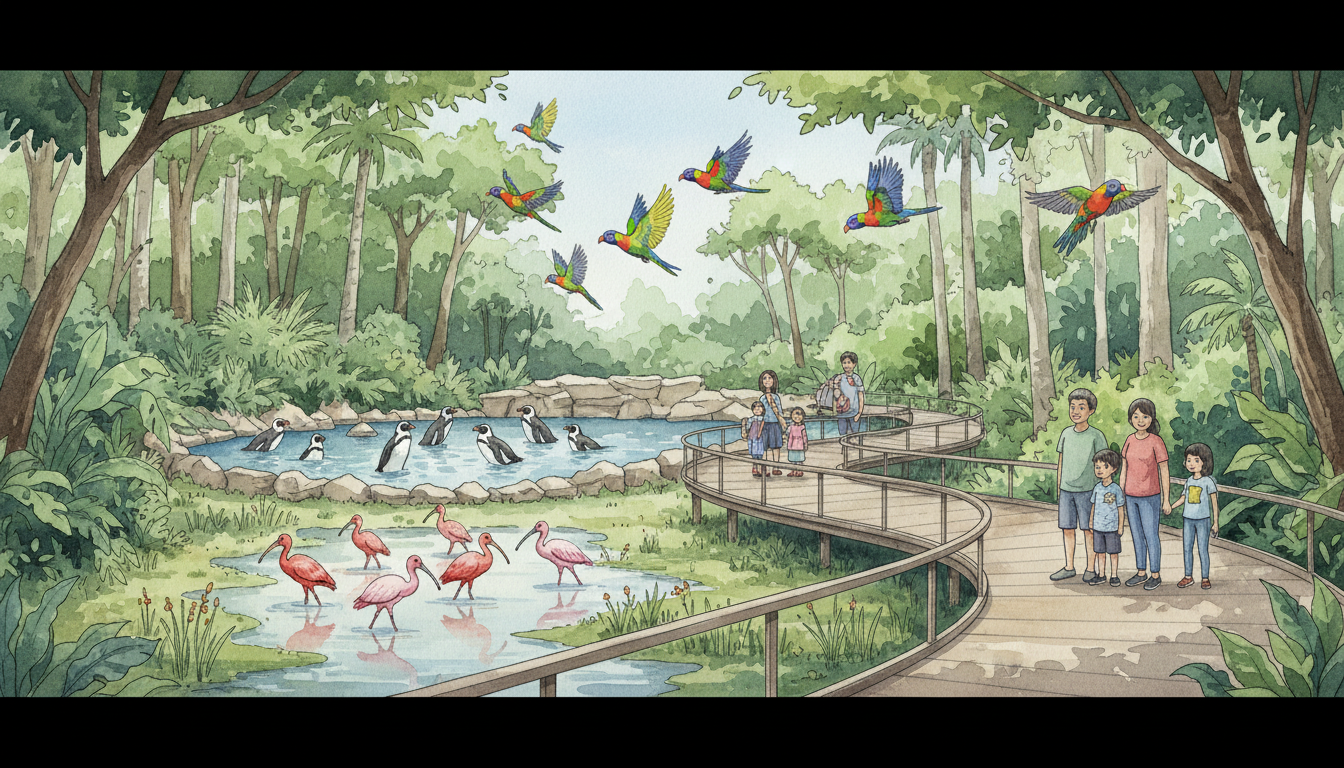
Featured image: Original eduKate editorial illustration of different birds and separately depicted habitats, not a photograph of one actual Bird Paradise aviary.
The lesson worth taking home
Bird Paradise can help you recognise how different bird species live, feed, move and depend on particular habitats. The careful work of keepers and conservation professionals makes that learning possible, but a managed aviary is not a replacement for protecting wild ecosystems. Choose a few species, observe without disturbance and leave able to explain one genuine relationship between a bird, its environment and responsible conservation.