
What will happen to civilisation when a maritime power depends on traders passing through important straits, but foreign rivals, changing markets and regional centres alter the routes? Srivijaya, often associated with Palembang in Sumatra, provides a particularly relevant lesson for Southeast Asia. From at least the seventh century CE, this polity became an influential network connecting the Malay world, India, China and Buddhist institutions.
Did you know? A famous naval raid in 1025 by the South Indian Chola ruler Rajendra I did not necessarily destroy Srivijaya overnight. A modern historical review notes that Srivijayan diplomacy and trade resumed, with missions to China after the raid. The attack was significant, but the long story of change cannot be reduced to one naval campaign.
This guide explores Srivijaya’s Old Malay inscriptions, its river-and-sea geography, the 1025 Chola campaign, later changes around Malayu-Jambi and the importance of maritime connections to the history of Singapore. It uses evidence and conditional futures, not a claim that modern countries will repeat an ancient collapse.
Srivijaya in one minute: essential answers
| Question | Quick answer |
|---|---|
| Where was Srivijaya? | Its early centres were associated with southern Sumatra, especially the Palembang region of present-day Indonesia. |
| When do we first see written evidence? | Seventh-century Old Malay inscriptions, including the Kedukan Bukit inscription dated to 683 CE. |
| Why was it influential? | It coordinated important maritime connections across the Straits of Malacca and Sunda and wider Indian Ocean–China trade. |
| Was it only a naval empire? | No. It also had inland relationships, local political structures, river connections and Buddhist cultural institutions. |
| What happened in 1025? | Rajendra Chola I launched an overseas military expedition against Srivijayan-linked centres, recorded triumphantly in Tamil inscriptions. |
| Did 1025 cause instant extinction? | No. Scholars describe continuing diplomatic, religious and commercial activity after the raid. |
| What happened later? | Power and trade relationships shifted among Sumatran and regional centres over subsequent centuries; exact sequences remain debated. |
The geography: rivers, straits and an international crossroads
Imagine merchants travelling between India and China before modern container ships, satellite navigation and refrigerated storage. Ships needed navigable passages, dependable shelter, water, supplies and relationships with local communities. Ports and river mouths provided places where overseas traffic connected with inland products and political networks.
Southern Sumatra offered access to rivers and maritime approaches near some of the busiest trade corridors in Southeast Asia. Coastal and riverine communities did not simply watch ships pass: they supplied goods and services and participated in the networks that made journeys possible.
A 2022 scholarly article, Srivijaya: Trade and Connectivity in the Pre-modern Malay World, examines how the polity’s importance was linked to a network of ports, rulers, merchants and maritime connections. Its evidence supports analysis of Srivijaya as more than one fixed territorial state.
A polity organised around maritime relationships may be resilient in ways different from a land empire. If one route becomes less valuable, alliances and commercial partnerships can shift. However, the same reliance on distant merchants exposes the polity to decisions made beyond its immediate territory.
Did you know? A stone inscription reveals a political world
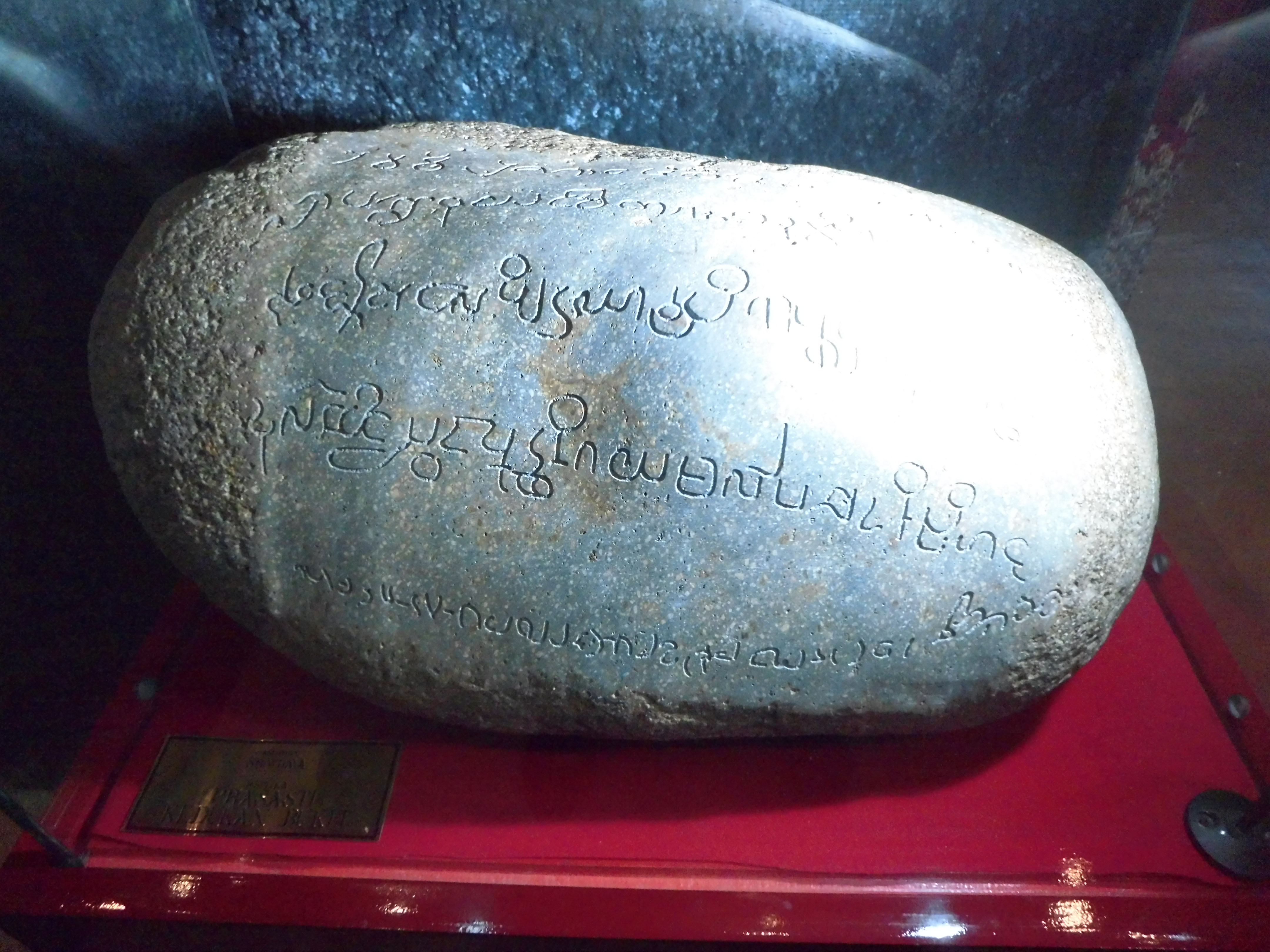
The Kedukan Bukit inscription is a seventh-century Old Malay text discovered near Palembang in 1920. It records a ruler’s successful undertaking, often described with the term siddhayatra, and is among the earliest important sources for Srivijaya’s political history.
The stone survives in the National Museum of Indonesia. A modern museum photograph shows the inscription itself, not a reconstruction of ships or a scene from the original journey.

Other surviving Old Malay inscriptions, including Talang Tuwo and Telaga Batu, provide clues about rulership, religious expression and political loyalty. The evidence is invaluable, but it is fragmentary. We do not possess a continuous series of court archives listing every port, tax, household or ruler over several centuries.
This is why a modern map showing Srivijaya as a solid block of territory should be read carefully. Its reach and control changed, and historians reconstruct the past from epigraphy, Chinese and Indian accounts, archaeology and later texts written for different purposes.
The most responsible question is not simply, ‘How much land did it own?’ It is, ‘Which people and places were connected through recognised relationships, and how did those connections change?’
Buddhist networks mattered alongside commercial ones
Srivijaya was associated with Buddhist learning and patronage, not only shipping. Merchants, monks and envoys travelled along overlapping regional and international circuits.
The review Drawing Srivijaya Out of the Past discusses Srivijayan rulers’ patronage of religious institutions and diplomatic offerings to powerful neighbours, including a monastery connected with Nalanda in India.
These networks could create prestige and relationships extending beyond immediate military control. A donation, embassy or temple connection might help rulers negotiate legitimacy and diplomatic access.
It would be simplistic to assume trade and religion were independent compartments. The same journeys carried goods, people, language, scholarship and political messages. The cultural life of the region cannot be reduced to the number of merchant vessels.
What really happened during the Chola expedition of 1025?
In 1025 CE, Rajendra Chola I’s forces conducted a major maritime campaign against Srivijayan-linked locations. Tamil inscriptions celebrate victories and the seizure of valuables and high-status captives. The attack belongs to a period in which South Indian, Sumatran and Chinese interests intersected.
Singapore’s National Library Board account of Sri Vijaya-Malayu notes the Chola assault and discusses its later memory in the Malay Annals. The article distinguishes literary traditions from a simple eyewitness chronology.
A 2024 review by Nayan Chanda recounts Tamil sources describing the Chola raid, but also draws attention to later contacts between Srivijaya and the Chinese court. In this account, the campaign’s longer-term consequences were more limited than the dramatic battle description might imply.
Why does that matter? Because a military victory is an event, whereas the collapse of an entire commercial and cultural network is a much larger claim. The first can be demonstrated from an inscription; the second requires later trade, settlement and political evidence.
A triumphant royal inscription may be accurate about a campaign and still exaggerate the scale of lasting control. Historians look for independent records and evidence from later decades rather than treating one celebratory text as a final verdict.
Did the maritime network recover after the raid?
Chanda’s account describes Chinese diplomatic records of continuing contacts, including a Srivijayan mission to China after the attack and later donations. This supports a picture of ongoing negotiation and commercial participation.
It does not prove that every community returned quickly to its old position or that there was no loss. Warfare could damage local livelihoods or shift advantages among rulers and merchants even if some diplomacy continued.
The interesting possibility is that Srivijaya adapted to pressure by recalibrating relationships with powerful neighbours rather than simply losing its ability to participate in trade.
For the modern reader, the lesson is about resilience through multiple connections. A trade network can be interrupted and still reorganise. Its survival depends on useful routes, partners, social institutions and the willingness of people to establish new arrangements.
The long transformation: Palembang and Malayu-Jambi
Over subsequent centuries, the geography of Malay political and commercial influence changed. Other Sumatran centres, including Malayu in the Jambi region, became increasingly important. Later developments included different Malay and Javanese political networks.
The NLB’s Sri Vijaya-Malayu account discusses historian O. W. Wolters’s view that Malayu-Jambi gained influence at Palembang’s expense during the period after the eleventh century. These are interpretations reconstructed from incomplete evidence, not a record of one day when the centre was officially transferred.
This shift is not adequately explained by the Chola expedition alone. Competition among regional centres, changes in routes, political alliances and evolving links with Chinese and Indian markets all deserve investigation.
A commercial hub may lose relative importance while river communities, cultural traditions and political networks continue in changed forms. The decline of an earlier political centre is different from the disappearance of Malay-speaking peoples.
Why this history matters to Singapore
Singapore’s location at the southern end of the Malay Peninsula made it part of wider maritime Southeast Asian histories. Later political and commercial centres around Temasek and Singapura existed in a changing world of Malay, Sumatran, Javanese and other connections.
The National Library Board discusses how the Malay Annals connected rulers, stories of origins and places such as Seguntang Hill in Palembang and Fort Canning in Singapore. These texts preserve valuable political ideas and later memory, but they should not be read as straightforward contemporary reports of the seventh or eleventh century.
The distinction is especially useful in school history. A legend about a ruler expresses how later communities explained legitimacy. An inscription records a different kind of evidence. Archaeological objects from Singapore give yet another perspective.
Connecting these forms of evidence shows how history is researched. We can understand regional links without claiming that one city, ship or dynasty explains all later Singapore history.
What does it mean for a trading civilisation to ‘collapse’?
Consider several possible measurements: lost naval authority, reduced access to customs revenues, diminished diplomatic standing, relocation of royal patrons or changed merchant preferences. They might not happen at the same time.
A port could remain populated even if major traders choose another harbour. Old Malay inscriptions might cease being produced in one location while languages and learning continue in different forms. A ruling dynasty could lose prestige without a universal breakdown of daily life.
This is why the word ‘collapse’ should not be used as though it describes every part of society with one number. Historians need to specify what changed, over which period, in which places and for whom.
Cause and effect: an ancient maritime network under pressure
- Geographical opportunity: a port connects riverine production and major sea routes.
- Commercial relationships: merchants value safe access, supplies, useful markets and predictable agreements.
- Political pressure: rivals or shifting alliances alter control of routes and the status of ruling groups.
- Response: courts, traders, seafaring communities and ports renegotiate relationships or change routes.
- Regional rebalancing: different centres gain or lose influence at different times.
- Cultural continuity: languages, religions, knowledge and family networks persist beyond one earlier political configuration.
None of these steps is inevitable. A military raid can cause serious losses without permanently destroying all trade; a new route can change commercial influence without ending a language or culture. The evidence matters more than a dramatic label.
Four possible futures when maritime routes change
Scenario 1: flexible regional cooperation
Hypothetical. Several modern ports share information and develop complementary logistics networks. Trade shifts, but essential food, medicine and industrial supplies continue moving through alternative routes. Some workers change roles, while public services remain reliable.
Scenario 2: sudden commercial disruption
Hypothetical. A security crisis temporarily interrupts one heavily used passage. Shipping schedules lengthen, insurance and freight costs rise, and dependent businesses struggle. Governments coordinate civilian supplies rather than treating every delayed cargo as an unavoidable national failure.
Scenario 3: one hub loses influence over decades
Hypothetical. New technology and production centres make another port more attractive. The former hub gradually diversifies into services, manufacturing, education and tourism. Its role changes without the erasure of its communities.
Scenario 4: commercial rivalry compounds political distrust
Hypothetical. Competing authorities impose inconsistent requirements and neglect shared infrastructure. Operators reduce investment and some trade moves elsewhere. The problem deepens because policy choices make an existing commercial shock more harmful.
The scenarios are not forecasts about a modern Southeast Asian state. They illustrate mechanisms that planners and readers can examine, using current evidence.
How to evaluate the future of a trade-dependent society
- Measure how much essential commerce depends on one strait, terminal or commercial partner.
- Identify shared dependencies hidden beneath apparently separate shipping routes.
- Protect the everyday needs of residents if revenue or transport reliability changes.
- Build realistic alternatives rather than assuming every port can replace every other port.
- Keep regional negotiations and public decisions transparent and accountable.
- Preserve historical records, languages and living cultural practices beyond one ruling institution.
- Study archaeology, inscriptions, written histories and oral traditions as different kinds of evidence.
A simple reading exercise: compare three sources
First examine the Kedukan Bukit inscription. What kind of statement would a ruler wish to record? Second read a Chinese account of trade or an embassy. What information did the foreign court choose to preserve? Third read a later Malay historical narrative. What political ideals or memories was its author trying to communicate?
All three sources matter, but their intentions differ. They should be compared rather than combined into a single uncritical story. This method is useful far beyond Srivijaya: it helps readers assess any dramatic historical or modern claim.
Frequently asked questions
Was Srivijaya based in Singapore?
Its earliest major centres were associated with southern Sumatra, particularly around Palembang. The wider Malay maritime world later included places connected with Singapore’s history, but the two should not be treated as identical political capitals.
Did the Cholas destroy Srivijaya in 1025?
The Chola campaign caused a major military shock, but later records show continuing Srivijayan diplomatic and commercial activity. Historians debate its long-term consequences.
Why do some histories describe Srivijaya as a maritime empire?
Its influence depended strongly on connections among ports, waterways, merchants and regional rulers, rather than only on a continuous inland landmass controlled in one way.
Was Srivijaya Buddhist?
Buddhist patronage and institutions were important in its history, alongside varied beliefs and communities across its wider network.
What happened to Srivijayan culture?
The earlier political order transformed, but Malay-speaking populations and Southeast Asian cultural traditions continued and evolved. A state’s loss of influence does not mean everyone vanished.
What is the modern lesson?
Maintain useful trade relationships and credible institutions, plan for changes in regional commerce and distinguish the fate of one ruling centre from the continuity of society.
Continue exploring civilisation
- When Indian Ocean Trade Shifts: Kilwa Kisiwani — an African maritime comparison.
- When Red Sea Trade Changes: Aksum — changing ports and political power.
- When Trade Networks Break: The Bronze Age Lesson — cascading network effects.
- Do Civilisations Collapse or Transform?.
- Civilisation | The Beginner’s Guide.
Sources and further reading
- National Library Board Singapore — Sri Vijaya-Malayu, regional history and later political memory.
- Nayan Chanda — Drawing Srivijaya Out of the Past, Global Asia (2024), historical book review and Chola campaign.
- Srivijaya: Trade and Connectivity in the Pre-modern Malay World, Journal of Urban Archaeology (2022).
- Kedukan Bukit Inscription — photograph by Gunawan Kartapranata, National Museum of Indonesia display, 2017, CC BY-SA 4.0.
Editorial note (25 October 2026): the cover photograph shows the seventh-century Kedukan Bukit inscription in a 2017 museum display, not the 1025 Chola naval campaign. Photographer Gunawan Kartapranata (Gunkarta), CC BY-SA 4.0. Historical assertions and hypothetical modern scenarios are distinguished.