
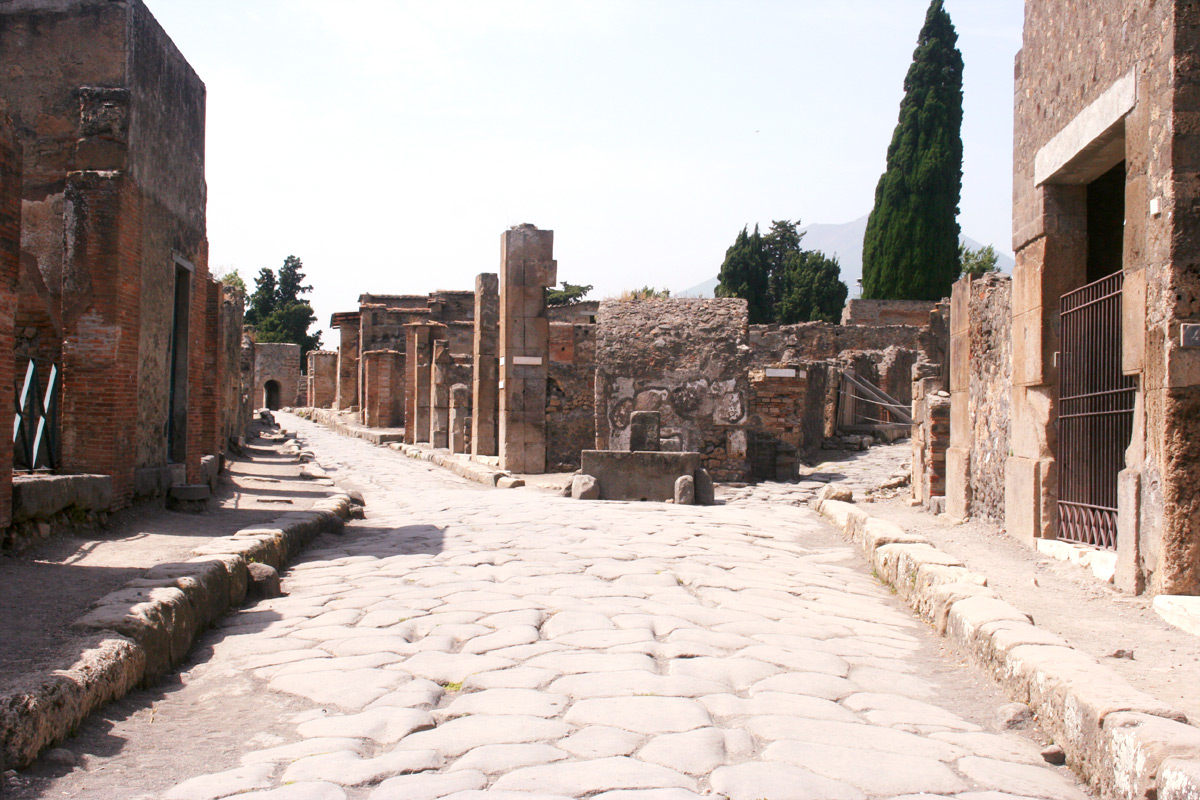
What will happen to civilisation when an entire city is buried in an extraordinary volcanic eruption? Pompeii gives us a famous but frequently misunderstood answer. Mount Vesuvius erupted in AD 79, destroying Pompeii, Herculaneum and nearby settlements around the Bay of Naples. Thousands of people faced deadly hazards, homes were buried and urban life was shattered. Yet the Roman Empire did not end, and people from the affected communities survived, moved and built lives elsewhere.
Did you know? Research published by Oxford University Press in 2025 and 2026 traces people who escaped the eruption through names, inscriptions and the communities in which they resettled. Separately, archaeological work reported in 2025 suggests that some people even lived among Pompeii’s ruined buildings after the catastrophe. An apparently silent city was not the complete ending of every human story.
The useful question for future civilisation is therefore not simply ‘Can a volcano destroy buildings?’ Of course it can. The harder questions concern warnings, evacuation, water and food, neighbours receiving displaced people, institutional response and the survival of knowledge after a city loses its physical centre. Historical evidence is presented here separately from conditional modern scenarios.
Pompeii, Vesuvius and civilisation: answers in one minute
| Question | Quick answer |
|---|---|
| When did Vesuvius erupt? | In AD 79. The exact day is debated in modern scholarship; the traditional August date is not the only interpretation. |
| What happened to Pompeii? | Pumice and ash accumulation followed by deadly volcanic currents buried and devastated the city. |
| What happened to Herculaneum? | The town was struck by hot pyroclastic surges and flows, leaving different deposits and preservation. |
| Did everyone die? | No. Some residents escaped; their later movements can be studied through inscriptions and other evidence. |
| Was the Roman Empire destroyed? | No. The disaster devastated particular communities, not the entire imperial political system. |
| Was Pompeii absolutely empty afterward? | Recent archaeology indicates some people lived among its ruins after AD 79, though not as a restored classical city. |
| What can modern cities learn? | Distinguish physical risk from social outcomes, improve hazard planning and protect displaced residents. |
Before the eruption: Pompeii was a working city, not a museum
It is easy to think of Pompeii as a collection of frozen streets, frescoes and statues. Before AD 79, it was a living Roman town with houses, shops, baths, streets, bakeries, religious spaces, markets and public institutions. People needed deliveries, employment and water, and their social lives crossed household and neighbourhood boundaries.
The UNESCO World Heritage Centre describes Pompeii as a substantial commercial town, Herculaneum as a smaller coastal settlement and the nearby villas of Torre Annunziata as evidence of wealthy Roman domestic life. The extraordinary archaeological preservation permits detailed research, but the material remains should not be mistaken for a representative census of all Romans.
For a family, the value of civilisation might have been the ability to buy bread, practise a trade, worship, attend public baths, work through an apprenticeship or rely on relatives. For administrators, civilisation involved roads, taxes, officials and the ability to organise wider resources. Those scales would behave differently during the catastrophe.
The physical town could be damaged beyond repair while family relationships, craft knowledge and commercial connections crossed into other places. That is why the human story needs to continue beyond the ruins.
Did you know? The landscape already contained clues
People near Vesuvius lived in an active volcanic landscape. A significant earthquake struck the region in AD 62 or 63, damaging buildings and requiring reconstruction. An earthquake alone cannot provide a precise prediction of a future eruption; many quakes do not lead to immediate volcanic disasters. Still, it is evidence that the physical environment was not uniformly stable.
Some houses were being renovated or repaired when the eruption occurred. Archaeologists can therefore study not only a city interrupted, but a city that was already changing. Ordinary people invest in repairs because they expect their homes, businesses and communities to continue.
A 2025 report on an excavated Roman construction site describes unfinished walls, building materials and tools that clarified ancient concrete-making methods. Discoveries like this are useful because they make Pompeii a source for understanding everyday work, rather than just a dramatic disaster location.
The lesson is not to blame ancient residents for lacking modern volcanology. They did not have today’s monitoring instruments, hazard maps or evacuation communications. Historical decisions must be interpreted within the knowledge and options people actually had.
What happened during the AD 79 eruption?
Explosive plume and falling pumice
The eruption produced an enormous column of volcanic material above Vesuvius. Falling pumice and ash accumulated, damaging roofs and making roads and shelter difficult to use. The weight of deposits can make a structure hazardous even before a fast-moving volcanic current reaches it.
The US Geological Survey volcanic glossary explains the Plinian eruption style and distinguishes pumice fall from flows and surges. This vocabulary matters: one eruption can create several hazards with different patterns, speeds and survival opportunities.
Hot pyroclastic currents
Later phases involved ground-hugging, hot mixtures of gas, rock fragments and ash. Pyroclastic currents can move extremely quickly and be fatal through heat, ash and other injuries. These are not ordinary winds or a thin layer of falling dust.
Pompeii and Herculaneum did not experience exactly the same sequence of deposits. UNESCO notes that Pompeii was largely buried by pumice and ash, while Herculaneum was engulfed by hot currents. A regional event must therefore be understood location by location.
When people had time, and when they did not
Some residents fled during earlier phases; others waited, sheltered or faced barriers to departure. Scholars cannot reconstruct the reasoning of every household. Some may have underestimated the danger, some lacked safe transport or help, and others were away from town before the eruption.
Historian Steven L. Tuck’s chapter on the eruptive events of AD 79 explains how conditions differed across settlements and how early departures offered some people opportunities to survive. That finding should not be translated into a promise that a modern evacuation will always succeed if someone leaves at the first sign of danger.
Why the exact eruption date is disputed
Readers often learn that the eruption began on 24 August AD 79. That traditional date derives from transmitted versions of a letter by Pliny the Younger. However, archaeologists have long debated autumn evidence, including inscriptions, clothing, crops and the textual history of the date.
The scholarly debate is not an argument that the eruption never happened. Its year, geological deposits and human consequences are well established. The narrower uncertainty concerns the calendar day and the relative strength of different indications.
Even official descriptions, such as the UNESCO property profile, retain the traditional date. The responsible way to write a quick guide is to use AD 79 for the event and acknowledge that the precise day remains disputed rather than presenting one date as unassailable.
Pliny’s eyewitness account and the limits of observation
Pliny the Younger described the eruption in letters that later became famous sources for Roman natural history and disaster narrative. His account from a different location is valuable for the plume, atmosphere and human reactions, but it was written afterward and does not document every street or minute in Pompeii.
A written account can capture fear, decision-making and events visible to the observer. Archaeological layers can show deposits, building damage and remains of victims. Geological analysis can identify different eruption phases. The strongest historical explanation compares these evidence types rather than making one text answer every question.
A writer’s dramatic imagery also needs interpretation. One can use a source to understand what witnesses noticed without copying its language as a literal measurement of cloud temperature or the number of people affected.
Did everyone die at Pompeii? No—and this changes the story
The ruins contain profoundly important evidence of people who died. But the survival of some people is also supported by research. A site preserving victims does not preserve every resident who successfully left, which creates a historical selection effect: the archaeological record gives us abundant evidence of those who remained, while many survivors are recorded elsewhere.
Tuck’s 2025 book Escape from Pompeii develops a systematic method for tracing former residents by combining names, inscriptions, civic affiliations and new settlement evidence. Its argument is that survival and migration involved a broader cross-section of the population than popular images of only rich escapees might suggest.
The September 2026 Oxford Handbook chapter presents further analysis of people resettling in nearby Campanian towns, including Naples, Puteoli and Cumae. Some refugees chose destinations shaped by pre-existing commercial and social networks, while official support came later than some initial moves.
This is an important reminder that the survival of civilisation is often carried by individual relationships before a government can coordinate large-scale action. Relatives, trading partners and religious communities may provide the first practical bridge to a new place.
Where did the survivors go?
Naples and neighbouring communities
People could seek established urban centres away from the worst effects of the eruption. Naples had labour markets, housing and social relationships capable of accommodating some newcomers. But resettlement is rarely effortless; receiving communities also need food, space, work and functioning institutions.
Tuck’s chapter on Naples examines inscriptional and cultural evidence for refugee communities, including signs that people carried customs and older languages into new settings. The arrival of people can change both the newcomers and the city receiving them.
Puteoli, Cumae and Misenum
Research also identifies likely resettlement in other cities around the Bay of Naples. The places offered different combinations of port activity, employment, housing and established personal ties. It is not reasonable to assume that every survivor moved to one official reception centre.
The Oxford chapter on Misenum investigates social and religious organisations as well as post-eruption public investment. This reveals that rebuilding lives involves cultural belonging and practical infrastructure together.
What evidence does not tell us
Names repeated across inscriptions are not automatically evidence of the same person. Researchers need chronology, family associations, civic details and other support. Not all survivors left traceable inscriptions, and not all residents could afford a memorial or official record.
The purpose of historical scholarship is to build a defensible picture from incomplete traces. The evidence supports significant survival and relocation; it does not give us an exact address for every refugee.
A surprising 2025 discovery: people later lived among the ruins
Recent excavations and reassessment of Pompeii’s Insula Meridionalis revealed signs of occupation after AD 79. The evidence includes changes to surviving rooms and facilities apparently used by later inhabitants. The settlement did not resemble a full restoration of Pompeii’s former Roman urban services.
The Archaeological Park of Pompeii published an 2025 excavation report on post-eruption reoccupation. The argument is supported by the archaeological context, but the size and composition of the later population remain uncertain.
It is tempting to call the settlement ‘Pompeii reborn’. That would be misleading if it suggested the ancient civic infrastructure, wealth and administration had simply returned. Some people may have used the remaining structures in precarious conditions over a long period.
This shows how the visible state of ruins can hide subsequent histories. Archaeologists who once concentrated on the remarkable AD 79 layer may have overlooked or removed some signs of later occupation. The methods and priorities of research influence what stories can be recovered.
A buried town is not the end of the Roman Empire
In AD 79, the wider Roman Empire retained its armies, provincial administrations, urban systems, roads and institutions. Other cities around Italy and the Mediterranean continued their ordinary activities. Pompeii was devastated, but the Roman political system did not cease.
This should not minimise the event. A disaster can be catastrophic for one place while a broader state retains capacity. Different scales of analysis are essential: an individual household, an ancient town, a region and an empire can all have different outcomes.
The survival of a wider network can become a source of recovery. Roads, neighbouring markets, urban communities and imperial resources made some new opportunities possible for displaced residents. Whether those resources reached vulnerable people fairly is a further question.
How a natural hazard becomes a civilisational crisis
- Physical shock: volcanic deposits, hot currents and infrastructure damage make some places unsafe or unusable.
- Household exposure: location, shelter, health, mobility and resources shape the options people can use.
- Movement: some residents escape early, others cannot, and many search for support through wider social networks.
- Regional reception: surrounding towns must provide work, shelter, food and space without ignoring their existing residents.
- Institutional response: authorities coordinate repairs, public works and long-term resettlement at different speeds.
- Cultural continuity: languages, professions, family relationships and community practices move beyond damaged buildings.
The sequence is a framework for thinking, not a reconstructed diary of all Pompeii’s residents. At every stage, uncertainty and unequal access matter.
What the evidence tells us about inequality
A person with money, relatives elsewhere and access to transport may have different possibilities from someone caring for vulnerable relatives or working with limited resources. The archaeological record does not give us a complete social census of everyone who fled.
Research has found signs that people of different social positions survived and resettled. Tuck’s study of refugee demographics challenges the assumption that escape was confined to elite households. Nevertheless, survival and later integration may have been uneven.
For modern planners, the practical lesson is to protect access for those who need assistance. Hazard communication that only reaches confident, mobile adults is not enough. Children, caregivers, disabled people and those without private transport face different constraints.
Did you know? Rebuilding a life is not the same as rebuilding a house
Someone escaping a disaster may need shelter immediately. But longer-term stability also requires income, schooling, health care, family contact, legal records and the possibility of participating in a new community.
A receiving city can provide opportunities while also creating pressure on public services. Thinking only in terms of how many tents or rooms are available can leave vital needs unmet. A city becomes a place to live through institutions and relationships, not simply through walls.
The Oxford research on Pompeii’s refugees discusses integration, intermarriage, identity and social organisations as well as infrastructure. This creates a wider understanding of resilience: preserving agency and connection among those affected, not merely counting buildings restored.
An ancient comparison with modern volcano monitoring
Modern volcanology uses seismic measurements, gas chemistry, ground deformation and other observations to assess unrest at active volcanoes. These tools provide information unavailable to Pompeii’s residents. They do not make every eruption predictable in exact timing or intensity.
The USGS volcano hazards glossary explains different eruption and hazard types. Public decisions also need local maps, accessible messages and practical plans. A scientific warning is only useful if it becomes understandable action at the right place and time.
Modern cities have interconnected power, communications, transport and hospital systems. A volcanic crisis can therefore produce secondary outages unlike those of AD 79. The transferable lesson is about how hazards interact with essential services, not that modern Naples is destined to become Pompeii.
Four conditional futures for a volcano-exposed region
Scenario 1: early decisions save many lives
Hypothetical. Volcanic monitoring detects concerning changes and scientists explain uncertainty clearly. Authorities prepare accessible, proportionate measures. People have transport and suitable assistance, while receiving communities are resourced for temporary relocation. The eruption still causes damage, but many avoid the most dangerous areas.
This outcome depends on science, trust, transport, facilities and realistic public coordination. None can simply be assumed. It does not mean that a particular eruption will occur or that every warning requires immediate wholesale evacuation.
Scenario 2: information is available but options are unequal
Hypothetical. Alerts reach most households, but some people cannot leave easily because they lack money, mobility or assistance. Hospitals and carers also need special arrangements. Overall evacuation statistics may look strong while a smaller set of residents faces serious danger.
The key question becomes whose needs were recognised in advance. A plan is not complete because it describes what an able-bodied person with a car should do.
Scenario 3: physical destruction leads to long resettlement
Hypothetical. A severe eruption leaves several neighbourhoods unusable for years. Households rebuild livelihoods across a wider region while preserving family and community relationships. Some return when conditions allow; others create permanent lives elsewhere.
This is neither the disappearance of an entire culture nor a painless transition. Protection of records, schools, employment access and cultural sites can determine how much opportunity remains.
Scenario 4: secondary failures extend the crisis
Hypothetical. Ash and damage interrupt roads, power and water treatment. Food deliveries and medical services are delayed just as many residents require support. A geological event becomes a longer humanitarian challenge because several infrastructure systems fail together.
The lesson is to plan for interacting failures and to keep essential services accessible, not to rely upon a single dramatic forecast.
What should societies measure before the next disaster?
- Risk knowledge: updated, locally meaningful maps and credible hazard explanations.
- Accessible warning: information in usable languages and formats, including for people with disabilities.
- Mobility: practical ways for children, carers and people without vehicles to reach appropriate assistance.
- Essential services: protected water, communications, electricity and critical health facilities.
- Reception capacity: housing, schooling, health care and employment for displaced residents.
- Records and identity: ways to preserve documents, qualifications and cultural material without exposing private information.
- Recovery accountability: measures of who actually receives help, not only what was announced.
A small thought experiment for readers
Imagine one coastal region where a volcano threatens three towns. In Town A, people have several routes out, accessible transport and friends in another city. Town B relies on one road. Town C contains a large hospital and many older residents. The same geological warning does not create identical choices.
Ask which people need support first, what institutions must remain operational and which neighbouring communities could help. Then add the possibility that roads or power fail. The goal is not to design a prediction from an ancient event, but to see why resilience is produced by several cooperating systems.
For Pompeii, the same approach helps us interpret escape and resettlement without blaming those who died or romanticising the suffering of survivors.
The hidden costs of a disaster that a preserved ruin cannot show
We often measure volcanic events by the thickness of their deposits, the number of excavated buildings or the number of victims recovered. Those observations are essential, but they cannot measure every consequence for those who survived. A child might lose a parent and the family’s only source of income; a trader might retain skills but lose customers, tools and suppliers; an enslaved person or recently freed individual might face severe limits on where and how they could live.
These human effects can continue long after the volcanic hazard has passed. The receiving town may need more housing and public services. People may wish to live near relatives or occupations familiar to them, but affordable opportunities are not guaranteed. A disaster can therefore alter the economic and cultural geography of an entire region without eliminating its wider civilisation.
Tuck’s inscription-based research is particularly valuable because it asks what happened after people crossed the line between the place of catastrophe and the next stage of their lives. The answer is not one moment of heroic escape. It is an extended process of community formation, work and adaptation.
Why an archaeological silence is not evidence of no survivors
Buried cities are extraordinary archives because they preserve material from a narrow moment. However, the very features that make Pompeii famous may also produce an incomplete historical impression. A person who left with belongings or later moved to Naples did not leave a body in Pompeii for archaeologists to recover. The absence of that person from a particular excavation is not evidence that the person died.
Historians use independent evidence—later inscriptions, names, settlement patterns and public projects—to ask where people travelled. Each identification needs caution: two similar names do not automatically belong to the same family. The method is stronger when chronological and geographical details converge. This is why newer research can change an older popular narrative even though the eruption itself is not in doubt.
What would a humane recovery need to preserve?
More than property and physical shelter
Shelter is urgent, but life also depends on contact with family, earning an income, accessing health care, communicating in familiar languages and maintaining community relationships. Public authorities can help by keeping essential services workable and ensuring assistance reaches those with limited means or mobility.
An impressive reconstruction that restores a civic centre but excludes poorer residents would not represent complete recovery. Similarly, a community that welcomes people and preserves their skills may sustain important aspects of civilisation even without rebuilding every destroyed stone street.
The right to a realistic choice
Some survivors may wish to return to a familiar place; others may need a secure home elsewhere. Neither preference should be romanticised or assumed possible under all conditions. Responsible planning uses current hazard evidence, protects human dignity and recognises that recovery decisions can produce different burdens for different households.
Where the historical comparison must stop
The Roman Empire had no modern volcanic monitoring agency, emergency broadcasting system or universal public health network. It also had social hierarchies, including slavery, that differ from the rights and obligations of many modern societies. Using Pompeii as an exact operating manual would ignore those differences.
The useful comparison is narrower: large hazards interact with social networks, access to transport, everyday livelihoods and regional institutions. Recognising the limits of analogy allows history to make modern preparedness more precise rather than more frightening.
Frequently asked questions about Pompeii and civilisational survival
Did everyone in Pompeii die in AD 79?
No. The town was devastated and many people died, but researchers have identified evidence of survivors who resettled in neighbouring cities. The exact numbers are uncertain.
Did people return after the eruption?
Recent research indicates some post-79 occupation among the ruins, but this did not constitute an immediate return to the former Roman urban system.
Was the eruption on 24 August AD 79?
That is a traditional date associated with a version of Pliny the Younger’s account. Other archaeological and textual evidence has prompted debate about an autumn date, so AD 79 is the secure general dating.
What killed people at Pompeii?
Different hazards occurred during the eruption, including ash and pumice accumulation, building collapse and hot pyroclastic currents. The cause of death for individual victims is not identical in every case.
Why is Herculaneum preserved differently?
It was buried under different volcanic deposits, including hot surges and flows, while Pompeii accumulated extensive pumice and ash. The burial conditions influenced what survived.
Did Rome itself fall because of Vesuvius?
No. The Roman Empire remained in operation after AD 79. This was a severe regional disaster, not the end of Roman political or cultural life.
How did survivors rebuild?
Many resettled in neighbouring towns where social ties, trade and services provided some opportunities. Inscriptions and civic evidence help historians trace elements of their later lives.
What can a modern city learn from this event?
Plan for multiple hazards, inclusive evacuation support and long-term recovery. Protect people and knowledge even when a settlement becomes physically unusable.
Continue exploring the Civilisation futures library
- When Volcanoes Disrupt Food: Tambora and 1816 — eruption effects at very different geographic scales.
- When Earthquakes Challenge Institutions: Lisbon 1755 — engineering and disaster governance.
- How Societies Rebuild After Empires Fall — the difference between communities and political centres.
- Do Civilisations Collapse or Transform? — the fundamental framework.
- Civilisation | The Beginner’s Guide.
More in this batch: Civilisation, cause and effect
Sources and further reading
- UNESCO World Heritage Centre — Archaeological Areas of Pompeii, Herculaneum and Torre Annunziata.
- US Geological Survey — Volcano Hazards Program Glossary (Plinian eruptions, pumice fall and pyroclastic flows).
- Steven L. Tuck, Escape from Pompeii: The Great Eruption of Mount Vesuvius and Its Survivors, Oxford University Press (online 2025; print 2026).
- Steven L. Tuck — Refugees from the Eruption of 79 CE, Oxford Handbook of Pompeii and Its Environs, 17 September 2026.
- Steven L. Tuck — Naples (evidence of refugee settlement and social continuity).
- Pompeii Archaeological Park, E-Journal degli Scavi di Pompei — Post-79 reoccupation in Insula Meridionalis (2025).
- Pompeii street photograph by Alago, Wikimedia Commons, public-domain dedication.

Reviewed 25 October 2026. Historical interpretations, provisional archaeological findings and conditional modern scenarios have been distinguished. The featured image is a modern archaeological photograph of Pompeii by Alago, public domain, not a photograph of the AD 79 eruption. This guide does not offer location-specific emergency instructions.