
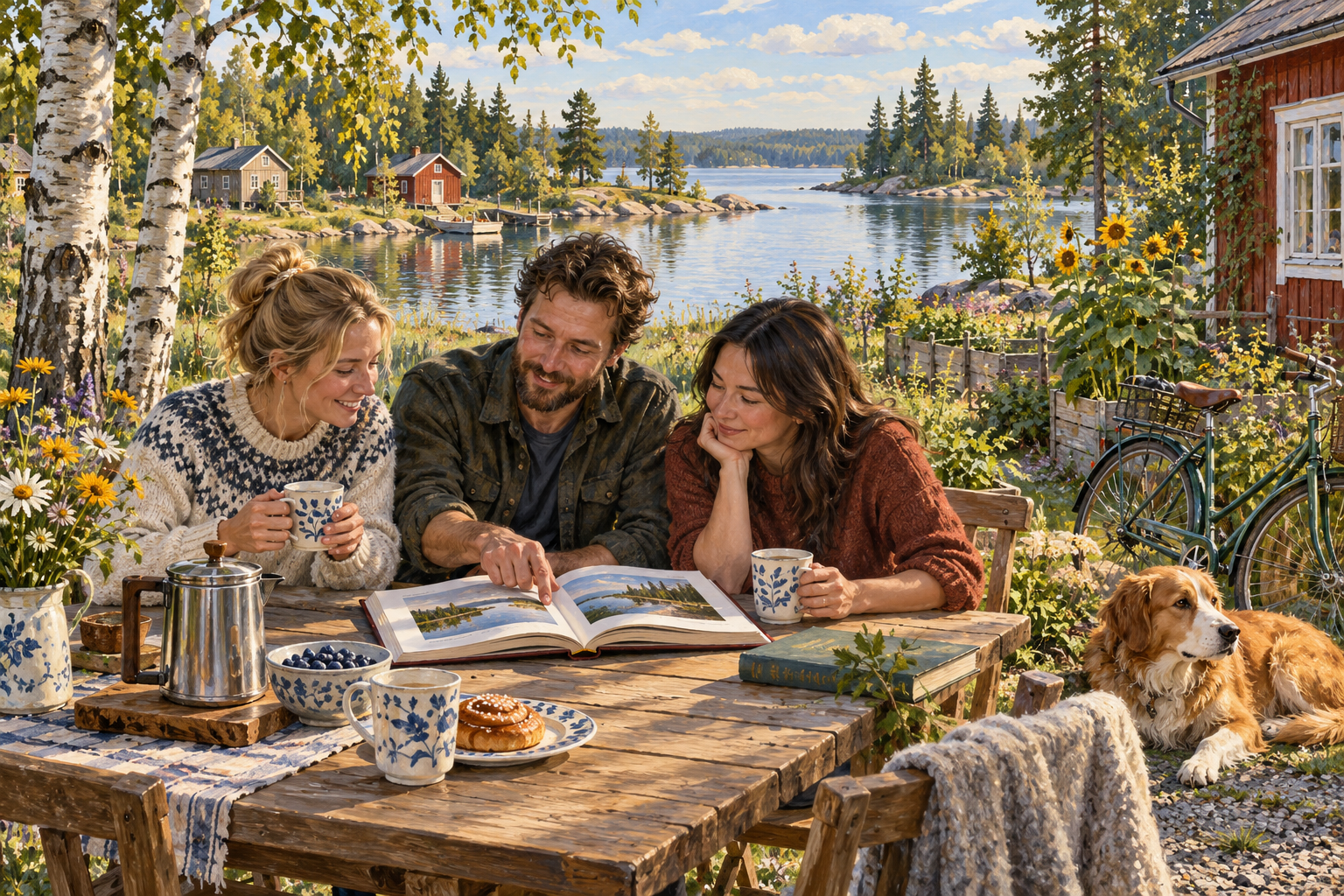
Finland Children Vocabulary | Words for Character and Nation Building. Did you know sauna culture was inscribed by UNESCO in 2020, a Finnish fiddle tradition has been passed down for centuries, five Nordic countries share boatbuilding heritage, and the coast of Finland is still rising after the weight of ancient ice disappeared? Finland gives children words for safe cultural understanding, genuine craftsmanship, listening and evidence-based science.
This independent English-learning resource is for international children about eight to twelve, supported by caregivers and teachers. It is not an official Finnish school syllabus, an invitation to heat saunas, build working boats, collect protected rocks or navigate island waters. All sample pupils and class events are fictional, and no Finnish person is required to follow the same traditions as every other resident.
Country facts and dates: UNESCO inscribed Sauna Culture in Finland in 2020, Kaustinen fiddle playing in 2021, and the joint Nordic clinker boat traditions in 2021 for Finland, Denmark, Iceland, Norway and Sweden. The Finnish Kvarken Archipelago became part of a shared natural World Heritage property with Sweden’s High Coast through a 2006 extension. These formal recognition dates are different from the age of the practices and the ancient geological processes.
Quick answer: twenty useful words, four grounded themes and practical learning
| Resource | What the student can do | What the student should avoid |
|---|---|---|
| 20 English vocabulary words | Explain terms and correct misleading uses | Assume a national culture is identical for everyone |
| Four substantive chapters | Identify named places, people, sources and evidence | Treat a photo as an entire history or scientific measurement |
| One fictional story and six worked checks | Spot and repair mistakes with accurate reasons | Present invented classroom claims as real events |
| A week of spaced practice | Read, speak, compare, write and transfer meanings | Take on dangerous adult work in a class exercise |
Jump to vocabulary bank · four chapters · fictional story · worked checks · seven-day plan · guidance for adults · FAQ · sources and linked learning.
20 children’s English vocabulary words with definitions and original examples
Each definition names an important distinction. These example sentences are newly written teaching material, not quotations from actual pupils.
1. Sauna culture: löyly, skilled preparation and personal boundaries
| Word | Meaning and boundary against misconception | Original example sentence |
|---|---|---|
| sauna | A space used for a particular heated bathing tradition; not a medical treatment prescribed for everyone. | The class learned why sauna is a cultural term. |
| löyly | Finnish term associated with steam or heat experience produced as water reaches heated sauna stones; not an ordinary drink. | UNESCO describes löyly in the Finnish sauna context. |
| steam | Water vapour and, in visible clouds, condensed tiny droplets; not the same as smoke from burning fuel. | The teacher distinguished steam from smoke. |
| practitioner | Someone experienced in carrying out and transmitting a cultural practice; not any visitor who has watched once. | A practitioner explained the tradition in a documented account. |
| consent | Freely agreed participation or permission for a specific action; not a general obligation to follow a custom. | The pupil respected a classmate’s consent. |
2. Kaustinen fiddle music: rhythmic listening and creative transmission
| Word | Meaning and boundary against misconception | Original example sentence |
|---|---|---|
| Kaustinen | A Finnish community associated with a distinctive folk-fiddle tradition; not every place that has a violin. | The map marked Kaustinen in western Finland. |
| fiddle | A violin used particularly in folk or related music; not the name of a piano. | The melody was played on a fiddle. |
| syncopation | Rhythmic emphasis in less-expected positions; not simply louder sound. | An original clap pattern illustrated syncopation. |
| repertoire | The pieces or tunes that a musician knows and can perform; not one isolated sound. | The fiddler added a tune to the repertoire. |
| transmission | Passing skills and knowledge through people over time; not merely storing an audio recording. | Guided listening supports transmission. |
3. Clinker boats: overlapping planks and shared Nordic knowledge
| Word | Meaning and boundary against misconception | Original example sentence |
|---|---|---|
| clinker-built | A boatbuilding technique with overlapping wooden planks fastened together; not one solid plastic shell. | The historical boat was clinker-built. |
| plank | A long flat piece of wood shaped for a use such as a boat hull; not a whole vessel. | The craftsperson shaped a plank. |
| keel | A main lengthwise structural part of many boat hulls; not an ordinary rope. | The diagram showed the keel beneath the planks. |
| rivet | A fastener that can join pieces of material; not simply a round painted dot. | Rivets joined some overlapping planks. |
| apprenticeship | Learning skilled work from experienced makers with guidance; not proof a beginner can work alone. | Boatbuilding skills can pass through apprenticeship. |
4. Kvarken Archipelago: glacial ridges and continuous land uplift
| Word | Meaning and boundary against misconception | Original example sentence |
|---|---|---|
| Kvarken Archipelago | A Finnish coastal archipelago sharing UNESCO World Heritage status with Sweden’s High Coast; not all lakes in Finland. | The map located Kvarken in the Gulf of Bothnia. |
| moraine | Glacially deposited debris or ridge formations; not a modern wall built by farmers. | The source describes moraine ridges in Kvarken. |
| land uplift | An increase in the height of land relative to sea level, here due to post-glacial processes; not a person lifting rocks. | Land uplift slowly changes parts of the coast. |
| isostatic rebound | The crust’s long-term adjustment after a heavy ice sheet loses its weight; not a bouncing toy. | Isostatic rebound explains the changing coastline. |
| monitoring | Repeated comparable observations or measurements; not a guess from one image. | Monitoring is needed to study the rate of uplift. |
Four learning chapters: sources, concepts, critical questions and safe practice
Each chapter connects five terms to specific evidence and distinguishes a tempting overstatement from what the source establishes. Classroom activities stay with safe paper or conversation, not physical imitation of risky heritage work.
1. Sauna culture in Finland involves community choices, not compulsory heat exposure
Five focus words: sauna · löyly · steam · practitioner · consent.
UNESCO inscribed sauna culture in Finland on its intangible-heritage list in 2020. The source describes a practice found in homes and public places and connected with different personal and community meanings. It also recognises that saunas take several forms. A child should not interpret the listing as a law requiring every Finnish person to visit a sauna or believe the same things about it. Cultural recognition and individual participation are different categories.
The term löyly is especially important to the Finnish sauna description. UNESCO associates it with the experience of steam or heat when water is poured onto heated stones. This is not an instruction to a child to operate a sauna heater or handle boiling water. The word can be explained through language and an authoritative description without physically reproducing its hazardous context.
Steam should be distinguished from smoke. Water can change to vapour when heated; smoke involves particles and gases generated through combustion. Some Finnish sauna traditions use wood-fired systems, while other saunas rely on electricity or different methods. A photograph of a wooden room cannot establish its heater type, ventilation, temperature or safety. The actual operating conditions are technical issues outside an English vocabulary glossary.
UNESCO describes several forms of sauna and notes that practitioners value cleanliness, relaxation and social relationships. These are cultural and personal meanings, not a claim that a sauna is a universally appropriate medical treatment. Health circumstances vary. Children must never be told to enter hot spaces alone, remain for fixed periods or test exposure to smoke or heat to earn a good grade. A teacher can respect a practice while declining to turn it into a dangerous activity.
A practitioner is someone with actual experience and knowledge of a tradition. Families, clubs and other groups may pass on knowledge about sauna etiquette, materials and meanings. Watching one short video does not make a pupil competent to provide safety advice. The appropriate lesson is that some knowledge is best learned with trained adults, and a public cultural description has limits.
Consent is a practical character term here. People have different privacy preferences and comfort levels, especially around bathing traditions. A child should never be required to describe their family’s private practices, participate in an unfamiliar activity or permit photographs simply to prove a cultural identity. A general classroom exercise can ask whether a friend agrees to have an original drawing displayed, illustrating consent without imitating sauna rituals.
The date 2020 is the year of UNESCO inscription, not the year saunas were invented in Finland. A child might see a headline ‘Sauna joined UNESCO in 2020’ and misread this as the origin of sauna use. A simple timeline separates a longstanding cultural practice from modern formal recognition. This is the same distinction pupils learn when comparing archaeological sites and their World Heritage inscription dates.
Imagine a school poster stating ‘UNESCO invented saunas in 2020 and every child should heat stones for a science experiment’. An informed class edits it to say that UNESCO recognised an existing Finnish practice and its use requires proper adult supervision and individual choice. The second sentence is both more accurate and safer. An exaggerated heritage claim is not made better simply by sounding enthusiastic.
A safe paper-only task can place vocabulary words into two columns. One column contains sauna, löyly and practitioner as cultural terms; the other contains safety, permission and consent as boundaries. Pupils explain why understanding the first column does not give a child the authority to prescribe actions in the second. This approach builds logical distinctions without physical risk.
The culture also provides a lesson about different people participating in different ways. Some Finnish residents may value the tradition deeply, others use it occasionally and still others may not participate. None of these choices invalidates the factual UNESCO listing. A writer should separate the broad description of a practice from an invented account of one anonymous family’s preferences.
It is tempting to add claims about special health benefits because saunas are often discussed in wellbeing articles. Yet the UNESCO heritage listing describes culture, not a clinical trial. Medical benefits, risks or suitability for an individual would require a different kind of source and professional guidance. Children can practise source literacy by identifying which question a heritage page cannot answer.
The final useful sentence is: ‘Finnish sauna culture is an older living practice recognised by UNESCO in 2020, with forms such as löyly and knowledge carried by practitioners, while participation and safety require suitable personal choice and expert care’. The sentence is precise and respects both culture and limits.
Claim to correct: Misleading: ‘Every Finnish child must use a sauna and its heritage listing guarantees heat exposure is safe.’ Repair: ‘UNESCO describes a cultural practice, while individual consent and safety require separate judgement.’
Safe transfer activity: Make a safe paper glossary sorting cultural terms from safety responsibilities. Do not use heaters, steam rooms or hot stones.
2. Kaustinen fiddle playing shows how rhythmic skill develops through listening
Five focus words: Kaustinen · fiddle · syncopation · repertoire · transmission.
UNESCO inscribed Kaustinen fiddle playing and related practices and expressions in 2021. Kaustinen is a particular Finnish musical community, not another word for all of Finland’s arts. The source describes a tradition maintained for centuries, with the fiddle or violin often the main melodic instrument. The recognition date is recent, but the practice itself existed long before it appeared on UNESCO’s list. A good country guide uses the right time scale.
The word fiddle generally refers to a violin used in folk and related music settings. A pupil may see an image of a violin and correctly identify its shape, but a photograph alone cannot establish which tune was played or whether it came from Kaustinen. A programme note or recording attribution is needed. A general instrument and a particular regional style are different levels of description.
UNESCO emphasises the distinctive rhythm of the Kaustinen practice, including pronounced accents and syncopation. Syncopation is a pattern of emphasis that occurs where a listener may not expect the stress. It is not the same as playing faster, louder or more aggressively. Children can understand the general concept with an original clap or written rhythm, without claiming that their pattern is a traditional Kaustinen tune.
A repertoire is the collection of tunes and musical skills a performer can draw upon. UNESCO describes a large body of music in the area. A professional, a keen amateur and a beginner may know different numbers of tunes. The fact that music is locally important does not mean every inhabitant performs it or has memorised the whole repertoire. A cultural practice can be significant to listeners as well as to players.
The source describes learning by ear as important. That means musicians listen carefully, remember patterns and receive feedback rather than depending only on a printed score. A child who watches one video has heard an example, not completed years of musical training. The ability to improvise or vary elements during a performance can depend on extensive practice and attention to other musicians. Skilled flexibility is not the same as randomness.
Transmission is how knowledge passes to learners. Families, community groups, lessons, festivals and jam sessions can contribute to keeping the music alive. The Kaustinen Folk Music Festival is one public setting, but it does not represent every private performance. Children should not use one festival photograph as evidence of the musical preferences or private beliefs of every Finnish resident.
A musical group may have several contributors. One musician carries the main melody, others accompany or provide rhythmic support, and dancers respond to the music. An accurate concert caption can name the participating group, performer, tune and source when this information is available. If a video uploader does not identify the composer or artist, do not invent those details. Cultural appreciation is strengthened by honest attribution.
Imagine a fictional classroom poster reading ‘UNESCO invented Finland’s fiddle music in 2021 and syncopation means playing very loudly’. The source checker corrects it to say that UNESCO recognised a longstanding Kaustinen tradition with particular rhythmic features. This example demonstrates why a sentence can become misleading even when it uses the right country and instrument. Dates and definitions matter.
A class can make a four-beat written pattern, then draw a symbol above an unexpected beat to represent a changed accent. Ask learners to explain which parts are invented for English study and which are drawn from UNESCO’s explanation of the real tradition. The teacher should never label the invented pattern an authentic Kaustinen composition. The concept can be understood without cultural impersonation.
There is also a social lesson: different people may contribute different parts while listening to one another. In a school group, one learner might write the source notes and another read the example aloud. Their tasks are not identical, yet they can produce a coherent presentation. This is a small analogy for cooperation, not a claim that a school exercise recreates folk heritage.
Music can be powerful in personal identity, but the word identity must be used carefully. UNESCO says that many people in the region value the tradition even without performing. That is not proof that every resident feels the same way, or that pupils elsewhere must prefer one style of music. Individuals are entitled to varied tastes and backgrounds. Source-backed language leaves room for those differences.
Finish by saying: ‘Kaustinen has a UNESCO-recognised fiddle tradition with rhythmic features, a learned repertoire and knowledge transmitted by musicians and community groups’. A pupil who can explain all five terms has a useful description rather than a slogan that ‘Finland is musical’.
Claim to correct: Misleading: ‘All Finns perform Kaustinen fiddle music, invented in 2021, and syncopation is simply loudness.’ Repair: ‘A longstanding regional tradition was recognised in 2021, while rhythm and volume are different concepts.’
Safe transfer activity: Write an original four-beat rhythmic pattern on paper and explain syncopation as a general idea, not an authentic Kaustinen performance.
3. Nordic clinker boat traditions belong to five states and experienced builders
Five focus words: clinker-built · plank · keel · rivet · apprenticeship.
UNESCO inscribed Nordic clinker boat traditions in 2021 as shared intangible heritage involving Denmark, Finland, Iceland, Norway and Sweden. This matters for a Finland country article: recognition of Finnish makers should not erase other Nordic communities. The listing concerns a longstanding craft and associated knowledge, not a boat invented in 2021. A pupil should distinguish the age of a practice from the much later institutional decision to recognise it.
The word clinker-built describes a construction technique in which long wooden planks overlap along the sides of a vessel. Builders shape the parts and attach them through suitable fastening methods. This is different from making one smooth plastic hull in a mould or loosely stacking boards. A photograph may show overlapping lines, but cannot tell an inexperienced viewer how strong the structure is or whether the boat is safe to sail.
A plank is a board of timber shaped for a role. A keel is a lengthwise supporting component at the base of many boat hulls. A rivet is a kind of fastening used to join material. These are separate terms; the keel is not the same as the finished hull, and a rivet is not simply any painted dot on a side panel. Each word has a technical meaning that should be explained before a learner copies a diagram.
UNESCO’s source notes variations in fastening and material choices across Nordic traditions. Some boats use rivets, wooden pegs or cord according to design and practice. A child should not assume that every boat built in Finland is clinker-built or that a particular museum vessel uses the same fittings as one made elsewhere. The specific boat’s maker and structural record are necessary for exact claims.
Apprenticeship is learning through experienced guidance. Practical boatbuilding can require years of training and knowledge of wood, tools and maritime demands. A child who reads a vocabulary article has learnt English words but not the skill to build or operate a seaworthy vessel. Sawing timber, using strong fasteners and entering open water are not appropriate unsupervised classroom activities.
Traditional boats historically supported fishing, transport and social life in different Nordic coastal and island communities. Modern uses may differ. A heritage listing does not mean every resident of Finland travels in an old wooden boat every day or that all boatbuilding workers have identical lives. A national statement should name the particular practice and the people whose knowledge keeps it alive.
An appealing museum exhibit may show the finished boat suspended above visitors. The image can demonstrate shape, but it may hide the person who chose the wood, fitted parts or maintained the vessel. An honest caption should credit the maker or workshop where known. If a museum identifies only the collection and date, do not invent a particular craftsperson’s name. The country’s name is not a substitute for proper individual attribution.
Imagine a fictional poster saying ‘A child can make a working clinker boat by overlapping four pieces of paper’. The paper exercise might illustrate a concept, but it cannot test a real vessel’s buoyancy, load capacity or strength. A source-checker changes the caption to ‘Overlapping planks form part of a specialised boatbuilding tradition requiring trained adults’. The revision improves both technical accuracy and safety.
A safe model uses coloured paper strips over a drawn keel line, with small circles representing where a fastening might be found. Label it a conceptual cross-section, not a construction plan. Pupils can explain how parts relate without operating wood tools or claiming their drawing meets marine safety standards. A good learning task makes the distinction between analogy and practical authority explicit.
Another common error is turning regional heritage into a competition over exclusive ownership. UNESCO’s joint listing acknowledges related skills across multiple states. A Finnish boat may have its own local details, while craftspeople in Sweden or Norway can also sustain traditional methods. Saying a practice is shared does not make every design identical; it gives credit to relationships and variations.
The word transmission from the previous music chapter also applies here. One generation’s boatbuilders may pass on methods through workshops, families or apprenticeships. What is learnt can include judgement not obvious in written instructions. A film or museum label helps the public appreciate the craft but does not replace professional teaching. Children can respect that expertise without being asked to perform it.
End with an exact description: ‘Nordic clinker-built boats use carefully shaped overlapping planks connected to structures such as a keel, with appropriate fastenings and skilled apprenticeships across five countries’. The sentence is more accurate than a claim that anyone can build one from memory.
Claim to correct: Misleading: ‘Clinker boatbuilding is a Finnish-only invention and a child’s paper drawing proves a real boat is safe.’ Repair: ‘UNESCO recognises a shared five-country tradition, and seaworthiness requires qualified technical work.’
Safe transfer activity: Draw an invented paper cross-section with plank, keel and rivet labels, explicitly marked non-operational.
4. Kvarken’s rising coastal land gives children a real example of long-term geology
Five focus words: Kvarken Archipelago · moraine · land uplift · isostatic rebound · monitoring.
UNESCO’s High Coast / Kvarken Archipelago World Heritage property is shared by Sweden and Finland. The High Coast in Sweden was inscribed in 2000, and Finland’s Kvarken Archipelago was added through an extension in 2006. The modern World Heritage dates must not be confused with the geological processes that shaped the islands over thousands of years. A child’s map should show both countries and identify the Gulf of Bothnia between them.
The Kvarken Archipelago is known for many islands and glacial formations. UNESCO describes distinctive moraines and ridges formed from material deposited or moved by former ice sheets. A moraine is a natural glacial feature, not a modern concrete seawall. Some ridges can appear orderly from a plane, but their shapes need geological explanation rather than an invented history of farmers stacking rocks in lines.
Land uplift is a change in the relative height of land and sea level. In this part of Finland, it is associated with isostatic rebound after the weight of large glacial ice sheets was removed. Earth’s crust continues to adjust long after the ice has melted. A learner who imagines someone physically lifting each island in 2006 has confused the real natural process with the year of an international heritage decision.
UNESCO describes how coastline shapes evolve as the land rises. New islands can appear, separate islands may eventually connect, bays can become lakes, and wetlands may develop. These changes take place across different timescales rather than overnight. A photograph of today’s coast does not establish the exact future outline of a named island or the uplift rate at every point. Scientific measurements and models are necessary for those claims.
The term monitoring describes repeated, systematic observations. Surveyors may compare land elevations, water levels and satellite measurements over appropriate periods. A single old photograph cannot determine the annual rate of uplift. A student may draw a chart with invented heights to practise graph reading, but it must say ‘fictional data’. The real rate needs an authorised geological or geodetic source with dates and methods.
The property is geographically diverse. UNESCO contrasts Sweden’s steep High Coast with Finland’s low island-and-moraine landscape. This difference is part of why the combined property is significant: the two sides provide complementary evidence of post-glacial processes. A learner should not treat the Swedish shore as an identical copy of Kvarken simply because both belong to the same listing.
The World Heritage recognition concerns natural geology, but the surrounding coasts also include communities, wildlife and present-day activity. An internationally recognised landscape is not automatically uninhabited or open for any form of access. A visitor should not remove protected rocks or assume every shore can be navigated safely. Real access rules depend on relevant authorities, marine conditions and responsible adults.
A child’s model can be made with three drawings: an earlier shoreline, an intermediate stage and a possible later stage. Each can show a fictional bay becoming shallow as land rises. The drawings are useful conceptual illustrations, not a forecast of a particular coast. Ask which processes UNESCO identifies and what a geologist would need to measure before predicting the real future of a named island.
Imagine a school poster claiming ‘UNESCO raised the Finnish coast in 2006, and every island gains exactly the same height each year’. A student checks the source and corrects it: ‘Land uplift is a continuing post-glacial process, while 2006 was the year Finland’s Kvarken area joined the shared World Heritage property’. The revised caption separates cause, measurement and recognition. That distinction is broadly useful in science writing.
There is also an educational connection with Finland’s language and cultural rights. Section 17 of the Finnish Constitution names Finnish and Swedish as national languages and protects the rights of Sámi and other groups to maintain language and culture. The shared Finnish–Swedish geology of Kvarken should not be confused with those legal and personal language experiences. A geological map cannot tell us which language every nearby resident prefers to speak.
The word ‘uplift’ can be used metaphorically in ordinary English to mean encouragement or improvement. In the Kvarken lesson it has a geological meaning. A strong student chooses the definition that fits the source rather than assuming every English use is identical. The same method works with terms such as ‘rivet’, ‘steam’ and ‘fiddle’ from the earlier chapters.
Finally, say: ‘Kvarken’s moraine landscapes and continuing isostatic rebound show how a Finnish coast can keep changing long after ice sheets melt; monitoring provides the evidence for those changes’. Add that Finland shares the UNESCO property with Sweden. This sentence accurately links place, landform, process, scientific method and cross-border recognition.
Claim to correct: Misleading: ‘UNESCO lifted Finland’s islands in 2006 and an old photo proves exactly how fast every coast is rising.’ Repair: ‘The 2006 event was a World Heritage extension; post-glacial uplift is natural and needs monitoring.’
Safe transfer activity: Draw an imaginary island coastline changing across three stages; label the model fictional and distinguish it from the geological record cited by UNESCO.
Fictional school story: source checks change the final answer
At a fictional Finnish school exhibition, Aino writes that UNESCO invented saunas in 2020 and invites pupils to heat stones. The teacher changes this into a source-based language activity. Eero says Kaustinen syncopation is just loudness, so classmates explain rhythm and trained repertoire. Salla calls clinker boats a Finnish-only invention and offers to build a real boat from paper, but her source checker names the other Nordic states and the professional safety limits. Finally, Oskari describes UNESCO physically lifting islands in 2006, until a classmate explains isostatic rebound and the World Heritage extension. The story and students are invented; the underlying country facts are supported by named sources.
Four comprehension questions
- 1. What safety and chronological errors did Aino’s first sauna plan make?
- 2. Why is rhythmic syncopation not the same as playing loudly?
- 3. How was Salla’s clinker-boat claim too narrow and unsafe?
- 4. Why did Oskari need to distinguish geological uplift from UNESCO recognition?
For the fictional lesson, refer to the action that demonstrates each correction. For real country information, cite the named UNESCO or legal sources below, not the invented school story.
Six self-check questions with worked answers
Check 1: When did UNESCO inscribe sauna culture in Finland?
Worked answer: 2020, recognising a much older cultural practice.
Explain the supporting evidence, rule out an inaccurate alternative and make a new original example. A child’s reasoning is more useful than repeating the printed words.
Check 2: Does UNESCO’s sauna listing establish a safe heat exposure for every child?
Worked answer: No. Heritage recognition and individual safety or health guidance are separate questions.
Explain the supporting evidence, rule out an inaccurate alternative and make a new original example. A child’s reasoning is more useful than repeating the printed words.
Check 3: What special musical tradition did UNESCO recognise for Kaustinen in 2021?
Worked answer: Regional fiddle playing with distinctive rhythmic patterns and learned tunes.
Explain the supporting evidence, rule out an inaccurate alternative and make a new original example. A child’s reasoning is more useful than repeating the printed words.
Check 4: Which countries share Nordic clinker boat traditions on UNESCO’s 2021 list?
Worked answer: Denmark, Finland, Iceland, Norway and Sweden.
Explain the supporting evidence, rule out an inaccurate alternative and make a new original example. A child’s reasoning is more useful than repeating the printed words.
Check 5: When was Finland’s Kvarken Archipelago added to the shared UNESCO property?
Worked answer: 2006, through an extension of the earlier Swedish High Coast listing.
Explain the supporting evidence, rule out an inaccurate alternative and make a new original example. A child’s reasoning is more useful than repeating the printed words.
Check 6: What does isostatic rebound explain?
Worked answer: Gradual uplift or adjustment of Earth’s crust after the load of ancient glacial ice decreases.
Explain the supporting evidence, rule out an inaccurate alternative and make a new original example. A child’s reasoning is more useful than repeating the printed words.
Seven-day learning and retrieval plan
| Day | Practice task | Proof of understanding |
|---|---|---|
| Day 1 — Notice | Read words 1–5 and explain each with a correct and incorrect example. | Accurate meanings in the learner’s words |
| Day 2 — Speak | Use words 6–10 in two ordinary school or home situations. | Clear original spoken sentences |
| Day 3 — Verify | Read a short suitable source excerpt with teacher or adult support. | One documented fact and one open question |
| Day 4 — Compare | Study words 11–15 and sort fact, inference, model and observation. | No imaginary claim passed off as real evidence |
| Day 5 — Decide | Use words 16–20 for a small fictional group task. | An achievable safe action and check |
| Day 6 — Write | Compose 80–120 original words including at least three terms and one source. | Precise, coherent writing and proper attribution |
| Day 7 — Transfer | Use three general words to explain an unfamiliar school or country scenario. | Correct meaning applied independently |
How parents and teachers can assess progress
A child is approaching mastery when they can define the word in their own terms, correct a plausible misuse and use it in a new situation. Note progress as ‘not yet’, ‘with help’ or ‘independently’. Revisit several days later instead of rewarding a single memorised recital. Accurate revision after checking a source is a sign of growth.
In written work, check clear subjects and verbs, meaningful vocabulary choices, proper attribution, respectful treatment of individuals and appropriate limits on practical tasks. A concise source-backed explanation is stronger than a spectacular unsupported claim.
Parents and teachers: first principles, active recall and responsible action
- Start with what the word means. Explain a useful example and a near-miss before asking pupils to memorise its spelling.
- Connect themes using comparisons. Contrast steam and smoke, syncopation and loudness, a paper boat and a safe real vessel, or uplift and inscription.
- Use spaced retrieval. Practise five connected words through reading, speaking, independent writing and a later follow-up.
- Keep personal participation voluntary. A culture is not an obligation for every family, and private experiences should not be required classroom disclosures.
- Do not imitate hazardous technical work. Sauna heaters, actual boatbuilding, navigation and protected coastal fieldwork need competent adults.
- Credit artists and knowledge holders. A named UNESCO element does not identify the creator of every photograph or object.
- Read scientific methods critically. One photo is not a measured land-uplift rate; one performance is not an entire musical repertoire.
- Value corrections. A source-backed revision, clear caption and honest report are practical evidence of character.
Frequently asked questions
Does every Finnish person participate in sauna culture?
No. UNESCO recognises an important living practice, not compulsory individual bathing or uniform preferences.
Can children heat sauna stones to demonstrate löyly?
No. Technical heat and health decisions belong to qualified adults; a paper explanation is sufficient.
What is distinctive about Kaustinen fiddle playing?
It is a regional Finnish folk-music practice involving repertoire, learned skills and particular rhythmic features.
Why is Nordic clinker boat heritage shared?
Related overlapping-plank boatbuilding knowledge is maintained in five Nordic countries, not Finland alone.
What is a moraine?
A glacial accumulation or landform made from material transported or deposited by ice.
Why is Kvarken still rising?
Post-glacial isostatic rebound continues as the crust responds after ancient ice sheets lost their weight.
Institutional sources and connected eduKateSG vocabulary
Real country facts and dates above use the named UNESCO and Finnish legal sources available in October 2026. Fictional class dialogue, sample sentences and diagrams are original English-learning material, not official school syllabuses or real historical testimony. Real-world safety or site access requires guidance from competent authorities.
- UNESCO Intangible Heritage | Sauna culture in Finland
- UNESCO Intangible Heritage | Kaustinen fiddle playing
- UNESCO Intangible Heritage | Nordic clinker boat traditions
- UNESCO World Heritage | High Coast / Kvarken Archipelago
- UNESCO | 2006 World Heritage extension decision for Kvarken
- Finlex | Finnish Constitution, Section 17 language and cultural rights
- UNICEF | Convention on the Rights of the Child
Further Finland vocabulary and education reading
- Everything About Finland
- How Finland Works | Schools, Taxation and Services
- How Finland Works | Free Public Libraries
- How Finland Works | School Meals and Learning Support
- Top 100 Sauna Culture Vocabulary Words
- Top 100 Forestry Vocabulary Words
- Top 100 Peatland Restoration Vocabulary Words
- Top 100 Kantele Music Vocabulary Words
Continue the A–K Children Vocabulary country series
Eswatini Children Vocabulary · Ethiopia Children Vocabulary · Fiji Children Vocabulary · Finland (this article) · France Children Vocabulary
Return to vocabulary and country-learning hubs
Children completing this Finland guide should be able to use twenty accurate English terms, identify their sources and limits, respect the people carrying living heritage, and make a small safe correction. Meaningful vocabulary improves shared understanding rather than demanding that everyone be alike.