
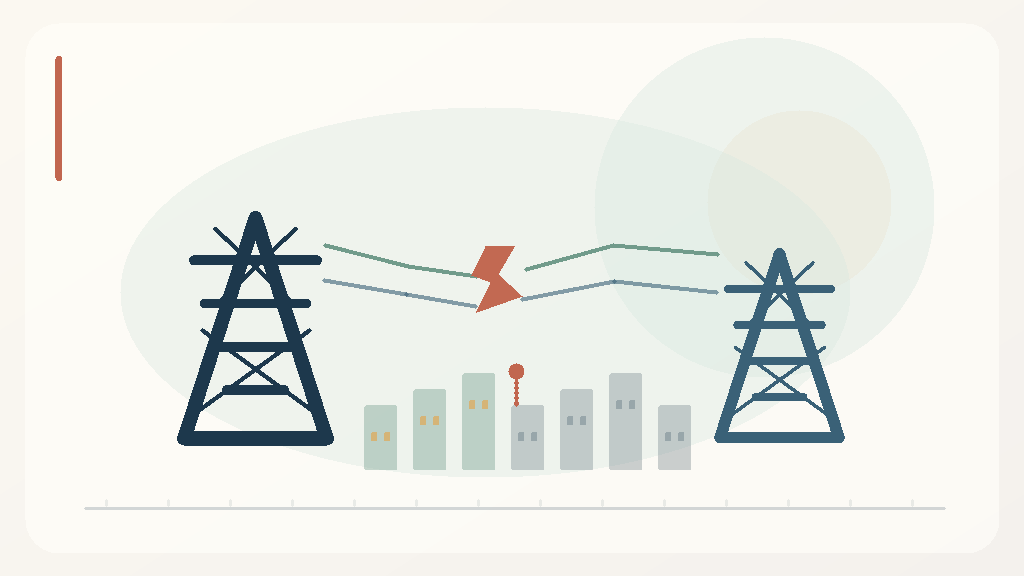
Did you know? A power station can still be producing electricity while thousands of homes remain dark. The weak link might be a transmission corridor, a substation, a protective device or a chain of operational decisions—not a complete absence of energy.
Quick answer: Power grids collapse when a disturbance overwhelms the network’s ability to keep generation and demand balanced and equipment operating safely. A failed line can redirect electrical flows, other equipment may disconnect, and cascading failures can spread the outage. The first fault matters, but the system’s protection, information, coordination and capacity determine whether it becomes a major blackout.
This plain-English guide explains why power grids collapse, how cascading blackouts spread, what caused the August 2003 US–Canada blackout and why electricity recovery can take longer than fixing the original fault. It also shows which warning signs and safeguards deserve attention.
Follow the failure chain: generation and imports → transmission → substations → distribution → usable electricity, with balancing, protective systems, communications and maintenance supporting every handoff.
Choose your reading route
- What does a power-grid collapse actually mean?
- The quick answer: how a small fault becomes a blackout
- Electricity must be balanced in real time
- Transmission is not the same as distribution
- Why connected grids are both stronger and more vulnerable
- A fictional example: three transmission routes and one overloaded path
- Protection devices prevent damage but can expand an outage
- Why frequency, voltage and thermal limits are different
- When forecasts and reserve margins are wrong
- Why extreme weather stresses more than one layer
- Maintenance problems become visible during an emergency
- When control rooms lose the real picture
- Case study: the August 2003 North American blackout
- Why blaming only the first tripped line misses the lesson
- Why blackouts affect hospitals, water and communications
- Does renewable electricity make blackouts inevitable?
- Cybersecurity and software dependencies
- Why restoration can take longer than the initiating fault
- Local reliability and regional resilience need different measures
- What a practical grid-resilience plan contains
- A student’s thought experiment: remove one link, then trace the outcome
- Frequently asked questions
What does a power-grid collapse actually mean?
Did you know? Most electricity outages are not failures of an entire national grid. A fallen local line may darken one neighbourhood while nearby districts remain supplied. A major cascading blackout is different: a disturbance spreads through connected equipment and operating areas until far more customers lose supply than the original fault should have affected.
The distinction matters because the fixes differ. A damaged low-voltage cable may require a local repair crew. A generation shortage may demand reserve power or temporary demand reduction. A major transmission disturbance may require coordinated actions across network operators. A widespread system collapse may also require a carefully sequenced restoration, not simply turning one switch back on.
A grid fails at the point where its electrical, physical or operational safeguards cannot maintain the service promised to users. The question to ask is specific: Which region lost power? Was the cause generation, transmission, distribution, control or protection? How long did the interruption last? Which essential services were affected? Avoid treating every power cut as evidence that an entire country’s electrical system has stopped working.
The quick answer: how a small fault becomes a blackout
A power grid is a connected physical network. Electricity moves through generators, transformers, high-voltage transmission lines, substations and distribution networks. Operating conditions have to remain within defined ranges while supply and demand are kept sufficiently balanced.
A disturbance might begin when a transmission line is taken out of service. Power flows can shift to other paths. Those paths may then encounter abnormal loading, voltage or stability conditions. Protective equipment acts to prevent equipment damage or unsafe operation, but removing more equipment can change the network again. If operators and automated safeguards cannot contain the disturbance, the outage may spread.
This is a cascading failure: each interruption increases stress elsewhere, which can trigger another interruption. The initial fault is only part of the explanation. Network design, maintenance, monitoring, protection settings, spare capacity and operator coordination influence whether the system absorbs the problem or amplifies it. A well-designed grid expects individual faults and aims to prevent them from turning into regional emergencies.
Electricity must be balanced in real time
In an alternating-current power network, generation and consumption need to stay sufficiently balanced from moment to moment, taking into account losses and system dynamics. A grid cannot rely on household batteries or ordinary wires to absorb unlimited mismatches without consequences. Energy storage and other flexible resources can help, but their availability and capabilities are finite.
Grid frequency is one useful indicator of imbalance in synchronous AC systems. Many countries operate at a nominal 50 hertz; others use 60 hertz. The particular number is not itself a universal sign of quality. Operators work to keep frequency and other electrical quantities within permitted limits.
If demand suddenly exceeds available generation and corrective actions are insufficient, frequency can fall. If generation exceeds demand, frequency can rise. Severe deviations threaten equipment and system stability, potentially triggering automatic protective responses. Balancing authorities coordinate reserves, generation, imports and other resources to maintain acceptable operation. The US Energy Information Administration’s grid explanation describes the interconnected delivery system and the need to match supply with demand.
Transmission is not the same as distribution
A useful mental picture separates two parts of the journey. Transmission uses higher voltages to move power across long distances, often connecting large generating resources with cities and industrial areas. Distribution carries power through local substations and lower-voltage networks to the places where people use it.
A storm damaging a street-level distribution line may cause many local customers to lose electricity while the high-voltage system remains stable. Conversely, a severe transmission disturbance can deprive several distribution networks of supply even if their neighbourhood wires have no physical damage.
These failures may look identical inside a dark house. Their engineering causes and recovery processes are different. That is why a useful outage report identifies the affected level, the failed components and the route to restoration. The same distinction applies when interpreting headlines: an outage across several districts does not automatically mean generation was inadequate, and a working power station does not prove that its electricity can be delivered through a damaged or overloaded transmission network.
Why connected grids are both stronger and more vulnerable
Interconnecting electricity systems allows regions to share resources. A city can receive power from more than one generator, and a region with limited supply may import from neighbours. This diversity can lower cost and improve reliability compared with relying on one isolated source.
But interconnection also creates shared exposure. When one high-capacity connection trips, power that was using it may redistribute through other lines. Operators and automatic devices must keep those new flows within acceptable thermal, voltage and stability limits. The actual flows follow electrical network properties, not a manager’s preferred delivery route.
The engineering challenge is to capture the benefits of sharing without letting a local problem spread. Network studies therefore consider contingencies, protection, operating margins and the consequences of losing important equipment. Redundancy is helpful when alternatives have genuinely usable capacity and their operation is coordinated. Drawing two lines on a diagram is not sufficient if both lines would be stressed by the same disturbance.
A fictional example: three transmission routes and one overloaded path
Imagine a fictional region supplied across three major routes. Under normal conditions, the power flows are distributed safely across them. A wildfire then forces one route out of service. The remaining network carries more of the transfer, and one of its lines approaches an operational limit.
If system controls and operators can adjust generation, transfers and demand in time, the disturbance may be contained. If another line disconnects before the adjustments take effect, the remaining paths may experience still more stress. The original interruption is now a cascade because the network’s new condition makes additional interruptions more likely.
The example is deliberately simplified. Real electricity flows depend on impedances, topology, reactive-power conditions, generator behaviour and other dynamic constraints; the load does not divide neatly among remaining lines. The point is the feedback loop: one path disappears → electrical flows change → other constraints are challenged → more equipment may disconnect. Reliability planning asks how to break that loop safely rather than assuming that equipment will always survive abnormal operation.
Protection devices prevent damage but can expand an outage
Protective relays, circuit breakers and related systems monitor electrical conditions and disconnect equipment when required. They are vital safeguards. When a line develops an electrical fault, leaving it energised may be dangerous or may damage expensive equipment. Isolation can protect workers, equipment and the wider network.
However, every disconnection alters the available network. Protection needs to act correctly for the relevant condition and coordinate with neighbouring devices. If a device responds when it should not, responds too slowly, or acts on incomplete information, its effect on the wider system can be serious.
The solution is not to disable protection indiscriminately. That would create a different danger. Operators instead rely on engineering standards, coordinated settings, testing, maintenance, accurate records and independent reviews of unexpected operations. In a major investigation, it is important to distinguish protection operating correctly under genuinely unsafe conditions from a protective-system misoperation that contributed to the incident. A blackout may involve both kinds of event.
Why frequency, voltage and thermal limits are different
Three constraints are often mentioned in blackout analysis, but they are not interchangeable. Frequency reflects the dynamic balance of generation and load in synchronous systems. Voltage relates to electrical conditions and reactive-power support across the network. Thermal limits concern heating and safe current-carrying capabilities of equipment.
A line may be thermally overloaded while grid frequency remains close to nominal. A region may encounter voltage instability even though sufficient generating capacity appears available on paper. Under some disturbances, rotor-angle or other dynamic stability constraints may become critical before long-term thermal capacity is exhausted.
The difference explains why a statement like “there was plenty of electricity” may not settle the question. Energy has to be deliverable while all required operating conditions remain acceptable. A generator on the wrong side of a constrained network does not solve a local voltage problem by its existence alone. Grid operators need several kinds of measurements and models rather than a single national supply-versus-demand number.
When forecasts and reserve margins are wrong
Electricity operators plan around expected demand, generator availability, imports, weather and system maintenance. But forecasts can be wrong. Heat waves, cold spells, industrial loads or unexpected outages can alter the real balance. Equipment can also fail when needed most.
Adequacy planning considers whether sufficient resources are available to meet demand across relevant scenarios. Operational reliability asks whether the power can be delivered safely while the system handles faults and changing conditions. These are related but distinct. A grid may have enough installed generating capacity yet suffer transmission constraints or equipment failures. Another grid may have sound wires but insufficient available generation during an extreme event.
Resilience requires realistic reserve planning, flexible resources, demand response where appropriate, sound asset maintenance and clear emergency procedures. It is misleading to blame any one energy source without checking the event’s actual conditions and the capabilities of the complete system. Different technologies contribute in different ways, and their reliability depends on location, weather, maintenance, controls and supporting infrastructure.
Why extreme weather stresses more than one layer
Storms can damage lines, substations and access roads. Floods can affect equipment or prevent repair crews reaching sites. Heat can raise electricity demand while changing equipment ratings or affecting generating resources. Drought can reduce available hydropower or cooling resources in some systems. Freezing conditions can disrupt fuel supply and generation equipment.
The danger grows when several dependencies are affected at once. Backup generation may exist but lack fuel. A substation may be physically intact but inaccessible to crews. A communication network may fail because its local battery backup is exhausted. Weather stress can therefore become a logistical and organisational problem as well as an electrical one.
Adaptation starts with location-specific hazard data: which assets are exposed, how severe could the conditions become, what critical customers depend on them and what alternatives are actually available? No network can promise zero failures under every possible extreme event. The meaningful question is whether risk is understood, protection is proportionate and restoration can proceed safely.
Maintenance problems become visible during an emergency
Transmission corridors need vegetation management, equipment inspections and repair programmes. Transformers, switchgear, control systems and distribution assets have different maintenance needs. The work may be unglamorous, and the benefit is often the absence of a headline.
Deferred maintenance can create hidden fragility. A line operating close to its limits may depend on accurate monitoring and healthy equipment. If a sensor fails or a warning is not communicated, operators may lose the time needed to correct the problem. Multiple small weaknesses can combine under a new disturbance even if no single defect seemed catastrophic beforehand.
Effective maintenance prioritises safety-critical and system-critical assets according to risk. It keeps records, checks whether work was completed to standard and ensures faults reported by staff have a route to resolution. A maintenance budget is not merely a cost to minimise. It is part of the capability that allows the network to deliver electricity reliably over its whole service life.
When control rooms lose the real picture
Operators make decisions using telemetry, alarms, network models, schedules and communications with neighbouring utilities. These systems help them understand conditions beyond what any one person can physically observe. A delayed alarm or inaccurate model can hide an emerging problem.
One dangerous pattern is an apparently reassuring screen while the physical system is becoming less stable. That can happen when monitoring fails, data are stale, a topology change is not reflected correctly, or operators receive too many alerts without a usable priority structure. More data do not automatically mean better situational awareness.
Control rooms need resilient communications, validated displays, rehearsed escalation rules and staff trained to question conflicting signals. Adjacent operators also need a shared operational understanding because electricity does not stop at an administrative boundary. An incident review should ask what information was available, when it arrived, how it was interpreted and which alternatives were realistically possible at each point.
Case study: the August 2003 North American blackout
On 14 August 2003, a major blackout spread across parts of the northeastern United States and Ontario, Canada. The US Department of Energy’s historical account states that roughly 50 million people were affected. For some locations, restoration extended over multiple days.
The official investigation described an interacting sequence of vegetation contacts involving transmission lines in Ohio, inadequate situational awareness, monitoring and communication weaknesses, and other operational problems. The significance is not that “one tree shut down a continent.” Contact between trees and high-voltage lines was part of a larger chain whose consequences depended on how the interconnected system was monitored and managed.
The case shows why a power failure should be analysed as a timeline with multiple layers of responsibility. Initial faults, operator decisions, alarm systems, protection operations and regional coordination must be studied together. Investigations are valuable precisely because dramatic shorthand conceals the mechanisms that future engineering work must repair. The event also helped spur changes in reliability requirements and oversight in North America.
Why blaming only the first tripped line misses the lesson
Suppose a single transmission line goes out of service. Properly planned interconnected systems are expected to tolerate defined credible contingencies under relevant operating conditions. If one disconnection becomes a widespread blackout, it is not enough to identify the component that stopped first.
Investigators need to ask whether the disturbance exceeded planning assumptions, whether other equipment was already unavailable, whether adequate margins existed, whether protection operated as expected and whether warnings reached operators. A surprising number of organisations may have relevant responsibilities even if each manages only a portion of the network.
This wider view does not excuse poor maintenance or bad decisions. It makes accountability more useful. Fixing a tree-clearance practice may reduce one initiating hazard, but without addressing deficient monitoring or coordination the system could remain vulnerable to another trigger. Good post-incident analysis connects root causes to changes that can be tested, rather than simply identifying the last person involved before the lights went out.
Why blackouts affect hospitals, water and communications
Electricity underlies many other public services. Hospitals rely on power for clinical equipment, lighting, information systems and temperature control. Water and wastewater systems use pumps and treatment equipment. Mobile networks, fuel stations, refrigeration, payment terminals and transport infrastructure all have dependencies.
Some critical facilities have backup power, but a backup is not the same as an unlimited independent electricity supply. It needs suitable fuel or energy storage, maintenance, testing, safe switching and functioning downstream equipment. Backup operation may support only selected loads. A long outage can therefore expose additional bottlenecks even when the initial electricity failure is being repaired.
Emergency planning must identify genuinely critical functions and realistic durations. For a hospital, the relevant result is safe clinical care, not merely a generator status light. For water supply, it is safe water at the receiving tap. Public resilience is measured at the point where people depend on the service, not at the boundary between infrastructure departments.
Does renewable electricity make blackouts inevitable?
No. Wind, solar, hydro, thermal, nuclear and storage technologies have different operating characteristics. The grid’s reliability depends on how resources, demand, transmission, controls and reserves work together. A particular mix may create challenges that require planning, but it is inaccurate to equate one source’s presence with certain failure.
Wind and solar output vary with weather and time. Operators use forecasts, flexible generation, storage, network connections, demand flexibility and other resources to manage variation. Conventional generators also experience forced outages, fuel constraints, cooling limitations and maintenance needs. All resource classes require a realistic assessment of their performance under stress.
New technologies, including inverter-based resources, can contribute essential grid services when appropriately designed and integrated. The technical challenges differ by system. A credible blackout explanation should name the actual disturbance, available resources and system response. It should not select an energy technology as the culprit merely because that technology features in the public debate.
Cybersecurity and software dependencies
Modern power networks rely on digital monitoring, communications and controls. This improves speed and visibility but introduces technology and security dependencies. A software fault or cyber incident could affect operations, while physical equipment may also be vulnerable to intentional damage.
The distinction between a malfunction, a cyberattack and deliberate physical sabotage matters. A major outage should not be described as an attack without credible evidence. Authorities and operators investigate security incidents using appropriate procedures, and technical details of sensitive systems should not be casually inferred from public photographs or rumours.
Resilience includes access controls, system segmentation appropriate to the environment, tested backups, vendor management, accurate asset inventories and rehearsed incident response. It also includes maintaining safe manual or fallback procedures where practical. A digitally advanced grid is not necessarily fragile, but complexity must be supported by disciplined engineering and clear responsibility for the connections between software and physical equipment.
Why restoration can take longer than the initiating fault
Restoring a large electrical system is not always equivalent to switching on a lamp. Operators must verify equipment conditions, establish suitable sources, rebuild stable network areas and reconnect loads in an appropriate sequence. Some restoration plans rely on resources capable of supporting network re-energisation under defined conditions.
The procedures are technically specialised and safety-critical. Prematurely reconnecting too much load or energising equipment before faults are understood may threaten people and equipment. Restoration may also be slowed by damaged substations, inaccessible routes, depleted fuel, unavailable staff or communications failures.
A public statement that the original fault has been cleared does not prove every customer can immediately receive electricity. The repaired component may be only one part of the recovery. Service restoration should be monitored by actual customer supply, critical-facility needs and verified stability, with clear updates for affected communities. The right objective is safe, sustained power, not a brief restart followed by another interruption.
Local reliability and regional resilience need different measures
Utilities often track indicators such as how frequently customers experience interruptions and how long those interruptions last. Depending on jurisdiction, common metrics include SAIFI for average interruption frequency and SAIDI for average interruption duration. Definitions, exclusions and treatment of major events matter before comparisons are made.
A region may have good average local outage performance while remaining exposed to a rare but severe regional event. Conversely, a district with frequent short distribution interruptions may have no unusual risk of national grid collapse. These are different aspects of reliability.
Resilience assessment should therefore include normal service quality, critical equipment health, credible disturbance scenarios, recovery capability and the consequences for essential facilities. A single annual average does not capture tail risks or vulnerable customers. Operators should publish understandable measures, explain unusual events and investigate whether improvements actually reduce the outcomes people experience.
What a practical grid-resilience plan contains
The first layer is prevention: maintain lines and substations, manage vegetation, validate protection systems, monitor assets and plan sufficient operational margins. The second is containment: design and test procedures that limit the spread of credible disturbances. The third is recovery: coordinate personnel, equipment, communications and essential-service priorities after an event.
Plans should recognise shared dependencies. A spare component stored in an inaccessible warehouse may not be available during a flood. A backup communications network that relies on the same power source may not be independent. Operators also need arrangements with neighbouring systems because problems and solutions can cross organisational boundaries.
Testing matters. Emergency drills should expose incomplete records, unworkable assumptions and communication gaps while there is still time to correct them. The goal is not a binder declaring “resilient.” It is observable capability: a problem is detected, prevented from escalating where possible, and repaired safely with real people and resources.
A student’s thought experiment: remove one link, then trace the outcome
Draw a simple diagram with two generating stations, several transmission paths, a substation, a hospital and a residential district. First, remove one distribution line. Which customers might be affected? Then remove a major transmission route. What other paths remain, and do they have adequate capacity? Finally, imagine that communications between operators are interrupted. How would they know what is happening?
This is only a learning exercise, not an electrical design calculation. Real grid analysis requires trained professionals and validated models. Its value is understanding interdependence: a good design provides alternative routes, clear information, correct protection and a safe way to recover.
The bigger lesson applies to many systems. A failure becomes dangerous when a missing link changes the load and behaviour of the remaining links. A strong grid is not one that never experiences faults. It is one that expects faults, limits their spread, tells the truth about their impact and restores service reliably.
Frequently asked questions
Why do power grids collapse instead of just losing one line?
A local fault can change power flows, voltage or frequency elsewhere. If additional components disconnect and safeguards cannot contain the disturbance, the outage can cascade. Many individual faults do not escalate because grid protection, redundancy and operator procedures absorb them.
Is a blackout the same as a brownout?
Not exactly. A blackout is a loss of electrical supply. A brownout generally refers to reduced voltage or a related degraded-voltage condition rather than complete loss of supply. Terminology varies by region and operator.
Can a tree really cause a huge blackout?
Tree contact can initiate a transmission fault, but a widespread cascade usually requires interacting network and operational conditions. The August 2003 event involved vegetation contacts as well as monitoring, coordination and other system weaknesses.
Why can electricity not simply flow around a broken line?
Power flows follow the electrical characteristics of the interconnected network. Alternate paths have operating limits, and voltage and stability must remain acceptable. The existence of another line does not guarantee it can safely carry every resulting flow.
Do batteries make the entire grid impossible to collapse?
No. Storage can help with flexibility and certain grid services when correctly integrated, but every resource has limits, including energy duration, power output, location and controls. Reliability still requires network planning and protection.
Can one country avoid blackouts by importing all electricity?
Imports can diversify supply, but cross-border connections have capacity, contractual and physical limits. A disruption affecting an interconnector or shared regional network can still matter. Security of supply depends on the full system.
Do blackouts mean generation has stopped everywhere?
No. A distribution fault can interrupt users while generators are operating. Transmission failures can also prevent power reaching a location even when generation exists elsewhere. The specific failed layer must be identified.
Why is grid frequency important?
In synchronous AC systems, frequency is one indication of the balance between generation and demand. Severe departures from the allowed range can trigger protective actions and stability problems. Operators use several measurements, not frequency alone.
Why does it take hours or days to restore power?
Damaged equipment, access constraints, safety checks and coordinated restoration can take time. Major blackouts may require rebuilding stable network sections and reconnecting customers in an appropriate sequence.
Are renewables responsible for all modern blackouts?
No. Every major event has its own causes. Renewable generation creates particular integration requirements, while conventional generators and networks also have failure risks. Credible analysis examines the complete resource mix, operating conditions and recorded sequence.
What should households do during a real power outage?
Follow local utility and emergency-authority guidance, preserve communication and lighting resources and avoid dangerous improvised electrical connections. If essential medical equipment depends on electricity, use the relevant care and emergency plan established with professionals. Safety needs vary by household.
What is the clearest lesson from the 2003 blackout?
A preventable set of local faults and operational weaknesses can propagate across a connected network. Maintenance, situational awareness, coordinated operating practices and tested reliability safeguards all matter.
Primary sources and further reading
The US Energy Information Administration explains generation, transmission, distribution and balancing authorities. The US Department of Energy’s August 2003 blackout archive documents the historical event and links the official investigation. These sources describe US and North American systems; grid rules and technology differ across countries.
Explore the positive cross-border grid mechanism in Global Connectivity | Electricity Grids, and a companion explanation of power-grid connectivity failures. Related failures: Why Countries Fail | Institutions, Trust and State Capacity; Why Supply Chains Break | Bottlenecks, Dependencies and Delays.
Final thought: Grid reliability is not the absence of faults. It is the ability to contain them before one broken link becomes everyone else’s emergency, then restore safe service where people actually need it.