
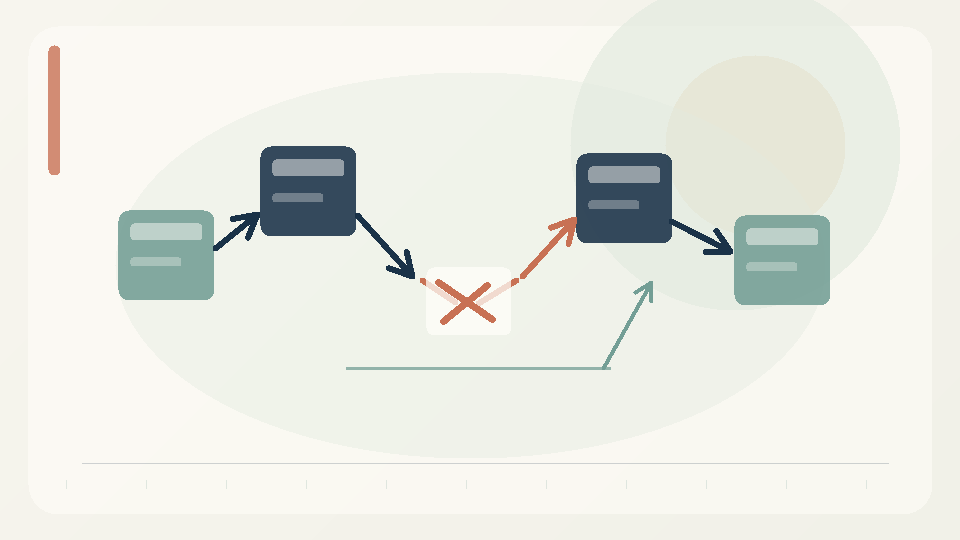
Did you know? A supply chain can break because of one part that costs less than a cup of coffee. If a factory cannot obtain that component, the expensive finished product may never reach the customer—even when nearly every other part is ready.
Quick answer: Supply chains break when materials, capacity, information, finance, approvals or transport cannot move reliably between the people and organisations that depend on them. Bottlenecks, concentrated suppliers, delayed deliveries, bad forecasts, regulatory constraints and inadequate recovery options can spread one local disruption across an entire network.
This guide explains why supply chains break, how a shortage becomes a cascade, what the 2021 Suez Canal incident teaches, and how businesses and governments can build realistic resilience. It uses everyday examples, dated primary sources and practical checks rather than dramatic claims that global trade has ended.
Remember the mechanism: real demand → suppliers → materials → production → quality → stock → transport and customs → usable delivery, with information and payment supporting every handoff. For the constructive explanation, read How Supply Chains Work.
Choose your reading route
- The quick answer: why supply chains break
- What a supply chain must coordinate
- Why one missing component can stop an entire factory
- The hidden tiers beyond the familiar supplier
- The trade-off between lean inventory and buffers
- Why lead time matters more than distance alone
- What is the bullwhip effect?
- Forecast error: the wrong product in the wrong place
- Capacity is not the same as theoretical output
- Why supplier concentration creates risk
- Two suppliers may not be two real alternatives
- When standards and quality checks block substitution
- Transport chokepoints: when a route has no easy substitute
- Ports, customs and the last-mile problem
- Information failures can stop physical movement
- Cash flow and credit are part of the chain
- Weather, disasters and disease expose physical limits
- Geopolitics can change the legal route overnight
- Why shortages can persist after the original shock ends
- Case study: essential medicines
- Case study: electronics and semiconductor bottlenecks
- Case study: the ordinary grocery shelf
- How to choose between efficiency and resilience
- Why bringing all production home may not solve the problem
- What a useful supply-chain risk map includes
- Early warning signals worth monitoring
- The first 48 hours of a disruption: a realistic playbook
- Measure recovery at the receiving end
- What consumers and students can learn from broken supply chains
- Frequently asked questions
The quick answer: why supply chains break
Did you know? A supermarket can have willing customers, a manufacturer can have a working factory and a shipping company can have available vessels—yet the product can still fail to reach the shelf. One missing input or blocked handoff may prevent the entire journey from finishing.
A supply chain connects demand, raw materials, suppliers, production, quality checks, information, finance, inventory, transport and delivery. In practice it is a network, not a simple line. The system breaks when one or more essential flows cannot meet the timing, quantity, quality or destination needed downstream.
Not every disruption is a total collapse. A delayed container, a temporary factory shutdown and a widespread shortage are different events. The useful diagnosis asks what was required, what actually arrived, which node or connection failed and whether alternative capacity was available. Failure spreads when other participants must wait, reroute, pay more, reduce output or make decisions using outdated information. The visible empty shelf is often the final consequence of a much earlier problem.
What a supply chain must coordinate
Imagine a simple bicycle. It needs a frame, wheels, tyres, a chain, brakes, labour, tools, packaging and delivery. Those parts may come from different firms and locations. A distributor forecasts demand and places orders; suppliers obtain materials; factories schedule capacity; inspectors check quality; logistics teams move finished bicycles to shops.
Every stage needs information as well as physical goods. A supplier must know which component specification is required. A factory must know when the component will arrive. A distributor must know what has been dispatched rather than what was merely promised. Finance and payment terms influence whether each participant can continue purchasing and producing.
The chain is successful when the right product reaches the final receiver in usable condition at the required time and reasonable cost. A completed purchase order is not successful delivery. A container unloaded at a port is not necessarily an item available for sale. For the constructive mechanism, see How Supply Chains Work; here we follow the failure modes that disrupt it.
Why one missing component can stop an entire factory
Consider a fictional appliance factory. Ninety-nine of its hundred required parts arrive. The remaining component is small, inexpensive and specialised. Without it, safety testing cannot be completed and the finished product cannot legally or practically be shipped. The value of all the parts already in the factory does not solve the missing input.
This is a bottleneck: a constraint that governs the output of a larger process. In assembly, some inputs are complementary rather than interchangeable. If a machine needs a particular approved controller, an ordinary cable cannot substitute simply because it is available. A replacement component may also require engineering approval, software changes or new tests.
The lesson is that supply-chain risk cannot be prioritised by purchase price alone. A tiny part with long replenishment time and no substitute may deserve more planning than an expensive input available from several compatible suppliers. Effective risk maps ask which resources are indispensable, how long replacement takes and what evidence would establish that an alternative is safe and functional.
The hidden tiers beyond the familiar supplier
A retailer may know its direct supplier but not the company that makes the supplier’s packaging resin or a specialised electronic component. That direct supplier may depend on subcontractors, warehouses, energy providers, cloud software and raw-material processors. The full network can extend across several tiers.
This creates a visibility problem. A purchaser believes it has two independent sources because the contracts carry different company names. Yet both suppliers may depend on the same factory, semiconductor design, port or power grid. A disruption at that hidden shared node can remove both alternatives at once.
Mapping every relationship in perfect detail may be impractical. The sensible approach is to begin with critical products and identify the dependencies most likely to cause serious interruption. Suppliers can share information about relevant bottlenecks without exposing every commercial secret. A useful map records not only names but also location, capacity, lead time, critical subcomponents, substitution options and the limits of available knowledge. Unknown dependencies should be labelled unknown rather than silently treated as zero risk.
The trade-off between lean inventory and buffers
Holding inventory costs money. Goods require storage, financing, security, insurance and management; some perish or become obsolete. Lean production can reduce waste and allow companies to respond efficiently to real demand. That is why low inventory is not inherently poor management.
The problem emerges when minimal stock is combined with unreliable replenishment, high demand variability or long recovery times. A small delay that was harmless with ten days of usable stock may stop production when only two days remain. If many firms have reduced buffers at the same time, a common disruption can become more severe.
Buffer design should be proportional to the item’s criticality, demand pattern, replacement lead time and cost of interruption. The correct answer is not “store everything forever.” Emergency food, life-saving medicines and easily substituted office supplies have different risk profiles. Companies can use safety stock, spare capacity, approved alternatives, flexible contracts or better forecasting. Resilience means choosing suitable protection for a specific failure, not maximising piles of goods without understanding their use.
Why lead time matters more than distance alone
Lead time is the elapsed time between triggering a supply activity and receiving usable output. It can include order processing, procurement, production, inspection, transport, customs, unloading and final delivery. Physical distance affects transport, but it is only one part of the total.
A supplier across a border may deliver predictably in days if processes and connectivity are strong. A nearer supplier can take much longer if production queues, inspections or border procedures are unpredictable. A shipment may cross an ocean quickly yet remain at a port because documentation is incomplete or the receiver cannot arrange onward movement.
Readers should distinguish average lead time from variability. If most deliveries take eight days but some take thirty, planning around eight alone can be risky. Companies need realistic distributions or scenario ranges, not only a cheerful single-number promise. The World Bank’s Logistics Performance Indicators 2.0 use observed connectivity, speed and reliability measures rather than relying solely on perceptions. The principle is simple: measure what reaches the receiver, not just what leaves the origin.
What is the bullwhip effect?
Imagine shoppers buy slightly more rice than usual. A supermarket manager worries about running out and orders extra from a wholesaler. The wholesaler interprets several increased orders as a new demand trend and orders even more from the mill. The mill expands its request for raw supplies. A small change at the consumer end becomes a larger swing upstream.
This amplification is often called the bullwhip effect. It can occur when participants rely on orders rather than actual final consumption, maintain separate forecasts, batch purchases or react nervously to shortages. Later, after the rush passes, the system may be left with excess inventory.
Better information can reduce amplification, but simply sharing a dashboard is not sufficient if incentives remain distorted. Firms need to distinguish genuine demand growth from precautionary ordering, align forecasting horizons and avoid repeated overcorrections. A supply chain can fail through excess just as it can fail through scarcity. The goal is not perfectly smooth demand; it is a network able to respond without magnifying every signal into a crisis.
Forecast error: the wrong product in the wrong place
Demand forecasts are estimates, not promises about what consumers will buy. They can be disrupted by weather, fashion, new competitors, changes in income or unexpected events. A forecast that was reasonable at the time may still prove wrong. The operational question is how quickly the system notices and adapts.
Suppose a retailer expects strong demand for one winter coat style and orders large quantities early. A warmer season and changing preferences leave stores with unsold inventory, while a different product sells out. The warehouse has goods, but not the goods customers need. Excess and shortage exist simultaneously.
Resilient planning uses scenario ranges, shorter feedback loops where feasible, appropriate inventory placement and flexibility in sourcing and production. It also separates forecast accuracy from the cost of forecast error. A small forecasting mistake on an inexpensive, replaceable item may matter little; the same proportional error for a critical component with a year-long lead time may stop an entire programme. Good managers examine both likelihood and consequence.
Capacity is not the same as theoretical output
A factory may advertise that it can produce a thousand units a day, but the figure may assume continuous staffing, available inputs, healthy machines and no changeovers. Actual output is constrained by uptime, product mix, yield, quality, labour and maintenance. Operating close to maximum capacity for long periods leaves little room to absorb surprises.
Queues grow rapidly when arrival rates approach service capacity and variability remains. A port, inspection centre or specialised machine can become congested even if its average annual throughput looks adequate. A single breakdown may push work into an already full schedule, delaying many later orders.
Good capacity planning examines peak loads and recovery time, not only annual averages. Useful options include maintenance planning, alternate shifts, flexible scheduling, spare capacity for critical steps and agreements with qualified external providers. These measures have costs, so not every network needs the same margin. The question is how much service loss is acceptable and what capacity is truly executable when a disruption occurs.
Why supplier concentration creates risk
Working with a highly capable supplier can lower cost and improve quality. Close relationships may make joint innovation and coordination easier. But dependency becomes dangerous if the supplier is the only practical source of an essential product and no workable substitution or recovery plan exists.
Concentration can also be regional. Several suppliers might operate in the same floodplain, depend on the same electricity network or route all exports through one congested port. A geopolitical restriction or extreme weather event may affect them simultaneously. The fact that there are three invoices does not prove there are three independent paths to supply.
The OECD’s 2025 Supply Chain Resilience Review examines concentration and the benefits of adaptive networks. The practical response is selective diversification: identify critical dependencies, qualify alternatives when feasible and understand the full cost of switching. Diversification without compatibility, capacity or contractual access can create the illusion of safety rather than real redundancy.
Two suppliers may not be two real alternatives
Imagine a medical-device manufacturer purchasing a sensor from Supplier A and Supplier B. Both have independent sales teams and different delivery vans. It looks like a resilient arrangement. But a later audit finds that each buys the same crucial chip from the same specialist plant.
If that plant loses power, both nominal alternatives may fail. The true shared dependency sits one tier further upstream. Resolving it may require redesigning the product to accept another chip, qualifying a second manufacturer or holding a carefully chosen inventory buffer. Those changes take time.
This is why supply-chain mapping must identify the point at which alternatives actually diverge. An alternative supplier is useful only if it can meet the required quality, quantity, lead time and legal conditions under the scenario being considered. A backup route that also crosses the blocked canal is not a backup for that particular disruption. Independence is scenario-specific, and risk plans should say exactly which disruption each alternative can absorb.
When standards and quality checks block substitution
A manufacturer may find a replacement part that looks identical, yet the substitute might use a different material, fail a safety requirement or interact differently with other components. This matters especially in medicine, aviation, electronics, food safety and critical infrastructure, where untested substitutions can create harm.
Quality controls can therefore create a temporary delay that is justified. The failure is not necessarily the inspector’s refusal to approve an unsafe component. The upstream planning failure may be the absence of a qualified second source before the shortage occurred. In other situations, unclear standards or inconsistent inspection procedures may cause avoidable delays.
Strong supply chains distinguish a genuine safety requirement from administrative friction. They maintain technical specifications, test methods, supplier qualification records and change-control processes. When disruption occurs, decisions should preserve safety while seeking lawful, verified alternatives. A fast delivery of the wrong or unsafe product is not a successful recovery. The final receiver needs usable quality, not simply movement.
Transport chokepoints: when a route has no easy substitute
Global trade depends on ports, waterways, roads, rail corridors and border crossings. Some are narrow chokepoints with limited nearby substitutes. A disruption can delay vessels already committed to a route, change schedules elsewhere and create congestion at subsequent ports.
In March 2021, the container ship Ever Given blocked the Suez Canal, interrupting traffic for roughly a week. A UNCTAD maritime logistics case study discusses the obstruction, contributing operational factors and the resulting traffic queue. The event illustrated why one shipping channel can affect cargo owners far beyond its immediate location.
Rerouting is not automatically easy. An alternative passage can add sailing time, fuel costs, port demands and uncertainty over vessel availability. The shipping line may be able to move the vessel but still miss a customer’s manufacturing slot. Resilience planning therefore considers rerouting, buffer stock, alternate modes for especially critical cargo and realistic promises to downstream customers. An alternative route is valuable only if the total chain can use it in time.
Ports, customs and the last-mile problem
A container can reach a destination port and still fail to become usable inventory. It may await unloading, inspection, customs clearance, documentation, a truck appointment or space in a warehouse. Each step belongs to a different organisation, and each may have its own queues and operating hours.
A vessel’s arrival timestamp can therefore look positive while the factory still faces a shortage. Real operational measurement follows cargo until it reaches the next productive user. Port dwell time, border waiting, missed appointments and final delivery reliability can matter as much as miles travelled.
Avoid assuming that building a new terminal alone solves every delay. Landside road access, digital documentation, customs processes, staffing, equipment and coordination influence effective capacity. Governments and businesses may be able to improve reliability through harmonised procedures, risk-based inspections and transparent data sharing, while still respecting safety and security. The supply chain ends where the promised goods are usable, not where a transport operator’s responsibility happens to end.
Information failures can stop physical movement
Supply chains move documents and data as well as goods. A manufacturer needs a correct specification. A warehouse needs accurate item identifiers. A carrier needs valid shipping instructions. Customs authorities need appropriate declarations. Payments and insurance depend on records that match the underlying transaction.
A simple error can be expensive. If a shipment is labelled with the wrong classification, documents may be rejected and the cargo held for clarification. If an inventory system says an item is available when it was already allocated, a seller may accept orders it cannot fulfil. A cyber incident can prevent access to routing or stock information.
Digitalisation can help through timely, consistent and traceable records, but data quality, permissions and recovery plans matter. A shared software platform may itself become a concentrated dependency. Operators should know which records are critical, who can correct them, how discrepancies are escalated and how essential operations continue during outages. A physical supply chain is only as coordinated as the information that guides it.
Cash flow and credit are part of the chain
A supplier must often pay workers and purchase materials before a customer pays the final invoice. That creates a working-capital requirement. If customers delay payment, banks tighten lending or financing costs rise, the supplier may be unable to keep producing even when demand is strong.
The problem can move upstream. A large buyer’s delayed payment may force a smaller supplier to delay its own purchases. The smaller supplier’s subcontractor then loses orders, and several firms reduce capacity. A financial stress has turned into a physical supply shortage.
Healthy supply chains therefore consider payment reliability, credit concentration, supplier financial health and fair commercial terms. Supporting a critical supplier need not mean guaranteeing every business; it can include more predictable payment, earlier visibility of orders or carefully designed financing where appropriate. Buyers should remember that the lowest quoted price can conceal a fragile operating model. The chain is sustained by actual cash flow and capability, not purchase orders alone.
Weather, disasters and disease expose physical limits
Flooding can close a road or damage a warehouse. Drought can affect agricultural output and water-intensive production. Extreme heat can reduce labour productivity or strain cooling systems. Disease outbreaks can interrupt staffing, transport and household consumption. These mechanisms differ, and their consequences depend on local conditions.
It is misleading to say a natural hazard alone explains every shortage. A well-prepared network may have alternate routes, protected inventory, diversified sites and emergency operating plans. Another network may be highly exposed because key nodes share the same floodplain or because it has no information about upstream dependencies.
Climate adaptation and disaster planning should be tied to concrete operations: which facility can flood, which essential part could be stranded, how quickly can the route reopen, and who has authority to reroute orders? Contingency tests should include the people and data needed to execute them. Buying an insurance policy may compensate for some financial losses, but it does not instantly replace a damaged bridge or restart a contaminated production line.
Geopolitics can change the legal route overnight
Sanctions, export controls, trade restrictions, conflict, border closures and changing compliance requirements can alter which suppliers, destinations and transactions are lawful or feasible. A product can be technically available and still unable to cross a particular boundary under applicable rules.
Companies need to distinguish a physical shortage from a legal or contractual constraint. If a shipment cannot proceed under a new rule, the solution is not simply to find a faster truck. It may require lawful alternative sourcing, different product designs, revised approvals or a different market. Compliance must be taken seriously.
Political conditions are uncertain and can change quickly. Supply-chain planning should examine critical jurisdictions and contractual dependencies without assuming that every country in a region will behave alike. Diversification can reduce some exposure, yet moving everything into one home market creates other risks. A better question is which specific shocks the network can withstand, and at what cost, rather than whether international trade should be abandoned in principle.
Why shortages can persist after the original shock ends
Suppose a major factory shuts for two weeks. Customers draw down their stocks and place replacement orders elsewhere. The second supplier becomes congested. When the first factory reopens, it faces a backlog, delayed raw materials and pressure from customers who want their orders first. The original shutdown has ended, but the system has not returned to normal.
Recovery time depends on how much output was lost, spare capacity, replacement lead times, order prioritisation and demand changes. A factory operating at full normal capacity may be unable to erase a backlog without overtime, extra shifts or fewer new orders. Downstream businesses may continue experiencing shortages well after upstream production resumes.
This is why a reopening announcement should not be confused with restored supply. Track quantities shipped, delivery reliability, backlog age, defect rates and what customers actually receive. Avoid double-ordering and panic replenishment that can make the backlog less interpretable. Stabilising the entire network can take longer than restarting its most visible node.
Case study: essential medicines
Medicines illustrate why shortage analysis must follow more than one factory. Production can depend on active ingredients, excipients, sterile containers, packaging, regulatory approval, quality release, cold-chain requirements, distributors and healthcare providers. A failure anywhere may prevent safe treatment from reaching the patient.
If a manufacturer cannot obtain a particular ingredient, production may slow. If finished products fail quality controls, batches cannot responsibly be released. If a refrigerated shipment loses required temperature control, arrival at the destination does not prove that the medicine is still suitable for use. Every stage must satisfy both timing and safety.
Resilience can involve qualified alternative suppliers, transparent shortage communication, appropriate stocks of critical products and coordination among regulators, producers and care providers. Specific measures depend on the medicine and jurisdiction. The ethical endpoint is not merely the number of boxes shipped; it is whether patients can safely receive needed care. Where substitution is clinically significant, qualified professionals and the applicable rules must guide decisions.
Case study: electronics and semiconductor bottlenecks
Modern products often require specialised chips, sensors and controllers manufactured through complex global networks. Fabrication equipment, design intellectual property, chemicals, substrates, packaging and skilled engineering capacity can all be concentrated in different places. Building a new advanced facility is not the same as finding an empty warehouse.
A carmaker or appliance manufacturer might have the steel, plastics, labour and assembly line ready while lacking one approved controller. Replacing it could require redesign, firmware work, testing and certification. A shortage of a low-cost part may therefore immobilise a much more valuable finished product.
Planning begins before the disruption. Designers can consider multiple qualified components where practical, procurement teams can map critical tiers, and manufacturers can hold selective buffers. However, alternatives are not always cheap or immediately available. It is better to state the constraint honestly than to promise instant onshoring or assume that switching supplier names solves complex technical dependencies. Resilience often comes from years of deliberate engineering, not a last-minute purchase.
Case study: the ordinary grocery shelf
A grocery supply chain can appear simple because the customer sees only packaged products. In reality, fresh and packaged foods depend on agricultural output, processing, refrigeration, packaging, transport, storage, labour, inspections and the retailer’s ordering decisions. Different goods have different shelf lives and substitutions.
Imagine heavy rain disrupting a crop harvest while transport delays affect a separate packaging supplier. The retailer may have adequate warehouse space but not the expected product mix. Customers shift to substitutes, raising demand for those items as well. If orders are increased without real consumption data, the network may overreact.
Retailers can improve reliability through alternative sources, realistic seasonal forecasts, clear stock information and careful management of perishables. But holding unlimited fresh produce would increase waste rather than resilience. The right response balances continuity, food safety, affordability and spoilage. For the household, an empty shelf can reflect several interacting decisions and constraints rather than one missing truck.
How to choose between efficiency and resilience
Every protective option has a cost. Additional stock ties up cash. More warehouses require staff and energy. Dual suppliers may reduce economies of scale. Spare machines may sit idle. Yet a very cheap operating system can become extremely expensive when one failure interrupts critical output.
A good decision considers both normal costs and the expected consequences of disruption. Begin with critical products and estimate the harm from losing them for one day, one week or one month. Then compare realistic alternatives: spare inventory, dual sourcing, product redesign, flexible contracts, emergency transport or additional capacity.
No single design is best for everything. A fashion accessory may tolerate delayed delivery; emergency medical supplies may not. Resilience is not a licence for waste or a claim that every interruption can be prevented. It is the disciplined allocation of protection to dependencies where failure would cause unacceptable harm. The measure of success is continued service to the user under plausible stress, at a cost the organisation can sustain.
Why bringing all production home may not solve the problem
After a disruption, it can seem obvious that every country should manufacture everything domestically. But production still depends on equipment, specialised knowledge, raw materials, utilities, suppliers and markets. Domestic facilities can share exposure to the same local disaster or electricity network. Shortening geographic distance does not remove all dependencies.
The OECD’s June 2025 research modelled broad supply-chain relocalisation scenarios and found potential reductions in global trade of more than 18% and global real GDP of more than 5%, without consistent improvements in stability. Those figures are outcomes of specified models and assumptions, not a prediction that any one factory relocation will have those effects.
A better strategy is usually selective and evidence-led: diversify where dependence is dangerous, preserve the benefits of international trade, support adaptability and secure critical capacities where there is a strong case. Different sectors may justify different choices. The question is not whether local or global is always safer; it is what the actual network can recover from.
What a useful supply-chain risk map includes
Start by defining the final service: which product, quality, destination, quantity and delivery window must be protected? List the inputs and processes without which that outcome cannot occur. For each critical dependency, identify the owners, locations, lead times, substitute options, upstream concentrations and exposure to plausible shocks.
Then include information and finance. Can participants access the records required to ship or produce? What happens if a payment system or software provider is unavailable? Which goods are perishable or regulated? Which routes have no practical alternate crossing? Risk maps that show only arrows between company logos often miss these constraints.
A good map also records uncertainty. Some upstream supplier data may be incomplete, and a backup may only handle part of the required volume. Label those limits clearly. Finally, connect risks to actions: who receives an alert, who can authorise substitution, what safety checks apply and which performance measures show that the workaround reached the customer. A map is useful when it guides decisions, not when it merely decorates a presentation.
Early warning signals worth monitoring
Useful signals depend on the product, but common examples include worsening supplier on-time performance, rising lead-time variability, repeated quality defects, growing backorders, falling usable inventory relative to expected demand, capacity utilisation approaching limits and unexpected changes in shipping routes.
Financial and administrative signals also matter: late supplier payments, unresolved customs documentation, withdrawal of trade credit, loss of a key specialist or a change to relevant export rules. Monitoring should distinguish background noise from a meaningful change. One late parcel is not proof of global collapse.
Choose thresholds that lead to a defined response. If the supplier’s delivery reliability falls below the level needed to maintain production, who checks the cause and activates the alternative? If an item is too critical to substitute, who decides whether additional safety stock is justified? Warning systems that generate alerts but no decisions create another kind of overload. A meaningful signal must travel to someone who can act, while there is still time to reduce the harm.
The first 48 hours of a disruption: a realistic playbook
When a disruption appears, verify the facts before making assumptions. Identify the affected supplier or route, the products and orders exposed, current usable inventory and the earliest likely service interruption. Clarify which information is confirmed and which remains an estimate. Avoid sending customers a confident delivery date unsupported by operational evidence.
Next, protect safety and essential demand. Check whether an approved alternative supplier, route, production sequence or inventory pool is genuinely available. Prioritise customers according to legitimate obligations and transparent criteria. Coordinate with finance, operations and communications so one team’s promise does not conflict with another team’s constraints.
Then update the picture as events change. Track received quantities, outstanding orders, restoration milestones and product quality. Ask whether the workaround introduces new dependencies or legal risks. A strong response does not mean every shipment arrives on time. It means the organisation can describe the constraint, make proportionate decisions and restore service with fewer surprises and less preventable harm.
Measure recovery at the receiving end
An upstream supplier may announce that production has resumed, but downstream customers may still be waiting. A shipping line may record that a vessel has sailed, but goods may remain unavailable while customs or final distribution is incomplete. Recovery must be verified against what the user actually needed.
Useful measures include orders delivered in full and on time, time to restore a critical product, backlog reduction, quality acceptance, lead-time reliability and total additional cost. These need clear definitions. A high percentage of orders on time can conceal one missing product that is essential to a hospital or factory.
Independent checking is especially valuable after an emergency because organisations face pressure to declare success. Encourage suppliers and customers to report exceptions safely, then investigate persistent gaps. Lessons should feed back into supplier qualification, inventory rules, product design and contingency planning. Resilience is not merely restarting the flow once; it is becoming better prepared for the next disruption.
What consumers and students can learn from broken supply chains
For consumers, supply-chain explanations help distinguish genuine shortages from marketing pressure or rumours. Check whether a product is unavailable locally, delayed across several sellers, affected by safety concerns or simply temporarily out of stock. Avoid assuming that every visible gap reflects a single global cause.
For students, a simple experiment is to map the journey of a pencil, phone charger or loaf of bread. List its materials, factories, transport links, information, payment and final seller. Then remove one essential node from the drawing. Could the product still arrive? What alternative would work, how quickly, and at what cost?
The exercise builds systems thinking. It shows that a product’s existence in one warehouse does not mean it is accessible everywhere, and that a fast route is not useful if quality or documentation fails at the end. The real lesson is to identify dependencies, test alternatives and measure whether the receiver obtained the promised result.
Frequently asked questions
Why do supply chains break even when demand is strong?
Demand alone cannot create components, transport capacity, working capital or regulatory approvals. A factory may have customers waiting but lack an indispensable input. Follow the full network from raw material to final delivery to identify the constraint.
Is a supply chain just a series of shipping companies?
No. Shipping is one important element. Supply chains also involve sourcing, manufacturing, inventory, quality, finance, data, orders and customer fulfilment. A delivery failure can start long before transport begins.
What is the bullwhip effect?
It is the amplification of demand fluctuations upstream when firms react to orders and uncertainties with larger replenishment changes. Separate forecasts, batching and precautionary orders can contribute. Sharing reliable consumption information and aligning decisions can reduce it.
Why can a very cheap component cause an expensive shutdown?
If the component is essential and cannot be substituted without testing or redesign, the entire product may remain incomplete. Its criticality comes from its function and replacement lead time, not its purchase price.
Does having two suppliers guarantee resilience?
No. Two suppliers may depend on the same factory, chip, port, material or power grid. A useful backup needs enough independent capacity, a compatible product, verified quality and a route that works under the relevant disruption.
Is just-in-time inventory a mistake?
Not inherently. It can reduce waste and cost when operations and replenishment are reliable. Problems arise when low buffers are combined with fragile supplies or poorly understood recovery times. Stock and alternatives should reflect the item’s criticality and uncertainty.
Why did the Suez Canal blockage matter globally?
The March 2021 obstruction interrupted a major shipping chokepoint, delaying vessels and their downstream schedules. Cargo owners faced waiting, rerouting and knock-on timing problems. The effect was not confined to ships physically inside the canal.
Will reshoring always fix shortages?
No. Domestic production can still depend on imported equipment or materials and be vulnerable to local disasters or limited capacity. Some reshoring choices are justified, but robust decisions compare real dependencies and total costs rather than assuming one geography is always safer.
How long does supply-chain recovery take?
It depends on the lost capacity, backlogs, alternative sources, logistics delays and demand. A factory reopening does not instantly replenish every downstream customer. Monitor delivered goods and backlog reduction, not only reopening announcements.
What is the best first step in a shortage?
Confirm which product, location, quantity and delivery date are actually affected. Map the critical missing input and available stock, then evaluate safe and lawful alternatives. Clear information is more useful than panic ordering.
How can a small business improve resilience?
Identify its few most critical supplies, check supplier lead times, maintain accurate inventory records, verify practical substitutes and communicate honestly with customers. Expensive analytics may be unnecessary if the basic dependency map and response ownership are clear.
What should students remember in one sentence?
A supply chain breaks when a necessary material, action, information or payment cannot reach the next stage in time—and the network lacks a workable way around the constraint. The fix begins by finding that specific handoff.
Primary sources and related reading
For current research on dependence, resilience and the limits of universal reshoring, see the OECD Supply Chain Resilience Review (2025). For real-world movement and waiting-time measurement, consult the World Bank Logistics Performance Indicators 2.0. For the Suez example, read UNCTAD’s 2021 obstruction case study. Each source has its own scope and data period.
For the positive journey, return to How Supply Chains Work and How Logistics Works. Explore the companion failure series: Why Countries Fail | Institutions, Trust and State Capacity; Why Banks Collapse | Liquidity, Bank Runs and Hidden Risk; Why Education Systems Fail | When Schooling Stops Becoming Learning.
Final thought: Supply-chain resilience is not the promise that nothing will ever go wrong. It is the ability to see where the flow is fragile, protect what matters, choose safe alternatives and verify that the right product still reaches the person who needs it.