
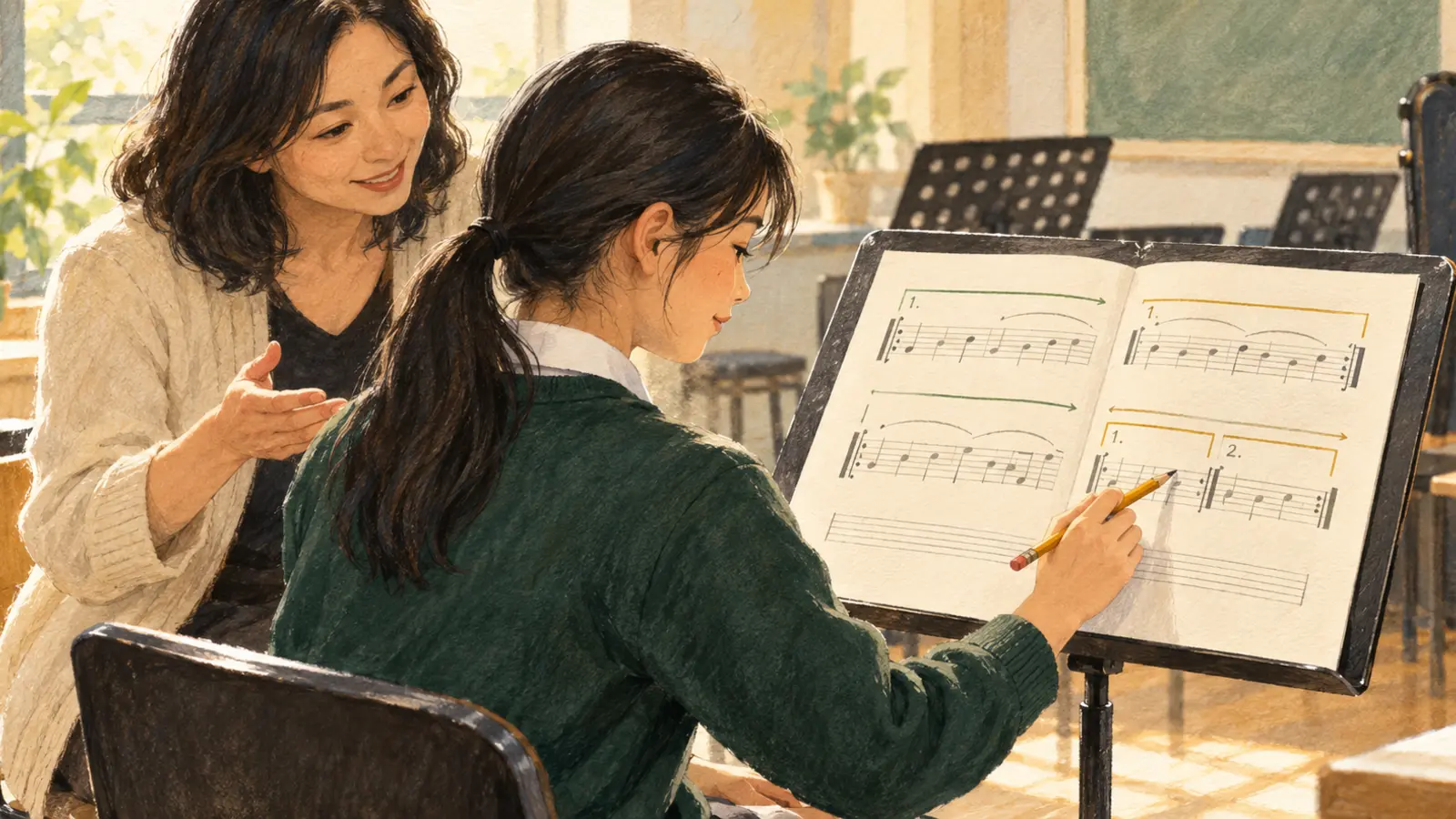
Did you know? A dramatic soundtrack can make an ordinary film scene feel tense, while a quiet cue can make a visual discovery seem important. In Singapore’s 2027 G1 Music SEC, students are asked to learn this relationship directly: create an original thirty-second instrumental cue and synchronise it to one of two provided film or television clips.
This is Task 2 Creating and Evaluating in G1 Music K128 Paper 2. The candidate works with a supplied 30-second video and short description, develops a musical response in a Digital Audio Workstation, renders the cue together with the video and explains the choices in a note of no more than 100 words. Task 2 is worth 20 raw marks and 20% of the subject.
This guide explains how to understand the brief before creating sound, the difference between emotive and action cues, soundtrack timing, originality rules, the correct file format and what parents can ask without composing on behalf of the child. It uses the official 2027 SEAB syllabus and preserves the unchanged eduKateSG teaching reference as a model of targeted feedback.
The quick answer for families
A film cue is music designed to serve a particular screen moment. The candidate needs to notice what happens visually, decide which sonic features support the purpose and produce a coherent musical result with an appropriate beginning, development and ending.
A useful learning question is What changes in the scene, where does it happen, and how does the music help the viewer understand that change? This is more specific than trying to make the soundtrack sound generally exciting.
How Task 2 fits the full G1 Music assessment
K128 allocates Paper 1 Listening 40% and Paper 2 Coursework 60%. The coursework contains Task 1 Creating and Performing worth 40% and Task 2 Creating and Evaluating worth 20%.
Task 1 arranges an existing permitted work and records a unique live student part. Task 2 instead requires an original instrumental cue for an assigned visual situation. The two tasks are not interchangeable.
The correct syllabus is SEC G1 Music K128
SEAB lists G1 Music as K128 for 2027. The film/TV cue belongs to Area of Study 3, Music for Film and Television, under the compulsory Creating and Performing coursework.
The national assessment requires direct supervision by an authorised G1 Music teacher in the student’s own school. Private music creation can support general skill-building but cannot replace authenticated examination work.
Two contexts are offered
The question provides two different film or television contexts, each consisting of a 30-second video and a short write-up. Candidates select one.
Before choosing, read the description and observe the scene carefully. The most visually impressive clip is not necessarily the one a particular student can communicate most convincingly through music.
The cue must last exactly thirty seconds
The music is synchronised to the selected thirty-second video, so its duration needs to correspond to the clip. A longer music-only composition is not the required final outcome.
The first second and last second matter. A well-designed cue may prepare an arrival or resolve a moment, but it should not run beyond the relevant visual sequence.
What a film context tells the composer
The context may involve mood, action, pace, a narrative transition or an important visual event. The candidate should identify which of these relationships is central.
A short description should not be treated as permission to invent new plot facts that are not visible or supplied. The strongest sound choices respond to the actual context.
Emotive and action cues
K128 Area of Study 3 names Emotive Music Cues and Action Music Cues. These are related ways of supporting screen storytelling but do not demand identical musical materials.
An emotive cue may use restraint, harmonic colour or melodic movement; an action cue may emphasise changing rhythm, accents or texture. These are possibilities, not universal formulas.
An emotive cue does not have to be slow
Quiet or gentle music can support an emotional scene, but emotion is not determined solely by tempo. Register, harmony, phrasing, sound colour and silence can also influence the viewer.
Ask which musical feature makes the emotion intelligible and how it fits this particular scene. A slow drum beat under every sad picture may be an unexamined stereotype.
Action music is more than loud percussion
An action sequence may benefit from rhythmic motion, abrupt changes, patterns, tension or silence. The soundtrack’s timing and relationship to the visual event are crucial.
A loud loop throughout the entire clip might conceal an important turning point. The better choice may be a specific accent or change at the moment the story shifts.
Spot the scene’s turning point
Before creating a cue, ask what happens in the opening, which event changes the situation and how the clip concludes. Even an apparently continuous scene can contain an important shift.
Marking those moments on a simple timeline is an unassessed learning aid. The musical decisions should follow the actual issued question rather than an adult-made script.
A sound event is not always a melody
The official Task 2 requirements allow a musical cue with at least one appropriate part from melody, harmony or percussion, with a bass line available where useful.
A meaningful response may be sparse. What matters is whether the selected musical elements communicate the context and are musically coherent.
Melody can give the viewer a thread
A short melodic idea can provide continuity across a change of scene or support an important character or action. It may be repeated, varied or contrasted.
The student should be able to explain why the melody enters when it does and what changes later. Simply placing a pleasant tune beneath a clip may be less purposeful.
Harmony can create expectation
Harmonic movement can influence the perception of tension, release or uncertainty. Its use should be appropriate to the visual context and the student’s understanding.
An imposed sequence of impressive chords is not necessarily better than a simpler approach. Ask what the harmonic movement actually makes the listener anticipate.
Percussion can guide motion
A rhythmic pattern may establish pulse, create energy or mark a change in action. Its character depends on timbre, accent, density and relation to the visual events.
Avoid equating any drum sound with danger or action. A useful pattern should follow the intended purpose and fit the scene’s timing.
Bass can support a chosen part
A bass line is optional and may support the harmonic or rhythmic foundation of the cue. It should be used if it helps communicate the concept.
When listening to a draft, remove the bass temporarily and ask what is lost. If there is no clear musical function, another approach may be more effective.
Silence is also a composition choice
A well-placed silence or reduced texture can draw attention to a visual event. Continuous music is not always the best response to every moment in a thirty-second clip.
The decision should be explainable and consistent with the task. Silence is not an excuse for failing to provide the required original musical cue.
Timbre can change visual meaning
A bright synthetic tone, low sustained sound, plucked instrument or soft percussive texture can affect how a scene is perceived. The role of the sound matters as much as its source.
Ask what the listener hears and why it belongs at that exact moment. Claiming a particular instrument always represents one emotion would be an overgeneralisation.
Texture can grow or contract
The number and relationship of musical layers can change as the scene progresses. An entrance or removal of a part can mark a new visual development.
Adding more tracks should not be the default way to indicate intensity. A contrast can also emerge through different register, rhythm or sound quality.
The cue needs musical coherence
The thirty seconds should form one intelligible response rather than a collection of unrelated effects. A recurring gesture or deliberate transition can help unify the sound.
Ask whether the final passage relates to the opening or to an important visual event. Music can remain simple while still showing development.
Originality is a core examination condition
The K128 Task 2 cue must be original and must not feature excerpts from existing songs or music. Candidates should not insert a famous soundtrack segment because it fits the scene.
The student’s work should demonstrate a candidate-created musical relationship. Reusing someone else’s composition without permission and representation of the source is unacceptable.
Existing background tracks are forbidden
The syllabus prohibits auto-accompaniment software or hardware and existing background music audio tracks found in a DAW, another application or online sources.
A ready-made cinematic bed does not count as the student’s original cue. The student needs to design the musical outcome with permitted DAW functions and materials.
Permitted loops require source acknowledgement
The syllabus allows suitable loops, third-party samples and software instrument plugins within its rules. The candidate must document sources of borrowed materials.
An allowed sample does not make the overall cue automatically original. The student should explain what was combined, changed and organised personally.
What a DAW contributes
A Digital Audio Workstation provides the tools to sequence sounds along the exact screen timeline, edit a gesture, balance layers and export the result.
A student who can drag clips but cannot explain why the cue aligns with the scene has learned only a fraction of the task. Musical intention comes before technical polish.
Choose sound before applying effects
Some students immediately add reverb, distortion or delay to make a short recording feel cinematic. These effects can be useful, but they may also obscure a clear melodic or rhythmic idea.
Try the draft without the effect and compare. If the effect makes the intended musical message harder to understand, reduce or remove it.
Synchronisation must be checked by playback
A cue can be exactly thirty seconds long and still miss the scene’s important moments. Play the video and music together to confirm that entrances, changes and ending occur when intended.
A waveform or timeline marker shows placement, but the listener’s experience is the actual test. A few frames of mismatch may weaken an otherwise thoughtful concept.
Video dimensions and frame rate matter
SEAB specifies that the exported video should preserve the same dimensions and frame rate as the supplied source. Altering these can change playback and synchronisation.
The approved school should provide the technical instructions and source media. A student need not purchase an expensive camera to complete this computer-based soundtrack task.
The required export is MP4 or MOV
Task 2 must be rendered together with the selected video as an MP4 or MOV file. The audio quality must be 185 kbps or higher.
A separately saved MP3 or an unsynchronised DAW project is not a substitute. Open the exported result and verify the complete audiovisual presentation.
The source record is part of submission
Candidates submit documentation for the third-party loops, samples and software plugins used in the cue. A clear inventory should distinguish borrowed resources from student work.
Do not assume an asset is free to redistribute merely because it is available online. The school’s coursework conditions and applicable licences must be respected.
A supporting note of no more than one hundred words
The written supporting note explains musical decisions for the chosen context. It is worth four of Task 2’s twenty raw marks and must not exceed 100 words.
A good note names a specific sound and what screen event it supports. A long account of the software menus used is less helpful than a concise connection between intention and result.
What the twenty marks actually assess
Task 2 allocates sixteen marks to genre-specific musical understanding, musical communication and music-technology skills demonstrated in the completed cue, and four to the supporting note.
This structure rewards the audible outcome and the student’s explanation of why it works. A sophisticated-looking software project does not automatically meet either criterion.
The four questions behind a good supporting note
What is the screen situation? Which musical element was chosen? At which moment does it change? Why does this help communicate the intended scene?
These are useful review questions, not a rigid marking template. The note must describe the actual cue produced rather than a better idea the student wished they had made.
An original practice scene: a new discovery
Imagine a fictional thirty-second clip of a student walking through a quiet gallery and noticing an unfamiliar display. A composer might use one musical texture for the opening and change it at the moment of discovery.
This is an original learning example, not a published SEAB prompt. The student should try multiple plausible sound choices and explain the differences.
Another practice scene: an urgent message
Imagine a short clip showing someone trying to deliver a message before an event begins. The cue might suggest urgency through rhythmic organisation or increasing density.
It does not necessarily need a constant loud drumbeat. Ask whether the music helps the viewer follow the action without overwhelming the visual information.
A third practice scene: a calm conclusion
An invented clip ends with a group finding a solution to a shared problem. The music could communicate completion by reducing tension, revisiting a phrase or selecting a new timbre.
An evaluation should consider whether the transition fits the depicted moment. Do not assume a bright major chord is the only valid ending.
Use general practice material, not the assessed clip
Families can practise these ideas with original or properly permitted fictional footage. The actual K128 coursework context and student-created cue remain subject to school supervision and authentication.
Parents and tutors must not produce the official examined music or supporting note on behalf of a child. The purpose of preparation is to build independent capability.
A short diagnosis-led learning cycle
Start with the learner’s understanding of the scene, then the musical purpose, then the DAW implementation, and finally the exported file. If the result is weak, locate the first step that no longer matches the intended meaning.
A timing error needs a different correction from an unclear musical idea or incorrect export. A single instruction to ‘make the cue better’ cannot diagnose those differences.
A four-week general preparation plan
Week one: listen to how musical textures affect short scenes. Week two: create original motifs, sound changes and contrasts in unassessed work. Week three: practise synchronising small ideas to fictional video. Week four: evaluate a result, write a concise explanation and check exports.
The real coursework follows the school’s five-month, thirty-hour supervised arrangement. General practice should not replace or circumvent official conditions.
What parents can ask after class
Try What changed on screen? What happened in the music at that time? How would the clip feel different if that sound were removed?
The student should answer using their own observation. This builds musical thinking without the parent becoming an unacknowledged composer or editor.
Frequently asked questions
Is Task 2 compulsory? Yes, it is part of the 60% G1 Music Coursework. How long is the cue? Thirty seconds. Can an existing background track be imported? No.
What is submitted? The synchronised MP4/MOV video, relevant third-party source documentation and a note of no more than 100 words. Do the video dimensions and frame rate need to match the source? Yes.
The lasting reason to study film and television music
This task can help teenagers connect careful observation with artistic action: understand a scene, test an idea, create sound responsibly and explain its effect. The lasting skill is purposeful communication through music.
Read the official 2027 SEAB G1 Music K128 syllabus. Compare G1 Music Coursework and the DAW guide. The unchanged Clementi tutorial benchmark illustrates targeted feedback in a separate subject and does not promise soundtrack-composition tuition.