
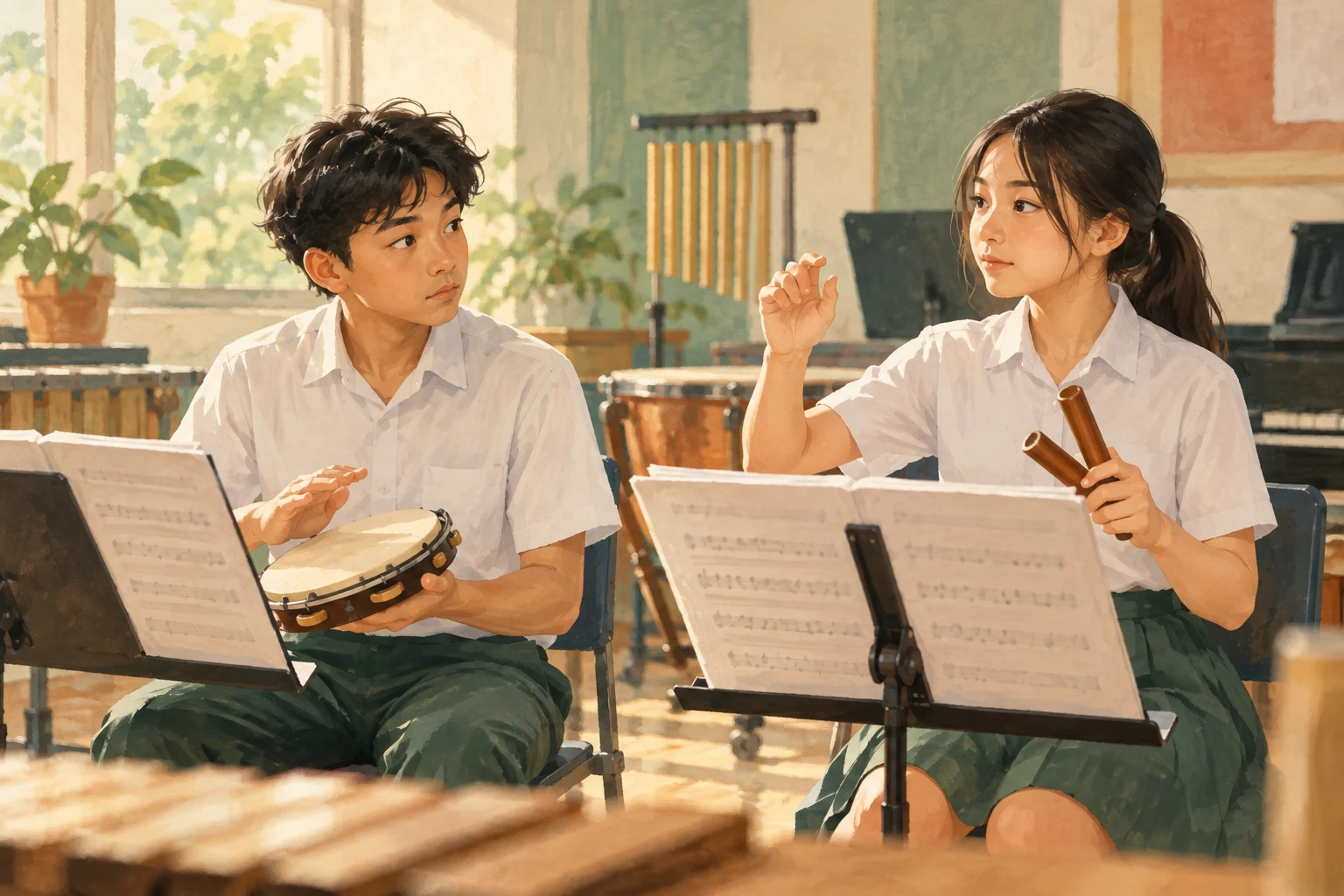
**Did you know?** A teenager taking the 2027 G1 Music SEC must do something unusually concrete: create an arrangement in a digital audio workstation, perform one unique part live and record the performance under supervision. The same student must also compose an original instrumental cue synchronised to a thirty-second film or television clip. Both tasks are marked, and they account for sixty per cent of the subject.
**G1 Music Coursework is Paper 2 of the Singapore–Cambridge Secondary Education Certificate K128.** It is not simply a school concert or a folder of favourite songs. The work assesses how a child understands a musical genre, creates an arrangement, uses music technology responsibly, performs with accuracy and communicates the thinking behind a short screen-music cue.
This guide explains the 2027 requirements in practical language for Singapore families: Task 1 Creating and Performing, Task 2 Creating and Evaluating, the five-month and thirty-hour supervised period, DAW rules, live recording, restricted source use, audio/video files and the scoring rubrics. The goal is useful, honest preparation rather than an adult-produced coursework package.
The quick answer for parents
G1 Music Coursework contributes **60 raw marks and 60%** of K128. **Task 1 is worth forty marks (40%)** and requires an arrangement with a separately identifiable live-performed part. **Task 2 is worth twenty marks (20%)** and requires an original thirty-second instrumental cue for a supplied film or television context plus a short supporting note.
The student must be able to explain what each musical part does, why the chosen sounds suit the purpose and what was created personally. A professional-looking audio file without that understanding is not the educational outcome.
G1 Music has two national papers
K128 Paper 1 Listening is **one hour and forty marks (40%)**, while Paper 2 Coursework is the remaining **60 marks (60%)**. Both are compulsory under the official 2027 scheme.
The course integrates listening, creating and performing. The coursework is not optional simply because the learner enjoys listening more or plays an instrument privately.
The full five-month supervision arrangement
SEAB permits up to **thirty supervised hours over a period of up to five months**, commencing from March of the examination year. The student’s G1 Music teacher supervises the coursework.
Rehearsal and the Task 2 supporting note may fall outside the counted supervised time under specified rules; the live recording itself must follow its own supervised recording requirements. Exact school milestones remain the authority.
The teacher’s role is to supervise, not create
K128 requires direct supervision of a G1 Music teacher in the candidate’s own school. The coursework remains the student’s own production, with the teacher describing the nature and extent of guidance and certifying authenticity.
Parents and tutors should not assemble the actual assessed audio, write the supporting note or replace the student’s instrument performance with a professional recording.
Task 1 is an arrangement, not a new commercial recording
The candidate chooses a song or instrumental work from permitted genres and creates an arrangement in a DAW, using source recordings, lead sheets or chord charts as appropriate.
This task requires independent arranging decisions about musical layers, genre, structure and performance. It does not permit simply importing a ready-made backing track and presenting it as a new arrangement.
Permitted Task 1 Areas of Study
Task 1 may use **AoS 1 Popular Music from 2000 onward**, **AoS 2 Western Classical Music**, or **AoS 4 Music from Local Cultures**, with the syllabus allowing appropriate combinations of features from two relevant genres.
**AoS 3 Music for Film and Television** is not the Task 1 source category; it is the dedicated context for Task 2. The distinction prevents a student from choosing an unsuitable starting task.
The arrangement must last one to two minutes
K128 sets a **one- to two-minute** duration for the complete Task 1 arrangement. The work needs a clear introduction and ending, genre-specific features and the required musical layers.
A longer arrangement is not automatically better, and a short clip without a meaningful ending may feel incomplete. Plan the musical progression before polishing the final mix.
Melody is a required part
The arrangement needs a recognisable melodic part. The student should know how the melody relates to the original source and how their own production makes that relationship clear.
A melody can be prominent without being extremely loud. The arrangement should allow listeners to understand its role among the other instruments.
Harmony is a required part
The rubric expects harmonic support appropriate to the chosen genre. The specification permits **no more than three layers of contrasting harmony parts of different instrumental timbres**.
Adding ten keyboard chord tracks would not satisfy that arrangement rule simply because they sound rich. Choose harmonic parts whose functions can be explained.
A bass line is required
A bass line anchors or shapes aspects of harmony, groove and musical movement, depending on genre. The arrangement must include a relevant bass part rather than rely on an unexplained preset sound.
Ask whether the bass supports the intended musical structure and whether it is distinct enough from the melody and harmony to contribute meaningfully.
Drum or percussion is contextual
A drum or percussion part is required when appropriate to the style, with **no more than three contrasting percussion layers using different timbres in total**.
The instrument choice should respect the genre. A dense programmed dance beat is not automatically appropriate for every Western Classical or local ensemble arrangement.
Optional layers do not replace the core parts
K128 lists possible optional elements such as counter-melody, vocal harmony, rap or spoken words, sound effects and an instrumental solo.
These can enrich an arrangement when they add a genuine musical function. Adding them merely to show technical sophistication can obscure the melody or violate the task’s clarity.
Intro and ending are assessed musical decisions
A clear introduction helps establish genre and lead into the main idea. A deliberate ending communicates closure or a suitable final gesture.
Students should not simply start in the middle of a source track or stop the DAW when the duration reaches its maximum. Ask how the beginning and ending relate to the whole arrangement.
A DAW is compulsory for Task 1
The arrangement is produced in a **digital audio workstation**, using appropriate sequencing, recording, mixing and audio or MIDI tools.
A DAW supports musical decisions but does not determine them. The candidate should explain why an instrument or track was chosen and how it relates to the arrangement’s style.
MIDI is not the same as audio
MIDI can represent musical note or control events and drive suitable sound sources, while audio captures a sound signal. Both can be part of a music-production workflow.
A student should know whether a track contains a performance recording or a sequenced pattern and how that affects editing and the evidence required for the coursework.
Sequencing has a musical purpose
The candidate may sequence appropriate accompaniment parts, develop patterns and organise layers into a coherent arrangement.
The goal is to realise the intended musical texture, not to fill the screen with loops. Each track should make a contribution that remains audible and meaningful.
One part must be performed live
Task 1 requires the student to perform **one of the arrangement’s parts live** and record it into the DAW as an audio or MIDI track. The rest can be sequenced under the syllabus rules.
The live-performed part **must not duplicate another part**. The candidate’s own technical and expressive skill is assessed, so the recording needs to reveal it clearly.
The live part is recorded last
SEAB states that the candidate records the live part as the final stage of the arranging process, after preparing the other tracks appropriately.
This helps the pupil coordinate the live performance with the completed accompaniment. The candidate should understand the entry points and rhythmic relationships before the supervised session begins.
Three takes within thirty minutes
The candidate has **thirty minutes to record three takes** of the live part and choose the best one. The recording must be completed within the same supervised session.
This is not unlimited studio time. Practise beforehand under ordinary learning conditions so that the candidate can perform the part reliably without needing a professional editor to repair it.
The best take needs video authentication
All three takes are video-recorded, and the video of the best take is submitted for authentication along with the resulting audio. The video should clearly document the candidate’s actual performance process.
Families should follow the authorised school’s filming and storage rules. The video is assessment evidence, not a social-media publicity requirement.
Pitch and rhythm correction are prohibited
The 2027 K128 instructions expressly prohibit using **pitch or rhythm correction software tools** on the live-performed part.
The student must demonstrate actual musical timing and pitch control appropriate to the part. Automatically correcting a weak performance would misrepresent the skill the examiner is assessing.
Existing backing tracks are prohibited
Task 1 does not permit importing existing backing tracks or using auto-accompaniment software/hardware to complete the work. It also forbids importing related original MIDI files or audio stems as arrangement parts.
This is a major difference between arranging and merely remixing a finished commercial production. The candidate must construct their own appropriate accompaniment under the rules.
How original score imports are restricted
For the Task 1 arrangement, parts other than the melody cannot simply be typeset or imported from existing notated scores. Candidates need to create the supporting arrangement themselves.
A source lead sheet may guide the musical material, but the student’s contribution must be genuine. Ask which parts were arranged and which original sources were acknowledged.
Loops may be used when permitted
The syllabus allows appropriate loops, third-party samples and software-instrument plugins within the DAW while expressly restricting existing backing tracks and automatic accompaniment.
The distinction matters: permitted production tools can support original arrangements, but they cannot substitute for the required musical decisions or the live-performance part.
Source documentation is compulsory
Candidates must acknowledge the source material they selected and document third-party loops, samples and software plugins. The examiner needs to know which material was borrowed and what the student created.
A source file’s presence on the internet does not automatically confer copyright permission. The school should guide suitable, legally accessed materials and the required attribution.
Mixing has a limited but important goal
For Task 1, the candidate should balance parts sensibly in dynamic levels and use appropriate panning. The coursework does not become stronger simply by adding excessive studio effects.
Ask whether the melody, bass and live part can be heard and how they interact. A clearly balanced mix usually makes the arrangement’s musical intent easier to assess.
Task 1 audio needs the correct quality
The finished arrangement is rendered as an **MP3 at 256 kbps or higher**, including the selected recorded live take. The output must be prepared within the official live recording process.
Verify that the exported file has the correct full duration, intended track balance and actual chosen take. A DAW project that plays correctly but has not been exported as required is not a complete submission.
Task 1 is worth forty marks
The arrangement’s genre understanding, communication and music-technology skills carry **sixteen marks**; the accuracy and expression of the candidate’s live performance carry **sixteen**; and range of arranging and performing skills carries **eight**.
This makes both production and musicianship essential. A pupil should understand why practising the live part matters as much as choosing good digital sounds.
Task 1 Creating rubric details
Within the creating aspect, the syllabus divides marks among genre-specific communication, DAW technology and the range of arranging skills.
A convincing arrangement should sound appropriate to its chosen style and show that the pupil deliberately selected and combined parts. A copied ready-made backing file is not equivalent evidence.
Task 1 Performing rubric details
The performing aspect examines accuracy of notes and rhythms, coordination with the arrangement and communication of musical ideas through the student’s playing or singing.
A strong candidate knows where the part enters, how it interacts with the surrounding sound and what expressive character suits the genre. Mechanical note accuracy is important but not the whole assessment.
Task 2 is not another arrangement
Task 2 requires an **original thirty-second instrumental music cue**, synchronised to one of two film or TV contexts supplied by the examination authority.
The candidate is responding to a visual story or action, not making a new version of an existing song. The music must be original and must not include excerpts from existing songs or other music.
Two film or TV contexts are supplied
The task offers two different contexts, each with a **thirty-second video clip and a short write-up**. Candidates choose one and create music suited to that situation.
A student should read the write-up and inspect how the scene develops, rather than choose the first context simply because its imagery looks exciting.
The cue must match the video duration
The original instrumental music should run for the **same thirty seconds as the chosen clip** and be synchronised to it. That duration is a formal requirement.
Composition and timing work together. A dramatic sound that begins after the relevant visual event may communicate less effectively than a simpler cue placed deliberately.
Musical cues carry a narrative function
A cue may support action, anticipation, emotional movement or a transition, depending on the supplied context and the Music for Film and Television conventions.
The student should identify what the viewer needs to understand or feel at a particular moment and which musical relationship may help. The choice must fit the actual clip.
Emotive and action cues are different possibilities
The syllabus’s Music for Film and Television area covers **Emotive Music Cues** and **Action Music Cues**. Their characteristics depend on how sound supports the visual context.
Do not automatically use slow music for sadness or loud percussion for action. A credible cue follows the specific scene’s events and artistic purpose.
Task 2 requires a meaningful musical part
The cue must include at least one of melody, harmony, or drum/percussion where appropriate. A bass line can be added to those parts, and multiple tracks can support the idea.
More instruments are not necessary when a focused musical gesture communicates the context. The composer should know why every sound appears.
A cue has its own beginning and change
In a thirty-second clip, the cue may need to establish a sound, respond to a turning point and conclude at the correct moment. Small changes in texture can have a large impact on how the scene is perceived.
Students should identify the most significant visual moments before constructing a musical plan. The result must be synchronised rather than simply placed under the video.
Task 2 needs a DAW as well
The candidate creates Task 2 using a DAW and its appropriate functions, which may include permitted loops, effects and software instruments.
Automatic accompaniment and ready-made background music from applications or online sources are prohibited in this task too. The cue must retain its original character and satisfy source-use rules.
Sound design should serve the scene
A change in timbre, rhythm, dynamics or silence can support a visual event. The candidate should choose those elements because they communicate the supplied context.
Pressing buttons until a cue sounds dramatic may produce a technically busy result with no clear connection to the scene. Purposeful testing is better.
A fictional practice clip
Imagine an original thirty-second practice clip of students entering a darkened museum exhibit and discovering a brightly lit object. The learner can ask where anticipation begins and where a musical change would fit.
This is unassessed, original teaching material, not a SEAB examination video. The pupil should invent a musical concept appropriate to the situation rather than copy a famous film cue.
Another practice clip: a quiet transition
A fictional clip could show the transition from a crowded school corridor to a calm reading room. A candidate might explore reducing texture, changing timbre or leaving space to communicate that movement.
The exercise is about choices and evaluation. It does not prescribe a particular melody, instrument or finished assessed cue.
Task 2 Supporting Note is at most 100 words
The student supplies a short written note explaining musical choices for the selected context. SEAB sets a maximum of **100 words**, and the note carries **four of the twenty Task 2 marks**.
The note should identify the most important musical decision and how it serves the visual material. A long essay about the history of film music would not meet its purpose.
Task 2 is worth twenty marks
The original cue’s genre-specific understanding, musical communication and technology skills are worth **sixteen marks**; the supporting note is worth **four marks**.
That means the actual produced music is central, while the writing must still show the learner understands why the cue was made that way.
Task 2 final export includes video
The finished cue is rendered **together with the chosen video** as MP4 or MOV, with the same dimensions and frame rate as the source clip. The required audio quality is **185 kbps or higher**.
A separate audio-only file cannot automatically replace the specified synchronised video. Check the clip’s full length and whether musical events occur at the intended moments.
Task 1 submission: four evidence items
SEAB requires the final MP3 arrangement, video of the candidate’s best live-performance take, documentation of the original musical source and documentation of any third-party loops, samples or software instrument plugins used.
These items serve different purposes: hearing the result, authenticating the live performance and distinguishing sourced content from the student’s own contribution.
Task 2 submission: three evidence items
The student submits the synchronised MP4/MOV cue video, third-party source documentation and a supporting note of at most 100 words.
Missing source records or the note can leave the task incomplete even if the video itself plays. Organisation should begin before the final export.
Three tasks parents should not take over
Parents should not construct the Task 1 backing, correct the live take in software or create the Task 2 music cue for the child. Doing so can undermine both learning and the formal authentication conditions.
Parents can discuss purposes, ask the learner to explain choices and help them keep track of official deadlines without becoming the assessed performer or composer.
The music must remain the candidate’s work
Teacher authentication and school control of drafts are part of the official coursework process. The aim is to establish that the candidate has demonstrated the musical and technological abilities assessed.
A file that sounds professional is not evidence of the teenager’s competence if someone else performed or arranged its essential parts. Honest, age-appropriate work is more meaningful.
Five common DAW mistakes
The first mistake is adding tracks without clear function. The second is using an existing backing file. The third is allowing the live part to duplicate another track. The fourth is using prohibited correction. The fifth is failing to check the actual exported submission.
A targeted music teacher can diagnose each cause and teach an appropriate repair using authorised learning examples.
A short track-function check
Ask the student to identify melody, harmony, bass, rhythm and the unique live part in the arrangement. For each, explain its role and listen to what happens when that part is muted.
This exercise can expose unnecessary duplication, poor balance or missing function before the final supervised recording session.
How to prepare for the live take
Practise the chosen part with the intended accompaniment at a manageable tempo, then gradually rehearse the full target performance. Focus on accurate entrances, rhythmic stability and expressive purpose.
The official supervised recording has only three takes within thirty minutes. Preparation should create real performance confidence rather than depend on later correction.
A controlled rehearsal log
Record one specific issue, such as an entrance that arrives early or a melody masked by a harmony part. Write down a change and whether it helped.
This makes practice diagnostic. A diary that merely lists software sessions and hours worked may miss the reason the music still sounds incomplete.
How to prepare the film cue
Before sequencing, ask the student to describe the thirty-second clip in a few stages: setup, significant visual event and ending. Then identify what musical information is needed at each moment.
Keep the eventual music original and relevant. The purpose is synchronised expressive design, not a generic background track chosen because it sounds dramatic.
What the rubric reveals about the educational goal
Task 1 values genre understanding, technology, arranging range and live musicianship. Task 2 values genre-specific cue creation, digital production and thoughtful explanation. Together they connect listening with making.
Parents can judge learning more accurately by asking the teenager to explain the relationship among these parts than by counting how many plugins or instruments they have used.
A five-month planning principle
Early supervised work can establish the source and arrangement structure; later stages can refine parts and prepare the live performance. The film cue needs its own planning, composition, review and export milestones.
These are planning suggestions, not an official prescribed week-by-week schedule. The supervising school and current question paper control actual coursework progression.
The role of copyright and permissions
Existing music, arrangements, samples, recordings and video material can have rights restrictions. The coursework syllabus specifies when source material can be used and how it must be documented.
Do not upload school-supplied clips or copyrighted works publicly without permission. Using the material within an examination does not automatically authorise sharing it online.
A four-week general practice cycle
Outside examined work, week one can develop understanding of melody and harmony roles; week two can practise simple DAW sequencing and recording; week three can explore synchronising an original sound idea with an invented visual scene; week four can review attribution and export skills.
This is general preparatory learning, not an alternative to the officially supervised five-month coursework and actual issued questions.
What parents can ask after a session
Try **Which part did you create? Why is it needed? How would the recording or scene change without it?** Then let the student demonstrate their reasoning without an adult operating the DAW for them.
If the pupil cannot explain a technical requirement, refer to the approved teacher and syllabus. A question that identifies confusion is useful information for the next lesson.
What an effective Music tutor should teach
A capable teacher can diagnose source selection, arrangement structure, incomplete musical parts, timing with a DAW, insufficient instrument technique, inappropriate cue synchronisation and weak supporting explanation.
The lesson should lead to independent improvement on permitted, unassessed material. A tutor who delivers a completed track for the student to submit has not demonstrated that the teenager learned to make it.
Frequently asked questions
Is G1 Music Coursework worth sixty per cent? **Yes.** Is Task 1 a one- to two-minute arrangement with a live part? **Yes.** Is that part allowed to duplicate another track? **No.** May pitch correction repair the live performance? **No.**
Is Task 2 a thirty-second original cue? **Yes.** What is its writing limit? **A supporting note of no more than 100 words.** Are existing backing tracks permitted? **No**, under the specified conditions.
The lasting reason to study G1 Music Coursework
G1 Music Coursework can help a teenager move beyond passive listening toward purposeful arrangement, accountable performance and original sound design. The learning is real when they can explain their musical choices, follow copyright and examination rules, and demonstrate the work independently.
Consult SEAB’s official 2027 G1 Music K128 syllabus, Paper 2 and detailed rubrics. Continue with Why Study G1 Music, the G1–G3 Music comparison, and the G3 Music Creating guide to understand different examination levels. The unchanged Clementi small-group Mathematics reference illustrates a separate diagnostic learning philosophy and does not imply G1 Music coursework tuition availability.