
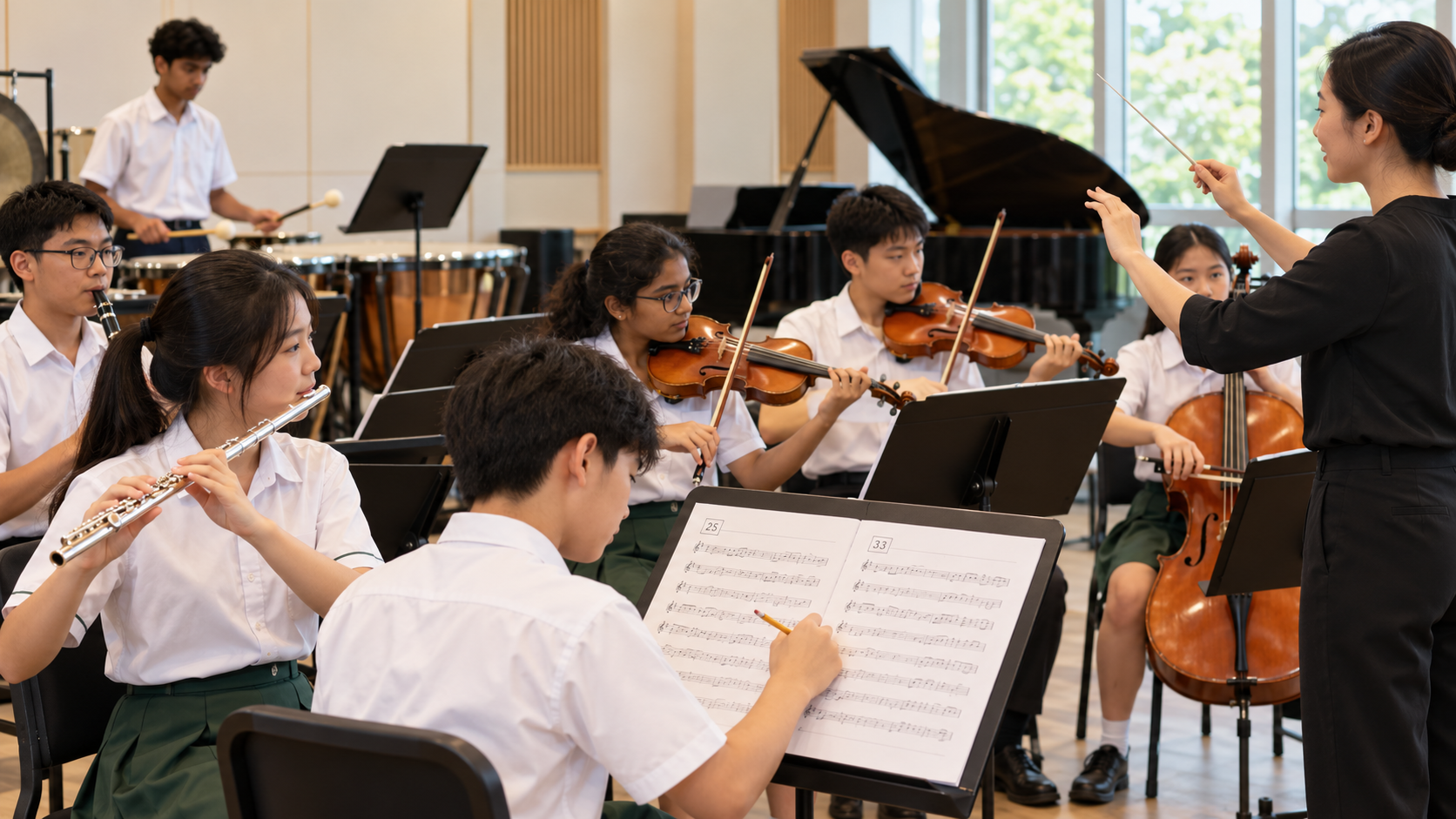
Did you know? The 2027 G3 Music SEC deliberately gives candidates no printed score for the two Asian Music listening questions. Students must rely on what they hear: how instruments interact, which rhythmic relationships recur, how an ensemble changes and what distinguishes a particular tradition. Naming an instrument is only the first step.
Asian Music is Part 3 of the Music Studies paper in G3 Music syllabus K350. The two questions are worth a combined 25 of the 75 Music Studies marks and cover specified practices of Malay traditional dances, Chinese ensembles, Indian ensembles and Javanese Gamelan. Each extract is heard four times, with pauses for answers.
This guide follows the official 2027 Singapore–Cambridge Secondary Education Certificate syllabus. It explains the actual traditions and technical concepts, develops score-free listening and cultural literacy, and helps Singapore parents support understanding without turning complex living practices into inaccurate stereotypes.
Quick answer: why study Asian Music?
It develops the ability to hear how different musical cultures organise pulse, melody, texture, instruments, form and performance. Students learn to notice relationships rather than identify music only by a broad cultural label.
The lasting question is What does the ensemble do, which musical event supports your explanation, and what makes the tradition distinctive in this excerpt? This method combines respectful curiosity with accurate listening.
Where Asian Music sits in the SEC
K350 Music Studies Paper 1 is a 90-minute, 75-mark written exam worth 40% of G3 Music. Part 3 Asian Music has two compulsory questions worth a total of 25 raw marks.
The other 50 marks cover Western Classical (25) and Jazz/Popular (25). Asian Music must be prepared thoroughly, but it does not replace the rest of the syllabus or the compulsory Creating and Performing papers.
Questions 5 and 6
The two Asian Music questions are numbered 5 and 6. Each carries 12 or 13 marks and may draw on any of the specified traditions.
Students should not assume Question 5 always covers one country and Question 6 another. The syllabus defines a pool of traditions, not a permanently fixed pairing.
No score is supplied
SEAB states that Questions 5 and 6 have no accompanying musical score. Students must listen directly for relevant rhythmic, melodic and instrumental features.
A candidate who relies on written notation to analyse other parts of Music Studies needs deliberate score-free practice here. The absence of notation makes careful auditory evidence especially important.
Four hearings with pauses
Each Asian Music extract is played four times, with timed pauses to write responses. The general Music Studies extract duration is about 30 seconds to one minute thirty seconds.
Use the first hearing for overall sound, the second for rhythmic or instrumental relationships, and later hearings to verify the answer requested. The sequence is a study suggestion, not SEAB’s required internal listening procedure.
The four assessed traditions
The published K350 list includes Malay Traditional Dances (Zapin and Joget), Chinese Ensemble Music (Jiangnan Sizhu and Guangdong Music), Indian Ensemble Music (Hindustani and Carnatic) and Javanese Gamelan.
These labels name particular practices. A candidate should not classify every performance from a wider culture under one of these categories without evidence.
| 2027 K350 Asian Music | Required traditions | Special terminology |
|---|---|---|
| Malay Traditional Dances | Zapin and Joget | Gambus, seruling, rebana, marwas, gong; taksim, wainap |
| Chinese Ensembles | Jiangnan Sizhu and Guangdong Music | Erhu, gaohu, pipa, dizi, pentatonic; manban, zhongban, kuaiban |
| Indian Ensembles | Hindustani and Carnatic | Raga, tala, alap/alapana, gat, kriti |
| Javanese Gamelan | Gamelan ensemble | Pelog, slendro, heterophony, polyphonic stratification |
| National paper | Questions 5 and 6, 12 or 13 marks each | Four hearings per extract; no score |
The point of musical context
Students are expected to understand social and cultural setting, performance purpose, arrangements, improvisation and roles of instruments within the actual tradition.
Context matters when it explains sound. A memorised story about a community is not an answer to a question asking why one instrument leads or how a rhythmic pattern recurs.
Listening begins with pulse
Before deciding which tradition is heard, identify whether a steady pulse is apparent and which instruments or gestures establish musical time.
Some music may organise time through cycles or layered markers rather than a Western drum-kit pattern. Describe what happens before forcing every excerpt into an inappropriate framework.
Rhythm versus metre
Rhythm concerns audible patterns of duration and accents; metre concerns a broader grouping of beats. The distinction remains useful across traditions, though each practice may use its own theoretical vocabulary.
A learner should avoid claiming every accented note changes metre. Listen for repetition and grouping across more than one instant.
Melody is culturally situated
A musical phrase can have a recognisable contour, repeated idea, ornamentation or characteristic mode. But the way those elements are organised differs by practice.
Use appropriate terms for the specific tradition when the syllabus supplies them. Do not assume every melody must be explained through Western major/minor harmony.
Texture describes relationships
An ensemble can combine a main line, simultaneous variations, recurring patterns and other parts with contrasting functions.
A strong answer identifies how the voices relate. Counting instruments without explaining what they do gives much less information.
Timbre is an audible clue
A bowed string, plucked zither, metallophone, hand drum or gong can provide clues when identified accurately from the actual sound.
One instrument may be used across multiple genres or settings. The ensemble and musical organisation are usually more reliable than an isolated timbre guess.
Instrumentation is not ethnicity
A musical classification should follow instruments, style and context—not photographs, clothing, facial features or assumptions about performers.
The exam uses audio. This encourages students to justify conclusions through the music itself, an important safeguard against stereotyping.
Malay traditional dance music
The syllabus covers Zapin and Joget as distinct Malay dance-associated genres. Their rhythmic patterns, instrumental groupings and performance functions should be understood separately.
Candidates should use the specific listening features taught in K350. A label ‘Malay music’ alone does not explain which dance genre or which musical event is being heard.
Zapin: a specific dance tradition
Zapin has associated rhythmic and ensemble practices. The learner should identify the characteristic relationships heard in a particular authorised example.
Do not describe every quick repeated rhythm as Zapin. The correct identification should follow a combination of rhythmic and instrumental evidence.
Joget: contrast with Zapin
Joget is another named tradition. Studying it alongside Zapin allows students to compare patterns of dance accompaniment, rhythmic feel and ensemble roles.
A compare-and-contrast answer should make a clear claim about each passage and identify evidence rather than reduce the distinction to one being simply faster.
Gambus as an instrument
The gambus is one of the instruments named in the K350 Malay Traditional Dances content. Students should recognise its relevant plucked-string role and sound in context.
An answer is stronger when it says what the gambus contributes in the excerpt. A precise named instrument without a role may not fully address the question.
Seruling, violin and accordion
The syllabus names seruling, violin and accordion among Malay dance ensemble instruments. Different combinations can create contrasting melodic and timbral relationships.
A student should not insist that every listed instrument is present in every excerpt. Describe the source actually audible and remain cautious when timbres are ambiguous.
Rebana, marwas and gong
The syllabus also names rebana, marwas and gong, which can contribute contrasting rhythmic or punctuation roles within the relevant traditions.
Ask which instrument maintains a recurring pattern, articulates an accent or marks a structural point. Naming percussion without explaining its function is incomplete analysis.
Taksim
K350 explicitly includes the function and features of taksim in the Malay dance area. It is a concept to understand within its particular performance context.
A candidate should learn what the section does and how it relates to other musical events rather than treating the term as a decorative label for any instrumental solo.
Wainap
The syllabus also names wainap in the same specific area. The learner should understand its features and function in relation to the relevant traditional performance.
Use the school-approved musical examples to hear the relationship, then describe it with precise context. Do not invent a universal rule about all Malay ensemble music.
How to compare two Malay dance excerpts
Listen for recurring rhythmic organisation, leading melodic instruments, accent patterns and relevant formal or introductory functions.
Describe differences in the actual recordings. A generic statement that one is energetic and the other graceful is less convincing without specifying the musical evidence.
Chinese Ensemble Music: two named practices
K350 covers Jiangnan Sizhu and Guangdong Music. These genres have distinct histories, ensemble configurations and ways of treating melody.
Students should avoid treating Chinese Ensemble Music as one uniform instrumental sound. The actual features of the two prescribed practices are the examination focus.
Jiangnan Sizhu
Jiangnan Sizhu involves ensemble music with its own idiomatic interactions and instrumental practices, including melodic elaboration and the relationship among lines.
The listener should identify which instruments share or decorate material and how those parts coordinate. Hearing one bowed instrument does not by itself establish the genre.
Guangdong Music
Guangdong Music is separately named in the syllabus and requires recognition of characteristic instrumentation, musical texture and style.
Ask what distinguishes the present arrangement from another Chinese ensemble practice. A genre name with no sound-based justification shows limited understanding.
Erhu and gaohu
The erhu and gaohu are bowed-string instruments named in the K350 Chinese Ensemble Music list, with different ranges and timbral qualities.
Students should identify their roles carefully when audible. It is reasonable to acknowledge uncertainty when short excerpts do not permit an unequivocal instrumental distinction.
Dizi and xiao
The dizi and xiao are distinct flutes listed in the syllabus. They can contribute characteristic timbre and melodic phrasing in relevant ensemble contexts.
Avoid assuming all flute-like sounds come from one instrument. Note what can be heard and use the complete instrumental setting as context.
Pipa, guzheng and yangqin
These plucked or struck-string instruments appear among the specified Chinese ensemble instruments. Their attacks, decay and musical roles can help explain a passage.
A useful response discusses a recognisable musical contribution rather than merely producing an alphabetised list of instrument names.
Sanxian, sheng and percussion
The sanxian, sheng, clappers, cymbals and drums are also listed. Their functions vary with the composition and ensemble.
Ask which sounds establish continuity, rhythmic emphasis or texture. Do not claim every piece includes the entire syllabus instrument list.
Pentatonic mode
The 2027 Chinese Ensemble Music content identifies pentatonic mode as a relevant concept. It describes particular pitch organisation.
A pentatonic pitch collection alone does not identify every music practice uniquely. Students should combine pitch evidence with instrumentation and performance style.
Tempo terms: manban, zhongban, kuaiban
SEAB explicitly names manban, zhongban and kuaiban as tempo/form terminology within the Chinese Ensemble Music content.
Learn them as meaningful categories related to musical pace or section, and check how the actual excerpt demonstrates the relevant distinction. Memorising spellings without sound examples is inadequate.
How to recognise melodic elaboration
Two instruments can present related versions of a melodic line, each adding ornaments or moving differently while maintaining a shared identity.
This is a texture relationship rather than proof that two unrelated songs play simultaneously. Ask which contour or phrase remains recognisable beneath the variations.
Indian Ensemble Music: two traditions
The official G3 Music syllabus includes Hindustani and Carnatic ensemble practices. Candidates should understand named instruments, improvisatory approaches and associated forms.
The two traditions have distinct histories and performance conventions. Do not impose a single description on all Indian music or claim the listed forms belong identically to every performance.
Hindustani listening
A Hindustani excerpt may involve particular melodic organisation through raga, rhythmic cycles through tala and characteristic stages of performance.
A useful answer identifies what is actually heard and which convention is relevant. Merely knowing the words raga and tala does not explain a musical passage.
Carnatic listening
Carnatic music includes its own vocal, instrumental, compositional and improvisatory practices. The syllabus names forms and stages to be recognised within this context.
The student should learn from authorised examples appropriate to the particular tradition rather than rely on generic ideas about improvisation.
Raga as a melodic framework
Raga concerns a framework of melodic organisation and performance, and cannot be reduced to simply choosing one Western major or minor scale.
Students should understand its function at the level prescribed by K350 and identify appropriate evidence in the heard passage.
Tala as rhythmic organisation
Tala concerns cyclical rhythmic organisation in Indian musical practices. It can inform how accompaniment, emphasis and performance relate.
Ask the learner to hear the cycle and its markers where appropriate. Do not assume the absence of a Western drum kit means the music has no organised rhythm.
Alap and alapana
The syllabus explicitly names alap/alapana among the relevant form and structure concepts. These require understanding in relation to their respective traditions.
Listen to the role of an opening or exploratory stage and how it relates to subsequent performance. Avoid assuming any slow introduction automatically qualifies.
Gat and kriti
The syllabus also names gat and kriti within its Indian Ensemble Music coverage, each associated with specific musical contexts.
Candidates should understand where these forms are relevant and how composition and performance practice contribute. A single translated label does not communicate all the musical evidence.
Sitar and veena
The sitar and veena are among the named instruments in the syllabus. They have distinctive techniques and possible roles in the relevant traditions.
Identify actual timbre, melodic activity or ornamentation rather than rely on a general plucked-string assumption.
Tabla and mridangam
The tabla and mridangam are named percussion instruments with different traditions and roles in rhythmic organisation.
Ask whether the instrument marks a cycle, responds to a performer or develops another pattern. The significance is in the musical relationship, not only the instrument’s name.
Sarod, sarangi and tambura
The syllabus includes sarod, sarangi and tambura, among other instruments, with different melodic and drone functions in suitable contexts.
Students should distinguish sustained tonal reference from melodic development when the evidence allows. A deep or continuous sound should not be labelled by guesswork alone.
Improvisation is not formless sound
Improvisation in the named Indian traditions occurs within particular musical frameworks and performance conventions.
A response should describe how melodic or rhythmic ideas unfold in context rather than claim the musician is simply playing whatever comes to mind.
Javanese Gamelan: a different ensemble logic
The K350 syllabus specifically examines Javanese Gamelan, including metallophones, gongs, gong-chimes, rebab, suling and kendang.
A learner should hear how the parts organise layers, timing and musical structure. One gong strike does not by itself explain the whole ensemble.
Metallophones and gong-chimes
Metallophones and gong-chimes provide characteristic pitched percussion sounds and may participate in recurring patterns or structural relationships.
Ask which part repeats a framework and which creates variation. The music is better understood through roles than by a simple list of metallic instruments.
Kendang and ensemble time
The kendang is among the syllabus’s named Gamelan instruments and can help organise rhythmic and performance relationships.
A candidate should describe its specific contribution where audible rather than assume every percussion sound is the same drum.
Rebab and suling
The rebab and suling appear among the Javanese Gamelan instruments listed in K350. Their sounds may contrast with metallophones and gongs.
Ask how sustained or melodic lines sit among percussive layers. Recognising different sound families is a beginning, not an entire analysis.
Pelog and slendro
SEAB names pelog and slendro as tuning systems within Javanese Gamelan music.
They should not be treated as identical to Western equal-tempered major and minor scales. The student should learn their musical purpose in the context of the prescribed tradition.
Heterophony
Heterophony describes simultaneous variations of a related melodic line, an important textural concept in the syllabus’s Gamelan area.
Students need to hear the shared melodic identity and the different ways parts elaborate it. Heterophony is not simply a synonym for any music containing several instruments.
Polyphonic stratification
The syllabus also names polyphonic stratification, referring to layered relationships in the organisation of musical activity.
A student should identify distinct functional layers or temporal levels in the heard ensemble rather than claim every part follows an identical rhythm.
Aural comparison without scores
Because the Asian Music questions have no notation, the pupil should describe timbre, recurring rhythm, melodic relationship and form using concise listening language.
The absence of a score does not prevent accurate analysis. It places greater emphasis on what the student can hear and explain.
An original comparison exercise
Imagine two original classroom sound examples: one features distinct pitched percussion layers and structural gongs; another features bowed and plucked strings sharing decorated melodic material.
Ask what musical functions are different and what additional evidence would be needed to identify a specific tradition. This trains evidence without reproducing copyrighted recordings.
Avoid stereotyping through instruments
A genre can be associated with a specific community and still share instruments or ideas with other practices. Instrument identity and performer appearance are not reliable substitutes for careful musical listening.
Explain each example in its actual context. Do not claim an entire population has one musical taste or that any one tradition is permanently unchanged.
Why musical source quality matters
A poor recording may conceal an instrument or make rhythmic layers difficult to distinguish. A useful practice recording should be legitimate, sufficiently clear and relevant to the prescribed material.
Students should avoid drawing confident conclusions from audio that lacks enough information. School-approved resources help develop reliable aural evidence.
A four-hearing listening strategy
First hearing: identify overall texture and broad tradition clues. Second: isolate rhythm and significant instrument roles. Third: trace form or a change. Fourth: verify the exact detail asked by the question.
This is an optional practice method. Candidates should respond to the actual paper and make notes during the timed pauses provided.
How to prepare a twelve-mark response
Read whether the item asks for a genre, instrument, rhythmic pattern, textural relationship, performance practice or comparison. Answer directly using correct terms.
Long general cultural descriptions cannot replace evidence about the played excerpt. The most useful response often names a feature and explains what it does.
A listening error log
Record which tradition was guessed, which actual clue was overlooked and what distinction the corrected answer depends on.
Test the distinction again with another authorised example. Learning transfers when a candidate can identify a new performance, not merely memorise yesterday’s clip.
A four-week Asian Music plan
Week one: Malay dance traditions and instrument roles. Week two: Jiangnan Sizhu and Guangdong Music. Week three: Hindustani, Carnatic and Javanese Gamelan. Week four: mixed score-free listening, precise short answers and review of recurring errors.
This sequence is illustrative rather than SEAB’s calendar. Other Music Studies parts and core Music coursework remain compulsory for K350.
What parents can ask after listening
Try Which sound leads? What repeats? How do the parts work together, and which detail supports the genre you chose?
Even parents unfamiliar with a tradition can ask for clear explanations. When a musical term or instrument identification is uncertain, refer to authorised teaching resources.
Why this content is valuable beyond examinations
Asian Music study can broaden awareness of performance practices and cultural experiences, while showing how musical thinking develops through different systems.
These benefits require respectful, accurate engagement. Listening to a tradition as an exotic stereotype does not achieve the syllabus’s stated goal of understanding music in context.
Frequently asked questions: are scores provided?
No. The official 2027 K350 Asian Music Questions 5 and 6 are played without accompanying musical scores.
Students should develop direct listening rather than rely on full notation or printed part labels during this section.
Frequently asked questions: which genres are examined?
Malay Zapin/Joget, Chinese Jiangnan Sizhu/Guangdong Music, Indian Hindustani/Carnatic, and Javanese Gamelan are explicitly listed.
The question can use any of the prescribed traditions, so families should avoid assuming one community is guaranteed a fixed question number.
Frequently asked questions: how many marks?
Questions 5 and 6 contribute a combined 25 of the 75 raw marks in Music Studies Paper 1, with twelve or thirteen marks per question.
Music Studies contributes 40% of the overall K350 subject, while Creating and Performing each contribute 30%.
The lasting reason to study G3 Asian Music
Asian Music can teach teenagers to listen beyond familiar commercial styles, understand sophisticated ensemble relationships and recognise that different musical communities organise sound in different but equally meaningful ways.
Read the official 2027 SEAB G3 Music K350 syllabus, especially Asian Music and Paper 1. Explore G3 Music Studies, Western Classical Tradition and Jazz and Popular Music. The unchanged Clementi Secondary 1 Mathematics tutorial reference describes a separate teaching approach and does not imply availability of Music tuition.