
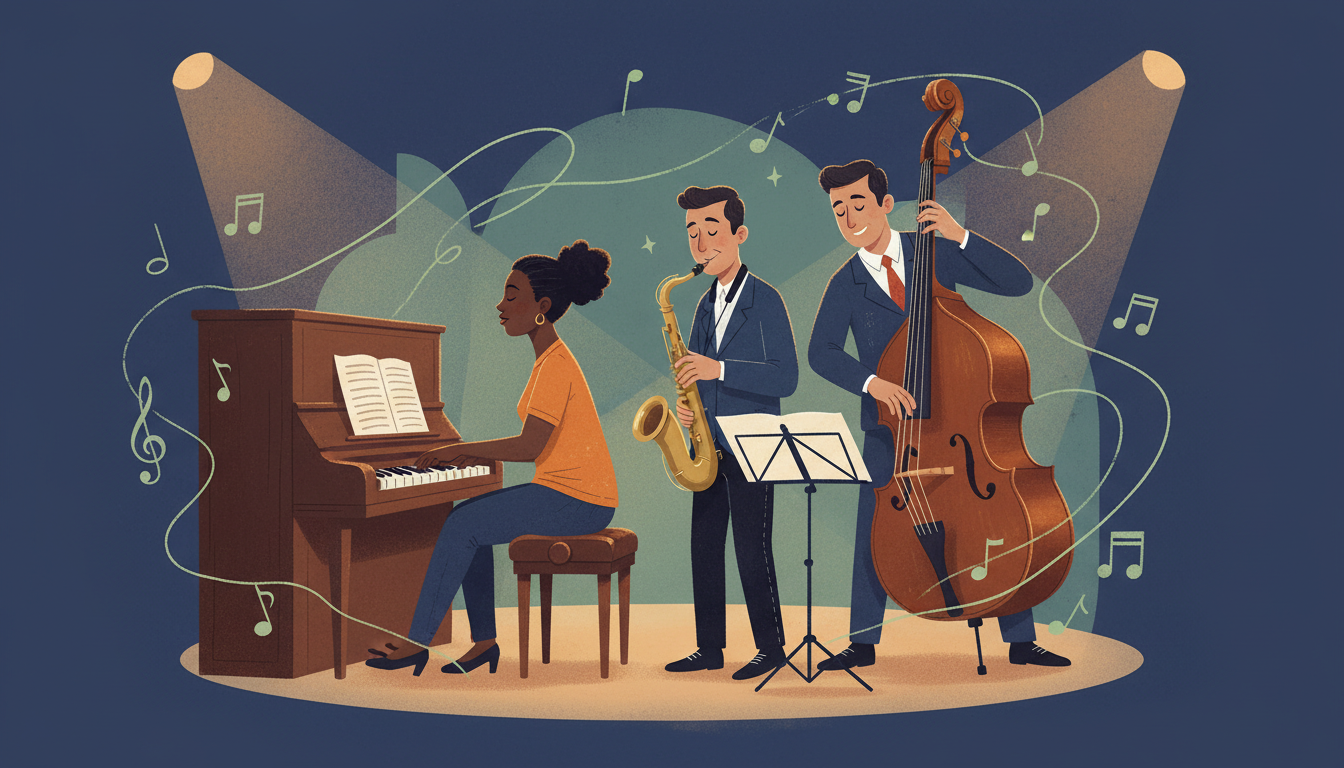
Did you know? In the 2027 G3 Music SEC, Jazz candidates are not required to identify individual Jazz chords aurally, while Popular Music candidates are expected to recognise common chord progressions by ear. That subtle assessment difference matters more than memorising dozens of genre labels without hearing how the actual music works.
Jazz and Popular Music form Part 2 of G3 Music Studies Paper 1, syllabus K350. The examination uses one Jazz question and one Popular Music question, worth a combined 25 marks. Students hear four playings of each extract and use a skeleton score or lead sheet to connect rhythm, harmony, melody, instrumentation, form and production to the sound.
This guide follows SEAB’s official 2027 Singapore–Cambridge Secondary Education Certificate syllabus. It distinguishes Traditional Jazz, Swing, Bebop and Cool Jazz from the specified late-1960s Pop-Rock, Synth-Pop and R&B/Soul material, explains digital sound effects and provides practical diagnosis-led learning strategies for Singapore families.
The quick answer for parents
Jazz and Popular Music listening encourages teenagers to identify how musicians shape rhythm, improvisation, ensemble relationships, songwriting, recording and production. The goal is not naming a favourite track but explaining an unfamiliar sound accurately.
Ask Which sound or pattern supports your identification, and what does it do within the musical arrangement? That question turns recognition into evidence-based understanding.
Part 2 is twenty-five Music Studies marks
G3 K350 Paper 1 Music Studies lasts 90 minutes, has 75 marks and contributes 40% of the Music qualification. Part 2 assigns a total of 25 marks to Jazz and Popular Music.
The marks are divided between Question 3 and Question 4, with one question receiving twelve and the other thirteen. They are both compulsory, not optional genre choices.
Which question examines Jazz?
Question 3 uses a Jazz extract from the selected American styles spanning the 1920s to 1960s: Traditional Jazz, Swing, Bebop or Cool Jazz.
The student needs to know how the actual arrangement, rhythm, instrumental roles and improvisation relate to a style. A saxophone by itself is not conclusive genre evidence.
Which question examines Popular Music?
Question 4 uses the prescribed Popular Music genres: Late 1960s Pop-Rock, Synth-Pop, or R&B and Soul.
A candidate should explain instruments, lyrics-related choices, sound production and relevant harmonic or rhythmic structures without treating every electronically amplified song as one identical style.
| K350 Part 2 | Question 3 Jazz | Question 4 Popular Music |
|---|---|---|
| 2027 coverage | Traditional Jazz, Swing, Bebop, Cool Jazz (1920s–1960s) | Late-1960s Pop-Rock, Synth-Pop, R&B/Soul |
| Marks | 12 or 13 | 12 or 13 |
| Source | Four hearings; skeleton score or lead sheet | Four hearings; skeleton score or lead sheet |
| Harmony aural requirement | No need to identify individual chords aurally | Identify common chord progressions aurally |
| Other key areas | Improvisation, ensemble roles and Jazz form | Song form, lyrics and sound production effects |
Scores and lead sheets are provided
Question 3 and Question 4 each use a skeleton score or lead sheet, including lyrics where relevant. The provided notation helps students trace the sound, even when certain production details must be heard directly.
A lead sheet often captures melody and harmonic information without spelling out every instrument part. The listener should identify what can be read and what the recorded performance contributes.
Four playings and timed pauses
Each extract is played four times in the paper, with timed pauses for answers. Extracts in Music Studies generally last about 30 seconds to one minute thirty seconds.
An effective candidate uses the early hearings to identify structure and the later ones to verify a requested feature. Hearing the same passage repeatedly without a specific question can create familiarity without understanding.
The assessment tests unfamiliar music
The actual recordings are not supplied as a set of answers to memorise. The syllabus specifies styles, terms and practices that can be recognised when an unfamiliar excerpt is played.
Use teacher-approved or appropriately licensed examples to practise transferring knowledge. Knowing the title of a famous Jazz recording is not the same as explaining an unseen one.
Why the Jazz and Popular Music harmony rules differ
In Jazz Question 3, SEAB says candidates need not identify chords by ear, but should understand types of chord, keys, cadences, modulation and harmonic devices.
In Popular Music Question 4, candidates are expected to identify common chord progressions aurally. Parents should not purchase a generic ear-training course that misstates both demands as identical.
Rhythm is more than musical speed
Tempo describes pulse speed; rhythm describes patterns of duration and accent; groove emerges from relationships among parts. A quick solo does not mean the underlying tempo has doubled.
Ask students to identify the pulse first and then describe how notes or accents relate to it. This foundation supports both Jazz and Popular analysis.
Swing rhythm versus Swing as a genre
Swing rhythm is a way of treating subdivisions and beat feel, while Swing is also the name of a particular Jazz style and period in the syllabus.
A piece can incorporate swung rhythms without being a Swing-era big-band example. Students should distinguish technique from historical style before reaching a genre conclusion.
Syncopation is not random off-beat playing
Syncopation moves emphasis relative to an expected metric pattern. It can contribute to groove, surprise or tension when integrated into the music.
A response should explain where an accent occurs and why it differs from the underlying beat expectation. Calling every unfamiliar rhythm syncopation is not precise enough.
Backbeat and groove
A backbeat places emphasis on particular beats or positions in a rhythmic cycle, while a groove also depends on interplay among bass, percussion, harmony and other lines.
Ask what stays constant and which instrument creates the accent. This can help a learner distinguish a characteristic style from one isolated percussive sound.
Stop time
Stop time involves moments where the ensemble changes or interrupts ordinary accompaniment patterns while a solo line or other musical event is featured.
It is a specific arrangement practice. A student should identify the audible interruption or punctuated support rather than claim every silence is stop time.
Traditional Jazz
The syllabus names Traditional Jazz as one of the four American Jazz styles. Listening can involve front-line instruments, ensemble interactions and characteristic rhythmic or improvisatory practices.
Avoid assuming that simply hearing a trumpet makes the excerpt Traditional Jazz. Explain what the instruments do together and how that corresponds to the taught musical context.
Collective improvisation
Some Jazz settings feature multiple lines being elaborated or improvised simultaneously. The interaction creates a distinctive texture.
Ask which lines appear independently active and how the ensemble maintains a shared rhythmic framework. Several instruments playing an identical melody together are not the same phenomenon.
Swing and the larger ensemble
Swing can involve big-band sections and arrangements that organise saxophones, trumpets, trombones and a rhythm section into contrasting roles.
A student should hear whether a line is played by a section or a soloist, and what the arrangement contributes. Big instrumentation is relevant only when paired with stylistic evidence.
Big-band sections
The horn section and rhythm section can establish a dialogue through melodic figures, chordal blocks or accompanying patterns. Sectional roles may change across an excerpt.
Ask which group is foregrounded and how another responds. A strong answer is a relationship, not a roll call of instruments.
Walking bass
A walking bass line creates a recurring moving foundation that can support harmony and pulse in relevant Jazz passages.
Students should distinguish its characteristic movement from an identical bass note repeated on every beat. The explanation should follow the actual line, not a memorised stereotype.
Comping
Comping describes chordal accompaniment, often from piano or guitar, that supports the music while responding rhythmically to other performers.
Listen to where the chords occur and how they interact with the soloist or rhythm section. Playing chords is not always automatically comping in the stylistic sense examined.
Bebop
Bebop is one of the prescribed Jazz styles, often associated with different improvisational and melodic approaches from earlier collective ensemble traditions.
The student should describe the featured solo line, phrasing, harmonic context and instrumental interplay. It is inaccurate to say every Bebop example is defined solely by playing at maximum speed.
Chromatic motion and phrasing
A solo line may feature chromatic approaches, rapid contours or distinctive phrasing in a relevant Bebop context.
Ask what musical event is heard and how it relates to the supporting harmony. Correct terms should be used because they identify evidence, not because they sound advanced.
Cool Jazz
Cool Jazz appears as another named style in the 2027 scheme. It should be understood through specific texture, arrangement, articulation and ensemble approaches.
The word ‘cool’ does not establish that every piece is soft or emotionally distant. Genre identification requires an actual combination of characteristic features.
Improvisation has rules and relationships
Jazz improvisation may involve melodic devices, harmony, groove, call-and-response and interaction with the accompaniment. It is not necessarily the absence of structure.
Teach students to identify a musical idea, how it changes and what the other musicians do in response. An improvised passage can still be organised and purposeful.
Blue notes
Blue notes are a named melodic concept within Jazz, alongside blues scales and particular inflections of pitch.
A pupil should connect the term to the appropriate musical context rather than label every flattened note a blue note without considering the phrase.
Call-and-response
Call-and-response involves a musical statement answered or complemented by another statement, which may be played by a different instrument or section.
Listen for a relationship across two moments. A pattern simply repeated unchanged in the same part is not necessarily call-and-response.
Riff, fill and vamp
A riff is a recurring recognisable musical figure; a fill can occupy or connect spaces; a vamp often provides a repeating accompaniment framework.
These terms have overlapping contexts but distinct jobs. The student should identify which part repeats, where a fill occurs and how the pattern supports the music.
The blues scale and form
Blues scales and the 12-bar blues form appear in the syllabus. They organise aspects of pitch choice and harmonic or formal expectations in relevant music.
A candidate should not assume that every improvisation or blues-influenced recording follows the same 12-bar structure. Test the form against the actual musical evidence.
Thirty-two-bar song forms
K350 names 32-bar AABA and ABAC forms, as well as 12-bar blues, within the Jazz form-and-structure topics.
Ask what contrasts between A and B or C and whether the returning material has a recognisable identity. The numbers describe structural models, not every piece’s mandatory length.
Chord-symbol literacy
Lead sheets use chord symbols and slash-chord notation that communicate relevant harmonic information without showing every possible voicing.
The student should know how such symbols guide performance and what they do not specify. This supports score reading even when aural identification of individual Jazz chords is not required.
Seventh chords and added tones
The syllabus identifies dominant, major and minor sevenths, added-sixth and diminished chord types, inversions and rootless voicings.
Understanding the terms helps describe harmonic choices, but do not imply candidates must label each chord solely by ear in Jazz Question 3. The official note explicitly limits that demand.
Cadence and modulation in Jazz
Harmonic movement can shape direction and structure, including cadences, changes of key, turnarounds, pedal points and vamps.
A student should link the harmonic event to a particular musical moment or notated evidence. Listing theoretical concepts without identifying their function is not analysis.
The rhythm section’s role
Bass, drums, piano or guitar may provide pulse, harmony and rhythmic support in a Jazz setting, though real ensembles vary.
A detailed answer identifies whether the section supports, responds to or briefly foregrounds another voice. Instrument names alone provide only the beginning of an explanation.
Instrumental technique is audible evidence
Slides, glissandi, pitch bends, vibrato, mutes, accents and articulation can change a musical phrase’s character.
Ask what the performer actually did and how it affects timbre or phrasing. An instrument capable of using a mute is not proof that the present excerpt uses one.
Popular Music from late-1960s contexts
The K350 Popular Music area specifies Late 1960s Pop-Rock, Synth-Pop and R&B/Soul. It links music to historical production and performance practices.
Do not substitute a G1 list of post-2000 Pop, Rock, R&B and Electronic Dance Remix as though it were the same G3 examination genre list.
Late 1960s Pop-Rock
The specified Pop-Rock area allows study of electric and acoustic sounds, vocal and instrumental relationships, groove, song form and recording approaches.
A useful question asks which parts establish the rhythmic foundation and how the arrangement changes around a vocal passage. The presence of a guitar alone does not identify a decade.
Verse and chorus
Verses and choruses can develop or repeat different melodic and lyrical ideas. Their relationship helps a listener follow a song’s progression.
A short extract may contain only one section. Candidates should not claim they heard a whole verse-chorus form if the recording did not provide that evidence.
The role of the bridge
A bridge can provide contrast through harmony, melody, texture or lyric focus before another section returns.
Ask what actually changes and why the difference matters to the musical structure. The word ‘bridge’ is not synonymous with any instrumental passage.
Synth-Pop
Synth-Pop draws attention to electronic sound production and timbral design, along with melodic hooks, rhythm and studio arrangement.
A learner should identify which sound appears synthesised and explain its role, rather than assume all music using a keyboard belongs to this genre.
R&B and Soul
R&B and Soul in the K350 area invite attention to groove, phrasing, voice, instruments and the relationship among musical lines.
A candidate should describe a particular arrangement’s features. A genre label based only on the singer’s identity or the song’s topic is not acceptable musical evidence.
Vocal technique and song meaning
A voice can use articulation, register, rhythmic placement and expressive phrasing to interact with the accompanying instruments or lyrics.
Ask how the vocal line changes against the rhythm section. Detailed analysis should avoid quoting extensive copyrighted lyrics when the task can be answered through brief reference and musical description.
Digital effect: reverb
Reverb can simulate or reshape a sense of acoustic space, making sound appear more sustained or ambient.
A student should identify the heard tail or spatial quality and distinguish it from a simple repeated echo. The effect should be described in the actual excerpt.
Digital effect: delay
Delay produces a postponed repetition or other time-related echo effect. It can alter texture or rhythmic interaction.
Do not call every sustained sound delay. Ask whether a discrete repetition is audible and how it relates to the original sound.
Digital effect: distortion
Distortion changes sound character by altering the signal, potentially introducing additional harmonic content or a rougher timbre.
The learner should identify the audible change and its expressive role, rather than assume all loud guitars are distorted.
Digital effect: panning
Panning changes a sound’s relative placement within the stereo field. It can clarify layers, create motion or separate instrumental parts.
Ask which part seems to move or occupy another spatial position. The effect should not be confused with the musician physically walking across a stage.
Digital effect: fade in and fade out
A fade changes the recorded level gradually at an opening, ending or other point. Its musical purpose may be different from a performer slowly becoming quieter.
Describe where the sound level changes and how it shapes entry or closure. A gradual fade should not be assumed when the track ends sharply.
Overdubbing
Overdubbing adds a new recorded part to existing recorded material, allowing layered performance or arrangement.
The student should distinguish this process from simply increasing the volume of an existing track. Understanding production requires a clear model of what was recorded when.
Multitracking
Multitracking records or organises separate parts on distinct tracks so they can be processed or mixed independently.
Several layers can create dense texture, but one track need not equal one physical instrument. Explain what the process permits and which musical result it supports.
Looping
Looping repeats a recorded or sequenced segment, often establishing a consistent pattern or texture.
A loop can support musical form but may also create stagnation if never developed. The examiner is interested in what can be heard or explained, not which software brand supplied it.
The Popular Music chord-progression rule
SEAB says candidates in Question 4 need to identify common chord progressions aurally, in contrast with the Jazz chord-identification exemption.
Practise hearing relationships among familiar progressions using original teacher-made examples, then confirm against the notated lead sheet. Guessing a progression because a song feels familiar is not reliable.
Harmony and lyrics belong together
A vocal arrangement can use harmonic movement to support a change of lyric meaning, tension or emphasis.
A candidate should identify the relationship shown by the actual score and recording. Broad claims about the singer’s private intentions should be treated as interpretation, not certain fact.
Part 2 can include short dictation
K350 permits brief melodic or rhythmic dictation tasks in Parts 1 and 2, with at most two across those areas.
The student should learn pulse, phrasing and notation in manageable stages. A long commercial melody should not be copied merely to create a practice worksheet.
How to use the skeleton score
Read part labels, metre, important rhythms, chord symbols and repeated motifs, then verify how those features sound in the excerpt.
A skeleton score omits details; absence from the page does not necessarily mean an instrument or sound is absent from the recording.
How to use a lead sheet
The lead sheet helps orient melody, harmonic structure and sometimes lyrics, but often leaves texture, instrumentation and production to the recording.
Students should explain what is demonstrated in sound beyond the printed symbols. This is especially important for sound effects and performance conventions.
An original compare-and-contrast task
Imagine two short original classroom excerpts: one uses a horn section with call-and-response and a moving bass; another uses synthesised pads and a repeated electronic hook.
Ask which features support Jazz or Synth-Pop identification and what additional evidence would strengthen the conclusion. This teaches method without reproducing commercial recordings.
Avoid guessing genre from performer identity
Genre is assessed from musical features and context, not an image of the performer or a surname. A singer or instrumentalist can work across multiple musical styles.
Train a student to explain sound with appropriate terms. Cultural or racial assumptions are not acceptable substitutes for musical analysis.
A genre-comparison error log
Record whether a mistaken answer came from pulse, style, instrument role, harmony, form, production effect or use of the notation.
Then test the corrected distinction in an unfamiliar excerpt. Being able to state ‘this was delay rather than reverb because I heard separate repeats’ is more useful than copying the answer label.
A four-week Jazz/Popular learning cycle
Week one: pulse, rhythm and ensemble roles. Week two: Traditional Jazz, Swing, Bebop and Cool Jazz. Week three: the three Popular genres and five named digital effects. Week four: unfamiliar listening, lead-sheet interpretation and short explanation.
This is a suggested revision sequence rather than SEAB’s teaching schedule. The other parts of Music Studies and the Creating/Performing papers remain compulsory.
What parents can ask
Try Which part leads? What supports it? What changed when the next phrase began? Then ask what evidence makes a genre identification convincing.
Parents need not be Jazz performers or sound engineers. They can support accurate reasoning and refer uncertain technical claims to the authorised music teacher.
Frequently asked questions: how many questions are in Part 2?
There are two compulsory questions: Question 3 Jazz and Question 4 Popular Music. Together they contribute 25 of the 75 marks in Music Studies Paper 1.
Each is worth twelve or thirteen marks, depending on the particular paper arrangement.
Frequently asked questions: must Jazz chords be identified by ear?
No. K350 says Jazz candidates need not aurally identify individual chords, while they must understand chord types and harmonic concepts. The Popular Music question does require aural recognition of common progressions.
These are distinct rules. A resource that claims both papers use exactly the same ear-training task is not precisely aligned with the official syllabus.
The lasting reason to study Jazz and Popular Music
Understanding Jazz and Popular Music develops respect for musical collaboration, creative structures and technology, while teaching students to ground a claim about sound in actual evidence.
Read the official 2027 G3 Music K350 syllabus for the Jazz, Popular and Paper 1 sections. Continue with G3 Music Studies, Western Classical Tradition and Asian Music. The unchanged Clementi Maths tutor reference illustrates a separate feedback-led teaching approach, not Music tuition availability.