
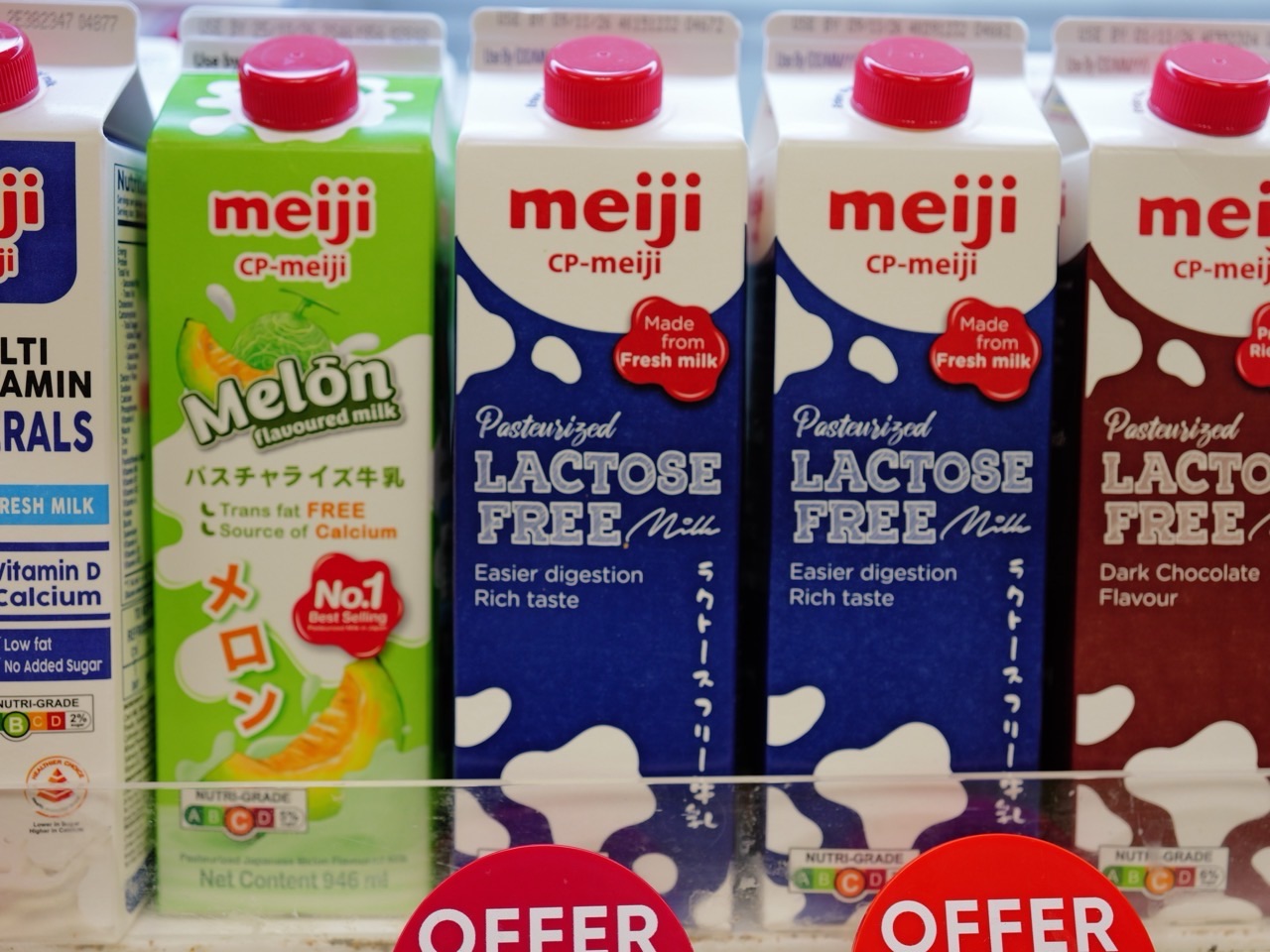
Did you know that thousands of Singapore primary-school pupils once received milk at school as part of an organised nutrition scheme? In the 1970s and 1980s, milk deliveries, packets, teachers’ records, advertisements and even children’s packaging competitions became part of school life. Yet the scheme did not stay popular forever. As households’ circumstances changed, questions arose about cost, choice, nutritional needs and whether schools should continue the arrangement.
The chronology starts with a trial in ten primary schools in June 1973. The Ministry of Education formally launched the School Milk Scheme in February 1974 at 33 schools. It expanded to 150 schools by the end of 1975, with small packets of milk sold at a subsidised price and free supplies for eligible needy children. A Milk for Children Advisory Council formed in 1982, and promotional activities followed, including design competitions and Milk Day events. By the late 1980s, the scheme faced changing nutritional priorities and was temporarily halted in 1988.
Why study this History? Because a school programme’s aim to improve nutrition is not proof that every participating child’s examination results improved. A photograph showing children drinking milk cannot tell us whether all pupils liked it, and an old price does not establish affordability without historical income context. The subject helps students practise evidence evaluation, Statistics, civic literacy and the History of Singapore education while understanding how a well-intentioned policy can change when conditions change.
Explore this guide
- The direct answer: nutrition programmes have a history
- 1973 began with a trial rather than full rollout
- February 1974 marked the formal School Milk Scheme
- The programme expanded during 1975
- The participation decline needs careful interpretation
- 8 December 1982 marked the council’s inauguration
- Milk Day brought promotion beyond the classroom
- 1988 brought a temporary suspension
- 2011 brought a distinct school-meals initiative
- Four weeks to learn History through school nutrition
- FAQ: when did the School Milk Scheme begin?
- Authoritative sources and connected eduKateSG learning
The direct answer: nutrition programmes have a history
A school nutrition programme connects education authorities, teachers, suppliers, parents and pupils through regular routines.
The aim may be to support children’s health or learning, but running the programme also involves payment, storage, timing, distribution and communication.
History asks why the scheme was introduced, which evidence supported it and how its operation changed across years.
Students should distinguish the documented policy goal from measured health or educational outcomes. The existence of a milk packet on a desk is not proof that all pupils experienced the same benefits.
School food was important before the scheme
Children ate meals and snacks at home or in school settings long before the milk programme began.
Tuckshops, canteens and personal food brought from home served different needs, while nutritional circumstances varied across households.
The School Milk Scheme was an additional organised initiative, not the first occasion on which children consumed milk or other nourishing foods.
Students should avoid a misleading origin story in which an entire school food system appeared in February 1974. The historical change concerns the creation of a particular public programme within an older education system.
A school programme reflects the circumstances of its period
Singapore was developing rapidly during the 1970s, but household incomes and access to nutritious food were not identical for all families.
The National Library’s 2026 history of the scheme describes contemporary concerns about children’s dietary intake.
Students should reconstruct those concerns without treating every family as deprived or assuming all households could comfortably pay for daily supplements.
Historical explanation depends on the conditions decision-makers were addressing, not an imagined universal childhood.
Nutrition and education can influence one another
The programme reflected concern that children should receive suitable nourishment while learning and growing.
The existence of that concern is documented through the Ministry of Education’s explanations and later public discussion.
But a broad belief that nourishment matters does not establish the effect of this particular packet of milk on each pupil’s concentration or examination results.
Students should recognise the difference between a policy rationale, general scientific understanding and an experiment capable of measuring a specific outcome. This is essential when History intersects with health.
The history of poverty should not become a stereotype
Oral histories and contemporary accounts describe differences in Singapore households’ resources during the 1970s.
These differences influenced why subsidised school nutrition attracted public attention.
Students should not conclude that every pupil in a particular neighbourhood lacked breakfast or that a school photograph reveals a child’s family income.
History invites empathy but requires evidence about the particular person, community or population being discussed.
1973 began with a trial rather than full rollout
NLB’s historical account dates a preparatory milk programme to June 1973, when powdered milk was sold in ten primary schools.
The trial was designed to introduce the idea and give organisers experience before wider implementation.
Students should not describe the experiment as already covering every school in Singapore.
A trial and a national programme are related stages but not the same event. This distinction is useful in studying many public initiatives, from classroom technology to vaccination programmes.
Ten schools was the size of one starting phase
The number ten identifies the primary schools participating in the early trial.
It is not the number of pupils who drank milk, the daily packets delivered or the total number of primary schools operating that year.
Students should retain the measurement’s unit whenever they cite it.
This simple practice prevents an accurate institutional figure from being rewritten into a misleading population claim.
The 1973 trial charged ten cents per glass
NLB records the early powdered-milk trial at a ten-cent price, with free supplies for eligible underprivileged children.
The price is a useful historical fact, but it cannot establish that every family considered the drink inexpensive.
Students would need information about wages, household budgets and the costs of other foods to evaluate affordability.
History and Mathematics work together when nominal prices are interpreted within their own social and economic context.
Free supplies had an equity purpose
Providing milk without charge to certain eligible children reflected concern that cost should not prevent participation by households receiving assistance.
Eligibility under a historical programme is a defined administrative category.
Students should not assume all pupils received free milk or that the programme reached every financially disadvantaged child in identical circumstances.
A policy can intend to address inequality while the actual coverage and effect require separate data.
A successful pilot still requires evaluation
A school trial may generate favourable comments from participating teachers, parents or pupils.
Such reports are useful evidence of particular reactions, but they do not guarantee the same result in every later school.
Students should distinguish a reported positive response from independently measured nutrition outcomes.
History explains why a government might expand a pilot while retaining the question of how well the larger programme ultimately worked.
February 1974 marked the formal School Milk Scheme
The National Library chronology identifies February 1974 as the beginning of the scheme at 33 primary schools.
The formal programme used packaged milk under organised supply arrangements.
Students should separate this milestone from the ten-school 1973 preparatory trial.
The different dates are not contradictory; they refer to distinct stages in bringing an initiative into ordinary school routines.
Thirty-three schools is not thirty-three packets
The count of 33 refers to participating institutions at launch.
Each school could have many pupils, delivery arrangements and class groups, so the number alone does not identify consumption.
Students should distinguish school coverage, pupil participation and packets actually sold.
This is an important quantitative lesson for interpreting public programmes: a headline about expansion can be accurate without supplying every other measure of activity.
The milk came in small packets
The historical account describes 150-millilitre packets of reconstituted pasteurised milk during the initial programme.
Packaging mattered because milk had to reach children in manageable portions during the school day.
Students should not treat an ordinary modern one-litre carton as an exact photograph of the original 1974 packets.
The material object can help explain a procedure when its date, volume and form are identified accurately.
Pasteurised milk was not the same as later UHT milk
The early scheme used pasteurised milk under delivery arrangements designed for a perishable product.
The programme later explored ultra-high-temperature-treated milk with different storage characteristics.
Students should not describe all school milk from 1973 to 1988 as one unchanging product.
History and Food Science intersect here, but exact processing and safety claims require the relevant technical sources rather than assumptions from a brand or package’s appearance.
School distribution involved daily logistics
Milk needed to be prepared, packaged, transported and made available in time for school breaks.
NLB’s history describes deliveries arriving at schools during recess periods.
A delivery plan is evidence of expected organisation, not proof every shipment always arrived complete and on time.
Students can study logistics as part of educational history, recognising that a successful class programme may depend on work carried out outside the classroom.
The suppliers had their own commercial roles
The original programme used firms including Ben Sunshine Dairies, while later supply arrangements involved other dairy businesses.
Their functions included preparing and delivering milk, which were different responsibilities from educational policy.
Students should not assume the Ministry of Education directly manufactured all packets or that every supplier served every school simultaneously.
The history becomes clearer when government objectives, commercial contracts and school implementation are described as related but separate roles.
A school tuckshop vendor had different responsibilities
Drinks and snacks sold at school tuckshops could be affected when pupils purchased programme milk.
NLB’s article describes contemporary reports of some canteen vendors cooperating despite possible changes to drink sales.
Students should not infer the revenue effect on every stall or conclude that all vendors supported the scheme equally.
Historical work needs particular commercial records for claims about income, rather than treating an institutional account as a nationwide sales survey.
Recess was an important time for practical delivery
The timetable of breaks constrained when children could receive and drink their packets.
School staff needed to coordinate distribution with lessons and other activities.
A programme’s nutritional aim therefore existed within a schedule originally designed for learning and recreation.
Students can investigate the practical pressures without assuming every school followed an identical minute-by-minute routine.
Teachers became part of the administrative system
Some teachers distributed milk, collected payments, recorded participation and handled problems with deliveries.
These tasks belonged to the operation of a nutrition programme but could compete with time intended for teaching.
Students should avoid assuming every teacher welcomed the additional work or that all schools organised distribution identically.
History draws attention to the hidden labour necessary when a public initiative becomes part of everyday institutional life.
The programme expanded during 1975
NLB records children in 150 primary schools receiving milk by the end of 1975.
The published figure demonstrates substantial growth from the original 33-school launch.
It does not establish that every pupil in those schools participated or that the programme had reached every primary school.
Students should identify coverage and participation separately when constructing a historical timeline.
Plans for 1976 were not automatically completed outcomes
Contemporary reports discussed expanding the programme to further schools by the end of 1976.
A target or proposed number is evidence of intention and administrative planning.
Students should not describe the entire projected expansion as achieved without a later official record.
This is a useful example of a historical source problem that also appears in housing, railways and public-health programmes: a clear proposal is not yet evidence of delivery.
The price increased during the expansion
NLB records early 150-millilitre packets increasing from ten cents to twelve cents beginning in 1975.
The change may be meaningful within the programme’s operating costs and payment system.
Students should not infer a precise cause from the price difference alone or convert the old figures into modern purchasing power without suitable economic data.
The accurate historical claim includes the product, amount and period.
Five flavours gave children different options
The historical school milk programme offered plain, chocolate, strawberry, vanilla and pineapple flavours at an earlier stage.
Variety was intended to encourage acceptance, but supply and ordering arrangements could affect actual choice in schools.
Students should not assume every child could choose any flavour every day.
The existence of an advertised range and the experience of a particular pupil require different sources to evaluate.
Pupil preference was not uniform
Some children enjoyed milk and others disliked its taste or the expectation of drinking it regularly.
Contemporary interviews cited by NLB provide examples of both enthusiasm and resistance.
Students should not treat one pupil’s words as the opinion of all schoolchildren.
The appropriate historical method identifies the speaker, date and circumstances before drawing a carefully limited conclusion.
A positive quotation is not an academic experiment
A child might believe milk would help them grow stronger or perform better at school.
Their statement can be valuable evidence of expectations and the public message received.
It does not prove that the child’s marks improved because of the drink.
History teaches the distinction between personal belief, policy promotion and measured educational outcome. This is especially important when school programmes use health-related promises to encourage participation.
The original public aim was partly educational
Authorities wanted pupils to learn about food habits as well as consume a particular nutritional supplement.
A regular classroom routine could reinforce the message that diet mattered.
The NLB history documents this intention through ministry statements.
Students should not automatically conclude every pupil developed lifelong habits as a result. The existence of an educational message and its later effect are separate research questions.
Photographs of classroom milk are historically useful
The National Archives preserves images of pupils drinking milk during the 1970s and 1980s.
They can show packaging, classroom settings and visible school activity at a documented moment.
An image cannot establish every child’s nutritional status, approval of the programme or academic progress.
Students should recognise photographs as direct evidence of some visible details while seeking other sources for broader claims.
A photograph of 1986 should not be captioned 1974
Tanglin Primary School images from 1986 show a later stage of the scheme, not necessarily the same packaging or distribution process used at launch.
Students must check the original archive caption rather than describe all old classroom milk images as depicting the first year.
This is visual-source criticism through ordinary school life.
A photograph’s authenticity remains important, but its value depends on correct date, location and context.
A modern milk-carton photo is not archival evidence
A contemporary photograph of tetra-pack milk can illustrate modern packaging.
It should not be presented as an original 1974 milk packet, especially if the shape or brand differs from historical descriptions.
Students should label such images as present-day illustrations and rely on properly attributed historical photographs for specific claims about the scheme.
This is a simple publishing rule that prevents an attractive visual from introducing a factual error.
The participation decline needs careful interpretation
NLB cites ministry figures describing daily participation at 63 per cent in 1974 and 21 per cent by 1980 under the source’s reported measure.
The change suggests an important decline in use.
Students should retain the dates and population definition, and not automatically convert those percentages into exact packet quantities without information about enrolment, school days and calculation methods.
A rate of participation and a number of milk packets are different statistics.
An apparent decline may have several causes
The Education Ministry discussed pupils tiring of daily milk and competition from other drinks in explaining falling participation.
Cost, flavour, routine and practical school arrangements could also affect decisions, depending on the child and institution.
Students should avoid declaring one universal cause without adequate evidence.
History rewards multicausal explanation: different reasons may matter in different schools, and policymakers’ explanations do not automatically represent every household’s personal experience.
Soft-drink promotion created competing choices
Historical ministry statements associated the decline partly with the availability and advertising of other beverages.
A commercial advertisement reveals what a seller wanted children or families to buy, but cannot establish that every pupil responded identically.
Students can compare policy and marketing sources while identifying their different purposes.
This connects school nutrition with the history of consumer choices and the influence of commercial messages.
A pupil’s refusal is a meaningful but bounded source
An interviewed child may describe dislike, discomfort or preference for water.
Such testimony is direct evidence of that person’s stated view, not proof that all pupils rejected the programme.
Students should respect the individual voice and avoid describing it as laziness or evidence of poor upbringing.
Historical analysis becomes stronger when children are treated as participants with varied experiences rather than merely passive recipients of decisions by adults.
Parental views also differed
Some families valued a convenient supplement while others questioned payment, choice or school procedures.
NLB cites newspaper complaints about large quantities of packets being sent home and pupils being expected to purchase unwanted milk.
Students should not present these criticisms as the universal view of all parents.
A balanced history distinguishes documented individual concerns from the institution’s public aims and from any broader surveys.
Twenty packets at once created a different burden
Contemporary accounts describe some schools providing a month’s packets at once instead of daily consumption at school.
That distribution arrangement could create practical work for families and pupils, especially when transport or storage was inconvenient.
Students should not assume every school used the arrangement.
The example shows how the same nutritional product can be experienced differently depending on programme implementation, a lesson relevant to many public services.
Teachers’ teaching time was another concern
Collecting money, checking orders and distributing packets could be time-consuming.
Later interviews from educators described those tasks as burdensome in some schools.
This is important because a policy’s operational costs include staff attention as well as money and materials.
Students should not assume the scheme’s planners deliberately wanted to reduce teaching time. History asks about intentions and actual consequences separately.
A complaint can be genuine without describing every school
A teacher or parent writing to a newspaper may accurately report problems in a particular class.
That account is evidence of a specific concern, not necessarily a statistical sample of all schools.
Students should identify the circumstances and whether any independent information shows the problem’s frequency.
This is media literacy applied to education policy, where dramatic examples can draw attention to genuine issues without revealing their full scale.
1981 brought renewed official encouragement
As participation declined, the Education Ministry urged schools to explain the nutritional rationale and encourage families to join.
These statements are evidence of institutional attempts to influence behaviour.
Students should not treat the instruction as proof that the campaign immediately succeeded.
The method is the same used for other historical programmes: distinguish announcement, implementation and outcome through dated sources.
The milk product itself changed in 1982
NLB describes plans in January 1982 to introduce ultra-high-temperature-treated milk in larger packs.
The change aimed to address practical supply and acceptance issues under new arrangements.
Students should distinguish the product type, packet size and price instead of comparing a 1974 small pasteurised packet directly with a later, differently sized product.
A fair historical price comparison requires the same quantity and other relevant conditions.
UHT processing is not a date of invention for milk
Ultra-high-temperature treatment refers to a particular method of processing milk.
Its use in the programme did not mean earlier pupils had never consumed milk or that the new treatment was developed for the first time in Singapore schools in 1982.
Students should identify the adoption of a method within one programme separately from the broader scientific history of the technology.
This is technological change interpreted with the correct level of historical specificity.
Changing packet size complicates price comparisons
A later milk pack may contain more liquid than an earlier one, even if its printed price is higher.
Students should compare cost per equivalent quantity where reliable numbers are available and should avoid assuming every product had the same nutritional composition.
Historical price data must also be placed in its original economic setting.
This illustrates why apparently simple comparisons can become misleading when several product characteristics change at once.
The Consumers’ Association played a separate role
The Consumers’ Association of Singapore helped establish the Milk for Children Advisory Council in 1982.
The council complemented the Education Ministry’s school programme but had its own advisory, publicity and support activities.
Students should not assume the council created the first 1973 trial or that it directly managed all school deliveries.
History reveals how several institutions may join an existing programme at different stages to respond to new challenges.
8 December 1982 marked the council’s inauguration
A speech by Minister of State Tay Eng Soon at the council’s inauguration was delivered on 8 December 1982.
The National Archives speech record documents the event and public rationale.
Students should distinguish a council’s formal inauguration from the School Milk Scheme’s February 1974 launch.
The two milestones belong to related but different organisations and stages.
An advisory council is not the same as a school
An advisory body may promote ideas, coordinate sponsors and develop publicity materials, while teachers and staff handle practical routines inside participating schools.
The different duties can interact, but they should not be merged into a single actor.
Students should identify whether a source reports a council decision, ministry instruction or one school’s practice.
This is basic institutional literacy, useful whenever several organisations cooperate on a public project.
The council considered children outside primary schools
NLB describes a broader aim to promote appropriate nutrition for young children and secure assistance for those in need.
The council’s focus was not limited to pupils in the original 33 primary schools.
Students should distinguish the age and eligibility group discussed in an advisory document from those actually participating in a specific school programme.
This avoids reporting a council’s broad ambitions as though every young child was already receiving milk.
A school nutrition slogan is a persuasive message
Promotional brochures linked milk consumption with better thinking, growth and healthy habits.
Such slogans reveal what organisers wanted families to believe or remember.
Students should not use an advertising line as proof of a causal improvement in examination results.
History can analyse the wording, target audience and period, then explain what further scientific evidence would be needed for the stronger health or learning claim.
The 1983 packaging contests involved children
The council organised competitions inviting children to propose a new name or packaging design for school milk.
The NLB historical account describes the activity during 1983.
Students should not call every winning design a new nutritional discovery or assume all pupils entered.
The competitions are evidence of efforts to make the product more appealing and to involve children in public communication.
Changing a packet design is different from changing its contents
A new label, colour or name may alter how a product looks or the audience it attracts.
The actual nutritional composition depends on ingredients and preparation, which may or may not have changed with the packaging.
Students should keep marketing and food processing as separate subjects unless a source establishes a connection.
This distinction is useful for interpreting historical advertising and today’s consumer products without making unsupported health claims.
The prize money was part of a publicity programme
Contemporary accounts described prizes associated with the milk naming and packaging contest.
The prize reflects resources devoted to attracting public participation, not a direct measurement of the nutritional value of milk.
Students should identify whether a figure refers to a contest award, programme cost or product price.
This is another example of how the meaning of a number matters as much as the number itself.
Collecting package flaps became a promotional activity
The council encouraged children to collect parts of milk packs in exchange for small rewards during 1983.
The promotion linked repeated purchases or consumption with prizes.
Students should not conclude that every child joined or that the rewards improved long-term dietary habits without additional evidence.
The historical significance lies in the attempt to shape behaviour through incentives and publicity, a different approach from the original subsidised supply.
An incentive may change behaviour without changing a preference
A child might participate to receive a ruler or other object even if they did not particularly enjoy the drink.
This is one reason an increase in purchases cannot automatically be interpreted as a change in personal taste.
Students should distinguish uptake of an offer from the beliefs and motivations of each user.
History encourages careful consideration of why programme administrators may monitor several indicators rather than one simple total.
Milk Day brought promotion beyond the classroom
NLB records the first Milk Day at Singapore Zoological Gardens in November 1984, with later events at the zoo and Jurong Bird Park.
The events combined nutrition publicity with children’s recreation and entertainment.
Students should distinguish an event’s reported attendance from the number of unique children who regularly drank milk throughout the school year.
This example shows a school-related programme extending into public leisure spaces.
An animal park event is not proof of conservation outcomes
A Milk Day held at a zoo linked two public institutions and offered an appealing event for children.
It does not establish the welfare of zoo animals or the effect of a milk programme on wild species.
Students should not combine unrelated outcomes merely because they took place at the same venue.
The historical importance concerns the programme’s outreach strategy and the use of familiar public attractions to encourage participation.
The 1985 Milk Day had its own attendance figure
NLB cites a 1985 zoo event attracting about 5,500 children on one of its scheduled days.
The figure belongs to a specified event, not the full number of children in the milk programme nationally.
Students should state the date and count precisely rather than turn an impressive event total into a school-enrolment statistic.
This is numerical source criticism within the History of public education campaigns.
New flavours were another form of adaptation
The programme explored further flavours, including fruit-inspired options, as organisers sought to maintain children’s interest.
Not all proposed products were practical or popular, and the available supply differed from original suggestions.
Students should distinguish a flavour being tested from its later availability in every school.
History reveals product development as a process of trials and decisions rather than a sequence in which every idea automatically became a successful product.
The 1987 sweetcorn example reflects local marketing
The historical account identifies a sweetcorn milk flavour promoted at a Milk Day event held at Jurong Bird Park in 1987.
That activity is evidence of product promotion in a particular setting, not proof all children bought it regularly or that it replaced every older flavour.
Students should connect the event to the declining popularity of the wider programme without inventing universal consumer response.
This makes everyday school products part of cultural and commercial History.
The 1983 packet total is different from a pupil total
NLB records roughly ten million packs purchased through participating institutions during 1983.
One child could consume many packs, so the quantity cannot be interpreted as ten million unique pupils.
Students should identify annual product volume separately from the number of participating children or schools.
This is a clear mathematical lesson about repeated transactions and why public statistics need the right unit and time interval.
The 1983 pupil estimate used another definition
Contemporary reporting described tens of thousands of children participating during one phase of the programme.
That count differs from the earlier percentage-based reports for 1974 and 1980, which may have used different populations or definitions.
Students should not combine them into a single exact time-series graph without checking comparability.
A careful historian preserves what each source counted and recognises that apparently conflicting numbers can describe different aspects of a changing programme.
The late-1980s nutrition debate had a different focus
Initial policy arguments emphasised ensuring sufficient intake among children with uneven household resources.
By the late 1980s, public-health discussion increasingly considered different dietary patterns and concerns about excess weight.
Students should not conclude all children became overweight or that the original objective had been dishonest.
History explains how public priorities can change when conditions and scientific understanding develop.
Concern about obesity was debated, not settled by a photograph
Contemporary accounts recorded worries that school milk might contribute to weight gain, alongside officials disputing a direct causal link.
Neither a photograph of a child holding a packet nor a marketing slogan can establish such a health outcome.
Students should distinguish the existence of the debate from evidence proving a particular medical mechanism.
The topic offers an important lesson in separating historical public-health perceptions from current, individual nutritional advice.
1988 brought a temporary suspension
NLB’s 2026 research reports that the School Milk Scheme was temporarily stopped in 1988 amid changing concerns and institutional review.
A temporary suspension is not the same event as its original launch or every stage of its eventual winding down.
Students should not invent an exact permanent closure date when the available account describes a gradual decline.
Historical honesty sometimes means preserving uncertainty rather than manufacturing a convenient final milestone.
The August 1988 seminar reviewed changing needs
An August 1988 gathering brought educators, health professionals and other participants together to discuss the future of the milk scheme.
The discussion reflected questions about children’s diets and the appropriate role of organised school provision.
Students should identify the seminar as evidence of policy review, not automatic proof that a particular proposal was implemented nationwide.
This is another example of the difference between debate, decision and measurable outcome.
Changing to low-fat milk was a policy response
Historical accounts describe a change toward low-fat milk during 1988 amid public discussion about diet.
The stated reasons and the evidence available at the time belong to that policy context.
Students should not turn the historical change into universal dietary advice about which milk every present-day child should drink.
Current nutritional decisions depend on individual circumstances and up-to-date guidance, which are different questions from why a past programme changed products.
A reported health concern does not establish causation
A school policy may be reconsidered because of perceived risk, incomplete evidence or changing priorities.
The fact that officials discussed childhood obesity does not prove the milk scheme caused it.
Students should distinguish correlation, public concern, scientific analysis and institutional decision.
This is a particularly valuable reason to study History together with Science, because the development of policy often occurs under uncertainty rather than after every question has been fully resolved.
Economic development changed the original rationale
Former educators and public-health officials linked the scheme’s declining relevance to changes in household resources and food availability.
The argument concerns broader national conditions, not a claim that every child’s diet became ideal or that food insecurity disappeared entirely.
Students should read the source as an explanation offered by particular participants and researchers.
History supports careful evaluation of changing priorities without treating national prosperity as an identical experience for all families.
The programme faded rather than having one simple ending
NLB’s retrospective describes the School Milk Scheme as losing practical relevance by the end of the 1980s.
Different programme activities and advisory efforts may have followed their own schedules.
Students should avoid asserting that one widely published meeting necessarily marked the last packet served anywhere.
A precise account identifies what is firmly dated, including the 1988 suspension, while treating the broader ending as a process where exact dates are not established in the same way.
The School Milk Scheme was not a modern Healthy Meals programme
The historical scheme centred on providing or promoting a particular drink within primary-school routines.
More recent programmes address broader food choices, canteen practices and balanced meals.
Students should not call the programmes identical merely because both involved children’s nutrition.
Their design, institutional arrangements, scientific context and implementation periods differ in important ways.
2011 brought a distinct school-meals initiative
The Health Promotion Board’s 2011 announcement documents a school-canteen pilot encouraging healthier set meals at Wellington Primary School.
It belongs to a later approach involving food groups and meal composition rather than a revival of the original small-packet milk programme.
Students should distinguish the 2011 pilot from the 1974 School Milk Scheme and avoid writing as though the newer initiative began during the 1980s.
Today’s Healthy Meals in Schools has broader guidelines
The Health Promotion Board’s current description addresses wholegrains, vegetables, fruit, beverage choices and other food-service considerations.
These measures reflect a broader contemporary approach to school nutrition.
Students should not apply the 2026 guidance retroactively to every school tuckshop operating in 1974.
History shows how the aims and tools of nutrition programmes evolve while their general concern for children’s wellbeing continues.
A current health programme requires current guidance
An article about the 1970s is not individual nutritional advice.
Children may have different dietary needs, allergies or medical circumstances, and historical school practices should not be copied without professional context.
Families can refer to up-to-date public-health advice and their healthcare professionals for personal questions.
History’s educational role is to understand how institutions made decisions, which evidence was available and why methods changed.
Photographs of milk packaging can be primary sources
An authentic archived packet may show volume, brand, programme logo or nutritional messaging from its period.
Its design can help researchers understand the way the scheme was presented to pupils.
But the packet cannot prove that every child drank it, agreed with the promotion or experienced an educational benefit.
Students should distinguish material evidence of communication from evidence about individual outcomes.
The packet’s design does not tell the whole price history
A promotional image may omit the price or show a product size that changed after the original rollout.
Students need dated pricing records and a consistent volume before comparing costs across years.
A ten-cent early packet and a later larger UHT pack are not directly comparable as identical items.
This is a useful Mathematics skill: establish units before drawing a conclusion from two numbers.
School photographs have several layers of provenance
An image might be taken by an official photographer in 1986, archived later and reproduced in an NLB article published in 2026.
Those dates describe exposure, preservation and modern interpretation.
Students should not treat the article’s publication year as the year the pupils were photographed.
This is historical source analysis through familiar classroom imagery.
An adult’s memory of milk may be selective
Some former pupils remember a favourite flavour while others recall dislike or the inconvenience of carrying packets home.
Memories can be valuable even when exact dates and prices are difficult to recall.
Students should identify the speaker and compare factual details with contemporary school or newspaper records where possible.
Historical empathy is strengthened when different childhood experiences are acknowledged without treating one recollection as a national survey.
A teacher’s view is not the child’s view
An adult educator may remember the administrative burden, while pupils may remember taste, friendship or being told to drink the milk.
Both accounts can be genuine and describe different parts of one programme.
Students should distinguish the roles and periods of the speakers rather than force their memories into a single identical experience.
The study becomes richer when it recognises that one initiative affected several groups whose responsibilities and choices differed.
A supplier’s role cannot be inferred from a teacher interview
A teacher may describe packets arriving late or in unsuitable quantities.
Those experiences can reveal school-level logistics, but the causes may require delivery and contract records.
Students should not invent financial motives or operational failures by naming a supplier solely because it appears in a retrospective list.
History demands appropriate evidence for claims about business decisions as much as for claims about government policy.
A school milk delivery is a supply-chain problem
The scheme required reliable preparation, packaging, transportation and timing, with education staff forming the final stage of distribution.
Any interruption could affect children and teachers even if the original nutritional goal remained unchanged.
Students can investigate the documented logistical arrangements without pretending that every school received identical quantities on every day.
This makes the topic a useful connection between social History and the organisation of essential goods.
Milk storage has technical requirements
Different milk-processing and packaging systems can affect how the product must be stored and how long it remains suitable.
The adoption of UHT milk belonged partly to changing practical arrangements, but the exact scientific claims require technical source support.
Students should not infer that every product labelled milk can be stored in the same conditions.
History explains why institutions change products, while present food safety belongs to current qualified guidance.
School administration has opportunity costs
A teacher’s time collecting fees and distributing packets is time not simultaneously available for some other activity.
This does not establish that the programme was worthless; it identifies a practical cost of implementation that policymakers needed to consider.
Students should distinguish financial price from staff effort and operational complexity.
A well-intentioned initiative can create additional duties, and History helps make those duties visible rather than reducing the scheme to a single nutritional slogan.
A programme can serve different groups differently
A household receiving free milk, a family paying the listed price, a teacher handling records and a canteen vendor selling alternative drinks may experience the same scheme differently.
Students should not assume one source represents all these perspectives.
A fuller historical account selects suitable records for each group and explains where evidence is missing.
This is an important general method for studying education policy, where impacts and responsibilities vary among participants.
The year on a policy letter matters
A ministry letter published in 1982 may explain how officials understood a programme after years of operation.
It should not automatically be quoted as the exact wording used at the 1974 launch.
Students can compare contemporaneous launch material with later explanations, identifying continuity and change in official emphasis.
This is source criticism through timing: a later retrospective may reflect lessons and circumstances that were not available when the original decision was made.
A 1995 oral history is not a 1974 recording
NLB cites an interview conducted with historian and educator Eugene Wijeysingha in 1995.
His recollection provides valuable context about earlier nutrition discussions and school administration.
It remains a later oral account, not a recording made during the first milk deliveries in February 1974.
Students should preserve both the date being remembered and the date of the interview when interpreting testimony.
An archival research article is not an original school circular
The NLB history published in 2026 synthesises earlier newspaper coverage, speeches, photographs and oral testimony.
It is valuable as a modern historical study, while the underlying records have their own dates and purposes.
Students can consult the original source listed in its notes when investigating a narrow factual claim.
This reinforces the difference between later historical interpretation and documents produced by people involved in the scheme at the time.
A headline about declining participation needs context
A newspaper may highlight a dramatic decline in the number of pupils buying milk.
The reported measurement should be checked for date, population and definition before being converted into a general conclusion.
Students should not assume a rate for one school or period necessarily describes the entire life of the programme.
History and Statistics meet when public claims are tested against what the underlying numbers actually measure.
An annual packet count cannot be turned into a unique pupil count
A child could receive a packet on many school days, so one year’s supply of millions of packets does not represent millions of different students.
Students should keep transactions, products and individuals as separate units.
The interpretation remains the same for library loans, bus rides or restaurant orders, where repeated actions by one person affect totals.
This provides a highly transferable quantitative literacy lesson within education History.
The percentage decline is not automatically a causal explanation
A change from one participation rate to another shows a pattern but does not by itself reveal why it occurred.
Multiple explanations may be plausible, including taste, alternative drinks, price, school organisation and changing household conditions.
Students should consult the documented policy response and contemporary interviews while recognising that they may not settle every cause.
This is mature historical reasoning: identify the trend first, then investigate causes with appropriately matched evidence.
A popular packaging design does not guarantee learning
A competition may increase attention and make children feel involved in the product’s presentation.
That engagement can be a meaningful goal, but it is not automatically proof of improved nutrition knowledge or academic performance.
Students need suitable assessments for those outcomes.
History teaches that activities and their intended benefits are different kinds of claims, even when both sound positive in an anniversary report.
Milk Day was a public event, not a daily school lesson
An event at the zoo involved recreation and publicity outside ordinary classroom routines.
Students should distinguish the date of a specific celebration from a child’s regular participation during school days.
A large turnout can demonstrate interest in the occasion, but not necessarily long-term adoption of the milk scheme.
This comparison helps explain how public programmes sometimes use special events to support everyday behaviour, with different evidence needed for each.
The same site can connect unrelated institutional histories
Milk Day at Singapore Zoo connected the advisory council’s work with the zoo’s visitor programmes.
The zoo had opened in 1973 for different purposes involving animal care, recreation and education.
Students should not treat the milk event as the opening of the zoo or a conservation programme.
This demonstrates how institutions can collaborate for an occasion while retaining separate founding dates and primary responsibilities.
Childhood nutrition concerns changed across decades
The initial programme was introduced when some families faced limited resources and officials worried about adequate intake.
Later public discussion paid greater attention to different diet patterns and possible excess consumption.
Students should not assume that the same policy is appropriate under all circumstances or that all children experience identical health needs.
History gives students a way to understand why a public programme may be reconsidered when the conditions it originally addressed change.
Policy revision does not prove the original concern was imaginary
A programme can respond to a genuine issue in its own period and later become less appropriate as circumstances evolve.
Changing policy does not automatically make everyone involved earlier ignorant or dishonest.
Students should examine the information available at the time and identify which new conditions or evidence influenced later review.
This is a valuable general lesson about public decision-making under uncertainty.
The milk scheme can be discussed without recommending a diet
A history lesson does not need to decide which particular milk or beverage every present-day child should consume.
Its purpose is to reconstruct the documented programme, identify the changing concerns and explain the role of institutions and families.
Modern health guidance addresses different questions and should be kept separate.
This preserves both historical accuracy and the proper boundaries of a school research article.
Public health and education can be connected but distinct
A school may communicate healthier habits, while healthcare and nutrition specialists develop guidelines and assess outcomes.
Teachers can support a programme without being expected to replace professional nutritional assessment.
Students should distinguish the educational setting from the scientific evidence for a particular dietary recommendation.
History becomes more useful when it identifies how agencies collaborated and which responsibilities each held.
A modern school canteen has a different operating context
Today’s school food services may involve guidelines for balanced meals, beverages, vendors and educational support.
The HPB programme describes current arrangements.
Students should not assume the original School Milk Scheme remained continuously in force and simply changed its name to the modern programme.
The historical relationship is continuity of concern about children’s nutrition, combined with substantial change in policy design and practical methods.
The changing role of vendors deserves attention
Canteen operators may be affected by nutrition rules, promotional initiatives and changing pupil preferences.
A vendor’s economic and practical circumstances cannot be inferred entirely from the official programme launch.
Students should look for appropriate commercial records and direct testimony where available.
This broadens education History to include the small businesses that serve schools as part of everyday institutional life.
Packaging and waste are further historical questions
Milk packets required materials and disposal arrangements, and large-scale programmes could create waste-management concerns.
However, a packet count does not directly establish total packaging weight or environmental impact without details about the materials used.
Students should avoid inventing a historical environmental assessment from a photograph.
The question remains useful because it shows how one public programme can have additional logistical and material effects not captured by its main aim.
Milk and other beverages belong to commercial History too
Dairy companies, tuckshop vendors and competing drink brands all operated within a marketplace.
Their promotional strategies could influence what children asked for or bought, while broader economic conditions affected household choices.
Students should not reduce a complex change in demand to one advertisement or assume every pupil was influenced in the same way.
Historical explanation may include commercial incentives without treating them as a complete account of individual decisions.
The public programme had symbolic meanings
School milk became associated with nutrition, government care for children’s development and memories of growing up in a changing Singapore.
Those associations developed through publicity, participation and later retrospective accounts.
A particular child might remember the scheme positively, negatively or hardly at all.
Students should distinguish public symbolism from individual lived experience, avoiding one universal nostalgic story about a whole generation.
A 1970s packet can become museum evidence
A preserved school milk packet or promotional brochure may reveal design, text, period branding and official educational messages.
It is valuable even if its contents are no longer present, because the object records how the programme was communicated.
Students should not assume one artefact shows the same product and packaging used every year.
This is material-source criticism through a small everyday object that once belonged to an extensive public initiative.
Printed school records need careful handling
Enrolment forms, order lists and payment records may show how some schools organised participation.
Such material can contain names and private family circumstances, so research should use authorised archival material rather than publish personal details.
Students can still learn from institutional summaries and properly anonymised examples.
Historical rigour includes respect for privacy as well as accurate dates and statistics.
A historical photograph cannot prove personal health
An image of smiling schoolchildren drinking milk can show an activity at a particular time.
It cannot diagnose individuals’ nutritional status, reveal family finances or show long-term health and examination outcomes.
Students should use appropriately designed studies for those claims.
This is one of the clearest source-evaluation lessons the programme offers: visible behaviour and invisible physiological effects are different kinds of evidence.
A pupil’s comment cannot substitute for a medical study
A newspaper interview may record whether a child liked the taste or believed milk helped them.
Those statements provide insight into preference and perception, not controlled evidence of medical effects.
Students should identify the viewpoint and avoid turning enthusiastic or critical comments into universal scientific conclusions.
History preserves the voices of participants while recognising their different evidential roles.
A parent complaint may identify a real administrative problem
Reports of children carrying many packets home reveal one kind of implementation issue.
The claim may be valid for the school and period discussed, but it does not prove every participating school organised delivery the same way.
Students should name the source and specific practice, then identify what broader evidence would be required to determine its prevalence.
This demonstrates fair treatment of criticism without exaggerating its scale.
The same programme can create different incentives
Authorities wanted nutritional support, suppliers needed reliable orders, teachers needed manageable routines and children cared about taste and convenience.
These interests could align or conflict depending on conditions.
History helps students explain why the success of one aspect of the scheme did not guarantee every participant experienced the programme positively.
The subject becomes an accessible case of public policy involving several institutions and groups.
An opening date and a suspension date do not show every event between
The programme began officially in 1974 and faced suspension in 1988.
Between those dates came changes in school coverage, pricing, milk products, publicity and participation.
Students should not assume the arrangement was entirely unchanged for fourteen years.
A multi-stage timeline better represents a developing institution than a simple line connecting its start and end.
One photograph may show a scheme at a particular phase
An image from 1974 may document early pasteurised packets, while a 1986 image may show different packaging after programme changes.
Students should not interpret apparent differences as proof of forgery or assume one image is misdated without examining the source.
Different authentic images may simply reflect distinct stages.
History requires that objects be understood within their own time rather than measured against a single timeless expectation.
Four decades can change which questions seem important
In the 1970s officials emphasised gaps in dietary intake; by the late 1980s public debate considered changing nutrition patterns.
In the 2010s school meals programmes focused on broader food composition.
A historian can explain those shifts without assuming that every old decision was wrong or every new decision is final.
This is the value of long-term comparison: policy priorities reflect conditions, evidence and public expectations that may change.
A nutrition policy has an economic context
The price of a packet, the availability of subsidies and the costs of distribution influenced the practical programme.
Students should not judge affordability solely by comparing old cents with current prices.
The relevant historical comparison includes income and the amount of food supplied, and may also consider whether a household had alternative options.
This is economic History through a small but meaningful part of school life.
A successful school event does not equal a successful national policy
A contest or Milk Day could draw participation and favourable coverage while ordinary day-to-day milk subscriptions declined elsewhere.
Both facts could be true.
Students should avoid treating one festive crowd as proof every school was experiencing increasing demand.
History teaches the distinction between the visibility of a public event and sustained behaviour across a wider system.
A policy can be valuable without remaining permanent
The School Milk Scheme reflected genuine concerns and created organised nutritional provision for some children over many years.
Changes in household conditions, product availability and implementation burdens later affected its place in education policy.
A fair history can recognise documented benefits and difficulties without declaring the scheme either an unqualified triumph or a complete failure.
The strongest explanation identifies what worked for whom and what evidence remains insufficient.
Worked exercise: distinguish 1973 and 1974
Give students the June 1973 ten-school powdered-milk trial and February 1974 launch at 33 primary schools.
Ask what each date established and why they are not rival founding claims.
The response should identify a preparatory phase and a later official programme.
This is a concise chronology exercise applicable to many other school initiatives.
Worked exercise: ten cents versus twelve cents
Provide the recorded early packet price and its 1975 increase, specifying the product volume.
Students can identify the nominal difference but should not claim exact changes in household affordability without appropriate income data.
Ask what further information would help evaluate the economic effect.
The task shows how simple arithmetic and historical interpretation work together.
Worked exercise: 63 per cent versus 21 per cent
Use NLB’s reported participation rates for 1974 and 1980.
Students should label the years and the reported group and explain why falling participation does not prove one particular cause.
Then ask for two relevant sources that might help investigate children’s choices.
This exercises statistical care and multicausal historical reasoning.
Worked exercise: 150 schools is not 150 pupils
Present the end-1975 record of 150 participating schools.
Ask why the number cannot be used to calculate individual pupil participation without knowing enrolment and uptake.
Students should propose the appropriate missing data rather than invent a simple multiplication.
This is an effective practice in interpreting policy coverage.
Worked exercise: an image of a 1986 class
Use the properly credited 1986 Tanglin Primary School photograph referenced by the National Library.
Students describe the visible activity and explain what cannot be inferred about individual health, preference or family income.
Then compare the image with a 1974 source to identify documented changes in packaging or procedures if visible.
This develops careful visual analysis and respect for children’s privacy.
Worked exercise: competing goals and practical burdens
Provide extracts from an original ministry explanation and a documented teacher complaint.
Students identify the nutritional intention and the administrative problem separately.
Their answer should not assume the complaint represents every school or that the policy intention proves a particular outcome.
The exercise trains fair comparison of sources reflecting different institutional roles.
Worked exercise: Milk Day and regular participation
Compare the 1985 zoo-event attendance with a separate school participation figure.
Students explain why attendance at a promotional event cannot be substituted for regular milk consumption during a whole year.
They should identify each statistic’s population and time interval.
This is quantitative source criticism in a situation where an exciting headline can obscure a different long-term trend.
Worked exercise: compare 1974 with 2011
Use the School Milk Scheme launch and the HPB school-canteen pilot introduced in 2011.
Students identify the difference between providing a particular drink and encouraging balanced meals through canteen guidelines.
The final paragraph should recognise continuity of attention to children’s health alongside change in the method used.
This is a practical application of historical continuity and change across generations.
Four weeks to learn History through school nutrition
Week one builds the chronology of the 1973 pilot, 1974 rollout and 1975 expansion.
Week two analyses programme advertisements, packet photographs, prices and participation figures.
Week three compares pupil, parent, teacher and advisory-council perspectives, distinguishing what each source can establish.
Week four examines the 1988 review and later school-meals history, producing a sourced explanation with one meaningful limitation.
Progress means independent evaluation of evidence rather than memorising milk-packet flavours.
Common mistakes and how to repair them
First, students describe 1973 as the same event as the February 1974 formal launch. Second, they treat a school count as a pupil count.
Third, they infer affordability from nominal cents. Fourth, they treat a marketing slogan as proof of academic improvement.
Fifth, they assume every school used identical delivery procedures. Sixth, they call an event’s attendance a national milk-consumption total.
Seventh, they say the 2011 Healthy Meals programme was simply the old milk scheme under a new name. Each repair requires precise chronology and evidence.
Parents can discuss the past without copying its diet
A family can read the NLB history and compare a 1974 school milk photo with a present-day description of healthy school meals.
Ask the child what was offered, which costs were recorded and what cannot be concluded from a single image.
There is no need to require a child to consume milk or any other food as a historical experiment.
The aim is to understand changing public policy and learn how to evaluate historical claims responsibly.
FAQ: when did the School Milk Scheme begin?
The Ministry of Education trialled milk sales in ten primary schools in June 1973 and formally launched the School Milk Scheme at 33 primary schools in February 1974.
The two dates describe preparatory and official rollout stages of the same broader initiative.
FAQ: how much did the original school milk cost?
Early programme packets were sold at ten cents, rising to twelve cents from 1975, with free provision for certain eligible needy children.
The amounts are historical prices for specific products and periods, not a direct comparison with current purchasing power.
FAQ: why did children stop joining the scheme?
Historical accounts describe several factors, including boredom with daily milk, changing beverage preferences, product choices and practical administration.
Reported participation fell substantially between 1974 and 1980, but the figures do not independently prove one universal cause across every school.
FAQ: when did the milk programme end?
The programme was temporarily stopped in 1988 amid changing nutritional priorities and review. Historical research describes the scheme fading by the late 1980s rather than providing one simple, universally applicable final-packet date.
Students should preserve the distinction between a temporary suspension and a fully documented permanent closure.
FAQ: is the modern Healthy Meals in Schools Programme the same?
No. The Health Promotion Board introduced a broader approach to healthier school meals in 2011.
It addresses multiple food groups and canteen practices, while the 1974 programme focused on school milk. They are separate historical initiatives linked by concern for students’ nutrition.
Authoritative sources and connected eduKateSG learning
Begin with Rebecca Tan’s National Library history of the School Milk Scheme, the 1982 National Archives inauguration speech, HPB’s 2011 school-meals pilot and the current Healthy Meals in Schools framework.
Within eduKateSG, explore school and childhood change, the history of food shopping, hawker-centre history, public-health institutions, visual historical evidence and source evaluation. The SEC History guide supports the skills used throughout.
The School Milk Scheme shows that a simple drink can become a complex part of education policy. Its History is not just about whether children liked milk; it is about why public institutions acted, how families and teachers experienced the programme, and why changing circumstances can lead to changing solutions.