
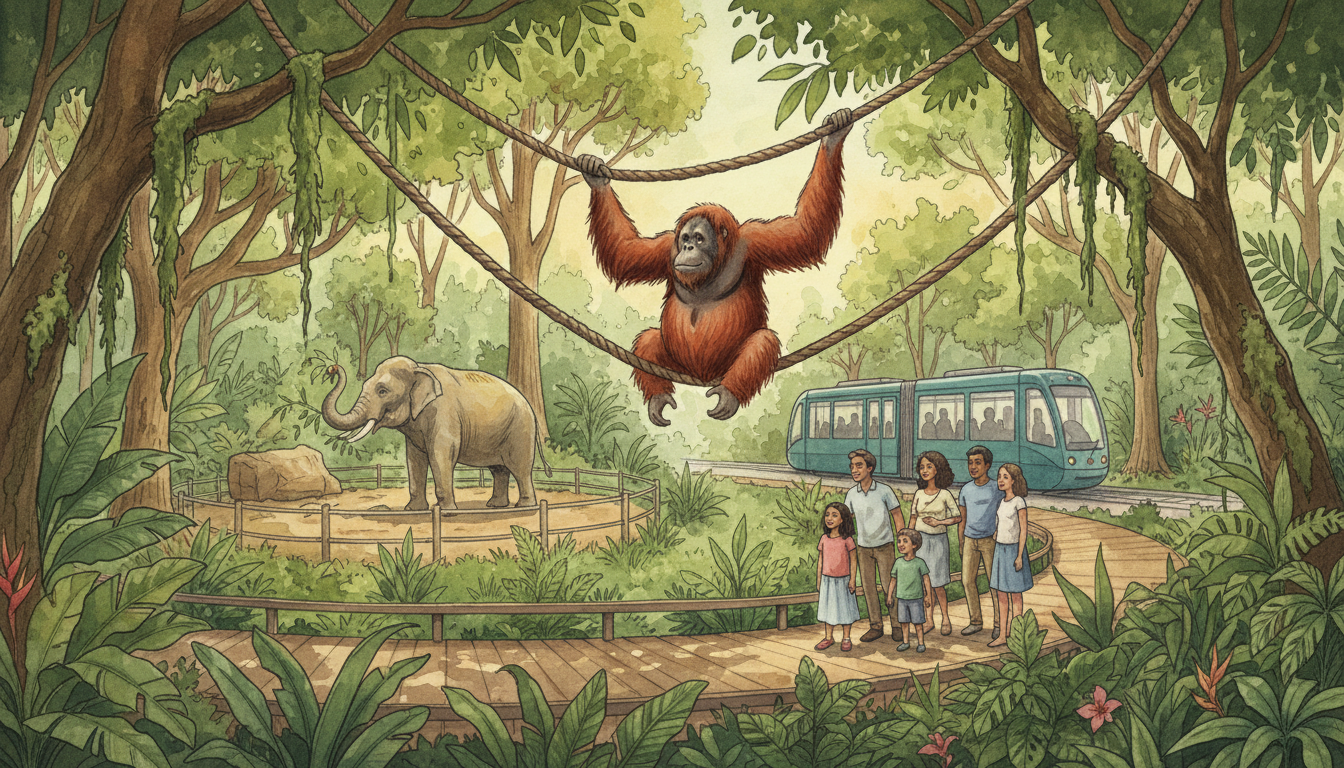
Why study History through a zoo? Because the relationship between people and animals has changed as scientific understanding, public expectations and conservation priorities have developed. An animal habitat, school programme or famous photograph at a wildlife park is not a timeless reflection of nature. It is part of an institution built through decisions about land, finance, animal care, research, visitor access and how people should learn about wildlife.
Singapore Zoo illustrates these changes. The idea developed in 1968, when Public Utilities Board chairman Ong Swee Law considered creating a zoological garden beside Upper Seletar Reservoir. Singapore Zoological Gardens officially opened on 27 June 1973 with 272 animals representing 72 species. The zoo became a popular recreational destination, while its work later expanded through breeding, veterinary care, rainforest-style habitats and conservation education. The Night Safari opened in 1994 as a distinct wildlife attraction, and programmes at the broader Mandai wildlife precinct continued evolving through the following decades.
History helps students distinguish a zoo’s founding date from the later introduction of an exhibit, the number of animals displayed from the success of conservation, and a well-known animal’s public story from the complete scientific evidence about a species. These distinctions build reasoning skills useful in History, Biology, Geography, Science and thoughtful environmental citizenship.
Explore the evidence
- The main reason to study a zoo’s history
- 27 June 1973 was the official zoo opening
- 272 animals and 72 species are opening figures
- The first orangutan birth came in 1975
- A night zoo is a separate institution
- The 1998 Fragile Forest exhibit was a different stage
- A four-week learning plan using Singapore Zoo
- FAQ: when did Singapore Zoo open?
- Official sources and connected eduKateSG learning
The main reason to study a zoo’s history
A zoo is an institution where people care for animals, build habitats, organise scientific work and make educational choices.
Its purpose can change as public expectations and knowledge develop. A historic opening ceremony can establish a founding date, but not prove that all present research programmes already existed.
History asks why the institution was created, which challenges arose and how later generations responded.
Students learn to distinguish organisational aims from actual outcomes and to evaluate claims about animals using both historical and scientific evidence.
Wildlife in a zoo differs from wildlife in its natural habitat
An animal in managed care has an environment shaped by people, including enclosure design, nutrition, veterinary oversight and opportunities for behaviour.
Wild populations face different ecological conditions. Observing an animal in a park cannot directly establish the size or health of a population in its native habitat.
Students should distinguish an animal-care account from a field study of wild populations.
This is an important interdisciplinary habit: a zoo’s History explains institutional decisions, while Ecology evaluates the species and habitats involved.
A zoo is not simply a collection of attractive animals
Animal care depends on staff, facilities, suitable diets, enrichment, health monitoring, veterinary expertise and maintenance.
A visitor photograph may show a happy-looking scene, but cannot establish every aspect of an animal’s welfare.
History asks how care practices and standards developed across periods and what evidence documents improvements or concerns.
Students learn that public institutions cannot be evaluated only through memorable pictures and publicity.
The 1968 proposal was not the zoo’s opening
Mandai Wildlife Group’s Golden Jubilee history identifies 1968 as the year Ong Swee Law proposed a zoo in the catchment forest area near Upper Seletar Reservoir.
A steering committee was formed to examine the idea. That was a planning step, years before animals and visitors entered the completed park.
Students should distinguish the first proposal, design work, construction and public opening.
This simple chronology prevents one ambitious idea from being mistaken for an operating wildlife institution.
Why the Upper Seletar landscape mattered
The zoo’s location near the reservoir provided a green setting for a substantial animal park, away from some of the denser streets of the city.
The historical reason for selecting land needs to be reconstructed from planning accounts, not simply guessed from a modern visitor map.
Students can use the documented geography to ask which transport, water and environmental constraints had to be considered.
This connects the zoo to the wider History of Singapore’s catchment areas and urban planning.
A forest setting is not automatically an untouched habitat
An area containing trees may still include paths, animal enclosures, managed vegetation and constructed visitor spaces.
Students should not interpret the words rainforest setting as proof that every animal occupies an original wild habitat or that all plants were left undisturbed.
The zoo’s landscape is designed and managed even when it draws inspiration from natural environments.
Historical Geography helps explain how public recreation facilities can be built within a green setting without treating the result as untouched wilderness.
A founding committee reveals institutional decisions
A committee may examine finance, site design, animal requirements and public access before the government or another body commits to an operating park.
The existence of a planning committee does not prove that every proposal was carried out unchanged.
Students should compare an early plan with later official records to identify actual implementation.
This makes the zoo a useful case for learning how public ideas become institutions through several stages rather than a single ceremony.
27 June 1973 was the official zoo opening
Mandai’s anniversary chronology identifies 27 June 1973 as the official opening by Deputy Prime Minister Goh Keng Swee.
The institution was then known as Singapore Zoological Gardens. Its current name and broader organisational setting developed later.
Students should attach the date to the original park, not all the distinct attractions that subsequently opened around Mandai.
Accurate names and dates are essential for comparing different stages in wildlife education.
272 animals and 72 species are opening figures
Mandai states that the original 1973 park occupied approximately 28 hectares and displayed 272 animals from 72 species.
Those figures describe the initial collection and site, not today’s population or the number of animals living freely in Singapore’s forests.
Students should preserve the source’s units—individual animals, species and hectares.
An impressive count does not by itself measure animal welfare, scientific learning or conservation success. Each outcome requires separate evidence.
An opening-day photograph is not a visitor survey
Photographs of the 1973 ceremony include the orangutan Susie interacting with Goh Keng Swee and people gathered for the event.
The pictures can document visible participants and the official occasion. They cannot establish how every guest felt or predict the park’s entire future.
Students should distinguish a genuine archive image from later promotions using the same historic event.
This lesson applies to the opening of museums, libraries, theatres and other public institutions.
The first public visiting day was 28 June 1973
The National Library’s study of the zoo’s early years distinguishes the official 27 June opening from admission of public visitors beginning on 28 June.
This is a small but meaningful chronological distinction. A ceremony attended by invited guests is not the same event as the first normal public day.
Students can use it to learn that an institution may have several valid opening milestones depending on the question.
Opening admission prices require their period context
NLB records initial ticket prices of two dollars for adults and one dollar for children.
These are historical prices for particular admission categories, not proof that every family could afford to visit or that the current price has the same purchasing power.
Students would need appropriate wage, transport and household-cost evidence for a broader comparison.
History and Mathematics meet in the simple but essential practice of interpreting an old price in its proper context.
Popularity emerged faster than initial projections
Mandai’s Golden Jubilee history records the park welcoming its millionth visitor in November 1974, about seventeen months after opening.
That is a cumulative visitor milestone for the institution. It does not represent one million unique Singapore residents or the number of people in the park on one day.
Students should distinguish admissions, individual persons and national population.
This is a valuable example of why the denominator and measurement period matter when an institutional history uses impressive numbers.
A visitor total does not measure scientific learning
High admissions can show public interest or reach, but do not automatically establish the quality of educational outcomes.
To study learning, researchers need suitable evidence about what visitors understood, remembered or did differently.
An anniversary report may accurately celebrate participation while answering a different question from a formal educational evaluation.
History teaches students to identify the kind of achievement a source actually demonstrates instead of turning every numerical success into a claim about everything else.
The open-concept design reflected a particular institutional idea
Singapore Zoo became known for exhibits using landscape, moats and barriers that could be less visually intrusive than conventional cages.
NLB’s 2024 history explains the ambition and challenges associated with presenting animals in a naturalistic setting.
Students should not infer from the word open that animals were free to roam outside managed care or that all exhibits used identical designs.
The educational lesson is to distinguish presentation, containment and welfare as related but separate subjects.
A naturalistic enclosure still needs engineering
Moats, vegetation, shelters and visitor paths may appear informal while having carefully designed functions.
Animal security, welfare and human safety depend on the complete habitat, not merely on whether a fence is visible.
A modern photograph of an exhibit cannot reveal every barrier, feeding arrangement or management procedure.
Students should seek documented exhibit descriptions when making factual claims about a particular development period. History complements animal science without guessing technical details from appearance.
The early years involved practical setbacks
The National Library research discusses challenges faced by the zoo during its formative years, including the complexities of animal management.
This is an important corrective to a story in which the institution opened perfectly and every later development was inevitable.
Students should examine documented problems and responses without sensationalising animal suffering or assuming all care was poor.
History explains how public institutions learn from experience and develop professional standards.
Animal welfare has a history of changing expectations
People’s understanding of suitable animal care, enrichment and habitat design has evolved with research and public debate.
A historic exhibit may be assessed differently under present knowledge, but the historian still needs to reconstruct the standards, resources and concerns of its own period.
Students should not assume that every earlier practice was accepted by everyone or that every modern arrangement is flawless.
The best explanation combines contextual understanding with careful evaluation based on credible scientific evidence.
A keeper’s work is more than a public performance
Animal keepers prepare food, monitor behaviour, clean facilities and work with veterinary teams. Much of this labour occurs away from visitors.
A photograph of a feeding session cannot describe a keeper’s entire daily schedule or professional training.
Students should use staff histories and reliable institutional records for occupational claims.
This broadens zoo History beyond famous animals and public ceremonies to the workers whose continuing care makes the institution possible.
Veterinary care developed alongside the institution
A growing zoological collection creates needs for diagnosis, preventive care, records and specialised facilities.
Mandai’s anniversary chronology describes later veterinary and research improvements.
Students should not project current medical equipment backwards into every enclosure in 1973 or claim a new facility instantly solved all animal-health problems.
History makes technical change understandable through a series of dated developments rather than a vague account of continual progress.
Scientific names and species counts need care
An animal species is a biological classification, while a zoo may also organise animals by exhibit group or population.
Students should not treat an exhibit count as the same thing as a species count or add individuals and species together in one total.
Taxonomy can also change as scientific understanding develops.
This is an opportunity to combine accurate Biology vocabulary with History’s insistence that numerical categories be defined in their original source.
Breeding in care is one possible conservation activity
Some zoos participate in coordinated breeding programmes, which may contribute to the management of threatened species.
But the birth of one animal does not automatically establish recovery of the species in the wild. Habitat protection and other efforts remain relevant.
Students should distinguish reproductive success at an institution from changes in wild population status.
History teaches how a reported milestone can be significant within a programme without proving every larger goal has been accomplished.
The first orangutan birth came in 1975
Mandai records Singapore Zoo’s first orangutan birth in 1975, after earlier attempts and challenges.
The event was a meaningful animal-care and breeding milestone. It was not the first orangutan ever to live in the country or proof that every orangutan breed or population had been secured.
Students should name the event accurately and examine what kind of scientific conclusion the source supports.
This builds measured interpretation of celebrated wildlife developments.
Orangutans became part of the zoo’s public identity
Orangutans appeared prominently in publicity and educational activity associated with the park.
Their visibility can introduce visitors to questions about rainforest habitats and conservation. But public familiarity with one individual does not directly measure wild orangutan population health.
Students should study the difference between an animal as a public ambassador and the scientific evidence about its species.
This helps avoid converting a popular story into a simplistic claim about conservation.
Ah Meng was a famous individual with a documented biography
Mandai’s Golden Jubilee history describes the Sumatran orangutan Ah Meng, whose later role in public engagement became internationally recognisable.
She arrived in managed care after having been kept illegally as a pet, a fact relevant to wider questions about wildlife trade and protection.
Students should not invent her behaviour, thoughts or family history beyond the records.
A careful biography can recognise one animal’s significance without making her a substitute for every orangutan’s experience.
The 1992 tourism ambassador recognition was a separate milestone
Mandai records Ah Meng receiving a Special Tourism Ambassador award in 1992.
The award is evidence of public recognition and the zoo’s tourism role. It is not a direct biological measurement of breeding success or habitat protection.
Students should distinguish recognition, animal care and ecological conservation as separate kinds of evidence.
This is a transferable method: public awards describe institutional or symbolic achievement, not automatically every relevant scientific outcome.
An animal’s popularity is not the same as conservation impact
A zoo resident may appear in travel media and attract visitors for many years.
To assess whether the attention influenced conservation behaviour or funding, researchers would need appropriate programme and outcome records.
Students should avoid assuming each admirer became a donor, or that every newspaper story improved wild habitat conditions.
History makes these distinctions clear while recognising that public engagement can still be an important institutional goal.
Breakfast with an Orangutan began in 1982
Mandai’s timeline identifies May 1982 as the start of Breakfast with an Orangutan, a distinctive dining and visitor programme.
It subsequently evolved through other formats and names. The original event and a present programme should not be described as technically identical.
Students can distinguish the change in public presentation from broader animal-welfare questions, which need scientific and operational evidence.
This is another example of a continuing brand or theme across changing institutional practices.
Changing visitor experiences reflect changing values
An attraction might move from spectacle toward interpretation of species, habitat and conservation challenges.
Students should investigate specific programmes and their documented educational aims before claiming a universal improvement in visitor behaviour.
Public presentation can change for several reasons, including science, visitor demand, regulation and institutional priorities.
History helps explain these multiple influences rather than attributing every change to one new idea.
A famous animal’s death belongs to remembrance history too
Ah Meng died in February 2008. Mandai’s anniversary material describes a public memorial and later commemorative sculpture.
Those actions reveal how the institution and visitors remembered one resident. They are not interchangeable with the animal’s biological life history or the species’ conservation status.
Students should distinguish an original animal, later memorial object and retrospective public narrative.
The method is the same used in studying historic memorials and monuments.
Commemoration need not replace scientific evidence
An artwork honouring an individual animal can be important to public memory.
But it cannot tell us the full health of captive or wild populations, nor the experience of every person who knew the animal.
Students should use the memorial for questions about remembrance and scientific publications for biological claims.
This shows how History can respect symbolic meaning while maintaining distinct evidential standards.
A night zoo is a separate institution
The Night Safari opened in 1994 as a wildlife attraction designed around nocturnal animals and evening visitor experiences.
It is associated with Singapore’s wider Mandai wildlife institutions but is not simply a 1994 replacement for Singapore Zoo, which opened in 1973.
Students must distinguish the facilities and their founding dates.
This is a useful example of how a larger organisation can develop several attractions with related but different purposes.
Nocturnal animals require a different approach to observation
Animals active in the evening or at night may need different lighting and habitat arrangements to allow visitors to observe them.
Public accounts of Night Safari explain carefully controlled illumination and visitor movement. A night photograph does not establish that all animals were active simultaneously or that every species behaved as in the wild.
Students can distinguish the experience designed for visitors from scientific observations about animal behaviour.
History gives the programme’s development, while Biology evaluates the underlying ecology.
The 1998 Fragile Forest exhibit was a different stage
Mandai’s chronology records the opening of Fragile Forest in 1998 as an immersive rainforest-style experience.
The exhibit brought visitors into a managed environment designed to communicate aspects of tropical forest life.
Students should not infer that the enclosure was an untouched rainforest or that its presence restored wild forests elsewhere.
A historical account names the design and educational purpose while leaving outcome claims to suitable research.
An immersive exhibit can be educational without being wild habitat
A walk-through space may contain plants and animals arranged to support observation and a particular learning theme.
Its design can demonstrate selected ecological relationships but is still a human-managed setting.
Students should distinguish an exhibit’s representation from the condition of original forest ecosystems.
This develops a more sophisticated connection between cultural interpretation, natural science and the built environment.
Elephants of Asia was another exhibit milestone
Mandai records an Elephants of Asia exhibit opening in 2003 with a landscaped space and infrastructure for animals and visitors.
The exhibit’s design includes features intended for elephant care and public viewing.
Students should not conclude that every elephant living in a zoo has identical requirements or that one new enclosure proves the welfare of all elephants.
History documents what was built and when, while appropriate scientific evidence assesses the care outcomes.
The exhibit’s cultural design is not an animal’s origin story
A managed animal habitat may use architectural motifs from a region associated with the species.
Those motifs can help visitors imagine geography, but they do not establish where each individual animal was born or lived.
Students should distinguish public interpretation, design inspiration and verified provenance.
This is the same source discipline used when reading museum reconstructions: an evocative setting should not be treated as a literal historical record.
Animal-care facilities require specialised professional work
Veterinary clinics, pathology laboratories, nutrition programmes and quarantine arrangements may form part of an institution’s supporting infrastructure.
Such facilities usually receive less publicity than new exhibits, yet they can be crucial to animal care.
Students should identify documented additions through the institutional timeline and avoid inventing performance data.
The lesson is that important scientific work often takes place away from the most visible visitor attractions.
A conservation programme needs goals beyond displaying animals
Conservation can involve research, threatened-species management, habitat protection, community engagement and cooperation with other institutions.
A zoo’s mission statement may document its aims. To determine the actual effects of a programme, historians and scientists need suitable reports and ecological evidence.
Students should not equate the number of animals displayed with conservation success.
This is a particularly useful distinction for environmental education, where strong intentions should be separated from measured consequences.
A 2009 fund changed institutional conservation work
Mandai’s Golden Jubilee history dates the launch of the Wildlife Reserves Singapore Conservation Fund to July 2009.
The fund focused on conservation and education, especially in Singapore, with later institutional arrangements expanding related activity.
Students should not describe the fund’s founding as proof that every funded project immediately succeeded.
A sound history distinguishes resources made available, projects supported and their documented outcomes.
A conservation fund and an animal exhibit serve different roles
An exhibit provides an environment for animals and visitors, while a fund can support work by researchers, organisations or communities elsewhere.
Both may connect to the institution’s mission, but success is assessed through different evidence.
Students should identify whether a source reports money committed, research completed or a measurable change in wildlife conditions.
This avoids using general words such as conservation to make every institutional activity appear identical.
Mandai Nature developed from earlier conservation arrangements
Mandai’s institutional material identifies the establishment of Mandai Nature in 2020 as an expanded platform for conservation work.
The later organisation builds on earlier funding and wildlife research rather than marking the first conservation-related activity of Singapore Zoo.
Students should separate organisational change from the start of every underlying project.
This is a clear example of how institutions grow and adopt new forms while continuing some existing purposes.
Species breeding records need specific interpretation
A successful breeding record can establish that a particular species reproduced under managed conditions.
The result may be important to husbandry and coordinated species management, but it does not automatically demonstrate a stable wild population.
Students should identify which animal or group, date and institution the record actually concerns.
This prevents a conservation milestone from being transformed into an unsupported universal statement about endangered wildlife.
The 2009 Komodo dragon hatchling was a notable event
Mandai’s history records a Komodo dragon hatchling in November 2009, after a long period without such a birth in the zoo.
That result was important to the institution’s animal management and breeding work.
Students should not claim it was the first Komodo dragon hatchling anywhere in the world or proof that the species was no longer threatened.
Accurate historical writing specifies the local event and the context of its significance.
A breeding achievement has a long preparation story
Successful animal care can require suitable social conditions, nutrition, veterinary oversight and observation before breeding occurs.
A celebratory photograph of a hatchling documents an outcome but not all the preparations or uncertainty preceding it.
Students should use institutional and scientific reports for the full explanation rather than create a dramatic story of inevitable success.
History draws attention to process, professional work and the gap between hoped-for and achieved results.
The 1971 Jurong Bird Park belongs to another institution
Jurong Bird Park opened in January 1971, before Singapore Zoo began operation. It later developed separate avian care and conservation programmes.
Students should not treat the zoo’s 1973 opening as the beginning of every zoological attraction in Singapore.
The broader Mandai history now includes several institutions that began in different periods.
This is an opportunity to build accurate parallel timelines rather than compress distinct wildlife parks into one founding story.
The 2023 Bird Paradise opening represents relocation and redevelopment
Bird Paradise opened at Mandai in 2023 as a successor to Jurong Bird Park.
Mandai’s 2026 precinct history identifies its November 2023 official inauguration.
Students should distinguish the original bird park, its relocation and the opening of the new venue.
An institution’s functions and expertise can continue across major changes in its physical location.
River-themed wildlife exhibits followed another timeline
River Safari began opening in the early 2010s and later became known as River Wonders.
Its purpose and habitats differ from Singapore Zoo’s original 1973 collection, even though both belong to a related wider precinct.
Students should not use the new attraction’s date as a replacement for Singapore Zoo’s own founding milestone.
History becomes clearer when names, sites and dates are carefully separated.
A wildlife precinct changes through multiple projects
Development around Mandai has involved separate wildlife parks, nature infrastructure, visitor facilities and conservation programmes.
Each component has a different planning and operational chronology. A master plan cannot be treated as evidence all facilities were finished on one day.
Students can compare the relevant institutional timelines and mark verified openings separately.
This is a valuable public-project lesson: a large site changes through overlapping phases rather than through one instant transformation.
Animal welfare debates are part of the historical record
The role of zoos involves legitimate questions about education, conservation, animal care and keeping wildlife under human management.
Different researchers, practitioners and public groups may emphasise different evidence and ethical values. Students should present those perspectives fairly while avoiding unsupported claims that every zoo has identical conditions.
An evidence-based essay should distinguish observable practices, scientific assessments and value judgements.
History helps clarify how the debate developed, rather than requiring students to adopt a simplistic all-good or all-bad verdict.
A historic exhibit should be read in the standards of its period
An enclosure photographed in 1973 may be unlike one built decades later.
Students should reconstruct what staff understood and intended at the earlier date while recognising that later science can justify improvements.
Historical context is not an excuse to ignore welfare concerns; it is a way to explain how practices and standards developed.
The strongest analysis acknowledges documented constraints and change without substituting retrospective certainty for evidence available at the time.
A zoo’s mission can change while its name continues
An institution may remain publicly known by a familiar name even as its professional responsibilities and visitor programmes expand.
Students should not assume that everything currently included under conservation or education was part of the original 1973 operating model.
An official timeline and dated programme reports can reveal these changes.
This is continuity of institutional identity alongside evolution of purpose, a central concept in historical reasoning.
Visitor education must be evaluated with the right evidence
A wildlife talk may aim to teach habitats, threats or conservation actions. The fact that it was presented does not prove every audience member understood or acted on the message.
Students need suitable research or programme evaluation to claim a measurable educational effect.
An event schedule is evidence of what an institution offered, while visitor learning is a different outcome.
This distinction is useful for examining museums, schools and science centres as well as zoos.
The zoo also provides work and training
Keepers, educators, veterinarians, researchers, horticulturists, cleaners and technical workers all contribute to the institution.
A photograph of a famous orangutan may conceal the staff whose daily work supported its care.
Students can investigate documented roles and how training developed without inventing personal experience.
This widens the history from popular attractions to the professional knowledge and labour that sustain them.
Zookeepers can have different relationships to the same animal
Long-term care may involve many staff members across different periods. Their observations and routines may contribute to institutional knowledge.
A single interviewee’s account can explain one worker’s experience, but should not be taken as the universal view of all staff.
Students should identify speaker, date and scope before quoting personal testimony.
Historical empathy is strongest when individuals are recognised accurately rather than treated as anonymous representatives of an entire profession.
Veterinary records and publicity photographs answer different questions
A veterinary record may document a diagnosis, treatment or professional observation under appropriate access conditions.
A publicity image may show an animal’s appearance or a celebratory moment.
Neither should be made to answer every question about long-term welfare or wild habitat.
Students learn to choose evidence appropriate to the specific claim, especially when a famous animal’s story evokes strong emotions.
Modern habitat displays have different purposes
Some exhibits emphasise immersion, others focus on a species’ ecology or breeding-related management needs.
A label describing the natural habitat is an educational interpretation rather than proof the enclosure is an original wild ecosystem.
Students should distinguish what is simulated, what is authentic and what the institution says about its design.
This is the same source skill used in archaeological exhibits and historical museum reconstructions.
A model habitat can show relationships without proving conditions in the wild
A carefully designed forest-style enclosure can help visitors visualise vegetation, water and shelter.
But the numbers of animals or plants inside it may not match those in an original forest, nor reproduce all ecological processes.
Students should use field studies or conservation research for wild-population claims.
History is valuable because it explains why humans built the model and how the educational purpose changed, not because the model replaces nature.
Wildlife history must consider animals as well as institutions
A history focused only on new buildings and high visitor numbers may miss the animal-care challenges behind those milestones.
Conversely, a study of one animal’s life may omit the public and professional systems that influenced its circumstances.
Students can compare institutional and scientific records while being careful about what each establishes.
The result is a richer explanation that neither anthropomorphises animals nor reduces them to statistical exhibits.
Publicity can communicate values without measuring outcomes
An anniversary brochure may celebrate conservation, education and visitor enjoyment.
Its claims about dates and formally recorded events can be valuable; broader statements about effectiveness require suitable supporting evidence.
Students should identify whether a passage is a measured result, an institutional aim or a celebratory interpretation.
This is media literacy through History: public relations and scholarly analysis serve different purposes, even when both contain accurate facts.
One species can be threatened even if a zoo breeds it successfully
A successful breeding programme may support a captive population while wild habitats remain under pressure from land-use change or other factors.
Students should not use one newborn animal as proof a species is secure.
The correct conservation question involves wild population trends, habitat condition and the role of different interventions.
History teaches the discipline of limiting a conclusion to the event actually documented by the source.
A large animal collection is not a biodiversity measure for Singapore
The number of species in a wildlife park refers to its managed collection at a particular time.
It does not represent the number of native species living in Singapore or their ecological condition.
Students need scientific inventories and field data for such questions.
This simple definition is crucial when schools compare conservation attractions with nature reserves and other wildlife settings.
Tourism and wildlife education are different performance measures
High attendance and international awards may show public interest or recognition. Educational effectiveness, conservation funding and animal welfare require other forms of evidence.
Students should avoid treating one highly positive statistic as proof of every institutional goal.
A balanced essay explains what the measure describes and what it cannot establish.
This is quantitative historical literacy applied to a familiar public attraction.
A popular animal’s biography has several source layers
Public reports may document arrival, milestones and later remembrance, while veterinary records and staff recollections address different parts of the animal’s life.
A bronze sculpture or commemorative story is evidence of public memory, not a complete original clinical record.
Students should identify which source supports each biographical fact.
This is particularly valuable for Ah Meng’s history, where popular affection and scientific questions need to be kept distinct.
A site can change without erasing its historical significance
Renovating enclosures or opening new facilities may alter the park’s appearance and visitor routes.
The official founding date remains meaningful, but an old site map should not be used to describe every present enclosure.
Students can compare dated park plans and identify changes to the institution’s physical geography.
The method transfers to historic markets, theatres and stations that also evolve while retaining a familiar public identity.
An institutional anniversary is not a species milestone
The zoo’s Golden Jubilee in 2023 marked fifty years since the original 1973 opening.
The anniversary date is not the birth date of every animal in the collection or the founding year of later Mandai attractions.
Students should distinguish a commemorative institutional event from biological and technical developments.
This prevents timelines from turning a collection of related but different subjects into one misleading chronology.
A visitor map is not a wildlife distribution map
A zoo visitor guide locates paths, exhibits and facilities within the managed park. A conservation map may show a species’ wild range.
These are different geographic documents serving different audiences.
Students should not infer the natural distribution of an animal from its position inside a zoo.
This is a clear Geography and History lesson in evaluating what a map is designed to communicate.
Photographs of animal encounters require context
A picture may show an animal near a visitor or official during a particular event.
It cannot establish that such interactions were routine, appropriate under current practice, or representative of every animal’s experience.
Students should check its date and accompanying institutional account before interpreting the encounter.
Historical images are valuable, but they should not become instructions for approaching or touching wild animals.
Modern animal-care standards are not classroom handling instructions
An article about the history of exhibits or feeding programmes is not guidance on how children should handle animals.
Wildlife encounters should follow current professional instructions and applicable regulations. Historic publicity about contact should not be recreated as a home experiment.
This boundary helps students understand a changing institution while respecting present welfare and safety concerns.
History and Biology complement one another when each retains its appropriate role.
The conservation of native wildlife is not only a zoo activity
Protecting wild species can involve habitat management, public agencies, researchers and communities operating outside zoological parks.
Mandai’s work may contribute to a wider network, but it should not be credited automatically for every improvement in Singapore’s biodiversity.
Students should identify the relevant organisations and evidence for each project.
History becomes more accurate when it recognises collaboration without assigning all results to one famous institution.
An animal hospital is not evidence of every animal’s health
A new veterinary facility may enhance the resources available to staff, but actual outcomes require suitable clinical and husbandry records.
Students should not infer universal animal wellbeing merely from a building opening or equipment purchase.
The relevant historical claim may be that the park expanded its professional capacity at a particular date.
This is a distinction shared with studies of human hospitals and public-health systems.
A zoo’s continuing history includes ethical learning
Public understanding of animals can change through science, welfare debates and the experiences of institutions managing different species.
A responsible historical account should examine how practices were justified and revised rather than assume every earlier decision was perfect or every later decision solves all problems.
Students learn to discuss contested questions with specific evidence and fair presentation of relevant concerns.
That skill is useful for environmental citizenship and broader public policy debates.
Worked exercise: 1968 proposal versus 1973 opening
Provide Mandai’s Golden Jubilee timeline and ask students which event occurred in 1968 and which occurred on 27 June 1973.
They should identify planning and official opening as different milestones, then explain what additional source would establish first public admission.
The task shows why a project may have several related origin dates.
A clear answer avoids claiming visitors entered a completed zoo in 1968 merely because the idea had been proposed.
Worked exercise: 272 animals is not 272 species
Use the documented opening collection of 272 individual animals across 72 species.
Ask students what each number counts and why one cannot be substituted for the other.
Then ask whether the figures independently prove successful wildlife conservation. The answer must explain that the collection and the condition of wild populations are different subjects.
This is a compact lesson in precise quantitative interpretation and Biology vocabulary.
Worked exercise: a familiar animal and a public award
Give students Mandai’s account of Ah Meng’s career and 1992 tourism recognition.
Ask which facts concern the individual animal, which concern public representation and what evidence would be needed for a claim about wild orangutan conservation.
The final paragraph should state one supported historical milestone and one significant limit.
This helps students respect a well-known story without exaggerating its scientific reach.
Worked exercise: 1973 Zoo versus 1994 Night Safari
Provide official sources for both opening dates. Students should identify the two distinct attractions and their differing visitor models.
A correct timeline should not treat Night Safari as the original 1973 zoo or assume all its specialised nocturnal features existed from the outset.
Next, ask which kinds of research are needed to evaluate animals’ natural behaviours.
The exercise connects institutional chronology with a basic distinction between managed observation and field ecology.
Worked exercise: a publicity photograph and an animal-care record
Prepare an authorised photograph from an opening ceremony alongside a suitable published account of husbandry or exhibit improvements.
Students identify what the image directly shows and what the second source establishes about professional practice.
They should not infer long-term animal welfare from a single smile or celebratory scene.
This trains careful comparison of visually persuasive and technically informative evidence.
A four-week learning plan using Singapore Zoo
Week one builds chronology from the 1968 idea through the 1973 opening, later exhibit milestones and other Mandai attractions.
Week two evaluates photographs, institutional histories, species counts and scientific descriptions, identifying their different purposes.
Week three explores change and continuity in animal care, education, tourism and conservation without equating them.
Week four asks for a short independent investigation of another wildlife institution, with a cited claim and meaningful limitation.
Progress means the student can reason accurately about unfamiliar evidence instead of repeating a list of famous animals.
Common mistakes and how to correct them
First, students describe the 1968 proposal as the zoo’s official public opening. Second, they call the 1973 collection of 272 animals a total of 272 species.
Third, they treat a visitor record as proof of educational or conservation success. Fourth, they merge Singapore Zoo and Night Safari into one identical institution.
Fifth, they infer wild population health from a single birth in managed care. Sixth, they interpret a promotional photograph as complete evidence of welfare.
Each repair requires date, category and an appropriate source.
Parents can turn a zoo visit into historical thinking
A family can read the park’s official anniversary timeline and choose one dated change in habitat design or educational programming.
Ask the child what the milestone shows and which broader claims would need scientific evidence. A visitor map can be compared with a historic institutional record without treating the managed park as wild habitat.
During any visit, follow present animal-care and visitor rules rather than imitate old photographs of close encounters.
A short, carefully sourced reflection develops History and Science together.
FAQ: when did Singapore Zoo open?
Singapore Zoological Gardens officially opened on 27 June 1973, with public visiting beginning the following day.
The original collection included 272 animals across 72 species. The 1968 proposal and later Mandai attractions belong to different stages of the history.
FAQ: when did Night Safari open?
Night Safari opened in 1994 as a separate attraction dedicated to nocturnal wildlife experiences.
It developed within the broader Mandai wildlife precinct but should not be confused with Singapore Zoo’s original 1973 opening.
FAQ: does breeding an endangered animal prove the species is safe?
No. A birth in managed care can be important for husbandry or breeding programmes, but it does not independently demonstrate recovery of populations in their natural habitats.
Conservation claims require appropriate scientific evidence about the relevant species, habitat and programme.
FAQ: why study a zoo in History class?
The subject offers accessible examples of chronology, institutional development, historical source evaluation, changing scientific knowledge and debates about public responsibilities.
It supplements, rather than replaces, scientific study of ecosystems and school syllabus content. The benefit is learning how to interpret evidence and explain change responsibly.
Official sources and connected eduKateSG learning
Begin with Mandai Wildlife Group’s Golden Jubilee chronology, NLB’s Animals, Anxieties and Aspirations: The Earlier Years of Singapore Zoo, and Mandai’s later precinct-history milestones. These sources distinguish original planning, public opening and later conservation and attraction developments.
Within eduKateSG, continue through parks and gardens as living history, scientific knowledge and changing evidence, museum collections and public education, reading old photographs responsibly, and change and continuity. The SEC History guide explains the school enquiry skills.
Singapore Zoo’s History is an education in how people’s relationships with animals and nature can change through research, institutions and public expectations. The strongest account recognises the value of documented achievements while keeping the difference between memorable animals, successful visitor experiences and measurable conservation outcomes clear.