
Why study History through an old coin, receipt, sewing tool or household object? Because the things people made and used can preserve traces of work, trade, skill and social life that written accounts overlook. A museum object may appear ordinary, but the evidence surrounding it—who made it, where it was found, how it was acquired and why it was preserved—can reveal connections across generations.
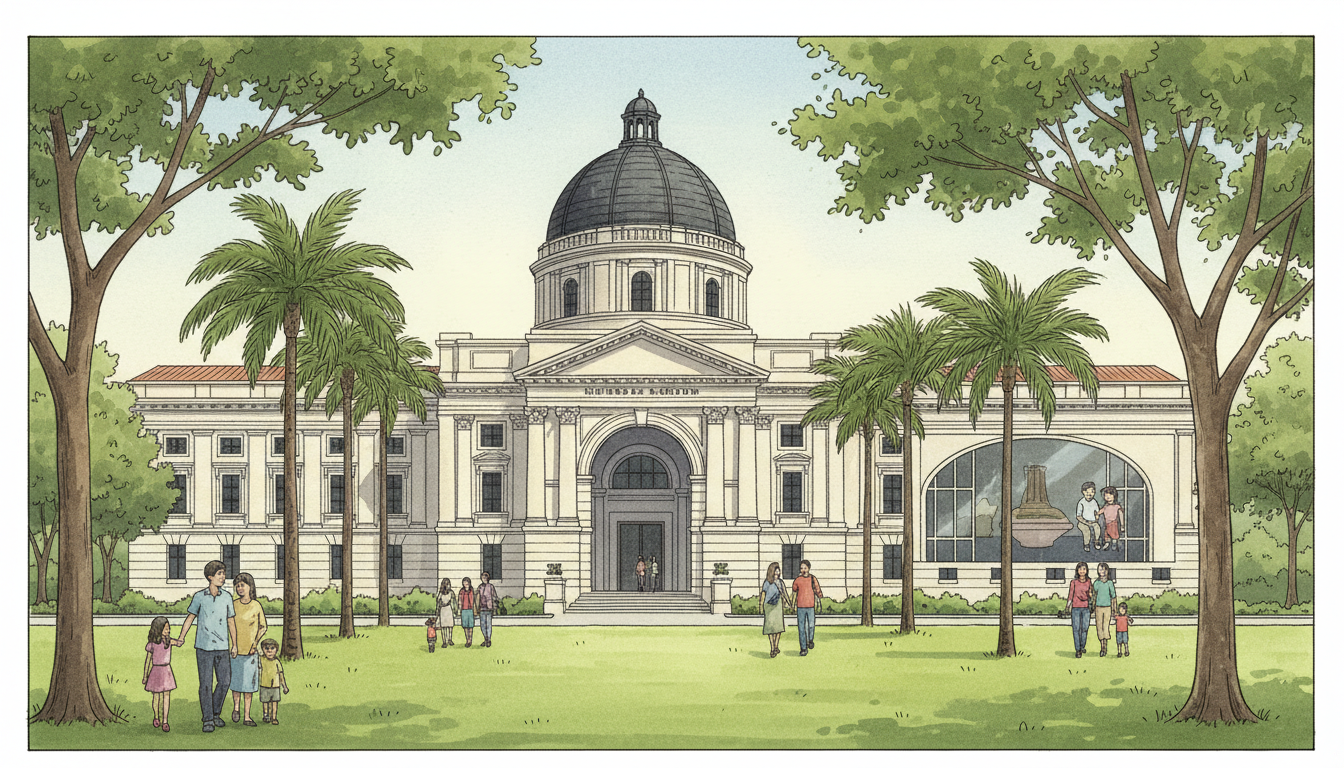
Singapore’s National Museum offers a starting point. In 1849, two ancient gold coins donated by the Temenggong of Johor helped prompt the creation of a museum collection within the Singapore Library. The Raffles Library and Museum later moved into its Stamford Road building in 1887. Its collections once emphasised natural history as well as artefacts; the museum’s focus subsequently shifted toward Singapore’s culture and history. These changes show that the purposes of a museum are themselves historical.
Studying museum collections teaches students to distinguish the object from the interpretation attached to it, understand why provenance matters, recognise gaps in what institutions preserved and examine how present-day exhibitions construct historical explanations. These are essential tools for Secondary History and for reading the physical evidence of everyday life.
Explore this article
- The direct answer: objects record actions, but they do not explain themselves
- Why two gold coins mattered in 1849
- What provenance means for museum objects
- A collection can be large without being representative of everyone
- A museum visit can be a source-analysis exercise
- A four-week History plan built around objects
- FAQ: Are everyday objects as useful as famous artefacts?
- Official sources and connected eduKateSG reading
The direct answer: objects record actions, but they do not explain themselves
A used tool may reveal material, form and signs of wear. A ticket may show a printed date or price. A household container may demonstrate a design intended for storage.
None directly tells us everything about the person who used it. A ticket does not prove its purchaser attended an event; an old cup does not reveal who washed it; a photograph of an object cannot establish its complete ownership history.
History trains the student to separate direct observation from reasoned inference and unsupported invention.
The value of a museum lies not only in possessing an item but in preserving enough reliable context for future researchers to ask meaningful questions.
The first question is what the object actually is
An accurate museum description identifies the material, dimensions, inscriptions, construction and condition of an object, often together with an estimated or documented date.
The identification may require specialist knowledge. Two similar-looking objects can have different functions, and an item that resembles an antique may be a later reproduction.
Students should begin with the museum’s catalogue entry and distinguish recorded facts from interpretive labels such as “probably” or “possibly”.
This teaches careful language and stops a historical essay from relying on a guess made from appearance alone.
Why two gold coins mattered in 1849
The National Library’s museum history explains that two ancient gold coins presented by the Temenggong of Johor in early 1849 helped spur the establishment of a small museum within the Singapore Library.
The story is interesting because a modest donation was linked with an institutional initiative. It does not mean that two coins, by themselves, explain every subsequent development of the museum.
Students should distinguish the date the idea of a library and museum was raised, the 1849 collecting effort and the later formation of a government-supported museum.
One object can be an important milestone without being the whole history of an institution.
The 1823 proposal was not the completed museum
Stamford Raffles discussed a library and museum in connection with an educational project in 1823, but the museum collection did not immediately become an established public institution.
The National Museum’s milestone chronology separates early conceptual discussions from subsequent collecting and organisational developments.
A strong History answer distinguishes a proposal, an initial collection, an established institution and a purpose-built building. These are different events.
The lesson applies widely: the first idea for a public project is not its completion date, and an official commemorative timeline often combines several types of milestones.
The 1874 Raffles Library and Museum reflects institutional change
The National Library account records the formation of the Raffles Library and Museum as a named institution in July 1874.
The new arrangement involved government support and combined functions that would later be separated. Understanding the organisation requires reading its rules, responsibilities and collections within the colonial institutional setting.
Students should not project the modern National Museum’s purpose backwards into every nineteenth-century period.
Historical institutions change names, management and priorities, and all three deserve attention when explaining what an object meant to its custodians.
The 1887 Stamford Road building is an important but different date
The purpose-built museum and library building at Stamford Road opened on 12 October 1887, according to the National Library’s account.
Its construction provided new space for collections, but the museum’s history began before the building. A physical opening should not be confused with the origin of every object later displayed inside.
Students can practise building a timeline with separate entries for the early coin donation, institutional establishment and building opening.
This simple distinction prevents the common mistake of calling a prominent building the beginning of all museum activity.
Early collections included natural history
The Raffles Library and Museum collected zoological, botanical, geological and other materials from Singapore and the wider region.
The National Library account explains that the early museum placed substantial emphasis on natural-history specimens before its later focus changed. An insect specimen and a household artefact might have been collected for different research aims.
Students should identify which department, period or collecting project an object belonged to before assigning it a modern historical meaning.
This is why museum history also connects with the history of Science: institutions change what they consider important evidence.
A museum’s purpose changes as society asks new questions
By 1960, the museum had been separated from the National Library. Later in the twentieth century, its focus moved toward Singapore’s history, culture and art; some natural-history material was transferred elsewhere.
The NLB chronology identifies these developments, including the 1972 transfer of zoological specimens.
Students should not claim that an object became unimportant because it moved to another institution. Its research purpose and custodial setting may have changed.
Historical inquiry investigates the reasons for collecting, preserving, transferring and exhibiting material rather than assuming that museum organisation is permanent.
What provenance means for museum objects
Provenance is the documented origin and history of an item, including where relevant its maker, earlier custodians, archaeological context and route into a collection.
A beautiful object with an uncertain origin can be difficult to interpret responsibly. A museum may know when it acquired an item without knowing every earlier owner.
Students should not fill gaps with an invented story of discovery. The honest statement “origin not established from the consulted record” is academically useful.
Understanding provenance also helps readers distinguish authentic objects, later reproductions and modern artworks used to illustrate a historical theme.
An accession number is not a date of manufacture
Museums often assign records or identifiers when an item enters a collection. An accession number helps document custody and manage the object.
It should not be confused with the object’s original date or the date it was excavated. A nineteenth-century object could have been donated to a museum decades later.
A student should record acquisition, creation and discovery separately when the information exists.
This is a straightforward exercise in chronological precision, preventing a catalogue field from being interpreted as an event it was never designed to describe.
A museum label is a later interpretation
A display label may have been written many decades after the object’s original use. It can summarise scholarly research and help visitors understand the item.
But the label is not the object itself and is not necessarily a contemporary eyewitness statement. Its language, questions and sources belong to the exhibition’s own period.
Students can compare a catalogue entry, the object and a public-facing label. Each answers different questions.
This teaches a critical historical distinction: material evidence can survive across centuries, while explanations of that evidence may change as research develops.
Why material matters but cannot reveal every use
Clay, metal, wood, textiles and glass have physical properties that shape how objects can be made and used. Specialist analysis may identify manufacturing techniques or wear.
Yet a material’s presence does not automatically reveal the exact occupation, ethnicity or personal identity of its user.
Students should use qualified descriptions and consult relevant research before making technical claims. A photographed object may not allow reliable testing of its composition.
The educational payoff is respect for evidence boundaries: physical observation can support some propositions while leaving other questions open.
A household object can illuminate work and care
A cooking implement or sewing tool may raise questions about labour, family responsibilities, income and daily routines.
But the tool alone does not prove who performed a task or how often it was done. Its shape may indicate a function, while a dated advertisement or oral account can offer a different form of evidence.
Students can construct a small inquiry around one object and identify the records needed to move from design to actual use.
This makes social History accessible without turning ordinary people into fictional characters whose thoughts are invented from surviving objects.
How everyday objects preserve economic change
Old packaging, ration books, price tags and transport tickets can reveal the forms in which goods and services were offered.
A printed price is evidence of a stated amount for a specified item. It is not sufficient to establish national affordability or changes in living standards.
To make broader comparisons, historians need compatible income, quantity and price data. Some objects also survive precisely because they were unusual, not because they represent normal experience.
Museum collections can thus support economic History while teaching students why a single object should not stand for an entire population.
A donated object carries more than one history
A donation may involve the object’s manufacture, use, preservation by a family and eventual transfer to an institution.
These stages may reflect different motivations and periods. A family may donate something because it is meaningful to them, while a curator may value it for a research question.
Students should distinguish the donor’s explanation from independently established facts. Personal recollection is valuable within its scope, but it may not verify every date.
The object can be both a family memory and part of a public collection without those roles being identical.
Museums select what they accept
Institutions cannot preserve every object. Decisions may depend on collecting policy, condition, significance, documentation and available storage.
The National Museum’s donation initiatives show that collections can develop through public contributions, selected for particular research or exhibition needs.
Students should not assume that everything offered to a museum is automatically acquired. Nor does the absence of a type of object prove people never used it.
This is a central insight about archives: the surviving record reflects both past life and later decisions about what to preserve.
A collection can be large without being representative of everyone
A museum may hold thousands of items, yet some communities or occupations can be better documented than others.
Reasons include access to donors, earlier collecting priorities, the durability of materials and the survival of documentation. Fragile ordinary objects may be lost more readily than ceremonial or expensive ones.
Students should ask what kinds of objects dominate a collection and who is less visible. They must not invent missing objects or experiences to complete the picture.
The honest recognition of archival bias is a strength of History, not a reason to abandon the evidence that survives.
The National Collection has more than one custodian
Singapore’s National Heritage Board describes a National Collection spanning museums and heritage institutions, with large numbers of digitised artefacts.
The NHB overview explains preservation and documentation responsibilities. The objects represent different subjects, periods and source histories.
Students should not assume a single museum physically displays the entire collection. A record may be accessible digitally while the original object is stored or shown elsewhere.
This is useful for research planning: collection ownership, physical location and public access are distinct matters.
Conservation is not the same as making an object new
Conservators seek to stabilise objects and manage deterioration through appropriate methods. Conservation can include examination, preventive care and carefully documented intervention.
It is not necessarily desirable or possible to restore every item to an imagined original appearance. Some traces of age and use are important historical evidence.
Students should avoid judging conservation by whether an object looks shiny or flawless. A well-preserved item may show wear precisely because that wear is informative.
Museum history teaches that preservation involves technical knowledge and ethical decisions about how much to alter the surviving material.
Storage conditions affect future historical knowledge
Temperature, humidity, light, pests and handling practices can influence how objects survive. Different materials have different vulnerabilities.
The National Museum’s earlier history documents problems with mould, dust and termites, illustrating the practical challenges of storing collections in a tropical environment.
A student can connect that history to the development of museum preservation systems. The goal is not to claim that every older curator was careless, but to understand the constraints and knowledge available at the time.
The continued existence of an object is often evidence of maintenance and institutional work, not simply good luck.
An object in storage is still part of the historical record
Not every item can be displayed at once. Museums may rotate exhibitions or keep material in controlled storage for conservation and research.
A visitor who sees only a small fraction of the holdings should not treat that selection as the complete collection. The choice of objects on display reflects the exhibition’s questions and practical limits.
Students can use digital catalogues and collection descriptions to discover items that are not currently exhibited.
This encourages research beyond a single museum visit while respecting access and handling rules.
Digitisation improves access but does not reproduce an object perfectly
A digital image can help readers identify design, text and surface features without travelling to a collection.
But it may not convey accurate scale, weight, texture, three-dimensional structure or every mark. Lighting and framing affect what appears.
A museum catalogue photograph should therefore be treated as an interpretation of a physical object, useful for many questions but insufficient for some forms of technical analysis.
History students learn to record whether they examined the original object, a photograph or a curator’s description. This transparency strengthens research.
A museum object can be authentic and still be mislabelled
Authenticity concerns whether the item is what it purports to be. A catalogue’s interpretation may nevertheless contain an error about date, function or earlier ownership.
Scholarly research can revise the classification when better evidence becomes available. That does not make all museum knowledge arbitrary.
Students should compare updated records and recognise that corrections are a normal part of responsible collection management.
The lesson is an intellectual habit shared with Science: evidence should be evaluated and conclusions changed when warranted.
Exhibitions organise objects into narratives
A curator may arrange several objects to explore migration, education, trade or everyday life. The order invites visitors to interpret connections.
Yet objects displayed side by side did not necessarily belong to the same person, place or decade. Exhibition design should not be mistaken for an original historical relationship.
Students should read dates and catalogue descriptions before inferring links. A comparison can be insightful even when objects have different origins, provided that the comparison is clearly explained.
This is a useful warning against treating museum displays as evidence that explains itself.
Why the National Museum’s own name changed
The museum’s institutional history includes the National Museum designation in 1960, its Singapore History Museum period from the early 1990s to 2006, and the return to the National Museum of Singapore name in 2006.
The NLB account documents these stages alongside changing curatorial priorities.
Students should not treat a modern label as the name the institution used in every historical period.
This supports precise citations and reminds readers that a museum’s identity is also shaped by changing public goals.
A building and its collection have separate biographies
The Stamford Road museum building became a national monument in 1992. Its physical conservation and architectural history belong alongside, but are not identical to, the histories of the objects it houses.
An item in the collection may have been created overseas centuries before the museum building existed, or donated after its restoration.
Students should keep the timeline of the structure separate from the production, movement and use of a specific object.
This demonstrates why History often needs multiple chronologies operating at different scales.
Museums can preserve memories of overlooked work
Tools, shop signs, transport tickets and household items can draw attention to occupations and everyday activities often absent from formal political records.
But the museum must still document provenance and context. A nameless tool cannot be used to invent the biography of a particular worker.
Students can ask what the object establishes about technique or a type of labour and what additional records would reveal the people involved.
This approach makes everyday life part of History while avoiding a sentimental narrative unsupported by evidence.
Ethical collecting is a historical question too
An object may have been acquired through donation, purchase, excavation or other circumstances. Its acquisition history can raise questions about permission, authority and community relationships.
Students should not assume that a museum’s possession alone proves an uncomplicated right of ownership or that every old object was acquired improperly. The documented circumstances matter.
A responsible inquiry begins with acquisition records and appropriate museum policy, then considers which people or communities have a connection to the object.
This is one reason provenance matters beyond academic dating: the history of custody can affect how an item should be interpreted and treated today.
Whose interpretation is missing from a label?
An exhibition may rely on expert scholarship but still emphasise particular historical questions. Community members, practitioners or families may understand the object through different kinds of experience.
Students should distinguish a meaningful personal interpretation from a claim about a factual origin. Both can be discussed without pretending they are the same kind of evidence.
A more inclusive investigation can seek relevant, ethically gathered testimony while retaining independent historical verification where appropriate.
History helps learners listen to varied voices without replacing evidence with mere assertion.
A museum visit can be a source-analysis exercise
Choose one object with a readable label and a public catalogue entry. Record material, approximate date, source, acquisition information and stated function.
Separate the information into three columns: directly observed, documented by the museum and inferred by the student. If an item is a replica, record that explicitly.
Then ask which claim would need a second independent source. The final paragraph should be modest enough that every sentence can be defended.
This produces a more rigorous result than merely copying the museum label into a school report.
Worked example: a transport ticket in a display
Imagine an authentic dated ticket in a museum collection. It may show a route, fare or design used in a particular transport system.
A student may be tempted to conclude that everybody could travel cheaply at that time. But the ticket alone cannot tell us average earnings, whether the route ran reliably or who could afford it.
A stronger account states the ticket’s verified details and identifies an additional source needed for a broader claim.
This exercise turns an ordinary object into a clear lesson about historical evidence and overgeneralisation.
Worked example: two ceramics with different provenances
Suppose two pottery vessels look alike. One has a documented archaeological findspot and associated dating evidence; the other was acquired long ago without a reliable origin record.
Students should not assign both the same history simply from appearance. They can compare material features while clearly separating documented context from uncertain attribution.
A museum catalogue may already indicate where the evidence is tentative. The learner should preserve that qualification.
The exercise teaches why collecting and recording context is often as important as preserving the artefact itself.
Worked example: a donor’s memory and a catalogue date
A family may donate a household object and recall that it belonged to a grandparent during a particular decade. The museum may separately identify a manufacturing period using expert analysis.
If the accounts differ, students should not simply dismiss the donor or automatically reject the catalogue. They should distinguish manufacture, purchase and use, which can occur in different decades.
A careful explanation may reconcile the dates or record remaining uncertainty.
This is a practical demonstration of corroboration across personal and institutional sources.
A four-week History plan built around objects
Week one teaches observation. Students describe objects without assigning undocumented users or motives.
Week two introduces provenance: maker, date, location and route into a collection. Learners practise identifying missing details.
Week three studies interpretation. Students compare a catalogue, public display label and external source, noting where conclusions differ and why.
Week four tests independent research on an unfamiliar object. The student writes a short sourced analysis with one supported inference and one limitation.
Improvement means the student can derive appropriate claims from material evidence without relying on a curator’s wording as an unquestionable script.
Six mistakes that undermine object-based History
The first is using an acquisition date as the manufacture date. The second is assuming visually similar objects have identical origins. The third is treating the museum’s label as a statement written by an original user.
The fourth is making population-wide claims from a single surviving item. The fifth is assuming a digital photograph provides every property of a physical artefact. The sixth is inventing an unnamed owner’s emotions because a narrative seems incomplete.
Each repair involves identifying provenance, separating observation from interpretation and matching claims to appropriate evidence.
These habits are fundamental to sound historical reasoning.
Parents can use everyday household objects thoughtfully
Choose a non-sensitive family object, such as an old school badge, bus ticket or kitchen implement. Ask when it was acquired, how it was used and which details can be checked.
A relative’s willing explanation is valuable personal testimony; a manufacturer’s label or dated photograph may corroborate parts of it. Avoid turning private belongings into public assignments without permission.
The child can write a short object biography with verified facts and clearly marked uncertainties.
This makes History practical and personal without confusing affection for an object with certainty about all its past.
FAQ: Are everyday objects as useful as famous artefacts?
They can be, depending on the question. An ordinary tool or receipt may illuminate labour, trade, household decisions or changing technology more effectively than a famous ceremonial object.
The source’s value depends on provenance, context and what it can actually establish, not merely monetary value or age.
FAQ: Does a museum own everything it displays?
Museums may display items from their own holdings as well as objects borrowed from other custodians. A label or catalogue entry may identify the lender or collection.
Students should avoid assuming that public display and legal ownership are the same thing. Acquisition and loan information should be checked.
FAQ: Is a replica a historical source?
A replica is evidence of a later reconstruction or teaching representation, not automatically an original object from the period depicted.
It can help learners visualise form or function, provided it is labelled accurately. Claims about the original artefact must be grounded in authentic documentation.
FAQ: Why do museum labels sometimes change?
New research, corrected provenance, improved dating or a changed exhibition focus can lead to revised descriptions.
Responsible revisions do not mean all historical knowledge is arbitrary. They show that interpretations should respond to evidence and clearly communicate uncertainty.
Official sources and connected eduKateSG reading
Read the National Library’s museum chronology, National Museum milestones, NHB’s National Collection overview, and museum donation initiatives for institutional and collecting context.
Within eduKateSG, continue through reading the built environment, recovering overlooked lives, source evaluation and how libraries make knowledge accessible. The SEC History guide connects the skills to formal study.
Studying museum objects teaches students that the past is not simply displayed behind glass. It must be reconstructed from material traces, carefully documented contexts and interpretations that remain open to better evidence.