
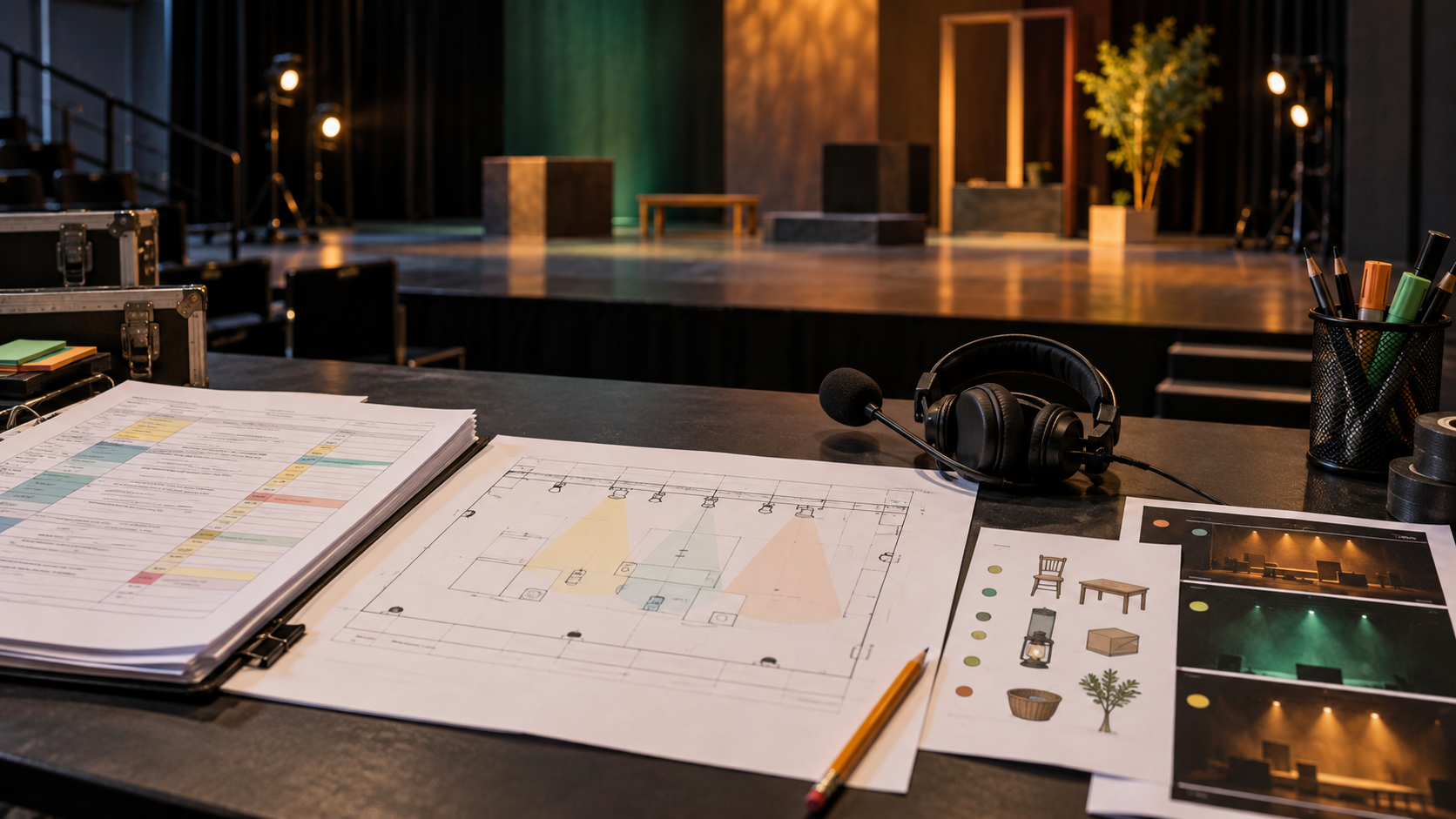
Can an actor say nothing and still change the meaning of an entire scene? Imagine two characters standing beside an unopened suitcase. One has a hand on the door. The other says, ‘You can leave whenever you wish.’ A long silence, the distance between them and the placement of the suitcase may make the line feel generous, threatening or desperate. Theatre Studies and Drama teaches students to investigate how a written text becomes a live experience.
For Singapore parents, JC H2 Theatre Studies and Drama (TSD) combines theatre history, close reading, practical creativity, production skills and collaboration. It is not simply a drama club that awards marks for enthusiasm. Students analyse world theatre, research an individual skill, present creative work, contribute to a group production and answer questions about their decisions.
This guide explains Why Study JC H2 Theatre Studies and Drama | How It Affects Your Child? under the 2027 Singapore–Cambridge GCE A-Level H2 syllabus 9519. We cover the 40% written / 15% critical commentary / 45% practical assessment, the eight prescribed set-text options, open-book rules, the 2,000–2,500-word reflection, individual skills, groups of four to six, examiner interviews and responsible ways parents can support learning. Source: SEAB’s official 2027 H2 Theatre Studies and Drama syllabus 9519.
The quick answer for parents
TSD develops the ability to interpret drama as both written literature and live performance. Students learn to use speech, movement, design, stage space and theatrical conventions to communicate meaning, while grounding their decisions in context and critical study.
The subject can build collaborative and expressive skill, but it does not require every candidate to become a professional actor. Designing a set, make-up or costume can be an important theatre specialisation. A student’s performance should be judged against the particular 2027 assessment criteria, not a parent’s impression of stage confidence alone.
The exact 2027 assessment: three papers
| Paper | Component | Raw marks or parts | Subject weighting |
|---|---|---|---|
| 1 | World Theatre and Drama — open-book written examination, 3 hours | Three questions of 25, total 75 | 40% |
| 2 | Critical Commentary on individual skill | 30 raw marks | 15% |
| 3 | Practical assessment | Individual, group and contribution components | 45% |
| Total | Three compulsory papers | Written, reflective and practical | 100% |
The practical component is itself divided into Individual Skills Presentation 15%, Group Presentation 20% and Individual Contribution to Group Presentation 10%. The last portion is assessed through teachers’ observations and is subject to moderation.
This is a major difference from H2 Literature in English, whose assessment consists of literary written papers. TSD includes a substantial practical theatre-making assessment and reflective writing tied directly to a candidate’s own work.
Paper 1: World Theatre and Drama
Paper 1 is a three-hour open-book written examination worth 40%. Candidates answer three questions: one from the unseen drama section, one from a chosen Classical Theatre text and one from a chosen Modern Theatre text.
| Section | Topic | Question structure | Raw marks |
|---|---|---|---|
| A | Forms and Concepts — unseen play extract | Choose one of two unseen extract questions | 25 |
| B | Classical Theatre and Drama | One question on the studied classical text | 25 |
| C | Modern Theatre and Drama | One question on the studied modern text | 25 |
| Total | Three answers in three hours | All three sections required | 75 |
Candidates study one Classical text and one Modern text. They do not need to learn every listed play. A family should confirm the actual two works taught by the school before purchasing books or revision materials.
Paper 1 Section A: imagine a production, not only a page
The unseen passage may invite discussion of character, atmosphere, setting, relationships, dramatic tension or possible actor and director choices. A strong answer identifies how the scene could be staged and why the text supports that decision.
Merely paraphrasing dialogue can miss the role of silence, movement, lighting, pace and audience awareness. An actor’s pause is a theatrical decision with possible effects, not just unused examination time.
An original unseen-scene exercise
Original teaching scene: A father sits beside a suitcase. His daughter stands near the door. ‘The key is on the table,’ he says. She looks at the empty table. Neither moves until the lights fade.
A student might analyse absent props, the daughter’s gaze, the father’s claim and the resulting uncertainty. A production could emphasise awkwardness or menace through distance and lighting. But the invented scene does not prove that either character is lying.
Why one physical decision changes a scene
Place the father in the centre under direct light and the daughter in shadow; the audience may feel his authority. Move him to the edge, keep the daughter near the suitcase and allow a longer silence; the apparent power relationship may shift.
This experiment demonstrates theatrical form. It is not an argument that every director must stage the scene in one prescribed way. The text constrains interpretation, while performance choices illuminate possibilities.
The elements of drama are practical tools
| Element | Question | Example |
|---|---|---|
| Roles and relationships | Who wants what from whom? | Parent and child with conflicting aims |
| Dramatic tension | What makes the outcome uncertain? | A withheld decision |
| Time and place | Where and when does action occur? | A late-night departure |
| Focus and space | Where is the audience’s attention directed? | A lone suitcase under light |
| Mood and language | How does speech or silence work? | A calm sentence with a threatening implication |
| Symbol and contrast | What detail acquires significance? | An empty table where a key should be |
| Movement | How does physical behaviour express change? | A performer turns away without speaking |
The elements are connected, not independent boxes. A change in space can alter a relationship; a movement can contradict spoken words; a lighting cue can change what the audience knows.
A stage direction can carry the argument
A written play can include instructions on movement or setting, but a director and actors still need to interpret how to realise them. A student should distinguish what the text requires from what a particular proposed staging adds.
An answer may make a compelling suggestion, but it must remain feasible within the scene and acknowledge relevant theatrical conventions.
Section B: Classical Theatre choices
| Play | Author |
|---|---|
| Antigone | Sophocles |
| Othello | William Shakespeare |
| Tartuffe | Molière |
| The Beggar’s Opera | John Gay |
The classical section covers traditions from Greek theatre through the mid-nineteenth century. The candidate needs a detailed understanding of the chosen work and relevant theatrical or historical context, not four complete plays.
For a selected work, consider how its original theatrical conventions shape dialogue, staging, audience expectations and the social or political issues represented. The word ‘classical’ is not a claim that every play from different centuries has identical staging.
Section C: Modern Theatre choices
| Play | Author |
|---|---|
| A Doll’s House | Henrik Ibsen |
| Six Characters in Search of an Author | Luigi Pirandello |
| The Spirits Play | Kuo Pao Kun |
| Fences | August Wilson |
The modern section encompasses European, American and Singaporean dramatic writing. Students must situate the chosen work in its relevant tradition rather than treat every modern play as a simple realistic conversation.
The inclusion of Kuo Pao Kun’s work offers an opportunity to examine Singaporean dramatic traditions within a wider world-theatre framework, but a student’s analysis should remain grounded in the actual text and production possibilities.
World theatre requires sensitivity to context
Greek tragedy, early modern theatre, European naturalism and Singaporean modern writing can involve different conventions of space, chorus, audience relationship or representation. Context helps explain artistic choices without determining one fixed interpretation.
Do not reduce a theatrical tradition to a stereotype about an entire culture. Historical research should support specific claims about a production or playwright.
A play is not the same thing as one production
A text sets out dialogue and often stage directions, but different productions may interpret the same work through different casting, movement, scenography and pace. Students should be able to compare a textual possibility with a real or hypothetical production choice.
A critical discussion identifies why a particular approach is supported by the play and what its effect might be, rather than declaring an imagined staging definitively ‘what the author wanted’.
Open-book rules are strict
For the written examination, candidates may bring one non-electronic original hardcopy of each approved set text. Photocopies, downloaded printouts, critical texts, separate study notes and dictionaries are not permitted.
Only underlining, highlighting and vertical lines may be added to the books, aside from the candidate’s name. Paper clips and folded page corners are permitted; sticky notes and tape flags are not.
| Item | Status | Condition |
|---|---|---|
| One original printed approved text | Allowed | One hardcopy of each |
| Underlining and highlighting | Allowed | No commentary written in book |
| Vertical lines and name | Allowed | Other annotations prohibited |
| Paper clips or folded corners | Allowed | Follow the published flagging rules |
| Sticky notes and tape flags | Not allowed | Do not bring them |
| Photocopies, study notes, dictionary | Not allowed | Exam room restriction |
The exact school’s examination instructions are authoritative in implementation. Parents should check books well before the exam, because a child accustomed to annotating personal reading copies may need a separate compliant examination copy.
Open book does not mean learning can wait until the exam
Three hours leaves limited time to search a play from beginning to end. Candidates should already understand the key dramatic episodes, contexts and possibilities, using the permitted book to support accurate references.
A strong student knows why a particular scene matters and how its theatrical construction relates to the question.
Paper 2: Critical Commentary, not a production diary
Paper 2 is a written 2,000–2,500-word critical commentary about the candidate’s own Individual Skills Presentation. It is worth 15% of the subject and must be submitted before the presentation.
It examines artistic intention, relevant theatre traditions and the actual creative process. A list of rehearsal dates does not by itself satisfy the requirement to analyse why important decisions were made.
The commentary has three ten-mark parts
| Part | Content | Marks |
|---|---|---|
| Artist Statement | Personal artistic intention and vision for the chosen area | 10 |
| Historical/Contextual Statement | Relevant theatrical tradition, performance theory and documented sources | 10 |
| Evaluation of Creative Process | Critical assessment of methods and significant decisions to submission point | 10 |
The comment should use formal continuous prose and standard academic conventions. Relevant photographs, sketches or drawings can appear as annexes, but the syllabus says the examiners consult them when referenced appropriately in the commentary.
Additional text placed in an annex does not count as extra assessed commentary. Students should not try to circumvent the word limit through pages of appended prose.
An Artist Statement needs a specific creative purpose
A sentence such as ‘I want the audience to enjoy the performance’ is too broad to explain an artistic strategy. A stronger statement identifies what question or experience the piece explores and how a particular skill or convention will contribute.
For the fictional suitcase scene, a student might aim to explore how silence makes a family decision feel more uncertain than dialogue would. That provides a purpose against which timing, focus and movement can be assessed.
Historical research should inform creative choice
The historical/contextual statement connects the candidate’s work to theatre traditions, theory and relevant examples. It must cite sources rather than present unsupported claims about what actors or directors always do.
A student can explain why a particular convention is appropriate or why they are deliberately departing from it. The critical task is to justify the choice, not display the longest list of theorists.
Evaluation focuses on actual turning points
If a rehearsal revealed that a gesture looked comic rather than unsettling, the learner may have changed movement or timing. A useful commentary explains the initial aim, observed result, adjustment and effect.
A comment stating only ‘We worked very hard and improved’ is less meaningful because it gives no evidence of which artistic problem was addressed.
An original reflection contrast
| Weak statement | Better analytical direction |
|---|---|
| I changed my movement to make it good | Explain how the initial movement distracted from the intended relationship |
| I researched theatre history | Identify a relevant convention and how it influenced the scene |
| The final rehearsal was successful | Describe evidence that timing or focus communicated the intention |
These are teaching examples. The actual assessed commentary must be the student’s own authentic account of their work.
Paper 3: a real practical assessment
Paper 3 contributes 45% and includes an individually prepared skill presentation, a group presentation and an assessment of individual contribution to the group work. The programme integrates theatre scholarship with making and performing.
The practical includes interviews with a visiting examiner. Students should be able to explain their choices, not simply present a polished product and hope it speaks entirely for itself.
Individual Skills Presentation: two broad routes
The official syllabus allows a candidate to specialise in Performing or Designing. Performing options include repertoire acting, devised performance and stage movement. Designing options include set, make-up and costume.
| Route | Examples | What the student demonstrates |
|---|---|---|
| Performing | Acting from repertoire | Voice, character, movement and audience relationship |
| Performing | Devised performance | Integrated theatre-making through selected performance disciplines |
| Performing | Stage movement | Physical communication, space and gesture |
| Designing | Set design | Scaled model and functional stage planning |
| Designing | Make-up and costume design | Design choices consistent with character and context |
This structure is why TSD should not be described simply as a competition for the best actor. A student with strengths in visual design and scenography may have a legitimate creative specialisation under the published criteria.
The Individual Presentation is worth 15%
Each student develops and presents the individual skill under visiting-examiner assessment. The chosen performance or design must connect to an artistic intention and suitable theatrical context.
The syllabus prohibits using the same performance material for the individual presentation and the group presentation, though the student may work in similar skill areas. Candidates also may not perform the Paper 1 prescribed set texts as practical presentations.
What an individual acting repertoire can require
For repertoire acting, the syllabus describes a monologue and a duologue as two contrasting set pieces. The candidate should communicate character, mood and style through voice, movement, space and interactions.
Knowing the words is only part of the performance. Students should understand how a change in pace, relationship to another actor or physical positioning communicates an intention.
What a devised performance can require
A devised piece integrates selected performance forms and creates a coherent theatrical experience. The published criteria mention combinations of acting, dance and singing, with possible elements such as mask, puppetry, lighting or sound in the appropriate options.
A collection of unrelated attractive moments may not become a meaningful performance without a clear organising idea. The student’s choices should be connected, rehearsed and suitable to the intended audience.
Stage movement requires meaning, not gymnastics
Movement can direct the audience’s attention, establish status or evoke emotion. The skill is not necessarily about high physical difficulty. A restrained shift of position may convey more than a technically impressive movement if it fits the dramatic question.
Students should follow trained supervision and physical safety procedures. They should not attempt hazardous movements or stunts in order to appear more ambitious.
Set design is theatrical problem solving
A set needs to serve performance: actor movement, entrances, exits, changes between scenes, visibility and the intended visual world. The official criteria call for a scaled model and evidence of how the design would work in a known space.
A visually striking model can fail if performers cannot move safely or if key scenes cannot be presented. The learner should explain functional constraints alongside aesthetics.
An original set-design comparison
Imagine the fictional suitcase scene staged in an intimate classroom theatre. Option A uses two large walls enclosing the characters. Option B uses one suspended doorway and an otherwise open stage.
| Aspect | Design A | Design B |
|---|---|---|
| Spatial effect | Enclosed and domestic | Sparse and exposed |
| Technical challenge | Sightlines and exits | How to establish setting |
| Possible interpretation | Pressure or confinement | Uncertainty or isolation |
Neither design is intrinsically better. The student should evaluate what each achieves for the scene, its feasibility and the performance’s intended relationship with the audience.
Make-up and costume are part of characterisation
Costume and make-up can reflect period, occupation, social position or deliberate theatrical stylisation. The 2027 individual design criteria require two costumes with make-up for a chosen theatrical context, with appropriate demonstration and supporting models or sketches.
Students should avoid using cultural symbols merely as generic decoration. Research, context and the practical needs of performers matter.
Stage lighting and sound create information
A lighting cue can shift focus before a performer moves. A repeated sound can establish expectation or suggest a location outside the visible stage. The student’s task is to show how these elements serve the dramatic intention.
Technical apparatus should be operated according to school procedures by trained personnel. Live electrical work, heavy suspended objects or high-intensity equipment are not suitable for unsafe home experimentation.
The examiner interview is part of practical learning
After individual presentations, the examiner can ask the candidate to clarify how the work reflects the commentary or why a choice was made. This rewards students who understand their own creative process.
A memorised speech about ‘passion’ is less useful than specific explanations: what was tried, what failed, what changed and how the final choice communicates the intended effect.
An original examiner-style rehearsal question set
- Which theatrical convention informed your chosen approach?
- Why does your movement or design direct attention to that part of the scene?
- What changed after observing a rehearsal?
- Which creative problem remains and how did you address it?
- How does your work relate to the intended audience?
- What evidence shows that your choice supports the stated intention?
These are invented practice questions, not official questions issued by SEAB. Their purpose is to encourage genuine explanation.
Group Presentation: four to six students
The 2027 group presentation involves four to six candidates producing either an adaptation and performance of a published play or an original devised theatrical presentation, with prior approval of the chosen subject.
The group should have a clear artistic objective while allowing development during rehearsal. The intended audience and the proposed performance form should be explained as part of the process.
Group work is not the same as equal stage time
Different students may take different acting, design or production responsibilities. Fairness requires meaningful contribution and opportunities to demonstrate the skills for which they are assessed, not necessarily identical words or minutes for every person.
The syllabus expects evidence of initiative, responsiveness to others, evaluation of work in progress and sustained commitment. A student who completes their own scene but ignores the group’s needs may still need to develop ensemble responsibility.
The practical group marks are divided
| Component | Weight | Assessment emphasis |
|---|---|---|
| Individual Skills Presentation | 15% | Personal specialised performance/design |
| Group Presentation | 20% | Collective theatrical work as assessed by examiner |
| Individual contribution to group | 10% | Teacher-observed responsibility and contribution, moderated |
| Paper 3 total | 45% | Practical theatre-making |
The teacher-observed 10% is important. A large speaking role does not automatically establish the quality of someone’s collaboration, and a student contributing through a legitimate design role should not be dismissed as uninvolved because they have fewer lines.
An ensemble’s decisions need explicit communication
Groups must manage disagreement about staging, pace, roles, technical requirements and deadlines. Good teamwork separates criticism of an idea from criticism of a person. It can include documenting the decision and explaining why one option was selected.
A student should involve the supervising teacher when conflict becomes persistent or unsafe rather than accepting bullying or harassment as an inevitable part of artistic work.
An original group-decision log
| Question | Options considered | Decision reason | Next check |
|---|---|---|---|
| How is uncertainty staged? | Silence or extra dialogue | Use silence to foreground physical distance | Test audience understanding |
| Where is the key prop? | Table or suitcase | Table makes empty space significant | Verify sightline |
| How long is the pause? | Short or sustained | Sustain only while tension develops | Rehearse timing |
| Who handles transition? | Actor or stage manager | Select safer, clearer responsibility | Run technical rehearsal |
The group should only record authentic decisions and actual rehearsal observations. Fabricating a process history is not an acceptable way to make a production look thoroughly planned.
Group presentation timing depends on group size
The syllabus indicates a minimum playing time of 15 minutes for a four-person group and a maximum of 30 minutes for a six-person group, subject to the detailed practical examination handbook. The correct duration must follow the school’s official group instructions.
A student should not apply the maximum for every group size without checking. More stage time does not automatically create a stronger presentation.
The group examiner interview
After the presentation, the examiner can ask the group about conception, development and execution. Individual candidates may explain their specific contribution and how the ensemble handled the artistic work.
Students therefore need to understand the full production well enough to discuss its overall purpose, even if they held one specialist responsibility.
Theatre history and practice reinforce each other
Studying drama from different periods can show how conventions developed and how theatrical spaces or audience relationships shaped writing. Practical production then forces the learner to ask whether a method can actually be realised with available performers, time and equipment.
Conversely, staging even a short passage can reveal aspects of a play’s tension that silent reading may miss. The strongest course integrates both forms of knowledge.
What distinguishes theatre from literary essay alone?
Theatre operates through an event: performers, space, timing, body, audience and production choices. A script can be read like literature, but a TSD student must consider how meaning becomes visible or audible in a specific setting.
A strong response to an unseen passage may include an interpretation of potential actor decisions, lighting or movement rather than only metaphor and theme.
Theatrical space is an active element
A proscenium stage, theatre-in-the-round or intimate studio can change sightlines, audience distance and performance dynamics. A student should know how space influences design and actor movement, and choose accordingly.
A very small performance area may make a subtle gesture highly visible, while a larger venue might require a different physical scale. Students should not confuse louder performance with clearer storytelling.
A fictional audience comparison
Imagine performing the same invented scene first for twenty classmates seated close to the stage and then in a hall with the audience far back. The visible effect of a subtle glance may change, while the main text remains identical.
A thoughtful production adapts staging and focus without abandoning the intended meaning. The comparison is illustrative; the actual assessment uses school-approved performance conditions.
Sound, silence and pacing
A sound cue can anticipate an arrival, suggest an event offstage or shift atmosphere. Silence can focus attention on a prop or relationship. Pacing can affect dramatic tension even without adding dialogue.
Students should explain the role of a cue rather than claim that every quiet moment creates suspense. The effect depends on context and prior action.
Costume can create and complicate expectations
A costume may suggest period, occupation or status, but it can also deliberately contradict an audience’s expectation. The choice should reflect historical research where relevant and allow the performer to move and work safely.
Using a culturally specific garment as an exotic stereotype is different from researching its meaning and using it thoughtfully within an appropriate theatrical context.
Critical commentary and performance must be consistent
A commentary may promise a restrained, intimate approach, but the final performance could become broad and comic. Such a difference may need critical explanation when queried. Artistic change can be legitimate, but students should know why the work developed.
The goal is truthful reflection, not pretending the process followed a perfect plan from the beginning.
An original revision exercise for theatrical intention
Take the invented suitcase scene. Ask the learner to create two staging plans with different intentions: one makes the daughter appear ready to leave; the other makes the father appear to be avoiding a difficult conversation.
For each plan, explain what changes in actor position, prop placement and timing, and what textual evidence permits the choice. The exercise tests the connection between interpretation and craft.
How to review a rehearsal constructively
| Focus | What can be observed | Useful feedback question |
|---|---|---|
| Intention | Is the main conflict understandable? | Which action established it? |
| Space | Can the audience see crucial behaviour? | Were sightlines clear? |
| Pace | Does tension develop appropriately? | Where did attention drift? |
| Ensemble | Do cues and interactions work? | How did performers respond to one another? |
| Technical elements | Do light, sound and props support meaning? | Were changes timely and safe? |
Good feedback should be specific and respectful. The point is to improve the work, not humiliate a learner for experimenting.
Professionalism includes safety
Rehearsal involves movement, equipment and sometimes complex emotional material. Schools should manage safety, consent, appropriate supervision and well-being. Students should not be pressured into unsafe stunts, intimate contact or distressing improvisation outside agreed procedures.
Parents can discuss any safety concern with the supervising teacher. The assessment’s creative aims never override the responsibility to protect students.
Respect cultural and historical contexts
Studying world theatre requires understanding that performance traditions have different social, political and cultural histories. A learner should not treat a classical Greek play and a contemporary Singapore work as if they necessarily use identical dramatic conventions.
Context informs interpretation; it should not become a decorative paragraph or a stereotype about the playwright’s identity.
The difference between a scholarly source and a production opinion
A review of one production can reveal a critic’s response, while a reliable academic account can help establish historical conventions. Each type of source has a different evidential role. A student should acknowledge what the source can and cannot tell them.
For the Critical Commentary, cite relevant historical and theoretical material rather than invent authoritative statements about acting practice.
A realistic study rotation
| Session | Focus | Evidence of independent learning |
|---|---|---|
| Monday | Unseen dramatic passage | Explains staging possibilities with textual support |
| Tuesday | Selected Classical play | Uses relevant tradition and scenes |
| Wednesday | Selected Modern play | Connects form, context and character |
| Thursday | Individual skill and commentary | Explains genuine creative decisions |
| Weekend | Group rehearsal reflection | Identifies an ensemble issue and a feasible adjustment |
The table is not an instruction to add unsupervised rehearsal beyond school arrangements. It is a way to maintain both theoretical and practical thinking.
A compact play-reading notebook
- Record the chosen play, important scenes and historical context accurately.
- Identify what a character wants and what obstructs it.
- Describe stage directions that change focus or tension.
- Note one or two plausible performance choices grounded in the text.
- Separate the playwright’s words from a director’s possible interpretation.
- Record relevant conventions and genuine scholarly references.
- Keep this analytical notebook outside the open-book examination copies.
Theatre Studies versus Literature in English
H2 Literature in English 9539 primarily assesses written close reading and comparison of literary works in its two papers. H2 Theatre Studies and Drama 9519 assesses a combination of text/history, original critical reflection and practical theatre-making.
Both value language and interpretation, but a Literature essay does not by itself satisfy a TSD production or practical interview requirement. Students should select according to interest, school arrangements and willingness to work collaboratively.
Theatre Studies versus a CCA performance
A school drama CCA can foster theatre enjoyment, skill and teamwork, but the H2 subject is assessed through a formal syllabus with specific written, critical and practical components. Participation in one does not automatically fulfil the requirements of the other.
A talented performer still needs historical study, written analysis and a 2,000–2,500-word reflective commentary. A shy learner may develop useful skills through design or carefully supported performance work under the school’s options.
Common 2027 TSD misunderstandings
- Thinking TSD means only acting and has no written paper.
- Forgetting that Paper 2 Critical Commentary counts for 15%.
- Treating the commentary as a diary instead of researched critical reflection.
- Using an unapproved or unsuitable performance material for Paper 3.
- Attempting to perform a Paper 1 set text as assessed practical material.
- Assuming group marks are completely identical regardless of individual contribution.
- Preparing group performances with fewer than four or more than six candidates.
- Bringing sticky notes or margin annotations in the open-book exam.
- Memorising dramatic text without discussing possible staging.
- Using a technically elaborate design that cannot work safely in the actual space.
Questions parents can ask after a rehearsal
- What dramatic question or experience do you want the audience to understand?
- Which textual detail supports your interpretation?
- What changed when you moved an actor or a prop?
- What historical or theatrical research informed the decision?
- What evidence from rehearsal suggested an improvement?
- How did other members contribute, and how did you respond?
- What part of your own work will you explain during the examiner interview?
- Are all practical arrangements within the school’s safety and assessment rules?
What appropriate tuition or extra teaching can do
A subject-aware teacher can support general theatrical analysis, historical context, rehearsal technique and the student’s understanding of how to evaluate decisions, but assessed performance and writing must remain authentic and comply with school supervision.
The immutable eduKateSG Secondary 1 Mathematics Tutor Clementi reference illustrates small-group academic support in Mathematics, not evidence of a current H2 TSD production studio or authorised practical-assessment programme. Check the actual subject expertise, facilities, fees and availability before making any commitment.
Parent checklist for 2027 H2 Theatre Studies and Drama
- Confirm syllabus 9519 and three compulsory papers.
- Know the 40% World Theatre, 15% Commentary and 45% Practical split.
- Prepare the three-hour, 75-mark open-book paper with one classical and one modern set text.
- Check permitted original hardcopy texts and prohibited notes or sticky flags.
- Maintain an authentic 2,000–2,500-word Critical Commentary before the individual presentation.
- Choose the individual performing or design specialisation under the published rules.
- Understand the 15% individual presentation and examiner interview.
- Work within a school-approved group of four to six for the collective presentation.
- Recognise the 20% group and 10% teacher-observed individual contribution components.
- Follow the school’s practical handbook, approval and safety arrangements.
Frequently asked questions
What is the 2027 H2 Theatre Studies and Drama code?
9519 in the A-Level subject directory.
How many papers?
Three: World Theatre and Drama, Critical Commentary and Practical Assessment.
What are their weightings?
40%, 15% and 45%, respectively.
What is Paper 1’s format?
Three hours, open book, three 25-mark questions based on unseen, classical and modern drama.
How many prescribed plays does a candidate study?
One from the Classical list and one from the Modern list for the written paper.
Is the Critical Commentary a written paper?
It is a 2,000–2,500-word critical written response to the candidate’s Individual Skills Presentation, submitted before that presentation.
What are the three commentary parts?
Artist Statement, Historical/Contextual Statement and Evaluation of the Creative Process, ten marks each.
Can students specialise in set or costume design?
Yes. Designing is among the permitted individual specialisations.
What is the group size?
Four to six candidates.
Is the whole 45% practical a group mark?
No. It includes 15% individual presentation, 20% group presentation and 10% individual contribution.
Do examiner interviews occur?
Yes, after the relevant individual and group presentations.
Can Paper 1 set texts be performed as Paper 3 material?
No, the syllabus prohibits performing those prescribed set texts in the practical assessment.
Are sticky notes permitted in exam copies?
No. Only permitted highlighting/underlining/vertical marks and specified page flagging are allowed.
Is TSD a professional acting qualification?
No. It develops theoretical and practical theatrical learning but does not by itself confer professional accreditation.
What demonstrates genuine improvement?
The learner connects textual analysis and context to thoughtful performance/design, reflects on decisions honestly and contributes meaningfully to an ensemble.
The lasting reason to study H2 Theatre Studies and Drama
Theatre makes human choices visible through the arrangement of words, bodies, spaces and time. A pause can speak, a design can alter relationships and an ensemble can create meaning no single person could produce alone.
For parents, the most valuable result is a teenager who can analyse a play, create with intention, listen to others and explain their choices with evidence and responsibility. That disciplined creativity reaches beyond one national examination.
For binding requirements see SEAB’s 2027 H2 Theatre Studies and Drama 9519 syllabus and the 2027 A-Level school-candidate directory. Related eduKateSG parent guides include Why Study JC H2 Literature in English, Why Study JC H2 Art and Why Study G3 Drama. Follow the school’s official practical-examination handbook for detailed procedures.