
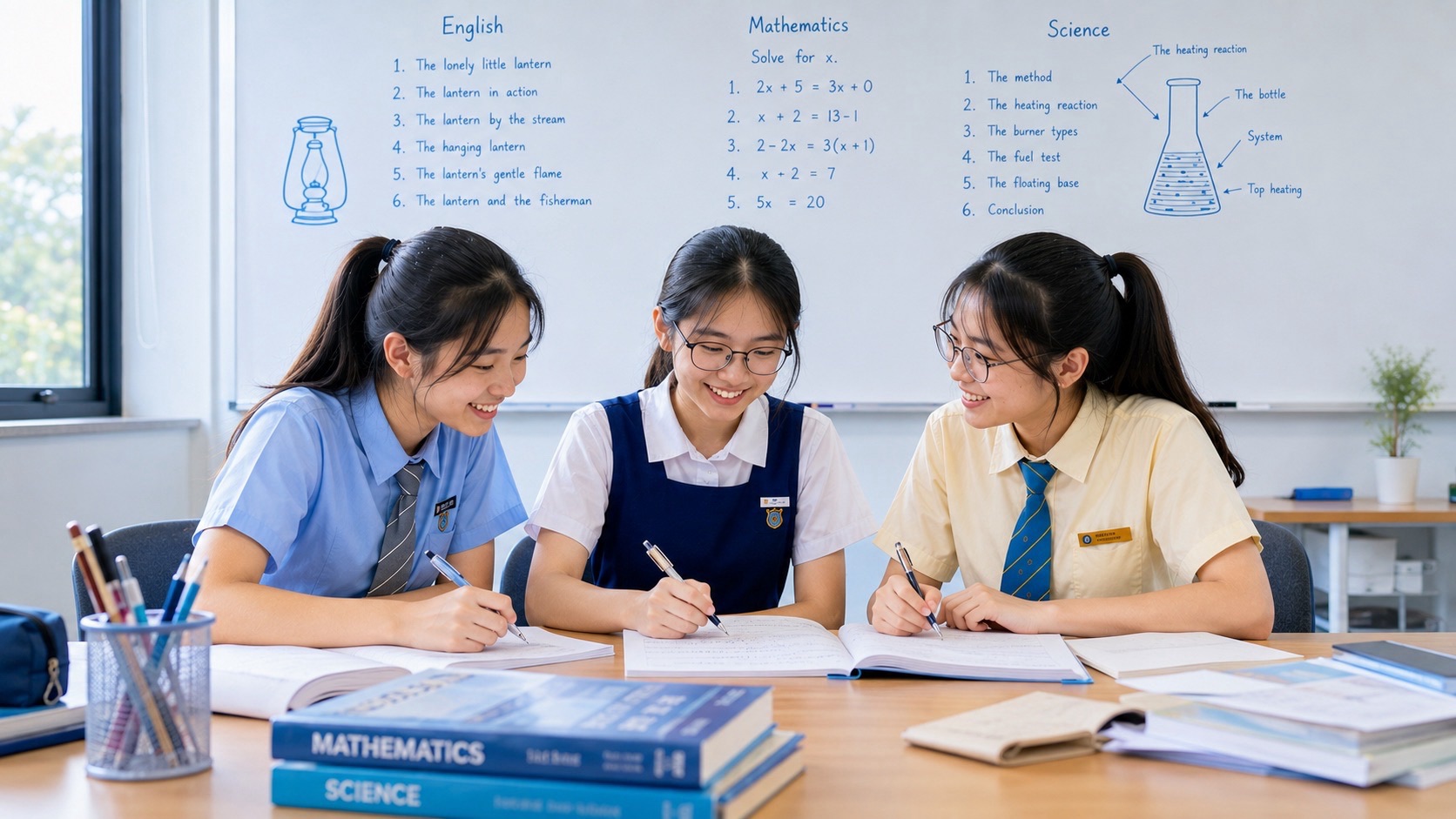
Can a student recognise every Chinese character in a classical passage yet misunderstand its argument? Yes. A short exchange in the Analects can rely on a speaker’s relationship, implied values and the dialogue’s setting. A scene from Dream of the Red Chamber can seem straightforward until the reader notices irony, character contrast and what a narrator leaves unstated. JC H3 Chinese Language and Literature asks students to read with that depth while also developing their own sophisticated creative and argumentative writing.
For Singapore parents, H3 华文与文学 is an extension of H2 Chinese Language and Literature, not a general higher-level Mandarin vocabulary quiz. It combines 写作 (Writing) and 作品赏析 (Literary Appreciation), with significant choice among prescribed classical and poetic works and an unfamiliar contemporary-language text.
This guide explains Why Study JC H3 Chinese Language and Literature | How It Affects Your Child? for the 2027 Singapore–Cambridge GCE A-Level syllabus 9901. We explain the 50% Writing and 50% Literary Appreciation scheme, the three writing choices, open-book set-text analysis, one prescribed-group answer and one unseen-text answer, and how to study 论语, Tang/Song poetry, 红楼梦 and 史记 without relying on memorised slogans. Source: SEAB’s official 2027 H3 Chinese Language and Literature 9901 syllabus.
The quick answer for parents
H3 Chinese Language and Literature develops a teenager’s ability to write with purpose, analyse the construction of literary meaning, interpret Chinese texts in context and make a reasoned independent judgement. A high-quality answer does not merely translate the story or praise the writer; it explains how genre, structure and language create an effect.
The qualification can deepen appreciation of Chinese-language cultural traditions while encouraging precise expression. Students have different language experiences, and success should be evaluated through actual reading and writing ability, not stereotypes about the languages used at home.
2027 syllabus code and level
The subject is H3 Chinese Language and Literature 9901 (H3 华文与文学). The official syllabus describes it as a deeper course for students studying H2 Chinese Language and Literature. Parents should not confuse this with H1 Chinese Language 8655, H2 Chinese Language and Literature 9575 or H2 China Studies in Chinese 9629.
All of these involve Chinese-language skill, but the H3 9901 tasks focus on literary creation and criticism in the precise official format.
The 2027 examination at a glance
| Part | Task | Choice | Weight |
|---|---|---|---|
| 写作 / Writing | Creative, narrative/lyrical or argumentative writing | Choose one of three questions | 50% |
| 作品赏析 A / Prescribed literature | Critical analysis of set works | Choose one of eight questions across four groups | 25% |
| 作品赏析 B / Unseen literature | Analyse unfamiliar modern-language text | Choose one of two questions | 25% |
| Total | One writing response and two literary responses | Three answers, three-hour exam as specified | 100% |
The H3 syllabus lists paper codes 9901/1 for Writing and 9901/2 for Appreciation. The examination time shown in the blueprint is three hours. The student should follow the centre’s actual sitting and section instructions rather than infer that each component has a separate three-hour duration.
Unlike H3 History, Art or Music, 9901 is not described as an independent 3,500-word research-essay submission. It assesses composition and literary analysis through the national examination.
Part 1: writing carries half of the qualification
The Writing portion presents three alternatives. The 2027 mark guidance identifies creative microfiction, narrative or lyrical writing, and argumentation. Candidates answer one of three according to the chosen task’s instructions.
The syllabus says there is no general word-count limit unless a particular question specifies one. Parents should not import a 350-, 460- or 800-word minimum from another Mother Tongue syllabus.
| Question | Chinese task family | What it assesses |
|---|---|---|
| 1 | 创作(小小说) | Imaginative compact narrative and controlled expression |
| 2 | 记叙文/抒情文 | Narrative experience or lyrical expression |
| 3 | 议论文 | Reasoned argumentation and coherent analysis |
Each 50-mark writing response is assessed through content (25 marks) and expression (25 marks) in the official appendix. Strong vocabulary with a weak argument or vivid plot with unclear expression can therefore leave significant room for improvement.
An approved dictionary is permitted for writing
The 2027 syllabus allows the prescribed dictionary during the Writing portion. The permission does not extend automatically to every part of Literary Appreciation. Students should follow examination instructions on materials precisely.
A dictionary is useful for verifying a word’s form or meaning, but overreliance can interrupt the creative or argumentative flow. Build flexible vocabulary in advance and use the reference selectively.
Small fiction has to work as fiction
A 小小说 task demands economy: a defined situation, a meaningful tension, significant details and an ending that changes or sharpens the reader’s understanding. A succession of unrelated dramatic events may make the story longer without making it more coherent.
Students should not confuse surprise with depth. A subtle change in a character’s decision can be more compelling than an implausible catastrophe added solely for shock.
An original fictional story example
Original teaching scenario, not a past-year topic: A student finds a notebook left in a classroom and recognises a drawing of a place they know. They consider opening the notebook to find its owner, then decide how to return it without reading private pages.
The narrative could develop around curiosity, restraint and the final choice. The writer needs to select details—an unfamiliar name on the cover, the empty classroom, a missed opportunity to ask for help—that support a coherent turning point.
What makes an effective 小小说 ending
An ending should complete or deliberately complicate the story’s central tension. It need not explain every emotion; a small physical action can communicate a change when the preceding details prepare the reader.
For the fictional notebook scene, returning the object unopened can express a decision without an essay-like moral being added at the end. The writer should show the process through action.
The difference between plot and structure
Plot concerns events; structure concerns how the story gives those events to the reader. The writer may delay revealing a fact, place a repeated object at turning points, or return to an earlier image with altered meaning.
A strong composition controls reader knowledge instead of treating every event as equally important.
An original plot-design matrix
| Stage | Story function | What to ask |
|---|---|---|
| Opening | Establish one relevant situation | Whose problem is this? |
| Development | Introduce a choice or tension | Why does it matter? |
| Turning point | Make a decision consequential | What has changed? |
| Ending | Leave a coherent impression | Does it grow from earlier evidence? |
This is a creative-writing scaffold, not a model SEAB story to memorise. The student must respond to the actual prompt independently.
Narrative and lyrical writing demand different control
Narrative writing uses events and development; lyrical prose may emphasise mood, memory, viewpoint and imagery. A candidate should notice the chosen task’s expected form before drafting.
Beautiful language becomes more powerful when it is precise. A paragraph filled with metaphors that contradict one another can weaken rather than enrich an experience.
An original imagery exercise
Original line: 傍晚的走廊渐渐安静,窗边还留着一把没人坐的椅子。 The corridor grows quiet at evening, and an empty chair remains by the window.
The image may communicate absence, waiting or reflection. The writer should develop one purposeful effect through context, not treat the chair as a universally fixed symbol of loneliness.
抒情文 needs an actual perspective
An expressive piece should not be a list of general feelings. It can use a specific moment, place or relationship to give emotion shape. The student’s vocabulary choices and rhythm of sentences should fit the narrator’s experience.
A writer who aims for restrained tenderness might select quieter detail than someone creating urgency, but the relationship between style and intention must remain consistent.
Argumentative writing needs more than elegant slogans
A 议论文 answer states and develops a defensible position. It should distinguish assertions, reasons, evidence, counterarguments and judgement. Repeating a stock saying about diligence does not answer a question about a contemporary cultural or social decision.
A strong essay can acknowledge genuine objections and specify conditions under which its recommendation is reasonable. Complexity does not require indecision.
An original argument prompt
Fictional practice prompt: Should public libraries reserve more space for quiet reading even if some visitors want collaborative activities? This is not a SEAB examination question.
A thoughtful discussion could consider different readers’ needs, the purpose of shared space, available facilities and scheduling options. The conclusion should identify a workable arrangement rather than declare one group uniformly right.
A nuanced position is a precise position
An answer might argue for separate or time-based zones rather than absolute prohibition of group activity, provided there is evidence of real needs and capacity. The value lies in explaining how the proposed policy balances competing uses.
The student should avoid invented statistics and false certainty. A clearly labelled hypothetical example can illuminate an idea without pretending to be a survey result.
An original argument structure
| Part | Purpose | Common weakness |
|---|---|---|
| Question interpretation | Define exactly what is contested | Off-topic prepared opening |
| Position | State a qualified thesis | No clear conclusion |
| Reasons | Explain two or three meaningful mechanisms | List slogans |
| Alternative | Consider a serious counterargument | Straw-man objection |
| Judgement | Weigh evidence and conditions | Repeat both sides exist |
The writing rubric rewards language and content together
The official appendix allocates 25 marks each to 内容 and 表达. The student needs ideas worth developing and Chinese expression that makes their organisation clear. Extremely ornate vocabulary is not an end in itself.
A word chosen for prestige rather than meaning can distort a sentence. Readability and precision are important parts of effective advanced writing.
Part 2: literary appreciation carries the other half
作品赏析 is assessed through two compulsory responses: A 部分 from prescribed works (25%) and B 部分 from an unfamiliar modern-language literary text (25%). The learner needs both deep preparation and transferable close-reading skill.
The syllabus specifies that the appreciation part is open book for the approved texts. Candidates may bring the prescribed works, subject to the current examination rules. This does not make the questions easy for someone who has not actually studied the material.
Part A: four groups of prescribed literature
| Group | Prescribed area | What students may need to analyse |
|---|---|---|
| 一 | 《论语》 selected chapters | Dialogic form, ethics, roles and interpretation |
| 二 | 唐诗宋词: selected 李白 and 苏轼 works | Poetic imagery, tone, form and historical setting |
| 三 | 《红楼梦》 selected chapters | Narrative, irony, characters and relationships |
| 四 | 《史记》 selected biographies and episodes | Historical narrative craft and literary characterisation |
A total of eight questions across four groups are offered in Part A. The candidate answers one from the prescribed group/question alternatives. Schools will advise how to prepare strategically while maintaining an understanding of the literary requirements.
The group choice does not mean reading no prescribed texts until the examination. A candidate should prepare authentic works deeply enough to analyse unfamiliar question wording.
Group 1: the Analects is concise but not simplistic
The 2027 selection from 论语 includes 《里仁第四》, 《述而第七》, 《颜渊第十二》 and 《卫灵公第十五》. The text often communicates through short exchanges, carefully chosen terms and relations among questioner and teacher.
A candidate should consider how the dialogue form shapes the idea. Treating every exchange as a free-floating proverb can remove the conditions that make its meaning intelligible.
The speaker and situation matter
A statement in a dialogue may respond to a specific student’s question or practical concern. A close reading should establish who addresses whom and which ideas the response foregrounds.
The same classical term can operate differently across conversations. Students should not substitute one memorised modern slogan for every occurrence of a familiar character.
An original Analects-style thought experiment
Original invented classroom dialogue—not from the Analects: Student: ‘Is a good answer always the longest?’ Teacher: ‘The answer that fits the question has already begun to be clear.’
The imagined exchange uses brevity and indirect teaching. Its meaning depends on the relation between the question and reply, not simply the dictionary definition of the word ‘clear’. Real examination analysis must refer to the genuine prescribed passages.
Classical Chinese cannot be analysed through translation alone
Modern paraphrase can clarify a basic proposition, but literary form, economy, parallelism and ambiguous terms may be lost. A strong student compares the wording of the approved text with contextual understanding and explains how expression contributes to meaning.
The skill is careful interpretation, not manufacturing a modern message that ignores historical language.
Group 2: Tang poetry and Song ci
The prescribed group includes selected poems by 李白 (Li Bai) and ci by 苏轼 (Su Shi), including titles such as 《蜀道难》, 《将进酒》, 《登金陵凤凰台》, 《定风波》 and 《江城子》 (the specified versions and selections are detailed in the syllabus).
A candidate should know which particular poems and ci are in scope. The full selected list matters: an unrelated famous poem by the same author is not necessarily an assessed prescribed text.
Poetic voice is not a biographical confession
A poem can create a speaker or scene that differs from the poet’s actual personal circumstances. Historical biography can provide context when verified, but should not be inferred from every first-person image.
A strong answer explains how diction, imagery, tonal movement and structural design develop the poem’s concerns.
An original poetry micro-example
Original Chinese lines created for this guide: 雨停以后,石阶仍然湿着。远处的灯亮了,门却没有开。
The rain has stopped, while steps remain wet and a distant light appears behind a closed door. The sequence may evoke expectation or hesitation. It does not establish who is behind the door or why it remains closed.
How imagery connects feeling to an idea
An image is not an interchangeable symbol card. Rain may suggest renewal in one poem and discomfort in another, depending on its setting and surrounding language. The candidate should explain the particular pattern in the prescribed work.
If a poem shifts from movement to stillness, note how the change is achieved and how it relates to the speaker’s developing perspective.
Tang 诗 and Song 词 have different formal expectations
Poetic forms can differ in line pattern, rhythm, structure and relationship to musical tradition. A student should know the relevant conventions and apply them to actual selected works rather than treat every poem as a modern free-verse paragraph.
Technical terminology adds value when it explains an effect. Labelling a device without analysing its context does not establish critical appreciation.
An original poetic comparison table
| Feature | Image A | Image B |
|---|---|---|
| Motion | A boat crossing a river | A lamp remaining in one room |
| Time | Morning | Evening |
| Possible emphasis | Departure or movement | Waiting or continuity |
| Interpretive limit | Neither establishes one fixed emotional meaning | Context decides relevance |
Group 3: Dream of the Red Chamber
The 2027 《红楼梦》 group prescribes selected episodes and chapters including Chapter 3, Chapters 29–30, 31–32, 33–34, and Chapter 6 plus 39–40 as listed. These include scenes of first encounters, conflict, character interaction and the appearances of 刘姥姥.
The candidate needs the correct approved passages, their narrative context and what the writer’s structure achieves. Reading a plot synopsis alone cannot explain irony, focalisation and complex character relationships.
Characterisation emerges through contrast
A character may be presented through how others react, which details are emphasised or what happens in an apparently minor interaction. A student should not assign a permanent label such as ‘kind’ or ‘jealous’ to a figure without examining significant evidence.
An advanced reading identifies moments that complicate a first impression, showing how the narrative positions the reader.
An original fictional social-scene example
Imagine an invented family gathering. A guest enters late, speaks politely to everyone and quietly moves an object from a prominent table. Another character notices but says nothing. The action can communicate authority, discomfort or social calculation, depending on context.
A critical reader examines the sequence and other characters’ responses before stating a motive. This is a method illustration and not an event from 红楼梦.
Narrative perspective changes judgement
The reader may know something one character does not. A narrator may withhold a later revelation. Irony can emerge from the gap between what characters say and what the audience understands.
A literary essay should explain these mechanisms rather than repeat the most dramatic event in the chapter.
The selected episode must be distinguished from the whole novel
The official 2027 syllabus selects particular chapters and sometimes portions of a chapter rather than every page of the full novel. Students should know the surrounding context needed to interpret those extracts but prepare according to the prescribed range.
A candidate should not assume that the question necessarily expects an exhaustive account of all characters and events in the complete novel.
Group 4: Records of the Grand Historian
《史记》 by 司马迁 (Sima Qian) appears through selected biographies and episodes: 鸿门宴 in 项羽本纪, 管晏列传, 魏公子列传, 屈原列传 and 荆轲刺秦王 in 刺客列传.
These are historical narratives with literary construction. A student should analyse selection, dialogue, pacing, portrayal and judgement while distinguishing historical interpretation from simple factual transcription.
Historical narrative can create character through scenes
A writer may select one encounter to reveal status, strategy or conflict. The placement of speech or a contrast between characters can influence how readers understand the event.
A strong response explains how the historian-writer constructs significance without claiming direct access to every historical actor’s private intentions.
An original historical narrative exercise
Imagine a fictional biography describing a leader who refuses a lavish gift in public but later accepts assistance privately. Readers may interpret consistency, hypocrisy or different social obligations depending on the source’s wording and available context.
The candidate should identify what is explicitly narrated and what requires an inference, then consider why an author selected the two scenes.
Historical accuracy and literary interpretation are related but distinct
A text may be important as a historical source and as a crafted narrative. H3 Chinese literary appreciation emphasises how a writer uses form, language and structure. A history fact sheet cannot replace those analytical moves.
Students may need verified cultural and historical context, but they should not devote the whole essay to a chronological summary unrelated to the question.
A cross-group reading framework
| Group | Literary form | Useful focal question |
|---|---|---|
| 《论语》 | Dialogic sayings | How is an idea developed through exchange? |
| 唐诗宋词 | Poetry and ci | How do image, form and tone shape experience? |
| 《红楼梦》 | Long-form fiction | How do narrative choices develop relationships? |
| 《史记》 | Historical and biographical narrative | How does scene construction shape judgement? |
Part B: unseen modern-language literature
The syllabus sets two options drawn from unseen 白话 poetry, microfiction or prose, of which the candidate answers one. This rewards the ability to read an unfamiliar Chinese text analytically, rather than remember a predetermined interpretation.
The student must be able to identify voice, shifts, imagery and genre features without knowing the author’s name or background in advance.
A good unseen reading starts with the literal situation
First ask what is happening and who appears to speak. Then identify two or three significant details and explain how they shape the passage’s meaning. Only after this should the student propose a wider theme or judgement.
This is not a fixed examination script. A tightly structured unseen poem and a short prose story may require different kinds of evidence.
An original unseen prose exercise
Original teaching excerpt: 老人每天都把椅子搬到门口。那天下起大雨,他却把椅子留在原处。邻居问他在等谁,他只说,今天路上会很安静。
The repeated chair, the change in weather and the indirect answer create uncertainty. A reader may infer that the person is waiting or remembering, but cannot establish one definite backstory from the excerpt alone.
Analysis separates three levels
| Level | Example | What it means |
|---|---|---|
| Literal | The chair remains outside in rain | Textual observation |
| Formal | Habit is repeated, then contrasted with changed weather | Structural feature |
| Interpretation | May suggest deliberate waiting or attachment | Qualified inference |
| Uncertainty | No explicit identity of the awaited person | Boundary of evidence |
Different readings can be supported but not arbitrary
One learner may read the chair as a symbol of endurance, another as a sign of routine. Each must explain which textual details support the reading and how it fits the whole passage.
A statement such as ‘all interpretations are correct’ sidesteps the purpose of literary analysis, which is to make reasoned, evidence-based distinctions.
Unseen poetry depends on language and structure
A short poem may use repetition, syntax, line breaks or image clusters to communicate change. The candidate should explain how these devices affect the speaker or reader rather than simply list technical names.
Because an unseen text may be unfamiliar in subject or form, transferable close-reading habits are more valuable than memorising a collection of stock themes.
Why a microfiction ending matters
A microfiction text compresses a story into a small number of selected details. A final line can redirect an earlier assumption, but a student should show how the opening prepared or complicated the turn.
Surprise alone is not a literary argument. The key is how the writer designs reader expectations.
An original story-ending thought experiment
Imagine a fictional story beginning with a child carefully wrapping a gift and ending with the child leaving it at a lost-property counter. The ending changes the likely meaning of the wrapping, suggesting the object may not have been intended as a gift at all.
A careful student would test the interpretation against earlier word choices, not claim that the story must be about theft.
Literary devices have genres and contexts
Metaphor, irony, parallelism, narrative perspective and tonal shifts operate differently across short prose, classical dialogue and lyric poetry. The student must identify the device’s actual function in the question’s text.
A mechanically inserted phrase such as ‘the poet uses imagery to attract attention’ rarely explains enough. What image, which relation and why does it matter?
An effective analytical paragraph
| Move | Action | Check |
|---|---|---|
| Claim | Give a specific answer to the question | Relevant? |
| Evidence | Refer to accurate textual detail | Verifiable? |
| Analysis | Explain form, structure or diction | How does meaning emerge? |
| Qualification | Consider complication or context | Supported? |
| Judgement | Return to thesis | Clearly justified? |
Part A and Part B need different preparation
Part A rewards accurate and deep knowledge of prescribed works, supported by context and literary concepts. Part B rewards the ability to transfer those concepts to unfamiliar writing without relying on a model answer.
A student who only memorises class notes may perform reasonably on familiar passages but become uncertain when faced with a new writer. Regular unseen practice reduces this gap.
Open book is not unlimited books and notes
The official 9901 syllabus permits approved prescribed works for the 作品赏析 part. It does not imply that personal notes, photocopies, electronic readers or any other material are automatically permitted.
Parents should follow SEAB’s and the centre’s actual book-marking, edition and dictionary rules rather than borrow open-book practices from H2 Literature in English without checking.
Knowing the set text remains essential
An open-book response is not a chance to read the chosen section for the first time. The candidate should know where relevant scenes and lines occur and why they matter, using the approved text to verify important details.
The ability to retrieve evidence quickly supports deeper writing within the three-hour assessment.
A compact prescribed-text study notebook
| Field | Record | Use |
|---|---|---|
| Work and selected range | Exact official title/chapter | Syllabus control |
| Narrative or speaker | Who is involved? | Literal understanding |
| Literary choice | Form, image, structure or word | Close analysis |
| Context | Verified relevant circumstances | Interpretive depth |
| Possible reading | What claim the detail supports | Independent argument |
| Limit or counterpoint | Which other details complicate it? | Intellectual balance |
Why context must not become a stereotype
Chinese writing spans many periods, genres and communities. One classical sentence does not express every person’s beliefs in its period, and a novelist’s narrator need not voice the author’s biography.
Historical and cultural context helps when linked to actual language and form. General statements about national culture are not a substitute for analysing the prescribed passage.
Three genres, three forms of analytical care
A classical dialogue may depend on brevity and situational relationships. A poem may generate meaning through sound, imagery and formal convention. A novel or biography may shape judgement through sequences of actions, dialogue and narration.
Good students respect those differences instead of forcing one generic five-device checklist onto every piece of writing.
Making a judgement without pretending certainty
Literary analysis allows reasoned disagreement. One scene may support both sympathy and criticism toward a character. A thoughtful answer can establish which reading is more strongly supported by weighing contrasting details.
It should not retreat into vague indecision. A conclusion is meaningful when it specifies how and why the evidence limits or supports the proposed interpretation.
Why exact wording matters in classical literature
Classical texts can be brief and semantically dense. Small changes in translation or punctuation may alter a modern reader’s interpretation. The candidate should work from the approved text, recognise linguistic context and avoid presenting a convenient paraphrase as a direct quotation.
A polished modern Chinese summary is useful for understanding, but it must not replace attention to the literary expression being examined.
An original wording exercise
Consider the two invented Chinese expressions 他终于说了 (‘he finally spoke’) and 他才说了一句 (‘he spoke only then / only a sentence’, depending on context). The choice of aspect and emphasis changes what the reader infers about delay or quantity.
The example is not prescribed classical material. It illustrates why small linguistic choices deserve analysis.
Poetry needs attention to imagined voice
A poet may create a persona, address an absent person or speak through images rather than direct explanation. The student’s task is to interpret the voice within the text and identify where any biographical claim would need outside support.
The fact that a poem uses ‘I’ does not prove every described incident happened to its author exactly as written.
Narrative irony can challenge a confident statement
A character might proudly describe being generous, while their actions reveal an unacknowledged demand. The reader can interpret the gap between speech and behaviour as irony if the work supports that relation.
The student should show which words and events create the contrast, not label every disagreement ‘irony’.
An original irony example
A fictional host announces, ‘No one must feel obliged to stay,’ then closes the door and moves the guests’ coats out of reach. The actions complicate the literal words.
A competent analysis links the spoken declaration to stage or narrative action, while distinguishing what the work shows from an invented statement about the host’s whole character.
Historical narratives involve selection
A narrative writer chooses which encounters, dialogue and actions to include. That selection can construct a moral or political impression. The candidate can examine how it functions as literature without assuming the full historical record is reproduced unedited.
When using additional historical context, make clear what comes from the prescribed text and what comes from independently verified scholarship.
A realistic reading and writing schedule
| Day | Focus | Independent output |
|---|---|---|
| Monday | Creative writing | One original scene and self-revision |
| Tuesday | Argumentative writing | A relevant thesis with a counterpoint |
| Wednesday | One prescribed literary group | Text-specific analysis |
| Thursday | One unseen text | Fresh close-reading paragraph |
| Weekend | Timed combined practice and feedback | Sustained quality across three responses |
The goal is to master all compulsory task families. Spending all available time memorising Tang poems while neglecting writing or unseen analysis will not match the 50/25/25 scheme.
A revision error log
| Observed weakness | Likely problem | Fresh transfer task |
|---|---|---|
| Creative story wanders | No central tension or controlled structure | Write a new microfiction outline |
| Argument has slogans | No developed reasoning | Add mechanism and counterexample |
| Classical answer overgeneralises | Context ignored | Read a different dialogue with speaker roles |
| Poetry answer lists devices | Effect unexplained | Analyse a new image cluster |
| Novel answer retells plot | Narrative method missing | Discuss an unfamiliar scene |
| Unseen answer invents motive | Inference exceeds evidence | Mark literal facts and possible readings |
Parents can support without writing Chinese for the child
Parents can help with a consistent reading environment and ask what the question requires. If a family member reads Chinese well, they can discuss the difference between a literal translation and an interpretation, but the student must do the actual composition and exam practice independently.
Even parents who are not proficient in advanced Chinese can ask useful general questions: What does this detail show? Which claim follows? What alternative remains possible?
Questions parents can ask after a response
- Which of the three writing questions did you choose, and why?
- What is the main idea you want the reader to understand?
- Which Chinese word or sentence creates an important effect?
- Does your analysis explain form and language, not just plot?
- Which part of the prescribed work is actually examined in 2027?
- Why is the unseen response supported by the text?
- What would change your interpretation?
- Have you checked the right subject code and permitted materials?
Common H3 Chinese Language and Literature misconceptions
- Treating H3 9901 as a research coursework subject like H3 History.
- Using H1 or H2 composition word minima for 9901 without checking the actual question.
- Assuming Writing is only narrative and never argument.
- Preparing only a famous set text and neglecting the unseen response.
- Believing open book means handwritten notes or any downloaded version are permitted.
- Treating 《论语》 as a collection of decontextualised slogans.
- Using biography in place of poetic analysis.
- Retelling 《红楼梦》 or 《史记》 without examining narrative craft.
- Assuming every classic Chinese work is prescribed in full.
- Listing literary terms without explaining the effect of the actual wording.
How H3 Chinese differs from H2 Chinese Language and Literature
H2 Chinese Language and Literature 9575 is the foundation course, with language and literary work under its own national assessment. H3 9901 deepens creative writing and literary criticism through a focused three-hour exam with 50% Writing and 50% Appreciation.
The advanced level expects independent, well-supported readings and controlled writing, but it does not replace the H2 subject. Students should confirm their school’s offering and eligibility.
How it differs from H2 China Studies in Chinese
H2 China Studies in Chinese 9629 examines contemporary China’s economy, governance, society and foreign policy through source-based case studies and essays. H3 Chinese Language and Literature 9901 instead studies literary creation and criticism, including classical and modern literary texts.
Both are Chinese-medium subjects, but their methods, sources and examination tasks are distinct. A China Studies current-affairs essay is not a substitute for a prescribed literary interpretation.
How it differs from H3 Literature in English
H3 Literature in English 9805 is an independent research essay with a separate evaluative commentary on at least three qualifying English-language primary texts. H3 Chinese Language and Literature 9901 is a three-hour national writing-and-appreciation exam with prescribed and unseen Chinese texts.
They share critical-reading habits, but students should never apply the research-project submission requirements of 9805 to the 9901 paper.
Readiness beyond vocabulary volume
A student ready for H3 can make a substantial point in precise Chinese, interpret unfamiliar literary language and connect a classic work’s details to a broader argument. Vocabulary helps, but critical comprehension and expressive control matter at least as much.
Families should look for the ability to respond to a changed question, not simply recite a familiar answer on a prepared theme.
What effective subject tuition can contribute
A competent advanced Chinese educator can diagnose weak narrative design, unclear argumentation, classical-language misunderstanding or literary device analysis. Feedback should lead to a new independent writing or close-reading task, not a polished script the learner copies.
The immutable eduKateSG Secondary 1 Mathematics Tutor Clementi reference illustrates small-group feedback in Mathematics, not verified H3 Chinese Language and Literature classes. Parents should check the educator’s knowledge of code 9901, the prescribed selections, fees and current availability separately.
A parent checklist for 2027 H3 Chinese Language and Literature
- Confirm the H3 national syllabus code is 9901 and the H2 Chinese foundation.
- Understand the 50% Writing and 50% Literary Appreciation split.
- Practise one of three writing choices: microfiction, narrative/lyrical or argumentative.
- Remember the 2027 syllabus gives no general word minimum unless a question specifies one.
- Use the approved dictionary only within the permitted Writing examination conditions.
- Prepare the prescribed Part A groups: 《论语》, Tang/Song poetry, 《红楼梦》 and 《史记》.
- Practise an unfamiliar 白话 poem, microfiction or prose text for Part B.
- Remember the 25% prescribed and 25% unseen appreciation contributions.
- Follow open-book rules and approved selections exactly.
- Develop original Chinese expression with evidence-based literary judgement.
Frequently asked questions
What is the 2027 H3 Chinese Language and Literature code?
9901 in SEAB’s Local Subjects H3 list.
What is its Chinese name?
H3 华文与文学.
How is it weighted?
Writing 50%, prescribed literature appreciation 25%, unseen literature appreciation 25%.
Is it a research-essay submission?
No. The published 9901 scheme assesses Writing and Appreciation through the examination.
How many writing questions are offered?
Three, from which the candidate answers one.
What forms are tested in Writing?
Microfiction, narrative/lyrical prose and argumentation under the published rubric.
Is there a fixed word minimum?
No general fixed word limit unless the question provides one.
Can a dictionary be used?
The approved dictionary is allowed in the Writing part under official rules.
Is literary appreciation open book?
Yes, using the prescribed texts under published examination conditions.
How many prescribed groups are offered?
Four groups with eight Part A questions in total; candidates choose one.
What are the prescribed groups?
《论语》, selected 唐诗宋词, selected 《红楼梦》 chapters, selected 《史记》 episodes.
What is Part B?
Choose one of two questions on unfamiliar modern-language poetry, microfiction or prose.
Is the entire Dream of the Red Chamber examined?
The syllabus specifies selected chapters and passages, not an undifferentiated whole novel.
Is this the same as H2 China Studies in Chinese?
No. China Studies 9629 has a different multidisciplinary contemporary-China syllabus.
Is it the same as H3 Literature in English?
No. English H3 9805 is a research essay plus commentary, while Chinese H3 9901 is a writing-and-literary-appreciation examination.
Does H3 guarantee university admission?
No. Admission depends on the programme’s current criteria.
What shows genuine progress?
The student writes independently in Chinese and analyses unfamiliar and prescribed literature through accurate evidence and context.
The lasting reason to study H3 Chinese Language and Literature
Advanced language learning is not simply knowing more words. It involves the capacity to transform experience into meaningful writing and to understand how others have shaped experience through language across different literary forms and periods.
For parents, the most important achievement is a teenager who can read a classical exchange with care, interpret a literary scene without flattening its complexity, and write a clear argument or original piece with genuine control.
For controlling details consult SEAB’s 2027 H3 Chinese Language and Literature 9901 syllabus and the official 2027 A-Level school-candidate directory. Related eduKateSG guides: Why Study JC H2 Chinese Language and Literature, Why Study JC H1 Chinese Language, Why Study JC H2 Translation (Chinese), and Why Study JC H3 Literature in English. Always check the exact prescribed portions and examination instructions.