
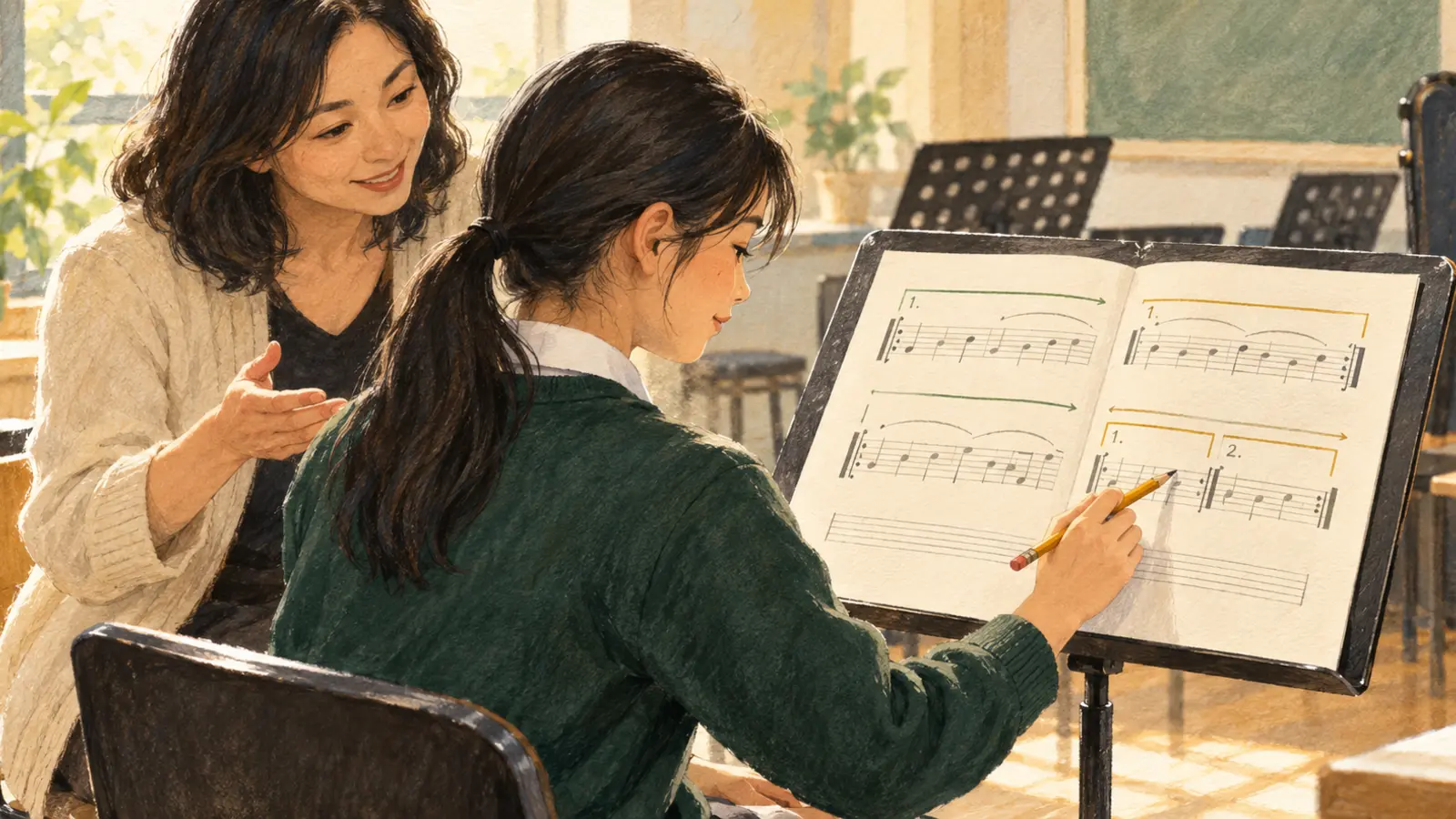
Primary Music matters because children can learn to hear, make and understand sound as a form of human expression. Rhythm, melody, tone and silence are not just pleasant classroom experiences. They are elements that learners can notice, combine, change and discuss. Through listening, creating and performing, a child begins to recognise how musical choices shape a piece and how shared music connects people across occasions and cultures.
For Singapore parents, the subject’s value extends well beyond preparing a child for an instrumental examination or co-curricular performance. In school, Music is an opportunity for a learner to respond to unfamiliar sounds, explore a musical idea, practise with attention, cooperate with others and appreciate why people make music. A child who does not attend private lessons can still participate meaningfully in this curriculum.
The most useful question is not whether Music will automatically improve Mathematics marks or intelligence. Such claims demand evidence and cannot be promised for every child. The better question is what musical capability your child gains: can they hear a rhythmic contrast, make a short phrase intentionally, join a group performance, listen to another tradition respectfully and explain something about the music itself?
The quick answer for Singapore parents
Primary Music develops listening, creating and performing, with opportunities to connect music to culture and everyday experience. Singapore’s MOE 2023 Music Syllabus for Primary and Lower Secondary makes these three processes central. It is a subject for the broad education of children, not a competition to determine which families can afford private instrumental training.
Your child can learn to keep a pulse, notice changes in tempo and dynamics, respond to melodies, experiment with instruments or everyday sounds, and discuss why a piece creates a particular impression. As pupils grow older, the tasks may involve more complex rhythms, musical structures and group work. What matters is the relationship between what they hear, the choices they make and their ability to reflect.
The official syllabus tells us what Music education is for
The MOE 2023 Music Syllabus for Primary and Lower Secondary was introduced with the 2023 Primary 1 and Primary 2 cohorts, and the MOE implementation note indicates that the syllabus applied to Primary 1–6 by 2024. Its learning outcomes integrate listening and responding, creating, and performing. The syllabus also encourages connections to music in culture and society.
This is broader than teaching every pupil to reproduce a particular song. Students encounter musical elements and ideas through experience and are encouraged to explain musical decisions at developmentally appropriate levels. A rhythm exercise can develop precision; a group composition can develop intentional musical structure; a discussion can build an ability to listen and describe.
Parents can consult the official document and their child’s teacher for the exact stage and activity. Schools select appropriate instruments, resources and musical experiences within the curriculum. The fact that two children perform different pieces does not automatically mean one has received a weaker education.
Listening is active noticing rather than passive background sound
Children hear music almost everywhere: on the way to school, in films, at festivals, in games and at home. Yet being surrounded by music does not guarantee a child can describe what is happening within it. Music class provides a chance to listen actively.
Ask a child whether the pulse becomes faster, whether an instrument enters, or whether the melody repeats with a changed ending. These observations are accessible even without extensive theoretical vocabulary. They shift attention from “I like this” towards “I noticed this musical choice”.
That distinction is important. Enjoyment remains valuable, but careful listening helps a learner hear relationships within unfamiliar music. It can also make a child more curious about pieces they would otherwise dismiss immediately.
A steady pulse gives music a sense of organisation
The beat is a useful starting point for understanding rhythm. Children can step, tap or clap a steady pulse while music continues. They then discover that a musical rhythm may have long and short sounds positioned in relation to that pulse.
One common difficulty is speeding up while clapping an exciting passage or treating a rest as the loss of the beat. A child who can count silently during a rest and return at the right moment is demonstrating coordinated listening.
Parents can practise safely with a short piece played at a comfortable volume. Ask the child to keep a pulse, then to identify one point where the rhythm differs from that underlying beat. Avoid turning the exercise into a test of speed or physical coordination.
Rhythm and beat are connected but not identical
A piece can maintain a steady beat while notes vary in duration and placement. This allows children to hear patterns, syncopation at a suitable level, and silence as an intentional musical event rather than an error.
Imagine four evenly spaced pulses. A simple melody might sound on all four, then sound only on the first and third. The pulse continues in both versions, but the rhythm differs. A child who can clap or describe that change has gained a conceptual distinction.
This matters for singing and playing in groups. A learner must know when not to make sound as well as when to enter. The discipline is musical: listening to the whole pattern while controlling one’s own contribution.
Melody gives children a language for musical direction
Melodies can rise, fall, repeat, change register or return in a varied form. Young learners may first describe a contour using hand movement or pictures before relying on staff notation. The physical gesture helps them connect a heard relationship with a representation.
A child might notice that the final phrase resembles the first but has a different ending. Ask what changed, whether the movement was higher or lower, and how the change affects the feeling of completion. This brings musical structure into reach without requiring the child to analyse a full score.
The educational aim is recognising relationships, not guessing the composer’s private thoughts. A learner can describe a rising melody accurately without declaring that it universally means happiness or victory.
Dynamics and expression turn a sound into a choice
Volume and musical expression are related, but music is not expressive only when it is loud. A soft entry after a busy section may become striking precisely because it contrasts with the surrounding material. Students learn to hear and produce these effects intentionally.
A useful exercise compares two versions of the same short phrase, one with even dynamics and another with a planned change. Ask which part caught attention and what the performer changed. A child can make and discuss this decision with voice, hand percussion or another suitable classroom instrument.
Parents should not assume that louder singing means better participation. Good musical expression depends on control, attention and appropriateness to the piece.
Tempo: fast is not automatically exciting
Tempo refers to the speed of the underlying pulse. A quick piece may feel energetic, but an expressive result also depends on articulation, rhythm, harmony, texture and context. A slow piece can be tense, playful or solemn depending on its other features.
Ask the child to compare what happens when the same musical phrase is played at two reasonable tempos. Does it become easier to hear a detail at the slower speed? Does the faster version require a different approach to articulation?
This teaches the child that a musical element can be changed deliberately, and that the effect must be judged within the work. It is a small but meaningful form of artistic decision-making.
Timbre: why instruments sound different
A piano, violin, flute and voice can produce notes of similar pitch and loudness yet sound different because of their timbres. Children learn to recognise the character of sounds and consider how instruments produce them.
A learner can explore this through classroom instruments or safe everyday sound sources where permitted. Striking, plucking, shaking and blowing produce different sound characteristics. The child should learn to describe the sound and its source accurately rather than rank instruments according to personal preference alone.
Parents can invite the child to name which sound they hear and what makes it distinguishable. This enriches listening and helps pupils contribute more thoughtfully when selecting sounds for a small composition.
Texture: listening beyond the main melody
Texture concerns how musical parts combine. There may be a single line, a melody with accompaniment or several independent lines. Young listeners often focus only on the loudest or most familiar part of the music.
Play a short extract and ask whether a second musical layer appears. Is it moving with the melody or repeating a supporting pattern? What happens if the accompaniment stops? Such questions help the child hear the whole musical relationship.
For group performance, this is practical. A child who listens to accompaniment can maintain an appropriate balance instead of focusing solely on playing their notes as loudly as possible.
Repetition and contrast give a piece a shape
Music is organised over time. Repeated phrases can create familiarity, and contrast can make a new idea noticeable. Children begin to recognise forms through listening, movement, drawing or short improvised musical examples.
A pupil may label a first idea A and a contrasting idea B, then hear A return. The purpose of this simple representation is understanding that musical sections have relationships. It does not require every Primary pupil to memorise advanced formal analysis.
At home, ask whether a familiar chorus returns exactly or with a change. The learner practises memory and musical observation within a piece they enjoy.
Creating is more than pressing random keys
Musical creativity can begin with a short rhythm, a melodic fragment or the choice of two contrasting sounds. But making an intentional musical idea involves deciding what to repeat, vary, develop and end. A child learns that creativity includes editing and listening critically.
Suppose a pupil creates a four-beat percussion pattern. They might repeat it twice and then introduce a rest or a different instrument. After hearing the result, they decide whether the change made the pattern clearer or more interesting.
The child need not invent a completely new musical language. They are learning to work with musical conventions while developing their own decisions. This is a more useful goal than asking whether the first attempt sounds professional.
Improvisation: responding while music is happening
Improvisation involves making musical choices in the moment. In a suitable classroom setting, the teacher may invite a short rhythmic or melodic response to a musical phrase. The learner listens, notices the pattern and responds within an agreed framework.
A child might be hesitant because they believe there is only one hidden correct answer. An encouraging start uses a manageable set of sounds and invites variation. Feedback can discuss how the response relates to the original phrase rather than label every unusual idea as wrong.
Improvisation can help a child become more comfortable exploring possibilities, but it should remain a musical exercise with meaningful listening and feedback, not a promise of general personality change.
Composition: developing an idea through decisions
A small composition can introduce pupils to planning and revision. Students may choose a rhythm, melody, instruments or a simple structure, then listen to whether the parts work together. Music technology may support this when the school considers it appropriate.
A first draft may be too repetitive, too crowded or difficult to perform. Revising the draft offers an opportunity to examine the relationship between intention and result. The pupil discovers that improvement can come from removing a sound as well as adding one.
Parents should not compose an assessed task for the child or ask an outside tool to generate the final work as if it were the pupil’s own. The learning is in the child’s choices and ability to explain them.
Performing: accuracy and expression are both meaningful
Performance can involve singing, playing classroom instruments, body percussion or suitable digital and traditional instruments. The objective is not simply avoiding wrong notes. Children also learn to listen to tempo, maintain balance and convey an intended musical idea.
A technically simple performance can be educationally strong if it demonstrates appropriate timing and expression. A difficult solo can be less successful if the performer does not listen or control the musical result.
Ask the child which passage they wanted to improve and what changed after practice. This encourages deliberate rehearsal rather than the assumption that repeating a whole song many times is always the best method.
Singing builds a connection between hearing and making sound
Singing gives children direct access to melody and expression without requiring a costly instrument. They learn to match pitch appropriately, control breathing, follow phrases and listen to others in a group.
Not every child is equally comfortable singing publicly. Some need time, supportive demonstrations and smaller opportunities before they feel ready to join an ensemble. Avoid comparisons that make a developing voice feel defective.
Parents can sing suitable songs together at a comfortable level and celebrate an accurate, expressive contribution. The objective is musical participation and development, not auditioning every child for professional singing.
Playing instruments requires coordinated listening
Playing pitched or unpitched instruments involves physical control together with attention to musical patterns. The learner must know how to produce a sound, when to enter, how the sound fits with other parts and how to adjust.
The instrument itself is not the measure of educational quality. A simple percussion part may require subtle control and listening. A digital instrument can also support musical learning when pupils make informed choices rather than press buttons randomly.
Parents should follow school guidance on appropriate instruments and practice. There is no need to purchase expensive private equipment simply to prove that Primary Music is being taken seriously.
A group performance teaches musical responsibility
When children perform together, each pupil contributes to a larger result. Entering at the correct moment, listening for balance and responding to a conductor or group cue are aspects of the music, not merely lessons in obedience.
A group may need to repeat a passage because one layer arrives early. The correction works best when it identifies the musical issue rather than blames a child. “We lost the pulse at the rest” is more useful than “You ruined the song”.
The experience can build an appreciation of shared effort and responsibility, though benefits depend on the quality of instruction. A class does not automatically become cooperative just because everyone holds an instrument.
Notation helps preserve and share musical ideas
Written notation can represent pitch, rhythm, rests and other elements, depending on the musical tradition and age of the learner. Staff notation is one useful form, but it is not the only legitimate way to represent music.
The syllabus includes appropriate experiences with graphic and other forms of notation. Young pupils might begin by sketching a rhythm or drawing a visual representation of a repeated sound before using more formal signs.
Parents can ask what a symbol is meant to represent and then listen to the child perform it. Linking the written form to sound is the educational purpose. Copying notation neatly without hearing what it means may hide a learning gap.
Music from Singapore connects with everyday life
Singapore offers musical experiences across traditions, communities, festivals and public spaces. Pupils can encounter songs associated with shared occasions, local musical practices and artists, alongside music from the wider region and world.
The educational aim is to listen with interest and learn appropriate context. One instrument or song does not represent the whole experience of a culture. A thoughtful child can ask where a piece is used, who performs it and what sources explain its background.
Parents can use school-appropriate performances or public cultural events as starting points for discussion. The lesson is not that the child must like every style, but that unfamiliar music deserves attentive hearing before dismissal.
National and community songs have social contexts
Primary Music provides opportunities to encounter music connected to Singapore’s national and community life. The syllabus includes understanding the roles of the National Anthem and other shared repertoire, not merely memorising notes without context.
A learner can discuss when a song is used, how it is performed appropriately and why a community attaches significance to it. Parents can reinforce respect and accurate information without insisting that every child must have the same personal emotional response.
Music can help children recognise shared experiences while appreciating differences. Its educational value is strongest when context and careful listening accompany performance.
Global music broadens listening without exoticising people
Students may encounter musical traditions from Southeast Asia and beyond. These experiences allow them to notice unfamiliar rhythmic structures, instruments, vocal styles and approaches to music-making. They should be introduced with accurate cultural information rather than stereotypes.
A child should not assume that a performance sounds “strange” because the performers lack skill. They may be hearing musical conventions unlike those used in familiar songs. Listening and learning provide a basis for informed appreciation.
Parents can ask which audible feature is different and what the school or a reliable source says about it. This combines curiosity with respect.
Digital tools can support music, but they should not erase authorship
Software can allow a child to sequence sounds, record a pattern or hear how layering changes a short composition. These tools can make musical relationships accessible without requiring advanced instrumental technique.
The danger is mistaking a polished automated output for independent learning. If the software selects every musical detail while the child makes no intentional decision, the task’s creative purpose may be lost.
Use tools permitted by the school, protect the child’s data and let the pupil explain which musical choices were theirs. Technology is most useful when it helps learners hear, compare and revise their own ideas.
Music is not a compulsory private instrumental lesson
Some families worry because other pupils attend piano, violin or singing lessons. Formal private training can support particular musical skills, but Primary Music in school is designed for broad participation and meaningful learning, not simply for those with access to outside classes.
One pupil may have strong notation knowledge yet hesitate with improvisation. Another may learn songs accurately by ear but need help representing a rhythm on paper. Both have strengths and next steps.
Parents can speak to the teacher about the actual goals of the classroom activity rather than assuming a higher private examination grade automatically proves superiority in every musical domain.
Primary 1 and 2: enjoy, explore and recognise patterns
In the early years, children can listen to short musical examples, sing suitable songs, move to a pulse and explore rhythmic or melodic ideas. Playful activity is valuable when it teaches pupils to hear relationships and control their musical responses.
A young child who keeps the pulse through a short rest or notices the difference between two melodic contours has made progress. These accomplishments should not be dismissed because they do not resemble advanced instrumental performance.
Parents can use brief, enjoyable listening activities at home. Invite curiosity, but stop before the experience becomes an exhausting assessment.
Primary 3 and 4: develop coordination and musical vocabulary
As pupils grow, they can handle more complex rhythms, contrasting textures and deliberate choices in performance and composition. Classroom tasks may ask them to identify changes, organise short phrases and respond to music from different cultural settings.
A child might understand a rhythmic idea through clapping before representing it with notation. Another might recognise the texture of an ensemble but need help describing it in words.
Parents can ask for one specific listening observation or let the child demonstrate a short pattern. A clear explanation of one element is often more educational than an impressive but unexamined performance.
Primary 5 and 6: connect listening, creating and performing
Older Primary pupils can increasingly describe musical structures, compare styles, plan a short creative response and reflect on how performance decisions work. The exact tasks depend on stage, school resources and the syllabus.
They may be able to coordinate two musical parts, recognise a repeated section with variation or discuss the role of music in a familiar cultural setting. The key development is greater independence in listening and choosing.
Parents can encourage the child to explain both the musical intention and the effect. When a learner can justify a choice and revise it after hearing the result, the subject is building a meaningful capability.
Primary Music is not a PSLE examination paper
Music is part of Singapore’s Primary curriculum but is not a PSLE written examination subject. That distinction should be stated plainly. The subject is still valuable, and schools can assess its learning through appropriate classroom tasks.
Parents should not ignore learning simply because it does not affect PSLE scoring directly. Equally, they should not claim that Music participation guarantees higher grades in PSLE Mathematics, English or Science.
A broad education includes capabilities that are not captured by one national examination. Musical listening, creating and performing are worthwhile on their own terms.
The bridge to Secondary Music and G3 options
Lower-secondary pupils continue to encounter common Music learning, while certain upper-secondary routes allow more specialised study. In the 2027 SEC, G3 Music K350 and Higher Music K351 are distinct examinations with their own requirements.
Enjoying Primary Music does not automatically mean the child should pursue an upper-secondary Music elective. That choice depends on school offerings, suitability, interests and willingness to engage with the complete assessment—not only performance.
Parents can nurture musical interest without turning every Primary lesson into early examination coaching. Musical capability and enjoyment can continue through many routes, including non-examinable participation.
A fictional learner: the child who cannot read notation yet
Imagine a Primary 4 student, Daniel, who enjoys singing but hesitates when a worksheet uses musical notation. He fears that classmates with piano lessons know the answer before he can begin. His parent assumes he is bad at Music.
His teacher asks him to hear and clap the pattern first, then identify how the notation represents the sounds and rests. Daniel begins to recognise the symbols because they are connected to something he can hear and perform.
The case is illustrative. It shows why the correct intervention is not always more copying. A child may need a stronger connection between sound, action and representation.
Another fictional learner: the confident performer who needs to listen
Imagine a Primary 6 pupil, Maya, who plays an instrument fluently and enjoys demonstrating pieces. During group performance, however, she sometimes continues at her preferred tempo even when the rest of the ensemble slows down.
Her teacher gives her a simpler part and asks her to listen for cues from another group. Maya discovers that musical skill includes responsiveness and balance. Her performance becomes more effective not through playing more notes, but through hearing the others.
The example illustrates why Music education is broader than technical virtuosity. A good musical contributor can adapt an individual part to a shared result.
A short listening routine for home
Choose an age-appropriate thirty- to sixty-second musical extract. Listen once for enjoyment. On the second hearing, ask the child to focus on one element: tempo, rhythm, timbre, dynamics or texture. Then invite a brief explanation of the particular detail noticed.
Do not require five technical terms in every response. One accurate observation is a good starting point. Ask how the passage would sound if that element changed, and let the child propose a creative variation.
This activity can be completed without purchasing an instrument, enrolling in a private class or using high volume. The educational outcome is careful listening and intentional response.
A simple creating routine: one rhythm, two variations
Start with four steady pulses using hand claps or another suitable low-volume sound. The child creates a short pattern, repeats it, then changes one feature—perhaps a rest, an accent or a different sound. Ask which version is easier to remember and why.
Let the pupil choose how the pattern ends. Invite them to explain whether the changes created contrast or continuity. This connects musical creation with hearing and reflection.
Use the activity for general learning rather than completing a school assessment task on the child’s behalf. The child’s own decisions should remain central.
What if my child says they are not musical?
Find out which activity the child finds difficult. Are they embarrassed to sing, unsure about rhythm, unfamiliar with notation or uninterested in a particular style? These are different situations and deserve different responses.
Offer manageable ways to participate. Listening and describing, clapping a simple pulse, experimenting with a sound or joining a supportive group task can each provide a starting point.
Avoid fixing the label “unmusical” onto a child. Musical skills develop through exposure, appropriate instruction and practice. At the same time, it is not necessary to promise that every pupil will become a professional performer.
When enrichment might help
A child with a sustained interest in playing an instrument, singing, composing or production may enjoy additional instruction. This can deepen particular skills, but it is not automatically necessary for meeting the aims of Primary Music.
Parents should assess whether enrichment suits the learner’s motivation and wider workload. Choose opportunities that develop listening, technique and musical understanding rather than promising an examination certificate as proof of all-around ability.
A useful programme makes the child more independent in hearing and making decisions. It should not turn every musical experience into pressure to achieve the next grade.
How to recognise meaningful progress
Look for a child who keeps the pulse more reliably, hears an unfamiliar contrast, understands what a rest does, experiments with a short phrase and describes a musical choice more precisely. These are concrete musical outcomes.
The child may also show greater awareness of other performers, more careful use of sound and more willingness to listen to unfamiliar musical styles. Such changes should be recognised without converting them into exaggerated claims about every other school subject.
Assessment feedback matters, but the deepest measure is whether the learner can hear, create and perform with increasing understanding and independence.
Questions Singapore parents frequently ask
Why study Primary Music if my child will not become a musician?
Music develops listening, creating, performing and appreciation as valuable educational capabilities. Professional specialisation is not required for the subject to matter.
Is Primary Music tested in PSLE?
No. It is part of the primary curriculum but not a PSLE examination paper.
Must my child have private instrumental lessons?
No. Primary school Music provides learning opportunities for all pupils. Private lessons may deepen particular skills but are not the definition of the school curriculum.
Does Music automatically improve Mathematics grades?
No universal guarantee can be made. Music is educationally valuable through its own listening, creative, cultural and performance demands.
What does the 2023 MOE Music syllabus emphasise?
Its core learning outcomes involve listening and responding, creating, and performing, with connections to musical elements and social or cultural contexts.
Does Primary Music mean only singing?
No. Children may experience listening, singing, instrumental activities, creative tasks, movement, notation and musical discussion as appropriate.
Is notation essential from Primary 1?
Children develop understanding progressively through appropriate sound experiences and representations. Formal notation is introduced at suitable levels and linked with listening and performing.
Can a shy child benefit from Music?
Yes, if activities are supportive and provide suitable ways to participate. Listening and composing can also be meaningful routes into musical learning.
Is a child with a high instrumental grade automatically strong in school Music?
Not necessarily. School Music also involves listening, creating, cultural understanding and collaborative responsiveness.
Do digital instruments count as learning?
They can, when school-approved tools allow the pupil to make and explain genuine musical choices rather than rely only on automated output.
Should we correct every singing mistake at home?
Focus on one attainable point and protect enjoyment. Specific, supportive feedback is more useful than constant interruption.
What is the best sign of progress?
The child notices musical relationships, performs or creates with intention and can explain how a choice changed the result.
The enduring reason to study Primary Music
Music helps children engage with the world through attentive hearing and purposeful expression. They learn that a rest has meaning, that a phrase can return differently, that another performer affects their own contribution and that songs belong to cultures and communities with histories worth understanding.
Parents can preserve this educational value by encouraging curiosity, suitable practice and respect for the child’s musical choices. A learner who can listen more closely, make a short piece intentionally and respond to others thoughtfully has gained something that matters whether or not Music becomes an examinable subject later.
For official curriculum information, consult the MOE 2023 Music Syllabus for Primary and Lower Secondary and the MOE Primary curriculum information. Related eduKateSG reading includes Primary Music Step-by-Step Study Guides, Why Study G3 Music, Why Study Primary Art and How Primary Art, Music and Practical Skills Lead to SEC Subjects. These pages address different stages and should not be mistaken for one examination specification.