
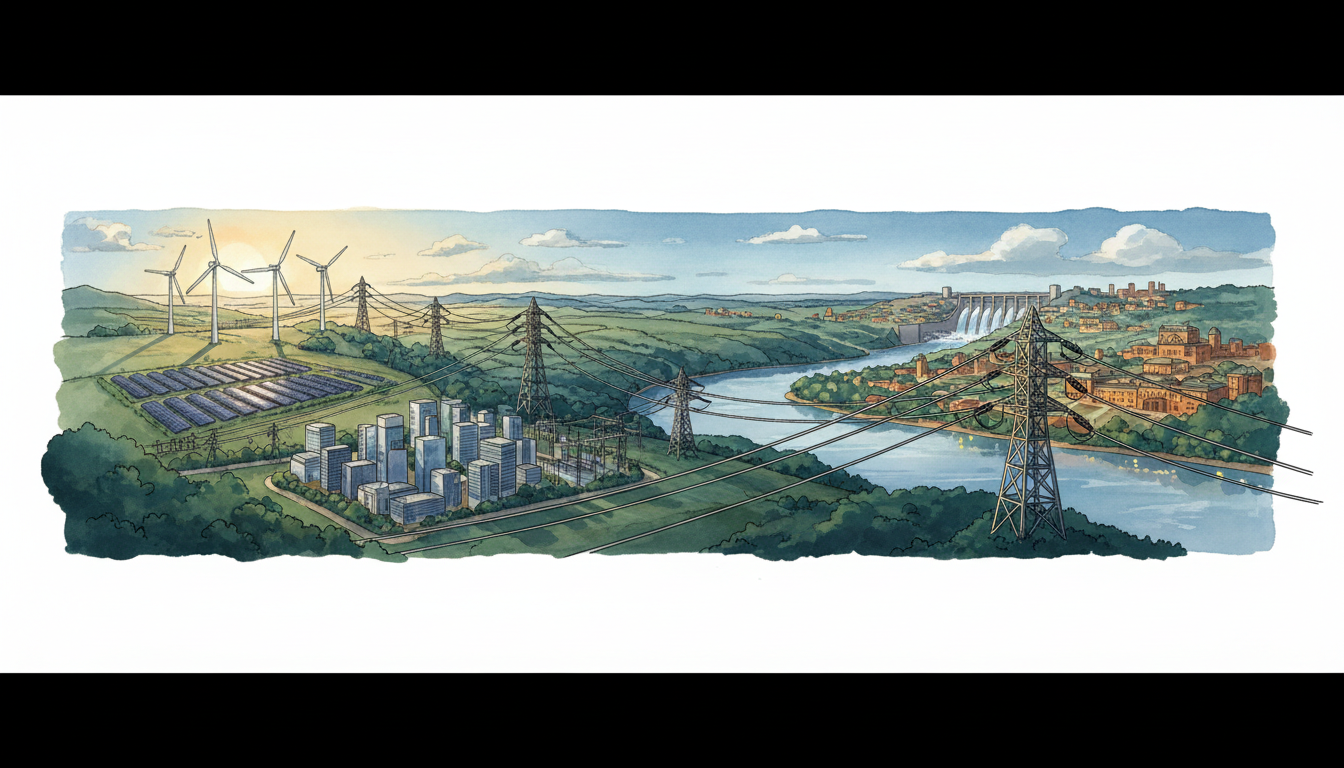
Why study Science? A solar panel converts sunlight into electricity through semiconductor physics. Its actual energy output depends on light, time, temperature, orientation, shade and connected equipment.
Quick answer: photons absorbed by a solar cell help create moving charge carriers, and the photovoltaic system supplies electrical power through an appropriate circuit. A rated kilowatt value is not the number of kilowatt-hours produced in a day.
This Singapore-focused guide uses DOE and EMA educational resources, with fictional calculations clearly identified. It is not a rooftop design or electrical installation guide, and no student should work on live solar equipment.
Contents
- A rooftop panel turns sunlight into a Physics question
- Photovoltaic means conversion of light into electricity
- Sunlight contains energy across many wavelengths
- A semiconductor is neither a perfect wire nor a perfect insulator
- A p–n junction helps separate charges
- Electrons are not produced from nothing
- Direct current and alternating current are different
- A cell, module, array and installation are not identical
- Peak power is a rating under specified conditions
- Power and energy must be separated
- Worked example: watts and watt-hours
- A power curve changes through the day
- Worked example: sum several time intervals
- Solar irradiance measures incoming power per area
- Efficiency is output divided by input
- Worked example: light on a fictional panel
- Why not every photon becomes electric current
- Why solar cells become less efficient when hot
- Shadows change more than the appearance of a panel
- Cloudy conditions do not always mean zero generation
- Rain and dust can change different aspects of performance
- Inverters have an efficiency of their own
- Capacity factor is not the same as conversion efficiency
- Worked example: a hypothetical capacity factor
- Solar generation is intermittent
- Storage shifts energy through time
- Grid-connected and off-grid solar systems differ
- Singapore provides a concrete local case
- Floating solar introduces additional engineering conditions
- Why solar does not automatically meet every hour of demand
- What a net-zero claim would require
- Why solar electricity is not entirely impact-free
- Solar panels are engineered electronic products
- A rooftop rating is not a permit or safety assessment
- Solar comparisons need a defined timeframe
- Worked example: the wrong 24-hour multiplication
- Why shade can change the electrical configuration
- A current–voltage curve provides more detail
- Worked example: a fictional current–voltage table
- A school experiment should not connect rooftop systems
- Common misconceptions about solar electricity
- A two-week solar-energy learning plan
- How parents can use a solar roof as a Science question
- What classroom calculations cannot decide
- The lasting reason to study Science
A rooftop panel turns sunlight into a Physics question
Walk through a Singapore housing estate and you may notice dark panels on a roof. The panels are quiet and do not resemble a conventional generator, yet they can produce electricity when sunlight reaches their solar cells.
That is an excellent reason to study Science. A solar panel combines electromagnetic radiation, semiconductors, electrical circuits, energy conservation and environmental design. It also gives students a practical lesson in units: the kilowatt rating printed on a system is not the number of kilowatt-hours it produces every day.
Singapore’s Energy Market Authority explains that photovoltaic systems convert sunlight into direct-current electricity and commonly use inverters to supply alternating-current systems. The principle is clear, but real output depends on conditions rather than the mere existence of panels on a roof.
Students who understand how a measurement relates to the physical mechanism are better equipped to interpret energy dashboards and claims about renewable power.
Photovoltaic means conversion of light into electricity
Photovoltaic technology uses semiconductor materials that respond to absorbed light by generating electrical charge carriers. Under appropriate device structures, these charges can be separated and collected as electric current.
This is different from a solar-thermal collector, which primarily uses sunlight to heat a fluid or another material. Both harness solar energy but the desired useful outputs are different.
A student should not say that every black solar panel directly boils water or that a photovoltaic module creates electricity simply because it becomes hot. The key photovoltaic process involves electronic behaviour in a semiconductor.
Science teaches how to classify technologies by mechanisms, not appearance.
Sunlight contains energy across many wavelengths
Sunlight is electromagnetic radiation containing photons with a range of energies. The energy of a photon is related to its frequency, so different wavelengths interact with semiconductor materials differently.
Some incoming light is reflected from a module, some passes through and some is absorbed. Only part of the absorbed energy contributes to electrical output; other pathways include heating and internal losses.
The US Department of Energy explains that photovoltaic efficiency depends in part on wavelength, charge-carrier recombination, reflection and temperature.
Learning this links school chapters on light, heat, electricity and materials into one coherent technology.
A semiconductor is neither a perfect wire nor a perfect insulator
Semiconductors have electronic properties between those of familiar conductors and insulators. Their conductivity and charge behaviour can be adjusted through material structure and carefully controlled processing.
Silicon is a widely used photovoltaic semiconductor. It is formed into a crystal and treated so regions have differing electronic properties, supporting a built-in electric field at a junction.
Students should not conclude that any sand or ordinary piece of glass becomes a solar cell when placed in sunlight. Manufacturing a functional cell requires refined materials and an engineered structure.
Science helps explain why a useful physical effect must be harnessed by a designed device rather than assumed from a material’s name.
A p–n junction helps separate charges
In a simplified silicon photovoltaic cell, differently doped regions form a junction with an internal electric field. When suitable photons are absorbed, they can create mobile electrons and holes.
The junction field and electrical contacts help separate and collect those carriers. When an external circuit is connected, this arrangement can deliver electric power to a load.
An introductory diagram may show charges moving in opposite directions, but real device physics includes diffusion, recombination and contact behaviour. The diagram is a model, not a photograph of free particles.
Students should identify the material, light absorption, charge separation and completed circuit as distinct steps in the explanation.
Electrons are not produced from nothing
The photovoltaic effect does not manufacture new electrons whenever sunlight arrives. Electrons already present in the semiconductor receive energy, and charge carriers participate in electrical transport.
Conservation of charge remains valid. When a current flows through a closed circuit, charge circulates or is transferred according to the connected system; the panel is an energy converter rather than a factory creating matter.
A student may say sunlight is turned into electrons. The more precise statement is that photon energy can excite charge carriers whose movement delivers electrical energy.
This is a useful correction because it distinguishes matter from energy across a physical process.
Direct current and alternating current are different
Solar photovoltaic cells generate direct-current electrical output. Household and grid-connected equipment in Singapore generally operate through alternating-current systems, so an inverter converts power into a suitable form.
Changing DC into AC does not create extra energy. Conversion involves electronics and unavoidable losses, so AC energy delivered after the inverter can be less than DC energy produced by the array.
A student should label where measurements are taken. An output at the panel is not necessarily the same as electricity exported through the grid meter.
Science teaches the importance of a system boundary even when two displays both use kilowatts.
A cell, module, array and installation are not identical
One photovoltaic cell is the basic conversion device. Multiple cells are connected and packaged into a module, often called a solar panel. Groups of modules form arrays, which are integrated with inverters, protection devices and other equipment into a complete installation.
A rating stated for one module cannot be applied automatically to an entire rooftop without knowing how many modules and their configuration. Similarly, a rooftop area does not reveal the exact electrical capacity by itself.
The DOE’s photovoltaic primer explains the hierarchical relationship among cells, modules and systems. This is useful vocabulary for reading accurate diagrams or news reports.
Science encourages students to define which level of the system a measurement describes.
Peak power is a rating under specified conditions
Photovoltaic modules are commonly rated under standard test conditions, yielding a peak power value expressed in watts-peak or kilowatts-peak. The rating supports comparison of products under a defined laboratory reference.
A module with a 400 Wp rating does not promise exactly 400 W at every hour of the day. Actual sunlight intensity, cell temperature, shading, orientation and system operation change the output.
Students should not treat a nameplate as a live measurement. Rated capacity and measured power are related but different quantities.
The broader lesson applies to batteries, engines and electrical appliances: a test rating has conditions and is not a universal performance guarantee.
Power and energy must be separated
Power describes the rate of energy transfer, measured in watts or kilowatts. Energy is the accumulated amount delivered over time, measured in joules or kilowatt-hours.
A solar system rated at 5 kWp is a system with a specified peak power under test conditions. It does not mean the system produces 5 kWh every hour or 120 kWh in every 24-hour day.
If the output is 3 kW steadily for two hours, the electrical energy produced over that interval is 3 × 2 = 6 kWh. The word steadily is part of the fictional assumption.
This unit distinction is one of the most useful things a Science student can learn from the solar topic.
Worked example: watts and watt-hours
Invented production record: a solar system supplies a constant 2 kW during a hypothetical three-hour period. Its output energy is 2 kW × 3 h = 6 kWh.
If that 6 kWh is expressed in joules, it equals 6 × 3.6 million = 21.6 million joules. That is an energy amount, not a power rating.
Real PV power varies with cloud cover, orientation, temperature and other factors. A rectangular power-over-time assumption is convenient for arithmetic but not a forecast of Singapore rooftop production.
Students should inspect the time interval and output variable before integrating or multiplying values.
A power curve changes through the day
Solar irradiance at a particular panel varies as the Sun’s position changes and clouds alter the incoming light. A representative output curve may rise in the morning, reach higher values around a suitable midday period and decline later.
The actual curve may have irregular dips or multiple peaks during passing cloud. A system’s peak time also depends on its orientation and shade.
The area beneath a power-versus-time curve represents energy when units and sampling are handled properly. The highest plotted point alone does not reveal total daily production.
Science students can connect graph interpretation with practical electricity accounting.
Worked example: sum several time intervals
Fictional hourly-average AC outputs: from 9–10 a.m. the system averages 1 kW; 10–11 a.m. averages 2 kW; 11 a.m.–noon averages 3 kW; noon–1 p.m. averages 2 kW.
Each interval lasts one hour, giving 1 + 2 + 3 + 2 = 8 kWh over the four-hour period. The largest power was 3 kW, not 8 kW.
Other hours could contribute further energy, so this does not establish an entire day’s production. Equipment limits and inverter efficiency are already assumed to be reflected in the fictitious AC data.
The exercise teaches why energy is accumulated across time rather than copied from the biggest instantaneous output.
Solar irradiance measures incoming power per area
Irradiance describes incoming radiant power per unit area, commonly in watts per square metre. It is a rate, not the day’s total solar energy received by the surface.
Solar irradiation or insolation over a period may be expressed in kilowatt-hours per square metre. Comparing these quantities requires a defined integration interval.
Students should not treat 800 W/m² at one moment as 800 kWh/m² for a day. The difference between instantaneous conditions and accumulated exposure is substantial.
This is a useful connection to weather, temperature and energy data where similar names describe different dimensions.
Efficiency is output divided by input
Photovoltaic conversion efficiency is the ratio of useful electrical power output to incident solar power on the relevant device area under specified conditions.
If 1,000 W of light reaches a suitable panel and it produces 200 W of electrical output, the simplified conversion efficiency is 200/1,000 = 20%. The remaining energy is not all electrical output, and can be reflected, transmitted or converted into heat.
The computation requires the incident power on the device area and a consistent output boundary. A manufacturer’s cell efficiency and whole-module efficiency may differ.
Science makes the concept of efficiency precise rather than equating it with high output in every circumstance.
Worked example: light on a fictional panel
Invented controlled values: a module has area 2 m² and receives uniform irradiance of 900 W/m². The total incident power is 2 × 900 = 1,800 W.
If the module delivers 360 W of DC power at that moment, the calculated module conversion efficiency is 360/1,800 × 100 = 20%.
The result says nothing about the energy delivered across a whole day without power-over-time data. Nor does it include downstream inverter losses unless the 360 W figure is redefined.
Students must label the input and output points before trusting the percentage.
Why not every photon becomes electric current
Some sunlight is reflected or passes through the material. Absorbed photons with suitable energy can create charge carriers, but recombination and other device processes reduce useful collection.
Photons with energy below a semiconductor’s bandgap cannot drive the same electronic transition in that material. Other absorbed energy may become heat.
These mechanisms help explain why a real module does not have 100% conversion efficiency and why researchers investigate different semiconductor structures.
Science connects the microscopic behaviour of electrons with a measurable output on a rooftop.
Why solar cells become less efficient when hot
Sunlight can warm a photovoltaic module as well as supply photons for electricity. For many common silicon devices, higher cell temperature tends to reduce voltage enough to lower electrical conversion performance.
The effect depends on cell technology, temperature and other conditions. A student’s calculation should not assume one universal percent loss per degree without a product-specific coefficient or source.
This is a memorable paradox: bright sunshine can improve incident light while high panel temperature creates an opposing efficiency effect.
Science teaches that two variables can influence an outcome in different directions.
Shadows change more than the appearance of a panel
A nearby tree, wall or roof structure may cast shade on part of a solar array. Shading reduces incident light and can interact with the electrical configuration of connected cells and modules.
The amount of power lost is not necessarily equal to the fraction of area shaded. Bypass arrangements, string connections and inverter architecture can affect the outcome.
Students should not estimate precise production loss from one photograph without measurement and system information. It is appropriate to say shade can reduce generation, then identify what additional data are needed.
Science rewards a causal explanation with an honest limit rather than a guessed percentage.
Cloudy conditions do not always mean zero generation
Solar panels can use both direct sunlight and suitable diffuse light scattered through clouds and the atmosphere. Generation often continues on cloudy days, although the available irradiance can be lower and more variable.
A grey sky does not automatically mean the panel output is exactly zero. Nor does a bright-looking cloud guarantee a particular power level.
Reliable analysis uses measured irradiance and electrical power instead of visual impressions alone. The Australian government’s solar guidance explains this distinction in accessible terms.
Science links optical scattering, meteorology and electricity generation.
Rain and dust can change different aspects of performance
Dirt and deposits on a module can reduce transmission of light to the cells, while rainfall may remove some surface contamination but can also coincide with cloudy weather. Environmental effects are not identical on every site or product.
Cleaning performance and maintenance depend on location, module construction and safety requirements. A student should not infer that spraying water onto live rooftop equipment is an appropriate experiment.
Solar installations require professional access and electrical safety procedures, especially on roofs. Prepared data and publicly documented maintenance methods are better learning tools.
Science explains the physical mechanism without encouraging unsafe attempts to test it.
Inverters have an efficiency of their own
Direct-current electricity generated at modules may pass through an inverter to become suitable alternating current. The conversion is not loss-free.
A module array delivering 1,000 W DC might produce somewhat less usable AC power at that instant, depending on the inverter’s operating point and other system losses. A fictional 96% conversion would yield 960 W AC under the simplified assumption.
This distinction matters when comparing rooftop DC ratings with AC output at the building or grid connection. The numbers belong to different boundaries.
Science encourages tracing where measurements were taken before claiming that equipment underperformed.
Capacity factor is not the same as conversion efficiency
Capacity factor compares energy actually produced over a period with the energy that would be produced if the system operated at its nameplate capacity throughout that period, under a clearly defined rating basis.
A PV installation can have module conversion efficiency around one value but a much smaller capacity factor because sunlight is not continuously available at standard test intensity.
Students who confuse these percentages may think the cells are failing when the nighttime zero-output periods reduce the annual utilisation ratio.
Science teaches that distinct ratios answer distinct questions, even when both are reported as percentages.
Worked example: a hypothetical capacity factor
Fictional installation: a 10 kW rated system produces 12,000 kWh over a 365-day year. The theoretical nameplate energy if it ran at 10 kW for every hour would be 10 × 8,760 = 87,600 kWh.
The simple capacity factor is 12,000/87,600 ≈ 13.7%. This does not mean the solar cells convert only 13.7% of incident sunlight into electricity.
The example uses an idealised rating and annual energy total. Real performance assessment also distinguishes DC and AC ratings and may use other yield metrics.
Students can practise comparing ratios without confusing their physical definitions.
Solar generation is intermittent
Photovoltaic output varies with sunlight, so it typically produces little or no electricity at night and changes during cloudy weather. Electricity use in buildings follows a different pattern.
The mismatch between supply and demand is one reason grids use combinations of generation sources, storage, demand response and other system-management methods.
Singapore’s EMA explains that energy storage and grid measures help address the variability of solar generation as deployment expands.
Science links a single panel’s physical behaviour with the much larger challenge of supplying reliable electricity.
Storage shifts energy through time
Battery storage can absorb electrical energy during suitable periods and release it later. It does not create additional energy; charging and discharging involve losses.
A simple classroom model might store 10 kWh and later deliver 9 kWh, implying 90% round-trip energy efficiency under the defined energy boundary. The actual technology’s performance depends on design and conditions.
Storage capacity in kWh and discharge power in kW are distinct; a large energy store is not necessarily able to deliver all that energy instantly.
Students can connect the subject with earlier learning about electrochemical batteries.
Grid-connected and off-grid solar systems differ
EMA describes grid-connected systems that operate alongside the electricity network and off-grid systems designed to supply loads without that connection. Their equipment and operating constraints can differ substantially.
An ordinary grid-connected solar array without appropriate backup arrangements does not automatically supply a building during a grid outage. Grid-interconnection protections have defined safety purposes.
Students should not infer energy independence from seeing a panel on a roof. The full system’s configuration matters.
Science helps people distinguish a generation device from a complete reliable electricity supply.
Singapore provides a concrete local case
Singapore has extensive rooftop solar opportunities on HDB buildings and other public or private facilities, and floating solar installations on suitable water surfaces. EMA identifies solar as a major domestic renewable-energy resource and works on deployment and intermittency challenges.
Land constraints, shading, tropical weather and roof suitability affect where equipment can be installed. A larger array is not automatically practical if a roof cannot support it or receives extensive shade.
The scientific lesson is that a technology’s potential depends on local geography, materials and engineering conditions as well as the underlying photovoltaic effect.
Families can learn from official diagrams and published information without entering restricted rooftops.
Floating solar introduces additional engineering conditions
Singapore’s Tengeh Reservoir floating solar installation illustrates how panels may be deployed on water where land is scarce. The photovoltaic mechanism remains the same, but floats, moorings, water conditions, maintenance and ecological considerations become relevant.
Students should not assume that a floating panel produces a guaranteed efficiency advantage at every hour simply because it is near water. Performance depends on actual module temperature, wind, installation and design.
Solar development is therefore a systems challenge: the electrical cell, physical support, environment and environmental protection measures all need consideration.
Science helps explain how general principles are adapted to a particular site.
Why solar does not automatically meet every hour of demand
A large annual electricity total can coexist with periods when generation is much lower than demand. Annual energy and instantaneous adequacy are different planning quantities.
A solar system may produce enough energy over a year to match a household’s annual consumption under a particular accounting definition without ensuring that its generation equals demand at each hour.
Energy imports, the grid, storage and other resources may still be required. The exact solution depends on economics, reliability and policy as well as Physics.
Science teaches why an annual kilowatt-hour comparison cannot replace an hour-by-hour system analysis.
What a net-zero claim would require
A project might say that its solar panels offset its annual electricity demand or carbon emissions. Such claims need a clear time interval, generation and consumption data and an explicit accounting boundary.
Energy exported to a grid and energy used onsite may be measured differently. Renewable electricity certificates and greenhouse-gas accounting can introduce additional defined quantities.
Students should not treat a photograph of a solar roof as proof that a building operates without emissions or never draws power from the grid.
Scientific literacy demands a statement of what net means in the context.
Why solar electricity is not entirely impact-free
Photovoltaic generation produces electricity without burning fuel at the module during ordinary operation. Manufacturing, installation, transport, maintenance and eventual decommissioning still involve materials and energy.
Lifecycle analysis considers impacts over these stages rather than comparing only the moment when a panel is in sunlight. The assessment must use comparable functional units, timeframes and system boundaries.
An environmental benefit can be real while the technology still requires careful management of its materials and end-of-life treatment.
Science helps evaluate alternatives fairly without demanding that a useful solution have no environmental footprint whatsoever.
Solar panels are engineered electronic products
Modules contain semiconductors, electrical contacts, encapsulants, glass, frames and other components depending on the design. Their durability in heat, rain and ultraviolet exposure affects lifetime performance.
Damage, unsuitable connections or improper installation can create serious electrical or physical hazards. Qualified personnel and the relevant standards are essential for real PV systems.
Students should not attempt rooftop electrical tests, dismantle panels or connect improvised inverters for a classroom project.
Science can be rigorous with schematic diagrams, simulated power traces and official performance data.
A rooftop rating is not a permit or safety assessment
A 10 kWp design figure does not establish roof structural suitability, electrical interconnection compliance or safe installation details. Those issues require site assessment and qualified professional work.
EMA’s consumer guidance identifies shading, roof structure, installation requirements and applicable approvals as practical considerations.
The Physics of a photovoltaic cell remains the same whether the rooftop is suitable or not, but engineering decisions need additional evidence.
Science teaches the difference between a principle and a completed safe system.
Solar comparisons need a defined timeframe
Monthly generation may vary with cloud cover and weather, while annual production smooths over many short-term changes. A single clear-day maximum should not be used as an annual average.
Students should check whether a dashboard reports instantaneous kW, energy this month in kWh, energy year-to-date or a modelled annual yield. The units and timestamps determine the interpretation.
Comparison against another site also needs attention to rated capacity, orientation and measurement method.
This is the same evidence discipline needed for weather forecasts, pollution data and battery performance.
Worked example: the wrong 24-hour multiplication
An advertisement says an imaginary 8 kWp solar installation can produce 8 × 24 = 192 kWh every day. That arithmetic assumes operation at full nameplate power for all twenty-four hours, including nighttime.
The assumption is physically unsuitable for an ordinary sunlight-powered rooftop system. The correct approach uses time-varying irradiance, equipment performance and actual or modelled operating conditions.
An 8 kWp rating is still meaningful as a reference capacity, but does not independently determine the daily kWh value.
Science teaches students to question the assumptions behind a calculation rather than accept a correct multiplication attached to the wrong model.
Why shade can change the electrical configuration
Modules may be connected in strings, and their combined behaviour depends on wiring, bypass paths and power electronics. A partially shaded module can affect the output of a connected string differently from an isolated module.
Some systems use module-level electronics or alternative architectures to manage mismatched output. These choices have different costs, losses and maintenance considerations.
A student need not design the hardware to understand why one black patch in an image is not enough to predict a numerical system loss.
The science skill is recognising interconnected components and the importance of system design.
A current–voltage curve provides more detail
Solar cells have a current–voltage relationship that depends on illumination, temperature and device properties. Electrical power at a point on the curve is the product of voltage and current.
The maximum-power point is a condition where that product is highest for the stated cell conditions. Power electronics can seek a suitable operating point as sunlight changes.
A student may incorrectly assume that the highest voltage automatically gives the greatest power. At open circuit, current is essentially zero, so electrical output power to an external load is zero in the ideal relation.
Science connects graph interpretation with electronic control and energy conversion.
Worked example: a fictional current–voltage table
Teaching values only: a module produces 20 V at 4 A in one condition, 25 V at 5 A in another and 30 V at 2 A in a third.
The corresponding powers are 80 W, 125 W and 60 W. Among these three measured points, the 25 V, 5 A condition has the highest power.
The table does not establish the true maximum-power point because untested combinations may give a larger result. Nor does it state the correct operating limit for a real module.
Students practise multiplying the correct quantities and limiting the conclusion to the observed data.
A school experiment should not connect rooftop systems
Solar cells can be studied conceptually with diagrams, safe low-voltage approved teaching equipment and prepared datasets. Real rooftop PV systems involve hazardous voltages, elevated work and grid-interconnection requirements.
Children should not touch rooftop wiring, connect improvised inverters or perform maintenance in order to verify a classroom equation.
A safe paper-based task can still investigate the relationship between irradiance, power, duration and energy with more precision than an unsafe demonstration.
Science education protects both understanding and people by choosing methods appropriate to the learning objective.
Common misconceptions about solar electricity
One error says panels convert heat rather than light into electricity. Another claims a system rated 5 kWp produces 5 kWh in every hour, including night. Some pupils confuse efficiency with capacity factor or consider cloudy-day generation necessarily zero.
Others think a rooftop array must power a building during any blackout or that a battery and inverter have no losses. These claims hide relevant physical and engineering constraints.
Correct the errors by tracing photons, charge carriers, DC output, inverter losses, energy over time and the grid connection.
Students show understanding when they can identify the missing condition in an attractive energy claim.
- Photovoltaics converts suitable light energy into electrical output.
- A solar cell does not create electrons from nothing.
- kW measures power; kWh measures energy.
- kWp is a rating under defined conditions.
- Solar panels can generate some power in diffuse light.
- Higher temperature may reduce silicon module performance.
- Module efficiency and system capacity factor are different ratios.
- Storage shifts energy and has losses.
- A rooftop panel does not guarantee backup during outages.
- Real installation requires qualified professional assessment.
A two-week solar-energy learning plan
In the first week, study light absorption, semiconductors and the direction of charge movement. Draw a simple PV system showing module, DC circuit, inverter, building loads and grid.
Next compare power, energy, efficiency and capacity factor through the fictional calculations. Interpret a short power-versus-time graph and identify why the largest point does not equal total daily generation.
In week two, read official EMA guidance and describe Singapore’s rooftop and floating solar examples. Discuss temperature, cloud, shade, module life and the need for storage or other supply when solar generation changes.
Finish with an invented 8 kWp advertisement and write an evidence-led correction explaining why the 24-hour maximum-capacity assumption is invalid. No real electrical assembly is required.
- Days 1–3: photons, semiconductors and photovoltaic conversion.
- Days 4–5: DC, AC and inverters.
- Days 6–7: kW, kWh and rated capacity.
- Days 8–9: efficiency, area and irradiance.
- Days 10–11: power curves, shading and intermittency.
- Days 12–13: Singapore deployment and engineering constraints.
- Day 14: independent audit of a fictional solar claim.
How parents can use a solar roof as a Science question
Ask what sunlight does to the semiconductor and where electricity travels next. If the learner says panels store solar energy automatically for nighttime, ask which component would actually store energy and what happens without it.
If they see a large kWp number, ask how many hours at what power level would be required to calculate a given energy production. Encourage careful reading of the units rather than praise for a quick multiplication.
Families can view official EMA diagrams safely from home instead of attempting to access panels or electrical equipment.
The goal is a student who understands why an apparently simple technology depends on several connected scientific mechanisms.
What classroom calculations cannot decide
This guide cannot forecast the yield of a named roof, certify electrical equipment, choose an installer, determine project costs or guarantee carbon savings. Those require current site-specific information, engineering and appropriate regulatory guidance.
The fictional performance data demonstrate scientific ratios and energy accounting, not actual Singapore electricity production on a stated date.
Science remains valuable precisely because it clarifies which additional measurements are needed before a real decision.
The distinction between understanding a principle and certifying a design is essential.
The lasting reason to study Science
Solar photovoltaic systems show how energy carried by light can be converted into electrical power through the properties of semiconductors. The mechanism becomes useful in Singapore through careful installation, grid management and measurement.
A student who can distinguish power from energy, explain why shade and temperature matter and identify the limits of a rated capacity has gained durable scientific literacy.
That is why Science deserves study: it helps people understand technology, question impressive numbers and make more informed sense of the energy systems around them.
Frequently asked questions
What does photovoltaic mean?
Conversion of suitable light energy into electricity using a semiconductor device.
Do solar panels make electricity from heat?
Ordinary photovoltaic cells generate electricity primarily through absorbed light; solar-thermal technology uses heat differently.
What is a semiconductor?
A material with electronic properties that can be engineered for controlled charge behaviour.
Does a solar cell create new electrons?
No. It uses existing charge carriers and photon energy to generate an electrical output.
What is the difference between DC and AC?
Direct current flows with a fixed general direction; alternating current changes direction periodically.
Why does a solar system need an inverter?
Many grid-connected systems use an inverter to convert panel DC into suitable AC electricity.
What is kWp?
Kilowatts-peak, a rated photovoltaic power capacity under defined test conditions.
Is kWp the same as kWh?
No. kWp rates power; kWh is an amount of electrical energy.
Will a 5 kWp system produce 120 kWh every day?
No. That assumes full rated output through all 24 hours, including nighttime.
Do panels generate electricity on cloudy days?
They often can, using diffuse light, but output varies with the available irradiance.
Does higher panel temperature increase efficiency?
For many silicon cells, higher cell temperature reduces electrical efficiency under otherwise comparable conditions.
What is solar-module efficiency?
Useful electrical power output divided by incident solar power on the module under defined conditions.
Is capacity factor the same as module efficiency?
No. Capacity factor reflects output over time relative to continuous rated operation.
Can a solar panel power a home during a blackout?
Not automatically. Appropriate system configuration, protections and backup components are needed.
Does solar energy storage create electricity?
No. Storage shifts electrical energy through time and incurs losses.
Where does Singapore deploy solar?
EMA describes rooftops, public-sector buildings and suitable floating installations among its deployment pathways.
Can students inspect rooftop wiring for a project?
No. Use official educational resources; live PV installations need qualified safety procedures.
How can a student check a solar production claim?
Identify rated capacity, actual or modelled power profile, time period, losses and whether kW or kWh is reported.
Authoritative sources and related Science learning
The US Department of Energy explains PV cell behaviour, losses and efficiency. Singapore EMA provides local deployment, inverter and installation context. eduKateSG’s existing solar-rating case study offers a separate exercise. All numeric data in this article are fictional unless identified as standard unit conversions.
- US DOE — Solar Photovoltaic Cell Basics
- US DOE — Solar PV Performance and Efficiency Basics
- US DOE — PV Cells 101
- US DOE — How Does Solar Energy Work?
- Singapore EMA — Preparing for Solar
- Singapore EMA — Evaluating Solar PV Potential
- Singapore EMA — Solar Energy
- Singapore AEDO — Solar Energy Technologies (September 2026)
- Australian Government — Solar Panels
- eduKateSG — Solar Roof Had a 10 kW Rating but Budgeted 240 kWh Every Day
- eduKateSG — Batteries Turn Chemical Energy into Electricity
- MOE — Lower Secondary G2/G3 Science Syllabus
- eduKateSG — Science Learning Hub
- eduKateSG — Clementi Small Groups Reference
eduKateSG teaches students to identify the physical mechanism, choose the right quantity, verify units and explain what the model or measurement cannot establish.