
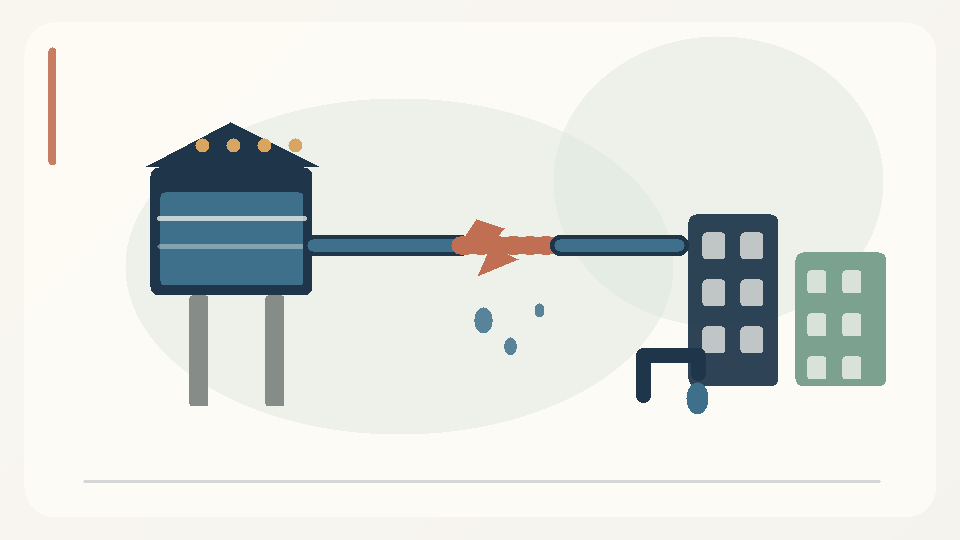
Did you know? A full reservoir is no guarantee of a working tap. Between rainfall and your glass are treatment plants, pumps, pipes, testing laboratories and people whose decisions keep an invisible public service running.
Quick answer: Water systems fail when sources, treatment, distribution, monitoring or maintenance cannot deliver enough safe water reliably. Droughts, floods, leaking pipes, electricity disruptions, pollution and weak investment can interact. The right solution depends on which link is broken.
This guide explains why water systems fail, how shortages differ from unsafe supply, why distribution can be the weak point and what Singapore’s Four National Taps illustrate about planning ahead. Real-world statistics are labelled with their reporting years and sources.
The essential chain is water source → collection and storage → treatment → quality verification → distribution and pressure → safe water received by people. A fault in any part can undermine the outcome.
Choose your reading route
- The quick answer: how a water system breaks
- Water security is a chain of separate promises
- A shortage is not the same as contaminated water
- What safely managed drinking water actually means
- Why drought becomes a problem long before taps run dry
- Too much rainfall can create a different water crisis
- A hidden epidemic of leaking pipes
- Pressure is a service requirement, not a minor technical detail
- When treatment plants become the bottleneck
- Pumps and electricity create a shared vulnerability
- How population growth and industry change demand
- Pricing, maintenance and the cost of underinvestment
- Poor data can make a utility appear healthier than it is
- Case study: Singapore’s Four National Taps
- What Singapore’s approach teaches—and what it does not
- How wastewater and drinking water are connected
- Why rural communities can face different failures
- What water quality monitoring should accomplish
- Why water networks recover slowly after major damage
- How to measure a water system without fooling ourselves
- A fictional city: the reservoir is full, yet taps are dry
- A second scenario: the dangerous shortcut
- What serious repair and resilience look like
- Frequently asked questions
The quick answer: how a water system breaks
Did you know? A city can receive heavy rainfall and still struggle to deliver safe tap water. Rain is a source, not a finished drinking-water service. Water must be collected, stored, treated, tested and transported through a dependable network before it becomes usable in a home, school or hospital.
A water system can fail at any of those steps. Drought can reduce available raw water. Pollution can make a source harder to treat. A damaged pipe can interrupt supply or waste treated water. A treatment malfunction can undermine safety. An electricity outage can stop pumps. A financial or staffing crisis can delay maintenance until ordinary wear becomes a major service problem.
Quick answer: Water systems fail when the combined source, treatment, distribution, monitoring and management arrangements cannot reliably deliver adequate quantities of safe water to the people who need it. An outage, an unsafe supply and long-term water insecurity are related but different failures. To understand the real problem, identify which stage broke, who was affected, how long the failure lasted and whether the drinking water remained safe.
Water security is a chain of separate promises
Imagine following one glass of water backwards. At the tap, the customer needs acceptable pressure, availability and quality. Before the tap comes a network of service pipes, mains, tanks, valves and sometimes pumps. Before the network, a treatment plant must manage the characteristics of the incoming water. Before that, the source itself depends on rainfall, rivers, groundwater, storage, coastal conditions or other inputs.
Each stage makes a promise to the next. A treatment facility may operate perfectly yet receive too little raw water during a prolonged drought. A reservoir may be full yet a neighbourhood receives none because a main has broken. A newly laid pipe may be useless until it is connected, tested and put safely into service.
This is why a water utility cannot judge performance by one figure such as reservoir level or litres treated. It also needs information about water quality, real distribution losses, outages, pressure, maintenance and the actual experience of customers. The system works only when all essential handoffs work together.
A shortage is not the same as contaminated water
Water quantity and water quality are different dimensions of security. A shortage means there is not enough usable water to satisfy relevant demand at the required place and time. Contamination means water contains a hazard or fails an applicable quality requirement. Both can occur together, but one does not prove the other.
For example, a long dry period can lower available freshwater supplies even when the remaining water passes treatment. Conversely, a high-volume river can carry pollution that complicates safe treatment. A household may receive continuous flow without that alone guaranteeing safety. The presence of pressure and the appearance of clarity are not laboratory evidence that drinking water meets health-based standards.
Responsible reporting states whether an official authority has detected a quality problem, a supply interruption or both. If a local authority issues a drinking-water advisory, its specific instructions take precedence over generic online tips. Water-safety decisions require accurate information about the contaminant and the distribution network, not guesses based on colour, taste or social-media rumours.
What safely managed drinking water actually means
The WHO/UNICEF Joint Monitoring Programme defines safely managed drinking water as an improved drinking-water source that is accessible on premises, available when needed and free from faecal and priority chemical contamination. This is a demanding standard because installation, availability and safety must all be considered.
Its 2025 update, reporting through 2024, estimated that 2.1 billion people worldwide lacked safely managed drinking water in 2024. The figure is a global estimate with a specific measurement framework and data period. It does not mean that everyone counted received no water at all; some used basic or limited services, and some relied on unimproved sources.
This distinction matters for policy. Installing a communal standpipe may be a meaningful improvement for a community that previously used an unsafe surface source, but it may not yet meet the full safely managed definition. Progress should be recognised while remaining gaps are measured honestly. A source on a map and a safe glass at the point of use are not automatically the same outcome.
Why drought becomes a problem long before taps run dry
Drought can be meteorological, agricultural or hydrological, depending on what is being measured. Rainfall can fall below expectations, soils can dry and stored surface water or groundwater can decline. These changes interact but do not always occur simultaneously.
A water utility may respond to falling inflows by adjusting operations, managing demand or using alternative sources where available. The vulnerability depends on existing storage, population, consumption, river-basin conditions, treatment capacity and legal or international arrangements for water use. A region with a diversified supply can respond differently from one relying on one reservoir.
The best warning sign is not simply “it has not rained for two weeks.” Managers need time-series data about rainfall, inflows, storage, groundwater where relevant, water quality and forecast uncertainty. Drought preparedness also requires a transparent priority system for critical use. Emergency restrictions should be based on applicable laws and the circumstances, not a universal formula copied from a different region.
Too much rainfall can create a different water crisis
A flood can damage pumps, treatment installations, electrical controls or pipework. Muddy runoff may carry sediment and contaminants into sources. Access roads can become impassable, preventing repair crews from reaching equipment. A city may therefore experience both abundant stormwater and interruptions to safe drinking-water service.
Floodwaters are not automatically safe water. Treatment processes are designed for particular source-water conditions and operating ranges. Extreme turbidity, damaged facilities or unexpected contamination can exceed normal capabilities. Sewage infrastructure may also be affected, creating additional public-health concerns.
Resilience planning needs flood protection for critical facilities, safe operating procedures, alternative power and accessible routes for repairs. Utilities should test how their systems respond to the actual hazards affecting their location. A water network is not made flood-proof by a large source alone; every essential connection from catchment to customer must remain functional or have a workable alternative.
A hidden epidemic of leaking pipes
A pipe can leak below a road for weeks or months before water reaches the surface. Other losses come from reservoir overflows, faults, unauthorised consumption or inaccurate metering. Utilities commonly distinguish physical losses from apparent losses under frameworks for non-revenue water, although the exact accounting methods can vary.
The practical harm of leakage is that treated water, energy and money are used without delivering the intended service. Severe network losses can intensify shortages and increase operating costs. An old network does not automatically fail, but deferred renewal and weak pressure control can leave it increasingly exposed.
Leakage reduction needs credible network maps, flow and pressure information, prompt repair and sensible asset renewal. A programme that installs new pipes without detecting faulty connections or improving maintenance may not deliver expected results. The objective is to reduce avoidable losses while maintaining safe, adequate pressure and reliable service—not merely to publicise the total length of pipe replaced.
Pressure is a service requirement, not a minor technical detail
A tap must have sufficient pressure to provide usable flow. Pressure also affects how distribution networks behave during demand changes, pumping failures or pipe faults. Very high pressure can contribute to leakage and equipment stress; persistently inadequate pressure can prevent water from reaching some users.
Loss of pressure is particularly important because operators may need to assess the risk of contamination entering through defects under particular conditions. The response depends on network design, sanitary barriers and the actual event. No reader should infer that an interruption automatically means contamination, but neither should safety be assumed without the relevant authority’s checks.
Good monitoring helps operators identify unusual pressure patterns and localise faults. Pressure management must be engineered for the specific network so that reducing losses does not deprive high or remote customers of usable supply. The best setting is not always the lowest or highest possible pressure. It is one that supports reliable service, protects equipment and maintains the required safety conditions.
When treatment plants become the bottleneck
Raw water usually needs treatment appropriate to its source and intended use. Treatment may involve combinations of physical separation, filtration, disinfection or other processes, with verification according to the local standards. Source-water quality and treatment technology influence what can be handled safely.
A plant can be limited by equipment failure, inadequate supplies of treatment chemicals, unexpected changes in source conditions, insufficient capacity or loss of electricity. Some failures stop production. Others may require isolating affected water, conducting tests or issuing an advisory according to local procedures.
The solution is not to bypass safeguards just to increase litres produced. Treatment capacity and monitoring exist to protect health. Utilities need preventive maintenance, appropriate reserves, trustworthy laboratory systems and staff trained to respond to abnormal results. Treatment quality should be assessed against applicable standards, and operational decisions belong to qualified water professionals and public-health authorities.
Pumps and electricity create a shared vulnerability
Many water systems rely on electricity to operate pumps, treatment equipment, valves, controls and monitoring instruments. Gravity can move water in some networks, but not every stage can operate without powered equipment. A severe power disruption can therefore interfere with water service even when reservoirs and pipes are physically intact.
Backup power can support resilience, but only if its capacity, fuel or energy supply, switching arrangements, maintenance and service priorities are appropriate. A generator that has never been tested under realistic operating conditions is not a proven continuity plan. Some treatment or distribution operations may require more power than others.
The electrical system and the water system are thus interdependent. For a companion explanation, read Why Power Grids Collapse. A water utility planning for power loss should evaluate which customers and facilities must be protected, and how safety will be verified during interruption and restoration.
How population growth and industry change demand
Water demand changes as populations, housing, commercial activities and industries change. A city can build more supply capacity but still face stress if demand rises faster than source development, treatment capacity or distribution investment. The pattern of use matters as well as the annual total.
A factory may need steady high-quality water for production. Households may concentrate demand around morning and evening routines. Hospitals and other essential facilities require particular reliability. Industrial water reuse or efficiency measures can reduce pressure on potable supplies where technically and legally suitable.
Forecasts should distinguish firm demand from assumptions about future development. Infrastructure has long construction times, so planning must begin before every new customer arrives. At the same time, overbuilding without regard to costs or environmental effects can create new problems. Responsible water planning examines growth, conservation, service quality, uncertainty and fair allocation together.
Pricing, maintenance and the cost of underinvestment
Pipes, treatment plants, laboratories and skilled teams need sustained funding. The initial construction cost is only part of the service’s lifetime cost. Assets require operation, routine inspection, repair and eventual renewal. If financial systems consistently underfund those obligations, deterioration can accumulate out of view.
Water tariffs and public subsidies involve difficult social and economic trade-offs. A utility needs resources to deliver safe service, but water must remain accessible to households with limited ability to pay. Different countries use different combinations of tariffs, transfers and targeted support. No single pricing model is universally correct.
A sound financing framework makes costs transparent, supports maintenance and protects people from unreasonable barriers to essential water. Leaders should be cautious about celebrating low bills achieved by postponing repairs. That saving may be temporary if future customers inherit a fragile network, frequent interruptions and expensive emergency replacement.
Poor data can make a utility appear healthier than it is
A system may report total litres treated and distributed while lacking accurate information about where water is lost or how many households experience interruptions. Some districts may receive excellent service, while others face recurring low pressure or unreliable hours. A national average can hide both.
Metering, flow sensors, pressure readings, water-quality tests, asset records and customer reports each provide different pieces of the picture. None should be treated as infallible. Faulty sensors, missing customer groups and poorly maintained maps can create misleading conclusions.
Useful performance management connects the numbers to action. Can operators locate abnormal losses? Can they confirm that a repaired area has regained safe, adequate supply? Do community complaints reach the team responsible for correction? The aim is not a dashboard full of green symbols. It is a truthful understanding of what is being delivered at the receiving tap.
Case study: Singapore’s Four National Taps
Singapore offers an instructive example of water-supply diversification in a water-stressed setting. The PUB Singapore Water Story identifies four national sources: local catchment water, imported water, NEWater and desalinated water. Each contributes to a portfolio that reduces dependence on one type of source.
Singapore’s Ministry of Sustainability and the Environment explained in its May 2026 update that NEWater and desalination strengthen resilience because they are weather-resilient sources, though their operation still requires infrastructure, energy and careful planning. This is a design response to a specific geography and national context, not a universal formula every country can copy.
The lesson is to identify common-mode risks. Two local reservoirs may both be stressed by drought, while a diversified portfolio can behave differently. But diversification is not magic: treatment facilities, power supplies, distribution networks and operational safeguards still need attention. Water security is created by the complete working system, not merely by listing several sources.
What Singapore’s approach teaches—and what it does not
The Four National Taps show how long-term policy can connect source planning, engineering, research, reuse and conservation. However, a reader should not conclude that a water system is invulnerable because it has four named inputs. All inputs require treatment or production capacity, monitoring and delivery to users.
The National Climate Change Secretariat’s July 2026 overview describes rainfall variability and the role of weather-resilient sources. The document illustrates why utilities consider climate risks when planning investment, not merely when a dry period is already underway.
The transferable principle is to match supply strategies to the actual constraint. A large inland country with extensive river basins may have very different options from an island city. It should still ask the same questions: Which sources are reliable under different shocks? What shared dependencies remain? Can demand be managed? Can every critical user receive safely treated water after one source becomes unavailable?
How wastewater and drinking water are connected
Drinking-water supply and wastewater services are linked through the larger water cycle. Once water is used, collection and treatment systems need to protect health and the environment. Unreliable sanitation can contaminate local water sources, increasing the difficulty of producing safe drinking water.
Reclaimed water may support particular industrial uses or other purposes depending on how it is treated, tested and regulated. In some advanced systems, highly treated reclaimed water becomes an important supply component. Such projects require engineering, monitoring, public communication and compliance with the relevant quality standards.
The important lesson is that moving used water away from a building is not the same as managing it safely. Sewer networks, treatment plants, discharge controls and where appropriate water reuse must be considered alongside source protection. A water system may fail indirectly because its sanitation counterpart is weak. The correct unit of analysis is often the entire water cycle, not a single treatment building.
Why rural communities can face different failures
A small community may depend on a borehole, a local distribution scheme or water collected from more distant sources. The challenges can include long travel distances, inadequate maintenance capacity, weak repair supply chains and limited access to testing. The risk profile can be very different from that of a large metropolitan network.
A newly installed pump can provide major benefits, but reliable service depends on spare parts, trained operators, an appropriate financing model and safe water quality. A project that announces completion at installation may leave the community vulnerable when the first breakdown occurs months later.
Community participation can help reveal practical issues such as access times, affordability, accessibility for people with disabilities and who is responsible for maintenance. Effective policy should not assume every small settlement needs the same large urban infrastructure. It should require the same seriousness about safe, usable water and measured outcomes.
What water quality monitoring should accomplish
Safe water management requires appropriate sampling, testing and operational controls. Monitoring can identify contamination risks, treatment weaknesses or unusual changes that warrant investigation. Results need correct interpretation because a single sample reflects a particular place, time and measurement.
A laboratory result should trigger a clear response when needed, including investigation, corrective action, further verification and communication through the responsible authority. Hiding a problem to protect a utility’s reputation can allow harm to continue. Public messaging also needs precision: announcing a concern without explaining its scope or what residents should do may create unnecessary confusion.
Do not rely on the idea that all water hazards can be detected through sight, smell or boiling. Different contaminants require different responses. When an official advisory is issued, follow the instructions for that specific incident. Responsible guidance prioritises qualified testing and verified advice over universal household remedies copied from another context.
Why water networks recover slowly after major damage
A major water-main break may look like an ordinary hole in a road. Yet recovery can require isolating the correct section, coordinating traffic and other buried utilities, obtaining parts, repairing the pipe, restoring suitable pressure and verifying water quality before normal service can safely resume.
If several neighbouring districts rely on the affected main, operators may need temporary distribution arrangements or staged restoration. A plant may resume producing water while the repaired network still requires checking. Consequently, “the pipe has been fixed” and “safe service has reached every household” are not identical statements.
Good recovery communication identifies affected areas, expected actions by residents according to official guidance, and the evidence needed to declare restoration. After the emergency, the utility should examine whether inspection, maintenance, network configuration or contingency planning could reduce future interruptions. Reopening a valve is not the final measure of success; reliable delivery is.
How to measure a water system without fooling ourselves
A good scorecard combines availability, continuity, water quality, adequate pressure, accessibility, non-revenue water, outage duration and fair service across communities. It also looks at maintenance and financial sustainability so current performance is not achieved by quietly spending tomorrow’s repair budget.
Measures need definitions. “Connected to the network” does not necessarily mean water is available continuously or safe at the point of use. Average hours of service can obscure neighbourhoods with recurring long interruptions. A falling rate of reported complaints may reflect improvement—or reduced ability to report problems.
Independent checks and receiver-level evidence can close these gaps. Regulators and utilities should investigate discrepancies rather than explain them away. A trustworthy water system can show not only that pipes and plants exist, but that people receive appropriate water under normal and stressed conditions.
A fictional city: the reservoir is full, yet taps are dry
Imagine a fictional city with a full reservoir and sufficient treatment capacity. It has delayed pipe renewal for fifteen years, however, and much of its distribution system is now prone to leakage. Pump maintenance is incomplete, and some pressure records are missing.
Demand rises during a hot period. A major main fails, and the utility must close sections of the system. Several districts lose supply. The initial news report focuses on the dramatic burst pipe, but the underlying weakness is the network’s accumulated maintenance and information gap.
The right investigation looks beyond reservoir volume. It asks how much treated water reached users, whether the fault could have been detected earlier, which alternatives existed and how restoration was verified. This example is invented; it illustrates why supply quantity and delivery reliability must be evaluated together. The correct repair might involve asset renewal, monitoring and operational reform, not construction of another reservoir.
A second scenario: the dangerous shortcut
Consider a second fictional utility facing a shortage of treatment supplies. Some managers suggest sending water directly from an available source to customers because demand is urgent. The proposal appears to solve a quantity problem by removing a quality safeguard.
The danger is obvious once the chain is separated: a larger volume of inadequately treated water is not equivalent to more safe drinking water. The proper response belongs to qualified operators and health authorities using documented emergency procedures and applicable legal standards.
A resilient system plans ahead for critical treatment inputs, maintenance, testing and public communication. It also recognises when supply must be limited rather than presented as safe without evidence. Operational pressure should not be allowed to redefine the purpose of the service. Success is access to water that is both available and suitable for its intended use.
What serious repair and resilience look like
First, diagnose the actual constraint: source scarcity, treatment capacity, network loss, power dependence, pollution, finances or exclusion. Stabilise essential needs under the relevant emergency plan. Then repair the failed link while identifying weaknesses likely to cause another interruption.
Longer-term work may include improved source protection, diversified supply, appropriate storage, pipe renewal, pressure management, treatment upgrades, better testing, trained teams and transparent financing. No utility needs every possible project at once. The priority is the combination that protects people most effectively under its real risks.
Finally, verify results at the household or facility. Did safe water return? Did losses fall? Were previously underserved communities reached? Can the system handle the next realistic shock without repeating the same breakdown? The ideal outcome is not a dramatic rescue story. It is a dependable ordinary day when safe water arrives and the responsible institutions can explain why it should keep arriving.
Frequently asked questions
Why do water systems fail when there is plenty of rain?
Rainfall alone does not create treated water at a tap. Storage, treatment, pumps and distribution networks must all work. Floods may damage facilities or change raw-water quality despite abundant rainfall.
Is a water shortage the same as contaminated water?
No. Shortage concerns sufficient quantity at the right place and time. Contamination concerns water quality. Both can occur together, and officials need to describe each separately.
What is non-revenue water?
It commonly refers to water entering a distribution system that does not produce billed revenue, including physical losses, some apparent losses and authorised unbilled use. Accounting frameworks vary; it is not identical to leaks alone.
Can a broken pipe make tap water unsafe?
Certain distribution faults and pressure conditions can create contamination risks. The outcome depends on the network, safeguards and event. Follow local utility or public-health advisories rather than assuming every pipe break has the same effect.
Why can drought affect a city with reservoirs?
Reservoirs have finite storage and depend on inflows and operating rules. Prolonged dry conditions or rising demand can reduce their ability to meet needs. Other supply sources and demand management can improve resilience where available.
What are Singapore’s Four National Taps?
PUB identifies local catchment water, imported water, NEWater and desalinated water. The diversified portfolio is designed to strengthen supply resilience, alongside conservation and long-term infrastructure planning.
Does desalination solve all water problems?
No. Desalination can provide a source less dependent on rainfall, but it requires energy, infrastructure, operation, water-quality controls and distribution. Its feasibility and costs vary by location.
Why is water pressure important?
Adequate pressure helps deliver water to customers. Pressure conditions can also affect leaks, equipment and some contamination risks. Utilities manage pressure according to the specific network and safety requirements.
What is safely managed drinking water?
The WHO/UNICEF JMP definition requires an improved source on premises, available when needed and free from faecal and priority chemical contamination. Having a nearby source does not automatically meet every part of the definition.
Can utilities fix water systems simply by building more plants?
Only if production capacity is the binding constraint. A network losing large quantities through damaged pipes or lacking reliable power may need different repairs first.
What should residents do after an official water-quality warning?
Follow the instructions and updates issued by the local water utility or public-health authority for that specific incident. Different hazards require different responses; generic online treatment tips may be unsuitable.
What is the best lesson for students?
Trace water from its source to a real user. At each handoff ask what resource, information or safeguard is essential. A system succeeds only when usable, safe water reaches the intended receiver.
Primary sources and further reading
See the WHO/UNICEF Joint Monitoring Programme 2025 update for drinking-water, sanitation and hygiene statistics through 2024, and UN Sustainable Development Goal 6 for global service and water-resource indicators. For Singapore’s water strategy, consult PUB’s Singapore Water Story, the Ministry of Sustainability and the Environment’s 2026 water overview and the National Climate Change Secretariat’s 2026 adaptation overview. The data have different dates and should not be treated as one current global count.
Explore connected systems: Why Power Grids Collapse | Cascading Failures, Blackouts and Recovery; Why Healthcare Systems Fail | Capacity, Access and Patient Safety; Why Ecosystems Collapse | Biodiversity Loss, Tipping Points and Recovery; Why Countries Fail | Institutions, Trust and State Capacity.
Final thought: Water security is not how much water looks available from far away. It is whether clean, safe and reliable water reaches the next person who turns on the tap—and whether the system can keep that promise under stress.