
Small Group Tutorials
Here to help students catch up, keep up, and move ahead. Book a consultation here.
Project Type: PSLE Mathematics Tuition
-
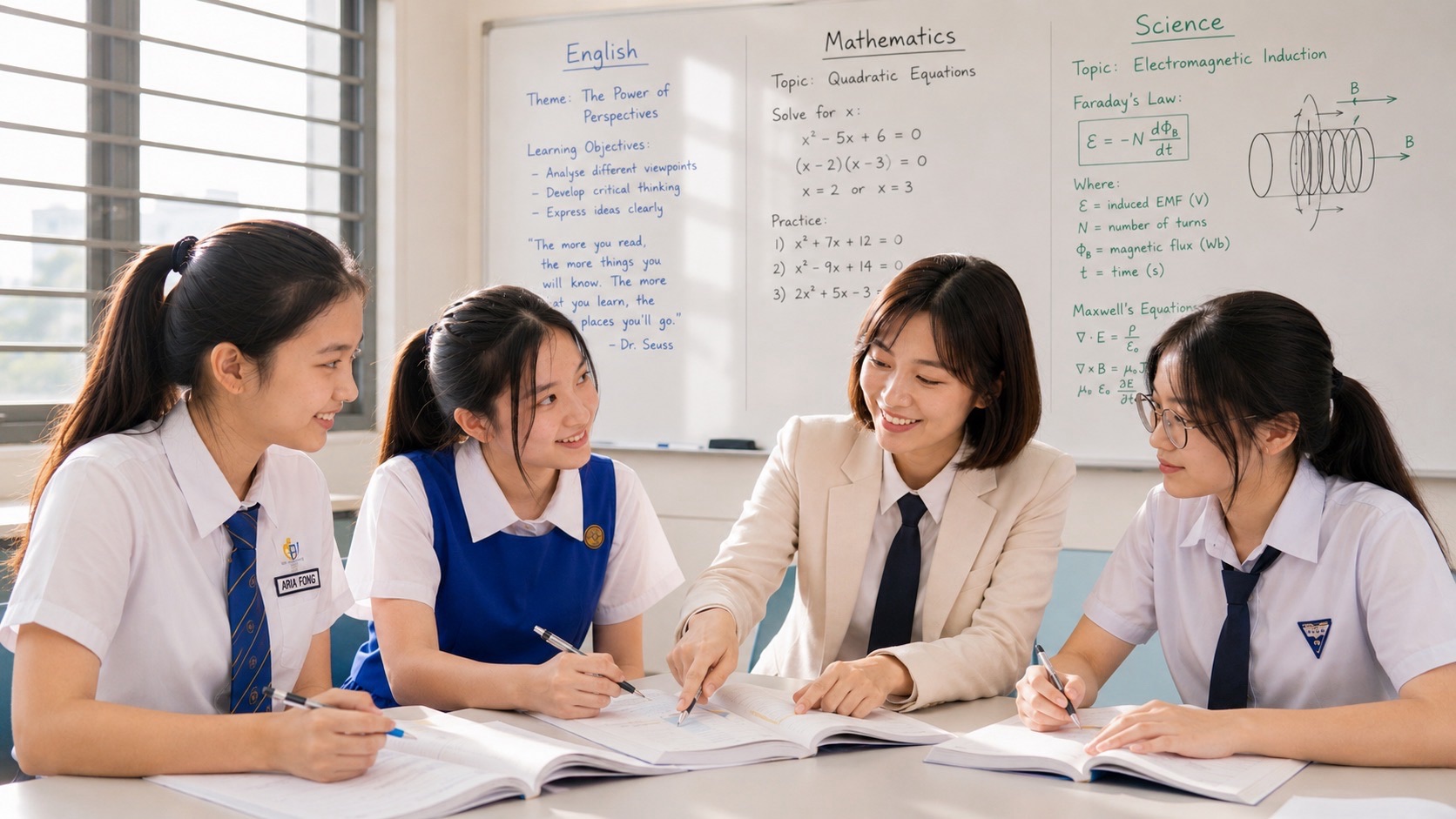
When to Start Mathematics Tuition for Your Child in Clementi
Parents in Clementi may consider Mathematics tuition for their child when they repeatedly struggle with concepts, require excessive help, or are facing significant transitions. It’s crucial to evaluate whether difficulties are temporary or persistent and to assess the student’s independence in addressing mistakes. Tuition should facilitate understanding without fostering dependency.
-

Why Small-Group Mathematics Tuition in Clementi Works | eduKateSG
Focused 3-pax Mathematics tuition benefits Clementi students by enabling precise correction, strong explanations, and enhanced independent practice. This small group setting allows tutors to closely monitor each student’s unique learning processes, ensuring effective diagnosis of misunderstandings. Ultimately, it fosters independent thinking while maintaining necessary support for mathematical skill development.
-

How PSLE Mathematics Works | The Full Examination Preparation Tutorial
6 Reader Articles + 1 Full Code Stack Stack Purpose This article stack explains PSLE Mathematics not as “just another exam”, but as a thinking system. PSLE Mathematics is not only testing whether a child remembers formulas. It tests whether the child can read a problem, understand what is being asked, choose the correct method,…
-

Primary 6 Mathematics Tuition | From PSLE to Secondary 1 Mathematics
Primary 6 Mathematics tuition is essential for preparing students for both the PSLE and the challenges of Secondary 1. It focuses not only on performance in primary assessments but also on building a strong foundation in algebra, geometry, and reasoning, ensuring students are ready for more abstract mathematical concepts in secondary school.
-

Primary 6 Mathematics | Paper 2 Is the Thinking Paper
The article outlines the complexities of Primary 6 Mathematics Paper 2 in the PSLE, focusing on the need for deep comprehension, structured problem-solving, and emotional control. It emphasizes the importance of careful reading, identifying question structures, and clear working methods to enhance student performance in multi-step problems.
-

Primary 6 Mathematics Tuition | The PSLE Year and the Final Primary Floor
Primary 6 Mathematics is a crucial consolidation year leading to the PSLE, where students integrate various math concepts under exam pressure. Effective tuition focuses on diagnosing weaknesses, emphasizing high-impact topics, and preparing students for both the PSLE and Secondary 1, while nurturing problem-solving skills and confidence.
-

Primary 6 Mathematics Tuition | The PSLE Going All In Now
Primary 6 Mathematics is a crucial year where students must integrate six years of learning under exam pressure. It involves not only knowledge acquisition but also application across topics like fractions and algebra. Effective tuition addresses weaknesses, develops exam strategies, and fosters confidence, making preparation structured and purposeful for the PSLE.
-

Fractions, Decimals, Percentages and Ratio: The Four Gates of Upper Primary Mathematics
eduKate Punggol offers Primary Mathematics Tuition focused on helping P4 to P6 students master crucial concepts such as fractions, decimals, percentages, and ratios, essential for performing well in PSLE. The program emphasizes understanding relationships among these topics, repairing weak foundations, and using model drawing to enhance problem-solving skills and confidence.
-

Punggol Primary Mathematics Tuition: How Primary Math Really Works from P1 to PSLE
eduKate Punggol offers Primary Mathematics tuition for P1 to P6 students to enhance foundational skills, word problem-solving, and exam confidence through personalized, small-group tutorials. The program diagnoses individual needs, strengthens concepts, and equips students for PSLE preparation by emphasizing clarity, strategy, and error analysis to foster independent, calm learners.
-

Punggol PSLE Mathematics Tuition | The Examination Engine
eduKate Punggol aims to prepare Primary 6 students for PSLE Mathematics by emphasizing understanding through interconnected topics rather than isolated learning. The program focuses on building a comprehensive mathematical “engine,” enhancing problem-solving skills, managing exam pressure, and fostering confidence, ensuring students recognize and effectively apply their knowledge during exams.
-

Punggol Tuition for Mathematics
Punggol Tuition for Mathematics focuses on helping students identify foundational problems, connect PSLE results to secondary pathways, and understand mathematical concepts beyond mere worksheets. At eduKate Punggol, personalized support in small-group settings aims to build confidence, reinforce weak areas, and facilitate smooth transitions from primary to secondary mathematics for improved academic performance.
PSLE Mathematics Tuition by eduKateSG helps students strengthen Mathematics across the full Primary-to-Secondary terrain, where Primary 5 foundations, Primary 6 examination preparation, PSLE performance, Secondary 1 readiness and future subject-level pathways must be understood as one connected learning journey.
PSLE Mathematics is not simply a final primary school examination. It is a connector year. It closes the Primary School Mathematics journey while opening the next corridor into Secondary School Mathematics, Posting Groups, subject levels, future confidence and long-term learning readiness. A student’s performance in Mathematics does not only affect one examination result. It also affects how confidently the student enters Secondary 1, handles algebra, manages word problems, reads questions, understands abstract thinking and continues climbing the capability ladder.
This project explains PSLE Mathematics Tuition as a structured terrain-navigation system for helping students fly safely through the PSLE year. Many students struggle in PSLE Mathematics not because they lack intelligence, but because the terrain becomes larger, faster and more connected. A question may combine fractions, ratio, percentage and comparison. A geometry problem may require visualisation, angle reasoning and area control. A speed question may require careful reading, unit awareness and rate thinking. A pattern question may require students to see structure instead of just calculating numbers. A word problem may look like English first, but underneath it is a mathematical route that must be decoded correctly.
eduKateSG’s PSLE Mathematics Tuition supports students by strengthening the full Mathematics flight chain: concept recall, question reading, method selection, working accuracy, model drawing, heuristic choice, visual reasoning, ratio control, fraction fluency, percentage thinking, speed and rate understanding, geometry mapping, data interpretation, calculator discipline, non-calculator fluency, time management, error detection and examination repair. The aim is not only to complete more worksheets, but to help students understand how Mathematics works as a connected terrain.
The project also helps parents and students understand why Primary 5 and Primary 6 should be treated together. Primary 5 is where the PSLE terrain begins to rise. Primary 6 is where the terrain becomes time-sensitive. Students who did well in Primary 5 must maintain high-level flight instead of relaxing too early. Students who dropped in Primary 5 or early Primary 6 must reverse the fall before prelims and PSLE pressure compress the year. Students who are already strong must climb further into higher-level problem-solving, accuracy, speed and examination control.
PSLE Mathematics Tuition by eduKateSG focuses on three main learning modes: reversing drops, maintaining flight and moving to better grades.
Reversing drops means identifying where the fall began. A child may not be weak in all of Mathematics. The problem may be fractions, ratio, percentage, speed, geometry, model drawing, careless computation, weak question reading, slow working, poor checking or panic under time pressure. Once the real source of the drop is found, the route can be repaired.
Maintaining flight means helping students who are already doing reasonably well stay stable throughout the PSLE year. These students must protect consistency, avoid careless marks lost, strengthen stamina, practise mixed-topic questions, improve time control and stay calm when the question looks unfamiliar. The goal is to keep the flight smooth from school revision to prelims and through the final PSLE papers.
Moving to better grades means helping students climb the capability ladder. These students must move from knowing methods to choosing methods, from doing familiar questions to handling unfamiliar questions, from memorising steps to seeing structure, from slow accuracy to controlled speed, and from exam fear to examination command. The higher the target, the more Mathematics must become a system of recognition, reasoning, checking and repair.
This branch studies PSLE Mathematics through curriculum, problem-solving, heuristics, model methods, fractions, decimals, ratio, percentage, speed, rate, geometry, measurement, area, volume, angles, data, patterns, algebraic thinking, calculator use, non-calculator skills, time management, prelim preparation, PSLE strategy, learning diagnostics, error repair and Secondary 1 readiness. It is designed for students, parents and educators who want to understand how PSLE Mathematics works, why it matters, and how tuition can support the full journey from Primary School into Secondary School.
The PSLE year has a special rhythm. January to March shows whether Primary 5 foundations are stable. March to May is the first major repair window. The June holidays become a critical consolidation period. Prelims test whether the student can perform under school examination pressure. August and September become the national examination runway, where students must manage English oral, listening comprehension, revision schedules, fatigue, school expectations, family pressure and written papers. By then, Mathematics should not be starting from scratch. It should be entering controlled flight.
This is why eduKateSG treats PSLE Mathematics as full terrain flight navigation. A student cannot only look at the next worksheet. The student must understand the landscape. Where did the topic come from? Which topics connect to it? Which question types hide inside it? Which errors repeat? Which methods open the route? Which traps close the route? Which skills will still matter in Secondary 1? Which weaknesses must be repaired before they become bigger secondary school problems?
In Mathematics, terrain matters because topics are connected. Fractions connect to ratio. Ratio connects to percentage. Percentage connects to rate, comparison and change. Speed connects to time, distance, units and proportional reasoning. Geometry connects to visual thinking, angle rules and spatial control. Area and volume connect to measurement and precision. Patterns connect to algebraic thinking. Word problems connect to English comprehension. Working steps connect to discipline. Checking connects to survival under pressure.
This is the Mathematics version of route awareness. Students must learn not only what to do, but where they are in the problem. A PSLE question is like a terrain map. The numbers, units, diagrams, words, comparison phrases, conditions and hidden relationships are all signals. A strong student learns to read these signals before rushing into calculation. The question is not asking the student to move blindly. It is asking the student to find the correct route.
PSLE Mathematics Tuition by eduKateSG therefore helps students see Mathematics as a navigable landscape. Some questions are direct roads. Some are slopes. Some are detours. Some are traps. Some require students to reverse from the answer. Some require drawing a model. Some require comparison. Some require testing cases. Some require cutting a shape. Some require recognising that the visible numbers are not the important structure. Good tuition teaches students to fly over the terrain, see the map and choose the safest route.
This terrain also connects directly to Secondary 1. Secondary Mathematics is not merely PSLE Mathematics with bigger numbers. The thinking system changes. Students meet more algebra, more symbolic reasoning, more abstraction, more formal working, more topic layering and more expectation that they can move from arithmetic into structure. A child who leaves Primary 6 only knowing memorised procedures may feel shocked when Secondary 1 Mathematics becomes more symbolic. A child who leaves Primary 6 understanding structure, comparison, variables, patterns, units and working discipline has a stronger runway.
Under Singapore’s PSLE-to-Secondary pathway, Mathematics also affects future subject readiness. Students move from PSLE into secondary school posting, subject levels and later academic pathways. This makes Mathematics a corridor subject. A strong Mathematics foundation can help keep future options open. A weak Mathematics foundation can create drag when the student enters Secondary 1 and faces new demands. eduKateSG’s mission is to help families see this earlier, before the child is already struggling in the next terrain.
The deeper goal is not only a score. The deeper goal is capability. A strong PSLE Mathematics student should be able to read a question carefully, identify the quantities, understand the relationship, choose a method, write clearly, check units, avoid traps, manage time and recover from errors. This capability carries into Secondary School, where the student must handle more abstract questions, heavier workload and faster teaching pace.
For students who are falling, PSLE Mathematics Tuition must reduce drag. The child may be carrying weak foundations, repeated careless habits, slow calculation, poor stamina or fear of hard questions. These problems pull the flight down. Good tuition identifies the drag and repairs it. The student does not need blind panic. The student needs diagnosis, correction and a cleaner route.
For students who are stable, PSLE Mathematics Tuition must maintain flight. These students need enough practice to stay sharp, enough challenge to grow, enough correction to avoid complacency and enough rest to avoid burnout. Maintaining flight is not passive. It requires control, rhythm, pacing and regular checking.
For students who are ready to climb, PSLE Mathematics Tuition must increase capability. These students need harder questions, mixed-topic reasoning, time pressure, alternative methods, explanation depth and post-paper analysis. They must learn to think like problem-solvers, not only answer-producers. The strongest students do not simply calculate faster. They see the terrain earlier.
This is why eduKateSG’s PSLE Mathematics Tuition connects education, examination and future readiness together. Mathematics is not taught as isolated chapters. It is taught as movement through a landscape. Each topic is a terrain feature. Each mistake is a signal. Each paper is a flight test. Each correction is a route repair. Each stronger method is a better engine. Each clearer explanation is a safer landing.
In the age of AI, data, technology and complex decision-making, Mathematics is also becoming more important as a thinking language. Students who understand Mathematics clearly can read patterns, compare quantities, test assumptions, interpret data, detect unreasonable answers and solve problems with more confidence. This matters for school, but it also matters for future learning, finance, science, engineering, coding, decision-making and everyday adulthood.
PSLE Mathematics Tuition by eduKateSG teaches Mathematics as a system for terrain reading, route repair, high-level flight, examination readiness, Secondary 1 preparation and future confidence. It helps students move from Primary 5 foundations into PSLE-ready Primary 6 Mathematics, and from PSLE Mathematics into Secondary School readiness, where concepts, methods, reasoning, speed, accuracy, stamina and judgement work together to support stronger long-term learning.