
Small Group Tutorials
Here to help students catch up, keep up, and move ahead. Book a consultation here.
Project Type: Secondary 1 Mathematics Tuition
-
Secondary 1 G3 Mathematics Tutor Bukit Timah | Retrieval Practice, Spacing and Mixed Maths Revision
Sec 1 G3 Mathematics revision that lasts: retrieval, spaced practice, mixed topic questions and a two-week family study timetable for Bukit Timah.
-
Secondary 1 G3 Mathematics Tutor Bukit Timah | Maths Assessment Time Management and Question Order
Sec 1 G3 Mathematics assessment time management: choose question order, show efficient working, review errors and practise a timed mixed set.
-

Secondary 1 G3 Mathematics Tuition Redhill | What happens in SEC G3 Mathematics Tutorials
Secondary 1 G3 Mathematics tuition Redhill: the Primary 6 transition into algebra, fractions and equations. Three-pupil tutorials, original worked problems and first-error diagnosis.
-
Secondary 1 G3 Mathematics Tuition Tiong Bahru | What happens in SEC G3 Mathematics Tutorials
Secondary 1 G3 Mathematics tuition Tiong Bahru: from PSLE arithmetic to Secondary 1 algebra. Three-pupil small-group tutorials, ten original worked Maths clinics and first-error diagnosis.
-
Secondary 1 G3 Mathematics Tuition Outram | What happens in SEC G3 Mathematics Tutorials
Secondary 1 G3 Mathematics tuition Outram: PSLE-to-secondary algebra and number foundations. Three-pupil tutorials, original worked problems and first-error diagnosis.
-

Secondary 1 G3 Mathematics Tuition Tanjong Pagar | What happens in SEC G3 Mathematics Tutorials
Secondary 1 G3 Mathematics tuition for Tanjong Pagar families: PSLE-to-secondary algebra, fractions and equation balance. Three-pupil tutorials, original worked questions, first-error diagnosis and examination-year guidance.
-

Secondary 1 G1 Mathematics Tutor Bukit Timah | Misleading Graphs: How Axis Scales Change the Story
Did you know? Bars showing 92 and 98 can appear four times different when the axis begins at 90. Learn why graph scales and keys matter.
-
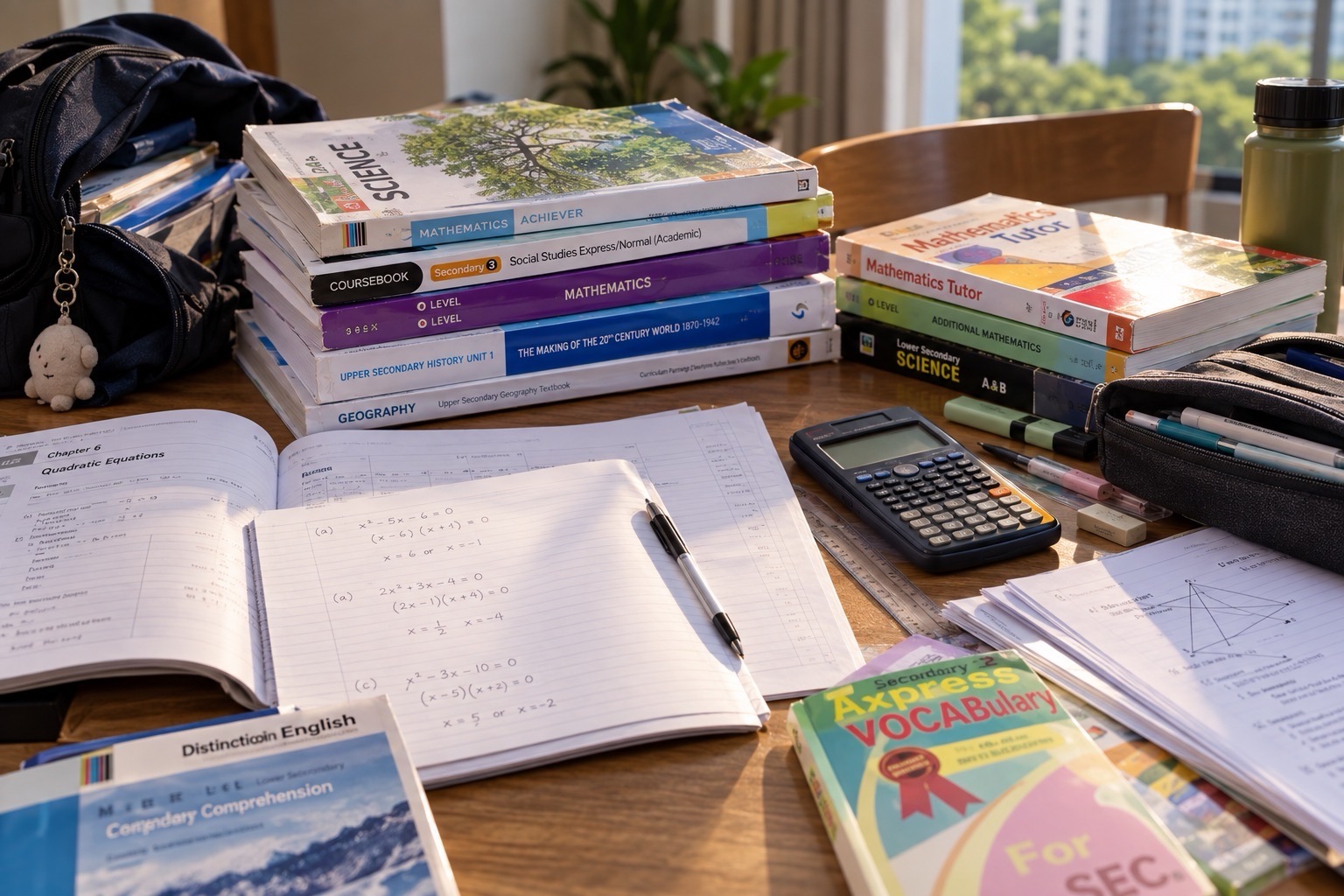
Secondary 1 G3 Mathematics Tutor Bukit Timah | Maths Command Words: Simplify, Solve, Evaluate and Factorise
Sec 1 G3 Mathematics command words for Bukit Timah: simplify, solve, expand, factorise, evaluate, estimate, explain and 20 practice questions.
-
Secondary 1 G1 Mathematics Tutor Bukit Timah | Not Drawn to Scale: Trust the Angle Facts, Not the Picture
Did you know? A geometry corner can look like 90 degrees without being given as 90 degrees. Learn to trust angle facts and markings.
-

Secondary 1 G3 Mathematics Tutor Bukit Timah | Showing Working, Method Marks and Mathematical Reasons
Sec 1 G3 Mathematics working methods: algebraic solutions, angle reasons, ratios, speed, percentages and how to present correct steps for Bukit Timah learners.
-

Secondary 1 G3 Mathematics Tutor Bukit Timah | 2027 MOE Topic Map and Learning Prerequisites
2027 Sec 1 G3 Mathematics planning map for Bukit Timah: all ten MOE topic headings, prerequisites, examples, Full SBB and revision priorities.
-
Secondary 1 G1 Mathematics Tutor Bukit Timah | Number Patterns That Fool You: Test the Rule
Did you know? Four numbers may suggest a rule but do not prove it forever. Learn to test G1 number patterns, nth terms and position tables.
Secondary 1 Mathematics Tuition by eduKateSG helps students make the important transition from Primary School Mathematics into Secondary School Mathematics with stronger number sense, algebra, geometry, measurement, statistics, probability, problem-solving, reasoning and mathematical communication skills.
Secondary 1 Mathematics is not simply “harder Primary 6 Mathematics.” It is the year where Mathematics begins to change from arithmetic and familiar problem types into a more structured symbolic language. Students are expected to work with negative numbers, algebraic expressions, equations, ratios, percentages, rates, speed, graphs, angles, mensuration, data handling and early mathematical reasoning with greater independence and accuracy.
This project explains Secondary 1 Mathematics Tuition as a structured learning system for helping students build route-ready mathematical foundations before the pressure of Secondary 2 subject-level decisions, upper-secondary subject combinations and future SEC examination pathways. Many students struggle in Secondary 1 not because they cannot do Mathematics, but because they have not yet learnt how secondary Mathematics is organised. A question may look familiar but require a new method. A number pattern may require algebraic thinking. A word problem may require translation into symbols. A geometry question may require proper reasoning. A graph may require students to connect visual information with equations and relationships.
eduKateSG’s Secondary 1 Mathematics Tuition supports students by strengthening the full Mathematics learning chain: reading the question, identifying the topic, selecting the method, showing working clearly, checking accuracy, explaining reasoning, detecting errors and repairing weak foundations before they become repeated habits. This includes number work, integers, rational numbers, ratio, percentage, rate, speed, algebraic expressions, equations, functions, linear graphs, number patterns, angles, geometry, mensuration, statistics, probability and problem-solving in real-world contexts.
The project also helps parents and students understand why Secondary 1 Mathematics is such an important turning point. At this level, students must move beyond primary-school memorisation and routine methods. They need to learn how to reason, represent, model, communicate, justify and connect mathematical ideas across topics. These skills are important not only for Mathematics examinations, but also for Science, Computing, Design and Technology, Economics, Engineering, data-related learning, AI tools, financial literacy and real-world decision-making.
Secondary 1 Mathematics Tuition by eduKateSG focuses on building controlled Mathematics, not just completed worksheets. Students learn how to read the right information, choose the right operation, form the right equation, draw the right diagram, label the right units, show the right working, check the right answer and repair weak steps before they become larger errors. The aim is to help students become clearer, more confident and more independent mathematical thinkers.
This branch studies Secondary 1 Mathematics through curriculum, number sense, algebra, geometry, measurement, statistics, probability, graphs, equations, problem-solving, mathematical communication, examination skills, learning diagnostics, Full Subject-Based Banding awareness and future pathway readiness. It is designed for students, parents and educators who want to understand how Secondary 1 Mathematics works, why it matters, and how tuition can support the transition into secondary school mathematical demands.
Secondary 1 is also the year where students begin learning inside Singapore’s Full Subject-Based Banding landscape. Students are no longer simply placed into the old Express, Normal Academic or Normal Technical streams. Instead, students enter secondary school through Posting Groups and may offer subjects at G1, G2 or G3 levels according to their strengths, needs and school assessment. Mathematics therefore becomes an important subject-level signal. A student who is strong in Mathematics may be able to access a more demanding level. A student who is struggling may need early repair before the gap becomes harder to close.
This is why Secondary 1 Mathematics must be treated as a foundation corridor. It is still early enough to repair weak PSLE habits, but important enough to affect future route choices. A weak algebra foundation in Secondary 1 can affect Secondary 2 Mathematics. A weak Secondary 2 foundation can affect Secondary 3 E-Math, A-Math eligibility and upper-secondary confidence. A weak upper-secondary Mathematics route can affect Secondary 4 SEC performance, post-secondary options, Polytechnic courses, JC readiness and future STEM-related pathways.
Secondary 2 is often the route-selection pressure year because students move closer to upper-secondary subject combinations and future SEC examination preparation. This means Secondary 1 should not be treated casually. It is the year to build the floor before the corridor narrows. Students who build strong Secondary 1 Mathematics foundations give themselves more flexibility later. Students who delay repair may find that Secondary 2 becomes a struggle not because the topics are impossible, but because earlier number, algebra, geometry and problem-solving habits were never stabilised.
In the future SEC pathway, students may sit Mathematics at G1, G2 or G3 levels. Each level still requires students to use Mathematics meaningfully, but the depth, pace, abstraction and examination demand will differ. Students aiming for stronger JC, Polytechnic, Additional Mathematics, Science, Computing, Engineering, Business, data or technical routes benefit from keeping their Mathematics corridor as strong as possible from Secondary 1. Mathematics is not only a subject score. It is a route subject because it affects what students can access later.
Secondary 1 Mathematics Tuition by eduKateSG also protects students from the “Musical Chair” problem in education. When questions evolve, students who only memorise repeated centre-safe methods may lose their seat when the question changes shape. Mathematics rewards students who can recognise structure, transfer methods and stay calm when the problem is unfamiliar. Good tuition helps students close the musical chairs by increasing understanding, exposure, confidence and route flexibility.
The Secondary 1 student must also learn that Mathematics is a language. Numbers, symbols, graphs, diagrams, equations and units all send meaning. A careless sign changes the answer. A missing bracket changes the expression. A wrong unit changes the result. A weak diagram hides the structure. A poor explanation loses marks even when the idea is partly correct. Strong Mathematics is not only about getting an answer. It is about making the method clear, reliable and readable.
eduKateSG’s Secondary 1 Mathematics Tuition therefore trains both technique and reasoning. Students learn standard methods, but they also learn why the method works. They learn to calculate, simplify, expand, factorise, solve, substitute, estimate, draw, measure, interpret, compare, model and explain. They also learn to ask better mathematical questions: What is given? What is unknown? Which topic is hidden here? What relationship connects the quantities? What operation is safe? What mistake is likely? Does the answer make sense?
In the age of AI, computing and digital learning, Mathematics is also becoming more important as a structure language. Students who understand Mathematics more clearly can read patterns, compare information, interpret charts, question data, understand rates of change, evaluate risk, use calculators and technology more responsibly, and think in a more organised way. This matters for school, but it also matters for future work, finance, science, technology and everyday decision-making.
Secondary 1 Mathematics Tuition by eduKateSG teaches Mathematics as a system for structure, reasoning, precision, problem-solving, communication, repair and future readiness. It helps students move from Primary School Mathematics into foundation-ready Secondary 1 Mathematics, where number sense, algebra, geometry, measurement, statistics, probability, graphs, working discipline and mathematical judgement work together to support school success, SEC readiness and stronger future pathways.