
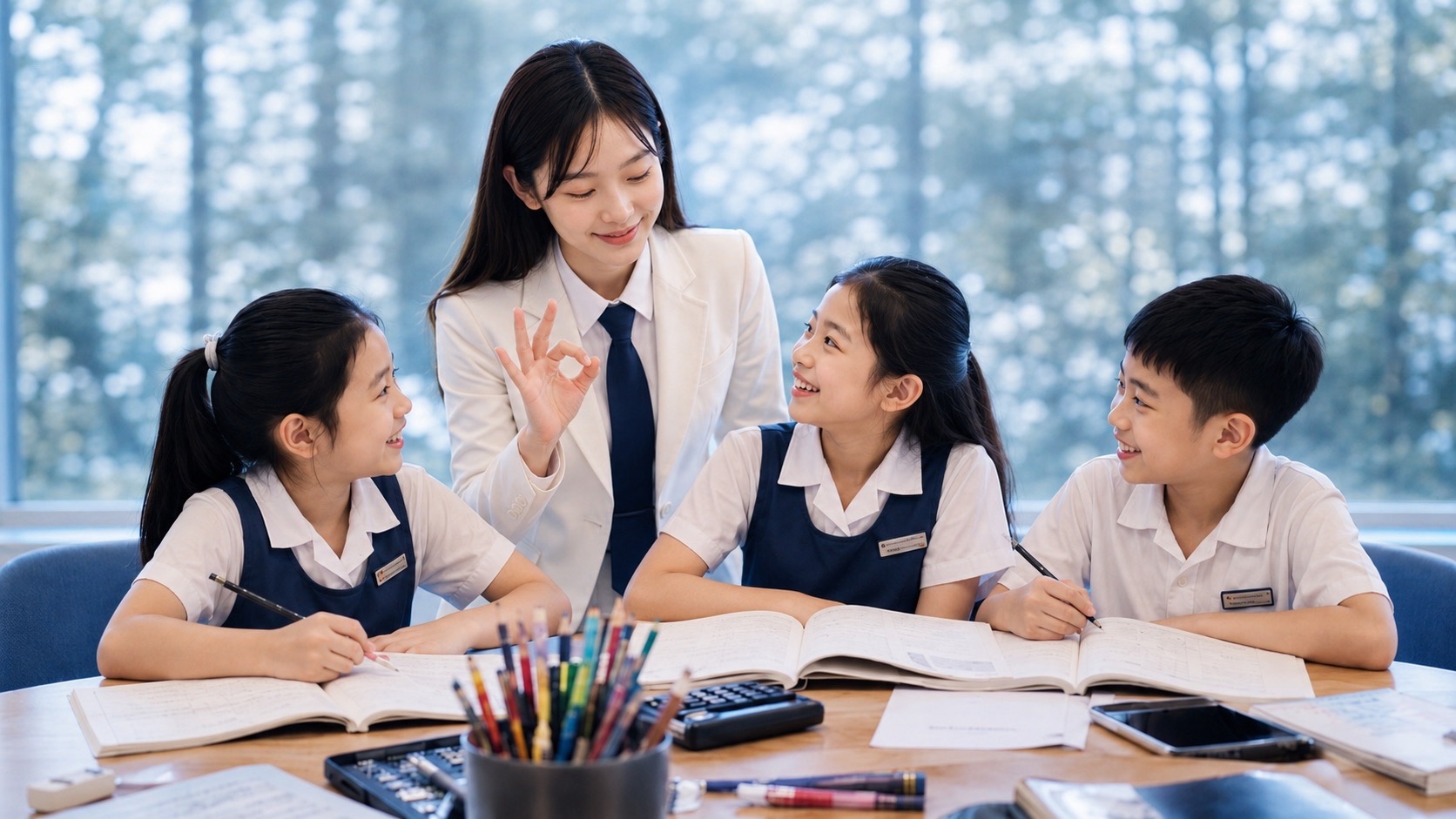
Punggol Primary 6 English Oral Skills: The Ultimate Guide for Improvement
Primary 6 English Oral is one of those examination components that looks simple from the outside.
A child reads aloud.
A child looks at a picture.
A child answers questions.
That seems manageable.
Until the examination room becomes quiet.
Until the examiner looks up.
Until the child suddenly has to speak clearly, think quickly, organise ideas, use proper English, explain opinions, give examples, and sound natural at the same time.
That is when many parents realise English Oral is not just “talking”.
It is language under pressure.
It is confidence under pressure.
It is thinking under pressure.
And for many Primary 6 students, that pressure can be trained.
At eduKate Punggol, we help Primary 6 students improve their English Oral skills through clear instruction, guided practice, careful correction and steady confidence-building.
Because Oral is not a talent reserved for naturally outspoken children.
Oral is a skill.
And skills can be taught.
English Oral Is Not Just Speaking
Some children are talkative at home but freeze during Oral.
Some children are quiet in daily life but can do well when properly trained.
Some children have many ideas but cannot organise them.
Some children know what they want to say but struggle to say it in complete English.
Some children speak too softly.
Some rush.
Some mumble.
Some give one-line answers.
Some sound memorised.
Some panic when the examiner asks a follow-up question.
This is why Primary 6 English Oral must be taught properly.
A strong Oral student does not merely speak more.
A strong Oral student speaks with control.
They read with expression.
They pronounce words clearly.
They pause in the right places.
They understand the tone of a passage.
They look at the stimulus carefully.
They answer the question directly.
They explain their opinion.
They give relevant examples.
They extend their ideas.
They stay calm when the question changes.
That is a lot for a twelve-year-old child.
So we do not expect children to magically know how to do it.
We teach them.
Why Primary 6 Oral Matters
Primary 6 is not only another school year.
It is the year where English becomes a serious gateway subject.
A child’s English result affects confidence, options, learning momentum and the transition into secondary school.
Oral matters because it tests something deeper than memorised answers.
It tests whether a child can use language in real time.
Can the child understand the situation?
Can the child respond appropriately?
Can the child express a personal opinion?
Can the child connect ideas to experience?
Can the child speak clearly enough for another person to follow?
These are examination skills.
But they are also life skills.
A child who can speak clearly learns to participate better in class.
A child who can explain opinions learns to think with more structure.
A child who can communicate calmly becomes more confident in school, interviews, presentations and future learning.
Education is not only about producing answers on paper.
A better civilisation needs children who can read, think, speak, listen, explain and respond with care.
English Oral is one part of that larger training.
It helps children learn that their voice can be clear.
Their ideas can be organised.
Their thoughts can be heard.
The Two Big Parts of Primary 6 English Oral
Primary 6 English Oral usually feels like two different challenges.
The first is Reading Aloud.
The second is Stimulus-based Conversation.
Both require different skills.
Reading Aloud is about control of voice, pronunciation, rhythm, expression and understanding.
Stimulus-based Conversation is about thinking, responding, explaining, extending and speaking naturally.
A child may be strong in one and weak in the other.
Some students read beautifully but give short conversation answers.
Some students have strong opinions but read too quickly.
Some students understand the picture but do not know how to organise their response.
Some students have vocabulary but lack fluency.
Some students are confident but careless.
Some students are careful but nervous.
Improvement begins when we know which part is actually weak.
That is why good tuition should not simply say, “Practise more Oral.”
It should diagnose the exact problem.
Reading Aloud: What Students Must Learn
Reading Aloud is not about reading every word loudly.
It is about reading with meaning.
A student must understand who is speaking, what the passage is about, what tone is needed, and how to guide the listener through the text.
Good reading sounds alive.
Not dramatic.
Not fake.
Not theatrical.
Alive.
The child should sound like they understand what they are reading.
This requires several skills.
They need accurate pronunciation.
They need proper pacing.
They need pauses at commas, full stops and natural meaning breaks.
They need stress on important words.
They need expression that fits the passage.
They need enough volume.
They need confidence.
Many students lose marks not because they cannot read.
They lose marks because they read mechanically.
The words come out, but the meaning does not.
At eduKate Punggol, we teach students to read with sense.
We help them see the shape of the sentence before they speak.
We teach them how to slow down without sounding dull.
We correct repeated pronunciation errors.
We train them to avoid rushing when nervous.
We show them how punctuation helps the voice.
We help them sound clearer, calmer and more natural.
Common Reading Aloud Problems
Parents often hear their child read at home and think, “Not bad.”
But in exam conditions, small issues become visible.
The child may skip words.
The child may swallow endings.
The child may mispronounce common words.
The child may ignore punctuation.
The child may read everything in the same tone.
The child may rush through long sentences.
The child may pause at the wrong place.
The child may sound uncertain even when the words are familiar.
These are not permanent problems.
They are trainable habits.
A child can learn to mark natural pauses.
A child can learn to group words properly.
A child can learn to lift the voice for excitement, soften it for reflection, and steady it for explanation.
A child can learn to read with confidence.
But they need correction.
If nobody points out the exact mistake, the child simply repeats the same reading style again and again.
Practice without correction can turn weak habits into permanent habits.
That is why guided practice matters.
Stimulus-based Conversation: The Real Test of Spoken Thinking
Stimulus-based Conversation is where many Primary 6 students become nervous.
The child sees a photo stimulus.
Then the examiner asks questions.
The child must respond.
Not with a memorised speech.
Not with a single sentence.
Not with “Yes, because it is good.”
The child must think.
This is the part where spoken English meets reasoning.
A good response usually needs a clear answer, explanation, example and extension.
The child must be able to say what they think, why they think it, and how it connects to real life.
For example, if the question is about helping others, the child should not stop at:
“Yes, helping others is important.”
That is too thin.
A stronger answer would explain why helping matters, give an example from school or home, and perhaps connect it to kindness, responsibility or community.
The improvement is not just in language.
It is in thinking.
Good Oral training teaches children to build answers.
Not stretch them with empty words.
Build them.
The Problem With One-Line Answers
Many Primary 6 students give answers that are technically correct but too short.
They answer the question.
Then they stop.
This happens because they are afraid of making mistakes, or they do not know how to extend.
The examiner asks:
“Do you think children should help with household chores?”
The child says:
“Yes, because it is good.”
Then silence.
The idea is not wrong.
It is just undeveloped.
A stronger response might include responsibility, family support, independence, time management and a personal example.
The child can say that helping with chores teaches responsibility because everyone in the family contributes. They can add that simple tasks like folding clothes or setting the table help children become more independent. They can also mention that when children help, parents may feel less tired after work.
That is now a better answer.
It has a point.
It has explanation.
It has example.
It has maturity.
At eduKate Punggol, we help students move from short answers to developed responses.
We teach them how to extend without rambling.
The Oral Answer Structure
Students often need a simple structure to make answers clearer.
Not a rigid script.
A thinking structure.
One useful pattern is:
Answer the question.
Explain your reason.
Give an example.
Extend the idea.
This helps the child avoid panic.
When they know how to build an answer, they do not have to search wildly for words.
They can move step by step.
First, they answer directly.
Then they explain.
Then they give a real-life example.
Then they add a thoughtful ending.
This structure works because it matches how good communication happens.
People want to know what you think.
Then they want to know why.
Then they want to hear something concrete.
Then they want to see that you can think a little further.
That is Oral.
It is not a performance.
It is a conversation with structure.
From Memorised Answers to Natural Speaking
Some students try to memorise model answers.
This can help with vocabulary at the beginning, but it becomes dangerous if the child sounds robotic.
Oral examiners are not looking for a child to recite a perfect paragraph that does not match the question.
They are listening for real communication.
A memorised answer often breaks when the question changes.
The child prepares for “healthy lifestyle”.
But the examiner asks about “spending time outdoors”.
The memorised answer no longer fits.
The child panics.
Good tuition should help students prepare ideas, not memorise entire speeches.
Students should build a bank of experiences, vocabulary, examples and flexible phrases.
They should know how to talk about school, family, community, technology, safety, environment, kindness, responsibility, hobbies, celebrations, teamwork and public behaviour.
But they must also learn how to adapt.
That is the difference between memorising and mastering.
Memorising repeats.
Mastering responds.
Confidence Is Built Through Correction
Many parents want their child to be more confident in Oral.
But confidence is not built by telling the child, “Just speak louder.”
Confidence comes when the child knows what to do.
They know how to start.
They know how to continue.
They know how to fix themselves if they stumble.
They know how to answer follow-up questions.
They know how to use examples.
They know how to sound clear.
They know how to recover.
This is why correction is kindness.
When a tutor corrects pronunciation, pacing, grammar or answer structure, the student becomes less afraid of the unknown.
The unknown becomes visible.
The visible can be improved.
At eduKate Punggol, we help students understand their mistakes without shame.
A weak answer is not a failure.
It is a draft.
We improve it.
A rushed reading is not a disaster.
It is a habit.
We correct it.
A nervous pause is not the end.
It is a moment to breathe and continue.
We train that too.
Oral Skills Are Connected to the Whole English Paper
Primary 6 English Oral does not exist alone.
A child with weak vocabulary may struggle to express ideas.
A child with weak grammar may speak in broken sentences.
A child who does not read widely may lack examples.
A child who struggles with comprehension may misread the question.
A child who rarely discusses opinions may give shallow responses.
So Oral improvement is also English improvement.
When students learn to explain opinions clearly, their composition writing can improve.
When students learn to give examples, their content becomes richer.
When students learn to speak in complete sentences, their grammar awareness strengthens.
When students learn to understand a question before answering, their comprehension thinking improves.
English is one system.
Reading, writing, listening and speaking feed one another.
That is why proper Primary 6 English tuition should build language as a whole, even when focusing on Oral.
What Parents Can Do at Home
Parents can help without turning the living room into an examination hall.
The aim is not to frighten the child.
The aim is to make speaking English feel normal, thoughtful and safe.
Ask simple opinion questions.
“What do you think about this?”
“Why do you say that?”
“Can you give me an example?”
“What would you do in that situation?”
“Do you agree or disagree?”
These questions help a child practise spoken reasoning.
When your child answers too briefly, do not scold immediately.
Prompt gently.
“Tell me more.”
“Why is that important?”
“Can you connect it to school?”
“Can you give a personal example?”
This teaches extension.
Parents can also ask children to read short passages aloud.
But listen for meaning, not only accuracy.
Is the child rushing?
Are the words clear?
Does the voice rise and fall naturally?
Are pauses placed sensibly?
Can the child explain what the passage is about after reading?
That final question is important.
Reading Aloud is stronger when the child understands the text.
What Students Should Avoid
Primary 6 students should avoid a few common Oral traps.
Do not give one-word answers.
Do not give answers that are too short.
Do not memorise blindly.
Do not speak too softly.
Do not rush through the reading passage.
Do not ignore punctuation.
Do not use Singlish in formal examination answers.
Do not panic when asked a follow-up question.
Do not say “I don’t know” too quickly.
Do not end every answer after one sentence.
These habits can be corrected.
But they must be corrected early enough for the child to practise the better version many times before the examination.
What Strong Oral Students Do Differently
Strong Oral students are not always the loudest.
They are usually the clearest.
They listen carefully to the question.
They answer directly.
They use complete sentences.
They explain their thinking.
They give examples from real life.
They speak at a steady pace.
They pronounce words clearly.
They recover calmly if they make a mistake.
They sound interested.
They sound respectful.
They sound like they understand the conversation.
That is the goal.
Not perfection.
Control.
How eduKate Punggol Helps Primary 6 Students Improve Oral
At eduKate Punggol, we help students improve through a practical learning loop.
We assess how the child reads.
We listen for pronunciation, pace, expression and confidence.
We correct weak habits.
We show students how to read with meaning.
We practise oral conversation questions.
We teach students how to structure answers.
We help them add examples and personal experiences.
We improve vocabulary and sentence structure.
We train them to answer follow-up questions.
We build confidence through repeated, guided practice.
This is important because Oral cannot be improved by theory alone.
Students must speak.
Then they must receive feedback.
Then they must try again.
That is how improvement becomes visible.
For the Quiet Child
Some children are thoughtful but quiet.
They may have good ideas, but they keep them inside.
They may worry about sounding wrong.
They may fear being judged.
They may need more time before speaking.
These children need patient guidance.
They should not be forced into loudness.
They should be guided into clarity.
A quiet child can do well in Oral if they learn how to organise thoughts and speak steadily.
Confidence does not always look dramatic.
Sometimes confidence is simply a child who can look at the examiner, breathe, and answer in a clear complete sentence.
That is already progress.
From there, we build.
For the Talkative Child
Some children speak easily but lose marks because their answers are messy.
They go off-topic.
They repeat themselves.
They use casual language.
They give long answers without clear structure.
They speak before thinking.
These children do not need more confidence.
They need control.
They need to learn how to answer the question precisely, organise ideas and choose better vocabulary.
Oral is not about talking the most.
It is about communicating well.
The talkative child can improve quickly when guided to slow down, think first and structure the response.
For the Child Who Panics
Some students know the answer during practice but freeze during examination-style conditions.
This is common.
The pressure changes the body.
The child’s mind goes blank.
The voice becomes soft.
The answer becomes shorter.
The child forgets examples.
This is why practice must include exam conditions gradually.
Not suddenly.
Gradually.
Students need to become familiar with the feeling of being asked a question and having to respond.
They need practice with unfamiliar topics.
They need to learn what to do when they pause.
They need recovery phrases.
They need breathing control.
They need reassurance that a small stumble does not ruin everything.
A child who can recover is stronger than a child who expects perfection.
Oral Improvement Is a Civilisation Skill
It may sound grand to say this about a Primary 6 Oral examination.
But it is true.
A society becomes better when its children can communicate clearly.
Clear speech helps students ask for help.
Clear speech helps students share ideas.
Clear speech helps students work with others.
Clear speech helps students explain problems, solve conflicts and participate in the world around them.
Education is not only the transfer of marks from paper to report book.
Education is the building of human capability.
When a child learns to speak clearly, the child becomes more able to take part in life.
That is why we care.
Not because Oral is a small examination component to be rushed through.
But because every clear sentence is a child becoming more visible to the world.
Every better answer is a child learning to think with order.
Every corrected mistake is a child gaining control.
Every confident response is a child discovering that their voice matters.
When Parents Should Seek Help
Parents should consider extra guidance if their child:
speaks too softly,
gives very short answers,
struggles to explain opinions,
uses weak or broken sentence structures,
mispronounces common words,
rushes when reading aloud,
sounds flat or expressionless,
panics during oral practice,
does not know how to answer follow-up questions,
or has difficulty giving examples.
These are all fixable problems.
But they need time, instruction and practice.
Waiting until the final weeks before PSLE can make the child feel more anxious.
Early preparation gives breathing room.
The child has time to make mistakes, correct them and improve.
The Ultimate Goal: Calm, Clear and Capable
The goal of Primary 6 English Oral preparation is not to turn every child into a stage performer.
The goal is to help the child become calm, clear and capable.
Calm enough to listen.
Clear enough to speak.
Capable enough to think and respond.
That is what we want for our students.
At eduKate Punggol, we help Primary 6 students improve their English Oral skills through patient teaching, guided practice and close correction.
We help students catch up where they are weak.
We help them keep up with school demands.
We help them move ahead with better confidence.
Because English Oral is not just about the examination.
It is about helping children find their voice.
And when a child learns to speak clearly, think carefully and respond confidently, they carry that skill far beyond Primary 6.
That is a better result.
That is a better learner.
That is how education helps build a better future.
For the complete Primary 6 English route, continue through Punggol Primary 6 English Small Group Tuition | PSLE Calibration, Timing and Independent Execution.
Quick Summary
- Enhance your child’s English oral skills with proper learning and preparation methods.
- Discover practical strategies to facilitate improvement in communication.
- Understand the essential reasons behind developing excellent English oral skills.
Introduction
In the 21st-century world, effective communication is more crucial than ever. English, being a global language, plays a vital role in all aspects of life, including education, business, and social interactions. At Punggol Primary, we understand the need for our Primary 6 students to master English oral skills for their comprehensive growth. This guide aims to provide practical advice on how to learn, prepare, improve, and understand the reasons behind the emphasis on these skills.
Why English Oral Skills are Crucial
English oral skills enable students to express their thoughts, ideas, and feelings clearly and confidently. They also facilitate the development of critical thinking, improve listening skills, and foster social interaction. The ability to speak English fluently and confidently can lead to better academic performance and open doors to future career opportunities.
How to Learn English Oral Skills
Learning English oral skills involves more than just understanding vocabulary and grammar. It’s about using the language effectively in real-life situations. Here’s how to encourage your child to learn English oral skills:
Immerse in English: Surround your child with English through books, music, movies, and conversations. This immersion will help them pick up pronunciation, intonation, and useful phrases naturally.
Encourage practice: Practice makes perfect. Encourage your child to speak English at home, with friends, and during school activities.
Use technology: There are numerous online resources and apps that can help your child improve their English oral skills. For example, the British Council offers a range of interactive learning tools designed for children.
Preparing for Punggol Primary 6 English Oral Examination
Preparing for an oral examination may seem daunting, but with the right strategies, it becomes manageable. Here are some practical ways to prepare:
Understand the exam structure: Knowing what to expect in the oral exam can help your child prepare effectively. Familiarize your child with the different segments of the exam, including Reading Aloud and Stimulus-based Conversation.
Develop critical thinking skills: In the Stimulus-based Conversation section, students are expected to express their opinions, ideas, and experiences related to a given stimulus. Encourage your child to read widely and engage in discussions about various topics to develop critical thinking and communication skills.
Practice with sample materials:Cambridge Assessment English provides useful resources, including sample oral test materials, to help your child prepare.
Have a look at some of our English Tutorial materials here:
- Back to our main article: English Primary OverviewOur Composition Writing section: Creative Writing Materials Primary SchoolsFor more Vocabulary Practices, Check out our full Vocabulary Lists.Latest SEAB MOE English Syllabus here
How to Improve Punggol Primary 6 English Oral Skills
Improvement comes with continuous effort and the right approach. Below are some strategies to improve English oral skills:
Get feedback: Constructive feedback can help identify areas of improvement. Teachers, peers, and family members can provide this valuable input.
Record and review: Encourage your child to record their speaking exercises and review them. They can identify areas for improvement, such as clarity, pronunciation, and fluency.
Join extracurricular activities: Participating in drama clubs, public speaking events, or debate clubs can provide excellent opportunities for your child to enhance their oral skills.
Conclusion
Enhancing Punggol Primary 6 English oral skills requires a strategic approach, continuous practice, and an understanding of the importance of these skills. With the tips outlined in this guide, your child will be well on their way to achieving fluency and confidence in English oral communication. Remember, the journey to mastering oral skills is a marathon, not a sprint, and every step taken is a stride towards success.
Click here to enrol at eduKateSingapore.com
Helpful Links:
