
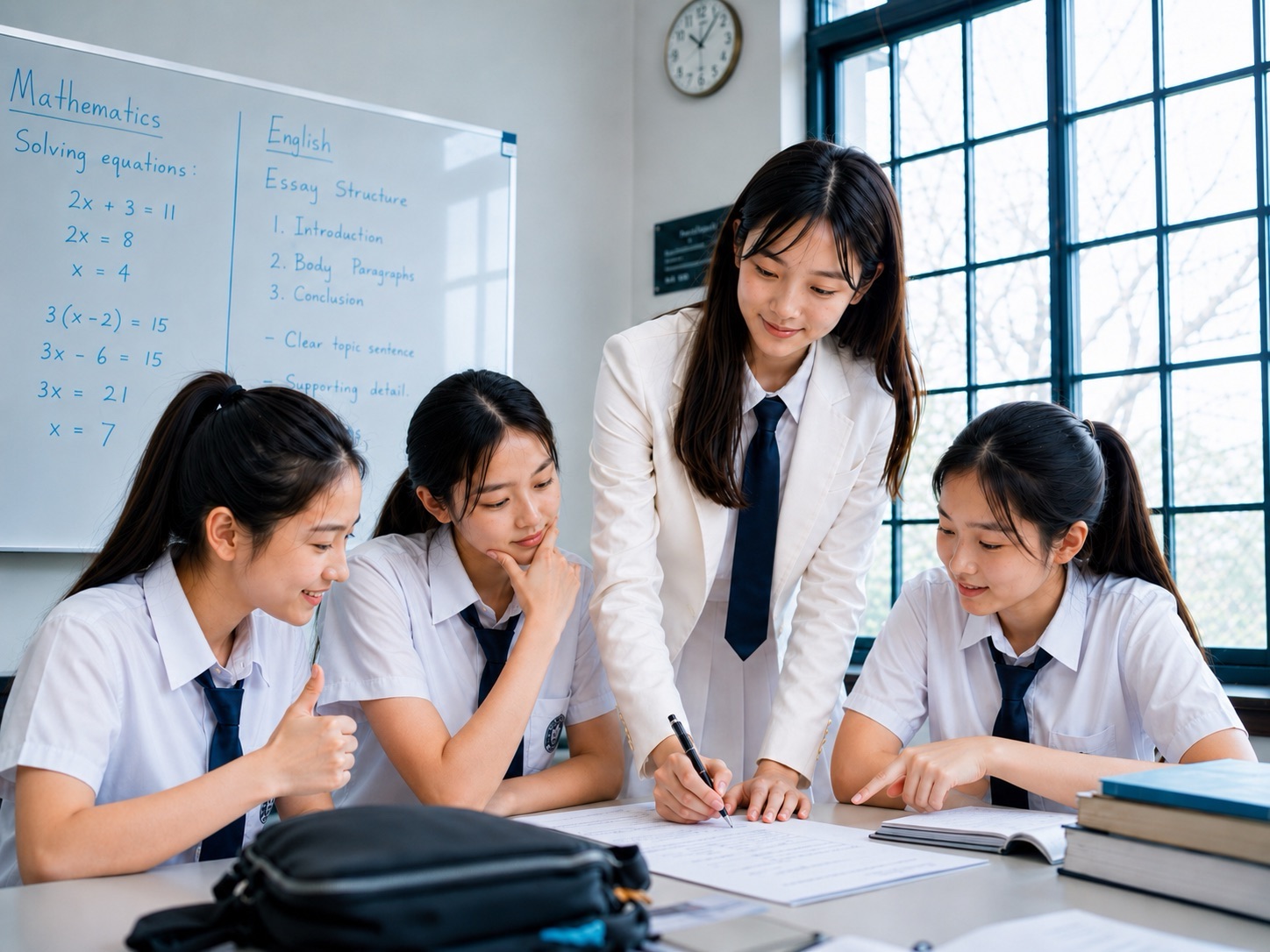
Secondary 3 Mathematics is the buffer corridor where students regroup from lower-secondary foundations, boost their E-Math and A-Math control, and begin stretching toward Sec 4, O-Level, IP, IB, IGCSE and future career pathways. At Bukit Timah Math Tutor, we help students repair weak foundations, sharpen exam habits, and enter a stronger Mathematics life with clarity, confidence and purpose.
Latest Sec 3 News for 2026
- Revised JC Admission Criteria Impacting Sec 3 Subject Choices: Starting from 2028, changes in Junior College admission will encourage more Secondary 3 students to take seven subjects, focusing on breadth while maintaining depth in core areas like Mathematics and Sciences. This shift aims to better prepare students for post-secondary pathways. With Bukit Timah Sec 3 Tuition at Bukit Timah Math Tutor, students can strategically manage this increased load through personalized syllabus-aligned sessions that build efficiency in E-Math and A-Math.
- Promotion of Fewer Upper Secondary Subjects for Well-Being: The Ministry of Education (MOE) is urging Secondary 3 students to opt for fewer subjects in upper secondary to prioritize mental health, personal interests, and deeper learning, reducing academic pressure. Bukit Timah Sec 3 Tuition supports this by offering focused, small-group (3-pax) coaching that maximizes learning in key subjects without overload, drawing from strategies like Metcalfe’s Law for networked mastery.
- Expansion of Computing as an Elective for Upper Secondary: From 2026, more Secondary 3 students, including those in G1, G2, and G3 groups, will have access to Computing as an elective, with all G1 students required to take it in Sec 3 to foster digital literacy. Complement this with Bukit Timah Sec 3 Tuition, where interdisciplinary links between Computing and Mathematics are explored in our programs to enhance problem-solving skills.
- 41 Schools Receiving New Principals in 2026: A total of 41 schools across Singapore, including secondary institutions, will appoint new principals in 2026, potentially bringing fresh leadership and initiatives to enhance Sec 3 curricula. Bukit Timah Sec 3 Tuition at centers like The Math Lab provides consistent, expert guidance amid these transitions, with updated 2026 timetables for Sec 3 Math.
- Full Implementation of Full Subject-Based Banding (SBB): By 2026, the removal of streaming (Normal Technical, Academic, Express) initiated from the 2024 Sec 1 cohort will be in full effect for upper secondary, allowing Sec 3 students greater flexibility in subject levels. Leverage Bukit Timah Sec 3 Tuition options from Future Academy to adapt to SBB with tailored classes for G3 A-Math and other subjects.
- MOE-OBS Challenge Expansion for Sec 3 Students: By 2026, more Secondary 3 students will participate in the MOE-Outward Bound Singapore (OBS) Challenge, emphasizing character development alongside academics. Bukit Timah Sec 3 Tuition integrates holistic support, such as at Indigo Education Group, to balance outdoor experiences with strong academic foundations in Sec 3.
- School Term Start Date for 2026: Secondary schools, including those offering Sec 3 programs, will commence on January 2, 2026, a Friday, setting an early tone for the academic year. Prepare effectively with Bukit Timah Sec 3 Tuition through early enrollment at BlueTree Education, ensuring a smooth start with updated 2026 schedules.
- A-Level Scoring System Updates from 2026: Changes to GCE A-Level scoring, effective from 2026, will influence Sec 3 students’ long-term planning by reducing grade emphasis and encouraging diverse interests. Bukit Timah Sec 3 Tuition at Miracle Learning Centre helps bridge to A-Levels with Science and Math programs designed for future success.
- Increased Demand for Sec 3 Tuition Assignments: With evolving curricula, there’s a rise in Sec 3 tuition needs, including IP Pure Chemistry and E-Math in Bukit Timah areas for 2026. Bukit Timah Sec 3 Tuition opportunities abound via platforms like ManyTutors, connecting students to specialized tutors.
- PSLE and Secondary English Updates Influencing Sec 3: While focused on PSLE, 2025+ English exam changes will ripple into Sec 3, emphasizing critical skills in reading and writing. Address this through Bukit Timah Sec 3 Tuition at The Alternative Story or The Learners’ Club, offering small-group English and multi-subject support for seamless progression.
A Mathematics Buffer Corridor System for the Big Stretch Ahead
Secondary 3 Mathematics is not just another school year.
It is the year where Mathematics changes gear.
For many students, Secondary 1 and Secondary 2 were about adapting to secondary school, surviving the pace, learning algebra, handling graphs, building new habits, and discovering that Mathematics is no longer just about getting an answer.
Then Secondary 3 begins.
Suddenly, Mathematics becomes wider, deeper and more consequential.
There is more algebra.
There is more abstraction.
There are more marks hidden inside method, notation, presentation and accuracy.
There is more pressure from school tests, weighted assessments, subject combinations, A-Maths, E-Maths, IP pathways, IGCSE preparation, IB ambitions and future university choices.
This is why Secondary 3 is such an important year.
It is not the final examination year yet.
But it is no longer a casual foundation year either.
Secondary 3 is the buffer corridor.
It is the protected stretch between “I used to manage Math somehow” and “I must now become exam-ready, pathway-ready and future-ready.”
At Bukit Timah Math Tutor, our Secondary 3 Math tuition is built around this corridor.
We help students regroup.
We help them repair weak foundations.
We help them connect lower-secondary Mathematics to upper-secondary demands.
We help them prepare for Sec 4.
We help them build the thinking habits needed for O-Level, SEC, IP, IB, IGCSE and future academic pathways.
Most importantly, we help them enter a new Mathematics life.
A life where Mathematics is not just homework.
It becomes a language for structure, logic, precision, careers, technology, science, business, engineering, economics, architecture, computing and decision-making.
Secondary 3 is where that life begins properly.
Why Secondary 3 Mathematics Feels Different
Secondary 3 Mathematics feels different because the subject stops being a collection of topics and starts becoming a system.
In lower secondary, students learn important building blocks.
Algebra.
Linear graphs.
Ratio.
Percentage.
Geometry.
Statistics.
Probability.
Equations.
Coordinate geometry.
Basic functions and patterns.
But in Secondary 3, these blocks start joining together.
A question may begin as algebra, turn into graph interpretation, require equation solving, and end with a real-world conclusion.
A geometry question may require angle reasoning, similarity, trigonometry and algebraic expression.
An A-Maths question may demand factorisation, surds, logarithms, functions, graphs and careful manipulation all inside one solution.
This is where students often feel surprised.
They thought they were weak in “the new topic.”
But actually, the new topic is exposing old gaps.
A student who struggles with quadratic functions may really have weak factorisation.
A student who struggles with trigonometry may really have weak equation solving.
A student who struggles with calculus later may really have weak algebraic control now.
A student who loses marks in E-Maths may not be conceptually weak, but may have poor presentation, weak checking habits or slow exam execution.
So the first job of Secondary 3 Math tuition is not simply to teach the next chapter.
The first job is diagnosis.
What is really happening?
Is the student missing knowledge?
Is the student weak in algebra?
Is the student unable to start questions?
Is the student copying examples without understanding?
Is the student losing marks from careless errors?
Is the student doing too little practice?
Is the student doing practice wrongly?
Is the student capable but under-stretched?
Is the student aiming for A1, but still revising like a B3 student?
Once we know the real problem, the work becomes clearer.
The Buffer Corridor: Why Students Need Space Before Sec 4
A corridor is not the final destination.
It is the space that gets you safely from one important place to another.
Secondary 3 is exactly that.
It connects lower secondary to Sec 4.
It connects PSLE habits to O-Level or SEC expectations.
It connects school Mathematics to future Mathematics.
It connects a child’s current ability to the next version of who they can become.
Without a proper corridor, students are thrown directly from foundation work into examination pressure.
That is dangerous.
They may enter Secondary 4 still carrying weak algebra.
They may enter revision season without topical mastery.
They may start timed papers before they understand the structure.
They may try to memorise methods instead of learning how questions are built.
They may panic because Sec 4 feels too close.
A good Secondary 3 Math tutor creates buffer.
Not buffer as delay.
Buffer as protection.
Buffer as preparation.
Buffer as a space where the student can repair, organise, practise, strengthen and stretch before the final year arrives.
At Bukit Timah Math Tutor, this buffer corridor has four jobs.
First, it catches falling students before they fall too far.
Second, it stabilises students who are passing but not secure.
Third, it stretches strong students so they do not plateau.
Fourth, it connects Mathematics to future pathways, so the student understands why the subject matters.
This is how Sec 3 tuition becomes more than “extra class.”
It becomes an academic transition system.
The Three Types of Secondary 3 Students
Most Secondary 3 students who come for Math tuition fall into three broad groups.
The first group needs to stop falling.
These students may have struggled through Secondary 2, entered Secondary 3 with shaky foundations, and now feel overwhelmed by the pace. Their homework takes too long. They cannot start questions alone. They may avoid Mathematics because every worksheet feels like proof that they are not good enough.
These students need calm repair.
They need someone to identify the missing foundations, rebuild algebra, slow down the logic, and show them that Mathematics can become understandable again.
The second group needs to maintain strong grades.
These students may already be doing reasonably well. They may be around A2, B3 or high B4, but they are not yet secure. Their marks move up and down. They can do familiar questions, but unfamiliar questions expose hesitation. They may understand lessons but lose marks in tests.
These students need consolidation.
They need better accuracy, better exam habits, better question recognition, stronger topical control and more systematic revision.
The third group needs distinction stretch.
These students may already be scoring well, but they want A1, top-band performance, IP readiness, IB readiness, IGCSE readiness or stronger preparation for future A-Maths and higher mathematics.
These students do not need tuition because they are weak.
They need tuition because they are ready to build at a higher level.
They need harder questions, sharper explanations, faster route recognition, stronger proof of understanding, and a tutor who will not let them become complacent.
All three types of students need different help.
That is why good tuition cannot be one-size-fits-all.
A falling student needs rescue and rebuild.
A steady student needs structure and polish.
A strong student needs acceleration and stretch.
The buffer corridor must have space for all three.

What Happens in Secondary 3 Math Tuition
In Secondary 3 Math tuition at Bukit Timah Math Tutor, lessons are not just about finishing worksheets.
The aim is to build mathematical control.
That means the student must learn how to understand, choose, execute, check and improve.
A typical tuition system involves five layers.
1. Foundation Check
We first look for the foundations that are affecting current performance.
This usually includes algebraic manipulation, expansion, factorisation, equations, inequalities, graphs, indices, surds, coordinate geometry, fractions, ratio, percentages and earlier geometry.
These foundations matter because upper-secondary Mathematics depends on them.
If a student is weak in algebra, almost every future topic becomes heavier.
If a student is weak in graph interpretation, functions become confusing.
If a student is weak in angles and geometry, trigonometry becomes unstable.
If a student is weak in number sense, careless errors multiply.
So we do not ignore the basics.
We strengthen them.
2. Current School Support
Students must keep up with school.
This matters because Secondary 3 moves quickly.
A student who falls behind one topic may still be trying to recover when the next topic begins.
In tuition, we help students understand current school topics, complete difficult concepts, clarify confusing methods, and prepare for upcoming tests.
This reduces panic.
When school lessons become clearer, the student starts entering class with more confidence.
They are no longer always chasing.
They can begin to participate, ask better questions, and see the topic before it becomes a crisis.
3. Ahead-of-School Preparation
For students who are ready, we teach ahead.
This is powerful in Secondary 3.
When a student sees a topic before school teaches it, school becomes revision instead of first exposure.
That changes everything.
The child listens differently.
They recognise the method.
They ask better questions.
They feel less threatened.
They can use school examples to deepen understanding instead of trying to survive.
Ahead-of-school preparation is especially useful for students aiming for strong Sec 4 performance because it creates time.
Time is one of the most important assets in Mathematics.
Students who learn early have more time to practise, make mistakes, correct them and attempt higher-level questions.
4. Mistake Correction and Exam Discipline
Many Secondary 3 students do not lose marks because they know nothing.
They lose marks because their working is untidy, their checking is weak, their algebra is careless, their diagrams are poorly labelled, or their answer does not match the question.
This is why mistake correction is central.
We teach students to treat mistakes as data.
A mistake tells us what to fix.
Was it a sign error?
A bracket error?
A formula error?
A misunderstanding?
A skipped step?
A careless calculator entry?
A poor diagram?
A wrong assumption?
A time-pressure mistake?
Once the student sees the pattern, we can train against it.
The goal is not perfection in one lesson.
The goal is fewer repeated mistakes over time.
That is how marks improve.
5. Stretch into Sec 4, IP, IB, IGCSE and Career Mode
Secondary 3 is not only about surviving the current chapter.
It is the beginning of the stretch.
Students who build strong Mathematics in Secondary 3 have more options later.
They are better prepared for Sec 4 E-Maths and A-Maths.
They are better positioned for IP Mathematics.
They are more ready for IGCSE or international school pathways.
They can approach IB Mathematics with stronger algebraic and analytical habits.
They can enter JC, polytechnic, university and future career pathways with more confidence.
This is where Mathematics becomes bigger than marks.
A student who understands Mathematics well has more access to science, computing, economics, business analytics, engineering, architecture, finance, design, medicine-related pathways, AI, data and technology.
Not every student will choose a Math-heavy career.
But every student benefits from mathematical thinking.
It teaches clarity.
It teaches structure.
It teaches decision-making under pressure.
It teaches the discipline to test an answer before trusting it.
These are life skills.
E-Maths and A-Maths: The Two Engines of Sec 3
For many Secondary 3 students, Mathematics splits into two engines.
E-Maths is the core engine.
It builds broad mathematical competence.
It covers the essential tools students need for national examinations and practical mathematical reasoning.
A-Maths is the stretch engine.
It develops deeper algebra, functions, trigonometry and calculus readiness.
It is more abstract, more technical and more demanding.
Some students take both.
Some take E-Maths only.
Some are in IP or international routes where the structure may differ, but the underlying challenge remains similar: algebra, functions, graphs, geometry, trigonometry, statistics, probability, reasoning and problem-solving must all become stronger.
A good Secondary 3 Math tuition system must know how these engines interact.
E-Maths supports A-Maths.
A-Maths strengthens E-Maths.
Algebra appears everywhere.
Graphs connect both.
Trigonometry grows in importance.
Functions become a bridge into higher Mathematics.
Calculus, for A-Maths students, begins to open the door to JC and university-level thinking.
That is why Secondary 3 cannot be treated casually.
It is where the engines are installed, tuned and tested.
The Bukit Timah Math Tutor Approach
Bukit Timah students often have high expectations placed on them.
Many are aiming for strong school results, competitive pathways, IP progression, IB preparation, IGCSE performance, O-Level distinctions or future university readiness.
But ambition without structure creates stress.
The role of tuition is not to add more noise.
It is to create clarity.
At Bukit Timah Math Tutor, the aim is to help students know exactly where they are, what is weak, what must improve, and how to train.
We teach the topic.
We correct the working.
We organise the revision.
We explain the strategy.
We prepare the student for the next step.
This is not panic tuition.
This is systems tuition.
A student should leave tuition knowing more than just one solution.
They should leave knowing how to think.
Why did this method work?
What was the clue?
What was the trap?
What should I check?
How do I know this answer makes sense?
What do I do when the question looks different?
These questions are the beginning of mathematical maturity.
Secondary 3 as the Start of Career Mode
There is a point where a student must stop seeing Mathematics as something adults force them to do.
Secondary 3 is a good time for that shift.
The student is older now.
They can begin to understand that Mathematics is connected to choices.
Subject combinations.
JC or polytechnic options.
Science pathways.
Engineering pathways.
Computing pathways.
Economics and business pathways.
Architecture and design pathways.
Data and AI pathways.
University admissions.
Career flexibility.
This does not mean every lesson must become a career talk.
But students should know that what they are building matters.
Algebra is not just algebra.
It is symbolic control.
Graphs are not just graphs.
They are visual reasoning.
Trigonometry is not just triangles.
It is measurement, modelling, wave behaviour, navigation, engineering and physics.
Statistics is not just charts.
It is data judgement.
Calculus is not just differentiation.
It is change, motion, optimisation and future scientific thinking.
When students see this, Mathematics becomes less like punishment and more like power.
They begin to understand that strong Mathematics gives them more doors.
This is the optimistic heart of Secondary 3 tuition.
We are not merely chasing marks.
We are building capability.
Regroup, Boost, Stretch
Secondary 3 students do not all need the same thing, but most need one of three actions.
They need to regroup.
This means slowing down enough to repair the foundations, organise the topics, rebuild confidence and stop the student from drifting further away from the subject.
They need to boost.
This means improving test performance, sharpening exam technique, strengthening topical mastery and moving from unstable marks to controlled improvement.
They need to stretch.
This means going beyond school basics, attempting harder questions, building A1-level habits, preparing for Sec 4 early, and connecting Mathematics to higher pathways.
Regroup.
Boost.
Stretch.
That is the movement.
That is how the buffer corridor works.
It catches.
It stabilises.
It accelerates.
What Parents Should Look Out For in Sec 3
Parents should not wait until Sec 4 panic.
Secondary 3 is the year to observe carefully.
Look out for these signs.
Your child takes too long to finish Math homework.
Your child says, “I understand in class, but I cannot do the question myself.”
Your child keeps losing marks from algebra mistakes.
Your child avoids A-Maths or E-Maths revision.
Your child’s marks fluctuate badly.
Your child can do textbook examples but struggles with test questions.
Your child cannot explain why a method works.
Your child has no revision system.
Your child is passing but not improving.
Your child is strong but no longer challenged.
These signs do not mean the child has failed.
They mean the system needs adjustment.
With the right correction, Secondary 3 can become a turning point.
Why This Year Can Be a New Beginning
The best way to think about Secondary 3 is not fear.
It is opportunity.
Yes, the subject becomes harder.
But that is also why improvement becomes more meaningful.
A student who learns to handle Secondary 3 Mathematics becomes more disciplined, more organised and more confident.
They begin to see that hard problems can be broken down.
They begin to trust proper working.
They begin to understand that mistakes can be corrected.
They begin to prepare earlier instead of waiting for panic.
They begin to move from “I cannot do Math” to “I know what to fix.”
That change is powerful.
It affects more than one subject.
A child who becomes stronger in Mathematics often becomes stronger in study discipline generally.
They learn how to revise.
They learn how to practise.
They learn how to track errors.
They learn how to ask better questions.
They learn how to work through difficulty.
This is why education matters.
A properly taught student becomes calmer.
A properly guided student becomes stronger.
A properly prepared student enters the future with more choices.
That is how we build better families, better schools, better communities and, eventually, a better civilisation.
One child at a time.
One corrected misconception at a time.
One clear explanation at a time.
One stronger habit at a time.
Sec 3 Math Tuition Bukit Timah: What We Build
At Bukit Timah Math Tutor, Secondary 3 Math tuition is designed to help students build the year properly.
We work on foundations.
We support school topics.
We prepare ahead.
We correct mistakes.
We strengthen exam technique.
We stretch capable students.
We connect Sec 3 to Sec 4, and Sec 4 to future pathways.
The goal is not simply to survive the year.
The goal is to use Secondary 3 well.
Because Secondary 3 is the corridor.
Walk through it properly, and Sec 4 becomes less frightening.
Walk through it properly, and A-Maths becomes more manageable.
Walk through it properly, and E-Maths becomes more controlled.
Walk through it properly, and IP, IB, IGCSE, SEC, O-Level and future academic routes become less distant.
This is the year to regroup.
This is the year to boost.
This is the year to stretch.
This is the year to begin Mathematics career mode.
And with the right tutor, the right system and the right habits, Secondary 3 can become one of the most important academic turning points in a student’s life.
Contact us here for our latest Sec 3 Math Tutorials at Bukit Timah
In the dynamic educational ecosystem of Singapore, Secondary 3 marks a pivotal transition in a student’s mathematical journey, where foundational concepts evolve into sophisticated problem-solving demands that shape future academic pathways.
As students navigate the Singapore Examinations and Assessment Board (SEAB) syllabuses for Elementary Mathematics (4052) and Additional Mathematics (4049), they encounter intensified strands in Number and Algebra, Geometry and Measurement, and Statistics and Probability, alongside emerging calculus and trigonometry in A-Math.
This year is crucial, as performance influences streaming into Sec 4 tracks, polytechnic admissions, or junior college eligibility for STEM disciplines. Yet, common hurdles like abstract algebraic manipulations, trigonometric identities, and rapid curriculum pacing often lead to frustration, with many students facing 20-30% dips in accuracy due to foundational gaps or cognitive overload.
At Bukit Timah Math Tutor, our specialized Sec 3 Math tuition transforms these challenges into triumphs through small-group (3-pax) sessions that blend personalized guidance, evidence-based strategies, and real-world applications.
Drawing from innovative frameworks like Metcalfe’s Law for networked math mastery, deflating the studying bubble of information overload, closing the two-step gap to distinctions, and harnessing AI-inspired S-curves for exponential growth, we don’t just teach math—we rewire minds for lifelong analytical prowess.
Backed by insights from the Ministry of Education (MOE) and cognitive research from institutions like the National Institute of Education (NIE), our approach has elevated countless Sec 3 students from B3 struggles to A1 excellence. Whether tackling E-Math’s practical modeling or A-Math’s proof-intensive calculus, discover what unfolds in our Bukit Timah sessions:
A blend of cognitive ignition, strategic networking, and sustained momentum that turns potential into performance.
The Sec 3 Math Landscape: Challenges and Cognitive Transformations
Secondary 3 Mathematics in Singapore isn’t merely a syllabus—it’s a cognitive crucible that forges adolescent brains for higher-order thinking.
As per the MOE’s 2020 G2 and G3 Mathematics Syllabuses, students delve deeper into polynomials, coordinate geometry, and probability, while A-Math introduces derivatives, integrals, and vector applications—demanding not just computation but conceptual fluency. This shift aligns with adolescent brain development, where the prefrontal cortex matures, enhancing executive functions like planning and inhibition.
Research from PNAS reveals that sustained math education boosts gamma-aminobutyric acid (GABA) levels in the intraparietal sulcus, improving neural inhibition and cognitive efficiency—benefits absent in those lacking such training, leading to developmental disadvantages.
However, challenges abound: Concept First identifies indices, surds, and trigonometry as stumbling blocks, exacerbated by fast-paced classrooms where individual queries go unanswered. Students often grapple with math anxiety, reducing working memory and problem-solving by 10-15%, as noted in MDPI studies.
In Bukit Timah Math Tutor’s 3-pax sessions, we counter this with diagnostics: Initial assessments map syllabus gaps (e.g., factor theorems per SEAB’s Algebra strand), while fostering cognitive flexibility through interleaved practice—mirroring ScienceDirect’s findings on math performance links.
Sessions ignite with retrieval starters, activating the hippocampus for memory consolidation, turning passive learners into active analysts ready for O-Level rigors.

Deflating the Studying Bubble: Building a Resilient Cognitive Foundation
A core peril in Sec 3 Math is the studying bubble—where unchecked information overload inflates cognitive strain, leading to Ebbinghaus forgetting curve losses of up to 70% overnight.
In large school classes, this manifests as fragmented understanding of quadratic equations or statistical distributions, with FA Education citing overload as a top issue. Our tuition deflates this through structured Pomodoro techniques: 25-minute focused bursts on E-Math geometry proofs, followed by resets, enhancing retention by 20-30% as per cognitive load theory.
Integrating Khan Academy’s resources for visual aids, we chunk complex topics like binomial expansions into germane loads, reducing extraneous distractions. Sessions incorporate spaced repetition via Anki-style quizzes, aligning with PubMed’s evidence on math education’s role in brain plasticity.
For A-Math starters, we relate rates of change to real-life scenarios (e.g., projectile motion), making abstract calculus tangible and staving off anxiety-induced blackouts. This foundation not only boosts immediate grades but, per Oxford University’s research, supports long-term neural health.
Networking Mastery: Applying Metcalfe’s Law in Tuition Dynamics
In Bukit Timah sessions, math evolves from isolated facts to interconnected webs, leveraging Metcalfe’s Law where knowledge value squares with connections. Siloed learning dooms Sec 3 students to rote struggles in trigonometry or vectors; instead, we map algebra to geometry (e.g., coordinate proofs linking to kinematics), exploding recall under exam pressure.
Peer interactions in our 3-pax groups amplify this: One student’s insight on partial fractions sparks another’s on integration, quadratically elevating understanding—echoing The Science Academy’s emphasis on collaborative skills. We draw from IXL’s syllabus breakdown for cross-topic drills, fostering the cognitive flexibility Loughborough University links to enhanced adolescent brain development.
Sessions culminate in “Interlink Challenges,” where students apply surds to probability, building resilience against Reddit’s common failures. This networked approach, per Studious Minds, prepares for A-Math’s depth.
Bridging to Brilliance: The Two-Step Path in Personalized Tuition
Distinctions are two steps away: Syllabus alignment and weak-tie leverage. Bukit Timah audits against SEAB objectives, targeting E-Math’s measurement fluency or A-Math’s calculus proofs for 15-20% gains.
Weak ties—alumni micro-sessions—introduce hacks like mnemonic for factor theorems, shattering isolation as per Granovetter’s theory. This mirrors Math Lobby’s strategies, yielding sigma boosts. Integrated with bubble-busting, it builds grit for non-routine problems.
Riding the S-Curve: Exponential Growth in Sec 3 Sessions
Our Sec 3 Math tuition mirrors AI’s S-curve: Slow foundations (algebra mastery), surge (trig integration), pivot (plateau breakthroughs). Iterations via error logs and GeoGebra visuals accelerate, per Oxford College’s insights. Networked pods and spaced mocks catalyze dopamine, outpacing anxiety.
Your 12-Week Sec 3 Mastery Blueprint: What Happens Week by Week
| Week | S-Curve Phase | Bubble-Bust Tactics | Metcalfe Networks | Two-Step Actions | Milestone |
|---|---|---|---|---|---|
| 1-2 | Crawl: Basics (e.g., polynomials) | Pomodoro on examples; retrieval | Map algebra to geometry | Syllabus audit; weak-tie checklist | 80% recall; anxiety <5 |
| 3-4 | Build: Bonds (e.g., trig) | Spaced interleaving; logs | Fusion drills; peer links | Alum hacks; objectives focus | Articulate links; 20% dip |
| 5-6 | Drive: Flow | Gamification; pauses | Cross-leaps; “echoes?” | Grad consults; mapping | 90% accuracy timed |
| 7-8 | Pivot: Fixes | Probes; journals | Refresh webs | Maneuvers; tunes | Break non-routine |
| 9-10 | Boom: Poise | Mixes; priming | Reviews | Nuggets; ritual | Paper calm |
| 11-12 | Crest: Trials | Mocks; zoning | Lattice muse | Cycles; hops | O-Level A1 sim |
This blueprint, inspired by Singapore Tuition Teachers, delivers results. Join Bukit Timah Math Tutor—where Sec 3 Math becomes your superpower. Enrol today: What’s your first math move to get A1?
