
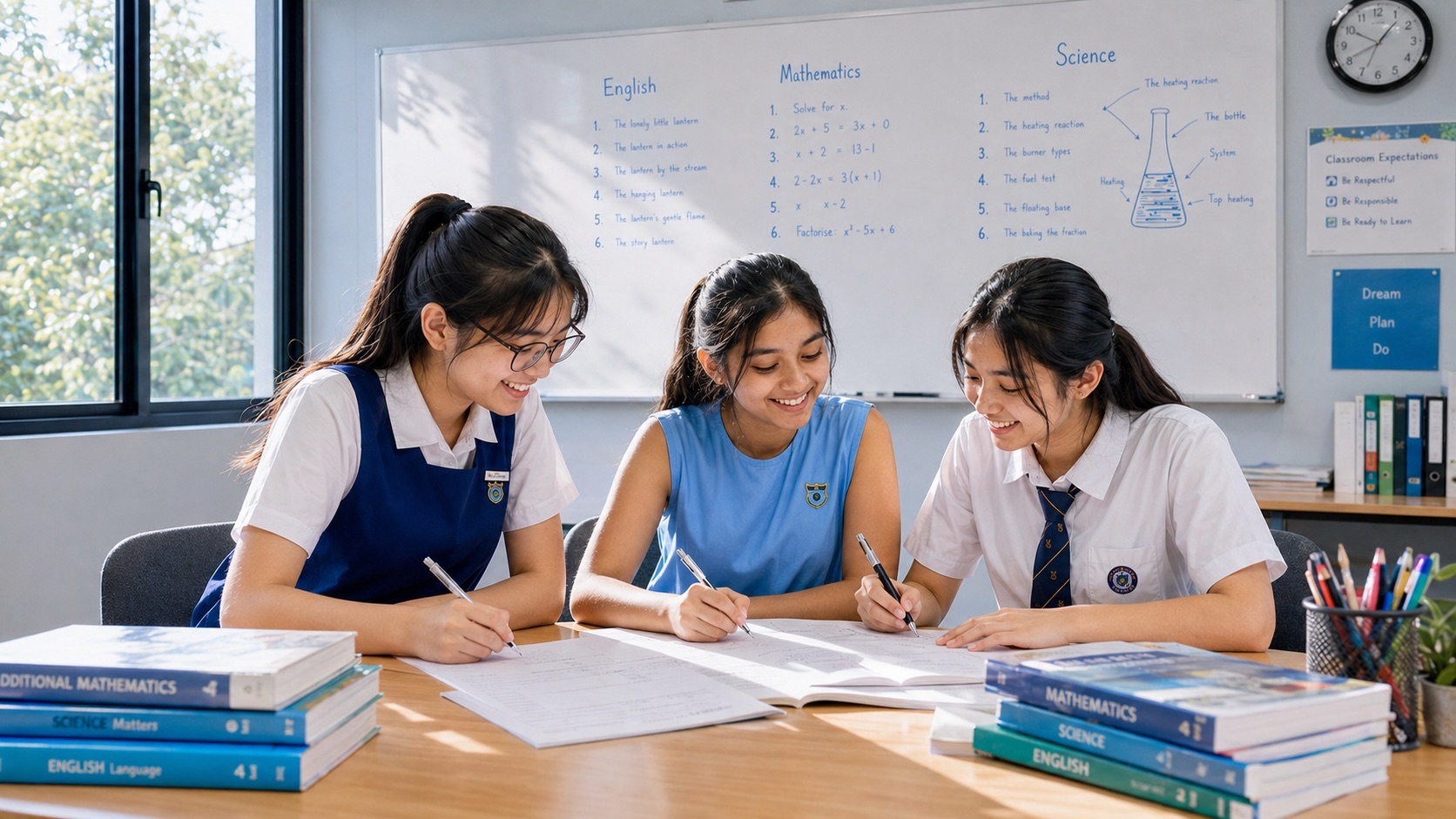
Purpose: Convert Secondary students’ English performance into O-Level reliable output: unseen comprehension + summary + situational writing + continuous writing, under higher load and stricter marking.
H1: Secondary English OS — What It Is and How It Works
Canonical Definition (LOCK)
Secondary_English_OS := a closed-loop reliability system that upgrades: Vocabulary (P3 under load), Comprehension (literal + inferential stability), Summary (compression without meaning loss), Writing (situational + continuous) under time pressure,into exam-stable output with low variance.
Output Contract (P3 mastery)
P3(Secondary English) = student can: - score consistently across unseen passages - infer without guessing (evidence-backed) - write with clarity + tone control + variation - summarise accurately within word limits - perform under exam timer with minimal collapse
H2: The OS Model (High-Level Pipeline)
Secondary_English_OS { Inputs: - reading exposure (nonfiction + narrative) - explicit vocab/chunk/structure training - timed exam-format practice Engines: - Vocabulary_OS (Z0–Z3 upgraded for tone + precision) - Comprehension_OS (inference stability + evidence discipline) - Summary_OS (compression + paraphrase control) - Writing_OS (situational + continuous, audience + purpose) - Structure_OS (sentence automation + paragraph coherence) Sensors: - inference error tags - tone/register errors - summary leakage (meaning loss) + repetition - timed performance variance Repairs: - micro drills + rewrite loops - timed sets + post-mortem correction Outputs: - O-Level grade reliability with reduced variance}
H2: Phase Reliability (P0–P3) Under Secondary Load
P0: cannot extract meaning reliably; writing breaks downP1: can answer when guided; vocab is recognition-onlyP2: can do well sometimes; inconsistent under exam conditionsP3: stable output under time pressure + variation across topics
Rule (LOCK):
Secondary English is a variance-control problem.High performers are not “more talented” — they are more stable under variation.
H2: What Changes from Primary → Secondary
Load increases in 5 ways
Load = { TextDensity↑ (more ideas per paragraph), InferenceDemand↑, PrecisionMarking↑, TimePressure↑, Tone/Audience constraints↑}
Therefore the upgrades must shift
- Vocabulary: from “nice words” → precision + register control
- Comprehension: from “understand” → prove with evidence
- Writing: from “story” → purposeful communication
- Summary: new bottleneck → compression without distortion
H2: The 5 Engines (Subsystems) + Pass Conditions
1) Vocabulary OS (Secondary Upgrade)
Goal: P3 vocabulary that survives exam load + supports precision.Key: chunks + tone + paraphrase families
Pass(P3)
- RecallTime <2s for targets- correct collocation + tone- can paraphrase without meaning drift- upgrades appear naturally in timed writing
2) Comprehension OS (Evidence-Disciplined)
Goal: literal accuracy + inference stability + evidence discipline.
Pass(P3)
- answers are consistent after re-read- inference is supported by text- avoids “over-infer” mistakes
3) Summary OS (Compression Engine)
Goal: reduce text to essentials within word limit without distortion.Summary is not copying — it is controlled paraphrase + selection.
Pass(P3)
- hits word limit- keeps all required points- paraphrases with minimal repetition- no meaning leakage
4) Writing OS (Situational + Continuous)
Goal: purpose + audience + tone + structure under time.
Pass(P3)
- addresses task fully- maintains tone/register- coherent paragraphing- stable language variation
5) Structure OS (Sentence + Paragraph Automation)
Goal: grammar + structure become automatic so brain can focus on ideas.
Pass(P3)
- low grammar error rate- connector diversity- clarity: reader knows actor/action/intent
H2: Top 6 Failure Modes (Secondary English)
FM1: Passive vocab (P1) — “knows but cannot use”FM2: Inference guessing — answers not anchored in textFM3: Summary leakage — meaning lost or points missingFM4: Tone/register mismatch — informal when formal, wrong audienceFM5: Weak paragraph coherence — idea drift, repetitionFM6: Exam variance collapse — does well at home, drops in exam
H2: Sensors Pack (Secondary English Instrument Panel)
A) Vocabulary Sensors
V_Sensors { RecallTime < 2s (targets) CollocationErrorRate low RegisterErrorRate low ParaphraseSuccessRate high VariationIndex trending up}
B) Comprehension Sensors (tag your wrong answers)
C_Sensors { WrongAnswerTags: - misread detail - vocab gap - inference leap (over-infer) - missed implication - evidence not cited StabilityCheck: - same answer after re-read? (Y/N)}
C) Summary Sensors
SUM_Sensors { PointsCaptured / PointsRequired WordLimitCompliance RepetitionRate MeaningLeakEvents (distortion)}
D) Writing Sensors
W_Sensors { TaskCompletionScore ToneMatchScore CoherenceScore (topic sentence → support → close) TimedFinishRate UpgradeCountCorrect (>= 12 per full piece)}
E) Variance Sensors (the hidden killer)
VAR_Sensors { ScoreStdDev across 5 timed sets CollapseEvents under timer TopicSensitivity (drops on unfamiliar topics)}
H2: Repair Loops (Smallest Reliable Fixes)
Loop 1 — Vocabulary Injection (daily 15 min)
Loop_Vocab_Secondary { choose 8 words/week + 4 chunks/week for each: - 2-sentence anchor - collocation bank (3 pairs) - paraphrase family (2 alternatives) timed use: - 8-min paragraph with 6 upgrades repair: - rewrite weakest paragraph}
Loop 2 — Evidence Discipline (3×/week)
Loop_Evidence { unseen passage set for each question: - answer - highlight evidence line(s) - rewrite answer in own words tag wrong answers by type fix the dominant tag each week}
Loop 3 — Summary Compression (2–3×/week)
Loop_Summary { take 1 passage segment steps: 1) list required points (no paraphrase yet) 2) compress points into 1–2 sentences 3) paraphrase with synonym families 4) check meaning drift 5) final word count trim}
Loop 4 — Tone & Audience Control (weekly)
Loop_Tone { pick 1 situational task write 2 versions: - formal neutral - warm persuasive compare: - tone markers - register errors repair: - rewrite introduction + conclusion only}
Loop 5 — Full Timed Set + Post-Mortem (weekly)
Loop_Timed_Set { do timed paper section post-mortem: - tag failure modes - identify weakest component (vocab / inference / summary / tone) - apply one targeted repair loop immediately}
H2: 12–16 Week Upgrade Plan (Secondary English)
Phase 1 (Weeks 1–4): Stabilise Foundations (P1→P2→P3)
- build chunk bank + paraphrase families- start evidence discipline tags- timed paragraph drills 2×/week
Phase 2 (Weeks 5–8): Summary + Tone Control
- summary compression drills 3×/week- situational writing tone practice weekly- rewrite weakest paragraph every session
Phase 3 (Weeks 9–12): Exam Load Training (variance reduction)
- weekly full timed set + post-mortem- eliminate dominant wrong-answer tag- increase upgrade density while maintaining accuracy
Phase 4 (Weeks 13–16): Transfer to O-Level Reliability
- timed practice across varied topics- focus on consistency: reduce score variance- final polishing of introductions/conclusions + summary trimming
H2: Negative Inversion — Why Students Plateau in Secondary English
Failure Mode Trace (required)
More reading → recognition rises (P1)→ no paraphrase training→ summary leaks meaning→ inference becomes guessing→ tone errors appear→ exam variance increases→ grade stagnates despite effort
Correct Fix (LOCK)
Secondary English mastery requires: evidence discipline + compression training + tone control + load drills,not just “read more” or “memorise more words.”
H2: Copy-Paste Blocks (Internal Linking Hooks)
Hook: Link to Vocabulary OS
If the student “knows words” but writes basic English,they are stuck in P1 (recognition) or P2 (slow recall).Use Vocabulary OS loops to force P3 retrieval under timed writing.
Hook: Link to Primary Composition Repair Protocol
Weak writing is usually a system leak:planning → structure → vocabulary retrieval → load collapse.Use a closed-loop repair plan, not random practice.
Hook: Link to O-Levels OS page (future)
O-Levels OS is variance-control: stable performance under topic variation and exam time pressure.Secondary English OS is one of the core pipelines feeding that reliability.
FAQ Pack (Secondary English)
Why is Secondary English so much harder than Primary?
Because text density, inference demands, tone constraints, and time pressure all increase at once.
Why can my child do well at home but not in exams?
Their performance is P2: it works without load. Exam timing reveals retrieval and structure instability.
How do you improve summary fast?
Train compression as a skill: list points → compress → paraphrase → check meaning → trim.
Recommended Internal Links (Spine)
Start Here for Lattice Infrastructure Connectors
- https://edukatesg.com/singapore-international-os-level-0/
- https://edukatesg.com/singapore-city-os/
- https://edukatesg.com/singapore-parliament-house-os/
- https://edukatesg.com/smrt-os/
- https://edukatesg.com/singapore-port-containers-os/
- https://edukatesg.com/changi-airport-os/
- https://edukatesg.com/tan-tock-seng-hospital-os-ttsh-os/
- https://edukatesg.com/bukit-timah-os/
- https://edukatesg.com/bukit-timah-schools-os/
- https://edukatesg.com/bukit-timah-tuition-os/
- https://edukatesg.com/family-os-level-0-root-node/
- https://bukittimahtutor.com
- https://edukatesg.com/punggol-os/
- https://edukatesg.com/tuas-industry-hub-os/
- https://edukatesg.com/shenton-way-banking-finance-hub-os/
- https://edukatesg.com/singapore-museum-smu-arts-school-district-os/
- https://edukatesg.com/orchard-road-shopping-district-os/
- https://edukatesg.com/singapore-integrated-sports-hub-national-stadium-os/
- Sholpan Upgrade Training Lattice (SholpUTL): https://edukatesg.com/sholpan-upgrade-training-lattice-sholputl/
- https://edukatesg.com/human-regenerative-lattice-3d-geometry-of-civilisation/
- https://edukatesg.com/new-york-z2-institutional-lattice-civos-index-page-master-hub/
- https://edukatesg.com/civilisation-lattice/
- https://edukatesg.com/civ-os-classification/
- https://edukatesg.com/civos-classification-systems/
- https://edukatesg.com/how-civilization-works/
- https://edukatesg.com/civos-lattice-coordinates-of-students-worldwide/
- https://edukatesg.com/civos-worldwide-student-lattice-case-articles-part-1/
- https://edukatesg.com/new-york-z2-institutional-lattice-civos-index-page-master-hub/
- https://edukatesg.com/advantages-of-using-civos-start-here-stack-z0-z3-for-humans-ai/
- Education OS (How Education Works): https://edukatesg.com/education-os-how-education-works-the-regenerative-machine-behind-learning/
- Tuition OS: https://edukatesg.com/tuition-os-edukateos-civos/
- Civilisation OS kernel: https://edukatesg.com/civilisation-os/
- Root definition: What is Civilisation?
- Control mechanism: Civilisation as a Control System
- First principles index: Index: First Principles of Civilisation
- Regeneration Engine: The Full Education OS Map
- The Civilisation OS Instrument Panel (Sensors & Metrics) + Weekly Scan + Recovery Schedule (30 / 90 / 365)
- Inversion Atlas Super Index: Full Inversion CivOS Inversion
- https://edukatesg.com/government-os-general-government-lane-almost-code-canonical/
- https://edukatesg.com/healthcare-os-general-healthcare-lane-almost-code-canonical/
- https://edukatesg.com/education-os-general-education-lane-almost-code-canonical/
- https://edukatesg.com/finance-os-general-finance-banking-lane-almost-code-canonical/
- https://edukatesg.com/transport-os-general-transport-transit-lane-almost-code-canonical/
- https://edukatesg.com/food-os-general-food-supply-chain-lane-almost-code-canonical/
- https://edukatesg.com/security-os-general-security-justice-rule-of-law-lane-almost-code-canonical/
- https://edukatesg.com/housing-os-general-housing-urban-operations-lane-almost-code-canonical/
- https://edukatesg.com/community-os-general-community-third-places-social-cohesion-lane-almost-code-canonical/
- https://edukatesg.com/energy-os-general-energy-power-grid-lane-almost-code-canonical/
- https://edukatesg.com/community-os-general-community-third-places-social-cohesion-lane-almost-code-canonical/
- https://edukatesg.com/water-os-general-water-wastewater-lane-almost-code-canonical/
- https://edukatesg.com/communications-os-general-telecom-internet-information-transport-lane-almost-code-canonical/
- https://edukatesg.com/media-os-general-media-information-integrity-narrative-coordination-lane-almost-code-canonical/
- https://edukatesg.com/waste-os-general-waste-sanitation-public-cleanliness-lane-almost-code-canonical/
- https://edukatesg.com/manufacturing-os-general-manufacturing-production-systems-lane-almost-code-canonical/
- https://edukatesg.com/logistics-os-general-logistics-warehousing-supply-routing-lane-almost-code-canonical/
- https://edukatesg.com/construction-os-general-construction-built-environment-delivery-lane-almost-code-canonical/
- https://edukatesg.com/science-os-general-science-rd-knowledge-production-lane-almost-code-canonical/
- https://edukatesg.com/religion-os-general-religion-meaning-systems-moral-coordination-lane-almost-code-canonical/
- https://edukatesg.com/finance-os-general-finance-money-credit-coordination-lane-almost-code-canonical/
- https://edukatesg.com/family-os-general-family-household-regenerative-unit-almost-code-canonical/