
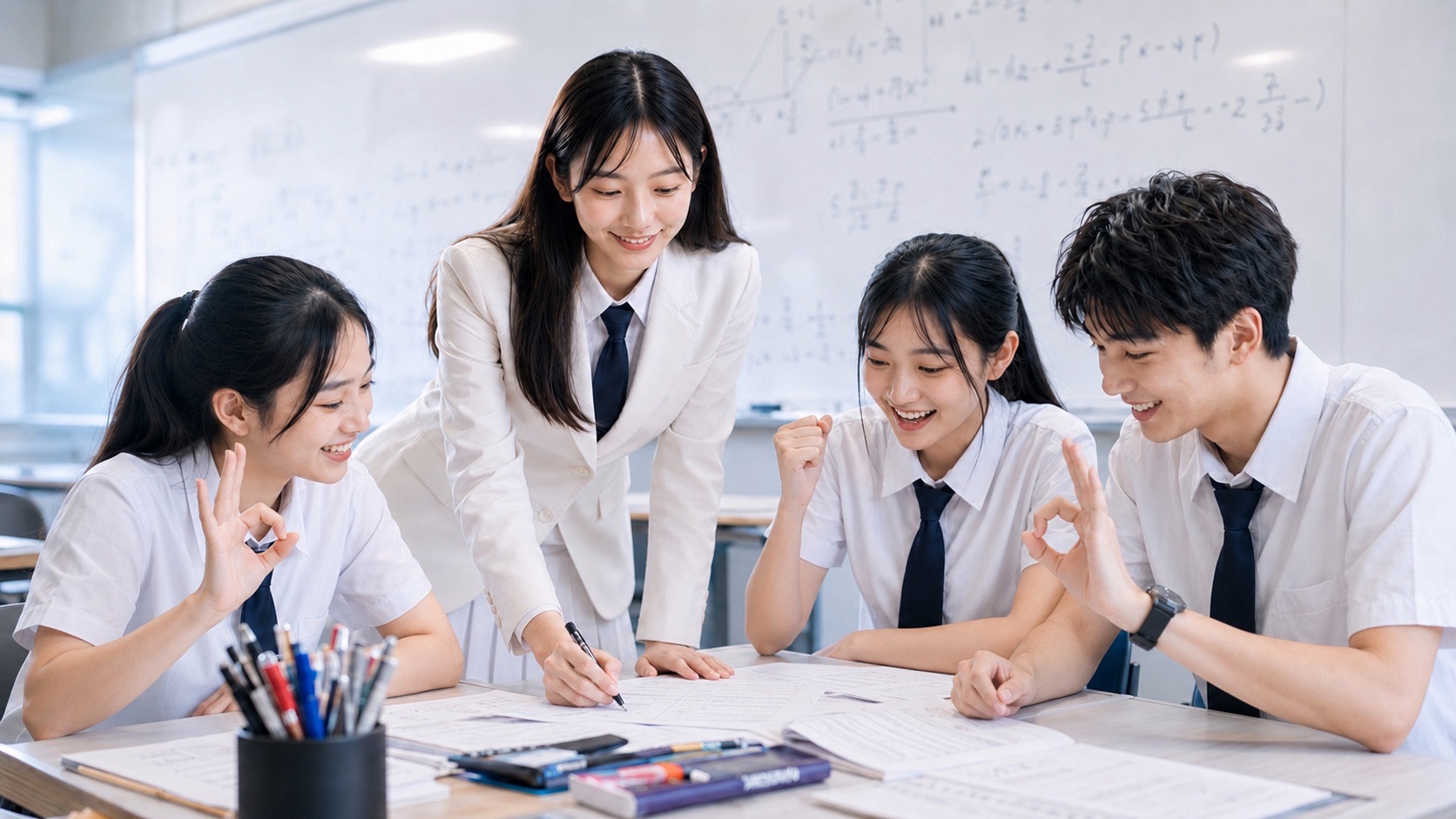
Secondary Mathematics Tuition at eduKate Punggol gives students a 3-pax small-group buffer corridor to regroup, rebuild and boost their Mathematics from PSLE into Secondary, Sec 4, IP, IB, IGCSE and future career pathways. With clear teaching, close correction and optimistic exam preparation, we help students turn Mathematics from a wall into a passage toward stronger confidence, better results and a larger future.
A Mathematics Buffer Corridor System for PSLE, Secondary, IP, IB, IGCSE, SEC and Future Career Mode
There is a moment in a student’s Mathematics life when the subject changes.
It is no longer just about getting the answer.
It becomes about movement.
Movement from arithmetic to algebra.
Movement from model drawing to symbolic thinking.
Movement from school homework to examination craft.
Movement from Secondary 1 survival to Secondary 4 execution.
Movement from PSLE memory to IP, IB, IGCSE, SEC, JC, Polytechnic and future university readiness.
For many students, this movement is exciting.
For others, it is frightening.
The child who was once comfortable in Primary Mathematics may suddenly feel slow in Secondary Mathematics.
The student who used to score well may begin to make careless errors.
The student who used to understand lessons may now copy without understanding.
The student who once felt confident may start saying, “I don’t know how to start.”
This is not the end of the child’s Mathematics story.
It is the beginning of the next stretch.
At eduKate Punggol, our Secondary Mathematics Tuition is built as a 3-pax small-group Mathematics buffer corridor system.
It is a corridor because students are moving from one academic world into another.
It is a buffer because students need protection from panic, confusion, weak foundations and school pace that can sometimes feel too fast.
It is a system because Mathematics cannot be repaired by random worksheets alone.
It needs structure.
It needs close teaching.
It needs clear correction.
It needs time to think.
It needs practice that has purpose.
It needs a tutor who can see exactly where the child is stuck.
And most of all, it needs optimism.
Because when Mathematics is taught properly, a student does not only prepare for the next test.
The student begins to build the mind for the future.
Mathematics Is Not Just a Subject. It Is a Future Operating System.
Mathematics trains a child to think in structure.
It teaches the mind how to organise information, test logic, recognise patterns, calculate consequences and correct errors.
That is why Mathematics matters beyond school.
A strong Mathematics student is not only better prepared for examinations.
They are better prepared for a world that increasingly runs on systems, data, finance, engineering, technology, science, design, logistics, artificial intelligence, economics and decision-making.
A child who learns Mathematics well learns how to make sense of complexity.
And complexity is everywhere now.
The future will not become simpler.
The future will reward students who can understand systems, read patterns, stay calm inside difficulty, and work through problems without giving up too early.
This is why Secondary Mathematics matters so much.
It is the bridge year after year.
Secondary 1 installs the new operating system.
Secondary 2 strengthens the bridge.
Secondary 3 begins the upper-secondary climb.
Secondary 4 becomes examination execution.
After that, the student moves toward JC, Polytechnic, IP, IB, IGCSE, SEC pathways, university choices and career mode.
If Mathematics is weak, the corridor narrows.
If Mathematics is strong, the corridor opens.
That is what we want for our students.
Not just marks.
Access.
Options.
Confidence.
A wider future.
The Buffer Corridor: Why Students Need a Safe Mathematical Passage
Many parents only see the result.
The test mark drops.
The homework takes too long.
The child becomes quiet.
The child avoids Mathematics.
The child says tuition is needed only after the damage has already appeared.
But a Mathematics drop often begins earlier.
It begins when a student misses a concept but continues to move forward anyway.
It begins when algebra is copied but not understood.
It begins when the child gets the answer once but cannot repeat the method alone.
It begins when mistakes are marked wrong but never properly explained.
It begins when the student is told to “practise more” without knowing what the practice is supposed to repair.
That is why we use the idea of a buffer corridor.
A corridor is not the final destination.
It is the protected passage between where the student is now and where the student needs to go.
In our Punggol Secondary Mathematics tuition, the buffer corridor helps students move through the difficult middle space:
From PSLE-style thinking to Secondary algebra.
From memorised methods to flexible reasoning.
From careless working to examination discipline.
From topic-by-topic studying to connected Mathematics.
From fear to control.
From “I cannot do this” to “I know what to try next.”
This corridor matters because many students are not actually weak.
They are unbuffered.
They meet a harder system without enough support.
Once support is added, the student begins to stabilise.
Why 3-Pax Small Groups Work for Secondary Mathematics
Secondary Mathematics mistakes are often hidden.
A student may write five lines of working, but the real mistake may be in line two.
A sign error.
A missing bracket.
A wrong substitution.
A misread question.
A weak algebraic habit.
A wrong assumption.
A skipped unit.
A careless graph scale.
A formula used without understanding the condition.
In a large group, these mistakes can pass unnoticed.
The student copies the corrected solution and moves on.
But the thinking has not changed.
That is why our 3-pax small-group structure matters.
In a small group, the tutor can see the student’s working closely.
The tutor can ask, “Why did you choose this step?”
The tutor can see whether the child understands the method or is only copying the surface.
The tutor can slow down at the exact point of confusion.
The tutor can correct not only the answer, but the thinking process behind the answer.
This is especially important from Secondary 1 to Secondary 4 because Mathematics becomes increasingly connected.
One weakness does not stay in one chapter.
Algebra affects equations.
Equations affect graphs.
Graphs affect functions.
Functions affect calculus.
Trigonometry affects geometry and modelling.
Statistics affects interpretation.
Problem sums affect reading, planning and execution.
A 3-pax tutorial gives enough peer energy for students to learn alongside others, but still keeps the class small enough for close correction.
That is the balance.
Not isolated one-to-one silence.
Not crowded classroom anonymity.
A focused small group where the student can be seen.

The PSLE to Secondary Shift: The First Corridor
The first major Mathematics corridor begins after PSLE.
Primary Mathematics often rewards strong methods, model drawing, arithmetic accuracy and problem-type recognition.
Secondary Mathematics begins to ask for something deeper.
Variables appear.
Algebra grows.
Equations become more central.
Geometry becomes more formal.
Data becomes more interpretive.
Working needs to be organised.
The student must explain movement from one step to the next.
For some students, this is refreshing.
For others, it feels like the subject has changed its language overnight.
That is why Secondary 1 Mathematics tuition is not only about keeping up.
It is about installing the new system properly.
At eduKate Punggol, we help students make this shift with care.
We show them how algebra works.
We explain why letters are used.
We teach them how to read questions differently.
We train them to show working in a way that protects marks.
We help them understand that Secondary Mathematics is not a betrayal of Primary Mathematics.
It is the next evolution.
The child is not starting over.
The child is upgrading.
Secondary 2: The Year of Strengthening
Secondary 2 is often underestimated.
Many students think it is just another year before upper secondary.
But Secondary 2 is a powerful bridge year.
The topics become more demanding.
The pace becomes more serious.
The student begins to see whether their Secondary 1 foundations are actually stable.
Future subject combinations and subject levels begin to matter more.
The school system starts asking the child to become more independent.
This is where the buffer corridor becomes important.
A student who enters Secondary 3 with weak Secondary 1 and 2 foundations will feel the jump.
A student who strengthens early has more room to breathe.
In our tutorials, Secondary 2 students are trained to become more mathematically organised.
They learn to recognise recurring structures.
They learn to avoid careless algebra habits.
They learn to read multi-step questions.
They learn to check their work.
They learn to see Mathematics not as separate chapters, but as a connected machine.
This is the year to regroup.
Not with fear.
With readiness.
Secondary 3: The Beginning of the Stretch
Secondary 3 is where Mathematics begins to feel serious.
E-Maths deepens.
A-Maths may begin.
Questions become longer.
The student must manage more topics, more homework, more tests and more expectations.
This is where students can split into three groups.
Some students need to stop falling.
They have lost confidence and need urgent repair. For them, tuition must identify missing foundations quickly and rebuild the basics before the gap becomes too large.
Some students need to maintain strong grades.
They are doing well but must not become complacent. They need accuracy, consistency and exam discipline.
Some students need to stretch toward distinction.
They already understand the basics and need higher-level problem solving, speed, precision and question recognition.
All three types of students need guidance.
But they do not need the same guidance.
That is why small-group teaching must still be personalised.
A good Secondary Mathematics tutor does not simply teach the topic.
The tutor reads the student.
Who needs repair?
Who needs consolidation?
Who needs acceleration?
Who needs confidence?
Who needs challenge?
Who needs to slow down?
Who needs to stop overthinking?
When this is done well, Secondary 3 becomes less of a shock and more of a launchpad.
The student begins to understand that upper-secondary Mathematics is not impossible.
It is just more structured.
And structure can be learned.
Secondary 4: Execution Year
Secondary 4 is not the year to discover that the foundation is weak.
It is the year to execute.
By Secondary 4, the student must bring many skills together.
Topic knowledge.
Paper strategy.
Time management.
Working presentation.
Error control.
Calculator discipline.
Non-calculator fluency.
Graph interpretation.
Algebra confidence.
Trigonometry awareness.
Statistics reading.
Problem-solving stamina.
This is where the corridor reaches examination mode.
The student must learn how to perform under timed conditions.
Not just understand the lesson.
Perform.
That requires training.
At eduKate Punggol, we help Secondary 4 students move from revision to execution.
We identify weak chapters.
We close repeated mistakes.
We practise paper-style questions.
We train students to recognise question patterns.
We help them learn what to do when a question looks unfamiliar.
We improve working habits so marks are not lost unnecessarily.
Most importantly, we help students stay calm.
A calm student thinks better.
A calm student reads better.
A calm student makes fewer careless errors.
A calm student can recover when one question is difficult instead of letting the whole paper collapse.
Secondary 4 is the final stretch before the next academic gate.
It deserves serious preparation.
But serious does not mean frightening.
Serious means clear.
IP, IB, IGCSE, SEC and the Mathematics Life Beyond Secondary School
Different students will move into different pathways.
Some will follow the O-Level or SEC route.
Some will move through the Integrated Programme.
Some will prepare for IGCSE.
Some will eventually meet IB Mathematics.
Some will go to JC, Polytechnic, specialised programmes or international academic tracks.
The labels may differ.
But the mathematical muscles remain connected.
Algebra still matters.
Functions still matter.
Graphs still matter.
Proportional reasoning still matters.
Trigonometry still matters.
Data interpretation still matters.
Calculus becomes important for higher mathematics.
Logical thinking becomes important everywhere.
That is why Secondary Mathematics tuition should not be too narrow.
Yes, we prepare for school tests.
Yes, we prepare for exams.
Yes, we want marks to improve.
But we also prepare students for the next academic world.
A student who learns Mathematics only for the next worksheet may survive the week.
A student who learns Mathematics as a thinking system is preparing for life.
This is the bigger view.
Mathematics is not only a school subject.
It is a passport.
It gives access to science.
It gives access to engineering.
It gives access to economics.
It gives access to computing.
It gives access to finance.
It gives access to architecture, design, medicine, data, business, logistics and future technologies.
Not every child will become a mathematician.
But every child benefits from a stronger mathematical mind.
The eduKate Punggol Mathematics Buffer System
Our Secondary Mathematics tuition system is built around a few key principles.
First, we make the weakness visible.
A student may say, “I don’t understand Maths.”
But that is too broad.
Which part?
Algebra?
Fractions?
Indices?
Graphs?
Geometry?
Trigonometry?
Statistics?
Problem reading?
Careless working?
Time pressure?
Exam panic?
Once we identify the exact weakness, the student feels less helpless.
Second, we teach clearly.
Good teaching reduces noise.
A concept should not remain mysterious after tuition.
The student should leave with clearer understanding, better working and a stronger sense of what to practise next.
Third, we correct closely.
Mistakes must not simply be marked.
They must be understood.
Why did the mistake happen?
How do we prevent it?
What habit must change?
What step must be written more clearly?
What concept must be retaught?
Fourth, we practise with direction.
Practice is not punishment.
Practice is training.
The right questions, done at the right time, with the right correction, can change a student’s trajectory.
Fifth, we prepare for examination conditions.
A student who understands slowly must learn to work accurately under time.
A student who works quickly must learn not to lose careless marks.
A student who panics must learn recovery strategies.
A student aiming for distinction must learn how to handle unfamiliar questions without freezing.
This is the buffer system.
It protects the student from collapse while building the strength needed for the next stage.
Mathematics Confidence Is Built, Not Wished Into Existence
Parents often want their child to be confident.
Students also want confidence.
But confidence does not come from empty encouragement.
It comes from evidence.
The student solves a question they could not solve before.
The student catches a mistake earlier.
The student understands a concept that used to feel impossible.
The student improves from one test to the next.
The student begins homework without panic.
The student enters the exam knowing what to do.
This is real confidence.
It is built.
Line by line.
Lesson by lesson.
Correction by correction.
Question by question.
At eduKate Punggol, we want students to feel that progress is possible.
Not because we say so.
Because they can see it in their own work.
For Parents: When Should You Start?
The best time to seek help is before the child’s confidence breaks.
Parents should watch for early signs.
Homework takes too long.
The child avoids Mathematics.
The child understands in class but cannot do questions alone.
Marks begin to fluctuate.
The same mistakes keep returning.
The child says, “I don’t know how to start.”
The child loses marks despite knowing the topic.
The child becomes quiet or frustrated when Mathematics is mentioned.
These signs do not mean the child is failing.
They mean the system needs support.
With the right help, many students can regroup.
They can repair.
They can stabilise.
They can build.
And once they build, they can stretch.
A Better World Needs Properly Taught Children
This is the heart of the matter.
Education is not just about grades.
Grades open doors, yes.
But education also shapes how a child meets the world.
A properly taught child learns that confusion can be solved.
A properly taught child learns that mistakes can be corrected.
A properly taught child learns that difficult systems can be understood.
A properly taught child learns that effort has direction.
A properly taught child learns how to think with clarity.
This matters for the future.
The world needs students who can reason.
The world needs students who can analyse.
The world needs students who can communicate clearly.
The world needs students who can build better systems, better communities, better technologies and better decisions.
Mathematics is one of the training grounds for that future.
Every strong solution teaches discipline.
Every corrected mistake teaches humility.
Every difficult question teaches resilience.
Every improved result teaches the child that growth is possible.
That is why we teach.
Not only to chase marks.
But to help children become capable people.
Come to eduKate Punggol to Regroup, Boost and Move Ahead
If your child is struggling with Secondary Mathematics, it is not time to panic.
It is time to make the problem visible.
If your child is doing well, it is not time to relax completely.
It is time to strengthen and stretch.
If your child is preparing for Secondary 4, IP, IB, IGCSE, SEC, O-Level pathways or future university and career mode, it is time to build the mathematical corridor properly.
At eduKate Punggol, our 3-pax Secondary Mathematics tuition gives students close guidance, clear teaching and steady correction.
We help students catch up where they are weak.
We help students keep up with school.
We help students move ahead when they are ready.
This is the Mathematics buffer corridor.
A place to regroup.
A place to rebuild.
A place to boost.
A place where students learn that Mathematics is not a wall.
It is a passage.
And with the right teaching, that passage can open into a much larger future.
Strong foundations. Exam confidence. Personal attention.
At eduKate Punggol, we coach Secondary 1–4 Mathematics (E-Math & A-Math) in premium 3-pax classes. Students learn from first principles, practise with exam-grade problems, and build habits that stick.
Book a consultation: Contact eduKate Singapore · Facebook Punggol · Facebook eduKate SG
Why Parents Choose eduKate Punggol
- 3-pax small groups → individual feedback, faster improvement
- MOE-aligned from Sec 1–4; bridges from Primary syllabus
- Teach to understand (first principles) before speed & drill
- Diagnostics → targeted practice (algebra, geometry, number accuracy)
- Weekly micro-tests & error analysis to curb carelessness
- WhatsApp support between lessons
- Convenient Punggol location (near Waterway Point / Punggol MRT)
Who We Teach (Streams & Levels)
- Secondary 1–2 (Lower Sec): Whole numbers → algebra fluency, equations/inequalities, graphs, geometry, statistics
- Secondary 3–4 (Upper Sec):
- E-Math: linear/quadratic functions, coordinate geometry, trigonometry, statistics, vectors
- A-Math: algebraic techniques, indices & surds, AP/GP, logarithms, circular measure, trigonometric identities, differentiation & integration, kinematics basics
- Tracks: Bridging (catch-up), Core (steady A), Enrichment (A1 target), IP support
For exam progression details, see SEAB.
Our Method
- Fencing Method: start simple → add complexity step by step
- CRA Progression: Concrete → Representational → Abstract
- Interleaving & Retrieval Practice: short, frequent, mixed-topic drills
- Think-Aloud Solutions: explain why a step works, not just how
- Exam Discipline Early: units, diagrams, workings, time checks
Lesson Flow (90 minutes)
- Warm-up recall (retrieval)
- Mini-lesson (first principles + misconception fixes)
- Guided → independent practice
- Timed exam set (Paper 1/2 styles)
- Error analytics + bite-size home practice
Results You Can Expect
- Faster, cleaner algebra and equation solving
- Fewer careless mistakes; clearer workings for method marks
- Stronger diagramming & graph interpretation
- Better time management under exam pressure
- Consistent scores climbing toward A1/A2
Punggol Class Details
- Format: 3-pax premium small groups
- Duration: 1.5 hours weekly (extra clinics before tests)
- Materials: curated notes, exam-type drills, weekly micro-tests
- Location: Punggol (near Waterway Point / Punggol MRT)
- Next step: Book a parent–student consultation via our homepage.
(Limited “trial lessons” may be available depending on 3-pax capacity.)
Parent FAQs
Q1: My child struggles with algebra. Where do you start?
Diagnostics → arithmetic laws & negatives → distributive law → linear equations/inequalities → word-to-algebra translation.
Q2: Can you support both E-Math and A-Math?
Yes. We stream students by level and goals; A-Math gets a separate track from Sec 3 onward.
Q3: How do you reduce careless errors?
Error typology (concept vs read vs arithmetic), checklisting, and timed micro-sets with reflective corrections.
Q4: How soon do we see progress?
Typically within 2–4 cycles of our diagnostics → targeted practice → review loop, you’ll see accuracy and confidence rise.
Q5: Do you coordinate with school tests?
We align homework to upcoming topics and run pre-test clinics.
Helpful Links
- eduKate Singapore – Contact & Locations
- MOE Primary Curriculum (bridging into Sec)
- SEAB GCE O-Level Examinations
- Follow updates: eduKate Punggol Facebook
Why Secondary Mathematics Tuition | Punggol — 3-Pax Small Groups
Introduction
Secondary school mathematics is a critical stage in every student’s academic journey. From Sec 1 algebra foundations to Sec 4 O-Level preparation in E-Math and A-Math, every year builds towards mastery of abstract reasoning, problem-solving, and exam performance.
At EduKate Punggol, we specialise in 3-pax small group Secondary Mathematics tuition, giving students the personalised attention they need to excel. Our proven approach combines first-principles teaching, exam techniques, and real-world application, ensuring that every student in Punggol develops the confidence to thrive.
Why Secondary Mathematics Tuition Matters
The MOE Secondary Mathematics syllabus progressively builds complexity from Sec 1 to Sec 4:
- Sec 1 & Sec 2: Students are introduced to algebra, geometry, statistics, and functions. Weak foundations here create long-term struggles.
- Sec 3 & Sec 4: Students split into Elementary Mathematics (E-Math) and Additional Mathematics (A-Math). Mastery becomes essential for O-Level success and future STEM opportunities.
Without proper support, students often:
- Memorise formulas without understanding them.
- Struggle with algebraic manipulation.
- Run out of time during exams due to poor strategy.
- Lose confidence, which affects other subjects.
(Official syllabus reference: MOE Secondary Math | SEAB O-Level Math).
The EduKate Punggol Advantage
3-Pax Small Group Model
Unlike large tuition classes with 10–20 students, our 3-pax format offers:
- Personalised Guidance – Every student receives targeted support for their weaknesses.
- Stronger Engagement – Tutors can adapt pacing to match each child’s progress.
- Safe Space for Questions – Shy students are encouraged to ask without fear.
- Focused Peer Motivation – Learning alongside two peers builds accountability and healthy competition.
- Higher Retention Rates – Students remember and apply concepts more effectively than in overcrowded classes.
Experienced MOE-Aligned Tutors
Our tutors have 20+ years of experience, specialising in MOE and SEAB Mathematics requirements. Lessons are structured to ensure deep understanding of concepts before moving to application and exam skills.
Punggol Location Advantage
Conveniently located in the heart of Punggol, our centre is accessible to families near Waterway Point, Compass One, and surrounding neighbourhoods.
What We Cover: Secondary 1 to 4 Mathematics
Secondary 1 & 2: Foundation Years
- Algebra (simplification, expansion, factorisation, solving linear equations).
- Geometry (angles, properties of triangles, quadrilaterals, circles).
- Statistics (mean, median, mode, representation of data).
- Introduction to graphs and functions.
Goal: Build confidence and strong algebraic foundations.
Secondary 3 & 4: E-Math
- Algebra (polynomials, quadratic equations, inequalities).
- Geometry & Trigonometry (Pythagoras, identities, sine/cosine rules).
- Functions & Graphs (linear, quadratic, exponential).
- Statistics & Probability.
Goal: Prepare for SEAB GCE O-Level E-Math with mastery in structured problem-solving.
Secondary 3 & 4: A-Math
- Advanced Algebra (surds, logarithms, partial fractions).
- Trigonometric Identities & Equations.
- Calculus (differentiation & integration).
- Coordinate Geometry & Proofs.
Goal: Equip students with higher-order problem-solving skills for STEM pathways.
Teaching Philosophy: First Principles + Exam Techniques
At EduKate Punggol, we blend:
- First Principles Learning – Students understand why a formula works, not just memorise it.
- Active Practice – Drills, problem-solving sessions, and applied questions.
- Exam Strategy – Time management, structured working, and past-paper exposure.
- Feedback Loop – Every lesson includes review and error analysis.
This ensures that students don’t just “survive” exams, but develop lasting mastery of mathematics.
Testimonials from Punggol Parents & Students
“My son struggled with algebra in Sec 2. With EduKate Punggol’s 3-pax class, he gained confidence and improved from C5 to A2 within a year.” – Parent, Punggol
“I like that I can ask all my questions without feeling shy. The small class helps me learn faster.” – Student, Sec 3, Compassvale Secondary
Why Parents in Punggol Choose Us
- Proven Results – Our students consistently achieve AL1–A1 in PSLE and O-Level Mathematics.
- Personalised Pathways – From foundation building to O-Level excellence.
- Holistic Approach – Beyond grades, we instil problem-solving skills, resilience, and confidence.
- Community Focus – As part of Edukate Punggol and Edukate Singapore, we offer access to broader educational resources.
How to Enrol in EduKate Punggol Secondary Math Tuition
- Book a Consultation – We assess your child’s strengths and gaps.
- Placement in a 3-Pax Class – Students are grouped with peers of similar level.
- Progress Tracking – Parents receive regular updates on achievements and next steps.
📍 Located near Waterway Point, Punggol MRT — easily accessible to families across Punggol and Sengkang.
Conclusion
Mathematics is the foundation of problem-solving, logic, and future opportunities. By investing in Secondary Mathematics Tuition in Punggol with EduKate’s 3-pax small groups, parents ensure their children are equipped not just for exams, but for life.
With experienced tutors, a focused environment, and MOE-aligned teaching, EduKate Punggol is your partner in turning challenges into success stories.
👉 Contact us today at Edukate Punggol or Edukate Singapore to secure your child’s place.
References
