
Secondary Mathematics Tuition | What Real Mathematics Teaching Looks Like
Good Secondary Mathematics tuition should change what a student can see, choose, explain and do independently. It should not merely increase the number of worksheets completed.
At eduKateSG, we use the phrase Real Mathematics Teaching to describe a simple standard: find the actual mathematical problem, teach the missing structure clearly, practise it under changing conditions, observe where the student still loses control, repair that failure, and gradually remove support.
The end point is not a student who can follow the tutor. The end point is a student who can enter a school test or national examination without the tutor and still recognise the structure, select a valid route, execute it accurately and check whether the answer makes sense.
Quick Read for Parents
- Diagnosis comes before practice. “Weak in algebra” is too broad. We look for the first unstable skill that is causing the visible error.
- Understanding and fluency are both necessary. A student must know why a method is valid and also be able to execute it efficiently.
- Mathematics is a dependency system. A weakness in fractions, negative numbers or symbolic reading can reappear later inside equations, graphs, trigonometry or calculus.
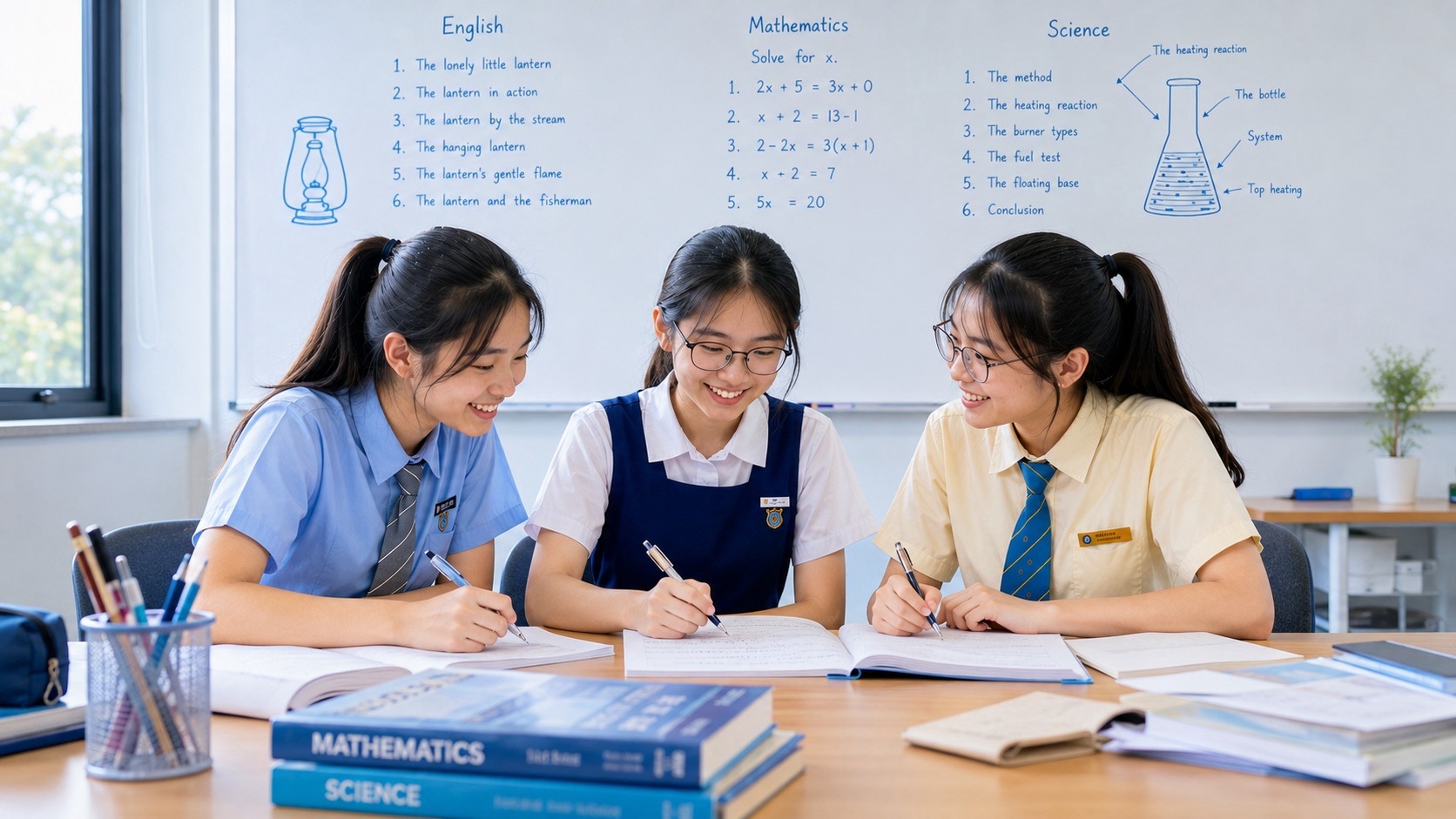
- Three students give the tutor visibility. Individual working remains observable while students still benefit from comparing different mathematical routes.
- Practice must change form. Familiar questions are followed by variation, mixed topics, time pressure and eventually full-paper demands.
- Errors are evidence. We classify them instead of dismissing everything as “careless”.
- Support should reduce. The student should need fewer prompts as capability grows.
- No responsible tutor can guarantee a grade. Progress is measured through understanding, retrieval, accuracy, transfer, speed and increasingly independent performance.
The Difference Between More Mathematics and Better Mathematics
A student can complete a great deal of Mathematics without becoming much better at Mathematics.
This happens when practice is too predictable. The student sees ten questions of the same type, copies a demonstrated procedure and becomes faster at recognising the surface pattern. During the lesson, everything appears successful. The difficulty only becomes visible later, when the school changes the wording, combines two topics, removes an obvious cue or asks for reasoning instead of routine execution.
Real teaching therefore asks a harder question than “Can the student finish this worksheet?”
Can the student reconstruct the mathematical relationship when the surface of the question changes?
That distinction matters from Secondary 1 onwards. Secondary Mathematics becomes progressively more symbolic, connected and abstract. A method learned as an isolated trick may work for one chapter but fail when the same idea appears inside another topic.
The purpose of tuition is not to create a second school lesson that repeats the same material at a different address. It should add diagnostic resolution, a clearer representation, better practice design, more precise correction and a route towards independent performance.
1. Diagnose Before Prescribing
The wrong answer is only the visible output. Two students can produce the same wrong answer for completely different reasons.
Consider a student who cannot solve an equation containing fractions. The visible label might be “weak in equations”. But the failure may actually begin with one of several earlier states:
- the student does not understand equality as balance;
- fraction operations are unstable;
- negative signs are being lost;
- the student cannot distinguish a term from a factor;
- brackets are being expanded incorrectly;
- the method is known but cannot be retrieved without a cue;
- the student reads the equation correctly but rushes the working; or
- the student can solve a clean exercise but cannot recognise the same structure inside a word problem.
Giving all eight students the same extra worksheet would be inefficient. The repair must match the cause.
Our first task is therefore to reduce a broad complaint—“Math is weak”, “algebra is bad”, “careless mistakes”, “cannot do problem sums”—into something small enough to teach.
Useful evidence includes recent school papers, marked assignments, unfinished questions, the student’s own working and a short diagnostic conversation. We pay particular attention to where the student first changes direction. The first incorrect mathematical state is often more useful than the final mark.
2. Mathematics Is a Dependency Network
Secondary Mathematics is not a shelf of independent chapters. Later capabilities sit on earlier ones.
Fractions support algebraic fractions. Negative-number control supports equations and coordinate geometry. Algebra supports functions, graphs and trigonometry. Equation solving supports almost every upper-secondary topic. In Additional Mathematics, the same algebraic infrastructure must remain stable while the student handles polynomials, logarithms, trigonometric identities and calculus.
This is why a student can appear to have a “calculus problem” when the earliest important weakness is algebra. Differentiation may be conceptually understood, but the answer still collapses because factorisation, fractions or symbolic manipulation are unreliable.
Real Mathematics Teaching travels upstream before adding more downstream work.
Repair the earliest important weak link that is still limiting the present task.
This does not mean restarting the entire syllabus. If a Secondary 3 student has one specific fraction weakness affecting algebra, we repair that fraction relationship and reconnect it to the current topic. The intervention should be as small as possible while still solving the real problem.
3. Teach the Mathematical Object, Not Only the Procedure
Students often know steps without knowing what the steps are operating on.
For example, a student may have learned the phrase “move it to the other side and change the sign”. That phrase can produce correct answers in simple equations. But it hides the actual invariant: an equation remains true when the same valid operation is applied to both sides.
When brackets, fractions or unknowns appear on both sides, the shortcut becomes fragile. A student who understands balance can reconstruct a route. A student who memorised movement rules often has nothing to fall back on.
First-principles teaching therefore begins with the mathematical object and its relationships:
- What does the symbol represent?
- What remains invariant?
- What operation is valid here?
- Under what condition is the method allowed?
- What changes when the representation changes?
- How can the result be checked?
Once the student understands the centre of the idea, fluency can be built around it. We do not oppose understanding and practice. Strong Mathematics requires both.
4. Representation Is Part of the Mathematics
A problem can become easier or harder depending on how it is represented.
A relationship may appear as words, a diagram, a table, a graph, an equation or a geometric configuration. Strong students learn to move between these forms without losing the underlying structure.
For lower-secondary students, we may move from a familiar quantity to a diagram and then to formal algebra. In graph work, the student learns that a plotted line is not merely a picture to reproduce; it is a representation of a relationship. In trigonometry, the diagram carries conditions that determine which relationship is useful. In calculus, a derivative can be connected to gradient and rate of change before rules are compressed into efficient symbolic procedures.
When a student is stuck, one useful question is therefore: Is the Mathematics missing, or is the representation inaccessible?
5. Route Selection Is a Separate Skill
Knowing a method is different from knowing when to use it.
Routine practice usually announces the chapter. Examination questions do not always do that. A student may have learned several valid methods but still hesitate because the question does not say which one belongs.
We therefore train students to read for structure:
- What is known?
- What is unknown?
- What relationship connects them?
- What conditions are present?
- Which representation exposes the structure?
- Which route is valid?
- Is there a shorter or safer route?
Route selection becomes increasingly important in mixed-topic and upper-secondary work. The student must stop behaving as if every question arrives with a chapter label attached.
6. Execution Must Be Inspectable
A correct idea can still lose marks through poor execution.
Secondary Mathematics requires students to maintain control across several lines of working. Signs, brackets, powers, units, exact values, calculator entries and diagram labels can all fail even when the conceptual route is correct.
We teach working as part of mathematical thinking, not decoration added at the end.
- One logical transformation should follow another.
- Equal signs should connect genuinely equal expressions.
- Important conditions should remain visible.
- Diagrams should carry useful labels.
- Units and rounding should be controlled.
- Calculator output should be interpreted rather than copied blindly.
Clear working also gives the tutor better evidence. When each mathematical state is visible, the first wrong state can be found quickly.
7. Verification Is a Mathematical Habit
Students sometimes treat checking as something to do only if time remains.
We treat verification as part of the solution process.
- Substitute an equation solution back into the original relationship.
- Estimate whether a numerical answer is plausible.
- Check units.
- Compare a graph with expected behaviour.
- Inspect whether a probability lies in a valid range.
- Check whether a trigonometric answer satisfies the stated interval.
- Ask whether the sign and magnitude make sense in the context.
Verification reduces avoidable loss, but it also develops mathematical judgement. The student becomes less dependent on the answer key because the Mathematics itself provides ways to test the result.
How the Job Changes from Secondary 1 to Secondary 4
Secondary 1: Translate into the New Language
Secondary 1 is a transition year. Arithmetic becomes more symbolic. Algebra, negative numbers, formal working, graphs and multi-step reasoning become more central. The teaching job is to connect Primary Mathematics foundations to the grammar of Secondary Mathematics before weak shortcuts become permanent.
Secondary 2: Stabilise Before the Upper-Secondary Split
Secondary 2 is a consolidation year. Students need enough algebraic and problem-solving stability to enter Secondary 3 without carrying a hidden backlog. A student can still be passing while important dependencies are becoming fragile. This is the time to audit them.
Secondary 3: Build a More Connected System
Secondary 3 increases abstraction and topic density. For students taking Additional Mathematics, algebra must remain reliable while new structures such as polynomials, functions, logarithms, trigonometric relationships and calculus are introduced according to the student’s syllabus and school sequence.
Secondary 4: Convert Knowledge into Examination Performance
Secondary 4 is increasingly a conversion year. Separate chapters must become one usable system. Students need retrieval across older topics, mixed-question recognition, timing, recovery after a difficult question, clear working and enough endurance for complete papers.
The tutor’s job therefore changes with the year. Repeating the same tuition format from Secondary 1 through Secondary 4 would ignore the changing problem.
Current 2026 and 2027 Examination Context
For students sitting the 2026 GCE O-Level, SEAB lists Mathematics as subject code 4052 and Additional Mathematics as 4049. From 2027, the Singapore-Cambridge Secondary Education Certificate (SEC) replaces the N- and O-Level certificates, with students sitting subjects at G1, G2 or G3 according to their subject level.
For 2027 school candidates, SEAB lists Mathematics as K110 at G1, K210 at G2 and K310 at G3. Additional Mathematics is listed as K232 at G2 and K341 at G3. These new codes should not be confused with a claim that Mathematics itself suddenly becomes a different subject. MOE has stated that the move to the SEC does not by itself change examination format, and SEAB states that overall examination standards are unchanged.
Parents can verify the current syllabuses directly from SEAB’s 2026 O-Level syllabus list and the 2027 SEC syllabus gateway.
For tuition, the practical implication is straightforward: teach the student at the correct current subject level, maintain the underlying mathematical dependencies, and prepare the learner to perform independently under the actual assessment demands of that syllabus.
Why Three Students Changes the Teaching
A three-student class is useful not because “smaller is always better”, but because it changes what can be observed.
Mathematics produces visible traces: diagrams, equations, substitutions, cancelled terms, graphs, calculator choices and written explanations. In a 3-pax lesson, the tutor can inspect these traces while the student is still thinking.
Three students also create useful contrast. One student may choose an algebraic route, another a graphical interpretation and a third may expose a common misconception. Those differences can become teaching material without turning the room into a large lecture.
- Visibility: individual working remains inspectable.
- Comparison: students see more than one valid route.
- Feedback: errors can be addressed close to the moment they occur.
- Participation: it is difficult to remain anonymously confused.
- Independence: the tutor can deliberately remain silent when a student is ready to struggle productively.
The last point matters. A small class should not become three simultaneous one-to-one rescue sessions. Good tuition must know when to help and when to withdraw help.
A Typical 1.5-Hour Secondary Mathematics Lesson
Our lessons are typically 1.5 hours. The exact balance changes with the student and the school calendar, but the operating rhythm is stable.
1. Retrieve
Begin with a short return to earlier learning. This tests whether knowledge survived beyond the previous lesson and reactivates dependencies needed for today’s work.
2. Locate
Use school evidence or a small diagnostic task to identify what is actually limiting the current topic.
3. Explain
Teach the missing structure in a representation the student can decode. The explanation should be clear enough for the student to reconstruct, not merely admire.
4. Guide
Work through carefully selected examples with prompts. The student should do as much of the mathematical thinking as possible.
5. Release
Reduce prompts and require independent attempts. This is where apparent understanding is tested.
6. Vary
Change notation, numbers, question order, representation or neighbouring topics so the student must recognise the underlying structure rather than copy the surface.
7. Review the Return
Classify errors, identify what remains unstable and decide what the next piece of practice should accomplish.
This loop can be compressed or expanded, but it keeps the central question visible: what can the student now do without us?
The Error Taxonomy: “Careless” Is Not a Diagnosis
Repeated mistakes become easier to repair when they are named correctly.
- Concept error: the underlying relationship is misunderstood.
- Representation error: the student cannot convert words, diagrams, graphs or symbols into a useful form.
- Recognition error: the correct method is known but the student does not recognise when it applies.
- Route error: the student chooses an invalid or unnecessarily fragile path.
- Algebra/arithmetic error: the route is correct but execution breaks.
- Condition error: restrictions, ranges, units or assumptions are ignored.
- Presentation error: working is too incomplete or disorganised to support reliable execution.
- Retrieval error: knowledge existed but was not available when needed.
- Time-control error: rushing, fixation or poor allocation causes preventable loss.
Once the error type is known, practice becomes more precise. More questions are not automatically the answer. Sometimes the student needs a new explanation. Sometimes a slower execution drill. Sometimes mixed retrieval. Sometimes a changed representation. Sometimes a timed section. Sometimes the best intervention is simply to stop rescuing and let the student complete the route.
The Practice Ladder: From Safe Learning to Examination Load
We do not move directly from explanation to full papers.
- Controlled practice: stabilise the central relationship.
- Variation: change surface features while preserving the concept.
- Mixed practice: remove the chapter cue and require recognition.
- Timed sections: add speed without overwhelming the student.
- Integrated questions: combine dependencies and neighbouring topics.
- Full-paper work: test retrieval, pacing, endurance and recovery together.
- Return tests: revisit repaired weaknesses after a delay to check whether the improvement remains available.
Each stage answers a different question. A student who succeeds at controlled practice but fails mixed work does not need the same intervention as a student who succeeds untimed but collapses under paper pressure.
What Progress Should Look Like Before the Grade Changes
Grades are important, but they are a compressed output. Earlier signals often show whether the system is improving.
- The student starts questions with fewer prompts.
- Old topics remain retrievable for longer.
- Working becomes easier to inspect.
- The same error type repeats less often.
- Changed question forms cause less disruption.
- The student can explain why a method applies.
- Checking becomes more deliberate.
- Routine work becomes faster without becoming sloppier.
- Mixed-topic sets become less intimidating.
- The student recovers more quickly after a difficult question.
- School homework consumes less unproductive time.
- Dependence on the tutor falls.
The direction should be towards greater mathematical control, not greater dependence on tuition.
Who This 3-Pax Model Fits
A three-student class is particularly useful when the learner needs:
- close inspection of working;
- frequent opportunities to ask and answer questions;
- targeted repair of a recurring weakness;
- more structure than independent study currently provides;
- a quieter environment than a large class;
- peer comparison without disappearing into a crowd;
- carefully paced extension; or
- help converting knowledge into examination performance.
When 3-Pax Tuition May Not Be the Right Tool
Tuition is not automatically necessary, and a 3-pax class is not automatically the best fit.
A student who is learning independently, correcting mistakes effectively and performing reliably may not need additional tuition. A student requiring intensive individual support for needs that cannot be served responsibly in a small group may require a different arrangement. A family whose schedule makes regular attendance unsustainable should also consider whether the travel and workload cost is greater than the likely benefit.
The right question is not “Is small-group tuition good?” It is “Does this format solve the learner’s actual problem better than the alternatives?”
Questions Parents Can Ask Any Mathematics Tutor
- How do you diagnose the cause of a wrong answer?
- What happens when a student cannot retrieve an older prerequisite?
- How do you distinguish concept errors from execution errors?
- How do you know when to explain and when to let the student struggle?
- How does practice progress from familiar questions to mixed and timed work?
- How do you check whether a repaired skill remains stable several weeks later?
- What evidence should parents look for besides one test score?
- How is support reduced as the student improves?
- How do you adapt for the student’s actual G1, G2 or G3 subject level?
- What do you refuse to promise?
A good answer should describe a teaching process, not only a marketing result.
What We Do Not Promise
We do not promise that a fixed number of lessons will produce a fixed grade. We do not guarantee an A1, AL1 or distinction. We do not assume that every student should take the same route simply because the subject title is the same.
Students begin from different states. School sequences differ. Time to examination differs. Attendance, practice, health, workload and many other factors affect performance.
What responsible tuition can promise is a method: inspect the evidence carefully, teach clearly, practise deliberately, observe what happens, repair the earliest important failure and keep returning responsibility to the learner.
The eduKateSG Secondary Mathematics Teaching Loop
Locate → Represent → Explain → Choose → Execute → Check → Vary → Mix → Stress-Test → Repair → Retest → Release.
This is what we mean by Real Mathematics Teaching.
It begins with the student in front of us, not with a generic worksheet. It respects the dependencies beneath the visible chapter. It builds understanding and fluency together. It treats mistakes as useful evidence. It increases difficulty in controlled stages. And it keeps asking whether the student is becoming more independent.
For a level-specific example of this approach, read our Secondary 1 Mathematics Tutor Clementi | Small Groups Tutorials. For a current parent decision about the cost of upper-secondary A-Math support, see How Much Does Sec 3 & Sec 4 Additional Mathematics Tuition Cost in Singapore?.
Arrange a Parent–Student Consultation
If you are considering Secondary Mathematics tuition, bring recent school papers, marked assignments and examples of questions that repeatedly cause difficulty. We will look for the learner’s present state and the first useful next move.
eduKateSG
8 Fourth Avenue, Singapore 268674
Near Sixth Avenue MRT
Premium 3-pax small-group Mathematics tuition
Typical lesson: 1.5 hours weekly
By appointment