
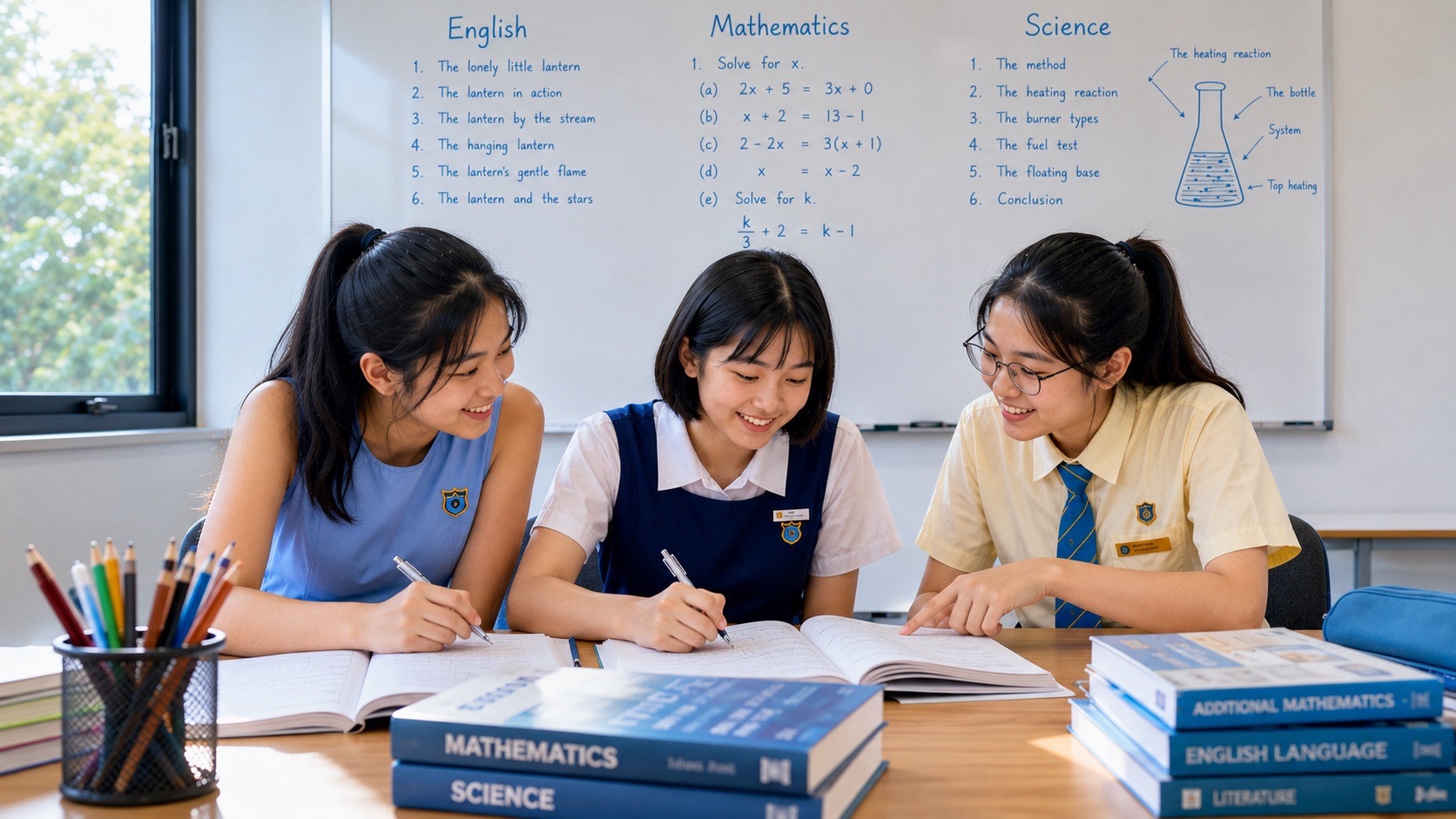
Secondary Mathematics Tuition Singapore | Why 3-Pax Small Groups Work
A three-student Mathematics class is not simply a smaller version of a large class. When it is taught properly, the format changes what the tutor can see, how quickly feedback can arrive, how students compare mathematical routes and how deliberately support can be withdrawn.
That is the real reason eduKateSG uses a 3-pax model for Secondary Mathematics. The benefit is not the number three by itself. The benefit is the teaching resolution that becomes possible when individual working remains visible while useful peer comparison is still present.
This page is for parents deciding between one-to-one tuition, a small group, a larger tuition class or no tuition at all. It explains what three students can add, where the format has limits, how a lesson should operate and what progress should look like if the arrangement is genuinely helping.
The Short Answer
Three students create a useful middle ground: enough individual visibility for diagnosis and correction, but enough peer variation for comparison, explanation and independent thinking.
The format works best when the tutor does more than lecture to three people. Students should work visibly, explain decisions, receive different interventions when needed, compare methods and eventually solve without being rescued.
Quick Read for Parents
- Three is small enough to inspect working. The tutor can see where an equation, graph, diagram or reasoning chain first becomes unstable.
- Three is large enough to create contrast. Different students often expose different routes and errors.
- Feedback can be targeted. One student may need a prerequisite rebuilt, another a route-selection question and another no help at all.
- Participation remains visible. It is harder to stay anonymously confused.
- The tutor must still protect independence. Constant intervention can make a small class worse by creating dependence.
- Not every student needs this format. Some learners are already independent; others may need a different form of support.
- Class size is not a guarantee. The quality of diagnosis, explanation, practice design and feedback matters more than the label “small group”.
- Progress should reduce dependence. Better tuition should produce a student who needs the tutor less over time.
Why Class Size Matters More in Mathematics Than It First Appears
Mathematics is unusually visible when students are required to show their thinking.
A page of working records a sequence of mental states. The student chooses a representation, writes an equation, expands a bracket, substitutes a value, changes a sign, draws a diagram, uses a calculator, rearranges a formula and decides when the answer is finished.
The final wrong answer may be ten steps away from the first wrong move.
This is why high-resolution observation matters. If the tutor only sees the final answer, the intervention may be generic: “be more careful”, “practise more”, “revise algebra”. If the tutor sees the exact line where the reasoning changes direction, the response can be much smaller and more useful.
A three-student class gives the tutor a practical chance to observe those traces while still allowing each learner time to think independently.
What Three Students Changes: Five Teaching Advantages
1. Working Visibility
With three students, the tutor can inspect individual working frequently enough to notice patterns rather than isolated mistakes.
A student may consistently lose a negative sign after expanding brackets. Another may choose the correct formula but substitute the wrong measurement. Another may understand the method yet organise the page so poorly that copying errors become likely. These are different problems and should not receive the same worksheet.
Visibility makes the correction more precise.
2. Route Comparison
Mathematics often allows more than one valid route.
When one student solves a problem algebraically and another sees a geometric or graphical route, the comparison can reveal structure. Students begin to ask not only “Is my answer correct?” but “Why is this route valid?” and “Which route is safer or more efficient under these conditions?”
This is difficult to create in a one-way lecture. A small group can make alternative thinking visible without allowing the discussion to become noisy or unfocused.
3. Diagnostic Bandwidth
Three students can be working on the same broad topic while needing different interventions.
- Student A may need fraction operations repaired before continuing an algebraic fraction.
- Student B may know the algebra but fail to recognise which route the question requires.
- Student C may be ready for a harder variation and should not be slowed by an explanation already mastered.
A useful small-group tutor can switch between these states without turning the lesson into three unrelated one-to-one sessions.
4. Frequent Retrieval and Explanation
Students learn more about what they know when they are required to retrieve and explain it.
In a group of three, each student can be asked regularly to state the relationship, explain the next line, justify a route or critique a piece of working. The tutor can hear whether the explanation reflects genuine structure or memorised language.
This is especially useful in Secondary Mathematics, where students must eventually recognise relationships without an obvious cue.
5. Productive Independence
A tutor who sits beside one student continuously may intervene too quickly. The student can become accustomed to prompts arriving the moment difficulty appears.
In a three-student class, the tutor can deliberately move attention elsewhere while a student works through uncertainty. That small delay matters. The learner must decide what to try next, recover an earlier method or check the working without immediate rescue.
Help should arrive when it changes learning, not simply when it removes discomfort.
3-Pax Is Not “Three Students Doing the Same Worksheet”
A small class can still be badly designed.
If the tutor delivers a forty-minute lecture, gives all three students the same exercise and checks answers at the end, the format has not used most of the advantages that small-group teaching can provide.
At eduKateSG, the class is intended to remain active. Students should spend substantial time solving, explaining, checking and responding to questions. The tutor moves between explanation and observation rather than occupying the entire lesson with demonstration.
The room should therefore alternate between several modes:
- Shared instruction when all three need the same central idea.
- Individual diagnosis when one learner’s working exposes a different weakness.
- Parallel practice when students need different question difficulty or support.
- Comparison when different routes can teach something useful.
- Silent independent work when the tutor needs to test whether support can be removed.
- Return review when old errors are revisited after a delay.
The format is valuable because it can change mode quickly.
3-Pax Compared with One-to-One Tuition
One-to-one tuition can provide maximum attention, and there are learners for whom that is appropriate. But more attention is not automatically more learning.
One-to-one can become inefficient when the tutor:
- explains before the student has tried to think;
- fills every silence;
- corrects every mistake immediately;
- provides continuous cues that disappear in an examination; or
- becomes the student’s external working memory.
A well-run three-student class naturally creates short periods in which the tutor is supporting someone else. Those periods can help students practise self-starting, persistence and checking.
However, one-to-one may still be better when a student requires an intensity, pace or type of support that cannot be responsibly shared. The decision should come from the learner state, not from the assumption that one format is universally superior.
3-Pax Compared with Larger Tuition Classes
Larger classes can be efficient for content delivery. A strong lecturer can explain a concept clearly to many students at once, and a learner who is already independent may need little more than that.
The limitation appears when the student’s problem is not the absence of explanation but the need for diagnosis.
A student may nod through a large-class explanation while making an entirely different error during practice. The tutor may not see that error until a marked test arrives weeks later.
Three-student tuition becomes more useful when the family is paying for:
- inspection of individual working;
- rapid correction of recurring errors;
- adaptation to school pace;
- questions that respond to the student’s state;
- careful bridging of missing prerequisites; and
- progressive withdrawal of support.
In other words, the smaller group should buy resolution, not merely exclusivity.
What a 1.5-Hour 3-Pax Lesson Can Look Like
eduKateSG Secondary Mathematics lessons are typically 1.5 hours. The lesson is not divided mechanically into identical blocks, but the following sequence shows the teaching logic.
Return to Earlier Learning
Students begin with retrieval from previous topics. This shows what remains available without re-teaching and exposes decayed prerequisites early.
Inspect the Current State
The tutor checks schoolwork, an upcoming topic or a small diagnostic question. The goal is to identify the first useful teaching problem rather than automatically continue from last week’s page number.
Teach the Shared Structure
When all three students need the same idea, the tutor explains it clearly from the underlying relationship. Examples are chosen to expose meaning and common failure modes.
Differentiate the Practice
Students may now receive different prompts or question variants. One may need a controlled example, another a mixed application and another an extension problem.
Compare Routes
Where useful, students explain how they approached a question. The tutor uses differences to highlight structure, efficiency or hidden assumptions.
Release Support
The final part should contain genuine independent work. The tutor needs evidence that the student can still perform when cues are removed.
Name the Return
Errors are classified and the next piece of work is chosen for a reason. The lesson ends with a clearer picture of what has changed and what still needs attention.
How the 3-Pax Job Changes by Secondary Level
Secondary 1: Transition Visibility
Secondary 1 students are learning a new mathematical language. The tutor needs to see whether problems arise from Primary-school foundations, negative numbers, algebraic notation, equation balance, graph interpretation or multi-step organisation.
A 3-pax class is useful because transition errors can be corrected before they harden into shortcuts.
Secondary 2: Stability Visibility
Secondary 2 students often appear to be coping while weaknesses accumulate beneath the mark. The tutor watches whether earlier algebra and number skills remain reliable when questions become longer or topics are mixed.
Secondary 3: Dependency Visibility
Secondary 3 increases topic density. Students may be working at different Mathematics subject levels, and some begin Additional Mathematics. The class needs enough resolution to separate a new-topic difficulty from an old algebraic dependency.
Secondary 4: Examination Visibility
By Secondary 4, the important evidence may come from mixed sets, timed sections and full papers. The tutor watches not only what the student knows, but whether the knowledge survives time pressure, unfamiliar ordering and paper fatigue.
3-Pax Under Full Subject-Based Banding
Full Subject-Based Banding has been fully implemented since 2024. Students may offer subjects at G1, G2 or G3 according to their school arrangements and readiness. From 2027, graduating students sit the Singapore-Cambridge Secondary Education Certificate (SEC) at their respective subject levels.
For 2027 school candidates, SEAB lists Mathematics as K110 at G1, K210 at G2 and K310 at G3. Additional Mathematics is listed at K232 for G2 and K341 for G3. MOE has stated that the change to the SEC does not itself change examination format, and SEAB states that the overall examination standards remain unchanged.
The practical tuition implication is not to turn a 3-pax class into three levels taught simultaneously without structure. A suitable group needs enough overlap for shared instruction while leaving enough flexibility for different repair or extension work.
Parents can verify the current examination framework through SEAB’s SEC syllabus gateway and MOE’s Full SBB and SEC announcement.
The Most Important Grouping Question Is Not “Same Grade?”
Three students being in the same school year does not automatically make them a useful group.
We also consider:
- subject level and school sequence;
- algebraic foundation;
- pace of independent work;
- amount of prompting needed;
- assessment proximity;
- error profile;
- ability to learn within a shared explanation; and
- whether the students’ differences create useful comparison or unproductive divergence.
A good small group has enough common ground to share a lesson and enough variation to create useful learning.
The Failure Mode: A Small Class Can Create Dependence
The greatest risk of high-attention tuition is over-helping.
If every hesitation produces a hint, the student may become very successful inside tuition and unexpectedly weak in a test. The classroom performance was partly being carried by invisible tutor cues.
We therefore distinguish between several levels of support:
- full explanation;
- worked model;
- partial prompt;
- question only;
- silent observation; and
- independent retest after delay.
As the student improves, the intervention should move down that list.
The examination eventually removes the tutor completely. Tuition should prepare for that removal.
The Failure Mode: Peer Learning Can Become Peer Copying
Students should benefit from one another’s thinking without outsourcing their thinking to the fastest classmate.
We manage this by separating attempt and comparison. Students usually need their own first attempt before another solution is discussed. The purpose of seeing another route is to compare structures, not to replace independent work.
When a student explains a solution, the others may be asked to identify the invariant, challenge a step, find a different representation or state the condition under which the method works. Passive listening is not enough.
The Failure Mode: “Small Group” Can Be a Marketing Label
Parents should ask what actually happens after a student makes a mistake.
If the answer is simply “we give more practice”, the class size may not be doing much diagnostic work. A meaningful small-group programme should be able to explain how it identifies the failure, changes the intervention and later checks whether the repair transferred.
Useful questions include:
- How do you inspect individual working?
- How often does each student need to explain?
- What happens if the three students are at different states?
- How is homework differentiated?
- How do you retest an old weakness?
- How do you know when to reduce help?
What Progress Should Look Like in a Good 3-Pax Class
Parents should look for changes that indicate the student is gaining control rather than merely becoming comfortable with the tutor.
- The student begins more questions without asking what method to use.
- Explanations become shorter and clearer.
- Old topics remain accessible after several weeks.
- Working becomes more organised.
- Recurring error types reduce.
- Changed question forms are less disruptive.
- The student can compare two routes and explain the trade-off.
- Timed work becomes faster without accuracy collapsing.
- School corrections require less supervision.
- The student asks more precise questions.
- Full-paper performance becomes less variable.
- The tutor needs to intervene less often.
One mark can rise or fall for many reasons. These process signals reveal whether the underlying learning system is becoming stronger.
Who Usually Benefits Most
- A student who understands in class but cannot reproduce the method later.
- A student with repeated algebra or accuracy errors that need close inspection.
- A student whose school pace is moving faster than the present foundation.
- A student who needs a structured bridge into Secondary 1 or upper-secondary work.
- A capable student who needs deeper variation rather than more routine worksheets.
- A Secondary 4 student who needs to convert knowledge into stable timed-paper performance.
- A student who benefits from hearing another mathematical route but becomes lost in a large class.
Who May Need Something Else
A student who is already self-correcting effectively and performing reliably may not need tuition. A learner requiring very intensive one-to-one support may need a different arrangement. A student whose subject level, school sequence or pace is too far from the available group should not be forced into a poor fit simply to fill a seat.
The purpose of consultation is therefore placement, not persuasion.
What to Bring to a 3-Pax Placement Consultation
- recent school test papers;
- marked worksheets;
- examples of unfinished or difficult questions;
- the current school topic sequence;
- teacher comments where useful;
- the student’s own description of what feels difficult; and
- upcoming assessment dates.
We are interested in the pattern beneath the score. A 65% paper can represent a conceptual problem, a retrieval problem, an execution problem or a timing problem. Those students require different teaching.
A Better Way to Compare Tuition Formats
Instead of asking only “How many students are in the class?”, compare the learning functions the format provides:
- Observation: Can the tutor see how the student thinks?
- Diagnosis: Can the tutor identify the first unstable state?
- Explanation: Can the concept be represented in a way this student understands?
- Practice design: Does difficulty increase in controlled stages?
- Feedback: Does correction arrive while the reasoning is still visible?
- Transfer: Are changed and mixed questions used?
- Assessment: Is timed and full-paper work introduced when appropriate?
- Independence: Is support deliberately withdrawn?
Three students can support all eight functions. But the tutor still has to use the format well.
The eduKateSG 3-Pax Mathematics Loop
Observe → Diagnose → Explain → Attempt → Compare → Correct → Vary → Release → Retest.
The group exists to make this loop more precise.
It is not a promise that every learner will reach the same grade. It is a teaching environment designed to keep mathematical thinking visible, make correction specific and build a gradual handover from tutor-supported performance to student-owned performance.
For the teaching philosophy behind the format, read Secondary Mathematics Tuition | What Real Mathematics Teaching Looks Like. For a level-specific example, see Secondary 1 Mathematics Tutor Clementi | Small Groups Tutorials.
Arrange a Parent–Student Consultation
eduKateSG
8 Fourth Avenue, Singapore 268674
Near Sixth Avenue MRT
3-pax Secondary Mathematics tuition
Typical lesson: 1.5 hours weekly
By appointment
Bring recent school evidence and we can discuss whether the student needs repair, stabilisation, extension or examination conversion—and whether a three-student group is the right tool.