
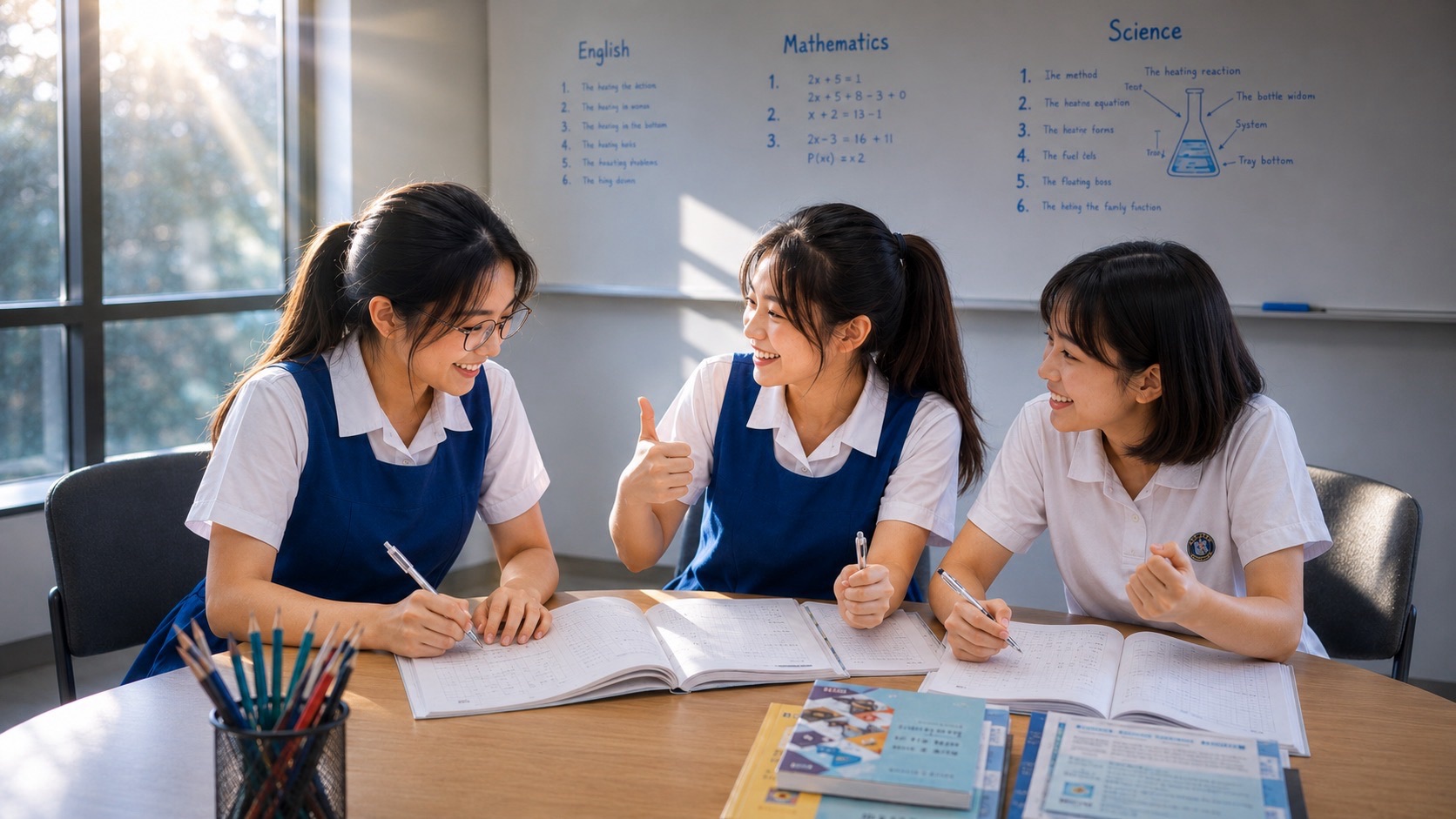
Small Group Additional Mathematics Tuition in Punggol
Additional Mathematics becomes much easier to manage when a student has enough space to ask questions, enough attention for mistakes to be noticed, and enough guided practice to understand why a mathematical method works.
At eduKateSG Punggol, our Small Group Additional Mathematics Tuition in Punggol is conducted in classes of up to 3 students, allowing the tutor to teach the topic while still observing how each individual student thinks, calculates and responds to unfamiliar questions.
The objective is not simply to give students more A-Math questions.
It is to help them understand the mathematics underneath those questions.
Quick Read: Small Group Additional Mathematics Tuition in Punggol
Programme: Secondary Additional Mathematics Tuition
Location: eduKateSG Punggol
Class size: Up to 3 students per class
Suitable for: Secondary 3 and Secondary 4 students studying Additional Mathematics
Main focus:
- Algebra and symbolic control
- Functions and graphs
- Equations and inequalities
- Logarithms and exponentials
- Trigonometry
- Coordinate geometry
- Differentiation
- Integration
- Problem-solving
- Examination technique
- Mathematical accuracy
- Independent question-solving
Best suited for students who:
- are beginning Additional Mathematics and want a strong foundation;
- understand lessons but make repeated algebraic mistakes;
- can complete familiar questions but struggle with unfamiliar ones;
- have gaps from earlier Mathematics topics;
- need closer correction than a large class can provide;
- are preparing for Secondary 4 examinations;
- need to rebuild confidence after weak test results; or
- want to move from simply completing questions to understanding A-Math properly.
The eduKateSG approach:
Diagnose the weakness → repair the foundation → understand the concept → practise the method → vary the question → correct mistakes → build independence → prepare for examination conditions.
What Is Small Group Additional Mathematics Tuition?
Small Group Additional Mathematics Tuition is not simply normal tuition with fewer students.
The important difference is what becomes possible when the class is kept small.
In a large classroom, a tutor can teach a method to everyone.
In a 3-pax Additional Mathematics class, the tutor can also watch how each student actually uses that method.
That distinction matters.
A student may copy every line correctly while the tutor is demonstrating a quadratic equation, differentiation question or trigonometric identity.
But when the student begins independently, a completely different picture may emerge.
The student might:
- lose a negative sign;
- expand an expression incorrectly;
- choose the wrong identity;
- misunderstand what a function represents;
- differentiate the wrong term;
- use a memorised method in the wrong situation;
- skip an important condition;
- abandon the question because it looks unfamiliar.
These are not always problems that require another lecture.
They often require observation and correction.
That is one of the principal advantages of small-group A-Math tuition.
Why Additional Mathematics Can Become Difficult So Quickly
Additional Mathematics is cumulative.
New concepts depend heavily on earlier mathematical control.
For example:
Weak algebra
↓
unstable equations
↓
difficulty manipulating functions
↓
difficulty with logarithms and trigonometry
↓
difficulty with differentiation and integration
↓
multi-step questions become increasingly difficult.
This means the chapter where the student finally starts failing may not be the chapter where the problem actually began.
A student struggling with calculus may appear to have a calculus problem.
But closer observation may reveal that the real difficulty is algebra.
Another student may know differentiation rules perfectly but repeatedly lose marks because expressions are simplified incorrectly.
Another may understand every individual chapter yet struggle during examinations because they cannot recognise which mathematical route a question requires.
Therefore:
The visible mistake is not always the original weakness.
Good Additional Mathematics tuition should find both.
Why We Keep Our Additional Mathematics Classes Small
At eduKateSG, our Additional Mathematics tuition classes are kept to 3 students per class, allowing closer teaching, observation and targeted correction than would normally be possible in a larger group.
Three students creates an important middle ground.
It is still a group.
Students hear other questions.
They see different approaches.
They discover that another student may misunderstand something they thought they understood.
They work alongside peers.
But the class remains small enough for the tutor to know what each student is doing.
This is especially useful in Additional Mathematics because mathematical errors are often highly individual.
Student A may understand the concept but work too quickly.
The solution may be mathematical discipline.
Student B may work carefully but have weak algebra.
The solution may be foundation repair.
Student C may know the formula but cannot recognise when to use it.
The solution may be route recognition.
All three students can be sitting in the same A-Math lesson.
But they should not receive exactly the same correction.
That is where the small-group format becomes valuable.
The 3-Pax Advantage: More Than Personal Attention
“Personal attention” is often used when describing small tuition classes.
But for Additional Mathematics, we can be more precise.
A three-student class allows several important teaching processes to occur.
1. The Tutor Can See the Working
In Mathematics, the final answer tells only part of the story.
The working reveals much more.
A wrong answer may result from:
- conceptual misunderstanding;
- poor algebra;
- incorrect substitution;
- careless arithmetic;
- weak notation;
- a skipped condition;
- a wrong mathematical route.
These require different corrections.
Looking at the student’s working allows the tutor to identify which failure actually occurred.
2. Questions Can Be Asked Earlier
In large environments, students sometimes wait.
They may not want to interrupt.
They may think their question is too small.
They may assume everyone else understands.
By the time they finally ask, several additional concepts may already depend on the part they missed.
A smaller class makes it easier to catch confusion earlier.
3. Mistakes Can Be Corrected Before They Become Habits
A repeated algebra mistake can become automatic.
For example:
- mishandling negative signs;
- expanding brackets incorrectly;
- cancelling terms illegally;
- confusing indices;
- mishandling logarithmic laws;
- forgetting restrictions;
- differentiating constants incorrectly.
Once a wrong operation becomes habitual, it takes more work to remove.
Close correction helps interrupt the mistake earlier.
4. The Tutor Can Change the Question
Understanding a worked example is not the same as understanding the concept.
So after teaching a method, we can alter:
- the numbers;
- the representation;
- the wording;
- the sequence;
- the information provided;
- the required unknown;
- or the combination of topics involved.
If the student still succeeds, the understanding is becoming transferable.
If the student suddenly fails, we have discovered where the understanding is still fragile.
5. Students Have to Think Independently
Small-group tuition should not become permanent hand-holding.
The objective is eventually the opposite.
Students need to reach the stage where they can look at an unfamiliar question and decide:
What is this question asking?
What information do I have?
Which mathematical relationships apply?
What should I do first?
Is my answer reasonable?
That is mathematical independence.
Additional Mathematics Is Not Simply “More Mathematics”
One reason students are surprised by A-Math is that it changes the nature of mathematical work.
Earlier Mathematics may allow a student to succeed through strong familiarity with recurring question formats.
Additional Mathematics increasingly requires the student to manipulate mathematical structures.
The student works with:
- variables;
- functions;
- transformations;
- identities;
- rates of change;
- relationships between quantities;
- mathematical conditions;
- symbolic representations.
This makes algebraic integrity extremely important.
If the algebra is unstable, the rest of Additional Mathematics becomes unstable.
That is why one of the first questions we ask is not simply:
“Which chapter is the student doing now?”
A more useful question is:
“What does the student need to be able to do for this chapter to work?”
Finding the Earliest Weak Link
Suppose a student struggles with differentiation.
Giving twenty more differentiation questions may appear sensible.
But imagine that the actual sequence is:
weak factorisation
→ poor algebraic simplification
→ difficulty rewriting expressions
→ differentiation becomes messy
→ answers repeatedly go wrong.
More differentiation worksheets would treat the final symptom.
Repairing the algebra addresses the earlier cause.
The same pattern can appear elsewhere.
Trigonometry difficulty
may actually begin with:
weak algebra → poor equation manipulation → difficulty solving trigonometric equations.
Logarithm difficulty
may begin with:
weak indices → poor understanding of exponential relationships → logarithmic laws feel arbitrary.
Coordinate geometry difficulty
may begin with:
weak manipulation → poor equation control → difficulty connecting geometry with algebra.
The purpose of diagnosis is therefore to locate the earliest useful repair point.
What We Teach in Additional Mathematics Tuition
The precise sequence depends on the student’s school, level and current needs, but Additional Mathematics typically develops across a connected mathematical system.
Algebra
Algebra is the operating language of A-Math.
Students need control over:
- manipulation;
- factorisation;
- equations;
- inequalities;
- indices;
- surds;
- polynomials;
- partial fractions;
- and symbolic reasoning.
Weakness here can travel into almost every later topic.
Functions and Graphs
Functions introduce students to relationships between inputs and outputs.
Students learn to understand:
- function notation;
- domain and range;
- composite functions;
- inverse functions;
- graphical relationships;
- transformations;
- and how algebra is represented visually.
Functions are important because they connect many later areas of mathematics.
Exponential and Logarithmic Functions
Students need more than memorised log laws.
They need to understand the relationship between:
indices ↔ exponentials ↔ logarithms.
Once that structure becomes clear, manipulation becomes much more logical.
Trigonometry
Additional Mathematics trigonometry introduces greater symbolic complexity.
Students work with:
- identities;
- equations;
- functions;
- graphs;
- exact values;
- and transformations.
Success depends heavily on both algebra and route recognition.
Coordinate Geometry
Coordinate geometry brings algebra and geometry together.
Students must understand relationships involving:
- gradients;
- equations;
- points;
- lines;
- curves;
- and geometrical conditions.
Differentiation
Differentiation introduces one of the most important ideas in higher mathematics:
change.
Instead of viewing differentiation only as a collection of rules, students should understand what the derivative tells us.
This makes later applications involving:
- gradients;
- stationary points;
- increasing and decreasing functions;
- rates of change;
- maxima and minima
much easier to organise.
Integration
Integration develops another major mathematical idea.
Students learn techniques of integration but also need to recognise what integration represents and how it connects with differentiation.
Eventually, questions may require several mathematical skills at once.
This is why strong foundations matter.
Secondary 3 Additional Mathematics Tuition in Punggol
Secondary 3 is often the most important time to establish the A-Math system correctly.
Students are learning a new mathematical language.
At this stage, the objective should not immediately be maximum speed.
It should be:
Understand correctly first.
Then:
Practise correctly.
Then:
Become efficient.
Secondary 3 tuition can therefore focus heavily on:
- establishing algebra discipline;
- understanding functions;
- learning new mathematical notation;
- developing systematic working;
- recognising common mathematical structures;
- and preventing early misconceptions from accumulating.
A strong Secondary 3 foundation reduces the amount of repair required later.
Secondary 4 Additional Mathematics Tuition in Punggol
Secondary 4 creates a different problem.
The syllabus is increasingly interconnected while examination pressure increases.
Students now need to combine:
knowledge + recognition + execution + accuracy + time control.
A Secondary 4 student may therefore need several kinds of work simultaneously.
Foundation repair
Repair mathematical weaknesses that are still causing marks to leak.
Topic consolidation
Ensure individual chapters are stable.
Integration
Train questions requiring several concepts.
Examination recognition
Learn to identify the likely route efficiently.
Timed execution
Move from understanding a question to completing it reliably within examination conditions.
Error reduction
Identify recurring sources of lost marks.
The objective is not simply to complete more papers.
The objective is to make each paper provide useful information.
From Worksheets to Feedback Loops
Practice matters enormously in Additional Mathematics.
But the number of questions completed is not the only useful measure.
Consider two students.
Student A
Completes 100 questions.
Makes the same algebraic mistake repeatedly.
Marks the answers.
Continues.
Student B
Completes 40 carefully selected questions.
Identifies three recurring errors.
Repairs them.
Attempts variations.
Tests the concept again.
Which student has completed more work?
Student A completed more questions.
Student B may have completed more learning.
A productive A-Math loop looks more like:
Attempt
→ observe
→ diagnose
→ correct
→ explain
→ vary
→ retry
→ retrieve later.
That feedback loop is one reason close small-group correction can be useful.
What Happens During Small Group A-Math Tuition?
A lesson may contain several different modes.
Explanation
New concepts are introduced clearly and connected to knowledge the student already has.
Guided examples
The tutor demonstrates the mathematical structure and decision process.
Student attempt
Students work independently while the tutor observes.
Immediate correction
Important misconceptions and working errors are addressed.
Question variation
Similar-looking but structurally different questions are introduced.
Retrieval
Previously learned concepts are brought back so they remain accessible.
Examination application
Students learn how the same mathematics appears under assessment conditions.
Not every student will spend exactly the same amount of time on each stage.
That flexibility is part of the value of keeping the class small.
What Small Group Tuition Should Not Become
Three students in a room does not automatically create effective tuition.
Small-group teaching should not mean:
worksheet → worksheet → worksheet → answer sheet.
Nor should it create dependence where the student cannot begin until the tutor provides a hint.
The purpose of close support is to gradually reduce the amount of support required.
A useful progression is:
I cannot do this.
then
I can do this with explanation.
then
I can do this with a small prompt.
then
I can do this independently.
then
I can still do this when the question changes.
then
I can do this accurately under examination conditions.
That last transition matters.
Because mathematics learned only in familiar conditions may disappear when the pressure changes.
Route Recognition in Additional Mathematics
One of the biggest differences between weaker and stronger A-Math students is often not whether they know a method.
It is whether they recognise when to use it.
An examination question does not normally announce:
“Use this exact technique.”
Students need to identify clues.
That requires seeing mathematical structure.
Over time, students should become better at asking:
- What type of object am I looking at?
- Which information is important?
- Which relationships are invariant?
- What is the question actually asking me to find?
- Which routes are available?
- Which is the cleanest route?
This reduces random trial-and-error.
Accuracy Is a Mathematical Skill
Students sometimes describe lost marks as “careless mistakes”.
Some mistakes genuinely are accidental.
But repeated carelessness often has structure.
If the same type of error appears repeatedly, we can investigate it.
For example:
sign errors
may indicate rushed transitions.
unexplained skipped steps
may indicate excessive mental calculation.
wrong substitutions
may indicate poor notation.
unfinished questions
may indicate slow route selection.
Instead of simply telling a student:
“Be more careful,”
we want to discover what produces the error.
Then we can build a better working habit.
Confidence Should Follow Competence
Confidence matters.
But in Additional Mathematics, confidence is most durable when it has evidence beneath it.
A student becomes more confident after repeatedly experiencing:
“I understand this.”
“I know why this works.”
“I corrected that mistake.”
“I managed the harder variation.”
“I solved that question without help.”
That kind of confidence is stronger than reassurance alone.
So our objective is not merely to tell students that they can do Additional Mathematics.
We want to help them accumulate enough successful mathematical control that they can see it themselves.
Why Location Still Matters: Additional Mathematics Tuition in Punggol
Tuition is part of a student’s weekly system.
Travel time matters.
Fatigue matters.
School workload matters.
CCA matters.
Homework matters.
Sleep matters.
An excellent lesson that creates an unsustainable weekly schedule can introduce another problem.
For families living around Punggol, Sengkang and the surrounding north-east region, attending a nearby class can reduce unnecessary travel while allowing students to maintain a more stable weekly study routine.
eduKateSG’s Punggol Mathematics programmes support Secondary and Additional Mathematics students in small groups close to Punggol MRT.
Convenience should never replace teaching quality.
But when strong teaching and practical location can exist together, that is useful.
Additional Mathematics and the Singapore Examination Pathway
For students sitting the 2026 Singapore-Cambridge GCE O-Level examination, Additional Mathematics remains Syllabus 4049.
From 2027, Singapore moves into the Singapore-Cambridge Secondary Education Certificate framework. SEAB currently lists Additional Mathematics within both the G2 and G3 SEC pathways, with the relevant subject codes published for the new system.
For students and parents, the practical principle remains straightforward:
Learn the Mathematics deeply enough that a change in examination label does not change the quality of the student’s mathematical understanding.
The fundamentals remain valuable:
- algebraic control;
- conceptual understanding;
- problem-solving;
- mathematical communication;
- accuracy;
- transfer;
- and examination execution.
Who May Benefit From Small Group Additional Mathematics Tuition?
A small-group A-Math class may be particularly useful for a student who:
Has just started Additional Mathematics
Early guidance can prevent weak habits from becoming embedded.
Is falling behind
The tutor can identify whether the student needs current-topic help, earlier foundation repair, or both.
Keeps making careless mistakes
Close observation can reveal whether these mistakes are genuinely random or part of a recurring pattern.
Understands school lessons but cannot do homework independently
This often indicates that recognition or retrieval is still fragile.
Can do topical worksheets but struggles with examination papers
The missing skill may be integration or route recognition.
Has lost confidence in Mathematics
A smaller environment can allow difficult concepts to be rebuilt at an appropriate pace.
Is already doing well and wants greater mathematical control
Small-group tuition is not only remedial.
A stronger student can use close feedback to improve precision, efficiency, explanation and performance on unfamiliar problems.
When Should a Student Start Additional Mathematics Tuition?
There is no universal date.
The better question is:
When does the student need additional support?
For some students, starting near the beginning of Secondary 3 helps establish the subject correctly.
For others, school teaching is sufficient until a particular topic exposes a weakness.
Some students need support only later, when the demands of Secondary 4 examination preparation increase.
Look for signals such as:
- homework taking increasingly long;
- repeated errors in basic manipulation;
- dependence on worked solutions;
- inability to explain methods;
- deterioration across several connected topics;
- growing avoidance of A-Math;
- large differences between practice and test performance.
These provide more useful information than the calendar alone.
What Should Parents Look for in an A-Math Tuition Class?
Class size is only one factor.
Parents can also consider whether the tuition helps the student:
- understand rather than copy;
- repair earlier mathematical gaps;
- ask questions comfortably;
- receive meaningful correction;
- practise independently;
- recognise unfamiliar question structures;
- retain earlier topics;
- work accurately;
- prepare for examinations without creating unnecessary panic.
Ultimately, the tuition should make the student progressively less dependent on tuition.
That may sound paradoxical.
But it is an important educational objective.
The tutor provides structure until the student can increasingly provide that structure for themselves.
Frequently Asked Questions
Is 3-pax tuition the same as one-to-one tuition?
No.
One-to-one tuition provides exclusive tutor attention.
Three-student tuition retains individual attention while also creating a small peer environment. Students can hear different questions, observe alternative solutions and practise independently while the tutor works momentarily with another student.
For many learners, this creates a useful balance between personal support and classroom independence.
Is small-group tuition suitable for a weak A-Math student?
It can be particularly useful when the tutor identifies the student’s actual weakness rather than simply following the current school chapter.
A weak student may need the learning sequence temporarily moved backwards before progress can move forwards.
Is it suitable for a strong student?
Yes.
Strong students may require less foundation repair but can benefit from:
- harder variations;
- efficient mathematical routes;
- precision;
- explanation;
- unfamiliar problems;
- and examination optimisation.
Small groups allow the difficulty to be adjusted more carefully.
Does doing more A-Math questions always improve results?
Practice is necessary, but volume alone is not sufficient.
If a student repeatedly practises the wrong method or repeats the same misconception, more questions may reinforce the problem.
Practice should include feedback and correction.
Should my child memorise A-Math formulas?
Some formula knowledge is required, but Additional Mathematics cannot be reduced to memorisation.
Students must also recognise conditions, manipulate expressions and decide which mathematics applies.
Why is algebra so important in Additional Mathematics?
Because algebra connects much of the subject.
Weak algebra can interfere with functions, logarithms, trigonometry, coordinate geometry, differentiation and integration.
Repairing algebra therefore often improves several topics simultaneously.
My child understands the tutor but still cannot solve questions alone. Why?
Following an explanation is a lower level of control than independently retrieving and applying the idea.
The next training stage should therefore reduce prompting and increase independent attempts.
How do I know whether A-Math tuition is working?
Do not look only at the next examination mark.
Also watch for changes such as:
- fewer repeated errors;
- cleaner working;
- faster recognition;
- better explanation;
- less dependence on solutions;
- improved retention;
- increased willingness to attempt unfamiliar questions.
Marks should eventually reflect these improvements, but these underlying changes often appear first.
Small Group Additional Mathematics Tuition in Punggol: The Main Idea
Additional Mathematics does not usually become easier because a student receives more worksheets.
It becomes easier when the mathematics becomes clearer.
A student needs to understand:
what the symbols mean;
what relationships are present;
which method applies;
why that method works;
where mistakes are occurring;
and how to reproduce the reasoning independently.
A small class gives us more opportunities to see that process happening in real time.
At eduKateSG Punggol, our 3-pax Small Group Additional Mathematics Tuition is designed around that principle.
We teach the topic.
But we also observe the student.
We locate weaknesses.
We repair foundations.
We correct recurring errors.
We vary questions.
We build route recognition.
We prepare students for examination conditions.
And, progressively, we help students take greater control of their own Mathematics.
Because the eventual goal of good tuition is not simply:
“My tutor can help me solve this.”
It is:
“I understand this. I know what to do. I can solve it myself.”
Looking for Small Group Additional Mathematics Tuition in Punggol?
eduKateSG provides Secondary 3 and Secondary 4 Additional Mathematics tuition in small groups of up to three students at our Punggol location. Our current A-Math programme is built around clear explanation, close observation, foundation repair, carefully selected practice and examination preparation.
Parents can contact eduKateSG to check the latest available Punggol A-Math class, current schedule, fee and suitability for your child’s present level.
The useful starting question is not simply:
“How many marks is my child getting?”
It is:
“Where does the Mathematics first stop working?”
Find that point.
Repair it.
Then build forward.