
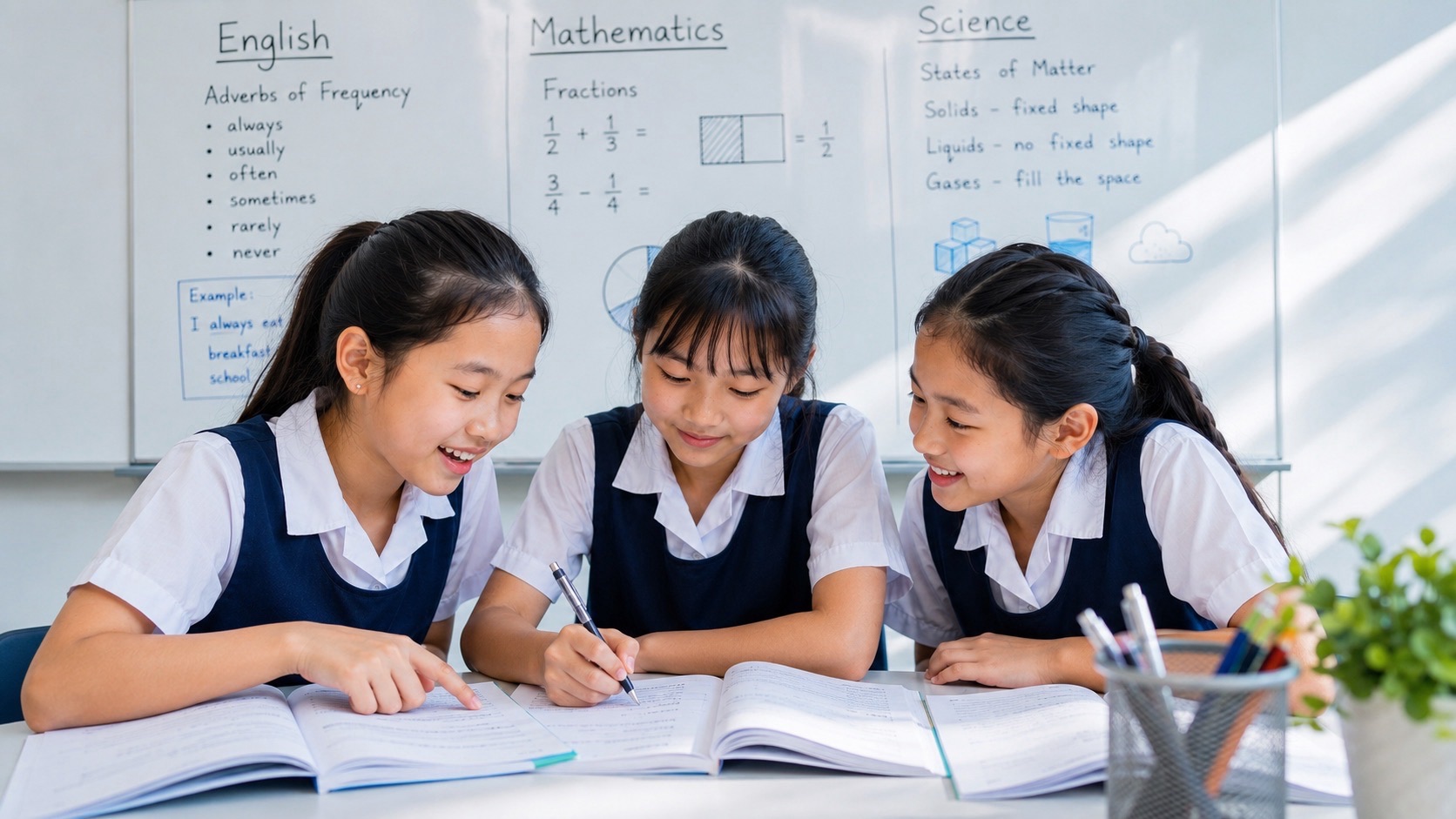
Primary 3 vocabulary becomes much more useful when children stop treating words as isolated items and start using them to read, think, explain and write. This Top 100 Primary 3 Vocabulary List is a world-facing guide for families and teachers searching for Grade 3 vocabulary words, 3rd grade vocabulary words, third grade vocabulary lists, academic vocabulary for Grade 3, and vocabulary words with meanings and example sentences. The list focuses on high-utility words that children can meet across stories, informational texts, Mathematics, Science, classroom instructions, speaking and everyday problem-solving.
A strong Grade 3 vocabulary list with meanings and examples should do more than offer one hundred difficult-looking words. It should help a child understand a word in plain language, notice how it behaves in a sentence, connect it to related words, distinguish it from a near neighbour, retrieve it later without the list visible, and transfer it into a new context. That is why this page combines 3rd grade academic vocabulary, reading vocabulary, writing vocabulary, cross-curricular words, word families, collocations, context clues, example sentences and practice. The goal is usable language rather than short-term memorisation.
For readers who use different school labels, Primary 3, Grade 3 and 3rd grade are used here as practical search-language bridges rather than as a claim that every education system is identical. Ages, curricula and expectations vary around the world. The useful question is whether the learner is ready for words that carry more reasoning: compare, evidence, infer, estimate, process, resource, responsibility, revise and predict. These words help children move from naming things to explaining relationships, causes, purposes, patterns and choices—exactly the transition many learners begin to make around this stage.
Quick Answer: What Should a Primary 3 or Grade 3 Vocabulary List Do?
It should build a bridge between word recognition and independent language use. A child who can point to the correct definition has started learning the word. A child who can select it while reading, explain it in their own words, use it naturally in a fresh sentence, recognize a related form, understand a nearby synonym and retrieve it a week later has built much stronger knowledge.
- Meaning: know the central idea of the word without depending on a memorised dictionary sentence.
- Context: recognize how surrounding words and situations change or narrow meaning.
- Precision: know why one word fits better than another nearby word.
- Collocation: learn natural partnerships such as strong evidence, accurate measurement, main purpose and natural resource.
- Word family: connect forms such as predict, prediction, predictable or revise, revision.
- Retrieval: produce the word from a meaning, clue, example or situation instead of merely recognizing it.
- Transfer: use the word in reading, writing, speaking and a different subject or real-life context.
Why Grade 3 Vocabulary Starts to Feel Different
Earlier vocabulary learning often grows through concrete experience: names of objects, actions, familiar qualities and everyday routines. By the third-grade stage, children increasingly meet words that are less visible and more relational. You can point to a chair, but you cannot point to evidence in the same way. You have to explain what makes information count as evidence. You can show two blocks, but the word compare requires a thinking operation. You can watch an event, but infer requires the learner to combine clues with knowledge and form an idea that is not stated directly.
This matters because school language begins to carry more instructions inside a single word. A question that says describe is asking for relevant features. A question that says explain is asking for a relationship or reason. Compare demands similarity and difference. Predict asks the learner to use a pattern or clue. Summarize asks for compression without losing the central meaning. Children who know the topic but do not understand the command word can still struggle to show what they know.
The same change appears in reading. Stories become longer, informational passages become denser, and children are expected to infer character feelings, identify text purpose, connect cause and effect, and follow processes across several sentences. Vocabulary therefore becomes part of comprehension architecture. Knowing more words helps, but knowing how words organize thought helps even more.
The list on this page deliberately mixes conversational, general academic and subject-related words. That mirrors how real learning works. The Grade 3 language standards used in the United States, for example, expect children to use context, word parts and reference tools; understand word relationships and shades of meaning; and acquire conversational, general academic and domain-specific vocabulary. The labels differ across countries, but the underlying direction is broadly useful: children need both more words and better strategies for learning words. See the Grade 3 Language standards for one clear example of that progression.
How These 100 Words Were Chosen
The selection follows five filters: utility, recurrence, transfer, teachability and developmental fit. Utility asks whether the word helps the learner do important intellectual work. Recurrence asks whether the word is likely to reappear across texts or subjects. Transfer asks whether the word can travel beyond one lesson. Teachability asks whether the concept can be explained accurately without requiring specialist knowledge far beyond this level. Developmental fit asks whether the word is challenging enough to expand language but not so obscure that learning it becomes a performance of difficulty.
This is why the list gives high priority to words such as analyze, compare, explain, evidence, pattern, estimate, process, reason, result, resource, revise and structure. These terms appear in many learning situations. They also create networks: reason connects to cause, evidence, conclusion and explanation; measure connects to unit, accurate, estimate, quantity and data; character connects to setting, dialogue, narrator, theme and author.
Current high-ranking vocabulary resources also reveal what families actually search for: phrases such as 3rd grade vocabulary words, vocabulary word list, academic vocabulary words for third graders, definitions and example sentences. Those search phrases are useful because they expose the practical need: people want a list, but they also want enough explanation to teach it. This page keeps the discoverable language while building a much deeper learning system around it.
Top 100 Primary 3 Vocabulary List: Grade 3 Academic Words with Meanings and Examples
Use the table as a reference map. Do not require a child to memorize all one hundred in one sitting. Ten words learned deeply are more useful than one hundred words skimmed once. After the table, the word-by-word field guide shows how to teach precision, word families and transfer.
| # | Word | Child-friendly meaning | Example sentence | Useful word partnership |
|---|---|---|---|---|
| 1 | analyze | to study something carefully by breaking it into parts or looking closely at its features | Alicia analyzed the chart and noticed that the second bar was twice as tall as the first. | analyze information |
| 2 | compare | to look at two or more things to find similarities and differences | Tricia compared the two habitats and found that both had water but only one had tall trees. | compare two ideas |
| 3 | contrast | to focus on how two or more things are different | Kai Kai contrasted the two solutions by explaining why one used less water. | contrast with |
| 4 | classify | to arrange people, objects or ideas into groups based on shared features | The class classified the rocks by texture, colour and hardness. | classify into groups |
| 5 | conclude | to reach a judgement after considering information or evidence | From the wet footprints, Alicia concluded that someone had entered from the garden. | conclude that |
| 6 | determine | to find out something by thinking, checking, measuring or investigating | Tricia measured both strings to determine which one was longer. | determine the cause |
| 7 | distinguish | to recognize or explain the difference between things that may seem similar | Kai Kai learned to distinguish a fact from an opinion. | distinguish between |
| 8 | evidence | facts, observations, examples or information that support an idea or answer | Alicia used evidence from the passage to explain why the character felt worried. | strong evidence |
| 9 | examine | to look at or consider something carefully in order to understand it better | We examined the leaf with a magnifying glass before drawing its veins. | examine closely |
| 10 | infer | to work out an idea that is not stated directly by combining clues with what you already know | The lights were off and the door was locked, so Tricia inferred that nobody was home. | infer from clues |
| 11 | author | the person who writes a book, story, article or other text | The author repeated the word suddenly to make the scene feel urgent. | the author explains |
| 12 | audience | the people who read, watch or listen to a message | Kai Kai used simpler words because his audience was a group of younger children. | target audience |
| 13 | character | a person, animal or imagined being who takes part in a story | Alicia noticed that the main character became more patient by the end of the story. | main character |
| 14 | dialogue | the words spoken by characters in a story or play | The dialogue showed that the two friends disagreed even before the narrator explained it. | realistic dialogue |
| 15 | fiction | writing that is created from imagination, even when it contains realistic details | The story about a child finding a hidden city is fiction. | fiction story |
| 16 | nonfiction | writing that presents information about real people, places, events or ideas | Tricia read a nonfiction article about how bridges are built. | nonfiction text |
| 17 | narrator | the voice or person that tells a story | The narrator knew what Alicia saw but did not reveal what the other character was thinking. | first-person narrator |
| 18 | passage | a section of written text, especially one used for reading or study | The teacher asked the class to reread the final passage before answering the question. | reading passage |
| 19 | setting | the time and place in which a story happens | A dark forest at midnight created a tense setting for the adventure. | story setting |
| 20 | theme | a larger idea or message that a text explores, such as courage, fairness or friendship | Kai Kai said the theme was responsibility because every major choice had a consequence. | central theme |
| 21 | describe | to tell what someone or something is like using relevant details | Alicia described the shell as smooth, pale and curved like a tiny bowl. | describe clearly |
| 22 | detail | a small but meaningful piece of information | Tricia included the cracked handle as a detail that helped identify the missing suitcase. | important detail |
| 23 | edit | to correct or improve a text, especially its wording, grammar, spelling or punctuation | Kai Kai edited the sentence by fixing the verb tense and removing a repeated word. | edit carefully |
| 24 | explain | to make an idea clear by telling how or why | Alicia explained why the shadow moved as the light source changed position. | explain a reason |
| 25 | organize | to arrange things or ideas so they are easier to use, understand or find | Tricia organized her notes into cause, effect and example. | organize information |
| 26 | paragraph | a group of connected sentences that develop one main idea or part of a text | Kai Kai began a new paragraph when the story moved from the problem to the solution. | well-developed paragraph |
| 27 | persuade | to try to convince someone to think, feel or do something | Alicia used reasons and examples to persuade her class to reduce food waste. | persuade someone |
| 28 | purpose | the reason something exists, is done or is written | The purpose of the poster was to warn readers about slippery steps. | main purpose |
| 29 | revise | to improve a piece of work by rethinking ideas, order, detail or expression | Tricia revised her opening so the problem appeared earlier and the story started faster. | revise a draft |
| 30 | summarize | to give the main ideas in a shorter form without copying every detail | Kai Kai summarized the chapter in three sentences. | summarize the text |
| 31 | accurate | correct and free from mistakes | Alicia checked the ruler again to make sure her measurement was accurate. | accurate measurement |
| 32 | approximate | close to the exact amount or value but not perfectly exact | The approximate length of the table was one metre. | approximate number |
| 33 | average | a value used to represent a group of numbers, often found by adding and dividing by how many values there are | The average of 4, 6 and 8 is 6. | average score |
| 34 | calculate | to work out a numerical answer using mathematics | Tricia calculated the total cost by adding the three prices. | calculate the total |
| 35 | data | facts, measurements or observations collected so they can be studied | Kai Kai recorded the plant heights as data in a table. | collect data |
| 36 | estimate | to make a sensible approximate judgement or calculation | Alicia estimated that the jar contained about eighty beads before counting them. | estimate the amount |
| 37 | measure | to find the size, amount, length, time or another quantity using a standard method | We measured the classroom door with a tape measure. | measure accurately |
| 38 | pattern | a repeated or predictable arrangement, relationship or sequence | Tricia noticed a pattern: each number was three greater than the one before it. | number pattern |
| 39 | quantity | an amount or number of something | Kai Kai compared the quantity of water in two containers. | large quantity |
| 40 | solution | an answer to a problem or a way of dealing with a difficulty | Alicia suggested a solution that reduced waiting time for everyone. | possible solution |
| 41 | adapt | to change in order to fit new conditions or a new purpose | The animal can adapt to colder weather by growing a thicker coat. | adapt to change |
| 42 | climate | the usual pattern of weather in a place over a long period | The region has a dry climate with little rain for much of the year. | warm climate |
| 43 | coast | the land beside the sea | The rocky coast had steep cliffs and small beaches. | along the coast |
| 44 | conserve | to protect something from waste, loss or damage by using it carefully | Tricia turned off the tap while brushing her teeth to conserve water. | conserve resources |
| 45 | ecosystem | a community of living things and the nonliving parts of their environment interacting together | The pond ecosystem included insects, plants, fish, water, mud and sunlight. | pond ecosystem |
| 46 | energy | the ability to cause change or do work, and also a common word for physical liveliness | Sunlight provides energy that plants can use. | source of energy |
| 47 | environment | the surroundings and conditions in which people, animals or plants live | A clean river environment supports many kinds of life. | protect the environment |
| 48 | habitat | the natural home or environment of an organism | A coral reef is a habitat for many sea animals. | natural habitat |
| 49 | material | a substance from which something is made | The bottle was made from a transparent plastic material. | strong material |
| 50 | matter | anything that has mass and takes up space | Air is matter even though we cannot usually see it. | state of matter |
| 51 | moisture | a small amount of water in the air, soil or on a surface | Moisture collected on the outside of the cold glass. | soil moisture |
| 52 | organism | an individual living thing | A mushroom is an organism, even though it is not a plant or animal. | living organism |
| 53 | resource | something useful that people or living things can use to meet a need or complete a task | Fresh water is an important natural resource. | natural resource |
| 54 | survive | to continue living or existing despite difficulty or danger | The cactus can survive long dry periods because it stores water. | survive in |
| 55 | temperature | a measure of how hot or cold something is | The temperature fell during the night. | measure temperature |
| 56 | community | a group of people who share a place, activity, identity or interest | The school community worked together to improve the garden. | local community |
| 57 | cooperate | to work together toward a shared goal | Alicia and Tricia cooperated by dividing the research and checking each other’s notes. | cooperate with |
| 58 | culture | the shared ways of life, ideas, arts, traditions and practices of a group | Stories, food and celebrations can all express parts of a culture. | cultural tradition |
| 59 | contribute | to give, add or do something that helps a larger effort or result | Kai Kai contributed an idea that improved the group’s final design. | contribute to |
| 60 | region | a large area that is identified by shared physical, political or cultural features | The northern region receives more snow in winter. | mountain region |
| 61 | responsibility | a duty or task that someone is expected to take care of | Feeding the class pet was Kai Kai’s responsibility for the week. | take responsibility |
| 62 | respectful | showing care for other people, rules, places or ideas | Tricia disagreed with the answer but spoke in a respectful way. | respectful behaviour |
| 63 | tradition | a practice, belief or custom passed from one generation or group to another | The family kept a tradition of telling stories together at the end of each year. | family tradition |
| 64 | volunteer | a person who freely offers to help, or the act of offering to help without being forced | Alicia volunteered to organize the donated books. | volunteer to help |
| 65 | fairness | the quality of treating people according to reasonable and just rules | The class discussed whether giving everyone the same amount was always the best form of fairness. | sense of fairness |
| 66 | confident | feeling reasonably sure about your ability, knowledge or decision | Tricia felt confident after checking her evidence twice. | confident about |
| 67 | curious | wanting to know, learn or understand more | Kai Kai became curious when he noticed that one seedling grew faster than the others. | curious about |
| 68 | disappointed | feeling unhappy because something did not happen as hoped or expected | Alicia felt disappointed when the experiment failed, but she recorded the result anyway. | deeply disappointed |
| 69 | eager | very interested and ready to do or experience something | Tricia was eager to test her model after making the final change. | eager to learn |
| 70 | fortunate | having experienced something good because of luck or favourable circumstances | We were fortunate that the rain stopped before the outdoor event began. | fortunate to have |
| 71 | nervous | worried, uneasy or excited about what may happen | Kai Kai felt nervous before presenting, even though he had practised carefully. | nervous about |
| 72 | patient | able to wait or continue calmly without becoming upset too quickly | Alicia was patient while her partner worked through a difficult calculation. | patient with |
| 73 | thoughtful | showing careful thinking or kind consideration for others | Tricia gave a thoughtful answer that considered both advantages and disadvantages. | thoughtful response |
| 74 | unusual | different from what is common, expected or ordinary | The bird had an unusual call that sounded like two notes repeated quickly. | unusual feature |
| 75 | valuable | useful, important or worth a great deal | Kai Kai said the feedback was valuable because it showed exactly what to improve. | valuable information |
| 76 | avoid | to keep away from something or prevent yourself from doing it | Alicia avoided repeating the same adjective in every sentence. | avoid a mistake |
| 77 | combine | to join two or more things so they work or exist together | Tricia combined the two small paragraphs because they developed the same idea. | combine ideas |
| 78 | depend | to need or be decided by something else | Whether the seed grows well will depend on light, water and temperature. | depend on |
| 79 | demonstrate | to show clearly how something works, is done or is true | Kai Kai demonstrated the method before the group tried it independently. | demonstrate how |
| 80 | include | to contain someone or something as part of a larger group or whole | Alicia’s report included a diagram, a table and a short conclusion. | include in |
| 81 | improve | to make or become better in quality, usefulness, accuracy or performance | Tricia improved her explanation by adding one example and removing an unclear phrase. | improve accuracy |
| 82 | notice | to become aware of something by seeing, hearing or thinking about it | Kai Kai noticed that every successful trial used the same amount of water. | notice a change |
| 83 | occur | to happen or take place | The change occurred after the liquid was heated. | occur naturally |
| 84 | prevent | to stop something from happening or make it less likely to happen | The cover helped prevent dust from entering the container. | prevent damage |
| 85 | require | to need something as necessary | The investigation required careful measurement and a fair comparison. | require attention |
| 86 | result | what happens because of an action, event or process | The result of adding more weight was that the bridge model bent. | result in |
| 87 | select | to choose something carefully from a set of options | Alicia selected the strongest evidence rather than copying every detail. | select from |
| 88 | sequence | the order in which things happen or are arranged | Tricia placed the pictures in sequence from the first event to the last. | sequence of events |
| 89 | similar | alike in important ways but not necessarily identical | The two shapes were similar because both had four equal sides. | similar to |
| 90 | typical | having the usual features of a group or situation | Warm days are typical of summer in many places. | typical example |
| 91 | vary | to change or be different across time, people, places or examples | The amount of daylight can vary across seasons. | vary greatly |
| 92 | process | a series of actions or changes that lead to a result | Photosynthesis is a process in which plants use light energy to make food. | step-by-step process |
| 93 | method | a planned way of doing something | Kai Kai used a different method to solve the problem but reached the same answer. | effective method |
| 94 | observe | to watch, notice or measure something carefully and purposefully | Alicia observed that the ice cube became smaller every five minutes. | observe carefully |
| 95 | predict | to say what you think will happen using clues, patterns, evidence or knowledge | Tricia predicted that the next number would be 24 because the pattern increased by four. | predict accurately |
| 96 | record | to write down, store or capture information so it can be used later | Kai Kai recorded the measurements in a table after every trial. | record data |
| 97 | structure | the way parts are arranged and connected to form a whole | The report’s structure moved from question to evidence to conclusion. | clear structure |
| 98 | reason | an explanation for why something happens, is true or is chosen | Alicia gave a reason for selecting the second design. | main reason |
| 99 | effect | a change or result caused by something else | One effect of the strong wind was that several branches fell. | effect on |
| 100 | explore | to investigate, travel through or examine something in order to learn more | Tricia explored several possible explanations before choosing the one best supported by evidence. | explore an idea |
The Ten Vocabulary Worlds
1. Thinking, reasoning and evidence
These words help a learner move from noticing to reasoning. They are useful in comprehension, science, mathematics, discussion and any task that asks a child to explain how an answer was reached. The words in this group are analyze, compare, contrast, classify, conclude, determine, distinguish, evidence, examine, infer.
Ask for the thinking move, not just the word. A learner should be able to compare, infer, classify or conclude in a fresh situation. Do not ask only, “What does this word mean?” Add “What would count as an example?”, “What would not count?”, “What word is close but different?”, and “Where else could we use it?” Those questions force the learner to build boundaries around meaning instead of memorising a loose synonym.
2. Reading and text knowledge
These words let children talk about how texts work. Once a learner can name author, narrator, setting, theme and audience, reading discussions become more precise and comprehension questions become easier to unpack. The words in this group are author, audience, character, dialogue, fiction, nonfiction, narrator, passage, setting, theme.
Move between fiction and nonfiction. Ask children to point to the part of the text that makes the word relevant. Do not ask only, “What does this word mean?” Add “What would count as an example?”, “What would not count?”, “What word is close but different?”, and “Where else could we use it?” Those questions force the learner to build boundaries around meaning instead of memorising a loose synonym.
3. Writing and communication
Writing improves when children can describe, explain, organize, revise, summarize and persuade. These are not decorative words; they are verbs for controlling ideas. The words in this group are describe, detail, edit, explain, organize, paragraph, persuade, purpose, revise, summarize.
Use real pieces of writing. Ask the child to perform the action, then explain what changed. Do not ask only, “What does this word mean?” Add “What would count as an example?”, “What would not count?”, “What word is close but different?”, and “Where else could we use it?” Those questions force the learner to build boundaries around meaning instead of memorising a loose synonym.
4. Mathematics, measurement and data
Mathematics has its own vocabulary, but many of its most useful words travel across subjects. Accurate, estimate, pattern, quantity and solution help children explain numerical thinking rather than only produce an answer. The words in this group are accurate, approximate, average, calculate, data, estimate, measure, pattern, quantity, solution.
Require units, reasons and checks. Language and calculation should support each other. Do not ask only, “What does this word mean?” Add “What would count as an example?”, “What would not count?”, “What word is close but different?”, and “Where else could we use it?” Those questions force the learner to build boundaries around meaning instead of memorising a loose synonym.
5. Science and the natural world
Science learning accelerates when children can connect everyday language with precise content words. These terms cover adaptation, environment, matter, resources and measurement without turning the list into a specialist glossary. The words in this group are adapt, climate, coast, conserve, ecosystem, energy, environment, habitat, material, matter, moisture, organism, resource, survive, temperature.
Tie each word to observation, comparison, cause and effect, or a real phenomenon. Do not ask only, “What does this word mean?” Add “What would count as an example?”, “What would not count?”, “What word is close but different?”, and “Where else could we use it?” Those questions force the learner to build boundaries around meaning instead of memorising a loose synonym.
6. Community, culture and responsibility
Children need language for working with other people and understanding shared life. These words support discussion of cooperation, culture, responsibility, fairness and contribution. The words in this group are community, cooperate, culture, contribute, region, responsibility, respectful, tradition, volunteer, fairness.
Use multiple examples so broad social words do not shrink into one stereotype or one classroom rule. Do not ask only, “What does this word mean?” Add “What would count as an example?”, “What would not count?”, “What word is close but different?”, and “Where else could we use it?” Those questions force the learner to build boundaries around meaning instead of memorising a loose synonym.
7. Feelings, attitudes and judgement
A richer emotional vocabulary improves both reading and expression. It also helps children distinguish shades of meaning rather than using happy, sad, good and bad for everything. The words in this group are confident, curious, disappointed, eager, fortunate, nervous, patient, thoughtful, unusual, valuable.
Compare nearby feelings and ask what event or expectation produced them. Do not ask only, “What does this word mean?” Add “What would count as an example?”, “What would not count?”, “What word is close but different?”, and “Where else could we use it?” Those questions force the learner to build boundaries around meaning instead of memorising a loose synonym.
8. Action, change and cause
These verbs appear again and again in instructions, reports and explanations. They help children describe how one action changes a result or how conditions affect an outcome. The words in this group are avoid, combine, depend, demonstrate, include, improve, notice, occur, prevent, require.
Build cause-and-effect chains and ask what would change if one condition changed. Do not ask only, “What does this word mean?” Add “What would count as an example?”, “What would not count?”, “What word is close but different?”, and “Where else could we use it?” Those questions force the learner to build boundaries around meaning instead of memorising a loose synonym.
9. Order, relationship and variation
These words help children explain relationships: cause and result, order, similarity, typicality and variation. They are especially valuable in comprehension and cross-curricular explanation. The words in this group are result, select, sequence, similar, typical, vary.
Ask for counterexamples. If something is typical, what would be unusual? If two things are similar, how are they different? Do not ask only, “What does this word mean?” Add “What would count as an example?”, “What would not count?”, “What word is close but different?”, and “Where else could we use it?” Those questions force the learner to build boundaries around meaning instead of memorising a loose synonym.
10. Learning, inquiry and systems
These words describe how knowledge is built: process, method, observe, predict, record, structure, reason, effect and explore. They make classroom thinking visible. The words in this group are process, method, observe, predict, record, structure, reason, effect, explore.
Turn every word into an action. Learners should observe, predict, record and explain rather than merely recite definitions. Do not ask only, “What does this word mean?” Add “What would count as an example?”, “What would not count?”, “What word is close but different?”, and “Where else could we use it?” Those questions force the learner to build boundaries around meaning instead of memorising a loose synonym.
Word-by-Word Field Guide: Meaning, Precision, Word Family and Practice
The field guide is designed for slow teaching. A useful routine is two or three words per session: say the word, explain it simply, read the example, discuss the precision note, connect the word family, then complete the transfer task without copying the model sentence.
1. analyze
Meaning: to study something carefully by breaking it into parts or looking closely at its features Natural partnership: analyze information. Word family: analysis, analytical.
In context: Alicia analyzed the chart and noticed that the second bar was twice as tall as the first. Use analyze when the job is deeper than simply looking; the learner is examining parts, patterns, evidence or relationships. This word belongs to the “Thinking, reasoning and evidence” group, so it should eventually be used as part of a larger thinking action rather than left as an isolated flashcard item.
Transfer challenge: Choose a short paragraph and analyze how two details support its main idea. After answering, change one feature of the situation and decide whether analyze still fits. If it no longer fits, choose a better word and explain the difference.
2. compare
Meaning: to look at two or more things to find similarities and differences Natural partnership: compare two ideas. Word family: comparison, comparable.
In context: Tricia compared the two habitats and found that both had water but only one had tall trees. Compare includes both likenesses and differences unless the question narrows the task. This word belongs to the “Thinking, reasoning and evidence” group, so it should eventually be used as part of a larger thinking action rather than left as an isolated flashcard item.
Transfer challenge: Compare two characters using one similarity and one difference. After answering, change one feature of the situation and decide whether compare still fits. If it no longer fits, choose a better word and explain the difference.
3. contrast
Meaning: to focus on how two or more things are different Natural partnership: contrast with. Word family: contrasting, contrast.
In context: Kai Kai contrasted the two solutions by explaining why one used less water. Contrast is narrower than compare because it directs attention to differences. This word belongs to the “Thinking, reasoning and evidence” group, so it should eventually be used as part of a larger thinking action rather than left as an isolated flashcard item.
Transfer challenge: Contrast a rainy day and a dry day using two precise details. After answering, change one feature of the situation and decide whether contrast still fits. If it no longer fits, choose a better word and explain the difference.
4. classify
Meaning: to arrange people, objects or ideas into groups based on shared features Natural partnership: classify into groups. Word family: classification.
In context: The class classified the rocks by texture, colour and hardness. A good classification rule is clear enough that another person can use it consistently. This word belongs to the “Thinking, reasoning and evidence” group, so it should eventually be used as part of a larger thinking action rather than left as an isolated flashcard item.
Transfer challenge: Classify ten household objects in two different sensible ways. After answering, change one feature of the situation and decide whether classify still fits. If it no longer fits, choose a better word and explain the difference.
5. conclude
Meaning: to reach a judgement after considering information or evidence Natural partnership: conclude that. Word family: conclusion, conclusive.
In context: From the wet footprints, Alicia concluded that someone had entered from the garden. A conclusion should grow from clues or evidence rather than from a random guess. This word belongs to the “Thinking, reasoning and evidence” group, so it should eventually be used as part of a larger thinking action rather than left as an isolated flashcard item.
Transfer challenge: Read three clues and state one conclusion that they reasonably support. After answering, change one feature of the situation and decide whether conclude still fits. If it no longer fits, choose a better word and explain the difference.
6. determine
Meaning: to find out something by thinking, checking, measuring or investigating Natural partnership: determine the cause. Word family: determination, determined.
In context: Tricia measured both strings to determine which one was longer. Determine often signals that a learner must work something out rather than merely recall it. This word belongs to the “Thinking, reasoning and evidence” group, so it should eventually be used as part of a larger thinking action rather than left as an isolated flashcard item.
Transfer challenge: Determine which container holds more and explain how you know. After answering, change one feature of the situation and decide whether determine still fits. If it no longer fits, choose a better word and explain the difference.
7. distinguish
Meaning: to recognize or explain the difference between things that may seem similar Natural partnership: distinguish between. Word family: distinction, distinctive.
In context: Kai Kai learned to distinguish a fact from an opinion. Distinguish is useful when the differences are important but not immediately obvious. This word belongs to the “Thinking, reasoning and evidence” group, so it should eventually be used as part of a larger thinking action rather than left as an isolated flashcard item.
Transfer challenge: Distinguish between a prediction and a conclusion. After answering, change one feature of the situation and decide whether distinguish still fits. If it no longer fits, choose a better word and explain the difference.
8. evidence
Meaning: facts, observations, examples or information that support an idea or answer Natural partnership: strong evidence. Word family: evident.
In context: Alicia used evidence from the passage to explain why the character felt worried. Evidence is what supports a claim; it is not the same thing as the claim itself. This word belongs to the “Thinking, reasoning and evidence” group, so it should eventually be used as part of a larger thinking action rather than left as an isolated flashcard item.
Transfer challenge: Give one claim and two pieces of evidence that could support it. After answering, change one feature of the situation and decide whether evidence still fits. If it no longer fits, choose a better word and explain the difference.
9. examine
Meaning: to look at or consider something carefully in order to understand it better Natural partnership: examine closely. Word family: examination.
In context: We examined the leaf with a magnifying glass before drawing its veins. Examine means careful attention, often for a purpose such as finding a feature or solving a problem. This word belongs to the “Thinking, reasoning and evidence” group, so it should eventually be used as part of a larger thinking action rather than left as an isolated flashcard item.
Transfer challenge: Examine an object and record five details that a quick glance might miss. After answering, change one feature of the situation and decide whether examine still fits. If it no longer fits, choose a better word and explain the difference.
10. infer
Meaning: to work out an idea that is not stated directly by combining clues with what you already know Natural partnership: infer from clues. Word family: inference.
In context: The lights were off and the door was locked, so Tricia inferred that nobody was home. An inference is supported by clues but is not copied directly from the text or situation. This word belongs to the “Thinking, reasoning and evidence” group, so it should eventually be used as part of a larger thinking action rather than left as an isolated flashcard item.
Transfer challenge: Infer how a character feels from three actions without using a feeling word. After answering, change one feature of the situation and decide whether infer still fits. If it no longer fits, choose a better word and explain the difference.
11. author
Meaning: the person who writes a book, story, article or other text Natural partnership: the author explains. Word family: authorship.
In context: The author repeated the word suddenly to make the scene feel urgent. The author creates the text; the narrator is the voice that tells a particular story. This word belongs to the “Reading and text knowledge” group, so it should eventually be used as part of a larger thinking action rather than left as an isolated flashcard item.
Transfer challenge: Choose a book and describe one choice the author made. After answering, change one feature of the situation and decide whether author still fits. If it no longer fits, choose a better word and explain the difference.
12. audience
Meaning: the people who read, watch or listen to a message Natural partnership: target audience. Word family: audience.
In context: Kai Kai used simpler words because his audience was a group of younger children. Writers and speakers adjust detail, tone and vocabulary for different audiences. This word belongs to the “Reading and text knowledge” group, so it should eventually be used as part of a larger thinking action rather than left as an isolated flashcard item.
Transfer challenge: Rewrite one instruction for a child and then for an adult. After answering, change one feature of the situation and decide whether audience still fits. If it no longer fits, choose a better word and explain the difference.
13. character
Meaning: a person, animal or imagined being who takes part in a story Natural partnership: main character. Word family: characterize, characterization.
In context: Alicia noticed that the main character became more patient by the end of the story. A character is part of the story world; the author is the real person who created the text. This word belongs to the “Reading and text knowledge” group, so it should eventually be used as part of a larger thinking action rather than left as an isolated flashcard item.
Transfer challenge: Describe a character using one trait and one action that proves it. After answering, change one feature of the situation and decide whether character still fits. If it no longer fits, choose a better word and explain the difference.
14. dialogue
Meaning: the words spoken by characters in a story or play Natural partnership: realistic dialogue. Word family: dialogue.
In context: The dialogue showed that the two friends disagreed even before the narrator explained it. Dialogue should sound natural and also do useful work, such as revealing a relationship or moving events forward. This word belongs to the “Reading and text knowledge” group, so it should eventually be used as part of a larger thinking action rather than left as an isolated flashcard item.
Transfer challenge: Write two lines of dialogue that reveal a disagreement without explaining it directly. After answering, change one feature of the situation and decide whether dialogue still fits. If it no longer fits, choose a better word and explain the difference.
15. fiction
Meaning: writing that is created from imagination, even when it contains realistic details Natural partnership: fiction story. Word family: fictional.
In context: The story about a child finding a hidden city is fiction. Fiction can include real places or facts, but its characters or events may be invented. This word belongs to the “Reading and text knowledge” group, so it should eventually be used as part of a larger thinking action rather than left as an isolated flashcard item.
Transfer challenge: Name a realistic detail that could appear inside a fictional story. After answering, change one feature of the situation and decide whether fiction still fits. If it no longer fits, choose a better word and explain the difference.
16. nonfiction
Meaning: writing that presents information about real people, places, events or ideas Natural partnership: nonfiction text. Word family: nonfiction.
In context: Tricia read a nonfiction article about how bridges are built. Nonfiction aims to inform about the real world, though writers still select and organize information. This word belongs to the “Reading and text knowledge” group, so it should eventually be used as part of a larger thinking action rather than left as an isolated flashcard item.
Transfer challenge: Find one nonfiction text feature and explain how it helps the reader. After answering, change one feature of the situation and decide whether nonfiction still fits. If it no longer fits, choose a better word and explain the difference.
17. narrator
Meaning: the voice or person that tells a story Natural partnership: first-person narrator. Word family: narrate, narration.
In context: The narrator knew what Alicia saw but did not reveal what the other character was thinking. A narrator is part of the storytelling method and may or may not be a character. This word belongs to the “Reading and text knowledge” group, so it should eventually be used as part of a larger thinking action rather than left as an isolated flashcard item.
Transfer challenge: Change one paragraph from an outside narrator to an I narrator. After answering, change one feature of the situation and decide whether narrator still fits. If it no longer fits, choose a better word and explain the difference.
18. passage
Meaning: a section of written text, especially one used for reading or study Natural partnership: reading passage. Word family: passage.
In context: The teacher asked the class to reread the final passage before answering the question. Passage is a useful school word for a selected section of text rather than an entire book. This word belongs to the “Reading and text knowledge” group, so it should eventually be used as part of a larger thinking action rather than left as an isolated flashcard item.
Transfer challenge: Summarize a short passage in one sentence. After answering, change one feature of the situation and decide whether passage still fits. If it no longer fits, choose a better word and explain the difference.
19. setting
Meaning: the time and place in which a story happens Natural partnership: story setting. Word family: set, setting.
In context: A dark forest at midnight created a tense setting for the adventure. Setting is more than a place name; time, weather, culture and surroundings can shape what happens. This word belongs to the “Reading and text knowledge” group, so it should eventually be used as part of a larger thinking action rather than left as an isolated flashcard item.
Transfer challenge: Change the setting of a scene and explain how the events would change. After answering, change one feature of the situation and decide whether setting still fits. If it no longer fits, choose a better word and explain the difference.
20. theme
Meaning: a larger idea or message that a text explores, such as courage, fairness or friendship Natural partnership: central theme. Word family: thematic.
In context: Kai Kai said the theme was responsibility because every major choice had a consequence. A theme is not simply a one-word topic; strong explanations connect the idea to events or choices in the text. This word belongs to the “Reading and text knowledge” group, so it should eventually be used as part of a larger thinking action rather than left as an isolated flashcard item.
Transfer challenge: State a theme and support it with two events from a story. After answering, change one feature of the situation and decide whether theme still fits. If it no longer fits, choose a better word and explain the difference.
21. describe
Meaning: to tell what someone or something is like using relevant details Natural partnership: describe clearly. Word family: description, descriptive.
In context: Alicia described the shell as smooth, pale and curved like a tiny bowl. Good description selects details that serve a purpose instead of piling up adjectives. This word belongs to the “Writing and communication” group, so it should eventually be used as part of a larger thinking action rather than left as an isolated flashcard item.
Transfer challenge: Describe an object so precisely that someone could identify it without seeing it. After answering, change one feature of the situation and decide whether describe still fits. If it no longer fits, choose a better word and explain the difference.
22. detail
Meaning: a small but meaningful piece of information Natural partnership: important detail. Word family: detailed.
In context: Tricia included the cracked handle as a detail that helped identify the missing suitcase. A detail is useful when it contributes to understanding, evidence, atmosphere or accuracy. This word belongs to the “Writing and communication” group, so it should eventually be used as part of a larger thinking action rather than left as an isolated flashcard item.
Transfer challenge: Choose one detail in a paragraph and explain why it matters. After answering, change one feature of the situation and decide whether detail still fits. If it no longer fits, choose a better word and explain the difference.
23. edit
Meaning: to correct or improve a text, especially its wording, grammar, spelling or punctuation Natural partnership: edit carefully. Word family: editor, editing.
In context: Kai Kai edited the sentence by fixing the verb tense and removing a repeated word. Editing usually works at sentence level; revising can involve larger changes to ideas or structure. This word belongs to the “Writing and communication” group, so it should eventually be used as part of a larger thinking action rather than left as an isolated flashcard item.
Transfer challenge: Edit three sentences for clarity without changing their main ideas. After answering, change one feature of the situation and decide whether edit still fits. If it no longer fits, choose a better word and explain the difference.
24. explain
Meaning: to make an idea clear by telling how or why Natural partnership: explain a reason. Word family: explanation.
In context: Alicia explained why the shadow moved as the light source changed position. An explanation adds reasoning or connection; it does more than give a short answer. This word belongs to the “Writing and communication” group, so it should eventually be used as part of a larger thinking action rather than left as an isolated flashcard item.
Transfer challenge: Explain how you know which object will float using because or therefore. After answering, change one feature of the situation and decide whether explain still fits. If it no longer fits, choose a better word and explain the difference.
25. organize
Meaning: to arrange things or ideas so they are easier to use, understand or find Natural partnership: organize information. Word family: organization, organized.
In context: Tricia organized her notes into cause, effect and example. Organization creates a useful order, not merely a neat appearance. This word belongs to the “Writing and communication” group, so it should eventually be used as part of a larger thinking action rather than left as an isolated flashcard item.
Transfer challenge: Organize six facts into two headings and justify your groups. After answering, change one feature of the situation and decide whether organize still fits. If it no longer fits, choose a better word and explain the difference.
26. paragraph
Meaning: a group of connected sentences that develop one main idea or part of a text Natural partnership: well-developed paragraph. Word family: paragraph.
In context: Kai Kai began a new paragraph when the story moved from the problem to the solution. A paragraph should feel connected; every sentence should contribute to its job. This word belongs to the “Writing and communication” group, so it should eventually be used as part of a larger thinking action rather than left as an isolated flashcard item.
Transfer challenge: Write a four-sentence paragraph with one clear focus. After answering, change one feature of the situation and decide whether paragraph still fits. If it no longer fits, choose a better word and explain the difference.
27. persuade
Meaning: to try to convince someone to think, feel or do something Natural partnership: persuade someone. Word family: persuasion, persuasive.
In context: Alicia used reasons and examples to persuade her class to reduce food waste. Persuasion is stronger when reasons are relevant to the audience and supported with evidence or examples. This word belongs to the “Writing and communication” group, so it should eventually be used as part of a larger thinking action rather than left as an isolated flashcard item.
Transfer challenge: Write two reasons that could persuade a school to create a quiet reading area. After answering, change one feature of the situation and decide whether persuade still fits. If it no longer fits, choose a better word and explain the difference.
28. purpose
Meaning: the reason something exists, is done or is written Natural partnership: main purpose. Word family: purposeful.
In context: The purpose of the poster was to warn readers about slippery steps. Purpose answers the question what is this trying to do: inform, explain, entertain, persuade, instruct or something else. This word belongs to the “Writing and communication” group, so it should eventually be used as part of a larger thinking action rather than left as an isolated flashcard item.
Transfer challenge: Identify the purpose of a notice and point to one feature that supports your answer. After answering, change one feature of the situation and decide whether purpose still fits. If it no longer fits, choose a better word and explain the difference.
29. revise
Meaning: to improve a piece of work by rethinking ideas, order, detail or expression Natural partnership: revise a draft. Word family: revision.
In context: Tricia revised her opening so the problem appeared earlier and the story started faster. Revision may change what the writing says or how it is shaped; editing often fixes smaller surface errors. This word belongs to the “Writing and communication” group, so it should eventually be used as part of a larger thinking action rather than left as an isolated flashcard item.
Transfer challenge: Revise a weak sentence twice: once for precision and once for stronger structure. After answering, change one feature of the situation and decide whether revise still fits. If it no longer fits, choose a better word and explain the difference.
30. summarize
Meaning: to give the main ideas in a shorter form without copying every detail Natural partnership: summarize the text. Word family: summary.
In context: Kai Kai summarized the chapter in three sentences. A summary keeps the central information and leaves out minor details. This word belongs to the “Writing and communication” group, so it should eventually be used as part of a larger thinking action rather than left as an isolated flashcard item.
Transfer challenge: Summarize a five-sentence paragraph in no more than twelve words. After answering, change one feature of the situation and decide whether summarize still fits. If it no longer fits, choose a better word and explain the difference.
31. accurate
Meaning: correct and free from mistakes Natural partnership: accurate measurement. Word family: accuracy, accurately.
In context: Alicia checked the ruler again to make sure her measurement was accurate. Accurate means correct; precise means exact or detailed, and the two ideas can overlap without being identical. This word belongs to the “Mathematics, measurement and data” group, so it should eventually be used as part of a larger thinking action rather than left as an isolated flashcard item.
Transfer challenge: Give one example of an answer that is accurate but not very precise. After answering, change one feature of the situation and decide whether accurate still fits. If it no longer fits, choose a better word and explain the difference.
32. approximate
Meaning: close to the exact amount or value but not perfectly exact Natural partnership: approximate number. Word family: approximately.
In context: The approximate length of the table was one metre. Approximate is useful when an exact value is unnecessary or unavailable. This word belongs to the “Mathematics, measurement and data” group, so it should eventually be used as part of a larger thinking action rather than left as an isolated flashcard item.
Transfer challenge: Estimate an approximate number of pages in three books together. After answering, change one feature of the situation and decide whether approximate still fits. If it no longer fits, choose a better word and explain the difference.
33. average
Meaning: a value used to represent a group of numbers, often found by adding and dividing by how many values there are Natural partnership: average score. Word family: averaging.
In context: The average of 4, 6 and 8 is 6. Average can mean typical in everyday speech and a calculated value in mathematics, so context matters. This word belongs to the “Mathematics, measurement and data” group, so it should eventually be used as part of a larger thinking action rather than left as an isolated flashcard item.
Transfer challenge: Create three numbers with an average of 10. After answering, change one feature of the situation and decide whether average still fits. If it no longer fits, choose a better word and explain the difference.
34. calculate
Meaning: to work out a numerical answer using mathematics Natural partnership: calculate the total. Word family: calculation.
In context: Tricia calculated the total cost by adding the three prices. Calculate is more specific than think because it involves numerical reasoning or operations. This word belongs to the “Mathematics, measurement and data” group, so it should eventually be used as part of a larger thinking action rather than left as an isolated flashcard item.
Transfer challenge: Calculate a result, then explain your method in words. After answering, change one feature of the situation and decide whether calculate still fits. If it no longer fits, choose a better word and explain the difference.
35. data
Meaning: facts, measurements or observations collected so they can be studied Natural partnership: collect data. Word family: data.
In context: Kai Kai recorded the plant heights as data in a table. Data become useful when they are organized and interpreted; a list of numbers alone does not explain what they mean. This word belongs to the “Mathematics, measurement and data” group, so it should eventually be used as part of a larger thinking action rather than left as an isolated flashcard item.
Transfer challenge: Collect a small set of data and write one sentence about its pattern. After answering, change one feature of the situation and decide whether data still fits. If it no longer fits, choose a better word and explain the difference.
36. estimate
Meaning: to make a sensible approximate judgement or calculation Natural partnership: estimate the amount. Word family: estimation.
In context: Alicia estimated that the jar contained about eighty beads before counting them. An estimate is not a careless guess; it should be based on size, pattern, experience or calculation. This word belongs to the “Mathematics, measurement and data” group, so it should eventually be used as part of a larger thinking action rather than left as an isolated flashcard item.
Transfer challenge: Estimate first, then measure or count to check how close you were. After answering, change one feature of the situation and decide whether estimate still fits. If it no longer fits, choose a better word and explain the difference.
37. measure
Meaning: to find the size, amount, length, time or another quantity using a standard method Natural partnership: measure accurately. Word family: measurement.
In context: We measured the classroom door with a tape measure. Good measurement uses an appropriate unit and tool. This word belongs to the “Mathematics, measurement and data” group, so it should eventually be used as part of a larger thinking action rather than left as an isolated flashcard item.
Transfer challenge: Choose the best tool and unit for measuring a desk, a drink and a short race. After answering, change one feature of the situation and decide whether measure still fits. If it no longer fits, choose a better word and explain the difference.
38. pattern
Meaning: a repeated or predictable arrangement, relationship or sequence Natural partnership: number pattern. Word family: patterned.
In context: Tricia noticed a pattern: each number was three greater than the one before it. Patterns can appear in numbers, shapes, language, behaviour and nature. This word belongs to the “Mathematics, measurement and data” group, so it should eventually be used as part of a larger thinking action rather than left as an isolated flashcard item.
Transfer challenge: Create a pattern, hide one part, and ask someone to predict what comes next. After answering, change one feature of the situation and decide whether pattern still fits. If it no longer fits, choose a better word and explain the difference.
39. quantity
Meaning: an amount or number of something Natural partnership: large quantity. Word family: quantitative.
In context: Kai Kai compared the quantity of water in two containers. Quantity tells how much or how many; quality describes how good or what kind. This word belongs to the “Mathematics, measurement and data” group, so it should eventually be used as part of a larger thinking action rather than left as an isolated flashcard item.
Transfer challenge: Write one question about quantity and one about quality. After answering, change one feature of the situation and decide whether quantity still fits. If it no longer fits, choose a better word and explain the difference.
40. solution
Meaning: an answer to a problem or a way of dealing with a difficulty Natural partnership: possible solution. Word family: solve, solution.
In context: Alicia suggested a solution that reduced waiting time for everyone. A solution should address the actual problem, not merely describe it. This word belongs to the “Mathematics, measurement and data” group, so it should eventually be used as part of a larger thinking action rather than left as an isolated flashcard item.
Transfer challenge: Name a problem, propose two solutions and compare their advantages. After answering, change one feature of the situation and decide whether solution still fits. If it no longer fits, choose a better word and explain the difference.
41. adapt
Meaning: to change in order to fit new conditions or a new purpose Natural partnership: adapt to change. Word family: adaptation, adaptable.
In context: The animal can adapt to colder weather by growing a thicker coat. Adapt does not mean giving up; it means changing something so it works better in a new situation. This word belongs to the “Science and the natural world” group, so it should eventually be used as part of a larger thinking action rather than left as an isolated flashcard item.
Transfer challenge: Describe how a person could adapt a plan when the weather changes. After answering, change one feature of the situation and decide whether adapt still fits. If it no longer fits, choose a better word and explain the difference.
42. climate
Meaning: the usual pattern of weather in a place over a long period Natural partnership: warm climate. Word family: climatic.
In context: The region has a dry climate with little rain for much of the year. Weather describes short-term conditions; climate describes longer-term patterns. This word belongs to the “Science and the natural world” group, so it should eventually be used as part of a larger thinking action rather than left as an isolated flashcard item.
Transfer challenge: Explain the difference between today’s weather and a region’s climate. After answering, change one feature of the situation and decide whether climate still fits. If it no longer fits, choose a better word and explain the difference.
43. coast
Meaning: the land beside the sea Natural partnership: along the coast. Word family: coastal.
In context: The rocky coast had steep cliffs and small beaches. Coast refers to the meeting area of land and sea, not simply any place near water. This word belongs to the “Science and the natural world” group, so it should eventually be used as part of a larger thinking action rather than left as an isolated flashcard item.
Transfer challenge: Describe two features you might find along a coast. After answering, change one feature of the situation and decide whether coast still fits. If it no longer fits, choose a better word and explain the difference.
44. conserve
Meaning: to protect something from waste, loss or damage by using it carefully Natural partnership: conserve resources. Word family: conservation.
In context: Tricia turned off the tap while brushing her teeth to conserve water. Conserve often combines protection with careful use. This word belongs to the “Science and the natural world” group, so it should eventually be used as part of a larger thinking action rather than left as an isolated flashcard item.
Transfer challenge: List three practical ways a household could conserve energy. After answering, change one feature of the situation and decide whether conserve still fits. If it no longer fits, choose a better word and explain the difference.
45. ecosystem
Meaning: a community of living things and the nonliving parts of their environment interacting together Natural partnership: pond ecosystem. Word family: ecosystem.
In context: The pond ecosystem included insects, plants, fish, water, mud and sunlight. An ecosystem includes relationships, not just a list of organisms. This word belongs to the “Science and the natural world” group, so it should eventually be used as part of a larger thinking action rather than left as an isolated flashcard item.
Transfer challenge: Choose one change to an ecosystem and predict two possible effects. After answering, change one feature of the situation and decide whether ecosystem still fits. If it no longer fits, choose a better word and explain the difference.
46. energy
Meaning: the ability to cause change or do work, and also a common word for physical liveliness Natural partnership: source of energy. Word family: energetic.
In context: Sunlight provides energy that plants can use. Energy has scientific meanings that are more specific than the everyday idea of feeling lively. This word belongs to the “Science and the natural world” group, so it should eventually be used as part of a larger thinking action rather than left as an isolated flashcard item.
Transfer challenge: Use energy once in a science sentence and once in an everyday sentence. After answering, change one feature of the situation and decide whether energy still fits. If it no longer fits, choose a better word and explain the difference.
47. environment
Meaning: the surroundings and conditions in which people, animals or plants live Natural partnership: protect the environment. Word family: environmental.
In context: A clean river environment supports many kinds of life. Environment can refer to natural surroundings or to the conditions around a person or activity. This word belongs to the “Science and the natural world” group, so it should eventually be used as part of a larger thinking action rather than left as an isolated flashcard item.
Transfer challenge: Describe one feature that makes a learning environment effective. After answering, change one feature of the situation and decide whether environment still fits. If it no longer fits, choose a better word and explain the difference.
48. habitat
Meaning: the natural home or environment of an organism Natural partnership: natural habitat. Word family: habitat.
In context: A coral reef is a habitat for many sea animals. A habitat is the place an organism lives; an ecosystem includes wider interactions among living and nonliving parts. This word belongs to the “Science and the natural world” group, so it should eventually be used as part of a larger thinking action rather than left as an isolated flashcard item.
Transfer challenge: Compare the habitats of two animals. After answering, change one feature of the situation and decide whether habitat still fits. If it no longer fits, choose a better word and explain the difference.
49. material
Meaning: a substance from which something is made Natural partnership: strong material. Word family: materials.
In context: The bottle was made from a transparent plastic material. Material can mean a physical substance and can also mean information used for learning; context decides. This word belongs to the “Science and the natural world” group, so it should eventually be used as part of a larger thinking action rather than left as an isolated flashcard item.
Transfer challenge: Choose the best material for an umbrella and explain why. After answering, change one feature of the situation and decide whether material still fits. If it no longer fits, choose a better word and explain the difference.
50. matter
Meaning: anything that has mass and takes up space Natural partnership: state of matter. Word family: matter.
In context: Air is matter even though we cannot usually see it. In science, matter has a technical meaning different from the everyday phrase it does not matter. This word belongs to the “Science and the natural world” group, so it should eventually be used as part of a larger thinking action rather than left as an isolated flashcard item.
Transfer challenge: Give three examples of matter in different states. After answering, change one feature of the situation and decide whether matter still fits. If it no longer fits, choose a better word and explain the difference.
51. moisture
Meaning: a small amount of water in the air, soil or on a surface Natural partnership: soil moisture. Word family: moist.
In context: Moisture collected on the outside of the cold glass. Moisture is related to water but does not necessarily mean something is fully wet. This word belongs to the “Science and the natural world” group, so it should eventually be used as part of a larger thinking action rather than left as an isolated flashcard item.
Transfer challenge: Describe how you could test whether soil has enough moisture for a plant. After answering, change one feature of the situation and decide whether moisture still fits. If it no longer fits, choose a better word and explain the difference.
52. organism
Meaning: an individual living thing Natural partnership: living organism. Word family: organism.
In context: A mushroom is an organism, even though it is not a plant or animal. Organism is a broad scientific word that includes many kinds of living things. This word belongs to the “Science and the natural world” group, so it should eventually be used as part of a larger thinking action rather than left as an isolated flashcard item.
Transfer challenge: Name five organisms from different groups and explain what makes them living. After answering, change one feature of the situation and decide whether organism still fits. If it no longer fits, choose a better word and explain the difference.
53. resource
Meaning: something useful that people or living things can use to meet a need or complete a task Natural partnership: natural resource. Word family: resources.
In context: Fresh water is an important natural resource. A resource can be physical, informational or human; its value depends on the need and context. This word belongs to the “Science and the natural world” group, so it should eventually be used as part of a larger thinking action rather than left as an isolated flashcard item.
Transfer challenge: List three resources needed to complete a class project. After answering, change one feature of the situation and decide whether resource still fits. If it no longer fits, choose a better word and explain the difference.
54. survive
Meaning: to continue living or existing despite difficulty or danger Natural partnership: survive in. Word family: survival.
In context: The cactus can survive long dry periods because it stores water. Survive focuses on continuing to live or exist, not necessarily on being comfortable or successful. This word belongs to the “Science and the natural world” group, so it should eventually be used as part of a larger thinking action rather than left as an isolated flashcard item.
Transfer challenge: Explain one feature that helps an animal survive in its habitat. After answering, change one feature of the situation and decide whether survive still fits. If it no longer fits, choose a better word and explain the difference.
55. temperature
Meaning: a measure of how hot or cold something is Natural partnership: measure temperature. Word family: temperature.
In context: The temperature fell during the night. Temperature is measured with a suitable instrument and unit; it is not the same as heat itself. This word belongs to the “Science and the natural world” group, so it should eventually be used as part of a larger thinking action rather than left as an isolated flashcard item.
Transfer challenge: Record the temperature at two times and describe the change accurately. After answering, change one feature of the situation and decide whether temperature still fits. If it no longer fits, choose a better word and explain the difference.
56. community
Meaning: a group of people who share a place, activity, identity or interest Natural partnership: local community. Word family: community.
In context: The school community worked together to improve the garden. Community can be based on location or shared connection; context tells you which. This word belongs to the “Community, culture and responsibility” group, so it should eventually be used as part of a larger thinking action rather than left as an isolated flashcard item.
Transfer challenge: Describe one action that could strengthen a community. After answering, change one feature of the situation and decide whether community still fits. If it no longer fits, choose a better word and explain the difference.
57. cooperate
Meaning: to work together toward a shared goal Natural partnership: cooperate with. Word family: cooperation, cooperative.
In context: Alicia and Tricia cooperated by dividing the research and checking each other’s notes. Cooperation requires coordinated effort, not simply working beside someone. This word belongs to the “Community, culture and responsibility” group, so it should eventually be used as part of a larger thinking action rather than left as an isolated flashcard item.
Transfer challenge: Describe how three people could cooperate on one task without duplicating work. After answering, change one feature of the situation and decide whether cooperate still fits. If it no longer fits, choose a better word and explain the difference.
58. culture
Meaning: the shared ways of life, ideas, arts, traditions and practices of a group Natural partnership: cultural tradition. Word family: cultural.
In context: Stories, food and celebrations can all express parts of a culture. Culture is broad and changes over time; avoid reducing a culture to one food, costume or festival. This word belongs to the “Community, culture and responsibility” group, so it should eventually be used as part of a larger thinking action rather than left as an isolated flashcard item.
Transfer challenge: Give three different kinds of evidence that could teach you about a culture. After answering, change one feature of the situation and decide whether culture still fits. If it no longer fits, choose a better word and explain the difference.
59. contribute
Meaning: to give, add or do something that helps a larger effort or result Natural partnership: contribute to. Word family: contribution.
In context: Kai Kai contributed an idea that improved the group’s final design. A contribution can be time, work, money, information, skill or an idea. This word belongs to the “Community, culture and responsibility” group, so it should eventually be used as part of a larger thinking action rather than left as an isolated flashcard item.
Transfer challenge: Name three different ways a child could contribute to a group project. After answering, change one feature of the situation and decide whether contribute still fits. If it no longer fits, choose a better word and explain the difference.
60. region
Meaning: a large area that is identified by shared physical, political or cultural features Natural partnership: mountain region. Word family: regional.
In context: The northern region receives more snow in winter. A region is larger and less exact than a single site or address; its boundaries depend on the purpose. This word belongs to the “Community, culture and responsibility” group, so it should eventually be used as part of a larger thinking action rather than left as an isolated flashcard item.
Transfer challenge: Describe one way to divide a country into regions. After answering, change one feature of the situation and decide whether region still fits. If it no longer fits, choose a better word and explain the difference.
61. responsibility
Meaning: a duty or task that someone is expected to take care of Natural partnership: take responsibility. Word family: responsible.
In context: Feeding the class pet was Kai Kai’s responsibility for the week. Responsibility can mean a duty and can also mean accepting the consequences of one’s choices. This word belongs to the “Community, culture and responsibility” group, so it should eventually be used as part of a larger thinking action rather than left as an isolated flashcard item.
Transfer challenge: Give one responsibility at home and one in a shared public place. After answering, change one feature of the situation and decide whether responsibility still fits. If it no longer fits, choose a better word and explain the difference.
62. respectful
Meaning: showing care for other people, rules, places or ideas Natural partnership: respectful behaviour. Word family: respect, respectfully.
In context: Tricia disagreed with the answer but spoke in a respectful way. Respectful does not mean always agreeing; it describes how disagreement or interaction is handled. This word belongs to the “Community, culture and responsibility” group, so it should eventually be used as part of a larger thinking action rather than left as an isolated flashcard item.
Transfer challenge: Rewrite a rude disagreement so it becomes firm but respectful. After answering, change one feature of the situation and decide whether respectful still fits. If it no longer fits, choose a better word and explain the difference.
63. tradition
Meaning: a practice, belief or custom passed from one generation or group to another Natural partnership: family tradition. Word family: traditional.
In context: The family kept a tradition of telling stories together at the end of each year. Traditions can change, combine or be interpreted differently by different people. This word belongs to the “Community, culture and responsibility” group, so it should eventually be used as part of a larger thinking action rather than left as an isolated flashcard item.
Transfer challenge: Describe a tradition and explain what purpose it serves. After answering, change one feature of the situation and decide whether tradition still fits. If it no longer fits, choose a better word and explain the difference.
64. volunteer
Meaning: a person who freely offers to help, or the act of offering to help without being forced Natural partnership: volunteer to help. Word family: voluntary.
In context: Alicia volunteered to organize the donated books. Volunteer emphasizes free choice; a required duty is not volunteering. This word belongs to the “Community, culture and responsibility” group, so it should eventually be used as part of a larger thinking action rather than left as an isolated flashcard item.
Transfer challenge: Name a useful task someone might volunteer to do in a community. After answering, change one feature of the situation and decide whether volunteer still fits. If it no longer fits, choose a better word and explain the difference.
65. fairness
Meaning: the quality of treating people according to reasonable and just rules Natural partnership: sense of fairness. Word family: fair.
In context: The class discussed whether giving everyone the same amount was always the best form of fairness. Fairness can involve equal treatment, but sometimes different needs require different support. This word belongs to the “Community, culture and responsibility” group, so it should eventually be used as part of a larger thinking action rather than left as an isolated flashcard item.
Transfer challenge: Give one example where fairness and sameness are not exactly the same. After answering, change one feature of the situation and decide whether fairness still fits. If it no longer fits, choose a better word and explain the difference.
66. confident
Meaning: feeling reasonably sure about your ability, knowledge or decision Natural partnership: confident about. Word family: confidence, confidently.
In context: Tricia felt confident after checking her evidence twice. Confidence is not the same as certainty; a confident person can still check and revise. This word belongs to the “Feelings, attitudes and judgement” group, so it should eventually be used as part of a larger thinking action rather than left as an isolated flashcard item.
Transfer challenge: Describe how preparation can increase confidence. After answering, change one feature of the situation and decide whether confident still fits. If it no longer fits, choose a better word and explain the difference.
67. curious
Meaning: wanting to know, learn or understand more Natural partnership: curious about. Word family: curiosity.
In context: Kai Kai became curious when he noticed that one seedling grew faster than the others. Curiosity leads to questions and investigation; it is more than simply being surprised. This word belongs to the “Feelings, attitudes and judgement” group, so it should eventually be used as part of a larger thinking action rather than left as an isolated flashcard item.
Transfer challenge: Turn one observation into three curious questions. After answering, change one feature of the situation and decide whether curious still fits. If it no longer fits, choose a better word and explain the difference.
68. disappointed
Meaning: feeling unhappy because something did not happen as hoped or expected Natural partnership: deeply disappointed. Word family: disappoint, disappointment.
In context: Alicia felt disappointed when the experiment failed, but she recorded the result anyway. Disappointment follows an unmet expectation, which is different from general sadness. This word belongs to the “Feelings, attitudes and judgement” group, so it should eventually be used as part of a larger thinking action rather than left as an isolated flashcard item.
Transfer challenge: Write a situation that would make someone disappointed but not angry. After answering, change one feature of the situation and decide whether disappointed still fits. If it no longer fits, choose a better word and explain the difference.
69. eager
Meaning: very interested and ready to do or experience something Natural partnership: eager to learn. Word family: eagerly.
In context: Tricia was eager to test her model after making the final change. Eager suggests positive readiness and interest; it is stronger than simply willing. This word belongs to the “Feelings, attitudes and judgement” group, so it should eventually be used as part of a larger thinking action rather than left as an isolated flashcard item.
Transfer challenge: Use eager in a sentence that shows action rather than only stating the feeling. After answering, change one feature of the situation and decide whether eager still fits. If it no longer fits, choose a better word and explain the difference.
70. fortunate
Meaning: having experienced something good because of luck or favourable circumstances Natural partnership: fortunate to have. Word family: fortune, fortunately.
In context: We were fortunate that the rain stopped before the outdoor event began. Fortunate refers to favourable circumstances; it does not necessarily mean someone earned the outcome. This word belongs to the “Feelings, attitudes and judgement” group, so it should eventually be used as part of a larger thinking action rather than left as an isolated flashcard item.
Transfer challenge: Describe a fortunate event and explain why it depended partly on chance. After answering, change one feature of the situation and decide whether fortunate still fits. If it no longer fits, choose a better word and explain the difference.
71. nervous
Meaning: worried, uneasy or excited about what may happen Natural partnership: nervous about. Word family: nervously.
In context: Kai Kai felt nervous before presenting, even though he had practised carefully. Nervous can mix worry with excitement; context shows the exact shade of feeling. This word belongs to the “Feelings, attitudes and judgement” group, so it should eventually be used as part of a larger thinking action rather than left as an isolated flashcard item.
Transfer challenge: Write two sentences showing nervous excitement and nervous fear. After answering, change one feature of the situation and decide whether nervous still fits. If it no longer fits, choose a better word and explain the difference.
72. patient
Meaning: able to wait or continue calmly without becoming upset too quickly Natural partnership: patient with. Word family: patience, patiently.
In context: Alicia was patient while her partner worked through a difficult calculation. Patient describes self-control over time, not passivity or lack of action. This word belongs to the “Feelings, attitudes and judgement” group, so it should eventually be used as part of a larger thinking action rather than left as an isolated flashcard item.
Transfer challenge: Give an example where being patient helps a problem get solved better. After answering, change one feature of the situation and decide whether patient still fits. If it no longer fits, choose a better word and explain the difference.
73. thoughtful
Meaning: showing careful thinking or kind consideration for others Natural partnership: thoughtful response. Word family: thought, thoughtfully.
In context: Tricia gave a thoughtful answer that considered both advantages and disadvantages. Thoughtful can describe careful reasoning or consideration for other people; context reveals which. This word belongs to the “Feelings, attitudes and judgement” group, so it should eventually be used as part of a larger thinking action rather than left as an isolated flashcard item.
Transfer challenge: Write one thoughtful academic response and one thoughtful social action. After answering, change one feature of the situation and decide whether thoughtful still fits. If it no longer fits, choose a better word and explain the difference.
74. unusual
Meaning: different from what is common, expected or ordinary Natural partnership: unusual feature. Word family: usual, usually.
In context: The bird had an unusual call that sounded like two notes repeated quickly. Unusual does not automatically mean bad, rare or impossible. This word belongs to the “Feelings, attitudes and judgement” group, so it should eventually be used as part of a larger thinking action rather than left as an isolated flashcard item.
Transfer challenge: Describe something unusual without using words that make it sound negative. After answering, change one feature of the situation and decide whether unusual still fits. If it no longer fits, choose a better word and explain the difference.
75. valuable
Meaning: useful, important or worth a great deal Natural partnership: valuable information. Word family: value.
In context: Kai Kai said the feedback was valuable because it showed exactly what to improve. Something can be valuable because of usefulness or meaning, not only because it costs money. This word belongs to the “Feelings, attitudes and judgement” group, so it should eventually be used as part of a larger thinking action rather than left as an isolated flashcard item.
Transfer challenge: Give one example of something valuable that has little financial price. After answering, change one feature of the situation and decide whether valuable still fits. If it no longer fits, choose a better word and explain the difference.
76. avoid
Meaning: to keep away from something or prevent yourself from doing it Natural partnership: avoid a mistake. Word family: avoidance.
In context: Alicia avoided repeating the same adjective in every sentence. Avoid is deliberate; something you simply miss by chance was not necessarily avoided. This word belongs to the “Action, change and cause” group, so it should eventually be used as part of a larger thinking action rather than left as an isolated flashcard item.
Transfer challenge: Write one safety rule using avoid and explain the reason behind it. After answering, change one feature of the situation and decide whether avoid still fits. If it no longer fits, choose a better word and explain the difference.
77. combine
Meaning: to join two or more things so they work or exist together Natural partnership: combine ideas. Word family: combination.
In context: Tricia combined the two small paragraphs because they developed the same idea. Combine creates a whole from parts, but the parts may still remain recognizable. This word belongs to the “Action, change and cause” group, so it should eventually be used as part of a larger thinking action rather than left as an isolated flashcard item.
Transfer challenge: Combine two simple sentences into one clear sentence. After answering, change one feature of the situation and decide whether combine still fits. If it no longer fits, choose a better word and explain the difference.
78. depend
Meaning: to need or be decided by something else Natural partnership: depend on. Word family: dependent.
In context: Whether the seed grows well will depend on light, water and temperature. Depend shows a relationship: one outcome changes according to another condition or need. This word belongs to the “Action, change and cause” group, so it should eventually be used as part of a larger thinking action rather than left as an isolated flashcard item.
Transfer challenge: Write a sentence where the result depends on two different factors. After answering, change one feature of the situation and decide whether depend still fits. If it no longer fits, choose a better word and explain the difference.
79. demonstrate
Meaning: to show clearly how something works, is done or is true Natural partnership: demonstrate how. Word family: demonstration.
In context: Kai Kai demonstrated the method before the group tried it independently. Demonstrate can mean show a procedure or provide clear evidence of an idea. This word belongs to the “Action, change and cause” group, so it should eventually be used as part of a larger thinking action rather than left as an isolated flashcard item.
Transfer challenge: Demonstrate a simple process using numbered steps and precise verbs. After answering, change one feature of the situation and decide whether demonstrate still fits. If it no longer fits, choose a better word and explain the difference.
80. include
Meaning: to contain someone or something as part of a larger group or whole Natural partnership: include in. Word family: inclusion.
In context: Alicia’s report included a diagram, a table and a short conclusion. Include means something is part of the whole, but it does not mean the list is complete unless the writer says so. This word belongs to the “Action, change and cause” group, so it should eventually be used as part of a larger thinking action rather than left as an isolated flashcard item.
Transfer challenge: Write one sentence that includes three examples but makes clear there could be others. After answering, change one feature of the situation and decide whether include still fits. If it no longer fits, choose a better word and explain the difference.
81. improve
Meaning: to make or become better in quality, usefulness, accuracy or performance Natural partnership: improve accuracy. Word family: improvement.
In context: Tricia improved her explanation by adding one example and removing an unclear phrase. Improve needs a standard: better in what way and for what purpose? This word belongs to the “Action, change and cause” group, so it should eventually be used as part of a larger thinking action rather than left as an isolated flashcard item.
Transfer challenge: Take a vague sentence and improve it for clarity. After answering, change one feature of the situation and decide whether improve still fits. If it no longer fits, choose a better word and explain the difference.
82. notice
Meaning: to become aware of something by seeing, hearing or thinking about it Natural partnership: notice a change. Word family: noticeable.
In context: Kai Kai noticed that every successful trial used the same amount of water. Notice often begins inquiry, but it is less systematic than observe. This word belongs to the “Action, change and cause” group, so it should eventually be used as part of a larger thinking action rather than left as an isolated flashcard item.
Transfer challenge: Explain the difference between noticing something and observing it carefully. After answering, change one feature of the situation and decide whether notice still fits. If it no longer fits, choose a better word and explain the difference.
83. occur
Meaning: to happen or take place Natural partnership: occur naturally. Word family: occurrence.
In context: The change occurred after the liquid was heated. Occur is a formal high-utility verb that often replaces happen in academic writing. This word belongs to the “Action, change and cause” group, so it should eventually be used as part of a larger thinking action rather than left as an isolated flashcard item.
Transfer challenge: Rewrite two sentences by replacing happen with occur where it sounds natural. After answering, change one feature of the situation and decide whether occur still fits. If it no longer fits, choose a better word and explain the difference.
84. prevent
Meaning: to stop something from happening or make it less likely to happen Natural partnership: prevent damage. Word family: prevention.
In context: The cover helped prevent dust from entering the container. Prevent describes action taken before or during a risk, not repair after the problem is complete. This word belongs to the “Action, change and cause” group, so it should eventually be used as part of a larger thinking action rather than left as an isolated flashcard item.
Transfer challenge: Name one way to prevent a common mistake in a task. After answering, change one feature of the situation and decide whether prevent still fits. If it no longer fits, choose a better word and explain the difference.
85. require
Meaning: to need something as necessary Natural partnership: require attention. Word family: requirement.
In context: The investigation required careful measurement and a fair comparison. required This word belongs to the “Action, change and cause” group, so it should eventually be used as part of a larger thinking action rather than left as an isolated flashcard item.
Transfer challenge: Require is stronger than prefer; a requirement is necessary rather than merely useful. After answering, change one feature of the situation and decide whether require still fits. If it no longer fits, choose a better word and explain the difference.
86. result
Meaning: what happens because of an action, event or process Natural partnership: result in. Word family: resulting.
In context: The result of adding more weight was that the bridge model bent. Result can be a noun or a verb phrase such as result in; the cause comes before the result. This word belongs to the “Order, relationship and variation” group, so it should eventually be used as part of a larger thinking action rather than left as an isolated flashcard item.
Transfer challenge: Write a cause-and-result sentence using because, then rewrite it using resulted in. After answering, change one feature of the situation and decide whether result still fits. If it no longer fits, choose a better word and explain the difference.
87. select
Meaning: to choose something carefully from a set of options Natural partnership: select from. Word family: selection.
In context: Alicia selected the strongest evidence rather than copying every detail. Select suggests purposeful choice based on a reason or rule. This word belongs to the “Order, relationship and variation” group, so it should eventually be used as part of a larger thinking action rather than left as an isolated flashcard item.
Transfer challenge: Select three words from this list for a science explanation and justify each choice. After answering, change one feature of the situation and decide whether select still fits. If it no longer fits, choose a better word and explain the difference.
88. sequence
Meaning: the order in which things happen or are arranged Natural partnership: sequence of events. Word family: sequential.
In context: Tricia placed the pictures in sequence from the first event to the last. A sequence is about order; a group can contain the same items but produce a different meaning when the order changes. This word belongs to the “Order, relationship and variation” group, so it should eventually be used as part of a larger thinking action rather than left as an isolated flashcard item.
Transfer challenge: Write a four-step sequence for a familiar process. After answering, change one feature of the situation and decide whether sequence still fits. If it no longer fits, choose a better word and explain the difference.
89. similar
Meaning: alike in important ways but not necessarily identical Natural partnership: similar to. Word family: similarity.
In context: The two shapes were similar because both had four equal sides. Similar means alike, not the same; good explanations state the shared feature. This word belongs to the “Order, relationship and variation” group, so it should eventually be used as part of a larger thinking action rather than left as an isolated flashcard item.
Transfer challenge: Name two similar objects and one important difference between them. After answering, change one feature of the situation and decide whether similar still fits. If it no longer fits, choose a better word and explain the difference.
90. typical
Meaning: having the usual features of a group or situation Natural partnership: typical example. Word family: typically.
In context: Warm days are typical of summer in many places. Typical describes what is common or expected, not what must always happen. This word belongs to the “Order, relationship and variation” group, so it should eventually be used as part of a larger thinking action rather than left as an isolated flashcard item.
Transfer challenge: Give a typical example and then one exception. After answering, change one feature of the situation and decide whether typical still fits. If it no longer fits, choose a better word and explain the difference.
91. vary
Meaning: to change or be different across time, people, places or examples Natural partnership: vary greatly. Word family: variety, various.
In context: The amount of daylight can vary across seasons. Vary points to change or difference; it is useful when not every case is the same. This word belongs to the “Order, relationship and variation” group, so it should eventually be used as part of a larger thinking action rather than left as an isolated flashcard item.
Transfer challenge: Choose one feature that varies among animals and explain two forms it can take. After answering, change one feature of the situation and decide whether vary still fits. If it no longer fits, choose a better word and explain the difference.
92. process
Meaning: a series of actions or changes that lead to a result Natural partnership: step-by-step process. Word family: processing.
In context: Photosynthesis is a process in which plants use light energy to make food. A process has stages or change over time; it is more than a single action. This word belongs to the “Learning, inquiry and systems” group, so it should eventually be used as part of a larger thinking action rather than left as an isolated flashcard item.
Transfer challenge: Describe a process you know using first, next, then and finally. After answering, change one feature of the situation and decide whether process still fits. If it no longer fits, choose a better word and explain the difference.
93. method
Meaning: a planned way of doing something Natural partnership: effective method. Word family: method.
In context: Kai Kai used a different method to solve the problem but reached the same answer. A method is the chosen approach; a process is the sequence of actions or changes that occurs. This word belongs to the “Learning, inquiry and systems” group, so it should eventually be used as part of a larger thinking action rather than left as an isolated flashcard item.
Transfer challenge: Compare two methods for solving the same problem. After answering, change one feature of the situation and decide whether method still fits. If it no longer fits, choose a better word and explain the difference.
94. observe
Meaning: to watch, notice or measure something carefully and purposefully Natural partnership: observe carefully. Word family: observation.
In context: Alicia observed that the ice cube became smaller every five minutes. Observe is usually more deliberate and systematic than simply look or notice. This word belongs to the “Learning, inquiry and systems” group, so it should eventually be used as part of a larger thinking action rather than left as an isolated flashcard item.
Transfer challenge: Observe one everyday change for five minutes and record what happens. After answering, change one feature of the situation and decide whether observe still fits. If it no longer fits, choose a better word and explain the difference.
95. predict
Meaning: to say what you think will happen using clues, patterns, evidence or knowledge Natural partnership: predict accurately. Word family: prediction, predictable.
In context: Tricia predicted that the next number would be 24 because the pattern increased by four. A strong prediction has a reason; it is not just a random guess about the future. This word belongs to the “Learning, inquiry and systems” group, so it should eventually be used as part of a larger thinking action rather than left as an isolated flashcard item.
Transfer challenge: Make a prediction and write the clue that supports it. After answering, change one feature of the situation and decide whether predict still fits. If it no longer fits, choose a better word and explain the difference.
96. record
Meaning: to write down, store or capture information so it can be used later Natural partnership: record data. Word family: recording.
In context: Kai Kai recorded the measurements in a table after every trial. Record is both a verb and a noun; in learning it often means preserving information accurately. This word belongs to the “Learning, inquiry and systems” group, so it should eventually be used as part of a larger thinking action rather than left as an isolated flashcard item.
Transfer challenge: Design a simple way to record observations from a five-minute test. After answering, change one feature of the situation and decide whether record still fits. If it no longer fits, choose a better word and explain the difference.
97. structure
Meaning: the way parts are arranged and connected to form a whole Natural partnership: clear structure. Word family: structural.
In context: The report’s structure moved from question to evidence to conclusion. Structure can describe a building, body, text, organization or system; the shared idea is arrangement of parts. This word belongs to the “Learning, inquiry and systems” group, so it should eventually be used as part of a larger thinking action rather than left as an isolated flashcard item.
Transfer challenge: Describe the structure of a familiar text or object. After answering, change one feature of the situation and decide whether structure still fits. If it no longer fits, choose a better word and explain the difference.
98. reason
Meaning: an explanation for why something happens, is true or is chosen Natural partnership: main reason. Word family: reasonable, reasoning.
In context: Alicia gave a reason for selecting the second design. A reason supports an answer or choice; evidence can strengthen the reason. This word belongs to the “Learning, inquiry and systems” group, so it should eventually be used as part of a larger thinking action rather than left as an isolated flashcard item.
Transfer challenge: State an opinion, give one reason and add one example as support. After answering, change one feature of the situation and decide whether reason still fits. If it no longer fits, choose a better word and explain the difference.
99. effect
Meaning: a change or result caused by something else Natural partnership: effect on. Word family: effective.
In context: One effect of the strong wind was that several branches fell. Effect is often the result; cause is what produces it. Effective is related in spelling but means successful at producing a result. This word belongs to the “Learning, inquiry and systems” group, so it should eventually be used as part of a larger thinking action rather than left as an isolated flashcard item.
Transfer challenge: Write one cause with two possible effects. After answering, change one feature of the situation and decide whether effect still fits. If it no longer fits, choose a better word and explain the difference.
100. explore
Meaning: to investigate, travel through or examine something in order to learn more Natural partnership: explore an idea. Word family: exploration.
In context: Tricia explored several possible explanations before choosing the one best supported by evidence. Explore can be physical or intellectual; in both cases the learner moves beyond the first obvious answer. This word belongs to the “Learning, inquiry and systems” group, so it should eventually be used as part of a larger thinking action rather than left as an isolated flashcard item.
Transfer challenge: Explore three possible answers to an open question before choosing one. After answering, change one feature of the situation and decide whether explore still fits. If it no longer fits, choose a better word and explain the difference.
What It Really Means to Know a Vocabulary Word
Word knowledge is not a switch that moves from unknown to known. It grows in layers. A learner may recognize conserve in a multiple-choice question but fail to produce it while writing. Another learner may use evidence correctly in reading but think any detail counts as evidence. A third may know predict in Science but not recognize that the same reasoning move appears when predicting what a character will do next in a story.
For practical teaching, use six layers. First is recognition: I have seen or heard the word. Second is basic meaning: I can explain the central idea. Third is context control: I understand the word in a sentence or situation. Fourth is precision: I can distinguish it from nearby words. Fifth is production: I can retrieve and use it without being shown. Sixth is transfer: I can use it correctly in a new subject, text type or situation.
This explains why copying definitions often creates the illusion of progress. Copying can make the page look complete while leaving retrieval weak. Conversely, a child who hesitates before choosing between notice and observe may actually be doing valuable semantic work. The hesitation shows that the learner is checking meaning boundaries.
A simple mastery rule is therefore: understand, distinguish, retrieve, use, transfer. If a word fails at one stage, repair that stage. Do not automatically restart from the definition.
Context Clues: How to Work Out an Unknown Word
By Grade 3, children should begin using surrounding information more deliberately. Context clues are not magical hints that always reveal an exact dictionary meaning. They are evidence. A sentence may tell you the category of a word, show a contrast, provide an example, reveal a cause or effect, or give enough situational information to narrow the possibilities.
- Read beyond the unknown word. The clue may appear in the next sentence, not beside the word.
- Ask what kind of word could fit. Is the unknown item likely to be an action, description, object, idea or relationship?
- Look for contrast markers. Words such as but, however, unlike and although can reveal opposition.
- Look for examples or restatements. Writers often explain a difficult word indirectly.
- Try a temporary meaning. Replace the unknown word with your idea and reread the sentence.
- Check whether the idea fits the wider passage. A clue that works in one sentence may still fail across the paragraph.
- Verify when precision matters. Use a glossary or dictionary rather than turning a sensible guess into a permanent mistake.
The Grade 3 Language standards explicitly include sentence-level context, affixes, roots and reference tools as strategies for clarifying meaning. These are useful beyond any one curriculum because they teach children how to learn words they have never been directly taught.
Word Families and Morphology: Turn One Word Into a Network
Morphology is the study of meaningful word parts. For a Grade 3 learner, the idea can be taught very simply: words often have families, and small parts can change meaning or grammatical job. If a child knows predict, then prediction becomes easier to learn. If responsibility is familiar, responsible can be connected. If the prefix un- is recognized, usual and unusual become a useful pair.
Do not teach word families as a mechanical suffix chart only. Meaning must stay attached. Effective is related in form to effect, but it is not simply “the adjective version of result” in every sentence. Resourceful looks related to resource, yet its meaning has developed in a particular direction. Children need both pattern recognition and semantic checking.
A strong mini-routine is: base word, family member, sentence, contrast. For example: observe → observation. “We observe the seedling every morning.” “Our observation was that the new leaf opened on Tuesday.” Then compare observation with opinion. One records what was noticed; the other expresses a view. That contrast makes the family useful rather than decorative.
Collocations: Teach the Company a Word Keeps
Vocabulary becomes more natural when learners notice which words commonly travel together. English allows many grammatically possible combinations that still sound strange. A child may know the definition of evidence but write “big evidence” where strong evidence or clear evidence is more natural. A child may know responsibility but need the patterns take responsibility, have responsibility for and personal responsibility.
That is why the master table includes a word partnership. Treat each partnership as a launch point, not a phrase to copy forever. Build two or three more combinations from real reading. Keep them in a vocabulary notebook. Later ask the learner to retrieve the whole phrase from a situation: “What phrase could we use for information that clearly supports a claim?” A good response might be strong evidence.
Collocation teaching also reduces forced writing. Instead of telling a child to insert an “advanced word,” ask for the phrase that naturally does the job. This turns vocabulary from decoration into control.
Shades of Meaning: Similar Does Not Mean Interchangeable
Many vocabulary errors occur because learners are taught synonyms as if they were perfect replacements. But words carry differences in strength, formality, emotion, grammar and usual context. Look, notice, observe all relate to attention, yet they are not identical. Notice often means becoming aware of something. Observe suggests more deliberate attention. Examine suggests careful inspection for a purpose.
Use word ladders. Put three related words on a line and discuss what changes. For feelings, compare eager, nervous, confident. A learner can be eager and nervous at the same time because one describes positive readiness while the other describes unease about what may happen. For reasoning, compare guess, predict, infer, conclude. The amount and type of evidence differs.
This kind of semantic discussion is especially valuable because Grade 3 learners are beginning to meet questions that depend on nuance. The official Grade 3 Language standards in the Common Core, for example, include word relationships, real-life connections and shades of meaning. The broader lesson is universal: vocabulary grows when children learn boundaries, not only labels.
How Vocabulary Supports Reading Comprehension
Reading comprehension depends on far more than vocabulary, but vocabulary is part of the machinery. When too many words are unknown, working memory is spent solving local meaning and less attention remains for plot, argument, cause, inference and structure. When academic command words are unfamiliar, the child may misread the question even after understanding the passage.
The most useful reading routine is not to stop for every unfamiliar word. Instead, teach triage. Which word blocks the sentence? Which word is repeated? Which word looks important to the topic? Which word can be inferred safely? Which word needs verification? Children become better readers when they learn that different unknown words deserve different levels of attention.
Reading widely remains essential because no list can contain the language a child will eventually need. Lists provide deliberate instruction; books, articles, conversations and subject lessons provide encounters. Reading Rockets notes that vocabulary sits at the heart of content learning and recommends wide reading, careful word selection, modelling word-solving strategies and opportunities to use words in collaborative talk. See Content Area Vocabulary Learning for a useful overview.
A practical target is to choose a small number of high-value words from each substantial reading session. Some words deserve only a quick explanation. Others deserve deep teaching because they recur across contexts. The Top 100 on this page is designed to supply many of those deep-teaching candidates.
How Vocabulary Supports Writing
Better writing is not created by replacing every common word with a longer one. A child who writes “the feline locomoted rapidly” has not improved a sentence that could simply say “the cat sprinted.” Vocabulary supports writing when it improves precision, structure, explanation, tone or efficiency.
Teach four writing jobs. First, precision: choose the exact noun or verb. Second, relationship: use words that show cause, contrast, sequence or result. Third, text control: use verbs such as describe, explain, summarize, persuade, revise. Fourth, idea development: use academic words such as evidence, reason, purpose, effect, process to make thinking visible.
A powerful editing question is, “What job is this word doing?” If the answer is only “It sounds impressive,” the word may be unnecessary. If the answer is “It shows the relationship between these two ideas more precisely,” it is probably earning its place.
Teach children to revise at three distances. From far away, check whether ideas are in a useful order. At middle distance, check paragraph focus and connections. Up close, check sentence wording, grammar, spelling and punctuation. This makes the distinction between revise and edit concrete.
How Vocabulary Supports Speaking and Listening
Oral language is a major route into vocabulary. Children often understand an idea in conversation before they can read or spell the word independently. Use that advantage. Say the word naturally, ask the learner to explain it, invite examples, then return to it during discussion.
Conversation also exposes whether knowledge is flexible. A child who memorized “infer means guess” may struggle when asked, “What clue makes that inference reasonable?” Spoken follow-up questions reveal the gaps quickly. They also let adults recast language without turning every mistake into a formal correction.
For multilingual learners, rich vocabulary instruction should not be reduced to translation lists. Translation can be useful, but the learner still needs context, word relationships, morphology, pronunciation, collocations and repeated use. Reading Rockets summarizes a U.S. Department of Education recommendation for extensive and varied vocabulary instruction for English learners, including explicit teaching of essential content words. See Best Practice for ELLs: Vocabulary Instruction.
Cross-Curricular Transfer: One Word, Several Subjects
The highest-value words travel. Evidence can refer to a quotation in reading, an observation in Science or information supporting a claim in Social Studies. Pattern can appear in Mathematics, spelling, music, behaviour or nature. Structure can describe a bridge, a paragraph, a plant or an organization. Process can describe evaporation, solving a problem or revising a draft.
Teach this travel deliberately. After a child learns a word in one subject, ask, “Where else could this word work?” That question builds semantic flexibility. It also prevents a common problem: compartmentalized vocabulary, where the child recognizes a term only in the exact worksheet where it was taught.
Transfer tasks should be genuinely new. If the model sentence says “predict the weather,” asking the child to write “I predict it will rain” is close repetition. Asking the child to predict the next event in a story or the next term in a number pattern is stronger transfer because the learner must preserve the core meaning while changing context.
Alicia, Tricia and Kai Kai: Three Ways to Learn the Same Word
Alicia likes evidence. When she learns infer, she wants to know which clues make the inference reasonable. Her best practice is a clue-to-conclusion routine: read, underline evidence, state the inference, then explain the link. This prevents inference from collapsing into guessing.
Tricia notices language patterns. When she learns predict, she also records prediction and predictable. She looks for collocations such as predict accurately and compares the word with guess. Her strength is building a network around the word rather than keeping it alone.
Kai Kai learns through transfer. If he meets structure in a writing lesson, he looks for structure in a bridge, a leaf and a group project. He asks what stays the same across all uses: parts are arranged and connected to form a whole. His method is powerful because it extracts the durable idea behind different contexts.
A strong vocabulary system uses all three habits: evidence, network and transfer. Children differ in what feels natural to them, so the teaching system should provide more than one route into mastery.
A 6-Week Teaching Plan for the Top 100
Week 1 — Thinking and text
Teach words 1–20 in two small groups. Use short passages, comparison tasks and story discussions. The goal is not speed. The goal is for learners to perform the thinking action attached to each word.
Week 2 — Writing and Mathematics
Teach words 21–40. Use real paragraphs for revise and edit, then practical measurement, estimation and data tasks. Mix old words into new activities so the vocabulary network begins to cross subject boundaries.
Week 3 — Science and environment
Teach words 41–55, then retrieve selected words 1–40. Use observations, diagrams and simple cause-and-effect explanations. Contrast habitat with ecosystem, weather with climate, and notice with observe.
Week 4 — Community and feelings
Teach words 56–75. Use scenarios rather than moral slogans. Ask what fairness means in different situations, how confidence differs from certainty, and why someone can be eager and nervous simultaneously.
Week 5 — Action and relationships
Teach words 76–100. Build process explanations and causal chains. Require children to use depend, prevent, require, result, sequence, vary, method and effect in genuinely different contexts.
Week 6 — Mixed transfer
Stop teaching in neat groups. Mix everything. Give a short text, a diagram, a data table and a real-life scenario. Ask the learner to choose useful words from the Top 100 without being told which ones to use.
The 15-Minute Vocabulary Lesson
- 2 minutes — Retrieval: ask for three previously learned words from meanings or situations.
- 3 minutes — New word: explain one or two target words simply and accurately.
- 3 minutes — Contrast: compare the new word with a related word or a non-example.
- 3 minutes — Context: read or create two different sentences using the word naturally.
- 2 minutes — Production: the child creates a fresh sentence without copying the model.
- 2 minutes — Transfer: move the word into another subject, text type or everyday situation.
The lesson is short on purpose. Vocabulary grows through repeated high-quality encounters, not one enormous explanation. A word can return tomorrow, next week and later in a different context.
Retrieval Practice: Useful Tool, Not Magic
Asking children to retrieve a word from memory can strengthen learning, but it should not be treated as a universal guarantee. Research in primary-school vocabulary has found benefits in some conditions and weaker or uncertain effects in others. That mixed result is a good reason to combine retrieval with context, explanation, semantic connections and meaningful use rather than turning vocabulary into endless low-context testing.
One study with primary-school learners found better delayed recall for retrieved words than restudied words, while a later multi-classroom study did not find the same advantage under all classroom conditions. See Goossens and colleagues on retrieval practice in primary vocabulary learning and the multi-classroom study of distributed and retrieval practice. The practical takeaway is modest and useful: retrieve, but also explain, connect, read, discuss and use.
A good retrieval prompt is not always “What is the definition of X?” Try the reverse direction: “What word means a planned way of doing something?” Or give a situation: “You look carefully at a plant every day and record changes. Which word fits?” Or ask for contrast: “Which is better here, notice or observe, and why?”
100 Independent Practice Prompts
These prompts are deliberately varied. They can be used one at a time, as oral warm-ups, notebook tasks, homework, tutoring questions or quick checks. The answer should normally include both the target word and a reason showing that the learner understands why it fits.
Practice 1: analyze
Choose a short paragraph and analyze how two details support its main idea. Then write a second example that belongs to a different context from the model sentence. Finally, explain why analyze is more precise than a vague substitute such as thing, do, good, bad, look or happen when one of those substitutes could appear.
For an extra challenge, connect analyze to one other word from the “Thinking, reasoning and evidence” group. State the relationship in a complete sentence. You might show cause, contrast, sequence, part-and-whole, example, category or method.
Practice 2: compare
Compare two characters using one similarity and one difference. Then write a second example that belongs to a different context from the model sentence. Finally, explain why compare is more precise than a vague substitute such as thing, do, good, bad, look or happen when one of those substitutes could appear.
For an extra challenge, connect compare to one other word from the “Thinking, reasoning and evidence” group. State the relationship in a complete sentence. You might show cause, contrast, sequence, part-and-whole, example, category or method.
Practice 3: contrast
Contrast a rainy day and a dry day using two precise details. Then write a second example that belongs to a different context from the model sentence. Finally, explain why contrast is more precise than a vague substitute such as thing, do, good, bad, look or happen when one of those substitutes could appear.
For an extra challenge, connect contrast to one other word from the “Thinking, reasoning and evidence” group. State the relationship in a complete sentence. You might show cause, contrast, sequence, part-and-whole, example, category or method.
Practice 4: classify
Classify ten household objects in two different sensible ways. Then write a second example that belongs to a different context from the model sentence. Finally, explain why classify is more precise than a vague substitute such as thing, do, good, bad, look or happen when one of those substitutes could appear.
For an extra challenge, connect classify to one other word from the “Thinking, reasoning and evidence” group. State the relationship in a complete sentence. You might show cause, contrast, sequence, part-and-whole, example, category or method.
Practice 5: conclude
Read three clues and state one conclusion that they reasonably support. Then write a second example that belongs to a different context from the model sentence. Finally, explain why conclude is more precise than a vague substitute such as thing, do, good, bad, look or happen when one of those substitutes could appear.
For an extra challenge, connect conclude to one other word from the “Thinking, reasoning and evidence” group. State the relationship in a complete sentence. You might show cause, contrast, sequence, part-and-whole, example, category or method.
Practice 6: determine
Determine which container holds more and explain how you know. Then write a second example that belongs to a different context from the model sentence. Finally, explain why determine is more precise than a vague substitute such as thing, do, good, bad, look or happen when one of those substitutes could appear.
For an extra challenge, connect determine to one other word from the “Thinking, reasoning and evidence” group. State the relationship in a complete sentence. You might show cause, contrast, sequence, part-and-whole, example, category or method.
Practice 7: distinguish
Distinguish between a prediction and a conclusion. Then write a second example that belongs to a different context from the model sentence. Finally, explain why distinguish is more precise than a vague substitute such as thing, do, good, bad, look or happen when one of those substitutes could appear.
For an extra challenge, connect distinguish to one other word from the “Thinking, reasoning and evidence” group. State the relationship in a complete sentence. You might show cause, contrast, sequence, part-and-whole, example, category or method.
Practice 8: evidence
Give one claim and two pieces of evidence that could support it. Then write a second example that belongs to a different context from the model sentence. Finally, explain why evidence is more precise than a vague substitute such as thing, do, good, bad, look or happen when one of those substitutes could appear.
For an extra challenge, connect evidence to one other word from the “Thinking, reasoning and evidence” group. State the relationship in a complete sentence. You might show cause, contrast, sequence, part-and-whole, example, category or method.
Practice 9: examine
Examine an object and record five details that a quick glance might miss. Then write a second example that belongs to a different context from the model sentence. Finally, explain why examine is more precise than a vague substitute such as thing, do, good, bad, look or happen when one of those substitutes could appear.
For an extra challenge, connect examine to one other word from the “Thinking, reasoning and evidence” group. State the relationship in a complete sentence. You might show cause, contrast, sequence, part-and-whole, example, category or method.
Practice 10: infer
Infer how a character feels from three actions without using a feeling word. Then write a second example that belongs to a different context from the model sentence. Finally, explain why infer is more precise than a vague substitute such as thing, do, good, bad, look or happen when one of those substitutes could appear.
For an extra challenge, connect infer to one other word from the “Thinking, reasoning and evidence” group. State the relationship in a complete sentence. You might show cause, contrast, sequence, part-and-whole, example, category or method.
Practice 11: author
Choose a book and describe one choice the author made. Then write a second example that belongs to a different context from the model sentence. Finally, explain why author is more precise than a vague substitute such as thing, do, good, bad, look or happen when one of those substitutes could appear.
For an extra challenge, connect author to one other word from the “Reading and text knowledge” group. State the relationship in a complete sentence. You might show cause, contrast, sequence, part-and-whole, example, category or method.
Practice 12: audience
Rewrite one instruction for a child and then for an adult. Then write a second example that belongs to a different context from the model sentence. Finally, explain why audience is more precise than a vague substitute such as thing, do, good, bad, look or happen when one of those substitutes could appear.
For an extra challenge, connect audience to one other word from the “Reading and text knowledge” group. State the relationship in a complete sentence. You might show cause, contrast, sequence, part-and-whole, example, category or method.
Practice 13: character
Describe a character using one trait and one action that proves it. Then write a second example that belongs to a different context from the model sentence. Finally, explain why character is more precise than a vague substitute such as thing, do, good, bad, look or happen when one of those substitutes could appear.
For an extra challenge, connect character to one other word from the “Reading and text knowledge” group. State the relationship in a complete sentence. You might show cause, contrast, sequence, part-and-whole, example, category or method.
Practice 14: dialogue
Write two lines of dialogue that reveal a disagreement without explaining it directly. Then write a second example that belongs to a different context from the model sentence. Finally, explain why dialogue is more precise than a vague substitute such as thing, do, good, bad, look or happen when one of those substitutes could appear.
For an extra challenge, connect dialogue to one other word from the “Reading and text knowledge” group. State the relationship in a complete sentence. You might show cause, contrast, sequence, part-and-whole, example, category or method.
Practice 15: fiction
Name a realistic detail that could appear inside a fictional story. Then write a second example that belongs to a different context from the model sentence. Finally, explain why fiction is more precise than a vague substitute such as thing, do, good, bad, look or happen when one of those substitutes could appear.
For an extra challenge, connect fiction to one other word from the “Reading and text knowledge” group. State the relationship in a complete sentence. You might show cause, contrast, sequence, part-and-whole, example, category or method.
Practice 16: nonfiction
Find one nonfiction text feature and explain how it helps the reader. Then write a second example that belongs to a different context from the model sentence. Finally, explain why nonfiction is more precise than a vague substitute such as thing, do, good, bad, look or happen when one of those substitutes could appear.
For an extra challenge, connect nonfiction to one other word from the “Reading and text knowledge” group. State the relationship in a complete sentence. You might show cause, contrast, sequence, part-and-whole, example, category or method.
Practice 17: narrator
Change one paragraph from an outside narrator to an I narrator. Then write a second example that belongs to a different context from the model sentence. Finally, explain why narrator is more precise than a vague substitute such as thing, do, good, bad, look or happen when one of those substitutes could appear.
For an extra challenge, connect narrator to one other word from the “Reading and text knowledge” group. State the relationship in a complete sentence. You might show cause, contrast, sequence, part-and-whole, example, category or method.
Practice 18: passage
Summarize a short passage in one sentence. Then write a second example that belongs to a different context from the model sentence. Finally, explain why passage is more precise than a vague substitute such as thing, do, good, bad, look or happen when one of those substitutes could appear.
For an extra challenge, connect passage to one other word from the “Reading and text knowledge” group. State the relationship in a complete sentence. You might show cause, contrast, sequence, part-and-whole, example, category or method.
Practice 19: setting
Change the setting of a scene and explain how the events would change. Then write a second example that belongs to a different context from the model sentence. Finally, explain why setting is more precise than a vague substitute such as thing, do, good, bad, look or happen when one of those substitutes could appear.
For an extra challenge, connect setting to one other word from the “Reading and text knowledge” group. State the relationship in a complete sentence. You might show cause, contrast, sequence, part-and-whole, example, category or method.
Practice 20: theme
State a theme and support it with two events from a story. Then write a second example that belongs to a different context from the model sentence. Finally, explain why theme is more precise than a vague substitute such as thing, do, good, bad, look or happen when one of those substitutes could appear.
For an extra challenge, connect theme to one other word from the “Reading and text knowledge” group. State the relationship in a complete sentence. You might show cause, contrast, sequence, part-and-whole, example, category or method.
Practice 21: describe
Describe an object so precisely that someone could identify it without seeing it. Then write a second example that belongs to a different context from the model sentence. Finally, explain why describe is more precise than a vague substitute such as thing, do, good, bad, look or happen when one of those substitutes could appear.
For an extra challenge, connect describe to one other word from the “Writing and communication” group. State the relationship in a complete sentence. You might show cause, contrast, sequence, part-and-whole, example, category or method.
Practice 22: detail
Choose one detail in a paragraph and explain why it matters. Then write a second example that belongs to a different context from the model sentence. Finally, explain why detail is more precise than a vague substitute such as thing, do, good, bad, look or happen when one of those substitutes could appear.
For an extra challenge, connect detail to one other word from the “Writing and communication” group. State the relationship in a complete sentence. You might show cause, contrast, sequence, part-and-whole, example, category or method.
Practice 23: edit
Edit three sentences for clarity without changing their main ideas. Then write a second example that belongs to a different context from the model sentence. Finally, explain why edit is more precise than a vague substitute such as thing, do, good, bad, look or happen when one of those substitutes could appear.
For an extra challenge, connect edit to one other word from the “Writing and communication” group. State the relationship in a complete sentence. You might show cause, contrast, sequence, part-and-whole, example, category or method.
Practice 24: explain
Explain how you know which object will float using because or therefore. Then write a second example that belongs to a different context from the model sentence. Finally, explain why explain is more precise than a vague substitute such as thing, do, good, bad, look or happen when one of those substitutes could appear.
For an extra challenge, connect explain to one other word from the “Writing and communication” group. State the relationship in a complete sentence. You might show cause, contrast, sequence, part-and-whole, example, category or method.
Practice 25: organize
Organize six facts into two headings and justify your groups. Then write a second example that belongs to a different context from the model sentence. Finally, explain why organize is more precise than a vague substitute such as thing, do, good, bad, look or happen when one of those substitutes could appear.
For an extra challenge, connect organize to one other word from the “Writing and communication” group. State the relationship in a complete sentence. You might show cause, contrast, sequence, part-and-whole, example, category or method.
Practice 26: paragraph
Write a four-sentence paragraph with one clear focus. Then write a second example that belongs to a different context from the model sentence. Finally, explain why paragraph is more precise than a vague substitute such as thing, do, good, bad, look or happen when one of those substitutes could appear.
For an extra challenge, connect paragraph to one other word from the “Writing and communication” group. State the relationship in a complete sentence. You might show cause, contrast, sequence, part-and-whole, example, category or method.
Practice 27: persuade
Write two reasons that could persuade a school to create a quiet reading area. Then write a second example that belongs to a different context from the model sentence. Finally, explain why persuade is more precise than a vague substitute such as thing, do, good, bad, look or happen when one of those substitutes could appear.
For an extra challenge, connect persuade to one other word from the “Writing and communication” group. State the relationship in a complete sentence. You might show cause, contrast, sequence, part-and-whole, example, category or method.
Practice 28: purpose
Identify the purpose of a notice and point to one feature that supports your answer. Then write a second example that belongs to a different context from the model sentence. Finally, explain why purpose is more precise than a vague substitute such as thing, do, good, bad, look or happen when one of those substitutes could appear.
For an extra challenge, connect purpose to one other word from the “Writing and communication” group. State the relationship in a complete sentence. You might show cause, contrast, sequence, part-and-whole, example, category or method.
Practice 29: revise
Revise a weak sentence twice: once for precision and once for stronger structure. Then write a second example that belongs to a different context from the model sentence. Finally, explain why revise is more precise than a vague substitute such as thing, do, good, bad, look or happen when one of those substitutes could appear.
For an extra challenge, connect revise to one other word from the “Writing and communication” group. State the relationship in a complete sentence. You might show cause, contrast, sequence, part-and-whole, example, category or method.
Practice 30: summarize
Summarize a five-sentence paragraph in no more than twelve words. Then write a second example that belongs to a different context from the model sentence. Finally, explain why summarize is more precise than a vague substitute such as thing, do, good, bad, look or happen when one of those substitutes could appear.
For an extra challenge, connect summarize to one other word from the “Writing and communication” group. State the relationship in a complete sentence. You might show cause, contrast, sequence, part-and-whole, example, category or method.
Practice 31: accurate
Give one example of an answer that is accurate but not very precise. Then write a second example that belongs to a different context from the model sentence. Finally, explain why accurate is more precise than a vague substitute such as thing, do, good, bad, look or happen when one of those substitutes could appear.
For an extra challenge, connect accurate to one other word from the “Mathematics, measurement and data” group. State the relationship in a complete sentence. You might show cause, contrast, sequence, part-and-whole, example, category or method.
Practice 32: approximate
Estimate an approximate number of pages in three books together. Then write a second example that belongs to a different context from the model sentence. Finally, explain why approximate is more precise than a vague substitute such as thing, do, good, bad, look or happen when one of those substitutes could appear.
For an extra challenge, connect approximate to one other word from the “Mathematics, measurement and data” group. State the relationship in a complete sentence. You might show cause, contrast, sequence, part-and-whole, example, category or method.
Practice 33: average
Create three numbers with an average of 10. Then write a second example that belongs to a different context from the model sentence. Finally, explain why average is more precise than a vague substitute such as thing, do, good, bad, look or happen when one of those substitutes could appear.
For an extra challenge, connect average to one other word from the “Mathematics, measurement and data” group. State the relationship in a complete sentence. You might show cause, contrast, sequence, part-and-whole, example, category or method.
Practice 34: calculate
Calculate a result, then explain your method in words. Then write a second example that belongs to a different context from the model sentence. Finally, explain why calculate is more precise than a vague substitute such as thing, do, good, bad, look or happen when one of those substitutes could appear.
For an extra challenge, connect calculate to one other word from the “Mathematics, measurement and data” group. State the relationship in a complete sentence. You might show cause, contrast, sequence, part-and-whole, example, category or method.
Practice 35: data
Collect a small set of data and write one sentence about its pattern. Then write a second example that belongs to a different context from the model sentence. Finally, explain why data is more precise than a vague substitute such as thing, do, good, bad, look or happen when one of those substitutes could appear.
For an extra challenge, connect data to one other word from the “Mathematics, measurement and data” group. State the relationship in a complete sentence. You might show cause, contrast, sequence, part-and-whole, example, category or method.
Practice 36: estimate
Estimate first, then measure or count to check how close you were. Then write a second example that belongs to a different context from the model sentence. Finally, explain why estimate is more precise than a vague substitute such as thing, do, good, bad, look or happen when one of those substitutes could appear.
For an extra challenge, connect estimate to one other word from the “Mathematics, measurement and data” group. State the relationship in a complete sentence. You might show cause, contrast, sequence, part-and-whole, example, category or method.
Practice 37: measure
Choose the best tool and unit for measuring a desk, a drink and a short race. Then write a second example that belongs to a different context from the model sentence. Finally, explain why measure is more precise than a vague substitute such as thing, do, good, bad, look or happen when one of those substitutes could appear.
For an extra challenge, connect measure to one other word from the “Mathematics, measurement and data” group. State the relationship in a complete sentence. You might show cause, contrast, sequence, part-and-whole, example, category or method.
Practice 38: pattern
Create a pattern, hide one part, and ask someone to predict what comes next. Then write a second example that belongs to a different context from the model sentence. Finally, explain why pattern is more precise than a vague substitute such as thing, do, good, bad, look or happen when one of those substitutes could appear.
For an extra challenge, connect pattern to one other word from the “Mathematics, measurement and data” group. State the relationship in a complete sentence. You might show cause, contrast, sequence, part-and-whole, example, category or method.
Practice 39: quantity
Write one question about quantity and one about quality. Then write a second example that belongs to a different context from the model sentence. Finally, explain why quantity is more precise than a vague substitute such as thing, do, good, bad, look or happen when one of those substitutes could appear.
For an extra challenge, connect quantity to one other word from the “Mathematics, measurement and data” group. State the relationship in a complete sentence. You might show cause, contrast, sequence, part-and-whole, example, category or method.
Practice 40: solution
Name a problem, propose two solutions and compare their advantages. Then write a second example that belongs to a different context from the model sentence. Finally, explain why solution is more precise than a vague substitute such as thing, do, good, bad, look or happen when one of those substitutes could appear.
For an extra challenge, connect solution to one other word from the “Mathematics, measurement and data” group. State the relationship in a complete sentence. You might show cause, contrast, sequence, part-and-whole, example, category or method.
Practice 41: adapt
Describe how a person could adapt a plan when the weather changes. Then write a second example that belongs to a different context from the model sentence. Finally, explain why adapt is more precise than a vague substitute such as thing, do, good, bad, look or happen when one of those substitutes could appear.
For an extra challenge, connect adapt to one other word from the “Science and the natural world” group. State the relationship in a complete sentence. You might show cause, contrast, sequence, part-and-whole, example, category or method.
Practice 42: climate
Explain the difference between today’s weather and a region’s climate. Then write a second example that belongs to a different context from the model sentence. Finally, explain why climate is more precise than a vague substitute such as thing, do, good, bad, look or happen when one of those substitutes could appear.
For an extra challenge, connect climate to one other word from the “Science and the natural world” group. State the relationship in a complete sentence. You might show cause, contrast, sequence, part-and-whole, example, category or method.
Practice 43: coast
Describe two features you might find along a coast. Then write a second example that belongs to a different context from the model sentence. Finally, explain why coast is more precise than a vague substitute such as thing, do, good, bad, look or happen when one of those substitutes could appear.
For an extra challenge, connect coast to one other word from the “Science and the natural world” group. State the relationship in a complete sentence. You might show cause, contrast, sequence, part-and-whole, example, category or method.
Practice 44: conserve
List three practical ways a household could conserve energy. Then write a second example that belongs to a different context from the model sentence. Finally, explain why conserve is more precise than a vague substitute such as thing, do, good, bad, look or happen when one of those substitutes could appear.
For an extra challenge, connect conserve to one other word from the “Science and the natural world” group. State the relationship in a complete sentence. You might show cause, contrast, sequence, part-and-whole, example, category or method.
Practice 45: ecosystem
Choose one change to an ecosystem and predict two possible effects. Then write a second example that belongs to a different context from the model sentence. Finally, explain why ecosystem is more precise than a vague substitute such as thing, do, good, bad, look or happen when one of those substitutes could appear.
For an extra challenge, connect ecosystem to one other word from the “Science and the natural world” group. State the relationship in a complete sentence. You might show cause, contrast, sequence, part-and-whole, example, category or method.
Practice 46: energy
Use energy once in a science sentence and once in an everyday sentence. Then write a second example that belongs to a different context from the model sentence. Finally, explain why energy is more precise than a vague substitute such as thing, do, good, bad, look or happen when one of those substitutes could appear.
For an extra challenge, connect energy to one other word from the “Science and the natural world” group. State the relationship in a complete sentence. You might show cause, contrast, sequence, part-and-whole, example, category or method.
Practice 47: environment
Describe one feature that makes a learning environment effective. Then write a second example that belongs to a different context from the model sentence. Finally, explain why environment is more precise than a vague substitute such as thing, do, good, bad, look or happen when one of those substitutes could appear.
For an extra challenge, connect environment to one other word from the “Science and the natural world” group. State the relationship in a complete sentence. You might show cause, contrast, sequence, part-and-whole, example, category or method.
Practice 48: habitat
Compare the habitats of two animals. Then write a second example that belongs to a different context from the model sentence. Finally, explain why habitat is more precise than a vague substitute such as thing, do, good, bad, look or happen when one of those substitutes could appear.
For an extra challenge, connect habitat to one other word from the “Science and the natural world” group. State the relationship in a complete sentence. You might show cause, contrast, sequence, part-and-whole, example, category or method.
Practice 49: material
Choose the best material for an umbrella and explain why. Then write a second example that belongs to a different context from the model sentence. Finally, explain why material is more precise than a vague substitute such as thing, do, good, bad, look or happen when one of those substitutes could appear.
For an extra challenge, connect material to one other word from the “Science and the natural world” group. State the relationship in a complete sentence. You might show cause, contrast, sequence, part-and-whole, example, category or method.
Practice 50: matter
Give three examples of matter in different states. Then write a second example that belongs to a different context from the model sentence. Finally, explain why matter is more precise than a vague substitute such as thing, do, good, bad, look or happen when one of those substitutes could appear.
For an extra challenge, connect matter to one other word from the “Science and the natural world” group. State the relationship in a complete sentence. You might show cause, contrast, sequence, part-and-whole, example, category or method.
Practice 51: moisture
Describe how you could test whether soil has enough moisture for a plant. Then write a second example that belongs to a different context from the model sentence. Finally, explain why moisture is more precise than a vague substitute such as thing, do, good, bad, look or happen when one of those substitutes could appear.
For an extra challenge, connect moisture to one other word from the “Science and the natural world” group. State the relationship in a complete sentence. You might show cause, contrast, sequence, part-and-whole, example, category or method.
Practice 52: organism
Name five organisms from different groups and explain what makes them living. Then write a second example that belongs to a different context from the model sentence. Finally, explain why organism is more precise than a vague substitute such as thing, do, good, bad, look or happen when one of those substitutes could appear.
For an extra challenge, connect organism to one other word from the “Science and the natural world” group. State the relationship in a complete sentence. You might show cause, contrast, sequence, part-and-whole, example, category or method.
Practice 53: resource
List three resources needed to complete a class project. Then write a second example that belongs to a different context from the model sentence. Finally, explain why resource is more precise than a vague substitute such as thing, do, good, bad, look or happen when one of those substitutes could appear.
For an extra challenge, connect resource to one other word from the “Science and the natural world” group. State the relationship in a complete sentence. You might show cause, contrast, sequence, part-and-whole, example, category or method.
Practice 54: survive
Explain one feature that helps an animal survive in its habitat. Then write a second example that belongs to a different context from the model sentence. Finally, explain why survive is more precise than a vague substitute such as thing, do, good, bad, look or happen when one of those substitutes could appear.
For an extra challenge, connect survive to one other word from the “Science and the natural world” group. State the relationship in a complete sentence. You might show cause, contrast, sequence, part-and-whole, example, category or method.
Practice 55: temperature
Record the temperature at two times and describe the change accurately. Then write a second example that belongs to a different context from the model sentence. Finally, explain why temperature is more precise than a vague substitute such as thing, do, good, bad, look or happen when one of those substitutes could appear.
For an extra challenge, connect temperature to one other word from the “Science and the natural world” group. State the relationship in a complete sentence. You might show cause, contrast, sequence, part-and-whole, example, category or method.
Practice 56: community
Describe one action that could strengthen a community. Then write a second example that belongs to a different context from the model sentence. Finally, explain why community is more precise than a vague substitute such as thing, do, good, bad, look or happen when one of those substitutes could appear.
For an extra challenge, connect community to one other word from the “Community, culture and responsibility” group. State the relationship in a complete sentence. You might show cause, contrast, sequence, part-and-whole, example, category or method.
Practice 57: cooperate
Describe how three people could cooperate on one task without duplicating work. Then write a second example that belongs to a different context from the model sentence. Finally, explain why cooperate is more precise than a vague substitute such as thing, do, good, bad, look or happen when one of those substitutes could appear.
For an extra challenge, connect cooperate to one other word from the “Community, culture and responsibility” group. State the relationship in a complete sentence. You might show cause, contrast, sequence, part-and-whole, example, category or method.
Practice 58: culture
Give three different kinds of evidence that could teach you about a culture. Then write a second example that belongs to a different context from the model sentence. Finally, explain why culture is more precise than a vague substitute such as thing, do, good, bad, look or happen when one of those substitutes could appear.
For an extra challenge, connect culture to one other word from the “Community, culture and responsibility” group. State the relationship in a complete sentence. You might show cause, contrast, sequence, part-and-whole, example, category or method.
Practice 59: contribute
Name three different ways a child could contribute to a group project. Then write a second example that belongs to a different context from the model sentence. Finally, explain why contribute is more precise than a vague substitute such as thing, do, good, bad, look or happen when one of those substitutes could appear.
For an extra challenge, connect contribute to one other word from the “Community, culture and responsibility” group. State the relationship in a complete sentence. You might show cause, contrast, sequence, part-and-whole, example, category or method.
Practice 60: region
Describe one way to divide a country into regions. Then write a second example that belongs to a different context from the model sentence. Finally, explain why region is more precise than a vague substitute such as thing, do, good, bad, look or happen when one of those substitutes could appear.
For an extra challenge, connect region to one other word from the “Community, culture and responsibility” group. State the relationship in a complete sentence. You might show cause, contrast, sequence, part-and-whole, example, category or method.
Practice 61: responsibility
Give one responsibility at home and one in a shared public place. Then write a second example that belongs to a different context from the model sentence. Finally, explain why responsibility is more precise than a vague substitute such as thing, do, good, bad, look or happen when one of those substitutes could appear.
For an extra challenge, connect responsibility to one other word from the “Community, culture and responsibility” group. State the relationship in a complete sentence. You might show cause, contrast, sequence, part-and-whole, example, category or method.
Practice 62: respectful
Rewrite a rude disagreement so it becomes firm but respectful. Then write a second example that belongs to a different context from the model sentence. Finally, explain why respectful is more precise than a vague substitute such as thing, do, good, bad, look or happen when one of those substitutes could appear.
For an extra challenge, connect respectful to one other word from the “Community, culture and responsibility” group. State the relationship in a complete sentence. You might show cause, contrast, sequence, part-and-whole, example, category or method.
Practice 63: tradition
Describe a tradition and explain what purpose it serves. Then write a second example that belongs to a different context from the model sentence. Finally, explain why tradition is more precise than a vague substitute such as thing, do, good, bad, look or happen when one of those substitutes could appear.
For an extra challenge, connect tradition to one other word from the “Community, culture and responsibility” group. State the relationship in a complete sentence. You might show cause, contrast, sequence, part-and-whole, example, category or method.
Practice 64: volunteer
Name a useful task someone might volunteer to do in a community. Then write a second example that belongs to a different context from the model sentence. Finally, explain why volunteer is more precise than a vague substitute such as thing, do, good, bad, look or happen when one of those substitutes could appear.
For an extra challenge, connect volunteer to one other word from the “Community, culture and responsibility” group. State the relationship in a complete sentence. You might show cause, contrast, sequence, part-and-whole, example, category or method.
Practice 65: fairness
Give one example where fairness and sameness are not exactly the same. Then write a second example that belongs to a different context from the model sentence. Finally, explain why fairness is more precise than a vague substitute such as thing, do, good, bad, look or happen when one of those substitutes could appear.
For an extra challenge, connect fairness to one other word from the “Community, culture and responsibility” group. State the relationship in a complete sentence. You might show cause, contrast, sequence, part-and-whole, example, category or method.
Practice 66: confident
Describe how preparation can increase confidence. Then write a second example that belongs to a different context from the model sentence. Finally, explain why confident is more precise than a vague substitute such as thing, do, good, bad, look or happen when one of those substitutes could appear.
For an extra challenge, connect confident to one other word from the “Feelings, attitudes and judgement” group. State the relationship in a complete sentence. You might show cause, contrast, sequence, part-and-whole, example, category or method.
Practice 67: curious
Turn one observation into three curious questions. Then write a second example that belongs to a different context from the model sentence. Finally, explain why curious is more precise than a vague substitute such as thing, do, good, bad, look or happen when one of those substitutes could appear.
For an extra challenge, connect curious to one other word from the “Feelings, attitudes and judgement” group. State the relationship in a complete sentence. You might show cause, contrast, sequence, part-and-whole, example, category or method.
Practice 68: disappointed
Write a situation that would make someone disappointed but not angry. Then write a second example that belongs to a different context from the model sentence. Finally, explain why disappointed is more precise than a vague substitute such as thing, do, good, bad, look or happen when one of those substitutes could appear.
For an extra challenge, connect disappointed to one other word from the “Feelings, attitudes and judgement” group. State the relationship in a complete sentence. You might show cause, contrast, sequence, part-and-whole, example, category or method.
Practice 69: eager
Use eager in a sentence that shows action rather than only stating the feeling. Then write a second example that belongs to a different context from the model sentence. Finally, explain why eager is more precise than a vague substitute such as thing, do, good, bad, look or happen when one of those substitutes could appear.
For an extra challenge, connect eager to one other word from the “Feelings, attitudes and judgement” group. State the relationship in a complete sentence. You might show cause, contrast, sequence, part-and-whole, example, category or method.
Practice 70: fortunate
Describe a fortunate event and explain why it depended partly on chance. Then write a second example that belongs to a different context from the model sentence. Finally, explain why fortunate is more precise than a vague substitute such as thing, do, good, bad, look or happen when one of those substitutes could appear.
For an extra challenge, connect fortunate to one other word from the “Feelings, attitudes and judgement” group. State the relationship in a complete sentence. You might show cause, contrast, sequence, part-and-whole, example, category or method.
Practice 71: nervous
Write two sentences showing nervous excitement and nervous fear. Then write a second example that belongs to a different context from the model sentence. Finally, explain why nervous is more precise than a vague substitute such as thing, do, good, bad, look or happen when one of those substitutes could appear.
For an extra challenge, connect nervous to one other word from the “Feelings, attitudes and judgement” group. State the relationship in a complete sentence. You might show cause, contrast, sequence, part-and-whole, example, category or method.
Practice 72: patient
Give an example where being patient helps a problem get solved better. Then write a second example that belongs to a different context from the model sentence. Finally, explain why patient is more precise than a vague substitute such as thing, do, good, bad, look or happen when one of those substitutes could appear.
For an extra challenge, connect patient to one other word from the “Feelings, attitudes and judgement” group. State the relationship in a complete sentence. You might show cause, contrast, sequence, part-and-whole, example, category or method.
Practice 73: thoughtful
Write one thoughtful academic response and one thoughtful social action. Then write a second example that belongs to a different context from the model sentence. Finally, explain why thoughtful is more precise than a vague substitute such as thing, do, good, bad, look or happen when one of those substitutes could appear.
For an extra challenge, connect thoughtful to one other word from the “Feelings, attitudes and judgement” group. State the relationship in a complete sentence. You might show cause, contrast, sequence, part-and-whole, example, category or method.
Practice 74: unusual
Describe something unusual without using words that make it sound negative. Then write a second example that belongs to a different context from the model sentence. Finally, explain why unusual is more precise than a vague substitute such as thing, do, good, bad, look or happen when one of those substitutes could appear.
For an extra challenge, connect unusual to one other word from the “Feelings, attitudes and judgement” group. State the relationship in a complete sentence. You might show cause, contrast, sequence, part-and-whole, example, category or method.
Practice 75: valuable
Give one example of something valuable that has little financial price. Then write a second example that belongs to a different context from the model sentence. Finally, explain why valuable is more precise than a vague substitute such as thing, do, good, bad, look or happen when one of those substitutes could appear.
For an extra challenge, connect valuable to one other word from the “Feelings, attitudes and judgement” group. State the relationship in a complete sentence. You might show cause, contrast, sequence, part-and-whole, example, category or method.
Practice 76: avoid
Write one safety rule using avoid and explain the reason behind it. Then write a second example that belongs to a different context from the model sentence. Finally, explain why avoid is more precise than a vague substitute such as thing, do, good, bad, look or happen when one of those substitutes could appear.
For an extra challenge, connect avoid to one other word from the “Action, change and cause” group. State the relationship in a complete sentence. You might show cause, contrast, sequence, part-and-whole, example, category or method.
Practice 77: combine
Combine two simple sentences into one clear sentence. Then write a second example that belongs to a different context from the model sentence. Finally, explain why combine is more precise than a vague substitute such as thing, do, good, bad, look or happen when one of those substitutes could appear.
For an extra challenge, connect combine to one other word from the “Action, change and cause” group. State the relationship in a complete sentence. You might show cause, contrast, sequence, part-and-whole, example, category or method.
Practice 78: depend
Write a sentence where the result depends on two different factors. Then write a second example that belongs to a different context from the model sentence. Finally, explain why depend is more precise than a vague substitute such as thing, do, good, bad, look or happen when one of those substitutes could appear.
For an extra challenge, connect depend to one other word from the “Action, change and cause” group. State the relationship in a complete sentence. You might show cause, contrast, sequence, part-and-whole, example, category or method.
Practice 79: demonstrate
Demonstrate a simple process using numbered steps and precise verbs. Then write a second example that belongs to a different context from the model sentence. Finally, explain why demonstrate is more precise than a vague substitute such as thing, do, good, bad, look or happen when one of those substitutes could appear.
For an extra challenge, connect demonstrate to one other word from the “Action, change and cause” group. State the relationship in a complete sentence. You might show cause, contrast, sequence, part-and-whole, example, category or method.
Practice 80: include
Write one sentence that includes three examples but makes clear there could be others. Then write a second example that belongs to a different context from the model sentence. Finally, explain why include is more precise than a vague substitute such as thing, do, good, bad, look or happen when one of those substitutes could appear.
For an extra challenge, connect include to one other word from the “Action, change and cause” group. State the relationship in a complete sentence. You might show cause, contrast, sequence, part-and-whole, example, category or method.
Practice 81: improve
Take a vague sentence and improve it for clarity. Then write a second example that belongs to a different context from the model sentence. Finally, explain why improve is more precise than a vague substitute such as thing, do, good, bad, look or happen when one of those substitutes could appear.
For an extra challenge, connect improve to one other word from the “Action, change and cause” group. State the relationship in a complete sentence. You might show cause, contrast, sequence, part-and-whole, example, category or method.
Practice 82: notice
Explain the difference between noticing something and observing it carefully. Then write a second example that belongs to a different context from the model sentence. Finally, explain why notice is more precise than a vague substitute such as thing, do, good, bad, look or happen when one of those substitutes could appear.
For an extra challenge, connect notice to one other word from the “Action, change and cause” group. State the relationship in a complete sentence. You might show cause, contrast, sequence, part-and-whole, example, category or method.
Practice 83: occur
Rewrite two sentences by replacing happen with occur where it sounds natural. Then write a second example that belongs to a different context from the model sentence. Finally, explain why occur is more precise than a vague substitute such as thing, do, good, bad, look or happen when one of those substitutes could appear.
For an extra challenge, connect occur to one other word from the “Action, change and cause” group. State the relationship in a complete sentence. You might show cause, contrast, sequence, part-and-whole, example, category or method.
Practice 84: prevent
Name one way to prevent a common mistake in a task. Then write a second example that belongs to a different context from the model sentence. Finally, explain why prevent is more precise than a vague substitute such as thing, do, good, bad, look or happen when one of those substitutes could appear.
For an extra challenge, connect prevent to one other word from the “Action, change and cause” group. State the relationship in a complete sentence. You might show cause, contrast, sequence, part-and-whole, example, category or method.
Practice 85: require
Require is stronger than prefer; a requirement is necessary rather than merely useful. Then write a second example that belongs to a different context from the model sentence. Finally, explain why require is more precise than a vague substitute such as thing, do, good, bad, look or happen when one of those substitutes could appear.
For an extra challenge, connect require to one other word from the “Action, change and cause” group. State the relationship in a complete sentence. You might show cause, contrast, sequence, part-and-whole, example, category or method.
Practice 86: result
Write a cause-and-result sentence using because, then rewrite it using resulted in. Then write a second example that belongs to a different context from the model sentence. Finally, explain why result is more precise than a vague substitute such as thing, do, good, bad, look or happen when one of those substitutes could appear.
For an extra challenge, connect result to one other word from the “Order, relationship and variation” group. State the relationship in a complete sentence. You might show cause, contrast, sequence, part-and-whole, example, category or method.
Practice 87: select
Select three words from this list for a science explanation and justify each choice. Then write a second example that belongs to a different context from the model sentence. Finally, explain why select is more precise than a vague substitute such as thing, do, good, bad, look or happen when one of those substitutes could appear.
For an extra challenge, connect select to one other word from the “Order, relationship and variation” group. State the relationship in a complete sentence. You might show cause, contrast, sequence, part-and-whole, example, category or method.
Practice 88: sequence
Write a four-step sequence for a familiar process. Then write a second example that belongs to a different context from the model sentence. Finally, explain why sequence is more precise than a vague substitute such as thing, do, good, bad, look or happen when one of those substitutes could appear.
For an extra challenge, connect sequence to one other word from the “Order, relationship and variation” group. State the relationship in a complete sentence. You might show cause, contrast, sequence, part-and-whole, example, category or method.
Practice 89: similar
Name two similar objects and one important difference between them. Then write a second example that belongs to a different context from the model sentence. Finally, explain why similar is more precise than a vague substitute such as thing, do, good, bad, look or happen when one of those substitutes could appear.
For an extra challenge, connect similar to one other word from the “Order, relationship and variation” group. State the relationship in a complete sentence. You might show cause, contrast, sequence, part-and-whole, example, category or method.
Practice 90: typical
Give a typical example and then one exception. Then write a second example that belongs to a different context from the model sentence. Finally, explain why typical is more precise than a vague substitute such as thing, do, good, bad, look or happen when one of those substitutes could appear.
For an extra challenge, connect typical to one other word from the “Order, relationship and variation” group. State the relationship in a complete sentence. You might show cause, contrast, sequence, part-and-whole, example, category or method.
Practice 91: vary
Choose one feature that varies among animals and explain two forms it can take. Then write a second example that belongs to a different context from the model sentence. Finally, explain why vary is more precise than a vague substitute such as thing, do, good, bad, look or happen when one of those substitutes could appear.
For an extra challenge, connect vary to one other word from the “Order, relationship and variation” group. State the relationship in a complete sentence. You might show cause, contrast, sequence, part-and-whole, example, category or method.
Practice 92: process
Describe a process you know using first, next, then and finally. Then write a second example that belongs to a different context from the model sentence. Finally, explain why process is more precise than a vague substitute such as thing, do, good, bad, look or happen when one of those substitutes could appear.
For an extra challenge, connect process to one other word from the “Learning, inquiry and systems” group. State the relationship in a complete sentence. You might show cause, contrast, sequence, part-and-whole, example, category or method.
Practice 93: method
Compare two methods for solving the same problem. Then write a second example that belongs to a different context from the model sentence. Finally, explain why method is more precise than a vague substitute such as thing, do, good, bad, look or happen when one of those substitutes could appear.
For an extra challenge, connect method to one other word from the “Learning, inquiry and systems” group. State the relationship in a complete sentence. You might show cause, contrast, sequence, part-and-whole, example, category or method.
Practice 94: observe
Observe one everyday change for five minutes and record what happens. Then write a second example that belongs to a different context from the model sentence. Finally, explain why observe is more precise than a vague substitute such as thing, do, good, bad, look or happen when one of those substitutes could appear.
For an extra challenge, connect observe to one other word from the “Learning, inquiry and systems” group. State the relationship in a complete sentence. You might show cause, contrast, sequence, part-and-whole, example, category or method.
Practice 95: predict
Make a prediction and write the clue that supports it. Then write a second example that belongs to a different context from the model sentence. Finally, explain why predict is more precise than a vague substitute such as thing, do, good, bad, look or happen when one of those substitutes could appear.
For an extra challenge, connect predict to one other word from the “Learning, inquiry and systems” group. State the relationship in a complete sentence. You might show cause, contrast, sequence, part-and-whole, example, category or method.
Practice 96: record
Design a simple way to record observations from a five-minute test. Then write a second example that belongs to a different context from the model sentence. Finally, explain why record is more precise than a vague substitute such as thing, do, good, bad, look or happen when one of those substitutes could appear.
For an extra challenge, connect record to one other word from the “Learning, inquiry and systems” group. State the relationship in a complete sentence. You might show cause, contrast, sequence, part-and-whole, example, category or method.
Practice 97: structure
Describe the structure of a familiar text or object. Then write a second example that belongs to a different context from the model sentence. Finally, explain why structure is more precise than a vague substitute such as thing, do, good, bad, look or happen when one of those substitutes could appear.
For an extra challenge, connect structure to one other word from the “Learning, inquiry and systems” group. State the relationship in a complete sentence. You might show cause, contrast, sequence, part-and-whole, example, category or method.
Practice 98: reason
State an opinion, give one reason and add one example as support. Then write a second example that belongs to a different context from the model sentence. Finally, explain why reason is more precise than a vague substitute such as thing, do, good, bad, look or happen when one of those substitutes could appear.
For an extra challenge, connect reason to one other word from the “Learning, inquiry and systems” group. State the relationship in a complete sentence. You might show cause, contrast, sequence, part-and-whole, example, category or method.
Practice 99: effect
Write one cause with two possible effects. Then write a second example that belongs to a different context from the model sentence. Finally, explain why effect is more precise than a vague substitute such as thing, do, good, bad, look or happen when one of those substitutes could appear.
For an extra challenge, connect effect to one other word from the “Learning, inquiry and systems” group. State the relationship in a complete sentence. You might show cause, contrast, sequence, part-and-whole, example, category or method.
Practice 100: explore
Explore three possible answers to an open question before choosing one. Then write a second example that belongs to a different context from the model sentence. Finally, explain why explore is more precise than a vague substitute such as thing, do, good, bad, look or happen when one of those substitutes could appear.
For an extra challenge, connect explore to one other word from the “Learning, inquiry and systems” group. State the relationship in a complete sentence. You might show cause, contrast, sequence, part-and-whole, example, category or method.
A 30-Day Vocabulary Mastery Calendar
Day 1
Choose five words and sort them by what kind of thinking or communication job they do. Explain the rule for each group. Keep the session focused on accuracy rather than speed. If a word is used awkwardly, repair the sentence immediately and record the corrected pattern so the same error does not become familiar.
Day 2
Cover the meanings and retrieve ten words from the examples. Mark each as secure, developing or return soon. Keep the session focused on accuracy rather than speed. If a word is used awkwardly, repair the sentence immediately and record the corrected pattern so the same error does not become familiar.
Day 3
Choose five words and create one accurate non-example for each. Explain why the word does not fit. Keep the session focused on accuracy rather than speed. If a word is used awkwardly, repair the sentence immediately and record the corrected pattern so the same error does not become familiar.
Day 4
Read a short article and highlight places where one of the Top 100 could summarize the writer’s move. Keep the session focused on accuracy rather than speed. If a word is used awkwardly, repair the sentence immediately and record the corrected pattern so the same error does not become familiar.
Day 5
Pick three word families and build base word, noun, adjective or adverb forms where they genuinely exist. Keep the session focused on accuracy rather than speed. If a word is used awkwardly, repair the sentence immediately and record the corrected pattern so the same error does not become familiar.
Day 6
Use compare, contrast, similar and vary in one coherent explanation. Keep the session focused on accuracy rather than speed. If a word is used awkwardly, repair the sentence immediately and record the corrected pattern so the same error does not become familiar.
Day 7
Use evidence, reason, infer and conclude to explain a small mystery or reading question. Keep the session focused on accuracy rather than speed. If a word is used awkwardly, repair the sentence immediately and record the corrected pattern so the same error does not become familiar.
Day 8
Use estimate, measure, accurate and data in a practical task. Keep the session focused on accuracy rather than speed. If a word is used awkwardly, repair the sentence immediately and record the corrected pattern so the same error does not become familiar.
Day 9
Use author, narrator, character, setting and theme while discussing one story. Keep the session focused on accuracy rather than speed. If a word is used awkwardly, repair the sentence immediately and record the corrected pattern so the same error does not become familiar.
Day 10
Use habitat, ecosystem, environment and resource in a science explanation. Keep the session focused on accuracy rather than speed. If a word is used awkwardly, repair the sentence immediately and record the corrected pattern so the same error does not become familiar.
Day 11
Write a paragraph, revise it for ideas, then edit it for sentence-level accuracy. Name what changed. Keep the session focused on accuracy rather than speed. If a word is used awkwardly, repair the sentence immediately and record the corrected pattern so the same error does not become familiar.
Day 12
Choose ten words and rank them from easiest to hardest to use naturally. Explain your ranking. Keep the session focused on accuracy rather than speed. If a word is used awkwardly, repair the sentence immediately and record the corrected pattern so the same error does not become familiar.
Day 13
Ask someone else to give you a situation; choose the best Top 100 word for it and justify your choice. Keep the session focused on accuracy rather than speed. If a word is used awkwardly, repair the sentence immediately and record the corrected pattern so the same error does not become familiar.
Day 14
Find three words in real reading. Copy the sentence, then explain what the word contributes. Keep the session focused on accuracy rather than speed. If a word is used awkwardly, repair the sentence immediately and record the corrected pattern so the same error does not become familiar.
Day 15
Create a cause-and-effect chain using prevent, result and effect. Keep the session focused on accuracy rather than speed. If a word is used awkwardly, repair the sentence immediately and record the corrected pattern so the same error does not become familiar.
Day 16
Use process, method, sequence and structure to explain how to complete a familiar task. Keep the session focused on accuracy rather than speed. If a word is used awkwardly, repair the sentence immediately and record the corrected pattern so the same error does not become familiar.
Day 17
Use community, contribute, responsibility and cooperate in a realistic shared problem. Keep the session focused on accuracy rather than speed. If a word is used awkwardly, repair the sentence immediately and record the corrected pattern so the same error does not become familiar.
Day 18
Use confident, eager, nervous and disappointed in four short scenes that clearly distinguish the feelings. Keep the session focused on accuracy rather than speed. If a word is used awkwardly, repair the sentence immediately and record the corrected pattern so the same error does not become familiar.
Day 19
Create five context-clue sentences that allow a reader to infer one target word. Keep the session focused on accuracy rather than speed. If a word is used awkwardly, repair the sentence immediately and record the corrected pattern so the same error does not become familiar.
Day 20
Choose five collocations from the master table and extend each with a second natural partnership. Keep the session focused on accuracy rather than speed. If a word is used awkwardly, repair the sentence immediately and record the corrected pattern so the same error does not become familiar.
Day 21
Rewrite five vague sentences by replacing weak wording with more precise Top 100 vocabulary. Keep the session focused on accuracy rather than speed. If a word is used awkwardly, repair the sentence immediately and record the corrected pattern so the same error does not become familiar.
Day 22
Take one word from each vocabulary world and connect all ten in a short explanation. Keep the session focused on accuracy rather than speed. If a word is used awkwardly, repair the sentence immediately and record the corrected pattern so the same error does not become familiar.
Day 23
Ask for ten definitions without showing the words. Retrieve first; check only after answering. Keep the session focused on accuracy rather than speed. If a word is used awkwardly, repair the sentence immediately and record the corrected pattern so the same error does not become familiar.
Day 24
Reverse the direction: show ten words and explain them without using memorised wording. Keep the session focused on accuracy rather than speed. If a word is used awkwardly, repair the sentence immediately and record the corrected pattern so the same error does not become familiar.
Day 25
Use one word in Mathematics, one in Science, one in reading and one in everyday life, then explain the transfer. Keep the session focused on accuracy rather than speed. If a word is used awkwardly, repair the sentence immediately and record the corrected pattern so the same error does not become familiar.
Day 26
Choose three pairs that are easy to confuse and write a difference statement for each pair. Keep the session focused on accuracy rather than speed. If a word is used awkwardly, repair the sentence immediately and record the corrected pattern so the same error does not become familiar.
Day 27
Create a mini quiz with five multiple-choice questions where the wrong options are plausible but clearly incorrect. Keep the session focused on accuracy rather than speed. If a word is used awkwardly, repair the sentence immediately and record the corrected pattern so the same error does not become familiar.
Day 28
Teach five words to another person. Their questions will reveal which parts of your own knowledge are weak. Keep the session focused on accuracy rather than speed. If a word is used awkwardly, repair the sentence immediately and record the corrected pattern so the same error does not become familiar.
Day 29
Return to every word marked return soon. Repair only the weak layer: meaning, precision, retrieval or transfer. Keep the session focused on accuracy rather than speed. If a word is used awkwardly, repair the sentence immediately and record the corrected pattern so the same error does not become familiar.
Day 30
Complete a final mixed challenge: choose any twenty words and use them naturally across a short report, story discussion and explanation. Keep the session focused on accuracy rather than speed. If a word is used awkwardly, repair the sentence immediately and record the corrected pattern so the same error does not become familiar.
How Parents and Teachers Can Diagnose the First Weak Link
When a child says “I don’t know the word,” the problem can be several different things. The most efficient teaching starts by identifying the first weak link instead of giving the same worksheet every time.
- Meaning failure: the learner cannot explain the basic idea. Repair with simple explanation, examples and non-examples.
- Context failure: the learner knows a definition but misreads the word in a sentence. Repair with varied contexts.
- Precision failure: the learner confuses nearby words. Repair with contrast and shades of meaning.
- Form failure: the learner recognizes one form but not another, such as predict and prediction. Repair the word family.
- Retrieval failure: the learner understands when shown the word but cannot produce it. Repair with cued recall and delayed return.
- Usage failure: the learner retrieves the word but places it in an unnatural phrase. Repair with collocations and model sentences.
- Transfer failure: the learner succeeds only in the original exercise. Repair by changing subject, audience, text type or situation.
This diagnostic approach keeps vocabulary teaching efficient. It also protects confidence because the child is not told to “learn the word again” when four out of six layers are already strong.
Common Mistakes to Avoid
- Choosing rarity over usefulness. A rare impressive word is not automatically better than a high-utility word that appears across subjects.
- Teaching one synonym as the whole meaning. Synonyms overlap; they are rarely perfect replacements.
- Using one context only. One sentence can create a narrow memory trace. Vary situations deliberately.
- Forcing advanced vocabulary into every composition. Natural precision is better than decoration.
- Testing recognition only. Multiple choice can hide weak retrieval and usage.
- Correcting spelling but ignoring meaning. A perfectly spelled wrong word is still a vocabulary error.
- Ignoring collocation. Children need to know what sounds natural around the target word.
- Moving on too quickly. A word should return after delays and in new contexts.
- Treating lists as a curriculum. Lists organize deliberate teaching; reading, discussion, writing and subject learning supply the wider language world.
Frequently Asked Questions About Primary 3 and Grade 3 Vocabulary
How many vocabulary words should a Grade 3 child learn?
There is no useful universal number because children begin with different language backgrounds and encounter different texts. A fixed list can organize teaching, but growth also comes from reading, conversation and subject learning. Depth matters: twenty words that a child can retrieve and transfer may be more valuable than two hundred words recognized only on a worksheet.
Are Primary 3 and Grade 3 exactly the same?
No. School labels, entry ages and curriculum sequences vary internationally. This page uses both terms because families search with different naming systems. The better match is developmental readiness: learners who are moving toward longer texts, clearer explanations, cross-subject academic language and more independent writing.
Should a Grade 3 vocabulary list include difficult words?
It should include challenging words when they are useful, teachable and likely to recur. Difficulty by itself is not a learning objective. A word such as evidence may be conceptually richer than an obscure adjective, but it earns its place because it supports reading, reasoning and writing again and again.
What are Tier 2 words?
Tier 2 is a common teaching label for high-utility words that appear across many contexts and subjects rather than belonging only to everyday basic speech or one narrow specialist domain. Labels differ across frameworks, but the practical idea is useful: prioritize words with wide transfer value.
Should children memorize dictionary definitions?
Short definitions can help, but memorization is not enough. Ask the learner to explain the word in their own words, recognize examples and non-examples, use it in context, connect related forms and retrieve it later. Those behaviours show stronger knowledge.
How often should vocabulary be reviewed?
Review should happen repeatedly and at increasing delays, but there is no single perfect schedule for every learner. Return sooner to weak words and less often to secure words. Mix old and new vocabulary so retrieval must respond to meaning rather than list position.
What should I do when a child uses an advanced word incorrectly?
Treat the error as useful diagnostic information. Ask what the child wanted to mean, identify the mismatch, provide a natural model and compare the target word with a better option. Then ask for a fresh sentence. Immediate repair is more valuable than simply crossing out the word.
Are synonyms a good way to teach vocabulary?
Yes, when they are used for comparison rather than substitution drills. Put two or three nearby words together and ask what changes in strength, tone, grammar or context. The difference is often more educational than the similarity.
Should vocabulary practice be written or oral?
Both. Oral practice allows rapid explanation, comparison and feedback. Written practice reveals spelling, grammar, collocation and sentence control. Reading provides encounters; speaking and writing provide production. Strong programs move among all four modes.
Can vocabulary improve comprehension?
Vocabulary is one important contributor to comprehension because known words reduce local uncertainty and support access to concepts. But comprehension also depends on background knowledge, syntax, inference, attention, decoding and text structure. Vocabulary should be part of a broader literacy system.
What if the child knows the word but cannot remember it during writing?
That is a retrieval problem, not necessarily a meaning problem. Practise producing the word from a clue, situation, synonym, sentence frame or word family. Then use it in a fresh paragraph. Keep retrieval low-stakes so hesitation becomes part of learning rather than a source of fear.
Should every word be used in composition writing?
No. Some words are better for explanations, Mathematics, Science or text discussion. Forcing all vocabulary into narrative writing creates unnatural prose. The aim is to use the right word in the right job.
How can I tell whether a word is mastered?
Ask for several demonstrations on different days: explain it, distinguish it from a neighbour, retrieve it from a clue, use it in a natural sentence, recognize a related form and transfer it to a new context. Mastery is flexible control, not one perfect test score.
What role does reading play?
Reading supplies volume and variety that no vocabulary list can match. Deliberate word teaching and wide reading should support each other. When a listed word reappears naturally in a book, article or subject lesson, point it out and discuss how the context deepens its meaning.
What if English is not the child’s first language?
Use the child’s existing language knowledge as an asset. Translation can establish a quick bridge, but continue into English examples, collocations, pronunciation, morphology and varied contexts. Do not assume a concept is unknown simply because the English label is unfamiliar.
How should spelling fit into vocabulary learning?
Spelling supports accurate production, but it should not replace meaning. Teach the spoken form, meaning, written form and word family together when possible. Morphology can help spelling because related words reveal stable meaningful parts.
Can AI tools help with vocabulary?
They can generate extra examples, contrasts and practice prompts, but adults and learners should still judge accuracy and naturalness. A useful prompt asks for several age-appropriate contexts and then requires the learner to choose, explain or correct rather than simply copy.
Should children study words alphabetically?
Alphabetical order is convenient for reference but weak for meaning connections. Teaching in semantic or functional clusters makes relationships visible. Later, mixed practice is important so the learner does not depend on cluster order.
What is the best way to use this Top 100 list?
Start with a small group, teach deeply, use the field guide, return after a delay and mix the words into reading, writing, speaking and subject tasks. Track which layer is weak for each word. Keep the list as a map rather than turning it into a one-time memory contest.
What comes after this Grade 3 list?
Move toward more independent vocabulary learning: infer from context, use morphology, verify with dictionaries, collect collocations, notice words during reading and choose words for precise purposes. Then progress to the next grade-level list without abandoning the strongest Grade 3 words.
Where This Article Fits in the eduKate Vocabulary System
This worldwide Primary 3 / Grade 3 page is designed as a general high-utility academic vocabulary owner. It does not replace the existing advanced or curriculum-specific Primary 3 resources. Use the Vocabulary Learning Hub to move across levels, or the master Vocabulary page for the broader vocabulary ecosystem.
- Top 100 Primary 2 Vocabulary List — step back when a learner needs a stronger foundation.
- Top 100 Vocabulary List for Primary 3 (AL1 Grade) Advanced — an existing advanced Primary 3 route kept separate from this worldwide general list.
- Why Primary 3 Vocabulary Suddenly Gets Harder — explains the subject-language jump in more detail.
- Top 100 Primary 4 Vocabulary List — the next progression when Grade 3 vocabulary is secure.
Final Mastery Challenge
Choose twenty words from the Top 100 without looking at the examples. Use five in a reading discussion, five in a short explanation, five in a cross-curricular task and five in a realistic everyday situation. Then return to the list and check collocations, meaning boundaries and word families. Any awkward sentence becomes tomorrow’s repair target.
The long-term goal is not to remember that a word once appeared on a list. It is to build a mental vocabulary system in which words are connected by meaning, form, context and use. A learner who can move from observe to evidence, from evidence to infer, from infer to conclude, and then explain that reasoning clearly has gained something more durable than one hundred definitions. The learner has gained language for thinking.