
Grade 4 Informational Writing Vocabulary is a world-facing guide to 100 fourth grade informational writing terms, Grade 4 expository writing vocabulary, explanatory writing, topic development, facts, definitions, concrete details, quotations, source use, headings, diagrams, text structures, domain-specific vocabulary, conclusions, research and revision. The goal is to help Primary 4 learners explain a topic clearly instead of merely collecting facts.
Current Grade 4 informational and explanatory writing expectations commonly emphasize introducing a topic clearly, grouping related information, using facts, definitions, concrete details, quotations or examples, adding formatting and visuals when useful, using precise or domain-specific vocabulary, linking ideas logically and providing a concluding section. Strong informational writing also requires clarity, appropriate tone and purposeful word choice rather than a pile of copied facts.
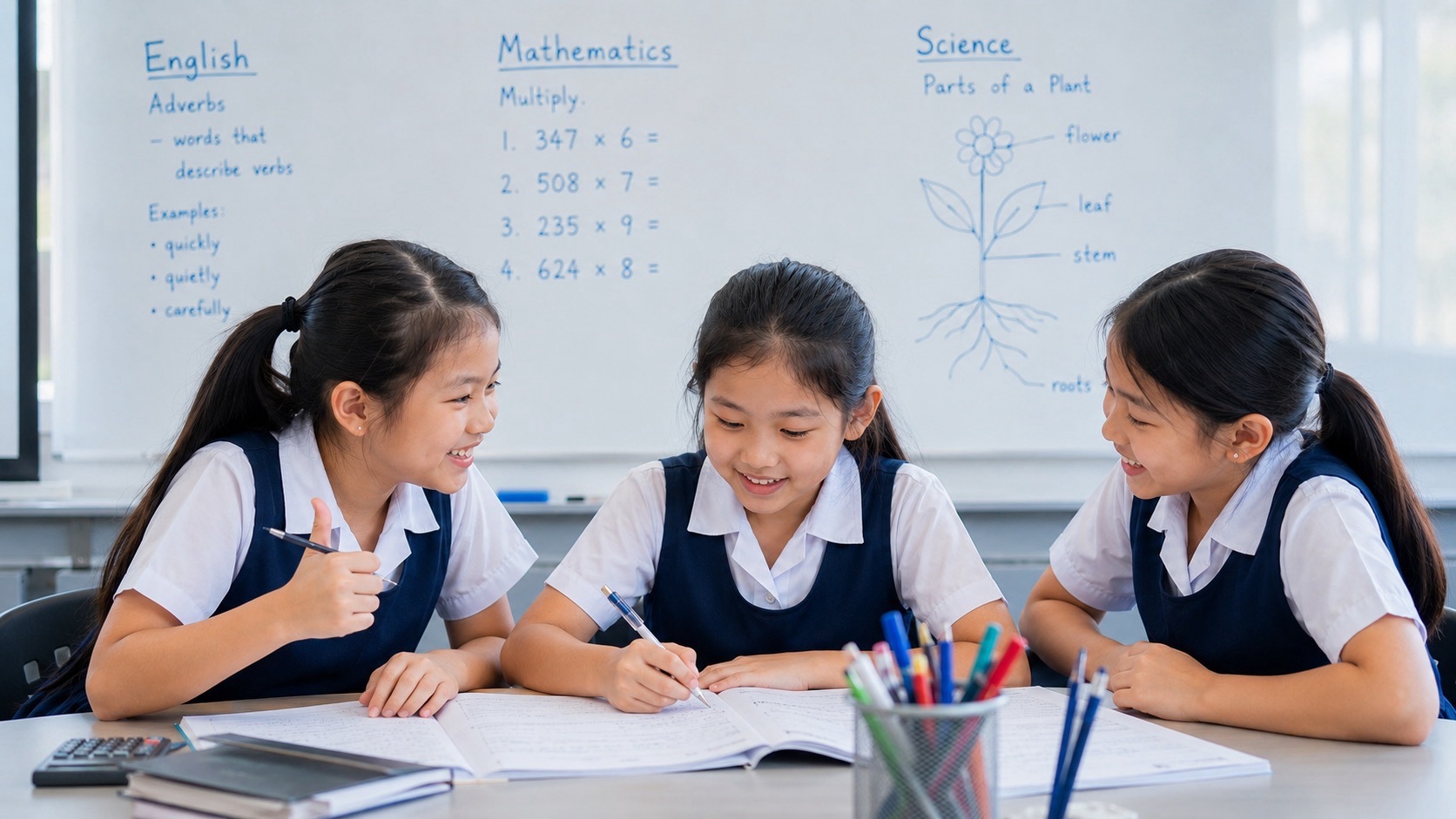
This page owns the new Primary 4 / Grade 4 Informational, Expository and Explanatory Writing vocabulary search family inside the eduKateSG world lane. It is additive: it does not replace the existing sentence-starter, transition-word, nonfiction-reading or opinion-writing owners. Alicia, Tricia and Kai Kai model the complete writing loop: research → narrow the topic → organize information → define terms → explain relationships → integrate visuals → paraphrase sources → revise for coherence and precision → publish.
The 50-Second Informational-Writing Rule
- Name the topic clearly.
- Narrow the focus so the piece can actually explain it.
- Group related information together.
- Use facts, definitions, details, examples and quotations for real purposes.
- Explain relationships instead of listing disconnected information.
- Use domain-specific vocabulary accurately.
- Add headings, diagrams, tables or other features only when they help comprehension.
- Paraphrase sources instead of copying them.
- Revise organization and explanation before editing punctuation.
- End with a conclusion that follows from the information already developed.
Informational writing succeeds when the reader can follow the topic, understand the relationships and trust where the information came from.
Why Informational-Writing Vocabulary Matters at Grade 4
A child can know many facts and still write a weak informational piece. The missing skill is often organization or explanation. A paragraph about volcanoes may contain correct facts but no central idea. A report may quote a source without explaining why the quotation matters. A Science explanation may use the word evaporation but never define it for the intended audience. The vocabulary on this page makes these writing jobs visible.
The terms also help learners separate reading from writing. A heading in a nonfiction article is something the reader uses to navigate; a heading in informational writing is also something the writer deliberately creates to organize information. A graph is not decoration. If it does not clarify a relationship or present information efficiently, it may not belong.
Informational Writing Foundations
These ten terms belong to the informational writing foundations family. Learn each term by using it to make a real informational-writing decision.
1. informational writing
Definition: writing whose main purpose is to explain or communicate accurate information.
Example: Alicia writes an informational piece about how mangroves protect coastlines.
Tricia’s writing check: Point to the exact sentence, source, visual, paragraph move or revision decision that would demonstrate informational writing. Then create a weak version where the term is missing or misused and explain what becomes harder for the reader.
Transfer: Use informational writing in a different Grade 4 informational topic. Explain how the term helps the writer decide what to include, define, group, explain, illustrate or revise.
2. explanatory writing
Definition: writing that makes an idea, process, relationship or cause understandable.
Example: Tricia writes an explanatory paragraph about how condensation forms.
Kai Kai’s writing check: Point to the exact sentence, source, visual, paragraph move or revision decision that would demonstrate explanatory writing. Then create a weak version where the term is missing or misused and explain what becomes harder for the reader.
Transfer: Use explanatory writing in a different Grade 4 informational topic. Explain how the term helps the writer decide what to include, define, group, explain, illustrate or revise.
3. expository writing
Definition: writing that presents and develops information about a topic clearly.
Example: Kai Kai uses expository writing to explain how a bridge distributes weight.
Alicia’s writing check: Point to the exact sentence, source, visual, paragraph move or revision decision that would demonstrate expository writing. Then create a weak version where the term is missing or misused and explain what becomes harder for the reader.
Transfer: Use expository writing in a different Grade 4 informational topic. Explain how the term helps the writer decide what to include, define, group, explain, illustrate or revise.
4. topic
Definition: the subject being explained.
Example: The topic is how seeds germinate.
Tricia’s writing check: Point to the exact sentence, source, visual, paragraph move or revision decision that would demonstrate topic. Then create a weak version where the term is missing or misused and explain what becomes harder for the reader.
Transfer: Use topic in a different Grade 4 informational topic. Explain how the term helps the writer decide what to include, define, group, explain, illustrate or revise.
5. focus
Definition: the specific part of a topic the writing concentrates on.
Example: The focus is the role of water during germination.
Kai Kai’s writing check: Point to the exact sentence, source, visual, paragraph move or revision decision that would demonstrate focus. Then create a weak version where the term is missing or misused and explain what becomes harder for the reader.
Transfer: Use focus in a different Grade 4 informational topic. Explain how the term helps the writer decide what to include, define, group, explain, illustrate or revise.
6. purpose
Definition: the reason the writer is presenting the information.
Example: The purpose is to explain a process clearly.
Alicia’s writing check: Point to the exact sentence, source, visual, paragraph move or revision decision that would demonstrate purpose. Then create a weak version where the term is missing or misused and explain what becomes harder for the reader.
Transfer: Use purpose in a different Grade 4 informational topic. Explain how the term helps the writer decide what to include, define, group, explain, illustrate or revise.
7. audience
Definition: the people expected to read or hear the writing.
Example: Alicia adjusts definitions because the audience is a younger class.
Tricia’s writing check: Point to the exact sentence, source, visual, paragraph move or revision decision that would demonstrate audience. Then create a weak version where the term is missing or misused and explain what becomes harder for the reader.
Transfer: Use audience in a different Grade 4 informational topic. Explain how the term helps the writer decide what to include, define, group, explain, illustrate or revise.
8. central idea
Definition: the main controlling idea developed across the piece.
Example: The central idea is that several plant structures work together to support growth.
Kai Kai’s writing check: Point to the exact sentence, source, visual, paragraph move or revision decision that would demonstrate central idea. Then create a weak version where the term is missing or misused and explain what becomes harder for the reader.
Transfer: Use central idea in a different Grade 4 informational topic. Explain how the term helps the writer decide what to include, define, group, explain, illustrate or revise.
9. scope
Definition: the amount or range of information the writing will cover.
Example: Tricia narrows the scope from all weather to how thunderstorms form.
Alicia’s writing check: Point to the exact sentence, source, visual, paragraph move or revision decision that would demonstrate scope. Then create a weak version where the term is missing or misused and explain what becomes harder for the reader.
Transfer: Use scope in a different Grade 4 informational topic. Explain how the term helps the writer decide what to include, define, group, explain, illustrate or revise.
10. accuracy
Definition: the quality of being correct and precise.
Example: Kai Kai checks the accuracy of every measurement before using it.
Tricia’s writing check: Point to the exact sentence, source, visual, paragraph move or revision decision that would demonstrate accuracy. Then create a weak version where the term is missing or misused and explain what becomes harder for the reader.
Transfer: Use accuracy in a different Grade 4 informational topic. Explain how the term helps the writer decide what to include, define, group, explain, illustrate or revise.
Informational Writing Foundations mini-practice
- Create one Grade 4 informational-writing task that requires informational writing. Write a model response sentence or paragraph and explain how it performs the term correctly.
- Create one Grade 4 informational-writing task that requires explanatory writing. Write a model response sentence or paragraph and explain how it performs the term correctly.
- Create one Grade 4 informational-writing task that requires expository writing. Write a model response sentence or paragraph and explain how it performs the term correctly.
- Create one Grade 4 informational-writing task that requires topic. Write a model response sentence or paragraph and explain how it performs the term correctly.
- Create one Grade 4 informational-writing task that requires focus. Write a model response sentence or paragraph and explain how it performs the term correctly.
- Create one Grade 4 informational-writing task that requires purpose. Write a model response sentence or paragraph and explain how it performs the term correctly.
- Create one Grade 4 informational-writing task that requires audience. Write a model response sentence or paragraph and explain how it performs the term correctly.
- Create one Grade 4 informational-writing task that requires central idea. Write a model response sentence or paragraph and explain how it performs the term correctly.
- Create one Grade 4 informational-writing task that requires scope. Write a model response sentence or paragraph and explain how it performs the term correctly.
- Create one Grade 4 informational-writing task that requires accuracy. Write a model response sentence or paragraph and explain how it performs the term correctly.
Facts, Definitions and Details
These ten terms belong to the facts, definitions and details family. Learn each term by using it to make a real informational-writing decision.
11. fact
Definition: a statement that can be checked against evidence.
Example: The water boiled at 100°C under the stated conditions is a fact.
Kai Kai’s writing check: Point to the exact sentence, source, visual, paragraph move or revision decision that would demonstrate fact. Then create a weak version where the term is missing or misused and explain what becomes harder for the reader.
Transfer: Use fact in a different Grade 4 informational topic. Explain how the term helps the writer decide what to include, define, group, explain, illustrate or revise.
12. definition
Definition: a clear explanation of what a term means.
Example: Alicia gives a definition of erosion before explaining examples.
Alicia’s writing check: Point to the exact sentence, source, visual, paragraph move or revision decision that would demonstrate definition. Then create a weak version where the term is missing or misused and explain what becomes harder for the reader.
Transfer: Use definition in a different Grade 4 informational topic. Explain how the term helps the writer decide what to include, define, group, explain, illustrate or revise.
13. concrete detail
Definition: a specific observable or measurable piece of information.
Example: The exact rainfall amount is a concrete detail.
Tricia’s writing check: Point to the exact sentence, source, visual, paragraph move or revision decision that would demonstrate concrete detail. Then create a weak version where the term is missing or misused and explain what becomes harder for the reader.
Transfer: Use concrete detail in a different Grade 4 informational topic. Explain how the term helps the writer decide what to include, define, group, explain, illustrate or revise.
14. example
Definition: a specific case used to illustrate an idea.
Example: Tricia gives mangroves as an example of coastal vegetation.
Kai Kai’s writing check: Point to the exact sentence, source, visual, paragraph move or revision decision that would demonstrate example. Then create a weak version where the term is missing or misused and explain what becomes harder for the reader.
Transfer: Use example in a different Grade 4 informational topic. Explain how the term helps the writer decide what to include, define, group, explain, illustrate or revise.
15. instance
Definition: a particular example of a general idea.
Example: One instance of heat transfer is a warm spoon heating cooler water.
Alicia’s writing check: Point to the exact sentence, source, visual, paragraph move or revision decision that would demonstrate instance. Then create a weak version where the term is missing or misused and explain what becomes harder for the reader.
Transfer: Use instance in a different Grade 4 informational topic. Explain how the term helps the writer decide what to include, define, group, explain, illustrate or revise.
16. description
Definition: language explaining what something is like or what features it has.
Example: Kai Kai adds a description of the volcano’s layers.
Tricia’s writing check: Point to the exact sentence, source, visual, paragraph move or revision decision that would demonstrate description. Then create a weak version where the term is missing or misused and explain what becomes harder for the reader.
Transfer: Use description in a different Grade 4 informational topic. Explain how the term helps the writer decide what to include, define, group, explain, illustrate or revise.
17. characteristic
Definition: a feature that helps identify or describe something.
Example: One characteristic of a solid is that it keeps its shape.
Kai Kai’s writing check: Point to the exact sentence, source, visual, paragraph move or revision decision that would demonstrate characteristic. Then create a weak version where the term is missing or misused and explain what becomes harder for the reader.
Transfer: Use characteristic in a different Grade 4 informational topic. Explain how the term helps the writer decide what to include, define, group, explain, illustrate or revise.
18. feature
Definition: an important part, quality or component.
Example: A heading is one feature of an informational article.
Alicia’s writing check: Point to the exact sentence, source, visual, paragraph move or revision decision that would demonstrate feature. Then create a weak version where the term is missing or misused and explain what becomes harder for the reader.
Transfer: Use feature in a different Grade 4 informational topic. Explain how the term helps the writer decide what to include, define, group, explain, illustrate or revise.
19. measurement
Definition: a value found using a unit or scale.
Example: Alicia includes the measurement of 15 centimetres.
Tricia’s writing check: Point to the exact sentence, source, visual, paragraph move or revision decision that would demonstrate measurement. Then create a weak version where the term is missing or misused and explain what becomes harder for the reader.
Transfer: Use measurement in a different Grade 4 informational topic. Explain how the term helps the writer decide what to include, define, group, explain, illustrate or revise.
20. statistic
Definition: a numerical fact or summary based on collected data.
Example: Tricia uses a statistic from the class survey.
Kai Kai’s writing check: Point to the exact sentence, source, visual, paragraph move or revision decision that would demonstrate statistic. Then create a weak version where the term is missing or misused and explain what becomes harder for the reader.
Transfer: Use statistic in a different Grade 4 informational topic. Explain how the term helps the writer decide what to include, define, group, explain, illustrate or revise.
Facts, Definitions and Details mini-practice
- Create one Grade 4 informational-writing task that requires fact. Write a model response sentence or paragraph and explain how it performs the term correctly.
- Create one Grade 4 informational-writing task that requires definition. Write a model response sentence or paragraph and explain how it performs the term correctly.
- Create one Grade 4 informational-writing task that requires concrete detail. Write a model response sentence or paragraph and explain how it performs the term correctly.
- Create one Grade 4 informational-writing task that requires example. Write a model response sentence or paragraph and explain how it performs the term correctly.
- Create one Grade 4 informational-writing task that requires instance. Write a model response sentence or paragraph and explain how it performs the term correctly.
- Create one Grade 4 informational-writing task that requires description. Write a model response sentence or paragraph and explain how it performs the term correctly.
- Create one Grade 4 informational-writing task that requires characteristic. Write a model response sentence or paragraph and explain how it performs the term correctly.
- Create one Grade 4 informational-writing task that requires feature. Write a model response sentence or paragraph and explain how it performs the term correctly.
- Create one Grade 4 informational-writing task that requires measurement. Write a model response sentence or paragraph and explain how it performs the term correctly.
- Create one Grade 4 informational-writing task that requires statistic. Write a model response sentence or paragraph and explain how it performs the term correctly.
Sources and Evidence
These ten terms belong to the sources and evidence family. Learn each term by using it to make a real informational-writing decision.
21. source
Definition: a person, text, record, image or resource providing information.
Example: Kai Kai checks the source before copying the number.
Alicia’s writing check: Point to the exact sentence, source, visual, paragraph move or revision decision that would demonstrate source. Then create a weak version where the term is missing or misused and explain what becomes harder for the reader.
Transfer: Use source in a different Grade 4 informational topic. Explain how the term helps the writer decide what to include, define, group, explain, illustrate or revise.
22. reference
Definition: information that identifies or points to a source.
Example: Alicia adds a reference for the diagram.
Tricia’s writing check: Point to the exact sentence, source, visual, paragraph move or revision decision that would demonstrate reference. Then create a weak version where the term is missing or misused and explain what becomes harder for the reader.
Transfer: Use reference in a different Grade 4 informational topic. Explain how the term helps the writer decide what to include, define, group, explain, illustrate or revise.
23. quotation
Definition: exact words taken from a source.
Example: Tricia uses a short quotation from the interview.
Kai Kai’s writing check: Point to the exact sentence, source, visual, paragraph move or revision decision that would demonstrate quotation. Then create a weak version where the term is missing or misused and explain what becomes harder for the reader.
Transfer: Use quotation in a different Grade 4 informational topic. Explain how the term helps the writer decide what to include, define, group, explain, illustrate or revise.
24. citation
Definition: a formal note identifying where information came from.
Example: Kai Kai adds a citation for the published report.
Alicia’s writing check: Point to the exact sentence, source, visual, paragraph move or revision decision that would demonstrate citation. Then create a weak version where the term is missing or misused and explain what becomes harder for the reader.
Transfer: Use citation in a different Grade 4 informational topic. Explain how the term helps the writer decide what to include, define, group, explain, illustrate or revise.
25. evidence
Definition: information used to support an explanation or statement.
Example: The table provides evidence for the trend.
Tricia’s writing check: Point to the exact sentence, source, visual, paragraph move or revision decision that would demonstrate evidence. Then create a weak version where the term is missing or misused and explain what becomes harder for the reader.
Transfer: Use evidence in a different Grade 4 informational topic. Explain how the term helps the writer decide what to include, define, group, explain, illustrate or revise.
26. reliable
Definition: dependable enough to trust for the purpose.
Example: Alicia chooses a reliable source for weather records.
Kai Kai’s writing check: Point to the exact sentence, source, visual, paragraph move or revision decision that would demonstrate reliable. Then create a weak version where the term is missing or misused and explain what becomes harder for the reader.
Transfer: Use reliable in a different Grade 4 informational topic. Explain how the term helps the writer decide what to include, define, group, explain, illustrate or revise.
27. credible
Definition: believable and trustworthy based on source quality and evidence.
Example: Tricia checks whether the article is credible.
Alicia’s writing check: Point to the exact sentence, source, visual, paragraph move or revision decision that would demonstrate credible. Then create a weak version where the term is missing or misused and explain what becomes harder for the reader.
Transfer: Use credible in a different Grade 4 informational topic. Explain how the term helps the writer decide what to include, define, group, explain, illustrate or revise.
28. relevant
Definition: directly connected to the topic or point.
Example: Kai Kai removes a detail that is not relevant.
Tricia’s writing check: Point to the exact sentence, source, visual, paragraph move or revision decision that would demonstrate relevant. Then create a weak version where the term is missing or misused and explain what becomes harder for the reader.
Transfer: Use relevant in a different Grade 4 informational topic. Explain how the term helps the writer decide what to include, define, group, explain, illustrate or revise.
29. primary source
Definition: evidence created by a direct participant or during the time being studied.
Example: A diary can be a primary source.
Kai Kai’s writing check: Point to the exact sentence, source, visual, paragraph move or revision decision that would demonstrate primary source. Then create a weak version where the term is missing or misused and explain what becomes harder for the reader.
Transfer: Use primary source in a different Grade 4 informational topic. Explain how the term helps the writer decide what to include, define, group, explain, illustrate or revise.
30. secondary source
Definition: an account created later using other sources.
Example: A textbook chapter is usually a secondary source.
Alicia’s writing check: Point to the exact sentence, source, visual, paragraph move or revision decision that would demonstrate secondary source. Then create a weak version where the term is missing or misused and explain what becomes harder for the reader.
Transfer: Use secondary source in a different Grade 4 informational topic. Explain how the term helps the writer decide what to include, define, group, explain, illustrate or revise.
Sources and Evidence mini-practice
- Create one Grade 4 informational-writing task that requires source. Write a model response sentence or paragraph and explain how it performs the term correctly.
- Create one Grade 4 informational-writing task that requires reference. Write a model response sentence or paragraph and explain how it performs the term correctly.
- Create one Grade 4 informational-writing task that requires quotation. Write a model response sentence or paragraph and explain how it performs the term correctly.
- Create one Grade 4 informational-writing task that requires citation. Write a model response sentence or paragraph and explain how it performs the term correctly.
- Create one Grade 4 informational-writing task that requires evidence. Write a model response sentence or paragraph and explain how it performs the term correctly.
- Create one Grade 4 informational-writing task that requires reliable. Write a model response sentence or paragraph and explain how it performs the term correctly.
- Create one Grade 4 informational-writing task that requires credible. Write a model response sentence or paragraph and explain how it performs the term correctly.
- Create one Grade 4 informational-writing task that requires relevant. Write a model response sentence or paragraph and explain how it performs the term correctly.
- Create one Grade 4 informational-writing task that requires primary source. Write a model response sentence or paragraph and explain how it performs the term correctly.
- Create one Grade 4 informational-writing task that requires secondary source. Write a model response sentence or paragraph and explain how it performs the term correctly.
Organization and Paragraph Structure
These ten terms belong to the organization and paragraph structure family. Learn each term by using it to make a real informational-writing decision.
31. introduction
Definition: the opening section that presents the topic and prepares the reader.
Example: Alicia’s introduction names the topic and central idea.
Tricia’s writing check: Point to the exact sentence, source, visual, paragraph move or revision decision that would demonstrate introduction. Then create a weak version where the term is missing or misused and explain what becomes harder for the reader.
Transfer: Use introduction in a different Grade 4 informational topic. Explain how the term helps the writer decide what to include, define, group, explain, illustrate or revise.
32. body paragraph
Definition: a paragraph that develops one main part of the topic.
Example: Each body paragraph explains one stage of the process.
Kai Kai’s writing check: Point to the exact sentence, source, visual, paragraph move or revision decision that would demonstrate body paragraph. Then create a weak version where the term is missing or misused and explain what becomes harder for the reader.
Transfer: Use body paragraph in a different Grade 4 informational topic. Explain how the term helps the writer decide what to include, define, group, explain, illustrate or revise.
33. conclusion
Definition: the closing section that brings the explanation to a purposeful end.
Example: Tricia’s conclusion summarizes what the process shows.
Alicia’s writing check: Point to the exact sentence, source, visual, paragraph move or revision decision that would demonstrate conclusion. Then create a weak version where the term is missing or misused and explain what becomes harder for the reader.
Transfer: Use conclusion in a different Grade 4 informational topic. Explain how the term helps the writer decide what to include, define, group, explain, illustrate or revise.
34. topic sentence
Definition: a sentence stating the main point of a paragraph.
Example: Kai Kai begins with a topic sentence about evaporation.
Tricia’s writing check: Point to the exact sentence, source, visual, paragraph move or revision decision that would demonstrate topic sentence. Then create a weak version where the term is missing or misused and explain what becomes harder for the reader.
Transfer: Use topic sentence in a different Grade 4 informational topic. Explain how the term helps the writer decide what to include, define, group, explain, illustrate or revise.
35. supporting sentence
Definition: a sentence adding facts, examples or explanations to the paragraph’s main point.
Example: Alicia adds two supporting sentences.
Kai Kai’s writing check: Point to the exact sentence, source, visual, paragraph move or revision decision that would demonstrate supporting sentence. Then create a weak version where the term is missing or misused and explain what becomes harder for the reader.
Transfer: Use supporting sentence in a different Grade 4 informational topic. Explain how the term helps the writer decide what to include, define, group, explain, illustrate or revise.
36. paragraph
Definition: a group of related sentences developing one main idea.
Example: The paragraph stays focused on condensation.
Alicia’s writing check: Point to the exact sentence, source, visual, paragraph move or revision decision that would demonstrate paragraph. Then create a weak version where the term is missing or misused and explain what becomes harder for the reader.
Transfer: Use paragraph in a different Grade 4 informational topic. Explain how the term helps the writer decide what to include, define, group, explain, illustrate or revise.
37. section
Definition: a larger part of a text organized around a subtopic.
Example: The next section explains energy transfer.
Tricia’s writing check: Point to the exact sentence, source, visual, paragraph move or revision decision that would demonstrate section. Then create a weak version where the term is missing or misused and explain what becomes harder for the reader.
Transfer: Use section in a different Grade 4 informational topic. Explain how the term helps the writer decide what to include, define, group, explain, illustrate or revise.
38. heading
Definition: a title naming a section and helping readers navigate.
Example: The heading shows that the section is about habitats.
Kai Kai’s writing check: Point to the exact sentence, source, visual, paragraph move or revision decision that would demonstrate heading. Then create a weak version where the term is missing or misused and explain what becomes harder for the reader.
Transfer: Use heading in a different Grade 4 informational topic. Explain how the term helps the writer decide what to include, define, group, explain, illustrate or revise.
39. subheading
Definition: a smaller heading that narrows the section topic.
Example: The subheading introduces desert adaptations.
Alicia’s writing check: Point to the exact sentence, source, visual, paragraph move or revision decision that would demonstrate subheading. Then create a weak version where the term is missing or misused and explain what becomes harder for the reader.
Transfer: Use subheading in a different Grade 4 informational topic. Explain how the term helps the writer decide what to include, define, group, explain, illustrate or revise.
40. organization
Definition: the arrangement of ideas so the reader can follow the information.
Example: Tricia improves the organization by grouping related facts.
Tricia’s writing check: Point to the exact sentence, source, visual, paragraph move or revision decision that would demonstrate organization. Then create a weak version where the term is missing or misused and explain what becomes harder for the reader.
Transfer: Use organization in a different Grade 4 informational topic. Explain how the term helps the writer decide what to include, define, group, explain, illustrate or revise.
Organization and Paragraph Structure mini-practice
- Create one Grade 4 informational-writing task that requires introduction. Write a model response sentence or paragraph and explain how it performs the term correctly.
- Create one Grade 4 informational-writing task that requires body paragraph. Write a model response sentence or paragraph and explain how it performs the term correctly.
- Create one Grade 4 informational-writing task that requires conclusion. Write a model response sentence or paragraph and explain how it performs the term correctly.
- Create one Grade 4 informational-writing task that requires topic sentence. Write a model response sentence or paragraph and explain how it performs the term correctly.
- Create one Grade 4 informational-writing task that requires supporting sentence. Write a model response sentence or paragraph and explain how it performs the term correctly.
- Create one Grade 4 informational-writing task that requires paragraph. Write a model response sentence or paragraph and explain how it performs the term correctly.
- Create one Grade 4 informational-writing task that requires section. Write a model response sentence or paragraph and explain how it performs the term correctly.
- Create one Grade 4 informational-writing task that requires heading. Write a model response sentence or paragraph and explain how it performs the term correctly.
- Create one Grade 4 informational-writing task that requires subheading. Write a model response sentence or paragraph and explain how it performs the term correctly.
- Create one Grade 4 informational-writing task that requires organization. Write a model response sentence or paragraph and explain how it performs the term correctly.
Text Structures and Relationships
These ten terms belong to the text structures and relationships family. Learn each term by using it to make a real informational-writing decision.
41. chronology
Definition: organization by time order.
Example: The biography uses chronology.
Kai Kai’s writing check: Point to the exact sentence, source, visual, paragraph move or revision decision that would demonstrate chronology. Then create a weak version where the term is missing or misused and explain what becomes harder for the reader.
Transfer: Use chronology in a different Grade 4 informational topic. Explain how the term helps the writer decide what to include, define, group, explain, illustrate or revise.
42. sequence
Definition: organization by ordered steps or stages.
Example: The procedure uses sequence.
Alicia’s writing check: Point to the exact sentence, source, visual, paragraph move or revision decision that would demonstrate sequence. Then create a weak version where the term is missing or misused and explain what becomes harder for the reader.
Transfer: Use sequence in a different Grade 4 informational topic. Explain how the term helps the writer decide what to include, define, group, explain, illustrate or revise.
43. cause and effect
Definition: organization showing reasons and results.
Example: The article uses cause and effect to explain flooding.
Tricia’s writing check: Point to the exact sentence, source, visual, paragraph move or revision decision that would demonstrate cause and effect. Then create a weak version where the term is missing or misused and explain what becomes harder for the reader.
Transfer: Use cause and effect in a different Grade 4 informational topic. Explain how the term helps the writer decide what to include, define, group, explain, illustrate or revise.
44. compare and contrast
Definition: organization showing similarities and differences.
Example: Kai Kai compares solar and wind energy.
Kai Kai’s writing check: Point to the exact sentence, source, visual, paragraph move or revision decision that would demonstrate compare and contrast. Then create a weak version where the term is missing or misused and explain what becomes harder for the reader.
Transfer: Use compare and contrast in a different Grade 4 informational topic. Explain how the term helps the writer decide what to include, define, group, explain, illustrate or revise.
45. problem and solution
Definition: organization presenting a difficulty and one or more responses.
Example: The report uses problem and solution to discuss litter.
Alicia’s writing check: Point to the exact sentence, source, visual, paragraph move or revision decision that would demonstrate problem and solution. Then create a weak version where the term is missing or misused and explain what becomes harder for the reader.
Transfer: Use problem and solution in a different Grade 4 informational topic. Explain how the term helps the writer decide what to include, define, group, explain, illustrate or revise.
46. classification
Definition: organization grouping information into categories.
Example: Alicia uses classification to group animals by diet.
Tricia’s writing check: Point to the exact sentence, source, visual, paragraph move or revision decision that would demonstrate classification. Then create a weak version where the term is missing or misused and explain what becomes harder for the reader.
Transfer: Use classification in a different Grade 4 informational topic. Explain how the term helps the writer decide what to include, define, group, explain, illustrate or revise.
47. description structure
Definition: organization built around features and characteristics.
Example: The rainforest article uses description structure.
Kai Kai’s writing check: Point to the exact sentence, source, visual, paragraph move or revision decision that would demonstrate description structure. Then create a weak version where the term is missing or misused and explain what becomes harder for the reader.
Transfer: Use description structure in a different Grade 4 informational topic. Explain how the term helps the writer decide what to include, define, group, explain, illustrate or revise.
48. relationship
Definition: the way two ideas or facts are connected.
Example: Tricia explains the relationship between rainfall and river level.
Alicia’s writing check: Point to the exact sentence, source, visual, paragraph move or revision decision that would demonstrate relationship. Then create a weak version where the term is missing or misused and explain what becomes harder for the reader.
Transfer: Use relationship in a different Grade 4 informational topic. Explain how the term helps the writer decide what to include, define, group, explain, illustrate or revise.
49. signal word
Definition: a word or phrase hinting at a relationship or structure.
Example: Because is a signal word for cause.
Tricia’s writing check: Point to the exact sentence, source, visual, paragraph move or revision decision that would demonstrate signal word. Then create a weak version where the term is missing or misused and explain what becomes harder for the reader.
Transfer: Use signal word in a different Grade 4 informational topic. Explain how the term helps the writer decide what to include, define, group, explain, illustrate or revise.
50. transition
Definition: a word or phrase linking ideas or sections.
Example: However is a transition showing contrast.
Kai Kai’s writing check: Point to the exact sentence, source, visual, paragraph move or revision decision that would demonstrate transition. Then create a weak version where the term is missing or misused and explain what becomes harder for the reader.
Transfer: Use transition in a different Grade 4 informational topic. Explain how the term helps the writer decide what to include, define, group, explain, illustrate or revise.
Text Structures and Relationships mini-practice
- Create one Grade 4 informational-writing task that requires chronology. Write a model response sentence or paragraph and explain how it performs the term correctly.
- Create one Grade 4 informational-writing task that requires sequence. Write a model response sentence or paragraph and explain how it performs the term correctly.
- Create one Grade 4 informational-writing task that requires cause and effect. Write a model response sentence or paragraph and explain how it performs the term correctly.
- Create one Grade 4 informational-writing task that requires compare and contrast. Write a model response sentence or paragraph and explain how it performs the term correctly.
- Create one Grade 4 informational-writing task that requires problem and solution. Write a model response sentence or paragraph and explain how it performs the term correctly.
- Create one Grade 4 informational-writing task that requires classification. Write a model response sentence or paragraph and explain how it performs the term correctly.
- Create one Grade 4 informational-writing task that requires description structure. Write a model response sentence or paragraph and explain how it performs the term correctly.
- Create one Grade 4 informational-writing task that requires relationship. Write a model response sentence or paragraph and explain how it performs the term correctly.
- Create one Grade 4 informational-writing task that requires signal word. Write a model response sentence or paragraph and explain how it performs the term correctly.
- Create one Grade 4 informational-writing task that requires transition. Write a model response sentence or paragraph and explain how it performs the term correctly.
Explanation and Academic Reasoning
These ten terms belong to the explanation and academic reasoning family. Learn each term by using it to make a real informational-writing decision.
51. explain
Definition: make an idea, process or relationship understandable.
Example: Alicia explains why the metal warms faster.
Alicia’s writing check: Point to the exact sentence, source, visual, paragraph move or revision decision that would demonstrate explain. Then create a weak version where the term is missing or misused and explain what becomes harder for the reader.
Transfer: Use explain in a different Grade 4 informational topic. Explain how the term helps the writer decide what to include, define, group, explain, illustrate or revise.
52. clarify
Definition: make something easier to understand.
Example: Tricia clarifies what she means by absorb.
Tricia’s writing check: Point to the exact sentence, source, visual, paragraph move or revision decision that would demonstrate clarify. Then create a weak version where the term is missing or misused and explain what becomes harder for the reader.
Transfer: Use clarify in a different Grade 4 informational topic. Explain how the term helps the writer decide what to include, define, group, explain, illustrate or revise.
53. elaborate
Definition: add useful explanation, detail or example.
Example: Kai Kai elaborates on the first stage of the process.
Kai Kai’s writing check: Point to the exact sentence, source, visual, paragraph move or revision decision that would demonstrate elaborate. Then create a weak version where the term is missing or misused and explain what becomes harder for the reader.
Transfer: Use elaborate in a different Grade 4 informational topic. Explain how the term helps the writer decide what to include, define, group, explain, illustrate or revise.
54. analyze
Definition: examine parts or relationships carefully.
Example: Alicia analyzes how two factors affect growth.
Alicia’s writing check: Point to the exact sentence, source, visual, paragraph move or revision decision that would demonstrate analyze. Then create a weak version where the term is missing or misused and explain what becomes harder for the reader.
Transfer: Use analyze in a different Grade 4 informational topic. Explain how the term helps the writer decide what to include, define, group, explain, illustrate or revise.
55. interpret
Definition: explain what data, evidence or information means.
Example: Tricia interprets the graph before writing about it.
Tricia’s writing check: Point to the exact sentence, source, visual, paragraph move or revision decision that would demonstrate interpret. Then create a weak version where the term is missing or misused and explain what becomes harder for the reader.
Transfer: Use interpret in a different Grade 4 informational topic. Explain how the term helps the writer decide what to include, define, group, explain, illustrate or revise.
56. compare
Definition: examine similarities and differences.
Example: Kai Kai compares two materials.
Kai Kai’s writing check: Point to the exact sentence, source, visual, paragraph move or revision decision that would demonstrate compare. Then create a weak version where the term is missing or misused and explain what becomes harder for the reader.
Transfer: Use compare in a different Grade 4 informational topic. Explain how the term helps the writer decide what to include, define, group, explain, illustrate or revise.
57. contrast
Definition: focus on differences.
Example: Alicia contrasts the two methods.
Alicia’s writing check: Point to the exact sentence, source, visual, paragraph move or revision decision that would demonstrate contrast. Then create a weak version where the term is missing or misused and explain what becomes harder for the reader.
Transfer: Use contrast in a different Grade 4 informational topic. Explain how the term helps the writer decide what to include, define, group, explain, illustrate or revise.
58. summarize
Definition: state the most important information in a shorter form.
Example: Tricia summarizes the final section.
Tricia’s writing check: Point to the exact sentence, source, visual, paragraph move or revision decision that would demonstrate summarize. Then create a weak version where the term is missing or misused and explain what becomes harder for the reader.
Transfer: Use summarize in a different Grade 4 informational topic. Explain how the term helps the writer decide what to include, define, group, explain, illustrate or revise.
59. synthesize
Definition: combine information from several parts or sources into a new understanding.
Example: Kai Kai synthesizes the article and chart.
Kai Kai’s writing check: Point to the exact sentence, source, visual, paragraph move or revision decision that would demonstrate synthesize. Then create a weak version where the term is missing or misused and explain what becomes harder for the reader.
Transfer: Use synthesize in a different Grade 4 informational topic. Explain how the term helps the writer decide what to include, define, group, explain, illustrate or revise.
60. conclude
Definition: state what follows after considering information or evidence.
Example: Alicia concludes that both light and water affect growth.
Alicia’s writing check: Point to the exact sentence, source, visual, paragraph move or revision decision that would demonstrate conclude. Then create a weak version where the term is missing or misused and explain what becomes harder for the reader.
Transfer: Use conclude in a different Grade 4 informational topic. Explain how the term helps the writer decide what to include, define, group, explain, illustrate or revise.
Explanation and Academic Reasoning mini-practice
- Create one Grade 4 informational-writing task that requires explain. Write a model response sentence or paragraph and explain how it performs the term correctly.
- Create one Grade 4 informational-writing task that requires clarify. Write a model response sentence or paragraph and explain how it performs the term correctly.
- Create one Grade 4 informational-writing task that requires elaborate. Write a model response sentence or paragraph and explain how it performs the term correctly.
- Create one Grade 4 informational-writing task that requires analyze. Write a model response sentence or paragraph and explain how it performs the term correctly.
- Create one Grade 4 informational-writing task that requires interpret. Write a model response sentence or paragraph and explain how it performs the term correctly.
- Create one Grade 4 informational-writing task that requires compare. Write a model response sentence or paragraph and explain how it performs the term correctly.
- Create one Grade 4 informational-writing task that requires contrast. Write a model response sentence or paragraph and explain how it performs the term correctly.
- Create one Grade 4 informational-writing task that requires summarize. Write a model response sentence or paragraph and explain how it performs the term correctly.
- Create one Grade 4 informational-writing task that requires synthesize. Write a model response sentence or paragraph and explain how it performs the term correctly.
- Create one Grade 4 informational-writing task that requires conclude. Write a model response sentence or paragraph and explain how it performs the term correctly.
Domain-Specific and Academic Language
These ten terms belong to the domain-specific and academic language family. Learn each term by using it to make a real informational-writing decision.
61. domain-specific vocabulary
Definition: terms used within a particular subject or field.
Example: Photosynthesis is domain-specific vocabulary in Science.
Tricia’s writing check: Point to the exact sentence, source, visual, paragraph move or revision decision that would demonstrate domain-specific vocabulary. Then create a weak version where the term is missing or misused and explain what becomes harder for the reader.
Transfer: Use domain-specific vocabulary in a different Grade 4 informational topic. Explain how the term helps the writer decide what to include, define, group, explain, illustrate or revise.
62. academic vocabulary
Definition: words used across many school subjects and explanations.
Example: Analyze is academic vocabulary.
Kai Kai’s writing check: Point to the exact sentence, source, visual, paragraph move or revision decision that would demonstrate academic vocabulary. Then create a weak version where the term is missing or misused and explain what becomes harder for the reader.
Transfer: Use academic vocabulary in a different Grade 4 informational topic. Explain how the term helps the writer decide what to include, define, group, explain, illustrate or revise.
63. technical term
Definition: a precise word used for a specialized idea or process.
Example: Evaporation is a technical term in the water cycle.
Alicia’s writing check: Point to the exact sentence, source, visual, paragraph move or revision decision that would demonstrate technical term. Then create a weak version where the term is missing or misused and explain what becomes harder for the reader.
Transfer: Use technical term in a different Grade 4 informational topic. Explain how the term helps the writer decide what to include, define, group, explain, illustrate or revise.
64. precise noun
Definition: a noun chosen to name something exactly.
Example: Sparrow is more precise than bird when species matters.
Tricia’s writing check: Point to the exact sentence, source, visual, paragraph move or revision decision that would demonstrate precise noun. Then create a weak version where the term is missing or misused and explain what becomes harder for the reader.
Transfer: Use precise noun in a different Grade 4 informational topic. Explain how the term helps the writer decide what to include, define, group, explain, illustrate or revise.
65. strong verb
Definition: a verb carrying clear action or process meaning.
Example: Absorb is more precise than take in for some Science explanations.
Kai Kai’s writing check: Point to the exact sentence, source, visual, paragraph move or revision decision that would demonstrate strong verb. Then create a weak version where the term is missing or misused and explain what becomes harder for the reader.
Transfer: Use strong verb in a different Grade 4 informational topic. Explain how the term helps the writer decide what to include, define, group, explain, illustrate or revise.
66. modifier
Definition: a word or phrase adding information to another word or group.
Example: Rapidly is a modifier in rapidly increasing temperature.
Alicia’s writing check: Point to the exact sentence, source, visual, paragraph move or revision decision that would demonstrate modifier. Then create a weak version where the term is missing or misused and explain what becomes harder for the reader.
Transfer: Use modifier in a different Grade 4 informational topic. Explain how the term helps the writer decide what to include, define, group, explain, illustrate or revise.
67. terminology
Definition: the set of terms used in a subject.
Example: The report uses correct scientific terminology.
Tricia’s writing check: Point to the exact sentence, source, visual, paragraph move or revision decision that would demonstrate terminology. Then create a weak version where the term is missing or misused and explain what becomes harder for the reader.
Transfer: Use terminology in a different Grade 4 informational topic. Explain how the term helps the writer decide what to include, define, group, explain, illustrate or revise.
68. register
Definition: the level and style of language suited to the situation.
Example: A formal register fits an informational report.
Kai Kai’s writing check: Point to the exact sentence, source, visual, paragraph move or revision decision that would demonstrate register. Then create a weak version where the term is missing or misused and explain what becomes harder for the reader.
Transfer: Use register in a different Grade 4 informational topic. Explain how the term helps the writer decide what to include, define, group, explain, illustrate or revise.
69. formal language
Definition: language suited to serious or academic contexts.
Example: Tricia replaces gonna with will in formal language.
Alicia’s writing check: Point to the exact sentence, source, visual, paragraph move or revision decision that would demonstrate formal language. Then create a weak version where the term is missing or misused and explain what becomes harder for the reader.
Transfer: Use formal language in a different Grade 4 informational topic. Explain how the term helps the writer decide what to include, define, group, explain, illustrate or revise.
70. precision
Definition: the quality of expressing an idea exactly.
Example: Kai Kai improves precision by replacing thing with sediment.
Tricia’s writing check: Point to the exact sentence, source, visual, paragraph move or revision decision that would demonstrate precision. Then create a weak version where the term is missing or misused and explain what becomes harder for the reader.
Transfer: Use precision in a different Grade 4 informational topic. Explain how the term helps the writer decide what to include, define, group, explain, illustrate or revise.
Domain-Specific and Academic Language mini-practice
- Create one Grade 4 informational-writing task that requires domain-specific vocabulary. Write a model response sentence or paragraph and explain how it performs the term correctly.
- Create one Grade 4 informational-writing task that requires academic vocabulary. Write a model response sentence or paragraph and explain how it performs the term correctly.
- Create one Grade 4 informational-writing task that requires technical term. Write a model response sentence or paragraph and explain how it performs the term correctly.
- Create one Grade 4 informational-writing task that requires precise noun. Write a model response sentence or paragraph and explain how it performs the term correctly.
- Create one Grade 4 informational-writing task that requires strong verb. Write a model response sentence or paragraph and explain how it performs the term correctly.
- Create one Grade 4 informational-writing task that requires modifier. Write a model response sentence or paragraph and explain how it performs the term correctly.
- Create one Grade 4 informational-writing task that requires terminology. Write a model response sentence or paragraph and explain how it performs the term correctly.
- Create one Grade 4 informational-writing task that requires register. Write a model response sentence or paragraph and explain how it performs the term correctly.
- Create one Grade 4 informational-writing task that requires formal language. Write a model response sentence or paragraph and explain how it performs the term correctly.
- Create one Grade 4 informational-writing task that requires precision. Write a model response sentence or paragraph and explain how it performs the term correctly.
Text Features and Multimedia
These ten terms belong to the text features and multimedia family. Learn each term by using it to make a real informational-writing decision.
71. diagram
Definition: a simplified visual showing parts, processes or relationships.
Example: Alicia adds a diagram of the water cycle.
Kai Kai’s writing check: Point to the exact sentence, source, visual, paragraph move or revision decision that would demonstrate diagram. Then create a weak version where the term is missing or misused and explain what becomes harder for the reader.
Transfer: Use diagram in a different Grade 4 informational topic. Explain how the term helps the writer decide what to include, define, group, explain, illustrate or revise.
72. chart
Definition: a visual arrangement of information for comparison or organization.
Example: Tricia uses a chart to compare materials.
Alicia’s writing check: Point to the exact sentence, source, visual, paragraph move or revision decision that would demonstrate chart. Then create a weak version where the term is missing or misused and explain what becomes harder for the reader.
Transfer: Use chart in a different Grade 4 informational topic. Explain how the term helps the writer decide what to include, define, group, explain, illustrate or revise.
73. graph
Definition: a visual display showing numerical relationships or trends.
Example: Kai Kai includes a graph of temperature over time.
Tricia’s writing check: Point to the exact sentence, source, visual, paragraph move or revision decision that would demonstrate graph. Then create a weak version where the term is missing or misused and explain what becomes harder for the reader.
Transfer: Use graph in a different Grade 4 informational topic. Explain how the term helps the writer decide what to include, define, group, explain, illustrate or revise.
74. table
Definition: information arranged in rows and columns.
Example: Alicia uses a table for monthly rainfall.
Kai Kai’s writing check: Point to the exact sentence, source, visual, paragraph move or revision decision that would demonstrate table. Then create a weak version where the term is missing or misused and explain what becomes harder for the reader.
Transfer: Use table in a different Grade 4 informational topic. Explain how the term helps the writer decide what to include, define, group, explain, illustrate or revise.
75. caption
Definition: text explaining a photograph, diagram or illustration.
Example: The caption explains what the photograph shows.
Alicia’s writing check: Point to the exact sentence, source, visual, paragraph move or revision decision that would demonstrate caption. Then create a weak version where the term is missing or misused and explain what becomes harder for the reader.
Transfer: Use caption in a different Grade 4 informational topic. Explain how the term helps the writer decide what to include, define, group, explain, illustrate or revise.
76. label
Definition: a word or phrase naming part of a visual.
Example: Tricia labels each stage in the diagram.
Tricia’s writing check: Point to the exact sentence, source, visual, paragraph move or revision decision that would demonstrate label. Then create a weak version where the term is missing or misused and explain what becomes harder for the reader.
Transfer: Use label in a different Grade 4 informational topic. Explain how the term helps the writer decide what to include, define, group, explain, illustrate or revise.
77. illustration
Definition: a drawn or created visual that explains information.
Example: Kai Kai includes an illustration of the plant structure.
Kai Kai’s writing check: Point to the exact sentence, source, visual, paragraph move or revision decision that would demonstrate illustration. Then create a weak version where the term is missing or misused and explain what becomes harder for the reader.
Transfer: Use illustration in a different Grade 4 informational topic. Explain how the term helps the writer decide what to include, define, group, explain, illustrate or revise.
78. photograph
Definition: a camera image used as evidence or illustration.
Example: The photograph shows the coastline before restoration.
Alicia’s writing check: Point to the exact sentence, source, visual, paragraph move or revision decision that would demonstrate photograph. Then create a weak version where the term is missing or misused and explain what becomes harder for the reader.
Transfer: Use photograph in a different Grade 4 informational topic. Explain how the term helps the writer decide what to include, define, group, explain, illustrate or revise.
79. multimedia
Definition: combined use of text, images, audio, video or interactive elements.
Example: Alicia adds multimedia to the digital report.
Tricia’s writing check: Point to the exact sentence, source, visual, paragraph move or revision decision that would demonstrate multimedia. Then create a weak version where the term is missing or misused and explain what becomes harder for the reader.
Transfer: Use multimedia in a different Grade 4 informational topic. Explain how the term helps the writer decide what to include, define, group, explain, illustrate or revise.
80. formatting
Definition: visual arrangement such as headings, lists, spacing or bold text.
Example: Tricia uses formatting to make the report easier to scan.
Kai Kai’s writing check: Point to the exact sentence, source, visual, paragraph move or revision decision that would demonstrate formatting. Then create a weak version where the term is missing or misused and explain what becomes harder for the reader.
Transfer: Use formatting in a different Grade 4 informational topic. Explain how the term helps the writer decide what to include, define, group, explain, illustrate or revise.
Text Features and Multimedia mini-practice
- Create one Grade 4 informational-writing task that requires diagram. Write a model response sentence or paragraph and explain how it performs the term correctly.
- Create one Grade 4 informational-writing task that requires chart. Write a model response sentence or paragraph and explain how it performs the term correctly.
- Create one Grade 4 informational-writing task that requires graph. Write a model response sentence or paragraph and explain how it performs the term correctly.
- Create one Grade 4 informational-writing task that requires table. Write a model response sentence or paragraph and explain how it performs the term correctly.
- Create one Grade 4 informational-writing task that requires caption. Write a model response sentence or paragraph and explain how it performs the term correctly.
- Create one Grade 4 informational-writing task that requires label. Write a model response sentence or paragraph and explain how it performs the term correctly.
- Create one Grade 4 informational-writing task that requires illustration. Write a model response sentence or paragraph and explain how it performs the term correctly.
- Create one Grade 4 informational-writing task that requires photograph. Write a model response sentence or paragraph and explain how it performs the term correctly.
- Create one Grade 4 informational-writing task that requires multimedia. Write a model response sentence or paragraph and explain how it performs the term correctly.
- Create one Grade 4 informational-writing task that requires formatting. Write a model response sentence or paragraph and explain how it performs the term correctly.
Sentence-Level Information Control
These ten terms belong to the sentence-level information control family. Learn each term by using it to make a real informational-writing decision.
81. complete sentence
Definition: a sentence expressing a complete thought with the required structure.
Example: Kai Kai checks that every note has become a complete sentence.
Alicia’s writing check: Point to the exact sentence, source, visual, paragraph move or revision decision that would demonstrate complete sentence. Then create a weak version where the term is missing or misused and explain what becomes harder for the reader.
Transfer: Use complete sentence in a different Grade 4 informational topic. Explain how the term helps the writer decide what to include, define, group, explain, illustrate or revise.
82. definition sentence
Definition: a sentence explaining what a term means.
Example: Alicia writes a definition sentence for condensation.
Tricia’s writing check: Point to the exact sentence, source, visual, paragraph move or revision decision that would demonstrate definition sentence. Then create a weak version where the term is missing or misused and explain what becomes harder for the reader.
Transfer: Use definition sentence in a different Grade 4 informational topic. Explain how the term helps the writer decide what to include, define, group, explain, illustrate or revise.
83. example sentence
Definition: a sentence presenting a specific case.
Example: Tricia follows with an example sentence.
Kai Kai’s writing check: Point to the exact sentence, source, visual, paragraph move or revision decision that would demonstrate example sentence. Then create a weak version where the term is missing or misused and explain what becomes harder for the reader.
Transfer: Use example sentence in a different Grade 4 informational topic. Explain how the term helps the writer decide what to include, define, group, explain, illustrate or revise.
84. comparison sentence
Definition: a sentence showing similarity or difference.
Example: Kai Kai writes a comparison sentence about two habitats.
Alicia’s writing check: Point to the exact sentence, source, visual, paragraph move or revision decision that would demonstrate comparison sentence. Then create a weak version where the term is missing or misused and explain what becomes harder for the reader.
Transfer: Use comparison sentence in a different Grade 4 informational topic. Explain how the term helps the writer decide what to include, define, group, explain, illustrate or revise.
85. cause sentence
Definition: a sentence explaining why something happens.
Example: Alicia writes a cause sentence beginning with Because.
Tricia’s writing check: Point to the exact sentence, source, visual, paragraph move or revision decision that would demonstrate cause sentence. Then create a weak version where the term is missing or misused and explain what becomes harder for the reader.
Transfer: Use cause sentence in a different Grade 4 informational topic. Explain how the term helps the writer decide what to include, define, group, explain, illustrate or revise.
86. effect sentence
Definition: a sentence explaining a result.
Example: Tricia writes an effect sentence beginning with As a result.
Kai Kai’s writing check: Point to the exact sentence, source, visual, paragraph move or revision decision that would demonstrate effect sentence. Then create a weak version where the term is missing or misused and explain what becomes harder for the reader.
Transfer: Use effect sentence in a different Grade 4 informational topic. Explain how the term helps the writer decide what to include, define, group, explain, illustrate or revise.
87. sequence sentence
Definition: a sentence locating an event or step within an order.
Example: Next, the water vapour cools is a sequence sentence.
Alicia’s writing check: Point to the exact sentence, source, visual, paragraph move or revision decision that would demonstrate sequence sentence. Then create a weak version where the term is missing or misused and explain what becomes harder for the reader.
Transfer: Use sequence sentence in a different Grade 4 informational topic. Explain how the term helps the writer decide what to include, define, group, explain, illustrate or revise.
88. clarifying sentence
Definition: a sentence that makes a previous idea more exact or understandable.
Example: Kai Kai adds a clarifying sentence after the technical term.
Tricia’s writing check: Point to the exact sentence, source, visual, paragraph move or revision decision that would demonstrate clarifying sentence. Then create a weak version where the term is missing or misused and explain what becomes harder for the reader.
Transfer: Use clarifying sentence in a different Grade 4 informational topic. Explain how the term helps the writer decide what to include, define, group, explain, illustrate or revise.
89. summary sentence
Definition: a sentence compressing the main point.
Example: Alicia ends the section with a summary sentence.
Kai Kai’s writing check: Point to the exact sentence, source, visual, paragraph move or revision decision that would demonstrate summary sentence. Then create a weak version where the term is missing or misused and explain what becomes harder for the reader.
Transfer: Use summary sentence in a different Grade 4 informational topic. Explain how the term helps the writer decide what to include, define, group, explain, illustrate or revise.
90. coherence
Definition: the quality of ideas fitting together logically and clearly.
Example: Tricia improves coherence by moving an unrelated sentence.
Alicia’s writing check: Point to the exact sentence, source, visual, paragraph move or revision decision that would demonstrate coherence. Then create a weak version where the term is missing or misused and explain what becomes harder for the reader.
Transfer: Use coherence in a different Grade 4 informational topic. Explain how the term helps the writer decide what to include, define, group, explain, illustrate or revise.
Sentence-Level Information Control mini-practice
- Create one Grade 4 informational-writing task that requires complete sentence. Write a model response sentence or paragraph and explain how it performs the term correctly.
- Create one Grade 4 informational-writing task that requires definition sentence. Write a model response sentence or paragraph and explain how it performs the term correctly.
- Create one Grade 4 informational-writing task that requires example sentence. Write a model response sentence or paragraph and explain how it performs the term correctly.
- Create one Grade 4 informational-writing task that requires comparison sentence. Write a model response sentence or paragraph and explain how it performs the term correctly.
- Create one Grade 4 informational-writing task that requires cause sentence. Write a model response sentence or paragraph and explain how it performs the term correctly.
- Create one Grade 4 informational-writing task that requires effect sentence. Write a model response sentence or paragraph and explain how it performs the term correctly.
- Create one Grade 4 informational-writing task that requires sequence sentence. Write a model response sentence or paragraph and explain how it performs the term correctly.
- Create one Grade 4 informational-writing task that requires clarifying sentence. Write a model response sentence or paragraph and explain how it performs the term correctly.
- Create one Grade 4 informational-writing task that requires summary sentence. Write a model response sentence or paragraph and explain how it performs the term correctly.
- Create one Grade 4 informational-writing task that requires coherence. Write a model response sentence or paragraph and explain how it performs the term correctly.
Research, Revision and Publishing
These ten terms belong to the research, revision and publishing family. Learn each term by using it to make a real informational-writing decision.
91. research
Definition: systematic gathering and checking of information.
Example: Kai Kai researches two sources before drafting.
Tricia’s writing check: Point to the exact sentence, source, visual, paragraph move or revision decision that would demonstrate research. Then create a weak version where the term is missing or misused and explain what becomes harder for the reader.
Transfer: Use research in a different Grade 4 informational topic. Explain how the term helps the writer decide what to include, define, group, explain, illustrate or revise.
92. notes
Definition: short recorded information used during planning or research.
Example: Alicia organizes her notes by subtopic.
Kai Kai’s writing check: Point to the exact sentence, source, visual, paragraph move or revision decision that would demonstrate notes. Then create a weak version where the term is missing or misused and explain what becomes harder for the reader.
Transfer: Use notes in a different Grade 4 informational topic. Explain how the term helps the writer decide what to include, define, group, explain, illustrate or revise.
93. outline
Definition: a plan showing the order and hierarchy of ideas.
Example: Tricia makes an outline before drafting.
Alicia’s writing check: Point to the exact sentence, source, visual, paragraph move or revision decision that would demonstrate outline. Then create a weak version where the term is missing or misused and explain what becomes harder for the reader.
Transfer: Use outline in a different Grade 4 informational topic. Explain how the term helps the writer decide what to include, define, group, explain, illustrate or revise.
94. draft
Definition: an early version that can be revised.
Example: Kai Kai’s first draft contains too many copied phrases.
Tricia’s writing check: Point to the exact sentence, source, visual, paragraph move or revision decision that would demonstrate draft. Then create a weak version where the term is missing or misused and explain what becomes harder for the reader.
Transfer: Use draft in a different Grade 4 informational topic. Explain how the term helps the writer decide what to include, define, group, explain, illustrate or revise.
95. revision
Definition: changing ideas, organization or explanation to improve writing.
Example: Alicia’s revision groups related facts together.
Kai Kai’s writing check: Point to the exact sentence, source, visual, paragraph move or revision decision that would demonstrate revision. Then create a weak version where the term is missing or misused and explain what becomes harder for the reader.
Transfer: Use revision in a different Grade 4 informational topic. Explain how the term helps the writer decide what to include, define, group, explain, illustrate or revise.
96. edit
Definition: correct grammar, spelling, punctuation and usage.
Example: Tricia edits after revising content.
Alicia’s writing check: Point to the exact sentence, source, visual, paragraph move or revision decision that would demonstrate edit. Then create a weak version where the term is missing or misused and explain what becomes harder for the reader.
Transfer: Use edit in a different Grade 4 informational topic. Explain how the term helps the writer decide what to include, define, group, explain, illustrate or revise.
97. proofread
Definition: check the nearly finished text for surface errors.
Example: Kai Kai proofreads the final copy.
Tricia’s writing check: Point to the exact sentence, source, visual, paragraph move or revision decision that would demonstrate proofread. Then create a weak version where the term is missing or misused and explain what becomes harder for the reader.
Transfer: Use proofread in a different Grade 4 informational topic. Explain how the term helps the writer decide what to include, define, group, explain, illustrate or revise.
98. paraphrase
Definition: express source meaning using different words and sentence structure.
Example: Alicia paraphrases instead of copying.
Kai Kai’s writing check: Point to the exact sentence, source, visual, paragraph move or revision decision that would demonstrate paraphrase. Then create a weak version where the term is missing or misused and explain what becomes harder for the reader.
Transfer: Use paraphrase in a different Grade 4 informational topic. Explain how the term helps the writer decide what to include, define, group, explain, illustrate or revise.
99. publish
Definition: prepare and share a finished version with an audience.
Example: Tricia publishes the class report online.
Alicia’s writing check: Point to the exact sentence, source, visual, paragraph move or revision decision that would demonstrate publish. Then create a weak version where the term is missing or misused and explain what becomes harder for the reader.
Transfer: Use publish in a different Grade 4 informational topic. Explain how the term helps the writer decide what to include, define, group, explain, illustrate or revise.
100. presentation
Definition: the way finished information is communicated to an audience.
Example: Kai Kai turns the article into a short presentation.
Tricia’s writing check: Point to the exact sentence, source, visual, paragraph move or revision decision that would demonstrate presentation. Then create a weak version where the term is missing or misused and explain what becomes harder for the reader.
Transfer: Use presentation in a different Grade 4 informational topic. Explain how the term helps the writer decide what to include, define, group, explain, illustrate or revise.
Research, Revision and Publishing mini-practice
- Create one Grade 4 informational-writing task that requires research. Write a model response sentence or paragraph and explain how it performs the term correctly.
- Create one Grade 4 informational-writing task that requires notes. Write a model response sentence or paragraph and explain how it performs the term correctly.
- Create one Grade 4 informational-writing task that requires outline. Write a model response sentence or paragraph and explain how it performs the term correctly.
- Create one Grade 4 informational-writing task that requires draft. Write a model response sentence or paragraph and explain how it performs the term correctly.
- Create one Grade 4 informational-writing task that requires revision. Write a model response sentence or paragraph and explain how it performs the term correctly.
- Create one Grade 4 informational-writing task that requires edit. Write a model response sentence or paragraph and explain how it performs the term correctly.
- Create one Grade 4 informational-writing task that requires proofread. Write a model response sentence or paragraph and explain how it performs the term correctly.
- Create one Grade 4 informational-writing task that requires paraphrase. Write a model response sentence or paragraph and explain how it performs the term correctly.
- Create one Grade 4 informational-writing task that requires publish. Write a model response sentence or paragraph and explain how it performs the term correctly.
- Create one Grade 4 informational-writing task that requires presentation. Write a model response sentence or paragraph and explain how it performs the term correctly.
Worksheet 1 — Topic, Focus and Scope
Broad topic: Weather.
- Turn Weather into a narrower Grade 4 topic.
- Choose one clear focus.
- State one central idea.
- List three subtopics that belong inside the scope.
- List two interesting facts that should be excluded because they fall outside the scope.
Worksheet 2 — Fact, Definition, Detail or Example?
- Classify the sentence as mainly a definition, concrete detail, example or fact: Evaporation is the change of liquid water into water vapour at the surface.. Explain why the category fits.
- Classify the sentence as mainly a definition, concrete detail, example or fact: The tray lost 12 millilitres of water during the observation.. Explain why the category fits.
- Classify the sentence as mainly a definition, concrete detail, example or fact: For example, a puddle becomes smaller on a warm dry day.. Explain why the category fits.
- Classify the sentence as mainly a definition, concrete detail, example or fact: Water can evaporate below its boiling point.. Explain why the category fits.
Worksheet 3 — Listing Facts vs Explaining
Facts: Mangroves have roots. Mangroves grow near coasts. Their roots slow moving water. Sediment can collect around the roots.
Turn the four facts into a coherent explanatory paragraph. Use a cause-and-effect relationship to show how roots can help reduce erosion or trap sediment. The goal is to build an explanation, not merely join facts with and.
Worksheet 4 — Sources and Paraphrasing
- Choose one short source statement.
- Write the source meaning in your own words.
- Change both wording and sentence structure without changing the meaning.
- Add a citation or reference appropriate to the assignment.
- Explain the difference between paraphrasing and copying with a few words changed.
Worksheet 5 — Text Structure Choice
- Use chronology for a biography.
- Use sequence for a process.
- Use cause and effect for flooding.
- Use compare and contrast for two habitats.
- Use problem and solution for water waste.
- Use classification for animal groups.
- Explain why the same topic could sometimes support more than one structure.
Worksheet 6 — Domain-Specific Vocabulary
Choose a Science or Mathematics topic. List five technical terms a reader may need. Define two terms, use all five accurately, and decide whether any term should be replaced with simpler language for the intended audience. Precision and accessibility can work together.
Worksheet 7 — Visuals That Earn Their Place
- Choose a topic where a diagram is useful.
- Choose a topic where a table is better than a paragraph.
- Choose a trend that would be easier to see in a graph.
- Write one caption that adds information rather than repeating the image.
- Create labels that help the reader understand parts or stages.
- Explain one visual that would be decorative rather than useful and remove it.
Worksheet 8 — Paragraph Architecture
- Write a topic sentence.
- Add a definition or key fact.
- Add a concrete detail or example.
- Explain how the detail connects to the paragraph’s main point.
- Add a transition to the next related idea.
- Check that every sentence belongs in the same paragraph.
Worksheet 9 — Introduction and Conclusion
Write an introduction that names the topic, establishes the focus and prepares the reader for the organization. Then write a conclusion that summarizes the central idea or significance without introducing an unrelated new subtopic.
Worksheet 10 — Revision Before Editing
- Underline the central idea.
- Mark each section or paragraph by subtopic.
- Box facts, definitions and concrete details.
- Circle technical vocabulary.
- Draw arrows between evidence and explanation.
- Cross out irrelevant information.
- Add a heading where navigation would improve.
- Replace one copied source phrase with a real paraphrase.
- Revise for coherence and precision.
- Only then edit and proofread grammar, spelling and punctuation.
100 Retrieval Prompts
- Retrieve the informational-writing term meaning “writing whose main purpose is to explain or communicate accurate information”: informational writing. Then create one short writing example that demonstrates it.
- Retrieve the informational-writing term meaning “writing that makes an idea, process, relationship or cause understandable”: explanatory writing. Then create one short writing example that demonstrates it.
- Retrieve the informational-writing term meaning “writing that presents and develops information about a topic clearly”: expository writing. Then create one short writing example that demonstrates it.
- Retrieve the informational-writing term meaning “the subject being explained”: topic. Then create one short writing example that demonstrates it.
- Retrieve the informational-writing term meaning “the specific part of a topic the writing concentrates on”: focus. Then create one short writing example that demonstrates it.
- Retrieve the informational-writing term meaning “the reason the writer is presenting the information”: purpose. Then create one short writing example that demonstrates it.
- Retrieve the informational-writing term meaning “the people expected to read or hear the writing”: audience. Then create one short writing example that demonstrates it.
- Retrieve the informational-writing term meaning “the main controlling idea developed across the piece”: central idea. Then create one short writing example that demonstrates it.
- Retrieve the informational-writing term meaning “the amount or range of information the writing will cover”: scope. Then create one short writing example that demonstrates it.
- Retrieve the informational-writing term meaning “the quality of being correct and precise”: accuracy. Then create one short writing example that demonstrates it.
- Retrieve the informational-writing term meaning “a statement that can be checked against evidence”: fact. Then create one short writing example that demonstrates it.
- Retrieve the informational-writing term meaning “a clear explanation of what a term means”: definition. Then create one short writing example that demonstrates it.
- Retrieve the informational-writing term meaning “a specific observable or measurable piece of information”: concrete detail. Then create one short writing example that demonstrates it.
- Retrieve the informational-writing term meaning “a specific case used to illustrate an idea”: example. Then create one short writing example that demonstrates it.
- Retrieve the informational-writing term meaning “a particular example of a general idea”: instance. Then create one short writing example that demonstrates it.
- Retrieve the informational-writing term meaning “language explaining what something is like or what features it has”: description. Then create one short writing example that demonstrates it.
- Retrieve the informational-writing term meaning “a feature that helps identify or describe something”: characteristic. Then create one short writing example that demonstrates it.
- Retrieve the informational-writing term meaning “an important part, quality or component”: feature. Then create one short writing example that demonstrates it.
- Retrieve the informational-writing term meaning “a value found using a unit or scale”: measurement. Then create one short writing example that demonstrates it.
- Retrieve the informational-writing term meaning “a numerical fact or summary based on collected data”: statistic. Then create one short writing example that demonstrates it.
- Retrieve the informational-writing term meaning “a person, text, record, image or resource providing information”: source. Then create one short writing example that demonstrates it.
- Retrieve the informational-writing term meaning “information that identifies or points to a source”: reference. Then create one short writing example that demonstrates it.
- Retrieve the informational-writing term meaning “exact words taken from a source”: quotation. Then create one short writing example that demonstrates it.
- Retrieve the informational-writing term meaning “a formal note identifying where information came from”: citation. Then create one short writing example that demonstrates it.
- Retrieve the informational-writing term meaning “information used to support an explanation or statement”: evidence. Then create one short writing example that demonstrates it.
- Retrieve the informational-writing term meaning “dependable enough to trust for the purpose”: reliable. Then create one short writing example that demonstrates it.
- Retrieve the informational-writing term meaning “believable and trustworthy based on source quality and evidence”: credible. Then create one short writing example that demonstrates it.
- Retrieve the informational-writing term meaning “directly connected to the topic or point”: relevant. Then create one short writing example that demonstrates it.
- Retrieve the informational-writing term meaning “evidence created by a direct participant or during the time being studied”: primary source. Then create one short writing example that demonstrates it.
- Retrieve the informational-writing term meaning “an account created later using other sources”: secondary source. Then create one short writing example that demonstrates it.
- Retrieve the informational-writing term meaning “the opening section that presents the topic and prepares the reader”: introduction. Then create one short writing example that demonstrates it.
- Retrieve the informational-writing term meaning “a paragraph that develops one main part of the topic”: body paragraph. Then create one short writing example that demonstrates it.
- Retrieve the informational-writing term meaning “the closing section that brings the explanation to a purposeful end”: conclusion. Then create one short writing example that demonstrates it.
- Retrieve the informational-writing term meaning “a sentence stating the main point of a paragraph”: topic sentence. Then create one short writing example that demonstrates it.
- Retrieve the informational-writing term meaning “a sentence adding facts, examples or explanations to the paragraph’s main point”: supporting sentence. Then create one short writing example that demonstrates it.
- Retrieve the informational-writing term meaning “a group of related sentences developing one main idea”: paragraph. Then create one short writing example that demonstrates it.
- Retrieve the informational-writing term meaning “a larger part of a text organized around a subtopic”: section. Then create one short writing example that demonstrates it.
- Retrieve the informational-writing term meaning “a title naming a section and helping readers navigate”: heading. Then create one short writing example that demonstrates it.
- Retrieve the informational-writing term meaning “a smaller heading that narrows the section topic”: subheading. Then create one short writing example that demonstrates it.
- Retrieve the informational-writing term meaning “the arrangement of ideas so the reader can follow the information”: organization. Then create one short writing example that demonstrates it.
- Retrieve the informational-writing term meaning “organization by time order”: chronology. Then create one short writing example that demonstrates it.
- Retrieve the informational-writing term meaning “organization by ordered steps or stages”: sequence. Then create one short writing example that demonstrates it.
- Retrieve the informational-writing term meaning “organization showing reasons and results”: cause and effect. Then create one short writing example that demonstrates it.
- Retrieve the informational-writing term meaning “organization showing similarities and differences”: compare and contrast. Then create one short writing example that demonstrates it.
- Retrieve the informational-writing term meaning “organization presenting a difficulty and one or more responses”: problem and solution. Then create one short writing example that demonstrates it.
- Retrieve the informational-writing term meaning “organization grouping information into categories”: classification. Then create one short writing example that demonstrates it.
- Retrieve the informational-writing term meaning “organization built around features and characteristics”: description structure. Then create one short writing example that demonstrates it.
- Retrieve the informational-writing term meaning “the way two ideas or facts are connected”: relationship. Then create one short writing example that demonstrates it.
- Retrieve the informational-writing term meaning “a word or phrase hinting at a relationship or structure”: signal word. Then create one short writing example that demonstrates it.
- Retrieve the informational-writing term meaning “a word or phrase linking ideas or sections”: transition. Then create one short writing example that demonstrates it.
- Retrieve the informational-writing term meaning “make an idea, process or relationship understandable”: explain. Then create one short writing example that demonstrates it.
- Retrieve the informational-writing term meaning “make something easier to understand”: clarify. Then create one short writing example that demonstrates it.
- Retrieve the informational-writing term meaning “add useful explanation, detail or example”: elaborate. Then create one short writing example that demonstrates it.
- Retrieve the informational-writing term meaning “examine parts or relationships carefully”: analyze. Then create one short writing example that demonstrates it.
- Retrieve the informational-writing term meaning “explain what data, evidence or information means”: interpret. Then create one short writing example that demonstrates it.
- Retrieve the informational-writing term meaning “examine similarities and differences”: compare. Then create one short writing example that demonstrates it.
- Retrieve the informational-writing term meaning “focus on differences”: contrast. Then create one short writing example that demonstrates it.
- Retrieve the informational-writing term meaning “state the most important information in a shorter form”: summarize. Then create one short writing example that demonstrates it.
- Retrieve the informational-writing term meaning “combine information from several parts or sources into a new understanding”: synthesize. Then create one short writing example that demonstrates it.
- Retrieve the informational-writing term meaning “state what follows after considering information or evidence”: conclude. Then create one short writing example that demonstrates it.
- Retrieve the informational-writing term meaning “terms used within a particular subject or field”: domain-specific vocabulary. Then create one short writing example that demonstrates it.
- Retrieve the informational-writing term meaning “words used across many school subjects and explanations”: academic vocabulary. Then create one short writing example that demonstrates it.
- Retrieve the informational-writing term meaning “a precise word used for a specialized idea or process”: technical term. Then create one short writing example that demonstrates it.
- Retrieve the informational-writing term meaning “a noun chosen to name something exactly”: precise noun. Then create one short writing example that demonstrates it.
- Retrieve the informational-writing term meaning “a verb carrying clear action or process meaning”: strong verb. Then create one short writing example that demonstrates it.
- Retrieve the informational-writing term meaning “a word or phrase adding information to another word or group”: modifier. Then create one short writing example that demonstrates it.
- Retrieve the informational-writing term meaning “the set of terms used in a subject”: terminology. Then create one short writing example that demonstrates it.
- Retrieve the informational-writing term meaning “the level and style of language suited to the situation”: register. Then create one short writing example that demonstrates it.
- Retrieve the informational-writing term meaning “language suited to serious or academic contexts”: formal language. Then create one short writing example that demonstrates it.
- Retrieve the informational-writing term meaning “the quality of expressing an idea exactly”: precision. Then create one short writing example that demonstrates it.
- Retrieve the informational-writing term meaning “a simplified visual showing parts, processes or relationships”: diagram. Then create one short writing example that demonstrates it.
- Retrieve the informational-writing term meaning “a visual arrangement of information for comparison or organization”: chart. Then create one short writing example that demonstrates it.
- Retrieve the informational-writing term meaning “a visual display showing numerical relationships or trends”: graph. Then create one short writing example that demonstrates it.
- Retrieve the informational-writing term meaning “information arranged in rows and columns”: table. Then create one short writing example that demonstrates it.
- Retrieve the informational-writing term meaning “text explaining a photograph, diagram or illustration”: caption. Then create one short writing example that demonstrates it.
- Retrieve the informational-writing term meaning “a word or phrase naming part of a visual”: label. Then create one short writing example that demonstrates it.
- Retrieve the informational-writing term meaning “a drawn or created visual that explains information”: illustration. Then create one short writing example that demonstrates it.
- Retrieve the informational-writing term meaning “a camera image used as evidence or illustration”: photograph. Then create one short writing example that demonstrates it.
- Retrieve the informational-writing term meaning “combined use of text, images, audio, video or interactive elements”: multimedia. Then create one short writing example that demonstrates it.
- Retrieve the informational-writing term meaning “visual arrangement such as headings, lists, spacing or bold text”: formatting. Then create one short writing example that demonstrates it.
- Retrieve the informational-writing term meaning “a sentence expressing a complete thought with the required structure”: complete sentence. Then create one short writing example that demonstrates it.
- Retrieve the informational-writing term meaning “a sentence explaining what a term means”: definition sentence. Then create one short writing example that demonstrates it.
- Retrieve the informational-writing term meaning “a sentence presenting a specific case”: example sentence. Then create one short writing example that demonstrates it.
- Retrieve the informational-writing term meaning “a sentence showing similarity or difference”: comparison sentence. Then create one short writing example that demonstrates it.
- Retrieve the informational-writing term meaning “a sentence explaining why something happens”: cause sentence. Then create one short writing example that demonstrates it.
- Retrieve the informational-writing term meaning “a sentence explaining a result”: effect sentence. Then create one short writing example that demonstrates it.
- Retrieve the informational-writing term meaning “a sentence locating an event or step within an order”: sequence sentence. Then create one short writing example that demonstrates it.
- Retrieve the informational-writing term meaning “a sentence that makes a previous idea more exact or understandable”: clarifying sentence. Then create one short writing example that demonstrates it.
- Retrieve the informational-writing term meaning “a sentence compressing the main point”: summary sentence. Then create one short writing example that demonstrates it.
- Retrieve the informational-writing term meaning “the quality of ideas fitting together logically and clearly”: coherence. Then create one short writing example that demonstrates it.
- Retrieve the informational-writing term meaning “systematic gathering and checking of information”: research. Then create one short writing example that demonstrates it.
- Retrieve the informational-writing term meaning “short recorded information used during planning or research”: notes. Then create one short writing example that demonstrates it.
- Retrieve the informational-writing term meaning “a plan showing the order and hierarchy of ideas”: outline. Then create one short writing example that demonstrates it.
- Retrieve the informational-writing term meaning “an early version that can be revised”: draft. Then create one short writing example that demonstrates it.
- Retrieve the informational-writing term meaning “changing ideas, organization or explanation to improve writing”: revision. Then create one short writing example that demonstrates it.
- Retrieve the informational-writing term meaning “correct grammar, spelling, punctuation and usage”: edit. Then create one short writing example that demonstrates it.
- Retrieve the informational-writing term meaning “check the nearly finished text for surface errors”: proofread. Then create one short writing example that demonstrates it.
- Retrieve the informational-writing term meaning “express source meaning using different words and sentence structure”: paraphrase. Then create one short writing example that demonstrates it.
- Retrieve the informational-writing term meaning “prepare and share a finished version with an audience”: publish. Then create one short writing example that demonstrates it.
- Retrieve the informational-writing term meaning “the way finished information is communicated to an audience”: presentation. Then create one short writing example that demonstrates it.
100 Weak-to-Strong Explanation Challenges
- Create a weak informational sentence or paragraph where informational writing is missing, vague or misused. Revise it and explain exactly what became clearer, more accurate or better organized.
- Create a weak informational sentence or paragraph where explanatory writing is missing, vague or misused. Revise it and explain exactly what became clearer, more accurate or better organized.
- Create a weak informational sentence or paragraph where expository writing is missing, vague or misused. Revise it and explain exactly what became clearer, more accurate or better organized.
- Create a weak informational sentence or paragraph where topic is missing, vague or misused. Revise it and explain exactly what became clearer, more accurate or better organized.
- Create a weak informational sentence or paragraph where focus is missing, vague or misused. Revise it and explain exactly what became clearer, more accurate or better organized.
- Create a weak informational sentence or paragraph where purpose is missing, vague or misused. Revise it and explain exactly what became clearer, more accurate or better organized.
- Create a weak informational sentence or paragraph where audience is missing, vague or misused. Revise it and explain exactly what became clearer, more accurate or better organized.
- Create a weak informational sentence or paragraph where central idea is missing, vague or misused. Revise it and explain exactly what became clearer, more accurate or better organized.
- Create a weak informational sentence or paragraph where scope is missing, vague or misused. Revise it and explain exactly what became clearer, more accurate or better organized.
- Create a weak informational sentence or paragraph where accuracy is missing, vague or misused. Revise it and explain exactly what became clearer, more accurate or better organized.
- Create a weak informational sentence or paragraph where fact is missing, vague or misused. Revise it and explain exactly what became clearer, more accurate or better organized.
- Create a weak informational sentence or paragraph where definition is missing, vague or misused. Revise it and explain exactly what became clearer, more accurate or better organized.
- Create a weak informational sentence or paragraph where concrete detail is missing, vague or misused. Revise it and explain exactly what became clearer, more accurate or better organized.
- Create a weak informational sentence or paragraph where example is missing, vague or misused. Revise it and explain exactly what became clearer, more accurate or better organized.
- Create a weak informational sentence or paragraph where instance is missing, vague or misused. Revise it and explain exactly what became clearer, more accurate or better organized.
- Create a weak informational sentence or paragraph where description is missing, vague or misused. Revise it and explain exactly what became clearer, more accurate or better organized.
- Create a weak informational sentence or paragraph where characteristic is missing, vague or misused. Revise it and explain exactly what became clearer, more accurate or better organized.
- Create a weak informational sentence or paragraph where feature is missing, vague or misused. Revise it and explain exactly what became clearer, more accurate or better organized.
- Create a weak informational sentence or paragraph where measurement is missing, vague or misused. Revise it and explain exactly what became clearer, more accurate or better organized.
- Create a weak informational sentence or paragraph where statistic is missing, vague or misused. Revise it and explain exactly what became clearer, more accurate or better organized.
- Create a weak informational sentence or paragraph where source is missing, vague or misused. Revise it and explain exactly what became clearer, more accurate or better organized.
- Create a weak informational sentence or paragraph where reference is missing, vague or misused. Revise it and explain exactly what became clearer, more accurate or better organized.
- Create a weak informational sentence or paragraph where quotation is missing, vague or misused. Revise it and explain exactly what became clearer, more accurate or better organized.
- Create a weak informational sentence or paragraph where citation is missing, vague or misused. Revise it and explain exactly what became clearer, more accurate or better organized.
- Create a weak informational sentence or paragraph where evidence is missing, vague or misused. Revise it and explain exactly what became clearer, more accurate or better organized.
- Create a weak informational sentence or paragraph where reliable is missing, vague or misused. Revise it and explain exactly what became clearer, more accurate or better organized.
- Create a weak informational sentence or paragraph where credible is missing, vague or misused. Revise it and explain exactly what became clearer, more accurate or better organized.
- Create a weak informational sentence or paragraph where relevant is missing, vague or misused. Revise it and explain exactly what became clearer, more accurate or better organized.
- Create a weak informational sentence or paragraph where primary source is missing, vague or misused. Revise it and explain exactly what became clearer, more accurate or better organized.
- Create a weak informational sentence or paragraph where secondary source is missing, vague or misused. Revise it and explain exactly what became clearer, more accurate or better organized.
- Create a weak informational sentence or paragraph where introduction is missing, vague or misused. Revise it and explain exactly what became clearer, more accurate or better organized.
- Create a weak informational sentence or paragraph where body paragraph is missing, vague or misused. Revise it and explain exactly what became clearer, more accurate or better organized.
- Create a weak informational sentence or paragraph where conclusion is missing, vague or misused. Revise it and explain exactly what became clearer, more accurate or better organized.
- Create a weak informational sentence or paragraph where topic sentence is missing, vague or misused. Revise it and explain exactly what became clearer, more accurate or better organized.
- Create a weak informational sentence or paragraph where supporting sentence is missing, vague or misused. Revise it and explain exactly what became clearer, more accurate or better organized.
- Create a weak informational sentence or paragraph where paragraph is missing, vague or misused. Revise it and explain exactly what became clearer, more accurate or better organized.
- Create a weak informational sentence or paragraph where section is missing, vague or misused. Revise it and explain exactly what became clearer, more accurate or better organized.
- Create a weak informational sentence or paragraph where heading is missing, vague or misused. Revise it and explain exactly what became clearer, more accurate or better organized.
- Create a weak informational sentence or paragraph where subheading is missing, vague or misused. Revise it and explain exactly what became clearer, more accurate or better organized.
- Create a weak informational sentence or paragraph where organization is missing, vague or misused. Revise it and explain exactly what became clearer, more accurate or better organized.
- Create a weak informational sentence or paragraph where chronology is missing, vague or misused. Revise it and explain exactly what became clearer, more accurate or better organized.
- Create a weak informational sentence or paragraph where sequence is missing, vague or misused. Revise it and explain exactly what became clearer, more accurate or better organized.
- Create a weak informational sentence or paragraph where cause and effect is missing, vague or misused. Revise it and explain exactly what became clearer, more accurate or better organized.
- Create a weak informational sentence or paragraph where compare and contrast is missing, vague or misused. Revise it and explain exactly what became clearer, more accurate or better organized.
- Create a weak informational sentence or paragraph where problem and solution is missing, vague or misused. Revise it and explain exactly what became clearer, more accurate or better organized.
- Create a weak informational sentence or paragraph where classification is missing, vague or misused. Revise it and explain exactly what became clearer, more accurate or better organized.
- Create a weak informational sentence or paragraph where description structure is missing, vague or misused. Revise it and explain exactly what became clearer, more accurate or better organized.
- Create a weak informational sentence or paragraph where relationship is missing, vague or misused. Revise it and explain exactly what became clearer, more accurate or better organized.
- Create a weak informational sentence or paragraph where signal word is missing, vague or misused. Revise it and explain exactly what became clearer, more accurate or better organized.
- Create a weak informational sentence or paragraph where transition is missing, vague or misused. Revise it and explain exactly what became clearer, more accurate or better organized.
- Create a weak informational sentence or paragraph where explain is missing, vague or misused. Revise it and explain exactly what became clearer, more accurate or better organized.
- Create a weak informational sentence or paragraph where clarify is missing, vague or misused. Revise it and explain exactly what became clearer, more accurate or better organized.
- Create a weak informational sentence or paragraph where elaborate is missing, vague or misused. Revise it and explain exactly what became clearer, more accurate or better organized.
- Create a weak informational sentence or paragraph where analyze is missing, vague or misused. Revise it and explain exactly what became clearer, more accurate or better organized.
- Create a weak informational sentence or paragraph where interpret is missing, vague or misused. Revise it and explain exactly what became clearer, more accurate or better organized.
- Create a weak informational sentence or paragraph where compare is missing, vague or misused. Revise it and explain exactly what became clearer, more accurate or better organized.
- Create a weak informational sentence or paragraph where contrast is missing, vague or misused. Revise it and explain exactly what became clearer, more accurate or better organized.
- Create a weak informational sentence or paragraph where summarize is missing, vague or misused. Revise it and explain exactly what became clearer, more accurate or better organized.
- Create a weak informational sentence or paragraph where synthesize is missing, vague or misused. Revise it and explain exactly what became clearer, more accurate or better organized.
- Create a weak informational sentence or paragraph where conclude is missing, vague or misused. Revise it and explain exactly what became clearer, more accurate or better organized.
- Create a weak informational sentence or paragraph where domain-specific vocabulary is missing, vague or misused. Revise it and explain exactly what became clearer, more accurate or better organized.
- Create a weak informational sentence or paragraph where academic vocabulary is missing, vague or misused. Revise it and explain exactly what became clearer, more accurate or better organized.
- Create a weak informational sentence or paragraph where technical term is missing, vague or misused. Revise it and explain exactly what became clearer, more accurate or better organized.
- Create a weak informational sentence or paragraph where precise noun is missing, vague or misused. Revise it and explain exactly what became clearer, more accurate or better organized.
- Create a weak informational sentence or paragraph where strong verb is missing, vague or misused. Revise it and explain exactly what became clearer, more accurate or better organized.
- Create a weak informational sentence or paragraph where modifier is missing, vague or misused. Revise it and explain exactly what became clearer, more accurate or better organized.
- Create a weak informational sentence or paragraph where terminology is missing, vague or misused. Revise it and explain exactly what became clearer, more accurate or better organized.
- Create a weak informational sentence or paragraph where register is missing, vague or misused. Revise it and explain exactly what became clearer, more accurate or better organized.
- Create a weak informational sentence or paragraph where formal language is missing, vague or misused. Revise it and explain exactly what became clearer, more accurate or better organized.
- Create a weak informational sentence or paragraph where precision is missing, vague or misused. Revise it and explain exactly what became clearer, more accurate or better organized.
- Create a weak informational sentence or paragraph where diagram is missing, vague or misused. Revise it and explain exactly what became clearer, more accurate or better organized.
- Create a weak informational sentence or paragraph where chart is missing, vague or misused. Revise it and explain exactly what became clearer, more accurate or better organized.
- Create a weak informational sentence or paragraph where graph is missing, vague or misused. Revise it and explain exactly what became clearer, more accurate or better organized.
- Create a weak informational sentence or paragraph where table is missing, vague or misused. Revise it and explain exactly what became clearer, more accurate or better organized.
- Create a weak informational sentence or paragraph where caption is missing, vague or misused. Revise it and explain exactly what became clearer, more accurate or better organized.
- Create a weak informational sentence or paragraph where label is missing, vague or misused. Revise it and explain exactly what became clearer, more accurate or better organized.
- Create a weak informational sentence or paragraph where illustration is missing, vague or misused. Revise it and explain exactly what became clearer, more accurate or better organized.
- Create a weak informational sentence or paragraph where photograph is missing, vague or misused. Revise it and explain exactly what became clearer, more accurate or better organized.
- Create a weak informational sentence or paragraph where multimedia is missing, vague or misused. Revise it and explain exactly what became clearer, more accurate or better organized.
- Create a weak informational sentence or paragraph where formatting is missing, vague or misused. Revise it and explain exactly what became clearer, more accurate or better organized.
- Create a weak informational sentence or paragraph where complete sentence is missing, vague or misused. Revise it and explain exactly what became clearer, more accurate or better organized.
- Create a weak informational sentence or paragraph where definition sentence is missing, vague or misused. Revise it and explain exactly what became clearer, more accurate or better organized.
- Create a weak informational sentence or paragraph where example sentence is missing, vague or misused. Revise it and explain exactly what became clearer, more accurate or better organized.
- Create a weak informational sentence or paragraph where comparison sentence is missing, vague or misused. Revise it and explain exactly what became clearer, more accurate or better organized.
- Create a weak informational sentence or paragraph where cause sentence is missing, vague or misused. Revise it and explain exactly what became clearer, more accurate or better organized.
- Create a weak informational sentence or paragraph where effect sentence is missing, vague or misused. Revise it and explain exactly what became clearer, more accurate or better organized.
- Create a weak informational sentence or paragraph where sequence sentence is missing, vague or misused. Revise it and explain exactly what became clearer, more accurate or better organized.
- Create a weak informational sentence or paragraph where clarifying sentence is missing, vague or misused. Revise it and explain exactly what became clearer, more accurate or better organized.
- Create a weak informational sentence or paragraph where summary sentence is missing, vague or misused. Revise it and explain exactly what became clearer, more accurate or better organized.
- Create a weak informational sentence or paragraph where coherence is missing, vague or misused. Revise it and explain exactly what became clearer, more accurate or better organized.
- Create a weak informational sentence or paragraph where research is missing, vague or misused. Revise it and explain exactly what became clearer, more accurate or better organized.
- Create a weak informational sentence or paragraph where notes is missing, vague or misused. Revise it and explain exactly what became clearer, more accurate or better organized.
- Create a weak informational sentence or paragraph where outline is missing, vague or misused. Revise it and explain exactly what became clearer, more accurate or better organized.
- Create a weak informational sentence or paragraph where draft is missing, vague or misused. Revise it and explain exactly what became clearer, more accurate or better organized.
- Create a weak informational sentence or paragraph where revision is missing, vague or misused. Revise it and explain exactly what became clearer, more accurate or better organized.
- Create a weak informational sentence or paragraph where edit is missing, vague or misused. Revise it and explain exactly what became clearer, more accurate or better organized.
- Create a weak informational sentence or paragraph where proofread is missing, vague or misused. Revise it and explain exactly what became clearer, more accurate or better organized.
- Create a weak informational sentence or paragraph where paraphrase is missing, vague or misused. Revise it and explain exactly what became clearer, more accurate or better organized.
- Create a weak informational sentence or paragraph where publish is missing, vague or misused. Revise it and explain exactly what became clearer, more accurate or better organized.
- Create a weak informational sentence or paragraph where presentation is missing, vague or misused. Revise it and explain exactly what became clearer, more accurate or better organized.
100 Source-and-Structure Challenges
- For informational writing, design one Grade 4 informational-writing task where the learner must use a source, fact, definition, structure, visual, explanation or revision move. State what successful performance would look like.
- For explanatory writing, design one Grade 4 informational-writing task where the learner must use a source, fact, definition, structure, visual, explanation or revision move. State what successful performance would look like.
- For expository writing, design one Grade 4 informational-writing task where the learner must use a source, fact, definition, structure, visual, explanation or revision move. State what successful performance would look like.
- For topic, design one Grade 4 informational-writing task where the learner must use a source, fact, definition, structure, visual, explanation or revision move. State what successful performance would look like.
- For focus, design one Grade 4 informational-writing task where the learner must use a source, fact, definition, structure, visual, explanation or revision move. State what successful performance would look like.
- For purpose, design one Grade 4 informational-writing task where the learner must use a source, fact, definition, structure, visual, explanation or revision move. State what successful performance would look like.
- For audience, design one Grade 4 informational-writing task where the learner must use a source, fact, definition, structure, visual, explanation or revision move. State what successful performance would look like.
- For central idea, design one Grade 4 informational-writing task where the learner must use a source, fact, definition, structure, visual, explanation or revision move. State what successful performance would look like.
- For scope, design one Grade 4 informational-writing task where the learner must use a source, fact, definition, structure, visual, explanation or revision move. State what successful performance would look like.
- For accuracy, design one Grade 4 informational-writing task where the learner must use a source, fact, definition, structure, visual, explanation or revision move. State what successful performance would look like.
- For fact, design one Grade 4 informational-writing task where the learner must use a source, fact, definition, structure, visual, explanation or revision move. State what successful performance would look like.
- For definition, design one Grade 4 informational-writing task where the learner must use a source, fact, definition, structure, visual, explanation or revision move. State what successful performance would look like.
- For concrete detail, design one Grade 4 informational-writing task where the learner must use a source, fact, definition, structure, visual, explanation or revision move. State what successful performance would look like.
- For example, design one Grade 4 informational-writing task where the learner must use a source, fact, definition, structure, visual, explanation or revision move. State what successful performance would look like.
- For instance, design one Grade 4 informational-writing task where the learner must use a source, fact, definition, structure, visual, explanation or revision move. State what successful performance would look like.
- For description, design one Grade 4 informational-writing task where the learner must use a source, fact, definition, structure, visual, explanation or revision move. State what successful performance would look like.
- For characteristic, design one Grade 4 informational-writing task where the learner must use a source, fact, definition, structure, visual, explanation or revision move. State what successful performance would look like.
- For feature, design one Grade 4 informational-writing task where the learner must use a source, fact, definition, structure, visual, explanation or revision move. State what successful performance would look like.
- For measurement, design one Grade 4 informational-writing task where the learner must use a source, fact, definition, structure, visual, explanation or revision move. State what successful performance would look like.
- For statistic, design one Grade 4 informational-writing task where the learner must use a source, fact, definition, structure, visual, explanation or revision move. State what successful performance would look like.
- For source, design one Grade 4 informational-writing task where the learner must use a source, fact, definition, structure, visual, explanation or revision move. State what successful performance would look like.
- For reference, design one Grade 4 informational-writing task where the learner must use a source, fact, definition, structure, visual, explanation or revision move. State what successful performance would look like.
- For quotation, design one Grade 4 informational-writing task where the learner must use a source, fact, definition, structure, visual, explanation or revision move. State what successful performance would look like.
- For citation, design one Grade 4 informational-writing task where the learner must use a source, fact, definition, structure, visual, explanation or revision move. State what successful performance would look like.
- For evidence, design one Grade 4 informational-writing task where the learner must use a source, fact, definition, structure, visual, explanation or revision move. State what successful performance would look like.
- For reliable, design one Grade 4 informational-writing task where the learner must use a source, fact, definition, structure, visual, explanation or revision move. State what successful performance would look like.
- For credible, design one Grade 4 informational-writing task where the learner must use a source, fact, definition, structure, visual, explanation or revision move. State what successful performance would look like.
- For relevant, design one Grade 4 informational-writing task where the learner must use a source, fact, definition, structure, visual, explanation or revision move. State what successful performance would look like.
- For primary source, design one Grade 4 informational-writing task where the learner must use a source, fact, definition, structure, visual, explanation or revision move. State what successful performance would look like.
- For secondary source, design one Grade 4 informational-writing task where the learner must use a source, fact, definition, structure, visual, explanation or revision move. State what successful performance would look like.
- For introduction, design one Grade 4 informational-writing task where the learner must use a source, fact, definition, structure, visual, explanation or revision move. State what successful performance would look like.
- For body paragraph, design one Grade 4 informational-writing task where the learner must use a source, fact, definition, structure, visual, explanation or revision move. State what successful performance would look like.
- For conclusion, design one Grade 4 informational-writing task where the learner must use a source, fact, definition, structure, visual, explanation or revision move. State what successful performance would look like.
- For topic sentence, design one Grade 4 informational-writing task where the learner must use a source, fact, definition, structure, visual, explanation or revision move. State what successful performance would look like.
- For supporting sentence, design one Grade 4 informational-writing task where the learner must use a source, fact, definition, structure, visual, explanation or revision move. State what successful performance would look like.
- For paragraph, design one Grade 4 informational-writing task where the learner must use a source, fact, definition, structure, visual, explanation or revision move. State what successful performance would look like.
- For section, design one Grade 4 informational-writing task where the learner must use a source, fact, definition, structure, visual, explanation or revision move. State what successful performance would look like.
- For heading, design one Grade 4 informational-writing task where the learner must use a source, fact, definition, structure, visual, explanation or revision move. State what successful performance would look like.
- For subheading, design one Grade 4 informational-writing task where the learner must use a source, fact, definition, structure, visual, explanation or revision move. State what successful performance would look like.
- For organization, design one Grade 4 informational-writing task where the learner must use a source, fact, definition, structure, visual, explanation or revision move. State what successful performance would look like.
- For chronology, design one Grade 4 informational-writing task where the learner must use a source, fact, definition, structure, visual, explanation or revision move. State what successful performance would look like.
- For sequence, design one Grade 4 informational-writing task where the learner must use a source, fact, definition, structure, visual, explanation or revision move. State what successful performance would look like.
- For cause and effect, design one Grade 4 informational-writing task where the learner must use a source, fact, definition, structure, visual, explanation or revision move. State what successful performance would look like.
- For compare and contrast, design one Grade 4 informational-writing task where the learner must use a source, fact, definition, structure, visual, explanation or revision move. State what successful performance would look like.
- For problem and solution, design one Grade 4 informational-writing task where the learner must use a source, fact, definition, structure, visual, explanation or revision move. State what successful performance would look like.
- For classification, design one Grade 4 informational-writing task where the learner must use a source, fact, definition, structure, visual, explanation or revision move. State what successful performance would look like.
- For description structure, design one Grade 4 informational-writing task where the learner must use a source, fact, definition, structure, visual, explanation or revision move. State what successful performance would look like.
- For relationship, design one Grade 4 informational-writing task where the learner must use a source, fact, definition, structure, visual, explanation or revision move. State what successful performance would look like.
- For signal word, design one Grade 4 informational-writing task where the learner must use a source, fact, definition, structure, visual, explanation or revision move. State what successful performance would look like.
- For transition, design one Grade 4 informational-writing task where the learner must use a source, fact, definition, structure, visual, explanation or revision move. State what successful performance would look like.
- For explain, design one Grade 4 informational-writing task where the learner must use a source, fact, definition, structure, visual, explanation or revision move. State what successful performance would look like.
- For clarify, design one Grade 4 informational-writing task where the learner must use a source, fact, definition, structure, visual, explanation or revision move. State what successful performance would look like.
- For elaborate, design one Grade 4 informational-writing task where the learner must use a source, fact, definition, structure, visual, explanation or revision move. State what successful performance would look like.
- For analyze, design one Grade 4 informational-writing task where the learner must use a source, fact, definition, structure, visual, explanation or revision move. State what successful performance would look like.
- For interpret, design one Grade 4 informational-writing task where the learner must use a source, fact, definition, structure, visual, explanation or revision move. State what successful performance would look like.
- For compare, design one Grade 4 informational-writing task where the learner must use a source, fact, definition, structure, visual, explanation or revision move. State what successful performance would look like.
- For contrast, design one Grade 4 informational-writing task where the learner must use a source, fact, definition, structure, visual, explanation or revision move. State what successful performance would look like.
- For summarize, design one Grade 4 informational-writing task where the learner must use a source, fact, definition, structure, visual, explanation or revision move. State what successful performance would look like.
- For synthesize, design one Grade 4 informational-writing task where the learner must use a source, fact, definition, structure, visual, explanation or revision move. State what successful performance would look like.
- For conclude, design one Grade 4 informational-writing task where the learner must use a source, fact, definition, structure, visual, explanation or revision move. State what successful performance would look like.
- For domain-specific vocabulary, design one Grade 4 informational-writing task where the learner must use a source, fact, definition, structure, visual, explanation or revision move. State what successful performance would look like.
- For academic vocabulary, design one Grade 4 informational-writing task where the learner must use a source, fact, definition, structure, visual, explanation or revision move. State what successful performance would look like.
- For technical term, design one Grade 4 informational-writing task where the learner must use a source, fact, definition, structure, visual, explanation or revision move. State what successful performance would look like.
- For precise noun, design one Grade 4 informational-writing task where the learner must use a source, fact, definition, structure, visual, explanation or revision move. State what successful performance would look like.
- For strong verb, design one Grade 4 informational-writing task where the learner must use a source, fact, definition, structure, visual, explanation or revision move. State what successful performance would look like.
- For modifier, design one Grade 4 informational-writing task where the learner must use a source, fact, definition, structure, visual, explanation or revision move. State what successful performance would look like.
- For terminology, design one Grade 4 informational-writing task where the learner must use a source, fact, definition, structure, visual, explanation or revision move. State what successful performance would look like.
- For register, design one Grade 4 informational-writing task where the learner must use a source, fact, definition, structure, visual, explanation or revision move. State what successful performance would look like.
- For formal language, design one Grade 4 informational-writing task where the learner must use a source, fact, definition, structure, visual, explanation or revision move. State what successful performance would look like.
- For precision, design one Grade 4 informational-writing task where the learner must use a source, fact, definition, structure, visual, explanation or revision move. State what successful performance would look like.
- For diagram, design one Grade 4 informational-writing task where the learner must use a source, fact, definition, structure, visual, explanation or revision move. State what successful performance would look like.
- For chart, design one Grade 4 informational-writing task where the learner must use a source, fact, definition, structure, visual, explanation or revision move. State what successful performance would look like.
- For graph, design one Grade 4 informational-writing task where the learner must use a source, fact, definition, structure, visual, explanation or revision move. State what successful performance would look like.
- For table, design one Grade 4 informational-writing task where the learner must use a source, fact, definition, structure, visual, explanation or revision move. State what successful performance would look like.
- For caption, design one Grade 4 informational-writing task where the learner must use a source, fact, definition, structure, visual, explanation or revision move. State what successful performance would look like.
- For label, design one Grade 4 informational-writing task where the learner must use a source, fact, definition, structure, visual, explanation or revision move. State what successful performance would look like.
- For illustration, design one Grade 4 informational-writing task where the learner must use a source, fact, definition, structure, visual, explanation or revision move. State what successful performance would look like.
- For photograph, design one Grade 4 informational-writing task where the learner must use a source, fact, definition, structure, visual, explanation or revision move. State what successful performance would look like.
- For multimedia, design one Grade 4 informational-writing task where the learner must use a source, fact, definition, structure, visual, explanation or revision move. State what successful performance would look like.
- For formatting, design one Grade 4 informational-writing task where the learner must use a source, fact, definition, structure, visual, explanation or revision move. State what successful performance would look like.
- For complete sentence, design one Grade 4 informational-writing task where the learner must use a source, fact, definition, structure, visual, explanation or revision move. State what successful performance would look like.
- For definition sentence, design one Grade 4 informational-writing task where the learner must use a source, fact, definition, structure, visual, explanation or revision move. State what successful performance would look like.
- For example sentence, design one Grade 4 informational-writing task where the learner must use a source, fact, definition, structure, visual, explanation or revision move. State what successful performance would look like.
- For comparison sentence, design one Grade 4 informational-writing task where the learner must use a source, fact, definition, structure, visual, explanation or revision move. State what successful performance would look like.
- For cause sentence, design one Grade 4 informational-writing task where the learner must use a source, fact, definition, structure, visual, explanation or revision move. State what successful performance would look like.
- For effect sentence, design one Grade 4 informational-writing task where the learner must use a source, fact, definition, structure, visual, explanation or revision move. State what successful performance would look like.
- For sequence sentence, design one Grade 4 informational-writing task where the learner must use a source, fact, definition, structure, visual, explanation or revision move. State what successful performance would look like.
- For clarifying sentence, design one Grade 4 informational-writing task where the learner must use a source, fact, definition, structure, visual, explanation or revision move. State what successful performance would look like.
- For summary sentence, design one Grade 4 informational-writing task where the learner must use a source, fact, definition, structure, visual, explanation or revision move. State what successful performance would look like.
- For coherence, design one Grade 4 informational-writing task where the learner must use a source, fact, definition, structure, visual, explanation or revision move. State what successful performance would look like.
- For research, design one Grade 4 informational-writing task where the learner must use a source, fact, definition, structure, visual, explanation or revision move. State what successful performance would look like.
- For notes, design one Grade 4 informational-writing task where the learner must use a source, fact, definition, structure, visual, explanation or revision move. State what successful performance would look like.
- For outline, design one Grade 4 informational-writing task where the learner must use a source, fact, definition, structure, visual, explanation or revision move. State what successful performance would look like.
- For draft, design one Grade 4 informational-writing task where the learner must use a source, fact, definition, structure, visual, explanation or revision move. State what successful performance would look like.
- For revision, design one Grade 4 informational-writing task where the learner must use a source, fact, definition, structure, visual, explanation or revision move. State what successful performance would look like.
- For edit, design one Grade 4 informational-writing task where the learner must use a source, fact, definition, structure, visual, explanation or revision move. State what successful performance would look like.
- For proofread, design one Grade 4 informational-writing task where the learner must use a source, fact, definition, structure, visual, explanation or revision move. State what successful performance would look like.
- For paraphrase, design one Grade 4 informational-writing task where the learner must use a source, fact, definition, structure, visual, explanation or revision move. State what successful performance would look like.
- For publish, design one Grade 4 informational-writing task where the learner must use a source, fact, definition, structure, visual, explanation or revision move. State what successful performance would look like.
- For presentation, design one Grade 4 informational-writing task where the learner must use a source, fact, definition, structure, visual, explanation or revision move. State what successful performance would look like.
100 Topic Transfer Challenges
- Use informational writing while writing about the water cycle. Create one sentence, paragraph, visual decision or source decision and explain how the term improves comprehension.
- Use explanatory writing while writing about how bridges work. Create one sentence, paragraph, visual decision or source decision and explain how the term improves comprehension.
- Use expository writing while writing about animal adaptations. Create one sentence, paragraph, visual decision or source decision and explain how the term improves comprehension.
- Use topic while writing about renewable energy. Create one sentence, paragraph, visual decision or source decision and explain how the term improves comprehension.
- Use focus while writing about a famous inventor. Create one sentence, paragraph, visual decision or source decision and explain how the term improves comprehension.
- Use purpose while writing about weather systems. Create one sentence, paragraph, visual decision or source decision and explain how the term improves comprehension.
- Use audience while writing about fractions in daily life. Create one sentence, paragraph, visual decision or source decision and explain how the term improves comprehension.
- Use central idea while writing about local ecosystems. Create one sentence, paragraph, visual decision or source decision and explain how the term improves comprehension.
- Use scope while writing about how maps are made. Create one sentence, paragraph, visual decision or source decision and explain how the term improves comprehension.
- Use accuracy while writing about healthy sleep habits. Create one sentence, paragraph, visual decision or source decision and explain how the term improves comprehension.
- Use fact while writing about the water cycle. Create one sentence, paragraph, visual decision or source decision and explain how the term improves comprehension.
- Use definition while writing about how bridges work. Create one sentence, paragraph, visual decision or source decision and explain how the term improves comprehension.
- Use concrete detail while writing about animal adaptations. Create one sentence, paragraph, visual decision or source decision and explain how the term improves comprehension.
- Use example while writing about renewable energy. Create one sentence, paragraph, visual decision or source decision and explain how the term improves comprehension.
- Use instance while writing about a famous inventor. Create one sentence, paragraph, visual decision or source decision and explain how the term improves comprehension.
- Use description while writing about weather systems. Create one sentence, paragraph, visual decision or source decision and explain how the term improves comprehension.
- Use characteristic while writing about fractions in daily life. Create one sentence, paragraph, visual decision or source decision and explain how the term improves comprehension.
- Use feature while writing about local ecosystems. Create one sentence, paragraph, visual decision or source decision and explain how the term improves comprehension.
- Use measurement while writing about how maps are made. Create one sentence, paragraph, visual decision or source decision and explain how the term improves comprehension.
- Use statistic while writing about healthy sleep habits. Create one sentence, paragraph, visual decision or source decision and explain how the term improves comprehension.
- Use source while writing about the water cycle. Create one sentence, paragraph, visual decision or source decision and explain how the term improves comprehension.
- Use reference while writing about how bridges work. Create one sentence, paragraph, visual decision or source decision and explain how the term improves comprehension.
- Use quotation while writing about animal adaptations. Create one sentence, paragraph, visual decision or source decision and explain how the term improves comprehension.
- Use citation while writing about renewable energy. Create one sentence, paragraph, visual decision or source decision and explain how the term improves comprehension.
- Use evidence while writing about a famous inventor. Create one sentence, paragraph, visual decision or source decision and explain how the term improves comprehension.
- Use reliable while writing about weather systems. Create one sentence, paragraph, visual decision or source decision and explain how the term improves comprehension.
- Use credible while writing about fractions in daily life. Create one sentence, paragraph, visual decision or source decision and explain how the term improves comprehension.
- Use relevant while writing about local ecosystems. Create one sentence, paragraph, visual decision or source decision and explain how the term improves comprehension.
- Use primary source while writing about how maps are made. Create one sentence, paragraph, visual decision or source decision and explain how the term improves comprehension.
- Use secondary source while writing about healthy sleep habits. Create one sentence, paragraph, visual decision or source decision and explain how the term improves comprehension.
- Use introduction while writing about the water cycle. Create one sentence, paragraph, visual decision or source decision and explain how the term improves comprehension.
- Use body paragraph while writing about how bridges work. Create one sentence, paragraph, visual decision or source decision and explain how the term improves comprehension.
- Use conclusion while writing about animal adaptations. Create one sentence, paragraph, visual decision or source decision and explain how the term improves comprehension.
- Use topic sentence while writing about renewable energy. Create one sentence, paragraph, visual decision or source decision and explain how the term improves comprehension.
- Use supporting sentence while writing about a famous inventor. Create one sentence, paragraph, visual decision or source decision and explain how the term improves comprehension.
- Use paragraph while writing about weather systems. Create one sentence, paragraph, visual decision or source decision and explain how the term improves comprehension.
- Use section while writing about fractions in daily life. Create one sentence, paragraph, visual decision or source decision and explain how the term improves comprehension.
- Use heading while writing about local ecosystems. Create one sentence, paragraph, visual decision or source decision and explain how the term improves comprehension.
- Use subheading while writing about how maps are made. Create one sentence, paragraph, visual decision or source decision and explain how the term improves comprehension.
- Use organization while writing about healthy sleep habits. Create one sentence, paragraph, visual decision or source decision and explain how the term improves comprehension.
- Use chronology while writing about the water cycle. Create one sentence, paragraph, visual decision or source decision and explain how the term improves comprehension.
- Use sequence while writing about how bridges work. Create one sentence, paragraph, visual decision or source decision and explain how the term improves comprehension.
- Use cause and effect while writing about animal adaptations. Create one sentence, paragraph, visual decision or source decision and explain how the term improves comprehension.
- Use compare and contrast while writing about renewable energy. Create one sentence, paragraph, visual decision or source decision and explain how the term improves comprehension.
- Use problem and solution while writing about a famous inventor. Create one sentence, paragraph, visual decision or source decision and explain how the term improves comprehension.
- Use classification while writing about weather systems. Create one sentence, paragraph, visual decision or source decision and explain how the term improves comprehension.
- Use description structure while writing about fractions in daily life. Create one sentence, paragraph, visual decision or source decision and explain how the term improves comprehension.
- Use relationship while writing about local ecosystems. Create one sentence, paragraph, visual decision or source decision and explain how the term improves comprehension.
- Use signal word while writing about how maps are made. Create one sentence, paragraph, visual decision or source decision and explain how the term improves comprehension.
- Use transition while writing about healthy sleep habits. Create one sentence, paragraph, visual decision or source decision and explain how the term improves comprehension.
- Use explain while writing about the water cycle. Create one sentence, paragraph, visual decision or source decision and explain how the term improves comprehension.
- Use clarify while writing about how bridges work. Create one sentence, paragraph, visual decision or source decision and explain how the term improves comprehension.
- Use elaborate while writing about animal adaptations. Create one sentence, paragraph, visual decision or source decision and explain how the term improves comprehension.
- Use analyze while writing about renewable energy. Create one sentence, paragraph, visual decision or source decision and explain how the term improves comprehension.
- Use interpret while writing about a famous inventor. Create one sentence, paragraph, visual decision or source decision and explain how the term improves comprehension.
- Use compare while writing about weather systems. Create one sentence, paragraph, visual decision or source decision and explain how the term improves comprehension.
- Use contrast while writing about fractions in daily life. Create one sentence, paragraph, visual decision or source decision and explain how the term improves comprehension.
- Use summarize while writing about local ecosystems. Create one sentence, paragraph, visual decision or source decision and explain how the term improves comprehension.
- Use synthesize while writing about how maps are made. Create one sentence, paragraph, visual decision or source decision and explain how the term improves comprehension.
- Use conclude while writing about healthy sleep habits. Create one sentence, paragraph, visual decision or source decision and explain how the term improves comprehension.
- Use domain-specific vocabulary while writing about the water cycle. Create one sentence, paragraph, visual decision or source decision and explain how the term improves comprehension.
- Use academic vocabulary while writing about how bridges work. Create one sentence, paragraph, visual decision or source decision and explain how the term improves comprehension.
- Use technical term while writing about animal adaptations. Create one sentence, paragraph, visual decision or source decision and explain how the term improves comprehension.
- Use precise noun while writing about renewable energy. Create one sentence, paragraph, visual decision or source decision and explain how the term improves comprehension.
- Use strong verb while writing about a famous inventor. Create one sentence, paragraph, visual decision or source decision and explain how the term improves comprehension.
- Use modifier while writing about weather systems. Create one sentence, paragraph, visual decision or source decision and explain how the term improves comprehension.
- Use terminology while writing about fractions in daily life. Create one sentence, paragraph, visual decision or source decision and explain how the term improves comprehension.
- Use register while writing about local ecosystems. Create one sentence, paragraph, visual decision or source decision and explain how the term improves comprehension.
- Use formal language while writing about how maps are made. Create one sentence, paragraph, visual decision or source decision and explain how the term improves comprehension.
- Use precision while writing about healthy sleep habits. Create one sentence, paragraph, visual decision or source decision and explain how the term improves comprehension.
- Use diagram while writing about the water cycle. Create one sentence, paragraph, visual decision or source decision and explain how the term improves comprehension.
- Use chart while writing about how bridges work. Create one sentence, paragraph, visual decision or source decision and explain how the term improves comprehension.
- Use graph while writing about animal adaptations. Create one sentence, paragraph, visual decision or source decision and explain how the term improves comprehension.
- Use table while writing about renewable energy. Create one sentence, paragraph, visual decision or source decision and explain how the term improves comprehension.
- Use caption while writing about a famous inventor. Create one sentence, paragraph, visual decision or source decision and explain how the term improves comprehension.
- Use label while writing about weather systems. Create one sentence, paragraph, visual decision or source decision and explain how the term improves comprehension.
- Use illustration while writing about fractions in daily life. Create one sentence, paragraph, visual decision or source decision and explain how the term improves comprehension.
- Use photograph while writing about local ecosystems. Create one sentence, paragraph, visual decision or source decision and explain how the term improves comprehension.
- Use multimedia while writing about how maps are made. Create one sentence, paragraph, visual decision or source decision and explain how the term improves comprehension.
- Use formatting while writing about healthy sleep habits. Create one sentence, paragraph, visual decision or source decision and explain how the term improves comprehension.
- Use complete sentence while writing about the water cycle. Create one sentence, paragraph, visual decision or source decision and explain how the term improves comprehension.
- Use definition sentence while writing about how bridges work. Create one sentence, paragraph, visual decision or source decision and explain how the term improves comprehension.
- Use example sentence while writing about animal adaptations. Create one sentence, paragraph, visual decision or source decision and explain how the term improves comprehension.
- Use comparison sentence while writing about renewable energy. Create one sentence, paragraph, visual decision or source decision and explain how the term improves comprehension.
- Use cause sentence while writing about a famous inventor. Create one sentence, paragraph, visual decision or source decision and explain how the term improves comprehension.
- Use effect sentence while writing about weather systems. Create one sentence, paragraph, visual decision or source decision and explain how the term improves comprehension.
- Use sequence sentence while writing about fractions in daily life. Create one sentence, paragraph, visual decision or source decision and explain how the term improves comprehension.
- Use clarifying sentence while writing about local ecosystems. Create one sentence, paragraph, visual decision or source decision and explain how the term improves comprehension.
- Use summary sentence while writing about how maps are made. Create one sentence, paragraph, visual decision or source decision and explain how the term improves comprehension.
- Use coherence while writing about healthy sleep habits. Create one sentence, paragraph, visual decision or source decision and explain how the term improves comprehension.
- Use research while writing about the water cycle. Create one sentence, paragraph, visual decision or source decision and explain how the term improves comprehension.
- Use notes while writing about how bridges work. Create one sentence, paragraph, visual decision or source decision and explain how the term improves comprehension.
- Use outline while writing about animal adaptations. Create one sentence, paragraph, visual decision or source decision and explain how the term improves comprehension.
- Use draft while writing about renewable energy. Create one sentence, paragraph, visual decision or source decision and explain how the term improves comprehension.
- Use revision while writing about a famous inventor. Create one sentence, paragraph, visual decision or source decision and explain how the term improves comprehension.
- Use edit while writing about weather systems. Create one sentence, paragraph, visual decision or source decision and explain how the term improves comprehension.
- Use proofread while writing about fractions in daily life. Create one sentence, paragraph, visual decision or source decision and explain how the term improves comprehension.
- Use paraphrase while writing about local ecosystems. Create one sentence, paragraph, visual decision or source decision and explain how the term improves comprehension.
- Use publish while writing about how maps are made. Create one sentence, paragraph, visual decision or source decision and explain how the term improves comprehension.
- Use presentation while writing about healthy sleep habits. Create one sentence, paragraph, visual decision or source decision and explain how the term improves comprehension.
A 20-Day Grade 4 Informational-Writing Vocabulary Plan
Day 1 — informational writing, explanatory writing, expository writing, topic, focus
Learn five terms. Define each in plain language, create one informational-writing example and repair one weak version. Retrieve yesterday’s five before adding today’s set. Every fifth day, draft one short explanatory paragraph using the week’s concepts naturally.
Day 2 — purpose, audience, central idea, scope, accuracy
Learn five terms. Define each in plain language, create one informational-writing example and repair one weak version. Retrieve yesterday’s five before adding today’s set. Every fifth day, draft one short explanatory paragraph using the week’s concepts naturally.
Day 3 — fact, definition, concrete detail, example, instance
Learn five terms. Define each in plain language, create one informational-writing example and repair one weak version. Retrieve yesterday’s five before adding today’s set. Every fifth day, draft one short explanatory paragraph using the week’s concepts naturally.
Day 4 — description, characteristic, feature, measurement, statistic
Learn five terms. Define each in plain language, create one informational-writing example and repair one weak version. Retrieve yesterday’s five before adding today’s set. Every fifth day, draft one short explanatory paragraph using the week’s concepts naturally.
Day 5 — source, reference, quotation, citation, evidence
Learn five terms. Define each in plain language, create one informational-writing example and repair one weak version. Retrieve yesterday’s five before adding today’s set. Every fifth day, draft one short explanatory paragraph using the week’s concepts naturally.
Day 6 — reliable, credible, relevant, primary source, secondary source
Learn five terms. Define each in plain language, create one informational-writing example and repair one weak version. Retrieve yesterday’s five before adding today’s set. Every fifth day, draft one short explanatory paragraph using the week’s concepts naturally.
Day 7 — introduction, body paragraph, conclusion, topic sentence, supporting sentence
Learn five terms. Define each in plain language, create one informational-writing example and repair one weak version. Retrieve yesterday’s five before adding today’s set. Every fifth day, draft one short explanatory paragraph using the week’s concepts naturally.
Day 8 — paragraph, section, heading, subheading, organization
Learn five terms. Define each in plain language, create one informational-writing example and repair one weak version. Retrieve yesterday’s five before adding today’s set. Every fifth day, draft one short explanatory paragraph using the week’s concepts naturally.
Day 9 — chronology, sequence, cause and effect, compare and contrast, problem and solution
Learn five terms. Define each in plain language, create one informational-writing example and repair one weak version. Retrieve yesterday’s five before adding today’s set. Every fifth day, draft one short explanatory paragraph using the week’s concepts naturally.
Day 10 — classification, description structure, relationship, signal word, transition
Learn five terms. Define each in plain language, create one informational-writing example and repair one weak version. Retrieve yesterday’s five before adding today’s set. Every fifth day, draft one short explanatory paragraph using the week’s concepts naturally.
Day 11 — explain, clarify, elaborate, analyze, interpret
Learn five terms. Define each in plain language, create one informational-writing example and repair one weak version. Retrieve yesterday’s five before adding today’s set. Every fifth day, draft one short explanatory paragraph using the week’s concepts naturally.
Day 12 — compare, contrast, summarize, synthesize, conclude
Learn five terms. Define each in plain language, create one informational-writing example and repair one weak version. Retrieve yesterday’s five before adding today’s set. Every fifth day, draft one short explanatory paragraph using the week’s concepts naturally.
Day 13 — domain-specific vocabulary, academic vocabulary, technical term, precise noun, strong verb
Learn five terms. Define each in plain language, create one informational-writing example and repair one weak version. Retrieve yesterday’s five before adding today’s set. Every fifth day, draft one short explanatory paragraph using the week’s concepts naturally.
Day 14 — modifier, terminology, register, formal language, precision
Learn five terms. Define each in plain language, create one informational-writing example and repair one weak version. Retrieve yesterday’s five before adding today’s set. Every fifth day, draft one short explanatory paragraph using the week’s concepts naturally.
Day 15 — diagram, chart, graph, table, caption
Learn five terms. Define each in plain language, create one informational-writing example and repair one weak version. Retrieve yesterday’s five before adding today’s set. Every fifth day, draft one short explanatory paragraph using the week’s concepts naturally.
Day 16 — label, illustration, photograph, multimedia, formatting
Learn five terms. Define each in plain language, create one informational-writing example and repair one weak version. Retrieve yesterday’s five before adding today’s set. Every fifth day, draft one short explanatory paragraph using the week’s concepts naturally.
Day 17 — complete sentence, definition sentence, example sentence, comparison sentence, cause sentence
Learn five terms. Define each in plain language, create one informational-writing example and repair one weak version. Retrieve yesterday’s five before adding today’s set. Every fifth day, draft one short explanatory paragraph using the week’s concepts naturally.
Day 18 — effect sentence, sequence sentence, clarifying sentence, summary sentence, coherence
Learn five terms. Define each in plain language, create one informational-writing example and repair one weak version. Retrieve yesterday’s five before adding today’s set. Every fifth day, draft one short explanatory paragraph using the week’s concepts naturally.
Day 19 — research, notes, outline, draft, revision
Learn five terms. Define each in plain language, create one informational-writing example and repair one weak version. Retrieve yesterday’s five before adding today’s set. Every fifth day, draft one short explanatory paragraph using the week’s concepts naturally.
Day 20 — edit, proofread, paraphrase, publish, presentation
Learn five terms. Define each in plain language, create one informational-writing example and repair one weak version. Retrieve yesterday’s five before adding today’s set. Every fifth day, draft one short explanatory paragraph using the week’s concepts naturally.
Parent Guide — Ask “What Is This Sentence Doing?”
When a child writes a factual sentence, ask whether it is defining, describing, giving an example, presenting evidence or explaining a relationship. Then ask what the next sentence needs to do. This simple question turns informational writing from fact collection into organized explanation.
If the child copies source wording, ask them to close the source and explain the idea aloud first. Spoken explanation often reveals whether the idea is understood well enough to paraphrase.
Teacher Guide — Separate Content Knowledge from Writing Architecture
A learner may understand photosynthesis but write an incoherent explanation because the paragraph lacks sequence or definitions. Another may organize beautifully but use inaccurate Science vocabulary. Another may research well but copy too closely. Mark enough layers—accuracy, source use, organization, explanation, vocabulary and conventions—that the next teaching move is clear.
Where This Page Sits in the Primary 4 Vocabulary World Lane
- Grade 4 Opinion Writing Vocabulary — claims, reasons, evidence and persuasion.
- Grade 4 Transition Words — linking relationships.
- Grade 4 Sentence Starters — scaffolds for response and explanation.
- Grade 4 Nonfiction Text Features & Text Structures — nonfiction reading organization.
- Vocabulary apex — wider eduKateSG vocabulary system.
This is a new standalone Grade 4 Informational / Expository / Explanatory Writing vocabulary owner. No existing published article is replaced or rewritten.
Final Mastery Test
- Can the learner narrow a broad topic to a manageable focus?
- Can the learner state a central idea?
- Can the learner group related information?
- Can the learner use facts, definitions, details and examples appropriately?
- Can the learner explain relationships rather than list facts?
- Can the learner use domain-specific vocabulary accurately?
- Can the learner paraphrase source information?
- Can the learner use diagrams, tables, captions or headings when they improve comprehension?
- Can the learner revise organization before editing surface errors?
- Can the learner conclude without introducing an unrelated new topic?
Informational writing becomes powerful when accurate information is organized into an explanation the reader can actually follow.