
Day 7 is your museum day in Singapore, with one hundred practical vocabulary words that teach you how to look, read, question and enjoy art and history without pretending to know everything at first glance. You might begin at the National Museum of Singapore, where objects, documents and multimedia interpretation help people explore the country’s past. You might instead choose the Peranakan Museum to discover how material culture, family life, textiles and different communities meet across generations. Both offer meaningful learning. The best choice is the one that interests your group, not the one that fills the largest number of hours on a checklist.
This is a sibling of the Top 100 Singapore Touring and Visiting guide and the walking, parks, food, Sentosa and Mandai Day 1–5 series. Their jobs are different. Day 1 helped you read a civic street. Day 2 took vocabulary into horticultural spaces and water management. Day 3 used language to understand food, living faith and neighbourhood exchange. Day 4 followed island transport, coast and defence. Day 5 was about observing animals and conservation. Day 6 explored heartland towns, HDB living and the community spaces of everyday Singapore. Day 7 is about evidence and representation: what an artefact can tell us, what an exhibition chooses to show, how a community is represented, and why the visitor should distinguish an object from the interpretation placed beside it.
Welcome. A museum can be a wonderful place for a curious child who likes asking ‘What is that?’, an adult interested in art or somebody who wants a comfortable indoor learning afternoon. You need not memorise one hundred words before entering. In fact, three carefully chosen words—artefact, provenance and interpretation—can change the way you read an entire gallery. If you find yourself wondering whether an object is an original, a replica or a reconstruction, you have started a useful museum question.
Do not confuse an attractive gallery with universal permission. A museum may have permanent and changing exhibitions with different admission arrangements; some spaces are free to enter, others ticketed. Photography and flash restrictions can vary by display. Artefacts can be vulnerable to touch and environmental changes, and visitors nearby may require clear accessible paths, reduced noise or more time to read a label. A lovely museum day begins with care for the objects and the people who share the room.
A current 2026 caution: The National Museum of Singapore has been carrying out phased upgrading work. The museum’s September 2026 upgrading notice names 10 October 2026 as the planned reopening date for the Singapore History Gallery, while the Level 2 galleries are expected to reopen in the first quarter of 2027. Check the museum’s current admission and gallery notices for the day of your visit; an announced reopening date does not guarantee the availability of every display or service. An earlier special exhibition, Once Upon a Tide, was advertised until 9 October 2026; do not assume it is still available after that date. The immersive Singapore Odyssea: A Journey Through Time is described as an ongoing experience in the Shaw Foundation Glass Rotunda. Check the latest upgrading notice and current exhibitions list before promising a particular gallery to your family.
The National Museum is at 93 Stamford Road, while the Peranakan Museum is at 39 Armenian Street. They are in the wider central-city area, but this article is not a timed promise that you will visit both. Choose one primary museum and give it room to be interesting. If your group finishes comfortably, you may plan another nearby visit. If a child has become tired or an exhibition has changed, a single good museum experience is the right result. Some optional branches—National Gallery Singapore and the Asian Civilisations Museum—are best treated as separate art and heritage days.
At the National Museum, think of Day 7 as a journey from an admission decision to evidence, then to interpretation. First read the programme for the date you will visit. Next examine an object label or a dated photograph. Ask what the object is, where it came from and what claim the museum actually supports. In multimedia experiences, distinguish the original historical source from the contemporary effects used to explain it. Finally, let every member of the group choose one question they want to pursue.
At the Peranakan Museum, the permanent galleries use themes of Origins, Home and Style. You might find ceramics, food-related objects, textiles, jewellery or accounts of family life. The museum itself asks what the word Peranakan means, recognising that these communities are varied and that material culture reflects connections across Southeast Asia. The objects offer questions about identity and exchange. They do not authorise a stranger to define every person’s ancestry, belief or personal experience.
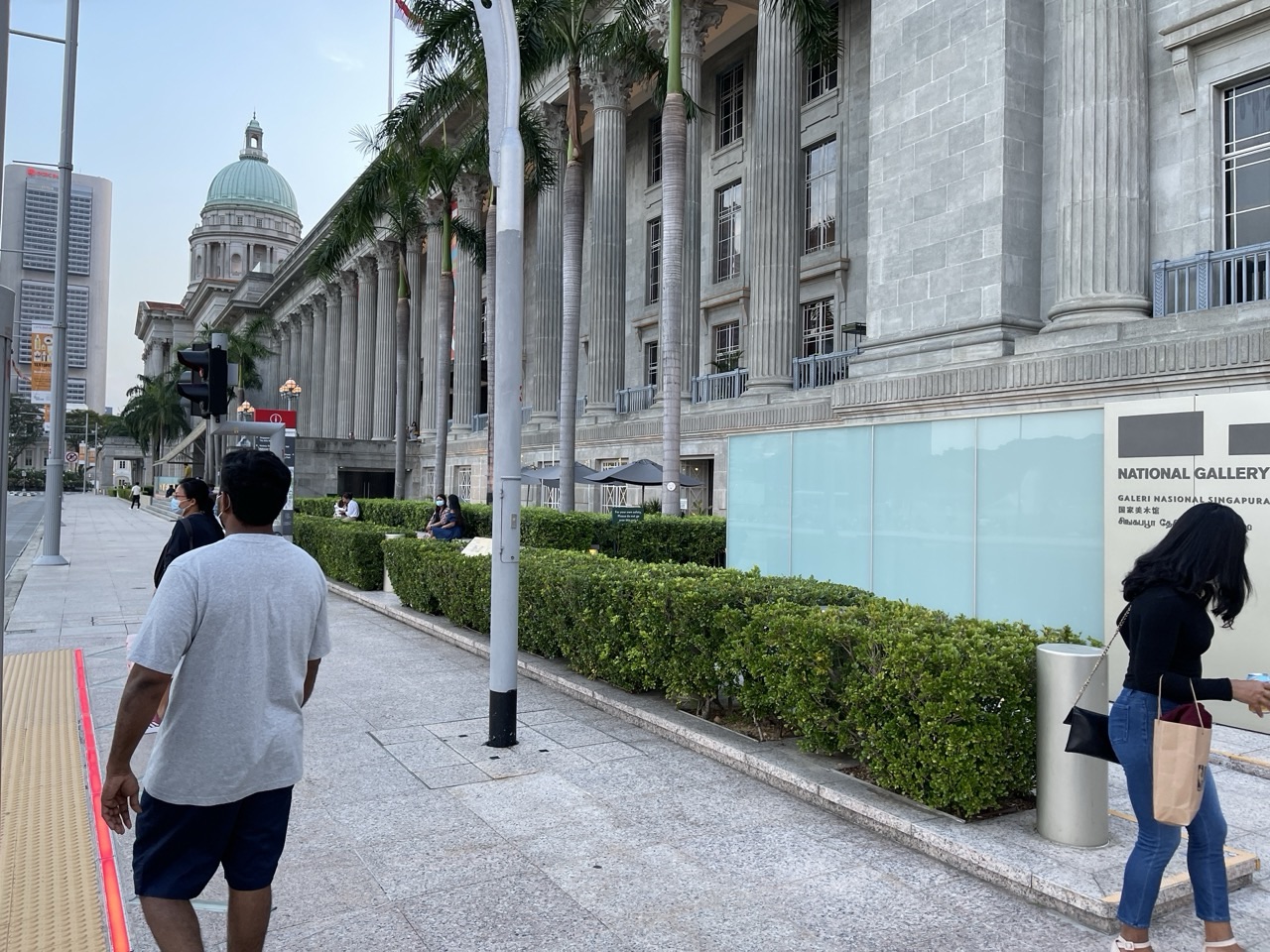
The National Gallery Singapore offers a different kind of learning centred on artworks, artistic practice and interpretation. It occupies the former City Hall and former Supreme Court buildings that appeared on Day 1, but an interior art visit has a distinct educational purpose: look at a work’s material, composition, date and context, then ask how its meaning is interpreted. Some areas of the Gallery can be visited without a ticket, while selected exhibitions require the correct entitlement. Check its current ticket and visitor information rather than assuming Day 1’s exterior walk includes every gallery.
The Asian Civilisations Museum, near the Singapore River, is another meaningful alternative rather than a compulsory extra stop. Its galleries address art and cultural heritage across Asia, including trade, religions, ceramics and other forms of exchange. The museum explains current accessibility resources, large-print guides and object-label information; these help different visitors access the collection. Again, one museum studied thoughtfully can teach more than several rushed stops.
The one hundred words below are divided into ten sets. The first four focus on museum entry, historical evidence, objects and multimedia interpretation. The fifth and sixth use the Peranakan Museum to understand identity and material culture. The seventh and eighth offer art-gallery and Asian-heritage alternatives. The final two sets cover accessible museum learning and the ethics of evidence, collection and community voice. Each entry offers a meaning, an original useful sentence, a practical observation and a distinction that guards against easy errors.
Many of these words are standard English, not exclusive Singapore slang. That is deliberate. A condition report or oral history can be useful in museums around the world. The Singapore collections give the vocabulary a vivid local setting while the skills remain transferable: asking for evidence, identifying uncertainty, reading a date and considering another person’s perspective. The article is an educational selection, not an official museum syllabus or a statistically measured word-frequency ranking.
Parents and teachers can use a simple four-question method. What do I see? Separate observation from assumption. What does the label actually say? Look for materials, dates, sources and careful wording. What remains uncertain? Do not fill gaps with an invented story. How could I explain it to someone else? Make a short, precise sentence. Children can begin with one object, one label and one genuine question. The aim is stronger reasoning, not exhausting homework.
Please follow the museum’s own current rules about admission, backpacks, food, photography and touch. The Asian Civilisations Museum explicitly advises not touching objects on open display because oils and handling can damage them. Some museums offer audio descriptions, large-print labels, accessibility aids and quieter resources. Choose the form of participation that lets your group engage comfortably. A museum is a shared educational space, and protecting that shared access is part of the visit.
All the teaching dialogues and example descriptions are invented illustrations. They do not claim to be quotations from identified museum staff, families or cultural-community members. Official institution sources support particular collection and visitor facts; they do not endorse eduKate’s word selection. The story is welcoming because discovery should be enjoyable, and careful because people, objects and histories deserve accuracy.
Choose a museum day, not a museum marathon
Main option A — National Museum of Singapore: Choose this if you want questions about Singapore history, objects, documents and interpretive media. Check which galleries are open after ongoing upgrading, especially because reopening schedules in 2026 were subject to change. One good exhibition or interactive experience is enough to make an afternoon meaningful.
Main option B — Peranakan Museum: Choose this if you want to examine objects linked to Peranakan histories, home life, ceramics, fabrics, beadwork, jewellery and questions of identity. Its permanent galleries have a different emphasis from the National Museum. Its visitor page gives information about access and admission, including eligibility conditions.
Alternative museum days: National Gallery Singapore is ideal for visual art and artistic interpretation; Asian Civilisations Museum is useful for pan-Asian cultural exchange and artefacts. Neither is a compulsory additional stop after the other two, and neither should be presented as though its collections were interchangeable.
A short accessible visit: Choose one or two galleries, ask the front desk about the best step-free approach or quiet resources, identify rest facilities, and allow plenty of time for a question. If somebody needs a break, that is a sensible museum decision, not an incomplete day.
Ten learning scenes and one hundred words
1. Choose your museum and read the admission correctly (words 1–10) · 2. The National Museum: how a timeline becomes a question (words 11–20) · 3. Artefacts, provenance and the evidence behind a display (words 21–30) · 4. Singapore Odyssea and multimedia history: spectacle with boundaries (words 31–40) · 5. Peranakan Museum Origins: identities shaped through exchange (words 41–50) · 6. Peranakan Home and Style: ceramics, textiles and craft (words 51–60) · 7. National Gallery alternative: look at art before judging it (words 61–70) · 8. Asian Civilisations Museum alternative: objects across regions (words 71–80) · 9. Learning with children and diverse access needs (words 81–90) · 10. Ethical collections and a visitor’s final question (words 91–100)
What a museum display can—and cannot—prove
A painting may show a particular viewpoint rather than a faithful photographic record. A label may distinguish what is documented from what scholars infer. An archival photograph records something framed by a particular photographer at a particular moment, not the entire society outside the frame. A reconstructed scene can help you imagine a past setting while remaining a modern interpretive choice. These distinctions do not make museums less valuable. They make the learning more durable because it is built on an honest account of evidence.
If you read a date and a historical period, ask whether the date refers to the creation of the object, the event depicted, its discovery, its donation or the installation of the exhibition. If you see an object described as ‘attributed to’ an artist or ‘possibly used for’ a purpose, keep those uncertainty words in your own explanation. The authority of a museum should encourage careful reading, not automatic certainty about everything on display.
Museum manners make discovery easier for everyone
Walk rather than run, keep food and drink outside restricted gallery spaces, respect photography instructions and avoid touching objects unless a display explicitly invites touch. Use a pencil instead of an ink pen in galleries where the museum requires that for worksheets. Ask before assuming a person is available for interviews or photographs. A visitor who reads one label respectfully has learned more than someone who rushes from case to case collecting pictures.
When a child becomes absorbed by an unusual object, let the child ask questions. When a visitor finds an artwork disturbing or unfamiliar, allow room for personal response without claiming that their reaction is the curator’s intended meaning. Art and history involve different perspectives and changing knowledge. The goal is not agreement about every interpretation; it is the capacity to explain an observation and test a claim.
Useful official sources include National Museum of Singapore, Peranakan Museum visitor information, National Gallery Singapore and Asian Civilisations Museum. All can change exhibition programming and ticket products, so the operator’s current page takes priority over a dated article.
Find any Day 7 museum word quickly
Open the group you need and jump directly to the numbered definition. Each word gives a practical sentence, something to notice and a boundary that prevents a misleading conclusion. You do not have to learn one hundred words before entering a museum. Five well-used terms can help you enjoy one object more deeply than a long glossary read in a hurry.
How the groups work: Words 1–40 focus on visiting and reading history at the National Museum. Words 41–60 explore the Peranakan Museum, a good separate museum option. Words 61–80 serve National Gallery and ACM as alternative visits, not additional compulsory stops. Words 81–100 cover access and collection ethics that apply across every museum.
1–10: Admission and choosing your museum
1. Gallery admission · 2. Permanent collection · 3. Temporary exhibition · 4. Ticket category · 5. Concession eligibility · 6. Gallery level · 7. Visitor orientation · 8. Exhibition scope · 9. Visitor advisory · 10. Time allowance
11–20: National Museum history and evidence
11. Historical timeline · 12. Periodisation · 13. Primary source · 14. Secondary account · 15. Eyewitness testimony · 16. Archival record · 17. Historical context · 18. Chronological order · 19. Historical causation · 20. Source corroboration
21–30: The artefact and its collection record
21. Accession number · 22. Provenance · 23. Object label · 24. Acquisition · 25. Collection donor · 26. Condition report · 27. Conservation treatment · 28. Facsimile · 29. Material analysis · 30. Authenticity assessment
31–40: Multimedia history and reconstruction
31. Immersive projection · 32. Interactive narrative · 33. RFID wristband · 34. Digital companion · 35. Diorama · 36. Theatrical reconstruction · 37. Sensory effect · 38. Historical simulation · 39. Interpretive licence · 40. Factual boundary
41–50: Peranakan Origins and cultural exchange
41. Peranakan · 42. Diaspora · 43. Cultural hybridity · 44. Self-identification · 45. Intermarriage · 46. Oral tradition · 47. Community memory · 48. Maritime exchange · 49. Language variety · 50. Generational change
51–60: Peranakan Home and Style objects
51. Domestic artefact · 52. Nyonyaware · 53. Porcelain · 54. Glaze · 55. Beadwork · 56. Embroidery · 57. Decorative motif · 58. Symbolic ornament · 59. Craftsmanship · 60. Material culture
61–70: National Gallery and visual art
61. Portraiture · 62. Landscape painting · 63. Composition · 64. Negative space · 65. Colour palette · 66. Brushwork · 67. Artistic medium · 68. Physical scale · 69. Artist statement · 70. Visual interpretation
71–80: Asian Civilisations Museum and connected worlds
71. Ritual implement · 72. Iconography · 73. Courtly patronage · 74. Transregional trade · 75. Ceramic kiln · 76. Metalworking technique · 77. Religious context · 78. Display juxtaposition · 79. Curatorial theme · 80. Cross-cultural influence
81–90: Accessible museums and family learning
81. Museum docent · 82. Tour schedule · 83. Tactile replica · 84. Hands-on exhibit · 85. Audio description · 86. Large-print guide · 87. Quiet space · 88. Age guidance · 89. Step-free route · 90. Self-guided question
91–100: Collection ethics and open questions
91. Attribution · 92. Image rights · 93. Reproduction permission · 94. Colonial collecting · 95. Contested ownership · 96. Restitution · 97. Repatriation · 98. Stewardship duty · 99. Archival silence · 100. Open research question
Three useful ten-word starting sets
For a child visiting one museum: gallery admission, object label, historical timeline, facsimile, diorama, digital companion, portraiture, hands-on exhibit, tactile replica and self-guided question. Invite one honest sentence after each observation. No child needs a grand opinion about everything in the room.
For a history enthusiast: primary source, secondary account, eyewitness testimony, source corroboration, provenance, accession number, material analysis, cultural hybridity, colonial collecting and archival silence. These words help separate evidence, ownership and interpretation.
For an art and culture enthusiast: Peranakan, material culture, beadwork, embroidery, decorative motif, composition, colour palette, artistic medium, iconography and curatorial theme. Use the museum labels to connect each term to an identifiable object.
When the reader finishes one definition, try recalling it without looking back. Use a new sentence about another museum or familiar object. If the word still feels uncertain, revisit it after a short interval and compare it with the term it is most easily confused with. That is a more useful learning routine than memorising an alphabetical list at speed.
Scene 1 — Your museum visit begins with one good admission question
The first museum challenge sounds very ordinary: which door and which ticket? It is a mistake to decide that a museum day begins only when a historical object comes into view. It begins when somebody asks which exhibition is available, what admission applies to the group and whether a child can take a comfortable route to the first gallery. This is practical English serving curiosity.
At the National Museum of Singapore, the reopening situation makes that distinction especially important in October 2026. Official museum notices describe staged upgrading across several galleries, including a scheduled October 2026 return for the Singapore History Gallery and later reopening for parts of the Level 2 collection. An earlier special exhibition, Once Upon a Tide, was advertised as ending on 9 October. A well-written visitor guide should not simply copy a photograph of that show and promise an experience no longer listed. Check the current museum programme first.
The difference between a permanent collection and a temporary exhibition is one of the day’s most useful word boundaries. A permanent collection means a museum has ongoing responsibility for objects or stories. The physical displays may change as objects are loaned, conserved or reinterpreted. A temporary exhibition might present a focused question for several months. It can be superb and meaningful even though it does not last forever. The relevant question is which one you want to see now.
The same care applies to ticket categories. The National Museum and other NHB museums publish free permanent-gallery admission for Singapore Citizens and Permanent Residents under defined conditions. That cannot be turned into a blanket sentence that every tourist can enter every special exhibition for free. Likewise, a child concession or student rate depends on the actual museum and evidence required. A simple line at the counter—‘Which admission category is suitable for our group?’—can prevent both overspending and embarrassment.
Once the ticket is clear, pause at an orientation board. A museum may occupy an old building with added modern wings and multiple gallery levels. A family with a stroller, a traveller using a wheelchair or somebody with difficulty reading small labels will benefit from knowing where lifts, seats or visitor services are located. A beautiful staircase does not have to be the only route. The best museum experience is the one a real person can comfortably enjoy.
Read the exhibition’s introductory panel before chasing one famous object. It may explain the story’s period, the types of evidence chosen or the question curators want visitors to ask. The museum does not need to promise every story about the nation or region in order to offer an excellent exhibition. Understanding the scope helps a visitor recognise both the power and the limits of the selection.
A child might say, ‘I want to see the oldest thing.’ Ask gently: oldest in what sense? Oldest item on view? Oldest material? Earliest historical event described? An object might have been created centuries before a later event it now helps illuminate. These are different questions. The museum’s introductory information and labels help us discover which is being answered.
Agree on a time allowance that includes doing less. A family could choose one hour for a particular gallery and rest afterwards, while a researcher might spend that hour on only two objects. Both are legitimate uses of the same institution. Nobody needs a scorecard of completed rooms.
The most useful preparation is a small set of questions: What can we enter? What are we allowed to do? Which exhibition answers the question we care about? And where can we rest if we need a break? Having these answers means that learning begins without hurry.
Once inside, allow a museum to lead you towards something unexpected. A small object in a quiet case may become more memorable than the glamorous centrepiece in the brochure. We will learn how to read its date and place in the next scene.
Words 1–10 | Find the right gallery, not the longest queue
1. Gallery admission
Meaning: Permission to enter particular museum galleries under the venue’s current terms, sometimes free and sometimes requiring a ticket.
Useful sentence: “Does our gallery admission cover this display, or only the permanent collection?”
Look for: A museum entrance can lead to several different exhibition spaces. Read the exact admission wording before assuming that one ticket opens all of them.
Precision check: Admission to the building is not automatically admission to every exhibition, tour or special experience.
2. Permanent collection
Meaning: A group of objects cared for by a museum over the long term, although the individual objects displayed can be rotated or temporarily removed.
Useful sentence: “The permanent collection gives us many ways to study the museum’s core subject.”
Look for: An institution can own or steward far more material than it can display at once. Ask which objects are selected for the current gallery.
Precision check: Permanent does not mean every object stays in the same display case forever.
3. Temporary exhibition
Meaning: A presentation of objects or experiences planned for a limited period, sometimes with its own ticket and special conditions.
Useful sentence: “We should check whether the temporary exhibition is still on before promising it to the children.”
Look for: An advertised closing date matters. The National Museum’s Once Upon a Tide exhibition ended on 9 October 2026, according to its published listing.
Precision check: Temporary is not another word for unimportant, and an old website photo cannot establish current availability.
4. Ticket category
Meaning: The classification of an admission product, such as adult, child, concession, local or special-exhibition access.
Useful sentence: “Which ticket category applies to our group, and what evidence is needed?”
Look for: The National Museum, Peranakan Museum and National Gallery have different offers and eligibility conditions. Compare the relevant current page.
Precision check: A local free-admission rule does not necessarily apply to foreign visitors or special exhibitions.
5. Concession eligibility
Meaning: The requirements a visitor must meet to receive a reduced admission rate, often based on age, educational status or other defined circumstances.
Useful sentence: “Can you confirm our concession eligibility and the document required?”
Look for: Discounts may be restricted by nationality, age, status or programme. Staff may ask for a particular proof of eligibility.
Precision check: Being a student or senior somewhere does not automatically qualify a visitor for every Singapore museum concession.
6. Gallery level
Meaning: A storey or floor within a museum building used to identify an exhibition or visitor facility.
Useful sentence: “The Origins Gallery is on Level One; let’s check the lift route if anyone needs it.”
Look for: The Peranakan Museum’s visitor guide identifies galleries on several levels. Accessibility routes may differ from a grand staircase.
Precision check: A gallery level is not the same as the historical period depicted by the objects displayed there.
7. Visitor orientation
Meaning: The process of understanding a museum’s layout, programme and practical rules before deciding where to go.
Useful sentence: “Let’s take two minutes for visitor orientation so we don’t rush into the wrong queue.”
Look for: A floor plan, staff guidance or introductory sign can make a large museum more comfortable to navigate.
Precision check: Orientation is not the entire visit. Its purpose is to help readers use the museum with less confusion.
8. Exhibition scope
Meaning: The subjects, period, objects or questions that a particular exhibition intends to address.
Useful sentence: “What is the exhibition scope: all Singapore history or one specific set of stories?”
Look for: Read the opening panel. A gallery usually selects some questions and examples rather than promising a complete history of everything.
Precision check: The scope is not a claim that omitted lives or objects never existed.
9. Visitor advisory
Meaning: A current notice about access, renovations, sensory effects, conduct or another condition relevant to a visitor.
Useful sentence: “The visitor advisory says the History Gallery is being upgraded; what is available now?”
Look for: The National Museum has run phased upgrading works. Its exact open galleries should be checked against the latest notice.
Precision check: An announced reopening month is not proof that a particular gallery has reopened on a specific day.
10. Time allowance
Meaning: The amount of time a person deliberately sets aside for a visit, including reading, movement and rest.
Useful sentence: “We have a generous time allowance for one gallery instead of hurrying through four.”
Look for: Older adults, children and readers who enjoy every label may need different amounts of time. A worthwhile visit is not measured in completed displays.
Precision check: Time allowance is a planning choice, not a guaranteed duration supplied by the museum.
The shortest useful conversation at the counter
Conversation: ‘Is the museum open?’ ‘Yes, but we should check which galleries are operating after the upgrading works.’ ‘Does this ticket include the special exhibition?’ ‘Let’s read the ticket category and ask if it is unclear.’
Practice: Take an exhibition title from the official museum website and write one sentence describing its intended subject. Then write one question it may not answer. This is a useful habit of reading scope rather than overclaiming.
Accessibility question: How can the group reach Level Two if somebody needs a step-free route? Do not guess from a photograph of the entrance; consult the museum’s current visitor guidance.
Next: Enter a historical exhibition when access is suitable, and learn how dates, timelines and source types can help you tell an accurate story.
Check the current National Museum upgrading notice, exhibitions listing and Peranakan Museum visitor information before the visit.
Scene 2 — The National Museum: read the timeline, then question it
History exhibitions contain dates, but dates alone are not history. A museum may put several events onto a wall in chronological order, choose names for long periods and display a photograph beside a paragraph. The task for a curious visitor is to ask what the sequence reveals, which records support it and where interpretation begins. This is an unusually powerful vocabulary lesson because the same habits make news articles and school textbooks easier to read.
A child may point to a timeline and say that one event happened because it comes after another. That is an understandable first thought. Help the child separate chronological order from historical causation. Time tells us when two things happened; explanation tells us how one may have contributed to the other. Sometimes the museum’s story includes several causes. Sometimes a surviving record supports only a modest conclusion. Strong English has room for words like ‘may’, ‘according to’ and ‘in part’.
Periodisation is another useful boundary. Institutions divide the past into eras so visitors can navigate complicated material. A gallery might name a period after a political institution, a war or a major historical transition. The line on the timeline is an editorial and scholarly device. Real people do not stop practising their customs at midnight because historians have given a new period a date. A careful learner asks which change makes the division useful.
Now consider a letter from the past. A letter can be a primary source when we study its writer’s contemporary words, intentions or circumstances. It is not automatically a perfectly accurate description of an entire society. The writer could be mistaken, biased, fearful or describing a limited view. A modern museum panel that combines this letter with maps and additional research may be a secondary account. The two have different roles; neither becomes useless because the other exists.
Oral history and eyewitness testimony can bring human experience into a gallery. Somebody may recount life during a period of hardship or a significant national transition. The account matters because a person was there and remembers. The recording date matters too, because recollection years later is not identical to a document written on the day. Treat the storyteller as a person, not a character invented to make an exhibition moving, and avoid adding dramatic details they never described.
The National Museum has long presented Singapore’s history through objects, images and stories across several periods. With the museum’s ongoing renovation in 2026, a particular gallery layout can change. That makes the method more important than the old map. Whichever historical exhibition is operating when you arrive, the distinction between evidence and explanation will remain useful.
Compare a map, a photograph and a written record concerning the same area. The map may show a road alignment, the photograph a viewpoint, and the document the decision of an official or business. Each contributes different information. If you want to claim that a road was moved because of a particular policy, you need evidence connecting the decision to the works, not simply a visual comparison.
One particularly valuable question is about absence. Which groups appear in the exhibition’s surviving records? Whose lives are less documented? Is that because the museum chose not to display the material, or because fewer records survive? It is responsible to ask without inventing the missing voices. Sometimes the answer requires more research, another archive or a different collection.
Teach the ten words through one small record. Ask a student to identify the object’s date, classify it as a primary or secondary source for a particular question, state what it directly supports and name one claim it cannot establish. A short careful answer is preferable to an enthusiastic page of unsupported speculation.
When a child asks ‘So what really happened?’, the best answer may be that historians combine multiple kinds of evidence, challenge incomplete accounts and revise conclusions as new material becomes available. Museums do not have to be places where uncertainty disappears. They can be places where visitors learn to describe it well.
Words 11–20 | Time, evidence and the limits of a date
11. Historical timeline
Meaning: An ordered presentation of events and periods intended to help readers understand sequence, duration and change.
Useful sentence: “This historical timeline helps us separate an early settlement from a later institution.”
Observe: Look at the time intervals. Not every event has the same type of source or the same certainty.
Distinction: A timeline is not a causal explanation by itself. The fact that one event follows another does not prove the first caused the second.
12. Periodisation
Meaning: The division of history into named periods to make a long, complex sequence easier to study.
Useful sentence: “Periodisation can help us organise a gallery, but the boundaries are chosen for a reason.”
Observe: Exhibitions may use periods such as colonial rule, occupation or independence as part of their story.
Distinction: A period label is an interpretive tool. Lives and cultural practices often cross the boundaries shown on the wall.
13. Primary source
Meaning: Evidence created within or close to the time and circumstances being studied, such as a contemporary letter, photograph, object or record.
Useful sentence: “This dated letter could be a primary source for what its writer said at that moment.”
Observe: Ask who produced the item, for whom and why it survived. The object may tell us about one viewpoint in a wider situation.
Distinction: Primary does not mean automatically unbiased, complete or true in every detail; it describes a relationship to the subject and time.
14. Secondary account
Meaning: A later explanation or analysis that draws on earlier evidence and scholarship to describe past events.
Useful sentence: “This historian’s account helps connect several primary sources.”
Observe: A museum panel often summarises research rather than reproducing every document from which its conclusions were drawn.
Distinction: Secondary does not mean inferior or false. A careful scholarly account can clarify matters that one surviving source cannot.
15. Eyewitness testimony
Meaning: A person’s account of events they observed or experienced, recorded orally, in writing or through another medium.
Useful sentence: “Her eyewitness testimony tells us what this participant remembered seeing.”
Observe: Notice the person’s position, age, circumstances and the date on which the recollection was recorded.
Distinction: A witness may remember some details incorrectly; one individual’s testimony is not a substitute for all other evidence.
16. Archival record
Meaning: A preserved document, image, recording or data item maintained as part of an institution or person’s records.
Useful sentence: “The archival record identifies the date of the meeting and the names listed.”
Observe: An archive provides contextual information that may not appear in a photographic display.
Distinction: Archival records are not always public, complete or free from errors. An incomplete record should not be silently filled with invention.
17. Historical context
Meaning: The surrounding social, political, economic or cultural conditions that help explain an event or object.
Useful sentence: “We need historical context before deciding why this object was significant.”
Observe: An object that seems unremarkable today may have been expensive, rare or politically important in an earlier setting.
Distinction: Context is not a licence to speculate without evidence; identify the relevant conditions and their sources.
18. Chronological order
Meaning: A sequence arranged according to time, typically from earlier to later events.
Useful sentence: “The gallery’s photographs are arranged in chronological order, though they discuss different subjects.”
Observe: Look at the caption dates rather than assuming that physical placement always follows time.
Distinction: Chronological order differs from thematic order, which groups material by subjects rather than strictly by date.
19. Historical causation
Meaning: A reasoned explanation of how factors contributed to an event or development, based on evidence.
Useful sentence: “We should not mistake a sequence of dates for a proven account of historical causation.”
Observe: A good exhibit may distinguish background conditions, immediate triggers and later consequences.
Distinction: Causation is not a simple chain established by saying ‘then’. Complex events can have multiple contributing factors.
20. Source corroboration
Meaning: Checking a claim against additional, suitably independent evidence to see whether accounts support or challenge each other.
Useful sentence: “Can we corroborate the date on this label with another archival record?”
Observe: A photograph, a document and a witness account may illuminate different aspects of one event.
Distinction: Agreement between two sources is not always independent confirmation if both repeat the same original claim.
One date, two different kinds of answer
Small exercise: Choose two dates from an exhibit. Write ‘A happened before B.’ Then ask what additional evidence would be needed to claim ‘A caused B.’ The second question is usually harder and more interesting.
A careful rewrite: Replace ‘This photograph proves everybody lived this way’ with ‘The photograph records a particular scene, at a particular time, from the photographer’s viewpoint.’
Child-friendly dialogue: ‘This woman said it happened like that.’ ‘Her account is valuable. Shall we check when she recorded it and whether other records add another perspective?’
Next: Move closer to an object label. The artefact itself will raise questions about material, origin, ownership and how it has been kept.
Official further reading: National Museum of Singapore, Singapore History Gallery and upgrading guidance. The editorial source categories are methods of historical inquiry, not claims that every gallery is currently open.
Scene 3 — A museum object is more than its appearance
Now select one museum object, not ten. Perhaps it is a letter, ceramic vessel, piece of jewellery, photograph or tool. Your first impression may be visual: old, delicate, beautiful, unfamiliar or ordinary. The next step is to learn how museums know which object it is and why it is presented here. A small object label can open questions about material, age, ownership and the work needed to keep the item available.
An accession number may appear beneath a label or in an online collection record. It is not a code visitors must memorise for a test. It is an identifier that helps the museum and researchers track the specific item. Two similar bowls could look almost identical while having different histories, materials or collection entries. Naming the correct object is the first step in explaining it responsibly.
Provenance is one of the most important words in a museum. It concerns the object’s journey through ownership or custody over time. A particular artefact may have passed between families, dealers, collectors or institutions before reaching the present museum. Sometimes the chain is well documented. Sometimes there are gaps. A museum displaying an object does not automatically prove that every step of that journey was fair, legal by current standards or adequately recorded. The history of collecting can itself be an ethical question.
A child may point at a piece of fabric and announce that it belonged to a famous historical figure. Ask what the actual label says. If the display uses ‘attributed to’, that qualification is doing useful work. It signals that the association is based on evidence but has some degree of uncertainty. The best sentence preserves the curator’s careful wording rather than upgrading a possibility into a dramatic fact.
An acquisition date can easily be confused with an object’s age. A museum might receive a century-old letter this year. The date of receipt refers to the institution’s records; the letter’s creation date refers to a different historical moment. The letter may discuss an even earlier event. Three dates can belong to one artefact without contradicting one another. Learn to ask which event each date names.
Donor credits add a human and institutional dimension. A donor may support an exhibition or give a collection item; a lender may allow a museum to display an object temporarily. These arrangements differ. A named donor is not necessarily the maker or the original owner. An artwork’s label might list an artist, a date, a medium, a collection and a donor. Each line answers a different question.
Conservation is the quiet work that protects a museum’s materials. Paper can be sensitive to light. Textiles can suffer from insects and humidity. Paint layers can become unstable. Metal can corrode in unsuitable conditions. A condition report records what has happened or what needs attention; a conservation treatment aims to protect the object and may leave historical traces visible. A restored object does not need to look as if it came from a modern shop in order to be successfully conserved.
A facsimile is a particularly useful discovery for younger learners. A museum may reproduce a document so that visitors can see it closely or compare details while the fragile original remains safely stored. This is not deceit when the reproduction is clearly identified. In fact, the facsimile may give more people access to a source that could not survive endless handling. An honest exhibition distinguishes what is original and what is shown for interpretation.
Material analysis can help reveal the substances making up a historical object. An instrument might distinguish pigments or metal compositions that the eye cannot reliably identify. But knowing a material does not settle who used the object or what they believed. Historical meaning requires contextual evidence as well. The most reliable account combines different types of knowledge without pretending one measurement answers every question.
When you finish with the object, write two sentences. One should state what the label and your direct observation establish. The other should name a question you cannot yet answer. For example: ‘This is a ceramic vessel dated to a stated period and held in the museum’s collection. I wonder who used it and how it travelled here.’ The second sentence is not a weakness. It is the beginning of research.
A museum’s objects can have long lives, but the present display is only one chapter. The choice of lighting, case, label and neighbouring objects is a modern interpretive decision. The next scene explains what happens when an institution uses more elaborate technology to tell a historical story.
Words 21–30 | Identify, care for and question the artefact
21. Accession number
Meaning: A unique identifier a museum assigns when it formally records an object or group of objects within its collection.
Useful sentence: “The accession number lets us refer to the specific object rather than another similar-looking one.”
Observe: Look for identifiers on the label or catalogue. A number can help track records across storage, research and displays.
Boundary: An accession number is not automatically a manufacturing date or a claim that the object is authentic.
22. Provenance
Meaning: The documented history of an object’s ownership, custody or movement through time.
Useful sentence: “The provenance helps us ask how this object reached the museum.”
Observe: Collection descriptions may say that an item was purchased, donated, excavated or transferred. Each history raises different questions.
Boundary: Provenance is not a statement about the object’s design or its place of manufacture alone; an ownership chain and an origin are related but distinct.
23. Object label
Meaning: A short text displayed near a museum item to identify it and provide selected facts or explanation.
Useful sentence: “The object label names its material and approximate date, but does not explain every possible use.”
Observe: Read the label’s words carefully: circa, attributed to, probably or unknown may signal legitimate uncertainty.
Boundary: A label is an edited summary, not a full research dossier or a personal eyewitness testimony.
24. Acquisition
Meaning: The process by which a museum obtains an object or assumes responsibility for it through purchase, donation, transfer or another lawful arrangement.
Useful sentence: “The acquisition record tells us when the institution obtained the object.”
Observe: A museum might acquire an eighteenth-century item in the twenty-first century. The two dates answer different questions.
Boundary: Acquisition date is not the same as creation date, discovery date or date of an event depicted by the item.
25. Collection donor
Meaning: A person or organisation that gives an object, money or another resource to a museum under defined arrangements.
Useful sentence: “The donor credit names who gave this collection item to the museum.”
Observe: Check whether a label credits a donor, lender or another kind of contributing institution.
Boundary: A donor credit is not proof that a person made the object or owned it from the beginning.
26. Condition report
Meaning: A documented assessment of an object’s physical state, including visible damage, changes and conservation concerns.
Useful sentence: “The condition report helps conservators monitor the object over time.”
Observe: Museum objects may be sensitive to light, humidity, handling or physical strain. Care is informed by records, not only the visitor’s eye.
Boundary: A condition report describes the state of the material; it does not automatically determine its historical meaning.
27. Conservation treatment
Meaning: Specialised work aimed at stabilising or preserving an artefact, artwork or document while respecting its material and significance.
Useful sentence: “The conservation treatment may protect the old paper without making it look completely new.”
Observe: Look for interpretation about cleaning, stabilisation or supporting fragile material, if the museum provides it.
Boundary: Conservation is not equivalent to repainting or redesigning an object to match a visitor’s idea of how it should look.
28. Facsimile
Meaning: A reproduction made to resemble an original document or object, sometimes produced so more people can study a fragile source.
Useful sentence: “This facsimile lets us examine the document without handling the original.”
Observe: Museums may show facsimiles when originals are too sensitive, inaccessible or held elsewhere. Check the label.
Boundary: A facsimile is not automatically a counterfeit. The museum can clearly identify it as a reproduction serving a legitimate educational purpose.
29. Material analysis
Meaning: The study of an object’s physical substances and construction using appropriate scientific or technical methods.
Useful sentence: “Material analysis might help establish what this pigment or metal contains.”
Observe: The colour or appearance of a material can suggest a question, but scientific identification may require instruments or laboratory methods.
Boundary: Material analysis does not itself reveal an artist’s motive or the social meaning of an item.
30. Authenticity assessment
Meaning: An evidence-based attempt to determine whether an object is what a description claims it to be.
Useful sentence: “An authenticity assessment draws on provenance, materials and comparison with other evidence.”
Observe: Some objects have disputed dates or attributions. A responsible label can state uncertainty rather than pretending certainty.
Boundary: Authentic does not necessarily mean unchanged, morally acquired or of high artistic value. These are separate questions.
Five lines of a label do five different jobs
Ask three dates: When was the object made? When was it acquired? When was the exhibition installed? If one date is unknown, record it as unknown rather than inventing a convenient year.
Mini-dialogue: ‘Is this the real letter?’ ‘The label says facsimile, so it reproduces the original. Let’s find out where the source document is held.’
Label repair: Change ‘This vase definitely belonged to the ruler’ to ‘The vase is attributed to the ruler’s collection, according to the label.’ Preserve the level of certainty actually offered.
Next: Learn how film, light, sound and reconstructed scenes can help visitors imagine history while remaining contemporary ways of representing it.
Source for visitor handling expectations: Asian Civilisations Museum visitor and object-care guidance. Visit the National Museum or Peranakan Museum galleries for current collection context.
Scene 4 — Singapore Odyssea: a vivid experience still needs evidence
At the National Museum, a historical experience may not look like a room of glass cases. Singapore Odyssea: A Journey Through Time, described by the museum as an ongoing installation in the Shaw Foundation Glass Rotunda, brings together light, digital imagery, interactive story elements and a time-travel motif. The museum has described a personal companion activated using an RFID wristband. These are interesting teaching tools, but they should be understood as a contemporary presentation of history rather than an actual voyage into it.
Why can an imaginative story be useful? Because a visitor sometimes needs a bridge between unfamiliar evidence and the everyday experience of making choices. A moving image of an earlier city can help a child picture a road or waterway that is difficult to imagine from a written date alone. A diorama can place buildings and people into a spatial relation. A digital character can guide attention. These devices need not replace primary sources; they can invite the visitor to seek them.
The key distinction is between what the museum knows and how it chooses to help us imagine it. The date of a documented event may come from a record. The lighting of a recreated street scene comes from a design team. An actor’s emotional expression may be a credible artistic interpretation without being evidence of what an identified person felt. The visitor who can separate these layers is not spoiling the magic. The visitor is understanding both the history and the craft of presenting it.
Consider a child who sees a historical character speaking in a projection. Ask, ‘Do we know that these were the person’s exact words?’ If the exhibit does not identify a source quotation, say the lines are likely part of the modern dramatization. It is a good moment to explain why museums sometimes use ‘based on’ or ‘inspired by’. Those phrases are not failures; they tell the reader how evidence and creativity have been combined.
Now consider the RFID wristband. It is a small piece of technology using radio-frequency identification to communicate a code to a compatible reader. In a visitor experience, that might activate a chosen route or character. But the presence of RFID is not enough to infer that a museum tracks a person’s location through every public street or collects a particular sensitive data field. Those are questions for the venue’s actual system description and privacy information, not a confident assumption from seeing a wristband.
The diorama and simulation terms also deserve care. A diorama is a representation of a scene. A simulation may model a process or allow different conditions to be explored. Neither is a preserved slice of reality. If a display depicts an ancient coastal settlement, the visitor can ask which features derive from excavation, maps, contemporary accounts or educated reconstruction. A model may be an excellent explanation even when the evidence cannot support every decorative detail.
A visitor should also be allowed to choose how much sensory intensity to experience. Darkness, flashing images, loud audio or motion can make some people excited and others uncomfortable. Check the operator’s current advisories and ask about quiet alternatives if needed. A child who declines one dark room has not failed to learn. A person who prefers an object label to a projected environment can still be deeply curious.
A useful word for this entire chapter is boundary. Where does the documented account end and the interpretive reconstruction begin? When is a label providing factual context, and when is it inviting imagination? The same question helps readers assess documentaries, historical novels and television drama. It is a transferable skill well beyond one Singapore museum.
Try a two-column notebook. On the left, write what the museum explicitly attributes to a source. On the right, write the modern presentation choices you noticed: music, lighting, a voice, animation or spatial scale. This does not mean you need to analyse every artistic detail. One or two examples show how history communication is constructed.
When you leave a multimedia experience, select one true claim you can explain and one question worth researching further. For example, ‘The exhibition explores Singapore’s long maritime history’ may be supported by the museum’s description. ‘Every ship and conversation in the projection happened exactly as shown’ would require much more evidence. Learning to see the difference leaves the attraction more meaningful.
Words 31–40 | Modern technology presenting old stories
31. Immersive projection
Meaning: Images or moving visuals cast or displayed to surround a visitor and create a strong sense of being within a designed scene.
Useful sentence: “The immersive projection gives us a feeling of the past, but we still need to identify the evidence behind it.”
Look for: Watch how light, scale and movement influence your sense of place. The effect is a modern creative arrangement.
Precision check: Immersive means engaging, not that you have physically travelled through time.
32. Interactive narrative
Meaning: A story or presentation that changes its route or response when a visitor makes a selection or performs an action.
Useful sentence: “The interactive narrative responds to our choices, although the history it presents is curated.”
Look for: A visitor may press a control, move through a route or activate a device to reveal part of the story.
Precision check: Interaction is not unlimited freedom to rewrite the historical facts of an event.
33. RFID wristband
Meaning: A wearable device using radio-frequency identification to communicate a code to compatible readers or systems.
Useful sentence: “The RFID wristband may activate a personal experience at an exhibition station.”
Look for: Singapore Odyssea has described using an RFID wristband to introduce a digital companion. Follow the operating instructions.
Precision check: RFID is not automatically a satellite tracker or proof that a museum records every personal detail; the system’s design and privacy policy matter.
34. Digital companion
Meaning: A software character or guided interface that accompanies a visitor through an experience.
Useful sentence: “The digital companion helps tell the story, but it is part of the museum’s presentation.”
Look for: The museum’s Singapore Odyssea experience introduces characters inspired by native wildlife.
Precision check: A digital companion is not an actual historical eyewitness or a living animal.
35. Diorama
Meaning: A three-dimensional or layered representation of a scene, usually combining objects, models and background elements.
Useful sentence: “The diorama helps us imagine the harbour, but it is not the real harbour preserved in a box.”
Look for: Notice how scale models, lighting and figures shape the viewpoint. Ask which features are supported by sources.
Precision check: A diorama is not an unmediated photograph of the past, even if it includes historically informed details.
36. Theatrical reconstruction
Meaning: A modern staged representation of an earlier event using actors, sets, sound or other expressive devices.
Useful sentence: “The theatrical reconstruction makes the episode vivid while requiring us to separate acting from archival evidence.”
Look for: Clothing, dialogue and camera positions may be based on research as well as artistic decisions.
Precision check: A spoken line in a reconstruction is not automatically a verbatim quotation from a person who lived through the event.
37. Sensory effect
Meaning: A designed visual, auditory, tactile or other stimulus intended to influence how an experience feels.
Useful sentence: “The sensory effect makes the gallery dramatic; let’s check whether it suits everyone in our group.”
Look for: Flashing images, darkness and louder sound can affect visitors differently. Ask about advisories or alternatives.
Precision check: An effect is not proof of a particular historical event, and intense presentation is not necessary for everybody.
38. Historical simulation
Meaning: A model or interactive representation of past conditions or processes built from selected evidence and assumptions.
Useful sentence: “This historical simulation lets us explore a scenario rather than observe the actual past.”
Look for: Read what variables or assumptions the model includes. A simulation may deliberately simplify complicated social events.
Precision check: Simulation is not the same as a source recording or an experimentally verified replay of exactly what happened.
39. Interpretive licence
Meaning: The freedom a creator uses to arrange, dramatise or simplify material in order to communicate a story.
Useful sentence: “The exhibition’s interpretive licence makes the scene accessible, but we should recognise its invented elements.”
Look for: Look for disclosures identifying a dramatization or artistic representation. Ask which claims are sourced.
Precision check: Interpretive licence is not permission to misrepresent a person’s testimony as an exact transcript.
40. Factual boundary
Meaning: The limit beyond which available evidence does not justify a claim.
Useful sentence: “The factual boundary is that the museum documents the event, but the imagined private dialogue is a modern reconstruction.”
Look for: Practice identifying what a source proves, what is inferred and what is added for narrative effect.
Precision check: A factual boundary is not an obstacle to imagination; it tells us when to label imagination honestly.
Enjoy the show and name its limits
Conversation: ‘Did this scene really happen exactly like the film?’ ‘It is a modern representation of history. Let’s read which parts are documented and which were staged.’
Technical question: What does an RFID wristband do within the experience? State only what the venue explains, rather than inventing a sweeping claim about personal data.
Gentle choice: If someone dislikes dark spaces or loud effects, ask about a different gallery route. The purpose is learning, not a forced test of sensory tolerance.
Next: The Peranakan Museum raises another rich question about identity: how can people share influences without belonging to one identical cultural group?
Official source: Singapore Odyssea at the National Museum of Singapore. Its visit rules, ticketing and interactive operation may change.
Scene 5 — Peranakan Origins: one word cannot hold every family
At the Peranakan Museum, the first question is not a date or a famous face. It is the meaning of the word Peranakan. The museum’s permanent Origins Gallery deliberately asks visitors what the term means and whose histories it describes. That is an excellent beginning because words about people must be used more carefully than labels for inanimate objects. A visitor should not decide somebody’s ancestry or identity from a photograph of a sarong, a necklace or a home interior.
The museum presents Peranakan cultures across Southeast Asia rather than presenting a single family type as the whole story. Chinese Peranakan heritage is important, but it does not exhaust the histories and communities included under the broad term. Identity can involve settlement, language, descent, religion, marriage, cultural practices and the ways people describe themselves. Different people give different weight to these factors. An exhibition offers ways to learn about variation; it is not a licence to define strangers.
Maritime exchange is a powerful explanatory idea in a port-city setting. Ships and trade routes linked communities around Southeast Asia and farther afield. People carried goods, languages, skills, tastes and family relationships. A textile design could travel through the sale of materials; a culinary habit through a household; a word through everyday conversation. Those connections created possibilities, but not always under equal conditions. The history of exchange can include commerce, migration, displacement and colonial power.
The term diaspora is useful when discussing communities with histories of movement and settlement across places. But it should not be treated as a permanent synonym for foreignness. A person can belong deeply to a city where their family has lived for generations while recognising connections to other regions. Likewise, cultural hybridity describes influences meeting and transforming, but it does not reduce people to collections of borrowed objects. Living identity is more than a list of ingredients.
Now look at one domestic object whose design combines visual elements associated with different traditions. A museum label might identify its material, place of production or ceremonial use. The visitor can describe those specific features and ask how they came together. It would be a leap to say that the object’s owner believed in a certain way or married into a particular family unless records support it. The object can be evidence of cultural connections without becoming a complete biography of a person.
Oral tradition and community memory help widen the questions. A family might preserve a recipe, a story, a form of address or a craft technique through direct teaching, long before a museum makes a recording. A documentary interview can give a person space to describe what mattered to them. But the existence of one account does not prove that every family had identical customs. In historical study, disagreement and change across generations are expected parts of the evidence.
Some parents worry that the word ‘change’ implies loss. A tradition might change through new materials, different living arrangements or the choices of younger members. That does not automatically make it fraudulent or meaningless. A museum can show an old embroidered item and a contemporary fashion response in the same gallery, inviting questions about continuity as well as difference. The goal is not to rank the generations but to understand their circumstances.
Self-identification matters most when talking about living people. A visitor can say ‘The museum describes this object as part of a Peranakan collection’, which attributes the label to the institution. A stranger who appears to wear similar jewellery has not thereby invited us to classify their personal identity. The vocabulary of responsible description includes ‘some’, ‘particular’, ‘according to this source’ and ‘in this period’. These modest phrases keep broad claims honest.
Try a family exercise using one label and one recorded story, if available. First list what the label says about the object’s physical form or provenance. Then note which experiences are described by the community speaker. Finally identify anything neither source can tell you. A surprising amount of careful reasoning can fit into a short notebook page.
The Peranakan Museum’s themes of Origins, Home and Style offer a helpful route into the subject. Origins raises identity questions; Home examines domestic and community life; Style explores creative expression. The exhibition’s organisation is an invitation to move across contexts, not a claim that a whole community can be reduced to three compartments.
If a child asks whether Peranakan culture is ‘old’, answer that the heritage has histories but people continue to make contemporary choices. A living community cannot be frozen in a museum case. Its objects deserve care, while the people represented deserve agency and complexity.
Words 41–50 | Identity, movement and cultural change
41. Peranakan
Meaning: A term used in Southeast Asia for people and communities with histories shaped by local birth, settlement and cultural exchange, carrying different meanings in different contexts.
Useful sentence: “The Peranakan Museum asks us to investigate which Peranakan community and period an object belongs to.”
Think about: The museum presents diverse Peranakan identities rather than treating one decorative style as the definition of every member.
Precision check: Peranakan is not automatically synonymous with Chinese ancestry alone, nor a label visitors should assign to a person from appearance.
42. Diaspora
Meaning: Communities whose histories involve movement and settlement away from an earlier place of origin, maintaining or transforming connections across locations.
Useful sentence: “A diasporic community can form new cultural traditions in the place where its members live.”
Think about: Trade, travel, family and settlement have connected Southeast Asian port cities over centuries.
Precision check: Diaspora does not imply that everyone has the same reason for migrating or that a community’s identity never changes.
43. Cultural hybridity
Meaning: The formation of practices, forms or expressions shaped by interaction among different cultural influences.
Useful sentence: “A decorative object may show cultural hybridity through material, motif and use.”
Think about: The Peranakan Museum’s exhibits place textiles, food objects and domestic furnishings in wider networks of exchange.
Precision check: Hybridity is not evidence that a culture has no independent history or that all people combine traditions in one identical way.
44. Self-identification
Meaning: The way a person or community describes its own identity rather than having it defined solely by an outside observer.
Useful sentence: “Museum visitors should respect self-identification when discussing living communities.”
Think about: Interviewed community members may use names and descriptions that reflect personal or family histories.
Precision check: An outsider cannot reliably infer someone’s identity from clothing, surname, language or an object displayed beside them.
45. Intermarriage
Meaning: Marriage between people associated with different familial, ethnic, religious or social backgrounds, with meaning dependent on time and context.
Useful sentence: “Some Peranakan histories involve intermarriage, but not every family shares one identical account.”
Think about: Museum materials explore varied family histories and links between communities in Southeast Asia.
Precision check: Intermarriage is not a complete definition of Peranakan identity, nor proof that every individual has mixed ancestry in a specific pattern.
46. Oral tradition
Meaning: Knowledge, stories, performances or practices transmitted primarily through spoken or performed communication across generations.
Useful sentence: “An oral tradition can preserve family knowledge that never appeared in a government record.”
Think about: Interviews or demonstrations may show how people teach words, recipes, songs or craft techniques.
Precision check: Oral does not mean the content is automatically unchanged or accurate in every detail; traditions can adapt and be interpreted.
47. Community memory
Meaning: The ways groups recall and give meaning to shared events, practices and relationships across time.
Useful sentence: “Community memory adds experiences that a museum’s official documents might otherwise overlook.”
Think about: A family story may complement a written archive while offering a different viewpoint.
Precision check: Community memory is not always unanimous, and one interviewee cannot stand for the experiences of everybody.
48. Maritime exchange
Meaning: Movement of people, goods, skills and ideas through sea routes linking ports and communities.
Useful sentence: “Maritime exchange helps explain why certain materials and designs travelled across Southeast Asia.”
Think about: Objects may contain materials from one region and design influences from another. Museum labels can identify documented connections.
Precision check: Exchange is not proof that every movement was voluntary or equal; trade and migration also involved power and hardship.
49. Language variety
Meaning: A form of language associated with a particular community, setting or history, including its vocabulary and patterns of use.
Useful sentence: “A language variety may borrow words while developing expressions meaningful within its community.”
Think about: Peranakan communities have different language histories, and museum interpretation may include multiple languages.
Precision check: One language label should not be used to claim every person speaks the same words or that a variety is inferior to another.
50. Generational change
Meaning: Differences in practices, experiences or attitudes across people who grow up in different periods within a family or community.
Useful sentence: “Generational change can affect which traditions people continue, adapt or newly invent.”
Think about: A garment worn by a grandparent may have a different role for a younger family member today.
Precision check: Change does not automatically mean a tradition has been lost or become less authentic.
A community speaks in more than one voice
Dialogue: ‘Is everyone who wears this textile Peranakan?’ ‘No. This object appears in a Peranakan collection, but someone’s identity cannot be determined from clothing alone.’
Two-source challenge: Find one material fact from a label and one personal experience from a community interview. Explain how they answer different questions.
Writing practice: Use ‘some Peranakan communities’, ‘according to the museum’ or ‘in this period’ when your evidence does not support a statement about every person.
Next: Explore Home and Style. Ceramics, beadwork, embroidery and jewellery can show both craftsmanship and the choices people made in daily life.
Museum sources: About the Peranakan Museum and permanent galleries. These materials discuss diverse histories and do not define any identified visitor’s personal ancestry.
Scene 6 — Peranakan Home and Style: one bead can hold a question
At the Peranakan Museum, Home and Style show why an everyday object deserves sustained attention. A bowl, piece of jewellery or embroidered fabric might appear merely decorative when viewed in isolation. In a household, however, the object may have been used for meals, celebrations, family relationships or a special occasion. Its design, production, ownership and survival are parts of a longer story. A museum helps by connecting the physical thing to evidence, though many questions remain open.
Begin with a ceramic vessel in the museum’s Ceramics and Food Culture displays. The material might be porcelain or another ceramic body, and a glaze may carry decoration or protective properties. A label may identify a pattern, workshop, region or period. Avoid turning ‘beautiful coloured plate’ into a guess that it was made locally or used every day. Some objects travelled across seas, and some were used for ceremonies or social display. The right explanation depends on the individual item.
Nyonyaware is a helpful term for certain ceramic wares associated with Peranakan material culture. It can be tempting to apply the term to any bright bowl with flowers. That would erase important differences in production and context. The museum’s labels and collection notes are better guides than colour alone. Ask which features make the identification appropriate and whether the item was used by a particular household or belongs to a broader decorative tradition.
Now move to textile displays. Beadwork and embroidery may look similar from far away because both can create dense patterns and colour. Up close, within permitted viewing distance, one involves the arrangement of beads while the other uses stitched thread on fabric. The distinction allows a visitor to recognise different kinds of craft labour. It also explains why certain works required patience, specialist materials and repeated practice over time.
A young learner may ask why anybody would spend so long decorating an object. There are many possible reasons: aesthetic pleasure, family tradition, social expectation, devotion, personal achievement or economic work. But the visitor should not choose one motive and present it as the maker’s own without evidence. Museum interviews, surviving records and community knowledge can help clarify what a piece meant to particular people. An interesting guess becomes stronger when it is labelled as a question.
Motifs can travel. A flower, animal or geometric form may appear on ceramics and textiles associated with different places. The appearance of a similar motif does not prove that every object has the same symbolic meaning. A museum may discuss the role of a design in a particular tradition, or compare its adaptation across media. This is where cultural exchange meets craft: people can use existing visual forms in new ways.
Jewellery provides another rich example. Materials and designs can signal different roles or stages of life, but these meanings are contextual. The Peranakan Museum’s Style galleries include jewellery and fashion from different periods and communities. A label may explain ceremonial use or a family connection. If no evidence is offered, the careful writer can describe form and material without inventing a story about who wore it.
Conservation matters here too. Textiles and beads can be fragile; oils from visitors’ fingers or changes in light and humidity can cause damage. Looking through a case does not make the object less important. A museum’s responsibility is to allow people to learn while protecting material for future visitors. That is one reason the barrier between object and hand may be part of the educational environment.
One of the most transferable terms is material culture. Historians and anthropologists study physical objects alongside oral traditions and documents to understand social worlds. A cooking pot tells us something different from an official letter; a piece of furniture reveals another kind of relationship to space. A single item rarely supplies a complete biography, but it can direct us towards better questions.
Try choosing one object and writing three short sentences. First, describe its visible material and form. Second, state the museum’s documented interpretation with attribution. Third, ask what remains unknown about the maker, user or journey. This is far more useful than a paragraph saying that everything in the room was ornate and exquisite.
The best moment may be the one when the child notices how much work went into an object. ‘Somebody had to place all those little beads’ is a simple observation with a real human connection. You can build on it with the precise word beadwork, then ask whose work the museum recognises and how the skill was learned. That turns admiration into respect for the maker.
Words 51–60 | Materials, methods and everyday objects
51. Domestic artefact
Meaning: An object associated with household life, such as furniture, tableware or a personal item, studied as evidence of everyday practice.
Useful sentence: “This domestic artefact can tell us something about a household, but not everything about its occupants.”
Observe: The Peranakan Museum’s Home galleries include ceramics, furniture and community-related objects.
Distinction: A domestic item is not automatically ordinary in cost or significance; some were used ceremonially or by affluent households.
52. Nyonyaware
Meaning: A term used for certain decorated ceramic wares associated with Peranakan material culture and dining traditions.
Useful sentence: “The label identifies nyonyaware, so let’s examine its form and decoration.”
Observe: The Peranakan Museum’s Ceramics and Food Culture Gallery presents ceramic objects in cultural context.
Distinction: Nyonyaware is not a generic name for every colourful Asian bowl, and individual pieces can differ in origin and date.
53. Porcelain
Meaning: A ceramic material fired under conditions that produce a dense, usually hard body, with technical definitions varying by tradition.
Useful sentence: “This porcelain vessel may have been produced in a different place from where it was later used.”
Observe: An object’s material, production centre and ownership history may be listed separately in a label.
Distinction: Porcelain is a material classification, not proof that all objects came from one country or functioned as luxury goods.
54. Glaze
Meaning: A glass-like coating applied and fired onto ceramics to alter surface properties, appearance or decoration.
Useful sentence: “The glaze gives this ceramic a smooth coloured surface.”
Observe: Look at how a pattern appears under or on a glazed layer if the interpretation explains it.
Distinction: A glossy surface is not proof that the glaze was applied by one particular technique.
55. Beadwork
Meaning: Decoration or construction using small beads attached or joined into a design.
Useful sentence: “The beadwork shows repeated careful actions by the maker.”
Observe: The museum presents beaded objects and discusses craft knowledge passed between people.
Distinction: Beadwork is not the same as printed imitation; the physical arrangement of beads and stitching may be central.
56. Embroidery
Meaning: Decoration made by stitching thread or other material onto a fabric surface.
Useful sentence: “The embroidery gives this textile texture that a flat printed design would not have.”
Observe: Examine the visible stitch patterns without touching a protected item. The form may reflect skilled labour.
Distinction: Embroidery and weaving differ: one adds stitches to a fabric, while the other helps produce the fabric itself.
57. Decorative motif
Meaning: A recurring image, shape or pattern element used in the design of an object.
Useful sentence: “The floral motif appears on several objects, but we should check whether its symbolism is documented.”
Observe: A bird, flower or geometric design might recur across ceramics, textiles or jewellery.
Distinction: A repeated motif does not always have one universal meaning; interpretation depends on community, place and period.
58. Symbolic ornament
Meaning: A decorative element used to express an idea, belief, status or association beyond its physical appearance.
Useful sentence: “The ornament may have symbolic significance, but the museum label should guide our explanation.”
Observe: Jewellery and ceremonial objects can carry meanings related to social roles or life events.
Distinction: An ornament’s beauty does not itself prove a fixed religious or social meaning.
59. Craftsmanship
Meaning: Skill demonstrated through making an object, including material choices, technique, judgement and refinement.
Useful sentence: “The craftsmanship appears in the precise stitching and arrangement of the beads.”
Observe: The Peranakan Museum includes contemporary and historical makers whose work invites technical questions.
Distinction: Craftsmanship does not mean the maker necessarily worked alone or that every object must be handmade by one person.
60. Material culture
Meaning: Physical objects and practices through which people express and organise social life.
Useful sentence: “Material culture allows a museum to study a community through more than written records.”
Observe: Tableware, clothing and household objects may illuminate relationships, work and identity.
Distinction: An object alone cannot fully explain a person’s beliefs or private life; interpretation requires context.
Read the craft before reaching for an adjective
Conversation: ‘Is this embroidered?’ ‘Let’s look at the label. Some objects use beads, while embroidery uses stitches. Those are different techniques.’
Compare two objects: Describe the material, method, documented use and uncertainty for each. The comparison may reveal variation within a museum collection rather than one uniform style.
Short composition: ‘The tiny beads formed a repeated pattern, and the label connected the work to a particular community tradition. I wondered how its maker learned the technique.’
Next: On a separate art-focused day, National Gallery Singapore can teach another set of words: how artists organise visual form and how viewers interpret it.
Official source: Peranakan Museum gallery guide and About the museum.
Scene 7 — National Gallery: give a painting one real question
National Gallery Singapore is a particularly rewarding optional museum day when your main interest is visual art. It occupies the former City Hall and former Supreme Court buildings that featured in Day 1’s Civic District walk. Day 1 asked us to read the exterior architecture and civic history. Day 7 asks an interior question: how does an artwork communicate through shape, material, arrangement and context, and how should a visitor describe that communication without inventing the artist’s private intentions?
Begin with a single painting or sculpture that catches your attention. Do not hurry to the label immediately. Look first. Is there a person, an environment, a pattern or an abstract form? Which element takes up the most space? Is the work small enough to miss or large enough to surround your field of view? Only after making these observations should you use the label to discover the artist, medium, date and collection information.
A portrait can be a study in representation. The sitter may appear serious, joyful, powerful or vulnerable, but the painted pose alone cannot tell us precisely what the person felt while sitting for the work. A portrait might be commissioned to express social status, remember a family member or challenge conventions. A careful description begins with observable composition and uses the artist’s statement, scholarship or contextual documents for explanatory claims.
Landscape paintings can present an image of Singapore or another region while showing artistic choices rather than a surveyor’s exact map. A tree may be emphasised; a building left out; colours changed to create a mood. You can compare a painted landscape with photographs, but the differences do not automatically mean the artist made a factual error. The purposes of art and geographical measurement are not identical.
Composition and negative space make powerful beginner terms. A child can describe the main figure, then the apparently empty area around it. Why might the artist leave so much room? Perhaps to show isolation, calm, grandeur or distance—but those remain interpretations unless supported by statements or scholarship. The sentence ‘The figure stands alone against a large open background’ is an observation; ‘The artist wanted everybody to feel lonely’ makes an unsupported psychological claim.
Colour palette is another opportunity to separate observation from explanation. ‘The painting uses muted blues and greys’ may be directly visible. ‘The artist is expressing grief’ requires more context. Gallery lighting can also affect the appearance of pigments, and digital reproductions can alter colour or scale. It is worthwhile to say whether you are looking at the original object or an image on your phone.
Brushwork and artistic medium help you describe how something was made. An ink painting can produce lines and washes different from oil paint; a photograph records light using its own material process; a digital work may change over time. The artist’s choices shape what the viewer sees. The word medium gives you a small technical vocabulary for that process, while the word brushwork directs attention to visible handling rather than to the depicted subject alone.
Do not ignore physical scale. A work that looks modest in a brochure may occupy a substantial wall; a detailed miniature may require patient viewing. Read the dimensions from the label if numbers matter. The key insight is that screen reproductions and the actual gallery experience are not equivalent. The museum has a responsibility to arrange lighting, height and viewing space so people can engage with works without damaging them.
An artist statement may offer insight into intentions or working process, but visitors can still have thoughtful responses that differ from the artist’s. Respectful interpretation names the visible details and context supporting a claim. Two people can disagree about what a work evokes without one of them being dishonest. The quality of an interpretation comes from its reasoning and specificity.
National Gallery Singapore’s official visitor page distinguishes ticketed exhibitions and areas that can be entered without a gallery admission ticket. The current programme changes, so do not promise that a named exhibition will remain open indefinitely. If a guided tour interests you, check the actual availability and admission terms. A family that spends one hour exploring two paintings and talking about them has not underused the gallery.
Try a very short group discussion. Each person names one thing they can see and one thing they think it might mean. Let a child disagree respectfully. Then read the wall label and the artist’s statement if available. The exercise can end with a revised view or a stronger question. It does not require everybody to agree on one perfect answer before moving on.
Art is sometimes discussed as though expertise means using difficult adjectives. The opposite is often more useful. ‘The painter put a small figure against a broad pale background, and that makes the figure seem distant’ is a precise sentence. It allows another person to examine the claim. ‘The art is stunning and sophisticated’ expresses taste but gives less to think about. Day 7 should make curiosity speak clearly.
Words 61–70 | Looking at art without claiming to read minds
61. Portraiture
Meaning: Art concerned with representing a person or group, often inviting questions about identity, presence, power or relationship.
Useful sentence: “The portrait tells us how someone was represented, not everything about their life.”
Observe: Notice pose, clothing, background, date, painter and context. A portrait may be commissioned for a particular purpose.
Distinction: Portraiture is not always a photographic likeness or evidence of the sitter’s personal feelings.
62. Landscape painting
Meaning: A form of visual art that treats environments, landforms or views as a major subject.
Useful sentence: “This landscape painting presents a particular view of Singapore or another place.”
Observe: Ask which forms, colours and features the artist emphasised or omitted. Compare the work with a historical map only with care.
Distinction: A painted landscape is not a neutral survey document and should not automatically be used as evidence of exact building positions.
63. Composition
Meaning: The arrangement of visual elements within an artwork or image.
Useful sentence: “The composition places the figure near one side and leaves space for the setting.”
Observe: Look at where your attention goes first, then what balances or contrasts with it.
Distinction: Composition concerns arrangement, not necessarily whether an artwork’s story is truthful.
64. Negative space
Meaning: The areas around or between subjects within a visual work, which can be actively used in its design.
Useful sentence: “The negative space makes the small human figure feel isolated within the scene.”
Observe: Notice empty-looking regions and their relation to the main subject.
Distinction: Negative space is not wasted space by definition; it can be a deliberate part of the visual argument.
65. Colour palette
Meaning: The set or range of colours used by an artist or designer in a work.
Useful sentence: “The restrained colour palette makes the red detail especially noticeable.”
Observe: Ask whether the observed colour belongs to the work, the gallery lighting or a reproduction.
Distinction: A colour palette alone does not establish the artist’s intended emotion or political message.
66. Brushwork
Meaning: The marks, textures and directional qualities produced through an artist’s handling of a brush.
Useful sentence: “The visible brushwork gives the surface a different character from a smooth photographic print.”
Observe: Look from an appropriate distance without approaching so closely that you endanger the painting.
Distinction: Brushwork is not the same as the subject depicted; a portrait and a landscape can have similar handling styles.
67. Artistic medium
Meaning: The material or process used to make an artwork, such as oil painting, ink, sculpture, photograph or video.
Useful sentence: “The label says the artistic medium is ink on paper rather than oil on canvas.”
Observe: The same subject can be represented using very different materials, affecting texture and preservation.
Distinction: Medium is not the plural of news media in this context and is not identical to the artwork’s theme.
68. Physical scale
Meaning: The relative dimensions of an object compared with the viewer or another reference.
Useful sentence: “The physical scale of this painting changes how it feels when we stand in front of it.”
Observe: Check the label for dimensions if you need numbers. Photographs on screens can distort the impression of size.
Distinction: Scale does not automatically mean importance; a small drawing can have a significant role in art history.
69. Artist statement
Meaning: A text or recorded explanation in which an artist describes aspects of their intentions, methods or work.
Useful sentence: “The artist statement offers one perspective on the artwork’s purpose.”
Observe: Read what the artist actually says, then compare it with the work and other interpretations.
Distinction: An artist statement is not always the only valid interpretation, but a visitor should not misquote or override it casually.
70. Visual interpretation
Meaning: A reasoned account of what an image or artwork might mean, using visible details and relevant context.
Useful sentence: “My visual interpretation is that the empty space creates tension, but I should explain the evidence.”
Observe: Different viewers may reach different readings while still identifying the same visible features.
Distinction: An interpretation is not automatically a verifiable fact about the artist’s private motive.
Say what is visible before explaining what it means
One-minute comparison: Describe the same work using three nouns—figure, background and medium—before using any adjective. Then add a reasoned interpretation.
Visual dialogue: ‘This portrait looks sad.’ ‘What do you see that makes you think so?’ ‘The dark colours and downward gaze.’ ‘That is a possible reading. What does the label add?’
Source reminder: An artwork can itself be a historical source for artistic practice or representation, but not necessarily a photographically exact record of the event it depicts.
Next: On another museum visit, Asian Civilisations Museum can extend the method to objects exchanged through trade and used in diverse religious, courtly and social settings.
Use National Gallery Singapore’s official visitor information for current ticketed spaces, family facilities and programme availability. The Gallery’s changing exhibition schedule is not reproduced as a permanent fact here.
Scene 8 — Asian Civilisations Museum: different objects, connected histories
Asian Civilisations Museum is another useful optional day, particularly for readers interested in how objects travel across regions and how ideas change through contact. The museum sits in the historic Empress Place Building beside the Singapore River, a setting encountered on Day 1’s exterior route. The Day 7 museum method gives it a distinct purpose: study an object’s material and context, then ask how it was used and how its interpretation was developed.
On its official visitor page, ACM describes galleries across subjects such as Singapore Archaeology, Ceramics, Jewellery, Islamic Art, Christian Art, Ancestors and Rituals, and Court and Company. Gallery arrangements can be refreshed and individual objects rotated, so the live directory is the correct reference for your particular visit. The variety of topics is an invitation to choose a manageable question rather than insist on entering every room.
Ritual objects require care in language. A material object can be a vessel, sculptural form or implement, but its meaning may depend on a religious tradition in which it was used. A visitor looking at an unfamiliar item should not call it magical equipment or a prop simply because its purpose is not obvious. Read the label, learn the community context and distinguish the object’s physical form from the beliefs associated with it.
Iconography helps explain why certain gestures, figures or patterns matter. The same type of shape may carry different meanings in different traditions. An object from a Buddhist context and another from a Hindu context might share a visual feature without being interchangeable. The appropriate task is to identify the particular tradition, date and object before making a comparison. Good museum literacy prevents the shortcut of calling all Asian religious art the same.
Courtly patronage raises different questions. Who had the resources to commission skilled makers? What materials were available? Were objects intended for rulers, communities, ritual practices or trade? A technically elaborate piece may tell a story about artistic skill and access to wealth. Yet not every beautiful work came from a royal court, and an object linked to a patron should not erase the craftspeople who actually made it.
The words ceramic kiln and metalworking technique take the visitor into production. Ceramic objects require shaping and firing under suitable conditions. Metal can be cast or worked through other methods. A museum may display the finished item with a technical explanation; it may not show the workshop or every historical tool used. Even then, understanding the method makes the work feel less like a miraculous object that appeared fully formed and more like the product of materials, people and skilled decisions.
Transregional trade broadens the picture. Singapore has long been connected to networks of commerce and migration across Asia and beyond. Objects can cross ports, change owners, be repaired, or be reused in different contexts. A ceramic bowl made in one region and found in another could raise questions about trade routes, tastes and exchange. But a visitor cannot reconstruct the precise journey from the bowl’s colour alone. Provenance and contextual evidence remain important.
Pay attention to the curator’s placement choices. Two objects may be displayed side by side because they belong to a common theme or illustrate a comparison, not because they were together in the past. Display juxtaposition is a modern act of explanation. It can make a pattern visible, but it should not be mistaken for proof of historical co-location. The introductory panel may reveal why the pair was chosen.
This is also where cross-cultural influence needs precision. Similar artistic motifs could reflect direct borrowing, common trade environments, parallel development or older shared traditions. An interesting resemblance is a clue, not a final conclusion. If the museum’s research supports a relationship, describe it with attribution. If not, write ‘I noticed a similarity and would like to investigate it’ rather than inventing a trade mission between two named makers.
The museum provides accessibility support including large-print object information, virtual guidance and in-museum tours according to its visitor resources. These can help people engage with the collections in different ways. A visitor does not have to read every tiny label or walk through every gallery unaided to have a meaningful experience.
One thoughtful exercise is to select a pair of objects from one gallery. Describe material, origin, date, documented use and one visible similarity. Then name one significant difference. If one piece is missing a date or provenance, treat the absence as a research question. You have learned more from the careful comparison than from a list of ten exotic-sounding object names.
Asian Civilisations Museum demonstrates why museum literacy travels beyond Singapore. When you encounter an unfamiliar artefact, the same questions will help: what is it, where did it come from, how was it made, how was it used, and how do we know? Those questions can be welcoming without pretending that one exhibition has the final word on an entire continent.
Words 71–80 | Compare responsibly across regions and traditions
71. Ritual implement
Meaning: An object used in a religious or ceremonial practice according to a particular tradition.
Useful sentence: “This ritual implement has a specific use described by the museum’s label.”
Notice: Exhibits may show how an item was made, handled or understood within a community.
Precision check: A ritual implement is not simply a decorative prop; its meaning depends on the practice and people associated with it.
72. Iconography
Meaning: The study or use of subjects, symbols and images that carry recognisable meanings in a visual tradition.
Useful sentence: “The iconography may help identify a figure or theme in this artwork.”
Notice: Religious art can use specific gestures, figures or symbols, but their interpretation requires appropriate expertise.
Precision check: Similar-looking images do not necessarily carry identical meanings across every religion or region.
73. Courtly patronage
Meaning: Support for art, scholarship or craft from a royal court or its associated elites.
Useful sentence: “Courtly patronage may have influenced the materials and scale of this object.”
Notice: A finely made item might reflect commissions and resources from a court setting, when the museum records that context.
Precision check: A beautiful object is not automatically royal, and patronage does not tell us everything about the individual maker.
74. Transregional trade
Meaning: Exchange of goods, skills or ideas across several regions or cultural areas.
Useful sentence: “Transregional trade can explain how materials and artistic techniques travelled.”
Notice: The Asian Civilisations Museum explores connections across Asian societies, ports and communities.
Precision check: A trade connection does not establish that every movement was voluntary, equal or confined to one neat route.
75. Ceramic kiln
Meaning: A high-temperature oven or furnace used to fire clay-based ceramic objects.
Useful sentence: “The ceramic kiln helped turn a shaped clay object into durable ware.”
Notice: Technical interpretation may discuss firing, glazing and production traditions from different regions.
Precision check: A kiln is production equipment, not a display case or a guarantee that an object came from one particular place.
76. Metalworking technique
Meaning: A method of shaping, joining, casting or decorating metal to create an object.
Useful sentence: “The metalworking technique is part of the artefact’s history.”
Notice: An object may be cast, hammered, engraved or otherwise worked; labels may distinguish the methods.
Precision check: The visible shine or weight of metal is not enough to identify the complete manufacturing process.
77. Religious context
Meaning: The beliefs, practices, institutions and circumstances relevant to understanding a religious object or image.
Useful sentence: “We need the religious context before calling the figure merely ornamental.”
Notice: The Asian Civilisations Museum includes galleries involving different religious traditions in Asia.
Precision check: Context does not authorise visitors to reduce a living faith to one object or make claims about any stranger’s personal religion.
78. Display juxtaposition
Meaning: The deliberate placing of two or more objects near one another so visitors can compare or contrast them.
Useful sentence: “The display juxtaposition invites comparison between the objects’ materials and histories.”
Notice: Look at which works are placed together and read the curatorial explanation for the relationship.
Precision check: Objects next to each other did not necessarily belong to the same owner or exist in the same place historically.
79. Curatorial theme
Meaning: A unifying question or subject that guides how a curator selects and organises a group of objects.
Useful sentence: “The curatorial theme is maritime exchange, not simply a collection of shiny objects.”
Notice: Themes help visitors see relations across periods, regions or materials. Ask why a particular object belongs in the section.
Precision check: A theme is one interpretive lens rather than the only possible way to organise the collection.
80. Cross-cultural influence
Meaning: A change or contribution resulting from contact between cultural practices, designs, ideas or people.
Useful sentence: “The object shows possible cross-cultural influence, as explained by the museum’s research.”
Notice: Artistic forms can travel and be adapted in different settings. Check the documented evidence for a specific example.
Precision check: Visual resemblance alone does not prove direct borrowing, and influence does not mean one culture lacks originality.
Two objects do not need to be the same to be connected
Visitor conversation: ‘These two objects look similar, so were they made by the same people?’ ‘Not necessarily. Let’s compare the dates and labels and see why the curator placed them together.’
Craft observation: Describe one ceramic or metal object by its material and a documented technique before speculating about its social function.
Interpretive test: Explain why a religious object deserves context and why an attractive motif does not have one universal meaning across Asia.
Next: Whether you choose National Museum, Peranakan Museum, ACM or National Gallery, the best learning route should remain suitable for children and visitors with different access needs.
Official source: Asian Civilisations Museum visitor and gallery information. Use the venue’s current exhibition guide for details about individual collections.
Scene 9 — The right museum route is the one that includes everybody
The most welcoming museum is not the one with the longest list of things to see. It is the one that allows people with different interests, ages and access needs to find a meaningful way into its collections. A parent with a child may want a hands-on activity. An older visitor may prefer a seat and a large-print guide. Someone who finds sudden sound or light overwhelming may choose a quiet gallery rather than an immersive multimedia room. None of these choices makes the visit less educational.
Singapore museums vary in facilities. Asian Civilisations Museum provides information about audio-description resources and large-print guides, while the Peranakan Museum describes access programmes and amenities for different visitors. National Gallery Singapore has educational and non-ticketed spaces alongside ticketed exhibitions. You should still consult each museum’s current resources. An accessible feature at one institution does not prove that another provides an identical service.
Docent-led tours can be helpful because a trained guide may draw connections a first-time visitor has not noticed. The term docent is worth learning, but it should not create pressure to join a group. Tours may be scheduled, ticketed, subject to numbers or conducted in a particular language. A family that has only one comfortable hour may do better with a self-guided route focusing on two or three objects.
Audio description and large-print information can give different visitors access to visual content in ways that ordinary small labels do not. A recording might explain the size, form or composition of a painting; a large-print object list can be read away from a crowded case. The museum’s provision may change as galleries are refreshed. If an access resource is important, check its current availability before travelling.
Tactile replicas provide an important distinction. Museums often prohibit touching original artefacts because skin oils, repeated handling and physical pressure can damage them. A specially designed replica can let someone explore a shape safely through touch. It is not the original object, and its educational value does not depend on pretending otherwise. Explain the difference to a child before entering the gallery, so touch becomes an intentional part of the authorised experience.
Age guidance matters beyond reading difficulty. A historical gallery may discuss war, death, imprisonment or another distressing subject. One child may be interested and ready for an age-appropriate explanation; another may find a particular image troubling. A responsible adult can choose a shorter route or defer the topic. A museum does not need to be completed on one visit, and emotional comfort is part of real learning.
Quiet spaces and seating are not rewards for a visitor who has reached the end of a gallery. They are practical needs that help many people remain engaged. If a child is overloaded or an adult becomes fatigued, stepping away for a break is sensible. You do not need to keep reciting vocabulary while someone is asking for rest. Learning can resume when attention and comfort return.
Step-free access should be assessed as an entire route. A ramp at the entrance may be helpful, but you also need to know about lifts, internal passages, accessible washrooms and the appropriate way back to transport. Historic museum buildings can have complex layouts. If you need a specific accommodation, the venue’s staff and access information are more reliable than assumptions drawn from a staircase photograph.
Give each person one self-guided question. A child might ask why the ceramic has a different colour from another. A history enthusiast might investigate the provenance of a photograph. A young artist might compare brushwork. The question creates a purpose, and the exhibition becomes a place where evidence can be found rather than an obstacle course of things to memorise.
A particularly helpful routine is to look, read, ask and rest. Look at one object carefully. Read the label. Ask a question whose answer requires evidence. Rest before moving to the next object if someone needs to. This rhythm can make a half-hour museum visit feel more rewarding than a frantic day across several large institutions.
Teachers organising a learning journey should consider group size, accessible routes, emergency arrangements, permissions and the programme requirements set by the institution. That is beyond an ordinary vocabulary list, but the language of tours, access and time allowance makes the planning clearer. Do not assume a museum will automatically accommodate an unannounced large school group at any hour.
At the end, invite visitors to name their favourite moment without judging the answers. One child may remember an interactive station, another an old photograph, and another the comfortable seat where a grandparent explained a family story. Each can be part of a genuine learning day. The words help make those memories communicable.
Words 81–90 | Access, family learning and respectful participation
81. Museum docent
Meaning: A trained volunteer or educator who helps visitors understand exhibits, often through guided tours.
Useful sentence: “The docent can explain the object’s context, but we can also read the label ourselves.”
Look for: Some Singapore museums offer docent-led tours subject to availability and the venue’s schedule.
Distinction: A docent’s explanation is informed interpretation, not permission for visitors to handle restricted objects.
82. Tour schedule
Meaning: The published times and conditions for guided visits or education programmes.
Useful sentence: “Let’s check the actual tour schedule instead of assuming a group tour starts whenever we arrive.”
Look for: A tour may require a ticket, advance registration or a particular language option.
Distinction: A published schedule can change due to staffing or events; it is not a universal right to immediate entry.
83. Tactile replica
Meaning: A reproduction designed to be safely explored through touch, helping visitors engage with form where appropriate.
Useful sentence: “This is a tactile replica, so touching it may be part of the intended learning activity.”
Look for: Some access programmes use models or replicas when original artefacts cannot be handled.
Distinction: A tactile replica is not the original museum object, and a touch-permitted station does not make all exhibits touchable.
84. Hands-on exhibit
Meaning: An interactive display explicitly designed for visitors to manipulate or explore within given instructions.
Useful sentence: “The hands-on exhibit invites children to experiment, unlike the protected case beside it.”
Look for: A museum may have distinct family-learning spaces and collection galleries with different rules.
Distinction: Hands-on is an instruction only when the venue identifies the particular display as interactive.
85. Audio description
Meaning: Spoken information explaining relevant visual features so listeners can access images, objects or environments.
Useful sentence: “Audio description can help somebody understand an artwork’s visible form.”
Look for: The Asian Civilisations Museum lists access resources and audio-description options in its visitor information.
Distinction: Audio description is not simply background music or the same thing as an audio guide in every case.
86. Large-print guide
Meaning: Visitor information or object text displayed in larger lettering to improve legibility.
Useful sentence: “A large-print guide may make reading the object label more comfortable.”
Look for: Some Singapore museums offer downloadable or printed alternatives to small gallery labels.
Distinction: Large print does not solve every visual-access need; ask about the actual resource and whether it is current.
87. Quiet space
Meaning: A place intended or suitable for rest and reduced sensory stimulation, subject to the venue’s facilities.
Useful sentence: “We can ask staff whether there is a quiet space or suitable seating nearby.”
Look for: A child or adult may need a break from crowded galleries or loud multimedia experiences.
Distinction: A quiet space is not guaranteed at every museum; its presence and availability must be checked.
88. Age guidance
Meaning: Information about the intended or recommended age range and content suitability of an exhibition or programme.
Useful sentence: “The age guidance helps us decide whether this display suits our younger child.”
Look for: Museums may have exhibitions about warfare, distressing events or complex social themes alongside family activities.
Distinction: An age recommendation is not a guarantee that every child of that age will react identically.
89. Step-free route
Meaning: A path without stairs that can help people using wheels or those who find steps difficult.
Useful sentence: “Could you show us the step-free route between these galleries?”
Look for: Some historic buildings include modern lifts or alternative entrances. The current visitor map gives the appropriate connection.
Distinction: One step-free section is not proof the whole journey, exhibition or transport connection meets all access needs.
90. Self-guided question
Meaning: A prompt a visitor uses independently to investigate a museum object or theme without relying on a formal tour.
Useful sentence: “My self-guided question is: what evidence supports the date on this label?”
Look for: A strong question can make a short visit worthwhile and help learners choose which object to study.
Distinction: A self-guided question is not a substitute for source verification if the answer makes a historical claim.
Look, read, ask and rest
A family conversation: ‘I can’t read the small label easily.’ ‘Let’s ask about a large-print guide or another accessible resource rather than strain to finish the room.’
A distinction: Original artefacts may require no-touch rules. A tactile replica or explicitly hands-on display may invite exploration, but permission belongs to the particular station.
A teacher’s question: Which museum experience would suit a group that includes a child who is sensitive to loud audio? What current information would you verify before planning?
Next: Museum ethics extends beyond visitor manners: who owns objects, who is credited for their creation, and what happens when a collection history is incomplete?
Visit Peranakan Museum’s access and community visit resources and ACM’s current accessibility information for the relevant forms of visitor support.
Scene 10 — Who made it, who holds it, and what we still do not know
The final Day 7 scene is about the responsibility behind knowledge. Museums preserve and interpret objects, but that work involves people, laws, communities and choices about whose accounts become visible. A beautiful collection can also contain difficult questions about acquisition, ownership, attribution and the gaps in historical records. These do not have to overwhelm a family museum visit. One carefully chosen question can help a young learner understand why responsible institutions do more than fill cabinets.
Start with attribution. An artwork or photograph may have a maker, donor, publisher, collection and photographer associated with it. These are separate roles. Crediting the holding museum does not automatically name the original artist. A school composition should distinguish ‘Photograph from the museum’s collection’ from ‘Photograph by the museum’ unless the record identifies the actual maker. A credit line can be small, but it matters because it connects a visible work to human effort and records.
Image rights are equally important. A visitor may be permitted to photograph an object for personal use while still facing restrictions on flash, commercial publication or the reuse of protected artwork. The responsible choice is to check the venue’s stated photography rules and any licensing terms attached to images downloaded from its website. The ability to tap a camera button is not legal permission to reproduce every image. This is a useful twenty-first-century vocabulary lesson for students as well as tourists.
Collection histories can raise more difficult questions. Objects have moved through purchase, donation, excavation, trade, displacement and periods of unequal power. Colonial collecting is a category for considering acquisitions and transfers within colonial structures; it does not by itself determine the facts of every individual object. A visitor should avoid both extremes: claiming every old museum collection is unquestionably legitimate, or assuming every item has the same wrongful origin. The evidence for each object matters.
Contested ownership describes disagreement over rights or obligations concerning a particular item. Such disputes may involve laws that differ across countries and historical periods, community claims, the nature of the original transaction and ethical principles. Restitution may involve redress for wrongful taking; repatriation refers to forms of return to a country, people or community. These terms can overlap but should be chosen for the actual question. Do not announce that a particular Singapore museum must return a named object unless a trustworthy source establishes the relevant facts.
Stewardship duty extends beyond a legal label. The institution cares for physical material, keeps records, examines provenance and considers how objects are made available. That work can include collaboration with communities represented by the collection. The goal is not to imply that every ethical decision has one easy answer; it is to show that questions of ownership, interpretation and care deserve evidence and dialogue.
An archival silence is another important kind of uncertainty. A colonial official might have left detailed correspondence, while workers, women, enslaved people or migrants might appear less frequently in the surviving written records. That imbalance can shape the stories researchers are able to tell. A museum may seek oral histories, material evidence and other sources to widen its account. Yet it should not invent a detailed testimony for a person whose voice is missing. The silence is a reason to investigate, not permission to fabricate.
Try an example that does not require a contested object. Imagine a small vessel whose maker is unknown but whose materials can be analysed. We might know roughly when it was produced and when it entered a collection; we might not know every owner. A careful label could present the supported facts and leave provenance gaps explicit. The visitor who learns to say ‘The maker is unknown’ has acquired a useful form of precision. It is better than inventing a romantic craftsperson’s name to make a caption seem complete.
Open research questions make museums intellectually alive. Scholarship changes when records are discovered, scientific methods improve or community members contribute additional knowledge. An object can be reinterpreted without losing its physical continuity. A child who asks ‘How do they know?’ is not undermining the museum; the child is participating in the kind of inquiry that makes research worth doing.
End with three brief thoughts: one thing you observed directly, one thing a museum source supported, and one thing you still want to investigate. They can be modest. ‘I noticed fine stitches on a garment.’ ‘The label identifies its material and region.’ ‘I wonder who taught the maker that technique.’ This is a satisfying ending because it respects both the visible object and the people whose knowledge made it possible.
Across six Singapore vocabulary days, we have learned to move, visit, eat, explore coastlines, observe wildlife and read museum objects. The common thread is not a demand that every traveller remember every word. It is the ability to make accurate distinctions at the moment they matter: a ticket from a free area, a source from a reconstruction, an animal’s behaviour from a promise, a vendor’s practice from a stereotype, a work of art from a complete biography.
Leave the museum when your group is ready. You may have seen one object that changed your understanding more than a hundred photographs did. That is enough. Curiosity, care for evidence and a willingness to say ‘I don’t know yet’ can accompany you into the next museum, school lesson or ordinary day.
Words 91–100 | Museum ethics and honest uncertainty
91. Attribution
Meaning: Identification of the person, group or source responsible for creating an object, image, statement or idea.
Useful sentence: “We should give proper attribution to the maker and the archive supplying the photograph.”
Think about: A label may name an artist, photographer, workshop, donor or holding collection; each role matters.
Boundary: Attribution is not always certain and is not automatically a declaration of legal ownership.
92. Image rights
Meaning: Legal or contractual permissions controlling how an image may be reproduced or used in different settings.
Useful sentence: “We need to check image rights before publishing a museum photograph online.”
Think about: A museum may allow personal photography while placing conditions on publication or commercial reuse.
Boundary: Permission to take a photo does not automatically give permission to publish or commercially reproduce every artwork depicted.
93. Reproduction permission
Meaning: Authorisation to copy, publish, distribute or otherwise reproduce specified material under stated conditions.
Useful sentence: “The publication needs reproduction permission for this protected image.”
Think about: A museum collection website may specify credit lines or routes for requesting permission.
Boundary: A reproduction permission is not necessarily free and is not a substitute for complying with other visitor rules.
94. Colonial collecting
Meaning: Acquisition and movement of objects within the historical conditions of colonial rule, sometimes involving unequal power relations.
Useful sentence: “Colonial collecting raises questions about how objects moved and who had authority over them.”
Think about: Museums may research acquisition histories shaped by empire, trade, excavation or military activity.
Boundary: Not every historic acquisition was made under identical conditions. The precise history of the individual object must be investigated.
95. Contested ownership
Meaning: A situation in which different parties dispute or question legitimate rights to an object.
Useful sentence: “The ownership is contested, so the museum’s records and the relevant parties’ claims should be examined.”
Think about: Ethical questions may depend on laws, agreements, historical circumstances and community perspectives.
Boundary: An online allegation is not by itself proof that a specific museum acquired an item unlawfully.
96. Restitution
Meaning: A process of returning property or providing redress in relation to a wrongful loss or taking, according to relevant legal and ethical circumstances.
Useful sentence: “The restitution claim requires evidence about the object’s original ownership and its movement.”
Think about: Some museums and communities discuss restitution in relation to collections with problematic histories.
Boundary: Restitution is not synonymous with lending an object for a temporary exhibition; nor does the term determine the outcome without investigation.
97. Repatriation
Meaning: Returning an object or cultural material to a country, people or community with a recognised connection to it, under relevant processes.
Useful sentence: “Repatriation can involve dialogue between the holding institution and communities of origin.”
Think about: Processes may involve law, agreements, care capacity and living community relationships.
Boundary: Repatriation and restitution can overlap, but they are not identical in every case; the terms answer different aspects of return.
98. Stewardship duty
Meaning: A responsibility to care for collections and make thoughtful decisions about their preservation, access and ethical use.
Useful sentence: “Museum stewardship duty includes caring for objects and being accountable for how they are represented.”
Think about: Collection care involves physical conservation, records, responsible research and consideration of affected communities.
Boundary: Possessing an object does not automatically settle every ethical question about how it was acquired or should be displayed.
99. Archival silence
Meaning: The absence or limited survival of documentation about certain people, experiences or events in the records available to researchers.
Useful sentence: “The archival silence makes it difficult to reconstruct the experiences of some workers.”
Think about: A collection may preserve records created by powerful institutions more readily than everyday voices.
Boundary: Silence is not proof that an event or person did not exist. It shows a limit in surviving evidence.
100. Open research question
Meaning: A question that remains unresolved because existing evidence or interpretation is incomplete.
Useful sentence: “The exhibit leaves an open research question about the object’s route into the collection.”
Think about: A good museum may state what it does not yet know and direct visitors toward continuing scholarship.
Boundary: An open question is not automatically a failure of expertise; intellectual honesty is part of responsible research.
The best museum souvenir may be a better question
Three lines: ‘I observed …’ ‘The museum label states …’ ‘I still wonder …’ Keep these three categories separate.
Respectful discussion: What is the difference between attribution to a maker, acknowledgement of a donor and a museum’s current stewardship responsibility?
Ethics boundary: A provenance gap is a reason for research. It is not proof, by itself, of an illegal act or a complete chain of ownership.
Series connection: Return to the parent Singapore Top 100 when you need general visitor words; use Days 1–5 when a city walk, garden, market, island or wildlife encounter raises a new question.
For collections and access, consult the National Museum of Singapore, Peranakan Museum, Asian Civilisations Museum and National Gallery. This section presents general ethical concepts, not allegations about named objects.
Twelve small museum conversations that make careful thinking feel natural
The conversations below are invented teaching scenes, not quotations from museum staff, members of cultural communities or identifiable visitors. They model the kinds of friendly questions that can clarify a display, a ticket or a historical assumption. Each correction tries to keep curiosity alive while preserving the distinction between what is visible, what a source supports and what remains uncertain.
1. The family that has one ticket but three ideas
Situation: A family reaches the museum thinking the general admission ticket includes every changing exhibition.
What they might say: ‘We bought admission. Does it cover this special gallery?’ ‘Let’s check the ticket category before we promise it to the children.’
Why the words matter: Admission is specific to the actual ticket product, not the overall name of a museum. Ask staff or read the current operator page rather than relying on a photograph of an old brochure.
Try it yourself: Write a shorter, polite question containing the words gallery admission and exhibition scope.
2. The gallery that may have reopened
Situation: A visitor reads a 2025 account announcing that the Singapore History Gallery would reopen in October 2026.
What they might say: ‘So it must be open today?’ ‘Not necessarily. An announced month is a plan. Let’s read the museum’s current gallery status.’
Why the words matter: A visitor advisory and a reopening schedule answer different questions. A scheduled date is not proof of a completed operational change.
Try it yourself: Explain what source you would check to verify the gallery’s present status.
3. The letter that makes a whole nation look simple
Situation: A child sees one historical letter and says everybody in Singapore must have believed the same thing.
What they might say: ‘The letter tells us what its writer said in that situation. How might we find other experiences?’
Why the words matter: The letter may be a primary source, but the writer’s viewpoint is partial. A secondary scholarly account can compare other evidence.
Try it yourself: Write one thing the letter supports and one thing it does not prove.
4. The photograph that might have been staged
Situation: A visitor sees an old photograph of workers standing in a row and assumes it depicts their everyday activity exactly as it happened.
What they might say: ‘Could the photographer have arranged them for the picture?’ ‘That’s possible. We should ask about the date, source and purpose before claiming it was spontaneous.’
Why the words matter: An image is evidence of what was photographed, while its meaning requires historical context and possibly corroboration.
Try it yourself: Try writing a caption without guessing the subjects’ thoughts.
5. The object that is not an original
Situation: A young learner notices that the display label calls a historical document a facsimile.
What they might say: ‘Does that mean it is fake?’ ‘It means it is an identified reproduction, often used so people can study the original’s appearance without harming it.’
Why the words matter: A transparent reproduction can be a legitimate educational tool. It is different from a counterfeit deceptively sold as an original.
Try it yourself: Identify the different questions answered by a facsimile and an original artefact.
6. The magical companion
Situation: A multimedia museum experience gives visitors a digital wildlife-inspired character.
What they might say: ‘Was this character alive when the historical events took place?’ ‘No, it is part of today’s storytelling design. The historical facts come from other sources.’
Why the words matter: The digital companion helps attention and engagement; it is not an eyewitness to the past. A simulation does not become evidence merely because it feels immersive.
Try it yourself: Separate one visual effect from one verifiable historical statement.
7. The word Peranakan applied too widely
Situation: A visitor sees a beautifully beaded pair of slippers and assumes everyone who wears similar footwear shares one identical Peranakan identity.
What they might say: ‘The museum links this object with a particular history. We cannot identify a living stranger’s ancestry from their shoes.’
Why the words matter: Self-identification, community histories and material objects offer different kinds of information. Respect the variation the museum describes.
Try it yourself: Use ‘some’ or ‘according to this collection’ in a careful sentence.
8. One thread or a hundred beads?
Situation: A child points to a detailed textile and uses beadwork and embroidery interchangeably.
What they might say: ‘Let’s look at the label. Beadwork uses small beads, while embroidery makes patterns with stitches and thread.’
Why the words matter: The medium and technique tell a more precise story about the maker’s craftsmanship.
Try it yourself: Describe an object without touching it and identify a difference in process.
9. The portrait that looks lonely
Situation: A reader says the artist must have been lonely because the painting has a small figure and a broad blank background.
What they might say: ‘The composition makes the figure feel isolated to me. What does the artist statement actually say?’
Why the words matter: An interpretation can be thoughtful while remaining different from a documented intention. Use visible evidence and cautious phrasing.
Try it yourself: Write one observation and one interpretation as separate sentences.
10. Two religious objects in a display case
Situation: A gallery places objects from different traditions together for comparison.
What they might say: ‘They are beside each other, so did they belong to the same ceremony?’ ‘Not necessarily. Their proximity is a modern display decision. Let’s read the curatorial theme.’
Why the words matter: Juxtaposition is a current interpretive act and not proof that two objects were historically used together.
Try it yourself: Name the two contexts separately before suggesting a connection.
11. The child who needs a quiet break
Situation: A family enjoys a sound-and-light exhibit, but one child becomes uncomfortable.
What they might say: ‘Can we stop? The room feels too loud.’ ‘Of course. Let’s look for a suitable resting place or a quieter gallery route.’
Why the words matter: A museum’s value is not measured by how much sensory intensity a person tolerates. Access and pacing are part of good education.
Try it yourself: Write a considerate question for visitor services about available access resources.
12. The object with a missing ownership story
Situation: A visitor finds that the museum label lists the maker and date but leaves part of the ownership history unclear.
What they might say: ‘Does that prove it was stolen?’ ‘No. It means the record has a gap. Further research may clarify it; we should not invent either innocence or wrongdoing.’
Why the words matter: Provenance gaps invite inquiry. Ethical judgements concerning specific objects need detailed evidence and careful reasoning.
Try it yourself: Write an open research question without alleging facts that the available record does not support.
A gentle correction is usually a more useful correction
Instead of saying ‘That’s not the real document, so it’s useless’, try ‘The label says it is a facsimile. What did the museum reproduce, and why?’ Instead of saying ‘Every Peranakan family did this’, ask ‘Which communities and historical period does this exhibit describe?’ Precise English gives another person room to learn without having to defend a mistaken first impression.
In a family or classroom, let one learner describe the observed object and another ask a question about the evidence. Then swap roles. The dialogue is successful if both can explain the boundary in a kinder, clearer sentence—even when the final historical answer remains unknown.
Twenty museum questions with explained answers
You do not need to take this list into a museum and complete all twenty questions. Choose two or three that match the exhibits you see, and answer in your own words before reading the explanations. The goal is to move vocabulary from recognition into the ability to make a careful claim, not to pass an invented official test.
1. Is a museum’s general admission ticket a guarantee of entry to every current exhibition?
Suggested answer: No. General admission, concession categories and special exhibitions can have different conditions. Read the current product and eligibility terms on the museum’s official site or ask visitor services. A ticket title is not a complete description of all possible experiences.
2. Can we assume the Singapore History Gallery is open just because a past notice said it would reopen in October 2026?
Suggested answer: No. An announced reopening date or month can change. The National Museum’s official upgrading notice and current exhibition listing are responsible sources for the actual status on the day you plan to attend.
3. What is the difference between a permanent collection and a permanent display?
Suggested answer: A permanent collection is material the museum stewards over the long term. Displays of individual collection items may change due to conservation, rotation, research or loan. Long-term ownership or stewardship does not require that every object remain on the same wall.
4. Does the fact that one event happened before another establish that it caused the second?
Suggested answer: No. Chronological order establishes sequence, while historical causation requires evidence of a contributing relationship. A timeline can help pose the question but does not alone answer it.
5. Can a primary source be biased or mistaken?
Suggested answer: Yes. Primary describes the source’s relationship to the time or subject being studied, not perfect truthfulness. A witness could misunderstand an event, and a document could reflect a particular interest. Context and corroboration help assess it.
6. Why should a visitor distinguish an object’s creation date from its acquisition date?
Suggested answer: Because the object may have been made long before the museum obtained it. A label might also include discovery, repair, donation or exhibition dates. Each refers to a different event.
7. What is a facsimile, and why might a museum display it?
Suggested answer: A facsimile is an identified reproduction of an original document or object. It can enable close study when the original is fragile, held elsewhere or unsuitable for repeated exposure. Clearly labelling a replica is not deception.
8. Can material analysis prove what an artist privately intended?
Suggested answer: No. Material analysis can identify or investigate physical substances and techniques. Artistic intentions or social meaning require other evidence, such as statements, historical context and scholarship.
9. Is the digital companion in Singapore Odyssea a historical eyewitness?
Suggested answer: No. It is a contemporary storytelling device within the museum’s multimedia experience. The event claims in the exhibition should be judged by their historical sources, not by the lifelike or engaging quality of the digital character.
10. What is the difference between a diorama and a photograph of an earlier scene?
Suggested answer: A diorama is a constructed representation using models, objects or layered imagery. A photograph records a selected moment from a camera viewpoint, though it too can be staged or edited. Neither tells the entire story without context.
11. Does the word Peranakan refer exclusively to one ancestry, language or religion?
Suggested answer: No. The Peranakan Museum explores diverse communities and historical expressions across Southeast Asia. The term has different uses across contexts. Avoid identifying a person’s heritage simply from clothing or jewellery.
12. Why should a visitor respect self-identification?
Suggested answer: Because people can describe their own ancestry, community connections and personal identity in ways outsiders cannot infer from appearance. A museum object may belong to a labelled collection without defining every person who wears a similar style today.
13. How are embroidery and beadwork different?
Suggested answer: Embroidery creates decoration through stitching thread or other material onto fabric, while beadwork uses beads joined or attached to form a design. The techniques may appear together, but they are not synonyms.
14. Does a shared decorative motif mean two objects had the same meaning or owner?
Suggested answer: Not necessarily. Motifs can travel or develop through different traditions, and a similar shape may acquire different meanings. The maker, period and context matter. Museum display proximity also does not imply historical ownership together.
15. Can a visitor infer an artist’s exact feelings from a painted portrait?
Suggested answer: No. Pose, colour and composition can support a viewer’s interpretation, but the sitter’s or artist’s personal feelings require additional evidence. State the observed features before offering a tentative reading.
16. How is artistic medium different from an artwork’s subject?
Suggested answer: Medium describes the material or process used to create the work, such as ink on paper or oil on canvas. Subject describes what the work depicts or explores. A portrait and a landscape could use the same medium.
17. What does the term curatorial theme explain?
Suggested answer: It identifies a question or subject organising a group of objects. Two works may stand side by side because a curator wants visitors to compare them, not because they were used together in the past.
18. Does one step-free entrance guarantee every internal route is accessible?
Suggested answer: No. Check lifts, gallery layouts, facilities and any current closures across the full route. Ask visitor services about the actual access support needed by members of your group.
19. Does permission to take a photo automatically grant the right to publish it commercially?
Suggested answer: No. Venue photography rules, copyright and image-reproduction terms can be separate. Check the rights of the artwork and the conditions imposed by the relevant institution before publication.
20. Does a provenance gap prove that an object was stolen?
Suggested answer: No. A gap signals incomplete documentation. Specific claims about wrongdoing, contested ownership or restitution require additional historical, legal and ethical evidence. An open research question is a responsible result when the record does not settle a conclusion.
Write a museum memory that sounds like yours
A museum essay becomes strong when a reader can distinguish observation, verified explanation and the visitor’s own response. Avoid filling paragraphs with praise such as ‘The museum was so beautiful and amazing and fantastic’. Enthusiasm has its place, but precise English gives other people something to picture and learn.
Example 1: an old letter and a new question
Vague version: ‘We saw an ancient letter and learned everything about history.’ That sentence exaggerates what one source can tell and offers no observation.
Improved version: ‘In the history gallery I stopped at a display about correspondence from an earlier period. The label identified the document and its date, and I realised that the words belonged to one writer rather than everybody who lived at that time. I asked whether another record described the same event from a different viewpoint. Instead of copying a dramatic sentence into my notebook as though it were the full story, I wrote a question about whose accounts had survived.’
The sample is an invented teaching illustration. A reader who visited a different exhibit should replace the object and label details with the real evidence encountered, or state explicitly that the composition is imagined.
Example 2: a Peranakan object’s craft
Vague version: ‘The culture was colourful and there were pretty things everywhere.’ This reduces people to decoration and gives the reader no sense of craft or context.
Improved version: ‘At the Peranakan Museum, I lingered over a delicate piece of beadwork. The tiny beads formed a repeated design, and the label helped me identify the type of object rather than guessing from its colour. I thought about the time a maker would need to arrange the pattern and wondered how such techniques were taught. The exhibition made me curious about a particular object, not confident that I could speak for every Peranakan family.’
Good cultural writing identifies a specific piece and avoids the claim that a single exhibit defines everyone in a living community. Attribution and careful language turn admiration into respect.
Example 3: the artwork that two people see differently
Vague version: ‘The artist showed sadness because the painting was dark.’ It turns one viewer’s reaction into an undocumented statement of intention.
Improved version: ‘The painting used a narrow range of dark colours and left a wide space around the central figure. I found the composition quiet and slightly unsettling, but my brother thought it felt peaceful. We read the wall label to learn about the artist and period. Our responses were different, yet we could both point to features of the same work. I left feeling less worried about producing one perfect adjective and more interested in explaining what I saw.’
Art criticism can allow multiple supported readings. The writer owns the personal response while preserving what is documented about the artwork.
Your six-sentence museum field note
Try this reusable structure: (1) Name the museum and object or exhibit. (2) Record one visible detail. (3) Use one word from the Day 7 finder correctly. (4) State one museum-supported fact with attribution. (5) Give your personal response without claiming it as the artist’s or subject’s intention. (6) End with one honest question that the current evidence does not fully answer.
For younger learners, a three-sentence version works well: ‘I noticed …’; ‘The label told me …’; ‘I wonder …’. For older students, identify the source type and uncertainty explicitly. Return to the sentence later and see whether you can explain the difference between an original object, a reproduction and a historical reconstruction.
Frequently asked questions about Singapore museums, galleries and vocabulary
This FAQ is written to keep durable educational concepts separate from operating details that can change. A museum may preserve a collection over many years while rotating its current displays. A planned reopening can move. A gallery may require a different admission product from the one a family bought yesterday. For the current visit, follow the institution’s direct information rather than assuming every example in a vocabulary guide is a permanent schedule.
1. What is the best museum to begin Day 7?
Choose one that fits your interest: National Museum for Singapore history and multimedia interpretation, or Peranakan Museum for material culture, identity and community histories. National Gallery and Asian Civilisations Museum offer other worthwhile themes. The best first museum is not automatically the biggest.
2. Can we visit every museum mentioned here in a single day?
The venues are in the wider central area, but it would be unwise to present all four as a compulsory route. Gallery reading, rest, entry conditions and transport take time. The article deliberately treats the Gallery and ACM as alternatives, and a group may prefer only one museum.
3. Is the Singapore History Gallery open right now in October 2026?
The National Museum’s published upgrading notices scheduled reopening during October 2026, but the exact operational status for the visit date needs confirmation from its current website. Do not rely solely on an earlier announcement or this vocabulary guide as a real-time reopening guarantee.
4. Can we still visit Singapore Odyssea?
The National Museum describes Singapore Odyssea as an ongoing immersive experience in the Shaw Foundation Glass Rotunda. Check the museum’s current exhibitions and visitor information for admission, access and any maintenance or operating changes.
5. Is Once Upon a Tide still on after 9 October 2026?
The official exhibitions listing advertised the special exhibition as running through 9 October 2026. Do not assume it continues afterwards without a new official announcement. Earlier photographs and promotion pages may remain online after a programme closes.
6. Are all Singapore museums free for every visitor?
No. Singapore Citizens and Permanent Residents have free admission arrangements for many NHB permanent galleries, subject to conditions, while tourists and other visitors may need tickets. Special exhibitions and other institutions have their own rules. Check the actual museum and admission category.
7. What makes the Peranakan Museum different from the National Museum?
The Peranakan Museum concentrates on the art and culture of varied Peranakan communities, organising permanent galleries around Origins, Home and Style. The National Museum focuses on the broader history of Singapore and changing interpretive experiences. Each offers distinct learning, rather than being a substitute copy.
8. Does Peranakan mean exactly the same thing for every person?
No. The term has varied meanings and community histories across Southeast Asia. The Peranakan Museum explicitly explores this diversity. Avoid assigning identity from somebody’s clothing or claiming that one object represents every family.
9. Are nyonyaware, embroidery and beadwork the same category?
No. Nyonyaware concerns certain ceramic wares; embroidery is stitching used to decorate fabric; beadwork uses beads. These terms describe different materials or methods. An exhibition may display them together because they relate to household or cultural practices, but the techniques are not interchangeable.
10. Why do museums use reproductions instead of original objects?
A facsimile or tactile replica can make an object easier to study while protecting fragile originals from handling, light or other stress. Clearly identifying a reproduction can improve access and understanding without pretending it is the source object.
11. Can a photograph establish exactly what everybody was doing in an earlier period?
No. A photograph records a selected view and may be staged, cropped or missing context. It can be a valuable primary source for specific questions, but it is not evidence of every person’s experience or the whole situation outside the frame.
12. How should we use the phrase ‘attributed to’ on a museum label?
Preserve the uncertainty. ‘Attributed to this maker’ does not mean the same thing as ‘documented as created by this maker’. If an item’s authorship is uncertain, the student should not silently rewrite a cautious label into a definite claim.
13. Do interactive digital experiences count as learning?
They can. Sound, imagery, reconstructed settings and personalised interactions may help visitors connect ideas. The educational value becomes stronger when the visitor distinguishes historical evidence from modern artistic choices and leaves with a question that can be checked.
14. Can we touch museum objects if no glass is in front of them?
Do not assume so. Many original artefacts are on open display and remain no-touch. The Asian Civilisations Museum explicitly warns against touching objects because oils and handling can damage them. Only interact physically where the museum expressly invites it.
15. Can I take and publish photographs of every displayed artwork?
No. Museum photography rules can vary by space or exhibit, and reproduction rights or copyright may be separate from the permission to take a personal photograph. Read signs and venue terms, and check licensing conditions before publication or commercial use.
16. What is the difference between a docent tour and an audio guide?
A docent tour is led by a trained person who helps interpret exhibits and may answer questions. An audio guide is recorded or digital interpretation a visitor may use independently. Different institutions may offer different access resources and programme schedules.
17. Are there accessible museum visits for children and people with disabilities?
Several institutions publish access resources, including suitable routes, guided community visits, large-print labels or audio description. Availability varies, so consult the actual museum. A step-free entrance alone does not guarantee every gallery or programme suits a particular visitor.
18. Is a portrait the same thing as a photographically accurate record?
No. Portraits may use composition, expression and artistic conventions for many purposes. Even photographic portraits are framed and selective. Describe visible features and consult contextual sources before treating the work as proof of private emotions or exact historical scenes.
19. Why does ACM place objects from different Asian regions near one another?
A curator may arrange objects to explain trade, religious practices, materials or cultural comparisons. Current display proximity is an interpretive choice, not proof that the objects were historically owned together or used in the same ceremony.
20. What if an object’s provenance is incomplete?
State the gap. A missing link in the ownership record invites research and can matter ethically, but it does not establish wrongdoing by itself. Object-specific conclusions should rely on the available historical, legal and community evidence.
21. Can students use these words for composition and history writing?
Yes. The explanations and exercises are original educational material. Teach a small set first, ask students to distinguish observation from interpretation, practise retrieval and require accurate source attribution. Do not turn an imagined museum exercise into a false claim of having witnessed or visited a particular exhibition.
22. Where can I find Days 1–6 and the overall Singapore vocabulary guide?
Use the parent Singapore Top 100 guide and the connected Day 1 city, Day 2 parks, Day 3 food, Day 4 Sentosa and Day 5 Mandai and Day 6 Heartland guides. They are siblings with different learning purposes, not compulsory stops in one day.
Official museum information and responsible further reading
National Museum of Singapore: Start with its official homepage, upgrading notice and current exhibitions. The Singapore Odyssea description supports the discussion of interactive multimedia history. Gallery closures and reopenings can change during renovation, so verify the actual programme.
Peranakan Museum: Use its visitor information, gallery descriptions, institutional history and approach, and access and community-visit resources. The museum’s materials describe Origins, Home and Style and represent varied Peranakan communities rather than an official definition of any visitor’s identity.
National Gallery Singapore: Consult its official visit and admission guide and the current exhibition listings for ticketed galleries, non-ticketed areas, guided tours, children’s learning and access conditions. Exhibition programmes and the use of historic building spaces are not permanently fixed by this article.
Asian Civilisations Museum: Its official visitor and access information covers tours, gallery subjects, large-print resources, no-touch expectations and other arrangements. The specific object selections may rotate as galleries are refreshed.
Evidence and interpretation note: The 100-word editorial selection, fictional practice conversations, writing examples and reasoning questions are original teaching material. The primary institutional websites are referenced for particular factual claims and for current visitor checks; they do not endorse or officially rank the vocabulary. Ethical terminology is introduced as general museum literacy, not as an allegation concerning any named object or collection.
How Day 7 fits into the eduKate Singapore ecosystem
This museum companion follows Day 1: Walking Around Singapore City, Day 2: Attractions and Parks, Day 3: Food, Culture and Neighbourhoods, Day 4: Sentosa, Beaches and Island Adventures and Day 5: Mandai Wildlife and Conservation and Day 6: Heartland Towns, HDB Living and Everyday Singapore. Each day owns a different part of the learning journey.
Return to the parent Top 100 Singapore Touring and Visiting guide for practical words useful across all the days. The Vocabulary Learning Hub explains the wider method of retrieval, word associations, precision and transfer. The Singapore Master Hub connects museum subjects with geography, infrastructure, institutions, history and the country’s wider story.
Day 7 also connects naturally with How Singapore Education Works | Museum Learning Journeys and Turning a Visit into a Question, MOE V3.0 Reference 110 on Museum Visits and Fieldwork, and the Singapore History Atlas. These are complementary deeper readings rather than destinations a family must complete during an actual museum outing.
Seven short learning sessions after your museum day
The seven sessions are optional and can each take only a few minutes. Their purpose is to turn a pleasant outing into durable word knowledge without requiring a child to memorise one hundred entries in one sitting.
1. Session 1: Recall five words you actually used during the museum visit without looking at the page. Then check and correct the meanings.
2. Session 2: Choose one object label and distinguish creation date, acquisition date and the event the object may depict.
3. Session 3: Explain primary source and secondary account through examples from the museum or a school textbook.
4. Session 4: Describe one artwork using medium, composition and one detail that supports your interpretation.
5. Session 5: Read a museum account of a community and rewrite one overgeneralised sentence to make its scope accurate.
6. Session 6: Explain the difference between a replica, a dramatic reconstruction and the original historical evidence.
7. Session 7: Write six sentences about one object or exhibit: place, observation, vocabulary, attributed fact, personal response and an open question.
One object, a better question and a museum day worth remembering
Perhaps you will remember the strange shape of an old tool, a difficult story spoken in a recorded voice, a painting that affected your mood or a piece of beadwork that made you wonder how patient its maker must have been. Perhaps your favourite moment was less obvious: learning that a dramatic scene was a reconstruction, discovering that a museum label used the careful phrase ‘attributed to’, or choosing a different route so everybody could enjoy the day comfortably.
Those are meaningful museum memories. They remind us that knowledge is not simply the number of objects seen or facts collected. It grows when we notice, name, test and explain. An honest question about an object’s origin may be more valuable than an invented story that sounds impressive but cannot be verified.
Return to the Day 7 quick word finder for a definition, try one of the sample conversations, or write a paragraph using the museum writing workshop. Then close the page and let the object in front of you occupy your attention. The words have served their purpose when they make the world more understandable, not when they become a burden to carry.
Next vocabulary outing: Pulau Ubin’s island heritage
After the indoor museum collections and heritage interpretation of Day 7, discover a very different learning setting in Day 8: Pulau Ubin, Chek Jawa and Island Heritage. The new set of 100 words develops observation, geology, community history and coastal ecology. This is a separate island visit, not another museum stop.
From reading a museum object to testing a scientific question
The historical and artistic interpretation in this museum vocabulary day has a complementary science-inquiry guide: Day 12: Science Centre, Experiments and Jurong East Discovery. Its new hundred-word set distinguishes observation, hypothesis, controlled comparison, physical models and evidence-based conclusions. The Science Centre is a different outing from the museums and galleries here.
A museum object leads into a living Little India district
The history, provenance and interpretation skills in this Day 7 museum guide connect naturally with Day 16: Little India, Serangoon Road and Living Heritage. It uses the Indian Heritage Centre as a starting point, then explores living market trades, multicultural architecture and faith institutions through a distinct hundred-word vocabulary.
From museum interpretation to the renewed Malay Heritage Centre
For a museum-and-streetscape companion to this Day 7 guide, open Day 17: Kampong Gelam, Arab Street and Living Heritage. The guide includes the Malay Heritage Centre, reopened on 25 April 2026, along with Sultan Mosque’s separate visitor rules, textile craftsmanship and the history of conservable buildings and community cultural practices.
Return to the Touring Singapore master hub
The Touring Singapore master hub connects the published Day 1–17 field guides, Top 10 visitor articles and family-learning destinations across the country. Museums and galleries are different from neighbourhood visits or scientific experiments; the master index offers separate guides for each. Select a topic that suits your interests and check current venue or transport guidance before a real visit.
Another museum-related learning day: Marina Bay Sands and ArtScience
For a place-based extension to the interpretation methods in Day 7, read Day 20: Marina Bay Sands, SkyPark and City Culture. The new guide distinguishes ArtScience Museum from the resort’s other attractions and develops vocabulary for observation, tickets, artistic programmes and urban perspective. It does not imply that one museum ticket includes the SkyPark Observation Deck or the hotel’s restricted Infinity Pool.
Day 32: A different museum theme — Haw Par Villa and folklore
For a specialised Singapore heritage encounter beyond the art and history galleries in this guide, read Day 34: Haw Par Villa, Hell’s Museum and Chinese Folklore. Its separate 100-word field guide covers dioramas, allegory, Chinese literary traditions, afterlife interpretation, conservation and careful source use. The outdoor park is subject to maintenance restrictions and Hell’s Museum has graphic material and specific closure dates, so check the operator’s current guidance before visiting.
Singapore’s performing arts companion: Day 37: Esplanade, Durian Domes and Performing Arts offers 100 terms for Singapore’s 2002 national arts centre, its iconic climate-shading architecture, music, theatre, free programmes and cultural festivals. It extends the museums and art vocabulary into live performance.
A focused Singapore art-museum companion: Day 40: National Gallery Singapore, Southeast Asian Art and Civic Heritage explains a hundred terms about visual art, the 1929 City Hall, the 1939 Supreme Court and current museum access. Use this alongside the general Day 7 vocabulary rather than treating them as duplicate pages.
Fort Canning: source literacy in an outdoor history setting
After the museum object and curatorial vocabulary in Day 7, discover a historical landscape in Day 41: Fort Canning Park, Battlebox and Singapore History. Its hundred original terms explain the differences between historical narrative, archaeological context, heritage reconstruction, original artefact and current visitor access at Fort Canning. These are two distinct outings and reading themes.
From museum objects to historical newspapers and civic exhibits
If the museum galleries have made you curious about original documents, read Day 51: National Library, Newspapers and Singapore History for catalogues, source evaluation, archives and historical newspaper research. You can also explore Day 50: Singapore Discovery Centre, Defence and the Singapore Story for an interactive civic-history perspective. The National Library, National Museum and Discovery Centre are separate destinations with different access arrangements.