
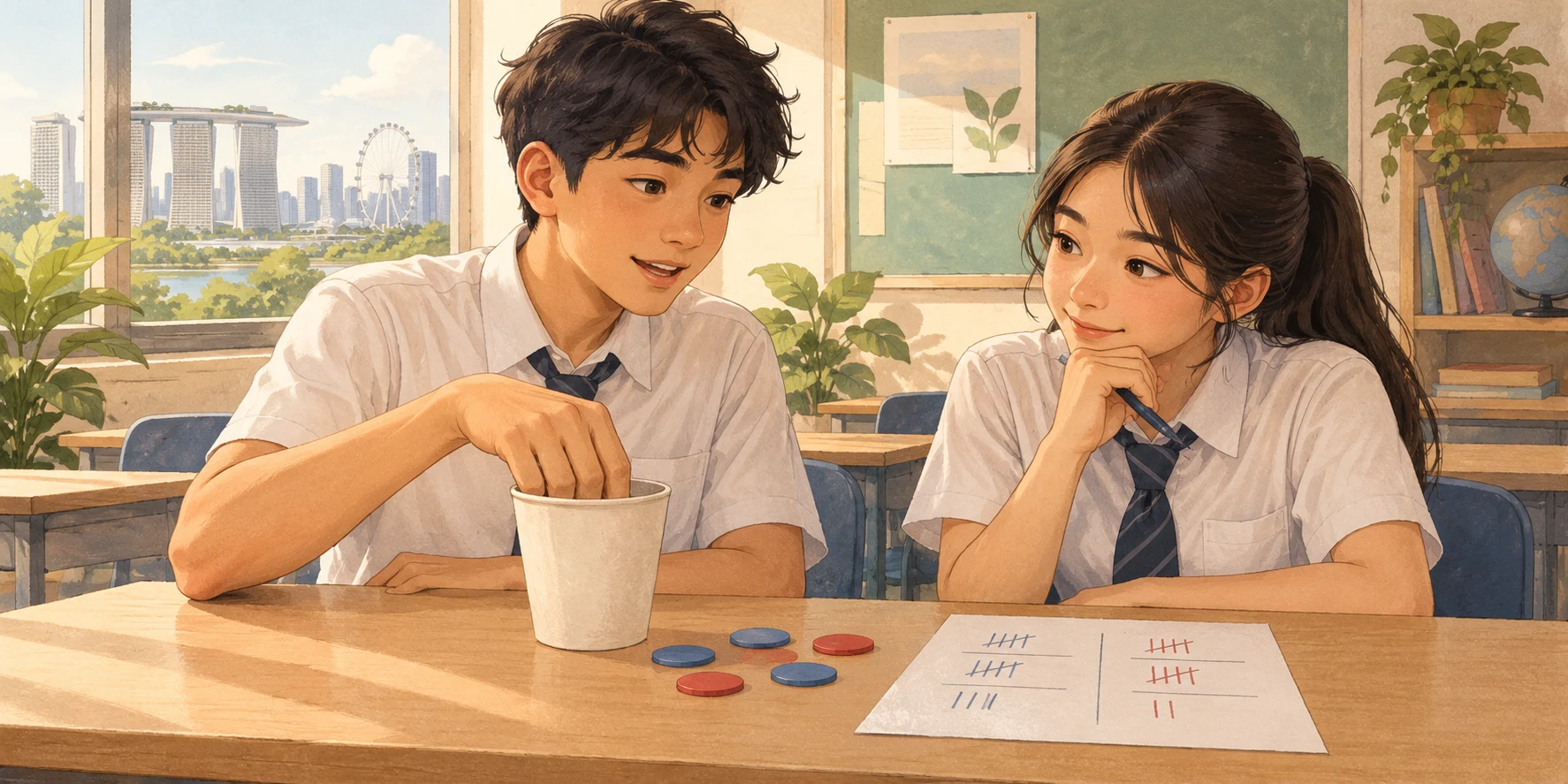
A Singapore child explores a hands-on science exhibit. A ball appears to float, a mirror makes two objects look different in size, or coloured light creates an unexpected shadow. The first reaction might be, “It’s magic!” Curiosity is an excellent beginning, but science learning asks a second question: what can we observe, and which explanation could we test? Children need vocabulary such as hypothesis, prediction, variable, fair test, measurement and evidence to move from wonder toward careful reasoning.
A family may explain that wonder in English, Mandarin, Malay, Tamil or another home language. A child who can describe why two paper objects move differently in the language they understand best already has a starting concept. A parent or teacher can then help formulate one accurate English scientific sentence without insisting that the first answer be polished or that every experiment succeed on the first attempt.
This forty-first article in Singapore Children Vocabulary focuses on using age-appropriate science exhibits and safe paper experiments to learn how evidence is made and evaluated, mainly for children ages eight to twelve. It complements Museum Artefacts and Historical Evidence, which interprets objects from the past, and SingStat Charts and Fair Comparisons, which reads published data. Here the child learns to design a small investigation, distinguish a demonstration from a controlled test and explain what a result actually supports.
Quick answer: ask a testable question and record what happened
An age-appropriate investigation follows notice → ask → predict → test safely → record → compare → explain the limit. The steps need not be performed in a rigid order in every science activity, and a captivating museum demonstration is not automatically a formal experiment. The child can learn the vocabulary through very simple comparisons without touching hazardous materials or conducting a trial with an unknown risk.
A good progress sentence is “I predicted the folded paper would travel farther, but I saw a different result in two trials. I should repeat the test and check the conditions.” A wrong prediction is not a personal failure. It provides an opportunity to improve a question, measurement or explanation.
- Age focus: upper primary, with observation-only activities suitable for younger children.
- Safe materials: paper, rulers, pencils, pre-approved exhibit images or adult-supervised simple classroom resources.
- Successful learning: child distinguishes a prediction from a recorded result and knows when a claim requires more evidence.
- Safety boundary: no household fire-tornado experiments, high-voltage demonstrations, unapproved chemicals, laser devices or imitations of restricted Science Centre equipment.
What Science Centre Singapore provides in 2026
Science Centre Singapore is based in Jurong East and was established in 1977 to promote science and technology learning. Its official exhibitions directory describes interactive learning across topics such as everyday science, energy, the environment, engineering and perception. The listings include exhibitions named Everyday Science, Kinetic Garden, Future Makers, Scientist for a Day and The Tinkering Studio, subject to current access and operating arrangements.
The official Everyday Science page explains that its permanent exhibition connects familiar experiences—such as rainbows, wind, light and elements—to scientific phenomena. It also notes sensory features, including dimmer zones. That matters because a scientifically useful exhibit should also be accessible and suitable to the visitor, not simply spectacular.
The Tinkering Studio encourages hands-on making and exploration. Its activities involve creative problem-solving rather than always following a single predetermined result. Kinetic Garden uses outdoor interactive exhibits to explore energy, echoes and visual illusions. The centre’s Future Makers highlights engineering questions and the solutions people develop to technical challenges.
For contemporary learning, the ONE Ocean: Every Action Ripples exhibition opened in May 2026 and uses scientific research, immersive presentations and interactive marine content. An immersive experience can teach concepts, but it does not automatically let a visitor reproduce the underlying research. The child should distinguish a displayed scientific finding from a small model or simulation.
The official Visit Planner requires online timed-entry ticket booking for relevant Science Centre attractions. Operating hours, exhibitions, age recommendations, session capacity and accessibility arrangements may change. Parents should check the live details before travel instead of treating this vocabulary article as a current ticket or opening-hours guarantee.
Twenty scientific inquiry words for children
These English definitions are original child-level teaching meanings, not a complete formal philosophy of science or an official MOE science examination list. Work in groups of five and demonstrate the meaning with a harmless paper exercise.
- 1. Science: a process of developing and testing explanations about the natural world using evidence. “Science asks how we know an explanation is supported.”
- 2. Exhibit: an object or interactive display used to present information or an experience. “The exhibit illustrates how light behaves.”
- 3. Observation: something directly noticed or recorded. “My observation is that the paper moved.”
- 4. Question: something a learner asks to investigate or understand. “Our question is which design travels farther.”
- 5. Hypothesis: a proposed explanation that can be investigated or tested. “My hypothesis links shape to how the paper moves.”
- 6. Prediction: a statement about the result expected under specified conditions. “I predict the flat piece will fall differently.”
- 7. Experiment: an organised investigation designed to examine a question or explanation. “We plan a safe paper experiment.”
- 8. Variable: a factor that may change and influence a result. “We choose which variable to change.”
- 9. Fair test: a comparison designed so relevant conditions are controlled as appropriately as possible. “A fair test keeps the launch method similar.”
- 10. Control: a reference condition or factor kept the same for comparison. “Keep the starting height constant.”
- 11. Procedure: an ordered description of what is done. “Write the procedure so another group can understand it.”
- 12. Measurement: information obtained using a stated unit or method. “Measure the distance using a ruler.”
- 13. Data: recorded observations or measurements used in analysis. “Our data include three distances.”
- 14. Trial: one run or repeat of a test. “This is the second trial.”
- 15. Repeat: do an investigation again to examine consistency. “Repeat the test under appropriate conditions.”
- 16. Evidence: observations or data relevant to evaluating a claim. “Evidence supports or challenges a proposed explanation.”
- 17. Conclusion: a carefully stated interpretation of the results and what they support. “The conclusion should not be broader than our tests.”
- 18. Prototype: an early model made to explore or improve a design. “We made a paper prototype.”
- 19. Revision: an evidence-informed change to a question, design or explanation. “We revise the model after feedback.”
- 20. Uncertainty: a recognised limit to how precisely or confidently something is known. “Our small test has uncertainty.”
A prediction is not an observed result. A hypothesis is a proposed explanation, not merely a guess about which team will win. A prototype is a model or early design, not necessarily a controlled experiment. A fair test seeks a meaningful comparison, but even a careful small test can have measurement error or unexplored conditions.
Worked case one: the ball that appears to float
At a fictional interactive exhibition, a ball appears suspended in moving air. A child says that gravity has stopped existing in that room.
Parent: “What can we observe?”
Child: “The ball remains suspended while air is moving.”
Parent: “Does that prove gravity has disappeared?”
Child: “No. Other forces or conditions could explain the observation.”
Parent: “What could we learn from the exhibit?”
Child: “Read the explanation, watch the change in conditions and ask how the forces interact.”
The example is based on a familiar kind of science demonstration rather than instructions to construct equipment. The child is practising the difference between an unusual observation and an extreme explanation. They should not attempt to build a high-speed air system or place objects near machinery at home.
An extension asks why a ball moving differently when airflow changes could be useful evidence. The changed condition may affect the result, though a full physical explanation would require careful analysis. A demonstration offers a clue, not proof of every possible claim about flight.
Worked case two: the optical illusion that changes apparent size
A child sees two objects in a visual-illusion exhibit. They appear to be different sizes when viewed from one perspective, yet a label explains that the setup changes perceived proportions. The child says, “My eyes are wrong, so observation is useless.”
Teacher: “What did you experience?”
Child: “The objects appeared to have different sizes.”
Teacher: “Does perceived size always equal measured size?”
Child: “No.”
Teacher: “What could help?”
Child: “A suitable measurement or a different viewpoint.”
Teacher: “What have we learned about observations?”
Child: “They are useful, but we should check what they actually establish.”
Science Centre’s Kinetic Garden includes visual-illusion experiences, while its exhibition directory includes perception-themed galleries. A child can compare a safely prepared paper drawing without copying restricted exhibit designs or using hazardous optical equipment.
The learning is not that the human senses are worthless. It is that observations need context, method and sometimes instruments. That reasoning also helps children read photographs and charts more carefully.
Worked case three: two paper gliders and an unfair comparison
A class wants to compare two paper-glider designs. One student throws their favourite glider from a higher point and gives it a stronger push. It travels farther, and they declare the shape caused the entire difference.
Teacher: “What was our question?”
Child: “Which paper design travels farther under comparable conditions?”
Teacher: “What else changed?”
Child: “The starting height and strength of the throw.”
Teacher: “Can we attribute the result to design alone?”
Child: “No. The test was not fair.”
Teacher: “What could we do in a safe classroom?”
Child: “Keep the paper and launch method comparable, and repeat the trials.”
A paper-glider exercise may still have uncontrolled differences between throws. A child can state those limitations rather than invent precision. Teacher supervision matters even for simple activities, and the gliders should not be thrown toward people, roads or electrical fixtures.
An extension introduces variable. If the design is the factor under investigation, avoid knowingly changing several other factors at the same time. A fair comparison becomes an idea the child can explain, not a slogan.
Worked case four: the prediction was wrong
A student predicts that a larger paper parachute model will descend more quickly. In a harmless adult-supervised class demonstration, the opposite happens. The student crosses out the recorded time because the outcome is embarrassing.
Teacher: “Was the prediction a guarantee?”
Child: “No. It was what I thought might happen.”
Teacher: “Should we change the actual observation to match it?”
Child: “No.”
Teacher: “What could we do next?”
Child: “Keep the true data, repeat under suitable conditions and revise our explanation.”
This is one of the most important scientific language habits. A prediction may be disproved, but honest observations can still teach. The child is not judged by guessing the correct result in advance.
Parents should avoid dramatic statements such as “Your experiment failed because you were wrong.” Instead distinguish unexpected result, inconsistent procedure and evidence that challenges the hypothesis. These are different explanations requiring different follow-up.
Worked case five: one successful trial does not settle everything
A child builds a paper tower prototype that stands upright once. They announce that it will withstand strong wind, rain and any number of books.
Parent: “What have we actually tested?”
Child: “The tower stood under the conditions of our one trial.”
Parent: “Did we test it with heavy books or strong wind?”
Child: “No.”
Parent: “What conclusion would fit the evidence?”
Child: “The prototype stood during this one safe trial. Other conditions remain unknown.”
The word prototype does not imply that a product is ready for real use. Engineers test models for specific requirements, revise designs and consider failure modes with appropriate safety. A child can learn this concept with paper without load-testing furniture or structures people depend on.
This also separates tinkering from formal testing. Open-ended making can generate ideas; a fair test compares a particular feature; engineering validation may need more rigorous methods. Both exploration and testing can be useful, but they should not be called identical activities.
Worked case six: an exciting exhibit is not a home experiment
At a Science Centre show, a child sees a visually dramatic demonstration involving high heat or electricity and asks to repeat it in the kitchen. The caregiver explains the difference between a professionally managed demonstration and a suitable children’s activity.
Parent: “Who designed and operates this show?”
Child: “Trained staff using specialised equipment.”
Parent: “Does watching give us the ability or permission to copy it at home?”
Child: “No.”
Parent: “How can we learn the scientific idea safely?”
Child: “Read the explanation or use a suitable paper model with adult guidance.”
Science Centre’s public programme includes professional demonstrations as well as hands-on exhibits; they have different supervision requirements. Parents should not ask children to imitate fire, electricity, compressed air, concentrated light or chemical demonstrations. A vocabulary exercise must not become a hazardous trial.
The child can still formulate a scientific question: “What factor influences the effect shown?” Then the family can choose an age-appropriate safe analogy rather than reproducing the original equipment.
Worked case seven: the exhibition has changed since a friend’s visit
A classmate remembers a Science Centre exhibit from a previous year. The child insists it must be available on their next visit because it appeared on an old photo.
Parent: “What does the old photo establish?”
Child: “That the exhibit was present when the photo was taken.”
Parent: “Does it prove the current gallery lineup?”
Child: “No.”
Parent: “What should we check?”
Child: “Science Centre’s current exhibition pages and visit information.”
The official exhibitions directory and Visit Planner are appropriate sources for current offerings and ticket arrangements. A permanent exhibition listing is more stable than a temporary show, but maintenance or access restrictions can still occur.
This is a scientific-information habit: a dated observation is not a timeless statement. A child can preserve “I saw this exhibit last year” without asserting “It is open now.”
Observation versus hypothesis versus prediction
These terms are frequently confused because all three can be spoken before an experiment begins. An observation describes what is already seen or recorded. A hypothesis proposes an explanation or relationship that could be tested. A prediction states what result is expected if particular conditions apply.
For a harmless example, imagine a paper spiral moving when air blows on it. “It moved when air reached it” is an observation. “Moving air causes a force that can rotate the spiral” is a proposed explanation to investigate. “If the airflow increases under comparable conditions, the rotation may change” is a prediction. This does not establish a measured relationship until an actual suitable test is performed.
Ask the child to sort the three sentences and discuss what additional evidence would help. A first-language explanation can be longer than the English technical term; accuracy of the sequence matters most.
Do not imply that science consists of guessing first and forcing data to agree. Sometimes careful observations generate new questions; researchers revise models when evidence conflicts with expectations. A good learning culture values truthful correction.
Measuring fairly does not mean every result must be identical
Repeated trials can produce different numbers even when children try to follow the same procedure. The difference may arise from measurement precision, small variations in conditions or other factors. Teach uncertainty as a reason to explain the range of results, not a reason to hide inconvenient values.
For example, in a fictional set of three trials measuring a paper glider’s travel, the recorded distances are 150 cm, 164 cm and 157 cm. The child should not silently replace all three with the longest distance. They can report the three values and ask what accounts for the variation.
Older children may calculate an average, but that is a separate mathematical skill. A mean does not erase the existence of variation, and a small number of trials cannot prove a design will always behave the same way.
A fair test also requires a suitable comparison. Changing the shape, paper weight, launch height and fan speed together makes it hard to isolate the effect of one factor. For a younger learner, “Change one thing at a time when possible” is a useful simplified starting idea, with adults explaining that real investigations can be more complex.
A first-language conversation about evidence
A child might use a home-language expression equivalent to “I know it works.” The adult can ask what “works” means. Did the model move once? Did it repeat the result? Was it safe under the intended conditions? Which observation supports the claim?
That dialogue can produce an English sentence such as “My prototype worked in two classroom trials, but I have not tested it under other conditions.” The sentence preserves evidence and limitations. It does not require perfect English before the child’s reasoning is understood.
Another important distinction is conclusion versus opinion. “I liked the display” is a valid personal response; “The display proves all forces disappear” is a scientific claim requiring evidence. Families can welcome curiosity and enjoyment without treating every impression as a scientific result.
If a child has a sensory or learning need, the adult should offer a suitable observation format, such as drawings, written descriptions or accessible gallery information. Science literacy is not restricted to children who can manipulate every interactive exhibit or speak loudly in a crowded hall.
A ten-minute science vocabulary activity using paper
Prepare two strips of paper of the same material and dimensions. Fold one into a different safe shape. Use an adult-approved desk surface and a simple method to compare the shapes’ stability or ability to stand. The adult supervises, and no sharp tools, flame, heat or electrical equipment are needed.
First ask the child what they are curious about. For example, “Which arrangement stands more reliably under gentle, similar conditions?” Then ask for a hypothesis explaining why shape might matter and a prediction about the result. Do not give the child the “correct” observation before testing.
Second describe a simple procedure and decide which factor changes. Keep as many other relevant conditions the same as practical. Ask the child what would make the comparison unfair. They should identify a hidden change rather than treating every result as pure luck.
Third record each trial truthfully in a small table. If the structures behave differently across repeats, write that down too. An unexpected result is still data.
Fourth ask for a conclusion limited to the conditions tested. “In our paper activity, the folded shape stood more reliably” is acceptable if it reflects the records. “This proves all buildings with this shape are safe” is an unjustified jump.
Finally invite one revision: improve a paper design or change the procedure for a clearer comparison, and explain why. This is enough to connect scientific words to meaningful decisions without a laboratory or museum visit.
Three learning pathways
Repair pathway: a child enjoys experiments but cannot explain what was seen. Teach science, observation, question, procedure and measurement. Give one simple observation card and allow a first-language explanation.
Stabilisation pathway: a child can describe events but confuses prediction and proof. Teach hypothesis, prediction, variable, fair test and evidence. Compare a claim with an actual recorded trial.
Extension pathway: the learner is ready for control, trial, repeat, prototype and uncertainty. Ask how to improve reliability and why one successful demonstration does not establish every intended use.
A child confident in Mandarin may need the English word for “prediction”; a fluent reader may still replace actual measurements with the preferred outcome. Diagnose the relevant gap. More difficult vocabulary is helpful only when attached to accurate concepts.
Four weeks of Singapore science vocabulary
- Week 1 — notice and ask: science, exhibit, observation, question and hypothesis. Describe a simple public Science Centre picture and one investigable question.
- Week 2 — design a comparison: prediction, experiment, variable, fair test and control. Use fictional paper designs and identify what should remain comparable.
- Week 3 — record what happened: procedure, measurement, data, trial and repeat. Make a small table using an adult-approved harmless test.
- Week 4 — reason and improve: evidence, conclusion, prototype, revision and uncertainty. Write one careful conclusion and one limitation.
Return to the earlier words in each new activity. Do not require families to purchase expensive materials or attend a particular exhibition. Science Centre’s online descriptions and simple classroom resources can support conversations where a visit is not possible.
A useful progress record asks, “What did I predict?”, “What did I observe?”, “Which variable might matter?”, and “What remains unknown?” An accurate limitation is strong evidence of scientific understanding.
Frequent scientific vocabulary mistakes
“A dramatic exhibit proves a magical force is operating.” No. Begin with observation and investigate the scientific explanation.
“A hypothesis is the result already measured.” No. It is a proposed explanation that can be investigated.
“If my prediction was wrong, I should change the data.” Never. Keep honest observations and reconsider the explanation or method.
“One successful trial proves every design is safe.” No. Conclusions must remain limited to the conditions tested.
“A fair test can change all conditions at once and still isolate one cause.” Not usually. Relevant conditions need suitable control for a meaningful comparison.
“An exhibit that uses specialised equipment can be copied at home.” No. Professional demonstrations require their own safety systems and trained staff.
“The exhibit shown on an old brochure must be open now.” No. Check current official information and any ticket requirements.
“Science means everyone must agree immediately.” No. Evidence can be examined, explanations revised and uncertainty acknowledged.
Frequently asked questions
What is a scientific hypothesis?
What makes a school experiment a fair test?
Are observation and prediction the same?
Is repeating a trial useful?
Does Science Centre Singapore have interactive exhibits?
Can children reproduce Science Centre fire or high-voltage demonstrations at home?
Does a child need to visit Science Centre to learn the twenty words?
Can a first language other than English support scientific inquiry?
Scientific literacy as shared public knowledge
Singapore’s public science institutions offer ways for people from different language backgrounds to explore scientific ideas. The national value is not that every child becomes an engineer or that every exhibit answers all questions. It is that people can ask better questions, use evidence, acknowledge limits and revise beliefs responsibly.
Science Centre’s exhibitions directory, Everyday Science and Tinkering Studio pages provide the public institutional context. This article’s paper gliders, diagrams, student dialogues and results are fictional teaching examples rather than descriptions of data collected by the Centre.
A child who says “My evidence supports this result in our small trial, but I need more information to make a broader claim” demonstrates a valuable civic habit. Accurate scientific language helps people share discoveries without exaggerating certainty.
Continue the Singapore Children Vocabulary learning library
For evidence based on historical objects, use Museum Artefacts and Historical Evidence. For careful reading of public numerical information, visit SingStat Charts and Fair Comparisons. For environmental observations, see Biodiversity Observation.
This four-article batch also includes Ports and Global Trade, Media Ratings and Family Choices and Urban Wildlife Encounters. Each develops a different application of responsible public knowledge.
For general methods, see the Vocabulary Learning Hub, Vocabulary Development and Singapore Bilingual Education.
One five-minute experiment that begins with words
Give your child two paper shapes and a question about how their structure affects stability. Ask for a hypothesis, a prediction and a fair way to compare them under safe conditions. Let them respond in their first language, then write one English sentence describing what actually happened. If the prediction differs from the result, keep both. That is a practical beginning to scientific thinking.
Prepared 24 October 2026 with Science Centre Singapore public exhibition and visit information. All worked trials and conversations are fictional. Follow current exhibition access rules and adult safety supervision for real activities.