
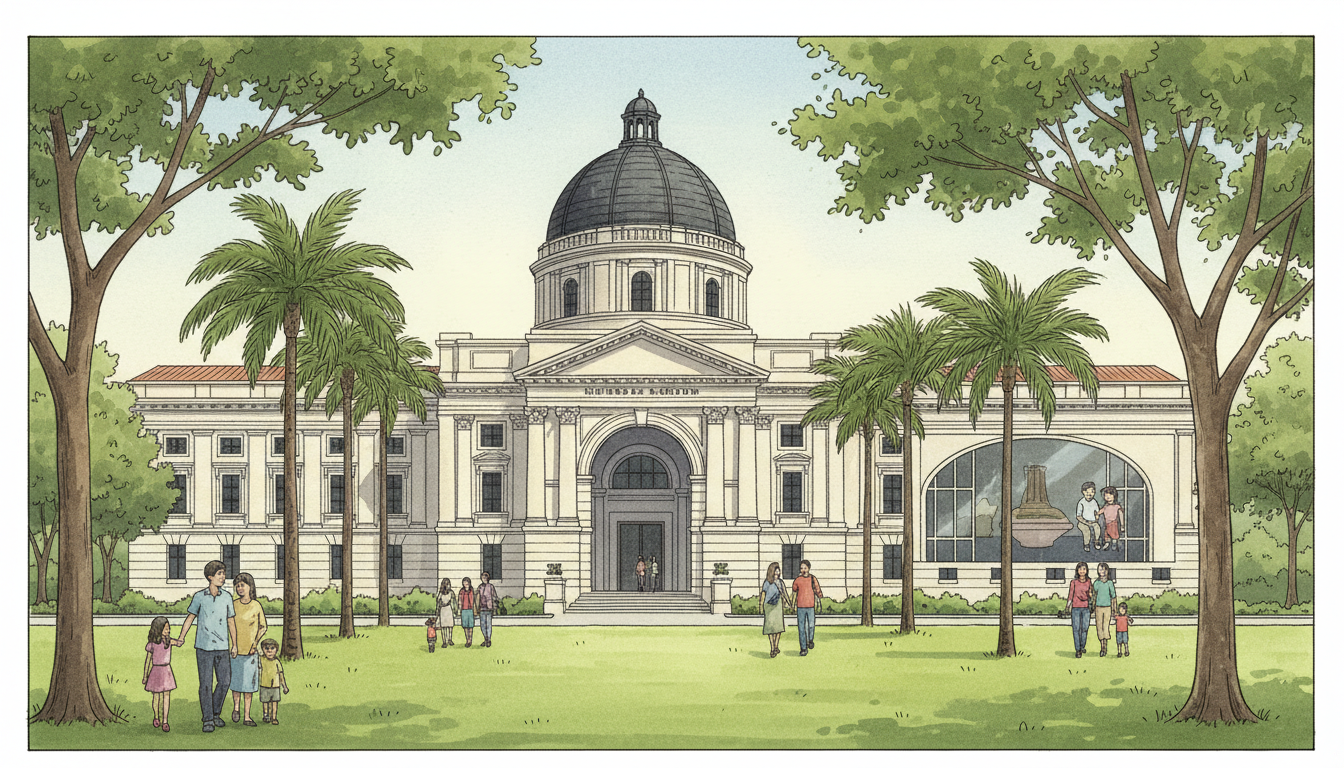
Singapore children can stand before an old object and ask a deceptively difficult question: “How do we know what this was used for?” The object may be a stone bearing marks, an old transport ticket, a musical instrument or a household machine. A museum label can explain its material, approximate date, owner, provenance or relationship to a wider event. But some parts of an object’s history may remain unknown, disputed or subject to new research. The child needs the vocabulary to notice that distinction.
In a multilingual family, an adult might describe the object in Mandarin, Malay, Tamil, English or another language used at home. The child may first understand “someone used this long ago” before they can express artefact, collection, inscription, provenance or interpretation in English. Building those terms helps the child explain what an exhibit actually supports while preserving family-language curiosity and memory.
This thirty-third Singapore Children Vocabulary article teaches a focused nation-building skill: reading museum artefacts as historical evidence without confusing an object, its label and a visitor’s story. It is aimed mainly at ages eight to twelve and includes simpler oral or picture-based options for younger learners. Unlike Heritage Buildings and Shared Memory, which studies architecture and protected places, this guide examines objects collected and cared for in museums. Unlike Public Art and Shared Meaning, it asks how a historical object, evidence record and curatorial explanation can be checked separately.
Quick answer: begin with what is visible and ask where the explanation comes from
A useful five-step learning routine is observe the object → read the label → name the source → separate fact from interpretation → ask one unanswered question. An object can prove that a particular physical item exists and bears visible features. Its label may establish the date range, provenance, maker or use based on research. The visitor may make a plausible inference, but a plausible inference is not automatically a historical fact.
A child who says “I can see marks carved into a stone, and the museum identifies it as a historical inscription, but researchers have not fully deciphered the text” has learned more than somebody who insists they can read it from a photograph. The aim is careful reasoning, not memorising a dramatic version of history.
- First five minutes: select one official museum object page, let the child describe two observable details, and then read the museum’s title and explanatory note.
- Evidence of progress: the child can give one observation, one sourced statement and one question the display does not answer.
- First-language bridge: allow the child to express the observation in the strongest language, then reconstruct it in clear, appropriately cautious English.
- Safety and respect: never touch an artefact, enter a restricted collection area, photograph people without appropriate permission, or treat a museum as an unsupervised playground.
Singapore’s museum collections and why they are shared public resources
The National Heritage Board’s National Collection connects heritage objects to the study of Singapore’s social and cultural history. NHB reported in February 2026 that more than 100,000 artefacts from the collection had been digitised and made accessible through Roots.sg, with digitisation continuing over time. A digitised record can help a family study an object even when they cannot visit an exhibition.
NHB’s National Collection as a Public Good explains that national museums preserve objects while using them to explore, discuss and sometimes reassess Singapore’s history and identity. The museums are not simply storage rooms. They select, interpret, conserve and display objects so visitors can think about evidence and how public historical accounts are constructed.
The National Museum of Singapore is the country’s oldest museum, established in 1887. Its historic Stamford Road building was gazetted as a National Monument on 14 February 1992. That building is itself heritage architecture, but this lesson concentrates on the objects and exhibits displayed inside.
The National Museum’s revamped Singapore History Gallery reopened on 10 October 2026, using artefacts, historical research, multimedia and personal accounts to trace more than 700 years of Singapore history. Contemporary reporting on the reopening identifies, among other objects, a restored Housing & Development Board lift from the 1970s, a traditional Nanyang coffee-roasting machine and a piano associated with composer Zubir Said. See the October 2026 CNA reopening report and the museum’s official gallery-upgrading information.
Visitors should check the current museum visitor guide before visiting. Not every gallery remains open or holds the same objects forever. The museum’s Level 2 Life in Singapore galleries, for example, were scheduled for reopening in the first quarter of 2027 according to the museum’s September 2026 upgrading information. A family should not promise children that every historical display is available on a particular day without checking.
Twenty vocabulary words for reading museum artefacts accurately
These twenty words are child-level English meaning anchors rather than an official MOE vocabulary examination list. Use five at a time, and pair each with a picture or an authorised object record. A child may understand the meaning first in another home language; the English term can follow.
- 1. Museum: an institution caring for, studying and presenting collections for public learning. “The museum shares objects and stories about the past.”
- 2. Artefact: an object made, used or changed by people that may provide historical evidence. “The old ticket is an artefact from everyday life.”
- 3. Collection: objects gathered and managed for research, preservation or display. “The National Collection contains many different kinds of artefacts.”
- 4. Exhibit: an item or organised display presented for visitors. “This exhibit includes an object and its explanation.”
- 5. Label: text identifying or explaining an object or display. “Read the label before naming the object’s age.”
- 6. Material: the substance from which an object is made. “The label identifies the material as sandstone.”
- 7. Inscription: writing or markings recorded on a surface such as stone or metal. “The stone bears an inscription.”
- 8. Date range: a period within which something may belong. “The date range covers several centuries.”
- 9. Source: the record, object or person providing information. “The museum page is our source for the collection description.”
- 10. Provenance: the documented history of where an object came from and how it changed hands or was used. “The provenance helps explain the object’s journey into a collection.”
- 11. Curator: a museum professional who researches, develops and interprets collection displays. “A curator selects evidence for an exhibition.”
- 12. Catalogue: an organised record of objects and their details. “The catalogue entry provides the object number.”
- 13. Observation: something directly noticed from available evidence. “I observe faint marks on the object’s surface.”
- 14. Evidence: information that supports or tests a statement about the past. “The object provides evidence, but its meaning still needs analysis.”
- 15. Interpretation: an explanation formed from evidence and reasoning. “The interpretation may change when new evidence is found.”
- 16. Uncertain: not fully known or securely established. “The precise meaning of the inscription remains uncertain.”
- 17. Conservation: professional care that aims to protect an object’s condition and long-term survival. “Conservation helps keep fragile artefacts safe.”
- 18. Replica: a reproduction of another object. “The exhibit uses a replica so visitors can explore the shape safely.”
- 19. Context: surrounding information needed to understand an object. “The date and place give this tool historical context.”
- 20. Perspective: a particular person’s position or way of understanding events. “Two people may tell the same historical event from different perspectives.”
The important distinctions are artefact versus replica, observation versus interpretation, collection versus exhibition, and provenance versus an invented story about ownership. A label does not make a claim true simply because it appears in formal language, but an established, attributable museum record is more reliable about that institution’s collection than an unsupported social-media caption.
Worked case one: the Singapore Stone and the unreadable inscription
The National Museum’s Singapore Stone object catalogue identifies the surviving sandstone fragment, dated to the tenth through fourteenth centuries, as one of its important historical artefacts. The stone stood near the mouth of the Singapore River before the original boulder was destroyed in the nineteenth century. Its carved marks are historically significant, but the inscription has not been fully deciphered.
Imagine a Primary 4 child looking at an official image of the stone and saying, “I can see writing, so I know exactly what the people of the past wanted to tell us.”
Parent: “What can you actually see in the picture?”
Child: “Marks carved into a stone surface.”
Parent: “What does the museum identify them as?”
Child: “An inscription on the Singapore Stone.”
Parent: “Has the whole inscription been securely translated?”
Child: “No. Its full meaning remains uncertain.”
Parent: “What can we say truthfully?”
Child: “The carved stone is evidence of an early inscription. We should not invent a complete translation.”
This is an excellent first-language vocabulary case because the child may be tempted to match unfamiliar letterforms to a language they know. Some research has discussed connections with scripts and languages used in the wider region, but the surviving fragment does not support a child confidently reading a complete message from its marks. The child’s correct answer can include uncertainty.
For a transfer task, present a fictional stone with clearly invented markings and ask whether the child can declare the language or exact date. No. The child can describe the appearance; specialists need further context, comparison and analysis to justify a conclusion.
The Singapore Stone is more than a mystery prop. It offers evidence that the history of the island and its networks extends beyond the familiar nineteenth-century colonial chronology. Yet public history is better served by careful claims than by pretending the unknown words have already been recovered.
Worked case two: the old HDB lift and the story it can support
Reporting on the revamped Singapore History Gallery in October 2026 describes a restored HDB lift from the 1970s used to explore Singapore’s transition into public housing. The object provides a concrete entry point into daily experience: people going home, getting used to multi-storey living and adapting to a changed neighbourhood environment.
A fictional student looks at the lift and says, “This proves every Singapore family loved moving into a high-rise block.”
Teacher: “What is the object?”
Child: “A restored HDB lift from an earlier period.”
Teacher: “What can it illustrate?”
Child: “A technology and a way people moved through housing buildings.”
Teacher: “Does one lift prove that every family felt the same way?”
Child: “No. Different residents could have had different experiences.”
Teacher: “What would help us understand those experiences?”
Child: “Oral accounts, records and other exhibits with their sources.”
The important word here is perspective. An object can anchor a story without proving the feelings of an entire population. One family may recall new convenience, another the difficulty of leaving a former neighbourhood and another a sense of community in a different setting. These hypothetical reactions must not be presented as direct quotations from named historical witnesses.
The child can learn the difference between material evidence and testimony. The lift demonstrates a type of equipment that existed; a personal account offers evidence about how someone experienced it. Together they can illuminate a period without erasing differences between people.
This topic connects to Void Decks and Shared Facilities, but the activity here concerns historical evidence, not present-day HDB facility rules.
Worked case three: the piano and what one object cannot tell us
A piano associated with composer Zubir Said, who composed Majulah Singapura, is among the artefacts highlighted in reporting on the 2026 gallery reopening. A musical instrument can help visitors connect a nationally familiar anthem to the creative work of a historical person. But the object alone cannot tell visitors everything about the composition process, the reception of the song or what every singer feels.
Child: “The piano proves all Singaporeans had the same reaction when the anthem was composed.”
Parent: “What is the museum object connected with?”
Child: “The composer Zubir Said and his music.”
Parent: “Does that one piano show how every listener felt?”
Child: “No. It is one artefact related to a particular person’s work.”
Parent: “What other sources could help?”
Child: “Documents, recordings, interviews and reliable historical explanations.”
A strong response might be: “The piano links the composer to a tangible object, while other sources explain when the anthem was written and how it became a national symbol.” The child has not claimed the piano answers questions it cannot answer.
For the language and ceremonial difference between the Pledge and the Anthem, use National Symbols, the Pledge and the Anthem. That is a separate learning task. The museum lesson uses a tangible historical object to ask what the evidence supports.
Worked case four: a coffee-roasting machine and everyday history
The revamped 2026 Singapore History Gallery has also been reported to feature a traditional Nanyang coffee-roasting machine from Ho Tit Coffee Powder Factory. At first glance, a child may ask why a machine used in a trade belongs in a national museum beside material associated with public affairs and historical change.
Parent: “Does history include only political speeches?”
Child: “No. Work, food, housing and ordinary routines are also part of people’s past.”
Parent: “What can a coffee-roasting machine show?”
Child: “A tool linked to producing and preparing coffee in a particular period or business.”
Parent: “Does it prove everyone drank the same coffee?”
Child: “No. That would need more evidence.”
Parent: “Why might a curator include the machine?”
Child: “To connect everyday work and cultural practices to the larger historical story.”
This case extends the child’s idea of nation building beyond flags and famous people. Museums can preserve material evidence of workers, family routines and commercial life as well as major public events. It does not mean every coffee shop had the same machine or every community has the same food practice.
The child can use artefact, material, context and curator in one explanation: “The curator uses this artefact and its context to help visitors investigate everyday work.” That is a better sentence than “All Singapore history is about coffee.”
Worked case five: the catalogue entry and the invented age
A fictional museum worksheet shows a photograph of a small metal tool, its accession number and a broad date range such as “early twentieth century.” A child rewrites the date as “made in 1900” because the specific year looks neater.
Teacher: “What does the source say?”
Child: “Early twentieth century.”
Teacher: “Does it identify 1900 exactly?”
Child: “No. I invented a precise year.”
Teacher: “Why does a date range matter?”
Child: “The evidence may support only a period, not one confirmed day or year.”
Teacher: “What should we write?”
Child: “The museum dates it to the early twentieth century, according to the catalogue.”
Historical dates often come with uncertainty. Experts may draw on materials, comparable objects, documents and scientific examinations to support a range rather than an exact date. An honest museum report keeps that range intact. When converting it into the child’s first language, adults should not replace “possibly” or “circa” with an exact year.
For further practice, compare three fictional labels: “1905,” “about 1905” and “1900–1920.” Ask which is most precise and which claims are justified by the printed information. The lesson is about faithful reading, not trying to know more than the curator.
Worked case six: a replica that visitors may touch
An adult-selected museum display contains a clearly marked replica of a historical object. A child notices a hands-on instruction for that specific exhibit and assumes all original objects can now be handled.
Child: “This replica is allowed to be touched, so I can touch the original artefact too.”
Parent: “Does the permission for one item apply to every display?”
Child: “No. The rules can differ.”
Parent: “What is a replica?”
Child: “A reproduction made to resemble another object.”
Parent: “Why might a museum use one?”
Child: “So visitors can explore a form or idea without damaging the original.”
The National Museum’s Museum Etiquette guidance says not to touch collection objects unless an activity explicitly permits it. It also advises speaking softly, not running, keeping food and drinks out of galleries and avoiding flash photography. These rules protect the National Collection and other visitors.
The child should never test whether an object is fragile. Professional conservators and museum staff decide how originals are handled, displayed and stored. A visitor’s curiosity does not give permission to touch a stone, lift, instrument or old document.
What provenance means without turning children into detectives
Provenance is the documented journey of an object, including where it came from, earlier owners or users where known, and how it entered its current collection. Museums examine provenance because origin and ownership can shape what an artefact means, whether its history is well supported and which ethical or legal questions require professional attention.
For a child, start with an ordinary fictional pencil case. A family member says it belonged to an older sibling and was later given to a younger child. The child can describe that known sequence as a simple account of ownership. Then distinguish it from a museum record, which may use dated documents, catalogues and research.
A child should not invent a chain of owners to fill a gap: “It looks expensive, so a king must have owned it” is unsupported. The proper sentence is “The earlier ownership is not stated on this label” or “The museum records that it was donated by…” when the record actually supplies the information.
NHB’s National Collection information explains that the Heritage Conservation Centre preserves and manages objects; the National Museum’s artefact adoption overview refers to objects’ significance and rich provenance. These sources are a starting point for the idea, not a complete public provenance report for every item.
The child’s role is to ask good questions, not to identify rightful owners, settle legal claims or research private family histories without consent. Complex historical ownership issues belong to competent professionals and relevant communities.
Why conserving an artefact is more than cleaning it
Older objects can deteriorate through exposure to moisture, light, handling, temperature changes or unsuitable materials. The Heritage Conservation Centre and other museum specialists examine objects before deciding what treatment is appropriate. Conservation may involve documentation and preventive care as well as specialised treatment. The goal is to preserve evidence rather than make every object appear newly manufactured.
NHB’s introduction to conservation examination describes investigations of provenance, materials, condition and past repairs; it mentions tools such as microscopes and scientific analysis for details that are not visible to visitors. This shows why a museum object should not be handled or polished casually.
A child may ask whether the Singapore Stone could simply be scrubbed to make the marks more readable. The answer is that conservation decisions require professional assessment; an abrasive cleaning attempt might destroy fragile evidence. The same applies to handwritten letters, textiles, musical instruments and old machinery.
Teach the contrast between care and alter. To care for an object in a gallery, the visitor follows museum etiquette. To alter or conserve a National Collection object, qualified professionals follow specialised processes. Knowing the word conservation does not make a child a conservator.
The first-language bridge: preserve what is known, believed and unknown
A museum explanation might say “believed to be,” “dated to,” “possibly used for,” or “not fully deciphered.” These small phrases do important work. They tell readers how certain a statement is. A child translating into the family language may accidentally turn possibly into definitely or dated to a period into one exact year.
Teach a three-part test. What does the source state as observed or documented? What is inferred or interpreted? What remains uncertain? The child’s translation should preserve all three boundaries. If no neat one-word equivalent exists, use a longer explanation that keeps the level of certainty intact.
Imagine the fictional label: “This tool may have been used to prepare food.” A faithful explanation cannot say “Everyone used this tool to prepare their meals.” The label states a possibility about one object; the second statement turns it into a universal social fact. Ask a fluent adult or teacher to check nuanced translation where necessary.
Similarly, a grandparent may say “I remember seeing a similar machine in our neighbourhood.” That is a personal recollection, not proof that the museum’s exact object belonged to their street. Children can value the connection while attributing it accurately.
Singapore’s bilingual school context is explained separately in Singapore Bilingual Education. The child’s actual first language does not necessarily match the formal school Mother Tongue Language. Museum learning can welcome both family-language understanding and accurate shared English.
Reading an exhibit label as an evidence map
A museum label may contain several kinds of information: title, maker, date or period, material, collection number, origin, donor and explanatory description. Not every label contains all of them. For a child, this means “not stated” is a valid answer.
Show a fictional label: “Small ceramic bowl. Maker unknown. Early twentieth century. Glazed ceramic. Acquired for the collection in 1980.” Ask the learner to identify material, date range, acquisition information and what is unknown. The child should not invent a maker’s name or assume the bowl was created in 1980.
Next ask whether a collection number is the same as the year of manufacture. It is not. A collection or accession number is an administrative identifier, and its format is defined by the institution. The number can help locate a catalogue entry without telling the complete historical story.
Then ask what would make the label more useful to someone who speaks a different language or needs another format. Simple language, a competent translation, appropriate reading size or an accessible explanation may help. The child is not asked to redesign museum access independently; they can recognise that visitors have different needs.
Finally, ask whether the information may change. Research can result in a more precise attribution, a revised date, a corrected provenance or a new interpretation. Revision is not necessarily proof of carelessness; responsible museums respond to evidence. Children can learn that public knowledge sometimes becomes more accurate over time.
A ten-minute museum vocabulary exercise without leaving home
Choose a genuine object entry from the Roots.sg National Collection or an authorised museum webpage. An adult should make sure the image is appropriate for the child’s age and that it includes enough reliable descriptive information. Do not upload copyrighted museum imagery or private visitor photographs to a public worksheet unless usage rights permit it.
First, hide the caption and ask the child for two observations. One may describe shape; another may describe visible material or markings, cautiously if the material cannot be verified from the photo alone. The child may respond in their home language before putting one observation into English.
Second, uncover the label. Ask for the object’s title, material, broad date or collection source if stated. Mark missing items explicitly rather than guessing. The child should recognise how much more the museum record tells them than the image alone.
Third, invite one interpretation or question. “What might this object tell us about daily life?” is appropriate; “This proves everybody lived in exactly this way” is not. Discuss what other kinds of evidence would be needed to build a wider account.
Fourth, add a fictional personal memory from a family member: “I saw something similar when I was young.” Ask how to attribute it without claiming the museum object itself was owned by that relative.
Fifth, practise museum etiquette on paper: no touching unless specifically allowed, avoid obstructing other visitors, follow photography restrictions, and keep food outside galleries. Children should understand why an action matters, not merely recite prohibitions.
The activity can be completed at a table, making it usable for families unable to visit an exhibition. Learning historical evidence does not depend on visiting an expensive programme or collecting a large number of photographs.
Three differentiated learning pathways
Repair pathway: a child sees an object but has only vague words such as “old thing.” Teach museum, artefact, material, label and observation. Use one clear picture and a short prompt: “What can you actually see?”
Stabilisation pathway: a child reads a caption but invents a precise date or use. Teach source, date range, evidence, interpretation and uncertain. Contrast “dated to the fourteenth century” with “made in exactly 1300” and ask what the label supports.
Extension pathway: a learner can distinguish observations and is ready for provenance, curator, catalogue, conservation and perspective. Ask why the same object can be used in different exhibitions, why provenance matters and what additional evidence is needed before making a sweeping historical claim.
If the child understands the task in Tamil but struggles with English history vocabulary, build the English phrase after the reasoning is established. A fluent English reader who changes “possibly” into “definitely” needs precision, not a longer list of adjectives.
Children with sensory, learning or mobility needs may require an alternative format or a calm environment. The goal is meaningful access to the explanation rather than a uniform expectation to read every label at the same speed.
Four weeks of first-language museum vocabulary
- Week 1 — recognise the object: museum, artefact, collection, exhibit and label. Learn the difference between an object and the explanation beside it.
- Week 2 — read the evidence: material, inscription, date range, source and observation. Practise describing what is visible without inventing the exact year or words.
- Week 3 — understand the museum’s work: provenance, curator, catalogue, conservation and replica. Explain why collections need documentation and professional care.
- Week 4 — interpret with care: evidence, interpretation, uncertain, context and perspective. Compare a documented object fact with a possible explanation and a personal memory.
Each week revisit one earlier term using a fresh object record. A family does not need to visit four museums or schedule a long excursion. Five to ten minutes with one credible digital collection page can provide useful learning when the adult asks the right questions.
For a progress check, give the child a new fictional object label and ask for four statements: “I can see…,” “The museum records…,” “This may suggest…,” and “I still do not know…”. A child who can keep those statements separate has learned a transferable method for studying history, science and public information.
Common misunderstandings about museums and artefacts
“Every old object is automatically historically important.” Some objects have well-documented significance, while others may provide limited information or require more research. Age alone does not establish a detailed historical claim.
“The museum display tells us everything.” A display selects and summarises evidence. Curators make choices, and research can update the interpretation. Ask what the label says and what it leaves unanswered.
“A replica and an original are the same.” They serve different purposes. A replica may enable hands-on learning where allowed, while an original carries particular physical historical evidence.
“If writing is visible, I can invent the full translation.” No. The Singapore Stone’s inscription has not been fully deciphered. Describe the marks and rely on credible research for any proposed reading.
“A date range is just an imprecise way of saying the year I prefer.” No. The range reflects the limits of available evidence. Do not replace it with an invented exact date.
“One artefact proves how everybody felt.” A historical object can illuminate part of daily life; different people’s experiences may require oral accounts, documents and other evidence.
“Touching a little cannot damage an artefact.” Museums prohibit touching protected objects because accumulated handling can damage fragile surfaces. Respect the rules.
“National museums belong to one language community.” Singapore’s collection includes histories and objects connected to different communities. A child can learn through multiple languages without claiming that one family represents everybody.
“A photograph of a museum object can be used in any commercial project.” Not necessarily. Follow copyright, museum photography and reuse rules, and credit the appropriate creator or collection.
Frequently asked questions
What is an artefact?
How is an artefact different from a replica?
Can children touch the Singapore Stone or other museum objects?
Is the Singapore Stone’s inscription fully translated?
Did the Singapore History Gallery reopen in October 2026?
Is every object in the National Collection on display?
May a child’s first language be used to explain museum history?
Can one object tell the complete story of a nation?
Nation building through shared evidence, not a single compulsory story
Museums help preserve objects that connect people with earlier lives. The National Collection includes material from many communities, periods and settings. A historical stone, an old lift, a musical instrument and a coffee-roasting machine can each prompt different questions about Singapore’s development. Their significance comes from evidence and context, not simply from calling them national treasures.
NHB’s National Collection as a Public Good describes public collections as part of the process of discussing and reconsidering collective identity. The National Collection page makes digitised artefacts available beyond physical galleries, while the National Museum’s etiquette guidance explains how visitors help protect fragile evidence.
The child-level contribution to nation building is modest but concrete. A learner can recognise that Singapore’s history involves people with different first languages, occupations and experiences; examine what an object actually documents; and preserve uncertainty instead of inventing a tidy account. That is a useful foundation for informed citizenship, not a test of patriotism or a claim that one museum visit can produce national unity.
Connected Singapore Children Vocabulary reading
Continue from Heritage Buildings, Conservation and Shared Memory for protected architecture, and Public Art and Shared Meaning for artistic intention versus a viewer’s interpretation. Family Stories and Heritage focuses on oral accounts, while National Symbols, the Pledge and the Anthem explains official civic symbolism.
The broader subject overview Singapore Vocabulary: Museums, First Languages and Shared Public Memory provides the historical and civic context. The existing Top 100 Singapore Vocabulary, Day 7: Museums, Art and Discovery is a separate general-purpose word collection. This guide adds the child-sized evidence-reading method and the twenty-word artefact vocabulary to that content hub.
For language-learning techniques, use the Vocabulary Learning Hub and Vocabulary Development. The Singapore Bilingual Education reference explains the difference between school-designated Mother Tongue Languages and the languages children actually learn first.
One practical exercise for tonight
Open a genuine museum collection page, not a social-media screenshot with an unknown source. Ask your child for one detail they can see, one fact the museum label confirms and one thing the evidence does not establish. Let them answer in the language they know best, then make one careful English sentence such as “The museum dates this artefact to a period, but the exact year is not stated.” That sentence demonstrates historical vocabulary, evidence awareness and respect for a shared past.
Prepared for Singapore families on 23 October 2026 using NHB National Collection resources, National Museum artefact and etiquette materials, and October 2026 coverage of the Singapore History Gallery reopening. All dialogues and teaching records are fictional. The featured image is an original non-literal illustration of the National Museum building, not a photograph of a particular historical artefact.