
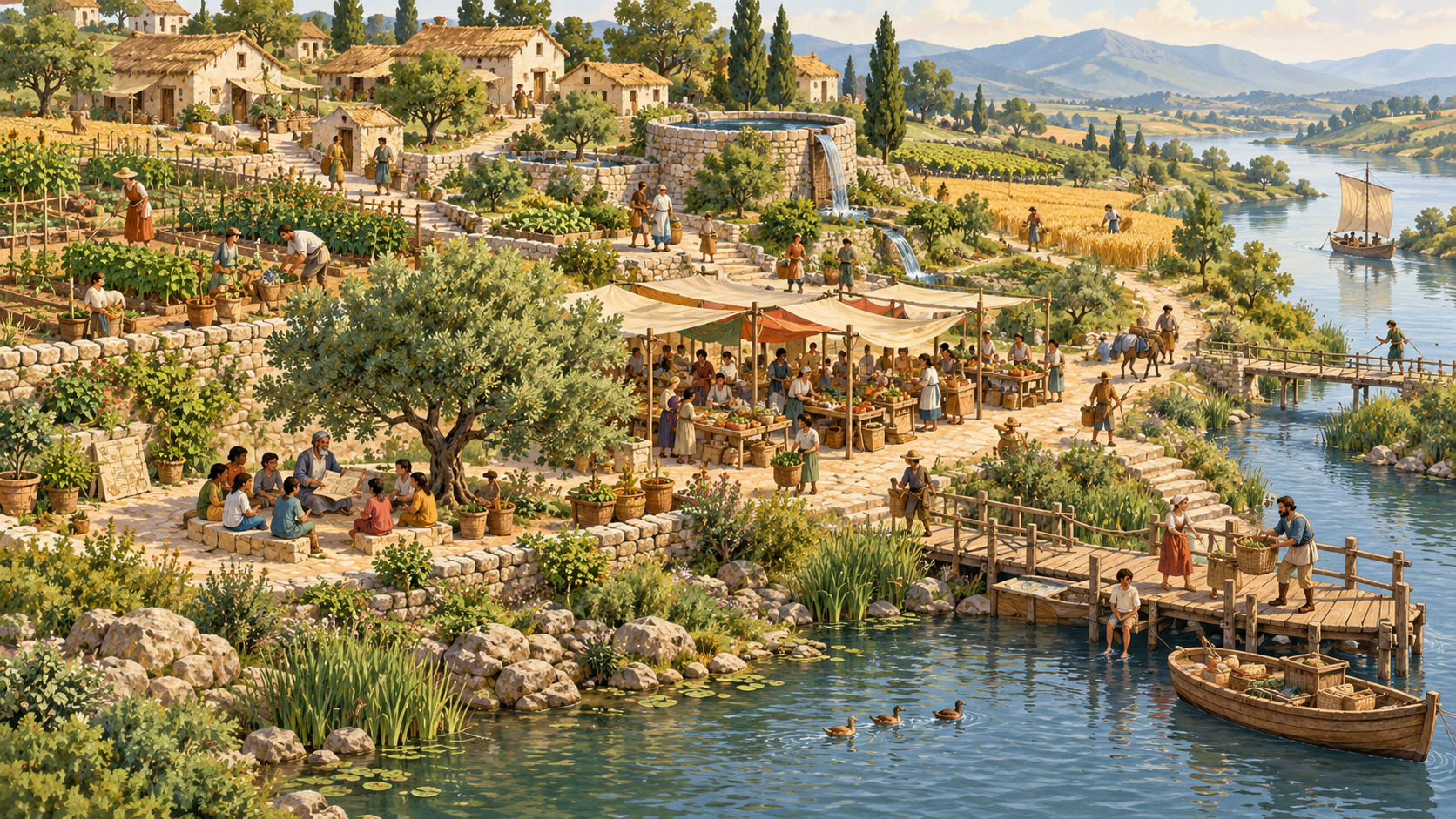
Culture, memory and education across generations help a civilisation remain understandable to the people who inherit it. This Civilisation Building guide gives children, parents and tutors a practical way to explore how communities keep stories, teach useful skills, preserve disagreement and make room for new contributions.
Building a civilisation includes deciding what people will be able to learn from those who came before them. Through the fictional Riverbend Learning House, learners examine records, practise explanations, organise shared learning and ask whose experiences a collection might leave out. The emphasis is on thoughtful participation rather than memorising a single approved story.
Parents and tutors can use these forty chapters as a flexible teaching sequence. Follow one of five reading routes, choose a manageable activity and return to the worked examples when the learner needs more support. The final project combines a small exhibition, a teaching demonstration and an evidence review that another learner can inspect.
Civilisation Building series · Previous learning stage · Civilisation hub
Series cover: AI-generated conceptual illustration of Riverbend, the starting community in these guides. It is not a literal depiction of every scenario, a historical reconstruction or an engineering plan.
Choose your next learning question
Follow one route, try a worked activity and return when the learner is ready for another layer.
Full chapter index · Capstone project · Wider civilisation reading
Riverbend, its residents, collections, schedules, tokens and numerical examples are invented. The activities use classroom materials and replicas. They are not professional conservation instructions, legal advice or a claim about the history of a real culture. Real objects, personal accounts and cultural practices require appropriate care, permission and attention to the people involved.
You do not need to collect private family information or ask children to represent an entire community. Fictional source cards give everyone a shared starting point. Learners may contribute an imagined example, select a supplied one or observe a discussion without explaining personal circumstances.
This guide follows the integrated advanced-civilisation design project. It asks a different question: what will the next generation be able to understand, practise, question and change? Technical capability matters, but the classroom task here is to make the transfer of meaning and skill visible enough to examine.
Full chapter index
Chapters 1–8: Examine records and stories
- 1. Begin with what a community wants to carry forward
- 2. Distinguish an event from the stories told about it
- 3. Build a timeline without inventing the missing links
- 4. Describe an object so another person can find and question it
- 5. Preserve a record's journey as well as its contents
- 6. Make room for disagreement in the shared archive
- 7. Treat living language as part of the memory
- 8. Translate meaning while showing the choices involved
Chapters 9–16: Keep meaning understandable
- 9. Invite accounts without demanding private disclosure
- 10. Teach a practice so another generation can adapt it
- 11. Design learning routes that let newcomers question the archive
- 12. Hand over a collection with responsibilities still visible
- 13. Make apprenticeship a relationship with a learnable purpose
- 14. Reveal the decisions hidden inside skilled practice
- 15. Demonstrate a task in a form another learner can use
- 16. Use practice and feedback to locate the next learnable step
Chapters 17–24: Teach and share cultural skills
- 17. Check whether a skill travels beyond the first example
- 18. Make access to cultural learning practical
- 19. Let generations teach one another without stereotypes
- 20. Connect libraries and workshops through useful activity
- 21. Practise care through classroom replicas
- 22. Connect festivals with everyday cultural participation
- 23. Budget time and capacity for cultural learning
- 24. Build a repeatable community teaching sequence
Chapters 25–32: Make thoughtful shared choices
- 25. Ask who decides what the community remembers
- 26. Keep contested memories visible without making every claim equally supported
- 27. Use classroom stories with permission, privacy and clear boundaries
- 28. Fund cultural learning through an explicit, reviewable choice
- 29. Let traditions change while preserving the meaning people value
- 30. Respond to a gap in memory without inventing the missing story
- 31. Recover access and the supporting work in a sensible order
- 32. Exchange cultural knowledge through reciprocal learning
Chapters 33–40: Review and hand on the learning
- 33. Prepare succession before one keeper becomes the whole archive
- 34. Distinguish living memory, evidence and inherited meaning
- 35. Teach memory and culture through four practical sessions
- 36. Prepare a cultural-learning portfolio that another person can inspect
- 37. Read two exhibitions about the same place
- 38. Explain one cultural choice in two useful forms
- 39. Review what the next learner can actually inherit
- 40. Build the Learning House inheritance portfolio
CHAPTER 1 OF 40 · Examine records and stories
1. Begin with what a community wants to carry forward
Riverbend begins its memory project with a question that sounds simple: what should children born after the present residents have grown old be able to understand? One learner suggests keeping every important story. Another asks who decides what important means. That second question becomes the starting point. A memory collection expresses choices, even when its organisers hope to represent everyone. Learners will build a small fictional collection whose choices can be inspected and revised.
The first workshop uses a paper map of Riverbend with a meeting square, outer paths, a workshop, a quiet garden and several learning rooms. Each place receives two cards. One describes an activity that happens there; the other describes something a future reader might misunderstand. At the workshop, a repaired chair could look like a simple object unless someone explains why residents kept repairing it. At the garden, an empty patch might reflect an abandoned plan, a deliberate resting space or missing information. Learners cannot choose among these explanations from appearance alone.
Parents can begin with three entirely invented objects: a painted cup, a route token and a torn programme. Ask the child to write an exhibition label using only supplied information. Then offer an additional account that changes the interpretation. The cup was made for a gathering that never occurred; the token belonged to a route that was proposed but never opened. A good revised label preserves the interesting story while correcting the original assumption. Imagination supplies questions, whereas the evidence card limits what the label may assert.
Examine the relationship and its conditions
The class writes a charter covering purpose, intended readers, selection, permission, uncertainty and revision. Its purpose might be to explain how Riverbend changed its shared learning spaces across three invented generations. The collection will include objects, accounts and records supplied within the model. It will not claim to describe every resident or settle every disputed memory. This boundary lets children produce something meaningful without pretending to have completed an entire community's history.
The charter should include an ordinary reader. Imagine a child who recognises none of the people, abbreviations or place names. What would that reader need first? A short timeline, a map and a glossary may be more useful than a long introductory speech. Older learners can add another reader who knows the events but disagrees with the organisers. The project must remain understandable to that person without requiring agreement with every interpretation.
A useful selection exercise supplies twelve candidate items and space for six. Four concern public celebrations, three concern ordinary work, two concern a disagreement about access, two describe children's play and one records an unsuccessful project. There is no mathematically correct selection. Each proposed collection should explain what its six items reveal and what the omitted six might have added. Selecting only celebrations produces a different picture from selecting only disputes; neither choice becomes neutral because the display looks attractive.
Apply, explain and check understanding
Children should also distinguish preserving an account from celebrating its actions. The collection may retain evidence of an unfair decision so future learners can examine how it happened and how residents responded. That does not oblige the class to praise the decision or place an affected person on public display. Adults should use fictional situations and avoid inviting private disclosures as the price of participation.
Finish the first session with a promise the project can keep: another reader will be able to tell what each item is, why it was included, what supports its description and how to question it. A civilisation carries memory forward through these usable relationships. The collection's value lies partly in what it saves and partly in how carefully it explains the limits of what has been saved.
CHAPTER 2 OF 40 · Examine records and stories
2. Distinguish an event from the stories told about it
At Riverbend's first story circle, three accounts describe the opening of a learning room. One narrator remembers a crowded doorway. Another remembers waiting outside. A third remembers leaving early because the instructions were unclear. The accounts need not be identical to concern the same occasion. Learners begin by separating the event, each person's experience and the later story assembled from those experiences. This prevents a search for one neat version from erasing useful differences.
Provide fictional source cards with clearly stated positions. Mara watched the entrance from the square; Evin helped inside; Sali arrived after the first session. None could observe every part of the day. Ask children to draw each narrator's viewing boundary on the map. Mara could count people entering but could not see whether each person understood the task. Evin heard questions inside but did not know why some people stayed outside. Sali's later arrival cannot establish what happened at the beginning.
This exercise gives children a practical alternative to treating every difference as dishonesty. Two people may report different parts, use different categories or remember different moments. They may also make mistakes. The learner should investigate the particular claim instead of granting complete trust or complete distrust to an entire person. An account can be useful about the room's arrangement while uncertain about the number of visitors.
Examine the relationship and its conditions
Give the class four statements: the room opened during the morning period; everyone entered immediately; several residents waited outside; the opening made every learner confident. A dated programme supports the planned opening period, but a programme alone does not prove the opening happened as scheduled. An attendance sheet may help establish actual participation if its recording method is known. The statements about everyone and every learner demand evidence much wider than a single narrator's account.
Older children can make a claim ledger with a statement, supporting item, limitation and current conclusion. They might write that two supplied accounts support some waiting outside, while neither establishes its duration for all residents. Avoid forcing a certainty score when the evidence does not support a meaningful numerical probability. Plain language such as supported within these accounts, disputed or not yet established can be more precise than an invented percentage.
For a worked comparison, the model provides twenty arrival cards. Twelve record immediate entry, five record waiting and three contain no entry-status mark. Among the seventeen marked cards, five out of seventeen, about 29.4%, record waiting. Across all twenty cards, at least five out of twenty, or 25%, record waiting. If all three missing statuses involved waiting, the total would be eight out of twenty, or 40%. These are bounds under supplied possibilities, not findings about the missing three. The class cannot truthfully replace them with either a universal success story or a universal failure story.
Apply, explain and check understanding
A younger learner can represent this with twenty counters and a covered group of three. The adult asks which statements remain true whatever is beneath the cover. Five recorded waits remains true; nobody waited becomes false; exactly five people waited remains unproved. The physical model makes uncertainty visible without treating it as a reason to abandon the investigation.
End by writing a short account that includes the opening and its uneven experience. It can say that the room opened, that the available arrival cards record both immediate entry and waiting, and that some statuses remain unknown. It can also quote the fictional narrators as accounts of their experiences. A trustworthy community story becomes richer when evidence and perspective are connected carefully rather than compressed into an artificial chorus.
CHAPTER 3 OF 40 · Examine records and stories
3. Build a timeline without inventing the missing links
Riverbend's memory team finds a sketch of a bridge, a workshop note and a celebration programme. The temptation is to place them in a smooth sequence: residents planned the bridge, built it and celebrated its completion. Yet the sketch might concern an earlier proposal, and the celebration might concern something else. A timeline needs relationships supported by the supplied records. Empty spaces should remain visible until evidence justifies filling them.
The classroom model uses numbered learning periods rather than real historical dates. A sketch carries period 3, a material receipt carries period 7 and a programme carries period 10. Those marks establish the recorded positions of the items, assuming the model's dating information is accurate. They do not alone show that all three concern one project. Learners look for names, locations, descriptions or references connecting them. An attractive chronological order is a question to investigate, not a complete explanation.
Give children two strings on the desk. One represents when an event reportedly happened; the other represents when an account was created. A narrator may describe period 4 during an interview in period 12. Place the interview card at period 12 on the second string and connect it to period 4 on the first. Keeping these dates separate prevents a later recollection from being mistaken for a record created during the event.
Examine the relationship and its conditions
Suppose a supplied letter states that a room was already in use by period 9. A floor record states that the previous room closed at the end of period 5, and an accompanying transition note explicitly states that the new room was first used only after that closure. Together, these fictional records support a possible opening interval after period 5 and no later than period 9. It does not establish opening in period 7 simply because that is the middle. A child can draw a shaded interval rather than a single dot. The drawing conveys useful information without pretending to know more than the sources provide.
A numerical exercise supplies five records with described-event periods 2, 4, 4, 7 and 9, and creation periods 3, 4, 8, 8 and 12. Their recording delays are 1, 0, 4, 1 and 3 periods. The total delay is nine periods across five records, so the mean delay is 1.8 periods. This summary describes the supplied set. It does not make the record with the longest delay automatically wrong or the immediate record automatically complete. Children should name what the calculation measures before interpreting it.
Now introduce a copied note. The archive holds a copy made in period 15 of an account labelled period 4. Its copy date is 15; the source it claims to reproduce is labelled 4. The catalogue should retain both descriptions and state whether the earlier item is available for comparison. Otherwise, a future reader might confuse the survival of a later copy with the survival of the original. The class need not solve every issue of authenticity to describe this distinction honestly.
Apply, explain and check understanding
Parents can turn the timeline into a reasoning game. Ask the child to identify one ordering that is established, one that is merely possible and one that conflicts with the supplied dates. Require a sentence explaining each answer. The aim is not speed. It is the habit of distinguishing a justified relationship from an appealing narrative connection.
For the final display, provide three visual conventions and explain them in words: a point for a supplied exact period, a band for a supported range and a separate note for an undated item. These conventions belong to this classroom project, not to every archive. Future readers should be able to reconstruct which part of Riverbend's sequence is known, which part is inferred and which part remains open for another generation to investigate.
CHAPTER 4 OF 40 · Examine records and stories
4. Describe an object so another person can find and question it
The memory team now has a shelf of fictional objects but no reliable way to connect them with their stories. A blue box says old things, a folder says important papers and several tokens have no labels. Familiarity makes these descriptions seem sufficient to the first organisers. A later child will not share that familiarity. An archive begins becoming usable when descriptions travel beyond the memory of the person who arranged it.
Give each classroom item a stable identifier that means only this item in this collection. Riverbend might use R001 through R024 for twenty-four supplied records. The identifier should remain attached when a description changes. If R007 was first called a festival ticket and later recognised as an unused design, correcting the description should not make the item disappear from earlier references. A stable reference gives the correction somewhere to land.
The catalogue entry describes the item, its supplied origin, relevant dates, current location, permitted uses within the activity and known uncertainties. Children can add a short reason for inclusion. They should keep direct description separate from interpretation. Blue paper with three circular marks describes visible features; entry token for a cancelled gathering interprets those features using additional evidence. Both can belong in the record when their different foundations are clear.
Examine the relationship and its conditions
Use six objects and ask a second group to find one without pointing or giving hints. The instruction might be: find the route token described in the account of the outer learning path. If several entries match, the problem is an opportunity to improve description. The searching group should report where the ambiguity arose. Blaming them for not knowing the collection defeats the test, whose purpose is to discover what the catalogue fails to explain.
An inventory exercise supplies twenty-four numbered entries. On inspection, twenty-one are in their recorded locations, two have moved with a movement note and one cannot yet be located. The collection has twenty-three located items out of twenty-four, about 95.8%. Its recorded-location accuracy is twenty-one out of twenty-four, or 87.5%, if that measure requires the item to be where the catalogue currently says. These measures answer different questions. Updating the two movement notes into current locations would improve the catalogue, but it would not locate the remaining item.
Avoid writing lost permanently when the search has only established not found during this check. The search record can state which locations were checked, by whom in the fictional role play and during which period. It should name the next responsible step. Children learn that an honest incomplete result can still guide action. A dramatic label often closes inquiry before the necessary work has been done.
Apply, explain and check understanding
Catalogue language should also preserve how a name was assigned. One object may have a name supplied by its fictional maker, another a later nickname and another a temporary descriptive title created by the class. Recording that distinction helps future readers avoid attributing the organiser's wording to the original community. If a label is offensive within the invented case, adults can discuss how to describe its presence without requiring children to repeat it or applying it to real classmates.
Finish with a handover. One group leaves the room while another uses the catalogue to retrieve, interpret and return two items. Count successful retrievals, but also collect the misunderstandings. The best result is a catalogue that another group can use and improve. The shelf has become more than a container: it now holds references, explanations and a route for testing whether its own descriptions are still accurate.
| Source type | What to inspect | Question to retain |
|---|---|---|
| Story card | Speaker, context and stated event | What is recalled or inferred? |
| Object replica | Supplied description and label | Which uses are supported? |
| Sequence record | Dates or order labels | Which relationships remain uncertain? |
CHAPTER 5 OF 40 · Examine records and stories
5. Preserve a record's journey as well as its contents
A page can contain a convincing story while leaving its journey unexplained. Riverbend receives a copied speech through a learning room. Someone says it came from an old collection; someone else thinks it was rewritten for a play. The text itself cannot settle every question about how it reached the shelf. Learners therefore record the item's supplied journey alongside its contents, separating documented steps from gaps.
For the activity, make three envelopes. The first holds a fictional speech with a supplied creation note. The second holds a copy with an explicit copying note. The third holds an unattributed version with two changed sentences. Children compare the words and the accompanying information. The aim is not to declare the best-looking page authentic. It is to explain which relationships can be demonstrated from the materials and which remain uncertain.
A journey record can name receipt, custody, copying, annotation and movement. These words need ordinary explanations. Custody means who was responsible for holding the item in this model; annotation means an added note; copying means producing another version intended to reproduce it. No single classroom form guarantees reliability. The useful feature is that a later reader can inspect what happened instead of relying on an organiser's confident tone.
Examine the relationship and its conditions
Suppose the archive has an initial speech A, a classroom copy B and a performance adaptation C. B reproduces A except for a corrected spelling that is explicitly marked. C shortens two paragraphs and adds a fictional speaker's introduction. Learners should not catalogue C simply as the original speech. It is an adaptation related to A, with changes that matter to interpretation. A future reader studying the performance may value C for reasons different from a reader studying the initial speech.
A worked version audit contains forty reading copies. Twenty-eight match the currently approved classroom text, eight reproduce an earlier text and four have no version mark. Twenty-eight out of forty, or 70%, are confirmed current. Eight out of forty, or 20%, are known earlier copies. Four out of forty, or 10%, remain unclassified. Calling all twelve non-current-confirmed copies outdated would wrongly turn uncertainty about four copies into a finding. Calling all forty suitable because the titles match would ignore the audit.
The group now receives enough time to check six copies. A sensible explanation might prioritise the four unclassified copies and two earlier copies most likely to be handed out next. Another plan might first withdraw all known earlier copies from the active tray and use the checking time on uncertain ones. There is no universal answer without the activity's purpose and constraints. Learners should state what their sequence achieves and what remains unfinished.
Apply, explain and check understanding
Parents can make the lesson concrete with a recipe for an imaginary festival snack that uses counters rather than real ingredients. Change the fictional serving quantity between versions and ask which instructions belong together. This avoids practical food guidance while showing how mixing pages can create an internally inconsistent document. The child should preserve the earlier version as evidence of change while clearly identifying the version intended for the present paper activity.
End by asking what would happen if all journey notes were removed. The text might survive, but readers would lose information needed to interpret its authority and alterations. Preserving a civilisation's memory therefore includes preserving the relationships between records. A clean copy is useful; a clean copy falsely presented as an untouched original can mislead. The archive should help future learners see both the words and the route by which those words arrived.
CHAPTER 6 OF 40 · Examine records and stories
6. Make room for disagreement in the shared archive
Riverbend's collection reaches a difficult decision when two groups describe the same square differently. One calls its redesign a welcome meeting place. Another remembers losing a quieter space. A display labelled the square everyone wanted would make the first experience appear universal. Replacing it with the square everyone regretted would create the opposite error. Learners need a form that preserves the disagreement without pretending every factual claim has equal support.
Begin with a distinction between different experiences and contradictory factual statements. Two residents may truthfully describe different levels of comfort. A claim that no benches were removed and a supplied dated inventory recording removed benches cannot both describe the same defined event accurately unless another distinction resolves the conflict. Children should examine dates, meanings and scope before choosing between these possibilities. Respectful listening does not require abandoning evidence.
Create an interpretation panel with three spaces: shared ground, differing accounts and unanswered questions. Shared ground might include the model's agreed date of the redesign. Differing accounts might concern how the new space affected conversation or rest. Unanswered questions might include use during a period for which no observation cards survive. The panel should not label every unsettled issue a controversy; sometimes the class simply lacks information.
Examine the relationship and its conditions
Each entry records the precise claim, the supplied support, the response and the current status. Use neutral verbs such as reports, remembers, disputes or the inventory records when they fit. Avoid replacing these with says without thinking, since that can flatten the difference between a personal experience and a counted record. Equally, avoid writing proves when the item supports only part of the statement. Children practise matching verbs to the work the evidence actually does.
A fictional consultation offers thirty response cards. Eighteen favour the redesign as described, seven oppose it and five state mixed views. These categories sum to thirty. Eighteen out of thirty is 60%, seven out of thirty is about 23.3% and five out of thirty is about 16.7%. The set supports a majority among these responding cards favouring this described proposal. It does not show that 60% of every resident favoured every later version, nor that a majority preference cancels the experiences of the other twelve respondents.
Now add an important limitation: the response station was open during one activity period at the square. The model supplies no count of residents unable to attend. The archive should record that collection method. A tutor can ask learners to suggest a further fictional listening route for people outside the observed group. The task is to improve the evidence boundary, not invent missing opinions and add them to the tally.
Apply, explain and check understanding
Public wording can preserve disagreement without making the display unreadably long. A main label might explain that the redesign created more meeting space and that the supplied accounts describe both benefits and loss of quiet. A nearby reference lets interested readers inspect the accounts and response method. Younger children can choose two short quotations from invented narrators, while older learners explain why those quotations illustrate experiences rather than establish their prevalence.
The final exercise asks each group to write the strongest fair account of a view they did not initially prefer. They must preserve that view's actual concern without claiming to agree with it. The adult should keep the situation fictional and manageable, especially where real family disputes could intrude. A durable memory institution can carry disagreement forward as a resource for understanding. It need not manufacture harmony, and it need not turn every difference into a permanent contest with one approved winner.
CHAPTER 7 OF 40 · Examine records and stories
7. Treat living language as part of the memory
Riverbend's old workshop record uses the word turn to describe a shared activity. A younger reader assumes it means rotating an object. A fictional elder's account says it referred to a person's agreed period of responsibility. Neither reader benefits if the archive silently replaces every occurrence with a modern classroom phrase. Learners need enough explanation to understand the record while preserving the wording that made the question possible.
The chapter begins with an invented glossary rather than a lesson about any real language. In this model, reedtime means the short preparation period before a shared lesson, and pathkeeper means a role that checks whether the meeting instructions are available along the outer route. These are fictional community terms. Their definitions arise from supplied usage cards, not from claims about historical origins. Children can examine how a word carries information about the activity a community considered worth naming.
Give four usage cards for reedtime. Two describe arranging materials, one describes welcoming early arrivals and one describes checking that directions are understandable. A glossary entry saying furniture-moving time would capture only part of the supplied use. A better entry explains the preparation period and gives contrasting examples. The learner should retain uncertainty if the cards do not establish whether the word also covered other tasks. A dictionary-shaped box does not make a guessed definition complete.
Examine the relationship and its conditions
A useful entry includes the original term, a plain explanation, a source reference and an example in context. It can also distinguish a suggested classroom equivalent from an exact replacement. One phrase may be easier to read aloud; another may preserve the role's meaning more closely. Children can keep both when the relationship is explained. The glossary is a bridge for readers rather than a command that everyone must adopt one vocabulary.
For a practical exercise, supply sixteen record extracts. Ten contain reedtime, four contain pathkeeper and two contain both. Count extracts carefully: the category containing both is separate if the first two categories mean only one term. Under that interpretation, twelve extracts contain reedtime and six contain pathkeeper, with eighteen term-presence occurrences across sixteen extracts. If the original ten and four already included the shared two, the totals would differ. Learners must define the counting categories before calculating. Ambiguous labels can create an error even when the addition is correct.
Parents can explore the same issue with invented words for classroom routines. Ask a child to teach the routine to a puppet that does not know the word. The child may gesture, draw, demonstrate or explain. Then ask which part became difficult to communicate. The activity values language as a tool for participation and memory; it should not rank families by how closely their speech resembles the tutor's preferred form.
Apply, explain and check understanding
An archive also needs to explain changing usage. Suppose early cards use pathkeeper for distributing notices, while later cards explicitly include checking understanding. The glossary can describe the supplied change across model periods. It should not project the later definition backwards without checking. Conversely, the appearance of a new word does not alone prove the underlying practice began at that moment. Earlier records might describe the same work differently, or the surviving set may simply omit it.
End with a small bilingual-style display using two invented registers: the archive's community phrase and the classroom explanation. Learners test it with another group and revise the explanation when necessary. The original wording remains visible so later readers can question the interpretation. Carrying language across generations means preserving opportunities to understand and participate, including the possibility that future learners will explain a term more accurately than the first glossary did.
CHAPTER 8 OF 40 · Examine records and stories
8. Translate meaning while showing the choices involved
Bayhaven sends Riverbend a fictional message inviting residents to a gathering. Its supplied literal rendering says bring your door to the circle. Within this invented setting, an attached usage note explains that door refers to a concern someone wants the group to consider. Learners should not guess that meaning from imagination alone. The exercise supplies the explanation so children can investigate translation choices without making claims about any real community's language.
One translation reads bring your concern to the meeting. Another reads everyone must submit a complaint. The first loses some imagery but preserves the stated invitation. The second changes both tone and obligation: a concern becomes a complaint, and an invitation becomes a requirement. Asking which version sounds more polished is insufficient. The class should compare what each version allows a reader to understand and what action it appears to request.
Translation in this paper activity includes translating between formats as well as between invented registers. A spoken invitation, a short written notice and a picture sequence can communicate related information with different strengths and omissions. A picture of a circle might show the location but fail to show that attendance is optional. A long paragraph may contain every detail while remaining difficult for a particular fictional resident to use. The relevant test concerns the intended reader and task.
Examine the relationship and its conditions
A translation note need not discuss every word. It should explain choices that materially affect meaning, such as whether a phrase indicates permission, expectation or a fixed condition. The class can preserve an original expression, a readable rendering and a brief reason for the rendering. Where two plausible meanings remain, the note should say so and identify the evidence needed to choose. Inventing certainty is not a service to the reader.
A worked check uses twenty-four fictional reader cards. Under notice A, sixteen select the intended action, five select a different action and three cannot choose. Under notice B, twenty select the intended action, two select a different action and two cannot choose. The intended-action fractions are sixteen out of twenty-four, about 66.7%, and twenty out of twenty-four, about 83.3%. The increase is four readers out of twenty-four, or about 16.7 percentage points. These supplied results describe this check; they do not establish that B is suitable for every resident or that wording alone caused the difference if the groups or conditions differed.
To examine the conditions, give half the fictional group one notice first and half the other. Discuss how earlier exposure might influence the second response. The purpose is conceptual rather than a claim that this classroom arrangement controls every influence. Children should be able to name a limitation and still use the exercise to discover a concrete ambiguity, such as optional attendance disappearing from a picture sequence.
Apply, explain and check understanding
A tutor can ask learners to translate the message for three resident cards: a confident reader unfamiliar with the community phrase, a child who prefers a demonstration and a resident who needs the information in a different supplied format. Do not assume those cards define permanent abilities or real categories of people. The same person may prefer different formats for different tasks. Ask what the message must retain in every version: purpose, place, timing, choice and a route for questions.
The final archive stores the translated notice beside its reference and revision note. If a later generation changes the rendering, it can explain why rather than erase the earlier choice. This produces a useful chain of interpretation. Future readers inherit both accessible language and evidence about how that accessibility was attempted, tested and revised within the limits of the model.
CHAPTER 9 OF 40 · Keep meaning understandable
9. Invite accounts without demanding private disclosure
Riverbend's archive team wants to learn how residents remember their first shared lesson. An enthusiastic pupil proposes asking every participant to describe the most difficult event in their life. The adult redirects the task. A useful community-memory question does not require an intimate answer, and joining a learning activity should not depend on revealing private experiences. The class can practise listening through fictional role cards while learning how scope and choice affect the resulting record.
The supplied role cards contain ordinary invented experiences: finding a room, borrowing a resource, misunderstanding a notice or helping prepare materials. Each card marks information available for the exercise and a detail the fictional speaker chooses not to share. The interviewer has enough material for a meaningful conversation without trying to defeat that boundary. Listening skill includes recognising when a question exceeds the agreed purpose.
Begin with an invitation that explains the topic, intended use and available choices in plain language. In the model, a speaker may answer selected questions, ask for a pause, review the summary or decline the displayed quotation. These classroom arrangements teach consideration; they do not constitute a real legal permission system. Parents and tutors should use appropriate adult judgement and applicable real requirements for any activity involving actual personal records beyond the fictional exercise.
Examine the relationship and its conditions
Compare you must have loved the opening with what do you remember about arriving. The first supplies an expected emotion; the second opens a topic without dictating the response. Compare why did everyone ignore the notice with what information did your character have before arriving. The second avoids building an unestablished accusation into the question. Children can underline assumptions in sample questions and rewrite them before conducting the role play.
An interview sequence can move from a concrete scene to an interpretation: what happened, what did the character understand at the time and how does the character describe it now? The interviewer should mark the distinction. A later explanation may draw on information the person did not possess during the event. Keeping both versions can reveal learning across time without making the earlier experience seem foolish or the later explanation automatically final.
For a recording exercise, the model includes twelve interview invitations. Eight characters accept a short summary, two accept only an anonymous paraphrase and two decline participation. The archive may hold ten contributions under the stated classroom conditions, but only eight are available for named summaries. Eight out of twelve is about 66.7%; ten out of twelve is about 83.3%. Neither number measures approval of the archive's interpretation. Declining is not evidence of hostility, and accepting a paraphrase is not acceptance of every future use.
Apply, explain and check understanding
A child summarising an account should read it back within the role play. The speaker card may identify a correction: the character was confused by the route symbol, not unwilling to attend. Preserve the corrected summary and note that it was reviewed for this exercise. That review improves the account's fit to the supplied character; it does not independently verify every event described. The difference matters when accounts later enter a broader history.
Finish by asking the interviewer what they deliberately left out and why. A careful answer might mention a declined topic, an irrelevant private detail or a claim beyond the character's knowledge. The archive is not made stronger simply by collecting more personal information. It becomes stronger when contributors' choices, the questions' scope and the record's permitted classroom uses remain clear enough for a later custodian to honour them.
CHAPTER 10 OF 40 · Keep meaning understandable
10. Teach a practice so another generation can adapt it
Hillstead sends Riverbend an illustrated description of a paper-weaving activity used during a fictional gathering. The collection already preserves a finished example, but a child who sees only the result cannot tell how it was made or why participants valued the activity. A living educational record needs more than an attractive object. It can connect materials, sequence, purpose, variation and the voices of people who practise it within the invented community.
Keep the task safely within ordinary paper classroom materials selected by the adult. The lesson does not claim to transmit a real craft tradition or provide specialist technical instruction. Its aim is to examine how an explanation carries a practice across learners. One version might use strips placed in alternating positions; another might use a simpler drawing that represents the pattern. The class should label the drawing as a representation, not present it as the same experience as making the object.
Ask the first group to write instructions while doing the activity. They soon notice hidden steps: how they choose a starting edge, how they identify the next position and how they check whether the pattern matches their intention. Familiar actions often disappear from an expert's explanation. A second group tests the instructions without receiving whispered help. Every needed intervention becomes information for revision rather than evidence that the second group is poor at learning.
Examine the relationship and its conditions
The fictional practice has several supplied meanings. Some residents use it to welcome new learners, others enjoy experimenting with patterns and one account describes quiet shared work rather than conversation. A teaching page can explain these accounts without declaring a single compulsory experience. It should also distinguish a repeated practice from a rule that every person must participate. Respect for cultural memory can include suitable alternatives and the freedom to engage differently.
A worked teaching check begins with eighteen learner cards. Twelve complete the agreed paper pattern independently using version A, four complete it after a clarification and two choose an alternative drawing route. If the question is independent completion of that pattern, the result is twelve out of eighteen, about 66.7%. If the question is completion after an available clarification among those attempting the pattern, sixteen out of sixteen eventually complete under these supplied conditions. Those two measures have different denominators and meanings. Neither justifies describing the alternative-route learners as unsuccessful people.
Version B adds a starting-edge diagram and a check after the second step. Rather than assume improvement, the class writes a new test question: can a new group identify the next action without the teacher naming it? A tutor may supply invented results for comparison, but children should preserve differences between groups and tasks. They can still explain why the added diagram addresses a specific observed confusion even before claiming a measured benefit.
Apply, explain and check understanding
Now introduce adaptation. Bayhaven has wider paper strips in its model kit, so the original count of strips does not produce the same final proportions. Learners can either preserve the count and describe the changed result or revise the dimensions with a worked plan. They should state what feature they are trying to carry forward: the exact proportions, the alternating relationship or the welcome activity's shared structure. Adaptation becomes more intelligible when its purpose is explicit.
The archive entry ends with three linked pieces: a description of the original supplied practice, a tested classroom teaching version and a note about adaptations. A future child can then recover both continuity and change. Education across generations succeeds when learners gain enough understanding to make responsible choices, including the ability to explain when their new version carries forward a principle and when it creates a different activity inspired by the earlier one.
CHAPTER 11 OF 40 · Keep meaning understandable
11. Design learning routes that let newcomers question the archive
Riverbend opens its memory room and discovers that the catalogue alone is not a lesson. A newcomer can retrieve a token yet remain unsure why it matters. Another learner enjoys the story panel but cannot tell which sentences rely on records. The education team needs routes that connect curiosity, orientation, evidence and independent judgement. Its aim is to help readers use the collection without requiring them to memorise the organisers' preferred account.
Start with one question: how did learners find their way to the first shared room? The route includes a map, a token, two contrasting arrival accounts and the missing-status exercise from the opening records. Children should meet a manageable selection before the wider catalogue. A route becomes misleading, however, if it conceals contradictory items solely to make the story easier. The guide can point to additional accounts while explaining why the starter set was chosen.
A younger child might compare pictures and dictate an explanation. An older learner might trace identifiers through catalogue entries and inspect a denominator. A tutor can offer these as different ways into the same question rather than fixed ranks of intelligence. The learner who enjoys calculation may still need help understanding a narrator's perspective. The learner who tells a vivid story may still be ready to inspect the evidence supporting it.
Examine the relationship and its conditions
The fictional workshop lasts forty learning minutes. Its plan allocates six minutes to orientation, ten to examining two items, twelve to comparing accounts, eight to composing a label and four to reflection. The total is forty minutes. If orientation grows to nine minutes and every other allocation remains unchanged, the session requires forty-three minutes. The teacher must shorten another stage, extend the session if genuinely possible or revise the commitment. Writing forty at the top does not make an overfilled plan fit.
Now add a movement requirement. In the model, a group needs two minutes to move between the map table and the object table, and it makes that movement twice. Four minutes of movement must be included unless the original allocations explicitly cover it. If the forty-minute plan omitted them, the actual requirement becomes forty-four minutes. Learners can reorganise the stations to reduce movement or change the task. They should not silently treat the transition as costless while promising the same experience.
Use a readiness check that informs teaching rather than sorting children permanently. Before the route, ask what a label's identifier lets a reader do. After the route, ask the child to use an identifier to find support for one claim. Correctly reciting the definition is useful but does not alone demonstrate that the child can trace a source. The two observations can guide the next lesson without being inflated into a judgement about lifelong ability.
Apply, explain and check understanding
A parent can ask a productive question during the label-writing stage: what could another reasonable reader still ask? The child might identify the unknown duration of waiting or the missing explanation of a symbol. Include that question in the finished work. Making uncertainty visible gives the next learner a place to enter the inquiry instead of presenting the archive as a sealed answer book.
Finish with a teaching handover containing the route's question, supplied materials, timing assumptions, alternatives and likely points of confusion. It should also describe what evidence the activity can produce. A short lesson may show that a learner can distinguish one account from one event under these conditions. It does not establish complete historical understanding. A well-designed memory room helps each generation become a more capable questioner, including a questioner of the room's own explanations.
CHAPTER 12 OF 40 · Keep meaning understandable
12. Hand over a collection with responsibilities still visible
The first Riverbend memory team prepares to leave its classroom roles. It has twenty-four archive items, several glossary entries, competing accounts and a tested learning route. Its final responsibility is to help a new team continue without guessing which promises remain active. A collection handed over as a box of treasures may inspire interest, but a collection handed over with clear responsibilities can support dependable learning and correction.
Begin with a state description at a named model period. How many items are located, which descriptions need review, which classroom uses are currently permitted and which questions remain open? Link this description to the catalogue rather than copying every entry into a competing list. A handover should make the current state easier to discover, not create a second record that immediately begins drifting away from the first.
The fictional team has twenty-four items. Twenty-one are in recorded locations, two have documented moves awaiting catalogue updates and one remains unlocated after the stated search. These are the same categories examined earlier, carried forward deliberately. The handover must not suddenly describe all twenty-four as shelf-ready because the project is ending. Completion of the class period and completion of every archive task are different events.
Examine the relationship and its conditions
The new team has three model work periods, each providing six task slots. That gives eighteen available slots if every supplied slot is suitable for the planned work. The task list allocates two slots to updating moved-item locations, four to a bounded search for the unlocated item, six to reviewing three labels at two slots each and four to checking the glossary examples. The total is sixteen slots, leaving two unallocated. This plan fits the stated aggregate capacity, but the sequence still needs checking.
Suppose the label reviewers need the glossary check before reviewing one language-related label. Put the four glossary slots in period one, along with the two location updates. Period two can hold the four search slots and two slots for one unrelated label. Period three can hold four slots for the remaining two labels, leaving two slots available. The dependencies fit six slots per period. The unallocated slots are capacity, not proof that any unexpected task can be resolved: a task may need different skills or information.
Now change the search finding. The missing item is not located after four search slots. The plan has completed its bounded search, while the item remains unlocated. The handover should record both statements. Spending the remaining two slots may be reasonable if a specific new lead exists, but the model does not justify promising recovery simply because spare time remains. Children learn to distinguish effort, completed procedure and achieved outcome through this concrete example.
Apply, explain and check understanding
Responsibility also applies to disagreement. Assign a fictional role to receive challenges to labels and another to approve changes within the classroom scope. A learner may submit evidence without having authority to overwrite every description. The team should preserve the earlier wording and the reason for a substantial correction so future readers can understand the change. The task is continuity with an accountable revision route, rather than freezing the archive or allowing untraceable alteration.
Close the twelve-chapter sequence with a transfer exercise. Give a fresh group only the handover, catalogue and supplied records. Ask them to find an item, explain one uncertainty, identify a permitted teaching use and plan the first work period. Their questions reveal what the departing team assumed everyone knew. Revise those gaps before celebrating the collection. Riverbend's memory now belongs to an ongoing educational practice: people can find it, interpret it, disagree with it carefully and leave clearer conditions for those who follow.
For a broader teaching connection, explore How Education Works.
CHAPTER 13 OF 40 · Keep meaning understandable
13. Make apprenticeship a relationship with a learnable purpose
Riverbend's shared workshop has a useful practice: experienced residents help others learn to make a paper learning kit. The arrangement becomes an apprenticeship in our fictional story when it includes a defined skill, suitable guidance, opportunities to practise and a route towards increasing independence. Merely standing beside an experienced person does not establish that learning has occurred.
Begin by choosing a task small enough to examine. A learner might prepare a complete set of twenty paper cards using an approved classroom template. The experienced guide explains the purpose, demonstrates relevant decisions and helps the learner notice the difference between a matching component and a similar-looking one. Adults use only suitable classroom materials and supervision; the activity does not confer technical competence for real workshop equipment.
The relationship should identify what the learner may attempt independently and what still requires support. Increasing responsibility is a response to demonstrated capability, not a reward for appearing confident. A learner who asks a precise question may be showing useful awareness of a boundary. The guide should not mistake silence for understanding or uncertainty for unwillingness.
Examine the relationship and its conditions
A simple apprenticeship card can name the intended skill, starting experience, suitable practice task, support available and evidence of independent performance. It should also state how the learner can raise a concern. The card makes expectations visible without trying to reduce every human teaching relationship to a checklist. The conversation and observation remain important parts of the arrangement.
For a family activity, choose a low-stakes paper task such as assembling a labelled set of counters and cards. The adult first performs the task while explaining selected decisions. The child then works with support, followed by a changed example. Ask the child to identify one moment when the explanation helped and one moment that remained unclear. The adult revises the teaching rather than demanding greater confidence.
Time is a real commitment within the model. Suppose an ordinary preparation task takes twelve work tokens. Teaching the task adds eight explanation tokens and six checking tokens, for 26 combined work tokens in that session. This does not prove the arrangement is inefficient. It shows that developing future capability uses present capacity, which should be recognised rather than squeezed invisibly into an already full timetable.
Apply, explain and check understanding
The benefit should not be assumed from participation alone. After several guided attempts, the learner might still need support with version matching or sequencing. That finding identifies the next lesson. A useful record distinguishes tasks performed with guidance from those demonstrated independently. Both can represent progress, while answering different questions about readiness for responsibility.
Apprenticeship should remain open to suitable people beyond familiar households or confident insiders. Timing, travel, caring responsibilities or communication format may affect access. Riverbend can use fictional resident cards to test whether the stated invitation is workable. A public announcement is only the beginning of a pathway; the learner needs a realistic route to enter, continue and ask for support.
Experienced guides also deserve support. Teaching can require preparation, patience and reflection, while learners bring questions that may improve the method. The relationship need not be a one-way transfer from a person who knows everything to someone with nothing to contribute. Respect can include acknowledging the guide's expertise and allowing the learner's observations to matter.
The chapter's lesson is a purposeful relationship through which capability can grow. A civilisation carries practical culture across generations when useful work is made learnable, responsibility remains appropriate and both people can understand the next step. The learner should be able to explain the skill being developed, the evidence of progress and the support that still belongs in the plan.
CHAPTER 14 OF 40 · Keep meaning understandable
14. Reveal the decisions hidden inside skilled practice
An experienced person can make a task look effortless because many decisions have become familiar. A newcomer sees the visible sequence but may miss the judgement guiding it. Riverbend's teaching workshop therefore asks guides to reveal selected decisions: what they notice, why one option fits and how they recognise a result needing another check.
Take the paper-kit task. The guide chooses a current template before preparing cards. To an observer, that may look like picking up a sheet. The important decision is whether the template matches the accepted activity. If the guide does not explain that distinction, a learner may copy the movement while selecting the wrong version. The visible action and the underlying reason need to be connected.
A useful teaching method is to pause at a decision point and ask what information matters. The adult need not narrate every thought continuously, which can overwhelm the task. Choose two or three consequential moments. Explain the cue, the alternative and the reason for the choice, using plain language that the learner can question.
Examine the relationship and its conditions
For an observation activity, one learner watches an adult-selected paper demonstration and records actions in one column and decisions in another. The group then compares the columns. Some actions have several possible reasons, and an observer should not invent the guide's intention. Ask the demonstrator to clarify where the reasoning remains uncertain. This practises careful interpretation alongside practical learning.
Now provide a changed condition. The card count is correct but two symbols do not match the guide. A learner who has memorised only the counting sequence may declare the set complete. A learner who understands the purpose can identify the mismatch as a separate issue. The test reveals which relationship has transferred beyond the original demonstration.
The guide can model checking without performing a theatre of perfection. If an error appears, identify it, explain how it was detected and show an appropriate correction within the classroom task. The important lesson is not that skilled people never make mistakes. It is that competence includes noticing relevant evidence and responding suitably rather than protecting an appearance of certainty.
Apply, explain and check understanding
Use invented time figures to compare the teaching plan. A ten-token demonstration includes three planned pauses, each requiring two extra explanation tokens. The planned session therefore needs sixteen tokens before questions or practice. If only twelve are available, the adult should reduce scope or revise timing. Rushing every pause into the smaller period may remove the very reasoning the session was intended to reveal.
Older learners can distinguish a rule from a judgement. Some tasks use a fixed classroom count; others require interpreting whether the example fits the stated purpose. The guide should identify which is being taught. A checklist can support judgement while not replacing every decision, and an appeal to experience should not make a reason impossible to discuss.
This approach also helps the experienced person inspect their own practice. A learner's question may reveal an ambiguous instruction or a shortcut that works only under familiar conditions. The resulting revision can improve teaching for the next group. Cultural continuity includes examining a method, not merely copying it because it is established.
The chapter's lesson is to make selected expertise visible enough to learn. A civilisation preserves practical knowledge more effectively when newcomers can connect actions with reasons. The learner should finish able to name a decision cue, explain the choice it supports and identify what would change if the relevant condition were different.
CHAPTER 15 OF 40 · Keep meaning understandable
15. Demonstrate a task in a form another learner can use
A demonstration is useful when it helps a learner understand a task and prepare for their own attempt. Riverbend's guides should choose scope, pace, viewpoint and explanation deliberately. A polished performance can be enjoyable while leaving the learner unsure what to do next. The goal is usable understanding rather than admiration for the demonstrator.
Begin with an explicit outcome. The learner will assemble one complete paper set, distinguish matching versions or prepare a labelled classroom display. Keep the first demonstration narrow enough to inspect. If several unfamiliar skills are combined immediately, the adult may struggle to identify which step created confusion. Complexity can be added after the foundation becomes visible.
Make the starting state clear. Which materials are available, which template applies and what counts as a suitable result? A newcomer may not share assumptions that are obvious to the guide. The demonstration should not depend on private knowledge about where an item belongs or which instruction is current. A short starting check can prevent several later misunderstandings.
Examine the relationship and its conditions
Choose a position from which the learner can actually see or otherwise access the relevant information. A close view, larger model, spoken description or another suitable format may help different learners. Accessibility should be planned around the person and task, with appropriate support, rather than treated as a special favour after the demonstration has already failed to communicate.
For an activity, the adult demonstrates arranging six paper cards according to two stated features. The child first predicts one placement, then watches the guide explain a decision. Afterwards, the child completes a different set and explains an uncertain case. The adult should avoid moving the child's pieces automatically at every hesitation, because that can hide what the child understands and what needs teaching.
A demonstration can be divided into meaningful chunks. Show one part, invite a brief restatement or attempt, then connect it to the next part. The suitable size depends on readiness and task complexity. The guide should not claim that one fixed number of steps works for every learner. Observation of the actual response helps adjust the lesson.
Apply, explain and check understanding
Use a simple session calculation. The plan allocates five time tokens to orientation, nine to demonstration, twelve to supported practice and four to review, totalling thirty. If the available session is 25, the guide needs a real revision. Removing the review silently changes the teaching purpose; another option may be to narrow the demonstrated task and preserve a brief check of understanding.
Older learners can compare two demonstrations of the same paper activity. One is fast and complete; another explains selected choices and allows a changed example. Ask which evidence each provides about learning. A learner's ability to repeat an immediate sequence is relevant but differs from later independent use. The explanation should preserve that distinction instead of declaring one performance universally best.
The receiving learner should have a route to ask questions respectfully. Some may prefer speaking, drawing a confusing step or pointing to an example. The adult can provide suitable options without assuming silence means no difficulty. A demonstration becomes more useful when feedback can change how the task is explained.
The chapter's lesson is to demonstrate for the learner's next action. A civilisation carries skills through demonstrations that reveal purpose, relevant decisions and suitable checks. The learner should be able to describe the starting conditions, attempt the task within appropriate boundaries and identify the step requiring another explanation rather than simply copying a memorable performance.
CHAPTER 16 OF 40 · Keep meaning understandable
16. Use practice and feedback to locate the next learnable step
Practice gives learners opportunities to perform and refine a task, while feedback helps them understand the result and choose what to do next. Riverbend's guides should connect both to a defined skill. Repeating an activity without inspecting the uncertain step can create a great deal of visible effort while leaving the same misunderstanding untouched.
Begin with a learner who assembles the correct number of cards but includes an earlier version. The counting skill may be secure while the matching rule remains uncertain. Feedback such as be more careful is too broad to guide the next attempt. A more useful response identifies the version cue, explains its purpose and asks the learner to apply it to a new pair.
Another learner may understand the matching rule but lose count during assembly. That calls for a different support, perhaps a suitable grouping representation or a clearer recording step in the paper task. The adult should avoid treating every incorrect set as the same difficulty. Diagnosis becomes useful when it leads to a smaller, more precise teaching action.
Examine the relationship and its conditions
For a family exercise, prepare three short fictional results: correct count with mismatched symbols, matching symbols with a missing component and a complete set whose instruction is unclear. Ask the learner to identify the issue in each and suggest an appropriate check. The activity practises distinguishing dimensions of quality rather than searching for one general label of success or failure.
Feedback should preserve what the learner already controls. If the count is correct, acknowledge that fact while teaching the mismatch. This is not empty praise; it is an accurate account of the evidence. It helps the adult avoid reteaching every part and gives the learner a clear picture of which relationship still needs attention.
A next attempt should test the revised understanding. If the adult corrects the item and asks only whether the child agrees, independent control remains uncertain. Provide a different example within the same appropriate skill boundary. Ask the learner to explain how they checked it. The explanation can reveal a sound method or a copied answer that needs further work.
Apply, explain and check understanding
Use invented practice figures carefully. A learner completes eight of ten paper sets according to the stated checklist. That is an eighty per cent matching share for those ten sets. It does not establish a permanent ability level or complete learning outcome. The adult should inspect which two differed and whether the method changes after feedback.
Older learners can keep a brief practice record with task, support used, result and next question. The record should not become a ranking of classmates or a demand to disclose private difficulties. Its purpose is to make progress and teaching choices understandable. A small useful note can serve that purpose better than a long table nobody uses.
Rest and pacing belong in the plan. A learner who is tired or overloaded may need a different session scope rather than more repetitions immediately. The guide should observe the person and task, use suitable adult judgement and avoid claiming one universal practice dose. The aim is increasing control with dignity, not endurance as a substitute for understanding.
The chapter's lesson is feedback that creates a next step. A civilisation renews skill when people can identify a specific gap, teach it clearly and check a changed attempt. The learner should leave with an explanation of what is secure, what remains uncertain and which manageable task will help the next stage of learning become visible.
| Teaching stage | Evidence to observe |
|---|---|
| Explanation | The learner can state the purpose |
| Supported attempt | The record names the help given |
| Independent attempt | The learner performs the stated task |
| Later handover | Another learner can follow the guide |
CHAPTER 17 OF 40 · Teach and share cultural skills
17. Check whether a skill travels beyond the first example
A learner may perform a familiar task successfully while remaining unsure when its surface details change. Riverbend's guides therefore distinguish repetition from transfer. Transfer means recognising a useful underlying relationship and applying it appropriately in another situation, while noticing the differences that prevent the original method from being copied unchanged.
Begin with the paper-kit example. A learner has practised checking twenty cards, ten counters and one guide. A new classroom activity needs twelve picture cards, six counters and two instruction sheets. The child should not insist on the original quantities. The transferable relationship is matching a complete set to its stated requirements, not treating one memorable count as a universal rule.
Ask the learner to explain what stays the same and what changes. The need for clear units, suitable components and matching instructions may remain. The quantities, format and checking method may differ. This two-part explanation prevents transfer from becoming an unsupported claim that every task is fundamentally identical. Similar appearance can hide a different purpose.
Examine the relationship and its conditions
For a practical activity, place two task cards beside clean paper materials. One requires a complete reading-game set, the other a drawing-game set. The learner prepares each and explains the relevant requirements. The adult introduces one ambiguous component and asks what evidence would resolve its use. The child should be allowed to seek clarification rather than forced to guess confidently.
Now move farther from the original context. A library activity requires a set of suitable materials for several readers. The learner can identify a completeness relationship, but access, timing and individual needs introduce other questions. A kit-checking skill may help one part of the task without solving the whole service. The adult should preserve both the useful connection and its boundary.
An invented comparison can support the lesson. Three groups each need four drawing cards and two counters. Total requirements are twelve cards and six counters. The store has fourteen suitable cards but only five counters. Under the fixed requirement, at most two complete group sets are available, with cards remaining. Counting nineteen mixed pieces and dividing by six would not preserve the different component functions.
Apply, explain and check understanding
Older learners can write a transfer note with original relationship, new situation, matching feature, important difference and next check. The note should be short enough to use. Its purpose is to make reasoning inspectable, not create another form that competes with the activity. A spoken explanation or labelled drawing can provide the same evidence for a developing writer.
The receiving context may need expertise beyond the learner's current capability. A general habit of careful measurement does not authorise technical work, and a classroom allocation example does not settle real public decisions. Recognising the point where another kind of knowledge is needed is part of mature transfer rather than a failure to use what was learned.
Teaching can revisit transfer over time through suitable changed examples. The adult should not infer stable control from one immediate success, nor treat one uncertain attempt as proof that the child learned nothing. Identify which feature confused the learner and provide a focused revisit. The assessment should remain connected to the actual task and evidence.
The chapter's lesson is flexible continuity. A civilisation carries practical culture forward when people can preserve a useful relationship while adapting its expression. The learner should explain what travelled, what needed changing and which question remains open before the method is trusted in the new setting.
CHAPTER 18 OF 40 · Teach and share cultural skills
18. Make access to cultural learning practical
A community can offer a workshop or reading activity while leaving some people without a workable route into it. Riverbend's learning culture should examine timing, travel, communication, format, materials and confidence. An invitation is valuable, but practical access requires more than a sentence saying everyone is welcome.
Begin with a fictional workshop scheduled during a fixed household responsibility for one participant. Another person needs a route without steps, and another cannot use the small printed instruction card. These cases identify design questions. They should not be framed as personal failings or reasons the learners matter less to the shared activity.
Ask what the essential learning purpose is. If the aim is to understand matching components, an alternative presentation may preserve that purpose. If a particular movement or format is essential to another task, suitability needs more careful review. Inclusion should not mean offering an unrelated activity and declaring the original access problem solved.
Examine the relationship and its conditions
For an activity, learners test a workshop plan using four fictional participant cards. They trace the route from hearing about the session to obtaining materials, understanding the task, participating and receiving feedback. Each stage can contain a barrier. The map helps the group identify where a concrete revision would make a difference.
Timing revisions need capacity. A second session may improve access but requires suitable guidance, space, materials and preparation. The town should not solve the schedule on paper by assigning the same guide to incompatible tasks. A good proposal names the support it needs and preserves any unresolved commitment honestly.
Use invented numbers. A session has twelve suitable participation places, while sixteen accepted learners need the activity. A further session with six places would provide eighteen aggregate places if suitable support and access are established. That total does not prove every person can attend one of the periods. The learner should compare the actual availability pattern and relevant circumstances.
Apply, explain and check understanding
Communication should be understandable without requiring a newcomer to know the community's usual shorthand. State the purpose, timing, location, materials and question route clearly. A person should have a suitable way to ask for help without unnecessary public disclosure. The classroom can use fictional details to practise this relationship while respecting participants' privacy.
Older learners can distinguish equal invitation, equal quantity and suitable opportunity. These are related but different ideas. Giving every participant the same small printout may not create equivalent access to its meaning. Appropriate alternatives can preserve the learning goal while recognising relevant circumstances, with qualified support where needed in real settings.
Participation also includes contribution. A person receiving support may bring observations that improve the workshop for others. The community should avoid casting them only as a burden or passive recipient. Ask how feedback enters the revision process and how the outcome is explained back to participants. Cultural learning becomes stronger when different experiences can inform its design.
The chapter's lesson is a usable route into shared capability. A civilisation renews culture when people can enter, participate, practise and progress through arrangements that respect their lives. The learner should identify one barrier, propose a concrete supported revision and explain what evidence would show whether access actually improved.
CHAPTER 19 OF 40 · Teach and share cultural skills
19. Let generations teach one another without stereotypes
Intergenerational learning connects people whose experiences, skills and perspectives differ. It should not assume that every older person knows every tradition or every younger person understands every new tool. Riverbend's exchange begins with specific capabilities and curiosity, allowing people to contribute and learn without being reduced to an age-based role.
Imagine a community session in which one resident demonstrates a familiar paper-folding pattern, another explains a classroom sorting activity and a third helps organise a suitable shared display. Their contributions may come from people of different ages, but the teaching plan should identify actual knowledge and support needs. Age alone is not evidence of competence or authority.
Begin with an invitation to share a low-stakes skill voluntarily. The participant describes what they can demonstrate, what materials are suitable and what learners may attempt under adult guidance. The organiser should not pressure someone to perform an identity or represent an entire community because of their background. A personal contribution remains valuable within its own scope.
Examine the relationship and its conditions
The receiving learners prepare questions about purpose and method. What makes one step fit the intended result? Which variation would change the task? Which part took practice? These questions respect expertise by engaging with its content. They should not become an interrogation demanding that the contributor justify every aspect of their life or culture.
For a practical activity, pair participants to teach two different paper tasks. Each person becomes guide for one task and learner for the other. After both attempts, they identify one explanation that helped and one question that improved the method. The aim is reciprocity through actual exchange rather than a ceremonial statement that everyone has something to teach.
A suitable session needs boundaries and support. Children remain under appropriate adult supervision, and no one is asked to teach technical work beyond the activity's safe classroom scope. Participants can choose an observer or explanation role where appropriate. The organiser should make consent, comfort and a route for concerns part of the plan.
Apply, explain and check understanding
Use a fictional schedule. Two demonstrations take eight time tokens each, two practice periods twelve each and a shared review six, totalling 46. A forty-token session cannot contain the full plan unchanged. The group might narrow each practice task, separate the exchange across sessions or revise another element with reasons. Intergenerational goodwill does not create extra time automatically.
Older learners can examine mutual influence. A newcomer may ask why a step is necessary, prompting the guide to notice an assumption. An experienced participant may recognise a useful relationship in the newer task. The outcome need not be that one generation replaces another's method. It can be a clearer understanding of when different methods serve different purposes.
Avoid using the activity to make universal claims about change. One successful exchange does not prove every age group agrees or every tradition should be taught in the same way. The class can report what its participants demonstrated and observed, while leaving broader conclusions to suitable evidence. Respect includes preserving that limited scope.
The chapter's lesson is relationship across difference. A civilisation carries culture through people who can teach, question and learn with dignity. The learner should be able to name a specific contribution, explain what was learned in return and identify one support that made the exchange genuinely workable.
CHAPTER 20 OF 40 · Teach and share cultural skills
20. Connect libraries and workshops through useful activity
A library and a workshop can support different parts of learning while sharing a purpose: helping people gain usable understanding. Riverbend's library activity provides suitable reading and reflection, while the workshop offers selected practical paper tasks. The connection should be designed around what learners need to do rather than treating the two places as decorative symbols of culture.
Begin with a question such as how a set of parts becomes a complete learning kit. A reading activity introduces the task and its requirements; a workshop lets learners prepare and check a model. The adult then asks for an explanation connecting the two. Reading and making should inform one another rather than occupy separate periods with no shared reasoning.
The library's role includes access to suitable materials and a way to find help. A shelf containing useful books does not establish that a learner can identify the relevant one, reach it or interpret the task. The workshop has similar conditions: materials, guidance, space and appropriate boundaries. Both are services supported by people, not only rooms filled with objects.
Examine the relationship and its conditions
For a classroom activity, create a small resource station with a brief explanation card, a worked paper example and a question prompt. Learners choose what they need before attempting the task. Afterwards, they explain which resource helped and what remained unclear. The adult can use the response to improve the station rather than infer learning from the number of items displayed.
A shared schedule should include transitions. Moving a group, arranging materials and preparing a suitable workspace require time. If a plan allocates twenty time tokens to reading and twenty to making inside a forty-token session, it leaves none for transition or review. A realistic sequence names those commitments and narrows scope if needed.
Now compare access across participants. A learner may prefer hearing the explanation, using a larger model or receiving support with a reading passage. Appropriate alternatives should preserve the conceptual purpose. The activity should not equate reading speed with the whole ability to reason about the task, while still helping the learner develop literacy through suitable teaching.
Apply, explain and check understanding
Use a capacity example. The resource station has six suitable work positions and each group uses it for one model period. Eighteen learners can use three successive periods if all stated support and timing conditions hold. They cannot all use it simultaneously by dividing the room into more labels. The plan needs actual suitable provision or a different arrangement.
Older learners can design a bridge question between the two activities. For example, which requirement from the explanation guided a choice during assembly, and which practical observation suggests revising the explanation? This helps the learner see knowledge as usable and revisable. It also gives the adult evidence beyond participation or task completion alone.
The connection should remain manageable for staff and guides. A programme requiring one person to teach, supervise, prepare every material and answer every question at once may be unrealistic. Supporting roles and clear scope can make the sequence more dependable. A new facility does not create suitable human capacity simply by opening its doors.
The chapter's lesson is a learning pathway across places and methods. A civilisation strengthens culture when reading, discussion and practical activity connect through clear purposes and supported access. The learner should explain how the two settings contribute differently to the same understanding and what makes the handoff between them work.
CHAPTER 21 OF 40 · Teach and share cultural skills
21. Practise care through classroom replicas
Objects can help people explore craft, use and shared meaning, but real artefacts may require specialised care and authority. Riverbend's lesson uses only clearly labelled classroom replicas made from suitable materials selected by the adult. It does not teach children to clean, repair, alter or handle actual collection objects without appropriate professional guidance and permission.
Begin with the replica's educational purpose. A paper model may illustrate the shape of a container or the sequence of a making activity. It is not evidence of an actual historical object's age, origin or condition. The learner should be able to distinguish what the model represents from what its physical presence can establish. A convincing appearance should not be mistaken for authenticity.
Care starts with an agreed classroom task. The group may need to keep model pieces together, make the activity understandable and return suitable materials for another learner. These are manageable responsibilities within the lesson. The adult chooses safe handling arrangements and appropriate supervision rather than transferring technical conservation decisions to a child through a checklist.
Examine the relationship and its conditions
For an activity, provide a clean paper replica with detachable labelled teaching components. Learners identify which pieces support the intended explanation and check completeness before and after use. A missing paper piece is a classroom discrepancy to investigate. It should not become a dramatic story about irreversible loss or a reason to assign blame before the facts are understood.
Use a fictional count. A replica set begins with eighteen teaching components. Two are allocated to a separate demonstration, so sixteen remain for the current activity. If the guide requires all eighteen together, the plan needs an authorised revised arrangement; it cannot report completeness merely because the two pieces still exist elsewhere. Location, commitment and purpose shape usable availability.
The lesson can introduce a condition vocabulary suited to paper models: complete, incomplete, awaiting adult review and suitable for the stated activity. A child should not infer technical stability or material safety from these labels. The class is learning how definitions support responsible use, not certifying real conservation condition. Uncertainty can be recorded as a question for the adult.
Apply, explain and check understanding
Now introduce a proposed change. A learner wants to decorate the model to make it more attractive. Ask whether that change supports or confuses the agreed teaching purpose, who may approve it and whether another unmodified replica is needed. The question concerns the classroom design. It should not imply that all cultural objects are freely available for alteration whenever a new user has a creative idea.
An older learner can compare representation and use. A simplified model may be easier to manipulate but omit an important feature. The explanation should identify that omission. Accessibility and fidelity can require thoughtful choices, and the adult should avoid pretending a single replica perfectly represents every aspect of an object or practice. A model remains useful when its scope is clear.
Shared care also involves other learners. Returning the pieces in an understandable state supports the next person's access. The responsibility is not simply possession or tidiness; it is preserving the educational capability the set provides. Ask the learner what another group would need to continue the activity without depending on the first group's memory.
For a reflection task, write three statements: what the replica helps us examine, what it cannot establish and how our classroom use will leave it suitable for the next activity. These statements keep curiosity connected to responsible boundaries. They allow a child to practise care without assuming authority over real artefacts, collections or cultural rights.
The chapter's lesson is careful representation and appropriate responsibility. A civilisation can teach respect for material culture through well-designed replicas while recognising that real objects involve knowledge, permissions and expertise beyond the lesson. The learner should explain the model's purpose, its limits and the practical care that supports another person's learning.
CHAPTER 22 OF 40 · Teach and share cultural skills
22. Connect festivals with everyday cultural participation
A festival can bring people together through music, food, art, games or shared activities. Everyday culture also lives in ordinary teaching, care, conversation and cooperation between such occasions. Riverbend's fictional community celebration should make these contributions visible without implying that one event represents every resident or that belonging requires identical preferences.
Begin with the event's purpose. The class might create a low-stakes learning celebration where participants demonstrate suitable paper activities and share what helped them learn. The plan should explain who is invited, what participation means and how people can choose a comfortable role. Attendance, performance and agreement are not the same thing, and nobody needs to display a personal identity on demand.
Use fictional contribution cards rather than assigning real cultural representation to classmates. One card proposes a drawing activity, another a rhythm pattern, another a cooperative sorting game and another a quiet explanation space. These choices illustrate different ways to participate. They should not be presented as authentic practices of a real group unless suitable knowledge and permissions support that claim.
Examine the relationship and its conditions
Ask whose work makes the event possible. Preparing materials, explaining access, setting up a suitable space, supporting participants and restoring the room afterwards all matter. A programme showing only performers can hide the work sustaining the occasion. The learner should identify both visible and supporting contributions when describing the community's achievement.
For an activity, groups design one short station with a clear learning purpose and participation route. Another group tries it and identifies a helpful feature and an access question. The station is revised before the shared session. This makes celebration a place for genuine teaching and listening rather than a collection of attractive displays whose meaning remains unexplained.
A fictional budget gives the event ninety tokens. Materials require 24, suitable space support eighteen, access arrangements twenty and preparation support sixteen, totalling 78 and leaving twelve uncommitted. A proposed fifteen-token decoration exceeds that remaining amount by three. The group needs a stated revision or appropriate additional resources. Decorative value can be discussed, but arithmetic should not disappear because the event is enjoyable.
Apply, explain and check understanding
Timing creates trade-offs too. A popular period may conflict with another group's responsibilities. A louder activity may make a nearby quiet activity difficult. Learners should compare suitable scheduling or location options and consult the affected fictional participants. A successful plan need not remove every preference conflict; it should explain how relevant needs and purposes were considered through an understandable process.
Older learners can examine the difference between invitation and pressure. A community can welcome contribution while respecting someone who prefers observing or taking a supporting role. A person may value the community without enjoying a particular event. The lesson should not treat one style of participation as proof of loyalty or use absence as an unsupported judgement about belonging.
After the celebration, ask what continues in everyday life. A useful workshop method may become part of another lesson, or a clearer access arrangement may improve ordinary sessions. Not every event needs a permanent new programme. The question is which learning, relationship or practice is worth carrying into routine activity, with suitable support and consent.
Evaluation should match purpose. Counting visitors can describe reach, but it does not prove understanding, inclusion or shared meaning. A short explanation from participants, an observation of a teaching task and unresolved access questions can provide different evidence. The report should preserve those distinctions rather than claim that a full room demonstrates every desired outcome.
The chapter's lesson is culture through participation and care. A civilisation's shared occasions become more meaningful when they connect enjoyment with understandable contribution and respect for varied lives. The learner should explain what the event offered, whose work supported it and one practical relationship that matters on an ordinary day as well as a celebration day.
CHAPTER 23 OF 40 · Teach and share cultural skills
23. Budget time and capacity for cultural learning
A cultural learning programme needs real time, suitable skills, materials and space. Riverbend should make those commitments visible rather than assume enthusiasm can fit unlimited activities into one session. A clear capacity plan protects learning quality, access and the people doing the supporting work, while allowing ambition to be revised into a workable scope.
Begin with a ninety-minute fictional teaching session under suitable adult supervision. Orientation takes ten minutes, a demonstration fifteen, supported practice twenty-five, a changed-example attempt fifteen, transition and resetting ten, and discussion fifteen. The total is ninety. These are illustrative teaching allocations, not a universal prescription for attention or learning. The adult should adapt them to the actual learner and task.
Now add a ten-minute second demonstration. The unchanged programme needs 100 minutes, exceeding the available period by ten. The response could narrow scope, move an activity to another suitable session or revise timing with a clear account of consequences. Simply deleting support or discussion without explanation changes the programme's intended evidence of learning and should not be hidden.
Examine the relationship and its conditions
Capacity is not only clock time. A room may hold a certain number of suitable work positions, and guidance may require a particular level of attention. A larger attendance count does not establish suitable supervision or support. Real arrangements need appropriate adult judgement and relevant requirements. The classroom model can identify the relationship without certifying a real staffing ratio or facility limit.
Use an invented tabletop model. Four groups each need a fifteen-time-token workshop period with one suitable guide. If the guide handles them successively, direct workshop time totals sixty tokens before transition and preparation. If the session provides only fifty, the model cannot deliver all four unchanged. Writing parallel groups on the chart does not create another guide or remove the need for suitable support.
Now suppose a second suitably prepared guide is genuinely available for the same period and the space supports two separate groups appropriately. Two rounds can then cover the four groups in thirty direct time tokens under those assumptions. Total guided work remains sixty guide-time tokens. Elapsed duration and combined work are different quantities, and the learner should not claim half the work disappeared.
Apply, explain and check understanding
For an activity, learners prepare a schedule with activity duration, required role, space and materials. Another learner checks for double bookings and missing transitions. They should identify which conflicts are genuine and which can be resolved through a suitable change. The aim is a reviewable plan, not an elegant grid that depends on invisible labour or overlapping commitments.
Preparation and review deserve explicit places. A guide may need to select suitable examples, organise materials and inspect feedback. If those tasks are omitted, someone may still carry them outside the counted period. A resource comparison should not present that hidden work as free merely because it does not occur in front of the group.
Older learners can distinguish potential capacity from actual participation and useful learning. A session with twelve suitable places may receive nine participants; that does not prove its capacity is nine. Twelve attending does not establish twelve independent performances. The report should label which quantity it counts and avoid converting one milestone into another without evidence.
A budget also carries opportunity cost. Choosing a longer workshop may reduce time for another valued activity, while cutting the workshop may leave an essential skill insufficiently taught. Learners should name the forgone alternative and explain the choice. The arithmetic clarifies a constraint but does not select the community's priorities by itself.
The chapter's lesson is supported cultural ambition. A civilisation can teach and share more dependably when time, work and access are planned honestly. The learner should reconcile the schedule, identify one hidden commitment and explain a revision that preserves the central learning purpose without pretending suitable capacity appeared from enthusiasm alone.
CHAPTER 24 OF 40 · Teach and share cultural skills
24. Build a repeatable community teaching sequence
A useful community teaching session should be understandable enough for another suitable guide to prepare and adapt. Riverbend's sequence connects purpose, demonstration, practice, changed application and review. It is a practical teaching framework for the fictional programme, not a claim that one sequence or duration fits every learner, culture or skill.
Start with a narrow learning question. For example, how can we prepare a complete paper activity set and recognise when its components do not match the stated task? The question should identify an outcome the guide can examine. A broad ambition such as pass on all our culture is meaningful as a direction but too large to become one teachable session.
Identify what learners need before beginning. Relevant vocabulary, a clear starting example and suitable materials may support the task. The adult should not assume identical prior experience. A short diagnostic prompt can reveal whether a child understands the component relationship or needs a concrete introduction. The finding changes the next step rather than becoming a permanent label.
Examine the relationship and its conditions
The guide demonstrates selected decisions and then lets learners attempt a manageable part. Support should be visible and gradually adjusted in response to evidence. A child who completes a task with prompts has achieved something different from independent completion, and both states can be described accurately. The programme should not hide support in order to make its result look stronger.
For an activity, use three stages of a paper-set task. First, identify what a complete set requires. Second, prepare one with suitable help. Third, inspect a changed example containing either a missing piece or a mismatched symbol. The learner explains how the evidence supports a conclusion. The changed example should test the relationship rather than merely repeat the original answer.
A review question connects the work to its purpose. Ask which decision helped another person use the activity and what remained confusing. Learners can respond through speech, drawing or a short written note according to readiness and suitable support. The guide looks for a precise next teaching action, not a general judgement that the session was enjoyable and therefore complete.
Apply, explain and check understanding
Use a fictional result carefully. Fourteen learners attend; twelve complete the guided set, and of those twelve, nine demonstrate the stated check independently on the changed example. Attendance, guided completion and independent demonstration are different milestones. Nine out of fourteen is about 64.3 per cent of attendees, while nine out of twelve is 75 per cent of guided completers. The denominator should match the claim, and neither share establishes a universal teaching effect.
The missing cases need appropriate interpretation. A learner may not have had time for the final task, may require another format or may remain uncertain about the concept. The count alone does not decide which explanation applies. The adult should investigate suitably and avoid treating absence of a recorded result as automatic evidence of inability or lack of interest.
Older learners can help prepare a teaching card naming purpose, starting conditions, key demonstration decisions, practice task, suitable support, changed example and review. Another appropriate guide interprets the card and identifies unclear points. This is a check of usable communication. It does not mean every aspect of teaching can be transferred through a document without experience, judgement or a relationship with learners.
A repeatable sequence should remain revisable. If participants encounter an unexpected barrier or the activity's requirements change, the guide adapts through an appropriate process and explains the reason. Repetition preserves useful relationships; it need not freeze every detail. A civilisation can maintain continuity while allowing new people to make a practice clearer and more accessible.
The chapter's lesson is education that can be carried by people beyond the first session. Cultural learning becomes durable when a useful purpose, supported practice and honest evidence stay connected. The learner should be able to explain what the group attempted, what was demonstrated and which next question will help the community continue teaching without mistaking a familiar routine for complete understanding.
Extend the cooperation question through How Teamwork Works.
CHAPTER 25 OF 40 · Make thoughtful shared choices
25. Ask who decides what the community remembers
Riverbend's memory room has space for twelve displays, while residents propose many more stories. Some concern public achievements, some everyday work and some experiences that earlier displays overlooked. The first question is not which proposal looks most impressive. It is who may choose, what purpose the room serves and how affected people can contribute to that choice.
A memory collection is always selective. Space, time, knowledge and available evidence shape what enters it. Recognising selection does not mean every collection is dishonest. It means the decision should remain explainable. A display can be valuable while still leaving important questions or perspectives outside its boundary, and the label should not pretend the room contains the whole community's experience.
Begin with a purpose statement. The room might help children understand how Riverbend's shared services developed, including work, care, learning and disagreement. That purpose gives a reason to include more than portraits of leaders. It also helps the group explain why a fascinating but unrelated proposal may belong elsewhere rather than in the current limited display.
Examine the relationship and its conditions
Now map decision roles. Contributors offer material and context. A suitable teaching group considers educational use. A curator or coordinator organises the collection within a mandate. A review route considers a concern about accuracy, representation or appropriate use. One person may hold several roles in the fictional classroom, but the different responsibilities should remain visible.
For a practical activity, give learners eighteen invented story cards and twelve display spaces. Ask them to state a selection principle before choosing. They may use a mixture of themes, experiences and evidence types. The aim is not to find a uniquely perfect set. It is to show how a principle changes the selection and which meaningful experience remains absent.
The learner should then examine whose voice shaped the cards. A tidy choice among available proposals can still exclude residents who had no realistic opportunity to contribute. Timing, language, confidence and access may affect participation. The collection process should offer suitable routes for a short spoken account, a written note or a supported fictional contribution rather than assume one format reaches everyone.
Apply, explain and check understanding
Older learners can distinguish representation from endorsement. Including a documented disagreement does not necessarily mean the institution agrees with every view expressed. A display can explain that people understood an event differently and identify the relevant evidence. The task is to make the account interpretable, not force every contribution into a single approved emotional response.
A collection also needs a route for revision. A resident may identify an inaccurate caption, an omitted role or a misleading comparison. The responsible group should explain how it examines the concern and records a correction. Memory becomes more trustworthy when a display can improve through evidence, rather than remain untouched because someone already spent time making it attractive.
Ask children to compare two statements: 'These are Riverbend's twelve most important stories' and 'These twelve displays explore the development of shared services through the evidence and contributions currently available.' The second makes a narrower, more inspectable claim. It leaves room for future learning without dismissing the value of the present collection.
The chapter's lesson is selection with accountable purpose. A civilisation passes memory forward through choices made by people and institutions. A learner should be able to explain the collection's question, the authority behind a selection and one practical route through which a missing perspective or better evidence can change what later visitors encounter.
CHAPTER 26 OF 40 · Make thoughtful shared choices
26. Keep contested memories visible without making every claim equally supported
Two fictional residents remember Riverbend's first learning courtyard differently. One recalls a hopeful gathering that created new opportunities. Another recalls the same project requiring a difficult detour for nearby households. Their accounts need not cancel each other. They may reveal different experiences of one development, while any factual contradiction still requires careful examination.
Begin by separating kinds of statement. 'The courtyard opened during the third model season' is a claim about an event. 'The opening felt like a new beginning' describes an interpretation or experience. 'Everyone benefited immediately' is a broad conclusion that needs evidence beyond one account. A display becomes clearer when it preserves these differences rather than present every sentence as the same kind of fact.
The class receives three invented sources: a construction record, a resident's account and a later celebratory poster. Each has a creator, purpose and boundary. The record may show what work was authorised or completed. The account may reveal an important experience. The poster may show how organisers wanted the project understood. None should automatically be treated as the complete story.
Examine the relationship and its conditions
For an activity, learners write a caption using all three sources. The caption should identify a supported event, preserve one meaningful difference and name a question the evidence cannot settle. It should avoid invented quotations or details added only to make the scene more vivid. A short accurate account can be more educational than a dramatic paragraph whose evidence is unclear.
Now introduce a direct contradiction. One source lists six benches and another eight. Possible explanations include different dates, different boundaries or an error. The learner should seek the next useful check before claiming that one contributor deliberately lied. Respectful treatment of people does not require accepting contradictory counts without investigation; it requires a fair distinction between evidence and intention.
A contested memory can also involve values rather than numbers. Some residents may see a new route as progress while others give more weight to the loss of a familiar meeting space. More measurement can clarify effects without choosing every priority. The account should state where judgement remains, instead of implying that one additional statistic will resolve every disagreement about meaning.
Apply, explain and check understanding
Older learners can examine a request to remove an uncomfortable account. The responsible group should ask whether the concern involves accuracy, privacy, suitability for the audience or disagreement with the perspective itself. Those are different questions. A process can provide context, revise wording or choose another suitable format without treating exclusion as the automatic answer to discomfort.
Classroom discussions should remain fictional and respectful. Do not ask children to expose sensitive family disputes or defend a real community's identity to practise source analysis. The teaching aim is to carry difference with evidence and dignity. A learner can take an observer or caption-review role rather than perform an emotionally difficult personal viewpoint.
A review note should explain what changed and why. If a caption is corrected after a new record appears, the collection can acknowledge the improvement. If an account remains included with clearer context, explain that decision too. Quietly erasing the history may leave later readers unable to understand why several versions of the story circulate.
The chapter's lesson is plural memory with disciplined claims. A civilisation can preserve varied experiences while still asking what each source supports. A learner should be able to distinguish a factual discrepancy, a difference in experience and a value disagreement, then propose a caption or review step suited to the actual issue.
CHAPTER 27 OF 40 · Make thoughtful shared choices
27. Use classroom stories with permission, privacy and clear boundaries
A story can help a learner understand ordinary life, but its educational value does not automatically justify collecting or displaying every detail. Riverbend's classroom uses invented accounts unless an adult has an appropriate, clearly agreed basis for another form of contribution. This chapter teaches purposeful information use, not actual legal rules about ownership, consent or privacy.
Begin with the intended activity. A lesson about shared work may need a short fictional account of carrying materials to a learning space. It does not need someone's real address, medical history or family difficulty. Ask which details help explain the concept and which merely make the story feel more personal. Unnecessary detail can create exposure without improving understanding.
Permission should be understood in relation to a defined use. Sharing a story with one teaching group is different from placing it in a public collection or adapting it into a performance. The classroom arrangement should say what is proposed, who will encounter it and which parts may change. A vague request to share everything gives contributors little practical understanding of the activity.
Examine the relationship and its conditions
Use an invented contribution card. It identifies the fictional story, intended audience, suitable format, attribution preference within the exercise and a route to ask for a change. The card is a learning tool, not a real permission document. Actual use of personal or cultural material may need appropriate professional guidance, rights assessment and current requirements beyond this model.
For a safe activity, learners receive fictional story packs with different permitted uses stated on the cards. One may be read within the group, another adapted with a named condition and another retained only as a planning example. Ask which proposed actions fit the defined arrangement. The task makes boundaries concrete without requiring real private data.
Changing names does not necessarily remove every identifying feature in a real account. The class can understand this through an invented puzzle: a story omits a name but describes the only person holding a unique role. The lesson is not a technical promise of anonymity. It is a reason to minimise unnecessary detail and seek suitable adult support before using actual sensitive material.
Apply, explain and check understanding
Older learners can distinguish public accountability from disclosure of individual lives. A collection can explain how stories were selected, which themes it covers and how corrections are handled without publishing every contributor's circumstances. Transparency about the process should support trust while personal information follows an appropriate protected route.
The contributor should have a practical way to raise a concern. In the classroom exercise, a fictional request to pause an adaptation should reach a responsible adult role and a defined review. It should not be ignored because the display is already attractive or inconvenient to change. At the same time, the lesson should avoid making unsupported claims about universal real-world rights of withdrawal.
Recognition also needs care. Some contributors may want acknowledgement; others may prefer an appropriate different arrangement. The group should not invent permission to use a name or assume a public credit settles every question about use. The relevant agreement and context matter, and the child's role remains within an adult-guided fictional activity.
The chapter's lesson is meaningful stories with proportionate information. A civilisation's memory work should preserve people as participants with dignity rather than turn them into convenient material. A learner should be able to state the teaching purpose, identify unnecessary detail and explain the boundary between a fictional permission exercise and a real decision requiring suitable authority and care.
CHAPTER 28 OF 40 · Make thoughtful shared choices
28. Fund cultural learning through an explicit, reviewable choice
Riverbend has more cultural and educational proposals than its current shared budget can support. Oral-history workshops, a display and a training pathway all promise useful outcomes. Funding requires a comparison of purpose, evidence, access and continuing responsibilities. The arithmetic should clarify the choice without pretending that the cheapest proposal or largest audience automatically settles its value.
Use an invented three-period planning horizon after the initial work. Proposal A creates guided story workshops for ninety tokens initially and twelve in each of three later support periods, giving 126. Proposal B creates a display for 120 initially and eight in each later period, giving 144. Proposal C develops teaching apprenticeships for 75 initially and fifteen per later period, giving 120.
The three stated commitments total 390 tokens. The available fictional budget is 360, leaving a gap of thirty if all proposals proceed unchanged. A council cannot remove that gap simply by describing each project as important. It needs suitable additional resources, a revised scope, a different sequence or a reasoned choice about what must wait.
Examine the relationship and its conditions
Now test a possible revision. A smaller display reduces Proposal B's initial cost from 120 to ninety while preserving the stated eight-token support payments. Its revised total is 114. The combined commitments become 126 plus 114 plus 120, exactly 360. The figures reconcile, but the group must still check whether the smaller display meets the essential teaching and access requirements.
The budget does not establish that every benefit is equivalent. Workshops may support conversation, a display may provide repeated access and apprenticeships may renew capability across time. Ask what each proposal enables, for whom and with what evidence. A single attendance estimate should not erase differences in depth, accessibility or future learning.
For a classroom exercise, give groups the proposal cards and a fixed token budget. They write a recommendation identifying a benefit, an opportunity cost and a continuing obligation. A strong answer can support one proposal while recognising another's genuine value. The aim is clear judgement under constraint, not a contest in which every rejected project is declared unimportant.
Apply, explain and check understanding
Older learners can examine distribution. A central display may be easy for some residents to reach and difficult for others. A workshop may serve a smaller number more intensively. The decision should investigate relevant access rather than use either reach or depth as an automatic universal winner. Appropriate participation can reveal a burden missing from the first proposal.
Spending and outcome should remain distinct. An invoice showing 90 tokens used for the revised display does not prove that visitors can understand it. A completed apprenticeship period does not establish independent teaching capability. The funding agreement should identify suitable evidence and review so the resource commitment remains connected to its purpose.
Public reporting can show planned amounts, actual use and significant differences. An underspend may reflect efficiency, delay or unmet work. It needs interpretation. The institution should avoid calling every unspent token a saving while obligations remain, or treating every justified revision as failure simply because the first estimate changed.
The chapter's lesson is cultural funding with accountable reasons. A civilisation can support memory and expression while explaining its constraints and priorities. A learner should be able to reproduce the stated totals, identify what the revision changes and name one important value or suitability question the calculation cannot decide alone.
| Planning question | What the group should record |
|---|---|
| What is being selected? | The bounded purpose and supplied alternatives |
| Who has contributed? | The participation conditions in this fictional model |
| Why this choice? | The evidence and tradeoff |
| What remains open? | The review question and next step |
CHAPTER 29 OF 40 · Make thoughtful shared choices
29. Let traditions change while preserving the meaning people value
A tradition can continue through repetition, adaptation and discussion. Riverbend's fictional gathering has changed several times as residents' needs and ideas developed. Preserving its meaning does not necessarily require every detail to remain fixed, just as changing a detail does not automatically preserve the purpose people cared about. The relationship deserves careful explanation.
Begin with the gathering's function. It may welcome new learners, recognise shared work or create a space for stories. Participants may value different parts: a familiar sequence, a particular expression or the opportunity to contribute. Ask what people want to carry forward before deciding which visible features are essential and which can vary suitably.
A younger learner proposes replacing a long spoken opening with a short shared activity. Some residents welcome the idea; others worry that the story's context will disappear. Neither response proves an entire generation is forward-looking or resistant. The group should clarify the purpose, audience and evidence about the proposed change rather than turn age into a character judgement.
Examine the relationship and its conditions
For an activity, give learners a fictional tradition card describing purpose, current form and a new access need. They propose one adaptation and explain what it preserves, changes and still needs testing. Another group asks a respectful question. The revision should respond to a specific finding rather than simply add more decoration or shorten everything automatically.
Adaptation may require learning. A changed format can create unfamiliar roles, materials or interpretation needs. The group should identify who helps participants understand it and how feedback is gathered. A new version is not successful merely because it happened once, and an awkward first trial does not necessarily prove the idea unsuitable forever.
Older learners can examine the claim that one person speaks for the whole tradition. Knowledge and authority may be distributed across contributors, practitioners and participants. Appropriate rights and permissions matter for real cultural material. The classroom uses invented practices to ask who should be involved without claiming that a simple vote settles every actual heritage decision.
Apply, explain and check understanding
The account should preserve relevant history. A note explaining why the format changed can help future participants understand the relationship between continuity and adaptation. Without that context, later people may repeat a feature blindly or dismiss it without knowing the need it once served. Memory supports informed choice when it preserves reasons.
A tradition can also be questioned because of its effects. Familiarity should not make a harmful or exclusionary arrangement beyond review. Conversely, unfamiliarity should not be treated as proof of harm. The discussion should examine dignity, participation, consent where relevant and actual consequences, using suitable adult guidance and evidence rather than stereotypes.
The group may decide to keep several suitable forms. A shared purpose can be served through different expressions for different audiences or settings. Variation does not automatically break continuity. The important question is whether participants can understand the meaning, use the arrangement and contribute to its future within appropriate responsibilities.
The chapter's lesson is living continuity. A civilisation carries culture across generations through people who interpret and practise it, not only through unchanged objects. A learner should be able to describe a valued meaning, propose a reasoned adaptation and explain why the decision needs relevant voices, evidence and a route to review.
CHAPTER 30 OF 40 · Make thoughtful shared choices
30. Respond to a gap in memory without inventing the missing story
Riverbend's memory room closes temporarily for a fictional maintenance problem. Several records are unavailable, and a planned lesson lacks its usual source pack. The class needs a suitable response that preserves learning without pretending the missing evidence is known. A gap can become a lesson about uncertainty rather than an invitation to make the story more complete through invention.
Begin by recording current state. Which materials are available, which are confirmed unavailable and which have not yet been checked? Those categories should not collapse into one word such as lost. A record may exist elsewhere, remain inaccessible for a period or require suitable restoration. The response depends on the actual condition.
Use an invented collection of forty teaching packs. Sixteen are currently complete and usable, twelve have some relevant material but lack context, and twelve are not yet located within the exercise. The categories sum to forty. A report should not call all forty ready merely because every pack has an identifier, nor assume the unlocated twelve no longer exist.
Examine the relationship and its conditions
The lesson plan can use the sixteen suitable packs, choose an already approved alternative activity or revise timing through the appropriate role. Partially contextualised material should not be presented as a complete account simply to preserve the original schedule. The learner should explain what each alternative supports and which purpose remains unresolved.
For a classroom exercise, give groups a source list with deliberate missing links. They write a short account containing only supported statements and mark a question for later investigation. Creative writing can still be valuable, but it should be labelled as invention and separated from an evidence-based account. The boundary protects both imagination and historical reasoning.
Older learners can distinguish recovery from reconstruction. Recovering a record aims to make an existing source suitably accessible. Reconstructing an account involves reasoning from surviving evidence and should preserve uncertainty. Neither activity automatically justifies a vivid detail that no source supports. The claim should identify its basis and scope.
Apply, explain and check understanding
Communication should give users a practical route. State which lessons or materials remain available, what changed and when another update is expected. A vague reassurance that the collection is being handled offers less help than a precise account of current access. The update need not disclose irrelevant personal or technical details to be useful.
A backup should be evaluated against the relevant gap. A second file without the needed context may preserve content but not interpretability. Several copies relying on one absent specialist may not provide independent capability. The group should trace what the alternative actually allows a suitable person to do.
After access improves, review the conditions. Was the current catalogue understandable? Did teachers know how to request an alternative? Which task had no clear owner? The review should support a targeted improvement rather than treat the interruption as proof that every earlier choice was wrong. Calm, specific learning strengthens continuity.
The chapter's lesson is honest memory under disruption. A civilisation preserves knowledge better when it can acknowledge what is missing, support suitable learning and investigate without fabricating certainty. A learner should be able to distinguish available evidence, an unresolved gap and a clearly labelled imaginative response, then identify the next responsible action.
CHAPTER 31 OF 40 · Make thoughtful shared choices
31. Recover access and the supporting work in a sensible order
Reopening a collection does not automatically mean every part of the learning service has recovered. Riverbend may restore ordinary access while carrying delayed enquiries, incomplete context and tired staff. Recovery should identify the useful functions, their dependencies and the work still required, rather than use one reopened door as a complete success measure.
Begin with the user journey. A teacher needs to find a relevant source, understand its scope, obtain suitable use information and prepare the activity. Restoring a catalogue may help the first step while interpretation remains constrained. The recovery map should distinguish those capabilities so the class can identify which link currently limits useful learning.
Use a fictional enquiry queue. Fifteen requests are waiting, four new requests arrive each round and suitable staff can complete seven. Under constant equivalent-task assumptions, three backlog requests clear per round. The initial fifteen therefore clear in five rounds. A faster catalogue search does not remove the interpretation work represented by those requests.
Examine the relationship and its conditions
Now change the arrival rate to five while keeping suitable capacity at seven. Two backlog requests clear each round, so fifteen require eight rounds under the model, with only one backlog request remaining for the final round after seven reductions of two. The answer should not be rounded down to seven simply because most of the work has finished. Units and whole-task completion matter.
The arithmetic does not prescribe how a real archive should staff its work. Requests differ in complexity, and appropriate handling may require expertise beyond the classroom. The model isolates a relationship between arrivals, capacity and backlog. Learners should state which assumptions would need checking before using its result as a practical commitment.
For an activity, groups receive a recovery card showing catalogue access, interpretation support, permissions information, training and outstanding requests. They identify which functions are ready, partly ready or unresolved. The task should lead to a concrete next action and responsible role, not only a coloured dashboard with no explanation of what the colour means.
Apply, explain and check understanding
Recovery priorities should consider consequence and access. A familiar public display may attract attention, while a less visible source-context service supports many lessons. Neither should automatically win. The responsible group needs evidence about affected users, dependencies and suitable alternatives, together with a clear account of the chosen trade-off.
Older learners can examine temporary support. A partner community may offer trained help for two rounds, but the record must state capability, authority and scope. The local institution should not assume any volunteer can interpret every sensitive or specialised item. Suitable assistance is valuable when its conditions are understood and users know where unresolved questions remain.
Supporting arrangements need restoration too. Temporary notices should be updated, records reconciled and any used reserve replenishment considered. A transition can create new confusion if obsolete instructions remain alongside current ones. Recovery includes leaving a usable state for the next ordinary period, not simply completing the most visible repair task.
The review should identify one justified preventive improvement. A clearer catalogue, better handover or suitable training route may address the actual mechanism. Adding many unrelated procedures can create work without improving continuity. The institution should connect each proposed change to evidence from the interruption and later check whether it helped.
The chapter's lesson is recovery as renewed capability. A civilisation sustains memory through people, interpretation and institutions as well as preserved objects. A learner should be able to calculate a stated backlog, identify its limits and explain why restored access, manageable workload and usable context are distinct but connected parts of a successful return.
CHAPTER 32 OF 40 · Make thoughtful shared choices
32. Exchange cultural knowledge through reciprocal learning
Riverbend invites fictional neighbouring teachers to compare ways of using stories in lessons. The visitors bring useful methods, while Riverbend offers experience in source comparison and accessible route cards. The exchange should create learning in more than one direction without demanding identical contributions or treating another community's culture as a collection of attractive objects to borrow.
Begin with a shared question. How can a lesson help children distinguish an observed event, a remembered experience and a later interpretation? Each group can demonstrate one method under stated conditions. The purpose gives the exchange focus and allows participants to ask what transfers, what needs adaptation and what remains unfamiliar.
Knowledge should travel with context. A method may depend on language, group size, prior learning or a particular form of participation. Copying the visible steps without those conditions can produce a different result. The receiving group should test a changed example and explain which underlying relationship it preserved rather than claim a complete transfer because the document arrived.
Examine the relationship and its conditions
For a classroom activity, one group designs a fictional story card and another creates a teaching question from it. The original group reviews whether the question preserves the intended meaning and evidence boundary. Both record their contributions to the revised lesson. The exercise makes recognition practical, showing that original knowledge and later adaptation each involve work.
Appropriate permissions matter when actual material is involved. This exercise uses invented accounts and does not state real rules for cultural ownership or educational use. Adults should seek suitable guidance and respect relevant rights in real settings. A warm invitation to exchange does not automatically establish unrestricted permission for public display, adaptation or further sharing.
Reciprocity can occur across different forms. One partner offers a method, another testing time and another suitable translation support. The agreement should identify what each contribution enables and what burden it creates. A simple token count may not capture those differences, but an absence of perfect measurement does not justify leaving the work invisible.
Apply, explain and check understanding
Older learners can examine an unequal knowledge relationship. If one institution gathers examples, controls the archive and receives recognition while contributors cannot access or correct the account, the arrangement deserves review. A useful exchange should consider who benefits now, who develops later capability and how a contributor can raise a concern about representation.
A feedback route helps knowledge improve. A visiting teacher may find a symbol unclear, or a local learner may identify an access barrier. The receiving institution should preserve those observations in context rather than call every difficulty resistance to an unfamiliar method. Respectful scrutiny supports learning more than either uncritical praise or automatic rejection.
The exchange can also preserve legitimate difference. Several suitable lesson forms may serve the shared purpose without becoming one uniform method. The partners should identify which interfaces need to match, such as source labels and permission scope, while allowing appropriate local teaching judgement. Cooperation can strengthen variety when it makes differences understandable rather than forcing them away.
The chapter's lesson is culture shared as living capability. A civilisation learns across communities when context, permission, recognition and feedback travel with the material. A learner should be able to explain what each partner contributed, what was demonstrated and which question remains before the method can be responsibly used in another setting.
CHAPTER 33 OF 40 · Review and hand on the learning
33. Prepare succession before one keeper becomes the whole archive
Riverbend's most experienced memory-room keeper knows where records are stored, why captions changed and which questions remain unresolved. That knowledge is valuable. It also creates a continuity concern if no one else can interpret it. Succession should develop suitable capability and clear responsibility before the institution depends on one person's permanent availability.
Begin with the role rather than the personality. What tasks must continue: maintaining current records, supporting interpretation, organising suitable use and handling concerns? The successor needs enough authority, time and training to carry those tasks. A title alone does not create expertise, just as expertise alone does not authorise every decision about the collection.
Some knowledge can be documented directly. A current catalogue, version history and unresolved-question list help another person understand the state. Other knowledge needs demonstration, practice and feedback. A successor may read a source card successfully while still needing support to explain a contested caption. The handover should distinguish levels of capability rather than call all training complete at once.
Examine the relationship and its conditions
Use a fictional time budget. The team has sixty suitable work tokens in a planning period. Routine support uses thirty, training twelve, documentation ten and checking eight, totalling sixty. A new six-token display task cannot be added without a stated revision or suitable additional capacity. Training and records are real work within the model, not free extras outside the schedule.
For an activity, one group prepares a handover for an unfinished fictional display. Another group uses only the record and appropriate shared information to continue. The review identifies what helped, what remained ambiguous and which decision required referral. A successful handover is demonstrated through usable action, not merely by checking that every field contains text.
The incoming keeper should know what they may change. A routine typo correction may follow one process, while revising a disputed interpretation may require wider evidence and review. The boundaries should be clear enough to support initiative without making every small action impossible. Responsible continuity includes suitable discretion and an understandable route for consequential decisions.
Apply, explain and check understanding
Older learners can examine a sudden absence. Which records and suitable backup are already available? A system that works only when the departing person can answer unlimited questions remains fragile. The plan should identify what can continue, what needs support and what should pause until appropriate capability and authority are present.
Succession should not demand imitation of every earlier habit. A new person may discover a clearer catalogue or more accessible teaching route. The institution should allow evidence-based improvement within its mandate. At the same time, personal preference does not justify removing accepted responsibilities or relevant contributors without appropriate review.
The departing keeper deserves a realistic transition too. They may need rest, recognition and clear limits on continuing questions. Treating expertise as a permanent unpaid obligation can preserve a hidden burden. A durable institution helps later people carry the work rather than leave the former holder responsible indefinitely for every missing explanation.
The chapter's lesson is continuity beyond an individual. A civilisation strengthens memory when its experienced people help make future capability possible through teaching, records and bounded roles. A learner should be able to state what a successor needs, demonstrate one handover and identify the difference between inheriting documents and inheriting usable understanding.
CHAPTER 34 OF 40 · Review and hand on the learning
34. Distinguish living memory, evidence and inherited meaning
Memory can be carried through people recalling experiences, records preserving observations and practices transmitting meanings over time. These forms overlap without becoming interchangeable. Riverbend's learners need vocabulary that helps them ask what a source represents, how it can be used and which claim would extend beyond its evidence.
A remembered experience can provide valuable information about what an event meant to a person. It is not automatically a complete measurement of the whole event. A formal record can preserve a quantity or decision while missing lived experience. The useful approach is to examine source, context and scope rather than declare either personal memory or official records always superior.
Begin with a fictional source pair. A maintenance note records that a meeting room reopened in Round 6. A resident recalls feeling welcome there only after a later information change. These accounts can both be meaningful because they describe different milestones. The room's physical reopening is not identical to that person's practical access or sense of participation.
Examine the relationship and its conditions
For an activity, learners label statements as observed event, remembered experience, interpretation, inherited practice or proposed future action. Some sentences contain several layers and should be separated. The purpose is not to reduce every story to rigid categories. It is to notice where a claim changes type and therefore needs a different kind of support.
Provenance means relevant origin and history. Context means the surrounding conditions that help interpretation. Corroboration means additional evidence supporting a claim, with attention to whether it is genuinely independent. Sentence task: explain why three captions repeating one original account do not automatically establish three separate observations of the event.
Continuity means something relevant is carried through time or change. Transmission concerns how knowledge or meaning moves between people. Adaptation changes a form or method in response to a context. Sentence task: show how a fictional gathering can preserve its welcome purpose through a revised format, while identifying evidence needed to judge whether participants can actually use it.
Apply, explain and check understanding
Stewardship concerns responsible care of something entrusted or relied upon. Representation concerns carrying perspectives through a defined relationship. Interpretation connects evidence or expression with meaning. Sentence task: explain why selecting a source for a display does not give the curator unlimited authority to speak for every person associated with it.
Older learners can examine uncertainty in memory without making it an insult. An account may contain an uncertain sequence and a clear experience. The record can preserve the speaker's stated confidence and compare relevant evidence. A fair discussion should not equate an ordinary uncertainty with deliberate deception or use one error to dismiss every part of the account automatically.
Inheritance includes choices as well as information. A later generation may value a practice differently or need another format. Usable records and respectful learning routes help them decide with better understanding. The aim is neither to freeze meaning nor erase the past whenever preferences change. It is to preserve enough context for an informed, accountable relationship with what came before.
The chapter's lesson is language that protects distinctions. A civilisation's memory becomes more useful when people can explain what is remembered, recorded, interpreted and revised. A learner should be able to carry a meaningful story while identifying its evidence boundary, using technical vocabulary only when it makes that relationship clearer.
CHAPTER 35 OF 40 · Review and hand on the learning
35. Teach memory and culture through four practical sessions
The following four-session route turns these chapters into manageable learning for parents and tutors. It can use invented Riverbend materials, paper counters and short source cards. Adjust reading, calculation and response format to readiness. The aim is clearer thought about memory, dignity and continuity, not asking children to reveal private experiences or defend a real cultural identity.
Session one asks who chooses what enters a collection. Use Chapters 25 and 26 with eighteen fictional story cards and twelve spaces. Learners state a purpose, choose a selection principle and identify an absent perspective. The adult listens for the difference between an available source and a complete account of the community. A useful exit sentence names one choice and its reason.
The session's discussion can compare a public achievement with an account of ordinary caring work. Neither should win automatically from a label. Ask how each helps answer the collection's question and what evidence supports it. If the learner says everything must be included, revisit the practical constraint and explain how a catalogue or later collection can preserve additional routes without pretending the current space is unlimited.
Examine the relationship and its conditions
Session two asks how a story may be used. Use Chapter 27 with fictional permission cards, then Chapter 34 to distinguish observation, experience and interpretation. Learners identify an unnecessary personal detail and rewrite one claim to match its source. The adult should check whether privacy language is being used thoughtfully rather than as a reason to remove every meaningful context.
Session three asks how the learning work can be supported and renewed. Use Chapters 28, 31 and 33. Learners calculate a stated budget, compare a backlog under two arrival rates and prepare a short role handover. The adult separates numerical difficulty from conceptual misunderstanding. A learner who subtracts incorrectly may still understand the allocation principle, while correct arithmetic may coexist with an unsupported claim about fairness.
Session four asks what should continue and what may change. Use Chapters 29, 32 and the portfolio preparation in Chapter 36. Learners adapt a fictional tradition for a stated access need, explain a reciprocal knowledge exchange and test whether another group can interpret the resulting record. The final reflection identifies one revision justified by evidence or a previously overlooked perspective.
Apply, explain and check understanding
For younger learners, use pictures, small groups of counters and spoken explanations recorded by the adult. A child can understand that a story needs a clear source label before managing a large budget. Developing readers can use sentence starters and short comparisons. Confident learners can examine independent evidence, continuing commitments and different forms of representation without treating age as a fixed ceiling on understanding.
Use retrieval and transfer separately. Retrieval asks why Riverbend's display has a selection principle. Transfer asks how the same question appears in a classroom wall, reading list or club record. A strong transfer explanation names the common structure and a relevant difference. The learner should not assume every collection needs the same process merely because both preserve material.
Feedback should name demonstrated control. The learner preserved a source's limitation, identified an access barrier, reconciled a budget or improved a handover. Choose one small next step from the first uncertain relationship. Avoid turning an error into a character judgement or treating respectful agreement with the adult as proof that the child understands the reasoning.
The sequence succeeds when memory becomes a practical learning relationship. A child should leave able to ask who chose an account, what supports it, whose experience is absent and how later people can revise it responsibly. Those questions connect culture and education across generations without requiring the learner to become certain about every contested story.
CHAPTER 36 OF 40 · Review and hand on the learning
36. Prepare a cultural-learning portfolio that another person can inspect
This chapter prepares the evidence and materials for the wider guide's final synthesis. The learner builds a small portfolio about one fictional Riverbend collection, story exchange or changing tradition. It is a reviewable classroom account, not a complete cultural institution or a real permission, legal or funding instrument. Keep the scope narrow enough that each important claim can be explained.
Start with a purpose card. State the intended learning question, audience and useful outcome. Identify what the portfolio does not claim to represent. A project exploring shared work can include several selected experiences without declaring itself the full history of Riverbend. The boundary should help another person understand both the value of the material and the limits of the account.
Create a source table with creator by fictional role, source type, context, supported claim and unresolved question. Use invented records and accounts. At least one pair should offer different experiences without direct contradiction, and another pair can contain a numerical discrepancy to investigate. This gives learners practice distinguishing plural perspective from a question requiring factual reconciliation.
Examine the relationship and its conditions
Prepare two captions for one display. The first deliberately overclaims, perhaps saying that every resident benefited immediately from a new learning courtyard. The revised caption states the supported event, identifies a relevant experience and preserves a limitation. Explain what changed and why. The exercise should improve meaning rather than merely add cautious words around an unchanged unsupported claim.
Add a use-boundary card for the fictional material. It identifies the classroom audience, adaptation scope, attribution arrangement and route for questions within the exercise. A learner should not present this as a document authorising actual use of personal or cultural material. The card teaches the questions an appropriate adult would need to consider, with real decisions requiring suitable guidance and relevant rights.
Include a resource statement and a learning plan. The figures should name initial work, continuing support and the stated horizon. The plan should show how a learner can move from hearing the story to comparing evidence and explaining a changed example. A completed display is an output; demonstrated interpretation is a different kind of evidence about educational value.
Apply, explain and check understanding
Use a small worked example. The portfolio contains 24 fictional source cards. Eighteen currently have usable context, four need clarification and two are not yet checked. These separate categories sum to 24. The report should not call all 24 ready because they occupy numbered spaces, nor call the six unresolved cards worthless. It should identify the next responsible check for each state.
Suppose a teaching group can review three clarification or unchecked cards per model round with no new work entering. Six unresolved cards require two rounds under equivalent-task assumptions. If the cases differ in complexity or need a particular specialist, that estimate may not apply. The learner should keep the arithmetic and its scope together rather than turn a simple ratio into an unconditional promise.
Test the handover. Another learner receives the purpose, source table, captions, use-boundary card, resource statement and current-state note without extra spoken hints. Ask them to identify a supported claim, a missing context and a decision requiring referral. Their questions provide evidence about whether the portfolio is usable beyond its author's memory.
Finally, prepare a short review note for the synthesis chapters that follow. Name one thing preserved, one thing revised, one affected perspective and one unresolved responsibility. The learner should be ready to combine cultural meaning, educational purpose and institutional continuity without pretending a small classroom portfolio settles every larger question. The preparation succeeds when it makes the next decision clearer and gives another person a fair basis for asking a better question.
A final rehearsal can use four short statements from the portfolio. The first says that a record lists six benches when the courtyard opened. Ask the receiving learner to identify the source and what the count establishes. The statement should not be expanded into a claim that six benches remained throughout every later period. A quantity needs a time and boundary to remain interpretable.
The second statement says a resident felt more welcome after a notice changed. This account can provide valuable experience without proving every resident felt the same way or that the notice caused the whole difference. The learner should preserve the account and identify which broader conclusion would need additional evidence. Careful interpretation should make the story more usable rather than strip it of human meaning.
The third statement says that the revised display cost less, so it must be the best option. The receiver should separate the supported cost comparison from the value judgement. Suitability, access and the intended teaching purpose still matter. A lower figure can inform the decision while leaving those questions open. The portfolio should identify who is responsible for examining them rather than hide them outside the budget table.
The fourth statement says a new keeper received every file, so succession is complete. The receiving learner tests that claim by finding the current version, explaining a disputed caption and identifying the next unresolved task. If those actions remain difficult, the handover may need teaching or clearer context. The presence of documents is useful evidence about preservation, but not complete evidence of independent capability.
Record the outcome of the rehearsal in ordinary language. The receiver could find the record's date, needed help distinguishing experience from causation and correctly identified the unassigned review. These observations guide a small revision. A general label such as excellent portfolio would reveal less about what another person can actually understand and carry.
The learner can now approach the guide's final synthesis with a prepared evidence base rather than only an attractive idea. Their work preserves a meaningful contribution, makes its limits visible and identifies a practical route to improvement. That combination supports culture and education across generations: later people inherit something worth engaging with and enough understanding to ask how it should continue.
CHAPTER 37 OF 40 · Review and hand on the learning
37. Read two exhibitions about the same place
Set out two invented exhibitions about Riverbend's old crossing. Exhibition A contains a route drawing, three photographs of classroom models, a celebratory opening speech and a visitor-direction card. Exhibition B contains two maintenance notes, two residents' complaints about the approach path, a sketch made before the crossing opened and an access-route note. The objects are invented source cards. The task is to compare the accounts each selection makes possible.
Begin with observation before judging the curators. Write what is actually present in each exhibition. The opening speech describes an ambition. The maintenance notes describe particular tasks. A complaint records one person's stated experience. None of these source types automatically provides the complete account of the crossing, and the absence of an item from an exhibition does not establish that it never existed.
Give the learner a precise question: what could a visitor learn about reaching the crossing? Exhibition A may show its location clearly while saying little about the approach. Exhibition B may identify a difficulty without showing whether later work resolved it. The strongest comparison explains what each source contributes to the question and what additional evidence would help.
Examine the relationship and its conditions
Now examine the labels. A label reading 'Everyone welcomed the crossing' goes beyond a single opening speech. A label reading 'This speaker welcomed the crossing at the fictional opening ceremony' stays close to what the supplied source supports. Children can practise revising the first label without rejecting the entire exhibition. Editing an overstatement is a useful contribution to a shared account.
The exhibitions each contain six items, but equal item counts do not establish equal coverage. Four celebratory cards and two drawings can still leave a question about access unanswered. Conversely, several complaint cards may describe one incident repeatedly. Ask learners to group evidence by independent contribution rather than treat every card as a separate vote for a conclusion.
For a numerical exercise, give Exhibition A six items taking a total of twelve reading minutes and Exhibition B six items taking eighteen minutes. Their mean reading times are two and three minutes per item. A visitor with fifteen minutes could read all of A under those assumed timings but not all of B. This calculation concerns time, not truthfulness, importance or the worth of either story.
Apply, explain and check understanding
Invite learners to propose a combined route for that visitor. They might choose four items taking eleven minutes, leaving four minutes for looking, discussion or a slower reading pace. The plan should identify exactly which question the selected route serves. It cannot promise that every visitor will read at the assumed speed, so a shorter introductory route remains useful.
An older learner can write two defensible exhibition introductions using the same evidence. One might organise the material around construction; another around changing journeys. Different organising questions need not be dishonest. Both introductions should identify uncertainty, avoid attributing unrecorded feelings and allow visitors to distinguish supplied evidence from the curator's interpretation.
End with a visitor response card asking which question remains open. Do not ask only which exhibition was better. An open question can identify a missing date, unclear route or unexplained change that the next curator can investigate. The learner has practised comparing accounts without assuming that one polished display can contain an entire community's memory.
CHAPTER 38 OF 40 · Review and hand on the learning
38. Explain one cultural choice in two useful forms
Riverbend's Learning House needs a short invitation and a longer teaching note for the same exhibition. The two texts serve different reading situations. The invitation helps someone decide whether to attend. The teaching note explains the learning task, evidence boundaries and discussion options. Neither text should introduce a claim that the underlying project cannot support.
Start with three stable facts from the fictional plan: the exhibition uses twelve source cards, visitors can compare two accounts and participation does not require a personal family story. Put those facts on a reference sheet. Learners can vary vocabulary and sentence length while checking every version against this shared basis. Clear writing begins with a reliable account of what the project actually offers.
Ask a younger child to prepare a spoken invitation of three sentences. A possible sequence names the activity, gives an example and explains the next action. The child can point to an object while speaking. An adult should check whether a listener understands the invitation without requiring a rehearsed performance or rewarding confident delivery over accurate explanation.
Examine the relationship and its conditions
An older learner writes a ninety-word invitation and a two-hundred-word teaching note. These are classroom limits, not a rule about ideal writing length. The invitation should not spend most of its space describing the organising committee. The note needs enough room to explain that the sources are fictional and that different interpretations require evidence. Count words only after checking meaning.
In a worked editing task, a draft has 112 words and must reach the ninety-word classroom limit. Removing twenty-two words is a reduction of 22 divided by 112, approximately 19.6 per cent. That percentage describes the edit's length. It does not tell us whether the shorter text is clearer. A child must still read it aloud or ask a listener to explain what they understood.
Use vocabulary as a tool for precision. A record is something retained; an interpretation is an account of what material may mean; a permission is an agreed allowance within stated conditions. Ask learners to use each term in a sentence about the actual activity. A definition recited correctly can still be applied poorly when the learner labels an interpretation as a record.
Apply, explain and check understanding
Prepare an accessible alternative alongside the main text. This might be a short spoken explanation, a large-print classroom card or a diagram with plain labels. Do not assume that shortening a paragraph alone addresses every access need. In this model, learners should specify which difficulty their alternative is intended to reduce and invite a check rather than announce universal accessibility.
Now introduce a change: one source card is withdrawn before the exhibition. Both texts must be reviewed. If neither mentions that card, the main factual invitation may remain accurate, but a teaching instruction referring to it needs revision. This shows why communication versions need a shared source and a named review point. Otherwise an old promise can survive after the activity changes.
Finish by exchanging texts between pairs. The reader identifies the activity, the evidence boundary and what they can do next. The writer revises whichever part the reader could not recover. This feedback concerns communication in this small exercise; it is not a judgement of the writer's cultural belonging or personal confidence. The aim is a useful invitation that respects both its audience and its evidence.
Continue developing precise explanations with How Vocabulary Works.
CHAPTER 39 OF 40 · Review and hand on the learning
39. Review what the next learner can actually inherit
A collection can look complete while remaining difficult to use. Riverbend's review therefore begins with a learner who did not help build it. Give that learner a supplied question, a labelled source folder and a simple teaching activity. Observe what the arrangement enables without providing constant hints that hide weaknesses in the instructions.
Choose three review tasks: locate a source, distinguish its description from an interpretation and demonstrate a classroom skill using the supplied guide. Each task needs an observable criterion. 'Understands culture' is too broad for this review. 'Finds the correct card and explains why its date matters to the question' tells the reviewer what evidence to look for.
The learner may ask for help. Record the type of help instead of treating every request as failure. A confusing label suggests one kind of revision; an unfamiliar word suggests another. If an adult supplies the conclusion, the final answer cannot be recorded as an independent explanation. Support is welcome, but the record should describe it honestly.
Examine the relationship and its conditions
For the invented review, eight learners attempt the locate-a-source task. Six complete it independently and two use a directional hint. The independent completion fraction is six eighths, or 75 per cent. All eight eventually find the source, but reporting only 100 per cent completion would conceal the difference in support. Both outcomes can be stated with their conditions.
Do not turn eight invented observations into a universal claim. The review is a teaching example with a small set of tasks and participants. It can identify a label worth improving. It cannot establish that the entire collection is suitable for every age, language or circumstance. An explicit boundary allows a modest finding to remain useful without growing into a promise it cannot carry.
Change one instruction and try the task again with a fresh fictional learner card. A before-and-after result may suggest improvement, but the learners and conditions may differ. Ask what else could explain the change. In a classroom, this question develops careful reasoning without requiring a complex study or pretending that one retry proves a general causal effect.
Apply, explain and check understanding
Inspect the handover materials too. A successor needs the collection list, current permissions within the fictional model, unresolved questions, teaching notes and a clear statement of where the project stops. A beautiful folder without an explanation of its labels can transfer objects while losing much of the work required to interpret them. Useful inheritance includes context.
Ask children to identify something they deliberately did not preserve. Perhaps a duplicate practice card was discarded after its useful information was recorded elsewhere. The explanation should say why the decision suited this classroom purpose. Avoid the opposite extremes of keeping everything without a retrieval plan or discarding material simply because its significance is not immediately obvious.
The chapter closes with a conditional judgement: the next learner can perform these tasks with these materials under these conditions; these other questions remain unresolved. That statement is more useful than declaring the collection finished forever. It creates a sound starting point for a successor who will bring different questions and may improve the arrangement further.
| Source-location result | Invented learners | Share of eight |
|---|---|---|
| Independent completion | 6 | 75% |
| Completion with directional hint | 2 | 25% |
| Total eventually completing | 8 | 100% |
CHAPTER 40 OF 40 · Review and hand on the learning
40. Build the Learning House inheritance portfolio
The final project is a small inheritance portfolio for Riverbend's fictional Learning House. It contains an exhibition route, a source register, one teachable classroom skill, a resource plan and a review record. Learners can work with paper cards and ordinary craft materials. They do not need to obtain real cultural objects, interview relatives or disclose personal experiences.
State the project's question at the top: how can a new learner understand one part of Riverbend's shared life and contribute a justified revision? Choose a narrow topic such as the old crossing, a fictional community meal or the Learning House's changing workshop routine. A clear boundary lets children complete a meaningful project without trying to represent every aspect of a civilisation.
Prepare twelve invented source cards. Give each an identifier, a description, a fictional date or sequence position where relevant, and a note distinguishing what it records from what a reader may infer. At least two cards should leave a question unresolved. Uncertainty should be visible in the materials, not inserted only after the child has reached a confident conclusion.
Examine the relationship and its conditions
Choose eight cards for the main visitor route and keep four in a further-reading folder. Selection is part of the task. Learners should explain how the chosen eight address the project question and what the shorter route omits. They must not imply that the unselected material is worthless or that the display provides the only legitimate account.
Allocate a model preparation budget of 120 classroom tokens. Source preparation uses 30, clear labels use 24, teaching materials use 36 and review materials use 18. The committed total is 108 tokens, leaving twelve unallocated. These invented tokens represent a bounded planning exercise; they are not prices or a real financial budget. Check the sum before deciding what the remaining allowance can support.
Now a label revision requires eight additional tokens. Using the reserve leaves four. If learners instead propose a fifteen-token addition, the original reserve is insufficient by three tokens. They must revise another commitment, change the proposed addition or explain why it should wait. They cannot spend the same twelve-token reserve once on labels and again on a new display.
Apply, explain and check understanding
Prepare a forty-minute visit. Allocate five minutes to orientation, sixteen to the exhibition, twelve to the skill demonstration and seven to discussion. The total is forty minutes. Allowing two minutes per selected exhibition card accounts for the sixteen-minute segment under that simplified assumption. A slower reader may use fewer cards; the schedule should permit a shorter route rather than make speed a condition of belonging.
The teaching demonstration should involve a safe, ordinary classroom skill, such as folding a labelled paper folder or arranging evidence cards in a stated order. The instructor gives a reason for each essential step. The next learner then tries the task with appropriate support. A finished object alone does not show whether the learner can explain or repeat the process.
Use a review sheet with separate spaces for observed action, help given and interpretation. For example, 'placed card R4 before R5 after checking their sequence labels' is an observation. 'understands every historical sequence' is an unsupported generalisation. Children should learn to record a small success accurately rather than attach a larger claim to make the project sound impressive.
Introduce a change card after the first review: one contributor withdraws a fictional story card from public display. The class removes it from the route, updates the list and reviews any explanation depending on it. The exercise models attention to stated participation conditions. It does not invite children to debate whether they should override a real person's wishes or decide legal ownership.
Worked capstone and review
The revised route now has seven cards. If the original two-minute reading assumption is retained, its card-reading allowance becomes fourteen minutes. The class may use the two released minutes for a question or keep them as breathing space. Removing a card does not require inventing another contribution merely to restore the original count.
Add a successor note naming the portfolio's current version, the changes made, the unresolved question and the next review task. A child can write this note as a short letter to a fictional future learner. The tone should welcome improvement. It should not demand that successors preserve every classroom decision or assume that changing a tradition always means rejecting the people who practised it.
Invite the learner to present one claim they can support, one judgement they changed and one question still open. These three statements connect confidence with reflection. The adult can ask for the relevant source or observed action, then help the learner narrow a sentence that has grown beyond its evidence. The presentation may be spoken, drawn or written according to the teaching situation.
Younger learners can complete a smaller portfolio with four cards and a single demonstration. Older learners can compare two selection policies, reconcile a revised resource ledger or evaluate different visitor routes. The standard is not the size of the folder. It is whether another person can follow the reasoning, use the materials and recognise where further work is needed.
The Learning House portfolio completes this stage of the civilisation-building journey. A community's inheritance includes records, skills, questions and the capacity to revise an account responsibly. Children have practised making that inheritance usable: they selected evidence, explained choices, taught a process, checked a handover and left space for the next learner to contribute.
| Budget allocation | Classroom tokens |
|---|---|
| Source preparation | 30 |
| Clear labels | 24 |
| Teaching materials | 36 |
| Review materials | 18 |
| Initial committed total | 108 |
| Initial unallocated reserve | 12 |
| Total available | 120 |
Contents · Previous chapter · Continue in the civilisation hub
Continue through the civilisation learning routes
Revisit the established learning stages: How to Build a Civilisation · From Settlement to a Reliable Town · Connected Cities and Specialised Production · Scientific Thinking and Knowledge Institutions · Reliable Infrastructure and Energy Systems · Governing Complex Civilisations · Advanced Civilisations and Long-Term Resilience · Complex Technologies and Responsible Automation · Ecological Stewardship and Resource Renewal · Cooperation Between Civilisations · Designing and Testing an Advanced Civilisation.
For the established wider route, use What is Civilisation?, Civilisation, Society and Culture or the Civilisation Further Reading Index.
Continue to exploration, maps and new frontiers
Use paper maps, fictional enquiry tasks and neighbouring perspectives in Civilisation Building | Exploration, Maps and New Frontiers.