
Guide 20 · Civilisation Building
Previous guide: Homes, Neighbourhoods and Everyday Access · Full series index
Arts and imagination give a civilisation ways to express experience, explore possibilities and question the meanings people share. A picture, scene, pattern or story can invite attention to something an ordinary report leaves out. This guide follows the fictional Riverbend Story Studio as children make creative choices, examine interpretations and revise work for an audience.
Parents and tutors can use the forty chapters over many short sessions. Children arrange paper scenes, compare story viewpoints, invent patterns and prepare a small exhibition. The aim is to support thoughtful making and interpretation. A learner can explain a choice, notice an unexpected response or revise a scene without having to find one approved meaning for every artwork.
The Story Studio is a classroom model. Its artworks, response cards, roles, timings and quantities are invented for the supplied exercises. Each scenario states its own conditions. These activities offer ways to discuss creative work; they do not establish universal rules of art, conclusions about real audiences or professional standards. Adapt the reading and activity to the learner’s readiness.
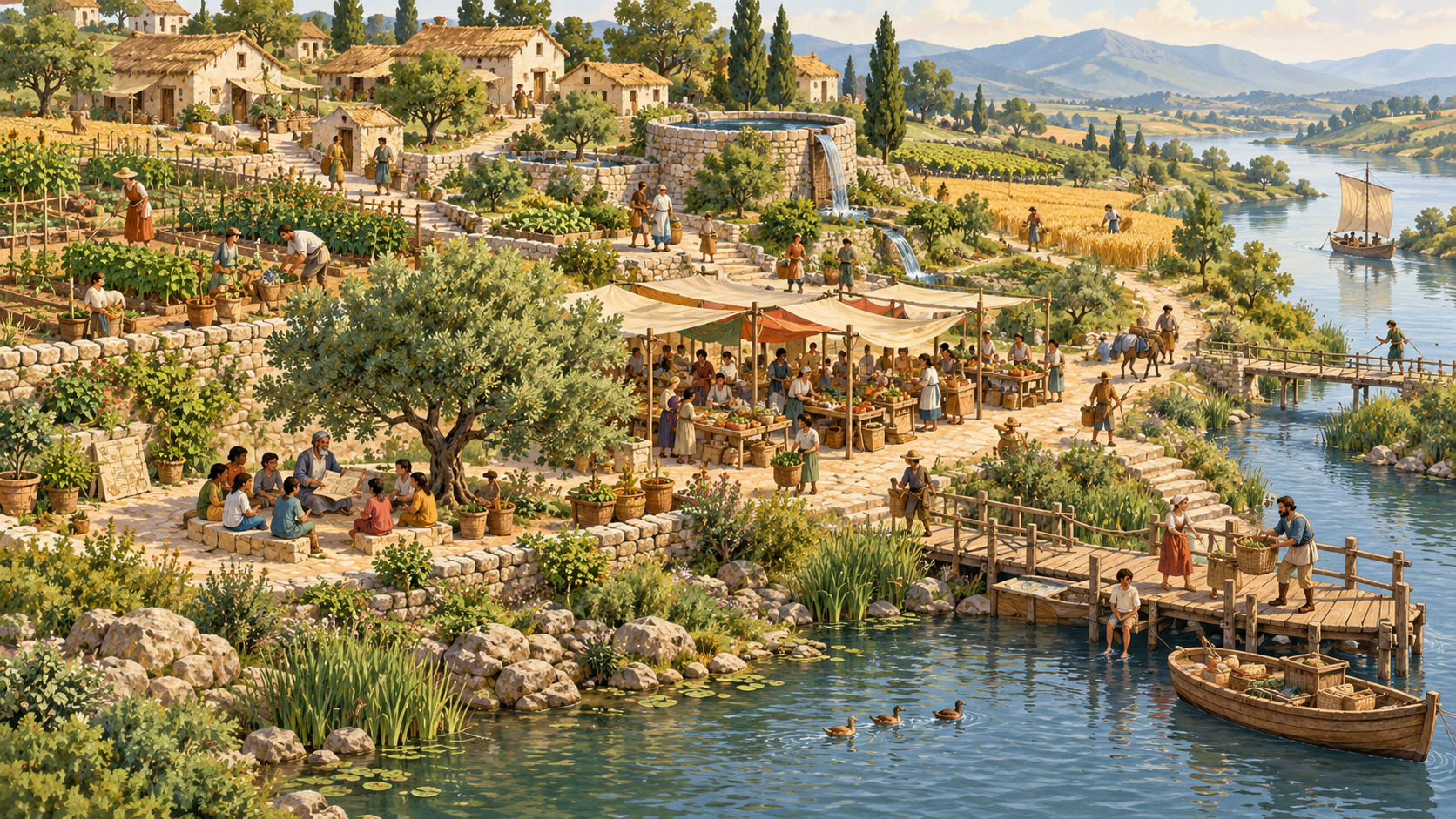
Series cover: AI-generated conceptual illustration of Riverbend, the starting community in these guides. It is not a literal depiction of every scenario, a historical reconstruction or an engineering plan.
Choose your next learning question
Follow a route into the expanded chapters, or choose a specific activity from the index.
Full chapter index
Chapters 1–8: Notice and imagine
- 1. Begin with something worth expressing
- 2. Look closely before deciding what a picture means
- 3. Let several meanings remain without making every reading equal
- 4. Build a visual sequence that makes the change intelligible
- 5. Change the viewpoint and discover a different story
- 6. Give a fictional voice choices beyond a single trait
- 7. Invent a world with relationships readers can follow
- 8. Let a symbol gain meaning from its surroundings
Chapters 9–16: Develop a creative voice
- 9. Choose names and titles that open the right questions
- 10. Compose rhythm with a supplied paper pattern
- 11. Represent movement through relationships between cards
- 12. Make something together without erasing different contributions
- 13. Revise through a reader's response while keeping artistic judgement
- 14. Compose a small shared work with room for another interpretation
- 15. Make a small work around a question worth exploring
- 16. Make alternatives before deciding which idea to develop
Chapters 17–24: Make and revise together
- 17. Use contrast to direct attention without prescribing a response
- 18. Arrange a sequence that changes what the audience knows
- 19. Let repetition create a relationship that can also change
- 20. Revise the work at the point where its purpose becomes clearer
- 21. Listen to audience interpretations without counting them as commands
- 22. Write dialogue in which each speaker has something to pursue
- 23. Rehearse a paper performance as a work in time
- 24. Collaborate through shared choices while preserving distinct voices
Chapters 25–32: Meet an audience
- 25. Adapt the encounter without pretending every form is identical
- 26. Exhibit work so that placement contributes to meaning
- 27. Support creative practice through materials, attention and reflection
- 28. Hand over a creative work with room for another encounter
- 29. Discover how one image can carry several shared meanings
- 30. Disagree about a story while continuing to read it closely
- 31. Credit the voices that help make a shared artwork
- 32. Revise an artwork without requiring every viewer to agree
Chapters 33–40: Practise and curate
- 33. Give feedback that opens a useful artistic question
- 34. Use interpretative evidence without pretending that art is a code
- 35. Let shared words and different voices shape a performance
- 36. Diagnose an artistic difficulty before changing the work
- 37. Teach looking and interpretation through the first two studio sessions
- 38. Teach feedback and artistic revision through two further sessions
- 39. Create a paper exhibition around an open question
- 40. Read visitor responses and make one meaningful exhibition revision
Riverbend's Story Studio opens with a paper square, a folded blue shape and an unfinished sentence: someone has left something here. One child makes the shape a boat waiting for its owner. Another makes it a message from a place that does not exist. A third sees an ordinary wrapper and writes a story about tidying the square. The same materials can begin different works because an artwork's purpose is not exhausted by identifying the object on the table.
The Studio is a fictional classroom setting. Children make paper pictures, invented stories, symbol cards and represented sound or movement patterns. They do not need to imitate a real artist, reveal a personal experience or supply claims about actual history. Parents and tutors can offer invented situations so a learner has room to explore an idea without being asked to turn private feelings into a public performance. The work may be serious, playful, puzzled or deliberately strange.
Begin by asking what the child wants the piece to invite another person to notice. Perhaps it is a small object overlooked in a busy place, the difference between waiting and being forgotten or the comic difficulty of carrying an enormous imaginary hat. The answer need not become a moral. A work can raise a question, hold a surprising image or explore a rhythm without delivering an approved lesson at the end.
Give three starting cards: a place, a change and a point of attention. A place might be Riverbend's paper square. A change might be that all its shadows point towards one door. The point of attention might be a character who notices the smallest shadow first. The learner can accept, combine or revise the cards. Their purpose is to create a workable beginning, not a test of whether a child can guess the adult's preferred story.
Explore the example
A useful first draft can take several forms. One child draws a single scene, another arranges three pictures and another dictates a few sentences beside a shape. Ask the maker to identify one choice they made: where the blue shape sits, which character appears, what the reader sees first or which word repeats. That choice gives discussion a concrete place to begin. General praise about talent is less informative than a question about how a particular choice contributes to the work.
Parents can model an imaginative response without claiming ownership of the interpretation. The folded shape makes me wonder whether someone will return is an invitation to conversation. It is different from announcing that the shape definitely means abandonment. The maker may have intended a joke or may discover a meaning they had not considered. The class can preserve that exchange while distinguishing the work, its maker's intention and the reader's response.
Try a small transformation. Keep the shape and place fixed, but change the title from Waiting to The First Visitor. Ask how the scene reads differently. No additional object has appeared, yet the title directs attention towards a different possibility. The learner can choose either version or retain both as an exploration. The activity makes artistic decisions visible without reducing art to a mechanical formula.
The Studio's opening page contains the work, one statement of intention and one genuine question from a reader. It need not contain a judgement of success. Riverbend's learners begin with expression as a set of choices that another person can encounter and question. The coming chapters will add sequence, viewpoint, voice, symbol and pattern, giving children more ways to shape something worth sharing rather than merely decorate a predetermined answer.
CHAPTER 2 OF 40 · Notice and imagine
2. Look closely before deciding what a picture means
A paper picture shows a small figure beside a large doorway. The figure faces away, one hand rests near the doorframe and a red rectangle lies on the ground. A reader says the character is frightened. Another says the character is about to welcome someone. The picture may support several interpretations, but the class first needs a careful account of what is actually shown. Observation gives interpretations something specific to rest on and something another reader can examine.
Ask learners to make two kinds of sentence. One names a visible feature: the figure is smaller than the doorway, the red shape lies below the hand or the face is not shown. The other offers an interpretation: the figure seems hesitant, the red shape might be a message or the doorway may lead to an unfamiliar place. The distinction does not make interpretation inferior. It helps readers show how they move from a feature to a possible meaning.
A parent can place the picture behind a paper window that reveals only one part at a time. First show the hand, then the doorway, then the rectangle. Ask what each added detail changes. A learner may reasonably revise an early guess. The exercise should not be staged as a trick proving that imagination is unreliable. It demonstrates how interpretation responds to what the work makes visible and what the reader initially assumes.
Give the maker a choice about the rectangle. If it becomes an envelope with a name, one set of story possibilities grows stronger. If it becomes a fallen stage ticket, another emerges. If it remains a plain rectangle, its ambiguity can be deliberate. Ask whether the ambiguity contributes to the intended experience. Not every unexplained mark needs clarification, but the maker can decide whether readers' uncertainty is useful or merely an accidental distraction.
Explore the example
Younger children can sort prepared sentences into seen, suggested and not supported by the supplied picture. The sentence the figure wears a red hat belongs in the last group if no hat appears. The sentence the figure may be waiting can remain an interpretation if its tentative wording fits the evidence. Older learners can write a short reading that quotes two visual features and explains why those features matter to their interpretation.
Now redraw the same arrangement with the figure much larger than the doorway. The scene may become comic, awkward or fantastical. The class should compare the actual drawings rather than assume that a large figure always means power or a small one always means weakness. Context, posture, title and surrounding details can change those relationships. An artistic convention can be useful without becoming a universal dictionary.
Invite two readers to disagree carefully. One explains that the turned face makes the figure seem uncertain; the other notices the steady hand and reads confidence. Each can acknowledge the other's cited feature while preserving a different interpretation. If one reader claims a detail that is absent, the group can correct that observation without declaring every difference of meaning a mistake.
Finish with a page divided into visible features and possible readings. The child chooses whether to revise the picture after seeing the page. Riverbend's Studio values close looking because it makes imaginative conversation more precise. A reader can respond freely while remaining answerable to the work, and a maker can learn which choices invite the intended question without being required to control every meaning another person may find.
CHAPTER 3 OF 40 · Notice and imagine
3. Let several meanings remain without making every reading equal
Riverbend's paper river carries a row of empty boats. One learner reads departure, another reads preparation for a celebration and a third imagines boats that carry dreams rather than people. The Studio does not need to choose one authorised feeling before anyone can discuss the picture. It does need a way to distinguish a reading connected to the work from a claim that ignores its supplied features or imports an invented fact as though observed.
Begin with a shared scene containing five boats, one mooring line and a figure holding a folded sheet. The title is Before the Crossing. Ask readers to propose interpretations and point to a feature that gives each a foothold. The mooring line might support waiting or restraint. The title might suggest anticipation. The folded sheet might be a map, a letter or simply an unresolved object. Readers should preserve those possibilities as possibilities unless the work supplies a more definite identification.
Now offer a statement that the scene shows a real Riverbend disaster from a particular historical year. The classroom has supplied no actual event or year. That statement is not merely another interpretation of mood; it makes an unsupported factual claim. Children can explain the difference without dismissing the emotional response of a reader who finds the scene sad. Feeling sad before a picture does not require pretending the picture documents a real event.
A practical activity gives three response cards for each interpretation: feature noticed, connection proposed and question remaining. A younger child might draw the line and say it keeps the boats close. An older learner might explain that the line can signify either belonging or constraint within this scene. The group can compare which details support the alternatives. The aim is thoughtful plurality, rather than a vote deciding which reader has the correct emotion.
Explore the example
Parents can ask the maker whether they want to add a clue. A tiny flag saying welcome would shift the work towards a public gathering. A torn map could introduce uncertainty about direction. Leaving the folded sheet unlabelled may preserve the question the maker prefers. Artistic revision can strengthen one reading or keep several alive. The child should be able to explain that choice without promising that every viewer will respond in the same way.
Try a title exchange. Present the unchanged image under Before the Crossing, The Boats Have Returned and A Place for One More. Readers describe the new possibilities each title opens. The exercise does not prove that titles dictate meaning. It shows that a title becomes part of the context through which a reader encounters the image. The maker can compare versions and decide whether the words narrow the scene too far or provide the invitation it needs.
Older learners can examine a disagreement about tone. A playful reader sees a tiny boat tilted at an odd angle, while another focuses on the solitary figure. Both details appear. A strong response can acknowledge the competing emphasis: the tilted boat makes the scene comic to me, although the figure's separation also suggests waiting. Such a sentence is more useful than insisting that all readings are equally supported or that only the maker's initial intention matters.
The chapter closes with two interpretations placed beside the same work, each naming its evidence and its limit. Riverbend's learners can keep a work open without abandoning careful reading. Shared meaning need not be perfect agreement. It can be a conversation in which people recognise what they are responding to, explain the path from feature to interpretation and remain willing to revise a claim that the work does not actually support.
CHAPTER 4 OF 40 · Notice and imagine
4. Build a visual sequence that makes the change intelligible
The Studio receives four paper scenes: a child finds a blue envelope, an empty square, a crowd beside a door and a hand placing a small card on a table. Several sequences are possible. The order can turn the envelope into an invitation, a clue or the last trace of a gathering. Learners now compose visual stories by deciding what changes between images and which connection the reader is invited to make.
Start with three panels rather than a long storyboard. Panel one establishes a situation, panel two changes something and panel three offers a consequence or a new question. This is one useful classroom scaffold, not a rule governing every story. A learner may deliberately repeat a moment, begin with a consequence or leave the ending open. The scaffold helps make those departures purposeful rather than requiring every narrative to end with a tidy resolution.
Give children two versions of a simple sequence. In one, a character holds an envelope, opens it and walks towards the square. In another, the character walks away from the square, finds the envelope and opens it. The objects are almost identical, but the chronology invites different explanations. Ask readers what they know from the panels and which links they are supplying themselves. An image of an opened envelope does not establish its contents unless another feature supplies them.
A parent can remove the middle panel and ask what becomes difficult to understand. The learner may add a connecting image or decide that the gap creates useful curiosity. The question is whether the intended reader can follow the relevant change, not whether every action appears. A sequence that shows every footstep may become cumbersome, while a sequence that hides the crucial discovery may lose the relationship the maker wanted to share.
Explore the example
For a small numerical exploration, prepare four distinct panel cards. There are four choices for the first position, three for the next, two for the third and one for the last, giving twenty-four possible orders if every card appears once. The class does not need to inspect all twenty-four. Choose three contrasting arrangements and explain how they alter the story. Counting possibilities can reveal the room for creative choice without turning the activity into a race to generate every permutation.
Now explore rhythm through panel size. Give a large panel to the quiet discovery and smaller panels to a busy sequence of arrivals. A reader may spend attention differently, but the maker should test the actual page rather than assume a precise reading time from area. Panel size is an expressive choice in this exercise, not a clock that guarantees how long every viewer will look.
Older learners can write captions that repeat, contradict or add to the images. A caption saying nothing happened beside a crowded scene might create irony if the contrast is intended and understandable. A caption that supplies a missing location can support orientation. The child should inspect whether the words do useful work or merely describe everything already visible. Different choices can be effective for different purposes.
Finish with a reader retelling the sequence without being prompted by the maker. The retelling reveals which relationships travelled and which were supplied through guesswork. The maker can revise one transition while preserving an open ending. Riverbend's visual stories now have more than a collection of attractive scenes: they contain chosen changes and gaps that invite a reader to participate in constructing the story.
| Studio note | Question |
|---|---|
| Observation | What feature can another viewer locate? |
| Interpretation | How does that feature support the suggested meaning? |
| Alternative | What other reading could the same feature support? |
CHAPTER 5 OF 40 · Notice and imagine
5. Change the viewpoint and discover a different story
Riverbend's square looks crowded from the tower drawn on one page and almost empty from behind a market screen on another. The scene's supplied events have not changed, but the reader's access to them has. Viewpoint determines what a work makes available, what it conceals and which details appear important. Learners explore that choice through invented characters and paper windows, without claiming to know every person's actual experience of a place.
Prepare one shared event sheet. A story card falls from a table, two characters notice it, one picks it up and another keeps arranging paper flags. Now assign different viewpoints. Neri sees the card fall but leaves before it is picked up. Sol sees the pickup but not the fall. The flag arranger sees neither. Each can tell a limited account. The child should not give a narrator knowledge beyond the supplied viewpoint unless the story clearly changes its narrative convention.
Ask a learner to write the scene from Neri's position. The story may contain a question about what happens to the card after departure. Sol's version may begin with a character holding a card and wondering who dropped it. The flag arranger's version can focus on a pattern gradually covering the table. These are different stories built from a shared event, not evidence that one character necessarily lies because their account omits something they could not observe.
Parents can make a paper viewing frame and move it across a larger drawing. At each position, ask what enters and leaves the reader's knowledge. A close view of a hand may create suspense about the object it holds. A wide view may show a second character that changes the interpretation. The maker can choose the frame that suits the question, rather than assuming that the widest picture always provides the best artistic experience.
Explore the example
Now change narrative distance. A first-person voice can say I thought the card was mine, identifying a character's belief. A more distant narrator can state that the card carries another name, if the chosen story convention gives that narrator the information. The class should distinguish what a character believes from what the narrative establishes. That distinction creates possibilities for misunderstanding, humour and discovery within fiction.
A practical exercise asks groups to make two panels from different positions around the same paper scene. Each group lists one visible detail, one hidden detail and one interpretation its frame encourages. Another group reconstructs the event from both panels and names anything still unresolved. The activity gives viewpoint a concrete form while leaving room for the maker's expressive choices about scale, angle and emphasis.
Older learners can inspect an unfairly simplified character. If one narrator describes another only as the person in the way, the child can try a second viewpoint that gives the other a purpose. This does not require every fictional character to receive equal space in every story. It offers a revision tool when a work unintentionally reduces someone to a convenient obstacle and the maker wants a more developed scene.
The chapter ends with two short versions that retain the same event facts but differ in attention and knowledge. Riverbend's learners can now explain why viewpoint matters beyond changing pronouns. A story gives the reader a position from which to notice, infer and care. Choosing that position deliberately allows a child to make a richer work while remaining clear about whose knowledge and interpretation a particular sentence expresses.
CHAPTER 6 OF 40 · Notice and imagine
6. Give a fictional voice choices beyond a single trait
The Studio's first character speaks only in complaints. Another is always wise, and a third exists only to make mistakes. The stories become more interesting when each voice gains a purpose, a way of noticing and something it does not yet understand. Learners now develop fictional voices through choices in wording and attention, without borrowing stereotypes about real groups or demanding that children perform identities from their own lives.
Begin with three neutral character cards. One wants to find the maker of a folded bird. One wants to finish a pattern before the square fills. One wants to ask a question but keeps rewriting it. Give each an ordinary strength and a limitation relevant to the scene. The pattern maker may notice repeated shapes while overlooking a person waiting to speak. The careful questioner may choose precise words while delaying the moment of asking. Neither trait needs to define the character forever.
Ask children to write the same request in three voices: please leave a space on the table. One character may ask directly, another explain the reason and another turn it into a playful image. The voices should differ through purposeful language rather than spelling that mocks a real accent. A younger learner can choose between prepared sentences; an older learner can compose their own and explain what the wording suggests about the speaker's current intention.
Parents can use dialogue cards with a blank response. The first speaker says there is no room left. The second might move a paper object, ask what the space is needed for or misunderstand room as a building. Each response creates a different scene. The child can explore comic misunderstanding without making a character incapable in every context. Give that character a later opportunity to notice something another voice misses.
Explore the example
A voice also includes what a character does not say. A short pause card between two lines may represent hesitation, attention or a decision to let someone else speak. The work needs enough context for the intended reading, but it need not explain every silence. Ask whether the surrounding words and actions support the possibility the maker wants to invite. A reader's uncertainty can be part of the scene when it is chosen rather than accidental.
Try a dialogue revision that removes identifying names. Can a reader distinguish the speakers through their concerns and sentence choices? If not, the child can add a characteristic question, recurring image or pattern of response. Avoid requiring every voice to become exaggerated. Two characters may speak similarly while remaining distinct through what each wants and knows. The test is a prompt for artistic attention, not a rule that realistic voices must all sound dramatically different.
Older learners can write a character changing their mind. The first line claims the square is only useful for quiet work. A later line, after a supplied scene, recognises a place for storytelling too. The change should have a visible connection to the experience rather than appear solely because the adult expects a moral. A character can also retain a preference while understanding another purpose more clearly.
Finish with a short scene containing at least two voices, an action and a meaningful response. Readers identify one place where wording changes their understanding of a character. Riverbend's Studio now has voices that contribute different forms of attention. Shared meaning grows through their interaction, including misunderstanding and revision, rather than through a cast arranged only to announce the maker's conclusion in slightly different sentences.
CHAPTER 7 OF 40 · Notice and imagine
7. Invent a world with relationships readers can follow
Riverbend's young makers imagine a square where every spoken question becomes a paper door. Another world has shadows that arrive before their owners. A third contains a river that carries forgotten names back to the shore. None needs to be plausible as an actual place. An imagined world can invite curiosity when its chosen relationships are clear enough for readers to notice consequences, while retaining mystery where the maker wants it.
Start with one unusual rule and an ordinary character purpose. In the question-door world, Neri wants to find a lost story card. Each genuine question creates a door, but repeating the same question creates the same door. This is a fictional narrative rule, not a claim about language or reality. It gives the child a way to invent obstacles and choices without adding a new unexplained power whenever the story becomes difficult.
Ask the learner to explore consequences on paper. If Neri asks where is the card and receives a door, what happens on the other side? The maker can decide, but should keep the chosen rule consistent unless the story makes its change meaningful. If every door automatically solves the problem, the child may prefer a different challenge, such as choosing which question to ask or discovering that a door reveals only one viewpoint.
Parents can offer three possible complications. A character asks a question they do not want answered. Two people ask related questions and receive doors into different parts of the same scene. A silent character makes a door through a drawn question. The learner selects one and explains whether it fits the world's established rule or requires a clearly introduced extension. Imagination remains open, while the reader receives enough support to follow the change.
Explore the example
A practical activity makes a world page with an ordinary place, one altered relationship and three examples of its operation. The page may also name one thing the story deliberately leaves unexplained. The class should not turn it into a huge technical manual. A few well-chosen examples can carry more narrative meaning than a list of laws that never affect a character's experience.
Now introduce a contradiction on purpose. A repeated question creates a different door despite the earlier rule. The child can treat this as an error to revise or as a story event requiring attention. Perhaps someone changed a word, the questioner understands the question differently or the world itself is changing. Each possibility creates a different narrative. The important point is that the break should matter to the work rather than pass unnoticed because the maker needed an easy escape.
Older learners can connect an imagined rule with a theme without claiming a single compulsory meaning. Doors made from questions might invite thoughts about curiosity, access or the cost of certainty. The maker can encourage one reading through scenes and choices. A reader can offer another if it connects with the work. Neither needs to convert the fiction into a statement that actual questions literally create opportunities in every circumstance.
End with a scene showing a character use, misunderstand or challenge the invented relationship. The world becomes more than an unusual backdrop when its possibilities shape action. Riverbend's Story Studio gives children room to make the impossible coherent enough to share, preserving the difference between a fictional rule that serves a work and a real-world claim that would need a different kind of evidence.
CHAPTER 8 OF 40 · Notice and imagine
8. Let a symbol gain meaning from its surroundings
The Story Studio places the same drawn circle in three scenes. In the first it lies beside a character's hand. In the second it floats above a doorway. In the third a row of circles forms a path across the square. Readers may imagine a coin, a moon, a mark or something else. The circle does not arrive with one universal meaning. Learners explore how a work supplies context that makes a symbol useful while leaving room for interpretation.
Begin with a distinction between a symbol key and an artistic association. A tabletop map can explicitly define a circle as an operating story desk. A picture can place a circle near a character's lost object and invite a less fixed association. Both are legitimate choices, but they do different work. The child should not claim that every reader must interpret a circle as belonging, hope or money because one classroom picture used it that way.
Give each learner one simple mark and three setting cards: a crowded table, an empty window and a procession of paper figures. The task is to incorporate the mark into each scene without changing its basic shape. Ask another reader what relationships the surrounding details suggest. The maker can compare the responses and decide which context best serves the intended question. The activity treats interpretation as evidence about these encounters, not a catalogue of what the mark always means.
Parents can introduce colour as another choice with context. A blue shape may connect to the river because the picture labels that river blue in this work. A red rectangle may stand out from a grey arrangement because the maker deliberately contrasts it. Neither example establishes a universal emotion attached to a colour. Ask what the actual page makes noticeable and what the reader brings from their own associations.
Explore the example
A repeating symbol can change across a story. The folded bird first appears as a gift, later as a clue and finally as something the character chooses to remake. Its recurring shape connects the scenes while its role develops. The child can use three panels and a short caption to show what remains and what changes. A symbol becomes richer when the story gives it relationships, rather than requiring a label that declares a single abstract meaning.
Try a symbol substitution. Replace the folded bird with a plain square in the same sequence. What is lost, altered or surprisingly preserved? A reader might still follow the exchange while losing the connection to making and flight imagined in the original. Another reader may prefer the square's uncertainty. The class can discuss these possibilities without pretending that every response proves the maker's intention succeeded or failed.
Older learners can inspect a symbol used by different fictional groups. In the invented Story Circle, a spiral means a story still open. In the invented Map Club, the same spiral marks a proposed path. A collaborative display should explain the difference or choose a shared local convention for that work. The scenario does not claim that either symbol has those meanings outside the fiction. Context should travel with the mark when a misunderstanding would undermine the intended experience.
Finish with a symbol note attached to a finished scene. It names the supplied convention, if any, and describes one association the maker hoped to invite. A reader adds a different supported possibility. Riverbend's learners can now use symbols boldly without turning them into a rigid dictionary. Shared meaning can emerge from recognisable choices and open conversation, with enough context to prevent a local artistic decision from masquerading as a universal rule.
CHAPTER 9 OF 40 · Develop a creative voice
9. Choose names and titles that open the right questions
A Studio picture shows a long paper bridge ending at a closed gate. Its first title is Bridge. A child changes it to The Last Invitation. Another suggests Not Yet. The image remains unchanged, but the titles direct attention towards different relationships. Naming is an artistic choice that can orient, surprise, complicate or deliberately withhold information. Learners now explore titles without assuming that the most dramatic phrase is always the most useful one.
Begin with three kinds of title for one supplied image. A descriptive title names what appears, such as Bridge and Gate. A narrative title suggests an event, such as The Visitor Arrives. An open title raises a question, such as Beyond This Point. These categories are teaching prompts rather than rules that every title must obey. A phrase can do several things at once, and the child may invent a different approach.
Parents can hide the title while a reader describes the picture, then reveal one version. Ask which interpretation changed and which features remained visible. The title becomes part of the work's context; it does not erase the image. If a title says A Warm Welcome while the supplied scene shows a barrier and a waiting figure, the contrast may create irony, confusion or a new question. The maker should inspect whether that relationship is intentional and sufficiently supported.
A practical naming exercise uses six slips, each carrying a possible title. Learners pair one image with three alternatives and write a short opening sentence under each. The sentence should grow from the title-image relationship rather than invent an unrelated adventure. A younger child can dictate the line. An older learner can compare whether the title adds information, repeats the obvious or places too much explanation before the reader has encountered the scene.
Explore the example
Names inside a fictional world also shape the reader's expectations. A place called the Listening Steps suggests an activity, while Number Four Gate offers a different texture. The story should still show what people do there. Calling a place kind does not establish that every fictional character experiences kindness within it. The child can explore a deliberate gap between a place's public name and a character's encounter, provided the work gives the reader a way to notice that gap.
Now give a character the opportunity to rename an object. Neri calls the folded bird a map because its creases resemble paths. Sol calls it a promise because it was left on the table for someone else. These are character interpretations, not corrections to an objective label. A scene can let the names coexist or make the disagreement part of the action. The maker can distinguish a name used for identification from a name used to express a relationship.
Older learners can inspect a title that claims a factual authority the work does not have. The True History of Riverbend would need clear fictional framing if attached to an invented scene. A title can play with certainty inside a story, but the classroom presentation should not mislead readers into thinking the project documents real history. The work's imaginative freedom remains strong when its relationship to the real world is honestly identified.
End by choosing a title and explaining one alternative rejected for an artistic reason. The explanation might say that the rejected title revealed the ending too soon or narrowed the bridge to a single reading. Riverbend's learners gain a tool that is small on the page but substantial in effect. A title can invite a shared question while leaving the reader enough room to enter the work rather than encounter its entire interpretation before the first image.
CHAPTER 10 OF 40 · Develop a creative voice
10. Compose rhythm with a supplied paper pattern
The Story Studio lays twelve equal boxes in a row. Some contain a drawn circle and others remain empty. Under this chapter's invented score convention, a circle represents one sound event at the start of a box and an empty box represents no event there. Each box occupies one equal model beat. Children can read and rearrange the paper pattern without making any actual sound. The exercise explores artistic pattern rather than claiming a particular rhythm causes a particular feeling.
Begin with the four-box pattern event, empty, event, event. Repeating it three times fills twelve boxes. The pattern contains three events per four-beat unit, so the full row contains nine sound events across twelve model beats. Nine is an event count; twelve is a duration measured in beat boxes. An event at the start of the last box does not automatically last until the row's end. Duration of a sound would require a separate convention.
Now compare a pattern with three events followed by one empty box. It also repeats to nine events across twelve beats. Its event placement differs from the first despite matching totals. Ask learners to mark the gaps between events and describe what repeats. The class need not assign an emotion to either pattern. A reader can prefer one or imagine a scene for it, while acknowledging that the preference is a response to this particular arrangement.
Parents can offer two symbol types. A circle stands for one supplied kind of imaginary sound and a square for another. The key can call them tap and hum as fictional score labels, without requiring children to perform them or hold a sound. Learners arrange the symbols in equal boxes and describe the contrast they intend. If a square represents an event rather than a sustained duration, the key should say so to prevent conflicting readings of the score.
Explore the example
A practical composition task gives the child eight beat boxes and asks for a repeated four-box motif with one deliberate change in the second repetition. The maker points to the repeated relationship and the changed position. Another learner identifies the change from the score alone. This is an interpretation check for the supplied paper convention, not evidence about musical ability or a claim that repetition has one universal effect on listeners.
Try pairing a pattern with a visual sequence. A character crosses a square while circles appear in alternate boxes; at the doorway, the pattern changes. The child can choose whether the change marks surprise, a new speaker or simply formal contrast. Words or images should provide any story connection the maker wants readers to recover. The rhythm pattern does not automatically supply a narrative meaning by itself.
Older learners can add a second row whose events occur simultaneously with the first. If row A has events in boxes one, three and five, and row B in three, four and six, there are six events but only five occupied beat positions: one, three, four, five and six. Box three contains two simultaneous events. Counting events differs from counting positions, just as artistic texture differs from a bare total.
Finish with a small score, a readable key and one sentence about the composer's choice. A reader can propose a different scene the pattern might accompany. Riverbend's Studio has gained an expressive form in which silence, repetition, contrast and layering can be represented on paper. The mathematics clarifies what is arranged, while the artistic conversation remains open about what someone may hear in imagination or connect with the chosen pattern.
CHAPTER 11 OF 40 · Develop a creative voice
11. Represent movement through relationships between cards
A paper character appears in three poses: facing the square, turning towards a door and holding a folded bird above the table. The Studio does not require children to perform the actions. They can arrange pose cards, direction marks and scene panels to represent movement. This gives learners another way to compose change while keeping the activity within a tabletop model and avoiding assumptions about what real bodies should be able to do.
Begin with three questions: what changes position, what stays in place and what marks the sequence? A hand may move while the character's home position remains fixed. A figure may change its relation to a doorway without crossing the whole page. The child can show these differences through repeated outlines, arrows or separate panels. The chosen convention should be explained where a reader needs it, rather than treated as an obvious universal sign language.
Give a learner four cards showing a figure beside, behind, within and beyond a drawn arch. Ask for two sequences with different story possibilities. Moving from behind to within to beyond can suggest emergence. Beginning beyond and returning behind can suggest retreat, a game or another interpretation depending on context. The positional sequence alone does not establish a character's feeling. A title, object or accompanying voice can strengthen the connection the maker wants to invite.
Parents can use a paper stage with removable figures. One learner arranges three still scenes and another describes the implied movement. If the reader imagines an extra action, ask whether the panels support it or whether a connecting card would help. The maker may preserve the gap deliberately. Movement represented through still images often depends on what the reader supplies between them, and that participation can be part of the work.
Explore the example
Now explore stillness as a choice. Repeat the same figure position across three panels while the surrounding crowd changes. The figure's unmoving relation to the table can become noticeable through contrast. A child might intend patient waiting, careful attention or comic stubbornness. The class should discuss the actual details rather than claim that stillness always means calm or that movement always means excitement.
A practical duet places two figures on separate rows. Under the supplied score rule, cards in the same column represent simultaneous model moments. Figure A turns towards the door in column two while Figure B places the bird on the table. A reader can trace each row separately and then compare the relationship. If the maker instead wants one action to precede the other, they need different columns or a clear sequence cue. The arrangement makes timing part of artistic composition without needing a real performance.
Older learners can compare movement shown from outside with a character's narrated account. A caption saying I stayed where I was may accompany panels in which the surrounding scenery changes. The contrast might indicate that the character's place stayed constant while their understanding changed, or that the narrator overlooks a movement. The work should provide enough context for its chosen ambiguity. Readers can propose possibilities rather than demand that the image and words always report identical information.
End with a short movement sequence containing one repeated relation and one meaningful change. The maker identifies the convention and the expressive choice, while a reader describes what they infer. Riverbend's learners now have a way to create action, pause and interaction through accessible paper materials. The art lies in the relationships the cards establish and the questions they invite, not in requiring every child to enact the same physical movement.
CHAPTER 12 OF 40 · Develop a creative voice
12. Make something together without erasing different contributions
Three Story Studio learners want to make a scene together. One prefers a mysterious doorway, another wants a comic bird and a third wants the square's quiet corner to matter. A shared work need not give every idea equal space, but it should have a way to recognise choices and discuss disagreements. Children now practise collaborative authorship through an invented project whose voices remain visible in the process and coherent enough for a reader to follow.
Start with a shared question rather than a demand for a unanimous style. The group might ask what happens when a folded bird arrives at a door nobody remembers opening. Each maker contributes one proposal in a different form: a sketch, a line of dialogue or a sequence of actions. The proposals are not automatically included in the final work. They become material for a conversation about purpose, tone and relationship.
A useful collaboration exercise gives each learner a paper window onto the same scene. One frames the bird, one the door and one the person watching from the corner. Place the views together and ask what story the combination suggests. The group may keep the different viewpoints instead of redrawing everything into one identical style. Consistency can come from a repeated object, a shared sequence or a connected question, rather than uniform appearance across every panel.
Parents can model a specific response to disagreement. I want the bird to speak because it would change what the doorway means explains a proposal. My idea is better announces a ranking without helping another maker understand the choice. Ask children to identify what they want to preserve and what they can change. A learner may keep the comic tone while accepting a different line, or keep the quiet observer while moving their appearance to the final panel.
Explore the example
Now introduce an idea that does not fit the shared work: a sudden race through an unrelated city. The group can explore whether a connection exists or set the idea aside for another piece. Declining an idea need not become a judgement about its maker. A small rejected-ideas page can preserve a possibility without forcing it into a story where it distracts from the chosen question. The class should not demand endless revision from the person whose contribution was set aside.
A practical method alternates making and reading. One learner adds a panel, another responds with a line and a third arranges the next relation. At a pause point, all three read the sequence as an audience would. They can revise earlier choices together rather than let the last maker decide every meaning. Keep the task short enough that children can notice how their contributions interact instead of becoming preoccupied with managing a large production.
Older learners can write a credit note that describes contributions accurately: scene design, dialogue, sequence arrangement or revision reading. The note should not invent equal quantities of work merely to look fair, nor become a competitive ranking. Its purpose is to let another reader recognise how the work was made. This is a classroom authorship account, not a lesson about real contractual or publication rights.
Finish with the shared piece and a short account of one decision the group changed. Readers can ask how the change affected the work rather than who won the argument. Riverbend's Studio now treats collaboration as composition across people: different forms of attention meet, shape one another and leave an artwork that none of the starting proposals fully contained. Shared meaning can preserve difference while giving the reader enough connection to encounter the work as a whole.
| Choice | Question for the maker |
|---|---|
| Viewpoint | Whose experience does the scene make visible? |
| Sequence | What changes when the order changes? |
| Repetition | Which relationship does the pattern invite us to notice? |
| Context | What information helps a viewer interpret the work? |
Extend this learning question through How Education Works.
CHAPTER 13 OF 40 · Develop a creative voice
13. Revise through a reader's response while keeping artistic judgement
A reader looks at the Studio's doorway story and says the ending surprised them. Another says they could not tell who placed the bird on the table. A third asks for a brighter background. These responses contribute different information. The maker does not need to obey every suggestion, but can examine what each reveals about the encounter between work and reader. Revision is an artistic decision informed by response, rather than a vote transferring authorship to the loudest viewer.
Begin by separating description of response from instruction. I thought the bird belonged to Neri reports a reading. Make the bird larger proposes a change. The second may be useful, but it does not explain why the change matters. A parent can ask the reader to connect the proposal to a feature or difficulty. Perhaps the bird was hard to identify in a crowded panel, or perhaps the reader simply prefers larger objects. Those are different reasons for the maker to consider.
A practical feedback page contains three prompts: what I noticed, what I wondered and where I lost a connection. None asks whether the child is talented. A learner can respond through a sketch or a short dictated sentence. The maker chooses one issue to investigate and explains the reason. Keeping the task bounded prevents revision from becoming an attempt to satisfy every possible preference at once.
Try two alternative revisions of one panel. Version A adds a hand placing the bird; Version B changes only the caption to identify the action. Readers explain what each makes clearer and what artistic quality it alters. A visible hand may connect the event more directly, while a caption may preserve a wider view. The class should compare the actual versions rather than assume images are always better than words or that explanation always ruins mystery.
Explore the example
Parents can protect a deliberate open ending. If a reader asks who finally opens the door, the maker may decide that uncertainty belongs to the piece. They should still inspect whether the earlier action is intelligible enough for the question to feel meaningful. An open ending differs from a missing connection the maker never intended. Both can produce a reader's question, so the artist must judge what kind of question their work has created.
A small supplied response set can support discussion without turning popularity into artistic quality. Six fictional reader cards encounter the original sequence. Four identify the intended action and two are uncertain. After a clearer transition, five of six identify it and one remains uncertain in a separate supplied check. That change concerns recognition of a specified action. It does not establish that the revised piece is more beautiful, moving or valuable in every respect, and the reader groups or conditions may differ.
Older learners can keep an earlier version alongside the revision and write a short artistic note. It might explain that the revised hand clarifies the exchange but makes the scene less mysterious, a trade-off the maker accepts. Another learner may choose the earlier version for a different purpose. A reasoned choice can acknowledge a cost without treating it as proof the revision failed.
Finish with a revised piece and one sentence beginning I changed this because. Another sentence can explain something deliberately retained despite a suggestion. Riverbend's learners can now use feedback without surrendering judgement. The Studio's conversation becomes more useful when readers describe their encounters carefully and makers connect revisions with the experience they hope the work will invite, rather than chase approval through an endless series of unrelated alterations.
CHAPTER 14 OF 40 · Develop a creative voice
14. Compose a small shared work with room for another interpretation
The opening Story Studio project ends with a compact work called One More Place at the Table. The title is a starting invitation, and learners may replace it if their work develops another question. The piece brings together an image sequence, at least two fictional voices and one chosen pattern or repeated symbol. It need not use every technique from the earlier chapters. The purpose is to make artistic choices connect, rather than produce a checklist disguised as a story.
Offer a fresh scene brief. A table in Riverbend's paper square holds three folded shapes. A fourth character arrives carrying an object that does not match them. No supplied card states whether the arrival is welcome, awkward, comic or mysterious. The learner chooses the relationships and gives the reader clues through viewpoint, wording and arrangement. The scene does not represent a real community event or require a moral about how actual people must behave.
Begin with a single image that establishes what matters. A wide view might show available space around the table. A close view might show the unmatched object touching one familiar shape. Ask the child what the chosen frame lets a reader notice and what it leaves hidden. The next image should change a relationship, not merely add decorative detail. A hand moves, a character speaks or a pattern breaks in a way the maker wants the reader to consider.
Develop two voices with different concerns. One might want the arrangement to remain symmetrical; another might be curious about the new object's story. Neither needs to be the villain. A dialogue can let both purposes remain understandable while the scene changes. Parents can offer a response card that asks what each character notices first. This often provides a stronger basis for distinct voices than assigning one character kindness and the other a permanent flaw.
Explore the example
Choose a formal connection across the piece. A circle might recur beside each invitation, with its context explained by the scenes. A four-box rhythm pattern might appear below the panels and change at the arrival. A repeated sentence might acquire a different meaning when another character says it. The child should be able to point to the connection and describe the choice, without claiming that every reader must receive the same emotion from it.
The final panel can resolve the practical action while leaving interpretation open. The unmatched object might receive a place, remain in the visitor's hand or transform into a new table in an imagined world. A reader should be able to follow the supplied action even if its meaning remains plural. The maker can test the sequence with another learner who first describes visible changes and then offers a possible reading. Any factual correction should be distinguished from a different response to the work.
Prepare a short sharing page with the title, fictional frame and an invitation to respond. Ask readers what detail stayed with them and what question the piece opened. A child may choose not to explain a private association; the work can stand through its invented scene. The adult should not infer hidden personal experiences from the story or use its imagery to diagnose the maker's feelings.
Keep the finished work beside one earlier sketch and a note about a meaningful revision. Riverbend's learners have created something another person can encounter without needing the entire making process explained. Their opening Studio portfolio shows expression, interpretation and shared attention in action. The work remains available for new readings because its choices are visible, its fictional claims are clear and its maker has left room for an audience to contribute a thoughtful response rather than repeat a single authorised meaning.
CHAPTER 15 OF 40 · Develop a creative voice
15. Make a small work around a question worth exploring
Riverbend's fictional Story Studio gives a child six blank paper panels and a question: what might a neighbourhood notice when a familiar gathering place becomes quiet? The child does not need to explain a real event or disclose a personal experience. They can invent a square, a missing song, a curious visitor or an ordinary object that seems different. The question opens a creative possibility rather than specifying the correct moral of the finished work.
Begin by naming what the maker wants to explore. A learner might choose curiosity, loneliness, relief or the discovery of an overlooked sound. These are possible intentions within the exercise, not emotions that every viewer must experience. Ask the child to choose one question they would like a viewer to carry into the story. What happened here invites a different arrangement from why does the visitor choose to stay? The work may change direction during making, but the initial question gives the child something concrete to revise.
Offer a six-panel example plan without completing its content. The first panel establishes the square, the second introduces a change, the third notices a detail, the fourth offers a possible explanation, the fifth complicates that explanation and the sixth leaves a response or further question. These functions are a supplied studio scaffold, not a universal rule for storytelling. A learner may combine, replace or reject them if they can explain the different experience they are trying to create.
The six panels each contain four invented drawing cells, giving twenty-four cells of available paper space. If the child uses two panels for establishing the setting, that occupies eight cells and leaves sixteen across the other four panels. The calculation describes the template, not the amount of artistic value in each section. A small image may carry a central idea, while a large background may establish atmosphere. Children should resist turning the space count into a rule that every idea deserves equal area.
Explore the example
A parent can sit beside the learner as a curious reader. Instead of asking whether the picture is good, ask where attention should go first and what remains uncertain. The child can point to a doorway, an empty seat or a repeated mark. If the explanation depends entirely on oral commentary, decide whether that spoken contribution belongs to the intended work. A narrated picture and a picture meant to stand alone are different forms, and either can be a deliberate choice.
Leave room for discovery during making. The child may draw a tiny paper bird on an empty chair and realise that it changes the story's direction. They can keep that discovery, revise the original question or return to the earlier plan. The tutor should help distinguish a chosen change from a distraction imposed by someone else. A studio plan supports attention without becoming a demand that the first idea remain untouched.
At the end of the session, ask the maker to give the work a provisional title and write one sentence beginning I am exploring. A second sentence can name a question still open. These notes are not labels telling every viewer what to think. They preserve the maker's present intention so that later interpretation and revision have something to converse with. The Story Studio begins with a work small enough to make, rich enough to question and open enough for a learner's own choices to matter.
CHAPTER 16 OF 40 · Develop a creative voice
16. Make alternatives before deciding which idea to develop
An early idea can feel inevitable once it fills the page. Riverbend's Story Studio offers a short alternative-making activity before a child commits to a large paper scene. The fictional brief asks for an image of arrival at an unfamiliar workshop. A doorway, a waiting object, a pair of shadows or a map fragment could introduce that arrival differently. Children explore possibilities without needing to declare one universally best.
Give the learner three small rectangles. In the first, place the imagined visitor close to the workshop entrance. In the second, show only what the visitor sees through the doorway. In the third, leave the visitor outside the frame and show objects responding to an arrival. The content can remain simple marks. The purpose is to compare viewpoints and questions, not to produce three polished drawings that exhaust the learner before the chosen work begins.
Use a supplied effort plan for the studio exercise. Each rough alternative receives three model making minutes and one minute for a note about its intended effect. Three alternatives therefore occupy twelve minutes. A five-minute comparison brings the complete activity to seventeen. These are chosen classroom intervals, not claims about how long creative thought should take. A learner may continue a promising question later rather than treat the end of the interval as evidence that imagination has been completed.
Ask what each version lets the audience know. A close visitor may invite attention to a gesture, while an empty frame may leave the identity uncertain. The child should point to the actual marks that support the explanation. Calling an image mysterious does not establish that its intended uncertainty is visible. Another learner can describe what they notice before hearing the maker's intention, providing a useful comparison without claiming to speak for every future viewer.
Explore the example
A parent can introduce one changed condition: the work will appear as a small picture on a paper invitation rather than a large tabletop scene. Ask which alternative retains a readable relationship at that scale under the supplied template. Do not assume that more detail always helps. The child can make a small copy of one version and inspect which marks remain distinct, treating the copy as evidence about this example rather than a rule for all visual art.
Alternatives can share material. The doorway drawn for one rough may become part of another, while the visitor's gesture is changed. Preserve the initial sketches long enough to compare the choices. They are records of thinking, not failed artworks that must be hidden. A learner can say that an unchosen version has a useful question but does not serve the present brief as well. This keeps evaluation tied to purpose instead of turning selection into a claim that the discarded idea has no value.
The studio ends with a choice and a reason that names a feature. I chose the view through the doorway because the half-seen table makes me wonder who is already inside is more informative than I liked it most. Personal preference can remain part of the choice, but a concrete explanation helps another learner discuss it. Developing one alternative then becomes a deliberate act of authorship, supported by possibilities that were genuinely examined rather than by a list of options invented afterwards to make the decision look thoughtful.
CHAPTER 17 OF 40 · Make and revise together
17. Use contrast to direct attention without prescribing a response
Riverbend's fictional market-square collage begins with a page full of equally busy marks. A learner wants the audience to notice a small open doorway, but the doorway disappears among the other shapes. The Story Studio explores contrast as a supplied set of choices about difference. In this exercise, children can vary filled and unfilled space, repeated and unusual shapes, large and small marks or dense and sparse areas. The activity does not claim that any one contrast causes the same feeling in every viewer.
Begin with two copies of the same simple composition. On one, every doorway has the same outline. On the other, one doorway is left as a clear unfilled shape inside a densely marked wall. Ask a reader where their attention goes first, then compare that observation with the maker's intention. The result may suggest a useful revision for this picture. It does not establish a universal law that an unfilled shape always attracts attention or always means welcome.
The supplied page grid contains thirty equal cells. Eighteen are assigned to dense marks, eight to light marks and four remain unfilled. The categories total thirty. Dense cells occupy sixty per cent of the template, light cells approximately 26.7% and unfilled cells approximately 13.3%. These proportions describe the maker's allocation. They do not measure sixty per cent intensity, interest or emotional impact. The arithmetic is useful only when attached to the visible categories it actually counts.
Now move two cells from the dense category to the unfilled category. The new counts are sixteen dense, eight light and six unfilled. Twenty per cent is unfilled, compared with approximately 13.3% before. The child can make the alteration on a copy and discuss what it changes in the actual scene. A different allocation is not automatically an improvement; perhaps it makes the intended doorway clearer, or perhaps it removes a detail important to the story.
Explore the example
For a parent activity, ask the learner to identify two possible focal points before revising. One might be the doorway and another a dropped paper ribbon. Invite the child to make one version emphasising each. The comparison turns contrast into a creative decision about the story's question. A tutor should not quietly replace the learner's chosen focal point with the adult's favourite object and then judge the revision by whether it follows that preference.
Meaning also depends on context. A single dark shape may suggest a visitor, an empty place, a sign or an unresolved mark depending on the surrounding work. Ask viewers to explain their interpretation by pointing to relationships in the image. The maker can listen without either accepting every interpretation as intended or dismissing it as a failure to understand. A difference between intention and reception can become a question for revision.
The completed contrast note should name what changed and why the maker wants to keep or undo it. A learner might restore one dense area because it helps establish the busy square, while retaining the clear doorway. This selective revision is more thoughtful than a rule that the page must become simpler everywhere. The Story Studio uses contrast to expand the maker's control over attention, while leaving the audience space to notice, connect and interpret beyond a prescribed answer.
CHAPTER 18 OF 40 · Make and revise together
18. Arrange a sequence that changes what the audience knows
A paper story does more than place events beside one another. Its order determines when the audience receives a clue, meets a character or revises an expectation. Riverbend's Story Studio supplies four fictional panels: a broken invitation seal, a visitor waiting outside, an empty gathering table and a new note arriving. Children can arrange them to explore different questions without claiming that one sequence is the natural order of every story.
Begin with the visitor, then the broken-seal note, then the empty table and finally the new message. A reader may first wonder why the visitor waits. Reverse the first two panels and the note may become the initial puzzle. The events have not changed, but the audience's entry point has. Ask the learner to describe what is known after each panel, keeping that account separate from the complete explanation the maker already has in mind.
Four distinct panels can be arranged in twenty-four different orders if each is used once: four choices for the first position, then three, two and one. Children do not need to draw all twenty-four. A tutor can offer three contrasting sequences and ask the learner to compare them. The count shows the space of possible arrangements under this limited rule; it does not establish that twenty-four equally useful stories exist or that every order preserves the maker's intended meaning.
Add a constraint that the new note must appear after the empty table. Exactly half of the twenty-four orders place those two in that relationship, giving twelve permitted arrangements under the new rule. The class can verify the symmetry by pairing an order with another in which only those two panels exchange positions. This is an optional mathematical extension. The creative question remains why the maker wants the note to follow that discovery and what the audience gains from the delay.
Explore the example
A parent can read the panels aloud while pausing after each. Ask what a viewer might reasonably infer now, without using information from later panels. This helps the maker notice an explanation that arrives too late for the intended task or an early clue that removes an uncertainty they wanted to preserve. It can also reveal a productive surprise: an audience may connect two objects in a way the maker had not considered.
A sequence can be deliberately nonchronological, provided its form supports the intended experience. The child may begin with the empty table and later show how the invitation was damaged. A simple marker such as earlier in this invented story can establish the shift if needed. The tutor should ask whether the reader can recognise the shift, not forbid it because it differs from a straightforward first-next-last pattern.
Finish by keeping a small sequence record: panel identifiers, chosen order and a sentence about what the audience learns at the turning point. If the child changes the order later, preserve the earlier arrangement as a comparison. The studio is teaching a practical form of authorship in which ordering is part of meaning. A story can invite inquiry, surprise or reconsideration through the timing of its information, rather than relying only on the content of each individual picture.
CHAPTER 19 OF 40 · Make and revise together
19. Let repetition create a relationship that can also change
A small paper lantern appears in each scene of Riverbend's fictional night-festival story. At first it hangs by a doorway, later it lies beside a letter, and finally it is carried towards a gathering. The Story Studio asks what the repeated object connects. Repetition can make a pattern available for interpretation, but the maker does not need to assign it one permanent meaning. A change in its position or context may become as important as the recurrence itself.
Give the learner six small scene cards and three possible repeated elements: a lantern, a phrase or a border mark. Ask them to choose one and explain the relationship they want to explore. A repeated phrase such as someone is still listening might sound reassuring in one scene and questioning in another. The words can remain the same while the speaker, surrounding action or pause changes. Children should point to the actual context rather than assume identical form means identical effect.
Use a supplied pattern exercise. A border contains four groups, each with the sequence circle, circle, square. There are twelve marks: eight circles and four squares. The class then replaces the last square with a triangle. The border still has twelve marks, now eight circles, three squares and one triangle. The altered mark breaks the previous pattern at a particular position. Whether that break matters to the artwork depends on what the maker and reader do with it.
A parent can ask a viewer to describe the pattern before showing the final group. Then reveal the triangle and invite more than one possible reading. It might signal a change, a new participant or simply a chosen variation. The maker can explain their intention while acknowledging interpretations supported by the surrounding work. The exercise does not establish that a triangle inherently means change or that every viewer must notice the same feature first.
Explore the example
Repetition can also become excessive for the intended work. If a phrase appears on every panel, the reader may notice its persistence more than the event in any one scene. That could be precisely the maker's aim. Alternatively, the learner may decide to omit it once so that the silence creates a question. Make a copy with the phrase removed from one panel and compare the actual versions rather than following a blanket rule to repeat less or repeat more.
For a tutor activity, give two learners the same repeated object but different story questions. One explores return, the other explores an unexpected invitation. Each arranges the object across three scenes and explains the connections. This shows how a shared material can support different works without reducing art to a set of symbols with fixed translations. The audience can recognise a common element while reading its relationships differently.
The final revision note identifies where the repetition continues, where it changes and what question the maker wants that relationship to open. The child can retain a pattern even when viewers offer different interpretations, provided the decision remains deliberate. Riverbend's Story Studio treats repetition as a way to weave parts of a work together, giving children a concrete means of creating continuity and variation while keeping meaning larger than a count of repeated marks.
CHAPTER 20 OF 40 · Make and revise together
20. Revise the work at the point where its purpose becomes clearer
A learner returns to a paper story after a studio conversation. The audience noticed a lost ribbon, but the maker had intended the central question to concern an invitation that nobody answered. The child can keep the unexpected emphasis, redirect attention or develop a relationship between both details. Riverbend's Story Studio approaches revision as a series of choices about the work. It is not a demand to obey every comment or to replace the original with the tutor's preferred version.
Begin by separating observations from suggestions. A reader says that the ribbon is the first object they noticed. That is an observation about their encounter. Another says the maker should remove it. That is a proposed response. The maker may choose a different response, such as changing its size, moving the invitation or allowing the ribbon to carry a clue. A useful studio conversation does not confuse a thoughtful observation with authority to decide the artist's next action.
The supplied revision plan has twenty model making minutes. Rereading the current sequence takes three, trying two alternative openings takes four minutes each, comparing them takes four and recording the selected change takes two. The plan totals seventeen, leaving three for a small chosen refinement. These are classroom allocations that support a bounded activity. They are not a measure of the worth of the resulting work or a prediction of how real creative practice should proceed.
Ask the learner to choose one question for the round. They might examine where the audience first recognises that an invitation exists. Changing the opening, dialogue, ending and border simultaneously could produce an interesting new work, but it would make the effect of one alteration difficult to discuss separately. The child can still choose a broad remake if that is their purpose. The record should say that several features changed rather than attributing a different audience response to the opening alone.
Explore the example
A parent can use a keep, try and reconsider sheet. The child names one feature they want to preserve, one change they want to test and one unresolved question. The keep column protects a part of the maker's intention from disappearing under a pile of suggestions. The try column creates room for an experiment that can be reversed. The reconsider column preserves uncertainty without requiring an immediate solution to every artistic question.
Compare versions using the same relevant task. If the original audience saw only pictures and the revised audience receives an oral explanation, the difference in interpretation concerns both the changed work and the added support. It does not isolate the picture revision. This does not invalidate the narrated version as art. It narrows what the class can claim about why the responses differed, allowing the maker to decide whether narration belongs in the intended form.
End with a before-and-after pair and a short note about the decision. The maker can say that the revised invitation is easier for this reader to identify, while the story's final response remains deliberately open. Improvement need not mean removing every ambiguity. A work may become clearer about its central question while retaining several possible answers. The studio gives learners a way to revise with intention, evidence from encounters and respect for their own evolving sense of what the work is becoming.
| Response | Useful follow-up |
|---|---|
| A viewer notices a detail | Ask what the detail contributed |
| A viewer offers a meaning | Ask which features support that reading |
| A viewer is uncertain | Locate the point that needs another look |
| The maker revises | Explain the choice and inspect its effect |
CHAPTER 21 OF 40 · Make and revise together
21. Listen to audience interpretations without counting them as commands
The Story Studio displays a fictional image of an open gate, an empty chair and two paper birds. Four prepared reader cards offer different interpretations: an expected visitor, a remembered meeting, a game interrupted and a place kept available. Children explore how a work can support several readings while still having identifiable features. The activity does not ask viewers to disclose personal memories or treat an emotional response as evidence about someone else's life.
Begin with description before interpretation. An empty chair is a visible feature in the supplied picture. A chair waiting for someone is one interpretation of its relationship with the open gate. Ask learners to make that transition explicit with a sentence such as I think this because. The explanation should connect with something in the work. This does not reduce interpretation to proving a single hidden answer; it makes the conversation specific enough for others to understand and question.
Use twelve invented audience response cards. Five read the scene as an arrival, four as a departure, two offer another reading and one has no recorded interpretation. Five out of twelve is approximately 41.7% of all cards. Among the eleven recorded interpretations, five out of eleven is approximately 45.5%. The choice of denominator should be visible. Neither figure tells the maker which interpretation they must adopt or establishes what every future audience will see.
A parent can ask the child to sort the responses into supported readings, readings that need another explanation and records that remain unclear. The maker should not reject a reading merely because it differs from the original intention. Equally, an unsupported claim about an object absent from the picture need not be accepted as evidence of what the work communicates. The class can distinguish an audience's imaginative extension from a relationship the work itself makes available.
Explore the example
Invite the maker to respond without immediately revising. They may say which interpretation surprises them, which feature they want to keep and which uncertainty they would like to investigate. This pause protects the conversation from becoming a contest in which the most confident viewer redesigns the work. Listening can deepen the maker's understanding even when the final image remains unchanged.
For a tutor activity, offer two versions differing only in the position of one bird. Keep the prepared viewing prompt the same and ask what questions the versions open. The class should not claim a broad causal result from a small set of invented responses. It can compare the supplied interpretations and discuss whether the changed relationship serves the maker's purpose. Other viewers may still respond differently.
The audience record belongs beside the work as evidence of particular encounters, not a popularity score that measures artistic value. A learner can choose to make a work that challenges an expectation or leaves an uneasy question. The useful studio habit is to explain that choice while remaining curious about what others actually encounter. Riverbend's children learn to treat interpretation as a dialogue between work, maker and reader, with room for both shared attention and differences that a tally cannot settle.
CHAPTER 22 OF 40 · Make and revise together
22. Write dialogue in which each speaker has something to pursue
Riverbend's paper theatre stages a conversation between a map keeper and a visitor carrying an unfinished invitation. A weak first draft makes both speakers explain the same information to the audience. The Story Studio asks what each speaker wants in this moment and what neither is ready to say. Dialogue can carry disagreement, curiosity, misunderstanding or cooperation through the relationship between voices, rather than through a list of facts divided arbitrarily between two names.
Give the map keeper a purpose card: preserve the gathering place's current name because it carries a story. Give the visitor a different purpose: find a name that newcomers can understand. These intentions are fictional and neither role is automatically correct. Ask learners to write a line in which the speaker acts towards the other person, such as asking, challenging, inviting or refusing. The line should do something within the scene instead of merely announce a personality trait.
A simple exercise allows eight turns, four for each speaker. The maker can distribute them alternately or allow two consecutive turns by one voice if the form makes that choice clear. Equal turn counts do not establish equal influence, word count or dramatic importance. One short question can change the scene more than a long explanation. Children should examine the effect of a line rather than assume fairness or interest follows automatically from numerical equality.
Use a supplied word-count limit of seventy-two spoken words for the whole short script. The first draft gives the keeper thirty-eight and the visitor thirty-four, totaling seventy-two. Adding a six-word question requires removing six words elsewhere or revising the limit under the classroom brief. A parent can ask which deletion preserves the central conflict and which removes a clue the audience needs. The count is a constraint for this exercise, not a rule that concise dialogue is always better.
Explore the example
Read the scene in two ways. In one, the keeper answers quickly; in another, the reader places a marked pause before the same answer. The words remain identical, but the timing may invite a different interpretation. Use prepared performances rather than asserting that a pause always means uncertainty or concealment. Ask what the audience can hear and which reading fits the surrounding action.
For a tutor activity, swap the purpose cards while keeping the first line unchanged. The map keeper now wants a new name, while the visitor carries an older family phrase in the fiction. Learners revise the next two turns to match the changed intentions. This makes character and dialogue a practical relationship. A role's words should connect with what they are trying to do now, rather than follow a permanent stereotype attached to a title.
The final script can leave the disagreement unresolved, but it should show movement in the encounter. Perhaps the speakers agree to display two names, discover that they are asking different questions or decide to listen to another story first. Ask the maker to identify the line after which something becomes different. The studio keeps dialogue central to shared meaning by giving each voice a purpose, a relationship and the capacity to affect what the other voice can say next.
CHAPTER 23 OF 40 · Make and revise together
23. Rehearse a paper performance as a work in time
The Story Studio turns a picture sequence into a tabletop performance with paper figures and a spoken script. A rehearsal is an opportunity to discover how words, movements and pauses work together. It is not only a test of whether performers remember the sequence. Children can use fictional characters and prepared lines, keeping the activity within an ordinary paper-arts lesson rather than making claims about professional performance practice.
The supplied scene has a twenty-second opening image, forty seconds of dialogue, a ten-second paper movement and a fifteen-second closing pause. If these parts are sequential, the performance lasts eighty-five seconds. The class should state that arrangement before adding the durations. If the movement occurs during part of the dialogue, the elapsed length may differ, but only when the overlap is explicitly described. The same numbers can support different performance structures.
In a revised arrangement, the ten-second movement happens entirely inside the forty-second dialogue interval. The opening, dialogue with movement and closing then total seventy-five seconds. There are still eighty-five seconds when the component durations are summed, but that sum is not the elapsed performance length because ten seconds overlap. A parent can place paper strips on two lines, one for speech and one for movement, to make the relationship visible.
Ask whether the overlap serves the work. If the audience needs to read a small sign at the same moment an important line is spoken, the two actions may compete for the attention the maker wants. The class can try a pause or move the sign reveal. It should discuss the actual scene rather than assume that doing more at once creates a better performance. A slower version may make a relationship clearer, while a quicker overlap may be deliberately playful or unsettled.
Explore the example
A rehearsal note should describe a moment and a proposed change. At the invitation reveal, the second figure covers the title is more useful than the performance was confusing. The maker can move the figure, change the sign's position or revise the reveal. Another rehearsal then examines the changed combination. This is creative problem solving because the response should preserve or deepen the scene's intended question, not merely remove every moment of uncertainty.
For a tutor activity, assign one learner the paper movement, another the speech and a third a prepared observation task. The observer watches when the invitation becomes visible and records that moment using the supplied sequence marks. Swap roles after one trial. The goal is shared attention to the work, not ranking the children by performance. A learner who notices an important relationship contributes to the scene even when they prefer not to speak a character's lines.
End by marking the chosen version on the script. Include the cue for movement and any pause that matters to the scene. A later group should be able to rehearse the intended arrangement without guessing whether the movement is simultaneous or sequential. The Story Studio gives children experience of art unfolding in time, where the placement of a gesture or silence can change the audience's encounter as much as an added sentence or a new image.
CHAPTER 24 OF 40 · Make and revise together
24. Collaborate through shared choices while preserving distinct voices
Three learners in Riverbend's fictional studio create a paper neighbourhood tale. One draws settings, one writes captions and one arranges the panel sequence. Their contributions connect, but dividing tasks does not settle every creative decision. A caption may explain an uncertainty the image intends to preserve, or a sequence change may alter the meaning of a carefully drawn gesture. Collaboration needs conversation about the work's relationships, not merely a total of completed pieces.
Begin with a shared question, such as what makes a newcomer feel invited in this invented square. Each learner proposes one scene that explores it. The group can keep differences in style if they serve the chosen form. It might use a distinct border for each voice or connect the scenes through one repeated object. The tutor should not assume that a collaborative work must look as though one person made every mark.
The supplied project has nine panels. Each of three makers prepares three, giving nine altogether. A draft caption plan uses two captions per panel, so eighteen captions are needed if that rule is retained. If the group later chooses captions only for six panels, with two on each, the requirement becomes twelve. Six captions have been omitted from the planned form, not lost from the completed work. The decision should follow the relationship between words and pictures rather than a desire to make the arithmetic tidy.
Ask the group to identify one choice that must be shared. The meaning of a recurring lantern may need discussion if one scene treats it as a gift and another as an unwanted reminder. The two meanings could coexist intentionally, but the relation should be considered. A purely local choice, such as a small background pattern, may require no group approval if it does not alter the shared sequence. This distinction can leave room for individual authorship within a common work.
Explore the example
For a parent activity, provide three prepared contribution cards that do not quite fit. A caption names a character the picture leaves unidentified; an ending assumes a meeting that no earlier scene shows; a border repeats a mark absent elsewhere. Ask learners to decide which differences are meaningful possibilities and which create an unintended break. They may revise the image, caption or sequence, but should explain whose contribution changes and why.
Credit can describe contributions without reducing them to a competition. One learner may have proposed the central image, another revised the question and another noticed a sequence problem. A list of three panels each does not capture all that work. Invite children to write a brief account of how the collaboration changed the piece. They can acknowledge a particular suggestion while preserving the fact that the final arrangement was discussed together.
The completed tale should be accompanied by a short shared note and, if useful, individual maker notes. The shared note explains the question and the chosen connection among scenes. Individual notes can describe a local choice or an interpretation that remains distinct. Riverbend's studio treats collaboration as an artistic practice in which people affect one another's work, preserving enough shared intention to make a coherent piece while allowing more than one voice to remain audible within it.
Try a collaboration in which the disagreement becomes part of the chosen form. One caption calls the square empty, while a second voice notices small traces of people who have left. The group might retain both as distinct speakers, provided the layout makes that relationship readable. They need not force a single description merely to demonstrate agreement. Ask whether the contrast deepens the shared question or creates an unintended contradiction about the story's events. The answer depends on the actual work, and the makers should preserve their reason for the choice.
Extend this learning question through How Teamwork Works.
CHAPTER 25 OF 40 · Meet an audience
25. Adapt the encounter without pretending every form is identical
A six-panel visual story is ready for Riverbend's fictional exhibition, but the prepared audience roles encounter works through different forms. One uses the panels directly, another needs a supplied descriptive script and a third uses a larger-layout version. The Story Studio asks what each form should preserve and where a deliberate difference may belong. The exercise does not diagnose actual viewers or claim universal accessibility from a small set of role cards.
Begin by naming the relationships central to the work. The invitation appears before the visitor enters, the lantern recurs in three scenes and the final chair remains empty. A descriptive script should make those relationships available if they matter to the intended encounter. It need not inventory every decorative mark equally. Ask the maker which detail carries the story question and which supports atmosphere, while allowing a reader to question an omission that changes the work's meaning.
A script can describe a visible feature without announcing the correct feeling. An empty chair stands beside an open doorway leaves interpretation more open than the lonely chair waits sadly for its owner. The latter may be a deliberate narrated voice, but it adds an interpretation. Children can compare the two forms and decide whether that voice belongs to their adaptation. Preserving meaning does not require pretending that description is a transparent copy with no creative choices.
Use a supplied layout calculation. The original has six panels, each occupying four paper cells, for twenty-four cells. A larger version gives each panel six cells, totaling thirty-six. The additional space is twelve cells, or fifty per cent of the original allocation. This does not establish fifty per cent greater access or meaning. It describes a change in the template. The class still needs to inspect whether labels, relationships and sequence remain usable for the prepared role.
Explore the example
A parent can ask one learner to follow the panels and another to use the descriptive script, with the same fictional question about when the invitation becomes visible. Compare the supplied observations, noting where the forms differ. A difference may reveal an omitted clue, a changed order or a new interpretive emphasis. It need not mean that one form has failed as art. The maker should decide which differences preserve the intended work and which require revision for this particular purpose.
Timing matters for a spoken adaptation. The tutor supplies six panel descriptions taking ten seconds each and five between-panel pauses taking two each. The complete sequential version lasts seventy seconds. There is no pause after the final panel in this stated pattern. If a five-second introduction is added, the whole encounter becomes seventy-five. These figures describe the supplied script arrangement rather than real reading speeds or audience needs.
The final adaptation note identifies the source version, chosen form and relationships intentionally preserved or changed. It should name any unresolved question for the next studio trial. Children learn to treat access as part of the artistic encounter, with decisions about sequence, description, scale and voice. Riverbend's work becomes available through more than one supported route while retaining an honest account of how each route shapes what the audience can notice and interpret.
CHAPTER 26 OF 40 · Meet an audience
26. Exhibit work so that placement contributes to meaning
Riverbend's fictional studio has three paper works to display: a quiet gate image, a busy square collage and a short dialogue strip. Children become curators of a tabletop exhibition, deciding how placement, spacing, labels and sequence shape the encounter. The display is itself a creative arrangement. It can invite comparison, create a pause or reveal a repeated object across works without claiming that every viewer follows the same path.
Begin by choosing an exhibition question. What makes a place feel available to someone new might connect all three works while allowing disagreement between them. Write a short opening label that asks the question rather than tells viewers the conclusion. A parent can read the label and name one comparison it invites. If the label explains every work completely before anyone looks, the group can decide whether it is closing an uncertainty the exhibition wanted to preserve.
The supplied display strip has thirty paper spaces. The three works occupy eight, seven and nine, totaling twenty-four. Two gaps of two spaces each add four, making twenty-eight. Two spaces remain for an opening mark under this simple one-line plan. The calculation establishes that the arrangement fits the strip. It does not establish that the spacing is artistically appropriate or that every prepared role can read the work from that presentation.
Try the gate, square and dialogue in one order, then the dialogue, gate and square. Ask what changes when a spoken disagreement becomes the first encounter rather than the final one. The same works may now seem to pose different questions to one another. A learner should describe a relationship they actually notice, such as the repeated doorway or conflicting invitation, rather than use a vague rule that the strongest work always belongs first.
Explore the example
Labels can support the encounter without replacing it. Include a title, the fictional maker credit chosen for the exercise and a brief process note if relevant. Distinguish an artwork's words from the curator's comment, so viewers know whose voice they are reading. A label that says this picture means everyone is welcome may claim a single answer that the maker did not intend. The class can revise it to describe the question or the making choice instead.
For a tutor activity, assign one learner a prepared visitor route and another the task of observing where the route becomes unclear. The visitor might enter from the opposite end of the paper strip or seek the dialogue first. The exhibition can provide more than one readable entry without pretending that all orders are identical. A small orientation mark may help, while a fully prescribed route may be a deliberate choice for another form.
The exhibition record can include a sketch and a reason for one important placement. If another group later changes the arrangement, it can discuss the original intention rather than infer it from spacing alone. Riverbend's studio shows children that sharing art involves more than putting finished objects in a row. The relationships between works, the framing question and the audience's movement through the display become part of the shared meaning the exhibition makes possible.
CHAPTER 27 OF 40 · Meet an audience
27. Support creative practice through materials, attention and reflection
The Story Studio wants to make room for continuing creative work, not only a final exhibition. A learner needs materials, a question, a chance to try and an opportunity to return to the result. These supports can be modest. Children explore a paper studio session in which the making remains central, while the surrounding arrangement helps them use their attention and preserve discoveries. The activity does not prescribe a universal creative routine.
The supplied thirty-five-minute session begins with five minutes of looking at prepared examples, followed by twelve of making, four of conversation, nine of revision and five of reflection. The intervals total thirty-five. Conversation and reflection are part of the studio's learning arrangement, but they are not counted as additional making time. A learner receives twenty-one minutes across making and revision under this plan, alongside other distinct activities that may influence the work.
Ask what materials the creative question actually needs. A story about an unopened invitation might be explored with folded paper, marks and short text. More supplies could open another possibility, but a large box does not guarantee a richer work. The tutor can offer a limited set deliberately: six panel cards, two border strips and one title card per learner. Children decide how to use the set rather than follow a demand to fill every piece.
For four learners, that set requires twenty-four panels, eight border strips and four title cards. If stock contains thirty panels, seven border strips and six title cards, border strips are short by one for four complete supplied sets. The class can ask whether one learner freely chooses a form using only one strip, or whether another strip can be provided. It should not silently reduce a learner's materials and then compare their result as though everyone received the same brief.
Explore the example
A parent can provide a small studio notebook with space for a sketch, a phrase and a question. The learner chooses which discoveries to keep. The notebook need not become a complete transcript that interrupts every creative moment. Its purpose is to help the child return to a promising relationship or recognise how a work changed, especially when the final page looks different from the first plan.
Reflection can be concrete. Ask the maker to identify a mark they kept, a change they made and a question they want to revisit. Avoid asking for a grand lesson after every small piece. A child may simply notice that moving the lantern changed which character seemed to own it. That observation is meaningful studio learning because it connects a creative action with an encounter, without requiring the work to carry a moral approved in advance.
The continuing practice plan should preserve choice. Some learners may want to extend one story, while others explore a different question using the same materials. The tutor can provide a clear session boundary and invite a feasible next step. Riverbend's studio supports imagination through materials and attention that children can actually use, while keeping the art's possibilities larger than a checklist of tasks completed or a single finished product displayed at the end.
Looking at an example can generate a question rather than a demand to copy its style. A learner might notice that a doorway appears in every scene and ask what would happen if it disappeared once. The next work can explore that relationship with different objects and a different story. A tutor can invite the child to name what they borrowed as an idea and what they changed through their own making. This keeps influence visible without assuming that learning from an example requires reproducing its final appearance.
CHAPTER 28 OF 40 · Meet an audience
28. Hand over a creative work with room for another encounter
A later group in Riverbend's fictional Story Studio will restage the paper invitation scene and arrange its related pictures. The original makers want the work to remain recognisable without freezing every detail. Children prepare a creative handover that identifies the current version, the relationships that matter and the choices another group may revisit. The record should help future makers encounter the work, rather than replace it with a set of instructions that eliminates interpretation.
Begin with the work itself: numbered panels, the current dialogue strip and the performance cue sheet. Keep older alternatives in a separate learning folder. A striking early sketch may remain interesting but should not silently replace the chosen ending in the active set. The handover can explain why the final chair remains empty and which earlier version filled it, leaving the next group able to understand the decision rather than guess from a pile of mixed papers.
The supplied performance kit contains six scene panels, two character cards, one invitation and one cue sheet, totaling ten pieces. Three complete copies require eighteen scene panels, six characters, three invitations and three cue sheets. If stock has twenty scene panels, six characters, four invitations and two cue sheets, the kit count is limited to two complete copies. A third cue sheet is needed for the three-copy proposal. This count concerns the defined kit, not the number of meaningful performances the work might support under another arrangement.
A handover note can distinguish an essential relationship from a local choice. The invitation must become visible after the empty-table image if the work is to retain its chosen information sequence. The colour of a background border may remain open unless the makers have given it a specific role. Another group can propose changing the sequence, but should recognise that it is creating a revised interpretation rather than claiming to reproduce every original choice unchanged.
Explore the example
For a tutor activity, ask a new learner to explain the scene using the work and cue sheet while the original maker listens silently. Note where an oral explanation would be needed. The missing information may concern a movement cue, an unidentified speaker or the status of an alternative ending. Revise the record where appropriate, but do not explain away every open question. Some uncertainty belongs to the audience's encounter and should remain available.
The record should also preserve the kinds of audience response already received. It can say that particular prepared cards read the scene as arrival or departure, without turning those responses into a requirement that later viewers agree. Future makers can use that history to ask a new question. The work has a past of making and reception, but that past does not determine every future meaning it can carry.
End with an invitation from the original makers: here is what we chose, here is what we are still wondering, and here is the relationship we would like you to notice. Another group can respond through restaging, description or a clearly marked new version. Riverbend's creative life grows when works can travel across people and time with enough care to retain their particularity, while leaving space for another encounter to reveal a connection the first makers had not yet imagined.
| Record | Include |
|---|---|
| Current work | The version being discussed |
| Maker’s note | An intention and the choices used to explore it |
| Audience response | The stated context and scope |
| Open question | A decision the next studio session can examine |
CHAPTER 29 OF 40 · Meet an audience
29. Discover how one image can carry several shared meanings
Riverbend’s Story Studio places a paper lantern in the centre of an invented town square. The lantern is drawn, not lit, and the square exists only on the classroom sheet. One fictional speaker calls it a welcome. Another sees a signal to gather. A third sees a reminder of someone absent. Children explore how an artwork can become a meeting place for meanings without having one meaning that every viewer must repeat. Parents and tutors can use prepared character cards so that learners need not disclose personal memories. The shared object provides something visible to discuss, while each interpretation needs an explanation that another reader can follow.
Begin with a simple drawing instruction: a large square contains three small doorways, a lantern shape hangs above the centre and one doorway has no path leading to it. Give learners time to notice before asking what it means. A child might identify the missing path, the lantern’s position or the different door sizes. These observations are not yet complete interpretations, but they provide their material. Write them around a copy of the drawing without correcting them into a preferred theme. The teacher should preserve the difference between “the third doorway has no path” and “the third household has been forgotten.” The first describes the picture; the second interprets its relationship.
Now distribute three fictional voice cards. The messenger says the lantern shows where a meeting begins. The returning traveller says it marks a place remembered. The doorway keeper says the missing path makes the welcome incomplete. Ask each learner to connect a voice to a feature in the drawing. The messenger might point to the central position; the keeper can point to the unconnected doorway. The traveller’s reading may rely on the supplied story that the lantern appeared in an earlier scene. Without that story, the interpretation would need another basis. Context can support meaning, but it should be available to the person asked to evaluate the explanation.
Try changing a single feature. Add a path to the third doorway while leaving everything else in place. Ask which interpretations become easier to sustain, which become less persuasive and which remain possible. The gathering signal may remain. The incomplete-welcome interpretation loses its most direct visual evidence. A viewer could still find another reason to question the welcome, but that reason must be shown rather than carried over automatically. Revision changes the available evidence, not necessarily every viewer’s conclusion in the same way. Children learn that an interpretation can be open while still being answerable to the work in front of them.
Explore the example
The class can make a shared-meaning ribbon from strips bearing different readings. Attach each strip to a drawn feature with a line. Strips without a visible or supplied contextual connection go in a question area rather than being thrown away. Their writers can seek evidence, identify an imaginative extension or label a personal association. A personal association may be valuable in conversation even when it does not establish the artist’s intention. The ribbon should show these different relationships accurately. Otherwise a rich discussion can quietly turn every thought into an equally supported claim about what the artwork necessarily says.
For a paired activity, one learner draws an object that could serve two story purposes, such as a folded letter on an empty chair. Another proposes two readings and identifies the feature or context that supports each. The maker then describes an intended meaning without declaring the visitor wrong merely for noticing something else. Intention joins the discussion as relevant information. It does not erase what the visible arrangement invites a thoughtful viewer to see. Ask the pair to retain one agreement and one unresolved difference. A shared conversation can be successful even when it does not end with a single approved sentence.
Useful words include observation, interpretation, context, association and intention. Define them through the lantern picture rather than ask learners to memorise abstract distinctions first. The finished activity is a drawing with several traceable readings, one deliberate revision and a note explaining what the revision changed. It gives civilisation building an artistic dimension: people can gather around an image, recognise different experiences and examine their reasons without requiring everyone to surrender a meaningful difference. Shared meaning grows through a relationship between the work and its audiences, sustained by attention to what is actually there and what the conversation has supplied.
CHAPTER 30 OF 40 · Meet an audience
30. Disagree about a story while continuing to read it closely
The Story Studio creates a six-panel paper story about a character carrying an unopened envelope across Riverbend. In the final panel, the character places it beside a closed door and walks away. One prepared visitor calls the ending generous; another calls it evasive. Children investigate a disagreement that cannot be settled by counting which reading has more supporters. The task is to explain how a reading fits the sequence, what it leaves uncertain and which additional scene would change the explanation. The characters and events are invented. Learners can discuss the supplied envelope instead of drawing conclusions about actual people’s motives.
Describe the six panels clearly. First, the character receives the envelope from a messenger. Second, the character passes a gathering at the square. Third, a close view shows an unbroken seal. Fourth, the character stands at the closed door. Fifth, the envelope rests on a small stool beside that door. Sixth, the character walks toward the gathering while the door remains closed. No panel shows the envelope’s contents or identifies the intended recipient. Ask learners to sort what is shown, what a supplied caption says and what a visitor infers. The missing information is part of the work, not an invitation to invent facts and then cite them as evidence.
The generous reading suggests that the character delivers something without demanding recognition. Its evidence includes the careful placement on the stool and the absence of a public announcement. The evasive reading suggests that the character avoids a difficult conversation. Its evidence includes the closed door and departure. Both are plausible from the supplied sequence, but neither has access to the character’s unshown thoughts. A strong explanation can say “this suggests” rather than “this proves.” Children should identify where their reading depends on an assumption, such as believing that the character could have knocked. The story does not show whether knocking was possible or expected.
Offer three optional seventh panels as separate branches. In one, the door opens and a hand retrieves the envelope. In another, the character returns with the messenger. In the third, rain shapes surround the envelope while the door remains closed. These are drawn weather marks inside the fiction, not a real outdoor activity. Ask which branch strengthens or complicates each reading. Retrieval may support successful delivery without explaining the character’s motive. Returning with the messenger introduces another relationship. The weather marks make the unattended placement feel less secure, but they still do not reveal the envelope’s contents. Each addition changes some questions while leaving others unresolved.
Explore the example
A tutor can model disagreement by restating a learner’s interpretation before challenging it. “You read the quiet placement as considerate because nobody is made to perform gratitude.” Then ask whether the closed door creates a complication. This approach keeps criticism directed toward the explanation and work. A child should not need to abandon a reading simply because another learner prefers a different ending. Equally, “everyone has an opinion” should not end the enquiry before anyone has shown evidence. Interpretations can remain plural while becoming more precise, qualified and responsive to details that initially received little attention.
For a writing exercise, ask for two short reviews of the same story, each using a different reading and at least two supplied features. A learner need not personally endorse both. Writing the alternative helps them see the difference between understanding a position and agreeing with it. A younger child can dictate the two reviews while pointing to panels. Another can write a sentence identifying an unresolved assumption in each. The reviews should avoid invented dialogue presented as though it appeared in the original panels. An imagined conversation can be added as a creative response, clearly labelled as a new scene rather than recovered evidence.
End by placing the two reviews beside the unchanged six-panel story. Ask what the disagreement has made the class notice: perhaps the stool, the untouched seal or the character’s direction of movement. The terms ambiguity, sequence, inference, counter-reading and qualification can now be attached to concrete examples. Close reading has not forced a final verdict, but it has changed the quality of the disagreement. A civilisation can use stories to examine choices and relationships when its participants can challenge one another’s reasons while keeping the shared work available for another look, instead of treating interpretation as a contest that someone must win.
CHAPTER 31 OF 40 · Meet an audience
31. Credit the voices that help make a shared artwork
Riverbend’s exhibition scene contains a doorway drawn by one fictional maker, a short spoken line proposed by another and a sequence arranged by a third. The display label says only “Studio work.” Children examine whether that label gives a useful account of the contributions. Attribution in this chapter follows a classroom agreement made for the activity. It is not a description of actual copyright, ownership or legal permission. The agreement aims to help viewers understand how the work was made and to respect the supplied choices of contributors, including a role that prefers not to have its name displayed publicly in the fictional exhibition.
Give the class a contribution sheet with four roles. Mira designs the doorway shapes, Sol writes the line “There is room for another story,” Neri arranges the panels and an unnamed visitor role suggests leaving the final doorway open. These are invented character names, not actual artists. The final work uses all four contributions. Ask learners what a viewer might reasonably want to know: who made a visible element, where a line came from and whether the arrangement was collaborative. A credit should describe the contribution accurately. Calling every role the sole creator would be flattering but contradictory, while hiding all roles behind a collective title could lose information that matters to the process.
The supplied classroom agreement permits Mira, Sol and Neri to use their fictional names on the label. The visitor role permits its idea to be used but asks to appear as “visiting contributor.” Children should honour that supplied preference inside the model. They need not speculate about its reason. Prepare a label that credits doorway design, line, arrangement and the open-door suggestion separately. The label can remain concise by grouping related contributions, provided it does not erase the distinction between making an element and offering feedback. A person who commented on a draft did not necessarily agree with every later choice in the final work.
Now add an adaptation task. Sol’s original line becomes “There is room for a different story” in a later version. The contribution record should show that the line was adapted by the arranging group, rather than imply that Sol supplied the exact revised wording. The fictional agreement asks the group to return the changed line to Sol’s role card for confirmation before using its name beside that wording. This is a rule for this classroom exercise. Children can discuss why it helps prevent a credit from becoming a misleading endorsement. If confirmation is absent, the status should remain proposed rather than silently treated as accepted.
Explore the example
A numerical audit can help a larger paper exhibition. Twelve works each require three credit fields under the supplied agreement: maker or agreed display name, contribution description and source note for any reused classroom material. Thirty-six field positions are required. Two works lack a contribution description, and a third lacks both a display name and a source note. Four field entries are missing across three affected works. Nine works have all three fields. Children should not call four works incomplete merely because four entries need attention. The audit checks these fields; it does not establish that every description is accurate without examining the underlying contribution record.
For a practical activity, give pairs a mixed envelope containing a drawing fragment, a quotation card, a feedback slip and a proposed label. Ask them to reconstruct the supported credits and mark any uncertainty. One fragment may have no maker identified. They should ask for clarification, use a supplied anonymous-source description if the agreement permits it or omit the fragment. They should not invent a maker because an empty credit box looks untidy. Likewise, a response card saying “I like the doorway” does not establish permission to display that visitor’s name. Use predetermined role preferences so no actual child is pressured into a public attribution decision.
The resulting credit strip can become part of the artwork’s meaning. It shows that a shared scene emerged through drawing, words, arrangement and response. Useful vocabulary includes contribution, attribution, adaptation, source and agreed display name. Ask learners to inspect the finished work and label together, identifying one detail the credit helps them understand. The artistic goal remains central: an open doorway may communicate welcome partly because several voices shaped it. Clear attribution allows collaboration to remain visible without turning every contribution into a claim of total agreement or making an invented classroom rule sound like a statement about real law.
CHAPTER 32 OF 40 · Meet an audience
32. Revise an artwork without requiring every viewer to agree
The Story Studio’s doorway collage receives two contrasting responses. One visitor finds the wide open doorway inviting. Another finds the same opening unsettling because nothing beyond it is visible. The maker wants to revise the collage, but does not want to erase its uncertainty. Children explore revision as an artistic choice made in response to evidence and purpose. It need not be a vote that forces the maker to satisfy every comment. It also need not be a declaration that an artist’s original intention makes every visitor response irrelevant. The classroom work is a fictional collage described on paper, with supplied response cards.
Ask the maker role to name what should remain. The supplied intention is to suggest a welcome that is not yet complete. That purpose contains tension: an opening offers possibility, while the unfinished space raises a question. A revision adding a smiling crowd may make welcome clearer but remove the incomplete quality. A revision closing the doorway may intensify uncertainty while weakening the invitation. Children should connect proposed changes to the intended relationship rather than assume that making the work more cheerful or more obvious automatically improves it. Artistic purposes can include unease, unanswered questions and contrasts, provided their discussion remains appropriate to the fictional lesson.
Prepare three revisions on small sheets. Version A adds a visible path ending at the doorway. Version B adds a caption saying “You may enter when the story is ready.” Version C places a second small doorway beside the first, with one closed and one open. Learners predict what each might emphasise, then compare the predictions with supplied visitor responses. They should label predictions as predictions. A path might strengthen the invitation, but no number of confident explanations establishes what a prepared visitor actually noticed. The tutor can provide response cards that complicate expectations rather than reward whichever revision the maker prefers.
The response pack contains six cards for each version. For A, four mention invitation and two mention uncertainty. For B, two mention invitation, three mention waiting and one asks who decides when the story is ready. For C, three mention choice, two mention exclusion and one mentions invitation. These are topic counts defined by the pack, with one primary topic per card. They total six for each version. They do not prove that a viewer experienced only that topic, that the chosen word was favourable or that six responses represent every possible audience. Ask learners to read the wording of at least one card before using the counts to choose.
Explore the example
A maker might retain A because its invitation remains visible while uncertainty survives in two responses. Another might choose B because the question of who decides becomes a useful new theme. Either choice should explain how it relates to the supplied intention and what it changes. The decision does not require every viewer to use the maker’s preferred word. A response identifying exclusion can be a valuable warning or a meaningful complication, depending on the work and purpose. The class should examine the specific feature supporting it. A simple positive-versus-negative tally would flatten the artistic questions the revisions have made available.
Use a revision letter addressed to the fictional visitor whose reading differed from the maker’s intention. It should thank the visitor for a specific observation, identify a change accepted or declined and explain why. “I added the path because you noticed that nobody could tell how to approach the doorway” is more informative than “I fixed it.” “I kept the darkness because the unfinished welcome remains part of the story” can be a reasoned refusal, provided the maker acknowledges the actual response rather than misrepresenting it. Children practise responding with artistic judgement rather than obedience or dismissal.
Place the original and selected revision side by side with one retained difference in interpretation. The terms revision, intention, emphasis, ambiguity and response become visible in the comparison. Ask another learner what the revision has made more prominent, even if their reading remains different. A shared culture can support creative development without requiring unanimity. Its participants can listen, make deliberate changes and explain what they preserve. The artwork remains an invitation to encounter, rather than a device for producing one exact sentence in every visitor’s mind or a sealed object whose maker refuses to hear what its arrangement makes possible.
CHAPTER 33 OF 40 · Practise and curate
33. Give feedback that opens a useful artistic question
Riverbend’s fictional makers receive three comments on a paper scene: “Nice,” “I do not like it” and “The empty chair draws my eye before I notice the letter.” The first two communicate a reaction but give little guidance about the work. The third identifies an experience and a feature that can be discussed. Children explore feedback as a contribution to making and looking. They need not turn every reaction into a technical critique, and they need not disguise dislike as praise. The goal is to say enough that a maker can understand what was noticed, consider its significance and choose a meaningful next question.
Prepare a scene containing a large empty chair, a small folded letter on its seat and three faint doorway outlines behind it. These are invented paper shapes. Do not assign universal meanings to their colours or positions. The tutor supplies one visitor who notices the chair first, another who notices the letter and a third who overlooks the doorway outlines. Each response belongs to that prepared visitor under the stated conditions. Ask learners to restate the observations without turning them into rules such as “large chairs always mean loneliness” or “faint lines make everyone feel uncertain.” The artwork’s context and each response still need attention.
A feedback sentence can follow a simple movement: feature, experience, question. “The letter is much smaller than the chair; I noticed the chair first; do you want the letter to be discovered later?” This is a question about artistic emphasis, not an instruction to enlarge the letter. The maker might indeed want delayed discovery. Another useful response could say that the faint doorways seem disconnected from the foreground and ask whether they represent earlier scenes. If the visitor invents a story, label it as an interpretation. The maker should be able to separate a description of what was noticed from a recommendation about what to change.
Use two feedback rounds. In the first, visitors can only describe and ask. In the second, the maker identifies one question on which suggestions are welcome. This prevents every visitor from redesigning the whole work according to personal taste. Suppose the maker asks how to make the letter discoverable without making it the first thing seen. Learners can propose a small repeated line, a partial shadow shape or a caption placed after the scene. They should describe what the change might do and retain uncertainty. The tutor can supply a trial response that shows a proposal working differently than expected, keeping the activity exploratory.
Explore the example
For a classification exercise, prepare fifteen feedback slips. Six identify a feature and ask a relevant question, four identify a feature without a question, three state only a preference and two describe something absent from the supplied scene. Ten of fifteen identify a present feature, or two thirds. Six of fifteen, or 40%, contain both feature and question. The preference slips are not automatically worthless, but they serve a different purpose. The absent-feature slips need clarification: perhaps the visitor saw another version or misremembered. Children should not assume deception. A version check can resolve a mismatch before the maker changes the wrong artwork.
Now ask each learner to rewrite one weak slip. “Too empty” could become “There are no figures beside the chair; I wondered whether someone has left; is that absence part of the story?” The revised comment preserves the initial reaction while making its basis available. A maker can answer that question without accepting the suggested story as fact. A parent or tutor can model a response that names both agreement and difference: the absence is deliberate, but the work does not specify whether someone left or has not yet arrived. Such an answer deepens the conversation without forcing the visitor to retract a thoughtful association.
The final feedback sheet has space for what the maker heard, what the maker will explore and what remains unchanged. It should not list every suggestion as an accepted task. Vocabulary such as emphasis, feature, question, suggestion and response helps learners describe the exchange. The artistic result may be a revised scene or a more precise account of why the original arrangement remains. Feedback becomes useful when it gives the maker a clearer view of the encounter between work and visitor. Its success is not measured by the number of changes demanded or by whether every participant ends the session liking the same thing.
CHAPTER 34 OF 40 · Practise and curate
34. Use interpretative evidence without pretending that art is a code
The Story Studio invents a short poem for its doorway exhibition: “A cup waits on the step. The doorway keeps its place. A foot turns toward the square.” The lines do not name the person, the drink or the reason for leaving. Children examine how details support readings without treating the poem as a code with one hidden answer the tutor already knows. The text is supplied entirely within the classroom fiction. No actual poet, historical movement or psychological claim is needed. Learners can test an explanation against the words, acknowledge an uncertainty and distinguish a creative continuation from a claim about the existing poem.
Start by asking what the verbs do. Waits gives an ordinary cup a kind of expectancy. Keeps suggests continuity, although the doorway itself has not moved. Turns indicates a change of direction without stating a destination reached. These observations concern the supplied wording, not universal laws about how readers respond to those verbs. A visitor may read the poem as departure, another as anticipation and another as an interrupted visit. Ask each to point to a word or relationship that matters. The line about the cup can support anticipation; the turning foot can support departure. Neither alone reveals the complete unshown event.
Offer a proposed interpretation: the cup proves that a friendly host is inside. Children should identify the leap. A cup on a step might fit that story, but the poem does not show a host or establish friendliness. A more qualified claim might say the cup makes a welcome possible while the turning foot complicates it. This is not a demand that every sentence become hesitant. It is a distinction between the evidence available and the certainty claimed. A strong interpretation can be confident about a visible pattern while remaining open about motives or events that the work leaves unspecified.
A useful exercise places four kinds of card beside the poem: quotation, observation, interpretation and continuation. A quotation repeats supplied words. An observation describes their arrangement, such as the movement from an object to a doorway to a foot. An interpretation proposes significance. A continuation invents what might happen next. All four can contribute to an arts lesson, but they do different work. If a learner adds “the host calls from inside,” that can be an engaging continuation. It becomes misleading only if the learner later cites the invented call as evidence that the original poem clearly contained a host.
Explore the example
Try three revisions to the final line: “A foot turns toward the square,” “Two feet settle on the step” and “No foot reaches the step.” Ask how each changes the relation between waiting and movement. The first introduces departure or redirection, the second arrival or pausing, and the third an absence. These are possibilities grounded in the words, not guaranteed emotional effects. A prepared visitor card may respond unexpectedly. One visitor can find the second version more uneasy because the stillness feels unresolved within its supplied story. Let the class examine that reading rather than correct it into a required feeling attached to a particular action.
For a small evidence audit, give eight interpretation notes. Three cite a relevant phrase and qualify an unshown motive, two cite a relevant phrase but make an unsupported certainty claim, two offer imaginative continuations without labelling them and one refers to a line not present in the poem. Five notes cite a relevant phrase, but only three also handle the unshown motive carefully under this exercise’s criteria. Do not convert these counts into a ranking of the writers’ creativity. They identify revision tasks for notes: qualify, relabel, check the source or preserve a supported explanation. A learner can make an imaginative contribution while still needing a clearer evidence label.
End by letting learners choose whether to write an interpretation or a continuation. They should label the choice and explain one connection to the supplied poem. This keeps close reading and invention in conversation rather than making one replace the other. The terms evidence, personification, sequence, certainty and continuation can be introduced through the cup and doorway. A culture that uses art to think together benefits from this clarity. People can invent freely, interpret thoughtfully and disagree without confusing what the shared work contains with the new material they have brought to it.
CHAPTER 35 OF 40 · Practise and curate
35. Let shared words and different voices shape a performance
Riverbend’s exhibition includes a spoken paper script performed only through reading at the classroom table. Three fictional voices describe the same doorway. One says, “I return to the place I remember.” Another says, “I arrive where I have not been.” A third says, “I keep a space for the next arrival.” Children explore how a shared subject can hold different positions. The exercise does not claim that a particular rhythm, voice or sound produces a universal feeling. Learners can read quietly, point to prepared delivery marks or ask the tutor to read. No child must perform publicly or imitate an actual person’s accent.
Arrange the three lines in different orders. Returning first may make memory the starting point; arriving first may foreground discovery; keeping space first may foreground a responsibility toward others. These are interpretative possibilities. Ask listeners which relation they noticed and which words support it. A reading that begins with the keeper can still be heard as a story about absence. The class should retain a thoughtful unexpected response rather than enforce the maker’s intended hierarchy. Order changes the encounter, but it does not determine every audience member’s conclusion. A performance can be deliberate while remaining open to response.
Introduce a repeated line spoken by all three fictional voices: “The doorway is still here.” Place it after every individual line in one version and only at the end in another. In the first, the repetition repeatedly returns attention to the shared object. In the second, it may function as a closing connection after differences have been heard. Ask learners to mark where a pause would help them distinguish a voice from the refrain. A pause is a supplied performance choice, not empty time to be removed automatically. It can separate ideas, allow a change of speaker or preserve a deliberate unfinished moment.
A timing calculation can support the performance without taking over the lesson. The tutor supplies each individual line as twelve model seconds, each refrain as eight and each marked pause as four. A version with three individual lines, three refrains and two pauses lasts thirty-six plus twenty-four plus eight, or sixty-eight model seconds. A version with three individual lines, one final refrain and two pauses lasts fifty-two. The difference is sixteen seconds, matching the two omitted refrains. These are invented durations for planning the classroom script, not measured speaking rates. A different delivery would need its own supplied or observed timing.
Explore the example
The exhibition slot is sixty model seconds. The sixty-eight-second version exceeds it by eight; the fifty-two-second version leaves eight. The class can choose the shorter version or revise the longer one through an actual artistic change. Removing both four-second pauses would make the longer version sixty, but it may blur the intended separation between voices. Learners should consider that consequence instead of describing the cuts as a free improvement. A supplied delivery in which every line is spoken faster is another proposal requiring revised durations and a reason. “Just hurry” is neither an artistic explanation nor a complete timing account.
For a sound-free alternative, write the lines on separate cards and reveal them in sequence. The refrain can be represented by returning a shared doorway card to the centre. Ask whether the resulting visual rhythm supports the intended relation. It need not produce an identical experience to speech in order to serve the lesson. The class should describe what remains common, such as order and wording, and what changes, such as vocal emphasis. This gives participation routes without claiming that every format is equivalent in every respect. A prepared visitor can respond to either version through a written or dictated note.
Finish with a script carrying voice labels, order, repetition and pause marks, alongside one visitor response that differs from the maker’s prediction. Useful vocabulary includes refrain, voice, pause, sequence and emphasis. The maker’s note explains why the chosen version fits both the artistic purpose and the supplied slot. Its strongest sentence may concern the relationship between returning and arriving rather than the arithmetic. The timing simply keeps the performance feasible. Shared meaning develops when several voices can remain distinct within a form that brings them into contact, without making the common refrain erase the differences that give the work its substance.
CHAPTER 36 OF 40 · Practise and curate
36. Diagnose an artistic difficulty before changing the work
The Story Studio receives a comment that an exhibition piece does not communicate its intended question. The first impulse is to add a large explanatory caption. Children instead examine what kind of difficulty the response describes. Perhaps the work deliberately leaves a question open, perhaps a necessary panel is missing, perhaps the caption contradicts the image or perhaps the visitor saw an earlier version. These situations require different artistic decisions. The diagnosis uses invented artworks and prepared responses, not assessments of actual children’s emotions or abilities. The class should preserve the possibility that a visitor’s different reading is a meaningful encounter rather than a defect to eliminate.
Prepare a small work called Three Arrivals. Panel one shows a cup beside a doorway, panel two an empty chair and panel three a folded note on the chair. The maker’s supplied intention is to ask whether arrival can be anticipated before a person appears. The display caption says “After everyone has left.” That caption may invite a departure reading that differs from the maker’s intention. It is not necessarily wrong as art, but the group should recognise the tension and decide whether it is deliberate. A caption is part of the encounter; it should not be ignored when explaining why visitors read the images differently.
The tutor provides six response cards. Two mention departure because of the caption. One wonders who will arrive because of the empty chair. One cannot connect the panels because the second panel was not displayed. One describes a note colour absent from the current version, and one says only “I am not sure.” These cards do not represent six identical misunderstandings. The missing panel is a presentation problem under the stated complete-sequence requirement. The absent colour suggests a version question. The uncertain response needs a follow-up about what was noticed. The departure and arrival readings can be examined through their evidence before the maker decides whether to revise the work.
Ask learners to assign a next action to each kind of response. Check the display sequence, compare the visitor’s version, ask a feature question or reconsider the caption-image relation. Do not require a visual change before that enquiry. If the missing panel is restored and the visitor then connects the sequence, the group has evidence about that presentation condition. It has not proved that the complete sequence communicates the maker’s intention to everyone. If the caption remains, departure may remain a thoughtful reading. Diagnosis should sharpen the creative choice rather than become a procedure for making every visitor reproduce the maker’s words.
Explore the example
Try two caption revisions as separate artworks: “Before a voice is heard” and “A place remains.” The first directs attention toward anticipation, while the second leaves a wider relation to absence and continuity. Ask learners what each caption adds that the images alone did not specify. A caption can guide meaning, create tension or leave a productive opening. It need not be judged solely by how many visitors use the intended theme word. The maker should decide how much direction serves this piece. A visitor may understand the question without using the maker’s vocabulary, or repeat the vocabulary without explaining its relation to the work.
A diagnosis sheet has four spaces: observed presentation, visitor response, possible explanation and next artistic question. Keep possible explanations in their own space. The tutor can demonstrate how “the visitor did not understand” is broader than the evidence and can hide several causes. A more useful statement says the visitor saw two of three panels and could not explain their sequence. The next question concerns the complete presentation. Another says the visitor used the caption to read departure; the next question concerns whether the maker wants that tension. Neither requires a judgement about the visitor’s imagination or the maker’s worth.
End with a deliberate choice and a remaining openness. The maker may restore the missing panel, correct the version label and keep “A place remains” because it supports more than one traceable reading. Another maker may choose the anticipation caption. Both should explain what evidence informed the change and what difference they intentionally retain. Terms such as presentation, version, tension, caption and diagnosis can be taught through the scene. Art remains more interesting when revision addresses an actual relationship in the work, rather than covering every uncertain response with a sentence that tells the audience exactly what it is supposed to think.
| Prompt | What to listen for |
|---|---|
| Describe | A feature that another learner can identify |
| Interpret | A supported reading with room for alternatives |
| Make | A choice connected to an intended effect |
| Revise | A reason for change and a way to examine the result |
CHAPTER 37 OF 40 · Practise and curate
37. Teach looking and interpretation through the first two studio sessions
Parents and tutors can organise the Story Studio material into four connected sessions. The first two focus on looking, interpreting and crediting contributions; the later two focus on feedback and a deliberate revision. Prepare plain paper, shape cards, short invented texts and predetermined visitor responses. Learners can draw, dictate, arrange supplied fragments or ask the tutor to read. The activities do not require personal disclosure or a public performance. Their purpose is to make the relationship between an artwork, an intention and a response discussable. The class need not produce a polished exhibition before it can practise that relationship carefully.
Session one begins with the lantern square. Describe the three doorways, the lantern above the centre and the doorway without a path. Ask learners for observations before interpretations. Write “one doorway has no path” separately from “someone has been left out.” The teacher should not treat the interpretation as an error; it is an idea whose connection to the picture can be explored. Give the messenger, traveller and doorway-keeper voice cards. Each learner chooses a reading, points to a feature and identifies any context needed to support it. The traveller’s memory reading depends partly on a supplied earlier scene, so that scene must be available in the discussion.
Change the image by adding the missing path. Ask which reading has lost its most direct evidence and which can remain. A learner may continue to see an incomplete welcome, but should find a new basis or qualify the claim. Then let pairs invent a two-meaning object such as a letter on an empty chair. The maker supplies an intention only after the visitor has offered a reading. This order helps the class notice what the arrangement itself invites before the maker’s explanation becomes the only frame. It is a teaching choice for this exercise, not a claim that artists must always hide their intentions from audiences.
End the first session with a shared-meaning ribbon. Attach interpretation strips to specific features, and place personal associations or unresolved claims in a labelled question area. A younger learner can point and dictate, while another writes an evidence sentence. The teacher should look for an accurate relationship, not an impressive term. A child who says “I think someone is expected because the chair has a letter waiting on it” has made a traceable contribution. Another can question whether a letter must mean expectation. Keep that question visible rather than settle it through the teacher’s preferred story.
Explore the example
Session two uses the six-panel envelope story. Learners reconstruct the sequence, identify what is not shown and compare generous delivery with avoidance. Ask each group to write or dictate a counter-reading that it can understand even if it prefers the other. Add one optional seventh panel and examine which question it changes. A retrieving hand can show that the envelope is collected without establishing why the original character walked away. The teacher can ask learners to qualify a motive claim while preserving a confident observation. This keeps the enquiry close to the artwork rather than turning it into a guessing game about an answer hidden in the teacher’s notes.
Continue with contribution labels. Use Mira’s doorway shapes, Sol’s line, Neri’s arrangement and the visiting contributor’s open-door suggestion. The fictional classroom agreement supplies the display preferences. Learners prepare a credit strip that distinguishes making, writing, arranging and feedback. If the line changes, record the adaptation rather than present the revised wording as Sol’s unchanged contribution. The exercise should remain about accurate relationships in this paper project. It makes no actual copyright claim. Children can see that a label tells a story about collaboration and can become misleading if it turns a suggestion into endorsement of the entire finished piece.
Preserve one drawing, two readings and a contribution strip from the first two sessions. Ask learners to choose a sentence they want to revise after a question from another participant. A useful revision may change “this means” to “this suggests because,” or add a previously omitted feature. It may also strengthen a claim when the evidence is clearer than the first explanation recognised. The folder should show both the creative work and the reasoning that surrounds it. Before the next session, ask what question the maker genuinely wants visitors to help explore. That question will guide feedback without handing the artwork’s entire direction to an anonymous list of suggestions.
CHAPTER 38 OF 40 · Practise and curate
38. Teach feedback and artistic revision through two further sessions
The third session begins with the empty chair, folded letter and faint doorway outlines. Give learners the three comments “Nice,” “I do not like it” and the feature-specific observation about noticing the chair before the letter. Ask what each comment communicates and what it leaves the maker unable to examine. A preference can matter without becoming a complete revision instruction. Learners then practise feature, experience and question: identify something present, describe a supplied encounter and ask about its role. The teacher should avoid requiring every sentence to follow an identical formula once children understand the relationship. Natural language can remain varied and specific.
Run a first feedback round in which visitors describe and ask, followed by a second in which the maker requests suggestions about one chosen question. For example, how can the letter become discoverable without dominating the first glance? Learners may propose a repeated line or a changed placement. Label these as proposals and compare them with supplied trial responses. If a visitor notices something unexpected, treat that as material to examine rather than proof the trial was done incorrectly. The aim is not to make every creative prediction come true. It is to notice how choices and encounters relate, including when the relation differs from the maker’s expectation.
Use the fifteen-slip classification pack if a count helps the group. Six slips identify a feature and question, four a feature alone, three only a preference and two an absent feature. Ten identify a present feature, while six contain both the feature and question. Children can rewrite one slip and explain the improvement. The teacher should not turn the resulting categories into grades for people. They describe particular comments under the stated task. A brief preference may be appropriate in one conversation, while a focused question is more useful when a maker is deciding which relationship in the artwork to revise.
Session four moves from feedback to a decision. Return to the doorway collage and its three revisions: path, waiting caption and paired open-and-closed doors. Read the six prepared responses for each. Ask the maker to restate the supplied purpose of an incomplete welcome, then choose which revision best serves it and what consequence is accepted. The choice need not follow the largest count of invitation words. A response about who decides when the story is ready might open a more important artistic question. Learners should read individual comments as well as category totals, because a theme label can hide the feature and reasoning that made the response useful.
Explore the example
Write a revision letter to one fictional visitor. It should mention the observation heard, the change accepted or declined and the reason. A maker can keep uncertainty deliberately while correcting an accidental missing panel or mismatched version. Use the Three Arrivals diagnosis pack to distinguish those cases. Two responses draw on a departure caption, one sees anticipation, one lacks the second panel, one refers to an earlier colour and one is unspecified. Restoring the panel addresses presentation. Checking the colour addresses version. The caption-image relationship remains an artistic decision. These actions should not be collapsed into a demand to explain away every different interpretation.
Finish by comparing two short performances of the three doorway voices. Use the supplied model durations only if timing is relevant to the lesson. Three twelve-second lines, three eight-second refrains and two four-second pauses total sixty-eight seconds. With one final refrain, the total is fifty-two. A sixty-second slot admits the latter, while the former needs revision. Removing pauses would fit the longer version exactly, but changes its separation of voices. Ask learners to describe that artistic consequence. The timing account supports a choice; it does not decide whether repetition or silence matters more for the work’s intended relationship.
The four-session folder now contains a work, traceable readings, credits, feedback and a deliberate revision. Ask each learner to select one retained ambiguity and one corrected problem. An ambiguity might concern who will arrive; a corrected problem might be the missing panel that prevented the intended sequence from being seen. This distinction prepares the class for the exhibition capstone. The vocabulary can be reviewed through objects in the folder: refrain on the script, provenance on a reused fragment, interpretation beside the drawing and revision between two versions. Artistic learning is represented here through specific completed actions, without claiming that the activity guarantees a real psychological or educational effect beyond the supplied classroom task.
Extend this learning question through How Vocabulary Works.
CHAPTER 39 OF 40 · Practise and curate
39. Create a paper exhibition around an open question
This capstone supplies a complete creative brief for a fictional Riverbend exhibition called A Place for Another Story. The exhibition asks, “How can a place seem ready for someone who has not yet appeared?” Everything is made from paper shapes, invented words and prepared visitor cards. No real personal story, found image or named artist is required. The class makes three related works: a three-panel image sequence, a short poem and a fold-out doorway. The aim is to connect them through an open question while allowing each form to contribute something different. There is no required emotion, colour meaning or single correct visitor sentence.
For the image sequence, use three equal rectangular panels in a left-to-right order. Panel one contains a small table with two cups, one near each edge. Panel two contains the same table with one chair drawn close and another slightly separated. Panel three contains the table and chairs beneath a window, with a folded paper shape on the nearer chair. Nobody is shown. All these details are supplied to make the sequence available for discussion. Makers may change one feature deliberately, but they must retain the earlier version in the record and explain what question the change explores. The folded shape is not automatically a letter; calling it a letter is an interpretation unless the maker adds a label or another identifying feature.
The poem begins as four invented lines: “Two cups keep their places. One chair waits apart. The window holds a square of light. A fold keeps something unread.” Learners choose whether to retain the lines, alter one line or rearrange their order. If a group wants to describe the folded shape as a letter, changing the final line is one way to make that choice explicit. If it wants the object to remain uncertain, it can preserve the broader word fold. Ask the makers to identify how the words add to or complicate the images. The poem should not merely repeat a caption saying that the pictures mean welcome; it can hold waiting, separation and unread possibility together.
The fold-out work uses one paper rectangle folded into two door-like flaps. Draw an empty seat on the inner centre. On the outside, place the words “A place is kept.” Inside, choose one of two supplied lines: “Who is expected?” or “Who has been missing?” These are different questions. The first directs attention toward a possible arrival; the second introduces absence and a possible past. Neither is automatically better. The maker’s note should explain the choice and identify a visible feature that works with it. Opening the flaps changes what a visitor can see, giving the artwork a sequence that the static image panels do not have.
Explore the example
The fictional classroom contribution agreement is also supplied. One role arranges the image sequence, another chooses the poem wording and a third makes the fold-out. They use the fictional display names Rowan, Tavi and Sen respectively. If a real learner prefers not to take a role name, the tutor can use the supplied labels without linking them publicly to the learner. The exhibition label credits the three contributions and states that the words and shapes were created for this classroom model. A visitor suggestion may be used only with the display preference on its prepared response card. No statement here describes actual copyright or the legal ownership of an artwork.
Visitors encounter the three works in the supplied order: image sequence, poem, then fold-out. Before opening the flaps, they record what they expect to see. After opening, they record what changed in their reading. These are prepared fictional responses in the next chapter, though children can first predict possibilities. Label a prediction as a prediction. The exhibition does not need a numerical success target, because making every visitor say welcome would narrow the open question. Instead, the group asks whether visitors can identify a feature supporting a reading and whether an unintended presentation problem prevents the works from being encountered as designed.
The capstone portfolio contains the three works, their selected wording, a short maker’s note for each and the contribution label. Each note names an intention, a choice and an openness retained. For example, the separated chair may introduce distance while the two cups preserve a relation. A maker can choose another interpretation if it fits the supplied arrangement and explains its evidence. Before adding visitor responses, ask a reviewer to reconstruct the order and open the flaps without private instruction. A missing panel or sealed flap is a presentation issue under this brief. A visitor wondering whether the absent person will arrive is part of the artistic question the exhibition deliberately keeps available.
CHAPTER 40 OF 40 · Practise and curate
40. Read visitor responses and make one meaningful exhibition revision
Continue with A Place for Another Story and its three works from the previous chapter. The tutor supplies eight fictional visitor response cards for each work, twenty-four response cards altogether. These are records about three encounters, not necessarily twenty-four different visitors; the pack does not identify distinct people across works. Each card has one primary topic for the counting exercise, even though its full wording may contain several ideas. The purpose of the count is to make a pattern visible before reading individual responses. It does not rank the artworks, establish a universal meaning or decide which revision the makers must choose.
For the image sequence, three cards primarily mention welcome, three absence and two waiting. For the poem, two mention arrival, four waiting and two departure. For the fold-out, four mention choice, two a barrier and two uncertainty. Every set totals eight. The image’s welcome share is three eighths, or 37.5%, within that supplied set. The poem’s waiting share and the fold-out’s choice share are each four eighths, or 50%, within their respective sets. These figures concern different topics in different works. Adding them into one exhibition score would lose the artistic relationship the class is trying to understand.
Read three supplied comments closely. An image visitor says, “The two cups suggest someone is expected, but the chair apart makes the meeting feel unfinished.” A poem visitor says, “Keep their places sounds steady, while unread makes me wonder what has not been said.” A fold-out visitor says, “I expected a person behind the flaps; finding an empty seat changed the question from who is there to who could be there.” These comments identify features and relationships. They give the makers something more specific than their primary topic labels. Ask learners which details support the readings and where the visitors contribute an association or assumption beyond what is explicitly shown.
Now reveal a presentation problem on one separate inspection card. The image sequence was displayed with panels one, three and two in that order, although the makers’ record specified one, two and three. The eight image responses belong to that displayed order. They remain observations of that encounter; they should not be silently relabelled as responses to the intended order. Correcting the order restores the planned presentation, but does not prove what a new visitor will say. Prepare a later response pack only if the tutor chooses to supply one. The class can make a justified correction while leaving its interpretative effect unresolved until another encounter is recorded.
Explore the example
Choose one artistic revision as well as correcting the order. Three complete options are available. The image maker can move the separated chair closer to the table, potentially weakening the visible distance. The poem maker can change “A fold keeps something unread” to “A letter waits to be opened,” making the object more explicit and strengthening an action not yet completed. The fold-out maker can change the inner line from “Who is expected?” to “Who has been missing?” or the reverse, depending on the chosen original. Learners should select one option and explain what it adds, what it removes and which response informed the choice. They need not maximise the most common topic count.
A fully worked artistic response retains the separated chair, changes the poem’s final line to the letter wording and keeps “Who is expected?” inside the fold-out. Its maker’s note explains that the image continues to show an incomplete meeting, the poem now identifies the folded object more clearly and the fold-out keeps a future-facing question. This is a coherent choice, not the prescribed answer. Another group may preserve the ambiguous fold and choose the missing-person question because it wants the work to hold memory and expectation together. Both should acknowledge a difference in emphasis rather than claim that their revision merely made the same meaning clearer for everyone.
The final portfolio separates original work, displayed order, visitor evidence, corrected presentation and chosen artistic revision. It includes an accurate contribution label and a response letter to one fictional visitor, using the supplied display preference if the visitor’s words appear. Ask each learner to identify one reading the exhibition supports and one reading it cannot establish as fact. The cups can suggest expectation; they cannot prove that a friendly host is inside an unshown room. The capstone is complete when another learner can encounter the works, trace the makers’ choices and offer a reasoned different reading. A civilisation’s shared imagination remains alive through that combination of form, voice, evidence and openness: people make something together, see more than one possibility in it and continue the conversation without turning every difference into a problem to remove.
Continue through the civilisation learning routes
Choose another Civilisation Building guide · What is Civilisation? · Civilisation, Society and Culture
For more arts reading in eduKate’s ecosystem, explore Art, Literature, Music and Human Creativity and How Subject Matter Works in Art. Choose a short section that fits the learner’s current question.