
Singapore children encounter road-safety language before they can read a full newspaper. A teacher may say “Practise the Kerb Drill.” A parent points to a zebra crossing. A traffic signal changes from a steady green man to a flashing one. Children may recognise the shapes yet misunderstand the action: a flashing green man is not an invitation to begin crossing, and a zebra crossing does not remove the need to check whether traffic has actually stopped.
The child’s first language may be English, Mandarin, Malay, Tamil or another home language. The family can first explain the concept of waiting, approaching traffic and crossing safely in the strongest language, then teach the English terms that appear on Singapore signs and public guidance. The challenge is not merely to pronounce “pedestrian.” It is to keep a correct safety instruction intact when switching languages or responding to a changed signal.
This fiftieth article in Singapore Children Vocabulary teaches twenty functional words for school-zone road safety, pedestrian crossings, signals, waiting, visibility and considerate use of shared streets. It is designed primarily for ages seven to twelve and assumes a responsible adult supervises real journeys. Unlike Cycling Paths and Active Mobility, which distinguishes paths and devices, this lesson addresses the child crossing a road on foot. Unlike Public Notices and Directions, its core problem is interpreting a changing signal while checking live traffic, not just reading a fixed sign.
Quick answer: stop, observe, use the crossing and follow the actual signal
The simplest child-level language sequence is approach safely → stop at the kerb → look for traffic → wait for the appropriate crossing phase → cross carefully with the responsible adult. Keep the child’s eyes and attention on actual road conditions. A green signal does not mean a driver is incapable of making a mistake, and a zebra crossing should not be entered abruptly without making sure approaching vehicles have stopped.
Singapore Police Force’s Road Safety Tips for Pedestrians includes the primary-school Kerb Drill: stop, look right, look left, look right again, and ensure vehicles have stopped before crossing. It says to use proper crossings, avoid distraction by mobile devices and not start crossing when the green man is flashing. The child should follow the school’s and caregiver’s actual safety instructions in real traffic.
- Suitable learner: Primary 1–6 children learning to name signals and explain the actions they indicate.
- Safety boundary: practise on paper or in an approved school setting. Do not send a child to test signal timing, cross a road alone for homework, or photograph moving traffic from the carriageway.
- Observable learning: child distinguishes a steady green man, flashing green man, red man, zebra crossing and school-zone sign.
- Adult responsibility: select a suitable route, supervise real crossing, assess traffic and adjust for the child’s age and accessibility needs.
What Singapore’s official road-safety materials establish
The Land Transport Authority’s Road Safety guide explains that a School Zone is a signed part of a road near a school. School Zones use lower speed limits and traffic-calming measures; their exact design depends on local conditions. Enhanced School Zones near primary and special schools may include conspicuous red road surfaces, school markings and other features intended to encourage driver caution.
A specific 2026 update matters. From 1 January 2026, the lower speed limits for Enhanced School Zones apply throughout the day instead of only during some arrival and dismissal periods, under the current LTA guidance. Children should not teach parents that every Enhanced School Zone speed restriction disappears after lessons end. Motorists must obey the actual posted road signs. A child cannot enforce speed limits, and the rule does not mean every nearby residential road has the same limit.
At zebra crossings, the LTA guide identifies priority for crossing pedestrians and features such as zigzag road markings and yellow beacons. Its “LOOK” markings remind people, including children, to check approaching traffic. Even where motorists should yield, the pedestrian must consider the real road situation. An entitlement under traffic rules is not a physical force field.
LTA’s Intelligent Transport Systems explanation distinguishes the steady green man, which allows people waiting to begin crossing, from the flashing green man, which gives pedestrians already crossing time to finish. It explicitly states that it is unsafe to start crossing when the green man has begun flashing.
The same page describes Green Man+: at equipped signalised crossings, eligible seniors and persons with disabilities may obtain a longer pedestrian crossing phase by tapping the appropriate concession card. LTA describes an additional three to thirteen seconds depending on the crossing. That feature aims to improve accessible movement, not to make children responsible for other people’s cards or to guarantee every crossing has the same equipment.
The LTA Walking guide further describes safety features such as raised zebra crossings, barrier-free access and crossings adapted for people with different mobility needs. The details vary by site, and families should follow current ground conditions rather than an old poster.
Twenty first-language words for safe road-crossing communication
These are original child-level definitions linked to real Singapore public terminology, not a substitute for supervised crossing training.
- 1. Pedestrian: someone travelling on foot. “The child is a pedestrian waiting to cross.”
- 2. Kerb: the raised edge between the pavement and the road. “Stop safely at the kerb before crossing.”
- 3. Kerb Drill: Singapore’s taught sequence of stopping and checking traffic before crossing. “Practise the Kerb Drill with an adult.”
- 4. Zebra crossing: a marked road crossing at which motorists are required to give way to pedestrians under the applicable rules. “Look carefully before using the zebra crossing.”
- 5. Signalised crossing: a crossing controlled by traffic signals. “The signalised crossing has pedestrian lights.”
- 6. Steady: remaining constant without flashing. “Wait for the steady green man before starting.”
- 7. Flashing: turning on and off repeatedly. “Do not begin crossing when the green man is flashing.”
- 8. Red man: the pedestrian signal indicating not to start crossing. “We wait at the red man.”
- 9. Countdown: a display showing time remaining in a particular signal phase. “The countdown does not replace checking traffic.”
- 10. Traffic: moving road users including relevant vehicles and other participants. “Look out for approaching traffic.”
- 11. Approach: move towards a place. “A car may approach the crossing.”
- 12. Visibility: how clearly a person or vehicle can be seen. “Heavy rain may reduce visibility.”
- 13. Obstruction: something that blocks a route or view. “A parked vehicle may obstruct the view.”
- 14. Right-of-way: priority to proceed under the relevant rule and circumstances. “Zebra crossing priority does not guarantee every car has stopped.”
- 15. Yield: allow another road user to proceed when required. “Drivers must give way at an applicable zebra crossing.”
- 16. School Zone: a signed road area near a school with additional safety controls. “A School Zone has special road-safety features.”
- 17. Enhanced School Zone: a School Zone with additional conspicuous measures to protect students. “The driver follows the posted Enhanced School Zone limit.”
- 18. Green Man+: a crossing feature granting extra crossing time to eligible users at equipped signals. “Green Man+ helps people who need more time.”
- 19. Accessible: usable by people with relevant mobility and sensory needs. “A crossing should account for accessible movement.”
- 20. Supervision: a responsible person’s watchful guidance. “Adult supervision matters on a school journey.”
Three contrasts must become stable. Green does not mean the same thing throughout a flashing and steady phase. Right-of-way is a legal priority, while safe crossing involves actual observations. School Zone describes a signed environment; the child’s casual phrase “near my school” does not automatically establish the exact traffic-zone boundary.
Worked case one: the flashing green man
A fictional child reaches a pedestrian crossing just as the green figure begins flashing. They say, “Green means go, so I can still begin.”
Parent: “Is the green man steady or flashing?”
Child: “Flashing.”
Parent: “What does LTA say about beginning to cross during that phase?”
Child: “It is unsafe to start then. The flashing period is for people already crossing to finish.”
Parent: “What is our appropriate next step?”
Child: “Wait safely with you for the next steady green phase.”
This case corrects a language shortcut before it becomes a risky habit. “Green means go” lacks the condition steady, and a child can easily retain a catchy slogan while missing the real rule. Draw both symbols on paper; do not have pupils run toward an actual flashing crossing for practice.
LTA explains why the timing changes: the steady phase offers pedestrians waiting at the kerb the opportunity to start, while the flashing phase accounts for those already in the crossing. A countdown is additional information, not a reason to rush across.
Worked case two: the zebra crossing where the vehicle has not stopped
A child sees the striped markings at a zebra crossing and says, “Cars must yield, so I can step in immediately without looking.”
Caregiver: “What does a zebra crossing give pedestrians?”
Child: “Priority under the crossing rules.”
Caregiver: “Does a rule physically stop a moving car?”
Child: “No.”
Caregiver: “What does the SPF Kerb Drill tell us?”
Child: “Stop, look right, left and right again, and ensure approaching vehicles stop.”
Caregiver: “Who supervises our actual crossing?”
Child: “You do.”
The lesson is not about surrendering rights; it is about distinguishing an obligation owed by a motorist from the child’s actual exposure to risk. A driver may fail to stop. Children need neither to predict why nor to confront the person. They should wait and move only when the caregiver determines the crossing is appropriate.
For a paper comparison, draw the same zebra stripes twice, once with approaching traffic still moving and once with traffic stationary. Ask what changed even though the marking is identical.
Worked case three: crossing behind a stationary vehicle
During a fictional school pickup, several vehicles are stationary near a kerb. A child says they can walk between two vehicles because none appears to be moving.
Parent: “Can you clearly see the traffic beyond them?”
Child: “No. The vehicles block my view.”
Parent: “What is the vocabulary word?”
Child: “Obstruction.”
Parent: “What does SPF advise?”
Child: “Do not cross between stationary vehicles where visibility is limited.”
Parent: “What should our family choose?”
Child: “An appropriate designated crossing and adult guidance.”
The difference between stopped and safe is important. Even a vehicle parked legally can obscure movement behind it. The child should not peek into a traffic lane, weave between vehicles or test sight lines for an assignment.
An extension asks whether it helps to carry a phone while crossing. No. SPF advises against distraction by mobile devices. The child’s attention belongs to the surrounding road.
Worked case four: the school-zone sign after lessons end
A child notices an Enhanced School Zone sign in a photo taken on a weekend and says the lower speed restriction applies only at morning assembly.
Parent: “What changed on 1 January 2026?”
Child: “Enhanced School Zone lower speed limits apply throughout the day.”
Parent: “Does that mean every street outside every school has an identical posted limit?”
Child: “No. Drivers must read and obey the actual signs.”
Parent: “Should a child try to stop speeding drivers?”
Child: “No. Responsible authorities handle enforcement.”
The official OneMotoring road-safety page explains the update. The child need not memorise every location’s speed number. The central skill is understanding that throughout the day differs from only during dismissal and that a posted zone has defined boundaries.
This example supports truthful first-language translation: do not convert “throughout the day” into “all roads everywhere at every speed.” Keep the scope of the change intact.
Worked case five: why Green Man+ does not make another person slow
An older relative uses a Green Man+ reader at a supported pedestrian crossing. A child claims it is a medical-testing device that measures how slowly the person walks.
Adult: “What does Green Man+ provide?”
Child: “Additional crossing time at equipped signals to eligible users.”
Adult: “Does the reader diagnose a person’s health?”
Child: “No.”
Adult: “Who decides whether to use a concession card?”
Child: “The eligible person, with appropriate support.”
Adult: “How should we behave as other pedestrians?”
Child: “Respect the person’s space, and don’t demand private explanations.”
LTA explains the extra three to thirteen seconds. It is a facility adjustment, not a statement about a person’s medical history or exact walking speed. Many public services provide additional accessibility features without requiring strangers to prove why they need them.
Use a fictional picture of the crossing reader. Children should not touch an unknown person’s card or press crossing controls repeatedly to entertain themselves.
Worked case six: the red man and the empty road
A child sees a red pedestrian signal with no visible vehicle and says they should cross because the signal must have malfunctioned.
Caregiver: “What does the red man indicate?”
Child: “Do not start crossing.”
Caregiver: “Can you establish a signal fault just because no car is visible?”
Child: “No.”
Caregiver: “What do we do?”
Child: “Wait with you and follow the real safe crossing arrangements.”
This is a language lesson about observation versus diagnosis. The child’s observation may be true: they cannot see a car. The inference that a light has failed is unsupported. A child must not independently improvise a crossing from that assumption.
LTA explains that some pedestrian signals are activated by push buttons and may have deliberate timing as part of a computerised traffic-management system. That means a delay is not automatically a defect. An adult can check current instructions if an actual signal appears faulty.
Worked case seven: a rushed group at school pickup
In a fictional situation, classmates begin to run toward a crossing as they hear a bus stopping. One child feels pressure to follow even though the pedestrian signal is not appropriate.
Teacher: “What are your friends trying to do?”
Child: “Catch the bus.”
Teacher: “Does their urgency change the traffic signal?”
Child: “No.”
Teacher: “What should you choose?”
Child: “Follow the safe crossing with the responsible adult rather than rushing.”
The words urgent and safe have different meanings. Missing a bus can be inconvenient, but running into traffic carries a different kind of risk. Children should be supported in making an appropriate safety decision, not shamed for failing to keep up with peers.
The teacher can model a respectful explanation such as “I’ll wait for the next crossing phase.” That short sentence is useful in a multilingual group.
The Fencing Method: separate five similar-looking road rules
Fence one — signal versus traffic: a pedestrian light communicates a rule; the actual road may still contain moving vehicles. Children should understand both.
Fence two — steady versus flashing: the steady green phase is when waiting pedestrians may begin crossing; the flashing phase allows those already crossing to complete it.
Fence three — priority versus physical safety: a zebra crossing gives pedestrians priority, but road users still need to observe vehicles and act carefully.
Fence four — a School Zone versus a street nearby: legal road zones have start and end signs and posted restrictions; proximity alone does not give the child every specific rule.
Fence five — speed limit versus safe behaviour: posted limits govern drivers, but slower movement or additional caution may be necessary in particular situations. A child’s role is not to calculate driver compliance or challenge someone.
This is the first-principles teaching progression visible in the immutable Clementi Small-Groups Tutorial reference: identify the unstable distinction, rebuild its meaning, practise a supported example, then apply it in a new setting. For a road-safety topic, however, all practice must remain away from moving traffic.
A ten-minute paper crossing lesson
Draw two traffic-light figures, one steady and one flashing, plus a red man. Add a zebra crossing, School Zone start and end signs and one stopped vehicle. Mark every location FICTIONAL PRACTICE.
First ask the child which figure lets a pedestrian waiting at the kerb begin under normal conditions. Second ask which figure should not be used to start. Do not award marks for speed; ask why the difference exists.
Third draw another moving vehicle approaching the zebra crossing. Ask whether the stripes alone have stopped it. The child should answer no and explain the Kerb Drill and caregiver supervision.
Fourth add an imaginary parked van that blocks the view. Ask for the word obstruction and why an adult should choose a more suitable crossing arrangement.
Fifth draw a Green Man+ reader and a card for an eligible user. Ask whether the system gives additional crossing time and why that is different from an automatic claim about the person’s health.
Finally show a dated notice referring to pre-2026 time limits for Enhanced School Zones. Ask the child what LTA’s January 2026 update changed and why an old poster may not be the best current reference.
The paper exercise is complete without a road visit. Actual crossing training remains the responsibility of adults and the school.
Three learner pathways
Repair pathway: teach pedestrian, kerb, zebra crossing, red man and steady. Use clear pictures and sentence frames: “We stop because…” and “We wait for…”. A child may respond in a familiar home language first.
Stabilisation pathway: when the child can name signals but rushes, teach flashing, countdown, approaching, obstruction and right-of-way. Ask what the sign establishes and what must still be observed.
Extension pathway: the child distinguishes crossing phases and is ready for School Zone, Enhanced School Zone, Green Man+, accessible and supervision. Explain why infrastructure adjustments protect different users, without judging personal medical needs.
A child who pronounces “pedestrian” perfectly but begins a flashing crossing has a meaning-and-action gap. A child who follows road instructions reliably in Tamil but cannot yet express “steady green man” in English needs lexical support. Diagnosis should guide the instruction.
Four weeks of first-language road-safety vocabulary
- Week 1 — the road user and kerb: pedestrian, kerb, Kerb Drill, traffic and visibility. Describe a safe paper crossing and why a blocked view matters.
- Week 2 — the crossing phases: zebra crossing, signalised crossing, steady, flashing and red man. Distinguish when waiting pedestrians may start.
- Week 3 — the streets near school: School Zone, Enhanced School Zone, yield, right-of-way and approach. Apply January 2026 guidance to a fictional weekend situation.
- Week 4 — access and attentiveness: countdown, obstruction, Green Man+, accessible and supervision. Discuss why different road users need different support.
Review one earlier term each week in a new imaginary setting. A child should not have to cross extra roads to prove learning. Progress is the ability to explain an appropriate action and its reason, not the number of road photographs taken.
A useful parent record has four fields: Signal observed, Traffic condition, Safe adult-guided decision and What I must not assume. The fourth field teaches children not to treat a painted marking as a guarantee of real-time safety.
Common mistakes and corrective explanations
“Flashing green means begin quickly.” No. LTA says not to start crossing during flashing green.
“A zebra crossing makes cars stop automatically.” No. Pedestrians have priority, but safety requires checking that vehicles have stopped.
“A road with a school nearby must have the same restriction as every School Zone.” No. A School Zone has specific signs and applicable limits.
“Enhanced School Zone lower speed limits always stop after dismissal.” No. From 1 January 2026 they apply throughout the day under the updated guidance.
“Green Man+ is a medical test.” No. It is an accessibility feature that can provide longer crossing time to eligible users.
“A red signal with no visible car means it must be broken.” No. Push-button timing and traffic control can explain delays.
“A quick photograph of a moving vehicle is required for safety homework.” No. Paper scenes and current official guidance are safer.
“Being in a hurry changes the pedestrian rule.” No. A missed bus does not justify unsafe crossing.
Frequently asked questions
What is the Kerb Drill taught in Singapore schools?
Can a child begin crossing on a flashing green man?
Does a zebra crossing give pedestrians right-of-way?
What changed in Enhanced School Zones in 2026?
How is Green Man+ different from a normal crossing?
Can a child cross when the red man shows but no car is visible?
Does this replace real road-safety instruction?
Can families explain crossing rules in a home language first?
Why school-road vocabulary is part of nation building
Every school journey uses public systems shared by drivers, pedestrians, cyclists, seniors and people with disabilities. Road designs, signals, enforcement, school teaching and family supervision contribute differently to safer movement. A child can learn which actions they can control and why others need accessible crossings, without assuming that road safety belongs to children alone.
The source-backed guidance comes from SPF’s Pedestrian Safety Tips, LTA’s Road Safety guide, signal timing and Green Man+, and Walking infrastructure. Family dialogues and drawn street scenes are fictional teaching material.
The vocabulary achievement is simple and real: the child understands that “flashing green” means wait rather than sprint, and “right-of-way” does not substitute for checking traffic. Precise shared English can support safety across different first languages, while adults and institutions retain the larger responsibilities.
Connected Singapore Children Vocabulary reading
Use Cycling Paths and Active Mobility for distinctions among Pedestrian-Only Paths, ordinary footpaths and relevant mobility devices. OneMap and Map Legends explains why a mapped walking route needs current access checks. Public Transport Courtesy teaches conduct on buses and trains.
The Accessible Communication article supports the Green Man+ discussion, while Public Notices and Signs covers fixed instruction reading. For the parent collection use the Singapore Children Vocabulary hub.
Read the companion pieces on ScamShield and Scam Warnings, E-Waste and Battery Collection and Public Budgets and Shared Choices when those companion pages are available.
One safe five-minute family exercise
Draw a zebra crossing beside a school and three separate pedestrian signal pictures: steady green, flashing green and red. Ask the child when a waiting pedestrian may start, what else must be checked, and why a crossing’s marking does not guarantee a vehicle has stopped. Let the child answer in the first language that carries the meaning most clearly, then construct one accurate English sentence. No real road crossing is required.
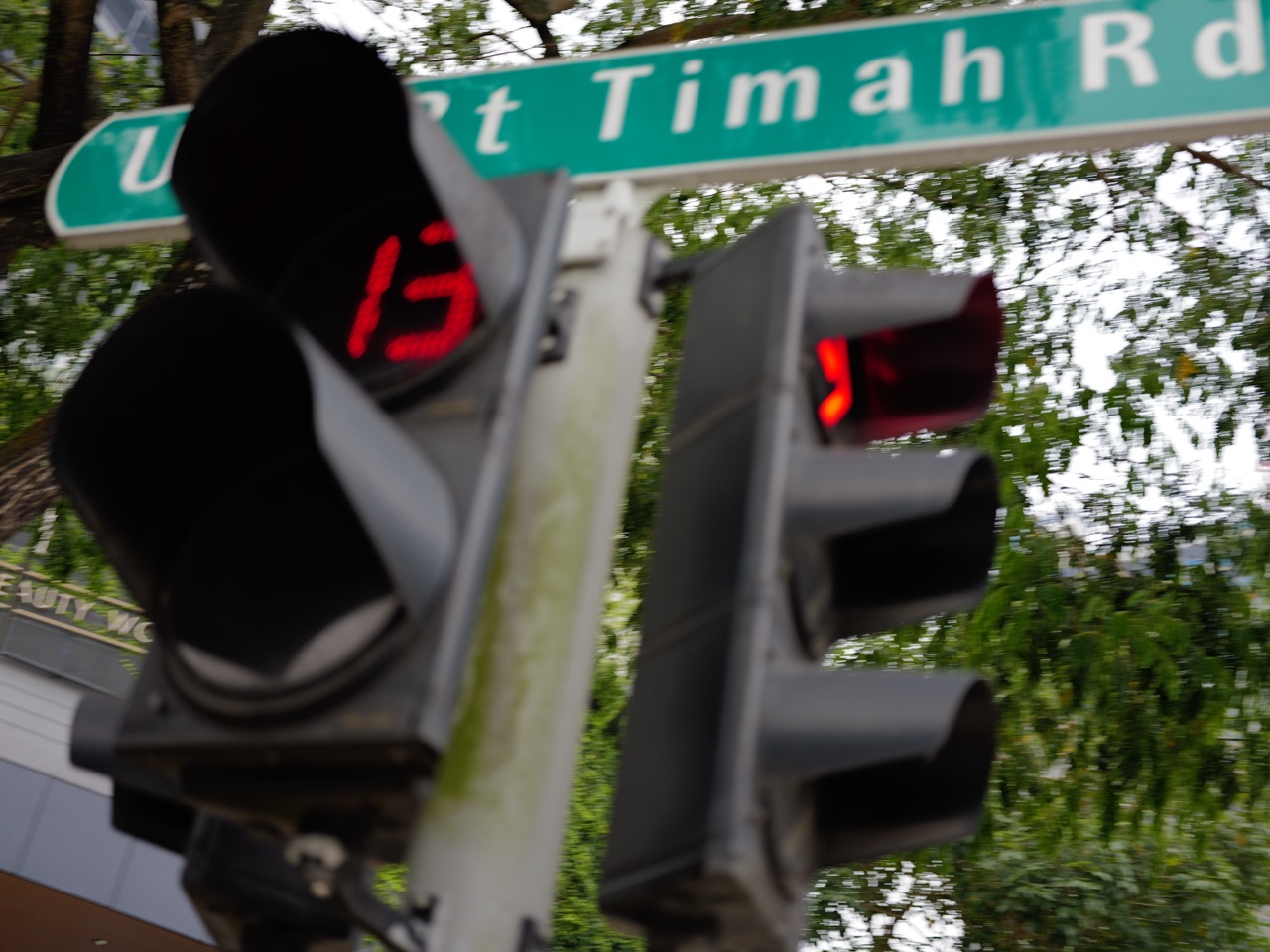
Prepared for Singapore families on 28 October 2026 with current SPF and LTA guidance, including the January 2026 Enhanced School Zone change. All dialogues and pictured signals are fictional. The featured photo shows a pedestrian crossing and signal countdown along Bukit Timah Road, not a certified record of a particular school-zone rule.