
Guide 33 · Civilisation Building · 40 in-depth learning chapters
Previous guide · Series index · What is Civilisation?
A civilisation becomes more dependable when its shared arrangements can be examined, corrected and handed on. This guide asks how to trace the essential purpose of a service through its dependencies, understand the limits of a backup, and keep recovery claims tied to verified outcomes. The fictional Riverbend setting is used so children can practise reading evidence, choosing fairly, doing arithmetic accurately and recognising the limits of any conclusion. It is a guide for readers, parents and tutors who want a useful learning activity rather than an abstract promise that bigger or more complicated communities are always better.
In each chapter, an everyday story introduces a clear question. Children first identify the purpose and explain what the evidence says; older students inspect a separate numerical model and a changed condition. A tutor can check whether the student understood the distinction, not just whether the final number matches the sample. The examples are imaginary and independent; figures from one chapter are not carried into another unless the exercise explicitly says so.
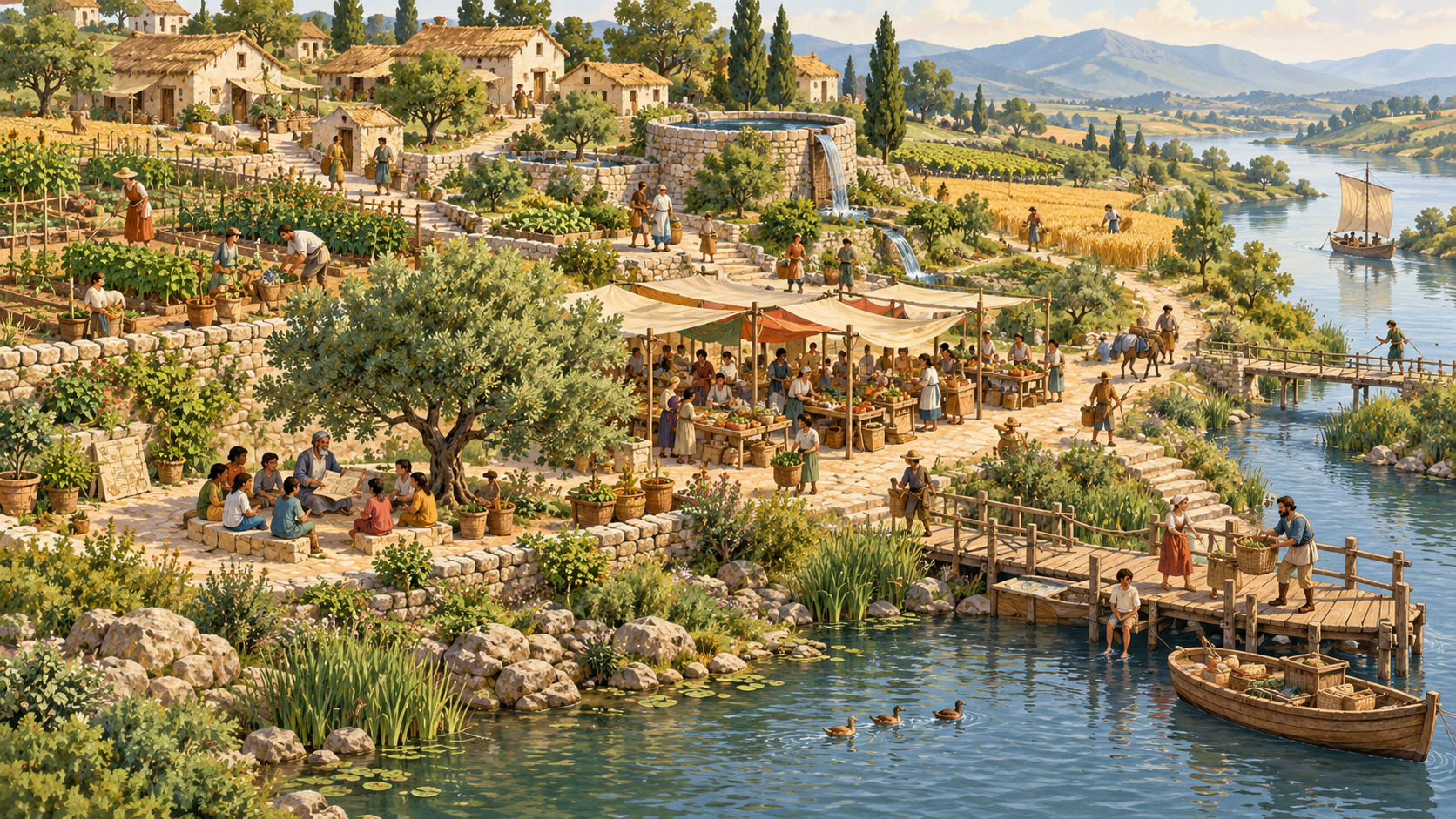
The tabletop disruptions are fictional educational simulations. They are not emergency instructions, safety specifications, engineering plans, disaster response advice or professional operational guidance. The established Riverbend cover is an AI-generated conceptual illustration, not a documentary image of a real place or a technical plan. A fictional role’s availability, consent, need or capability cannot be treated as a general truth about an actual person. All decisions in the guide stay within the limits of the written classroom rules.
Five guided learning routes
- Define the service and its essential purpose — chapters 1–8
- Map dependencies, resources and alternatives — chapters 9–16
- Tell warnings from established changes — chapters 17–24
- Restore service with checkable stages — chapters 25–32
- Learn from failure and build resilience — chapters 33–40
Complete 40-chapter index
Open all chapter titles
- 1. Continuity protects an outcome, not a building
- 2. A service differs from its usual asset
- 3. Draw the whole dependency chain
- 4. Separate essentials from decoration
- 5. State the time horizon
- 6. Find the limiting required resource
- 7. Spot shared single points of failure
- 8. Ask if backups share a failure
- 9. Keep track of a spare resource's location
- 10. Audit the inventory against the cards
- 11. Define when to activate a fallback
- 12. Issue a specific, dated change notice
- 13. A fallback is not an imaginary shortcut
- 14. Priorities are constraints, not human worth
- 15. Do not duplicate a staff role
- 16. Volunteers have bounded availability
- 17. Restore prerequisites before dependent services
- 18. Define planned, available and completed
- 19. Trace a cascade across the network
- 20. A tabletop rehearsal is not certification
- 21. Green dashboards require source checks
- 22. A backup may preserve a wrong version
- 23. State assumptions about access
- 24. Different suppliers can share one key
- 25. Test whether an alternative meets the same purpose
- 26. Share the knowledge needed for continuity
- 27. Maintain alternatives before relying on them
- 28. A warning is not a confirmed closure
- 29. Preserve useful unknown states
- 30. Do not bypass constraints for an attractive ending
- 31. Compare incompatible recovery priorities
- 32. Verify service rather than a room symbol
- 33. Re-evaluate the network after another change
- 34. Count commitments across repeated short fixes
- 35. Learn from a failed drill honestly
- 36. Coordinate promises between institutions
- 37. Tell the recovery story with intermediate states
- 38. Return to routine without deleting lessons
- 39. Capstone: protect three shared learning activities
- 40. Capstone: the fallback also becomes unavailable
Integrated project · Parent and tutor questions · Learning quality checklist
1. Continuity protects an outcome, not a building
CHAPTER 1 OF 40 · Define the service and its essential purpose · Back to index
Before a number is written, consider the ordinary person in the story. At Riverbend’s Story Hall, Ari encounters a concrete challenge: The learning hall is closed but the story session has a different approved venue. Notice how this creates two questions. The first concerns the task itself: what should happen for the people in the scene? The second concerns evidence: what records would justify saying the intended result has happened? The chapter is about continuity protects an outcome, not a building, so it should not be reduced to a moral slogan or a correct calculation unconnected to an actual purpose.
Start by making the request legible. Ask Ari to name the roles involved, the resource or information they share, the constraint each knows, and what condition would mark the task complete. Draw a small line between the request and the supplied evidence. If there is no line, the necessary information is missing. This exercise strengthens the important distinction between noticing something, interpreting its meaning and making an authorised decision about it. It is legitimate to say the answer remains unknown when the record does not support a stronger claim.
A common misreading appears immediately: Equating an open door with recovered learning. Do not simply tell the child that this is wrong. Ask why the shorter answer is attractive: it may produce a neat total, avoid a difficult conversation or assume someone else has already checked the source. Then explain how the shortcut changes the meaning of the original task. Have the student construct a counterexample in which the neat-looking answer is identical but the underlying purpose is unmet. When they can do that, they understand the failure mode rather than memorising a warning.
The intended repair is specific: Check whether the intended session can occur. This should be written as a checkable action, not as a compliment for the imagined organisers. Place a source card beside it. Which part of the correction comes directly from the stated conditions? Which part is a possible response requiring permission? Which part is still undecided? Strong work preserves all three categories, especially when the first proposal sounded plausible. A real community needs processes that can withstand those questions, although the classroom card cannot itself establish a real-world standard.
Work through a separate numerical model
For this chapter’s independent tabletop continuity model, 15 fictional session periods exist. 3 have earlier approved uses, and 13 new requests appear. Each requested activity consumes one eligible model period. The exercise says nothing about real emergency capacity, personnel, safety or building suitability. Those remain separate prerequisites that the learner must label and verify from explicit cards before interpreting the arithmetic.
Eligible periods are 15 − 3 = 12. At most 12 of 13 requests can be allocated, leaving 1 without a period. These are potential bookings, not verified completed services; every required dependency must also be checked. A single missing essential condition could prevent several sessions even if the paper timetable looks clear.
| Record | Quantity | Meaning |
|---|---|---|
| Whole fictional periods | 15 | Session tokens |
| Earlier reservations | 3 | Not free |
| Potential availability | 12 | Before dependency check |
| Requests | 13 | Desired sessions |
| Potential allocations | 12 | Not verified complete |
| Conditional alternative | 3 | Requires independent usability |
The arithmetic matters because shared promises fail when resources are counted inconsistently. But the calculation does not answer every ethical, educational or practical question in this chapter. A parent can ask what the numbers name and what they do not name. A tutor can ask for the rule that makes the operation valid, then ask the learner to find one important outcome that the table cannot measure. The best answer distinguishes a possibility, an allocation, a reported event and a verified completion instead of using them as interchangeable labels.
A changed-condition challenge
A separately authorised alternate space contributes 3 possible periods. If it meets every stated requirement and does not share the failed dependency, the model could now allocate up to 13 requests, leaving 0 unallocated. If the alternative shares the problem, the additional periods are not usable. Record the assumption rather than automatically adding capacity to the result.
Return to The learning hall is closed but the story session has a different approved venue. The revised scenario is not an excuse to erase the earlier record. Put the baseline beside the changed sheet; mark the newly supplied information and keep the unaffected commitments. Ask Hana to identify whether the proposed solution remains allowed. If the student wants to add a resource, change a person’s acceptance or rewrite a source, require an explicit card authorising that change. The goal is a reasoned answer that another reader can check rather than a story that always ends conveniently.
The qualitative principle remains Check whether the intended session can occur. If the new calculation produces an attractive result but the original mistake survives, the repair is incomplete. Ask the learner to describe two layers of success: first, did the written model’s stated arithmetic or sequencing work? Second, did the particular need in the scene receive a verified response? A correct first answer is necessary for a credible plan, yet it is not proof of the second. This distinction becomes more valuable as a civilisation grows complicated enough for its records to hide what people actually experience.
A short parent conversation and tutor exercise
For a younger child, begin with a sketch of the Story Hall and four labelled cards: request, evidence, suggestion and finished action. Invite Ari to put each sentence from the story under the right card. Then ask, “Which card would you want to see before you believed the ending?” A parent can follow with an invitation to draw a second ending that stays within the stated rules. Keep the question concrete. An elaborate description may sound advanced while concealing the fact that the learner has not separated a plan from its completion.
For an older learner, write a four-sentence case analysis. Sentence one identifies the actual question. Sentence two cites the decisive information rather than repeating a general value. Sentence three explains the permitted choice or calculation. Sentence four sets a limit: what would still have to be verified? Mark the four functions separately. If the student’s numbers are wrong, repair the working. If the numbers are right but the conclusion is too strong, repair the inference. If the description of the request is wrong, return to the source. Those three errors need different tutorial interventions.
Try an independent challenge without telling the learner which answer to prefer. Try telling the story from the receiver’s viewpoint without changing any of the written conditions. Then ask for a written comparison of the two versions. The comparison should mention both the unchanged baseline and the new condition. An unanswered question should appear as an open question, not be quietly dropped. Reward the student who can explain why additional evidence is required. That explanation is more transferable than correctly predicting the ending of one invented story.
A useful follow-up for a class is to exchange papers. The receiving student must reproduce the calculation, identify the source behind the decisive claim and understand the proposed correction without help from the original author. If either student needs a hidden oral explanation, the written record is not yet ready for handover. This is not about bureaucratic length; a clear short record is better than a long one that hides its assumptions. Have the class rewrite only the sentence where the misunderstanding began and compare the difference in meaning.
Finally, return to the wider learning aim: trace the essential purpose of a service through its dependencies, understand the limits of a backup, and keep recovery claims tied to verified outcomes. That aspiration does not magically make the fictional proposal correct. Here, the concrete difficulty was The learning hall is closed but the story session has a different approved venue. The misleading shortcut was Equating an open door with recovered learning. The testable improvement was Check whether the intended session can occur. A learner who can explain those three things in ordinary language, check the small model and describe one unanswered question has moved beyond recognising a topic name. They have practised the habit of making a public claim open to scrutiny and correction.
2. A service differs from its usual asset
CHAPTER 2 OF 40 · Define the service and its essential purpose · Back to index
Children often notice the most visible object and overlook the promise behind it. At Riverbend’s River Square, Mina encounters a concrete challenge: A workshop uses the Hall but could use a permitted Garden Room. Notice how this creates two questions. The first concerns the task itself: what should happen for the people in the scene? The second concerns evidence: what records would justify saying the intended result has happened? The chapter is about a service differs from its usual asset, so it should not be reduced to a moral slogan or a correct calculation unconnected to an actual purpose.
Start by making the request legible. Ask Mina to name the roles involved, the resource or information they share, the constraint each knows, and what condition would mark the task complete. Draw a small line between the request and the supplied evidence. If there is no line, the necessary information is missing. This exercise strengthens the important distinction between noticing something, interpreting its meaning and making an authorised decision about it. It is legitimate to say the answer remains unknown when the record does not support a stronger claim.
A common misreading appears immediately: Declaring a named location irreplaceable. Do not simply tell the child that this is wrong. Ask why the shorter answer is attractive: it may produce a neat total, avoid a difficult conversation or assume someone else has already checked the source. Then explain how the shortcut changes the meaning of the original task. Have the student construct a counterexample in which the neat-looking answer is identical but the underlying purpose is unmet. When they can do that, they understand the failure mode rather than memorising a warning.
The intended repair is specific: List the functional conditions of alternatives. This should be written as a checkable action, not as a compliment for the imagined organisers. Place a source card beside it. Which part of the correction comes directly from the stated conditions? Which part is a possible response requiring permission? Which part is still undecided? Strong work preserves all three categories, especially when the first proposal sounded plausible. A real community needs processes that can withstand those questions, although the classroom card cannot itself establish a real-world standard.
Work through a separate numerical model
For this chapter’s independent tabletop continuity model, 18 fictional session periods exist. 4 have earlier approved uses, and 18 new requests appear. Each requested activity consumes one eligible model period. The exercise says nothing about real emergency capacity, personnel, safety or building suitability. Those remain separate prerequisites that the learner must label and verify from explicit cards before interpreting the arithmetic.
Eligible periods are 18 − 4 = 14. At most 14 of 18 requests can be allocated, leaving 4 without a period. These are potential bookings, not verified completed services; every required dependency must also be checked. A single missing essential condition could prevent several sessions even if the paper timetable looks clear.
| Record | Quantity | Meaning |
|---|---|---|
| Whole fictional periods | 18 | Session tokens |
| Earlier reservations | 4 | Not free |
| Potential availability | 14 | Before dependency check |
| Requests | 18 | Desired sessions |
| Potential allocations | 14 | Not verified complete |
| Conditional alternative | 4 | Requires independent usability |
The arithmetic matters because shared promises fail when resources are counted inconsistently. But the calculation does not answer every ethical, educational or practical question in this chapter. A parent can ask what the numbers name and what they do not name. A tutor can ask for the rule that makes the operation valid, then ask the learner to find one important outcome that the table cannot measure. The best answer distinguishes a possibility, an allocation, a reported event and a verified completion instead of using them as interchangeable labels.
A changed-condition challenge
A separately authorised alternate space contributes 4 possible periods. If it meets every stated requirement and does not share the failed dependency, the model could now allocate up to 18 requests, leaving 0 unallocated. If the alternative shares the problem, the additional periods are not usable. Record the assumption rather than automatically adding capacity to the result.
Return to A workshop uses the Hall but could use a permitted Garden Room. The revised scenario is not an excuse to erase the earlier record. Put the baseline beside the changed sheet; mark the newly supplied information and keep the unaffected commitments. Ask Kai to identify whether the proposed solution remains allowed. If the student wants to add a resource, change a person’s acceptance or rewrite a source, require an explicit card authorising that change. The goal is a reasoned answer that another reader can check rather than a story that always ends conveniently.
The qualitative principle remains List the functional conditions of alternatives. If the new calculation produces an attractive result but the original mistake survives, the repair is incomplete. Ask the learner to describe two layers of success: first, did the written model’s stated arithmetic or sequencing work? Second, did the particular need in the scene receive a verified response? A correct first answer is necessary for a credible plan, yet it is not proof of the second. This distinction becomes more valuable as a civilisation grows complicated enough for its records to hide what people actually experience.
A short parent conversation and tutor exercise
For a younger child, begin with a sketch of the River Square and four labelled cards: request, evidence, suggestion and finished action. Invite Mina to put each sentence from the story under the right card. Then ask, “Which card would you want to see before you believed the ending?” A parent can follow with an invitation to draw a second ending that stays within the stated rules. Keep the question concrete. An elaborate description may sound advanced while concealing the fact that the learner has not separated a plan from its completion.
For an older learner, write a four-sentence case analysis. Sentence one identifies the actual question. Sentence two cites the decisive information rather than repeating a general value. Sentence three explains the permitted choice or calculation. Sentence four sets a limit: what would still have to be verified? Mark the four functions separately. If the student’s numbers are wrong, repair the working. If the numbers are right but the conclusion is too strong, repair the inference. If the description of the request is wrong, return to the source. Those three errors need different tutorial interventions.
Try an independent challenge without telling the learner which answer to prefer. Ask which part of the claimed result can be demonstrated with cards and which part is still a prediction. Then ask for a written comparison of the two versions. The comparison should mention both the unchanged baseline and the new condition. An unanswered question should appear as an open question, not be quietly dropped. Reward the student who can explain why additional evidence is required. That explanation is more transferable than correctly predicting the ending of one invented story.
A useful follow-up for a class is to exchange papers. The receiving student must reproduce the calculation, identify the source behind the decisive claim and understand the proposed correction without help from the original author. If either student needs a hidden oral explanation, the written record is not yet ready for handover. This is not about bureaucratic length; a clear short record is better than a long one that hides its assumptions. Have the class rewrite only the sentence where the misunderstanding began and compare the difference in meaning.
Finally, return to the wider learning aim: trace the essential purpose of a service through its dependencies, understand the limits of a backup, and keep recovery claims tied to verified outcomes. That aspiration does not magically make the fictional proposal correct. Here, the concrete difficulty was A workshop uses the Hall but could use a permitted Garden Room. The misleading shortcut was Declaring a named location irreplaceable. The testable improvement was List the functional conditions of alternatives. A learner who can explain those three things in ordinary language, check the small model and describe one unanswered question has moved beyond recognising a topic name. They have practised the habit of making a public claim open to scrutiny and correction.
Full index · Previous · Next
3. Draw the whole dependency chain
CHAPTER 3 OF 40 · Define the service and its essential purpose · Back to index
Riverbend’s daily life creates a small but revealing puzzle. At Riverbend’s Learning Room, Leonie encounters a concrete challenge: A story depends on a room, booking, facilitator and notice. Notice how this creates two questions. The first concerns the task itself: what should happen for the people in the scene? The second concerns evidence: what records would justify saying the intended result has happened? The chapter is about draw the whole dependency chain, so it should not be reduced to a moral slogan or a correct calculation unconnected to an actual purpose.
Start by making the request legible. Ask Leonie to name the roles involved, the resource or information they share, the constraint each knows, and what condition would mark the task complete. Draw a small line between the request and the supplied evidence. If there is no line, the necessary information is missing. This exercise strengthens the important distinction between noticing something, interpreting its meaning and making an authorised decision about it. It is legitimate to say the answer remains unknown when the record does not support a stronger claim.
A common misreading appears immediately: Assuming the room alone makes it possible. Do not simply tell the child that this is wrong. Ask why the shorter answer is attractive: it may produce a neat total, avoid a difficult conversation or assume someone else has already checked the source. Then explain how the shortcut changes the meaning of the original task. Have the student construct a counterexample in which the neat-looking answer is identical but the underlying purpose is unmet. When they can do that, they understand the failure mode rather than memorising a warning.
The intended repair is specific: Verify each necessary condition. This should be written as a checkable action, not as a compliment for the imagined organisers. Place a source card beside it. Which part of the correction comes directly from the stated conditions? Which part is a possible response requiring permission? Which part is still undecided? Strong work preserves all three categories, especially when the first proposal sounded plausible. A real community needs processes that can withstand those questions, although the classroom card cannot itself establish a real-world standard.
Work through a separate numerical model
For this chapter’s independent tabletop continuity model, 21 fictional session periods exist. 5 have earlier approved uses, and 10 new requests appear. Each requested activity consumes one eligible model period. The exercise says nothing about real emergency capacity, personnel, safety or building suitability. Those remain separate prerequisites that the learner must label and verify from explicit cards before interpreting the arithmetic.
Eligible periods are 21 − 5 = 16. At most 10 of 10 requests can be allocated, leaving 0 without a period. These are potential bookings, not verified completed services; every required dependency must also be checked. A single missing essential condition could prevent several sessions even if the paper timetable looks clear.
| Record | Quantity | Meaning |
|---|---|---|
| Whole fictional periods | 21 | Session tokens |
| Earlier reservations | 5 | Not free |
| Potential availability | 16 | Before dependency check |
| Requests | 10 | Desired sessions |
| Potential allocations | 10 | Not verified complete |
| Conditional alternative | 5 | Requires independent usability |
The arithmetic matters because shared promises fail when resources are counted inconsistently. But the calculation does not answer every ethical, educational or practical question in this chapter. A parent can ask what the numbers name and what they do not name. A tutor can ask for the rule that makes the operation valid, then ask the learner to find one important outcome that the table cannot measure. The best answer distinguishes a possibility, an allocation, a reported event and a verified completion instead of using them as interchangeable labels.
A changed-condition challenge
A separately authorised alternate space contributes 5 possible periods. If it meets every stated requirement and does not share the failed dependency, the model could now allocate up to 10 requests, leaving 0 unallocated. If the alternative shares the problem, the additional periods are not usable. Record the assumption rather than automatically adding capacity to the result.
Return to A story depends on a room, booking, facilitator and notice. The revised scenario is not an excuse to erase the earlier record. Put the baseline beside the changed sheet; mark the newly supplied information and keep the unaffected commitments. Ask Sofia to identify whether the proposed solution remains allowed. If the student wants to add a resource, change a person’s acceptance or rewrite a source, require an explicit card authorising that change. The goal is a reasoned answer that another reader can check rather than a story that always ends conveniently.
The qualitative principle remains Verify each necessary condition. If the new calculation produces an attractive result but the original mistake survives, the repair is incomplete. Ask the learner to describe two layers of success: first, did the written model’s stated arithmetic or sequencing work? Second, did the particular need in the scene receive a verified response? A correct first answer is necessary for a credible plan, yet it is not proof of the second. This distinction becomes more valuable as a civilisation grows complicated enough for its records to hide what people actually experience.
A short parent conversation and tutor exercise
For a younger child, begin with a sketch of the Learning Room and four labelled cards: request, evidence, suggestion and finished action. Invite Leonie to put each sentence from the story under the right card. Then ask, “Which card would you want to see before you believed the ending?” A parent can follow with an invitation to draw a second ending that stays within the stated rules. Keep the question concrete. An elaborate description may sound advanced while concealing the fact that the learner has not separated a plan from its completion.
For an older learner, write a four-sentence case analysis. Sentence one identifies the actual question. Sentence two cites the decisive information rather than repeating a general value. Sentence three explains the permitted choice or calculation. Sentence four sets a limit: what would still have to be verified? Mark the four functions separately. If the student’s numbers are wrong, repair the working. If the numbers are right but the conclusion is too strong, repair the inference. If the description of the request is wrong, return to the source. Those three errors need different tutorial interventions.
Try an independent challenge without telling the learner which answer to prefer. Give the record to somebody who has not heard the conversation and check what they can reconstruct. Then ask for a written comparison of the two versions. The comparison should mention both the unchanged baseline and the new condition. An unanswered question should appear as an open question, not be quietly dropped. Reward the student who can explain why additional evidence is required. That explanation is more transferable than correctly predicting the ending of one invented story.
A useful follow-up for a class is to exchange papers. The receiving student must reproduce the calculation, identify the source behind the decisive claim and understand the proposed correction without help from the original author. If either student needs a hidden oral explanation, the written record is not yet ready for handover. This is not about bureaucratic length; a clear short record is better than a long one that hides its assumptions. Have the class rewrite only the sentence where the misunderstanding began and compare the difference in meaning.
Finally, return to the wider learning aim: trace the essential purpose of a service through its dependencies, understand the limits of a backup, and keep recovery claims tied to verified outcomes. That aspiration does not magically make the fictional proposal correct. Here, the concrete difficulty was A story depends on a room, booking, facilitator and notice. The misleading shortcut was Assuming the room alone makes it possible. The testable improvement was Verify each necessary condition. A learner who can explain those three things in ordinary language, check the small model and describe one unanswered question has moved beyond recognising a topic name. They have practised the habit of making a public claim open to scrutiny and correction.
Full index · Previous · Next
4. Separate essentials from decoration
CHAPTER 4 OF 40 · Define the service and its essential purpose · Back to index
A fresh tabletop record is placed in front of the class. At Riverbend’s Neighbourhood Table, Jia encounters a concrete challenge: A learning session needs a readable story but not display ribbons. Notice how this creates two questions. The first concerns the task itself: what should happen for the people in the scene? The second concerns evidence: what records would justify saying the intended result has happened? The chapter is about separate essentials from decoration, so it should not be reduced to a moral slogan or a correct calculation unconnected to an actual purpose.
Start by making the request legible. Ask Jia to name the roles involved, the resource or information they share, the constraint each knows, and what condition would mark the task complete. Draw a small line between the request and the supplied evidence. If there is no line, the necessary information is missing. This exercise strengthens the important distinction between noticing something, interpreting its meaning and making an authorised decision about it. It is legitimate to say the answer remains unknown when the record does not support a stronger claim.
A common misreading appears immediately: Delaying everything for an optional feature. Do not simply tell the child that this is wrong. Ask why the shorter answer is attractive: it may produce a neat total, avoid a difficult conversation or assume someone else has already checked the source. Then explain how the shortcut changes the meaning of the original task. Have the student construct a counterexample in which the neat-looking answer is identical but the underlying purpose is unmet. When they can do that, they understand the failure mode rather than memorising a warning.
The intended repair is specific: Protect required components first. This should be written as a checkable action, not as a compliment for the imagined organisers. Place a source card beside it. Which part of the correction comes directly from the stated conditions? Which part is a possible response requiring permission? Which part is still undecided? Strong work preserves all three categories, especially when the first proposal sounded plausible. A real community needs processes that can withstand those questions, although the classroom card cannot itself establish a real-world standard.
Work through a separate numerical model
For this chapter’s independent tabletop continuity model, 12 fictional session periods exist. 2 have earlier approved uses, and 15 new requests appear. Each requested activity consumes one eligible model period. The exercise says nothing about real emergency capacity, personnel, safety or building suitability. Those remain separate prerequisites that the learner must label and verify from explicit cards before interpreting the arithmetic.
Eligible periods are 12 − 2 = 10. At most 10 of 15 requests can be allocated, leaving 5 without a period. These are potential bookings, not verified completed services; every required dependency must also be checked. A single missing essential condition could prevent several sessions even if the paper timetable looks clear.
| Record | Quantity | Meaning |
|---|---|---|
| Whole fictional periods | 12 | Session tokens |
| Earlier reservations | 2 | Not free |
| Potential availability | 10 | Before dependency check |
| Requests | 15 | Desired sessions |
| Potential allocations | 10 | Not verified complete |
| Conditional alternative | 2 | Requires independent usability |
The arithmetic matters because shared promises fail when resources are counted inconsistently. But the calculation does not answer every ethical, educational or practical question in this chapter. A parent can ask what the numbers name and what they do not name. A tutor can ask for the rule that makes the operation valid, then ask the learner to find one important outcome that the table cannot measure. The best answer distinguishes a possibility, an allocation, a reported event and a verified completion instead of using them as interchangeable labels.
A changed-condition challenge
A separately authorised alternate space contributes 2 possible periods. If it meets every stated requirement and does not share the failed dependency, the model could now allocate up to 12 requests, leaving 3 unallocated. If the alternative shares the problem, the additional periods are not usable. Record the assumption rather than automatically adding capacity to the result.
Return to A learning session needs a readable story but not display ribbons. The revised scenario is not an excuse to erase the earlier record. Put the baseline beside the changed sheet; mark the newly supplied information and keep the unaffected commitments. Ask Iman to identify whether the proposed solution remains allowed. If the student wants to add a resource, change a person’s acceptance or rewrite a source, require an explicit card authorising that change. The goal is a reasoned answer that another reader can check rather than a story that always ends conveniently.
The qualitative principle remains Protect required components first. If the new calculation produces an attractive result but the original mistake survives, the repair is incomplete. Ask the learner to describe two layers of success: first, did the written model’s stated arithmetic or sequencing work? Second, did the particular need in the scene receive a verified response? A correct first answer is necessary for a credible plan, yet it is not proof of the second. This distinction becomes more valuable as a civilisation grows complicated enough for its records to hide what people actually experience.
A short parent conversation and tutor exercise
For a younger child, begin with a sketch of the Neighbourhood Table and four labelled cards: request, evidence, suggestion and finished action. Invite Jia to put each sentence from the story under the right card. Then ask, “Which card would you want to see before you believed the ending?” A parent can follow with an invitation to draw a second ending that stays within the stated rules. Keep the question concrete. An elaborate description may sound advanced while concealing the fact that the learner has not separated a plan from its completion.
For an older learner, write a four-sentence case analysis. Sentence one identifies the actual question. Sentence two cites the decisive information rather than repeating a general value. Sentence three explains the permitted choice or calculation. Sentence four sets a limit: what would still have to be verified? Mark the four functions separately. If the student’s numbers are wrong, repair the working. If the numbers are right but the conclusion is too strong, repair the inference. If the description of the request is wrong, return to the source. Those three errors need different tutorial interventions.
Try an independent challenge without telling the learner which answer to prefer. Let a second child challenge the first answer using one explicit line of evidence rather than a guess. Then ask for a written comparison of the two versions. The comparison should mention both the unchanged baseline and the new condition. An unanswered question should appear as an open question, not be quietly dropped. Reward the student who can explain why additional evidence is required. That explanation is more transferable than correctly predicting the ending of one invented story.
A useful follow-up for a class is to exchange papers. The receiving student must reproduce the calculation, identify the source behind the decisive claim and understand the proposed correction without help from the original author. If either student needs a hidden oral explanation, the written record is not yet ready for handover. This is not about bureaucratic length; a clear short record is better than a long one that hides its assumptions. Have the class rewrite only the sentence where the misunderstanding began and compare the difference in meaning.
Finally, return to the wider learning aim: trace the essential purpose of a service through its dependencies, understand the limits of a backup, and keep recovery claims tied to verified outcomes. That aspiration does not magically make the fictional proposal correct. Here, the concrete difficulty was A learning session needs a readable story but not display ribbons. The misleading shortcut was Delaying everything for an optional feature. The testable improvement was Protect required components first. A learner who can explain those three things in ordinary language, check the small model and describe one unanswered question has moved beyond recognising a topic name. They have practised the habit of making a public claim open to scrutiny and correction.
Full index · Previous · Next
5. State the time horizon
CHAPTER 5 OF 40 · Define the service and its essential purpose · Back to index
Two apparently simple statements turn out to describe different things. At Riverbend’s Garden Court, Ravi encounters a concrete challenge: An afternoon schedule is mistaken for a whole-term plan. Notice how this creates two questions. The first concerns the task itself: what should happen for the people in the scene? The second concerns evidence: what records would justify saying the intended result has happened? The chapter is about state the time horizon, so it should not be reduced to a moral slogan or a correct calculation unconnected to an actual purpose.
Start by making the request legible. Ask Ravi to name the roles involved, the resource or information they share, the constraint each knows, and what condition would mark the task complete. Draw a small line between the request and the supplied evidence. If there is no line, the necessary information is missing. This exercise strengthens the important distinction between noticing something, interpreting its meaning and making an authorised decision about it. It is legitimate to say the answer remains unknown when the record does not support a stronger claim.
A common misreading appears immediately: Treating one successful day as indefinite assurance. Do not simply tell the child that this is wrong. Ask why the shorter answer is attractive: it may produce a neat total, avoid a difficult conversation or assume someone else has already checked the source. Then explain how the shortcut changes the meaning of the original task. Have the student construct a counterexample in which the neat-looking answer is identical but the underlying purpose is unmet. When they can do that, they understand the failure mode rather than memorising a warning.
The intended repair is specific: Label the covered period. This should be written as a checkable action, not as a compliment for the imagined organisers. Place a source card beside it. Which part of the correction comes directly from the stated conditions? Which part is a possible response requiring permission? Which part is still undecided? Strong work preserves all three categories, especially when the first proposal sounded plausible. A real community needs processes that can withstand those questions, although the classroom card cannot itself establish a real-world standard.
Work through a separate numerical model
For this chapter’s independent tabletop continuity model, 15 fictional session periods exist. 3 have earlier approved uses, and 20 new requests appear. Each requested activity consumes one eligible model period. The exercise says nothing about real emergency capacity, personnel, safety or building suitability. Those remain separate prerequisites that the learner must label and verify from explicit cards before interpreting the arithmetic.
Eligible periods are 15 − 3 = 12. At most 12 of 20 requests can be allocated, leaving 8 without a period. These are potential bookings, not verified completed services; every required dependency must also be checked. A single missing essential condition could prevent several sessions even if the paper timetable looks clear.
| Record | Quantity | Meaning |
|---|---|---|
| Whole fictional periods | 15 | Session tokens |
| Earlier reservations | 3 | Not free |
| Potential availability | 12 | Before dependency check |
| Requests | 20 | Desired sessions |
| Potential allocations | 12 | Not verified complete |
| Conditional alternative | 3 | Requires independent usability |
The arithmetic matters because shared promises fail when resources are counted inconsistently. But the calculation does not answer every ethical, educational or practical question in this chapter. A parent can ask what the numbers name and what they do not name. A tutor can ask for the rule that makes the operation valid, then ask the learner to find one important outcome that the table cannot measure. The best answer distinguishes a possibility, an allocation, a reported event and a verified completion instead of using them as interchangeable labels.
A changed-condition challenge
A separately authorised alternate space contributes 3 possible periods. If it meets every stated requirement and does not share the failed dependency, the model could now allocate up to 15 requests, leaving 5 unallocated. If the alternative shares the problem, the additional periods are not usable. Record the assumption rather than automatically adding capacity to the result.
Return to An afternoon schedule is mistaken for a whole-term plan. The revised scenario is not an excuse to erase the earlier record. Put the baseline beside the changed sheet; mark the newly supplied information and keep the unaffected commitments. Ask Devi to identify whether the proposed solution remains allowed. If the student wants to add a resource, change a person’s acceptance or rewrite a source, require an explicit card authorising that change. The goal is a reasoned answer that another reader can check rather than a story that always ends conveniently.
The qualitative principle remains Label the covered period. If the new calculation produces an attractive result but the original mistake survives, the repair is incomplete. Ask the learner to describe two layers of success: first, did the written model’s stated arithmetic or sequencing work? Second, did the particular need in the scene receive a verified response? A correct first answer is necessary for a credible plan, yet it is not proof of the second. This distinction becomes more valuable as a civilisation grows complicated enough for its records to hide what people actually experience.
A short parent conversation and tutor exercise
For a younger child, begin with a sketch of the Garden Court and four labelled cards: request, evidence, suggestion and finished action. Invite Ravi to put each sentence from the story under the right card. Then ask, “Which card would you want to see before you believed the ending?” A parent can follow with an invitation to draw a second ending that stays within the stated rules. Keep the question concrete. An elaborate description may sound advanced while concealing the fact that the learner has not separated a plan from its completion.
For an older learner, write a four-sentence case analysis. Sentence one identifies the actual question. Sentence two cites the decisive information rather than repeating a general value. Sentence three explains the permitted choice or calculation. Sentence four sets a limit: what would still have to be verified? Mark the four functions separately. If the student’s numbers are wrong, repair the working. If the numbers are right but the conclusion is too strong, repair the inference. If the description of the request is wrong, return to the source. Those three errors need different tutorial interventions.
Try an independent challenge without telling the learner which answer to prefer. Change only the named condition on the new card and leave every previous commitment intact. Then ask for a written comparison of the two versions. The comparison should mention both the unchanged baseline and the new condition. An unanswered question should appear as an open question, not be quietly dropped. Reward the student who can explain why additional evidence is required. That explanation is more transferable than correctly predicting the ending of one invented story.
A useful follow-up for a class is to exchange papers. The receiving student must reproduce the calculation, identify the source behind the decisive claim and understand the proposed correction without help from the original author. If either student needs a hidden oral explanation, the written record is not yet ready for handover. This is not about bureaucratic length; a clear short record is better than a long one that hides its assumptions. Have the class rewrite only the sentence where the misunderstanding began and compare the difference in meaning.
Finally, return to the wider learning aim: trace the essential purpose of a service through its dependencies, understand the limits of a backup, and keep recovery claims tied to verified outcomes. That aspiration does not magically make the fictional proposal correct. Here, the concrete difficulty was An afternoon schedule is mistaken for a whole-term plan. The misleading shortcut was Treating one successful day as indefinite assurance. The testable improvement was Label the covered period. A learner who can explain those three things in ordinary language, check the small model and describe one unanswered question has moved beyond recognising a topic name. They have practised the habit of making a public claim open to scrutiny and correction.
Full index · Previous · Next
6. Find the limiting required resource
CHAPTER 6 OF 40 · Define the service and its essential purpose · Back to index
A family reading this scene can begin with a question rather than a lecture. At Riverbend’s Library Desk, Hana encounters a concrete challenge: Many books exist but only one fictional teaching slot is available. Notice how this creates two questions. The first concerns the task itself: what should happen for the people in the scene? The second concerns evidence: what records would justify saying the intended result has happened? The chapter is about find the limiting required resource, so it should not be reduced to a moral slogan or a correct calculation unconnected to an actual purpose.
Start by making the request legible. Ask Hana to name the roles involved, the resource or information they share, the constraint each knows, and what condition would mark the task complete. Draw a small line between the request and the supplied evidence. If there is no line, the necessary information is missing. This exercise strengthens the important distinction between noticing something, interpreting its meaning and making an authorised decision about it. It is legitimate to say the answer remains unknown when the record does not support a stronger claim.
A common misreading appears immediately: Counting copies as extra sessions. Do not simply tell the child that this is wrong. Ask why the shorter answer is attractive: it may produce a neat total, avoid a difficult conversation or assume someone else has already checked the source. Then explain how the shortcut changes the meaning of the original task. Have the student construct a counterexample in which the neat-looking answer is identical but the underlying purpose is unmet. When they can do that, they understand the failure mode rather than memorising a warning.
The intended repair is specific: Compare all bottleneck resources. This should be written as a checkable action, not as a compliment for the imagined organisers. Place a source card beside it. Which part of the correction comes directly from the stated conditions? Which part is a possible response requiring permission? Which part is still undecided? Strong work preserves all three categories, especially when the first proposal sounded plausible. A real community needs processes that can withstand those questions, although the classroom card cannot itself establish a real-world standard.
Work through a separate numerical model
For this chapter’s independent tabletop continuity model, 18 fictional session periods exist. 4 have earlier approved uses, and 12 new requests appear. Each requested activity consumes one eligible model period. The exercise says nothing about real emergency capacity, personnel, safety or building suitability. Those remain separate prerequisites that the learner must label and verify from explicit cards before interpreting the arithmetic.
Eligible periods are 18 − 4 = 14. At most 12 of 12 requests can be allocated, leaving 0 without a period. These are potential bookings, not verified completed services; every required dependency must also be checked. A single missing essential condition could prevent several sessions even if the paper timetable looks clear.
| Record | Quantity | Meaning |
|---|---|---|
| Whole fictional periods | 18 | Session tokens |
| Earlier reservations | 4 | Not free |
| Potential availability | 14 | Before dependency check |
| Requests | 12 | Desired sessions |
| Potential allocations | 12 | Not verified complete |
| Conditional alternative | 4 | Requires independent usability |
The arithmetic matters because shared promises fail when resources are counted inconsistently. But the calculation does not answer every ethical, educational or practical question in this chapter. A parent can ask what the numbers name and what they do not name. A tutor can ask for the rule that makes the operation valid, then ask the learner to find one important outcome that the table cannot measure. The best answer distinguishes a possibility, an allocation, a reported event and a verified completion instead of using them as interchangeable labels.
A changed-condition challenge
A separately authorised alternate space contributes 4 possible periods. If it meets every stated requirement and does not share the failed dependency, the model could now allocate up to 12 requests, leaving 0 unallocated. If the alternative shares the problem, the additional periods are not usable. Record the assumption rather than automatically adding capacity to the result.
Return to Many books exist but only one fictional teaching slot is available. The revised scenario is not an excuse to erase the earlier record. Put the baseline beside the changed sheet; mark the newly supplied information and keep the unaffected commitments. Ask Chen to identify whether the proposed solution remains allowed. If the student wants to add a resource, change a person’s acceptance or rewrite a source, require an explicit card authorising that change. The goal is a reasoned answer that another reader can check rather than a story that always ends conveniently.
The qualitative principle remains Compare all bottleneck resources. If the new calculation produces an attractive result but the original mistake survives, the repair is incomplete. Ask the learner to describe two layers of success: first, did the written model’s stated arithmetic or sequencing work? Second, did the particular need in the scene receive a verified response? A correct first answer is necessary for a credible plan, yet it is not proof of the second. This distinction becomes more valuable as a civilisation grows complicated enough for its records to hide what people actually experience.
A short parent conversation and tutor exercise
For a younger child, begin with a sketch of the Library Desk and four labelled cards: request, evidence, suggestion and finished action. Invite Hana to put each sentence from the story under the right card. Then ask, “Which card would you want to see before you believed the ending?” A parent can follow with an invitation to draw a second ending that stays within the stated rules. Keep the question concrete. An elaborate description may sound advanced while concealing the fact that the learner has not separated a plan from its completion.
For an older learner, write a four-sentence case analysis. Sentence one identifies the actual question. Sentence two cites the decisive information rather than repeating a general value. Sentence three explains the permitted choice or calculation. Sentence four sets a limit: what would still have to be verified? Mark the four functions separately. If the student’s numbers are wrong, repair the working. If the numbers are right but the conclusion is too strong, repair the inference. If the description of the request is wrong, return to the source. Those three errors need different tutorial interventions.
Try an independent challenge without telling the learner which answer to prefer. Ask why an apparently kind or efficient shortcut might make the public record less trustworthy. Then ask for a written comparison of the two versions. The comparison should mention both the unchanged baseline and the new condition. An unanswered question should appear as an open question, not be quietly dropped. Reward the student who can explain why additional evidence is required. That explanation is more transferable than correctly predicting the ending of one invented story.
A useful follow-up for a class is to exchange papers. The receiving student must reproduce the calculation, identify the source behind the decisive claim and understand the proposed correction without help from the original author. If either student needs a hidden oral explanation, the written record is not yet ready for handover. This is not about bureaucratic length; a clear short record is better than a long one that hides its assumptions. Have the class rewrite only the sentence where the misunderstanding began and compare the difference in meaning.
Finally, return to the wider learning aim: trace the essential purpose of a service through its dependencies, understand the limits of a backup, and keep recovery claims tied to verified outcomes. That aspiration does not magically make the fictional proposal correct. Here, the concrete difficulty was Many books exist but only one fictional teaching slot is available. The misleading shortcut was Counting copies as extra sessions. The testable improvement was Compare all bottleneck resources. A learner who can explain those three things in ordinary language, check the small model and describe one unanswered question has moved beyond recognising a topic name. They have practised the habit of making a public claim open to scrutiny and correction.
Full index · Previous · Next
7. Spot shared single points of failure
CHAPTER 7 OF 40 · Define the service and its essential purpose · Back to index
Sometimes the most valuable evidence is a condition that has not been supplied. At Riverbend’s Community Studio, Kai encounters a concrete challenge: Two activities rely on one schedule board. Notice how this creates two questions. The first concerns the task itself: what should happen for the people in the scene? The second concerns evidence: what records would justify saying the intended result has happened? The chapter is about spot shared single points of failure, so it should not be reduced to a moral slogan or a correct calculation unconnected to an actual purpose.
Start by making the request legible. Ask Kai to name the roles involved, the resource or information they share, the constraint each knows, and what condition would mark the task complete. Draw a small line between the request and the supplied evidence. If there is no line, the necessary information is missing. This exercise strengthens the important distinction between noticing something, interpreting its meaning and making an authorised decision about it. It is legitimate to say the answer remains unknown when the record does not support a stronger claim.
A common misreading appears immediately: Claiming independent systems because rooms differ. Do not simply tell the child that this is wrong. Ask why the shorter answer is attractive: it may produce a neat total, avoid a difficult conversation or assume someone else has already checked the source. Then explain how the shortcut changes the meaning of the original task. Have the student construct a counterexample in which the neat-looking answer is identical but the underlying purpose is unmet. When they can do that, they understand the failure mode rather than memorising a warning.
The intended repair is specific: Draw the shared dependency. This should be written as a checkable action, not as a compliment for the imagined organisers. Place a source card beside it. Which part of the correction comes directly from the stated conditions? Which part is a possible response requiring permission? Which part is still undecided? Strong work preserves all three categories, especially when the first proposal sounded plausible. A real community needs processes that can withstand those questions, although the classroom card cannot itself establish a real-world standard.
Work through a separate numerical model
For this chapter’s independent tabletop continuity model, 21 fictional session periods exist. 5 have earlier approved uses, and 17 new requests appear. Each requested activity consumes one eligible model period. The exercise says nothing about real emergency capacity, personnel, safety or building suitability. Those remain separate prerequisites that the learner must label and verify from explicit cards before interpreting the arithmetic.
Eligible periods are 21 − 5 = 16. At most 16 of 17 requests can be allocated, leaving 1 without a period. These are potential bookings, not verified completed services; every required dependency must also be checked. A single missing essential condition could prevent several sessions even if the paper timetable looks clear.
| Record | Quantity | Meaning |
|---|---|---|
| Whole fictional periods | 21 | Session tokens |
| Earlier reservations | 5 | Not free |
| Potential availability | 16 | Before dependency check |
| Requests | 17 | Desired sessions |
| Potential allocations | 16 | Not verified complete |
| Conditional alternative | 5 | Requires independent usability |
The arithmetic matters because shared promises fail when resources are counted inconsistently. But the calculation does not answer every ethical, educational or practical question in this chapter. A parent can ask what the numbers name and what they do not name. A tutor can ask for the rule that makes the operation valid, then ask the learner to find one important outcome that the table cannot measure. The best answer distinguishes a possibility, an allocation, a reported event and a verified completion instead of using them as interchangeable labels.
A changed-condition challenge
A separately authorised alternate space contributes 5 possible periods. If it meets every stated requirement and does not share the failed dependency, the model could now allocate up to 17 requests, leaving 0 unallocated. If the alternative shares the problem, the additional periods are not usable. Record the assumption rather than automatically adding capacity to the result.
Return to Two activities rely on one schedule board. The revised scenario is not an excuse to erase the earlier record. Put the baseline beside the changed sheet; mark the newly supplied information and keep the unaffected commitments. Ask Ella to identify whether the proposed solution remains allowed. If the student wants to add a resource, change a person’s acceptance or rewrite a source, require an explicit card authorising that change. The goal is a reasoned answer that another reader can check rather than a story that always ends conveniently.
The qualitative principle remains Draw the shared dependency. If the new calculation produces an attractive result but the original mistake survives, the repair is incomplete. Ask the learner to describe two layers of success: first, did the written model’s stated arithmetic or sequencing work? Second, did the particular need in the scene receive a verified response? A correct first answer is necessary for a credible plan, yet it is not proof of the second. This distinction becomes more valuable as a civilisation grows complicated enough for its records to hide what people actually experience.
A short parent conversation and tutor exercise
For a younger child, begin with a sketch of the Community Studio and four labelled cards: request, evidence, suggestion and finished action. Invite Kai to put each sentence from the story under the right card. Then ask, “Which card would you want to see before you believed the ending?” A parent can follow with an invitation to draw a second ending that stays within the stated rules. Keep the question concrete. An elaborate description may sound advanced while concealing the fact that the learner has not separated a plan from its completion.
For an older learner, write a four-sentence case analysis. Sentence one identifies the actual question. Sentence two cites the decisive information rather than repeating a general value. Sentence three explains the permitted choice or calculation. Sentence four sets a limit: what would still have to be verified? Mark the four functions separately. If the student’s numbers are wrong, repair the working. If the numbers are right but the conclusion is too strong, repair the inference. If the description of the request is wrong, return to the source. Those three errors need different tutorial interventions.
Try an independent challenge without telling the learner which answer to prefer. Have the learner state what would count as disconfirming evidence for the proposed conclusion. Then ask for a written comparison of the two versions. The comparison should mention both the unchanged baseline and the new condition. An unanswered question should appear as an open question, not be quietly dropped. Reward the student who can explain why additional evidence is required. That explanation is more transferable than correctly predicting the ending of one invented story.
A useful follow-up for a class is to exchange papers. The receiving student must reproduce the calculation, identify the source behind the decisive claim and understand the proposed correction without help from the original author. If either student needs a hidden oral explanation, the written record is not yet ready for handover. This is not about bureaucratic length; a clear short record is better than a long one that hides its assumptions. Have the class rewrite only the sentence where the misunderstanding began and compare the difference in meaning.
Finally, return to the wider learning aim: trace the essential purpose of a service through its dependencies, understand the limits of a backup, and keep recovery claims tied to verified outcomes. That aspiration does not magically make the fictional proposal correct. Here, the concrete difficulty was Two activities rely on one schedule board. The misleading shortcut was Claiming independent systems because rooms differ. The testable improvement was Draw the shared dependency. A learner who can explain those three things in ordinary language, check the small model and describe one unanswered question has moved beyond recognising a topic name. They have practised the habit of making a public claim open to scrutiny and correction.
Full index · Previous · Next
8. Ask if backups share a failure
CHAPTER 8 OF 40 · Define the service and its essential purpose · Back to index
A learner’s first confident answer may be narrower than it sounds. At Riverbend’s Map Table, Sofia encounters a concrete challenge: Two extra timetables are stored in the same locked box. Notice how this creates two questions. The first concerns the task itself: what should happen for the people in the scene? The second concerns evidence: what records would justify saying the intended result has happened? The chapter is about ask if backups share a failure, so it should not be reduced to a moral slogan or a correct calculation unconnected to an actual purpose.
Start by making the request legible. Ask Sofia to name the roles involved, the resource or information they share, the constraint each knows, and what condition would mark the task complete. Draw a small line between the request and the supplied evidence. If there is no line, the necessary information is missing. This exercise strengthens the important distinction between noticing something, interpreting its meaning and making an authorised decision about it. It is legitimate to say the answer remains unknown when the record does not support a stronger claim.
A common misreading appears immediately: Counting two copies as independent access. Do not simply tell the child that this is wrong. Ask why the shorter answer is attractive: it may produce a neat total, avoid a difficult conversation or assume someone else has already checked the source. Then explain how the shortcut changes the meaning of the original task. Have the student construct a counterexample in which the neat-looking answer is identical but the underlying purpose is unmet. When they can do that, they understand the failure mode rather than memorising a warning.
The intended repair is specific: Check location and access. This should be written as a checkable action, not as a compliment for the imagined organisers. Place a source card beside it. Which part of the correction comes directly from the stated conditions? Which part is a possible response requiring permission? Which part is still undecided? Strong work preserves all three categories, especially when the first proposal sounded plausible. A real community needs processes that can withstand those questions, although the classroom card cannot itself establish a real-world standard.
Work through a separate numerical model
For this chapter’s independent tabletop continuity model, 12 fictional session periods exist. 2 have earlier approved uses, and 9 new requests appear. Each requested activity consumes one eligible model period. The exercise says nothing about real emergency capacity, personnel, safety or building suitability. Those remain separate prerequisites that the learner must label and verify from explicit cards before interpreting the arithmetic.
Eligible periods are 12 − 2 = 10. At most 9 of 9 requests can be allocated, leaving 0 without a period. These are potential bookings, not verified completed services; every required dependency must also be checked. A single missing essential condition could prevent several sessions even if the paper timetable looks clear.
| Record | Quantity | Meaning |
|---|---|---|
| Whole fictional periods | 12 | Session tokens |
| Earlier reservations | 2 | Not free |
| Potential availability | 10 | Before dependency check |
| Requests | 9 | Desired sessions |
| Potential allocations | 9 | Not verified complete |
| Conditional alternative | 2 | Requires independent usability |
The arithmetic matters because shared promises fail when resources are counted inconsistently. But the calculation does not answer every ethical, educational or practical question in this chapter. A parent can ask what the numbers name and what they do not name. A tutor can ask for the rule that makes the operation valid, then ask the learner to find one important outcome that the table cannot measure. The best answer distinguishes a possibility, an allocation, a reported event and a verified completion instead of using them as interchangeable labels.
A changed-condition challenge
A separately authorised alternate space contributes 2 possible periods. If it meets every stated requirement and does not share the failed dependency, the model could now allocate up to 9 requests, leaving 0 unallocated. If the alternative shares the problem, the additional periods are not usable. Record the assumption rather than automatically adding capacity to the result.
Return to Two extra timetables are stored in the same locked box. The revised scenario is not an excuse to erase the earlier record. Put the baseline beside the changed sheet; mark the newly supplied information and keep the unaffected commitments. Ask Ari to identify whether the proposed solution remains allowed. If the student wants to add a resource, change a person’s acceptance or rewrite a source, require an explicit card authorising that change. The goal is a reasoned answer that another reader can check rather than a story that always ends conveniently.
The qualitative principle remains Check location and access. If the new calculation produces an attractive result but the original mistake survives, the repair is incomplete. Ask the learner to describe two layers of success: first, did the written model’s stated arithmetic or sequencing work? Second, did the particular need in the scene receive a verified response? A correct first answer is necessary for a credible plan, yet it is not proof of the second. This distinction becomes more valuable as a civilisation grows complicated enough for its records to hide what people actually experience.
A short parent conversation and tutor exercise
For a younger child, begin with a sketch of the Map Table and four labelled cards: request, evidence, suggestion and finished action. Invite Sofia to put each sentence from the story under the right card. Then ask, “Which card would you want to see before you believed the ending?” A parent can follow with an invitation to draw a second ending that stays within the stated rules. Keep the question concrete. An elaborate description may sound advanced while concealing the fact that the learner has not separated a plan from its completion.
For an older learner, write a four-sentence case analysis. Sentence one identifies the actual question. Sentence two cites the decisive information rather than repeating a general value. Sentence three explains the permitted choice or calculation. Sentence four sets a limit: what would still have to be verified? Mark the four functions separately. If the student’s numbers are wrong, repair the working. If the numbers are right but the conclusion is too strong, repair the inference. If the description of the request is wrong, return to the source. Those three errors need different tutorial interventions.
Try an independent challenge without telling the learner which answer to prefer. Separate the decision process from whether the intended experience was actually delivered. Then ask for a written comparison of the two versions. The comparison should mention both the unchanged baseline and the new condition. An unanswered question should appear as an open question, not be quietly dropped. Reward the student who can explain why additional evidence is required. That explanation is more transferable than correctly predicting the ending of one invented story.
A useful follow-up for a class is to exchange papers. The receiving student must reproduce the calculation, identify the source behind the decisive claim and understand the proposed correction without help from the original author. If either student needs a hidden oral explanation, the written record is not yet ready for handover. This is not about bureaucratic length; a clear short record is better than a long one that hides its assumptions. Have the class rewrite only the sentence where the misunderstanding began and compare the difference in meaning.
Finally, return to the wider learning aim: trace the essential purpose of a service through its dependencies, understand the limits of a backup, and keep recovery claims tied to verified outcomes. That aspiration does not magically make the fictional proposal correct. Here, the concrete difficulty was Two extra timetables are stored in the same locked box. The misleading shortcut was Counting two copies as independent access. The testable improvement was Check location and access. A learner who can explain those three things in ordinary language, check the small model and describe one unanswered question has moved beyond recognising a topic name. They have practised the habit of making a public claim open to scrutiny and correction.
Full index · Previous · Next
9. Keep track of a spare resource's location
CHAPTER 9 OF 40 · Map dependencies, resources and alternatives · Back to index
Before a number is written, consider the ordinary person in the story. At Riverbend’s Story Hall, Iman encounters a concrete challenge: An alternate story kit sits at the Garden House. Notice how this creates two questions. The first concerns the task itself: what should happen for the people in the scene? The second concerns evidence: what records would justify saying the intended result has happened? The chapter is about keep track of a spare resource's location, so it should not be reduced to a moral slogan or a correct calculation unconnected to an actual purpose.
Start by making the request legible. Ask Iman to name the roles involved, the resource or information they share, the constraint each knows, and what condition would mark the task complete. Draw a small line between the request and the supplied evidence. If there is no line, the necessary information is missing. This exercise strengthens the important distinction between noticing something, interpreting its meaning and making an authorised decision about it. It is legitimate to say the answer remains unknown when the record does not support a stronger claim.
A common misreading appears immediately: Teleporting the kit to a different hall. Do not simply tell the child that this is wrong. Ask why the shorter answer is attractive: it may produce a neat total, avoid a difficult conversation or assume someone else has already checked the source. Then explain how the shortcut changes the meaning of the original task. Have the student construct a counterexample in which the neat-looking answer is identical but the underlying purpose is unmet. When they can do that, they understand the failure mode rather than memorising a warning.
The intended repair is specific: Include a permitted movement record. This should be written as a checkable action, not as a compliment for the imagined organisers. Place a source card beside it. Which part of the correction comes directly from the stated conditions? Which part is a possible response requiring permission? Which part is still undecided? Strong work preserves all three categories, especially when the first proposal sounded plausible. A real community needs processes that can withstand those questions, although the classroom card cannot itself establish a real-world standard.
Work through a separate numerical model
For this chapter’s independent tabletop continuity model, 15 fictional session periods exist. 3 have earlier approved uses, and 14 new requests appear. Each requested activity consumes one eligible model period. The exercise says nothing about real emergency capacity, personnel, safety or building suitability. Those remain separate prerequisites that the learner must label and verify from explicit cards before interpreting the arithmetic.
Eligible periods are 15 − 3 = 12. At most 12 of 14 requests can be allocated, leaving 2 without a period. These are potential bookings, not verified completed services; every required dependency must also be checked. A single missing essential condition could prevent several sessions even if the paper timetable looks clear.
| Record | Quantity | Meaning |
|---|---|---|
| Whole fictional periods | 15 | Session tokens |
| Earlier reservations | 3 | Not free |
| Potential availability | 12 | Before dependency check |
| Requests | 14 | Desired sessions |
| Potential allocations | 12 | Not verified complete |
| Conditional alternative | 3 | Requires independent usability |
The arithmetic matters because shared promises fail when resources are counted inconsistently. But the calculation does not answer every ethical, educational or practical question in this chapter. A parent can ask what the numbers name and what they do not name. A tutor can ask for the rule that makes the operation valid, then ask the learner to find one important outcome that the table cannot measure. The best answer distinguishes a possibility, an allocation, a reported event and a verified completion instead of using them as interchangeable labels.
A changed-condition challenge
A separately authorised alternate space contributes 3 possible periods. If it meets every stated requirement and does not share the failed dependency, the model could now allocate up to 14 requests, leaving 0 unallocated. If the alternative shares the problem, the additional periods are not usable. Record the assumption rather than automatically adding capacity to the result.
Return to An alternate story kit sits at the Garden House. The revised scenario is not an excuse to erase the earlier record. Put the baseline beside the changed sheet; mark the newly supplied information and keep the unaffected commitments. Ask Mina to identify whether the proposed solution remains allowed. If the student wants to add a resource, change a person’s acceptance or rewrite a source, require an explicit card authorising that change. The goal is a reasoned answer that another reader can check rather than a story that always ends conveniently.
The qualitative principle remains Include a permitted movement record. If the new calculation produces an attractive result but the original mistake survives, the repair is incomplete. Ask the learner to describe two layers of success: first, did the written model’s stated arithmetic or sequencing work? Second, did the particular need in the scene receive a verified response? A correct first answer is necessary for a credible plan, yet it is not proof of the second. This distinction becomes more valuable as a civilisation grows complicated enough for its records to hide what people actually experience.
A short parent conversation and tutor exercise
For a younger child, begin with a sketch of the Story Hall and four labelled cards: request, evidence, suggestion and finished action. Invite Iman to put each sentence from the story under the right card. Then ask, “Which card would you want to see before you believed the ending?” A parent can follow with an invitation to draw a second ending that stays within the stated rules. Keep the question concrete. An elaborate description may sound advanced while concealing the fact that the learner has not separated a plan from its completion.
For an older learner, write a four-sentence case analysis. Sentence one identifies the actual question. Sentence two cites the decisive information rather than repeating a general value. Sentence three explains the permitted choice or calculation. Sentence four sets a limit: what would still have to be verified? Mark the four functions separately. If the student’s numbers are wrong, repair the working. If the numbers are right but the conclusion is too strong, repair the inference. If the description of the request is wrong, return to the source. Those three errors need different tutorial interventions.
Try an independent challenge without telling the learner which answer to prefer. Try telling the story from the receiver’s viewpoint without changing any of the written conditions. Then ask for a written comparison of the two versions. The comparison should mention both the unchanged baseline and the new condition. An unanswered question should appear as an open question, not be quietly dropped. Reward the student who can explain why additional evidence is required. That explanation is more transferable than correctly predicting the ending of one invented story.
A useful follow-up for a class is to exchange papers. The receiving student must reproduce the calculation, identify the source behind the decisive claim and understand the proposed correction without help from the original author. If either student needs a hidden oral explanation, the written record is not yet ready for handover. This is not about bureaucratic length; a clear short record is better than a long one that hides its assumptions. Have the class rewrite only the sentence where the misunderstanding began and compare the difference in meaning.
Finally, return to the wider learning aim: trace the essential purpose of a service through its dependencies, understand the limits of a backup, and keep recovery claims tied to verified outcomes. That aspiration does not magically make the fictional proposal correct. Here, the concrete difficulty was An alternate story kit sits at the Garden House. The misleading shortcut was Teleporting the kit to a different hall. The testable improvement was Include a permitted movement record. A learner who can explain those three things in ordinary language, check the small model and describe one unanswered question has moved beyond recognising a topic name. They have practised the habit of making a public claim open to scrutiny and correction.
Full index · Previous · Next
10. Audit the inventory against the cards
CHAPTER 10 OF 40 · Map dependencies, resources and alternatives · Back to index
Children often notice the most visible object and overlook the promise behind it. At Riverbend’s River Square, Devi encounters a concrete challenge: A ledger lists six kits but only four are accounted for. Notice how this creates two questions. The first concerns the task itself: what should happen for the people in the scene? The second concerns evidence: what records would justify saying the intended result has happened? The chapter is about audit the inventory against the cards, so it should not be reduced to a moral slogan or a correct calculation unconnected to an actual purpose.
Start by making the request legible. Ask Devi to name the roles involved, the resource or information they share, the constraint each knows, and what condition would mark the task complete. Draw a small line between the request and the supplied evidence. If there is no line, the necessary information is missing. This exercise strengthens the important distinction between noticing something, interpreting its meaning and making an authorised decision about it. It is legitimate to say the answer remains unknown when the record does not support a stronger claim.
A common misreading appears immediately: Planning with optimistic numbers. Do not simply tell the child that this is wrong. Ask why the shorter answer is attractive: it may produce a neat total, avoid a difficult conversation or assume someone else has already checked the source. Then explain how the shortcut changes the meaning of the original task. Have the student construct a counterexample in which the neat-looking answer is identical but the underlying purpose is unmet. When they can do that, they understand the failure mode rather than memorising a warning.
The intended repair is specific: Reconcile known and unknown items. This should be written as a checkable action, not as a compliment for the imagined organisers. Place a source card beside it. Which part of the correction comes directly from the stated conditions? Which part is a possible response requiring permission? Which part is still undecided? Strong work preserves all three categories, especially when the first proposal sounded plausible. A real community needs processes that can withstand those questions, although the classroom card cannot itself establish a real-world standard.
Work through a separate numerical model
For this chapter’s independent tabletop continuity model, 18 fictional session periods exist. 4 have earlier approved uses, and 19 new requests appear. Each requested activity consumes one eligible model period. The exercise says nothing about real emergency capacity, personnel, safety or building suitability. Those remain separate prerequisites that the learner must label and verify from explicit cards before interpreting the arithmetic.
Eligible periods are 18 − 4 = 14. At most 14 of 19 requests can be allocated, leaving 5 without a period. These are potential bookings, not verified completed services; every required dependency must also be checked. A single missing essential condition could prevent several sessions even if the paper timetable looks clear.
| Record | Quantity | Meaning |
|---|---|---|
| Whole fictional periods | 18 | Session tokens |
| Earlier reservations | 4 | Not free |
| Potential availability | 14 | Before dependency check |
| Requests | 19 | Desired sessions |
| Potential allocations | 14 | Not verified complete |
| Conditional alternative | 4 | Requires independent usability |
The arithmetic matters because shared promises fail when resources are counted inconsistently. But the calculation does not answer every ethical, educational or practical question in this chapter. A parent can ask what the numbers name and what they do not name. A tutor can ask for the rule that makes the operation valid, then ask the learner to find one important outcome that the table cannot measure. The best answer distinguishes a possibility, an allocation, a reported event and a verified completion instead of using them as interchangeable labels.
A changed-condition challenge
A separately authorised alternate space contributes 4 possible periods. If it meets every stated requirement and does not share the failed dependency, the model could now allocate up to 18 requests, leaving 1 unallocated. If the alternative shares the problem, the additional periods are not usable. Record the assumption rather than automatically adding capacity to the result.
Return to A ledger lists six kits but only four are accounted for. The revised scenario is not an excuse to erase the earlier record. Put the baseline beside the changed sheet; mark the newly supplied information and keep the unaffected commitments. Ask Leonie to identify whether the proposed solution remains allowed. If the student wants to add a resource, change a person’s acceptance or rewrite a source, require an explicit card authorising that change. The goal is a reasoned answer that another reader can check rather than a story that always ends conveniently.
The qualitative principle remains Reconcile known and unknown items. If the new calculation produces an attractive result but the original mistake survives, the repair is incomplete. Ask the learner to describe two layers of success: first, did the written model’s stated arithmetic or sequencing work? Second, did the particular need in the scene receive a verified response? A correct first answer is necessary for a credible plan, yet it is not proof of the second. This distinction becomes more valuable as a civilisation grows complicated enough for its records to hide what people actually experience.
A short parent conversation and tutor exercise
For a younger child, begin with a sketch of the River Square and four labelled cards: request, evidence, suggestion and finished action. Invite Devi to put each sentence from the story under the right card. Then ask, “Which card would you want to see before you believed the ending?” A parent can follow with an invitation to draw a second ending that stays within the stated rules. Keep the question concrete. An elaborate description may sound advanced while concealing the fact that the learner has not separated a plan from its completion.
For an older learner, write a four-sentence case analysis. Sentence one identifies the actual question. Sentence two cites the decisive information rather than repeating a general value. Sentence three explains the permitted choice or calculation. Sentence four sets a limit: what would still have to be verified? Mark the four functions separately. If the student’s numbers are wrong, repair the working. If the numbers are right but the conclusion is too strong, repair the inference. If the description of the request is wrong, return to the source. Those three errors need different tutorial interventions.
Try an independent challenge without telling the learner which answer to prefer. Ask which part of the claimed result can be demonstrated with cards and which part is still a prediction. Then ask for a written comparison of the two versions. The comparison should mention both the unchanged baseline and the new condition. An unanswered question should appear as an open question, not be quietly dropped. Reward the student who can explain why additional evidence is required. That explanation is more transferable than correctly predicting the ending of one invented story.
A useful follow-up for a class is to exchange papers. The receiving student must reproduce the calculation, identify the source behind the decisive claim and understand the proposed correction without help from the original author. If either student needs a hidden oral explanation, the written record is not yet ready for handover. This is not about bureaucratic length; a clear short record is better than a long one that hides its assumptions. Have the class rewrite only the sentence where the misunderstanding began and compare the difference in meaning.
Finally, return to the wider learning aim: trace the essential purpose of a service through its dependencies, understand the limits of a backup, and keep recovery claims tied to verified outcomes. That aspiration does not magically make the fictional proposal correct. Here, the concrete difficulty was A ledger lists six kits but only four are accounted for. The misleading shortcut was Planning with optimistic numbers. The testable improvement was Reconcile known and unknown items. A learner who can explain those three things in ordinary language, check the small model and describe one unanswered question has moved beyond recognising a topic name. They have practised the habit of making a public claim open to scrutiny and correction.
Full index · Previous · Next
11. Define when to activate a fallback
CHAPTER 11 OF 40 · Map dependencies, resources and alternatives · Back to index
Riverbend’s daily life creates a small but revealing puzzle. At Riverbend’s Learning Room, Chen encounters a concrete challenge: An alternative room has a specified trigger in the scenario. Notice how this creates two questions. The first concerns the task itself: what should happen for the people in the scene? The second concerns evidence: what records would justify saying the intended result has happened? The chapter is about define when to activate a fallback, so it should not be reduced to a moral slogan or a correct calculation unconnected to an actual purpose.
Start by making the request legible. Ask Chen to name the roles involved, the resource or information they share, the constraint each knows, and what condition would mark the task complete. Draw a small line between the request and the supplied evidence. If there is no line, the necessary information is missing. This exercise strengthens the important distinction between noticing something, interpreting its meaning and making an authorised decision about it. It is legitimate to say the answer remains unknown when the record does not support a stronger claim.
A common misreading appears immediately: Changing locations for an unsupported rumour. Do not simply tell the child that this is wrong. Ask why the shorter answer is attractive: it may produce a neat total, avoid a difficult conversation or assume someone else has already checked the source. Then explain how the shortcut changes the meaning of the original task. Have the student construct a counterexample in which the neat-looking answer is identical but the underlying purpose is unmet. When they can do that, they understand the failure mode rather than memorising a warning.
The intended repair is specific: Use the stated activation rule. This should be written as a checkable action, not as a compliment for the imagined organisers. Place a source card beside it. Which part of the correction comes directly from the stated conditions? Which part is a possible response requiring permission? Which part is still undecided? Strong work preserves all three categories, especially when the first proposal sounded plausible. A real community needs processes that can withstand those questions, although the classroom card cannot itself establish a real-world standard.
Work through a separate numerical model
For this chapter’s independent tabletop continuity model, 21 fictional session periods exist. 5 have earlier approved uses, and 11 new requests appear. Each requested activity consumes one eligible model period. The exercise says nothing about real emergency capacity, personnel, safety or building suitability. Those remain separate prerequisites that the learner must label and verify from explicit cards before interpreting the arithmetic.
Eligible periods are 21 − 5 = 16. At most 11 of 11 requests can be allocated, leaving 0 without a period. These are potential bookings, not verified completed services; every required dependency must also be checked. A single missing essential condition could prevent several sessions even if the paper timetable looks clear.
| Record | Quantity | Meaning |
|---|---|---|
| Whole fictional periods | 21 | Session tokens |
| Earlier reservations | 5 | Not free |
| Potential availability | 16 | Before dependency check |
| Requests | 11 | Desired sessions |
| Potential allocations | 11 | Not verified complete |
| Conditional alternative | 5 | Requires independent usability |
The arithmetic matters because shared promises fail when resources are counted inconsistently. But the calculation does not answer every ethical, educational or practical question in this chapter. A parent can ask what the numbers name and what they do not name. A tutor can ask for the rule that makes the operation valid, then ask the learner to find one important outcome that the table cannot measure. The best answer distinguishes a possibility, an allocation, a reported event and a verified completion instead of using them as interchangeable labels.
A changed-condition challenge
A separately authorised alternate space contributes 5 possible periods. If it meets every stated requirement and does not share the failed dependency, the model could now allocate up to 11 requests, leaving 0 unallocated. If the alternative shares the problem, the additional periods are not usable. Record the assumption rather than automatically adding capacity to the result.
Return to An alternative room has a specified trigger in the scenario. The revised scenario is not an excuse to erase the earlier record. Put the baseline beside the changed sheet; mark the newly supplied information and keep the unaffected commitments. Ask Jia to identify whether the proposed solution remains allowed. If the student wants to add a resource, change a person’s acceptance or rewrite a source, require an explicit card authorising that change. The goal is a reasoned answer that another reader can check rather than a story that always ends conveniently.
The qualitative principle remains Use the stated activation rule. If the new calculation produces an attractive result but the original mistake survives, the repair is incomplete. Ask the learner to describe two layers of success: first, did the written model’s stated arithmetic or sequencing work? Second, did the particular need in the scene receive a verified response? A correct first answer is necessary for a credible plan, yet it is not proof of the second. This distinction becomes more valuable as a civilisation grows complicated enough for its records to hide what people actually experience.
A short parent conversation and tutor exercise
For a younger child, begin with a sketch of the Learning Room and four labelled cards: request, evidence, suggestion and finished action. Invite Chen to put each sentence from the story under the right card. Then ask, “Which card would you want to see before you believed the ending?” A parent can follow with an invitation to draw a second ending that stays within the stated rules. Keep the question concrete. An elaborate description may sound advanced while concealing the fact that the learner has not separated a plan from its completion.
For an older learner, write a four-sentence case analysis. Sentence one identifies the actual question. Sentence two cites the decisive information rather than repeating a general value. Sentence three explains the permitted choice or calculation. Sentence four sets a limit: what would still have to be verified? Mark the four functions separately. If the student’s numbers are wrong, repair the working. If the numbers are right but the conclusion is too strong, repair the inference. If the description of the request is wrong, return to the source. Those three errors need different tutorial interventions.
Try an independent challenge without telling the learner which answer to prefer. Give the record to somebody who has not heard the conversation and check what they can reconstruct. Then ask for a written comparison of the two versions. The comparison should mention both the unchanged baseline and the new condition. An unanswered question should appear as an open question, not be quietly dropped. Reward the student who can explain why additional evidence is required. That explanation is more transferable than correctly predicting the ending of one invented story.
A useful follow-up for a class is to exchange papers. The receiving student must reproduce the calculation, identify the source behind the decisive claim and understand the proposed correction without help from the original author. If either student needs a hidden oral explanation, the written record is not yet ready for handover. This is not about bureaucratic length; a clear short record is better than a long one that hides its assumptions. Have the class rewrite only the sentence where the misunderstanding began and compare the difference in meaning.
Finally, return to the wider learning aim: trace the essential purpose of a service through its dependencies, understand the limits of a backup, and keep recovery claims tied to verified outcomes. That aspiration does not magically make the fictional proposal correct. Here, the concrete difficulty was An alternative room has a specified trigger in the scenario. The misleading shortcut was Changing locations for an unsupported rumour. The testable improvement was Use the stated activation rule. A learner who can explain those three things in ordinary language, check the small model and describe one unanswered question has moved beyond recognising a topic name. They have practised the habit of making a public claim open to scrutiny and correction.
Full index · Previous · Next
12. Issue a specific, dated change notice
CHAPTER 12 OF 40 · Map dependencies, resources and alternatives · Back to index
A fresh tabletop record is placed in front of the class. At Riverbend’s Neighbourhood Table, Ella encounters a concrete challenge: A message says class moved without identifying which class. Notice how this creates two questions. The first concerns the task itself: what should happen for the people in the scene? The second concerns evidence: what records would justify saying the intended result has happened? The chapter is about issue a specific, dated change notice, so it should not be reduced to a moral slogan or a correct calculation unconnected to an actual purpose.
Start by making the request legible. Ask Ella to name the roles involved, the resource or information they share, the constraint each knows, and what condition would mark the task complete. Draw a small line between the request and the supplied evidence. If there is no line, the necessary information is missing. This exercise strengthens the important distinction between noticing something, interpreting its meaning and making an authorised decision about it. It is legitimate to say the answer remains unknown when the record does not support a stronger claim.
A common misreading appears immediately: Changing the whole timetable by implication. Do not simply tell the child that this is wrong. Ask why the shorter answer is attractive: it may produce a neat total, avoid a difficult conversation or assume someone else has already checked the source. Then explain how the shortcut changes the meaning of the original task. Have the student construct a counterexample in which the neat-looking answer is identical but the underlying purpose is unmet. When they can do that, they understand the failure mode rather than memorising a warning.
The intended repair is specific: Name affected session and version. This should be written as a checkable action, not as a compliment for the imagined organisers. Place a source card beside it. Which part of the correction comes directly from the stated conditions? Which part is a possible response requiring permission? Which part is still undecided? Strong work preserves all three categories, especially when the first proposal sounded plausible. A real community needs processes that can withstand those questions, although the classroom card cannot itself establish a real-world standard.
Work through a separate numerical model
For this chapter’s independent tabletop continuity model, 12 fictional session periods exist. 2 have earlier approved uses, and 16 new requests appear. Each requested activity consumes one eligible model period. The exercise says nothing about real emergency capacity, personnel, safety or building suitability. Those remain separate prerequisites that the learner must label and verify from explicit cards before interpreting the arithmetic.
Eligible periods are 12 − 2 = 10. At most 10 of 16 requests can be allocated, leaving 6 without a period. These are potential bookings, not verified completed services; every required dependency must also be checked. A single missing essential condition could prevent several sessions even if the paper timetable looks clear.
| Record | Quantity | Meaning |
|---|---|---|
| Whole fictional periods | 12 | Session tokens |
| Earlier reservations | 2 | Not free |
| Potential availability | 10 | Before dependency check |
| Requests | 16 | Desired sessions |
| Potential allocations | 10 | Not verified complete |
| Conditional alternative | 2 | Requires independent usability |
The arithmetic matters because shared promises fail when resources are counted inconsistently. But the calculation does not answer every ethical, educational or practical question in this chapter. A parent can ask what the numbers name and what they do not name. A tutor can ask for the rule that makes the operation valid, then ask the learner to find one important outcome that the table cannot measure. The best answer distinguishes a possibility, an allocation, a reported event and a verified completion instead of using them as interchangeable labels.
A changed-condition challenge
A separately authorised alternate space contributes 2 possible periods. If it meets every stated requirement and does not share the failed dependency, the model could now allocate up to 12 requests, leaving 4 unallocated. If the alternative shares the problem, the additional periods are not usable. Record the assumption rather than automatically adding capacity to the result.
Return to A message says class moved without identifying which class. The revised scenario is not an excuse to erase the earlier record. Put the baseline beside the changed sheet; mark the newly supplied information and keep the unaffected commitments. Ask Ravi to identify whether the proposed solution remains allowed. If the student wants to add a resource, change a person’s acceptance or rewrite a source, require an explicit card authorising that change. The goal is a reasoned answer that another reader can check rather than a story that always ends conveniently.
The qualitative principle remains Name affected session and version. If the new calculation produces an attractive result but the original mistake survives, the repair is incomplete. Ask the learner to describe two layers of success: first, did the written model’s stated arithmetic or sequencing work? Second, did the particular need in the scene receive a verified response? A correct first answer is necessary for a credible plan, yet it is not proof of the second. This distinction becomes more valuable as a civilisation grows complicated enough for its records to hide what people actually experience.
A short parent conversation and tutor exercise
For a younger child, begin with a sketch of the Neighbourhood Table and four labelled cards: request, evidence, suggestion and finished action. Invite Ella to put each sentence from the story under the right card. Then ask, “Which card would you want to see before you believed the ending?” A parent can follow with an invitation to draw a second ending that stays within the stated rules. Keep the question concrete. An elaborate description may sound advanced while concealing the fact that the learner has not separated a plan from its completion.
For an older learner, write a four-sentence case analysis. Sentence one identifies the actual question. Sentence two cites the decisive information rather than repeating a general value. Sentence three explains the permitted choice or calculation. Sentence four sets a limit: what would still have to be verified? Mark the four functions separately. If the student’s numbers are wrong, repair the working. If the numbers are right but the conclusion is too strong, repair the inference. If the description of the request is wrong, return to the source. Those three errors need different tutorial interventions.
Try an independent challenge without telling the learner which answer to prefer. Let a second child challenge the first answer using one explicit line of evidence rather than a guess. Then ask for a written comparison of the two versions. The comparison should mention both the unchanged baseline and the new condition. An unanswered question should appear as an open question, not be quietly dropped. Reward the student who can explain why additional evidence is required. That explanation is more transferable than correctly predicting the ending of one invented story.
A useful follow-up for a class is to exchange papers. The receiving student must reproduce the calculation, identify the source behind the decisive claim and understand the proposed correction without help from the original author. If either student needs a hidden oral explanation, the written record is not yet ready for handover. This is not about bureaucratic length; a clear short record is better than a long one that hides its assumptions. Have the class rewrite only the sentence where the misunderstanding began and compare the difference in meaning.
Finally, return to the wider learning aim: trace the essential purpose of a service through its dependencies, understand the limits of a backup, and keep recovery claims tied to verified outcomes. That aspiration does not magically make the fictional proposal correct. Here, the concrete difficulty was A message says class moved without identifying which class. The misleading shortcut was Changing the whole timetable by implication. The testable improvement was Name affected session and version. A learner who can explain those three things in ordinary language, check the small model and describe one unanswered question has moved beyond recognising a topic name. They have practised the habit of making a public claim open to scrutiny and correction.
Full index · Previous · Next
13. A fallback is not an imaginary shortcut
CHAPTER 13 OF 40 · Map dependencies, resources and alternatives · Back to index
Two apparently simple statements turn out to describe different things. At Riverbend’s Garden Court, Ari encounters a concrete challenge: The permitted route map contains one closed link. Notice how this creates two questions. The first concerns the task itself: what should happen for the people in the scene? The second concerns evidence: what records would justify saying the intended result has happened? The chapter is about a fallback is not an imaginary shortcut, so it should not be reduced to a moral slogan or a correct calculation unconnected to an actual purpose.
Start by making the request legible. Ask Ari to name the roles involved, the resource or information they share, the constraint each knows, and what condition would mark the task complete. Draw a small line between the request and the supplied evidence. If there is no line, the necessary information is missing. This exercise strengthens the important distinction between noticing something, interpreting its meaning and making an authorised decision about it. It is legitimate to say the answer remains unknown when the record does not support a stronger claim.
A common misreading appears immediately: Drawing an unsupplied new link. Do not simply tell the child that this is wrong. Ask why the shorter answer is attractive: it may produce a neat total, avoid a difficult conversation or assume someone else has already checked the source. Then explain how the shortcut changes the meaning of the original task. Have the student construct a counterexample in which the neat-looking answer is identical but the underlying purpose is unmet. When they can do that, they understand the failure mode rather than memorising a warning.
The intended repair is specific: Use allowed routes or mark unavailable. This should be written as a checkable action, not as a compliment for the imagined organisers. Place a source card beside it. Which part of the correction comes directly from the stated conditions? Which part is a possible response requiring permission? Which part is still undecided? Strong work preserves all three categories, especially when the first proposal sounded plausible. A real community needs processes that can withstand those questions, although the classroom card cannot itself establish a real-world standard.
Work through a separate numerical model
For this chapter’s independent tabletop continuity model, 15 fictional session periods exist. 3 have earlier approved uses, and 8 new requests appear. Each requested activity consumes one eligible model period. The exercise says nothing about real emergency capacity, personnel, safety or building suitability. Those remain separate prerequisites that the learner must label and verify from explicit cards before interpreting the arithmetic.
Eligible periods are 15 − 3 = 12. At most 8 of 8 requests can be allocated, leaving 0 without a period. These are potential bookings, not verified completed services; every required dependency must also be checked. A single missing essential condition could prevent several sessions even if the paper timetable looks clear.
| Record | Quantity | Meaning |
|---|---|---|
| Whole fictional periods | 15 | Session tokens |
| Earlier reservations | 3 | Not free |
| Potential availability | 12 | Before dependency check |
| Requests | 8 | Desired sessions |
| Potential allocations | 8 | Not verified complete |
| Conditional alternative | 3 | Requires independent usability |
The arithmetic matters because shared promises fail when resources are counted inconsistently. But the calculation does not answer every ethical, educational or practical question in this chapter. A parent can ask what the numbers name and what they do not name. A tutor can ask for the rule that makes the operation valid, then ask the learner to find one important outcome that the table cannot measure. The best answer distinguishes a possibility, an allocation, a reported event and a verified completion instead of using them as interchangeable labels.
A changed-condition challenge
A separately authorised alternate space contributes 3 possible periods. If it meets every stated requirement and does not share the failed dependency, the model could now allocate up to 8 requests, leaving 0 unallocated. If the alternative shares the problem, the additional periods are not usable. Record the assumption rather than automatically adding capacity to the result.
Return to The permitted route map contains one closed link. The revised scenario is not an excuse to erase the earlier record. Put the baseline beside the changed sheet; mark the newly supplied information and keep the unaffected commitments. Ask Hana to identify whether the proposed solution remains allowed. If the student wants to add a resource, change a person’s acceptance or rewrite a source, require an explicit card authorising that change. The goal is a reasoned answer that another reader can check rather than a story that always ends conveniently.
The qualitative principle remains Use allowed routes or mark unavailable. If the new calculation produces an attractive result but the original mistake survives, the repair is incomplete. Ask the learner to describe two layers of success: first, did the written model’s stated arithmetic or sequencing work? Second, did the particular need in the scene receive a verified response? A correct first answer is necessary for a credible plan, yet it is not proof of the second. This distinction becomes more valuable as a civilisation grows complicated enough for its records to hide what people actually experience.
A short parent conversation and tutor exercise
For a younger child, begin with a sketch of the Garden Court and four labelled cards: request, evidence, suggestion and finished action. Invite Ari to put each sentence from the story under the right card. Then ask, “Which card would you want to see before you believed the ending?” A parent can follow with an invitation to draw a second ending that stays within the stated rules. Keep the question concrete. An elaborate description may sound advanced while concealing the fact that the learner has not separated a plan from its completion.
For an older learner, write a four-sentence case analysis. Sentence one identifies the actual question. Sentence two cites the decisive information rather than repeating a general value. Sentence three explains the permitted choice or calculation. Sentence four sets a limit: what would still have to be verified? Mark the four functions separately. If the student’s numbers are wrong, repair the working. If the numbers are right but the conclusion is too strong, repair the inference. If the description of the request is wrong, return to the source. Those three errors need different tutorial interventions.
Try an independent challenge without telling the learner which answer to prefer. Change only the named condition on the new card and leave every previous commitment intact. Then ask for a written comparison of the two versions. The comparison should mention both the unchanged baseline and the new condition. An unanswered question should appear as an open question, not be quietly dropped. Reward the student who can explain why additional evidence is required. That explanation is more transferable than correctly predicting the ending of one invented story.
A useful follow-up for a class is to exchange papers. The receiving student must reproduce the calculation, identify the source behind the decisive claim and understand the proposed correction without help from the original author. If either student needs a hidden oral explanation, the written record is not yet ready for handover. This is not about bureaucratic length; a clear short record is better than a long one that hides its assumptions. Have the class rewrite only the sentence where the misunderstanding began and compare the difference in meaning.
Finally, return to the wider learning aim: trace the essential purpose of a service through its dependencies, understand the limits of a backup, and keep recovery claims tied to verified outcomes. That aspiration does not magically make the fictional proposal correct. Here, the concrete difficulty was The permitted route map contains one closed link. The misleading shortcut was Drawing an unsupplied new link. The testable improvement was Use allowed routes or mark unavailable. A learner who can explain those three things in ordinary language, check the small model and describe one unanswered question has moved beyond recognising a topic name. They have practised the habit of making a public claim open to scrutiny and correction.
Full index · Previous · Next
14. Priorities are constraints, not human worth
CHAPTER 14 OF 40 · Map dependencies, resources and alternatives · Back to index
A family reading this scene can begin with a question rather than a lecture. At Riverbend’s Library Desk, Mina encounters a concrete challenge: Three fictional activities have distinct deadlines. Notice how this creates two questions. The first concerns the task itself: what should happen for the people in the scene? The second concerns evidence: what records would justify saying the intended result has happened? The chapter is about priorities are constraints, not human worth, so it should not be reduced to a moral slogan or a correct calculation unconnected to an actual purpose.
Start by making the request legible. Ask Mina to name the roles involved, the resource or information they share, the constraint each knows, and what condition would mark the task complete. Draw a small line between the request and the supplied evidence. If there is no line, the necessary information is missing. This exercise strengthens the important distinction between noticing something, interpreting its meaning and making an authorised decision about it. It is legitimate to say the answer remains unknown when the record does not support a stronger claim.
A common misreading appears immediately: Treating a later activity as less worthy. Do not simply tell the child that this is wrong. Ask why the shorter answer is attractive: it may produce a neat total, avoid a difficult conversation or assume someone else has already checked the source. Then explain how the shortcut changes the meaning of the original task. Have the student construct a counterexample in which the neat-looking answer is identical but the underlying purpose is unmet. When they can do that, they understand the failure mode rather than memorising a warning.
The intended repair is specific: Explain the stated scheduling rule. This should be written as a checkable action, not as a compliment for the imagined organisers. Place a source card beside it. Which part of the correction comes directly from the stated conditions? Which part is a possible response requiring permission? Which part is still undecided? Strong work preserves all three categories, especially when the first proposal sounded plausible. A real community needs processes that can withstand those questions, although the classroom card cannot itself establish a real-world standard.
Work through a separate numerical model
For this chapter’s independent tabletop continuity model, 18 fictional session periods exist. 4 have earlier approved uses, and 13 new requests appear. Each requested activity consumes one eligible model period. The exercise says nothing about real emergency capacity, personnel, safety or building suitability. Those remain separate prerequisites that the learner must label and verify from explicit cards before interpreting the arithmetic.
Eligible periods are 18 − 4 = 14. At most 13 of 13 requests can be allocated, leaving 0 without a period. These are potential bookings, not verified completed services; every required dependency must also be checked. A single missing essential condition could prevent several sessions even if the paper timetable looks clear.
| Record | Quantity | Meaning |
|---|---|---|
| Whole fictional periods | 18 | Session tokens |
| Earlier reservations | 4 | Not free |
| Potential availability | 14 | Before dependency check |
| Requests | 13 | Desired sessions |
| Potential allocations | 13 | Not verified complete |
| Conditional alternative | 4 | Requires independent usability |
The arithmetic matters because shared promises fail when resources are counted inconsistently. But the calculation does not answer every ethical, educational or practical question in this chapter. A parent can ask what the numbers name and what they do not name. A tutor can ask for the rule that makes the operation valid, then ask the learner to find one important outcome that the table cannot measure. The best answer distinguishes a possibility, an allocation, a reported event and a verified completion instead of using them as interchangeable labels.
A changed-condition challenge
A separately authorised alternate space contributes 4 possible periods. If it meets every stated requirement and does not share the failed dependency, the model could now allocate up to 13 requests, leaving 0 unallocated. If the alternative shares the problem, the additional periods are not usable. Record the assumption rather than automatically adding capacity to the result.
Return to Three fictional activities have distinct deadlines. The revised scenario is not an excuse to erase the earlier record. Put the baseline beside the changed sheet; mark the newly supplied information and keep the unaffected commitments. Ask Kai to identify whether the proposed solution remains allowed. If the student wants to add a resource, change a person’s acceptance or rewrite a source, require an explicit card authorising that change. The goal is a reasoned answer that another reader can check rather than a story that always ends conveniently.
The qualitative principle remains Explain the stated scheduling rule. If the new calculation produces an attractive result but the original mistake survives, the repair is incomplete. Ask the learner to describe two layers of success: first, did the written model’s stated arithmetic or sequencing work? Second, did the particular need in the scene receive a verified response? A correct first answer is necessary for a credible plan, yet it is not proof of the second. This distinction becomes more valuable as a civilisation grows complicated enough for its records to hide what people actually experience.
A short parent conversation and tutor exercise
For a younger child, begin with a sketch of the Library Desk and four labelled cards: request, evidence, suggestion and finished action. Invite Mina to put each sentence from the story under the right card. Then ask, “Which card would you want to see before you believed the ending?” A parent can follow with an invitation to draw a second ending that stays within the stated rules. Keep the question concrete. An elaborate description may sound advanced while concealing the fact that the learner has not separated a plan from its completion.
For an older learner, write a four-sentence case analysis. Sentence one identifies the actual question. Sentence two cites the decisive information rather than repeating a general value. Sentence three explains the permitted choice or calculation. Sentence four sets a limit: what would still have to be verified? Mark the four functions separately. If the student’s numbers are wrong, repair the working. If the numbers are right but the conclusion is too strong, repair the inference. If the description of the request is wrong, return to the source. Those three errors need different tutorial interventions.
Try an independent challenge without telling the learner which answer to prefer. Ask why an apparently kind or efficient shortcut might make the public record less trustworthy. Then ask for a written comparison of the two versions. The comparison should mention both the unchanged baseline and the new condition. An unanswered question should appear as an open question, not be quietly dropped. Reward the student who can explain why additional evidence is required. That explanation is more transferable than correctly predicting the ending of one invented story.
A useful follow-up for a class is to exchange papers. The receiving student must reproduce the calculation, identify the source behind the decisive claim and understand the proposed correction without help from the original author. If either student needs a hidden oral explanation, the written record is not yet ready for handover. This is not about bureaucratic length; a clear short record is better than a long one that hides its assumptions. Have the class rewrite only the sentence where the misunderstanding began and compare the difference in meaning.
Finally, return to the wider learning aim: trace the essential purpose of a service through its dependencies, understand the limits of a backup, and keep recovery claims tied to verified outcomes. That aspiration does not magically make the fictional proposal correct. Here, the concrete difficulty was Three fictional activities have distinct deadlines. The misleading shortcut was Treating a later activity as less worthy. The testable improvement was Explain the stated scheduling rule. A learner who can explain those three things in ordinary language, check the small model and describe one unanswered question has moved beyond recognising a topic name. They have practised the habit of making a public claim open to scrutiny and correction.
Full index · Previous · Next
15. Do not duplicate a staff role
CHAPTER 15 OF 40 · Map dependencies, resources and alternatives · Back to index
Sometimes the most valuable evidence is a condition that has not been supplied. At Riverbend’s Community Studio, Leonie encounters a concrete challenge: One facilitator appears simultaneously in two rooms. Notice how this creates two questions. The first concerns the task itself: what should happen for the people in the scene? The second concerns evidence: what records would justify saying the intended result has happened? The chapter is about do not duplicate a staff role, so it should not be reduced to a moral slogan or a correct calculation unconnected to an actual purpose.
Start by making the request legible. Ask Leonie to name the roles involved, the resource or information they share, the constraint each knows, and what condition would mark the task complete. Draw a small line between the request and the supplied evidence. If there is no line, the necessary information is missing. This exercise strengthens the important distinction between noticing something, interpreting its meaning and making an authorised decision about it. It is legitimate to say the answer remains unknown when the record does not support a stronger claim.
A common misreading appears immediately: Counting one person as two independent resources. Do not simply tell the child that this is wrong. Ask why the shorter answer is attractive: it may produce a neat total, avoid a difficult conversation or assume someone else has already checked the source. Then explain how the shortcut changes the meaning of the original task. Have the student construct a counterexample in which the neat-looking answer is identical but the underlying purpose is unmet. When they can do that, they understand the failure mode rather than memorising a warning.
The intended repair is specific: Resolve the overlap. This should be written as a checkable action, not as a compliment for the imagined organisers. Place a source card beside it. Which part of the correction comes directly from the stated conditions? Which part is a possible response requiring permission? Which part is still undecided? Strong work preserves all three categories, especially when the first proposal sounded plausible. A real community needs processes that can withstand those questions, although the classroom card cannot itself establish a real-world standard.
Work through a separate numerical model
For this chapter’s independent tabletop continuity model, 21 fictional session periods exist. 5 have earlier approved uses, and 18 new requests appear. Each requested activity consumes one eligible model period. The exercise says nothing about real emergency capacity, personnel, safety or building suitability. Those remain separate prerequisites that the learner must label and verify from explicit cards before interpreting the arithmetic.
Eligible periods are 21 − 5 = 16. At most 16 of 18 requests can be allocated, leaving 2 without a period. These are potential bookings, not verified completed services; every required dependency must also be checked. A single missing essential condition could prevent several sessions even if the paper timetable looks clear.
| Record | Quantity | Meaning |
|---|---|---|
| Whole fictional periods | 21 | Session tokens |
| Earlier reservations | 5 | Not free |
| Potential availability | 16 | Before dependency check |
| Requests | 18 | Desired sessions |
| Potential allocations | 16 | Not verified complete |
| Conditional alternative | 5 | Requires independent usability |
The arithmetic matters because shared promises fail when resources are counted inconsistently. But the calculation does not answer every ethical, educational or practical question in this chapter. A parent can ask what the numbers name and what they do not name. A tutor can ask for the rule that makes the operation valid, then ask the learner to find one important outcome that the table cannot measure. The best answer distinguishes a possibility, an allocation, a reported event and a verified completion instead of using them as interchangeable labels.
A changed-condition challenge
A separately authorised alternate space contributes 5 possible periods. If it meets every stated requirement and does not share the failed dependency, the model could now allocate up to 18 requests, leaving 0 unallocated. If the alternative shares the problem, the additional periods are not usable. Record the assumption rather than automatically adding capacity to the result.
Return to One facilitator appears simultaneously in two rooms. The revised scenario is not an excuse to erase the earlier record. Put the baseline beside the changed sheet; mark the newly supplied information and keep the unaffected commitments. Ask Sofia to identify whether the proposed solution remains allowed. If the student wants to add a resource, change a person’s acceptance or rewrite a source, require an explicit card authorising that change. The goal is a reasoned answer that another reader can check rather than a story that always ends conveniently.
The qualitative principle remains Resolve the overlap. If the new calculation produces an attractive result but the original mistake survives, the repair is incomplete. Ask the learner to describe two layers of success: first, did the written model’s stated arithmetic or sequencing work? Second, did the particular need in the scene receive a verified response? A correct first answer is necessary for a credible plan, yet it is not proof of the second. This distinction becomes more valuable as a civilisation grows complicated enough for its records to hide what people actually experience.
A short parent conversation and tutor exercise
For a younger child, begin with a sketch of the Community Studio and four labelled cards: request, evidence, suggestion and finished action. Invite Leonie to put each sentence from the story under the right card. Then ask, “Which card would you want to see before you believed the ending?” A parent can follow with an invitation to draw a second ending that stays within the stated rules. Keep the question concrete. An elaborate description may sound advanced while concealing the fact that the learner has not separated a plan from its completion.
For an older learner, write a four-sentence case analysis. Sentence one identifies the actual question. Sentence two cites the decisive information rather than repeating a general value. Sentence three explains the permitted choice or calculation. Sentence four sets a limit: what would still have to be verified? Mark the four functions separately. If the student’s numbers are wrong, repair the working. If the numbers are right but the conclusion is too strong, repair the inference. If the description of the request is wrong, return to the source. Those three errors need different tutorial interventions.
Try an independent challenge without telling the learner which answer to prefer. Have the learner state what would count as disconfirming evidence for the proposed conclusion. Then ask for a written comparison of the two versions. The comparison should mention both the unchanged baseline and the new condition. An unanswered question should appear as an open question, not be quietly dropped. Reward the student who can explain why additional evidence is required. That explanation is more transferable than correctly predicting the ending of one invented story.
A useful follow-up for a class is to exchange papers. The receiving student must reproduce the calculation, identify the source behind the decisive claim and understand the proposed correction without help from the original author. If either student needs a hidden oral explanation, the written record is not yet ready for handover. This is not about bureaucratic length; a clear short record is better than a long one that hides its assumptions. Have the class rewrite only the sentence where the misunderstanding began and compare the difference in meaning.
Finally, return to the wider learning aim: trace the essential purpose of a service through its dependencies, understand the limits of a backup, and keep recovery claims tied to verified outcomes. That aspiration does not magically make the fictional proposal correct. Here, the concrete difficulty was One facilitator appears simultaneously in two rooms. The misleading shortcut was Counting one person as two independent resources. The testable improvement was Resolve the overlap. A learner who can explain those three things in ordinary language, check the small model and describe one unanswered question has moved beyond recognising a topic name. They have practised the habit of making a public claim open to scrutiny and correction.
Full index · Previous · Next
16. Volunteers have bounded availability
CHAPTER 16 OF 40 · Map dependencies, resources and alternatives · Back to index
A learner’s first confident answer may be narrower than it sounds. At Riverbend’s Map Table, Jia encounters a concrete challenge: A helper can assist during one model period. Notice how this creates two questions. The first concerns the task itself: what should happen for the people in the scene? The second concerns evidence: what records would justify saying the intended result has happened? The chapter is about volunteers have bounded availability, so it should not be reduced to a moral slogan or a correct calculation unconnected to an actual purpose.
Start by making the request legible. Ask Jia to name the roles involved, the resource or information they share, the constraint each knows, and what condition would mark the task complete. Draw a small line between the request and the supplied evidence. If there is no line, the necessary information is missing. This exercise strengthens the important distinction between noticing something, interpreting its meaning and making an authorised decision about it. It is legitimate to say the answer remains unknown when the record does not support a stronger claim.
A common misreading appears immediately: Assuming unlimited support. Do not simply tell the child that this is wrong. Ask why the shorter answer is attractive: it may produce a neat total, avoid a difficult conversation or assume someone else has already checked the source. Then explain how the shortcut changes the meaning of the original task. Have the student construct a counterexample in which the neat-looking answer is identical but the underlying purpose is unmet. When they can do that, they understand the failure mode rather than memorising a warning.
The intended repair is specific: Keep unserved tasks visible. This should be written as a checkable action, not as a compliment for the imagined organisers. Place a source card beside it. Which part of the correction comes directly from the stated conditions? Which part is a possible response requiring permission? Which part is still undecided? Strong work preserves all three categories, especially when the first proposal sounded plausible. A real community needs processes that can withstand those questions, although the classroom card cannot itself establish a real-world standard.
Work through a separate numerical model
For this chapter’s independent tabletop continuity model, 12 fictional session periods exist. 2 have earlier approved uses, and 10 new requests appear. Each requested activity consumes one eligible model period. The exercise says nothing about real emergency capacity, personnel, safety or building suitability. Those remain separate prerequisites that the learner must label and verify from explicit cards before interpreting the arithmetic.
Eligible periods are 12 − 2 = 10. At most 10 of 10 requests can be allocated, leaving 0 without a period. These are potential bookings, not verified completed services; every required dependency must also be checked. A single missing essential condition could prevent several sessions even if the paper timetable looks clear.
| Record | Quantity | Meaning |
|---|---|---|
| Whole fictional periods | 12 | Session tokens |
| Earlier reservations | 2 | Not free |
| Potential availability | 10 | Before dependency check |
| Requests | 10 | Desired sessions |
| Potential allocations | 10 | Not verified complete |
| Conditional alternative | 2 | Requires independent usability |
The arithmetic matters because shared promises fail when resources are counted inconsistently. But the calculation does not answer every ethical, educational or practical question in this chapter. A parent can ask what the numbers name and what they do not name. A tutor can ask for the rule that makes the operation valid, then ask the learner to find one important outcome that the table cannot measure. The best answer distinguishes a possibility, an allocation, a reported event and a verified completion instead of using them as interchangeable labels.
A changed-condition challenge
A separately authorised alternate space contributes 2 possible periods. If it meets every stated requirement and does not share the failed dependency, the model could now allocate up to 10 requests, leaving 0 unallocated. If the alternative shares the problem, the additional periods are not usable. Record the assumption rather than automatically adding capacity to the result.
Return to A helper can assist during one model period. The revised scenario is not an excuse to erase the earlier record. Put the baseline beside the changed sheet; mark the newly supplied information and keep the unaffected commitments. Ask Iman to identify whether the proposed solution remains allowed. If the student wants to add a resource, change a person’s acceptance or rewrite a source, require an explicit card authorising that change. The goal is a reasoned answer that another reader can check rather than a story that always ends conveniently.
The qualitative principle remains Keep unserved tasks visible. If the new calculation produces an attractive result but the original mistake survives, the repair is incomplete. Ask the learner to describe two layers of success: first, did the written model’s stated arithmetic or sequencing work? Second, did the particular need in the scene receive a verified response? A correct first answer is necessary for a credible plan, yet it is not proof of the second. This distinction becomes more valuable as a civilisation grows complicated enough for its records to hide what people actually experience.
A short parent conversation and tutor exercise
For a younger child, begin with a sketch of the Map Table and four labelled cards: request, evidence, suggestion and finished action. Invite Jia to put each sentence from the story under the right card. Then ask, “Which card would you want to see before you believed the ending?” A parent can follow with an invitation to draw a second ending that stays within the stated rules. Keep the question concrete. An elaborate description may sound advanced while concealing the fact that the learner has not separated a plan from its completion.
For an older learner, write a four-sentence case analysis. Sentence one identifies the actual question. Sentence two cites the decisive information rather than repeating a general value. Sentence three explains the permitted choice or calculation. Sentence four sets a limit: what would still have to be verified? Mark the four functions separately. If the student’s numbers are wrong, repair the working. If the numbers are right but the conclusion is too strong, repair the inference. If the description of the request is wrong, return to the source. Those three errors need different tutorial interventions.
Try an independent challenge without telling the learner which answer to prefer. Separate the decision process from whether the intended experience was actually delivered. Then ask for a written comparison of the two versions. The comparison should mention both the unchanged baseline and the new condition. An unanswered question should appear as an open question, not be quietly dropped. Reward the student who can explain why additional evidence is required. That explanation is more transferable than correctly predicting the ending of one invented story.
A useful follow-up for a class is to exchange papers. The receiving student must reproduce the calculation, identify the source behind the decisive claim and understand the proposed correction without help from the original author. If either student needs a hidden oral explanation, the written record is not yet ready for handover. This is not about bureaucratic length; a clear short record is better than a long one that hides its assumptions. Have the class rewrite only the sentence where the misunderstanding began and compare the difference in meaning.
Finally, return to the wider learning aim: trace the essential purpose of a service through its dependencies, understand the limits of a backup, and keep recovery claims tied to verified outcomes. That aspiration does not magically make the fictional proposal correct. Here, the concrete difficulty was A helper can assist during one model period. The misleading shortcut was Assuming unlimited support. The testable improvement was Keep unserved tasks visible. A learner who can explain those three things in ordinary language, check the small model and describe one unanswered question has moved beyond recognising a topic name. They have practised the habit of making a public claim open to scrutiny and correction.
Full index · Previous · Next
17. Restore prerequisites before dependent services
CHAPTER 17 OF 40 · Tell warnings from established changes · Back to index
Before a number is written, consider the ordinary person in the story. At Riverbend’s Story Hall, Ravi encounters a concrete challenge: A library index needs approved room access first. Notice how this creates two questions. The first concerns the task itself: what should happen for the people in the scene? The second concerns evidence: what records would justify saying the intended result has happened? The chapter is about restore prerequisites before dependent services, so it should not be reduced to a moral slogan or a correct calculation unconnected to an actual purpose.
Start by making the request legible. Ask Ravi to name the roles involved, the resource or information they share, the constraint each knows, and what condition would mark the task complete. Draw a small line between the request and the supplied evidence. If there is no line, the necessary information is missing. This exercise strengthens the important distinction between noticing something, interpreting its meaning and making an authorised decision about it. It is legitimate to say the answer remains unknown when the record does not support a stronger claim.
A common misreading appears immediately: Marking search restored before access. Do not simply tell the child that this is wrong. Ask why the shorter answer is attractive: it may produce a neat total, avoid a difficult conversation or assume someone else has already checked the source. Then explain how the shortcut changes the meaning of the original task. Have the student construct a counterexample in which the neat-looking answer is identical but the underlying purpose is unmet. When they can do that, they understand the failure mode rather than memorising a warning.
The intended repair is specific: Order the steps consistently. This should be written as a checkable action, not as a compliment for the imagined organisers. Place a source card beside it. Which part of the correction comes directly from the stated conditions? Which part is a possible response requiring permission? Which part is still undecided? Strong work preserves all three categories, especially when the first proposal sounded plausible. A real community needs processes that can withstand those questions, although the classroom card cannot itself establish a real-world standard.
Work through a separate numerical model
For this chapter’s independent tabletop continuity model, 15 fictional session periods exist. 3 have earlier approved uses, and 15 new requests appear. Each requested activity consumes one eligible model period. The exercise says nothing about real emergency capacity, personnel, safety or building suitability. Those remain separate prerequisites that the learner must label and verify from explicit cards before interpreting the arithmetic.
Eligible periods are 15 − 3 = 12. At most 12 of 15 requests can be allocated, leaving 3 without a period. These are potential bookings, not verified completed services; every required dependency must also be checked. A single missing essential condition could prevent several sessions even if the paper timetable looks clear.
| Record | Quantity | Meaning |
|---|---|---|
| Whole fictional periods | 15 | Session tokens |
| Earlier reservations | 3 | Not free |
| Potential availability | 12 | Before dependency check |
| Requests | 15 | Desired sessions |
| Potential allocations | 12 | Not verified complete |
| Conditional alternative | 3 | Requires independent usability |
The arithmetic matters because shared promises fail when resources are counted inconsistently. But the calculation does not answer every ethical, educational or practical question in this chapter. A parent can ask what the numbers name and what they do not name. A tutor can ask for the rule that makes the operation valid, then ask the learner to find one important outcome that the table cannot measure. The best answer distinguishes a possibility, an allocation, a reported event and a verified completion instead of using them as interchangeable labels.
A changed-condition challenge
A separately authorised alternate space contributes 3 possible periods. If it meets every stated requirement and does not share the failed dependency, the model could now allocate up to 15 requests, leaving 0 unallocated. If the alternative shares the problem, the additional periods are not usable. Record the assumption rather than automatically adding capacity to the result.
Return to A library index needs approved room access first. The revised scenario is not an excuse to erase the earlier record. Put the baseline beside the changed sheet; mark the newly supplied information and keep the unaffected commitments. Ask Devi to identify whether the proposed solution remains allowed. If the student wants to add a resource, change a person’s acceptance or rewrite a source, require an explicit card authorising that change. The goal is a reasoned answer that another reader can check rather than a story that always ends conveniently.
The qualitative principle remains Order the steps consistently. If the new calculation produces an attractive result but the original mistake survives, the repair is incomplete. Ask the learner to describe two layers of success: first, did the written model’s stated arithmetic or sequencing work? Second, did the particular need in the scene receive a verified response? A correct first answer is necessary for a credible plan, yet it is not proof of the second. This distinction becomes more valuable as a civilisation grows complicated enough for its records to hide what people actually experience.
A short parent conversation and tutor exercise
For a younger child, begin with a sketch of the Story Hall and four labelled cards: request, evidence, suggestion and finished action. Invite Ravi to put each sentence from the story under the right card. Then ask, “Which card would you want to see before you believed the ending?” A parent can follow with an invitation to draw a second ending that stays within the stated rules. Keep the question concrete. An elaborate description may sound advanced while concealing the fact that the learner has not separated a plan from its completion.
For an older learner, write a four-sentence case analysis. Sentence one identifies the actual question. Sentence two cites the decisive information rather than repeating a general value. Sentence three explains the permitted choice or calculation. Sentence four sets a limit: what would still have to be verified? Mark the four functions separately. If the student’s numbers are wrong, repair the working. If the numbers are right but the conclusion is too strong, repair the inference. If the description of the request is wrong, return to the source. Those three errors need different tutorial interventions.
Try an independent challenge without telling the learner which answer to prefer. Try telling the story from the receiver’s viewpoint without changing any of the written conditions. Then ask for a written comparison of the two versions. The comparison should mention both the unchanged baseline and the new condition. An unanswered question should appear as an open question, not be quietly dropped. Reward the student who can explain why additional evidence is required. That explanation is more transferable than correctly predicting the ending of one invented story.
A useful follow-up for a class is to exchange papers. The receiving student must reproduce the calculation, identify the source behind the decisive claim and understand the proposed correction without help from the original author. If either student needs a hidden oral explanation, the written record is not yet ready for handover. This is not about bureaucratic length; a clear short record is better than a long one that hides its assumptions. Have the class rewrite only the sentence where the misunderstanding began and compare the difference in meaning.
Finally, return to the wider learning aim: trace the essential purpose of a service through its dependencies, understand the limits of a backup, and keep recovery claims tied to verified outcomes. That aspiration does not magically make the fictional proposal correct. Here, the concrete difficulty was A library index needs approved room access first. The misleading shortcut was Marking search restored before access. The testable improvement was Order the steps consistently. A learner who can explain those three things in ordinary language, check the small model and describe one unanswered question has moved beyond recognising a topic name. They have practised the habit of making a public claim open to scrutiny and correction.
Full index · Previous · Next
18. Define planned, available and completed
CHAPTER 18 OF 40 · Tell warnings from established changes · Back to index
Children often notice the most visible object and overlook the promise behind it. At Riverbend’s River Square, Hana encounters a concrete challenge: One notice uses these labels interchangeably. Notice how this creates two questions. The first concerns the task itself: what should happen for the people in the scene? The second concerns evidence: what records would justify saying the intended result has happened? The chapter is about define planned, available and completed, so it should not be reduced to a moral slogan or a correct calculation unconnected to an actual purpose.
Start by making the request legible. Ask Hana to name the roles involved, the resource or information they share, the constraint each knows, and what condition would mark the task complete. Draw a small line between the request and the supplied evidence. If there is no line, the necessary information is missing. This exercise strengthens the important distinction between noticing something, interpreting its meaning and making an authorised decision about it. It is legitimate to say the answer remains unknown when the record does not support a stronger claim.
A common misreading appears immediately: Treating intention as delivery. Do not simply tell the child that this is wrong. Ask why the shorter answer is attractive: it may produce a neat total, avoid a difficult conversation or assume someone else has already checked the source. Then explain how the shortcut changes the meaning of the original task. Have the student construct a counterexample in which the neat-looking answer is identical but the underlying purpose is unmet. When they can do that, they understand the failure mode rather than memorising a warning.
The intended repair is specific: Specify evidence for each status. This should be written as a checkable action, not as a compliment for the imagined organisers. Place a source card beside it. Which part of the correction comes directly from the stated conditions? Which part is a possible response requiring permission? Which part is still undecided? Strong work preserves all three categories, especially when the first proposal sounded plausible. A real community needs processes that can withstand those questions, although the classroom card cannot itself establish a real-world standard.
Work through a separate numerical model
For this chapter’s independent tabletop continuity model, 18 fictional session periods exist. 4 have earlier approved uses, and 20 new requests appear. Each requested activity consumes one eligible model period. The exercise says nothing about real emergency capacity, personnel, safety or building suitability. Those remain separate prerequisites that the learner must label and verify from explicit cards before interpreting the arithmetic.
Eligible periods are 18 − 4 = 14. At most 14 of 20 requests can be allocated, leaving 6 without a period. These are potential bookings, not verified completed services; every required dependency must also be checked. A single missing essential condition could prevent several sessions even if the paper timetable looks clear.
| Record | Quantity | Meaning |
|---|---|---|
| Whole fictional periods | 18 | Session tokens |
| Earlier reservations | 4 | Not free |
| Potential availability | 14 | Before dependency check |
| Requests | 20 | Desired sessions |
| Potential allocations | 14 | Not verified complete |
| Conditional alternative | 4 | Requires independent usability |
The arithmetic matters because shared promises fail when resources are counted inconsistently. But the calculation does not answer every ethical, educational or practical question in this chapter. A parent can ask what the numbers name and what they do not name. A tutor can ask for the rule that makes the operation valid, then ask the learner to find one important outcome that the table cannot measure. The best answer distinguishes a possibility, an allocation, a reported event and a verified completion instead of using them as interchangeable labels.
A changed-condition challenge
A separately authorised alternate space contributes 4 possible periods. If it meets every stated requirement and does not share the failed dependency, the model could now allocate up to 18 requests, leaving 2 unallocated. If the alternative shares the problem, the additional periods are not usable. Record the assumption rather than automatically adding capacity to the result.
Return to One notice uses these labels interchangeably. The revised scenario is not an excuse to erase the earlier record. Put the baseline beside the changed sheet; mark the newly supplied information and keep the unaffected commitments. Ask Chen to identify whether the proposed solution remains allowed. If the student wants to add a resource, change a person’s acceptance or rewrite a source, require an explicit card authorising that change. The goal is a reasoned answer that another reader can check rather than a story that always ends conveniently.
The qualitative principle remains Specify evidence for each status. If the new calculation produces an attractive result but the original mistake survives, the repair is incomplete. Ask the learner to describe two layers of success: first, did the written model’s stated arithmetic or sequencing work? Second, did the particular need in the scene receive a verified response? A correct first answer is necessary for a credible plan, yet it is not proof of the second. This distinction becomes more valuable as a civilisation grows complicated enough for its records to hide what people actually experience.
A short parent conversation and tutor exercise
For a younger child, begin with a sketch of the River Square and four labelled cards: request, evidence, suggestion and finished action. Invite Hana to put each sentence from the story under the right card. Then ask, “Which card would you want to see before you believed the ending?” A parent can follow with an invitation to draw a second ending that stays within the stated rules. Keep the question concrete. An elaborate description may sound advanced while concealing the fact that the learner has not separated a plan from its completion.
For an older learner, write a four-sentence case analysis. Sentence one identifies the actual question. Sentence two cites the decisive information rather than repeating a general value. Sentence three explains the permitted choice or calculation. Sentence four sets a limit: what would still have to be verified? Mark the four functions separately. If the student’s numbers are wrong, repair the working. If the numbers are right but the conclusion is too strong, repair the inference. If the description of the request is wrong, return to the source. Those three errors need different tutorial interventions.
Try an independent challenge without telling the learner which answer to prefer. Ask which part of the claimed result can be demonstrated with cards and which part is still a prediction. Then ask for a written comparison of the two versions. The comparison should mention both the unchanged baseline and the new condition. An unanswered question should appear as an open question, not be quietly dropped. Reward the student who can explain why additional evidence is required. That explanation is more transferable than correctly predicting the ending of one invented story.
A useful follow-up for a class is to exchange papers. The receiving student must reproduce the calculation, identify the source behind the decisive claim and understand the proposed correction without help from the original author. If either student needs a hidden oral explanation, the written record is not yet ready for handover. This is not about bureaucratic length; a clear short record is better than a long one that hides its assumptions. Have the class rewrite only the sentence where the misunderstanding began and compare the difference in meaning.
Finally, return to the wider learning aim: trace the essential purpose of a service through its dependencies, understand the limits of a backup, and keep recovery claims tied to verified outcomes. That aspiration does not magically make the fictional proposal correct. Here, the concrete difficulty was One notice uses these labels interchangeably. The misleading shortcut was Treating intention as delivery. The testable improvement was Specify evidence for each status. A learner who can explain those three things in ordinary language, check the small model and describe one unanswered question has moved beyond recognising a topic name. They have practised the habit of making a public claim open to scrutiny and correction.
Full index · Previous · Next
19. Trace a cascade across the network
CHAPTER 19 OF 40 · Tell warnings from established changes · Back to index
Riverbend’s daily life creates a small but revealing puzzle. At Riverbend’s Learning Room, Kai encounters a concrete challenge: A shared timetable outage affects two classes and notices. Notice how this creates two questions. The first concerns the task itself: what should happen for the people in the scene? The second concerns evidence: what records would justify saying the intended result has happened? The chapter is about trace a cascade across the network, so it should not be reduced to a moral slogan or a correct calculation unconnected to an actual purpose.
Start by making the request legible. Ask Kai to name the roles involved, the resource or information they share, the constraint each knows, and what condition would mark the task complete. Draw a small line between the request and the supplied evidence. If there is no line, the necessary information is missing. This exercise strengthens the important distinction between noticing something, interpreting its meaning and making an authorised decision about it. It is legitimate to say the answer remains unknown when the record does not support a stronger claim.
A common misreading appears immediately: Testing only the first visible effect. Do not simply tell the child that this is wrong. Ask why the shorter answer is attractive: it may produce a neat total, avoid a difficult conversation or assume someone else has already checked the source. Then explain how the shortcut changes the meaning of the original task. Have the student construct a counterexample in which the neat-looking answer is identical but the underlying purpose is unmet. When they can do that, they understand the failure mode rather than memorising a warning.
The intended repair is specific: Follow each dependent edge. This should be written as a checkable action, not as a compliment for the imagined organisers. Place a source card beside it. Which part of the correction comes directly from the stated conditions? Which part is a possible response requiring permission? Which part is still undecided? Strong work preserves all three categories, especially when the first proposal sounded plausible. A real community needs processes that can withstand those questions, although the classroom card cannot itself establish a real-world standard.
Work through a separate numerical model
For this chapter’s independent tabletop continuity model, 21 fictional session periods exist. 5 have earlier approved uses, and 12 new requests appear. Each requested activity consumes one eligible model period. The exercise says nothing about real emergency capacity, personnel, safety or building suitability. Those remain separate prerequisites that the learner must label and verify from explicit cards before interpreting the arithmetic.
Eligible periods are 21 − 5 = 16. At most 12 of 12 requests can be allocated, leaving 0 without a period. These are potential bookings, not verified completed services; every required dependency must also be checked. A single missing essential condition could prevent several sessions even if the paper timetable looks clear.
| Record | Quantity | Meaning |
|---|---|---|
| Whole fictional periods | 21 | Session tokens |
| Earlier reservations | 5 | Not free |
| Potential availability | 16 | Before dependency check |
| Requests | 12 | Desired sessions |
| Potential allocations | 12 | Not verified complete |
| Conditional alternative | 5 | Requires independent usability |
The arithmetic matters because shared promises fail when resources are counted inconsistently. But the calculation does not answer every ethical, educational or practical question in this chapter. A parent can ask what the numbers name and what they do not name. A tutor can ask for the rule that makes the operation valid, then ask the learner to find one important outcome that the table cannot measure. The best answer distinguishes a possibility, an allocation, a reported event and a verified completion instead of using them as interchangeable labels.
A changed-condition challenge
A separately authorised alternate space contributes 5 possible periods. If it meets every stated requirement and does not share the failed dependency, the model could now allocate up to 12 requests, leaving 0 unallocated. If the alternative shares the problem, the additional periods are not usable. Record the assumption rather than automatically adding capacity to the result.
Return to A shared timetable outage affects two classes and notices. The revised scenario is not an excuse to erase the earlier record. Put the baseline beside the changed sheet; mark the newly supplied information and keep the unaffected commitments. Ask Ella to identify whether the proposed solution remains allowed. If the student wants to add a resource, change a person’s acceptance or rewrite a source, require an explicit card authorising that change. The goal is a reasoned answer that another reader can check rather than a story that always ends conveniently.
The qualitative principle remains Follow each dependent edge. If the new calculation produces an attractive result but the original mistake survives, the repair is incomplete. Ask the learner to describe two layers of success: first, did the written model’s stated arithmetic or sequencing work? Second, did the particular need in the scene receive a verified response? A correct first answer is necessary for a credible plan, yet it is not proof of the second. This distinction becomes more valuable as a civilisation grows complicated enough for its records to hide what people actually experience.
A short parent conversation and tutor exercise
For a younger child, begin with a sketch of the Learning Room and four labelled cards: request, evidence, suggestion and finished action. Invite Kai to put each sentence from the story under the right card. Then ask, “Which card would you want to see before you believed the ending?” A parent can follow with an invitation to draw a second ending that stays within the stated rules. Keep the question concrete. An elaborate description may sound advanced while concealing the fact that the learner has not separated a plan from its completion.
For an older learner, write a four-sentence case analysis. Sentence one identifies the actual question. Sentence two cites the decisive information rather than repeating a general value. Sentence three explains the permitted choice or calculation. Sentence four sets a limit: what would still have to be verified? Mark the four functions separately. If the student’s numbers are wrong, repair the working. If the numbers are right but the conclusion is too strong, repair the inference. If the description of the request is wrong, return to the source. Those three errors need different tutorial interventions.
Try an independent challenge without telling the learner which answer to prefer. Give the record to somebody who has not heard the conversation and check what they can reconstruct. Then ask for a written comparison of the two versions. The comparison should mention both the unchanged baseline and the new condition. An unanswered question should appear as an open question, not be quietly dropped. Reward the student who can explain why additional evidence is required. That explanation is more transferable than correctly predicting the ending of one invented story.
A useful follow-up for a class is to exchange papers. The receiving student must reproduce the calculation, identify the source behind the decisive claim and understand the proposed correction without help from the original author. If either student needs a hidden oral explanation, the written record is not yet ready for handover. This is not about bureaucratic length; a clear short record is better than a long one that hides its assumptions. Have the class rewrite only the sentence where the misunderstanding began and compare the difference in meaning.
Finally, return to the wider learning aim: trace the essential purpose of a service through its dependencies, understand the limits of a backup, and keep recovery claims tied to verified outcomes. That aspiration does not magically make the fictional proposal correct. Here, the concrete difficulty was A shared timetable outage affects two classes and notices. The misleading shortcut was Testing only the first visible effect. The testable improvement was Follow each dependent edge. A learner who can explain those three things in ordinary language, check the small model and describe one unanswered question has moved beyond recognising a topic name. They have practised the habit of making a public claim open to scrutiny and correction.
Full index · Previous · Next
20. A tabletop rehearsal is not certification
CHAPTER 20 OF 40 · Tell warnings from established changes · Back to index
A fresh tabletop record is placed in front of the class. At Riverbend’s Neighbourhood Table, Sofia encounters a concrete challenge: A class successfully reassigns model cards after a room closure. Notice how this creates two questions. The first concerns the task itself: what should happen for the people in the scene? The second concerns evidence: what records would justify saying the intended result has happened? The chapter is about a tabletop rehearsal is not certification, so it should not be reduced to a moral slogan or a correct calculation unconnected to an actual purpose.
Start by making the request legible. Ask Sofia to name the roles involved, the resource or information they share, the constraint each knows, and what condition would mark the task complete. Draw a small line between the request and the supplied evidence. If there is no line, the necessary information is missing. This exercise strengthens the important distinction between noticing something, interpreting its meaning and making an authorised decision about it. It is legitimate to say the answer remains unknown when the record does not support a stronger claim.
A common misreading appears immediately: Claiming a real building has been safety-tested. Do not simply tell the child that this is wrong. Ask why the shorter answer is attractive: it may produce a neat total, avoid a difficult conversation or assume someone else has already checked the source. Then explain how the shortcut changes the meaning of the original task. Have the student construct a counterexample in which the neat-looking answer is identical but the underlying purpose is unmet. When they can do that, they understand the failure mode rather than memorising a warning.
The intended repair is specific: Report the exercise scope. This should be written as a checkable action, not as a compliment for the imagined organisers. Place a source card beside it. Which part of the correction comes directly from the stated conditions? Which part is a possible response requiring permission? Which part is still undecided? Strong work preserves all three categories, especially when the first proposal sounded plausible. A real community needs processes that can withstand those questions, although the classroom card cannot itself establish a real-world standard.
Work through a separate numerical model
For this chapter’s independent tabletop continuity model, 12 fictional session periods exist. 2 have earlier approved uses, and 17 new requests appear. Each requested activity consumes one eligible model period. The exercise says nothing about real emergency capacity, personnel, safety or building suitability. Those remain separate prerequisites that the learner must label and verify from explicit cards before interpreting the arithmetic.
Eligible periods are 12 − 2 = 10. At most 10 of 17 requests can be allocated, leaving 7 without a period. These are potential bookings, not verified completed services; every required dependency must also be checked. A single missing essential condition could prevent several sessions even if the paper timetable looks clear.
| Record | Quantity | Meaning |
|---|---|---|
| Whole fictional periods | 12 | Session tokens |
| Earlier reservations | 2 | Not free |
| Potential availability | 10 | Before dependency check |
| Requests | 17 | Desired sessions |
| Potential allocations | 10 | Not verified complete |
| Conditional alternative | 2 | Requires independent usability |
The arithmetic matters because shared promises fail when resources are counted inconsistently. But the calculation does not answer every ethical, educational or practical question in this chapter. A parent can ask what the numbers name and what they do not name. A tutor can ask for the rule that makes the operation valid, then ask the learner to find one important outcome that the table cannot measure. The best answer distinguishes a possibility, an allocation, a reported event and a verified completion instead of using them as interchangeable labels.
A changed-condition challenge
A separately authorised alternate space contributes 2 possible periods. If it meets every stated requirement and does not share the failed dependency, the model could now allocate up to 12 requests, leaving 5 unallocated. If the alternative shares the problem, the additional periods are not usable. Record the assumption rather than automatically adding capacity to the result.
Return to A class successfully reassigns model cards after a room closure. The revised scenario is not an excuse to erase the earlier record. Put the baseline beside the changed sheet; mark the newly supplied information and keep the unaffected commitments. Ask Ari to identify whether the proposed solution remains allowed. If the student wants to add a resource, change a person’s acceptance or rewrite a source, require an explicit card authorising that change. The goal is a reasoned answer that another reader can check rather than a story that always ends conveniently.
The qualitative principle remains Report the exercise scope. If the new calculation produces an attractive result but the original mistake survives, the repair is incomplete. Ask the learner to describe two layers of success: first, did the written model’s stated arithmetic or sequencing work? Second, did the particular need in the scene receive a verified response? A correct first answer is necessary for a credible plan, yet it is not proof of the second. This distinction becomes more valuable as a civilisation grows complicated enough for its records to hide what people actually experience.
A short parent conversation and tutor exercise
For a younger child, begin with a sketch of the Neighbourhood Table and four labelled cards: request, evidence, suggestion and finished action. Invite Sofia to put each sentence from the story under the right card. Then ask, “Which card would you want to see before you believed the ending?” A parent can follow with an invitation to draw a second ending that stays within the stated rules. Keep the question concrete. An elaborate description may sound advanced while concealing the fact that the learner has not separated a plan from its completion.
For an older learner, write a four-sentence case analysis. Sentence one identifies the actual question. Sentence two cites the decisive information rather than repeating a general value. Sentence three explains the permitted choice or calculation. Sentence four sets a limit: what would still have to be verified? Mark the four functions separately. If the student’s numbers are wrong, repair the working. If the numbers are right but the conclusion is too strong, repair the inference. If the description of the request is wrong, return to the source. Those three errors need different tutorial interventions.
Try an independent challenge without telling the learner which answer to prefer. Let a second child challenge the first answer using one explicit line of evidence rather than a guess. Then ask for a written comparison of the two versions. The comparison should mention both the unchanged baseline and the new condition. An unanswered question should appear as an open question, not be quietly dropped. Reward the student who can explain why additional evidence is required. That explanation is more transferable than correctly predicting the ending of one invented story.
A useful follow-up for a class is to exchange papers. The receiving student must reproduce the calculation, identify the source behind the decisive claim and understand the proposed correction without help from the original author. If either student needs a hidden oral explanation, the written record is not yet ready for handover. This is not about bureaucratic length; a clear short record is better than a long one that hides its assumptions. Have the class rewrite only the sentence where the misunderstanding began and compare the difference in meaning.
Finally, return to the wider learning aim: trace the essential purpose of a service through its dependencies, understand the limits of a backup, and keep recovery claims tied to verified outcomes. That aspiration does not magically make the fictional proposal correct. Here, the concrete difficulty was A class successfully reassigns model cards after a room closure. The misleading shortcut was Claiming a real building has been safety-tested. The testable improvement was Report the exercise scope. A learner who can explain those three things in ordinary language, check the small model and describe one unanswered question has moved beyond recognising a topic name. They have practised the habit of making a public claim open to scrutiny and correction.
Full index · Previous · Next
21. Green dashboards require source checks
CHAPTER 21 OF 40 · Tell warnings from established changes · Back to index
Two apparently simple statements turn out to describe different things. At Riverbend’s Garden Court, Iman encounters a concrete challenge: Every icon looks ready though several source cards are old. Notice how this creates two questions. The first concerns the task itself: what should happen for the people in the scene? The second concerns evidence: what records would justify saying the intended result has happened? The chapter is about green dashboards require source checks, so it should not be reduced to a moral slogan or a correct calculation unconnected to an actual purpose.
Start by making the request legible. Ask Iman to name the roles involved, the resource or information they share, the constraint each knows, and what condition would mark the task complete. Draw a small line between the request and the supplied evidence. If there is no line, the necessary information is missing. This exercise strengthens the important distinction between noticing something, interpreting its meaning and making an authorised decision about it. It is legitimate to say the answer remains unknown when the record does not support a stronger claim.
A common misreading appears immediately: Trusting colour without provenance. Do not simply tell the child that this is wrong. Ask why the shorter answer is attractive: it may produce a neat total, avoid a difficult conversation or assume someone else has already checked the source. Then explain how the shortcut changes the meaning of the original task. Have the student construct a counterexample in which the neat-looking answer is identical but the underlying purpose is unmet. When they can do that, they understand the failure mode rather than memorising a warning.
The intended repair is specific: Audit the underlying records. This should be written as a checkable action, not as a compliment for the imagined organisers. Place a source card beside it. Which part of the correction comes directly from the stated conditions? Which part is a possible response requiring permission? Which part is still undecided? Strong work preserves all three categories, especially when the first proposal sounded plausible. A real community needs processes that can withstand those questions, although the classroom card cannot itself establish a real-world standard.
Work through a separate numerical model
For this chapter’s independent tabletop continuity model, 15 fictional session periods exist. 3 have earlier approved uses, and 9 new requests appear. Each requested activity consumes one eligible model period. The exercise says nothing about real emergency capacity, personnel, safety or building suitability. Those remain separate prerequisites that the learner must label and verify from explicit cards before interpreting the arithmetic.
Eligible periods are 15 − 3 = 12. At most 9 of 9 requests can be allocated, leaving 0 without a period. These are potential bookings, not verified completed services; every required dependency must also be checked. A single missing essential condition could prevent several sessions even if the paper timetable looks clear.
| Record | Quantity | Meaning |
|---|---|---|
| Whole fictional periods | 15 | Session tokens |
| Earlier reservations | 3 | Not free |
| Potential availability | 12 | Before dependency check |
| Requests | 9 | Desired sessions |
| Potential allocations | 9 | Not verified complete |
| Conditional alternative | 3 | Requires independent usability |
The arithmetic matters because shared promises fail when resources are counted inconsistently. But the calculation does not answer every ethical, educational or practical question in this chapter. A parent can ask what the numbers name and what they do not name. A tutor can ask for the rule that makes the operation valid, then ask the learner to find one important outcome that the table cannot measure. The best answer distinguishes a possibility, an allocation, a reported event and a verified completion instead of using them as interchangeable labels.
A changed-condition challenge
A separately authorised alternate space contributes 3 possible periods. If it meets every stated requirement and does not share the failed dependency, the model could now allocate up to 9 requests, leaving 0 unallocated. If the alternative shares the problem, the additional periods are not usable. Record the assumption rather than automatically adding capacity to the result.
Return to Every icon looks ready though several source cards are old. The revised scenario is not an excuse to erase the earlier record. Put the baseline beside the changed sheet; mark the newly supplied information and keep the unaffected commitments. Ask Mina to identify whether the proposed solution remains allowed. If the student wants to add a resource, change a person’s acceptance or rewrite a source, require an explicit card authorising that change. The goal is a reasoned answer that another reader can check rather than a story that always ends conveniently.
The qualitative principle remains Audit the underlying records. If the new calculation produces an attractive result but the original mistake survives, the repair is incomplete. Ask the learner to describe two layers of success: first, did the written model’s stated arithmetic or sequencing work? Second, did the particular need in the scene receive a verified response? A correct first answer is necessary for a credible plan, yet it is not proof of the second. This distinction becomes more valuable as a civilisation grows complicated enough for its records to hide what people actually experience.
A short parent conversation and tutor exercise
For a younger child, begin with a sketch of the Garden Court and four labelled cards: request, evidence, suggestion and finished action. Invite Iman to put each sentence from the story under the right card. Then ask, “Which card would you want to see before you believed the ending?” A parent can follow with an invitation to draw a second ending that stays within the stated rules. Keep the question concrete. An elaborate description may sound advanced while concealing the fact that the learner has not separated a plan from its completion.
For an older learner, write a four-sentence case analysis. Sentence one identifies the actual question. Sentence two cites the decisive information rather than repeating a general value. Sentence three explains the permitted choice or calculation. Sentence four sets a limit: what would still have to be verified? Mark the four functions separately. If the student’s numbers are wrong, repair the working. If the numbers are right but the conclusion is too strong, repair the inference. If the description of the request is wrong, return to the source. Those three errors need different tutorial interventions.
Try an independent challenge without telling the learner which answer to prefer. Change only the named condition on the new card and leave every previous commitment intact. Then ask for a written comparison of the two versions. The comparison should mention both the unchanged baseline and the new condition. An unanswered question should appear as an open question, not be quietly dropped. Reward the student who can explain why additional evidence is required. That explanation is more transferable than correctly predicting the ending of one invented story.
A useful follow-up for a class is to exchange papers. The receiving student must reproduce the calculation, identify the source behind the decisive claim and understand the proposed correction without help from the original author. If either student needs a hidden oral explanation, the written record is not yet ready for handover. This is not about bureaucratic length; a clear short record is better than a long one that hides its assumptions. Have the class rewrite only the sentence where the misunderstanding began and compare the difference in meaning.
Finally, return to the wider learning aim: trace the essential purpose of a service through its dependencies, understand the limits of a backup, and keep recovery claims tied to verified outcomes. That aspiration does not magically make the fictional proposal correct. Here, the concrete difficulty was Every icon looks ready though several source cards are old. The misleading shortcut was Trusting colour without provenance. The testable improvement was Audit the underlying records. A learner who can explain those three things in ordinary language, check the small model and describe one unanswered question has moved beyond recognising a topic name. They have practised the habit of making a public claim open to scrutiny and correction.
Full index · Previous · Next
22. A backup may preserve a wrong version
CHAPTER 22 OF 40 · Tell warnings from established changes · Back to index
A family reading this scene can begin with a question rather than a lecture. At Riverbend’s Library Desk, Devi encounters a concrete challenge: The spare schedule lists the previous session time. Notice how this creates two questions. The first concerns the task itself: what should happen for the people in the scene? The second concerns evidence: what records would justify saying the intended result has happened? The chapter is about a backup may preserve a wrong version, so it should not be reduced to a moral slogan or a correct calculation unconnected to an actual purpose.
Start by making the request legible. Ask Devi to name the roles involved, the resource or information they share, the constraint each knows, and what condition would mark the task complete. Draw a small line between the request and the supplied evidence. If there is no line, the necessary information is missing. This exercise strengthens the important distinction between noticing something, interpreting its meaning and making an authorised decision about it. It is legitimate to say the answer remains unknown when the record does not support a stronger claim.
A common misreading appears immediately: Publishing it because it is accessible. Do not simply tell the child that this is wrong. Ask why the shorter answer is attractive: it may produce a neat total, avoid a difficult conversation or assume someone else has already checked the source. Then explain how the shortcut changes the meaning of the original task. Have the student construct a counterexample in which the neat-looking answer is identical but the underlying purpose is unmet. When they can do that, they understand the failure mode rather than memorising a warning.
The intended repair is specific: Reconcile current version. This should be written as a checkable action, not as a compliment for the imagined organisers. Place a source card beside it. Which part of the correction comes directly from the stated conditions? Which part is a possible response requiring permission? Which part is still undecided? Strong work preserves all three categories, especially when the first proposal sounded plausible. A real community needs processes that can withstand those questions, although the classroom card cannot itself establish a real-world standard.
Work through a separate numerical model
For this chapter’s independent tabletop continuity model, 18 fictional session periods exist. 4 have earlier approved uses, and 14 new requests appear. Each requested activity consumes one eligible model period. The exercise says nothing about real emergency capacity, personnel, safety or building suitability. Those remain separate prerequisites that the learner must label and verify from explicit cards before interpreting the arithmetic.
Eligible periods are 18 − 4 = 14. At most 14 of 14 requests can be allocated, leaving 0 without a period. These are potential bookings, not verified completed services; every required dependency must also be checked. A single missing essential condition could prevent several sessions even if the paper timetable looks clear.
| Record | Quantity | Meaning |
|---|---|---|
| Whole fictional periods | 18 | Session tokens |
| Earlier reservations | 4 | Not free |
| Potential availability | 14 | Before dependency check |
| Requests | 14 | Desired sessions |
| Potential allocations | 14 | Not verified complete |
| Conditional alternative | 4 | Requires independent usability |
The arithmetic matters because shared promises fail when resources are counted inconsistently. But the calculation does not answer every ethical, educational or practical question in this chapter. A parent can ask what the numbers name and what they do not name. A tutor can ask for the rule that makes the operation valid, then ask the learner to find one important outcome that the table cannot measure. The best answer distinguishes a possibility, an allocation, a reported event and a verified completion instead of using them as interchangeable labels.
A changed-condition challenge
A separately authorised alternate space contributes 4 possible periods. If it meets every stated requirement and does not share the failed dependency, the model could now allocate up to 14 requests, leaving 0 unallocated. If the alternative shares the problem, the additional periods are not usable. Record the assumption rather than automatically adding capacity to the result.
Return to The spare schedule lists the previous session time. The revised scenario is not an excuse to erase the earlier record. Put the baseline beside the changed sheet; mark the newly supplied information and keep the unaffected commitments. Ask Leonie to identify whether the proposed solution remains allowed. If the student wants to add a resource, change a person’s acceptance or rewrite a source, require an explicit card authorising that change. The goal is a reasoned answer that another reader can check rather than a story that always ends conveniently.
The qualitative principle remains Reconcile current version. If the new calculation produces an attractive result but the original mistake survives, the repair is incomplete. Ask the learner to describe two layers of success: first, did the written model’s stated arithmetic or sequencing work? Second, did the particular need in the scene receive a verified response? A correct first answer is necessary for a credible plan, yet it is not proof of the second. This distinction becomes more valuable as a civilisation grows complicated enough for its records to hide what people actually experience.
A short parent conversation and tutor exercise
For a younger child, begin with a sketch of the Library Desk and four labelled cards: request, evidence, suggestion and finished action. Invite Devi to put each sentence from the story under the right card. Then ask, “Which card would you want to see before you believed the ending?” A parent can follow with an invitation to draw a second ending that stays within the stated rules. Keep the question concrete. An elaborate description may sound advanced while concealing the fact that the learner has not separated a plan from its completion.
For an older learner, write a four-sentence case analysis. Sentence one identifies the actual question. Sentence two cites the decisive information rather than repeating a general value. Sentence three explains the permitted choice or calculation. Sentence four sets a limit: what would still have to be verified? Mark the four functions separately. If the student’s numbers are wrong, repair the working. If the numbers are right but the conclusion is too strong, repair the inference. If the description of the request is wrong, return to the source. Those three errors need different tutorial interventions.
Try an independent challenge without telling the learner which answer to prefer. Ask why an apparently kind or efficient shortcut might make the public record less trustworthy. Then ask for a written comparison of the two versions. The comparison should mention both the unchanged baseline and the new condition. An unanswered question should appear as an open question, not be quietly dropped. Reward the student who can explain why additional evidence is required. That explanation is more transferable than correctly predicting the ending of one invented story.
A useful follow-up for a class is to exchange papers. The receiving student must reproduce the calculation, identify the source behind the decisive claim and understand the proposed correction without help from the original author. If either student needs a hidden oral explanation, the written record is not yet ready for handover. This is not about bureaucratic length; a clear short record is better than a long one that hides its assumptions. Have the class rewrite only the sentence where the misunderstanding began and compare the difference in meaning.
Finally, return to the wider learning aim: trace the essential purpose of a service through its dependencies, understand the limits of a backup, and keep recovery claims tied to verified outcomes. That aspiration does not magically make the fictional proposal correct. Here, the concrete difficulty was The spare schedule lists the previous session time. The misleading shortcut was Publishing it because it is accessible. The testable improvement was Reconcile current version. A learner who can explain those three things in ordinary language, check the small model and describe one unanswered question has moved beyond recognising a topic name. They have practised the habit of making a public claim open to scrutiny and correction.
Full index · Previous · Next
23. State assumptions about access
CHAPTER 23 OF 40 · Tell warnings from established changes · Back to index
Sometimes the most valuable evidence is a condition that has not been supplied. At Riverbend’s Community Studio, Chen encounters a concrete challenge: A model assumes everyone can use an alternate room. Notice how this creates two questions. The first concerns the task itself: what should happen for the people in the scene? The second concerns evidence: what records would justify saying the intended result has happened? The chapter is about state assumptions about access, so it should not be reduced to a moral slogan or a correct calculation unconnected to an actual purpose.
Start by making the request legible. Ask Chen to name the roles involved, the resource or information they share, the constraint each knows, and what condition would mark the task complete. Draw a small line between the request and the supplied evidence. If there is no line, the necessary information is missing. This exercise strengthens the important distinction between noticing something, interpreting its meaning and making an authorised decision about it. It is legitimate to say the answer remains unknown when the record does not support a stronger claim.
A common misreading appears immediately: Treating a simplified rule as a universal real fact. Do not simply tell the child that this is wrong. Ask why the shorter answer is attractive: it may produce a neat total, avoid a difficult conversation or assume someone else has already checked the source. Then explain how the shortcut changes the meaning of the original task. Have the student construct a counterexample in which the neat-looking answer is identical but the underlying purpose is unmet. When they can do that, they understand the failure mode rather than memorising a warning.
The intended repair is specific: Mark the assumption. This should be written as a checkable action, not as a compliment for the imagined organisers. Place a source card beside it. Which part of the correction comes directly from the stated conditions? Which part is a possible response requiring permission? Which part is still undecided? Strong work preserves all three categories, especially when the first proposal sounded plausible. A real community needs processes that can withstand those questions, although the classroom card cannot itself establish a real-world standard.
Work through a separate numerical model
For this chapter’s independent tabletop continuity model, 21 fictional session periods exist. 5 have earlier approved uses, and 19 new requests appear. Each requested activity consumes one eligible model period. The exercise says nothing about real emergency capacity, personnel, safety or building suitability. Those remain separate prerequisites that the learner must label and verify from explicit cards before interpreting the arithmetic.
Eligible periods are 21 − 5 = 16. At most 16 of 19 requests can be allocated, leaving 3 without a period. These are potential bookings, not verified completed services; every required dependency must also be checked. A single missing essential condition could prevent several sessions even if the paper timetable looks clear.
| Record | Quantity | Meaning |
|---|---|---|
| Whole fictional periods | 21 | Session tokens |
| Earlier reservations | 5 | Not free |
| Potential availability | 16 | Before dependency check |
| Requests | 19 | Desired sessions |
| Potential allocations | 16 | Not verified complete |
| Conditional alternative | 5 | Requires independent usability |
The arithmetic matters because shared promises fail when resources are counted inconsistently. But the calculation does not answer every ethical, educational or practical question in this chapter. A parent can ask what the numbers name and what they do not name. A tutor can ask for the rule that makes the operation valid, then ask the learner to find one important outcome that the table cannot measure. The best answer distinguishes a possibility, an allocation, a reported event and a verified completion instead of using them as interchangeable labels.
A changed-condition challenge
A separately authorised alternate space contributes 5 possible periods. If it meets every stated requirement and does not share the failed dependency, the model could now allocate up to 19 requests, leaving 0 unallocated. If the alternative shares the problem, the additional periods are not usable. Record the assumption rather than automatically adding capacity to the result.
Return to A model assumes everyone can use an alternate room. The revised scenario is not an excuse to erase the earlier record. Put the baseline beside the changed sheet; mark the newly supplied information and keep the unaffected commitments. Ask Jia to identify whether the proposed solution remains allowed. If the student wants to add a resource, change a person’s acceptance or rewrite a source, require an explicit card authorising that change. The goal is a reasoned answer that another reader can check rather than a story that always ends conveniently.
The qualitative principle remains Mark the assumption. If the new calculation produces an attractive result but the original mistake survives, the repair is incomplete. Ask the learner to describe two layers of success: first, did the written model’s stated arithmetic or sequencing work? Second, did the particular need in the scene receive a verified response? A correct first answer is necessary for a credible plan, yet it is not proof of the second. This distinction becomes more valuable as a civilisation grows complicated enough for its records to hide what people actually experience.
A short parent conversation and tutor exercise
For a younger child, begin with a sketch of the Community Studio and four labelled cards: request, evidence, suggestion and finished action. Invite Chen to put each sentence from the story under the right card. Then ask, “Which card would you want to see before you believed the ending?” A parent can follow with an invitation to draw a second ending that stays within the stated rules. Keep the question concrete. An elaborate description may sound advanced while concealing the fact that the learner has not separated a plan from its completion.
For an older learner, write a four-sentence case analysis. Sentence one identifies the actual question. Sentence two cites the decisive information rather than repeating a general value. Sentence three explains the permitted choice or calculation. Sentence four sets a limit: what would still have to be verified? Mark the four functions separately. If the student’s numbers are wrong, repair the working. If the numbers are right but the conclusion is too strong, repair the inference. If the description of the request is wrong, return to the source. Those three errors need different tutorial interventions.
Try an independent challenge without telling the learner which answer to prefer. Have the learner state what would count as disconfirming evidence for the proposed conclusion. Then ask for a written comparison of the two versions. The comparison should mention both the unchanged baseline and the new condition. An unanswered question should appear as an open question, not be quietly dropped. Reward the student who can explain why additional evidence is required. That explanation is more transferable than correctly predicting the ending of one invented story.
A useful follow-up for a class is to exchange papers. The receiving student must reproduce the calculation, identify the source behind the decisive claim and understand the proposed correction without help from the original author. If either student needs a hidden oral explanation, the written record is not yet ready for handover. This is not about bureaucratic length; a clear short record is better than a long one that hides its assumptions. Have the class rewrite only the sentence where the misunderstanding began and compare the difference in meaning.
Finally, return to the wider learning aim: trace the essential purpose of a service through its dependencies, understand the limits of a backup, and keep recovery claims tied to verified outcomes. That aspiration does not magically make the fictional proposal correct. Here, the concrete difficulty was A model assumes everyone can use an alternate room. The misleading shortcut was Treating a simplified rule as a universal real fact. The testable improvement was Mark the assumption. A learner who can explain those three things in ordinary language, check the small model and describe one unanswered question has moved beyond recognising a topic name. They have practised the habit of making a public claim open to scrutiny and correction.
Full index · Previous · Next
24. Different suppliers can share one key
CHAPTER 24 OF 40 · Tell warnings from established changes · Back to index
A learner’s first confident answer may be narrower than it sounds. At Riverbend’s Map Table, Ella encounters a concrete challenge: Two paper kits come from shelves opened by the same storage key. Notice how this creates two questions. The first concerns the task itself: what should happen for the people in the scene? The second concerns evidence: what records would justify saying the intended result has happened? The chapter is about different suppliers can share one key, so it should not be reduced to a moral slogan or a correct calculation unconnected to an actual purpose.
Start by making the request legible. Ask Ella to name the roles involved, the resource or information they share, the constraint each knows, and what condition would mark the task complete. Draw a small line between the request and the supplied evidence. If there is no line, the necessary information is missing. This exercise strengthens the important distinction between noticing something, interpreting its meaning and making an authorised decision about it. It is legitimate to say the answer remains unknown when the record does not support a stronger claim.
A common misreading appears immediately: Calling the supply paths independent. Do not simply tell the child that this is wrong. Ask why the shorter answer is attractive: it may produce a neat total, avoid a difficult conversation or assume someone else has already checked the source. Then explain how the shortcut changes the meaning of the original task. Have the student construct a counterexample in which the neat-looking answer is identical but the underlying purpose is unmet. When they can do that, they understand the failure mode rather than memorising a warning.
The intended repair is specific: Trace shared access dependencies. This should be written as a checkable action, not as a compliment for the imagined organisers. Place a source card beside it. Which part of the correction comes directly from the stated conditions? Which part is a possible response requiring permission? Which part is still undecided? Strong work preserves all three categories, especially when the first proposal sounded plausible. A real community needs processes that can withstand those questions, although the classroom card cannot itself establish a real-world standard.
Work through a separate numerical model
For this chapter’s independent tabletop continuity model, 12 fictional session periods exist. 2 have earlier approved uses, and 11 new requests appear. Each requested activity consumes one eligible model period. The exercise says nothing about real emergency capacity, personnel, safety or building suitability. Those remain separate prerequisites that the learner must label and verify from explicit cards before interpreting the arithmetic.
Eligible periods are 12 − 2 = 10. At most 10 of 11 requests can be allocated, leaving 1 without a period. These are potential bookings, not verified completed services; every required dependency must also be checked. A single missing essential condition could prevent several sessions even if the paper timetable looks clear.
| Record | Quantity | Meaning |
|---|---|---|
| Whole fictional periods | 12 | Session tokens |
| Earlier reservations | 2 | Not free |
| Potential availability | 10 | Before dependency check |
| Requests | 11 | Desired sessions |
| Potential allocations | 10 | Not verified complete |
| Conditional alternative | 2 | Requires independent usability |
The arithmetic matters because shared promises fail when resources are counted inconsistently. But the calculation does not answer every ethical, educational or practical question in this chapter. A parent can ask what the numbers name and what they do not name. A tutor can ask for the rule that makes the operation valid, then ask the learner to find one important outcome that the table cannot measure. The best answer distinguishes a possibility, an allocation, a reported event and a verified completion instead of using them as interchangeable labels.
A changed-condition challenge
A separately authorised alternate space contributes 2 possible periods. If it meets every stated requirement and does not share the failed dependency, the model could now allocate up to 11 requests, leaving 0 unallocated. If the alternative shares the problem, the additional periods are not usable. Record the assumption rather than automatically adding capacity to the result.
Return to Two paper kits come from shelves opened by the same storage key. The revised scenario is not an excuse to erase the earlier record. Put the baseline beside the changed sheet; mark the newly supplied information and keep the unaffected commitments. Ask Ravi to identify whether the proposed solution remains allowed. If the student wants to add a resource, change a person’s acceptance or rewrite a source, require an explicit card authorising that change. The goal is a reasoned answer that another reader can check rather than a story that always ends conveniently.
The qualitative principle remains Trace shared access dependencies. If the new calculation produces an attractive result but the original mistake survives, the repair is incomplete. Ask the learner to describe two layers of success: first, did the written model’s stated arithmetic or sequencing work? Second, did the particular need in the scene receive a verified response? A correct first answer is necessary for a credible plan, yet it is not proof of the second. This distinction becomes more valuable as a civilisation grows complicated enough for its records to hide what people actually experience.
A short parent conversation and tutor exercise
For a younger child, begin with a sketch of the Map Table and four labelled cards: request, evidence, suggestion and finished action. Invite Ella to put each sentence from the story under the right card. Then ask, “Which card would you want to see before you believed the ending?” A parent can follow with an invitation to draw a second ending that stays within the stated rules. Keep the question concrete. An elaborate description may sound advanced while concealing the fact that the learner has not separated a plan from its completion.
For an older learner, write a four-sentence case analysis. Sentence one identifies the actual question. Sentence two cites the decisive information rather than repeating a general value. Sentence three explains the permitted choice or calculation. Sentence four sets a limit: what would still have to be verified? Mark the four functions separately. If the student’s numbers are wrong, repair the working. If the numbers are right but the conclusion is too strong, repair the inference. If the description of the request is wrong, return to the source. Those three errors need different tutorial interventions.
Try an independent challenge without telling the learner which answer to prefer. Separate the decision process from whether the intended experience was actually delivered. Then ask for a written comparison of the two versions. The comparison should mention both the unchanged baseline and the new condition. An unanswered question should appear as an open question, not be quietly dropped. Reward the student who can explain why additional evidence is required. That explanation is more transferable than correctly predicting the ending of one invented story.
A useful follow-up for a class is to exchange papers. The receiving student must reproduce the calculation, identify the source behind the decisive claim and understand the proposed correction without help from the original author. If either student needs a hidden oral explanation, the written record is not yet ready for handover. This is not about bureaucratic length; a clear short record is better than a long one that hides its assumptions. Have the class rewrite only the sentence where the misunderstanding began and compare the difference in meaning.
Finally, return to the wider learning aim: trace the essential purpose of a service through its dependencies, understand the limits of a backup, and keep recovery claims tied to verified outcomes. That aspiration does not magically make the fictional proposal correct. Here, the concrete difficulty was Two paper kits come from shelves opened by the same storage key. The misleading shortcut was Calling the supply paths independent. The testable improvement was Trace shared access dependencies. A learner who can explain those three things in ordinary language, check the small model and describe one unanswered question has moved beyond recognising a topic name. They have practised the habit of making a public claim open to scrutiny and correction.
Full index · Previous · Next
25. Test whether an alternative meets the same purpose
CHAPTER 25 OF 40 · Restore service with checkable stages · Back to index
Before a number is written, consider the ordinary person in the story. At Riverbend’s Story Hall, Ari encounters a concrete challenge: A projector story is replaced by printed cards. Notice how this creates two questions. The first concerns the task itself: what should happen for the people in the scene? The second concerns evidence: what records would justify saying the intended result has happened? The chapter is about test whether an alternative meets the same purpose, so it should not be reduced to a moral slogan or a correct calculation unconnected to an actual purpose.
Start by making the request legible. Ask Ari to name the roles involved, the resource or information they share, the constraint each knows, and what condition would mark the task complete. Draw a small line between the request and the supplied evidence. If there is no line, the necessary information is missing. This exercise strengthens the important distinction between noticing something, interpreting its meaning and making an authorised decision about it. It is legitimate to say the answer remains unknown when the record does not support a stronger claim.
A common misreading appears immediately: Assuming similar appearance means same learning opportunity. Do not simply tell the child that this is wrong. Ask why the shorter answer is attractive: it may produce a neat total, avoid a difficult conversation or assume someone else has already checked the source. Then explain how the shortcut changes the meaning of the original task. Have the student construct a counterexample in which the neat-looking answer is identical but the underlying purpose is unmet. When they can do that, they understand the failure mode rather than memorising a warning.
The intended repair is specific: Check the intended activity. This should be written as a checkable action, not as a compliment for the imagined organisers. Place a source card beside it. Which part of the correction comes directly from the stated conditions? Which part is a possible response requiring permission? Which part is still undecided? Strong work preserves all three categories, especially when the first proposal sounded plausible. A real community needs processes that can withstand those questions, although the classroom card cannot itself establish a real-world standard.
Work through a separate numerical model
For this chapter’s independent tabletop continuity model, 15 fictional session periods exist. 3 have earlier approved uses, and 16 new requests appear. Each requested activity consumes one eligible model period. The exercise says nothing about real emergency capacity, personnel, safety or building suitability. Those remain separate prerequisites that the learner must label and verify from explicit cards before interpreting the arithmetic.
Eligible periods are 15 − 3 = 12. At most 12 of 16 requests can be allocated, leaving 4 without a period. These are potential bookings, not verified completed services; every required dependency must also be checked. A single missing essential condition could prevent several sessions even if the paper timetable looks clear.
| Record | Quantity | Meaning |
|---|---|---|
| Whole fictional periods | 15 | Session tokens |
| Earlier reservations | 3 | Not free |
| Potential availability | 12 | Before dependency check |
| Requests | 16 | Desired sessions |
| Potential allocations | 12 | Not verified complete |
| Conditional alternative | 3 | Requires independent usability |
The arithmetic matters because shared promises fail when resources are counted inconsistently. But the calculation does not answer every ethical, educational or practical question in this chapter. A parent can ask what the numbers name and what they do not name. A tutor can ask for the rule that makes the operation valid, then ask the learner to find one important outcome that the table cannot measure. The best answer distinguishes a possibility, an allocation, a reported event and a verified completion instead of using them as interchangeable labels.
A changed-condition challenge
A separately authorised alternate space contributes 3 possible periods. If it meets every stated requirement and does not share the failed dependency, the model could now allocate up to 15 requests, leaving 1 unallocated. If the alternative shares the problem, the additional periods are not usable. Record the assumption rather than automatically adding capacity to the result.
Return to A projector story is replaced by printed cards. The revised scenario is not an excuse to erase the earlier record. Put the baseline beside the changed sheet; mark the newly supplied information and keep the unaffected commitments. Ask Hana to identify whether the proposed solution remains allowed. If the student wants to add a resource, change a person’s acceptance or rewrite a source, require an explicit card authorising that change. The goal is a reasoned answer that another reader can check rather than a story that always ends conveniently.
The qualitative principle remains Check the intended activity. If the new calculation produces an attractive result but the original mistake survives, the repair is incomplete. Ask the learner to describe two layers of success: first, did the written model’s stated arithmetic or sequencing work? Second, did the particular need in the scene receive a verified response? A correct first answer is necessary for a credible plan, yet it is not proof of the second. This distinction becomes more valuable as a civilisation grows complicated enough for its records to hide what people actually experience.
A short parent conversation and tutor exercise
For a younger child, begin with a sketch of the Story Hall and four labelled cards: request, evidence, suggestion and finished action. Invite Ari to put each sentence from the story under the right card. Then ask, “Which card would you want to see before you believed the ending?” A parent can follow with an invitation to draw a second ending that stays within the stated rules. Keep the question concrete. An elaborate description may sound advanced while concealing the fact that the learner has not separated a plan from its completion.
For an older learner, write a four-sentence case analysis. Sentence one identifies the actual question. Sentence two cites the decisive information rather than repeating a general value. Sentence three explains the permitted choice or calculation. Sentence four sets a limit: what would still have to be verified? Mark the four functions separately. If the student’s numbers are wrong, repair the working. If the numbers are right but the conclusion is too strong, repair the inference. If the description of the request is wrong, return to the source. Those three errors need different tutorial interventions.
Try an independent challenge without telling the learner which answer to prefer. Try telling the story from the receiver’s viewpoint without changing any of the written conditions. Then ask for a written comparison of the two versions. The comparison should mention both the unchanged baseline and the new condition. An unanswered question should appear as an open question, not be quietly dropped. Reward the student who can explain why additional evidence is required. That explanation is more transferable than correctly predicting the ending of one invented story.
A useful follow-up for a class is to exchange papers. The receiving student must reproduce the calculation, identify the source behind the decisive claim and understand the proposed correction without help from the original author. If either student needs a hidden oral explanation, the written record is not yet ready for handover. This is not about bureaucratic length; a clear short record is better than a long one that hides its assumptions. Have the class rewrite only the sentence where the misunderstanding began and compare the difference in meaning.
Finally, return to the wider learning aim: trace the essential purpose of a service through its dependencies, understand the limits of a backup, and keep recovery claims tied to verified outcomes. That aspiration does not magically make the fictional proposal correct. Here, the concrete difficulty was A projector story is replaced by printed cards. The misleading shortcut was Assuming similar appearance means same learning opportunity. The testable improvement was Check the intended activity. A learner who can explain those three things in ordinary language, check the small model and describe one unanswered question has moved beyond recognising a topic name. They have practised the habit of making a public claim open to scrutiny and correction.
Full index · Previous · Next
26. Share the knowledge needed for continuity
CHAPTER 26 OF 40 · Restore service with checkable stages · Back to index
Children often notice the most visible object and overlook the promise behind it. At Riverbend’s River Square, Mina encounters a concrete challenge: Only one student understands the booking ledger. Notice how this creates two questions. The first concerns the task itself: what should happen for the people in the scene? The second concerns evidence: what records would justify saying the intended result has happened? The chapter is about share the knowledge needed for continuity, so it should not be reduced to a moral slogan or a correct calculation unconnected to an actual purpose.
Start by making the request legible. Ask Mina to name the roles involved, the resource or information they share, the constraint each knows, and what condition would mark the task complete. Draw a small line between the request and the supplied evidence. If there is no line, the necessary information is missing. This exercise strengthens the important distinction between noticing something, interpreting its meaning and making an authorised decision about it. It is legitimate to say the answer remains unknown when the record does not support a stronger claim.
A common misreading appears immediately: Calling the system resilient because it has extra desks. Do not simply tell the child that this is wrong. Ask why the shorter answer is attractive: it may produce a neat total, avoid a difficult conversation or assume someone else has already checked the source. Then explain how the shortcut changes the meaning of the original task. Have the student construct a counterexample in which the neat-looking answer is identical but the underlying purpose is unmet. When they can do that, they understand the failure mode rather than memorising a warning.
The intended repair is specific: Document a teachable handover. This should be written as a checkable action, not as a compliment for the imagined organisers. Place a source card beside it. Which part of the correction comes directly from the stated conditions? Which part is a possible response requiring permission? Which part is still undecided? Strong work preserves all three categories, especially when the first proposal sounded plausible. A real community needs processes that can withstand those questions, although the classroom card cannot itself establish a real-world standard.
Work through a separate numerical model
For this chapter’s independent tabletop continuity model, 18 fictional session periods exist. 4 have earlier approved uses, and 8 new requests appear. Each requested activity consumes one eligible model period. The exercise says nothing about real emergency capacity, personnel, safety or building suitability. Those remain separate prerequisites that the learner must label and verify from explicit cards before interpreting the arithmetic.
Eligible periods are 18 − 4 = 14. At most 8 of 8 requests can be allocated, leaving 0 without a period. These are potential bookings, not verified completed services; every required dependency must also be checked. A single missing essential condition could prevent several sessions even if the paper timetable looks clear.
| Record | Quantity | Meaning |
|---|---|---|
| Whole fictional periods | 18 | Session tokens |
| Earlier reservations | 4 | Not free |
| Potential availability | 14 | Before dependency check |
| Requests | 8 | Desired sessions |
| Potential allocations | 8 | Not verified complete |
| Conditional alternative | 4 | Requires independent usability |
The arithmetic matters because shared promises fail when resources are counted inconsistently. But the calculation does not answer every ethical, educational or practical question in this chapter. A parent can ask what the numbers name and what they do not name. A tutor can ask for the rule that makes the operation valid, then ask the learner to find one important outcome that the table cannot measure. The best answer distinguishes a possibility, an allocation, a reported event and a verified completion instead of using them as interchangeable labels.
A changed-condition challenge
A separately authorised alternate space contributes 4 possible periods. If it meets every stated requirement and does not share the failed dependency, the model could now allocate up to 8 requests, leaving 0 unallocated. If the alternative shares the problem, the additional periods are not usable. Record the assumption rather than automatically adding capacity to the result.
Return to Only one student understands the booking ledger. The revised scenario is not an excuse to erase the earlier record. Put the baseline beside the changed sheet; mark the newly supplied information and keep the unaffected commitments. Ask Kai to identify whether the proposed solution remains allowed. If the student wants to add a resource, change a person’s acceptance or rewrite a source, require an explicit card authorising that change. The goal is a reasoned answer that another reader can check rather than a story that always ends conveniently.
The qualitative principle remains Document a teachable handover. If the new calculation produces an attractive result but the original mistake survives, the repair is incomplete. Ask the learner to describe two layers of success: first, did the written model’s stated arithmetic or sequencing work? Second, did the particular need in the scene receive a verified response? A correct first answer is necessary for a credible plan, yet it is not proof of the second. This distinction becomes more valuable as a civilisation grows complicated enough for its records to hide what people actually experience.
A short parent conversation and tutor exercise
For a younger child, begin with a sketch of the River Square and four labelled cards: request, evidence, suggestion and finished action. Invite Mina to put each sentence from the story under the right card. Then ask, “Which card would you want to see before you believed the ending?” A parent can follow with an invitation to draw a second ending that stays within the stated rules. Keep the question concrete. An elaborate description may sound advanced while concealing the fact that the learner has not separated a plan from its completion.
For an older learner, write a four-sentence case analysis. Sentence one identifies the actual question. Sentence two cites the decisive information rather than repeating a general value. Sentence three explains the permitted choice or calculation. Sentence four sets a limit: what would still have to be verified? Mark the four functions separately. If the student’s numbers are wrong, repair the working. If the numbers are right but the conclusion is too strong, repair the inference. If the description of the request is wrong, return to the source. Those three errors need different tutorial interventions.
Try an independent challenge without telling the learner which answer to prefer. Ask which part of the claimed result can be demonstrated with cards and which part is still a prediction. Then ask for a written comparison of the two versions. The comparison should mention both the unchanged baseline and the new condition. An unanswered question should appear as an open question, not be quietly dropped. Reward the student who can explain why additional evidence is required. That explanation is more transferable than correctly predicting the ending of one invented story.
A useful follow-up for a class is to exchange papers. The receiving student must reproduce the calculation, identify the source behind the decisive claim and understand the proposed correction without help from the original author. If either student needs a hidden oral explanation, the written record is not yet ready for handover. This is not about bureaucratic length; a clear short record is better than a long one that hides its assumptions. Have the class rewrite only the sentence where the misunderstanding began and compare the difference in meaning.
Finally, return to the wider learning aim: trace the essential purpose of a service through its dependencies, understand the limits of a backup, and keep recovery claims tied to verified outcomes. That aspiration does not magically make the fictional proposal correct. Here, the concrete difficulty was Only one student understands the booking ledger. The misleading shortcut was Calling the system resilient because it has extra desks. The testable improvement was Document a teachable handover. A learner who can explain those three things in ordinary language, check the small model and describe one unanswered question has moved beyond recognising a topic name. They have practised the habit of making a public claim open to scrutiny and correction.
Full index · Previous · Next
27. Maintain alternatives before relying on them
CHAPTER 27 OF 40 · Restore service with checkable stages · Back to index
Riverbend’s daily life creates a small but revealing puzzle. At Riverbend’s Learning Room, Leonie encounters a concrete challenge: A backup room is listed on a year-old card. Notice how this creates two questions. The first concerns the task itself: what should happen for the people in the scene? The second concerns evidence: what records would justify saying the intended result has happened? The chapter is about maintain alternatives before relying on them, so it should not be reduced to a moral slogan or a correct calculation unconnected to an actual purpose.
Start by making the request legible. Ask Leonie to name the roles involved, the resource or information they share, the constraint each knows, and what condition would mark the task complete. Draw a small line between the request and the supplied evidence. If there is no line, the necessary information is missing. This exercise strengthens the important distinction between noticing something, interpreting its meaning and making an authorised decision about it. It is legitimate to say the answer remains unknown when the record does not support a stronger claim.
A common misreading appears immediately: Declaring it ready without an updated check. Do not simply tell the child that this is wrong. Ask why the shorter answer is attractive: it may produce a neat total, avoid a difficult conversation or assume someone else has already checked the source. Then explain how the shortcut changes the meaning of the original task. Have the student construct a counterexample in which the neat-looking answer is identical but the underlying purpose is unmet. When they can do that, they understand the failure mode rather than memorising a warning.
The intended repair is specific: Verify current status in the exercise. This should be written as a checkable action, not as a compliment for the imagined organisers. Place a source card beside it. Which part of the correction comes directly from the stated conditions? Which part is a possible response requiring permission? Which part is still undecided? Strong work preserves all three categories, especially when the first proposal sounded plausible. A real community needs processes that can withstand those questions, although the classroom card cannot itself establish a real-world standard.
Work through a separate numerical model
For this chapter’s independent tabletop continuity model, 21 fictional session periods exist. 5 have earlier approved uses, and 13 new requests appear. Each requested activity consumes one eligible model period. The exercise says nothing about real emergency capacity, personnel, safety or building suitability. Those remain separate prerequisites that the learner must label and verify from explicit cards before interpreting the arithmetic.
Eligible periods are 21 − 5 = 16. At most 13 of 13 requests can be allocated, leaving 0 without a period. These are potential bookings, not verified completed services; every required dependency must also be checked. A single missing essential condition could prevent several sessions even if the paper timetable looks clear.
| Record | Quantity | Meaning |
|---|---|---|
| Whole fictional periods | 21 | Session tokens |
| Earlier reservations | 5 | Not free |
| Potential availability | 16 | Before dependency check |
| Requests | 13 | Desired sessions |
| Potential allocations | 13 | Not verified complete |
| Conditional alternative | 5 | Requires independent usability |
The arithmetic matters because shared promises fail when resources are counted inconsistently. But the calculation does not answer every ethical, educational or practical question in this chapter. A parent can ask what the numbers name and what they do not name. A tutor can ask for the rule that makes the operation valid, then ask the learner to find one important outcome that the table cannot measure. The best answer distinguishes a possibility, an allocation, a reported event and a verified completion instead of using them as interchangeable labels.
A changed-condition challenge
A separately authorised alternate space contributes 5 possible periods. If it meets every stated requirement and does not share the failed dependency, the model could now allocate up to 13 requests, leaving 0 unallocated. If the alternative shares the problem, the additional periods are not usable. Record the assumption rather than automatically adding capacity to the result.
Return to A backup room is listed on a year-old card. The revised scenario is not an excuse to erase the earlier record. Put the baseline beside the changed sheet; mark the newly supplied information and keep the unaffected commitments. Ask Sofia to identify whether the proposed solution remains allowed. If the student wants to add a resource, change a person’s acceptance or rewrite a source, require an explicit card authorising that change. The goal is a reasoned answer that another reader can check rather than a story that always ends conveniently.
The qualitative principle remains Verify current status in the exercise. If the new calculation produces an attractive result but the original mistake survives, the repair is incomplete. Ask the learner to describe two layers of success: first, did the written model’s stated arithmetic or sequencing work? Second, did the particular need in the scene receive a verified response? A correct first answer is necessary for a credible plan, yet it is not proof of the second. This distinction becomes more valuable as a civilisation grows complicated enough for its records to hide what people actually experience.
A short parent conversation and tutor exercise
For a younger child, begin with a sketch of the Learning Room and four labelled cards: request, evidence, suggestion and finished action. Invite Leonie to put each sentence from the story under the right card. Then ask, “Which card would you want to see before you believed the ending?” A parent can follow with an invitation to draw a second ending that stays within the stated rules. Keep the question concrete. An elaborate description may sound advanced while concealing the fact that the learner has not separated a plan from its completion.
For an older learner, write a four-sentence case analysis. Sentence one identifies the actual question. Sentence two cites the decisive information rather than repeating a general value. Sentence three explains the permitted choice or calculation. Sentence four sets a limit: what would still have to be verified? Mark the four functions separately. If the student’s numbers are wrong, repair the working. If the numbers are right but the conclusion is too strong, repair the inference. If the description of the request is wrong, return to the source. Those three errors need different tutorial interventions.
Try an independent challenge without telling the learner which answer to prefer. Give the record to somebody who has not heard the conversation and check what they can reconstruct. Then ask for a written comparison of the two versions. The comparison should mention both the unchanged baseline and the new condition. An unanswered question should appear as an open question, not be quietly dropped. Reward the student who can explain why additional evidence is required. That explanation is more transferable than correctly predicting the ending of one invented story.
A useful follow-up for a class is to exchange papers. The receiving student must reproduce the calculation, identify the source behind the decisive claim and understand the proposed correction without help from the original author. If either student needs a hidden oral explanation, the written record is not yet ready for handover. This is not about bureaucratic length; a clear short record is better than a long one that hides its assumptions. Have the class rewrite only the sentence where the misunderstanding began and compare the difference in meaning.
Finally, return to the wider learning aim: trace the essential purpose of a service through its dependencies, understand the limits of a backup, and keep recovery claims tied to verified outcomes. That aspiration does not magically make the fictional proposal correct. Here, the concrete difficulty was A backup room is listed on a year-old card. The misleading shortcut was Declaring it ready without an updated check. The testable improvement was Verify current status in the exercise. A learner who can explain those three things in ordinary language, check the small model and describe one unanswered question has moved beyond recognising a topic name. They have practised the habit of making a public claim open to scrutiny and correction.
Full index · Previous · Next
28. A warning is not a confirmed closure
CHAPTER 28 OF 40 · Restore service with checkable stages · Back to index
A fresh tabletop record is placed in front of the class. At Riverbend’s Neighbourhood Table, Jia encounters a concrete challenge: A rumour predicts that a fictional hall may be unavailable. Notice how this creates two questions. The first concerns the task itself: what should happen for the people in the scene? The second concerns evidence: what records would justify saying the intended result has happened? The chapter is about a warning is not a confirmed closure, so it should not be reduced to a moral slogan or a correct calculation unconnected to an actual purpose.
Start by making the request legible. Ask Jia to name the roles involved, the resource or information they share, the constraint each knows, and what condition would mark the task complete. Draw a small line between the request and the supplied evidence. If there is no line, the necessary information is missing. This exercise strengthens the important distinction between noticing something, interpreting its meaning and making an authorised decision about it. It is legitimate to say the answer remains unknown when the record does not support a stronger claim.
A common misreading appears immediately: Cancelling events as if the closure had happened. Do not simply tell the child that this is wrong. Ask why the shorter answer is attractive: it may produce a neat total, avoid a difficult conversation or assume someone else has already checked the source. Then explain how the shortcut changes the meaning of the original task. Have the student construct a counterexample in which the neat-looking answer is identical but the underlying purpose is unmet. When they can do that, they understand the failure mode rather than memorising a warning.
The intended repair is specific: Distinguish provisional and confirmed. This should be written as a checkable action, not as a compliment for the imagined organisers. Place a source card beside it. Which part of the correction comes directly from the stated conditions? Which part is a possible response requiring permission? Which part is still undecided? Strong work preserves all three categories, especially when the first proposal sounded plausible. A real community needs processes that can withstand those questions, although the classroom card cannot itself establish a real-world standard.
Work through a separate numerical model
For this chapter’s independent tabletop continuity model, 12 fictional session periods exist. 2 have earlier approved uses, and 18 new requests appear. Each requested activity consumes one eligible model period. The exercise says nothing about real emergency capacity, personnel, safety or building suitability. Those remain separate prerequisites that the learner must label and verify from explicit cards before interpreting the arithmetic.
Eligible periods are 12 − 2 = 10. At most 10 of 18 requests can be allocated, leaving 8 without a period. These are potential bookings, not verified completed services; every required dependency must also be checked. A single missing essential condition could prevent several sessions even if the paper timetable looks clear.
| Record | Quantity | Meaning |
|---|---|---|
| Whole fictional periods | 12 | Session tokens |
| Earlier reservations | 2 | Not free |
| Potential availability | 10 | Before dependency check |
| Requests | 18 | Desired sessions |
| Potential allocations | 10 | Not verified complete |
| Conditional alternative | 2 | Requires independent usability |
The arithmetic matters because shared promises fail when resources are counted inconsistently. But the calculation does not answer every ethical, educational or practical question in this chapter. A parent can ask what the numbers name and what they do not name. A tutor can ask for the rule that makes the operation valid, then ask the learner to find one important outcome that the table cannot measure. The best answer distinguishes a possibility, an allocation, a reported event and a verified completion instead of using them as interchangeable labels.
A changed-condition challenge
A separately authorised alternate space contributes 2 possible periods. If it meets every stated requirement and does not share the failed dependency, the model could now allocate up to 12 requests, leaving 6 unallocated. If the alternative shares the problem, the additional periods are not usable. Record the assumption rather than automatically adding capacity to the result.
Return to A rumour predicts that a fictional hall may be unavailable. The revised scenario is not an excuse to erase the earlier record. Put the baseline beside the changed sheet; mark the newly supplied information and keep the unaffected commitments. Ask Iman to identify whether the proposed solution remains allowed. If the student wants to add a resource, change a person’s acceptance or rewrite a source, require an explicit card authorising that change. The goal is a reasoned answer that another reader can check rather than a story that always ends conveniently.
The qualitative principle remains Distinguish provisional and confirmed. If the new calculation produces an attractive result but the original mistake survives, the repair is incomplete. Ask the learner to describe two layers of success: first, did the written model’s stated arithmetic or sequencing work? Second, did the particular need in the scene receive a verified response? A correct first answer is necessary for a credible plan, yet it is not proof of the second. This distinction becomes more valuable as a civilisation grows complicated enough for its records to hide what people actually experience.
A short parent conversation and tutor exercise
For a younger child, begin with a sketch of the Neighbourhood Table and four labelled cards: request, evidence, suggestion and finished action. Invite Jia to put each sentence from the story under the right card. Then ask, “Which card would you want to see before you believed the ending?” A parent can follow with an invitation to draw a second ending that stays within the stated rules. Keep the question concrete. An elaborate description may sound advanced while concealing the fact that the learner has not separated a plan from its completion.
For an older learner, write a four-sentence case analysis. Sentence one identifies the actual question. Sentence two cites the decisive information rather than repeating a general value. Sentence three explains the permitted choice or calculation. Sentence four sets a limit: what would still have to be verified? Mark the four functions separately. If the student’s numbers are wrong, repair the working. If the numbers are right but the conclusion is too strong, repair the inference. If the description of the request is wrong, return to the source. Those three errors need different tutorial interventions.
Try an independent challenge without telling the learner which answer to prefer. Let a second child challenge the first answer using one explicit line of evidence rather than a guess. Then ask for a written comparison of the two versions. The comparison should mention both the unchanged baseline and the new condition. An unanswered question should appear as an open question, not be quietly dropped. Reward the student who can explain why additional evidence is required. That explanation is more transferable than correctly predicting the ending of one invented story.
A useful follow-up for a class is to exchange papers. The receiving student must reproduce the calculation, identify the source behind the decisive claim and understand the proposed correction without help from the original author. If either student needs a hidden oral explanation, the written record is not yet ready for handover. This is not about bureaucratic length; a clear short record is better than a long one that hides its assumptions. Have the class rewrite only the sentence where the misunderstanding began and compare the difference in meaning.
Finally, return to the wider learning aim: trace the essential purpose of a service through its dependencies, understand the limits of a backup, and keep recovery claims tied to verified outcomes. That aspiration does not magically make the fictional proposal correct. Here, the concrete difficulty was A rumour predicts that a fictional hall may be unavailable. The misleading shortcut was Cancelling events as if the closure had happened. The testable improvement was Distinguish provisional and confirmed. A learner who can explain those three things in ordinary language, check the small model and describe one unanswered question has moved beyond recognising a topic name. They have practised the habit of making a public claim open to scrutiny and correction.
Full index · Previous · Next
29. Preserve useful unknown states
CHAPTER 29 OF 40 · Restore service with checkable stages · Back to index
Two apparently simple statements turn out to describe different things. At Riverbend’s Garden Court, Ravi encounters a concrete challenge: A booking record is missing and no replacement is approved. Notice how this creates two questions. The first concerns the task itself: what should happen for the people in the scene? The second concerns evidence: what records would justify saying the intended result has happened? The chapter is about preserve useful unknown states, so it should not be reduced to a moral slogan or a correct calculation unconnected to an actual purpose.
Start by making the request legible. Ask Ravi to name the roles involved, the resource or information they share, the constraint each knows, and what condition would mark the task complete. Draw a small line between the request and the supplied evidence. If there is no line, the necessary information is missing. This exercise strengthens the important distinction between noticing something, interpreting its meaning and making an authorised decision about it. It is legitimate to say the answer remains unknown when the record does not support a stronger claim.
A common misreading appears immediately: Inventing an exact restoration time. Do not simply tell the child that this is wrong. Ask why the shorter answer is attractive: it may produce a neat total, avoid a difficult conversation or assume someone else has already checked the source. Then explain how the shortcut changes the meaning of the original task. Have the student construct a counterexample in which the neat-looking answer is identical but the underlying purpose is unmet. When they can do that, they understand the failure mode rather than memorising a warning.
The intended repair is specific: Write unknown and next check. This should be written as a checkable action, not as a compliment for the imagined organisers. Place a source card beside it. Which part of the correction comes directly from the stated conditions? Which part is a possible response requiring permission? Which part is still undecided? Strong work preserves all three categories, especially when the first proposal sounded plausible. A real community needs processes that can withstand those questions, although the classroom card cannot itself establish a real-world standard.
Work through a separate numerical model
For this chapter’s independent tabletop continuity model, 15 fictional session periods exist. 3 have earlier approved uses, and 10 new requests appear. Each requested activity consumes one eligible model period. The exercise says nothing about real emergency capacity, personnel, safety or building suitability. Those remain separate prerequisites that the learner must label and verify from explicit cards before interpreting the arithmetic.
Eligible periods are 15 − 3 = 12. At most 10 of 10 requests can be allocated, leaving 0 without a period. These are potential bookings, not verified completed services; every required dependency must also be checked. A single missing essential condition could prevent several sessions even if the paper timetable looks clear.
| Record | Quantity | Meaning |
|---|---|---|
| Whole fictional periods | 15 | Session tokens |
| Earlier reservations | 3 | Not free |
| Potential availability | 12 | Before dependency check |
| Requests | 10 | Desired sessions |
| Potential allocations | 10 | Not verified complete |
| Conditional alternative | 3 | Requires independent usability |
The arithmetic matters because shared promises fail when resources are counted inconsistently. But the calculation does not answer every ethical, educational or practical question in this chapter. A parent can ask what the numbers name and what they do not name. A tutor can ask for the rule that makes the operation valid, then ask the learner to find one important outcome that the table cannot measure. The best answer distinguishes a possibility, an allocation, a reported event and a verified completion instead of using them as interchangeable labels.
A changed-condition challenge
A separately authorised alternate space contributes 3 possible periods. If it meets every stated requirement and does not share the failed dependency, the model could now allocate up to 10 requests, leaving 0 unallocated. If the alternative shares the problem, the additional periods are not usable. Record the assumption rather than automatically adding capacity to the result.
Return to A booking record is missing and no replacement is approved. The revised scenario is not an excuse to erase the earlier record. Put the baseline beside the changed sheet; mark the newly supplied information and keep the unaffected commitments. Ask Devi to identify whether the proposed solution remains allowed. If the student wants to add a resource, change a person’s acceptance or rewrite a source, require an explicit card authorising that change. The goal is a reasoned answer that another reader can check rather than a story that always ends conveniently.
The qualitative principle remains Write unknown and next check. If the new calculation produces an attractive result but the original mistake survives, the repair is incomplete. Ask the learner to describe two layers of success: first, did the written model’s stated arithmetic or sequencing work? Second, did the particular need in the scene receive a verified response? A correct first answer is necessary for a credible plan, yet it is not proof of the second. This distinction becomes more valuable as a civilisation grows complicated enough for its records to hide what people actually experience.
A short parent conversation and tutor exercise
For a younger child, begin with a sketch of the Garden Court and four labelled cards: request, evidence, suggestion and finished action. Invite Ravi to put each sentence from the story under the right card. Then ask, “Which card would you want to see before you believed the ending?” A parent can follow with an invitation to draw a second ending that stays within the stated rules. Keep the question concrete. An elaborate description may sound advanced while concealing the fact that the learner has not separated a plan from its completion.
For an older learner, write a four-sentence case analysis. Sentence one identifies the actual question. Sentence two cites the decisive information rather than repeating a general value. Sentence three explains the permitted choice or calculation. Sentence four sets a limit: what would still have to be verified? Mark the four functions separately. If the student’s numbers are wrong, repair the working. If the numbers are right but the conclusion is too strong, repair the inference. If the description of the request is wrong, return to the source. Those three errors need different tutorial interventions.
Try an independent challenge without telling the learner which answer to prefer. Change only the named condition on the new card and leave every previous commitment intact. Then ask for a written comparison of the two versions. The comparison should mention both the unchanged baseline and the new condition. An unanswered question should appear as an open question, not be quietly dropped. Reward the student who can explain why additional evidence is required. That explanation is more transferable than correctly predicting the ending of one invented story.
A useful follow-up for a class is to exchange papers. The receiving student must reproduce the calculation, identify the source behind the decisive claim and understand the proposed correction without help from the original author. If either student needs a hidden oral explanation, the written record is not yet ready for handover. This is not about bureaucratic length; a clear short record is better than a long one that hides its assumptions. Have the class rewrite only the sentence where the misunderstanding began and compare the difference in meaning.
Finally, return to the wider learning aim: trace the essential purpose of a service through its dependencies, understand the limits of a backup, and keep recovery claims tied to verified outcomes. That aspiration does not magically make the fictional proposal correct. Here, the concrete difficulty was A booking record is missing and no replacement is approved. The misleading shortcut was Inventing an exact restoration time. The testable improvement was Write unknown and next check. A learner who can explain those three things in ordinary language, check the small model and describe one unanswered question has moved beyond recognising a topic name. They have practised the habit of making a public claim open to scrutiny and correction.
Full index · Previous · Next
30. Do not bypass constraints for an attractive ending
CHAPTER 30 OF 40 · Restore service with checkable stages · Back to index
A family reading this scene can begin with a question rather than a lecture. At Riverbend’s Library Desk, Hana encounters a concrete challenge: A deadline approaches but fictional access rules remain. Notice how this creates two questions. The first concerns the task itself: what should happen for the people in the scene? The second concerns evidence: what records would justify saying the intended result has happened? The chapter is about do not bypass constraints for an attractive ending, so it should not be reduced to a moral slogan or a correct calculation unconnected to an actual purpose.
Start by making the request legible. Ask Hana to name the roles involved, the resource or information they share, the constraint each knows, and what condition would mark the task complete. Draw a small line between the request and the supplied evidence. If there is no line, the necessary information is missing. This exercise strengthens the important distinction between noticing something, interpreting its meaning and making an authorised decision about it. It is legitimate to say the answer remains unknown when the record does not support a stronger claim.
A common misreading appears immediately: Creating permission after the event. Do not simply tell the child that this is wrong. Ask why the shorter answer is attractive: it may produce a neat total, avoid a difficult conversation or assume someone else has already checked the source. Then explain how the shortcut changes the meaning of the original task. Have the student construct a counterexample in which the neat-looking answer is identical but the underlying purpose is unmet. When they can do that, they understand the failure mode rather than memorising a warning.
The intended repair is specific: Choose allowed options or mark infeasible. This should be written as a checkable action, not as a compliment for the imagined organisers. Place a source card beside it. Which part of the correction comes directly from the stated conditions? Which part is a possible response requiring permission? Which part is still undecided? Strong work preserves all three categories, especially when the first proposal sounded plausible. A real community needs processes that can withstand those questions, although the classroom card cannot itself establish a real-world standard.
Work through a separate numerical model
For this chapter’s independent tabletop continuity model, 18 fictional session periods exist. 4 have earlier approved uses, and 15 new requests appear. Each requested activity consumes one eligible model period. The exercise says nothing about real emergency capacity, personnel, safety or building suitability. Those remain separate prerequisites that the learner must label and verify from explicit cards before interpreting the arithmetic.
Eligible periods are 18 − 4 = 14. At most 14 of 15 requests can be allocated, leaving 1 without a period. These are potential bookings, not verified completed services; every required dependency must also be checked. A single missing essential condition could prevent several sessions even if the paper timetable looks clear.
| Record | Quantity | Meaning |
|---|---|---|
| Whole fictional periods | 18 | Session tokens |
| Earlier reservations | 4 | Not free |
| Potential availability | 14 | Before dependency check |
| Requests | 15 | Desired sessions |
| Potential allocations | 14 | Not verified complete |
| Conditional alternative | 4 | Requires independent usability |
The arithmetic matters because shared promises fail when resources are counted inconsistently. But the calculation does not answer every ethical, educational or practical question in this chapter. A parent can ask what the numbers name and what they do not name. A tutor can ask for the rule that makes the operation valid, then ask the learner to find one important outcome that the table cannot measure. The best answer distinguishes a possibility, an allocation, a reported event and a verified completion instead of using them as interchangeable labels.
A changed-condition challenge
A separately authorised alternate space contributes 4 possible periods. If it meets every stated requirement and does not share the failed dependency, the model could now allocate up to 15 requests, leaving 0 unallocated. If the alternative shares the problem, the additional periods are not usable. Record the assumption rather than automatically adding capacity to the result.
Return to A deadline approaches but fictional access rules remain. The revised scenario is not an excuse to erase the earlier record. Put the baseline beside the changed sheet; mark the newly supplied information and keep the unaffected commitments. Ask Chen to identify whether the proposed solution remains allowed. If the student wants to add a resource, change a person’s acceptance or rewrite a source, require an explicit card authorising that change. The goal is a reasoned answer that another reader can check rather than a story that always ends conveniently.
The qualitative principle remains Choose allowed options or mark infeasible. If the new calculation produces an attractive result but the original mistake survives, the repair is incomplete. Ask the learner to describe two layers of success: first, did the written model’s stated arithmetic or sequencing work? Second, did the particular need in the scene receive a verified response? A correct first answer is necessary for a credible plan, yet it is not proof of the second. This distinction becomes more valuable as a civilisation grows complicated enough for its records to hide what people actually experience.
A short parent conversation and tutor exercise
For a younger child, begin with a sketch of the Library Desk and four labelled cards: request, evidence, suggestion and finished action. Invite Hana to put each sentence from the story under the right card. Then ask, “Which card would you want to see before you believed the ending?” A parent can follow with an invitation to draw a second ending that stays within the stated rules. Keep the question concrete. An elaborate description may sound advanced while concealing the fact that the learner has not separated a plan from its completion.
For an older learner, write a four-sentence case analysis. Sentence one identifies the actual question. Sentence two cites the decisive information rather than repeating a general value. Sentence three explains the permitted choice or calculation. Sentence four sets a limit: what would still have to be verified? Mark the four functions separately. If the student’s numbers are wrong, repair the working. If the numbers are right but the conclusion is too strong, repair the inference. If the description of the request is wrong, return to the source. Those three errors need different tutorial interventions.
Try an independent challenge without telling the learner which answer to prefer. Ask why an apparently kind or efficient shortcut might make the public record less trustworthy. Then ask for a written comparison of the two versions. The comparison should mention both the unchanged baseline and the new condition. An unanswered question should appear as an open question, not be quietly dropped. Reward the student who can explain why additional evidence is required. That explanation is more transferable than correctly predicting the ending of one invented story.
A useful follow-up for a class is to exchange papers. The receiving student must reproduce the calculation, identify the source behind the decisive claim and understand the proposed correction without help from the original author. If either student needs a hidden oral explanation, the written record is not yet ready for handover. This is not about bureaucratic length; a clear short record is better than a long one that hides its assumptions. Have the class rewrite only the sentence where the misunderstanding began and compare the difference in meaning.
Finally, return to the wider learning aim: trace the essential purpose of a service through its dependencies, understand the limits of a backup, and keep recovery claims tied to verified outcomes. That aspiration does not magically make the fictional proposal correct. Here, the concrete difficulty was A deadline approaches but fictional access rules remain. The misleading shortcut was Creating permission after the event. The testable improvement was Choose allowed options or mark infeasible. A learner who can explain those three things in ordinary language, check the small model and describe one unanswered question has moved beyond recognising a topic name. They have practised the habit of making a public claim open to scrutiny and correction.
Full index · Previous · Next
31. Compare incompatible recovery priorities
CHAPTER 31 OF 40 · Restore service with checkable stages · Back to index
Sometimes the most valuable evidence is a condition that has not been supplied. At Riverbend’s Community Studio, Kai encounters a concrete challenge: Two sessions request one remaining time slot. Notice how this creates two questions. The first concerns the task itself: what should happen for the people in the scene? The second concerns evidence: what records would justify saying the intended result has happened? The chapter is about compare incompatible recovery priorities, so it should not be reduced to a moral slogan or a correct calculation unconnected to an actual purpose.
Start by making the request legible. Ask Kai to name the roles involved, the resource or information they share, the constraint each knows, and what condition would mark the task complete. Draw a small line between the request and the supplied evidence. If there is no line, the necessary information is missing. This exercise strengthens the important distinction between noticing something, interpreting its meaning and making an authorised decision about it. It is legitimate to say the answer remains unknown when the record does not support a stronger claim.
A common misreading appears immediately: Calling the preferred group more deserving. Do not simply tell the child that this is wrong. Ask why the shorter answer is attractive: it may produce a neat total, avoid a difficult conversation or assume someone else has already checked the source. Then explain how the shortcut changes the meaning of the original task. Have the student construct a counterexample in which the neat-looking answer is identical but the underlying purpose is unmet. When they can do that, they understand the failure mode rather than memorising a warning.
The intended repair is specific: Show deadlines and trade-offs. This should be written as a checkable action, not as a compliment for the imagined organisers. Place a source card beside it. Which part of the correction comes directly from the stated conditions? Which part is a possible response requiring permission? Which part is still undecided? Strong work preserves all three categories, especially when the first proposal sounded plausible. A real community needs processes that can withstand those questions, although the classroom card cannot itself establish a real-world standard.
Work through a separate numerical model
For this chapter’s independent tabletop continuity model, 21 fictional session periods exist. 5 have earlier approved uses, and 20 new requests appear. Each requested activity consumes one eligible model period. The exercise says nothing about real emergency capacity, personnel, safety or building suitability. Those remain separate prerequisites that the learner must label and verify from explicit cards before interpreting the arithmetic.
Eligible periods are 21 − 5 = 16. At most 16 of 20 requests can be allocated, leaving 4 without a period. These are potential bookings, not verified completed services; every required dependency must also be checked. A single missing essential condition could prevent several sessions even if the paper timetable looks clear.
| Record | Quantity | Meaning |
|---|---|---|
| Whole fictional periods | 21 | Session tokens |
| Earlier reservations | 5 | Not free |
| Potential availability | 16 | Before dependency check |
| Requests | 20 | Desired sessions |
| Potential allocations | 16 | Not verified complete |
| Conditional alternative | 5 | Requires independent usability |
The arithmetic matters because shared promises fail when resources are counted inconsistently. But the calculation does not answer every ethical, educational or practical question in this chapter. A parent can ask what the numbers name and what they do not name. A tutor can ask for the rule that makes the operation valid, then ask the learner to find one important outcome that the table cannot measure. The best answer distinguishes a possibility, an allocation, a reported event and a verified completion instead of using them as interchangeable labels.
A changed-condition challenge
A separately authorised alternate space contributes 5 possible periods. If it meets every stated requirement and does not share the failed dependency, the model could now allocate up to 20 requests, leaving 0 unallocated. If the alternative shares the problem, the additional periods are not usable. Record the assumption rather than automatically adding capacity to the result.
Return to Two sessions request one remaining time slot. The revised scenario is not an excuse to erase the earlier record. Put the baseline beside the changed sheet; mark the newly supplied information and keep the unaffected commitments. Ask Ella to identify whether the proposed solution remains allowed. If the student wants to add a resource, change a person’s acceptance or rewrite a source, require an explicit card authorising that change. The goal is a reasoned answer that another reader can check rather than a story that always ends conveniently.
The qualitative principle remains Show deadlines and trade-offs. If the new calculation produces an attractive result but the original mistake survives, the repair is incomplete. Ask the learner to describe two layers of success: first, did the written model’s stated arithmetic or sequencing work? Second, did the particular need in the scene receive a verified response? A correct first answer is necessary for a credible plan, yet it is not proof of the second. This distinction becomes more valuable as a civilisation grows complicated enough for its records to hide what people actually experience.
A short parent conversation and tutor exercise
For a younger child, begin with a sketch of the Community Studio and four labelled cards: request, evidence, suggestion and finished action. Invite Kai to put each sentence from the story under the right card. Then ask, “Which card would you want to see before you believed the ending?” A parent can follow with an invitation to draw a second ending that stays within the stated rules. Keep the question concrete. An elaborate description may sound advanced while concealing the fact that the learner has not separated a plan from its completion.
For an older learner, write a four-sentence case analysis. Sentence one identifies the actual question. Sentence two cites the decisive information rather than repeating a general value. Sentence three explains the permitted choice or calculation. Sentence four sets a limit: what would still have to be verified? Mark the four functions separately. If the student’s numbers are wrong, repair the working. If the numbers are right but the conclusion is too strong, repair the inference. If the description of the request is wrong, return to the source. Those three errors need different tutorial interventions.
Try an independent challenge without telling the learner which answer to prefer. Have the learner state what would count as disconfirming evidence for the proposed conclusion. Then ask for a written comparison of the two versions. The comparison should mention both the unchanged baseline and the new condition. An unanswered question should appear as an open question, not be quietly dropped. Reward the student who can explain why additional evidence is required. That explanation is more transferable than correctly predicting the ending of one invented story.
A useful follow-up for a class is to exchange papers. The receiving student must reproduce the calculation, identify the source behind the decisive claim and understand the proposed correction without help from the original author. If either student needs a hidden oral explanation, the written record is not yet ready for handover. This is not about bureaucratic length; a clear short record is better than a long one that hides its assumptions. Have the class rewrite only the sentence where the misunderstanding began and compare the difference in meaning.
Finally, return to the wider learning aim: trace the essential purpose of a service through its dependencies, understand the limits of a backup, and keep recovery claims tied to verified outcomes. That aspiration does not magically make the fictional proposal correct. Here, the concrete difficulty was Two sessions request one remaining time slot. The misleading shortcut was Calling the preferred group more deserving. The testable improvement was Show deadlines and trade-offs. A learner who can explain those three things in ordinary language, check the small model and describe one unanswered question has moved beyond recognising a topic name. They have practised the habit of making a public claim open to scrutiny and correction.
Full index · Previous · Next
32. Verify service rather than a room symbol
CHAPTER 32 OF 40 · Restore service with checkable stages · Back to index
A learner’s first confident answer may be narrower than it sounds. At Riverbend’s Map Table, Sofia encounters a concrete challenge: The room reopens but the story materials remain elsewhere. Notice how this creates two questions. The first concerns the task itself: what should happen for the people in the scene? The second concerns evidence: what records would justify saying the intended result has happened? The chapter is about verify service rather than a room symbol, so it should not be reduced to a moral slogan or a correct calculation unconnected to an actual purpose.
Start by making the request legible. Ask Sofia to name the roles involved, the resource or information they share, the constraint each knows, and what condition would mark the task complete. Draw a small line between the request and the supplied evidence. If there is no line, the necessary information is missing. This exercise strengthens the important distinction between noticing something, interpreting its meaning and making an authorised decision about it. It is legitimate to say the answer remains unknown when the record does not support a stronger claim.
A common misreading appears immediately: Declaring the service fully restored. Do not simply tell the child that this is wrong. Ask why the shorter answer is attractive: it may produce a neat total, avoid a difficult conversation or assume someone else has already checked the source. Then explain how the shortcut changes the meaning of the original task. Have the student construct a counterexample in which the neat-looking answer is identical but the underlying purpose is unmet. When they can do that, they understand the failure mode rather than memorising a warning.
The intended repair is specific: Test the complete learning path. This should be written as a checkable action, not as a compliment for the imagined organisers. Place a source card beside it. Which part of the correction comes directly from the stated conditions? Which part is a possible response requiring permission? Which part is still undecided? Strong work preserves all three categories, especially when the first proposal sounded plausible. A real community needs processes that can withstand those questions, although the classroom card cannot itself establish a real-world standard.
Work through a separate numerical model
For this chapter’s independent tabletop continuity model, 12 fictional session periods exist. 2 have earlier approved uses, and 12 new requests appear. Each requested activity consumes one eligible model period. The exercise says nothing about real emergency capacity, personnel, safety or building suitability. Those remain separate prerequisites that the learner must label and verify from explicit cards before interpreting the arithmetic.
Eligible periods are 12 − 2 = 10. At most 10 of 12 requests can be allocated, leaving 2 without a period. These are potential bookings, not verified completed services; every required dependency must also be checked. A single missing essential condition could prevent several sessions even if the paper timetable looks clear.
| Record | Quantity | Meaning |
|---|---|---|
| Whole fictional periods | 12 | Session tokens |
| Earlier reservations | 2 | Not free |
| Potential availability | 10 | Before dependency check |
| Requests | 12 | Desired sessions |
| Potential allocations | 10 | Not verified complete |
| Conditional alternative | 2 | Requires independent usability |
The arithmetic matters because shared promises fail when resources are counted inconsistently. But the calculation does not answer every ethical, educational or practical question in this chapter. A parent can ask what the numbers name and what they do not name. A tutor can ask for the rule that makes the operation valid, then ask the learner to find one important outcome that the table cannot measure. The best answer distinguishes a possibility, an allocation, a reported event and a verified completion instead of using them as interchangeable labels.
A changed-condition challenge
A separately authorised alternate space contributes 2 possible periods. If it meets every stated requirement and does not share the failed dependency, the model could now allocate up to 12 requests, leaving 0 unallocated. If the alternative shares the problem, the additional periods are not usable. Record the assumption rather than automatically adding capacity to the result.
Return to The room reopens but the story materials remain elsewhere. The revised scenario is not an excuse to erase the earlier record. Put the baseline beside the changed sheet; mark the newly supplied information and keep the unaffected commitments. Ask Ari to identify whether the proposed solution remains allowed. If the student wants to add a resource, change a person’s acceptance or rewrite a source, require an explicit card authorising that change. The goal is a reasoned answer that another reader can check rather than a story that always ends conveniently.
The qualitative principle remains Test the complete learning path. If the new calculation produces an attractive result but the original mistake survives, the repair is incomplete. Ask the learner to describe two layers of success: first, did the written model’s stated arithmetic or sequencing work? Second, did the particular need in the scene receive a verified response? A correct first answer is necessary for a credible plan, yet it is not proof of the second. This distinction becomes more valuable as a civilisation grows complicated enough for its records to hide what people actually experience.
A short parent conversation and tutor exercise
For a younger child, begin with a sketch of the Map Table and four labelled cards: request, evidence, suggestion and finished action. Invite Sofia to put each sentence from the story under the right card. Then ask, “Which card would you want to see before you believed the ending?” A parent can follow with an invitation to draw a second ending that stays within the stated rules. Keep the question concrete. An elaborate description may sound advanced while concealing the fact that the learner has not separated a plan from its completion.
For an older learner, write a four-sentence case analysis. Sentence one identifies the actual question. Sentence two cites the decisive information rather than repeating a general value. Sentence three explains the permitted choice or calculation. Sentence four sets a limit: what would still have to be verified? Mark the four functions separately. If the student’s numbers are wrong, repair the working. If the numbers are right but the conclusion is too strong, repair the inference. If the description of the request is wrong, return to the source. Those three errors need different tutorial interventions.
Try an independent challenge without telling the learner which answer to prefer. Separate the decision process from whether the intended experience was actually delivered. Then ask for a written comparison of the two versions. The comparison should mention both the unchanged baseline and the new condition. An unanswered question should appear as an open question, not be quietly dropped. Reward the student who can explain why additional evidence is required. That explanation is more transferable than correctly predicting the ending of one invented story.
A useful follow-up for a class is to exchange papers. The receiving student must reproduce the calculation, identify the source behind the decisive claim and understand the proposed correction without help from the original author. If either student needs a hidden oral explanation, the written record is not yet ready for handover. This is not about bureaucratic length; a clear short record is better than a long one that hides its assumptions. Have the class rewrite only the sentence where the misunderstanding began and compare the difference in meaning.
Finally, return to the wider learning aim: trace the essential purpose of a service through its dependencies, understand the limits of a backup, and keep recovery claims tied to verified outcomes. That aspiration does not magically make the fictional proposal correct. Here, the concrete difficulty was The room reopens but the story materials remain elsewhere. The misleading shortcut was Declaring the service fully restored. The testable improvement was Test the complete learning path. A learner who can explain those three things in ordinary language, check the small model and describe one unanswered question has moved beyond recognising a topic name. They have practised the habit of making a public claim open to scrutiny and correction.
Full index · Previous · Next
33. Re-evaluate the network after another change
CHAPTER 33 OF 40 · Learn from failure and build resilience · Back to index
Before a number is written, consider the ordinary person in the story. At Riverbend’s Story Hall, Iman encounters a concrete challenge: The backup room becomes unavailable after the main closure. Notice how this creates two questions. The first concerns the task itself: what should happen for the people in the scene? The second concerns evidence: what records would justify saying the intended result has happened? The chapter is about re-evaluate the network after another change, so it should not be reduced to a moral slogan or a correct calculation unconnected to an actual purpose.
Start by making the request legible. Ask Iman to name the roles involved, the resource or information they share, the constraint each knows, and what condition would mark the task complete. Draw a small line between the request and the supplied evidence. If there is no line, the necessary information is missing. This exercise strengthens the important distinction between noticing something, interpreting its meaning and making an authorised decision about it. It is legitimate to say the answer remains unknown when the record does not support a stronger claim.
A common misreading appears immediately: Keeping the failed fallback in the plan. Do not simply tell the child that this is wrong. Ask why the shorter answer is attractive: it may produce a neat total, avoid a difficult conversation or assume someone else has already checked the source. Then explain how the shortcut changes the meaning of the original task. Have the student construct a counterexample in which the neat-looking answer is identical but the underlying purpose is unmet. When they can do that, they understand the failure mode rather than memorising a warning.
The intended repair is specific: Rebuild the graph from actual state. This should be written as a checkable action, not as a compliment for the imagined organisers. Place a source card beside it. Which part of the correction comes directly from the stated conditions? Which part is a possible response requiring permission? Which part is still undecided? Strong work preserves all three categories, especially when the first proposal sounded plausible. A real community needs processes that can withstand those questions, although the classroom card cannot itself establish a real-world standard.
Work through a separate numerical model
For this chapter’s independent tabletop continuity model, 15 fictional session periods exist. 3 have earlier approved uses, and 17 new requests appear. Each requested activity consumes one eligible model period. The exercise says nothing about real emergency capacity, personnel, safety or building suitability. Those remain separate prerequisites that the learner must label and verify from explicit cards before interpreting the arithmetic.
Eligible periods are 15 − 3 = 12. At most 12 of 17 requests can be allocated, leaving 5 without a period. These are potential bookings, not verified completed services; every required dependency must also be checked. A single missing essential condition could prevent several sessions even if the paper timetable looks clear.
| Record | Quantity | Meaning |
|---|---|---|
| Whole fictional periods | 15 | Session tokens |
| Earlier reservations | 3 | Not free |
| Potential availability | 12 | Before dependency check |
| Requests | 17 | Desired sessions |
| Potential allocations | 12 | Not verified complete |
| Conditional alternative | 3 | Requires independent usability |
The arithmetic matters because shared promises fail when resources are counted inconsistently. But the calculation does not answer every ethical, educational or practical question in this chapter. A parent can ask what the numbers name and what they do not name. A tutor can ask for the rule that makes the operation valid, then ask the learner to find one important outcome that the table cannot measure. The best answer distinguishes a possibility, an allocation, a reported event and a verified completion instead of using them as interchangeable labels.
A changed-condition challenge
A separately authorised alternate space contributes 3 possible periods. If it meets every stated requirement and does not share the failed dependency, the model could now allocate up to 15 requests, leaving 2 unallocated. If the alternative shares the problem, the additional periods are not usable. Record the assumption rather than automatically adding capacity to the result.
Return to The backup room becomes unavailable after the main closure. The revised scenario is not an excuse to erase the earlier record. Put the baseline beside the changed sheet; mark the newly supplied information and keep the unaffected commitments. Ask Mina to identify whether the proposed solution remains allowed. If the student wants to add a resource, change a person’s acceptance or rewrite a source, require an explicit card authorising that change. The goal is a reasoned answer that another reader can check rather than a story that always ends conveniently.
The qualitative principle remains Rebuild the graph from actual state. If the new calculation produces an attractive result but the original mistake survives, the repair is incomplete. Ask the learner to describe two layers of success: first, did the written model’s stated arithmetic or sequencing work? Second, did the particular need in the scene receive a verified response? A correct first answer is necessary for a credible plan, yet it is not proof of the second. This distinction becomes more valuable as a civilisation grows complicated enough for its records to hide what people actually experience.
A short parent conversation and tutor exercise
For a younger child, begin with a sketch of the Story Hall and four labelled cards: request, evidence, suggestion and finished action. Invite Iman to put each sentence from the story under the right card. Then ask, “Which card would you want to see before you believed the ending?” A parent can follow with an invitation to draw a second ending that stays within the stated rules. Keep the question concrete. An elaborate description may sound advanced while concealing the fact that the learner has not separated a plan from its completion.
For an older learner, write a four-sentence case analysis. Sentence one identifies the actual question. Sentence two cites the decisive information rather than repeating a general value. Sentence three explains the permitted choice or calculation. Sentence four sets a limit: what would still have to be verified? Mark the four functions separately. If the student’s numbers are wrong, repair the working. If the numbers are right but the conclusion is too strong, repair the inference. If the description of the request is wrong, return to the source. Those three errors need different tutorial interventions.
Try an independent challenge without telling the learner which answer to prefer. Try telling the story from the receiver’s viewpoint without changing any of the written conditions. Then ask for a written comparison of the two versions. The comparison should mention both the unchanged baseline and the new condition. An unanswered question should appear as an open question, not be quietly dropped. Reward the student who can explain why additional evidence is required. That explanation is more transferable than correctly predicting the ending of one invented story.
A useful follow-up for a class is to exchange papers. The receiving student must reproduce the calculation, identify the source behind the decisive claim and understand the proposed correction without help from the original author. If either student needs a hidden oral explanation, the written record is not yet ready for handover. This is not about bureaucratic length; a clear short record is better than a long one that hides its assumptions. Have the class rewrite only the sentence where the misunderstanding began and compare the difference in meaning.
Finally, return to the wider learning aim: trace the essential purpose of a service through its dependencies, understand the limits of a backup, and keep recovery claims tied to verified outcomes. That aspiration does not magically make the fictional proposal correct. Here, the concrete difficulty was The backup room becomes unavailable after the main closure. The misleading shortcut was Keeping the failed fallback in the plan. The testable improvement was Rebuild the graph from actual state. A learner who can explain those three things in ordinary language, check the small model and describe one unanswered question has moved beyond recognising a topic name. They have practised the habit of making a public claim open to scrutiny and correction.
Full index · Previous · Next
34. Count commitments across repeated short fixes
CHAPTER 34 OF 40 · Learn from failure and build resilience · Back to index
Children often notice the most visible object and overlook the promise behind it. At Riverbend’s River Square, Devi encounters a concrete challenge: A temporary workaround uses more periods every week. Notice how this creates two questions. The first concerns the task itself: what should happen for the people in the scene? The second concerns evidence: what records would justify saying the intended result has happened? The chapter is about count commitments across repeated short fixes, so it should not be reduced to a moral slogan or a correct calculation unconnected to an actual purpose.
Start by making the request legible. Ask Devi to name the roles involved, the resource or information they share, the constraint each knows, and what condition would mark the task complete. Draw a small line between the request and the supplied evidence. If there is no line, the necessary information is missing. This exercise strengthens the important distinction between noticing something, interpreting its meaning and making an authorised decision about it. It is legitimate to say the answer remains unknown when the record does not support a stronger claim.
A common misreading appears immediately: Looking only at the first week. Do not simply tell the child that this is wrong. Ask why the shorter answer is attractive: it may produce a neat total, avoid a difficult conversation or assume someone else has already checked the source. Then explain how the shortcut changes the meaning of the original task. Have the student construct a counterexample in which the neat-looking answer is identical but the underlying purpose is unmet. When they can do that, they understand the failure mode rather than memorising a warning.
The intended repair is specific: Recalculate the horizon. This should be written as a checkable action, not as a compliment for the imagined organisers. Place a source card beside it. Which part of the correction comes directly from the stated conditions? Which part is a possible response requiring permission? Which part is still undecided? Strong work preserves all three categories, especially when the first proposal sounded plausible. A real community needs processes that can withstand those questions, although the classroom card cannot itself establish a real-world standard.
Work through a separate numerical model
For this chapter’s independent tabletop continuity model, 18 fictional session periods exist. 4 have earlier approved uses, and 9 new requests appear. Each requested activity consumes one eligible model period. The exercise says nothing about real emergency capacity, personnel, safety or building suitability. Those remain separate prerequisites that the learner must label and verify from explicit cards before interpreting the arithmetic.
Eligible periods are 18 − 4 = 14. At most 9 of 9 requests can be allocated, leaving 0 without a period. These are potential bookings, not verified completed services; every required dependency must also be checked. A single missing essential condition could prevent several sessions even if the paper timetable looks clear.
| Record | Quantity | Meaning |
|---|---|---|
| Whole fictional periods | 18 | Session tokens |
| Earlier reservations | 4 | Not free |
| Potential availability | 14 | Before dependency check |
| Requests | 9 | Desired sessions |
| Potential allocations | 9 | Not verified complete |
| Conditional alternative | 4 | Requires independent usability |
The arithmetic matters because shared promises fail when resources are counted inconsistently. But the calculation does not answer every ethical, educational or practical question in this chapter. A parent can ask what the numbers name and what they do not name. A tutor can ask for the rule that makes the operation valid, then ask the learner to find one important outcome that the table cannot measure. The best answer distinguishes a possibility, an allocation, a reported event and a verified completion instead of using them as interchangeable labels.
A changed-condition challenge
A separately authorised alternate space contributes 4 possible periods. If it meets every stated requirement and does not share the failed dependency, the model could now allocate up to 9 requests, leaving 0 unallocated. If the alternative shares the problem, the additional periods are not usable. Record the assumption rather than automatically adding capacity to the result.
Return to A temporary workaround uses more periods every week. The revised scenario is not an excuse to erase the earlier record. Put the baseline beside the changed sheet; mark the newly supplied information and keep the unaffected commitments. Ask Leonie to identify whether the proposed solution remains allowed. If the student wants to add a resource, change a person’s acceptance or rewrite a source, require an explicit card authorising that change. The goal is a reasoned answer that another reader can check rather than a story that always ends conveniently.
The qualitative principle remains Recalculate the horizon. If the new calculation produces an attractive result but the original mistake survives, the repair is incomplete. Ask the learner to describe two layers of success: first, did the written model’s stated arithmetic or sequencing work? Second, did the particular need in the scene receive a verified response? A correct first answer is necessary for a credible plan, yet it is not proof of the second. This distinction becomes more valuable as a civilisation grows complicated enough for its records to hide what people actually experience.
A short parent conversation and tutor exercise
For a younger child, begin with a sketch of the River Square and four labelled cards: request, evidence, suggestion and finished action. Invite Devi to put each sentence from the story under the right card. Then ask, “Which card would you want to see before you believed the ending?” A parent can follow with an invitation to draw a second ending that stays within the stated rules. Keep the question concrete. An elaborate description may sound advanced while concealing the fact that the learner has not separated a plan from its completion.
For an older learner, write a four-sentence case analysis. Sentence one identifies the actual question. Sentence two cites the decisive information rather than repeating a general value. Sentence three explains the permitted choice or calculation. Sentence four sets a limit: what would still have to be verified? Mark the four functions separately. If the student’s numbers are wrong, repair the working. If the numbers are right but the conclusion is too strong, repair the inference. If the description of the request is wrong, return to the source. Those three errors need different tutorial interventions.
Try an independent challenge without telling the learner which answer to prefer. Ask which part of the claimed result can be demonstrated with cards and which part is still a prediction. Then ask for a written comparison of the two versions. The comparison should mention both the unchanged baseline and the new condition. An unanswered question should appear as an open question, not be quietly dropped. Reward the student who can explain why additional evidence is required. That explanation is more transferable than correctly predicting the ending of one invented story.
A useful follow-up for a class is to exchange papers. The receiving student must reproduce the calculation, identify the source behind the decisive claim and understand the proposed correction without help from the original author. If either student needs a hidden oral explanation, the written record is not yet ready for handover. This is not about bureaucratic length; a clear short record is better than a long one that hides its assumptions. Have the class rewrite only the sentence where the misunderstanding began and compare the difference in meaning.
Finally, return to the wider learning aim: trace the essential purpose of a service through its dependencies, understand the limits of a backup, and keep recovery claims tied to verified outcomes. That aspiration does not magically make the fictional proposal correct. Here, the concrete difficulty was A temporary workaround uses more periods every week. The misleading shortcut was Looking only at the first week. The testable improvement was Recalculate the horizon. A learner who can explain those three things in ordinary language, check the small model and describe one unanswered question has moved beyond recognising a topic name. They have practised the habit of making a public claim open to scrutiny and correction.
Full index · Previous · Next
35. Learn from a failed drill honestly
CHAPTER 35 OF 40 · Learn from failure and build resilience · Back to index
Riverbend’s daily life creates a small but revealing puzzle. At Riverbend’s Learning Room, Chen encounters a concrete challenge: An independent learner cannot reconstruct the plan's latest version. Notice how this creates two questions. The first concerns the task itself: what should happen for the people in the scene? The second concerns evidence: what records would justify saying the intended result has happened? The chapter is about learn from a failed drill honestly, so it should not be reduced to a moral slogan or a correct calculation unconnected to an actual purpose.
Start by making the request legible. Ask Chen to name the roles involved, the resource or information they share, the constraint each knows, and what condition would mark the task complete. Draw a small line between the request and the supplied evidence. If there is no line, the necessary information is missing. This exercise strengthens the important distinction between noticing something, interpreting its meaning and making an authorised decision about it. It is legitimate to say the answer remains unknown when the record does not support a stronger claim.
A common misreading appears immediately: Deleting a weak result. Do not simply tell the child that this is wrong. Ask why the shorter answer is attractive: it may produce a neat total, avoid a difficult conversation or assume someone else has already checked the source. Then explain how the shortcut changes the meaning of the original task. Have the student construct a counterexample in which the neat-looking answer is identical but the underlying purpose is unmet. When they can do that, they understand the failure mode rather than memorising a warning.
The intended repair is specific: Record the defect and retest. This should be written as a checkable action, not as a compliment for the imagined organisers. Place a source card beside it. Which part of the correction comes directly from the stated conditions? Which part is a possible response requiring permission? Which part is still undecided? Strong work preserves all three categories, especially when the first proposal sounded plausible. A real community needs processes that can withstand those questions, although the classroom card cannot itself establish a real-world standard.
Work through a separate numerical model
For this chapter’s independent tabletop continuity model, 21 fictional session periods exist. 5 have earlier approved uses, and 14 new requests appear. Each requested activity consumes one eligible model period. The exercise says nothing about real emergency capacity, personnel, safety or building suitability. Those remain separate prerequisites that the learner must label and verify from explicit cards before interpreting the arithmetic.
Eligible periods are 21 − 5 = 16. At most 14 of 14 requests can be allocated, leaving 0 without a period. These are potential bookings, not verified completed services; every required dependency must also be checked. A single missing essential condition could prevent several sessions even if the paper timetable looks clear.
| Record | Quantity | Meaning |
|---|---|---|
| Whole fictional periods | 21 | Session tokens |
| Earlier reservations | 5 | Not free |
| Potential availability | 16 | Before dependency check |
| Requests | 14 | Desired sessions |
| Potential allocations | 14 | Not verified complete |
| Conditional alternative | 5 | Requires independent usability |
The arithmetic matters because shared promises fail when resources are counted inconsistently. But the calculation does not answer every ethical, educational or practical question in this chapter. A parent can ask what the numbers name and what they do not name. A tutor can ask for the rule that makes the operation valid, then ask the learner to find one important outcome that the table cannot measure. The best answer distinguishes a possibility, an allocation, a reported event and a verified completion instead of using them as interchangeable labels.
A changed-condition challenge
A separately authorised alternate space contributes 5 possible periods. If it meets every stated requirement and does not share the failed dependency, the model could now allocate up to 14 requests, leaving 0 unallocated. If the alternative shares the problem, the additional periods are not usable. Record the assumption rather than automatically adding capacity to the result.
Return to An independent learner cannot reconstruct the plan's latest version. The revised scenario is not an excuse to erase the earlier record. Put the baseline beside the changed sheet; mark the newly supplied information and keep the unaffected commitments. Ask Jia to identify whether the proposed solution remains allowed. If the student wants to add a resource, change a person’s acceptance or rewrite a source, require an explicit card authorising that change. The goal is a reasoned answer that another reader can check rather than a story that always ends conveniently.
The qualitative principle remains Record the defect and retest. If the new calculation produces an attractive result but the original mistake survives, the repair is incomplete. Ask the learner to describe two layers of success: first, did the written model’s stated arithmetic or sequencing work? Second, did the particular need in the scene receive a verified response? A correct first answer is necessary for a credible plan, yet it is not proof of the second. This distinction becomes more valuable as a civilisation grows complicated enough for its records to hide what people actually experience.
A short parent conversation and tutor exercise
For a younger child, begin with a sketch of the Learning Room and four labelled cards: request, evidence, suggestion and finished action. Invite Chen to put each sentence from the story under the right card. Then ask, “Which card would you want to see before you believed the ending?” A parent can follow with an invitation to draw a second ending that stays within the stated rules. Keep the question concrete. An elaborate description may sound advanced while concealing the fact that the learner has not separated a plan from its completion.
For an older learner, write a four-sentence case analysis. Sentence one identifies the actual question. Sentence two cites the decisive information rather than repeating a general value. Sentence three explains the permitted choice or calculation. Sentence four sets a limit: what would still have to be verified? Mark the four functions separately. If the student’s numbers are wrong, repair the working. If the numbers are right but the conclusion is too strong, repair the inference. If the description of the request is wrong, return to the source. Those three errors need different tutorial interventions.
Try an independent challenge without telling the learner which answer to prefer. Give the record to somebody who has not heard the conversation and check what they can reconstruct. Then ask for a written comparison of the two versions. The comparison should mention both the unchanged baseline and the new condition. An unanswered question should appear as an open question, not be quietly dropped. Reward the student who can explain why additional evidence is required. That explanation is more transferable than correctly predicting the ending of one invented story.
A useful follow-up for a class is to exchange papers. The receiving student must reproduce the calculation, identify the source behind the decisive claim and understand the proposed correction without help from the original author. If either student needs a hidden oral explanation, the written record is not yet ready for handover. This is not about bureaucratic length; a clear short record is better than a long one that hides its assumptions. Have the class rewrite only the sentence where the misunderstanding began and compare the difference in meaning.
Finally, return to the wider learning aim: trace the essential purpose of a service through its dependencies, understand the limits of a backup, and keep recovery claims tied to verified outcomes. That aspiration does not magically make the fictional proposal correct. Here, the concrete difficulty was An independent learner cannot reconstruct the plan's latest version. The misleading shortcut was Deleting a weak result. The testable improvement was Record the defect and retest. A learner who can explain those three things in ordinary language, check the small model and describe one unanswered question has moved beyond recognising a topic name. They have practised the habit of making a public claim open to scrutiny and correction.
Full index · Previous · Next
36. Coordinate promises between institutions
CHAPTER 36 OF 40 · Learn from failure and build resilience · Back to index
A fresh tabletop record is placed in front of the class. At Riverbend’s Neighbourhood Table, Ella encounters a concrete challenge: Two fictional groups reserve the same alternate room slot. Notice how this creates two questions. The first concerns the task itself: what should happen for the people in the scene? The second concerns evidence: what records would justify saying the intended result has happened? The chapter is about coordinate promises between institutions, so it should not be reduced to a moral slogan or a correct calculation unconnected to an actual purpose.
Start by making the request legible. Ask Ella to name the roles involved, the resource or information they share, the constraint each knows, and what condition would mark the task complete. Draw a small line between the request and the supplied evidence. If there is no line, the necessary information is missing. This exercise strengthens the important distinction between noticing something, interpreting its meaning and making an authorised decision about it. It is legitimate to say the answer remains unknown when the record does not support a stronger claim.
A common misreading appears immediately: Both treating it as their sole resource. Do not simply tell the child that this is wrong. Ask why the shorter answer is attractive: it may produce a neat total, avoid a difficult conversation or assume someone else has already checked the source. Then explain how the shortcut changes the meaning of the original task. Have the student construct a counterexample in which the neat-looking answer is identical but the underlying purpose is unmet. When they can do that, they understand the failure mode rather than memorising a warning.
The intended repair is specific: Use one shared ledger. This should be written as a checkable action, not as a compliment for the imagined organisers. Place a source card beside it. Which part of the correction comes directly from the stated conditions? Which part is a possible response requiring permission? Which part is still undecided? Strong work preserves all three categories, especially when the first proposal sounded plausible. A real community needs processes that can withstand those questions, although the classroom card cannot itself establish a real-world standard.
Work through a separate numerical model
For this chapter’s independent tabletop continuity model, 12 fictional session periods exist. 2 have earlier approved uses, and 19 new requests appear. Each requested activity consumes one eligible model period. The exercise says nothing about real emergency capacity, personnel, safety or building suitability. Those remain separate prerequisites that the learner must label and verify from explicit cards before interpreting the arithmetic.
Eligible periods are 12 − 2 = 10. At most 10 of 19 requests can be allocated, leaving 9 without a period. These are potential bookings, not verified completed services; every required dependency must also be checked. A single missing essential condition could prevent several sessions even if the paper timetable looks clear.
| Record | Quantity | Meaning |
|---|---|---|
| Whole fictional periods | 12 | Session tokens |
| Earlier reservations | 2 | Not free |
| Potential availability | 10 | Before dependency check |
| Requests | 19 | Desired sessions |
| Potential allocations | 10 | Not verified complete |
| Conditional alternative | 2 | Requires independent usability |
The arithmetic matters because shared promises fail when resources are counted inconsistently. But the calculation does not answer every ethical, educational or practical question in this chapter. A parent can ask what the numbers name and what they do not name. A tutor can ask for the rule that makes the operation valid, then ask the learner to find one important outcome that the table cannot measure. The best answer distinguishes a possibility, an allocation, a reported event and a verified completion instead of using them as interchangeable labels.
A changed-condition challenge
A separately authorised alternate space contributes 2 possible periods. If it meets every stated requirement and does not share the failed dependency, the model could now allocate up to 12 requests, leaving 7 unallocated. If the alternative shares the problem, the additional periods are not usable. Record the assumption rather than automatically adding capacity to the result.
Return to Two fictional groups reserve the same alternate room slot. The revised scenario is not an excuse to erase the earlier record. Put the baseline beside the changed sheet; mark the newly supplied information and keep the unaffected commitments. Ask Ravi to identify whether the proposed solution remains allowed. If the student wants to add a resource, change a person’s acceptance or rewrite a source, require an explicit card authorising that change. The goal is a reasoned answer that another reader can check rather than a story that always ends conveniently.
The qualitative principle remains Use one shared ledger. If the new calculation produces an attractive result but the original mistake survives, the repair is incomplete. Ask the learner to describe two layers of success: first, did the written model’s stated arithmetic or sequencing work? Second, did the particular need in the scene receive a verified response? A correct first answer is necessary for a credible plan, yet it is not proof of the second. This distinction becomes more valuable as a civilisation grows complicated enough for its records to hide what people actually experience.
A short parent conversation and tutor exercise
For a younger child, begin with a sketch of the Neighbourhood Table and four labelled cards: request, evidence, suggestion and finished action. Invite Ella to put each sentence from the story under the right card. Then ask, “Which card would you want to see before you believed the ending?” A parent can follow with an invitation to draw a second ending that stays within the stated rules. Keep the question concrete. An elaborate description may sound advanced while concealing the fact that the learner has not separated a plan from its completion.
For an older learner, write a four-sentence case analysis. Sentence one identifies the actual question. Sentence two cites the decisive information rather than repeating a general value. Sentence three explains the permitted choice or calculation. Sentence four sets a limit: what would still have to be verified? Mark the four functions separately. If the student’s numbers are wrong, repair the working. If the numbers are right but the conclusion is too strong, repair the inference. If the description of the request is wrong, return to the source. Those three errors need different tutorial interventions.
Try an independent challenge without telling the learner which answer to prefer. Let a second child challenge the first answer using one explicit line of evidence rather than a guess. Then ask for a written comparison of the two versions. The comparison should mention both the unchanged baseline and the new condition. An unanswered question should appear as an open question, not be quietly dropped. Reward the student who can explain why additional evidence is required. That explanation is more transferable than correctly predicting the ending of one invented story.
A useful follow-up for a class is to exchange papers. The receiving student must reproduce the calculation, identify the source behind the decisive claim and understand the proposed correction without help from the original author. If either student needs a hidden oral explanation, the written record is not yet ready for handover. This is not about bureaucratic length; a clear short record is better than a long one that hides its assumptions. Have the class rewrite only the sentence where the misunderstanding began and compare the difference in meaning.
Finally, return to the wider learning aim: trace the essential purpose of a service through its dependencies, understand the limits of a backup, and keep recovery claims tied to verified outcomes. That aspiration does not magically make the fictional proposal correct. Here, the concrete difficulty was Two fictional groups reserve the same alternate room slot. The misleading shortcut was Both treating it as their sole resource. The testable improvement was Use one shared ledger. A learner who can explain those three things in ordinary language, check the small model and describe one unanswered question has moved beyond recognising a topic name. They have practised the habit of making a public claim open to scrutiny and correction.
Full index · Previous · Next
37. Tell the recovery story with intermediate states
CHAPTER 37 OF 40 · Learn from failure and build resilience · Back to index
Two apparently simple statements turn out to describe different things. At Riverbend’s Garden Court, Ari encounters a concrete challenge: The log jumps directly from unavailable to completed. Notice how this creates two questions. The first concerns the task itself: what should happen for the people in the scene? The second concerns evidence: what records would justify saying the intended result has happened? The chapter is about tell the recovery story with intermediate states, so it should not be reduced to a moral slogan or a correct calculation unconnected to an actual purpose.
Start by making the request legible. Ask Ari to name the roles involved, the resource or information they share, the constraint each knows, and what condition would mark the task complete. Draw a small line between the request and the supplied evidence. If there is no line, the necessary information is missing. This exercise strengthens the important distinction between noticing something, interpreting its meaning and making an authorised decision about it. It is legitimate to say the answer remains unknown when the record does not support a stronger claim.
A common misreading appears immediately: Accepting an unexplained leap. Do not simply tell the child that this is wrong. Ask why the shorter answer is attractive: it may produce a neat total, avoid a difficult conversation or assume someone else has already checked the source. Then explain how the shortcut changes the meaning of the original task. Have the student construct a counterexample in which the neat-looking answer is identical but the underlying purpose is unmet. When they can do that, they understand the failure mode rather than memorising a warning.
The intended repair is specific: Require event evidence. This should be written as a checkable action, not as a compliment for the imagined organisers. Place a source card beside it. Which part of the correction comes directly from the stated conditions? Which part is a possible response requiring permission? Which part is still undecided? Strong work preserves all three categories, especially when the first proposal sounded plausible. A real community needs processes that can withstand those questions, although the classroom card cannot itself establish a real-world standard.
Work through a separate numerical model
For this chapter’s independent tabletop continuity model, 15 fictional session periods exist. 3 have earlier approved uses, and 11 new requests appear. Each requested activity consumes one eligible model period. The exercise says nothing about real emergency capacity, personnel, safety or building suitability. Those remain separate prerequisites that the learner must label and verify from explicit cards before interpreting the arithmetic.
Eligible periods are 15 − 3 = 12. At most 11 of 11 requests can be allocated, leaving 0 without a period. These are potential bookings, not verified completed services; every required dependency must also be checked. A single missing essential condition could prevent several sessions even if the paper timetable looks clear.
| Record | Quantity | Meaning |
|---|---|---|
| Whole fictional periods | 15 | Session tokens |
| Earlier reservations | 3 | Not free |
| Potential availability | 12 | Before dependency check |
| Requests | 11 | Desired sessions |
| Potential allocations | 11 | Not verified complete |
| Conditional alternative | 3 | Requires independent usability |
The arithmetic matters because shared promises fail when resources are counted inconsistently. But the calculation does not answer every ethical, educational or practical question in this chapter. A parent can ask what the numbers name and what they do not name. A tutor can ask for the rule that makes the operation valid, then ask the learner to find one important outcome that the table cannot measure. The best answer distinguishes a possibility, an allocation, a reported event and a verified completion instead of using them as interchangeable labels.
A changed-condition challenge
A separately authorised alternate space contributes 3 possible periods. If it meets every stated requirement and does not share the failed dependency, the model could now allocate up to 11 requests, leaving 0 unallocated. If the alternative shares the problem, the additional periods are not usable. Record the assumption rather than automatically adding capacity to the result.
Return to The log jumps directly from unavailable to completed. The revised scenario is not an excuse to erase the earlier record. Put the baseline beside the changed sheet; mark the newly supplied information and keep the unaffected commitments. Ask Hana to identify whether the proposed solution remains allowed. If the student wants to add a resource, change a person’s acceptance or rewrite a source, require an explicit card authorising that change. The goal is a reasoned answer that another reader can check rather than a story that always ends conveniently.
The qualitative principle remains Require event evidence. If the new calculation produces an attractive result but the original mistake survives, the repair is incomplete. Ask the learner to describe two layers of success: first, did the written model’s stated arithmetic or sequencing work? Second, did the particular need in the scene receive a verified response? A correct first answer is necessary for a credible plan, yet it is not proof of the second. This distinction becomes more valuable as a civilisation grows complicated enough for its records to hide what people actually experience.
A short parent conversation and tutor exercise
For a younger child, begin with a sketch of the Garden Court and four labelled cards: request, evidence, suggestion and finished action. Invite Ari to put each sentence from the story under the right card. Then ask, “Which card would you want to see before you believed the ending?” A parent can follow with an invitation to draw a second ending that stays within the stated rules. Keep the question concrete. An elaborate description may sound advanced while concealing the fact that the learner has not separated a plan from its completion.
For an older learner, write a four-sentence case analysis. Sentence one identifies the actual question. Sentence two cites the decisive information rather than repeating a general value. Sentence three explains the permitted choice or calculation. Sentence four sets a limit: what would still have to be verified? Mark the four functions separately. If the student’s numbers are wrong, repair the working. If the numbers are right but the conclusion is too strong, repair the inference. If the description of the request is wrong, return to the source. Those three errors need different tutorial interventions.
Try an independent challenge without telling the learner which answer to prefer. Change only the named condition on the new card and leave every previous commitment intact. Then ask for a written comparison of the two versions. The comparison should mention both the unchanged baseline and the new condition. An unanswered question should appear as an open question, not be quietly dropped. Reward the student who can explain why additional evidence is required. That explanation is more transferable than correctly predicting the ending of one invented story.
A useful follow-up for a class is to exchange papers. The receiving student must reproduce the calculation, identify the source behind the decisive claim and understand the proposed correction without help from the original author. If either student needs a hidden oral explanation, the written record is not yet ready for handover. This is not about bureaucratic length; a clear short record is better than a long one that hides its assumptions. Have the class rewrite only the sentence where the misunderstanding began and compare the difference in meaning.
Finally, return to the wider learning aim: trace the essential purpose of a service through its dependencies, understand the limits of a backup, and keep recovery claims tied to verified outcomes. That aspiration does not magically make the fictional proposal correct. Here, the concrete difficulty was The log jumps directly from unavailable to completed. The misleading shortcut was Accepting an unexplained leap. The testable improvement was Require event evidence. A learner who can explain those three things in ordinary language, check the small model and describe one unanswered question has moved beyond recognising a topic name. They have practised the habit of making a public claim open to scrutiny and correction.
Full index · Previous · Next
38. Return to routine without deleting lessons
CHAPTER 38 OF 40 · Learn from failure and build resilience · Back to index
A family reading this scene can begin with a question rather than a lecture. At Riverbend’s Library Desk, Mina encounters a concrete challenge: The main classroom opens after an interruption. Notice how this creates two questions. The first concerns the task itself: what should happen for the people in the scene? The second concerns evidence: what records would justify saying the intended result has happened? The chapter is about return to routine without deleting lessons, so it should not be reduced to a moral slogan or a correct calculation unconnected to an actual purpose.
Start by making the request legible. Ask Mina to name the roles involved, the resource or information they share, the constraint each knows, and what condition would mark the task complete. Draw a small line between the request and the supplied evidence. If there is no line, the necessary information is missing. This exercise strengthens the important distinction between noticing something, interpreting its meaning and making an authorised decision about it. It is legitimate to say the answer remains unknown when the record does not support a stronger claim.
A common misreading appears immediately: Destroying all incident notes. Do not simply tell the child that this is wrong. Ask why the shorter answer is attractive: it may produce a neat total, avoid a difficult conversation or assume someone else has already checked the source. Then explain how the shortcut changes the meaning of the original task. Have the student construct a counterexample in which the neat-looking answer is identical but the underlying purpose is unmet. When they can do that, they understand the failure mode rather than memorising a warning.
The intended repair is specific: Keep correction history. This should be written as a checkable action, not as a compliment for the imagined organisers. Place a source card beside it. Which part of the correction comes directly from the stated conditions? Which part is a possible response requiring permission? Which part is still undecided? Strong work preserves all three categories, especially when the first proposal sounded plausible. A real community needs processes that can withstand those questions, although the classroom card cannot itself establish a real-world standard.
Work through a separate numerical model
For this chapter’s independent tabletop continuity model, 18 fictional session periods exist. 4 have earlier approved uses, and 16 new requests appear. Each requested activity consumes one eligible model period. The exercise says nothing about real emergency capacity, personnel, safety or building suitability. Those remain separate prerequisites that the learner must label and verify from explicit cards before interpreting the arithmetic.
Eligible periods are 18 − 4 = 14. At most 14 of 16 requests can be allocated, leaving 2 without a period. These are potential bookings, not verified completed services; every required dependency must also be checked. A single missing essential condition could prevent several sessions even if the paper timetable looks clear.
| Record | Quantity | Meaning |
|---|---|---|
| Whole fictional periods | 18 | Session tokens |
| Earlier reservations | 4 | Not free |
| Potential availability | 14 | Before dependency check |
| Requests | 16 | Desired sessions |
| Potential allocations | 14 | Not verified complete |
| Conditional alternative | 4 | Requires independent usability |
The arithmetic matters because shared promises fail when resources are counted inconsistently. But the calculation does not answer every ethical, educational or practical question in this chapter. A parent can ask what the numbers name and what they do not name. A tutor can ask for the rule that makes the operation valid, then ask the learner to find one important outcome that the table cannot measure. The best answer distinguishes a possibility, an allocation, a reported event and a verified completion instead of using them as interchangeable labels.
A changed-condition challenge
A separately authorised alternate space contributes 4 possible periods. If it meets every stated requirement and does not share the failed dependency, the model could now allocate up to 16 requests, leaving 0 unallocated. If the alternative shares the problem, the additional periods are not usable. Record the assumption rather than automatically adding capacity to the result.
Return to The main classroom opens after an interruption. The revised scenario is not an excuse to erase the earlier record. Put the baseline beside the changed sheet; mark the newly supplied information and keep the unaffected commitments. Ask Kai to identify whether the proposed solution remains allowed. If the student wants to add a resource, change a person’s acceptance or rewrite a source, require an explicit card authorising that change. The goal is a reasoned answer that another reader can check rather than a story that always ends conveniently.
The qualitative principle remains Keep correction history. If the new calculation produces an attractive result but the original mistake survives, the repair is incomplete. Ask the learner to describe two layers of success: first, did the written model’s stated arithmetic or sequencing work? Second, did the particular need in the scene receive a verified response? A correct first answer is necessary for a credible plan, yet it is not proof of the second. This distinction becomes more valuable as a civilisation grows complicated enough for its records to hide what people actually experience.
A short parent conversation and tutor exercise
For a younger child, begin with a sketch of the Library Desk and four labelled cards: request, evidence, suggestion and finished action. Invite Mina to put each sentence from the story under the right card. Then ask, “Which card would you want to see before you believed the ending?” A parent can follow with an invitation to draw a second ending that stays within the stated rules. Keep the question concrete. An elaborate description may sound advanced while concealing the fact that the learner has not separated a plan from its completion.
For an older learner, write a four-sentence case analysis. Sentence one identifies the actual question. Sentence two cites the decisive information rather than repeating a general value. Sentence three explains the permitted choice or calculation. Sentence four sets a limit: what would still have to be verified? Mark the four functions separately. If the student’s numbers are wrong, repair the working. If the numbers are right but the conclusion is too strong, repair the inference. If the description of the request is wrong, return to the source. Those three errors need different tutorial interventions.
Try an independent challenge without telling the learner which answer to prefer. Ask why an apparently kind or efficient shortcut might make the public record less trustworthy. Then ask for a written comparison of the two versions. The comparison should mention both the unchanged baseline and the new condition. An unanswered question should appear as an open question, not be quietly dropped. Reward the student who can explain why additional evidence is required. That explanation is more transferable than correctly predicting the ending of one invented story.
A useful follow-up for a class is to exchange papers. The receiving student must reproduce the calculation, identify the source behind the decisive claim and understand the proposed correction without help from the original author. If either student needs a hidden oral explanation, the written record is not yet ready for handover. This is not about bureaucratic length; a clear short record is better than a long one that hides its assumptions. Have the class rewrite only the sentence where the misunderstanding began and compare the difference in meaning.
Finally, return to the wider learning aim: trace the essential purpose of a service through its dependencies, understand the limits of a backup, and keep recovery claims tied to verified outcomes. That aspiration does not magically make the fictional proposal correct. Here, the concrete difficulty was The main classroom opens after an interruption. The misleading shortcut was Destroying all incident notes. The testable improvement was Keep correction history. A learner who can explain those three things in ordinary language, check the small model and describe one unanswered question has moved beyond recognising a topic name. They have practised the habit of making a public claim open to scrutiny and correction.
Full index · Previous · Next
39. Capstone: protect three shared learning activities
CHAPTER 39 OF 40 · Learn from failure and build resilience · Back to index
Sometimes the most valuable evidence is a condition that has not been supplied. At Riverbend’s Community Studio, Leonie encounters a concrete challenge: A story club, art workshop and library use overlapping rooms and staff. Notice how this creates two questions. The first concerns the task itself: what should happen for the people in the scene? The second concerns evidence: what records would justify saying the intended result has happened? The chapter is about capstone: protect three shared learning activities, so it should not be reduced to a moral slogan or a correct calculation unconnected to an actual purpose.
Start by making the request legible. Ask Leonie to name the roles involved, the resource or information they share, the constraint each knows, and what condition would mark the task complete. Draw a small line between the request and the supplied evidence. If there is no line, the necessary information is missing. This exercise strengthens the important distinction between noticing something, interpreting its meaning and making an authorised decision about it. It is legitimate to say the answer remains unknown when the record does not support a stronger claim.
A common misreading appears immediately: Assuming every backup is free. Do not simply tell the child that this is wrong. Ask why the shorter answer is attractive: it may produce a neat total, avoid a difficult conversation or assume someone else has already checked the source. Then explain how the shortcut changes the meaning of the original task. Have the student construct a counterexample in which the neat-looking answer is identical but the underlying purpose is unmet. When they can do that, they understand the failure mode rather than memorising a warning.
The intended repair is specific: Trace each required service path. This should be written as a checkable action, not as a compliment for the imagined organisers. Place a source card beside it. Which part of the correction comes directly from the stated conditions? Which part is a possible response requiring permission? Which part is still undecided? Strong work preserves all three categories, especially when the first proposal sounded plausible. A real community needs processes that can withstand those questions, although the classroom card cannot itself establish a real-world standard.
Work through a separate numerical model
For this chapter’s independent tabletop continuity model, 21 fictional session periods exist. 5 have earlier approved uses, and 8 new requests appear. Each requested activity consumes one eligible model period. The exercise says nothing about real emergency capacity, personnel, safety or building suitability. Those remain separate prerequisites that the learner must label and verify from explicit cards before interpreting the arithmetic.
Eligible periods are 21 − 5 = 16. At most 8 of 8 requests can be allocated, leaving 0 without a period. These are potential bookings, not verified completed services; every required dependency must also be checked. A single missing essential condition could prevent several sessions even if the paper timetable looks clear.
| Record | Quantity | Meaning |
|---|---|---|
| Whole fictional periods | 21 | Session tokens |
| Earlier reservations | 5 | Not free |
| Potential availability | 16 | Before dependency check |
| Requests | 8 | Desired sessions |
| Potential allocations | 8 | Not verified complete |
| Conditional alternative | 5 | Requires independent usability |
The arithmetic matters because shared promises fail when resources are counted inconsistently. But the calculation does not answer every ethical, educational or practical question in this chapter. A parent can ask what the numbers name and what they do not name. A tutor can ask for the rule that makes the operation valid, then ask the learner to find one important outcome that the table cannot measure. The best answer distinguishes a possibility, an allocation, a reported event and a verified completion instead of using them as interchangeable labels.
A changed-condition challenge
A separately authorised alternate space contributes 5 possible periods. If it meets every stated requirement and does not share the failed dependency, the model could now allocate up to 8 requests, leaving 0 unallocated. If the alternative shares the problem, the additional periods are not usable. Record the assumption rather than automatically adding capacity to the result.
Return to A story club, art workshop and library use overlapping rooms and staff. The revised scenario is not an excuse to erase the earlier record. Put the baseline beside the changed sheet; mark the newly supplied information and keep the unaffected commitments. Ask Sofia to identify whether the proposed solution remains allowed. If the student wants to add a resource, change a person’s acceptance or rewrite a source, require an explicit card authorising that change. The goal is a reasoned answer that another reader can check rather than a story that always ends conveniently.
The qualitative principle remains Trace each required service path. If the new calculation produces an attractive result but the original mistake survives, the repair is incomplete. Ask the learner to describe two layers of success: first, did the written model’s stated arithmetic or sequencing work? Second, did the particular need in the scene receive a verified response? A correct first answer is necessary for a credible plan, yet it is not proof of the second. This distinction becomes more valuable as a civilisation grows complicated enough for its records to hide what people actually experience.
A short parent conversation and tutor exercise
For a younger child, begin with a sketch of the Community Studio and four labelled cards: request, evidence, suggestion and finished action. Invite Leonie to put each sentence from the story under the right card. Then ask, “Which card would you want to see before you believed the ending?” A parent can follow with an invitation to draw a second ending that stays within the stated rules. Keep the question concrete. An elaborate description may sound advanced while concealing the fact that the learner has not separated a plan from its completion.
For an older learner, write a four-sentence case analysis. Sentence one identifies the actual question. Sentence two cites the decisive information rather than repeating a general value. Sentence three explains the permitted choice or calculation. Sentence four sets a limit: what would still have to be verified? Mark the four functions separately. If the student’s numbers are wrong, repair the working. If the numbers are right but the conclusion is too strong, repair the inference. If the description of the request is wrong, return to the source. Those three errors need different tutorial interventions.
Try an independent challenge without telling the learner which answer to prefer. Have the learner state what would count as disconfirming evidence for the proposed conclusion. Then ask for a written comparison of the two versions. The comparison should mention both the unchanged baseline and the new condition. An unanswered question should appear as an open question, not be quietly dropped. Reward the student who can explain why additional evidence is required. That explanation is more transferable than correctly predicting the ending of one invented story.
A useful follow-up for a class is to exchange papers. The receiving student must reproduce the calculation, identify the source behind the decisive claim and understand the proposed correction without help from the original author. If either student needs a hidden oral explanation, the written record is not yet ready for handover. This is not about bureaucratic length; a clear short record is better than a long one that hides its assumptions. Have the class rewrite only the sentence where the misunderstanding began and compare the difference in meaning.
Finally, return to the wider learning aim: trace the essential purpose of a service through its dependencies, understand the limits of a backup, and keep recovery claims tied to verified outcomes. That aspiration does not magically make the fictional proposal correct. Here, the concrete difficulty was A story club, art workshop and library use overlapping rooms and staff. The misleading shortcut was Assuming every backup is free. The testable improvement was Trace each required service path. A learner who can explain those three things in ordinary language, check the small model and describe one unanswered question has moved beyond recognising a topic name. They have practised the habit of making a public claim open to scrutiny and correction.
Full index · Previous · Next
40. Capstone: the fallback also becomes unavailable
CHAPTER 40 OF 40 · Learn from failure and build resilience · Back to index
A learner’s first confident answer may be narrower than it sounds. At Riverbend’s Map Table, Jia encounters a concrete challenge: Both primary and secondary fictional story rooms close under the change card. Notice how this creates two questions. The first concerns the task itself: what should happen for the people in the scene? The second concerns evidence: what records would justify saying the intended result has happened? The chapter is about capstone: the fallback also becomes unavailable, so it should not be reduced to a moral slogan or a correct calculation unconnected to an actual purpose.
Start by making the request legible. Ask Jia to name the roles involved, the resource or information they share, the constraint each knows, and what condition would mark the task complete. Draw a small line between the request and the supplied evidence. If there is no line, the necessary information is missing. This exercise strengthens the important distinction between noticing something, interpreting its meaning and making an authorised decision about it. It is legitimate to say the answer remains unknown when the record does not support a stronger claim.
A common misreading appears immediately: Inventing a third room to keep the ending happy. Do not simply tell the child that this is wrong. Ask why the shorter answer is attractive: it may produce a neat total, avoid a difficult conversation or assume someone else has already checked the source. Then explain how the shortcut changes the meaning of the original task. Have the student construct a counterexample in which the neat-looking answer is identical but the underlying purpose is unmet. When they can do that, they understand the failure mode rather than memorising a warning.
The intended repair is specific: State infeasibility if the supplied world cannot meet the aim. This should be written as a checkable action, not as a compliment for the imagined organisers. Place a source card beside it. Which part of the correction comes directly from the stated conditions? Which part is a possible response requiring permission? Which part is still undecided? Strong work preserves all three categories, especially when the first proposal sounded plausible. A real community needs processes that can withstand those questions, although the classroom card cannot itself establish a real-world standard.
Work through a separate numerical model
For this chapter’s independent tabletop continuity model, 12 fictional session periods exist. 2 have earlier approved uses, and 13 new requests appear. Each requested activity consumes one eligible model period. The exercise says nothing about real emergency capacity, personnel, safety or building suitability. Those remain separate prerequisites that the learner must label and verify from explicit cards before interpreting the arithmetic.
Eligible periods are 12 − 2 = 10. At most 10 of 13 requests can be allocated, leaving 3 without a period. These are potential bookings, not verified completed services; every required dependency must also be checked. A single missing essential condition could prevent several sessions even if the paper timetable looks clear.
| Record | Quantity | Meaning |
|---|---|---|
| Whole fictional periods | 12 | Session tokens |
| Earlier reservations | 2 | Not free |
| Potential availability | 10 | Before dependency check |
| Requests | 13 | Desired sessions |
| Potential allocations | 10 | Not verified complete |
| Conditional alternative | 2 | Requires independent usability |
The arithmetic matters because shared promises fail when resources are counted inconsistently. But the calculation does not answer every ethical, educational or practical question in this chapter. A parent can ask what the numbers name and what they do not name. A tutor can ask for the rule that makes the operation valid, then ask the learner to find one important outcome that the table cannot measure. The best answer distinguishes a possibility, an allocation, a reported event and a verified completion instead of using them as interchangeable labels.
A changed-condition challenge
A separately authorised alternate space contributes 2 possible periods. If it meets every stated requirement and does not share the failed dependency, the model could now allocate up to 12 requests, leaving 1 unallocated. If the alternative shares the problem, the additional periods are not usable. Record the assumption rather than automatically adding capacity to the result.
Return to Both primary and secondary fictional story rooms close under the change card. The revised scenario is not an excuse to erase the earlier record. Put the baseline beside the changed sheet; mark the newly supplied information and keep the unaffected commitments. Ask Iman to identify whether the proposed solution remains allowed. If the student wants to add a resource, change a person’s acceptance or rewrite a source, require an explicit card authorising that change. The goal is a reasoned answer that another reader can check rather than a story that always ends conveniently.
The qualitative principle remains State infeasibility if the supplied world cannot meet the aim. If the new calculation produces an attractive result but the original mistake survives, the repair is incomplete. Ask the learner to describe two layers of success: first, did the written model’s stated arithmetic or sequencing work? Second, did the particular need in the scene receive a verified response? A correct first answer is necessary for a credible plan, yet it is not proof of the second. This distinction becomes more valuable as a civilisation grows complicated enough for its records to hide what people actually experience.
A short parent conversation and tutor exercise
For a younger child, begin with a sketch of the Map Table and four labelled cards: request, evidence, suggestion and finished action. Invite Jia to put each sentence from the story under the right card. Then ask, “Which card would you want to see before you believed the ending?” A parent can follow with an invitation to draw a second ending that stays within the stated rules. Keep the question concrete. An elaborate description may sound advanced while concealing the fact that the learner has not separated a plan from its completion.
For an older learner, write a four-sentence case analysis. Sentence one identifies the actual question. Sentence two cites the decisive information rather than repeating a general value. Sentence three explains the permitted choice or calculation. Sentence four sets a limit: what would still have to be verified? Mark the four functions separately. If the student’s numbers are wrong, repair the working. If the numbers are right but the conclusion is too strong, repair the inference. If the description of the request is wrong, return to the source. Those three errors need different tutorial interventions.
Try an independent challenge without telling the learner which answer to prefer. Separate the decision process from whether the intended experience was actually delivered. Then ask for a written comparison of the two versions. The comparison should mention both the unchanged baseline and the new condition. An unanswered question should appear as an open question, not be quietly dropped. Reward the student who can explain why additional evidence is required. That explanation is more transferable than correctly predicting the ending of one invented story.
A useful follow-up for a class is to exchange papers. The receiving student must reproduce the calculation, identify the source behind the decisive claim and understand the proposed correction without help from the original author. If either student needs a hidden oral explanation, the written record is not yet ready for handover. This is not about bureaucratic length; a clear short record is better than a long one that hides its assumptions. Have the class rewrite only the sentence where the misunderstanding began and compare the difference in meaning.
Finally, return to the wider learning aim: trace the essential purpose of a service through its dependencies, understand the limits of a backup, and keep recovery claims tied to verified outcomes. That aspiration does not magically make the fictional proposal correct. Here, the concrete difficulty was Both primary and secondary fictional story rooms close under the change card. The misleading shortcut was Inventing a third room to keep the ending happy. The testable improvement was State infeasibility if the supplied world cannot meet the aim. A learner who can explain those three things in ordinary language, check the small model and describe one unanswered question has moved beyond recognising a topic name. They have practised the habit of making a public claim open to scrutiny and correction.
The complete Riverbend project
Build an independent classroom portfolio that combines all five learning routes. Start with a fictional brief explaining how to trace the essential purpose of a service through its dependencies, understand the limits of a backup, and keep recovery claims tied to verified outcomes. Then provide task cards, named locations, dates within the story, resource limits and an agreed definition of completion. Use at least two possible responses. Each should preserve earlier commitments, cite the relevant source and explain its trade-offs. The classroom exercise must not present any result as the performance or policy of a real institution.
Begin with a baseline state. Put six request cards on the table and separate them from two already completed tasks. Give the group a resource sheet with twenty available tokens, four previously committed and seven requests that need two tokens each. The uncommitted balance is sixteen, so the seven requests cost fourteen; if they are otherwise permitted, two tokens remain. This arithmetic does not certify completion. Mark all seven proposed allocations with a status that still requires a separate task verification.
Introduce an unexpected change: three of the available tokens are withdrawn before the allocations are authorised. The originally free sixteen becomes thirteen, which cannot cover fourteen tokens of requested work. A valid revision must adjust the proposal rather than silently spend fourteen. If each task must receive two tokens or none, at most six could receive twelve, leaving one eligible request unallocated and one token uncommitted. But any other fixed conditions on the task cards may make even six allocations invalid. In a strong project, numerical feasibility is one required check, not a licence to disregard other constraints.
Have one learner prepare a written decision or record using only the changed-condition facts. A second learner should read it without being told the first person’s intentions. Ask whether the record distinguishes the old plan from the authorised new one; whether it acknowledges the still-unmet request; whether it identifies a specific review point; and whether anyone has been promised an outcome beyond the documented capacity. The two learners should disagree politely about one inference and settle only the part their shared evidence can actually support.
A final portfolio contains the initial brief, card list, worked table, a contrasting feasible or infeasible plan, evidence register, dated revision, reviewer question and written reflection. Every claim must be reconstructable. A family can make a colourful paper model, but the educational success lies in knowing precisely what the model demonstrates and what it does not. Honest uncertainty and visible correction are part of good work, not blemishes to be hidden.
Questions for parents, tutors and older learners
1. Can a younger child use a forty-chapter guide?
Yes. One chapter can serve as one conversation and drawing exercise. The arithmetic and change card add depth for a learner who is ready.
2. Are the fictional resource numbers real standards?
No. The tabletop disruptions are fictional educational simulations. They are not emergency instructions, safety specifications, engineering plans, disaster response advice or professional operational guidance. The numerical exercises are teaching devices that make assumptions testable.
3. What matters more than getting the arithmetic right?
Correct arithmetic matters, but the learner must also know what was counted, whether the relevant rules permit the result and whether the intended outcome has been verified.
4. What if a learner disagrees with the guide's first option?
Invite the learner to state the alternative, cite its source, check its constraints and explain the remaining uncertainty. A properly defended correction is excellent learning.
5. How should a tutor mark the explanation?
Evaluate the comprehension of the request, use of evidence, validity of the model, scope of the conclusion and ability to respond to a changed condition.
6. Why keep a superseded draft?
It provides a visible account of how and why an assumption changed. It should be clearly labelled and not circulated as the current instruction.
7. Why are privacy and consent considered?
Civic reasoning can become careless if people's information or choices are treated as free resources. The simulation therefore requires clear boundaries even when it has no real personal data.
8. What is the connection to advanced civilisations?
Advanced societies require more than complex equipment. They need arrangements that preserve meaning, explain constraints, share knowledge and correct failure in ways others can verify.
Evidence, readability and editorial audit
- The first paragraphs establish the subject and immediately explain its value to readers.
- The guide separates supplied evidence, interpretation, proposal and completed outcome.
- Every numerical worked case has a stated rule and independently checkable arithmetic.
- All forty chapters contain unique cases and an explicit possible misconception.
- Parents and tutors have discussion prompts as well as worked exercises.
- Different cases do not borrow quantities from one another without permission.
- Privacy, consent, authority and professional safety boundaries remain explicit.
- A change card never silently erases the starting state of a scenario.
- The capstone includes both a baseline and a revised feasibility check.
- Only supportable claims are presented as established facts.
- The cover is acknowledged as an AI-generated conceptual Riverbend illustration.
- Readers can return to the series, the civilisation hub and further learning guides.
Continue through the Civilisation Building guides or explore What is Civilisation? and the How X Works learning library. The chief outcome is a method: read a request carefully, state constraints, test a claim and correct the record when evidence changes.