
Guide 32 · Civilisation Building · 40 in-depth learning chapters
Previous guide · Series index · What is Civilisation?
A civilisation becomes more dependable when its shared arrangements can be examined, corrected and handed on. This guide asks how to preserve evidence, show its origins and limitations, provide access responsibly, and correct public knowledge when stronger sources appear. The fictional Riverbend setting is used so children can practise reading evidence, choosing fairly, doing arithmetic accurately and recognising the limits of any conclusion. It is a guide for readers, parents and tutors who want a useful learning activity rather than an abstract promise that bigger or more complicated communities are always better.
In each chapter, an everyday story introduces a clear question. Children first identify the purpose and explain what the evidence says; older students inspect a separate numerical model and a changed condition. A tutor can check whether the student understood the distinction, not just whether the final number matches the sample. The examples are imaginary and independent; figures from one chapter are not carried into another unless the exercise explicitly says so.
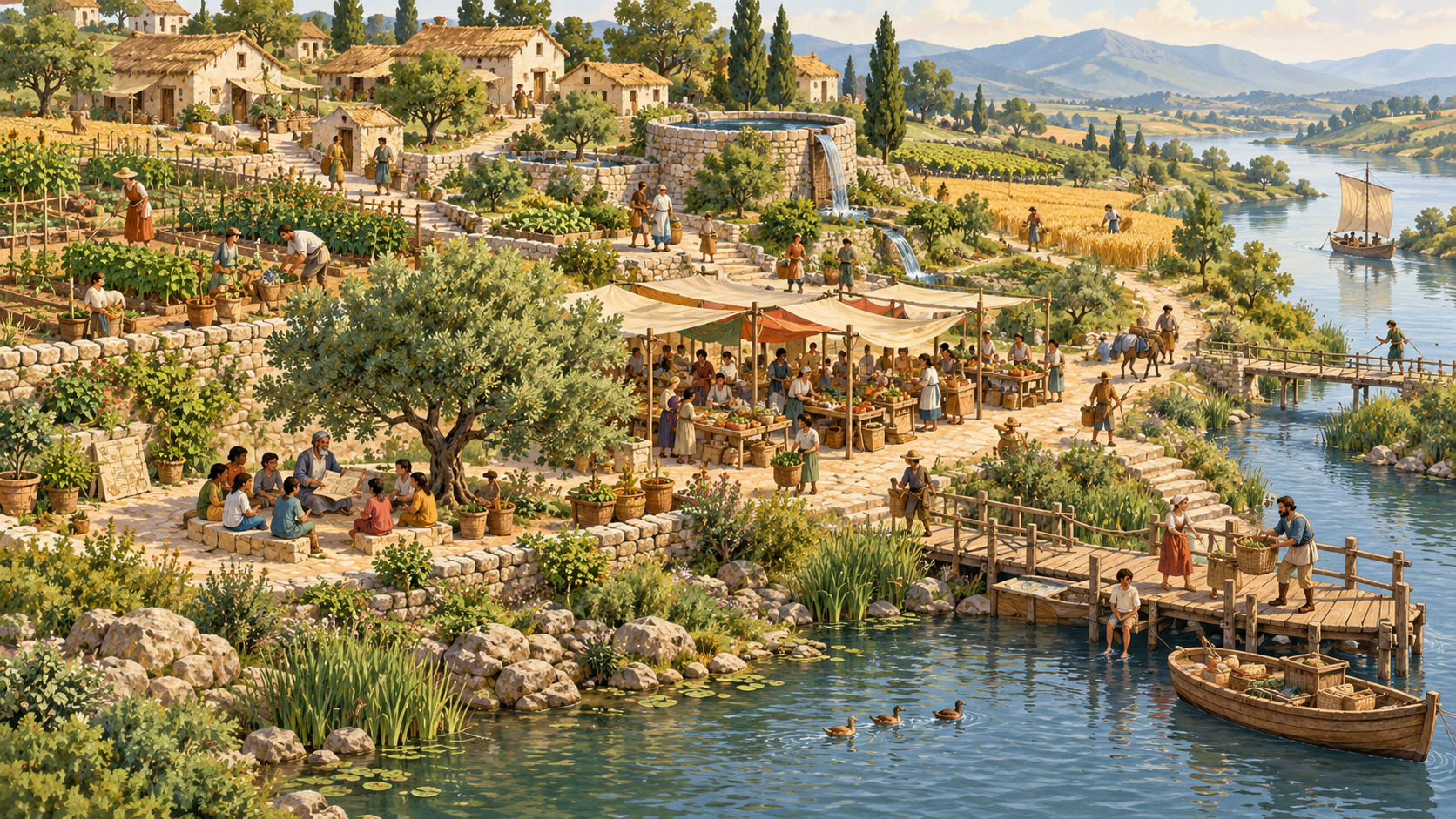
All sources, dates, collections and catalogue rules are fictional learning examples, not legal compliance guidance, professional archival policy or personal-data handling instructions. The established Riverbend cover is an AI-generated conceptual illustration, not a documentary image of a real place or a technical plan. A fictional role’s availability, consent, need or capability cannot be treated as a general truth about an actual person. All decisions in the guide stay within the limits of the written classroom rules.
Five guided learning routes
- Tell sources apart and preserve context — chapters 1–8
- Build retrievable catalogue records — chapters 9–16
- Preserve privacy, access and formats — chapters 17–24
- Resolve conflicting evidence honestly — chapters 25–32
- Carry corrected knowledge into the future — chapters 33–40
Complete 40-chapter index
Open all chapter titles
- 1. Why keep stories for future readers?
- 2. Memory differs from a dated document
- 3. Copies may not be independent witnesses
- 4. Drafts are not final announcements
- 5. Write a usable catalogue description
- 6. Separate donor from creator
- 7. Do not invent exact dates
- 8. Absence of evidence is not evidence of absence
- 9. Use categories without hiding cross-topic value
- 10. Location is not identity
- 11. Leave an unidentified folder provisionally named
- 12. Distinguish duplicate objects and sources
- 13. Preserve revision history
- 14. Correct a caption with an erratum
- 15. Transcription is not interpretation
- 16. Words change across contexts
- 17. A replica differs from an original
- 18. Choose what to preserve transparently
- 19. Retaining a file is not making it readable
- 20. A catalogue is not the underlying source
- 21. Protect private material in public displays
- 22. Preservation permission differs from publication
- 23. Official voices are not every voice
- 24. One invoice cannot define a whole economy
- 25. A map has a purpose and a date
- 26. Explain a classroom retention rule as fictional
- 27. Backups are not independent confirmations
- 28. Compare copies with a source rather than guess
- 29. Handle conflicting records without averaging truth
- 30. Cite the source behind a public statement
- 31. Point to the precise passage
- 32. Confidence depends on the particular claim
- 33. Keep research hypotheses labelled
- 34. Give objects meaningful context
- 35. Make search useful to different readers
- 36. Welcome stronger contradictory evidence
- 37. Transfer the collection to new staff
- 38. Answer a narrowly defined research question
- 39. Capstone: catalogue twelve mock sources
- 40. Capstone: recover from a missing storage box
Integrated project · Parent and tutor questions · Learning quality checklist
1. Why keep stories for future readers?
CHAPTER 1 OF 40 · Tell sources apart and preserve context · Back to index
Before a number is written, consider the ordinary person in the story. At Riverbend’s Story Hall, Ari encounters a concrete challenge: A student notebook describes a festival no one now remembers fully. Notice how this creates two questions. The first concerns the task itself: what should happen for the people in the scene? The second concerns evidence: what records would justify saying the intended result has happened? The chapter is about why keep stories for future readers?, so it should not be reduced to a moral slogan or a correct calculation unconnected to an actual purpose.
Start by making the request legible. Ask Ari to name the roles involved, the resource or information they share, the constraint each knows, and what condition would mark the task complete. Draw a small line between the request and the supplied evidence. If there is no line, the necessary information is missing. This exercise strengthens the important distinction between noticing something, interpreting its meaning and making an authorised decision about it. It is legitimate to say the answer remains unknown when the record does not support a stronger claim.
A common misreading appears immediately: Saving anything with no recorded purpose. Do not simply tell the child that this is wrong. Ask why the shorter answer is attractive: it may produce a neat total, avoid a difficult conversation or assume someone else has already checked the source. Then explain how the shortcut changes the meaning of the original task. Have the student construct a counterexample in which the neat-looking answer is identical but the underlying purpose is unmet. When they can do that, they understand the failure mode rather than memorising a warning.
The intended repair is specific: Write a question the notebook might answer. This should be written as a checkable action, not as a compliment for the imagined organisers. Place a source card beside it. Which part of the correction comes directly from the stated conditions? Which part is a possible response requiring permission? Which part is still undecided? Strong work preserves all three categories, especially when the first proposal sounded plausible. A real community needs processes that can withstand those questions, although the classroom card cannot itself establish a real-world standard.
Work through a separate numerical model
The Archive and Reading Room receives 16 distinct fictional source identities represented by 20 physical objects; the excess 4 are known copies. Of the 16 underlying sources, 2 have incomplete descriptive details. This small exercise tests provenance and catalogue counting, not the historical accuracy of the records. An object can be stored and catalogued yet still make claims requiring independent checking.
The physical item count is 16 + 4 = 20, but there are only 16 independently identified underlying sources in the supplied model. 14 source entries have the complete fields required for this exercise; 2 remain provisionally identified. Completeness of a label is not proof of historical truth, and copying a statement cannot create a new witness to the event.
| Record | Quantity | Meaning |
|---|---|---|
| Underlying sources | 16 | Distinct identities |
| Initial extra copies | 4 | Not independent evidence |
| Physical items | 20 | Sources plus copies |
| Provisional identities | 2 | Unresolved fields |
| Complete descriptions | 14 | Not a truth guarantee |
| Later duplicate copies | 3 | Added objects only |
The arithmetic matters because shared promises fail when resources are counted inconsistently. But the calculation does not answer every ethical, educational or practical question in this chapter. A parent can ask what the numbers name and what they do not name. A tutor can ask for the rule that makes the operation valid, then ask the learner to find one important outcome that the table cannot measure. The best answer distinguishes a possibility, an allocation, a reported event and a verified completion instead of using them as interchangeable labels.
A changed-condition challenge
Later, 3 additional objects arrive. Their donation cards explicitly identify them as copies of already recorded sources. Physical objects therefore total 23, while the independent source-identity count remains 16. If further evidence contradicts a source, the learner must document that conflict, not automatically delete or uncritically accept it.
Return to A student notebook describes a festival no one now remembers fully. The revised scenario is not an excuse to erase the earlier record. Put the baseline beside the changed sheet; mark the newly supplied information and keep the unaffected commitments. Ask Hana to identify whether the proposed solution remains allowed. If the student wants to add a resource, change a person’s acceptance or rewrite a source, require an explicit card authorising that change. The goal is a reasoned answer that another reader can check rather than a story that always ends conveniently.
The qualitative principle remains Write a question the notebook might answer. If the new calculation produces an attractive result but the original mistake survives, the repair is incomplete. Ask the learner to describe two layers of success: first, did the written model’s stated arithmetic or sequencing work? Second, did the particular need in the scene receive a verified response? A correct first answer is necessary for a credible plan, yet it is not proof of the second. This distinction becomes more valuable as a civilisation grows complicated enough for its records to hide what people actually experience.
A short parent conversation and tutor exercise
For a younger child, begin with a sketch of the Story Hall and four labelled cards: request, evidence, suggestion and finished action. Invite Ari to put each sentence from the story under the right card. Then ask, “Which card would you want to see before you believed the ending?” A parent can follow with an invitation to draw a second ending that stays within the stated rules. Keep the question concrete. An elaborate description may sound advanced while concealing the fact that the learner has not separated a plan from its completion.
For an older learner, write a four-sentence case analysis. Sentence one identifies the actual question. Sentence two cites the decisive information rather than repeating a general value. Sentence three explains the permitted choice or calculation. Sentence four sets a limit: what would still have to be verified? Mark the four functions separately. If the student’s numbers are wrong, repair the working. If the numbers are right but the conclusion is too strong, repair the inference. If the description of the request is wrong, return to the source. Those three errors need different tutorial interventions.
Try an independent challenge without telling the learner which answer to prefer. Try telling the story from the receiver’s viewpoint without changing any of the written conditions. Then ask for a written comparison of the two versions. The comparison should mention both the unchanged baseline and the new condition. An unanswered question should appear as an open question, not be quietly dropped. Reward the student who can explain why additional evidence is required. That explanation is more transferable than correctly predicting the ending of one invented story.
A useful follow-up for a class is to exchange papers. The receiving student must reproduce the calculation, identify the source behind the decisive claim and understand the proposed correction without help from the original author. If either student needs a hidden oral explanation, the written record is not yet ready for handover. This is not about bureaucratic length; a clear short record is better than a long one that hides its assumptions. Have the class rewrite only the sentence where the misunderstanding began and compare the difference in meaning.
Finally, return to the wider learning aim: preserve evidence, show its origins and limitations, provide access responsibly, and correct public knowledge when stronger sources appear. That aspiration does not magically make the fictional proposal correct. Here, the concrete difficulty was A student notebook describes a festival no one now remembers fully. The misleading shortcut was Saving anything with no recorded purpose. The testable improvement was Write a question the notebook might answer. A learner who can explain those three things in ordinary language, check the small model and describe one unanswered question has moved beyond recognising a topic name. They have practised the habit of making a public claim open to scrutiny and correction.
2. Memory differs from a dated document
CHAPTER 2 OF 40 · Tell sources apart and preserve context · Back to index
Children often notice the most visible object and overlook the promise behind it. At Riverbend’s River Square, Mina encounters a concrete challenge: A storyteller and a programme disagree about a celebration's day. Notice how this creates two questions. The first concerns the task itself: what should happen for the people in the scene? The second concerns evidence: what records would justify saying the intended result has happened? The chapter is about memory differs from a dated document, so it should not be reduced to a moral slogan or a correct calculation unconnected to an actual purpose.
Start by making the request legible. Ask Mina to name the roles involved, the resource or information they share, the constraint each knows, and what condition would mark the task complete. Draw a small line between the request and the supplied evidence. If there is no line, the necessary information is missing. This exercise strengthens the important distinction between noticing something, interpreting its meaning and making an authorised decision about it. It is legitimate to say the answer remains unknown when the record does not support a stronger claim.
A common misreading appears immediately: Assuming printed text is always perfect. Do not simply tell the child that this is wrong. Ask why the shorter answer is attractive: it may produce a neat total, avoid a difficult conversation or assume someone else has already checked the source. Then explain how the shortcut changes the meaning of the original task. Have the student construct a counterexample in which the neat-looking answer is identical but the underlying purpose is unmet. When they can do that, they understand the failure mode rather than memorising a warning.
The intended repair is specific: Record both source types and limitations. This should be written as a checkable action, not as a compliment for the imagined organisers. Place a source card beside it. Which part of the correction comes directly from the stated conditions? Which part is a possible response requiring permission? Which part is still undecided? Strong work preserves all three categories, especially when the first proposal sounded plausible. A real community needs processes that can withstand those questions, although the classroom card cannot itself establish a real-world standard.
Work through a separate numerical model
The Archive and Reading Room receives 19 distinct fictional source identities represented by 24 physical objects; the excess 5 are known copies. Of the 19 underlying sources, 3 have incomplete descriptive details. This small exercise tests provenance and catalogue counting, not the historical accuracy of the records. An object can be stored and catalogued yet still make claims requiring independent checking.
The physical item count is 19 + 5 = 24, but there are only 19 independently identified underlying sources in the supplied model. 16 source entries have the complete fields required for this exercise; 3 remain provisionally identified. Completeness of a label is not proof of historical truth, and copying a statement cannot create a new witness to the event.
| Record | Quantity | Meaning |
|---|---|---|
| Underlying sources | 19 | Distinct identities |
| Initial extra copies | 5 | Not independent evidence |
| Physical items | 24 | Sources plus copies |
| Provisional identities | 3 | Unresolved fields |
| Complete descriptions | 16 | Not a truth guarantee |
| Later duplicate copies | 4 | Added objects only |
The arithmetic matters because shared promises fail when resources are counted inconsistently. But the calculation does not answer every ethical, educational or practical question in this chapter. A parent can ask what the numbers name and what they do not name. A tutor can ask for the rule that makes the operation valid, then ask the learner to find one important outcome that the table cannot measure. The best answer distinguishes a possibility, an allocation, a reported event and a verified completion instead of using them as interchangeable labels.
A changed-condition challenge
Later, 4 additional objects arrive. Their donation cards explicitly identify them as copies of already recorded sources. Physical objects therefore total 28, while the independent source-identity count remains 19. If further evidence contradicts a source, the learner must document that conflict, not automatically delete or uncritically accept it.
Return to A storyteller and a programme disagree about a celebration's day. The revised scenario is not an excuse to erase the earlier record. Put the baseline beside the changed sheet; mark the newly supplied information and keep the unaffected commitments. Ask Kai to identify whether the proposed solution remains allowed. If the student wants to add a resource, change a person’s acceptance or rewrite a source, require an explicit card authorising that change. The goal is a reasoned answer that another reader can check rather than a story that always ends conveniently.
The qualitative principle remains Record both source types and limitations. If the new calculation produces an attractive result but the original mistake survives, the repair is incomplete. Ask the learner to describe two layers of success: first, did the written model’s stated arithmetic or sequencing work? Second, did the particular need in the scene receive a verified response? A correct first answer is necessary for a credible plan, yet it is not proof of the second. This distinction becomes more valuable as a civilisation grows complicated enough for its records to hide what people actually experience.
A short parent conversation and tutor exercise
For a younger child, begin with a sketch of the River Square and four labelled cards: request, evidence, suggestion and finished action. Invite Mina to put each sentence from the story under the right card. Then ask, “Which card would you want to see before you believed the ending?” A parent can follow with an invitation to draw a second ending that stays within the stated rules. Keep the question concrete. An elaborate description may sound advanced while concealing the fact that the learner has not separated a plan from its completion.
For an older learner, write a four-sentence case analysis. Sentence one identifies the actual question. Sentence two cites the decisive information rather than repeating a general value. Sentence three explains the permitted choice or calculation. Sentence four sets a limit: what would still have to be verified? Mark the four functions separately. If the student’s numbers are wrong, repair the working. If the numbers are right but the conclusion is too strong, repair the inference. If the description of the request is wrong, return to the source. Those three errors need different tutorial interventions.
Try an independent challenge without telling the learner which answer to prefer. Ask which part of the claimed result can be demonstrated with cards and which part is still a prediction. Then ask for a written comparison of the two versions. The comparison should mention both the unchanged baseline and the new condition. An unanswered question should appear as an open question, not be quietly dropped. Reward the student who can explain why additional evidence is required. That explanation is more transferable than correctly predicting the ending of one invented story.
A useful follow-up for a class is to exchange papers. The receiving student must reproduce the calculation, identify the source behind the decisive claim and understand the proposed correction without help from the original author. If either student needs a hidden oral explanation, the written record is not yet ready for handover. This is not about bureaucratic length; a clear short record is better than a long one that hides its assumptions. Have the class rewrite only the sentence where the misunderstanding began and compare the difference in meaning.
Finally, return to the wider learning aim: preserve evidence, show its origins and limitations, provide access responsibly, and correct public knowledge when stronger sources appear. That aspiration does not magically make the fictional proposal correct. Here, the concrete difficulty was A storyteller and a programme disagree about a celebration's day. The misleading shortcut was Assuming printed text is always perfect. The testable improvement was Record both source types and limitations. A learner who can explain those three things in ordinary language, check the small model and describe one unanswered question has moved beyond recognising a topic name. They have practised the habit of making a public claim open to scrutiny and correction.
Full index · Previous · Next
3. Copies may not be independent witnesses
CHAPTER 3 OF 40 · Tell sources apart and preserve context · Back to index
Riverbend’s daily life creates a small but revealing puzzle. At Riverbend’s Learning Room, Leonie encounters a concrete challenge: Three cards repeat a market story, two copied from the first. Notice how this creates two questions. The first concerns the task itself: what should happen for the people in the scene? The second concerns evidence: what records would justify saying the intended result has happened? The chapter is about copies may not be independent witnesses, so it should not be reduced to a moral slogan or a correct calculation unconnected to an actual purpose.
Start by making the request legible. Ask Leonie to name the roles involved, the resource or information they share, the constraint each knows, and what condition would mark the task complete. Draw a small line between the request and the supplied evidence. If there is no line, the necessary information is missing. This exercise strengthens the important distinction between noticing something, interpreting its meaning and making an authorised decision about it. It is legitimate to say the answer remains unknown when the record does not support a stronger claim.
A common misreading appears immediately: Counting all three as independent testimony. Do not simply tell the child that this is wrong. Ask why the shorter answer is attractive: it may produce a neat total, avoid a difficult conversation or assume someone else has already checked the source. Then explain how the shortcut changes the meaning of the original task. Have the student construct a counterexample in which the neat-looking answer is identical but the underlying purpose is unmet. When they can do that, they understand the failure mode rather than memorising a warning.
The intended repair is specific: Trace the copying relationships. This should be written as a checkable action, not as a compliment for the imagined organisers. Place a source card beside it. Which part of the correction comes directly from the stated conditions? Which part is a possible response requiring permission? Which part is still undecided? Strong work preserves all three categories, especially when the first proposal sounded plausible. A real community needs processes that can withstand those questions, although the classroom card cannot itself establish a real-world standard.
Work through a separate numerical model
The Archive and Reading Room receives 22 distinct fictional source identities represented by 28 physical objects; the excess 6 are known copies. Of the 22 underlying sources, 4 have incomplete descriptive details. This small exercise tests provenance and catalogue counting, not the historical accuracy of the records. An object can be stored and catalogued yet still make claims requiring independent checking.
The physical item count is 22 + 6 = 28, but there are only 22 independently identified underlying sources in the supplied model. 18 source entries have the complete fields required for this exercise; 4 remain provisionally identified. Completeness of a label is not proof of historical truth, and copying a statement cannot create a new witness to the event.
| Record | Quantity | Meaning |
|---|---|---|
| Underlying sources | 22 | Distinct identities |
| Initial extra copies | 6 | Not independent evidence |
| Physical items | 28 | Sources plus copies |
| Provisional identities | 4 | Unresolved fields |
| Complete descriptions | 18 | Not a truth guarantee |
| Later duplicate copies | 5 | Added objects only |
The arithmetic matters because shared promises fail when resources are counted inconsistently. But the calculation does not answer every ethical, educational or practical question in this chapter. A parent can ask what the numbers name and what they do not name. A tutor can ask for the rule that makes the operation valid, then ask the learner to find one important outcome that the table cannot measure. The best answer distinguishes a possibility, an allocation, a reported event and a verified completion instead of using them as interchangeable labels.
A changed-condition challenge
Later, 5 additional objects arrive. Their donation cards explicitly identify them as copies of already recorded sources. Physical objects therefore total 33, while the independent source-identity count remains 22. If further evidence contradicts a source, the learner must document that conflict, not automatically delete or uncritically accept it.
Return to Three cards repeat a market story, two copied from the first. The revised scenario is not an excuse to erase the earlier record. Put the baseline beside the changed sheet; mark the newly supplied information and keep the unaffected commitments. Ask Sofia to identify whether the proposed solution remains allowed. If the student wants to add a resource, change a person’s acceptance or rewrite a source, require an explicit card authorising that change. The goal is a reasoned answer that another reader can check rather than a story that always ends conveniently.
The qualitative principle remains Trace the copying relationships. If the new calculation produces an attractive result but the original mistake survives, the repair is incomplete. Ask the learner to describe two layers of success: first, did the written model’s stated arithmetic or sequencing work? Second, did the particular need in the scene receive a verified response? A correct first answer is necessary for a credible plan, yet it is not proof of the second. This distinction becomes more valuable as a civilisation grows complicated enough for its records to hide what people actually experience.
A short parent conversation and tutor exercise
For a younger child, begin with a sketch of the Learning Room and four labelled cards: request, evidence, suggestion and finished action. Invite Leonie to put each sentence from the story under the right card. Then ask, “Which card would you want to see before you believed the ending?” A parent can follow with an invitation to draw a second ending that stays within the stated rules. Keep the question concrete. An elaborate description may sound advanced while concealing the fact that the learner has not separated a plan from its completion.
For an older learner, write a four-sentence case analysis. Sentence one identifies the actual question. Sentence two cites the decisive information rather than repeating a general value. Sentence three explains the permitted choice or calculation. Sentence four sets a limit: what would still have to be verified? Mark the four functions separately. If the student’s numbers are wrong, repair the working. If the numbers are right but the conclusion is too strong, repair the inference. If the description of the request is wrong, return to the source. Those three errors need different tutorial interventions.
Try an independent challenge without telling the learner which answer to prefer. Give the record to somebody who has not heard the conversation and check what they can reconstruct. Then ask for a written comparison of the two versions. The comparison should mention both the unchanged baseline and the new condition. An unanswered question should appear as an open question, not be quietly dropped. Reward the student who can explain why additional evidence is required. That explanation is more transferable than correctly predicting the ending of one invented story.
A useful follow-up for a class is to exchange papers. The receiving student must reproduce the calculation, identify the source behind the decisive claim and understand the proposed correction without help from the original author. If either student needs a hidden oral explanation, the written record is not yet ready for handover. This is not about bureaucratic length; a clear short record is better than a long one that hides its assumptions. Have the class rewrite only the sentence where the misunderstanding began and compare the difference in meaning.
Finally, return to the wider learning aim: preserve evidence, show its origins and limitations, provide access responsibly, and correct public knowledge when stronger sources appear. That aspiration does not magically make the fictional proposal correct. Here, the concrete difficulty was Three cards repeat a market story, two copied from the first. The misleading shortcut was Counting all three as independent testimony. The testable improvement was Trace the copying relationships. A learner who can explain those three things in ordinary language, check the small model and describe one unanswered question has moved beyond recognising a topic name. They have practised the habit of making a public claim open to scrutiny and correction.
Full index · Previous · Next
4. Drafts are not final announcements
CHAPTER 4 OF 40 · Tell sources apart and preserve context · Back to index
A fresh tabletop record is placed in front of the class. At Riverbend’s Neighbourhood Table, Jia encounters a concrete challenge: An early poster and a later published version survive. Notice how this creates two questions. The first concerns the task itself: what should happen for the people in the scene? The second concerns evidence: what records would justify saying the intended result has happened? The chapter is about drafts are not final announcements, so it should not be reduced to a moral slogan or a correct calculation unconnected to an actual purpose.
Start by making the request legible. Ask Jia to name the roles involved, the resource or information they share, the constraint each knows, and what condition would mark the task complete. Draw a small line between the request and the supplied evidence. If there is no line, the necessary information is missing. This exercise strengthens the important distinction between noticing something, interpreting its meaning and making an authorised decision about it. It is legitimate to say the answer remains unknown when the record does not support a stronger claim.
A common misreading appears immediately: Treating a working draft as the public rule. Do not simply tell the child that this is wrong. Ask why the shorter answer is attractive: it may produce a neat total, avoid a difficult conversation or assume someone else has already checked the source. Then explain how the shortcut changes the meaning of the original task. Have the student construct a counterexample in which the neat-looking answer is identical but the underlying purpose is unmet. When they can do that, they understand the failure mode rather than memorising a warning.
The intended repair is specific: Mark publication status. This should be written as a checkable action, not as a compliment for the imagined organisers. Place a source card beside it. Which part of the correction comes directly from the stated conditions? Which part is a possible response requiring permission? Which part is still undecided? Strong work preserves all three categories, especially when the first proposal sounded plausible. A real community needs processes that can withstand those questions, although the classroom card cannot itself establish a real-world standard.
Work through a separate numerical model
The Archive and Reading Room receives 25 distinct fictional source identities represented by 32 physical objects; the excess 7 are known copies. Of the 25 underlying sources, 1 have incomplete descriptive details. This small exercise tests provenance and catalogue counting, not the historical accuracy of the records. An object can be stored and catalogued yet still make claims requiring independent checking.
The physical item count is 25 + 7 = 32, but there are only 25 independently identified underlying sources in the supplied model. 24 source entries have the complete fields required for this exercise; 1 remain provisionally identified. Completeness of a label is not proof of historical truth, and copying a statement cannot create a new witness to the event.
| Record | Quantity | Meaning |
|---|---|---|
| Underlying sources | 25 | Distinct identities |
| Initial extra copies | 7 | Not independent evidence |
| Physical items | 32 | Sources plus copies |
| Provisional identities | 1 | Unresolved fields |
| Complete descriptions | 24 | Not a truth guarantee |
| Later duplicate copies | 6 | Added objects only |
The arithmetic matters because shared promises fail when resources are counted inconsistently. But the calculation does not answer every ethical, educational or practical question in this chapter. A parent can ask what the numbers name and what they do not name. A tutor can ask for the rule that makes the operation valid, then ask the learner to find one important outcome that the table cannot measure. The best answer distinguishes a possibility, an allocation, a reported event and a verified completion instead of using them as interchangeable labels.
A changed-condition challenge
Later, 6 additional objects arrive. Their donation cards explicitly identify them as copies of already recorded sources. Physical objects therefore total 38, while the independent source-identity count remains 25. If further evidence contradicts a source, the learner must document that conflict, not automatically delete or uncritically accept it.
Return to An early poster and a later published version survive. The revised scenario is not an excuse to erase the earlier record. Put the baseline beside the changed sheet; mark the newly supplied information and keep the unaffected commitments. Ask Iman to identify whether the proposed solution remains allowed. If the student wants to add a resource, change a person’s acceptance or rewrite a source, require an explicit card authorising that change. The goal is a reasoned answer that another reader can check rather than a story that always ends conveniently.
The qualitative principle remains Mark publication status. If the new calculation produces an attractive result but the original mistake survives, the repair is incomplete. Ask the learner to describe two layers of success: first, did the written model’s stated arithmetic or sequencing work? Second, did the particular need in the scene receive a verified response? A correct first answer is necessary for a credible plan, yet it is not proof of the second. This distinction becomes more valuable as a civilisation grows complicated enough for its records to hide what people actually experience.
A short parent conversation and tutor exercise
For a younger child, begin with a sketch of the Neighbourhood Table and four labelled cards: request, evidence, suggestion and finished action. Invite Jia to put each sentence from the story under the right card. Then ask, “Which card would you want to see before you believed the ending?” A parent can follow with an invitation to draw a second ending that stays within the stated rules. Keep the question concrete. An elaborate description may sound advanced while concealing the fact that the learner has not separated a plan from its completion.
For an older learner, write a four-sentence case analysis. Sentence one identifies the actual question. Sentence two cites the decisive information rather than repeating a general value. Sentence three explains the permitted choice or calculation. Sentence four sets a limit: what would still have to be verified? Mark the four functions separately. If the student’s numbers are wrong, repair the working. If the numbers are right but the conclusion is too strong, repair the inference. If the description of the request is wrong, return to the source. Those three errors need different tutorial interventions.
Try an independent challenge without telling the learner which answer to prefer. Let a second child challenge the first answer using one explicit line of evidence rather than a guess. Then ask for a written comparison of the two versions. The comparison should mention both the unchanged baseline and the new condition. An unanswered question should appear as an open question, not be quietly dropped. Reward the student who can explain why additional evidence is required. That explanation is more transferable than correctly predicting the ending of one invented story.
A useful follow-up for a class is to exchange papers. The receiving student must reproduce the calculation, identify the source behind the decisive claim and understand the proposed correction without help from the original author. If either student needs a hidden oral explanation, the written record is not yet ready for handover. This is not about bureaucratic length; a clear short record is better than a long one that hides its assumptions. Have the class rewrite only the sentence where the misunderstanding began and compare the difference in meaning.
Finally, return to the wider learning aim: preserve evidence, show its origins and limitations, provide access responsibly, and correct public knowledge when stronger sources appear. That aspiration does not magically make the fictional proposal correct. Here, the concrete difficulty was An early poster and a later published version survive. The misleading shortcut was Treating a working draft as the public rule. The testable improvement was Mark publication status. A learner who can explain those three things in ordinary language, check the small model and describe one unanswered question has moved beyond recognising a topic name. They have practised the habit of making a public claim open to scrutiny and correction.
Full index · Previous · Next
5. Write a usable catalogue description
CHAPTER 5 OF 40 · Tell sources apart and preserve context · Back to index
Two apparently simple statements turn out to describe different things. At Riverbend’s Garden Court, Ravi encounters a concrete challenge: A box of timetables and maps is labelled old papers. Notice how this creates two questions. The first concerns the task itself: what should happen for the people in the scene? The second concerns evidence: what records would justify saying the intended result has happened? The chapter is about write a usable catalogue description, so it should not be reduced to a moral slogan or a correct calculation unconnected to an actual purpose.
Start by making the request legible. Ask Ravi to name the roles involved, the resource or information they share, the constraint each knows, and what condition would mark the task complete. Draw a small line between the request and the supplied evidence. If there is no line, the necessary information is missing. This exercise strengthens the important distinction between noticing something, interpreting its meaning and making an authorised decision about it. It is legitimate to say the answer remains unknown when the record does not support a stronger claim.
A common misreading appears immediately: Assuming the label is sufficient. Do not simply tell the child that this is wrong. Ask why the shorter answer is attractive: it may produce a neat total, avoid a difficult conversation or assume someone else has already checked the source. Then explain how the shortcut changes the meaning of the original task. Have the student construct a counterexample in which the neat-looking answer is identical but the underlying purpose is unmet. When they can do that, they understand the failure mode rather than memorising a warning.
The intended repair is specific: Add source, date and item ID. This should be written as a checkable action, not as a compliment for the imagined organisers. Place a source card beside it. Which part of the correction comes directly from the stated conditions? Which part is a possible response requiring permission? Which part is still undecided? Strong work preserves all three categories, especially when the first proposal sounded plausible. A real community needs processes that can withstand those questions, although the classroom card cannot itself establish a real-world standard.
Work through a separate numerical model
The Archive and Reading Room receives 28 distinct fictional source identities represented by 36 physical objects; the excess 8 are known copies. Of the 28 underlying sources, 2 have incomplete descriptive details. This small exercise tests provenance and catalogue counting, not the historical accuracy of the records. An object can be stored and catalogued yet still make claims requiring independent checking.
The physical item count is 28 + 8 = 36, but there are only 28 independently identified underlying sources in the supplied model. 26 source entries have the complete fields required for this exercise; 2 remain provisionally identified. Completeness of a label is not proof of historical truth, and copying a statement cannot create a new witness to the event.
| Record | Quantity | Meaning |
|---|---|---|
| Underlying sources | 28 | Distinct identities |
| Initial extra copies | 8 | Not independent evidence |
| Physical items | 36 | Sources plus copies |
| Provisional identities | 2 | Unresolved fields |
| Complete descriptions | 26 | Not a truth guarantee |
| Later duplicate copies | 2 | Added objects only |
The arithmetic matters because shared promises fail when resources are counted inconsistently. But the calculation does not answer every ethical, educational or practical question in this chapter. A parent can ask what the numbers name and what they do not name. A tutor can ask for the rule that makes the operation valid, then ask the learner to find one important outcome that the table cannot measure. The best answer distinguishes a possibility, an allocation, a reported event and a verified completion instead of using them as interchangeable labels.
A changed-condition challenge
Later, 2 additional objects arrive. Their donation cards explicitly identify them as copies of already recorded sources. Physical objects therefore total 38, while the independent source-identity count remains 28. If further evidence contradicts a source, the learner must document that conflict, not automatically delete or uncritically accept it.
Return to A box of timetables and maps is labelled old papers. The revised scenario is not an excuse to erase the earlier record. Put the baseline beside the changed sheet; mark the newly supplied information and keep the unaffected commitments. Ask Devi to identify whether the proposed solution remains allowed. If the student wants to add a resource, change a person’s acceptance or rewrite a source, require an explicit card authorising that change. The goal is a reasoned answer that another reader can check rather than a story that always ends conveniently.
The qualitative principle remains Add source, date and item ID. If the new calculation produces an attractive result but the original mistake survives, the repair is incomplete. Ask the learner to describe two layers of success: first, did the written model’s stated arithmetic or sequencing work? Second, did the particular need in the scene receive a verified response? A correct first answer is necessary for a credible plan, yet it is not proof of the second. This distinction becomes more valuable as a civilisation grows complicated enough for its records to hide what people actually experience.
A short parent conversation and tutor exercise
For a younger child, begin with a sketch of the Garden Court and four labelled cards: request, evidence, suggestion and finished action. Invite Ravi to put each sentence from the story under the right card. Then ask, “Which card would you want to see before you believed the ending?” A parent can follow with an invitation to draw a second ending that stays within the stated rules. Keep the question concrete. An elaborate description may sound advanced while concealing the fact that the learner has not separated a plan from its completion.
For an older learner, write a four-sentence case analysis. Sentence one identifies the actual question. Sentence two cites the decisive information rather than repeating a general value. Sentence three explains the permitted choice or calculation. Sentence four sets a limit: what would still have to be verified? Mark the four functions separately. If the student’s numbers are wrong, repair the working. If the numbers are right but the conclusion is too strong, repair the inference. If the description of the request is wrong, return to the source. Those three errors need different tutorial interventions.
Try an independent challenge without telling the learner which answer to prefer. Change only the named condition on the new card and leave every previous commitment intact. Then ask for a written comparison of the two versions. The comparison should mention both the unchanged baseline and the new condition. An unanswered question should appear as an open question, not be quietly dropped. Reward the student who can explain why additional evidence is required. That explanation is more transferable than correctly predicting the ending of one invented story.
A useful follow-up for a class is to exchange papers. The receiving student must reproduce the calculation, identify the source behind the decisive claim and understand the proposed correction without help from the original author. If either student needs a hidden oral explanation, the written record is not yet ready for handover. This is not about bureaucratic length; a clear short record is better than a long one that hides its assumptions. Have the class rewrite only the sentence where the misunderstanding began and compare the difference in meaning.
Finally, return to the wider learning aim: preserve evidence, show its origins and limitations, provide access responsibly, and correct public knowledge when stronger sources appear. That aspiration does not magically make the fictional proposal correct. Here, the concrete difficulty was A box of timetables and maps is labelled old papers. The misleading shortcut was Assuming the label is sufficient. The testable improvement was Add source, date and item ID. A learner who can explain those three things in ordinary language, check the small model and describe one unanswered question has moved beyond recognising a topic name. They have practised the habit of making a public claim open to scrutiny and correction.
Full index · Previous · Next
6. Separate donor from creator
CHAPTER 6 OF 40 · Tell sources apart and preserve context · Back to index
A family reading this scene can begin with a question rather than a lecture. At Riverbend’s Library Desk, Hana encounters a concrete challenge: A family gives an old drawing but does not know its artist. Notice how this creates two questions. The first concerns the task itself: what should happen for the people in the scene? The second concerns evidence: what records would justify saying the intended result has happened? The chapter is about separate donor from creator, so it should not be reduced to a moral slogan or a correct calculation unconnected to an actual purpose.
Start by making the request legible. Ask Hana to name the roles involved, the resource or information they share, the constraint each knows, and what condition would mark the task complete. Draw a small line between the request and the supplied evidence. If there is no line, the necessary information is missing. This exercise strengthens the important distinction between noticing something, interpreting its meaning and making an authorised decision about it. It is legitimate to say the answer remains unknown when the record does not support a stronger claim.
A common misreading appears immediately: Listing the donor as certain author. Do not simply tell the child that this is wrong. Ask why the shorter answer is attractive: it may produce a neat total, avoid a difficult conversation or assume someone else has already checked the source. Then explain how the shortcut changes the meaning of the original task. Have the student construct a counterexample in which the neat-looking answer is identical but the underlying purpose is unmet. When they can do that, they understand the failure mode rather than memorising a warning.
The intended repair is specific: Keep acquisition and authorship separate. This should be written as a checkable action, not as a compliment for the imagined organisers. Place a source card beside it. Which part of the correction comes directly from the stated conditions? Which part is a possible response requiring permission? Which part is still undecided? Strong work preserves all three categories, especially when the first proposal sounded plausible. A real community needs processes that can withstand those questions, although the classroom card cannot itself establish a real-world standard.
Work through a separate numerical model
The Archive and Reading Room receives 15 distinct fictional source identities represented by 18 physical objects; the excess 3 are known copies. Of the 15 underlying sources, 3 have incomplete descriptive details. This small exercise tests provenance and catalogue counting, not the historical accuracy of the records. An object can be stored and catalogued yet still make claims requiring independent checking.
The physical item count is 15 + 3 = 18, but there are only 15 independently identified underlying sources in the supplied model. 12 source entries have the complete fields required for this exercise; 3 remain provisionally identified. Completeness of a label is not proof of historical truth, and copying a statement cannot create a new witness to the event.
| Record | Quantity | Meaning |
|---|---|---|
| Underlying sources | 15 | Distinct identities |
| Initial extra copies | 3 | Not independent evidence |
| Physical items | 18 | Sources plus copies |
| Provisional identities | 3 | Unresolved fields |
| Complete descriptions | 12 | Not a truth guarantee |
| Later duplicate copies | 3 | Added objects only |
The arithmetic matters because shared promises fail when resources are counted inconsistently. But the calculation does not answer every ethical, educational or practical question in this chapter. A parent can ask what the numbers name and what they do not name. A tutor can ask for the rule that makes the operation valid, then ask the learner to find one important outcome that the table cannot measure. The best answer distinguishes a possibility, an allocation, a reported event and a verified completion instead of using them as interchangeable labels.
A changed-condition challenge
Later, 3 additional objects arrive. Their donation cards explicitly identify them as copies of already recorded sources. Physical objects therefore total 21, while the independent source-identity count remains 15. If further evidence contradicts a source, the learner must document that conflict, not automatically delete or uncritically accept it.
Return to A family gives an old drawing but does not know its artist. The revised scenario is not an excuse to erase the earlier record. Put the baseline beside the changed sheet; mark the newly supplied information and keep the unaffected commitments. Ask Chen to identify whether the proposed solution remains allowed. If the student wants to add a resource, change a person’s acceptance or rewrite a source, require an explicit card authorising that change. The goal is a reasoned answer that another reader can check rather than a story that always ends conveniently.
The qualitative principle remains Keep acquisition and authorship separate. If the new calculation produces an attractive result but the original mistake survives, the repair is incomplete. Ask the learner to describe two layers of success: first, did the written model’s stated arithmetic or sequencing work? Second, did the particular need in the scene receive a verified response? A correct first answer is necessary for a credible plan, yet it is not proof of the second. This distinction becomes more valuable as a civilisation grows complicated enough for its records to hide what people actually experience.
A short parent conversation and tutor exercise
For a younger child, begin with a sketch of the Library Desk and four labelled cards: request, evidence, suggestion and finished action. Invite Hana to put each sentence from the story under the right card. Then ask, “Which card would you want to see before you believed the ending?” A parent can follow with an invitation to draw a second ending that stays within the stated rules. Keep the question concrete. An elaborate description may sound advanced while concealing the fact that the learner has not separated a plan from its completion.
For an older learner, write a four-sentence case analysis. Sentence one identifies the actual question. Sentence two cites the decisive information rather than repeating a general value. Sentence three explains the permitted choice or calculation. Sentence four sets a limit: what would still have to be verified? Mark the four functions separately. If the student’s numbers are wrong, repair the working. If the numbers are right but the conclusion is too strong, repair the inference. If the description of the request is wrong, return to the source. Those three errors need different tutorial interventions.
Try an independent challenge without telling the learner which answer to prefer. Ask why an apparently kind or efficient shortcut might make the public record less trustworthy. Then ask for a written comparison of the two versions. The comparison should mention both the unchanged baseline and the new condition. An unanswered question should appear as an open question, not be quietly dropped. Reward the student who can explain why additional evidence is required. That explanation is more transferable than correctly predicting the ending of one invented story.
A useful follow-up for a class is to exchange papers. The receiving student must reproduce the calculation, identify the source behind the decisive claim and understand the proposed correction without help from the original author. If either student needs a hidden oral explanation, the written record is not yet ready for handover. This is not about bureaucratic length; a clear short record is better than a long one that hides its assumptions. Have the class rewrite only the sentence where the misunderstanding began and compare the difference in meaning.
Finally, return to the wider learning aim: preserve evidence, show its origins and limitations, provide access responsibly, and correct public knowledge when stronger sources appear. That aspiration does not magically make the fictional proposal correct. Here, the concrete difficulty was A family gives an old drawing but does not know its artist. The misleading shortcut was Listing the donor as certain author. The testable improvement was Keep acquisition and authorship separate. A learner who can explain those three things in ordinary language, check the small model and describe one unanswered question has moved beyond recognising a topic name. They have practised the habit of making a public claim open to scrutiny and correction.
Full index · Previous · Next
7. Do not invent exact dates
CHAPTER 7 OF 40 · Tell sources apart and preserve context · Back to index
Sometimes the most valuable evidence is a condition that has not been supplied. At Riverbend’s Community Studio, Kai encounters a concrete challenge: A diary says only early rainy season. Notice how this creates two questions. The first concerns the task itself: what should happen for the people in the scene? The second concerns evidence: what records would justify saying the intended result has happened? The chapter is about do not invent exact dates, so it should not be reduced to a moral slogan or a correct calculation unconnected to an actual purpose.
Start by making the request legible. Ask Kai to name the roles involved, the resource or information they share, the constraint each knows, and what condition would mark the task complete. Draw a small line between the request and the supplied evidence. If there is no line, the necessary information is missing. This exercise strengthens the important distinction between noticing something, interpreting its meaning and making an authorised decision about it. It is legitimate to say the answer remains unknown when the record does not support a stronger claim.
A common misreading appears immediately: Converting a vague phrase to a precise day. Do not simply tell the child that this is wrong. Ask why the shorter answer is attractive: it may produce a neat total, avoid a difficult conversation or assume someone else has already checked the source. Then explain how the shortcut changes the meaning of the original task. Have the student construct a counterexample in which the neat-looking answer is identical but the underlying purpose is unmet. When they can do that, they understand the failure mode rather than memorising a warning.
The intended repair is specific: Preserve uncertainty explicitly. This should be written as a checkable action, not as a compliment for the imagined organisers. Place a source card beside it. Which part of the correction comes directly from the stated conditions? Which part is a possible response requiring permission? Which part is still undecided? Strong work preserves all three categories, especially when the first proposal sounded plausible. A real community needs processes that can withstand those questions, although the classroom card cannot itself establish a real-world standard.
Work through a separate numerical model
The Archive and Reading Room receives 18 distinct fictional source identities represented by 22 physical objects; the excess 4 are known copies. Of the 18 underlying sources, 4 have incomplete descriptive details. This small exercise tests provenance and catalogue counting, not the historical accuracy of the records. An object can be stored and catalogued yet still make claims requiring independent checking.
The physical item count is 18 + 4 = 22, but there are only 18 independently identified underlying sources in the supplied model. 14 source entries have the complete fields required for this exercise; 4 remain provisionally identified. Completeness of a label is not proof of historical truth, and copying a statement cannot create a new witness to the event.
| Record | Quantity | Meaning |
|---|---|---|
| Underlying sources | 18 | Distinct identities |
| Initial extra copies | 4 | Not independent evidence |
| Physical items | 22 | Sources plus copies |
| Provisional identities | 4 | Unresolved fields |
| Complete descriptions | 14 | Not a truth guarantee |
| Later duplicate copies | 4 | Added objects only |
The arithmetic matters because shared promises fail when resources are counted inconsistently. But the calculation does not answer every ethical, educational or practical question in this chapter. A parent can ask what the numbers name and what they do not name. A tutor can ask for the rule that makes the operation valid, then ask the learner to find one important outcome that the table cannot measure. The best answer distinguishes a possibility, an allocation, a reported event and a verified completion instead of using them as interchangeable labels.
A changed-condition challenge
Later, 4 additional objects arrive. Their donation cards explicitly identify them as copies of already recorded sources. Physical objects therefore total 26, while the independent source-identity count remains 18. If further evidence contradicts a source, the learner must document that conflict, not automatically delete or uncritically accept it.
Return to A diary says only early rainy season. The revised scenario is not an excuse to erase the earlier record. Put the baseline beside the changed sheet; mark the newly supplied information and keep the unaffected commitments. Ask Ella to identify whether the proposed solution remains allowed. If the student wants to add a resource, change a person’s acceptance or rewrite a source, require an explicit card authorising that change. The goal is a reasoned answer that another reader can check rather than a story that always ends conveniently.
The qualitative principle remains Preserve uncertainty explicitly. If the new calculation produces an attractive result but the original mistake survives, the repair is incomplete. Ask the learner to describe two layers of success: first, did the written model’s stated arithmetic or sequencing work? Second, did the particular need in the scene receive a verified response? A correct first answer is necessary for a credible plan, yet it is not proof of the second. This distinction becomes more valuable as a civilisation grows complicated enough for its records to hide what people actually experience.
A short parent conversation and tutor exercise
For a younger child, begin with a sketch of the Community Studio and four labelled cards: request, evidence, suggestion and finished action. Invite Kai to put each sentence from the story under the right card. Then ask, “Which card would you want to see before you believed the ending?” A parent can follow with an invitation to draw a second ending that stays within the stated rules. Keep the question concrete. An elaborate description may sound advanced while concealing the fact that the learner has not separated a plan from its completion.
For an older learner, write a four-sentence case analysis. Sentence one identifies the actual question. Sentence two cites the decisive information rather than repeating a general value. Sentence three explains the permitted choice or calculation. Sentence four sets a limit: what would still have to be verified? Mark the four functions separately. If the student’s numbers are wrong, repair the working. If the numbers are right but the conclusion is too strong, repair the inference. If the description of the request is wrong, return to the source. Those three errors need different tutorial interventions.
Try an independent challenge without telling the learner which answer to prefer. Have the learner state what would count as disconfirming evidence for the proposed conclusion. Then ask for a written comparison of the two versions. The comparison should mention both the unchanged baseline and the new condition. An unanswered question should appear as an open question, not be quietly dropped. Reward the student who can explain why additional evidence is required. That explanation is more transferable than correctly predicting the ending of one invented story.
A useful follow-up for a class is to exchange papers. The receiving student must reproduce the calculation, identify the source behind the decisive claim and understand the proposed correction without help from the original author. If either student needs a hidden oral explanation, the written record is not yet ready for handover. This is not about bureaucratic length; a clear short record is better than a long one that hides its assumptions. Have the class rewrite only the sentence where the misunderstanding began and compare the difference in meaning.
Finally, return to the wider learning aim: preserve evidence, show its origins and limitations, provide access responsibly, and correct public knowledge when stronger sources appear. That aspiration does not magically make the fictional proposal correct. Here, the concrete difficulty was A diary says only early rainy season. The misleading shortcut was Converting a vague phrase to a precise day. The testable improvement was Preserve uncertainty explicitly. A learner who can explain those three things in ordinary language, check the small model and describe one unanswered question has moved beyond recognising a topic name. They have practised the habit of making a public claim open to scrutiny and correction.
Full index · Previous · Next
8. Absence of evidence is not evidence of absence
CHAPTER 8 OF 40 · Tell sources apart and preserve context · Back to index
A learner’s first confident answer may be narrower than it sounds. At Riverbend’s Map Table, Sofia encounters a concrete challenge: No programme survives for an imaginary concert. Notice how this creates two questions. The first concerns the task itself: what should happen for the people in the scene? The second concerns evidence: what records would justify saying the intended result has happened? The chapter is about absence of evidence is not evidence of absence, so it should not be reduced to a moral slogan or a correct calculation unconnected to an actual purpose.
Start by making the request legible. Ask Sofia to name the roles involved, the resource or information they share, the constraint each knows, and what condition would mark the task complete. Draw a small line between the request and the supplied evidence. If there is no line, the necessary information is missing. This exercise strengthens the important distinction between noticing something, interpreting its meaning and making an authorised decision about it. It is legitimate to say the answer remains unknown when the record does not support a stronger claim.
A common misreading appears immediately: Declaring the concert cancelled. Do not simply tell the child that this is wrong. Ask why the shorter answer is attractive: it may produce a neat total, avoid a difficult conversation or assume someone else has already checked the source. Then explain how the shortcut changes the meaning of the original task. Have the student construct a counterexample in which the neat-looking answer is identical but the underlying purpose is unmet. When they can do that, they understand the failure mode rather than memorising a warning.
The intended repair is specific: Say no programme has been found. This should be written as a checkable action, not as a compliment for the imagined organisers. Place a source card beside it. Which part of the correction comes directly from the stated conditions? Which part is a possible response requiring permission? Which part is still undecided? Strong work preserves all three categories, especially when the first proposal sounded plausible. A real community needs processes that can withstand those questions, although the classroom card cannot itself establish a real-world standard.
Work through a separate numerical model
The Archive and Reading Room receives 21 distinct fictional source identities represented by 26 physical objects; the excess 5 are known copies. Of the 21 underlying sources, 1 have incomplete descriptive details. This small exercise tests provenance and catalogue counting, not the historical accuracy of the records. An object can be stored and catalogued yet still make claims requiring independent checking.
The physical item count is 21 + 5 = 26, but there are only 21 independently identified underlying sources in the supplied model. 20 source entries have the complete fields required for this exercise; 1 remain provisionally identified. Completeness of a label is not proof of historical truth, and copying a statement cannot create a new witness to the event.
| Record | Quantity | Meaning |
|---|---|---|
| Underlying sources | 21 | Distinct identities |
| Initial extra copies | 5 | Not independent evidence |
| Physical items | 26 | Sources plus copies |
| Provisional identities | 1 | Unresolved fields |
| Complete descriptions | 20 | Not a truth guarantee |
| Later duplicate copies | 5 | Added objects only |
The arithmetic matters because shared promises fail when resources are counted inconsistently. But the calculation does not answer every ethical, educational or practical question in this chapter. A parent can ask what the numbers name and what they do not name. A tutor can ask for the rule that makes the operation valid, then ask the learner to find one important outcome that the table cannot measure. The best answer distinguishes a possibility, an allocation, a reported event and a verified completion instead of using them as interchangeable labels.
A changed-condition challenge
Later, 5 additional objects arrive. Their donation cards explicitly identify them as copies of already recorded sources. Physical objects therefore total 31, while the independent source-identity count remains 21. If further evidence contradicts a source, the learner must document that conflict, not automatically delete or uncritically accept it.
Return to No programme survives for an imaginary concert. The revised scenario is not an excuse to erase the earlier record. Put the baseline beside the changed sheet; mark the newly supplied information and keep the unaffected commitments. Ask Ari to identify whether the proposed solution remains allowed. If the student wants to add a resource, change a person’s acceptance or rewrite a source, require an explicit card authorising that change. The goal is a reasoned answer that another reader can check rather than a story that always ends conveniently.
The qualitative principle remains Say no programme has been found. If the new calculation produces an attractive result but the original mistake survives, the repair is incomplete. Ask the learner to describe two layers of success: first, did the written model’s stated arithmetic or sequencing work? Second, did the particular need in the scene receive a verified response? A correct first answer is necessary for a credible plan, yet it is not proof of the second. This distinction becomes more valuable as a civilisation grows complicated enough for its records to hide what people actually experience.
A short parent conversation and tutor exercise
For a younger child, begin with a sketch of the Map Table and four labelled cards: request, evidence, suggestion and finished action. Invite Sofia to put each sentence from the story under the right card. Then ask, “Which card would you want to see before you believed the ending?” A parent can follow with an invitation to draw a second ending that stays within the stated rules. Keep the question concrete. An elaborate description may sound advanced while concealing the fact that the learner has not separated a plan from its completion.
For an older learner, write a four-sentence case analysis. Sentence one identifies the actual question. Sentence two cites the decisive information rather than repeating a general value. Sentence three explains the permitted choice or calculation. Sentence four sets a limit: what would still have to be verified? Mark the four functions separately. If the student’s numbers are wrong, repair the working. If the numbers are right but the conclusion is too strong, repair the inference. If the description of the request is wrong, return to the source. Those three errors need different tutorial interventions.
Try an independent challenge without telling the learner which answer to prefer. Separate the decision process from whether the intended experience was actually delivered. Then ask for a written comparison of the two versions. The comparison should mention both the unchanged baseline and the new condition. An unanswered question should appear as an open question, not be quietly dropped. Reward the student who can explain why additional evidence is required. That explanation is more transferable than correctly predicting the ending of one invented story.
A useful follow-up for a class is to exchange papers. The receiving student must reproduce the calculation, identify the source behind the decisive claim and understand the proposed correction without help from the original author. If either student needs a hidden oral explanation, the written record is not yet ready for handover. This is not about bureaucratic length; a clear short record is better than a long one that hides its assumptions. Have the class rewrite only the sentence where the misunderstanding began and compare the difference in meaning.
Finally, return to the wider learning aim: preserve evidence, show its origins and limitations, provide access responsibly, and correct public knowledge when stronger sources appear. That aspiration does not magically make the fictional proposal correct. Here, the concrete difficulty was No programme survives for an imaginary concert. The misleading shortcut was Declaring the concert cancelled. The testable improvement was Say no programme has been found. A learner who can explain those three things in ordinary language, check the small model and describe one unanswered question has moved beyond recognising a topic name. They have practised the habit of making a public claim open to scrutiny and correction.
Full index · Previous · Next
9. Use categories without hiding cross-topic value
CHAPTER 9 OF 40 · Build retrievable catalogue records · Back to index
Before a number is written, consider the ordinary person in the story. At Riverbend’s Story Hall, Iman encounters a concrete challenge: A timetable concerns both education and journeys. Notice how this creates two questions. The first concerns the task itself: what should happen for the people in the scene? The second concerns evidence: what records would justify saying the intended result has happened? The chapter is about use categories without hiding cross-topic value, so it should not be reduced to a moral slogan or a correct calculation unconnected to an actual purpose.
Start by making the request legible. Ask Iman to name the roles involved, the resource or information they share, the constraint each knows, and what condition would mark the task complete. Draw a small line between the request and the supplied evidence. If there is no line, the necessary information is missing. This exercise strengthens the important distinction between noticing something, interpreting its meaning and making an authorised decision about it. It is legitimate to say the answer remains unknown when the record does not support a stronger claim.
A common misreading appears immediately: Allowing only one search route. Do not simply tell the child that this is wrong. Ask why the shorter answer is attractive: it may produce a neat total, avoid a difficult conversation or assume someone else has already checked the source. Then explain how the shortcut changes the meaning of the original task. Have the student construct a counterexample in which the neat-looking answer is identical but the underlying purpose is unmet. When they can do that, they understand the failure mode rather than memorising a warning.
The intended repair is specific: Cross-reference without double-counting the object. This should be written as a checkable action, not as a compliment for the imagined organisers. Place a source card beside it. Which part of the correction comes directly from the stated conditions? Which part is a possible response requiring permission? Which part is still undecided? Strong work preserves all three categories, especially when the first proposal sounded plausible. A real community needs processes that can withstand those questions, although the classroom card cannot itself establish a real-world standard.
Work through a separate numerical model
The Archive and Reading Room receives 24 distinct fictional source identities represented by 30 physical objects; the excess 6 are known copies. Of the 24 underlying sources, 2 have incomplete descriptive details. This small exercise tests provenance and catalogue counting, not the historical accuracy of the records. An object can be stored and catalogued yet still make claims requiring independent checking.
The physical item count is 24 + 6 = 30, but there are only 24 independently identified underlying sources in the supplied model. 22 source entries have the complete fields required for this exercise; 2 remain provisionally identified. Completeness of a label is not proof of historical truth, and copying a statement cannot create a new witness to the event.
| Record | Quantity | Meaning |
|---|---|---|
| Underlying sources | 24 | Distinct identities |
| Initial extra copies | 6 | Not independent evidence |
| Physical items | 30 | Sources plus copies |
| Provisional identities | 2 | Unresolved fields |
| Complete descriptions | 22 | Not a truth guarantee |
| Later duplicate copies | 6 | Added objects only |
The arithmetic matters because shared promises fail when resources are counted inconsistently. But the calculation does not answer every ethical, educational or practical question in this chapter. A parent can ask what the numbers name and what they do not name. A tutor can ask for the rule that makes the operation valid, then ask the learner to find one important outcome that the table cannot measure. The best answer distinguishes a possibility, an allocation, a reported event and a verified completion instead of using them as interchangeable labels.
A changed-condition challenge
Later, 6 additional objects arrive. Their donation cards explicitly identify them as copies of already recorded sources. Physical objects therefore total 36, while the independent source-identity count remains 24. If further evidence contradicts a source, the learner must document that conflict, not automatically delete or uncritically accept it.
Return to A timetable concerns both education and journeys. The revised scenario is not an excuse to erase the earlier record. Put the baseline beside the changed sheet; mark the newly supplied information and keep the unaffected commitments. Ask Mina to identify whether the proposed solution remains allowed. If the student wants to add a resource, change a person’s acceptance or rewrite a source, require an explicit card authorising that change. The goal is a reasoned answer that another reader can check rather than a story that always ends conveniently.
The qualitative principle remains Cross-reference without double-counting the object. If the new calculation produces an attractive result but the original mistake survives, the repair is incomplete. Ask the learner to describe two layers of success: first, did the written model’s stated arithmetic or sequencing work? Second, did the particular need in the scene receive a verified response? A correct first answer is necessary for a credible plan, yet it is not proof of the second. This distinction becomes more valuable as a civilisation grows complicated enough for its records to hide what people actually experience.
A short parent conversation and tutor exercise
For a younger child, begin with a sketch of the Story Hall and four labelled cards: request, evidence, suggestion and finished action. Invite Iman to put each sentence from the story under the right card. Then ask, “Which card would you want to see before you believed the ending?” A parent can follow with an invitation to draw a second ending that stays within the stated rules. Keep the question concrete. An elaborate description may sound advanced while concealing the fact that the learner has not separated a plan from its completion.
For an older learner, write a four-sentence case analysis. Sentence one identifies the actual question. Sentence two cites the decisive information rather than repeating a general value. Sentence three explains the permitted choice or calculation. Sentence four sets a limit: what would still have to be verified? Mark the four functions separately. If the student’s numbers are wrong, repair the working. If the numbers are right but the conclusion is too strong, repair the inference. If the description of the request is wrong, return to the source. Those three errors need different tutorial interventions.
Try an independent challenge without telling the learner which answer to prefer. Try telling the story from the receiver’s viewpoint without changing any of the written conditions. Then ask for a written comparison of the two versions. The comparison should mention both the unchanged baseline and the new condition. An unanswered question should appear as an open question, not be quietly dropped. Reward the student who can explain why additional evidence is required. That explanation is more transferable than correctly predicting the ending of one invented story.
A useful follow-up for a class is to exchange papers. The receiving student must reproduce the calculation, identify the source behind the decisive claim and understand the proposed correction without help from the original author. If either student needs a hidden oral explanation, the written record is not yet ready for handover. This is not about bureaucratic length; a clear short record is better than a long one that hides its assumptions. Have the class rewrite only the sentence where the misunderstanding began and compare the difference in meaning.
Finally, return to the wider learning aim: preserve evidence, show its origins and limitations, provide access responsibly, and correct public knowledge when stronger sources appear. That aspiration does not magically make the fictional proposal correct. Here, the concrete difficulty was A timetable concerns both education and journeys. The misleading shortcut was Allowing only one search route. The testable improvement was Cross-reference without double-counting the object. A learner who can explain those three things in ordinary language, check the small model and describe one unanswered question has moved beyond recognising a topic name. They have practised the habit of making a public claim open to scrutiny and correction.
Full index · Previous · Next
10. Location is not identity
CHAPTER 10 OF 40 · Build retrievable catalogue records · Back to index
Children often notice the most visible object and overlook the promise behind it. At Riverbend’s River Square, Devi encounters a concrete challenge: A ledger with a stable ID moves to a new shelf. Notice how this creates two questions. The first concerns the task itself: what should happen for the people in the scene? The second concerns evidence: what records would justify saying the intended result has happened? The chapter is about location is not identity, so it should not be reduced to a moral slogan or a correct calculation unconnected to an actual purpose.
Start by making the request legible. Ask Devi to name the roles involved, the resource or information they share, the constraint each knows, and what condition would mark the task complete. Draw a small line between the request and the supplied evidence. If there is no line, the necessary information is missing. This exercise strengthens the important distinction between noticing something, interpreting its meaning and making an authorised decision about it. It is legitimate to say the answer remains unknown when the record does not support a stronger claim.
A common misreading appears immediately: Changing the source identity with the shelf code. Do not simply tell the child that this is wrong. Ask why the shorter answer is attractive: it may produce a neat total, avoid a difficult conversation or assume someone else has already checked the source. Then explain how the shortcut changes the meaning of the original task. Have the student construct a counterexample in which the neat-looking answer is identical but the underlying purpose is unmet. When they can do that, they understand the failure mode rather than memorising a warning.
The intended repair is specific: Update the storage field only. This should be written as a checkable action, not as a compliment for the imagined organisers. Place a source card beside it. Which part of the correction comes directly from the stated conditions? Which part is a possible response requiring permission? Which part is still undecided? Strong work preserves all three categories, especially when the first proposal sounded plausible. A real community needs processes that can withstand those questions, although the classroom card cannot itself establish a real-world standard.
Work through a separate numerical model
The Archive and Reading Room receives 27 distinct fictional source identities represented by 34 physical objects; the excess 7 are known copies. Of the 27 underlying sources, 3 have incomplete descriptive details. This small exercise tests provenance and catalogue counting, not the historical accuracy of the records. An object can be stored and catalogued yet still make claims requiring independent checking.
The physical item count is 27 + 7 = 34, but there are only 27 independently identified underlying sources in the supplied model. 24 source entries have the complete fields required for this exercise; 3 remain provisionally identified. Completeness of a label is not proof of historical truth, and copying a statement cannot create a new witness to the event.
| Record | Quantity | Meaning |
|---|---|---|
| Underlying sources | 27 | Distinct identities |
| Initial extra copies | 7 | Not independent evidence |
| Physical items | 34 | Sources plus copies |
| Provisional identities | 3 | Unresolved fields |
| Complete descriptions | 24 | Not a truth guarantee |
| Later duplicate copies | 2 | Added objects only |
The arithmetic matters because shared promises fail when resources are counted inconsistently. But the calculation does not answer every ethical, educational or practical question in this chapter. A parent can ask what the numbers name and what they do not name. A tutor can ask for the rule that makes the operation valid, then ask the learner to find one important outcome that the table cannot measure. The best answer distinguishes a possibility, an allocation, a reported event and a verified completion instead of using them as interchangeable labels.
A changed-condition challenge
Later, 2 additional objects arrive. Their donation cards explicitly identify them as copies of already recorded sources. Physical objects therefore total 36, while the independent source-identity count remains 27. If further evidence contradicts a source, the learner must document that conflict, not automatically delete or uncritically accept it.
Return to A ledger with a stable ID moves to a new shelf. The revised scenario is not an excuse to erase the earlier record. Put the baseline beside the changed sheet; mark the newly supplied information and keep the unaffected commitments. Ask Leonie to identify whether the proposed solution remains allowed. If the student wants to add a resource, change a person’s acceptance or rewrite a source, require an explicit card authorising that change. The goal is a reasoned answer that another reader can check rather than a story that always ends conveniently.
The qualitative principle remains Update the storage field only. If the new calculation produces an attractive result but the original mistake survives, the repair is incomplete. Ask the learner to describe two layers of success: first, did the written model’s stated arithmetic or sequencing work? Second, did the particular need in the scene receive a verified response? A correct first answer is necessary for a credible plan, yet it is not proof of the second. This distinction becomes more valuable as a civilisation grows complicated enough for its records to hide what people actually experience.
A short parent conversation and tutor exercise
For a younger child, begin with a sketch of the River Square and four labelled cards: request, evidence, suggestion and finished action. Invite Devi to put each sentence from the story under the right card. Then ask, “Which card would you want to see before you believed the ending?” A parent can follow with an invitation to draw a second ending that stays within the stated rules. Keep the question concrete. An elaborate description may sound advanced while concealing the fact that the learner has not separated a plan from its completion.
For an older learner, write a four-sentence case analysis. Sentence one identifies the actual question. Sentence two cites the decisive information rather than repeating a general value. Sentence three explains the permitted choice or calculation. Sentence four sets a limit: what would still have to be verified? Mark the four functions separately. If the student’s numbers are wrong, repair the working. If the numbers are right but the conclusion is too strong, repair the inference. If the description of the request is wrong, return to the source. Those three errors need different tutorial interventions.
Try an independent challenge without telling the learner which answer to prefer. Ask which part of the claimed result can be demonstrated with cards and which part is still a prediction. Then ask for a written comparison of the two versions. The comparison should mention both the unchanged baseline and the new condition. An unanswered question should appear as an open question, not be quietly dropped. Reward the student who can explain why additional evidence is required. That explanation is more transferable than correctly predicting the ending of one invented story.
A useful follow-up for a class is to exchange papers. The receiving student must reproduce the calculation, identify the source behind the decisive claim and understand the proposed correction without help from the original author. If either student needs a hidden oral explanation, the written record is not yet ready for handover. This is not about bureaucratic length; a clear short record is better than a long one that hides its assumptions. Have the class rewrite only the sentence where the misunderstanding began and compare the difference in meaning.
Finally, return to the wider learning aim: preserve evidence, show its origins and limitations, provide access responsibly, and correct public knowledge when stronger sources appear. That aspiration does not magically make the fictional proposal correct. Here, the concrete difficulty was A ledger with a stable ID moves to a new shelf. The misleading shortcut was Changing the source identity with the shelf code. The testable improvement was Update the storage field only. A learner who can explain those three things in ordinary language, check the small model and describe one unanswered question has moved beyond recognising a topic name. They have practised the habit of making a public claim open to scrutiny and correction.
Full index · Previous · Next
11. Leave an unidentified folder provisionally named
CHAPTER 11 OF 40 · Build retrievable catalogue records · Back to index
Riverbend’s daily life creates a small but revealing puzzle. At Riverbend’s Learning Room, Chen encounters a concrete challenge: An unlabeled paper could match several nearby folders. Notice how this creates two questions. The first concerns the task itself: what should happen for the people in the scene? The second concerns evidence: what records would justify saying the intended result has happened? The chapter is about leave an unidentified folder provisionally named, so it should not be reduced to a moral slogan or a correct calculation unconnected to an actual purpose.
Start by making the request legible. Ask Chen to name the roles involved, the resource or information they share, the constraint each knows, and what condition would mark the task complete. Draw a small line between the request and the supplied evidence. If there is no line, the necessary information is missing. This exercise strengthens the important distinction between noticing something, interpreting its meaning and making an authorised decision about it. It is legitimate to say the answer remains unknown when the record does not support a stronger claim.
A common misreading appears immediately: Guessing its title from proximity. Do not simply tell the child that this is wrong. Ask why the shorter answer is attractive: it may produce a neat total, avoid a difficult conversation or assume someone else has already checked the source. Then explain how the shortcut changes the meaning of the original task. Have the student construct a counterexample in which the neat-looking answer is identical but the underlying purpose is unmet. When they can do that, they understand the failure mode rather than memorising a warning.
The intended repair is specific: Assign a temporary identifier. This should be written as a checkable action, not as a compliment for the imagined organisers. Place a source card beside it. Which part of the correction comes directly from the stated conditions? Which part is a possible response requiring permission? Which part is still undecided? Strong work preserves all three categories, especially when the first proposal sounded plausible. A real community needs processes that can withstand those questions, although the classroom card cannot itself establish a real-world standard.
Work through a separate numerical model
The Archive and Reading Room receives 14 distinct fictional source identities represented by 22 physical objects; the excess 8 are known copies. Of the 14 underlying sources, 4 have incomplete descriptive details. This small exercise tests provenance and catalogue counting, not the historical accuracy of the records. An object can be stored and catalogued yet still make claims requiring independent checking.
The physical item count is 14 + 8 = 22, but there are only 14 independently identified underlying sources in the supplied model. 10 source entries have the complete fields required for this exercise; 4 remain provisionally identified. Completeness of a label is not proof of historical truth, and copying a statement cannot create a new witness to the event.
| Record | Quantity | Meaning |
|---|---|---|
| Underlying sources | 14 | Distinct identities |
| Initial extra copies | 8 | Not independent evidence |
| Physical items | 22 | Sources plus copies |
| Provisional identities | 4 | Unresolved fields |
| Complete descriptions | 10 | Not a truth guarantee |
| Later duplicate copies | 3 | Added objects only |
The arithmetic matters because shared promises fail when resources are counted inconsistently. But the calculation does not answer every ethical, educational or practical question in this chapter. A parent can ask what the numbers name and what they do not name. A tutor can ask for the rule that makes the operation valid, then ask the learner to find one important outcome that the table cannot measure. The best answer distinguishes a possibility, an allocation, a reported event and a verified completion instead of using them as interchangeable labels.
A changed-condition challenge
Later, 3 additional objects arrive. Their donation cards explicitly identify them as copies of already recorded sources. Physical objects therefore total 25, while the independent source-identity count remains 14. If further evidence contradicts a source, the learner must document that conflict, not automatically delete or uncritically accept it.
Return to An unlabeled paper could match several nearby folders. The revised scenario is not an excuse to erase the earlier record. Put the baseline beside the changed sheet; mark the newly supplied information and keep the unaffected commitments. Ask Jia to identify whether the proposed solution remains allowed. If the student wants to add a resource, change a person’s acceptance or rewrite a source, require an explicit card authorising that change. The goal is a reasoned answer that another reader can check rather than a story that always ends conveniently.
The qualitative principle remains Assign a temporary identifier. If the new calculation produces an attractive result but the original mistake survives, the repair is incomplete. Ask the learner to describe two layers of success: first, did the written model’s stated arithmetic or sequencing work? Second, did the particular need in the scene receive a verified response? A correct first answer is necessary for a credible plan, yet it is not proof of the second. This distinction becomes more valuable as a civilisation grows complicated enough for its records to hide what people actually experience.
A short parent conversation and tutor exercise
For a younger child, begin with a sketch of the Learning Room and four labelled cards: request, evidence, suggestion and finished action. Invite Chen to put each sentence from the story under the right card. Then ask, “Which card would you want to see before you believed the ending?” A parent can follow with an invitation to draw a second ending that stays within the stated rules. Keep the question concrete. An elaborate description may sound advanced while concealing the fact that the learner has not separated a plan from its completion.
For an older learner, write a four-sentence case analysis. Sentence one identifies the actual question. Sentence two cites the decisive information rather than repeating a general value. Sentence three explains the permitted choice or calculation. Sentence four sets a limit: what would still have to be verified? Mark the four functions separately. If the student’s numbers are wrong, repair the working. If the numbers are right but the conclusion is too strong, repair the inference. If the description of the request is wrong, return to the source. Those three errors need different tutorial interventions.
Try an independent challenge without telling the learner which answer to prefer. Give the record to somebody who has not heard the conversation and check what they can reconstruct. Then ask for a written comparison of the two versions. The comparison should mention both the unchanged baseline and the new condition. An unanswered question should appear as an open question, not be quietly dropped. Reward the student who can explain why additional evidence is required. That explanation is more transferable than correctly predicting the ending of one invented story.
A useful follow-up for a class is to exchange papers. The receiving student must reproduce the calculation, identify the source behind the decisive claim and understand the proposed correction without help from the original author. If either student needs a hidden oral explanation, the written record is not yet ready for handover. This is not about bureaucratic length; a clear short record is better than a long one that hides its assumptions. Have the class rewrite only the sentence where the misunderstanding began and compare the difference in meaning.
Finally, return to the wider learning aim: preserve evidence, show its origins and limitations, provide access responsibly, and correct public knowledge when stronger sources appear. That aspiration does not magically make the fictional proposal correct. Here, the concrete difficulty was An unlabeled paper could match several nearby folders. The misleading shortcut was Guessing its title from proximity. The testable improvement was Assign a temporary identifier. A learner who can explain those three things in ordinary language, check the small model and describe one unanswered question has moved beyond recognising a topic name. They have practised the habit of making a public claim open to scrutiny and correction.
Full index · Previous · Next
12. Distinguish duplicate objects and sources
CHAPTER 12 OF 40 · Build retrievable catalogue records · Back to index
A fresh tabletop record is placed in front of the class. At Riverbend’s Neighbourhood Table, Ella encounters a concrete challenge: Two acquired copies reproduce the same notice. Notice how this creates two questions. The first concerns the task itself: what should happen for the people in the scene? The second concerns evidence: what records would justify saying the intended result has happened? The chapter is about distinguish duplicate objects and sources, so it should not be reduced to a moral slogan or a correct calculation unconnected to an actual purpose.
Start by making the request legible. Ask Ella to name the roles involved, the resource or information they share, the constraint each knows, and what condition would mark the task complete. Draw a small line between the request and the supplied evidence. If there is no line, the necessary information is missing. This exercise strengthens the important distinction between noticing something, interpreting its meaning and making an authorised decision about it. It is legitimate to say the answer remains unknown when the record does not support a stronger claim.
A common misreading appears immediately: Recording two decisions instead of one. Do not simply tell the child that this is wrong. Ask why the shorter answer is attractive: it may produce a neat total, avoid a difficult conversation or assume someone else has already checked the source. Then explain how the shortcut changes the meaning of the original task. Have the student construct a counterexample in which the neat-looking answer is identical but the underlying purpose is unmet. When they can do that, they understand the failure mode rather than memorising a warning.
The intended repair is specific: Link copies to the common source. This should be written as a checkable action, not as a compliment for the imagined organisers. Place a source card beside it. Which part of the correction comes directly from the stated conditions? Which part is a possible response requiring permission? Which part is still undecided? Strong work preserves all three categories, especially when the first proposal sounded plausible. A real community needs processes that can withstand those questions, although the classroom card cannot itself establish a real-world standard.
Work through a separate numerical model
The Archive and Reading Room receives 17 distinct fictional source identities represented by 20 physical objects; the excess 3 are known copies. Of the 17 underlying sources, 1 have incomplete descriptive details. This small exercise tests provenance and catalogue counting, not the historical accuracy of the records. An object can be stored and catalogued yet still make claims requiring independent checking.
The physical item count is 17 + 3 = 20, but there are only 17 independently identified underlying sources in the supplied model. 16 source entries have the complete fields required for this exercise; 1 remain provisionally identified. Completeness of a label is not proof of historical truth, and copying a statement cannot create a new witness to the event.
| Record | Quantity | Meaning |
|---|---|---|
| Underlying sources | 17 | Distinct identities |
| Initial extra copies | 3 | Not independent evidence |
| Physical items | 20 | Sources plus copies |
| Provisional identities | 1 | Unresolved fields |
| Complete descriptions | 16 | Not a truth guarantee |
| Later duplicate copies | 4 | Added objects only |
The arithmetic matters because shared promises fail when resources are counted inconsistently. But the calculation does not answer every ethical, educational or practical question in this chapter. A parent can ask what the numbers name and what they do not name. A tutor can ask for the rule that makes the operation valid, then ask the learner to find one important outcome that the table cannot measure. The best answer distinguishes a possibility, an allocation, a reported event and a verified completion instead of using them as interchangeable labels.
A changed-condition challenge
Later, 4 additional objects arrive. Their donation cards explicitly identify them as copies of already recorded sources. Physical objects therefore total 24, while the independent source-identity count remains 17. If further evidence contradicts a source, the learner must document that conflict, not automatically delete or uncritically accept it.
Return to Two acquired copies reproduce the same notice. The revised scenario is not an excuse to erase the earlier record. Put the baseline beside the changed sheet; mark the newly supplied information and keep the unaffected commitments. Ask Ravi to identify whether the proposed solution remains allowed. If the student wants to add a resource, change a person’s acceptance or rewrite a source, require an explicit card authorising that change. The goal is a reasoned answer that another reader can check rather than a story that always ends conveniently.
The qualitative principle remains Link copies to the common source. If the new calculation produces an attractive result but the original mistake survives, the repair is incomplete. Ask the learner to describe two layers of success: first, did the written model’s stated arithmetic or sequencing work? Second, did the particular need in the scene receive a verified response? A correct first answer is necessary for a credible plan, yet it is not proof of the second. This distinction becomes more valuable as a civilisation grows complicated enough for its records to hide what people actually experience.
A short parent conversation and tutor exercise
For a younger child, begin with a sketch of the Neighbourhood Table and four labelled cards: request, evidence, suggestion and finished action. Invite Ella to put each sentence from the story under the right card. Then ask, “Which card would you want to see before you believed the ending?” A parent can follow with an invitation to draw a second ending that stays within the stated rules. Keep the question concrete. An elaborate description may sound advanced while concealing the fact that the learner has not separated a plan from its completion.
For an older learner, write a four-sentence case analysis. Sentence one identifies the actual question. Sentence two cites the decisive information rather than repeating a general value. Sentence three explains the permitted choice or calculation. Sentence four sets a limit: what would still have to be verified? Mark the four functions separately. If the student’s numbers are wrong, repair the working. If the numbers are right but the conclusion is too strong, repair the inference. If the description of the request is wrong, return to the source. Those three errors need different tutorial interventions.
Try an independent challenge without telling the learner which answer to prefer. Let a second child challenge the first answer using one explicit line of evidence rather than a guess. Then ask for a written comparison of the two versions. The comparison should mention both the unchanged baseline and the new condition. An unanswered question should appear as an open question, not be quietly dropped. Reward the student who can explain why additional evidence is required. That explanation is more transferable than correctly predicting the ending of one invented story.
A useful follow-up for a class is to exchange papers. The receiving student must reproduce the calculation, identify the source behind the decisive claim and understand the proposed correction without help from the original author. If either student needs a hidden oral explanation, the written record is not yet ready for handover. This is not about bureaucratic length; a clear short record is better than a long one that hides its assumptions. Have the class rewrite only the sentence where the misunderstanding began and compare the difference in meaning.
Finally, return to the wider learning aim: preserve evidence, show its origins and limitations, provide access responsibly, and correct public knowledge when stronger sources appear. That aspiration does not magically make the fictional proposal correct. Here, the concrete difficulty was Two acquired copies reproduce the same notice. The misleading shortcut was Recording two decisions instead of one. The testable improvement was Link copies to the common source. A learner who can explain those three things in ordinary language, check the small model and describe one unanswered question has moved beyond recognising a topic name. They have practised the habit of making a public claim open to scrutiny and correction.
Full index · Previous · Next
13. Preserve revision history
CHAPTER 13 OF 40 · Build retrievable catalogue records · Back to index
Two apparently simple statements turn out to describe different things. At Riverbend’s Garden Court, Ari encounters a concrete challenge: A reading rule is rewritten after feedback. Notice how this creates two questions. The first concerns the task itself: what should happen for the people in the scene? The second concerns evidence: what records would justify saying the intended result has happened? The chapter is about preserve revision history, so it should not be reduced to a moral slogan or a correct calculation unconnected to an actual purpose.
Start by making the request legible. Ask Ari to name the roles involved, the resource or information they share, the constraint each knows, and what condition would mark the task complete. Draw a small line between the request and the supplied evidence. If there is no line, the necessary information is missing. This exercise strengthens the important distinction between noticing something, interpreting its meaning and making an authorised decision about it. It is legitimate to say the answer remains unknown when the record does not support a stronger claim.
A common misreading appears immediately: Overwriting the old version invisibly. Do not simply tell the child that this is wrong. Ask why the shorter answer is attractive: it may produce a neat total, avoid a difficult conversation or assume someone else has already checked the source. Then explain how the shortcut changes the meaning of the original task. Have the student construct a counterexample in which the neat-looking answer is identical but the underlying purpose is unmet. When they can do that, they understand the failure mode rather than memorising a warning.
The intended repair is specific: Label current and superseded documents. This should be written as a checkable action, not as a compliment for the imagined organisers. Place a source card beside it. Which part of the correction comes directly from the stated conditions? Which part is a possible response requiring permission? Which part is still undecided? Strong work preserves all three categories, especially when the first proposal sounded plausible. A real community needs processes that can withstand those questions, although the classroom card cannot itself establish a real-world standard.
Work through a separate numerical model
The Archive and Reading Room receives 20 distinct fictional source identities represented by 24 physical objects; the excess 4 are known copies. Of the 20 underlying sources, 2 have incomplete descriptive details. This small exercise tests provenance and catalogue counting, not the historical accuracy of the records. An object can be stored and catalogued yet still make claims requiring independent checking.
The physical item count is 20 + 4 = 24, but there are only 20 independently identified underlying sources in the supplied model. 18 source entries have the complete fields required for this exercise; 2 remain provisionally identified. Completeness of a label is not proof of historical truth, and copying a statement cannot create a new witness to the event.
| Record | Quantity | Meaning |
|---|---|---|
| Underlying sources | 20 | Distinct identities |
| Initial extra copies | 4 | Not independent evidence |
| Physical items | 24 | Sources plus copies |
| Provisional identities | 2 | Unresolved fields |
| Complete descriptions | 18 | Not a truth guarantee |
| Later duplicate copies | 5 | Added objects only |
The arithmetic matters because shared promises fail when resources are counted inconsistently. But the calculation does not answer every ethical, educational or practical question in this chapter. A parent can ask what the numbers name and what they do not name. A tutor can ask for the rule that makes the operation valid, then ask the learner to find one important outcome that the table cannot measure. The best answer distinguishes a possibility, an allocation, a reported event and a verified completion instead of using them as interchangeable labels.
A changed-condition challenge
Later, 5 additional objects arrive. Their donation cards explicitly identify them as copies of already recorded sources. Physical objects therefore total 29, while the independent source-identity count remains 20. If further evidence contradicts a source, the learner must document that conflict, not automatically delete or uncritically accept it.
Return to A reading rule is rewritten after feedback. The revised scenario is not an excuse to erase the earlier record. Put the baseline beside the changed sheet; mark the newly supplied information and keep the unaffected commitments. Ask Hana to identify whether the proposed solution remains allowed. If the student wants to add a resource, change a person’s acceptance or rewrite a source, require an explicit card authorising that change. The goal is a reasoned answer that another reader can check rather than a story that always ends conveniently.
The qualitative principle remains Label current and superseded documents. If the new calculation produces an attractive result but the original mistake survives, the repair is incomplete. Ask the learner to describe two layers of success: first, did the written model’s stated arithmetic or sequencing work? Second, did the particular need in the scene receive a verified response? A correct first answer is necessary for a credible plan, yet it is not proof of the second. This distinction becomes more valuable as a civilisation grows complicated enough for its records to hide what people actually experience.
A short parent conversation and tutor exercise
For a younger child, begin with a sketch of the Garden Court and four labelled cards: request, evidence, suggestion and finished action. Invite Ari to put each sentence from the story under the right card. Then ask, “Which card would you want to see before you believed the ending?” A parent can follow with an invitation to draw a second ending that stays within the stated rules. Keep the question concrete. An elaborate description may sound advanced while concealing the fact that the learner has not separated a plan from its completion.
For an older learner, write a four-sentence case analysis. Sentence one identifies the actual question. Sentence two cites the decisive information rather than repeating a general value. Sentence three explains the permitted choice or calculation. Sentence four sets a limit: what would still have to be verified? Mark the four functions separately. If the student’s numbers are wrong, repair the working. If the numbers are right but the conclusion is too strong, repair the inference. If the description of the request is wrong, return to the source. Those three errors need different tutorial interventions.
Try an independent challenge without telling the learner which answer to prefer. Change only the named condition on the new card and leave every previous commitment intact. Then ask for a written comparison of the two versions. The comparison should mention both the unchanged baseline and the new condition. An unanswered question should appear as an open question, not be quietly dropped. Reward the student who can explain why additional evidence is required. That explanation is more transferable than correctly predicting the ending of one invented story.
A useful follow-up for a class is to exchange papers. The receiving student must reproduce the calculation, identify the source behind the decisive claim and understand the proposed correction without help from the original author. If either student needs a hidden oral explanation, the written record is not yet ready for handover. This is not about bureaucratic length; a clear short record is better than a long one that hides its assumptions. Have the class rewrite only the sentence where the misunderstanding began and compare the difference in meaning.
Finally, return to the wider learning aim: preserve evidence, show its origins and limitations, provide access responsibly, and correct public knowledge when stronger sources appear. That aspiration does not magically make the fictional proposal correct. Here, the concrete difficulty was A reading rule is rewritten after feedback. The misleading shortcut was Overwriting the old version invisibly. The testable improvement was Label current and superseded documents. A learner who can explain those three things in ordinary language, check the small model and describe one unanswered question has moved beyond recognising a topic name. They have practised the habit of making a public claim open to scrutiny and correction.
Full index · Previous · Next
14. Correct a caption with an erratum
CHAPTER 14 OF 40 · Build retrievable catalogue records · Back to index
A family reading this scene can begin with a question rather than a lecture. At Riverbend’s Library Desk, Mina encounters a concrete challenge: An exhibition states an incorrect year. Notice how this creates two questions. The first concerns the task itself: what should happen for the people in the scene? The second concerns evidence: what records would justify saying the intended result has happened? The chapter is about correct a caption with an erratum, so it should not be reduced to a moral slogan or a correct calculation unconnected to an actual purpose.
Start by making the request legible. Ask Mina to name the roles involved, the resource or information they share, the constraint each knows, and what condition would mark the task complete. Draw a small line between the request and the supplied evidence. If there is no line, the necessary information is missing. This exercise strengthens the important distinction between noticing something, interpreting its meaning and making an authorised decision about it. It is legitimate to say the answer remains unknown when the record does not support a stronger claim.
A common misreading appears immediately: Quietly erasing the mistake. Do not simply tell the child that this is wrong. Ask why the shorter answer is attractive: it may produce a neat total, avoid a difficult conversation or assume someone else has already checked the source. Then explain how the shortcut changes the meaning of the original task. Have the student construct a counterexample in which the neat-looking answer is identical but the underlying purpose is unmet. When they can do that, they understand the failure mode rather than memorising a warning.
The intended repair is specific: Add a dated correction and evidence. This should be written as a checkable action, not as a compliment for the imagined organisers. Place a source card beside it. Which part of the correction comes directly from the stated conditions? Which part is a possible response requiring permission? Which part is still undecided? Strong work preserves all three categories, especially when the first proposal sounded plausible. A real community needs processes that can withstand those questions, although the classroom card cannot itself establish a real-world standard.
Work through a separate numerical model
The Archive and Reading Room receives 23 distinct fictional source identities represented by 28 physical objects; the excess 5 are known copies. Of the 23 underlying sources, 3 have incomplete descriptive details. This small exercise tests provenance and catalogue counting, not the historical accuracy of the records. An object can be stored and catalogued yet still make claims requiring independent checking.
The physical item count is 23 + 5 = 28, but there are only 23 independently identified underlying sources in the supplied model. 20 source entries have the complete fields required for this exercise; 3 remain provisionally identified. Completeness of a label is not proof of historical truth, and copying a statement cannot create a new witness to the event.
| Record | Quantity | Meaning |
|---|---|---|
| Underlying sources | 23 | Distinct identities |
| Initial extra copies | 5 | Not independent evidence |
| Physical items | 28 | Sources plus copies |
| Provisional identities | 3 | Unresolved fields |
| Complete descriptions | 20 | Not a truth guarantee |
| Later duplicate copies | 6 | Added objects only |
The arithmetic matters because shared promises fail when resources are counted inconsistently. But the calculation does not answer every ethical, educational or practical question in this chapter. A parent can ask what the numbers name and what they do not name. A tutor can ask for the rule that makes the operation valid, then ask the learner to find one important outcome that the table cannot measure. The best answer distinguishes a possibility, an allocation, a reported event and a verified completion instead of using them as interchangeable labels.
A changed-condition challenge
Later, 6 additional objects arrive. Their donation cards explicitly identify them as copies of already recorded sources. Physical objects therefore total 34, while the independent source-identity count remains 23. If further evidence contradicts a source, the learner must document that conflict, not automatically delete or uncritically accept it.
Return to An exhibition states an incorrect year. The revised scenario is not an excuse to erase the earlier record. Put the baseline beside the changed sheet; mark the newly supplied information and keep the unaffected commitments. Ask Kai to identify whether the proposed solution remains allowed. If the student wants to add a resource, change a person’s acceptance or rewrite a source, require an explicit card authorising that change. The goal is a reasoned answer that another reader can check rather than a story that always ends conveniently.
The qualitative principle remains Add a dated correction and evidence. If the new calculation produces an attractive result but the original mistake survives, the repair is incomplete. Ask the learner to describe two layers of success: first, did the written model’s stated arithmetic or sequencing work? Second, did the particular need in the scene receive a verified response? A correct first answer is necessary for a credible plan, yet it is not proof of the second. This distinction becomes more valuable as a civilisation grows complicated enough for its records to hide what people actually experience.
A short parent conversation and tutor exercise
For a younger child, begin with a sketch of the Library Desk and four labelled cards: request, evidence, suggestion and finished action. Invite Mina to put each sentence from the story under the right card. Then ask, “Which card would you want to see before you believed the ending?” A parent can follow with an invitation to draw a second ending that stays within the stated rules. Keep the question concrete. An elaborate description may sound advanced while concealing the fact that the learner has not separated a plan from its completion.
For an older learner, write a four-sentence case analysis. Sentence one identifies the actual question. Sentence two cites the decisive information rather than repeating a general value. Sentence three explains the permitted choice or calculation. Sentence four sets a limit: what would still have to be verified? Mark the four functions separately. If the student’s numbers are wrong, repair the working. If the numbers are right but the conclusion is too strong, repair the inference. If the description of the request is wrong, return to the source. Those three errors need different tutorial interventions.
Try an independent challenge without telling the learner which answer to prefer. Ask why an apparently kind or efficient shortcut might make the public record less trustworthy. Then ask for a written comparison of the two versions. The comparison should mention both the unchanged baseline and the new condition. An unanswered question should appear as an open question, not be quietly dropped. Reward the student who can explain why additional evidence is required. That explanation is more transferable than correctly predicting the ending of one invented story.
A useful follow-up for a class is to exchange papers. The receiving student must reproduce the calculation, identify the source behind the decisive claim and understand the proposed correction without help from the original author. If either student needs a hidden oral explanation, the written record is not yet ready for handover. This is not about bureaucratic length; a clear short record is better than a long one that hides its assumptions. Have the class rewrite only the sentence where the misunderstanding began and compare the difference in meaning.
Finally, return to the wider learning aim: preserve evidence, show its origins and limitations, provide access responsibly, and correct public knowledge when stronger sources appear. That aspiration does not magically make the fictional proposal correct. Here, the concrete difficulty was An exhibition states an incorrect year. The misleading shortcut was Quietly erasing the mistake. The testable improvement was Add a dated correction and evidence. A learner who can explain those three things in ordinary language, check the small model and describe one unanswered question has moved beyond recognising a topic name. They have practised the habit of making a public claim open to scrutiny and correction.
Full index · Previous · Next
15. Transcription is not interpretation
CHAPTER 15 OF 40 · Build retrievable catalogue records · Back to index
Sometimes the most valuable evidence is a condition that has not been supplied. At Riverbend’s Community Studio, Leonie encounters a concrete challenge: Two readers disagree about one handwritten word. Notice how this creates two questions. The first concerns the task itself: what should happen for the people in the scene? The second concerns evidence: what records would justify saying the intended result has happened? The chapter is about transcription is not interpretation, so it should not be reduced to a moral slogan or a correct calculation unconnected to an actual purpose.
Start by making the request legible. Ask Leonie to name the roles involved, the resource or information they share, the constraint each knows, and what condition would mark the task complete. Draw a small line between the request and the supplied evidence. If there is no line, the necessary information is missing. This exercise strengthens the important distinction between noticing something, interpreting its meaning and making an authorised decision about it. It is legitimate to say the answer remains unknown when the record does not support a stronger claim.
A common misreading appears immediately: Publishing a guess as a faithful transcription. Do not simply tell the child that this is wrong. Ask why the shorter answer is attractive: it may produce a neat total, avoid a difficult conversation or assume someone else has already checked the source. Then explain how the shortcut changes the meaning of the original task. Have the student construct a counterexample in which the neat-looking answer is identical but the underlying purpose is unmet. When they can do that, they understand the failure mode rather than memorising a warning.
The intended repair is specific: Mark uncertain letters. This should be written as a checkable action, not as a compliment for the imagined organisers. Place a source card beside it. Which part of the correction comes directly from the stated conditions? Which part is a possible response requiring permission? Which part is still undecided? Strong work preserves all three categories, especially when the first proposal sounded plausible. A real community needs processes that can withstand those questions, although the classroom card cannot itself establish a real-world standard.
Work through a separate numerical model
The Archive and Reading Room receives 26 distinct fictional source identities represented by 32 physical objects; the excess 6 are known copies. Of the 26 underlying sources, 4 have incomplete descriptive details. This small exercise tests provenance and catalogue counting, not the historical accuracy of the records. An object can be stored and catalogued yet still make claims requiring independent checking.
The physical item count is 26 + 6 = 32, but there are only 26 independently identified underlying sources in the supplied model. 22 source entries have the complete fields required for this exercise; 4 remain provisionally identified. Completeness of a label is not proof of historical truth, and copying a statement cannot create a new witness to the event.
| Record | Quantity | Meaning |
|---|---|---|
| Underlying sources | 26 | Distinct identities |
| Initial extra copies | 6 | Not independent evidence |
| Physical items | 32 | Sources plus copies |
| Provisional identities | 4 | Unresolved fields |
| Complete descriptions | 22 | Not a truth guarantee |
| Later duplicate copies | 2 | Added objects only |
The arithmetic matters because shared promises fail when resources are counted inconsistently. But the calculation does not answer every ethical, educational or practical question in this chapter. A parent can ask what the numbers name and what they do not name. A tutor can ask for the rule that makes the operation valid, then ask the learner to find one important outcome that the table cannot measure. The best answer distinguishes a possibility, an allocation, a reported event and a verified completion instead of using them as interchangeable labels.
A changed-condition challenge
Later, 2 additional objects arrive. Their donation cards explicitly identify them as copies of already recorded sources. Physical objects therefore total 34, while the independent source-identity count remains 26. If further evidence contradicts a source, the learner must document that conflict, not automatically delete or uncritically accept it.
Return to Two readers disagree about one handwritten word. The revised scenario is not an excuse to erase the earlier record. Put the baseline beside the changed sheet; mark the newly supplied information and keep the unaffected commitments. Ask Sofia to identify whether the proposed solution remains allowed. If the student wants to add a resource, change a person’s acceptance or rewrite a source, require an explicit card authorising that change. The goal is a reasoned answer that another reader can check rather than a story that always ends conveniently.
The qualitative principle remains Mark uncertain letters. If the new calculation produces an attractive result but the original mistake survives, the repair is incomplete. Ask the learner to describe two layers of success: first, did the written model’s stated arithmetic or sequencing work? Second, did the particular need in the scene receive a verified response? A correct first answer is necessary for a credible plan, yet it is not proof of the second. This distinction becomes more valuable as a civilisation grows complicated enough for its records to hide what people actually experience.
A short parent conversation and tutor exercise
For a younger child, begin with a sketch of the Community Studio and four labelled cards: request, evidence, suggestion and finished action. Invite Leonie to put each sentence from the story under the right card. Then ask, “Which card would you want to see before you believed the ending?” A parent can follow with an invitation to draw a second ending that stays within the stated rules. Keep the question concrete. An elaborate description may sound advanced while concealing the fact that the learner has not separated a plan from its completion.
For an older learner, write a four-sentence case analysis. Sentence one identifies the actual question. Sentence two cites the decisive information rather than repeating a general value. Sentence three explains the permitted choice or calculation. Sentence four sets a limit: what would still have to be verified? Mark the four functions separately. If the student’s numbers are wrong, repair the working. If the numbers are right but the conclusion is too strong, repair the inference. If the description of the request is wrong, return to the source. Those three errors need different tutorial interventions.
Try an independent challenge without telling the learner which answer to prefer. Have the learner state what would count as disconfirming evidence for the proposed conclusion. Then ask for a written comparison of the two versions. The comparison should mention both the unchanged baseline and the new condition. An unanswered question should appear as an open question, not be quietly dropped. Reward the student who can explain why additional evidence is required. That explanation is more transferable than correctly predicting the ending of one invented story.
A useful follow-up for a class is to exchange papers. The receiving student must reproduce the calculation, identify the source behind the decisive claim and understand the proposed correction without help from the original author. If either student needs a hidden oral explanation, the written record is not yet ready for handover. This is not about bureaucratic length; a clear short record is better than a long one that hides its assumptions. Have the class rewrite only the sentence where the misunderstanding began and compare the difference in meaning.
Finally, return to the wider learning aim: preserve evidence, show its origins and limitations, provide access responsibly, and correct public knowledge when stronger sources appear. That aspiration does not magically make the fictional proposal correct. Here, the concrete difficulty was Two readers disagree about one handwritten word. The misleading shortcut was Publishing a guess as a faithful transcription. The testable improvement was Mark uncertain letters. A learner who can explain those three things in ordinary language, check the small model and describe one unanswered question has moved beyond recognising a topic name. They have practised the habit of making a public claim open to scrutiny and correction.
Full index · Previous · Next
16. Words change across contexts
CHAPTER 16 OF 40 · Build retrievable catalogue records · Back to index
A learner’s first confident answer may be narrower than it sounds. At Riverbend’s Map Table, Jia encounters a concrete challenge: An old use of school differs from today's use. Notice how this creates two questions. The first concerns the task itself: what should happen for the people in the scene? The second concerns evidence: what records would justify saying the intended result has happened? The chapter is about words change across contexts, so it should not be reduced to a moral slogan or a correct calculation unconnected to an actual purpose.
Start by making the request legible. Ask Jia to name the roles involved, the resource or information they share, the constraint each knows, and what condition would mark the task complete. Draw a small line between the request and the supplied evidence. If there is no line, the necessary information is missing. This exercise strengthens the important distinction between noticing something, interpreting its meaning and making an authorised decision about it. It is legitimate to say the answer remains unknown when the record does not support a stronger claim.
A common misreading appears immediately: Imposing the modern definition automatically. Do not simply tell the child that this is wrong. Ask why the shorter answer is attractive: it may produce a neat total, avoid a difficult conversation or assume someone else has already checked the source. Then explain how the shortcut changes the meaning of the original task. Have the student construct a counterexample in which the neat-looking answer is identical but the underlying purpose is unmet. When they can do that, they understand the failure mode rather than memorising a warning.
The intended repair is specific: Explain the source's usage cautiously. This should be written as a checkable action, not as a compliment for the imagined organisers. Place a source card beside it. Which part of the correction comes directly from the stated conditions? Which part is a possible response requiring permission? Which part is still undecided? Strong work preserves all three categories, especially when the first proposal sounded plausible. A real community needs processes that can withstand those questions, although the classroom card cannot itself establish a real-world standard.
Work through a separate numerical model
The Archive and Reading Room receives 13 distinct fictional source identities represented by 20 physical objects; the excess 7 are known copies. Of the 13 underlying sources, 1 have incomplete descriptive details. This small exercise tests provenance and catalogue counting, not the historical accuracy of the records. An object can be stored and catalogued yet still make claims requiring independent checking.
The physical item count is 13 + 7 = 20, but there are only 13 independently identified underlying sources in the supplied model. 12 source entries have the complete fields required for this exercise; 1 remain provisionally identified. Completeness of a label is not proof of historical truth, and copying a statement cannot create a new witness to the event.
| Record | Quantity | Meaning |
|---|---|---|
| Underlying sources | 13 | Distinct identities |
| Initial extra copies | 7 | Not independent evidence |
| Physical items | 20 | Sources plus copies |
| Provisional identities | 1 | Unresolved fields |
| Complete descriptions | 12 | Not a truth guarantee |
| Later duplicate copies | 3 | Added objects only |
The arithmetic matters because shared promises fail when resources are counted inconsistently. But the calculation does not answer every ethical, educational or practical question in this chapter. A parent can ask what the numbers name and what they do not name. A tutor can ask for the rule that makes the operation valid, then ask the learner to find one important outcome that the table cannot measure. The best answer distinguishes a possibility, an allocation, a reported event and a verified completion instead of using them as interchangeable labels.
A changed-condition challenge
Later, 3 additional objects arrive. Their donation cards explicitly identify them as copies of already recorded sources. Physical objects therefore total 23, while the independent source-identity count remains 13. If further evidence contradicts a source, the learner must document that conflict, not automatically delete or uncritically accept it.
Return to An old use of school differs from today's use. The revised scenario is not an excuse to erase the earlier record. Put the baseline beside the changed sheet; mark the newly supplied information and keep the unaffected commitments. Ask Iman to identify whether the proposed solution remains allowed. If the student wants to add a resource, change a person’s acceptance or rewrite a source, require an explicit card authorising that change. The goal is a reasoned answer that another reader can check rather than a story that always ends conveniently.
The qualitative principle remains Explain the source's usage cautiously. If the new calculation produces an attractive result but the original mistake survives, the repair is incomplete. Ask the learner to describe two layers of success: first, did the written model’s stated arithmetic or sequencing work? Second, did the particular need in the scene receive a verified response? A correct first answer is necessary for a credible plan, yet it is not proof of the second. This distinction becomes more valuable as a civilisation grows complicated enough for its records to hide what people actually experience.
A short parent conversation and tutor exercise
For a younger child, begin with a sketch of the Map Table and four labelled cards: request, evidence, suggestion and finished action. Invite Jia to put each sentence from the story under the right card. Then ask, “Which card would you want to see before you believed the ending?” A parent can follow with an invitation to draw a second ending that stays within the stated rules. Keep the question concrete. An elaborate description may sound advanced while concealing the fact that the learner has not separated a plan from its completion.
For an older learner, write a four-sentence case analysis. Sentence one identifies the actual question. Sentence two cites the decisive information rather than repeating a general value. Sentence three explains the permitted choice or calculation. Sentence four sets a limit: what would still have to be verified? Mark the four functions separately. If the student’s numbers are wrong, repair the working. If the numbers are right but the conclusion is too strong, repair the inference. If the description of the request is wrong, return to the source. Those three errors need different tutorial interventions.
Try an independent challenge without telling the learner which answer to prefer. Separate the decision process from whether the intended experience was actually delivered. Then ask for a written comparison of the two versions. The comparison should mention both the unchanged baseline and the new condition. An unanswered question should appear as an open question, not be quietly dropped. Reward the student who can explain why additional evidence is required. That explanation is more transferable than correctly predicting the ending of one invented story.
A useful follow-up for a class is to exchange papers. The receiving student must reproduce the calculation, identify the source behind the decisive claim and understand the proposed correction without help from the original author. If either student needs a hidden oral explanation, the written record is not yet ready for handover. This is not about bureaucratic length; a clear short record is better than a long one that hides its assumptions. Have the class rewrite only the sentence where the misunderstanding began and compare the difference in meaning.
Finally, return to the wider learning aim: preserve evidence, show its origins and limitations, provide access responsibly, and correct public knowledge when stronger sources appear. That aspiration does not magically make the fictional proposal correct. Here, the concrete difficulty was An old use of school differs from today's use. The misleading shortcut was Imposing the modern definition automatically. The testable improvement was Explain the source's usage cautiously. A learner who can explain those three things in ordinary language, check the small model and describe one unanswered question has moved beyond recognising a topic name. They have practised the habit of making a public claim open to scrutiny and correction.
Full index · Previous · Next
17. A replica differs from an original
CHAPTER 17 OF 40 · Preserve privacy, access and formats · Back to index
Before a number is written, consider the ordinary person in the story. At Riverbend’s Story Hall, Ravi encounters a concrete challenge: A fragile drawing is shown as a photographic copy. Notice how this creates two questions. The first concerns the task itself: what should happen for the people in the scene? The second concerns evidence: what records would justify saying the intended result has happened? The chapter is about a replica differs from an original, so it should not be reduced to a moral slogan or a correct calculation unconnected to an actual purpose.
Start by making the request legible. Ask Ravi to name the roles involved, the resource or information they share, the constraint each knows, and what condition would mark the task complete. Draw a small line between the request and the supplied evidence. If there is no line, the necessary information is missing. This exercise strengthens the important distinction between noticing something, interpreting its meaning and making an authorised decision about it. It is legitimate to say the answer remains unknown when the record does not support a stronger claim.
A common misreading appears immediately: Describing the reproduction as original paper. Do not simply tell the child that this is wrong. Ask why the shorter answer is attractive: it may produce a neat total, avoid a difficult conversation or assume someone else has already checked the source. Then explain how the shortcut changes the meaning of the original task. Have the student construct a counterexample in which the neat-looking answer is identical but the underlying purpose is unmet. When they can do that, they understand the failure mode rather than memorising a warning.
The intended repair is specific: Identify what is and is not preserved. This should be written as a checkable action, not as a compliment for the imagined organisers. Place a source card beside it. Which part of the correction comes directly from the stated conditions? Which part is a possible response requiring permission? Which part is still undecided? Strong work preserves all three categories, especially when the first proposal sounded plausible. A real community needs processes that can withstand those questions, although the classroom card cannot itself establish a real-world standard.
Work through a separate numerical model
The Archive and Reading Room receives 16 distinct fictional source identities represented by 24 physical objects; the excess 8 are known copies. Of the 16 underlying sources, 2 have incomplete descriptive details. This small exercise tests provenance and catalogue counting, not the historical accuracy of the records. An object can be stored and catalogued yet still make claims requiring independent checking.
The physical item count is 16 + 8 = 24, but there are only 16 independently identified underlying sources in the supplied model. 14 source entries have the complete fields required for this exercise; 2 remain provisionally identified. Completeness of a label is not proof of historical truth, and copying a statement cannot create a new witness to the event.
| Record | Quantity | Meaning |
|---|---|---|
| Underlying sources | 16 | Distinct identities |
| Initial extra copies | 8 | Not independent evidence |
| Physical items | 24 | Sources plus copies |
| Provisional identities | 2 | Unresolved fields |
| Complete descriptions | 14 | Not a truth guarantee |
| Later duplicate copies | 4 | Added objects only |
The arithmetic matters because shared promises fail when resources are counted inconsistently. But the calculation does not answer every ethical, educational or practical question in this chapter. A parent can ask what the numbers name and what they do not name. A tutor can ask for the rule that makes the operation valid, then ask the learner to find one important outcome that the table cannot measure. The best answer distinguishes a possibility, an allocation, a reported event and a verified completion instead of using them as interchangeable labels.
A changed-condition challenge
Later, 4 additional objects arrive. Their donation cards explicitly identify them as copies of already recorded sources. Physical objects therefore total 28, while the independent source-identity count remains 16. If further evidence contradicts a source, the learner must document that conflict, not automatically delete or uncritically accept it.
Return to A fragile drawing is shown as a photographic copy. The revised scenario is not an excuse to erase the earlier record. Put the baseline beside the changed sheet; mark the newly supplied information and keep the unaffected commitments. Ask Devi to identify whether the proposed solution remains allowed. If the student wants to add a resource, change a person’s acceptance or rewrite a source, require an explicit card authorising that change. The goal is a reasoned answer that another reader can check rather than a story that always ends conveniently.
The qualitative principle remains Identify what is and is not preserved. If the new calculation produces an attractive result but the original mistake survives, the repair is incomplete. Ask the learner to describe two layers of success: first, did the written model’s stated arithmetic or sequencing work? Second, did the particular need in the scene receive a verified response? A correct first answer is necessary for a credible plan, yet it is not proof of the second. This distinction becomes more valuable as a civilisation grows complicated enough for its records to hide what people actually experience.
A short parent conversation and tutor exercise
For a younger child, begin with a sketch of the Story Hall and four labelled cards: request, evidence, suggestion and finished action. Invite Ravi to put each sentence from the story under the right card. Then ask, “Which card would you want to see before you believed the ending?” A parent can follow with an invitation to draw a second ending that stays within the stated rules. Keep the question concrete. An elaborate description may sound advanced while concealing the fact that the learner has not separated a plan from its completion.
For an older learner, write a four-sentence case analysis. Sentence one identifies the actual question. Sentence two cites the decisive information rather than repeating a general value. Sentence three explains the permitted choice or calculation. Sentence four sets a limit: what would still have to be verified? Mark the four functions separately. If the student’s numbers are wrong, repair the working. If the numbers are right but the conclusion is too strong, repair the inference. If the description of the request is wrong, return to the source. Those three errors need different tutorial interventions.
Try an independent challenge without telling the learner which answer to prefer. Try telling the story from the receiver’s viewpoint without changing any of the written conditions. Then ask for a written comparison of the two versions. The comparison should mention both the unchanged baseline and the new condition. An unanswered question should appear as an open question, not be quietly dropped. Reward the student who can explain why additional evidence is required. That explanation is more transferable than correctly predicting the ending of one invented story.
A useful follow-up for a class is to exchange papers. The receiving student must reproduce the calculation, identify the source behind the decisive claim and understand the proposed correction without help from the original author. If either student needs a hidden oral explanation, the written record is not yet ready for handover. This is not about bureaucratic length; a clear short record is better than a long one that hides its assumptions. Have the class rewrite only the sentence where the misunderstanding began and compare the difference in meaning.
Finally, return to the wider learning aim: preserve evidence, show its origins and limitations, provide access responsibly, and correct public knowledge when stronger sources appear. That aspiration does not magically make the fictional proposal correct. Here, the concrete difficulty was A fragile drawing is shown as a photographic copy. The misleading shortcut was Describing the reproduction as original paper. The testable improvement was Identify what is and is not preserved. A learner who can explain those three things in ordinary language, check the small model and describe one unanswered question has moved beyond recognising a topic name. They have practised the habit of making a public claim open to scrutiny and correction.
Full index · Previous · Next
18. Choose what to preserve transparently
CHAPTER 18 OF 40 · Preserve privacy, access and formats · Back to index
Children often notice the most visible object and overlook the promise behind it. At Riverbend’s River Square, Hana encounters a concrete challenge: Only some large models fit the archive's fictional storage space. Notice how this creates two questions. The first concerns the task itself: what should happen for the people in the scene? The second concerns evidence: what records would justify saying the intended result has happened? The chapter is about choose what to preserve transparently, so it should not be reduced to a moral slogan or a correct calculation unconnected to an actual purpose.
Start by making the request legible. Ask Hana to name the roles involved, the resource or information they share, the constraint each knows, and what condition would mark the task complete. Draw a small line between the request and the supplied evidence. If there is no line, the necessary information is missing. This exercise strengthens the important distinction between noticing something, interpreting its meaning and making an authorised decision about it. It is legitimate to say the answer remains unknown when the record does not support a stronger claim.
A common misreading appears immediately: Keeping the most spectacular object without criteria. Do not simply tell the child that this is wrong. Ask why the shorter answer is attractive: it may produce a neat total, avoid a difficult conversation or assume someone else has already checked the source. Then explain how the shortcut changes the meaning of the original task. Have the student construct a counterexample in which the neat-looking answer is identical but the underlying purpose is unmet. When they can do that, they understand the failure mode rather than memorising a warning.
The intended repair is specific: Record trade-offs and collection gaps. This should be written as a checkable action, not as a compliment for the imagined organisers. Place a source card beside it. Which part of the correction comes directly from the stated conditions? Which part is a possible response requiring permission? Which part is still undecided? Strong work preserves all three categories, especially when the first proposal sounded plausible. A real community needs processes that can withstand those questions, although the classroom card cannot itself establish a real-world standard.
Work through a separate numerical model
The Archive and Reading Room receives 19 distinct fictional source identities represented by 22 physical objects; the excess 3 are known copies. Of the 19 underlying sources, 3 have incomplete descriptive details. This small exercise tests provenance and catalogue counting, not the historical accuracy of the records. An object can be stored and catalogued yet still make claims requiring independent checking.
The physical item count is 19 + 3 = 22, but there are only 19 independently identified underlying sources in the supplied model. 16 source entries have the complete fields required for this exercise; 3 remain provisionally identified. Completeness of a label is not proof of historical truth, and copying a statement cannot create a new witness to the event.
| Record | Quantity | Meaning |
|---|---|---|
| Underlying sources | 19 | Distinct identities |
| Initial extra copies | 3 | Not independent evidence |
| Physical items | 22 | Sources plus copies |
| Provisional identities | 3 | Unresolved fields |
| Complete descriptions | 16 | Not a truth guarantee |
| Later duplicate copies | 5 | Added objects only |
The arithmetic matters because shared promises fail when resources are counted inconsistently. But the calculation does not answer every ethical, educational or practical question in this chapter. A parent can ask what the numbers name and what they do not name. A tutor can ask for the rule that makes the operation valid, then ask the learner to find one important outcome that the table cannot measure. The best answer distinguishes a possibility, an allocation, a reported event and a verified completion instead of using them as interchangeable labels.
A changed-condition challenge
Later, 5 additional objects arrive. Their donation cards explicitly identify them as copies of already recorded sources. Physical objects therefore total 27, while the independent source-identity count remains 19. If further evidence contradicts a source, the learner must document that conflict, not automatically delete or uncritically accept it.
Return to Only some large models fit the archive's fictional storage space. The revised scenario is not an excuse to erase the earlier record. Put the baseline beside the changed sheet; mark the newly supplied information and keep the unaffected commitments. Ask Chen to identify whether the proposed solution remains allowed. If the student wants to add a resource, change a person’s acceptance or rewrite a source, require an explicit card authorising that change. The goal is a reasoned answer that another reader can check rather than a story that always ends conveniently.
The qualitative principle remains Record trade-offs and collection gaps. If the new calculation produces an attractive result but the original mistake survives, the repair is incomplete. Ask the learner to describe two layers of success: first, did the written model’s stated arithmetic or sequencing work? Second, did the particular need in the scene receive a verified response? A correct first answer is necessary for a credible plan, yet it is not proof of the second. This distinction becomes more valuable as a civilisation grows complicated enough for its records to hide what people actually experience.
A short parent conversation and tutor exercise
For a younger child, begin with a sketch of the River Square and four labelled cards: request, evidence, suggestion and finished action. Invite Hana to put each sentence from the story under the right card. Then ask, “Which card would you want to see before you believed the ending?” A parent can follow with an invitation to draw a second ending that stays within the stated rules. Keep the question concrete. An elaborate description may sound advanced while concealing the fact that the learner has not separated a plan from its completion.
For an older learner, write a four-sentence case analysis. Sentence one identifies the actual question. Sentence two cites the decisive information rather than repeating a general value. Sentence three explains the permitted choice or calculation. Sentence four sets a limit: what would still have to be verified? Mark the four functions separately. If the student’s numbers are wrong, repair the working. If the numbers are right but the conclusion is too strong, repair the inference. If the description of the request is wrong, return to the source. Those three errors need different tutorial interventions.
Try an independent challenge without telling the learner which answer to prefer. Ask which part of the claimed result can be demonstrated with cards and which part is still a prediction. Then ask for a written comparison of the two versions. The comparison should mention both the unchanged baseline and the new condition. An unanswered question should appear as an open question, not be quietly dropped. Reward the student who can explain why additional evidence is required. That explanation is more transferable than correctly predicting the ending of one invented story.
A useful follow-up for a class is to exchange papers. The receiving student must reproduce the calculation, identify the source behind the decisive claim and understand the proposed correction without help from the original author. If either student needs a hidden oral explanation, the written record is not yet ready for handover. This is not about bureaucratic length; a clear short record is better than a long one that hides its assumptions. Have the class rewrite only the sentence where the misunderstanding began and compare the difference in meaning.
Finally, return to the wider learning aim: preserve evidence, show its origins and limitations, provide access responsibly, and correct public knowledge when stronger sources appear. That aspiration does not magically make the fictional proposal correct. Here, the concrete difficulty was Only some large models fit the archive's fictional storage space. The misleading shortcut was Keeping the most spectacular object without criteria. The testable improvement was Record trade-offs and collection gaps. A learner who can explain those three things in ordinary language, check the small model and describe one unanswered question has moved beyond recognising a topic name. They have practised the habit of making a public claim open to scrutiny and correction.
Full index · Previous · Next
19. Retaining a file is not making it readable
CHAPTER 19 OF 40 · Preserve privacy, access and formats · Back to index
Riverbend’s daily life creates a small but revealing puzzle. At Riverbend’s Learning Room, Kai encounters a concrete challenge: A story survives in an obsolete pretend format. Notice how this creates two questions. The first concerns the task itself: what should happen for the people in the scene? The second concerns evidence: what records would justify saying the intended result has happened? The chapter is about retaining a file is not making it readable, so it should not be reduced to a moral slogan or a correct calculation unconnected to an actual purpose.
Start by making the request legible. Ask Kai to name the roles involved, the resource or information they share, the constraint each knows, and what condition would mark the task complete. Draw a small line between the request and the supplied evidence. If there is no line, the necessary information is missing. This exercise strengthens the important distinction between noticing something, interpreting its meaning and making an authorised decision about it. It is legitimate to say the answer remains unknown when the record does not support a stronger claim.
A common misreading appears immediately: Calling it accessible because the object exists. Do not simply tell the child that this is wrong. Ask why the shorter answer is attractive: it may produce a neat total, avoid a difficult conversation or assume someone else has already checked the source. Then explain how the shortcut changes the meaning of the original task. Have the student construct a counterexample in which the neat-looking answer is identical but the underlying purpose is unmet. When they can do that, they understand the failure mode rather than memorising a warning.
The intended repair is specific: Document required reading method. This should be written as a checkable action, not as a compliment for the imagined organisers. Place a source card beside it. Which part of the correction comes directly from the stated conditions? Which part is a possible response requiring permission? Which part is still undecided? Strong work preserves all three categories, especially when the first proposal sounded plausible. A real community needs processes that can withstand those questions, although the classroom card cannot itself establish a real-world standard.
Work through a separate numerical model
The Archive and Reading Room receives 22 distinct fictional source identities represented by 26 physical objects; the excess 4 are known copies. Of the 22 underlying sources, 4 have incomplete descriptive details. This small exercise tests provenance and catalogue counting, not the historical accuracy of the records. An object can be stored and catalogued yet still make claims requiring independent checking.
The physical item count is 22 + 4 = 26, but there are only 22 independently identified underlying sources in the supplied model. 18 source entries have the complete fields required for this exercise; 4 remain provisionally identified. Completeness of a label is not proof of historical truth, and copying a statement cannot create a new witness to the event.
| Record | Quantity | Meaning |
|---|---|---|
| Underlying sources | 22 | Distinct identities |
| Initial extra copies | 4 | Not independent evidence |
| Physical items | 26 | Sources plus copies |
| Provisional identities | 4 | Unresolved fields |
| Complete descriptions | 18 | Not a truth guarantee |
| Later duplicate copies | 6 | Added objects only |
The arithmetic matters because shared promises fail when resources are counted inconsistently. But the calculation does not answer every ethical, educational or practical question in this chapter. A parent can ask what the numbers name and what they do not name. A tutor can ask for the rule that makes the operation valid, then ask the learner to find one important outcome that the table cannot measure. The best answer distinguishes a possibility, an allocation, a reported event and a verified completion instead of using them as interchangeable labels.
A changed-condition challenge
Later, 6 additional objects arrive. Their donation cards explicitly identify them as copies of already recorded sources. Physical objects therefore total 32, while the independent source-identity count remains 22. If further evidence contradicts a source, the learner must document that conflict, not automatically delete or uncritically accept it.
Return to A story survives in an obsolete pretend format. The revised scenario is not an excuse to erase the earlier record. Put the baseline beside the changed sheet; mark the newly supplied information and keep the unaffected commitments. Ask Ella to identify whether the proposed solution remains allowed. If the student wants to add a resource, change a person’s acceptance or rewrite a source, require an explicit card authorising that change. The goal is a reasoned answer that another reader can check rather than a story that always ends conveniently.
The qualitative principle remains Document required reading method. If the new calculation produces an attractive result but the original mistake survives, the repair is incomplete. Ask the learner to describe two layers of success: first, did the written model’s stated arithmetic or sequencing work? Second, did the particular need in the scene receive a verified response? A correct first answer is necessary for a credible plan, yet it is not proof of the second. This distinction becomes more valuable as a civilisation grows complicated enough for its records to hide what people actually experience.
A short parent conversation and tutor exercise
For a younger child, begin with a sketch of the Learning Room and four labelled cards: request, evidence, suggestion and finished action. Invite Kai to put each sentence from the story under the right card. Then ask, “Which card would you want to see before you believed the ending?” A parent can follow with an invitation to draw a second ending that stays within the stated rules. Keep the question concrete. An elaborate description may sound advanced while concealing the fact that the learner has not separated a plan from its completion.
For an older learner, write a four-sentence case analysis. Sentence one identifies the actual question. Sentence two cites the decisive information rather than repeating a general value. Sentence three explains the permitted choice or calculation. Sentence four sets a limit: what would still have to be verified? Mark the four functions separately. If the student’s numbers are wrong, repair the working. If the numbers are right but the conclusion is too strong, repair the inference. If the description of the request is wrong, return to the source. Those three errors need different tutorial interventions.
Try an independent challenge without telling the learner which answer to prefer. Give the record to somebody who has not heard the conversation and check what they can reconstruct. Then ask for a written comparison of the two versions. The comparison should mention both the unchanged baseline and the new condition. An unanswered question should appear as an open question, not be quietly dropped. Reward the student who can explain why additional evidence is required. That explanation is more transferable than correctly predicting the ending of one invented story.
A useful follow-up for a class is to exchange papers. The receiving student must reproduce the calculation, identify the source behind the decisive claim and understand the proposed correction without help from the original author. If either student needs a hidden oral explanation, the written record is not yet ready for handover. This is not about bureaucratic length; a clear short record is better than a long one that hides its assumptions. Have the class rewrite only the sentence where the misunderstanding began and compare the difference in meaning.
Finally, return to the wider learning aim: preserve evidence, show its origins and limitations, provide access responsibly, and correct public knowledge when stronger sources appear. That aspiration does not magically make the fictional proposal correct. Here, the concrete difficulty was A story survives in an obsolete pretend format. The misleading shortcut was Calling it accessible because the object exists. The testable improvement was Document required reading method. A learner who can explain those three things in ordinary language, check the small model and describe one unanswered question has moved beyond recognising a topic name. They have practised the habit of making a public claim open to scrutiny and correction.
Full index · Previous · Next
20. A catalogue is not the underlying source
CHAPTER 20 OF 40 · Preserve privacy, access and formats · Back to index
A fresh tabletop record is placed in front of the class. At Riverbend’s Neighbourhood Table, Sofia encounters a concrete challenge: An image entry points to a notebook in another box. Notice how this creates two questions. The first concerns the task itself: what should happen for the people in the scene? The second concerns evidence: what records would justify saying the intended result has happened? The chapter is about a catalogue is not the underlying source, so it should not be reduced to a moral slogan or a correct calculation unconnected to an actual purpose.
Start by making the request legible. Ask Sofia to name the roles involved, the resource or information they share, the constraint each knows, and what condition would mark the task complete. Draw a small line between the request and the supplied evidence. If there is no line, the necessary information is missing. This exercise strengthens the important distinction between noticing something, interpreting its meaning and making an authorised decision about it. It is legitimate to say the answer remains unknown when the record does not support a stronger claim.
A common misreading appears immediately: Quoting the catalogue as primary evidence. Do not simply tell the child that this is wrong. Ask why the shorter answer is attractive: it may produce a neat total, avoid a difficult conversation or assume someone else has already checked the source. Then explain how the shortcut changes the meaning of the original task. Have the student construct a counterexample in which the neat-looking answer is identical but the underlying purpose is unmet. When they can do that, they understand the failure mode rather than memorising a warning.
The intended repair is specific: Link through to the actual item. This should be written as a checkable action, not as a compliment for the imagined organisers. Place a source card beside it. Which part of the correction comes directly from the stated conditions? Which part is a possible response requiring permission? Which part is still undecided? Strong work preserves all three categories, especially when the first proposal sounded plausible. A real community needs processes that can withstand those questions, although the classroom card cannot itself establish a real-world standard.
Work through a separate numerical model
The Archive and Reading Room receives 25 distinct fictional source identities represented by 30 physical objects; the excess 5 are known copies. Of the 25 underlying sources, 1 have incomplete descriptive details. This small exercise tests provenance and catalogue counting, not the historical accuracy of the records. An object can be stored and catalogued yet still make claims requiring independent checking.
The physical item count is 25 + 5 = 30, but there are only 25 independently identified underlying sources in the supplied model. 24 source entries have the complete fields required for this exercise; 1 remain provisionally identified. Completeness of a label is not proof of historical truth, and copying a statement cannot create a new witness to the event.
| Record | Quantity | Meaning |
|---|---|---|
| Underlying sources | 25 | Distinct identities |
| Initial extra copies | 5 | Not independent evidence |
| Physical items | 30 | Sources plus copies |
| Provisional identities | 1 | Unresolved fields |
| Complete descriptions | 24 | Not a truth guarantee |
| Later duplicate copies | 2 | Added objects only |
The arithmetic matters because shared promises fail when resources are counted inconsistently. But the calculation does not answer every ethical, educational or practical question in this chapter. A parent can ask what the numbers name and what they do not name. A tutor can ask for the rule that makes the operation valid, then ask the learner to find one important outcome that the table cannot measure. The best answer distinguishes a possibility, an allocation, a reported event and a verified completion instead of using them as interchangeable labels.
A changed-condition challenge
Later, 2 additional objects arrive. Their donation cards explicitly identify them as copies of already recorded sources. Physical objects therefore total 32, while the independent source-identity count remains 25. If further evidence contradicts a source, the learner must document that conflict, not automatically delete or uncritically accept it.
Return to An image entry points to a notebook in another box. The revised scenario is not an excuse to erase the earlier record. Put the baseline beside the changed sheet; mark the newly supplied information and keep the unaffected commitments. Ask Ari to identify whether the proposed solution remains allowed. If the student wants to add a resource, change a person’s acceptance or rewrite a source, require an explicit card authorising that change. The goal is a reasoned answer that another reader can check rather than a story that always ends conveniently.
The qualitative principle remains Link through to the actual item. If the new calculation produces an attractive result but the original mistake survives, the repair is incomplete. Ask the learner to describe two layers of success: first, did the written model’s stated arithmetic or sequencing work? Second, did the particular need in the scene receive a verified response? A correct first answer is necessary for a credible plan, yet it is not proof of the second. This distinction becomes more valuable as a civilisation grows complicated enough for its records to hide what people actually experience.
A short parent conversation and tutor exercise
For a younger child, begin with a sketch of the Neighbourhood Table and four labelled cards: request, evidence, suggestion and finished action. Invite Sofia to put each sentence from the story under the right card. Then ask, “Which card would you want to see before you believed the ending?” A parent can follow with an invitation to draw a second ending that stays within the stated rules. Keep the question concrete. An elaborate description may sound advanced while concealing the fact that the learner has not separated a plan from its completion.
For an older learner, write a four-sentence case analysis. Sentence one identifies the actual question. Sentence two cites the decisive information rather than repeating a general value. Sentence three explains the permitted choice or calculation. Sentence four sets a limit: what would still have to be verified? Mark the four functions separately. If the student’s numbers are wrong, repair the working. If the numbers are right but the conclusion is too strong, repair the inference. If the description of the request is wrong, return to the source. Those three errors need different tutorial interventions.
Try an independent challenge without telling the learner which answer to prefer. Let a second child challenge the first answer using one explicit line of evidence rather than a guess. Then ask for a written comparison of the two versions. The comparison should mention both the unchanged baseline and the new condition. An unanswered question should appear as an open question, not be quietly dropped. Reward the student who can explain why additional evidence is required. That explanation is more transferable than correctly predicting the ending of one invented story.
A useful follow-up for a class is to exchange papers. The receiving student must reproduce the calculation, identify the source behind the decisive claim and understand the proposed correction without help from the original author. If either student needs a hidden oral explanation, the written record is not yet ready for handover. This is not about bureaucratic length; a clear short record is better than a long one that hides its assumptions. Have the class rewrite only the sentence where the misunderstanding began and compare the difference in meaning.
Finally, return to the wider learning aim: preserve evidence, show its origins and limitations, provide access responsibly, and correct public knowledge when stronger sources appear. That aspiration does not magically make the fictional proposal correct. Here, the concrete difficulty was An image entry points to a notebook in another box. The misleading shortcut was Quoting the catalogue as primary evidence. The testable improvement was Link through to the actual item. A learner who can explain those three things in ordinary language, check the small model and describe one unanswered question has moved beyond recognising a topic name. They have practised the habit of making a public claim open to scrutiny and correction.
Full index · Previous · Next
21. Protect private material in public displays
CHAPTER 21 OF 40 · Preserve privacy, access and formats · Back to index
Two apparently simple statements turn out to describe different things. At Riverbend’s Garden Court, Iman encounters a concrete challenge: A fictional family letter contains sensitive unrelated details. Notice how this creates two questions. The first concerns the task itself: what should happen for the people in the scene? The second concerns evidence: what records would justify saying the intended result has happened? The chapter is about protect private material in public displays, so it should not be reduced to a moral slogan or a correct calculation unconnected to an actual purpose.
Start by making the request legible. Ask Iman to name the roles involved, the resource or information they share, the constraint each knows, and what condition would mark the task complete. Draw a small line between the request and the supplied evidence. If there is no line, the necessary information is missing. This exercise strengthens the important distinction between noticing something, interpreting its meaning and making an authorised decision about it. It is legitimate to say the answer remains unknown when the record does not support a stronger claim.
A common misreading appears immediately: Publishing the entire letter as transparency. Do not simply tell the child that this is wrong. Ask why the shorter answer is attractive: it may produce a neat total, avoid a difficult conversation or assume someone else has already checked the source. Then explain how the shortcut changes the meaning of the original task. Have the student construct a counterexample in which the neat-looking answer is identical but the underlying purpose is unmet. When they can do that, they understand the failure mode rather than memorising a warning.
The intended repair is specific: Keep the permitted summary separate. This should be written as a checkable action, not as a compliment for the imagined organisers. Place a source card beside it. Which part of the correction comes directly from the stated conditions? Which part is a possible response requiring permission? Which part is still undecided? Strong work preserves all three categories, especially when the first proposal sounded plausible. A real community needs processes that can withstand those questions, although the classroom card cannot itself establish a real-world standard.
Work through a separate numerical model
The Archive and Reading Room receives 28 distinct fictional source identities represented by 34 physical objects; the excess 6 are known copies. Of the 28 underlying sources, 2 have incomplete descriptive details. This small exercise tests provenance and catalogue counting, not the historical accuracy of the records. An object can be stored and catalogued yet still make claims requiring independent checking.
The physical item count is 28 + 6 = 34, but there are only 28 independently identified underlying sources in the supplied model. 26 source entries have the complete fields required for this exercise; 2 remain provisionally identified. Completeness of a label is not proof of historical truth, and copying a statement cannot create a new witness to the event.
| Record | Quantity | Meaning |
|---|---|---|
| Underlying sources | 28 | Distinct identities |
| Initial extra copies | 6 | Not independent evidence |
| Physical items | 34 | Sources plus copies |
| Provisional identities | 2 | Unresolved fields |
| Complete descriptions | 26 | Not a truth guarantee |
| Later duplicate copies | 3 | Added objects only |
The arithmetic matters because shared promises fail when resources are counted inconsistently. But the calculation does not answer every ethical, educational or practical question in this chapter. A parent can ask what the numbers name and what they do not name. A tutor can ask for the rule that makes the operation valid, then ask the learner to find one important outcome that the table cannot measure. The best answer distinguishes a possibility, an allocation, a reported event and a verified completion instead of using them as interchangeable labels.
A changed-condition challenge
Later, 3 additional objects arrive. Their donation cards explicitly identify them as copies of already recorded sources. Physical objects therefore total 37, while the independent source-identity count remains 28. If further evidence contradicts a source, the learner must document that conflict, not automatically delete or uncritically accept it.
Return to A fictional family letter contains sensitive unrelated details. The revised scenario is not an excuse to erase the earlier record. Put the baseline beside the changed sheet; mark the newly supplied information and keep the unaffected commitments. Ask Mina to identify whether the proposed solution remains allowed. If the student wants to add a resource, change a person’s acceptance or rewrite a source, require an explicit card authorising that change. The goal is a reasoned answer that another reader can check rather than a story that always ends conveniently.
The qualitative principle remains Keep the permitted summary separate. If the new calculation produces an attractive result but the original mistake survives, the repair is incomplete. Ask the learner to describe two layers of success: first, did the written model’s stated arithmetic or sequencing work? Second, did the particular need in the scene receive a verified response? A correct first answer is necessary for a credible plan, yet it is not proof of the second. This distinction becomes more valuable as a civilisation grows complicated enough for its records to hide what people actually experience.
A short parent conversation and tutor exercise
For a younger child, begin with a sketch of the Garden Court and four labelled cards: request, evidence, suggestion and finished action. Invite Iman to put each sentence from the story under the right card. Then ask, “Which card would you want to see before you believed the ending?” A parent can follow with an invitation to draw a second ending that stays within the stated rules. Keep the question concrete. An elaborate description may sound advanced while concealing the fact that the learner has not separated a plan from its completion.
For an older learner, write a four-sentence case analysis. Sentence one identifies the actual question. Sentence two cites the decisive information rather than repeating a general value. Sentence three explains the permitted choice or calculation. Sentence four sets a limit: what would still have to be verified? Mark the four functions separately. If the student’s numbers are wrong, repair the working. If the numbers are right but the conclusion is too strong, repair the inference. If the description of the request is wrong, return to the source. Those three errors need different tutorial interventions.
Try an independent challenge without telling the learner which answer to prefer. Change only the named condition on the new card and leave every previous commitment intact. Then ask for a written comparison of the two versions. The comparison should mention both the unchanged baseline and the new condition. An unanswered question should appear as an open question, not be quietly dropped. Reward the student who can explain why additional evidence is required. That explanation is more transferable than correctly predicting the ending of one invented story.
A useful follow-up for a class is to exchange papers. The receiving student must reproduce the calculation, identify the source behind the decisive claim and understand the proposed correction without help from the original author. If either student needs a hidden oral explanation, the written record is not yet ready for handover. This is not about bureaucratic length; a clear short record is better than a long one that hides its assumptions. Have the class rewrite only the sentence where the misunderstanding began and compare the difference in meaning.
Finally, return to the wider learning aim: preserve evidence, show its origins and limitations, provide access responsibly, and correct public knowledge when stronger sources appear. That aspiration does not magically make the fictional proposal correct. Here, the concrete difficulty was A fictional family letter contains sensitive unrelated details. The misleading shortcut was Publishing the entire letter as transparency. The testable improvement was Keep the permitted summary separate. A learner who can explain those three things in ordinary language, check the small model and describe one unanswered question has moved beyond recognising a topic name. They have practised the habit of making a public claim open to scrutiny and correction.
Full index · Previous · Next
22. Preservation permission differs from publication
CHAPTER 22 OF 40 · Preserve privacy, access and formats · Back to index
A family reading this scene can begin with a question rather than a lecture. At Riverbend’s Library Desk, Devi encounters a concrete challenge: A student donates a notebook to store, not display. Notice how this creates two questions. The first concerns the task itself: what should happen for the people in the scene? The second concerns evidence: what records would justify saying the intended result has happened? The chapter is about preservation permission differs from publication, so it should not be reduced to a moral slogan or a correct calculation unconnected to an actual purpose.
Start by making the request legible. Ask Devi to name the roles involved, the resource or information they share, the constraint each knows, and what condition would mark the task complete. Draw a small line between the request and the supplied evidence. If there is no line, the necessary information is missing. This exercise strengthens the important distinction between noticing something, interpreting its meaning and making an authorised decision about it. It is legitimate to say the answer remains unknown when the record does not support a stronger claim.
A common misreading appears immediately: Assuming a gift permits unlimited distribution. Do not simply tell the child that this is wrong. Ask why the shorter answer is attractive: it may produce a neat total, avoid a difficult conversation or assume someone else has already checked the source. Then explain how the shortcut changes the meaning of the original task. Have the student construct a counterexample in which the neat-looking answer is identical but the underlying purpose is unmet. When they can do that, they understand the failure mode rather than memorising a warning.
The intended repair is specific: Document permission scope. This should be written as a checkable action, not as a compliment for the imagined organisers. Place a source card beside it. Which part of the correction comes directly from the stated conditions? Which part is a possible response requiring permission? Which part is still undecided? Strong work preserves all three categories, especially when the first proposal sounded plausible. A real community needs processes that can withstand those questions, although the classroom card cannot itself establish a real-world standard.
Work through a separate numerical model
The Archive and Reading Room receives 15 distinct fictional source identities represented by 22 physical objects; the excess 7 are known copies. Of the 15 underlying sources, 3 have incomplete descriptive details. This small exercise tests provenance and catalogue counting, not the historical accuracy of the records. An object can be stored and catalogued yet still make claims requiring independent checking.
The physical item count is 15 + 7 = 22, but there are only 15 independently identified underlying sources in the supplied model. 12 source entries have the complete fields required for this exercise; 3 remain provisionally identified. Completeness of a label is not proof of historical truth, and copying a statement cannot create a new witness to the event.
| Record | Quantity | Meaning |
|---|---|---|
| Underlying sources | 15 | Distinct identities |
| Initial extra copies | 7 | Not independent evidence |
| Physical items | 22 | Sources plus copies |
| Provisional identities | 3 | Unresolved fields |
| Complete descriptions | 12 | Not a truth guarantee |
| Later duplicate copies | 4 | Added objects only |
The arithmetic matters because shared promises fail when resources are counted inconsistently. But the calculation does not answer every ethical, educational or practical question in this chapter. A parent can ask what the numbers name and what they do not name. A tutor can ask for the rule that makes the operation valid, then ask the learner to find one important outcome that the table cannot measure. The best answer distinguishes a possibility, an allocation, a reported event and a verified completion instead of using them as interchangeable labels.
A changed-condition challenge
Later, 4 additional objects arrive. Their donation cards explicitly identify them as copies of already recorded sources. Physical objects therefore total 26, while the independent source-identity count remains 15. If further evidence contradicts a source, the learner must document that conflict, not automatically delete or uncritically accept it.
Return to A student donates a notebook to store, not display. The revised scenario is not an excuse to erase the earlier record. Put the baseline beside the changed sheet; mark the newly supplied information and keep the unaffected commitments. Ask Leonie to identify whether the proposed solution remains allowed. If the student wants to add a resource, change a person’s acceptance or rewrite a source, require an explicit card authorising that change. The goal is a reasoned answer that another reader can check rather than a story that always ends conveniently.
The qualitative principle remains Document permission scope. If the new calculation produces an attractive result but the original mistake survives, the repair is incomplete. Ask the learner to describe two layers of success: first, did the written model’s stated arithmetic or sequencing work? Second, did the particular need in the scene receive a verified response? A correct first answer is necessary for a credible plan, yet it is not proof of the second. This distinction becomes more valuable as a civilisation grows complicated enough for its records to hide what people actually experience.
A short parent conversation and tutor exercise
For a younger child, begin with a sketch of the Library Desk and four labelled cards: request, evidence, suggestion and finished action. Invite Devi to put each sentence from the story under the right card. Then ask, “Which card would you want to see before you believed the ending?” A parent can follow with an invitation to draw a second ending that stays within the stated rules. Keep the question concrete. An elaborate description may sound advanced while concealing the fact that the learner has not separated a plan from its completion.
For an older learner, write a four-sentence case analysis. Sentence one identifies the actual question. Sentence two cites the decisive information rather than repeating a general value. Sentence three explains the permitted choice or calculation. Sentence four sets a limit: what would still have to be verified? Mark the four functions separately. If the student’s numbers are wrong, repair the working. If the numbers are right but the conclusion is too strong, repair the inference. If the description of the request is wrong, return to the source. Those three errors need different tutorial interventions.
Try an independent challenge without telling the learner which answer to prefer. Ask why an apparently kind or efficient shortcut might make the public record less trustworthy. Then ask for a written comparison of the two versions. The comparison should mention both the unchanged baseline and the new condition. An unanswered question should appear as an open question, not be quietly dropped. Reward the student who can explain why additional evidence is required. That explanation is more transferable than correctly predicting the ending of one invented story.
A useful follow-up for a class is to exchange papers. The receiving student must reproduce the calculation, identify the source behind the decisive claim and understand the proposed correction without help from the original author. If either student needs a hidden oral explanation, the written record is not yet ready for handover. This is not about bureaucratic length; a clear short record is better than a long one that hides its assumptions. Have the class rewrite only the sentence where the misunderstanding began and compare the difference in meaning.
Finally, return to the wider learning aim: preserve evidence, show its origins and limitations, provide access responsibly, and correct public knowledge when stronger sources appear. That aspiration does not magically make the fictional proposal correct. Here, the concrete difficulty was A student donates a notebook to store, not display. The misleading shortcut was Assuming a gift permits unlimited distribution. The testable improvement was Document permission scope. A learner who can explain those three things in ordinary language, check the small model and describe one unanswered question has moved beyond recognising a topic name. They have practised the habit of making a public claim open to scrutiny and correction.
Full index · Previous · Next
23. Official voices are not every voice
CHAPTER 23 OF 40 · Preserve privacy, access and formats · Back to index
Sometimes the most valuable evidence is a condition that has not been supplied. At Riverbend’s Community Studio, Chen encounters a concrete challenge: An archive has speeches but no audience accounts. Notice how this creates two questions. The first concerns the task itself: what should happen for the people in the scene? The second concerns evidence: what records would justify saying the intended result has happened? The chapter is about official voices are not every voice, so it should not be reduced to a moral slogan or a correct calculation unconnected to an actual purpose.
Start by making the request legible. Ask Chen to name the roles involved, the resource or information they share, the constraint each knows, and what condition would mark the task complete. Draw a small line between the request and the supplied evidence. If there is no line, the necessary information is missing. This exercise strengthens the important distinction between noticing something, interpreting its meaning and making an authorised decision about it. It is legitimate to say the answer remains unknown when the record does not support a stronger claim.
A common misreading appears immediately: Claiming a whole community spoke through officials. Do not simply tell the child that this is wrong. Ask why the shorter answer is attractive: it may produce a neat total, avoid a difficult conversation or assume someone else has already checked the source. Then explain how the shortcut changes the meaning of the original task. Have the student construct a counterexample in which the neat-looking answer is identical but the underlying purpose is unmet. When they can do that, they understand the failure mode rather than memorising a warning.
The intended repair is specific: Identify the selection gap. This should be written as a checkable action, not as a compliment for the imagined organisers. Place a source card beside it. Which part of the correction comes directly from the stated conditions? Which part is a possible response requiring permission? Which part is still undecided? Strong work preserves all three categories, especially when the first proposal sounded plausible. A real community needs processes that can withstand those questions, although the classroom card cannot itself establish a real-world standard.
Work through a separate numerical model
The Archive and Reading Room receives 18 distinct fictional source identities represented by 26 physical objects; the excess 8 are known copies. Of the 18 underlying sources, 4 have incomplete descriptive details. This small exercise tests provenance and catalogue counting, not the historical accuracy of the records. An object can be stored and catalogued yet still make claims requiring independent checking.
The physical item count is 18 + 8 = 26, but there are only 18 independently identified underlying sources in the supplied model. 14 source entries have the complete fields required for this exercise; 4 remain provisionally identified. Completeness of a label is not proof of historical truth, and copying a statement cannot create a new witness to the event.
| Record | Quantity | Meaning |
|---|---|---|
| Underlying sources | 18 | Distinct identities |
| Initial extra copies | 8 | Not independent evidence |
| Physical items | 26 | Sources plus copies |
| Provisional identities | 4 | Unresolved fields |
| Complete descriptions | 14 | Not a truth guarantee |
| Later duplicate copies | 5 | Added objects only |
The arithmetic matters because shared promises fail when resources are counted inconsistently. But the calculation does not answer every ethical, educational or practical question in this chapter. A parent can ask what the numbers name and what they do not name. A tutor can ask for the rule that makes the operation valid, then ask the learner to find one important outcome that the table cannot measure. The best answer distinguishes a possibility, an allocation, a reported event and a verified completion instead of using them as interchangeable labels.
A changed-condition challenge
Later, 5 additional objects arrive. Their donation cards explicitly identify them as copies of already recorded sources. Physical objects therefore total 31, while the independent source-identity count remains 18. If further evidence contradicts a source, the learner must document that conflict, not automatically delete or uncritically accept it.
Return to An archive has speeches but no audience accounts. The revised scenario is not an excuse to erase the earlier record. Put the baseline beside the changed sheet; mark the newly supplied information and keep the unaffected commitments. Ask Jia to identify whether the proposed solution remains allowed. If the student wants to add a resource, change a person’s acceptance or rewrite a source, require an explicit card authorising that change. The goal is a reasoned answer that another reader can check rather than a story that always ends conveniently.
The qualitative principle remains Identify the selection gap. If the new calculation produces an attractive result but the original mistake survives, the repair is incomplete. Ask the learner to describe two layers of success: first, did the written model’s stated arithmetic or sequencing work? Second, did the particular need in the scene receive a verified response? A correct first answer is necessary for a credible plan, yet it is not proof of the second. This distinction becomes more valuable as a civilisation grows complicated enough for its records to hide what people actually experience.
A short parent conversation and tutor exercise
For a younger child, begin with a sketch of the Community Studio and four labelled cards: request, evidence, suggestion and finished action. Invite Chen to put each sentence from the story under the right card. Then ask, “Which card would you want to see before you believed the ending?” A parent can follow with an invitation to draw a second ending that stays within the stated rules. Keep the question concrete. An elaborate description may sound advanced while concealing the fact that the learner has not separated a plan from its completion.
For an older learner, write a four-sentence case analysis. Sentence one identifies the actual question. Sentence two cites the decisive information rather than repeating a general value. Sentence three explains the permitted choice or calculation. Sentence four sets a limit: what would still have to be verified? Mark the four functions separately. If the student’s numbers are wrong, repair the working. If the numbers are right but the conclusion is too strong, repair the inference. If the description of the request is wrong, return to the source. Those three errors need different tutorial interventions.
Try an independent challenge without telling the learner which answer to prefer. Have the learner state what would count as disconfirming evidence for the proposed conclusion. Then ask for a written comparison of the two versions. The comparison should mention both the unchanged baseline and the new condition. An unanswered question should appear as an open question, not be quietly dropped. Reward the student who can explain why additional evidence is required. That explanation is more transferable than correctly predicting the ending of one invented story.
A useful follow-up for a class is to exchange papers. The receiving student must reproduce the calculation, identify the source behind the decisive claim and understand the proposed correction without help from the original author. If either student needs a hidden oral explanation, the written record is not yet ready for handover. This is not about bureaucratic length; a clear short record is better than a long one that hides its assumptions. Have the class rewrite only the sentence where the misunderstanding began and compare the difference in meaning.
Finally, return to the wider learning aim: preserve evidence, show its origins and limitations, provide access responsibly, and correct public knowledge when stronger sources appear. That aspiration does not magically make the fictional proposal correct. Here, the concrete difficulty was An archive has speeches but no audience accounts. The misleading shortcut was Claiming a whole community spoke through officials. The testable improvement was Identify the selection gap. A learner who can explain those three things in ordinary language, check the small model and describe one unanswered question has moved beyond recognising a topic name. They have practised the habit of making a public claim open to scrutiny and correction.
Full index · Previous · Next
24. One invoice cannot define a whole economy
CHAPTER 24 OF 40 · Preserve privacy, access and formats · Back to index
A learner’s first confident answer may be narrower than it sounds. At Riverbend’s Map Table, Ella encounters a concrete challenge: A single market price survives from one imaginary year. Notice how this creates two questions. The first concerns the task itself: what should happen for the people in the scene? The second concerns evidence: what records would justify saying the intended result has happened? The chapter is about one invoice cannot define a whole economy, so it should not be reduced to a moral slogan or a correct calculation unconnected to an actual purpose.
Start by making the request legible. Ask Ella to name the roles involved, the resource or information they share, the constraint each knows, and what condition would mark the task complete. Draw a small line between the request and the supplied evidence. If there is no line, the necessary information is missing. This exercise strengthens the important distinction between noticing something, interpreting its meaning and making an authorised decision about it. It is legitimate to say the answer remains unknown when the record does not support a stronger claim.
A common misreading appears immediately: Generalising one observation to every trade. Do not simply tell the child that this is wrong. Ask why the shorter answer is attractive: it may produce a neat total, avoid a difficult conversation or assume someone else has already checked the source. Then explain how the shortcut changes the meaning of the original task. Have the student construct a counterexample in which the neat-looking answer is identical but the underlying purpose is unmet. When they can do that, they understand the failure mode rather than memorising a warning.
The intended repair is specific: State the narrow claim it supports. This should be written as a checkable action, not as a compliment for the imagined organisers. Place a source card beside it. Which part of the correction comes directly from the stated conditions? Which part is a possible response requiring permission? Which part is still undecided? Strong work preserves all three categories, especially when the first proposal sounded plausible. A real community needs processes that can withstand those questions, although the classroom card cannot itself establish a real-world standard.
Work through a separate numerical model
The Archive and Reading Room receives 21 distinct fictional source identities represented by 24 physical objects; the excess 3 are known copies. Of the 21 underlying sources, 1 have incomplete descriptive details. This small exercise tests provenance and catalogue counting, not the historical accuracy of the records. An object can be stored and catalogued yet still make claims requiring independent checking.
The physical item count is 21 + 3 = 24, but there are only 21 independently identified underlying sources in the supplied model. 20 source entries have the complete fields required for this exercise; 1 remain provisionally identified. Completeness of a label is not proof of historical truth, and copying a statement cannot create a new witness to the event.
| Record | Quantity | Meaning |
|---|---|---|
| Underlying sources | 21 | Distinct identities |
| Initial extra copies | 3 | Not independent evidence |
| Physical items | 24 | Sources plus copies |
| Provisional identities | 1 | Unresolved fields |
| Complete descriptions | 20 | Not a truth guarantee |
| Later duplicate copies | 6 | Added objects only |
The arithmetic matters because shared promises fail when resources are counted inconsistently. But the calculation does not answer every ethical, educational or practical question in this chapter. A parent can ask what the numbers name and what they do not name. A tutor can ask for the rule that makes the operation valid, then ask the learner to find one important outcome that the table cannot measure. The best answer distinguishes a possibility, an allocation, a reported event and a verified completion instead of using them as interchangeable labels.
A changed-condition challenge
Later, 6 additional objects arrive. Their donation cards explicitly identify them as copies of already recorded sources. Physical objects therefore total 30, while the independent source-identity count remains 21. If further evidence contradicts a source, the learner must document that conflict, not automatically delete or uncritically accept it.
Return to A single market price survives from one imaginary year. The revised scenario is not an excuse to erase the earlier record. Put the baseline beside the changed sheet; mark the newly supplied information and keep the unaffected commitments. Ask Ravi to identify whether the proposed solution remains allowed. If the student wants to add a resource, change a person’s acceptance or rewrite a source, require an explicit card authorising that change. The goal is a reasoned answer that another reader can check rather than a story that always ends conveniently.
The qualitative principle remains State the narrow claim it supports. If the new calculation produces an attractive result but the original mistake survives, the repair is incomplete. Ask the learner to describe two layers of success: first, did the written model’s stated arithmetic or sequencing work? Second, did the particular need in the scene receive a verified response? A correct first answer is necessary for a credible plan, yet it is not proof of the second. This distinction becomes more valuable as a civilisation grows complicated enough for its records to hide what people actually experience.
A short parent conversation and tutor exercise
For a younger child, begin with a sketch of the Map Table and four labelled cards: request, evidence, suggestion and finished action. Invite Ella to put each sentence from the story under the right card. Then ask, “Which card would you want to see before you believed the ending?” A parent can follow with an invitation to draw a second ending that stays within the stated rules. Keep the question concrete. An elaborate description may sound advanced while concealing the fact that the learner has not separated a plan from its completion.
For an older learner, write a four-sentence case analysis. Sentence one identifies the actual question. Sentence two cites the decisive information rather than repeating a general value. Sentence three explains the permitted choice or calculation. Sentence four sets a limit: what would still have to be verified? Mark the four functions separately. If the student’s numbers are wrong, repair the working. If the numbers are right but the conclusion is too strong, repair the inference. If the description of the request is wrong, return to the source. Those three errors need different tutorial interventions.
Try an independent challenge without telling the learner which answer to prefer. Separate the decision process from whether the intended experience was actually delivered. Then ask for a written comparison of the two versions. The comparison should mention both the unchanged baseline and the new condition. An unanswered question should appear as an open question, not be quietly dropped. Reward the student who can explain why additional evidence is required. That explanation is more transferable than correctly predicting the ending of one invented story.
A useful follow-up for a class is to exchange papers. The receiving student must reproduce the calculation, identify the source behind the decisive claim and understand the proposed correction without help from the original author. If either student needs a hidden oral explanation, the written record is not yet ready for handover. This is not about bureaucratic length; a clear short record is better than a long one that hides its assumptions. Have the class rewrite only the sentence where the misunderstanding began and compare the difference in meaning.
Finally, return to the wider learning aim: preserve evidence, show its origins and limitations, provide access responsibly, and correct public knowledge when stronger sources appear. That aspiration does not magically make the fictional proposal correct. Here, the concrete difficulty was A single market price survives from one imaginary year. The misleading shortcut was Generalising one observation to every trade. The testable improvement was State the narrow claim it supports. A learner who can explain those three things in ordinary language, check the small model and describe one unanswered question has moved beyond recognising a topic name. They have practised the habit of making a public claim open to scrutiny and correction.
Full index · Previous · Next
25. A map has a purpose and a date
CHAPTER 25 OF 40 · Resolve conflicting evidence honestly · Back to index
Before a number is written, consider the ordinary person in the story. At Riverbend’s Story Hall, Ari encounters a concrete challenge: Two maps show different bridge layouts. Notice how this creates two questions. The first concerns the task itself: what should happen for the people in the scene? The second concerns evidence: what records would justify saying the intended result has happened? The chapter is about a map has a purpose and a date, so it should not be reduced to a moral slogan or a correct calculation unconnected to an actual purpose.
Start by making the request legible. Ask Ari to name the roles involved, the resource or information they share, the constraint each knows, and what condition would mark the task complete. Draw a small line between the request and the supplied evidence. If there is no line, the necessary information is missing. This exercise strengthens the important distinction between noticing something, interpreting its meaning and making an authorised decision about it. It is legitimate to say the answer remains unknown when the record does not support a stronger claim.
A common misreading appears immediately: Assuming one necessarily exposes an error. Do not simply tell the child that this is wrong. Ask why the shorter answer is attractive: it may produce a neat total, avoid a difficult conversation or assume someone else has already checked the source. Then explain how the shortcut changes the meaning of the original task. Have the student construct a counterexample in which the neat-looking answer is identical but the underlying purpose is unmet. When they can do that, they understand the failure mode rather than memorising a warning.
The intended repair is specific: Compare production and purpose. This should be written as a checkable action, not as a compliment for the imagined organisers. Place a source card beside it. Which part of the correction comes directly from the stated conditions? Which part is a possible response requiring permission? Which part is still undecided? Strong work preserves all three categories, especially when the first proposal sounded plausible. A real community needs processes that can withstand those questions, although the classroom card cannot itself establish a real-world standard.
Work through a separate numerical model
The Archive and Reading Room receives 24 distinct fictional source identities represented by 28 physical objects; the excess 4 are known copies. Of the 24 underlying sources, 2 have incomplete descriptive details. This small exercise tests provenance and catalogue counting, not the historical accuracy of the records. An object can be stored and catalogued yet still make claims requiring independent checking.
The physical item count is 24 + 4 = 28, but there are only 24 independently identified underlying sources in the supplied model. 22 source entries have the complete fields required for this exercise; 2 remain provisionally identified. Completeness of a label is not proof of historical truth, and copying a statement cannot create a new witness to the event.
| Record | Quantity | Meaning |
|---|---|---|
| Underlying sources | 24 | Distinct identities |
| Initial extra copies | 4 | Not independent evidence |
| Physical items | 28 | Sources plus copies |
| Provisional identities | 2 | Unresolved fields |
| Complete descriptions | 22 | Not a truth guarantee |
| Later duplicate copies | 2 | Added objects only |
The arithmetic matters because shared promises fail when resources are counted inconsistently. But the calculation does not answer every ethical, educational or practical question in this chapter. A parent can ask what the numbers name and what they do not name. A tutor can ask for the rule that makes the operation valid, then ask the learner to find one important outcome that the table cannot measure. The best answer distinguishes a possibility, an allocation, a reported event and a verified completion instead of using them as interchangeable labels.
A changed-condition challenge
Later, 2 additional objects arrive. Their donation cards explicitly identify them as copies of already recorded sources. Physical objects therefore total 30, while the independent source-identity count remains 24. If further evidence contradicts a source, the learner must document that conflict, not automatically delete or uncritically accept it.
Return to Two maps show different bridge layouts. The revised scenario is not an excuse to erase the earlier record. Put the baseline beside the changed sheet; mark the newly supplied information and keep the unaffected commitments. Ask Hana to identify whether the proposed solution remains allowed. If the student wants to add a resource, change a person’s acceptance or rewrite a source, require an explicit card authorising that change. The goal is a reasoned answer that another reader can check rather than a story that always ends conveniently.
The qualitative principle remains Compare production and purpose. If the new calculation produces an attractive result but the original mistake survives, the repair is incomplete. Ask the learner to describe two layers of success: first, did the written model’s stated arithmetic or sequencing work? Second, did the particular need in the scene receive a verified response? A correct first answer is necessary for a credible plan, yet it is not proof of the second. This distinction becomes more valuable as a civilisation grows complicated enough for its records to hide what people actually experience.
A short parent conversation and tutor exercise
For a younger child, begin with a sketch of the Story Hall and four labelled cards: request, evidence, suggestion and finished action. Invite Ari to put each sentence from the story under the right card. Then ask, “Which card would you want to see before you believed the ending?” A parent can follow with an invitation to draw a second ending that stays within the stated rules. Keep the question concrete. An elaborate description may sound advanced while concealing the fact that the learner has not separated a plan from its completion.
For an older learner, write a four-sentence case analysis. Sentence one identifies the actual question. Sentence two cites the decisive information rather than repeating a general value. Sentence three explains the permitted choice or calculation. Sentence four sets a limit: what would still have to be verified? Mark the four functions separately. If the student’s numbers are wrong, repair the working. If the numbers are right but the conclusion is too strong, repair the inference. If the description of the request is wrong, return to the source. Those three errors need different tutorial interventions.
Try an independent challenge without telling the learner which answer to prefer. Try telling the story from the receiver’s viewpoint without changing any of the written conditions. Then ask for a written comparison of the two versions. The comparison should mention both the unchanged baseline and the new condition. An unanswered question should appear as an open question, not be quietly dropped. Reward the student who can explain why additional evidence is required. That explanation is more transferable than correctly predicting the ending of one invented story.
A useful follow-up for a class is to exchange papers. The receiving student must reproduce the calculation, identify the source behind the decisive claim and understand the proposed correction without help from the original author. If either student needs a hidden oral explanation, the written record is not yet ready for handover. This is not about bureaucratic length; a clear short record is better than a long one that hides its assumptions. Have the class rewrite only the sentence where the misunderstanding began and compare the difference in meaning.
Finally, return to the wider learning aim: preserve evidence, show its origins and limitations, provide access responsibly, and correct public knowledge when stronger sources appear. That aspiration does not magically make the fictional proposal correct. Here, the concrete difficulty was Two maps show different bridge layouts. The misleading shortcut was Assuming one necessarily exposes an error. The testable improvement was Compare production and purpose. A learner who can explain those three things in ordinary language, check the small model and describe one unanswered question has moved beyond recognising a topic name. They have practised the habit of making a public claim open to scrutiny and correction.
Full index · Previous · Next
26. Explain a classroom retention rule as fictional
CHAPTER 26 OF 40 · Resolve conflicting evidence honestly · Back to index
Children often notice the most visible object and overlook the promise behind it. At Riverbend’s River Square, Mina encounters a concrete challenge: Students choose when their exercise notes are kept. Notice how this creates two questions. The first concerns the task itself: what should happen for the people in the scene? The second concerns evidence: what records would justify saying the intended result has happened? The chapter is about explain a classroom retention rule as fictional, so it should not be reduced to a moral slogan or a correct calculation unconnected to an actual purpose.
Start by making the request legible. Ask Mina to name the roles involved, the resource or information they share, the constraint each knows, and what condition would mark the task complete. Draw a small line between the request and the supplied evidence. If there is no line, the necessary information is missing. This exercise strengthens the important distinction between noticing something, interpreting its meaning and making an authorised decision about it. It is legitimate to say the answer remains unknown when the record does not support a stronger claim.
A common misreading appears immediately: Claiming their rule is national legislation. Do not simply tell the child that this is wrong. Ask why the shorter answer is attractive: it may produce a neat total, avoid a difficult conversation or assume someone else has already checked the source. Then explain how the shortcut changes the meaning of the original task. Have the student construct a counterexample in which the neat-looking answer is identical but the underlying purpose is unmet. When they can do that, they understand the failure mode rather than memorising a warning.
The intended repair is specific: Label the invented scope. This should be written as a checkable action, not as a compliment for the imagined organisers. Place a source card beside it. Which part of the correction comes directly from the stated conditions? Which part is a possible response requiring permission? Which part is still undecided? Strong work preserves all three categories, especially when the first proposal sounded plausible. A real community needs processes that can withstand those questions, although the classroom card cannot itself establish a real-world standard.
Work through a separate numerical model
The Archive and Reading Room receives 27 distinct fictional source identities represented by 32 physical objects; the excess 5 are known copies. Of the 27 underlying sources, 3 have incomplete descriptive details. This small exercise tests provenance and catalogue counting, not the historical accuracy of the records. An object can be stored and catalogued yet still make claims requiring independent checking.
The physical item count is 27 + 5 = 32, but there are only 27 independently identified underlying sources in the supplied model. 24 source entries have the complete fields required for this exercise; 3 remain provisionally identified. Completeness of a label is not proof of historical truth, and copying a statement cannot create a new witness to the event.
| Record | Quantity | Meaning |
|---|---|---|
| Underlying sources | 27 | Distinct identities |
| Initial extra copies | 5 | Not independent evidence |
| Physical items | 32 | Sources plus copies |
| Provisional identities | 3 | Unresolved fields |
| Complete descriptions | 24 | Not a truth guarantee |
| Later duplicate copies | 3 | Added objects only |
The arithmetic matters because shared promises fail when resources are counted inconsistently. But the calculation does not answer every ethical, educational or practical question in this chapter. A parent can ask what the numbers name and what they do not name. A tutor can ask for the rule that makes the operation valid, then ask the learner to find one important outcome that the table cannot measure. The best answer distinguishes a possibility, an allocation, a reported event and a verified completion instead of using them as interchangeable labels.
A changed-condition challenge
Later, 3 additional objects arrive. Their donation cards explicitly identify them as copies of already recorded sources. Physical objects therefore total 35, while the independent source-identity count remains 27. If further evidence contradicts a source, the learner must document that conflict, not automatically delete or uncritically accept it.
Return to Students choose when their exercise notes are kept. The revised scenario is not an excuse to erase the earlier record. Put the baseline beside the changed sheet; mark the newly supplied information and keep the unaffected commitments. Ask Kai to identify whether the proposed solution remains allowed. If the student wants to add a resource, change a person’s acceptance or rewrite a source, require an explicit card authorising that change. The goal is a reasoned answer that another reader can check rather than a story that always ends conveniently.
The qualitative principle remains Label the invented scope. If the new calculation produces an attractive result but the original mistake survives, the repair is incomplete. Ask the learner to describe two layers of success: first, did the written model’s stated arithmetic or sequencing work? Second, did the particular need in the scene receive a verified response? A correct first answer is necessary for a credible plan, yet it is not proof of the second. This distinction becomes more valuable as a civilisation grows complicated enough for its records to hide what people actually experience.
A short parent conversation and tutor exercise
For a younger child, begin with a sketch of the River Square and four labelled cards: request, evidence, suggestion and finished action. Invite Mina to put each sentence from the story under the right card. Then ask, “Which card would you want to see before you believed the ending?” A parent can follow with an invitation to draw a second ending that stays within the stated rules. Keep the question concrete. An elaborate description may sound advanced while concealing the fact that the learner has not separated a plan from its completion.
For an older learner, write a four-sentence case analysis. Sentence one identifies the actual question. Sentence two cites the decisive information rather than repeating a general value. Sentence three explains the permitted choice or calculation. Sentence four sets a limit: what would still have to be verified? Mark the four functions separately. If the student’s numbers are wrong, repair the working. If the numbers are right but the conclusion is too strong, repair the inference. If the description of the request is wrong, return to the source. Those three errors need different tutorial interventions.
Try an independent challenge without telling the learner which answer to prefer. Ask which part of the claimed result can be demonstrated with cards and which part is still a prediction. Then ask for a written comparison of the two versions. The comparison should mention both the unchanged baseline and the new condition. An unanswered question should appear as an open question, not be quietly dropped. Reward the student who can explain why additional evidence is required. That explanation is more transferable than correctly predicting the ending of one invented story.
A useful follow-up for a class is to exchange papers. The receiving student must reproduce the calculation, identify the source behind the decisive claim and understand the proposed correction without help from the original author. If either student needs a hidden oral explanation, the written record is not yet ready for handover. This is not about bureaucratic length; a clear short record is better than a long one that hides its assumptions. Have the class rewrite only the sentence where the misunderstanding began and compare the difference in meaning.
Finally, return to the wider learning aim: preserve evidence, show its origins and limitations, provide access responsibly, and correct public knowledge when stronger sources appear. That aspiration does not magically make the fictional proposal correct. Here, the concrete difficulty was Students choose when their exercise notes are kept. The misleading shortcut was Claiming their rule is national legislation. The testable improvement was Label the invented scope. A learner who can explain those three things in ordinary language, check the small model and describe one unanswered question has moved beyond recognising a topic name. They have practised the habit of making a public claim open to scrutiny and correction.
Full index · Previous · Next
27. Backups are not independent confirmations
CHAPTER 27 OF 40 · Resolve conflicting evidence honestly · Back to index
Riverbend’s daily life creates a small but revealing puzzle. At Riverbend’s Learning Room, Leonie encounters a concrete challenge: Three copies of an old catalogue share the same mistakes. Notice how this creates two questions. The first concerns the task itself: what should happen for the people in the scene? The second concerns evidence: what records would justify saying the intended result has happened? The chapter is about backups are not independent confirmations, so it should not be reduced to a moral slogan or a correct calculation unconnected to an actual purpose.
Start by making the request legible. Ask Leonie to name the roles involved, the resource or information they share, the constraint each knows, and what condition would mark the task complete. Draw a small line between the request and the supplied evidence. If there is no line, the necessary information is missing. This exercise strengthens the important distinction between noticing something, interpreting its meaning and making an authorised decision about it. It is legitimate to say the answer remains unknown when the record does not support a stronger claim.
A common misreading appears immediately: Equating quantity of copies with truth. Do not simply tell the child that this is wrong. Ask why the shorter answer is attractive: it may produce a neat total, avoid a difficult conversation or assume someone else has already checked the source. Then explain how the shortcut changes the meaning of the original task. Have the student construct a counterexample in which the neat-looking answer is identical but the underlying purpose is unmet. When they can do that, they understand the failure mode rather than memorising a warning.
The intended repair is specific: Track source lineage. This should be written as a checkable action, not as a compliment for the imagined organisers. Place a source card beside it. Which part of the correction comes directly from the stated conditions? Which part is a possible response requiring permission? Which part is still undecided? Strong work preserves all three categories, especially when the first proposal sounded plausible. A real community needs processes that can withstand those questions, although the classroom card cannot itself establish a real-world standard.
Work through a separate numerical model
The Archive and Reading Room receives 14 distinct fictional source identities represented by 20 physical objects; the excess 6 are known copies. Of the 14 underlying sources, 4 have incomplete descriptive details. This small exercise tests provenance and catalogue counting, not the historical accuracy of the records. An object can be stored and catalogued yet still make claims requiring independent checking.
The physical item count is 14 + 6 = 20, but there are only 14 independently identified underlying sources in the supplied model. 10 source entries have the complete fields required for this exercise; 4 remain provisionally identified. Completeness of a label is not proof of historical truth, and copying a statement cannot create a new witness to the event.
| Record | Quantity | Meaning |
|---|---|---|
| Underlying sources | 14 | Distinct identities |
| Initial extra copies | 6 | Not independent evidence |
| Physical items | 20 | Sources plus copies |
| Provisional identities | 4 | Unresolved fields |
| Complete descriptions | 10 | Not a truth guarantee |
| Later duplicate copies | 4 | Added objects only |
The arithmetic matters because shared promises fail when resources are counted inconsistently. But the calculation does not answer every ethical, educational or practical question in this chapter. A parent can ask what the numbers name and what they do not name. A tutor can ask for the rule that makes the operation valid, then ask the learner to find one important outcome that the table cannot measure. The best answer distinguishes a possibility, an allocation, a reported event and a verified completion instead of using them as interchangeable labels.
A changed-condition challenge
Later, 4 additional objects arrive. Their donation cards explicitly identify them as copies of already recorded sources. Physical objects therefore total 24, while the independent source-identity count remains 14. If further evidence contradicts a source, the learner must document that conflict, not automatically delete or uncritically accept it.
Return to Three copies of an old catalogue share the same mistakes. The revised scenario is not an excuse to erase the earlier record. Put the baseline beside the changed sheet; mark the newly supplied information and keep the unaffected commitments. Ask Sofia to identify whether the proposed solution remains allowed. If the student wants to add a resource, change a person’s acceptance or rewrite a source, require an explicit card authorising that change. The goal is a reasoned answer that another reader can check rather than a story that always ends conveniently.
The qualitative principle remains Track source lineage. If the new calculation produces an attractive result but the original mistake survives, the repair is incomplete. Ask the learner to describe two layers of success: first, did the written model’s stated arithmetic or sequencing work? Second, did the particular need in the scene receive a verified response? A correct first answer is necessary for a credible plan, yet it is not proof of the second. This distinction becomes more valuable as a civilisation grows complicated enough for its records to hide what people actually experience.
A short parent conversation and tutor exercise
For a younger child, begin with a sketch of the Learning Room and four labelled cards: request, evidence, suggestion and finished action. Invite Leonie to put each sentence from the story under the right card. Then ask, “Which card would you want to see before you believed the ending?” A parent can follow with an invitation to draw a second ending that stays within the stated rules. Keep the question concrete. An elaborate description may sound advanced while concealing the fact that the learner has not separated a plan from its completion.
For an older learner, write a four-sentence case analysis. Sentence one identifies the actual question. Sentence two cites the decisive information rather than repeating a general value. Sentence three explains the permitted choice or calculation. Sentence four sets a limit: what would still have to be verified? Mark the four functions separately. If the student’s numbers are wrong, repair the working. If the numbers are right but the conclusion is too strong, repair the inference. If the description of the request is wrong, return to the source. Those three errors need different tutorial interventions.
Try an independent challenge without telling the learner which answer to prefer. Give the record to somebody who has not heard the conversation and check what they can reconstruct. Then ask for a written comparison of the two versions. The comparison should mention both the unchanged baseline and the new condition. An unanswered question should appear as an open question, not be quietly dropped. Reward the student who can explain why additional evidence is required. That explanation is more transferable than correctly predicting the ending of one invented story.
A useful follow-up for a class is to exchange papers. The receiving student must reproduce the calculation, identify the source behind the decisive claim and understand the proposed correction without help from the original author. If either student needs a hidden oral explanation, the written record is not yet ready for handover. This is not about bureaucratic length; a clear short record is better than a long one that hides its assumptions. Have the class rewrite only the sentence where the misunderstanding began and compare the difference in meaning.
Finally, return to the wider learning aim: preserve evidence, show its origins and limitations, provide access responsibly, and correct public knowledge when stronger sources appear. That aspiration does not magically make the fictional proposal correct. Here, the concrete difficulty was Three copies of an old catalogue share the same mistakes. The misleading shortcut was Equating quantity of copies with truth. The testable improvement was Track source lineage. A learner who can explain those three things in ordinary language, check the small model and describe one unanswered question has moved beyond recognising a topic name. They have practised the habit of making a public claim open to scrutiny and correction.
Full index · Previous · Next
28. Compare copies with a source rather than guess
CHAPTER 28 OF 40 · Resolve conflicting evidence honestly · Back to index
A fresh tabletop record is placed in front of the class. At Riverbend’s Neighbourhood Table, Jia encounters a concrete challenge: Two documents differ by one route letter. Notice how this creates two questions. The first concerns the task itself: what should happen for the people in the scene? The second concerns evidence: what records would justify saying the intended result has happened? The chapter is about compare copies with a source rather than guess, so it should not be reduced to a moral slogan or a correct calculation unconnected to an actual purpose.
Start by making the request legible. Ask Jia to name the roles involved, the resource or information they share, the constraint each knows, and what condition would mark the task complete. Draw a small line between the request and the supplied evidence. If there is no line, the necessary information is missing. This exercise strengthens the important distinction between noticing something, interpreting its meaning and making an authorised decision about it. It is legitimate to say the answer remains unknown when the record does not support a stronger claim.
A common misreading appears immediately: Assuming the first seen must be correct. Do not simply tell the child that this is wrong. Ask why the shorter answer is attractive: it may produce a neat total, avoid a difficult conversation or assume someone else has already checked the source. Then explain how the shortcut changes the meaning of the original task. Have the student construct a counterexample in which the neat-looking answer is identical but the underlying purpose is unmet. When they can do that, they understand the failure mode rather than memorising a warning.
The intended repair is specific: Find a verified source or mark unresolved. This should be written as a checkable action, not as a compliment for the imagined organisers. Place a source card beside it. Which part of the correction comes directly from the stated conditions? Which part is a possible response requiring permission? Which part is still undecided? Strong work preserves all three categories, especially when the first proposal sounded plausible. A real community needs processes that can withstand those questions, although the classroom card cannot itself establish a real-world standard.
Work through a separate numerical model
The Archive and Reading Room receives 17 distinct fictional source identities represented by 24 physical objects; the excess 7 are known copies. Of the 17 underlying sources, 1 have incomplete descriptive details. This small exercise tests provenance and catalogue counting, not the historical accuracy of the records. An object can be stored and catalogued yet still make claims requiring independent checking.
The physical item count is 17 + 7 = 24, but there are only 17 independently identified underlying sources in the supplied model. 16 source entries have the complete fields required for this exercise; 1 remain provisionally identified. Completeness of a label is not proof of historical truth, and copying a statement cannot create a new witness to the event.
| Record | Quantity | Meaning |
|---|---|---|
| Underlying sources | 17 | Distinct identities |
| Initial extra copies | 7 | Not independent evidence |
| Physical items | 24 | Sources plus copies |
| Provisional identities | 1 | Unresolved fields |
| Complete descriptions | 16 | Not a truth guarantee |
| Later duplicate copies | 5 | Added objects only |
The arithmetic matters because shared promises fail when resources are counted inconsistently. But the calculation does not answer every ethical, educational or practical question in this chapter. A parent can ask what the numbers name and what they do not name. A tutor can ask for the rule that makes the operation valid, then ask the learner to find one important outcome that the table cannot measure. The best answer distinguishes a possibility, an allocation, a reported event and a verified completion instead of using them as interchangeable labels.
A changed-condition challenge
Later, 5 additional objects arrive. Their donation cards explicitly identify them as copies of already recorded sources. Physical objects therefore total 29, while the independent source-identity count remains 17. If further evidence contradicts a source, the learner must document that conflict, not automatically delete or uncritically accept it.
Return to Two documents differ by one route letter. The revised scenario is not an excuse to erase the earlier record. Put the baseline beside the changed sheet; mark the newly supplied information and keep the unaffected commitments. Ask Iman to identify whether the proposed solution remains allowed. If the student wants to add a resource, change a person’s acceptance or rewrite a source, require an explicit card authorising that change. The goal is a reasoned answer that another reader can check rather than a story that always ends conveniently.
The qualitative principle remains Find a verified source or mark unresolved. If the new calculation produces an attractive result but the original mistake survives, the repair is incomplete. Ask the learner to describe two layers of success: first, did the written model’s stated arithmetic or sequencing work? Second, did the particular need in the scene receive a verified response? A correct first answer is necessary for a credible plan, yet it is not proof of the second. This distinction becomes more valuable as a civilisation grows complicated enough for its records to hide what people actually experience.
A short parent conversation and tutor exercise
For a younger child, begin with a sketch of the Neighbourhood Table and four labelled cards: request, evidence, suggestion and finished action. Invite Jia to put each sentence from the story under the right card. Then ask, “Which card would you want to see before you believed the ending?” A parent can follow with an invitation to draw a second ending that stays within the stated rules. Keep the question concrete. An elaborate description may sound advanced while concealing the fact that the learner has not separated a plan from its completion.
For an older learner, write a four-sentence case analysis. Sentence one identifies the actual question. Sentence two cites the decisive information rather than repeating a general value. Sentence three explains the permitted choice or calculation. Sentence four sets a limit: what would still have to be verified? Mark the four functions separately. If the student’s numbers are wrong, repair the working. If the numbers are right but the conclusion is too strong, repair the inference. If the description of the request is wrong, return to the source. Those three errors need different tutorial interventions.
Try an independent challenge without telling the learner which answer to prefer. Let a second child challenge the first answer using one explicit line of evidence rather than a guess. Then ask for a written comparison of the two versions. The comparison should mention both the unchanged baseline and the new condition. An unanswered question should appear as an open question, not be quietly dropped. Reward the student who can explain why additional evidence is required. That explanation is more transferable than correctly predicting the ending of one invented story.
A useful follow-up for a class is to exchange papers. The receiving student must reproduce the calculation, identify the source behind the decisive claim and understand the proposed correction without help from the original author. If either student needs a hidden oral explanation, the written record is not yet ready for handover. This is not about bureaucratic length; a clear short record is better than a long one that hides its assumptions. Have the class rewrite only the sentence where the misunderstanding began and compare the difference in meaning.
Finally, return to the wider learning aim: preserve evidence, show its origins and limitations, provide access responsibly, and correct public knowledge when stronger sources appear. That aspiration does not magically make the fictional proposal correct. Here, the concrete difficulty was Two documents differ by one route letter. The misleading shortcut was Assuming the first seen must be correct. The testable improvement was Find a verified source or mark unresolved. A learner who can explain those three things in ordinary language, check the small model and describe one unanswered question has moved beyond recognising a topic name. They have practised the habit of making a public claim open to scrutiny and correction.
Full index · Previous · Next
29. Handle conflicting records without averaging truth
CHAPTER 29 OF 40 · Resolve conflicting evidence honestly · Back to index
Two apparently simple statements turn out to describe different things. At Riverbend’s Garden Court, Ravi encounters a concrete challenge: Two signed cards show incompatible closing times. Notice how this creates two questions. The first concerns the task itself: what should happen for the people in the scene? The second concerns evidence: what records would justify saying the intended result has happened? The chapter is about handle conflicting records without averaging truth, so it should not be reduced to a moral slogan or a correct calculation unconnected to an actual purpose.
Start by making the request legible. Ask Ravi to name the roles involved, the resource or information they share, the constraint each knows, and what condition would mark the task complete. Draw a small line between the request and the supplied evidence. If there is no line, the necessary information is missing. This exercise strengthens the important distinction between noticing something, interpreting its meaning and making an authorised decision about it. It is legitimate to say the answer remains unknown when the record does not support a stronger claim.
A common misreading appears immediately: Taking the numerical midpoint as historical fact. Do not simply tell the child that this is wrong. Ask why the shorter answer is attractive: it may produce a neat total, avoid a difficult conversation or assume someone else has already checked the source. Then explain how the shortcut changes the meaning of the original task. Have the student construct a counterexample in which the neat-looking answer is identical but the underlying purpose is unmet. When they can do that, they understand the failure mode rather than memorising a warning.
The intended repair is specific: Preserve claims and test provenance. This should be written as a checkable action, not as a compliment for the imagined organisers. Place a source card beside it. Which part of the correction comes directly from the stated conditions? Which part is a possible response requiring permission? Which part is still undecided? Strong work preserves all three categories, especially when the first proposal sounded plausible. A real community needs processes that can withstand those questions, although the classroom card cannot itself establish a real-world standard.
Work through a separate numerical model
The Archive and Reading Room receives 20 distinct fictional source identities represented by 28 physical objects; the excess 8 are known copies. Of the 20 underlying sources, 2 have incomplete descriptive details. This small exercise tests provenance and catalogue counting, not the historical accuracy of the records. An object can be stored and catalogued yet still make claims requiring independent checking.
The physical item count is 20 + 8 = 28, but there are only 20 independently identified underlying sources in the supplied model. 18 source entries have the complete fields required for this exercise; 2 remain provisionally identified. Completeness of a label is not proof of historical truth, and copying a statement cannot create a new witness to the event.
| Record | Quantity | Meaning |
|---|---|---|
| Underlying sources | 20 | Distinct identities |
| Initial extra copies | 8 | Not independent evidence |
| Physical items | 28 | Sources plus copies |
| Provisional identities | 2 | Unresolved fields |
| Complete descriptions | 18 | Not a truth guarantee |
| Later duplicate copies | 6 | Added objects only |
The arithmetic matters because shared promises fail when resources are counted inconsistently. But the calculation does not answer every ethical, educational or practical question in this chapter. A parent can ask what the numbers name and what they do not name. A tutor can ask for the rule that makes the operation valid, then ask the learner to find one important outcome that the table cannot measure. The best answer distinguishes a possibility, an allocation, a reported event and a verified completion instead of using them as interchangeable labels.
A changed-condition challenge
Later, 6 additional objects arrive. Their donation cards explicitly identify them as copies of already recorded sources. Physical objects therefore total 34, while the independent source-identity count remains 20. If further evidence contradicts a source, the learner must document that conflict, not automatically delete or uncritically accept it.
Return to Two signed cards show incompatible closing times. The revised scenario is not an excuse to erase the earlier record. Put the baseline beside the changed sheet; mark the newly supplied information and keep the unaffected commitments. Ask Devi to identify whether the proposed solution remains allowed. If the student wants to add a resource, change a person’s acceptance or rewrite a source, require an explicit card authorising that change. The goal is a reasoned answer that another reader can check rather than a story that always ends conveniently.
The qualitative principle remains Preserve claims and test provenance. If the new calculation produces an attractive result but the original mistake survives, the repair is incomplete. Ask the learner to describe two layers of success: first, did the written model’s stated arithmetic or sequencing work? Second, did the particular need in the scene receive a verified response? A correct first answer is necessary for a credible plan, yet it is not proof of the second. This distinction becomes more valuable as a civilisation grows complicated enough for its records to hide what people actually experience.
A short parent conversation and tutor exercise
For a younger child, begin with a sketch of the Garden Court and four labelled cards: request, evidence, suggestion and finished action. Invite Ravi to put each sentence from the story under the right card. Then ask, “Which card would you want to see before you believed the ending?” A parent can follow with an invitation to draw a second ending that stays within the stated rules. Keep the question concrete. An elaborate description may sound advanced while concealing the fact that the learner has not separated a plan from its completion.
For an older learner, write a four-sentence case analysis. Sentence one identifies the actual question. Sentence two cites the decisive information rather than repeating a general value. Sentence three explains the permitted choice or calculation. Sentence four sets a limit: what would still have to be verified? Mark the four functions separately. If the student’s numbers are wrong, repair the working. If the numbers are right but the conclusion is too strong, repair the inference. If the description of the request is wrong, return to the source. Those three errors need different tutorial interventions.
Try an independent challenge without telling the learner which answer to prefer. Change only the named condition on the new card and leave every previous commitment intact. Then ask for a written comparison of the two versions. The comparison should mention both the unchanged baseline and the new condition. An unanswered question should appear as an open question, not be quietly dropped. Reward the student who can explain why additional evidence is required. That explanation is more transferable than correctly predicting the ending of one invented story.
A useful follow-up for a class is to exchange papers. The receiving student must reproduce the calculation, identify the source behind the decisive claim and understand the proposed correction without help from the original author. If either student needs a hidden oral explanation, the written record is not yet ready for handover. This is not about bureaucratic length; a clear short record is better than a long one that hides its assumptions. Have the class rewrite only the sentence where the misunderstanding began and compare the difference in meaning.
Finally, return to the wider learning aim: preserve evidence, show its origins and limitations, provide access responsibly, and correct public knowledge when stronger sources appear. That aspiration does not magically make the fictional proposal correct. Here, the concrete difficulty was Two signed cards show incompatible closing times. The misleading shortcut was Taking the numerical midpoint as historical fact. The testable improvement was Preserve claims and test provenance. A learner who can explain those three things in ordinary language, check the small model and describe one unanswered question has moved beyond recognising a topic name. They have practised the habit of making a public claim open to scrutiny and correction.
Full index · Previous · Next
30. Cite the source behind a public statement
CHAPTER 30 OF 40 · Resolve conflicting evidence honestly · Back to index
A family reading this scene can begin with a question rather than a lecture. At Riverbend’s Library Desk, Hana encounters a concrete challenge: A caption asserts a timetable fact but lacks its record ID. Notice how this creates two questions. The first concerns the task itself: what should happen for the people in the scene? The second concerns evidence: what records would justify saying the intended result has happened? The chapter is about cite the source behind a public statement, so it should not be reduced to a moral slogan or a correct calculation unconnected to an actual purpose.
Start by making the request legible. Ask Hana to name the roles involved, the resource or information they share, the constraint each knows, and what condition would mark the task complete. Draw a small line between the request and the supplied evidence. If there is no line, the necessary information is missing. This exercise strengthens the important distinction between noticing something, interpreting its meaning and making an authorised decision about it. It is legitimate to say the answer remains unknown when the record does not support a stronger claim.
A common misreading appears immediately: Saying research proves without verifiable reference. Do not simply tell the child that this is wrong. Ask why the shorter answer is attractive: it may produce a neat total, avoid a difficult conversation or assume someone else has already checked the source. Then explain how the shortcut changes the meaning of the original task. Have the student construct a counterexample in which the neat-looking answer is identical but the underlying purpose is unmet. When they can do that, they understand the failure mode rather than memorising a warning.
The intended repair is specific: Supply the relevant source ID. This should be written as a checkable action, not as a compliment for the imagined organisers. Place a source card beside it. Which part of the correction comes directly from the stated conditions? Which part is a possible response requiring permission? Which part is still undecided? Strong work preserves all three categories, especially when the first proposal sounded plausible. A real community needs processes that can withstand those questions, although the classroom card cannot itself establish a real-world standard.
Work through a separate numerical model
The Archive and Reading Room receives 23 distinct fictional source identities represented by 26 physical objects; the excess 3 are known copies. Of the 23 underlying sources, 3 have incomplete descriptive details. This small exercise tests provenance and catalogue counting, not the historical accuracy of the records. An object can be stored and catalogued yet still make claims requiring independent checking.
The physical item count is 23 + 3 = 26, but there are only 23 independently identified underlying sources in the supplied model. 20 source entries have the complete fields required for this exercise; 3 remain provisionally identified. Completeness of a label is not proof of historical truth, and copying a statement cannot create a new witness to the event.
| Record | Quantity | Meaning |
|---|---|---|
| Underlying sources | 23 | Distinct identities |
| Initial extra copies | 3 | Not independent evidence |
| Physical items | 26 | Sources plus copies |
| Provisional identities | 3 | Unresolved fields |
| Complete descriptions | 20 | Not a truth guarantee |
| Later duplicate copies | 2 | Added objects only |
The arithmetic matters because shared promises fail when resources are counted inconsistently. But the calculation does not answer every ethical, educational or practical question in this chapter. A parent can ask what the numbers name and what they do not name. A tutor can ask for the rule that makes the operation valid, then ask the learner to find one important outcome that the table cannot measure. The best answer distinguishes a possibility, an allocation, a reported event and a verified completion instead of using them as interchangeable labels.
A changed-condition challenge
Later, 2 additional objects arrive. Their donation cards explicitly identify them as copies of already recorded sources. Physical objects therefore total 28, while the independent source-identity count remains 23. If further evidence contradicts a source, the learner must document that conflict, not automatically delete or uncritically accept it.
Return to A caption asserts a timetable fact but lacks its record ID. The revised scenario is not an excuse to erase the earlier record. Put the baseline beside the changed sheet; mark the newly supplied information and keep the unaffected commitments. Ask Chen to identify whether the proposed solution remains allowed. If the student wants to add a resource, change a person’s acceptance or rewrite a source, require an explicit card authorising that change. The goal is a reasoned answer that another reader can check rather than a story that always ends conveniently.
The qualitative principle remains Supply the relevant source ID. If the new calculation produces an attractive result but the original mistake survives, the repair is incomplete. Ask the learner to describe two layers of success: first, did the written model’s stated arithmetic or sequencing work? Second, did the particular need in the scene receive a verified response? A correct first answer is necessary for a credible plan, yet it is not proof of the second. This distinction becomes more valuable as a civilisation grows complicated enough for its records to hide what people actually experience.
A short parent conversation and tutor exercise
For a younger child, begin with a sketch of the Library Desk and four labelled cards: request, evidence, suggestion and finished action. Invite Hana to put each sentence from the story under the right card. Then ask, “Which card would you want to see before you believed the ending?” A parent can follow with an invitation to draw a second ending that stays within the stated rules. Keep the question concrete. An elaborate description may sound advanced while concealing the fact that the learner has not separated a plan from its completion.
For an older learner, write a four-sentence case analysis. Sentence one identifies the actual question. Sentence two cites the decisive information rather than repeating a general value. Sentence three explains the permitted choice or calculation. Sentence four sets a limit: what would still have to be verified? Mark the four functions separately. If the student’s numbers are wrong, repair the working. If the numbers are right but the conclusion is too strong, repair the inference. If the description of the request is wrong, return to the source. Those three errors need different tutorial interventions.
Try an independent challenge without telling the learner which answer to prefer. Ask why an apparently kind or efficient shortcut might make the public record less trustworthy. Then ask for a written comparison of the two versions. The comparison should mention both the unchanged baseline and the new condition. An unanswered question should appear as an open question, not be quietly dropped. Reward the student who can explain why additional evidence is required. That explanation is more transferable than correctly predicting the ending of one invented story.
A useful follow-up for a class is to exchange papers. The receiving student must reproduce the calculation, identify the source behind the decisive claim and understand the proposed correction without help from the original author. If either student needs a hidden oral explanation, the written record is not yet ready for handover. This is not about bureaucratic length; a clear short record is better than a long one that hides its assumptions. Have the class rewrite only the sentence where the misunderstanding began and compare the difference in meaning.
Finally, return to the wider learning aim: preserve evidence, show its origins and limitations, provide access responsibly, and correct public knowledge when stronger sources appear. That aspiration does not magically make the fictional proposal correct. Here, the concrete difficulty was A caption asserts a timetable fact but lacks its record ID. The misleading shortcut was Saying research proves without verifiable reference. The testable improvement was Supply the relevant source ID. A learner who can explain those three things in ordinary language, check the small model and describe one unanswered question has moved beyond recognising a topic name. They have practised the habit of making a public claim open to scrutiny and correction.
Full index · Previous · Next
31. Point to the precise passage
CHAPTER 31 OF 40 · Resolve conflicting evidence honestly · Back to index
Sometimes the most valuable evidence is a condition that has not been supplied. At Riverbend’s Community Studio, Kai encounters a concrete challenge: A learner relies on page three of a fictional diary. Notice how this creates two questions. The first concerns the task itself: what should happen for the people in the scene? The second concerns evidence: what records would justify saying the intended result has happened? The chapter is about point to the precise passage, so it should not be reduced to a moral slogan or a correct calculation unconnected to an actual purpose.
Start by making the request legible. Ask Kai to name the roles involved, the resource or information they share, the constraint each knows, and what condition would mark the task complete. Draw a small line between the request and the supplied evidence. If there is no line, the necessary information is missing. This exercise strengthens the important distinction between noticing something, interpreting its meaning and making an authorised decision about it. It is legitimate to say the answer remains unknown when the record does not support a stronger claim.
A common misreading appears immediately: Citing the whole book vaguely. Do not simply tell the child that this is wrong. Ask why the shorter answer is attractive: it may produce a neat total, avoid a difficult conversation or assume someone else has already checked the source. Then explain how the shortcut changes the meaning of the original task. Have the student construct a counterexample in which the neat-looking answer is identical but the underlying purpose is unmet. When they can do that, they understand the failure mode rather than memorising a warning.
The intended repair is specific: Identify the supporting passage. This should be written as a checkable action, not as a compliment for the imagined organisers. Place a source card beside it. Which part of the correction comes directly from the stated conditions? Which part is a possible response requiring permission? Which part is still undecided? Strong work preserves all three categories, especially when the first proposal sounded plausible. A real community needs processes that can withstand those questions, although the classroom card cannot itself establish a real-world standard.
Work through a separate numerical model
The Archive and Reading Room receives 26 distinct fictional source identities represented by 30 physical objects; the excess 4 are known copies. Of the 26 underlying sources, 4 have incomplete descriptive details. This small exercise tests provenance and catalogue counting, not the historical accuracy of the records. An object can be stored and catalogued yet still make claims requiring independent checking.
The physical item count is 26 + 4 = 30, but there are only 26 independently identified underlying sources in the supplied model. 22 source entries have the complete fields required for this exercise; 4 remain provisionally identified. Completeness of a label is not proof of historical truth, and copying a statement cannot create a new witness to the event.
| Record | Quantity | Meaning |
|---|---|---|
| Underlying sources | 26 | Distinct identities |
| Initial extra copies | 4 | Not independent evidence |
| Physical items | 30 | Sources plus copies |
| Provisional identities | 4 | Unresolved fields |
| Complete descriptions | 22 | Not a truth guarantee |
| Later duplicate copies | 3 | Added objects only |
The arithmetic matters because shared promises fail when resources are counted inconsistently. But the calculation does not answer every ethical, educational or practical question in this chapter. A parent can ask what the numbers name and what they do not name. A tutor can ask for the rule that makes the operation valid, then ask the learner to find one important outcome that the table cannot measure. The best answer distinguishes a possibility, an allocation, a reported event and a verified completion instead of using them as interchangeable labels.
A changed-condition challenge
Later, 3 additional objects arrive. Their donation cards explicitly identify them as copies of already recorded sources. Physical objects therefore total 33, while the independent source-identity count remains 26. If further evidence contradicts a source, the learner must document that conflict, not automatically delete or uncritically accept it.
Return to A learner relies on page three of a fictional diary. The revised scenario is not an excuse to erase the earlier record. Put the baseline beside the changed sheet; mark the newly supplied information and keep the unaffected commitments. Ask Ella to identify whether the proposed solution remains allowed. If the student wants to add a resource, change a person’s acceptance or rewrite a source, require an explicit card authorising that change. The goal is a reasoned answer that another reader can check rather than a story that always ends conveniently.
The qualitative principle remains Identify the supporting passage. If the new calculation produces an attractive result but the original mistake survives, the repair is incomplete. Ask the learner to describe two layers of success: first, did the written model’s stated arithmetic or sequencing work? Second, did the particular need in the scene receive a verified response? A correct first answer is necessary for a credible plan, yet it is not proof of the second. This distinction becomes more valuable as a civilisation grows complicated enough for its records to hide what people actually experience.
A short parent conversation and tutor exercise
For a younger child, begin with a sketch of the Community Studio and four labelled cards: request, evidence, suggestion and finished action. Invite Kai to put each sentence from the story under the right card. Then ask, “Which card would you want to see before you believed the ending?” A parent can follow with an invitation to draw a second ending that stays within the stated rules. Keep the question concrete. An elaborate description may sound advanced while concealing the fact that the learner has not separated a plan from its completion.
For an older learner, write a four-sentence case analysis. Sentence one identifies the actual question. Sentence two cites the decisive information rather than repeating a general value. Sentence three explains the permitted choice or calculation. Sentence four sets a limit: what would still have to be verified? Mark the four functions separately. If the student’s numbers are wrong, repair the working. If the numbers are right but the conclusion is too strong, repair the inference. If the description of the request is wrong, return to the source. Those three errors need different tutorial interventions.
Try an independent challenge without telling the learner which answer to prefer. Have the learner state what would count as disconfirming evidence for the proposed conclusion. Then ask for a written comparison of the two versions. The comparison should mention both the unchanged baseline and the new condition. An unanswered question should appear as an open question, not be quietly dropped. Reward the student who can explain why additional evidence is required. That explanation is more transferable than correctly predicting the ending of one invented story.
A useful follow-up for a class is to exchange papers. The receiving student must reproduce the calculation, identify the source behind the decisive claim and understand the proposed correction without help from the original author. If either student needs a hidden oral explanation, the written record is not yet ready for handover. This is not about bureaucratic length; a clear short record is better than a long one that hides its assumptions. Have the class rewrite only the sentence where the misunderstanding began and compare the difference in meaning.
Finally, return to the wider learning aim: preserve evidence, show its origins and limitations, provide access responsibly, and correct public knowledge when stronger sources appear. That aspiration does not magically make the fictional proposal correct. Here, the concrete difficulty was A learner relies on page three of a fictional diary. The misleading shortcut was Citing the whole book vaguely. The testable improvement was Identify the supporting passage. A learner who can explain those three things in ordinary language, check the small model and describe one unanswered question has moved beyond recognising a topic name. They have practised the habit of making a public claim open to scrutiny and correction.
Full index · Previous · Next
32. Confidence depends on the particular claim
CHAPTER 32 OF 40 · Resolve conflicting evidence honestly · Back to index
A learner’s first confident answer may be narrower than it sounds. At Riverbend’s Map Table, Sofia encounters a concrete challenge: A date is certain but location is inferred later. Notice how this creates two questions. The first concerns the task itself: what should happen for the people in the scene? The second concerns evidence: what records would justify saying the intended result has happened? The chapter is about confidence depends on the particular claim, so it should not be reduced to a moral slogan or a correct calculation unconnected to an actual purpose.
Start by making the request legible. Ask Sofia to name the roles involved, the resource or information they share, the constraint each knows, and what condition would mark the task complete. Draw a small line between the request and the supplied evidence. If there is no line, the necessary information is missing. This exercise strengthens the important distinction between noticing something, interpreting its meaning and making an authorised decision about it. It is legitimate to say the answer remains unknown when the record does not support a stronger claim.
A common misreading appears immediately: Giving the whole item one absolute certainty label. Do not simply tell the child that this is wrong. Ask why the shorter answer is attractive: it may produce a neat total, avoid a difficult conversation or assume someone else has already checked the source. Then explain how the shortcut changes the meaning of the original task. Have the student construct a counterexample in which the neat-looking answer is identical but the underlying purpose is unmet. When they can do that, they understand the failure mode rather than memorising a warning.
The intended repair is specific: Separate directly observed and inferred fields. This should be written as a checkable action, not as a compliment for the imagined organisers. Place a source card beside it. Which part of the correction comes directly from the stated conditions? Which part is a possible response requiring permission? Which part is still undecided? Strong work preserves all three categories, especially when the first proposal sounded plausible. A real community needs processes that can withstand those questions, although the classroom card cannot itself establish a real-world standard.
Work through a separate numerical model
The Archive and Reading Room receives 13 distinct fictional source identities represented by 18 physical objects; the excess 5 are known copies. Of the 13 underlying sources, 1 have incomplete descriptive details. This small exercise tests provenance and catalogue counting, not the historical accuracy of the records. An object can be stored and catalogued yet still make claims requiring independent checking.
The physical item count is 13 + 5 = 18, but there are only 13 independently identified underlying sources in the supplied model. 12 source entries have the complete fields required for this exercise; 1 remain provisionally identified. Completeness of a label is not proof of historical truth, and copying a statement cannot create a new witness to the event.
| Record | Quantity | Meaning |
|---|---|---|
| Underlying sources | 13 | Distinct identities |
| Initial extra copies | 5 | Not independent evidence |
| Physical items | 18 | Sources plus copies |
| Provisional identities | 1 | Unresolved fields |
| Complete descriptions | 12 | Not a truth guarantee |
| Later duplicate copies | 4 | Added objects only |
The arithmetic matters because shared promises fail when resources are counted inconsistently. But the calculation does not answer every ethical, educational or practical question in this chapter. A parent can ask what the numbers name and what they do not name. A tutor can ask for the rule that makes the operation valid, then ask the learner to find one important outcome that the table cannot measure. The best answer distinguishes a possibility, an allocation, a reported event and a verified completion instead of using them as interchangeable labels.
A changed-condition challenge
Later, 4 additional objects arrive. Their donation cards explicitly identify them as copies of already recorded sources. Physical objects therefore total 22, while the independent source-identity count remains 13. If further evidence contradicts a source, the learner must document that conflict, not automatically delete or uncritically accept it.
Return to A date is certain but location is inferred later. The revised scenario is not an excuse to erase the earlier record. Put the baseline beside the changed sheet; mark the newly supplied information and keep the unaffected commitments. Ask Ari to identify whether the proposed solution remains allowed. If the student wants to add a resource, change a person’s acceptance or rewrite a source, require an explicit card authorising that change. The goal is a reasoned answer that another reader can check rather than a story that always ends conveniently.
The qualitative principle remains Separate directly observed and inferred fields. If the new calculation produces an attractive result but the original mistake survives, the repair is incomplete. Ask the learner to describe two layers of success: first, did the written model’s stated arithmetic or sequencing work? Second, did the particular need in the scene receive a verified response? A correct first answer is necessary for a credible plan, yet it is not proof of the second. This distinction becomes more valuable as a civilisation grows complicated enough for its records to hide what people actually experience.
A short parent conversation and tutor exercise
For a younger child, begin with a sketch of the Map Table and four labelled cards: request, evidence, suggestion and finished action. Invite Sofia to put each sentence from the story under the right card. Then ask, “Which card would you want to see before you believed the ending?” A parent can follow with an invitation to draw a second ending that stays within the stated rules. Keep the question concrete. An elaborate description may sound advanced while concealing the fact that the learner has not separated a plan from its completion.
For an older learner, write a four-sentence case analysis. Sentence one identifies the actual question. Sentence two cites the decisive information rather than repeating a general value. Sentence three explains the permitted choice or calculation. Sentence four sets a limit: what would still have to be verified? Mark the four functions separately. If the student’s numbers are wrong, repair the working. If the numbers are right but the conclusion is too strong, repair the inference. If the description of the request is wrong, return to the source. Those three errors need different tutorial interventions.
Try an independent challenge without telling the learner which answer to prefer. Separate the decision process from whether the intended experience was actually delivered. Then ask for a written comparison of the two versions. The comparison should mention both the unchanged baseline and the new condition. An unanswered question should appear as an open question, not be quietly dropped. Reward the student who can explain why additional evidence is required. That explanation is more transferable than correctly predicting the ending of one invented story.
A useful follow-up for a class is to exchange papers. The receiving student must reproduce the calculation, identify the source behind the decisive claim and understand the proposed correction without help from the original author. If either student needs a hidden oral explanation, the written record is not yet ready for handover. This is not about bureaucratic length; a clear short record is better than a long one that hides its assumptions. Have the class rewrite only the sentence where the misunderstanding began and compare the difference in meaning.
Finally, return to the wider learning aim: preserve evidence, show its origins and limitations, provide access responsibly, and correct public knowledge when stronger sources appear. That aspiration does not magically make the fictional proposal correct. Here, the concrete difficulty was A date is certain but location is inferred later. The misleading shortcut was Giving the whole item one absolute certainty label. The testable improvement was Separate directly observed and inferred fields. A learner who can explain those three things in ordinary language, check the small model and describe one unanswered question has moved beyond recognising a topic name. They have practised the habit of making a public claim open to scrutiny and correction.
Full index · Previous · Next
33. Keep research hypotheses labelled
CHAPTER 33 OF 40 · Carry corrected knowledge into the future · Back to index
Before a number is written, consider the ordinary person in the story. At Riverbend’s Story Hall, Iman encounters a concrete challenge: A student writes a speculation beside a source image. Notice how this creates two questions. The first concerns the task itself: what should happen for the people in the scene? The second concerns evidence: what records would justify saying the intended result has happened? The chapter is about keep research hypotheses labelled, so it should not be reduced to a moral slogan or a correct calculation unconnected to an actual purpose.
Start by making the request legible. Ask Iman to name the roles involved, the resource or information they share, the constraint each knows, and what condition would mark the task complete. Draw a small line between the request and the supplied evidence. If there is no line, the necessary information is missing. This exercise strengthens the important distinction between noticing something, interpreting its meaning and making an authorised decision about it. It is legitimate to say the answer remains unknown when the record does not support a stronger claim.
A common misreading appears immediately: Presenting it as established historical fact. Do not simply tell the child that this is wrong. Ask why the shorter answer is attractive: it may produce a neat total, avoid a difficult conversation or assume someone else has already checked the source. Then explain how the shortcut changes the meaning of the original task. Have the student construct a counterexample in which the neat-looking answer is identical but the underlying purpose is unmet. When they can do that, they understand the failure mode rather than memorising a warning.
The intended repair is specific: Mark interpretation and evidence separately. This should be written as a checkable action, not as a compliment for the imagined organisers. Place a source card beside it. Which part of the correction comes directly from the stated conditions? Which part is a possible response requiring permission? Which part is still undecided? Strong work preserves all three categories, especially when the first proposal sounded plausible. A real community needs processes that can withstand those questions, although the classroom card cannot itself establish a real-world standard.
Work through a separate numerical model
The Archive and Reading Room receives 16 distinct fictional source identities represented by 22 physical objects; the excess 6 are known copies. Of the 16 underlying sources, 2 have incomplete descriptive details. This small exercise tests provenance and catalogue counting, not the historical accuracy of the records. An object can be stored and catalogued yet still make claims requiring independent checking.
The physical item count is 16 + 6 = 22, but there are only 16 independently identified underlying sources in the supplied model. 14 source entries have the complete fields required for this exercise; 2 remain provisionally identified. Completeness of a label is not proof of historical truth, and copying a statement cannot create a new witness to the event.
| Record | Quantity | Meaning |
|---|---|---|
| Underlying sources | 16 | Distinct identities |
| Initial extra copies | 6 | Not independent evidence |
| Physical items | 22 | Sources plus copies |
| Provisional identities | 2 | Unresolved fields |
| Complete descriptions | 14 | Not a truth guarantee |
| Later duplicate copies | 5 | Added objects only |
The arithmetic matters because shared promises fail when resources are counted inconsistently. But the calculation does not answer every ethical, educational or practical question in this chapter. A parent can ask what the numbers name and what they do not name. A tutor can ask for the rule that makes the operation valid, then ask the learner to find one important outcome that the table cannot measure. The best answer distinguishes a possibility, an allocation, a reported event and a verified completion instead of using them as interchangeable labels.
A changed-condition challenge
Later, 5 additional objects arrive. Their donation cards explicitly identify them as copies of already recorded sources. Physical objects therefore total 27, while the independent source-identity count remains 16. If further evidence contradicts a source, the learner must document that conflict, not automatically delete or uncritically accept it.
Return to A student writes a speculation beside a source image. The revised scenario is not an excuse to erase the earlier record. Put the baseline beside the changed sheet; mark the newly supplied information and keep the unaffected commitments. Ask Mina to identify whether the proposed solution remains allowed. If the student wants to add a resource, change a person’s acceptance or rewrite a source, require an explicit card authorising that change. The goal is a reasoned answer that another reader can check rather than a story that always ends conveniently.
The qualitative principle remains Mark interpretation and evidence separately. If the new calculation produces an attractive result but the original mistake survives, the repair is incomplete. Ask the learner to describe two layers of success: first, did the written model’s stated arithmetic or sequencing work? Second, did the particular need in the scene receive a verified response? A correct first answer is necessary for a credible plan, yet it is not proof of the second. This distinction becomes more valuable as a civilisation grows complicated enough for its records to hide what people actually experience.
A short parent conversation and tutor exercise
For a younger child, begin with a sketch of the Story Hall and four labelled cards: request, evidence, suggestion and finished action. Invite Iman to put each sentence from the story under the right card. Then ask, “Which card would you want to see before you believed the ending?” A parent can follow with an invitation to draw a second ending that stays within the stated rules. Keep the question concrete. An elaborate description may sound advanced while concealing the fact that the learner has not separated a plan from its completion.
For an older learner, write a four-sentence case analysis. Sentence one identifies the actual question. Sentence two cites the decisive information rather than repeating a general value. Sentence three explains the permitted choice or calculation. Sentence four sets a limit: what would still have to be verified? Mark the four functions separately. If the student’s numbers are wrong, repair the working. If the numbers are right but the conclusion is too strong, repair the inference. If the description of the request is wrong, return to the source. Those three errors need different tutorial interventions.
Try an independent challenge without telling the learner which answer to prefer. Try telling the story from the receiver’s viewpoint without changing any of the written conditions. Then ask for a written comparison of the two versions. The comparison should mention both the unchanged baseline and the new condition. An unanswered question should appear as an open question, not be quietly dropped. Reward the student who can explain why additional evidence is required. That explanation is more transferable than correctly predicting the ending of one invented story.
A useful follow-up for a class is to exchange papers. The receiving student must reproduce the calculation, identify the source behind the decisive claim and understand the proposed correction without help from the original author. If either student needs a hidden oral explanation, the written record is not yet ready for handover. This is not about bureaucratic length; a clear short record is better than a long one that hides its assumptions. Have the class rewrite only the sentence where the misunderstanding began and compare the difference in meaning.
Finally, return to the wider learning aim: preserve evidence, show its origins and limitations, provide access responsibly, and correct public knowledge when stronger sources appear. That aspiration does not magically make the fictional proposal correct. Here, the concrete difficulty was A student writes a speculation beside a source image. The misleading shortcut was Presenting it as established historical fact. The testable improvement was Mark interpretation and evidence separately. A learner who can explain those three things in ordinary language, check the small model and describe one unanswered question has moved beyond recognising a topic name. They have practised the habit of making a public claim open to scrutiny and correction.
Full index · Previous · Next
34. Give objects meaningful context
CHAPTER 34 OF 40 · Carry corrected knowledge into the future · Back to index
Children often notice the most visible object and overlook the promise behind it. At Riverbend’s River Square, Devi encounters a concrete challenge: A replica tool is displayed beside a trade poster without provenance. Notice how this creates two questions. The first concerns the task itself: what should happen for the people in the scene? The second concerns evidence: what records would justify saying the intended result has happened? The chapter is about give objects meaningful context, so it should not be reduced to a moral slogan or a correct calculation unconnected to an actual purpose.
Start by making the request legible. Ask Devi to name the roles involved, the resource or information they share, the constraint each knows, and what condition would mark the task complete. Draw a small line between the request and the supplied evidence. If there is no line, the necessary information is missing. This exercise strengthens the important distinction between noticing something, interpreting its meaning and making an authorised decision about it. It is legitimate to say the answer remains unknown when the record does not support a stronger claim.
A common misreading appears immediately: Inventing a historical connection. Do not simply tell the child that this is wrong. Ask why the shorter answer is attractive: it may produce a neat total, avoid a difficult conversation or assume someone else has already checked the source. Then explain how the shortcut changes the meaning of the original task. Have the student construct a counterexample in which the neat-looking answer is identical but the underlying purpose is unmet. When they can do that, they understand the failure mode rather than memorising a warning.
The intended repair is specific: Explain limits of the illustration. This should be written as a checkable action, not as a compliment for the imagined organisers. Place a source card beside it. Which part of the correction comes directly from the stated conditions? Which part is a possible response requiring permission? Which part is still undecided? Strong work preserves all three categories, especially when the first proposal sounded plausible. A real community needs processes that can withstand those questions, although the classroom card cannot itself establish a real-world standard.
Work through a separate numerical model
The Archive and Reading Room receives 19 distinct fictional source identities represented by 26 physical objects; the excess 7 are known copies. Of the 19 underlying sources, 3 have incomplete descriptive details. This small exercise tests provenance and catalogue counting, not the historical accuracy of the records. An object can be stored and catalogued yet still make claims requiring independent checking.
The physical item count is 19 + 7 = 26, but there are only 19 independently identified underlying sources in the supplied model. 16 source entries have the complete fields required for this exercise; 3 remain provisionally identified. Completeness of a label is not proof of historical truth, and copying a statement cannot create a new witness to the event.
| Record | Quantity | Meaning |
|---|---|---|
| Underlying sources | 19 | Distinct identities |
| Initial extra copies | 7 | Not independent evidence |
| Physical items | 26 | Sources plus copies |
| Provisional identities | 3 | Unresolved fields |
| Complete descriptions | 16 | Not a truth guarantee |
| Later duplicate copies | 6 | Added objects only |
The arithmetic matters because shared promises fail when resources are counted inconsistently. But the calculation does not answer every ethical, educational or practical question in this chapter. A parent can ask what the numbers name and what they do not name. A tutor can ask for the rule that makes the operation valid, then ask the learner to find one important outcome that the table cannot measure. The best answer distinguishes a possibility, an allocation, a reported event and a verified completion instead of using them as interchangeable labels.
A changed-condition challenge
Later, 6 additional objects arrive. Their donation cards explicitly identify them as copies of already recorded sources. Physical objects therefore total 32, while the independent source-identity count remains 19. If further evidence contradicts a source, the learner must document that conflict, not automatically delete or uncritically accept it.
Return to A replica tool is displayed beside a trade poster without provenance. The revised scenario is not an excuse to erase the earlier record. Put the baseline beside the changed sheet; mark the newly supplied information and keep the unaffected commitments. Ask Leonie to identify whether the proposed solution remains allowed. If the student wants to add a resource, change a person’s acceptance or rewrite a source, require an explicit card authorising that change. The goal is a reasoned answer that another reader can check rather than a story that always ends conveniently.
The qualitative principle remains Explain limits of the illustration. If the new calculation produces an attractive result but the original mistake survives, the repair is incomplete. Ask the learner to describe two layers of success: first, did the written model’s stated arithmetic or sequencing work? Second, did the particular need in the scene receive a verified response? A correct first answer is necessary for a credible plan, yet it is not proof of the second. This distinction becomes more valuable as a civilisation grows complicated enough for its records to hide what people actually experience.
A short parent conversation and tutor exercise
For a younger child, begin with a sketch of the River Square and four labelled cards: request, evidence, suggestion and finished action. Invite Devi to put each sentence from the story under the right card. Then ask, “Which card would you want to see before you believed the ending?” A parent can follow with an invitation to draw a second ending that stays within the stated rules. Keep the question concrete. An elaborate description may sound advanced while concealing the fact that the learner has not separated a plan from its completion.
For an older learner, write a four-sentence case analysis. Sentence one identifies the actual question. Sentence two cites the decisive information rather than repeating a general value. Sentence three explains the permitted choice or calculation. Sentence four sets a limit: what would still have to be verified? Mark the four functions separately. If the student’s numbers are wrong, repair the working. If the numbers are right but the conclusion is too strong, repair the inference. If the description of the request is wrong, return to the source. Those three errors need different tutorial interventions.
Try an independent challenge without telling the learner which answer to prefer. Ask which part of the claimed result can be demonstrated with cards and which part is still a prediction. Then ask for a written comparison of the two versions. The comparison should mention both the unchanged baseline and the new condition. An unanswered question should appear as an open question, not be quietly dropped. Reward the student who can explain why additional evidence is required. That explanation is more transferable than correctly predicting the ending of one invented story.
A useful follow-up for a class is to exchange papers. The receiving student must reproduce the calculation, identify the source behind the decisive claim and understand the proposed correction without help from the original author. If either student needs a hidden oral explanation, the written record is not yet ready for handover. This is not about bureaucratic length; a clear short record is better than a long one that hides its assumptions. Have the class rewrite only the sentence where the misunderstanding began and compare the difference in meaning.
Finally, return to the wider learning aim: preserve evidence, show its origins and limitations, provide access responsibly, and correct public knowledge when stronger sources appear. That aspiration does not magically make the fictional proposal correct. Here, the concrete difficulty was A replica tool is displayed beside a trade poster without provenance. The misleading shortcut was Inventing a historical connection. The testable improvement was Explain limits of the illustration. A learner who can explain those three things in ordinary language, check the small model and describe one unanswered question has moved beyond recognising a topic name. They have practised the habit of making a public claim open to scrutiny and correction.
Full index · Previous · Next
35. Make search useful to different readers
CHAPTER 35 OF 40 · Carry corrected knowledge into the future · Back to index
Riverbend’s daily life creates a small but revealing puzzle. At Riverbend’s Learning Room, Chen encounters a concrete challenge: Two names refer to the same fictional bridge. Notice how this creates two questions. The first concerns the task itself: what should happen for the people in the scene? The second concerns evidence: what records would justify saying the intended result has happened? The chapter is about make search useful to different readers, so it should not be reduced to a moral slogan or a correct calculation unconnected to an actual purpose.
Start by making the request legible. Ask Chen to name the roles involved, the resource or information they share, the constraint each knows, and what condition would mark the task complete. Draw a small line between the request and the supplied evidence. If there is no line, the necessary information is missing. This exercise strengthens the important distinction between noticing something, interpreting its meaning and making an authorised decision about it. It is legitimate to say the answer remains unknown when the record does not support a stronger claim.
A common misreading appears immediately: Blaming readers who cannot guess the preferred term. Do not simply tell the child that this is wrong. Ask why the shorter answer is attractive: it may produce a neat total, avoid a difficult conversation or assume someone else has already checked the source. Then explain how the shortcut changes the meaning of the original task. Have the student construct a counterexample in which the neat-looking answer is identical but the underlying purpose is unmet. When they can do that, they understand the failure mode rather than memorising a warning.
The intended repair is specific: Add appropriate synonyms and cross-references. This should be written as a checkable action, not as a compliment for the imagined organisers. Place a source card beside it. Which part of the correction comes directly from the stated conditions? Which part is a possible response requiring permission? Which part is still undecided? Strong work preserves all three categories, especially when the first proposal sounded plausible. A real community needs processes that can withstand those questions, although the classroom card cannot itself establish a real-world standard.
Work through a separate numerical model
The Archive and Reading Room receives 22 distinct fictional source identities represented by 30 physical objects; the excess 8 are known copies. Of the 22 underlying sources, 4 have incomplete descriptive details. This small exercise tests provenance and catalogue counting, not the historical accuracy of the records. An object can be stored and catalogued yet still make claims requiring independent checking.
The physical item count is 22 + 8 = 30, but there are only 22 independently identified underlying sources in the supplied model. 18 source entries have the complete fields required for this exercise; 4 remain provisionally identified. Completeness of a label is not proof of historical truth, and copying a statement cannot create a new witness to the event.
| Record | Quantity | Meaning |
|---|---|---|
| Underlying sources | 22 | Distinct identities |
| Initial extra copies | 8 | Not independent evidence |
| Physical items | 30 | Sources plus copies |
| Provisional identities | 4 | Unresolved fields |
| Complete descriptions | 18 | Not a truth guarantee |
| Later duplicate copies | 2 | Added objects only |
The arithmetic matters because shared promises fail when resources are counted inconsistently. But the calculation does not answer every ethical, educational or practical question in this chapter. A parent can ask what the numbers name and what they do not name. A tutor can ask for the rule that makes the operation valid, then ask the learner to find one important outcome that the table cannot measure. The best answer distinguishes a possibility, an allocation, a reported event and a verified completion instead of using them as interchangeable labels.
A changed-condition challenge
Later, 2 additional objects arrive. Their donation cards explicitly identify them as copies of already recorded sources. Physical objects therefore total 32, while the independent source-identity count remains 22. If further evidence contradicts a source, the learner must document that conflict, not automatically delete or uncritically accept it.
Return to Two names refer to the same fictional bridge. The revised scenario is not an excuse to erase the earlier record. Put the baseline beside the changed sheet; mark the newly supplied information and keep the unaffected commitments. Ask Jia to identify whether the proposed solution remains allowed. If the student wants to add a resource, change a person’s acceptance or rewrite a source, require an explicit card authorising that change. The goal is a reasoned answer that another reader can check rather than a story that always ends conveniently.
The qualitative principle remains Add appropriate synonyms and cross-references. If the new calculation produces an attractive result but the original mistake survives, the repair is incomplete. Ask the learner to describe two layers of success: first, did the written model’s stated arithmetic or sequencing work? Second, did the particular need in the scene receive a verified response? A correct first answer is necessary for a credible plan, yet it is not proof of the second. This distinction becomes more valuable as a civilisation grows complicated enough for its records to hide what people actually experience.
A short parent conversation and tutor exercise
For a younger child, begin with a sketch of the Learning Room and four labelled cards: request, evidence, suggestion and finished action. Invite Chen to put each sentence from the story under the right card. Then ask, “Which card would you want to see before you believed the ending?” A parent can follow with an invitation to draw a second ending that stays within the stated rules. Keep the question concrete. An elaborate description may sound advanced while concealing the fact that the learner has not separated a plan from its completion.
For an older learner, write a four-sentence case analysis. Sentence one identifies the actual question. Sentence two cites the decisive information rather than repeating a general value. Sentence three explains the permitted choice or calculation. Sentence four sets a limit: what would still have to be verified? Mark the four functions separately. If the student’s numbers are wrong, repair the working. If the numbers are right but the conclusion is too strong, repair the inference. If the description of the request is wrong, return to the source. Those three errors need different tutorial interventions.
Try an independent challenge without telling the learner which answer to prefer. Give the record to somebody who has not heard the conversation and check what they can reconstruct. Then ask for a written comparison of the two versions. The comparison should mention both the unchanged baseline and the new condition. An unanswered question should appear as an open question, not be quietly dropped. Reward the student who can explain why additional evidence is required. That explanation is more transferable than correctly predicting the ending of one invented story.
A useful follow-up for a class is to exchange papers. The receiving student must reproduce the calculation, identify the source behind the decisive claim and understand the proposed correction without help from the original author. If either student needs a hidden oral explanation, the written record is not yet ready for handover. This is not about bureaucratic length; a clear short record is better than a long one that hides its assumptions. Have the class rewrite only the sentence where the misunderstanding began and compare the difference in meaning.
Finally, return to the wider learning aim: preserve evidence, show its origins and limitations, provide access responsibly, and correct public knowledge when stronger sources appear. That aspiration does not magically make the fictional proposal correct. Here, the concrete difficulty was Two names refer to the same fictional bridge. The misleading shortcut was Blaming readers who cannot guess the preferred term. The testable improvement was Add appropriate synonyms and cross-references. A learner who can explain those three things in ordinary language, check the small model and describe one unanswered question has moved beyond recognising a topic name. They have practised the habit of making a public claim open to scrutiny and correction.
Full index · Previous · Next
36. Welcome stronger contradictory evidence
CHAPTER 36 OF 40 · Carry corrected knowledge into the future · Back to index
A fresh tabletop record is placed in front of the class. At Riverbend’s Neighbourhood Table, Ella encounters a concrete challenge: A newly found card challenges the displayed opening date. Notice how this creates two questions. The first concerns the task itself: what should happen for the people in the scene? The second concerns evidence: what records would justify saying the intended result has happened? The chapter is about welcome stronger contradictory evidence, so it should not be reduced to a moral slogan or a correct calculation unconnected to an actual purpose.
Start by making the request legible. Ask Ella to name the roles involved, the resource or information they share, the constraint each knows, and what condition would mark the task complete. Draw a small line between the request and the supplied evidence. If there is no line, the necessary information is missing. This exercise strengthens the important distinction between noticing something, interpreting its meaning and making an authorised decision about it. It is legitimate to say the answer remains unknown when the record does not support a stronger claim.
A common misreading appears immediately: Protecting institutional pride over the record. Do not simply tell the child that this is wrong. Ask why the shorter answer is attractive: it may produce a neat total, avoid a difficult conversation or assume someone else has already checked the source. Then explain how the shortcut changes the meaning of the original task. Have the student construct a counterexample in which the neat-looking answer is identical but the underlying purpose is unmet. When they can do that, they understand the failure mode rather than memorising a warning.
The intended repair is specific: Show old and revised confidence. This should be written as a checkable action, not as a compliment for the imagined organisers. Place a source card beside it. Which part of the correction comes directly from the stated conditions? Which part is a possible response requiring permission? Which part is still undecided? Strong work preserves all three categories, especially when the first proposal sounded plausible. A real community needs processes that can withstand those questions, although the classroom card cannot itself establish a real-world standard.
Work through a separate numerical model
The Archive and Reading Room receives 25 distinct fictional source identities represented by 28 physical objects; the excess 3 are known copies. Of the 25 underlying sources, 1 have incomplete descriptive details. This small exercise tests provenance and catalogue counting, not the historical accuracy of the records. An object can be stored and catalogued yet still make claims requiring independent checking.
The physical item count is 25 + 3 = 28, but there are only 25 independently identified underlying sources in the supplied model. 24 source entries have the complete fields required for this exercise; 1 remain provisionally identified. Completeness of a label is not proof of historical truth, and copying a statement cannot create a new witness to the event.
| Record | Quantity | Meaning |
|---|---|---|
| Underlying sources | 25 | Distinct identities |
| Initial extra copies | 3 | Not independent evidence |
| Physical items | 28 | Sources plus copies |
| Provisional identities | 1 | Unresolved fields |
| Complete descriptions | 24 | Not a truth guarantee |
| Later duplicate copies | 3 | Added objects only |
The arithmetic matters because shared promises fail when resources are counted inconsistently. But the calculation does not answer every ethical, educational or practical question in this chapter. A parent can ask what the numbers name and what they do not name. A tutor can ask for the rule that makes the operation valid, then ask the learner to find one important outcome that the table cannot measure. The best answer distinguishes a possibility, an allocation, a reported event and a verified completion instead of using them as interchangeable labels.
A changed-condition challenge
Later, 3 additional objects arrive. Their donation cards explicitly identify them as copies of already recorded sources. Physical objects therefore total 31, while the independent source-identity count remains 25. If further evidence contradicts a source, the learner must document that conflict, not automatically delete or uncritically accept it.
Return to A newly found card challenges the displayed opening date. The revised scenario is not an excuse to erase the earlier record. Put the baseline beside the changed sheet; mark the newly supplied information and keep the unaffected commitments. Ask Ravi to identify whether the proposed solution remains allowed. If the student wants to add a resource, change a person’s acceptance or rewrite a source, require an explicit card authorising that change. The goal is a reasoned answer that another reader can check rather than a story that always ends conveniently.
The qualitative principle remains Show old and revised confidence. If the new calculation produces an attractive result but the original mistake survives, the repair is incomplete. Ask the learner to describe two layers of success: first, did the written model’s stated arithmetic or sequencing work? Second, did the particular need in the scene receive a verified response? A correct first answer is necessary for a credible plan, yet it is not proof of the second. This distinction becomes more valuable as a civilisation grows complicated enough for its records to hide what people actually experience.
A short parent conversation and tutor exercise
For a younger child, begin with a sketch of the Neighbourhood Table and four labelled cards: request, evidence, suggestion and finished action. Invite Ella to put each sentence from the story under the right card. Then ask, “Which card would you want to see before you believed the ending?” A parent can follow with an invitation to draw a second ending that stays within the stated rules. Keep the question concrete. An elaborate description may sound advanced while concealing the fact that the learner has not separated a plan from its completion.
For an older learner, write a four-sentence case analysis. Sentence one identifies the actual question. Sentence two cites the decisive information rather than repeating a general value. Sentence three explains the permitted choice or calculation. Sentence four sets a limit: what would still have to be verified? Mark the four functions separately. If the student’s numbers are wrong, repair the working. If the numbers are right but the conclusion is too strong, repair the inference. If the description of the request is wrong, return to the source. Those three errors need different tutorial interventions.
Try an independent challenge without telling the learner which answer to prefer. Let a second child challenge the first answer using one explicit line of evidence rather than a guess. Then ask for a written comparison of the two versions. The comparison should mention both the unchanged baseline and the new condition. An unanswered question should appear as an open question, not be quietly dropped. Reward the student who can explain why additional evidence is required. That explanation is more transferable than correctly predicting the ending of one invented story.
A useful follow-up for a class is to exchange papers. The receiving student must reproduce the calculation, identify the source behind the decisive claim and understand the proposed correction without help from the original author. If either student needs a hidden oral explanation, the written record is not yet ready for handover. This is not about bureaucratic length; a clear short record is better than a long one that hides its assumptions. Have the class rewrite only the sentence where the misunderstanding began and compare the difference in meaning.
Finally, return to the wider learning aim: preserve evidence, show its origins and limitations, provide access responsibly, and correct public knowledge when stronger sources appear. That aspiration does not magically make the fictional proposal correct. Here, the concrete difficulty was A newly found card challenges the displayed opening date. The misleading shortcut was Protecting institutional pride over the record. The testable improvement was Show old and revised confidence. A learner who can explain those three things in ordinary language, check the small model and describe one unanswered question has moved beyond recognising a topic name. They have practised the habit of making a public claim open to scrutiny and correction.
Full index · Previous · Next
37. Transfer the collection to new staff
CHAPTER 37 OF 40 · Carry corrected knowledge into the future · Back to index
Two apparently simple statements turn out to describe different things. At Riverbend’s Garden Court, Ari encounters a concrete challenge: A shelf map survives but no verification log. Notice how this creates two questions. The first concerns the task itself: what should happen for the people in the scene? The second concerns evidence: what records would justify saying the intended result has happened? The chapter is about transfer the collection to new staff, so it should not be reduced to a moral slogan or a correct calculation unconnected to an actual purpose.
Start by making the request legible. Ask Ari to name the roles involved, the resource or information they share, the constraint each knows, and what condition would mark the task complete. Draw a small line between the request and the supplied evidence. If there is no line, the necessary information is missing. This exercise strengthens the important distinction between noticing something, interpreting its meaning and making an authorised decision about it. It is legitimate to say the answer remains unknown when the record does not support a stronger claim.
A common misreading appears immediately: Treating everything as verified. Do not simply tell the child that this is wrong. Ask why the shorter answer is attractive: it may produce a neat total, avoid a difficult conversation or assume someone else has already checked the source. Then explain how the shortcut changes the meaning of the original task. Have the student construct a counterexample in which the neat-looking answer is identical but the underlying purpose is unmet. When they can do that, they understand the failure mode rather than memorising a warning.
The intended repair is specific: Hand over uncertain and completed fields. This should be written as a checkable action, not as a compliment for the imagined organisers. Place a source card beside it. Which part of the correction comes directly from the stated conditions? Which part is a possible response requiring permission? Which part is still undecided? Strong work preserves all three categories, especially when the first proposal sounded plausible. A real community needs processes that can withstand those questions, although the classroom card cannot itself establish a real-world standard.
Work through a separate numerical model
The Archive and Reading Room receives 28 distinct fictional source identities represented by 32 physical objects; the excess 4 are known copies. Of the 28 underlying sources, 2 have incomplete descriptive details. This small exercise tests provenance and catalogue counting, not the historical accuracy of the records. An object can be stored and catalogued yet still make claims requiring independent checking.
The physical item count is 28 + 4 = 32, but there are only 28 independently identified underlying sources in the supplied model. 26 source entries have the complete fields required for this exercise; 2 remain provisionally identified. Completeness of a label is not proof of historical truth, and copying a statement cannot create a new witness to the event.
| Record | Quantity | Meaning |
|---|---|---|
| Underlying sources | 28 | Distinct identities |
| Initial extra copies | 4 | Not independent evidence |
| Physical items | 32 | Sources plus copies |
| Provisional identities | 2 | Unresolved fields |
| Complete descriptions | 26 | Not a truth guarantee |
| Later duplicate copies | 4 | Added objects only |
The arithmetic matters because shared promises fail when resources are counted inconsistently. But the calculation does not answer every ethical, educational or practical question in this chapter. A parent can ask what the numbers name and what they do not name. A tutor can ask for the rule that makes the operation valid, then ask the learner to find one important outcome that the table cannot measure. The best answer distinguishes a possibility, an allocation, a reported event and a verified completion instead of using them as interchangeable labels.
A changed-condition challenge
Later, 4 additional objects arrive. Their donation cards explicitly identify them as copies of already recorded sources. Physical objects therefore total 36, while the independent source-identity count remains 28. If further evidence contradicts a source, the learner must document that conflict, not automatically delete or uncritically accept it.
Return to A shelf map survives but no verification log. The revised scenario is not an excuse to erase the earlier record. Put the baseline beside the changed sheet; mark the newly supplied information and keep the unaffected commitments. Ask Hana to identify whether the proposed solution remains allowed. If the student wants to add a resource, change a person’s acceptance or rewrite a source, require an explicit card authorising that change. The goal is a reasoned answer that another reader can check rather than a story that always ends conveniently.
The qualitative principle remains Hand over uncertain and completed fields. If the new calculation produces an attractive result but the original mistake survives, the repair is incomplete. Ask the learner to describe two layers of success: first, did the written model’s stated arithmetic or sequencing work? Second, did the particular need in the scene receive a verified response? A correct first answer is necessary for a credible plan, yet it is not proof of the second. This distinction becomes more valuable as a civilisation grows complicated enough for its records to hide what people actually experience.
A short parent conversation and tutor exercise
For a younger child, begin with a sketch of the Garden Court and four labelled cards: request, evidence, suggestion and finished action. Invite Ari to put each sentence from the story under the right card. Then ask, “Which card would you want to see before you believed the ending?” A parent can follow with an invitation to draw a second ending that stays within the stated rules. Keep the question concrete. An elaborate description may sound advanced while concealing the fact that the learner has not separated a plan from its completion.
For an older learner, write a four-sentence case analysis. Sentence one identifies the actual question. Sentence two cites the decisive information rather than repeating a general value. Sentence three explains the permitted choice or calculation. Sentence four sets a limit: what would still have to be verified? Mark the four functions separately. If the student’s numbers are wrong, repair the working. If the numbers are right but the conclusion is too strong, repair the inference. If the description of the request is wrong, return to the source. Those three errors need different tutorial interventions.
Try an independent challenge without telling the learner which answer to prefer. Change only the named condition on the new card and leave every previous commitment intact. Then ask for a written comparison of the two versions. The comparison should mention both the unchanged baseline and the new condition. An unanswered question should appear as an open question, not be quietly dropped. Reward the student who can explain why additional evidence is required. That explanation is more transferable than correctly predicting the ending of one invented story.
A useful follow-up for a class is to exchange papers. The receiving student must reproduce the calculation, identify the source behind the decisive claim and understand the proposed correction without help from the original author. If either student needs a hidden oral explanation, the written record is not yet ready for handover. This is not about bureaucratic length; a clear short record is better than a long one that hides its assumptions. Have the class rewrite only the sentence where the misunderstanding began and compare the difference in meaning.
Finally, return to the wider learning aim: preserve evidence, show its origins and limitations, provide access responsibly, and correct public knowledge when stronger sources appear. That aspiration does not magically make the fictional proposal correct. Here, the concrete difficulty was A shelf map survives but no verification log. The misleading shortcut was Treating everything as verified. The testable improvement was Hand over uncertain and completed fields. A learner who can explain those three things in ordinary language, check the small model and describe one unanswered question has moved beyond recognising a topic name. They have practised the habit of making a public claim open to scrutiny and correction.
Full index · Previous · Next
38. Answer a narrowly defined research question
CHAPTER 38 OF 40 · Carry corrected knowledge into the future · Back to index
A family reading this scene can begin with a question rather than a lecture. At Riverbend’s Library Desk, Mina encounters a concrete challenge: Three cards refer to different rooms called Library. Notice how this creates two questions. The first concerns the task itself: what should happen for the people in the scene? The second concerns evidence: what records would justify saying the intended result has happened? The chapter is about answer a narrowly defined research question, so it should not be reduced to a moral slogan or a correct calculation unconnected to an actual purpose.
Start by making the request legible. Ask Mina to name the roles involved, the resource or information they share, the constraint each knows, and what condition would mark the task complete. Draw a small line between the request and the supplied evidence. If there is no line, the necessary information is missing. This exercise strengthens the important distinction between noticing something, interpreting its meaning and making an authorised decision about it. It is legitimate to say the answer remains unknown when the record does not support a stronger claim.
A common misreading appears immediately: Choosing the oldest date automatically. Do not simply tell the child that this is wrong. Ask why the shorter answer is attractive: it may produce a neat total, avoid a difficult conversation or assume someone else has already checked the source. Then explain how the shortcut changes the meaning of the original task. Have the student construct a counterexample in which the neat-looking answer is identical but the underlying purpose is unmet. When they can do that, they understand the failure mode rather than memorising a warning.
The intended repair is specific: Define the exact event being investigated. This should be written as a checkable action, not as a compliment for the imagined organisers. Place a source card beside it. Which part of the correction comes directly from the stated conditions? Which part is a possible response requiring permission? Which part is still undecided? Strong work preserves all three categories, especially when the first proposal sounded plausible. A real community needs processes that can withstand those questions, although the classroom card cannot itself establish a real-world standard.
Work through a separate numerical model
The Archive and Reading Room receives 15 distinct fictional source identities represented by 20 physical objects; the excess 5 are known copies. Of the 15 underlying sources, 3 have incomplete descriptive details. This small exercise tests provenance and catalogue counting, not the historical accuracy of the records. An object can be stored and catalogued yet still make claims requiring independent checking.
The physical item count is 15 + 5 = 20, but there are only 15 independently identified underlying sources in the supplied model. 12 source entries have the complete fields required for this exercise; 3 remain provisionally identified. Completeness of a label is not proof of historical truth, and copying a statement cannot create a new witness to the event.
| Record | Quantity | Meaning |
|---|---|---|
| Underlying sources | 15 | Distinct identities |
| Initial extra copies | 5 | Not independent evidence |
| Physical items | 20 | Sources plus copies |
| Provisional identities | 3 | Unresolved fields |
| Complete descriptions | 12 | Not a truth guarantee |
| Later duplicate copies | 5 | Added objects only |
The arithmetic matters because shared promises fail when resources are counted inconsistently. But the calculation does not answer every ethical, educational or practical question in this chapter. A parent can ask what the numbers name and what they do not name. A tutor can ask for the rule that makes the operation valid, then ask the learner to find one important outcome that the table cannot measure. The best answer distinguishes a possibility, an allocation, a reported event and a verified completion instead of using them as interchangeable labels.
A changed-condition challenge
Later, 5 additional objects arrive. Their donation cards explicitly identify them as copies of already recorded sources. Physical objects therefore total 25, while the independent source-identity count remains 15. If further evidence contradicts a source, the learner must document that conflict, not automatically delete or uncritically accept it.
Return to Three cards refer to different rooms called Library. The revised scenario is not an excuse to erase the earlier record. Put the baseline beside the changed sheet; mark the newly supplied information and keep the unaffected commitments. Ask Kai to identify whether the proposed solution remains allowed. If the student wants to add a resource, change a person’s acceptance or rewrite a source, require an explicit card authorising that change. The goal is a reasoned answer that another reader can check rather than a story that always ends conveniently.
The qualitative principle remains Define the exact event being investigated. If the new calculation produces an attractive result but the original mistake survives, the repair is incomplete. Ask the learner to describe two layers of success: first, did the written model’s stated arithmetic or sequencing work? Second, did the particular need in the scene receive a verified response? A correct first answer is necessary for a credible plan, yet it is not proof of the second. This distinction becomes more valuable as a civilisation grows complicated enough for its records to hide what people actually experience.
A short parent conversation and tutor exercise
For a younger child, begin with a sketch of the Library Desk and four labelled cards: request, evidence, suggestion and finished action. Invite Mina to put each sentence from the story under the right card. Then ask, “Which card would you want to see before you believed the ending?” A parent can follow with an invitation to draw a second ending that stays within the stated rules. Keep the question concrete. An elaborate description may sound advanced while concealing the fact that the learner has not separated a plan from its completion.
For an older learner, write a four-sentence case analysis. Sentence one identifies the actual question. Sentence two cites the decisive information rather than repeating a general value. Sentence three explains the permitted choice or calculation. Sentence four sets a limit: what would still have to be verified? Mark the four functions separately. If the student’s numbers are wrong, repair the working. If the numbers are right but the conclusion is too strong, repair the inference. If the description of the request is wrong, return to the source. Those three errors need different tutorial interventions.
Try an independent challenge without telling the learner which answer to prefer. Ask why an apparently kind or efficient shortcut might make the public record less trustworthy. Then ask for a written comparison of the two versions. The comparison should mention both the unchanged baseline and the new condition. An unanswered question should appear as an open question, not be quietly dropped. Reward the student who can explain why additional evidence is required. That explanation is more transferable than correctly predicting the ending of one invented story.
A useful follow-up for a class is to exchange papers. The receiving student must reproduce the calculation, identify the source behind the decisive claim and understand the proposed correction without help from the original author. If either student needs a hidden oral explanation, the written record is not yet ready for handover. This is not about bureaucratic length; a clear short record is better than a long one that hides its assumptions. Have the class rewrite only the sentence where the misunderstanding began and compare the difference in meaning.
Finally, return to the wider learning aim: preserve evidence, show its origins and limitations, provide access responsibly, and correct public knowledge when stronger sources appear. That aspiration does not magically make the fictional proposal correct. Here, the concrete difficulty was Three cards refer to different rooms called Library. The misleading shortcut was Choosing the oldest date automatically. The testable improvement was Define the exact event being investigated. A learner who can explain those three things in ordinary language, check the small model and describe one unanswered question has moved beyond recognising a topic name. They have practised the habit of making a public claim open to scrutiny and correction.
Full index · Previous · Next
39. Capstone: catalogue twelve mock sources
CHAPTER 39 OF 40 · Carry corrected knowledge into the future · Back to index
Sometimes the most valuable evidence is a condition that has not been supplied. At Riverbend’s Community Studio, Leonie encounters a concrete challenge: Three duplicate copies and one unidentified item mix with original records. Notice how this creates two questions. The first concerns the task itself: what should happen for the people in the scene? The second concerns evidence: what records would justify saying the intended result has happened? The chapter is about capstone: catalogue twelve mock sources, so it should not be reduced to a moral slogan or a correct calculation unconnected to an actual purpose.
Start by making the request legible. Ask Leonie to name the roles involved, the resource or information they share, the constraint each knows, and what condition would mark the task complete. Draw a small line between the request and the supplied evidence. If there is no line, the necessary information is missing. This exercise strengthens the important distinction between noticing something, interpreting its meaning and making an authorised decision about it. It is legitimate to say the answer remains unknown when the record does not support a stronger claim.
A common misreading appears immediately: Declaring every physical object an independent source. Do not simply tell the child that this is wrong. Ask why the shorter answer is attractive: it may produce a neat total, avoid a difficult conversation or assume someone else has already checked the source. Then explain how the shortcut changes the meaning of the original task. Have the student construct a counterexample in which the neat-looking answer is identical but the underlying purpose is unmet. When they can do that, they understand the failure mode rather than memorising a warning.
The intended repair is specific: Build provenance and access fields. This should be written as a checkable action, not as a compliment for the imagined organisers. Place a source card beside it. Which part of the correction comes directly from the stated conditions? Which part is a possible response requiring permission? Which part is still undecided? Strong work preserves all three categories, especially when the first proposal sounded plausible. A real community needs processes that can withstand those questions, although the classroom card cannot itself establish a real-world standard.
Work through a separate numerical model
The Archive and Reading Room receives 18 distinct fictional source identities represented by 24 physical objects; the excess 6 are known copies. Of the 18 underlying sources, 4 have incomplete descriptive details. This small exercise tests provenance and catalogue counting, not the historical accuracy of the records. An object can be stored and catalogued yet still make claims requiring independent checking.
The physical item count is 18 + 6 = 24, but there are only 18 independently identified underlying sources in the supplied model. 14 source entries have the complete fields required for this exercise; 4 remain provisionally identified. Completeness of a label is not proof of historical truth, and copying a statement cannot create a new witness to the event.
| Record | Quantity | Meaning |
|---|---|---|
| Underlying sources | 18 | Distinct identities |
| Initial extra copies | 6 | Not independent evidence |
| Physical items | 24 | Sources plus copies |
| Provisional identities | 4 | Unresolved fields |
| Complete descriptions | 14 | Not a truth guarantee |
| Later duplicate copies | 6 | Added objects only |
The arithmetic matters because shared promises fail when resources are counted inconsistently. But the calculation does not answer every ethical, educational or practical question in this chapter. A parent can ask what the numbers name and what they do not name. A tutor can ask for the rule that makes the operation valid, then ask the learner to find one important outcome that the table cannot measure. The best answer distinguishes a possibility, an allocation, a reported event and a verified completion instead of using them as interchangeable labels.
A changed-condition challenge
Later, 6 additional objects arrive. Their donation cards explicitly identify them as copies of already recorded sources. Physical objects therefore total 30, while the independent source-identity count remains 18. If further evidence contradicts a source, the learner must document that conflict, not automatically delete or uncritically accept it.
Return to Three duplicate copies and one unidentified item mix with original records. The revised scenario is not an excuse to erase the earlier record. Put the baseline beside the changed sheet; mark the newly supplied information and keep the unaffected commitments. Ask Sofia to identify whether the proposed solution remains allowed. If the student wants to add a resource, change a person’s acceptance or rewrite a source, require an explicit card authorising that change. The goal is a reasoned answer that another reader can check rather than a story that always ends conveniently.
The qualitative principle remains Build provenance and access fields. If the new calculation produces an attractive result but the original mistake survives, the repair is incomplete. Ask the learner to describe two layers of success: first, did the written model’s stated arithmetic or sequencing work? Second, did the particular need in the scene receive a verified response? A correct first answer is necessary for a credible plan, yet it is not proof of the second. This distinction becomes more valuable as a civilisation grows complicated enough for its records to hide what people actually experience.
A short parent conversation and tutor exercise
For a younger child, begin with a sketch of the Community Studio and four labelled cards: request, evidence, suggestion and finished action. Invite Leonie to put each sentence from the story under the right card. Then ask, “Which card would you want to see before you believed the ending?” A parent can follow with an invitation to draw a second ending that stays within the stated rules. Keep the question concrete. An elaborate description may sound advanced while concealing the fact that the learner has not separated a plan from its completion.
For an older learner, write a four-sentence case analysis. Sentence one identifies the actual question. Sentence two cites the decisive information rather than repeating a general value. Sentence three explains the permitted choice or calculation. Sentence four sets a limit: what would still have to be verified? Mark the four functions separately. If the student’s numbers are wrong, repair the working. If the numbers are right but the conclusion is too strong, repair the inference. If the description of the request is wrong, return to the source. Those three errors need different tutorial interventions.
Try an independent challenge without telling the learner which answer to prefer. Have the learner state what would count as disconfirming evidence for the proposed conclusion. Then ask for a written comparison of the two versions. The comparison should mention both the unchanged baseline and the new condition. An unanswered question should appear as an open question, not be quietly dropped. Reward the student who can explain why additional evidence is required. That explanation is more transferable than correctly predicting the ending of one invented story.
A useful follow-up for a class is to exchange papers. The receiving student must reproduce the calculation, identify the source behind the decisive claim and understand the proposed correction without help from the original author. If either student needs a hidden oral explanation, the written record is not yet ready for handover. This is not about bureaucratic length; a clear short record is better than a long one that hides its assumptions. Have the class rewrite only the sentence where the misunderstanding began and compare the difference in meaning.
Finally, return to the wider learning aim: preserve evidence, show its origins and limitations, provide access responsibly, and correct public knowledge when stronger sources appear. That aspiration does not magically make the fictional proposal correct. Here, the concrete difficulty was Three duplicate copies and one unidentified item mix with original records. The misleading shortcut was Declaring every physical object an independent source. The testable improvement was Build provenance and access fields. A learner who can explain those three things in ordinary language, check the small model and describe one unanswered question has moved beyond recognising a topic name. They have practised the habit of making a public claim open to scrutiny and correction.
Full index · Previous · Next
40. Capstone: recover from a missing storage box
CHAPTER 40 OF 40 · Carry corrected knowledge into the future · Back to index
A learner’s first confident answer may be narrower than it sounds. At Riverbend’s Map Table, Jia encounters a concrete challenge: A box disappears while its descriptive catalogue persists. Notice how this creates two questions. The first concerns the task itself: what should happen for the people in the scene? The second concerns evidence: what records would justify saying the intended result has happened? The chapter is about capstone: recover from a missing storage box, so it should not be reduced to a moral slogan or a correct calculation unconnected to an actual purpose.
Start by making the request legible. Ask Jia to name the roles involved, the resource or information they share, the constraint each knows, and what condition would mark the task complete. Draw a small line between the request and the supplied evidence. If there is no line, the necessary information is missing. This exercise strengthens the important distinction between noticing something, interpreting its meaning and making an authorised decision about it. It is legitimate to say the answer remains unknown when the record does not support a stronger claim.
A common misreading appears immediately: Quoting the missing originals as inspected today. Do not simply tell the child that this is wrong. Ask why the shorter answer is attractive: it may produce a neat total, avoid a difficult conversation or assume someone else has already checked the source. Then explain how the shortcut changes the meaning of the original task. Have the student construct a counterexample in which the neat-looking answer is identical but the underlying purpose is unmet. When they can do that, they understand the failure mode rather than memorising a warning.
The intended repair is specific: Mark temporarily unverified items. This should be written as a checkable action, not as a compliment for the imagined organisers. Place a source card beside it. Which part of the correction comes directly from the stated conditions? Which part is a possible response requiring permission? Which part is still undecided? Strong work preserves all three categories, especially when the first proposal sounded plausible. A real community needs processes that can withstand those questions, although the classroom card cannot itself establish a real-world standard.
Work through a separate numerical model
The Archive and Reading Room receives 21 distinct fictional source identities represented by 28 physical objects; the excess 7 are known copies. Of the 21 underlying sources, 1 have incomplete descriptive details. This small exercise tests provenance and catalogue counting, not the historical accuracy of the records. An object can be stored and catalogued yet still make claims requiring independent checking.
The physical item count is 21 + 7 = 28, but there are only 21 independently identified underlying sources in the supplied model. 20 source entries have the complete fields required for this exercise; 1 remain provisionally identified. Completeness of a label is not proof of historical truth, and copying a statement cannot create a new witness to the event.
| Record | Quantity | Meaning |
|---|---|---|
| Underlying sources | 21 | Distinct identities |
| Initial extra copies | 7 | Not independent evidence |
| Physical items | 28 | Sources plus copies |
| Provisional identities | 1 | Unresolved fields |
| Complete descriptions | 20 | Not a truth guarantee |
| Later duplicate copies | 2 | Added objects only |
The arithmetic matters because shared promises fail when resources are counted inconsistently. But the calculation does not answer every ethical, educational or practical question in this chapter. A parent can ask what the numbers name and what they do not name. A tutor can ask for the rule that makes the operation valid, then ask the learner to find one important outcome that the table cannot measure. The best answer distinguishes a possibility, an allocation, a reported event and a verified completion instead of using them as interchangeable labels.
A changed-condition challenge
Later, 2 additional objects arrive. Their donation cards explicitly identify them as copies of already recorded sources. Physical objects therefore total 30, while the independent source-identity count remains 21. If further evidence contradicts a source, the learner must document that conflict, not automatically delete or uncritically accept it.
Return to A box disappears while its descriptive catalogue persists. The revised scenario is not an excuse to erase the earlier record. Put the baseline beside the changed sheet; mark the newly supplied information and keep the unaffected commitments. Ask Iman to identify whether the proposed solution remains allowed. If the student wants to add a resource, change a person’s acceptance or rewrite a source, require an explicit card authorising that change. The goal is a reasoned answer that another reader can check rather than a story that always ends conveniently.
The qualitative principle remains Mark temporarily unverified items. If the new calculation produces an attractive result but the original mistake survives, the repair is incomplete. Ask the learner to describe two layers of success: first, did the written model’s stated arithmetic or sequencing work? Second, did the particular need in the scene receive a verified response? A correct first answer is necessary for a credible plan, yet it is not proof of the second. This distinction becomes more valuable as a civilisation grows complicated enough for its records to hide what people actually experience.
A short parent conversation and tutor exercise
For a younger child, begin with a sketch of the Map Table and four labelled cards: request, evidence, suggestion and finished action. Invite Jia to put each sentence from the story under the right card. Then ask, “Which card would you want to see before you believed the ending?” A parent can follow with an invitation to draw a second ending that stays within the stated rules. Keep the question concrete. An elaborate description may sound advanced while concealing the fact that the learner has not separated a plan from its completion.
For an older learner, write a four-sentence case analysis. Sentence one identifies the actual question. Sentence two cites the decisive information rather than repeating a general value. Sentence three explains the permitted choice or calculation. Sentence four sets a limit: what would still have to be verified? Mark the four functions separately. If the student’s numbers are wrong, repair the working. If the numbers are right but the conclusion is too strong, repair the inference. If the description of the request is wrong, return to the source. Those three errors need different tutorial interventions.
Try an independent challenge without telling the learner which answer to prefer. Separate the decision process from whether the intended experience was actually delivered. Then ask for a written comparison of the two versions. The comparison should mention both the unchanged baseline and the new condition. An unanswered question should appear as an open question, not be quietly dropped. Reward the student who can explain why additional evidence is required. That explanation is more transferable than correctly predicting the ending of one invented story.
A useful follow-up for a class is to exchange papers. The receiving student must reproduce the calculation, identify the source behind the decisive claim and understand the proposed correction without help from the original author. If either student needs a hidden oral explanation, the written record is not yet ready for handover. This is not about bureaucratic length; a clear short record is better than a long one that hides its assumptions. Have the class rewrite only the sentence where the misunderstanding began and compare the difference in meaning.
Finally, return to the wider learning aim: preserve evidence, show its origins and limitations, provide access responsibly, and correct public knowledge when stronger sources appear. That aspiration does not magically make the fictional proposal correct. Here, the concrete difficulty was A box disappears while its descriptive catalogue persists. The misleading shortcut was Quoting the missing originals as inspected today. The testable improvement was Mark temporarily unverified items. A learner who can explain those three things in ordinary language, check the small model and describe one unanswered question has moved beyond recognising a topic name. They have practised the habit of making a public claim open to scrutiny and correction.
The complete Riverbend project
Build an independent classroom portfolio that combines all five learning routes. Start with a fictional brief explaining how to preserve evidence, show its origins and limitations, provide access responsibly, and correct public knowledge when stronger sources appear. Then provide task cards, named locations, dates within the story, resource limits and an agreed definition of completion. Use at least two possible responses. Each should preserve earlier commitments, cite the relevant source and explain its trade-offs. The classroom exercise must not present any result as the performance or policy of a real institution.
Begin with a baseline state. Put six request cards on the table and separate them from two already completed tasks. Give the group a resource sheet with twenty available tokens, four previously committed and seven requests that need two tokens each. The uncommitted balance is sixteen, so the seven requests cost fourteen; if they are otherwise permitted, two tokens remain. This arithmetic does not certify completion. Mark all seven proposed allocations with a status that still requires a separate task verification.
Introduce an unexpected change: three of the available tokens are withdrawn before the allocations are authorised. The originally free sixteen becomes thirteen, which cannot cover fourteen tokens of requested work. A valid revision must adjust the proposal rather than silently spend fourteen. If each task must receive two tokens or none, at most six could receive twelve, leaving one eligible request unallocated and one token uncommitted. But any other fixed conditions on the task cards may make even six allocations invalid. In a strong project, numerical feasibility is one required check, not a licence to disregard other constraints.
Have one learner prepare a written decision or record using only the changed-condition facts. A second learner should read it without being told the first person’s intentions. Ask whether the record distinguishes the old plan from the authorised new one; whether it acknowledges the still-unmet request; whether it identifies a specific review point; and whether anyone has been promised an outcome beyond the documented capacity. The two learners should disagree politely about one inference and settle only the part their shared evidence can actually support.
A final portfolio contains the initial brief, card list, worked table, a contrasting feasible or infeasible plan, evidence register, dated revision, reviewer question and written reflection. Every claim must be reconstructable. A family can make a colourful paper model, but the educational success lies in knowing precisely what the model demonstrates and what it does not. Honest uncertainty and visible correction are part of good work, not blemishes to be hidden.
Questions for parents, tutors and older learners
1. Can a younger child use a forty-chapter guide?
Yes. One chapter can serve as one conversation and drawing exercise. The arithmetic and change card add depth for a learner who is ready.
2. Are the fictional resource numbers real standards?
No. All sources, dates, collections and catalogue rules are fictional learning examples, not legal compliance guidance, professional archival policy or personal-data handling instructions. The numerical exercises are teaching devices that make assumptions testable.
3. What matters more than getting the arithmetic right?
Correct arithmetic matters, but the learner must also know what was counted, whether the relevant rules permit the result and whether the intended outcome has been verified.
4. What if a learner disagrees with the guide's first option?
Invite the learner to state the alternative, cite its source, check its constraints and explain the remaining uncertainty. A properly defended correction is excellent learning.
5. How should a tutor mark the explanation?
Evaluate the comprehension of the request, use of evidence, validity of the model, scope of the conclusion and ability to respond to a changed condition.
6. Why keep a superseded draft?
It provides a visible account of how and why an assumption changed. It should be clearly labelled and not circulated as the current instruction.
7. Why are privacy and consent considered?
Civic reasoning can become careless if people's information or choices are treated as free resources. The simulation therefore requires clear boundaries even when it has no real personal data.
8. What is the connection to advanced civilisations?
Advanced societies require more than complex equipment. They need arrangements that preserve meaning, explain constraints, share knowledge and correct failure in ways others can verify.
Evidence, readability and editorial audit
- The first paragraphs establish the subject and immediately explain its value to readers.
- The guide separates supplied evidence, interpretation, proposal and completed outcome.
- Every numerical worked case has a stated rule and independently checkable arithmetic.
- All forty chapters contain unique cases and an explicit possible misconception.
- Parents and tutors have discussion prompts as well as worked exercises.
- Different cases do not borrow quantities from one another without permission.
- Privacy, consent, authority and professional safety boundaries remain explicit.
- A change card never silently erases the starting state of a scenario.
- The capstone includes both a baseline and a revised feasibility check.
- Only supportable claims are presented as established facts.
- The cover is acknowledged as an AI-generated conceptual Riverbend illustration.
- Readers can return to the series, the civilisation hub and further learning guides.
Continue through the Civilisation Building guides or explore What is Civilisation? and the How X Works learning library. The chief outcome is a method: read a request carefully, state constraints, test a claim and correct the record when evidence changes.