
Did you know? Civilisations coordinate through quantities and dates as much as through buildings and laws. A hospital, port, school, laboratory, power service and public office may all use numbers, but numbers are dependable only when their units, measurement methods, timestamps and meanings are shared or correctly translated. This is why it is more educational to study civilisational resilience through functions and evidence than to begin with a frightening prediction.
How a Civilisation Might End | When Shared Measurements and Timekeeping Lose Reliability is Part 30 of eduKate’s longform civilisation series. This guide concerns metrology and common meaning across institutions. It is distinct from the earlier scientific-research guide, which focuses on correcting claims, and the technology-maintenance guide, which focuses on keeping equipment and software operational. Our fictional Measurebridge classroom community helps parents, students and tutors explore trusted measurement, time standards and interoperability across public services through clear definitions, original activities and careful worked calculations. The town and the numbers are invented; they are not claims about actual places.
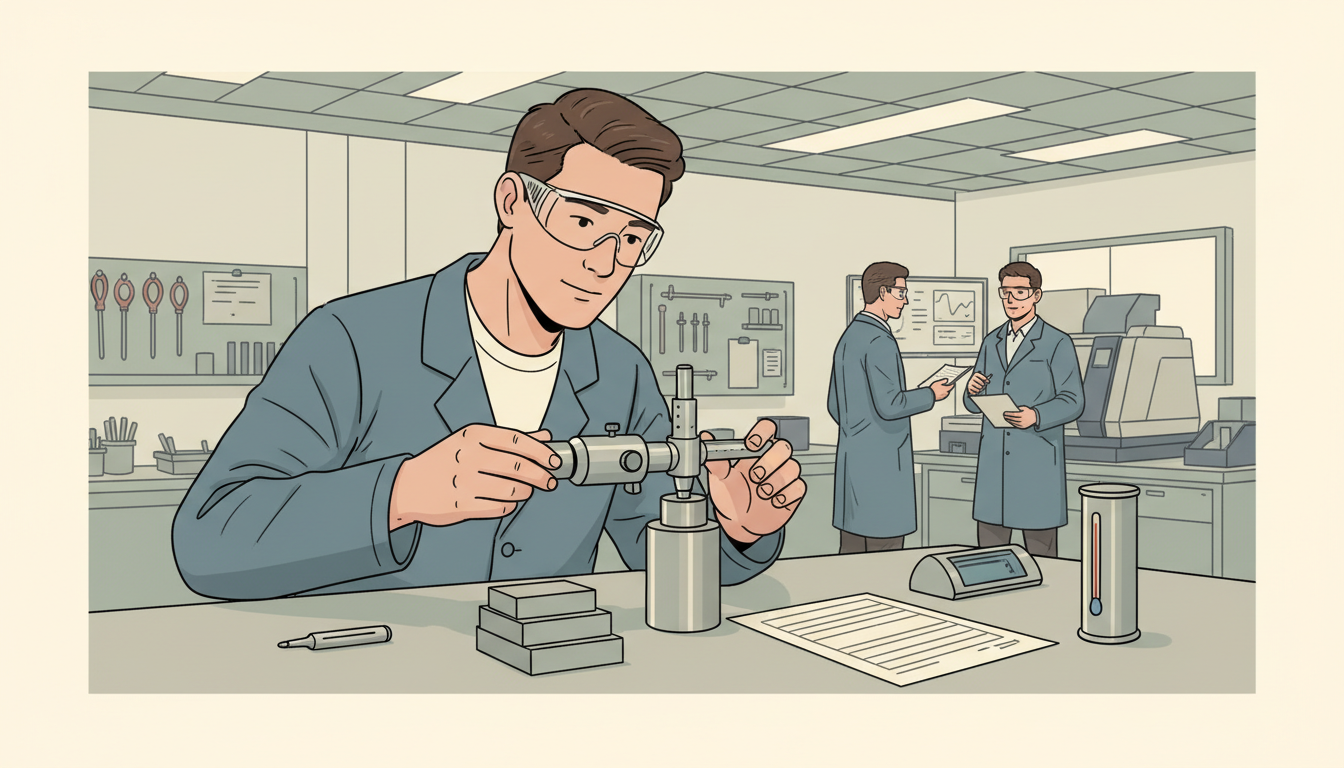
Featured image disclosure: The existing 2026 eduKate illustration shows a technician using precision-measurement equipment in a generic workshop. It is conceptual educational artwork and does not attest to the calibration or safety of real equipment. An educational illustration is not evidence of a real event or assessment.
Safety and scope: Not professional engineering, laboratory, medical, navigation, aviation or time-synchronisation advice. Only paper diagrams and invented measurements are used. Never alter equipment calibration, live infrastructure or security controls; qualified specialists and current authoritative standards govern real work.
Quick answer: the vulnerability and what may survive
Civilisations coordinate through quantities and dates as much as through buildings and laws. A hospital, port, school, laboratory, power service and public office may all use numbers, but numbers are dependable only when their units, measurement methods, timestamps and meanings are shared or correctly translated. The serious risk emerges when related capacities become unreliable and people cannot maintain or repair an important service over time. Yet one defective measurement, one ecological pressure or one interrupted institution does not automatically end a civilisation. People can adapt, preserve cultural knowledge, cooperate, improve practices and reconstruct damaged services. Honest explanation therefore asks what specifically became unavailable, whose experience changed, how long it lasted, what continued functioning and which kinds of evidence would establish improvement.
- Define the function: what real activity or ecological process is at issue?
- Trace dependence: what people, habitats, tools, records or institutions support it?
- Specify evidence: which dated original source establishes the claim?
- Identify variation: could the outcome differ across places or users?
- Recognise continuity: which alternative pathways or forms of adaptation exist?
- Verify repair: what observable outcome would indicate meaningful improvement?
Evidence and reporting boundaries
The BIPM’s International System of Units (SI) Brochure remains in its ninth edition and was revised to version 4.01 in June 2026, clarifying the place of non-SI units in relation to SI. ISO 8601-1:2019 specifies machine-exchangeable representations of Gregorian dates and 24-hour times; the ISO page states that it was reviewed and confirmed in 2024. The BIPM’s Circular T provides ongoing traceability information for local realisations of Coordinated Universal Time. A common standard helps comparison, but proper application, calibration, contextual meaning and communication are still necessary. These verified facts concern the published sources and their specified dates. They cannot automatically describe a single town or school, and they do not certify the imagined Measurebridge scenario. We distinguish adopted standards and conservation targets from actual measured achievements, and observed outcomes from modelled possibilities. Source links are collected in the reading notes below.
Complete 35-chapter index
- 1. A number without a unit may not be usable
- 2. Why shared measures matter to civilisation
- 3. The 2026 SI Brochure revision
- 4. The seven SI base units and derived quantities
- 5. Magnitude, prefix and mathematical scale
- 6. Measurement uncertainty is not failure
- 7. Calibration and traceable comparison
- 8. Accuracy, precision and bias
- 9. Temperature scales in shared reports
- 10. Length standards in construction planning
- 11. Mass versus weight
- 12. Energy and power are distinct
- 13. Volumes, areas and compound units
- 14. Rates, ratios and denominators
- 15. Science and reproducible measurement
- 16. Industrial manufacturing tolerances
- 17. Trade quantities and product labels
- 18. Public health measurement boundaries
- 19. Environmental sensors and comparability
- 20. Geographic coordinates and map datums
- 21. Time zones and local civil dates
- 22. UTC and international time comparison
- 23. BIPM Circular T and timing laboratories
- 24. ISO 8601 date and time exchange
- 25. Midnight, date boundaries and log order
- 26. Clock drift and maintenance
- 27. The difference between precision and truthful reporting
- 28. Data schemas and shared field definitions
- 29. Event logs and responsible audit trails
- 30. Standards and local variation
- 31. Tolerances, thresholds and false alarms
- 32. Metrology institutions and professional trust
- 33. Measurement failure during a service interruption
- 34. Teaching measurement as civic literacy
- 35. Long-term common measures and human continuity
1. A number without a unit may not be usable
What the chapter explains. A numerical value means little when the measured quantity, unit, method and applicable context are unspecified. This is one of the mechanisms through which trusted measurement, time standards and interoperability across public services may support or strain a complex society. The words “a civilisation might end” do not describe a deterministic scientific law. We need to name the function, the relevant period and place, the affected people, the conditions under which the system works and evidence that those conditions changed. A society can experience major disruption in one activity while other institutions, relationships and cultural practices continue. The explanation should be precise enough to be tested rather than a dramatic label.
Trace the function before declaring a failure
Begin in Measurebridge, the fictional learning community developed for this guide. Someone needs a useful result; people and records help provide it; and an agreed process connects resources to an outcome. Suppose a supporting step is misunderstood or unavailable. The person may experience a delay, an inaccurate result or a missing service. That symptom is important, but it does not reveal the cause by itself. A trained professional might discover a different upstream issue, or a suitable alternative might already exist. The useful analytical task is to reconstruct how the process actually depends on its component parts.
A numerical value means little when the measured quantity, unit, method and applicable context are unspecified. Place five paper boxes under the labels need, input, responsible people, process and verified outcome. Connect them only where the relationship is meaningful. Remove one component while leaving the rest unchanged. What effect should follow according to the model? Which effects are merely possible? What would prevent the problem from spreading? Asking these questions is a simple way to practise causal reasoning. It also avoids the assumption that every system in a civilisation is equally fragile or that the failure of one facility or population necessarily erases every other capability.
One observation may have several reasonable explanations, and an honest account identifies the evidence needed to distinguish them. Sometimes a service appears to stop because users must reach it differently. In another case, a process genuinely loses capacity while published notices remain optimistic. An institution may function for most people but fail to accommodate an important minority. These possibilities should be tested separately. A conscientious reader avoids treating formal existence, available equipment, actual access and reliable outcomes as synonyms. That distinction matters in science, public administration, culture and ecology alike.
Find trustworthy evidence
Look for a source describing what was measured and under which conditions. Every important claim should be connected to an appropriately authoritative original source, with its institution or author, publication date, observation period, geographic scope and definition. A number taken from a global assessment cannot automatically describe a Singapore neighbourhood. A policy target describes an intention, while a verified result describes an observation. A scenario depends on assumptions about what could happen, while an actual historical outcome is bounded by the available record. The best articles explicitly distinguish these categories instead of letting a confident tone obscure uncertainty.
Ask whether the claim is being made at the correct scale. If a study covers many sites, is it valid to infer the outcome for a single site? If an index counts covered institutions, does it reveal whether their users can obtain the intended benefit? If a professional standard has been revised, has the new version actually changed the underlying measurement or merely clarified its presentation? If biodiversity targets were adopted, have their reported implementation and ecological outcomes been independently assessed? A source often becomes more useful when its limits are understood.
Two identical numbers do not imply equivalent quantities or compatible instruments. To challenge an explanation fairly, construct two alternative hypotheses. Perhaps the condition really changed; perhaps the data became more complete; perhaps an accessible route or definition was modified. Each would predict a different record or later outcome. Identify what new observation could distinguish them and make a note of the assumptions. This method allows learners to question an explanation without dismissing genuine harms. It is better to say “this information is not yet sufficient” than to invent a precise prediction about a sensitive or high-stakes situation.
Why people and context matter
Imagine a student reading a source using the relevant information or service. That person might discover a gap that a national average, published standard or polished diagram does not reveal. Another person could have no difficulty. An institution responsible for the system may know that some limitations are being addressed, or may be unaware that a particular user is excluded. A fair analysis asks what people really need and whether the process works for them, without assuming that individuals with a certain age, language, identity or background all have the same preferences.
Not professional engineering, laboratory, medical, navigation, aviation or time-synchronisation advice. Only paper diagrams and invented measurements are used. Never alter equipment calibration, live infrastructure or security controls; qualified specialists and current authoritative standards govern real work. Our invented exercises never use actual health records, personal legal data, live technical infrastructure or wildlife handling. The purpose of including perspectives is not to make children’s lives part of the evidence. It is to improve the ethical quality of their thinking. When real issues arise, the appropriate qualified authority or professional should be consulted rather than using a paper exercise to make a safety or technical determination.
How a useful correction would be recognised
Require explicit units and appropriate uncertainty in public communication. An improvement starts with a narrow problem statement, legitimate responsibility and an outcome worth measuring. A newly installed instrument, written treaty, planted tree or published report may be a valuable input, yet none necessarily shows that the intended function is working for everyone. Check implementation, maintenance, user access and relevant benefits over a suitable period. Be careful about indicators that reward visible activity rather than a completed meaningful result. A system can have many recorded actions while its most important problem remains unresolved.
Use a four-part review loop. Observe: describe the specific issue, location and date without guessing motives. Verify: compare the best relevant evidence and a credible competing explanation. Improve: choose a lawful, professionally appropriate action that preserves people’s rights and safety. Recheck: assess what changed, who benefited and which uncertainties remain. If the intervention had an unintended consequence, report it honestly and revise the plan. If a source is corrected later, preserve the new context rather than silently reproducing an obsolete claim.
A resilient community also needs an intelligible handover. The person responsible tomorrow should be able to understand which definitions were used, what evidence supported a decision, where responsibility lies and when the next check is due. If knowledge depends on one individual’s undocumented memory, continuity is fragile. If an archive contains numbers without their units or ecological observations without dates, preservation has not retained their full meaning. The lesson therefore treats accountability and explanation as practical capacities, not just words in a mission statement.
A safe original parent-and-tutor activity
Sort imaginary cards labelled 12 metres, 12 kilograms and 12 seconds and explain why they cannot be added. Set the activity in an invented school library with ordinary clean paper and stationery. Give one pupil the observer role, a second the evidence checker, a third the inclusion reviewer and a fourth the recorder role. The observer describes only what happens in the invented scenario. The evidence checker asks what published source could establish a similar claim in reality. The inclusion reviewer asks whose experience might not be visible in the first measurement. The recorder writes a short, clear handover of the proposed correction and its limitations.
Primary pupils can use a three-card version: function, possible problem and evidence. Upper-primary students can propose two explanations. Secondary pupils should add units, a relevant denominator, an uncertainty statement and a fresh test of their reasoning. More advanced learners may introduce alternative definitions or check whether two published datasets could be meaningfully compared. The tutor rewards precise explanation and willingness to correct an error rather than speed alone. All tasks remain fictional; a model is a way to practise judgement, not a professional assessment of a real site or system.
Worked mathematics: transparent toy indicators
In this fictional exercise, an invented school library receives 55 paper observation cards. Of these, 4 need an additional review. The fraction requiring review is 4/55 × 100 = 7.3% to one decimal place. After the imagined reviewer checks and resolves 2 such cards, 2 remain open. These are entirely invented stationery quantities, not data on calibration failures, biological populations, public health, legal incidents or a civilisation’s future. The purpose is to practise denominators, percentages and clear categories.
Now suppose the number of observations increases substantially while the percentage flagged remains similar. Raw counts can rise without a deterioration in the rate. In another scenario, people unable to use the observation channel are missing from both parts of the fraction. That omission may make performance appear better than it really is. Finally, a card marked “resolved” might mean that an office closed a file, a specialist verified the result or the intended user actually received a benefit. Those are distinct measurements. Ask learners to state their unit, definition and reporting period beside each number.
Questions to check understanding
- Core mechanism: A numerical value means little when the measured quantity, unit, method and applicable context are unspecified.
- Relevant evidence: Look for a source describing what was measured and under which conditions.
- Important boundary: Two identical numbers do not imply equivalent quantities or compatible instruments.
- Corrective principle: Require explicit units and appropriate uncertainty in public communication.
- Paper investigation: Sort imaginary cards labelled 12 metres, 12 kilograms and 12 seconds and explain why they cannot be added.
- Evidence limit: explain why the invented example cannot support a real-world declaration of civilisational collapse.
The strongest teach-back states the intended function, a possible pathway for failure, relevant evidence, a meaningful competing interpretation, the people who need access and what would demonstrate improvement. Have the pupil write this short handover: “The useful activity is … . The crucial dependency is … . The observation is … . A second explanation might be … . The source I would check is … . A fair correction would be … . A later check would ask … .” Another learner should be able to challenge and continue the reasoning. That is how knowledge becomes reliable across a community rather than remaining a claim one person must accept.
2. Why shared measures matter to civilisation
What the chapter explains. Trade, scientific work, construction, health services and public decisions rely on quantities that different people can interpret consistently. This is one of the mechanisms through which trusted measurement, time standards and interoperability across public services may support or strain a complex society. The words “a civilisation might end” do not describe a deterministic scientific law. We need to name the function, the relevant period and place, the affected people, the conditions under which the system works and evidence that those conditions changed. A society can experience major disruption in one activity while other institutions, relationships and cultural practices continue. The explanation should be precise enough to be tested rather than a dramatic label.
Trace the function before declaring a failure
Begin in Measurebridge, the fictional learning community developed for this guide. Someone needs a useful result; people and records help provide it; and an agreed process connects resources to an outcome. Suppose a supporting step is misunderstood or unavailable. The person may experience a delay, an inaccurate result or a missing service. That symptom is important, but it does not reveal the cause by itself. A trained professional might discover a different upstream issue, or a suitable alternative might already exist. The useful analytical task is to reconstruct how the process actually depends on its component parts.
Trade, scientific work, construction, health services and public decisions rely on quantities that different people can interpret consistently. Place five paper boxes under the labels need, input, responsible people, process and verified outcome. Connect them only where the relationship is meaningful. Remove one component while leaving the rest unchanged. What effect should follow according to the model? Which effects are merely possible? What would prevent the problem from spreading? Asking these questions is a simple way to practise causal reasoning. It also avoids the assumption that every system in a civilisation is equally fragile or that the failure of one facility or population necessarily erases every other capability.
An impressive diagram can conceal missing connections unless every arrow is justified. Sometimes a service appears to stop because users must reach it differently. In another case, a process genuinely loses capacity while published notices remain optimistic. An institution may function for most people but fail to accommodate an important minority. These possibilities should be tested separately. A conscientious reader avoids treating formal existence, available equipment, actual access and reliable outcomes as synonyms. That distinction matters in science, public administration, culture and ecology alike.
Find trustworthy evidence
Trace a real task across two institutions and note which measurement definitions they share. Every important claim should be connected to an appropriately authoritative original source, with its institution or author, publication date, observation period, geographic scope and definition. A number taken from a global assessment cannot automatically describe a Singapore neighbourhood. A policy target describes an intention, while a verified result describes an observation. A scenario depends on assumptions about what could happen, while an actual historical outcome is bounded by the available record. The best articles explicitly distinguish these categories instead of letting a confident tone obscure uncertainty.
Ask whether the claim is being made at the correct scale. If a study covers many sites, is it valid to infer the outcome for a single site? If an index counts covered institutions, does it reveal whether their users can obtain the intended benefit? If a professional standard has been revised, has the new version actually changed the underlying measurement or merely clarified its presentation? If biodiversity targets were adopted, have their reported implementation and ecological outcomes been independently assessed? A source often becomes more useful when its limits are understood.
The same formal unit does not automatically mean two measurements have identical accuracy. To challenge an explanation fairly, construct two alternative hypotheses. Perhaps the condition really changed; perhaps the data became more complete; perhaps an accessible route or definition was modified. Each would predict a different record or later outcome. Identify what new observation could distinguish them and make a note of the assumptions. This method allows learners to question an explanation without dismissing genuine harms. It is better to say “this information is not yet sufficient” than to invent a precise prediction about a sensitive or high-stakes situation.
Why people and context matter
Imagine a trained specialist accountable for a service using the relevant information or service. That person might discover a gap that a national average, published standard or polished diagram does not reveal. Another person could have no difficulty. An institution responsible for the system may know that some limitations are being addressed, or may be unaware that a particular user is excluded. A fair analysis asks what people really need and whether the process works for them, without assuming that individuals with a certain age, language, identity or background all have the same preferences.
Not professional engineering, laboratory, medical, navigation, aviation or time-synchronisation advice. Only paper diagrams and invented measurements are used. Never alter equipment calibration, live infrastructure or security controls; qualified specialists and current authoritative standards govern real work. Our invented exercises never use actual health records, personal legal data, live technical infrastructure or wildlife handling. The purpose of including perspectives is not to make children’s lives part of the evidence. It is to improve the ethical quality of their thinking. When real issues arise, the appropriate qualified authority or professional should be consulted rather than using a paper exercise to make a safety or technical determination.
How a useful correction would be recognised
Maintain coherent standards, competent staff and transparent reporting. An improvement starts with a narrow problem statement, legitimate responsibility and an outcome worth measuring. A newly installed instrument, written treaty, planted tree or published report may be a valuable input, yet none necessarily shows that the intended function is working for everyone. Check implementation, maintenance, user access and relevant benefits over a suitable period. Be careful about indicators that reward visible activity rather than a completed meaningful result. A system can have many recorded actions while its most important problem remains unresolved.
Use a four-part review loop. Observe: describe the specific issue, location and date without guessing motives. Verify: compare the best relevant evidence and a credible competing explanation. Improve: choose a lawful, professionally appropriate action that preserves people’s rights and safety. Recheck: assess what changed, who benefited and which uncertainties remain. If the intervention had an unintended consequence, report it honestly and revise the plan. If a source is corrected later, preserve the new context rather than silently reproducing an obsolete claim.
A resilient community also needs an intelligible handover. The person responsible tomorrow should be able to understand which definitions were used, what evidence supported a decision, where responsibility lies and when the next check is due. If knowledge depends on one individual’s undocumented memory, continuity is fragile. If an archive contains numbers without their units or ecological observations without dates, preservation has not retained their full meaning. The lesson therefore treats accountability and explanation as practical capacities, not just words in a mission statement.
A safe original parent-and-tutor activity
Draw two pretend workshops exchanging parts with the same size requirement. Set the activity in a paper research centre with ordinary clean paper and stationery. Give one pupil the observer role, a second the evidence checker, a third the inclusion reviewer and a fourth the recorder role. The observer describes only what happens in the invented scenario. The evidence checker asks what published source could establish a similar claim in reality. The inclusion reviewer asks whose experience might not be visible in the first measurement. The recorder writes a short, clear handover of the proposed correction and its limitations.
Primary pupils can use a three-card version: function, possible problem and evidence. Upper-primary students can propose two explanations. Secondary pupils should add units, a relevant denominator, an uncertainty statement and a fresh test of their reasoning. More advanced learners may introduce alternative definitions or check whether two published datasets could be meaningfully compared. The tutor rewards precise explanation and willingness to correct an error rather than speed alone. All tasks remain fictional; a model is a way to practise judgement, not a professional assessment of a real site or system.
Worked mathematics: transparent toy indicators
In this fictional exercise, a paper research centre receives 62 paper observation cards. Of these, 9 need an additional review. The fraction requiring review is 9/62 × 100 = 14.5% to one decimal place. After the imagined reviewer checks and resolves 5 such cards, 4 remain open. These are entirely invented stationery quantities, not data on calibration failures, biological populations, public health, legal incidents or a civilisation’s future. The purpose is to practise denominators, percentages and clear categories.
Now suppose the number of observations increases substantially while the percentage flagged remains similar. Raw counts can rise without a deterioration in the rate. In another scenario, people unable to use the observation channel are missing from both parts of the fraction. That omission may make performance appear better than it really is. Finally, a card marked “resolved” might mean that an office closed a file, a specialist verified the result or the intended user actually received a benefit. Those are distinct measurements. Ask learners to state their unit, definition and reporting period beside each number.
Questions to check understanding
- Core mechanism: Trade, scientific work, construction, health services and public decisions rely on quantities that different people can interpret consistently.
- Relevant evidence: Trace a real task across two institutions and note which measurement definitions they share.
- Important boundary: The same formal unit does not automatically mean two measurements have identical accuracy.
- Corrective principle: Maintain coherent standards, competent staff and transparent reporting.
- Paper investigation: Draw two pretend workshops exchanging parts with the same size requirement.
- Evidence limit: explain why the invented example cannot support a real-world declaration of civilisational collapse.
The strongest teach-back states the intended function, a possible pathway for failure, relevant evidence, a meaningful competing interpretation, the people who need access and what would demonstrate improvement. Have the pupil write this short handover: “The useful activity is … . The crucial dependency is … . The observation is … . A second explanation might be … . The source I would check is … . A fair correction would be … . A later check would ask … .” Another learner should be able to challenge and continue the reasoning. That is how knowledge becomes reliable across a community rather than remaining a claim one person must accept.
3. The 2026 SI Brochure revision
What the chapter explains. BIPM’s June 2026 update clarified the status and presentation of non-SI units while maintaining the wider SI framework. This is one of the mechanisms through which trusted measurement, time standards and interoperability across public services may support or strain a complex society. The words “a civilisation might end” do not describe a deterministic scientific law. We need to name the function, the relevant period and place, the affected people, the conditions under which the system works and evidence that those conditions changed. A society can experience major disruption in one activity while other institutions, relationships and cultural practices continue. The explanation should be precise enough to be tested rather than a dramatic label.
Trace the function before declaring a failure
Begin in Measurebridge, the fictional learning community developed for this guide. Someone needs a useful result; people and records help provide it; and an agreed process connects resources to an outcome. Suppose a supporting step is misunderstood or unavailable. The person may experience a delay, an inaccurate result or a missing service. That symptom is important, but it does not reveal the cause by itself. A trained professional might discover a different upstream issue, or a suitable alternative might already exist. The useful analytical task is to reconstruct how the process actually depends on its component parts.
BIPM’s June 2026 update clarified the status and presentation of non-SI units while maintaining the wider SI framework. Place five paper boxes under the labels need, input, responsible people, process and verified outcome. Connect them only where the relationship is meaningful. Remove one component while leaving the rest unchanged. What effect should follow according to the model? Which effects are merely possible? What would prevent the problem from spreading? Asking these questions is a simple way to practise causal reasoning. It also avoids the assumption that every system in a civilisation is equally fragile or that the failure of one facility or population necessarily erases every other capability.
A service can be available on paper while its benefit remains out of reach for certain people. Sometimes a service appears to stop because users must reach it differently. In another case, a process genuinely loses capacity while published notices remain optimistic. An institution may function for most people but fail to accommodate an important minority. These possibilities should be tested separately. A conscientious reader avoids treating formal existence, available equipment, actual access and reliable outcomes as synonyms. That distinction matters in science, public administration, culture and ecology alike.
Find trustworthy evidence
Read the original BIPM revision note and avoid inventing new base units. Every important claim should be connected to an appropriately authoritative original source, with its institution or author, publication date, observation period, geographic scope and definition. A number taken from a global assessment cannot automatically describe a Singapore neighbourhood. A policy target describes an intention, while a verified result describes an observation. A scenario depends on assumptions about what could happen, while an actual historical outcome is bounded by the available record. The best articles explicitly distinguish these categories instead of letting a confident tone obscure uncertainty.
Ask whether the claim is being made at the correct scale. If a study covers many sites, is it valid to infer the outcome for a single site? If an index counts covered institutions, does it reveal whether their users can obtain the intended benefit? If a professional standard has been revised, has the new version actually changed the underlying measurement or merely clarified its presentation? If biodiversity targets were adopted, have their reported implementation and ecological outcomes been independently assessed? A source often becomes more useful when its limits are understood.
An editorial update should not be described as evidence that all previously measured quantities changed. To challenge an explanation fairly, construct two alternative hypotheses. Perhaps the condition really changed; perhaps the data became more complete; perhaps an accessible route or definition was modified. Each would predict a different record or later outcome. Identify what new observation could distinguish them and make a note of the assumptions. This method allows learners to question an explanation without dismissing genuine harms. It is better to say “this information is not yet sufficient” than to invent a precise prediction about a sensitive or high-stakes situation.
Why people and context matter
Imagine a parent seeking clear information using the relevant information or service. That person might discover a gap that a national average, published standard or polished diagram does not reveal. Another person could have no difficulty. An institution responsible for the system may know that some limitations are being addressed, or may be unaware that a particular user is excluded. A fair analysis asks what people really need and whether the process works for them, without assuming that individuals with a certain age, language, identity or background all have the same preferences.
Not professional engineering, laboratory, medical, navigation, aviation or time-synchronisation advice. Only paper diagrams and invented measurements are used. Never alter equipment calibration, live infrastructure or security controls; qualified specialists and current authoritative standards govern real work. Our invented exercises never use actual health records, personal legal data, live technical infrastructure or wildlife handling. The purpose of including perspectives is not to make children’s lives part of the evidence. It is to improve the ethical quality of their thinking. When real issues arise, the appropriate qualified authority or professional should be consulted rather than using a paper exercise to make a safety or technical determination.
How a useful correction would be recognised
Explain what a revised technical standard changes and does not change. An improvement starts with a narrow problem statement, legitimate responsibility and an outcome worth measuring. A newly installed instrument, written treaty, planted tree or published report may be a valuable input, yet none necessarily shows that the intended function is working for everyone. Check implementation, maintenance, user access and relevant benefits over a suitable period. Be careful about indicators that reward visible activity rather than a completed meaningful result. A system can have many recorded actions while its most important problem remains unresolved.
Use a four-part review loop. Observe: describe the specific issue, location and date without guessing motives. Verify: compare the best relevant evidence and a credible competing explanation. Improve: choose a lawful, professionally appropriate action that preserves people’s rights and safety. Recheck: assess what changed, who benefited and which uncertainties remain. If the intervention had an unintended consequence, report it honestly and revise the plan. If a source is corrected later, preserve the new context rather than silently reproducing an obsolete claim.
A resilient community also needs an intelligible handover. The person responsible tomorrow should be able to understand which definitions were used, what evidence supported a decision, where responsibility lies and when the next check is due. If knowledge depends on one individual’s undocumented memory, continuity is fragile. If an archive contains numbers without their units or ecological observations without dates, preservation has not retained their full meaning. The lesson therefore treats accountability and explanation as practical capacities, not just words in a mission statement.
A safe original parent-and-tutor activity
Compare fictional technical notices with different version dates. Set the activity in an imaginary community garden with ordinary clean paper and stationery. Give one pupil the observer role, a second the evidence checker, a third the inclusion reviewer and a fourth the recorder role. The observer describes only what happens in the invented scenario. The evidence checker asks what published source could establish a similar claim in reality. The inclusion reviewer asks whose experience might not be visible in the first measurement. The recorder writes a short, clear handover of the proposed correction and its limitations.
Primary pupils can use a three-card version: function, possible problem and evidence. Upper-primary students can propose two explanations. Secondary pupils should add units, a relevant denominator, an uncertainty statement and a fresh test of their reasoning. More advanced learners may introduce alternative definitions or check whether two published datasets could be meaningfully compared. The tutor rewards precise explanation and willingness to correct an error rather than speed alone. All tasks remain fictional; a model is a way to practise judgement, not a professional assessment of a real site or system.
Worked mathematics: transparent toy indicators
In this fictional exercise, an imaginary community garden receives 69 paper observation cards. Of these, 14 need an additional review. The fraction requiring review is 14/69 × 100 = 20.3% to one decimal place. After the imagined reviewer checks and resolves 8 such cards, 6 remain open. These are entirely invented stationery quantities, not data on calibration failures, biological populations, public health, legal incidents or a civilisation’s future. The purpose is to practise denominators, percentages and clear categories.
Now suppose the number of observations increases substantially while the percentage flagged remains similar. Raw counts can rise without a deterioration in the rate. In another scenario, people unable to use the observation channel are missing from both parts of the fraction. That omission may make performance appear better than it really is. Finally, a card marked “resolved” might mean that an office closed a file, a specialist verified the result or the intended user actually received a benefit. Those are distinct measurements. Ask learners to state their unit, definition and reporting period beside each number.
Questions to check understanding
- Core mechanism: BIPM’s June 2026 update clarified the status and presentation of non-SI units while maintaining the wider SI framework.
- Relevant evidence: Read the original BIPM revision note and avoid inventing new base units.
- Important boundary: An editorial update should not be described as evidence that all previously measured quantities changed.
- Corrective principle: Explain what a revised technical standard changes and does not change.
- Paper investigation: Compare fictional technical notices with different version dates.
- Evidence limit: explain why the invented example cannot support a real-world declaration of civilisational collapse.
The strongest teach-back states the intended function, a possible pathway for failure, relevant evidence, a meaningful competing interpretation, the people who need access and what would demonstrate improvement. Have the pupil write this short handover: “The useful activity is … . The crucial dependency is … . The observation is … . A second explanation might be … . The source I would check is … . A fair correction would be … . A later check would ask … .” Another learner should be able to challenge and continue the reasoning. That is how knowledge becomes reliable across a community rather than remaining a claim one person must accept.
4. The seven SI base units and derived quantities
What the chapter explains. SI establishes a coherent framework whose base units cover time, length, mass, electric current, thermodynamic temperature, amount of substance and luminous intensity. This is one of the mechanisms through which trusted measurement, time standards and interoperability across public services may support or strain a complex society. The words “a civilisation might end” do not describe a deterministic scientific law. We need to name the function, the relevant period and place, the affected people, the conditions under which the system works and evidence that those conditions changed. A society can experience major disruption in one activity while other institutions, relationships and cultural practices continue. The explanation should be precise enough to be tested rather than a dramatic label.
Trace the function before declaring a failure
Begin in Measurebridge, the fictional learning community developed for this guide. Someone needs a useful result; people and records help provide it; and an agreed process connects resources to an outcome. Suppose a supporting step is misunderstood or unavailable. The person may experience a delay, an inaccurate result or a missing service. That symptom is important, but it does not reveal the cause by itself. A trained professional might discover a different upstream issue, or a suitable alternative might already exist. The useful analytical task is to reconstruct how the process actually depends on its component parts.
SI establishes a coherent framework whose base units cover time, length, mass, electric current, thermodynamic temperature, amount of substance and luminous intensity. Place five paper boxes under the labels need, input, responsible people, process and verified outcome. Connect them only where the relationship is meaningful. Remove one component while leaving the rest unchanged. What effect should follow according to the model? Which effects are merely possible? What would prevent the problem from spreading? Asking these questions is a simple way to practise causal reasoning. It also avoids the assumption that every system in a civilisation is equally fragile or that the failure of one facility or population necessarily erases every other capability.
Continuity can be present even when one component has changed or been lost. Sometimes a service appears to stop because users must reach it differently. In another case, a process genuinely loses capacity while published notices remain optimistic. An institution may function for most people but fail to accommodate an important minority. These possibilities should be tested separately. A conscientious reader avoids treating formal existence, available equipment, actual access and reliable outcomes as synonyms. That distinction matters in science, public administration, culture and ecology alike.
Find trustworthy evidence
Use the authoritative SI Brochure to distinguish the base unit from a derived unit. Every important claim should be connected to an appropriately authoritative original source, with its institution or author, publication date, observation period, geographic scope and definition. A number taken from a global assessment cannot automatically describe a Singapore neighbourhood. A policy target describes an intention, while a verified result describes an observation. A scenario depends on assumptions about what could happen, while an actual historical outcome is bounded by the available record. The best articles explicitly distinguish these categories instead of letting a confident tone obscure uncertainty.
Ask whether the claim is being made at the correct scale. If a study covers many sites, is it valid to infer the outcome for a single site? If an index counts covered institutions, does it reveal whether their users can obtain the intended benefit? If a professional standard has been revised, has the new version actually changed the underlying measurement or merely clarified its presentation? If biodiversity targets were adopted, have their reported implementation and ecological outcomes been independently assessed? A source often becomes more useful when its limits are understood.
Memorising seven names is not proof that a student can interpret physical quantities correctly. To challenge an explanation fairly, construct two alternative hypotheses. Perhaps the condition really changed; perhaps the data became more complete; perhaps an accessible route or definition was modified. Each would predict a different record or later outcome. Identify what new observation could distinguish them and make a note of the assumptions. This method allows learners to question an explanation without dismissing genuine harms. It is better to say “this information is not yet sufficient” than to invent a precise prediction about a sensitive or high-stakes situation.
Why people and context matter
Imagine a resident using an alternative format using the relevant information or service. That person might discover a gap that a national average, published standard or polished diagram does not reveal. Another person could have no difficulty. An institution responsible for the system may know that some limitations are being addressed, or may be unaware that a particular user is excluded. A fair analysis asks what people really need and whether the process works for them, without assuming that individuals with a certain age, language, identity or background all have the same preferences.
Not professional engineering, laboratory, medical, navigation, aviation or time-synchronisation advice. Only paper diagrams and invented measurements are used. Never alter equipment calibration, live infrastructure or security controls; qualified specialists and current authoritative standards govern real work. Our invented exercises never use actual health records, personal legal data, live technical infrastructure or wildlife handling. The purpose of including perspectives is not to make children’s lives part of the evidence. It is to improve the ethical quality of their thinking. When real issues arise, the appropriate qualified authority or professional should be consulted rather than using a paper exercise to make a safety or technical determination.
How a useful correction would be recognised
Teach meaning, unit symbols and appropriate derived relationships. An improvement starts with a narrow problem statement, legitimate responsibility and an outcome worth measuring. A newly installed instrument, written treaty, planted tree or published report may be a valuable input, yet none necessarily shows that the intended function is working for everyone. Check implementation, maintenance, user access and relevant benefits over a suitable period. Be careful about indicators that reward visible activity rather than a completed meaningful result. A system can have many recorded actions while its most important problem remains unresolved.
Use a four-part review loop. Observe: describe the specific issue, location and date without guessing motives. Verify: compare the best relevant evidence and a credible competing explanation. Improve: choose a lawful, professionally appropriate action that preserves people’s rights and safety. Recheck: assess what changed, who benefited and which uncertainties remain. If the intervention had an unintended consequence, report it honestly and revise the plan. If a source is corrected later, preserve the new context rather than silently reproducing an obsolete claim.
A resilient community also needs an intelligible handover. The person responsible tomorrow should be able to understand which definitions were used, what evidence supported a decision, where responsibility lies and when the next check is due. If knowledge depends on one individual’s undocumented memory, continuity is fragile. If an archive contains numbers without their units or ecological observations without dates, preservation has not retained their full meaning. The lesson therefore treats accountability and explanation as practical capacities, not just words in a mission statement.
A safe original parent-and-tutor activity
Match imaginary scientific labels to seconds, metres, kilograms and other SI base units. Set the activity in a fictional town archive with ordinary clean paper and stationery. Give one pupil the observer role, a second the evidence checker, a third the inclusion reviewer and a fourth the recorder role. The observer describes only what happens in the invented scenario. The evidence checker asks what published source could establish a similar claim in reality. The inclusion reviewer asks whose experience might not be visible in the first measurement. The recorder writes a short, clear handover of the proposed correction and its limitations.
Primary pupils can use a three-card version: function, possible problem and evidence. Upper-primary students can propose two explanations. Secondary pupils should add units, a relevant denominator, an uncertainty statement and a fresh test of their reasoning. More advanced learners may introduce alternative definitions or check whether two published datasets could be meaningfully compared. The tutor rewards precise explanation and willingness to correct an error rather than speed alone. All tasks remain fictional; a model is a way to practise judgement, not a professional assessment of a real site or system.
Worked mathematics: transparent toy indicators
In this fictional exercise, a fictional town archive receives 76 paper observation cards. Of these, 19 need an additional review. The fraction requiring review is 19/76 × 100 = 25.0% to one decimal place. After the imagined reviewer checks and resolves 11 such cards, 8 remain open. These are entirely invented stationery quantities, not data on calibration failures, biological populations, public health, legal incidents or a civilisation’s future. The purpose is to practise denominators, percentages and clear categories.
Now suppose the number of observations increases substantially while the percentage flagged remains similar. Raw counts can rise without a deterioration in the rate. In another scenario, people unable to use the observation channel are missing from both parts of the fraction. That omission may make performance appear better than it really is. Finally, a card marked “resolved” might mean that an office closed a file, a specialist verified the result or the intended user actually received a benefit. Those are distinct measurements. Ask learners to state their unit, definition and reporting period beside each number.
Questions to check understanding
- Core mechanism: SI establishes a coherent framework whose base units cover time, length, mass, electric current, thermodynamic temperature, amount of substance and luminous intensity.
- Relevant evidence: Use the authoritative SI Brochure to distinguish the base unit from a derived unit.
- Important boundary: Memorising seven names is not proof that a student can interpret physical quantities correctly.
- Corrective principle: Teach meaning, unit symbols and appropriate derived relationships.
- Paper investigation: Match imaginary scientific labels to seconds, metres, kilograms and other SI base units.
- Evidence limit: explain why the invented example cannot support a real-world declaration of civilisational collapse.
The strongest teach-back states the intended function, a possible pathway for failure, relevant evidence, a meaningful competing interpretation, the people who need access and what would demonstrate improvement. Have the pupil write this short handover: “The useful activity is … . The crucial dependency is … . The observation is … . A second explanation might be … . The source I would check is … . A fair correction would be … . A later check would ask … .” Another learner should be able to challenge and continue the reasoning. That is how knowledge becomes reliable across a community rather than remaining a claim one person must accept.
5. Magnitude, prefix and mathematical scale
What the chapter explains. Prefixes can represent powers of ten but must be applied to the correct unit and quantity. This is one of the mechanisms through which trusted measurement, time standards and interoperability across public services may support or strain a complex society. The words “a civilisation might end” do not describe a deterministic scientific law. We need to name the function, the relevant period and place, the affected people, the conditions under which the system works and evidence that those conditions changed. A society can experience major disruption in one activity while other institutions, relationships and cultural practices continue. The explanation should be precise enough to be tested rather than a dramatic label.
Trace the function before declaring a failure
Begin in Measurebridge, the fictional learning community developed for this guide. Someone needs a useful result; people and records help provide it; and an agreed process connects resources to an outcome. Suppose a supporting step is misunderstood or unavailable. The person may experience a delay, an inaccurate result or a missing service. That symptom is important, but it does not reveal the cause by itself. A trained professional might discover a different upstream issue, or a suitable alternative might already exist. The useful analytical task is to reconstruct how the process actually depends on its component parts.
Prefixes can represent powers of ten but must be applied to the correct unit and quantity. Place five paper boxes under the labels need, input, responsible people, process and verified outcome. Connect them only where the relationship is meaningful. Remove one component while leaving the rest unchanged. What effect should follow according to the model? Which effects are merely possible? What would prevent the problem from spreading? Asking these questions is a simple way to practise causal reasoning. It also avoids the assumption that every system in a civilisation is equally fragile or that the failure of one facility or population necessarily erases every other capability.
Changing a definition between two reports can alter the appearance of progress without changing the underlying condition. Sometimes a service appears to stop because users must reach it differently. In another case, a process genuinely loses capacity while published notices remain optimistic. An institution may function for most people but fail to accommodate an important minority. These possibilities should be tested separately. A conscientious reader avoids treating formal existence, available equipment, actual access and reliable outcomes as synonyms. That distinction matters in science, public administration, culture and ecology alike.
Find trustworthy evidence
Compare clearly written numerical conversions with the 2026 SI guidance. Every important claim should be connected to an appropriately authoritative original source, with its institution or author, publication date, observation period, geographic scope and definition. A number taken from a global assessment cannot automatically describe a Singapore neighbourhood. A policy target describes an intention, while a verified result describes an observation. A scenario depends on assumptions about what could happen, while an actual historical outcome is bounded by the available record. The best articles explicitly distinguish these categories instead of letting a confident tone obscure uncertainty.
Ask whether the claim is being made at the correct scale. If a study covers many sites, is it valid to infer the outcome for a single site? If an index counts covered institutions, does it reveal whether their users can obtain the intended benefit? If a professional standard has been revised, has the new version actually changed the underlying measurement or merely clarified its presentation? If biodiversity targets were adopted, have their reported implementation and ecological outcomes been independently assessed? A source often becomes more useful when its limits are understood.
Confusing milli with mega changes magnitude dramatically even when the digits look plausible. To challenge an explanation fairly, construct two alternative hypotheses. Perhaps the condition really changed; perhaps the data became more complete; perhaps an accessible route or definition was modified. Each would predict a different record or later outcome. Identify what new observation could distinguish them and make a note of the assumptions. This method allows learners to question an explanation without dismissing genuine harms. It is better to say “this information is not yet sufficient” than to invent a precise prediction about a sensitive or high-stakes situation.
Why people and context matter
Imagine a community organiser using the relevant information or service. That person might discover a gap that a national average, published standard or polished diagram does not reveal. Another person could have no difficulty. An institution responsible for the system may know that some limitations are being addressed, or may be unaware that a particular user is excluded. A fair analysis asks what people really need and whether the process works for them, without assuming that individuals with a certain age, language, identity or background all have the same preferences.
Not professional engineering, laboratory, medical, navigation, aviation or time-synchronisation advice. Only paper diagrams and invented measurements are used. Never alter equipment calibration, live infrastructure or security controls; qualified specialists and current authoritative standards govern real work. Our invented exercises never use actual health records, personal legal data, live technical infrastructure or wildlife handling. The purpose of including perspectives is not to make children’s lives part of the evidence. It is to improve the ethical quality of their thinking. When real issues arise, the appropriate qualified authority or professional should be consulted rather than using a paper exercise to make a safety or technical determination.
How a useful correction would be recognised
Use unit-aware checking and estimation instead of blind copying. An improvement starts with a narrow problem statement, legitimate responsibility and an outcome worth measuring. A newly installed instrument, written treaty, planted tree or published report may be a valuable input, yet none necessarily shows that the intended function is working for everyone. Check implementation, maintenance, user access and relevant benefits over a suitable period. Be careful about indicators that reward visible activity rather than a completed meaningful result. A system can have many recorded actions while its most important problem remains unresolved.
Use a four-part review loop. Observe: describe the specific issue, location and date without guessing motives. Verify: compare the best relevant evidence and a credible competing explanation. Improve: choose a lawful, professionally appropriate action that preserves people’s rights and safety. Recheck: assess what changed, who benefited and which uncertainties remain. If the intervention had an unintended consequence, report it honestly and revise the plan. If a source is corrected later, preserve the new context rather than silently reproducing an obsolete claim.
A resilient community also needs an intelligible handover. The person responsible tomorrow should be able to understand which definitions were used, what evidence supported a decision, where responsibility lies and when the next check is due. If knowledge depends on one individual’s undocumented memory, continuity is fragile. If an archive contains numbers without their units or ecological observations without dates, preservation has not retained their full meaning. The lesson therefore treats accountability and explanation as practical capacities, not just words in a mission statement.
A safe original parent-and-tutor activity
Convert fictional 3 kilometres to metres and compare against 3 millimetres. Set the activity in a classroom systems board with ordinary clean paper and stationery. Give one pupil the observer role, a second the evidence checker, a third the inclusion reviewer and a fourth the recorder role. The observer describes only what happens in the invented scenario. The evidence checker asks what published source could establish a similar claim in reality. The inclusion reviewer asks whose experience might not be visible in the first measurement. The recorder writes a short, clear handover of the proposed correction and its limitations.
Primary pupils can use a three-card version: function, possible problem and evidence. Upper-primary students can propose two explanations. Secondary pupils should add units, a relevant denominator, an uncertainty statement and a fresh test of their reasoning. More advanced learners may introduce alternative definitions or check whether two published datasets could be meaningfully compared. The tutor rewards precise explanation and willingness to correct an error rather than speed alone. All tasks remain fictional; a model is a way to practise judgement, not a professional assessment of a real site or system.
Worked mathematics: transparent toy indicators
In this fictional exercise, a classroom systems board receives 83 paper observation cards. Of these, 6 need an additional review. The fraction requiring review is 6/83 × 100 = 7.2% to one decimal place. After the imagined reviewer checks and resolves 3 such cards, 3 remain open. These are entirely invented stationery quantities, not data on calibration failures, biological populations, public health, legal incidents or a civilisation’s future. The purpose is to practise denominators, percentages and clear categories.
Now suppose the number of observations increases substantially while the percentage flagged remains similar. Raw counts can rise without a deterioration in the rate. In another scenario, people unable to use the observation channel are missing from both parts of the fraction. That omission may make performance appear better than it really is. Finally, a card marked “resolved” might mean that an office closed a file, a specialist verified the result or the intended user actually received a benefit. Those are distinct measurements. Ask learners to state their unit, definition and reporting period beside each number.
Questions to check understanding
- Core mechanism: Prefixes can represent powers of ten but must be applied to the correct unit and quantity.
- Relevant evidence: Compare clearly written numerical conversions with the 2026 SI guidance.
- Important boundary: Confusing milli with mega changes magnitude dramatically even when the digits look plausible.
- Corrective principle: Use unit-aware checking and estimation instead of blind copying.
- Paper investigation: Convert fictional 3 kilometres to metres and compare against 3 millimetres.
- Evidence limit: explain why the invented example cannot support a real-world declaration of civilisational collapse.
The strongest teach-back states the intended function, a possible pathway for failure, relevant evidence, a meaningful competing interpretation, the people who need access and what would demonstrate improvement. Have the pupil write this short handover: “The useful activity is … . The crucial dependency is … . The observation is … . A second explanation might be … . The source I would check is … . A fair correction would be … . A later check would ask … .” Another learner should be able to challenge and continue the reasoning. That is how knowledge becomes reliable across a community rather than remaining a claim one person must accept.
6. Measurement uncertainty is not failure
What the chapter explains. Real measurements have limits that are part of honest reporting rather than evidence that a device is broken. This is one of the mechanisms through which trusted measurement, time standards and interoperability across public services may support or strain a complex society. The words “a civilisation might end” do not describe a deterministic scientific law. We need to name the function, the relevant period and place, the affected people, the conditions under which the system works and evidence that those conditions changed. A society can experience major disruption in one activity while other institutions, relationships and cultural practices continue. The explanation should be precise enough to be tested rather than a dramatic label.
Trace the function before declaring a failure
Begin in Measurebridge, the fictional learning community developed for this guide. Someone needs a useful result; people and records help provide it; and an agreed process connects resources to an outcome. Suppose a supporting step is misunderstood or unavailable. The person may experience a delay, an inaccurate result or a missing service. That symptom is important, but it does not reveal the cause by itself. A trained professional might discover a different upstream issue, or a suitable alternative might already exist. The useful analytical task is to reconstruct how the process actually depends on its component parts.
Real measurements have limits that are part of honest reporting rather than evidence that a device is broken. Place five paper boxes under the labels need, input, responsible people, process and verified outcome. Connect them only where the relationship is meaningful. Remove one component while leaving the rest unchanged. What effect should follow according to the model? Which effects are merely possible? What would prevent the problem from spreading? Asking these questions is a simple way to practise causal reasoning. It also avoids the assumption that every system in a civilisation is equally fragile or that the failure of one facility or population necessarily erases every other capability.
The strongest lesson includes a counterexample and a clearly stated uncertainty. Sometimes a service appears to stop because users must reach it differently. In another case, a process genuinely loses capacity while published notices remain optimistic. An institution may function for most people but fail to accommodate an important minority. These possibilities should be tested separately. A conscientious reader avoids treating formal existence, available equipment, actual access and reliable outcomes as synonyms. That distinction matters in science, public administration, culture and ecology alike.
Find trustworthy evidence
Specify repeatability, calibration, instrument resolution and a suitable uncertainty statement. Every important claim should be connected to an appropriately authoritative original source, with its institution or author, publication date, observation period, geographic scope and definition. A number taken from a global assessment cannot automatically describe a Singapore neighbourhood. A policy target describes an intention, while a verified result describes an observation. A scenario depends on assumptions about what could happen, while an actual historical outcome is bounded by the available record. The best articles explicitly distinguish these categories instead of letting a confident tone obscure uncertainty.
Ask whether the claim is being made at the correct scale. If a study covers many sites, is it valid to infer the outcome for a single site? If an index counts covered institutions, does it reveal whether their users can obtain the intended benefit? If a professional standard has been revised, has the new version actually changed the underlying measurement or merely clarified its presentation? If biodiversity targets were adopted, have their reported implementation and ecological outcomes been independently assessed? A source often becomes more useful when its limits are understood.
More decimal places can create the appearance of precision without more reliable evidence. To challenge an explanation fairly, construct two alternative hypotheses. Perhaps the condition really changed; perhaps the data became more complete; perhaps an accessible route or definition was modified. Each would predict a different record or later outcome. Identify what new observation could distinguish them and make a note of the assumptions. This method allows learners to question an explanation without dismissing genuine harms. It is better to say “this information is not yet sufficient” than to invent a precise prediction about a sensitive or high-stakes situation.
Why people and context matter
Imagine an older learner contributing experience using the relevant information or service. That person might discover a gap that a national average, published standard or polished diagram does not reveal. Another person could have no difficulty. An institution responsible for the system may know that some limitations are being addressed, or may be unaware that a particular user is excluded. A fair analysis asks what people really need and whether the process works for them, without assuming that individuals with a certain age, language, identity or background all have the same preferences.
Not professional engineering, laboratory, medical, navigation, aviation or time-synchronisation advice. Only paper diagrams and invented measurements are used. Never alter equipment calibration, live infrastructure or security controls; qualified specialists and current authoritative standards govern real work. Our invented exercises never use actual health records, personal legal data, live technical infrastructure or wildlife handling. The purpose of including perspectives is not to make children’s lives part of the evidence. It is to improve the ethical quality of their thinking. When real issues arise, the appropriate qualified authority or professional should be consulted rather than using a paper exercise to make a safety or technical determination.
How a useful correction would be recognised
Teach appropriate confidence and independent verification. An improvement starts with a narrow problem statement, legitimate responsibility and an outcome worth measuring. A newly installed instrument, written treaty, planted tree or published report may be a valuable input, yet none necessarily shows that the intended function is working for everyone. Check implementation, maintenance, user access and relevant benefits over a suitable period. Be careful about indicators that reward visible activity rather than a completed meaningful result. A system can have many recorded actions while its most important problem remains unresolved.
Use a four-part review loop. Observe: describe the specific issue, location and date without guessing motives. Verify: compare the best relevant evidence and a credible competing explanation. Improve: choose a lawful, professionally appropriate action that preserves people’s rights and safety. Recheck: assess what changed, who benefited and which uncertainties remain. If the intervention had an unintended consequence, report it honestly and revise the plan. If a source is corrected later, preserve the new context rather than silently reproducing an obsolete claim.
A resilient community also needs an intelligible handover. The person responsible tomorrow should be able to understand which definitions were used, what evidence supported a decision, where responsibility lies and when the next check is due. If knowledge depends on one individual’s undocumented memory, continuity is fragile. If an archive contains numbers without their units or ecological observations without dates, preservation has not retained their full meaning. The lesson therefore treats accountability and explanation as practical capacities, not just words in a mission statement.
A safe original parent-and-tutor activity
Compare two invented measurements with equal central values but different uncertainty intervals. Set the activity in a model public-service desk with ordinary clean paper and stationery. Give one pupil the observer role, a second the evidence checker, a third the inclusion reviewer and a fourth the recorder role. The observer describes only what happens in the invented scenario. The evidence checker asks what published source could establish a similar claim in reality. The inclusion reviewer asks whose experience might not be visible in the first measurement. The recorder writes a short, clear handover of the proposed correction and its limitations.
Primary pupils can use a three-card version: function, possible problem and evidence. Upper-primary students can propose two explanations. Secondary pupils should add units, a relevant denominator, an uncertainty statement and a fresh test of their reasoning. More advanced learners may introduce alternative definitions or check whether two published datasets could be meaningfully compared. The tutor rewards precise explanation and willingness to correct an error rather than speed alone. All tasks remain fictional; a model is a way to practise judgement, not a professional assessment of a real site or system.
Worked mathematics: transparent toy indicators
In this fictional exercise, a model public-service desk receives 90 paper observation cards. Of these, 11 need an additional review. The fraction requiring review is 11/90 × 100 = 12.2% to one decimal place. After the imagined reviewer checks and resolves 6 such cards, 5 remain open. These are entirely invented stationery quantities, not data on calibration failures, biological populations, public health, legal incidents or a civilisation’s future. The purpose is to practise denominators, percentages and clear categories.
Now suppose the number of observations increases substantially while the percentage flagged remains similar. Raw counts can rise without a deterioration in the rate. In another scenario, people unable to use the observation channel are missing from both parts of the fraction. That omission may make performance appear better than it really is. Finally, a card marked “resolved” might mean that an office closed a file, a specialist verified the result or the intended user actually received a benefit. Those are distinct measurements. Ask learners to state their unit, definition and reporting period beside each number.
Questions to check understanding
- Core mechanism: Real measurements have limits that are part of honest reporting rather than evidence that a device is broken.
- Relevant evidence: Specify repeatability, calibration, instrument resolution and a suitable uncertainty statement.
- Important boundary: More decimal places can create the appearance of precision without more reliable evidence.
- Corrective principle: Teach appropriate confidence and independent verification.
- Paper investigation: Compare two invented measurements with equal central values but different uncertainty intervals.
- Evidence limit: explain why the invented example cannot support a real-world declaration of civilisational collapse.
The strongest teach-back states the intended function, a possible pathway for failure, relevant evidence, a meaningful competing interpretation, the people who need access and what would demonstrate improvement. Have the pupil write this short handover: “The useful activity is … . The crucial dependency is … . The observation is … . A second explanation might be … . The source I would check is … . A fair correction would be … . A later check would ask … .” Another learner should be able to challenge and continue the reasoning. That is how knowledge becomes reliable across a community rather than remaining a claim one person must accept.
7. Calibration and traceable comparison
What the chapter explains. Calibration helps connect a measurement result with recognised references under specified methods. This is one of the mechanisms through which trusted measurement, time standards and interoperability across public services may support or strain a complex society. The words “a civilisation might end” do not describe a deterministic scientific law. We need to name the function, the relevant period and place, the affected people, the conditions under which the system works and evidence that those conditions changed. A society can experience major disruption in one activity while other institutions, relationships and cultural practices continue. The explanation should be precise enough to be tested rather than a dramatic label.
Trace the function before declaring a failure
Begin in Measurebridge, the fictional learning community developed for this guide. Someone needs a useful result; people and records help provide it; and an agreed process connects resources to an outcome. Suppose a supporting step is misunderstood or unavailable. The person may experience a delay, an inaccurate result or a missing service. That symptom is important, but it does not reveal the cause by itself. A trained professional might discover a different upstream issue, or a suitable alternative might already exist. The useful analytical task is to reconstruct how the process actually depends on its component parts.
Calibration helps connect a measurement result with recognised references under specified methods. Place five paper boxes under the labels need, input, responsible people, process and verified outcome. Connect them only where the relationship is meaningful. Remove one component while leaving the rest unchanged. What effect should follow according to the model? Which effects are merely possible? What would prevent the problem from spreading? Asking these questions is a simple way to practise causal reasoning. It also avoids the assumption that every system in a civilisation is equally fragile or that the failure of one facility or population necessarily erases every other capability.
One observation may have several reasonable explanations, and an honest account identifies the evidence needed to distinguish them. Sometimes a service appears to stop because users must reach it differently. In another case, a process genuinely loses capacity while published notices remain optimistic. An institution may function for most people but fail to accommodate an important minority. These possibilities should be tested separately. A conscientious reader avoids treating formal existence, available equipment, actual access and reliable outcomes as synonyms. That distinction matters in science, public administration, culture and ecology alike.
Find trustworthy evidence
Read competent standards and documentation about the calibration chain. Every important claim should be connected to an appropriately authoritative original source, with its institution or author, publication date, observation period, geographic scope and definition. A number taken from a global assessment cannot automatically describe a Singapore neighbourhood. A policy target describes an intention, while a verified result describes an observation. A scenario depends on assumptions about what could happen, while an actual historical outcome is bounded by the available record. The best articles explicitly distinguish these categories instead of letting a confident tone obscure uncertainty.
Ask whether the claim is being made at the correct scale. If a study covers many sites, is it valid to infer the outcome for a single site? If an index counts covered institutions, does it reveal whether their users can obtain the intended benefit? If a professional standard has been revised, has the new version actually changed the underlying measurement or merely clarified its presentation? If biodiversity targets were adopted, have their reported implementation and ecological outcomes been independently assessed? A source often becomes more useful when its limits are understood.
A sticker showing a date does not alone certify every aspect of a real measuring process. To challenge an explanation fairly, construct two alternative hypotheses. Perhaps the condition really changed; perhaps the data became more complete; perhaps an accessible route or definition was modified. Each would predict a different record or later outcome. Identify what new observation could distinguish them and make a note of the assumptions. This method allows learners to question an explanation without dismissing genuine harms. It is better to say “this information is not yet sufficient” than to invent a precise prediction about a sensitive or high-stakes situation.
Why people and context matter
Imagine a student reading a source using the relevant information or service. That person might discover a gap that a national average, published standard or polished diagram does not reveal. Another person could have no difficulty. An institution responsible for the system may know that some limitations are being addressed, or may be unaware that a particular user is excluded. A fair analysis asks what people really need and whether the process works for them, without assuming that individuals with a certain age, language, identity or background all have the same preferences.
Not professional engineering, laboratory, medical, navigation, aviation or time-synchronisation advice. Only paper diagrams and invented measurements are used. Never alter equipment calibration, live infrastructure or security controls; qualified specialists and current authoritative standards govern real work. Our invented exercises never use actual health records, personal legal data, live technical infrastructure or wildlife handling. The purpose of including perspectives is not to make children’s lives part of the evidence. It is to improve the ethical quality of their thinking. When real issues arise, the appropriate qualified authority or professional should be consulted rather than using a paper exercise to make a safety or technical determination.
How a useful correction would be recognised
Use authorised qualified laboratories and suitable review practices. An improvement starts with a narrow problem statement, legitimate responsibility and an outcome worth measuring. A newly installed instrument, written treaty, planted tree or published report may be a valuable input, yet none necessarily shows that the intended function is working for everyone. Check implementation, maintenance, user access and relevant benefits over a suitable period. Be careful about indicators that reward visible activity rather than a completed meaningful result. A system can have many recorded actions while its most important problem remains unresolved.
Use a four-part review loop. Observe: describe the specific issue, location and date without guessing motives. Verify: compare the best relevant evidence and a credible competing explanation. Improve: choose a lawful, professionally appropriate action that preserves people’s rights and safety. Recheck: assess what changed, who benefited and which uncertainties remain. If the intervention had an unintended consequence, report it honestly and revise the plan. If a source is corrected later, preserve the new context rather than silently reproducing an obsolete claim.
A resilient community also needs an intelligible handover. The person responsible tomorrow should be able to understand which definitions were used, what evidence supported a decision, where responsibility lies and when the next check is due. If knowledge depends on one individual’s undocumented memory, continuity is fragile. If an archive contains numbers without their units or ecological observations without dates, preservation has not retained their full meaning. The lesson therefore treats accountability and explanation as practical capacities, not just words in a mission statement.
A safe original parent-and-tutor activity
Arrange paper reference cards in a simple chain of comparison. Set the activity in an invented school library with ordinary clean paper and stationery. Give one pupil the observer role, a second the evidence checker, a third the inclusion reviewer and a fourth the recorder role. The observer describes only what happens in the invented scenario. The evidence checker asks what published source could establish a similar claim in reality. The inclusion reviewer asks whose experience might not be visible in the first measurement. The recorder writes a short, clear handover of the proposed correction and its limitations.
Primary pupils can use a three-card version: function, possible problem and evidence. Upper-primary students can propose two explanations. Secondary pupils should add units, a relevant denominator, an uncertainty statement and a fresh test of their reasoning. More advanced learners may introduce alternative definitions or check whether two published datasets could be meaningfully compared. The tutor rewards precise explanation and willingness to correct an error rather than speed alone. All tasks remain fictional; a model is a way to practise judgement, not a professional assessment of a real site or system.
Worked mathematics: transparent toy indicators
In this fictional exercise, an invented school library receives 97 paper observation cards. Of these, 16 need an additional review. The fraction requiring review is 16/97 × 100 = 16.5% to one decimal place. After the imagined reviewer checks and resolves 9 such cards, 7 remain open. These are entirely invented stationery quantities, not data on calibration failures, biological populations, public health, legal incidents or a civilisation’s future. The purpose is to practise denominators, percentages and clear categories.
Now suppose the number of observations increases substantially while the percentage flagged remains similar. Raw counts can rise without a deterioration in the rate. In another scenario, people unable to use the observation channel are missing from both parts of the fraction. That omission may make performance appear better than it really is. Finally, a card marked “resolved” might mean that an office closed a file, a specialist verified the result or the intended user actually received a benefit. Those are distinct measurements. Ask learners to state their unit, definition and reporting period beside each number.
Questions to check understanding
- Core mechanism: Calibration helps connect a measurement result with recognised references under specified methods.
- Relevant evidence: Read competent standards and documentation about the calibration chain.
- Important boundary: A sticker showing a date does not alone certify every aspect of a real measuring process.
- Corrective principle: Use authorised qualified laboratories and suitable review practices.
- Paper investigation: Arrange paper reference cards in a simple chain of comparison.
- Evidence limit: explain why the invented example cannot support a real-world declaration of civilisational collapse.
The strongest teach-back states the intended function, a possible pathway for failure, relevant evidence, a meaningful competing interpretation, the people who need access and what would demonstrate improvement. Have the pupil write this short handover: “The useful activity is … . The crucial dependency is … . The observation is … . A second explanation might be … . The source I would check is … . A fair correction would be … . A later check would ask … .” Another learner should be able to challenge and continue the reasoning. That is how knowledge becomes reliable across a community rather than remaining a claim one person must accept.
8. Accuracy, precision and bias
What the chapter explains. Measurements can vary little while remaining systematically displaced from an appropriate reference. This is one of the mechanisms through which trusted measurement, time standards and interoperability across public services may support or strain a complex society. The words “a civilisation might end” do not describe a deterministic scientific law. We need to name the function, the relevant period and place, the affected people, the conditions under which the system works and evidence that those conditions changed. A society can experience major disruption in one activity while other institutions, relationships and cultural practices continue. The explanation should be precise enough to be tested rather than a dramatic label.
Trace the function before declaring a failure
Begin in Measurebridge, the fictional learning community developed for this guide. Someone needs a useful result; people and records help provide it; and an agreed process connects resources to an outcome. Suppose a supporting step is misunderstood or unavailable. The person may experience a delay, an inaccurate result or a missing service. That symptom is important, but it does not reveal the cause by itself. A trained professional might discover a different upstream issue, or a suitable alternative might already exist. The useful analytical task is to reconstruct how the process actually depends on its component parts.
Measurements can vary little while remaining systematically displaced from an appropriate reference. Place five paper boxes under the labels need, input, responsible people, process and verified outcome. Connect them only where the relationship is meaningful. Remove one component while leaving the rest unchanged. What effect should follow according to the model? Which effects are merely possible? What would prevent the problem from spreading? Asking these questions is a simple way to practise causal reasoning. It also avoids the assumption that every system in a civilisation is equally fragile or that the failure of one facility or population necessarily erases every other capability.
An impressive diagram can conceal missing connections unless every arrow is justified. Sometimes a service appears to stop because users must reach it differently. In another case, a process genuinely loses capacity while published notices remain optimistic. An institution may function for most people but fail to accommodate an important minority. These possibilities should be tested separately. A conscientious reader avoids treating formal existence, available equipment, actual access and reliable outcomes as synonyms. That distinction matters in science, public administration, culture and ecology alike.
Find trustworthy evidence
Compare replicate readings and a known classroom reference separately. Every important claim should be connected to an appropriately authoritative original source, with its institution or author, publication date, observation period, geographic scope and definition. A number taken from a global assessment cannot automatically describe a Singapore neighbourhood. A policy target describes an intention, while a verified result describes an observation. A scenario depends on assumptions about what could happen, while an actual historical outcome is bounded by the available record. The best articles explicitly distinguish these categories instead of letting a confident tone obscure uncertainty.
Ask whether the claim is being made at the correct scale. If a study covers many sites, is it valid to infer the outcome for a single site? If an index counts covered institutions, does it reveal whether their users can obtain the intended benefit? If a professional standard has been revised, has the new version actually changed the underlying measurement or merely clarified its presentation? If biodiversity targets were adopted, have their reported implementation and ecological outcomes been independently assessed? A source often becomes more useful when its limits are understood.
A tightly grouped set of numbers does not necessarily imply good accuracy. To challenge an explanation fairly, construct two alternative hypotheses. Perhaps the condition really changed; perhaps the data became more complete; perhaps an accessible route or definition was modified. Each would predict a different record or later outcome. Identify what new observation could distinguish them and make a note of the assumptions. This method allows learners to question an explanation without dismissing genuine harms. It is better to say “this information is not yet sufficient” than to invent a precise prediction about a sensitive or high-stakes situation.
Why people and context matter
Imagine a trained specialist accountable for a service using the relevant information or service. That person might discover a gap that a national average, published standard or polished diagram does not reveal. Another person could have no difficulty. An institution responsible for the system may know that some limitations are being addressed, or may be unaware that a particular user is excluded. A fair analysis asks what people really need and whether the process works for them, without assuming that individuals with a certain age, language, identity or background all have the same preferences.
Not professional engineering, laboratory, medical, navigation, aviation or time-synchronisation advice. Only paper diagrams and invented measurements are used. Never alter equipment calibration, live infrastructure or security controls; qualified specialists and current authoritative standards govern real work. Our invented exercises never use actual health records, personal legal data, live technical infrastructure or wildlife handling. The purpose of including perspectives is not to make children’s lives part of the evidence. It is to improve the ethical quality of their thinking. When real issues arise, the appropriate qualified authority or professional should be consulted rather than using a paper exercise to make a safety or technical determination.
How a useful correction would be recognised
Teach both error sources and the significance of reference conditions. An improvement starts with a narrow problem statement, legitimate responsibility and an outcome worth measuring. A newly installed instrument, written treaty, planted tree or published report may be a valuable input, yet none necessarily shows that the intended function is working for everyone. Check implementation, maintenance, user access and relevant benefits over a suitable period. Be careful about indicators that reward visible activity rather than a completed meaningful result. A system can have many recorded actions while its most important problem remains unresolved.
Use a four-part review loop. Observe: describe the specific issue, location and date without guessing motives. Verify: compare the best relevant evidence and a credible competing explanation. Improve: choose a lawful, professionally appropriate action that preserves people’s rights and safety. Recheck: assess what changed, who benefited and which uncertainties remain. If the intervention had an unintended consequence, report it honestly and revise the plan. If a source is corrected later, preserve the new context rather than silently reproducing an obsolete claim.
A resilient community also needs an intelligible handover. The person responsible tomorrow should be able to understand which definitions were used, what evidence supported a decision, where responsibility lies and when the next check is due. If knowledge depends on one individual’s undocumented memory, continuity is fragile. If an archive contains numbers without their units or ecological observations without dates, preservation has not retained their full meaning. The lesson therefore treats accountability and explanation as practical capacities, not just words in a mission statement.
A safe original parent-and-tutor activity
Draw two fictional target diagrams illustrating consistent and offset readings. Set the activity in a paper research centre with ordinary clean paper and stationery. Give one pupil the observer role, a second the evidence checker, a third the inclusion reviewer and a fourth the recorder role. The observer describes only what happens in the invented scenario. The evidence checker asks what published source could establish a similar claim in reality. The inclusion reviewer asks whose experience might not be visible in the first measurement. The recorder writes a short, clear handover of the proposed correction and its limitations.
Primary pupils can use a three-card version: function, possible problem and evidence. Upper-primary students can propose two explanations. Secondary pupils should add units, a relevant denominator, an uncertainty statement and a fresh test of their reasoning. More advanced learners may introduce alternative definitions or check whether two published datasets could be meaningfully compared. The tutor rewards precise explanation and willingness to correct an error rather than speed alone. All tasks remain fictional; a model is a way to practise judgement, not a professional assessment of a real site or system.
Worked mathematics: transparent toy indicators
In this fictional exercise, a paper research centre receives 58 paper observation cards. Of these, 21 need an additional review. The fraction requiring review is 21/58 × 100 = 36.2% to one decimal place. After the imagined reviewer checks and resolves 12 such cards, 9 remain open. These are entirely invented stationery quantities, not data on calibration failures, biological populations, public health, legal incidents or a civilisation’s future. The purpose is to practise denominators, percentages and clear categories.
Now suppose the number of observations increases substantially while the percentage flagged remains similar. Raw counts can rise without a deterioration in the rate. In another scenario, people unable to use the observation channel are missing from both parts of the fraction. That omission may make performance appear better than it really is. Finally, a card marked “resolved” might mean that an office closed a file, a specialist verified the result or the intended user actually received a benefit. Those are distinct measurements. Ask learners to state their unit, definition and reporting period beside each number.
Questions to check understanding
- Core mechanism: Measurements can vary little while remaining systematically displaced from an appropriate reference.
- Relevant evidence: Compare replicate readings and a known classroom reference separately.
- Important boundary: A tightly grouped set of numbers does not necessarily imply good accuracy.
- Corrective principle: Teach both error sources and the significance of reference conditions.
- Paper investigation: Draw two fictional target diagrams illustrating consistent and offset readings.
- Evidence limit: explain why the invented example cannot support a real-world declaration of civilisational collapse.
The strongest teach-back states the intended function, a possible pathway for failure, relevant evidence, a meaningful competing interpretation, the people who need access and what would demonstrate improvement. Have the pupil write this short handover: “The useful activity is … . The crucial dependency is … . The observation is … . A second explanation might be … . The source I would check is … . A fair correction would be … . A later check would ask … .” Another learner should be able to challenge and continue the reasoning. That is how knowledge becomes reliable across a community rather than remaining a claim one person must accept.
9. Temperature scales in shared reports
What the chapter explains. Temperature figures need a scale, observation time, site and relevant environmental context. This is one of the mechanisms through which trusted measurement, time standards and interoperability across public services may support or strain a complex society. The words “a civilisation might end” do not describe a deterministic scientific law. We need to name the function, the relevant period and place, the affected people, the conditions under which the system works and evidence that those conditions changed. A society can experience major disruption in one activity while other institutions, relationships and cultural practices continue. The explanation should be precise enough to be tested rather than a dramatic label.
Trace the function before declaring a failure
Begin in Measurebridge, the fictional learning community developed for this guide. Someone needs a useful result; people and records help provide it; and an agreed process connects resources to an outcome. Suppose a supporting step is misunderstood or unavailable. The person may experience a delay, an inaccurate result or a missing service. That symptom is important, but it does not reveal the cause by itself. A trained professional might discover a different upstream issue, or a suitable alternative might already exist. The useful analytical task is to reconstruct how the process actually depends on its component parts.
Temperature figures need a scale, observation time, site and relevant environmental context. Place five paper boxes under the labels need, input, responsible people, process and verified outcome. Connect them only where the relationship is meaningful. Remove one component while leaving the rest unchanged. What effect should follow according to the model? Which effects are merely possible? What would prevent the problem from spreading? Asking these questions is a simple way to practise causal reasoning. It also avoids the assumption that every system in a civilisation is equally fragile or that the failure of one facility or population necessarily erases every other capability.
A service can be available on paper while its benefit remains out of reach for certain people. Sometimes a service appears to stop because users must reach it differently. In another case, a process genuinely loses capacity while published notices remain optimistic. An institution may function for most people but fail to accommodate an important minority. These possibilities should be tested separately. A conscientious reader avoids treating formal existence, available equipment, actual access and reliable outcomes as synonyms. That distinction matters in science, public administration, culture and ecology alike.
Find trustworthy evidence
Differentiate degrees Celsius from kelvin and explain that they are not interchangeable numerically without conversion. Every important claim should be connected to an appropriately authoritative original source, with its institution or author, publication date, observation period, geographic scope and definition. A number taken from a global assessment cannot automatically describe a Singapore neighbourhood. A policy target describes an intention, while a verified result describes an observation. A scenario depends on assumptions about what could happen, while an actual historical outcome is bounded by the available record. The best articles explicitly distinguish these categories instead of letting a confident tone obscure uncertainty.
Ask whether the claim is being made at the correct scale. If a study covers many sites, is it valid to infer the outcome for a single site? If an index counts covered institutions, does it reveal whether their users can obtain the intended benefit? If a professional standard has been revised, has the new version actually changed the underlying measurement or merely clarified its presentation? If biodiversity targets were adopted, have their reported implementation and ecological outcomes been independently assessed? A source often becomes more useful when its limits are understood.
A consumer thermometer cannot certify a technical measurement or health condition. To challenge an explanation fairly, construct two alternative hypotheses. Perhaps the condition really changed; perhaps the data became more complete; perhaps an accessible route or definition was modified. Each would predict a different record or later outcome. Identify what new observation could distinguish them and make a note of the assumptions. This method allows learners to question an explanation without dismissing genuine harms. It is better to say “this information is not yet sufficient” than to invent a precise prediction about a sensitive or high-stakes situation.
Why people and context matter
Imagine a parent seeking clear information using the relevant information or service. That person might discover a gap that a national average, published standard or polished diagram does not reveal. Another person could have no difficulty. An institution responsible for the system may know that some limitations are being addressed, or may be unaware that a particular user is excluded. A fair analysis asks what people really need and whether the process works for them, without assuming that individuals with a certain age, language, identity or background all have the same preferences.
Not professional engineering, laboratory, medical, navigation, aviation or time-synchronisation advice. Only paper diagrams and invented measurements are used. Never alter equipment calibration, live infrastructure or security controls; qualified specialists and current authoritative standards govern real work. Our invented exercises never use actual health records, personal legal data, live technical infrastructure or wildlife handling. The purpose of including perspectives is not to make children’s lives part of the evidence. It is to improve the ethical quality of their thinking. When real issues arise, the appropriate qualified authority or professional should be consulted rather than using a paper exercise to make a safety or technical determination.
How a useful correction would be recognised
Preserve scale, measurement method and reporting conditions. An improvement starts with a narrow problem statement, legitimate responsibility and an outcome worth measuring. A newly installed instrument, written treaty, planted tree or published report may be a valuable input, yet none necessarily shows that the intended function is working for everyone. Check implementation, maintenance, user access and relevant benefits over a suitable period. Be careful about indicators that reward visible activity rather than a completed meaningful result. A system can have many recorded actions while its most important problem remains unresolved.
Use a four-part review loop. Observe: describe the specific issue, location and date without guessing motives. Verify: compare the best relevant evidence and a credible competing explanation. Improve: choose a lawful, professionally appropriate action that preserves people’s rights and safety. Recheck: assess what changed, who benefited and which uncertainties remain. If the intervention had an unintended consequence, report it honestly and revise the plan. If a source is corrected later, preserve the new context rather than silently reproducing an obsolete claim.
A resilient community also needs an intelligible handover. The person responsible tomorrow should be able to understand which definitions were used, what evidence supported a decision, where responsibility lies and when the next check is due. If knowledge depends on one individual’s undocumented memory, continuity is fragile. If an archive contains numbers without their units or ecological observations without dates, preservation has not retained their full meaning. The lesson therefore treats accountability and explanation as practical capacities, not just words in a mission statement.
A safe original parent-and-tutor activity
Translate pretend temperature records into clearly labelled classroom tables. Set the activity in an imaginary community garden with ordinary clean paper and stationery. Give one pupil the observer role, a second the evidence checker, a third the inclusion reviewer and a fourth the recorder role. The observer describes only what happens in the invented scenario. The evidence checker asks what published source could establish a similar claim in reality. The inclusion reviewer asks whose experience might not be visible in the first measurement. The recorder writes a short, clear handover of the proposed correction and its limitations.
Primary pupils can use a three-card version: function, possible problem and evidence. Upper-primary students can propose two explanations. Secondary pupils should add units, a relevant denominator, an uncertainty statement and a fresh test of their reasoning. More advanced learners may introduce alternative definitions or check whether two published datasets could be meaningfully compared. The tutor rewards precise explanation and willingness to correct an error rather than speed alone. All tasks remain fictional; a model is a way to practise judgement, not a professional assessment of a real site or system.
Worked mathematics: transparent toy indicators
In this fictional exercise, an imaginary community garden receives 65 paper observation cards. Of these, 8 need an additional review. The fraction requiring review is 8/65 × 100 = 12.3% to one decimal place. After the imagined reviewer checks and resolves 4 such cards, 4 remain open. These are entirely invented stationery quantities, not data on calibration failures, biological populations, public health, legal incidents or a civilisation’s future. The purpose is to practise denominators, percentages and clear categories.
Now suppose the number of observations increases substantially while the percentage flagged remains similar. Raw counts can rise without a deterioration in the rate. In another scenario, people unable to use the observation channel are missing from both parts of the fraction. That omission may make performance appear better than it really is. Finally, a card marked “resolved” might mean that an office closed a file, a specialist verified the result or the intended user actually received a benefit. Those are distinct measurements. Ask learners to state their unit, definition and reporting period beside each number.
Questions to check understanding
- Core mechanism: Temperature figures need a scale, observation time, site and relevant environmental context.
- Relevant evidence: Differentiate degrees Celsius from kelvin and explain that they are not interchangeable numerically without conversion.
- Important boundary: A consumer thermometer cannot certify a technical measurement or health condition.
- Corrective principle: Preserve scale, measurement method and reporting conditions.
- Paper investigation: Translate pretend temperature records into clearly labelled classroom tables.
- Evidence limit: explain why the invented example cannot support a real-world declaration of civilisational collapse.
The strongest teach-back states the intended function, a possible pathway for failure, relevant evidence, a meaningful competing interpretation, the people who need access and what would demonstrate improvement. Have the pupil write this short handover: “The useful activity is … . The crucial dependency is … . The observation is … . A second explanation might be … . The source I would check is … . A fair correction would be … . A later check would ask … .” Another learner should be able to challenge and continue the reasoning. That is how knowledge becomes reliable across a community rather than remaining a claim one person must accept.
10. Length standards in construction planning
What the chapter explains. Dimensions affect whether components or spaces meet intended purposes. This is one of the mechanisms through which trusted measurement, time standards and interoperability across public services may support or strain a complex society. The words “a civilisation might end” do not describe a deterministic scientific law. We need to name the function, the relevant period and place, the affected people, the conditions under which the system works and evidence that those conditions changed. A society can experience major disruption in one activity while other institutions, relationships and cultural practices continue. The explanation should be precise enough to be tested rather than a dramatic label.
Trace the function before declaring a failure
Begin in Measurebridge, the fictional learning community developed for this guide. Someone needs a useful result; people and records help provide it; and an agreed process connects resources to an outcome. Suppose a supporting step is misunderstood or unavailable. The person may experience a delay, an inaccurate result or a missing service. That symptom is important, but it does not reveal the cause by itself. A trained professional might discover a different upstream issue, or a suitable alternative might already exist. The useful analytical task is to reconstruct how the process actually depends on its component parts.
Dimensions affect whether components or spaces meet intended purposes. Place five paper boxes under the labels need, input, responsible people, process and verified outcome. Connect them only where the relationship is meaningful. Remove one component while leaving the rest unchanged. What effect should follow according to the model? Which effects are merely possible? What would prevent the problem from spreading? Asking these questions is a simple way to practise causal reasoning. It also avoids the assumption that every system in a civilisation is equally fragile or that the failure of one facility or population necessarily erases every other capability.
Continuity can be present even when one component has changed or been lost. Sometimes a service appears to stop because users must reach it differently. In another case, a process genuinely loses capacity while published notices remain optimistic. An institution may function for most people but fail to accommodate an important minority. These possibilities should be tested separately. A conscientious reader avoids treating formal existence, available equipment, actual access and reliable outcomes as synonyms. That distinction matters in science, public administration, culture and ecology alike.
Find trustworthy evidence
Check drawing scale, unit and tolerance before comparing a specified measurement. Every important claim should be connected to an appropriately authoritative original source, with its institution or author, publication date, observation period, geographic scope and definition. A number taken from a global assessment cannot automatically describe a Singapore neighbourhood. A policy target describes an intention, while a verified result describes an observation. A scenario depends on assumptions about what could happen, while an actual historical outcome is bounded by the available record. The best articles explicitly distinguish these categories instead of letting a confident tone obscure uncertainty.
Ask whether the claim is being made at the correct scale. If a study covers many sites, is it valid to infer the outcome for a single site? If an index counts covered institutions, does it reveal whether their users can obtain the intended benefit? If a professional standard has been revised, has the new version actually changed the underlying measurement or merely clarified its presentation? If biodiversity targets were adopted, have their reported implementation and ecological outcomes been independently assessed? A source often becomes more useful when its limits are understood.
A paper construction model does not determine the structural safety of a building. To challenge an explanation fairly, construct two alternative hypotheses. Perhaps the condition really changed; perhaps the data became more complete; perhaps an accessible route or definition was modified. Each would predict a different record or later outcome. Identify what new observation could distinguish them and make a note of the assumptions. This method allows learners to question an explanation without dismissing genuine harms. It is better to say “this information is not yet sufficient” than to invent a precise prediction about a sensitive or high-stakes situation.
Why people and context matter
Imagine a resident using an alternative format using the relevant information or service. That person might discover a gap that a national average, published standard or polished diagram does not reveal. Another person could have no difficulty. An institution responsible for the system may know that some limitations are being addressed, or may be unaware that a particular user is excluded. A fair analysis asks what people really need and whether the process works for them, without assuming that individuals with a certain age, language, identity or background all have the same preferences.
Not professional engineering, laboratory, medical, navigation, aviation or time-synchronisation advice. Only paper diagrams and invented measurements are used. Never alter equipment calibration, live infrastructure or security controls; qualified specialists and current authoritative standards govern real work. Our invented exercises never use actual health records, personal legal data, live technical infrastructure or wildlife handling. The purpose of including perspectives is not to make children’s lives part of the evidence. It is to improve the ethical quality of their thinking. When real issues arise, the appropriate qualified authority or professional should be consulted rather than using a paper exercise to make a safety or technical determination.
How a useful correction would be recognised
Keep dimensional interpretation and professional inspection aligned. An improvement starts with a narrow problem statement, legitimate responsibility and an outcome worth measuring. A newly installed instrument, written treaty, planted tree or published report may be a valuable input, yet none necessarily shows that the intended function is working for everyone. Check implementation, maintenance, user access and relevant benefits over a suitable period. Be careful about indicators that reward visible activity rather than a completed meaningful result. A system can have many recorded actions while its most important problem remains unresolved.
Use a four-part review loop. Observe: describe the specific issue, location and date without guessing motives. Verify: compare the best relevant evidence and a credible competing explanation. Improve: choose a lawful, professionally appropriate action that preserves people’s rights and safety. Recheck: assess what changed, who benefited and which uncertainties remain. If the intervention had an unintended consequence, report it honestly and revise the plan. If a source is corrected later, preserve the new context rather than silently reproducing an obsolete claim.
A resilient community also needs an intelligible handover. The person responsible tomorrow should be able to understand which definitions were used, what evidence supported a decision, where responsibility lies and when the next check is due. If knowledge depends on one individual’s undocumented memory, continuity is fragile. If an archive contains numbers without their units or ecological observations without dates, preservation has not retained their full meaning. The lesson therefore treats accountability and explanation as practical capacities, not just words in a mission statement.
A safe original parent-and-tutor activity
Compare two imaginary door widths expressed in different units. Set the activity in a fictional town archive with ordinary clean paper and stationery. Give one pupil the observer role, a second the evidence checker, a third the inclusion reviewer and a fourth the recorder role. The observer describes only what happens in the invented scenario. The evidence checker asks what published source could establish a similar claim in reality. The inclusion reviewer asks whose experience might not be visible in the first measurement. The recorder writes a short, clear handover of the proposed correction and its limitations.
Primary pupils can use a three-card version: function, possible problem and evidence. Upper-primary students can propose two explanations. Secondary pupils should add units, a relevant denominator, an uncertainty statement and a fresh test of their reasoning. More advanced learners may introduce alternative definitions or check whether two published datasets could be meaningfully compared. The tutor rewards precise explanation and willingness to correct an error rather than speed alone. All tasks remain fictional; a model is a way to practise judgement, not a professional assessment of a real site or system.
Worked mathematics: transparent toy indicators
In this fictional exercise, a fictional town archive receives 72 paper observation cards. Of these, 13 need an additional review. The fraction requiring review is 13/72 × 100 = 18.1% to one decimal place. After the imagined reviewer checks and resolves 7 such cards, 6 remain open. These are entirely invented stationery quantities, not data on calibration failures, biological populations, public health, legal incidents or a civilisation’s future. The purpose is to practise denominators, percentages and clear categories.
Now suppose the number of observations increases substantially while the percentage flagged remains similar. Raw counts can rise without a deterioration in the rate. In another scenario, people unable to use the observation channel are missing from both parts of the fraction. That omission may make performance appear better than it really is. Finally, a card marked “resolved” might mean that an office closed a file, a specialist verified the result or the intended user actually received a benefit. Those are distinct measurements. Ask learners to state their unit, definition and reporting period beside each number.
Questions to check understanding
- Core mechanism: Dimensions affect whether components or spaces meet intended purposes.
- Relevant evidence: Check drawing scale, unit and tolerance before comparing a specified measurement.
- Important boundary: A paper construction model does not determine the structural safety of a building.
- Corrective principle: Keep dimensional interpretation and professional inspection aligned.
- Paper investigation: Compare two imaginary door widths expressed in different units.
- Evidence limit: explain why the invented example cannot support a real-world declaration of civilisational collapse.
The strongest teach-back states the intended function, a possible pathway for failure, relevant evidence, a meaningful competing interpretation, the people who need access and what would demonstrate improvement. Have the pupil write this short handover: “The useful activity is … . The crucial dependency is … . The observation is … . A second explanation might be … . The source I would check is … . A fair correction would be … . A later check would ask … .” Another learner should be able to challenge and continue the reasoning. That is how knowledge becomes reliable across a community rather than remaining a claim one person must accept.
11. Mass versus weight
What the chapter explains. Mass and gravitational force are related but not the same physical quantity. This is one of the mechanisms through which trusted measurement, time standards and interoperability across public services may support or strain a complex society. The words “a civilisation might end” do not describe a deterministic scientific law. We need to name the function, the relevant period and place, the affected people, the conditions under which the system works and evidence that those conditions changed. A society can experience major disruption in one activity while other institutions, relationships and cultural practices continue. The explanation should be precise enough to be tested rather than a dramatic label.
Trace the function before declaring a failure
Begin in Measurebridge, the fictional learning community developed for this guide. Someone needs a useful result; people and records help provide it; and an agreed process connects resources to an outcome. Suppose a supporting step is misunderstood or unavailable. The person may experience a delay, an inaccurate result or a missing service. That symptom is important, but it does not reveal the cause by itself. A trained professional might discover a different upstream issue, or a suitable alternative might already exist. The useful analytical task is to reconstruct how the process actually depends on its component parts.
Mass and gravitational force are related but not the same physical quantity. Place five paper boxes under the labels need, input, responsible people, process and verified outcome. Connect them only where the relationship is meaningful. Remove one component while leaving the rest unchanged. What effect should follow according to the model? Which effects are merely possible? What would prevent the problem from spreading? Asking these questions is a simple way to practise causal reasoning. It also avoids the assumption that every system in a civilisation is equally fragile or that the failure of one facility or population necessarily erases every other capability.
Changing a definition between two reports can alter the appearance of progress without changing the underlying condition. Sometimes a service appears to stop because users must reach it differently. In another case, a process genuinely loses capacity while published notices remain optimistic. An institution may function for most people but fail to accommodate an important minority. These possibilities should be tested separately. A conscientious reader avoids treating formal existence, available equipment, actual access and reliable outcomes as synonyms. That distinction matters in science, public administration, culture and ecology alike.
Find trustworthy evidence
Examine which unit a source uses and whether gravity or force is relevant. Every important claim should be connected to an appropriately authoritative original source, with its institution or author, publication date, observation period, geographic scope and definition. A number taken from a global assessment cannot automatically describe a Singapore neighbourhood. A policy target describes an intention, while a verified result describes an observation. A scenario depends on assumptions about what could happen, while an actual historical outcome is bounded by the available record. The best articles explicitly distinguish these categories instead of letting a confident tone obscure uncertainty.
Ask whether the claim is being made at the correct scale. If a study covers many sites, is it valid to infer the outcome for a single site? If an index counts covered institutions, does it reveal whether their users can obtain the intended benefit? If a professional standard has been revised, has the new version actually changed the underlying measurement or merely clarified its presentation? If biodiversity targets were adopted, have their reported implementation and ecological outcomes been independently assessed? A source often becomes more useful when its limits are understood.
A mislabeled axis may make a technically correct calculation answer the wrong question. To challenge an explanation fairly, construct two alternative hypotheses. Perhaps the condition really changed; perhaps the data became more complete; perhaps an accessible route or definition was modified. Each would predict a different record or later outcome. Identify what new observation could distinguish them and make a note of the assumptions. This method allows learners to question an explanation without dismissing genuine harms. It is better to say “this information is not yet sufficient” than to invent a precise prediction about a sensitive or high-stakes situation.
Why people and context matter
Imagine a community organiser using the relevant information or service. That person might discover a gap that a national average, published standard or polished diagram does not reveal. Another person could have no difficulty. An institution responsible for the system may know that some limitations are being addressed, or may be unaware that a particular user is excluded. A fair analysis asks what people really need and whether the process works for them, without assuming that individuals with a certain age, language, identity or background all have the same preferences.
Not professional engineering, laboratory, medical, navigation, aviation or time-synchronisation advice. Only paper diagrams and invented measurements are used. Never alter equipment calibration, live infrastructure or security controls; qualified specialists and current authoritative standards govern real work. Our invented exercises never use actual health records, personal legal data, live technical infrastructure or wildlife handling. The purpose of including perspectives is not to make children’s lives part of the evidence. It is to improve the ethical quality of their thinking. When real issues arise, the appropriate qualified authority or professional should be consulted rather than using a paper exercise to make a safety or technical determination.
How a useful correction would be recognised
Encourage physics-based language and appropriate unit checks. An improvement starts with a narrow problem statement, legitimate responsibility and an outcome worth measuring. A newly installed instrument, written treaty, planted tree or published report may be a valuable input, yet none necessarily shows that the intended function is working for everyone. Check implementation, maintenance, user access and relevant benefits over a suitable period. Be careful about indicators that reward visible activity rather than a completed meaningful result. A system can have many recorded actions while its most important problem remains unresolved.
Use a four-part review loop. Observe: describe the specific issue, location and date without guessing motives. Verify: compare the best relevant evidence and a credible competing explanation. Improve: choose a lawful, professionally appropriate action that preserves people’s rights and safety. Recheck: assess what changed, who benefited and which uncertainties remain. If the intervention had an unintended consequence, report it honestly and revise the plan. If a source is corrected later, preserve the new context rather than silently reproducing an obsolete claim.
A resilient community also needs an intelligible handover. The person responsible tomorrow should be able to understand which definitions were used, what evidence supported a decision, where responsibility lies and when the next check is due. If knowledge depends on one individual’s undocumented memory, continuity is fragile. If an archive contains numbers without their units or ecological observations without dates, preservation has not retained their full meaning. The lesson therefore treats accountability and explanation as practical capacities, not just words in a mission statement.
A safe original parent-and-tutor activity
Sort fictional balances and force diagrams into correct conceptual categories. Set the activity in a classroom systems board with ordinary clean paper and stationery. Give one pupil the observer role, a second the evidence checker, a third the inclusion reviewer and a fourth the recorder role. The observer describes only what happens in the invented scenario. The evidence checker asks what published source could establish a similar claim in reality. The inclusion reviewer asks whose experience might not be visible in the first measurement. The recorder writes a short, clear handover of the proposed correction and its limitations.
Primary pupils can use a three-card version: function, possible problem and evidence. Upper-primary students can propose two explanations. Secondary pupils should add units, a relevant denominator, an uncertainty statement and a fresh test of their reasoning. More advanced learners may introduce alternative definitions or check whether two published datasets could be meaningfully compared. The tutor rewards precise explanation and willingness to correct an error rather than speed alone. All tasks remain fictional; a model is a way to practise judgement, not a professional assessment of a real site or system.
Worked mathematics: transparent toy indicators
In this fictional exercise, a classroom systems board receives 79 paper observation cards. Of these, 18 need an additional review. The fraction requiring review is 18/79 × 100 = 22.8% to one decimal place. After the imagined reviewer checks and resolves 10 such cards, 8 remain open. These are entirely invented stationery quantities, not data on calibration failures, biological populations, public health, legal incidents or a civilisation’s future. The purpose is to practise denominators, percentages and clear categories.
Now suppose the number of observations increases substantially while the percentage flagged remains similar. Raw counts can rise without a deterioration in the rate. In another scenario, people unable to use the observation channel are missing from both parts of the fraction. That omission may make performance appear better than it really is. Finally, a card marked “resolved” might mean that an office closed a file, a specialist verified the result or the intended user actually received a benefit. Those are distinct measurements. Ask learners to state their unit, definition and reporting period beside each number.
Questions to check understanding
- Core mechanism: Mass and gravitational force are related but not the same physical quantity.
- Relevant evidence: Examine which unit a source uses and whether gravity or force is relevant.
- Important boundary: A mislabeled axis may make a technically correct calculation answer the wrong question.
- Corrective principle: Encourage physics-based language and appropriate unit checks.
- Paper investigation: Sort fictional balances and force diagrams into correct conceptual categories.
- Evidence limit: explain why the invented example cannot support a real-world declaration of civilisational collapse.
The strongest teach-back states the intended function, a possible pathway for failure, relevant evidence, a meaningful competing interpretation, the people who need access and what would demonstrate improvement. Have the pupil write this short handover: “The useful activity is … . The crucial dependency is … . The observation is … . A second explanation might be … . The source I would check is … . A fair correction would be … . A later check would ask … .” Another learner should be able to challenge and continue the reasoning. That is how knowledge becomes reliable across a community rather than remaining a claim one person must accept.
12. Energy and power are distinct
What the chapter explains. Energy accumulated or used across time differs from the rate at which energy is transferred. This is one of the mechanisms through which trusted measurement, time standards and interoperability across public services may support or strain a complex society. The words “a civilisation might end” do not describe a deterministic scientific law. We need to name the function, the relevant period and place, the affected people, the conditions under which the system works and evidence that those conditions changed. A society can experience major disruption in one activity while other institutions, relationships and cultural practices continue. The explanation should be precise enough to be tested rather than a dramatic label.
Trace the function before declaring a failure
Begin in Measurebridge, the fictional learning community developed for this guide. Someone needs a useful result; people and records help provide it; and an agreed process connects resources to an outcome. Suppose a supporting step is misunderstood or unavailable. The person may experience a delay, an inaccurate result or a missing service. That symptom is important, but it does not reveal the cause by itself. A trained professional might discover a different upstream issue, or a suitable alternative might already exist. The useful analytical task is to reconstruct how the process actually depends on its component parts.
Energy accumulated or used across time differs from the rate at which energy is transferred. Place five paper boxes under the labels need, input, responsible people, process and verified outcome. Connect them only where the relationship is meaningful. Remove one component while leaving the rest unchanged. What effect should follow according to the model? Which effects are merely possible? What would prevent the problem from spreading? Asking these questions is a simple way to practise causal reasoning. It also avoids the assumption that every system in a civilisation is equally fragile or that the failure of one facility or population necessarily erases every other capability.
The strongest lesson includes a counterexample and a clearly stated uncertainty. Sometimes a service appears to stop because users must reach it differently. In another case, a process genuinely loses capacity while published notices remain optimistic. An institution may function for most people but fail to accommodate an important minority. These possibilities should be tested separately. A conscientious reader avoids treating formal existence, available equipment, actual access and reliable outcomes as synonyms. That distinction matters in science, public administration, culture and ecology alike.
Find trustworthy evidence
Preserve joules, watts, kilowatt-hours and reporting duration in relevant comparisons. Every important claim should be connected to an appropriately authoritative original source, with its institution or author, publication date, observation period, geographic scope and definition. A number taken from a global assessment cannot automatically describe a Singapore neighbourhood. A policy target describes an intention, while a verified result describes an observation. A scenario depends on assumptions about what could happen, while an actual historical outcome is bounded by the available record. The best articles explicitly distinguish these categories instead of letting a confident tone obscure uncertainty.
Ask whether the claim is being made at the correct scale. If a study covers many sites, is it valid to infer the outcome for a single site? If an index counts covered institutions, does it reveal whether their users can obtain the intended benefit? If a professional standard has been revised, has the new version actually changed the underlying measurement or merely clarified its presentation? If biodiversity targets were adopted, have their reported implementation and ecological outcomes been independently assessed? A source often becomes more useful when its limits are understood.
A higher rated power device does not necessarily use more total energy in every scenario. To challenge an explanation fairly, construct two alternative hypotheses. Perhaps the condition really changed; perhaps the data became more complete; perhaps an accessible route or definition was modified. Each would predict a different record or later outcome. Identify what new observation could distinguish them and make a note of the assumptions. This method allows learners to question an explanation without dismissing genuine harms. It is better to say “this information is not yet sufficient” than to invent a precise prediction about a sensitive or high-stakes situation.
Why people and context matter
Imagine an older learner contributing experience using the relevant information or service. That person might discover a gap that a national average, published standard or polished diagram does not reveal. Another person could have no difficulty. An institution responsible for the system may know that some limitations are being addressed, or may be unaware that a particular user is excluded. A fair analysis asks what people really need and whether the process works for them, without assuming that individuals with a certain age, language, identity or background all have the same preferences.
Not professional engineering, laboratory, medical, navigation, aviation or time-synchronisation advice. Only paper diagrams and invented measurements are used. Never alter equipment calibration, live infrastructure or security controls; qualified specialists and current authoritative standards govern real work. Our invented exercises never use actual health records, personal legal data, live technical infrastructure or wildlife handling. The purpose of including perspectives is not to make children’s lives part of the evidence. It is to improve the ethical quality of their thinking. When real issues arise, the appropriate qualified authority or professional should be consulted rather than using a paper exercise to make a safety or technical determination.
How a useful correction would be recognised
Teach energy accounting using units and time intervals. An improvement starts with a narrow problem statement, legitimate responsibility and an outcome worth measuring. A newly installed instrument, written treaty, planted tree or published report may be a valuable input, yet none necessarily shows that the intended function is working for everyone. Check implementation, maintenance, user access and relevant benefits over a suitable period. Be careful about indicators that reward visible activity rather than a completed meaningful result. A system can have many recorded actions while its most important problem remains unresolved.
Use a four-part review loop. Observe: describe the specific issue, location and date without guessing motives. Verify: compare the best relevant evidence and a credible competing explanation. Improve: choose a lawful, professionally appropriate action that preserves people’s rights and safety. Recheck: assess what changed, who benefited and which uncertainties remain. If the intervention had an unintended consequence, report it honestly and revise the plan. If a source is corrected later, preserve the new context rather than silently reproducing an obsolete claim.
A resilient community also needs an intelligible handover. The person responsible tomorrow should be able to understand which definitions were used, what evidence supported a decision, where responsibility lies and when the next check is due. If knowledge depends on one individual’s undocumented memory, continuity is fragile. If an archive contains numbers without their units or ecological observations without dates, preservation has not retained their full meaning. The lesson therefore treats accountability and explanation as practical capacities, not just words in a mission statement.
A safe original parent-and-tutor activity
Calculate a harmless fictional appliance’s kilowatt-hour use from invented duration. Set the activity in a model public-service desk with ordinary clean paper and stationery. Give one pupil the observer role, a second the evidence checker, a third the inclusion reviewer and a fourth the recorder role. The observer describes only what happens in the invented scenario. The evidence checker asks what published source could establish a similar claim in reality. The inclusion reviewer asks whose experience might not be visible in the first measurement. The recorder writes a short, clear handover of the proposed correction and its limitations.
Primary pupils can use a three-card version: function, possible problem and evidence. Upper-primary students can propose two explanations. Secondary pupils should add units, a relevant denominator, an uncertainty statement and a fresh test of their reasoning. More advanced learners may introduce alternative definitions or check whether two published datasets could be meaningfully compared. The tutor rewards precise explanation and willingness to correct an error rather than speed alone. All tasks remain fictional; a model is a way to practise judgement, not a professional assessment of a real site or system.
Worked mathematics: transparent toy indicators
In this fictional exercise, a model public-service desk receives 86 paper observation cards. Of these, 5 need an additional review. The fraction requiring review is 5/86 × 100 = 5.8% to one decimal place. After the imagined reviewer checks and resolves 2 such cards, 3 remain open. These are entirely invented stationery quantities, not data on calibration failures, biological populations, public health, legal incidents or a civilisation’s future. The purpose is to practise denominators, percentages and clear categories.
Now suppose the number of observations increases substantially while the percentage flagged remains similar. Raw counts can rise without a deterioration in the rate. In another scenario, people unable to use the observation channel are missing from both parts of the fraction. That omission may make performance appear better than it really is. Finally, a card marked “resolved” might mean that an office closed a file, a specialist verified the result or the intended user actually received a benefit. Those are distinct measurements. Ask learners to state their unit, definition and reporting period beside each number.
Questions to check understanding
- Core mechanism: Energy accumulated or used across time differs from the rate at which energy is transferred.
- Relevant evidence: Preserve joules, watts, kilowatt-hours and reporting duration in relevant comparisons.
- Important boundary: A higher rated power device does not necessarily use more total energy in every scenario.
- Corrective principle: Teach energy accounting using units and time intervals.
- Paper investigation: Calculate a harmless fictional appliance’s kilowatt-hour use from invented duration.
- Evidence limit: explain why the invented example cannot support a real-world declaration of civilisational collapse.
The strongest teach-back states the intended function, a possible pathway for failure, relevant evidence, a meaningful competing interpretation, the people who need access and what would demonstrate improvement. Have the pupil write this short handover: “The useful activity is … . The crucial dependency is … . The observation is … . A second explanation might be … . The source I would check is … . A fair correction would be … . A later check would ask … .” Another learner should be able to challenge and continue the reasoning. That is how knowledge becomes reliable across a community rather than remaining a claim one person must accept.
13. Volumes, areas and compound units
What the chapter explains. Square metres and cubic metres describe different geometric quantities with different applications. This is one of the mechanisms through which trusted measurement, time standards and interoperability across public services may support or strain a complex society. The words “a civilisation might end” do not describe a deterministic scientific law. We need to name the function, the relevant period and place, the affected people, the conditions under which the system works and evidence that those conditions changed. A society can experience major disruption in one activity while other institutions, relationships and cultural practices continue. The explanation should be precise enough to be tested rather than a dramatic label.
Trace the function before declaring a failure
Begin in Measurebridge, the fictional learning community developed for this guide. Someone needs a useful result; people and records help provide it; and an agreed process connects resources to an outcome. Suppose a supporting step is misunderstood or unavailable. The person may experience a delay, an inaccurate result or a missing service. That symptom is important, but it does not reveal the cause by itself. A trained professional might discover a different upstream issue, or a suitable alternative might already exist. The useful analytical task is to reconstruct how the process actually depends on its component parts.
Square metres and cubic metres describe different geometric quantities with different applications. Place five paper boxes under the labels need, input, responsible people, process and verified outcome. Connect them only where the relationship is meaningful. Remove one component while leaving the rest unchanged. What effect should follow according to the model? Which effects are merely possible? What would prevent the problem from spreading? Asking these questions is a simple way to practise causal reasoning. It also avoids the assumption that every system in a civilisation is equally fragile or that the failure of one facility or population necessarily erases every other capability.
One observation may have several reasonable explanations, and an honest account identifies the evidence needed to distinguish them. Sometimes a service appears to stop because users must reach it differently. In another case, a process genuinely loses capacity while published notices remain optimistic. An institution may function for most people but fail to accommodate an important minority. These possibilities should be tested separately. A conscientious reader avoids treating formal existence, available equipment, actual access and reliable outcomes as synonyms. That distinction matters in science, public administration, culture and ecology alike.
Find trustworthy evidence
Check dimensional exponents and unit conversion when comparing design proposals. Every important claim should be connected to an appropriately authoritative original source, with its institution or author, publication date, observation period, geographic scope and definition. A number taken from a global assessment cannot automatically describe a Singapore neighbourhood. A policy target describes an intention, while a verified result describes an observation. A scenario depends on assumptions about what could happen, while an actual historical outcome is bounded by the available record. The best articles explicitly distinguish these categories instead of letting a confident tone obscure uncertainty.
Ask whether the claim is being made at the correct scale. If a study covers many sites, is it valid to infer the outcome for a single site? If an index counts covered institutions, does it reveal whether their users can obtain the intended benefit? If a professional standard has been revised, has the new version actually changed the underlying measurement or merely clarified its presentation? If biodiversity targets were adopted, have their reported implementation and ecological outcomes been independently assessed? A source often becomes more useful when its limits are understood.
Doubling every dimension can change area and volume at different rates. To challenge an explanation fairly, construct two alternative hypotheses. Perhaps the condition really changed; perhaps the data became more complete; perhaps an accessible route or definition was modified. Each would predict a different record or later outcome. Identify what new observation could distinguish them and make a note of the assumptions. This method allows learners to question an explanation without dismissing genuine harms. It is better to say “this information is not yet sufficient” than to invent a precise prediction about a sensitive or high-stakes situation.
Why people and context matter
Imagine a student reading a source using the relevant information or service. That person might discover a gap that a national average, published standard or polished diagram does not reveal. Another person could have no difficulty. An institution responsible for the system may know that some limitations are being addressed, or may be unaware that a particular user is excluded. A fair analysis asks what people really need and whether the process works for them, without assuming that individuals with a certain age, language, identity or background all have the same preferences.
Not professional engineering, laboratory, medical, navigation, aviation or time-synchronisation advice. Only paper diagrams and invented measurements are used. Never alter equipment calibration, live infrastructure or security controls; qualified specialists and current authoritative standards govern real work. Our invented exercises never use actual health records, personal legal data, live technical infrastructure or wildlife handling. The purpose of including perspectives is not to make children’s lives part of the evidence. It is to improve the ethical quality of their thinking. When real issues arise, the appropriate qualified authority or professional should be consulted rather than using a paper exercise to make a safety or technical determination.
How a useful correction would be recognised
Use dimensional analysis to catch conceptual mistakes. An improvement starts with a narrow problem statement, legitimate responsibility and an outcome worth measuring. A newly installed instrument, written treaty, planted tree or published report may be a valuable input, yet none necessarily shows that the intended function is working for everyone. Check implementation, maintenance, user access and relevant benefits over a suitable period. Be careful about indicators that reward visible activity rather than a completed meaningful result. A system can have many recorded actions while its most important problem remains unresolved.
Use a four-part review loop. Observe: describe the specific issue, location and date without guessing motives. Verify: compare the best relevant evidence and a credible competing explanation. Improve: choose a lawful, professionally appropriate action that preserves people’s rights and safety. Recheck: assess what changed, who benefited and which uncertainties remain. If the intervention had an unintended consequence, report it honestly and revise the plan. If a source is corrected later, preserve the new context rather than silently reproducing an obsolete claim.
A resilient community also needs an intelligible handover. The person responsible tomorrow should be able to understand which definitions were used, what evidence supported a decision, where responsibility lies and when the next check is due. If knowledge depends on one individual’s undocumented memory, continuity is fragile. If an archive contains numbers without their units or ecological observations without dates, preservation has not retained their full meaning. The lesson therefore treats accountability and explanation as practical capacities, not just words in a mission statement.
A safe original parent-and-tutor activity
Build a paper rectangular prism and compare its dimensions, area and volume. Set the activity in an invented school library with ordinary clean paper and stationery. Give one pupil the observer role, a second the evidence checker, a third the inclusion reviewer and a fourth the recorder role. The observer describes only what happens in the invented scenario. The evidence checker asks what published source could establish a similar claim in reality. The inclusion reviewer asks whose experience might not be visible in the first measurement. The recorder writes a short, clear handover of the proposed correction and its limitations.
Primary pupils can use a three-card version: function, possible problem and evidence. Upper-primary students can propose two explanations. Secondary pupils should add units, a relevant denominator, an uncertainty statement and a fresh test of their reasoning. More advanced learners may introduce alternative definitions or check whether two published datasets could be meaningfully compared. The tutor rewards precise explanation and willingness to correct an error rather than speed alone. All tasks remain fictional; a model is a way to practise judgement, not a professional assessment of a real site or system.
Worked mathematics: transparent toy indicators
In this fictional exercise, an invented school library receives 93 paper observation cards. Of these, 10 need an additional review. The fraction requiring review is 10/93 × 100 = 10.8% to one decimal place. After the imagined reviewer checks and resolves 5 such cards, 5 remain open. These are entirely invented stationery quantities, not data on calibration failures, biological populations, public health, legal incidents or a civilisation’s future. The purpose is to practise denominators, percentages and clear categories.
Now suppose the number of observations increases substantially while the percentage flagged remains similar. Raw counts can rise without a deterioration in the rate. In another scenario, people unable to use the observation channel are missing from both parts of the fraction. That omission may make performance appear better than it really is. Finally, a card marked “resolved” might mean that an office closed a file, a specialist verified the result or the intended user actually received a benefit. Those are distinct measurements. Ask learners to state their unit, definition and reporting period beside each number.
Questions to check understanding
- Core mechanism: Square metres and cubic metres describe different geometric quantities with different applications.
- Relevant evidence: Check dimensional exponents and unit conversion when comparing design proposals.
- Important boundary: Doubling every dimension can change area and volume at different rates.
- Corrective principle: Use dimensional analysis to catch conceptual mistakes.
- Paper investigation: Build a paper rectangular prism and compare its dimensions, area and volume.
- Evidence limit: explain why the invented example cannot support a real-world declaration of civilisational collapse.
The strongest teach-back states the intended function, a possible pathway for failure, relevant evidence, a meaningful competing interpretation, the people who need access and what would demonstrate improvement. Have the pupil write this short handover: “The useful activity is … . The crucial dependency is … . The observation is … . A second explanation might be … . The source I would check is … . A fair correction would be … . A later check would ask … .” Another learner should be able to challenge and continue the reasoning. That is how knowledge becomes reliable across a community rather than remaining a claim one person must accept.
14. Rates, ratios and denominators
What the chapter explains. Speed, population density, infection rates and percentages depend on specified reference quantities. This is one of the mechanisms through which trusted measurement, time standards and interoperability across public services may support or strain a complex society. The words “a civilisation might end” do not describe a deterministic scientific law. We need to name the function, the relevant period and place, the affected people, the conditions under which the system works and evidence that those conditions changed. A society can experience major disruption in one activity while other institutions, relationships and cultural practices continue. The explanation should be precise enough to be tested rather than a dramatic label.
Trace the function before declaring a failure
Begin in Measurebridge, the fictional learning community developed for this guide. Someone needs a useful result; people and records help provide it; and an agreed process connects resources to an outcome. Suppose a supporting step is misunderstood or unavailable. The person may experience a delay, an inaccurate result or a missing service. That symptom is important, but it does not reveal the cause by itself. A trained professional might discover a different upstream issue, or a suitable alternative might already exist. The useful analytical task is to reconstruct how the process actually depends on its component parts.
Speed, population density, infection rates and percentages depend on specified reference quantities. Place five paper boxes under the labels need, input, responsible people, process and verified outcome. Connect them only where the relationship is meaningful. Remove one component while leaving the rest unchanged. What effect should follow according to the model? Which effects are merely possible? What would prevent the problem from spreading? Asking these questions is a simple way to practise causal reasoning. It also avoids the assumption that every system in a civilisation is equally fragile or that the failure of one facility or population necessarily erases every other capability.
An impressive diagram can conceal missing connections unless every arrow is justified. Sometimes a service appears to stop because users must reach it differently. In another case, a process genuinely loses capacity while published notices remain optimistic. An institution may function for most people but fail to accommodate an important minority. These possibilities should be tested separately. A conscientious reader avoids treating formal existence, available equipment, actual access and reliable outcomes as synonyms. That distinction matters in science, public administration, culture and ecology alike.
Find trustworthy evidence
Write numerator and denominator with units before interpreting a published rate. Every important claim should be connected to an appropriately authoritative original source, with its institution or author, publication date, observation period, geographic scope and definition. A number taken from a global assessment cannot automatically describe a Singapore neighbourhood. A policy target describes an intention, while a verified result describes an observation. A scenario depends on assumptions about what could happen, while an actual historical outcome is bounded by the available record. The best articles explicitly distinguish these categories instead of letting a confident tone obscure uncertainty.
Ask whether the claim is being made at the correct scale. If a study covers many sites, is it valid to infer the outcome for a single site? If an index counts covered institutions, does it reveal whether their users can obtain the intended benefit? If a professional standard has been revised, has the new version actually changed the underlying measurement or merely clarified its presentation? If biodiversity targets were adopted, have their reported implementation and ecological outcomes been independently assessed? A source often becomes more useful when its limits are understood.
A rate without a defined population or time period can mislead even when arithmetic is correct. To challenge an explanation fairly, construct two alternative hypotheses. Perhaps the condition really changed; perhaps the data became more complete; perhaps an accessible route or definition was modified. Each would predict a different record or later outcome. Identify what new observation could distinguish them and make a note of the assumptions. This method allows learners to question an explanation without dismissing genuine harms. It is better to say “this information is not yet sufficient” than to invent a precise prediction about a sensitive or high-stakes situation.
Why people and context matter
Imagine a trained specialist accountable for a service using the relevant information or service. That person might discover a gap that a national average, published standard or polished diagram does not reveal. Another person could have no difficulty. An institution responsible for the system may know that some limitations are being addressed, or may be unaware that a particular user is excluded. A fair analysis asks what people really need and whether the process works for them, without assuming that individuals with a certain age, language, identity or background all have the same preferences.
Not professional engineering, laboratory, medical, navigation, aviation or time-synchronisation advice. Only paper diagrams and invented measurements are used. Never alter equipment calibration, live infrastructure or security controls; qualified specialists and current authoritative standards govern real work. Our invented exercises never use actual health records, personal legal data, live technical infrastructure or wildlife handling. The purpose of including perspectives is not to make children’s lives part of the evidence. It is to improve the ethical quality of their thinking. When real issues arise, the appropriate qualified authority or professional should be consulted rather than using a paper exercise to make a safety or technical determination.
How a useful correction would be recognised
Establish transparent definitions and check comparison compatibility. An improvement starts with a narrow problem statement, legitimate responsibility and an outcome worth measuring. A newly installed instrument, written treaty, planted tree or published report may be a valuable input, yet none necessarily shows that the intended function is working for everyone. Check implementation, maintenance, user access and relevant benefits over a suitable period. Be careful about indicators that reward visible activity rather than a completed meaningful result. A system can have many recorded actions while its most important problem remains unresolved.
Use a four-part review loop. Observe: describe the specific issue, location and date without guessing motives. Verify: compare the best relevant evidence and a credible competing explanation. Improve: choose a lawful, professionally appropriate action that preserves people’s rights and safety. Recheck: assess what changed, who benefited and which uncertainties remain. If the intervention had an unintended consequence, report it honestly and revise the plan. If a source is corrected later, preserve the new context rather than silently reproducing an obsolete claim.
A resilient community also needs an intelligible handover. The person responsible tomorrow should be able to understand which definitions were used, what evidence supported a decision, where responsibility lies and when the next check is due. If knowledge depends on one individual’s undocumented memory, continuity is fragile. If an archive contains numbers without their units or ecological observations without dates, preservation has not retained their full meaning. The lesson therefore treats accountability and explanation as practical capacities, not just words in a mission statement.
A safe original parent-and-tutor activity
Compare two fictional buses using passengers per hour, not passenger totals alone. Set the activity in a paper research centre with ordinary clean paper and stationery. Give one pupil the observer role, a second the evidence checker, a third the inclusion reviewer and a fourth the recorder role. The observer describes only what happens in the invented scenario. The evidence checker asks what published source could establish a similar claim in reality. The inclusion reviewer asks whose experience might not be visible in the first measurement. The recorder writes a short, clear handover of the proposed correction and its limitations.
Primary pupils can use a three-card version: function, possible problem and evidence. Upper-primary students can propose two explanations. Secondary pupils should add units, a relevant denominator, an uncertainty statement and a fresh test of their reasoning. More advanced learners may introduce alternative definitions or check whether two published datasets could be meaningfully compared. The tutor rewards precise explanation and willingness to correct an error rather than speed alone. All tasks remain fictional; a model is a way to practise judgement, not a professional assessment of a real site or system.
Worked mathematics: transparent toy indicators
In this fictional exercise, a paper research centre receives 100 paper observation cards. Of these, 15 need an additional review. The fraction requiring review is 15/100 × 100 = 15.0% to one decimal place. After the imagined reviewer checks and resolves 8 such cards, 7 remain open. These are entirely invented stationery quantities, not data on calibration failures, biological populations, public health, legal incidents or a civilisation’s future. The purpose is to practise denominators, percentages and clear categories.
Now suppose the number of observations increases substantially while the percentage flagged remains similar. Raw counts can rise without a deterioration in the rate. In another scenario, people unable to use the observation channel are missing from both parts of the fraction. That omission may make performance appear better than it really is. Finally, a card marked “resolved” might mean that an office closed a file, a specialist verified the result or the intended user actually received a benefit. Those are distinct measurements. Ask learners to state their unit, definition and reporting period beside each number.
Questions to check understanding
- Core mechanism: Speed, population density, infection rates and percentages depend on specified reference quantities.
- Relevant evidence: Write numerator and denominator with units before interpreting a published rate.
- Important boundary: A rate without a defined population or time period can mislead even when arithmetic is correct.
- Corrective principle: Establish transparent definitions and check comparison compatibility.
- Paper investigation: Compare two fictional buses using passengers per hour, not passenger totals alone.
- Evidence limit: explain why the invented example cannot support a real-world declaration of civilisational collapse.
The strongest teach-back states the intended function, a possible pathway for failure, relevant evidence, a meaningful competing interpretation, the people who need access and what would demonstrate improvement. Have the pupil write this short handover: “The useful activity is … . The crucial dependency is … . The observation is … . A second explanation might be … . The source I would check is … . A fair correction would be … . A later check would ask … .” Another learner should be able to challenge and continue the reasoning. That is how knowledge becomes reliable across a community rather than remaining a claim one person must accept.
15. Science and reproducible measurement
What the chapter explains. Research relies on consistent observations, traceability and the ability of others to understand methods. This is one of the mechanisms through which trusted measurement, time standards and interoperability across public services may support or strain a complex society. The words “a civilisation might end” do not describe a deterministic scientific law. We need to name the function, the relevant period and place, the affected people, the conditions under which the system works and evidence that those conditions changed. A society can experience major disruption in one activity while other institutions, relationships and cultural practices continue. The explanation should be precise enough to be tested rather than a dramatic label.
Trace the function before declaring a failure
Begin in Measurebridge, the fictional learning community developed for this guide. Someone needs a useful result; people and records help provide it; and an agreed process connects resources to an outcome. Suppose a supporting step is misunderstood or unavailable. The person may experience a delay, an inaccurate result or a missing service. That symptom is important, but it does not reveal the cause by itself. A trained professional might discover a different upstream issue, or a suitable alternative might already exist. The useful analytical task is to reconstruct how the process actually depends on its component parts.
Research relies on consistent observations, traceability and the ability of others to understand methods. Place five paper boxes under the labels need, input, responsible people, process and verified outcome. Connect them only where the relationship is meaningful. Remove one component while leaving the rest unchanged. What effect should follow according to the model? Which effects are merely possible? What would prevent the problem from spreading? Asking these questions is a simple way to practise causal reasoning. It also avoids the assumption that every system in a civilisation is equally fragile or that the failure of one facility or population necessarily erases every other capability.
A service can be available on paper while its benefit remains out of reach for certain people. Sometimes a service appears to stop because users must reach it differently. In another case, a process genuinely loses capacity while published notices remain optimistic. An institution may function for most people but fail to accommodate an important minority. These possibilities should be tested separately. A conscientious reader avoids treating formal existence, available equipment, actual access and reliable outcomes as synonyms. That distinction matters in science, public administration, culture and ecology alike.
Find trustworthy evidence
Examine source data, calibration and processing records rather than only the final chart. Every important claim should be connected to an appropriately authoritative original source, with its institution or author, publication date, observation period, geographic scope and definition. A number taken from a global assessment cannot automatically describe a Singapore neighbourhood. A policy target describes an intention, while a verified result describes an observation. A scenario depends on assumptions about what could happen, while an actual historical outcome is bounded by the available record. The best articles explicitly distinguish these categories instead of letting a confident tone obscure uncertainty.
Ask whether the claim is being made at the correct scale. If a study covers many sites, is it valid to infer the outcome for a single site? If an index counts covered institutions, does it reveal whether their users can obtain the intended benefit? If a professional standard has been revised, has the new version actually changed the underlying measurement or merely clarified its presentation? If biodiversity targets were adopted, have their reported implementation and ecological outcomes been independently assessed? A source often becomes more useful when its limits are understood.
Repeating an analysis cannot correct a systematically wrong original measurement. To challenge an explanation fairly, construct two alternative hypotheses. Perhaps the condition really changed; perhaps the data became more complete; perhaps an accessible route or definition was modified. Each would predict a different record or later outcome. Identify what new observation could distinguish them and make a note of the assumptions. This method allows learners to question an explanation without dismissing genuine harms. It is better to say “this information is not yet sufficient” than to invent a precise prediction about a sensitive or high-stakes situation.
Why people and context matter
Imagine a parent seeking clear information using the relevant information or service. That person might discover a gap that a national average, published standard or polished diagram does not reveal. Another person could have no difficulty. An institution responsible for the system may know that some limitations are being addressed, or may be unaware that a particular user is excluded. A fair analysis asks what people really need and whether the process works for them, without assuming that individuals with a certain age, language, identity or background all have the same preferences.
Not professional engineering, laboratory, medical, navigation, aviation or time-synchronisation advice. Only paper diagrams and invented measurements are used. Never alter equipment calibration, live infrastructure or security controls; qualified specialists and current authoritative standards govern real work. Our invented exercises never use actual health records, personal legal data, live technical infrastructure or wildlife handling. The purpose of including perspectives is not to make children’s lives part of the evidence. It is to improve the ethical quality of their thinking. When real issues arise, the appropriate qualified authority or professional should be consulted rather than using a paper exercise to make a safety or technical determination.
How a useful correction would be recognised
Preserve transparent methodology and appropriate independent checks. An improvement starts with a narrow problem statement, legitimate responsibility and an outcome worth measuring. A newly installed instrument, written treaty, planted tree or published report may be a valuable input, yet none necessarily shows that the intended function is working for everyone. Check implementation, maintenance, user access and relevant benefits over a suitable period. Be careful about indicators that reward visible activity rather than a completed meaningful result. A system can have many recorded actions while its most important problem remains unresolved.
Use a four-part review loop. Observe: describe the specific issue, location and date without guessing motives. Verify: compare the best relevant evidence and a credible competing explanation. Improve: choose a lawful, professionally appropriate action that preserves people’s rights and safety. Recheck: assess what changed, who benefited and which uncertainties remain. If the intervention had an unintended consequence, report it honestly and revise the plan. If a source is corrected later, preserve the new context rather than silently reproducing an obsolete claim.
A resilient community also needs an intelligible handover. The person responsible tomorrow should be able to understand which definitions were used, what evidence supported a decision, where responsibility lies and when the next check is due. If knowledge depends on one individual’s undocumented memory, continuity is fragile. If an archive contains numbers without their units or ecological observations without dates, preservation has not retained their full meaning. The lesson therefore treats accountability and explanation as practical capacities, not just words in a mission statement.
A safe original parent-and-tutor activity
Recalculate a toy science table with one intentionally mislabeled unit. Set the activity in an imaginary community garden with ordinary clean paper and stationery. Give one pupil the observer role, a second the evidence checker, a third the inclusion reviewer and a fourth the recorder role. The observer describes only what happens in the invented scenario. The evidence checker asks what published source could establish a similar claim in reality. The inclusion reviewer asks whose experience might not be visible in the first measurement. The recorder writes a short, clear handover of the proposed correction and its limitations.
Primary pupils can use a three-card version: function, possible problem and evidence. Upper-primary students can propose two explanations. Secondary pupils should add units, a relevant denominator, an uncertainty statement and a fresh test of their reasoning. More advanced learners may introduce alternative definitions or check whether two published datasets could be meaningfully compared. The tutor rewards precise explanation and willingness to correct an error rather than speed alone. All tasks remain fictional; a model is a way to practise judgement, not a professional assessment of a real site or system.
Worked mathematics: transparent toy indicators
In this fictional exercise, an imaginary community garden receives 61 paper observation cards. Of these, 20 need an additional review. The fraction requiring review is 20/61 × 100 = 32.8% to one decimal place. After the imagined reviewer checks and resolves 11 such cards, 9 remain open. These are entirely invented stationery quantities, not data on calibration failures, biological populations, public health, legal incidents or a civilisation’s future. The purpose is to practise denominators, percentages and clear categories.
Now suppose the number of observations increases substantially while the percentage flagged remains similar. Raw counts can rise without a deterioration in the rate. In another scenario, people unable to use the observation channel are missing from both parts of the fraction. That omission may make performance appear better than it really is. Finally, a card marked “resolved” might mean that an office closed a file, a specialist verified the result or the intended user actually received a benefit. Those are distinct measurements. Ask learners to state their unit, definition and reporting period beside each number.
Questions to check understanding
- Core mechanism: Research relies on consistent observations, traceability and the ability of others to understand methods.
- Relevant evidence: Examine source data, calibration and processing records rather than only the final chart.
- Important boundary: Repeating an analysis cannot correct a systematically wrong original measurement.
- Corrective principle: Preserve transparent methodology and appropriate independent checks.
- Paper investigation: Recalculate a toy science table with one intentionally mislabeled unit.
- Evidence limit: explain why the invented example cannot support a real-world declaration of civilisational collapse.
The strongest teach-back states the intended function, a possible pathway for failure, relevant evidence, a meaningful competing interpretation, the people who need access and what would demonstrate improvement. Have the pupil write this short handover: “The useful activity is … . The crucial dependency is … . The observation is … . A second explanation might be … . The source I would check is … . A fair correction would be … . A later check would ask … .” Another learner should be able to challenge and continue the reasoning. That is how knowledge becomes reliable across a community rather than remaining a claim one person must accept.
16. Industrial manufacturing tolerances
What the chapter explains. Manufactured parts may need dimensions within specified permissible variations to work together. This is one of the mechanisms through which trusted measurement, time standards and interoperability across public services may support or strain a complex society. The words “a civilisation might end” do not describe a deterministic scientific law. We need to name the function, the relevant period and place, the affected people, the conditions under which the system works and evidence that those conditions changed. A society can experience major disruption in one activity while other institutions, relationships and cultural practices continue. The explanation should be precise enough to be tested rather than a dramatic label.
Trace the function before declaring a failure
Begin in Measurebridge, the fictional learning community developed for this guide. Someone needs a useful result; people and records help provide it; and an agreed process connects resources to an outcome. Suppose a supporting step is misunderstood or unavailable. The person may experience a delay, an inaccurate result or a missing service. That symptom is important, but it does not reveal the cause by itself. A trained professional might discover a different upstream issue, or a suitable alternative might already exist. The useful analytical task is to reconstruct how the process actually depends on its component parts.
Manufactured parts may need dimensions within specified permissible variations to work together. Place five paper boxes under the labels need, input, responsible people, process and verified outcome. Connect them only where the relationship is meaningful. Remove one component while leaving the rest unchanged. What effect should follow according to the model? Which effects are merely possible? What would prevent the problem from spreading? Asking these questions is a simple way to practise causal reasoning. It also avoids the assumption that every system in a civilisation is equally fragile or that the failure of one facility or population necessarily erases every other capability.
Continuity can be present even when one component has changed or been lost. Sometimes a service appears to stop because users must reach it differently. In another case, a process genuinely loses capacity while published notices remain optimistic. An institution may function for most people but fail to accommodate an important minority. These possibilities should be tested separately. A conscientious reader avoids treating formal existence, available equipment, actual access and reliable outcomes as synonyms. That distinction matters in science, public administration, culture and ecology alike.
Find trustworthy evidence
Distinguish nominal size, tolerance, measurement uncertainty and practical conformance. Every important claim should be connected to an appropriately authoritative original source, with its institution or author, publication date, observation period, geographic scope and definition. A number taken from a global assessment cannot automatically describe a Singapore neighbourhood. A policy target describes an intention, while a verified result describes an observation. A scenario depends on assumptions about what could happen, while an actual historical outcome is bounded by the available record. The best articles explicitly distinguish these categories instead of letting a confident tone obscure uncertainty.
Ask whether the claim is being made at the correct scale. If a study covers many sites, is it valid to infer the outcome for a single site? If an index counts covered institutions, does it reveal whether their users can obtain the intended benefit? If a professional standard has been revised, has the new version actually changed the underlying measurement or merely clarified its presentation? If biodiversity targets were adopted, have their reported implementation and ecological outcomes been independently assessed? A source often becomes more useful when its limits are understood.
A nominally matching number does not prove a part meets the relevant technical specification. To challenge an explanation fairly, construct two alternative hypotheses. Perhaps the condition really changed; perhaps the data became more complete; perhaps an accessible route or definition was modified. Each would predict a different record or later outcome. Identify what new observation could distinguish them and make a note of the assumptions. This method allows learners to question an explanation without dismissing genuine harms. It is better to say “this information is not yet sufficient” than to invent a precise prediction about a sensitive or high-stakes situation.
Why people and context matter
Imagine a resident using an alternative format using the relevant information or service. That person might discover a gap that a national average, published standard or polished diagram does not reveal. Another person could have no difficulty. An institution responsible for the system may know that some limitations are being addressed, or may be unaware that a particular user is excluded. A fair analysis asks what people really need and whether the process works for them, without assuming that individuals with a certain age, language, identity or background all have the same preferences.
Not professional engineering, laboratory, medical, navigation, aviation or time-synchronisation advice. Only paper diagrams and invented measurements are used. Never alter equipment calibration, live infrastructure or security controls; qualified specialists and current authoritative standards govern real work. Our invented exercises never use actual health records, personal legal data, live technical infrastructure or wildlife handling. The purpose of including perspectives is not to make children’s lives part of the evidence. It is to improve the ethical quality of their thinking. When real issues arise, the appropriate qualified authority or professional should be consulted rather than using a paper exercise to make a safety or technical determination.
How a useful correction would be recognised
Use qualified quality assurance and agreed technical drawings. An improvement starts with a narrow problem statement, legitimate responsibility and an outcome worth measuring. A newly installed instrument, written treaty, planted tree or published report may be a valuable input, yet none necessarily shows that the intended function is working for everyone. Check implementation, maintenance, user access and relevant benefits over a suitable period. Be careful about indicators that reward visible activity rather than a completed meaningful result. A system can have many recorded actions while its most important problem remains unresolved.
Use a four-part review loop. Observe: describe the specific issue, location and date without guessing motives. Verify: compare the best relevant evidence and a credible competing explanation. Improve: choose a lawful, professionally appropriate action that preserves people’s rights and safety. Recheck: assess what changed, who benefited and which uncertainties remain. If the intervention had an unintended consequence, report it honestly and revise the plan. If a source is corrected later, preserve the new context rather than silently reproducing an obsolete claim.
A resilient community also needs an intelligible handover. The person responsible tomorrow should be able to understand which definitions were used, what evidence supported a decision, where responsibility lies and when the next check is due. If knowledge depends on one individual’s undocumented memory, continuity is fragile. If an archive contains numbers without their units or ecological observations without dates, preservation has not retained their full meaning. The lesson therefore treats accountability and explanation as practical capacities, not just words in a mission statement.
A safe original parent-and-tutor activity
Compare two invented cardboard parts under a harmless toy tolerance. Set the activity in a fictional town archive with ordinary clean paper and stationery. Give one pupil the observer role, a second the evidence checker, a third the inclusion reviewer and a fourth the recorder role. The observer describes only what happens in the invented scenario. The evidence checker asks what published source could establish a similar claim in reality. The inclusion reviewer asks whose experience might not be visible in the first measurement. The recorder writes a short, clear handover of the proposed correction and its limitations.
Primary pupils can use a three-card version: function, possible problem and evidence. Upper-primary students can propose two explanations. Secondary pupils should add units, a relevant denominator, an uncertainty statement and a fresh test of their reasoning. More advanced learners may introduce alternative definitions or check whether two published datasets could be meaningfully compared. The tutor rewards precise explanation and willingness to correct an error rather than speed alone. All tasks remain fictional; a model is a way to practise judgement, not a professional assessment of a real site or system.
Worked mathematics: transparent toy indicators
In this fictional exercise, a fictional town archive receives 68 paper observation cards. Of these, 7 need an additional review. The fraction requiring review is 7/68 × 100 = 10.3% to one decimal place. After the imagined reviewer checks and resolves 3 such cards, 4 remain open. These are entirely invented stationery quantities, not data on calibration failures, biological populations, public health, legal incidents or a civilisation’s future. The purpose is to practise denominators, percentages and clear categories.
Now suppose the number of observations increases substantially while the percentage flagged remains similar. Raw counts can rise without a deterioration in the rate. In another scenario, people unable to use the observation channel are missing from both parts of the fraction. That omission may make performance appear better than it really is. Finally, a card marked “resolved” might mean that an office closed a file, a specialist verified the result or the intended user actually received a benefit. Those are distinct measurements. Ask learners to state their unit, definition and reporting period beside each number.
Questions to check understanding
- Core mechanism: Manufactured parts may need dimensions within specified permissible variations to work together.
- Relevant evidence: Distinguish nominal size, tolerance, measurement uncertainty and practical conformance.
- Important boundary: A nominally matching number does not prove a part meets the relevant technical specification.
- Corrective principle: Use qualified quality assurance and agreed technical drawings.
- Paper investigation: Compare two invented cardboard parts under a harmless toy tolerance.
- Evidence limit: explain why the invented example cannot support a real-world declaration of civilisational collapse.
The strongest teach-back states the intended function, a possible pathway for failure, relevant evidence, a meaningful competing interpretation, the people who need access and what would demonstrate improvement. Have the pupil write this short handover: “The useful activity is … . The crucial dependency is … . The observation is … . A second explanation might be … . The source I would check is … . A fair correction would be … . A later check would ask … .” Another learner should be able to challenge and continue the reasoning. That is how knowledge becomes reliable across a community rather than remaining a claim one person must accept.
17. Trade quantities and product labels
What the chapter explains. Buyers and sellers rely on compatible units, accurate quantities and appropriately regulated measurements. This is one of the mechanisms through which trusted measurement, time standards and interoperability across public services may support or strain a complex society. The words “a civilisation might end” do not describe a deterministic scientific law. We need to name the function, the relevant period and place, the affected people, the conditions under which the system works and evidence that those conditions changed. A society can experience major disruption in one activity while other institutions, relationships and cultural practices continue. The explanation should be precise enough to be tested rather than a dramatic label.
Trace the function before declaring a failure
Begin in Measurebridge, the fictional learning community developed for this guide. Someone needs a useful result; people and records help provide it; and an agreed process connects resources to an outcome. Suppose a supporting step is misunderstood or unavailable. The person may experience a delay, an inaccurate result or a missing service. That symptom is important, but it does not reveal the cause by itself. A trained professional might discover a different upstream issue, or a suitable alternative might already exist. The useful analytical task is to reconstruct how the process actually depends on its component parts.
Buyers and sellers rely on compatible units, accurate quantities and appropriately regulated measurements. Place five paper boxes under the labels need, input, responsible people, process and verified outcome. Connect them only where the relationship is meaningful. Remove one component while leaving the rest unchanged. What effect should follow according to the model? Which effects are merely possible? What would prevent the problem from spreading? Asking these questions is a simple way to practise causal reasoning. It also avoids the assumption that every system in a civilisation is equally fragile or that the failure of one facility or population necessarily erases every other capability.
Changing a definition between two reports can alter the appearance of progress without changing the underlying condition. Sometimes a service appears to stop because users must reach it differently. In another case, a process genuinely loses capacity while published notices remain optimistic. An institution may function for most people but fail to accommodate an important minority. These possibilities should be tested separately. A conscientious reader avoids treating formal existence, available equipment, actual access and reliable outcomes as synonyms. That distinction matters in science, public administration, culture and ecology alike.
Find trustworthy evidence
Check the product’s legal labeling requirements and correct units rather than assuming all countries use identical conventions. Every important claim should be connected to an appropriately authoritative original source, with its institution or author, publication date, observation period, geographic scope and definition. A number taken from a global assessment cannot automatically describe a Singapore neighbourhood. A policy target describes an intention, while a verified result describes an observation. A scenario depends on assumptions about what could happen, while an actual historical outcome is bounded by the available record. The best articles explicitly distinguish these categories instead of letting a confident tone obscure uncertainty.
Ask whether the claim is being made at the correct scale. If a study covers many sites, is it valid to infer the outcome for a single site? If an index counts covered institutions, does it reveal whether their users can obtain the intended benefit? If a professional standard has been revised, has the new version actually changed the underlying measurement or merely clarified its presentation? If biodiversity targets were adopted, have their reported implementation and ecological outcomes been independently assessed? A source often becomes more useful when its limits are understood.
A package with a familiar number may represent a different quantity if the unit or definition differs. To challenge an explanation fairly, construct two alternative hypotheses. Perhaps the condition really changed; perhaps the data became more complete; perhaps an accessible route or definition was modified. Each would predict a different record or later outcome. Identify what new observation could distinguish them and make a note of the assumptions. This method allows learners to question an explanation without dismissing genuine harms. It is better to say “this information is not yet sufficient” than to invent a precise prediction about a sensitive or high-stakes situation.
Why people and context matter
Imagine a community organiser using the relevant information or service. That person might discover a gap that a national average, published standard or polished diagram does not reveal. Another person could have no difficulty. An institution responsible for the system may know that some limitations are being addressed, or may be unaware that a particular user is excluded. A fair analysis asks what people really need and whether the process works for them, without assuming that individuals with a certain age, language, identity or background all have the same preferences.
Not professional engineering, laboratory, medical, navigation, aviation or time-synchronisation advice. Only paper diagrams and invented measurements are used. Never alter equipment calibration, live infrastructure or security controls; qualified specialists and current authoritative standards govern real work. Our invented exercises never use actual health records, personal legal data, live technical infrastructure or wildlife handling. The purpose of including perspectives is not to make children’s lives part of the evidence. It is to improve the ethical quality of their thinking. When real issues arise, the appropriate qualified authority or professional should be consulted rather than using a paper exercise to make a safety or technical determination.
How a useful correction would be recognised
Support trustworthy measurement, fair commerce and clear records. An improvement starts with a narrow problem statement, legitimate responsibility and an outcome worth measuring. A newly installed instrument, written treaty, planted tree or published report may be a valuable input, yet none necessarily shows that the intended function is working for everyone. Check implementation, maintenance, user access and relevant benefits over a suitable period. Be careful about indicators that reward visible activity rather than a completed meaningful result. A system can have many recorded actions while its most important problem remains unresolved.
Use a four-part review loop. Observe: describe the specific issue, location and date without guessing motives. Verify: compare the best relevant evidence and a credible competing explanation. Improve: choose a lawful, professionally appropriate action that preserves people’s rights and safety. Recheck: assess what changed, who benefited and which uncertainties remain. If the intervention had an unintended consequence, report it honestly and revise the plan. If a source is corrected later, preserve the new context rather than silently reproducing an obsolete claim.
A resilient community also needs an intelligible handover. The person responsible tomorrow should be able to understand which definitions were used, what evidence supported a decision, where responsibility lies and when the next check is due. If knowledge depends on one individual’s undocumented memory, continuity is fragile. If an archive contains numbers without their units or ecological observations without dates, preservation has not retained their full meaning. The lesson therefore treats accountability and explanation as practical capacities, not just words in a mission statement.
A safe original parent-and-tutor activity
Create a fictional marketplace comparing cartons by mass and volume. Set the activity in a classroom systems board with ordinary clean paper and stationery. Give one pupil the observer role, a second the evidence checker, a third the inclusion reviewer and a fourth the recorder role. The observer describes only what happens in the invented scenario. The evidence checker asks what published source could establish a similar claim in reality. The inclusion reviewer asks whose experience might not be visible in the first measurement. The recorder writes a short, clear handover of the proposed correction and its limitations.
Primary pupils can use a three-card version: function, possible problem and evidence. Upper-primary students can propose two explanations. Secondary pupils should add units, a relevant denominator, an uncertainty statement and a fresh test of their reasoning. More advanced learners may introduce alternative definitions or check whether two published datasets could be meaningfully compared. The tutor rewards precise explanation and willingness to correct an error rather than speed alone. All tasks remain fictional; a model is a way to practise judgement, not a professional assessment of a real site or system.
Worked mathematics: transparent toy indicators
In this fictional exercise, a classroom systems board receives 75 paper observation cards. Of these, 12 need an additional review. The fraction requiring review is 12/75 × 100 = 16.0% to one decimal place. After the imagined reviewer checks and resolves 6 such cards, 6 remain open. These are entirely invented stationery quantities, not data on calibration failures, biological populations, public health, legal incidents or a civilisation’s future. The purpose is to practise denominators, percentages and clear categories.
Now suppose the number of observations increases substantially while the percentage flagged remains similar. Raw counts can rise without a deterioration in the rate. In another scenario, people unable to use the observation channel are missing from both parts of the fraction. That omission may make performance appear better than it really is. Finally, a card marked “resolved” might mean that an office closed a file, a specialist verified the result or the intended user actually received a benefit. Those are distinct measurements. Ask learners to state their unit, definition and reporting period beside each number.
Questions to check understanding
- Core mechanism: Buyers and sellers rely on compatible units, accurate quantities and appropriately regulated measurements.
- Relevant evidence: Check the product’s legal labeling requirements and correct units rather than assuming all countries use identical conventions.
- Important boundary: A package with a familiar number may represent a different quantity if the unit or definition differs.
- Corrective principle: Support trustworthy measurement, fair commerce and clear records.
- Paper investigation: Create a fictional marketplace comparing cartons by mass and volume.
- Evidence limit: explain why the invented example cannot support a real-world declaration of civilisational collapse.
The strongest teach-back states the intended function, a possible pathway for failure, relevant evidence, a meaningful competing interpretation, the people who need access and what would demonstrate improvement. Have the pupil write this short handover: “The useful activity is … . The crucial dependency is … . The observation is … . A second explanation might be … . The source I would check is … . A fair correction would be … . A later check would ask … .” Another learner should be able to challenge and continue the reasoning. That is how knowledge becomes reliable across a community rather than remaining a claim one person must accept.
18. Public health measurement boundaries
What the chapter explains. Health research and care require measured quantities interpreted under professional medical standards. This is one of the mechanisms through which trusted measurement, time standards and interoperability across public services may support or strain a complex society. The words “a civilisation might end” do not describe a deterministic scientific law. We need to name the function, the relevant period and place, the affected people, the conditions under which the system works and evidence that those conditions changed. A society can experience major disruption in one activity while other institutions, relationships and cultural practices continue. The explanation should be precise enough to be tested rather than a dramatic label.
Trace the function before declaring a failure
Begin in Measurebridge, the fictional learning community developed for this guide. Someone needs a useful result; people and records help provide it; and an agreed process connects resources to an outcome. Suppose a supporting step is misunderstood or unavailable. The person may experience a delay, an inaccurate result or a missing service. That symptom is important, but it does not reveal the cause by itself. A trained professional might discover a different upstream issue, or a suitable alternative might already exist. The useful analytical task is to reconstruct how the process actually depends on its component parts.
Health research and care require measured quantities interpreted under professional medical standards. Place five paper boxes under the labels need, input, responsible people, process and verified outcome. Connect them only where the relationship is meaningful. Remove one component while leaving the rest unchanged. What effect should follow according to the model? Which effects are merely possible? What would prevent the problem from spreading? Asking these questions is a simple way to practise causal reasoning. It also avoids the assumption that every system in a civilisation is equally fragile or that the failure of one facility or population necessarily erases every other capability.
The strongest lesson includes a counterexample and a clearly stated uncertainty. Sometimes a service appears to stop because users must reach it differently. In another case, a process genuinely loses capacity while published notices remain optimistic. An institution may function for most people but fail to accommodate an important minority. These possibilities should be tested separately. A conscientious reader avoids treating formal existence, available equipment, actual access and reliable outcomes as synonyms. That distinction matters in science, public administration, culture and ecology alike.
Find trustworthy evidence
Distinguish observations, population statistics, clinical thresholds and individual assessments. Every important claim should be connected to an appropriately authoritative original source, with its institution or author, publication date, observation period, geographic scope and definition. A number taken from a global assessment cannot automatically describe a Singapore neighbourhood. A policy target describes an intention, while a verified result describes an observation. A scenario depends on assumptions about what could happen, while an actual historical outcome is bounded by the available record. The best articles explicitly distinguish these categories instead of letting a confident tone obscure uncertainty.
Ask whether the claim is being made at the correct scale. If a study covers many sites, is it valid to infer the outcome for a single site? If an index counts covered institutions, does it reveal whether their users can obtain the intended benefit? If a professional standard has been revised, has the new version actually changed the underlying measurement or merely clarified its presentation? If biodiversity targets were adopted, have their reported implementation and ecological outcomes been independently assessed? A source often becomes more useful when its limits are understood.
Never use classroom calculations to diagnose illness, medication doses or medical device safety. To challenge an explanation fairly, construct two alternative hypotheses. Perhaps the condition really changed; perhaps the data became more complete; perhaps an accessible route or definition was modified. Each would predict a different record or later outcome. Identify what new observation could distinguish them and make a note of the assumptions. This method allows learners to question an explanation without dismissing genuine harms. It is better to say “this information is not yet sufficient” than to invent a precise prediction about a sensitive or high-stakes situation.
Why people and context matter
Imagine an older learner contributing experience using the relevant information or service. That person might discover a gap that a national average, published standard or polished diagram does not reveal. Another person could have no difficulty. An institution responsible for the system may know that some limitations are being addressed, or may be unaware that a particular user is excluded. A fair analysis asks what people really need and whether the process works for them, without assuming that individuals with a certain age, language, identity or background all have the same preferences.
Not professional engineering, laboratory, medical, navigation, aviation or time-synchronisation advice. Only paper diagrams and invented measurements are used. Never alter equipment calibration, live infrastructure or security controls; qualified specialists and current authoritative standards govern real work. Our invented exercises never use actual health records, personal legal data, live technical infrastructure or wildlife handling. The purpose of including perspectives is not to make children’s lives part of the evidence. It is to improve the ethical quality of their thinking. When real issues arise, the appropriate qualified authority or professional should be consulted rather than using a paper exercise to make a safety or technical determination.
How a useful correction would be recognised
Keep clinical application with qualified professionals and verified sources. An improvement starts with a narrow problem statement, legitimate responsibility and an outcome worth measuring. A newly installed instrument, written treaty, planted tree or published report may be a valuable input, yet none necessarily shows that the intended function is working for everyone. Check implementation, maintenance, user access and relevant benefits over a suitable period. Be careful about indicators that reward visible activity rather than a completed meaningful result. A system can have many recorded actions while its most important problem remains unresolved.
Use a four-part review loop. Observe: describe the specific issue, location and date without guessing motives. Verify: compare the best relevant evidence and a credible competing explanation. Improve: choose a lawful, professionally appropriate action that preserves people’s rights and safety. Recheck: assess what changed, who benefited and which uncertainties remain. If the intervention had an unintended consequence, report it honestly and revise the plan. If a source is corrected later, preserve the new context rather than silently reproducing an obsolete claim.
A resilient community also needs an intelligible handover. The person responsible tomorrow should be able to understand which definitions were used, what evidence supported a decision, where responsibility lies and when the next check is due. If knowledge depends on one individual’s undocumented memory, continuity is fragile. If an archive contains numbers without their units or ecological observations without dates, preservation has not retained their full meaning. The lesson therefore treats accountability and explanation as practical capacities, not just words in a mission statement.
A safe original parent-and-tutor activity
Correct a harmless invented appointment statistics table with no patient details. Set the activity in a model public-service desk with ordinary clean paper and stationery. Give one pupil the observer role, a second the evidence checker, a third the inclusion reviewer and a fourth the recorder role. The observer describes only what happens in the invented scenario. The evidence checker asks what published source could establish a similar claim in reality. The inclusion reviewer asks whose experience might not be visible in the first measurement. The recorder writes a short, clear handover of the proposed correction and its limitations.
Primary pupils can use a three-card version: function, possible problem and evidence. Upper-primary students can propose two explanations. Secondary pupils should add units, a relevant denominator, an uncertainty statement and a fresh test of their reasoning. More advanced learners may introduce alternative definitions or check whether two published datasets could be meaningfully compared. The tutor rewards precise explanation and willingness to correct an error rather than speed alone. All tasks remain fictional; a model is a way to practise judgement, not a professional assessment of a real site or system.
Worked mathematics: transparent toy indicators
In this fictional exercise, a model public-service desk receives 82 paper observation cards. Of these, 17 need an additional review. The fraction requiring review is 17/82 × 100 = 20.7% to one decimal place. After the imagined reviewer checks and resolves 9 such cards, 8 remain open. These are entirely invented stationery quantities, not data on calibration failures, biological populations, public health, legal incidents or a civilisation’s future. The purpose is to practise denominators, percentages and clear categories.
Now suppose the number of observations increases substantially while the percentage flagged remains similar. Raw counts can rise without a deterioration in the rate. In another scenario, people unable to use the observation channel are missing from both parts of the fraction. That omission may make performance appear better than it really is. Finally, a card marked “resolved” might mean that an office closed a file, a specialist verified the result or the intended user actually received a benefit. Those are distinct measurements. Ask learners to state their unit, definition and reporting period beside each number.
Questions to check understanding
- Core mechanism: Health research and care require measured quantities interpreted under professional medical standards.
- Relevant evidence: Distinguish observations, population statistics, clinical thresholds and individual assessments.
- Important boundary: Never use classroom calculations to diagnose illness, medication doses or medical device safety.
- Corrective principle: Keep clinical application with qualified professionals and verified sources.
- Paper investigation: Correct a harmless invented appointment statistics table with no patient details.
- Evidence limit: explain why the invented example cannot support a real-world declaration of civilisational collapse.
The strongest teach-back states the intended function, a possible pathway for failure, relevant evidence, a meaningful competing interpretation, the people who need access and what would demonstrate improvement. Have the pupil write this short handover: “The useful activity is … . The crucial dependency is … . The observation is … . A second explanation might be … . The source I would check is … . A fair correction would be … . A later check would ask … .” Another learner should be able to challenge and continue the reasoning. That is how knowledge becomes reliable across a community rather than remaining a claim one person must accept.
19. Environmental sensors and comparability
What the chapter explains. Environmental measurements need the right instrument, calibration, position, averaging interval and unit. This is one of the mechanisms through which trusted measurement, time standards and interoperability across public services may support or strain a complex society. The words “a civilisation might end” do not describe a deterministic scientific law. We need to name the function, the relevant period and place, the affected people, the conditions under which the system works and evidence that those conditions changed. A society can experience major disruption in one activity while other institutions, relationships and cultural practices continue. The explanation should be precise enough to be tested rather than a dramatic label.
Trace the function before declaring a failure
Begin in Measurebridge, the fictional learning community developed for this guide. Someone needs a useful result; people and records help provide it; and an agreed process connects resources to an outcome. Suppose a supporting step is misunderstood or unavailable. The person may experience a delay, an inaccurate result or a missing service. That symptom is important, but it does not reveal the cause by itself. A trained professional might discover a different upstream issue, or a suitable alternative might already exist. The useful analytical task is to reconstruct how the process actually depends on its component parts.
Environmental measurements need the right instrument, calibration, position, averaging interval and unit. Place five paper boxes under the labels need, input, responsible people, process and verified outcome. Connect them only where the relationship is meaningful. Remove one component while leaving the rest unchanged. What effect should follow according to the model? Which effects are merely possible? What would prevent the problem from spreading? Asking these questions is a simple way to practise causal reasoning. It also avoids the assumption that every system in a civilisation is equally fragile or that the failure of one facility or population necessarily erases every other capability.
One observation may have several reasonable explanations, and an honest account identifies the evidence needed to distinguish them. Sometimes a service appears to stop because users must reach it differently. In another case, a process genuinely loses capacity while published notices remain optimistic. An institution may function for most people but fail to accommodate an important minority. These possibilities should be tested separately. A conscientious reader avoids treating formal existence, available equipment, actual access and reliable outcomes as synonyms. That distinction matters in science, public administration, culture and ecology alike.
Find trustworthy evidence
Examine authoritative monitoring methods and what each sensor actually measures. Every important claim should be connected to an appropriately authoritative original source, with its institution or author, publication date, observation period, geographic scope and definition. A number taken from a global assessment cannot automatically describe a Singapore neighbourhood. A policy target describes an intention, while a verified result describes an observation. A scenario depends on assumptions about what could happen, while an actual historical outcome is bounded by the available record. The best articles explicitly distinguish these categories instead of letting a confident tone obscure uncertainty.
Ask whether the claim is being made at the correct scale. If a study covers many sites, is it valid to infer the outcome for a single site? If an index counts covered institutions, does it reveal whether their users can obtain the intended benefit? If a professional standard has been revised, has the new version actually changed the underlying measurement or merely clarified its presentation? If biodiversity targets were adopted, have their reported implementation and ecological outcomes been independently assessed? A source often becomes more useful when its limits are understood.
A personal device reading cannot replace official assessment or establish a particular exposure outcome. To challenge an explanation fairly, construct two alternative hypotheses. Perhaps the condition really changed; perhaps the data became more complete; perhaps an accessible route or definition was modified. Each would predict a different record or later outcome. Identify what new observation could distinguish them and make a note of the assumptions. This method allows learners to question an explanation without dismissing genuine harms. It is better to say “this information is not yet sufficient” than to invent a precise prediction about a sensitive or high-stakes situation.
Why people and context matter
Imagine a student reading a source using the relevant information or service. That person might discover a gap that a national average, published standard or polished diagram does not reveal. Another person could have no difficulty. An institution responsible for the system may know that some limitations are being addressed, or may be unaware that a particular user is excluded. A fair analysis asks what people really need and whether the process works for them, without assuming that individuals with a certain age, language, identity or background all have the same preferences.
Not professional engineering, laboratory, medical, navigation, aviation or time-synchronisation advice. Only paper diagrams and invented measurements are used. Never alter equipment calibration, live infrastructure or security controls; qualified specialists and current authoritative standards govern real work. Our invented exercises never use actual health records, personal legal data, live technical infrastructure or wildlife handling. The purpose of including perspectives is not to make children’s lives part of the evidence. It is to improve the ethical quality of their thinking. When real issues arise, the appropriate qualified authority or professional should be consulted rather than using a paper exercise to make a safety or technical determination.
How a useful correction would be recognised
Use professional monitoring and transparent limitations. An improvement starts with a narrow problem statement, legitimate responsibility and an outcome worth measuring. A newly installed instrument, written treaty, planted tree or published report may be a valuable input, yet none necessarily shows that the intended function is working for everyone. Check implementation, maintenance, user access and relevant benefits over a suitable period. Be careful about indicators that reward visible activity rather than a completed meaningful result. A system can have many recorded actions while its most important problem remains unresolved.
Use a four-part review loop. Observe: describe the specific issue, location and date without guessing motives. Verify: compare the best relevant evidence and a credible competing explanation. Improve: choose a lawful, professionally appropriate action that preserves people’s rights and safety. Recheck: assess what changed, who benefited and which uncertainties remain. If the intervention had an unintended consequence, report it honestly and revise the plan. If a source is corrected later, preserve the new context rather than silently reproducing an obsolete claim.
A resilient community also needs an intelligible handover. The person responsible tomorrow should be able to understand which definitions were used, what evidence supported a decision, where responsibility lies and when the next check is due. If knowledge depends on one individual’s undocumented memory, continuity is fragile. If an archive contains numbers without their units or ecological observations without dates, preservation has not retained their full meaning. The lesson therefore treats accountability and explanation as practical capacities, not just words in a mission statement.
A safe original parent-and-tutor activity
Compare imaginary sensor logs from a sunny and shaded spot, noting conditions. Set the activity in an invented school library with ordinary clean paper and stationery. Give one pupil the observer role, a second the evidence checker, a third the inclusion reviewer and a fourth the recorder role. The observer describes only what happens in the invented scenario. The evidence checker asks what published source could establish a similar claim in reality. The inclusion reviewer asks whose experience might not be visible in the first measurement. The recorder writes a short, clear handover of the proposed correction and its limitations.
Primary pupils can use a three-card version: function, possible problem and evidence. Upper-primary students can propose two explanations. Secondary pupils should add units, a relevant denominator, an uncertainty statement and a fresh test of their reasoning. More advanced learners may introduce alternative definitions or check whether two published datasets could be meaningfully compared. The tutor rewards precise explanation and willingness to correct an error rather than speed alone. All tasks remain fictional; a model is a way to practise judgement, not a professional assessment of a real site or system.
Worked mathematics: transparent toy indicators
In this fictional exercise, an invented school library receives 89 paper observation cards. Of these, 4 need an additional review. The fraction requiring review is 4/89 × 100 = 4.5% to one decimal place. After the imagined reviewer checks and resolves 3 such cards, 1 remain open. These are entirely invented stationery quantities, not data on calibration failures, biological populations, public health, legal incidents or a civilisation’s future. The purpose is to practise denominators, percentages and clear categories.
Now suppose the number of observations increases substantially while the percentage flagged remains similar. Raw counts can rise without a deterioration in the rate. In another scenario, people unable to use the observation channel are missing from both parts of the fraction. That omission may make performance appear better than it really is. Finally, a card marked “resolved” might mean that an office closed a file, a specialist verified the result or the intended user actually received a benefit. Those are distinct measurements. Ask learners to state their unit, definition and reporting period beside each number.
Questions to check understanding
- Core mechanism: Environmental measurements need the right instrument, calibration, position, averaging interval and unit.
- Relevant evidence: Examine authoritative monitoring methods and what each sensor actually measures.
- Important boundary: A personal device reading cannot replace official assessment or establish a particular exposure outcome.
- Corrective principle: Use professional monitoring and transparent limitations.
- Paper investigation: Compare imaginary sensor logs from a sunny and shaded spot, noting conditions.
- Evidence limit: explain why the invented example cannot support a real-world declaration of civilisational collapse.
The strongest teach-back states the intended function, a possible pathway for failure, relevant evidence, a meaningful competing interpretation, the people who need access and what would demonstrate improvement. Have the pupil write this short handover: “The useful activity is … . The crucial dependency is … . The observation is … . A second explanation might be … . The source I would check is … . A fair correction would be … . A later check would ask … .” Another learner should be able to challenge and continue the reasoning. That is how knowledge becomes reliable across a community rather than remaining a claim one person must accept.
20. Geographic coordinates and map datums
What the chapter explains. Latitude, longitude and projected coordinates require correctly defined reference systems for precise mapping. This is one of the mechanisms through which trusted measurement, time standards and interoperability across public services may support or strain a complex society. The words “a civilisation might end” do not describe a deterministic scientific law. We need to name the function, the relevant period and place, the affected people, the conditions under which the system works and evidence that those conditions changed. A society can experience major disruption in one activity while other institutions, relationships and cultural practices continue. The explanation should be precise enough to be tested rather than a dramatic label.
Trace the function before declaring a failure
Begin in Measurebridge, the fictional learning community developed for this guide. Someone needs a useful result; people and records help provide it; and an agreed process connects resources to an outcome. Suppose a supporting step is misunderstood or unavailable. The person may experience a delay, an inaccurate result or a missing service. That symptom is important, but it does not reveal the cause by itself. A trained professional might discover a different upstream issue, or a suitable alternative might already exist. The useful analytical task is to reconstruct how the process actually depends on its component parts.
Latitude, longitude and projected coordinates require correctly defined reference systems for precise mapping. Place five paper boxes under the labels need, input, responsible people, process and verified outcome. Connect them only where the relationship is meaningful. Remove one component while leaving the rest unchanged. What effect should follow according to the model? Which effects are merely possible? What would prevent the problem from spreading? Asking these questions is a simple way to practise causal reasoning. It also avoids the assumption that every system in a civilisation is equally fragile or that the failure of one facility or population necessarily erases every other capability.
An impressive diagram can conceal missing connections unless every arrow is justified. Sometimes a service appears to stop because users must reach it differently. In another case, a process genuinely loses capacity while published notices remain optimistic. An institution may function for most people but fail to accommodate an important minority. These possibilities should be tested separately. A conscientious reader avoids treating formal existence, available equipment, actual access and reliable outcomes as synonyms. That distinction matters in science, public administration, culture and ecology alike.
Find trustworthy evidence
Check the coordinate reference system and datum before comparing digital map points. Every important claim should be connected to an appropriately authoritative original source, with its institution or author, publication date, observation period, geographic scope and definition. A number taken from a global assessment cannot automatically describe a Singapore neighbourhood. A policy target describes an intention, while a verified result describes an observation. A scenario depends on assumptions about what could happen, while an actual historical outcome is bounded by the available record. The best articles explicitly distinguish these categories instead of letting a confident tone obscure uncertainty.
Ask whether the claim is being made at the correct scale. If a study covers many sites, is it valid to infer the outcome for a single site? If an index counts covered institutions, does it reveal whether their users can obtain the intended benefit? If a professional standard has been revised, has the new version actually changed the underlying measurement or merely clarified its presentation? If biodiversity targets were adopted, have their reported implementation and ecological outcomes been independently assessed? A source often becomes more useful when its limits are understood.
The same coordinate numbers in incompatible datums may not indicate an identical precise position. To challenge an explanation fairly, construct two alternative hypotheses. Perhaps the condition really changed; perhaps the data became more complete; perhaps an accessible route or definition was modified. Each would predict a different record or later outcome. Identify what new observation could distinguish them and make a note of the assumptions. This method allows learners to question an explanation without dismissing genuine harms. It is better to say “this information is not yet sufficient” than to invent a precise prediction about a sensitive or high-stakes situation.
Why people and context matter
Imagine a trained specialist accountable for a service using the relevant information or service. That person might discover a gap that a national average, published standard or polished diagram does not reveal. Another person could have no difficulty. An institution responsible for the system may know that some limitations are being addressed, or may be unaware that a particular user is excluded. A fair analysis asks what people really need and whether the process works for them, without assuming that individuals with a certain age, language, identity or background all have the same preferences.
Not professional engineering, laboratory, medical, navigation, aviation or time-synchronisation advice. Only paper diagrams and invented measurements are used. Never alter equipment calibration, live infrastructure or security controls; qualified specialists and current authoritative standards govern real work. Our invented exercises never use actual health records, personal legal data, live technical infrastructure or wildlife handling. The purpose of including perspectives is not to make children’s lives part of the evidence. It is to improve the ethical quality of their thinking. When real issues arise, the appropriate qualified authority or professional should be consulted rather than using a paper exercise to make a safety or technical determination.
How a useful correction would be recognised
Require qualified geospatial standards and metadata. An improvement starts with a narrow problem statement, legitimate responsibility and an outcome worth measuring. A newly installed instrument, written treaty, planted tree or published report may be a valuable input, yet none necessarily shows that the intended function is working for everyone. Check implementation, maintenance, user access and relevant benefits over a suitable period. Be careful about indicators that reward visible activity rather than a completed meaningful result. A system can have many recorded actions while its most important problem remains unresolved.
Use a four-part review loop. Observe: describe the specific issue, location and date without guessing motives. Verify: compare the best relevant evidence and a credible competing explanation. Improve: choose a lawful, professionally appropriate action that preserves people’s rights and safety. Recheck: assess what changed, who benefited and which uncertainties remain. If the intervention had an unintended consequence, report it honestly and revise the plan. If a source is corrected later, preserve the new context rather than silently reproducing an obsolete claim.
A resilient community also needs an intelligible handover. The person responsible tomorrow should be able to understand which definitions were used, what evidence supported a decision, where responsibility lies and when the next check is due. If knowledge depends on one individual’s undocumented memory, continuity is fragile. If an archive contains numbers without their units or ecological observations without dates, preservation has not retained their full meaning. The lesson therefore treats accountability and explanation as practical capacities, not just words in a mission statement.
A safe original parent-and-tutor activity
Place fictional coordinate cards on two deliberately different paper grids. Set the activity in a paper research centre with ordinary clean paper and stationery. Give one pupil the observer role, a second the evidence checker, a third the inclusion reviewer and a fourth the recorder role. The observer describes only what happens in the invented scenario. The evidence checker asks what published source could establish a similar claim in reality. The inclusion reviewer asks whose experience might not be visible in the first measurement. The recorder writes a short, clear handover of the proposed correction and its limitations.
Primary pupils can use a three-card version: function, possible problem and evidence. Upper-primary students can propose two explanations. Secondary pupils should add units, a relevant denominator, an uncertainty statement and a fresh test of their reasoning. More advanced learners may introduce alternative definitions or check whether two published datasets could be meaningfully compared. The tutor rewards precise explanation and willingness to correct an error rather than speed alone. All tasks remain fictional; a model is a way to practise judgement, not a professional assessment of a real site or system.
Worked mathematics: transparent toy indicators
In this fictional exercise, a paper research centre receives 96 paper observation cards. Of these, 9 need an additional review. The fraction requiring review is 9/96 × 100 = 9.4% to one decimal place. After the imagined reviewer checks and resolves 4 such cards, 5 remain open. These are entirely invented stationery quantities, not data on calibration failures, biological populations, public health, legal incidents or a civilisation’s future. The purpose is to practise denominators, percentages and clear categories.
Now suppose the number of observations increases substantially while the percentage flagged remains similar. Raw counts can rise without a deterioration in the rate. In another scenario, people unable to use the observation channel are missing from both parts of the fraction. That omission may make performance appear better than it really is. Finally, a card marked “resolved” might mean that an office closed a file, a specialist verified the result or the intended user actually received a benefit. Those are distinct measurements. Ask learners to state their unit, definition and reporting period beside each number.
Questions to check understanding
- Core mechanism: Latitude, longitude and projected coordinates require correctly defined reference systems for precise mapping.
- Relevant evidence: Check the coordinate reference system and datum before comparing digital map points.
- Important boundary: The same coordinate numbers in incompatible datums may not indicate an identical precise position.
- Corrective principle: Require qualified geospatial standards and metadata.
- Paper investigation: Place fictional coordinate cards on two deliberately different paper grids.
- Evidence limit: explain why the invented example cannot support a real-world declaration of civilisational collapse.
The strongest teach-back states the intended function, a possible pathway for failure, relevant evidence, a meaningful competing interpretation, the people who need access and what would demonstrate improvement. Have the pupil write this short handover: “The useful activity is … . The crucial dependency is … . The observation is … . A second explanation might be … . The source I would check is … . A fair correction would be … . A later check would ask … .” Another learner should be able to challenge and continue the reasoning. That is how knowledge becomes reliable across a community rather than remaining a claim one person must accept.
21. Time zones and local civil dates
What the chapter explains. Local time depends on geographic offset, applicable rules and the date being described. This is one of the mechanisms through which trusted measurement, time standards and interoperability across public services may support or strain a complex society. The words “a civilisation might end” do not describe a deterministic scientific law. We need to name the function, the relevant period and place, the affected people, the conditions under which the system works and evidence that those conditions changed. A society can experience major disruption in one activity while other institutions, relationships and cultural practices continue. The explanation should be precise enough to be tested rather than a dramatic label.
Trace the function before declaring a failure
Begin in Measurebridge, the fictional learning community developed for this guide. Someone needs a useful result; people and records help provide it; and an agreed process connects resources to an outcome. Suppose a supporting step is misunderstood or unavailable. The person may experience a delay, an inaccurate result or a missing service. That symptom is important, but it does not reveal the cause by itself. A trained professional might discover a different upstream issue, or a suitable alternative might already exist. The useful analytical task is to reconstruct how the process actually depends on its component parts.
Local time depends on geographic offset, applicable rules and the date being described. Place five paper boxes under the labels need, input, responsible people, process and verified outcome. Connect them only where the relationship is meaningful. Remove one component while leaving the rest unchanged. What effect should follow according to the model? Which effects are merely possible? What would prevent the problem from spreading? Asking these questions is a simple way to practise causal reasoning. It also avoids the assumption that every system in a civilisation is equally fragile or that the failure of one facility or population necessarily erases every other capability.
A service can be available on paper while its benefit remains out of reach for certain people. Sometimes a service appears to stop because users must reach it differently. In another case, a process genuinely loses capacity while published notices remain optimistic. An institution may function for most people but fail to accommodate an important minority. These possibilities should be tested separately. A conscientious reader avoids treating formal existence, available equipment, actual access and reliable outcomes as synonyms. That distinction matters in science, public administration, culture and ecology alike.
Find trustworthy evidence
Preserve the time zone or offset when sharing event times between places. Every important claim should be connected to an appropriately authoritative original source, with its institution or author, publication date, observation period, geographic scope and definition. A number taken from a global assessment cannot automatically describe a Singapore neighbourhood. A policy target describes an intention, while a verified result describes an observation. A scenario depends on assumptions about what could happen, while an actual historical outcome is bounded by the available record. The best articles explicitly distinguish these categories instead of letting a confident tone obscure uncertainty.
Ask whether the claim is being made at the correct scale. If a study covers many sites, is it valid to infer the outcome for a single site? If an index counts covered institutions, does it reveal whether their users can obtain the intended benefit? If a professional standard has been revised, has the new version actually changed the underlying measurement or merely clarified its presentation? If biodiversity targets were adopted, have their reported implementation and ecological outcomes been independently assessed? A source often becomes more useful when its limits are understood.
A bare clock reading without date and zone can be ambiguous. To challenge an explanation fairly, construct two alternative hypotheses. Perhaps the condition really changed; perhaps the data became more complete; perhaps an accessible route or definition was modified. Each would predict a different record or later outcome. Identify what new observation could distinguish them and make a note of the assumptions. This method allows learners to question an explanation without dismissing genuine harms. It is better to say “this information is not yet sufficient” than to invent a precise prediction about a sensitive or high-stakes situation.
Why people and context matter
Imagine a parent seeking clear information using the relevant information or service. That person might discover a gap that a national average, published standard or polished diagram does not reveal. Another person could have no difficulty. An institution responsible for the system may know that some limitations are being addressed, or may be unaware that a particular user is excluded. A fair analysis asks what people really need and whether the process works for them, without assuming that individuals with a certain age, language, identity or background all have the same preferences.
Not professional engineering, laboratory, medical, navigation, aviation or time-synchronisation advice. Only paper diagrams and invented measurements are used. Never alter equipment calibration, live infrastructure or security controls; qualified specialists and current authoritative standards govern real work. Our invented exercises never use actual health records, personal legal data, live technical infrastructure or wildlife handling. The purpose of including perspectives is not to make children’s lives part of the evidence. It is to improve the ethical quality of their thinking. When real issues arise, the appropriate qualified authority or professional should be consulted rather than using a paper exercise to make a safety or technical determination.
How a useful correction would be recognised
Use explicit local context and reliable formatting. An improvement starts with a narrow problem statement, legitimate responsibility and an outcome worth measuring. A newly installed instrument, written treaty, planted tree or published report may be a valuable input, yet none necessarily shows that the intended function is working for everyone. Check implementation, maintenance, user access and relevant benefits over a suitable period. Be careful about indicators that reward visible activity rather than a completed meaningful result. A system can have many recorded actions while its most important problem remains unresolved.
Use a four-part review loop. Observe: describe the specific issue, location and date without guessing motives. Verify: compare the best relevant evidence and a credible competing explanation. Improve: choose a lawful, professionally appropriate action that preserves people’s rights and safety. Recheck: assess what changed, who benefited and which uncertainties remain. If the intervention had an unintended consequence, report it honestly and revise the plan. If a source is corrected later, preserve the new context rather than silently reproducing an obsolete claim.
A resilient community also needs an intelligible handover. The person responsible tomorrow should be able to understand which definitions were used, what evidence supported a decision, where responsibility lies and when the next check is due. If knowledge depends on one individual’s undocumented memory, continuity is fragile. If an archive contains numbers without their units or ecological observations without dates, preservation has not retained their full meaning. The lesson therefore treats accountability and explanation as practical capacities, not just words in a mission statement.
A safe original parent-and-tutor activity
Arrange a fictional Singapore and London meeting timetable with supplied offsets. Set the activity in an imaginary community garden with ordinary clean paper and stationery. Give one pupil the observer role, a second the evidence checker, a third the inclusion reviewer and a fourth the recorder role. The observer describes only what happens in the invented scenario. The evidence checker asks what published source could establish a similar claim in reality. The inclusion reviewer asks whose experience might not be visible in the first measurement. The recorder writes a short, clear handover of the proposed correction and its limitations.
Primary pupils can use a three-card version: function, possible problem and evidence. Upper-primary students can propose two explanations. Secondary pupils should add units, a relevant denominator, an uncertainty statement and a fresh test of their reasoning. More advanced learners may introduce alternative definitions or check whether two published datasets could be meaningfully compared. The tutor rewards precise explanation and willingness to correct an error rather than speed alone. All tasks remain fictional; a model is a way to practise judgement, not a professional assessment of a real site or system.
Worked mathematics: transparent toy indicators
In this fictional exercise, an imaginary community garden receives 57 paper observation cards. Of these, 14 need an additional review. The fraction requiring review is 14/57 × 100 = 24.6% to one decimal place. After the imagined reviewer checks and resolves 7 such cards, 7 remain open. These are entirely invented stationery quantities, not data on calibration failures, biological populations, public health, legal incidents or a civilisation’s future. The purpose is to practise denominators, percentages and clear categories.
Now suppose the number of observations increases substantially while the percentage flagged remains similar. Raw counts can rise without a deterioration in the rate. In another scenario, people unable to use the observation channel are missing from both parts of the fraction. That omission may make performance appear better than it really is. Finally, a card marked “resolved” might mean that an office closed a file, a specialist verified the result or the intended user actually received a benefit. Those are distinct measurements. Ask learners to state their unit, definition and reporting period beside each number.
Questions to check understanding
- Core mechanism: Local time depends on geographic offset, applicable rules and the date being described.
- Relevant evidence: Preserve the time zone or offset when sharing event times between places.
- Important boundary: A bare clock reading without date and zone can be ambiguous.
- Corrective principle: Use explicit local context and reliable formatting.
- Paper investigation: Arrange a fictional Singapore and London meeting timetable with supplied offsets.
- Evidence limit: explain why the invented example cannot support a real-world declaration of civilisational collapse.
The strongest teach-back states the intended function, a possible pathway for failure, relevant evidence, a meaningful competing interpretation, the people who need access and what would demonstrate improvement. Have the pupil write this short handover: “The useful activity is … . The crucial dependency is … . The observation is … . A second explanation might be … . The source I would check is … . A fair correction would be … . A later check would ask … .” Another learner should be able to challenge and continue the reasoning. That is how knowledge becomes reliable across a community rather than remaining a claim one person must accept.
22. UTC and international time comparison
What the chapter explains. Coordinated Universal Time supports consistent time relationships for many technical and civic uses. This is one of the mechanisms through which trusted measurement, time standards and interoperability across public services may support or strain a complex society. The words “a civilisation might end” do not describe a deterministic scientific law. We need to name the function, the relevant period and place, the affected people, the conditions under which the system works and evidence that those conditions changed. A society can experience major disruption in one activity while other institutions, relationships and cultural practices continue. The explanation should be precise enough to be tested rather than a dramatic label.
Trace the function before declaring a failure
Begin in Measurebridge, the fictional learning community developed for this guide. Someone needs a useful result; people and records help provide it; and an agreed process connects resources to an outcome. Suppose a supporting step is misunderstood or unavailable. The person may experience a delay, an inaccurate result or a missing service. That symptom is important, but it does not reveal the cause by itself. A trained professional might discover a different upstream issue, or a suitable alternative might already exist. The useful analytical task is to reconstruct how the process actually depends on its component parts.
Coordinated Universal Time supports consistent time relationships for many technical and civic uses. Place five paper boxes under the labels need, input, responsible people, process and verified outcome. Connect them only where the relationship is meaningful. Remove one component while leaving the rest unchanged. What effect should follow according to the model? Which effects are merely possible? What would prevent the problem from spreading? Asking these questions is a simple way to practise causal reasoning. It also avoids the assumption that every system in a civilisation is equally fragile or that the failure of one facility or population necessarily erases every other capability.
Continuity can be present even when one component has changed or been lost. Sometimes a service appears to stop because users must reach it differently. In another case, a process genuinely loses capacity while published notices remain optimistic. An institution may function for most people but fail to accommodate an important minority. These possibilities should be tested separately. A conscientious reader avoids treating formal existence, available equipment, actual access and reliable outcomes as synonyms. That distinction matters in science, public administration, culture and ecology alike.
Find trustworthy evidence
Read BIPM’s definitions and the role of national UTC realisations. Every important claim should be connected to an appropriately authoritative original source, with its institution or author, publication date, observation period, geographic scope and definition. A number taken from a global assessment cannot automatically describe a Singapore neighbourhood. A policy target describes an intention, while a verified result describes an observation. A scenario depends on assumptions about what could happen, while an actual historical outcome is bounded by the available record. The best articles explicitly distinguish these categories instead of letting a confident tone obscure uncertainty.
Ask whether the claim is being made at the correct scale. If a study covers many sites, is it valid to infer the outcome for a single site? If an index counts covered institutions, does it reveal whether their users can obtain the intended benefit? If a professional standard has been revised, has the new version actually changed the underlying measurement or merely clarified its presentation? If biodiversity targets were adopted, have their reported implementation and ecological outcomes been independently assessed? A source often becomes more useful when its limits are understood.
UTC is not the same thing as every country’s local clock display. To challenge an explanation fairly, construct two alternative hypotheses. Perhaps the condition really changed; perhaps the data became more complete; perhaps an accessible route or definition was modified. Each would predict a different record or later outcome. Identify what new observation could distinguish them and make a note of the assumptions. This method allows learners to question an explanation without dismissing genuine harms. It is better to say “this information is not yet sufficient” than to invent a precise prediction about a sensitive or high-stakes situation.
Why people and context matter
Imagine a resident using an alternative format using the relevant information or service. That person might discover a gap that a national average, published standard or polished diagram does not reveal. Another person could have no difficulty. An institution responsible for the system may know that some limitations are being addressed, or may be unaware that a particular user is excluded. A fair analysis asks what people really need and whether the process works for them, without assuming that individuals with a certain age, language, identity or background all have the same preferences.
Not professional engineering, laboratory, medical, navigation, aviation or time-synchronisation advice. Only paper diagrams and invented measurements are used. Never alter equipment calibration, live infrastructure or security controls; qualified specialists and current authoritative standards govern real work. Our invented exercises never use actual health records, personal legal data, live technical infrastructure or wildlife handling. The purpose of including perspectives is not to make children’s lives part of the evidence. It is to improve the ethical quality of their thinking. When real issues arise, the appropriate qualified authority or professional should be consulted rather than using a paper exercise to make a safety or technical determination.
How a useful correction would be recognised
Preserve traceable timing and correctly communicated offsets. An improvement starts with a narrow problem statement, legitimate responsibility and an outcome worth measuring. A newly installed instrument, written treaty, planted tree or published report may be a valuable input, yet none necessarily shows that the intended function is working for everyone. Check implementation, maintenance, user access and relevant benefits over a suitable period. Be careful about indicators that reward visible activity rather than a completed meaningful result. A system can have many recorded actions while its most important problem remains unresolved.
Use a four-part review loop. Observe: describe the specific issue, location and date without guessing motives. Verify: compare the best relevant evidence and a credible competing explanation. Improve: choose a lawful, professionally appropriate action that preserves people’s rights and safety. Recheck: assess what changed, who benefited and which uncertainties remain. If the intervention had an unintended consequence, report it honestly and revise the plan. If a source is corrected later, preserve the new context rather than silently reproducing an obsolete claim.
A resilient community also needs an intelligible handover. The person responsible tomorrow should be able to understand which definitions were used, what evidence supported a decision, where responsibility lies and when the next check is due. If knowledge depends on one individual’s undocumented memory, continuity is fragile. If an archive contains numbers without their units or ecological observations without dates, preservation has not retained their full meaning. The lesson therefore treats accountability and explanation as practical capacities, not just words in a mission statement.
A safe original parent-and-tutor activity
Convert an invented UTC timestamp into a stated fixed local offset. Set the activity in a fictional town archive with ordinary clean paper and stationery. Give one pupil the observer role, a second the evidence checker, a third the inclusion reviewer and a fourth the recorder role. The observer describes only what happens in the invented scenario. The evidence checker asks what published source could establish a similar claim in reality. The inclusion reviewer asks whose experience might not be visible in the first measurement. The recorder writes a short, clear handover of the proposed correction and its limitations.
Primary pupils can use a three-card version: function, possible problem and evidence. Upper-primary students can propose two explanations. Secondary pupils should add units, a relevant denominator, an uncertainty statement and a fresh test of their reasoning. More advanced learners may introduce alternative definitions or check whether two published datasets could be meaningfully compared. The tutor rewards precise explanation and willingness to correct an error rather than speed alone. All tasks remain fictional; a model is a way to practise judgement, not a professional assessment of a real site or system.
Worked mathematics: transparent toy indicators
In this fictional exercise, a fictional town archive receives 64 paper observation cards. Of these, 19 need an additional review. The fraction requiring review is 19/64 × 100 = 29.7% to one decimal place. After the imagined reviewer checks and resolves 10 such cards, 9 remain open. These are entirely invented stationery quantities, not data on calibration failures, biological populations, public health, legal incidents or a civilisation’s future. The purpose is to practise denominators, percentages and clear categories.
Now suppose the number of observations increases substantially while the percentage flagged remains similar. Raw counts can rise without a deterioration in the rate. In another scenario, people unable to use the observation channel are missing from both parts of the fraction. That omission may make performance appear better than it really is. Finally, a card marked “resolved” might mean that an office closed a file, a specialist verified the result or the intended user actually received a benefit. Those are distinct measurements. Ask learners to state their unit, definition and reporting period beside each number.
Questions to check understanding
- Core mechanism: Coordinated Universal Time supports consistent time relationships for many technical and civic uses.
- Relevant evidence: Read BIPM’s definitions and the role of national UTC realisations.
- Important boundary: UTC is not the same thing as every country’s local clock display.
- Corrective principle: Preserve traceable timing and correctly communicated offsets.
- Paper investigation: Convert an invented UTC timestamp into a stated fixed local offset.
- Evidence limit: explain why the invented example cannot support a real-world declaration of civilisational collapse.
The strongest teach-back states the intended function, a possible pathway for failure, relevant evidence, a meaningful competing interpretation, the people who need access and what would demonstrate improvement. Have the pupil write this short handover: “The useful activity is … . The crucial dependency is … . The observation is … . A second explanation might be … . The source I would check is … . A fair correction would be … . A later check would ask … .” Another learner should be able to challenge and continue the reasoning. That is how knowledge becomes reliable across a community rather than remaining a claim one person must accept.
23. BIPM Circular T and timing laboratories
What the chapter explains. BIPM Circular T reports traceability data relating local time realisations to UTC. This is one of the mechanisms through which trusted measurement, time standards and interoperability across public services may support or strain a complex society. The words “a civilisation might end” do not describe a deterministic scientific law. We need to name the function, the relevant period and place, the affected people, the conditions under which the system works and evidence that those conditions changed. A society can experience major disruption in one activity while other institutions, relationships and cultural practices continue. The explanation should be precise enough to be tested rather than a dramatic label.
Trace the function before declaring a failure
Begin in Measurebridge, the fictional learning community developed for this guide. Someone needs a useful result; people and records help provide it; and an agreed process connects resources to an outcome. Suppose a supporting step is misunderstood or unavailable. The person may experience a delay, an inaccurate result or a missing service. That symptom is important, but it does not reveal the cause by itself. A trained professional might discover a different upstream issue, or a suitable alternative might already exist. The useful analytical task is to reconstruct how the process actually depends on its component parts.
BIPM Circular T reports traceability data relating local time realisations to UTC. Place five paper boxes under the labels need, input, responsible people, process and verified outcome. Connect them only where the relationship is meaningful. Remove one component while leaving the rest unchanged. What effect should follow according to the model? Which effects are merely possible? What would prevent the problem from spreading? Asking these questions is a simple way to practise causal reasoning. It also avoids the assumption that every system in a civilisation is equally fragile or that the failure of one facility or population necessarily erases every other capability.
Changing a definition between two reports can alter the appearance of progress without changing the underlying condition. Sometimes a service appears to stop because users must reach it differently. In another case, a process genuinely loses capacity while published notices remain optimistic. An institution may function for most people but fail to accommodate an important minority. These possibilities should be tested separately. A conscientious reader avoids treating formal existence, available equipment, actual access and reliable outcomes as synonyms. That distinction matters in science, public administration, culture and ecology alike.
Find trustworthy evidence
Follow BIPM’s explanation of UTC(k), its publication interval and contributing laboratories. Every important claim should be connected to an appropriately authoritative original source, with its institution or author, publication date, observation period, geographic scope and definition. A number taken from a global assessment cannot automatically describe a Singapore neighbourhood. A policy target describes an intention, while a verified result describes an observation. A scenario depends on assumptions about what could happen, while an actual historical outcome is bounded by the available record. The best articles explicitly distinguish these categories instead of letting a confident tone obscure uncertainty.
Ask whether the claim is being made at the correct scale. If a study covers many sites, is it valid to infer the outcome for a single site? If an index counts covered institutions, does it reveal whether their users can obtain the intended benefit? If a professional standard has been revised, has the new version actually changed the underlying measurement or merely clarified its presentation? If biodiversity targets were adopted, have their reported implementation and ecological outcomes been independently assessed? A source often becomes more useful when its limits are understood.
A public school exercise cannot evaluate a national time laboratory or set a clock standard. To challenge an explanation fairly, construct two alternative hypotheses. Perhaps the condition really changed; perhaps the data became more complete; perhaps an accessible route or definition was modified. Each would predict a different record or later outcome. Identify what new observation could distinguish them and make a note of the assumptions. This method allows learners to question an explanation without dismissing genuine harms. It is better to say “this information is not yet sufficient” than to invent a precise prediction about a sensitive or high-stakes situation.
Why people and context matter
Imagine a community organiser using the relevant information or service. That person might discover a gap that a national average, published standard or polished diagram does not reveal. Another person could have no difficulty. An institution responsible for the system may know that some limitations are being addressed, or may be unaware that a particular user is excluded. A fair analysis asks what people really need and whether the process works for them, without assuming that individuals with a certain age, language, identity or background all have the same preferences.
Not professional engineering, laboratory, medical, navigation, aviation or time-synchronisation advice. Only paper diagrams and invented measurements are used. Never alter equipment calibration, live infrastructure or security controls; qualified specialists and current authoritative standards govern real work. Our invented exercises never use actual health records, personal legal data, live technical infrastructure or wildlife handling. The purpose of including perspectives is not to make children’s lives part of the evidence. It is to improve the ethical quality of their thinking. When real issues arise, the appropriate qualified authority or professional should be consulted rather than using a paper exercise to make a safety or technical determination.
How a useful correction would be recognised
Support professional timing infrastructure and respect data-use conditions. An improvement starts with a narrow problem statement, legitimate responsibility and an outcome worth measuring. A newly installed instrument, written treaty, planted tree or published report may be a valuable input, yet none necessarily shows that the intended function is working for everyone. Check implementation, maintenance, user access and relevant benefits over a suitable period. Be careful about indicators that reward visible activity rather than a completed meaningful result. A system can have many recorded actions while its most important problem remains unresolved.
Use a four-part review loop. Observe: describe the specific issue, location and date without guessing motives. Verify: compare the best relevant evidence and a credible competing explanation. Improve: choose a lawful, professionally appropriate action that preserves people’s rights and safety. Recheck: assess what changed, who benefited and which uncertainties remain. If the intervention had an unintended consequence, report it honestly and revise the plan. If a source is corrected later, preserve the new context rather than silently reproducing an obsolete claim.
A resilient community also needs an intelligible handover. The person responsible tomorrow should be able to understand which definitions were used, what evidence supported a decision, where responsibility lies and when the next check is due. If knowledge depends on one individual’s undocumented memory, continuity is fragile. If an archive contains numbers without their units or ecological observations without dates, preservation has not retained their full meaning. The lesson therefore treats accountability and explanation as practical capacities, not just words in a mission statement.
A safe original parent-and-tutor activity
Make a harmless table showing imaginary local clock differences. Set the activity in a classroom systems board with ordinary clean paper and stationery. Give one pupil the observer role, a second the evidence checker, a third the inclusion reviewer and a fourth the recorder role. The observer describes only what happens in the invented scenario. The evidence checker asks what published source could establish a similar claim in reality. The inclusion reviewer asks whose experience might not be visible in the first measurement. The recorder writes a short, clear handover of the proposed correction and its limitations.
Primary pupils can use a three-card version: function, possible problem and evidence. Upper-primary students can propose two explanations. Secondary pupils should add units, a relevant denominator, an uncertainty statement and a fresh test of their reasoning. More advanced learners may introduce alternative definitions or check whether two published datasets could be meaningfully compared. The tutor rewards precise explanation and willingness to correct an error rather than speed alone. All tasks remain fictional; a model is a way to practise judgement, not a professional assessment of a real site or system.
Worked mathematics: transparent toy indicators
In this fictional exercise, a classroom systems board receives 71 paper observation cards. Of these, 6 need an additional review. The fraction requiring review is 6/71 × 100 = 8.5% to one decimal place. After the imagined reviewer checks and resolves 2 such cards, 4 remain open. These are entirely invented stationery quantities, not data on calibration failures, biological populations, public health, legal incidents or a civilisation’s future. The purpose is to practise denominators, percentages and clear categories.
Now suppose the number of observations increases substantially while the percentage flagged remains similar. Raw counts can rise without a deterioration in the rate. In another scenario, people unable to use the observation channel are missing from both parts of the fraction. That omission may make performance appear better than it really is. Finally, a card marked “resolved” might mean that an office closed a file, a specialist verified the result or the intended user actually received a benefit. Those are distinct measurements. Ask learners to state their unit, definition and reporting period beside each number.
Questions to check understanding
- Core mechanism: BIPM Circular T reports traceability data relating local time realisations to UTC.
- Relevant evidence: Follow BIPM’s explanation of UTC(k), its publication interval and contributing laboratories.
- Important boundary: A public school exercise cannot evaluate a national time laboratory or set a clock standard.
- Corrective principle: Support professional timing infrastructure and respect data-use conditions.
- Paper investigation: Make a harmless table showing imaginary local clock differences.
- Evidence limit: explain why the invented example cannot support a real-world declaration of civilisational collapse.
The strongest teach-back states the intended function, a possible pathway for failure, relevant evidence, a meaningful competing interpretation, the people who need access and what would demonstrate improvement. Have the pupil write this short handover: “The useful activity is … . The crucial dependency is … . The observation is … . A second explanation might be … . The source I would check is … . A fair correction would be … . A later check would ask … .” Another learner should be able to challenge and continue the reasoning. That is how knowledge becomes reliable across a community rather than remaining a claim one person must accept.
24. ISO 8601 date and time exchange
What the chapter explains. ISO 8601-1 provides representations of Gregorian dates and 24-hour times for information interchange. This is one of the mechanisms through which trusted measurement, time standards and interoperability across public services may support or strain a complex society. The words “a civilisation might end” do not describe a deterministic scientific law. We need to name the function, the relevant period and place, the affected people, the conditions under which the system works and evidence that those conditions changed. A society can experience major disruption in one activity while other institutions, relationships and cultural practices continue. The explanation should be precise enough to be tested rather than a dramatic label.
Trace the function before declaring a failure
Begin in Measurebridge, the fictional learning community developed for this guide. Someone needs a useful result; people and records help provide it; and an agreed process connects resources to an outcome. Suppose a supporting step is misunderstood or unavailable. The person may experience a delay, an inaccurate result or a missing service. That symptom is important, but it does not reveal the cause by itself. A trained professional might discover a different upstream issue, or a suitable alternative might already exist. The useful analytical task is to reconstruct how the process actually depends on its component parts.
ISO 8601-1 provides representations of Gregorian dates and 24-hour times for information interchange. Place five paper boxes under the labels need, input, responsible people, process and verified outcome. Connect them only where the relationship is meaningful. Remove one component while leaving the rest unchanged. What effect should follow according to the model? Which effects are merely possible? What would prevent the problem from spreading? Asking these questions is a simple way to practise causal reasoning. It also avoids the assumption that every system in a civilisation is equally fragile or that the failure of one facility or population necessarily erases every other capability.
The strongest lesson includes a counterexample and a clearly stated uncertainty. Sometimes a service appears to stop because users must reach it differently. In another case, a process genuinely loses capacity while published notices remain optimistic. An institution may function for most people but fail to accommodate an important minority. These possibilities should be tested separately. A conscientious reader avoids treating formal existence, available equipment, actual access and reliable outcomes as synonyms. That distinction matters in science, public administration, culture and ecology alike.
Find trustworthy evidence
Use the 2019 standard and its 2024 review status rather than invent a newer edition. Every important claim should be connected to an appropriately authoritative original source, with its institution or author, publication date, observation period, geographic scope and definition. A number taken from a global assessment cannot automatically describe a Singapore neighbourhood. A policy target describes an intention, while a verified result describes an observation. A scenario depends on assumptions about what could happen, while an actual historical outcome is bounded by the available record. The best articles explicitly distinguish these categories instead of letting a confident tone obscure uncertainty.
Ask whether the claim is being made at the correct scale. If a study covers many sites, is it valid to infer the outcome for a single site? If an index counts covered institutions, does it reveal whether their users can obtain the intended benefit? If a professional standard has been revised, has the new version actually changed the underlying measurement or merely clarified its presentation? If biodiversity targets were adopted, have their reported implementation and ecological outcomes been independently assessed? A source often becomes more useful when its limits are understood.
A date string without a zone or context may still be insufficient to resolve a real event’s local time. To challenge an explanation fairly, construct two alternative hypotheses. Perhaps the condition really changed; perhaps the data became more complete; perhaps an accessible route or definition was modified. Each would predict a different record or later outcome. Identify what new observation could distinguish them and make a note of the assumptions. This method allows learners to question an explanation without dismissing genuine harms. It is better to say “this information is not yet sufficient” than to invent a precise prediction about a sensitive or high-stakes situation.
Why people and context matter
Imagine an older learner contributing experience using the relevant information or service. That person might discover a gap that a national average, published standard or polished diagram does not reveal. Another person could have no difficulty. An institution responsible for the system may know that some limitations are being addressed, or may be unaware that a particular user is excluded. A fair analysis asks what people really need and whether the process works for them, without assuming that individuals with a certain age, language, identity or background all have the same preferences.
Not professional engineering, laboratory, medical, navigation, aviation or time-synchronisation advice. Only paper diagrams and invented measurements are used. Never alter equipment calibration, live infrastructure or security controls; qualified specialists and current authoritative standards govern real work. Our invented exercises never use actual health records, personal legal data, live technical infrastructure or wildlife handling. The purpose of including perspectives is not to make children’s lives part of the evidence. It is to improve the ethical quality of their thinking. When real issues arise, the appropriate qualified authority or professional should be consulted rather than using a paper exercise to make a safety or technical determination.
How a useful correction would be recognised
Employ appropriate ISO-aligned formats with explicit context. An improvement starts with a narrow problem statement, legitimate responsibility and an outcome worth measuring. A newly installed instrument, written treaty, planted tree or published report may be a valuable input, yet none necessarily shows that the intended function is working for everyone. Check implementation, maintenance, user access and relevant benefits over a suitable period. Be careful about indicators that reward visible activity rather than a completed meaningful result. A system can have many recorded actions while its most important problem remains unresolved.
Use a four-part review loop. Observe: describe the specific issue, location and date without guessing motives. Verify: compare the best relevant evidence and a credible competing explanation. Improve: choose a lawful, professionally appropriate action that preserves people’s rights and safety. Recheck: assess what changed, who benefited and which uncertainties remain. If the intervention had an unintended consequence, report it honestly and revise the plan. If a source is corrected later, preserve the new context rather than silently reproducing an obsolete claim.
A resilient community also needs an intelligible handover. The person responsible tomorrow should be able to understand which definitions were used, what evidence supported a decision, where responsibility lies and when the next check is due. If knowledge depends on one individual’s undocumented memory, continuity is fragile. If an archive contains numbers without their units or ecological observations without dates, preservation has not retained their full meaning. The lesson therefore treats accountability and explanation as practical capacities, not just words in a mission statement.
A safe original parent-and-tutor activity
Rewrite fictional dates from ambiguous short forms into YYYY-MM-DD. Set the activity in a model public-service desk with ordinary clean paper and stationery. Give one pupil the observer role, a second the evidence checker, a third the inclusion reviewer and a fourth the recorder role. The observer describes only what happens in the invented scenario. The evidence checker asks what published source could establish a similar claim in reality. The inclusion reviewer asks whose experience might not be visible in the first measurement. The recorder writes a short, clear handover of the proposed correction and its limitations.
Primary pupils can use a three-card version: function, possible problem and evidence. Upper-primary students can propose two explanations. Secondary pupils should add units, a relevant denominator, an uncertainty statement and a fresh test of their reasoning. More advanced learners may introduce alternative definitions or check whether two published datasets could be meaningfully compared. The tutor rewards precise explanation and willingness to correct an error rather than speed alone. All tasks remain fictional; a model is a way to practise judgement, not a professional assessment of a real site or system.
Worked mathematics: transparent toy indicators
In this fictional exercise, a model public-service desk receives 78 paper observation cards. Of these, 11 need an additional review. The fraction requiring review is 11/78 × 100 = 14.1% to one decimal place. After the imagined reviewer checks and resolves 5 such cards, 6 remain open. These are entirely invented stationery quantities, not data on calibration failures, biological populations, public health, legal incidents or a civilisation’s future. The purpose is to practise denominators, percentages and clear categories.
Now suppose the number of observations increases substantially while the percentage flagged remains similar. Raw counts can rise without a deterioration in the rate. In another scenario, people unable to use the observation channel are missing from both parts of the fraction. That omission may make performance appear better than it really is. Finally, a card marked “resolved” might mean that an office closed a file, a specialist verified the result or the intended user actually received a benefit. Those are distinct measurements. Ask learners to state their unit, definition and reporting period beside each number.
Questions to check understanding
- Core mechanism: ISO 8601-1 provides representations of Gregorian dates and 24-hour times for information interchange.
- Relevant evidence: Use the 2019 standard and its 2024 review status rather than invent a newer edition.
- Important boundary: A date string without a zone or context may still be insufficient to resolve a real event’s local time.
- Corrective principle: Employ appropriate ISO-aligned formats with explicit context.
- Paper investigation: Rewrite fictional dates from ambiguous short forms into YYYY-MM-DD.
- Evidence limit: explain why the invented example cannot support a real-world declaration of civilisational collapse.
The strongest teach-back states the intended function, a possible pathway for failure, relevant evidence, a meaningful competing interpretation, the people who need access and what would demonstrate improvement. Have the pupil write this short handover: “The useful activity is … . The crucial dependency is … . The observation is … . A second explanation might be … . The source I would check is … . A fair correction would be … . A later check would ask … .” Another learner should be able to challenge and continue the reasoning. That is how knowledge becomes reliable across a community rather than remaining a claim one person must accept.
25. Midnight, date boundaries and log order
What the chapter explains. Events across midnight can change calendar date while the elapsed time remains short. This is one of the mechanisms through which trusted measurement, time standards and interoperability across public services may support or strain a complex society. The words “a civilisation might end” do not describe a deterministic scientific law. We need to name the function, the relevant period and place, the affected people, the conditions under which the system works and evidence that those conditions changed. A society can experience major disruption in one activity while other institutions, relationships and cultural practices continue. The explanation should be precise enough to be tested rather than a dramatic label.
Trace the function before declaring a failure
Begin in Measurebridge, the fictional learning community developed for this guide. Someone needs a useful result; people and records help provide it; and an agreed process connects resources to an outcome. Suppose a supporting step is misunderstood or unavailable. The person may experience a delay, an inaccurate result or a missing service. That symptom is important, but it does not reveal the cause by itself. A trained professional might discover a different upstream issue, or a suitable alternative might already exist. The useful analytical task is to reconstruct how the process actually depends on its component parts.
Events across midnight can change calendar date while the elapsed time remains short. Place five paper boxes under the labels need, input, responsible people, process and verified outcome. Connect them only where the relationship is meaningful. Remove one component while leaving the rest unchanged. What effect should follow according to the model? Which effects are merely possible? What would prevent the problem from spreading? Asking these questions is a simple way to practise causal reasoning. It also avoids the assumption that every system in a civilisation is equally fragile or that the failure of one facility or population necessarily erases every other capability.
One observation may have several reasonable explanations, and an honest account identifies the evidence needed to distinguish them. Sometimes a service appears to stop because users must reach it differently. In another case, a process genuinely loses capacity while published notices remain optimistic. An institution may function for most people but fail to accommodate an important minority. These possibilities should be tested separately. A conscientious reader avoids treating formal existence, available equipment, actual access and reliable outcomes as synonyms. That distinction matters in science, public administration, culture and ecology alike.
Find trustworthy evidence
Identify local date, offset, timestamp precision and order. Every important claim should be connected to an appropriately authoritative original source, with its institution or author, publication date, observation period, geographic scope and definition. A number taken from a global assessment cannot automatically describe a Singapore neighbourhood. A policy target describes an intention, while a verified result describes an observation. A scenario depends on assumptions about what could happen, while an actual historical outcome is bounded by the available record. The best articles explicitly distinguish these categories instead of letting a confident tone obscure uncertainty.
Ask whether the claim is being made at the correct scale. If a study covers many sites, is it valid to infer the outcome for a single site? If an index counts covered institutions, does it reveal whether their users can obtain the intended benefit? If a professional standard has been revised, has the new version actually changed the underlying measurement or merely clarified its presentation? If biodiversity targets were adopted, have their reported implementation and ecological outcomes been independently assessed? A source often becomes more useful when its limits are understood.
A log sorted by local clock display may be chronologically wrong across different time zones. To challenge an explanation fairly, construct two alternative hypotheses. Perhaps the condition really changed; perhaps the data became more complete; perhaps an accessible route or definition was modified. Each would predict a different record or later outcome. Identify what new observation could distinguish them and make a note of the assumptions. This method allows learners to question an explanation without dismissing genuine harms. It is better to say “this information is not yet sufficient” than to invent a precise prediction about a sensitive or high-stakes situation.
Why people and context matter
Imagine a student reading a source using the relevant information or service. That person might discover a gap that a national average, published standard or polished diagram does not reveal. Another person could have no difficulty. An institution responsible for the system may know that some limitations are being addressed, or may be unaware that a particular user is excluded. A fair analysis asks what people really need and whether the process works for them, without assuming that individuals with a certain age, language, identity or background all have the same preferences.
Not professional engineering, laboratory, medical, navigation, aviation or time-synchronisation advice. Only paper diagrams and invented measurements are used. Never alter equipment calibration, live infrastructure or security controls; qualified specialists and current authoritative standards govern real work. Our invented exercises never use actual health records, personal legal data, live technical infrastructure or wildlife handling. The purpose of including perspectives is not to make children’s lives part of the evidence. It is to improve the ethical quality of their thinking. When real issues arise, the appropriate qualified authority or professional should be consulted rather than using a paper exercise to make a safety or technical determination.
How a useful correction would be recognised
Record context and verify inter-system time interpretation. An improvement starts with a narrow problem statement, legitimate responsibility and an outcome worth measuring. A newly installed instrument, written treaty, planted tree or published report may be a valuable input, yet none necessarily shows that the intended function is working for everyone. Check implementation, maintenance, user access and relevant benefits over a suitable period. Be careful about indicators that reward visible activity rather than a completed meaningful result. A system can have many recorded actions while its most important problem remains unresolved.
Use a four-part review loop. Observe: describe the specific issue, location and date without guessing motives. Verify: compare the best relevant evidence and a credible competing explanation. Improve: choose a lawful, professionally appropriate action that preserves people’s rights and safety. Recheck: assess what changed, who benefited and which uncertainties remain. If the intervention had an unintended consequence, report it honestly and revise the plan. If a source is corrected later, preserve the new context rather than silently reproducing an obsolete claim.
A resilient community also needs an intelligible handover. The person responsible tomorrow should be able to understand which definitions were used, what evidence supported a decision, where responsibility lies and when the next check is due. If knowledge depends on one individual’s undocumented memory, continuity is fragile. If an archive contains numbers without their units or ecological observations without dates, preservation has not retained their full meaning. The lesson therefore treats accountability and explanation as practical capacities, not just words in a mission statement.
A safe original parent-and-tutor activity
Sort four invented international event records into chronological order. Set the activity in an invented school library with ordinary clean paper and stationery. Give one pupil the observer role, a second the evidence checker, a third the inclusion reviewer and a fourth the recorder role. The observer describes only what happens in the invented scenario. The evidence checker asks what published source could establish a similar claim in reality. The inclusion reviewer asks whose experience might not be visible in the first measurement. The recorder writes a short, clear handover of the proposed correction and its limitations.
Primary pupils can use a three-card version: function, possible problem and evidence. Upper-primary students can propose two explanations. Secondary pupils should add units, a relevant denominator, an uncertainty statement and a fresh test of their reasoning. More advanced learners may introduce alternative definitions or check whether two published datasets could be meaningfully compared. The tutor rewards precise explanation and willingness to correct an error rather than speed alone. All tasks remain fictional; a model is a way to practise judgement, not a professional assessment of a real site or system.
Worked mathematics: transparent toy indicators
In this fictional exercise, an invented school library receives 85 paper observation cards. Of these, 16 need an additional review. The fraction requiring review is 16/85 × 100 = 18.8% to one decimal place. After the imagined reviewer checks and resolves 8 such cards, 8 remain open. These are entirely invented stationery quantities, not data on calibration failures, biological populations, public health, legal incidents or a civilisation’s future. The purpose is to practise denominators, percentages and clear categories.
Now suppose the number of observations increases substantially while the percentage flagged remains similar. Raw counts can rise without a deterioration in the rate. In another scenario, people unable to use the observation channel are missing from both parts of the fraction. That omission may make performance appear better than it really is. Finally, a card marked “resolved” might mean that an office closed a file, a specialist verified the result or the intended user actually received a benefit. Those are distinct measurements. Ask learners to state their unit, definition and reporting period beside each number.
Questions to check understanding
- Core mechanism: Events across midnight can change calendar date while the elapsed time remains short.
- Relevant evidence: Identify local date, offset, timestamp precision and order.
- Important boundary: A log sorted by local clock display may be chronologically wrong across different time zones.
- Corrective principle: Record context and verify inter-system time interpretation.
- Paper investigation: Sort four invented international event records into chronological order.
- Evidence limit: explain why the invented example cannot support a real-world declaration of civilisational collapse.
The strongest teach-back states the intended function, a possible pathway for failure, relevant evidence, a meaningful competing interpretation, the people who need access and what would demonstrate improvement. Have the pupil write this short handover: “The useful activity is … . The crucial dependency is … . The observation is … . A second explanation might be … . The source I would check is … . A fair correction would be … . A later check would ask … .” Another learner should be able to challenge and continue the reasoning. That is how knowledge becomes reliable across a community rather than remaining a claim one person must accept.
26. Clock drift and maintenance
What the chapter explains. Physical clocks and digital timing systems can differ and require appropriate comparison and maintenance. This is one of the mechanisms through which trusted measurement, time standards and interoperability across public services may support or strain a complex society. The words “a civilisation might end” do not describe a deterministic scientific law. We need to name the function, the relevant period and place, the affected people, the conditions under which the system works and evidence that those conditions changed. A society can experience major disruption in one activity while other institutions, relationships and cultural practices continue. The explanation should be precise enough to be tested rather than a dramatic label.
Trace the function before declaring a failure
Begin in Measurebridge, the fictional learning community developed for this guide. Someone needs a useful result; people and records help provide it; and an agreed process connects resources to an outcome. Suppose a supporting step is misunderstood or unavailable. The person may experience a delay, an inaccurate result or a missing service. That symptom is important, but it does not reveal the cause by itself. A trained professional might discover a different upstream issue, or a suitable alternative might already exist. The useful analytical task is to reconstruct how the process actually depends on its component parts.
Physical clocks and digital timing systems can differ and require appropriate comparison and maintenance. Place five paper boxes under the labels need, input, responsible people, process and verified outcome. Connect them only where the relationship is meaningful. Remove one component while leaving the rest unchanged. What effect should follow according to the model? Which effects are merely possible? What would prevent the problem from spreading? Asking these questions is a simple way to practise causal reasoning. It also avoids the assumption that every system in a civilisation is equally fragile or that the failure of one facility or population necessarily erases every other capability.
An impressive diagram can conceal missing connections unless every arrow is justified. Sometimes a service appears to stop because users must reach it differently. In another case, a process genuinely loses capacity while published notices remain optimistic. An institution may function for most people but fail to accommodate an important minority. These possibilities should be tested separately. A conscientious reader avoids treating formal existence, available equipment, actual access and reliable outcomes as synonyms. That distinction matters in science, public administration, culture and ecology alike.
Find trustworthy evidence
Check authorised timing guidance rather than infer critical-system risk from a paper clock example. Every important claim should be connected to an appropriately authoritative original source, with its institution or author, publication date, observation period, geographic scope and definition. A number taken from a global assessment cannot automatically describe a Singapore neighbourhood. A policy target describes an intention, while a verified result describes an observation. A scenario depends on assumptions about what could happen, while an actual historical outcome is bounded by the available record. The best articles explicitly distinguish these categories instead of letting a confident tone obscure uncertainty.
Ask whether the claim is being made at the correct scale. If a study covers many sites, is it valid to infer the outcome for a single site? If an index counts covered institutions, does it reveal whether their users can obtain the intended benefit? If a professional standard has been revised, has the new version actually changed the underlying measurement or merely clarified its presentation? If biodiversity targets were adopted, have their reported implementation and ecological outcomes been independently assessed? A source often becomes more useful when its limits are understood.
A few seconds of disagreement may matter greatly in one application and not in another. To challenge an explanation fairly, construct two alternative hypotheses. Perhaps the condition really changed; perhaps the data became more complete; perhaps an accessible route or definition was modified. Each would predict a different record or later outcome. Identify what new observation could distinguish them and make a note of the assumptions. This method allows learners to question an explanation without dismissing genuine harms. It is better to say “this information is not yet sufficient” than to invent a precise prediction about a sensitive or high-stakes situation.
Why people and context matter
Imagine a trained specialist accountable for a service using the relevant information or service. That person might discover a gap that a national average, published standard or polished diagram does not reveal. Another person could have no difficulty. An institution responsible for the system may know that some limitations are being addressed, or may be unaware that a particular user is excluded. A fair analysis asks what people really need and whether the process works for them, without assuming that individuals with a certain age, language, identity or background all have the same preferences.
Not professional engineering, laboratory, medical, navigation, aviation or time-synchronisation advice. Only paper diagrams and invented measurements are used. Never alter equipment calibration, live infrastructure or security controls; qualified specialists and current authoritative standards govern real work. Our invented exercises never use actual health records, personal legal data, live technical infrastructure or wildlife handling. The purpose of including perspectives is not to make children’s lives part of the evidence. It is to improve the ethical quality of their thinking. When real issues arise, the appropriate qualified authority or professional should be consulted rather than using a paper exercise to make a safety or technical determination.
How a useful correction would be recognised
Assign suitable professional timing requirements by use case. An improvement starts with a narrow problem statement, legitimate responsibility and an outcome worth measuring. A newly installed instrument, written treaty, planted tree or published report may be a valuable input, yet none necessarily shows that the intended function is working for everyone. Check implementation, maintenance, user access and relevant benefits over a suitable period. Be careful about indicators that reward visible activity rather than a completed meaningful result. A system can have many recorded actions while its most important problem remains unresolved.
Use a four-part review loop. Observe: describe the specific issue, location and date without guessing motives. Verify: compare the best relevant evidence and a credible competing explanation. Improve: choose a lawful, professionally appropriate action that preserves people’s rights and safety. Recheck: assess what changed, who benefited and which uncertainties remain. If the intervention had an unintended consequence, report it honestly and revise the plan. If a source is corrected later, preserve the new context rather than silently reproducing an obsolete claim.
A resilient community also needs an intelligible handover. The person responsible tomorrow should be able to understand which definitions were used, what evidence supported a decision, where responsibility lies and when the next check is due. If knowledge depends on one individual’s undocumented memory, continuity is fragile. If an archive contains numbers without their units or ecological observations without dates, preservation has not retained their full meaning. The lesson therefore treats accountability and explanation as practical capacities, not just words in a mission statement.
A safe original parent-and-tutor activity
Compare two fictional classroom clocks over an invented day. Set the activity in a paper research centre with ordinary clean paper and stationery. Give one pupil the observer role, a second the evidence checker, a third the inclusion reviewer and a fourth the recorder role. The observer describes only what happens in the invented scenario. The evidence checker asks what published source could establish a similar claim in reality. The inclusion reviewer asks whose experience might not be visible in the first measurement. The recorder writes a short, clear handover of the proposed correction and its limitations.
Primary pupils can use a three-card version: function, possible problem and evidence. Upper-primary students can propose two explanations. Secondary pupils should add units, a relevant denominator, an uncertainty statement and a fresh test of their reasoning. More advanced learners may introduce alternative definitions or check whether two published datasets could be meaningfully compared. The tutor rewards precise explanation and willingness to correct an error rather than speed alone. All tasks remain fictional; a model is a way to practise judgement, not a professional assessment of a real site or system.
Worked mathematics: transparent toy indicators
In this fictional exercise, a paper research centre receives 92 paper observation cards. Of these, 21 need an additional review. The fraction requiring review is 21/92 × 100 = 22.8% to one decimal place. After the imagined reviewer checks and resolves 11 such cards, 10 remain open. These are entirely invented stationery quantities, not data on calibration failures, biological populations, public health, legal incidents or a civilisation’s future. The purpose is to practise denominators, percentages and clear categories.
Now suppose the number of observations increases substantially while the percentage flagged remains similar. Raw counts can rise without a deterioration in the rate. In another scenario, people unable to use the observation channel are missing from both parts of the fraction. That omission may make performance appear better than it really is. Finally, a card marked “resolved” might mean that an office closed a file, a specialist verified the result or the intended user actually received a benefit. Those are distinct measurements. Ask learners to state their unit, definition and reporting period beside each number.
Questions to check understanding
- Core mechanism: Physical clocks and digital timing systems can differ and require appropriate comparison and maintenance.
- Relevant evidence: Check authorised timing guidance rather than infer critical-system risk from a paper clock example.
- Important boundary: A few seconds of disagreement may matter greatly in one application and not in another.
- Corrective principle: Assign suitable professional timing requirements by use case.
- Paper investigation: Compare two fictional classroom clocks over an invented day.
- Evidence limit: explain why the invented example cannot support a real-world declaration of civilisational collapse.
The strongest teach-back states the intended function, a possible pathway for failure, relevant evidence, a meaningful competing interpretation, the people who need access and what would demonstrate improvement. Have the pupil write this short handover: “The useful activity is … . The crucial dependency is … . The observation is … . A second explanation might be … . The source I would check is … . A fair correction would be … . A later check would ask … .” Another learner should be able to challenge and continue the reasoning. That is how knowledge becomes reliable across a community rather than remaining a claim one person must accept.
27. The difference between precision and truthful reporting
What the chapter explains. A dashboard can show many digits while concealing uncertainty or inconsistent definitions. This is one of the mechanisms through which trusted measurement, time standards and interoperability across public services may support or strain a complex society. The words “a civilisation might end” do not describe a deterministic scientific law. We need to name the function, the relevant period and place, the affected people, the conditions under which the system works and evidence that those conditions changed. A society can experience major disruption in one activity while other institutions, relationships and cultural practices continue. The explanation should be precise enough to be tested rather than a dramatic label.
Trace the function before declaring a failure
Begin in Measurebridge, the fictional learning community developed for this guide. Someone needs a useful result; people and records help provide it; and an agreed process connects resources to an outcome. Suppose a supporting step is misunderstood or unavailable. The person may experience a delay, an inaccurate result or a missing service. That symptom is important, but it does not reveal the cause by itself. A trained professional might discover a different upstream issue, or a suitable alternative might already exist. The useful analytical task is to reconstruct how the process actually depends on its component parts.
A dashboard can show many digits while concealing uncertainty or inconsistent definitions. Place five paper boxes under the labels need, input, responsible people, process and verified outcome. Connect them only where the relationship is meaningful. Remove one component while leaving the rest unchanged. What effect should follow according to the model? Which effects are merely possible? What would prevent the problem from spreading? Asking these questions is a simple way to practise causal reasoning. It also avoids the assumption that every system in a civilisation is equally fragile or that the failure of one facility or population necessarily erases every other capability.
A service can be available on paper while its benefit remains out of reach for certain people. Sometimes a service appears to stop because users must reach it differently. In another case, a process genuinely loses capacity while published notices remain optimistic. An institution may function for most people but fail to accommodate an important minority. These possibilities should be tested separately. A conscientious reader avoids treating formal existence, available equipment, actual access and reliable outcomes as synonyms. That distinction matters in science, public administration, culture and ecology alike.
Find trustworthy evidence
Review measurement resolution, data quality and significance of displayed precision. Every important claim should be connected to an appropriately authoritative original source, with its institution or author, publication date, observation period, geographic scope and definition. A number taken from a global assessment cannot automatically describe a Singapore neighbourhood. A policy target describes an intention, while a verified result describes an observation. A scenario depends on assumptions about what could happen, while an actual historical outcome is bounded by the available record. The best articles explicitly distinguish these categories instead of letting a confident tone obscure uncertainty.
Ask whether the claim is being made at the correct scale. If a study covers many sites, is it valid to infer the outcome for a single site? If an index counts covered institutions, does it reveal whether their users can obtain the intended benefit? If a professional standard has been revised, has the new version actually changed the underlying measurement or merely clarified its presentation? If biodiversity targets were adopted, have their reported implementation and ecological outcomes been independently assessed? A source often becomes more useful when its limits are understood.
Long decimal strings do not transform an assumption into evidence. To challenge an explanation fairly, construct two alternative hypotheses. Perhaps the condition really changed; perhaps the data became more complete; perhaps an accessible route or definition was modified. Each would predict a different record or later outcome. Identify what new observation could distinguish them and make a note of the assumptions. This method allows learners to question an explanation without dismissing genuine harms. It is better to say “this information is not yet sufficient” than to invent a precise prediction about a sensitive or high-stakes situation.
Why people and context matter
Imagine a parent seeking clear information using the relevant information or service. That person might discover a gap that a national average, published standard or polished diagram does not reveal. Another person could have no difficulty. An institution responsible for the system may know that some limitations are being addressed, or may be unaware that a particular user is excluded. A fair analysis asks what people really need and whether the process works for them, without assuming that individuals with a certain age, language, identity or background all have the same preferences.
Not professional engineering, laboratory, medical, navigation, aviation or time-synchronisation advice. Only paper diagrams and invented measurements are used. Never alter equipment calibration, live infrastructure or security controls; qualified specialists and current authoritative standards govern real work. Our invented exercises never use actual health records, personal legal data, live technical infrastructure or wildlife handling. The purpose of including perspectives is not to make children’s lives part of the evidence. It is to improve the ethical quality of their thinking. When real issues arise, the appropriate qualified authority or professional should be consulted rather than using a paper exercise to make a safety or technical determination.
How a useful correction would be recognised
Publish suitable precision and explain limits clearly. An improvement starts with a narrow problem statement, legitimate responsibility and an outcome worth measuring. A newly installed instrument, written treaty, planted tree or published report may be a valuable input, yet none necessarily shows that the intended function is working for everyone. Check implementation, maintenance, user access and relevant benefits over a suitable period. Be careful about indicators that reward visible activity rather than a completed meaningful result. A system can have many recorded actions while its most important problem remains unresolved.
Use a four-part review loop. Observe: describe the specific issue, location and date without guessing motives. Verify: compare the best relevant evidence and a credible competing explanation. Improve: choose a lawful, professionally appropriate action that preserves people’s rights and safety. Recheck: assess what changed, who benefited and which uncertainties remain. If the intervention had an unintended consequence, report it honestly and revise the plan. If a source is corrected later, preserve the new context rather than silently reproducing an obsolete claim.
A resilient community also needs an intelligible handover. The person responsible tomorrow should be able to understand which definitions were used, what evidence supported a decision, where responsibility lies and when the next check is due. If knowledge depends on one individual’s undocumented memory, continuity is fragile. If an archive contains numbers without their units or ecological observations without dates, preservation has not retained their full meaning. The lesson therefore treats accountability and explanation as practical capacities, not just words in a mission statement.
A safe original parent-and-tutor activity
Round a fictional survey result to sensible significant figures. Set the activity in an imaginary community garden with ordinary clean paper and stationery. Give one pupil the observer role, a second the evidence checker, a third the inclusion reviewer and a fourth the recorder role. The observer describes only what happens in the invented scenario. The evidence checker asks what published source could establish a similar claim in reality. The inclusion reviewer asks whose experience might not be visible in the first measurement. The recorder writes a short, clear handover of the proposed correction and its limitations.
Primary pupils can use a three-card version: function, possible problem and evidence. Upper-primary students can propose two explanations. Secondary pupils should add units, a relevant denominator, an uncertainty statement and a fresh test of their reasoning. More advanced learners may introduce alternative definitions or check whether two published datasets could be meaningfully compared. The tutor rewards precise explanation and willingness to correct an error rather than speed alone. All tasks remain fictional; a model is a way to practise judgement, not a professional assessment of a real site or system.
Worked mathematics: transparent toy indicators
In this fictional exercise, an imaginary community garden receives 99 paper observation cards. Of these, 8 need an additional review. The fraction requiring review is 8/99 × 100 = 8.1% to one decimal place. After the imagined reviewer checks and resolves 3 such cards, 5 remain open. These are entirely invented stationery quantities, not data on calibration failures, biological populations, public health, legal incidents or a civilisation’s future. The purpose is to practise denominators, percentages and clear categories.
Now suppose the number of observations increases substantially while the percentage flagged remains similar. Raw counts can rise without a deterioration in the rate. In another scenario, people unable to use the observation channel are missing from both parts of the fraction. That omission may make performance appear better than it really is. Finally, a card marked “resolved” might mean that an office closed a file, a specialist verified the result or the intended user actually received a benefit. Those are distinct measurements. Ask learners to state their unit, definition and reporting period beside each number.
Questions to check understanding
- Core mechanism: A dashboard can show many digits while concealing uncertainty or inconsistent definitions.
- Relevant evidence: Review measurement resolution, data quality and significance of displayed precision.
- Important boundary: Long decimal strings do not transform an assumption into evidence.
- Corrective principle: Publish suitable precision and explain limits clearly.
- Paper investigation: Round a fictional survey result to sensible significant figures.
- Evidence limit: explain why the invented example cannot support a real-world declaration of civilisational collapse.
The strongest teach-back states the intended function, a possible pathway for failure, relevant evidence, a meaningful competing interpretation, the people who need access and what would demonstrate improvement. Have the pupil write this short handover: “The useful activity is … . The crucial dependency is … . The observation is … . A second explanation might be … . The source I would check is … . A fair correction would be … . A later check would ask … .” Another learner should be able to challenge and continue the reasoning. That is how knowledge becomes reliable across a community rather than remaining a claim one person must accept.
28. Data schemas and shared field definitions
What the chapter explains. Systems need agreement on what values mean as well as their physical units and format. This is one of the mechanisms through which trusted measurement, time standards and interoperability across public services may support or strain a complex society. The words “a civilisation might end” do not describe a deterministic scientific law. We need to name the function, the relevant period and place, the affected people, the conditions under which the system works and evidence that those conditions changed. A society can experience major disruption in one activity while other institutions, relationships and cultural practices continue. The explanation should be precise enough to be tested rather than a dramatic label.
Trace the function before declaring a failure
Begin in Measurebridge, the fictional learning community developed for this guide. Someone needs a useful result; people and records help provide it; and an agreed process connects resources to an outcome. Suppose a supporting step is misunderstood or unavailable. The person may experience a delay, an inaccurate result or a missing service. That symptom is important, but it does not reveal the cause by itself. A trained professional might discover a different upstream issue, or a suitable alternative might already exist. The useful analytical task is to reconstruct how the process actually depends on its component parts.
Systems need agreement on what values mean as well as their physical units and format. Place five paper boxes under the labels need, input, responsible people, process and verified outcome. Connect them only where the relationship is meaningful. Remove one component while leaving the rest unchanged. What effect should follow according to the model? Which effects are merely possible? What would prevent the problem from spreading? Asking these questions is a simple way to practise causal reasoning. It also avoids the assumption that every system in a civilisation is equally fragile or that the failure of one facility or population necessarily erases every other capability.
Continuity can be present even when one component has changed or been lost. Sometimes a service appears to stop because users must reach it differently. In another case, a process genuinely loses capacity while published notices remain optimistic. An institution may function for most people but fail to accommodate an important minority. These possibilities should be tested separately. A conscientious reader avoids treating formal existence, available equipment, actual access and reliable outcomes as synonyms. That distinction matters in science, public administration, culture and ecology alike.
Find trustworthy evidence
Test whether a field named time or quantity uses matching definitions across the parties. Every important claim should be connected to an appropriately authoritative original source, with its institution or author, publication date, observation period, geographic scope and definition. A number taken from a global assessment cannot automatically describe a Singapore neighbourhood. A policy target describes an intention, while a verified result describes an observation. A scenario depends on assumptions about what could happen, while an actual historical outcome is bounded by the available record. The best articles explicitly distinguish these categories instead of letting a confident tone obscure uncertainty.
Ask whether the claim is being made at the correct scale. If a study covers many sites, is it valid to infer the outcome for a single site? If an index counts covered institutions, does it reveal whether their users can obtain the intended benefit? If a professional standard has been revised, has the new version actually changed the underlying measurement or merely clarified its presentation? If biodiversity targets were adopted, have their reported implementation and ecological outcomes been independently assessed? A source often becomes more useful when its limits are understood.
Two databases can use identical field names with incompatible content. To challenge an explanation fairly, construct two alternative hypotheses. Perhaps the condition really changed; perhaps the data became more complete; perhaps an accessible route or definition was modified. Each would predict a different record or later outcome. Identify what new observation could distinguish them and make a note of the assumptions. This method allows learners to question an explanation without dismissing genuine harms. It is better to say “this information is not yet sufficient” than to invent a precise prediction about a sensitive or high-stakes situation.
Why people and context matter
Imagine a resident using an alternative format using the relevant information or service. That person might discover a gap that a national average, published standard or polished diagram does not reveal. Another person could have no difficulty. An institution responsible for the system may know that some limitations are being addressed, or may be unaware that a particular user is excluded. A fair analysis asks what people really need and whether the process works for them, without assuming that individuals with a certain age, language, identity or background all have the same preferences.
Not professional engineering, laboratory, medical, navigation, aviation or time-synchronisation advice. Only paper diagrams and invented measurements are used. Never alter equipment calibration, live infrastructure or security controls; qualified specialists and current authoritative standards govern real work. Our invented exercises never use actual health records, personal legal data, live technical infrastructure or wildlife handling. The purpose of including perspectives is not to make children’s lives part of the evidence. It is to improve the ethical quality of their thinking. When real issues arise, the appropriate qualified authority or professional should be consulted rather than using a paper exercise to make a safety or technical determination.
How a useful correction would be recognised
Preserve metadata, semantics and professionally tested interoperability. An improvement starts with a narrow problem statement, legitimate responsibility and an outcome worth measuring. A newly installed instrument, written treaty, planted tree or published report may be a valuable input, yet none necessarily shows that the intended function is working for everyone. Check implementation, maintenance, user access and relevant benefits over a suitable period. Be careful about indicators that reward visible activity rather than a completed meaningful result. A system can have many recorded actions while its most important problem remains unresolved.
Use a four-part review loop. Observe: describe the specific issue, location and date without guessing motives. Verify: compare the best relevant evidence and a credible competing explanation. Improve: choose a lawful, professionally appropriate action that preserves people’s rights and safety. Recheck: assess what changed, who benefited and which uncertainties remain. If the intervention had an unintended consequence, report it honestly and revise the plan. If a source is corrected later, preserve the new context rather than silently reproducing an obsolete claim.
A resilient community also needs an intelligible handover. The person responsible tomorrow should be able to understand which definitions were used, what evidence supported a decision, where responsibility lies and when the next check is due. If knowledge depends on one individual’s undocumented memory, continuity is fragile. If an archive contains numbers without their units or ecological observations without dates, preservation has not retained their full meaning. The lesson therefore treats accountability and explanation as practical capacities, not just words in a mission statement.
A safe original parent-and-tutor activity
Merge invented library records with deliberately inconsistent date fields. Set the activity in a fictional town archive with ordinary clean paper and stationery. Give one pupil the observer role, a second the evidence checker, a third the inclusion reviewer and a fourth the recorder role. The observer describes only what happens in the invented scenario. The evidence checker asks what published source could establish a similar claim in reality. The inclusion reviewer asks whose experience might not be visible in the first measurement. The recorder writes a short, clear handover of the proposed correction and its limitations.
Primary pupils can use a three-card version: function, possible problem and evidence. Upper-primary students can propose two explanations. Secondary pupils should add units, a relevant denominator, an uncertainty statement and a fresh test of their reasoning. More advanced learners may introduce alternative definitions or check whether two published datasets could be meaningfully compared. The tutor rewards precise explanation and willingness to correct an error rather than speed alone. All tasks remain fictional; a model is a way to practise judgement, not a professional assessment of a real site or system.
Worked mathematics: transparent toy indicators
In this fictional exercise, a fictional town archive receives 60 paper observation cards. Of these, 13 need an additional review. The fraction requiring review is 13/60 × 100 = 21.7% to one decimal place. After the imagined reviewer checks and resolves 6 such cards, 7 remain open. These are entirely invented stationery quantities, not data on calibration failures, biological populations, public health, legal incidents or a civilisation’s future. The purpose is to practise denominators, percentages and clear categories.
Now suppose the number of observations increases substantially while the percentage flagged remains similar. Raw counts can rise without a deterioration in the rate. In another scenario, people unable to use the observation channel are missing from both parts of the fraction. That omission may make performance appear better than it really is. Finally, a card marked “resolved” might mean that an office closed a file, a specialist verified the result or the intended user actually received a benefit. Those are distinct measurements. Ask learners to state their unit, definition and reporting period beside each number.
Questions to check understanding
- Core mechanism: Systems need agreement on what values mean as well as their physical units and format.
- Relevant evidence: Test whether a field named time or quantity uses matching definitions across the parties.
- Important boundary: Two databases can use identical field names with incompatible content.
- Corrective principle: Preserve metadata, semantics and professionally tested interoperability.
- Paper investigation: Merge invented library records with deliberately inconsistent date fields.
- Evidence limit: explain why the invented example cannot support a real-world declaration of civilisational collapse.
The strongest teach-back states the intended function, a possible pathway for failure, relevant evidence, a meaningful competing interpretation, the people who need access and what would demonstrate improvement. Have the pupil write this short handover: “The useful activity is … . The crucial dependency is … . The observation is … . A second explanation might be … . The source I would check is … . A fair correction would be … . A later check would ask … .” Another learner should be able to challenge and continue the reasoning. That is how knowledge becomes reliable across a community rather than remaining a claim one person must accept.
29. Event logs and responsible audit trails
What the chapter explains. Security, maintenance and administrative records may need reliable order and provenance to support later review. This is one of the mechanisms through which trusted measurement, time standards and interoperability across public services may support or strain a complex society. The words “a civilisation might end” do not describe a deterministic scientific law. We need to name the function, the relevant period and place, the affected people, the conditions under which the system works and evidence that those conditions changed. A society can experience major disruption in one activity while other institutions, relationships and cultural practices continue. The explanation should be precise enough to be tested rather than a dramatic label.
Trace the function before declaring a failure
Begin in Measurebridge, the fictional learning community developed for this guide. Someone needs a useful result; people and records help provide it; and an agreed process connects resources to an outcome. Suppose a supporting step is misunderstood or unavailable. The person may experience a delay, an inaccurate result or a missing service. That symptom is important, but it does not reveal the cause by itself. A trained professional might discover a different upstream issue, or a suitable alternative might already exist. The useful analytical task is to reconstruct how the process actually depends on its component parts.
Security, maintenance and administrative records may need reliable order and provenance to support later review. Place five paper boxes under the labels need, input, responsible people, process and verified outcome. Connect them only where the relationship is meaningful. Remove one component while leaving the rest unchanged. What effect should follow according to the model? Which effects are merely possible? What would prevent the problem from spreading? Asking these questions is a simple way to practise causal reasoning. It also avoids the assumption that every system in a civilisation is equally fragile or that the failure of one facility or population necessarily erases every other capability.
Changing a definition between two reports can alter the appearance of progress without changing the underlying condition. Sometimes a service appears to stop because users must reach it differently. In another case, a process genuinely loses capacity while published notices remain optimistic. An institution may function for most people but fail to accommodate an important minority. These possibilities should be tested separately. A conscientious reader avoids treating formal existence, available equipment, actual access and reliable outcomes as synonyms. That distinction matters in science, public administration, culture and ecology alike.
Find trustworthy evidence
Check applicable clock, system identity, event definition and access authorisation. Every important claim should be connected to an appropriately authoritative original source, with its institution or author, publication date, observation period, geographic scope and definition. A number taken from a global assessment cannot automatically describe a Singapore neighbourhood. A policy target describes an intention, while a verified result describes an observation. A scenario depends on assumptions about what could happen, while an actual historical outcome is bounded by the available record. The best articles explicitly distinguish these categories instead of letting a confident tone obscure uncertainty.
Ask whether the claim is being made at the correct scale. If a study covers many sites, is it valid to infer the outcome for a single site? If an index counts covered institutions, does it reveal whether their users can obtain the intended benefit? If a professional standard has been revised, has the new version actually changed the underlying measurement or merely clarified its presentation? If biodiversity targets were adopted, have their reported implementation and ecological outcomes been independently assessed? A source often becomes more useful when its limits are understood.
Students must never access live security logs or infer wrongdoing from an unexplained timestamp. To challenge an explanation fairly, construct two alternative hypotheses. Perhaps the condition really changed; perhaps the data became more complete; perhaps an accessible route or definition was modified. Each would predict a different record or later outcome. Identify what new observation could distinguish them and make a note of the assumptions. This method allows learners to question an explanation without dismissing genuine harms. It is better to say “this information is not yet sufficient” than to invent a precise prediction about a sensitive or high-stakes situation.
Why people and context matter
Imagine a community organiser using the relevant information or service. That person might discover a gap that a national average, published standard or polished diagram does not reveal. Another person could have no difficulty. An institution responsible for the system may know that some limitations are being addressed, or may be unaware that a particular user is excluded. A fair analysis asks what people really need and whether the process works for them, without assuming that individuals with a certain age, language, identity or background all have the same preferences.
Not professional engineering, laboratory, medical, navigation, aviation or time-synchronisation advice. Only paper diagrams and invented measurements are used. Never alter equipment calibration, live infrastructure or security controls; qualified specialists and current authoritative standards govern real work. Our invented exercises never use actual health records, personal legal data, live technical infrastructure or wildlife handling. The purpose of including perspectives is not to make children’s lives part of the evidence. It is to improve the ethical quality of their thinking. When real issues arise, the appropriate qualified authority or professional should be consulted rather than using a paper exercise to make a safety or technical determination.
How a useful correction would be recognised
Use authorised retention and professional information governance. An improvement starts with a narrow problem statement, legitimate responsibility and an outcome worth measuring. A newly installed instrument, written treaty, planted tree or published report may be a valuable input, yet none necessarily shows that the intended function is working for everyone. Check implementation, maintenance, user access and relevant benefits over a suitable period. Be careful about indicators that reward visible activity rather than a completed meaningful result. A system can have many recorded actions while its most important problem remains unresolved.
Use a four-part review loop. Observe: describe the specific issue, location and date without guessing motives. Verify: compare the best relevant evidence and a credible competing explanation. Improve: choose a lawful, professionally appropriate action that preserves people’s rights and safety. Recheck: assess what changed, who benefited and which uncertainties remain. If the intervention had an unintended consequence, report it honestly and revise the plan. If a source is corrected later, preserve the new context rather than silently reproducing an obsolete claim.
A resilient community also needs an intelligible handover. The person responsible tomorrow should be able to understand which definitions were used, what evidence supported a decision, where responsibility lies and when the next check is due. If knowledge depends on one individual’s undocumented memory, continuity is fragile. If an archive contains numbers without their units or ecological observations without dates, preservation has not retained their full meaning. The lesson therefore treats accountability and explanation as practical capacities, not just words in a mission statement.
A safe original parent-and-tutor activity
Audit a fictional event log with one missing zone. Set the activity in a classroom systems board with ordinary clean paper and stationery. Give one pupil the observer role, a second the evidence checker, a third the inclusion reviewer and a fourth the recorder role. The observer describes only what happens in the invented scenario. The evidence checker asks what published source could establish a similar claim in reality. The inclusion reviewer asks whose experience might not be visible in the first measurement. The recorder writes a short, clear handover of the proposed correction and its limitations.
Primary pupils can use a three-card version: function, possible problem and evidence. Upper-primary students can propose two explanations. Secondary pupils should add units, a relevant denominator, an uncertainty statement and a fresh test of their reasoning. More advanced learners may introduce alternative definitions or check whether two published datasets could be meaningfully compared. The tutor rewards precise explanation and willingness to correct an error rather than speed alone. All tasks remain fictional; a model is a way to practise judgement, not a professional assessment of a real site or system.
Worked mathematics: transparent toy indicators
In this fictional exercise, a classroom systems board receives 67 paper observation cards. Of these, 18 need an additional review. The fraction requiring review is 18/67 × 100 = 26.9% to one decimal place. After the imagined reviewer checks and resolves 9 such cards, 9 remain open. These are entirely invented stationery quantities, not data on calibration failures, biological populations, public health, legal incidents or a civilisation’s future. The purpose is to practise denominators, percentages and clear categories.
Now suppose the number of observations increases substantially while the percentage flagged remains similar. Raw counts can rise without a deterioration in the rate. In another scenario, people unable to use the observation channel are missing from both parts of the fraction. That omission may make performance appear better than it really is. Finally, a card marked “resolved” might mean that an office closed a file, a specialist verified the result or the intended user actually received a benefit. Those are distinct measurements. Ask learners to state their unit, definition and reporting period beside each number.
Questions to check understanding
- Core mechanism: Security, maintenance and administrative records may need reliable order and provenance to support later review.
- Relevant evidence: Check applicable clock, system identity, event definition and access authorisation.
- Important boundary: Students must never access live security logs or infer wrongdoing from an unexplained timestamp.
- Corrective principle: Use authorised retention and professional information governance.
- Paper investigation: Audit a fictional event log with one missing zone.
- Evidence limit: explain why the invented example cannot support a real-world declaration of civilisational collapse.
The strongest teach-back states the intended function, a possible pathway for failure, relevant evidence, a meaningful competing interpretation, the people who need access and what would demonstrate improvement. Have the pupil write this short handover: “The useful activity is … . The crucial dependency is … . The observation is … . A second explanation might be … . The source I would check is … . A fair correction would be … . A later check would ask … .” Another learner should be able to challenge and continue the reasoning. That is how knowledge becomes reliable across a community rather than remaining a claim one person must accept.
30. Standards and local variation
What the chapter explains. Shared standards provide consistency while real countries may use different permitted non-SI units or conventions. This is one of the mechanisms through which trusted measurement, time standards and interoperability across public services may support or strain a complex society. The words “a civilisation might end” do not describe a deterministic scientific law. We need to name the function, the relevant period and place, the affected people, the conditions under which the system works and evidence that those conditions changed. A society can experience major disruption in one activity while other institutions, relationships and cultural practices continue. The explanation should be precise enough to be tested rather than a dramatic label.
Trace the function before declaring a failure
Begin in Measurebridge, the fictional learning community developed for this guide. Someone needs a useful result; people and records help provide it; and an agreed process connects resources to an outcome. Suppose a supporting step is misunderstood or unavailable. The person may experience a delay, an inaccurate result or a missing service. That symptom is important, but it does not reveal the cause by itself. A trained professional might discover a different upstream issue, or a suitable alternative might already exist. The useful analytical task is to reconstruct how the process actually depends on its component parts.
Shared standards provide consistency while real countries may use different permitted non-SI units or conventions. Place five paper boxes under the labels need, input, responsible people, process and verified outcome. Connect them only where the relationship is meaningful. Remove one component while leaving the rest unchanged. What effect should follow according to the model? Which effects are merely possible? What would prevent the problem from spreading? Asking these questions is a simple way to practise causal reasoning. It also avoids the assumption that every system in a civilisation is equally fragile or that the failure of one facility or population necessarily erases every other capability.
The strongest lesson includes a counterexample and a clearly stated uncertainty. Sometimes a service appears to stop because users must reach it differently. In another case, a process genuinely loses capacity while published notices remain optimistic. An institution may function for most people but fail to accommodate an important minority. These possibilities should be tested separately. A conscientious reader avoids treating formal existence, available equipment, actual access and reliable outcomes as synonyms. That distinction matters in science, public administration, culture and ecology alike.
Find trustworthy evidence
Refer to the June 2026 SI Brochure’s careful treatment of non-SI units. Every important claim should be connected to an appropriately authoritative original source, with its institution or author, publication date, observation period, geographic scope and definition. A number taken from a global assessment cannot automatically describe a Singapore neighbourhood. A policy target describes an intention, while a verified result describes an observation. A scenario depends on assumptions about what could happen, while an actual historical outcome is bounded by the available record. The best articles explicitly distinguish these categories instead of letting a confident tone obscure uncertainty.
Ask whether the claim is being made at the correct scale. If a study covers many sites, is it valid to infer the outcome for a single site? If an index counts covered institutions, does it reveal whether their users can obtain the intended benefit? If a professional standard has been revised, has the new version actually changed the underlying measurement or merely clarified its presentation? If biodiversity targets were adopted, have their reported implementation and ecological outcomes been independently assessed? A source often becomes more useful when its limits are understood.
Global standards do not mean all local traditions and units are identical or invalid. To challenge an explanation fairly, construct two alternative hypotheses. Perhaps the condition really changed; perhaps the data became more complete; perhaps an accessible route or definition was modified. Each would predict a different record or later outcome. Identify what new observation could distinguish them and make a note of the assumptions. This method allows learners to question an explanation without dismissing genuine harms. It is better to say “this information is not yet sufficient” than to invent a precise prediction about a sensitive or high-stakes situation.
Why people and context matter
Imagine an older learner contributing experience using the relevant information or service. That person might discover a gap that a national average, published standard or polished diagram does not reveal. Another person could have no difficulty. An institution responsible for the system may know that some limitations are being addressed, or may be unaware that a particular user is excluded. A fair analysis asks what people really need and whether the process works for them, without assuming that individuals with a certain age, language, identity or background all have the same preferences.
Not professional engineering, laboratory, medical, navigation, aviation or time-synchronisation advice. Only paper diagrams and invented measurements are used. Never alter equipment calibration, live infrastructure or security controls; qualified specialists and current authoritative standards govern real work. Our invented exercises never use actual health records, personal legal data, live technical infrastructure or wildlife handling. The purpose of including perspectives is not to make children’s lives part of the evidence. It is to improve the ethical quality of their thinking. When real issues arise, the appropriate qualified authority or professional should be consulted rather than using a paper exercise to make a safety or technical determination.
How a useful correction would be recognised
Teach conversion, official requirements and respectful context. An improvement starts with a narrow problem statement, legitimate responsibility and an outcome worth measuring. A newly installed instrument, written treaty, planted tree or published report may be a valuable input, yet none necessarily shows that the intended function is working for everyone. Check implementation, maintenance, user access and relevant benefits over a suitable period. Be careful about indicators that reward visible activity rather than a completed meaningful result. A system can have many recorded actions while its most important problem remains unresolved.
Use a four-part review loop. Observe: describe the specific issue, location and date without guessing motives. Verify: compare the best relevant evidence and a credible competing explanation. Improve: choose a lawful, professionally appropriate action that preserves people’s rights and safety. Recheck: assess what changed, who benefited and which uncertainties remain. If the intervention had an unintended consequence, report it honestly and revise the plan. If a source is corrected later, preserve the new context rather than silently reproducing an obsolete claim.
A resilient community also needs an intelligible handover. The person responsible tomorrow should be able to understand which definitions were used, what evidence supported a decision, where responsibility lies and when the next check is due. If knowledge depends on one individual’s undocumented memory, continuity is fragile. If an archive contains numbers without their units or ecological observations without dates, preservation has not retained their full meaning. The lesson therefore treats accountability and explanation as practical capacities, not just words in a mission statement.
A safe original parent-and-tutor activity
Compare an invented legacy quantity with a documented SI conversion. Set the activity in a model public-service desk with ordinary clean paper and stationery. Give one pupil the observer role, a second the evidence checker, a third the inclusion reviewer and a fourth the recorder role. The observer describes only what happens in the invented scenario. The evidence checker asks what published source could establish a similar claim in reality. The inclusion reviewer asks whose experience might not be visible in the first measurement. The recorder writes a short, clear handover of the proposed correction and its limitations.
Primary pupils can use a three-card version: function, possible problem and evidence. Upper-primary students can propose two explanations. Secondary pupils should add units, a relevant denominator, an uncertainty statement and a fresh test of their reasoning. More advanced learners may introduce alternative definitions or check whether two published datasets could be meaningfully compared. The tutor rewards precise explanation and willingness to correct an error rather than speed alone. All tasks remain fictional; a model is a way to practise judgement, not a professional assessment of a real site or system.
Worked mathematics: transparent toy indicators
In this fictional exercise, a model public-service desk receives 74 paper observation cards. Of these, 5 need an additional review. The fraction requiring review is 5/74 × 100 = 6.8% to one decimal place. After the imagined reviewer checks and resolves 4 such cards, 1 remain open. These are entirely invented stationery quantities, not data on calibration failures, biological populations, public health, legal incidents or a civilisation’s future. The purpose is to practise denominators, percentages and clear categories.
Now suppose the number of observations increases substantially while the percentage flagged remains similar. Raw counts can rise without a deterioration in the rate. In another scenario, people unable to use the observation channel are missing from both parts of the fraction. That omission may make performance appear better than it really is. Finally, a card marked “resolved” might mean that an office closed a file, a specialist verified the result or the intended user actually received a benefit. Those are distinct measurements. Ask learners to state their unit, definition and reporting period beside each number.
Questions to check understanding
- Core mechanism: Shared standards provide consistency while real countries may use different permitted non-SI units or conventions.
- Relevant evidence: Refer to the June 2026 SI Brochure’s careful treatment of non-SI units.
- Important boundary: Global standards do not mean all local traditions and units are identical or invalid.
- Corrective principle: Teach conversion, official requirements and respectful context.
- Paper investigation: Compare an invented legacy quantity with a documented SI conversion.
- Evidence limit: explain why the invented example cannot support a real-world declaration of civilisational collapse.
The strongest teach-back states the intended function, a possible pathway for failure, relevant evidence, a meaningful competing interpretation, the people who need access and what would demonstrate improvement. Have the pupil write this short handover: “The useful activity is … . The crucial dependency is … . The observation is … . A second explanation might be … . The source I would check is … . A fair correction would be … . A later check would ask … .” Another learner should be able to challenge and continue the reasoning. That is how knowledge becomes reliable across a community rather than remaining a claim one person must accept.
31. Tolerances, thresholds and false alarms
What the chapter explains. Decisions may require an acceptable range rather than a single exact value. This is one of the mechanisms through which trusted measurement, time standards and interoperability across public services may support or strain a complex society. The words “a civilisation might end” do not describe a deterministic scientific law. We need to name the function, the relevant period and place, the affected people, the conditions under which the system works and evidence that those conditions changed. A society can experience major disruption in one activity while other institutions, relationships and cultural practices continue. The explanation should be precise enough to be tested rather than a dramatic label.
Trace the function before declaring a failure
Begin in Measurebridge, the fictional learning community developed for this guide. Someone needs a useful result; people and records help provide it; and an agreed process connects resources to an outcome. Suppose a supporting step is misunderstood or unavailable. The person may experience a delay, an inaccurate result or a missing service. That symptom is important, but it does not reveal the cause by itself. A trained professional might discover a different upstream issue, or a suitable alternative might already exist. The useful analytical task is to reconstruct how the process actually depends on its component parts.
Decisions may require an acceptable range rather than a single exact value. Place five paper boxes under the labels need, input, responsible people, process and verified outcome. Connect them only where the relationship is meaningful. Remove one component while leaving the rest unchanged. What effect should follow according to the model? Which effects are merely possible? What would prevent the problem from spreading? Asking these questions is a simple way to practise causal reasoning. It also avoids the assumption that every system in a civilisation is equally fragile or that the failure of one facility or population necessarily erases every other capability.
One observation may have several reasonable explanations, and an honest account identifies the evidence needed to distinguish them. Sometimes a service appears to stop because users must reach it differently. In another case, a process genuinely loses capacity while published notices remain optimistic. An institution may function for most people but fail to accommodate an important minority. These possibilities should be tested separately. A conscientious reader avoids treating formal existence, available equipment, actual access and reliable outcomes as synonyms. That distinction matters in science, public administration, culture and ecology alike.
Find trustworthy evidence
Define target, measurement uncertainty and consequences of an incorrect classification. Every important claim should be connected to an appropriately authoritative original source, with its institution or author, publication date, observation period, geographic scope and definition. A number taken from a global assessment cannot automatically describe a Singapore neighbourhood. A policy target describes an intention, while a verified result describes an observation. A scenario depends on assumptions about what could happen, while an actual historical outcome is bounded by the available record. The best articles explicitly distinguish these categories instead of letting a confident tone obscure uncertainty.
Ask whether the claim is being made at the correct scale. If a study covers many sites, is it valid to infer the outcome for a single site? If an index counts covered institutions, does it reveal whether their users can obtain the intended benefit? If a professional standard has been revised, has the new version actually changed the underlying measurement or merely clarified its presentation? If biodiversity targets were adopted, have their reported implementation and ecological outcomes been independently assessed? A source often becomes more useful when its limits are understood.
Changing a threshold silently can make results appear improved without real change. To challenge an explanation fairly, construct two alternative hypotheses. Perhaps the condition really changed; perhaps the data became more complete; perhaps an accessible route or definition was modified. Each would predict a different record or later outcome. Identify what new observation could distinguish them and make a note of the assumptions. This method allows learners to question an explanation without dismissing genuine harms. It is better to say “this information is not yet sufficient” than to invent a precise prediction about a sensitive or high-stakes situation.
Why people and context matter
Imagine a student reading a source using the relevant information or service. That person might discover a gap that a national average, published standard or polished diagram does not reveal. Another person could have no difficulty. An institution responsible for the system may know that some limitations are being addressed, or may be unaware that a particular user is excluded. A fair analysis asks what people really need and whether the process works for them, without assuming that individuals with a certain age, language, identity or background all have the same preferences.
Not professional engineering, laboratory, medical, navigation, aviation or time-synchronisation advice. Only paper diagrams and invented measurements are used. Never alter equipment calibration, live infrastructure or security controls; qualified specialists and current authoritative standards govern real work. Our invented exercises never use actual health records, personal legal data, live technical infrastructure or wildlife handling. The purpose of including perspectives is not to make children’s lives part of the evidence. It is to improve the ethical quality of their thinking. When real issues arise, the appropriate qualified authority or professional should be consulted rather than using a paper exercise to make a safety or technical determination.
How a useful correction would be recognised
Establish transparent professionally appropriate decision rules. An improvement starts with a narrow problem statement, legitimate responsibility and an outcome worth measuring. A newly installed instrument, written treaty, planted tree or published report may be a valuable input, yet none necessarily shows that the intended function is working for everyone. Check implementation, maintenance, user access and relevant benefits over a suitable period. Be careful about indicators that reward visible activity rather than a completed meaningful result. A system can have many recorded actions while its most important problem remains unresolved.
Use a four-part review loop. Observe: describe the specific issue, location and date without guessing motives. Verify: compare the best relevant evidence and a credible competing explanation. Improve: choose a lawful, professionally appropriate action that preserves people’s rights and safety. Recheck: assess what changed, who benefited and which uncertainties remain. If the intervention had an unintended consequence, report it honestly and revise the plan. If a source is corrected later, preserve the new context rather than silently reproducing an obsolete claim.
A resilient community also needs an intelligible handover. The person responsible tomorrow should be able to understand which definitions were used, what evidence supported a decision, where responsibility lies and when the next check is due. If knowledge depends on one individual’s undocumented memory, continuity is fragile. If an archive contains numbers without their units or ecological observations without dates, preservation has not retained their full meaning. The lesson therefore treats accountability and explanation as practical capacities, not just words in a mission statement.
A safe original parent-and-tutor activity
Apply two fictional toy inspection thresholds to the same paper values. Set the activity in an invented school library with ordinary clean paper and stationery. Give one pupil the observer role, a second the evidence checker, a third the inclusion reviewer and a fourth the recorder role. The observer describes only what happens in the invented scenario. The evidence checker asks what published source could establish a similar claim in reality. The inclusion reviewer asks whose experience might not be visible in the first measurement. The recorder writes a short, clear handover of the proposed correction and its limitations.
Primary pupils can use a three-card version: function, possible problem and evidence. Upper-primary students can propose two explanations. Secondary pupils should add units, a relevant denominator, an uncertainty statement and a fresh test of their reasoning. More advanced learners may introduce alternative definitions or check whether two published datasets could be meaningfully compared. The tutor rewards precise explanation and willingness to correct an error rather than speed alone. All tasks remain fictional; a model is a way to practise judgement, not a professional assessment of a real site or system.
Worked mathematics: transparent toy indicators
In this fictional exercise, an invented school library receives 81 paper observation cards. Of these, 10 need an additional review. The fraction requiring review is 10/81 × 100 = 12.3% to one decimal place. After the imagined reviewer checks and resolves 4 such cards, 6 remain open. These are entirely invented stationery quantities, not data on calibration failures, biological populations, public health, legal incidents or a civilisation’s future. The purpose is to practise denominators, percentages and clear categories.
Now suppose the number of observations increases substantially while the percentage flagged remains similar. Raw counts can rise without a deterioration in the rate. In another scenario, people unable to use the observation channel are missing from both parts of the fraction. That omission may make performance appear better than it really is. Finally, a card marked “resolved” might mean that an office closed a file, a specialist verified the result or the intended user actually received a benefit. Those are distinct measurements. Ask learners to state their unit, definition and reporting period beside each number.
Questions to check understanding
- Core mechanism: Decisions may require an acceptable range rather than a single exact value.
- Relevant evidence: Define target, measurement uncertainty and consequences of an incorrect classification.
- Important boundary: Changing a threshold silently can make results appear improved without real change.
- Corrective principle: Establish transparent professionally appropriate decision rules.
- Paper investigation: Apply two fictional toy inspection thresholds to the same paper values.
- Evidence limit: explain why the invented example cannot support a real-world declaration of civilisational collapse.
The strongest teach-back states the intended function, a possible pathway for failure, relevant evidence, a meaningful competing interpretation, the people who need access and what would demonstrate improvement. Have the pupil write this short handover: “The useful activity is … . The crucial dependency is … . The observation is … . A second explanation might be … . The source I would check is … . A fair correction would be … . A later check would ask … .” Another learner should be able to challenge and continue the reasoning. That is how knowledge becomes reliable across a community rather than remaining a claim one person must accept.
32. Metrology institutions and professional trust
What the chapter explains. Standards laboratories and competent professional networks support trustworthy measurement across sectors. This is one of the mechanisms through which trusted measurement, time standards and interoperability across public services may support or strain a complex society. The words “a civilisation might end” do not describe a deterministic scientific law. We need to name the function, the relevant period and place, the affected people, the conditions under which the system works and evidence that those conditions changed. A society can experience major disruption in one activity while other institutions, relationships and cultural practices continue. The explanation should be precise enough to be tested rather than a dramatic label.
Trace the function before declaring a failure
Begin in Measurebridge, the fictional learning community developed for this guide. Someone needs a useful result; people and records help provide it; and an agreed process connects resources to an outcome. Suppose a supporting step is misunderstood or unavailable. The person may experience a delay, an inaccurate result or a missing service. That symptom is important, but it does not reveal the cause by itself. A trained professional might discover a different upstream issue, or a suitable alternative might already exist. The useful analytical task is to reconstruct how the process actually depends on its component parts.
Standards laboratories and competent professional networks support trustworthy measurement across sectors. Place five paper boxes under the labels need, input, responsible people, process and verified outcome. Connect them only where the relationship is meaningful. Remove one component while leaving the rest unchanged. What effect should follow according to the model? Which effects are merely possible? What would prevent the problem from spreading? Asking these questions is a simple way to practise causal reasoning. It also avoids the assumption that every system in a civilisation is equally fragile or that the failure of one facility or population necessarily erases every other capability.
An impressive diagram can conceal missing connections unless every arrow is justified. Sometimes a service appears to stop because users must reach it differently. In another case, a process genuinely loses capacity while published notices remain optimistic. An institution may function for most people but fail to accommodate an important minority. These possibilities should be tested separately. A conscientious reader avoids treating formal existence, available equipment, actual access and reliable outcomes as synonyms. That distinction matters in science, public administration, culture and ecology alike.
Find trustworthy evidence
Differentiate a national standard, a private reading and a completed calibration service. Every important claim should be connected to an appropriately authoritative original source, with its institution or author, publication date, observation period, geographic scope and definition. A number taken from a global assessment cannot automatically describe a Singapore neighbourhood. A policy target describes an intention, while a verified result describes an observation. A scenario depends on assumptions about what could happen, while an actual historical outcome is bounded by the available record. The best articles explicitly distinguish these categories instead of letting a confident tone obscure uncertainty.
Ask whether the claim is being made at the correct scale. If a study covers many sites, is it valid to infer the outcome for a single site? If an index counts covered institutions, does it reveal whether their users can obtain the intended benefit? If a professional standard has been revised, has the new version actually changed the underlying measurement or merely clarified its presentation? If biodiversity targets were adopted, have their reported implementation and ecological outcomes been independently assessed? A source often becomes more useful when its limits are understood.
No student can certify an industrial or medical instrument through a textbook example. To challenge an explanation fairly, construct two alternative hypotheses. Perhaps the condition really changed; perhaps the data became more complete; perhaps an accessible route or definition was modified. Each would predict a different record or later outcome. Identify what new observation could distinguish them and make a note of the assumptions. This method allows learners to question an explanation without dismissing genuine harms. It is better to say “this information is not yet sufficient” than to invent a precise prediction about a sensitive or high-stakes situation.
Why people and context matter
Imagine a trained specialist accountable for a service using the relevant information or service. That person might discover a gap that a national average, published standard or polished diagram does not reveal. Another person could have no difficulty. An institution responsible for the system may know that some limitations are being addressed, or may be unaware that a particular user is excluded. A fair analysis asks what people really need and whether the process works for them, without assuming that individuals with a certain age, language, identity or background all have the same preferences.
Not professional engineering, laboratory, medical, navigation, aviation or time-synchronisation advice. Only paper diagrams and invented measurements are used. Never alter equipment calibration, live infrastructure or security controls; qualified specialists and current authoritative standards govern real work. Our invented exercises never use actual health records, personal legal data, live technical infrastructure or wildlife handling. The purpose of including perspectives is not to make children’s lives part of the evidence. It is to improve the ethical quality of their thinking. When real issues arise, the appropriate qualified authority or professional should be consulted rather than using a paper exercise to make a safety or technical determination.
How a useful correction would be recognised
Fund qualified measurement infrastructure and mutual recognition where relevant. An improvement starts with a narrow problem statement, legitimate responsibility and an outcome worth measuring. A newly installed instrument, written treaty, planted tree or published report may be a valuable input, yet none necessarily shows that the intended function is working for everyone. Check implementation, maintenance, user access and relevant benefits over a suitable period. Be careful about indicators that reward visible activity rather than a completed meaningful result. A system can have many recorded actions while its most important problem remains unresolved.
Use a four-part review loop. Observe: describe the specific issue, location and date without guessing motives. Verify: compare the best relevant evidence and a credible competing explanation. Improve: choose a lawful, professionally appropriate action that preserves people’s rights and safety. Recheck: assess what changed, who benefited and which uncertainties remain. If the intervention had an unintended consequence, report it honestly and revise the plan. If a source is corrected later, preserve the new context rather than silently reproducing an obsolete claim.
A resilient community also needs an intelligible handover. The person responsible tomorrow should be able to understand which definitions were used, what evidence supported a decision, where responsibility lies and when the next check is due. If knowledge depends on one individual’s undocumented memory, continuity is fragile. If an archive contains numbers without their units or ecological observations without dates, preservation has not retained their full meaning. The lesson therefore treats accountability and explanation as practical capacities, not just words in a mission statement.
A safe original parent-and-tutor activity
Draw an imaginary calibration service network showing accountable roles. Set the activity in a paper research centre with ordinary clean paper and stationery. Give one pupil the observer role, a second the evidence checker, a third the inclusion reviewer and a fourth the recorder role. The observer describes only what happens in the invented scenario. The evidence checker asks what published source could establish a similar claim in reality. The inclusion reviewer asks whose experience might not be visible in the first measurement. The recorder writes a short, clear handover of the proposed correction and its limitations.
Primary pupils can use a three-card version: function, possible problem and evidence. Upper-primary students can propose two explanations. Secondary pupils should add units, a relevant denominator, an uncertainty statement and a fresh test of their reasoning. More advanced learners may introduce alternative definitions or check whether two published datasets could be meaningfully compared. The tutor rewards precise explanation and willingness to correct an error rather than speed alone. All tasks remain fictional; a model is a way to practise judgement, not a professional assessment of a real site or system.
Worked mathematics: transparent toy indicators
In this fictional exercise, a paper research centre receives 88 paper observation cards. Of these, 15 need an additional review. The fraction requiring review is 15/88 × 100 = 17.0% to one decimal place. After the imagined reviewer checks and resolves 7 such cards, 8 remain open. These are entirely invented stationery quantities, not data on calibration failures, biological populations, public health, legal incidents or a civilisation’s future. The purpose is to practise denominators, percentages and clear categories.
Now suppose the number of observations increases substantially while the percentage flagged remains similar. Raw counts can rise without a deterioration in the rate. In another scenario, people unable to use the observation channel are missing from both parts of the fraction. That omission may make performance appear better than it really is. Finally, a card marked “resolved” might mean that an office closed a file, a specialist verified the result or the intended user actually received a benefit. Those are distinct measurements. Ask learners to state their unit, definition and reporting period beside each number.
Questions to check understanding
- Core mechanism: Standards laboratories and competent professional networks support trustworthy measurement across sectors.
- Relevant evidence: Differentiate a national standard, a private reading and a completed calibration service.
- Important boundary: No student can certify an industrial or medical instrument through a textbook example.
- Corrective principle: Fund qualified measurement infrastructure and mutual recognition where relevant.
- Paper investigation: Draw an imaginary calibration service network showing accountable roles.
- Evidence limit: explain why the invented example cannot support a real-world declaration of civilisational collapse.
The strongest teach-back states the intended function, a possible pathway for failure, relevant evidence, a meaningful competing interpretation, the people who need access and what would demonstrate improvement. Have the pupil write this short handover: “The useful activity is … . The crucial dependency is … . The observation is … . A second explanation might be … . The source I would check is … . A fair correction would be … . A later check would ask … .” Another learner should be able to challenge and continue the reasoning. That is how knowledge becomes reliable across a community rather than remaining a claim one person must accept.
33. Measurement failure during a service interruption
What the chapter explains. Loss of trusted measurement can disrupt interpretation even if physical systems remain present. This is one of the mechanisms through which trusted measurement, time standards and interoperability across public services may support or strain a complex society. The words “a civilisation might end” do not describe a deterministic scientific law. We need to name the function, the relevant period and place, the affected people, the conditions under which the system works and evidence that those conditions changed. A society can experience major disruption in one activity while other institutions, relationships and cultural practices continue. The explanation should be precise enough to be tested rather than a dramatic label.
Trace the function before declaring a failure
Begin in Measurebridge, the fictional learning community developed for this guide. Someone needs a useful result; people and records help provide it; and an agreed process connects resources to an outcome. Suppose a supporting step is misunderstood or unavailable. The person may experience a delay, an inaccurate result or a missing service. That symptom is important, but it does not reveal the cause by itself. A trained professional might discover a different upstream issue, or a suitable alternative might already exist. The useful analytical task is to reconstruct how the process actually depends on its component parts.
Loss of trusted measurement can disrupt interpretation even if physical systems remain present. Place five paper boxes under the labels need, input, responsible people, process and verified outcome. Connect them only where the relationship is meaningful. Remove one component while leaving the rest unchanged. What effect should follow according to the model? Which effects are merely possible? What would prevent the problem from spreading? Asking these questions is a simple way to practise causal reasoning. It also avoids the assumption that every system in a civilisation is equally fragile or that the failure of one facility or population necessarily erases every other capability.
A service can be available on paper while its benefit remains out of reach for certain people. Sometimes a service appears to stop because users must reach it differently. In another case, a process genuinely loses capacity while published notices remain optimistic. An institution may function for most people but fail to accommodate an important minority. These possibilities should be tested separately. A conscientious reader avoids treating formal existence, available equipment, actual access and reliable outcomes as synonyms. That distinction matters in science, public administration, culture and ecology alike.
Find trustworthy evidence
Separate the instrument’s condition, data capture, transfer and human interpretation. Every important claim should be connected to an appropriately authoritative original source, with its institution or author, publication date, observation period, geographic scope and definition. A number taken from a global assessment cannot automatically describe a Singapore neighbourhood. A policy target describes an intention, while a verified result describes an observation. A scenario depends on assumptions about what could happen, while an actual historical outcome is bounded by the available record. The best articles explicitly distinguish these categories instead of letting a confident tone obscure uncertainty.
Ask whether the claim is being made at the correct scale. If a study covers many sites, is it valid to infer the outcome for a single site? If an index counts covered institutions, does it reveal whether their users can obtain the intended benefit? If a professional standard has been revised, has the new version actually changed the underlying measurement or merely clarified its presentation? If biodiversity targets were adopted, have their reported implementation and ecological outcomes been independently assessed? A source often becomes more useful when its limits are understood.
A missing sensor reading is not necessarily proof the entire underlying service failed. To challenge an explanation fairly, construct two alternative hypotheses. Perhaps the condition really changed; perhaps the data became more complete; perhaps an accessible route or definition was modified. Each would predict a different record or later outcome. Identify what new observation could distinguish them and make a note of the assumptions. This method allows learners to question an explanation without dismissing genuine harms. It is better to say “this information is not yet sufficient” than to invent a precise prediction about a sensitive or high-stakes situation.
Why people and context matter
Imagine a parent seeking clear information using the relevant information or service. That person might discover a gap that a national average, published standard or polished diagram does not reveal. Another person could have no difficulty. An institution responsible for the system may know that some limitations are being addressed, or may be unaware that a particular user is excluded. A fair analysis asks what people really need and whether the process works for them, without assuming that individuals with a certain age, language, identity or background all have the same preferences.
Not professional engineering, laboratory, medical, navigation, aviation or time-synchronisation advice. Only paper diagrams and invented measurements are used. Never alter equipment calibration, live infrastructure or security controls; qualified specialists and current authoritative standards govern real work. Our invented exercises never use actual health records, personal legal data, live technical infrastructure or wildlife handling. The purpose of including perspectives is not to make children’s lives part of the evidence. It is to improve the ethical quality of their thinking. When real issues arise, the appropriate qualified authority or professional should be consulted rather than using a paper exercise to make a safety or technical determination.
How a useful correction would be recognised
Maintain suitable professional backups and documented verification. An improvement starts with a narrow problem statement, legitimate responsibility and an outcome worth measuring. A newly installed instrument, written treaty, planted tree or published report may be a valuable input, yet none necessarily shows that the intended function is working for everyone. Check implementation, maintenance, user access and relevant benefits over a suitable period. Be careful about indicators that reward visible activity rather than a completed meaningful result. A system can have many recorded actions while its most important problem remains unresolved.
Use a four-part review loop. Observe: describe the specific issue, location and date without guessing motives. Verify: compare the best relevant evidence and a credible competing explanation. Improve: choose a lawful, professionally appropriate action that preserves people’s rights and safety. Recheck: assess what changed, who benefited and which uncertainties remain. If the intervention had an unintended consequence, report it honestly and revise the plan. If a source is corrected later, preserve the new context rather than silently reproducing an obsolete claim.
A resilient community also needs an intelligible handover. The person responsible tomorrow should be able to understand which definitions were used, what evidence supported a decision, where responsibility lies and when the next check is due. If knowledge depends on one individual’s undocumented memory, continuity is fragile. If an archive contains numbers without their units or ecological observations without dates, preservation has not retained their full meaning. The lesson therefore treats accountability and explanation as practical capacities, not just words in a mission statement.
A safe original parent-and-tutor activity
Reconstruct an imaginary school experiment from a missing-data log. Set the activity in an imaginary community garden with ordinary clean paper and stationery. Give one pupil the observer role, a second the evidence checker, a third the inclusion reviewer and a fourth the recorder role. The observer describes only what happens in the invented scenario. The evidence checker asks what published source could establish a similar claim in reality. The inclusion reviewer asks whose experience might not be visible in the first measurement. The recorder writes a short, clear handover of the proposed correction and its limitations.
Primary pupils can use a three-card version: function, possible problem and evidence. Upper-primary students can propose two explanations. Secondary pupils should add units, a relevant denominator, an uncertainty statement and a fresh test of their reasoning. More advanced learners may introduce alternative definitions or check whether two published datasets could be meaningfully compared. The tutor rewards precise explanation and willingness to correct an error rather than speed alone. All tasks remain fictional; a model is a way to practise judgement, not a professional assessment of a real site or system.
Worked mathematics: transparent toy indicators
In this fictional exercise, an imaginary community garden receives 95 paper observation cards. Of these, 20 need an additional review. The fraction requiring review is 20/95 × 100 = 21.1% to one decimal place. After the imagined reviewer checks and resolves 10 such cards, 10 remain open. These are entirely invented stationery quantities, not data on calibration failures, biological populations, public health, legal incidents or a civilisation’s future. The purpose is to practise denominators, percentages and clear categories.
Now suppose the number of observations increases substantially while the percentage flagged remains similar. Raw counts can rise without a deterioration in the rate. In another scenario, people unable to use the observation channel are missing from both parts of the fraction. That omission may make performance appear better than it really is. Finally, a card marked “resolved” might mean that an office closed a file, a specialist verified the result or the intended user actually received a benefit. Those are distinct measurements. Ask learners to state their unit, definition and reporting period beside each number.
Questions to check understanding
- Core mechanism: Loss of trusted measurement can disrupt interpretation even if physical systems remain present.
- Relevant evidence: Separate the instrument’s condition, data capture, transfer and human interpretation.
- Important boundary: A missing sensor reading is not necessarily proof the entire underlying service failed.
- Corrective principle: Maintain suitable professional backups and documented verification.
- Paper investigation: Reconstruct an imaginary school experiment from a missing-data log.
- Evidence limit: explain why the invented example cannot support a real-world declaration of civilisational collapse.
The strongest teach-back states the intended function, a possible pathway for failure, relevant evidence, a meaningful competing interpretation, the people who need access and what would demonstrate improvement. Have the pupil write this short handover: “The useful activity is … . The crucial dependency is … . The observation is … . A second explanation might be … . The source I would check is … . A fair correction would be … . A later check would ask … .” Another learner should be able to challenge and continue the reasoning. That is how knowledge becomes reliable across a community rather than remaining a claim one person must accept.
34. Teaching measurement as civic literacy
What the chapter explains. Pupils can learn to resist misleading statistics through unit awareness, estimation and careful source checking. This is one of the mechanisms through which trusted measurement, time standards and interoperability across public services may support or strain a complex society. The words “a civilisation might end” do not describe a deterministic scientific law. We need to name the function, the relevant period and place, the affected people, the conditions under which the system works and evidence that those conditions changed. A society can experience major disruption in one activity while other institutions, relationships and cultural practices continue. The explanation should be precise enough to be tested rather than a dramatic label.
Trace the function before declaring a failure
Begin in Measurebridge, the fictional learning community developed for this guide. Someone needs a useful result; people and records help provide it; and an agreed process connects resources to an outcome. Suppose a supporting step is misunderstood or unavailable. The person may experience a delay, an inaccurate result or a missing service. That symptom is important, but it does not reveal the cause by itself. A trained professional might discover a different upstream issue, or a suitable alternative might already exist. The useful analytical task is to reconstruct how the process actually depends on its component parts.
Pupils can learn to resist misleading statistics through unit awareness, estimation and careful source checking. Place five paper boxes under the labels need, input, responsible people, process and verified outcome. Connect them only where the relationship is meaningful. Remove one component while leaving the rest unchanged. What effect should follow according to the model? Which effects are merely possible? What would prevent the problem from spreading? Asking these questions is a simple way to practise causal reasoning. It also avoids the assumption that every system in a civilisation is equally fragile or that the failure of one facility or population necessarily erases every other capability.
Continuity can be present even when one component has changed or been lost. Sometimes a service appears to stop because users must reach it differently. In another case, a process genuinely loses capacity while published notices remain optimistic. An institution may function for most people but fail to accommodate an important minority. These possibilities should be tested separately. A conscientious reader avoids treating formal existence, available equipment, actual access and reliable outcomes as synonyms. That distinction matters in science, public administration, culture and ecology alike.
Find trustworthy evidence
Test whether learners recognise a dimensionally impossible comparison or unsupported causal statement. Every important claim should be connected to an appropriately authoritative original source, with its institution or author, publication date, observation period, geographic scope and definition. A number taken from a global assessment cannot automatically describe a Singapore neighbourhood. A policy target describes an intention, while a verified result describes an observation. A scenario depends on assumptions about what could happen, while an actual historical outcome is bounded by the available record. The best articles explicitly distinguish these categories instead of letting a confident tone obscure uncertainty.
Ask whether the claim is being made at the correct scale. If a study covers many sites, is it valid to infer the outcome for a single site? If an index counts covered institutions, does it reveal whether their users can obtain the intended benefit? If a professional standard has been revised, has the new version actually changed the underlying measurement or merely clarified its presentation? If biodiversity targets were adopted, have their reported implementation and ecological outcomes been independently assessed? A source often becomes more useful when its limits are understood.
School problems must not involve real high-stakes calibration or hazardous materials. To challenge an explanation fairly, construct two alternative hypotheses. Perhaps the condition really changed; perhaps the data became more complete; perhaps an accessible route or definition was modified. Each would predict a different record or later outcome. Identify what new observation could distinguish them and make a note of the assumptions. This method allows learners to question an explanation without dismissing genuine harms. It is better to say “this information is not yet sufficient” than to invent a precise prediction about a sensitive or high-stakes situation.
Why people and context matter
Imagine a resident using an alternative format using the relevant information or service. That person might discover a gap that a national average, published standard or polished diagram does not reveal. Another person could have no difficulty. An institution responsible for the system may know that some limitations are being addressed, or may be unaware that a particular user is excluded. A fair analysis asks what people really need and whether the process works for them, without assuming that individuals with a certain age, language, identity or background all have the same preferences.
Not professional engineering, laboratory, medical, navigation, aviation or time-synchronisation advice. Only paper diagrams and invented measurements are used. Never alter equipment calibration, live infrastructure or security controls; qualified specialists and current authoritative standards govern real work. Our invented exercises never use actual health records, personal legal data, live technical infrastructure or wildlife handling. The purpose of including perspectives is not to make children’s lives part of the evidence. It is to improve the ethical quality of their thinking. When real issues arise, the appropriate qualified authority or professional should be consulted rather than using a paper exercise to make a safety or technical determination.
How a useful correction would be recognised
Connect maths and science to public-information judgement. An improvement starts with a narrow problem statement, legitimate responsibility and an outcome worth measuring. A newly installed instrument, written treaty, planted tree or published report may be a valuable input, yet none necessarily shows that the intended function is working for everyone. Check implementation, maintenance, user access and relevant benefits over a suitable period. Be careful about indicators that reward visible activity rather than a completed meaningful result. A system can have many recorded actions while its most important problem remains unresolved.
Use a four-part review loop. Observe: describe the specific issue, location and date without guessing motives. Verify: compare the best relevant evidence and a credible competing explanation. Improve: choose a lawful, professionally appropriate action that preserves people’s rights and safety. Recheck: assess what changed, who benefited and which uncertainties remain. If the intervention had an unintended consequence, report it honestly and revise the plan. If a source is corrected later, preserve the new context rather than silently reproducing an obsolete claim.
A resilient community also needs an intelligible handover. The person responsible tomorrow should be able to understand which definitions were used, what evidence supported a decision, where responsibility lies and when the next check is due. If knowledge depends on one individual’s undocumented memory, continuity is fragile. If an archive contains numbers without their units or ecological observations without dates, preservation has not retained their full meaning. The lesson therefore treats accountability and explanation as practical capacities, not just words in a mission statement.
A safe original parent-and-tutor activity
Repair an invented chart that mixes percentages and raw counts. Set the activity in a fictional town archive with ordinary clean paper and stationery. Give one pupil the observer role, a second the evidence checker, a third the inclusion reviewer and a fourth the recorder role. The observer describes only what happens in the invented scenario. The evidence checker asks what published source could establish a similar claim in reality. The inclusion reviewer asks whose experience might not be visible in the first measurement. The recorder writes a short, clear handover of the proposed correction and its limitations.
Primary pupils can use a three-card version: function, possible problem and evidence. Upper-primary students can propose two explanations. Secondary pupils should add units, a relevant denominator, an uncertainty statement and a fresh test of their reasoning. More advanced learners may introduce alternative definitions or check whether two published datasets could be meaningfully compared. The tutor rewards precise explanation and willingness to correct an error rather than speed alone. All tasks remain fictional; a model is a way to practise judgement, not a professional assessment of a real site or system.
Worked mathematics: transparent toy indicators
In this fictional exercise, a fictional town archive receives 56 paper observation cards. Of these, 7 need an additional review. The fraction requiring review is 7/56 × 100 = 12.5% to one decimal place. After the imagined reviewer checks and resolves 2 such cards, 5 remain open. These are entirely invented stationery quantities, not data on calibration failures, biological populations, public health, legal incidents or a civilisation’s future. The purpose is to practise denominators, percentages and clear categories.
Now suppose the number of observations increases substantially while the percentage flagged remains similar. Raw counts can rise without a deterioration in the rate. In another scenario, people unable to use the observation channel are missing from both parts of the fraction. That omission may make performance appear better than it really is. Finally, a card marked “resolved” might mean that an office closed a file, a specialist verified the result or the intended user actually received a benefit. Those are distinct measurements. Ask learners to state their unit, definition and reporting period beside each number.
Questions to check understanding
- Core mechanism: Pupils can learn to resist misleading statistics through unit awareness, estimation and careful source checking.
- Relevant evidence: Test whether learners recognise a dimensionally impossible comparison or unsupported causal statement.
- Important boundary: School problems must not involve real high-stakes calibration or hazardous materials.
- Corrective principle: Connect maths and science to public-information judgement.
- Paper investigation: Repair an invented chart that mixes percentages and raw counts.
- Evidence limit: explain why the invented example cannot support a real-world declaration of civilisational collapse.
The strongest teach-back states the intended function, a possible pathway for failure, relevant evidence, a meaningful competing interpretation, the people who need access and what would demonstrate improvement. Have the pupil write this short handover: “The useful activity is … . The crucial dependency is … . The observation is … . A second explanation might be … . The source I would check is … . A fair correction would be … . A later check would ask … .” Another learner should be able to challenge and continue the reasoning. That is how knowledge becomes reliable across a community rather than remaining a claim one person must accept.
35. Long-term common measures and human continuity
What the chapter explains. A civilisation can preserve coordination across generations when units, timestamps and meanings remain interpretable. This is one of the mechanisms through which trusted measurement, time standards and interoperability across public services may support or strain a complex society. The words “a civilisation might end” do not describe a deterministic scientific law. We need to name the function, the relevant period and place, the affected people, the conditions under which the system works and evidence that those conditions changed. A society can experience major disruption in one activity while other institutions, relationships and cultural practices continue. The explanation should be precise enough to be tested rather than a dramatic label.
Trace the function before declaring a failure
Begin in Measurebridge, the fictional learning community developed for this guide. Someone needs a useful result; people and records help provide it; and an agreed process connects resources to an outcome. Suppose a supporting step is misunderstood or unavailable. The person may experience a delay, an inaccurate result or a missing service. That symptom is important, but it does not reveal the cause by itself. A trained professional might discover a different upstream issue, or a suitable alternative might already exist. The useful analytical task is to reconstruct how the process actually depends on its component parts.
A civilisation can preserve coordination across generations when units, timestamps and meanings remain interpretable. Place five paper boxes under the labels need, input, responsible people, process and verified outcome. Connect them only where the relationship is meaningful. Remove one component while leaving the rest unchanged. What effect should follow according to the model? Which effects are merely possible? What would prevent the problem from spreading? Asking these questions is a simple way to practise causal reasoning. It also avoids the assumption that every system in a civilisation is equally fragile or that the failure of one facility or population necessarily erases every other capability.
Changing a definition between two reports can alter the appearance of progress without changing the underlying condition. Sometimes a service appears to stop because users must reach it differently. In another case, a process genuinely loses capacity while published notices remain optimistic. An institution may function for most people but fail to accommodate an important minority. These possibilities should be tested separately. A conscientious reader avoids treating formal existence, available equipment, actual access and reliable outcomes as synonyms. That distinction matters in science, public administration, culture and ecology alike.
Find trustworthy evidence
Audit whether a successor can understand old records after a standard or software version changes. Every important claim should be connected to an appropriately authoritative original source, with its institution or author, publication date, observation period, geographic scope and definition. A number taken from a global assessment cannot automatically describe a Singapore neighbourhood. A policy target describes an intention, while a verified result describes an observation. A scenario depends on assumptions about what could happen, while an actual historical outcome is bounded by the available record. The best articles explicitly distinguish these categories instead of letting a confident tone obscure uncertainty.
Ask whether the claim is being made at the correct scale. If a study covers many sites, is it valid to infer the outcome for a single site? If an index counts covered institutions, does it reveal whether their users can obtain the intended benefit? If a professional standard has been revised, has the new version actually changed the underlying measurement or merely clarified its presentation? If biodiversity targets were adopted, have their reported implementation and ecological outcomes been independently assessed? A source often becomes more useful when its limits are understood.
The existence of a standard alone does not guarantee faithful use. To challenge an explanation fairly, construct two alternative hypotheses. Perhaps the condition really changed; perhaps the data became more complete; perhaps an accessible route or definition was modified. Each would predict a different record or later outcome. Identify what new observation could distinguish them and make a note of the assumptions. This method allows learners to question an explanation without dismissing genuine harms. It is better to say “this information is not yet sufficient” than to invent a precise prediction about a sensitive or high-stakes situation.
Why people and context matter
Imagine a community organiser using the relevant information or service. That person might discover a gap that a national average, published standard or polished diagram does not reveal. Another person could have no difficulty. An institution responsible for the system may know that some limitations are being addressed, or may be unaware that a particular user is excluded. A fair analysis asks what people really need and whether the process works for them, without assuming that individuals with a certain age, language, identity or background all have the same preferences.
Not professional engineering, laboratory, medical, navigation, aviation or time-synchronisation advice. Only paper diagrams and invented measurements are used. Never alter equipment calibration, live infrastructure or security controls; qualified specialists and current authoritative standards govern real work. Our invented exercises never use actual health records, personal legal data, live technical infrastructure or wildlife handling. The purpose of including perspectives is not to make children’s lives part of the evidence. It is to improve the ethical quality of their thinking. When real issues arise, the appropriate qualified authority or professional should be consulted rather than using a paper exercise to make a safety or technical determination.
How a useful correction would be recognised
Build trustworthy, corrigible and maintainable measurement practices. An improvement starts with a narrow problem statement, legitimate responsibility and an outcome worth measuring. A newly installed instrument, written treaty, planted tree or published report may be a valuable input, yet none necessarily shows that the intended function is working for everyone. Check implementation, maintenance, user access and relevant benefits over a suitable period. Be careful about indicators that reward visible activity rather than a completed meaningful result. A system can have many recorded actions while its most important problem remains unresolved.
Use a four-part review loop. Observe: describe the specific issue, location and date without guessing motives. Verify: compare the best relevant evidence and a credible competing explanation. Improve: choose a lawful, professionally appropriate action that preserves people’s rights and safety. Recheck: assess what changed, who benefited and which uncertainties remain. If the intervention had an unintended consequence, report it honestly and revise the plan. If a source is corrected later, preserve the new context rather than silently reproducing an obsolete claim.
A resilient community also needs an intelligible handover. The person responsible tomorrow should be able to understand which definitions were used, what evidence supported a decision, where responsibility lies and when the next check is due. If knowledge depends on one individual’s undocumented memory, continuity is fragile. If an archive contains numbers without their units or ecological observations without dates, preservation has not retained their full meaning. The lesson therefore treats accountability and explanation as practical capacities, not just words in a mission statement.
A safe original parent-and-tutor activity
Handover an imaginary archive of measurements and dates for another class to interpret. Set the activity in a classroom systems board with ordinary clean paper and stationery. Give one pupil the observer role, a second the evidence checker, a third the inclusion reviewer and a fourth the recorder role. The observer describes only what happens in the invented scenario. The evidence checker asks what published source could establish a similar claim in reality. The inclusion reviewer asks whose experience might not be visible in the first measurement. The recorder writes a short, clear handover of the proposed correction and its limitations.
Primary pupils can use a three-card version: function, possible problem and evidence. Upper-primary students can propose two explanations. Secondary pupils should add units, a relevant denominator, an uncertainty statement and a fresh test of their reasoning. More advanced learners may introduce alternative definitions or check whether two published datasets could be meaningfully compared. The tutor rewards precise explanation and willingness to correct an error rather than speed alone. All tasks remain fictional; a model is a way to practise judgement, not a professional assessment of a real site or system.
Worked mathematics: transparent toy indicators
In this fictional exercise, a classroom systems board receives 63 paper observation cards. Of these, 12 need an additional review. The fraction requiring review is 12/63 × 100 = 19.0% to one decimal place. After the imagined reviewer checks and resolves 5 such cards, 7 remain open. These are entirely invented stationery quantities, not data on calibration failures, biological populations, public health, legal incidents or a civilisation’s future. The purpose is to practise denominators, percentages and clear categories.
Now suppose the number of observations increases substantially while the percentage flagged remains similar. Raw counts can rise without a deterioration in the rate. In another scenario, people unable to use the observation channel are missing from both parts of the fraction. That omission may make performance appear better than it really is. Finally, a card marked “resolved” might mean that an office closed a file, a specialist verified the result or the intended user actually received a benefit. Those are distinct measurements. Ask learners to state their unit, definition and reporting period beside each number.
Questions to check understanding
- Core mechanism: A civilisation can preserve coordination across generations when units, timestamps and meanings remain interpretable.
- Relevant evidence: Audit whether a successor can understand old records after a standard or software version changes.
- Important boundary: The existence of a standard alone does not guarantee faithful use.
- Corrective principle: Build trustworthy, corrigible and maintainable measurement practices.
- Paper investigation: Handover an imaginary archive of measurements and dates for another class to interpret.
- Evidence limit: explain why the invented example cannot support a real-world declaration of civilisational collapse.
The strongest teach-back states the intended function, a possible pathway for failure, relevant evidence, a meaningful competing interpretation, the people who need access and what would demonstrate improvement. Have the pupil write this short handover: “The useful activity is … . The crucial dependency is … . The observation is … . A second explanation might be … . The source I would check is … . A fair correction would be … . A later check would ask … .” Another learner should be able to challenge and continue the reasoning. That is how knowledge becomes reliable across a community rather than remaining a claim one person must accept.
A five-stage parent-and-tutor teaching plan
Stage 1, fifteen minutes. Discuss the actual functions supplied by trusted measurement, time standards and interoperability across public services without asking pupils to make predictions about the fate of nations. Let learners give examples from everyday activities, then distinguish the existence of a service or habitat from its actual effectiveness. Use only the fictional classroom town and simple paper diagrams. Explain the difference between a measured change, a stated target and a hypothetical future.
Stage 2, twenty minutes. Construct a dependency diagram based on one chapter. Assign a responsible organisation, the resources or ecological relationships involved, the process that supports the outcome and the person who receives the benefit. Ask pupils to alter just one card. If they think every part will fail, challenge them to find a genuine alternative pathway or buffer. A credible argument must justify each causal arrow.
Stage 3, twenty minutes. Read a brief excerpt from one original institutional source, noting its author, publication or observation year, scope and limitations. Ask students to compare a defensible statement with a deliberately exaggerated fictional headline. They should correct the headline without concealing important genuine concerns. Explain the need to preserve legal status, scientific uncertainty and the difference between global reporting and site-specific interpretation.
Stage 4, twenty minutes. Use a chapter’s toy paper-ledger calculation. Identify numerator, denominator, units and rounding. Change the total number of observations and ask whether a count change always means an actual condition changed. Discuss groups missing from the data and distinguish a completed procedure from an effective outcome. Make clear that the exercise is arithmetic and evidence literacy, not a professional technical or ecological measurement.
Stage 5, fifteen minutes. Pupils create a one-page handover identifying the specific problem, likely dependencies, a competing explanation, relevant original source, affected users, a professional corrective responsibility and a follow-up indicator. Ask a different group to find an unwarranted assumption. Learners demonstrate understanding by revising their claim, stating uncertainty and explaining a meaningful step toward continuity.
Glossary and language of careful analysis
- Civilisation: a debated term for interrelated societies, cultures, institutions and capacities.
- Disruption: an interruption of a specified function or practice.
- Decline: a measured or interpreted deterioration over an appropriate period.
- Continuity: useful functions or meanings that remain available or are renewed.
- Transformation: change of form, which need not equal disappearance of the people involved.
- Dependency: an input, skill, relationship, condition or process necessary for another activity.
- Redundancy: an alternative route or capacity that can reduce a single failure’s effect.
- Indicator: a defined measure of one aspect of a broader system.
- Uncertainty: limits of what a measurement or source can establish.
- Baseline: the stated comparison condition or observation period.
- Denominator: the quantity used as the reference whole when calculating a fraction.
- Source scope: the population, geography, time and methods to which a claim applies.
- Verification: a reasoned check against sufficiently relevant evidence.
- Interoperability: meaningful exchange or use across systems with compatible definitions.
- Stewardship: ongoing responsible care for useful shared capacities.
- Accountability: assigned responsibility with explanations and a route to correct errors.
- Recovery: meaningful restoration of a function or condition shown by evidence.
- Handover: retained reasons, data, responsibilities and next checks for a successor.
Frequently asked questions
Does one weak measurement or lost species mean civilisation has ended?
No. The meaning of failure depends on scale, duration, effects, alternatives, and ecological or social continuity.
Are the classroom figures genuine statistical findings?
No. They are invented stationery counts used to practise transparent calculations.
Why use a hypothetical town?
It permits safe explanation of complicated systems without high-stakes interventions or private information.
Can I use a toy sensor or biodiversity map to judge a real site?
No. Professional measurement or ecology requires competent methods, suitable data and authorised interpretation.
Why are source dates and definitions important?
A published year, observed year, forecast horizon and current applicable standard can all differ.
How can parents simplify the topic?
Start with one chapter, three paper cards and the question of how a useful result would be verified.
What if two sources appear to disagree?
Compare their periods, methods, definitions, geographic scope and uncertainty before deciding.
What is the educational aim?
Students should identify a dependency, challenge a claim, respect the people and nature involved, and describe a verifiable improvement.
Authoritative references and methodological caution
These links provide institutional background on trusted measurement, time standards and interoperability across public services. They do not evaluate the fictional Measurebridge learning model, endorse eduKate or certify real engineering, medical or environmental decisions. Where standards are revised or ecological reports updated, the reader should check the current source, document date and applicable scope. The featured image is disclosed as an existing original educational illustration.
- BIPM, SI Brochure, Ninth Edition, updated June 2026
- BIPM, June 2026 SI Brochure Update and Non-SI Units
- ISO 8601-1:2019, Date and Time for Information Interchange
- BIPM, Circular T and UTC Traceability
- BIPM, CIPM Mutual Recognition Arrangement
- NIST, Metrological Traceability Overview
- UNESCO, Recommendation on Open Science
- Google Search Central, Creating Helpful and Reliable Content
Continue learning across the civilisation series
- How a Civilisation Might End | When Climate and Ecological Stress Compound
- How a Civilisation Might End | When Resource Extraction Outpaces Repair and Restoration
- How a Civilisation Might End | When Waste and Pollution Overwhelm Environmental Protection
- How a Civilisation Might End | When Scientific Research Can No Longer Correct Its Own Errors
- How a Civilisation Might End | When Essential Technology Becomes Impossible to Maintain
The ability to endure is not measured simply by large numbers of technologies, monuments, policies or scientific publications. It depends on people maintaining meaningful capabilities, recognising when an essential relationship is being weakened, checking the evidence and working responsibly toward improvement. That is the habit this guide aims to teach.