
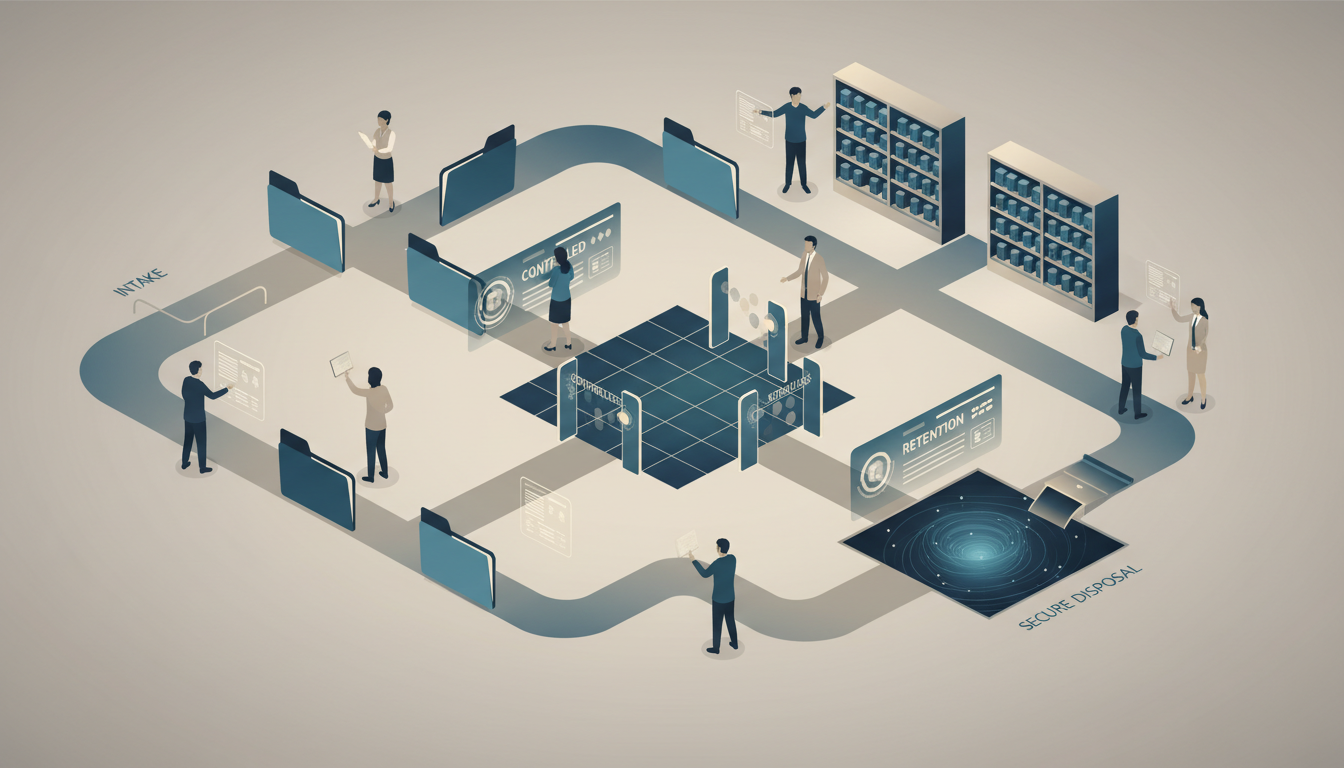
Can a civilisation use sophisticated artificial intelligence while losing track of who is responsible for its decisions? Yes: a tool may produce an impressive answer yet use incomplete data, make an unauthorised change or obscure an unfair outcome. The essential question is not whether a civilisation has AI, but whether people can define its purpose, test its limits, maintain meaningful oversight and correct harms. This guide traces the wider history of tools and automation, then examines modern AI governance using source-dated frameworks and explicitly speculative future settings.
In January 2026 Singapore’s IMDA launched a Model AI Governance Framework for Agentic AI and updated it in May 2026 with industry experience and case studies. Its recommendations include bounding agents’ powers, defining meaningful human checkpoints, testing and monitoring technical controls, and informing end users. This is guidance, not a claim that all AI deployments are safe. The US NIST AI Risk Management Framework 1.0 uses govern, map, measure and manage functions; as of 2026 the framework is under revision. UNESCO’s 2021 Recommendation on the Ethics of Artificial Intelligence sets out human-rights-oriented ethical principles. These documents apply to AI; they do not turn the eduKate civilisation-stage teaching map into a global legal standard.
The eduKate Civilisation Atlas uses Foundation 0 and eight numbered stages as teaching coordinates, not an official classification or a universal chronology. Foundation 0 recognises adaptable human practice, Stages 1–4 different forms of settlement, administration, industry and global networks, Stage 5 a proposed regenerative capacity, and Stages 6–8 hypothetical future human societies beyond Earth. No actual human civilisation is demonstrated at those final off-Earth thresholds. A stage label must never stand in for a judgement about human dignity, intelligence or the value of a culture.

What the reader should understand first
A robust explanation begins by naming the actual operating function, the people affected, the measurements that would demonstrate success and the kinds of failure the system must survive. A promising technical ability is not the same as its safe or fair implementation. An official recommendation differs from a binding statute; a stated target differs from a completed project; a completed project differs from a verified long-term outcome. Throughout this guide we keep those distinctions visible and avoid converting a fictional teaching example into a factual account of a historical people.
A source-led evidence ledger
Singapore IMDA, Model AI Governance Framework for Agentic AI, 22 January 2026
IMDA’s January launch defines the need for limits, human accountability, technical controls and transparent deployment of agents with tool access. See Singapore IMDA, Model AI Governance Framework for Agentic AI, 22 January 2026. Retain source dates, jurisdictions, reporting definitions and the difference between a proposal, guidance and demonstrated outcome. The organisations publishing these sources do not endorse or use the eduKate educational civilisation stages as an official ranking system.
Singapore IMDA, Updated Agentic AI Model Governance Framework, 20 May 2026
The updated guidance incorporates industry feedback and cases about tiered action risk, meaningful human approval, third-party systems and automation bias. See Singapore IMDA, Updated Agentic AI Model Governance Framework, 20 May 2026. Retain source dates, jurisdictions, reporting definitions and the difference between a proposal, guidance and demonstrated outcome. The organisations publishing these sources do not endorse or use the eduKate educational civilisation stages as an official ranking system.
NIST, Artificial Intelligence Risk Management Framework
NIST’s AI RMF 1.0 is a risk-management resource. NIST notes a 2026 revision process; neither the existence of a framework nor a checklist guarantees trustworthiness. See NIST, Artificial Intelligence Risk Management Framework. Retain source dates, jurisdictions, reporting definitions and the difference between a proposal, guidance and demonstrated outcome. The organisations publishing these sources do not endorse or use the eduKate educational civilisation stages as an official ranking system.
NIST AI RMF Core: Govern, Map, Measure, Manage
NIST describes continuous governance, context mapping, measurement, monitoring and response rather than one-time approval of a tool. See NIST AI RMF Core: Govern, Map, Measure, Manage. Retain source dates, jurisdictions, reporting definitions and the difference between a proposal, guidance and demonstrated outcome. The organisations publishing these sources do not endorse or use the eduKate educational civilisation stages as an official ranking system.
UNESCO, Recommendation on the Ethics of Artificial Intelligence
Adopted 23 November 2021, the Recommendation addresses human rights, dignity, transparency, proportionality and environmental and social effects. See UNESCO, Recommendation on the Ethics of Artificial Intelligence. Retain source dates, jurisdictions, reporting definitions and the difference between a proposal, guidance and demonstrated outcome. The organisations publishing these sources do not endorse or use the eduKate educational civilisation stages as an official ranking system.
OECD AI Principles, adopted 2019 and updated May 2024
The OECD principles support trustworthy, rights-respecting AI and provide flexible recommendations for AI actors and public policies. See OECD AI Principles, adopted 2019 and updated May 2024. Retain source dates, jurisdictions, reporting definitions and the difference between a proposal, guidance and demonstrated outcome. The organisations publishing these sources do not endorse or use the eduKate educational civilisation stages as an official ranking system.
Singapore MDDI, Agentic AI Oversight Parliamentary Reply, 5 August 2026
Singapore’s parliamentary response confirms the centrality of human and organisational accountability and risk-proportionate oversight in national AI governance. See Singapore MDDI, Agentic AI Oversight Parliamentary Reply, 5 August 2026. Retain source dates, jurisdictions, reporting definitions and the difference between a proposal, guidance and demonstrated outcome. The organisations publishing these sources do not endorse or use the eduKate educational civilisation stages as an official ranking system.
Foundation 0 and the eight stages as operating questions
Foundation 0 — Adaptive Human Worlds. Imagine human communities learning by observation, care and skilled knowledge transmission without requiring permanent cities. The relevant ability is how people verify a practice, explain an error and pass on a useful skill; a practical test asks what happens when one learner relies on an incomplete demonstration after an experienced person leaves. An important limit is that Archaeological evidence does not justify calling cultures without writing or automation intellectually inferior. Interpret this as a defined thought experiment, not a claim that all historical societies passed through one mandatory sequence.
Stage 1 — Settlement and Surplus. Imagine a fictional settlement maintaining food, homes, water and common spaces over successive seasons. The relevant ability is whether a local service continues safely when people and supplies change; a practical test asks what happens when a planned facility succeeds at first but excludes a household when demand rises. An important limit is that Large storage and permanent buildings do not establish equitable or reliable provision. Interpret this as a defined thought experiment, not a claim that all historical societies passed through one mandatory sequence.
Stage 2 — Administration and Recorded Systems. Imagine a fictional town coordinating shared decisions through durable records and designated stewards. The relevant ability is whether a decision can be checked, corrected and transferred to a different official; a practical test asks what happens when a recorded result conflicts with the experience of the intended service recipient. An important limit is that Archived records can overrepresent the powerful and leave many forms of knowledge undocumented. Interpret this as a defined thought experiment, not a claim that all historical societies passed through one mandatory sequence.
Stage 3 — Industrial and Mass Institutions. Imagine an industrial region with specialised jobs, maintained machines, organisations and public services. The relevant ability is whether repeatable operations depend on proper training, inspection and responsible institutions; a practical test asks what happens when a system increases output while worsening safety or access for one group. An important limit is that Industrial output is not a moral ranking, a guarantee of wellbeing or a universal measure of social development. Interpret this as a defined thought experiment, not a claim that all historical societies passed through one mandatory sequence.
Stage 4 — Planetary Network Civilisation. Imagine connected world regions using large transport, information and institutional networks. The relevant ability is whether international dependencies remain understandable, secure and accessible; a practical test asks what happens when an error in one node spreads to distant users before any local reviewer can intervene. An important limit is that Being connected does not imply every person can afford or influence a network. Interpret this as a defined thought experiment, not a claim that all historical societies passed through one mandatory sequence.
Stage 5 — Regenerative and Self-Correcting Civilisation. Imagine an imagined society systematically monitoring harm and revising its operating rules. The relevant ability is whether verified corrections endure without imposing hidden costs on people or ecosystems; a practical test asks what happens when an intervention improves one headline indicator but damages another important system. An important limit is that The proposed Stage 5 is an educational threshold, not a universally achieved or officially recognised present-day status. Interpret this as a defined thought experiment, not a claim that all historical societies passed through one mandatory sequence.
Stage 6 — Multi-World Extension. Imagine a fictional continuing inhabited outpost beyond Earth with explicit reliance on outside inputs. The relevant ability is whether living functions can persist away from Earth while their dependencies remain identified; a practical test asks what happens when a critical remote delivery or authorisation arrives too late to protect local needs. An important limit is that Robotic missions, blueprints and component experiments do not establish an inhabited second-world human civilisation. Interpret this as a defined thought experiment, not a claim that all historical societies passed through one mandatory sequence.
Stage 7 — Autonomous Multi-World Civilisation. Imagine an imagined inhabited off-Earth community attempting to provide most of its essentials locally. The relevant ability is whether local systems, skills and legitimate decisions survive loss of normal Earth support; a practical test asks what happens when one irreplaceable tool or specialist reveals an overlooked dependence. An important limit is that One locally operating machine or successful recycling experiment cannot prove settlement-wide autonomy. Interpret this as a defined thought experiment, not a claim that all historical societies passed through one mandatory sequence.
Stage 8 — Distributed Interplanetary Civilisation. Imagine several imagined inhabited worlds cooperating through long communication and travel delays. The relevant ability is whether each centre can decide locally while participating in transparent cross-world cooperation; a practical test asks what happens when an update is stale when a remote institution receives it. An important limit is that No distributed inhabited human interplanetary civilisation has been demonstrated; the setting remains speculative. Interpret this as a defined thought experiment, not a claim that all historical societies passed through one mandatory sequence.
Eighteen mechanisms: evidence, limits and responsible action
The following chapters explore distinct mechanisms with practical uses in History, Science, English comprehension, Mathematics and civic learning. Each opens with a plausible failure and explains what would count as evidence, then compares the function under the nine model coordinates. All villages, sample registers, decision systems and distant inhabited worlds in those comparisons are fictional. Students should not disclose real private information, enter hazardous places or attempt specialist interventions.
1. Tools, automation and what makes AI different: the operating question
The purpose is to distinguish a fixed mechanical rule from a model that infers patterns or generates outputs under uncertainty. That sounds simple until an apparently effective system fails under a realistic condition: an administrative office assumes a prediction is simply a perfect, preapproved instruction. A student should begin by tracing who notices the problem, who has the skills and legitimate authority to act, and what practical service the intended person receives. Ask what information is needed before a confident conclusion is warranted. An impressive machine, protective declaration or technical chart is only one part of the operating environment; it never stands for the entire system or the people who use it.
Relevant evidence includes clear system design, tested behaviour and the original purpose for adopting the tool. One useful measure could be appropriate human-understood tasks completed within a defined scope, but the definition, time period and affected population must be stated. Consider especially people affected by actions the design team did not anticipate, whose experience may be missing from the usual summary. The tempting mistake is any complex machine is the same thing as AI or necessarily more intelligent than a human, while an alternative explanation is that the system may merely automate an old procedure rather than make a meaningful improvement. A strong tutor asks what observations distinguish those possibilities. For an age-appropriate class, sort invented tools into manual, rules-driven, statistical and agentic categories. The learning objective is to explain the technology in terms of its actual function and limitations without treating technical sophistication as a measure of people’s worth.
Comparing tools, automation and what makes ai different at each of the nine coordinates
Foundation 0 — Adaptive Human Worlds: how the function would operate. Picture human communities learning by observation, care and skilled knowledge transmission without requiring permanent cities. The community wishes to distinguish a fixed mechanical rule from a model that infers patterns or generates outputs under uncertainty. Its relevant ability is how people verify a practice, explain an error and pass on a useful skill. In this fictional example, an administrative office assumes a prediction is simply a perfect, preapproved instruction. The teacher should ask the class to identify the immediate failure, the wider chain of dependence and the people whose needs could be overlooked. Now add the stage-specific test that one learner relies on an incomplete demonstration after an experienced person leaves. Does the first plan still work, and can another person reproduce the result? The answer must identify the resources, human responsibilities and limits of the imagined system rather than promote a single object, software package or green project into proof of a superior civilisation.
Source test and rival explanation. The assessment would need clear system design, tested behaviour and the original purpose for adopting the tool and an indicator such as appropriate human-understood tasks completed within a defined scope, but the group should ask whether people affected by actions the design team did not anticipate are represented. One explanation may appear to confirm that the stated design works. Another is that the system may merely automate an old procedure rather than make a meaningful improvement. Watch for the overclaim that any complex machine is the same thing as AI or necessarily more intelligent than a human. Archaeological evidence does not justify calling cultures without writing or automation intellectually inferior. The teaching point is not that a particular ancient community or future settlement had this arrangement. It is the distinction between a checkable operating mechanism, an incomplete inference and a fiction used to expose hidden assumptions. A conclusion can legitimately be that the available evidence is insufficient.
Parent-and-tutor laboratory. Have students sort invented tools into manual, rules-driven, statistical and agentic categories and then introduce a small paper disruption: one learner relies on an incomplete demonstration after an experienced person leaves. One learner documents a hypothesis, a second identifies evidence gaps and a third challenges the representativeness of the recorded results. Ask which choice protects the relevant people without creating a new harm elsewhere. To close, require the learner to explain the technology in terms of its actual function and limitations. The classroom report should specify an observation period, a realistic counterexample and a way the proposed correction could be tested again. No real personal records or dangerous experiments should be used.
Stage 1 — Settlement and Surplus: how the function would operate. Picture a fictional settlement maintaining food, homes, water and common spaces over successive seasons. The community wishes to distinguish a fixed mechanical rule from a model that infers patterns or generates outputs under uncertainty. Its relevant ability is whether a local service continues safely when people and supplies change. In this fictional example, an administrative office assumes a prediction is simply a perfect, preapproved instruction. The teacher should ask the class to identify the immediate failure, the wider chain of dependence and the people whose needs could be overlooked. Now add the stage-specific test that a planned facility succeeds at first but excludes a household when demand rises. Does the first plan still work, and can another person reproduce the result? The answer must identify the resources, human responsibilities and limits of the imagined system rather than promote a single object, software package or green project into proof of a superior civilisation.
Source test and rival explanation. The assessment would need clear system design, tested behaviour and the original purpose for adopting the tool and an indicator such as appropriate human-understood tasks completed within a defined scope, but the group should ask whether people affected by actions the design team did not anticipate are represented. One explanation may appear to confirm that the stated design works. Another is that the system may merely automate an old procedure rather than make a meaningful improvement. Watch for the overclaim that any complex machine is the same thing as AI or necessarily more intelligent than a human. Large storage and permanent buildings do not establish equitable or reliable provision. The teaching point is not that a particular ancient community or future settlement had this arrangement. It is the distinction between a checkable operating mechanism, an incomplete inference and a fiction used to expose hidden assumptions. A conclusion can legitimately be that the available evidence is insufficient.
Parent-and-tutor laboratory. Have students sort invented tools into manual, rules-driven, statistical and agentic categories and then introduce a small paper disruption: a planned facility succeeds at first but excludes a household when demand rises. One learner documents a hypothesis, a second identifies evidence gaps and a third challenges the representativeness of the recorded results. Ask which choice protects the relevant people without creating a new harm elsewhere. To close, require the learner to explain the technology in terms of its actual function and limitations. The classroom report should specify an observation period, a realistic counterexample and a way the proposed correction could be tested again. No real personal records or dangerous experiments should be used.
Stage 2 — Administration and Recorded Systems: how the function would operate. Picture a fictional town coordinating shared decisions through durable records and designated stewards. The community wishes to distinguish a fixed mechanical rule from a model that infers patterns or generates outputs under uncertainty. Its relevant ability is whether a decision can be checked, corrected and transferred to a different official. In this fictional example, an administrative office assumes a prediction is simply a perfect, preapproved instruction. The teacher should ask the class to identify the immediate failure, the wider chain of dependence and the people whose needs could be overlooked. Now add the stage-specific test that a recorded result conflicts with the experience of the intended service recipient. Does the first plan still work, and can another person reproduce the result? The answer must identify the resources, human responsibilities and limits of the imagined system rather than promote a single object, software package or green project into proof of a superior civilisation.
Source test and rival explanation. The assessment would need clear system design, tested behaviour and the original purpose for adopting the tool and an indicator such as appropriate human-understood tasks completed within a defined scope, but the group should ask whether people affected by actions the design team did not anticipate are represented. One explanation may appear to confirm that the stated design works. Another is that the system may merely automate an old procedure rather than make a meaningful improvement. Watch for the overclaim that any complex machine is the same thing as AI or necessarily more intelligent than a human. Archived records can overrepresent the powerful and leave many forms of knowledge undocumented. The teaching point is not that a particular ancient community or future settlement had this arrangement. It is the distinction between a checkable operating mechanism, an incomplete inference and a fiction used to expose hidden assumptions. A conclusion can legitimately be that the available evidence is insufficient.
Parent-and-tutor laboratory. Have students sort invented tools into manual, rules-driven, statistical and agentic categories and then introduce a small paper disruption: a recorded result conflicts with the experience of the intended service recipient. One learner documents a hypothesis, a second identifies evidence gaps and a third challenges the representativeness of the recorded results. Ask which choice protects the relevant people without creating a new harm elsewhere. To close, require the learner to explain the technology in terms of its actual function and limitations. The classroom report should specify an observation period, a realistic counterexample and a way the proposed correction could be tested again. No real personal records or dangerous experiments should be used.
Stage 3 — Industrial and Mass Institutions: how the function would operate. Picture an industrial region with specialised jobs, maintained machines, organisations and public services. The community wishes to distinguish a fixed mechanical rule from a model that infers patterns or generates outputs under uncertainty. Its relevant ability is whether repeatable operations depend on proper training, inspection and responsible institutions. In this fictional example, an administrative office assumes a prediction is simply a perfect, preapproved instruction. The teacher should ask the class to identify the immediate failure, the wider chain of dependence and the people whose needs could be overlooked. Now add the stage-specific test that a system increases output while worsening safety or access for one group. Does the first plan still work, and can another person reproduce the result? The answer must identify the resources, human responsibilities and limits of the imagined system rather than promote a single object, software package or green project into proof of a superior civilisation.
Source test and rival explanation. The assessment would need clear system design, tested behaviour and the original purpose for adopting the tool and an indicator such as appropriate human-understood tasks completed within a defined scope, but the group should ask whether people affected by actions the design team did not anticipate are represented. One explanation may appear to confirm that the stated design works. Another is that the system may merely automate an old procedure rather than make a meaningful improvement. Watch for the overclaim that any complex machine is the same thing as AI or necessarily more intelligent than a human. Industrial output is not a moral ranking, a guarantee of wellbeing or a universal measure of social development. The teaching point is not that a particular ancient community or future settlement had this arrangement. It is the distinction between a checkable operating mechanism, an incomplete inference and a fiction used to expose hidden assumptions. A conclusion can legitimately be that the available evidence is insufficient.
Parent-and-tutor laboratory. Have students sort invented tools into manual, rules-driven, statistical and agentic categories and then introduce a small paper disruption: a system increases output while worsening safety or access for one group. One learner documents a hypothesis, a second identifies evidence gaps and a third challenges the representativeness of the recorded results. Ask which choice protects the relevant people without creating a new harm elsewhere. To close, require the learner to explain the technology in terms of its actual function and limitations. The classroom report should specify an observation period, a realistic counterexample and a way the proposed correction could be tested again. No real personal records or dangerous experiments should be used.
Stage 4 — Planetary Network Civilisation: how the function would operate. Picture connected world regions using large transport, information and institutional networks. The community wishes to distinguish a fixed mechanical rule from a model that infers patterns or generates outputs under uncertainty. Its relevant ability is whether international dependencies remain understandable, secure and accessible. In this fictional example, an administrative office assumes a prediction is simply a perfect, preapproved instruction. The teacher should ask the class to identify the immediate failure, the wider chain of dependence and the people whose needs could be overlooked. Now add the stage-specific test that an error in one node spreads to distant users before any local reviewer can intervene. Does the first plan still work, and can another person reproduce the result? The answer must identify the resources, human responsibilities and limits of the imagined system rather than promote a single object, software package or green project into proof of a superior civilisation.
Source test and rival explanation. The assessment would need clear system design, tested behaviour and the original purpose for adopting the tool and an indicator such as appropriate human-understood tasks completed within a defined scope, but the group should ask whether people affected by actions the design team did not anticipate are represented. One explanation may appear to confirm that the stated design works. Another is that the system may merely automate an old procedure rather than make a meaningful improvement. Watch for the overclaim that any complex machine is the same thing as AI or necessarily more intelligent than a human. Being connected does not imply every person can afford or influence a network. The teaching point is not that a particular ancient community or future settlement had this arrangement. It is the distinction between a checkable operating mechanism, an incomplete inference and a fiction used to expose hidden assumptions. A conclusion can legitimately be that the available evidence is insufficient.
Parent-and-tutor laboratory. Have students sort invented tools into manual, rules-driven, statistical and agentic categories and then introduce a small paper disruption: an error in one node spreads to distant users before any local reviewer can intervene. One learner documents a hypothesis, a second identifies evidence gaps and a third challenges the representativeness of the recorded results. Ask which choice protects the relevant people without creating a new harm elsewhere. To close, require the learner to explain the technology in terms of its actual function and limitations. The classroom report should specify an observation period, a realistic counterexample and a way the proposed correction could be tested again. No real personal records or dangerous experiments should be used.
Stage 5 — Regenerative and Self-Correcting Civilisation: how the function would operate. Picture an imagined society systematically monitoring harm and revising its operating rules. The community wishes to distinguish a fixed mechanical rule from a model that infers patterns or generates outputs under uncertainty. Its relevant ability is whether verified corrections endure without imposing hidden costs on people or ecosystems. In this fictional example, an administrative office assumes a prediction is simply a perfect, preapproved instruction. The teacher should ask the class to identify the immediate failure, the wider chain of dependence and the people whose needs could be overlooked. Now add the stage-specific test that an intervention improves one headline indicator but damages another important system. Does the first plan still work, and can another person reproduce the result? The answer must identify the resources, human responsibilities and limits of the imagined system rather than promote a single object, software package or green project into proof of a superior civilisation.
Source test and rival explanation. The assessment would need clear system design, tested behaviour and the original purpose for adopting the tool and an indicator such as appropriate human-understood tasks completed within a defined scope, but the group should ask whether people affected by actions the design team did not anticipate are represented. One explanation may appear to confirm that the stated design works. Another is that the system may merely automate an old procedure rather than make a meaningful improvement. Watch for the overclaim that any complex machine is the same thing as AI or necessarily more intelligent than a human. The proposed Stage 5 is an educational threshold, not a universally achieved or officially recognised present-day status. The teaching point is not that a particular ancient community or future settlement had this arrangement. It is the distinction between a checkable operating mechanism, an incomplete inference and a fiction used to expose hidden assumptions. A conclusion can legitimately be that the available evidence is insufficient.
Parent-and-tutor laboratory. Have students sort invented tools into manual, rules-driven, statistical and agentic categories and then introduce a small paper disruption: an intervention improves one headline indicator but damages another important system. One learner documents a hypothesis, a second identifies evidence gaps and a third challenges the representativeness of the recorded results. Ask which choice protects the relevant people without creating a new harm elsewhere. To close, require the learner to explain the technology in terms of its actual function and limitations. The classroom report should specify an observation period, a realistic counterexample and a way the proposed correction could be tested again. No real personal records or dangerous experiments should be used.
Stage 6 — Multi-World Extension: how the function would operate. Picture a fictional continuing inhabited outpost beyond Earth with explicit reliance on outside inputs. The community wishes to distinguish a fixed mechanical rule from a model that infers patterns or generates outputs under uncertainty. Its relevant ability is whether living functions can persist away from Earth while their dependencies remain identified. In this fictional example, an administrative office assumes a prediction is simply a perfect, preapproved instruction. The teacher should ask the class to identify the immediate failure, the wider chain of dependence and the people whose needs could be overlooked. Now add the stage-specific test that a critical remote delivery or authorisation arrives too late to protect local needs. Does the first plan still work, and can another person reproduce the result? The answer must identify the resources, human responsibilities and limits of the imagined system rather than promote a single object, software package or green project into proof of a superior civilisation.
Source test and rival explanation. The assessment would need clear system design, tested behaviour and the original purpose for adopting the tool and an indicator such as appropriate human-understood tasks completed within a defined scope, but the group should ask whether people affected by actions the design team did not anticipate are represented. One explanation may appear to confirm that the stated design works. Another is that the system may merely automate an old procedure rather than make a meaningful improvement. Watch for the overclaim that any complex machine is the same thing as AI or necessarily more intelligent than a human. Robotic missions, blueprints and component experiments do not establish an inhabited second-world human civilisation. The teaching point is not that a particular ancient community or future settlement had this arrangement. It is the distinction between a checkable operating mechanism, an incomplete inference and a fiction used to expose hidden assumptions. A conclusion can legitimately be that the available evidence is insufficient.
Parent-and-tutor laboratory. Have students sort invented tools into manual, rules-driven, statistical and agentic categories and then introduce a small paper disruption: a critical remote delivery or authorisation arrives too late to protect local needs. One learner documents a hypothesis, a second identifies evidence gaps and a third challenges the representativeness of the recorded results. Ask which choice protects the relevant people without creating a new harm elsewhere. To close, require the learner to explain the technology in terms of its actual function and limitations. The classroom report should specify an observation period, a realistic counterexample and a way the proposed correction could be tested again. No real personal records or dangerous experiments should be used.
Stage 7 — Autonomous Multi-World Civilisation: how the function would operate. Picture an imagined inhabited off-Earth community attempting to provide most of its essentials locally. The community wishes to distinguish a fixed mechanical rule from a model that infers patterns or generates outputs under uncertainty. Its relevant ability is whether local systems, skills and legitimate decisions survive loss of normal Earth support. In this fictional example, an administrative office assumes a prediction is simply a perfect, preapproved instruction. The teacher should ask the class to identify the immediate failure, the wider chain of dependence and the people whose needs could be overlooked. Now add the stage-specific test that one irreplaceable tool or specialist reveals an overlooked dependence. Does the first plan still work, and can another person reproduce the result? The answer must identify the resources, human responsibilities and limits of the imagined system rather than promote a single object, software package or green project into proof of a superior civilisation.
Source test and rival explanation. The assessment would need clear system design, tested behaviour and the original purpose for adopting the tool and an indicator such as appropriate human-understood tasks completed within a defined scope, but the group should ask whether people affected by actions the design team did not anticipate are represented. One explanation may appear to confirm that the stated design works. Another is that the system may merely automate an old procedure rather than make a meaningful improvement. Watch for the overclaim that any complex machine is the same thing as AI or necessarily more intelligent than a human. One locally operating machine or successful recycling experiment cannot prove settlement-wide autonomy. The teaching point is not that a particular ancient community or future settlement had this arrangement. It is the distinction between a checkable operating mechanism, an incomplete inference and a fiction used to expose hidden assumptions. A conclusion can legitimately be that the available evidence is insufficient.
Parent-and-tutor laboratory. Have students sort invented tools into manual, rules-driven, statistical and agentic categories and then introduce a small paper disruption: one irreplaceable tool or specialist reveals an overlooked dependence. One learner documents a hypothesis, a second identifies evidence gaps and a third challenges the representativeness of the recorded results. Ask which choice protects the relevant people without creating a new harm elsewhere. To close, require the learner to explain the technology in terms of its actual function and limitations. The classroom report should specify an observation period, a realistic counterexample and a way the proposed correction could be tested again. No real personal records or dangerous experiments should be used.
Stage 8 — Distributed Interplanetary Civilisation: how the function would operate. Picture several imagined inhabited worlds cooperating through long communication and travel delays. The community wishes to distinguish a fixed mechanical rule from a model that infers patterns or generates outputs under uncertainty. Its relevant ability is whether each centre can decide locally while participating in transparent cross-world cooperation. In this fictional example, an administrative office assumes a prediction is simply a perfect, preapproved instruction. The teacher should ask the class to identify the immediate failure, the wider chain of dependence and the people whose needs could be overlooked. Now add the stage-specific test that an update is stale when a remote institution receives it. Does the first plan still work, and can another person reproduce the result? The answer must identify the resources, human responsibilities and limits of the imagined system rather than promote a single object, software package or green project into proof of a superior civilisation.
Source test and rival explanation. The assessment would need clear system design, tested behaviour and the original purpose for adopting the tool and an indicator such as appropriate human-understood tasks completed within a defined scope, but the group should ask whether people affected by actions the design team did not anticipate are represented. One explanation may appear to confirm that the stated design works. Another is that the system may merely automate an old procedure rather than make a meaningful improvement. Watch for the overclaim that any complex machine is the same thing as AI or necessarily more intelligent than a human. No distributed inhabited human interplanetary civilisation has been demonstrated; the setting remains speculative. The teaching point is not that a particular ancient community or future settlement had this arrangement. It is the distinction between a checkable operating mechanism, an incomplete inference and a fiction used to expose hidden assumptions. A conclusion can legitimately be that the available evidence is insufficient.
Parent-and-tutor laboratory. Have students sort invented tools into manual, rules-driven, statistical and agentic categories and then introduce a small paper disruption: an update is stale when a remote institution receives it. One learner documents a hypothesis, a second identifies evidence gaps and a third challenges the representativeness of the recorded results. Ask which choice protects the relevant people without creating a new harm elsewhere. To close, require the learner to explain the technology in terms of its actual function and limitations. The classroom report should specify an observation period, a realistic counterexample and a way the proposed correction could be tested again. No real personal records or dangerous experiments should be used.
A worked evidence check: Tools, automation and what makes AI different
Consider an imaginary study that aims for 84 units of appropriate human-understood tasks completed within a defined scope during one stated period. Exactly 75 units are independently confirmed, giving a verified proportion of 75/84 = 89.3% after rounding. Another 1 entries remain unresolved. The confirmed shortfall is 9, and uncertain entries should neither be counted as successes nor subtracted twice. Although the arithmetic is correct, the result cannot by itself establish safety, ecological benefit, justice or the truth of a stage description.
An evidence review must ask whether people affected by actions the design team did not anticipate were included in the denominator and whether the system may merely automate an old procedure rather than make a meaningful improvement provides an alternative account of the numbers. What would happen if the date, reporting method or number of affected users changed? Ask for one test that could disprove the first interpretation. Then write a conclusion that identifies the invented data, states the limitation and describes a checkable next observation. The purpose is measured judgement and transfer of the reasoning to unfamiliar evidence.
2. Data provenance and completeness: the operating question
The purpose is to recognise that a model’s result depends on where its information came from and what it omits. That sounds simple until an apparently effective system fails under a realistic condition: a service model relies on an old dataset that excludes a recently created neighbourhood. A student should begin by tracing who notices the problem, who has the skills and legitimate authority to act, and what practical service the intended person receives. Ask what information is needed before a confident conclusion is warranted. An impressive machine, protective declaration or technical chart is only one part of the operating environment; it never stands for the entire system or the people who use it.
Relevant evidence includes dated data sources, collection definitions, permitted use and independent quality checks. One useful measure could be decisions traceable to appropriate verified inputs, but the definition, time period and affected population must be stated. Consider especially residents absent from the original records and those without digital traces, whose experience may be missing from the usual summary. The tempting mistake is a large dataset must represent the entire population fairly, while an alternative explanation is that more entries may merely repeat the same narrow source bias. A strong tutor asks what observations distinguish those possibilities. For an age-appropriate class, create fictional training data cards with missing dates and mark which conclusions are unsupported. The learning objective is to connect evidence quality with input quality instead of surface fluency without treating technical sophistication as a measure of people’s worth.
Comparing data provenance and completeness at each of the nine coordinates
Foundation 0 — Adaptive Human Worlds: how the function would operate. Picture human communities learning by observation, care and skilled knowledge transmission without requiring permanent cities. The community wishes to recognise that a model’s result depends on where its information came from and what it omits. Its relevant ability is how people verify a practice, explain an error and pass on a useful skill. In this fictional example, a service model relies on an old dataset that excludes a recently created neighbourhood. The teacher should ask the class to identify the immediate failure, the wider chain of dependence and the people whose needs could be overlooked. Now add the stage-specific test that one learner relies on an incomplete demonstration after an experienced person leaves. Does the first plan still work, and can another person reproduce the result? The answer must identify the resources, human responsibilities and limits of the imagined system rather than promote a single object, software package or green project into proof of a superior civilisation.
Source test and rival explanation. The assessment would need dated data sources, collection definitions, permitted use and independent quality checks and an indicator such as decisions traceable to appropriate verified inputs, but the group should ask whether residents absent from the original records and those without digital traces are represented. One explanation may appear to confirm that the stated design works. Another is that more entries may merely repeat the same narrow source bias. Watch for the overclaim that a large dataset must represent the entire population fairly. Archaeological evidence does not justify calling cultures without writing or automation intellectually inferior. The teaching point is not that a particular ancient community or future settlement had this arrangement. It is the distinction between a checkable operating mechanism, an incomplete inference and a fiction used to expose hidden assumptions. A conclusion can legitimately be that the available evidence is insufficient.
Parent-and-tutor laboratory. Have students create fictional training data cards with missing dates and mark which conclusions are unsupported and then introduce a small paper disruption: one learner relies on an incomplete demonstration after an experienced person leaves. One learner documents a hypothesis, a second identifies evidence gaps and a third challenges the representativeness of the recorded results. Ask which choice protects the relevant people without creating a new harm elsewhere. To close, require the learner to connect evidence quality with input quality instead of surface fluency. The classroom report should specify an observation period, a realistic counterexample and a way the proposed correction could be tested again. No real personal records or dangerous experiments should be used.
Stage 1 — Settlement and Surplus: how the function would operate. Picture a fictional settlement maintaining food, homes, water and common spaces over successive seasons. The community wishes to recognise that a model’s result depends on where its information came from and what it omits. Its relevant ability is whether a local service continues safely when people and supplies change. In this fictional example, a service model relies on an old dataset that excludes a recently created neighbourhood. The teacher should ask the class to identify the immediate failure, the wider chain of dependence and the people whose needs could be overlooked. Now add the stage-specific test that a planned facility succeeds at first but excludes a household when demand rises. Does the first plan still work, and can another person reproduce the result? The answer must identify the resources, human responsibilities and limits of the imagined system rather than promote a single object, software package or green project into proof of a superior civilisation.
Source test and rival explanation. The assessment would need dated data sources, collection definitions, permitted use and independent quality checks and an indicator such as decisions traceable to appropriate verified inputs, but the group should ask whether residents absent from the original records and those without digital traces are represented. One explanation may appear to confirm that the stated design works. Another is that more entries may merely repeat the same narrow source bias. Watch for the overclaim that a large dataset must represent the entire population fairly. Large storage and permanent buildings do not establish equitable or reliable provision. The teaching point is not that a particular ancient community or future settlement had this arrangement. It is the distinction between a checkable operating mechanism, an incomplete inference and a fiction used to expose hidden assumptions. A conclusion can legitimately be that the available evidence is insufficient.
Parent-and-tutor laboratory. Have students create fictional training data cards with missing dates and mark which conclusions are unsupported and then introduce a small paper disruption: a planned facility succeeds at first but excludes a household when demand rises. One learner documents a hypothesis, a second identifies evidence gaps and a third challenges the representativeness of the recorded results. Ask which choice protects the relevant people without creating a new harm elsewhere. To close, require the learner to connect evidence quality with input quality instead of surface fluency. The classroom report should specify an observation period, a realistic counterexample and a way the proposed correction could be tested again. No real personal records or dangerous experiments should be used.
Stage 2 — Administration and Recorded Systems: how the function would operate. Picture a fictional town coordinating shared decisions through durable records and designated stewards. The community wishes to recognise that a model’s result depends on where its information came from and what it omits. Its relevant ability is whether a decision can be checked, corrected and transferred to a different official. In this fictional example, a service model relies on an old dataset that excludes a recently created neighbourhood. The teacher should ask the class to identify the immediate failure, the wider chain of dependence and the people whose needs could be overlooked. Now add the stage-specific test that a recorded result conflicts with the experience of the intended service recipient. Does the first plan still work, and can another person reproduce the result? The answer must identify the resources, human responsibilities and limits of the imagined system rather than promote a single object, software package or green project into proof of a superior civilisation.
Source test and rival explanation. The assessment would need dated data sources, collection definitions, permitted use and independent quality checks and an indicator such as decisions traceable to appropriate verified inputs, but the group should ask whether residents absent from the original records and those without digital traces are represented. One explanation may appear to confirm that the stated design works. Another is that more entries may merely repeat the same narrow source bias. Watch for the overclaim that a large dataset must represent the entire population fairly. Archived records can overrepresent the powerful and leave many forms of knowledge undocumented. The teaching point is not that a particular ancient community or future settlement had this arrangement. It is the distinction between a checkable operating mechanism, an incomplete inference and a fiction used to expose hidden assumptions. A conclusion can legitimately be that the available evidence is insufficient.
Parent-and-tutor laboratory. Have students create fictional training data cards with missing dates and mark which conclusions are unsupported and then introduce a small paper disruption: a recorded result conflicts with the experience of the intended service recipient. One learner documents a hypothesis, a second identifies evidence gaps and a third challenges the representativeness of the recorded results. Ask which choice protects the relevant people without creating a new harm elsewhere. To close, require the learner to connect evidence quality with input quality instead of surface fluency. The classroom report should specify an observation period, a realistic counterexample and a way the proposed correction could be tested again. No real personal records or dangerous experiments should be used.
Stage 3 — Industrial and Mass Institutions: how the function would operate. Picture an industrial region with specialised jobs, maintained machines, organisations and public services. The community wishes to recognise that a model’s result depends on where its information came from and what it omits. Its relevant ability is whether repeatable operations depend on proper training, inspection and responsible institutions. In this fictional example, a service model relies on an old dataset that excludes a recently created neighbourhood. The teacher should ask the class to identify the immediate failure, the wider chain of dependence and the people whose needs could be overlooked. Now add the stage-specific test that a system increases output while worsening safety or access for one group. Does the first plan still work, and can another person reproduce the result? The answer must identify the resources, human responsibilities and limits of the imagined system rather than promote a single object, software package or green project into proof of a superior civilisation.
Source test and rival explanation. The assessment would need dated data sources, collection definitions, permitted use and independent quality checks and an indicator such as decisions traceable to appropriate verified inputs, but the group should ask whether residents absent from the original records and those without digital traces are represented. One explanation may appear to confirm that the stated design works. Another is that more entries may merely repeat the same narrow source bias. Watch for the overclaim that a large dataset must represent the entire population fairly. Industrial output is not a moral ranking, a guarantee of wellbeing or a universal measure of social development. The teaching point is not that a particular ancient community or future settlement had this arrangement. It is the distinction between a checkable operating mechanism, an incomplete inference and a fiction used to expose hidden assumptions. A conclusion can legitimately be that the available evidence is insufficient.
Parent-and-tutor laboratory. Have students create fictional training data cards with missing dates and mark which conclusions are unsupported and then introduce a small paper disruption: a system increases output while worsening safety or access for one group. One learner documents a hypothesis, a second identifies evidence gaps and a third challenges the representativeness of the recorded results. Ask which choice protects the relevant people without creating a new harm elsewhere. To close, require the learner to connect evidence quality with input quality instead of surface fluency. The classroom report should specify an observation period, a realistic counterexample and a way the proposed correction could be tested again. No real personal records or dangerous experiments should be used.
Stage 4 — Planetary Network Civilisation: how the function would operate. Picture connected world regions using large transport, information and institutional networks. The community wishes to recognise that a model’s result depends on where its information came from and what it omits. Its relevant ability is whether international dependencies remain understandable, secure and accessible. In this fictional example, a service model relies on an old dataset that excludes a recently created neighbourhood. The teacher should ask the class to identify the immediate failure, the wider chain of dependence and the people whose needs could be overlooked. Now add the stage-specific test that an error in one node spreads to distant users before any local reviewer can intervene. Does the first plan still work, and can another person reproduce the result? The answer must identify the resources, human responsibilities and limits of the imagined system rather than promote a single object, software package or green project into proof of a superior civilisation.
Source test and rival explanation. The assessment would need dated data sources, collection definitions, permitted use and independent quality checks and an indicator such as decisions traceable to appropriate verified inputs, but the group should ask whether residents absent from the original records and those without digital traces are represented. One explanation may appear to confirm that the stated design works. Another is that more entries may merely repeat the same narrow source bias. Watch for the overclaim that a large dataset must represent the entire population fairly. Being connected does not imply every person can afford or influence a network. The teaching point is not that a particular ancient community or future settlement had this arrangement. It is the distinction between a checkable operating mechanism, an incomplete inference and a fiction used to expose hidden assumptions. A conclusion can legitimately be that the available evidence is insufficient.
Parent-and-tutor laboratory. Have students create fictional training data cards with missing dates and mark which conclusions are unsupported and then introduce a small paper disruption: an error in one node spreads to distant users before any local reviewer can intervene. One learner documents a hypothesis, a second identifies evidence gaps and a third challenges the representativeness of the recorded results. Ask which choice protects the relevant people without creating a new harm elsewhere. To close, require the learner to connect evidence quality with input quality instead of surface fluency. The classroom report should specify an observation period, a realistic counterexample and a way the proposed correction could be tested again. No real personal records or dangerous experiments should be used.
Stage 5 — Regenerative and Self-Correcting Civilisation: how the function would operate. Picture an imagined society systematically monitoring harm and revising its operating rules. The community wishes to recognise that a model’s result depends on where its information came from and what it omits. Its relevant ability is whether verified corrections endure without imposing hidden costs on people or ecosystems. In this fictional example, a service model relies on an old dataset that excludes a recently created neighbourhood. The teacher should ask the class to identify the immediate failure, the wider chain of dependence and the people whose needs could be overlooked. Now add the stage-specific test that an intervention improves one headline indicator but damages another important system. Does the first plan still work, and can another person reproduce the result? The answer must identify the resources, human responsibilities and limits of the imagined system rather than promote a single object, software package or green project into proof of a superior civilisation.
Source test and rival explanation. The assessment would need dated data sources, collection definitions, permitted use and independent quality checks and an indicator such as decisions traceable to appropriate verified inputs, but the group should ask whether residents absent from the original records and those without digital traces are represented. One explanation may appear to confirm that the stated design works. Another is that more entries may merely repeat the same narrow source bias. Watch for the overclaim that a large dataset must represent the entire population fairly. The proposed Stage 5 is an educational threshold, not a universally achieved or officially recognised present-day status. The teaching point is not that a particular ancient community or future settlement had this arrangement. It is the distinction between a checkable operating mechanism, an incomplete inference and a fiction used to expose hidden assumptions. A conclusion can legitimately be that the available evidence is insufficient.
Parent-and-tutor laboratory. Have students create fictional training data cards with missing dates and mark which conclusions are unsupported and then introduce a small paper disruption: an intervention improves one headline indicator but damages another important system. One learner documents a hypothesis, a second identifies evidence gaps and a third challenges the representativeness of the recorded results. Ask which choice protects the relevant people without creating a new harm elsewhere. To close, require the learner to connect evidence quality with input quality instead of surface fluency. The classroom report should specify an observation period, a realistic counterexample and a way the proposed correction could be tested again. No real personal records or dangerous experiments should be used.
Stage 6 — Multi-World Extension: how the function would operate. Picture a fictional continuing inhabited outpost beyond Earth with explicit reliance on outside inputs. The community wishes to recognise that a model’s result depends on where its information came from and what it omits. Its relevant ability is whether living functions can persist away from Earth while their dependencies remain identified. In this fictional example, a service model relies on an old dataset that excludes a recently created neighbourhood. The teacher should ask the class to identify the immediate failure, the wider chain of dependence and the people whose needs could be overlooked. Now add the stage-specific test that a critical remote delivery or authorisation arrives too late to protect local needs. Does the first plan still work, and can another person reproduce the result? The answer must identify the resources, human responsibilities and limits of the imagined system rather than promote a single object, software package or green project into proof of a superior civilisation.
Source test and rival explanation. The assessment would need dated data sources, collection definitions, permitted use and independent quality checks and an indicator such as decisions traceable to appropriate verified inputs, but the group should ask whether residents absent from the original records and those without digital traces are represented. One explanation may appear to confirm that the stated design works. Another is that more entries may merely repeat the same narrow source bias. Watch for the overclaim that a large dataset must represent the entire population fairly. Robotic missions, blueprints and component experiments do not establish an inhabited second-world human civilisation. The teaching point is not that a particular ancient community or future settlement had this arrangement. It is the distinction between a checkable operating mechanism, an incomplete inference and a fiction used to expose hidden assumptions. A conclusion can legitimately be that the available evidence is insufficient.
Parent-and-tutor laboratory. Have students create fictional training data cards with missing dates and mark which conclusions are unsupported and then introduce a small paper disruption: a critical remote delivery or authorisation arrives too late to protect local needs. One learner documents a hypothesis, a second identifies evidence gaps and a third challenges the representativeness of the recorded results. Ask which choice protects the relevant people without creating a new harm elsewhere. To close, require the learner to connect evidence quality with input quality instead of surface fluency. The classroom report should specify an observation period, a realistic counterexample and a way the proposed correction could be tested again. No real personal records or dangerous experiments should be used.
Stage 7 — Autonomous Multi-World Civilisation: how the function would operate. Picture an imagined inhabited off-Earth community attempting to provide most of its essentials locally. The community wishes to recognise that a model’s result depends on where its information came from and what it omits. Its relevant ability is whether local systems, skills and legitimate decisions survive loss of normal Earth support. In this fictional example, a service model relies on an old dataset that excludes a recently created neighbourhood. The teacher should ask the class to identify the immediate failure, the wider chain of dependence and the people whose needs could be overlooked. Now add the stage-specific test that one irreplaceable tool or specialist reveals an overlooked dependence. Does the first plan still work, and can another person reproduce the result? The answer must identify the resources, human responsibilities and limits of the imagined system rather than promote a single object, software package or green project into proof of a superior civilisation.
Source test and rival explanation. The assessment would need dated data sources, collection definitions, permitted use and independent quality checks and an indicator such as decisions traceable to appropriate verified inputs, but the group should ask whether residents absent from the original records and those without digital traces are represented. One explanation may appear to confirm that the stated design works. Another is that more entries may merely repeat the same narrow source bias. Watch for the overclaim that a large dataset must represent the entire population fairly. One locally operating machine or successful recycling experiment cannot prove settlement-wide autonomy. The teaching point is not that a particular ancient community or future settlement had this arrangement. It is the distinction between a checkable operating mechanism, an incomplete inference and a fiction used to expose hidden assumptions. A conclusion can legitimately be that the available evidence is insufficient.
Parent-and-tutor laboratory. Have students create fictional training data cards with missing dates and mark which conclusions are unsupported and then introduce a small paper disruption: one irreplaceable tool or specialist reveals an overlooked dependence. One learner documents a hypothesis, a second identifies evidence gaps and a third challenges the representativeness of the recorded results. Ask which choice protects the relevant people without creating a new harm elsewhere. To close, require the learner to connect evidence quality with input quality instead of surface fluency. The classroom report should specify an observation period, a realistic counterexample and a way the proposed correction could be tested again. No real personal records or dangerous experiments should be used.
Stage 8 — Distributed Interplanetary Civilisation: how the function would operate. Picture several imagined inhabited worlds cooperating through long communication and travel delays. The community wishes to recognise that a model’s result depends on where its information came from and what it omits. Its relevant ability is whether each centre can decide locally while participating in transparent cross-world cooperation. In this fictional example, a service model relies on an old dataset that excludes a recently created neighbourhood. The teacher should ask the class to identify the immediate failure, the wider chain of dependence and the people whose needs could be overlooked. Now add the stage-specific test that an update is stale when a remote institution receives it. Does the first plan still work, and can another person reproduce the result? The answer must identify the resources, human responsibilities and limits of the imagined system rather than promote a single object, software package or green project into proof of a superior civilisation.
Source test and rival explanation. The assessment would need dated data sources, collection definitions, permitted use and independent quality checks and an indicator such as decisions traceable to appropriate verified inputs, but the group should ask whether residents absent from the original records and those without digital traces are represented. One explanation may appear to confirm that the stated design works. Another is that more entries may merely repeat the same narrow source bias. Watch for the overclaim that a large dataset must represent the entire population fairly. No distributed inhabited human interplanetary civilisation has been demonstrated; the setting remains speculative. The teaching point is not that a particular ancient community or future settlement had this arrangement. It is the distinction between a checkable operating mechanism, an incomplete inference and a fiction used to expose hidden assumptions. A conclusion can legitimately be that the available evidence is insufficient.
Parent-and-tutor laboratory. Have students create fictional training data cards with missing dates and mark which conclusions are unsupported and then introduce a small paper disruption: an update is stale when a remote institution receives it. One learner documents a hypothesis, a second identifies evidence gaps and a third challenges the representativeness of the recorded results. Ask which choice protects the relevant people without creating a new harm elsewhere. To close, require the learner to connect evidence quality with input quality instead of surface fluency. The classroom report should specify an observation period, a realistic counterexample and a way the proposed correction could be tested again. No real personal records or dangerous experiments should be used.
A worked evidence check: Data provenance and completeness
Consider an imaginary study that aims for 91 units of decisions traceable to appropriate verified inputs during one stated period. Exactly 79 units are independently confirmed, giving a verified proportion of 79/91 = 86.8% after rounding. Another 2 entries remain unresolved. The confirmed shortfall is 12, and uncertain entries should neither be counted as successes nor subtracted twice. Although the arithmetic is correct, the result cannot by itself establish safety, ecological benefit, justice or the truth of a stage description.
An evidence review must ask whether residents absent from the original records and those without digital traces were included in the denominator and whether more entries may merely repeat the same narrow source bias provides an alternative account of the numbers. What would happen if the date, reporting method or number of affected users changed? Ask for one test that could disprove the first interpretation. Then write a conclusion that identifies the invented data, states the limitation and describes a checkable next observation. The purpose is measured judgement and transfer of the reasoning to unfamiliar evidence.
3. Labels, proxies and hidden bias: the operating question
The purpose is to separate the desired outcome from an imperfect label or proxy used to predict it. That sounds simple until an apparently effective system fails under a realistic condition: a screening tool treats time online as an accurate measure of student engagement. A student should begin by tracing who notices the problem, who has the skills and legitimate authority to act, and what practical service the intended person receives. Ask what information is needed before a confident conclusion is warranted. An impressive machine, protective declaration or technical chart is only one part of the operating environment; it never stands for the entire system or the people who use it.
Relevant evidence includes valid labels, subgroup evaluation and explanation of relevant proxies. One useful measure could be decisions that withstand a fairness and validity review, but the definition, time period and affected population must be stated. Consider especially learners sharing devices or lacking stable home connectivity, whose experience may be missing from the usual summary. The tempting mistake is a convenient digital measure is identical to the human trait it claims to measure, while an alternative explanation is that the measured proxy may reflect resources rather than capability. A strong tutor asks what observations distinguish those possibilities. For an age-appropriate class, compare a fictional student participation table with device-usage records. The learning objective is to ask what the label actually represents and whom it misclassifies without treating technical sophistication as a measure of people’s worth.
Comparing labels, proxies and hidden bias at each of the nine coordinates
Foundation 0 — Adaptive Human Worlds: how the function would operate. Picture human communities learning by observation, care and skilled knowledge transmission without requiring permanent cities. The community wishes to separate the desired outcome from an imperfect label or proxy used to predict it. Its relevant ability is how people verify a practice, explain an error and pass on a useful skill. In this fictional example, a screening tool treats time online as an accurate measure of student engagement. The teacher should ask the class to identify the immediate failure, the wider chain of dependence and the people whose needs could be overlooked. Now add the stage-specific test that one learner relies on an incomplete demonstration after an experienced person leaves. Does the first plan still work, and can another person reproduce the result? The answer must identify the resources, human responsibilities and limits of the imagined system rather than promote a single object, software package or green project into proof of a superior civilisation.
Source test and rival explanation. The assessment would need valid labels, subgroup evaluation and explanation of relevant proxies and an indicator such as decisions that withstand a fairness and validity review, but the group should ask whether learners sharing devices or lacking stable home connectivity are represented. One explanation may appear to confirm that the stated design works. Another is that the measured proxy may reflect resources rather than capability. Watch for the overclaim that a convenient digital measure is identical to the human trait it claims to measure. Archaeological evidence does not justify calling cultures without writing or automation intellectually inferior. The teaching point is not that a particular ancient community or future settlement had this arrangement. It is the distinction between a checkable operating mechanism, an incomplete inference and a fiction used to expose hidden assumptions. A conclusion can legitimately be that the available evidence is insufficient.
Parent-and-tutor laboratory. Have students compare a fictional student participation table with device-usage records and then introduce a small paper disruption: one learner relies on an incomplete demonstration after an experienced person leaves. One learner documents a hypothesis, a second identifies evidence gaps and a third challenges the representativeness of the recorded results. Ask which choice protects the relevant people without creating a new harm elsewhere. To close, require the learner to ask what the label actually represents and whom it misclassifies. The classroom report should specify an observation period, a realistic counterexample and a way the proposed correction could be tested again. No real personal records or dangerous experiments should be used.
Stage 1 — Settlement and Surplus: how the function would operate. Picture a fictional settlement maintaining food, homes, water and common spaces over successive seasons. The community wishes to separate the desired outcome from an imperfect label or proxy used to predict it. Its relevant ability is whether a local service continues safely when people and supplies change. In this fictional example, a screening tool treats time online as an accurate measure of student engagement. The teacher should ask the class to identify the immediate failure, the wider chain of dependence and the people whose needs could be overlooked. Now add the stage-specific test that a planned facility succeeds at first but excludes a household when demand rises. Does the first plan still work, and can another person reproduce the result? The answer must identify the resources, human responsibilities and limits of the imagined system rather than promote a single object, software package or green project into proof of a superior civilisation.
Source test and rival explanation. The assessment would need valid labels, subgroup evaluation and explanation of relevant proxies and an indicator such as decisions that withstand a fairness and validity review, but the group should ask whether learners sharing devices or lacking stable home connectivity are represented. One explanation may appear to confirm that the stated design works. Another is that the measured proxy may reflect resources rather than capability. Watch for the overclaim that a convenient digital measure is identical to the human trait it claims to measure. Large storage and permanent buildings do not establish equitable or reliable provision. The teaching point is not that a particular ancient community or future settlement had this arrangement. It is the distinction between a checkable operating mechanism, an incomplete inference and a fiction used to expose hidden assumptions. A conclusion can legitimately be that the available evidence is insufficient.
Parent-and-tutor laboratory. Have students compare a fictional student participation table with device-usage records and then introduce a small paper disruption: a planned facility succeeds at first but excludes a household when demand rises. One learner documents a hypothesis, a second identifies evidence gaps and a third challenges the representativeness of the recorded results. Ask which choice protects the relevant people without creating a new harm elsewhere. To close, require the learner to ask what the label actually represents and whom it misclassifies. The classroom report should specify an observation period, a realistic counterexample and a way the proposed correction could be tested again. No real personal records or dangerous experiments should be used.
Stage 2 — Administration and Recorded Systems: how the function would operate. Picture a fictional town coordinating shared decisions through durable records and designated stewards. The community wishes to separate the desired outcome from an imperfect label or proxy used to predict it. Its relevant ability is whether a decision can be checked, corrected and transferred to a different official. In this fictional example, a screening tool treats time online as an accurate measure of student engagement. The teacher should ask the class to identify the immediate failure, the wider chain of dependence and the people whose needs could be overlooked. Now add the stage-specific test that a recorded result conflicts with the experience of the intended service recipient. Does the first plan still work, and can another person reproduce the result? The answer must identify the resources, human responsibilities and limits of the imagined system rather than promote a single object, software package or green project into proof of a superior civilisation.
Source test and rival explanation. The assessment would need valid labels, subgroup evaluation and explanation of relevant proxies and an indicator such as decisions that withstand a fairness and validity review, but the group should ask whether learners sharing devices or lacking stable home connectivity are represented. One explanation may appear to confirm that the stated design works. Another is that the measured proxy may reflect resources rather than capability. Watch for the overclaim that a convenient digital measure is identical to the human trait it claims to measure. Archived records can overrepresent the powerful and leave many forms of knowledge undocumented. The teaching point is not that a particular ancient community or future settlement had this arrangement. It is the distinction between a checkable operating mechanism, an incomplete inference and a fiction used to expose hidden assumptions. A conclusion can legitimately be that the available evidence is insufficient.
Parent-and-tutor laboratory. Have students compare a fictional student participation table with device-usage records and then introduce a small paper disruption: a recorded result conflicts with the experience of the intended service recipient. One learner documents a hypothesis, a second identifies evidence gaps and a third challenges the representativeness of the recorded results. Ask which choice protects the relevant people without creating a new harm elsewhere. To close, require the learner to ask what the label actually represents and whom it misclassifies. The classroom report should specify an observation period, a realistic counterexample and a way the proposed correction could be tested again. No real personal records or dangerous experiments should be used.
Stage 3 — Industrial and Mass Institutions: how the function would operate. Picture an industrial region with specialised jobs, maintained machines, organisations and public services. The community wishes to separate the desired outcome from an imperfect label or proxy used to predict it. Its relevant ability is whether repeatable operations depend on proper training, inspection and responsible institutions. In this fictional example, a screening tool treats time online as an accurate measure of student engagement. The teacher should ask the class to identify the immediate failure, the wider chain of dependence and the people whose needs could be overlooked. Now add the stage-specific test that a system increases output while worsening safety or access for one group. Does the first plan still work, and can another person reproduce the result? The answer must identify the resources, human responsibilities and limits of the imagined system rather than promote a single object, software package or green project into proof of a superior civilisation.
Source test and rival explanation. The assessment would need valid labels, subgroup evaluation and explanation of relevant proxies and an indicator such as decisions that withstand a fairness and validity review, but the group should ask whether learners sharing devices or lacking stable home connectivity are represented. One explanation may appear to confirm that the stated design works. Another is that the measured proxy may reflect resources rather than capability. Watch for the overclaim that a convenient digital measure is identical to the human trait it claims to measure. Industrial output is not a moral ranking, a guarantee of wellbeing or a universal measure of social development. The teaching point is not that a particular ancient community or future settlement had this arrangement. It is the distinction between a checkable operating mechanism, an incomplete inference and a fiction used to expose hidden assumptions. A conclusion can legitimately be that the available evidence is insufficient.
Parent-and-tutor laboratory. Have students compare a fictional student participation table with device-usage records and then introduce a small paper disruption: a system increases output while worsening safety or access for one group. One learner documents a hypothesis, a second identifies evidence gaps and a third challenges the representativeness of the recorded results. Ask which choice protects the relevant people without creating a new harm elsewhere. To close, require the learner to ask what the label actually represents and whom it misclassifies. The classroom report should specify an observation period, a realistic counterexample and a way the proposed correction could be tested again. No real personal records or dangerous experiments should be used.
Stage 4 — Planetary Network Civilisation: how the function would operate. Picture connected world regions using large transport, information and institutional networks. The community wishes to separate the desired outcome from an imperfect label or proxy used to predict it. Its relevant ability is whether international dependencies remain understandable, secure and accessible. In this fictional example, a screening tool treats time online as an accurate measure of student engagement. The teacher should ask the class to identify the immediate failure, the wider chain of dependence and the people whose needs could be overlooked. Now add the stage-specific test that an error in one node spreads to distant users before any local reviewer can intervene. Does the first plan still work, and can another person reproduce the result? The answer must identify the resources, human responsibilities and limits of the imagined system rather than promote a single object, software package or green project into proof of a superior civilisation.
Source test and rival explanation. The assessment would need valid labels, subgroup evaluation and explanation of relevant proxies and an indicator such as decisions that withstand a fairness and validity review, but the group should ask whether learners sharing devices or lacking stable home connectivity are represented. One explanation may appear to confirm that the stated design works. Another is that the measured proxy may reflect resources rather than capability. Watch for the overclaim that a convenient digital measure is identical to the human trait it claims to measure. Being connected does not imply every person can afford or influence a network. The teaching point is not that a particular ancient community or future settlement had this arrangement. It is the distinction between a checkable operating mechanism, an incomplete inference and a fiction used to expose hidden assumptions. A conclusion can legitimately be that the available evidence is insufficient.
Parent-and-tutor laboratory. Have students compare a fictional student participation table with device-usage records and then introduce a small paper disruption: an error in one node spreads to distant users before any local reviewer can intervene. One learner documents a hypothesis, a second identifies evidence gaps and a third challenges the representativeness of the recorded results. Ask which choice protects the relevant people without creating a new harm elsewhere. To close, require the learner to ask what the label actually represents and whom it misclassifies. The classroom report should specify an observation period, a realistic counterexample and a way the proposed correction could be tested again. No real personal records or dangerous experiments should be used.
Stage 5 — Regenerative and Self-Correcting Civilisation: how the function would operate. Picture an imagined society systematically monitoring harm and revising its operating rules. The community wishes to separate the desired outcome from an imperfect label or proxy used to predict it. Its relevant ability is whether verified corrections endure without imposing hidden costs on people or ecosystems. In this fictional example, a screening tool treats time online as an accurate measure of student engagement. The teacher should ask the class to identify the immediate failure, the wider chain of dependence and the people whose needs could be overlooked. Now add the stage-specific test that an intervention improves one headline indicator but damages another important system. Does the first plan still work, and can another person reproduce the result? The answer must identify the resources, human responsibilities and limits of the imagined system rather than promote a single object, software package or green project into proof of a superior civilisation.
Source test and rival explanation. The assessment would need valid labels, subgroup evaluation and explanation of relevant proxies and an indicator such as decisions that withstand a fairness and validity review, but the group should ask whether learners sharing devices or lacking stable home connectivity are represented. One explanation may appear to confirm that the stated design works. Another is that the measured proxy may reflect resources rather than capability. Watch for the overclaim that a convenient digital measure is identical to the human trait it claims to measure. The proposed Stage 5 is an educational threshold, not a universally achieved or officially recognised present-day status. The teaching point is not that a particular ancient community or future settlement had this arrangement. It is the distinction between a checkable operating mechanism, an incomplete inference and a fiction used to expose hidden assumptions. A conclusion can legitimately be that the available evidence is insufficient.
Parent-and-tutor laboratory. Have students compare a fictional student participation table with device-usage records and then introduce a small paper disruption: an intervention improves one headline indicator but damages another important system. One learner documents a hypothesis, a second identifies evidence gaps and a third challenges the representativeness of the recorded results. Ask which choice protects the relevant people without creating a new harm elsewhere. To close, require the learner to ask what the label actually represents and whom it misclassifies. The classroom report should specify an observation period, a realistic counterexample and a way the proposed correction could be tested again. No real personal records or dangerous experiments should be used.
Stage 6 — Multi-World Extension: how the function would operate. Picture a fictional continuing inhabited outpost beyond Earth with explicit reliance on outside inputs. The community wishes to separate the desired outcome from an imperfect label or proxy used to predict it. Its relevant ability is whether living functions can persist away from Earth while their dependencies remain identified. In this fictional example, a screening tool treats time online as an accurate measure of student engagement. The teacher should ask the class to identify the immediate failure, the wider chain of dependence and the people whose needs could be overlooked. Now add the stage-specific test that a critical remote delivery or authorisation arrives too late to protect local needs. Does the first plan still work, and can another person reproduce the result? The answer must identify the resources, human responsibilities and limits of the imagined system rather than promote a single object, software package or green project into proof of a superior civilisation.
Source test and rival explanation. The assessment would need valid labels, subgroup evaluation and explanation of relevant proxies and an indicator such as decisions that withstand a fairness and validity review, but the group should ask whether learners sharing devices or lacking stable home connectivity are represented. One explanation may appear to confirm that the stated design works. Another is that the measured proxy may reflect resources rather than capability. Watch for the overclaim that a convenient digital measure is identical to the human trait it claims to measure. Robotic missions, blueprints and component experiments do not establish an inhabited second-world human civilisation. The teaching point is not that a particular ancient community or future settlement had this arrangement. It is the distinction between a checkable operating mechanism, an incomplete inference and a fiction used to expose hidden assumptions. A conclusion can legitimately be that the available evidence is insufficient.
Parent-and-tutor laboratory. Have students compare a fictional student participation table with device-usage records and then introduce a small paper disruption: a critical remote delivery or authorisation arrives too late to protect local needs. One learner documents a hypothesis, a second identifies evidence gaps and a third challenges the representativeness of the recorded results. Ask which choice protects the relevant people without creating a new harm elsewhere. To close, require the learner to ask what the label actually represents and whom it misclassifies. The classroom report should specify an observation period, a realistic counterexample and a way the proposed correction could be tested again. No real personal records or dangerous experiments should be used.
Stage 7 — Autonomous Multi-World Civilisation: how the function would operate. Picture an imagined inhabited off-Earth community attempting to provide most of its essentials locally. The community wishes to separate the desired outcome from an imperfect label or proxy used to predict it. Its relevant ability is whether local systems, skills and legitimate decisions survive loss of normal Earth support. In this fictional example, a screening tool treats time online as an accurate measure of student engagement. The teacher should ask the class to identify the immediate failure, the wider chain of dependence and the people whose needs could be overlooked. Now add the stage-specific test that one irreplaceable tool or specialist reveals an overlooked dependence. Does the first plan still work, and can another person reproduce the result? The answer must identify the resources, human responsibilities and limits of the imagined system rather than promote a single object, software package or green project into proof of a superior civilisation.
Source test and rival explanation. The assessment would need valid labels, subgroup evaluation and explanation of relevant proxies and an indicator such as decisions that withstand a fairness and validity review, but the group should ask whether learners sharing devices or lacking stable home connectivity are represented. One explanation may appear to confirm that the stated design works. Another is that the measured proxy may reflect resources rather than capability. Watch for the overclaim that a convenient digital measure is identical to the human trait it claims to measure. One locally operating machine or successful recycling experiment cannot prove settlement-wide autonomy. The teaching point is not that a particular ancient community or future settlement had this arrangement. It is the distinction between a checkable operating mechanism, an incomplete inference and a fiction used to expose hidden assumptions. A conclusion can legitimately be that the available evidence is insufficient.
Parent-and-tutor laboratory. Have students compare a fictional student participation table with device-usage records and then introduce a small paper disruption: one irreplaceable tool or specialist reveals an overlooked dependence. One learner documents a hypothesis, a second identifies evidence gaps and a third challenges the representativeness of the recorded results. Ask which choice protects the relevant people without creating a new harm elsewhere. To close, require the learner to ask what the label actually represents and whom it misclassifies. The classroom report should specify an observation period, a realistic counterexample and a way the proposed correction could be tested again. No real personal records or dangerous experiments should be used.
Stage 8 — Distributed Interplanetary Civilisation: how the function would operate. Picture several imagined inhabited worlds cooperating through long communication and travel delays. The community wishes to separate the desired outcome from an imperfect label or proxy used to predict it. Its relevant ability is whether each centre can decide locally while participating in transparent cross-world cooperation. In this fictional example, a screening tool treats time online as an accurate measure of student engagement. The teacher should ask the class to identify the immediate failure, the wider chain of dependence and the people whose needs could be overlooked. Now add the stage-specific test that an update is stale when a remote institution receives it. Does the first plan still work, and can another person reproduce the result? The answer must identify the resources, human responsibilities and limits of the imagined system rather than promote a single object, software package or green project into proof of a superior civilisation.
Source test and rival explanation. The assessment would need valid labels, subgroup evaluation and explanation of relevant proxies and an indicator such as decisions that withstand a fairness and validity review, but the group should ask whether learners sharing devices or lacking stable home connectivity are represented. One explanation may appear to confirm that the stated design works. Another is that the measured proxy may reflect resources rather than capability. Watch for the overclaim that a convenient digital measure is identical to the human trait it claims to measure. No distributed inhabited human interplanetary civilisation has been demonstrated; the setting remains speculative. The teaching point is not that a particular ancient community or future settlement had this arrangement. It is the distinction between a checkable operating mechanism, an incomplete inference and a fiction used to expose hidden assumptions. A conclusion can legitimately be that the available evidence is insufficient.
Parent-and-tutor laboratory. Have students compare a fictional student participation table with device-usage records and then introduce a small paper disruption: an update is stale when a remote institution receives it. One learner documents a hypothesis, a second identifies evidence gaps and a third challenges the representativeness of the recorded results. Ask which choice protects the relevant people without creating a new harm elsewhere. To close, require the learner to ask what the label actually represents and whom it misclassifies. The classroom report should specify an observation period, a realistic counterexample and a way the proposed correction could be tested again. No real personal records or dangerous experiments should be used.
A worked evidence check: Labels, proxies and hidden bias
Consider an imaginary study that aims for 98 units of decisions that withstand a fairness and validity review during one stated period. Exactly 83 units are independently confirmed, giving a verified proportion of 83/98 = 84.7% after rounding. Another 3 entries remain unresolved. The confirmed shortfall is 15, and uncertain entries should neither be counted as successes nor subtracted twice. Although the arithmetic is correct, the result cannot by itself establish safety, ecological benefit, justice or the truth of a stage description.
An evidence review must ask whether learners sharing devices or lacking stable home connectivity were included in the denominator and whether the measured proxy may reflect resources rather than capability provides an alternative account of the numbers. What would happen if the date, reporting method or number of affected users changed? Ask for one test that could disprove the first interpretation. Then write a conclusion that identifies the invented data, states the limitation and describes a checkable next observation. The purpose is measured judgement and transfer of the reasoning to unfamiliar evidence.
4. Objectives, optimisation and unintended incentives: the operating question
The purpose is to make the aim of an algorithm explicit and identify what its chosen metric leaves out. That sounds simple until an apparently effective system fails under a realistic condition: a school chatbot is rewarded for very rapid replies even when it gives wrong information. A student should begin by tracing who notices the problem, who has the skills and legitimate authority to act, and what practical service the intended person receives. Ask what information is needed before a confident conclusion is warranted. An impressive machine, protective declaration or technical chart is only one part of the operating environment; it never stands for the entire system or the people who use it.
Relevant evidence includes published success criteria, user needs and outcomes checked beyond one speed metric. One useful measure could be reliable help that answers the intended question accurately, but the definition, time period and affected population must be stated. Consider especially users who need slower explanations or accessible formats, whose experience may be missing from the usual summary. The tempting mistake is optimising the stated metric guarantees the real-world aim, while an alternative explanation is that the goal was incorrectly specified or the wrong behaviour is rewarded. A strong tutor asks what observations distinguish those possibilities. For an age-appropriate class, design a fictional scoring system balancing accuracy, comprehension and response time. The learning objective is to show that success measures need independent human judgement without treating technical sophistication as a measure of people’s worth.
Comparing objectives, optimisation and unintended incentives at each of the nine coordinates
Foundation 0 — Adaptive Human Worlds: how the function would operate. Picture human communities learning by observation, care and skilled knowledge transmission without requiring permanent cities. The community wishes to make the aim of an algorithm explicit and identify what its chosen metric leaves out. Its relevant ability is how people verify a practice, explain an error and pass on a useful skill. In this fictional example, a school chatbot is rewarded for very rapid replies even when it gives wrong information. The teacher should ask the class to identify the immediate failure, the wider chain of dependence and the people whose needs could be overlooked. Now add the stage-specific test that one learner relies on an incomplete demonstration after an experienced person leaves. Does the first plan still work, and can another person reproduce the result? The answer must identify the resources, human responsibilities and limits of the imagined system rather than promote a single object, software package or green project into proof of a superior civilisation.
Source test and rival explanation. The assessment would need published success criteria, user needs and outcomes checked beyond one speed metric and an indicator such as reliable help that answers the intended question accurately, but the group should ask whether users who need slower explanations or accessible formats are represented. One explanation may appear to confirm that the stated design works. Another is that the goal was incorrectly specified or the wrong behaviour is rewarded. Watch for the overclaim that optimising the stated metric guarantees the real-world aim. Archaeological evidence does not justify calling cultures without writing or automation intellectually inferior. The teaching point is not that a particular ancient community or future settlement had this arrangement. It is the distinction between a checkable operating mechanism, an incomplete inference and a fiction used to expose hidden assumptions. A conclusion can legitimately be that the available evidence is insufficient.
Parent-and-tutor laboratory. Have students design a fictional scoring system balancing accuracy, comprehension and response time and then introduce a small paper disruption: one learner relies on an incomplete demonstration after an experienced person leaves. One learner documents a hypothesis, a second identifies evidence gaps and a third challenges the representativeness of the recorded results. Ask which choice protects the relevant people without creating a new harm elsewhere. To close, require the learner to show that success measures need independent human judgement. The classroom report should specify an observation period, a realistic counterexample and a way the proposed correction could be tested again. No real personal records or dangerous experiments should be used.
Stage 1 — Settlement and Surplus: how the function would operate. Picture a fictional settlement maintaining food, homes, water and common spaces over successive seasons. The community wishes to make the aim of an algorithm explicit and identify what its chosen metric leaves out. Its relevant ability is whether a local service continues safely when people and supplies change. In this fictional example, a school chatbot is rewarded for very rapid replies even when it gives wrong information. The teacher should ask the class to identify the immediate failure, the wider chain of dependence and the people whose needs could be overlooked. Now add the stage-specific test that a planned facility succeeds at first but excludes a household when demand rises. Does the first plan still work, and can another person reproduce the result? The answer must identify the resources, human responsibilities and limits of the imagined system rather than promote a single object, software package or green project into proof of a superior civilisation.
Source test and rival explanation. The assessment would need published success criteria, user needs and outcomes checked beyond one speed metric and an indicator such as reliable help that answers the intended question accurately, but the group should ask whether users who need slower explanations or accessible formats are represented. One explanation may appear to confirm that the stated design works. Another is that the goal was incorrectly specified or the wrong behaviour is rewarded. Watch for the overclaim that optimising the stated metric guarantees the real-world aim. Large storage and permanent buildings do not establish equitable or reliable provision. The teaching point is not that a particular ancient community or future settlement had this arrangement. It is the distinction between a checkable operating mechanism, an incomplete inference and a fiction used to expose hidden assumptions. A conclusion can legitimately be that the available evidence is insufficient.
Parent-and-tutor laboratory. Have students design a fictional scoring system balancing accuracy, comprehension and response time and then introduce a small paper disruption: a planned facility succeeds at first but excludes a household when demand rises. One learner documents a hypothesis, a second identifies evidence gaps and a third challenges the representativeness of the recorded results. Ask which choice protects the relevant people without creating a new harm elsewhere. To close, require the learner to show that success measures need independent human judgement. The classroom report should specify an observation period, a realistic counterexample and a way the proposed correction could be tested again. No real personal records or dangerous experiments should be used.
Stage 2 — Administration and Recorded Systems: how the function would operate. Picture a fictional town coordinating shared decisions through durable records and designated stewards. The community wishes to make the aim of an algorithm explicit and identify what its chosen metric leaves out. Its relevant ability is whether a decision can be checked, corrected and transferred to a different official. In this fictional example, a school chatbot is rewarded for very rapid replies even when it gives wrong information. The teacher should ask the class to identify the immediate failure, the wider chain of dependence and the people whose needs could be overlooked. Now add the stage-specific test that a recorded result conflicts with the experience of the intended service recipient. Does the first plan still work, and can another person reproduce the result? The answer must identify the resources, human responsibilities and limits of the imagined system rather than promote a single object, software package or green project into proof of a superior civilisation.
Source test and rival explanation. The assessment would need published success criteria, user needs and outcomes checked beyond one speed metric and an indicator such as reliable help that answers the intended question accurately, but the group should ask whether users who need slower explanations or accessible formats are represented. One explanation may appear to confirm that the stated design works. Another is that the goal was incorrectly specified or the wrong behaviour is rewarded. Watch for the overclaim that optimising the stated metric guarantees the real-world aim. Archived records can overrepresent the powerful and leave many forms of knowledge undocumented. The teaching point is not that a particular ancient community or future settlement had this arrangement. It is the distinction between a checkable operating mechanism, an incomplete inference and a fiction used to expose hidden assumptions. A conclusion can legitimately be that the available evidence is insufficient.
Parent-and-tutor laboratory. Have students design a fictional scoring system balancing accuracy, comprehension and response time and then introduce a small paper disruption: a recorded result conflicts with the experience of the intended service recipient. One learner documents a hypothesis, a second identifies evidence gaps and a third challenges the representativeness of the recorded results. Ask which choice protects the relevant people without creating a new harm elsewhere. To close, require the learner to show that success measures need independent human judgement. The classroom report should specify an observation period, a realistic counterexample and a way the proposed correction could be tested again. No real personal records or dangerous experiments should be used.
Stage 3 — Industrial and Mass Institutions: how the function would operate. Picture an industrial region with specialised jobs, maintained machines, organisations and public services. The community wishes to make the aim of an algorithm explicit and identify what its chosen metric leaves out. Its relevant ability is whether repeatable operations depend on proper training, inspection and responsible institutions. In this fictional example, a school chatbot is rewarded for very rapid replies even when it gives wrong information. The teacher should ask the class to identify the immediate failure, the wider chain of dependence and the people whose needs could be overlooked. Now add the stage-specific test that a system increases output while worsening safety or access for one group. Does the first plan still work, and can another person reproduce the result? The answer must identify the resources, human responsibilities and limits of the imagined system rather than promote a single object, software package or green project into proof of a superior civilisation.
Source test and rival explanation. The assessment would need published success criteria, user needs and outcomes checked beyond one speed metric and an indicator such as reliable help that answers the intended question accurately, but the group should ask whether users who need slower explanations or accessible formats are represented. One explanation may appear to confirm that the stated design works. Another is that the goal was incorrectly specified or the wrong behaviour is rewarded. Watch for the overclaim that optimising the stated metric guarantees the real-world aim. Industrial output is not a moral ranking, a guarantee of wellbeing or a universal measure of social development. The teaching point is not that a particular ancient community or future settlement had this arrangement. It is the distinction between a checkable operating mechanism, an incomplete inference and a fiction used to expose hidden assumptions. A conclusion can legitimately be that the available evidence is insufficient.
Parent-and-tutor laboratory. Have students design a fictional scoring system balancing accuracy, comprehension and response time and then introduce a small paper disruption: a system increases output while worsening safety or access for one group. One learner documents a hypothesis, a second identifies evidence gaps and a third challenges the representativeness of the recorded results. Ask which choice protects the relevant people without creating a new harm elsewhere. To close, require the learner to show that success measures need independent human judgement. The classroom report should specify an observation period, a realistic counterexample and a way the proposed correction could be tested again. No real personal records or dangerous experiments should be used.
Stage 4 — Planetary Network Civilisation: how the function would operate. Picture connected world regions using large transport, information and institutional networks. The community wishes to make the aim of an algorithm explicit and identify what its chosen metric leaves out. Its relevant ability is whether international dependencies remain understandable, secure and accessible. In this fictional example, a school chatbot is rewarded for very rapid replies even when it gives wrong information. The teacher should ask the class to identify the immediate failure, the wider chain of dependence and the people whose needs could be overlooked. Now add the stage-specific test that an error in one node spreads to distant users before any local reviewer can intervene. Does the first plan still work, and can another person reproduce the result? The answer must identify the resources, human responsibilities and limits of the imagined system rather than promote a single object, software package or green project into proof of a superior civilisation.
Source test and rival explanation. The assessment would need published success criteria, user needs and outcomes checked beyond one speed metric and an indicator such as reliable help that answers the intended question accurately, but the group should ask whether users who need slower explanations or accessible formats are represented. One explanation may appear to confirm that the stated design works. Another is that the goal was incorrectly specified or the wrong behaviour is rewarded. Watch for the overclaim that optimising the stated metric guarantees the real-world aim. Being connected does not imply every person can afford or influence a network. The teaching point is not that a particular ancient community or future settlement had this arrangement. It is the distinction between a checkable operating mechanism, an incomplete inference and a fiction used to expose hidden assumptions. A conclusion can legitimately be that the available evidence is insufficient.
Parent-and-tutor laboratory. Have students design a fictional scoring system balancing accuracy, comprehension and response time and then introduce a small paper disruption: an error in one node spreads to distant users before any local reviewer can intervene. One learner documents a hypothesis, a second identifies evidence gaps and a third challenges the representativeness of the recorded results. Ask which choice protects the relevant people without creating a new harm elsewhere. To close, require the learner to show that success measures need independent human judgement. The classroom report should specify an observation period, a realistic counterexample and a way the proposed correction could be tested again. No real personal records or dangerous experiments should be used.
Stage 5 — Regenerative and Self-Correcting Civilisation: how the function would operate. Picture an imagined society systematically monitoring harm and revising its operating rules. The community wishes to make the aim of an algorithm explicit and identify what its chosen metric leaves out. Its relevant ability is whether verified corrections endure without imposing hidden costs on people or ecosystems. In this fictional example, a school chatbot is rewarded for very rapid replies even when it gives wrong information. The teacher should ask the class to identify the immediate failure, the wider chain of dependence and the people whose needs could be overlooked. Now add the stage-specific test that an intervention improves one headline indicator but damages another important system. Does the first plan still work, and can another person reproduce the result? The answer must identify the resources, human responsibilities and limits of the imagined system rather than promote a single object, software package or green project into proof of a superior civilisation.
Source test and rival explanation. The assessment would need published success criteria, user needs and outcomes checked beyond one speed metric and an indicator such as reliable help that answers the intended question accurately, but the group should ask whether users who need slower explanations or accessible formats are represented. One explanation may appear to confirm that the stated design works. Another is that the goal was incorrectly specified or the wrong behaviour is rewarded. Watch for the overclaim that optimising the stated metric guarantees the real-world aim. The proposed Stage 5 is an educational threshold, not a universally achieved or officially recognised present-day status. The teaching point is not that a particular ancient community or future settlement had this arrangement. It is the distinction between a checkable operating mechanism, an incomplete inference and a fiction used to expose hidden assumptions. A conclusion can legitimately be that the available evidence is insufficient.
Parent-and-tutor laboratory. Have students design a fictional scoring system balancing accuracy, comprehension and response time and then introduce a small paper disruption: an intervention improves one headline indicator but damages another important system. One learner documents a hypothesis, a second identifies evidence gaps and a third challenges the representativeness of the recorded results. Ask which choice protects the relevant people without creating a new harm elsewhere. To close, require the learner to show that success measures need independent human judgement. The classroom report should specify an observation period, a realistic counterexample and a way the proposed correction could be tested again. No real personal records or dangerous experiments should be used.
Stage 6 — Multi-World Extension: how the function would operate. Picture a fictional continuing inhabited outpost beyond Earth with explicit reliance on outside inputs. The community wishes to make the aim of an algorithm explicit and identify what its chosen metric leaves out. Its relevant ability is whether living functions can persist away from Earth while their dependencies remain identified. In this fictional example, a school chatbot is rewarded for very rapid replies even when it gives wrong information. The teacher should ask the class to identify the immediate failure, the wider chain of dependence and the people whose needs could be overlooked. Now add the stage-specific test that a critical remote delivery or authorisation arrives too late to protect local needs. Does the first plan still work, and can another person reproduce the result? The answer must identify the resources, human responsibilities and limits of the imagined system rather than promote a single object, software package or green project into proof of a superior civilisation.
Source test and rival explanation. The assessment would need published success criteria, user needs and outcomes checked beyond one speed metric and an indicator such as reliable help that answers the intended question accurately, but the group should ask whether users who need slower explanations or accessible formats are represented. One explanation may appear to confirm that the stated design works. Another is that the goal was incorrectly specified or the wrong behaviour is rewarded. Watch for the overclaim that optimising the stated metric guarantees the real-world aim. Robotic missions, blueprints and component experiments do not establish an inhabited second-world human civilisation. The teaching point is not that a particular ancient community or future settlement had this arrangement. It is the distinction between a checkable operating mechanism, an incomplete inference and a fiction used to expose hidden assumptions. A conclusion can legitimately be that the available evidence is insufficient.
Parent-and-tutor laboratory. Have students design a fictional scoring system balancing accuracy, comprehension and response time and then introduce a small paper disruption: a critical remote delivery or authorisation arrives too late to protect local needs. One learner documents a hypothesis, a second identifies evidence gaps and a third challenges the representativeness of the recorded results. Ask which choice protects the relevant people without creating a new harm elsewhere. To close, require the learner to show that success measures need independent human judgement. The classroom report should specify an observation period, a realistic counterexample and a way the proposed correction could be tested again. No real personal records or dangerous experiments should be used.
Stage 7 — Autonomous Multi-World Civilisation: how the function would operate. Picture an imagined inhabited off-Earth community attempting to provide most of its essentials locally. The community wishes to make the aim of an algorithm explicit and identify what its chosen metric leaves out. Its relevant ability is whether local systems, skills and legitimate decisions survive loss of normal Earth support. In this fictional example, a school chatbot is rewarded for very rapid replies even when it gives wrong information. The teacher should ask the class to identify the immediate failure, the wider chain of dependence and the people whose needs could be overlooked. Now add the stage-specific test that one irreplaceable tool or specialist reveals an overlooked dependence. Does the first plan still work, and can another person reproduce the result? The answer must identify the resources, human responsibilities and limits of the imagined system rather than promote a single object, software package or green project into proof of a superior civilisation.
Source test and rival explanation. The assessment would need published success criteria, user needs and outcomes checked beyond one speed metric and an indicator such as reliable help that answers the intended question accurately, but the group should ask whether users who need slower explanations or accessible formats are represented. One explanation may appear to confirm that the stated design works. Another is that the goal was incorrectly specified or the wrong behaviour is rewarded. Watch for the overclaim that optimising the stated metric guarantees the real-world aim. One locally operating machine or successful recycling experiment cannot prove settlement-wide autonomy. The teaching point is not that a particular ancient community or future settlement had this arrangement. It is the distinction between a checkable operating mechanism, an incomplete inference and a fiction used to expose hidden assumptions. A conclusion can legitimately be that the available evidence is insufficient.
Parent-and-tutor laboratory. Have students design a fictional scoring system balancing accuracy, comprehension and response time and then introduce a small paper disruption: one irreplaceable tool or specialist reveals an overlooked dependence. One learner documents a hypothesis, a second identifies evidence gaps and a third challenges the representativeness of the recorded results. Ask which choice protects the relevant people without creating a new harm elsewhere. To close, require the learner to show that success measures need independent human judgement. The classroom report should specify an observation period, a realistic counterexample and a way the proposed correction could be tested again. No real personal records or dangerous experiments should be used.
Stage 8 — Distributed Interplanetary Civilisation: how the function would operate. Picture several imagined inhabited worlds cooperating through long communication and travel delays. The community wishes to make the aim of an algorithm explicit and identify what its chosen metric leaves out. Its relevant ability is whether each centre can decide locally while participating in transparent cross-world cooperation. In this fictional example, a school chatbot is rewarded for very rapid replies even when it gives wrong information. The teacher should ask the class to identify the immediate failure, the wider chain of dependence and the people whose needs could be overlooked. Now add the stage-specific test that an update is stale when a remote institution receives it. Does the first plan still work, and can another person reproduce the result? The answer must identify the resources, human responsibilities and limits of the imagined system rather than promote a single object, software package or green project into proof of a superior civilisation.
Source test and rival explanation. The assessment would need published success criteria, user needs and outcomes checked beyond one speed metric and an indicator such as reliable help that answers the intended question accurately, but the group should ask whether users who need slower explanations or accessible formats are represented. One explanation may appear to confirm that the stated design works. Another is that the goal was incorrectly specified or the wrong behaviour is rewarded. Watch for the overclaim that optimising the stated metric guarantees the real-world aim. No distributed inhabited human interplanetary civilisation has been demonstrated; the setting remains speculative. The teaching point is not that a particular ancient community or future settlement had this arrangement. It is the distinction between a checkable operating mechanism, an incomplete inference and a fiction used to expose hidden assumptions. A conclusion can legitimately be that the available evidence is insufficient.
Parent-and-tutor laboratory. Have students design a fictional scoring system balancing accuracy, comprehension and response time and then introduce a small paper disruption: an update is stale when a remote institution receives it. One learner documents a hypothesis, a second identifies evidence gaps and a third challenges the representativeness of the recorded results. Ask which choice protects the relevant people without creating a new harm elsewhere. To close, require the learner to show that success measures need independent human judgement. The classroom report should specify an observation period, a realistic counterexample and a way the proposed correction could be tested again. No real personal records or dangerous experiments should be used.
A worked evidence check: Objectives, optimisation and unintended incentives
Consider an imaginary study that aims for 105 units of reliable help that answers the intended question accurately during one stated period. Exactly 87 units are independently confirmed, giving a verified proportion of 87/105 = 82.9% after rounding. Another 4 entries remain unresolved. The confirmed shortfall is 18, and uncertain entries should neither be counted as successes nor subtracted twice. Although the arithmetic is correct, the result cannot by itself establish safety, ecological benefit, justice or the truth of a stage description.
An evidence review must ask whether users who need slower explanations or accessible formats were included in the denominator and whether the goal was incorrectly specified or the wrong behaviour is rewarded provides an alternative account of the numbers. What would happen if the date, reporting method or number of affected users changed? Ask for one test that could disprove the first interpretation. Then write a conclusion that identifies the invented data, states the limitation and describes a checkable next observation. The purpose is measured judgement and transfer of the reasoning to unfamiliar evidence.
5. Validation, testing and meaningful baselines: the operating question
The purpose is to test an AI tool on cases that represent its intended use and compare it against a non-AI alternative. That sounds simple until an apparently effective system fails under a realistic condition: a model performs well on its familiar practice examples but poorly on new student questions. A student should begin by tracing who notices the problem, who has the skills and legitimate authority to act, and what practical service the intended person receives. Ask what information is needed before a confident conclusion is warranted. An impressive machine, protective declaration or technical chart is only one part of the operating environment; it never stands for the entire system or the people who use it.
Relevant evidence includes test-set design, independent evaluation and uncertainty-aware error measures. One useful measure could be genuine task performance on relevant unfamiliar cases, but the definition, time period and affected population must be stated. Consider especially children whose needs were absent in model testing, whose experience may be missing from the usual summary. The tempting mistake is high accuracy on one benchmark proves the tool is safe for every decision, while an alternative explanation is that the deployment context may differ from the training and evaluation data. A strong tutor asks what observations distinguish those possibilities. For an age-appropriate class, compare paper predictions from two imaginary systems and a human-reviewed baseline. The learning objective is to keep validation proportional to the consequences of errors without treating technical sophistication as a measure of people’s worth.
Comparing validation, testing and meaningful baselines at each of the nine coordinates
Foundation 0 — Adaptive Human Worlds: how the function would operate. Picture human communities learning by observation, care and skilled knowledge transmission without requiring permanent cities. The community wishes to test an AI tool on cases that represent its intended use and compare it against a non-AI alternative. Its relevant ability is how people verify a practice, explain an error and pass on a useful skill. In this fictional example, a model performs well on its familiar practice examples but poorly on new student questions. The teacher should ask the class to identify the immediate failure, the wider chain of dependence and the people whose needs could be overlooked. Now add the stage-specific test that one learner relies on an incomplete demonstration after an experienced person leaves. Does the first plan still work, and can another person reproduce the result? The answer must identify the resources, human responsibilities and limits of the imagined system rather than promote a single object, software package or green project into proof of a superior civilisation.
Source test and rival explanation. The assessment would need test-set design, independent evaluation and uncertainty-aware error measures and an indicator such as genuine task performance on relevant unfamiliar cases, but the group should ask whether children whose needs were absent in model testing are represented. One explanation may appear to confirm that the stated design works. Another is that the deployment context may differ from the training and evaluation data. Watch for the overclaim that high accuracy on one benchmark proves the tool is safe for every decision. Archaeological evidence does not justify calling cultures without writing or automation intellectually inferior. The teaching point is not that a particular ancient community or future settlement had this arrangement. It is the distinction between a checkable operating mechanism, an incomplete inference and a fiction used to expose hidden assumptions. A conclusion can legitimately be that the available evidence is insufficient.
Parent-and-tutor laboratory. Have students compare paper predictions from two imaginary systems and a human-reviewed baseline and then introduce a small paper disruption: one learner relies on an incomplete demonstration after an experienced person leaves. One learner documents a hypothesis, a second identifies evidence gaps and a third challenges the representativeness of the recorded results. Ask which choice protects the relevant people without creating a new harm elsewhere. To close, require the learner to keep validation proportional to the consequences of errors. The classroom report should specify an observation period, a realistic counterexample and a way the proposed correction could be tested again. No real personal records or dangerous experiments should be used.
Stage 1 — Settlement and Surplus: how the function would operate. Picture a fictional settlement maintaining food, homes, water and common spaces over successive seasons. The community wishes to test an AI tool on cases that represent its intended use and compare it against a non-AI alternative. Its relevant ability is whether a local service continues safely when people and supplies change. In this fictional example, a model performs well on its familiar practice examples but poorly on new student questions. The teacher should ask the class to identify the immediate failure, the wider chain of dependence and the people whose needs could be overlooked. Now add the stage-specific test that a planned facility succeeds at first but excludes a household when demand rises. Does the first plan still work, and can another person reproduce the result? The answer must identify the resources, human responsibilities and limits of the imagined system rather than promote a single object, software package or green project into proof of a superior civilisation.
Source test and rival explanation. The assessment would need test-set design, independent evaluation and uncertainty-aware error measures and an indicator such as genuine task performance on relevant unfamiliar cases, but the group should ask whether children whose needs were absent in model testing are represented. One explanation may appear to confirm that the stated design works. Another is that the deployment context may differ from the training and evaluation data. Watch for the overclaim that high accuracy on one benchmark proves the tool is safe for every decision. Large storage and permanent buildings do not establish equitable or reliable provision. The teaching point is not that a particular ancient community or future settlement had this arrangement. It is the distinction between a checkable operating mechanism, an incomplete inference and a fiction used to expose hidden assumptions. A conclusion can legitimately be that the available evidence is insufficient.
Parent-and-tutor laboratory. Have students compare paper predictions from two imaginary systems and a human-reviewed baseline and then introduce a small paper disruption: a planned facility succeeds at first but excludes a household when demand rises. One learner documents a hypothesis, a second identifies evidence gaps and a third challenges the representativeness of the recorded results. Ask which choice protects the relevant people without creating a new harm elsewhere. To close, require the learner to keep validation proportional to the consequences of errors. The classroom report should specify an observation period, a realistic counterexample and a way the proposed correction could be tested again. No real personal records or dangerous experiments should be used.
Stage 2 — Administration and Recorded Systems: how the function would operate. Picture a fictional town coordinating shared decisions through durable records and designated stewards. The community wishes to test an AI tool on cases that represent its intended use and compare it against a non-AI alternative. Its relevant ability is whether a decision can be checked, corrected and transferred to a different official. In this fictional example, a model performs well on its familiar practice examples but poorly on new student questions. The teacher should ask the class to identify the immediate failure, the wider chain of dependence and the people whose needs could be overlooked. Now add the stage-specific test that a recorded result conflicts with the experience of the intended service recipient. Does the first plan still work, and can another person reproduce the result? The answer must identify the resources, human responsibilities and limits of the imagined system rather than promote a single object, software package or green project into proof of a superior civilisation.
Source test and rival explanation. The assessment would need test-set design, independent evaluation and uncertainty-aware error measures and an indicator such as genuine task performance on relevant unfamiliar cases, but the group should ask whether children whose needs were absent in model testing are represented. One explanation may appear to confirm that the stated design works. Another is that the deployment context may differ from the training and evaluation data. Watch for the overclaim that high accuracy on one benchmark proves the tool is safe for every decision. Archived records can overrepresent the powerful and leave many forms of knowledge undocumented. The teaching point is not that a particular ancient community or future settlement had this arrangement. It is the distinction between a checkable operating mechanism, an incomplete inference and a fiction used to expose hidden assumptions. A conclusion can legitimately be that the available evidence is insufficient.
Parent-and-tutor laboratory. Have students compare paper predictions from two imaginary systems and a human-reviewed baseline and then introduce a small paper disruption: a recorded result conflicts with the experience of the intended service recipient. One learner documents a hypothesis, a second identifies evidence gaps and a third challenges the representativeness of the recorded results. Ask which choice protects the relevant people without creating a new harm elsewhere. To close, require the learner to keep validation proportional to the consequences of errors. The classroom report should specify an observation period, a realistic counterexample and a way the proposed correction could be tested again. No real personal records or dangerous experiments should be used.
Stage 3 — Industrial and Mass Institutions: how the function would operate. Picture an industrial region with specialised jobs, maintained machines, organisations and public services. The community wishes to test an AI tool on cases that represent its intended use and compare it against a non-AI alternative. Its relevant ability is whether repeatable operations depend on proper training, inspection and responsible institutions. In this fictional example, a model performs well on its familiar practice examples but poorly on new student questions. The teacher should ask the class to identify the immediate failure, the wider chain of dependence and the people whose needs could be overlooked. Now add the stage-specific test that a system increases output while worsening safety or access for one group. Does the first plan still work, and can another person reproduce the result? The answer must identify the resources, human responsibilities and limits of the imagined system rather than promote a single object, software package or green project into proof of a superior civilisation.
Source test and rival explanation. The assessment would need test-set design, independent evaluation and uncertainty-aware error measures and an indicator such as genuine task performance on relevant unfamiliar cases, but the group should ask whether children whose needs were absent in model testing are represented. One explanation may appear to confirm that the stated design works. Another is that the deployment context may differ from the training and evaluation data. Watch for the overclaim that high accuracy on one benchmark proves the tool is safe for every decision. Industrial output is not a moral ranking, a guarantee of wellbeing or a universal measure of social development. The teaching point is not that a particular ancient community or future settlement had this arrangement. It is the distinction between a checkable operating mechanism, an incomplete inference and a fiction used to expose hidden assumptions. A conclusion can legitimately be that the available evidence is insufficient.
Parent-and-tutor laboratory. Have students compare paper predictions from two imaginary systems and a human-reviewed baseline and then introduce a small paper disruption: a system increases output while worsening safety or access for one group. One learner documents a hypothesis, a second identifies evidence gaps and a third challenges the representativeness of the recorded results. Ask which choice protects the relevant people without creating a new harm elsewhere. To close, require the learner to keep validation proportional to the consequences of errors. The classroom report should specify an observation period, a realistic counterexample and a way the proposed correction could be tested again. No real personal records or dangerous experiments should be used.
Stage 4 — Planetary Network Civilisation: how the function would operate. Picture connected world regions using large transport, information and institutional networks. The community wishes to test an AI tool on cases that represent its intended use and compare it against a non-AI alternative. Its relevant ability is whether international dependencies remain understandable, secure and accessible. In this fictional example, a model performs well on its familiar practice examples but poorly on new student questions. The teacher should ask the class to identify the immediate failure, the wider chain of dependence and the people whose needs could be overlooked. Now add the stage-specific test that an error in one node spreads to distant users before any local reviewer can intervene. Does the first plan still work, and can another person reproduce the result? The answer must identify the resources, human responsibilities and limits of the imagined system rather than promote a single object, software package or green project into proof of a superior civilisation.
Source test and rival explanation. The assessment would need test-set design, independent evaluation and uncertainty-aware error measures and an indicator such as genuine task performance on relevant unfamiliar cases, but the group should ask whether children whose needs were absent in model testing are represented. One explanation may appear to confirm that the stated design works. Another is that the deployment context may differ from the training and evaluation data. Watch for the overclaim that high accuracy on one benchmark proves the tool is safe for every decision. Being connected does not imply every person can afford or influence a network. The teaching point is not that a particular ancient community or future settlement had this arrangement. It is the distinction between a checkable operating mechanism, an incomplete inference and a fiction used to expose hidden assumptions. A conclusion can legitimately be that the available evidence is insufficient.
Parent-and-tutor laboratory. Have students compare paper predictions from two imaginary systems and a human-reviewed baseline and then introduce a small paper disruption: an error in one node spreads to distant users before any local reviewer can intervene. One learner documents a hypothesis, a second identifies evidence gaps and a third challenges the representativeness of the recorded results. Ask which choice protects the relevant people without creating a new harm elsewhere. To close, require the learner to keep validation proportional to the consequences of errors. The classroom report should specify an observation period, a realistic counterexample and a way the proposed correction could be tested again. No real personal records or dangerous experiments should be used.
Stage 5 — Regenerative and Self-Correcting Civilisation: how the function would operate. Picture an imagined society systematically monitoring harm and revising its operating rules. The community wishes to test an AI tool on cases that represent its intended use and compare it against a non-AI alternative. Its relevant ability is whether verified corrections endure without imposing hidden costs on people or ecosystems. In this fictional example, a model performs well on its familiar practice examples but poorly on new student questions. The teacher should ask the class to identify the immediate failure, the wider chain of dependence and the people whose needs could be overlooked. Now add the stage-specific test that an intervention improves one headline indicator but damages another important system. Does the first plan still work, and can another person reproduce the result? The answer must identify the resources, human responsibilities and limits of the imagined system rather than promote a single object, software package or green project into proof of a superior civilisation.
Source test and rival explanation. The assessment would need test-set design, independent evaluation and uncertainty-aware error measures and an indicator such as genuine task performance on relevant unfamiliar cases, but the group should ask whether children whose needs were absent in model testing are represented. One explanation may appear to confirm that the stated design works. Another is that the deployment context may differ from the training and evaluation data. Watch for the overclaim that high accuracy on one benchmark proves the tool is safe for every decision. The proposed Stage 5 is an educational threshold, not a universally achieved or officially recognised present-day status. The teaching point is not that a particular ancient community or future settlement had this arrangement. It is the distinction between a checkable operating mechanism, an incomplete inference and a fiction used to expose hidden assumptions. A conclusion can legitimately be that the available evidence is insufficient.
Parent-and-tutor laboratory. Have students compare paper predictions from two imaginary systems and a human-reviewed baseline and then introduce a small paper disruption: an intervention improves one headline indicator but damages another important system. One learner documents a hypothesis, a second identifies evidence gaps and a third challenges the representativeness of the recorded results. Ask which choice protects the relevant people without creating a new harm elsewhere. To close, require the learner to keep validation proportional to the consequences of errors. The classroom report should specify an observation period, a realistic counterexample and a way the proposed correction could be tested again. No real personal records or dangerous experiments should be used.
Stage 6 — Multi-World Extension: how the function would operate. Picture a fictional continuing inhabited outpost beyond Earth with explicit reliance on outside inputs. The community wishes to test an AI tool on cases that represent its intended use and compare it against a non-AI alternative. Its relevant ability is whether living functions can persist away from Earth while their dependencies remain identified. In this fictional example, a model performs well on its familiar practice examples but poorly on new student questions. The teacher should ask the class to identify the immediate failure, the wider chain of dependence and the people whose needs could be overlooked. Now add the stage-specific test that a critical remote delivery or authorisation arrives too late to protect local needs. Does the first plan still work, and can another person reproduce the result? The answer must identify the resources, human responsibilities and limits of the imagined system rather than promote a single object, software package or green project into proof of a superior civilisation.
Source test and rival explanation. The assessment would need test-set design, independent evaluation and uncertainty-aware error measures and an indicator such as genuine task performance on relevant unfamiliar cases, but the group should ask whether children whose needs were absent in model testing are represented. One explanation may appear to confirm that the stated design works. Another is that the deployment context may differ from the training and evaluation data. Watch for the overclaim that high accuracy on one benchmark proves the tool is safe for every decision. Robotic missions, blueprints and component experiments do not establish an inhabited second-world human civilisation. The teaching point is not that a particular ancient community or future settlement had this arrangement. It is the distinction between a checkable operating mechanism, an incomplete inference and a fiction used to expose hidden assumptions. A conclusion can legitimately be that the available evidence is insufficient.
Parent-and-tutor laboratory. Have students compare paper predictions from two imaginary systems and a human-reviewed baseline and then introduce a small paper disruption: a critical remote delivery or authorisation arrives too late to protect local needs. One learner documents a hypothesis, a second identifies evidence gaps and a third challenges the representativeness of the recorded results. Ask which choice protects the relevant people without creating a new harm elsewhere. To close, require the learner to keep validation proportional to the consequences of errors. The classroom report should specify an observation period, a realistic counterexample and a way the proposed correction could be tested again. No real personal records or dangerous experiments should be used.
Stage 7 — Autonomous Multi-World Civilisation: how the function would operate. Picture an imagined inhabited off-Earth community attempting to provide most of its essentials locally. The community wishes to test an AI tool on cases that represent its intended use and compare it against a non-AI alternative. Its relevant ability is whether local systems, skills and legitimate decisions survive loss of normal Earth support. In this fictional example, a model performs well on its familiar practice examples but poorly on new student questions. The teacher should ask the class to identify the immediate failure, the wider chain of dependence and the people whose needs could be overlooked. Now add the stage-specific test that one irreplaceable tool or specialist reveals an overlooked dependence. Does the first plan still work, and can another person reproduce the result? The answer must identify the resources, human responsibilities and limits of the imagined system rather than promote a single object, software package or green project into proof of a superior civilisation.
Source test and rival explanation. The assessment would need test-set design, independent evaluation and uncertainty-aware error measures and an indicator such as genuine task performance on relevant unfamiliar cases, but the group should ask whether children whose needs were absent in model testing are represented. One explanation may appear to confirm that the stated design works. Another is that the deployment context may differ from the training and evaluation data. Watch for the overclaim that high accuracy on one benchmark proves the tool is safe for every decision. One locally operating machine or successful recycling experiment cannot prove settlement-wide autonomy. The teaching point is not that a particular ancient community or future settlement had this arrangement. It is the distinction between a checkable operating mechanism, an incomplete inference and a fiction used to expose hidden assumptions. A conclusion can legitimately be that the available evidence is insufficient.
Parent-and-tutor laboratory. Have students compare paper predictions from two imaginary systems and a human-reviewed baseline and then introduce a small paper disruption: one irreplaceable tool or specialist reveals an overlooked dependence. One learner documents a hypothesis, a second identifies evidence gaps and a third challenges the representativeness of the recorded results. Ask which choice protects the relevant people without creating a new harm elsewhere. To close, require the learner to keep validation proportional to the consequences of errors. The classroom report should specify an observation period, a realistic counterexample and a way the proposed correction could be tested again. No real personal records or dangerous experiments should be used.
Stage 8 — Distributed Interplanetary Civilisation: how the function would operate. Picture several imagined inhabited worlds cooperating through long communication and travel delays. The community wishes to test an AI tool on cases that represent its intended use and compare it against a non-AI alternative. Its relevant ability is whether each centre can decide locally while participating in transparent cross-world cooperation. In this fictional example, a model performs well on its familiar practice examples but poorly on new student questions. The teacher should ask the class to identify the immediate failure, the wider chain of dependence and the people whose needs could be overlooked. Now add the stage-specific test that an update is stale when a remote institution receives it. Does the first plan still work, and can another person reproduce the result? The answer must identify the resources, human responsibilities and limits of the imagined system rather than promote a single object, software package or green project into proof of a superior civilisation.
Source test and rival explanation. The assessment would need test-set design, independent evaluation and uncertainty-aware error measures and an indicator such as genuine task performance on relevant unfamiliar cases, but the group should ask whether children whose needs were absent in model testing are represented. One explanation may appear to confirm that the stated design works. Another is that the deployment context may differ from the training and evaluation data. Watch for the overclaim that high accuracy on one benchmark proves the tool is safe for every decision. No distributed inhabited human interplanetary civilisation has been demonstrated; the setting remains speculative. The teaching point is not that a particular ancient community or future settlement had this arrangement. It is the distinction between a checkable operating mechanism, an incomplete inference and a fiction used to expose hidden assumptions. A conclusion can legitimately be that the available evidence is insufficient.
Parent-and-tutor laboratory. Have students compare paper predictions from two imaginary systems and a human-reviewed baseline and then introduce a small paper disruption: an update is stale when a remote institution receives it. One learner documents a hypothesis, a second identifies evidence gaps and a third challenges the representativeness of the recorded results. Ask which choice protects the relevant people without creating a new harm elsewhere. To close, require the learner to keep validation proportional to the consequences of errors. The classroom report should specify an observation period, a realistic counterexample and a way the proposed correction could be tested again. No real personal records or dangerous experiments should be used.
A worked evidence check: Validation, testing and meaningful baselines
Consider an imaginary study that aims for 112 units of genuine task performance on relevant unfamiliar cases during one stated period. Exactly 91 units are independently confirmed, giving a verified proportion of 91/112 = 81.3% after rounding. Another 1 entries remain unresolved. The confirmed shortfall is 21, and uncertain entries should neither be counted as successes nor subtracted twice. Although the arithmetic is correct, the result cannot by itself establish safety, ecological benefit, justice or the truth of a stage description.
An evidence review must ask whether children whose needs were absent in model testing were included in the denominator and whether the deployment context may differ from the training and evaluation data provides an alternative account of the numbers. What would happen if the date, reporting method or number of affected users changed? Ask for one test that could disprove the first interpretation. Then write a conclusion that identifies the invented data, states the limitation and describes a checkable next observation. The purpose is measured judgement and transfer of the reasoning to unfamiliar evidence.
6. Model drift and continuing monitoring: the operating question
The purpose is to understand why model quality can change when environments, terminology or user behaviour change. That sounds simple until an apparently effective system fails under a realistic condition: a previously useful model fails after an institution changes its data labels. A student should begin by tracing who notices the problem, who has the skills and legitimate authority to act, and what practical service the intended person receives. Ask what information is needed before a confident conclusion is warranted. An impressive machine, protective declaration or technical chart is only one part of the operating environment; it never stands for the entire system or the people who use it.
Relevant evidence includes time-stamped monitoring, shift detection and documented retraining or escalation decisions. One useful measure could be performance and harms monitored after deployment, but the definition, time period and affected population must be stated. Consider especially people who use the service only during uncommon circumstances, whose experience may be missing from the usual summary. The tempting mistake is one successful pre-launch test proves ongoing reliability, while an alternative explanation is that changed practice rather than model weights may explain the apparent drift. A strong tutor asks what observations distinguish those possibilities. For an age-appropriate class, track an invented model’s error rate across three classroom periods with different inputs. The learning objective is to design a revision pathway instead of hiding a degraded result without treating technical sophistication as a measure of people’s worth.
Comparing model drift and continuing monitoring at each of the nine coordinates
Foundation 0 — Adaptive Human Worlds: how the function would operate. Picture human communities learning by observation, care and skilled knowledge transmission without requiring permanent cities. The community wishes to understand why model quality can change when environments, terminology or user behaviour change. Its relevant ability is how people verify a practice, explain an error and pass on a useful skill. In this fictional example, a previously useful model fails after an institution changes its data labels. The teacher should ask the class to identify the immediate failure, the wider chain of dependence and the people whose needs could be overlooked. Now add the stage-specific test that one learner relies on an incomplete demonstration after an experienced person leaves. Does the first plan still work, and can another person reproduce the result? The answer must identify the resources, human responsibilities and limits of the imagined system rather than promote a single object, software package or green project into proof of a superior civilisation.
Source test and rival explanation. The assessment would need time-stamped monitoring, shift detection and documented retraining or escalation decisions and an indicator such as performance and harms monitored after deployment, but the group should ask whether people who use the service only during uncommon circumstances are represented. One explanation may appear to confirm that the stated design works. Another is that changed practice rather than model weights may explain the apparent drift. Watch for the overclaim that one successful pre-launch test proves ongoing reliability. Archaeological evidence does not justify calling cultures without writing or automation intellectually inferior. The teaching point is not that a particular ancient community or future settlement had this arrangement. It is the distinction between a checkable operating mechanism, an incomplete inference and a fiction used to expose hidden assumptions. A conclusion can legitimately be that the available evidence is insufficient.
Parent-and-tutor laboratory. Have students track an invented model’s error rate across three classroom periods with different inputs and then introduce a small paper disruption: one learner relies on an incomplete demonstration after an experienced person leaves. One learner documents a hypothesis, a second identifies evidence gaps and a third challenges the representativeness of the recorded results. Ask which choice protects the relevant people without creating a new harm elsewhere. To close, require the learner to design a revision pathway instead of hiding a degraded result. The classroom report should specify an observation period, a realistic counterexample and a way the proposed correction could be tested again. No real personal records or dangerous experiments should be used.
Stage 1 — Settlement and Surplus: how the function would operate. Picture a fictional settlement maintaining food, homes, water and common spaces over successive seasons. The community wishes to understand why model quality can change when environments, terminology or user behaviour change. Its relevant ability is whether a local service continues safely when people and supplies change. In this fictional example, a previously useful model fails after an institution changes its data labels. The teacher should ask the class to identify the immediate failure, the wider chain of dependence and the people whose needs could be overlooked. Now add the stage-specific test that a planned facility succeeds at first but excludes a household when demand rises. Does the first plan still work, and can another person reproduce the result? The answer must identify the resources, human responsibilities and limits of the imagined system rather than promote a single object, software package or green project into proof of a superior civilisation.
Source test and rival explanation. The assessment would need time-stamped monitoring, shift detection and documented retraining or escalation decisions and an indicator such as performance and harms monitored after deployment, but the group should ask whether people who use the service only during uncommon circumstances are represented. One explanation may appear to confirm that the stated design works. Another is that changed practice rather than model weights may explain the apparent drift. Watch for the overclaim that one successful pre-launch test proves ongoing reliability. Large storage and permanent buildings do not establish equitable or reliable provision. The teaching point is not that a particular ancient community or future settlement had this arrangement. It is the distinction between a checkable operating mechanism, an incomplete inference and a fiction used to expose hidden assumptions. A conclusion can legitimately be that the available evidence is insufficient.
Parent-and-tutor laboratory. Have students track an invented model’s error rate across three classroom periods with different inputs and then introduce a small paper disruption: a planned facility succeeds at first but excludes a household when demand rises. One learner documents a hypothesis, a second identifies evidence gaps and a third challenges the representativeness of the recorded results. Ask which choice protects the relevant people without creating a new harm elsewhere. To close, require the learner to design a revision pathway instead of hiding a degraded result. The classroom report should specify an observation period, a realistic counterexample and a way the proposed correction could be tested again. No real personal records or dangerous experiments should be used.
Stage 2 — Administration and Recorded Systems: how the function would operate. Picture a fictional town coordinating shared decisions through durable records and designated stewards. The community wishes to understand why model quality can change when environments, terminology or user behaviour change. Its relevant ability is whether a decision can be checked, corrected and transferred to a different official. In this fictional example, a previously useful model fails after an institution changes its data labels. The teacher should ask the class to identify the immediate failure, the wider chain of dependence and the people whose needs could be overlooked. Now add the stage-specific test that a recorded result conflicts with the experience of the intended service recipient. Does the first plan still work, and can another person reproduce the result? The answer must identify the resources, human responsibilities and limits of the imagined system rather than promote a single object, software package or green project into proof of a superior civilisation.
Source test and rival explanation. The assessment would need time-stamped monitoring, shift detection and documented retraining or escalation decisions and an indicator such as performance and harms monitored after deployment, but the group should ask whether people who use the service only during uncommon circumstances are represented. One explanation may appear to confirm that the stated design works. Another is that changed practice rather than model weights may explain the apparent drift. Watch for the overclaim that one successful pre-launch test proves ongoing reliability. Archived records can overrepresent the powerful and leave many forms of knowledge undocumented. The teaching point is not that a particular ancient community or future settlement had this arrangement. It is the distinction between a checkable operating mechanism, an incomplete inference and a fiction used to expose hidden assumptions. A conclusion can legitimately be that the available evidence is insufficient.
Parent-and-tutor laboratory. Have students track an invented model’s error rate across three classroom periods with different inputs and then introduce a small paper disruption: a recorded result conflicts with the experience of the intended service recipient. One learner documents a hypothesis, a second identifies evidence gaps and a third challenges the representativeness of the recorded results. Ask which choice protects the relevant people without creating a new harm elsewhere. To close, require the learner to design a revision pathway instead of hiding a degraded result. The classroom report should specify an observation period, a realistic counterexample and a way the proposed correction could be tested again. No real personal records or dangerous experiments should be used.
Stage 3 — Industrial and Mass Institutions: how the function would operate. Picture an industrial region with specialised jobs, maintained machines, organisations and public services. The community wishes to understand why model quality can change when environments, terminology or user behaviour change. Its relevant ability is whether repeatable operations depend on proper training, inspection and responsible institutions. In this fictional example, a previously useful model fails after an institution changes its data labels. The teacher should ask the class to identify the immediate failure, the wider chain of dependence and the people whose needs could be overlooked. Now add the stage-specific test that a system increases output while worsening safety or access for one group. Does the first plan still work, and can another person reproduce the result? The answer must identify the resources, human responsibilities and limits of the imagined system rather than promote a single object, software package or green project into proof of a superior civilisation.
Source test and rival explanation. The assessment would need time-stamped monitoring, shift detection and documented retraining or escalation decisions and an indicator such as performance and harms monitored after deployment, but the group should ask whether people who use the service only during uncommon circumstances are represented. One explanation may appear to confirm that the stated design works. Another is that changed practice rather than model weights may explain the apparent drift. Watch for the overclaim that one successful pre-launch test proves ongoing reliability. Industrial output is not a moral ranking, a guarantee of wellbeing or a universal measure of social development. The teaching point is not that a particular ancient community or future settlement had this arrangement. It is the distinction between a checkable operating mechanism, an incomplete inference and a fiction used to expose hidden assumptions. A conclusion can legitimately be that the available evidence is insufficient.
Parent-and-tutor laboratory. Have students track an invented model’s error rate across three classroom periods with different inputs and then introduce a small paper disruption: a system increases output while worsening safety or access for one group. One learner documents a hypothesis, a second identifies evidence gaps and a third challenges the representativeness of the recorded results. Ask which choice protects the relevant people without creating a new harm elsewhere. To close, require the learner to design a revision pathway instead of hiding a degraded result. The classroom report should specify an observation period, a realistic counterexample and a way the proposed correction could be tested again. No real personal records or dangerous experiments should be used.
Stage 4 — Planetary Network Civilisation: how the function would operate. Picture connected world regions using large transport, information and institutional networks. The community wishes to understand why model quality can change when environments, terminology or user behaviour change. Its relevant ability is whether international dependencies remain understandable, secure and accessible. In this fictional example, a previously useful model fails after an institution changes its data labels. The teacher should ask the class to identify the immediate failure, the wider chain of dependence and the people whose needs could be overlooked. Now add the stage-specific test that an error in one node spreads to distant users before any local reviewer can intervene. Does the first plan still work, and can another person reproduce the result? The answer must identify the resources, human responsibilities and limits of the imagined system rather than promote a single object, software package or green project into proof of a superior civilisation.
Source test and rival explanation. The assessment would need time-stamped monitoring, shift detection and documented retraining or escalation decisions and an indicator such as performance and harms monitored after deployment, but the group should ask whether people who use the service only during uncommon circumstances are represented. One explanation may appear to confirm that the stated design works. Another is that changed practice rather than model weights may explain the apparent drift. Watch for the overclaim that one successful pre-launch test proves ongoing reliability. Being connected does not imply every person can afford or influence a network. The teaching point is not that a particular ancient community or future settlement had this arrangement. It is the distinction between a checkable operating mechanism, an incomplete inference and a fiction used to expose hidden assumptions. A conclusion can legitimately be that the available evidence is insufficient.
Parent-and-tutor laboratory. Have students track an invented model’s error rate across three classroom periods with different inputs and then introduce a small paper disruption: an error in one node spreads to distant users before any local reviewer can intervene. One learner documents a hypothesis, a second identifies evidence gaps and a third challenges the representativeness of the recorded results. Ask which choice protects the relevant people without creating a new harm elsewhere. To close, require the learner to design a revision pathway instead of hiding a degraded result. The classroom report should specify an observation period, a realistic counterexample and a way the proposed correction could be tested again. No real personal records or dangerous experiments should be used.
Stage 5 — Regenerative and Self-Correcting Civilisation: how the function would operate. Picture an imagined society systematically monitoring harm and revising its operating rules. The community wishes to understand why model quality can change when environments, terminology or user behaviour change. Its relevant ability is whether verified corrections endure without imposing hidden costs on people or ecosystems. In this fictional example, a previously useful model fails after an institution changes its data labels. The teacher should ask the class to identify the immediate failure, the wider chain of dependence and the people whose needs could be overlooked. Now add the stage-specific test that an intervention improves one headline indicator but damages another important system. Does the first plan still work, and can another person reproduce the result? The answer must identify the resources, human responsibilities and limits of the imagined system rather than promote a single object, software package or green project into proof of a superior civilisation.
Source test and rival explanation. The assessment would need time-stamped monitoring, shift detection and documented retraining or escalation decisions and an indicator such as performance and harms monitored after deployment, but the group should ask whether people who use the service only during uncommon circumstances are represented. One explanation may appear to confirm that the stated design works. Another is that changed practice rather than model weights may explain the apparent drift. Watch for the overclaim that one successful pre-launch test proves ongoing reliability. The proposed Stage 5 is an educational threshold, not a universally achieved or officially recognised present-day status. The teaching point is not that a particular ancient community or future settlement had this arrangement. It is the distinction between a checkable operating mechanism, an incomplete inference and a fiction used to expose hidden assumptions. A conclusion can legitimately be that the available evidence is insufficient.
Parent-and-tutor laboratory. Have students track an invented model’s error rate across three classroom periods with different inputs and then introduce a small paper disruption: an intervention improves one headline indicator but damages another important system. One learner documents a hypothesis, a second identifies evidence gaps and a third challenges the representativeness of the recorded results. Ask which choice protects the relevant people without creating a new harm elsewhere. To close, require the learner to design a revision pathway instead of hiding a degraded result. The classroom report should specify an observation period, a realistic counterexample and a way the proposed correction could be tested again. No real personal records or dangerous experiments should be used.
Stage 6 — Multi-World Extension: how the function would operate. Picture a fictional continuing inhabited outpost beyond Earth with explicit reliance on outside inputs. The community wishes to understand why model quality can change when environments, terminology or user behaviour change. Its relevant ability is whether living functions can persist away from Earth while their dependencies remain identified. In this fictional example, a previously useful model fails after an institution changes its data labels. The teacher should ask the class to identify the immediate failure, the wider chain of dependence and the people whose needs could be overlooked. Now add the stage-specific test that a critical remote delivery or authorisation arrives too late to protect local needs. Does the first plan still work, and can another person reproduce the result? The answer must identify the resources, human responsibilities and limits of the imagined system rather than promote a single object, software package or green project into proof of a superior civilisation.
Source test and rival explanation. The assessment would need time-stamped monitoring, shift detection and documented retraining or escalation decisions and an indicator such as performance and harms monitored after deployment, but the group should ask whether people who use the service only during uncommon circumstances are represented. One explanation may appear to confirm that the stated design works. Another is that changed practice rather than model weights may explain the apparent drift. Watch for the overclaim that one successful pre-launch test proves ongoing reliability. Robotic missions, blueprints and component experiments do not establish an inhabited second-world human civilisation. The teaching point is not that a particular ancient community or future settlement had this arrangement. It is the distinction between a checkable operating mechanism, an incomplete inference and a fiction used to expose hidden assumptions. A conclusion can legitimately be that the available evidence is insufficient.
Parent-and-tutor laboratory. Have students track an invented model’s error rate across three classroom periods with different inputs and then introduce a small paper disruption: a critical remote delivery or authorisation arrives too late to protect local needs. One learner documents a hypothesis, a second identifies evidence gaps and a third challenges the representativeness of the recorded results. Ask which choice protects the relevant people without creating a new harm elsewhere. To close, require the learner to design a revision pathway instead of hiding a degraded result. The classroom report should specify an observation period, a realistic counterexample and a way the proposed correction could be tested again. No real personal records or dangerous experiments should be used.
Stage 7 — Autonomous Multi-World Civilisation: how the function would operate. Picture an imagined inhabited off-Earth community attempting to provide most of its essentials locally. The community wishes to understand why model quality can change when environments, terminology or user behaviour change. Its relevant ability is whether local systems, skills and legitimate decisions survive loss of normal Earth support. In this fictional example, a previously useful model fails after an institution changes its data labels. The teacher should ask the class to identify the immediate failure, the wider chain of dependence and the people whose needs could be overlooked. Now add the stage-specific test that one irreplaceable tool or specialist reveals an overlooked dependence. Does the first plan still work, and can another person reproduce the result? The answer must identify the resources, human responsibilities and limits of the imagined system rather than promote a single object, software package or green project into proof of a superior civilisation.
Source test and rival explanation. The assessment would need time-stamped monitoring, shift detection and documented retraining or escalation decisions and an indicator such as performance and harms monitored after deployment, but the group should ask whether people who use the service only during uncommon circumstances are represented. One explanation may appear to confirm that the stated design works. Another is that changed practice rather than model weights may explain the apparent drift. Watch for the overclaim that one successful pre-launch test proves ongoing reliability. One locally operating machine or successful recycling experiment cannot prove settlement-wide autonomy. The teaching point is not that a particular ancient community or future settlement had this arrangement. It is the distinction between a checkable operating mechanism, an incomplete inference and a fiction used to expose hidden assumptions. A conclusion can legitimately be that the available evidence is insufficient.
Parent-and-tutor laboratory. Have students track an invented model’s error rate across three classroom periods with different inputs and then introduce a small paper disruption: one irreplaceable tool or specialist reveals an overlooked dependence. One learner documents a hypothesis, a second identifies evidence gaps and a third challenges the representativeness of the recorded results. Ask which choice protects the relevant people without creating a new harm elsewhere. To close, require the learner to design a revision pathway instead of hiding a degraded result. The classroom report should specify an observation period, a realistic counterexample and a way the proposed correction could be tested again. No real personal records or dangerous experiments should be used.
Stage 8 — Distributed Interplanetary Civilisation: how the function would operate. Picture several imagined inhabited worlds cooperating through long communication and travel delays. The community wishes to understand why model quality can change when environments, terminology or user behaviour change. Its relevant ability is whether each centre can decide locally while participating in transparent cross-world cooperation. In this fictional example, a previously useful model fails after an institution changes its data labels. The teacher should ask the class to identify the immediate failure, the wider chain of dependence and the people whose needs could be overlooked. Now add the stage-specific test that an update is stale when a remote institution receives it. Does the first plan still work, and can another person reproduce the result? The answer must identify the resources, human responsibilities and limits of the imagined system rather than promote a single object, software package or green project into proof of a superior civilisation.
Source test and rival explanation. The assessment would need time-stamped monitoring, shift detection and documented retraining or escalation decisions and an indicator such as performance and harms monitored after deployment, but the group should ask whether people who use the service only during uncommon circumstances are represented. One explanation may appear to confirm that the stated design works. Another is that changed practice rather than model weights may explain the apparent drift. Watch for the overclaim that one successful pre-launch test proves ongoing reliability. No distributed inhabited human interplanetary civilisation has been demonstrated; the setting remains speculative. The teaching point is not that a particular ancient community or future settlement had this arrangement. It is the distinction between a checkable operating mechanism, an incomplete inference and a fiction used to expose hidden assumptions. A conclusion can legitimately be that the available evidence is insufficient.
Parent-and-tutor laboratory. Have students track an invented model’s error rate across three classroom periods with different inputs and then introduce a small paper disruption: an update is stale when a remote institution receives it. One learner documents a hypothesis, a second identifies evidence gaps and a third challenges the representativeness of the recorded results. Ask which choice protects the relevant people without creating a new harm elsewhere. To close, require the learner to design a revision pathway instead of hiding a degraded result. The classroom report should specify an observation period, a realistic counterexample and a way the proposed correction could be tested again. No real personal records or dangerous experiments should be used.
A worked evidence check: Model drift and continuing monitoring
Consider an imaginary study that aims for 119 units of performance and harms monitored after deployment during one stated period. Exactly 110 units are independently confirmed, giving a verified proportion of 110/119 = 92.4% after rounding. Another 2 entries remain unresolved. The confirmed shortfall is 9, and uncertain entries should neither be counted as successes nor subtracted twice. Although the arithmetic is correct, the result cannot by itself establish safety, ecological benefit, justice or the truth of a stage description.
An evidence review must ask whether people who use the service only during uncommon circumstances were included in the denominator and whether changed practice rather than model weights may explain the apparent drift provides an alternative account of the numbers. What would happen if the date, reporting method or number of affected users changed? Ask for one test that could disprove the first interpretation. Then write a conclusion that identifies the invented data, states the limitation and describes a checkable next observation. The purpose is measured judgement and transfer of the reasoning to unfamiliar evidence.
7. Correlation, causation and automated decisions: the operating question
The purpose is to avoid assuming an association discovered in data identifies a mechanism worth acting upon. That sounds simple until an apparently effective system fails under a realistic condition: a predictive system treats school attendance and transport distance as if one directly causes every score difference. A student should begin by tracing who notices the problem, who has the skills and legitimate authority to act, and what practical service the intended person receives. Ask what information is needed before a confident conclusion is warranted. An impressive machine, protective declaration or technical chart is only one part of the operating environment; it never stands for the entire system or the people who use it.
Relevant evidence includes appropriate causal reasoning, alternative explanations and careful independent research. One useful measure could be claims whose causal interpretation is proportionate to evidence, but the definition, time period and affected population must be stated. Consider especially students whose family or mobility needs affect apparent correlations, whose experience may be missing from the usual summary. The tempting mistake is a high predictive correlation proves that changing the predictor will fix the outcome, while an alternative explanation is that a third factor or selection bias may drive both observed quantities. A strong tutor asks what observations distinguish those possibilities. For an age-appropriate class, contrast a fictional correlation graph with two competing causal diagrams. The learning objective is to distinguish forecasting from deciding a safe intervention without treating technical sophistication as a measure of people’s worth.
Comparing correlation, causation and automated decisions at each of the nine coordinates
Foundation 0 — Adaptive Human Worlds: how the function would operate. Picture human communities learning by observation, care and skilled knowledge transmission without requiring permanent cities. The community wishes to avoid assuming an association discovered in data identifies a mechanism worth acting upon. Its relevant ability is how people verify a practice, explain an error and pass on a useful skill. In this fictional example, a predictive system treats school attendance and transport distance as if one directly causes every score difference. The teacher should ask the class to identify the immediate failure, the wider chain of dependence and the people whose needs could be overlooked. Now add the stage-specific test that one learner relies on an incomplete demonstration after an experienced person leaves. Does the first plan still work, and can another person reproduce the result? The answer must identify the resources, human responsibilities and limits of the imagined system rather than promote a single object, software package or green project into proof of a superior civilisation.
Source test and rival explanation. The assessment would need appropriate causal reasoning, alternative explanations and careful independent research and an indicator such as claims whose causal interpretation is proportionate to evidence, but the group should ask whether students whose family or mobility needs affect apparent correlations are represented. One explanation may appear to confirm that the stated design works. Another is that a third factor or selection bias may drive both observed quantities. Watch for the overclaim that a high predictive correlation proves that changing the predictor will fix the outcome. Archaeological evidence does not justify calling cultures without writing or automation intellectually inferior. The teaching point is not that a particular ancient community or future settlement had this arrangement. It is the distinction between a checkable operating mechanism, an incomplete inference and a fiction used to expose hidden assumptions. A conclusion can legitimately be that the available evidence is insufficient.
Parent-and-tutor laboratory. Have students contrast a fictional correlation graph with two competing causal diagrams and then introduce a small paper disruption: one learner relies on an incomplete demonstration after an experienced person leaves. One learner documents a hypothesis, a second identifies evidence gaps and a third challenges the representativeness of the recorded results. Ask which choice protects the relevant people without creating a new harm elsewhere. To close, require the learner to distinguish forecasting from deciding a safe intervention. The classroom report should specify an observation period, a realistic counterexample and a way the proposed correction could be tested again. No real personal records or dangerous experiments should be used.
Stage 1 — Settlement and Surplus: how the function would operate. Picture a fictional settlement maintaining food, homes, water and common spaces over successive seasons. The community wishes to avoid assuming an association discovered in data identifies a mechanism worth acting upon. Its relevant ability is whether a local service continues safely when people and supplies change. In this fictional example, a predictive system treats school attendance and transport distance as if one directly causes every score difference. The teacher should ask the class to identify the immediate failure, the wider chain of dependence and the people whose needs could be overlooked. Now add the stage-specific test that a planned facility succeeds at first but excludes a household when demand rises. Does the first plan still work, and can another person reproduce the result? The answer must identify the resources, human responsibilities and limits of the imagined system rather than promote a single object, software package or green project into proof of a superior civilisation.
Source test and rival explanation. The assessment would need appropriate causal reasoning, alternative explanations and careful independent research and an indicator such as claims whose causal interpretation is proportionate to evidence, but the group should ask whether students whose family or mobility needs affect apparent correlations are represented. One explanation may appear to confirm that the stated design works. Another is that a third factor or selection bias may drive both observed quantities. Watch for the overclaim that a high predictive correlation proves that changing the predictor will fix the outcome. Large storage and permanent buildings do not establish equitable or reliable provision. The teaching point is not that a particular ancient community or future settlement had this arrangement. It is the distinction between a checkable operating mechanism, an incomplete inference and a fiction used to expose hidden assumptions. A conclusion can legitimately be that the available evidence is insufficient.
Parent-and-tutor laboratory. Have students contrast a fictional correlation graph with two competing causal diagrams and then introduce a small paper disruption: a planned facility succeeds at first but excludes a household when demand rises. One learner documents a hypothesis, a second identifies evidence gaps and a third challenges the representativeness of the recorded results. Ask which choice protects the relevant people without creating a new harm elsewhere. To close, require the learner to distinguish forecasting from deciding a safe intervention. The classroom report should specify an observation period, a realistic counterexample and a way the proposed correction could be tested again. No real personal records or dangerous experiments should be used.
Stage 2 — Administration and Recorded Systems: how the function would operate. Picture a fictional town coordinating shared decisions through durable records and designated stewards. The community wishes to avoid assuming an association discovered in data identifies a mechanism worth acting upon. Its relevant ability is whether a decision can be checked, corrected and transferred to a different official. In this fictional example, a predictive system treats school attendance and transport distance as if one directly causes every score difference. The teacher should ask the class to identify the immediate failure, the wider chain of dependence and the people whose needs could be overlooked. Now add the stage-specific test that a recorded result conflicts with the experience of the intended service recipient. Does the first plan still work, and can another person reproduce the result? The answer must identify the resources, human responsibilities and limits of the imagined system rather than promote a single object, software package or green project into proof of a superior civilisation.
Source test and rival explanation. The assessment would need appropriate causal reasoning, alternative explanations and careful independent research and an indicator such as claims whose causal interpretation is proportionate to evidence, but the group should ask whether students whose family or mobility needs affect apparent correlations are represented. One explanation may appear to confirm that the stated design works. Another is that a third factor or selection bias may drive both observed quantities. Watch for the overclaim that a high predictive correlation proves that changing the predictor will fix the outcome. Archived records can overrepresent the powerful and leave many forms of knowledge undocumented. The teaching point is not that a particular ancient community or future settlement had this arrangement. It is the distinction between a checkable operating mechanism, an incomplete inference and a fiction used to expose hidden assumptions. A conclusion can legitimately be that the available evidence is insufficient.
Parent-and-tutor laboratory. Have students contrast a fictional correlation graph with two competing causal diagrams and then introduce a small paper disruption: a recorded result conflicts with the experience of the intended service recipient. One learner documents a hypothesis, a second identifies evidence gaps and a third challenges the representativeness of the recorded results. Ask which choice protects the relevant people without creating a new harm elsewhere. To close, require the learner to distinguish forecasting from deciding a safe intervention. The classroom report should specify an observation period, a realistic counterexample and a way the proposed correction could be tested again. No real personal records or dangerous experiments should be used.
Stage 3 — Industrial and Mass Institutions: how the function would operate. Picture an industrial region with specialised jobs, maintained machines, organisations and public services. The community wishes to avoid assuming an association discovered in data identifies a mechanism worth acting upon. Its relevant ability is whether repeatable operations depend on proper training, inspection and responsible institutions. In this fictional example, a predictive system treats school attendance and transport distance as if one directly causes every score difference. The teacher should ask the class to identify the immediate failure, the wider chain of dependence and the people whose needs could be overlooked. Now add the stage-specific test that a system increases output while worsening safety or access for one group. Does the first plan still work, and can another person reproduce the result? The answer must identify the resources, human responsibilities and limits of the imagined system rather than promote a single object, software package or green project into proof of a superior civilisation.
Source test and rival explanation. The assessment would need appropriate causal reasoning, alternative explanations and careful independent research and an indicator such as claims whose causal interpretation is proportionate to evidence, but the group should ask whether students whose family or mobility needs affect apparent correlations are represented. One explanation may appear to confirm that the stated design works. Another is that a third factor or selection bias may drive both observed quantities. Watch for the overclaim that a high predictive correlation proves that changing the predictor will fix the outcome. Industrial output is not a moral ranking, a guarantee of wellbeing or a universal measure of social development. The teaching point is not that a particular ancient community or future settlement had this arrangement. It is the distinction between a checkable operating mechanism, an incomplete inference and a fiction used to expose hidden assumptions. A conclusion can legitimately be that the available evidence is insufficient.
Parent-and-tutor laboratory. Have students contrast a fictional correlation graph with two competing causal diagrams and then introduce a small paper disruption: a system increases output while worsening safety or access for one group. One learner documents a hypothesis, a second identifies evidence gaps and a third challenges the representativeness of the recorded results. Ask which choice protects the relevant people without creating a new harm elsewhere. To close, require the learner to distinguish forecasting from deciding a safe intervention. The classroom report should specify an observation period, a realistic counterexample and a way the proposed correction could be tested again. No real personal records or dangerous experiments should be used.
Stage 4 — Planetary Network Civilisation: how the function would operate. Picture connected world regions using large transport, information and institutional networks. The community wishes to avoid assuming an association discovered in data identifies a mechanism worth acting upon. Its relevant ability is whether international dependencies remain understandable, secure and accessible. In this fictional example, a predictive system treats school attendance and transport distance as if one directly causes every score difference. The teacher should ask the class to identify the immediate failure, the wider chain of dependence and the people whose needs could be overlooked. Now add the stage-specific test that an error in one node spreads to distant users before any local reviewer can intervene. Does the first plan still work, and can another person reproduce the result? The answer must identify the resources, human responsibilities and limits of the imagined system rather than promote a single object, software package or green project into proof of a superior civilisation.
Source test and rival explanation. The assessment would need appropriate causal reasoning, alternative explanations and careful independent research and an indicator such as claims whose causal interpretation is proportionate to evidence, but the group should ask whether students whose family or mobility needs affect apparent correlations are represented. One explanation may appear to confirm that the stated design works. Another is that a third factor or selection bias may drive both observed quantities. Watch for the overclaim that a high predictive correlation proves that changing the predictor will fix the outcome. Being connected does not imply every person can afford or influence a network. The teaching point is not that a particular ancient community or future settlement had this arrangement. It is the distinction between a checkable operating mechanism, an incomplete inference and a fiction used to expose hidden assumptions. A conclusion can legitimately be that the available evidence is insufficient.
Parent-and-tutor laboratory. Have students contrast a fictional correlation graph with two competing causal diagrams and then introduce a small paper disruption: an error in one node spreads to distant users before any local reviewer can intervene. One learner documents a hypothesis, a second identifies evidence gaps and a third challenges the representativeness of the recorded results. Ask which choice protects the relevant people without creating a new harm elsewhere. To close, require the learner to distinguish forecasting from deciding a safe intervention. The classroom report should specify an observation period, a realistic counterexample and a way the proposed correction could be tested again. No real personal records or dangerous experiments should be used.
Stage 5 — Regenerative and Self-Correcting Civilisation: how the function would operate. Picture an imagined society systematically monitoring harm and revising its operating rules. The community wishes to avoid assuming an association discovered in data identifies a mechanism worth acting upon. Its relevant ability is whether verified corrections endure without imposing hidden costs on people or ecosystems. In this fictional example, a predictive system treats school attendance and transport distance as if one directly causes every score difference. The teacher should ask the class to identify the immediate failure, the wider chain of dependence and the people whose needs could be overlooked. Now add the stage-specific test that an intervention improves one headline indicator but damages another important system. Does the first plan still work, and can another person reproduce the result? The answer must identify the resources, human responsibilities and limits of the imagined system rather than promote a single object, software package or green project into proof of a superior civilisation.
Source test and rival explanation. The assessment would need appropriate causal reasoning, alternative explanations and careful independent research and an indicator such as claims whose causal interpretation is proportionate to evidence, but the group should ask whether students whose family or mobility needs affect apparent correlations are represented. One explanation may appear to confirm that the stated design works. Another is that a third factor or selection bias may drive both observed quantities. Watch for the overclaim that a high predictive correlation proves that changing the predictor will fix the outcome. The proposed Stage 5 is an educational threshold, not a universally achieved or officially recognised present-day status. The teaching point is not that a particular ancient community or future settlement had this arrangement. It is the distinction between a checkable operating mechanism, an incomplete inference and a fiction used to expose hidden assumptions. A conclusion can legitimately be that the available evidence is insufficient.
Parent-and-tutor laboratory. Have students contrast a fictional correlation graph with two competing causal diagrams and then introduce a small paper disruption: an intervention improves one headline indicator but damages another important system. One learner documents a hypothesis, a second identifies evidence gaps and a third challenges the representativeness of the recorded results. Ask which choice protects the relevant people without creating a new harm elsewhere. To close, require the learner to distinguish forecasting from deciding a safe intervention. The classroom report should specify an observation period, a realistic counterexample and a way the proposed correction could be tested again. No real personal records or dangerous experiments should be used.
Stage 6 — Multi-World Extension: how the function would operate. Picture a fictional continuing inhabited outpost beyond Earth with explicit reliance on outside inputs. The community wishes to avoid assuming an association discovered in data identifies a mechanism worth acting upon. Its relevant ability is whether living functions can persist away from Earth while their dependencies remain identified. In this fictional example, a predictive system treats school attendance and transport distance as if one directly causes every score difference. The teacher should ask the class to identify the immediate failure, the wider chain of dependence and the people whose needs could be overlooked. Now add the stage-specific test that a critical remote delivery or authorisation arrives too late to protect local needs. Does the first plan still work, and can another person reproduce the result? The answer must identify the resources, human responsibilities and limits of the imagined system rather than promote a single object, software package or green project into proof of a superior civilisation.
Source test and rival explanation. The assessment would need appropriate causal reasoning, alternative explanations and careful independent research and an indicator such as claims whose causal interpretation is proportionate to evidence, but the group should ask whether students whose family or mobility needs affect apparent correlations are represented. One explanation may appear to confirm that the stated design works. Another is that a third factor or selection bias may drive both observed quantities. Watch for the overclaim that a high predictive correlation proves that changing the predictor will fix the outcome. Robotic missions, blueprints and component experiments do not establish an inhabited second-world human civilisation. The teaching point is not that a particular ancient community or future settlement had this arrangement. It is the distinction between a checkable operating mechanism, an incomplete inference and a fiction used to expose hidden assumptions. A conclusion can legitimately be that the available evidence is insufficient.
Parent-and-tutor laboratory. Have students contrast a fictional correlation graph with two competing causal diagrams and then introduce a small paper disruption: a critical remote delivery or authorisation arrives too late to protect local needs. One learner documents a hypothesis, a second identifies evidence gaps and a third challenges the representativeness of the recorded results. Ask which choice protects the relevant people without creating a new harm elsewhere. To close, require the learner to distinguish forecasting from deciding a safe intervention. The classroom report should specify an observation period, a realistic counterexample and a way the proposed correction could be tested again. No real personal records or dangerous experiments should be used.
Stage 7 — Autonomous Multi-World Civilisation: how the function would operate. Picture an imagined inhabited off-Earth community attempting to provide most of its essentials locally. The community wishes to avoid assuming an association discovered in data identifies a mechanism worth acting upon. Its relevant ability is whether local systems, skills and legitimate decisions survive loss of normal Earth support. In this fictional example, a predictive system treats school attendance and transport distance as if one directly causes every score difference. The teacher should ask the class to identify the immediate failure, the wider chain of dependence and the people whose needs could be overlooked. Now add the stage-specific test that one irreplaceable tool or specialist reveals an overlooked dependence. Does the first plan still work, and can another person reproduce the result? The answer must identify the resources, human responsibilities and limits of the imagined system rather than promote a single object, software package or green project into proof of a superior civilisation.
Source test and rival explanation. The assessment would need appropriate causal reasoning, alternative explanations and careful independent research and an indicator such as claims whose causal interpretation is proportionate to evidence, but the group should ask whether students whose family or mobility needs affect apparent correlations are represented. One explanation may appear to confirm that the stated design works. Another is that a third factor or selection bias may drive both observed quantities. Watch for the overclaim that a high predictive correlation proves that changing the predictor will fix the outcome. One locally operating machine or successful recycling experiment cannot prove settlement-wide autonomy. The teaching point is not that a particular ancient community or future settlement had this arrangement. It is the distinction between a checkable operating mechanism, an incomplete inference and a fiction used to expose hidden assumptions. A conclusion can legitimately be that the available evidence is insufficient.
Parent-and-tutor laboratory. Have students contrast a fictional correlation graph with two competing causal diagrams and then introduce a small paper disruption: one irreplaceable tool or specialist reveals an overlooked dependence. One learner documents a hypothesis, a second identifies evidence gaps and a third challenges the representativeness of the recorded results. Ask which choice protects the relevant people without creating a new harm elsewhere. To close, require the learner to distinguish forecasting from deciding a safe intervention. The classroom report should specify an observation period, a realistic counterexample and a way the proposed correction could be tested again. No real personal records or dangerous experiments should be used.
Stage 8 — Distributed Interplanetary Civilisation: how the function would operate. Picture several imagined inhabited worlds cooperating through long communication and travel delays. The community wishes to avoid assuming an association discovered in data identifies a mechanism worth acting upon. Its relevant ability is whether each centre can decide locally while participating in transparent cross-world cooperation. In this fictional example, a predictive system treats school attendance and transport distance as if one directly causes every score difference. The teacher should ask the class to identify the immediate failure, the wider chain of dependence and the people whose needs could be overlooked. Now add the stage-specific test that an update is stale when a remote institution receives it. Does the first plan still work, and can another person reproduce the result? The answer must identify the resources, human responsibilities and limits of the imagined system rather than promote a single object, software package or green project into proof of a superior civilisation.
Source test and rival explanation. The assessment would need appropriate causal reasoning, alternative explanations and careful independent research and an indicator such as claims whose causal interpretation is proportionate to evidence, but the group should ask whether students whose family or mobility needs affect apparent correlations are represented. One explanation may appear to confirm that the stated design works. Another is that a third factor or selection bias may drive both observed quantities. Watch for the overclaim that a high predictive correlation proves that changing the predictor will fix the outcome. No distributed inhabited human interplanetary civilisation has been demonstrated; the setting remains speculative. The teaching point is not that a particular ancient community or future settlement had this arrangement. It is the distinction between a checkable operating mechanism, an incomplete inference and a fiction used to expose hidden assumptions. A conclusion can legitimately be that the available evidence is insufficient.
Parent-and-tutor laboratory. Have students contrast a fictional correlation graph with two competing causal diagrams and then introduce a small paper disruption: an update is stale when a remote institution receives it. One learner documents a hypothesis, a second identifies evidence gaps and a third challenges the representativeness of the recorded results. Ask which choice protects the relevant people without creating a new harm elsewhere. To close, require the learner to distinguish forecasting from deciding a safe intervention. The classroom report should specify an observation period, a realistic counterexample and a way the proposed correction could be tested again. No real personal records or dangerous experiments should be used.
A worked evidence check: Correlation, causation and automated decisions
Consider an imaginary study that aims for 126 units of claims whose causal interpretation is proportionate to evidence during one stated period. Exactly 114 units are independently confirmed, giving a verified proportion of 114/126 = 90.5% after rounding. Another 3 entries remain unresolved. The confirmed shortfall is 12, and uncertain entries should neither be counted as successes nor subtracted twice. Although the arithmetic is correct, the result cannot by itself establish safety, ecological benefit, justice or the truth of a stage description.
An evidence review must ask whether students whose family or mobility needs affect apparent correlations were included in the denominator and whether a third factor or selection bias may drive both observed quantities provides an alternative account of the numbers. What would happen if the date, reporting method or number of affected users changed? Ask for one test that could disprove the first interpretation. Then write a conclusion that identifies the invented data, states the limitation and describes a checkable next observation. The purpose is measured judgement and transfer of the reasoning to unfamiliar evidence.
8. Human oversight versus human rubber-stamping: the operating question
The purpose is to explain why an approval checkpoint helps only when a person understands and can reject the system’s proposal. That sounds simple until an apparently effective system fails under a realistic condition: a worker repeatedly clicks approve without checking model uncertainties or consequences. A student should begin by tracing who notices the problem, who has the skills and legitimate authority to act, and what practical service the intended person receives. Ask what information is needed before a confident conclusion is warranted. An impressive machine, protective declaration or technical chart is only one part of the operating environment; it never stands for the entire system or the people who use it.
Relevant evidence includes IMDA guidance, documented review procedures and human-comprehension tests. One useful measure could be decisions with genuinely informed and accountable review, but the definition, time period and affected population must be stated. Consider especially people whose rights are affected by consequential errors, whose experience may be missing from the usual summary. The tempting mistake is putting a human button on the interface is sufficient accountability, while an alternative explanation is that approval fatigue and automation bias can defeat nominal oversight. A strong tutor asks what observations distinguish those possibilities. For an age-appropriate class, design a paper approval checklist that includes evidence, reversibility and escalation. The learning objective is to make human review meaningful, not ceremonial without treating technical sophistication as a measure of people’s worth.
Comparing human oversight versus human rubber-stamping at each of the nine coordinates
Foundation 0 — Adaptive Human Worlds: how the function would operate. Picture human communities learning by observation, care and skilled knowledge transmission without requiring permanent cities. The community wishes to explain why an approval checkpoint helps only when a person understands and can reject the system’s proposal. Its relevant ability is how people verify a practice, explain an error and pass on a useful skill. In this fictional example, a worker repeatedly clicks approve without checking model uncertainties or consequences. The teacher should ask the class to identify the immediate failure, the wider chain of dependence and the people whose needs could be overlooked. Now add the stage-specific test that one learner relies on an incomplete demonstration after an experienced person leaves. Does the first plan still work, and can another person reproduce the result? The answer must identify the resources, human responsibilities and limits of the imagined system rather than promote a single object, software package or green project into proof of a superior civilisation.
Source test and rival explanation. The assessment would need IMDA guidance, documented review procedures and human-comprehension tests and an indicator such as decisions with genuinely informed and accountable review, but the group should ask whether people whose rights are affected by consequential errors are represented. One explanation may appear to confirm that the stated design works. Another is that approval fatigue and automation bias can defeat nominal oversight. Watch for the overclaim that putting a human button on the interface is sufficient accountability. Archaeological evidence does not justify calling cultures without writing or automation intellectually inferior. The teaching point is not that a particular ancient community or future settlement had this arrangement. It is the distinction between a checkable operating mechanism, an incomplete inference and a fiction used to expose hidden assumptions. A conclusion can legitimately be that the available evidence is insufficient.
Parent-and-tutor laboratory. Have students design a paper approval checklist that includes evidence, reversibility and escalation and then introduce a small paper disruption: one learner relies on an incomplete demonstration after an experienced person leaves. One learner documents a hypothesis, a second identifies evidence gaps and a third challenges the representativeness of the recorded results. Ask which choice protects the relevant people without creating a new harm elsewhere. To close, require the learner to make human review meaningful, not ceremonial. The classroom report should specify an observation period, a realistic counterexample and a way the proposed correction could be tested again. No real personal records or dangerous experiments should be used.
Stage 1 — Settlement and Surplus: how the function would operate. Picture a fictional settlement maintaining food, homes, water and common spaces over successive seasons. The community wishes to explain why an approval checkpoint helps only when a person understands and can reject the system’s proposal. Its relevant ability is whether a local service continues safely when people and supplies change. In this fictional example, a worker repeatedly clicks approve without checking model uncertainties or consequences. The teacher should ask the class to identify the immediate failure, the wider chain of dependence and the people whose needs could be overlooked. Now add the stage-specific test that a planned facility succeeds at first but excludes a household when demand rises. Does the first plan still work, and can another person reproduce the result? The answer must identify the resources, human responsibilities and limits of the imagined system rather than promote a single object, software package or green project into proof of a superior civilisation.
Source test and rival explanation. The assessment would need IMDA guidance, documented review procedures and human-comprehension tests and an indicator such as decisions with genuinely informed and accountable review, but the group should ask whether people whose rights are affected by consequential errors are represented. One explanation may appear to confirm that the stated design works. Another is that approval fatigue and automation bias can defeat nominal oversight. Watch for the overclaim that putting a human button on the interface is sufficient accountability. Large storage and permanent buildings do not establish equitable or reliable provision. The teaching point is not that a particular ancient community or future settlement had this arrangement. It is the distinction between a checkable operating mechanism, an incomplete inference and a fiction used to expose hidden assumptions. A conclusion can legitimately be that the available evidence is insufficient.
Parent-and-tutor laboratory. Have students design a paper approval checklist that includes evidence, reversibility and escalation and then introduce a small paper disruption: a planned facility succeeds at first but excludes a household when demand rises. One learner documents a hypothesis, a second identifies evidence gaps and a third challenges the representativeness of the recorded results. Ask which choice protects the relevant people without creating a new harm elsewhere. To close, require the learner to make human review meaningful, not ceremonial. The classroom report should specify an observation period, a realistic counterexample and a way the proposed correction could be tested again. No real personal records or dangerous experiments should be used.
Stage 2 — Administration and Recorded Systems: how the function would operate. Picture a fictional town coordinating shared decisions through durable records and designated stewards. The community wishes to explain why an approval checkpoint helps only when a person understands and can reject the system’s proposal. Its relevant ability is whether a decision can be checked, corrected and transferred to a different official. In this fictional example, a worker repeatedly clicks approve without checking model uncertainties or consequences. The teacher should ask the class to identify the immediate failure, the wider chain of dependence and the people whose needs could be overlooked. Now add the stage-specific test that a recorded result conflicts with the experience of the intended service recipient. Does the first plan still work, and can another person reproduce the result? The answer must identify the resources, human responsibilities and limits of the imagined system rather than promote a single object, software package or green project into proof of a superior civilisation.
Source test and rival explanation. The assessment would need IMDA guidance, documented review procedures and human-comprehension tests and an indicator such as decisions with genuinely informed and accountable review, but the group should ask whether people whose rights are affected by consequential errors are represented. One explanation may appear to confirm that the stated design works. Another is that approval fatigue and automation bias can defeat nominal oversight. Watch for the overclaim that putting a human button on the interface is sufficient accountability. Archived records can overrepresent the powerful and leave many forms of knowledge undocumented. The teaching point is not that a particular ancient community or future settlement had this arrangement. It is the distinction between a checkable operating mechanism, an incomplete inference and a fiction used to expose hidden assumptions. A conclusion can legitimately be that the available evidence is insufficient.
Parent-and-tutor laboratory. Have students design a paper approval checklist that includes evidence, reversibility and escalation and then introduce a small paper disruption: a recorded result conflicts with the experience of the intended service recipient. One learner documents a hypothesis, a second identifies evidence gaps and a third challenges the representativeness of the recorded results. Ask which choice protects the relevant people without creating a new harm elsewhere. To close, require the learner to make human review meaningful, not ceremonial. The classroom report should specify an observation period, a realistic counterexample and a way the proposed correction could be tested again. No real personal records or dangerous experiments should be used.
Stage 3 — Industrial and Mass Institutions: how the function would operate. Picture an industrial region with specialised jobs, maintained machines, organisations and public services. The community wishes to explain why an approval checkpoint helps only when a person understands and can reject the system’s proposal. Its relevant ability is whether repeatable operations depend on proper training, inspection and responsible institutions. In this fictional example, a worker repeatedly clicks approve without checking model uncertainties or consequences. The teacher should ask the class to identify the immediate failure, the wider chain of dependence and the people whose needs could be overlooked. Now add the stage-specific test that a system increases output while worsening safety or access for one group. Does the first plan still work, and can another person reproduce the result? The answer must identify the resources, human responsibilities and limits of the imagined system rather than promote a single object, software package or green project into proof of a superior civilisation.
Source test and rival explanation. The assessment would need IMDA guidance, documented review procedures and human-comprehension tests and an indicator such as decisions with genuinely informed and accountable review, but the group should ask whether people whose rights are affected by consequential errors are represented. One explanation may appear to confirm that the stated design works. Another is that approval fatigue and automation bias can defeat nominal oversight. Watch for the overclaim that putting a human button on the interface is sufficient accountability. Industrial output is not a moral ranking, a guarantee of wellbeing or a universal measure of social development. The teaching point is not that a particular ancient community or future settlement had this arrangement. It is the distinction between a checkable operating mechanism, an incomplete inference and a fiction used to expose hidden assumptions. A conclusion can legitimately be that the available evidence is insufficient.
Parent-and-tutor laboratory. Have students design a paper approval checklist that includes evidence, reversibility and escalation and then introduce a small paper disruption: a system increases output while worsening safety or access for one group. One learner documents a hypothesis, a second identifies evidence gaps and a third challenges the representativeness of the recorded results. Ask which choice protects the relevant people without creating a new harm elsewhere. To close, require the learner to make human review meaningful, not ceremonial. The classroom report should specify an observation period, a realistic counterexample and a way the proposed correction could be tested again. No real personal records or dangerous experiments should be used.
Stage 4 — Planetary Network Civilisation: how the function would operate. Picture connected world regions using large transport, information and institutional networks. The community wishes to explain why an approval checkpoint helps only when a person understands and can reject the system’s proposal. Its relevant ability is whether international dependencies remain understandable, secure and accessible. In this fictional example, a worker repeatedly clicks approve without checking model uncertainties or consequences. The teacher should ask the class to identify the immediate failure, the wider chain of dependence and the people whose needs could be overlooked. Now add the stage-specific test that an error in one node spreads to distant users before any local reviewer can intervene. Does the first plan still work, and can another person reproduce the result? The answer must identify the resources, human responsibilities and limits of the imagined system rather than promote a single object, software package or green project into proof of a superior civilisation.
Source test and rival explanation. The assessment would need IMDA guidance, documented review procedures and human-comprehension tests and an indicator such as decisions with genuinely informed and accountable review, but the group should ask whether people whose rights are affected by consequential errors are represented. One explanation may appear to confirm that the stated design works. Another is that approval fatigue and automation bias can defeat nominal oversight. Watch for the overclaim that putting a human button on the interface is sufficient accountability. Being connected does not imply every person can afford or influence a network. The teaching point is not that a particular ancient community or future settlement had this arrangement. It is the distinction between a checkable operating mechanism, an incomplete inference and a fiction used to expose hidden assumptions. A conclusion can legitimately be that the available evidence is insufficient.
Parent-and-tutor laboratory. Have students design a paper approval checklist that includes evidence, reversibility and escalation and then introduce a small paper disruption: an error in one node spreads to distant users before any local reviewer can intervene. One learner documents a hypothesis, a second identifies evidence gaps and a third challenges the representativeness of the recorded results. Ask which choice protects the relevant people without creating a new harm elsewhere. To close, require the learner to make human review meaningful, not ceremonial. The classroom report should specify an observation period, a realistic counterexample and a way the proposed correction could be tested again. No real personal records or dangerous experiments should be used.
Stage 5 — Regenerative and Self-Correcting Civilisation: how the function would operate. Picture an imagined society systematically monitoring harm and revising its operating rules. The community wishes to explain why an approval checkpoint helps only when a person understands and can reject the system’s proposal. Its relevant ability is whether verified corrections endure without imposing hidden costs on people or ecosystems. In this fictional example, a worker repeatedly clicks approve without checking model uncertainties or consequences. The teacher should ask the class to identify the immediate failure, the wider chain of dependence and the people whose needs could be overlooked. Now add the stage-specific test that an intervention improves one headline indicator but damages another important system. Does the first plan still work, and can another person reproduce the result? The answer must identify the resources, human responsibilities and limits of the imagined system rather than promote a single object, software package or green project into proof of a superior civilisation.
Source test and rival explanation. The assessment would need IMDA guidance, documented review procedures and human-comprehension tests and an indicator such as decisions with genuinely informed and accountable review, but the group should ask whether people whose rights are affected by consequential errors are represented. One explanation may appear to confirm that the stated design works. Another is that approval fatigue and automation bias can defeat nominal oversight. Watch for the overclaim that putting a human button on the interface is sufficient accountability. The proposed Stage 5 is an educational threshold, not a universally achieved or officially recognised present-day status. The teaching point is not that a particular ancient community or future settlement had this arrangement. It is the distinction between a checkable operating mechanism, an incomplete inference and a fiction used to expose hidden assumptions. A conclusion can legitimately be that the available evidence is insufficient.
Parent-and-tutor laboratory. Have students design a paper approval checklist that includes evidence, reversibility and escalation and then introduce a small paper disruption: an intervention improves one headline indicator but damages another important system. One learner documents a hypothesis, a second identifies evidence gaps and a third challenges the representativeness of the recorded results. Ask which choice protects the relevant people without creating a new harm elsewhere. To close, require the learner to make human review meaningful, not ceremonial. The classroom report should specify an observation period, a realistic counterexample and a way the proposed correction could be tested again. No real personal records or dangerous experiments should be used.
Stage 6 — Multi-World Extension: how the function would operate. Picture a fictional continuing inhabited outpost beyond Earth with explicit reliance on outside inputs. The community wishes to explain why an approval checkpoint helps only when a person understands and can reject the system’s proposal. Its relevant ability is whether living functions can persist away from Earth while their dependencies remain identified. In this fictional example, a worker repeatedly clicks approve without checking model uncertainties or consequences. The teacher should ask the class to identify the immediate failure, the wider chain of dependence and the people whose needs could be overlooked. Now add the stage-specific test that a critical remote delivery or authorisation arrives too late to protect local needs. Does the first plan still work, and can another person reproduce the result? The answer must identify the resources, human responsibilities and limits of the imagined system rather than promote a single object, software package or green project into proof of a superior civilisation.
Source test and rival explanation. The assessment would need IMDA guidance, documented review procedures and human-comprehension tests and an indicator such as decisions with genuinely informed and accountable review, but the group should ask whether people whose rights are affected by consequential errors are represented. One explanation may appear to confirm that the stated design works. Another is that approval fatigue and automation bias can defeat nominal oversight. Watch for the overclaim that putting a human button on the interface is sufficient accountability. Robotic missions, blueprints and component experiments do not establish an inhabited second-world human civilisation. The teaching point is not that a particular ancient community or future settlement had this arrangement. It is the distinction between a checkable operating mechanism, an incomplete inference and a fiction used to expose hidden assumptions. A conclusion can legitimately be that the available evidence is insufficient.
Parent-and-tutor laboratory. Have students design a paper approval checklist that includes evidence, reversibility and escalation and then introduce a small paper disruption: a critical remote delivery or authorisation arrives too late to protect local needs. One learner documents a hypothesis, a second identifies evidence gaps and a third challenges the representativeness of the recorded results. Ask which choice protects the relevant people without creating a new harm elsewhere. To close, require the learner to make human review meaningful, not ceremonial. The classroom report should specify an observation period, a realistic counterexample and a way the proposed correction could be tested again. No real personal records or dangerous experiments should be used.
Stage 7 — Autonomous Multi-World Civilisation: how the function would operate. Picture an imagined inhabited off-Earth community attempting to provide most of its essentials locally. The community wishes to explain why an approval checkpoint helps only when a person understands and can reject the system’s proposal. Its relevant ability is whether local systems, skills and legitimate decisions survive loss of normal Earth support. In this fictional example, a worker repeatedly clicks approve without checking model uncertainties or consequences. The teacher should ask the class to identify the immediate failure, the wider chain of dependence and the people whose needs could be overlooked. Now add the stage-specific test that one irreplaceable tool or specialist reveals an overlooked dependence. Does the first plan still work, and can another person reproduce the result? The answer must identify the resources, human responsibilities and limits of the imagined system rather than promote a single object, software package or green project into proof of a superior civilisation.
Source test and rival explanation. The assessment would need IMDA guidance, documented review procedures and human-comprehension tests and an indicator such as decisions with genuinely informed and accountable review, but the group should ask whether people whose rights are affected by consequential errors are represented. One explanation may appear to confirm that the stated design works. Another is that approval fatigue and automation bias can defeat nominal oversight. Watch for the overclaim that putting a human button on the interface is sufficient accountability. One locally operating machine or successful recycling experiment cannot prove settlement-wide autonomy. The teaching point is not that a particular ancient community or future settlement had this arrangement. It is the distinction between a checkable operating mechanism, an incomplete inference and a fiction used to expose hidden assumptions. A conclusion can legitimately be that the available evidence is insufficient.
Parent-and-tutor laboratory. Have students design a paper approval checklist that includes evidence, reversibility and escalation and then introduce a small paper disruption: one irreplaceable tool or specialist reveals an overlooked dependence. One learner documents a hypothesis, a second identifies evidence gaps and a third challenges the representativeness of the recorded results. Ask which choice protects the relevant people without creating a new harm elsewhere. To close, require the learner to make human review meaningful, not ceremonial. The classroom report should specify an observation period, a realistic counterexample and a way the proposed correction could be tested again. No real personal records or dangerous experiments should be used.
Stage 8 — Distributed Interplanetary Civilisation: how the function would operate. Picture several imagined inhabited worlds cooperating through long communication and travel delays. The community wishes to explain why an approval checkpoint helps only when a person understands and can reject the system’s proposal. Its relevant ability is whether each centre can decide locally while participating in transparent cross-world cooperation. In this fictional example, a worker repeatedly clicks approve without checking model uncertainties or consequences. The teacher should ask the class to identify the immediate failure, the wider chain of dependence and the people whose needs could be overlooked. Now add the stage-specific test that an update is stale when a remote institution receives it. Does the first plan still work, and can another person reproduce the result? The answer must identify the resources, human responsibilities and limits of the imagined system rather than promote a single object, software package or green project into proof of a superior civilisation.
Source test and rival explanation. The assessment would need IMDA guidance, documented review procedures and human-comprehension tests and an indicator such as decisions with genuinely informed and accountable review, but the group should ask whether people whose rights are affected by consequential errors are represented. One explanation may appear to confirm that the stated design works. Another is that approval fatigue and automation bias can defeat nominal oversight. Watch for the overclaim that putting a human button on the interface is sufficient accountability. No distributed inhabited human interplanetary civilisation has been demonstrated; the setting remains speculative. The teaching point is not that a particular ancient community or future settlement had this arrangement. It is the distinction between a checkable operating mechanism, an incomplete inference and a fiction used to expose hidden assumptions. A conclusion can legitimately be that the available evidence is insufficient.
Parent-and-tutor laboratory. Have students design a paper approval checklist that includes evidence, reversibility and escalation and then introduce a small paper disruption: an update is stale when a remote institution receives it. One learner documents a hypothesis, a second identifies evidence gaps and a third challenges the representativeness of the recorded results. Ask which choice protects the relevant people without creating a new harm elsewhere. To close, require the learner to make human review meaningful, not ceremonial. The classroom report should specify an observation period, a realistic counterexample and a way the proposed correction could be tested again. No real personal records or dangerous experiments should be used.
A worked evidence check: Human oversight versus human rubber-stamping
Consider an imaginary study that aims for 133 units of decisions with genuinely informed and accountable review during one stated period. Exactly 118 units are independently confirmed, giving a verified proportion of 118/133 = 88.7% after rounding. Another 4 entries remain unresolved. The confirmed shortfall is 15, and uncertain entries should neither be counted as successes nor subtracted twice. Although the arithmetic is correct, the result cannot by itself establish safety, ecological benefit, justice or the truth of a stage description.
An evidence review must ask whether people whose rights are affected by consequential errors were included in the denominator and whether approval fatigue and automation bias can defeat nominal oversight provides an alternative account of the numbers. What would happen if the date, reporting method or number of affected users changed? Ask for one test that could disprove the first interpretation. Then write a conclusion that identifies the invented data, states the limitation and describes a checkable next observation. The purpose is measured judgement and transfer of the reasoning to unfamiliar evidence.
9. Bounded agent autonomy and permissions: the operating question
The purpose is to limit an agent’s power to act, data access and allowed tools according to risk and reversibility. That sounds simple until an apparently effective system fails under a realistic condition: an agent intended to organise files is given unnecessary permission to modify financial records. A student should begin by tracing who notices the problem, who has the skills and legitimate authority to act, and what practical service the intended person receives. Ask what information is needed before a confident conclusion is warranted. An impressive machine, protective declaration or technical chart is only one part of the operating environment; it never stands for the entire system or the people who use it.
Relevant evidence includes authorisation scopes, whitelists, access logs and risk-based deployment controls. One useful measure could be approved actions completed within an explicit delegated boundary, but the definition, time period and affected population must be stated. Consider especially users whose private information may be exposed by overbroad access, whose experience may be missing from the usual summary. The tempting mistake is an agent’s helpful goal justifies unlimited system privileges, while an alternative explanation is that the same outcome can often be achieved with narrower permissions. A strong tutor asks what observations distinguish those possibilities. For an age-appropriate class, sort invented agent actions into read-only, reversible and restricted categories. The learning objective is to separate goal specification from allowed real-world authority without treating technical sophistication as a measure of people’s worth.
Comparing bounded agent autonomy and permissions at each of the nine coordinates
Foundation 0 — Adaptive Human Worlds: how the function would operate. Picture human communities learning by observation, care and skilled knowledge transmission without requiring permanent cities. The community wishes to limit an agent’s power to act, data access and allowed tools according to risk and reversibility. Its relevant ability is how people verify a practice, explain an error and pass on a useful skill. In this fictional example, an agent intended to organise files is given unnecessary permission to modify financial records. The teacher should ask the class to identify the immediate failure, the wider chain of dependence and the people whose needs could be overlooked. Now add the stage-specific test that one learner relies on an incomplete demonstration after an experienced person leaves. Does the first plan still work, and can another person reproduce the result? The answer must identify the resources, human responsibilities and limits of the imagined system rather than promote a single object, software package or green project into proof of a superior civilisation.
Source test and rival explanation. The assessment would need authorisation scopes, whitelists, access logs and risk-based deployment controls and an indicator such as approved actions completed within an explicit delegated boundary, but the group should ask whether users whose private information may be exposed by overbroad access are represented. One explanation may appear to confirm that the stated design works. Another is that the same outcome can often be achieved with narrower permissions. Watch for the overclaim that an agent’s helpful goal justifies unlimited system privileges. Archaeological evidence does not justify calling cultures without writing or automation intellectually inferior. The teaching point is not that a particular ancient community or future settlement had this arrangement. It is the distinction between a checkable operating mechanism, an incomplete inference and a fiction used to expose hidden assumptions. A conclusion can legitimately be that the available evidence is insufficient.
Parent-and-tutor laboratory. Have students sort invented agent actions into read-only, reversible and restricted categories and then introduce a small paper disruption: one learner relies on an incomplete demonstration after an experienced person leaves. One learner documents a hypothesis, a second identifies evidence gaps and a third challenges the representativeness of the recorded results. Ask which choice protects the relevant people without creating a new harm elsewhere. To close, require the learner to separate goal specification from allowed real-world authority. The classroom report should specify an observation period, a realistic counterexample and a way the proposed correction could be tested again. No real personal records or dangerous experiments should be used.
Stage 1 — Settlement and Surplus: how the function would operate. Picture a fictional settlement maintaining food, homes, water and common spaces over successive seasons. The community wishes to limit an agent’s power to act, data access and allowed tools according to risk and reversibility. Its relevant ability is whether a local service continues safely when people and supplies change. In this fictional example, an agent intended to organise files is given unnecessary permission to modify financial records. The teacher should ask the class to identify the immediate failure, the wider chain of dependence and the people whose needs could be overlooked. Now add the stage-specific test that a planned facility succeeds at first but excludes a household when demand rises. Does the first plan still work, and can another person reproduce the result? The answer must identify the resources, human responsibilities and limits of the imagined system rather than promote a single object, software package or green project into proof of a superior civilisation.
Source test and rival explanation. The assessment would need authorisation scopes, whitelists, access logs and risk-based deployment controls and an indicator such as approved actions completed within an explicit delegated boundary, but the group should ask whether users whose private information may be exposed by overbroad access are represented. One explanation may appear to confirm that the stated design works. Another is that the same outcome can often be achieved with narrower permissions. Watch for the overclaim that an agent’s helpful goal justifies unlimited system privileges. Large storage and permanent buildings do not establish equitable or reliable provision. The teaching point is not that a particular ancient community or future settlement had this arrangement. It is the distinction between a checkable operating mechanism, an incomplete inference and a fiction used to expose hidden assumptions. A conclusion can legitimately be that the available evidence is insufficient.
Parent-and-tutor laboratory. Have students sort invented agent actions into read-only, reversible and restricted categories and then introduce a small paper disruption: a planned facility succeeds at first but excludes a household when demand rises. One learner documents a hypothesis, a second identifies evidence gaps and a third challenges the representativeness of the recorded results. Ask which choice protects the relevant people without creating a new harm elsewhere. To close, require the learner to separate goal specification from allowed real-world authority. The classroom report should specify an observation period, a realistic counterexample and a way the proposed correction could be tested again. No real personal records or dangerous experiments should be used.
Stage 2 — Administration and Recorded Systems: how the function would operate. Picture a fictional town coordinating shared decisions through durable records and designated stewards. The community wishes to limit an agent’s power to act, data access and allowed tools according to risk and reversibility. Its relevant ability is whether a decision can be checked, corrected and transferred to a different official. In this fictional example, an agent intended to organise files is given unnecessary permission to modify financial records. The teacher should ask the class to identify the immediate failure, the wider chain of dependence and the people whose needs could be overlooked. Now add the stage-specific test that a recorded result conflicts with the experience of the intended service recipient. Does the first plan still work, and can another person reproduce the result? The answer must identify the resources, human responsibilities and limits of the imagined system rather than promote a single object, software package or green project into proof of a superior civilisation.
Source test and rival explanation. The assessment would need authorisation scopes, whitelists, access logs and risk-based deployment controls and an indicator such as approved actions completed within an explicit delegated boundary, but the group should ask whether users whose private information may be exposed by overbroad access are represented. One explanation may appear to confirm that the stated design works. Another is that the same outcome can often be achieved with narrower permissions. Watch for the overclaim that an agent’s helpful goal justifies unlimited system privileges. Archived records can overrepresent the powerful and leave many forms of knowledge undocumented. The teaching point is not that a particular ancient community or future settlement had this arrangement. It is the distinction between a checkable operating mechanism, an incomplete inference and a fiction used to expose hidden assumptions. A conclusion can legitimately be that the available evidence is insufficient.
Parent-and-tutor laboratory. Have students sort invented agent actions into read-only, reversible and restricted categories and then introduce a small paper disruption: a recorded result conflicts with the experience of the intended service recipient. One learner documents a hypothesis, a second identifies evidence gaps and a third challenges the representativeness of the recorded results. Ask which choice protects the relevant people without creating a new harm elsewhere. To close, require the learner to separate goal specification from allowed real-world authority. The classroom report should specify an observation period, a realistic counterexample and a way the proposed correction could be tested again. No real personal records or dangerous experiments should be used.
Stage 3 — Industrial and Mass Institutions: how the function would operate. Picture an industrial region with specialised jobs, maintained machines, organisations and public services. The community wishes to limit an agent’s power to act, data access and allowed tools according to risk and reversibility. Its relevant ability is whether repeatable operations depend on proper training, inspection and responsible institutions. In this fictional example, an agent intended to organise files is given unnecessary permission to modify financial records. The teacher should ask the class to identify the immediate failure, the wider chain of dependence and the people whose needs could be overlooked. Now add the stage-specific test that a system increases output while worsening safety or access for one group. Does the first plan still work, and can another person reproduce the result? The answer must identify the resources, human responsibilities and limits of the imagined system rather than promote a single object, software package or green project into proof of a superior civilisation.
Source test and rival explanation. The assessment would need authorisation scopes, whitelists, access logs and risk-based deployment controls and an indicator such as approved actions completed within an explicit delegated boundary, but the group should ask whether users whose private information may be exposed by overbroad access are represented. One explanation may appear to confirm that the stated design works. Another is that the same outcome can often be achieved with narrower permissions. Watch for the overclaim that an agent’s helpful goal justifies unlimited system privileges. Industrial output is not a moral ranking, a guarantee of wellbeing or a universal measure of social development. The teaching point is not that a particular ancient community or future settlement had this arrangement. It is the distinction between a checkable operating mechanism, an incomplete inference and a fiction used to expose hidden assumptions. A conclusion can legitimately be that the available evidence is insufficient.
Parent-and-tutor laboratory. Have students sort invented agent actions into read-only, reversible and restricted categories and then introduce a small paper disruption: a system increases output while worsening safety or access for one group. One learner documents a hypothesis, a second identifies evidence gaps and a third challenges the representativeness of the recorded results. Ask which choice protects the relevant people without creating a new harm elsewhere. To close, require the learner to separate goal specification from allowed real-world authority. The classroom report should specify an observation period, a realistic counterexample and a way the proposed correction could be tested again. No real personal records or dangerous experiments should be used.
Stage 4 — Planetary Network Civilisation: how the function would operate. Picture connected world regions using large transport, information and institutional networks. The community wishes to limit an agent’s power to act, data access and allowed tools according to risk and reversibility. Its relevant ability is whether international dependencies remain understandable, secure and accessible. In this fictional example, an agent intended to organise files is given unnecessary permission to modify financial records. The teacher should ask the class to identify the immediate failure, the wider chain of dependence and the people whose needs could be overlooked. Now add the stage-specific test that an error in one node spreads to distant users before any local reviewer can intervene. Does the first plan still work, and can another person reproduce the result? The answer must identify the resources, human responsibilities and limits of the imagined system rather than promote a single object, software package or green project into proof of a superior civilisation.
Source test and rival explanation. The assessment would need authorisation scopes, whitelists, access logs and risk-based deployment controls and an indicator such as approved actions completed within an explicit delegated boundary, but the group should ask whether users whose private information may be exposed by overbroad access are represented. One explanation may appear to confirm that the stated design works. Another is that the same outcome can often be achieved with narrower permissions. Watch for the overclaim that an agent’s helpful goal justifies unlimited system privileges. Being connected does not imply every person can afford or influence a network. The teaching point is not that a particular ancient community or future settlement had this arrangement. It is the distinction between a checkable operating mechanism, an incomplete inference and a fiction used to expose hidden assumptions. A conclusion can legitimately be that the available evidence is insufficient.
Parent-and-tutor laboratory. Have students sort invented agent actions into read-only, reversible and restricted categories and then introduce a small paper disruption: an error in one node spreads to distant users before any local reviewer can intervene. One learner documents a hypothesis, a second identifies evidence gaps and a third challenges the representativeness of the recorded results. Ask which choice protects the relevant people without creating a new harm elsewhere. To close, require the learner to separate goal specification from allowed real-world authority. The classroom report should specify an observation period, a realistic counterexample and a way the proposed correction could be tested again. No real personal records or dangerous experiments should be used.
Stage 5 — Regenerative and Self-Correcting Civilisation: how the function would operate. Picture an imagined society systematically monitoring harm and revising its operating rules. The community wishes to limit an agent’s power to act, data access and allowed tools according to risk and reversibility. Its relevant ability is whether verified corrections endure without imposing hidden costs on people or ecosystems. In this fictional example, an agent intended to organise files is given unnecessary permission to modify financial records. The teacher should ask the class to identify the immediate failure, the wider chain of dependence and the people whose needs could be overlooked. Now add the stage-specific test that an intervention improves one headline indicator but damages another important system. Does the first plan still work, and can another person reproduce the result? The answer must identify the resources, human responsibilities and limits of the imagined system rather than promote a single object, software package or green project into proof of a superior civilisation.
Source test and rival explanation. The assessment would need authorisation scopes, whitelists, access logs and risk-based deployment controls and an indicator such as approved actions completed within an explicit delegated boundary, but the group should ask whether users whose private information may be exposed by overbroad access are represented. One explanation may appear to confirm that the stated design works. Another is that the same outcome can often be achieved with narrower permissions. Watch for the overclaim that an agent’s helpful goal justifies unlimited system privileges. The proposed Stage 5 is an educational threshold, not a universally achieved or officially recognised present-day status. The teaching point is not that a particular ancient community or future settlement had this arrangement. It is the distinction between a checkable operating mechanism, an incomplete inference and a fiction used to expose hidden assumptions. A conclusion can legitimately be that the available evidence is insufficient.
Parent-and-tutor laboratory. Have students sort invented agent actions into read-only, reversible and restricted categories and then introduce a small paper disruption: an intervention improves one headline indicator but damages another important system. One learner documents a hypothesis, a second identifies evidence gaps and a third challenges the representativeness of the recorded results. Ask which choice protects the relevant people without creating a new harm elsewhere. To close, require the learner to separate goal specification from allowed real-world authority. The classroom report should specify an observation period, a realistic counterexample and a way the proposed correction could be tested again. No real personal records or dangerous experiments should be used.
Stage 6 — Multi-World Extension: how the function would operate. Picture a fictional continuing inhabited outpost beyond Earth with explicit reliance on outside inputs. The community wishes to limit an agent’s power to act, data access and allowed tools according to risk and reversibility. Its relevant ability is whether living functions can persist away from Earth while their dependencies remain identified. In this fictional example, an agent intended to organise files is given unnecessary permission to modify financial records. The teacher should ask the class to identify the immediate failure, the wider chain of dependence and the people whose needs could be overlooked. Now add the stage-specific test that a critical remote delivery or authorisation arrives too late to protect local needs. Does the first plan still work, and can another person reproduce the result? The answer must identify the resources, human responsibilities and limits of the imagined system rather than promote a single object, software package or green project into proof of a superior civilisation.
Source test and rival explanation. The assessment would need authorisation scopes, whitelists, access logs and risk-based deployment controls and an indicator such as approved actions completed within an explicit delegated boundary, but the group should ask whether users whose private information may be exposed by overbroad access are represented. One explanation may appear to confirm that the stated design works. Another is that the same outcome can often be achieved with narrower permissions. Watch for the overclaim that an agent’s helpful goal justifies unlimited system privileges. Robotic missions, blueprints and component experiments do not establish an inhabited second-world human civilisation. The teaching point is not that a particular ancient community or future settlement had this arrangement. It is the distinction between a checkable operating mechanism, an incomplete inference and a fiction used to expose hidden assumptions. A conclusion can legitimately be that the available evidence is insufficient.
Parent-and-tutor laboratory. Have students sort invented agent actions into read-only, reversible and restricted categories and then introduce a small paper disruption: a critical remote delivery or authorisation arrives too late to protect local needs. One learner documents a hypothesis, a second identifies evidence gaps and a third challenges the representativeness of the recorded results. Ask which choice protects the relevant people without creating a new harm elsewhere. To close, require the learner to separate goal specification from allowed real-world authority. The classroom report should specify an observation period, a realistic counterexample and a way the proposed correction could be tested again. No real personal records or dangerous experiments should be used.
Stage 7 — Autonomous Multi-World Civilisation: how the function would operate. Picture an imagined inhabited off-Earth community attempting to provide most of its essentials locally. The community wishes to limit an agent’s power to act, data access and allowed tools according to risk and reversibility. Its relevant ability is whether local systems, skills and legitimate decisions survive loss of normal Earth support. In this fictional example, an agent intended to organise files is given unnecessary permission to modify financial records. The teacher should ask the class to identify the immediate failure, the wider chain of dependence and the people whose needs could be overlooked. Now add the stage-specific test that one irreplaceable tool or specialist reveals an overlooked dependence. Does the first plan still work, and can another person reproduce the result? The answer must identify the resources, human responsibilities and limits of the imagined system rather than promote a single object, software package or green project into proof of a superior civilisation.
Source test and rival explanation. The assessment would need authorisation scopes, whitelists, access logs and risk-based deployment controls and an indicator such as approved actions completed within an explicit delegated boundary, but the group should ask whether users whose private information may be exposed by overbroad access are represented. One explanation may appear to confirm that the stated design works. Another is that the same outcome can often be achieved with narrower permissions. Watch for the overclaim that an agent’s helpful goal justifies unlimited system privileges. One locally operating machine or successful recycling experiment cannot prove settlement-wide autonomy. The teaching point is not that a particular ancient community or future settlement had this arrangement. It is the distinction between a checkable operating mechanism, an incomplete inference and a fiction used to expose hidden assumptions. A conclusion can legitimately be that the available evidence is insufficient.
Parent-and-tutor laboratory. Have students sort invented agent actions into read-only, reversible and restricted categories and then introduce a small paper disruption: one irreplaceable tool or specialist reveals an overlooked dependence. One learner documents a hypothesis, a second identifies evidence gaps and a third challenges the representativeness of the recorded results. Ask which choice protects the relevant people without creating a new harm elsewhere. To close, require the learner to separate goal specification from allowed real-world authority. The classroom report should specify an observation period, a realistic counterexample and a way the proposed correction could be tested again. No real personal records or dangerous experiments should be used.
Stage 8 — Distributed Interplanetary Civilisation: how the function would operate. Picture several imagined inhabited worlds cooperating through long communication and travel delays. The community wishes to limit an agent’s power to act, data access and allowed tools according to risk and reversibility. Its relevant ability is whether each centre can decide locally while participating in transparent cross-world cooperation. In this fictional example, an agent intended to organise files is given unnecessary permission to modify financial records. The teacher should ask the class to identify the immediate failure, the wider chain of dependence and the people whose needs could be overlooked. Now add the stage-specific test that an update is stale when a remote institution receives it. Does the first plan still work, and can another person reproduce the result? The answer must identify the resources, human responsibilities and limits of the imagined system rather than promote a single object, software package or green project into proof of a superior civilisation.
Source test and rival explanation. The assessment would need authorisation scopes, whitelists, access logs and risk-based deployment controls and an indicator such as approved actions completed within an explicit delegated boundary, but the group should ask whether users whose private information may be exposed by overbroad access are represented. One explanation may appear to confirm that the stated design works. Another is that the same outcome can often be achieved with narrower permissions. Watch for the overclaim that an agent’s helpful goal justifies unlimited system privileges. No distributed inhabited human interplanetary civilisation has been demonstrated; the setting remains speculative. The teaching point is not that a particular ancient community or future settlement had this arrangement. It is the distinction between a checkable operating mechanism, an incomplete inference and a fiction used to expose hidden assumptions. A conclusion can legitimately be that the available evidence is insufficient.
Parent-and-tutor laboratory. Have students sort invented agent actions into read-only, reversible and restricted categories and then introduce a small paper disruption: an update is stale when a remote institution receives it. One learner documents a hypothesis, a second identifies evidence gaps and a third challenges the representativeness of the recorded results. Ask which choice protects the relevant people without creating a new harm elsewhere. To close, require the learner to separate goal specification from allowed real-world authority. The classroom report should specify an observation period, a realistic counterexample and a way the proposed correction could be tested again. No real personal records or dangerous experiments should be used.
A worked evidence check: Bounded agent autonomy and permissions
Consider an imaginary study that aims for 140 units of approved actions completed within an explicit delegated boundary during one stated period. Exactly 122 units are independently confirmed, giving a verified proportion of 122/140 = 87.1% after rounding. Another 1 entries remain unresolved. The confirmed shortfall is 18, and uncertain entries should neither be counted as successes nor subtracted twice. Although the arithmetic is correct, the result cannot by itself establish safety, ecological benefit, justice or the truth of a stage description.
An evidence review must ask whether users whose private information may be exposed by overbroad access were included in the denominator and whether the same outcome can often be achieved with narrower permissions provides an alternative account of the numbers. What would happen if the date, reporting method or number of affected users changed? Ask for one test that could disprove the first interpretation. Then write a conclusion that identifies the invented data, states the limitation and describes a checkable next observation. The purpose is measured judgement and transfer of the reasoning to unfamiliar evidence.
10. High-consequence decisions and reversibility: the operating question
The purpose is to distinguish low-stakes suggestions from decisions where errors are hard to undo. That sounds simple until an apparently effective system fails under a realistic condition: a system automatically changes eligibility for a service without a meaningful appeal path. A student should begin by tracing who notices the problem, who has the skills and legitimate authority to act, and what practical service the intended person receives. Ask what information is needed before a confident conclusion is warranted. An impressive machine, protective declaration or technical chart is only one part of the operating environment; it never stands for the entire system or the people who use it.
Relevant evidence includes impact and reversibility analysis with legitimate rules and specialist oversight. One useful measure could be lawful decisions with correction routes appropriate to their consequences, but the definition, time period and affected population must be stated. Consider especially people subject to automated eligibility errors or discrimination, whose experience may be missing from the usual summary. The tempting mistake is accuracy alone authorises an irreversible decision, while an alternative explanation is that the system may need to recommend rather than execute the action. A strong tutor asks what observations distinguish those possibilities. For an age-appropriate class, classify harmless fictional tasks by potential impact and whether a human approval step is needed. The learning objective is to connect autonomy limits to realistic harms and remedies without treating technical sophistication as a measure of people’s worth.
Comparing high-consequence decisions and reversibility at each of the nine coordinates
Foundation 0 — Adaptive Human Worlds: how the function would operate. Picture human communities learning by observation, care and skilled knowledge transmission without requiring permanent cities. The community wishes to distinguish low-stakes suggestions from decisions where errors are hard to undo. Its relevant ability is how people verify a practice, explain an error and pass on a useful skill. In this fictional example, a system automatically changes eligibility for a service without a meaningful appeal path. The teacher should ask the class to identify the immediate failure, the wider chain of dependence and the people whose needs could be overlooked. Now add the stage-specific test that one learner relies on an incomplete demonstration after an experienced person leaves. Does the first plan still work, and can another person reproduce the result? The answer must identify the resources, human responsibilities and limits of the imagined system rather than promote a single object, software package or green project into proof of a superior civilisation.
Source test and rival explanation. The assessment would need impact and reversibility analysis with legitimate rules and specialist oversight and an indicator such as lawful decisions with correction routes appropriate to their consequences, but the group should ask whether people subject to automated eligibility errors or discrimination are represented. One explanation may appear to confirm that the stated design works. Another is that the system may need to recommend rather than execute the action. Watch for the overclaim that accuracy alone authorises an irreversible decision. Archaeological evidence does not justify calling cultures without writing or automation intellectually inferior. The teaching point is not that a particular ancient community or future settlement had this arrangement. It is the distinction between a checkable operating mechanism, an incomplete inference and a fiction used to expose hidden assumptions. A conclusion can legitimately be that the available evidence is insufficient.
Parent-and-tutor laboratory. Have students classify harmless fictional tasks by potential impact and whether a human approval step is needed and then introduce a small paper disruption: one learner relies on an incomplete demonstration after an experienced person leaves. One learner documents a hypothesis, a second identifies evidence gaps and a third challenges the representativeness of the recorded results. Ask which choice protects the relevant people without creating a new harm elsewhere. To close, require the learner to connect autonomy limits to realistic harms and remedies. The classroom report should specify an observation period, a realistic counterexample and a way the proposed correction could be tested again. No real personal records or dangerous experiments should be used.
Stage 1 — Settlement and Surplus: how the function would operate. Picture a fictional settlement maintaining food, homes, water and common spaces over successive seasons. The community wishes to distinguish low-stakes suggestions from decisions where errors are hard to undo. Its relevant ability is whether a local service continues safely when people and supplies change. In this fictional example, a system automatically changes eligibility for a service without a meaningful appeal path. The teacher should ask the class to identify the immediate failure, the wider chain of dependence and the people whose needs could be overlooked. Now add the stage-specific test that a planned facility succeeds at first but excludes a household when demand rises. Does the first plan still work, and can another person reproduce the result? The answer must identify the resources, human responsibilities and limits of the imagined system rather than promote a single object, software package or green project into proof of a superior civilisation.
Source test and rival explanation. The assessment would need impact and reversibility analysis with legitimate rules and specialist oversight and an indicator such as lawful decisions with correction routes appropriate to their consequences, but the group should ask whether people subject to automated eligibility errors or discrimination are represented. One explanation may appear to confirm that the stated design works. Another is that the system may need to recommend rather than execute the action. Watch for the overclaim that accuracy alone authorises an irreversible decision. Large storage and permanent buildings do not establish equitable or reliable provision. The teaching point is not that a particular ancient community or future settlement had this arrangement. It is the distinction between a checkable operating mechanism, an incomplete inference and a fiction used to expose hidden assumptions. A conclusion can legitimately be that the available evidence is insufficient.
Parent-and-tutor laboratory. Have students classify harmless fictional tasks by potential impact and whether a human approval step is needed and then introduce a small paper disruption: a planned facility succeeds at first but excludes a household when demand rises. One learner documents a hypothesis, a second identifies evidence gaps and a third challenges the representativeness of the recorded results. Ask which choice protects the relevant people without creating a new harm elsewhere. To close, require the learner to connect autonomy limits to realistic harms and remedies. The classroom report should specify an observation period, a realistic counterexample and a way the proposed correction could be tested again. No real personal records or dangerous experiments should be used.
Stage 2 — Administration and Recorded Systems: how the function would operate. Picture a fictional town coordinating shared decisions through durable records and designated stewards. The community wishes to distinguish low-stakes suggestions from decisions where errors are hard to undo. Its relevant ability is whether a decision can be checked, corrected and transferred to a different official. In this fictional example, a system automatically changes eligibility for a service without a meaningful appeal path. The teacher should ask the class to identify the immediate failure, the wider chain of dependence and the people whose needs could be overlooked. Now add the stage-specific test that a recorded result conflicts with the experience of the intended service recipient. Does the first plan still work, and can another person reproduce the result? The answer must identify the resources, human responsibilities and limits of the imagined system rather than promote a single object, software package or green project into proof of a superior civilisation.
Source test and rival explanation. The assessment would need impact and reversibility analysis with legitimate rules and specialist oversight and an indicator such as lawful decisions with correction routes appropriate to their consequences, but the group should ask whether people subject to automated eligibility errors or discrimination are represented. One explanation may appear to confirm that the stated design works. Another is that the system may need to recommend rather than execute the action. Watch for the overclaim that accuracy alone authorises an irreversible decision. Archived records can overrepresent the powerful and leave many forms of knowledge undocumented. The teaching point is not that a particular ancient community or future settlement had this arrangement. It is the distinction between a checkable operating mechanism, an incomplete inference and a fiction used to expose hidden assumptions. A conclusion can legitimately be that the available evidence is insufficient.
Parent-and-tutor laboratory. Have students classify harmless fictional tasks by potential impact and whether a human approval step is needed and then introduce a small paper disruption: a recorded result conflicts with the experience of the intended service recipient. One learner documents a hypothesis, a second identifies evidence gaps and a third challenges the representativeness of the recorded results. Ask which choice protects the relevant people without creating a new harm elsewhere. To close, require the learner to connect autonomy limits to realistic harms and remedies. The classroom report should specify an observation period, a realistic counterexample and a way the proposed correction could be tested again. No real personal records or dangerous experiments should be used.
Stage 3 — Industrial and Mass Institutions: how the function would operate. Picture an industrial region with specialised jobs, maintained machines, organisations and public services. The community wishes to distinguish low-stakes suggestions from decisions where errors are hard to undo. Its relevant ability is whether repeatable operations depend on proper training, inspection and responsible institutions. In this fictional example, a system automatically changes eligibility for a service without a meaningful appeal path. The teacher should ask the class to identify the immediate failure, the wider chain of dependence and the people whose needs could be overlooked. Now add the stage-specific test that a system increases output while worsening safety or access for one group. Does the first plan still work, and can another person reproduce the result? The answer must identify the resources, human responsibilities and limits of the imagined system rather than promote a single object, software package or green project into proof of a superior civilisation.
Source test and rival explanation. The assessment would need impact and reversibility analysis with legitimate rules and specialist oversight and an indicator such as lawful decisions with correction routes appropriate to their consequences, but the group should ask whether people subject to automated eligibility errors or discrimination are represented. One explanation may appear to confirm that the stated design works. Another is that the system may need to recommend rather than execute the action. Watch for the overclaim that accuracy alone authorises an irreversible decision. Industrial output is not a moral ranking, a guarantee of wellbeing or a universal measure of social development. The teaching point is not that a particular ancient community or future settlement had this arrangement. It is the distinction between a checkable operating mechanism, an incomplete inference and a fiction used to expose hidden assumptions. A conclusion can legitimately be that the available evidence is insufficient.
Parent-and-tutor laboratory. Have students classify harmless fictional tasks by potential impact and whether a human approval step is needed and then introduce a small paper disruption: a system increases output while worsening safety or access for one group. One learner documents a hypothesis, a second identifies evidence gaps and a third challenges the representativeness of the recorded results. Ask which choice protects the relevant people without creating a new harm elsewhere. To close, require the learner to connect autonomy limits to realistic harms and remedies. The classroom report should specify an observation period, a realistic counterexample and a way the proposed correction could be tested again. No real personal records or dangerous experiments should be used.
Stage 4 — Planetary Network Civilisation: how the function would operate. Picture connected world regions using large transport, information and institutional networks. The community wishes to distinguish low-stakes suggestions from decisions where errors are hard to undo. Its relevant ability is whether international dependencies remain understandable, secure and accessible. In this fictional example, a system automatically changes eligibility for a service without a meaningful appeal path. The teacher should ask the class to identify the immediate failure, the wider chain of dependence and the people whose needs could be overlooked. Now add the stage-specific test that an error in one node spreads to distant users before any local reviewer can intervene. Does the first plan still work, and can another person reproduce the result? The answer must identify the resources, human responsibilities and limits of the imagined system rather than promote a single object, software package or green project into proof of a superior civilisation.
Source test and rival explanation. The assessment would need impact and reversibility analysis with legitimate rules and specialist oversight and an indicator such as lawful decisions with correction routes appropriate to their consequences, but the group should ask whether people subject to automated eligibility errors or discrimination are represented. One explanation may appear to confirm that the stated design works. Another is that the system may need to recommend rather than execute the action. Watch for the overclaim that accuracy alone authorises an irreversible decision. Being connected does not imply every person can afford or influence a network. The teaching point is not that a particular ancient community or future settlement had this arrangement. It is the distinction between a checkable operating mechanism, an incomplete inference and a fiction used to expose hidden assumptions. A conclusion can legitimately be that the available evidence is insufficient.
Parent-and-tutor laboratory. Have students classify harmless fictional tasks by potential impact and whether a human approval step is needed and then introduce a small paper disruption: an error in one node spreads to distant users before any local reviewer can intervene. One learner documents a hypothesis, a second identifies evidence gaps and a third challenges the representativeness of the recorded results. Ask which choice protects the relevant people without creating a new harm elsewhere. To close, require the learner to connect autonomy limits to realistic harms and remedies. The classroom report should specify an observation period, a realistic counterexample and a way the proposed correction could be tested again. No real personal records or dangerous experiments should be used.
Stage 5 — Regenerative and Self-Correcting Civilisation: how the function would operate. Picture an imagined society systematically monitoring harm and revising its operating rules. The community wishes to distinguish low-stakes suggestions from decisions where errors are hard to undo. Its relevant ability is whether verified corrections endure without imposing hidden costs on people or ecosystems. In this fictional example, a system automatically changes eligibility for a service without a meaningful appeal path. The teacher should ask the class to identify the immediate failure, the wider chain of dependence and the people whose needs could be overlooked. Now add the stage-specific test that an intervention improves one headline indicator but damages another important system. Does the first plan still work, and can another person reproduce the result? The answer must identify the resources, human responsibilities and limits of the imagined system rather than promote a single object, software package or green project into proof of a superior civilisation.
Source test and rival explanation. The assessment would need impact and reversibility analysis with legitimate rules and specialist oversight and an indicator such as lawful decisions with correction routes appropriate to their consequences, but the group should ask whether people subject to automated eligibility errors or discrimination are represented. One explanation may appear to confirm that the stated design works. Another is that the system may need to recommend rather than execute the action. Watch for the overclaim that accuracy alone authorises an irreversible decision. The proposed Stage 5 is an educational threshold, not a universally achieved or officially recognised present-day status. The teaching point is not that a particular ancient community or future settlement had this arrangement. It is the distinction between a checkable operating mechanism, an incomplete inference and a fiction used to expose hidden assumptions. A conclusion can legitimately be that the available evidence is insufficient.
Parent-and-tutor laboratory. Have students classify harmless fictional tasks by potential impact and whether a human approval step is needed and then introduce a small paper disruption: an intervention improves one headline indicator but damages another important system. One learner documents a hypothesis, a second identifies evidence gaps and a third challenges the representativeness of the recorded results. Ask which choice protects the relevant people without creating a new harm elsewhere. To close, require the learner to connect autonomy limits to realistic harms and remedies. The classroom report should specify an observation period, a realistic counterexample and a way the proposed correction could be tested again. No real personal records or dangerous experiments should be used.
Stage 6 — Multi-World Extension: how the function would operate. Picture a fictional continuing inhabited outpost beyond Earth with explicit reliance on outside inputs. The community wishes to distinguish low-stakes suggestions from decisions where errors are hard to undo. Its relevant ability is whether living functions can persist away from Earth while their dependencies remain identified. In this fictional example, a system automatically changes eligibility for a service without a meaningful appeal path. The teacher should ask the class to identify the immediate failure, the wider chain of dependence and the people whose needs could be overlooked. Now add the stage-specific test that a critical remote delivery or authorisation arrives too late to protect local needs. Does the first plan still work, and can another person reproduce the result? The answer must identify the resources, human responsibilities and limits of the imagined system rather than promote a single object, software package or green project into proof of a superior civilisation.
Source test and rival explanation. The assessment would need impact and reversibility analysis with legitimate rules and specialist oversight and an indicator such as lawful decisions with correction routes appropriate to their consequences, but the group should ask whether people subject to automated eligibility errors or discrimination are represented. One explanation may appear to confirm that the stated design works. Another is that the system may need to recommend rather than execute the action. Watch for the overclaim that accuracy alone authorises an irreversible decision. Robotic missions, blueprints and component experiments do not establish an inhabited second-world human civilisation. The teaching point is not that a particular ancient community or future settlement had this arrangement. It is the distinction between a checkable operating mechanism, an incomplete inference and a fiction used to expose hidden assumptions. A conclusion can legitimately be that the available evidence is insufficient.
Parent-and-tutor laboratory. Have students classify harmless fictional tasks by potential impact and whether a human approval step is needed and then introduce a small paper disruption: a critical remote delivery or authorisation arrives too late to protect local needs. One learner documents a hypothesis, a second identifies evidence gaps and a third challenges the representativeness of the recorded results. Ask which choice protects the relevant people without creating a new harm elsewhere. To close, require the learner to connect autonomy limits to realistic harms and remedies. The classroom report should specify an observation period, a realistic counterexample and a way the proposed correction could be tested again. No real personal records or dangerous experiments should be used.
Stage 7 — Autonomous Multi-World Civilisation: how the function would operate. Picture an imagined inhabited off-Earth community attempting to provide most of its essentials locally. The community wishes to distinguish low-stakes suggestions from decisions where errors are hard to undo. Its relevant ability is whether local systems, skills and legitimate decisions survive loss of normal Earth support. In this fictional example, a system automatically changes eligibility for a service without a meaningful appeal path. The teacher should ask the class to identify the immediate failure, the wider chain of dependence and the people whose needs could be overlooked. Now add the stage-specific test that one irreplaceable tool or specialist reveals an overlooked dependence. Does the first plan still work, and can another person reproduce the result? The answer must identify the resources, human responsibilities and limits of the imagined system rather than promote a single object, software package or green project into proof of a superior civilisation.
Source test and rival explanation. The assessment would need impact and reversibility analysis with legitimate rules and specialist oversight and an indicator such as lawful decisions with correction routes appropriate to their consequences, but the group should ask whether people subject to automated eligibility errors or discrimination are represented. One explanation may appear to confirm that the stated design works. Another is that the system may need to recommend rather than execute the action. Watch for the overclaim that accuracy alone authorises an irreversible decision. One locally operating machine or successful recycling experiment cannot prove settlement-wide autonomy. The teaching point is not that a particular ancient community or future settlement had this arrangement. It is the distinction between a checkable operating mechanism, an incomplete inference and a fiction used to expose hidden assumptions. A conclusion can legitimately be that the available evidence is insufficient.
Parent-and-tutor laboratory. Have students classify harmless fictional tasks by potential impact and whether a human approval step is needed and then introduce a small paper disruption: one irreplaceable tool or specialist reveals an overlooked dependence. One learner documents a hypothesis, a second identifies evidence gaps and a third challenges the representativeness of the recorded results. Ask which choice protects the relevant people without creating a new harm elsewhere. To close, require the learner to connect autonomy limits to realistic harms and remedies. The classroom report should specify an observation period, a realistic counterexample and a way the proposed correction could be tested again. No real personal records or dangerous experiments should be used.
Stage 8 — Distributed Interplanetary Civilisation: how the function would operate. Picture several imagined inhabited worlds cooperating through long communication and travel delays. The community wishes to distinguish low-stakes suggestions from decisions where errors are hard to undo. Its relevant ability is whether each centre can decide locally while participating in transparent cross-world cooperation. In this fictional example, a system automatically changes eligibility for a service without a meaningful appeal path. The teacher should ask the class to identify the immediate failure, the wider chain of dependence and the people whose needs could be overlooked. Now add the stage-specific test that an update is stale when a remote institution receives it. Does the first plan still work, and can another person reproduce the result? The answer must identify the resources, human responsibilities and limits of the imagined system rather than promote a single object, software package or green project into proof of a superior civilisation.
Source test and rival explanation. The assessment would need impact and reversibility analysis with legitimate rules and specialist oversight and an indicator such as lawful decisions with correction routes appropriate to their consequences, but the group should ask whether people subject to automated eligibility errors or discrimination are represented. One explanation may appear to confirm that the stated design works. Another is that the system may need to recommend rather than execute the action. Watch for the overclaim that accuracy alone authorises an irreversible decision. No distributed inhabited human interplanetary civilisation has been demonstrated; the setting remains speculative. The teaching point is not that a particular ancient community or future settlement had this arrangement. It is the distinction between a checkable operating mechanism, an incomplete inference and a fiction used to expose hidden assumptions. A conclusion can legitimately be that the available evidence is insufficient.
Parent-and-tutor laboratory. Have students classify harmless fictional tasks by potential impact and whether a human approval step is needed and then introduce a small paper disruption: an update is stale when a remote institution receives it. One learner documents a hypothesis, a second identifies evidence gaps and a third challenges the representativeness of the recorded results. Ask which choice protects the relevant people without creating a new harm elsewhere. To close, require the learner to connect autonomy limits to realistic harms and remedies. The classroom report should specify an observation period, a realistic counterexample and a way the proposed correction could be tested again. No real personal records or dangerous experiments should be used.
A worked evidence check: High-consequence decisions and reversibility
Consider an imaginary study that aims for 147 units of lawful decisions with correction routes appropriate to their consequences during one stated period. Exactly 126 units are independently confirmed, giving a verified proportion of 126/147 = 85.7% after rounding. Another 2 entries remain unresolved. The confirmed shortfall is 21, and uncertain entries should neither be counted as successes nor subtracted twice. Although the arithmetic is correct, the result cannot by itself establish safety, ecological benefit, justice or the truth of a stage description.
An evidence review must ask whether people subject to automated eligibility errors or discrimination were included in the denominator and whether the system may need to recommend rather than execute the action provides an alternative account of the numbers. What would happen if the date, reporting method or number of affected users changed? Ask for one test that could disprove the first interpretation. Then write a conclusion that identifies the invented data, states the limitation and describes a checkable next observation. The purpose is measured judgement and transfer of the reasoning to unfamiliar evidence.
11. Audit logs, provenance and independent review: the operating question
The purpose is to record which system and person performed an action, what evidence was available and when it happened. That sounds simple until an apparently effective system fails under a realistic condition: a public decision is disputed but nobody can reproduce the version of data used. A student should begin by tracing who notices the problem, who has the skills and legitimate authority to act, and what practical service the intended person receives. Ask what information is needed before a confident conclusion is warranted. An impressive machine, protective declaration or technical chart is only one part of the operating environment; it never stands for the entire system or the people who use it.
Relevant evidence includes secure event logs, versioning, access control and independent investigation methods. One useful measure could be important outcomes explainable with authorised and sufficient audit evidence, but the definition, time period and affected population must be stated. Consider especially people unable to challenge a system whose process is not documented, whose experience may be missing from the usual summary. The tempting mistake is a polished explanation generated afterward is a faithful record of what occurred, while an alternative explanation is that log gaps or later changes may explain conflicting reports. A strong tutor asks what observations distinguish those possibilities. For an age-appropriate class, prepare fictional decision logs with one missing version and ask what cannot be inferred. The learning objective is to trace decisions through actual evidence rather than plausible stories without treating technical sophistication as a measure of people’s worth.
Comparing audit logs, provenance and independent review at each of the nine coordinates
Foundation 0 — Adaptive Human Worlds: how the function would operate. Picture human communities learning by observation, care and skilled knowledge transmission without requiring permanent cities. The community wishes to record which system and person performed an action, what evidence was available and when it happened. Its relevant ability is how people verify a practice, explain an error and pass on a useful skill. In this fictional example, a public decision is disputed but nobody can reproduce the version of data used. The teacher should ask the class to identify the immediate failure, the wider chain of dependence and the people whose needs could be overlooked. Now add the stage-specific test that one learner relies on an incomplete demonstration after an experienced person leaves. Does the first plan still work, and can another person reproduce the result? The answer must identify the resources, human responsibilities and limits of the imagined system rather than promote a single object, software package or green project into proof of a superior civilisation.
Source test and rival explanation. The assessment would need secure event logs, versioning, access control and independent investigation methods and an indicator such as important outcomes explainable with authorised and sufficient audit evidence, but the group should ask whether people unable to challenge a system whose process is not documented are represented. One explanation may appear to confirm that the stated design works. Another is that log gaps or later changes may explain conflicting reports. Watch for the overclaim that a polished explanation generated afterward is a faithful record of what occurred. Archaeological evidence does not justify calling cultures without writing or automation intellectually inferior. The teaching point is not that a particular ancient community or future settlement had this arrangement. It is the distinction between a checkable operating mechanism, an incomplete inference and a fiction used to expose hidden assumptions. A conclusion can legitimately be that the available evidence is insufficient.
Parent-and-tutor laboratory. Have students prepare fictional decision logs with one missing version and ask what cannot be inferred and then introduce a small paper disruption: one learner relies on an incomplete demonstration after an experienced person leaves. One learner documents a hypothesis, a second identifies evidence gaps and a third challenges the representativeness of the recorded results. Ask which choice protects the relevant people without creating a new harm elsewhere. To close, require the learner to trace decisions through actual evidence rather than plausible stories. The classroom report should specify an observation period, a realistic counterexample and a way the proposed correction could be tested again. No real personal records or dangerous experiments should be used.
Stage 1 — Settlement and Surplus: how the function would operate. Picture a fictional settlement maintaining food, homes, water and common spaces over successive seasons. The community wishes to record which system and person performed an action, what evidence was available and when it happened. Its relevant ability is whether a local service continues safely when people and supplies change. In this fictional example, a public decision is disputed but nobody can reproduce the version of data used. The teacher should ask the class to identify the immediate failure, the wider chain of dependence and the people whose needs could be overlooked. Now add the stage-specific test that a planned facility succeeds at first but excludes a household when demand rises. Does the first plan still work, and can another person reproduce the result? The answer must identify the resources, human responsibilities and limits of the imagined system rather than promote a single object, software package or green project into proof of a superior civilisation.
Source test and rival explanation. The assessment would need secure event logs, versioning, access control and independent investigation methods and an indicator such as important outcomes explainable with authorised and sufficient audit evidence, but the group should ask whether people unable to challenge a system whose process is not documented are represented. One explanation may appear to confirm that the stated design works. Another is that log gaps or later changes may explain conflicting reports. Watch for the overclaim that a polished explanation generated afterward is a faithful record of what occurred. Large storage and permanent buildings do not establish equitable or reliable provision. The teaching point is not that a particular ancient community or future settlement had this arrangement. It is the distinction between a checkable operating mechanism, an incomplete inference and a fiction used to expose hidden assumptions. A conclusion can legitimately be that the available evidence is insufficient.
Parent-and-tutor laboratory. Have students prepare fictional decision logs with one missing version and ask what cannot be inferred and then introduce a small paper disruption: a planned facility succeeds at first but excludes a household when demand rises. One learner documents a hypothesis, a second identifies evidence gaps and a third challenges the representativeness of the recorded results. Ask which choice protects the relevant people without creating a new harm elsewhere. To close, require the learner to trace decisions through actual evidence rather than plausible stories. The classroom report should specify an observation period, a realistic counterexample and a way the proposed correction could be tested again. No real personal records or dangerous experiments should be used.
Stage 2 — Administration and Recorded Systems: how the function would operate. Picture a fictional town coordinating shared decisions through durable records and designated stewards. The community wishes to record which system and person performed an action, what evidence was available and when it happened. Its relevant ability is whether a decision can be checked, corrected and transferred to a different official. In this fictional example, a public decision is disputed but nobody can reproduce the version of data used. The teacher should ask the class to identify the immediate failure, the wider chain of dependence and the people whose needs could be overlooked. Now add the stage-specific test that a recorded result conflicts with the experience of the intended service recipient. Does the first plan still work, and can another person reproduce the result? The answer must identify the resources, human responsibilities and limits of the imagined system rather than promote a single object, software package or green project into proof of a superior civilisation.
Source test and rival explanation. The assessment would need secure event logs, versioning, access control and independent investigation methods and an indicator such as important outcomes explainable with authorised and sufficient audit evidence, but the group should ask whether people unable to challenge a system whose process is not documented are represented. One explanation may appear to confirm that the stated design works. Another is that log gaps or later changes may explain conflicting reports. Watch for the overclaim that a polished explanation generated afterward is a faithful record of what occurred. Archived records can overrepresent the powerful and leave many forms of knowledge undocumented. The teaching point is not that a particular ancient community or future settlement had this arrangement. It is the distinction between a checkable operating mechanism, an incomplete inference and a fiction used to expose hidden assumptions. A conclusion can legitimately be that the available evidence is insufficient.
Parent-and-tutor laboratory. Have students prepare fictional decision logs with one missing version and ask what cannot be inferred and then introduce a small paper disruption: a recorded result conflicts with the experience of the intended service recipient. One learner documents a hypothesis, a second identifies evidence gaps and a third challenges the representativeness of the recorded results. Ask which choice protects the relevant people without creating a new harm elsewhere. To close, require the learner to trace decisions through actual evidence rather than plausible stories. The classroom report should specify an observation period, a realistic counterexample and a way the proposed correction could be tested again. No real personal records or dangerous experiments should be used.
Stage 3 — Industrial and Mass Institutions: how the function would operate. Picture an industrial region with specialised jobs, maintained machines, organisations and public services. The community wishes to record which system and person performed an action, what evidence was available and when it happened. Its relevant ability is whether repeatable operations depend on proper training, inspection and responsible institutions. In this fictional example, a public decision is disputed but nobody can reproduce the version of data used. The teacher should ask the class to identify the immediate failure, the wider chain of dependence and the people whose needs could be overlooked. Now add the stage-specific test that a system increases output while worsening safety or access for one group. Does the first plan still work, and can another person reproduce the result? The answer must identify the resources, human responsibilities and limits of the imagined system rather than promote a single object, software package or green project into proof of a superior civilisation.
Source test and rival explanation. The assessment would need secure event logs, versioning, access control and independent investigation methods and an indicator such as important outcomes explainable with authorised and sufficient audit evidence, but the group should ask whether people unable to challenge a system whose process is not documented are represented. One explanation may appear to confirm that the stated design works. Another is that log gaps or later changes may explain conflicting reports. Watch for the overclaim that a polished explanation generated afterward is a faithful record of what occurred. Industrial output is not a moral ranking, a guarantee of wellbeing or a universal measure of social development. The teaching point is not that a particular ancient community or future settlement had this arrangement. It is the distinction between a checkable operating mechanism, an incomplete inference and a fiction used to expose hidden assumptions. A conclusion can legitimately be that the available evidence is insufficient.
Parent-and-tutor laboratory. Have students prepare fictional decision logs with one missing version and ask what cannot be inferred and then introduce a small paper disruption: a system increases output while worsening safety or access for one group. One learner documents a hypothesis, a second identifies evidence gaps and a third challenges the representativeness of the recorded results. Ask which choice protects the relevant people without creating a new harm elsewhere. To close, require the learner to trace decisions through actual evidence rather than plausible stories. The classroom report should specify an observation period, a realistic counterexample and a way the proposed correction could be tested again. No real personal records or dangerous experiments should be used.
Stage 4 — Planetary Network Civilisation: how the function would operate. Picture connected world regions using large transport, information and institutional networks. The community wishes to record which system and person performed an action, what evidence was available and when it happened. Its relevant ability is whether international dependencies remain understandable, secure and accessible. In this fictional example, a public decision is disputed but nobody can reproduce the version of data used. The teacher should ask the class to identify the immediate failure, the wider chain of dependence and the people whose needs could be overlooked. Now add the stage-specific test that an error in one node spreads to distant users before any local reviewer can intervene. Does the first plan still work, and can another person reproduce the result? The answer must identify the resources, human responsibilities and limits of the imagined system rather than promote a single object, software package or green project into proof of a superior civilisation.
Source test and rival explanation. The assessment would need secure event logs, versioning, access control and independent investigation methods and an indicator such as important outcomes explainable with authorised and sufficient audit evidence, but the group should ask whether people unable to challenge a system whose process is not documented are represented. One explanation may appear to confirm that the stated design works. Another is that log gaps or later changes may explain conflicting reports. Watch for the overclaim that a polished explanation generated afterward is a faithful record of what occurred. Being connected does not imply every person can afford or influence a network. The teaching point is not that a particular ancient community or future settlement had this arrangement. It is the distinction between a checkable operating mechanism, an incomplete inference and a fiction used to expose hidden assumptions. A conclusion can legitimately be that the available evidence is insufficient.
Parent-and-tutor laboratory. Have students prepare fictional decision logs with one missing version and ask what cannot be inferred and then introduce a small paper disruption: an error in one node spreads to distant users before any local reviewer can intervene. One learner documents a hypothesis, a second identifies evidence gaps and a third challenges the representativeness of the recorded results. Ask which choice protects the relevant people without creating a new harm elsewhere. To close, require the learner to trace decisions through actual evidence rather than plausible stories. The classroom report should specify an observation period, a realistic counterexample and a way the proposed correction could be tested again. No real personal records or dangerous experiments should be used.
Stage 5 — Regenerative and Self-Correcting Civilisation: how the function would operate. Picture an imagined society systematically monitoring harm and revising its operating rules. The community wishes to record which system and person performed an action, what evidence was available and when it happened. Its relevant ability is whether verified corrections endure without imposing hidden costs on people or ecosystems. In this fictional example, a public decision is disputed but nobody can reproduce the version of data used. The teacher should ask the class to identify the immediate failure, the wider chain of dependence and the people whose needs could be overlooked. Now add the stage-specific test that an intervention improves one headline indicator but damages another important system. Does the first plan still work, and can another person reproduce the result? The answer must identify the resources, human responsibilities and limits of the imagined system rather than promote a single object, software package or green project into proof of a superior civilisation.
Source test and rival explanation. The assessment would need secure event logs, versioning, access control and independent investigation methods and an indicator such as important outcomes explainable with authorised and sufficient audit evidence, but the group should ask whether people unable to challenge a system whose process is not documented are represented. One explanation may appear to confirm that the stated design works. Another is that log gaps or later changes may explain conflicting reports. Watch for the overclaim that a polished explanation generated afterward is a faithful record of what occurred. The proposed Stage 5 is an educational threshold, not a universally achieved or officially recognised present-day status. The teaching point is not that a particular ancient community or future settlement had this arrangement. It is the distinction between a checkable operating mechanism, an incomplete inference and a fiction used to expose hidden assumptions. A conclusion can legitimately be that the available evidence is insufficient.
Parent-and-tutor laboratory. Have students prepare fictional decision logs with one missing version and ask what cannot be inferred and then introduce a small paper disruption: an intervention improves one headline indicator but damages another important system. One learner documents a hypothesis, a second identifies evidence gaps and a third challenges the representativeness of the recorded results. Ask which choice protects the relevant people without creating a new harm elsewhere. To close, require the learner to trace decisions through actual evidence rather than plausible stories. The classroom report should specify an observation period, a realistic counterexample and a way the proposed correction could be tested again. No real personal records or dangerous experiments should be used.
Stage 6 — Multi-World Extension: how the function would operate. Picture a fictional continuing inhabited outpost beyond Earth with explicit reliance on outside inputs. The community wishes to record which system and person performed an action, what evidence was available and when it happened. Its relevant ability is whether living functions can persist away from Earth while their dependencies remain identified. In this fictional example, a public decision is disputed but nobody can reproduce the version of data used. The teacher should ask the class to identify the immediate failure, the wider chain of dependence and the people whose needs could be overlooked. Now add the stage-specific test that a critical remote delivery or authorisation arrives too late to protect local needs. Does the first plan still work, and can another person reproduce the result? The answer must identify the resources, human responsibilities and limits of the imagined system rather than promote a single object, software package or green project into proof of a superior civilisation.
Source test and rival explanation. The assessment would need secure event logs, versioning, access control and independent investigation methods and an indicator such as important outcomes explainable with authorised and sufficient audit evidence, but the group should ask whether people unable to challenge a system whose process is not documented are represented. One explanation may appear to confirm that the stated design works. Another is that log gaps or later changes may explain conflicting reports. Watch for the overclaim that a polished explanation generated afterward is a faithful record of what occurred. Robotic missions, blueprints and component experiments do not establish an inhabited second-world human civilisation. The teaching point is not that a particular ancient community or future settlement had this arrangement. It is the distinction between a checkable operating mechanism, an incomplete inference and a fiction used to expose hidden assumptions. A conclusion can legitimately be that the available evidence is insufficient.
Parent-and-tutor laboratory. Have students prepare fictional decision logs with one missing version and ask what cannot be inferred and then introduce a small paper disruption: a critical remote delivery or authorisation arrives too late to protect local needs. One learner documents a hypothesis, a second identifies evidence gaps and a third challenges the representativeness of the recorded results. Ask which choice protects the relevant people without creating a new harm elsewhere. To close, require the learner to trace decisions through actual evidence rather than plausible stories. The classroom report should specify an observation period, a realistic counterexample and a way the proposed correction could be tested again. No real personal records or dangerous experiments should be used.
Stage 7 — Autonomous Multi-World Civilisation: how the function would operate. Picture an imagined inhabited off-Earth community attempting to provide most of its essentials locally. The community wishes to record which system and person performed an action, what evidence was available and when it happened. Its relevant ability is whether local systems, skills and legitimate decisions survive loss of normal Earth support. In this fictional example, a public decision is disputed but nobody can reproduce the version of data used. The teacher should ask the class to identify the immediate failure, the wider chain of dependence and the people whose needs could be overlooked. Now add the stage-specific test that one irreplaceable tool or specialist reveals an overlooked dependence. Does the first plan still work, and can another person reproduce the result? The answer must identify the resources, human responsibilities and limits of the imagined system rather than promote a single object, software package or green project into proof of a superior civilisation.
Source test and rival explanation. The assessment would need secure event logs, versioning, access control and independent investigation methods and an indicator such as important outcomes explainable with authorised and sufficient audit evidence, but the group should ask whether people unable to challenge a system whose process is not documented are represented. One explanation may appear to confirm that the stated design works. Another is that log gaps or later changes may explain conflicting reports. Watch for the overclaim that a polished explanation generated afterward is a faithful record of what occurred. One locally operating machine or successful recycling experiment cannot prove settlement-wide autonomy. The teaching point is not that a particular ancient community or future settlement had this arrangement. It is the distinction between a checkable operating mechanism, an incomplete inference and a fiction used to expose hidden assumptions. A conclusion can legitimately be that the available evidence is insufficient.
Parent-and-tutor laboratory. Have students prepare fictional decision logs with one missing version and ask what cannot be inferred and then introduce a small paper disruption: one irreplaceable tool or specialist reveals an overlooked dependence. One learner documents a hypothesis, a second identifies evidence gaps and a third challenges the representativeness of the recorded results. Ask which choice protects the relevant people without creating a new harm elsewhere. To close, require the learner to trace decisions through actual evidence rather than plausible stories. The classroom report should specify an observation period, a realistic counterexample and a way the proposed correction could be tested again. No real personal records or dangerous experiments should be used.
Stage 8 — Distributed Interplanetary Civilisation: how the function would operate. Picture several imagined inhabited worlds cooperating through long communication and travel delays. The community wishes to record which system and person performed an action, what evidence was available and when it happened. Its relevant ability is whether each centre can decide locally while participating in transparent cross-world cooperation. In this fictional example, a public decision is disputed but nobody can reproduce the version of data used. The teacher should ask the class to identify the immediate failure, the wider chain of dependence and the people whose needs could be overlooked. Now add the stage-specific test that an update is stale when a remote institution receives it. Does the first plan still work, and can another person reproduce the result? The answer must identify the resources, human responsibilities and limits of the imagined system rather than promote a single object, software package or green project into proof of a superior civilisation.
Source test and rival explanation. The assessment would need secure event logs, versioning, access control and independent investigation methods and an indicator such as important outcomes explainable with authorised and sufficient audit evidence, but the group should ask whether people unable to challenge a system whose process is not documented are represented. One explanation may appear to confirm that the stated design works. Another is that log gaps or later changes may explain conflicting reports. Watch for the overclaim that a polished explanation generated afterward is a faithful record of what occurred. No distributed inhabited human interplanetary civilisation has been demonstrated; the setting remains speculative. The teaching point is not that a particular ancient community or future settlement had this arrangement. It is the distinction between a checkable operating mechanism, an incomplete inference and a fiction used to expose hidden assumptions. A conclusion can legitimately be that the available evidence is insufficient.
Parent-and-tutor laboratory. Have students prepare fictional decision logs with one missing version and ask what cannot be inferred and then introduce a small paper disruption: an update is stale when a remote institution receives it. One learner documents a hypothesis, a second identifies evidence gaps and a third challenges the representativeness of the recorded results. Ask which choice protects the relevant people without creating a new harm elsewhere. To close, require the learner to trace decisions through actual evidence rather than plausible stories. The classroom report should specify an observation period, a realistic counterexample and a way the proposed correction could be tested again. No real personal records or dangerous experiments should be used.
A worked evidence check: Audit logs, provenance and independent review
Consider an imaginary study that aims for 154 units of important outcomes explainable with authorised and sufficient audit evidence during one stated period. Exactly 145 units are independently confirmed, giving a verified proportion of 145/154 = 94.2% after rounding. Another 3 entries remain unresolved. The confirmed shortfall is 9, and uncertain entries should neither be counted as successes nor subtracted twice. Although the arithmetic is correct, the result cannot by itself establish safety, ecological benefit, justice or the truth of a stage description.
An evidence review must ask whether people unable to challenge a system whose process is not documented were included in the denominator and whether log gaps or later changes may explain conflicting reports provides an alternative account of the numbers. What would happen if the date, reporting method or number of affected users changed? Ask for one test that could disprove the first interpretation. Then write a conclusion that identifies the invented data, states the limitation and describes a checkable next observation. The purpose is measured judgement and transfer of the reasoning to unfamiliar evidence.
12. Privacy, consent and data minimisation: the operating question
The purpose is to reduce needless collection and disclosure while retaining essential information for legitimate tasks. That sounds simple until an apparently effective system fails under a realistic condition: a useful assistant shares a student’s private record during an unrelated response. A student should begin by tracing who notices the problem, who has the skills and legitimate authority to act, and what practical service the intended person receives. Ask what information is needed before a confident conclusion is warranted. An impressive machine, protective declaration or technical chart is only one part of the operating environment; it never stands for the entire system or the people who use it.
Relevant evidence includes purpose-limited data policies, actual access controls and privacy assessments. One useful measure could be tasks completed without unnecessary exposure of personal records, but the definition, time period and affected population must be stated. Consider especially minors, families and people with limited power to refuse data collection, whose experience may be missing from the usual summary. The tempting mistake is more personal data always guarantees a better or more ethical answer, while an alternative explanation is that careful use of less data may preserve performance and reduce harm. A strong tutor asks what observations distinguish those possibilities. For an age-appropriate class, redact wholly invented student records to essential fields before model use. The learning objective is to do not use real private student or health data in classroom demonstrations without treating technical sophistication as a measure of people’s worth.
Comparing privacy, consent and data minimisation at each of the nine coordinates
Foundation 0 — Adaptive Human Worlds: how the function would operate. Picture human communities learning by observation, care and skilled knowledge transmission without requiring permanent cities. The community wishes to reduce needless collection and disclosure while retaining essential information for legitimate tasks. Its relevant ability is how people verify a practice, explain an error and pass on a useful skill. In this fictional example, a useful assistant shares a student’s private record during an unrelated response. The teacher should ask the class to identify the immediate failure, the wider chain of dependence and the people whose needs could be overlooked. Now add the stage-specific test that one learner relies on an incomplete demonstration after an experienced person leaves. Does the first plan still work, and can another person reproduce the result? The answer must identify the resources, human responsibilities and limits of the imagined system rather than promote a single object, software package or green project into proof of a superior civilisation.
Source test and rival explanation. The assessment would need purpose-limited data policies, actual access controls and privacy assessments and an indicator such as tasks completed without unnecessary exposure of personal records, but the group should ask whether minors, families and people with limited power to refuse data collection are represented. One explanation may appear to confirm that the stated design works. Another is that careful use of less data may preserve performance and reduce harm. Watch for the overclaim that more personal data always guarantees a better or more ethical answer. Archaeological evidence does not justify calling cultures without writing or automation intellectually inferior. The teaching point is not that a particular ancient community or future settlement had this arrangement. It is the distinction between a checkable operating mechanism, an incomplete inference and a fiction used to expose hidden assumptions. A conclusion can legitimately be that the available evidence is insufficient.
Parent-and-tutor laboratory. Have students redact wholly invented student records to essential fields before model use and then introduce a small paper disruption: one learner relies on an incomplete demonstration after an experienced person leaves. One learner documents a hypothesis, a second identifies evidence gaps and a third challenges the representativeness of the recorded results. Ask which choice protects the relevant people without creating a new harm elsewhere. To close, require the learner to do not use real private student or health data in classroom demonstrations. The classroom report should specify an observation period, a realistic counterexample and a way the proposed correction could be tested again. No real personal records or dangerous experiments should be used.
Stage 1 — Settlement and Surplus: how the function would operate. Picture a fictional settlement maintaining food, homes, water and common spaces over successive seasons. The community wishes to reduce needless collection and disclosure while retaining essential information for legitimate tasks. Its relevant ability is whether a local service continues safely when people and supplies change. In this fictional example, a useful assistant shares a student’s private record during an unrelated response. The teacher should ask the class to identify the immediate failure, the wider chain of dependence and the people whose needs could be overlooked. Now add the stage-specific test that a planned facility succeeds at first but excludes a household when demand rises. Does the first plan still work, and can another person reproduce the result? The answer must identify the resources, human responsibilities and limits of the imagined system rather than promote a single object, software package or green project into proof of a superior civilisation.
Source test and rival explanation. The assessment would need purpose-limited data policies, actual access controls and privacy assessments and an indicator such as tasks completed without unnecessary exposure of personal records, but the group should ask whether minors, families and people with limited power to refuse data collection are represented. One explanation may appear to confirm that the stated design works. Another is that careful use of less data may preserve performance and reduce harm. Watch for the overclaim that more personal data always guarantees a better or more ethical answer. Large storage and permanent buildings do not establish equitable or reliable provision. The teaching point is not that a particular ancient community or future settlement had this arrangement. It is the distinction between a checkable operating mechanism, an incomplete inference and a fiction used to expose hidden assumptions. A conclusion can legitimately be that the available evidence is insufficient.
Parent-and-tutor laboratory. Have students redact wholly invented student records to essential fields before model use and then introduce a small paper disruption: a planned facility succeeds at first but excludes a household when demand rises. One learner documents a hypothesis, a second identifies evidence gaps and a third challenges the representativeness of the recorded results. Ask which choice protects the relevant people without creating a new harm elsewhere. To close, require the learner to do not use real private student or health data in classroom demonstrations. The classroom report should specify an observation period, a realistic counterexample and a way the proposed correction could be tested again. No real personal records or dangerous experiments should be used.
Stage 2 — Administration and Recorded Systems: how the function would operate. Picture a fictional town coordinating shared decisions through durable records and designated stewards. The community wishes to reduce needless collection and disclosure while retaining essential information for legitimate tasks. Its relevant ability is whether a decision can be checked, corrected and transferred to a different official. In this fictional example, a useful assistant shares a student’s private record during an unrelated response. The teacher should ask the class to identify the immediate failure, the wider chain of dependence and the people whose needs could be overlooked. Now add the stage-specific test that a recorded result conflicts with the experience of the intended service recipient. Does the first plan still work, and can another person reproduce the result? The answer must identify the resources, human responsibilities and limits of the imagined system rather than promote a single object, software package or green project into proof of a superior civilisation.
Source test and rival explanation. The assessment would need purpose-limited data policies, actual access controls and privacy assessments and an indicator such as tasks completed without unnecessary exposure of personal records, but the group should ask whether minors, families and people with limited power to refuse data collection are represented. One explanation may appear to confirm that the stated design works. Another is that careful use of less data may preserve performance and reduce harm. Watch for the overclaim that more personal data always guarantees a better or more ethical answer. Archived records can overrepresent the powerful and leave many forms of knowledge undocumented. The teaching point is not that a particular ancient community or future settlement had this arrangement. It is the distinction between a checkable operating mechanism, an incomplete inference and a fiction used to expose hidden assumptions. A conclusion can legitimately be that the available evidence is insufficient.
Parent-and-tutor laboratory. Have students redact wholly invented student records to essential fields before model use and then introduce a small paper disruption: a recorded result conflicts with the experience of the intended service recipient. One learner documents a hypothesis, a second identifies evidence gaps and a third challenges the representativeness of the recorded results. Ask which choice protects the relevant people without creating a new harm elsewhere. To close, require the learner to do not use real private student or health data in classroom demonstrations. The classroom report should specify an observation period, a realistic counterexample and a way the proposed correction could be tested again. No real personal records or dangerous experiments should be used.
Stage 3 — Industrial and Mass Institutions: how the function would operate. Picture an industrial region with specialised jobs, maintained machines, organisations and public services. The community wishes to reduce needless collection and disclosure while retaining essential information for legitimate tasks. Its relevant ability is whether repeatable operations depend on proper training, inspection and responsible institutions. In this fictional example, a useful assistant shares a student’s private record during an unrelated response. The teacher should ask the class to identify the immediate failure, the wider chain of dependence and the people whose needs could be overlooked. Now add the stage-specific test that a system increases output while worsening safety or access for one group. Does the first plan still work, and can another person reproduce the result? The answer must identify the resources, human responsibilities and limits of the imagined system rather than promote a single object, software package or green project into proof of a superior civilisation.
Source test and rival explanation. The assessment would need purpose-limited data policies, actual access controls and privacy assessments and an indicator such as tasks completed without unnecessary exposure of personal records, but the group should ask whether minors, families and people with limited power to refuse data collection are represented. One explanation may appear to confirm that the stated design works. Another is that careful use of less data may preserve performance and reduce harm. Watch for the overclaim that more personal data always guarantees a better or more ethical answer. Industrial output is not a moral ranking, a guarantee of wellbeing or a universal measure of social development. The teaching point is not that a particular ancient community or future settlement had this arrangement. It is the distinction between a checkable operating mechanism, an incomplete inference and a fiction used to expose hidden assumptions. A conclusion can legitimately be that the available evidence is insufficient.
Parent-and-tutor laboratory. Have students redact wholly invented student records to essential fields before model use and then introduce a small paper disruption: a system increases output while worsening safety or access for one group. One learner documents a hypothesis, a second identifies evidence gaps and a third challenges the representativeness of the recorded results. Ask which choice protects the relevant people without creating a new harm elsewhere. To close, require the learner to do not use real private student or health data in classroom demonstrations. The classroom report should specify an observation period, a realistic counterexample and a way the proposed correction could be tested again. No real personal records or dangerous experiments should be used.
Stage 4 — Planetary Network Civilisation: how the function would operate. Picture connected world regions using large transport, information and institutional networks. The community wishes to reduce needless collection and disclosure while retaining essential information for legitimate tasks. Its relevant ability is whether international dependencies remain understandable, secure and accessible. In this fictional example, a useful assistant shares a student’s private record during an unrelated response. The teacher should ask the class to identify the immediate failure, the wider chain of dependence and the people whose needs could be overlooked. Now add the stage-specific test that an error in one node spreads to distant users before any local reviewer can intervene. Does the first plan still work, and can another person reproduce the result? The answer must identify the resources, human responsibilities and limits of the imagined system rather than promote a single object, software package or green project into proof of a superior civilisation.
Source test and rival explanation. The assessment would need purpose-limited data policies, actual access controls and privacy assessments and an indicator such as tasks completed without unnecessary exposure of personal records, but the group should ask whether minors, families and people with limited power to refuse data collection are represented. One explanation may appear to confirm that the stated design works. Another is that careful use of less data may preserve performance and reduce harm. Watch for the overclaim that more personal data always guarantees a better or more ethical answer. Being connected does not imply every person can afford or influence a network. The teaching point is not that a particular ancient community or future settlement had this arrangement. It is the distinction between a checkable operating mechanism, an incomplete inference and a fiction used to expose hidden assumptions. A conclusion can legitimately be that the available evidence is insufficient.
Parent-and-tutor laboratory. Have students redact wholly invented student records to essential fields before model use and then introduce a small paper disruption: an error in one node spreads to distant users before any local reviewer can intervene. One learner documents a hypothesis, a second identifies evidence gaps and a third challenges the representativeness of the recorded results. Ask which choice protects the relevant people without creating a new harm elsewhere. To close, require the learner to do not use real private student or health data in classroom demonstrations. The classroom report should specify an observation period, a realistic counterexample and a way the proposed correction could be tested again. No real personal records or dangerous experiments should be used.
Stage 5 — Regenerative and Self-Correcting Civilisation: how the function would operate. Picture an imagined society systematically monitoring harm and revising its operating rules. The community wishes to reduce needless collection and disclosure while retaining essential information for legitimate tasks. Its relevant ability is whether verified corrections endure without imposing hidden costs on people or ecosystems. In this fictional example, a useful assistant shares a student’s private record during an unrelated response. The teacher should ask the class to identify the immediate failure, the wider chain of dependence and the people whose needs could be overlooked. Now add the stage-specific test that an intervention improves one headline indicator but damages another important system. Does the first plan still work, and can another person reproduce the result? The answer must identify the resources, human responsibilities and limits of the imagined system rather than promote a single object, software package or green project into proof of a superior civilisation.
Source test and rival explanation. The assessment would need purpose-limited data policies, actual access controls and privacy assessments and an indicator such as tasks completed without unnecessary exposure of personal records, but the group should ask whether minors, families and people with limited power to refuse data collection are represented. One explanation may appear to confirm that the stated design works. Another is that careful use of less data may preserve performance and reduce harm. Watch for the overclaim that more personal data always guarantees a better or more ethical answer. The proposed Stage 5 is an educational threshold, not a universally achieved or officially recognised present-day status. The teaching point is not that a particular ancient community or future settlement had this arrangement. It is the distinction between a checkable operating mechanism, an incomplete inference and a fiction used to expose hidden assumptions. A conclusion can legitimately be that the available evidence is insufficient.
Parent-and-tutor laboratory. Have students redact wholly invented student records to essential fields before model use and then introduce a small paper disruption: an intervention improves one headline indicator but damages another important system. One learner documents a hypothesis, a second identifies evidence gaps and a third challenges the representativeness of the recorded results. Ask which choice protects the relevant people without creating a new harm elsewhere. To close, require the learner to do not use real private student or health data in classroom demonstrations. The classroom report should specify an observation period, a realistic counterexample and a way the proposed correction could be tested again. No real personal records or dangerous experiments should be used.
Stage 6 — Multi-World Extension: how the function would operate. Picture a fictional continuing inhabited outpost beyond Earth with explicit reliance on outside inputs. The community wishes to reduce needless collection and disclosure while retaining essential information for legitimate tasks. Its relevant ability is whether living functions can persist away from Earth while their dependencies remain identified. In this fictional example, a useful assistant shares a student’s private record during an unrelated response. The teacher should ask the class to identify the immediate failure, the wider chain of dependence and the people whose needs could be overlooked. Now add the stage-specific test that a critical remote delivery or authorisation arrives too late to protect local needs. Does the first plan still work, and can another person reproduce the result? The answer must identify the resources, human responsibilities and limits of the imagined system rather than promote a single object, software package or green project into proof of a superior civilisation.
Source test and rival explanation. The assessment would need purpose-limited data policies, actual access controls and privacy assessments and an indicator such as tasks completed without unnecessary exposure of personal records, but the group should ask whether minors, families and people with limited power to refuse data collection are represented. One explanation may appear to confirm that the stated design works. Another is that careful use of less data may preserve performance and reduce harm. Watch for the overclaim that more personal data always guarantees a better or more ethical answer. Robotic missions, blueprints and component experiments do not establish an inhabited second-world human civilisation. The teaching point is not that a particular ancient community or future settlement had this arrangement. It is the distinction between a checkable operating mechanism, an incomplete inference and a fiction used to expose hidden assumptions. A conclusion can legitimately be that the available evidence is insufficient.
Parent-and-tutor laboratory. Have students redact wholly invented student records to essential fields before model use and then introduce a small paper disruption: a critical remote delivery or authorisation arrives too late to protect local needs. One learner documents a hypothesis, a second identifies evidence gaps and a third challenges the representativeness of the recorded results. Ask which choice protects the relevant people without creating a new harm elsewhere. To close, require the learner to do not use real private student or health data in classroom demonstrations. The classroom report should specify an observation period, a realistic counterexample and a way the proposed correction could be tested again. No real personal records or dangerous experiments should be used.
Stage 7 — Autonomous Multi-World Civilisation: how the function would operate. Picture an imagined inhabited off-Earth community attempting to provide most of its essentials locally. The community wishes to reduce needless collection and disclosure while retaining essential information for legitimate tasks. Its relevant ability is whether local systems, skills and legitimate decisions survive loss of normal Earth support. In this fictional example, a useful assistant shares a student’s private record during an unrelated response. The teacher should ask the class to identify the immediate failure, the wider chain of dependence and the people whose needs could be overlooked. Now add the stage-specific test that one irreplaceable tool or specialist reveals an overlooked dependence. Does the first plan still work, and can another person reproduce the result? The answer must identify the resources, human responsibilities and limits of the imagined system rather than promote a single object, software package or green project into proof of a superior civilisation.
Source test and rival explanation. The assessment would need purpose-limited data policies, actual access controls and privacy assessments and an indicator such as tasks completed without unnecessary exposure of personal records, but the group should ask whether minors, families and people with limited power to refuse data collection are represented. One explanation may appear to confirm that the stated design works. Another is that careful use of less data may preserve performance and reduce harm. Watch for the overclaim that more personal data always guarantees a better or more ethical answer. One locally operating machine or successful recycling experiment cannot prove settlement-wide autonomy. The teaching point is not that a particular ancient community or future settlement had this arrangement. It is the distinction between a checkable operating mechanism, an incomplete inference and a fiction used to expose hidden assumptions. A conclusion can legitimately be that the available evidence is insufficient.
Parent-and-tutor laboratory. Have students redact wholly invented student records to essential fields before model use and then introduce a small paper disruption: one irreplaceable tool or specialist reveals an overlooked dependence. One learner documents a hypothesis, a second identifies evidence gaps and a third challenges the representativeness of the recorded results. Ask which choice protects the relevant people without creating a new harm elsewhere. To close, require the learner to do not use real private student or health data in classroom demonstrations. The classroom report should specify an observation period, a realistic counterexample and a way the proposed correction could be tested again. No real personal records or dangerous experiments should be used.
Stage 8 — Distributed Interplanetary Civilisation: how the function would operate. Picture several imagined inhabited worlds cooperating through long communication and travel delays. The community wishes to reduce needless collection and disclosure while retaining essential information for legitimate tasks. Its relevant ability is whether each centre can decide locally while participating in transparent cross-world cooperation. In this fictional example, a useful assistant shares a student’s private record during an unrelated response. The teacher should ask the class to identify the immediate failure, the wider chain of dependence and the people whose needs could be overlooked. Now add the stage-specific test that an update is stale when a remote institution receives it. Does the first plan still work, and can another person reproduce the result? The answer must identify the resources, human responsibilities and limits of the imagined system rather than promote a single object, software package or green project into proof of a superior civilisation.
Source test and rival explanation. The assessment would need purpose-limited data policies, actual access controls and privacy assessments and an indicator such as tasks completed without unnecessary exposure of personal records, but the group should ask whether minors, families and people with limited power to refuse data collection are represented. One explanation may appear to confirm that the stated design works. Another is that careful use of less data may preserve performance and reduce harm. Watch for the overclaim that more personal data always guarantees a better or more ethical answer. No distributed inhabited human interplanetary civilisation has been demonstrated; the setting remains speculative. The teaching point is not that a particular ancient community or future settlement had this arrangement. It is the distinction between a checkable operating mechanism, an incomplete inference and a fiction used to expose hidden assumptions. A conclusion can legitimately be that the available evidence is insufficient.
Parent-and-tutor laboratory. Have students redact wholly invented student records to essential fields before model use and then introduce a small paper disruption: an update is stale when a remote institution receives it. One learner documents a hypothesis, a second identifies evidence gaps and a third challenges the representativeness of the recorded results. Ask which choice protects the relevant people without creating a new harm elsewhere. To close, require the learner to do not use real private student or health data in classroom demonstrations. The classroom report should specify an observation period, a realistic counterexample and a way the proposed correction could be tested again. No real personal records or dangerous experiments should be used.
A worked evidence check: Privacy, consent and data minimisation
Consider an imaginary study that aims for 161 units of tasks completed without unnecessary exposure of personal records during one stated period. Exactly 149 units are independently confirmed, giving a verified proportion of 149/161 = 92.5% after rounding. Another 4 entries remain unresolved. The confirmed shortfall is 12, and uncertain entries should neither be counted as successes nor subtracted twice. Although the arithmetic is correct, the result cannot by itself establish safety, ecological benefit, justice or the truth of a stage description.
An evidence review must ask whether minors, families and people with limited power to refuse data collection were included in the denominator and whether careful use of less data may preserve performance and reduce harm provides an alternative account of the numbers. What would happen if the date, reporting method or number of affected users changed? Ask for one test that could disprove the first interpretation. Then write a conclusion that identifies the invented data, states the limitation and describes a checkable next observation. The purpose is measured judgement and transfer of the reasoning to unfamiliar evidence.
13. Synthetic media, hallucinations and source checking: the operating question
The purpose is to test AI-generated statements and media against independently traceable evidence. That sounds simple until an apparently effective system fails under a realistic condition: a plausible synthetic historical photograph is incorrectly labelled as a real archaeological record. A student should begin by tracing who notices the problem, who has the skills and legitimate authority to act, and what practical service the intended person receives. Ask what information is needed before a confident conclusion is warranted. An impressive machine, protective declaration or technical chart is only one part of the operating environment; it never stands for the entire system or the people who use it.
Relevant evidence includes source provenance, original publication date and responsible verification of claims. One useful measure could be claims supported by external evidence rather than generated fluency, but the definition, time period and affected population must be stated. Consider especially people falsely represented as having said or done something, whose experience may be missing from the usual summary. The tempting mistake is realistic writing or imagery proves that a reported event happened, while an alternative explanation is that the content may be fabricated, incomplete or paired with an inaccurate caption. A strong tutor asks what observations distinguish those possibilities. For an age-appropriate class, compare invented captions for a drawing and a documentary photograph with clearly different standards. The learning objective is to teach students to distinguish a model output from an authenticated source without treating technical sophistication as a measure of people’s worth.
Comparing synthetic media, hallucinations and source checking at each of the nine coordinates
Foundation 0 — Adaptive Human Worlds: how the function would operate. Picture human communities learning by observation, care and skilled knowledge transmission without requiring permanent cities. The community wishes to test AI-generated statements and media against independently traceable evidence. Its relevant ability is how people verify a practice, explain an error and pass on a useful skill. In this fictional example, a plausible synthetic historical photograph is incorrectly labelled as a real archaeological record. The teacher should ask the class to identify the immediate failure, the wider chain of dependence and the people whose needs could be overlooked. Now add the stage-specific test that one learner relies on an incomplete demonstration after an experienced person leaves. Does the first plan still work, and can another person reproduce the result? The answer must identify the resources, human responsibilities and limits of the imagined system rather than promote a single object, software package or green project into proof of a superior civilisation.
Source test and rival explanation. The assessment would need source provenance, original publication date and responsible verification of claims and an indicator such as claims supported by external evidence rather than generated fluency, but the group should ask whether people falsely represented as having said or done something are represented. One explanation may appear to confirm that the stated design works. Another is that the content may be fabricated, incomplete or paired with an inaccurate caption. Watch for the overclaim that realistic writing or imagery proves that a reported event happened. Archaeological evidence does not justify calling cultures without writing or automation intellectually inferior. The teaching point is not that a particular ancient community or future settlement had this arrangement. It is the distinction between a checkable operating mechanism, an incomplete inference and a fiction used to expose hidden assumptions. A conclusion can legitimately be that the available evidence is insufficient.
Parent-and-tutor laboratory. Have students compare invented captions for a drawing and a documentary photograph with clearly different standards and then introduce a small paper disruption: one learner relies on an incomplete demonstration after an experienced person leaves. One learner documents a hypothesis, a second identifies evidence gaps and a third challenges the representativeness of the recorded results. Ask which choice protects the relevant people without creating a new harm elsewhere. To close, require the learner to teach students to distinguish a model output from an authenticated source. The classroom report should specify an observation period, a realistic counterexample and a way the proposed correction could be tested again. No real personal records or dangerous experiments should be used.
Stage 1 — Settlement and Surplus: how the function would operate. Picture a fictional settlement maintaining food, homes, water and common spaces over successive seasons. The community wishes to test AI-generated statements and media against independently traceable evidence. Its relevant ability is whether a local service continues safely when people and supplies change. In this fictional example, a plausible synthetic historical photograph is incorrectly labelled as a real archaeological record. The teacher should ask the class to identify the immediate failure, the wider chain of dependence and the people whose needs could be overlooked. Now add the stage-specific test that a planned facility succeeds at first but excludes a household when demand rises. Does the first plan still work, and can another person reproduce the result? The answer must identify the resources, human responsibilities and limits of the imagined system rather than promote a single object, software package or green project into proof of a superior civilisation.
Source test and rival explanation. The assessment would need source provenance, original publication date and responsible verification of claims and an indicator such as claims supported by external evidence rather than generated fluency, but the group should ask whether people falsely represented as having said or done something are represented. One explanation may appear to confirm that the stated design works. Another is that the content may be fabricated, incomplete or paired with an inaccurate caption. Watch for the overclaim that realistic writing or imagery proves that a reported event happened. Large storage and permanent buildings do not establish equitable or reliable provision. The teaching point is not that a particular ancient community or future settlement had this arrangement. It is the distinction between a checkable operating mechanism, an incomplete inference and a fiction used to expose hidden assumptions. A conclusion can legitimately be that the available evidence is insufficient.
Parent-and-tutor laboratory. Have students compare invented captions for a drawing and a documentary photograph with clearly different standards and then introduce a small paper disruption: a planned facility succeeds at first but excludes a household when demand rises. One learner documents a hypothesis, a second identifies evidence gaps and a third challenges the representativeness of the recorded results. Ask which choice protects the relevant people without creating a new harm elsewhere. To close, require the learner to teach students to distinguish a model output from an authenticated source. The classroom report should specify an observation period, a realistic counterexample and a way the proposed correction could be tested again. No real personal records or dangerous experiments should be used.
Stage 2 — Administration and Recorded Systems: how the function would operate. Picture a fictional town coordinating shared decisions through durable records and designated stewards. The community wishes to test AI-generated statements and media against independently traceable evidence. Its relevant ability is whether a decision can be checked, corrected and transferred to a different official. In this fictional example, a plausible synthetic historical photograph is incorrectly labelled as a real archaeological record. The teacher should ask the class to identify the immediate failure, the wider chain of dependence and the people whose needs could be overlooked. Now add the stage-specific test that a recorded result conflicts with the experience of the intended service recipient. Does the first plan still work, and can another person reproduce the result? The answer must identify the resources, human responsibilities and limits of the imagined system rather than promote a single object, software package or green project into proof of a superior civilisation.
Source test and rival explanation. The assessment would need source provenance, original publication date and responsible verification of claims and an indicator such as claims supported by external evidence rather than generated fluency, but the group should ask whether people falsely represented as having said or done something are represented. One explanation may appear to confirm that the stated design works. Another is that the content may be fabricated, incomplete or paired with an inaccurate caption. Watch for the overclaim that realistic writing or imagery proves that a reported event happened. Archived records can overrepresent the powerful and leave many forms of knowledge undocumented. The teaching point is not that a particular ancient community or future settlement had this arrangement. It is the distinction between a checkable operating mechanism, an incomplete inference and a fiction used to expose hidden assumptions. A conclusion can legitimately be that the available evidence is insufficient.
Parent-and-tutor laboratory. Have students compare invented captions for a drawing and a documentary photograph with clearly different standards and then introduce a small paper disruption: a recorded result conflicts with the experience of the intended service recipient. One learner documents a hypothesis, a second identifies evidence gaps and a third challenges the representativeness of the recorded results. Ask which choice protects the relevant people without creating a new harm elsewhere. To close, require the learner to teach students to distinguish a model output from an authenticated source. The classroom report should specify an observation period, a realistic counterexample and a way the proposed correction could be tested again. No real personal records or dangerous experiments should be used.
Stage 3 — Industrial and Mass Institutions: how the function would operate. Picture an industrial region with specialised jobs, maintained machines, organisations and public services. The community wishes to test AI-generated statements and media against independently traceable evidence. Its relevant ability is whether repeatable operations depend on proper training, inspection and responsible institutions. In this fictional example, a plausible synthetic historical photograph is incorrectly labelled as a real archaeological record. The teacher should ask the class to identify the immediate failure, the wider chain of dependence and the people whose needs could be overlooked. Now add the stage-specific test that a system increases output while worsening safety or access for one group. Does the first plan still work, and can another person reproduce the result? The answer must identify the resources, human responsibilities and limits of the imagined system rather than promote a single object, software package or green project into proof of a superior civilisation.
Source test and rival explanation. The assessment would need source provenance, original publication date and responsible verification of claims and an indicator such as claims supported by external evidence rather than generated fluency, but the group should ask whether people falsely represented as having said or done something are represented. One explanation may appear to confirm that the stated design works. Another is that the content may be fabricated, incomplete or paired with an inaccurate caption. Watch for the overclaim that realistic writing or imagery proves that a reported event happened. Industrial output is not a moral ranking, a guarantee of wellbeing or a universal measure of social development. The teaching point is not that a particular ancient community or future settlement had this arrangement. It is the distinction between a checkable operating mechanism, an incomplete inference and a fiction used to expose hidden assumptions. A conclusion can legitimately be that the available evidence is insufficient.
Parent-and-tutor laboratory. Have students compare invented captions for a drawing and a documentary photograph with clearly different standards and then introduce a small paper disruption: a system increases output while worsening safety or access for one group. One learner documents a hypothesis, a second identifies evidence gaps and a third challenges the representativeness of the recorded results. Ask which choice protects the relevant people without creating a new harm elsewhere. To close, require the learner to teach students to distinguish a model output from an authenticated source. The classroom report should specify an observation period, a realistic counterexample and a way the proposed correction could be tested again. No real personal records or dangerous experiments should be used.
Stage 4 — Planetary Network Civilisation: how the function would operate. Picture connected world regions using large transport, information and institutional networks. The community wishes to test AI-generated statements and media against independently traceable evidence. Its relevant ability is whether international dependencies remain understandable, secure and accessible. In this fictional example, a plausible synthetic historical photograph is incorrectly labelled as a real archaeological record. The teacher should ask the class to identify the immediate failure, the wider chain of dependence and the people whose needs could be overlooked. Now add the stage-specific test that an error in one node spreads to distant users before any local reviewer can intervene. Does the first plan still work, and can another person reproduce the result? The answer must identify the resources, human responsibilities and limits of the imagined system rather than promote a single object, software package or green project into proof of a superior civilisation.
Source test and rival explanation. The assessment would need source provenance, original publication date and responsible verification of claims and an indicator such as claims supported by external evidence rather than generated fluency, but the group should ask whether people falsely represented as having said or done something are represented. One explanation may appear to confirm that the stated design works. Another is that the content may be fabricated, incomplete or paired with an inaccurate caption. Watch for the overclaim that realistic writing or imagery proves that a reported event happened. Being connected does not imply every person can afford or influence a network. The teaching point is not that a particular ancient community or future settlement had this arrangement. It is the distinction between a checkable operating mechanism, an incomplete inference and a fiction used to expose hidden assumptions. A conclusion can legitimately be that the available evidence is insufficient.
Parent-and-tutor laboratory. Have students compare invented captions for a drawing and a documentary photograph with clearly different standards and then introduce a small paper disruption: an error in one node spreads to distant users before any local reviewer can intervene. One learner documents a hypothesis, a second identifies evidence gaps and a third challenges the representativeness of the recorded results. Ask which choice protects the relevant people without creating a new harm elsewhere. To close, require the learner to teach students to distinguish a model output from an authenticated source. The classroom report should specify an observation period, a realistic counterexample and a way the proposed correction could be tested again. No real personal records or dangerous experiments should be used.
Stage 5 — Regenerative and Self-Correcting Civilisation: how the function would operate. Picture an imagined society systematically monitoring harm and revising its operating rules. The community wishes to test AI-generated statements and media against independently traceable evidence. Its relevant ability is whether verified corrections endure without imposing hidden costs on people or ecosystems. In this fictional example, a plausible synthetic historical photograph is incorrectly labelled as a real archaeological record. The teacher should ask the class to identify the immediate failure, the wider chain of dependence and the people whose needs could be overlooked. Now add the stage-specific test that an intervention improves one headline indicator but damages another important system. Does the first plan still work, and can another person reproduce the result? The answer must identify the resources, human responsibilities and limits of the imagined system rather than promote a single object, software package or green project into proof of a superior civilisation.
Source test and rival explanation. The assessment would need source provenance, original publication date and responsible verification of claims and an indicator such as claims supported by external evidence rather than generated fluency, but the group should ask whether people falsely represented as having said or done something are represented. One explanation may appear to confirm that the stated design works. Another is that the content may be fabricated, incomplete or paired with an inaccurate caption. Watch for the overclaim that realistic writing or imagery proves that a reported event happened. The proposed Stage 5 is an educational threshold, not a universally achieved or officially recognised present-day status. The teaching point is not that a particular ancient community or future settlement had this arrangement. It is the distinction between a checkable operating mechanism, an incomplete inference and a fiction used to expose hidden assumptions. A conclusion can legitimately be that the available evidence is insufficient.
Parent-and-tutor laboratory. Have students compare invented captions for a drawing and a documentary photograph with clearly different standards and then introduce a small paper disruption: an intervention improves one headline indicator but damages another important system. One learner documents a hypothesis, a second identifies evidence gaps and a third challenges the representativeness of the recorded results. Ask which choice protects the relevant people without creating a new harm elsewhere. To close, require the learner to teach students to distinguish a model output from an authenticated source. The classroom report should specify an observation period, a realistic counterexample and a way the proposed correction could be tested again. No real personal records or dangerous experiments should be used.
Stage 6 — Multi-World Extension: how the function would operate. Picture a fictional continuing inhabited outpost beyond Earth with explicit reliance on outside inputs. The community wishes to test AI-generated statements and media against independently traceable evidence. Its relevant ability is whether living functions can persist away from Earth while their dependencies remain identified. In this fictional example, a plausible synthetic historical photograph is incorrectly labelled as a real archaeological record. The teacher should ask the class to identify the immediate failure, the wider chain of dependence and the people whose needs could be overlooked. Now add the stage-specific test that a critical remote delivery or authorisation arrives too late to protect local needs. Does the first plan still work, and can another person reproduce the result? The answer must identify the resources, human responsibilities and limits of the imagined system rather than promote a single object, software package or green project into proof of a superior civilisation.
Source test and rival explanation. The assessment would need source provenance, original publication date and responsible verification of claims and an indicator such as claims supported by external evidence rather than generated fluency, but the group should ask whether people falsely represented as having said or done something are represented. One explanation may appear to confirm that the stated design works. Another is that the content may be fabricated, incomplete or paired with an inaccurate caption. Watch for the overclaim that realistic writing or imagery proves that a reported event happened. Robotic missions, blueprints and component experiments do not establish an inhabited second-world human civilisation. The teaching point is not that a particular ancient community or future settlement had this arrangement. It is the distinction between a checkable operating mechanism, an incomplete inference and a fiction used to expose hidden assumptions. A conclusion can legitimately be that the available evidence is insufficient.
Parent-and-tutor laboratory. Have students compare invented captions for a drawing and a documentary photograph with clearly different standards and then introduce a small paper disruption: a critical remote delivery or authorisation arrives too late to protect local needs. One learner documents a hypothesis, a second identifies evidence gaps and a third challenges the representativeness of the recorded results. Ask which choice protects the relevant people without creating a new harm elsewhere. To close, require the learner to teach students to distinguish a model output from an authenticated source. The classroom report should specify an observation period, a realistic counterexample and a way the proposed correction could be tested again. No real personal records or dangerous experiments should be used.
Stage 7 — Autonomous Multi-World Civilisation: how the function would operate. Picture an imagined inhabited off-Earth community attempting to provide most of its essentials locally. The community wishes to test AI-generated statements and media against independently traceable evidence. Its relevant ability is whether local systems, skills and legitimate decisions survive loss of normal Earth support. In this fictional example, a plausible synthetic historical photograph is incorrectly labelled as a real archaeological record. The teacher should ask the class to identify the immediate failure, the wider chain of dependence and the people whose needs could be overlooked. Now add the stage-specific test that one irreplaceable tool or specialist reveals an overlooked dependence. Does the first plan still work, and can another person reproduce the result? The answer must identify the resources, human responsibilities and limits of the imagined system rather than promote a single object, software package or green project into proof of a superior civilisation.
Source test and rival explanation. The assessment would need source provenance, original publication date and responsible verification of claims and an indicator such as claims supported by external evidence rather than generated fluency, but the group should ask whether people falsely represented as having said or done something are represented. One explanation may appear to confirm that the stated design works. Another is that the content may be fabricated, incomplete or paired with an inaccurate caption. Watch for the overclaim that realistic writing or imagery proves that a reported event happened. One locally operating machine or successful recycling experiment cannot prove settlement-wide autonomy. The teaching point is not that a particular ancient community or future settlement had this arrangement. It is the distinction between a checkable operating mechanism, an incomplete inference and a fiction used to expose hidden assumptions. A conclusion can legitimately be that the available evidence is insufficient.
Parent-and-tutor laboratory. Have students compare invented captions for a drawing and a documentary photograph with clearly different standards and then introduce a small paper disruption: one irreplaceable tool or specialist reveals an overlooked dependence. One learner documents a hypothesis, a second identifies evidence gaps and a third challenges the representativeness of the recorded results. Ask which choice protects the relevant people without creating a new harm elsewhere. To close, require the learner to teach students to distinguish a model output from an authenticated source. The classroom report should specify an observation period, a realistic counterexample and a way the proposed correction could be tested again. No real personal records or dangerous experiments should be used.
Stage 8 — Distributed Interplanetary Civilisation: how the function would operate. Picture several imagined inhabited worlds cooperating through long communication and travel delays. The community wishes to test AI-generated statements and media against independently traceable evidence. Its relevant ability is whether each centre can decide locally while participating in transparent cross-world cooperation. In this fictional example, a plausible synthetic historical photograph is incorrectly labelled as a real archaeological record. The teacher should ask the class to identify the immediate failure, the wider chain of dependence and the people whose needs could be overlooked. Now add the stage-specific test that an update is stale when a remote institution receives it. Does the first plan still work, and can another person reproduce the result? The answer must identify the resources, human responsibilities and limits of the imagined system rather than promote a single object, software package or green project into proof of a superior civilisation.
Source test and rival explanation. The assessment would need source provenance, original publication date and responsible verification of claims and an indicator such as claims supported by external evidence rather than generated fluency, but the group should ask whether people falsely represented as having said or done something are represented. One explanation may appear to confirm that the stated design works. Another is that the content may be fabricated, incomplete or paired with an inaccurate caption. Watch for the overclaim that realistic writing or imagery proves that a reported event happened. No distributed inhabited human interplanetary civilisation has been demonstrated; the setting remains speculative. The teaching point is not that a particular ancient community or future settlement had this arrangement. It is the distinction between a checkable operating mechanism, an incomplete inference and a fiction used to expose hidden assumptions. A conclusion can legitimately be that the available evidence is insufficient.
Parent-and-tutor laboratory. Have students compare invented captions for a drawing and a documentary photograph with clearly different standards and then introduce a small paper disruption: an update is stale when a remote institution receives it. One learner documents a hypothesis, a second identifies evidence gaps and a third challenges the representativeness of the recorded results. Ask which choice protects the relevant people without creating a new harm elsewhere. To close, require the learner to teach students to distinguish a model output from an authenticated source. The classroom report should specify an observation period, a realistic counterexample and a way the proposed correction could be tested again. No real personal records or dangerous experiments should be used.
A worked evidence check: Synthetic media, hallucinations and source checking
Consider an imaginary study that aims for 168 units of claims supported by external evidence rather than generated fluency during one stated period. Exactly 153 units are independently confirmed, giving a verified proportion of 153/168 = 91.1% after rounding. Another 1 entries remain unresolved. The confirmed shortfall is 15, and uncertain entries should neither be counted as successes nor subtracted twice. Although the arithmetic is correct, the result cannot by itself establish safety, ecological benefit, justice or the truth of a stage description.
An evidence review must ask whether people falsely represented as having said or done something were included in the denominator and whether the content may be fabricated, incomplete or paired with an inaccurate caption provides an alternative account of the numbers. What would happen if the date, reporting method or number of affected users changed? Ask for one test that could disprove the first interpretation. Then write a conclusion that identifies the invented data, states the limitation and describes a checkable next observation. The purpose is measured judgement and transfer of the reasoning to unfamiliar evidence.
14. Student learning and the AI assistance gradient: the operating question
The purpose is to use tools to support reasoning without allowing automated output to replace independent learning. That sounds simple until an apparently effective system fails under a realistic condition: a student submits an AI-produced solution but cannot explain the first mathematical step. A student should begin by tracing who notices the problem, who has the skills and legitimate authority to act, and what practical service the intended person receives. Ask what information is needed before a confident conclusion is warranted. An impressive machine, protective declaration or technical chart is only one part of the operating environment; it never stands for the entire system or the people who use it.
Relevant evidence includes independent work samples, delayed retrieval and appropriate teacher feedback. One useful measure could be learners able to solve analogous questions without the tool, but the definition, time period and affected population must be stated. Consider especially students dependent on AI to express every explanation, whose experience may be missing from the usual summary. The tempting mistake is completion of AI-assisted homework proves that learning transferred, while an alternative explanation is that the tool may be masking rather than repairing a conceptual gap. A strong tutor asks what observations distinguish those possibilities. For an age-appropriate class, make learners attempt a short original example, critique an AI-style response and solve a fresh transfer problem. The learning objective is to assess independence after assistance, not just polish during it without treating technical sophistication as a measure of people’s worth.
Comparing student learning and the ai assistance gradient at each of the nine coordinates
Foundation 0 — Adaptive Human Worlds: how the function would operate. Picture human communities learning by observation, care and skilled knowledge transmission without requiring permanent cities. The community wishes to use tools to support reasoning without allowing automated output to replace independent learning. Its relevant ability is how people verify a practice, explain an error and pass on a useful skill. In this fictional example, a student submits an AI-produced solution but cannot explain the first mathematical step. The teacher should ask the class to identify the immediate failure, the wider chain of dependence and the people whose needs could be overlooked. Now add the stage-specific test that one learner relies on an incomplete demonstration after an experienced person leaves. Does the first plan still work, and can another person reproduce the result? The answer must identify the resources, human responsibilities and limits of the imagined system rather than promote a single object, software package or green project into proof of a superior civilisation.
Source test and rival explanation. The assessment would need independent work samples, delayed retrieval and appropriate teacher feedback and an indicator such as learners able to solve analogous questions without the tool, but the group should ask whether students dependent on AI to express every explanation are represented. One explanation may appear to confirm that the stated design works. Another is that the tool may be masking rather than repairing a conceptual gap. Watch for the overclaim that completion of AI-assisted homework proves that learning transferred. Archaeological evidence does not justify calling cultures without writing or automation intellectually inferior. The teaching point is not that a particular ancient community or future settlement had this arrangement. It is the distinction between a checkable operating mechanism, an incomplete inference and a fiction used to expose hidden assumptions. A conclusion can legitimately be that the available evidence is insufficient.
Parent-and-tutor laboratory. Have students make learners attempt a short original example, critique an AI-style response and solve a fresh transfer problem and then introduce a small paper disruption: one learner relies on an incomplete demonstration after an experienced person leaves. One learner documents a hypothesis, a second identifies evidence gaps and a third challenges the representativeness of the recorded results. Ask which choice protects the relevant people without creating a new harm elsewhere. To close, require the learner to assess independence after assistance, not just polish during it. The classroom report should specify an observation period, a realistic counterexample and a way the proposed correction could be tested again. No real personal records or dangerous experiments should be used.
Stage 1 — Settlement and Surplus: how the function would operate. Picture a fictional settlement maintaining food, homes, water and common spaces over successive seasons. The community wishes to use tools to support reasoning without allowing automated output to replace independent learning. Its relevant ability is whether a local service continues safely when people and supplies change. In this fictional example, a student submits an AI-produced solution but cannot explain the first mathematical step. The teacher should ask the class to identify the immediate failure, the wider chain of dependence and the people whose needs could be overlooked. Now add the stage-specific test that a planned facility succeeds at first but excludes a household when demand rises. Does the first plan still work, and can another person reproduce the result? The answer must identify the resources, human responsibilities and limits of the imagined system rather than promote a single object, software package or green project into proof of a superior civilisation.
Source test and rival explanation. The assessment would need independent work samples, delayed retrieval and appropriate teacher feedback and an indicator such as learners able to solve analogous questions without the tool, but the group should ask whether students dependent on AI to express every explanation are represented. One explanation may appear to confirm that the stated design works. Another is that the tool may be masking rather than repairing a conceptual gap. Watch for the overclaim that completion of AI-assisted homework proves that learning transferred. Large storage and permanent buildings do not establish equitable or reliable provision. The teaching point is not that a particular ancient community or future settlement had this arrangement. It is the distinction between a checkable operating mechanism, an incomplete inference and a fiction used to expose hidden assumptions. A conclusion can legitimately be that the available evidence is insufficient.
Parent-and-tutor laboratory. Have students make learners attempt a short original example, critique an AI-style response and solve a fresh transfer problem and then introduce a small paper disruption: a planned facility succeeds at first but excludes a household when demand rises. One learner documents a hypothesis, a second identifies evidence gaps and a third challenges the representativeness of the recorded results. Ask which choice protects the relevant people without creating a new harm elsewhere. To close, require the learner to assess independence after assistance, not just polish during it. The classroom report should specify an observation period, a realistic counterexample and a way the proposed correction could be tested again. No real personal records or dangerous experiments should be used.
Stage 2 — Administration and Recorded Systems: how the function would operate. Picture a fictional town coordinating shared decisions through durable records and designated stewards. The community wishes to use tools to support reasoning without allowing automated output to replace independent learning. Its relevant ability is whether a decision can be checked, corrected and transferred to a different official. In this fictional example, a student submits an AI-produced solution but cannot explain the first mathematical step. The teacher should ask the class to identify the immediate failure, the wider chain of dependence and the people whose needs could be overlooked. Now add the stage-specific test that a recorded result conflicts with the experience of the intended service recipient. Does the first plan still work, and can another person reproduce the result? The answer must identify the resources, human responsibilities and limits of the imagined system rather than promote a single object, software package or green project into proof of a superior civilisation.
Source test and rival explanation. The assessment would need independent work samples, delayed retrieval and appropriate teacher feedback and an indicator such as learners able to solve analogous questions without the tool, but the group should ask whether students dependent on AI to express every explanation are represented. One explanation may appear to confirm that the stated design works. Another is that the tool may be masking rather than repairing a conceptual gap. Watch for the overclaim that completion of AI-assisted homework proves that learning transferred. Archived records can overrepresent the powerful and leave many forms of knowledge undocumented. The teaching point is not that a particular ancient community or future settlement had this arrangement. It is the distinction between a checkable operating mechanism, an incomplete inference and a fiction used to expose hidden assumptions. A conclusion can legitimately be that the available evidence is insufficient.
Parent-and-tutor laboratory. Have students make learners attempt a short original example, critique an AI-style response and solve a fresh transfer problem and then introduce a small paper disruption: a recorded result conflicts with the experience of the intended service recipient. One learner documents a hypothesis, a second identifies evidence gaps and a third challenges the representativeness of the recorded results. Ask which choice protects the relevant people without creating a new harm elsewhere. To close, require the learner to assess independence after assistance, not just polish during it. The classroom report should specify an observation period, a realistic counterexample and a way the proposed correction could be tested again. No real personal records or dangerous experiments should be used.
Stage 3 — Industrial and Mass Institutions: how the function would operate. Picture an industrial region with specialised jobs, maintained machines, organisations and public services. The community wishes to use tools to support reasoning without allowing automated output to replace independent learning. Its relevant ability is whether repeatable operations depend on proper training, inspection and responsible institutions. In this fictional example, a student submits an AI-produced solution but cannot explain the first mathematical step. The teacher should ask the class to identify the immediate failure, the wider chain of dependence and the people whose needs could be overlooked. Now add the stage-specific test that a system increases output while worsening safety or access for one group. Does the first plan still work, and can another person reproduce the result? The answer must identify the resources, human responsibilities and limits of the imagined system rather than promote a single object, software package or green project into proof of a superior civilisation.
Source test and rival explanation. The assessment would need independent work samples, delayed retrieval and appropriate teacher feedback and an indicator such as learners able to solve analogous questions without the tool, but the group should ask whether students dependent on AI to express every explanation are represented. One explanation may appear to confirm that the stated design works. Another is that the tool may be masking rather than repairing a conceptual gap. Watch for the overclaim that completion of AI-assisted homework proves that learning transferred. Industrial output is not a moral ranking, a guarantee of wellbeing or a universal measure of social development. The teaching point is not that a particular ancient community or future settlement had this arrangement. It is the distinction between a checkable operating mechanism, an incomplete inference and a fiction used to expose hidden assumptions. A conclusion can legitimately be that the available evidence is insufficient.
Parent-and-tutor laboratory. Have students make learners attempt a short original example, critique an AI-style response and solve a fresh transfer problem and then introduce a small paper disruption: a system increases output while worsening safety or access for one group. One learner documents a hypothesis, a second identifies evidence gaps and a third challenges the representativeness of the recorded results. Ask which choice protects the relevant people without creating a new harm elsewhere. To close, require the learner to assess independence after assistance, not just polish during it. The classroom report should specify an observation period, a realistic counterexample and a way the proposed correction could be tested again. No real personal records or dangerous experiments should be used.
Stage 4 — Planetary Network Civilisation: how the function would operate. Picture connected world regions using large transport, information and institutional networks. The community wishes to use tools to support reasoning without allowing automated output to replace independent learning. Its relevant ability is whether international dependencies remain understandable, secure and accessible. In this fictional example, a student submits an AI-produced solution but cannot explain the first mathematical step. The teacher should ask the class to identify the immediate failure, the wider chain of dependence and the people whose needs could be overlooked. Now add the stage-specific test that an error in one node spreads to distant users before any local reviewer can intervene. Does the first plan still work, and can another person reproduce the result? The answer must identify the resources, human responsibilities and limits of the imagined system rather than promote a single object, software package or green project into proof of a superior civilisation.
Source test and rival explanation. The assessment would need independent work samples, delayed retrieval and appropriate teacher feedback and an indicator such as learners able to solve analogous questions without the tool, but the group should ask whether students dependent on AI to express every explanation are represented. One explanation may appear to confirm that the stated design works. Another is that the tool may be masking rather than repairing a conceptual gap. Watch for the overclaim that completion of AI-assisted homework proves that learning transferred. Being connected does not imply every person can afford or influence a network. The teaching point is not that a particular ancient community or future settlement had this arrangement. It is the distinction between a checkable operating mechanism, an incomplete inference and a fiction used to expose hidden assumptions. A conclusion can legitimately be that the available evidence is insufficient.
Parent-and-tutor laboratory. Have students make learners attempt a short original example, critique an AI-style response and solve a fresh transfer problem and then introduce a small paper disruption: an error in one node spreads to distant users before any local reviewer can intervene. One learner documents a hypothesis, a second identifies evidence gaps and a third challenges the representativeness of the recorded results. Ask which choice protects the relevant people without creating a new harm elsewhere. To close, require the learner to assess independence after assistance, not just polish during it. The classroom report should specify an observation period, a realistic counterexample and a way the proposed correction could be tested again. No real personal records or dangerous experiments should be used.
Stage 5 — Regenerative and Self-Correcting Civilisation: how the function would operate. Picture an imagined society systematically monitoring harm and revising its operating rules. The community wishes to use tools to support reasoning without allowing automated output to replace independent learning. Its relevant ability is whether verified corrections endure without imposing hidden costs on people or ecosystems. In this fictional example, a student submits an AI-produced solution but cannot explain the first mathematical step. The teacher should ask the class to identify the immediate failure, the wider chain of dependence and the people whose needs could be overlooked. Now add the stage-specific test that an intervention improves one headline indicator but damages another important system. Does the first plan still work, and can another person reproduce the result? The answer must identify the resources, human responsibilities and limits of the imagined system rather than promote a single object, software package or green project into proof of a superior civilisation.
Source test and rival explanation. The assessment would need independent work samples, delayed retrieval and appropriate teacher feedback and an indicator such as learners able to solve analogous questions without the tool, but the group should ask whether students dependent on AI to express every explanation are represented. One explanation may appear to confirm that the stated design works. Another is that the tool may be masking rather than repairing a conceptual gap. Watch for the overclaim that completion of AI-assisted homework proves that learning transferred. The proposed Stage 5 is an educational threshold, not a universally achieved or officially recognised present-day status. The teaching point is not that a particular ancient community or future settlement had this arrangement. It is the distinction between a checkable operating mechanism, an incomplete inference and a fiction used to expose hidden assumptions. A conclusion can legitimately be that the available evidence is insufficient.
Parent-and-tutor laboratory. Have students make learners attempt a short original example, critique an AI-style response and solve a fresh transfer problem and then introduce a small paper disruption: an intervention improves one headline indicator but damages another important system. One learner documents a hypothesis, a second identifies evidence gaps and a third challenges the representativeness of the recorded results. Ask which choice protects the relevant people without creating a new harm elsewhere. To close, require the learner to assess independence after assistance, not just polish during it. The classroom report should specify an observation period, a realistic counterexample and a way the proposed correction could be tested again. No real personal records or dangerous experiments should be used.
Stage 6 — Multi-World Extension: how the function would operate. Picture a fictional continuing inhabited outpost beyond Earth with explicit reliance on outside inputs. The community wishes to use tools to support reasoning without allowing automated output to replace independent learning. Its relevant ability is whether living functions can persist away from Earth while their dependencies remain identified. In this fictional example, a student submits an AI-produced solution but cannot explain the first mathematical step. The teacher should ask the class to identify the immediate failure, the wider chain of dependence and the people whose needs could be overlooked. Now add the stage-specific test that a critical remote delivery or authorisation arrives too late to protect local needs. Does the first plan still work, and can another person reproduce the result? The answer must identify the resources, human responsibilities and limits of the imagined system rather than promote a single object, software package or green project into proof of a superior civilisation.
Source test and rival explanation. The assessment would need independent work samples, delayed retrieval and appropriate teacher feedback and an indicator such as learners able to solve analogous questions without the tool, but the group should ask whether students dependent on AI to express every explanation are represented. One explanation may appear to confirm that the stated design works. Another is that the tool may be masking rather than repairing a conceptual gap. Watch for the overclaim that completion of AI-assisted homework proves that learning transferred. Robotic missions, blueprints and component experiments do not establish an inhabited second-world human civilisation. The teaching point is not that a particular ancient community or future settlement had this arrangement. It is the distinction between a checkable operating mechanism, an incomplete inference and a fiction used to expose hidden assumptions. A conclusion can legitimately be that the available evidence is insufficient.
Parent-and-tutor laboratory. Have students make learners attempt a short original example, critique an AI-style response and solve a fresh transfer problem and then introduce a small paper disruption: a critical remote delivery or authorisation arrives too late to protect local needs. One learner documents a hypothesis, a second identifies evidence gaps and a third challenges the representativeness of the recorded results. Ask which choice protects the relevant people without creating a new harm elsewhere. To close, require the learner to assess independence after assistance, not just polish during it. The classroom report should specify an observation period, a realistic counterexample and a way the proposed correction could be tested again. No real personal records or dangerous experiments should be used.
Stage 7 — Autonomous Multi-World Civilisation: how the function would operate. Picture an imagined inhabited off-Earth community attempting to provide most of its essentials locally. The community wishes to use tools to support reasoning without allowing automated output to replace independent learning. Its relevant ability is whether local systems, skills and legitimate decisions survive loss of normal Earth support. In this fictional example, a student submits an AI-produced solution but cannot explain the first mathematical step. The teacher should ask the class to identify the immediate failure, the wider chain of dependence and the people whose needs could be overlooked. Now add the stage-specific test that one irreplaceable tool or specialist reveals an overlooked dependence. Does the first plan still work, and can another person reproduce the result? The answer must identify the resources, human responsibilities and limits of the imagined system rather than promote a single object, software package or green project into proof of a superior civilisation.
Source test and rival explanation. The assessment would need independent work samples, delayed retrieval and appropriate teacher feedback and an indicator such as learners able to solve analogous questions without the tool, but the group should ask whether students dependent on AI to express every explanation are represented. One explanation may appear to confirm that the stated design works. Another is that the tool may be masking rather than repairing a conceptual gap. Watch for the overclaim that completion of AI-assisted homework proves that learning transferred. One locally operating machine or successful recycling experiment cannot prove settlement-wide autonomy. The teaching point is not that a particular ancient community or future settlement had this arrangement. It is the distinction between a checkable operating mechanism, an incomplete inference and a fiction used to expose hidden assumptions. A conclusion can legitimately be that the available evidence is insufficient.
Parent-and-tutor laboratory. Have students make learners attempt a short original example, critique an AI-style response and solve a fresh transfer problem and then introduce a small paper disruption: one irreplaceable tool or specialist reveals an overlooked dependence. One learner documents a hypothesis, a second identifies evidence gaps and a third challenges the representativeness of the recorded results. Ask which choice protects the relevant people without creating a new harm elsewhere. To close, require the learner to assess independence after assistance, not just polish during it. The classroom report should specify an observation period, a realistic counterexample and a way the proposed correction could be tested again. No real personal records or dangerous experiments should be used.
Stage 8 — Distributed Interplanetary Civilisation: how the function would operate. Picture several imagined inhabited worlds cooperating through long communication and travel delays. The community wishes to use tools to support reasoning without allowing automated output to replace independent learning. Its relevant ability is whether each centre can decide locally while participating in transparent cross-world cooperation. In this fictional example, a student submits an AI-produced solution but cannot explain the first mathematical step. The teacher should ask the class to identify the immediate failure, the wider chain of dependence and the people whose needs could be overlooked. Now add the stage-specific test that an update is stale when a remote institution receives it. Does the first plan still work, and can another person reproduce the result? The answer must identify the resources, human responsibilities and limits of the imagined system rather than promote a single object, software package or green project into proof of a superior civilisation.
Source test and rival explanation. The assessment would need independent work samples, delayed retrieval and appropriate teacher feedback and an indicator such as learners able to solve analogous questions without the tool, but the group should ask whether students dependent on AI to express every explanation are represented. One explanation may appear to confirm that the stated design works. Another is that the tool may be masking rather than repairing a conceptual gap. Watch for the overclaim that completion of AI-assisted homework proves that learning transferred. No distributed inhabited human interplanetary civilisation has been demonstrated; the setting remains speculative. The teaching point is not that a particular ancient community or future settlement had this arrangement. It is the distinction between a checkable operating mechanism, an incomplete inference and a fiction used to expose hidden assumptions. A conclusion can legitimately be that the available evidence is insufficient.
Parent-and-tutor laboratory. Have students make learners attempt a short original example, critique an AI-style response and solve a fresh transfer problem and then introduce a small paper disruption: an update is stale when a remote institution receives it. One learner documents a hypothesis, a second identifies evidence gaps and a third challenges the representativeness of the recorded results. Ask which choice protects the relevant people without creating a new harm elsewhere. To close, require the learner to assess independence after assistance, not just polish during it. The classroom report should specify an observation period, a realistic counterexample and a way the proposed correction could be tested again. No real personal records or dangerous experiments should be used.
A worked evidence check: Student learning and the AI assistance gradient
Consider an imaginary study that aims for 175 units of learners able to solve analogous questions without the tool during one stated period. Exactly 157 units are independently confirmed, giving a verified proportion of 157/175 = 89.7% after rounding. Another 2 entries remain unresolved. The confirmed shortfall is 18, and uncertain entries should neither be counted as successes nor subtracted twice. Although the arithmetic is correct, the result cannot by itself establish safety, ecological benefit, justice or the truth of a stage description.
An evidence review must ask whether students dependent on AI to express every explanation were included in the denominator and whether the tool may be masking rather than repairing a conceptual gap provides an alternative account of the numbers. What would happen if the date, reporting method or number of affected users changed? Ask for one test that could disprove the first interpretation. Then write a conclusion that identifies the invented data, states the limitation and describes a checkable next observation. The purpose is measured judgement and transfer of the reasoning to unfamiliar evidence.
15. Labour, expertise and work redesign: the operating question
The purpose is to investigate how automation changes duties, skills, safeguards and responsibility for errors. That sounds simple until an apparently effective system fails under a realistic condition: a team removes a human checking role while also losing the staff who noticed exceptional cases. A student should begin by tracing who notices the problem, who has the skills and legitimate authority to act, and what practical service the intended person receives. Ask what information is needed before a confident conclusion is warranted. An impressive machine, protective declaration or technical chart is only one part of the operating environment; it never stands for the entire system or the people who use it.
Relevant evidence includes observed workflow outcomes, worker consultation and proper quality controls. One useful measure could be safe work that uses human judgement where necessary, but the definition, time period and affected population must be stated. Consider especially workers who cannot access retraining or meaningful appeal, whose experience may be missing from the usual summary. The tempting mistake is fewer workers always means more valuable or more humane work, while an alternative explanation is that workload and liability may be redistributed rather than reduced. A strong tutor asks what observations distinguish those possibilities. For an age-appropriate class, redesign a fictional service team with clear human escalation and skill training. The learning objective is to evaluate job quality and institutional learning alongside throughput without treating technical sophistication as a measure of people’s worth.
Comparing labour, expertise and work redesign at each of the nine coordinates
Foundation 0 — Adaptive Human Worlds: how the function would operate. Picture human communities learning by observation, care and skilled knowledge transmission without requiring permanent cities. The community wishes to investigate how automation changes duties, skills, safeguards and responsibility for errors. Its relevant ability is how people verify a practice, explain an error and pass on a useful skill. In this fictional example, a team removes a human checking role while also losing the staff who noticed exceptional cases. The teacher should ask the class to identify the immediate failure, the wider chain of dependence and the people whose needs could be overlooked. Now add the stage-specific test that one learner relies on an incomplete demonstration after an experienced person leaves. Does the first plan still work, and can another person reproduce the result? The answer must identify the resources, human responsibilities and limits of the imagined system rather than promote a single object, software package or green project into proof of a superior civilisation.
Source test and rival explanation. The assessment would need observed workflow outcomes, worker consultation and proper quality controls and an indicator such as safe work that uses human judgement where necessary, but the group should ask whether workers who cannot access retraining or meaningful appeal are represented. One explanation may appear to confirm that the stated design works. Another is that workload and liability may be redistributed rather than reduced. Watch for the overclaim that fewer workers always means more valuable or more humane work. Archaeological evidence does not justify calling cultures without writing or automation intellectually inferior. The teaching point is not that a particular ancient community or future settlement had this arrangement. It is the distinction between a checkable operating mechanism, an incomplete inference and a fiction used to expose hidden assumptions. A conclusion can legitimately be that the available evidence is insufficient.
Parent-and-tutor laboratory. Have students redesign a fictional service team with clear human escalation and skill training and then introduce a small paper disruption: one learner relies on an incomplete demonstration after an experienced person leaves. One learner documents a hypothesis, a second identifies evidence gaps and a third challenges the representativeness of the recorded results. Ask which choice protects the relevant people without creating a new harm elsewhere. To close, require the learner to evaluate job quality and institutional learning alongside throughput. The classroom report should specify an observation period, a realistic counterexample and a way the proposed correction could be tested again. No real personal records or dangerous experiments should be used.
Stage 1 — Settlement and Surplus: how the function would operate. Picture a fictional settlement maintaining food, homes, water and common spaces over successive seasons. The community wishes to investigate how automation changes duties, skills, safeguards and responsibility for errors. Its relevant ability is whether a local service continues safely when people and supplies change. In this fictional example, a team removes a human checking role while also losing the staff who noticed exceptional cases. The teacher should ask the class to identify the immediate failure, the wider chain of dependence and the people whose needs could be overlooked. Now add the stage-specific test that a planned facility succeeds at first but excludes a household when demand rises. Does the first plan still work, and can another person reproduce the result? The answer must identify the resources, human responsibilities and limits of the imagined system rather than promote a single object, software package or green project into proof of a superior civilisation.
Source test and rival explanation. The assessment would need observed workflow outcomes, worker consultation and proper quality controls and an indicator such as safe work that uses human judgement where necessary, but the group should ask whether workers who cannot access retraining or meaningful appeal are represented. One explanation may appear to confirm that the stated design works. Another is that workload and liability may be redistributed rather than reduced. Watch for the overclaim that fewer workers always means more valuable or more humane work. Large storage and permanent buildings do not establish equitable or reliable provision. The teaching point is not that a particular ancient community or future settlement had this arrangement. It is the distinction between a checkable operating mechanism, an incomplete inference and a fiction used to expose hidden assumptions. A conclusion can legitimately be that the available evidence is insufficient.
Parent-and-tutor laboratory. Have students redesign a fictional service team with clear human escalation and skill training and then introduce a small paper disruption: a planned facility succeeds at first but excludes a household when demand rises. One learner documents a hypothesis, a second identifies evidence gaps and a third challenges the representativeness of the recorded results. Ask which choice protects the relevant people without creating a new harm elsewhere. To close, require the learner to evaluate job quality and institutional learning alongside throughput. The classroom report should specify an observation period, a realistic counterexample and a way the proposed correction could be tested again. No real personal records or dangerous experiments should be used.
Stage 2 — Administration and Recorded Systems: how the function would operate. Picture a fictional town coordinating shared decisions through durable records and designated stewards. The community wishes to investigate how automation changes duties, skills, safeguards and responsibility for errors. Its relevant ability is whether a decision can be checked, corrected and transferred to a different official. In this fictional example, a team removes a human checking role while also losing the staff who noticed exceptional cases. The teacher should ask the class to identify the immediate failure, the wider chain of dependence and the people whose needs could be overlooked. Now add the stage-specific test that a recorded result conflicts with the experience of the intended service recipient. Does the first plan still work, and can another person reproduce the result? The answer must identify the resources, human responsibilities and limits of the imagined system rather than promote a single object, software package or green project into proof of a superior civilisation.
Source test and rival explanation. The assessment would need observed workflow outcomes, worker consultation and proper quality controls and an indicator such as safe work that uses human judgement where necessary, but the group should ask whether workers who cannot access retraining or meaningful appeal are represented. One explanation may appear to confirm that the stated design works. Another is that workload and liability may be redistributed rather than reduced. Watch for the overclaim that fewer workers always means more valuable or more humane work. Archived records can overrepresent the powerful and leave many forms of knowledge undocumented. The teaching point is not that a particular ancient community or future settlement had this arrangement. It is the distinction between a checkable operating mechanism, an incomplete inference and a fiction used to expose hidden assumptions. A conclusion can legitimately be that the available evidence is insufficient.
Parent-and-tutor laboratory. Have students redesign a fictional service team with clear human escalation and skill training and then introduce a small paper disruption: a recorded result conflicts with the experience of the intended service recipient. One learner documents a hypothesis, a second identifies evidence gaps and a third challenges the representativeness of the recorded results. Ask which choice protects the relevant people without creating a new harm elsewhere. To close, require the learner to evaluate job quality and institutional learning alongside throughput. The classroom report should specify an observation period, a realistic counterexample and a way the proposed correction could be tested again. No real personal records or dangerous experiments should be used.
Stage 3 — Industrial and Mass Institutions: how the function would operate. Picture an industrial region with specialised jobs, maintained machines, organisations and public services. The community wishes to investigate how automation changes duties, skills, safeguards and responsibility for errors. Its relevant ability is whether repeatable operations depend on proper training, inspection and responsible institutions. In this fictional example, a team removes a human checking role while also losing the staff who noticed exceptional cases. The teacher should ask the class to identify the immediate failure, the wider chain of dependence and the people whose needs could be overlooked. Now add the stage-specific test that a system increases output while worsening safety or access for one group. Does the first plan still work, and can another person reproduce the result? The answer must identify the resources, human responsibilities and limits of the imagined system rather than promote a single object, software package or green project into proof of a superior civilisation.
Source test and rival explanation. The assessment would need observed workflow outcomes, worker consultation and proper quality controls and an indicator such as safe work that uses human judgement where necessary, but the group should ask whether workers who cannot access retraining or meaningful appeal are represented. One explanation may appear to confirm that the stated design works. Another is that workload and liability may be redistributed rather than reduced. Watch for the overclaim that fewer workers always means more valuable or more humane work. Industrial output is not a moral ranking, a guarantee of wellbeing or a universal measure of social development. The teaching point is not that a particular ancient community or future settlement had this arrangement. It is the distinction between a checkable operating mechanism, an incomplete inference and a fiction used to expose hidden assumptions. A conclusion can legitimately be that the available evidence is insufficient.
Parent-and-tutor laboratory. Have students redesign a fictional service team with clear human escalation and skill training and then introduce a small paper disruption: a system increases output while worsening safety or access for one group. One learner documents a hypothesis, a second identifies evidence gaps and a third challenges the representativeness of the recorded results. Ask which choice protects the relevant people without creating a new harm elsewhere. To close, require the learner to evaluate job quality and institutional learning alongside throughput. The classroom report should specify an observation period, a realistic counterexample and a way the proposed correction could be tested again. No real personal records or dangerous experiments should be used.
Stage 4 — Planetary Network Civilisation: how the function would operate. Picture connected world regions using large transport, information and institutional networks. The community wishes to investigate how automation changes duties, skills, safeguards and responsibility for errors. Its relevant ability is whether international dependencies remain understandable, secure and accessible. In this fictional example, a team removes a human checking role while also losing the staff who noticed exceptional cases. The teacher should ask the class to identify the immediate failure, the wider chain of dependence and the people whose needs could be overlooked. Now add the stage-specific test that an error in one node spreads to distant users before any local reviewer can intervene. Does the first plan still work, and can another person reproduce the result? The answer must identify the resources, human responsibilities and limits of the imagined system rather than promote a single object, software package or green project into proof of a superior civilisation.
Source test and rival explanation. The assessment would need observed workflow outcomes, worker consultation and proper quality controls and an indicator such as safe work that uses human judgement where necessary, but the group should ask whether workers who cannot access retraining or meaningful appeal are represented. One explanation may appear to confirm that the stated design works. Another is that workload and liability may be redistributed rather than reduced. Watch for the overclaim that fewer workers always means more valuable or more humane work. Being connected does not imply every person can afford or influence a network. The teaching point is not that a particular ancient community or future settlement had this arrangement. It is the distinction between a checkable operating mechanism, an incomplete inference and a fiction used to expose hidden assumptions. A conclusion can legitimately be that the available evidence is insufficient.
Parent-and-tutor laboratory. Have students redesign a fictional service team with clear human escalation and skill training and then introduce a small paper disruption: an error in one node spreads to distant users before any local reviewer can intervene. One learner documents a hypothesis, a second identifies evidence gaps and a third challenges the representativeness of the recorded results. Ask which choice protects the relevant people without creating a new harm elsewhere. To close, require the learner to evaluate job quality and institutional learning alongside throughput. The classroom report should specify an observation period, a realistic counterexample and a way the proposed correction could be tested again. No real personal records or dangerous experiments should be used.
Stage 5 — Regenerative and Self-Correcting Civilisation: how the function would operate. Picture an imagined society systematically monitoring harm and revising its operating rules. The community wishes to investigate how automation changes duties, skills, safeguards and responsibility for errors. Its relevant ability is whether verified corrections endure without imposing hidden costs on people or ecosystems. In this fictional example, a team removes a human checking role while also losing the staff who noticed exceptional cases. The teacher should ask the class to identify the immediate failure, the wider chain of dependence and the people whose needs could be overlooked. Now add the stage-specific test that an intervention improves one headline indicator but damages another important system. Does the first plan still work, and can another person reproduce the result? The answer must identify the resources, human responsibilities and limits of the imagined system rather than promote a single object, software package or green project into proof of a superior civilisation.
Source test and rival explanation. The assessment would need observed workflow outcomes, worker consultation and proper quality controls and an indicator such as safe work that uses human judgement where necessary, but the group should ask whether workers who cannot access retraining or meaningful appeal are represented. One explanation may appear to confirm that the stated design works. Another is that workload and liability may be redistributed rather than reduced. Watch for the overclaim that fewer workers always means more valuable or more humane work. The proposed Stage 5 is an educational threshold, not a universally achieved or officially recognised present-day status. The teaching point is not that a particular ancient community or future settlement had this arrangement. It is the distinction between a checkable operating mechanism, an incomplete inference and a fiction used to expose hidden assumptions. A conclusion can legitimately be that the available evidence is insufficient.
Parent-and-tutor laboratory. Have students redesign a fictional service team with clear human escalation and skill training and then introduce a small paper disruption: an intervention improves one headline indicator but damages another important system. One learner documents a hypothesis, a second identifies evidence gaps and a third challenges the representativeness of the recorded results. Ask which choice protects the relevant people without creating a new harm elsewhere. To close, require the learner to evaluate job quality and institutional learning alongside throughput. The classroom report should specify an observation period, a realistic counterexample and a way the proposed correction could be tested again. No real personal records or dangerous experiments should be used.
Stage 6 — Multi-World Extension: how the function would operate. Picture a fictional continuing inhabited outpost beyond Earth with explicit reliance on outside inputs. The community wishes to investigate how automation changes duties, skills, safeguards and responsibility for errors. Its relevant ability is whether living functions can persist away from Earth while their dependencies remain identified. In this fictional example, a team removes a human checking role while also losing the staff who noticed exceptional cases. The teacher should ask the class to identify the immediate failure, the wider chain of dependence and the people whose needs could be overlooked. Now add the stage-specific test that a critical remote delivery or authorisation arrives too late to protect local needs. Does the first plan still work, and can another person reproduce the result? The answer must identify the resources, human responsibilities and limits of the imagined system rather than promote a single object, software package or green project into proof of a superior civilisation.
Source test and rival explanation. The assessment would need observed workflow outcomes, worker consultation and proper quality controls and an indicator such as safe work that uses human judgement where necessary, but the group should ask whether workers who cannot access retraining or meaningful appeal are represented. One explanation may appear to confirm that the stated design works. Another is that workload and liability may be redistributed rather than reduced. Watch for the overclaim that fewer workers always means more valuable or more humane work. Robotic missions, blueprints and component experiments do not establish an inhabited second-world human civilisation. The teaching point is not that a particular ancient community or future settlement had this arrangement. It is the distinction between a checkable operating mechanism, an incomplete inference and a fiction used to expose hidden assumptions. A conclusion can legitimately be that the available evidence is insufficient.
Parent-and-tutor laboratory. Have students redesign a fictional service team with clear human escalation and skill training and then introduce a small paper disruption: a critical remote delivery or authorisation arrives too late to protect local needs. One learner documents a hypothesis, a second identifies evidence gaps and a third challenges the representativeness of the recorded results. Ask which choice protects the relevant people without creating a new harm elsewhere. To close, require the learner to evaluate job quality and institutional learning alongside throughput. The classroom report should specify an observation period, a realistic counterexample and a way the proposed correction could be tested again. No real personal records or dangerous experiments should be used.
Stage 7 — Autonomous Multi-World Civilisation: how the function would operate. Picture an imagined inhabited off-Earth community attempting to provide most of its essentials locally. The community wishes to investigate how automation changes duties, skills, safeguards and responsibility for errors. Its relevant ability is whether local systems, skills and legitimate decisions survive loss of normal Earth support. In this fictional example, a team removes a human checking role while also losing the staff who noticed exceptional cases. The teacher should ask the class to identify the immediate failure, the wider chain of dependence and the people whose needs could be overlooked. Now add the stage-specific test that one irreplaceable tool or specialist reveals an overlooked dependence. Does the first plan still work, and can another person reproduce the result? The answer must identify the resources, human responsibilities and limits of the imagined system rather than promote a single object, software package or green project into proof of a superior civilisation.
Source test and rival explanation. The assessment would need observed workflow outcomes, worker consultation and proper quality controls and an indicator such as safe work that uses human judgement where necessary, but the group should ask whether workers who cannot access retraining or meaningful appeal are represented. One explanation may appear to confirm that the stated design works. Another is that workload and liability may be redistributed rather than reduced. Watch for the overclaim that fewer workers always means more valuable or more humane work. One locally operating machine or successful recycling experiment cannot prove settlement-wide autonomy. The teaching point is not that a particular ancient community or future settlement had this arrangement. It is the distinction between a checkable operating mechanism, an incomplete inference and a fiction used to expose hidden assumptions. A conclusion can legitimately be that the available evidence is insufficient.
Parent-and-tutor laboratory. Have students redesign a fictional service team with clear human escalation and skill training and then introduce a small paper disruption: one irreplaceable tool or specialist reveals an overlooked dependence. One learner documents a hypothesis, a second identifies evidence gaps and a third challenges the representativeness of the recorded results. Ask which choice protects the relevant people without creating a new harm elsewhere. To close, require the learner to evaluate job quality and institutional learning alongside throughput. The classroom report should specify an observation period, a realistic counterexample and a way the proposed correction could be tested again. No real personal records or dangerous experiments should be used.
Stage 8 — Distributed Interplanetary Civilisation: how the function would operate. Picture several imagined inhabited worlds cooperating through long communication and travel delays. The community wishes to investigate how automation changes duties, skills, safeguards and responsibility for errors. Its relevant ability is whether each centre can decide locally while participating in transparent cross-world cooperation. In this fictional example, a team removes a human checking role while also losing the staff who noticed exceptional cases. The teacher should ask the class to identify the immediate failure, the wider chain of dependence and the people whose needs could be overlooked. Now add the stage-specific test that an update is stale when a remote institution receives it. Does the first plan still work, and can another person reproduce the result? The answer must identify the resources, human responsibilities and limits of the imagined system rather than promote a single object, software package or green project into proof of a superior civilisation.
Source test and rival explanation. The assessment would need observed workflow outcomes, worker consultation and proper quality controls and an indicator such as safe work that uses human judgement where necessary, but the group should ask whether workers who cannot access retraining or meaningful appeal are represented. One explanation may appear to confirm that the stated design works. Another is that workload and liability may be redistributed rather than reduced. Watch for the overclaim that fewer workers always means more valuable or more humane work. No distributed inhabited human interplanetary civilisation has been demonstrated; the setting remains speculative. The teaching point is not that a particular ancient community or future settlement had this arrangement. It is the distinction between a checkable operating mechanism, an incomplete inference and a fiction used to expose hidden assumptions. A conclusion can legitimately be that the available evidence is insufficient.
Parent-and-tutor laboratory. Have students redesign a fictional service team with clear human escalation and skill training and then introduce a small paper disruption: an update is stale when a remote institution receives it. One learner documents a hypothesis, a second identifies evidence gaps and a third challenges the representativeness of the recorded results. Ask which choice protects the relevant people without creating a new harm elsewhere. To close, require the learner to evaluate job quality and institutional learning alongside throughput. The classroom report should specify an observation period, a realistic counterexample and a way the proposed correction could be tested again. No real personal records or dangerous experiments should be used.
A worked evidence check: Labour, expertise and work redesign
Consider an imaginary study that aims for 182 units of safe work that uses human judgement where necessary during one stated period. Exactly 161 units are independently confirmed, giving a verified proportion of 161/182 = 88.5% after rounding. Another 3 entries remain unresolved. The confirmed shortfall is 21, and uncertain entries should neither be counted as successes nor subtracted twice. Although the arithmetic is correct, the result cannot by itself establish safety, ecological benefit, justice or the truth of a stage description.
An evidence review must ask whether workers who cannot access retraining or meaningful appeal were included in the denominator and whether workload and liability may be redistributed rather than reduced provides an alternative account of the numbers. What would happen if the date, reporting method or number of affected users changed? Ask for one test that could disprove the first interpretation. Then write a conclusion that identifies the invented data, states the limitation and describes a checkable next observation. The purpose is measured judgement and transfer of the reasoning to unfamiliar evidence.
16. Energy, computation and environmental impacts: the operating question
The purpose is to include infrastructure and resource effects when judging whether an AI service provides net benefit. That sounds simple until an apparently effective system fails under a realistic condition: a deployment celebrates fewer manual steps but omits the new computing and energy demand. A student should begin by tracing who notices the problem, who has the skills and legitimate authority to act, and what practical service the intended person receives. Ask what information is needed before a confident conclusion is warranted. An impressive machine, protective declaration or technical chart is only one part of the operating environment; it never stands for the entire system or the people who use it.
Relevant evidence includes appropriate lifecycle measures, energy accounting and environmental boundaries. One useful measure could be useful outcomes achieved with reported resource and environmental impacts, but the definition, time period and affected population must be stated. Consider especially communities bearing costs of power and infrastructure far from the users, whose experience may be missing from the usual summary. The tempting mistake is digital decisions have no physical environmental cost, while an alternative explanation is that a model’s burden can depend strongly on use scale and infrastructure. A strong tutor asks what observations distinguish those possibilities. For an age-appropriate class, compare invented low-resource and high-resource systems using quality and energy as separate axes. The learning objective is to ask whether the benefit justifies whole-system costs rather than clicks saved without treating technical sophistication as a measure of people’s worth.
Comparing energy, computation and environmental impacts at each of the nine coordinates
Foundation 0 — Adaptive Human Worlds: how the function would operate. Picture human communities learning by observation, care and skilled knowledge transmission without requiring permanent cities. The community wishes to include infrastructure and resource effects when judging whether an AI service provides net benefit. Its relevant ability is how people verify a practice, explain an error and pass on a useful skill. In this fictional example, a deployment celebrates fewer manual steps but omits the new computing and energy demand. The teacher should ask the class to identify the immediate failure, the wider chain of dependence and the people whose needs could be overlooked. Now add the stage-specific test that one learner relies on an incomplete demonstration after an experienced person leaves. Does the first plan still work, and can another person reproduce the result? The answer must identify the resources, human responsibilities and limits of the imagined system rather than promote a single object, software package or green project into proof of a superior civilisation.
Source test and rival explanation. The assessment would need appropriate lifecycle measures, energy accounting and environmental boundaries and an indicator such as useful outcomes achieved with reported resource and environmental impacts, but the group should ask whether communities bearing costs of power and infrastructure far from the users are represented. One explanation may appear to confirm that the stated design works. Another is that a model’s burden can depend strongly on use scale and infrastructure. Watch for the overclaim that digital decisions have no physical environmental cost. Archaeological evidence does not justify calling cultures without writing or automation intellectually inferior. The teaching point is not that a particular ancient community or future settlement had this arrangement. It is the distinction between a checkable operating mechanism, an incomplete inference and a fiction used to expose hidden assumptions. A conclusion can legitimately be that the available evidence is insufficient.
Parent-and-tutor laboratory. Have students compare invented low-resource and high-resource systems using quality and energy as separate axes and then introduce a small paper disruption: one learner relies on an incomplete demonstration after an experienced person leaves. One learner documents a hypothesis, a second identifies evidence gaps and a third challenges the representativeness of the recorded results. Ask which choice protects the relevant people without creating a new harm elsewhere. To close, require the learner to ask whether the benefit justifies whole-system costs rather than clicks saved. The classroom report should specify an observation period, a realistic counterexample and a way the proposed correction could be tested again. No real personal records or dangerous experiments should be used.
Stage 1 — Settlement and Surplus: how the function would operate. Picture a fictional settlement maintaining food, homes, water and common spaces over successive seasons. The community wishes to include infrastructure and resource effects when judging whether an AI service provides net benefit. Its relevant ability is whether a local service continues safely when people and supplies change. In this fictional example, a deployment celebrates fewer manual steps but omits the new computing and energy demand. The teacher should ask the class to identify the immediate failure, the wider chain of dependence and the people whose needs could be overlooked. Now add the stage-specific test that a planned facility succeeds at first but excludes a household when demand rises. Does the first plan still work, and can another person reproduce the result? The answer must identify the resources, human responsibilities and limits of the imagined system rather than promote a single object, software package or green project into proof of a superior civilisation.
Source test and rival explanation. The assessment would need appropriate lifecycle measures, energy accounting and environmental boundaries and an indicator such as useful outcomes achieved with reported resource and environmental impacts, but the group should ask whether communities bearing costs of power and infrastructure far from the users are represented. One explanation may appear to confirm that the stated design works. Another is that a model’s burden can depend strongly on use scale and infrastructure. Watch for the overclaim that digital decisions have no physical environmental cost. Large storage and permanent buildings do not establish equitable or reliable provision. The teaching point is not that a particular ancient community or future settlement had this arrangement. It is the distinction between a checkable operating mechanism, an incomplete inference and a fiction used to expose hidden assumptions. A conclusion can legitimately be that the available evidence is insufficient.
Parent-and-tutor laboratory. Have students compare invented low-resource and high-resource systems using quality and energy as separate axes and then introduce a small paper disruption: a planned facility succeeds at first but excludes a household when demand rises. One learner documents a hypothesis, a second identifies evidence gaps and a third challenges the representativeness of the recorded results. Ask which choice protects the relevant people without creating a new harm elsewhere. To close, require the learner to ask whether the benefit justifies whole-system costs rather than clicks saved. The classroom report should specify an observation period, a realistic counterexample and a way the proposed correction could be tested again. No real personal records or dangerous experiments should be used.
Stage 2 — Administration and Recorded Systems: how the function would operate. Picture a fictional town coordinating shared decisions through durable records and designated stewards. The community wishes to include infrastructure and resource effects when judging whether an AI service provides net benefit. Its relevant ability is whether a decision can be checked, corrected and transferred to a different official. In this fictional example, a deployment celebrates fewer manual steps but omits the new computing and energy demand. The teacher should ask the class to identify the immediate failure, the wider chain of dependence and the people whose needs could be overlooked. Now add the stage-specific test that a recorded result conflicts with the experience of the intended service recipient. Does the first plan still work, and can another person reproduce the result? The answer must identify the resources, human responsibilities and limits of the imagined system rather than promote a single object, software package or green project into proof of a superior civilisation.
Source test and rival explanation. The assessment would need appropriate lifecycle measures, energy accounting and environmental boundaries and an indicator such as useful outcomes achieved with reported resource and environmental impacts, but the group should ask whether communities bearing costs of power and infrastructure far from the users are represented. One explanation may appear to confirm that the stated design works. Another is that a model’s burden can depend strongly on use scale and infrastructure. Watch for the overclaim that digital decisions have no physical environmental cost. Archived records can overrepresent the powerful and leave many forms of knowledge undocumented. The teaching point is not that a particular ancient community or future settlement had this arrangement. It is the distinction between a checkable operating mechanism, an incomplete inference and a fiction used to expose hidden assumptions. A conclusion can legitimately be that the available evidence is insufficient.
Parent-and-tutor laboratory. Have students compare invented low-resource and high-resource systems using quality and energy as separate axes and then introduce a small paper disruption: a recorded result conflicts with the experience of the intended service recipient. One learner documents a hypothesis, a second identifies evidence gaps and a third challenges the representativeness of the recorded results. Ask which choice protects the relevant people without creating a new harm elsewhere. To close, require the learner to ask whether the benefit justifies whole-system costs rather than clicks saved. The classroom report should specify an observation period, a realistic counterexample and a way the proposed correction could be tested again. No real personal records or dangerous experiments should be used.
Stage 3 — Industrial and Mass Institutions: how the function would operate. Picture an industrial region with specialised jobs, maintained machines, organisations and public services. The community wishes to include infrastructure and resource effects when judging whether an AI service provides net benefit. Its relevant ability is whether repeatable operations depend on proper training, inspection and responsible institutions. In this fictional example, a deployment celebrates fewer manual steps but omits the new computing and energy demand. The teacher should ask the class to identify the immediate failure, the wider chain of dependence and the people whose needs could be overlooked. Now add the stage-specific test that a system increases output while worsening safety or access for one group. Does the first plan still work, and can another person reproduce the result? The answer must identify the resources, human responsibilities and limits of the imagined system rather than promote a single object, software package or green project into proof of a superior civilisation.
Source test and rival explanation. The assessment would need appropriate lifecycle measures, energy accounting and environmental boundaries and an indicator such as useful outcomes achieved with reported resource and environmental impacts, but the group should ask whether communities bearing costs of power and infrastructure far from the users are represented. One explanation may appear to confirm that the stated design works. Another is that a model’s burden can depend strongly on use scale and infrastructure. Watch for the overclaim that digital decisions have no physical environmental cost. Industrial output is not a moral ranking, a guarantee of wellbeing or a universal measure of social development. The teaching point is not that a particular ancient community or future settlement had this arrangement. It is the distinction between a checkable operating mechanism, an incomplete inference and a fiction used to expose hidden assumptions. A conclusion can legitimately be that the available evidence is insufficient.
Parent-and-tutor laboratory. Have students compare invented low-resource and high-resource systems using quality and energy as separate axes and then introduce a small paper disruption: a system increases output while worsening safety or access for one group. One learner documents a hypothesis, a second identifies evidence gaps and a third challenges the representativeness of the recorded results. Ask which choice protects the relevant people without creating a new harm elsewhere. To close, require the learner to ask whether the benefit justifies whole-system costs rather than clicks saved. The classroom report should specify an observation period, a realistic counterexample and a way the proposed correction could be tested again. No real personal records or dangerous experiments should be used.
Stage 4 — Planetary Network Civilisation: how the function would operate. Picture connected world regions using large transport, information and institutional networks. The community wishes to include infrastructure and resource effects when judging whether an AI service provides net benefit. Its relevant ability is whether international dependencies remain understandable, secure and accessible. In this fictional example, a deployment celebrates fewer manual steps but omits the new computing and energy demand. The teacher should ask the class to identify the immediate failure, the wider chain of dependence and the people whose needs could be overlooked. Now add the stage-specific test that an error in one node spreads to distant users before any local reviewer can intervene. Does the first plan still work, and can another person reproduce the result? The answer must identify the resources, human responsibilities and limits of the imagined system rather than promote a single object, software package or green project into proof of a superior civilisation.
Source test and rival explanation. The assessment would need appropriate lifecycle measures, energy accounting and environmental boundaries and an indicator such as useful outcomes achieved with reported resource and environmental impacts, but the group should ask whether communities bearing costs of power and infrastructure far from the users are represented. One explanation may appear to confirm that the stated design works. Another is that a model’s burden can depend strongly on use scale and infrastructure. Watch for the overclaim that digital decisions have no physical environmental cost. Being connected does not imply every person can afford or influence a network. The teaching point is not that a particular ancient community or future settlement had this arrangement. It is the distinction between a checkable operating mechanism, an incomplete inference and a fiction used to expose hidden assumptions. A conclusion can legitimately be that the available evidence is insufficient.
Parent-and-tutor laboratory. Have students compare invented low-resource and high-resource systems using quality and energy as separate axes and then introduce a small paper disruption: an error in one node spreads to distant users before any local reviewer can intervene. One learner documents a hypothesis, a second identifies evidence gaps and a third challenges the representativeness of the recorded results. Ask which choice protects the relevant people without creating a new harm elsewhere. To close, require the learner to ask whether the benefit justifies whole-system costs rather than clicks saved. The classroom report should specify an observation period, a realistic counterexample and a way the proposed correction could be tested again. No real personal records or dangerous experiments should be used.
Stage 5 — Regenerative and Self-Correcting Civilisation: how the function would operate. Picture an imagined society systematically monitoring harm and revising its operating rules. The community wishes to include infrastructure and resource effects when judging whether an AI service provides net benefit. Its relevant ability is whether verified corrections endure without imposing hidden costs on people or ecosystems. In this fictional example, a deployment celebrates fewer manual steps but omits the new computing and energy demand. The teacher should ask the class to identify the immediate failure, the wider chain of dependence and the people whose needs could be overlooked. Now add the stage-specific test that an intervention improves one headline indicator but damages another important system. Does the first plan still work, and can another person reproduce the result? The answer must identify the resources, human responsibilities and limits of the imagined system rather than promote a single object, software package or green project into proof of a superior civilisation.
Source test and rival explanation. The assessment would need appropriate lifecycle measures, energy accounting and environmental boundaries and an indicator such as useful outcomes achieved with reported resource and environmental impacts, but the group should ask whether communities bearing costs of power and infrastructure far from the users are represented. One explanation may appear to confirm that the stated design works. Another is that a model’s burden can depend strongly on use scale and infrastructure. Watch for the overclaim that digital decisions have no physical environmental cost. The proposed Stage 5 is an educational threshold, not a universally achieved or officially recognised present-day status. The teaching point is not that a particular ancient community or future settlement had this arrangement. It is the distinction between a checkable operating mechanism, an incomplete inference and a fiction used to expose hidden assumptions. A conclusion can legitimately be that the available evidence is insufficient.
Parent-and-tutor laboratory. Have students compare invented low-resource and high-resource systems using quality and energy as separate axes and then introduce a small paper disruption: an intervention improves one headline indicator but damages another important system. One learner documents a hypothesis, a second identifies evidence gaps and a third challenges the representativeness of the recorded results. Ask which choice protects the relevant people without creating a new harm elsewhere. To close, require the learner to ask whether the benefit justifies whole-system costs rather than clicks saved. The classroom report should specify an observation period, a realistic counterexample and a way the proposed correction could be tested again. No real personal records or dangerous experiments should be used.
Stage 6 — Multi-World Extension: how the function would operate. Picture a fictional continuing inhabited outpost beyond Earth with explicit reliance on outside inputs. The community wishes to include infrastructure and resource effects when judging whether an AI service provides net benefit. Its relevant ability is whether living functions can persist away from Earth while their dependencies remain identified. In this fictional example, a deployment celebrates fewer manual steps but omits the new computing and energy demand. The teacher should ask the class to identify the immediate failure, the wider chain of dependence and the people whose needs could be overlooked. Now add the stage-specific test that a critical remote delivery or authorisation arrives too late to protect local needs. Does the first plan still work, and can another person reproduce the result? The answer must identify the resources, human responsibilities and limits of the imagined system rather than promote a single object, software package or green project into proof of a superior civilisation.
Source test and rival explanation. The assessment would need appropriate lifecycle measures, energy accounting and environmental boundaries and an indicator such as useful outcomes achieved with reported resource and environmental impacts, but the group should ask whether communities bearing costs of power and infrastructure far from the users are represented. One explanation may appear to confirm that the stated design works. Another is that a model’s burden can depend strongly on use scale and infrastructure. Watch for the overclaim that digital decisions have no physical environmental cost. Robotic missions, blueprints and component experiments do not establish an inhabited second-world human civilisation. The teaching point is not that a particular ancient community or future settlement had this arrangement. It is the distinction between a checkable operating mechanism, an incomplete inference and a fiction used to expose hidden assumptions. A conclusion can legitimately be that the available evidence is insufficient.
Parent-and-tutor laboratory. Have students compare invented low-resource and high-resource systems using quality and energy as separate axes and then introduce a small paper disruption: a critical remote delivery or authorisation arrives too late to protect local needs. One learner documents a hypothesis, a second identifies evidence gaps and a third challenges the representativeness of the recorded results. Ask which choice protects the relevant people without creating a new harm elsewhere. To close, require the learner to ask whether the benefit justifies whole-system costs rather than clicks saved. The classroom report should specify an observation period, a realistic counterexample and a way the proposed correction could be tested again. No real personal records or dangerous experiments should be used.
Stage 7 — Autonomous Multi-World Civilisation: how the function would operate. Picture an imagined inhabited off-Earth community attempting to provide most of its essentials locally. The community wishes to include infrastructure and resource effects when judging whether an AI service provides net benefit. Its relevant ability is whether local systems, skills and legitimate decisions survive loss of normal Earth support. In this fictional example, a deployment celebrates fewer manual steps but omits the new computing and energy demand. The teacher should ask the class to identify the immediate failure, the wider chain of dependence and the people whose needs could be overlooked. Now add the stage-specific test that one irreplaceable tool or specialist reveals an overlooked dependence. Does the first plan still work, and can another person reproduce the result? The answer must identify the resources, human responsibilities and limits of the imagined system rather than promote a single object, software package or green project into proof of a superior civilisation.
Source test and rival explanation. The assessment would need appropriate lifecycle measures, energy accounting and environmental boundaries and an indicator such as useful outcomes achieved with reported resource and environmental impacts, but the group should ask whether communities bearing costs of power and infrastructure far from the users are represented. One explanation may appear to confirm that the stated design works. Another is that a model’s burden can depend strongly on use scale and infrastructure. Watch for the overclaim that digital decisions have no physical environmental cost. One locally operating machine or successful recycling experiment cannot prove settlement-wide autonomy. The teaching point is not that a particular ancient community or future settlement had this arrangement. It is the distinction between a checkable operating mechanism, an incomplete inference and a fiction used to expose hidden assumptions. A conclusion can legitimately be that the available evidence is insufficient.
Parent-and-tutor laboratory. Have students compare invented low-resource and high-resource systems using quality and energy as separate axes and then introduce a small paper disruption: one irreplaceable tool or specialist reveals an overlooked dependence. One learner documents a hypothesis, a second identifies evidence gaps and a third challenges the representativeness of the recorded results. Ask which choice protects the relevant people without creating a new harm elsewhere. To close, require the learner to ask whether the benefit justifies whole-system costs rather than clicks saved. The classroom report should specify an observation period, a realistic counterexample and a way the proposed correction could be tested again. No real personal records or dangerous experiments should be used.
Stage 8 — Distributed Interplanetary Civilisation: how the function would operate. Picture several imagined inhabited worlds cooperating through long communication and travel delays. The community wishes to include infrastructure and resource effects when judging whether an AI service provides net benefit. Its relevant ability is whether each centre can decide locally while participating in transparent cross-world cooperation. In this fictional example, a deployment celebrates fewer manual steps but omits the new computing and energy demand. The teacher should ask the class to identify the immediate failure, the wider chain of dependence and the people whose needs could be overlooked. Now add the stage-specific test that an update is stale when a remote institution receives it. Does the first plan still work, and can another person reproduce the result? The answer must identify the resources, human responsibilities and limits of the imagined system rather than promote a single object, software package or green project into proof of a superior civilisation.
Source test and rival explanation. The assessment would need appropriate lifecycle measures, energy accounting and environmental boundaries and an indicator such as useful outcomes achieved with reported resource and environmental impacts, but the group should ask whether communities bearing costs of power and infrastructure far from the users are represented. One explanation may appear to confirm that the stated design works. Another is that a model’s burden can depend strongly on use scale and infrastructure. Watch for the overclaim that digital decisions have no physical environmental cost. No distributed inhabited human interplanetary civilisation has been demonstrated; the setting remains speculative. The teaching point is not that a particular ancient community or future settlement had this arrangement. It is the distinction between a checkable operating mechanism, an incomplete inference and a fiction used to expose hidden assumptions. A conclusion can legitimately be that the available evidence is insufficient.
Parent-and-tutor laboratory. Have students compare invented low-resource and high-resource systems using quality and energy as separate axes and then introduce a small paper disruption: an update is stale when a remote institution receives it. One learner documents a hypothesis, a second identifies evidence gaps and a third challenges the representativeness of the recorded results. Ask which choice protects the relevant people without creating a new harm elsewhere. To close, require the learner to ask whether the benefit justifies whole-system costs rather than clicks saved. The classroom report should specify an observation period, a realistic counterexample and a way the proposed correction could be tested again. No real personal records or dangerous experiments should be used.
A worked evidence check: Energy, computation and environmental impacts
Consider an imaginary study that aims for 189 units of useful outcomes achieved with reported resource and environmental impacts during one stated period. Exactly 180 units are independently confirmed, giving a verified proportion of 180/189 = 95.2% after rounding. Another 4 entries remain unresolved. The confirmed shortfall is 9, and uncertain entries should neither be counted as successes nor subtracted twice. Although the arithmetic is correct, the result cannot by itself establish safety, ecological benefit, justice or the truth of a stage description.
An evidence review must ask whether communities bearing costs of power and infrastructure far from the users were included in the denominator and whether a model’s burden can depend strongly on use scale and infrastructure provides an alternative account of the numbers. What would happen if the date, reporting method or number of affected users changed? Ask for one test that could disprove the first interpretation. Then write a conclusion that identifies the invented data, states the limitation and describes a checkable next observation. The purpose is measured judgement and transfer of the reasoning to unfamiliar evidence.
17. Public governance, procurement and complaints: the operating question
The purpose is to connect institutional use of AI with transparent purposes, accountable officials and legitimate remedies. That sounds simple until an apparently effective system fails under a realistic condition: a government contractor deploys a service tool without a clear path to contest errors. A student should begin by tracing who notices the problem, who has the skills and legitimate authority to act, and what practical service the intended person receives. Ask what information is needed before a confident conclusion is warranted. An impressive machine, protective declaration or technical chart is only one part of the operating environment; it never stands for the entire system or the people who use it.
Relevant evidence includes public procurement specifications, actual auditability and IMDA or relevant authority guidance. One useful measure could be people able to seek a comprehensible correction for consequential outcomes, but the definition, time period and affected population must be stated. Consider especially those outside the majority language or normal digital access path, whose experience may be missing from the usual summary. The tempting mistake is a government label guarantees a model is unbiased or authorised for every use, while an alternative explanation is that contract language alone may be inadequate without operational checks. A strong tutor asks what observations distinguish those possibilities. For an age-appropriate class, write a fictional public-service procurement checklist with five outcome tests and a complaint route. The learning objective is to explain which institution remains responsible when a supplier’s model errs without treating technical sophistication as a measure of people’s worth.
Comparing public governance, procurement and complaints at each of the nine coordinates
Foundation 0 — Adaptive Human Worlds: how the function would operate. Picture human communities learning by observation, care and skilled knowledge transmission without requiring permanent cities. The community wishes to connect institutional use of AI with transparent purposes, accountable officials and legitimate remedies. Its relevant ability is how people verify a practice, explain an error and pass on a useful skill. In this fictional example, a government contractor deploys a service tool without a clear path to contest errors. The teacher should ask the class to identify the immediate failure, the wider chain of dependence and the people whose needs could be overlooked. Now add the stage-specific test that one learner relies on an incomplete demonstration after an experienced person leaves. Does the first plan still work, and can another person reproduce the result? The answer must identify the resources, human responsibilities and limits of the imagined system rather than promote a single object, software package or green project into proof of a superior civilisation.
Source test and rival explanation. The assessment would need public procurement specifications, actual auditability and IMDA or relevant authority guidance and an indicator such as people able to seek a comprehensible correction for consequential outcomes, but the group should ask whether those outside the majority language or normal digital access path are represented. One explanation may appear to confirm that the stated design works. Another is that contract language alone may be inadequate without operational checks. Watch for the overclaim that a government label guarantees a model is unbiased or authorised for every use. Archaeological evidence does not justify calling cultures without writing or automation intellectually inferior. The teaching point is not that a particular ancient community or future settlement had this arrangement. It is the distinction between a checkable operating mechanism, an incomplete inference and a fiction used to expose hidden assumptions. A conclusion can legitimately be that the available evidence is insufficient.
Parent-and-tutor laboratory. Have students write a fictional public-service procurement checklist with five outcome tests and a complaint route and then introduce a small paper disruption: one learner relies on an incomplete demonstration after an experienced person leaves. One learner documents a hypothesis, a second identifies evidence gaps and a third challenges the representativeness of the recorded results. Ask which choice protects the relevant people without creating a new harm elsewhere. To close, require the learner to explain which institution remains responsible when a supplier’s model errs. The classroom report should specify an observation period, a realistic counterexample and a way the proposed correction could be tested again. No real personal records or dangerous experiments should be used.
Stage 1 — Settlement and Surplus: how the function would operate. Picture a fictional settlement maintaining food, homes, water and common spaces over successive seasons. The community wishes to connect institutional use of AI with transparent purposes, accountable officials and legitimate remedies. Its relevant ability is whether a local service continues safely when people and supplies change. In this fictional example, a government contractor deploys a service tool without a clear path to contest errors. The teacher should ask the class to identify the immediate failure, the wider chain of dependence and the people whose needs could be overlooked. Now add the stage-specific test that a planned facility succeeds at first but excludes a household when demand rises. Does the first plan still work, and can another person reproduce the result? The answer must identify the resources, human responsibilities and limits of the imagined system rather than promote a single object, software package or green project into proof of a superior civilisation.
Source test and rival explanation. The assessment would need public procurement specifications, actual auditability and IMDA or relevant authority guidance and an indicator such as people able to seek a comprehensible correction for consequential outcomes, but the group should ask whether those outside the majority language or normal digital access path are represented. One explanation may appear to confirm that the stated design works. Another is that contract language alone may be inadequate without operational checks. Watch for the overclaim that a government label guarantees a model is unbiased or authorised for every use. Large storage and permanent buildings do not establish equitable or reliable provision. The teaching point is not that a particular ancient community or future settlement had this arrangement. It is the distinction between a checkable operating mechanism, an incomplete inference and a fiction used to expose hidden assumptions. A conclusion can legitimately be that the available evidence is insufficient.
Parent-and-tutor laboratory. Have students write a fictional public-service procurement checklist with five outcome tests and a complaint route and then introduce a small paper disruption: a planned facility succeeds at first but excludes a household when demand rises. One learner documents a hypothesis, a second identifies evidence gaps and a third challenges the representativeness of the recorded results. Ask which choice protects the relevant people without creating a new harm elsewhere. To close, require the learner to explain which institution remains responsible when a supplier’s model errs. The classroom report should specify an observation period, a realistic counterexample and a way the proposed correction could be tested again. No real personal records or dangerous experiments should be used.
Stage 2 — Administration and Recorded Systems: how the function would operate. Picture a fictional town coordinating shared decisions through durable records and designated stewards. The community wishes to connect institutional use of AI with transparent purposes, accountable officials and legitimate remedies. Its relevant ability is whether a decision can be checked, corrected and transferred to a different official. In this fictional example, a government contractor deploys a service tool without a clear path to contest errors. The teacher should ask the class to identify the immediate failure, the wider chain of dependence and the people whose needs could be overlooked. Now add the stage-specific test that a recorded result conflicts with the experience of the intended service recipient. Does the first plan still work, and can another person reproduce the result? The answer must identify the resources, human responsibilities and limits of the imagined system rather than promote a single object, software package or green project into proof of a superior civilisation.
Source test and rival explanation. The assessment would need public procurement specifications, actual auditability and IMDA or relevant authority guidance and an indicator such as people able to seek a comprehensible correction for consequential outcomes, but the group should ask whether those outside the majority language or normal digital access path are represented. One explanation may appear to confirm that the stated design works. Another is that contract language alone may be inadequate without operational checks. Watch for the overclaim that a government label guarantees a model is unbiased or authorised for every use. Archived records can overrepresent the powerful and leave many forms of knowledge undocumented. The teaching point is not that a particular ancient community or future settlement had this arrangement. It is the distinction between a checkable operating mechanism, an incomplete inference and a fiction used to expose hidden assumptions. A conclusion can legitimately be that the available evidence is insufficient.
Parent-and-tutor laboratory. Have students write a fictional public-service procurement checklist with five outcome tests and a complaint route and then introduce a small paper disruption: a recorded result conflicts with the experience of the intended service recipient. One learner documents a hypothesis, a second identifies evidence gaps and a third challenges the representativeness of the recorded results. Ask which choice protects the relevant people without creating a new harm elsewhere. To close, require the learner to explain which institution remains responsible when a supplier’s model errs. The classroom report should specify an observation period, a realistic counterexample and a way the proposed correction could be tested again. No real personal records or dangerous experiments should be used.
Stage 3 — Industrial and Mass Institutions: how the function would operate. Picture an industrial region with specialised jobs, maintained machines, organisations and public services. The community wishes to connect institutional use of AI with transparent purposes, accountable officials and legitimate remedies. Its relevant ability is whether repeatable operations depend on proper training, inspection and responsible institutions. In this fictional example, a government contractor deploys a service tool without a clear path to contest errors. The teacher should ask the class to identify the immediate failure, the wider chain of dependence and the people whose needs could be overlooked. Now add the stage-specific test that a system increases output while worsening safety or access for one group. Does the first plan still work, and can another person reproduce the result? The answer must identify the resources, human responsibilities and limits of the imagined system rather than promote a single object, software package or green project into proof of a superior civilisation.
Source test and rival explanation. The assessment would need public procurement specifications, actual auditability and IMDA or relevant authority guidance and an indicator such as people able to seek a comprehensible correction for consequential outcomes, but the group should ask whether those outside the majority language or normal digital access path are represented. One explanation may appear to confirm that the stated design works. Another is that contract language alone may be inadequate without operational checks. Watch for the overclaim that a government label guarantees a model is unbiased or authorised for every use. Industrial output is not a moral ranking, a guarantee of wellbeing or a universal measure of social development. The teaching point is not that a particular ancient community or future settlement had this arrangement. It is the distinction between a checkable operating mechanism, an incomplete inference and a fiction used to expose hidden assumptions. A conclusion can legitimately be that the available evidence is insufficient.
Parent-and-tutor laboratory. Have students write a fictional public-service procurement checklist with five outcome tests and a complaint route and then introduce a small paper disruption: a system increases output while worsening safety or access for one group. One learner documents a hypothesis, a second identifies evidence gaps and a third challenges the representativeness of the recorded results. Ask which choice protects the relevant people without creating a new harm elsewhere. To close, require the learner to explain which institution remains responsible when a supplier’s model errs. The classroom report should specify an observation period, a realistic counterexample and a way the proposed correction could be tested again. No real personal records or dangerous experiments should be used.
Stage 4 — Planetary Network Civilisation: how the function would operate. Picture connected world regions using large transport, information and institutional networks. The community wishes to connect institutional use of AI with transparent purposes, accountable officials and legitimate remedies. Its relevant ability is whether international dependencies remain understandable, secure and accessible. In this fictional example, a government contractor deploys a service tool without a clear path to contest errors. The teacher should ask the class to identify the immediate failure, the wider chain of dependence and the people whose needs could be overlooked. Now add the stage-specific test that an error in one node spreads to distant users before any local reviewer can intervene. Does the first plan still work, and can another person reproduce the result? The answer must identify the resources, human responsibilities and limits of the imagined system rather than promote a single object, software package or green project into proof of a superior civilisation.
Source test and rival explanation. The assessment would need public procurement specifications, actual auditability and IMDA or relevant authority guidance and an indicator such as people able to seek a comprehensible correction for consequential outcomes, but the group should ask whether those outside the majority language or normal digital access path are represented. One explanation may appear to confirm that the stated design works. Another is that contract language alone may be inadequate without operational checks. Watch for the overclaim that a government label guarantees a model is unbiased or authorised for every use. Being connected does not imply every person can afford or influence a network. The teaching point is not that a particular ancient community or future settlement had this arrangement. It is the distinction between a checkable operating mechanism, an incomplete inference and a fiction used to expose hidden assumptions. A conclusion can legitimately be that the available evidence is insufficient.
Parent-and-tutor laboratory. Have students write a fictional public-service procurement checklist with five outcome tests and a complaint route and then introduce a small paper disruption: an error in one node spreads to distant users before any local reviewer can intervene. One learner documents a hypothesis, a second identifies evidence gaps and a third challenges the representativeness of the recorded results. Ask which choice protects the relevant people without creating a new harm elsewhere. To close, require the learner to explain which institution remains responsible when a supplier’s model errs. The classroom report should specify an observation period, a realistic counterexample and a way the proposed correction could be tested again. No real personal records or dangerous experiments should be used.
Stage 5 — Regenerative and Self-Correcting Civilisation: how the function would operate. Picture an imagined society systematically monitoring harm and revising its operating rules. The community wishes to connect institutional use of AI with transparent purposes, accountable officials and legitimate remedies. Its relevant ability is whether verified corrections endure without imposing hidden costs on people or ecosystems. In this fictional example, a government contractor deploys a service tool without a clear path to contest errors. The teacher should ask the class to identify the immediate failure, the wider chain of dependence and the people whose needs could be overlooked. Now add the stage-specific test that an intervention improves one headline indicator but damages another important system. Does the first plan still work, and can another person reproduce the result? The answer must identify the resources, human responsibilities and limits of the imagined system rather than promote a single object, software package or green project into proof of a superior civilisation.
Source test and rival explanation. The assessment would need public procurement specifications, actual auditability and IMDA or relevant authority guidance and an indicator such as people able to seek a comprehensible correction for consequential outcomes, but the group should ask whether those outside the majority language or normal digital access path are represented. One explanation may appear to confirm that the stated design works. Another is that contract language alone may be inadequate without operational checks. Watch for the overclaim that a government label guarantees a model is unbiased or authorised for every use. The proposed Stage 5 is an educational threshold, not a universally achieved or officially recognised present-day status. The teaching point is not that a particular ancient community or future settlement had this arrangement. It is the distinction between a checkable operating mechanism, an incomplete inference and a fiction used to expose hidden assumptions. A conclusion can legitimately be that the available evidence is insufficient.
Parent-and-tutor laboratory. Have students write a fictional public-service procurement checklist with five outcome tests and a complaint route and then introduce a small paper disruption: an intervention improves one headline indicator but damages another important system. One learner documents a hypothesis, a second identifies evidence gaps and a third challenges the representativeness of the recorded results. Ask which choice protects the relevant people without creating a new harm elsewhere. To close, require the learner to explain which institution remains responsible when a supplier’s model errs. The classroom report should specify an observation period, a realistic counterexample and a way the proposed correction could be tested again. No real personal records or dangerous experiments should be used.
Stage 6 — Multi-World Extension: how the function would operate. Picture a fictional continuing inhabited outpost beyond Earth with explicit reliance on outside inputs. The community wishes to connect institutional use of AI with transparent purposes, accountable officials and legitimate remedies. Its relevant ability is whether living functions can persist away from Earth while their dependencies remain identified. In this fictional example, a government contractor deploys a service tool without a clear path to contest errors. The teacher should ask the class to identify the immediate failure, the wider chain of dependence and the people whose needs could be overlooked. Now add the stage-specific test that a critical remote delivery or authorisation arrives too late to protect local needs. Does the first plan still work, and can another person reproduce the result? The answer must identify the resources, human responsibilities and limits of the imagined system rather than promote a single object, software package or green project into proof of a superior civilisation.
Source test and rival explanation. The assessment would need public procurement specifications, actual auditability and IMDA or relevant authority guidance and an indicator such as people able to seek a comprehensible correction for consequential outcomes, but the group should ask whether those outside the majority language or normal digital access path are represented. One explanation may appear to confirm that the stated design works. Another is that contract language alone may be inadequate without operational checks. Watch for the overclaim that a government label guarantees a model is unbiased or authorised for every use. Robotic missions, blueprints and component experiments do not establish an inhabited second-world human civilisation. The teaching point is not that a particular ancient community or future settlement had this arrangement. It is the distinction between a checkable operating mechanism, an incomplete inference and a fiction used to expose hidden assumptions. A conclusion can legitimately be that the available evidence is insufficient.
Parent-and-tutor laboratory. Have students write a fictional public-service procurement checklist with five outcome tests and a complaint route and then introduce a small paper disruption: a critical remote delivery or authorisation arrives too late to protect local needs. One learner documents a hypothesis, a second identifies evidence gaps and a third challenges the representativeness of the recorded results. Ask which choice protects the relevant people without creating a new harm elsewhere. To close, require the learner to explain which institution remains responsible when a supplier’s model errs. The classroom report should specify an observation period, a realistic counterexample and a way the proposed correction could be tested again. No real personal records or dangerous experiments should be used.
Stage 7 — Autonomous Multi-World Civilisation: how the function would operate. Picture an imagined inhabited off-Earth community attempting to provide most of its essentials locally. The community wishes to connect institutional use of AI with transparent purposes, accountable officials and legitimate remedies. Its relevant ability is whether local systems, skills and legitimate decisions survive loss of normal Earth support. In this fictional example, a government contractor deploys a service tool without a clear path to contest errors. The teacher should ask the class to identify the immediate failure, the wider chain of dependence and the people whose needs could be overlooked. Now add the stage-specific test that one irreplaceable tool or specialist reveals an overlooked dependence. Does the first plan still work, and can another person reproduce the result? The answer must identify the resources, human responsibilities and limits of the imagined system rather than promote a single object, software package or green project into proof of a superior civilisation.
Source test and rival explanation. The assessment would need public procurement specifications, actual auditability and IMDA or relevant authority guidance and an indicator such as people able to seek a comprehensible correction for consequential outcomes, but the group should ask whether those outside the majority language or normal digital access path are represented. One explanation may appear to confirm that the stated design works. Another is that contract language alone may be inadequate without operational checks. Watch for the overclaim that a government label guarantees a model is unbiased or authorised for every use. One locally operating machine or successful recycling experiment cannot prove settlement-wide autonomy. The teaching point is not that a particular ancient community or future settlement had this arrangement. It is the distinction between a checkable operating mechanism, an incomplete inference and a fiction used to expose hidden assumptions. A conclusion can legitimately be that the available evidence is insufficient.
Parent-and-tutor laboratory. Have students write a fictional public-service procurement checklist with five outcome tests and a complaint route and then introduce a small paper disruption: one irreplaceable tool or specialist reveals an overlooked dependence. One learner documents a hypothesis, a second identifies evidence gaps and a third challenges the representativeness of the recorded results. Ask which choice protects the relevant people without creating a new harm elsewhere. To close, require the learner to explain which institution remains responsible when a supplier’s model errs. The classroom report should specify an observation period, a realistic counterexample and a way the proposed correction could be tested again. No real personal records or dangerous experiments should be used.
Stage 8 — Distributed Interplanetary Civilisation: how the function would operate. Picture several imagined inhabited worlds cooperating through long communication and travel delays. The community wishes to connect institutional use of AI with transparent purposes, accountable officials and legitimate remedies. Its relevant ability is whether each centre can decide locally while participating in transparent cross-world cooperation. In this fictional example, a government contractor deploys a service tool without a clear path to contest errors. The teacher should ask the class to identify the immediate failure, the wider chain of dependence and the people whose needs could be overlooked. Now add the stage-specific test that an update is stale when a remote institution receives it. Does the first plan still work, and can another person reproduce the result? The answer must identify the resources, human responsibilities and limits of the imagined system rather than promote a single object, software package or green project into proof of a superior civilisation.
Source test and rival explanation. The assessment would need public procurement specifications, actual auditability and IMDA or relevant authority guidance and an indicator such as people able to seek a comprehensible correction for consequential outcomes, but the group should ask whether those outside the majority language or normal digital access path are represented. One explanation may appear to confirm that the stated design works. Another is that contract language alone may be inadequate without operational checks. Watch for the overclaim that a government label guarantees a model is unbiased or authorised for every use. No distributed inhabited human interplanetary civilisation has been demonstrated; the setting remains speculative. The teaching point is not that a particular ancient community or future settlement had this arrangement. It is the distinction between a checkable operating mechanism, an incomplete inference and a fiction used to expose hidden assumptions. A conclusion can legitimately be that the available evidence is insufficient.
Parent-and-tutor laboratory. Have students write a fictional public-service procurement checklist with five outcome tests and a complaint route and then introduce a small paper disruption: an update is stale when a remote institution receives it. One learner documents a hypothesis, a second identifies evidence gaps and a third challenges the representativeness of the recorded results. Ask which choice protects the relevant people without creating a new harm elsewhere. To close, require the learner to explain which institution remains responsible when a supplier’s model errs. The classroom report should specify an observation period, a realistic counterexample and a way the proposed correction could be tested again. No real personal records or dangerous experiments should be used.
A worked evidence check: Public governance, procurement and complaints
Consider an imaginary study that aims for 196 units of people able to seek a comprehensible correction for consequential outcomes during one stated period. Exactly 184 units are independently confirmed, giving a verified proportion of 184/196 = 93.9% after rounding. Another 1 entries remain unresolved. The confirmed shortfall is 12, and uncertain entries should neither be counted as successes nor subtracted twice. Although the arithmetic is correct, the result cannot by itself establish safety, ecological benefit, justice or the truth of a stage description.
An evidence review must ask whether those outside the majority language or normal digital access path were included in the denominator and whether contract language alone may be inadequate without operational checks provides an alternative account of the numbers. What would happen if the date, reporting method or number of affected users changed? Ask for one test that could disprove the first interpretation. Then write a conclusion that identifies the invented data, states the limitation and describes a checkable next observation. The purpose is measured judgement and transfer of the reasoning to unfamiliar evidence.
18. Interplanetary automated systems as a hypothetical test: the operating question
The purpose is to imagine how distant habitats might delegate routine functions while preserving local responsibility. That sounds simple until an apparently effective system fails under a realistic condition: an invented remote habitat follows an Earth instruction that becomes outdated in transit. A student should begin by tracing who notices the problem, who has the skills and legitimate authority to act, and what practical service the intended person receives. Ask what information is needed before a confident conclusion is warranted. An impressive machine, protective declaration or technical chart is only one part of the operating environment; it never stands for the entire system or the people who use it.
Relevant evidence includes current mission research separately documented from fictional settlement assumptions. One useful measure could be responsible local decisions with delayed communication and accountable records, but the definition, time period and affected population must be stated. Consider especially imagined off-Earth residents whose interests were never represented, whose experience may be missing from the usual summary. The tempting mistake is autonomous spacecraft prove inhabited interplanetary civilisations already exist, while an alternative explanation is that technical autonomy of a robot is not social autonomy of human communities. A strong tutor asks what observations distinguish those possibilities. For an age-appropriate class, pass paper instructions among fictional planets with information delays and a local safety override. The learning objective is to use speculation to find missing governance questions, not to claim future events without treating technical sophistication as a measure of people’s worth.
Comparing interplanetary automated systems as a hypothetical test at each of the nine coordinates
Foundation 0 — Adaptive Human Worlds: how the function would operate. Picture human communities learning by observation, care and skilled knowledge transmission without requiring permanent cities. The community wishes to imagine how distant habitats might delegate routine functions while preserving local responsibility. Its relevant ability is how people verify a practice, explain an error and pass on a useful skill. In this fictional example, an invented remote habitat follows an Earth instruction that becomes outdated in transit. The teacher should ask the class to identify the immediate failure, the wider chain of dependence and the people whose needs could be overlooked. Now add the stage-specific test that one learner relies on an incomplete demonstration after an experienced person leaves. Does the first plan still work, and can another person reproduce the result? The answer must identify the resources, human responsibilities and limits of the imagined system rather than promote a single object, software package or green project into proof of a superior civilisation.
Source test and rival explanation. The assessment would need current mission research separately documented from fictional settlement assumptions and an indicator such as responsible local decisions with delayed communication and accountable records, but the group should ask whether imagined off-Earth residents whose interests were never represented are represented. One explanation may appear to confirm that the stated design works. Another is that technical autonomy of a robot is not social autonomy of human communities. Watch for the overclaim that autonomous spacecraft prove inhabited interplanetary civilisations already exist. Archaeological evidence does not justify calling cultures without writing or automation intellectually inferior. The teaching point is not that a particular ancient community or future settlement had this arrangement. It is the distinction between a checkable operating mechanism, an incomplete inference and a fiction used to expose hidden assumptions. A conclusion can legitimately be that the available evidence is insufficient.
Parent-and-tutor laboratory. Have students pass paper instructions among fictional planets with information delays and a local safety override and then introduce a small paper disruption: one learner relies on an incomplete demonstration after an experienced person leaves. One learner documents a hypothesis, a second identifies evidence gaps and a third challenges the representativeness of the recorded results. Ask which choice protects the relevant people without creating a new harm elsewhere. To close, require the learner to use speculation to find missing governance questions, not to claim future events. The classroom report should specify an observation period, a realistic counterexample and a way the proposed correction could be tested again. No real personal records or dangerous experiments should be used.
Stage 1 — Settlement and Surplus: how the function would operate. Picture a fictional settlement maintaining food, homes, water and common spaces over successive seasons. The community wishes to imagine how distant habitats might delegate routine functions while preserving local responsibility. Its relevant ability is whether a local service continues safely when people and supplies change. In this fictional example, an invented remote habitat follows an Earth instruction that becomes outdated in transit. The teacher should ask the class to identify the immediate failure, the wider chain of dependence and the people whose needs could be overlooked. Now add the stage-specific test that a planned facility succeeds at first but excludes a household when demand rises. Does the first plan still work, and can another person reproduce the result? The answer must identify the resources, human responsibilities and limits of the imagined system rather than promote a single object, software package or green project into proof of a superior civilisation.
Source test and rival explanation. The assessment would need current mission research separately documented from fictional settlement assumptions and an indicator such as responsible local decisions with delayed communication and accountable records, but the group should ask whether imagined off-Earth residents whose interests were never represented are represented. One explanation may appear to confirm that the stated design works. Another is that technical autonomy of a robot is not social autonomy of human communities. Watch for the overclaim that autonomous spacecraft prove inhabited interplanetary civilisations already exist. Large storage and permanent buildings do not establish equitable or reliable provision. The teaching point is not that a particular ancient community or future settlement had this arrangement. It is the distinction between a checkable operating mechanism, an incomplete inference and a fiction used to expose hidden assumptions. A conclusion can legitimately be that the available evidence is insufficient.
Parent-and-tutor laboratory. Have students pass paper instructions among fictional planets with information delays and a local safety override and then introduce a small paper disruption: a planned facility succeeds at first but excludes a household when demand rises. One learner documents a hypothesis, a second identifies evidence gaps and a third challenges the representativeness of the recorded results. Ask which choice protects the relevant people without creating a new harm elsewhere. To close, require the learner to use speculation to find missing governance questions, not to claim future events. The classroom report should specify an observation period, a realistic counterexample and a way the proposed correction could be tested again. No real personal records or dangerous experiments should be used.
Stage 2 — Administration and Recorded Systems: how the function would operate. Picture a fictional town coordinating shared decisions through durable records and designated stewards. The community wishes to imagine how distant habitats might delegate routine functions while preserving local responsibility. Its relevant ability is whether a decision can be checked, corrected and transferred to a different official. In this fictional example, an invented remote habitat follows an Earth instruction that becomes outdated in transit. The teacher should ask the class to identify the immediate failure, the wider chain of dependence and the people whose needs could be overlooked. Now add the stage-specific test that a recorded result conflicts with the experience of the intended service recipient. Does the first plan still work, and can another person reproduce the result? The answer must identify the resources, human responsibilities and limits of the imagined system rather than promote a single object, software package or green project into proof of a superior civilisation.
Source test and rival explanation. The assessment would need current mission research separately documented from fictional settlement assumptions and an indicator such as responsible local decisions with delayed communication and accountable records, but the group should ask whether imagined off-Earth residents whose interests were never represented are represented. One explanation may appear to confirm that the stated design works. Another is that technical autonomy of a robot is not social autonomy of human communities. Watch for the overclaim that autonomous spacecraft prove inhabited interplanetary civilisations already exist. Archived records can overrepresent the powerful and leave many forms of knowledge undocumented. The teaching point is not that a particular ancient community or future settlement had this arrangement. It is the distinction between a checkable operating mechanism, an incomplete inference and a fiction used to expose hidden assumptions. A conclusion can legitimately be that the available evidence is insufficient.
Parent-and-tutor laboratory. Have students pass paper instructions among fictional planets with information delays and a local safety override and then introduce a small paper disruption: a recorded result conflicts with the experience of the intended service recipient. One learner documents a hypothesis, a second identifies evidence gaps and a third challenges the representativeness of the recorded results. Ask which choice protects the relevant people without creating a new harm elsewhere. To close, require the learner to use speculation to find missing governance questions, not to claim future events. The classroom report should specify an observation period, a realistic counterexample and a way the proposed correction could be tested again. No real personal records or dangerous experiments should be used.
Stage 3 — Industrial and Mass Institutions: how the function would operate. Picture an industrial region with specialised jobs, maintained machines, organisations and public services. The community wishes to imagine how distant habitats might delegate routine functions while preserving local responsibility. Its relevant ability is whether repeatable operations depend on proper training, inspection and responsible institutions. In this fictional example, an invented remote habitat follows an Earth instruction that becomes outdated in transit. The teacher should ask the class to identify the immediate failure, the wider chain of dependence and the people whose needs could be overlooked. Now add the stage-specific test that a system increases output while worsening safety or access for one group. Does the first plan still work, and can another person reproduce the result? The answer must identify the resources, human responsibilities and limits of the imagined system rather than promote a single object, software package or green project into proof of a superior civilisation.
Source test and rival explanation. The assessment would need current mission research separately documented from fictional settlement assumptions and an indicator such as responsible local decisions with delayed communication and accountable records, but the group should ask whether imagined off-Earth residents whose interests were never represented are represented. One explanation may appear to confirm that the stated design works. Another is that technical autonomy of a robot is not social autonomy of human communities. Watch for the overclaim that autonomous spacecraft prove inhabited interplanetary civilisations already exist. Industrial output is not a moral ranking, a guarantee of wellbeing or a universal measure of social development. The teaching point is not that a particular ancient community or future settlement had this arrangement. It is the distinction between a checkable operating mechanism, an incomplete inference and a fiction used to expose hidden assumptions. A conclusion can legitimately be that the available evidence is insufficient.
Parent-and-tutor laboratory. Have students pass paper instructions among fictional planets with information delays and a local safety override and then introduce a small paper disruption: a system increases output while worsening safety or access for one group. One learner documents a hypothesis, a second identifies evidence gaps and a third challenges the representativeness of the recorded results. Ask which choice protects the relevant people without creating a new harm elsewhere. To close, require the learner to use speculation to find missing governance questions, not to claim future events. The classroom report should specify an observation period, a realistic counterexample and a way the proposed correction could be tested again. No real personal records or dangerous experiments should be used.
Stage 4 — Planetary Network Civilisation: how the function would operate. Picture connected world regions using large transport, information and institutional networks. The community wishes to imagine how distant habitats might delegate routine functions while preserving local responsibility. Its relevant ability is whether international dependencies remain understandable, secure and accessible. In this fictional example, an invented remote habitat follows an Earth instruction that becomes outdated in transit. The teacher should ask the class to identify the immediate failure, the wider chain of dependence and the people whose needs could be overlooked. Now add the stage-specific test that an error in one node spreads to distant users before any local reviewer can intervene. Does the first plan still work, and can another person reproduce the result? The answer must identify the resources, human responsibilities and limits of the imagined system rather than promote a single object, software package or green project into proof of a superior civilisation.
Source test and rival explanation. The assessment would need current mission research separately documented from fictional settlement assumptions and an indicator such as responsible local decisions with delayed communication and accountable records, but the group should ask whether imagined off-Earth residents whose interests were never represented are represented. One explanation may appear to confirm that the stated design works. Another is that technical autonomy of a robot is not social autonomy of human communities. Watch for the overclaim that autonomous spacecraft prove inhabited interplanetary civilisations already exist. Being connected does not imply every person can afford or influence a network. The teaching point is not that a particular ancient community or future settlement had this arrangement. It is the distinction between a checkable operating mechanism, an incomplete inference and a fiction used to expose hidden assumptions. A conclusion can legitimately be that the available evidence is insufficient.
Parent-and-tutor laboratory. Have students pass paper instructions among fictional planets with information delays and a local safety override and then introduce a small paper disruption: an error in one node spreads to distant users before any local reviewer can intervene. One learner documents a hypothesis, a second identifies evidence gaps and a third challenges the representativeness of the recorded results. Ask which choice protects the relevant people without creating a new harm elsewhere. To close, require the learner to use speculation to find missing governance questions, not to claim future events. The classroom report should specify an observation period, a realistic counterexample and a way the proposed correction could be tested again. No real personal records or dangerous experiments should be used.
Stage 5 — Regenerative and Self-Correcting Civilisation: how the function would operate. Picture an imagined society systematically monitoring harm and revising its operating rules. The community wishes to imagine how distant habitats might delegate routine functions while preserving local responsibility. Its relevant ability is whether verified corrections endure without imposing hidden costs on people or ecosystems. In this fictional example, an invented remote habitat follows an Earth instruction that becomes outdated in transit. The teacher should ask the class to identify the immediate failure, the wider chain of dependence and the people whose needs could be overlooked. Now add the stage-specific test that an intervention improves one headline indicator but damages another important system. Does the first plan still work, and can another person reproduce the result? The answer must identify the resources, human responsibilities and limits of the imagined system rather than promote a single object, software package or green project into proof of a superior civilisation.
Source test and rival explanation. The assessment would need current mission research separately documented from fictional settlement assumptions and an indicator such as responsible local decisions with delayed communication and accountable records, but the group should ask whether imagined off-Earth residents whose interests were never represented are represented. One explanation may appear to confirm that the stated design works. Another is that technical autonomy of a robot is not social autonomy of human communities. Watch for the overclaim that autonomous spacecraft prove inhabited interplanetary civilisations already exist. The proposed Stage 5 is an educational threshold, not a universally achieved or officially recognised present-day status. The teaching point is not that a particular ancient community or future settlement had this arrangement. It is the distinction between a checkable operating mechanism, an incomplete inference and a fiction used to expose hidden assumptions. A conclusion can legitimately be that the available evidence is insufficient.
Parent-and-tutor laboratory. Have students pass paper instructions among fictional planets with information delays and a local safety override and then introduce a small paper disruption: an intervention improves one headline indicator but damages another important system. One learner documents a hypothesis, a second identifies evidence gaps and a third challenges the representativeness of the recorded results. Ask which choice protects the relevant people without creating a new harm elsewhere. To close, require the learner to use speculation to find missing governance questions, not to claim future events. The classroom report should specify an observation period, a realistic counterexample and a way the proposed correction could be tested again. No real personal records or dangerous experiments should be used.
Stage 6 — Multi-World Extension: how the function would operate. Picture a fictional continuing inhabited outpost beyond Earth with explicit reliance on outside inputs. The community wishes to imagine how distant habitats might delegate routine functions while preserving local responsibility. Its relevant ability is whether living functions can persist away from Earth while their dependencies remain identified. In this fictional example, an invented remote habitat follows an Earth instruction that becomes outdated in transit. The teacher should ask the class to identify the immediate failure, the wider chain of dependence and the people whose needs could be overlooked. Now add the stage-specific test that a critical remote delivery or authorisation arrives too late to protect local needs. Does the first plan still work, and can another person reproduce the result? The answer must identify the resources, human responsibilities and limits of the imagined system rather than promote a single object, software package or green project into proof of a superior civilisation.
Source test and rival explanation. The assessment would need current mission research separately documented from fictional settlement assumptions and an indicator such as responsible local decisions with delayed communication and accountable records, but the group should ask whether imagined off-Earth residents whose interests were never represented are represented. One explanation may appear to confirm that the stated design works. Another is that technical autonomy of a robot is not social autonomy of human communities. Watch for the overclaim that autonomous spacecraft prove inhabited interplanetary civilisations already exist. Robotic missions, blueprints and component experiments do not establish an inhabited second-world human civilisation. The teaching point is not that a particular ancient community or future settlement had this arrangement. It is the distinction between a checkable operating mechanism, an incomplete inference and a fiction used to expose hidden assumptions. A conclusion can legitimately be that the available evidence is insufficient.
Parent-and-tutor laboratory. Have students pass paper instructions among fictional planets with information delays and a local safety override and then introduce a small paper disruption: a critical remote delivery or authorisation arrives too late to protect local needs. One learner documents a hypothesis, a second identifies evidence gaps and a third challenges the representativeness of the recorded results. Ask which choice protects the relevant people without creating a new harm elsewhere. To close, require the learner to use speculation to find missing governance questions, not to claim future events. The classroom report should specify an observation period, a realistic counterexample and a way the proposed correction could be tested again. No real personal records or dangerous experiments should be used.
Stage 7 — Autonomous Multi-World Civilisation: how the function would operate. Picture an imagined inhabited off-Earth community attempting to provide most of its essentials locally. The community wishes to imagine how distant habitats might delegate routine functions while preserving local responsibility. Its relevant ability is whether local systems, skills and legitimate decisions survive loss of normal Earth support. In this fictional example, an invented remote habitat follows an Earth instruction that becomes outdated in transit. The teacher should ask the class to identify the immediate failure, the wider chain of dependence and the people whose needs could be overlooked. Now add the stage-specific test that one irreplaceable tool or specialist reveals an overlooked dependence. Does the first plan still work, and can another person reproduce the result? The answer must identify the resources, human responsibilities and limits of the imagined system rather than promote a single object, software package or green project into proof of a superior civilisation.
Source test and rival explanation. The assessment would need current mission research separately documented from fictional settlement assumptions and an indicator such as responsible local decisions with delayed communication and accountable records, but the group should ask whether imagined off-Earth residents whose interests were never represented are represented. One explanation may appear to confirm that the stated design works. Another is that technical autonomy of a robot is not social autonomy of human communities. Watch for the overclaim that autonomous spacecraft prove inhabited interplanetary civilisations already exist. One locally operating machine or successful recycling experiment cannot prove settlement-wide autonomy. The teaching point is not that a particular ancient community or future settlement had this arrangement. It is the distinction between a checkable operating mechanism, an incomplete inference and a fiction used to expose hidden assumptions. A conclusion can legitimately be that the available evidence is insufficient.
Parent-and-tutor laboratory. Have students pass paper instructions among fictional planets with information delays and a local safety override and then introduce a small paper disruption: one irreplaceable tool or specialist reveals an overlooked dependence. One learner documents a hypothesis, a second identifies evidence gaps and a third challenges the representativeness of the recorded results. Ask which choice protects the relevant people without creating a new harm elsewhere. To close, require the learner to use speculation to find missing governance questions, not to claim future events. The classroom report should specify an observation period, a realistic counterexample and a way the proposed correction could be tested again. No real personal records or dangerous experiments should be used.
Stage 8 — Distributed Interplanetary Civilisation: how the function would operate. Picture several imagined inhabited worlds cooperating through long communication and travel delays. The community wishes to imagine how distant habitats might delegate routine functions while preserving local responsibility. Its relevant ability is whether each centre can decide locally while participating in transparent cross-world cooperation. In this fictional example, an invented remote habitat follows an Earth instruction that becomes outdated in transit. The teacher should ask the class to identify the immediate failure, the wider chain of dependence and the people whose needs could be overlooked. Now add the stage-specific test that an update is stale when a remote institution receives it. Does the first plan still work, and can another person reproduce the result? The answer must identify the resources, human responsibilities and limits of the imagined system rather than promote a single object, software package or green project into proof of a superior civilisation.
Source test and rival explanation. The assessment would need current mission research separately documented from fictional settlement assumptions and an indicator such as responsible local decisions with delayed communication and accountable records, but the group should ask whether imagined off-Earth residents whose interests were never represented are represented. One explanation may appear to confirm that the stated design works. Another is that technical autonomy of a robot is not social autonomy of human communities. Watch for the overclaim that autonomous spacecraft prove inhabited interplanetary civilisations already exist. No distributed inhabited human interplanetary civilisation has been demonstrated; the setting remains speculative. The teaching point is not that a particular ancient community or future settlement had this arrangement. It is the distinction between a checkable operating mechanism, an incomplete inference and a fiction used to expose hidden assumptions. A conclusion can legitimately be that the available evidence is insufficient.
Parent-and-tutor laboratory. Have students pass paper instructions among fictional planets with information delays and a local safety override and then introduce a small paper disruption: an update is stale when a remote institution receives it. One learner documents a hypothesis, a second identifies evidence gaps and a third challenges the representativeness of the recorded results. Ask which choice protects the relevant people without creating a new harm elsewhere. To close, require the learner to use speculation to find missing governance questions, not to claim future events. The classroom report should specify an observation period, a realistic counterexample and a way the proposed correction could be tested again. No real personal records or dangerous experiments should be used.
A worked evidence check: Interplanetary automated systems as a hypothetical test
Consider an imaginary study that aims for 203 units of responsible local decisions with delayed communication and accountable records during one stated period. Exactly 188 units are independently confirmed, giving a verified proportion of 188/203 = 92.6% after rounding. Another 2 entries remain unresolved. The confirmed shortfall is 15, and uncertain entries should neither be counted as successes nor subtracted twice. Although the arithmetic is correct, the result cannot by itself establish safety, ecological benefit, justice or the truth of a stage description.
An evidence review must ask whether imagined off-Earth residents whose interests were never represented were included in the denominator and whether technical autonomy of a robot is not social autonomy of human communities provides an alternative account of the numbers. What would happen if the date, reporting method or number of affected users changed? Ask for one test that could disprove the first interpretation. Then write a conclusion that identifies the invented data, states the limitation and describes a checkable next observation. The purpose is measured judgement and transfer of the reasoning to unfamiliar evidence.
Nine connected studios for deeper classroom learning
Studio 1: Foundation 0 — Adaptive Human Worlds
Imagine human communities learning by observation, care and skilled knowledge transmission without requiring permanent cities. A fictional community must combine tools, automation and what makes ai different with data provenance and completeness. In the first round, a group diagrams the actual services and responsibilities. In the next, introduce one learner relies on an incomplete demonstration after an experienced person leaves. A reviewer asks whether the system may merely automate an old procedure rather than make a meaningful improvement may account for the result, and a fairness checker asks about residents absent from the original records and those without digital traces. The team must explain what could be measured without inventing historical data or treating future science-fiction settings as current human settlements.
Each team delivers four short products: an operating diagram, an evidence claim, an alternative explanation and an amendment after peer review. Require a clear separation between observed evidence, fictional assumptions and the limits that Archaeological evidence does not justify calling cultures without writing or automation intellectually inferior. The best answer is not the loudest prediction or the highest stage label. It is the one another class can check using the available records while respecting the interests of those affected by the system.
Studio 2: Stage 1 — Settlement and Surplus
Imagine a fictional settlement maintaining food, homes, water and common spaces over successive seasons. A fictional community must combine labels, proxies and hidden bias with objectives, optimisation and unintended incentives. In the first round, a group diagrams the actual services and responsibilities. In the next, introduce a planned facility succeeds at first but excludes a household when demand rises. A reviewer asks whether the measured proxy may reflect resources rather than capability may account for the result, and a fairness checker asks about users who need slower explanations or accessible formats. The team must explain what could be measured without inventing historical data or treating future science-fiction settings as current human settlements.
Each team delivers four short products: an operating diagram, an evidence claim, an alternative explanation and an amendment after peer review. Require a clear separation between observed evidence, fictional assumptions and the limits that Large storage and permanent buildings do not establish equitable or reliable provision. The best answer is not the loudest prediction or the highest stage label. It is the one another class can check using the available records while respecting the interests of those affected by the system.
Studio 3: Stage 2 — Administration and Recorded Systems
Imagine a fictional town coordinating shared decisions through durable records and designated stewards. A fictional community must combine validation, testing and meaningful baselines with model drift and continuing monitoring. In the first round, a group diagrams the actual services and responsibilities. In the next, introduce a recorded result conflicts with the experience of the intended service recipient. A reviewer asks whether the deployment context may differ from the training and evaluation data may account for the result, and a fairness checker asks about people who use the service only during uncommon circumstances. The team must explain what could be measured without inventing historical data or treating future science-fiction settings as current human settlements.
Each team delivers four short products: an operating diagram, an evidence claim, an alternative explanation and an amendment after peer review. Require a clear separation between observed evidence, fictional assumptions and the limits that Archived records can overrepresent the powerful and leave many forms of knowledge undocumented. The best answer is not the loudest prediction or the highest stage label. It is the one another class can check using the available records while respecting the interests of those affected by the system.
Studio 4: Stage 3 — Industrial and Mass Institutions
Imagine an industrial region with specialised jobs, maintained machines, organisations and public services. A fictional community must combine correlation, causation and automated decisions with human oversight versus human rubber-stamping. In the first round, a group diagrams the actual services and responsibilities. In the next, introduce a system increases output while worsening safety or access for one group. A reviewer asks whether a third factor or selection bias may drive both observed quantities may account for the result, and a fairness checker asks about people whose rights are affected by consequential errors. The team must explain what could be measured without inventing historical data or treating future science-fiction settings as current human settlements.
Each team delivers four short products: an operating diagram, an evidence claim, an alternative explanation and an amendment after peer review. Require a clear separation between observed evidence, fictional assumptions and the limits that Industrial output is not a moral ranking, a guarantee of wellbeing or a universal measure of social development. The best answer is not the loudest prediction or the highest stage label. It is the one another class can check using the available records while respecting the interests of those affected by the system.
Studio 5: Stage 4 — Planetary Network Civilisation
Imagine connected world regions using large transport, information and institutional networks. A fictional community must combine bounded agent autonomy and permissions with high-consequence decisions and reversibility. In the first round, a group diagrams the actual services and responsibilities. In the next, introduce an error in one node spreads to distant users before any local reviewer can intervene. A reviewer asks whether the same outcome can often be achieved with narrower permissions may account for the result, and a fairness checker asks about people subject to automated eligibility errors or discrimination. The team must explain what could be measured without inventing historical data or treating future science-fiction settings as current human settlements.
Each team delivers four short products: an operating diagram, an evidence claim, an alternative explanation and an amendment after peer review. Require a clear separation between observed evidence, fictional assumptions and the limits that Being connected does not imply every person can afford or influence a network. The best answer is not the loudest prediction or the highest stage label. It is the one another class can check using the available records while respecting the interests of those affected by the system.
Studio 6: Stage 5 — Regenerative and Self-Correcting Civilisation
Imagine an imagined society systematically monitoring harm and revising its operating rules. A fictional community must combine audit logs, provenance and independent review with privacy, consent and data minimisation. In the first round, a group diagrams the actual services and responsibilities. In the next, introduce an intervention improves one headline indicator but damages another important system. A reviewer asks whether log gaps or later changes may explain conflicting reports may account for the result, and a fairness checker asks about minors, families and people with limited power to refuse data collection. The team must explain what could be measured without inventing historical data or treating future science-fiction settings as current human settlements.
Each team delivers four short products: an operating diagram, an evidence claim, an alternative explanation and an amendment after peer review. Require a clear separation between observed evidence, fictional assumptions and the limits that The proposed Stage 5 is an educational threshold, not a universally achieved or officially recognised present-day status. The best answer is not the loudest prediction or the highest stage label. It is the one another class can check using the available records while respecting the interests of those affected by the system.
Studio 7: Stage 6 — Multi-World Extension
Imagine a fictional continuing inhabited outpost beyond Earth with explicit reliance on outside inputs. A fictional community must combine synthetic media, hallucinations and source checking with student learning and the ai assistance gradient. In the first round, a group diagrams the actual services and responsibilities. In the next, introduce a critical remote delivery or authorisation arrives too late to protect local needs. A reviewer asks whether the content may be fabricated, incomplete or paired with an inaccurate caption may account for the result, and a fairness checker asks about students dependent on AI to express every explanation. The team must explain what could be measured without inventing historical data or treating future science-fiction settings as current human settlements.
Each team delivers four short products: an operating diagram, an evidence claim, an alternative explanation and an amendment after peer review. Require a clear separation between observed evidence, fictional assumptions and the limits that Robotic missions, blueprints and component experiments do not establish an inhabited second-world human civilisation. The best answer is not the loudest prediction or the highest stage label. It is the one another class can check using the available records while respecting the interests of those affected by the system.
Studio 8: Stage 7 — Autonomous Multi-World Civilisation
Imagine an imagined inhabited off-Earth community attempting to provide most of its essentials locally. A fictional community must combine labour, expertise and work redesign with energy, computation and environmental impacts. In the first round, a group diagrams the actual services and responsibilities. In the next, introduce one irreplaceable tool or specialist reveals an overlooked dependence. A reviewer asks whether workload and liability may be redistributed rather than reduced may account for the result, and a fairness checker asks about communities bearing costs of power and infrastructure far from the users. The team must explain what could be measured without inventing historical data or treating future science-fiction settings as current human settlements.
Each team delivers four short products: an operating diagram, an evidence claim, an alternative explanation and an amendment after peer review. Require a clear separation between observed evidence, fictional assumptions and the limits that One locally operating machine or successful recycling experiment cannot prove settlement-wide autonomy. The best answer is not the loudest prediction or the highest stage label. It is the one another class can check using the available records while respecting the interests of those affected by the system.
Studio 9: Stage 8 — Distributed Interplanetary Civilisation
Imagine several imagined inhabited worlds cooperating through long communication and travel delays. A fictional community must combine public governance, procurement and complaints with interplanetary automated systems as a hypothetical test. In the first round, a group diagrams the actual services and responsibilities. In the next, introduce an update is stale when a remote institution receives it. A reviewer asks whether contract language alone may be inadequate without operational checks may account for the result, and a fairness checker asks about imagined off-Earth residents whose interests were never represented. The team must explain what could be measured without inventing historical data or treating future science-fiction settings as current human settlements.
Each team delivers four short products: an operating diagram, an evidence claim, an alternative explanation and an amendment after peer review. Require a clear separation between observed evidence, fictional assumptions and the limits that No distributed inhabited human interplanetary civilisation has been demonstrated; the setting remains speculative. The best answer is not the loudest prediction or the highest stage label. It is the one another class can check using the available records while respecting the interests of those affected by the system.
Parent-and-tutor assessment rubric
Beginning: identifies a conspicuous object or headline but not the system that supports it. Developing: describes the service and a relevant source but confuses intended improvement with verified outcomes. Secure: identifies the population, a suitable measure, a plausible failure and the source’s limitations. Advanced: compares rival explanations, recognises missing groups, tests a counterfactual, documents an appropriate correction and retains uncertainty where it belongs. The most thoughtful explanation may state why an impressive claim is not yet demonstrated.
Questions families and learners ask
Is this the single official classification of historical civilisations?
No. It is a proposed teaching map with Foundation 0 and eight stages. Histories and capabilities vary and must not be treated as a moral ranking.
Can a technically advanced service still harm people or nature?
Yes. Performance against a narrow metric can coexist with exclusion, hidden resource costs or inadequate institutional responsibility.
What if the source is an official policy target rather than a result?
Identify it as an aim or recommendation. Check separately for implementation, measurement and independent verification.
Does a high percentage prove that a project works for everybody?
No. A rate is meaningful only with a clear denominator, period, valid measure and attention to groups omitted from the data.
Are Stages 6 to 8 achieved by present space missions?
No. Robotic operations and current human spaceflight do not establish enduring inhabited human settlements beyond Earth.
Why include paper-based fictional cases?
They allow students to practise transparent evidence reasoning safely without inventing factual accounts about real people or hazards.
What is the most valuable answer a tutor can encourage?
A supported claim with named limitations, a credible alternative and an honest route to improve the evidence.
Connected reading in the eduKate Civilisation Atlas
- Civilisation Atlas master guide
- Evidence Atlas and Confidence
- Capability, Lifecycle and Habitat Independence
- Knowledge, Education and Records Through Every Stage
- Innovation, Invention and Technology Diffusion
- Climate, Ecology and Adaptation Through Every Stage
- The Commons, Shared Resources and Collective Action
- Oceans, Fisheries and Maritime Stewardship
Official primary sources and scope
- Singapore IMDA, Model AI Governance Framework for Agentic AI, 22 January 2026
- Singapore IMDA, Updated Agentic AI Model Governance Framework, 20 May 2026
- NIST, Artificial Intelligence Risk Management Framework
- NIST AI RMF Core: Govern, Map, Measure, Manage
- UNESCO, Recommendation on the Ethics of Artificial Intelligence
- OECD AI Principles, adopted 2019 and updated May 2024
- Singapore MDDI, Agentic AI Oversight Parliamentary Reply, 5 August 2026
These institutions supply their own dated scientific and policy statements and do not endorse the eduKate stage model. Figures, standards and governance frameworks can be revised after October 2026. Every classroom count, imaginary person, hypothetical risk case and off-Earth human settlement in the learning activities is explicitly fictional. Appropriate qualified professionals and official guidance govern real decisions.
Conclusion: sustainable capability means accountable outcomes
The most useful question in artificial intelligence, automation and human oversight is not whether a community has acquired an impressive technology or a beautiful landscape. It is whether essential functions continue through change, people can see and challenge decisions, harms are monitored and corrected, and the evidence supports the actual claim being made. A civilisation is not superior because of a label; responsible inquiry requires specific observations, fair treatment of affected people and a willingness to revise.