
A civilisation can discover how to make a useful object and still fail to produce it reliably for the people who need it. A beautiful prototype may depend on one craftsperson. An industrial workshop may have expensive machines but lack the materials, safe processes, trained workers or accurate records needed to deliver consistent products. Manufacturing is the organised capability that turns designs and resources into useful goods repeatedly, while managing quality, labour, environmental impacts and continuing improvement.
The manufacturing component of civilisation joins materials, design, production planning, skilled labour, suitable technology, quality management, supplier networks and responsible stewardship. Success is not merely the quantity leaving a factory gate. A dependable manufacturing system considers whether goods meet their defined purpose, can be traced and supported, are produced under appropriate working conditions and remain useful throughout their life.
This new long-form article continues the eduKate Components of a Civilisation series. Its fictional settlement Tidal Reach has 240 imaginary residents in sixty illustrative households. All product designs, factory operations, defects, suppliers and calculations used as classroom examples are invented. They are not documented real companies or instructions for operating industrial equipment.
This article concentrates on the operating and institutional systems of manufacturing. It complements the earlier tools-and-production, labour, research and logistics guides without repeating their broad introductions. It is not a manual for machining, industrial chemicals, machine guarding, electrical maintenance, product certification or regulated factory safety. Real operations require trained personnel and applicable standards.
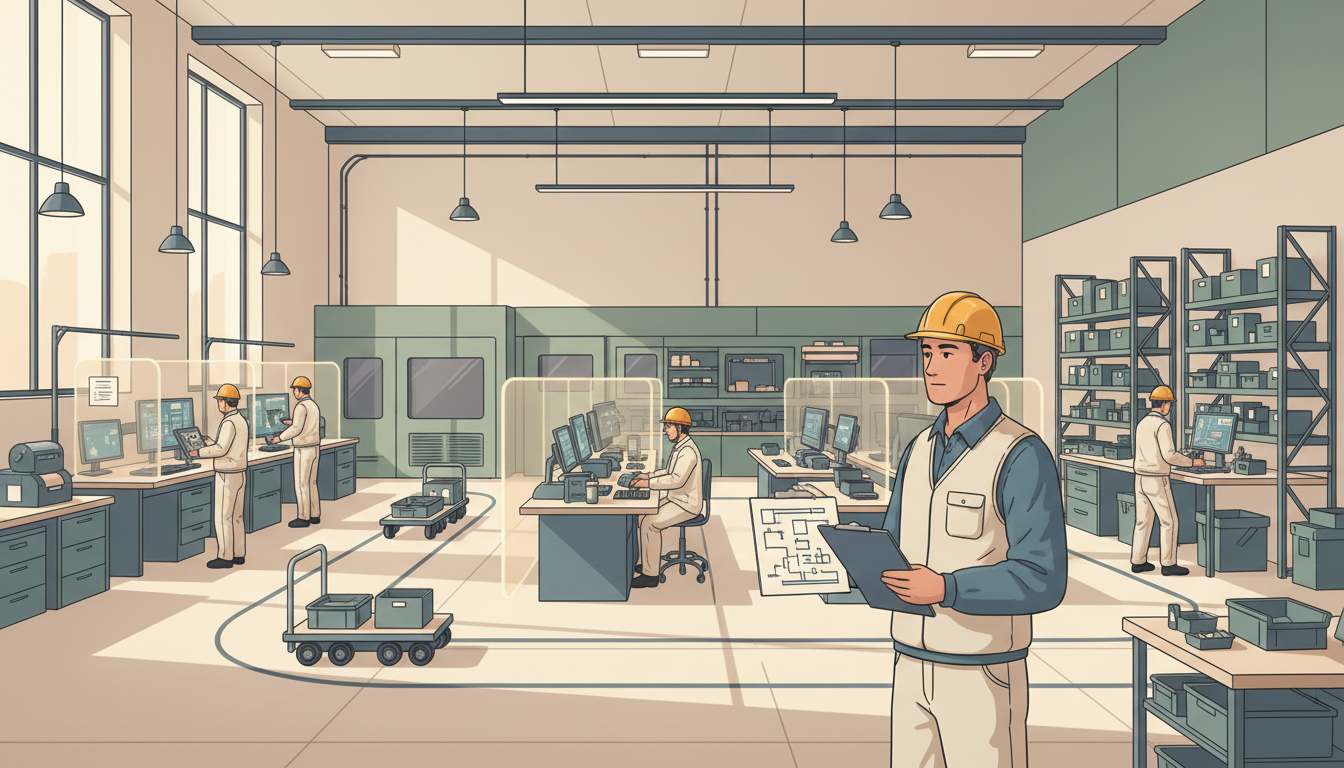
The featured 2026 original editorial illustration shows engineers and production workers reviewing an orderly conceptual workshop. It is not a real safety inspection or proof of conformity. Actual manufacturing and legal requirements need professionally qualified interpretation and relevant national authorities.
Quick answer: manufacturing is repeatable capability, not one prototype
The manufacturing component of civilisation joins materials, design, production planning, skilled labour, suitable technology, quality management, supplier networks and responsible stewardship. Success is not merely the quantity leaving a factory gate. A dependable manufacturing system considers whether goods meet their defined purpose, can be traced and supported, are produced under appropriate working conditions and remain useful throughout their life.
Important current sources: the 2026 ISO quality revision
The ISO 9001:2026 quality management standard was published on 16 September 2026 and replaces ISO 9001:2015, which has been withdrawn. The latest revision refines clarity, leadership and quality culture, and the treatment of risks and opportunities. It is a management-system requirements standard, not a product-safety certificate for an individual object. This guide paraphrases publicly described principles, not the copyrighted text of the standard.
The UNIDO Industrial Development Report 2024 addresses industrial policy, sustainable development and evolving production capabilities. The ILO recognised a safe and healthy working environment as a fundamental principle and right at work in June 2022. These sources have different institutional purposes; none establishes that the fictional workshop is certified, safe or environmentally compliant.
A seven-part model of the useful industrial service
- Purpose: what genuine product requirement is being fulfilled?
- Design: what definition or specification describes that requirement?
- Inputs: which materials, workers and technologies are available?
- Process: which appropriately qualified operations transform the inputs?
- Quality: what trustworthy evidence demonstrates conformity to requirements?
- Delivery: did the intended user receive a suitable outcome?
- Revision: can the institution learn from errors and sustain appropriate conditions?
Three useful calculations that still need context
Imagine an entirely fictional workshop that produces fifty cardboard learning models in one session. Eight do not meet the classroom’s stated appearance specification. The apparent nonconforming share is 8 ÷ 50 = 16% of those invented items. That is not a professional product-defect rate. It depends on the specification, examination method and counted population. A school exercise with paper models cannot certify a factory.
Suppose the next toy batch contains sixty items and six are classified as nonconforming under exactly the same criteria. The new proportion is 6 ÷ 60 = 10%. The measured share has decreased by six percentage points, but the difference alone cannot establish cause or statistical confidence. The materials, process and sample might have changed. A careful student asks for the record before declaring a quality improvement.
For resource efficiency, imagine two fictional batches each contain forty acceptable paper products. One uses a hundred sheets of material and the other eighty. The simplified resource intensity is 2.5 sheets per accepted item versus 2 sheets per accepted item. This is useful arithmetic, but it does not include real material specifications, product durability, environmental impacts or safe workplace processes.
Part 1: From a useful design to reliable industrial production
These six components examine one part of the industrial production system. They are written as educational investigations, not shop-floor work instructions. Each begins with a practical need, follows an invented process and asks what evidence a competent professional would use to review the result. A parent may select one station, while Secondary learners can compare several.
Component 01: What manufacturing contributes
How this manufacturing function works. Industrial production converts resources and designs into useful goods through a sequence of decisions, work and verification. The first question is what the product must accomplish for the person who needs it, not simply how many machines appear in the factory. Materials, staff, equipment and institutional records contribute at different stages. A student should trace the transformations and identify where a defect or missing resource could interrupt the whole outcome. Relate the explanation specifically to what manufacturing contributes. The aim is a causal description of how useful goods are produced, not an instruction to operate a real machine.
Inside fictional Tidal Reach. The town knows how to make one excellent school desk but cannot repeat it consistently. Draw the product’s conceptual route from a design to the user. Include material selection, appropriately qualified work, inspection, records and final receipt. At every handover, ask what must be known and how acceptance would be confirmed. A diagram with unexplained arrows can conceal defects that appear only later. The class’s success depends on clear reasoning, not a realistic-looking shop-floor layout. The workshop and its figures are imaginary; a student must distinguish given facts from invented assumptions.
Failure, risk and trade-off. A prototype does not demonstrate dependable industrial production. Short-term production decisions create future obligations. Machines need trained upkeep, process records require maintenance and products may need repair or traceability. Ask what happens when a component becomes unavailable or the first manager retires. An economical opening-day design can be fragile when recurring work is ignored. The classroom may discuss the concept without specifying professional maintenance procedures. Compare a potential correction with its strongest sensible objection, respecting rights and professional safety duties.
Evidence and valid interpretation. Compare repeatability, quality and ability to meet legitimate demand. Distinguish activity, output and outcome. A worker can complete many tasks while the product remains unusable; a shipment can leave the factory while arriving damaged. Choose evidence close to the original customer’s need, then ask which supporting indicator explains the result. A quality system should not be judged solely by the statistic that is easiest to display in an annual report. The conclusion should be proportional to the observation and its stated time, product and method.
Safe lesson with a parent or tutor. Draw a paper design-to-product chain. Hold a respectful exchange between fictional designers, workers, customers and public reviewers. Each learner should restate another role’s strongest legitimate concern before responding. The group then proposes a change and names the evidence required for a qualified decision. This teaches institutional cooperation rather than the habit of blaming one person for every defect. Children can use cardboard and paper diagrams; specialist processes and real industrial equipment are outside this exercise.
Review and intergenerational transfer. Sometimes the responsible next step is to ask qualified staff or an external authority rather than change the process immediately. This does not mean ignoring a clear problem. It means specifying what is unknown and which safety, product or legal question must be resolved. A school exercise cannot grant technical authority simply because its diagram seems logical. Connect this topic with the independent issue of factory layout and internal movement. State what one component supplies or constrains in the other.
Challenge the first explanation: If a prototype does not demonstrate dependable industrial production, what would the imagined product user or qualified worker experience? Describe an alternative, the evidence needed and the specific condition that would make the first plan inadequate. A thoughtful learner should be willing to leave a real technical decision to the competent authority rather than guess its answer.
Component 02: Design versus production
How this manufacturing function works. A successful prototype is not the same as a reliable production capability. Repetition can expose differences in material inputs, equipment condition and human processes that were invisible during the first demonstration. Ask what must be controlled or monitored as output grows and which professional roles make that possible. The explanation should focus on dependencies rather than assume greater scale automatically means better quality or working conditions. Relate the explanation specifically to design versus production. The aim is a causal description of how useful goods are produced, not an instruction to operate a real machine.
Inside fictional Tidal Reach. A drawing looks convincing but important material and dimensional assumptions are unstated. An imaginary factory may contain people with competing but legitimate concerns about quality, cost, safe work and environmental effects. Ask which disagreements depend on missing facts and which involve decisions about public priorities. The class should state the strongest good-faith view of another participant before deciding what evidence matters. A model does not become better by portraying a worker or customer as foolish. The workshop and its figures are imaginary; a student must distinguish given facts from invented assumptions.
Failure, risk and trade-off. A beautiful design cannot guarantee feasible or safe manufacture. Global supply chains can help manufacturing while bringing legal, logistical and environmental responsibilities beyond one workshop. A supplier may operate in another region with different conditions. Ask what the purchasing organisation should understand before claiming materials are suitable and responsibly sourced. International cooperation does not remove the need for valid specifications, professional oversight and a fair assessment of impacts. Compare a potential correction with its strongest sensible objection, respecting rights and professional safety duties.
Evidence and valid interpretation. Trace what information qualified production planning needs. Maintain an evidence trail from requirements through materials, process version, production record, inspection and customer feedback. This does not mean that every private commercial or worker record should become public. The classroom can use fictional batch codes and paper documents to understand traceability. A useful audit allows another reviewer to see where an interpretation entered the chain. The conclusion should be proportional to the observation and its stated time, product and method.
Safe lesson with a parent or tutor. Make a fictional design review checklist. Compare a fictional small craft workshop and large plant with a similar product purpose. Their resources, methods and organisational needs may differ without ranking the people who work there. Ask what function both must satisfy and which evidence would be needed to compare their results fairly. Avoid assuming scale alone establishes quality. Children can use cardboard and paper diagrams; specialist processes and real industrial equipment are outside this exercise.
Review and intergenerational transfer. End by naming who has legitimate responsibility when a production issue occurs. A customer may report a problem, a quality team may investigate, trained technical staff may assess equipment and a regulator may have separate powers. These roles should not be collapsed into one imaginary expert. The class can map the broad sequence without issuing actual repair or safety instructions. Connect this topic with the independent issue of equipment availability and readiness. State what one component supplies or constrains in the other.
Challenge the first explanation: If a beautiful design cannot guarantee feasible or safe manufacture, what would the imagined product user or qualified worker experience? Describe an alternative, the evidence needed and the specific condition that would make the first plan inadequate. A thoughtful learner should be willing to leave a real technical decision to the competent authority rather than guess its answer.
Component 03: Materials and specifications
How this manufacturing function works. Manufacturing involves both physical and informational flows. Materials move between receiving, production and dispatch while specifications, instructions and evidence travel between people and systems. The learner should draw both pathways and ask where they meet. A product can be physically present but unsuitable, or a completed task can be recorded with the wrong version. Clear traceability helps reveal those differences. Relate the explanation specifically to materials and specifications. The aim is a causal description of how useful goods are produced, not an instruction to operate a real machine.
Inside fictional Tidal Reach. Two imagined suppliers deliver visually similar wood with different stated properties. Introduce a student who was absent from the original production meeting. Could that person read the specifications and know why the quality criteria were chosen? If the explanation depends on a founder’s memory, the institution is fragile. Ask what documentation and trained professional review are needed for continuity. The class should not substitute its own paper procedure for real safe work instructions. The workshop and its figures are imaginary; a student must distinguish given facts from invented assumptions.
Failure, risk and trade-off. Materials that look alike may not meet identical requirements. Environmental claims need scope and evidence. Lower waste per item may coexist with greater total consumption as output expands, and a recyclable material may still have impacts across production and disposal. Ask which lifecycle stages are included and which outcomes remain unknown. A careful conclusion avoids calling any technology entirely impact-free based on one attractive label. Compare a potential correction with its strongest sensible objection, respecting rights and professional safety duties.
Evidence and valid interpretation. Ask what product purpose and material evidence need checking. A strong test can reveal that the original production plan is inadequate. Ask what observation would show a recurring defect, a missed customer requirement or an inaccessible service. State the criterion before inventing the result. A programme that explains every outcome as success cannot guide meaningful quality improvement. Real inspections and certifications require authorised methods, not classroom improvisation. The conclusion should be proportional to the observation and its stated time, product and method.
Safe lesson with a parent or tutor. Write a paper material specification with no safety-critical numbers. Give the class a fictional product label or instruction with an unclear unit, version or safety-related claim. Rewrite it in plain language, and mark any information only a qualified authority could provide. Another learner should be able to understand the purpose without further explanation. This connects manufacturing literacy to careful English communication. Children can use cardboard and paper diagrams; specialist processes and real industrial equipment are outside this exercise.
Review and intergenerational transfer. Sometimes the responsible next step is to ask qualified staff or an external authority rather than change the process immediately. This does not mean ignoring a clear problem. It means specifying what is unknown and which safety, product or legal question must be resolved. A school exercise cannot grant technical authority simply because its diagram seems logical. Connect this topic with the independent issue of workstations and safe human factors. State what one component supplies or constrains in the other.
Challenge the first explanation: If materials that look alike may not meet identical requirements, what would the imagined product user or qualified worker experience? Describe an alternative, the evidence needed and the specific condition that would make the first plan inadequate. A thoughtful learner should be willing to leave a real technical decision to the competent authority rather than guess its answer.
Component 04: Bills of materials and components
How this manufacturing function works. An industrial workshop is a continuing institution rather than a one-time collection of machines. Equipment ages, materials change and trained people come and go. A dependable system preserves process knowledge, authorised maintenance and methods for learning from errors. Imagine the original craftsperson leaves: could another qualified person reproduce the intended result appropriately? The answer reveals the importance of documentation and responsible training. Relate the explanation specifically to bills of materials and components. The aim is a causal description of how useful goods are produced, not an instruction to operate a real machine.
Inside fictional Tidal Reach. A fictional school desk requires parts not listed in the workshop’s assembly record. The imaginary workshop in Tidal Reach is a model, not a real industrial facility. Before deciding what happens next, identify the materials, task, expected outcome and information the story actually supplies. If equipment condition, professional training or product requirements are missing, mark those uncertainties. A pupil should not invent safe operating parameters to complete an attractive story. The case exists to illustrate institutional dependencies, not to provide machinery instructions. The workshop and its figures are imaginary; a student must distinguish given facts from invented assumptions.
Failure, risk and trade-off. Missing components can interrupt production despite available machines. Professional safety is not a negotiable inconvenience to be removed for faster output. Work involving machinery, industrial processes or hazardous substances requires competent people and applicable rules. A learner can identify the need for qualification, training and oversight without handling those tools. A responsible comparison keeps safety and workers’ rights visible even when the numerical production goal seems attractive. Compare a potential correction with its strongest sensible objection, respecting rights and professional safety duties.
Evidence and valid interpretation. Identify what a complete conceptual parts list must describe. Before calculating production success, define what is counted. Items started, items completed, good products, reworked items and delivered orders are different categories. A ratio may be mathematically correct and still describe the wrong outcome. State the time period, population of items and method of classification. Ask whether a defect, duplicate record or changed specification could alter the interpretation. The conclusion should be proportional to the observation and its stated time, product and method.
Safe lesson with a parent or tutor. Create a toy bill of materials for a cardboard object. Allocate a hundred imaginary resource tokens among materials, staff training, maintenance, quality checks and customer support. The values are arithmetic teaching devices, not actual factory budgets or safe staffing prescriptions. Ask which hidden responsibility might be neglected by a plan focusing entirely on buying new equipment. The conclusion should remain conditional on the model. Children can use cardboard and paper diagrams; specialist processes and real industrial equipment are outside this exercise.
Review and intergenerational transfer. End by naming who has legitimate responsibility when a production issue occurs. A customer may report a problem, a quality team may investigate, trained technical staff may assess equipment and a regulator may have separate powers. These roles should not be collapsed into one imaginary expert. The class can map the broad sequence without issuing actual repair or safety instructions. Connect this topic with the independent issue of skills and standardised work. State what one component supplies or constrains in the other.
Challenge the first explanation: If missing components can interrupt production despite available machines, what would the imagined product user or qualified worker experience? Describe an alternative, the evidence needed and the specific condition that would make the first plan inadequate. A thoughtful learner should be willing to leave a real technical decision to the competent authority rather than guess its answer.
Component 05: Production capacity and demand
How this manufacturing function works. Product quality must be defined in relation to legitimate requirements and use. A visually impressive object can fail to meet its purpose, while a modest product can be highly useful when it performs consistently. Ask what the customer actually needs and which observation would demonstrate suitability. A meaningful explanation separates aesthetic appeal, production quantity, compliance and user experience rather than collapsing them into the word excellent. Relate the explanation specifically to production capacity and demand. The aim is a causal description of how useful goods are produced, not an instruction to operate a real machine.
Inside fictional Tidal Reach. A workshop promises fifty items but has only equipment and staff for a smaller tested output. Change one fictional detail after the first conclusion is written. A supplier sends a different batch, a record uses an old drawing or a worker with specialised competence is absent. Which part of the original causal explanation changes? A student who can explain the revised dependency understands the mechanism. The classroom should use paper models rather than practise real technical operation. The workshop and its figures are imaginary; a student must distinguish given facts from invented assumptions.
Failure, risk and trade-off. Capacity claims without context can create false commitments. An apparent productivity gain can produce a burden elsewhere. Faster work at one station may increase unfinished inventory, defects or demands on downstream staff. Ask whether the whole system benefits rather than only the visible operation. Identify the possible affected people and an observation that could reveal the trade-off. The scenario is a hypothesis to investigate, not proof that a real factory has behaved improperly. Compare a potential correction with its strongest sensible objection, respecting rights and professional safety duties.
Evidence and valid interpretation. Distinguish required quantity, qualified throughput and lead time. More recorded defects may reflect worsening production, improved inspection or a changed classification method. Fewer defects may represent genuine improvement or a failure to detect problems. Ask what additional observation would help determine the cause. A dependable quality culture values accurate reporting and corrective learning instead of suppressing inconvenient data. The conclusion should be proportional to the observation and its stated time, product and method.
Safe lesson with a parent or tutor. Make an invented demand-versus-capacity table. Draw a process with four labelled boxes: material, suitably qualified work, quality verification and useful product. Each arrow should say what changes or what information moves. A second learner removes one supporting link and asks which outcome becomes uncertain. The activity can use paper and cardboard only; it is not a manufacturing safety or machinery operating lesson. Children can use cardboard and paper diagrams; specialist processes and real industrial equipment are outside this exercise.
Review and intergenerational transfer. Sometimes the responsible next step is to ask qualified staff or an external authority rather than change the process immediately. This does not mean ignoring a clear problem. It means specifying what is unknown and which safety, product or legal question must be resolved. A school exercise cannot grant technical authority simply because its diagram seems logical. Connect this topic with the independent issue of maintenance and downtime. State what one component supplies or constrains in the other.
Challenge the first explanation: If capacity claims without context can create false commitments, what would the imagined product user or qualified worker experience? Describe an alternative, the evidence needed and the specific condition that would make the first plan inadequate. A thoughtful learner should be willing to leave a real technical decision to the competent authority rather than guess its answer.
Component 06: Small-batch and large-scale production
How this manufacturing function works. Production decisions involve different specialist roles. Designers define intent, materials and production staff carry out authorised tasks, quality teams evaluate relevant evidence and managers maintain the system. No role can simply ignore applicable occupational safety or regulatory requirements to improve a headline production figure. Students may map the responsibilities but should never treat the classroom as a substitute for certified industrial practice. Relate the explanation specifically to small-batch and large-scale production. The aim is a causal description of how useful goods are produced, not an instruction to operate a real machine.
Inside fictional Tidal Reach. A craft worker makes five items carefully while a proposed factory plans many more. Two fictional workshops may produce similar items through different techniques and supply networks. Ask what function remains constant and which resources or legal obligations differ. The comparison should not be a ranking of human worth or an unsupported argument that all factories should adopt the same technology. Its value is the ability to explain why one approach fits its stated conditions. The workshop and its figures are imaginary; a student must distinguish given facts from invented assumptions.
Failure, risk and trade-off. Methods that work for a few products may not scale unchanged. Workers and customers may observe different aspects of the same production system. One person knows the job conditions while another experiences the finished item. Neither a single account nor an internal dashboard automatically represents everyone. A credible quality or labour review uses appropriate methods and respects protected information. A classroom can discuss that principle using fictional people. Compare a potential correction with its strongest sensible objection, respecting rights and professional safety duties.
Evidence and valid interpretation. Ask how training, equipment, variability and control needs differ. A ratio must include its denominator. Ten imaginary rejected units from fifty inspected items equals twenty per cent of that specific sample under a consistent definition. It is not automatically the defect rate for all production, and it does not identify the cause. Write the sampling process and reference period beside the number before interpreting it. The conclusion should be proportional to the observation and its stated time, product and method.
Safe lesson with a parent or tutor. Compare paper craft and imaginary factory models. Hold a respectful exchange between fictional designers, workers, customers and public reviewers. Each learner should restate another role’s strongest legitimate concern before responding. The group then proposes a change and names the evidence required for a qualified decision. This teaches institutional cooperation rather than the habit of blaming one person for every defect. Children can use cardboard and paper diagrams; specialist processes and real industrial equipment are outside this exercise.
Review and intergenerational transfer. End by naming who has legitimate responsibility when a production issue occurs. A customer may report a problem, a quality team may investigate, trained technical staff may assess equipment and a regulator may have separate powers. These roles should not be collapsed into one imaginary expert. The class can map the broad sequence without issuing actual repair or safety instructions. Connect this topic with the independent issue of quality assurance versus quality control. State what one component supplies or constrains in the other.
Challenge the first explanation: If methods that work for a few products may not scale unchanged, what would the imagined product user or qualified worker experience? Describe an alternative, the evidence needed and the specific condition that would make the first plan inadequate. A thoughtful learner should be willing to leave a real technical decision to the competent authority rather than guess its answer.
Integrated production case 1
Put What manufacturing contributes; Design versus production; Materials and specifications; Bills of materials and components; Production capacity and demand; Small-batch and large-scale production into one product-to-user map. Each arrow should carry a meaningful description of material, information, inspection or responsibility. Assign a source checker, a worker-and-safety boundary reviewer, a product-user representative and a successor who will document the conclusion. Ask the group to compare two plausible designs and identify the strongest reason to revise the preferred one.
Primary children may use five boxes and short descriptions. Secondary learners can write five paragraphs covering requirements, causal process, failure hypothesis, relevant measurement and accountable revision. No learner should run or repair machinery, handle industrial chemicals or treat the exercise as an ISO audit. Its value lies in transferable systems reasoning.
Part 2: Factory flow, equipment, skills and responsible workplaces
These six components examine one part of the industrial production system. They are written as educational investigations, not shop-floor work instructions. Each begins with a practical need, follows an invented process and asks what evidence a competent professional would use to review the result. A parent may select one station, while Secondary learners can compare several.
Component 07: Process maps and work sequences
How this manufacturing function works. A factory is connected to the civilisation around it through suppliers, electricity, transport, workers, laws and consumer demand. A failure upstream can interrupt production even when the local machines are operational. Trace one shared dependency with a causal arrow. The child should explain what the supporting institution provides and how its loss changes the outcome. This is systems reasoning, not a claim to operate any equipment. Relate the explanation specifically to process maps and work sequences. The aim is a causal description of how useful goods are produced, not an instruction to operate a real machine.
Inside fictional Tidal Reach. A factory diagram omits one inspection handover before final packing. End the fictional event by asking whether the customer received the product it needed and whether a qualified institution could trace the production decisions that shaped it. A dispatch record or production total may be relevant but incomplete. Name the additional evidence required before claiming that the factory’s system consistently meets its purpose. The best conclusion remains proportional to what the case actually states. The workshop and its figures are imaginary; a student must distinguish given facts from invented assumptions.
Failure, risk and trade-off. A completed machine step does not establish end-to-end quality. A process may have several supposed backups that depend on one upstream supplier or shared energy source. If the common input fails, all the alternatives may be affected. Draw the dependencies before calling the operation resilient. A concept map can reveal the weak link while leaving real technical risk assessment with appropriate experts. Counting options is not the same as proving independence. Compare a potential correction with its strongest sensible objection, respecting rights and professional safety duties.
Evidence and valid interpretation. Trace input, task, verification and next responsibility. An aggregate defect rate and a particular customer’s experience can illuminate different aspects of quality. A lower overall defect rate may be encouraging while an important failure remains unresolved for one user. Ask how both observations could be investigated appropriately. The classroom should not infer the prevalence of a problem from one anecdote or dismiss it solely because the average looks good. The conclusion should be proportional to the observation and its stated time, product and method.
Safe lesson with a parent or tutor. Draw a non-operational process flow. Compare a fictional small craft workshop and large plant with a similar product purpose. Their resources, methods and organisational needs may differ without ranking the people who work there. Ask what function both must satisfy and which evidence would be needed to compare their results fairly. Avoid assuming scale alone establishes quality. Children can use cardboard and paper diagrams; specialist processes and real industrial equipment are outside this exercise.
Review and intergenerational transfer. Sometimes the responsible next step is to ask qualified staff or an external authority rather than change the process immediately. This does not mean ignoring a clear problem. It means specifying what is unknown and which safety, product or legal question must be resolved. A school exercise cannot grant technical authority simply because its diagram seems logical. Connect this topic with the independent issue of the iso 9001:2026 quality system. State what one component supplies or constrains in the other.
Challenge the first explanation: If a completed machine step does not establish end-to-end quality, what would the imagined product user or qualified worker experience? Describe an alternative, the evidence needed and the specific condition that would make the first plan inadequate. A thoughtful learner should be willing to leave a real technical decision to the competent authority rather than guess its answer.
Component 08: Factory layout and internal movement
How this manufacturing function works. Industrial capability is tested through repeatability over time. An organisation might deliver one perfect item through extraordinary effort and still lack the capacity to do so reliably every week. Ask what processes, records and training make performance repeatable. A sensible model should also identify conditions under which the procedure needs revision. It is more durable to preserve the reasoning than to copy an unexplained instruction. Relate the explanation specifically to factory layout and internal movement. The aim is a causal description of how useful goods are produced, not an instruction to operate a real machine.
Inside fictional Tidal Reach. Boxes block a conceptual path between receiving and finished goods. Tell the case from the perspective of a workshop organiser and a person who needs the product. One may report output and operating efficiency while the other may encounter the product’s actual performance. Both observations can be relevant and different. Ask what evidence could connect them under a consistent definition of success. This encourages accountability without assuming every disagreement proves dishonesty. The workshop and its figures are imaginary; a student must distinguish given facts from invented assumptions.
Failure, risk and trade-off. Short-looking routes may conceal safety or accessibility issues. A larger equipment budget can look impressive while a workshop still lacks suitable inputs, qualified personnel or maintenance support. An input measure is not an outcome measure. Ask which capability the investment is supposed to create and whether the imagined system actually delivers it. A second indicator linked to product usefulness may be more informative than the total number of machines. Compare a potential correction with its strongest sensible objection, respecting rights and professional safety duties.
Evidence and valid interpretation. Distinguish professional facility design from a classroom sketch. ISO 9001:2026 provides a framework for quality management systems, but a school diagram cannot certify conformity. Product-specific laws and occupational safety requirements may impose separate duties. The student should know which published edition is current and what a competent certification or regulatory assessment would involve. Understanding a standard’s purpose is different from claiming authority to apply it. The conclusion should be proportional to the observation and its stated time, product and method.
Safe lesson with a parent or tutor. Design a paper warehouse and production layout. Give the class a fictional product label or instruction with an unclear unit, version or safety-related claim. Rewrite it in plain language, and mark any information only a qualified authority could provide. Another learner should be able to understand the purpose without further explanation. This connects manufacturing literacy to careful English communication. Children can use cardboard and paper diagrams; specialist processes and real industrial equipment are outside this exercise.
Review and intergenerational transfer. End by naming who has legitimate responsibility when a production issue occurs. A customer may report a problem, a quality team may investigate, trained technical staff may assess equipment and a regulator may have separate powers. These roles should not be collapsed into one imaginary expert. The class can map the broad sequence without issuing actual repair or safety instructions. Connect this topic with the independent issue of customer requirements and fitness for purpose. State what one component supplies or constrains in the other.
Challenge the first explanation: If short-looking routes may conceal safety or accessibility issues, what would the imagined product user or qualified worker experience? Describe an alternative, the evidence needed and the specific condition that would make the first plan inadequate. A thoughtful learner should be willing to leave a real technical decision to the competent authority rather than guess its answer.
Component 09: Equipment availability and readiness
How this manufacturing function works. A manufacturing system may be efficient at one internal stage while failing at the customer’s actual need. A machine can produce items quickly that remain defective, or a warehouse can dispatch goods without confirming the final recipient receives them. Follow the product through the entire chain and distinguish activity from meaningful outcome. An indicator is useful only when its definition relates to the stated purpose. Relate the explanation specifically to equipment availability and readiness. The aim is a causal description of how useful goods are produced, not an instruction to operate a real machine.
Inside fictional Tidal Reach. A fictional factory owns ten machines but cannot operate three because upkeep is incomplete. Make a short timeline from the initial request to the completed product and its later use. Identify where the product’s status changes, which organisation or worker is responsible, and what a record claims to prove. If a step is not explained, leave it open. A completed order can be different from a tested usable product. The student should learn to distinguish the stages rather than trust one status label. The workshop and its figures are imaginary; a student must distinguish given facts from invented assumptions.
Failure, risk and trade-off. Equipment count is not the same as usable capacity. Changing technology can improve useful work while altering the skills and responsibilities workers need. An automation project should not be described as eliminating every human duty or risk. Ask what must be learned, supervised, maintained and reviewed as the arrangement changes. A responsible transition values people and appropriate evidence alongside machine performance. Compare a potential correction with its strongest sensible objection, respecting rights and professional safety duties.
Evidence and valid interpretation. Separate installed, maintained and available assets. Two production reports can use incompatible definitions or time windows. A count of acceptable items before packaging differs from completed deliveries, while one version of a specification may not be directly comparable with another. Check units, source and revision status before drawing a trend. If the figures cannot be reconciled, state that limitation instead of forcing an attractive chart. The conclusion should be proportional to the observation and its stated time, product and method.
Safe lesson with a parent or tutor. Make fictional equipment status cards. Allocate a hundred imaginary resource tokens among materials, staff training, maintenance, quality checks and customer support. The values are arithmetic teaching devices, not actual factory budgets or safe staffing prescriptions. Ask which hidden responsibility might be neglected by a plan focusing entirely on buying new equipment. The conclusion should remain conditional on the model. Children can use cardboard and paper diagrams; specialist processes and real industrial equipment are outside this exercise.
Review and intergenerational transfer. Sometimes the responsible next step is to ask qualified staff or an external authority rather than change the process immediately. This does not mean ignoring a clear problem. It means specifying what is unknown and which safety, product or legal question must be resolved. A school exercise cannot grant technical authority simply because its diagram seems logical. Connect this topic with the independent issue of measurement and calibration. State what one component supplies or constrains in the other.
Challenge the first explanation: If equipment count is not the same as usable capacity, what would the imagined product user or qualified worker experience? Describe an alternative, the evidence needed and the specific condition that would make the first plan inadequate. A thoughtful learner should be willing to leave a real technical decision to the competent authority rather than guess its answer.
Component 10: Workstations and safe human factors
How this manufacturing function works. Different societies and industries can make related products through unlike materials and methods. A craft workshop and large factory may have different capacity, technology and staff structures without one community being intrinsically more valuable. Identify the shared function first and then compare the circumstances. A responsible answer names when local legal and technical standards make direct copying of a method inappropriate. Relate the explanation specifically to workstations and safe human factors. The aim is a causal description of how useful goods are produced, not an instruction to operate a real machine.
Inside fictional Tidal Reach. A task assumes all workers have the same reach, strength and access needs. Have the group identify one underlying dependency shared by several production stages. It might be a common material supplier, an energy source or a measurement system. If that input is wrong or unavailable, multiple otherwise functioning stations could be affected. Draw the source and downstream effects as a hypothesis to evaluate. This is a conceptual risk map, not a specialist safety assessment. The workshop and its figures are imaginary; a student must distinguish given facts from invented assumptions.
Failure, risk and trade-off. Poor workstation assumptions may create barriers or strain. Product quality is not always captured by a single inspection at the end. Some defects arise earlier in material selection, information or work handovers. Ask which stage would be able to detect the problem and how an institution might prevent recurrence. The goal is to move from repeated correction to learning, not to assume every fault comes from individual carelessness. Compare a potential correction with its strongest sensible objection, respecting rights and professional safety duties.
Evidence and valid interpretation. Ask what competent ergonomic and occupational review would require. One production problem does not prove a particular worker acted carelessly or that every product is defective. There may be multiple causes involving materials, instructions, machines or measurement. Ask the learner to propose an alternative explanation and the information needed to distinguish it. This is the beginning of fair root-cause thinking, not a permission to issue a real technical verdict. The conclusion should be proportional to the observation and its stated time, product and method.
Safe lesson with a parent or tutor. Compare two hypothetical workstation sketches without operating tools. Draw a process with four labelled boxes: material, suitably qualified work, quality verification and useful product. Each arrow should say what changes or what information moves. A second learner removes one supporting link and asks which outcome becomes uncertain. The activity can use paper and cardboard only; it is not a manufacturing safety or machinery operating lesson. Children can use cardboard and paper diagrams; specialist processes and real industrial equipment are outside this exercise.
Review and intergenerational transfer. End by naming who has legitimate responsibility when a production issue occurs. A customer may report a problem, a quality team may investigate, trained technical staff may assess equipment and a regulator may have separate powers. These roles should not be collapsed into one imaginary expert. The class can map the broad sequence without issuing actual repair or safety instructions. Connect this topic with the independent issue of inspection points and sampling. State what one component supplies or constrains in the other.
Challenge the first explanation: If poor workstation assumptions may create barriers or strain, what would the imagined product user or qualified worker experience? Describe an alternative, the evidence needed and the specific condition that would make the first plan inadequate. A thoughtful learner should be willing to leave a real technical decision to the competent authority rather than guess its answer.
Component 11: Skills and standardised work
How this manufacturing function works. Industrial production converts resources and designs into useful goods through a sequence of decisions, work and verification. The first question is what the product must accomplish for the person who needs it, not simply how many machines appear in the factory. Materials, staff, equipment and institutional records contribute at different stages. A student should trace the transformations and identify where a defect or missing resource could interrupt the whole outcome. Relate the explanation specifically to skills and standardised work. The aim is a causal description of how useful goods are produced, not an instruction to operate a real machine.
Inside fictional Tidal Reach. One experienced worker knows a method but cannot explain it to a successor. Draw the product’s conceptual route from a design to the user. Include material selection, appropriately qualified work, inspection, records and final receipt. At every handover, ask what must be known and how acceptance would be confirmed. A diagram with unexplained arrows can conceal defects that appear only later. The class’s success depends on clear reasoning, not a realistic-looking shop-floor layout. The workshop and its figures are imaginary; a student must distinguish given facts from invented assumptions.
Failure, risk and trade-off. Tacit knowledge can make output fragile when staff change. Short-term production decisions create future obligations. Machines need trained upkeep, process records require maintenance and products may need repair or traceability. Ask what happens when a component becomes unavailable or the first manager retires. An economical opening-day design can be fragile when recurring work is ignored. The classroom may discuss the concept without specifying professional maintenance procedures. Compare a potential correction with its strongest sensible objection, respecting rights and professional safety duties.
Evidence and valid interpretation. Identify which instructions, training and checks should be documented. Distinguish activity, output and outcome. A worker can complete many tasks while the product remains unusable; a shipment can leave the factory while arriving damaged. Choose evidence close to the original customer’s need, then ask which supporting indicator explains the result. A quality system should not be judged solely by the statistic that is easiest to display in an annual report. The conclusion should be proportional to the observation and its stated time, product and method.
Safe lesson with a parent or tutor. Write a harmless cardboard-work task description. Hold a respectful exchange between fictional designers, workers, customers and public reviewers. Each learner should restate another role’s strongest legitimate concern before responding. The group then proposes a change and names the evidence required for a qualified decision. This teaches institutional cooperation rather than the habit of blaming one person for every defect. Children can use cardboard and paper diagrams; specialist processes and real industrial equipment are outside this exercise.
Review and intergenerational transfer. Sometimes the responsible next step is to ask qualified staff or an external authority rather than change the process immediately. This does not mean ignoring a clear problem. It means specifying what is unknown and which safety, product or legal question must be resolved. A school exercise cannot grant technical authority simply because its diagram seems logical. Connect this topic with the independent issue of nonconforming products. State what one component supplies or constrains in the other.
Challenge the first explanation: If tacit knowledge can make output fragile when staff change, what would the imagined product user or qualified worker experience? Describe an alternative, the evidence needed and the specific condition that would make the first plan inadequate. A thoughtful learner should be willing to leave a real technical decision to the competent authority rather than guess its answer.
Component 12: Maintenance and downtime
How this manufacturing function works. A successful prototype is not the same as a reliable production capability. Repetition can expose differences in material inputs, equipment condition and human processes that were invisible during the first demonstration. Ask what must be controlled or monitored as output grows and which professional roles make that possible. The explanation should focus on dependencies rather than assume greater scale automatically means better quality or working conditions. Relate the explanation specifically to maintenance and downtime. The aim is a causal description of how useful goods are produced, not an instruction to operate a real machine.
Inside fictional Tidal Reach. An older workshop machine is used until it fails with no documented maintenance system. An imaginary factory may contain people with competing but legitimate concerns about quality, cost, safe work and environmental effects. Ask which disagreements depend on missing facts and which involve decisions about public priorities. The class should state the strongest good-faith view of another participant before deciding what evidence matters. A model does not become better by portraying a worker or customer as foolish. The workshop and its figures are imaginary; a student must distinguish given facts from invented assumptions.
Failure, risk and trade-off. Deferred upkeep may create unreliable output and risks. Global supply chains can help manufacturing while bringing legal, logistical and environmental responsibilities beyond one workshop. A supplier may operate in another region with different conditions. Ask what the purchasing organisation should understand before claiming materials are suitable and responsibly sourced. International cooperation does not remove the need for valid specifications, professional oversight and a fair assessment of impacts. Compare a potential correction with its strongest sensible objection, respecting rights and professional safety duties.
Evidence and valid interpretation. Name the role of qualified inspection and planned service. Maintain an evidence trail from requirements through materials, process version, production record, inspection and customer feedback. This does not mean that every private commercial or worker record should become public. The classroom can use fictional batch codes and paper documents to understand traceability. A useful audit allows another reviewer to see where an interpretation entered the chain. The conclusion should be proportional to the observation and its stated time, product and method.
Safe lesson with a parent or tutor. Create an imaginary maintenance responsibility chart. Compare a fictional small craft workshop and large plant with a similar product purpose. Their resources, methods and organisational needs may differ without ranking the people who work there. Ask what function both must satisfy and which evidence would be needed to compare their results fairly. Avoid assuming scale alone establishes quality. Children can use cardboard and paper diagrams; specialist processes and real industrial equipment are outside this exercise.
Review and intergenerational transfer. End by naming who has legitimate responsibility when a production issue occurs. A customer may report a problem, a quality team may investigate, trained technical staff may assess equipment and a regulator may have separate powers. These roles should not be collapsed into one imaginary expert. The class can map the broad sequence without issuing actual repair or safety instructions. Connect this topic with the independent issue of batch and lot traceability. State what one component supplies or constrains in the other.
Challenge the first explanation: If deferred upkeep may create unreliable output and risks, what would the imagined product user or qualified worker experience? Describe an alternative, the evidence needed and the specific condition that would make the first plan inadequate. A thoughtful learner should be willing to leave a real technical decision to the competent authority rather than guess its answer.
Integrated production case 2
Put Process maps and work sequences; Factory layout and internal movement; Equipment availability and readiness; Workstations and safe human factors; Skills and standardised work; Maintenance and downtime into one product-to-user map. Each arrow should carry a meaningful description of material, information, inspection or responsibility. Assign a source checker, a worker-and-safety boundary reviewer, a product-user representative and a successor who will document the conclusion. Ask the group to compare two plausible designs and identify the strongest reason to revise the preferred one.
Primary children may use five boxes and short descriptions. Secondary learners can write five paragraphs covering requirements, causal process, failure hypothesis, relevant measurement and accountable revision. No learner should run or repair machinery, handle industrial chemicals or treat the exercise as an ISO audit. Its value lies in transferable systems reasoning.
Part 3: Quality assurance, inspection, measurement and traceability
These six components examine one part of the industrial production system. They are written as educational investigations, not shop-floor work instructions. Each begins with a practical need, follows an invented process and asks what evidence a competent professional would use to review the result. A parent may select one station, while Secondary learners can compare several.
Component 13: Quality assurance versus quality control
How this manufacturing function works. Manufacturing involves both physical and informational flows. Materials move between receiving, production and dispatch while specifications, instructions and evidence travel between people and systems. The learner should draw both pathways and ask where they meet. A product can be physically present but unsuitable, or a completed task can be recorded with the wrong version. Clear traceability helps reveal those differences. Relate the explanation specifically to quality assurance versus quality control. The aim is a causal description of how useful goods are produced, not an instruction to operate a real machine.
Inside fictional Tidal Reach. A company checks products at the end but never investigates why defects recur. Introduce a student who was absent from the original production meeting. Could that person read the specifications and know why the quality criteria were chosen? If the explanation depends on a founder’s memory, the institution is fragile. Ask what documentation and trained professional review are needed for continuity. The class should not substitute its own paper procedure for real safe work instructions. The workshop and its figures are imaginary; a student must distinguish given facts from invented assumptions.
Failure, risk and trade-off. Inspection can find errors without preventing their underlying causes. Environmental claims need scope and evidence. Lower waste per item may coexist with greater total consumption as output expands, and a recyclable material may still have impacts across production and disposal. Ask which lifecycle stages are included and which outcomes remain unknown. A careful conclusion avoids calling any technology entirely impact-free based on one attractive label. Compare a potential correction with its strongest sensible objection, respecting rights and professional safety duties.
Evidence and valid interpretation. Distinguish system-level quality management from particular checks. A strong test can reveal that the original production plan is inadequate. Ask what observation would show a recurring defect, a missed customer requirement or an inaccessible service. State the criterion before inventing the result. A programme that explains every outcome as success cannot guide meaningful quality improvement. Real inspections and certifications require authorised methods, not classroom improvisation. The conclusion should be proportional to the observation and its stated time, product and method.
Safe lesson with a parent or tutor. Draw a process-prevention versus product-detection diagram. Give the class a fictional product label or instruction with an unclear unit, version or safety-related claim. Rewrite it in plain language, and mark any information only a qualified authority could provide. Another learner should be able to understand the purpose without further explanation. This connects manufacturing literacy to careful English communication. Children can use cardboard and paper diagrams; specialist processes and real industrial equipment are outside this exercise.
Review and intergenerational transfer. Sometimes the responsible next step is to ask qualified staff or an external authority rather than change the process immediately. This does not mean ignoring a clear problem. It means specifying what is unknown and which safety, product or legal question must be resolved. A school exercise cannot grant technical authority simply because its diagram seems logical. Connect this topic with the independent issue of corrective action and root cause. State what one component supplies or constrains in the other.
Challenge the first explanation: If inspection can find errors without preventing their underlying causes, what would the imagined product user or qualified worker experience? Describe an alternative, the evidence needed and the specific condition that would make the first plan inadequate. A thoughtful learner should be willing to leave a real technical decision to the competent authority rather than guess its answer.
Component 14: The ISO 9001:2026 quality system
How this manufacturing function works. An industrial workshop is a continuing institution rather than a one-time collection of machines. Equipment ages, materials change and trained people come and go. A dependable system preserves process knowledge, authorised maintenance and methods for learning from errors. Imagine the original craftsperson leaves: could another qualified person reproduce the intended result appropriately? The answer reveals the importance of documentation and responsible training. Relate the explanation specifically to the iso 9001:2026 quality system. The aim is a causal description of how useful goods are produced, not an instruction to operate a real machine.
Inside fictional Tidal Reach. A fictional manager uses ISO 9001:2015 as though it were still the newest edition. The imaginary workshop in Tidal Reach is a model, not a real industrial facility. Before deciding what happens next, identify the materials, task, expected outcome and information the story actually supplies. If equipment condition, professional training or product requirements are missing, mark those uncertainties. A pupil should not invent safe operating parameters to complete an attractive story. The case exists to illustrate institutional dependencies, not to provide machinery instructions. The workshop and its figures are imaginary; a student must distinguish given facts from invented assumptions.
Failure, risk and trade-off. Outdated standard references can misinform institutional planning. Professional safety is not a negotiable inconvenience to be removed for faster output. Work involving machinery, industrial processes or hazardous substances requires competent people and applicable rules. A learner can identify the need for qualification, training and oversight without handling those tools. A responsible comparison keeps safety and workers’ rights visible even when the numerical production goal seems attractive. Compare a potential correction with its strongest sensible objection, respecting rights and professional safety duties.
Evidence and valid interpretation. Use ISO’s 16 September 2026 edition and its stated scope. Before calculating production success, define what is counted. Items started, items completed, good products, reworked items and delivered orders are different categories. A ratio may be mathematically correct and still describe the wrong outcome. State the time period, population of items and method of classification. Ask whether a defect, duplicate record or changed specification could alter the interpretation. The conclusion should be proportional to the observation and its stated time, product and method.
Safe lesson with a parent or tutor. Create a source-date checklist for a hypothetical quality policy. Allocate a hundred imaginary resource tokens among materials, staff training, maintenance, quality checks and customer support. The values are arithmetic teaching devices, not actual factory budgets or safe staffing prescriptions. Ask which hidden responsibility might be neglected by a plan focusing entirely on buying new equipment. The conclusion should remain conditional on the model. Children can use cardboard and paper diagrams; specialist processes and real industrial equipment are outside this exercise.
Review and intergenerational transfer. End by naming who has legitimate responsibility when a production issue occurs. A customer may report a problem, a quality team may investigate, trained technical staff may assess equipment and a regulator may have separate powers. These roles should not be collapsed into one imaginary expert. The class can map the broad sequence without issuing actual repair or safety instructions. Connect this topic with the independent issue of quality audits and evidence. State what one component supplies or constrains in the other.
Challenge the first explanation: If outdated standard references can misinform institutional planning, what would the imagined product user or qualified worker experience? Describe an alternative, the evidence needed and the specific condition that would make the first plan inadequate. A thoughtful learner should be willing to leave a real technical decision to the competent authority rather than guess its answer.
Component 15: Customer requirements and fitness for purpose
How this manufacturing function works. Product quality must be defined in relation to legitimate requirements and use. A visually impressive object can fail to meet its purpose, while a modest product can be highly useful when it performs consistently. Ask what the customer actually needs and which observation would demonstrate suitability. A meaningful explanation separates aesthetic appeal, production quantity, compliance and user experience rather than collapsing them into the word excellent. Relate the explanation specifically to customer requirements and fitness for purpose. The aim is a causal description of how useful goods are produced, not an instruction to operate a real machine.
Inside fictional Tidal Reach. The workshop makes polished desks that do not meet the users’ described task. Change one fictional detail after the first conclusion is written. A supplier sends a different batch, a record uses an old drawing or a worker with specialised competence is absent. Which part of the original causal explanation changes? A student who can explain the revised dependency understands the mechanism. The classroom should use paper models rather than practise real technical operation. The workshop and its figures are imaginary; a student must distinguish given facts from invented assumptions.
Failure, risk and trade-off. Visual quality is not the same as meeting intended requirements. An apparent productivity gain can produce a burden elsewhere. Faster work at one station may increase unfinished inventory, defects or demands on downstream staff. Ask whether the whole system benefits rather than only the visible operation. Identify the possible affected people and an observation that could reveal the trade-off. The scenario is a hypothesis to investigate, not proof that a real factory has behaved improperly. Compare a potential correction with its strongest sensible objection, respecting rights and professional safety duties.
Evidence and valid interpretation. Compare what was requested, produced and actually useful. More recorded defects may reflect worsening production, improved inspection or a changed classification method. Fewer defects may represent genuine improvement or a failure to detect problems. Ask what additional observation would help determine the cause. A dependable quality culture values accurate reporting and corrective learning instead of suppressing inconvenient data. The conclusion should be proportional to the observation and its stated time, product and method.
Safe lesson with a parent or tutor. Write a fictional customer-requirements list. Draw a process with four labelled boxes: material, suitably qualified work, quality verification and useful product. Each arrow should say what changes or what information moves. A second learner removes one supporting link and asks which outcome becomes uncertain. The activity can use paper and cardboard only; it is not a manufacturing safety or machinery operating lesson. Children can use cardboard and paper diagrams; specialist processes and real industrial equipment are outside this exercise.
Review and intergenerational transfer. Sometimes the responsible next step is to ask qualified staff or an external authority rather than change the process immediately. This does not mean ignoring a clear problem. It means specifying what is unknown and which safety, product or legal question must be resolved. A school exercise cannot grant technical authority simply because its diagram seems logical. Connect this topic with the independent issue of change control and product revisions. State what one component supplies or constrains in the other.
Challenge the first explanation: If visual quality is not the same as meeting intended requirements, what would the imagined product user or qualified worker experience? Describe an alternative, the evidence needed and the specific condition that would make the first plan inadequate. A thoughtful learner should be willing to leave a real technical decision to the competent authority rather than guess its answer.
Component 16: Measurement and calibration
How this manufacturing function works. Production decisions involve different specialist roles. Designers define intent, materials and production staff carry out authorised tasks, quality teams evaluate relevant evidence and managers maintain the system. No role can simply ignore applicable occupational safety or regulatory requirements to improve a headline production figure. Students may map the responsibilities but should never treat the classroom as a substitute for certified industrial practice. Relate the explanation specifically to measurement and calibration. The aim is a causal description of how useful goods are produced, not an instruction to operate a real machine.
Inside fictional Tidal Reach. Two paper measurements differ because rulers and methods are inconsistent. Two fictional workshops may produce similar items through different techniques and supply networks. Ask what function remains constant and which resources or legal obligations differ. The comparison should not be a ranking of human worth or an unsupported argument that all factories should adopt the same technology. Its value is the ability to explain why one approach fits its stated conditions. The workshop and its figures are imaginary; a student must distinguish given facts from invented assumptions.
Failure, risk and trade-off. A precise-looking number may not be trustworthy or comparable. Workers and customers may observe different aspects of the same production system. One person knows the job conditions while another experiences the finished item. Neither a single account nor an internal dashboard automatically represents everyone. A credible quality or labour review uses appropriate methods and respects protected information. A classroom can discuss that principle using fictional people. Compare a potential correction with its strongest sensible objection, respecting rights and professional safety duties.
Evidence and valid interpretation. Ask what units, instruments and qualified traceability matter. A ratio must include its denominator. Ten imaginary rejected units from fifty inspected items equals twenty per cent of that specific sample under a consistent definition. It is not automatically the defect rate for all production, and it does not identify the cause. Write the sampling process and reference period beside the number before interpreting it. The conclusion should be proportional to the observation and its stated time, product and method.
Safe lesson with a parent or tutor. Use safe paper rulers on cardboard, without industrial metrology claims. Hold a respectful exchange between fictional designers, workers, customers and public reviewers. Each learner should restate another role’s strongest legitimate concern before responding. The group then proposes a change and names the evidence required for a qualified decision. This teaches institutional cooperation rather than the habit of blaming one person for every defect. Children can use cardboard and paper diagrams; specialist processes and real industrial equipment are outside this exercise.
Review and intergenerational transfer. End by naming who has legitimate responsibility when a production issue occurs. A customer may report a problem, a quality team may investigate, trained technical staff may assess equipment and a regulator may have separate powers. These roles should not be collapsed into one imaginary expert. The class can map the broad sequence without issuing actual repair or safety instructions. Connect this topic with the independent issue of supplier selection and quality. State what one component supplies or constrains in the other.
Challenge the first explanation: If a precise-looking number may not be trustworthy or comparable, what would the imagined product user or qualified worker experience? Describe an alternative, the evidence needed and the specific condition that would make the first plan inadequate. A thoughtful learner should be willing to leave a real technical decision to the competent authority rather than guess its answer.
Component 17: Inspection points and sampling
How this manufacturing function works. A factory is connected to the civilisation around it through suppliers, electricity, transport, workers, laws and consumer demand. A failure upstream can interrupt production even when the local machines are operational. Trace one shared dependency with a causal arrow. The child should explain what the supporting institution provides and how its loss changes the outcome. This is systems reasoning, not a claim to operate any equipment. Relate the explanation specifically to inspection points and sampling. The aim is a causal description of how useful goods are produced, not an instruction to operate a real machine.
Inside fictional Tidal Reach. A large fictional production batch is assessed from one casually selected item. End the fictional event by asking whether the customer received the product it needed and whether a qualified institution could trace the production decisions that shaped it. A dispatch record or production total may be relevant but incomplete. Name the additional evidence required before claiming that the factory’s system consistently meets its purpose. The best conclusion remains proportional to what the case actually states. The workshop and its figures are imaginary; a student must distinguish given facts from invented assumptions.
Failure, risk and trade-off. An unrepresentative check can create unjustified confidence. A process may have several supposed backups that depend on one upstream supplier or shared energy source. If the common input fails, all the alternatives may be affected. Draw the dependencies before calling the operation resilient. A concept map can reveal the weak link while leaving real technical risk assessment with appropriate experts. Counting options is not the same as proving independence. Compare a potential correction with its strongest sensible objection, respecting rights and professional safety duties.
Evidence and valid interpretation. Define sample, method, scope and decision limits. An aggregate defect rate and a particular customer’s experience can illuminate different aspects of quality. A lower overall defect rate may be encouraging while an important failure remains unresolved for one user. Ask how both observations could be investigated appropriately. The classroom should not infer the prevalence of a problem from one anecdote or dismiss it solely because the average looks good. The conclusion should be proportional to the observation and its stated time, product and method.
Safe lesson with a parent or tutor. Use paper coloured tokens to illustrate sampling bias. Compare a fictional small craft workshop and large plant with a similar product purpose. Their resources, methods and organisational needs may differ without ranking the people who work there. Ask what function both must satisfy and which evidence would be needed to compare their results fairly. Avoid assuming scale alone establishes quality. Children can use cardboard and paper diagrams; specialist processes and real industrial equipment are outside this exercise.
Review and intergenerational transfer. Sometimes the responsible next step is to ask qualified staff or an external authority rather than change the process immediately. This does not mean ignoring a clear problem. It means specifying what is unknown and which safety, product or legal question must be resolved. A school exercise cannot grant technical authority simply because its diagram seems logical. Connect this topic with the independent issue of incoming-goods verification. State what one component supplies or constrains in the other.
Challenge the first explanation: If an unrepresentative check can create unjustified confidence, what would the imagined product user or qualified worker experience? Describe an alternative, the evidence needed and the specific condition that would make the first plan inadequate. A thoughtful learner should be willing to leave a real technical decision to the competent authority rather than guess its answer.
Component 18: Nonconforming products
How this manufacturing function works. Industrial capability is tested through repeatability over time. An organisation might deliver one perfect item through extraordinary effort and still lack the capacity to do so reliably every week. Ask what processes, records and training make performance repeatable. A sensible model should also identify conditions under which the procedure needs revision. It is more durable to preserve the reasoning than to copy an unexplained instruction. Relate the explanation specifically to nonconforming products. The aim is a causal description of how useful goods are produced, not an instruction to operate a real machine.
Inside fictional Tidal Reach. A known defective imagined component remains mixed with available stock. Tell the case from the perspective of a workshop organiser and a person who needs the product. One may report output and operating efficiency while the other may encounter the product’s actual performance. Both observations can be relevant and different. Ask what evidence could connect them under a consistent definition of success. This encourages accountability without assuming every disagreement proves dishonesty. The workshop and its figures are imaginary; a student must distinguish given facts from invented assumptions.
Failure, risk and trade-off. An inventory total can disguise unusable products. A larger equipment budget can look impressive while a workshop still lacks suitable inputs, qualified personnel or maintenance support. An input measure is not an outcome measure. Ask which capability the investment is supposed to create and whether the imagined system actually delivers it. A second indicator linked to product usefulness may be more informative than the total number of machines. Compare a potential correction with its strongest sensible objection, respecting rights and professional safety duties.
Evidence and valid interpretation. Identify how professional systems distinguish accepted and unresolved items. ISO 9001:2026 provides a framework for quality management systems, but a school diagram cannot certify conformity. Product-specific laws and occupational safety requirements may impose separate duties. The student should know which published edition is current and what a competent certification or regulatory assessment would involve. Understanding a standard’s purpose is different from claiming authority to apply it. The conclusion should be proportional to the observation and its stated time, product and method.
Safe lesson with a parent or tutor. Sort paper cards into accepted, review and rejected states. Give the class a fictional product label or instruction with an unclear unit, version or safety-related claim. Rewrite it in plain language, and mark any information only a qualified authority could provide. Another learner should be able to understand the purpose without further explanation. This connects manufacturing literacy to careful English communication. Children can use cardboard and paper diagrams; specialist processes and real industrial equipment are outside this exercise.
Review and intergenerational transfer. End by naming who has legitimate responsibility when a production issue occurs. A customer may report a problem, a quality team may investigate, trained technical staff may assess equipment and a regulator may have separate powers. These roles should not be collapsed into one imaginary expert. The class can map the broad sequence without issuing actual repair or safety instructions. Connect this topic with the independent issue of production scheduling and sequencing. State what one component supplies or constrains in the other.
Challenge the first explanation: If an inventory total can disguise unusable products, what would the imagined product user or qualified worker experience? Describe an alternative, the evidence needed and the specific condition that would make the first plan inadequate. A thoughtful learner should be willing to leave a real technical decision to the competent authority rather than guess its answer.
Integrated production case 3
Put Quality assurance versus quality control; The ISO 9001:2026 quality system; Customer requirements and fitness for purpose; Measurement and calibration; Inspection points and sampling; Nonconforming products into one product-to-user map. Each arrow should carry a meaningful description of material, information, inspection or responsibility. Assign a source checker, a worker-and-safety boundary reviewer, a product-user representative and a successor who will document the conclusion. Ask the group to compare two plausible designs and identify the strongest reason to revise the preferred one.
Primary children may use five boxes and short descriptions. Secondary learners can write five paragraphs covering requirements, causal process, failure hypothesis, relevant measurement and accountable revision. No learner should run or repair machinery, handle industrial chemicals or treat the exercise as an ISO audit. Its value lies in transferable systems reasoning.
Part 4: Supply relationships, inventory, delivery and customer value
These six components examine one part of the industrial production system. They are written as educational investigations, not shop-floor work instructions. Each begins with a practical need, follows an invented process and asks what evidence a competent professional would use to review the result. A parent may select one station, while Secondary learners can compare several.
Component 19: Batch and lot traceability
How this manufacturing function works. A manufacturing system may be efficient at one internal stage while failing at the customer’s actual need. A machine can produce items quickly that remain defective, or a warehouse can dispatch goods without confirming the final recipient receives them. Follow the product through the entire chain and distinguish activity from meaningful outcome. An indicator is useful only when its definition relates to the stated purpose. Relate the explanation specifically to batch and lot traceability. The aim is a causal description of how useful goods are produced, not an instruction to operate a real machine.
Inside fictional Tidal Reach. A product fault is found but the town never recorded which batch contains related items. Make a short timeline from the initial request to the completed product and its later use. Identify where the product’s status changes, which organisation or worker is responsible, and what a record claims to prove. If a step is not explained, leave it open. A completed order can be different from a tested usable product. The student should learn to distinguish the stages rather than trust one status label. The workshop and its figures are imaginary; a student must distinguish given facts from invented assumptions.
Failure, risk and trade-off. Missing provenance can frustrate safe, appropriate correction. Changing technology can improve useful work while altering the skills and responsibilities workers need. An automation project should not be described as eliminating every human duty or risk. Ask what must be learned, supervised, maintained and reviewed as the arrangement changes. A responsible transition values people and appropriate evidence alongside machine performance. Compare a potential correction with its strongest sensible objection, respecting rights and professional safety duties.
Evidence and valid interpretation. Trace a fictional lot through receipt, production and delivery. Two production reports can use incompatible definitions or time windows. A count of acceptable items before packaging differs from completed deliveries, while one version of a specification may not be directly comparable with another. Check units, source and revision status before drawing a trend. If the figures cannot be reconciled, state that limitation instead of forcing an attractive chart. The conclusion should be proportional to the observation and its stated time, product and method.
Safe lesson with a parent or tutor. Create harmless invented batch labels. Allocate a hundred imaginary resource tokens among materials, staff training, maintenance, quality checks and customer support. The values are arithmetic teaching devices, not actual factory budgets or safe staffing prescriptions. Ask which hidden responsibility might be neglected by a plan focusing entirely on buying new equipment. The conclusion should remain conditional on the model. Children can use cardboard and paper diagrams; specialist processes and real industrial equipment are outside this exercise.
Review and intergenerational transfer. Sometimes the responsible next step is to ask qualified staff or an external authority rather than change the process immediately. This does not mean ignoring a clear problem. It means specifying what is unknown and which safety, product or legal question must be resolved. A school exercise cannot grant technical authority simply because its diagram seems logical. Connect this topic with the independent issue of bottlenecks and queues. State what one component supplies or constrains in the other.
Challenge the first explanation: If missing provenance can frustrate safe, appropriate correction, what would the imagined product user or qualified worker experience? Describe an alternative, the evidence needed and the specific condition that would make the first plan inadequate. A thoughtful learner should be willing to leave a real technical decision to the competent authority rather than guess its answer.
Component 20: Corrective action and root cause
How this manufacturing function works. Different societies and industries can make related products through unlike materials and methods. A craft workshop and large factory may have different capacity, technology and staff structures without one community being intrinsically more valuable. Identify the shared function first and then compare the circumstances. A responsible answer names when local legal and technical standards make direct copying of a method inappropriate. Relate the explanation specifically to corrective action and root cause. The aim is a causal description of how useful goods are produced, not an instruction to operate a real machine.
Inside fictional Tidal Reach. A team repeatedly replaces a defective part but does not examine why the error returns. Have the group identify one underlying dependency shared by several production stages. It might be a common material supplier, an energy source or a measurement system. If that input is wrong or unavailable, multiple otherwise functioning stations could be affected. Draw the source and downstream effects as a hypothesis to evaluate. This is a conceptual risk map, not a specialist safety assessment. The workshop and its figures are imaginary; a student must distinguish given facts from invented assumptions.
Failure, risk and trade-off. A repair can address symptoms without preventing recurrence. Product quality is not always captured by a single inspection at the end. Some defects arise earlier in material selection, information or work handovers. Ask which stage would be able to detect the problem and how an institution might prevent recurrence. The goal is to move from repeated correction to learning, not to assume every fault comes from individual carelessness. Compare a potential correction with its strongest sensible objection, respecting rights and professional safety duties.
Evidence and valid interpretation. Distinguish observed problem, evidence, causal hypothesis and qualified correction. One production problem does not prove a particular worker acted carelessly or that every product is defective. There may be multiple causes involving materials, instructions, machines or measurement. Ask the learner to propose an alternative explanation and the information needed to distinguish it. This is the beginning of fair root-cause thinking, not a permission to issue a real technical verdict. The conclusion should be proportional to the observation and its stated time, product and method.
Safe lesson with a parent or tutor. Draw a paper cause-and-review map. Draw a process with four labelled boxes: material, suitably qualified work, quality verification and useful product. Each arrow should say what changes or what information moves. A second learner removes one supporting link and asks which outcome becomes uncertain. The activity can use paper and cardboard only; it is not a manufacturing safety or machinery operating lesson. Children can use cardboard and paper diagrams; specialist processes and real industrial equipment are outside this exercise.
Review and intergenerational transfer. End by naming who has legitimate responsibility when a production issue occurs. A customer may report a problem, a quality team may investigate, trained technical staff may assess equipment and a regulator may have separate powers. These roles should not be collapsed into one imaginary expert. The class can map the broad sequence without issuing actual repair or safety instructions. Connect this topic with the independent issue of inventory and work in progress. State what one component supplies or constrains in the other.
Challenge the first explanation: If a repair can address symptoms without preventing recurrence, what would the imagined product user or qualified worker experience? Describe an alternative, the evidence needed and the specific condition that would make the first plan inadequate. A thoughtful learner should be willing to leave a real technical decision to the competent authority rather than guess its answer.
Component 21: Quality audits and evidence
How this manufacturing function works. Industrial production converts resources and designs into useful goods through a sequence of decisions, work and verification. The first question is what the product must accomplish for the person who needs it, not simply how many machines appear in the factory. Materials, staff, equipment and institutional records contribute at different stages. A student should trace the transformations and identify where a defect or missing resource could interrupt the whole outcome. Relate the explanation specifically to quality audits and evidence. The aim is a causal description of how useful goods are produced, not an instruction to operate a real machine.
Inside fictional Tidal Reach. A quality report celebrates perfect scores while staff report unresolved discrepancies. Draw the product’s conceptual route from a design to the user. Include material selection, appropriately qualified work, inspection, records and final receipt. At every handover, ask what must be known and how acceptance would be confirmed. A diagram with unexplained arrows can conceal defects that appear only later. The class’s success depends on clear reasoning, not a realistic-looking shop-floor layout. The workshop and its figures are imaginary; a student must distinguish given facts from invented assumptions.
Failure, risk and trade-off. A flattering scorecard is not proof of a functioning quality culture. Short-term production decisions create future obligations. Machines need trained upkeep, process records require maintenance and products may need repair or traceability. Ask what happens when a component becomes unavailable or the first manager retires. An economical opening-day design can be fragile when recurring work is ignored. The classroom may discuss the concept without specifying professional maintenance procedures. Compare a potential correction with its strongest sensible objection, respecting rights and professional safety duties.
Evidence and valid interpretation. Ask what competent audits, original records and independent review show. Distinguish activity, output and outcome. A worker can complete many tasks while the product remains unusable; a shipment can leave the factory while arriving damaged. Choose evidence close to the original customer’s need, then ask which supporting indicator explains the result. A quality system should not be judged solely by the statistic that is easiest to display in an annual report. The conclusion should be proportional to the observation and its stated time, product and method.
Safe lesson with a parent or tutor. Create a neutral imaginary internal audit question list. Hold a respectful exchange between fictional designers, workers, customers and public reviewers. Each learner should restate another role’s strongest legitimate concern before responding. The group then proposes a change and names the evidence required for a qualified decision. This teaches institutional cooperation rather than the habit of blaming one person for every defect. Children can use cardboard and paper diagrams; specialist processes and real industrial equipment are outside this exercise.
Review and intergenerational transfer. Sometimes the responsible next step is to ask qualified staff or an external authority rather than change the process immediately. This does not mean ignoring a clear problem. It means specifying what is unknown and which safety, product or legal question must be resolved. A school exercise cannot grant technical authority simply because its diagram seems logical. Connect this topic with the independent issue of packing and dispatch quality. State what one component supplies or constrains in the other.
Challenge the first explanation: If a flattering scorecard is not proof of a functioning quality culture, what would the imagined product user or qualified worker experience? Describe an alternative, the evidence needed and the specific condition that would make the first plan inadequate. A thoughtful learner should be willing to leave a real technical decision to the competent authority rather than guess its answer.
Component 22: Change control and product revisions
How this manufacturing function works. A successful prototype is not the same as a reliable production capability. Repetition can expose differences in material inputs, equipment condition and human processes that were invisible during the first demonstration. Ask what must be controlled or monitored as output grows and which professional roles make that possible. The explanation should focus on dependencies rather than assume greater scale automatically means better quality or working conditions. Relate the explanation specifically to change control and product revisions. The aim is a causal description of how useful goods are produced, not an instruction to operate a real machine.
Inside fictional Tidal Reach. A design is altered but old assembly and inspection records remain in circulation. An imaginary factory may contain people with competing but legitimate concerns about quality, cost, safe work and environmental effects. Ask which disagreements depend on missing facts and which involve decisions about public priorities. The class should state the strongest good-faith view of another participant before deciding what evidence matters. A model does not become better by portraying a worker or customer as foolish. The workshop and its figures are imaginary; a student must distinguish given facts from invented assumptions.
Failure, risk and trade-off. Different document versions may cause inconsistent products. Global supply chains can help manufacturing while bringing legal, logistical and environmental responsibilities beyond one workshop. A supplier may operate in another region with different conditions. Ask what the purchasing organisation should understand before claiming materials are suitable and responsibly sourced. International cooperation does not remove the need for valid specifications, professional oversight and a fair assessment of impacts. Compare a potential correction with its strongest sensible objection, respecting rights and professional safety duties.
Evidence and valid interpretation. Identify revision dates, authorisation and downstream communication. Maintain an evidence trail from requirements through materials, process version, production record, inspection and customer feedback. This does not mean that every private commercial or worker record should become public. The classroom can use fictional batch codes and paper documents to understand traceability. A useful audit allows another reviewer to see where an interpretation entered the chain. The conclusion should be proportional to the observation and its stated time, product and method.
Safe lesson with a parent or tutor. Compare two fictional version-controlled drawings. Compare a fictional small craft workshop and large plant with a similar product purpose. Their resources, methods and organisational needs may differ without ranking the people who work there. Ask what function both must satisfy and which evidence would be needed to compare their results fairly. Avoid assuming scale alone establishes quality. Children can use cardboard and paper diagrams; specialist processes and real industrial equipment are outside this exercise.
Review and intergenerational transfer. End by naming who has legitimate responsibility when a production issue occurs. A customer may report a problem, a quality team may investigate, trained technical staff may assess equipment and a regulator may have separate powers. These roles should not be collapsed into one imaginary expert. The class can map the broad sequence without issuing actual repair or safety instructions. Connect this topic with the independent issue of returns, repairs and aftersales service. State what one component supplies or constrains in the other.
Challenge the first explanation: If different document versions may cause inconsistent products, what would the imagined product user or qualified worker experience? Describe an alternative, the evidence needed and the specific condition that would make the first plan inadequate. A thoughtful learner should be willing to leave a real technical decision to the competent authority rather than guess its answer.
Component 23: Supplier selection and quality
How this manufacturing function works. Manufacturing involves both physical and informational flows. Materials move between receiving, production and dispatch while specifications, instructions and evidence travel between people and systems. The learner should draw both pathways and ask where they meet. A product can be physically present but unsuitable, or a completed task can be recorded with the wrong version. Clear traceability helps reveal those differences. Relate the explanation specifically to supplier selection and quality. The aim is a causal description of how useful goods are produced, not an instruction to operate a real machine.
Inside fictional Tidal Reach. A workshop chooses its cheapest materials supplier without checking suitability. Introduce a student who was absent from the original production meeting. Could that person read the specifications and know why the quality criteria were chosen? If the explanation depends on a founder’s memory, the institution is fragile. Ask what documentation and trained professional review are needed for continuity. The class should not substitute its own paper procedure for real safe work instructions. The workshop and its figures are imaginary; a student must distinguish given facts from invented assumptions.
Failure, risk and trade-off. Low purchase price can hide defects, delays or poor provenance. Environmental claims need scope and evidence. Lower waste per item may coexist with greater total consumption as output expands, and a recyclable material may still have impacts across production and disposal. Ask which lifecycle stages are included and which outcomes remain unknown. A careful conclusion avoids calling any technology entirely impact-free based on one attractive label. Compare a potential correction with its strongest sensible objection, respecting rights and professional safety duties.
Evidence and valid interpretation. Compare product needs, evidence and supplier capability. A strong test can reveal that the original production plan is inadequate. Ask what observation would show a recurring defect, a missed customer requirement or an inaccessible service. State the criterion before inventing the result. A programme that explains every outcome as success cannot guide meaningful quality improvement. Real inspections and certifications require authorised methods, not classroom improvisation. The conclusion should be proportional to the observation and its stated time, product and method.
Safe lesson with a parent or tutor. Design a toy supplier-evaluation worksheet. Give the class a fictional product label or instruction with an unclear unit, version or safety-related claim. Rewrite it in plain language, and mark any information only a qualified authority could provide. Another learner should be able to understand the purpose without further explanation. This connects manufacturing literacy to careful English communication. Children can use cardboard and paper diagrams; specialist processes and real industrial equipment are outside this exercise.
Review and intergenerational transfer. Sometimes the responsible next step is to ask qualified staff or an external authority rather than change the process immediately. This does not mean ignoring a clear problem. It means specifying what is unknown and which safety, product or legal question must be resolved. A school exercise cannot grant technical authority simply because its diagram seems logical. Connect this topic with the independent issue of customer feedback and improvement. State what one component supplies or constrains in the other.
Challenge the first explanation: If low purchase price can hide defects, delays or poor provenance, what would the imagined product user or qualified worker experience? Describe an alternative, the evidence needed and the specific condition that would make the first plan inadequate. A thoughtful learner should be willing to leave a real technical decision to the competent authority rather than guess its answer.
Component 24: Incoming-goods verification
How this manufacturing function works. An industrial workshop is a continuing institution rather than a one-time collection of machines. Equipment ages, materials change and trained people come and go. A dependable system preserves process knowledge, authorised maintenance and methods for learning from errors. Imagine the original craftsperson leaves: could another qualified person reproduce the intended result appropriately? The answer reveals the importance of documentation and responsible training. Relate the explanation specifically to incoming-goods verification. The aim is a causal description of how useful goods are produced, not an instruction to operate a real machine.
Inside fictional Tidal Reach. A box is marked received before contents are checked against the order. The imaginary workshop in Tidal Reach is a model, not a real industrial facility. Before deciding what happens next, identify the materials, task, expected outcome and information the story actually supplies. If equipment condition, professional training or product requirements are missing, mark those uncertainties. A pupil should not invent safe operating parameters to complete an attractive story. The case exists to illustrate institutional dependencies, not to provide machinery instructions. The workshop and its figures are imaginary; a student must distinguish given facts from invented assumptions.
Failure, risk and trade-off. Arrival does not guarantee correct or usable materials. Professional safety is not a negotiable inconvenience to be removed for faster output. Work involving machinery, industrial processes or hazardous substances requires competent people and applicable rules. A learner can identify the need for qualification, training and oversight without handling those tools. A responsible comparison keeps safety and workers’ rights visible even when the numerical production goal seems attractive. Compare a potential correction with its strongest sensible objection, respecting rights and professional safety duties.
Evidence and valid interpretation. Distinguish delivery, inspection and accepted stock. Before calculating production success, define what is counted. Items started, items completed, good products, reworked items and delivered orders are different categories. A ratio may be mathematically correct and still describe the wrong outcome. State the time period, population of items and method of classification. Ask whether a defect, duplicate record or changed specification could alter the interpretation. The conclusion should be proportional to the observation and its stated time, product and method.
Safe lesson with a parent or tutor. Match imaginary packing notes to order cards. Allocate a hundred imaginary resource tokens among materials, staff training, maintenance, quality checks and customer support. The values are arithmetic teaching devices, not actual factory budgets or safe staffing prescriptions. Ask which hidden responsibility might be neglected by a plan focusing entirely on buying new equipment. The conclusion should remain conditional on the model. Children can use cardboard and paper diagrams; specialist processes and real industrial equipment are outside this exercise.
Review and intergenerational transfer. End by naming who has legitimate responsibility when a production issue occurs. A customer may report a problem, a quality team may investigate, trained technical staff may assess equipment and a regulator may have separate powers. These roles should not be collapsed into one imaginary expert. The class can map the broad sequence without issuing actual repair or safety instructions. Connect this topic with the independent issue of worker safety as a fundamental right. State what one component supplies or constrains in the other.
Challenge the first explanation: If arrival does not guarantee correct or usable materials, what would the imagined product user or qualified worker experience? Describe an alternative, the evidence needed and the specific condition that would make the first plan inadequate. A thoughtful learner should be willing to leave a real technical decision to the competent authority rather than guess its answer.
Integrated production case 4
Put Batch and lot traceability; Corrective action and root cause; Quality audits and evidence; Change control and product revisions; Supplier selection and quality; Incoming-goods verification into one product-to-user map. Each arrow should carry a meaningful description of material, information, inspection or responsibility. Assign a source checker, a worker-and-safety boundary reviewer, a product-user representative and a successor who will document the conclusion. Ask the group to compare two plausible designs and identify the strongest reason to revise the preferred one.
Primary children may use five boxes and short descriptions. Secondary learners can write five paragraphs covering requirements, causal process, failure hypothesis, relevant measurement and accountable revision. No learner should run or repair machinery, handle industrial chemicals or treat the exercise as an ISO audit. Its value lies in transferable systems reasoning.
Part 5: Labour rights, competency, human factors and technology
These six components examine one part of the industrial production system. They are written as educational investigations, not shop-floor work instructions. Each begins with a practical need, follows an invented process and asks what evidence a competent professional would use to review the result. A parent may select one station, while Secondary learners can compare several.
Component 25: Production scheduling and sequencing
How this manufacturing function works. Product quality must be defined in relation to legitimate requirements and use. A visually impressive object can fail to meet its purpose, while a modest product can be highly useful when it performs consistently. Ask what the customer actually needs and which observation would demonstrate suitability. A meaningful explanation separates aesthetic appeal, production quantity, compliance and user experience rather than collapsing them into the word excellent. Relate the explanation specifically to production scheduling and sequencing. The aim is a causal description of how useful goods are produced, not an instruction to operate a real machine.
Inside fictional Tidal Reach. The same workshop resources are promised to two urgent orders at once. Change one fictional detail after the first conclusion is written. A supplier sends a different batch, a record uses an old drawing or a worker with specialised competence is absent. Which part of the original causal explanation changes? A student who can explain the revised dependency understands the mechanism. The classroom should use paper models rather than practise real technical operation. The workshop and its figures are imaginary; a student must distinguish given facts from invented assumptions.
Failure, risk and trade-off. A mathematically neat timetable may ignore actual capacity. An apparent productivity gain can produce a burden elsewhere. Faster work at one station may increase unfinished inventory, defects or demands on downstream staff. Ask whether the whole system benefits rather than only the visible operation. Identify the possible affected people and an observation that could reveal the trade-off. The scenario is a hypothesis to investigate, not proof that a real factory has behaved improperly. Compare a potential correction with its strongest sensible objection, respecting rights and professional safety duties.
Evidence and valid interpretation. Define finite resources, due dates and professional constraints. More recorded defects may reflect worsening production, improved inspection or a changed classification method. Fewer defects may represent genuine improvement or a failure to detect problems. Ask what additional observation would help determine the cause. A dependable quality culture values accurate reporting and corrective learning instead of suppressing inconvenient data. The conclusion should be proportional to the observation and its stated time, product and method.
Safe lesson with a parent or tutor. Make a paper job-order schedule without real machine guidance. Draw a process with four labelled boxes: material, suitably qualified work, quality verification and useful product. Each arrow should say what changes or what information moves. A second learner removes one supporting link and asks which outcome becomes uncertain. The activity can use paper and cardboard only; it is not a manufacturing safety or machinery operating lesson. Children can use cardboard and paper diagrams; specialist processes and real industrial equipment are outside this exercise.
Review and intergenerational transfer. Sometimes the responsible next step is to ask qualified staff or an external authority rather than change the process immediately. This does not mean ignoring a clear problem. It means specifying what is unknown and which safety, product or legal question must be resolved. A school exercise cannot grant technical authority simply because its diagram seems logical. Connect this topic with the independent issue of training and competency progression. State what one component supplies or constrains in the other.
Challenge the first explanation: If a mathematically neat timetable may ignore actual capacity, what would the imagined product user or qualified worker experience? Describe an alternative, the evidence needed and the specific condition that would make the first plan inadequate. A thoughtful learner should be willing to leave a real technical decision to the competent authority rather than guess its answer.
Component 26: Bottlenecks and queues
How this manufacturing function works. Production decisions involve different specialist roles. Designers define intent, materials and production staff carry out authorised tasks, quality teams evaluate relevant evidence and managers maintain the system. No role can simply ignore applicable occupational safety or regulatory requirements to improve a headline production figure. Students may map the responsibilities but should never treat the classroom as a substitute for certified industrial practice. Relate the explanation specifically to bottlenecks and queues. The aim is a causal description of how useful goods are produced, not an instruction to operate a real machine.
Inside fictional Tidal Reach. Most stations in the imagined factory wait for one slow inspection point. Two fictional workshops may produce similar items through different techniques and supply networks. Ask what function remains constant and which resources or legal obligations differ. The comparison should not be a ranking of human worth or an unsupported argument that all factories should adopt the same technology. Its value is the ability to explain why one approach fits its stated conditions. The workshop and its figures are imaginary; a student must distinguish given facts from invented assumptions.
Failure, risk and trade-off. Local speed improvements may not raise total output. Workers and customers may observe different aspects of the same production system. One person knows the job conditions while another experiences the finished item. Neither a single account nor an internal dashboard automatically represents everyone. A credible quality or labour review uses appropriate methods and respects protected information. A classroom can discuss that principle using fictional people. Compare a potential correction with its strongest sensible objection, respecting rights and professional safety duties.
Evidence and valid interpretation. Trace the effective system constraint and upstream inventory. A ratio must include its denominator. Ten imaginary rejected units from fifty inspected items equals twenty per cent of that specific sample under a consistent definition. It is not automatically the defect rate for all production, and it does not identify the cause. Write the sampling process and reference period beside the number before interpreting it. The conclusion should be proportional to the observation and its stated time, product and method.
Safe lesson with a parent or tutor. Use paper tokens to compare two abstract workflows. Hold a respectful exchange between fictional designers, workers, customers and public reviewers. Each learner should restate another role’s strongest legitimate concern before responding. The group then proposes a change and names the evidence required for a qualified decision. This teaches institutional cooperation rather than the habit of blaming one person for every defect. Children can use cardboard and paper diagrams; specialist processes and real industrial equipment are outside this exercise.
Review and intergenerational transfer. End by naming who has legitimate responsibility when a production issue occurs. A customer may report a problem, a quality team may investigate, trained technical staff may assess equipment and a regulator may have separate powers. These roles should not be collapsed into one imaginary expert. The class can map the broad sequence without issuing actual repair or safety instructions. Connect this topic with the independent issue of worker voice and stop-work concerns. State what one component supplies or constrains in the other.
Challenge the first explanation: If local speed improvements may not raise total output, what would the imagined product user or qualified worker experience? Describe an alternative, the evidence needed and the specific condition that would make the first plan inadequate. A thoughtful learner should be willing to leave a real technical decision to the competent authority rather than guess its answer.
Component 27: Inventory and work in progress
How this manufacturing function works. A factory is connected to the civilisation around it through suppliers, electricity, transport, workers, laws and consumer demand. A failure upstream can interrupt production even when the local machines are operational. Trace one shared dependency with a causal arrow. The child should explain what the supporting institution provides and how its loss changes the outcome. This is systems reasoning, not a claim to operate any equipment. Relate the explanation specifically to inventory and work in progress. The aim is a causal description of how useful goods are produced, not an instruction to operate a real machine.
Inside fictional Tidal Reach. Half-finished products occupy every shelf and cannot be traced to an order. End the fictional event by asking whether the customer received the product it needed and whether a qualified institution could trace the production decisions that shaped it. A dispatch record or production total may be relevant but incomplete. Name the additional evidence required before claiming that the factory’s system consistently meets its purpose. The best conclusion remains proportional to what the case actually states. The workshop and its figures are imaginary; a student must distinguish given facts from invented assumptions.
Failure, risk and trade-off. High activity can conceal unfinished goods and costly delays. A process may have several supposed backups that depend on one upstream supplier or shared energy source. If the common input fails, all the alternatives may be affected. Draw the dependencies before calling the operation resilient. A concept map can reveal the weak link while leaving real technical risk assessment with appropriate experts. Counting options is not the same as proving independence. Compare a potential correction with its strongest sensible objection, respecting rights and professional safety duties.
Evidence and valid interpretation. Distinguish raw materials, work in progress and usable output. An aggregate defect rate and a particular customer’s experience can illuminate different aspects of quality. A lower overall defect rate may be encouraging while an important failure remains unresolved for one user. Ask how both observations could be investigated appropriately. The classroom should not infer the prevalence of a problem from one anecdote or dismiss it solely because the average looks good. The conclusion should be proportional to the observation and its stated time, product and method.
Safe lesson with a parent or tutor. Create three fictional inventory categories. Compare a fictional small craft workshop and large plant with a similar product purpose. Their resources, methods and organisational needs may differ without ranking the people who work there. Ask what function both must satisfy and which evidence would be needed to compare their results fairly. Avoid assuming scale alone establishes quality. Children can use cardboard and paper diagrams; specialist processes and real industrial equipment are outside this exercise.
Review and intergenerational transfer. Sometimes the responsible next step is to ask qualified staff or an external authority rather than change the process immediately. This does not mean ignoring a clear problem. It means specifying what is unknown and which safety, product or legal question must be resolved. A school exercise cannot grant technical authority simply because its diagram seems logical. Connect this topic with the independent issue of automation and responsible job design. State what one component supplies or constrains in the other.
Challenge the first explanation: If high activity can conceal unfinished goods and costly delays, what would the imagined product user or qualified worker experience? Describe an alternative, the evidence needed and the specific condition that would make the first plan inadequate. A thoughtful learner should be willing to leave a real technical decision to the competent authority rather than guess its answer.
Component 28: Packing and dispatch quality
How this manufacturing function works. Industrial capability is tested through repeatability over time. An organisation might deliver one perfect item through extraordinary effort and still lack the capacity to do so reliably every week. Ask what processes, records and training make performance repeatable. A sensible model should also identify conditions under which the procedure needs revision. It is more durable to preserve the reasoning than to copy an unexplained instruction. Relate the explanation specifically to packing and dispatch quality. The aim is a causal description of how useful goods are produced, not an instruction to operate a real machine.
Inside fictional Tidal Reach. A manufactured product reaches the warehouse in good condition but is damaged before delivery. Tell the case from the perspective of a workshop organiser and a person who needs the product. One may report output and operating efficiency while the other may encounter the product’s actual performance. Both observations can be relevant and different. Ask what evidence could connect them under a consistent definition of success. This encourages accountability without assuming every disagreement proves dishonesty. The workshop and its figures are imaginary; a student must distinguish given facts from invented assumptions.
Failure, risk and trade-off. Factory-gate completion is not the full customer outcome. A larger equipment budget can look impressive while a workshop still lacks suitable inputs, qualified personnel or maintenance support. An input measure is not an outcome measure. Ask which capability the investment is supposed to create and whether the imagined system actually delivers it. A second indicator linked to product usefulness may be more informative than the total number of machines. Compare a potential correction with its strongest sensible objection, respecting rights and professional safety duties.
Evidence and valid interpretation. Follow packaging, custody and actual receipt. ISO 9001:2026 provides a framework for quality management systems, but a school diagram cannot certify conformity. Product-specific laws and occupational safety requirements may impose separate duties. The student should know which published edition is current and what a competent certification or regulatory assessment would involve. Understanding a standard’s purpose is different from claiming authority to apply it. The conclusion should be proportional to the observation and its stated time, product and method.
Safe lesson with a parent or tutor. Draw a fictional final quality-to-delivery path. Give the class a fictional product label or instruction with an unclear unit, version or safety-related claim. Rewrite it in plain language, and mark any information only a qualified authority could provide. Another learner should be able to understand the purpose without further explanation. This connects manufacturing literacy to careful English communication. Children can use cardboard and paper diagrams; specialist processes and real industrial equipment are outside this exercise.
Review and intergenerational transfer. End by naming who has legitimate responsibility when a production issue occurs. A customer may report a problem, a quality team may investigate, trained technical staff may assess equipment and a regulator may have separate powers. These roles should not be collapsed into one imaginary expert. The class can map the broad sequence without issuing actual repair or safety instructions. Connect this topic with the independent issue of digital manufacturing and data systems. State what one component supplies or constrains in the other.
Challenge the first explanation: If factory-gate completion is not the full customer outcome, what would the imagined product user or qualified worker experience? Describe an alternative, the evidence needed and the specific condition that would make the first plan inadequate. A thoughtful learner should be willing to leave a real technical decision to the competent authority rather than guess its answer.
Component 29: Returns, repairs and aftersales service
How this manufacturing function works. A manufacturing system may be efficient at one internal stage while failing at the customer’s actual need. A machine can produce items quickly that remain defective, or a warehouse can dispatch goods without confirming the final recipient receives them. Follow the product through the entire chain and distinguish activity from meaningful outcome. An indicator is useful only when its definition relates to the stated purpose. Relate the explanation specifically to returns, repairs and aftersales service. The aim is a causal description of how useful goods are produced, not an instruction to operate a real machine.
Inside fictional Tidal Reach. A school receives a defective desk but no one knows which manufacturer has the service record. Make a short timeline from the initial request to the completed product and its later use. Identify where the product’s status changes, which organisation or worker is responsible, and what a record claims to prove. If a step is not explained, leave it open. A completed order can be different from a tested usable product. The student should learn to distinguish the stages rather than trust one status label. The workshop and its figures are imaginary; a student must distinguish given facts from invented assumptions.
Failure, risk and trade-off. A delivered sale does not complete every product responsibility. Changing technology can improve useful work while altering the skills and responsibilities workers need. An automation project should not be described as eliminating every human duty or risk. Ask what must be learned, supervised, maintained and reviewed as the arrangement changes. A responsible transition values people and appropriate evidence alongside machine performance. Compare a potential correction with its strongest sensible objection, respecting rights and professional safety duties.
Evidence and valid interpretation. Map legitimate repair, return, warranty and traceability questions. Two production reports can use incompatible definitions or time windows. A count of acceptable items before packaging differs from completed deliveries, while one version of a specification may not be directly comparable with another. Check units, source and revision status before drawing a trend. If the figures cannot be reconciled, state that limitation instead of forcing an attractive chart. The conclusion should be proportional to the observation and its stated time, product and method.
Safe lesson with a parent or tutor. Write a fictional service enquiry without legal claims. Allocate a hundred imaginary resource tokens among materials, staff training, maintenance, quality checks and customer support. The values are arithmetic teaching devices, not actual factory budgets or safe staffing prescriptions. Ask which hidden responsibility might be neglected by a plan focusing entirely on buying new equipment. The conclusion should remain conditional on the model. Children can use cardboard and paper diagrams; specialist processes and real industrial equipment are outside this exercise.
Review and intergenerational transfer. Sometimes the responsible next step is to ask qualified staff or an external authority rather than change the process immediately. This does not mean ignoring a clear problem. It means specifying what is unknown and which safety, product or legal question must be resolved. A school exercise cannot grant technical authority simply because its diagram seems logical. Connect this topic with the independent issue of industrial employment and local communities. State what one component supplies or constrains in the other.
Challenge the first explanation: If a delivered sale does not complete every product responsibility, what would the imagined product user or qualified worker experience? Describe an alternative, the evidence needed and the specific condition that would make the first plan inadequate. A thoughtful learner should be willing to leave a real technical decision to the competent authority rather than guess its answer.
Component 30: Customer feedback and improvement
How this manufacturing function works. Different societies and industries can make related products through unlike materials and methods. A craft workshop and large factory may have different capacity, technology and staff structures without one community being intrinsically more valuable. Identify the shared function first and then compare the circumstances. A responsible answer names when local legal and technical standards make direct copying of a method inappropriate. Relate the explanation specifically to customer feedback and improvement. The aim is a causal description of how useful goods are produced, not an instruction to operate a real machine.
Inside fictional Tidal Reach. An industrial company records complaints but never checks whether corrections helped. Have the group identify one underlying dependency shared by several production stages. It might be a common material supplier, an energy source or a measurement system. If that input is wrong or unavailable, multiple otherwise functioning stations could be affected. Draw the source and downstream effects as a hypothesis to evaluate. This is a conceptual risk map, not a specialist safety assessment. The workshop and its figures are imaginary; a student must distinguish given facts from invented assumptions.
Failure, risk and trade-off. Closed tickets may hide recurring quality problems. Product quality is not always captured by a single inspection at the end. Some defects arise earlier in material selection, information or work handovers. Ask which stage would be able to detect the problem and how an institution might prevent recurrence. The goal is to move from repeated correction to learning, not to assume every fault comes from individual carelessness. Compare a potential correction with its strongest sensible objection, respecting rights and professional safety duties.
Evidence and valid interpretation. Define issue, response, verified outcome and recurring patterns. One production problem does not prove a particular worker acted carelessly or that every product is defective. There may be multiple causes involving materials, instructions, machines or measurement. Ask the learner to propose an alternative explanation and the information needed to distinguish it. This is the beginning of fair root-cause thinking, not a permission to issue a real technical verdict. The conclusion should be proportional to the observation and its stated time, product and method.
Safe lesson with a parent or tutor. Build a toy customer-feedback ledger. Draw a process with four labelled boxes: material, suitably qualified work, quality verification and useful product. Each arrow should say what changes or what information moves. A second learner removes one supporting link and asks which outcome becomes uncertain. The activity can use paper and cardboard only; it is not a manufacturing safety or machinery operating lesson. Children can use cardboard and paper diagrams; specialist processes and real industrial equipment are outside this exercise.
Review and intergenerational transfer. End by naming who has legitimate responsibility when a production issue occurs. A customer may report a problem, a quality team may investigate, trained technical staff may assess equipment and a regulator may have separate powers. These roles should not be collapsed into one imaginary expert. The class can map the broad sequence without issuing actual repair or safety instructions. Connect this topic with the independent issue of energy intensity and efficiency. State what one component supplies or constrains in the other.
Challenge the first explanation: If closed tickets may hide recurring quality problems, what would the imagined product user or qualified worker experience? Describe an alternative, the evidence needed and the specific condition that would make the first plan inadequate. A thoughtful learner should be willing to leave a real technical decision to the competent authority rather than guess its answer.
Integrated production case 5
Put Production scheduling and sequencing; Bottlenecks and queues; Inventory and work in progress; Packing and dispatch quality; Returns, repairs and aftersales service; Customer feedback and improvement into one product-to-user map. Each arrow should carry a meaningful description of material, information, inspection or responsibility. Assign a source checker, a worker-and-safety boundary reviewer, a product-user representative and a successor who will document the conclusion. Ask the group to compare two plausible designs and identify the strongest reason to revise the preferred one.
Primary children may use five boxes and short descriptions. Secondary learners can write five paragraphs covering requirements, causal process, failure hypothesis, relevant measurement and accountable revision. No learner should run or repair machinery, handle industrial chemicals or treat the exercise as an ISO audit. Its value lies in transferable systems reasoning.
Part 6: Energy, materials, environment and circular production
These six components examine one part of the industrial production system. They are written as educational investigations, not shop-floor work instructions. Each begins with a practical need, follows an invented process and asks what evidence a competent professional would use to review the result. A parent may select one station, while Secondary learners can compare several.
Component 31: Worker safety as a fundamental right
How this manufacturing function works. Industrial production converts resources and designs into useful goods through a sequence of decisions, work and verification. The first question is what the product must accomplish for the person who needs it, not simply how many machines appear in the factory. Materials, staff, equipment and institutional records contribute at different stages. A student should trace the transformations and identify where a defect or missing resource could interrupt the whole outcome. Relate the explanation specifically to worker safety as a fundamental right. The aim is a causal description of how useful goods are produced, not an instruction to operate a real machine.
Inside fictional Tidal Reach. A fictional factory rewards speed while ignoring a documented worker hazard. Draw the product’s conceptual route from a design to the user. Include material selection, appropriately qualified work, inspection, records and final receipt. At every handover, ask what must be known and how acceptance would be confirmed. A diagram with unexplained arrows can conceal defects that appear only later. The class’s success depends on clear reasoning, not a realistic-looking shop-floor layout. The workshop and its figures are imaginary; a student must distinguish given facts from invented assumptions.
Failure, risk and trade-off. Production goals cannot justify unsafe work. Short-term production decisions create future obligations. Machines need trained upkeep, process records require maintenance and products may need repair or traceability. Ask what happens when a component becomes unavailable or the first manager retires. An economical opening-day design can be fragile when recurring work is ignored. The classroom may discuss the concept without specifying professional maintenance procedures. Compare a potential correction with its strongest sensible objection, respecting rights and professional safety duties.
Evidence and valid interpretation. Recognise ILO occupational health principles and qualified management. Distinguish activity, output and outcome. A worker can complete many tasks while the product remains unusable; a shipment can leave the factory while arriving damaged. Choose evidence close to the original customer’s need, then ask which supporting indicator explains the result. A quality system should not be judged solely by the statistic that is easiest to display in an annual report. The conclusion should be proportional to the observation and its stated time, product and method.
Safe lesson with a parent or tutor. Create a paper role-boundary and reporting chart. Hold a respectful exchange between fictional designers, workers, customers and public reviewers. Each learner should restate another role’s strongest legitimate concern before responding. The group then proposes a change and names the evidence required for a qualified decision. This teaches institutional cooperation rather than the habit of blaming one person for every defect. Children can use cardboard and paper diagrams; specialist processes and real industrial equipment are outside this exercise.
Review and intergenerational transfer. Sometimes the responsible next step is to ask qualified staff or an external authority rather than change the process immediately. This does not mean ignoring a clear problem. It means specifying what is unknown and which safety, product or legal question must be resolved. A school exercise cannot grant technical authority simply because its diagram seems logical. Connect this topic with the independent issue of materials efficiency and scrap. State what one component supplies or constrains in the other.
Challenge the first explanation: If production goals cannot justify unsafe work, what would the imagined product user or qualified worker experience? Describe an alternative, the evidence needed and the specific condition that would make the first plan inadequate. A thoughtful learner should be willing to leave a real technical decision to the competent authority rather than guess its answer.
Component 32: Training and competency progression
How this manufacturing function works. A successful prototype is not the same as a reliable production capability. Repetition can expose differences in material inputs, equipment condition and human processes that were invisible during the first demonstration. Ask what must be controlled or monitored as output grows and which professional roles make that possible. The explanation should focus on dependencies rather than assume greater scale automatically means better quality or working conditions. Relate the explanation specifically to training and competency progression. The aim is a causal description of how useful goods are produced, not an instruction to operate a real machine.
Inside fictional Tidal Reach. A new worker is assigned a specialist process before appropriate training. An imaginary factory may contain people with competing but legitimate concerns about quality, cost, safe work and environmental effects. Ask which disagreements depend on missing facts and which involve decisions about public priorities. The class should state the strongest good-faith view of another participant before deciding what evidence matters. A model does not become better by portraying a worker or customer as foolish. The workshop and its figures are imaginary; a student must distinguish given facts from invented assumptions.
Failure, risk and trade-off. A job title does not prove competence to perform hazardous work. Global supply chains can help manufacturing while bringing legal, logistical and environmental responsibilities beyond one workshop. A supplier may operate in another region with different conditions. Ask what the purchasing organisation should understand before claiming materials are suitable and responsibly sourced. International cooperation does not remove the need for valid specifications, professional oversight and a fair assessment of impacts. Compare a potential correction with its strongest sensible objection, respecting rights and professional safety duties.
Evidence and valid interpretation. Ask which credentials, supervision and training need verification. Maintain an evidence trail from requirements through materials, process version, production record, inspection and customer feedback. This does not mean that every private commercial or worker record should become public. The classroom can use fictional batch codes and paper documents to understand traceability. A useful audit allows another reviewer to see where an interpretation entered the chain. The conclusion should be proportional to the observation and its stated time, product and method.
Safe lesson with a parent or tutor. Draw a fictional apprenticeship progression without operating equipment. Compare a fictional small craft workshop and large plant with a similar product purpose. Their resources, methods and organisational needs may differ without ranking the people who work there. Ask what function both must satisfy and which evidence would be needed to compare their results fairly. Avoid assuming scale alone establishes quality. Children can use cardboard and paper diagrams; specialist processes and real industrial equipment are outside this exercise.
Review and intergenerational transfer. End by naming who has legitimate responsibility when a production issue occurs. A customer may report a problem, a quality team may investigate, trained technical staff may assess equipment and a regulator may have separate powers. These roles should not be collapsed into one imaginary expert. The class can map the broad sequence without issuing actual repair or safety instructions. Connect this topic with the independent issue of repairability and circular design. State what one component supplies or constrains in the other.
Challenge the first explanation: If a job title does not prove competence to perform hazardous work, what would the imagined product user or qualified worker experience? Describe an alternative, the evidence needed and the specific condition that would make the first plan inadequate. A thoughtful learner should be willing to leave a real technical decision to the competent authority rather than guess its answer.
Component 33: Worker voice and stop-work concerns
How this manufacturing function works. Manufacturing involves both physical and informational flows. Materials move between receiving, production and dispatch while specifications, instructions and evidence travel between people and systems. The learner should draw both pathways and ask where they meet. A product can be physically present but unsuitable, or a completed task can be recorded with the wrong version. Clear traceability helps reveal those differences. Relate the explanation specifically to worker voice and stop-work concerns. The aim is a causal description of how useful goods are produced, not an instruction to operate a real machine.
Inside fictional Tidal Reach. Employees are afraid to report a potential workplace problem. Introduce a student who was absent from the original production meeting. Could that person read the specifications and know why the quality criteria were chosen? If the explanation depends on a founder’s memory, the institution is fragile. Ask what documentation and trained professional review are needed for continuity. The class should not substitute its own paper procedure for real safe work instructions. The workshop and its figures are imaginary; a student must distinguish given facts from invented assumptions.
Failure, risk and trade-off. A culture of silence can conceal risks and quality defects. Environmental claims need scope and evidence. Lower waste per item may coexist with greater total consumption as output expands, and a recyclable material may still have impacts across production and disposal. Ask which lifecycle stages are included and which outcomes remain unknown. A careful conclusion avoids calling any technology entirely impact-free based on one attractive label. Compare a potential correction with its strongest sensible objection, respecting rights and professional safety duties.
Evidence and valid interpretation. Identify legitimate worker representation and protected reporting routes. A strong test can reveal that the original production plan is inadequate. Ask what observation would show a recurring defect, a missed customer requirement or an inaccessible service. State the criterion before inventing the result. A programme that explains every outcome as success cannot guide meaningful quality improvement. Real inspections and certifications require authorised methods, not classroom improvisation. The conclusion should be proportional to the observation and its stated time, product and method.
Safe lesson with a parent or tutor. Write a respectful invented workplace concern note. Give the class a fictional product label or instruction with an unclear unit, version or safety-related claim. Rewrite it in plain language, and mark any information only a qualified authority could provide. Another learner should be able to understand the purpose without further explanation. This connects manufacturing literacy to careful English communication. Children can use cardboard and paper diagrams; specialist processes and real industrial equipment are outside this exercise.
Review and intergenerational transfer. Sometimes the responsible next step is to ask qualified staff or an external authority rather than change the process immediately. This does not mean ignoring a clear problem. It means specifying what is unknown and which safety, product or legal question must be resolved. A school exercise cannot grant technical authority simply because its diagram seems logical. Connect this topic with the independent issue of industrial emissions and environmental stewardship. State what one component supplies or constrains in the other.
Challenge the first explanation: If a culture of silence can conceal risks and quality defects, what would the imagined product user or qualified worker experience? Describe an alternative, the evidence needed and the specific condition that would make the first plan inadequate. A thoughtful learner should be willing to leave a real technical decision to the competent authority rather than guess its answer.
Component 34: Automation and responsible job design
How this manufacturing function works. An industrial workshop is a continuing institution rather than a one-time collection of machines. Equipment ages, materials change and trained people come and go. A dependable system preserves process knowledge, authorised maintenance and methods for learning from errors. Imagine the original craftsperson leaves: could another qualified person reproduce the intended result appropriately? The answer reveals the importance of documentation and responsible training. Relate the explanation specifically to automation and responsible job design. The aim is a causal description of how useful goods are produced, not an instruction to operate a real machine.
Inside fictional Tidal Reach. An automated station is introduced but workers receive no guidance about changed responsibilities. The imaginary workshop in Tidal Reach is a model, not a real industrial facility. Before deciding what happens next, identify the materials, task, expected outcome and information the story actually supplies. If equipment condition, professional training or product requirements are missing, mark those uncertainties. A pupil should not invent safe operating parameters to complete an attractive story. The case exists to illustrate institutional dependencies, not to provide machinery instructions. The workshop and its figures are imaginary; a student must distinguish given facts from invented assumptions.
Failure, risk and trade-off. Automation may shift rather than eliminate risks or labour needs. Professional safety is not a negotiable inconvenience to be removed for faster output. Work involving machinery, industrial processes or hazardous substances requires competent people and applicable rules. A learner can identify the need for qualification, training and oversight without handling those tools. A responsible comparison keeps safety and workers’ rights visible even when the numerical production goal seems attractive. Compare a potential correction with its strongest sensible objection, respecting rights and professional safety duties.
Evidence and valid interpretation. Compare human oversight, reskilling and system accountability. Before calculating production success, define what is counted. Items started, items completed, good products, reworked items and delivered orders are different categories. A ratio may be mathematically correct and still describe the wrong outcome. State the time period, population of items and method of classification. Ask whether a defect, duplicate record or changed specification could alter the interpretation. The conclusion should be proportional to the observation and its stated time, product and method.
Safe lesson with a parent or tutor. Draw a conceptual human-machine responsibility map. Allocate a hundred imaginary resource tokens among materials, staff training, maintenance, quality checks and customer support. The values are arithmetic teaching devices, not actual factory budgets or safe staffing prescriptions. Ask which hidden responsibility might be neglected by a plan focusing entirely on buying new equipment. The conclusion should remain conditional on the model. Children can use cardboard and paper diagrams; specialist processes and real industrial equipment are outside this exercise.
Review and intergenerational transfer. End by naming who has legitimate responsibility when a production issue occurs. A customer may report a problem, a quality team may investigate, trained technical staff may assess equipment and a regulator may have separate powers. These roles should not be collapsed into one imaginary expert. The class can map the broad sequence without issuing actual repair or safety instructions. Connect this topic with the independent issue of climate and supply-chain resilience. State what one component supplies or constrains in the other.
Challenge the first explanation: If automation may shift rather than eliminate risks or labour needs, what would the imagined product user or qualified worker experience? Describe an alternative, the evidence needed and the specific condition that would make the first plan inadequate. A thoughtful learner should be willing to leave a real technical decision to the competent authority rather than guess its answer.
Component 35: Digital manufacturing and data systems
How this manufacturing function works. Product quality must be defined in relation to legitimate requirements and use. A visually impressive object can fail to meet its purpose, while a modest product can be highly useful when it performs consistently. Ask what the customer actually needs and which observation would demonstrate suitability. A meaningful explanation separates aesthetic appeal, production quantity, compliance and user experience rather than collapsing them into the word excellent. Relate the explanation specifically to digital manufacturing and data systems. The aim is a causal description of how useful goods are produced, not an instruction to operate a real machine.
Inside fictional Tidal Reach. A digital factory dashboard receives inconsistent part identifiers. Change one fictional detail after the first conclusion is written. A supplier sends a different batch, a record uses an old drawing or a worker with specialised competence is absent. Which part of the original causal explanation changes? A student who can explain the revised dependency understands the mechanism. The classroom should use paper models rather than practise real technical operation. The workshop and its figures are imaginary; a student must distinguish given facts from invented assumptions.
Failure, risk and trade-off. More real-time data does not correct wrong definitions. An apparent productivity gain can produce a burden elsewhere. Faster work at one station may increase unfinished inventory, defects or demands on downstream staff. Ask whether the whole system benefits rather than only the visible operation. Identify the possible affected people and an observation that could reveal the trade-off. The scenario is a hypothesis to investigate, not proof that a real factory has behaved improperly. Compare a potential correction with its strongest sensible objection, respecting rights and professional safety duties.
Evidence and valid interpretation. Check data quality, privacy, interoperability and practical purpose. More recorded defects may reflect worsening production, improved inspection or a changed classification method. Fewer defects may represent genuine improvement or a failure to detect problems. Ask what additional observation would help determine the cause. A dependable quality culture values accurate reporting and corrective learning instead of suppressing inconvenient data. The conclusion should be proportional to the observation and its stated time, product and method.
Safe lesson with a parent or tutor. Create a paper data dictionary with imaginary identifiers. Draw a process with four labelled boxes: material, suitably qualified work, quality verification and useful product. Each arrow should say what changes or what information moves. A second learner removes one supporting link and asks which outcome becomes uncertain. The activity can use paper and cardboard only; it is not a manufacturing safety or machinery operating lesson. Children can use cardboard and paper diagrams; specialist processes and real industrial equipment are outside this exercise.
Review and intergenerational transfer. Sometimes the responsible next step is to ask qualified staff or an external authority rather than change the process immediately. This does not mean ignoring a clear problem. It means specifying what is unknown and which safety, product or legal question must be resolved. A school exercise cannot grant technical authority simply because its diagram seems logical. Connect this topic with the independent issue of future industry and institutional memory. State what one component supplies or constrains in the other.
Challenge the first explanation: If more real-time data does not correct wrong definitions, what would the imagined product user or qualified worker experience? Describe an alternative, the evidence needed and the specific condition that would make the first plan inadequate. A thoughtful learner should be willing to leave a real technical decision to the competent authority rather than guess its answer.
Component 36: Industrial employment and local communities
How this manufacturing function works. Production decisions involve different specialist roles. Designers define intent, materials and production staff carry out authorised tasks, quality teams evaluate relevant evidence and managers maintain the system. No role can simply ignore applicable occupational safety or regulatory requirements to improve a headline production figure. Students may map the responsibilities but should never treat the classroom as a substitute for certified industrial practice. Relate the explanation specifically to industrial employment and local communities. The aim is a causal description of how useful goods are produced, not an instruction to operate a real machine.
Inside fictional Tidal Reach. A town depends heavily on one manufacturing employer whose demand is changing. Two fictional workshops may produce similar items through different techniques and supply networks. Ask what function remains constant and which resources or legal obligations differ. The comparison should not be a ranking of human worth or an unsupported argument that all factories should adopt the same technology. Its value is the ability to explain why one approach fits its stated conditions. The workshop and its figures are imaginary; a student must distinguish given facts from invented assumptions.
Failure, risk and trade-off. Regional output can rise while some families experience unstable livelihoods. Workers and customers may observe different aspects of the same production system. One person knows the job conditions while another experiences the finished item. Neither a single account nor an internal dashboard automatically represents everyone. A credible quality or labour review uses appropriate methods and respects protected information. A classroom can discuss that principle using fictional people. Compare a potential correction with its strongest sensible objection, respecting rights and professional safety duties.
Evidence and valid interpretation. Distinguish output, job quality, skills and community adaptation. A ratio must include its denominator. Ten imaginary rejected units from fifty inspected items equals twenty per cent of that specific sample under a consistent definition. It is not automatically the defect rate for all production, and it does not identify the cause. Write the sampling process and reference period beside the number before interpreting it. The conclusion should be proportional to the observation and its stated time, product and method.
Safe lesson with a parent or tutor. Make an invented worker-transition map. Hold a respectful exchange between fictional designers, workers, customers and public reviewers. Each learner should restate another role’s strongest legitimate concern before responding. The group then proposes a change and names the evidence required for a qualified decision. This teaches institutional cooperation rather than the habit of blaming one person for every defect. Children can use cardboard and paper diagrams; specialist processes and real industrial equipment are outside this exercise.
Review and intergenerational transfer. End by naming who has legitimate responsibility when a production issue occurs. A customer may report a problem, a quality team may investigate, trained technical staff may assess equipment and a regulator may have separate powers. These roles should not be collapsed into one imaginary expert. The class can map the broad sequence without issuing actual repair or safety instructions. Connect this topic with the independent issue of what manufacturing contributes. State what one component supplies or constrains in the other.
Challenge the first explanation: If regional output can rise while some families experience unstable livelihoods, what would the imagined product user or qualified worker experience? Describe an alternative, the evidence needed and the specific condition that would make the first plan inadequate. A thoughtful learner should be willing to leave a real technical decision to the competent authority rather than guess its answer.
Integrated production case 6
Put Worker safety as a fundamental right; Training and competency progression; Worker voice and stop-work concerns; Automation and responsible job design; Digital manufacturing and data systems; Industrial employment and local communities into one product-to-user map. Each arrow should carry a meaningful description of material, information, inspection or responsibility. Assign a source checker, a worker-and-safety boundary reviewer, a product-user representative and a successor who will document the conclusion. Ask the group to compare two plausible designs and identify the strongest reason to revise the preferred one.
Primary children may use five boxes and short descriptions. Secondary learners can write five paragraphs covering requirements, causal process, failure hypothesis, relevant measurement and accountable revision. No learner should run or repair machinery, handle industrial chemicals or treat the exercise as an ISO audit. Its value lies in transferable systems reasoning.
Part 7: Industrial resilience, governance and future generations
These six components examine one part of the industrial production system. They are written as educational investigations, not shop-floor work instructions. Each begins with a practical need, follows an invented process and asks what evidence a competent professional would use to review the result. A parent may select one station, while Secondary learners can compare several.
Component 37: Energy intensity and efficiency
How this manufacturing function works. A factory is connected to the civilisation around it through suppliers, electricity, transport, workers, laws and consumer demand. A failure upstream can interrupt production even when the local machines are operational. Trace one shared dependency with a causal arrow. The child should explain what the supporting institution provides and how its loss changes the outcome. This is systems reasoning, not a claim to operate any equipment. Relate the explanation specifically to energy intensity and efficiency. The aim is a causal description of how useful goods are produced, not an instruction to operate a real machine.
Inside fictional Tidal Reach. A factory reports lower energy per unit but total output and consumption both increase. End the fictional event by asking whether the customer received the product it needed and whether a qualified institution could trace the production decisions that shaped it. A dispatch record or production total may be relevant but incomplete. Name the additional evidence required before claiming that the factory’s system consistently meets its purpose. The best conclusion remains proportional to what the case actually states. The workshop and its figures are imaginary; a student must distinguish given facts from invented assumptions.
Failure, risk and trade-off. Improvement in intensity does not imply lower absolute energy use. A process may have several supposed backups that depend on one upstream supplier or shared energy source. If the common input fails, all the alternatives may be affected. Draw the dependencies before calling the operation resilient. A concept map can reveal the weak link while leaving real technical risk assessment with appropriate experts. Counting options is not the same as proving independence. Compare a potential correction with its strongest sensible objection, respecting rights and professional safety duties.
Evidence and valid interpretation. Distinguish numerator, denominator, period and energy source. An aggregate defect rate and a particular customer’s experience can illuminate different aspects of quality. A lower overall defect rate may be encouraging while an important failure remains unresolved for one user. Ask how both observations could be investigated appropriately. The classroom should not infer the prevalence of a problem from one anecdote or dismiss it solely because the average looks good. The conclusion should be proportional to the observation and its stated time, product and method.
Safe lesson with a parent or tutor. Calculate fictional energy per item with clearly stated units. Compare a fictional small craft workshop and large plant with a similar product purpose. Their resources, methods and organisational needs may differ without ranking the people who work there. Ask what function both must satisfy and which evidence would be needed to compare their results fairly. Avoid assuming scale alone establishes quality. Children can use cardboard and paper diagrams; specialist processes and real industrial equipment are outside this exercise.
Review and intergenerational transfer. Sometimes the responsible next step is to ask qualified staff or an external authority rather than change the process immediately. This does not mean ignoring a clear problem. It means specifying what is unknown and which safety, product or legal question must be resolved. A school exercise cannot grant technical authority simply because its diagram seems logical. Connect this topic with the independent issue of design versus production. State what one component supplies or constrains in the other.
Challenge the first explanation: If improvement in intensity does not imply lower absolute energy use, what would the imagined product user or qualified worker experience? Describe an alternative, the evidence needed and the specific condition that would make the first plan inadequate. A thoughtful learner should be willing to leave a real technical decision to the competent authority rather than guess its answer.
Component 38: Materials efficiency and scrap
How this manufacturing function works. Industrial capability is tested through repeatability over time. An organisation might deliver one perfect item through extraordinary effort and still lack the capacity to do so reliably every week. Ask what processes, records and training make performance repeatable. A sensible model should also identify conditions under which the procedure needs revision. It is more durable to preserve the reasoning than to copy an unexplained instruction. Relate the explanation specifically to materials efficiency and scrap. The aim is a causal description of how useful goods are produced, not an instruction to operate a real machine.
Inside fictional Tidal Reach. A cutting process leaves large amounts of unused safe cardboard in the classroom model. Tell the case from the perspective of a workshop organiser and a person who needs the product. One may report output and operating efficiency while the other may encounter the product’s actual performance. Both observations can be relevant and different. Ask what evidence could connect them under a consistent definition of success. This encourages accountability without assuming every disagreement proves dishonesty. The workshop and its figures are imaginary; a student must distinguish given facts from invented assumptions.
Failure, risk and trade-off. A high production count can hide avoidable material waste. A larger equipment budget can look impressive while a workshop still lacks suitable inputs, qualified personnel or maintenance support. An input measure is not an outcome measure. Ask which capability the investment is supposed to create and whether the imagined system actually delivers it. A second indicator linked to product usefulness may be more informative than the total number of machines. Compare a potential correction with its strongest sensible objection, respecting rights and professional safety duties.
Evidence and valid interpretation. Trace purchased material, good output and recoverable scrap. ISO 9001:2026 provides a framework for quality management systems, but a school diagram cannot certify conformity. Product-specific laws and occupational safety requirements may impose separate duties. The student should know which published edition is current and what a competent certification or regulatory assessment would involve. Understanding a standard’s purpose is different from claiming authority to apply it. The conclusion should be proportional to the observation and its stated time, product and method.
Safe lesson with a parent or tutor. Draw a paper materials-flow chart. Give the class a fictional product label or instruction with an unclear unit, version or safety-related claim. Rewrite it in plain language, and mark any information only a qualified authority could provide. Another learner should be able to understand the purpose without further explanation. This connects manufacturing literacy to careful English communication. Children can use cardboard and paper diagrams; specialist processes and real industrial equipment are outside this exercise.
Review and intergenerational transfer. End by naming who has legitimate responsibility when a production issue occurs. A customer may report a problem, a quality team may investigate, trained technical staff may assess equipment and a regulator may have separate powers. These roles should not be collapsed into one imaginary expert. The class can map the broad sequence without issuing actual repair or safety instructions. Connect this topic with the independent issue of materials and specifications. State what one component supplies or constrains in the other.
Challenge the first explanation: If a high production count can hide avoidable material waste, what would the imagined product user or qualified worker experience? Describe an alternative, the evidence needed and the specific condition that would make the first plan inadequate. A thoughtful learner should be willing to leave a real technical decision to the competent authority rather than guess its answer.
Component 39: Repairability and circular design
How this manufacturing function works. A manufacturing system may be efficient at one internal stage while failing at the customer’s actual need. A machine can produce items quickly that remain defective, or a warehouse can dispatch goods without confirming the final recipient receives them. Follow the product through the entire chain and distinguish activity from meaningful outcome. An indicator is useful only when its definition relates to the stated purpose. Relate the explanation specifically to repairability and circular design. The aim is a causal description of how useful goods are produced, not an instruction to operate a real machine.
Inside fictional Tidal Reach. An imagined device becomes unusable because one small part cannot be replaced. Make a short timeline from the initial request to the completed product and its later use. Identify where the product’s status changes, which organisation or worker is responsible, and what a record claims to prove. If a step is not explained, leave it open. A completed order can be different from a tested usable product. The student should learn to distinguish the stages rather than trust one status label. The workshop and its figures are imaginary; a student must distinguish given facts from invented assumptions.
Failure, risk and trade-off. A durable-looking product may still create unnecessary waste. Changing technology can improve useful work while altering the skills and responsibilities workers need. An automation project should not be described as eliminating every human duty or risk. Ask what must be learned, supervised, maintained and reviewed as the arrangement changes. A responsible transition values people and appropriate evidence alongside machine performance. Compare a potential correction with its strongest sensible objection, respecting rights and professional safety duties.
Evidence and valid interpretation. Ask whether maintenance, spare parts and rights are considered. Two production reports can use incompatible definitions or time windows. A count of acceptable items before packaging differs from completed deliveries, while one version of a specification may not be directly comparable with another. Check units, source and revision status before drawing a trend. If the figures cannot be reconciled, state that limitation instead of forcing an attractive chart. The conclusion should be proportional to the observation and its stated time, product and method.
Safe lesson with a parent or tutor. Compare two conceptual repairable product designs. Allocate a hundred imaginary resource tokens among materials, staff training, maintenance, quality checks and customer support. The values are arithmetic teaching devices, not actual factory budgets or safe staffing prescriptions. Ask which hidden responsibility might be neglected by a plan focusing entirely on buying new equipment. The conclusion should remain conditional on the model. Children can use cardboard and paper diagrams; specialist processes and real industrial equipment are outside this exercise.
Review and intergenerational transfer. Sometimes the responsible next step is to ask qualified staff or an external authority rather than change the process immediately. This does not mean ignoring a clear problem. It means specifying what is unknown and which safety, product or legal question must be resolved. A school exercise cannot grant technical authority simply because its diagram seems logical. Connect this topic with the independent issue of bills of materials and components. State what one component supplies or constrains in the other.
Challenge the first explanation: If a durable-looking product may still create unnecessary waste, what would the imagined product user or qualified worker experience? Describe an alternative, the evidence needed and the specific condition that would make the first plan inadequate. A thoughtful learner should be willing to leave a real technical decision to the competent authority rather than guess its answer.
Component 40: Industrial emissions and environmental stewardship
How this manufacturing function works. Different societies and industries can make related products through unlike materials and methods. A craft workshop and large factory may have different capacity, technology and staff structures without one community being intrinsically more valuable. Identify the shared function first and then compare the circumstances. A responsible answer names when local legal and technical standards make direct copying of a method inappropriate. Relate the explanation specifically to industrial emissions and environmental stewardship. The aim is a causal description of how useful goods are produced, not an instruction to operate a real machine.
Inside fictional Tidal Reach. A proposed factory expansion considers jobs but omits water and local air questions. Have the group identify one underlying dependency shared by several production stages. It might be a common material supplier, an energy source or a measurement system. If that input is wrong or unavailable, multiple otherwise functioning stations could be affected. Draw the source and downstream effects as a hypothesis to evaluate. This is a conceptual risk map, not a specialist safety assessment. The workshop and its figures are imaginary; a student must distinguish given facts from invented assumptions.
Failure, risk and trade-off. Economic benefits cannot erase environmental responsibilities. Product quality is not always captured by a single inspection at the end. Some defects arise earlier in material selection, information or work handovers. Ask which stage would be able to detect the problem and how an institution might prevent recurrence. The goal is to move from repeated correction to learning, not to assume every fault comes from individual carelessness. Compare a potential correction with its strongest sensible objection, respecting rights and professional safety duties.
Evidence and valid interpretation. Identify lifecycle evidence and competent environmental assessments. One production problem does not prove a particular worker acted carelessly or that every product is defective. There may be multiple causes involving materials, instructions, machines or measurement. Ask the learner to propose an alternative explanation and the information needed to distinguish it. This is the beginning of fair root-cause thinking, not a permission to issue a real technical verdict. The conclusion should be proportional to the observation and its stated time, product and method.
Safe lesson with a parent or tutor. Create a conceptual impact matrix without pollutant calculations. Draw a process with four labelled boxes: material, suitably qualified work, quality verification and useful product. Each arrow should say what changes or what information moves. A second learner removes one supporting link and asks which outcome becomes uncertain. The activity can use paper and cardboard only; it is not a manufacturing safety or machinery operating lesson. Children can use cardboard and paper diagrams; specialist processes and real industrial equipment are outside this exercise.
Review and intergenerational transfer. End by naming who has legitimate responsibility when a production issue occurs. A customer may report a problem, a quality team may investigate, trained technical staff may assess equipment and a regulator may have separate powers. These roles should not be collapsed into one imaginary expert. The class can map the broad sequence without issuing actual repair or safety instructions. Connect this topic with the independent issue of production capacity and demand. State what one component supplies or constrains in the other.
Challenge the first explanation: If economic benefits cannot erase environmental responsibilities, what would the imagined product user or qualified worker experience? Describe an alternative, the evidence needed and the specific condition that would make the first plan inadequate. A thoughtful learner should be willing to leave a real technical decision to the competent authority rather than guess its answer.
Component 41: Climate and supply-chain resilience
How this manufacturing function works. Industrial production converts resources and designs into useful goods through a sequence of decisions, work and verification. The first question is what the product must accomplish for the person who needs it, not simply how many machines appear in the factory. Materials, staff, equipment and institutional records contribute at different stages. A student should trace the transformations and identify where a defect or missing resource could interrupt the whole outcome. Relate the explanation specifically to climate and supply-chain resilience. The aim is a causal description of how useful goods are produced, not an instruction to operate a real machine.
Inside fictional Tidal Reach. A flood interrupts one raw-material route used by several fictional workshops. Draw the product’s conceptual route from a design to the user. Include material selection, appropriately qualified work, inspection, records and final receipt. At every handover, ask what must be known and how acceptance would be confirmed. A diagram with unexplained arrows can conceal defects that appear only later. The class’s success depends on clear reasoning, not a realistic-looking shop-floor layout. The workshop and its figures are imaginary; a student must distinguish given facts from invented assumptions.
Failure, risk and trade-off. Multiple suppliers can share one geographical vulnerability. Short-term production decisions create future obligations. Machines need trained upkeep, process records require maintenance and products may need repair or traceability. Ask what happens when a component becomes unavailable or the first manager retires. An economical opening-day design can be fragile when recurring work is ignored. The classroom may discuss the concept without specifying professional maintenance procedures. Compare a potential correction with its strongest sensible objection, respecting rights and professional safety duties.
Evidence and valid interpretation. Map upstream dependencies and credible alternatives. Distinguish activity, output and outcome. A worker can complete many tasks while the product remains unusable; a shipment can leave the factory while arriving damaged. Choose evidence close to the original customer’s need, then ask which supporting indicator explains the result. A quality system should not be judged solely by the statistic that is easiest to display in an annual report. The conclusion should be proportional to the observation and its stated time, product and method.
Safe lesson with a parent or tutor. Draw an abstract supply-chain disruption scenario. Hold a respectful exchange between fictional designers, workers, customers and public reviewers. Each learner should restate another role’s strongest legitimate concern before responding. The group then proposes a change and names the evidence required for a qualified decision. This teaches institutional cooperation rather than the habit of blaming one person for every defect. Children can use cardboard and paper diagrams; specialist processes and real industrial equipment are outside this exercise.
Review and intergenerational transfer. Sometimes the responsible next step is to ask qualified staff or an external authority rather than change the process immediately. This does not mean ignoring a clear problem. It means specifying what is unknown and which safety, product or legal question must be resolved. A school exercise cannot grant technical authority simply because its diagram seems logical. Connect this topic with the independent issue of small-batch and large-scale production. State what one component supplies or constrains in the other.
Challenge the first explanation: If multiple suppliers can share one geographical vulnerability, what would the imagined product user or qualified worker experience? Describe an alternative, the evidence needed and the specific condition that would make the first plan inadequate. A thoughtful learner should be willing to leave a real technical decision to the competent authority rather than guess its answer.
Component 42: Future industry and institutional memory
How this manufacturing function works. A successful prototype is not the same as a reliable production capability. Repetition can expose differences in material inputs, equipment condition and human processes that were invisible during the first demonstration. Ask what must be controlled or monitored as output grows and which professional roles make that possible. The explanation should focus on dependencies rather than assume greater scale automatically means better quality or working conditions. Relate the explanation specifically to future industry and institutional memory. The aim is a causal description of how useful goods are produced, not an instruction to operate a real machine.
Inside fictional Tidal Reach. A manufacturing founder retires without leaving reasons for quality standards or process changes. An imaginary factory may contain people with competing but legitimate concerns about quality, cost, safe work and environmental effects. Ask which disagreements depend on missing facts and which involve decisions about public priorities. The class should state the strongest good-faith view of another participant before deciding what evidence matters. A model does not become better by portraying a worker or customer as foolish. The workshop and its figures are imaginary; a student must distinguish given facts from invented assumptions.
Failure, risk and trade-off. Inherited machinery without knowledge can lose its usefulness. Global supply chains can help manufacturing while bringing legal, logistical and environmental responsibilities beyond one workshop. A supplier may operate in another region with different conditions. Ask what the purchasing organisation should understand before claiming materials are suitable and responsibly sourced. International cooperation does not remove the need for valid specifications, professional oversight and a fair assessment of impacts. Compare a potential correction with its strongest sensible objection, respecting rights and professional safety duties.
Evidence and valid interpretation. Preserve purpose, evidence, trained successors and revision procedures. Maintain an evidence trail from requirements through materials, process version, production record, inspection and customer feedback. This does not mean that every private commercial or worker record should become public. The classroom can use fictional batch codes and paper documents to understand traceability. A useful audit allows another reviewer to see where an interpretation entered the chain. The conclusion should be proportional to the observation and its stated time, product and method.
Safe lesson with a parent or tutor. Write a fictional ten-year industrial handover. Compare a fictional small craft workshop and large plant with a similar product purpose. Their resources, methods and organisational needs may differ without ranking the people who work there. Ask what function both must satisfy and which evidence would be needed to compare their results fairly. Avoid assuming scale alone establishes quality. Children can use cardboard and paper diagrams; specialist processes and real industrial equipment are outside this exercise.
Review and intergenerational transfer. End by naming who has legitimate responsibility when a production issue occurs. A customer may report a problem, a quality team may investigate, trained technical staff may assess equipment and a regulator may have separate powers. These roles should not be collapsed into one imaginary expert. The class can map the broad sequence without issuing actual repair or safety instructions. Connect this topic with the independent issue of process maps and work sequences. State what one component supplies or constrains in the other.
Challenge the first explanation: If inherited machinery without knowledge can lose its usefulness, what would the imagined product user or qualified worker experience? Describe an alternative, the evidence needed and the specific condition that would make the first plan inadequate. A thoughtful learner should be willing to leave a real technical decision to the competent authority rather than guess its answer.
Integrated production case 7
Put Energy intensity and efficiency; Materials efficiency and scrap; Repairability and circular design; Industrial emissions and environmental stewardship; Climate and supply-chain resilience; Future industry and institutional memory into one product-to-user map. Each arrow should carry a meaningful description of material, information, inspection or responsibility. Assign a source checker, a worker-and-safety boundary reviewer, a product-user representative and a successor who will document the conclusion. Ask the group to compare two plausible designs and identify the strongest reason to revise the preferred one.
Primary children may use five boxes and short descriptions. Secondary learners can write five paragraphs covering requirements, causal process, failure hypothesis, relevant measurement and accountable revision. No learner should run or repair machinery, handle industrial chemicals or treat the exercise as an ISO audit. Its value lies in transferable systems reasoning.
Eight transfers from the workshop to the wider world
Transfer 1: One excellent prototype and repeatable industrial quality
State the shared human need and then change one condition. Materials, product purpose, scale, workforce roles and legal responsibilities can differ across contexts. A student should explain what causal principle transfers without assuming that the same machines or quality procedures suit every place. Actual standards remain with qualified industrial and regulatory institutions.
A Primary pupil can draw two versions. A Secondary learner can write a claim, supporting mechanism, credible counterexample and a clearly bounded conclusion. An advanced reader may use the latest ISO, UNIDO or ILO source for its relevant published purpose. The exercise succeeds when evidence leads to a more careful explanation, not an impressive amount of jargon.
Transfer 2: One machine’s output and the entire production system
State the shared human need and then change one condition. Materials, product purpose, scale, workforce roles and legal responsibilities can differ across contexts. A student should explain what causal principle transfers without assuming that the same machines or quality procedures suit every place. Actual standards remain with qualified industrial and regulatory institutions.
A Primary pupil can draw two versions. A Secondary learner can write a claim, supporting mechanism, credible counterexample and a clearly bounded conclusion. An advanced reader may use the latest ISO, UNIDO or ILO source for its relevant published purpose. The exercise succeeds when evidence leads to a more careful explanation, not an impressive amount of jargon.
Transfer 3: A low-cost material and genuine product fitness for purpose
State the shared human need and then change one condition. Materials, product purpose, scale, workforce roles and legal responsibilities can differ across contexts. A student should explain what causal principle transfers without assuming that the same machines or quality procedures suit every place. Actual standards remain with qualified industrial and regulatory institutions.
A Primary pupil can draw two versions. A Secondary learner can write a claim, supporting mechanism, credible counterexample and a clearly bounded conclusion. An advanced reader may use the latest ISO, UNIDO or ILO source for its relevant published purpose. The exercise succeeds when evidence leads to a more careful explanation, not an impressive amount of jargon.
Transfer 4: A production record and trustworthy batch traceability
State the shared human need and then change one condition. Materials, product purpose, scale, workforce roles and legal responsibilities can differ across contexts. A student should explain what causal principle transfers without assuming that the same machines or quality procedures suit every place. Actual standards remain with qualified industrial and regulatory institutions.
A Primary pupil can draw two versions. A Secondary learner can write a claim, supporting mechanism, credible counterexample and a clearly bounded conclusion. An advanced reader may use the latest ISO, UNIDO or ILO source for its relevant published purpose. The exercise succeeds when evidence leads to a more careful explanation, not an impressive amount of jargon.
Transfer 5: Worker safety and the organisation’s quality culture
State the shared human need and then change one condition. Materials, product purpose, scale, workforce roles and legal responsibilities can differ across contexts. A student should explain what causal principle transfers without assuming that the same machines or quality procedures suit every place. Actual standards remain with qualified industrial and regulatory institutions.
A Primary pupil can draw two versions. A Secondary learner can write a claim, supporting mechanism, credible counterexample and a clearly bounded conclusion. An advanced reader may use the latest ISO, UNIDO or ILO source for its relevant published purpose. The exercise succeeds when evidence leads to a more careful explanation, not an impressive amount of jargon.
Transfer 6: Lower resource intensity and overall environmental impact
State the shared human need and then change one condition. Materials, product purpose, scale, workforce roles and legal responsibilities can differ across contexts. A student should explain what causal principle transfers without assuming that the same machines or quality procedures suit every place. Actual standards remain with qualified industrial and regulatory institutions.
A Primary pupil can draw two versions. A Secondary learner can write a claim, supporting mechanism, credible counterexample and a clearly bounded conclusion. An advanced reader may use the latest ISO, UNIDO or ILO source for its relevant published purpose. The exercise succeeds when evidence leads to a more careful explanation, not an impressive amount of jargon.
Transfer 7: A local factory and its global supplier network
State the shared human need and then change one condition. Materials, product purpose, scale, workforce roles and legal responsibilities can differ across contexts. A student should explain what causal principle transfers without assuming that the same machines or quality procedures suit every place. Actual standards remain with qualified industrial and regulatory institutions.
A Primary pupil can draw two versions. A Secondary learner can write a claim, supporting mechanism, credible counterexample and a clearly bounded conclusion. An advanced reader may use the latest ISO, UNIDO or ILO source for its relevant published purpose. The exercise succeeds when evidence leads to a more careful explanation, not an impressive amount of jargon.
Transfer 8: Today’s manufacturing method and future skilled successors
State the shared human need and then change one condition. Materials, product purpose, scale, workforce roles and legal responsibilities can differ across contexts. A student should explain what causal principle transfers without assuming that the same machines or quality procedures suit every place. Actual standards remain with qualified industrial and regulatory institutions.
A Primary pupil can draw two versions. A Secondary learner can write a claim, supporting mechanism, credible counterexample and a clearly bounded conclusion. An advanced reader may use the latest ISO, UNIDO or ILO source for its relevant published purpose. The exercise succeeds when evidence leads to a more careful explanation, not an impressive amount of jargon.
Six practical industry lessons
Lesson 1
Trace one fictional product from user need through design, material and appropriate manufacturing. Begin with the child’s prior explanation. Choose one relevant station rather than requiring the entire long-form reference to be read in one sitting. Ask for one causal arrow, one missing assumption and a revision justified by the new evidence. Clear everyday vocabulary should be preferred to unsupported technical detail.
Primary pupils can use drawings, cardboard tokens and short sentences. Secondary students may add a correctly labelled hypothetical calculation, a reasonable objection and a limitations statement. Tutors should focus on causal accuracy, respect for professional duties and the distinction between a product claim and real proof of conformity.
Lesson 2
Distinguish product assurance from an individual end-of-line quality check. Begin with the child’s prior explanation. Choose one relevant station rather than requiring the entire long-form reference to be read in one sitting. Ask for one causal arrow, one missing assumption and a revision justified by the new evidence. Clear everyday vocabulary should be preferred to unsupported technical detail.
Primary pupils can use drawings, cardboard tokens and short sentences. Secondary students may add a correctly labelled hypothetical calculation, a reasonable objection and a limitations statement. Tutors should focus on causal accuracy, respect for professional duties and the distinction between a product claim and real proof of conformity.
Lesson 3
Make a paper batch record and explain how a nonconformity could be traced. Begin with the child’s prior explanation. Choose one relevant station rather than requiring the entire long-form reference to be read in one sitting. Ask for one causal arrow, one missing assumption and a revision justified by the new evidence. Clear everyday vocabulary should be preferred to unsupported technical detail.
Primary pupils can use drawings, cardboard tokens and short sentences. Secondary students may add a correctly labelled hypothetical calculation, a reasonable objection and a limitations statement. Tutors should focus on causal accuracy, respect for professional duties and the distinction between a product claim and real proof of conformity.
Lesson 4
Compare two invented production rates and distinguish acceptable items from all items. Begin with the child’s prior explanation. Choose one relevant station rather than requiring the entire long-form reference to be read in one sitting. Ask for one causal arrow, one missing assumption and a revision justified by the new evidence. Clear everyday vocabulary should be preferred to unsupported technical detail.
Primary pupils can use drawings, cardboard tokens and short sentences. Secondary students may add a correctly labelled hypothetical calculation, a reasonable objection and a limitations statement. Tutors should focus on causal accuracy, respect for professional duties and the distinction between a product claim and real proof of conformity.
Lesson 5
Discuss worker safety, training and human responsibility without operating hazardous tools. Begin with the child’s prior explanation. Choose one relevant station rather than requiring the entire long-form reference to be read in one sitting. Ask for one causal arrow, one missing assumption and a revision justified by the new evidence. Clear everyday vocabulary should be preferred to unsupported technical detail.
Primary pupils can use drawings, cardboard tokens and short sentences. Secondary students may add a correctly labelled hypothetical calculation, a reasonable objection and a limitations statement. Tutors should focus on causal accuracy, respect for professional duties and the distinction between a product claim and real proof of conformity.
Lesson 6
Teach the system to another pupil, change a condition and write an accountable revision. Begin with the child’s prior explanation. Choose one relevant station rather than requiring the entire long-form reference to be read in one sitting. Ask for one causal arrow, one missing assumption and a revision justified by the new evidence. Clear everyday vocabulary should be preferred to unsupported technical detail.
Primary pupils can use drawings, cardboard tokens and short sentences. Secondary students may add a correctly labelled hypothetical calculation, a reasonable objection and a limitations statement. Tutors should focus on causal accuracy, respect for professional duties and the distinction between a product claim and real proof of conformity.
Frequently asked questions
FAQ 1: Is manufacturing the same as making one prototype?
No. Repeatability, resources, skills and appropriate quality systems matter. Apply the distinction to one imaginary product and state what actual professional evidence would be required. A fictional cardboard exercise is not a factory inspection, ISO certification or legal assessment.
FAQ 2: What is the difference between quality assurance and quality control?
Quality assurance concerns the wider system for achieving requirements, while quality control includes specific verification activities. Apply the distinction to one imaginary product and state what actual professional evidence would be required. A fictional cardboard exercise is not a factory inspection, ISO certification or legal assessment.
FAQ 3: Which ISO 9001 edition is current in October 2026?
ISO 9001:2026, published on 16 September 2026, replaces the 2015 edition. Apply the distinction to one imaginary product and state what actual professional evidence would be required. A fictional cardboard exercise is not a factory inspection, ISO certification or legal assessment.
FAQ 4: Does ISO 9001 certify that every product is safe?
No. It is a quality-management-system standard, not a universal product-safety certificate. Apply the distinction to one imaginary product and state what actual professional evidence would be required. A fictional cardboard exercise is not a factory inspection, ISO certification or legal assessment.
FAQ 5: Why must workplaces protect worker health and safety?
Safe and healthy work is recognised by the ILO as a fundamental principle and right. Apply the distinction to one imaginary product and state what actual professional evidence would be required. A fictional cardboard exercise is not a factory inspection, ISO certification or legal assessment.
FAQ 6: Does faster machine output prove better manufacturing?
Not alone. Quality, full-system flow, customer value and safety matter. Apply the distinction to one imaginary product and state what actual professional evidence would be required. A fictional cardboard exercise is not a factory inspection, ISO certification or legal assessment.
FAQ 7: What does traceability help explain?
It connects products with relevant material, process and record history. Apply the distinction to one imaginary product and state what actual professional evidence would be required. A fictional cardboard exercise is not a factory inspection, ISO certification or legal assessment.
FAQ 8: Can a classroom use real industrial machinery for these exercises?
No. The activities are conceptual and use harmless materials only. Apply the distinction to one imaginary product and state what actual professional evidence would be required. A fictional cardboard exercise is not a factory inspection, ISO certification or legal assessment.
FAQ 9: What makes an honest quality measure?
A defined product requirement, suitable sample or method, time window and known limitations. Apply the distinction to one imaginary product and state what actual professional evidence would be required. A fictional cardboard exercise is not a factory inspection, ISO certification or legal assessment.
FAQ 10: Why does maintenance matter?
Assets, methods and people must remain capable beyond the initial production. Apply the distinction to one imaginary product and state what actual professional evidence would be required. A fictional cardboard exercise is not a factory inspection, ISO certification or legal assessment.
FAQ 11: Can digitisation remove all industrial risks?
No. It can change responsibilities and create new data and operational dependencies. Apply the distinction to one imaginary product and state what actual professional evidence would be required. A fictional cardboard exercise is not a factory inspection, ISO certification or legal assessment.
FAQ 12: What should future workers inherit?
Safe institutions, understandable requirements, trained successors and effective correction systems. Apply the distinction to one imaginary product and state what actual professional evidence would be required. A fictional cardboard exercise is not a factory inspection, ISO certification or legal assessment.
Sources and the limits of the model
UNIDO’s 2024 report examines industrial development and policy, ISO 9001:2026 sets out management-system requirements, and ILO materials address occupational health and safety principles. None certifies Tidal Reach’s invented factory. Actual quality, product safety, environmental and employment decisions require suitable current regulations and qualified practitioners.
- UNIDO Industrial Development Report 2024: industrial policy, technology and sustainable solutions.
- ISO, ISO 9001:2026 Quality Management Systems — Requirements (published 16 September 2026).
- ISO, ISO 9001:2026 — What businesses need to know.
- ILO, Safe and healthy working environment as a fundamental principle and right at work (2022).
Related parts of the civilisation library
- Tools, Energy, Skills and Production.
- Work, Professions, Apprenticeships and Labour Rights.
- Research, Innovation and Responsible Technology.
- Logistics, Warehousing, Supply Chains and Last-Mile Delivery.
- Timekeeping, Measurement, Standards and Interoperability.
- Electricity, Power Grids and Reliable Energy.
- Ecology, Waste, Resources and Environmental Renewal.
- Competition, Consumer Protection and Market Rules.
Final lesson: industry must produce useful goods responsibly
The manufacturing component of civilisation joins materials, design, production planning, skilled labour, suitable technology, quality management, supplier networks and responsible stewardship. Success is not merely the quantity leaving a factory gate. A dependable manufacturing system considers whether goods meet their defined purpose, can be traced and supported, are produced under appropriate working conditions and remain useful throughout their life.
Draw one final Tidal Reach production chain with a designer, materials supplier, trained worker, quality reviewer, delivery service and schoolchild using the completed item. Remove one link and state what outcome becomes uncertain. Then explain how the evidence should be preserved for another learner to challenge and improve. That is how the study of factories becomes an understanding of civilisation’s enduring productive capacity.