
A civilisation can build hospitals and train clinicians yet struggle to care for patients when essential medicines are unavailable, unaffordable or not of assured quality. The medicine in a pharmacy is the endpoint of many invisible decisions: scientific evidence, regulatory review, national priorities, manufacturing standards, procurement, distribution, professional dispensing, monitoring and public communication. A box on a shelf is not enough to establish that a health system is providing safe and effective care.
The medicines-and-pharmacy component of civilisation joins evidence-based medicine selection, legitimate regulation, quality-assured manufacture, responsible procurement, dependable supply, pharmacist and clinician expertise, patient access, appropriate use and continuing safety monitoring. It makes medicines part of a functioning health system rather than treating them as ordinary goods or universally appropriate remedies.
This article continues the Components of a Civilisation learning library. Our fictional town Tidal Reach has 240 invented residents in sixty hypothetical households. Its patients, staff, illnesses, medicines, records, procurement and supply examples are entirely fictional. No teaching scenario describes a real individual or supports clinical action.
This guide is about institutional medicines systems, not diagnosis or treatment. It gives no dosage, drug recommendation, self-medication instructions, prescription substitution, compounding procedure or clinical advice. The appropriate decisions about medicines and patient care belong to qualified healthcare professionals and competent national regulators.
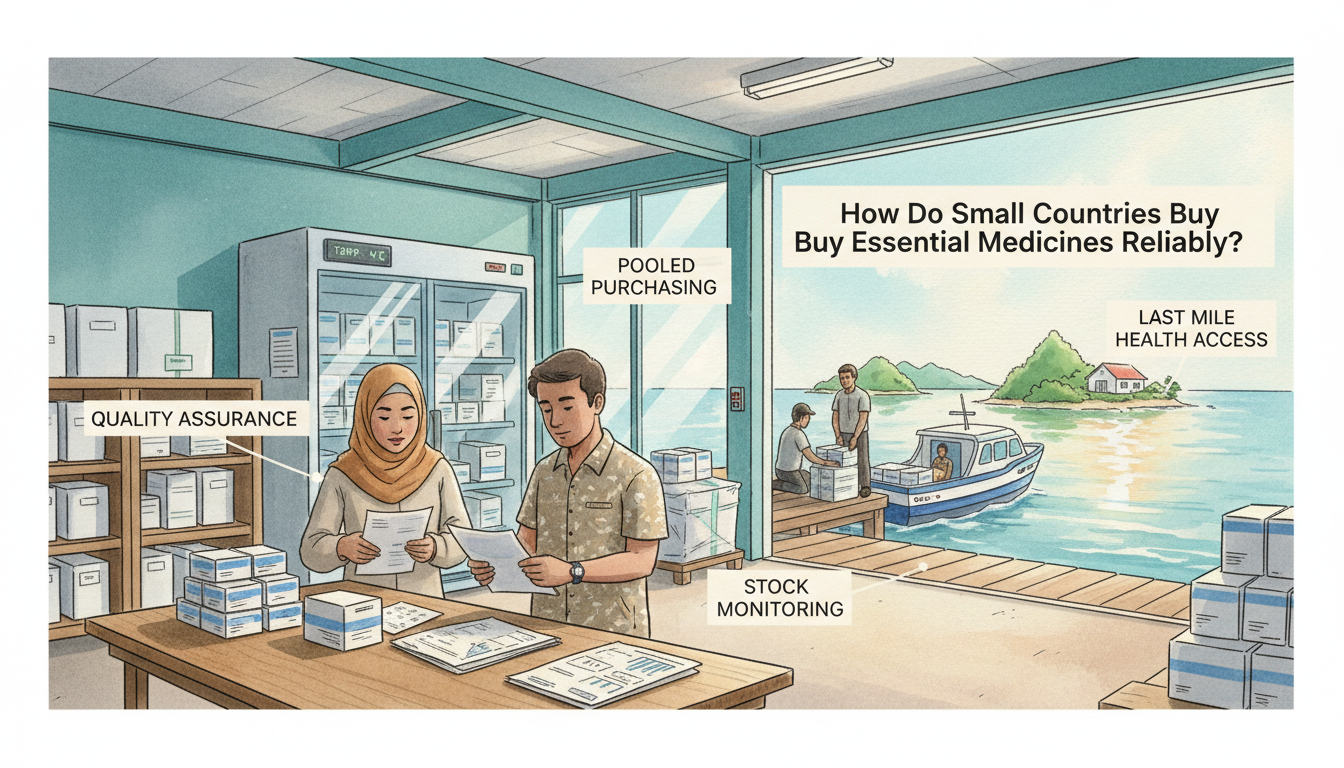
The featured 2026 conceptual image illustrates public-health procurement staff checking essential supplies at a regional store. It is not evidence about a specific medicine’s identity, a real supplier’s regulatory status or clinical suitability. The World Health Organization sources linked below describe international concepts and dated guidance.
Quick answer: a medicine system is more than a pharmacy shelf
The medicines-and-pharmacy component of civilisation joins evidence-based medicine selection, legitimate regulation, quality-assured manufacture, responsible procurement, dependable supply, pharmacist and clinician expertise, patient access, appropriate use and continuing safety monitoring. It makes medicines part of a functioning health system rather than treating them as ordinary goods or universally appropriate remedies.
The essential medicines concept, correctly dated
WHO’s Essential medicines fact sheet dated 26 January 2026 explains that essential medicines are selected according to priority health needs, public-health relevance, evidence and costs. WHO’s 24th Model List of Essential Medicines was published 5 September 2025. WHO updates its model lists every two years, while individual countries adopt or adapt national lists according to their own health systems.
The WHO fact sheet of 3 December 2024 distinguishes substandard products that fail quality specifications from falsified products that deliberately misrepresent identity, composition or source. WHO also provides safety alert information for medicines and vaccines. The existence of an alert should be understood in its exact regulatory scope rather than applied indiscriminately to unrelated products.
Six questions that help students understand medicine access
- Selection: which evidence-based population health need is the institution addressing?
- Authorisation: what competent national regulator governs the product and service?
- Quality: what assurance and traceability make a supply trustworthy?
- Availability: is an appropriate service and authorised product genuinely accessible where needed?
- Professional care: how do clinicians and pharmacists make suitable decisions within their roles?
- Review: how do monitoring, official alerts and correction preserve safety and trust?
Worked arithmetic: stock records are not a clinical outcome
Imagine a completely fictional health-service storeroom with fifty blank paper medicine-box cards. Ten are marked pending qualified review. The pending share is 10 ÷ 50 = 20% of those invented inventory cards. It is not a measure of unsafe medicines, disease burden or treatment success, and no clinical or regulatory decision can be inferred from the classroom label.
In another toy example, a warehouse records forty authorised neutral supply items while the island clinic has received thirty of the specified forty. The received share is 30 ÷ 40 = 75% of this fictional shipment. That does not mean patients received treatment or that the remaining ten items could be substituted. It shows why procurement, delivery, actual availability and clinical service are separate stages.
Part 1: Essential medicines and national health priorities
These six stations explore a connected medicines-system responsibility. Each has an evidence-based concept, a fictional learning case, an institutional weakness and a question for competent review. The material is deliberately separate from individual treatment guidance. A younger pupil may study one station; older learners may compare several and map dependencies.
Component 01: Medicines as part of healthcare
Institutional mechanism. Medicines are one component of broader clinical care, and their useful role depends on appropriate professional decisions A medicine is not simply an ordinary consumer product whose suitability can be judged from packaging or popularity. It enters healthcare through scientific evidence, qualified decisions and nationally defined authorisation. Begin by asking which institution ensures the product can legitimately serve a specific health-system purpose, and what remains within a clinician’s judgement. This protects the classroom from turning an informative supply-chain discussion into unsafe treatment advice. Connect the explanation specifically to medicines as part of healthcare without turning the general concept into a prescription or product recommendation.
The fictional Tidal Reach problem. A fictional clinic purchases many medicine boxes while its trained care team and diagnostic services remain limited Draw the product’s institutional journey from authorised evidence and quality-assured supply to the relevant licensed service. Each handover needs records or information whose purpose can be explained. A packet may arrive in the town while an eligibility, quality or clinical question remains unresolved. Students should identify the missing stage without handling actual medicines. What does the story actually establish, and what health or regulatory evidence remains missing?
The safety or access risk. Availability by itself does not establish appropriate or effective care Medicine-related safeguards involve real rights and professional duties. A classroom should not experiment with storage, doses, combinations or suspicious products. The appropriate response to any actual medicine concern belongs with authorised pharmacists, clinicians and regulators. Students can learn why these boundaries matter by tracing institutional responsibilities rather than imitating clinical work. Ask for an authorised institutional review, not an improvised patient treatment or medicine substitution.
Evidence and interpretation. Distinguish stocks, professional care and patient outcome A delivery or dispensing count is not automatically a health outcome. The products may be approved and properly supplied within a system while a patient still requires professional assessment and follow-up. Ask what the original policy was intended to improve and which evidence could legitimately address that goal. The classroom should identify the professional boundary and avoid measuring care with a single product total. The learner must state which population-level or product-level claim the evidence can support and where professional judgement begins.
Student-safe activity. Draw a paper medicines-to-health-service relationship Invite pupils to discuss viewpoints from a fictional pharmacist, regulator, patient representative and procurement official. Each should restate another role’s strongest concern before proposing a change. The class should preserve patient privacy and avoid treatment advice. A successful debate distinguishes legitimate rights, evidence and practical service problems. Use blank paper cards, invented categories and explanatory diagrams. No real prescriptions, pills or patient records should be used.
Improvement and future responsibility. Sometimes the correct next step is a current regulator’s information or a clinician’s assessment, not an improvised conclusion from a school article. This does not dismiss the need for medicine access. It defines what is unknown and who is competent to decide. A learner who can explain this boundary has acquired useful health literacy without unsafe self-medication advice. Link the station to medicines regulatory authorities and explain the kind of dependence between their functions.
Challenge the initial answer: Suppose availability by itself does not establish appropriate or effective care. Which institution is authorised to review the issue? What fact would change the proposed service improvement and what must remain a professional clinical decision? A good response identifies the limit of the fictional case instead of guessing an appropriate medicine for a particular person.
Component 02: The essential medicines concept
Institutional mechanism. WHO defines essential medicines through priority healthcare needs, evidence and public health relevance Healthcare needs and public medicine priorities are not identical to the sales figures of a pharmacy. Essential medicines are chosen with reference to population needs, evidence, affordability and feasible provision. The student should distinguish an international reference list, a national policy and the care of one actual patient. A useful systems explanation makes those levels explicit rather than treating a model list as a prescription. Connect the explanation specifically to the essential medicines concept without turning the general concept into a prescription or product recommendation.
The fictional Tidal Reach problem. Tidal Reach makes a toy list of popular products without considering its fictional population’s health needs A fictional community may have different needs for accessibility, service location and understandable information. Do not assign the same medicine or support needs to everyone within an age or disability category. Instead, compare the institutional barriers a person might face in reaching qualified advice. A legitimate healthcare question can be raised without disclosing private histories. What does the story actually establish, and what health or regulatory evidence remains missing?
The safety or access risk. Popularity is not the same as evidence-based priority selection Generational change creates challenges as new medicines and evidence emerge. Policies need revision while retaining trustworthy records, training and appropriate legal processes. A health ministry should not preserve a list merely because it was once approved, nor change it casually without review. Ask what evidence would trigger an authorised update and how the public would understand the reasoning. Ask for an authorised institutional review, not an improvised patient treatment or medicine substitution.
Evidence and interpretation. Identify criteria discussed in the January 2026 WHO fact sheet Trace the evidence from recognised product information to regulatory status, supply documentation, healthcare service and authorised review. Sensitive patient information must remain protected, so accountability does not mean publicising prescriptions or diagnoses. A fictional paper inventory can illustrate provenance without creating an actual medical record or treatment instruction. The learner must state which population-level or product-level claim the evidence can support and where professional judgement begins.
Student-safe activity. Write concept-level list selection questions without naming drugs for treatment Compare two imaginary communities with different geography and health institutions. Both need appropriate care, but their procurement, distribution and service arrangements may differ. Ask for one shared principle and two relevant contextual constraints. The aim is thoughtful comparison, not ranking people or borrowing actual clinical protocols. Use blank paper cards, invented categories and explanatory diagrams. No real prescriptions, pills or patient records should be used.
Improvement and future responsibility. Finish by identifying the competent institution responsible when a medicine-system problem appears. Pharmacists, prescribers, manufacturers and national regulators may have distinct duties. The classroom should not collapse those roles or invent an individual’s treatment instructions. A proper explanation names the question, evidence and channel for authorised review. Link the station to clinical evidence and assessment and explain the kind of dependence between their functions.
Challenge the initial answer: Suppose popularity is not the same as evidence-based priority selection. Which institution is authorised to review the issue? What fact would change the proposed service improvement and what must remain a professional clinical decision? A good response identifies the limit of the fictional case instead of guessing an appropriate medicine for a particular person.
Component 03: WHO Model List versus national lists
Institutional mechanism. The WHO Model List is guidance for national or regional adoption and adaptation, not an automatic local prescription A medicines system links knowledge and material supply. Researchers and regulators evaluate evidence; manufacturers must meet appropriate standards; procurement organisations obtain authorised products; pharmacists and clinicians manage professional use; and safety monitoring continues after market approval. A weakness in one stage may alter the value of another. Label the connections as roles and obligations rather than assume all actors are the same. Connect the explanation specifically to who model list versus national lists without turning the general concept into a prescription or product recommendation.
The fictional Tidal Reach problem. A council copies the 2025 WHO list word for word and calls it binding national law Draw the product’s institutional journey from authorised evidence and quality-assured supply to the relevant licensed service. Each handover needs records or information whose purpose can be explained. A packet may arrive in the town while an eligibility, quality or clinical question remains unresolved. Students should identify the missing stage without handling actual medicines. What does the story actually establish, and what health or regulatory evidence remains missing?
The safety or access risk. An international model does not replace local policy and clinical guidance Several suppliers may all depend on a single upstream manufacturer, route or active ingredient source. This can create a hidden vulnerability in procurement resilience. Draw the dependency before assuming different seller names provide independent supply. The classroom can explain the strategic risk but cannot select replacement medicines or override regulatory quality requirements. Ask for an authorised institutional review, not an improvised patient treatment or medicine substitution.
Evidence and interpretation. Distinguish WHO’s 2025 edition from national health authority rules A useful evaluation could reveal that a procurement or pharmacy arrangement is inadequate. Ask what observation would show a local shortage, an inaccessible service or incomplete regulatory information. Define the evidence question before inventing the outcome. The aim is to support qualified institutional learning rather than construct a dashboard designed only to praise the programme. The learner must state which population-level or product-level claim the evidence can support and where professional judgement begins.
Student-safe activity. Make a source-scope comparison table Give the class a made-up medicine information notice that lacks an authorised source, date or regulatory scope. Ask pupils to rewrite it so readers know where to seek legitimate professional information, without listing any drug doses or treatment recommendations. Another student should be able to identify what is known and what remains uncertain. Use blank paper cards, invented categories and explanatory diagrams. No real prescriptions, pills or patient records should be used.
Improvement and future responsibility. Sometimes the correct next step is a current regulator’s information or a clinician’s assessment, not an improvised conclusion from a school article. This does not dismiss the need for medicine access. It defines what is unknown and who is competent to decide. A learner who can explain this boundary has acquired useful health literacy without unsafe self-medication advice. Link the station to clinical trials and participant protection and explain the kind of dependence between their functions.
Challenge the initial answer: Suppose an international model does not replace local policy and clinical guidance. Which institution is authorised to review the issue? What fact would change the proposed service improvement and what must remain a professional clinical decision? A good response identifies the limit of the fictional case instead of guessing an appropriate medicine for a particular person.
Component 04: Selection based on evidence
Institutional mechanism. Medicine selection requires relevant evidence of benefit, harm, public health need and resource considerations An approved medicine may remain inaccessible because it is unavailable locally, unaffordable, unsuitable in format or difficult to obtain through the relevant clinical service. Conversely, a box physically present in a store does not establish that it should be supplied to any particular person. Ask what intended healthcare outcome the system seeks and which appropriate professional decisions make the supply useful. Connect the explanation specifically to selection based on evidence without turning the general concept into a prescription or product recommendation.
The fictional Tidal Reach problem. A fictional official adds a new product because an advertisement claims it is revolutionary A fictional community may have different needs for accessibility, service location and understandable information. Do not assign the same medicine or support needs to everyone within an age or disability category. Instead, compare the institutional barriers a person might face in reaching qualified advice. A legitimate healthcare question can be raised without disclosing private histories. What does the story actually establish, and what health or regulatory evidence remains missing?
The safety or access risk. Promotional claims cannot substitute for competent scientific review An international model list can guide national selection, yet public health priorities, budgets and authorised product decisions still require context-specific assessment. It would be misleading to demand that every country provide the same entire list immediately without considering actual policy and capacity. Ask which population-level evidence supports the priority and how reliable access could be organised over time. Ask for an authorised institutional review, not an improvised patient treatment or medicine substitution.
Evidence and interpretation. Ask what evidence and qualified committees are required Define what the indicator counts before interpreting it. Medicines listed nationally, authorised products, stock units purchased, products available at a facility and clinical access are distinct measures. A true national statistic can fail to describe one local service. State the population, period, product definition and source. A child should not infer individual treatment choices from an aggregate count. The learner must state which population-level or product-level claim the evidence can support and where professional judgement begins.
Student-safe activity. Redesign a fictional evidence summary without treatment guidance Use a hundred imaginary paper budget units to discuss quality systems, trained workforce, supply monitoring, remote access and public information. The amounts do not represent real procurement prices or national medicine policy. Ask what happens if almost all resources go to purchasing boxes while professional service capacity remains unsupported. This illustrates opportunity cost safely. Use blank paper cards, invented categories and explanatory diagrams. No real prescriptions, pills or patient records should be used.
Improvement and future responsibility. Finish by identifying the competent institution responsible when a medicine-system problem appears. Pharmacists, prescribers, manufacturers and national regulators may have distinct duties. The classroom should not collapse those roles or invent an individual’s treatment instructions. A proper explanation names the question, evidence and channel for authorised review. Link the station to manufacturing standards and assurance and explain the kind of dependence between their functions.
Challenge the initial answer: Suppose promotional claims cannot substitute for competent scientific review. Which institution is authorised to review the issue? What fact would change the proposed service improvement and what must remain a professional clinical decision? A good response identifies the limit of the fictional case instead of guessing an appropriate medicine for a particular person.
Component 05: Availability within a functioning system
Institutional mechanism. Essential medicines should be accessible in appropriate forms, assured quality and sufficient supply under actual health systems Professional pharmacy services contribute information, oversight and patient communication beyond handing over a package. A person may need clarification about a legally prescribed product or help navigating an authorised service. The learner should focus on how systems support informed professional care rather than write drug directions. A safe explanation ends where individual clinical judgement begins. Connect the explanation specifically to availability within a functioning system without turning the general concept into a prescription or product recommendation.
The fictional Tidal Reach problem. A town reports a product on its national list although no clinic can obtain it Draw the product’s institutional journey from authorised evidence and quality-assured supply to the relevant licensed service. Each handover needs records or information whose purpose can be explained. A packet may arrive in the town while an eligibility, quality or clinical question remains unresolved. Students should identify the missing stage without handling actual medicines. What does the story actually establish, and what health or regulatory evidence remains missing?
The safety or access risk. A policy entry cannot guarantee bedside availability An apparently efficient medicine purchase may create an unintended burden if quality, registration or service access is ignored. A lower quoted unit price does not guarantee lower overall health-system cost or better care. Ask who benefits and which safeguards or future expenses remain. The risk is a hypothesis for competent evaluation, not a reason for a student to select a different medicine. Ask for an authorised institutional review, not an improvised patient treatment or medicine substitution.
Evidence and interpretation. Trace procurement, distribution and professional use Monitoring is useful when qualified institutions examine the information, communicate appropriate findings and correct problems. A large collection of reports or product alerts without understanding of scope can mislead. Trace the path from a concern to an authorised review and public explanation. Do not instruct patients to change medication based on a fictional dataset. The learner must state which population-level or product-level claim the evidence can support and where professional judgement begins.
Student-safe activity. Draw a policy-to-service gap diagram Make five paper boxes labelled evidence, regulator, quality-assured supply, professional pharmacy service and appropriate healthcare outcome. Connect them with verbs describing legitimate responsibilities. A second child removes one link and asks what becomes uncertain. The exercise uses blank paper cards rather than real medicines. The learner’s achievement is understanding the system without pretending to give medical advice. Use blank paper cards, invented categories and explanatory diagrams. No real prescriptions, pills or patient records should be used.
Improvement and future responsibility. Sometimes the correct next step is a current regulator’s information or a clinician’s assessment, not an improvised conclusion from a school article. This does not dismiss the need for medicine access. It defines what is unknown and who is competent to decide. A learner who can explain this boundary has acquired useful health literacy without unsafe self-medication advice. Link the station to bioequivalence and generic approval and explain the kind of dependence between their functions.
Challenge the initial answer: Suppose a policy entry cannot guarantee bedside availability. Which institution is authorised to review the issue? What fact would change the proposed service improvement and what must remain a professional clinical decision? A good response identifies the limit of the fictional case instead of guessing an appropriate medicine for a particular person.
Component 06: Medicines for children and appropriate forms
Institutional mechanism. Children may require age-appropriate medicines and formulations selected through qualified evidence The quality of a medicine depends on much more than a familiar name. Authorised manufacture, suitable storage, verified supply and regulatory oversight provide important safeguards. A convincing-looking label can mislead if provenance is unclear. Ask what documentary or institutional evidence a competent professional would seek. No student should attempt chemical testing or decide a product’s clinical suitability from appearance. Connect the explanation specifically to medicines for children and appropriate forms without turning the general concept into a prescription or product recommendation.
The fictional Tidal Reach problem. The fictional clinic assumes an adult product format is automatically appropriate for every child A fictional community may have different needs for accessibility, service location and understandable information. Do not assign the same medicine or support needs to everyone within an age or disability category. Instead, compare the institutional barriers a person might face in reaching qualified advice. A legitimate healthcare question can be raised without disclosing private histories. What does the story actually establish, and what health or regulatory evidence remains missing?
The safety or access risk. Age and formulation decisions cannot be inferred from a box’s appearance Quality investigations require evidence rather than visual impressions. An authentic-looking logo, fashionable packaging or familiar shopfront cannot establish registration or appropriate storage. Likewise, a concern about one lot does not automatically implicate every product on the market. Ask what verified identity, lot information and authority determine the scope. The child should never handle unknown pharmaceutical substances to test an idea. Ask for an authorised institutional review, not an improvised patient treatment or medicine substitution.
Evidence and interpretation. Identify the role of paediatric professional guidance and WHO children lists Every rate needs a meaningful denominator. Ten missing inventory entries among fifty toy product records is twenty per cent of that sample, not a rate of unsafe medicines or untreated patients. The observation period and method of identifying missing entries matter. Ask what the calculated figure actually establishes and whether the public-health conclusion goes beyond it. The learner must state which population-level or product-level claim the evidence can support and where professional judgement begins.
Student-safe activity. Write a child-safe institutional question card without drug amounts Invite pupils to discuss viewpoints from a fictional pharmacist, regulator, patient representative and procurement official. Each should restate another role’s strongest concern before proposing a change. The class should preserve patient privacy and avoid treatment advice. A successful debate distinguishes legitimate rights, evidence and practical service problems. Use blank paper cards, invented categories and explanatory diagrams. No real prescriptions, pills or patient records should be used.
Improvement and future responsibility. Finish by identifying the competent institution responsible when a medicine-system problem appears. Pharmacists, prescribers, manufacturers and national regulators may have distinct duties. The classroom should not collapse those roles or invent an individual’s treatment instructions. A proper explanation names the question, evidence and channel for authorised review. Link the station to pharmacy as a professional service and explain the kind of dependence between their functions.
Challenge the initial answer: Suppose age and formulation decisions cannot be inferred from a box’s appearance. Which institution is authorised to review the issue? What fact would change the proposed service improvement and what must remain a professional clinical decision? A good response identifies the limit of the fictional case instead of guessing an appropriate medicine for a particular person.
Six-part health-system investigation 1
Connect Medicines as part of healthcare; The essential medicines concept; WHO Model List versus national lists; Selection based on evidence; Availability within a functioning system; Medicines for children and appropriate forms in one diagram of the health system. The student should label the transition from policy to quality supply, from supply to professional service and from reported concern to qualified review. One success at a regional warehouse cannot automatically substitute for an appropriate healthcare outcome.
Divide a class into a source checker, an access reviewer, a professional-boundary mapper and a future-generation records keeper. The group should write one bounded institutional proposal, its strongest counterargument and the official source it would need before a real decision. Primary learners can use a five-box map; Secondary learners can write five structured paragraphs without any medicine-selection or dosing advice.
Part 2: Science, market authorisation and trustworthy quality
These six stations explore a connected medicines-system responsibility. Each has an evidence-based concept, a fictional learning case, an institutional weakness and a question for competent review. The material is deliberately separate from individual treatment guidance. A younger pupil may study one station; older learners may compare several and map dependencies.
Component 07: National medicine policies
Institutional mechanism. Countries may develop policies linking selection, access, pricing, quality and appropriate medicine use Medicine access has a continuing institutional dimension. An initial shipment may be successful while later stock-outs, changing health needs or poor records undermine service. Ask what information and trained roles a future pharmacy or health ministry needs to preserve. A public health system is a durable capability, not a photograph of full shelves on opening day. Connect the explanation specifically to national medicine policies without turning the general concept into a prescription or product recommendation.
The fictional Tidal Reach problem. An imagined health ministry buys medicines without defining regulatory and distribution responsibilities Draw the product’s institutional journey from authorised evidence and quality-assured supply to the relevant licensed service. Each handover needs records or information whose purpose can be explained. A packet may arrive in the town while an eligibility, quality or clinical question remains unresolved. Students should identify the missing stage without handling actual medicines. What does the story actually establish, and what health or regulatory evidence remains missing?
The safety or access risk. Disconnected procurement can frustrate a well-intended national policy Digital medicine services may increase convenience while making access difficult for users without devices, suitable languages or reliable Internet. Privacy and the legitimacy of the provider also matter. Compare two fictional patient journeys, focusing on their ability to reach qualified care. Avoid assigning medical conditions or preferences from an identity label. The result should be an access question rather than a treatment plan. Ask for an authorised institutional review, not an improvised patient treatment or medicine substitution.
Evidence and interpretation. Map national regulation, procurement, providers and patients A patient or health professional may report a local experience that is not visible in an aggregate procurement table. Neither one account nor a national average automatically represents every person. A responsible institution uses suitable evidence to understand both while protecting privacy. The learner should identify which claim each source supports and where further review is necessary. The learner must state which population-level or product-level claim the evidence can support and where professional judgement begins.
Student-safe activity. Create a fictional policy responsibilities chart Compare two imaginary communities with different geography and health institutions. Both need appropriate care, but their procurement, distribution and service arrangements may differ. Ask for one shared principle and two relevant contextual constraints. The aim is thoughtful comparison, not ranking people or borrowing actual clinical protocols. Use blank paper cards, invented categories and explanatory diagrams. No real prescriptions, pills or patient records should be used.
Improvement and future responsibility. Sometimes the correct next step is a current regulator’s information or a clinician’s assessment, not an improvised conclusion from a school article. This does not dismiss the need for medicine access. It defines what is unknown and who is competent to decide. A learner who can explain this boundary has acquired useful health literacy without unsafe self-medication advice. Link the station to pharmacists and authorised scope and explain the kind of dependence between their functions.
Challenge the initial answer: Suppose disconnected procurement can frustrate a well-intended national policy. Which institution is authorised to review the issue? What fact would change the proposed service improvement and what must remain a professional clinical decision? A good response identifies the limit of the fictional case instead of guessing an appropriate medicine for a particular person.
Component 08: Medicines regulatory authorities
Institutional mechanism. National regulators oversee legal authorisation and relevant product requirements under local law One professional role is not interchangeable with another. Prescribers, pharmacists, national regulators, quality inspectors and patients interact under defined responsibilities that vary by jurisdiction. An invented town should not assign all decisions to one enthusiastic helper. The student can learn who provides oversight and information while leaving regulated tasks to appropriately qualified people. Connect the explanation specifically to medicines regulatory authorities without turning the general concept into a prescription or product recommendation.
The fictional Tidal Reach problem. A vendor describes a new product as approved everywhere based on a seller’s label A fictional community may have different needs for accessibility, service location and understandable information. Do not assign the same medicine or support needs to everyone within an age or disability category. Instead, compare the institutional barriers a person might face in reaching qualified advice. A legitimate healthcare question can be raised without disclosing private histories. What does the story actually establish, and what health or regulatory evidence remains missing?
The safety or access risk. Commercial availability does not prove official market authorisation More products on a shelf may appear positive while the most relevant priority medicine remains unavailable. A stock measure should specify which authorised item, location, condition and period it describes. Ask which evidence would reveal unmet clinical need without exposing patients’ private circumstances. A good health-system dashboard cannot be reduced to the total number of boxes counted. Ask for an authorised institutional review, not an improvised patient treatment or medicine substitution.
Evidence and interpretation. Ask which current regulator and marketing authorisation apply Actual regulatory authorisation, professional dispensing and product quality cannot be established by the classroom’s diagrams. WHO publications inform international policy and technical understanding, while national regulators decide their own legal arrangements. Students should name the relevant authority and avoid presenting any modelled conclusion as a real patient recommendation. The learner must state which population-level or product-level claim the evidence can support and where professional judgement begins.
Student-safe activity. Write an invented product-origin verification checklist Give the class a made-up medicine information notice that lacks an authorised source, date or regulatory scope. Ask pupils to rewrite it so readers know where to seek legitimate professional information, without listing any drug doses or treatment recommendations. Another student should be able to identify what is known and what remains uncertain. Use blank paper cards, invented categories and explanatory diagrams. No real prescriptions, pills or patient records should be used.
Improvement and future responsibility. Finish by identifying the competent institution responsible when a medicine-system problem appears. Pharmacists, prescribers, manufacturers and national regulators may have distinct duties. The classroom should not collapse those roles or invent an individual’s treatment instructions. A proper explanation names the question, evidence and channel for authorised review. Link the station to prescriptions and lawful dispensing and explain the kind of dependence between their functions.
Challenge the initial answer: Suppose commercial availability does not prove official market authorisation. Which institution is authorised to review the issue? What fact would change the proposed service improvement and what must remain a professional clinical decision? A good response identifies the limit of the fictional case instead of guessing an appropriate medicine for a particular person.
Component 09: Clinical evidence and assessment
Institutional mechanism. Regulatory review considers quality, safety and efficacy evidence for intended uses under defined requirements Population-level indicators and individual experiences answer different questions. A national list may identify priority products, while one household may still face a financial or travel barrier. Ask how data from procurement, stock, clinical services and patient feedback could be related without exposing private records. A single inventory count cannot describe the full public-health outcome. Connect the explanation specifically to clinical evidence and assessment without turning the general concept into a prescription or product recommendation.
The fictional Tidal Reach problem. A classroom advertisement treats a laboratory finding as proof of clinical effectiveness Draw the product’s institutional journey from authorised evidence and quality-assured supply to the relevant licensed service. Each handover needs records or information whose purpose can be explained. A packet may arrive in the town while an eligibility, quality or clinical question remains unresolved. Students should identify the missing stage without handling actual medicines. What does the story actually establish, and what health or regulatory evidence remains missing?
The safety or access risk. A preliminary study is not necessarily sufficient evidence for approval Health emergencies can change demand and disrupt medicine access, but improvising unverified supplies may add risk. A sensible institutional discussion identifies legitimate public-health procurement, distribution and clinical oversight. Students should ask what evidence and safeguards enable professional decisions rather than invent a substitute product. The framework supports public understanding without providing medical advice. Ask for an authorised institutional review, not an improvised patient treatment or medicine substitution.
Evidence and interpretation. Distinguish study stage, regulator decision and clinical use Before comparing two medicine availability reports, check the product category, national list, facility type, denominator and reporting date. A stock measurement at a national warehouse is not equivalent to availability at every clinic. An apparently consistent number may conceal different definitions or missing facilities. Honest reporting notes these limitations rather than forcing a misleading comparison. The learner must state which population-level or product-level claim the evidence can support and where professional judgement begins.
Student-safe activity. Make a fictional evidence-ladder chart Use a hundred imaginary paper budget units to discuss quality systems, trained workforce, supply monitoring, remote access and public information. The amounts do not represent real procurement prices or national medicine policy. Ask what happens if almost all resources go to purchasing boxes while professional service capacity remains unsupported. This illustrates opportunity cost safely. Use blank paper cards, invented categories and explanatory diagrams. No real prescriptions, pills or patient records should be used.
Improvement and future responsibility. Sometimes the correct next step is a current regulator’s information or a clinician’s assessment, not an improvised conclusion from a school article. This does not dismiss the need for medicine access. It defines what is unknown and who is competent to decide. A learner who can explain this boundary has acquired useful health literacy without unsafe self-medication advice. Link the station to patient information and comprehension and explain the kind of dependence between their functions.
Challenge the initial answer: Suppose a preliminary study is not necessarily sufficient evidence for approval. Which institution is authorised to review the issue? What fact would change the proposed service improvement and what must remain a professional clinical decision? A good response identifies the limit of the fictional case instead of guessing an appropriate medicine for a particular person.
Component 10: Clinical trials and participant protection
Institutional mechanism. Clinical research has ethical and regulatory responsibilities that differ from ordinary product marketing Pharmaceutical systems can benefit from international cooperation while retaining local legal duties. WHO publishes guidance and national regulators make their own decisions within applicable frameworks. A product authorised in one country is not automatically authorised everywhere. The learner should identify the relevant level of authority and the need for up-to-date verification. Connect the explanation specifically to clinical trials and participant protection without turning the general concept into a prescription or product recommendation.
The fictional Tidal Reach problem. An imaginary company recruits pupils into an experiment without consent or oversight A fictional community may have different needs for accessibility, service location and understandable information. Do not assign the same medicine or support needs to everyone within an age or disability category. Instead, compare the institutional barriers a person might face in reaching qualified advice. A legitimate healthcare question can be raised without disclosing private histories. What does the story actually establish, and what health or regulatory evidence remains missing?
The safety or access risk. Study enthusiasm cannot replace safeguards or lawful approval Professional medicines work is supported by people whose training and responsibilities differ. Prescribing, dispensing, regulation, manufacturing quality and postmarket monitoring cannot simply be merged into one sales task. A staff shortage in one area can affect an otherwise strong supply system. Ask where the qualified handover occurs and how the institution preserves competency over time. Ask for an authorised institutional review, not an improvised patient treatment or medicine substitution.
Evidence and interpretation. Identify competent ethical review and authorised research roles One reported concern cannot establish a general medicine safety rate or prove its cause. A suspicion may trigger a legitimate pharmacovigilance or quality process, but professional analysis is needed to assess it. Ask what alternative explanations could be relevant and what data are necessary. This teaches the difference between a signal, a finding and public action without judging any actual drug. The learner must state which population-level or product-level claim the evidence can support and where professional judgement begins.
Student-safe activity. Write a concept-only research-governance map Make five paper boxes labelled evidence, regulator, quality-assured supply, professional pharmacy service and appropriate healthcare outcome. Connect them with verbs describing legitimate responsibilities. A second child removes one link and asks what becomes uncertain. The exercise uses blank paper cards rather than real medicines. The learner’s achievement is understanding the system without pretending to give medical advice. Use blank paper cards, invented categories and explanatory diagrams. No real prescriptions, pills or patient records should be used.
Improvement and future responsibility. Finish by identifying the competent institution responsible when a medicine-system problem appears. Pharmacists, prescribers, manufacturers and national regulators may have distinct duties. The classroom should not collapse those roles or invent an individual’s treatment instructions. A proper explanation names the question, evidence and channel for authorised review. Link the station to adherence, capacity and respectful care and explain the kind of dependence between their functions.
Challenge the initial answer: Suppose study enthusiasm cannot replace safeguards or lawful approval. Which institution is authorised to review the issue? What fact would change the proposed service improvement and what must remain a professional clinical decision? A good response identifies the limit of the fictional case instead of guessing an appropriate medicine for a particular person.
Component 11: Manufacturing standards and assurance
Institutional mechanism. Medicines require quality-assured manufacture under relevant pharmaceutical standards and oversight Public trust requires continued openness to new evidence. Monitoring after authorisation can reveal issues not observed during narrower studies, and official alerts need accurate scope and dates. An alert is not a universal condemnation of every product sharing a broad name. Ask what is affected and which competent authority provides current guidance. This is a lesson in evidence interpretation rather than treatment. Connect the explanation specifically to manufacturing standards and assurance without turning the general concept into a prescription or product recommendation.
The fictional Tidal Reach problem. A fictional factory promises medicine quality because its packaging looks professional Draw the product’s institutional journey from authorised evidence and quality-assured supply to the relevant licensed service. Each handover needs records or information whose purpose can be explained. A packet may arrive in the town while an eligibility, quality or clinical question remains unresolved. Students should identify the missing stage without handling actual medicines. What does the story actually establish, and what health or regulatory evidence remains missing?
The safety or access risk. Appearance and generic factory inspection are not pharmaceutical certification Medicine-related safeguards involve real rights and professional duties. A classroom should not experiment with storage, doses, combinations or suspicious products. The appropriate response to any actual medicine concern belongs with authorised pharmacists, clinicians and regulators. Students can learn why these boundaries matter by tracing institutional responsibilities rather than imitating clinical work. Ask for an authorised institutional review, not an improvised patient treatment or medicine substitution.
Evidence and interpretation. Ask which regulator, product specification and approved standards are relevant A delivery or dispensing count is not automatically a health outcome. The products may be approved and properly supplied within a system while a patient still requires professional assessment and follow-up. Ask what the original policy was intended to improve and which evidence could legitimately address that goal. The classroom should identify the professional boundary and avoid measuring care with a single product total. The learner must state which population-level or product-level claim the evidence can support and where professional judgement begins.
Student-safe activity. Create a quality-information chain without production instructions Invite pupils to discuss viewpoints from a fictional pharmacist, regulator, patient representative and procurement official. Each should restate another role’s strongest concern before proposing a change. The class should preserve patient privacy and avoid treatment advice. A successful debate distinguishes legitimate rights, evidence and practical service problems. Use blank paper cards, invented categories and explanatory diagrams. No real prescriptions, pills or patient records should be used.
Improvement and future responsibility. Sometimes the correct next step is a current regulator’s information or a clinician’s assessment, not an improvised conclusion from a school article. This does not dismiss the need for medicine access. It defines what is unknown and who is competent to decide. A learner who can explain this boundary has acquired useful health literacy without unsafe self-medication advice. Link the station to interactions and professional review and explain the kind of dependence between their functions.
Challenge the initial answer: Suppose appearance and generic factory inspection are not pharmaceutical certification. Which institution is authorised to review the issue? What fact would change the proposed service improvement and what must remain a professional clinical decision? A good response identifies the limit of the fictional case instead of guessing an appropriate medicine for a particular person.
Component 12: Bioequivalence and generic approval
Institutional mechanism. Generic medicine authorisation may involve defined equivalence evidence and national regulatory requirements A safe systems explanation avoids both extremes: assuming every medicine is harmless because it is licensed, or assuming all medicines are suspicious because hazards exist. Scientific evaluation balances relevant benefits and risks under qualified professional processes. The child should describe how trustworthy institutions make those decisions and why ongoing monitoring and patient communication remain important. Connect the explanation specifically to bioequivalence and generic approval without turning the general concept into a prescription or product recommendation.
The fictional Tidal Reach problem. A student assumes every product with a similar name has identical approval status A fictional community may have different needs for accessibility, service location and understandable information. Do not assign the same medicine or support needs to everyone within an age or disability category. Instead, compare the institutional barriers a person might face in reaching qualified advice. A legitimate healthcare question can be raised without disclosing private histories. What does the story actually establish, and what health or regulatory evidence remains missing?
The safety or access risk. Names and marketing are not sufficient evidence of interchangeable use Generational change creates challenges as new medicines and evidence emerge. Policies need revision while retaining trustworthy records, training and appropriate legal processes. A health ministry should not preserve a list merely because it was once approved, nor change it casually without review. Ask what evidence would trigger an authorised update and how the public would understand the reasoning. Ask for an authorised institutional review, not an improvised patient treatment or medicine substitution.
Evidence and interpretation. Ask what authorised product information and professional judgement is needed Trace the evidence from recognised product information to regulatory status, supply documentation, healthcare service and authorised review. Sensitive patient information must remain protected, so accountability does not mean publicising prescriptions or diagnoses. A fictional paper inventory can illustrate provenance without creating an actual medical record or treatment instruction. The learner must state which population-level or product-level claim the evidence can support and where professional judgement begins.
Student-safe activity. Compare fictional regulatory categories without recommending switches Compare two imaginary communities with different geography and health institutions. Both need appropriate care, but their procurement, distribution and service arrangements may differ. Ask for one shared principle and two relevant contextual constraints. The aim is thoughtful comparison, not ranking people or borrowing actual clinical protocols. Use blank paper cards, invented categories and explanatory diagrams. No real prescriptions, pills or patient records should be used.
Improvement and future responsibility. Finish by identifying the competent institution responsible when a medicine-system problem appears. Pharmacists, prescribers, manufacturers and national regulators may have distinct duties. The classroom should not collapse those roles or invent an individual’s treatment instructions. A proper explanation names the question, evidence and channel for authorised review. Link the station to antimicrobial stewardship and explain the kind of dependence between their functions.
Challenge the initial answer: Suppose names and marketing are not sufficient evidence of interchangeable use. Which institution is authorised to review the issue? What fact would change the proposed service improvement and what must remain a professional clinical decision? A good response identifies the limit of the fictional case instead of guessing an appropriate medicine for a particular person.
Six-part health-system investigation 2
Connect National medicine policies; Medicines regulatory authorities; Clinical evidence and assessment; Clinical trials and participant protection; Manufacturing standards and assurance; Bioequivalence and generic approval in one diagram of the health system. The student should label the transition from policy to quality supply, from supply to professional service and from reported concern to qualified review. One success at a regional warehouse cannot automatically substitute for an appropriate healthcare outcome.
Divide a class into a source checker, an access reviewer, a professional-boundary mapper and a future-generation records keeper. The group should write one bounded institutional proposal, its strongest counterargument and the official source it would need before a real decision. Primary learners can use a five-box map; Secondary learners can write five structured paragraphs without any medicine-selection or dosing advice.
Part 3: Pharmacies, professional dispensing and information
These six stations explore a connected medicines-system responsibility. Each has an evidence-based concept, a fictional learning case, an institutional weakness and a question for competent review. The material is deliberately separate from individual treatment guidance. A younger pupil may study one station; older learners may compare several and map dependencies.
Component 13: Pharmacy as a professional service
Institutional mechanism. Community and hospital pharmacies support appropriate medicine supply and information under defined professional responsibilities A medicine is not simply an ordinary consumer product whose suitability can be judged from packaging or popularity. It enters healthcare through scientific evidence, qualified decisions and nationally defined authorisation. Begin by asking which institution ensures the product can legitimately serve a specific health-system purpose, and what remains within a clinician’s judgement. This protects the classroom from turning an informative supply-chain discussion into unsafe treatment advice. Connect the explanation specifically to pharmacy as a professional service without turning the general concept into a prescription or product recommendation.
The fictional Tidal Reach problem. Tidal Reach builds a pharmacy counter staffed only by an untrained volunteer Draw the product’s institutional journey from authorised evidence and quality-assured supply to the relevant licensed service. Each handover needs records or information whose purpose can be explained. A packet may arrive in the town while an eligibility, quality or clinical question remains unresolved. Students should identify the missing stage without handling actual medicines. What does the story actually establish, and what health or regulatory evidence remains missing?
The safety or access risk. A shop displaying medicine boxes cannot substitute for qualified practice Several suppliers may all depend on a single upstream manufacturer, route or active ingredient source. This can create a hidden vulnerability in procurement resilience. Draw the dependency before assuming different seller names provide independent supply. The classroom can explain the strategic risk but cannot select replacement medicines or override regulatory quality requirements. Ask for an authorised institutional review, not an improvised patient treatment or medicine substitution.
Evidence and interpretation. Separate inventory, lawful dispensing and patient counselling A useful evaluation could reveal that a procurement or pharmacy arrangement is inadequate. Ask what observation would show a local shortage, an inaccessible service or incomplete regulatory information. Define the evidence question before inventing the outcome. The aim is to support qualified institutional learning rather than construct a dashboard designed only to praise the programme. The learner must state which population-level or product-level claim the evidence can support and where professional judgement begins.
Student-safe activity. Draw an institutional pharmacy services map Give the class a made-up medicine information notice that lacks an authorised source, date or regulatory scope. Ask pupils to rewrite it so readers know where to seek legitimate professional information, without listing any drug doses or treatment recommendations. Another student should be able to identify what is known and what remains uncertain. Use blank paper cards, invented categories and explanatory diagrams. No real prescriptions, pills or patient records should be used.
Improvement and future responsibility. Sometimes the correct next step is a current regulator’s information or a clinician’s assessment, not an improvised conclusion from a school article. This does not dismiss the need for medicine access. It defines what is unknown and who is competent to decide. A learner who can explain this boundary has acquired useful health literacy without unsafe self-medication advice. Link the station to patient confidentiality and pharmacy records and explain the kind of dependence between their functions.
Challenge the initial answer: Suppose a shop displaying medicine boxes cannot substitute for qualified practice. Which institution is authorised to review the issue? What fact would change the proposed service improvement and what must remain a professional clinical decision? A good response identifies the limit of the fictional case instead of guessing an appropriate medicine for a particular person.
Component 14: Pharmacists and authorised scope
Institutional mechanism. Pharmacists have education, professional duties and scope determined by their jurisdiction Healthcare needs and public medicine priorities are not identical to the sales figures of a pharmacy. Essential medicines are chosen with reference to population needs, evidence, affordability and feasible provision. The student should distinguish an international reference list, a national policy and the care of one actual patient. A useful systems explanation makes those levels explicit rather than treating a model list as a prescription. Connect the explanation specifically to pharmacists and authorised scope without turning the general concept into a prescription or product recommendation.
The fictional Tidal Reach problem. A pupil assumes any retail worker may interpret or change a prescription A fictional community may have different needs for accessibility, service location and understandable information. Do not assign the same medicine or support needs to everyone within an age or disability category. Instead, compare the institutional barriers a person might face in reaching qualified advice. A legitimate healthcare question can be raised without disclosing private histories. What does the story actually establish, and what health or regulatory evidence remains missing?
The safety or access risk. Professional authority is not inferred from proximity to a medicine shelf An international model list can guide national selection, yet public health priorities, budgets and authorised product decisions still require context-specific assessment. It would be misleading to demand that every country provide the same entire list immediately without considering actual policy and capacity. Ask which population-level evidence supports the priority and how reliable access could be organised over time. Ask for an authorised institutional review, not an improvised patient treatment or medicine substitution.
Evidence and interpretation. Identify the roles of regulated pharmacists and prescribing clinicians Define what the indicator counts before interpreting it. Medicines listed nationally, authorised products, stock units purchased, products available at a facility and clinical access are distinct measures. A true national statistic can fail to describe one local service. State the population, period, product definition and source. A child should not infer individual treatment choices from an aggregate count. The learner must state which population-level or product-level claim the evidence can support and where professional judgement begins.
Student-safe activity. Write a nonclinical roles comparison Use a hundred imaginary paper budget units to discuss quality systems, trained workforce, supply monitoring, remote access and public information. The amounts do not represent real procurement prices or national medicine policy. Ask what happens if almost all resources go to purchasing boxes while professional service capacity remains unsupported. This illustrates opportunity cost safely. Use blank paper cards, invented categories and explanatory diagrams. No real prescriptions, pills or patient records should be used.
Improvement and future responsibility. Finish by identifying the competent institution responsible when a medicine-system problem appears. Pharmacists, prescribers, manufacturers and national regulators may have distinct duties. The classroom should not collapse those roles or invent an individual’s treatment instructions. A proper explanation names the question, evidence and channel for authorised review. Link the station to needs estimation and purchasing and explain the kind of dependence between their functions.
Challenge the initial answer: Suppose professional authority is not inferred from proximity to a medicine shelf. Which institution is authorised to review the issue? What fact would change the proposed service improvement and what must remain a professional clinical decision? A good response identifies the limit of the fictional case instead of guessing an appropriate medicine for a particular person.
Component 15: Prescriptions and lawful dispensing
Institutional mechanism. Prescription medicines involve professional orders, checks and local legal requirements A medicines system links knowledge and material supply. Researchers and regulators evaluate evidence; manufacturers must meet appropriate standards; procurement organisations obtain authorised products; pharmacists and clinicians manage professional use; and safety monitoring continues after market approval. A weakness in one stage may alter the value of another. Label the connections as roles and obligations rather than assume all actors are the same. Connect the explanation specifically to prescriptions and lawful dispensing without turning the general concept into a prescription or product recommendation.
The fictional Tidal Reach problem. A fictional resident brings an unclear old note and asks a shopkeeper to choose a medicine Draw the product’s institutional journey from authorised evidence and quality-assured supply to the relevant licensed service. Each handover needs records or information whose purpose can be explained. A packet may arrive in the town while an eligibility, quality or clinical question remains unresolved. Students should identify the missing stage without handling actual medicines. What does the story actually establish, and what health or regulatory evidence remains missing?
The safety or access risk. Guessing from an incomplete prescription can be unsafe An apparently efficient medicine purchase may create an unintended burden if quality, registration or service access is ignored. A lower quoted unit price does not guarantee lower overall health-system cost or better care. Ask who benefits and which safeguards or future expenses remain. The risk is a hypothesis for competent evaluation, not a reason for a student to select a different medicine. Ask for an authorised institutional review, not an improvised patient treatment or medicine substitution.
Evidence and interpretation. Ask which qualified professionals and current records are needed Monitoring is useful when qualified institutions examine the information, communicate appropriate findings and correct problems. A large collection of reports or product alerts without understanding of scope can mislead. Trace the path from a concern to an authorised review and public explanation. Do not instruct patients to change medication based on a fictional dataset. The learner must state which population-level or product-level claim the evidence can support and where professional judgement begins.
Student-safe activity. Map the concept of authorised prescription verification without medical steps Make five paper boxes labelled evidence, regulator, quality-assured supply, professional pharmacy service and appropriate healthcare outcome. Connect them with verbs describing legitimate responsibilities. A second child removes one link and asks what becomes uncertain. The exercise uses blank paper cards rather than real medicines. The learner’s achievement is understanding the system without pretending to give medical advice. Use blank paper cards, invented categories and explanatory diagrams. No real prescriptions, pills or patient records should be used.
Improvement and future responsibility. Sometimes the correct next step is a current regulator’s information or a clinician’s assessment, not an improvised conclusion from a school article. This does not dismiss the need for medicine access. It defines what is unknown and who is competent to decide. A learner who can explain this boundary has acquired useful health literacy without unsafe self-medication advice. Link the station to tendering and responsible suppliers and explain the kind of dependence between their functions.
Challenge the initial answer: Suppose guessing from an incomplete prescription can be unsafe. Which institution is authorised to review the issue? What fact would change the proposed service improvement and what must remain a professional clinical decision? A good response identifies the limit of the fictional case instead of guessing an appropriate medicine for a particular person.
Component 16: Patient information and comprehension
Institutional mechanism. Useful medicine information must be accurate, understandable and appropriate to the person and product An approved medicine may remain inaccessible because it is unavailable locally, unaffordable, unsuitable in format or difficult to obtain through the relevant clinical service. Conversely, a box physically present in a store does not establish that it should be supplied to any particular person. Ask what intended healthcare outcome the system seeks and which appropriate professional decisions make the supply useful. Connect the explanation specifically to patient information and comprehension without turning the general concept into a prescription or product recommendation.
The fictional Tidal Reach problem. A medicine label is only in an unfamiliar language for an imaginary patient A fictional community may have different needs for accessibility, service location and understandable information. Do not assign the same medicine or support needs to everyone within an age or disability category. Instead, compare the institutional barriers a person might face in reaching qualified advice. A legitimate healthcare question can be raised without disclosing private histories. What does the story actually establish, and what health or regulatory evidence remains missing?
The safety or access risk. Information provided is not necessarily information understood Quality investigations require evidence rather than visual impressions. An authentic-looking logo, fashionable packaging or familiar shopfront cannot establish registration or appropriate storage. Likewise, a concern about one lot does not automatically implicate every product on the market. Ask what verified identity, lot information and authority determine the scope. The child should never handle unknown pharmaceutical substances to test an idea. Ask for an authorised institutional review, not an improvised patient treatment or medicine substitution.
Evidence and interpretation. Compare authoritative product information with patient communication needs Every rate needs a meaningful denominator. Ten missing inventory entries among fifty toy product records is twenty per cent of that sample, not a rate of unsafe medicines or untreated patients. The observation period and method of identifying missing entries matter. Ask what the calculated figure actually establishes and whether the public-health conclusion goes beyond it. The learner must state which population-level or product-level claim the evidence can support and where professional judgement begins.
Student-safe activity. Rewrite a generic fictional help notice with no dosing advice Invite pupils to discuss viewpoints from a fictional pharmacist, regulator, patient representative and procurement official. Each should restate another role’s strongest concern before proposing a change. The class should preserve patient privacy and avoid treatment advice. A successful debate distinguishes legitimate rights, evidence and practical service problems. Use blank paper cards, invented categories and explanatory diagrams. No real prescriptions, pills or patient records should be used.
Improvement and future responsibility. Finish by identifying the competent institution responsible when a medicine-system problem appears. Pharmacists, prescribers, manufacturers and national regulators may have distinct duties. The classroom should not collapse those roles or invent an individual’s treatment instructions. A proper explanation names the question, evidence and channel for authorised review. Link the station to medicine inventory and stock-outs and explain the kind of dependence between their functions.
Challenge the initial answer: Suppose information provided is not necessarily information understood. Which institution is authorised to review the issue? What fact would change the proposed service improvement and what must remain a professional clinical decision? A good response identifies the limit of the fictional case instead of guessing an appropriate medicine for a particular person.
Component 17: Adherence, capacity and respectful care
Institutional mechanism. Patient experience and circumstances affect the practicality of a prescribed care plan Professional pharmacy services contribute information, oversight and patient communication beyond handing over a package. A person may need clarification about a legally prescribed product or help navigating an authorised service. The learner should focus on how systems support informed professional care rather than write drug directions. A safe explanation ends where individual clinical judgement begins. Connect the explanation specifically to adherence, capacity and respectful care without turning the general concept into a prescription or product recommendation.
The fictional Tidal Reach problem. An imagined patient cannot access the pharmacy during opening hours Draw the product’s institutional journey from authorised evidence and quality-assured supply to the relevant licensed service. Each handover needs records or information whose purpose can be explained. A packet may arrive in the town while an eligibility, quality or clinical question remains unresolved. Students should identify the missing stage without handling actual medicines. What does the story actually establish, and what health or regulatory evidence remains missing?
The safety or access risk. Calling people careless can conceal service and communication barriers Digital medicine services may increase convenience while making access difficult for users without devices, suitable languages or reliable Internet. Privacy and the legitimacy of the provider also matter. Compare two fictional patient journeys, focusing on their ability to reach qualified care. Avoid assigning medical conditions or preferences from an identity label. The result should be an access question rather than a treatment plan. Ask for an authorised institutional review, not an improvised patient treatment or medicine substitution.
Evidence and interpretation. Ask which professional support and access questions are relevant A patient or health professional may report a local experience that is not visible in an aggregate procurement table. Neither one account nor a national average automatically represents every person. A responsible institution uses suitable evidence to understand both while protecting privacy. The learner should identify which claim each source supports and where further review is necessary. The learner must state which population-level or product-level claim the evidence can support and where professional judgement begins.
Student-safe activity. Draw a fictional patient-journey map without treatment advice Compare two imaginary communities with different geography and health institutions. Both need appropriate care, but their procurement, distribution and service arrangements may differ. Ask for one shared principle and two relevant contextual constraints. The aim is thoughtful comparison, not ranking people or borrowing actual clinical protocols. Use blank paper cards, invented categories and explanatory diagrams. No real prescriptions, pills or patient records should be used.
Improvement and future responsibility. Sometimes the correct next step is a current regulator’s information or a clinician’s assessment, not an improvised conclusion from a school article. This does not dismiss the need for medicine access. It defines what is unknown and who is competent to decide. A learner who can explain this boundary has acquired useful health literacy without unsafe self-medication advice. Link the station to batch and lot traceability and explain the kind of dependence between their functions.
Challenge the initial answer: Suppose calling people careless can conceal service and communication barriers. Which institution is authorised to review the issue? What fact would change the proposed service improvement and what must remain a professional clinical decision? A good response identifies the limit of the fictional case instead of guessing an appropriate medicine for a particular person.
Component 18: Interactions and professional review
Institutional mechanism. Potential interactions among medicines and other products require qualified clinical assessment The quality of a medicine depends on much more than a familiar name. Authorised manufacture, suitable storage, verified supply and regulatory oversight provide important safeguards. A convincing-looking label can mislead if provenance is unclear. Ask what documentary or institutional evidence a competent professional would seek. No student should attempt chemical testing or decide a product’s clinical suitability from appearance. Connect the explanation specifically to interactions and professional review without turning the general concept into a prescription or product recommendation.
The fictional Tidal Reach problem. An imaginary resident assumes two individually approved products are automatically safe together A fictional community may have different needs for accessibility, service location and understandable information. Do not assign the same medicine or support needs to everyone within an age or disability category. Instead, compare the institutional barriers a person might face in reaching qualified advice. A legitimate healthcare question can be raised without disclosing private histories. What does the story actually establish, and what health or regulatory evidence remains missing?
The safety or access risk. Product approval does not establish safety of every combination More products on a shelf may appear positive while the most relevant priority medicine remains unavailable. A stock measure should specify which authorised item, location, condition and period it describes. Ask which evidence would reveal unmet clinical need without exposing patients’ private circumstances. A good health-system dashboard cannot be reduced to the total number of boxes counted. Ask for an authorised institutional review, not an improvised patient treatment or medicine substitution.
Evidence and interpretation. Identify pharmacist, prescriber and validated information roles Actual regulatory authorisation, professional dispensing and product quality cannot be established by the classroom’s diagrams. WHO publications inform international policy and technical understanding, while national regulators decide their own legal arrangements. Students should name the relevant authority and avoid presenting any modelled conclusion as a real patient recommendation. The learner must state which population-level or product-level claim the evidence can support and where professional judgement begins.
Student-safe activity. Write a neutral question to ask a qualified clinician Give the class a made-up medicine information notice that lacks an authorised source, date or regulatory scope. Ask pupils to rewrite it so readers know where to seek legitimate professional information, without listing any drug doses or treatment recommendations. Another student should be able to identify what is known and what remains uncertain. Use blank paper cards, invented categories and explanatory diagrams. No real prescriptions, pills or patient records should be used.
Improvement and future responsibility. Finish by identifying the competent institution responsible when a medicine-system problem appears. Pharmacists, prescribers, manufacturers and national regulators may have distinct duties. The classroom should not collapse those roles or invent an individual’s treatment instructions. A proper explanation names the question, evidence and channel for authorised review. Link the station to cold-chain products and qualified handling and explain the kind of dependence between their functions.
Challenge the initial answer: Suppose product approval does not establish safety of every combination. Which institution is authorised to review the issue? What fact would change the proposed service improvement and what must remain a professional clinical decision? A good response identifies the limit of the fictional case instead of guessing an appropriate medicine for a particular person.
Six-part health-system investigation 3
Connect Pharmacy as a professional service; Pharmacists and authorised scope; Prescriptions and lawful dispensing; Patient information and comprehension; Adherence, capacity and respectful care; Interactions and professional review in one diagram of the health system. The student should label the transition from policy to quality supply, from supply to professional service and from reported concern to qualified review. One success at a regional warehouse cannot automatically substitute for an appropriate healthcare outcome.
Divide a class into a source checker, an access reviewer, a professional-boundary mapper and a future-generation records keeper. The group should write one bounded institutional proposal, its strongest counterargument and the official source it would need before a real decision. Primary learners can use a five-box map; Secondary learners can write five structured paragraphs without any medicine-selection or dosing advice.
Part 4: Procurement, inventory and pharmaceutical supply chains
These six stations explore a connected medicines-system responsibility. Each has an evidence-based concept, a fictional learning case, an institutional weakness and a question for competent review. The material is deliberately separate from individual treatment guidance. A younger pupil may study one station; older learners may compare several and map dependencies.
Component 19: Antimicrobial stewardship
Institutional mechanism. Appropriate antimicrobial use requires clinical expertise and systems that protect effectiveness Medicine access has a continuing institutional dimension. An initial shipment may be successful while later stock-outs, changing health needs or poor records undermine service. Ask what information and trained roles a future pharmacy or health ministry needs to preserve. A public health system is a durable capability, not a photograph of full shelves on opening day. Connect the explanation specifically to antimicrobial stewardship without turning the general concept into a prescription or product recommendation.
The fictional Tidal Reach problem. The town celebrates high sales of antibiotics as proof of health success Draw the product’s institutional journey from authorised evidence and quality-assured supply to the relevant licensed service. Each handover needs records or information whose purpose can be explained. A packet may arrive in the town while an eligibility, quality or clinical question remains unresolved. Students should identify the missing stage without handling actual medicines. What does the story actually establish, and what health or regulatory evidence remains missing?
The safety or access risk. More antimicrobial use is not automatically better care Health emergencies can change demand and disrupt medicine access, but improvising unverified supplies may add risk. A sensible institutional discussion identifies legitimate public-health procurement, distribution and clinical oversight. Students should ask what evidence and safeguards enable professional decisions rather than invent a substitute product. The framework supports public understanding without providing medical advice. Ask for an authorised institutional review, not an improvised patient treatment or medicine substitution.
Evidence and interpretation. Explain the role of evidence and qualified stewardship programmes Before comparing two medicine availability reports, check the product category, national list, facility type, denominator and reporting date. A stock measurement at a national warehouse is not equivalent to availability at every clinic. An apparently consistent number may conceal different definitions or missing facilities. Honest reporting notes these limitations rather than forcing a misleading comparison. The learner must state which population-level or product-level claim the evidence can support and where professional judgement begins.
Student-safe activity. Build a conceptual stewardship institution map without antibiotic recommendations Use a hundred imaginary paper budget units to discuss quality systems, trained workforce, supply monitoring, remote access and public information. The amounts do not represent real procurement prices or national medicine policy. Ask what happens if almost all resources go to purchasing boxes while professional service capacity remains unsupported. This illustrates opportunity cost safely. Use blank paper cards, invented categories and explanatory diagrams. No real prescriptions, pills or patient records should be used.
Improvement and future responsibility. Sometimes the correct next step is a current regulator’s information or a clinician’s assessment, not an improvised conclusion from a school article. This does not dismiss the need for medicine access. It defines what is unknown and who is competent to decide. A learner who can explain this boundary has acquired useful health literacy without unsafe self-medication advice. Link the station to expiry and stock management and explain the kind of dependence between their functions.
Challenge the initial answer: Suppose more antimicrobial use is not automatically better care. Which institution is authorised to review the issue? What fact would change the proposed service improvement and what must remain a professional clinical decision? A good response identifies the limit of the fictional case instead of guessing an appropriate medicine for a particular person.
Component 20: Patient confidentiality and pharmacy records
Institutional mechanism. Medicine histories and prescriptions can contain sensitive health information One professional role is not interchangeable with another. Prescribers, pharmacists, national regulators, quality inspectors and patients interact under defined responsibilities that vary by jurisdiction. An invented town should not assign all decisions to one enthusiastic helper. The student can learn who provides oversight and information while leaving regulated tasks to appropriately qualified people. Connect the explanation specifically to patient confidentiality and pharmacy records without turning the general concept into a prescription or product recommendation.
The fictional Tidal Reach problem. A pharmacy publicly lists named patients and their medicines in a promotional poster A fictional community may have different needs for accessibility, service location and understandable information. Do not assign the same medicine or support needs to everyone within an age or disability category. Instead, compare the institutional barriers a person might face in reaching qualified advice. A legitimate healthcare question can be raised without disclosing private histories. What does the story actually establish, and what health or regulatory evidence remains missing?
The safety or access risk. Marketing interests do not remove health data protections Professional medicines work is supported by people whose training and responsibilities differ. Prescribing, dispensing, regulation, manufacturing quality and postmarket monitoring cannot simply be merged into one sales task. A staff shortage in one area can affect an otherwise strong supply system. Ask where the qualified handover occurs and how the institution preserves competency over time. Ask for an authorised institutional review, not an improvised patient treatment or medicine substitution.
Evidence and interpretation. Ask what records are necessary and who may lawfully view them One reported concern cannot establish a general medicine safety rate or prove its cause. A suspicion may trigger a legitimate pharmacovigilance or quality process, but professional analysis is needed to assess it. Ask what alternative explanations could be relevant and what data are necessary. This teaches the difference between a signal, a finding and public action without judging any actual drug. The learner must state which population-level or product-level claim the evidence can support and where professional judgement begins.
Student-safe activity. Redact an invented pharmacy record Make five paper boxes labelled evidence, regulator, quality-assured supply, professional pharmacy service and appropriate healthcare outcome. Connect them with verbs describing legitimate responsibilities. A second child removes one link and asks what becomes uncertain. The exercise uses blank paper cards rather than real medicines. The learner’s achievement is understanding the system without pretending to give medical advice. Use blank paper cards, invented categories and explanatory diagrams. No real prescriptions, pills or patient records should be used.
Improvement and future responsibility. Finish by identifying the competent institution responsible when a medicine-system problem appears. Pharmacists, prescribers, manufacturers and national regulators may have distinct duties. The classroom should not collapse those roles or invent an individual’s treatment instructions. A proper explanation names the question, evidence and channel for authorised review. Link the station to transport to remote communities and explain the kind of dependence between their functions.
Challenge the initial answer: Suppose marketing interests do not remove health data protections. Which institution is authorised to review the issue? What fact would change the proposed service improvement and what must remain a professional clinical decision? A good response identifies the limit of the fictional case instead of guessing an appropriate medicine for a particular person.
Component 21: Needs estimation and purchasing
Institutional mechanism. Medicine procurement requires forecasting needs, appropriate budgets and regulatory quality checks Population-level indicators and individual experiences answer different questions. A national list may identify priority products, while one household may still face a financial or travel barrier. Ask how data from procurement, stock, clinical services and patient feedback could be related without exposing private records. A single inventory count cannot describe the full public-health outcome. Connect the explanation specifically to needs estimation and purchasing without turning the general concept into a prescription or product recommendation.
The fictional Tidal Reach problem. A clinic buys a year’s worth of one imagined product while another priority is repeatedly out of stock Draw the product’s institutional journey from authorised evidence and quality-assured supply to the relevant licensed service. Each handover needs records or information whose purpose can be explained. A packet may arrive in the town while an eligibility, quality or clinical question remains unresolved. Students should identify the missing stage without handling actual medicines. What does the story actually establish, and what health or regulatory evidence remains missing?
The safety or access risk. Stock purchasing based only on past popularity may miss changing clinical needs Medicine-related safeguards involve real rights and professional duties. A classroom should not experiment with storage, doses, combinations or suspicious products. The appropriate response to any actual medicine concern belongs with authorised pharmacists, clinicians and regulators. Students can learn why these boundaries matter by tracing institutional responsibilities rather than imitating clinical work. Ask for an authorised institutional review, not an improvised patient treatment or medicine substitution.
Evidence and interpretation. Separate demand estimate, supplier evidence and qualified review A delivery or dispensing count is not automatically a health outcome. The products may be approved and properly supplied within a system while a patient still requires professional assessment and follow-up. Ask what the original policy was intended to improve and which evidence could legitimately address that goal. The classroom should identify the professional boundary and avoid measuring care with a single product total. The learner must state which population-level or product-level claim the evidence can support and where professional judgement begins.
Student-safe activity. Create a toy procurement forecast using only fictional neutral items Invite pupils to discuss viewpoints from a fictional pharmacist, regulator, patient representative and procurement official. Each should restate another role’s strongest concern before proposing a change. The class should preserve patient privacy and avoid treatment advice. A successful debate distinguishes legitimate rights, evidence and practical service problems. Use blank paper cards, invented categories and explanatory diagrams. No real prescriptions, pills or patient records should be used.
Improvement and future responsibility. Sometimes the correct next step is a current regulator’s information or a clinician’s assessment, not an improvised conclusion from a school article. This does not dismiss the need for medicine access. It defines what is unknown and who is competent to decide. A learner who can explain this boundary has acquired useful health literacy without unsafe self-medication advice. Link the station to financing and affordable medicine access and explain the kind of dependence between their functions.
Challenge the initial answer: Suppose stock purchasing based only on past popularity may miss changing clinical needs. Which institution is authorised to review the issue? What fact would change the proposed service improvement and what must remain a professional clinical decision? A good response identifies the limit of the fictional case instead of guessing an appropriate medicine for a particular person.
Component 22: Tendering and responsible suppliers
Institutional mechanism. Health purchasers need lawful and accountable selection of authorised suppliers Pharmaceutical systems can benefit from international cooperation while retaining local legal duties. WHO publishes guidance and national regulators make their own decisions within applicable frameworks. A product authorised in one country is not automatically authorised everywhere. The learner should identify the relevant level of authority and the need for up-to-date verification. Connect the explanation specifically to tendering and responsible suppliers without turning the general concept into a prescription or product recommendation.
The fictional Tidal Reach problem. A fictional procurement team chooses the lowest price while omitting quality-assurance evidence A fictional community may have different needs for accessibility, service location and understandable information. Do not assign the same medicine or support needs to everyone within an age or disability category. Instead, compare the institutional barriers a person might face in reaching qualified advice. A legitimate healthcare question can be raised without disclosing private histories. What does the story actually establish, and what health or regulatory evidence remains missing?
The safety or access risk. Low purchase price is not proof that a product is suitable or genuine Generational change creates challenges as new medicines and evidence emerge. Policies need revision while retaining trustworthy records, training and appropriate legal processes. A health ministry should not preserve a list merely because it was once approved, nor change it casually without review. Ask what evidence would trigger an authorised update and how the public would understand the reasoning. Ask for an authorised institutional review, not an improvised patient treatment or medicine substitution.
Evidence and interpretation. Ask which quality, regulatory and integrity checks govern procurement Trace the evidence from recognised product information to regulatory status, supply documentation, healthcare service and authorised review. Sensitive patient information must remain protected, so accountability does not mean publicising prescriptions or diagnoses. A fictional paper inventory can illustrate provenance without creating an actual medical record or treatment instruction. The learner must state which population-level or product-level claim the evidence can support and where professional judgement begins.
Student-safe activity. Write a procurement-criteria concept sheet Compare two imaginary communities with different geography and health institutions. Both need appropriate care, but their procurement, distribution and service arrangements may differ. Ask for one shared principle and two relevant contextual constraints. The aim is thoughtful comparison, not ranking people or borrowing actual clinical protocols. Use blank paper cards, invented categories and explanatory diagrams. No real prescriptions, pills or patient records should be used.
Improvement and future responsibility. Finish by identifying the competent institution responsible when a medicine-system problem appears. Pharmacists, prescribers, manufacturers and national regulators may have distinct duties. The classroom should not collapse those roles or invent an individual’s treatment instructions. A proper explanation names the question, evidence and channel for authorised review. Link the station to substandard and falsified products and explain the kind of dependence between their functions.
Challenge the initial answer: Suppose low purchase price is not proof that a product is suitable or genuine. Which institution is authorised to review the issue? What fact would change the proposed service improvement and what must remain a professional clinical decision? A good response identifies the limit of the fictional case instead of guessing an appropriate medicine for a particular person.
Component 23: Medicine inventory and stock-outs
Institutional mechanism. Availability requires trustworthy inventory and awareness of shortages at service sites Public trust requires continued openness to new evidence. Monitoring after authorisation can reveal issues not observed during narrower studies, and official alerts need accurate scope and dates. An alert is not a universal condemnation of every product sharing a broad name. Ask what is affected and which competent authority provides current guidance. This is a lesson in evidence interpretation rather than treatment. Connect the explanation specifically to medicine inventory and stock-outs without turning the general concept into a prescription or product recommendation.
The fictional Tidal Reach problem. A regional warehouse reports supply while the fictional island clinic has none Draw the product’s institutional journey from authorised evidence and quality-assured supply to the relevant licensed service. Each handover needs records or information whose purpose can be explained. A packet may arrive in the town while an eligibility, quality or clinical question remains unresolved. Students should identify the missing stage without handling actual medicines. What does the story actually establish, and what health or regulatory evidence remains missing?
The safety or access risk. National inventory totals can hide local shortages Several suppliers may all depend on a single upstream manufacturer, route or active ingredient source. This can create a hidden vulnerability in procurement resilience. Draw the dependency before assuming different seller names provide independent supply. The classroom can explain the strategic risk but cannot select replacement medicines or override regulatory quality requirements. Ask for an authorised institutional review, not an improvised patient treatment or medicine substitution.
Evidence and interpretation. Compare ordered, received, usable and actually available stock A useful evaluation could reveal that a procurement or pharmacy arrangement is inadequate. Ask what observation would show a local shortage, an inaccessible service or incomplete regulatory information. Define the evidence question before inventing the outcome. The aim is to support qualified institutional learning rather than construct a dashboard designed only to praise the programme. The learner must state which population-level or product-level claim the evidence can support and where professional judgement begins.
Student-safe activity. Make a paper inventory reconciliation Give the class a made-up medicine information notice that lacks an authorised source, date or regulatory scope. Ask pupils to rewrite it so readers know where to seek legitimate professional information, without listing any drug doses or treatment recommendations. Another student should be able to identify what is known and what remains uncertain. Use blank paper cards, invented categories and explanatory diagrams. No real prescriptions, pills or patient records should be used.
Improvement and future responsibility. Sometimes the correct next step is a current regulator’s information or a clinician’s assessment, not an improvised conclusion from a school article. This does not dismiss the need for medicine access. It defines what is unknown and who is competent to decide. A learner who can explain this boundary has acquired useful health literacy without unsafe self-medication advice. Link the station to online medicine markets and explain the kind of dependence between their functions.
Challenge the initial answer: Suppose national inventory totals can hide local shortages. Which institution is authorised to review the issue? What fact would change the proposed service improvement and what must remain a professional clinical decision? A good response identifies the limit of the fictional case instead of guessing an appropriate medicine for a particular person.
Component 24: Batch and lot traceability
Institutional mechanism. Medicine lots help authorities and institutions identify related products when quality concerns arise A safe systems explanation avoids both extremes: assuming every medicine is harmless because it is licensed, or assuming all medicines are suspicious because hazards exist. Scientific evaluation balances relevant benefits and risks under qualified professional processes. The child should describe how trustworthy institutions make those decisions and why ongoing monitoring and patient communication remain important. Connect the explanation specifically to batch and lot traceability without turning the general concept into a prescription or product recommendation.
The fictional Tidal Reach problem. A fictional clinic cannot distinguish two batches after a supply problem A fictional community may have different needs for accessibility, service location and understandable information. Do not assign the same medicine or support needs to everyone within an age or disability category. Instead, compare the institutional barriers a person might face in reaching qualified advice. A legitimate healthcare question can be raised without disclosing private histories. What does the story actually establish, and what health or regulatory evidence remains missing?
The safety or access risk. A missing batch code can weaken authorised recall or investigation An international model list can guide national selection, yet public health priorities, budgets and authorised product decisions still require context-specific assessment. It would be misleading to demand that every country provide the same entire list immediately without considering actual policy and capacity. Ask which population-level evidence supports the priority and how reliable access could be organised over time. Ask for an authorised institutional review, not an improvised patient treatment or medicine substitution.
Evidence and interpretation. Trace product identity and provenance through supply chains Define what the indicator counts before interpreting it. Medicines listed nationally, authorised products, stock units purchased, products available at a facility and clinical access are distinct measures. A true national statistic can fail to describe one local service. State the population, period, product definition and source. A child should not infer individual treatment choices from an aggregate count. The learner must state which population-level or product-level claim the evidence can support and where professional judgement begins.
Student-safe activity. Create invented lot labels for paper boxes Use a hundred imaginary paper budget units to discuss quality systems, trained workforce, supply monitoring, remote access and public information. The amounts do not represent real procurement prices or national medicine policy. Ask what happens if almost all resources go to purchasing boxes while professional service capacity remains unsupported. This illustrates opportunity cost safely. Use blank paper cards, invented categories and explanatory diagrams. No real prescriptions, pills or patient records should be used.
Improvement and future responsibility. Finish by identifying the competent institution responsible when a medicine-system problem appears. Pharmacists, prescribers, manufacturers and national regulators may have distinct duties. The classroom should not collapse those roles or invent an individual’s treatment instructions. A proper explanation names the question, evidence and channel for authorised review. Link the station to pharmacovigilance and postmarket monitoring and explain the kind of dependence between their functions.
Challenge the initial answer: Suppose a missing batch code can weaken authorised recall or investigation. Which institution is authorised to review the issue? What fact would change the proposed service improvement and what must remain a professional clinical decision? A good response identifies the limit of the fictional case instead of guessing an appropriate medicine for a particular person.
Six-part health-system investigation 4
Connect Antimicrobial stewardship; Patient confidentiality and pharmacy records; Needs estimation and purchasing; Tendering and responsible suppliers; Medicine inventory and stock-outs; Batch and lot traceability in one diagram of the health system. The student should label the transition from policy to quality supply, from supply to professional service and from reported concern to qualified review. One success at a regional warehouse cannot automatically substitute for an appropriate healthcare outcome.
Divide a class into a source checker, an access reviewer, a professional-boundary mapper and a future-generation records keeper. The group should write one bounded institutional proposal, its strongest counterargument and the official source it would need before a real decision. Primary learners can use a five-box map; Secondary learners can write five structured paragraphs without any medicine-selection or dosing advice.
Part 5: Safety surveillance, errors and regulatory response
These six stations explore a connected medicines-system responsibility. Each has an evidence-based concept, a fictional learning case, an institutional weakness and a question for competent review. The material is deliberately separate from individual treatment guidance. A younger pupil may study one station; older learners may compare several and map dependencies.
Component 25: Cold-chain products and qualified handling
Institutional mechanism. Some medicines require specialised documented conditions determined by product instructions and regulators A medicine is not simply an ordinary consumer product whose suitability can be judged from packaging or popularity. It enters healthcare through scientific evidence, qualified decisions and nationally defined authorisation. Begin by asking which institution ensures the product can legitimately serve a specific health-system purpose, and what remains within a clinician’s judgement. This protects the classroom from turning an informative supply-chain discussion into unsafe treatment advice. Connect the explanation specifically to cold-chain products and qualified handling without turning the general concept into a prescription or product recommendation.
The fictional Tidal Reach problem. A shipment’s temperature record is missing, but a worker insists the packaging looks fine Draw the product’s institutional journey from authorised evidence and quality-assured supply to the relevant licensed service. Each handover needs records or information whose purpose can be explained. A packet may arrive in the town while an eligibility, quality or clinical question remains unresolved. Students should identify the missing stage without handling actual medicines. What does the story actually establish, and what health or regulatory evidence remains missing?
The safety or access risk. Appearance cannot establish safe condition of temperature-sensitive medicines An apparently efficient medicine purchase may create an unintended burden if quality, registration or service access is ignored. A lower quoted unit price does not guarantee lower overall health-system cost or better care. Ask who benefits and which safeguards or future expenses remain. The risk is a hypothesis for competent evaluation, not a reason for a student to select a different medicine. Ask for an authorised institutional review, not an improvised patient treatment or medicine substitution.
Evidence and interpretation. Identify qualified cold-chain oversight and product requirements Monitoring is useful when qualified institutions examine the information, communicate appropriate findings and correct problems. A large collection of reports or product alerts without understanding of scope can mislead. Trace the path from a concern to an authorised review and public explanation. Do not instruct patients to change medication based on a fictional dataset. The learner must state which population-level or product-level claim the evidence can support and where professional judgement begins.
Student-safe activity. Draw a conceptual custody-and-condition map without handling stock Make five paper boxes labelled evidence, regulator, quality-assured supply, professional pharmacy service and appropriate healthcare outcome. Connect them with verbs describing legitimate responsibilities. A second child removes one link and asks what becomes uncertain. The exercise uses blank paper cards rather than real medicines. The learner’s achievement is understanding the system without pretending to give medical advice. Use blank paper cards, invented categories and explanatory diagrams. No real prescriptions, pills or patient records should be used.
Improvement and future responsibility. Sometimes the correct next step is a current regulator’s information or a clinician’s assessment, not an improvised conclusion from a school article. This does not dismiss the need for medicine access. It defines what is unknown and who is competent to decide. A learner who can explain this boundary has acquired useful health literacy without unsafe self-medication advice. Link the station to reporting suspected product problems and explain the kind of dependence between their functions.
Challenge the initial answer: Suppose appearance cannot establish safe condition of temperature-sensitive medicines. Which institution is authorised to review the issue? What fact would change the proposed service improvement and what must remain a professional clinical decision? A good response identifies the limit of the fictional case instead of guessing an appropriate medicine for a particular person.
Component 26: Expiry and stock management
Institutional mechanism. Medicines have product-specific storage and expiry conditions under authorised instructions Healthcare needs and public medicine priorities are not identical to the sales figures of a pharmacy. Essential medicines are chosen with reference to population needs, evidence, affordability and feasible provision. The student should distinguish an international reference list, a national policy and the care of one actual patient. A useful systems explanation makes those levels explicit rather than treating a model list as a prescription. Connect the explanation specifically to expiry and stock management without turning the general concept into a prescription or product recommendation.
The fictional Tidal Reach problem. A fictional storekeeper marks all boxes usable without checking legitimate status records A fictional community may have different needs for accessibility, service location and understandable information. Do not assign the same medicine or support needs to everyone within an age or disability category. Instead, compare the institutional barriers a person might face in reaching qualified advice. A legitimate healthcare question can be raised without disclosing private histories. What does the story actually establish, and what health or regulatory evidence remains missing?
The safety or access risk. A simple age-based sorting rule cannot replace product-specific safety decisions Quality investigations require evidence rather than visual impressions. An authentic-looking logo, fashionable packaging or familiar shopfront cannot establish registration or appropriate storage. Likewise, a concern about one lot does not automatically implicate every product on the market. Ask what verified identity, lot information and authority determine the scope. The child should never handle unknown pharmaceutical substances to test an idea. Ask for an authorised institutional review, not an improvised patient treatment or medicine substitution.
Evidence and interpretation. Ask which professional controls identify available or quarantined stock Every rate needs a meaningful denominator. Ten missing inventory entries among fifty toy product records is twenty per cent of that sample, not a rate of unsafe medicines or untreated patients. The observation period and method of identifying missing entries matter. Ask what the calculated figure actually establishes and whether the public-health conclusion goes beyond it. The learner must state which population-level or product-level claim the evidence can support and where professional judgement begins.
Student-safe activity. Sort blank paper cards by status, not real medicines Invite pupils to discuss viewpoints from a fictional pharmacist, regulator, patient representative and procurement official. Each should restate another role’s strongest concern before proposing a change. The class should preserve patient privacy and avoid treatment advice. A successful debate distinguishes legitimate rights, evidence and practical service problems. Use blank paper cards, invented categories and explanatory diagrams. No real prescriptions, pills or patient records should be used.
Improvement and future responsibility. Finish by identifying the competent institution responsible when a medicine-system problem appears. Pharmacists, prescribers, manufacturers and national regulators may have distinct duties. The classroom should not collapse those roles or invent an individual’s treatment instructions. A proper explanation names the question, evidence and channel for authorised review. Link the station to safety alerts and recalls and explain the kind of dependence between their functions.
Challenge the initial answer: Suppose a simple age-based sorting rule cannot replace product-specific safety decisions. Which institution is authorised to review the issue? What fact would change the proposed service improvement and what must remain a professional clinical decision? A good response identifies the limit of the fictional case instead of guessing an appropriate medicine for a particular person.
Component 27: Transport to remote communities
Institutional mechanism. Medicine access can depend on logistics across land, air, waterways and suitable service facilities A medicines system links knowledge and material supply. Researchers and regulators evaluate evidence; manufacturers must meet appropriate standards; procurement organisations obtain authorised products; pharmacists and clinicians manage professional use; and safety monitoring continues after market approval. A weakness in one stage may alter the value of another. Label the connections as roles and obligations rather than assume all actors are the same. Connect the explanation specifically to transport to remote communities without turning the general concept into a prescription or product recommendation.
The fictional Tidal Reach problem. Tidal Reach’s isolated clinic has an approved order but the only freight route is disrupted Draw the product’s institutional journey from authorised evidence and quality-assured supply to the relevant licensed service. Each handover needs records or information whose purpose can be explained. A packet may arrive in the town while an eligibility, quality or clinical question remains unresolved. Students should identify the missing stage without handling actual medicines. What does the story actually establish, and what health or regulatory evidence remains missing?
The safety or access risk. A paid purchase does not mean the product reached the patient Digital medicine services may increase convenience while making access difficult for users without devices, suitable languages or reliable Internet. Privacy and the legitimacy of the provider also matter. Compare two fictional patient journeys, focusing on their ability to reach qualified care. Avoid assigning medical conditions or preferences from an identity label. The result should be an access question rather than a treatment plan. Ask for an authorised institutional review, not an improvised patient treatment or medicine substitution.
Evidence and interpretation. Trace origin, transport, receiving and legitimate dispensing A patient or health professional may report a local experience that is not visible in an aggregate procurement table. Neither one account nor a national average automatically represents every person. A responsible institution uses suitable evidence to understand both while protecting privacy. The learner should identify which claim each source supports and where further review is necessary. The learner must state which population-level or product-level claim the evidence can support and where professional judgement begins.
Student-safe activity. Draw a conceptual island medicine supply chain Compare two imaginary communities with different geography and health institutions. Both need appropriate care, but their procurement, distribution and service arrangements may differ. Ask for one shared principle and two relevant contextual constraints. The aim is thoughtful comparison, not ranking people or borrowing actual clinical protocols. Use blank paper cards, invented categories and explanatory diagrams. No real prescriptions, pills or patient records should be used.
Improvement and future responsibility. Sometimes the correct next step is a current regulator’s information or a clinician’s assessment, not an improvised conclusion from a school article. This does not dismiss the need for medicine access. It defines what is unknown and who is competent to decide. A learner who can explain this boundary has acquired useful health literacy without unsafe self-medication advice. Link the station to medical errors and system learning and explain the kind of dependence between their functions.
Challenge the initial answer: Suppose a paid purchase does not mean the product reached the patient. Which institution is authorised to review the issue? What fact would change the proposed service improvement and what must remain a professional clinical decision? A good response identifies the limit of the fictional case instead of guessing an appropriate medicine for a particular person.
Component 28: Financing and affordable medicine access
Institutional mechanism. Costs to health systems and patients can create barriers even when products exist An approved medicine may remain inaccessible because it is unavailable locally, unaffordable, unsuitable in format or difficult to obtain through the relevant clinical service. Conversely, a box physically present in a store does not establish that it should be supplied to any particular person. Ask what intended healthcare outcome the system seeks and which appropriate professional decisions make the supply useful. Connect the explanation specifically to financing and affordable medicine access without turning the general concept into a prescription or product recommendation.
The fictional Tidal Reach problem. A fictional household cannot afford the service pathway that would provide a required medicine A fictional community may have different needs for accessibility, service location and understandable information. Do not assign the same medicine or support needs to everyone within an age or disability category. Instead, compare the institutional barriers a person might face in reaching qualified advice. A legitimate healthcare question can be raised without disclosing private histories. What does the story actually establish, and what health or regulatory evidence remains missing?
The safety or access risk. A low warehouse price may not mean affordable patient access More products on a shelf may appear positive while the most relevant priority medicine remains unavailable. A stock measure should specify which authorised item, location, condition and period it describes. Ask which evidence would reveal unmet clinical need without exposing patients’ private circumstances. A good health-system dashboard cannot be reduced to the total number of boxes counted. Ask for an authorised institutional review, not an improvised patient treatment or medicine substitution.
Evidence and interpretation. Distinguish procurement price, service delivery and out-of-pocket burden Actual regulatory authorisation, professional dispensing and product quality cannot be established by the classroom’s diagrams. WHO publications inform international policy and technical understanding, while national regulators decide their own legal arrangements. Students should name the relevant authority and avoid presenting any modelled conclusion as a real patient recommendation. The learner must state which population-level or product-level claim the evidence can support and where professional judgement begins.
Student-safe activity. Make an imaginary cost components chart without pricing advice Give the class a made-up medicine information notice that lacks an authorised source, date or regulatory scope. Ask pupils to rewrite it so readers know where to seek legitimate professional information, without listing any drug doses or treatment recommendations. Another student should be able to identify what is known and what remains uncertain. Use blank paper cards, invented categories and explanatory diagrams. No real prescriptions, pills or patient records should be used.
Improvement and future responsibility. Finish by identifying the competent institution responsible when a medicine-system problem appears. Pharmacists, prescribers, manufacturers and national regulators may have distinct duties. The classroom should not collapse those roles or invent an individual’s treatment instructions. A proper explanation names the question, evidence and channel for authorised review. Link the station to counterfeit risk and patient trust and explain the kind of dependence between their functions.
Challenge the initial answer: Suppose a low warehouse price may not mean affordable patient access. Which institution is authorised to review the issue? What fact would change the proposed service improvement and what must remain a professional clinical decision? A good response identifies the limit of the fictional case instead of guessing an appropriate medicine for a particular person.
Component 29: Substandard and falsified products
Institutional mechanism. WHO distinguishes products that fail quality specifications from those deliberately misrepresenting identity, composition or source Professional pharmacy services contribute information, oversight and patient communication beyond handing over a package. A person may need clarification about a legally prescribed product or help navigating an authorised service. The learner should focus on how systems support informed professional care rather than write drug directions. A safe explanation ends where individual clinical judgement begins. Connect the explanation specifically to substandard and falsified products without turning the general concept into a prescription or product recommendation.
The fictional Tidal Reach problem. A market seller promotes an unverified medicine package through an anonymous online storefront Draw the product’s institutional journey from authorised evidence and quality-assured supply to the relevant licensed service. Each handover needs records or information whose purpose can be explained. A packet may arrive in the town while an eligibility, quality or clinical question remains unresolved. Students should identify the missing stage without handling actual medicines. What does the story actually establish, and what health or regulatory evidence remains missing?
The safety or access risk. An authentic-looking logo cannot establish product legitimacy Health emergencies can change demand and disrupt medicine access, but improvising unverified supplies may add risk. A sensible institutional discussion identifies legitimate public-health procurement, distribution and clinical oversight. Students should ask what evidence and safeguards enable professional decisions rather than invent a substitute product. The framework supports public understanding without providing medical advice. Ask for an authorised institutional review, not an improvised patient treatment or medicine substitution.
Evidence and interpretation. Explain WHO’s 2024 definitions and official alert channels Before comparing two medicine availability reports, check the product category, national list, facility type, denominator and reporting date. A stock measurement at a national warehouse is not equivalent to availability at every clinic. An apparently consistent number may conceal different definitions or missing facilities. Honest reporting notes these limitations rather than forcing a misleading comparison. The learner must state which population-level or product-level claim the evidence can support and where professional judgement begins.
Student-safe activity. Write a safe verification-source checklist without investigating products directly Use a hundred imaginary paper budget units to discuss quality systems, trained workforce, supply monitoring, remote access and public information. The amounts do not represent real procurement prices or national medicine policy. Ask what happens if almost all resources go to purchasing boxes while professional service capacity remains unsupported. This illustrates opportunity cost safely. Use blank paper cards, invented categories and explanatory diagrams. No real prescriptions, pills or patient records should be used.
Improvement and future responsibility. Sometimes the correct next step is a current regulator’s information or a clinician’s assessment, not an improvised conclusion from a school article. This does not dismiss the need for medicine access. It defines what is unknown and who is competent to decide. A learner who can explain this boundary has acquired useful health literacy without unsafe self-medication advice. Link the station to equity across geography and income and explain the kind of dependence between their functions.
Challenge the initial answer: Suppose an authentic-looking logo cannot establish product legitimacy. Which institution is authorised to review the issue? What fact would change the proposed service improvement and what must remain a professional clinical decision? A good response identifies the limit of the fictional case instead of guessing an appropriate medicine for a particular person.
Component 30: Online medicine markets
Institutional mechanism. Digital sales can widen reach while creating risks involving legitimacy, information and personal data The quality of a medicine depends on much more than a familiar name. Authorised manufacture, suitable storage, verified supply and regulatory oversight provide important safeguards. A convincing-looking label can mislead if provenance is unclear. Ask what documentary or institutional evidence a competent professional would seek. No student should attempt chemical testing or decide a product’s clinical suitability from appearance. Connect the explanation specifically to online medicine markets without turning the general concept into a prescription or product recommendation.
The fictional Tidal Reach problem. A fictional website offers prescription products without any visible national authorisation A fictional community may have different needs for accessibility, service location and understandable information. Do not assign the same medicine or support needs to everyone within an age or disability category. Instead, compare the institutional barriers a person might face in reaching qualified advice. A legitimate healthcare question can be raised without disclosing private histories. What does the story actually establish, and what health or regulatory evidence remains missing?
The safety or access risk. Convenience does not remove medicine regulation or clinical requirements Professional medicines work is supported by people whose training and responsibilities differ. Prescribing, dispensing, regulation, manufacturing quality and postmarket monitoring cannot simply be merged into one sales task. A staff shortage in one area can affect an otherwise strong supply system. Ask where the qualified handover occurs and how the institution preserves competency over time. Ask for an authorised institutional review, not an improvised patient treatment or medicine substitution.
Evidence and interpretation. Identify recognised official regulators and qualified providers One reported concern cannot establish a general medicine safety rate or prove its cause. A suspicion may trigger a legitimate pharmacovigilance or quality process, but professional analysis is needed to assess it. Ask what alternative explanations could be relevant and what data are necessary. This teaches the difference between a signal, a finding and public action without judging any actual drug. The learner must state which population-level or product-level claim the evidence can support and where professional judgement begins.
Student-safe activity. Design a concept-only authorised-channel information card Make five paper boxes labelled evidence, regulator, quality-assured supply, professional pharmacy service and appropriate healthcare outcome. Connect them with verbs describing legitimate responsibilities. A second child removes one link and asks what becomes uncertain. The exercise uses blank paper cards rather than real medicines. The learner’s achievement is understanding the system without pretending to give medical advice. Use blank paper cards, invented categories and explanatory diagrams. No real prescriptions, pills or patient records should be used.
Improvement and future responsibility. Finish by identifying the competent institution responsible when a medicine-system problem appears. Pharmacists, prescribers, manufacturers and national regulators may have distinct duties. The classroom should not collapse those roles or invent an individual’s treatment instructions. A proper explanation names the question, evidence and channel for authorised review. Link the station to disability and accessible medicine services and explain the kind of dependence between their functions.
Challenge the initial answer: Suppose convenience does not remove medicine regulation or clinical requirements. Which institution is authorised to review the issue? What fact would change the proposed service improvement and what must remain a professional clinical decision? A good response identifies the limit of the fictional case instead of guessing an appropriate medicine for a particular person.
Six-part health-system investigation 5
Connect Cold-chain products and qualified handling; Expiry and stock management; Transport to remote communities; Financing and affordable medicine access; Substandard and falsified products; Online medicine markets in one diagram of the health system. The student should label the transition from policy to quality supply, from supply to professional service and from reported concern to qualified review. One success at a regional warehouse cannot automatically substitute for an appropriate healthcare outcome.
Divide a class into a source checker, an access reviewer, a professional-boundary mapper and a future-generation records keeper. The group should write one bounded institutional proposal, its strongest counterargument and the official source it would need before a real decision. Primary learners can use a five-box map; Secondary learners can write five structured paragraphs without any medicine-selection or dosing advice.
Part 6: Affordability, inclusion and difficult access circumstances
These six stations explore a connected medicines-system responsibility. Each has an evidence-based concept, a fictional learning case, an institutional weakness and a question for competent review. The material is deliberately separate from individual treatment guidance. A younger pupil may study one station; older learners may compare several and map dependencies.
Component 31: Pharmacovigilance and postmarket monitoring
Institutional mechanism. Safety monitoring continues after approval because some adverse effects emerge in broader populations Medicine access has a continuing institutional dimension. An initial shipment may be successful while later stock-outs, changing health needs or poor records undermine service. Ask what information and trained roles a future pharmacy or health ministry needs to preserve. A public health system is a durable capability, not a photograph of full shelves on opening day. Connect the explanation specifically to pharmacovigilance and postmarket monitoring without turning the general concept into a prescription or product recommendation.
The fictional Tidal Reach problem. The town assumes every authorised product has no possible unforeseen effects Draw the product’s institutional journey from authorised evidence and quality-assured supply to the relevant licensed service. Each handover needs records or information whose purpose can be explained. A packet may arrive in the town while an eligibility, quality or clinical question remains unresolved. Students should identify the missing stage without handling actual medicines. What does the story actually establish, and what health or regulatory evidence remains missing?
The safety or access risk. Pre-authorisation trials do not reveal every later safety question Medicine-related safeguards involve real rights and professional duties. A classroom should not experiment with storage, doses, combinations or suspicious products. The appropriate response to any actual medicine concern belongs with authorised pharmacists, clinicians and regulators. Students can learn why these boundaries matter by tracing institutional responsibilities rather than imitating clinical work. Ask for an authorised institutional review, not an improvised patient treatment or medicine substitution.
Evidence and interpretation. Use WHO safety alert guidance to distinguish signals from proven causal conclusions A delivery or dispensing count is not automatically a health outcome. The products may be approved and properly supplied within a system while a patient still requires professional assessment and follow-up. Ask what the original policy was intended to improve and which evidence could legitimately address that goal. The classroom should identify the professional boundary and avoid measuring care with a single product total. The learner must state which population-level or product-level claim the evidence can support and where professional judgement begins.
Student-safe activity. Create a fictional reporting system map without medical symptom advice Invite pupils to discuss viewpoints from a fictional pharmacist, regulator, patient representative and procurement official. Each should restate another role’s strongest concern before proposing a change. The class should preserve patient privacy and avoid treatment advice. A successful debate distinguishes legitimate rights, evidence and practical service problems. Use blank paper cards, invented categories and explanatory diagrams. No real prescriptions, pills or patient records should be used.
Improvement and future responsibility. Sometimes the correct next step is a current regulator’s information or a clinician’s assessment, not an improvised conclusion from a school article. This does not dismiss the need for medicine access. It defines what is unknown and who is competent to decide. A learner who can explain this boundary has acquired useful health literacy without unsafe self-medication advice. Link the station to older persons and medicine systems and explain the kind of dependence between their functions.
Challenge the initial answer: Suppose pre-authorisation trials do not reveal every later safety question. Which institution is authorised to review the issue? What fact would change the proposed service improvement and what must remain a professional clinical decision? A good response identifies the limit of the fictional case instead of guessing an appropriate medicine for a particular person.
Component 32: Reporting suspected product problems
Institutional mechanism. Health professionals and appropriate systems may report suspected quality or safety concerns to regulators One professional role is not interchangeable with another. Prescribers, pharmacists, national regulators, quality inspectors and patients interact under defined responsibilities that vary by jurisdiction. An invented town should not assign all decisions to one enthusiastic helper. The student can learn who provides oversight and information while leaving regulated tasks to appropriately qualified people. Connect the explanation specifically to reporting suspected product problems without turning the general concept into a prescription or product recommendation.
The fictional Tidal Reach problem. An invented provider encounters a possible product defect but has no reporting route A fictional community may have different needs for accessibility, service location and understandable information. Do not assign the same medicine or support needs to everyone within an age or disability category. Instead, compare the institutional barriers a person might face in reaching qualified advice. A legitimate healthcare question can be raised without disclosing private histories. What does the story actually establish, and what health or regulatory evidence remains missing?
The safety or access risk. Unreported concerns can prevent authorised investigation Generational change creates challenges as new medicines and evidence emerge. Policies need revision while retaining trustworthy records, training and appropriate legal processes. A health ministry should not preserve a list merely because it was once approved, nor change it casually without review. Ask what evidence would trigger an authorised update and how the public would understand the reasoning. Ask for an authorised institutional review, not an improvised patient treatment or medicine substitution.
Evidence and interpretation. Ask which national reporting and professional review channels apply Trace the evidence from recognised product information to regulatory status, supply documentation, healthcare service and authorised review. Sensitive patient information must remain protected, so accountability does not mean publicising prescriptions or diagnoses. A fictional paper inventory can illustrate provenance without creating an actual medical record or treatment instruction. The learner must state which population-level or product-level claim the evidence can support and where professional judgement begins.
Student-safe activity. Write a neutral hypothetical reporting-purpose note Compare two imaginary communities with different geography and health institutions. Both need appropriate care, but their procurement, distribution and service arrangements may differ. Ask for one shared principle and two relevant contextual constraints. The aim is thoughtful comparison, not ranking people or borrowing actual clinical protocols. Use blank paper cards, invented categories and explanatory diagrams. No real prescriptions, pills or patient records should be used.
Improvement and future responsibility. Finish by identifying the competent institution responsible when a medicine-system problem appears. Pharmacists, prescribers, manufacturers and national regulators may have distinct duties. The classroom should not collapse those roles or invent an individual’s treatment instructions. A proper explanation names the question, evidence and channel for authorised review. Link the station to humanitarian supply disruption and explain the kind of dependence between their functions.
Challenge the initial answer: Suppose unreported concerns can prevent authorised investigation. Which institution is authorised to review the issue? What fact would change the proposed service improvement and what must remain a professional clinical decision? A good response identifies the limit of the fictional case instead of guessing an appropriate medicine for a particular person.
Component 33: Safety alerts and recalls
Institutional mechanism. Official alerts can communicate relevant product concerns and authorised action under current rules Population-level indicators and individual experiences answer different questions. A national list may identify priority products, while one household may still face a financial or travel barrier. Ask how data from procurement, stock, clinical services and patient feedback could be related without exposing private records. A single inventory count cannot describe the full public-health outcome. Connect the explanation specifically to safety alerts and recalls without turning the general concept into a prescription or product recommendation.
The fictional Tidal Reach problem. A historical warning is reposted without its issue date or affected lot Draw the product’s institutional journey from authorised evidence and quality-assured supply to the relevant licensed service. Each handover needs records or information whose purpose can be explained. A packet may arrive in the town while an eligibility, quality or clinical question remains unresolved. Students should identify the missing stage without handling actual medicines. What does the story actually establish, and what health or regulatory evidence remains missing?
The safety or access risk. An outdated or misread alert may create confusion Several suppliers may all depend on a single upstream manufacturer, route or active ingredient source. This can create a hidden vulnerability in procurement resilience. Draw the dependency before assuming different seller names provide independent supply. The classroom can explain the strategic risk but cannot select replacement medicines or override regulatory quality requirements. Ask for an authorised institutional review, not an improvised patient treatment or medicine substitution.
Evidence and interpretation. Check product identity, source, scope and current status A useful evaluation could reveal that a procurement or pharmacy arrangement is inadequate. Ask what observation would show a local shortage, an inaccessible service or incomplete regulatory information. Define the evidence question before inventing the outcome. The aim is to support qualified institutional learning rather than construct a dashboard designed only to praise the programme. The learner must state which population-level or product-level claim the evidence can support and where professional judgement begins.
Student-safe activity. Annotate a fictional alert header without instructions about taking medicines Give the class a made-up medicine information notice that lacks an authorised source, date or regulatory scope. Ask pupils to rewrite it so readers know where to seek legitimate professional information, without listing any drug doses or treatment recommendations. Another student should be able to identify what is known and what remains uncertain. Use blank paper cards, invented categories and explanatory diagrams. No real prescriptions, pills or patient records should be used.
Improvement and future responsibility. Sometimes the correct next step is a current regulator’s information or a clinician’s assessment, not an improvised conclusion from a school article. This does not dismiss the need for medicine access. It defines what is unknown and who is competent to decide. A learner who can explain this boundary has acquired useful health literacy without unsafe self-medication advice. Link the station to professional education and ethics and explain the kind of dependence between their functions.
Challenge the initial answer: Suppose an outdated or misread alert may create confusion. Which institution is authorised to review the issue? What fact would change the proposed service improvement and what must remain a professional clinical decision? A good response identifies the limit of the fictional case instead of guessing an appropriate medicine for a particular person.
Component 34: Medical errors and system learning
Institutional mechanism. Medicine-related errors can arise from communication, records or different system stages and need professional review Pharmaceutical systems can benefit from international cooperation while retaining local legal duties. WHO publishes guidance and national regulators make their own decisions within applicable frameworks. A product authorised in one country is not automatically authorised everywhere. The learner should identify the relevant level of authority and the need for up-to-date verification. Connect the explanation specifically to medical errors and system learning without turning the general concept into a prescription or product recommendation.
The fictional Tidal Reach problem. Two fictional records use inconsistent product names during a clinical handover A fictional community may have different needs for accessibility, service location and understandable information. Do not assign the same medicine or support needs to everyone within an age or disability category. Instead, compare the institutional barriers a person might face in reaching qualified advice. A legitimate healthcare question can be raised without disclosing private histories. What does the story actually establish, and what health or regulatory evidence remains missing?
The safety or access risk. An error cannot always be understood by blaming one person An international model list can guide national selection, yet public health priorities, budgets and authorised product decisions still require context-specific assessment. It would be misleading to demand that every country provide the same entire list immediately without considering actual policy and capacity. Ask which population-level evidence supports the priority and how reliable access could be organised over time. Ask for an authorised institutional review, not an improvised patient treatment or medicine substitution.
Evidence and interpretation. Ask which authorised quality systems detect and review discrepancies Define what the indicator counts before interpreting it. Medicines listed nationally, authorised products, stock units purchased, products available at a facility and clinical access are distinct measures. A true national statistic can fail to describe one local service. State the population, period, product definition and source. A child should not infer individual treatment choices from an aggregate count. The learner must state which population-level or product-level claim the evidence can support and where professional judgement begins.
Student-safe activity. Compare imaginary labels without recommending a product Use a hundred imaginary paper budget units to discuss quality systems, trained workforce, supply monitoring, remote access and public information. The amounts do not represent real procurement prices or national medicine policy. Ask what happens if almost all resources go to purchasing boxes while professional service capacity remains unsupported. This illustrates opportunity cost safely. Use blank paper cards, invented categories and explanatory diagrams. No real prescriptions, pills or patient records should be used.
Improvement and future responsibility. Finish by identifying the competent institution responsible when a medicine-system problem appears. Pharmacists, prescribers, manufacturers and national regulators may have distinct duties. The classroom should not collapse those roles or invent an individual’s treatment instructions. A proper explanation names the question, evidence and channel for authorised review. Link the station to regulatory cooperation across borders and explain the kind of dependence between their functions.
Challenge the initial answer: Suppose an error cannot always be understood by blaming one person. Which institution is authorised to review the issue? What fact would change the proposed service improvement and what must remain a professional clinical decision? A good response identifies the limit of the fictional case instead of guessing an appropriate medicine for a particular person.
Component 35: Counterfeit risk and patient trust
Institutional mechanism. Trust requires legitimate sourcing and product oversight, not solely familiarity with a seller Public trust requires continued openness to new evidence. Monitoring after authorisation can reveal issues not observed during narrower studies, and official alerts need accurate scope and dates. An alert is not a universal condemnation of every product sharing a broad name. Ask what is affected and which competent authority provides current guidance. This is a lesson in evidence interpretation rather than treatment. Connect the explanation specifically to counterfeit risk and patient trust without turning the general concept into a prescription or product recommendation.
The fictional Tidal Reach problem. A patient believes a brightly printed medicine package must be genuine Draw the product’s institutional journey from authorised evidence and quality-assured supply to the relevant licensed service. Each handover needs records or information whose purpose can be explained. A packet may arrive in the town while an eligibility, quality or clinical question remains unresolved. Students should identify the missing stage without handling actual medicines. What does the story actually establish, and what health or regulatory evidence remains missing?
The safety or access risk. Appearance and popularity do not establish manufacturing quality or registration An apparently efficient medicine purchase may create an unintended burden if quality, registration or service access is ignored. A lower quoted unit price does not guarantee lower overall health-system cost or better care. Ask who benefits and which safeguards or future expenses remain. The risk is a hypothesis for competent evaluation, not a reason for a student to select a different medicine. Ask for an authorised institutional review, not an improvised patient treatment or medicine substitution.
Evidence and interpretation. Check trusted regulatory pathways and professional responsibility Monitoring is useful when qualified institutions examine the information, communicate appropriate findings and correct problems. A large collection of reports or product alerts without understanding of scope can mislead. Trace the path from a concern to an authorised review and public explanation. Do not instruct patients to change medication based on a fictional dataset. The learner must state which population-level or product-level claim the evidence can support and where professional judgement begins.
Student-safe activity. Create a paper trust-claim versus evidence table Make five paper boxes labelled evidence, regulator, quality-assured supply, professional pharmacy service and appropriate healthcare outcome. Connect them with verbs describing legitimate responsibilities. A second child removes one link and asks what becomes uncertain. The exercise uses blank paper cards rather than real medicines. The learner’s achievement is understanding the system without pretending to give medical advice. Use blank paper cards, invented categories and explanatory diagrams. No real prescriptions, pills or patient records should be used.
Improvement and future responsibility. Sometimes the correct next step is a current regulator’s information or a clinician’s assessment, not an improvised conclusion from a school article. This does not dismiss the need for medicine access. It defines what is unknown and who is competent to decide. A learner who can explain this boundary has acquired useful health literacy without unsafe self-medication advice. Link the station to future medicine security and institutional memory and explain the kind of dependence between their functions.
Challenge the initial answer: Suppose appearance and popularity do not establish manufacturing quality or registration. Which institution is authorised to review the issue? What fact would change the proposed service improvement and what must remain a professional clinical decision? A good response identifies the limit of the fictional case instead of guessing an appropriate medicine for a particular person.
Component 36: Equity across geography and income
Institutional mechanism. Access may differ between urban and remote residents and among people with different resources A safe systems explanation avoids both extremes: assuming every medicine is harmless because it is licensed, or assuming all medicines are suspicious because hazards exist. Scientific evaluation balances relevant benefits and risks under qualified professional processes. The child should describe how trustworthy institutions make those decisions and why ongoing monitoring and patient communication remain important. Connect the explanation specifically to equity across geography and income without turning the general concept into a prescription or product recommendation.
The fictional Tidal Reach problem. One fictional region has clinics while another relies on irregular deliveries A fictional community may have different needs for accessibility, service location and understandable information. Do not assign the same medicine or support needs to everyone within an age or disability category. Instead, compare the institutional barriers a person might face in reaching qualified advice. A legitimate healthcare question can be raised without disclosing private histories. What does the story actually establish, and what health or regulatory evidence remains missing?
The safety or access risk. A national average can conceal communities with unmet medicine needs Quality investigations require evidence rather than visual impressions. An authentic-looking logo, fashionable packaging or familiar shopfront cannot establish registration or appropriate storage. Likewise, a concern about one lot does not automatically implicate every product on the market. Ask what verified identity, lot information and authority determine the scope. The child should never handle unknown pharmaceutical substances to test an idea. Ask for an authorised institutional review, not an improvised patient treatment or medicine substitution.
Evidence and interpretation. Define service availability, affordability and practical reach Every rate needs a meaningful denominator. Ten missing inventory entries among fifty toy product records is twenty per cent of that sample, not a rate of unsafe medicines or untreated patients. The observation period and method of identifying missing entries matter. Ask what the calculated figure actually establishes and whether the public-health conclusion goes beyond it. The learner must state which population-level or product-level claim the evidence can support and where professional judgement begins.
Student-safe activity. Map contrasting invented patient journeys Invite pupils to discuss viewpoints from a fictional pharmacist, regulator, patient representative and procurement official. Each should restate another role’s strongest concern before proposing a change. The class should preserve patient privacy and avoid treatment advice. A successful debate distinguishes legitimate rights, evidence and practical service problems. Use blank paper cards, invented categories and explanatory diagrams. No real prescriptions, pills or patient records should be used.
Improvement and future responsibility. Finish by identifying the competent institution responsible when a medicine-system problem appears. Pharmacists, prescribers, manufacturers and national regulators may have distinct duties. The classroom should not collapse those roles or invent an individual’s treatment instructions. A proper explanation names the question, evidence and channel for authorised review. Link the station to medicines as part of healthcare and explain the kind of dependence between their functions.
Challenge the initial answer: Suppose a national average can conceal communities with unmet medicine needs. Which institution is authorised to review the issue? What fact would change the proposed service improvement and what must remain a professional clinical decision? A good response identifies the limit of the fictional case instead of guessing an appropriate medicine for a particular person.
Six-part health-system investigation 6
Connect Pharmacovigilance and postmarket monitoring; Reporting suspected product problems; Safety alerts and recalls; Medical errors and system learning; Counterfeit risk and patient trust; Equity across geography and income in one diagram of the health system. The student should label the transition from policy to quality supply, from supply to professional service and from reported concern to qualified review. One success at a regional warehouse cannot automatically substitute for an appropriate healthcare outcome.
Divide a class into a source checker, an access reviewer, a professional-boundary mapper and a future-generation records keeper. The group should write one bounded institutional proposal, its strongest counterargument and the official source it would need before a real decision. Primary learners can use a five-box map; Secondary learners can write five structured paragraphs without any medicine-selection or dosing advice.
Part 7: Future medicines policy, institutions and public trust
These six stations explore a connected medicines-system responsibility. Each has an evidence-based concept, a fictional learning case, an institutional weakness and a question for competent review. The material is deliberately separate from individual treatment guidance. A younger pupil may study one station; older learners may compare several and map dependencies.
Component 37: Disability and accessible medicine services
Institutional mechanism. People may need accessible pharmacy facilities, information or authorised support to use services A medicine is not simply an ordinary consumer product whose suitability can be judged from packaging or popularity. It enters healthcare through scientific evidence, qualified decisions and nationally defined authorisation. Begin by asking which institution ensures the product can legitimately serve a specific health-system purpose, and what remains within a clinician’s judgement. This protects the classroom from turning an informative supply-chain discussion into unsafe treatment advice. Connect the explanation specifically to disability and accessible medicine services without turning the general concept into a prescription or product recommendation.
The fictional Tidal Reach problem. An imaginary pharmacy has an entrance ramp but an inaccessible booking form Draw the product’s institutional journey from authorised evidence and quality-assured supply to the relevant licensed service. Each handover needs records or information whose purpose can be explained. A packet may arrive in the town while an eligibility, quality or clinical question remains unresolved. Students should identify the missing stage without handling actual medicines. What does the story actually establish, and what health or regulatory evidence remains missing?
The safety or access risk. One feature does not establish the whole patient journey is usable Digital medicine services may increase convenience while making access difficult for users without devices, suitable languages or reliable Internet. Privacy and the legitimacy of the provider also matter. Compare two fictional patient journeys, focusing on their ability to reach qualified care. Avoid assigning medical conditions or preferences from an identity label. The result should be an access question rather than a treatment plan. Ask for an authorised institutional review, not an improvised patient treatment or medicine substitution.
Evidence and interpretation. Ask about language, communication, digital and physical options A patient or health professional may report a local experience that is not visible in an aggregate procurement table. Neither one account nor a national average automatically represents every person. A responsible institution uses suitable evidence to understand both while protecting privacy. The learner should identify which claim each source supports and where further review is necessary. The learner must state which population-level or product-level claim the evidence can support and where professional judgement begins.
Student-safe activity. Design a neutral fictional accessible service map Compare two imaginary communities with different geography and health institutions. Both need appropriate care, but their procurement, distribution and service arrangements may differ. Ask for one shared principle and two relevant contextual constraints. The aim is thoughtful comparison, not ranking people or borrowing actual clinical protocols. Use blank paper cards, invented categories and explanatory diagrams. No real prescriptions, pills or patient records should be used.
Improvement and future responsibility. Sometimes the correct next step is a current regulator’s information or a clinician’s assessment, not an improvised conclusion from a school article. This does not dismiss the need for medicine access. It defines what is unknown and who is competent to decide. A learner who can explain this boundary has acquired useful health literacy without unsafe self-medication advice. Link the station to the essential medicines concept and explain the kind of dependence between their functions.
Challenge the initial answer: Suppose one feature does not establish the whole patient journey is usable. Which institution is authorised to review the issue? What fact would change the proposed service improvement and what must remain a professional clinical decision? A good response identifies the limit of the fictional case instead of guessing an appropriate medicine for a particular person.
Component 38: Older persons and medicine systems
Institutional mechanism. Older adults may use several health services and require careful professional medication review Healthcare needs and public medicine priorities are not identical to the sales figures of a pharmacy. Essential medicines are chosen with reference to population needs, evidence, affordability and feasible provision. The student should distinguish an international reference list, a national policy and the care of one actual patient. A useful systems explanation makes those levels explicit rather than treating a model list as a prescription. Connect the explanation specifically to older persons and medicine systems without turning the general concept into a prescription or product recommendation.
The fictional Tidal Reach problem. The fictional clinic assumes every older resident has the same needs and medicine regimen A fictional community may have different needs for accessibility, service location and understandable information. Do not assign the same medicine or support needs to everyone within an age or disability category. Instead, compare the institutional barriers a person might face in reaching qualified advice. A legitimate healthcare question can be raised without disclosing private histories. What does the story actually establish, and what health or regulatory evidence remains missing?
The safety or access risk. Age alone does not determine appropriate treatment or support More products on a shelf may appear positive while the most relevant priority medicine remains unavailable. A stock measure should specify which authorised item, location, condition and period it describes. Ask which evidence would reveal unmet clinical need without exposing patients’ private circumstances. A good health-system dashboard cannot be reduced to the total number of boxes counted. Ask for an authorised institutional review, not an improvised patient treatment or medicine substitution.
Evidence and interpretation. Identify clinical roles and avoid demographic stereotyping Actual regulatory authorisation, professional dispensing and product quality cannot be established by the classroom’s diagrams. WHO publications inform international policy and technical understanding, while national regulators decide their own legal arrangements. Students should name the relevant authority and avoid presenting any modelled conclusion as a real patient recommendation. The learner must state which population-level or product-level claim the evidence can support and where professional judgement begins.
Student-safe activity. Write respectful questions for a healthcare professional Give the class a made-up medicine information notice that lacks an authorised source, date or regulatory scope. Ask pupils to rewrite it so readers know where to seek legitimate professional information, without listing any drug doses or treatment recommendations. Another student should be able to identify what is known and what remains uncertain. Use blank paper cards, invented categories and explanatory diagrams. No real prescriptions, pills or patient records should be used.
Improvement and future responsibility. Finish by identifying the competent institution responsible when a medicine-system problem appears. Pharmacists, prescribers, manufacturers and national regulators may have distinct duties. The classroom should not collapse those roles or invent an individual’s treatment instructions. A proper explanation names the question, evidence and channel for authorised review. Link the station to who model list versus national lists and explain the kind of dependence between their functions.
Challenge the initial answer: Suppose age alone does not determine appropriate treatment or support. Which institution is authorised to review the issue? What fact would change the proposed service improvement and what must remain a professional clinical decision? A good response identifies the limit of the fictional case instead of guessing an appropriate medicine for a particular person.
Component 39: Humanitarian supply disruption
Institutional mechanism. Health services may face medicine shortages after disasters and transport failures A medicines system links knowledge and material supply. Researchers and regulators evaluate evidence; manufacturers must meet appropriate standards; procurement organisations obtain authorised products; pharmacists and clinicians manage professional use; and safety monitoring continues after market approval. A weakness in one stage may alter the value of another. Label the connections as roles and obligations rather than assume all actors are the same. Connect the explanation specifically to humanitarian supply disruption without turning the general concept into a prescription or product recommendation.
The fictional Tidal Reach problem. A storm damages the only fictional ferry link serving an island clinic Draw the product’s institutional journey from authorised evidence and quality-assured supply to the relevant licensed service. Each handover needs records or information whose purpose can be explained. A packet may arrive in the town while an eligibility, quality or clinical question remains unresolved. Students should identify the missing stage without handling actual medicines. What does the story actually establish, and what health or regulatory evidence remains missing?
The safety or access risk. Improvisation with unverified products may create additional risk Health emergencies can change demand and disrupt medicine access, but improvising unverified supplies may add risk. A sensible institutional discussion identifies legitimate public-health procurement, distribution and clinical oversight. Students should ask what evidence and safeguards enable professional decisions rather than invent a substitute product. The framework supports public understanding without providing medical advice. Ask for an authorised institutional review, not an improvised patient treatment or medicine substitution.
Evidence and interpretation. Identify legitimate public-health procurement and continuity institutions Before comparing two medicine availability reports, check the product category, national list, facility type, denominator and reporting date. A stock measurement at a national warehouse is not equivalent to availability at every clinic. An apparently consistent number may conceal different definitions or missing facilities. Honest reporting notes these limitations rather than forcing a misleading comparison. The learner must state which population-level or product-level claim the evidence can support and where professional judgement begins.
Student-safe activity. Draw a humanitarian logistics role chart Use a hundred imaginary paper budget units to discuss quality systems, trained workforce, supply monitoring, remote access and public information. The amounts do not represent real procurement prices or national medicine policy. Ask what happens if almost all resources go to purchasing boxes while professional service capacity remains unsupported. This illustrates opportunity cost safely. Use blank paper cards, invented categories and explanatory diagrams. No real prescriptions, pills or patient records should be used.
Improvement and future responsibility. Sometimes the correct next step is a current regulator’s information or a clinician’s assessment, not an improvised conclusion from a school article. This does not dismiss the need for medicine access. It defines what is unknown and who is competent to decide. A learner who can explain this boundary has acquired useful health literacy without unsafe self-medication advice. Link the station to selection based on evidence and explain the kind of dependence between their functions.
Challenge the initial answer: Suppose improvisation with unverified products may create additional risk. Which institution is authorised to review the issue? What fact would change the proposed service improvement and what must remain a professional clinical decision? A good response identifies the limit of the fictional case instead of guessing an appropriate medicine for a particular person.
Component 40: Professional education and ethics
Institutional mechanism. Pharmacy systems depend on trained people, ethical duties and ongoing learning An approved medicine may remain inaccessible because it is unavailable locally, unaffordable, unsuitable in format or difficult to obtain through the relevant clinical service. Conversely, a box physically present in a store does not establish that it should be supplied to any particular person. Ask what intended healthcare outcome the system seeks and which appropriate professional decisions make the supply useful. Connect the explanation specifically to professional education and ethics without turning the general concept into a prescription or product recommendation.
The fictional Tidal Reach problem. A newly opened pharmacy has shelves but no qualified workforce succession plan A fictional community may have different needs for accessibility, service location and understandable information. Do not assign the same medicine or support needs to everyone within an age or disability category. Instead, compare the institutional barriers a person might face in reaching qualified advice. A legitimate healthcare question can be raised without disclosing private histories. What does the story actually establish, and what health or regulatory evidence remains missing?
The safety or access risk. Buildings cannot substitute for professional competence Professional medicines work is supported by people whose training and responsibilities differ. Prescribing, dispensing, regulation, manufacturing quality and postmarket monitoring cannot simply be merged into one sales task. A staff shortage in one area can affect an otherwise strong supply system. Ask where the qualified handover occurs and how the institution preserves competency over time. Ask for an authorised institutional review, not an improvised patient treatment or medicine substitution.
Evidence and interpretation. Map relevant professional registration and continuing education roles One reported concern cannot establish a general medicine safety rate or prove its cause. A suspicion may trigger a legitimate pharmacovigilance or quality process, but professional analysis is needed to assess it. Ask what alternative explanations could be relevant and what data are necessary. This teaches the difference between a signal, a finding and public action without judging any actual drug. The learner must state which population-level or product-level claim the evidence can support and where professional judgement begins.
Student-safe activity. Create a conceptual workforce training timeline Make five paper boxes labelled evidence, regulator, quality-assured supply, professional pharmacy service and appropriate healthcare outcome. Connect them with verbs describing legitimate responsibilities. A second child removes one link and asks what becomes uncertain. The exercise uses blank paper cards rather than real medicines. The learner’s achievement is understanding the system without pretending to give medical advice. Use blank paper cards, invented categories and explanatory diagrams. No real prescriptions, pills or patient records should be used.
Improvement and future responsibility. Finish by identifying the competent institution responsible when a medicine-system problem appears. Pharmacists, prescribers, manufacturers and national regulators may have distinct duties. The classroom should not collapse those roles or invent an individual’s treatment instructions. A proper explanation names the question, evidence and channel for authorised review. Link the station to availability within a functioning system and explain the kind of dependence between their functions.
Challenge the initial answer: Suppose buildings cannot substitute for professional competence. Which institution is authorised to review the issue? What fact would change the proposed service improvement and what must remain a professional clinical decision? A good response identifies the limit of the fictional case instead of guessing an appropriate medicine for a particular person.
Component 41: Regulatory cooperation across borders
Institutional mechanism. Medicines circulate internationally while each jurisdiction retains applicable legal responsibilities Professional pharmacy services contribute information, oversight and patient communication beyond handing over a package. A person may need clarification about a legally prescribed product or help navigating an authorised service. The learner should focus on how systems support informed professional care rather than write drug directions. A safe explanation ends where individual clinical judgement begins. Connect the explanation specifically to regulatory cooperation across borders without turning the general concept into a prescription or product recommendation.
The fictional Tidal Reach problem. Two fictional neighbours exchange health supplies using incompatible product identifiers Draw the product’s institutional journey from authorised evidence and quality-assured supply to the relevant licensed service. Each handover needs records or information whose purpose can be explained. A packet may arrive in the town while an eligibility, quality or clinical question remains unresolved. Students should identify the missing stage without handling actual medicines. What does the story actually establish, and what health or regulatory evidence remains missing?
The safety or access risk. International shipment does not automatically establish regulatory authorisation Medicine-related safeguards involve real rights and professional duties. A classroom should not experiment with storage, doses, combinations or suspicious products. The appropriate response to any actual medicine concern belongs with authorised pharmacists, clinicians and regulators. Students can learn why these boundaries matter by tracing institutional responsibilities rather than imitating clinical work. Ask for an authorised institutional review, not an improvised patient treatment or medicine substitution.
Evidence and interpretation. Distinguish WHO guidance, national registration and import controls A delivery or dispensing count is not automatically a health outcome. The products may be approved and properly supplied within a system while a patient still requires professional assessment and follow-up. Ask what the original policy was intended to improve and which evidence could legitimately address that goal. The classroom should identify the professional boundary and avoid measuring care with a single product total. The learner must state which population-level or product-level claim the evidence can support and where professional judgement begins.
Student-safe activity. Draw a fictional cross-border documentation map Invite pupils to discuss viewpoints from a fictional pharmacist, regulator, patient representative and procurement official. Each should restate another role’s strongest concern before proposing a change. The class should preserve patient privacy and avoid treatment advice. A successful debate distinguishes legitimate rights, evidence and practical service problems. Use blank paper cards, invented categories and explanatory diagrams. No real prescriptions, pills or patient records should be used.
Improvement and future responsibility. Sometimes the correct next step is a current regulator’s information or a clinician’s assessment, not an improvised conclusion from a school article. This does not dismiss the need for medicine access. It defines what is unknown and who is competent to decide. A learner who can explain this boundary has acquired useful health literacy without unsafe self-medication advice. Link the station to medicines for children and appropriate forms and explain the kind of dependence between their functions.
Challenge the initial answer: Suppose international shipment does not automatically establish regulatory authorisation. Which institution is authorised to review the issue? What fact would change the proposed service improvement and what must remain a professional clinical decision? A good response identifies the limit of the fictional case instead of guessing an appropriate medicine for a particular person.
Component 42: Future medicine security and institutional memory
Institutional mechanism. Medicines policy must adapt to new evidence, shortages, technology and health priorities The quality of a medicine depends on much more than a familiar name. Authorised manufacture, suitable storage, verified supply and regulatory oversight provide important safeguards. A convincing-looking label can mislead if provenance is unclear. Ask what documentary or institutional evidence a competent professional would seek. No student should attempt chemical testing or decide a product’s clinical suitability from appearance. Connect the explanation specifically to future medicine security and institutional memory without turning the general concept into a prescription or product recommendation.
The fictional Tidal Reach problem. A future health official inherits a list with no revision history or rationale A fictional community may have different needs for accessibility, service location and understandable information. Do not assign the same medicine or support needs to everyone within an age or disability category. Instead, compare the institutional barriers a person might face in reaching qualified advice. A legitimate healthcare question can be raised without disclosing private histories. What does the story actually establish, and what health or regulatory evidence remains missing?
The safety or access risk. An outdated policy can be difficult to evaluate and improve Generational change creates challenges as new medicines and evidence emerge. Policies need revision while retaining trustworthy records, training and appropriate legal processes. A health ministry should not preserve a list merely because it was once approved, nor change it casually without review. Ask what evidence would trigger an authorised update and how the public would understand the reasoning. Ask for an authorised institutional review, not an improvised patient treatment or medicine substitution.
Evidence and interpretation. Preserve source dates, qualified review and authorised records Trace the evidence from recognised product information to regulatory status, supply documentation, healthcare service and authorised review. Sensitive patient information must remain protected, so accountability does not mean publicising prescriptions or diagnoses. A fictional paper inventory can illustrate provenance without creating an actual medical record or treatment instruction. The learner must state which population-level or product-level claim the evidence can support and where professional judgement begins.
Student-safe activity. Write a fictional ten-year medicine policy handover Compare two imaginary communities with different geography and health institutions. Both need appropriate care, but their procurement, distribution and service arrangements may differ. Ask for one shared principle and two relevant contextual constraints. The aim is thoughtful comparison, not ranking people or borrowing actual clinical protocols. Use blank paper cards, invented categories and explanatory diagrams. No real prescriptions, pills or patient records should be used.
Improvement and future responsibility. Finish by identifying the competent institution responsible when a medicine-system problem appears. Pharmacists, prescribers, manufacturers and national regulators may have distinct duties. The classroom should not collapse those roles or invent an individual’s treatment instructions. A proper explanation names the question, evidence and channel for authorised review. Link the station to national medicine policies and explain the kind of dependence between their functions.
Challenge the initial answer: Suppose an outdated policy can be difficult to evaluate and improve. Which institution is authorised to review the issue? What fact would change the proposed service improvement and what must remain a professional clinical decision? A good response identifies the limit of the fictional case instead of guessing an appropriate medicine for a particular person.
Six-part health-system investigation 7
Connect Disability and accessible medicine services; Older persons and medicine systems; Humanitarian supply disruption; Professional education and ethics; Regulatory cooperation across borders; Future medicine security and institutional memory in one diagram of the health system. The student should label the transition from policy to quality supply, from supply to professional service and from reported concern to qualified review. One success at a regional warehouse cannot automatically substitute for an appropriate healthcare outcome.
Divide a class into a source checker, an access reviewer, a professional-boundary mapper and a future-generation records keeper. The group should write one bounded institutional proposal, its strongest counterargument and the official source it would need before a real decision. Primary learners can use a five-box map; Secondary learners can write five structured paragraphs without any medicine-selection or dosing advice.
Eight transfers of medicines-system knowledge
Transfer 1: A medicine on a model list and an individual prescription
Start with the relevant health-system purpose and identify which level of authority is involved. International guidance, national registration, professional dispensing and individual clinical care are related but distinct. A classroom example cannot bridge those boundaries by assumption. The learner should state what source would be needed to answer a real question.
A Primary pupil can draw two contrasting institutional pathways. A Secondary student can write a claim, mechanism, fictional example, strong objection and conditional conclusion. The most mature explanation does not recommend a product or treatment. It shows how evidence and qualified responsibility make appropriate access possible.
Transfer 2: A national purchase and genuine availability at a remote clinic
Start with the relevant health-system purpose and identify which level of authority is involved. International guidance, national registration, professional dispensing and individual clinical care are related but distinct. A classroom example cannot bridge those boundaries by assumption. The learner should state what source would be needed to answer a real question.
A Primary pupil can draw two contrasting institutional pathways. A Secondary student can write a claim, mechanism, fictional example, strong objection and conditional conclusion. The most mature explanation does not recommend a product or treatment. It shows how evidence and qualified responsibility make appropriate access possible.
Transfer 3: A product’s attractive packaging and verified regulatory status
Start with the relevant health-system purpose and identify which level of authority is involved. International guidance, national registration, professional dispensing and individual clinical care are related but distinct. A classroom example cannot bridge those boundaries by assumption. The learner should state what source would be needed to answer a real question.
A Primary pupil can draw two contrasting institutional pathways. A Secondary student can write a claim, mechanism, fictional example, strong objection and conditional conclusion. The most mature explanation does not recommend a product or treatment. It shows how evidence and qualified responsibility make appropriate access possible.
Transfer 4: A pharmacy counter and a qualified professional service
Start with the relevant health-system purpose and identify which level of authority is involved. International guidance, national registration, professional dispensing and individual clinical care are related but distinct. A classroom example cannot bridge those boundaries by assumption. The learner should state what source would be needed to answer a real question.
A Primary pupil can draw two contrasting institutional pathways. A Secondary student can write a claim, mechanism, fictional example, strong objection and conditional conclusion. The most mature explanation does not recommend a product or treatment. It shows how evidence and qualified responsibility make appropriate access possible.
Transfer 5: A clinical trial and continuing postmarket safety monitoring
Start with the relevant health-system purpose and identify which level of authority is involved. International guidance, national registration, professional dispensing and individual clinical care are related but distinct. A classroom example cannot bridge those boundaries by assumption. The learner should state what source would be needed to answer a real question.
A Primary pupil can draw two contrasting institutional pathways. A Secondary student can write a claim, mechanism, fictional example, strong objection and conditional conclusion. The most mature explanation does not recommend a product or treatment. It shows how evidence and qualified responsibility make appropriate access possible.
Transfer 6: A high inventory count and a patient’s actual access
Start with the relevant health-system purpose and identify which level of authority is involved. International guidance, national registration, professional dispensing and individual clinical care are related but distinct. A classroom example cannot bridge those boundaries by assumption. The learner should state what source would be needed to answer a real question.
A Primary pupil can draw two contrasting institutional pathways. A Secondary student can write a claim, mechanism, fictional example, strong objection and conditional conclusion. The most mature explanation does not recommend a product or treatment. It shows how evidence and qualified responsibility make appropriate access possible.
Transfer 7: A single supplier and a resilient quality-assured system
Start with the relevant health-system purpose and identify which level of authority is involved. International guidance, national registration, professional dispensing and individual clinical care are related but distinct. A classroom example cannot bridge those boundaries by assumption. The learner should state what source would be needed to answer a real question.
A Primary pupil can draw two contrasting institutional pathways. A Secondary student can write a claim, mechanism, fictional example, strong objection and conditional conclusion. The most mature explanation does not recommend a product or treatment. It shows how evidence and qualified responsibility make appropriate access possible.
Transfer 8: A current national policy and the next generation of healthcare
Start with the relevant health-system purpose and identify which level of authority is involved. International guidance, national registration, professional dispensing and individual clinical care are related but distinct. A classroom example cannot bridge those boundaries by assumption. The learner should state what source would be needed to answer a real question.
A Primary pupil can draw two contrasting institutional pathways. A Secondary student can write a claim, mechanism, fictional example, strong objection and conditional conclusion. The most mature explanation does not recommend a product or treatment. It shows how evidence and qualified responsibility make appropriate access possible.
Six safe learning sessions
Lesson 1
Map evidence, national regulation, supply and qualified healthcare as separate steps. Use only paper and invented cases. The purpose is to explain how healthcare institutions are coordinated, never to imitate dispensing or prescribe a medicine. Ask the child to identify one fact not supplied by the scenario and which qualified institution could provide it.
Primary pupils may answer with pictures and simple sentences. Secondary students may add a transparent hypothetical ratio and a well-defined limitation. Parents and tutors should check whether the answer separates regulatory, supply and clinical roles appropriately. The quality of reasoning matters more than dramatic medical claims.
Lesson 2
Explain the difference between the WHO model list and an actual national medicine policy. Use only paper and invented cases. The purpose is to explain how healthcare institutions are coordinated, never to imitate dispensing or prescribe a medicine. Ask the child to identify one fact not supplied by the scenario and which qualified institution could provide it.
Primary pupils may answer with pictures and simple sentences. Secondary students may add a transparent hypothetical ratio and a well-defined limitation. Parents and tutors should check whether the answer separates regulatory, supply and clinical roles appropriately. The quality of reasoning matters more than dramatic medical claims.
Lesson 3
Compare fictional regional inventory and local service availability records. Use only paper and invented cases. The purpose is to explain how healthcare institutions are coordinated, never to imitate dispensing or prescribe a medicine. Ask the child to identify one fact not supplied by the scenario and which qualified institution could provide it.
Primary pupils may answer with pictures and simple sentences. Secondary students may add a transparent hypothetical ratio and a well-defined limitation. Parents and tutors should check whether the answer separates regulatory, supply and clinical roles appropriately. The quality of reasoning matters more than dramatic medical claims.
Lesson 4
Trace why a medicine’s lot and authoritative source matter for legitimate monitoring. Use only paper and invented cases. The purpose is to explain how healthcare institutions are coordinated, never to imitate dispensing or prescribe a medicine. Ask the child to identify one fact not supplied by the scenario and which qualified institution could provide it.
Primary pupils may answer with pictures and simple sentences. Secondary students may add a transparent hypothetical ratio and a well-defined limitation. Parents and tutors should check whether the answer separates regulatory, supply and clinical roles appropriately. The quality of reasoning matters more than dramatic medical claims.
Lesson 5
Discuss patient information, privacy and accessible professional services. Use only paper and invented cases. The purpose is to explain how healthcare institutions are coordinated, never to imitate dispensing or prescribe a medicine. Ask the child to identify one fact not supplied by the scenario and which qualified institution could provide it.
Primary pupils may answer with pictures and simple sentences. Secondary students may add a transparent hypothetical ratio and a well-defined limitation. Parents and tutors should check whether the answer separates regulatory, supply and clinical roles appropriately. The quality of reasoning matters more than dramatic medical claims.
Lesson 6
Teach the institutional pathway to a younger pupil and revise it after a new evidence question. Use only paper and invented cases. The purpose is to explain how healthcare institutions are coordinated, never to imitate dispensing or prescribe a medicine. Ask the child to identify one fact not supplied by the scenario and which qualified institution could provide it.
Primary pupils may answer with pictures and simple sentences. Secondary students may add a transparent hypothetical ratio and a well-defined limitation. Parents and tutors should check whether the answer separates regulatory, supply and clinical roles appropriately. The quality of reasoning matters more than dramatic medical claims.
Frequently asked questions
FAQ 1: Are essential medicines simply the most popular medicines?
No. WHO selection involves population health needs and evidence of benefit, risk and relevant costs. A fictional learning card can illustrate this institutional distinction but cannot establish what an individual should take or change. Qualified professionals and current official sources must guide real decisions.
FAQ 2: Is the WHO model list a prescription for a patient?
No. It guides national or regional policy, while individual clinical decisions need qualified care. A fictional learning card can illustrate this institutional distinction but cannot establish what an individual should take or change. Qualified professionals and current official sources must guide real decisions.
FAQ 3: Does medicine availability prove effective treatment?
No. Professional assessment, appropriate use and outcomes are separate questions. A fictional learning card can illustrate this institutional distinction but cannot establish what an individual should take or change. Qualified professionals and current official sources must guide real decisions.
FAQ 4: Can pupils substitute medicines using this article?
No. Medicine substitution is a regulated clinical and pharmacy matter. A fictional learning card can illustrate this institutional distinction but cannot establish what an individual should take or change. Qualified professionals and current official sources must guide real decisions.
FAQ 5: What is pharmacovigilance?
It involves monitoring and evaluating medicine safety information after products are used in healthcare. A fictional learning card can illustrate this institutional distinction but cannot establish what an individual should take or change. Qualified professionals and current official sources must guide real decisions.
FAQ 6: Are substandard and falsified medical products identical?
No. WHO distinguishes failure to meet specifications from deliberate misrepresentation. A fictional learning card can illustrate this institutional distinction but cannot establish what an individual should take or change. Qualified professionals and current official sources must guide real decisions.
FAQ 7: Does a beautiful package prove a product is genuine?
No. Legitimate sourcing and regulatory evidence are required. A fictional learning card can illustrate this institutional distinction but cannot establish what an individual should take or change. Qualified professionals and current official sources must guide real decisions.
FAQ 8: Can all medicines be stored using the same conditions?
No. Product-specific professional and regulatory requirements apply. A fictional learning card can illustrate this institutional distinction but cannot establish what an individual should take or change. Qualified professionals and current official sources must guide real decisions.
FAQ 9: Do international medicine lists establish identical legal obligations everywhere?
No. Countries adopt and adapt policies under their own frameworks. A fictional learning card can illustrate this institutional distinction but cannot establish what an individual should take or change. Qualified professionals and current official sources must guide real decisions.
FAQ 10: Why do pharmacists matter?
They contribute qualified medicine supply, professional information and appropriate care processes within local law. A fictional learning card can illustrate this institutional distinction but cannot establish what an individual should take or change. Qualified professionals and current official sources must guide real decisions.
FAQ 11: Is a recall or alert always about every product of a medicine type?
No. The scope of the official alert and specific product identity are crucial. A fictional learning card can illustrate this institutional distinction but cannot establish what an individual should take or change. Qualified professionals and current official sources must guide real decisions.
FAQ 12: What should future medicine systems preserve?
Reliable evidence, qualified services, regulation, access, accurate records and accountable review. A fictional learning card can illustrate this institutional distinction but cannot establish what an individual should take or change. Qualified professionals and current official sources must guide real decisions.
Primary sources and professional boundaries
WHO publishes essential medicines guidance, dated model lists, policy recommendations and product safety information. These sources do not approve Tidal Reach’s invented pharmacy or provide a treatment recommendation. Readers should seek qualified care and current local regulatory information for real medicine questions.
- WHO Essential medicines, 26 January 2026 fact sheet.
- WHO Model List of Essential Medicines, 24th list, 5 September 2025.
- WHO Access to Medicines and Health Products.
- WHO Substandard and falsified medical products, 3 December 2024.
- WHO Safety alerts for medicines and vaccines.
Continue the connected civilisation library
- Health, Care, Families and Population.
- Logistics, Warehousing and Last-Mile Delivery.
- Manufacturing, Factories and Quality Systems.
- Research, Innovation and Responsible Technology.
- Social Protection, Income Security and Public Benefits.
- Digital Identity, Privacy and Data Trust.
- Accessibility and Equal Participation.
- Connected Systems of Civilisation.
Conclusion: safe medicine access requires a trustworthy health system
The medicines-and-pharmacy component of civilisation joins evidence-based medicine selection, legitimate regulation, quality-assured manufacture, responsible procurement, dependable supply, pharmacist and clinician expertise, patient access, appropriate use and continuing safety monitoring. It makes medicines part of a functioning health system rather than treating them as ordinary goods or universally appropriate remedies.
Draw one final Tidal Reach diagram with a public health need, qualified policy selection, regulator, quality supply, pharmacy, clinician and patient. Label one missing handover and the official evidence needed to investigate it. A civilisation’s capability grows when future professionals can understand, maintain and improve the system without replacing clinical judgement with confident guesswork.