
Accessibility, disability rights and universal design are not small additions to civilisation after the important buildings have been constructed. They are part of whether a civilisation’s roads, schools, services, workplaces, information and cultural spaces are genuinely available to the people who live there. A society can erect impressive public facilities while creating unnecessary barriers for residents with different mobility, sensory, cognitive or communication needs.
The accessibility component of civilisation concerns the practical elimination of barriers to equal participation, alongside legitimate rights, user-informed design, appropriate accommodations, trustworthy services and continuing accountability. It connects the physical environment with transport, digital information, learning, work, public administration and community life. Formal permission to enter is not the same as genuine usable access.
This is an eduKate Components of a Civilisation learning reference. The classroom setting is the fictional town of Tidal Reach, inhabited by 240 imaginary residents in sixty illustrative households. Every case, figure, user and public decision is invented for teaching. The article discusses real principles while keeping the classroom model separate from evidence about any actual community or person.
This chapter takes accessibility across all civic systems as its main subject, unlike the separate sport, education, public administration and transport chapters. It is an educational discussion of rights and design principles rather than an individual diagnosis, building-code approval or legal advice about a specific jurisdiction.
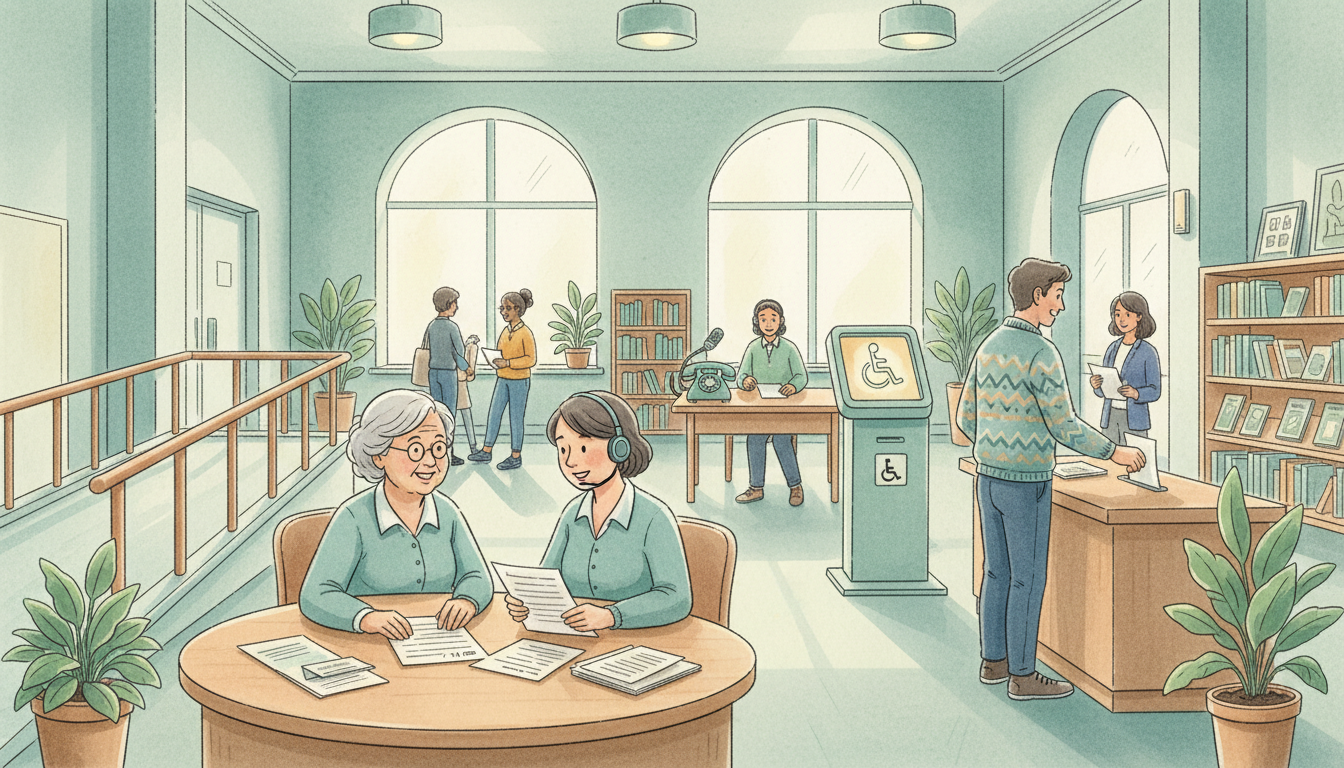
The featured illustration from the existing 2026 eduKate library depicts a conceptual public-service help desk; it is not evidence of an actual accessibility audit, a photograph of the imaginary town or certification of any facility. Readers should not infer a person’s disability or needs from an image.
Quick answer: what does accessibility add to a civilisation?
The accessibility component of civilisation concerns the practical elimination of barriers to equal participation, alongside legitimate rights, user-informed design, appropriate accommodations, trustworthy services and continuing accountability. It connects the physical environment with transport, digital information, learning, work, public administration and community life. Formal permission to enter is not the same as genuine usable access. The decisive question is not whether an institution announces that it welcomes everyone. It is whether people can complete the intended task, with appropriate rights and support, without unnecessary barriers. Accessibility therefore has an operational dimension: routes, information, technology, staff capabilities, feedback and responsible repair.
A rights-based framework, without inventing local entitlements
Article 9 of the UN Convention on the Rights of Persons with Disabilities addresses accessibility to the physical environment, transportation, information and communications, and services open or provided to the public. Its provisions place responsibilities on States Parties in the treaty framework. Particular building standards, legal remedies and service duties must still be checked against the applicable country’s current law and competent institutions.
The World Wide Web Consortium’s WCAG 2.2 is a specific technical recommendation for web content accessibility, not a universal certificate for every physical or digital service. WHO and UNICEF’s assistive-technology report addresses wider access, products and support ecosystems. These sources cover complementary parts of the topic and should not be treated as interchangeable.
Five ways to use the long-form guide
- Primary learner: draw a fictional user journey, explain where a barrier arises and how to ask a respectful question.
- Secondary learner: distinguish a feature from task completion, define an evidence check and write a conditional recommendation.
- Parent: discuss an everyday public-service journey using invented rather than personal medical information.
- Tutor: practise English comprehension, causal reasoning, fair evidence and a revision of the first drawing.
- Research-minded reader: consult the treaty, WHO and W3C sources in their actual scope.
The accessibility journey: a diagram that goes beyond the entrance
| Stage | Key question | A meaningful observation |
|---|---|---|
| Discover | Can a person find clear information about the service? | Understanding of where and how to begin |
| Reach | Is there a usable route from origin to destination? | Task-specific continuity of the route |
| Participate | Can the intended activity be completed using suitable options? | Outcome rather than feature count |
| Ask or decline | Can someone communicate, request support or refuse unwanted help? | Respect for agency and information access |
| Correct | Can a reported barrier be reviewed and meaningfully changed? | Verified practical improvement |
A fictional calculation: features versus completed journeys
Suppose a fictional civic building installs six accessibility features and records that four of eight invented user journeys can be completed without an unresolved barrier. The feature count is six, while the observed task-completion share is 4 ÷ 8 = 50% in the classroom model. These numbers refer to different things. The percentage does not describe real residents or establish legal compliance, and the model does not predict every person’s experience.
Now add a hypothetical improvement: two of the initially unsuccessful imaginary journeys become completable. Six of the same eight routes would then be represented as completed, or 75%, under the classroom’s stated definition. That change is not evidence that a real building meets standards or that every user can participate. It illustrates why specifying the task, sample and conditions is essential before calculating a meaningful outcome.
Part 1: Rights, language and real participation
These six stations examine a different part of the same practical right to participate. Each makes a human task visible, identifies an avoidable barrier, asks which evidence matters and considers a responsible route to improvement. The order is a reading strategy, not a claim that every society or individual follows one path. A child may study one station and return later for another.
Component 01: Access as a right, not a favour
The concept and its mechanism. Public participation should not depend solely on discretionary goodwill by whoever controls a building or service. Begin with the person, not the stereotype. An accessible system is designed around a real task and the conditions under which someone can undertake it, rather than an assumption about what all members of one group can do. State the purpose, map the barriers and ask who is responsible for removing unnecessary obstacles. The same person may find one activity easy and another difficult because of the environment or information. A useful classroom model makes that variation visible. Connect the description directly to access as a right, not a favour. A child should be able to name a specific task and the feature, process or right that makes it achievable.
An illustrative civic situation. A fictional resident is told the town hall’s only accessible entrance may be opened as a special favour. Pause the story before the fictional council announces success. One learner describes the designer’s intent, another follows the task from the user’s perspective and a third checks the evidence. These views may differ without anyone being dishonest. The group should identify a missing piece of information and ask what outcome would count as meaningful access. A tidy diagram is only the beginning of the inquiry. The person is fictional, and the story cannot be used to infer what a real group generally needs. Ask what facts are stated and which information would need respectful consultation.
What could go wrong? When access is treated as charity, an otherwise ordinary civic activity can depend on arbitrary permission. A short-term adaptation may depend on a specific trained person who will not always be available. Ask what happens when that person retires, moves away or is absent. A durable institution documents procedures, appropriate support and correction routes. It cannot make people depend indefinitely on one individual’s generosity. The future obligation is part of the original design. A sound explanation names a possible practical consequence and avoids claiming every user will experience it. The class should propose at least one credible alternative and a question that challenges the first plan.
How would we check? Ask whether a person can participate on a predictable, equal basis rather than only after pleading. Distinguish what organisers provide from what residents experience. A public authority may record a newly accessible facility while an individual encounters a missing transfer or unreadable instruction. Both reports may be accurate within their own scope. The challenge is to identify the difference and collect suitable evidence, not to choose one account simply because it sounds more authoritative. Require an observation of task completion and a statement of limitations rather than relying solely on the number of features installed. Professional or legal assessment remains outside the classroom’s authority.
A safe learning activity. Rewrite a hypothetical building notice to identify ordinary access and an appropriate help route. Invite a respectful conversation in which one student proposes a design and another identifies an overlooked task or person. Each speaker restates the other’s concern before responding. The group then writes a revised plan and a question for further evidence. The exercise should not pressure anyone to disclose personal disabilities. All perspectives may be fictional and still raise meaningful design questions. Use paper, invented users and voluntary discussion without requiring classmates to disclose private circumstances. The tutor can adjust the writing difficulty while keeping the core concept understandable.
Improve the result and preserve it. Sometimes the correct next step is qualified assessment or more information. That does not mean dismissing the problem or refusing practical support. It means identifying the exact task, barrier, evidence needed and authority responsible for a real decision. The classroom model can generate a careful question without pretending to provide individual medical or legal advice. Link this station to the separate theme of crossings and pedestrian routes and identify one connection that could make a broader service succeed or fail. Finish with a short reasoned recommendation, a counterexample and a relevant follow-up check.
Component 02: Barriers rather than assumptions about people
The concept and its mechanism. The environment, information and institutional arrangements can create disability-related barriers alongside individual functional needs. Distinguish the presence of an accommodation from meaningful participation. A sign, device, ramp or policy may be necessary, yet it is only one link in a longer journey. Trace the person’s path from discovering an opportunity through entry, activity, communication and safe departure. If one stage is unusable, an apparently impressive earlier stage may not deliver its intended benefit. The lesson is about end-to-end function, not decorative compliance. Connect the description directly to barriers rather than assumptions about people. A child should be able to name a specific task and the feature, process or right that makes it achievable.
An illustrative civic situation. A pupil can understand a museum explanation but cannot reach its upper gallery because the only route has stairs. Ask who was consulted and whether participation itself was accessible. A meeting about inclusive facilities held in an inaccessible venue contains a practical contradiction. Students can use the imagined scenario to identify how participation routes affect the quality of decisions. The point is not to assume any one attendee represents a whole population; it is to recognise that barriers also operate during consultation. The person is fictional, and the story cannot be used to infer what a real group generally needs. Ask what facts are stated and which information would need respectful consultation.
What could go wrong? Saying the pupil is the problem ignores a remediable physical barrier. A well-intended service can cause harm if it unnecessarily exposes private information or reduces a person’s control over choices. Identify what data or assistance the task actually requires and who has lawful reason to access it. Accessibility should not be treated as permission to publish sensitive records or make decisions on someone’s behalf without appropriate authority. A sound explanation names a possible practical consequence and avoids claiming every user will experience it. The class should propose at least one credible alternative and a question that challenges the first plan.
How would we check? Identify the part of the journey blocked and who is responsible for assessing it. Maintain a traceable line from the question through the source, observation, interpretation and proposed correction. Protect sensitive personal data throughout. Transparency about the method does not require public disclosure of someone’s diagnosis, medical records or other private circumstances. Children can use anonymised hypothetical descriptions and still learn how a design problem is investigated. Require an observation of task completion and a statement of limitations rather than relying solely on the number of features installed. Professional or legal assessment remains outside the classroom’s authority.
A safe learning activity. Draw two imaginary gallery routes and annotate a missing continuous connection. Invite a one-minute teach-back. The pupil explains the difference between a feature and an accessible journey to someone who has not read the article. The listener gives a new condition, such as a changed task or another communication channel. If the first model fails, revise it and explain why. This checks transfer of understanding rather than memory. Use paper, invented users and voluntary discussion without requiring classmates to disclose private circumstances. The tutor can adjust the writing difficulty while keeping the core concept understandable.
Improve the result and preserve it. A useful plan states what new evidence would trigger a review. Perhaps a technological update breaks keyboard operation, a route becomes unavailable or a resident reports an overlooked barrier. Identify who will examine the information and who can authorise a correction. The goal is a practical learning system rather than a promise that the first design will work forever. Link this station to the separate theme of public transport and transfers and identify one connection that could make a broader service succeed or fail. Finish with a short reasoned recommendation, a counterexample and a relevant follow-up check.
Component 03: Universal design and individual accommodations
The concept and its mechanism. Broadly accessible design can reduce barriers, while particular individuals may still require appropriate adaptations. Treat accessibility as a relationship among people, design, information and institutions. A service can be formally open and practically inaccessible, even without deliberate exclusion. Ask what actual task the public should be able to complete, what constraints are imposed by the environment and what kind of review could reveal a problem. A strong explanation identifies a specific barrier rather than making vague claims that every person experiences the same difficulty. Connect the description directly to universal design and individual accommodations. A child should be able to name a specific task and the feature, process or right that makes it achievable.
An illustrative civic situation. The library offers wide aisles but its booking form is unusable for one student’s assistive software. End the fictional story at the point of a measured outcome rather than at the opening of a new facility. Can the intended person complete the activity? Are barriers still present? Is there a way to request a correction? This frame discourages declaring victory from an impressive photograph and encourages evidence linked to the task. The person is fictional, and the story cannot be used to infer what a real group generally needs. Ask what facts are stated and which information would need respectful consultation.
What could go wrong? A universally designed intention does not guarantee that every person needs no accommodation. Some questions have specific legal, technical or professional boundaries. A classroom cannot decide whether a real building meets a code, prescribe an assistive device or settle an accommodation dispute. Students can identify the kinds of evidence and qualified roles needed. This makes their conceptual comparison safer and more precise rather than eliminating meaningful analysis. A sound explanation names a possible practical consequence and avoids claiming every user will experience it. The class should propose at least one credible alternative and a question that challenges the first plan.
How would we check? Compare general accessible features with a specific unresolved task. An honest evaluation must permit a finding that the first plan was insufficient. Ask students what evidence would make them revise their preferred design before constructing an imaginary result. If every possible outcome is called success, the evaluation is ceremonial rather than informative. A useful check identifies a specific stage of the journey and a meaningful result. Require an observation of task completion and a statement of limitations rather than relying solely on the number of features installed. Professional or legal assessment remains outside the classroom’s authority.
A safe learning activity. Create a paper feedback card that asks what task remains inaccessible without seeking a diagnosis. Design a plain-language fictional help card for someone who cannot complete an ordinary public-service task. It should state the purpose, one legitimate option for requesting support and how a problem could be reviewed. It must not claim to grant legal entitlements or replace formal accommodations. A second student checks whether the card is usable as an explanation. Use paper, invented users and voluntary discussion without requiring classmates to disclose private circumstances. The tutor can adjust the writing difficulty while keeping the core concept understandable.
Improve the result and preserve it. Compare the original user journey with the revised one. Name the removed barrier, the newly recognised dependency and the person whose experience prompted reconsideration. A successor should understand the reasoning without needing to trust the original designer’s personal confidence. The ability to pass on and question this knowledge is part of what makes a civilisation inclusive. Link this station to the separate theme of building entrances, doors and thresholds and identify one connection that could make a broader service succeed or fail. Finish with a short reasoned recommendation, a counterexample and a relevant follow-up check.
Component 04: Dignity and self-determination
The concept and its mechanism. People should have meaningful choices about how to access services and what assistance they accept. A relevant right does not perform the practical work by itself. It requires institutions that explain procedures, maintain facilities, provide suitable support and respond when people report barriers. Make the chain of responsibility explicit and distinguish qualified legal duties from a simplified classroom model. The exercise should help students understand why fair access includes operational competence as well as principled language. Connect the description directly to dignity and self-determination. A child should be able to name a specific task and the feature, process or right that makes it achievable.
An illustrative civic situation. A volunteer insists on pushing an imagined wheelchair user’s chair without asking. Imagine the fictional organisers sincerely want inclusion but have limited time, resources and expertise. A barrier can still remain because one service depends on another or because a support arrangement is poorly explained. Students should critique the process without turning every failure into an accusation against an imaginary worker. Identify the step where the intended task fails and the qualified review it requires. The person is fictional, and the story cannot be used to infer what a real group generally needs. Ask what facts are stated and which information would need respectful consultation.
What could go wrong? Unrequested assistance can disregard autonomy despite benevolent intent. Sometimes the best next step is to gather information or obtain qualified assessment rather than make a sweeping claim of compliance. A precise question about a task, environment and intended user can guide this work. The class should explain what it knows, what it cannot determine and why a revision may be needed. This is careful design reasoning, not indecision. A sound explanation names a possible practical consequence and avoids claiming every user will experience it. The class should propose at least one credible alternative and a question that challenges the first plan.
How would we check? Ask whether support is offered respectfully and requires an appropriate response. Choose an observation that bears directly on the intended task. A count of devices installed, signs printed or meetings held may reflect effort but not participation. Ask whether the person can reach, understand or use the service under the specified conditions. State the observation period and the group or task being considered. Where the method is fictional, the results must be labelled accordingly. Require an observation of task completion and a statement of limitations rather than relying solely on the number of features installed. Professional or legal assessment remains outside the classroom’s authority.
A safe learning activity. Write a short fictional exchange that asks before assisting and accepts a refusal. Use four cards: the intended activity, an accessibility feature, a possible remaining barrier and a fair way to check the result. Shuffle them and ask pupils to form a causal explanation. Add one different user or task and invite revision. A strong response will not insist that all people need the same adaptation. It will describe the actual functional question that the model raises. Use paper, invented users and voluntary discussion without requiring classmates to disclose private circumstances. The tutor can adjust the writing difficulty while keeping the core concept understandable.
Improve the result and preserve it. Move the imagined institution ten years ahead. New digital platforms, different public facilities and new users may change where barriers arise. What purpose should stay constant, and which methods need revision? Accessible practice is an ongoing civic capability rather than one permanent checklist. A good handover records the reason for its decisions and known limits. Link this station to the separate theme of facilities and accessible toilets and identify one connection that could make a broader service succeed or fail. Finish with a short reasoned recommendation, a counterexample and a relevant follow-up check.
Component 05: Participation by people with disabilities
The concept and its mechanism. Affected people’s experiences can help identify barriers that designers may not notice. People may rely on many different forms of access at the same time: physical routes, comprehensible information, communication technology, trained assistance and the ability to challenge a mistake. A design that addresses only one channel can leave the larger task unfinished. Ask the learner to identify each connection and label the point at which an intended user might become unable to proceed. A complete route matters more than an attractive isolated feature. Connect the description directly to participation by people with disabilities. A child should be able to name a specific task and the feature, process or right that makes it achievable.
An illustrative civic situation. The town designs a public square without inviting people who use different communication and mobility methods. Create a short user-journey memo for another student who missed the discussion. Include the intended task, barriers seen in the story, what remains uncertain and the next legitimate check. A successor should not need to rely on the original storyteller’s confidence. This connects inclusive design to accurate records and institutional learning. The person is fictional, and the story cannot be used to infer what a real group generally needs. Ask what facts are stated and which information would need respectful consultation.
What could go wrong? A consultation consisting only of able-bodied designers can miss daily practical obstacles. Resources committed to one project may delay other accessibility needs. Ask what is being prioritised and why, while respecting rights and professional standards that are not casual trade-offs. A high-profile entrance renovation might coexist with poor digital communication or a broken downstream route. The class should map the whole service rather than assume the most visible part is the most important. A sound explanation names a possible practical consequence and avoids claiming every user will experience it. The class should propose at least one credible alternative and a question that challenges the first plan.
How would we check? Identify which voices and access methods the project needs. End an evidence claim with its limitation. A global convention defines obligations for states parties, but local implementation depends on law and institutional context. A classroom task gives no legal ruling for a specific resident. Explain the principle, identify the current authoritative source and state which question requires qualified or official guidance. Require an observation of task completion and a statement of limitations rather than relying solely on the number of features installed. Professional or legal assessment remains outside the classroom’s authority.
A safe learning activity. Create an inclusive fictional meeting invitation with varied participation routes. Invite a respectful conversation in which one student proposes a design and another identifies an overlooked task or person. Each speaker restates the other’s concern before responding. The group then writes a revised plan and a question for further evidence. The exercise should not pressure anyone to disclose personal disabilities. All perspectives may be fictional and still raise meaningful design questions. Use paper, invented users and voluntary discussion without requiring classmates to disclose private circumstances. The tutor can adjust the writing difficulty while keeping the core concept understandable.
Improve the result and preserve it. Sometimes the correct next step is qualified assessment or more information. That does not mean dismissing the problem or refusing practical support. It means identifying the exact task, barrier, evidence needed and authority responsible for a real decision. The classroom model can generate a careful question without pretending to provide individual medical or legal advice. Link this station to the separate theme of housing and independent daily life and identify one connection that could make a broader service succeed or fail. Finish with a short reasoned recommendation, a counterexample and a relevant follow-up check.
Component 06: Language, stereotypes and respectful inquiry
The concept and its mechanism. Useful discussion describes particular barriers without assuming one diagnosis determines everyone’s needs. An institution may count how many facilities it has equipped, while a resident can explain whether a task is possible. These observations are related but not interchangeable. The first describes resources; the second concerns the outcome. Ask which evidence would be needed to understand both without collecting sensitive personal information. This keeps the lesson focused on useful participation rather than a superficial count of improvements. Connect the description directly to language, stereotypes and respectful inquiry. A child should be able to name a specific task and the feature, process or right that makes it achievable.
An illustrative civic situation. A school brochure claims all disabled students benefit from the same teaching method. Use two fictional people with different tasks instead of assuming everybody seeks identical support. One may need clearer visual information while another needs a physical alternative, or a person may use both. The class must not infer diagnoses or beliefs from appearance. The useful question is which part of the environment makes a particular task possible or difficult and what intervention might help. The person is fictional, and the story cannot be used to infer what a real group generally needs. Ask what facts are stated and which information would need respectful consultation.
What could go wrong? A stereotype may conceal variation and lead to inappropriate service. An impressive feature count can conceal an incomplete journey. Installing several ramps, captions or support devices may matter, but the task may still be unusable if one essential stage is inaccessible. Ask for an outcome measure closer to successful participation. Avoid assuming that equipment ownership or certification automatically settles all issues of day-to-day use. A sound explanation names a possible practical consequence and avoids claiming every user will experience it. The class should propose at least one credible alternative and a question that challenges the first plan.
How would we check? Ask whether a statement describes verified needs or guesses from a label. Even when a design meets a named standard, a responsible institution should consider continuing use and maintenance. Technical compliance and practical experience are related but not identical. Ask which evidence belongs to professional assessment and which comes from appropriately gathered user experience. Keep the two sources distinct while investigating how they inform one another. Require an observation of task completion and a statement of limitations rather than relying solely on the number of features installed. Professional or legal assessment remains outside the classroom’s authority.
A safe learning activity. Edit a fictional brochure to replace sweeping claims with respectful questions. Invite a one-minute teach-back. The pupil explains the difference between a feature and an accessible journey to someone who has not read the article. The listener gives a new condition, such as a changed task or another communication channel. If the first model fails, revise it and explain why. This checks transfer of understanding rather than memory. Use paper, invented users and voluntary discussion without requiring classmates to disclose private circumstances. The tutor can adjust the writing difficulty while keeping the core concept understandable.
Improve the result and preserve it. A useful plan states what new evidence would trigger a review. Perhaps a technological update breaks keyboard operation, a route becomes unavailable or a resident reports an overlooked barrier. Identify who will examine the information and who can authorise a correction. The goal is a practical learning system rather than a promise that the first design will work forever. Link this station to the separate theme of inclusive schools and classroom routes and identify one connection that could make a broader service succeed or fail. Finish with a short reasoned recommendation, a counterexample and a relevant follow-up check.
Joined case study 1: six interconnected tasks
The six concerns are Access as a right, not a favour; Barriers rather than assumptions about people; Universal design and individual accommodations; Dignity and self-determination; Participation by people with disabilities; Language, stereotypes and respectful inquiry. Put them into one diagram rather than treating each as an isolated checklist. An imaginary school or civic institution may deliver several of the functions well but fail at a single handover. Ask where the path becomes incomplete, whose agency matters and what professional information is missing.
Four pupils take roles: a user-journey mapper, a source checker, a reviewer of obligations and a person writing an accessible explanation for absent residents. Together they compare two possible designs. They should not diagnose anyone or decide actual legal entitlements. Their output is a reasoned proposal, the strongest credible objection and an evidence question that would be useful to a qualified decision maker.
Primary learners may use five boxes and short labels. Secondary students can write a five-paragraph claim–mechanism–counterexample–evidence–revision response. The tutor should mark clarity, respect, appropriate sourcing and recognition of what the illustration cannot prove. The length of the answer is less important than its practical precision.
Part 2: Streets, transport, housing and public buildings
These six stations examine a different part of the same practical right to participate. Each makes a human task visible, identifies an avoidable barrier, asks which evidence matters and considers a responsible route to improvement. The order is a reading strategy, not a claim that every society or individual follows one path. A child may study one station and return later for another.
Component 07: Continuous journeys rather than isolated ramps
The concept and its mechanism. Access depends on the complete path from origin to destination, not one accessible feature. Universal design can reduce foreseeable barriers through inclusive planning, but it is not a promise that no person will ever need an individual accommodation. Ask what a well-designed general system accomplishes and what additional support may remain appropriate. The aim is to recognise diverse needs, not to assign a single solution based on a label. A child can practise by comparing two fictional tasks and the steps required to finish each. Connect the description directly to continuous journeys rather than isolated ramps. A child should be able to name a specific task and the feature, process or right that makes it achievable.
An illustrative civic situation. A town hall has a ramp at its front door but the bus stop has no suitable approach path. Have learners compare the fictional user’s actual route with the organiser’s summary of the facilities installed. Where do the descriptions diverge? A policy may be true about its own measures and still incomplete about lived outcomes. Ask what observation could bring the two accounts together. This teaches precision without requiring anyone to share a real personal disability or medical history. The person is fictional, and the story cannot be used to infer what a real group generally needs. Ask what facts are stated and which information would need respectful consultation.
What could go wrong? One compliant-looking entrance cannot make an entire journey usable. An appropriate general standard can assist design, but no single procedure describes every user’s experience. Ask which recognised requirement applies and where user-informed testing and legitimate accommodations remain necessary. The student should not invent an engineering dimension or assume a document is a universal guarantee. A clear standard and meaningful practical evidence have complementary roles. A sound explanation names a possible practical consequence and avoids claiming every user will experience it. The class should propose at least one credible alternative and a question that challenges the first plan.
How would we check? Trace every transfer, crossing, surface and information point in the route. An accessible feedback system should have a clear reviewer, a reasonable way to communicate a decision and a method of checking whether the problem changed. Collecting complaints without action can deepen exclusion. Have pupils trace the entire feedback loop from user experience to correction. No invented statistical score substitutes for the person’s actual ability to access the task. Require an observation of task completion and a statement of limitations rather than relying solely on the number of features installed. Professional or legal assessment remains outside the classroom’s authority.
A safe learning activity. Draw a paper journey from an imaginary home to a library, marking barriers. Design a plain-language fictional help card for someone who cannot complete an ordinary public-service task. It should state the purpose, one legitimate option for requesting support and how a problem could be reviewed. It must not claim to grant legal entitlements or replace formal accommodations. A second student checks whether the card is usable as an explanation. Use paper, invented users and voluntary discussion without requiring classmates to disclose private circumstances. The tutor can adjust the writing difficulty while keeping the core concept understandable.
Improve the result and preserve it. Compare the original user journey with the revised one. Name the removed barrier, the newly recognised dependency and the person whose experience prompted reconsideration. A successor should understand the reasoning without needing to trust the original designer’s personal confidence. The ability to pass on and question this knowledge is part of what makes a civilisation inclusive. Link this station to the separate theme of assessment accessibility and learning evidence and identify one connection that could make a broader service succeed or fail. Finish with a short reasoned recommendation, a counterexample and a relevant follow-up check.
Component 08: Crossings and pedestrian routes
The concept and its mechanism. Streets need appropriate crossing, navigation and maintenance arrangements for diverse users. Everyday dignity is part of a system’s performance. People should not have to accept intrusive assistance, disclose unnecessary personal details or depend on a stranger’s arbitrary kindness to perform ordinary activities. Identify how a service communicates choice and offers legitimate help. A thoughtful diagram should include the affected person’s agency, not merely the convenience of the organiser. Connect the description directly to crossings and pedestrian routes. A child should be able to name a specific task and the feature, process or right that makes it achievable.
An illustrative civic situation. A model pedestrian route ends at an intersection with missing tactile information. In the imagined settlement, students should draw the journey and identify every transition rather than focusing only on the most visible feature. A building may have an accessible entrance but an unusable booking process, or a readable notice but no practical route to its destination. Ask which part of the scenario is given as fact and which remains an assumption. The exercise makes the full path visible before the class proposes a correction. The person is fictional, and the story cannot be used to infer what a real group generally needs. Ask what facts are stated and which information would need respectful consultation.
What could go wrong? A smooth pavement alone does not guarantee a safe journey. The strongest objection addresses a particular assumption rather than challenging a person’s identity. Perhaps a proposed pathway depends on a lift that often fails or a captioning method that cannot support a critical exchange. State the problem precisely and consider an alternative. A respectful critique can improve a design while retaining the recognition that access is a legitimate public concern. A sound explanation names a possible practical consequence and avoids claiming every user will experience it. The class should propose at least one credible alternative and a question that challenges the first plan.
How would we check? List what a qualified local accessibility and road-safety assessment would need. A change in reported barriers can reflect improvement, worsening conditions, increased awareness or a new reporting route. Ask what second observation would help interpret the trend. A trustworthy system should encourage relevant feedback rather than suppress complaints to improve a dashboard. The measure becomes valuable when it leads to an appropriate response. Require an observation of task completion and a statement of limitations rather than relying solely on the number of features installed. Professional or legal assessment remains outside the classroom’s authority.
A safe learning activity. Compare two imaginary crossing layouts without claiming engineering certification. Use four cards: the intended activity, an accessibility feature, a possible remaining barrier and a fair way to check the result. Shuffle them and ask pupils to form a causal explanation. Add one different user or task and invite revision. A strong response will not insist that all people need the same adaptation. It will describe the actual functional question that the model raises. Use paper, invented users and voluntary discussion without requiring classmates to disclose private circumstances. The tutor can adjust the writing difficulty while keeping the core concept understandable.
Improve the result and preserve it. Move the imagined institution ten years ahead. New digital platforms, different public facilities and new users may change where barriers arise. What purpose should stay constant, and which methods need revision? Accessible practice is an ongoing civic capability rather than one permanent checklist. A good handover records the reason for its decisions and known limits. Link this station to the separate theme of assistive communication and expression and identify one connection that could make a broader service succeed or fail. Finish with a short reasoned recommendation, a counterexample and a relevant follow-up check.
Component 09: Public transport and transfers
The concept and its mechanism. Accessible journeys rely on vehicles, platforms, information and reliable transfers working together. A system may work well for one person and fail for another without either account being a complete survey. Give two imaginary users different needs, then compare the specific environmental and institutional factors that change their experience. Use the contrast to generate questions for consultation and testing. Do not treat either fictional user as a spokesperson for all people with a similar identity or condition. Connect the description directly to public transport and transfers. A child should be able to name a specific task and the feature, process or right that makes it achievable.
An illustrative civic situation. One fictional bus accepts a mobility aid but a transfer to the train is unavailable. Introduce a plausible new fact after the class has made its first recommendation. Perhaps the service moves online, the usual lift is unavailable or the visitor needs a different communication method. Which part of the model changes? A child who can revise the causal diagram has understood the relationship, not merely memorised a slogan about accessibility. The new answer should state what remains unknown. The person is fictional, and the story cannot be used to infer what a real group generally needs. Ask what facts are stated and which information would need respectful consultation.
What could go wrong? A fleet-level accessibility statistic may hide unsuccessful trips. Future users may inherit a physically intact facility whose communication systems or service routes have become outdated. A project is therefore not finished forever when its first inspection is completed. A responsible plan includes maintenance, ongoing feedback and the possibility of redesign. Ask what people ten years later would need to know to assess whether the arrangement still works. A sound explanation names a possible practical consequence and avoids claiming every user will experience it. The class should propose at least one credible alternative and a question that challenges the first plan.
How would we check? Check door-to-door journey completion and travel-information clarity. Be careful with averages. A service might be successful for most participants while leaving a small group unable to complete an essential task. The average does not erase the importance of that barrier. At the same time, one fictional case cannot be treated as a measured rate. Students need to distinguish an issue worth investigating from evidence of its prevalence. Require an observation of task completion and a statement of limitations rather than relying solely on the number of features installed. Professional or legal assessment remains outside the classroom’s authority.
A safe learning activity. Map a hypothetical trip with a bus, station, lift and destination. Invite a respectful conversation in which one student proposes a design and another identifies an overlooked task or person. Each speaker restates the other’s concern before responding. The group then writes a revised plan and a question for further evidence. The exercise should not pressure anyone to disclose personal disabilities. All perspectives may be fictional and still raise meaningful design questions. Use paper, invented users and voluntary discussion without requiring classmates to disclose private circumstances. The tutor can adjust the writing difficulty while keeping the core concept understandable.
Improve the result and preserve it. Sometimes the correct next step is qualified assessment or more information. That does not mean dismissing the problem or refusing practical support. It means identifying the exact task, barrier, evidence needed and authority responsible for a real decision. The classroom model can generate a careful question without pretending to provide individual medical or legal advice. Link this station to the separate theme of healthcare access and informed communication and identify one connection that could make a broader service succeed or fail. Finish with a short reasoned recommendation, a counterexample and a relevant follow-up check.
Component 10: Building entrances, doors and thresholds
The concept and its mechanism. Public buildings can impose barriers through entrances, doors, thresholds and circulation routes. People who experience barriers often notice practical details that a designer cannot infer from abstract standards alone. Genuine participation therefore requires suitable ways for affected users to provide feedback. This does not mean asking one person to speak for everyone. A credible process includes multiple perspectives, appropriate professional methods and a route through which comments can actually influence the design. Connect the description directly to building entrances, doors and thresholds. A child should be able to name a specific task and the feature, process or right that makes it achievable.
An illustrative civic situation. A school annex advertises an accessible entrance but its doors cannot be independently operated by one visitor. Ask whether the person’s ability to refuse unwanted assistance or choose another route is visible in the plan. A service may reach its objective in a technical sense while diminishing autonomy. The imagined case lets the class discuss agency without passing judgement on real people’s support needs. Meaningful access involves both capability and dignity. The person is fictional, and the story cannot be used to infer what a real group generally needs. Ask what facts are stated and which information would need respectful consultation.
What could go wrong? A sign and a route on a map do not establish practical usability. Equal-looking rules can produce unequal practical outcomes. A service may offer one submission method to everyone but effectively exclude people who cannot use it. Give two fictional residents different task requirements and compare the steps they can complete. Do not generalise from a single invented person to a real group. The goal is to discover a question that suitable user testing could answer. A sound explanation names a possible practical consequence and avoids claiming every user will experience it. The class should propose at least one credible alternative and a question that challenges the first plan.
How would we check? Ask whether a person can enter, move through and leave using appropriate options. A simplified paper route cannot certify a real facility’s safety, lawful compliance or suitability to a specific individual. Students can still identify useful evidence questions, such as whether the intended task is completed and what prevents it. A qualified assessor and applicable standards are necessary for real decisions, and the learning materials should state this clearly. Require an observation of task completion and a statement of limitations rather than relying solely on the number of features installed. Professional or legal assessment remains outside the classroom’s authority.
A safe learning activity. Draw a conceptual entrance audit without measuring actual code compliance. Invite a one-minute teach-back. The pupil explains the difference between a feature and an accessible journey to someone who has not read the article. The listener gives a new condition, such as a changed task or another communication channel. If the first model fails, revise it and explain why. This checks transfer of understanding rather than memory. Use paper, invented users and voluntary discussion without requiring classmates to disclose private circumstances. The tutor can adjust the writing difficulty while keeping the core concept understandable.
Improve the result and preserve it. A useful plan states what new evidence would trigger a review. Perhaps a technological update breaks keyboard operation, a route becomes unavailable or a resident reports an overlooked barrier. Identify who will examine the information and who can authorise a correction. The goal is a practical learning system rather than a promise that the first design will work forever. Link this station to the separate theme of employment and accessible workplaces and identify one connection that could make a broader service succeed or fail. Finish with a short reasoned recommendation, a counterexample and a relevant follow-up check.
Component 11: Facilities and accessible toilets
The concept and its mechanism. Accessibility includes appropriate facilities once a person has entered a venue. Ask the learner to imagine that the first organiser of an accessible service leaves next year. What knowledge, support arrangements and user feedback would a successor need to maintain the outcome? Accessibility is not a one-off photograph of a completed installation. It is a continuing institutional responsibility that may require renewed maintenance, better information and revised choices when conditions change. Connect the description directly to facilities and accessible toilets. A child should be able to name a specific task and the feature, process or right that makes it achievable.
An illustrative civic situation. The fictional sports centre has an accessible front door but no usable toilet facilities. Build a four-stage timeline: the public opportunity is announced, a person tries to enter the system, they attempt the intended activity and they report the result. A missing or inaccessible stage should receive a question mark rather than a convenient invented explanation. This teaches the difference between formal promises, actual delivery and accountable correction. The person is fictional, and the story cannot be used to infer what a real group generally needs. Ask what facts are stated and which information would need respectful consultation.
What could go wrong? Entry permission can conceal exclusion from prolonged participation. A convenient solution for organisers may shift difficulty onto the person receiving the service. A digital-only process can reduce staff effort while increasing the burden on someone without a compatible device. A route change can improve traffic flow while blocking an accessible approach. Identify who gains, who might encounter a new barrier and what evidence would be needed. The possibility of an unintended effect is not proof that it occurred. A sound explanation names a possible practical consequence and avoids claiming every user will experience it. The class should propose at least one credible alternative and a question that challenges the first plan.
How would we check? Trace the complete visit and the facilities it requires. Definitions matter. Two reports may use ‘accessible’ to mean that a feature was installed or that a person completed a task. Those are different statements. Check the categories, reference date, methods and users included before comparing outcomes. If a published score changes because the definition changed, do not present the entire difference as real improvement or decline. Require an observation of task completion and a statement of limitations rather than relying solely on the number of features installed. Professional or legal assessment remains outside the classroom’s authority.
A safe learning activity. Make a paper visitor journey checklist with realistic privacy boundaries. Design a plain-language fictional help card for someone who cannot complete an ordinary public-service task. It should state the purpose, one legitimate option for requesting support and how a problem could be reviewed. It must not claim to grant legal entitlements or replace formal accommodations. A second student checks whether the card is usable as an explanation. Use paper, invented users and voluntary discussion without requiring classmates to disclose private circumstances. The tutor can adjust the writing difficulty while keeping the core concept understandable.
Improve the result and preserve it. Compare the original user journey with the revised one. Name the removed barrier, the newly recognised dependency and the person whose experience prompted reconsideration. A successor should understand the reasoning without needing to trust the original designer’s personal confidence. The ability to pass on and question this knowledge is part of what makes a civilisation inclusive. Link this station to the separate theme of care work and family support and identify one connection that could make a broader service succeed or fail. Finish with a short reasoned recommendation, a counterexample and a relevant follow-up check.
Component 12: Housing and independent daily life
The concept and its mechanism. The homes people occupy can affect whether they can live and participate according to their needs. A responsible explanation ends with a specific observation. It might concern successful completion of a journey or task, comprehension of a notice, or whether a person can obtain help without an unreasonable barrier. The claim should be narrow enough to be tested. A hypothetical success story can illustrate the question but cannot establish real-world compliance, health effects or the legal rights of a particular resident. Connect the description directly to housing and independent daily life. A child should be able to name a specific task and the feature, process or right that makes it achievable.
An illustrative civic situation. A family considers a housing design whose doorway and internal layout may be inaccessible to a member. Move the same service to another fictional neighbourhood with different distances or transport. Which features remain useful and which assumptions no longer hold? The comparison should be based on task completion rather than stereotypes. A design cannot be declared universally accessible solely because it worked in one classroom illustration. The person is fictional, and the story cannot be used to infer what a real group generally needs. Ask what facts are stated and which information would need respectful consultation.
What could go wrong? A house’s advertised bedroom count does not establish suitable independent use. Two apparent alternatives may fail together because they share a hidden dependency. A website and telephone help line could both rely on one unavailable service centre, or two routes might both require the same broken lift. Draw the dependencies before declaring resilience. Genuine alternatives should be evaluated against the actual barrier they are intended to overcome. A sound explanation names a possible practical consequence and avoids claiming every user will experience it. The class should propose at least one credible alternative and a question that challenges the first plan.
How would we check? Ask how the design supports ordinary routines while respecting privacy. One anecdote can reveal a real barrier without demonstrating how commonly it occurs. An aggregate figure can identify a broad pattern while overlooking a severe problem for a smaller group. A sound evaluation may use several methods with appropriate privacy and consent protections. Ask what the evidence can establish and what it cannot without more investigation. Require an observation of task completion and a statement of limitations rather than relying solely on the number of features installed. Professional or legal assessment remains outside the classroom’s authority.
A safe learning activity. Compare two imaginary floor plans, noting that real approval needs qualified review. Use four cards: the intended activity, an accessibility feature, a possible remaining barrier and a fair way to check the result. Shuffle them and ask pupils to form a causal explanation. Add one different user or task and invite revision. A strong response will not insist that all people need the same adaptation. It will describe the actual functional question that the model raises. Use paper, invented users and voluntary discussion without requiring classmates to disclose private circumstances. The tutor can adjust the writing difficulty while keeping the core concept understandable.
Improve the result and preserve it. Move the imagined institution ten years ahead. New digital platforms, different public facilities and new users may change where barriers arise. What purpose should stay constant, and which methods need revision? Accessible practice is an ongoing civic capability rather than one permanent checklist. A good handover records the reason for its decisions and known limits. Link this station to the separate theme of captions and information from speech and identify one connection that could make a broader service succeed or fail. Finish with a short reasoned recommendation, a counterexample and a relevant follow-up check.
Joined case study 2: six interconnected tasks
The six concerns are Continuous journeys rather than isolated ramps; Crossings and pedestrian routes; Public transport and transfers; Building entrances, doors and thresholds; Facilities and accessible toilets; Housing and independent daily life. Put them into one diagram rather than treating each as an isolated checklist. An imaginary school or civic institution may deliver several of the functions well but fail at a single handover. Ask where the path becomes incomplete, whose agency matters and what professional information is missing.
Four pupils take roles: a user-journey mapper, a source checker, a reviewer of obligations and a person writing an accessible explanation for absent residents. Together they compare two possible designs. They should not diagnose anyone or decide actual legal entitlements. Their output is a reasoned proposal, the strongest credible objection and an evidence question that would be useful to a qualified decision maker.
Primary learners may use five boxes and short labels. Secondary students can write a five-paragraph claim–mechanism–counterexample–evidence–revision response. The tutor should mark clarity, respect, appropriate sourcing and recognition of what the illustration cannot prove. The length of the answer is less important than its practical precision.
Part 3: Education, health and work throughout life
These six stations examine a different part of the same practical right to participate. Each makes a human task visible, identifies an avoidable barrier, asks which evidence matters and considers a responsible route to improvement. The order is a reading strategy, not a claim that every society or individual follows one path. A child may study one station and return later for another.
Component 13: Inclusive schools and classroom routes
The concept and its mechanism. Educational access includes physical space, communication, teaching materials and appropriate support. Begin with the person, not the stereotype. An accessible system is designed around a real task and the conditions under which someone can undertake it, rather than an assumption about what all members of one group can do. State the purpose, map the barriers and ask who is responsible for removing unnecessary obstacles. The same person may find one activity easy and another difficult because of the environment or information. A useful classroom model makes that variation visible. Connect the description directly to inclusive schools and classroom routes. A child should be able to name a specific task and the feature, process or right that makes it achievable.
An illustrative civic situation. A pupil reaches the school entrance but cannot access a classroom activity presented only in one format. Pause the story before the fictional council announces success. One learner describes the designer’s intent, another follows the task from the user’s perspective and a third checks the evidence. These views may differ without anyone being dishonest. The group should identify a missing piece of information and ask what outcome would count as meaningful access. A tidy diagram is only the beginning of the inquiry. The person is fictional, and the story cannot be used to infer what a real group generally needs. Ask what facts are stated and which information would need respectful consultation.
What could go wrong? Enrolment alone does not guarantee meaningful learning participation. A short-term adaptation may depend on a specific trained person who will not always be available. Ask what happens when that person retires, moves away or is absent. A durable institution documents procedures, appropriate support and correction routes. It cannot make people depend indefinitely on one individual’s generosity. The future obligation is part of the original design. A sound explanation names a possible practical consequence and avoids claiming every user will experience it. The class should propose at least one credible alternative and a question that challenges the first plan.
How would we check? Examine the complete path from arrival to lesson and feedback. Distinguish what organisers provide from what residents experience. A public authority may record a newly accessible facility while an individual encounters a missing transfer or unreadable instruction. Both reports may be accurate within their own scope. The challenge is to identify the difference and collect suitable evidence, not to choose one account simply because it sounds more authoritative. Require an observation of task completion and a statement of limitations rather than relying solely on the number of features installed. Professional or legal assessment remains outside the classroom’s authority.
A safe learning activity. Redesign a fictional learning task in multiple accessible formats. Invite a respectful conversation in which one student proposes a design and another identifies an overlooked task or person. Each speaker restates the other’s concern before responding. The group then writes a revised plan and a question for further evidence. The exercise should not pressure anyone to disclose personal disabilities. All perspectives may be fictional and still raise meaningful design questions. Use paper, invented users and voluntary discussion without requiring classmates to disclose private circumstances. The tutor can adjust the writing difficulty while keeping the core concept understandable.
Improve the result and preserve it. Sometimes the correct next step is qualified assessment or more information. That does not mean dismissing the problem or refusing practical support. It means identifying the exact task, barrier, evidence needed and authority responsible for a real decision. The classroom model can generate a careful question without pretending to provide individual medical or legal advice. Link this station to the separate theme of sign-language interpreting and choice and identify one connection that could make a broader service succeed or fail. Finish with a short reasoned recommendation, a counterexample and a relevant follow-up check.
Component 14: Assessment accessibility and learning evidence
The concept and its mechanism. Assessment methods should distinguish the capability being evaluated from avoidable format barriers. Distinguish the presence of an accommodation from meaningful participation. A sign, device, ramp or policy may be necessary, yet it is only one link in a longer journey. Trace the person’s path from discovering an opportunity through entry, activity, communication and safe departure. If one stage is unusable, an apparently impressive earlier stage may not deliver its intended benefit. The lesson is about end-to-end function, not decorative compliance. Connect the description directly to assessment accessibility and learning evidence. A child should be able to name a specific task and the feature, process or right that makes it achievable.
An illustrative civic situation. An imaginary student understands science but cannot use an inaccessible digital quiz interface. Ask who was consulted and whether participation itself was accessible. A meeting about inclusive facilities held in an inaccessible venue contains a practical contradiction. Students can use the imagined scenario to identify how participation routes affect the quality of decisions. The point is not to assume any one attendee represents a whole population; it is to recognise that barriers also operate during consultation. The person is fictional, and the story cannot be used to infer what a real group generally needs. Ask what facts are stated and which information would need respectful consultation.
What could go wrong? A poor score may reflect the test’s design rather than the intended skill. A well-intended service can cause harm if it unnecessarily exposes private information or reduces a person’s control over choices. Identify what data or assistance the task actually requires and who has lawful reason to access it. Accessibility should not be treated as permission to publish sensitive records or make decisions on someone’s behalf without appropriate authority. A sound explanation names a possible practical consequence and avoids claiming every user will experience it. The class should propose at least one credible alternative and a question that challenges the first plan.
How would we check? Ask what the assessment is meant to measure and which adjustments need authorised decisions. Maintain a traceable line from the question through the source, observation, interpretation and proposed correction. Protect sensitive personal data throughout. Transparency about the method does not require public disclosure of someone’s diagnosis, medical records or other private circumstances. Children can use anonymised hypothetical descriptions and still learn how a design problem is investigated. Require an observation of task completion and a statement of limitations rather than relying solely on the number of features installed. Professional or legal assessment remains outside the classroom’s authority.
A safe learning activity. Create paper alternative prompts without promising actual examination accommodations. Invite a one-minute teach-back. The pupil explains the difference between a feature and an accessible journey to someone who has not read the article. The listener gives a new condition, such as a changed task or another communication channel. If the first model fails, revise it and explain why. This checks transfer of understanding rather than memory. Use paper, invented users and voluntary discussion without requiring classmates to disclose private circumstances. The tutor can adjust the writing difficulty while keeping the core concept understandable.
Improve the result and preserve it. A useful plan states what new evidence would trigger a review. Perhaps a technological update breaks keyboard operation, a route becomes unavailable or a resident reports an overlooked barrier. Identify who will examine the information and who can authorise a correction. The goal is a practical learning system rather than a promise that the first design will work forever. Link this station to the separate theme of readable signs and wayfinding and identify one connection that could make a broader service succeed or fail. Finish with a short reasoned recommendation, a counterexample and a relevant follow-up check.
Component 15: Assistive communication and expression
The concept and its mechanism. People may use varied communication methods, aids and languages to share decisions and needs. Treat accessibility as a relationship among people, design, information and institutions. A service can be formally open and practically inaccessible, even without deliberate exclusion. Ask what actual task the public should be able to complete, what constraints are imposed by the environment and what kind of review could reveal a problem. A strong explanation identifies a specific barrier rather than making vague claims that every person experiences the same difficulty. Connect the description directly to assistive communication and expression. A child should be able to name a specific task and the feature, process or right that makes it achievable.
An illustrative civic situation. A meeting chair accepts speech-only contributions while one participant uses a communication device. End the fictional story at the point of a measured outcome rather than at the opening of a new facility. Can the intended person complete the activity? Are barriers still present? Is there a way to request a correction? This frame discourages declaring victory from an impressive photograph and encourages evidence linked to the task. The person is fictional, and the story cannot be used to infer what a real group generally needs. Ask what facts are stated and which information would need respectful consultation.
What could go wrong? Restricting expression to one mode can silence someone whose view is relevant. Some questions have specific legal, technical or professional boundaries. A classroom cannot decide whether a real building meets a code, prescribe an assistive device or settle an accommodation dispute. Students can identify the kinds of evidence and qualified roles needed. This makes their conceptual comparison safer and more precise rather than eliminating meaningful analysis. A sound explanation names a possible practical consequence and avoids claiming every user will experience it. The class should propose at least one credible alternative and a question that challenges the first plan.
How would we check? Check whether the participant’s chosen communication route is supported. An honest evaluation must permit a finding that the first plan was insufficient. Ask students what evidence would make them revise their preferred design before constructing an imaginary result. If every possible outcome is called success, the evaluation is ceremonial rather than informative. A useful check identifies a specific stage of the journey and a meaningful result. Require an observation of task completion and a statement of limitations rather than relying solely on the number of features installed. Professional or legal assessment remains outside the classroom’s authority.
A safe learning activity. Design a fictional feedback exercise allowing text, symbols and spoken contributions. Design a plain-language fictional help card for someone who cannot complete an ordinary public-service task. It should state the purpose, one legitimate option for requesting support and how a problem could be reviewed. It must not claim to grant legal entitlements or replace formal accommodations. A second student checks whether the card is usable as an explanation. Use paper, invented users and voluntary discussion without requiring classmates to disclose private circumstances. The tutor can adjust the writing difficulty while keeping the core concept understandable.
Improve the result and preserve it. Compare the original user journey with the revised one. Name the removed barrier, the newly recognised dependency and the person whose experience prompted reconsideration. A successor should understand the reasoning without needing to trust the original designer’s personal confidence. The ability to pass on and question this knowledge is part of what makes a civilisation inclusive. Link this station to the separate theme of plain language and cognitive accessibility and identify one connection that could make a broader service succeed or fail. Finish with a short reasoned recommendation, a counterexample and a relevant follow-up check.
Component 16: Healthcare access and informed communication
The concept and its mechanism. Accessible health services need trustworthy communication, physical reach and professional respect. A relevant right does not perform the practical work by itself. It requires institutions that explain procedures, maintain facilities, provide suitable support and respond when people report barriers. Make the chain of responsibility explicit and distinguish qualified legal duties from a simplified classroom model. The exercise should help students understand why fair access includes operational competence as well as principled language. Connect the description directly to healthcare access and informed communication. A child should be able to name a specific task and the feature, process or right that makes it achievable.
An illustrative civic situation. An imagined clinic sends important appointment information only through a difficult-to-use interface. Imagine the fictional organisers sincerely want inclusion but have limited time, resources and expertise. A barrier can still remain because one service depends on another or because a support arrangement is poorly explained. Students should critique the process without turning every failure into an accusation against an imaginary worker. Identify the step where the intended task fails and the qualified review it requires. The person is fictional, and the story cannot be used to infer what a real group generally needs. Ask what facts are stated and which information would need respectful consultation.
What could go wrong? A technically accurate notice may not be understood by the person it concerns. Sometimes the best next step is to gather information or obtain qualified assessment rather than make a sweeping claim of compliance. A precise question about a task, environment and intended user can guide this work. The class should explain what it knows, what it cannot determine and why a revision may be needed. This is careful design reasoning, not indecision. A sound explanation names a possible practical consequence and avoids claiming every user will experience it. The class should propose at least one credible alternative and a question that challenges the first plan.
How would we check? Identify legitimate clinician responsibilities, communication barriers and practical access. Choose an observation that bears directly on the intended task. A count of devices installed, signs printed or meetings held may reflect effort but not participation. Ask whether the person can reach, understand or use the service under the specified conditions. State the observation period and the group or task being considered. Where the method is fictional, the results must be labelled accordingly. Require an observation of task completion and a statement of limitations rather than relying solely on the number of features installed. Professional or legal assessment remains outside the classroom’s authority.
A safe learning activity. Write a list of safe questions for a qualified healthcare provider rather than medical advice. Use four cards: the intended activity, an accessibility feature, a possible remaining barrier and a fair way to check the result. Shuffle them and ask pupils to form a causal explanation. Add one different user or task and invite revision. A strong response will not insist that all people need the same adaptation. It will describe the actual functional question that the model raises. Use paper, invented users and voluntary discussion without requiring classmates to disclose private circumstances. The tutor can adjust the writing difficulty while keeping the core concept understandable.
Improve the result and preserve it. Move the imagined institution ten years ahead. New digital platforms, different public facilities and new users may change where barriers arise. What purpose should stay constant, and which methods need revision? Accessible practice is an ongoing civic capability rather than one permanent checklist. A good handover records the reason for its decisions and known limits. Link this station to the separate theme of web accessibility standards and scope and identify one connection that could make a broader service succeed or fail. Finish with a short reasoned recommendation, a counterexample and a relevant follow-up check.
Component 17: Employment and accessible workplaces
The concept and its mechanism. Participation at work includes recruitment, work environment, job tools and fair procedures. People may rely on many different forms of access at the same time: physical routes, comprehensible information, communication technology, trained assistance and the ability to challenge a mistake. A design that addresses only one channel can leave the larger task unfinished. Ask the learner to identify each connection and label the point at which an intended user might become unable to proceed. A complete route matters more than an attractive isolated feature. Connect the description directly to employment and accessible workplaces. A child should be able to name a specific task and the feature, process or right that makes it achievable.
An illustrative civic situation. A qualified candidate cannot complete a job application because the website is incompatible with assistive software. Create a short user-journey memo for another student who missed the discussion. Include the intended task, barriers seen in the story, what remains uncertain and the next legitimate check. A successor should not need to rely on the original storyteller’s confidence. This connects inclusive design to accurate records and institutional learning. The person is fictional, and the story cannot be used to infer what a real group generally needs. Ask what facts are stated and which information would need respectful consultation.
What could go wrong? Formal openness to applicants may conceal exclusion before an interview. Resources committed to one project may delay other accessibility needs. Ask what is being prioritised and why, while respecting rights and professional standards that are not casual trade-offs. A high-profile entrance renovation might coexist with poor digital communication or a broken downstream route. The class should map the whole service rather than assume the most visible part is the most important. A sound explanation names a possible practical consequence and avoids claiming every user will experience it. The class should propose at least one credible alternative and a question that challenges the first plan.
How would we check? Test the entire recruitment pathway conceptually and identify relevant qualified oversight. End an evidence claim with its limitation. A global convention defines obligations for states parties, but local implementation depends on law and institutional context. A classroom task gives no legal ruling for a specific resident. Explain the principle, identify the current authoritative source and state which question requires qualified or official guidance. Require an observation of task completion and a statement of limitations rather than relying solely on the number of features installed. Professional or legal assessment remains outside the classroom’s authority.
A safe learning activity. Rewrite a fictional job application instruction with an alternative submission route. Invite a respectful conversation in which one student proposes a design and another identifies an overlooked task or person. Each speaker restates the other’s concern before responding. The group then writes a revised plan and a question for further evidence. The exercise should not pressure anyone to disclose personal disabilities. All perspectives may be fictional and still raise meaningful design questions. Use paper, invented users and voluntary discussion without requiring classmates to disclose private circumstances. The tutor can adjust the writing difficulty while keeping the core concept understandable.
Improve the result and preserve it. Sometimes the correct next step is qualified assessment or more information. That does not mean dismissing the problem or refusing practical support. It means identifying the exact task, barrier, evidence needed and authority responsible for a real decision. The classroom model can generate a careful question without pretending to provide individual medical or legal advice. Link this station to the separate theme of keyboard and alternative input and identify one connection that could make a broader service succeed or fail. Finish with a short reasoned recommendation, a counterexample and a relevant follow-up check.
Component 18: Care work and family support
The concept and its mechanism. Families may provide support, but services should not assume unpaid carers can perform every task indefinitely. An institution may count how many facilities it has equipped, while a resident can explain whether a task is possible. These observations are related but not interchangeable. The first describes resources; the second concerns the outcome. Ask which evidence would be needed to understand both without collecting sensitive personal information. This keeps the lesson focused on useful participation rather than a superficial count of improvements. Connect the description directly to care work and family support. A child should be able to name a specific task and the feature, process or right that makes it achievable.
An illustrative civic situation. A household is expected to supply all transport and communication assistance without public guidance. Use two fictional people with different tasks instead of assuming everybody seeks identical support. One may need clearer visual information while another needs a physical alternative, or a person may use both. The class must not infer diagnoses or beliefs from appearance. The useful question is which part of the environment makes a particular task possible or difficult and what intervention might help. The person is fictional, and the story cannot be used to infer what a real group generally needs. Ask what facts are stated and which information would need respectful consultation.
What could go wrong? An arrangement can transfer excessive burden to relatives while claiming nominal access. An impressive feature count can conceal an incomplete journey. Installing several ramps, captions or support devices may matter, but the task may still be unusable if one essential stage is inaccessible. Ask for an outcome measure closer to successful participation. Avoid assuming that equipment ownership or certification automatically settles all issues of day-to-day use. A sound explanation names a possible practical consequence and avoids claiming every user will experience it. The class should propose at least one credible alternative and a question that challenges the first plan.
How would we check? Identify which tasks are familial choices and which are institutional responsibilities. Even when a design meets a named standard, a responsible institution should consider continuing use and maintenance. Technical compliance and practical experience are related but not identical. Ask which evidence belongs to professional assessment and which comes from appropriately gathered user experience. Keep the two sources distinct while investigating how they inform one another. Require an observation of task completion and a statement of limitations rather than relying solely on the number of features installed. Professional or legal assessment remains outside the classroom’s authority.
A safe learning activity. Map a fictional support network without requesting private family information. Invite a one-minute teach-back. The pupil explains the difference between a feature and an accessible journey to someone who has not read the article. The listener gives a new condition, such as a changed task or another communication channel. If the first model fails, revise it and explain why. This checks transfer of understanding rather than memory. Use paper, invented users and voluntary discussion without requiring classmates to disclose private circumstances. The tutor can adjust the writing difficulty while keeping the core concept understandable.
Improve the result and preserve it. A useful plan states what new evidence would trigger a review. Perhaps a technological update breaks keyboard operation, a route becomes unavailable or a resident reports an overlooked barrier. Identify who will examine the information and who can authorise a correction. The goal is a practical learning system rather than a promise that the first design will work forever. Link this station to the separate theme of screen readers and meaningful structure and identify one connection that could make a broader service succeed or fail. Finish with a short reasoned recommendation, a counterexample and a relevant follow-up check.
Joined case study 3: six interconnected tasks
The six concerns are Inclusive schools and classroom routes; Assessment accessibility and learning evidence; Assistive communication and expression; Healthcare access and informed communication; Employment and accessible workplaces; Care work and family support. Put them into one diagram rather than treating each as an isolated checklist. An imaginary school or civic institution may deliver several of the functions well but fail at a single handover. Ask where the path becomes incomplete, whose agency matters and what professional information is missing.
Four pupils take roles: a user-journey mapper, a source checker, a reviewer of obligations and a person writing an accessible explanation for absent residents. Together they compare two possible designs. They should not diagnose anyone or decide actual legal entitlements. Their output is a reasoned proposal, the strongest credible objection and an evidence question that would be useful to a qualified decision maker.
Primary learners may use five boxes and short labels. Secondary students can write a five-paragraph claim–mechanism–counterexample–evidence–revision response. The tutor should mark clarity, respect, appropriate sourcing and recognition of what the illustration cannot prove. The length of the answer is less important than its practical precision.
Part 4: Communications, websites and assistive technology
These six stations examine a different part of the same practical right to participate. Each makes a human task visible, identifies an avoidable barrier, asks which evidence matters and considers a responsible route to improvement. The order is a reading strategy, not a claim that every society or individual follows one path. A child may study one station and return later for another.
Component 19: Captions and information from speech
The concept and its mechanism. Captions and transcripts can help people access spoken information, depending on quality and context. Universal design can reduce foreseeable barriers through inclusive planning, but it is not a promise that no person will ever need an individual accommodation. Ask what a well-designed general system accomplishes and what additional support may remain appropriate. The aim is to recognise diverse needs, not to assign a single solution based on a label. A child can practise by comparing two fictional tasks and the steps required to finish each. Connect the description directly to captions and information from speech. A child should be able to name a specific task and the feature, process or right that makes it achievable.
An illustrative civic situation. The town posts a public lecture recording without captions or a written summary. Have learners compare the fictional user’s actual route with the organiser’s summary of the facilities installed. Where do the descriptions diverge? A policy may be true about its own measures and still incomplete about lived outcomes. Ask what observation could bring the two accounts together. This teaches precision without requiring anyone to share a real personal disability or medical history. The person is fictional, and the story cannot be used to infer what a real group generally needs. Ask what facts are stated and which information would need respectful consultation.
What could go wrong? Publishing the video does not mean every interested person can receive its content. An appropriate general standard can assist design, but no single procedure describes every user’s experience. Ask which recognised requirement applies and where user-informed testing and legitimate accommodations remain necessary. The student should not invent an engineering dimension or assume a document is a universal guarantee. A clear standard and meaningful practical evidence have complementary roles. A sound explanation names a possible practical consequence and avoids claiming every user will experience it. The class should propose at least one credible alternative and a question that challenges the first plan.
How would we check? Check caption availability, accuracy and completeness for the intended audience. An accessible feedback system should have a clear reviewer, a reasonable way to communicate a decision and a method of checking whether the problem changed. Collecting complaints without action can deepen exclusion. Have pupils trace the entire feedback loop from user experience to correction. No invented statistical score substitutes for the person’s actual ability to access the task. Require an observation of task completion and a statement of limitations rather than relying solely on the number of features installed. Professional or legal assessment remains outside the classroom’s authority.
A safe learning activity. Write a short sample caption transcript for an original classroom announcement. Design a plain-language fictional help card for someone who cannot complete an ordinary public-service task. It should state the purpose, one legitimate option for requesting support and how a problem could be reviewed. It must not claim to grant legal entitlements or replace formal accommodations. A second student checks whether the card is usable as an explanation. Use paper, invented users and voluntary discussion without requiring classmates to disclose private circumstances. The tutor can adjust the writing difficulty while keeping the core concept understandable.
Improve the result and preserve it. Compare the original user journey with the revised one. Name the removed barrier, the newly recognised dependency and the person whose experience prompted reconsideration. A successor should understand the reasoning without needing to trust the original designer’s personal confidence. The ability to pass on and question this knowledge is part of what makes a civilisation inclusive. Link this station to the separate theme of assistive products and service ecosystems and identify one connection that could make a broader service succeed or fail. Finish with a short reasoned recommendation, a counterexample and a relevant follow-up check.
Component 20: Sign-language interpreting and choice
The concept and its mechanism. Professional interpreting may be required for particular exchanges; one generic communication aid will not serve everyone. Everyday dignity is part of a system’s performance. People should not have to accept intrusive assistance, disclose unnecessary personal details or depend on a stranger’s arbitrary kindness to perform ordinary activities. Identify how a service communicates choice and offers legitimate help. A thoughtful diagram should include the affected person’s agency, not merely the convenience of the organiser. Connect the description directly to sign-language interpreting and choice. A child should be able to name a specific task and the feature, process or right that makes it achievable.
An illustrative civic situation. A council assumes automatic subtitles replace all interpreting needs during an important meeting. In the imagined settlement, students should draw the journey and identify every transition rather than focusing only on the most visible feature. A building may have an accessible entrance but an unusable booking process, or a readable notice but no practical route to its destination. Ask which part of the scenario is given as fact and which remains an assumption. The exercise makes the full path visible before the class proposes a correction. The person is fictional, and the story cannot be used to infer what a real group generally needs. Ask what facts are stated and which information would need respectful consultation.
What could go wrong? Machine captions may omit nuance and be unsuitable for critical communication. The strongest objection addresses a particular assumption rather than challenging a person’s identity. Perhaps a proposed pathway depends on a lift that often fails or a captioning method that cannot support a critical exchange. State the problem precisely and consider an alternative. A respectful critique can improve a design while retaining the recognition that access is a legitimate public concern. A sound explanation names a possible practical consequence and avoids claiming every user will experience it. The class should propose at least one credible alternative and a question that challenges the first plan.
How would we check? Ask who needs what support, and whether appropriate professional assistance is available. A change in reported barriers can reflect improvement, worsening conditions, increased awareness or a new reporting route. Ask what second observation would help interpret the trend. A trustworthy system should encourage relevant feedback rather than suppress complaints to improve a dashboard. The measure becomes valuable when it leads to an appropriate response. Require an observation of task completion and a statement of limitations rather than relying solely on the number of features installed. Professional or legal assessment remains outside the classroom’s authority.
A safe learning activity. Develop a fictional meeting accessibility request process without pretending to interpret. Use four cards: the intended activity, an accessibility feature, a possible remaining barrier and a fair way to check the result. Shuffle them and ask pupils to form a causal explanation. Add one different user or task and invite revision. A strong response will not insist that all people need the same adaptation. It will describe the actual functional question that the model raises. Use paper, invented users and voluntary discussion without requiring classmates to disclose private circumstances. The tutor can adjust the writing difficulty while keeping the core concept understandable.
Improve the result and preserve it. Move the imagined institution ten years ahead. New digital platforms, different public facilities and new users may change where barriers arise. What purpose should stay constant, and which methods need revision? Accessible practice is an ongoing civic capability rather than one permanent checklist. A good handover records the reason for its decisions and known limits. Link this station to the separate theme of affordability and procurement of accessible systems and identify one connection that could make a broader service succeed or fail. Finish with a short reasoned recommendation, a counterexample and a relevant follow-up check.
Component 21: Readable signs and wayfinding
The concept and its mechanism. Physical information should help people locate services through appropriate formats and clear decisions. A system may work well for one person and fail for another without either account being a complete survey. Give two imaginary users different needs, then compare the specific environmental and institutional factors that change their experience. Use the contrast to generate questions for consultation and testing. Do not treat either fictional user as a spokesperson for all people with a similar identity or condition. Connect the description directly to readable signs and wayfinding. A child should be able to name a specific task and the feature, process or right that makes it achievable.
An illustrative civic situation. A public service centre uses small decorative signs located far from key junctions. Introduce a plausible new fact after the class has made its first recommendation. Perhaps the service moves online, the usual lift is unavailable or the visitor needs a different communication method. Which part of the model changes? A child who can revise the causal diagram has understood the relationship, not merely memorised a slogan about accessibility. The new answer should state what remains unknown. The person is fictional, and the story cannot be used to infer what a real group generally needs. Ask what facts are stated and which information would need respectful consultation.
What could go wrong? An accessible doorway can still be difficult to find. Future users may inherit a physically intact facility whose communication systems or service routes have become outdated. A project is therefore not finished forever when its first inspection is completed. A responsible plan includes maintenance, ongoing feedback and the possibility of redesign. Ask what people ten years later would need to know to assess whether the arrangement still works. A sound explanation names a possible practical consequence and avoids claiming every user will experience it. The class should propose at least one credible alternative and a question that challenges the first plan.
How would we check? Compare information at arrival, decision points and destinations. Be careful with averages. A service might be successful for most participants while leaving a small group unable to complete an essential task. The average does not erase the importance of that barrier. At the same time, one fictional case cannot be treated as a measured rate. Students need to distinguish an issue worth investigating from evidence of its prevalence. Require an observation of task completion and a statement of limitations rather than relying solely on the number of features installed. Professional or legal assessment remains outside the classroom’s authority.
A safe learning activity. Redesign a paper sign system with plain language, contrast and meaningful directions. Invite a respectful conversation in which one student proposes a design and another identifies an overlooked task or person. Each speaker restates the other’s concern before responding. The group then writes a revised plan and a question for further evidence. The exercise should not pressure anyone to disclose personal disabilities. All perspectives may be fictional and still raise meaningful design questions. Use paper, invented users and voluntary discussion without requiring classmates to disclose private circumstances. The tutor can adjust the writing difficulty while keeping the core concept understandable.
Improve the result and preserve it. Sometimes the correct next step is qualified assessment or more information. That does not mean dismissing the problem or refusing practical support. It means identifying the exact task, barrier, evidence needed and authority responsible for a real decision. The classroom model can generate a careful question without pretending to provide individual medical or legal advice. Link this station to the separate theme of digital identity and inaccessible verification and identify one connection that could make a broader service succeed or fail. Finish with a short reasoned recommendation, a counterexample and a relevant follow-up check.
Component 22: Plain language and cognitive accessibility
The concept and its mechanism. Complicated procedures can become barriers when public information is needlessly difficult to understand. People who experience barriers often notice practical details that a designer cannot infer from abstract standards alone. Genuine participation therefore requires suitable ways for affected users to provide feedback. This does not mean asking one person to speak for everyone. A credible process includes multiple perspectives, appropriate professional methods and a route through which comments can actually influence the design. Connect the description directly to plain language and cognitive accessibility. A child should be able to name a specific task and the feature, process or right that makes it achievable.
An illustrative civic situation. A library membership form uses long paragraphs and unexplained technical terms. Ask whether the person’s ability to refuse unwanted assistance or choose another route is visible in the plan. A service may reach its objective in a technical sense while diminishing autonomy. The imagined case lets the class discuss agency without passing judgement on real people’s support needs. Meaningful access involves both capability and dignity. The person is fictional, and the story cannot be used to infer what a real group generally needs. Ask what facts are stated and which information would need respectful consultation.
What could go wrong? Legalistic language can hide essential steps even when the text is visually readable. Equal-looking rules can produce unequal practical outcomes. A service may offer one submission method to everyone but effectively exclude people who cannot use it. Give two fictional residents different task requirements and compare the steps they can complete. Do not generalise from a single invented person to a real group. The goal is to discover a question that suitable user testing could answer. A sound explanation names a possible practical consequence and avoids claiming every user will experience it. The class should propose at least one credible alternative and a question that challenges the first plan.
How would we check? Ask whether an intended user understands what to do next. A simplified paper route cannot certify a real facility’s safety, lawful compliance or suitability to a specific individual. Students can still identify useful evidence questions, such as whether the intended task is completed and what prevents it. A qualified assessor and applicable standards are necessary for real decisions, and the learning materials should state this clearly. Require an observation of task completion and a statement of limitations rather than relying solely on the number of features installed. Professional or legal assessment remains outside the classroom’s authority.
A safe learning activity. Rewrite a fictional service notice into concise, ordered steps. Invite a one-minute teach-back. The pupil explains the difference between a feature and an accessible journey to someone who has not read the article. The listener gives a new condition, such as a changed task or another communication channel. If the first model fails, revise it and explain why. This checks transfer of understanding rather than memory. Use paper, invented users and voluntary discussion without requiring classmates to disclose private circumstances. The tutor can adjust the writing difficulty while keeping the core concept understandable.
Improve the result and preserve it. A useful plan states what new evidence would trigger a review. Perhaps a technological update breaks keyboard operation, a route becomes unavailable or a resident reports an overlooked barrier. Identify who will examine the information and who can authorise a correction. The goal is a practical learning system rather than a promise that the first design will work forever. Link this station to the separate theme of emergency information in multiple formats and identify one connection that could make a broader service succeed or fail. Finish with a short reasoned recommendation, a counterexample and a relevant follow-up check.
Component 23: Web accessibility standards and scope
The concept and its mechanism. Digital accessibility involves perceivable, operable, understandable and robust interfaces under recognised standards. Ask the learner to imagine that the first organiser of an accessible service leaves next year. What knowledge, support arrangements and user feedback would a successor need to maintain the outcome? Accessibility is not a one-off photograph of a completed installation. It is a continuing institutional responsibility that may require renewed maintenance, better information and revised choices when conditions change. Connect the description directly to web accessibility standards and scope. A child should be able to name a specific task and the feature, process or right that makes it achievable.
An illustrative civic situation. A public website has stylish buttons that cannot be reached from the keyboard. Build a four-stage timeline: the public opportunity is announced, a person tries to enter the system, they attempt the intended activity and they report the result. A missing or inaccessible stage should receive a question mark rather than a convenient invented explanation. This teaches the difference between formal promises, actual delivery and accountable correction. The person is fictional, and the story cannot be used to infer what a real group generally needs. Ask what facts are stated and which information would need respectful consultation.
What could go wrong? A modern appearance does not establish compatibility with assistive technologies. A convenient solution for organisers may shift difficulty onto the person receiving the service. A digital-only process can reduce staff effort while increasing the burden on someone without a compatible device. A route change can improve traffic flow while blocking an accessible approach. Identify who gains, who might encounter a new barrier and what evidence would be needed. The possibility of an unintended effect is not proof that it occurred. A sound explanation names a possible practical consequence and avoids claiming every user will experience it. The class should propose at least one credible alternative and a question that challenges the first plan.
How would we check? Check relevant WCAG 2.2 criteria and qualified testing rather than claiming automatic compliance. Definitions matter. Two reports may use ‘accessible’ to mean that a feature was installed or that a person completed a task. Those are different statements. Check the categories, reference date, methods and users included before comparing outcomes. If a published score changes because the definition changed, do not present the entire difference as real improvement or decline. Require an observation of task completion and a statement of limitations rather than relying solely on the number of features installed. Professional or legal assessment remains outside the classroom’s authority.
A safe learning activity. Use a static paper interface to mark focus order and understandable controls. Design a plain-language fictional help card for someone who cannot complete an ordinary public-service task. It should state the purpose, one legitimate option for requesting support and how a problem could be reviewed. It must not claim to grant legal entitlements or replace formal accommodations. A second student checks whether the card is usable as an explanation. Use paper, invented users and voluntary discussion without requiring classmates to disclose private circumstances. The tutor can adjust the writing difficulty while keeping the core concept understandable.
Improve the result and preserve it. Compare the original user journey with the revised one. Name the removed barrier, the newly recognised dependency and the person whose experience prompted reconsideration. A successor should understand the reasoning without needing to trust the original designer’s personal confidence. The ability to pass on and question this knowledge is part of what makes a civilisation inclusive. Link this station to the separate theme of civic voting and public participation barriers and identify one connection that could make a broader service succeed or fail. Finish with a short reasoned recommendation, a counterexample and a relevant follow-up check.
Component 24: Keyboard and alternative input
The concept and its mechanism. Digital tasks should not depend exclusively on a mouse or one particular gesture. A responsible explanation ends with a specific observation. It might concern successful completion of a journey or task, comprehension of a notice, or whether a person can obtain help without an unreasonable barrier. The claim should be narrow enough to be tested. A hypothetical success story can illustrate the question but cannot establish real-world compliance, health effects or the legal rights of a particular resident. Connect the description directly to keyboard and alternative input. A child should be able to name a specific task and the feature, process or right that makes it achievable.
An illustrative civic situation. A town booking form can be used only by dragging a small icon. Move the same service to another fictional neighbourhood with different distances or transport. Which features remain useful and which assumptions no longer hold? The comparison should be based on task completion rather than stereotypes. A design cannot be declared universally accessible solely because it worked in one classroom illustration. The person is fictional, and the story cannot be used to infer what a real group generally needs. Ask what facts are stated and which information would need respectful consultation.
What could go wrong? One interaction style may exclude people using different input devices. Two apparent alternatives may fail together because they share a hidden dependency. A website and telephone help line could both rely on one unavailable service centre, or two routes might both require the same broken lift. Draw the dependencies before declaring resilience. Genuine alternatives should be evaluated against the actual barrier they are intended to overcome. A sound explanation names a possible practical consequence and avoids claiming every user will experience it. The class should propose at least one credible alternative and a question that challenges the first plan.
How would we check? Ask whether the core task has an effective alternative operation. One anecdote can reveal a real barrier without demonstrating how commonly it occurs. An aggregate figure can identify a broad pattern while overlooking a severe problem for a smaller group. A sound evaluation may use several methods with appropriate privacy and consent protections. Ask what the evidence can establish and what it cannot without more investigation. Require an observation of task completion and a statement of limitations rather than relying solely on the number of features installed. Professional or legal assessment remains outside the classroom’s authority.
A safe learning activity. Draw a keyboard-only paper path through an imagined form. Use four cards: the intended activity, an accessibility feature, a possible remaining barrier and a fair way to check the result. Shuffle them and ask pupils to form a causal explanation. Add one different user or task and invite revision. A strong response will not insist that all people need the same adaptation. It will describe the actual functional question that the model raises. Use paper, invented users and voluntary discussion without requiring classmates to disclose private circumstances. The tutor can adjust the writing difficulty while keeping the core concept understandable.
Improve the result and preserve it. Move the imagined institution ten years ahead. New digital platforms, different public facilities and new users may change where barriers arise. What purpose should stay constant, and which methods need revision? Accessible practice is an ongoing civic capability rather than one permanent checklist. A good handover records the reason for its decisions and known limits. Link this station to the separate theme of justice, complaints and supported access and identify one connection that could make a broader service succeed or fail. Finish with a short reasoned recommendation, a counterexample and a relevant follow-up check.
Joined case study 4: six interconnected tasks
The six concerns are Captions and information from speech; Sign-language interpreting and choice; Readable signs and wayfinding; Plain language and cognitive accessibility; Web accessibility standards and scope; Keyboard and alternative input. Put them into one diagram rather than treating each as an isolated checklist. An imaginary school or civic institution may deliver several of the functions well but fail at a single handover. Ask where the path becomes incomplete, whose agency matters and what professional information is missing.
Four pupils take roles: a user-journey mapper, a source checker, a reviewer of obligations and a person writing an accessible explanation for absent residents. Together they compare two possible designs. They should not diagnose anyone or decide actual legal entitlements. Their output is a reasoned proposal, the strongest credible objection and an evidence question that would be useful to a qualified decision maker.
Primary learners may use five boxes and short labels. Secondary students can write a five-paragraph claim–mechanism–counterexample–evidence–revision response. The tutor should mark clarity, respect, appropriate sourcing and recognition of what the illustration cannot prove. The length of the answer is less important than its practical precision.
Part 5: Civic services, rights, justice and cultural participation
These six stations examine a different part of the same practical right to participate. Each makes a human task visible, identifies an avoidable barrier, asks which evidence matters and considers a responsible route to improvement. The order is a reading strategy, not a claim that every society or individual follows one path. A child may study one station and return later for another.
Component 25: Screen readers and meaningful structure
The concept and its mechanism. Assistive software benefits from semantic structure, understandable labels and content order. Begin with the person, not the stereotype. An accessible system is designed around a real task and the conditions under which someone can undertake it, rather than an assumption about what all members of one group can do. State the purpose, map the barriers and ask who is responsible for removing unnecessary obstacles. The same person may find one activity easy and another difficult because of the environment or information. A useful classroom model makes that variation visible. Connect the description directly to screen readers and meaningful structure. A child should be able to name a specific task and the feature, process or right that makes it achievable.
An illustrative civic situation. A fictional online application has pictures of buttons but no useful names or headings. Pause the story before the fictional council announces success. One learner describes the designer’s intent, another follows the task from the user’s perspective and a third checks the evidence. These views may differ without anyone being dishonest. The group should identify a missing piece of information and ask what outcome would count as meaningful access. A tidy diagram is only the beginning of the inquiry. The person is fictional, and the story cannot be used to infer what a real group generally needs. Ask what facts are stated and which information would need respectful consultation.
What could go wrong? A visually clear screen can be obscure to non-visual navigation. A short-term adaptation may depend on a specific trained person who will not always be available. Ask what happens when that person retires, moves away or is absent. A durable institution documents procedures, appropriate support and correction routes. It cannot make people depend indefinitely on one individual’s generosity. The future obligation is part of the original design. A sound explanation names a possible practical consequence and avoids claiming every user will experience it. The class should propose at least one credible alternative and a question that challenges the first plan.
How would we check? Identify whether controls and information have meaningful structure. Distinguish what organisers provide from what residents experience. A public authority may record a newly accessible facility while an individual encounters a missing transfer or unreadable instruction. Both reports may be accurate within their own scope. The challenge is to identify the difference and collect suitable evidence, not to choose one account simply because it sounds more authoritative. Require an observation of task completion and a statement of limitations rather than relying solely on the number of features installed. Professional or legal assessment remains outside the classroom’s authority.
A safe learning activity. Write descriptive labels and headings for a nonfunctional paper webpage. Invite a respectful conversation in which one student proposes a design and another identifies an overlooked task or person. Each speaker restates the other’s concern before responding. The group then writes a revised plan and a question for further evidence. The exercise should not pressure anyone to disclose personal disabilities. All perspectives may be fictional and still raise meaningful design questions. Use paper, invented users and voluntary discussion without requiring classmates to disclose private circumstances. The tutor can adjust the writing difficulty while keeping the core concept understandable.
Improve the result and preserve it. Sometimes the correct next step is qualified assessment or more information. That does not mean dismissing the problem or refusing practical support. It means identifying the exact task, barrier, evidence needed and authority responsible for a real decision. The classroom model can generate a careful question without pretending to provide individual medical or legal advice. Link this station to the separate theme of arts, museums and cultural participation and identify one connection that could make a broader service succeed or fail. Finish with a short reasoned recommendation, a counterexample and a relevant follow-up check.
Component 26: Assistive products and service ecosystems
The concept and its mechanism. Assistive technology includes products and systems that may support daily functioning but also need assessment, fitting, training and maintenance. Distinguish the presence of an accommodation from meaningful participation. A sign, device, ramp or policy may be necessary, yet it is only one link in a longer journey. Trace the person’s path from discovering an opportunity through entry, activity, communication and safe departure. If one stage is unusable, an apparently impressive earlier stage may not deliver its intended benefit. The lesson is about end-to-end function, not decorative compliance. Connect the description directly to assistive products and service ecosystems. A child should be able to name a specific task and the feature, process or right that makes it achievable.
An illustrative civic situation. A fictional family acquires an assistive device with no training or replacement arrangement. Ask who was consulted and whether participation itself was accessible. A meeting about inclusive facilities held in an inaccessible venue contains a practical contradiction. Students can use the imagined scenario to identify how participation routes affect the quality of decisions. The point is not to assume any one attendee represents a whole population; it is to recognise that barriers also operate during consultation. The person is fictional, and the story cannot be used to infer what a real group generally needs. Ask what facts are stated and which information would need respectful consultation.
What could go wrong? Device ownership alone does not guarantee meaningful benefit. A well-intended service can cause harm if it unnecessarily exposes private information or reduces a person’s control over choices. Identify what data or assistance the task actually requires and who has lawful reason to access it. Accessibility should not be treated as permission to publish sensitive records or make decisions on someone’s behalf without appropriate authority. A sound explanation names a possible practical consequence and avoids claiming every user will experience it. The class should propose at least one credible alternative and a question that challenges the first plan.
How would we check? Ask whether the user, professional support and repair pathway are aligned. Maintain a traceable line from the question through the source, observation, interpretation and proposed correction. Protect sensitive personal data throughout. Transparency about the method does not require public disclosure of someone’s diagnosis, medical records or other private circumstances. Children can use anonymised hypothetical descriptions and still learn how a design problem is investigated. Require an observation of task completion and a statement of limitations rather than relying solely on the number of features installed. Professional or legal assessment remains outside the classroom’s authority.
A safe learning activity. Create a conceptual lifecycle timeline without prescribing a device. Invite a one-minute teach-back. The pupil explains the difference between a feature and an accessible journey to someone who has not read the article. The listener gives a new condition, such as a changed task or another communication channel. If the first model fails, revise it and explain why. This checks transfer of understanding rather than memory. Use paper, invented users and voluntary discussion without requiring classmates to disclose private circumstances. The tutor can adjust the writing difficulty while keeping the core concept understandable.
Improve the result and preserve it. A useful plan states what new evidence would trigger a review. Perhaps a technological update breaks keyboard operation, a route becomes unavailable or a resident reports an overlooked barrier. Identify who will examine the information and who can authorise a correction. The goal is a practical learning system rather than a promise that the first design will work forever. Link this station to the separate theme of play and recreation through many modes and identify one connection that could make a broader service succeed or fail. Finish with a short reasoned recommendation, a counterexample and a relevant follow-up check.
Component 27: Affordability and procurement of accessible systems
The concept and its mechanism. Accessible equipment and services require realistic public purchasing and ongoing support. Treat accessibility as a relationship among people, design, information and institutions. A service can be formally open and practically inaccessible, even without deliberate exclusion. Ask what actual task the public should be able to complete, what constraints are imposed by the environment and what kind of review could reveal a problem. A strong explanation identifies a specific barrier rather than making vague claims that every person experiences the same difficulty. Connect the description directly to affordability and procurement of accessible systems. A child should be able to name a specific task and the feature, process or right that makes it achievable.
An illustrative civic situation. The school purchases many low-cost devices that cannot be repaired or integrated into lessons. End the fictional story at the point of a measured outcome rather than at the opening of a new facility. Can the intended person complete the activity? Are barriers still present? Is there a way to request a correction? This frame discourages declaring victory from an impressive photograph and encourages evidence linked to the task. The person is fictional, and the story cannot be used to infer what a real group generally needs. Ask what facts are stated and which information would need respectful consultation.
What could go wrong? Counting devices purchased can conceal poor real usage. Some questions have specific legal, technical or professional boundaries. A classroom cannot decide whether a real building meets a code, prescribe an assistive device or settle an accommodation dispute. Students can identify the kinds of evidence and qualified roles needed. This makes their conceptual comparison safer and more precise rather than eliminating meaningful analysis. A sound explanation names a possible practical consequence and avoids claiming every user will experience it. The class should propose at least one credible alternative and a question that challenges the first plan.
How would we check? Compare compatibility, lifetime cost, support and informed selection. An honest evaluation must permit a finding that the first plan was insufficient. Ask students what evidence would make them revise their preferred design before constructing an imaginary result. If every possible outcome is called success, the evaluation is ceremonial rather than informative. A useful check identifies a specific stage of the journey and a meaningful result. Require an observation of task completion and a statement of limitations rather than relying solely on the number of features installed. Professional or legal assessment remains outside the classroom’s authority.
A safe learning activity. Design an imaginary procurement checklist with evidence fields. Design a plain-language fictional help card for someone who cannot complete an ordinary public-service task. It should state the purpose, one legitimate option for requesting support and how a problem could be reviewed. It must not claim to grant legal entitlements or replace formal accommodations. A second student checks whether the card is usable as an explanation. Use paper, invented users and voluntary discussion without requiring classmates to disclose private circumstances. The tutor can adjust the writing difficulty while keeping the core concept understandable.
Improve the result and preserve it. Compare the original user journey with the revised one. Name the removed barrier, the newly recognised dependency and the person whose experience prompted reconsideration. A successor should understand the reasoning without needing to trust the original designer’s personal confidence. The ability to pass on and question this knowledge is part of what makes a civilisation inclusive. Link this station to the separate theme of accessibility metrics versus actual experience and identify one connection that could make a broader service succeed or fail. Finish with a short reasoned recommendation, a counterexample and a relevant follow-up check.
Component 28: Digital identity and inaccessible verification
The concept and its mechanism. Identity checks can unintentionally exclude people when only one biometric or device-based method is provided. A relevant right does not perform the practical work by itself. It requires institutions that explain procedures, maintain facilities, provide suitable support and respond when people report barriers. Make the chain of responsibility explicit and distinguish qualified legal duties from a simplified classroom model. The exercise should help students understand why fair access includes operational competence as well as principled language. Connect the description directly to digital identity and inaccessible verification. A child should be able to name a specific task and the feature, process or right that makes it achievable.
An illustrative civic situation. A civic portal requires a gesture or image capture a fictional resident cannot complete. Imagine the fictional organisers sincerely want inclusion but have limited time, resources and expertise. A barrier can still remain because one service depends on another or because a support arrangement is poorly explained. Students should critique the process without turning every failure into an accusation against an imaginary worker. Identify the step where the intended task fails and the qualified review it requires. The person is fictional, and the story cannot be used to infer what a real group generally needs. Ask what facts are stated and which information would need respectful consultation.
What could go wrong? Security and convenience are not the same as accessible authentication. Sometimes the best next step is to gather information or obtain qualified assessment rather than make a sweeping claim of compliance. A precise question about a task, environment and intended user can guide this work. The class should explain what it knows, what it cannot determine and why a revision may be needed. This is careful design reasoning, not indecision. A sound explanation names a possible practical consequence and avoids claiming every user will experience it. The class should propose at least one credible alternative and a question that challenges the first plan.
How would we check? Ask how lawful alternatives preserve both access and appropriate security. Choose an observation that bears directly on the intended task. A count of devices installed, signs printed or meetings held may reflect effort but not participation. Ask whether the person can reach, understand or use the service under the specified conditions. State the observation period and the group or task being considered. Where the method is fictional, the results must be labelled accordingly. Require an observation of task completion and a statement of limitations rather than relying solely on the number of features installed. Professional or legal assessment remains outside the classroom’s authority.
A safe learning activity. Draw a concept-level fallback pathway without collecting real credentials. Use four cards: the intended activity, an accessibility feature, a possible remaining barrier and a fair way to check the result. Shuffle them and ask pupils to form a causal explanation. Add one different user or task and invite revision. A strong response will not insist that all people need the same adaptation. It will describe the actual functional question that the model raises. Use paper, invented users and voluntary discussion without requiring classmates to disclose private circumstances. The tutor can adjust the writing difficulty while keeping the core concept understandable.
Improve the result and preserve it. Move the imagined institution ten years ahead. New digital platforms, different public facilities and new users may change where barriers arise. What purpose should stay constant, and which methods need revision? Accessible practice is an ongoing civic capability rather than one permanent checklist. A good handover records the reason for its decisions and known limits. Link this station to the separate theme of privacy, respect and consent in accessibility work and identify one connection that could make a broader service succeed or fail. Finish with a short reasoned recommendation, a counterexample and a relevant follow-up check.
Component 29: Emergency information in multiple formats
The concept and its mechanism. Warnings and updates must reach people using different channels and communication methods. People may rely on many different forms of access at the same time: physical routes, comprehensible information, communication technology, trained assistance and the ability to challenge a mistake. A design that addresses only one channel can leave the larger task unfinished. Ask the learner to identify each connection and label the point at which an intended user might become unable to proceed. A complete route matters more than an attractive isolated feature. Connect the description directly to emergency information in multiple formats. A child should be able to name a specific task and the feature, process or right that makes it achievable.
An illustrative civic situation. The town issues a fictional closure notice through a siren but no readable text. Create a short user-journey memo for another student who missed the discussion. Include the intended task, barriers seen in the story, what remains uncertain and the next legitimate check. A successor should not need to rely on the original storyteller’s confidence. This connects inclusive design to accurate records and institutional learning. The person is fictional, and the story cannot be used to infer what a real group generally needs. Ask what facts are stated and which information would need respectful consultation.
What could go wrong? An audible signal alone can exclude residents who do not receive it. Resources committed to one project may delay other accessibility needs. Ask what is being prioritised and why, while respecting rights and professional standards that are not casual trade-offs. A high-profile entrance renovation might coexist with poor digital communication or a broken downstream route. The class should map the whole service rather than assume the most visible part is the most important. A sound explanation names a possible practical consequence and avoids claiming every user will experience it. The class should propose at least one credible alternative and a question that challenges the first plan.
How would we check? Ask which authorised alternative channels and comprehension checks are needed. End an evidence claim with its limitation. A global convention defines obligations for states parties, but local implementation depends on law and institutional context. A classroom task gives no legal ruling for a specific resident. Explain the principle, identify the current authoritative source and state which question requires qualified or official guidance. Require an observation of task completion and a statement of limitations rather than relying solely on the number of features installed. Professional or legal assessment remains outside the classroom’s authority.
A safe learning activity. Prepare two fictional notices for a supervised tabletop scenario, not an emergency plan. Invite a respectful conversation in which one student proposes a design and another identifies an overlooked task or person. Each speaker restates the other’s concern before responding. The group then writes a revised plan and a question for further evidence. The exercise should not pressure anyone to disclose personal disabilities. All perspectives may be fictional and still raise meaningful design questions. Use paper, invented users and voluntary discussion without requiring classmates to disclose private circumstances. The tutor can adjust the writing difficulty while keeping the core concept understandable.
Improve the result and preserve it. Sometimes the correct next step is qualified assessment or more information. That does not mean dismissing the problem or refusing practical support. It means identifying the exact task, barrier, evidence needed and authority responsible for a real decision. The classroom model can generate a careful question without pretending to provide individual medical or legal advice. Link this station to the separate theme of future communities and institutional repair and identify one connection that could make a broader service succeed or fail. Finish with a short reasoned recommendation, a counterexample and a relevant follow-up check.
Component 30: Civic voting and public participation barriers
The concept and its mechanism. Public participation can become unequal when information, venues or procedures are inaccessible. An institution may count how many facilities it has equipped, while a resident can explain whether a task is possible. These observations are related but not interchangeable. The first describes resources; the second concerns the outcome. Ask which evidence would be needed to understand both without collecting sensitive personal information. This keeps the lesson focused on useful participation rather than a superficial count of improvements. Connect the description directly to civic voting and public participation barriers. A child should be able to name a specific task and the feature, process or right that makes it achievable.
An illustrative civic situation. An imaginary town consultation is held upstairs with no usable alternative. Use two fictional people with different tasks instead of assuming everybody seeks identical support. One may need clearer visual information while another needs a physical alternative, or a person may use both. The class must not infer diagnoses or beliefs from appearance. The useful question is which part of the environment makes a particular task possible or difficult and what intervention might help. The person is fictional, and the story cannot be used to infer what a real group generally needs. Ask what facts are stated and which information would need respectful consultation.
What could go wrong? The appearance of a public meeting may conceal residents’ inability to participate. An impressive feature count can conceal an incomplete journey. Installing several ramps, captions or support devices may matter, but the task may still be unusable if one essential stage is inaccessible. Ask for an outcome measure closer to successful participation. Avoid assuming that equipment ownership or certification automatically settles all issues of day-to-day use. A sound explanation names a possible practical consequence and avoids claiming every user will experience it. The class should propose at least one credible alternative and a question that challenges the first plan.
How would we check? Check participation routes, notices and legitimate procedural boundaries. Even when a design meets a named standard, a responsible institution should consider continuing use and maintenance. Technical compliance and practical experience are related but not identical. Ask which evidence belongs to professional assessment and which comes from appropriately gathered user experience. Keep the two sources distinct while investigating how they inform one another. Require an observation of task completion and a statement of limitations rather than relying solely on the number of features installed. Professional or legal assessment remains outside the classroom’s authority.
A safe learning activity. Design an inclusive public-feedback exercise, not real election guidance. Invite a one-minute teach-back. The pupil explains the difference between a feature and an accessible journey to someone who has not read the article. The listener gives a new condition, such as a changed task or another communication channel. If the first model fails, revise it and explain why. This checks transfer of understanding rather than memory. Use paper, invented users and voluntary discussion without requiring classmates to disclose private circumstances. The tutor can adjust the writing difficulty while keeping the core concept understandable.
Improve the result and preserve it. A useful plan states what new evidence would trigger a review. Perhaps a technological update breaks keyboard operation, a route becomes unavailable or a resident reports an overlooked barrier. Identify who will examine the information and who can authorise a correction. The goal is a practical learning system rather than a promise that the first design will work forever. Link this station to the separate theme of access as a right, not a favour and identify one connection that could make a broader service succeed or fail. Finish with a short reasoned recommendation, a counterexample and a relevant follow-up check.
Joined case study 5: six interconnected tasks
The six concerns are Screen readers and meaningful structure; Assistive products and service ecosystems; Affordability and procurement of accessible systems; Digital identity and inaccessible verification; Emergency information in multiple formats; Civic voting and public participation barriers. Put them into one diagram rather than treating each as an isolated checklist. An imaginary school or civic institution may deliver several of the functions well but fail at a single handover. Ask where the path becomes incomplete, whose agency matters and what professional information is missing.
Four pupils take roles: a user-journey mapper, a source checker, a reviewer of obligations and a person writing an accessible explanation for absent residents. Together they compare two possible designs. They should not diagnose anyone or decide actual legal entitlements. Their output is a reasoned proposal, the strongest credible objection and an evidence question that would be useful to a qualified decision maker.
Primary learners may use five boxes and short labels. Secondary students can write a five-paragraph claim–mechanism–counterexample–evidence–revision response. The tutor should mark clarity, respect, appropriate sourcing and recognition of what the illustration cannot prove. The length of the answer is less important than its practical precision.
Part 6: Operations, emergencies and future inclusive communities
These six stations examine a different part of the same practical right to participate. Each makes a human task visible, identifies an avoidable barrier, asks which evidence matters and considers a responsible route to improvement. The order is a reading strategy, not a claim that every society or individual follows one path. A child may study one station and return later for another.
Component 31: Justice, complaints and supported access
The concept and its mechanism. People need practical ways to question mistakes in institutions that affect their lives. Universal design can reduce foreseeable barriers through inclusive planning, but it is not a promise that no person will ever need an individual accommodation. Ask what a well-designed general system accomplishes and what additional support may remain appropriate. The aim is to recognise diverse needs, not to assign a single solution based on a label. A child can practise by comparing two fictional tasks and the steps required to finish each. Connect the description directly to justice, complaints and supported access. A child should be able to name a specific task and the feature, process or right that makes it achievable.
An illustrative civic situation. A resident is denied service and cannot submit a complaint in the only available format. Have learners compare the fictional user’s actual route with the organiser’s summary of the facilities installed. Where do the descriptions diverge? A policy may be true about its own measures and still incomplete about lived outcomes. Ask what observation could bring the two accounts together. This teaches precision without requiring anyone to share a real personal disability or medical history. The person is fictional, and the story cannot be used to infer what a real group generally needs. Ask what facts are stated and which information would need respectful consultation.
What could go wrong? A formal appeal right may be unusable if the process itself is inaccessible. An appropriate general standard can assist design, but no single procedure describes every user’s experience. Ask which recognised requirement applies and where user-informed testing and legitimate accommodations remain necessary. The student should not invent an engineering dimension or assume a document is a universal guarantee. A clear standard and meaningful practical evidence have complementary roles. A sound explanation names a possible practical consequence and avoids claiming every user will experience it. The class should propose at least one credible alternative and a question that challenges the first plan.
How would we check? Map the whole complaint journey and professional interpretation needs. An accessible feedback system should have a clear reviewer, a reasonable way to communicate a decision and a method of checking whether the problem changed. Collecting complaints without action can deepen exclusion. Have pupils trace the entire feedback loop from user experience to correction. No invented statistical score substitutes for the person’s actual ability to access the task. Require an observation of task completion and a statement of limitations rather than relying solely on the number of features installed. Professional or legal assessment remains outside the classroom’s authority.
A safe learning activity. Rewrite a fictional response with clear review and alternative contact paths. Design a plain-language fictional help card for someone who cannot complete an ordinary public-service task. It should state the purpose, one legitimate option for requesting support and how a problem could be reviewed. It must not claim to grant legal entitlements or replace formal accommodations. A second student checks whether the card is usable as an explanation. Use paper, invented users and voluntary discussion without requiring classmates to disclose private circumstances. The tutor can adjust the writing difficulty while keeping the core concept understandable.
Improve the result and preserve it. Compare the original user journey with the revised one. Name the removed barrier, the newly recognised dependency and the person whose experience prompted reconsideration. A successor should understand the reasoning without needing to trust the original designer’s personal confidence. The ability to pass on and question this knowledge is part of what makes a civilisation inclusive. Link this station to the separate theme of barriers rather than assumptions about people and identify one connection that could make a broader service succeed or fail. Finish with a short reasoned recommendation, a counterexample and a relevant follow-up check.
Component 32: Arts, museums and cultural participation
The concept and its mechanism. Access to cultural life includes how people encounter, create and interpret works. Everyday dignity is part of a system’s performance. People should not have to accept intrusive assistance, disclose unnecessary personal details or depend on a stranger’s arbitrary kindness to perform ordinary activities. Identify how a service communicates choice and offers legitimate help. A thoughtful diagram should include the affected person’s agency, not merely the convenience of the organiser. Connect the description directly to arts, museums and cultural participation. A child should be able to name a specific task and the feature, process or right that makes it achievable.
An illustrative civic situation. A gallery offers only visually dense captions for an otherwise public exhibition. In the imagined settlement, students should draw the journey and identify every transition rather than focusing only on the most visible feature. A building may have an accessible entrance but an unusable booking process, or a readable notice but no practical route to its destination. Ask which part of the scenario is given as fact and which remains an assumption. The exercise makes the full path visible before the class proposes a correction. The person is fictional, and the story cannot be used to infer what a real group generally needs. Ask what facts are stated and which information would need respectful consultation.
What could go wrong? A free admission policy does not prove the experience is accessible. The strongest objection addresses a particular assumption rather than challenging a person’s identity. Perhaps a proposed pathway depends on a lift that often fails or a captioning method that cannot support a critical exchange. State the problem precisely and consider an alternative. A respectful critique can improve a design while retaining the recognition that access is a legitimate public concern. A sound explanation names a possible practical consequence and avoids claiming every user will experience it. The class should propose at least one credible alternative and a question that challenges the first plan.
How would we check? Ask how meaningful alternatives and informed participation can be supported. A change in reported barriers can reflect improvement, worsening conditions, increased awareness or a new reporting route. Ask what second observation would help interpret the trend. A trustworthy system should encourage relevant feedback rather than suppress complaints to improve a dashboard. The measure becomes valuable when it leads to an appropriate response. Require an observation of task completion and a statement of limitations rather than relying solely on the number of features installed. Professional or legal assessment remains outside the classroom’s authority.
A safe learning activity. Design an inclusive fictional exhibition route with several types of information. Use four cards: the intended activity, an accessibility feature, a possible remaining barrier and a fair way to check the result. Shuffle them and ask pupils to form a causal explanation. Add one different user or task and invite revision. A strong response will not insist that all people need the same adaptation. It will describe the actual functional question that the model raises. Use paper, invented users and voluntary discussion without requiring classmates to disclose private circumstances. The tutor can adjust the writing difficulty while keeping the core concept understandable.
Improve the result and preserve it. Move the imagined institution ten years ahead. New digital platforms, different public facilities and new users may change where barriers arise. What purpose should stay constant, and which methods need revision? Accessible practice is an ongoing civic capability rather than one permanent checklist. A good handover records the reason for its decisions and known limits. Link this station to the separate theme of universal design and individual accommodations and identify one connection that could make a broader service succeed or fail. Finish with a short reasoned recommendation, a counterexample and a relevant follow-up check.
Component 33: Play and recreation through many modes
The concept and its mechanism. Sport and leisure opportunities can include adapted activities and voluntary alternatives. A system may work well for one person and fail for another without either account being a complete survey. Give two imaginary users different needs, then compare the specific environmental and institutional factors that change their experience. Use the contrast to generate questions for consultation and testing. Do not treat either fictional user as a spokesperson for all people with a similar identity or condition. Connect the description directly to play and recreation through many modes. A child should be able to name a specific task and the feature, process or right that makes it achievable.
An illustrative civic situation. The town club offers one highly demanding competitive format for everyone. Introduce a plausible new fact after the class has made its first recommendation. Perhaps the service moves online, the usual lift is unavailable or the visitor needs a different communication method. Which part of the model changes? A child who can revise the causal diagram has understood the relationship, not merely memorised a slogan about accessibility. The new answer should state what remains unknown. The person is fictional, and the story cannot be used to infer what a real group generally needs. Ask what facts are stated and which information would need respectful consultation.
What could go wrong? A sporting venue’s presence does not ensure meaningful participation. Future users may inherit a physically intact facility whose communication systems or service routes have become outdated. A project is therefore not finished forever when its first inspection is completed. A responsible plan includes maintenance, ongoing feedback and the possibility of redesign. Ask what people ten years later would need to know to assess whether the arrangement still works. A sound explanation names a possible practical consequence and avoids claiming every user will experience it. The class should propose at least one credible alternative and a question that challenges the first plan.
How would we check? Compare choice, safeguards, training and actual practical access. Be careful with averages. A service might be successful for most participants while leaving a small group unable to complete an essential task. The average does not erase the importance of that barrier. At the same time, one fictional case cannot be treated as a measured rate. Students need to distinguish an issue worth investigating from evidence of its prevalence. Require an observation of task completion and a statement of limitations rather than relying solely on the number of features installed. Professional or legal assessment remains outside the classroom’s authority.
A safe learning activity. Invent a safe paper game with several equivalent ways to contribute. Invite a respectful conversation in which one student proposes a design and another identifies an overlooked task or person. Each speaker restates the other’s concern before responding. The group then writes a revised plan and a question for further evidence. The exercise should not pressure anyone to disclose personal disabilities. All perspectives may be fictional and still raise meaningful design questions. Use paper, invented users and voluntary discussion without requiring classmates to disclose private circumstances. The tutor can adjust the writing difficulty while keeping the core concept understandable.
Improve the result and preserve it. Sometimes the correct next step is qualified assessment or more information. That does not mean dismissing the problem or refusing practical support. It means identifying the exact task, barrier, evidence needed and authority responsible for a real decision. The classroom model can generate a careful question without pretending to provide individual medical or legal advice. Link this station to the separate theme of dignity and self-determination and identify one connection that could make a broader service succeed or fail. Finish with a short reasoned recommendation, a counterexample and a relevant follow-up check.
Component 34: Accessibility metrics versus actual experience
The concept and its mechanism. Indicators such as installed ramps or published policies are inputs that may not capture lived access. People who experience barriers often notice practical details that a designer cannot infer from abstract standards alone. Genuine participation therefore requires suitable ways for affected users to provide feedback. This does not mean asking one person to speak for everyone. A credible process includes multiple perspectives, appropriate professional methods and a route through which comments can actually influence the design. Connect the description directly to accessibility metrics versus actual experience. A child should be able to name a specific task and the feature, process or right that makes it achievable.
An illustrative civic situation. A town celebrates the number of accessible signs although residents still cannot complete ordinary tasks. Ask whether the person’s ability to refuse unwanted assistance or choose another route is visible in the plan. A service may reach its objective in a technical sense while diminishing autonomy. The imagined case lets the class discuss agency without passing judgement on real people’s support needs. Meaningful access involves both capability and dignity. The person is fictional, and the story cannot be used to infer what a real group generally needs. Ask what facts are stated and which information would need respectful consultation.
What could go wrong? Counting features may conceal breaks in end-to-end journeys. Equal-looking rules can produce unequal practical outcomes. A service may offer one submission method to everyone but effectively exclude people who cannot use it. Give two fictional residents different task requirements and compare the steps they can complete. Do not generalise from a single invented person to a real group. The goal is to discover a question that suitable user testing could answer. A sound explanation names a possible practical consequence and avoids claiming every user will experience it. The class should propose at least one credible alternative and a question that challenges the first plan.
How would we check? Test task completion, reported barriers and appropriate qualitative evidence together. A simplified paper route cannot certify a real facility’s safety, lawful compliance or suitability to a specific individual. Students can still identify useful evidence questions, such as whether the intended task is completed and what prevents it. A qualified assessor and applicable standards are necessary for real decisions, and the learning materials should state this clearly. Require an observation of task completion and a statement of limitations rather than relying solely on the number of features installed. Professional or legal assessment remains outside the classroom’s authority.
A safe learning activity. Make a fictional two-column scorecard: features installed versus tasks completed. Invite a one-minute teach-back. The pupil explains the difference between a feature and an accessible journey to someone who has not read the article. The listener gives a new condition, such as a changed task or another communication channel. If the first model fails, revise it and explain why. This checks transfer of understanding rather than memory. Use paper, invented users and voluntary discussion without requiring classmates to disclose private circumstances. The tutor can adjust the writing difficulty while keeping the core concept understandable.
Improve the result and preserve it. A useful plan states what new evidence would trigger a review. Perhaps a technological update breaks keyboard operation, a route becomes unavailable or a resident reports an overlooked barrier. Identify who will examine the information and who can authorise a correction. The goal is a practical learning system rather than a promise that the first design will work forever. Link this station to the separate theme of participation by people with disabilities and identify one connection that could make a broader service succeed or fail. Finish with a short reasoned recommendation, a counterexample and a relevant follow-up check.
Component 35: Privacy, respect and consent in accessibility work
The concept and its mechanism. Learning about barriers should not require individuals to disclose private diagnoses or personal histories. Ask the learner to imagine that the first organiser of an accessible service leaves next year. What knowledge, support arrangements and user feedback would a successor need to maintain the outcome? Accessibility is not a one-off photograph of a completed installation. It is a continuing institutional responsibility that may require renewed maintenance, better information and revised choices when conditions change. Connect the description directly to privacy, respect and consent in accessibility work. A child should be able to name a specific task and the feature, process or right that makes it achievable.
An illustrative civic situation. A school insists pupils explain medical details before a general classroom activity. Build a four-stage timeline: the public opportunity is announced, a person tries to enter the system, they attempt the intended activity and they report the result. A missing or inaccessible stage should receive a question mark rather than a convenient invented explanation. This teaches the difference between formal promises, actual delivery and accountable correction. The person is fictional, and the story cannot be used to infer what a real group generally needs. Ask what facts are stated and which information would need respectful consultation.
What could go wrong? Unnecessary disclosure can stigmatise students and compromise trust. A convenient solution for organisers may shift difficulty onto the person receiving the service. A digital-only process can reduce staff effort while increasing the burden on someone without a compatible device. A route change can improve traffic flow while blocking an accessible approach. Identify who gains, who might encounter a new barrier and what evidence would be needed. The possibility of an unintended effect is not proof that it occurred. A sound explanation names a possible practical consequence and avoids claiming every user will experience it. The class should propose at least one credible alternative and a question that challenges the first plan.
How would we check? Ask which information is truly needed and who may lawfully handle it. Definitions matter. Two reports may use ‘accessible’ to mean that a feature was installed or that a person completed a task. Those are different statements. Check the categories, reference date, methods and users included before comparing outcomes. If a published score changes because the definition changed, do not present the entire difference as real improvement or decline. Require an observation of task completion and a statement of limitations rather than relying solely on the number of features installed. Professional or legal assessment remains outside the classroom’s authority.
A safe learning activity. Use fictional user needs rather than collecting actual disability histories. Design a plain-language fictional help card for someone who cannot complete an ordinary public-service task. It should state the purpose, one legitimate option for requesting support and how a problem could be reviewed. It must not claim to grant legal entitlements or replace formal accommodations. A second student checks whether the card is usable as an explanation. Use paper, invented users and voluntary discussion without requiring classmates to disclose private circumstances. The tutor can adjust the writing difficulty while keeping the core concept understandable.
Improve the result and preserve it. Compare the original user journey with the revised one. Name the removed barrier, the newly recognised dependency and the person whose experience prompted reconsideration. A successor should understand the reasoning without needing to trust the original designer’s personal confidence. The ability to pass on and question this knowledge is part of what makes a civilisation inclusive. Link this station to the separate theme of language, stereotypes and respectful inquiry and identify one connection that could make a broader service succeed or fail. Finish with a short reasoned recommendation, a counterexample and a relevant follow-up check.
Component 36: Future communities and institutional repair
The concept and its mechanism. Inclusive capability requires adaptation as technology, people and expectations change. A responsible explanation ends with a specific observation. It might concern successful completion of a journey or task, comprehension of a notice, or whether a person can obtain help without an unreasonable barrier. The claim should be narrow enough to be tested. A hypothetical success story can illustrate the question but cannot establish real-world compliance, health effects or the legal rights of a particular resident. Connect the description directly to future communities and institutional repair. A child should be able to name a specific task and the feature, process or right that makes it achievable.
An illustrative civic situation. A public building remains physically sound while its digital booking system becomes unusable to some residents. Move the same service to another fictional neighbourhood with different distances or transport. Which features remain useful and which assumptions no longer hold? The comparison should be based on task completion rather than stereotypes. A design cannot be declared universally accessible solely because it worked in one classroom illustration. The person is fictional, and the story cannot be used to infer what a real group generally needs. Ask what facts are stated and which information would need respectful consultation.
What could go wrong? An old accessibility certificate or one renovation cannot guarantee perpetual access. Two apparent alternatives may fail together because they share a hidden dependency. A website and telephone help line could both rely on one unavailable service centre, or two routes might both require the same broken lift. Draw the dependencies before declaring resilience. Genuine alternatives should be evaluated against the actual barrier they are intended to overcome. A sound explanation names a possible practical consequence and avoids claiming every user will experience it. The class should propose at least one credible alternative and a question that challenges the first plan.
How would we check? Track continuing user feedback, standards review and repair responsibilities. One anecdote can reveal a real barrier without demonstrating how commonly it occurs. An aggregate figure can identify a broad pattern while overlooking a severe problem for a smaller group. A sound evaluation may use several methods with appropriate privacy and consent protections. Ask what the evidence can establish and what it cannot without more investigation. Require an observation of task completion and a statement of limitations rather than relying solely on the number of features installed. Professional or legal assessment remains outside the classroom’s authority.
A safe learning activity. Write an imagined ten-year access review with explicit limits. Use four cards: the intended activity, an accessibility feature, a possible remaining barrier and a fair way to check the result. Shuffle them and ask pupils to form a causal explanation. Add one different user or task and invite revision. A strong response will not insist that all people need the same adaptation. It will describe the actual functional question that the model raises. Use paper, invented users and voluntary discussion without requiring classmates to disclose private circumstances. The tutor can adjust the writing difficulty while keeping the core concept understandable.
Improve the result and preserve it. Move the imagined institution ten years ahead. New digital platforms, different public facilities and new users may change where barriers arise. What purpose should stay constant, and which methods need revision? Accessible practice is an ongoing civic capability rather than one permanent checklist. A good handover records the reason for its decisions and known limits. Link this station to the separate theme of continuous journeys rather than isolated ramps and identify one connection that could make a broader service succeed or fail. Finish with a short reasoned recommendation, a counterexample and a relevant follow-up check.
Joined case study 6: six interconnected tasks
The six concerns are Justice, complaints and supported access; Arts, museums and cultural participation; Play and recreation through many modes; Accessibility metrics versus actual experience; Privacy, respect and consent in accessibility work; Future communities and institutional repair. Put them into one diagram rather than treating each as an isolated checklist. An imaginary school or civic institution may deliver several of the functions well but fail at a single handover. Ask where the path becomes incomplete, whose agency matters and what professional information is missing.
Four pupils take roles: a user-journey mapper, a source checker, a reviewer of obligations and a person writing an accessible explanation for absent residents. Together they compare two possible designs. They should not diagnose anyone or decide actual legal entitlements. Their output is a reasoned proposal, the strongest credible objection and an evidence question that would be useful to a qualified decision maker.
Primary learners may use five boxes and short labels. Secondary students can write a five-paragraph claim–mechanism–counterexample–evidence–revision response. The tutor should mark clarity, respect, appropriate sourcing and recognition of what the illustration cannot prove. The length of the answer is less important than its practical precision.
Eight tests of transferable accessibility knowledge
Transfer 1: A school entrance to a full school day
Trace the route from arrival through lessons, facilities and departure; one accessible entrance may not be sufficient. Begin by identifying the task that remains constant. Then name one changed circumstance and explain how it affects practical access. Do not reduce the argument to an unverified assumption about an individual’s diagnosis. Strong reasoning uses task-specific evidence, respectful consultation and the relevant professional boundaries.
A younger student can draw two routes; a Secondary learner can explain one mechanism and its counterexample. An advanced reader can consult a source such as the CRPD or WCAG while identifying the specific requirement actually relevant to the problem. This turns accessible design into a transferable way of thinking without pretending one paper drawing certifies a real place.
Transfer 2: A printed notice to an online form
Distinguish readability from the ability to operate digital controls using different input methods. Begin by identifying the task that remains constant. Then name one changed circumstance and explain how it affects practical access. Do not reduce the argument to an unverified assumption about an individual’s diagnosis. Strong reasoning uses task-specific evidence, respectful consultation and the relevant professional boundaries.
A younger student can draw two routes; a Secondary learner can explain one mechanism and its counterexample. An advanced reader can consult a source such as the CRPD or WCAG while identifying the specific requirement actually relevant to the problem. This turns accessible design into a transferable way of thinking without pretending one paper drawing certifies a real place.
Transfer 3: A single prototype to a public service
Identify what user testing and professional review would be necessary before claiming general accessibility. Begin by identifying the task that remains constant. Then name one changed circumstance and explain how it affects practical access. Do not reduce the argument to an unverified assumption about an individual’s diagnosis. Strong reasoning uses task-specific evidence, respectful consultation and the relevant professional boundaries.
A younger student can draw two routes; a Secondary learner can explain one mechanism and its counterexample. An advanced reader can consult a source such as the CRPD or WCAG while identifying the specific requirement actually relevant to the problem. This turns accessible design into a transferable way of thinking without pretending one paper drawing certifies a real place.
Transfer 4: An ideal route to an unexpected closure
Ask what alternate information and routes remain available when a usual facility is interrupted. Begin by identifying the task that remains constant. Then name one changed circumstance and explain how it affects practical access. Do not reduce the argument to an unverified assumption about an individual’s diagnosis. Strong reasoning uses task-specific evidence, respectful consultation and the relevant professional boundaries.
A younger student can draw two routes; a Secondary learner can explain one mechanism and its counterexample. An advanced reader can consult a source such as the CRPD or WCAG while identifying the specific requirement actually relevant to the problem. This turns accessible design into a transferable way of thinking without pretending one paper drawing certifies a real place.
Transfer 5: One group to varied individual needs
Do not assign a common set of preferences to everyone with one disability label. Begin by identifying the task that remains constant. Then name one changed circumstance and explain how it affects practical access. Do not reduce the argument to an unverified assumption about an individual’s diagnosis. Strong reasoning uses task-specific evidence, respectful consultation and the relevant professional boundaries.
A younger student can draw two routes; a Secondary learner can explain one mechanism and its counterexample. An advanced reader can consult a source such as the CRPD or WCAG while identifying the specific requirement actually relevant to the problem. This turns accessible design into a transferable way of thinking without pretending one paper drawing certifies a real place.
Transfer 6: Physical facilities to cultural participation
Recognise that the ability to enter a venue and engage with its content can require different arrangements. Begin by identifying the task that remains constant. Then name one changed circumstance and explain how it affects practical access. Do not reduce the argument to an unverified assumption about an individual’s diagnosis. Strong reasoning uses task-specific evidence, respectful consultation and the relevant professional boundaries.
A younger student can draw two routes; a Secondary learner can explain one mechanism and its counterexample. An advanced reader can consult a source such as the CRPD or WCAG while identifying the specific requirement actually relevant to the problem. This turns accessible design into a transferable way of thinking without pretending one paper drawing certifies a real place.
Transfer 7: Current technology to future changes
Consider maintenance, assistive-technology compatibility and new user feedback as systems evolve. Begin by identifying the task that remains constant. Then name one changed circumstance and explain how it affects practical access. Do not reduce the argument to an unverified assumption about an individual’s diagnosis. Strong reasoning uses task-specific evidence, respectful consultation and the relevant professional boundaries.
A younger student can draw two routes; a Secondary learner can explain one mechanism and its counterexample. An advanced reader can consult a source such as the CRPD or WCAG while identifying the specific requirement actually relevant to the problem. This turns accessible design into a transferable way of thinking without pretending one paper drawing certifies a real place.
Transfer 8: A confident plan to a rights-aware revision
Identify where an institutional claim is incomplete and what legitimate remedy would be needed. Begin by identifying the task that remains constant. Then name one changed circumstance and explain how it affects practical access. Do not reduce the argument to an unverified assumption about an individual’s diagnosis. Strong reasoning uses task-specific evidence, respectful consultation and the relevant professional boundaries.
A younger student can draw two routes; a Secondary learner can explain one mechanism and its counterexample. An advanced reader can consult a source such as the CRPD or WCAG while identifying the specific requirement actually relevant to the problem. This turns accessible design into a transferable way of thinking without pretending one paper drawing certifies a real place.
Frequently asked questions about inclusion and access
FAQ 1: What is the difference between disability and an access barrier?
A person’s functional circumstances and the surrounding barriers are related, but should not be treated as identical. Apply the answer to a fictional task and identify the information that would make a real evaluation possible. Avoid claims about anyone’s specific rights or clinical circumstances without the appropriate source. The aim is a practical, respectful and evidence-based understanding.
FAQ 2: Is installing one ramp enough?
No. The entire journey may also depend on transport, entrances, facilities, information and operating arrangements. Apply the answer to a fictional task and identify the information that would make a real evaluation possible. Avoid claims about anyone’s specific rights or clinical circumstances without the appropriate source. The aim is a practical, respectful and evidence-based understanding.
FAQ 3: Does universal design remove every need for accommodation?
No. Thoughtful general design and appropriate individual support can both matter. Apply the answer to a fictional task and identify the information that would make a real evaluation possible. Avoid claims about anyone’s specific rights or clinical circumstances without the appropriate source. The aim is a practical, respectful and evidence-based understanding.
FAQ 4: Is a public website accessible because it looks modern?
No. Controls, structure and compatibility need to be evaluated against relevant criteria. Apply the answer to a fictional task and identify the information that would make a real evaluation possible. Avoid claims about anyone’s specific rights or clinical circumstances without the appropriate source. The aim is a practical, respectful and evidence-based understanding.
FAQ 5: Can automatic captions replace all interpreting?
Not necessarily. Communication methods must suit the context and the person’s needs. Apply the answer to a fictional task and identify the information that would make a real evaluation possible. Avoid claims about anyone’s specific rights or clinical circumstances without the appropriate source. The aim is a practical, respectful and evidence-based understanding.
FAQ 6: How does consent matter when offering assistance?
Support should respect autonomy and should not automatically be imposed. Apply the answer to a fictional task and identify the information that would make a real evaluation possible. Avoid claims about anyone’s specific rights or clinical circumstances without the appropriate source. The aim is a practical, respectful and evidence-based understanding.
FAQ 7: Why are people with disabilities important in consultation?
Practical experience can reveal barriers that organisers do not observe from design drawings alone. Apply the answer to a fictional task and identify the information that would make a real evaluation possible. Avoid claims about anyone’s specific rights or clinical circumstances without the appropriate source. The aim is a practical, respectful and evidence-based understanding.
FAQ 8: Does a high accessibility feature count prove equal participation?
No. Features are inputs; real task completion requires further evidence. Apply the answer to a fictional task and identify the information that would make a real evaluation possible. Avoid claims about anyone’s specific rights or clinical circumstances without the appropriate source. The aim is a practical, respectful and evidence-based understanding.
FAQ 9: Should children share medical details in class for these exercises?
No. Fictional cases let them explore rights and design without pressured disclosure. Apply the answer to a fictional task and identify the information that would make a real evaluation possible. Avoid claims about anyone’s specific rights or clinical circumstances without the appropriate source. The aim is a practical, respectful and evidence-based understanding.
FAQ 10: Can a tutor approve a real building’s accessibility?
No. Relevant professional assessment and current local regulations are required. Apply the answer to a fictional task and identify the information that would make a real evaluation possible. Avoid claims about anyone’s specific rights or clinical circumstances without the appropriate source. The aim is a practical, respectful and evidence-based understanding.
FAQ 11: How do accessibility and economic life connect?
Schooling, work, services and transport become more usable when relevant barriers are addressed. Apply the answer to a fictional task and identify the information that would make a real evaluation possible. Avoid claims about anyone’s specific rights or clinical circumstances without the appropriate source. The aim is a practical, respectful and evidence-based understanding.
FAQ 12: What should tomorrow’s learners inherit?
Services whose purposes and access routes can be explained, maintained and improved. Apply the answer to a fictional task and identify the information that would make a real evaluation possible. Avoid claims about anyone’s specific rights or clinical circumstances without the appropriate source. The aim is a practical, respectful and evidence-based understanding.
Authoritative sources and their precise roles
The treaty provides an international rights framework; W3C supplies a technical web-content recommendation; and WHO/UNICEF sources explain assistive technology and health-equity issues. None is proof that the fictional town meets any requirement. Actual building and service obligations vary by jurisdiction and must be checked with competent authorities.
- UN Convention on the Rights of Persons with Disabilities, Article 9: Accessibility.
- W3C Web Content Accessibility Guidelines 2.2, W3C Recommendation.
- WHO–UNICEF Global Report on Assistive Technology (2022).
- WHO Global Report on Health Equity for Persons with Disabilities (2022).
Related civic capabilities
- How to Build a Civilisation from Connected Systems.
- Shelter, Homes, Buildings and Public Spaces.
- Governance, Laws, Rights and Collective Decisions.
- Education, Knowledge, Science and Learning.
- Health, Care, Families and Population.
- Justice, Safety, Security and Conflict Repair.
- Public Administration and Civic Services.
- Sport, Recreation, Play and Shared Wellbeing.
- Communication Infrastructure and Connectivity.
- Technology, Research and Innovation.
Conclusion: equal participation is a system that can be tested
The accessibility component of civilisation concerns the practical elimination of barriers to equal participation, alongside legitimate rights, user-informed design, appropriate accommodations, trustworthy services and continuing accountability. It connects the physical environment with transport, digital information, learning, work, public administration and community life. Formal permission to enter is not the same as genuine usable access. A civilisation becomes more inclusive when rights, built environments, communications and public institutions are joined into useful routes that actual people can complete. It becomes more accountable when a barrier can be described, reviewed and corrected without forcing the person affected to lose dignity or privacy.
Draw a final Tidal Reach journey with a pupil, a caregiver, an older visitor and a person using a different communication mode. Ask which task each wishes to complete and where the route becomes difficult. Record a specific improvement and how a successor would know whether it helped. The value of the learning is not the attractiveness of the drawing, but whether the causal explanation can be understood, challenged and improved.