
Can a civilisation know exactly when an earthquake will happen? Not with today’s science. Earthquakes begin when rock along a fault ruptures and generates seismic waves, but their impacts depend on distance, local ground conditions, buildings, infrastructure and the ability of communities to respond. Scientists can assess long-term hazard, and some systems can send warnings after a quake has begun but before damaging shaking reaches farther locations. This guide examines those distinctions using USGS research, the 1906 San Francisco disaster and modern building and warning systems.
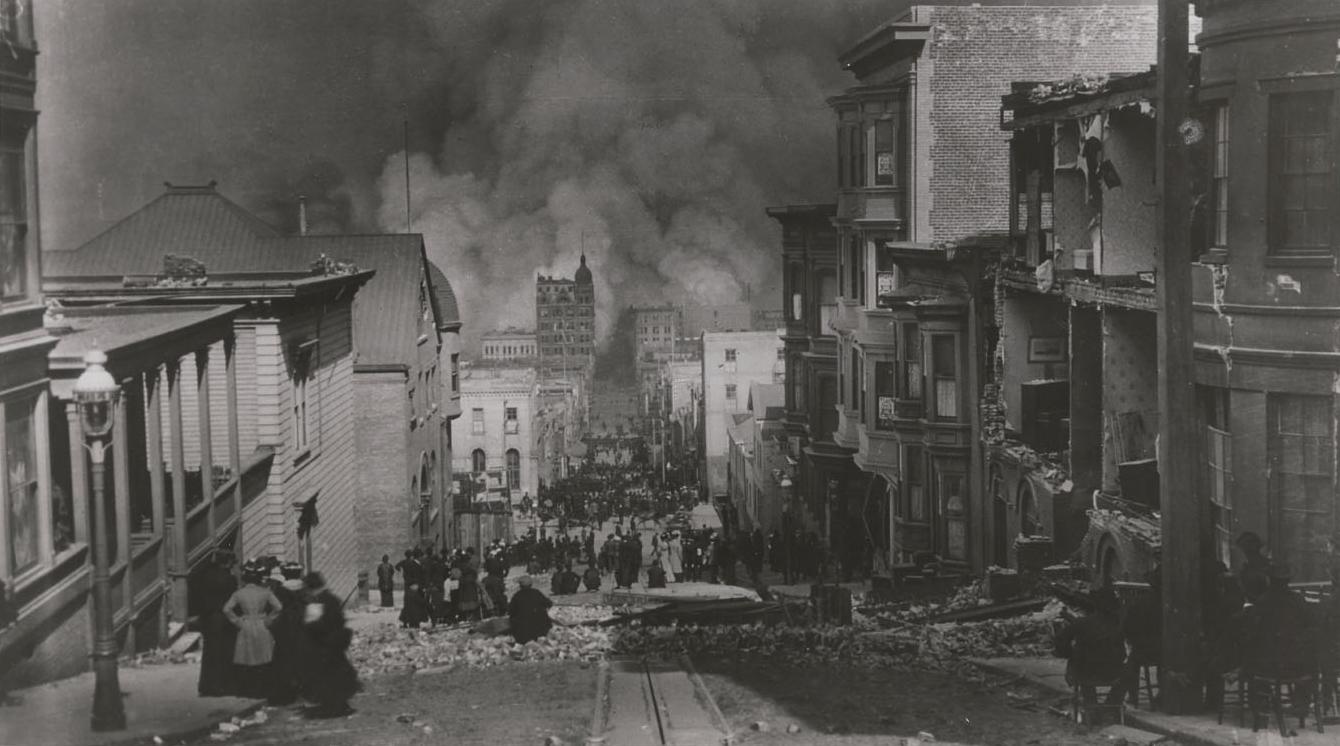
The US Geological Survey distinguishes **magnitude**—the size of an earthquake at its source—from **intensity**, which describes shaking effects at particular places and can vary around the same earthquake. USGS ShakeAlert is an early warning system, not an earthquake prediction system: it detects an event already underway and may transmit an alert before stronger shaking arrives. The famous 1906 San Francisco earthquake caused severe shaking and destructive fires, but photographs of smoke do not by themselves reveal the rupture mechanics, casualty history or safety of a later building. A strong explanation combines sources rather than attributing everything to one image.
The core question is risk reduction, not magical prediction. Earthquake hazard is not the same as exposure; two buildings can experience different conditions during one event. Responsible preparedness includes qualified building design, inspection, appropriate public information, accessible warning channels and community arrangements. Do not rely on claims that animals, clouds, or a specific social-media post can predict the exact place, time and magnitude of a major earthquake.
This educational Civilisation Atlas uses Foundation 0 and eight numbered capability stages, not a mandatory sequence every historical culture must follow. The first positions examine human adaptation, settlement, recorded administration, industry and planetary networks. Stage 5 is a proposed regenerative capability and Stages 6–8 are hypothetical human futures beyond Earth. The framework is not an official archaeological ranking and makes no judgement about a people’s intelligence or dignity.

Key concepts and what readers must not confuse
Magnitude. An estimate of the size of an earthquake at its source.
Intensity. Observed shaking effects in a specific place, which vary within the affected region.
Fault. A fracture or zone along which rock can move relative to adjacent rock.
Seismic wave. Energy transmitted through Earth after a seismic event, with several forms and different arrival properties.
Early warning. A notification delivered after a quake has begun but potentially before stronger shaking reaches a location.
Prediction. A claim of the future event’s precise timing, location and magnitude; USGS states no reliable method exists for such predictions.
Primary research, cultural evidence and safety guidance
USGS — Difference Between Magnitude and Intensity
USGS explains that an event has a magnitude estimate, while local shaking intensity varies with location and conditions. Consult the named primary source for the original scope, date, methods and any revisions. These institutions do not adopt or endorse eduKate’s stage framework. Their research and safety guidance must not be repackaged as a universal classification of cultures.
USGS — Earthquake Early Warning Overview
USGS explains its operational ShakeAlert detection, rapid calculations and the possibility of messages reaching people before stronger seismic waves. Consult the named primary source for the original scope, date, methods and any revisions. These institutions do not adopt or endorse eduKate’s stage framework. Their research and safety guidance must not be repackaged as a universal classification of cultures.
USGS — Can You Predict Earthquakes?
USGS states that scientists cannot reliably predict the precise date, time, location and magnitude of a future major earthquake; this differs from hazard probabilities and early warning. Consult the named primary source for the original scope, date, methods and any revisions. These institutions do not adopt or endorse eduKate’s stage framework. Their research and safety guidance must not be repackaged as a universal classification of cultures.
California Earthquake Early Warning — How It Works
The state describes sensors, alert delivery and limitations: people may receive an alert before, during or after shaking, depending on conditions. Consult the named primary source for the original scope, date, methods and any revisions. These institutions do not adopt or endorse eduKate’s stage framework. Their research and safety guidance must not be repackaged as a universal classification of cultures.
USGS — Historical Research on 1906 San Francisco Earthquake
USGS records post-event geological study, maps, archival evidence and subsequent reconstruction of the 1906 San Andreas fault rupture. Consult the named primary source for the original scope, date, methods and any revisions. These institutions do not adopt or endorse eduKate’s stage framework. Their research and safety guidance must not be repackaged as a universal classification of cultures.
USGS — Casualties and Damage After the 1906 Earthquake
USGS distinguishes destruction from shaking and later fire, with revised estimates and differing historical accounting methods. Consult the named primary source for the original scope, date, methods and any revisions. These institutions do not adopt or endorse eduKate’s stage framework. Their research and safety guidance must not be repackaged as a universal classification of cultures.
USGS — Effects of Earthquakes on Structures
USGS explains body and surface waves, the effect of different frequencies, local ground conditions and the aim of earthquake-resistant design. Consult the named primary source for the original scope, date, methods and any revisions. These institutions do not adopt or endorse eduKate’s stage framework. Their research and safety guidance must not be repackaged as a universal classification of cultures.
USGS — Soil Type and Severity of 1906 Damage
USGS describes how local filled or marshy soils suffered greater damage during the historic event than many rock sites. Consult the named primary source for the original scope, date, methods and any revisions. These institutions do not adopt or endorse eduKate’s stage framework. Their research and safety guidance must not be repackaged as a universal classification of cultures.
US Department of Homeland Security — CERT Earthquake Preparedness Guidance
Official guidance includes Drop, Cover and Hold On and appropriate actions suited to the person’s current setting; users should follow their local emergency authorities. Consult the named primary source for the original scope, date, methods and any revisions. These institutions do not adopt or endorse eduKate’s stage framework. Their research and safety guidance must not be repackaged as a universal classification of cultures.
The nine stages: a functional comparison, not a ranking
Foundation 0 — Adaptive Human Worlds
Small or mobile human communities may have rich knowledge of food, materials, weather and hazards without permanent cities or written bureaucracy. The educational focus is learning that can be transmitted and adapted. In this specific subject the question is how people can maintain a useful practice when The original skilled practitioner leaves and a new person must respond to changing conditions.. A single impressive piece of equipment or one successful event does not show what happens when the original competent person leaves or an essential material becomes unavailable.
Evidence boundary. No absence of preserved machinery or records proves that a population lacked intelligence, care or capable knowledge. Students should state the actual time and place, relevant people, type of technical or institutional evidence, and what would remain unverified. Hypothetical later-stage inhabitants and services are not existing human populations.
Stage 1 — Settlement and Surplus
A settled community develops recurring needs for seasonal provision, storage, safe routes and shared rules. Useful capability means the relevant service continues rather than functioning only on an unusually good day. In this specific subject the question is how people can maintain a useful practice when A seasonal interruption makes the usual supply, preparation or building arrangement unreliable.. A single impressive piece of equipment or one successful event does not show what happens when the original competent person leaves or an essential material becomes unavailable.
Evidence boundary. A large storage site or building does not establish the wellbeing or equality of every resident. Students should state the actual time and place, relevant people, type of technical or institutional evidence, and what would remain unverified. Hypothetical later-stage inhabitants and services are not existing human populations.
Stage 2 — Recorded Administration
A town’s reports, standards and designated duties can improve continuity across many people. But a record is only evidence of what was claimed until it is checked against an actual outcome. In this specific subject the question is how people can maintain a useful practice when An official inventory or inspection conflicts with the experience of a user.. A single impressive piece of equipment or one successful event does not show what happens when the original competent person leaves or an essential material becomes unavailable.
Evidence boundary. Archives may privilege administrators and must not be mistaken for the voices of every worker and household. Students should state the actual time and place, relevant people, type of technical or institutional evidence, and what would remain unverified. Hypothetical later-stage inhabitants and services are not existing human populations.
Stage 3 — Industrial and Mass Institutions
Specialised labour, large facilities, standardised processes and repairs can expand service. More output can also bring new risks if safety, access or maintenance are overlooked. In this specific subject the question is how people can maintain a useful practice when An efficiency gain masks a worker hazard, a missing maintenance obligation or a deteriorating service.. A single impressive piece of equipment or one successful event does not show what happens when the original competent person leaves or an essential material becomes unavailable.
Evidence boundary. Gross technical output is not a measure of moral progress or a guarantee of fair outcomes. Students should state the actual time and place, relevant people, type of technical or institutional evidence, and what would remain unverified. Hypothetical later-stage inhabitants and services are not existing human populations.
Stage 4 — Planetary Network Civilisation
Regions interact through trade, data, shared standards and scientific methods. The connections can expand possibilities and introduce vulnerabilities beyond the local place where a decision is made. In this specific subject the question is how people can maintain a useful practice when A remote supplier or institution changes something that affects a person far away.. A single impressive piece of equipment or one successful event does not show what happens when the original competent person leaves or an essential material becomes unavailable.
Evidence boundary. Being linked to a worldwide network does not ensure equally distributed access or safety. Students should state the actual time and place, relevant people, type of technical or institutional evidence, and what would remain unverified. Hypothetical later-stage inhabitants and services are not existing human populations.
Stage 5 — Proposed Regenerative and Self-Correcting Civilisation
The Atlas proposes an ability to detect causes of harm, modify practice, involve affected people and confirm durable improvement without transferring the problem elsewhere. In this specific subject the question is how people can maintain a useful practice when An intervention appears successful in one project boundary while causing unmeasured damage beyond it.. A single impressive piece of equipment or one successful event does not show what happens when the original competent person leaves or an essential material becomes unavailable.
Evidence boundary. This is an educationally proposed threshold and not a globally recognised status humanity has attained. Students should state the actual time and place, relevant people, type of technical or institutional evidence, and what would remain unverified. Hypothetical later-stage inhabitants and services are not existing human populations.
Stage 6 — Hypothetical Multi-World Extension
An imagined inhabited human outpost outside Earth would still require imported expertise, critical resources and a means to repair services. In this specific subject the question is how people can maintain a useful practice when An essential delivery from Earth is delayed and there is no local substitute.. A single impressive piece of equipment or one successful event does not show what happens when the original competent person leaves or an essential material becomes unavailable.
Evidence boundary. No demonstrated robotic mission or current spacecraft facility is an enduring second-world human civilisation. Students should state the actual time and place, relevant people, type of technical or institutional evidence, and what would remain unverified. Hypothetical later-stage inhabitants and services are not existing human populations.
Stage 7 — Hypothetical Autonomous Multi-World Community
A speculative inhabited settlement attempts to maintain multiple essential systems, health, education, repair and governance despite long periods without normal Earth resupply. In this specific subject the question is how people can maintain a useful practice when A small component turns out to be irreplaceable locally, making the entire service depend on Earth.. A single impressive piece of equipment or one successful event does not show what happens when the original competent person leaves or an essential material becomes unavailable.
Evidence boundary. One recycled resource or successfully grown crop does not establish whole-community autonomy. Students should state the actual time and place, relevant people, type of technical or institutional evidence, and what would remain unverified. Hypothetical later-stage inhabitants and services are not existing human populations.
Stage 8 — Hypothetical Distributed Interplanetary Civilisation
Several imagined human-inhabited worlds cooperate through large travel and communication delays while keeping essential services accountable locally. In this specific subject the question is how people can maintain a useful practice when A remote message arrives with outdated evidence and the receiving community must make a responsible decision.. A single impressive piece of equipment or one successful event does not show what happens when the original competent person leaves or an essential material becomes unavailable.
Evidence boundary. This remains speculation, not proof of existing populated interplanetary worlds. Students should state the actual time and place, relevant people, type of technical or institutional evidence, and what would remain unverified. Hypothetical later-stage inhabitants and services are not existing human populations.
Twenty-two practical mechanisms
1. Faults, rupture and changing stress
Earthquakes commonly involve a sudden release of accumulated elastic strain along a fault, generating seismic waves. The details differ among tectonic settings. When studying this mechanism, ask what the process is intended to achieve, the conditions under which it can be observed and the people who are responsible for its operation. A technical achievement is not evidence that every user or community experiences the same benefit. Consider the physical, biological or social constraints before drawing a bigger civilisational conclusion.
A tempting but incomplete explanation. An online post calls every small ground movement proof a destructive quake is imminent tomorrow. Correct it by identifying the precise source claim, the observed condition and at least one alternative cause. An author should not confuse an archaeological object with a modern technical demonstration, an official recommendation with a completed service, or a fictional learning illustration with documentary evidence.
Safe classroom enquiry. Use a fictional fault diagram to distinguish a geological fault from a precise event forecast. Use papers, diagrams, source cards and clearly fictional datasets. If the subject is food safety or disaster response, the class should compare authoritative guidance rather than undertake any hazardous cooking, preservation experiment or emergency manoeuvre without appropriate qualified direction.
What a good answer shows. Scientific knowledge of faults supports hazard assessment but not guaranteed prediction of one future event. The independent reviewer should be able to check the question, describe how the evidence was collected and explain why the conclusion would change if its assumptions were wrong. Intellectual honesty is more important than the appearance of having solved every possible problem.
2. A quake starts before an early warning
Warning systems rely on detecting an event once it begins. A notification can arrive before stronger shaking at some more distant places, but not necessarily near the source. When studying this mechanism, ask what the process is intended to achieve, the conditions under which it can be observed and the people who are responsible for its operation. A technical achievement is not evidence that every user or community experiences the same benefit. Consider the physical, biological or social constraints before drawing a bigger civilisational conclusion.
A tempting but incomplete explanation. A promotional poster says ShakeAlert sends an alert before an earthquake begins. Correct it by identifying the precise source claim, the observed condition and at least one alternative cause. An author should not confuse an archaeological object with a modern technical demonstration, an official recommendation with a completed service, or a fictional learning illustration with documentary evidence.
Safe classroom enquiry. Draw two timelines for event onset, sensor detection, processing, alert and arrival of damaging shaking. Use papers, diagrams, source cards and clearly fictional datasets. If the subject is food safety or disaster response, the class should compare authoritative guidance rather than undertake any hazardous cooking, preservation experiment or emergency manoeuvre without appropriate qualified direction.
What a good answer shows. Correct timing language is essential when a system affects public safety. The independent reviewer should be able to check the question, describe how the evidence was collected and explain why the conclusion would change if its assumptions were wrong. Intellectual honesty is more important than the appearance of having solved every possible problem.
3. P-waves, S-waves and surface waves
Different seismic waves travel at different speeds and produce different forms of ground motion. Fast P-wave arrivals can help systems detect an event sooner. When studying this mechanism, ask what the process is intended to achieve, the conditions under which it can be observed and the people who are responsible for its operation. A technical achievement is not evidence that every user or community experiences the same benefit. Consider the physical, biological or social constraints before drawing a bigger civilisational conclusion.
A tempting but incomplete explanation. A classroom drawing assumes every wave arrives at every location at exactly the same instant. Correct it by identifying the precise source claim, the observed condition and at least one alternative cause. An author should not confuse an archaeological object with a modern technical demonstration, an official recommendation with a completed service, or a fictional learning illustration with documentary evidence.
Safe classroom enquiry. Compare imaginary arrival times for three classes of waves, using no real alarm simulation. Use papers, diagrams, source cards and clearly fictional datasets. If the subject is food safety or disaster response, the class should compare authoritative guidance rather than undertake any hazardous cooking, preservation experiment or emergency manoeuvre without appropriate qualified direction.
What a good answer shows. The difference in propagation speed explains the possibility, but not the guarantee, of useful warning. The independent reviewer should be able to check the question, describe how the evidence was collected and explain why the conclusion would change if its assumptions were wrong. Intellectual honesty is more important than the appearance of having solved every possible problem.
4. Magnitude is not intensity
Magnitude characterises the event at source, whereas intensity represents observed shaking and effects at specific locations. One earthquake can therefore produce many local intensities. When studying this mechanism, ask what the process is intended to achieve, the conditions under which it can be observed and the people who are responsible for its operation. A technical achievement is not evidence that every user or community experiences the same benefit. Consider the physical, biological or social constraints before drawing a bigger civilisational conclusion.
A tempting but incomplete explanation. A student says an M7 event creates ‘intensity seven’ at all buildings by definition. Correct it by identifying the precise source claim, the observed condition and at least one alternative cause. An author should not confuse an archaeological object with a modern technical demonstration, an official recommendation with a completed service, or a fictional learning illustration with documentary evidence.
Safe classroom enquiry. Make a two-column source card labelled event magnitude and local intensity. Use papers, diagrams, source cards and clearly fictional datasets. If the subject is food safety or disaster response, the class should compare authoritative guidance rather than undertake any hazardous cooking, preservation experiment or emergency manoeuvre without appropriate qualified direction.
What a good answer shows. Precise use of terms prevents false comparisons and unsafe conclusions. The independent reviewer should be able to check the question, describe how the evidence was collected and explain why the conclusion would change if its assumptions were wrong. Intellectual honesty is more important than the appearance of having solved every possible problem.
5. Why initial magnitude estimates can change
Seismic magnitude is inferred from records under scientific methods; early estimates can be revised when additional data are analysed. When studying this mechanism, ask what the process is intended to achieve, the conditions under which it can be observed and the people who are responsible for its operation. A technical achievement is not evidence that every user or community experiences the same benefit. Consider the physical, biological or social constraints before drawing a bigger civilisational conclusion.
A tempting but incomplete explanation. An initial and a later official magnitude differ and a social post declares one must be fraudulent. Correct it by identifying the precise source claim, the observed condition and at least one alternative cause. An author should not confuse an archaeological object with a modern technical demonstration, an official recommendation with a completed service, or a fictional learning illustration with documentary evidence.
Safe classroom enquiry. Compare invented preliminary and revised reports with a source and update date. Use papers, diagrams, source cards and clearly fictional datasets. If the subject is food safety or disaster response, the class should compare authoritative guidance rather than undertake any hazardous cooking, preservation experiment or emergency manoeuvre without appropriate qualified direction.
What a good answer shows. A revision can reflect better evidence, not a conspiracy or a changed historic event. The independent reviewer should be able to check the question, describe how the evidence was collected and explain why the conclusion would change if its assumptions were wrong. Intellectual honesty is more important than the appearance of having solved every possible problem.
6. Energy release and the logarithmic scale
Magnitude differences are not linear differences in destructive effect. Energy release and shaking at a particular place must not be equated. When studying this mechanism, ask what the process is intended to achieve, the conditions under which it can be observed and the people who are responsible for its operation. A technical achievement is not evidence that every user or community experiences the same benefit. Consider the physical, biological or social constraints before drawing a bigger civilisational conclusion.
A tempting but incomplete explanation. A student claims a magnitude 8 event is simply twice as large as a magnitude 4 event. Correct it by identifying the precise source claim, the observed condition and at least one alternative cause. An author should not confuse an archaeological object with a modern technical demonstration, an official recommendation with a completed service, or a fictional learning illustration with documentary evidence.
Safe classroom enquiry. Use paper powers of ten to demonstrate why logarithmic scales need proper interpretation. Use papers, diagrams, source cards and clearly fictional datasets. If the subject is food safety or disaster response, the class should compare authoritative guidance rather than undertake any hazardous cooking, preservation experiment or emergency manoeuvre without appropriate qualified direction.
What a good answer shows. The unit and model must be named before numerical comparisons have meaning. The independent reviewer should be able to check the question, describe how the evidence was collected and explain why the conclusion would change if its assumptions were wrong. Intellectual honesty is more important than the appearance of having solved every possible problem.
7. Local soil can amplify damage
Ground composition, fill and geologic conditions can change shaking and building response even during the same earthquake. When studying this mechanism, ask what the process is intended to achieve, the conditions under which it can be observed and the people who are responsible for its operation. A technical achievement is not evidence that every user or community experiences the same benefit. Consider the physical, biological or social constraints before drawing a bigger civilisational conclusion.
A tempting but incomplete explanation. A map assumes two buildings an equal distance from the epicentre must experience identical damage. Correct it by identifying the precise source claim, the observed condition and at least one alternative cause. An author should not confuse an archaeological object with a modern technical demonstration, an official recommendation with a completed service, or a fictional learning illustration with documentary evidence.
Safe classroom enquiry. Use USGS’s 1906 soil discussion to annotate a fictional geology map. Use papers, diagrams, source cards and clearly fictional datasets. If the subject is food safety or disaster response, the class should compare authoritative guidance rather than undertake any hazardous cooking, preservation experiment or emergency manoeuvre without appropriate qualified direction.
What a good answer shows. Local site conditions can matter alongside magnitude and distance. The independent reviewer should be able to check the question, describe how the evidence was collected and explain why the conclusion would change if its assumptions were wrong. Intellectual honesty is more important than the appearance of having solved every possible problem.
8. Buildings and seismic load paths
A building’s response depends on how its structure carries lateral loads, its connections and the condition of its materials. Qualified engineering is essential. When studying this mechanism, ask what the process is intended to achieve, the conditions under which it can be observed and the people who are responsible for its operation. A technical achievement is not evidence that every user or community experiences the same benefit. Consider the physical, biological or social constraints before drawing a bigger civilisational conclusion.
A tempting but incomplete explanation. A photograph shows a new facade and claims the building is fully earthquake-resistant. Correct it by identifying the precise source claim, the observed condition and at least one alternative cause. An author should not confuse an archaeological object with a modern technical demonstration, an official recommendation with a completed service, or a fictional learning illustration with documentary evidence.
Safe classroom enquiry. Draw a paper path from roof loads to foundations and label professional review points. Use papers, diagrams, source cards and clearly fictional datasets. If the subject is food safety or disaster response, the class should compare authoritative guidance rather than undertake any hazardous cooking, preservation experiment or emergency manoeuvre without appropriate qualified direction.
What a good answer shows. Architectural appearance is not a substitute for evaluated structural design. The independent reviewer should be able to check the question, describe how the evidence was collected and explain why the conclusion would change if its assumptions were wrong. Intellectual honesty is more important than the appearance of having solved every possible problem.
9. Nonstructural hazards inside buildings
Shelves, equipment, glass and unsecured items can cause injury during shaking, separate from damage to a building’s main frame. When studying this mechanism, ask what the process is intended to achieve, the conditions under which it can be observed and the people who are responsible for its operation. A technical achievement is not evidence that every user or community experiences the same benefit. Consider the physical, biological or social constraints before drawing a bigger civilisational conclusion.
A tempting but incomplete explanation. A classroom counts a building as safe solely because its columns remain standing. Correct it by identifying the precise source claim, the observed condition and at least one alternative cause. An author should not confuse an archaeological object with a modern technical demonstration, an official recommendation with a completed service, or a fictional learning illustration with documentary evidence.
Safe classroom enquiry. Create a fictional indoor hazard checklist based on official guidance, without attempting hazardous adjustments. Use papers, diagrams, source cards and clearly fictional datasets. If the subject is food safety or disaster response, the class should compare authoritative guidance rather than undertake any hazardous cooking, preservation experiment or emergency manoeuvre without appropriate qualified direction.
What a good answer shows. Risk reduction includes the environment within a building and the people who use it. The independent reviewer should be able to check the question, describe how the evidence was collected and explain why the conclusion would change if its assumptions were wrong. Intellectual honesty is more important than the appearance of having solved every possible problem.
10. Preparedness and the right information
Preparedness concerns understanding hazards, suitable local official guidance, accessible communication and realistic support for vulnerable people. When studying this mechanism, ask what the process is intended to achieve, the conditions under which it can be observed and the people who are responsible for its operation. A technical achievement is not evidence that every user or community experiences the same benefit. Consider the physical, biological or social constraints before drawing a bigger civilisational conclusion.
A tempting but incomplete explanation. A neighbourhood prints a generic advice sheet without checking local building design or emergency arrangements. Correct it by identifying the precise source claim, the observed condition and at least one alternative cause. An author should not confuse an archaeological object with a modern technical demonstration, an official recommendation with a completed service, or a fictional learning illustration with documentary evidence.
Safe classroom enquiry. Write a hypothetical family information plan that defers to relevant local authorities. Use papers, diagrams, source cards and clearly fictional datasets. If the subject is food safety or disaster response, the class should compare authoritative guidance rather than undertake any hazardous cooking, preservation experiment or emergency manoeuvre without appropriate qualified direction.
What a good answer shows. A plan only works when people can understand and practise it appropriately. The independent reviewer should be able to check the question, describe how the evidence was collected and explain why the conclusion would change if its assumptions were wrong. Intellectual honesty is more important than the appearance of having solved every possible problem.
11. Drop, Cover and Hold On in context
Official US preparedness material describes Drop, Cover and Hold On where appropriate during shaking. The most suitable action can vary by the person’s circumstances and location. When studying this mechanism, ask what the process is intended to achieve, the conditions under which it can be observed and the people who are responsible for its operation. A technical achievement is not evidence that every user or community experiences the same benefit. Consider the physical, biological or social constraints before drawing a bigger civilisational conclusion.
A tempting but incomplete explanation. A fictional student runs outside during shaking because a social-media post said doorways are always safe. Correct it by identifying the precise source claim, the observed condition and at least one alternative cause. An author should not confuse an archaeological object with a modern technical demonstration, an official recommendation with a completed service, or a fictional learning illustration with documentary evidence.
Safe classroom enquiry. Compare a paper scenario with the official guidance, avoiding physical simulations of hazards. Use papers, diagrams, source cards and clearly fictional datasets. If the subject is food safety or disaster response, the class should compare authoritative guidance rather than undertake any hazardous cooking, preservation experiment or emergency manoeuvre without appropriate qualified direction.
What a good answer shows. Do not invent evacuation tactics; use the directions appropriate to local authorities. The independent reviewer should be able to check the question, describe how the evidence was collected and explain why the conclusion would change if its assumptions were wrong. Intellectual honesty is more important than the appearance of having solved every possible problem.
12. ShakeAlert is detection, not forecasting
ShakeAlert processes early seismic measurements from an earthquake already underway; it is not a tool for naming next month’s quake date. When studying this mechanism, ask what the process is intended to achieve, the conditions under which it can be observed and the people who are responsible for its operation. A technical achievement is not evidence that every user or community experiences the same benefit. Consider the physical, biological or social constraints before drawing a bigger civilisational conclusion.
A tempting but incomplete explanation. A television host calls a five-second warning a prediction made before the earthquake. Correct it by identifying the precise source claim, the observed condition and at least one alternative cause. An author should not confuse an archaeological object with a modern technical demonstration, an official recommendation with a completed service, or a fictional learning illustration with documentary evidence.
Safe classroom enquiry. Use a paper process map from sensors to estimated source and message delivery. Use papers, diagrams, source cards and clearly fictional datasets. If the subject is food safety or disaster response, the class should compare authoritative guidance rather than undertake any hazardous cooking, preservation experiment or emergency manoeuvre without appropriate qualified direction.
What a good answer shows. The engineering success is rapid detection and dissemination under real constraints. The independent reviewer should be able to check the question, describe how the evidence was collected and explain why the conclusion would change if its assumptions were wrong. Intellectual honesty is more important than the appearance of having solved every possible problem.
13. Why warning times vary
Distance from the source, sensor locations, processing, communication and seismic-wave speed affect whether useful lead time is possible. When studying this mechanism, ask what the process is intended to achieve, the conditions under which it can be observed and the people who are responsible for its operation. A technical achievement is not evidence that every user or community experiences the same benefit. Consider the physical, biological or social constraints before drawing a bigger civilisational conclusion.
A tempting but incomplete explanation. A city promises every resident will receive exactly 30 seconds of warning. Correct it by identifying the precise source claim, the observed condition and at least one alternative cause. An author should not confuse an archaeological object with a modern technical demonstration, an official recommendation with a completed service, or a fictional learning illustration with documentary evidence.
Safe classroom enquiry. Compare invented near and far listeners with different delays and acknowledge uncertainty. Use papers, diagrams, source cards and clearly fictional datasets. If the subject is food safety or disaster response, the class should compare authoritative guidance rather than undertake any hazardous cooking, preservation experiment or emergency manoeuvre without appropriate qualified direction.
What a good answer shows. A guaranteed warning-time slogan can misrepresent the technology. The independent reviewer should be able to check the question, describe how the evidence was collected and explain why the conclusion would change if its assumptions were wrong. Intellectual honesty is more important than the appearance of having solved every possible problem.
14. Early warning reaches different users differently
Smartphone access, sound and visual alerts, public systems and disability accessibility shape which people can act on a message. When studying this mechanism, ask what the process is intended to achieve, the conditions under which it can be observed and the people who are responsible for its operation. A technical achievement is not evidence that every user or community experiences the same benefit. Consider the physical, biological or social constraints before drawing a bigger civilisational conclusion.
A tempting but incomplete explanation. A service reports alerts sent and assumes every intended user received and understood them. Correct it by identifying the precise source claim, the observed condition and at least one alternative cause. An author should not confuse an archaeological object with a modern technical demonstration, an official recommendation with a completed service, or a fictional learning illustration with documentary evidence.
Safe classroom enquiry. Design a fictional alert with text, sound and an accessible alternative. Use papers, diagrams, source cards and clearly fictional datasets. If the subject is food safety or disaster response, the class should compare authoritative guidance rather than undertake any hazardous cooking, preservation experiment or emergency manoeuvre without appropriate qualified direction.
What a good answer shows. Sent messages and understood actionable warnings are separate indicators. The independent reviewer should be able to check the question, describe how the evidence was collected and explain why the conclusion would change if its assumptions were wrong. Intellectual honesty is more important than the appearance of having solved every possible problem.
15. The 1906 San Francisco event and documentary images
The 18 April 1906 event generated severe shaking, followed by destructive fires. Arnold Genthe’s Sacramento Street photograph documents approaching fire, not the details of rupture below ground. When studying this mechanism, ask what the process is intended to achieve, the conditions under which it can be observed and the people who are responsible for its operation. A technical achievement is not evidence that every user or community experiences the same benefit. Consider the physical, biological or social constraints before drawing a bigger civilisational conclusion.
A tempting but incomplete explanation. A caption treats the historic photo as a direct image of the fault tearing. Correct it by identifying the precise source claim, the observed condition and at least one alternative cause. An author should not confuse an archaeological object with a modern technical demonstration, an official recommendation with a completed service, or a fictional learning illustration with documentary evidence.
Safe classroom enquiry. Write a caption identifying location, photographer, date and the distinction between smoke and fault evidence. Use papers, diagrams, source cards and clearly fictional datasets. If the subject is food safety or disaster response, the class should compare authoritative guidance rather than undertake any hazardous cooking, preservation experiment or emergency manoeuvre without appropriate qualified direction.
What a good answer shows. An authentic image still needs a historically accurate interpretation. The independent reviewer should be able to check the question, describe how the evidence was collected and explain why the conclusion would change if its assumptions were wrong. Intellectual honesty is more important than the appearance of having solved every possible problem.
16. USGS geological and archival reconstruction
Research on the 1906 event draws on historical photographs, measured offsets, seismic records and later investigation. Those different sources can answer different questions. When studying this mechanism, ask what the process is intended to achieve, the conditions under which it can be observed and the people who are responsible for its operation. A technical achievement is not evidence that every user or community experiences the same benefit. Consider the physical, biological or social constraints before drawing a bigger civilisational conclusion.
A tempting but incomplete explanation. A pupil considers a century-old photograph insufficient because no modern satellite image existed. Correct it by identifying the precise source claim, the observed condition and at least one alternative cause. An author should not confuse an archaeological object with a modern technical demonstration, an official recommendation with a completed service, or a fictional learning illustration with documentary evidence.
Safe classroom enquiry. Sort the types of evidence and explain why they complement one another. Use papers, diagrams, source cards and clearly fictional datasets. If the subject is food safety or disaster response, the class should compare authoritative guidance rather than undertake any hazardous cooking, preservation experiment or emergency manoeuvre without appropriate qualified direction.
What a good answer shows. The past can be studied through converging evidence rather than fabricated certainty. The independent reviewer should be able to check the question, describe how the evidence was collected and explain why the conclusion would change if its assumptions were wrong. Intellectual honesty is more important than the appearance of having solved every possible problem.
17. Why 1906 death estimates differ
Historic casualty totals have been revised because the available records and counting methods differ. Damage from fire and shaking can overlap or be reported separately. When studying this mechanism, ask what the process is intended to achieve, the conditions under which it can be observed and the people who are responsible for its operation. A technical achievement is not evidence that every user or community experiences the same benefit. Consider the physical, biological or social constraints before drawing a bigger civilisational conclusion.
A tempting but incomplete explanation. One article claims every early casualty count is definitively correct and another is a lie. Correct it by identifying the precise source claim, the observed condition and at least one alternative cause. An author should not confuse an archaeological object with a modern technical demonstration, an official recommendation with a completed service, or a fictional learning illustration with documentary evidence.
Safe classroom enquiry. Build an imaginary source comparison for a contemporary count and a later archival reconstruction. Use papers, diagrams, source cards and clearly fictional datasets. If the subject is food safety or disaster response, the class should compare authoritative guidance rather than undertake any hazardous cooking, preservation experiment or emergency manoeuvre without appropriate qualified direction.
What a good answer shows. A change in estimates requires explanation, not automatic distrust. The independent reviewer should be able to check the question, describe how the evidence was collected and explain why the conclusion would change if its assumptions were wrong. Intellectual honesty is more important than the appearance of having solved every possible problem.
18. Aftershocks and continuing hazard
Aftershocks follow some earthquakes and can complicate inspection, rescue and recovery. Probabilistic aftershock forecasts are different from exact predictions. When studying this mechanism, ask what the process is intended to achieve, the conditions under which it can be observed and the people who are responsible for its operation. A technical achievement is not evidence that every user or community experiences the same benefit. Consider the physical, biological or social constraints before drawing a bigger civilisational conclusion.
A tempting but incomplete explanation. A household assumes the main event ending means there can be no further earthquake risk. Correct it by identifying the precise source claim, the observed condition and at least one alternative cause. An author should not confuse an archaeological object with a modern technical demonstration, an official recommendation with a completed service, or a fictional learning illustration with documentary evidence.
Safe classroom enquiry. Label hypothetical probabilities and emphasise following local official advice. Use papers, diagrams, source cards and clearly fictional datasets. If the subject is food safety or disaster response, the class should compare authoritative guidance rather than undertake any hazardous cooking, preservation experiment or emergency manoeuvre without appropriate qualified direction.
What a good answer shows. Recovery and hazard assessment involve ongoing observation rather than declaring total safety. The independent reviewer should be able to check the question, describe how the evidence was collected and explain why the conclusion would change if its assumptions were wrong. Intellectual honesty is more important than the appearance of having solved every possible problem.
19. Historical rebuilding and modern codes
Lessons from past damage contribute to engineering research and building requirements that evolve over time. One standard should not be assumed to apply equally in every country. When studying this mechanism, ask what the process is intended to achieve, the conditions under which it can be observed and the people who are responsible for its operation. A technical achievement is not evidence that every user or community experiences the same benefit. Consider the physical, biological or social constraints before drawing a bigger civilisational conclusion.
A tempting but incomplete explanation. A school copies a US building rule into a fictional settlement without checking jurisdiction. Correct it by identifying the precise source claim, the observed condition and at least one alternative cause. An author should not confuse an archaeological object with a modern technical demonstration, an official recommendation with a completed service, or a fictional learning illustration with documentary evidence.
Safe classroom enquiry. Prepare a source note identifying code year, country and qualified decision-maker. Use papers, diagrams, source cards and clearly fictional datasets. If the subject is food safety or disaster response, the class should compare authoritative guidance rather than undertake any hazardous cooking, preservation experiment or emergency manoeuvre without appropriate qualified direction.
What a good answer shows. Historical learning is useful when applied through current legitimate standards and expertise. The independent reviewer should be able to check the question, describe how the evidence was collected and explain why the conclusion would change if its assumptions were wrong. Intellectual honesty is more important than the appearance of having solved every possible problem.
20. Maintenance, retrofits and changing occupancy
A building may need condition assessments, upgrades or changes in use. A retrofit claim requires competent documentation of its actual scope and performance. When studying this mechanism, ask what the process is intended to achieve, the conditions under which it can be observed and the people who are responsible for its operation. A technical achievement is not evidence that every user or community experiences the same benefit. Consider the physical, biological or social constraints before drawing a bigger civilisational conclusion.
A tempting but incomplete explanation. An owner’s advertisement calls cosmetic repair an earthquake retrofit. Correct it by identifying the precise source claim, the observed condition and at least one alternative cause. An author should not confuse an archaeological object with a modern technical demonstration, an official recommendation with a completed service, or a fictional learning illustration with documentary evidence.
Safe classroom enquiry. Compare fictional maintenance, cosmetic and structural improvement records. Use papers, diagrams, source cards and clearly fictional datasets. If the subject is food safety or disaster response, the class should compare authoritative guidance rather than undertake any hazardous cooking, preservation experiment or emergency manoeuvre without appropriate qualified direction.
What a good answer shows. The service of a building includes its life after construction, not just a ribbon-cutting. The independent reviewer should be able to check the question, describe how the evidence was collected and explain why the conclusion would change if its assumptions were wrong. Intellectual honesty is more important than the appearance of having solved every possible problem.
21. Cascading failure: transport, water and power
Shaking, fire and damaged infrastructure can interact. Resilience planning must follow essential services and people rather than evaluating buildings in isolation. When studying this mechanism, ask what the process is intended to achieve, the conditions under which it can be observed and the people who are responsible for its operation. A technical achievement is not evidence that every user or community experiences the same benefit. Consider the physical, biological or social constraints before drawing a bigger civilisational conclusion.
A tempting but incomplete explanation. A hospital remains standing while its only water supply and access road are disrupted. Correct it by identifying the precise source claim, the observed condition and at least one alternative cause. An author should not confuse an archaeological object with a modern technical demonstration, an official recommendation with a completed service, or a fictional learning illustration with documentary evidence.
Safe classroom enquiry. Draw a paper dependency network with a blocked road and power fault. Use papers, diagrams, source cards and clearly fictional datasets. If the subject is food safety or disaster response, the class should compare authoritative guidance rather than undertake any hazardous cooking, preservation experiment or emergency manoeuvre without appropriate qualified direction.
What a good answer shows. A functioning structure is not necessarily an accessible and continuing public service. The independent reviewer should be able to check the question, describe how the evidence was collected and explain why the conclusion would change if its assumptions were wrong. Intellectual honesty is more important than the appearance of having solved every possible problem.
22. A hypothetical distant-world quake scenario
Other celestial bodies can experience seismic events, but human habitation beyond Earth remains hypothetical. An imagined lunar settlement needs grounded engineering questions, not a claim that such cities exist. When studying this mechanism, ask what the process is intended to achieve, the conditions under which it can be observed and the people who are responsible for its operation. A technical achievement is not evidence that every user or community experiences the same benefit. Consider the physical, biological or social constraints before drawing a bigger civilisational conclusion.
A tempting but incomplete explanation. A Moon-base rendering is used as evidence of a completed residential seismic-code programme. Correct it by identifying the precise source claim, the observed condition and at least one alternative cause. An author should not confuse an archaeological object with a modern technical demonstration, an official recommendation with a completed service, or a fictional learning illustration with documentary evidence.
Safe classroom enquiry. Compare real seismology research with a clearly invented habitat safety plan. Use papers, diagrams, source cards and clearly fictional datasets. If the subject is food safety or disaster response, the class should compare authoritative guidance rather than undertake any hazardous cooking, preservation experiment or emergency manoeuvre without appropriate qualified direction.
What a good answer shows. Scientific possibilities and a functioning human civilisation are distinct evidentiary claims. The independent reviewer should be able to check the question, describe how the evidence was collected and explain why the conclusion would change if its assumptions were wrong. Intellectual honesty is more important than the appearance of having solved every possible problem.
Five connected case studies
Case study: two locations, one event
Use USGS’s magnitude-intensity distinction. A single quake has one source magnitude estimate but produces different intensities at two fictional places, so the class must not infer identical shaking.
The related issue is faults, rupture and changing stress. Earthquakes commonly involve a sudden release of accumulated elastic strain along a fault, generating seismic waves. The details differ among tectonic settings. If the second issue changes, ask whether the first conclusion still holds and what further evidence would be needed to resolve the new uncertainty.
Write a compact report with four labelled parts: the original factual observation, its source and date, an interpretation with stated limits, and a correction after a counterexample. A student should not convert the invented part of the lesson into a claimed historical event or present-day safety certification.
Case study: 1906 photograph versus geological evidence
The Arnold Genthe image shows smoke and approaching fires in San Francisco. Combine it with separate USGS geological records before making any claim about fault movement.
The related issue is why initial magnitude estimates can change. Seismic magnitude is inferred from records under scientific methods; early estimates can be revised when additional data are analysed. If the second issue changes, ask whether the first conclusion still holds and what further evidence would be needed to resolve the new uncertainty.
Write a compact report with four labelled parts: the original factual observation, its source and date, an interpretation with stated limits, and a correction after a counterexample. A student should not convert the invented part of the lesson into a claimed historical event or present-day safety certification.
Case study: what ShakeAlert can actually do
The class distinguishes the earthquake starting, sensor detection, message processing and arrival of stronger shaking. Some hypothetical recipients receive a useful alert; those near the origin may not.
The related issue is nonstructural hazards inside buildings. Shelves, equipment, glass and unsecured items can cause injury during shaking, separate from damage to a building’s main frame. If the second issue changes, ask whether the first conclusion still holds and what further evidence would be needed to resolve the new uncertainty.
Write a compact report with four labelled parts: the original factual observation, its source and date, an interpretation with stated limits, and a correction after a counterexample. A student should not convert the invented part of the lesson into a claimed historical event or present-day safety certification.
Case study: fictional school building
The school plans to upgrade its library. Compare an attractive architectural drawing with the need for qualified seismic assessment, nonstructural hazard controls and accessible emergency information.
The related issue is why warning times vary. Distance from the source, sensor locations, processing, communication and seismic-wave speed affect whether useful lead time is possible. If the second issue changes, ask whether the first conclusion still holds and what further evidence would be needed to resolve the new uncertainty.
Write a compact report with four labelled parts: the original factual observation, its source and date, an interpretation with stated limits, and a correction after a counterexample. A student should not convert the invented part of the lesson into a claimed historical event or present-day safety certification.
Case study: science can revise a number
USGS describes more than one method for re-estimating 1906 magnitude. Teach students that source dates and method differences can legitimately change a technical estimate.
The related issue is why 1906 death estimates differ. Historic casualty totals have been revised because the available records and counting methods differ. Damage from fire and shaking can overlap or be reported separately. If the second issue changes, ask whether the first conclusion still holds and what further evidence would be needed to resolve the new uncertainty.
Write a compact report with four labelled parts: the original factual observation, its source and date, an interpretation with stated limits, and a correction after a counterexample. A student should not convert the invented part of the lesson into a claimed historical event or present-day safety certification.
Four short quantitative explanations with correct denominators
Magnitude versus intensity
An invented event receives magnitude 6 from a chosen standard estimate. Location A and Location B experience different shaking intensities. It is incorrect to assign both places an identical intensity merely by copying the source magnitude.
The learner should identify what was measured, its reference population, the time period and what the number does not establish. Correct arithmetic alone cannot rescue a statement built on an invalid definition or an invented causal explanation.
Early-warning latency
A fictional seismic network detects shaking at second 0, processes data for 3 seconds and spends 2 more seconds delivering a message. The earliest receipt is second 5. If stronger shaking arrives at a place at second 4, there is no lead time there.
The learner should identify what was measured, its reference population, the time period and what the number does not establish. Correct arithmetic alone cannot rescue a statement built on an invalid definition or an invented causal explanation.
Inventory of inspected buildings
In a made-up district, 80 buildings have records; 60 have completed qualified review. The review-coverage rate is 60/80 = 75%, but it does not state the number of buildings that passed their respective safety tests.
The learner should identify what was measured, its reference population, the time period and what the number does not establish. Correct arithmetic alone cannot rescue a statement built on an invalid definition or an invented causal explanation.
One photograph is not a citywide count
A 1906 photograph depicts a particular Sacramento Street view. It is not a representative sample of every building, neighbourhood, death or seismic effect. Quantification requires additional historically credible records.
The learner should identify what was measured, its reference population, the time period and what the number does not establish. Correct arithmetic alone cannot rescue a statement built on an invalid definition or an invented causal explanation.
Frequently asked questions
Can scientists predict the exact next major earthquake?
No. USGS distinguishes long-term hazard probabilities from precise prediction of time, location and magnitude.
Is ShakeAlert a prediction system?
No. It detects an earthquake after it begins and can sometimes provide warnings before stronger shaking reaches people.
Are earthquake magnitude and shaking intensity identical?
No. Magnitude characterises the earthquake source; intensity varies by location and physical effects.
Does a high-rise building automatically experience more damage?
Not necessarily. Structural design, frequency response, soil, distance and many other factors matter.
Did fire or shaking cause the 1906 San Francisco damage?
Both contributed. USGS records that fires following the earthquake caused extensive additional destruction.
Where should families obtain actual earthquake safety instructions?
From the relevant local emergency authorities and current official guidance, not an invented classroom analogy.
Assessment rubric for parents and tutors
Starting: recalls a fact but confuses a result with an entire system. Developing: explains one mechanism but overlooks its documented limitations. Secure: states the correct definition, source, date, affected people and a credible alternative interpretation. Advanced: evaluates counterevidence, separates technical success from social benefit and gives a justified correction. Students should never be encouraged to undertake dangerous practical activities for the sake of a classroom demonstration.
Continue with connected Civilisation Atlas guides
- Civilisation Atlas | How to Build and Recognise Its Stage
- Evidence Atlas and Confidence
- Food, Water and Safe Settlements
- Fire, Cooking and Thermal Technologies
- Risk, Reserves and the Design of Resilience
- Climate, Ecology and Adaptation
- Scientific Institutions and Open Research
- Shelter, Architecture and Public Space
Primary-source links
- USGS — Difference Between Magnitude and Intensity
- USGS — Earthquake Early Warning Overview
- USGS — Can You Predict Earthquakes?
- California Earthquake Early Warning — How It Works
- USGS — Historical Research on 1906 San Francisco Earthquake
- USGS — Casualties and Damage After the 1906 Earthquake
- USGS — Effects of Earthquakes on Structures
- USGS — Soil Type and Severity of 1906 Damage
- US Department of Homeland Security — CERT Earthquake Preparedness Guidance
All hypothetical households, measured service events, fabricated case studies and distant inhabited worlds are educational fiction. Real culture, public-health and scientific facts are tied to named source documents. The eduKate stage framework is not endorsed by the cited institutions and is not a universal historical progression. For practical food and earthquake safety, current local official guidance and qualified experts take precedence over any explanatory analogy.
Closing question: what can the system really demonstrate?
To understand earthquakes, early warning and safer buildings, follow the mechanism, the people depending on it, the essential maintenance and the data that allow a fair correction. A culture’s distinctive knowledge should be credited, a technical achievement evaluated for its actual scope, and a promising future described as a possibility rather than a completed fact. What the evidence cannot show is part of what a good explanation must say.