
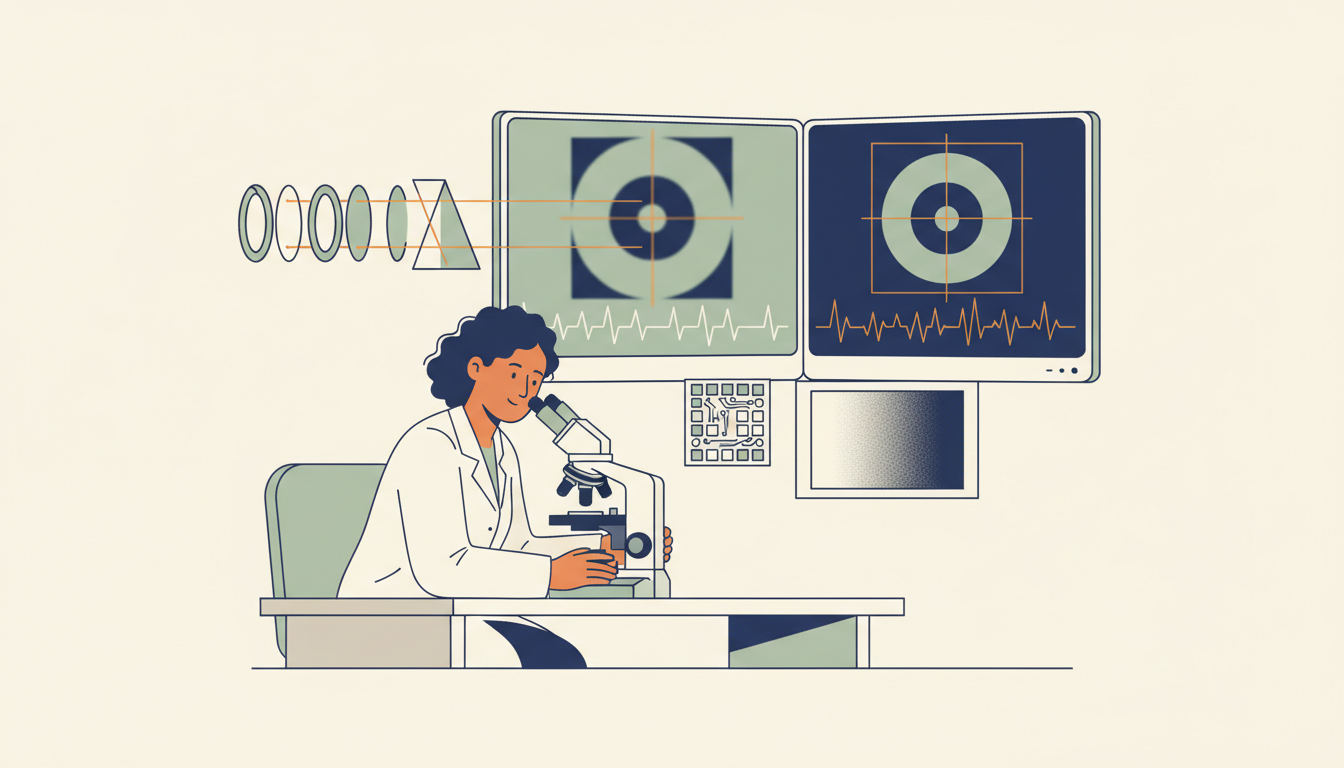
Did you know that a piece of glass can become a vessel, a window, a lens or part of a scientific instrument, depending on how it is made and used? Light makes observation possible, but seeing more does not automatically mean knowing more. Reflections, refraction, lenses, microscopes, telescopes, detectors and careful interpretation form a chain of knowledge. This guide explains those different capabilities across the stages of civilisation without treating the complexity of an optical instrument as a measure of the intelligence or worth of the people who built it.
The Corning Museum of Glass traces human-made glass to roughly four thousand years ago in ancient Mesopotamia, where craftspeople developed methods for shaping glass. Museo Galileo preserves an original telescope dated to late 1609 or early 1610, with the important qualification that its original eyepiece was later lost and replaced. NASA’s Webb telescope uses 18 gold-coated beryllium mirror segments to collect infrared light, not a single giant glass lens. These examples are historically and scientifically distinct: a surviving ancient object, a conserved early optical instrument and a modern operating observatory are different kinds of evidence.
The educational stage model used in this series contains Foundation 0 followed by eight numbered questions about maintained social and technical capability. Foundation 0 recognises adaptable knowledge and human dignity, Stages 1–4 examine settlement, administration, industrial operation and planetary networks, Stage 5 proposes a regenerative standard and Stages 6–8 describe speculative future humans beyond Earth. There is no universally mandatory archaeological ladder or scientific agreement that every society can be morally ranked by one technology.

A concise reading method for parents and tutors
Study the function before naming a civilisation stage. Describe the phenomenon, identify the source, ask who uses the capability and check whether its result can be reproduced when the original person or machine is absent. For every striking historical example, distinguish the original object from later conservation, restoration or an imagined reconstruction. For every modern measurement, distinguish a physical quantity from what readers think that number implies. All numerical classroom counts and distant inhabited-world examples below are invented and not historical facts.
What the source institutions actually establish
Corning Museum of Glass — Origins of Glassmaking
The museum discusses human-made glass in ancient Mesopotamia and Egypt, including casting and core-forming methods and the role of luxury objects. The source is Corning Museum of Glass — Origins of Glassmaking. The record supports a defined historical, scientific or public-health claim—not a ranking of all human cultures, universal adoption of a technique or endorsement of the eduKate stage map. Readers should preserve the date, technical measurement, provenance and uncertainty when quoting it.
Corning Museum of Glass — 35 Centuries of Glass
Traces glass objects and technologies through different regions and centuries, including ancient furnaces and modern industry. The source is Corning Museum of Glass — 35 Centuries of Glass. The record supports a defined historical, scientific or public-health claim—not a ranking of all human cultures, universal adoption of a technique or endorsement of the eduKate stage map. Readers should preserve the date, technical measurement, provenance and uncertainty when quoting it.
Museo Galileo — Galileo’s Telescope, Inventory 2428
The original 1609–1610 instrument survives; its historic objective, replaced eyepiece and technical details demonstrate the importance of conservation provenance. The source is Museo Galileo — Galileo’s Telescope, Inventory 2428. The record supports a defined historical, scientific or public-health claim—not a ranking of all human cultures, universal adoption of a technique or endorsement of the eduKate stage map. Readers should preserve the date, technical measurement, provenance and uncertainty when quoting it.
Museo Galileo — Galileo’s Objective Lens, Inventory 2429
The original lens used in Galileo’s 1609–1610 observations has a dated, documented museum history distinct from later mounts and conservation. The source is Museo Galileo — Galileo’s Objective Lens, Inventory 2429. The record supports a defined historical, scientific or public-health claim—not a ranking of all human cultures, universal adoption of a technique or endorsement of the eduKate stage map. Readers should preserve the date, technical measurement, provenance and uncertainty when quoting it.
NASA Science — The History of Hubble
Explains atmospheric distortion, the design of ground telescopes and the rationale for observing beyond Earth’s atmosphere. The source is NASA Science — The History of Hubble. The record supports a defined historical, scientific or public-health claim—not a ranking of all human cultures, universal adoption of a technique or endorsement of the eduKate stage map. Readers should preserve the date, technical measurement, provenance and uncertainty when quoting it.
NASA Science — Webb Telescope Overview
Describes Webb’s segmented primary mirror, collecting area, red-to-mid-infrared sensitivity and observational limitations. The source is NASA Science — Webb Telescope Overview. The record supports a defined historical, scientific or public-health claim—not a ranking of all human cultures, universal adoption of a technique or endorsement of the eduKate stage map. Readers should preserve the date, technical measurement, provenance and uncertainty when quoting it.
NASA Science — Webb Scientific Instruments
Explains separate imaging and spectroscopy modes and why wavelength coverage matters for a research question. The source is NASA Science — Webb Scientific Instruments. The record supports a defined historical, scientific or public-health claim—not a ranking of all human cultures, universal adoption of a technique or endorsement of the eduKate stage map. Readers should preserve the date, technical measurement, provenance and uncertainty when quoting it.
NASA Science — Hubble versus Webb
Differentiates Hubble and Webb’s observation ranges, and notes that both use mirrors as their main light-collecting optics. The source is NASA Science — Hubble versus Webb. The record supports a defined historical, scientific or public-health claim—not a ranking of all human cultures, universal adoption of a technique or endorsement of the eduKate stage map. Readers should preserve the date, technical measurement, provenance and uncertainty when quoting it.
PubMed — Lens Making for Scientific Instrumentation in the Seventeenth Century
A historical scholarly article describes the technical difficulty of producing reliable optical glass, grinding and polishing suitable lenses. The source is PubMed — Lens Making for Scientific Instrumentation in the Seventeenth Century. The record supports a defined historical, scientific or public-health claim—not a ranking of all human cultures, universal adoption of a technique or endorsement of the eduKate stage map. Readers should preserve the date, technical measurement, provenance and uncertainty when quoting it.
NIST — The SI Units and Physical Constants
Explains the measurement roles of fundamental constants and the difference between physical quantities and their SI expressions. The source is NIST — The SI Units and Physical Constants. The record supports a defined historical, scientific or public-health claim—not a ranking of all human cultures, universal adoption of a technique or endorsement of the eduKate stage map. Readers should preserve the date, technical measurement, provenance and uncertainty when quoting it.
Nine stages, correctly interpreted
Foundation 0: Adaptive Human Worlds. Picture a community using sensory observation, skilled making, teaching, and communication without needing a permanent city or written bureaucracy. The relevant operating capability is practical knowledge transferred through people and appropriately adapted to changing surroundings. If the individual who normally demonstrates a skill is absent when conditions change, ask what would count as an independently checked repair. Important limitation: Archaeological preservation is selective. Neither an absence of instruments nor a small population establishes an inferior culture.. This bounded scenario is a teaching analogy, not a claim about every population in an era.
Stage 1: Settlement and Surplus. Picture a fictional settlement sustaining homes, workshops, common areas and supplies through multiple seasons. The relevant operating capability is local services that work repeatedly for residents rather than only on a special occasion. If a shared workshop or pathway becomes unusable in one season, ask what would count as an independently checked repair. Important limitation: One surviving structure cannot show which people could reach the service or whether its operations were fair.. This bounded scenario is a teaching analogy, not a claim about every population in an era.
Stage 2: Administrative and Recorded Systems. Picture a town sharing records, training instructions and accountable decisions between different specialists. The relevant operating capability is checkable records and responsibilities capable of surviving an ordinary handover. If a surviving document conflicts with an object’s condition or the user’s experience, ask what would count as an independently checked repair. Important limitation: An official account may preserve elite concerns while omitting informal work and other community members.. This bounded scenario is a teaching analogy, not a claim about every population in an era.
Stage 3: Industrial and Mass Institutions. Picture an industrial region coordinating skilled labour, standards, production, public infrastructure and safety. The relevant operating capability is repeatable services at scale with appropriate technical competence, quality checks and maintenance. If greater output introduces a defect or hazard that was not measured in the original plan, ask what would count as an independently checked repair. Important limitation: Powerful machines and large institutions do not imply uniform wellbeing, equity or good environmental outcomes.. This bounded scenario is a teaching analogy, not a claim about every population in an era.
Stage 4: Planetary Network Civilisation. Picture interconnected regions moving goods, signals, scientific information and operating standards across borders. The relevant operating capability is reliable network service and visible dependencies beyond a single country. If an upstream change causes an unexpected error far from its original location, ask what would count as an independently checked repair. Important limitation: International connection does not imply every person or place has equivalent access or influence.. This bounded scenario is a teaching analogy, not a claim about every population in an era.
Stage 5: Proposed Regenerative and Self-Correcting Civilisation. Picture a hypothetical region that notices systemic damage, acts on causes and independently monitors the long-term result. The relevant operating capability is a proposed durable, equitable correction that does not transfer harm beyond the reported boundary. If a positive headline conceals a worsening effect on people or ecosystems outside the study area, ask what would count as an independently checked repair. Important limitation: This stage is a proposed educational threshold, not a verified international status for humanity.. This bounded scenario is a teaching analogy, not a claim about every population in an era.
Stage 6: Hypothetical Multi-World Extension. Picture an imagined off-Earth human habitat continuing to depend on essential shipments and expertise from Earth. The relevant operating capability is ongoing human operations outside Earth with their external dependencies declared. If one specialist, replacement device or shipment is unavailable during a long communications gap, ask what would count as an independently checked repair. Important limitation: A real spacecraft instrument or experiment does not demonstrate a permanently inhabited second-world human civilisation.. This bounded scenario is a teaching analogy, not a claim about every population in an era.
Stage 7: Hypothetical Autonomous Multi-World Civilisation. Picture a fictional inhabited second-world community maintaining many essentials locally despite extended interruptions of Earth support. The relevant operating capability is broad independent education, manufacturing, health, repair, power and legitimate decision making. If a seemingly minor imported part proves indispensable for keeping the facility working, ask what would count as an independently checked repair. Important limitation: One local manufacturing or recycling test cannot establish whole-settlement autonomy.. This bounded scenario is a teaching analogy, not a claim about every population in an era.
Stage 8: Hypothetical Distributed Interplanetary Civilisation. Picture several imagined inhabited worlds exchanging information and commitments through long travel and message delays. The relevant operating capability is durable local responsibility combined with independently accountable cross-world cooperation. If information is already outdated by the time a distant authority sees it, ask what would count as an independently checked repair. Important limitation: The proposed distributed inhabited human state is speculative; probes and radio networks are not populations.. This bounded scenario is a teaching analogy, not a claim about every population in an era.
Twenty subject-specific mechanisms
1. Light as a physical signal
Quick explanation. Distinguish optical radiation from the objects and materials that emit, reflect, absorb or transmit it. The key issue appears in a fictional case: A learner believes a bright image proves the object itself produces light.. The reader should identify the person or instrument involved, what is being detected or produced, and which conditions must hold before the operation works as intended. One result is not enough to describe a whole civilisation. A better account explains the exact service and separates what the original source establishes from what a modern interpreter has assumed.
Evidence and limits. Appropriate source and detector information, wave physics and measured illumination. It is important that Photographs contain the combined effects of a source, an object, an instrument and processing.. The learner should ask whether the evidence is a physical artefact, a report of a sensory experience, a derived measurement, a digital reconstruction or an institutional claim. These materials have different strengths and ways of failing. The tutor can offer a credible alternative explanation and ask the student for one test that might reverse the original conclusion. Good analysis includes the people affected, especially those who cannot access the service because of cost, disability or institutional restrictions.
Safe learning activity. Draw a simple source–object–detector diagram with only paper arrows. The broader lesson is that Observation is evidence after a chain of transformations, not a direct copy of reality.. Each activity should be confined to paper, printed source records or routine classroom observation, without loud sounds, solar viewing through optics, dangerous equipment, direct experimentation with biological specimens, or real private data. A child can develop excellent reasoning about physics and culture without taking personal safety risks.
Light as a physical signal in Foundation 0: Adaptive Human Worlds
Imagine the operating conditions. The group is situated in a community using sensory observation, skilled making, teaching, and communication without needing a permanent city or written bureaucracy. The challenge is to Distinguish optical radiation from the objects and materials that emit, reflect, absorb or transmit it. Suppose A learner believes a bright image proves the object itself produces light.. The relevant stage capability is practical knowledge transferred through people and appropriately adapted to changing surroundings, and the class must decide whether its model actually demonstrates it. First identify what is observable, who is responsible for using the result and which resources or physical properties are necessary. Then let the individual who normally demonstrates a skill is absent when conditions change. A successful-looking diagram can hide weak handovers, unclear instructions, unavailable materials or a service that works only under unusually favourable conditions. We do not treat this fictional problem as proof of an actual ancient culture’s experience.
What the evidence permits. The best record would include Appropriate source and detector information, wave physics and measured illumination.. Nevertheless, Photographs contain the combined effects of a source, an object, an instrument and processing.. The independent reviewer should distinguish a measurement from the model used to interpret it, and check whether affected people could actually reach the service. A claimed achievement needs a stated period and a suitable test; a published photograph or beautiful chart cannot automatically verify all its assumptions. Archaeological preservation is selective. Neither an absence of instruments nor a small population establishes an inferior culture.. In the imagined off-Earth stages the relevant inhabitants and institutions remain hypothetical and should never be reported as established fact.
Practice and correction. Have learners Draw a simple source–object–detector diagram with only paper arrows.. After the first result, introduce a paper disruption: the individual who normally demonstrates a skill is absent when conditions change. One group explains how the phenomenon works, a second looks for an alternative cause or reading, and a third considers accessibility and legitimate responsibility for errors. Require the groups to share their evidence and give a short note about what remains unknown. Their report should express the conclusion that Observation is evidence after a chain of transformations, not a direct copy of reality. without turning the technology into a test of human worth. A good educational explanation becomes stronger when another reader can repeat the reasoning and challenge its unsupported parts.
Light as a physical signal in Stage 1: Settlement and Surplus
Imagine the operating conditions. The group is situated in a fictional settlement sustaining homes, workshops, common areas and supplies through multiple seasons. The challenge is to Distinguish optical radiation from the objects and materials that emit, reflect, absorb or transmit it. Suppose A learner believes a bright image proves the object itself produces light.. The relevant stage capability is local services that work repeatedly for residents rather than only on a special occasion, and the class must decide whether its model actually demonstrates it. First identify what is observable, who is responsible for using the result and which resources or physical properties are necessary. Then let a shared workshop or pathway becomes unusable in one season. A successful-looking diagram can hide weak handovers, unclear instructions, unavailable materials or a service that works only under unusually favourable conditions. We do not treat this fictional problem as proof of an actual ancient culture’s experience.
What the evidence permits. The best record would include Appropriate source and detector information, wave physics and measured illumination.. Nevertheless, Photographs contain the combined effects of a source, an object, an instrument and processing.. The independent reviewer should distinguish a measurement from the model used to interpret it, and check whether affected people could actually reach the service. A claimed achievement needs a stated period and a suitable test; a published photograph or beautiful chart cannot automatically verify all its assumptions. One surviving structure cannot show which people could reach the service or whether its operations were fair.. In the imagined off-Earth stages the relevant inhabitants and institutions remain hypothetical and should never be reported as established fact.
Practice and correction. Have learners Draw a simple source–object–detector diagram with only paper arrows.. After the first result, introduce a paper disruption: a shared workshop or pathway becomes unusable in one season. One group explains how the phenomenon works, a second looks for an alternative cause or reading, and a third considers accessibility and legitimate responsibility for errors. Require the groups to share their evidence and give a short note about what remains unknown. Their report should express the conclusion that Observation is evidence after a chain of transformations, not a direct copy of reality. without turning the technology into a test of human worth. A good educational explanation becomes stronger when another reader can repeat the reasoning and challenge its unsupported parts.
Light as a physical signal in Stage 2: Administrative and Recorded Systems
Imagine the operating conditions. The group is situated in a town sharing records, training instructions and accountable decisions between different specialists. The challenge is to Distinguish optical radiation from the objects and materials that emit, reflect, absorb or transmit it. Suppose A learner believes a bright image proves the object itself produces light.. The relevant stage capability is checkable records and responsibilities capable of surviving an ordinary handover, and the class must decide whether its model actually demonstrates it. First identify what is observable, who is responsible for using the result and which resources or physical properties are necessary. Then let a surviving document conflicts with an object’s condition or the user’s experience. A successful-looking diagram can hide weak handovers, unclear instructions, unavailable materials or a service that works only under unusually favourable conditions. We do not treat this fictional problem as proof of an actual ancient culture’s experience.
What the evidence permits. The best record would include Appropriate source and detector information, wave physics and measured illumination.. Nevertheless, Photographs contain the combined effects of a source, an object, an instrument and processing.. The independent reviewer should distinguish a measurement from the model used to interpret it, and check whether affected people could actually reach the service. A claimed achievement needs a stated period and a suitable test; a published photograph or beautiful chart cannot automatically verify all its assumptions. An official account may preserve elite concerns while omitting informal work and other community members.. In the imagined off-Earth stages the relevant inhabitants and institutions remain hypothetical and should never be reported as established fact.
Practice and correction. Have learners Draw a simple source–object–detector diagram with only paper arrows.. After the first result, introduce a paper disruption: a surviving document conflicts with an object’s condition or the user’s experience. One group explains how the phenomenon works, a second looks for an alternative cause or reading, and a third considers accessibility and legitimate responsibility for errors. Require the groups to share their evidence and give a short note about what remains unknown. Their report should express the conclusion that Observation is evidence after a chain of transformations, not a direct copy of reality. without turning the technology into a test of human worth. A good educational explanation becomes stronger when another reader can repeat the reasoning and challenge its unsupported parts.
Light as a physical signal in Stage 3: Industrial and Mass Institutions
Imagine the operating conditions. The group is situated in an industrial region coordinating skilled labour, standards, production, public infrastructure and safety. The challenge is to Distinguish optical radiation from the objects and materials that emit, reflect, absorb or transmit it. Suppose A learner believes a bright image proves the object itself produces light.. The relevant stage capability is repeatable services at scale with appropriate technical competence, quality checks and maintenance, and the class must decide whether its model actually demonstrates it. First identify what is observable, who is responsible for using the result and which resources or physical properties are necessary. Then let greater output introduces a defect or hazard that was not measured in the original plan. A successful-looking diagram can hide weak handovers, unclear instructions, unavailable materials or a service that works only under unusually favourable conditions. We do not treat this fictional problem as proof of an actual ancient culture’s experience.
What the evidence permits. The best record would include Appropriate source and detector information, wave physics and measured illumination.. Nevertheless, Photographs contain the combined effects of a source, an object, an instrument and processing.. The independent reviewer should distinguish a measurement from the model used to interpret it, and check whether affected people could actually reach the service. A claimed achievement needs a stated period and a suitable test; a published photograph or beautiful chart cannot automatically verify all its assumptions. Powerful machines and large institutions do not imply uniform wellbeing, equity or good environmental outcomes.. In the imagined off-Earth stages the relevant inhabitants and institutions remain hypothetical and should never be reported as established fact.
Practice and correction. Have learners Draw a simple source–object–detector diagram with only paper arrows.. After the first result, introduce a paper disruption: greater output introduces a defect or hazard that was not measured in the original plan. One group explains how the phenomenon works, a second looks for an alternative cause or reading, and a third considers accessibility and legitimate responsibility for errors. Require the groups to share their evidence and give a short note about what remains unknown. Their report should express the conclusion that Observation is evidence after a chain of transformations, not a direct copy of reality. without turning the technology into a test of human worth. A good educational explanation becomes stronger when another reader can repeat the reasoning and challenge its unsupported parts.
Light as a physical signal in Stage 4: Planetary Network Civilisation
Imagine the operating conditions. The group is situated in interconnected regions moving goods, signals, scientific information and operating standards across borders. The challenge is to Distinguish optical radiation from the objects and materials that emit, reflect, absorb or transmit it. Suppose A learner believes a bright image proves the object itself produces light.. The relevant stage capability is reliable network service and visible dependencies beyond a single country, and the class must decide whether its model actually demonstrates it. First identify what is observable, who is responsible for using the result and which resources or physical properties are necessary. Then let an upstream change causes an unexpected error far from its original location. A successful-looking diagram can hide weak handovers, unclear instructions, unavailable materials or a service that works only under unusually favourable conditions. We do not treat this fictional problem as proof of an actual ancient culture’s experience.
What the evidence permits. The best record would include Appropriate source and detector information, wave physics and measured illumination.. Nevertheless, Photographs contain the combined effects of a source, an object, an instrument and processing.. The independent reviewer should distinguish a measurement from the model used to interpret it, and check whether affected people could actually reach the service. A claimed achievement needs a stated period and a suitable test; a published photograph or beautiful chart cannot automatically verify all its assumptions. International connection does not imply every person or place has equivalent access or influence.. In the imagined off-Earth stages the relevant inhabitants and institutions remain hypothetical and should never be reported as established fact.
Practice and correction. Have learners Draw a simple source–object–detector diagram with only paper arrows.. After the first result, introduce a paper disruption: an upstream change causes an unexpected error far from its original location. One group explains how the phenomenon works, a second looks for an alternative cause or reading, and a third considers accessibility and legitimate responsibility for errors. Require the groups to share their evidence and give a short note about what remains unknown. Their report should express the conclusion that Observation is evidence after a chain of transformations, not a direct copy of reality. without turning the technology into a test of human worth. A good educational explanation becomes stronger when another reader can repeat the reasoning and challenge its unsupported parts.
Light as a physical signal in Stage 5: Proposed Regenerative and Self-Correcting Civilisation
Imagine the operating conditions. The group is situated in a hypothetical region that notices systemic damage, acts on causes and independently monitors the long-term result. The challenge is to Distinguish optical radiation from the objects and materials that emit, reflect, absorb or transmit it. Suppose A learner believes a bright image proves the object itself produces light.. The relevant stage capability is a proposed durable, equitable correction that does not transfer harm beyond the reported boundary, and the class must decide whether its model actually demonstrates it. First identify what is observable, who is responsible for using the result and which resources or physical properties are necessary. Then let a positive headline conceals a worsening effect on people or ecosystems outside the study area. A successful-looking diagram can hide weak handovers, unclear instructions, unavailable materials or a service that works only under unusually favourable conditions. We do not treat this fictional problem as proof of an actual ancient culture’s experience.
What the evidence permits. The best record would include Appropriate source and detector information, wave physics and measured illumination.. Nevertheless, Photographs contain the combined effects of a source, an object, an instrument and processing.. The independent reviewer should distinguish a measurement from the model used to interpret it, and check whether affected people could actually reach the service. A claimed achievement needs a stated period and a suitable test; a published photograph or beautiful chart cannot automatically verify all its assumptions. This stage is a proposed educational threshold, not a verified international status for humanity.. In the imagined off-Earth stages the relevant inhabitants and institutions remain hypothetical and should never be reported as established fact.
Practice and correction. Have learners Draw a simple source–object–detector diagram with only paper arrows.. After the first result, introduce a paper disruption: a positive headline conceals a worsening effect on people or ecosystems outside the study area. One group explains how the phenomenon works, a second looks for an alternative cause or reading, and a third considers accessibility and legitimate responsibility for errors. Require the groups to share their evidence and give a short note about what remains unknown. Their report should express the conclusion that Observation is evidence after a chain of transformations, not a direct copy of reality. without turning the technology into a test of human worth. A good educational explanation becomes stronger when another reader can repeat the reasoning and challenge its unsupported parts.
Light as a physical signal in Stage 6: Hypothetical Multi-World Extension
Imagine the operating conditions. The group is situated in an imagined off-Earth human habitat continuing to depend on essential shipments and expertise from Earth. The challenge is to Distinguish optical radiation from the objects and materials that emit, reflect, absorb or transmit it. Suppose A learner believes a bright image proves the object itself produces light.. The relevant stage capability is ongoing human operations outside Earth with their external dependencies declared, and the class must decide whether its model actually demonstrates it. First identify what is observable, who is responsible for using the result and which resources or physical properties are necessary. Then let one specialist, replacement device or shipment is unavailable during a long communications gap. A successful-looking diagram can hide weak handovers, unclear instructions, unavailable materials or a service that works only under unusually favourable conditions. We do not treat this fictional problem as proof of an actual ancient culture’s experience.
What the evidence permits. The best record would include Appropriate source and detector information, wave physics and measured illumination.. Nevertheless, Photographs contain the combined effects of a source, an object, an instrument and processing.. The independent reviewer should distinguish a measurement from the model used to interpret it, and check whether affected people could actually reach the service. A claimed achievement needs a stated period and a suitable test; a published photograph or beautiful chart cannot automatically verify all its assumptions. A real spacecraft instrument or experiment does not demonstrate a permanently inhabited second-world human civilisation.. In the imagined off-Earth stages the relevant inhabitants and institutions remain hypothetical and should never be reported as established fact.
Practice and correction. Have learners Draw a simple source–object–detector diagram with only paper arrows.. After the first result, introduce a paper disruption: one specialist, replacement device or shipment is unavailable during a long communications gap. One group explains how the phenomenon works, a second looks for an alternative cause or reading, and a third considers accessibility and legitimate responsibility for errors. Require the groups to share their evidence and give a short note about what remains unknown. Their report should express the conclusion that Observation is evidence after a chain of transformations, not a direct copy of reality. without turning the technology into a test of human worth. A good educational explanation becomes stronger when another reader can repeat the reasoning and challenge its unsupported parts.
Light as a physical signal in Stage 7: Hypothetical Autonomous Multi-World Civilisation
Imagine the operating conditions. The group is situated in a fictional inhabited second-world community maintaining many essentials locally despite extended interruptions of Earth support. The challenge is to Distinguish optical radiation from the objects and materials that emit, reflect, absorb or transmit it. Suppose A learner believes a bright image proves the object itself produces light.. The relevant stage capability is broad independent education, manufacturing, health, repair, power and legitimate decision making, and the class must decide whether its model actually demonstrates it. First identify what is observable, who is responsible for using the result and which resources or physical properties are necessary. Then let a seemingly minor imported part proves indispensable for keeping the facility working. A successful-looking diagram can hide weak handovers, unclear instructions, unavailable materials or a service that works only under unusually favourable conditions. We do not treat this fictional problem as proof of an actual ancient culture’s experience.
What the evidence permits. The best record would include Appropriate source and detector information, wave physics and measured illumination.. Nevertheless, Photographs contain the combined effects of a source, an object, an instrument and processing.. The independent reviewer should distinguish a measurement from the model used to interpret it, and check whether affected people could actually reach the service. A claimed achievement needs a stated period and a suitable test; a published photograph or beautiful chart cannot automatically verify all its assumptions. One local manufacturing or recycling test cannot establish whole-settlement autonomy.. In the imagined off-Earth stages the relevant inhabitants and institutions remain hypothetical and should never be reported as established fact.
Practice and correction. Have learners Draw a simple source–object–detector diagram with only paper arrows.. After the first result, introduce a paper disruption: a seemingly minor imported part proves indispensable for keeping the facility working. One group explains how the phenomenon works, a second looks for an alternative cause or reading, and a third considers accessibility and legitimate responsibility for errors. Require the groups to share their evidence and give a short note about what remains unknown. Their report should express the conclusion that Observation is evidence after a chain of transformations, not a direct copy of reality. without turning the technology into a test of human worth. A good educational explanation becomes stronger when another reader can repeat the reasoning and challenge its unsupported parts.
Light as a physical signal in Stage 8: Hypothetical Distributed Interplanetary Civilisation
Imagine the operating conditions. The group is situated in several imagined inhabited worlds exchanging information and commitments through long travel and message delays. The challenge is to Distinguish optical radiation from the objects and materials that emit, reflect, absorb or transmit it. Suppose A learner believes a bright image proves the object itself produces light.. The relevant stage capability is durable local responsibility combined with independently accountable cross-world cooperation, and the class must decide whether its model actually demonstrates it. First identify what is observable, who is responsible for using the result and which resources or physical properties are necessary. Then let information is already outdated by the time a distant authority sees it. A successful-looking diagram can hide weak handovers, unclear instructions, unavailable materials or a service that works only under unusually favourable conditions. We do not treat this fictional problem as proof of an actual ancient culture’s experience.
What the evidence permits. The best record would include Appropriate source and detector information, wave physics and measured illumination.. Nevertheless, Photographs contain the combined effects of a source, an object, an instrument and processing.. The independent reviewer should distinguish a measurement from the model used to interpret it, and check whether affected people could actually reach the service. A claimed achievement needs a stated period and a suitable test; a published photograph or beautiful chart cannot automatically verify all its assumptions. The proposed distributed inhabited human state is speculative; probes and radio networks are not populations.. In the imagined off-Earth stages the relevant inhabitants and institutions remain hypothetical and should never be reported as established fact.
Practice and correction. Have learners Draw a simple source–object–detector diagram with only paper arrows.. After the first result, introduce a paper disruption: information is already outdated by the time a distant authority sees it. One group explains how the phenomenon works, a second looks for an alternative cause or reading, and a third considers accessibility and legitimate responsibility for errors. Require the groups to share their evidence and give a short note about what remains unknown. Their report should express the conclusion that Observation is evidence after a chain of transformations, not a direct copy of reality. without turning the technology into a test of human worth. A good educational explanation becomes stronger when another reader can repeat the reasoning and challenge its unsupported parts.
Worked evidence and arithmetic check: Light as a physical signal
In an invented teaching record the class plans 85 observations, images, messages or service instances but can independently confirm 79. That gives a verified fraction of 79/85, approximately 92.9%, leaving 6 not confirmed under the chosen definition. Another 1 claims are of uncertain status and cannot be added as confirmed cases. This is classroom arithmetic rather than actual measurement data from a museum, the WHO or NASA.
Now ask whether Photographs contain the combined effects of a source, an object, an instrument and processing.. Did the team choose the right unit, object and observation period? Was a processing choice mistaken for a direct natural observation? Would a different source or an independent reviewer agree? The exercise should conclude with a properly bounded claim, one credible counterexample and a proposed check. An exact-looking percentage is not a reason to hide uncertainty about the underlying mechanism.
2. Daylight, visibility and responsible use
Quick explanation. Connect practical visibility to time of day, location, user needs and safe access. The key issue appears in a fictional case: A new walking route appears well illuminated on a daytime map but is difficult to follow after sunset.. The reader should identify the person or instrument involved, what is being detected or produced, and which conditions must hold before the operation works as intended. One result is not enough to describe a whole civilisation. A better account explains the exact service and separates what the original source establishes from what a modern interpreter has assumed.
Evidence and limits. Site observations, accessible route studies and legitimate lighting requirements. It is important that An attractive daylight rendering cannot prove safety or accessibility at night.. The learner should ask whether the evidence is a physical artefact, a report of a sensory experience, a derived measurement, a digital reconstruction or an institutional claim. These materials have different strengths and ways of failing. The tutor can offer a credible alternative explanation and ask the student for one test that might reverse the original conclusion. Good analysis includes the people affected, especially those who cannot access the service because of cost, disability or institutional restrictions.
Safe learning activity. Compare two invented route descriptions for daytime and evening use. The broader lesson is that Lighting decisions have social and environmental consequences, not only visual effects.. Each activity should be confined to paper, printed source records or routine classroom observation, without loud sounds, solar viewing through optics, dangerous equipment, direct experimentation with biological specimens, or real private data. A child can develop excellent reasoning about physics and culture without taking personal safety risks.
Daylight, visibility and responsible use in Foundation 0: Adaptive Human Worlds
Imagine the operating conditions. The group is situated in a community using sensory observation, skilled making, teaching, and communication without needing a permanent city or written bureaucracy. The challenge is to Connect practical visibility to time of day, location, user needs and safe access. Suppose A new walking route appears well illuminated on a daytime map but is difficult to follow after sunset.. The relevant stage capability is practical knowledge transferred through people and appropriately adapted to changing surroundings, and the class must decide whether its model actually demonstrates it. First identify what is observable, who is responsible for using the result and which resources or physical properties are necessary. Then let the individual who normally demonstrates a skill is absent when conditions change. A successful-looking diagram can hide weak handovers, unclear instructions, unavailable materials or a service that works only under unusually favourable conditions. We do not treat this fictional problem as proof of an actual ancient culture’s experience.
What the evidence permits. The best record would include Site observations, accessible route studies and legitimate lighting requirements.. Nevertheless, An attractive daylight rendering cannot prove safety or accessibility at night.. The independent reviewer should distinguish a measurement from the model used to interpret it, and check whether affected people could actually reach the service. A claimed achievement needs a stated period and a suitable test; a published photograph or beautiful chart cannot automatically verify all its assumptions. Archaeological preservation is selective. Neither an absence of instruments nor a small population establishes an inferior culture.. In the imagined off-Earth stages the relevant inhabitants and institutions remain hypothetical and should never be reported as established fact.
Practice and correction. Have learners Compare two invented route descriptions for daytime and evening use.. After the first result, introduce a paper disruption: the individual who normally demonstrates a skill is absent when conditions change. One group explains how the phenomenon works, a second looks for an alternative cause or reading, and a third considers accessibility and legitimate responsibility for errors. Require the groups to share their evidence and give a short note about what remains unknown. Their report should express the conclusion that Lighting decisions have social and environmental consequences, not only visual effects. without turning the technology into a test of human worth. A good educational explanation becomes stronger when another reader can repeat the reasoning and challenge its unsupported parts.
Daylight, visibility and responsible use in Stage 1: Settlement and Surplus
Imagine the operating conditions. The group is situated in a fictional settlement sustaining homes, workshops, common areas and supplies through multiple seasons. The challenge is to Connect practical visibility to time of day, location, user needs and safe access. Suppose A new walking route appears well illuminated on a daytime map but is difficult to follow after sunset.. The relevant stage capability is local services that work repeatedly for residents rather than only on a special occasion, and the class must decide whether its model actually demonstrates it. First identify what is observable, who is responsible for using the result and which resources or physical properties are necessary. Then let a shared workshop or pathway becomes unusable in one season. A successful-looking diagram can hide weak handovers, unclear instructions, unavailable materials or a service that works only under unusually favourable conditions. We do not treat this fictional problem as proof of an actual ancient culture’s experience.
What the evidence permits. The best record would include Site observations, accessible route studies and legitimate lighting requirements.. Nevertheless, An attractive daylight rendering cannot prove safety or accessibility at night.. The independent reviewer should distinguish a measurement from the model used to interpret it, and check whether affected people could actually reach the service. A claimed achievement needs a stated period and a suitable test; a published photograph or beautiful chart cannot automatically verify all its assumptions. One surviving structure cannot show which people could reach the service or whether its operations were fair.. In the imagined off-Earth stages the relevant inhabitants and institutions remain hypothetical and should never be reported as established fact.
Practice and correction. Have learners Compare two invented route descriptions for daytime and evening use.. After the first result, introduce a paper disruption: a shared workshop or pathway becomes unusable in one season. One group explains how the phenomenon works, a second looks for an alternative cause or reading, and a third considers accessibility and legitimate responsibility for errors. Require the groups to share their evidence and give a short note about what remains unknown. Their report should express the conclusion that Lighting decisions have social and environmental consequences, not only visual effects. without turning the technology into a test of human worth. A good educational explanation becomes stronger when another reader can repeat the reasoning and challenge its unsupported parts.
Daylight, visibility and responsible use in Stage 2: Administrative and Recorded Systems
Imagine the operating conditions. The group is situated in a town sharing records, training instructions and accountable decisions between different specialists. The challenge is to Connect practical visibility to time of day, location, user needs and safe access. Suppose A new walking route appears well illuminated on a daytime map but is difficult to follow after sunset.. The relevant stage capability is checkable records and responsibilities capable of surviving an ordinary handover, and the class must decide whether its model actually demonstrates it. First identify what is observable, who is responsible for using the result and which resources or physical properties are necessary. Then let a surviving document conflicts with an object’s condition or the user’s experience. A successful-looking diagram can hide weak handovers, unclear instructions, unavailable materials or a service that works only under unusually favourable conditions. We do not treat this fictional problem as proof of an actual ancient culture’s experience.
What the evidence permits. The best record would include Site observations, accessible route studies and legitimate lighting requirements.. Nevertheless, An attractive daylight rendering cannot prove safety or accessibility at night.. The independent reviewer should distinguish a measurement from the model used to interpret it, and check whether affected people could actually reach the service. A claimed achievement needs a stated period and a suitable test; a published photograph or beautiful chart cannot automatically verify all its assumptions. An official account may preserve elite concerns while omitting informal work and other community members.. In the imagined off-Earth stages the relevant inhabitants and institutions remain hypothetical and should never be reported as established fact.
Practice and correction. Have learners Compare two invented route descriptions for daytime and evening use.. After the first result, introduce a paper disruption: a surviving document conflicts with an object’s condition or the user’s experience. One group explains how the phenomenon works, a second looks for an alternative cause or reading, and a third considers accessibility and legitimate responsibility for errors. Require the groups to share their evidence and give a short note about what remains unknown. Their report should express the conclusion that Lighting decisions have social and environmental consequences, not only visual effects. without turning the technology into a test of human worth. A good educational explanation becomes stronger when another reader can repeat the reasoning and challenge its unsupported parts.
Daylight, visibility and responsible use in Stage 3: Industrial and Mass Institutions
Imagine the operating conditions. The group is situated in an industrial region coordinating skilled labour, standards, production, public infrastructure and safety. The challenge is to Connect practical visibility to time of day, location, user needs and safe access. Suppose A new walking route appears well illuminated on a daytime map but is difficult to follow after sunset.. The relevant stage capability is repeatable services at scale with appropriate technical competence, quality checks and maintenance, and the class must decide whether its model actually demonstrates it. First identify what is observable, who is responsible for using the result and which resources or physical properties are necessary. Then let greater output introduces a defect or hazard that was not measured in the original plan. A successful-looking diagram can hide weak handovers, unclear instructions, unavailable materials or a service that works only under unusually favourable conditions. We do not treat this fictional problem as proof of an actual ancient culture’s experience.
What the evidence permits. The best record would include Site observations, accessible route studies and legitimate lighting requirements.. Nevertheless, An attractive daylight rendering cannot prove safety or accessibility at night.. The independent reviewer should distinguish a measurement from the model used to interpret it, and check whether affected people could actually reach the service. A claimed achievement needs a stated period and a suitable test; a published photograph or beautiful chart cannot automatically verify all its assumptions. Powerful machines and large institutions do not imply uniform wellbeing, equity or good environmental outcomes.. In the imagined off-Earth stages the relevant inhabitants and institutions remain hypothetical and should never be reported as established fact.
Practice and correction. Have learners Compare two invented route descriptions for daytime and evening use.. After the first result, introduce a paper disruption: greater output introduces a defect or hazard that was not measured in the original plan. One group explains how the phenomenon works, a second looks for an alternative cause or reading, and a third considers accessibility and legitimate responsibility for errors. Require the groups to share their evidence and give a short note about what remains unknown. Their report should express the conclusion that Lighting decisions have social and environmental consequences, not only visual effects. without turning the technology into a test of human worth. A good educational explanation becomes stronger when another reader can repeat the reasoning and challenge its unsupported parts.
Daylight, visibility and responsible use in Stage 4: Planetary Network Civilisation
Imagine the operating conditions. The group is situated in interconnected regions moving goods, signals, scientific information and operating standards across borders. The challenge is to Connect practical visibility to time of day, location, user needs and safe access. Suppose A new walking route appears well illuminated on a daytime map but is difficult to follow after sunset.. The relevant stage capability is reliable network service and visible dependencies beyond a single country, and the class must decide whether its model actually demonstrates it. First identify what is observable, who is responsible for using the result and which resources or physical properties are necessary. Then let an upstream change causes an unexpected error far from its original location. A successful-looking diagram can hide weak handovers, unclear instructions, unavailable materials or a service that works only under unusually favourable conditions. We do not treat this fictional problem as proof of an actual ancient culture’s experience.
What the evidence permits. The best record would include Site observations, accessible route studies and legitimate lighting requirements.. Nevertheless, An attractive daylight rendering cannot prove safety or accessibility at night.. The independent reviewer should distinguish a measurement from the model used to interpret it, and check whether affected people could actually reach the service. A claimed achievement needs a stated period and a suitable test; a published photograph or beautiful chart cannot automatically verify all its assumptions. International connection does not imply every person or place has equivalent access or influence.. In the imagined off-Earth stages the relevant inhabitants and institutions remain hypothetical and should never be reported as established fact.
Practice and correction. Have learners Compare two invented route descriptions for daytime and evening use.. After the first result, introduce a paper disruption: an upstream change causes an unexpected error far from its original location. One group explains how the phenomenon works, a second looks for an alternative cause or reading, and a third considers accessibility and legitimate responsibility for errors. Require the groups to share their evidence and give a short note about what remains unknown. Their report should express the conclusion that Lighting decisions have social and environmental consequences, not only visual effects. without turning the technology into a test of human worth. A good educational explanation becomes stronger when another reader can repeat the reasoning and challenge its unsupported parts.
Daylight, visibility and responsible use in Stage 5: Proposed Regenerative and Self-Correcting Civilisation
Imagine the operating conditions. The group is situated in a hypothetical region that notices systemic damage, acts on causes and independently monitors the long-term result. The challenge is to Connect practical visibility to time of day, location, user needs and safe access. Suppose A new walking route appears well illuminated on a daytime map but is difficult to follow after sunset.. The relevant stage capability is a proposed durable, equitable correction that does not transfer harm beyond the reported boundary, and the class must decide whether its model actually demonstrates it. First identify what is observable, who is responsible for using the result and which resources or physical properties are necessary. Then let a positive headline conceals a worsening effect on people or ecosystems outside the study area. A successful-looking diagram can hide weak handovers, unclear instructions, unavailable materials or a service that works only under unusually favourable conditions. We do not treat this fictional problem as proof of an actual ancient culture’s experience.
What the evidence permits. The best record would include Site observations, accessible route studies and legitimate lighting requirements.. Nevertheless, An attractive daylight rendering cannot prove safety or accessibility at night.. The independent reviewer should distinguish a measurement from the model used to interpret it, and check whether affected people could actually reach the service. A claimed achievement needs a stated period and a suitable test; a published photograph or beautiful chart cannot automatically verify all its assumptions. This stage is a proposed educational threshold, not a verified international status for humanity.. In the imagined off-Earth stages the relevant inhabitants and institutions remain hypothetical and should never be reported as established fact.
Practice and correction. Have learners Compare two invented route descriptions for daytime and evening use.. After the first result, introduce a paper disruption: a positive headline conceals a worsening effect on people or ecosystems outside the study area. One group explains how the phenomenon works, a second looks for an alternative cause or reading, and a third considers accessibility and legitimate responsibility for errors. Require the groups to share their evidence and give a short note about what remains unknown. Their report should express the conclusion that Lighting decisions have social and environmental consequences, not only visual effects. without turning the technology into a test of human worth. A good educational explanation becomes stronger when another reader can repeat the reasoning and challenge its unsupported parts.
Daylight, visibility and responsible use in Stage 6: Hypothetical Multi-World Extension
Imagine the operating conditions. The group is situated in an imagined off-Earth human habitat continuing to depend on essential shipments and expertise from Earth. The challenge is to Connect practical visibility to time of day, location, user needs and safe access. Suppose A new walking route appears well illuminated on a daytime map but is difficult to follow after sunset.. The relevant stage capability is ongoing human operations outside Earth with their external dependencies declared, and the class must decide whether its model actually demonstrates it. First identify what is observable, who is responsible for using the result and which resources or physical properties are necessary. Then let one specialist, replacement device or shipment is unavailable during a long communications gap. A successful-looking diagram can hide weak handovers, unclear instructions, unavailable materials or a service that works only under unusually favourable conditions. We do not treat this fictional problem as proof of an actual ancient culture’s experience.
What the evidence permits. The best record would include Site observations, accessible route studies and legitimate lighting requirements.. Nevertheless, An attractive daylight rendering cannot prove safety or accessibility at night.. The independent reviewer should distinguish a measurement from the model used to interpret it, and check whether affected people could actually reach the service. A claimed achievement needs a stated period and a suitable test; a published photograph or beautiful chart cannot automatically verify all its assumptions. A real spacecraft instrument or experiment does not demonstrate a permanently inhabited second-world human civilisation.. In the imagined off-Earth stages the relevant inhabitants and institutions remain hypothetical and should never be reported as established fact.
Practice and correction. Have learners Compare two invented route descriptions for daytime and evening use.. After the first result, introduce a paper disruption: one specialist, replacement device or shipment is unavailable during a long communications gap. One group explains how the phenomenon works, a second looks for an alternative cause or reading, and a third considers accessibility and legitimate responsibility for errors. Require the groups to share their evidence and give a short note about what remains unknown. Their report should express the conclusion that Lighting decisions have social and environmental consequences, not only visual effects. without turning the technology into a test of human worth. A good educational explanation becomes stronger when another reader can repeat the reasoning and challenge its unsupported parts.
Daylight, visibility and responsible use in Stage 7: Hypothetical Autonomous Multi-World Civilisation
Imagine the operating conditions. The group is situated in a fictional inhabited second-world community maintaining many essentials locally despite extended interruptions of Earth support. The challenge is to Connect practical visibility to time of day, location, user needs and safe access. Suppose A new walking route appears well illuminated on a daytime map but is difficult to follow after sunset.. The relevant stage capability is broad independent education, manufacturing, health, repair, power and legitimate decision making, and the class must decide whether its model actually demonstrates it. First identify what is observable, who is responsible for using the result and which resources or physical properties are necessary. Then let a seemingly minor imported part proves indispensable for keeping the facility working. A successful-looking diagram can hide weak handovers, unclear instructions, unavailable materials or a service that works only under unusually favourable conditions. We do not treat this fictional problem as proof of an actual ancient culture’s experience.
What the evidence permits. The best record would include Site observations, accessible route studies and legitimate lighting requirements.. Nevertheless, An attractive daylight rendering cannot prove safety or accessibility at night.. The independent reviewer should distinguish a measurement from the model used to interpret it, and check whether affected people could actually reach the service. A claimed achievement needs a stated period and a suitable test; a published photograph or beautiful chart cannot automatically verify all its assumptions. One local manufacturing or recycling test cannot establish whole-settlement autonomy.. In the imagined off-Earth stages the relevant inhabitants and institutions remain hypothetical and should never be reported as established fact.
Practice and correction. Have learners Compare two invented route descriptions for daytime and evening use.. After the first result, introduce a paper disruption: a seemingly minor imported part proves indispensable for keeping the facility working. One group explains how the phenomenon works, a second looks for an alternative cause or reading, and a third considers accessibility and legitimate responsibility for errors. Require the groups to share their evidence and give a short note about what remains unknown. Their report should express the conclusion that Lighting decisions have social and environmental consequences, not only visual effects. without turning the technology into a test of human worth. A good educational explanation becomes stronger when another reader can repeat the reasoning and challenge its unsupported parts.
Daylight, visibility and responsible use in Stage 8: Hypothetical Distributed Interplanetary Civilisation
Imagine the operating conditions. The group is situated in several imagined inhabited worlds exchanging information and commitments through long travel and message delays. The challenge is to Connect practical visibility to time of day, location, user needs and safe access. Suppose A new walking route appears well illuminated on a daytime map but is difficult to follow after sunset.. The relevant stage capability is durable local responsibility combined with independently accountable cross-world cooperation, and the class must decide whether its model actually demonstrates it. First identify what is observable, who is responsible for using the result and which resources or physical properties are necessary. Then let information is already outdated by the time a distant authority sees it. A successful-looking diagram can hide weak handovers, unclear instructions, unavailable materials or a service that works only under unusually favourable conditions. We do not treat this fictional problem as proof of an actual ancient culture’s experience.
What the evidence permits. The best record would include Site observations, accessible route studies and legitimate lighting requirements.. Nevertheless, An attractive daylight rendering cannot prove safety or accessibility at night.. The independent reviewer should distinguish a measurement from the model used to interpret it, and check whether affected people could actually reach the service. A claimed achievement needs a stated period and a suitable test; a published photograph or beautiful chart cannot automatically verify all its assumptions. The proposed distributed inhabited human state is speculative; probes and radio networks are not populations.. In the imagined off-Earth stages the relevant inhabitants and institutions remain hypothetical and should never be reported as established fact.
Practice and correction. Have learners Compare two invented route descriptions for daytime and evening use.. After the first result, introduce a paper disruption: information is already outdated by the time a distant authority sees it. One group explains how the phenomenon works, a second looks for an alternative cause or reading, and a third considers accessibility and legitimate responsibility for errors. Require the groups to share their evidence and give a short note about what remains unknown. Their report should express the conclusion that Lighting decisions have social and environmental consequences, not only visual effects. without turning the technology into a test of human worth. A good educational explanation becomes stronger when another reader can repeat the reasoning and challenge its unsupported parts.
Worked evidence and arithmetic check: Daylight, visibility and responsible use
In an invented teaching record the class plans 93 observations, images, messages or service instances but can independently confirm 85. That gives a verified fraction of 85/93, approximately 91.4%, leaving 8 not confirmed under the chosen definition. Another 2 claims are of uncertain status and cannot be added as confirmed cases. This is classroom arithmetic rather than actual measurement data from a museum, the WHO or NASA.
Now ask whether An attractive daylight rendering cannot prove safety or accessibility at night.. Did the team choose the right unit, object and observation period? Was a processing choice mistaken for a direct natural observation? Would a different source or an independent reviewer agree? The exercise should conclude with a properly bounded claim, one credible counterexample and a proposed check. An exact-looking percentage is not a reason to hide uncertainty about the underlying mechanism.
3. Shadow, geometry and explanation
Quick explanation. Use the direction of light and the geometry of objects to explain shadows without turning them into magical signs. The key issue appears in a fictional case: A student claims a changing shadow is proof that the object itself changed size.. The reader should identify the person or instrument involved, what is being detected or produced, and which conditions must hold before the operation works as intended. One result is not enough to describe a whole civilisation. A better account explains the exact service and separates what the original source establishes from what a modern interpreter has assumed.
Evidence and limits. Simple ray geometry and a declared position of source and object. It is important that Sun angle, object height and surface shape may change a shadow without changing its object.. The learner should ask whether the evidence is a physical artefact, a report of a sensory experience, a derived measurement, a digital reconstruction or an institutional claim. These materials have different strengths and ways of failing. The tutor can offer a credible alternative explanation and ask the student for one test that might reverse the original conclusion. Good analysis includes the people affected, especially those who cannot access the service because of cost, disability or institutional restrictions.
Safe learning activity. Draw a fictional tall pole and its shadow for two sun angles. The broader lesson is that A valid geometric explanation must state its assumptions.. Each activity should be confined to paper, printed source records or routine classroom observation, without loud sounds, solar viewing through optics, dangerous equipment, direct experimentation with biological specimens, or real private data. A child can develop excellent reasoning about physics and culture without taking personal safety risks.
Shadow, geometry and explanation in Foundation 0: Adaptive Human Worlds
Imagine the operating conditions. The group is situated in a community using sensory observation, skilled making, teaching, and communication without needing a permanent city or written bureaucracy. The challenge is to Use the direction of light and the geometry of objects to explain shadows without turning them into magical signs. Suppose A student claims a changing shadow is proof that the object itself changed size.. The relevant stage capability is practical knowledge transferred through people and appropriately adapted to changing surroundings, and the class must decide whether its model actually demonstrates it. First identify what is observable, who is responsible for using the result and which resources or physical properties are necessary. Then let the individual who normally demonstrates a skill is absent when conditions change. A successful-looking diagram can hide weak handovers, unclear instructions, unavailable materials or a service that works only under unusually favourable conditions. We do not treat this fictional problem as proof of an actual ancient culture’s experience.
What the evidence permits. The best record would include Simple ray geometry and a declared position of source and object.. Nevertheless, Sun angle, object height and surface shape may change a shadow without changing its object.. The independent reviewer should distinguish a measurement from the model used to interpret it, and check whether affected people could actually reach the service. A claimed achievement needs a stated period and a suitable test; a published photograph or beautiful chart cannot automatically verify all its assumptions. Archaeological preservation is selective. Neither an absence of instruments nor a small population establishes an inferior culture.. In the imagined off-Earth stages the relevant inhabitants and institutions remain hypothetical and should never be reported as established fact.
Practice and correction. Have learners Draw a fictional tall pole and its shadow for two sun angles.. After the first result, introduce a paper disruption: the individual who normally demonstrates a skill is absent when conditions change. One group explains how the phenomenon works, a second looks for an alternative cause or reading, and a third considers accessibility and legitimate responsibility for errors. Require the groups to share their evidence and give a short note about what remains unknown. Their report should express the conclusion that A valid geometric explanation must state its assumptions. without turning the technology into a test of human worth. A good educational explanation becomes stronger when another reader can repeat the reasoning and challenge its unsupported parts.
Shadow, geometry and explanation in Stage 1: Settlement and Surplus
Imagine the operating conditions. The group is situated in a fictional settlement sustaining homes, workshops, common areas and supplies through multiple seasons. The challenge is to Use the direction of light and the geometry of objects to explain shadows without turning them into magical signs. Suppose A student claims a changing shadow is proof that the object itself changed size.. The relevant stage capability is local services that work repeatedly for residents rather than only on a special occasion, and the class must decide whether its model actually demonstrates it. First identify what is observable, who is responsible for using the result and which resources or physical properties are necessary. Then let a shared workshop or pathway becomes unusable in one season. A successful-looking diagram can hide weak handovers, unclear instructions, unavailable materials or a service that works only under unusually favourable conditions. We do not treat this fictional problem as proof of an actual ancient culture’s experience.
What the evidence permits. The best record would include Simple ray geometry and a declared position of source and object.. Nevertheless, Sun angle, object height and surface shape may change a shadow without changing its object.. The independent reviewer should distinguish a measurement from the model used to interpret it, and check whether affected people could actually reach the service. A claimed achievement needs a stated period and a suitable test; a published photograph or beautiful chart cannot automatically verify all its assumptions. One surviving structure cannot show which people could reach the service or whether its operations were fair.. In the imagined off-Earth stages the relevant inhabitants and institutions remain hypothetical and should never be reported as established fact.
Practice and correction. Have learners Draw a fictional tall pole and its shadow for two sun angles.. After the first result, introduce a paper disruption: a shared workshop or pathway becomes unusable in one season. One group explains how the phenomenon works, a second looks for an alternative cause or reading, and a third considers accessibility and legitimate responsibility for errors. Require the groups to share their evidence and give a short note about what remains unknown. Their report should express the conclusion that A valid geometric explanation must state its assumptions. without turning the technology into a test of human worth. A good educational explanation becomes stronger when another reader can repeat the reasoning and challenge its unsupported parts.
Shadow, geometry and explanation in Stage 2: Administrative and Recorded Systems
Imagine the operating conditions. The group is situated in a town sharing records, training instructions and accountable decisions between different specialists. The challenge is to Use the direction of light and the geometry of objects to explain shadows without turning them into magical signs. Suppose A student claims a changing shadow is proof that the object itself changed size.. The relevant stage capability is checkable records and responsibilities capable of surviving an ordinary handover, and the class must decide whether its model actually demonstrates it. First identify what is observable, who is responsible for using the result and which resources or physical properties are necessary. Then let a surviving document conflicts with an object’s condition or the user’s experience. A successful-looking diagram can hide weak handovers, unclear instructions, unavailable materials or a service that works only under unusually favourable conditions. We do not treat this fictional problem as proof of an actual ancient culture’s experience.
What the evidence permits. The best record would include Simple ray geometry and a declared position of source and object.. Nevertheless, Sun angle, object height and surface shape may change a shadow without changing its object.. The independent reviewer should distinguish a measurement from the model used to interpret it, and check whether affected people could actually reach the service. A claimed achievement needs a stated period and a suitable test; a published photograph or beautiful chart cannot automatically verify all its assumptions. An official account may preserve elite concerns while omitting informal work and other community members.. In the imagined off-Earth stages the relevant inhabitants and institutions remain hypothetical and should never be reported as established fact.
Practice and correction. Have learners Draw a fictional tall pole and its shadow for two sun angles.. After the first result, introduce a paper disruption: a surviving document conflicts with an object’s condition or the user’s experience. One group explains how the phenomenon works, a second looks for an alternative cause or reading, and a third considers accessibility and legitimate responsibility for errors. Require the groups to share their evidence and give a short note about what remains unknown. Their report should express the conclusion that A valid geometric explanation must state its assumptions. without turning the technology into a test of human worth. A good educational explanation becomes stronger when another reader can repeat the reasoning and challenge its unsupported parts.
Shadow, geometry and explanation in Stage 3: Industrial and Mass Institutions
Imagine the operating conditions. The group is situated in an industrial region coordinating skilled labour, standards, production, public infrastructure and safety. The challenge is to Use the direction of light and the geometry of objects to explain shadows without turning them into magical signs. Suppose A student claims a changing shadow is proof that the object itself changed size.. The relevant stage capability is repeatable services at scale with appropriate technical competence, quality checks and maintenance, and the class must decide whether its model actually demonstrates it. First identify what is observable, who is responsible for using the result and which resources or physical properties are necessary. Then let greater output introduces a defect or hazard that was not measured in the original plan. A successful-looking diagram can hide weak handovers, unclear instructions, unavailable materials or a service that works only under unusually favourable conditions. We do not treat this fictional problem as proof of an actual ancient culture’s experience.
What the evidence permits. The best record would include Simple ray geometry and a declared position of source and object.. Nevertheless, Sun angle, object height and surface shape may change a shadow without changing its object.. The independent reviewer should distinguish a measurement from the model used to interpret it, and check whether affected people could actually reach the service. A claimed achievement needs a stated period and a suitable test; a published photograph or beautiful chart cannot automatically verify all its assumptions. Powerful machines and large institutions do not imply uniform wellbeing, equity or good environmental outcomes.. In the imagined off-Earth stages the relevant inhabitants and institutions remain hypothetical and should never be reported as established fact.
Practice and correction. Have learners Draw a fictional tall pole and its shadow for two sun angles.. After the first result, introduce a paper disruption: greater output introduces a defect or hazard that was not measured in the original plan. One group explains how the phenomenon works, a second looks for an alternative cause or reading, and a third considers accessibility and legitimate responsibility for errors. Require the groups to share their evidence and give a short note about what remains unknown. Their report should express the conclusion that A valid geometric explanation must state its assumptions. without turning the technology into a test of human worth. A good educational explanation becomes stronger when another reader can repeat the reasoning and challenge its unsupported parts.
Shadow, geometry and explanation in Stage 4: Planetary Network Civilisation
Imagine the operating conditions. The group is situated in interconnected regions moving goods, signals, scientific information and operating standards across borders. The challenge is to Use the direction of light and the geometry of objects to explain shadows without turning them into magical signs. Suppose A student claims a changing shadow is proof that the object itself changed size.. The relevant stage capability is reliable network service and visible dependencies beyond a single country, and the class must decide whether its model actually demonstrates it. First identify what is observable, who is responsible for using the result and which resources or physical properties are necessary. Then let an upstream change causes an unexpected error far from its original location. A successful-looking diagram can hide weak handovers, unclear instructions, unavailable materials or a service that works only under unusually favourable conditions. We do not treat this fictional problem as proof of an actual ancient culture’s experience.
What the evidence permits. The best record would include Simple ray geometry and a declared position of source and object.. Nevertheless, Sun angle, object height and surface shape may change a shadow without changing its object.. The independent reviewer should distinguish a measurement from the model used to interpret it, and check whether affected people could actually reach the service. A claimed achievement needs a stated period and a suitable test; a published photograph or beautiful chart cannot automatically verify all its assumptions. International connection does not imply every person or place has equivalent access or influence.. In the imagined off-Earth stages the relevant inhabitants and institutions remain hypothetical and should never be reported as established fact.
Practice and correction. Have learners Draw a fictional tall pole and its shadow for two sun angles.. After the first result, introduce a paper disruption: an upstream change causes an unexpected error far from its original location. One group explains how the phenomenon works, a second looks for an alternative cause or reading, and a third considers accessibility and legitimate responsibility for errors. Require the groups to share their evidence and give a short note about what remains unknown. Their report should express the conclusion that A valid geometric explanation must state its assumptions. without turning the technology into a test of human worth. A good educational explanation becomes stronger when another reader can repeat the reasoning and challenge its unsupported parts.
Shadow, geometry and explanation in Stage 5: Proposed Regenerative and Self-Correcting Civilisation
Imagine the operating conditions. The group is situated in a hypothetical region that notices systemic damage, acts on causes and independently monitors the long-term result. The challenge is to Use the direction of light and the geometry of objects to explain shadows without turning them into magical signs. Suppose A student claims a changing shadow is proof that the object itself changed size.. The relevant stage capability is a proposed durable, equitable correction that does not transfer harm beyond the reported boundary, and the class must decide whether its model actually demonstrates it. First identify what is observable, who is responsible for using the result and which resources or physical properties are necessary. Then let a positive headline conceals a worsening effect on people or ecosystems outside the study area. A successful-looking diagram can hide weak handovers, unclear instructions, unavailable materials or a service that works only under unusually favourable conditions. We do not treat this fictional problem as proof of an actual ancient culture’s experience.
What the evidence permits. The best record would include Simple ray geometry and a declared position of source and object.. Nevertheless, Sun angle, object height and surface shape may change a shadow without changing its object.. The independent reviewer should distinguish a measurement from the model used to interpret it, and check whether affected people could actually reach the service. A claimed achievement needs a stated period and a suitable test; a published photograph or beautiful chart cannot automatically verify all its assumptions. This stage is a proposed educational threshold, not a verified international status for humanity.. In the imagined off-Earth stages the relevant inhabitants and institutions remain hypothetical and should never be reported as established fact.
Practice and correction. Have learners Draw a fictional tall pole and its shadow for two sun angles.. After the first result, introduce a paper disruption: a positive headline conceals a worsening effect on people or ecosystems outside the study area. One group explains how the phenomenon works, a second looks for an alternative cause or reading, and a third considers accessibility and legitimate responsibility for errors. Require the groups to share their evidence and give a short note about what remains unknown. Their report should express the conclusion that A valid geometric explanation must state its assumptions. without turning the technology into a test of human worth. A good educational explanation becomes stronger when another reader can repeat the reasoning and challenge its unsupported parts.
Shadow, geometry and explanation in Stage 6: Hypothetical Multi-World Extension
Imagine the operating conditions. The group is situated in an imagined off-Earth human habitat continuing to depend on essential shipments and expertise from Earth. The challenge is to Use the direction of light and the geometry of objects to explain shadows without turning them into magical signs. Suppose A student claims a changing shadow is proof that the object itself changed size.. The relevant stage capability is ongoing human operations outside Earth with their external dependencies declared, and the class must decide whether its model actually demonstrates it. First identify what is observable, who is responsible for using the result and which resources or physical properties are necessary. Then let one specialist, replacement device or shipment is unavailable during a long communications gap. A successful-looking diagram can hide weak handovers, unclear instructions, unavailable materials or a service that works only under unusually favourable conditions. We do not treat this fictional problem as proof of an actual ancient culture’s experience.
What the evidence permits. The best record would include Simple ray geometry and a declared position of source and object.. Nevertheless, Sun angle, object height and surface shape may change a shadow without changing its object.. The independent reviewer should distinguish a measurement from the model used to interpret it, and check whether affected people could actually reach the service. A claimed achievement needs a stated period and a suitable test; a published photograph or beautiful chart cannot automatically verify all its assumptions. A real spacecraft instrument or experiment does not demonstrate a permanently inhabited second-world human civilisation.. In the imagined off-Earth stages the relevant inhabitants and institutions remain hypothetical and should never be reported as established fact.
Practice and correction. Have learners Draw a fictional tall pole and its shadow for two sun angles.. After the first result, introduce a paper disruption: one specialist, replacement device or shipment is unavailable during a long communications gap. One group explains how the phenomenon works, a second looks for an alternative cause or reading, and a third considers accessibility and legitimate responsibility for errors. Require the groups to share their evidence and give a short note about what remains unknown. Their report should express the conclusion that A valid geometric explanation must state its assumptions. without turning the technology into a test of human worth. A good educational explanation becomes stronger when another reader can repeat the reasoning and challenge its unsupported parts.
Shadow, geometry and explanation in Stage 7: Hypothetical Autonomous Multi-World Civilisation
Imagine the operating conditions. The group is situated in a fictional inhabited second-world community maintaining many essentials locally despite extended interruptions of Earth support. The challenge is to Use the direction of light and the geometry of objects to explain shadows without turning them into magical signs. Suppose A student claims a changing shadow is proof that the object itself changed size.. The relevant stage capability is broad independent education, manufacturing, health, repair, power and legitimate decision making, and the class must decide whether its model actually demonstrates it. First identify what is observable, who is responsible for using the result and which resources or physical properties are necessary. Then let a seemingly minor imported part proves indispensable for keeping the facility working. A successful-looking diagram can hide weak handovers, unclear instructions, unavailable materials or a service that works only under unusually favourable conditions. We do not treat this fictional problem as proof of an actual ancient culture’s experience.
What the evidence permits. The best record would include Simple ray geometry and a declared position of source and object.. Nevertheless, Sun angle, object height and surface shape may change a shadow without changing its object.. The independent reviewer should distinguish a measurement from the model used to interpret it, and check whether affected people could actually reach the service. A claimed achievement needs a stated period and a suitable test; a published photograph or beautiful chart cannot automatically verify all its assumptions. One local manufacturing or recycling test cannot establish whole-settlement autonomy.. In the imagined off-Earth stages the relevant inhabitants and institutions remain hypothetical and should never be reported as established fact.
Practice and correction. Have learners Draw a fictional tall pole and its shadow for two sun angles.. After the first result, introduce a paper disruption: a seemingly minor imported part proves indispensable for keeping the facility working. One group explains how the phenomenon works, a second looks for an alternative cause or reading, and a third considers accessibility and legitimate responsibility for errors. Require the groups to share their evidence and give a short note about what remains unknown. Their report should express the conclusion that A valid geometric explanation must state its assumptions. without turning the technology into a test of human worth. A good educational explanation becomes stronger when another reader can repeat the reasoning and challenge its unsupported parts.
Shadow, geometry and explanation in Stage 8: Hypothetical Distributed Interplanetary Civilisation
Imagine the operating conditions. The group is situated in several imagined inhabited worlds exchanging information and commitments through long travel and message delays. The challenge is to Use the direction of light and the geometry of objects to explain shadows without turning them into magical signs. Suppose A student claims a changing shadow is proof that the object itself changed size.. The relevant stage capability is durable local responsibility combined with independently accountable cross-world cooperation, and the class must decide whether its model actually demonstrates it. First identify what is observable, who is responsible for using the result and which resources or physical properties are necessary. Then let information is already outdated by the time a distant authority sees it. A successful-looking diagram can hide weak handovers, unclear instructions, unavailable materials or a service that works only under unusually favourable conditions. We do not treat this fictional problem as proof of an actual ancient culture’s experience.
What the evidence permits. The best record would include Simple ray geometry and a declared position of source and object.. Nevertheless, Sun angle, object height and surface shape may change a shadow without changing its object.. The independent reviewer should distinguish a measurement from the model used to interpret it, and check whether affected people could actually reach the service. A claimed achievement needs a stated period and a suitable test; a published photograph or beautiful chart cannot automatically verify all its assumptions. The proposed distributed inhabited human state is speculative; probes and radio networks are not populations.. In the imagined off-Earth stages the relevant inhabitants and institutions remain hypothetical and should never be reported as established fact.
Practice and correction. Have learners Draw a fictional tall pole and its shadow for two sun angles.. After the first result, introduce a paper disruption: information is already outdated by the time a distant authority sees it. One group explains how the phenomenon works, a second looks for an alternative cause or reading, and a third considers accessibility and legitimate responsibility for errors. Require the groups to share their evidence and give a short note about what remains unknown. Their report should express the conclusion that A valid geometric explanation must state its assumptions. without turning the technology into a test of human worth. A good educational explanation becomes stronger when another reader can repeat the reasoning and challenge its unsupported parts.
Worked evidence and arithmetic check: Shadow, geometry and explanation
In an invented teaching record the class plans 101 observations, images, messages or service instances but can independently confirm 91. That gives a verified fraction of 91/101, approximately 90.1%, leaving 10 not confirmed under the chosen definition. Another 3 claims are of uncertain status and cannot be added as confirmed cases. This is classroom arithmetic rather than actual measurement data from a museum, the WHO or NASA.
Now ask whether Sun angle, object height and surface shape may change a shadow without changing its object.. Did the team choose the right unit, object and observation period? Was a processing choice mistaken for a direct natural observation? Would a different source or an independent reviewer agree? The exercise should conclude with a properly bounded claim, one credible counterexample and a proposed check. An exact-looking percentage is not a reason to hide uncertainty about the underlying mechanism.
4. Reflection, mirrors and surface quality
Quick explanation. Explain how reflected light depends on surface orientation and material. The key issue appears in a fictional case: A damaged mirror produces a distorted view and a user concludes the observed object has changed.. The reader should identify the person or instrument involved, what is being detected or produced, and which conditions must hold before the operation works as intended. One result is not enough to describe a whole civilisation. A better account explains the exact service and separates what the original source establishes from what a modern interpreter has assumed.
Evidence and limits. Reflective geometry, surface examination and proper calibration. It is important that A distorted reflection can create a misleading representation without altering the source object.. The learner should ask whether the evidence is a physical artefact, a report of a sensory experience, a derived measurement, a digital reconstruction or an institutional claim. These materials have different strengths and ways of failing. The tutor can offer a credible alternative explanation and ask the student for one test that might reverse the original conclusion. Good analysis includes the people affected, especially those who cannot access the service because of cost, disability or institutional restrictions.
Safe learning activity. Draw two reflecting surfaces and trace an imagined light ray safely on paper. The broader lesson is that The instrument must be evaluated independently of the thing it observes.. Each activity should be confined to paper, printed source records or routine classroom observation, without loud sounds, solar viewing through optics, dangerous equipment, direct experimentation with biological specimens, or real private data. A child can develop excellent reasoning about physics and culture without taking personal safety risks.
Reflection, mirrors and surface quality in Foundation 0: Adaptive Human Worlds
Imagine the operating conditions. The group is situated in a community using sensory observation, skilled making, teaching, and communication without needing a permanent city or written bureaucracy. The challenge is to Explain how reflected light depends on surface orientation and material. Suppose A damaged mirror produces a distorted view and a user concludes the observed object has changed.. The relevant stage capability is practical knowledge transferred through people and appropriately adapted to changing surroundings, and the class must decide whether its model actually demonstrates it. First identify what is observable, who is responsible for using the result and which resources or physical properties are necessary. Then let the individual who normally demonstrates a skill is absent when conditions change. A successful-looking diagram can hide weak handovers, unclear instructions, unavailable materials or a service that works only under unusually favourable conditions. We do not treat this fictional problem as proof of an actual ancient culture’s experience.
What the evidence permits. The best record would include Reflective geometry, surface examination and proper calibration.. Nevertheless, A distorted reflection can create a misleading representation without altering the source object.. The independent reviewer should distinguish a measurement from the model used to interpret it, and check whether affected people could actually reach the service. A claimed achievement needs a stated period and a suitable test; a published photograph or beautiful chart cannot automatically verify all its assumptions. Archaeological preservation is selective. Neither an absence of instruments nor a small population establishes an inferior culture.. In the imagined off-Earth stages the relevant inhabitants and institutions remain hypothetical and should never be reported as established fact.
Practice and correction. Have learners Draw two reflecting surfaces and trace an imagined light ray safely on paper.. After the first result, introduce a paper disruption: the individual who normally demonstrates a skill is absent when conditions change. One group explains how the phenomenon works, a second looks for an alternative cause or reading, and a third considers accessibility and legitimate responsibility for errors. Require the groups to share their evidence and give a short note about what remains unknown. Their report should express the conclusion that The instrument must be evaluated independently of the thing it observes. without turning the technology into a test of human worth. A good educational explanation becomes stronger when another reader can repeat the reasoning and challenge its unsupported parts.
Reflection, mirrors and surface quality in Stage 1: Settlement and Surplus
Imagine the operating conditions. The group is situated in a fictional settlement sustaining homes, workshops, common areas and supplies through multiple seasons. The challenge is to Explain how reflected light depends on surface orientation and material. Suppose A damaged mirror produces a distorted view and a user concludes the observed object has changed.. The relevant stage capability is local services that work repeatedly for residents rather than only on a special occasion, and the class must decide whether its model actually demonstrates it. First identify what is observable, who is responsible for using the result and which resources or physical properties are necessary. Then let a shared workshop or pathway becomes unusable in one season. A successful-looking diagram can hide weak handovers, unclear instructions, unavailable materials or a service that works only under unusually favourable conditions. We do not treat this fictional problem as proof of an actual ancient culture’s experience.
What the evidence permits. The best record would include Reflective geometry, surface examination and proper calibration.. Nevertheless, A distorted reflection can create a misleading representation without altering the source object.. The independent reviewer should distinguish a measurement from the model used to interpret it, and check whether affected people could actually reach the service. A claimed achievement needs a stated period and a suitable test; a published photograph or beautiful chart cannot automatically verify all its assumptions. One surviving structure cannot show which people could reach the service or whether its operations were fair.. In the imagined off-Earth stages the relevant inhabitants and institutions remain hypothetical and should never be reported as established fact.
Practice and correction. Have learners Draw two reflecting surfaces and trace an imagined light ray safely on paper.. After the first result, introduce a paper disruption: a shared workshop or pathway becomes unusable in one season. One group explains how the phenomenon works, a second looks for an alternative cause or reading, and a third considers accessibility and legitimate responsibility for errors. Require the groups to share their evidence and give a short note about what remains unknown. Their report should express the conclusion that The instrument must be evaluated independently of the thing it observes. without turning the technology into a test of human worth. A good educational explanation becomes stronger when another reader can repeat the reasoning and challenge its unsupported parts.
Reflection, mirrors and surface quality in Stage 2: Administrative and Recorded Systems
Imagine the operating conditions. The group is situated in a town sharing records, training instructions and accountable decisions between different specialists. The challenge is to Explain how reflected light depends on surface orientation and material. Suppose A damaged mirror produces a distorted view and a user concludes the observed object has changed.. The relevant stage capability is checkable records and responsibilities capable of surviving an ordinary handover, and the class must decide whether its model actually demonstrates it. First identify what is observable, who is responsible for using the result and which resources or physical properties are necessary. Then let a surviving document conflicts with an object’s condition or the user’s experience. A successful-looking diagram can hide weak handovers, unclear instructions, unavailable materials or a service that works only under unusually favourable conditions. We do not treat this fictional problem as proof of an actual ancient culture’s experience.
What the evidence permits. The best record would include Reflective geometry, surface examination and proper calibration.. Nevertheless, A distorted reflection can create a misleading representation without altering the source object.. The independent reviewer should distinguish a measurement from the model used to interpret it, and check whether affected people could actually reach the service. A claimed achievement needs a stated period and a suitable test; a published photograph or beautiful chart cannot automatically verify all its assumptions. An official account may preserve elite concerns while omitting informal work and other community members.. In the imagined off-Earth stages the relevant inhabitants and institutions remain hypothetical and should never be reported as established fact.
Practice and correction. Have learners Draw two reflecting surfaces and trace an imagined light ray safely on paper.. After the first result, introduce a paper disruption: a surviving document conflicts with an object’s condition or the user’s experience. One group explains how the phenomenon works, a second looks for an alternative cause or reading, and a third considers accessibility and legitimate responsibility for errors. Require the groups to share their evidence and give a short note about what remains unknown. Their report should express the conclusion that The instrument must be evaluated independently of the thing it observes. without turning the technology into a test of human worth. A good educational explanation becomes stronger when another reader can repeat the reasoning and challenge its unsupported parts.
Reflection, mirrors and surface quality in Stage 3: Industrial and Mass Institutions
Imagine the operating conditions. The group is situated in an industrial region coordinating skilled labour, standards, production, public infrastructure and safety. The challenge is to Explain how reflected light depends on surface orientation and material. Suppose A damaged mirror produces a distorted view and a user concludes the observed object has changed.. The relevant stage capability is repeatable services at scale with appropriate technical competence, quality checks and maintenance, and the class must decide whether its model actually demonstrates it. First identify what is observable, who is responsible for using the result and which resources or physical properties are necessary. Then let greater output introduces a defect or hazard that was not measured in the original plan. A successful-looking diagram can hide weak handovers, unclear instructions, unavailable materials or a service that works only under unusually favourable conditions. We do not treat this fictional problem as proof of an actual ancient culture’s experience.
What the evidence permits. The best record would include Reflective geometry, surface examination and proper calibration.. Nevertheless, A distorted reflection can create a misleading representation without altering the source object.. The independent reviewer should distinguish a measurement from the model used to interpret it, and check whether affected people could actually reach the service. A claimed achievement needs a stated period and a suitable test; a published photograph or beautiful chart cannot automatically verify all its assumptions. Powerful machines and large institutions do not imply uniform wellbeing, equity or good environmental outcomes.. In the imagined off-Earth stages the relevant inhabitants and institutions remain hypothetical and should never be reported as established fact.
Practice and correction. Have learners Draw two reflecting surfaces and trace an imagined light ray safely on paper.. After the first result, introduce a paper disruption: greater output introduces a defect or hazard that was not measured in the original plan. One group explains how the phenomenon works, a second looks for an alternative cause or reading, and a third considers accessibility and legitimate responsibility for errors. Require the groups to share their evidence and give a short note about what remains unknown. Their report should express the conclusion that The instrument must be evaluated independently of the thing it observes. without turning the technology into a test of human worth. A good educational explanation becomes stronger when another reader can repeat the reasoning and challenge its unsupported parts.
Reflection, mirrors and surface quality in Stage 4: Planetary Network Civilisation
Imagine the operating conditions. The group is situated in interconnected regions moving goods, signals, scientific information and operating standards across borders. The challenge is to Explain how reflected light depends on surface orientation and material. Suppose A damaged mirror produces a distorted view and a user concludes the observed object has changed.. The relevant stage capability is reliable network service and visible dependencies beyond a single country, and the class must decide whether its model actually demonstrates it. First identify what is observable, who is responsible for using the result and which resources or physical properties are necessary. Then let an upstream change causes an unexpected error far from its original location. A successful-looking diagram can hide weak handovers, unclear instructions, unavailable materials or a service that works only under unusually favourable conditions. We do not treat this fictional problem as proof of an actual ancient culture’s experience.
What the evidence permits. The best record would include Reflective geometry, surface examination and proper calibration.. Nevertheless, A distorted reflection can create a misleading representation without altering the source object.. The independent reviewer should distinguish a measurement from the model used to interpret it, and check whether affected people could actually reach the service. A claimed achievement needs a stated period and a suitable test; a published photograph or beautiful chart cannot automatically verify all its assumptions. International connection does not imply every person or place has equivalent access or influence.. In the imagined off-Earth stages the relevant inhabitants and institutions remain hypothetical and should never be reported as established fact.
Practice and correction. Have learners Draw two reflecting surfaces and trace an imagined light ray safely on paper.. After the first result, introduce a paper disruption: an upstream change causes an unexpected error far from its original location. One group explains how the phenomenon works, a second looks for an alternative cause or reading, and a third considers accessibility and legitimate responsibility for errors. Require the groups to share their evidence and give a short note about what remains unknown. Their report should express the conclusion that The instrument must be evaluated independently of the thing it observes. without turning the technology into a test of human worth. A good educational explanation becomes stronger when another reader can repeat the reasoning and challenge its unsupported parts.
Reflection, mirrors and surface quality in Stage 5: Proposed Regenerative and Self-Correcting Civilisation
Imagine the operating conditions. The group is situated in a hypothetical region that notices systemic damage, acts on causes and independently monitors the long-term result. The challenge is to Explain how reflected light depends on surface orientation and material. Suppose A damaged mirror produces a distorted view and a user concludes the observed object has changed.. The relevant stage capability is a proposed durable, equitable correction that does not transfer harm beyond the reported boundary, and the class must decide whether its model actually demonstrates it. First identify what is observable, who is responsible for using the result and which resources or physical properties are necessary. Then let a positive headline conceals a worsening effect on people or ecosystems outside the study area. A successful-looking diagram can hide weak handovers, unclear instructions, unavailable materials or a service that works only under unusually favourable conditions. We do not treat this fictional problem as proof of an actual ancient culture’s experience.
What the evidence permits. The best record would include Reflective geometry, surface examination and proper calibration.. Nevertheless, A distorted reflection can create a misleading representation without altering the source object.. The independent reviewer should distinguish a measurement from the model used to interpret it, and check whether affected people could actually reach the service. A claimed achievement needs a stated period and a suitable test; a published photograph or beautiful chart cannot automatically verify all its assumptions. This stage is a proposed educational threshold, not a verified international status for humanity.. In the imagined off-Earth stages the relevant inhabitants and institutions remain hypothetical and should never be reported as established fact.
Practice and correction. Have learners Draw two reflecting surfaces and trace an imagined light ray safely on paper.. After the first result, introduce a paper disruption: a positive headline conceals a worsening effect on people or ecosystems outside the study area. One group explains how the phenomenon works, a second looks for an alternative cause or reading, and a third considers accessibility and legitimate responsibility for errors. Require the groups to share their evidence and give a short note about what remains unknown. Their report should express the conclusion that The instrument must be evaluated independently of the thing it observes. without turning the technology into a test of human worth. A good educational explanation becomes stronger when another reader can repeat the reasoning and challenge its unsupported parts.
Reflection, mirrors and surface quality in Stage 6: Hypothetical Multi-World Extension
Imagine the operating conditions. The group is situated in an imagined off-Earth human habitat continuing to depend on essential shipments and expertise from Earth. The challenge is to Explain how reflected light depends on surface orientation and material. Suppose A damaged mirror produces a distorted view and a user concludes the observed object has changed.. The relevant stage capability is ongoing human operations outside Earth with their external dependencies declared, and the class must decide whether its model actually demonstrates it. First identify what is observable, who is responsible for using the result and which resources or physical properties are necessary. Then let one specialist, replacement device or shipment is unavailable during a long communications gap. A successful-looking diagram can hide weak handovers, unclear instructions, unavailable materials or a service that works only under unusually favourable conditions. We do not treat this fictional problem as proof of an actual ancient culture’s experience.
What the evidence permits. The best record would include Reflective geometry, surface examination and proper calibration.. Nevertheless, A distorted reflection can create a misleading representation without altering the source object.. The independent reviewer should distinguish a measurement from the model used to interpret it, and check whether affected people could actually reach the service. A claimed achievement needs a stated period and a suitable test; a published photograph or beautiful chart cannot automatically verify all its assumptions. A real spacecraft instrument or experiment does not demonstrate a permanently inhabited second-world human civilisation.. In the imagined off-Earth stages the relevant inhabitants and institutions remain hypothetical and should never be reported as established fact.
Practice and correction. Have learners Draw two reflecting surfaces and trace an imagined light ray safely on paper.. After the first result, introduce a paper disruption: one specialist, replacement device or shipment is unavailable during a long communications gap. One group explains how the phenomenon works, a second looks for an alternative cause or reading, and a third considers accessibility and legitimate responsibility for errors. Require the groups to share their evidence and give a short note about what remains unknown. Their report should express the conclusion that The instrument must be evaluated independently of the thing it observes. without turning the technology into a test of human worth. A good educational explanation becomes stronger when another reader can repeat the reasoning and challenge its unsupported parts.
Reflection, mirrors and surface quality in Stage 7: Hypothetical Autonomous Multi-World Civilisation
Imagine the operating conditions. The group is situated in a fictional inhabited second-world community maintaining many essentials locally despite extended interruptions of Earth support. The challenge is to Explain how reflected light depends on surface orientation and material. Suppose A damaged mirror produces a distorted view and a user concludes the observed object has changed.. The relevant stage capability is broad independent education, manufacturing, health, repair, power and legitimate decision making, and the class must decide whether its model actually demonstrates it. First identify what is observable, who is responsible for using the result and which resources or physical properties are necessary. Then let a seemingly minor imported part proves indispensable for keeping the facility working. A successful-looking diagram can hide weak handovers, unclear instructions, unavailable materials or a service that works only under unusually favourable conditions. We do not treat this fictional problem as proof of an actual ancient culture’s experience.
What the evidence permits. The best record would include Reflective geometry, surface examination and proper calibration.. Nevertheless, A distorted reflection can create a misleading representation without altering the source object.. The independent reviewer should distinguish a measurement from the model used to interpret it, and check whether affected people could actually reach the service. A claimed achievement needs a stated period and a suitable test; a published photograph or beautiful chart cannot automatically verify all its assumptions. One local manufacturing or recycling test cannot establish whole-settlement autonomy.. In the imagined off-Earth stages the relevant inhabitants and institutions remain hypothetical and should never be reported as established fact.
Practice and correction. Have learners Draw two reflecting surfaces and trace an imagined light ray safely on paper.. After the first result, introduce a paper disruption: a seemingly minor imported part proves indispensable for keeping the facility working. One group explains how the phenomenon works, a second looks for an alternative cause or reading, and a third considers accessibility and legitimate responsibility for errors. Require the groups to share their evidence and give a short note about what remains unknown. Their report should express the conclusion that The instrument must be evaluated independently of the thing it observes. without turning the technology into a test of human worth. A good educational explanation becomes stronger when another reader can repeat the reasoning and challenge its unsupported parts.
Reflection, mirrors and surface quality in Stage 8: Hypothetical Distributed Interplanetary Civilisation
Imagine the operating conditions. The group is situated in several imagined inhabited worlds exchanging information and commitments through long travel and message delays. The challenge is to Explain how reflected light depends on surface orientation and material. Suppose A damaged mirror produces a distorted view and a user concludes the observed object has changed.. The relevant stage capability is durable local responsibility combined with independently accountable cross-world cooperation, and the class must decide whether its model actually demonstrates it. First identify what is observable, who is responsible for using the result and which resources or physical properties are necessary. Then let information is already outdated by the time a distant authority sees it. A successful-looking diagram can hide weak handovers, unclear instructions, unavailable materials or a service that works only under unusually favourable conditions. We do not treat this fictional problem as proof of an actual ancient culture’s experience.
What the evidence permits. The best record would include Reflective geometry, surface examination and proper calibration.. Nevertheless, A distorted reflection can create a misleading representation without altering the source object.. The independent reviewer should distinguish a measurement from the model used to interpret it, and check whether affected people could actually reach the service. A claimed achievement needs a stated period and a suitable test; a published photograph or beautiful chart cannot automatically verify all its assumptions. The proposed distributed inhabited human state is speculative; probes and radio networks are not populations.. In the imagined off-Earth stages the relevant inhabitants and institutions remain hypothetical and should never be reported as established fact.
Practice and correction. Have learners Draw two reflecting surfaces and trace an imagined light ray safely on paper.. After the first result, introduce a paper disruption: information is already outdated by the time a distant authority sees it. One group explains how the phenomenon works, a second looks for an alternative cause or reading, and a third considers accessibility and legitimate responsibility for errors. Require the groups to share their evidence and give a short note about what remains unknown. Their report should express the conclusion that The instrument must be evaluated independently of the thing it observes. without turning the technology into a test of human worth. A good educational explanation becomes stronger when another reader can repeat the reasoning and challenge its unsupported parts.
Worked evidence and arithmetic check: Reflection, mirrors and surface quality
In an invented teaching record the class plans 109 observations, images, messages or service instances but can independently confirm 97. That gives a verified fraction of 97/109, approximately 89.0%, leaving 12 not confirmed under the chosen definition. Another 1 claims are of uncertain status and cannot be added as confirmed cases. This is classroom arithmetic rather than actual measurement data from a museum, the WHO or NASA.
Now ask whether A distorted reflection can create a misleading representation without altering the source object.. Did the team choose the right unit, object and observation period? Was a processing choice mistaken for a direct natural observation? Would a different source or an independent reviewer agree? The exercise should conclude with a properly bounded claim, one credible counterexample and a proposed check. An exact-looking percentage is not a reason to hide uncertainty about the underlying mechanism.
5. Refraction and transparent boundaries
Quick explanation. Understand why light changes direction when it crosses materials with different optical properties. The key issue appears in a fictional case: A pupil uses a drawing of a bent straw to claim the physical straw is broken.. The reader should identify the person or instrument involved, what is being detected or produced, and which conditions must hold before the operation works as intended. One result is not enough to describe a whole civilisation. A better account explains the exact service and separates what the original source establishes from what a modern interpreter has assumed.
Evidence and limits. Appropriate optical physics and declared media boundaries. It is important that Reflection and refraction can occur together and depend on wavelength and geometry.. The learner should ask whether the evidence is a physical artefact, a report of a sensory experience, a derived measurement, a digital reconstruction or an institutional claim. These materials have different strengths and ways of failing. The tutor can offer a credible alternative explanation and ask the student for one test that might reverse the original conclusion. Good analysis includes the people affected, especially those who cannot access the service because of cost, disability or institutional restrictions.
Safe learning activity. Draw an imaginary light ray through air and water and mark the interface. The broader lesson is that Seeing an apparent position is not proof of the object’s real position.. Each activity should be confined to paper, printed source records or routine classroom observation, without loud sounds, solar viewing through optics, dangerous equipment, direct experimentation with biological specimens, or real private data. A child can develop excellent reasoning about physics and culture without taking personal safety risks.
Refraction and transparent boundaries in Foundation 0: Adaptive Human Worlds
Imagine the operating conditions. The group is situated in a community using sensory observation, skilled making, teaching, and communication without needing a permanent city or written bureaucracy. The challenge is to Understand why light changes direction when it crosses materials with different optical properties. Suppose A pupil uses a drawing of a bent straw to claim the physical straw is broken.. The relevant stage capability is practical knowledge transferred through people and appropriately adapted to changing surroundings, and the class must decide whether its model actually demonstrates it. First identify what is observable, who is responsible for using the result and which resources or physical properties are necessary. Then let the individual who normally demonstrates a skill is absent when conditions change. A successful-looking diagram can hide weak handovers, unclear instructions, unavailable materials or a service that works only under unusually favourable conditions. We do not treat this fictional problem as proof of an actual ancient culture’s experience.
What the evidence permits. The best record would include Appropriate optical physics and declared media boundaries.. Nevertheless, Reflection and refraction can occur together and depend on wavelength and geometry.. The independent reviewer should distinguish a measurement from the model used to interpret it, and check whether affected people could actually reach the service. A claimed achievement needs a stated period and a suitable test; a published photograph or beautiful chart cannot automatically verify all its assumptions. Archaeological preservation is selective. Neither an absence of instruments nor a small population establishes an inferior culture.. In the imagined off-Earth stages the relevant inhabitants and institutions remain hypothetical and should never be reported as established fact.
Practice and correction. Have learners Draw an imaginary light ray through air and water and mark the interface.. After the first result, introduce a paper disruption: the individual who normally demonstrates a skill is absent when conditions change. One group explains how the phenomenon works, a second looks for an alternative cause or reading, and a third considers accessibility and legitimate responsibility for errors. Require the groups to share their evidence and give a short note about what remains unknown. Their report should express the conclusion that Seeing an apparent position is not proof of the object’s real position. without turning the technology into a test of human worth. A good educational explanation becomes stronger when another reader can repeat the reasoning and challenge its unsupported parts.
Refraction and transparent boundaries in Stage 1: Settlement and Surplus
Imagine the operating conditions. The group is situated in a fictional settlement sustaining homes, workshops, common areas and supplies through multiple seasons. The challenge is to Understand why light changes direction when it crosses materials with different optical properties. Suppose A pupil uses a drawing of a bent straw to claim the physical straw is broken.. The relevant stage capability is local services that work repeatedly for residents rather than only on a special occasion, and the class must decide whether its model actually demonstrates it. First identify what is observable, who is responsible for using the result and which resources or physical properties are necessary. Then let a shared workshop or pathway becomes unusable in one season. A successful-looking diagram can hide weak handovers, unclear instructions, unavailable materials or a service that works only under unusually favourable conditions. We do not treat this fictional problem as proof of an actual ancient culture’s experience.
What the evidence permits. The best record would include Appropriate optical physics and declared media boundaries.. Nevertheless, Reflection and refraction can occur together and depend on wavelength and geometry.. The independent reviewer should distinguish a measurement from the model used to interpret it, and check whether affected people could actually reach the service. A claimed achievement needs a stated period and a suitable test; a published photograph or beautiful chart cannot automatically verify all its assumptions. One surviving structure cannot show which people could reach the service or whether its operations were fair.. In the imagined off-Earth stages the relevant inhabitants and institutions remain hypothetical and should never be reported as established fact.
Practice and correction. Have learners Draw an imaginary light ray through air and water and mark the interface.. After the first result, introduce a paper disruption: a shared workshop or pathway becomes unusable in one season. One group explains how the phenomenon works, a second looks for an alternative cause or reading, and a third considers accessibility and legitimate responsibility for errors. Require the groups to share their evidence and give a short note about what remains unknown. Their report should express the conclusion that Seeing an apparent position is not proof of the object’s real position. without turning the technology into a test of human worth. A good educational explanation becomes stronger when another reader can repeat the reasoning and challenge its unsupported parts.
Refraction and transparent boundaries in Stage 2: Administrative and Recorded Systems
Imagine the operating conditions. The group is situated in a town sharing records, training instructions and accountable decisions between different specialists. The challenge is to Understand why light changes direction when it crosses materials with different optical properties. Suppose A pupil uses a drawing of a bent straw to claim the physical straw is broken.. The relevant stage capability is checkable records and responsibilities capable of surviving an ordinary handover, and the class must decide whether its model actually demonstrates it. First identify what is observable, who is responsible for using the result and which resources or physical properties are necessary. Then let a surviving document conflicts with an object’s condition or the user’s experience. A successful-looking diagram can hide weak handovers, unclear instructions, unavailable materials or a service that works only under unusually favourable conditions. We do not treat this fictional problem as proof of an actual ancient culture’s experience.
What the evidence permits. The best record would include Appropriate optical physics and declared media boundaries.. Nevertheless, Reflection and refraction can occur together and depend on wavelength and geometry.. The independent reviewer should distinguish a measurement from the model used to interpret it, and check whether affected people could actually reach the service. A claimed achievement needs a stated period and a suitable test; a published photograph or beautiful chart cannot automatically verify all its assumptions. An official account may preserve elite concerns while omitting informal work and other community members.. In the imagined off-Earth stages the relevant inhabitants and institutions remain hypothetical and should never be reported as established fact.
Practice and correction. Have learners Draw an imaginary light ray through air and water and mark the interface.. After the first result, introduce a paper disruption: a surviving document conflicts with an object’s condition or the user’s experience. One group explains how the phenomenon works, a second looks for an alternative cause or reading, and a third considers accessibility and legitimate responsibility for errors. Require the groups to share their evidence and give a short note about what remains unknown. Their report should express the conclusion that Seeing an apparent position is not proof of the object’s real position. without turning the technology into a test of human worth. A good educational explanation becomes stronger when another reader can repeat the reasoning and challenge its unsupported parts.
Refraction and transparent boundaries in Stage 3: Industrial and Mass Institutions
Imagine the operating conditions. The group is situated in an industrial region coordinating skilled labour, standards, production, public infrastructure and safety. The challenge is to Understand why light changes direction when it crosses materials with different optical properties. Suppose A pupil uses a drawing of a bent straw to claim the physical straw is broken.. The relevant stage capability is repeatable services at scale with appropriate technical competence, quality checks and maintenance, and the class must decide whether its model actually demonstrates it. First identify what is observable, who is responsible for using the result and which resources or physical properties are necessary. Then let greater output introduces a defect or hazard that was not measured in the original plan. A successful-looking diagram can hide weak handovers, unclear instructions, unavailable materials or a service that works only under unusually favourable conditions. We do not treat this fictional problem as proof of an actual ancient culture’s experience.
What the evidence permits. The best record would include Appropriate optical physics and declared media boundaries.. Nevertheless, Reflection and refraction can occur together and depend on wavelength and geometry.. The independent reviewer should distinguish a measurement from the model used to interpret it, and check whether affected people could actually reach the service. A claimed achievement needs a stated period and a suitable test; a published photograph or beautiful chart cannot automatically verify all its assumptions. Powerful machines and large institutions do not imply uniform wellbeing, equity or good environmental outcomes.. In the imagined off-Earth stages the relevant inhabitants and institutions remain hypothetical and should never be reported as established fact.
Practice and correction. Have learners Draw an imaginary light ray through air and water and mark the interface.. After the first result, introduce a paper disruption: greater output introduces a defect or hazard that was not measured in the original plan. One group explains how the phenomenon works, a second looks for an alternative cause or reading, and a third considers accessibility and legitimate responsibility for errors. Require the groups to share their evidence and give a short note about what remains unknown. Their report should express the conclusion that Seeing an apparent position is not proof of the object’s real position. without turning the technology into a test of human worth. A good educational explanation becomes stronger when another reader can repeat the reasoning and challenge its unsupported parts.
Refraction and transparent boundaries in Stage 4: Planetary Network Civilisation
Imagine the operating conditions. The group is situated in interconnected regions moving goods, signals, scientific information and operating standards across borders. The challenge is to Understand why light changes direction when it crosses materials with different optical properties. Suppose A pupil uses a drawing of a bent straw to claim the physical straw is broken.. The relevant stage capability is reliable network service and visible dependencies beyond a single country, and the class must decide whether its model actually demonstrates it. First identify what is observable, who is responsible for using the result and which resources or physical properties are necessary. Then let an upstream change causes an unexpected error far from its original location. A successful-looking diagram can hide weak handovers, unclear instructions, unavailable materials or a service that works only under unusually favourable conditions. We do not treat this fictional problem as proof of an actual ancient culture’s experience.
What the evidence permits. The best record would include Appropriate optical physics and declared media boundaries.. Nevertheless, Reflection and refraction can occur together and depend on wavelength and geometry.. The independent reviewer should distinguish a measurement from the model used to interpret it, and check whether affected people could actually reach the service. A claimed achievement needs a stated period and a suitable test; a published photograph or beautiful chart cannot automatically verify all its assumptions. International connection does not imply every person or place has equivalent access or influence.. In the imagined off-Earth stages the relevant inhabitants and institutions remain hypothetical and should never be reported as established fact.
Practice and correction. Have learners Draw an imaginary light ray through air and water and mark the interface.. After the first result, introduce a paper disruption: an upstream change causes an unexpected error far from its original location. One group explains how the phenomenon works, a second looks for an alternative cause or reading, and a third considers accessibility and legitimate responsibility for errors. Require the groups to share their evidence and give a short note about what remains unknown. Their report should express the conclusion that Seeing an apparent position is not proof of the object’s real position. without turning the technology into a test of human worth. A good educational explanation becomes stronger when another reader can repeat the reasoning and challenge its unsupported parts.
Refraction and transparent boundaries in Stage 5: Proposed Regenerative and Self-Correcting Civilisation
Imagine the operating conditions. The group is situated in a hypothetical region that notices systemic damage, acts on causes and independently monitors the long-term result. The challenge is to Understand why light changes direction when it crosses materials with different optical properties. Suppose A pupil uses a drawing of a bent straw to claim the physical straw is broken.. The relevant stage capability is a proposed durable, equitable correction that does not transfer harm beyond the reported boundary, and the class must decide whether its model actually demonstrates it. First identify what is observable, who is responsible for using the result and which resources or physical properties are necessary. Then let a positive headline conceals a worsening effect on people or ecosystems outside the study area. A successful-looking diagram can hide weak handovers, unclear instructions, unavailable materials or a service that works only under unusually favourable conditions. We do not treat this fictional problem as proof of an actual ancient culture’s experience.
What the evidence permits. The best record would include Appropriate optical physics and declared media boundaries.. Nevertheless, Reflection and refraction can occur together and depend on wavelength and geometry.. The independent reviewer should distinguish a measurement from the model used to interpret it, and check whether affected people could actually reach the service. A claimed achievement needs a stated period and a suitable test; a published photograph or beautiful chart cannot automatically verify all its assumptions. This stage is a proposed educational threshold, not a verified international status for humanity.. In the imagined off-Earth stages the relevant inhabitants and institutions remain hypothetical and should never be reported as established fact.
Practice and correction. Have learners Draw an imaginary light ray through air and water and mark the interface.. After the first result, introduce a paper disruption: a positive headline conceals a worsening effect on people or ecosystems outside the study area. One group explains how the phenomenon works, a second looks for an alternative cause or reading, and a third considers accessibility and legitimate responsibility for errors. Require the groups to share their evidence and give a short note about what remains unknown. Their report should express the conclusion that Seeing an apparent position is not proof of the object’s real position. without turning the technology into a test of human worth. A good educational explanation becomes stronger when another reader can repeat the reasoning and challenge its unsupported parts.
Refraction and transparent boundaries in Stage 6: Hypothetical Multi-World Extension
Imagine the operating conditions. The group is situated in an imagined off-Earth human habitat continuing to depend on essential shipments and expertise from Earth. The challenge is to Understand why light changes direction when it crosses materials with different optical properties. Suppose A pupil uses a drawing of a bent straw to claim the physical straw is broken.. The relevant stage capability is ongoing human operations outside Earth with their external dependencies declared, and the class must decide whether its model actually demonstrates it. First identify what is observable, who is responsible for using the result and which resources or physical properties are necessary. Then let one specialist, replacement device or shipment is unavailable during a long communications gap. A successful-looking diagram can hide weak handovers, unclear instructions, unavailable materials or a service that works only under unusually favourable conditions. We do not treat this fictional problem as proof of an actual ancient culture’s experience.
What the evidence permits. The best record would include Appropriate optical physics and declared media boundaries.. Nevertheless, Reflection and refraction can occur together and depend on wavelength and geometry.. The independent reviewer should distinguish a measurement from the model used to interpret it, and check whether affected people could actually reach the service. A claimed achievement needs a stated period and a suitable test; a published photograph or beautiful chart cannot automatically verify all its assumptions. A real spacecraft instrument or experiment does not demonstrate a permanently inhabited second-world human civilisation.. In the imagined off-Earth stages the relevant inhabitants and institutions remain hypothetical and should never be reported as established fact.
Practice and correction. Have learners Draw an imaginary light ray through air and water and mark the interface.. After the first result, introduce a paper disruption: one specialist, replacement device or shipment is unavailable during a long communications gap. One group explains how the phenomenon works, a second looks for an alternative cause or reading, and a third considers accessibility and legitimate responsibility for errors. Require the groups to share their evidence and give a short note about what remains unknown. Their report should express the conclusion that Seeing an apparent position is not proof of the object’s real position. without turning the technology into a test of human worth. A good educational explanation becomes stronger when another reader can repeat the reasoning and challenge its unsupported parts.
Refraction and transparent boundaries in Stage 7: Hypothetical Autonomous Multi-World Civilisation
Imagine the operating conditions. The group is situated in a fictional inhabited second-world community maintaining many essentials locally despite extended interruptions of Earth support. The challenge is to Understand why light changes direction when it crosses materials with different optical properties. Suppose A pupil uses a drawing of a bent straw to claim the physical straw is broken.. The relevant stage capability is broad independent education, manufacturing, health, repair, power and legitimate decision making, and the class must decide whether its model actually demonstrates it. First identify what is observable, who is responsible for using the result and which resources or physical properties are necessary. Then let a seemingly minor imported part proves indispensable for keeping the facility working. A successful-looking diagram can hide weak handovers, unclear instructions, unavailable materials or a service that works only under unusually favourable conditions. We do not treat this fictional problem as proof of an actual ancient culture’s experience.
What the evidence permits. The best record would include Appropriate optical physics and declared media boundaries.. Nevertheless, Reflection and refraction can occur together and depend on wavelength and geometry.. The independent reviewer should distinguish a measurement from the model used to interpret it, and check whether affected people could actually reach the service. A claimed achievement needs a stated period and a suitable test; a published photograph or beautiful chart cannot automatically verify all its assumptions. One local manufacturing or recycling test cannot establish whole-settlement autonomy.. In the imagined off-Earth stages the relevant inhabitants and institutions remain hypothetical and should never be reported as established fact.
Practice and correction. Have learners Draw an imaginary light ray through air and water and mark the interface.. After the first result, introduce a paper disruption: a seemingly minor imported part proves indispensable for keeping the facility working. One group explains how the phenomenon works, a second looks for an alternative cause or reading, and a third considers accessibility and legitimate responsibility for errors. Require the groups to share their evidence and give a short note about what remains unknown. Their report should express the conclusion that Seeing an apparent position is not proof of the object’s real position. without turning the technology into a test of human worth. A good educational explanation becomes stronger when another reader can repeat the reasoning and challenge its unsupported parts.
Refraction and transparent boundaries in Stage 8: Hypothetical Distributed Interplanetary Civilisation
Imagine the operating conditions. The group is situated in several imagined inhabited worlds exchanging information and commitments through long travel and message delays. The challenge is to Understand why light changes direction when it crosses materials with different optical properties. Suppose A pupil uses a drawing of a bent straw to claim the physical straw is broken.. The relevant stage capability is durable local responsibility combined with independently accountable cross-world cooperation, and the class must decide whether its model actually demonstrates it. First identify what is observable, who is responsible for using the result and which resources or physical properties are necessary. Then let information is already outdated by the time a distant authority sees it. A successful-looking diagram can hide weak handovers, unclear instructions, unavailable materials or a service that works only under unusually favourable conditions. We do not treat this fictional problem as proof of an actual ancient culture’s experience.
What the evidence permits. The best record would include Appropriate optical physics and declared media boundaries.. Nevertheless, Reflection and refraction can occur together and depend on wavelength and geometry.. The independent reviewer should distinguish a measurement from the model used to interpret it, and check whether affected people could actually reach the service. A claimed achievement needs a stated period and a suitable test; a published photograph or beautiful chart cannot automatically verify all its assumptions. The proposed distributed inhabited human state is speculative; probes and radio networks are not populations.. In the imagined off-Earth stages the relevant inhabitants and institutions remain hypothetical and should never be reported as established fact.
Practice and correction. Have learners Draw an imaginary light ray through air and water and mark the interface.. After the first result, introduce a paper disruption: information is already outdated by the time a distant authority sees it. One group explains how the phenomenon works, a second looks for an alternative cause or reading, and a third considers accessibility and legitimate responsibility for errors. Require the groups to share their evidence and give a short note about what remains unknown. Their report should express the conclusion that Seeing an apparent position is not proof of the object’s real position. without turning the technology into a test of human worth. A good educational explanation becomes stronger when another reader can repeat the reasoning and challenge its unsupported parts.
Worked evidence and arithmetic check: Refraction and transparent boundaries
In an invented teaching record the class plans 117 observations, images, messages or service instances but can independently confirm 103. That gives a verified fraction of 103/117, approximately 88.0%, leaving 14 not confirmed under the chosen definition. Another 2 claims are of uncertain status and cannot be added as confirmed cases. This is classroom arithmetic rather than actual measurement data from a museum, the WHO or NASA.
Now ask whether Reflection and refraction can occur together and depend on wavelength and geometry.. Did the team choose the right unit, object and observation period? Was a processing choice mistaken for a direct natural observation? Would a different source or an independent reviewer agree? The exercise should conclude with a properly bounded claim, one credible counterexample and a proposed check. An exact-looking percentage is not a reason to hide uncertainty about the underlying mechanism.
6. Natural glass and human-made glass
Quick explanation. Differentiate naturally occurring glass from materials deliberately manufactured and shaped by craftspeople. The key issue appears in a fictional case: A report treats any piece of glass-like volcanic rock as a manufactured ancient bottle.. The reader should identify the person or instrument involved, what is being detected or produced, and which conditions must hold before the operation works as intended. One result is not enough to describe a whole civilisation. A better account explains the exact service and separates what the original source establishes from what a modern interpreter has assumed.
Evidence and limits. Material analysis, provenance and Corning’s history of glassmaking. It is important that An object’s appearance alone cannot establish how or when it formed.. The learner should ask whether the evidence is a physical artefact, a report of a sensory experience, a derived measurement, a digital reconstruction or an institutional claim. These materials have different strengths and ways of failing. The tutor can offer a credible alternative explanation and ask the student for one test that might reverse the original conclusion. Good analysis includes the people affected, especially those who cannot access the service because of cost, disability or institutional restrictions.
Safe learning activity. Sort fictional object cards into natural, manufactured and uncertain types. The broader lesson is that Material science and archaeological attribution are separate questions.. Each activity should be confined to paper, printed source records or routine classroom observation, without loud sounds, solar viewing through optics, dangerous equipment, direct experimentation with biological specimens, or real private data. A child can develop excellent reasoning about physics and culture without taking personal safety risks.
Natural glass and human-made glass in Foundation 0: Adaptive Human Worlds
Imagine the operating conditions. The group is situated in a community using sensory observation, skilled making, teaching, and communication without needing a permanent city or written bureaucracy. The challenge is to Differentiate naturally occurring glass from materials deliberately manufactured and shaped by craftspeople. Suppose A report treats any piece of glass-like volcanic rock as a manufactured ancient bottle.. The relevant stage capability is practical knowledge transferred through people and appropriately adapted to changing surroundings, and the class must decide whether its model actually demonstrates it. First identify what is observable, who is responsible for using the result and which resources or physical properties are necessary. Then let the individual who normally demonstrates a skill is absent when conditions change. A successful-looking diagram can hide weak handovers, unclear instructions, unavailable materials or a service that works only under unusually favourable conditions. We do not treat this fictional problem as proof of an actual ancient culture’s experience.
What the evidence permits. The best record would include Material analysis, provenance and Corning’s history of glassmaking.. Nevertheless, An object’s appearance alone cannot establish how or when it formed.. The independent reviewer should distinguish a measurement from the model used to interpret it, and check whether affected people could actually reach the service. A claimed achievement needs a stated period and a suitable test; a published photograph or beautiful chart cannot automatically verify all its assumptions. Archaeological preservation is selective. Neither an absence of instruments nor a small population establishes an inferior culture.. In the imagined off-Earth stages the relevant inhabitants and institutions remain hypothetical and should never be reported as established fact.
Practice and correction. Have learners Sort fictional object cards into natural, manufactured and uncertain types.. After the first result, introduce a paper disruption: the individual who normally demonstrates a skill is absent when conditions change. One group explains how the phenomenon works, a second looks for an alternative cause or reading, and a third considers accessibility and legitimate responsibility for errors. Require the groups to share their evidence and give a short note about what remains unknown. Their report should express the conclusion that Material science and archaeological attribution are separate questions. without turning the technology into a test of human worth. A good educational explanation becomes stronger when another reader can repeat the reasoning and challenge its unsupported parts.
Natural glass and human-made glass in Stage 1: Settlement and Surplus
Imagine the operating conditions. The group is situated in a fictional settlement sustaining homes, workshops, common areas and supplies through multiple seasons. The challenge is to Differentiate naturally occurring glass from materials deliberately manufactured and shaped by craftspeople. Suppose A report treats any piece of glass-like volcanic rock as a manufactured ancient bottle.. The relevant stage capability is local services that work repeatedly for residents rather than only on a special occasion, and the class must decide whether its model actually demonstrates it. First identify what is observable, who is responsible for using the result and which resources or physical properties are necessary. Then let a shared workshop or pathway becomes unusable in one season. A successful-looking diagram can hide weak handovers, unclear instructions, unavailable materials or a service that works only under unusually favourable conditions. We do not treat this fictional problem as proof of an actual ancient culture’s experience.
What the evidence permits. The best record would include Material analysis, provenance and Corning’s history of glassmaking.. Nevertheless, An object’s appearance alone cannot establish how or when it formed.. The independent reviewer should distinguish a measurement from the model used to interpret it, and check whether affected people could actually reach the service. A claimed achievement needs a stated period and a suitable test; a published photograph or beautiful chart cannot automatically verify all its assumptions. One surviving structure cannot show which people could reach the service or whether its operations were fair.. In the imagined off-Earth stages the relevant inhabitants and institutions remain hypothetical and should never be reported as established fact.
Practice and correction. Have learners Sort fictional object cards into natural, manufactured and uncertain types.. After the first result, introduce a paper disruption: a shared workshop or pathway becomes unusable in one season. One group explains how the phenomenon works, a second looks for an alternative cause or reading, and a third considers accessibility and legitimate responsibility for errors. Require the groups to share their evidence and give a short note about what remains unknown. Their report should express the conclusion that Material science and archaeological attribution are separate questions. without turning the technology into a test of human worth. A good educational explanation becomes stronger when another reader can repeat the reasoning and challenge its unsupported parts.
Natural glass and human-made glass in Stage 2: Administrative and Recorded Systems
Imagine the operating conditions. The group is situated in a town sharing records, training instructions and accountable decisions between different specialists. The challenge is to Differentiate naturally occurring glass from materials deliberately manufactured and shaped by craftspeople. Suppose A report treats any piece of glass-like volcanic rock as a manufactured ancient bottle.. The relevant stage capability is checkable records and responsibilities capable of surviving an ordinary handover, and the class must decide whether its model actually demonstrates it. First identify what is observable, who is responsible for using the result and which resources or physical properties are necessary. Then let a surviving document conflicts with an object’s condition or the user’s experience. A successful-looking diagram can hide weak handovers, unclear instructions, unavailable materials or a service that works only under unusually favourable conditions. We do not treat this fictional problem as proof of an actual ancient culture’s experience.
What the evidence permits. The best record would include Material analysis, provenance and Corning’s history of glassmaking.. Nevertheless, An object’s appearance alone cannot establish how or when it formed.. The independent reviewer should distinguish a measurement from the model used to interpret it, and check whether affected people could actually reach the service. A claimed achievement needs a stated period and a suitable test; a published photograph or beautiful chart cannot automatically verify all its assumptions. An official account may preserve elite concerns while omitting informal work and other community members.. In the imagined off-Earth stages the relevant inhabitants and institutions remain hypothetical and should never be reported as established fact.
Practice and correction. Have learners Sort fictional object cards into natural, manufactured and uncertain types.. After the first result, introduce a paper disruption: a surviving document conflicts with an object’s condition or the user’s experience. One group explains how the phenomenon works, a second looks for an alternative cause or reading, and a third considers accessibility and legitimate responsibility for errors. Require the groups to share their evidence and give a short note about what remains unknown. Their report should express the conclusion that Material science and archaeological attribution are separate questions. without turning the technology into a test of human worth. A good educational explanation becomes stronger when another reader can repeat the reasoning and challenge its unsupported parts.
Natural glass and human-made glass in Stage 3: Industrial and Mass Institutions
Imagine the operating conditions. The group is situated in an industrial region coordinating skilled labour, standards, production, public infrastructure and safety. The challenge is to Differentiate naturally occurring glass from materials deliberately manufactured and shaped by craftspeople. Suppose A report treats any piece of glass-like volcanic rock as a manufactured ancient bottle.. The relevant stage capability is repeatable services at scale with appropriate technical competence, quality checks and maintenance, and the class must decide whether its model actually demonstrates it. First identify what is observable, who is responsible for using the result and which resources or physical properties are necessary. Then let greater output introduces a defect or hazard that was not measured in the original plan. A successful-looking diagram can hide weak handovers, unclear instructions, unavailable materials or a service that works only under unusually favourable conditions. We do not treat this fictional problem as proof of an actual ancient culture’s experience.
What the evidence permits. The best record would include Material analysis, provenance and Corning’s history of glassmaking.. Nevertheless, An object’s appearance alone cannot establish how or when it formed.. The independent reviewer should distinguish a measurement from the model used to interpret it, and check whether affected people could actually reach the service. A claimed achievement needs a stated period and a suitable test; a published photograph or beautiful chart cannot automatically verify all its assumptions. Powerful machines and large institutions do not imply uniform wellbeing, equity or good environmental outcomes.. In the imagined off-Earth stages the relevant inhabitants and institutions remain hypothetical and should never be reported as established fact.
Practice and correction. Have learners Sort fictional object cards into natural, manufactured and uncertain types.. After the first result, introduce a paper disruption: greater output introduces a defect or hazard that was not measured in the original plan. One group explains how the phenomenon works, a second looks for an alternative cause or reading, and a third considers accessibility and legitimate responsibility for errors. Require the groups to share their evidence and give a short note about what remains unknown. Their report should express the conclusion that Material science and archaeological attribution are separate questions. without turning the technology into a test of human worth. A good educational explanation becomes stronger when another reader can repeat the reasoning and challenge its unsupported parts.
Natural glass and human-made glass in Stage 4: Planetary Network Civilisation
Imagine the operating conditions. The group is situated in interconnected regions moving goods, signals, scientific information and operating standards across borders. The challenge is to Differentiate naturally occurring glass from materials deliberately manufactured and shaped by craftspeople. Suppose A report treats any piece of glass-like volcanic rock as a manufactured ancient bottle.. The relevant stage capability is reliable network service and visible dependencies beyond a single country, and the class must decide whether its model actually demonstrates it. First identify what is observable, who is responsible for using the result and which resources or physical properties are necessary. Then let an upstream change causes an unexpected error far from its original location. A successful-looking diagram can hide weak handovers, unclear instructions, unavailable materials or a service that works only under unusually favourable conditions. We do not treat this fictional problem as proof of an actual ancient culture’s experience.
What the evidence permits. The best record would include Material analysis, provenance and Corning’s history of glassmaking.. Nevertheless, An object’s appearance alone cannot establish how or when it formed.. The independent reviewer should distinguish a measurement from the model used to interpret it, and check whether affected people could actually reach the service. A claimed achievement needs a stated period and a suitable test; a published photograph or beautiful chart cannot automatically verify all its assumptions. International connection does not imply every person or place has equivalent access or influence.. In the imagined off-Earth stages the relevant inhabitants and institutions remain hypothetical and should never be reported as established fact.
Practice and correction. Have learners Sort fictional object cards into natural, manufactured and uncertain types.. After the first result, introduce a paper disruption: an upstream change causes an unexpected error far from its original location. One group explains how the phenomenon works, a second looks for an alternative cause or reading, and a third considers accessibility and legitimate responsibility for errors. Require the groups to share their evidence and give a short note about what remains unknown. Their report should express the conclusion that Material science and archaeological attribution are separate questions. without turning the technology into a test of human worth. A good educational explanation becomes stronger when another reader can repeat the reasoning and challenge its unsupported parts.
Natural glass and human-made glass in Stage 5: Proposed Regenerative and Self-Correcting Civilisation
Imagine the operating conditions. The group is situated in a hypothetical region that notices systemic damage, acts on causes and independently monitors the long-term result. The challenge is to Differentiate naturally occurring glass from materials deliberately manufactured and shaped by craftspeople. Suppose A report treats any piece of glass-like volcanic rock as a manufactured ancient bottle.. The relevant stage capability is a proposed durable, equitable correction that does not transfer harm beyond the reported boundary, and the class must decide whether its model actually demonstrates it. First identify what is observable, who is responsible for using the result and which resources or physical properties are necessary. Then let a positive headline conceals a worsening effect on people or ecosystems outside the study area. A successful-looking diagram can hide weak handovers, unclear instructions, unavailable materials or a service that works only under unusually favourable conditions. We do not treat this fictional problem as proof of an actual ancient culture’s experience.
What the evidence permits. The best record would include Material analysis, provenance and Corning’s history of glassmaking.. Nevertheless, An object’s appearance alone cannot establish how or when it formed.. The independent reviewer should distinguish a measurement from the model used to interpret it, and check whether affected people could actually reach the service. A claimed achievement needs a stated period and a suitable test; a published photograph or beautiful chart cannot automatically verify all its assumptions. This stage is a proposed educational threshold, not a verified international status for humanity.. In the imagined off-Earth stages the relevant inhabitants and institutions remain hypothetical and should never be reported as established fact.
Practice and correction. Have learners Sort fictional object cards into natural, manufactured and uncertain types.. After the first result, introduce a paper disruption: a positive headline conceals a worsening effect on people or ecosystems outside the study area. One group explains how the phenomenon works, a second looks for an alternative cause or reading, and a third considers accessibility and legitimate responsibility for errors. Require the groups to share their evidence and give a short note about what remains unknown. Their report should express the conclusion that Material science and archaeological attribution are separate questions. without turning the technology into a test of human worth. A good educational explanation becomes stronger when another reader can repeat the reasoning and challenge its unsupported parts.
Natural glass and human-made glass in Stage 6: Hypothetical Multi-World Extension
Imagine the operating conditions. The group is situated in an imagined off-Earth human habitat continuing to depend on essential shipments and expertise from Earth. The challenge is to Differentiate naturally occurring glass from materials deliberately manufactured and shaped by craftspeople. Suppose A report treats any piece of glass-like volcanic rock as a manufactured ancient bottle.. The relevant stage capability is ongoing human operations outside Earth with their external dependencies declared, and the class must decide whether its model actually demonstrates it. First identify what is observable, who is responsible for using the result and which resources or physical properties are necessary. Then let one specialist, replacement device or shipment is unavailable during a long communications gap. A successful-looking diagram can hide weak handovers, unclear instructions, unavailable materials or a service that works only under unusually favourable conditions. We do not treat this fictional problem as proof of an actual ancient culture’s experience.
What the evidence permits. The best record would include Material analysis, provenance and Corning’s history of glassmaking.. Nevertheless, An object’s appearance alone cannot establish how or when it formed.. The independent reviewer should distinguish a measurement from the model used to interpret it, and check whether affected people could actually reach the service. A claimed achievement needs a stated period and a suitable test; a published photograph or beautiful chart cannot automatically verify all its assumptions. A real spacecraft instrument or experiment does not demonstrate a permanently inhabited second-world human civilisation.. In the imagined off-Earth stages the relevant inhabitants and institutions remain hypothetical and should never be reported as established fact.
Practice and correction. Have learners Sort fictional object cards into natural, manufactured and uncertain types.. After the first result, introduce a paper disruption: one specialist, replacement device or shipment is unavailable during a long communications gap. One group explains how the phenomenon works, a second looks for an alternative cause or reading, and a third considers accessibility and legitimate responsibility for errors. Require the groups to share their evidence and give a short note about what remains unknown. Their report should express the conclusion that Material science and archaeological attribution are separate questions. without turning the technology into a test of human worth. A good educational explanation becomes stronger when another reader can repeat the reasoning and challenge its unsupported parts.
Natural glass and human-made glass in Stage 7: Hypothetical Autonomous Multi-World Civilisation
Imagine the operating conditions. The group is situated in a fictional inhabited second-world community maintaining many essentials locally despite extended interruptions of Earth support. The challenge is to Differentiate naturally occurring glass from materials deliberately manufactured and shaped by craftspeople. Suppose A report treats any piece of glass-like volcanic rock as a manufactured ancient bottle.. The relevant stage capability is broad independent education, manufacturing, health, repair, power and legitimate decision making, and the class must decide whether its model actually demonstrates it. First identify what is observable, who is responsible for using the result and which resources or physical properties are necessary. Then let a seemingly minor imported part proves indispensable for keeping the facility working. A successful-looking diagram can hide weak handovers, unclear instructions, unavailable materials or a service that works only under unusually favourable conditions. We do not treat this fictional problem as proof of an actual ancient culture’s experience.
What the evidence permits. The best record would include Material analysis, provenance and Corning’s history of glassmaking.. Nevertheless, An object’s appearance alone cannot establish how or when it formed.. The independent reviewer should distinguish a measurement from the model used to interpret it, and check whether affected people could actually reach the service. A claimed achievement needs a stated period and a suitable test; a published photograph or beautiful chart cannot automatically verify all its assumptions. One local manufacturing or recycling test cannot establish whole-settlement autonomy.. In the imagined off-Earth stages the relevant inhabitants and institutions remain hypothetical and should never be reported as established fact.
Practice and correction. Have learners Sort fictional object cards into natural, manufactured and uncertain types.. After the first result, introduce a paper disruption: a seemingly minor imported part proves indispensable for keeping the facility working. One group explains how the phenomenon works, a second looks for an alternative cause or reading, and a third considers accessibility and legitimate responsibility for errors. Require the groups to share their evidence and give a short note about what remains unknown. Their report should express the conclusion that Material science and archaeological attribution are separate questions. without turning the technology into a test of human worth. A good educational explanation becomes stronger when another reader can repeat the reasoning and challenge its unsupported parts.
Natural glass and human-made glass in Stage 8: Hypothetical Distributed Interplanetary Civilisation
Imagine the operating conditions. The group is situated in several imagined inhabited worlds exchanging information and commitments through long travel and message delays. The challenge is to Differentiate naturally occurring glass from materials deliberately manufactured and shaped by craftspeople. Suppose A report treats any piece of glass-like volcanic rock as a manufactured ancient bottle.. The relevant stage capability is durable local responsibility combined with independently accountable cross-world cooperation, and the class must decide whether its model actually demonstrates it. First identify what is observable, who is responsible for using the result and which resources or physical properties are necessary. Then let information is already outdated by the time a distant authority sees it. A successful-looking diagram can hide weak handovers, unclear instructions, unavailable materials or a service that works only under unusually favourable conditions. We do not treat this fictional problem as proof of an actual ancient culture’s experience.
What the evidence permits. The best record would include Material analysis, provenance and Corning’s history of glassmaking.. Nevertheless, An object’s appearance alone cannot establish how or when it formed.. The independent reviewer should distinguish a measurement from the model used to interpret it, and check whether affected people could actually reach the service. A claimed achievement needs a stated period and a suitable test; a published photograph or beautiful chart cannot automatically verify all its assumptions. The proposed distributed inhabited human state is speculative; probes and radio networks are not populations.. In the imagined off-Earth stages the relevant inhabitants and institutions remain hypothetical and should never be reported as established fact.
Practice and correction. Have learners Sort fictional object cards into natural, manufactured and uncertain types.. After the first result, introduce a paper disruption: information is already outdated by the time a distant authority sees it. One group explains how the phenomenon works, a second looks for an alternative cause or reading, and a third considers accessibility and legitimate responsibility for errors. Require the groups to share their evidence and give a short note about what remains unknown. Their report should express the conclusion that Material science and archaeological attribution are separate questions. without turning the technology into a test of human worth. A good educational explanation becomes stronger when another reader can repeat the reasoning and challenge its unsupported parts.
Worked evidence and arithmetic check: Natural glass and human-made glass
In an invented teaching record the class plans 125 observations, images, messages or service instances but can independently confirm 109. That gives a verified fraction of 109/125, approximately 87.2%, leaving 16 not confirmed under the chosen definition. Another 3 claims are of uncertain status and cannot be added as confirmed cases. This is classroom arithmetic rather than actual measurement data from a museum, the WHO or NASA.
Now ask whether An object’s appearance alone cannot establish how or when it formed.. Did the team choose the right unit, object and observation period? Was a processing choice mistaken for a direct natural observation? Would a different source or an independent reviewer agree? The exercise should conclude with a properly bounded claim, one credible counterexample and a proposed check. An exact-looking percentage is not a reason to hide uncertainty about the underlying mechanism.
7. Mesopotamian glassmaking and contextual evidence
Quick explanation. Use Corning’s roughly four-thousand-year history with care, without claiming one universal date for every region. The key issue appears in a fictional case: A school project says every culture learned glassmaking at exactly the same moment.. The reader should identify the person or instrument involved, what is being detected or produced, and which conditions must hold before the operation works as intended. One result is not enough to describe a whole civilisation. A better account explains the exact service and separates what the original source establishes from what a modern interpreter has assumed.
Evidence and limits. Corning Museum interpretation and documented archaeological contexts. It is important that A museum’s surviving early objects cannot establish the entire undiscovered history of glass.. The learner should ask whether the evidence is a physical artefact, a report of a sensory experience, a derived measurement, a digital reconstruction or an institutional claim. These materials have different strengths and ways of failing. The tutor can offer a credible alternative explanation and ask the student for one test that might reverse the original conclusion. Good analysis includes the people affected, especially those who cannot access the service because of cost, disability or institutional restrictions.
Safe learning activity. Write a source-led caption separating an early known artefact from an absolute first invention. The broader lesson is that Historical dates should reflect evidence and its uncertainty rather than a cultural ranking.. Each activity should be confined to paper, printed source records or routine classroom observation, without loud sounds, solar viewing through optics, dangerous equipment, direct experimentation with biological specimens, or real private data. A child can develop excellent reasoning about physics and culture without taking personal safety risks.
Mesopotamian glassmaking and contextual evidence in Foundation 0: Adaptive Human Worlds
Imagine the operating conditions. The group is situated in a community using sensory observation, skilled making, teaching, and communication without needing a permanent city or written bureaucracy. The challenge is to Use Corning’s roughly four-thousand-year history with care, without claiming one universal date for every region. Suppose A school project says every culture learned glassmaking at exactly the same moment.. The relevant stage capability is practical knowledge transferred through people and appropriately adapted to changing surroundings, and the class must decide whether its model actually demonstrates it. First identify what is observable, who is responsible for using the result and which resources or physical properties are necessary. Then let the individual who normally demonstrates a skill is absent when conditions change. A successful-looking diagram can hide weak handovers, unclear instructions, unavailable materials or a service that works only under unusually favourable conditions. We do not treat this fictional problem as proof of an actual ancient culture’s experience.
What the evidence permits. The best record would include Corning Museum interpretation and documented archaeological contexts.. Nevertheless, A museum’s surviving early objects cannot establish the entire undiscovered history of glass.. The independent reviewer should distinguish a measurement from the model used to interpret it, and check whether affected people could actually reach the service. A claimed achievement needs a stated period and a suitable test; a published photograph or beautiful chart cannot automatically verify all its assumptions. Archaeological preservation is selective. Neither an absence of instruments nor a small population establishes an inferior culture.. In the imagined off-Earth stages the relevant inhabitants and institutions remain hypothetical and should never be reported as established fact.
Practice and correction. Have learners Write a source-led caption separating an early known artefact from an absolute first invention.. After the first result, introduce a paper disruption: the individual who normally demonstrates a skill is absent when conditions change. One group explains how the phenomenon works, a second looks for an alternative cause or reading, and a third considers accessibility and legitimate responsibility for errors. Require the groups to share their evidence and give a short note about what remains unknown. Their report should express the conclusion that Historical dates should reflect evidence and its uncertainty rather than a cultural ranking. without turning the technology into a test of human worth. A good educational explanation becomes stronger when another reader can repeat the reasoning and challenge its unsupported parts.
Mesopotamian glassmaking and contextual evidence in Stage 1: Settlement and Surplus
Imagine the operating conditions. The group is situated in a fictional settlement sustaining homes, workshops, common areas and supplies through multiple seasons. The challenge is to Use Corning’s roughly four-thousand-year history with care, without claiming one universal date for every region. Suppose A school project says every culture learned glassmaking at exactly the same moment.. The relevant stage capability is local services that work repeatedly for residents rather than only on a special occasion, and the class must decide whether its model actually demonstrates it. First identify what is observable, who is responsible for using the result and which resources or physical properties are necessary. Then let a shared workshop or pathway becomes unusable in one season. A successful-looking diagram can hide weak handovers, unclear instructions, unavailable materials or a service that works only under unusually favourable conditions. We do not treat this fictional problem as proof of an actual ancient culture’s experience.
What the evidence permits. The best record would include Corning Museum interpretation and documented archaeological contexts.. Nevertheless, A museum’s surviving early objects cannot establish the entire undiscovered history of glass.. The independent reviewer should distinguish a measurement from the model used to interpret it, and check whether affected people could actually reach the service. A claimed achievement needs a stated period and a suitable test; a published photograph or beautiful chart cannot automatically verify all its assumptions. One surviving structure cannot show which people could reach the service or whether its operations were fair.. In the imagined off-Earth stages the relevant inhabitants and institutions remain hypothetical and should never be reported as established fact.
Practice and correction. Have learners Write a source-led caption separating an early known artefact from an absolute first invention.. After the first result, introduce a paper disruption: a shared workshop or pathway becomes unusable in one season. One group explains how the phenomenon works, a second looks for an alternative cause or reading, and a third considers accessibility and legitimate responsibility for errors. Require the groups to share their evidence and give a short note about what remains unknown. Their report should express the conclusion that Historical dates should reflect evidence and its uncertainty rather than a cultural ranking. without turning the technology into a test of human worth. A good educational explanation becomes stronger when another reader can repeat the reasoning and challenge its unsupported parts.
Mesopotamian glassmaking and contextual evidence in Stage 2: Administrative and Recorded Systems
Imagine the operating conditions. The group is situated in a town sharing records, training instructions and accountable decisions between different specialists. The challenge is to Use Corning’s roughly four-thousand-year history with care, without claiming one universal date for every region. Suppose A school project says every culture learned glassmaking at exactly the same moment.. The relevant stage capability is checkable records and responsibilities capable of surviving an ordinary handover, and the class must decide whether its model actually demonstrates it. First identify what is observable, who is responsible for using the result and which resources or physical properties are necessary. Then let a surviving document conflicts with an object’s condition or the user’s experience. A successful-looking diagram can hide weak handovers, unclear instructions, unavailable materials or a service that works only under unusually favourable conditions. We do not treat this fictional problem as proof of an actual ancient culture’s experience.
What the evidence permits. The best record would include Corning Museum interpretation and documented archaeological contexts.. Nevertheless, A museum’s surviving early objects cannot establish the entire undiscovered history of glass.. The independent reviewer should distinguish a measurement from the model used to interpret it, and check whether affected people could actually reach the service. A claimed achievement needs a stated period and a suitable test; a published photograph or beautiful chart cannot automatically verify all its assumptions. An official account may preserve elite concerns while omitting informal work and other community members.. In the imagined off-Earth stages the relevant inhabitants and institutions remain hypothetical and should never be reported as established fact.
Practice and correction. Have learners Write a source-led caption separating an early known artefact from an absolute first invention.. After the first result, introduce a paper disruption: a surviving document conflicts with an object’s condition or the user’s experience. One group explains how the phenomenon works, a second looks for an alternative cause or reading, and a third considers accessibility and legitimate responsibility for errors. Require the groups to share their evidence and give a short note about what remains unknown. Their report should express the conclusion that Historical dates should reflect evidence and its uncertainty rather than a cultural ranking. without turning the technology into a test of human worth. A good educational explanation becomes stronger when another reader can repeat the reasoning and challenge its unsupported parts.
Mesopotamian glassmaking and contextual evidence in Stage 3: Industrial and Mass Institutions
Imagine the operating conditions. The group is situated in an industrial region coordinating skilled labour, standards, production, public infrastructure and safety. The challenge is to Use Corning’s roughly four-thousand-year history with care, without claiming one universal date for every region. Suppose A school project says every culture learned glassmaking at exactly the same moment.. The relevant stage capability is repeatable services at scale with appropriate technical competence, quality checks and maintenance, and the class must decide whether its model actually demonstrates it. First identify what is observable, who is responsible for using the result and which resources or physical properties are necessary. Then let greater output introduces a defect or hazard that was not measured in the original plan. A successful-looking diagram can hide weak handovers, unclear instructions, unavailable materials or a service that works only under unusually favourable conditions. We do not treat this fictional problem as proof of an actual ancient culture’s experience.
What the evidence permits. The best record would include Corning Museum interpretation and documented archaeological contexts.. Nevertheless, A museum’s surviving early objects cannot establish the entire undiscovered history of glass.. The independent reviewer should distinguish a measurement from the model used to interpret it, and check whether affected people could actually reach the service. A claimed achievement needs a stated period and a suitable test; a published photograph or beautiful chart cannot automatically verify all its assumptions. Powerful machines and large institutions do not imply uniform wellbeing, equity or good environmental outcomes.. In the imagined off-Earth stages the relevant inhabitants and institutions remain hypothetical and should never be reported as established fact.
Practice and correction. Have learners Write a source-led caption separating an early known artefact from an absolute first invention.. After the first result, introduce a paper disruption: greater output introduces a defect or hazard that was not measured in the original plan. One group explains how the phenomenon works, a second looks for an alternative cause or reading, and a third considers accessibility and legitimate responsibility for errors. Require the groups to share their evidence and give a short note about what remains unknown. Their report should express the conclusion that Historical dates should reflect evidence and its uncertainty rather than a cultural ranking. without turning the technology into a test of human worth. A good educational explanation becomes stronger when another reader can repeat the reasoning and challenge its unsupported parts.
Mesopotamian glassmaking and contextual evidence in Stage 4: Planetary Network Civilisation
Imagine the operating conditions. The group is situated in interconnected regions moving goods, signals, scientific information and operating standards across borders. The challenge is to Use Corning’s roughly four-thousand-year history with care, without claiming one universal date for every region. Suppose A school project says every culture learned glassmaking at exactly the same moment.. The relevant stage capability is reliable network service and visible dependencies beyond a single country, and the class must decide whether its model actually demonstrates it. First identify what is observable, who is responsible for using the result and which resources or physical properties are necessary. Then let an upstream change causes an unexpected error far from its original location. A successful-looking diagram can hide weak handovers, unclear instructions, unavailable materials or a service that works only under unusually favourable conditions. We do not treat this fictional problem as proof of an actual ancient culture’s experience.
What the evidence permits. The best record would include Corning Museum interpretation and documented archaeological contexts.. Nevertheless, A museum’s surviving early objects cannot establish the entire undiscovered history of glass.. The independent reviewer should distinguish a measurement from the model used to interpret it, and check whether affected people could actually reach the service. A claimed achievement needs a stated period and a suitable test; a published photograph or beautiful chart cannot automatically verify all its assumptions. International connection does not imply every person or place has equivalent access or influence.. In the imagined off-Earth stages the relevant inhabitants and institutions remain hypothetical and should never be reported as established fact.
Practice and correction. Have learners Write a source-led caption separating an early known artefact from an absolute first invention.. After the first result, introduce a paper disruption: an upstream change causes an unexpected error far from its original location. One group explains how the phenomenon works, a second looks for an alternative cause or reading, and a third considers accessibility and legitimate responsibility for errors. Require the groups to share their evidence and give a short note about what remains unknown. Their report should express the conclusion that Historical dates should reflect evidence and its uncertainty rather than a cultural ranking. without turning the technology into a test of human worth. A good educational explanation becomes stronger when another reader can repeat the reasoning and challenge its unsupported parts.
Mesopotamian glassmaking and contextual evidence in Stage 5: Proposed Regenerative and Self-Correcting Civilisation
Imagine the operating conditions. The group is situated in a hypothetical region that notices systemic damage, acts on causes and independently monitors the long-term result. The challenge is to Use Corning’s roughly four-thousand-year history with care, without claiming one universal date for every region. Suppose A school project says every culture learned glassmaking at exactly the same moment.. The relevant stage capability is a proposed durable, equitable correction that does not transfer harm beyond the reported boundary, and the class must decide whether its model actually demonstrates it. First identify what is observable, who is responsible for using the result and which resources or physical properties are necessary. Then let a positive headline conceals a worsening effect on people or ecosystems outside the study area. A successful-looking diagram can hide weak handovers, unclear instructions, unavailable materials or a service that works only under unusually favourable conditions. We do not treat this fictional problem as proof of an actual ancient culture’s experience.
What the evidence permits. The best record would include Corning Museum interpretation and documented archaeological contexts.. Nevertheless, A museum’s surviving early objects cannot establish the entire undiscovered history of glass.. The independent reviewer should distinguish a measurement from the model used to interpret it, and check whether affected people could actually reach the service. A claimed achievement needs a stated period and a suitable test; a published photograph or beautiful chart cannot automatically verify all its assumptions. This stage is a proposed educational threshold, not a verified international status for humanity.. In the imagined off-Earth stages the relevant inhabitants and institutions remain hypothetical and should never be reported as established fact.
Practice and correction. Have learners Write a source-led caption separating an early known artefact from an absolute first invention.. After the first result, introduce a paper disruption: a positive headline conceals a worsening effect on people or ecosystems outside the study area. One group explains how the phenomenon works, a second looks for an alternative cause or reading, and a third considers accessibility and legitimate responsibility for errors. Require the groups to share their evidence and give a short note about what remains unknown. Their report should express the conclusion that Historical dates should reflect evidence and its uncertainty rather than a cultural ranking. without turning the technology into a test of human worth. A good educational explanation becomes stronger when another reader can repeat the reasoning and challenge its unsupported parts.
Mesopotamian glassmaking and contextual evidence in Stage 6: Hypothetical Multi-World Extension
Imagine the operating conditions. The group is situated in an imagined off-Earth human habitat continuing to depend on essential shipments and expertise from Earth. The challenge is to Use Corning’s roughly four-thousand-year history with care, without claiming one universal date for every region. Suppose A school project says every culture learned glassmaking at exactly the same moment.. The relevant stage capability is ongoing human operations outside Earth with their external dependencies declared, and the class must decide whether its model actually demonstrates it. First identify what is observable, who is responsible for using the result and which resources or physical properties are necessary. Then let one specialist, replacement device or shipment is unavailable during a long communications gap. A successful-looking diagram can hide weak handovers, unclear instructions, unavailable materials or a service that works only under unusually favourable conditions. We do not treat this fictional problem as proof of an actual ancient culture’s experience.
What the evidence permits. The best record would include Corning Museum interpretation and documented archaeological contexts.. Nevertheless, A museum’s surviving early objects cannot establish the entire undiscovered history of glass.. The independent reviewer should distinguish a measurement from the model used to interpret it, and check whether affected people could actually reach the service. A claimed achievement needs a stated period and a suitable test; a published photograph or beautiful chart cannot automatically verify all its assumptions. A real spacecraft instrument or experiment does not demonstrate a permanently inhabited second-world human civilisation.. In the imagined off-Earth stages the relevant inhabitants and institutions remain hypothetical and should never be reported as established fact.
Practice and correction. Have learners Write a source-led caption separating an early known artefact from an absolute first invention.. After the first result, introduce a paper disruption: one specialist, replacement device or shipment is unavailable during a long communications gap. One group explains how the phenomenon works, a second looks for an alternative cause or reading, and a third considers accessibility and legitimate responsibility for errors. Require the groups to share their evidence and give a short note about what remains unknown. Their report should express the conclusion that Historical dates should reflect evidence and its uncertainty rather than a cultural ranking. without turning the technology into a test of human worth. A good educational explanation becomes stronger when another reader can repeat the reasoning and challenge its unsupported parts.
Mesopotamian glassmaking and contextual evidence in Stage 7: Hypothetical Autonomous Multi-World Civilisation
Imagine the operating conditions. The group is situated in a fictional inhabited second-world community maintaining many essentials locally despite extended interruptions of Earth support. The challenge is to Use Corning’s roughly four-thousand-year history with care, without claiming one universal date for every region. Suppose A school project says every culture learned glassmaking at exactly the same moment.. The relevant stage capability is broad independent education, manufacturing, health, repair, power and legitimate decision making, and the class must decide whether its model actually demonstrates it. First identify what is observable, who is responsible for using the result and which resources or physical properties are necessary. Then let a seemingly minor imported part proves indispensable for keeping the facility working. A successful-looking diagram can hide weak handovers, unclear instructions, unavailable materials or a service that works only under unusually favourable conditions. We do not treat this fictional problem as proof of an actual ancient culture’s experience.
What the evidence permits. The best record would include Corning Museum interpretation and documented archaeological contexts.. Nevertheless, A museum’s surviving early objects cannot establish the entire undiscovered history of glass.. The independent reviewer should distinguish a measurement from the model used to interpret it, and check whether affected people could actually reach the service. A claimed achievement needs a stated period and a suitable test; a published photograph or beautiful chart cannot automatically verify all its assumptions. One local manufacturing or recycling test cannot establish whole-settlement autonomy.. In the imagined off-Earth stages the relevant inhabitants and institutions remain hypothetical and should never be reported as established fact.
Practice and correction. Have learners Write a source-led caption separating an early known artefact from an absolute first invention.. After the first result, introduce a paper disruption: a seemingly minor imported part proves indispensable for keeping the facility working. One group explains how the phenomenon works, a second looks for an alternative cause or reading, and a third considers accessibility and legitimate responsibility for errors. Require the groups to share their evidence and give a short note about what remains unknown. Their report should express the conclusion that Historical dates should reflect evidence and its uncertainty rather than a cultural ranking. without turning the technology into a test of human worth. A good educational explanation becomes stronger when another reader can repeat the reasoning and challenge its unsupported parts.
Mesopotamian glassmaking and contextual evidence in Stage 8: Hypothetical Distributed Interplanetary Civilisation
Imagine the operating conditions. The group is situated in several imagined inhabited worlds exchanging information and commitments through long travel and message delays. The challenge is to Use Corning’s roughly four-thousand-year history with care, without claiming one universal date for every region. Suppose A school project says every culture learned glassmaking at exactly the same moment.. The relevant stage capability is durable local responsibility combined with independently accountable cross-world cooperation, and the class must decide whether its model actually demonstrates it. First identify what is observable, who is responsible for using the result and which resources or physical properties are necessary. Then let information is already outdated by the time a distant authority sees it. A successful-looking diagram can hide weak handovers, unclear instructions, unavailable materials or a service that works only under unusually favourable conditions. We do not treat this fictional problem as proof of an actual ancient culture’s experience.
What the evidence permits. The best record would include Corning Museum interpretation and documented archaeological contexts.. Nevertheless, A museum’s surviving early objects cannot establish the entire undiscovered history of glass.. The independent reviewer should distinguish a measurement from the model used to interpret it, and check whether affected people could actually reach the service. A claimed achievement needs a stated period and a suitable test; a published photograph or beautiful chart cannot automatically verify all its assumptions. The proposed distributed inhabited human state is speculative; probes and radio networks are not populations.. In the imagined off-Earth stages the relevant inhabitants and institutions remain hypothetical and should never be reported as established fact.
Practice and correction. Have learners Write a source-led caption separating an early known artefact from an absolute first invention.. After the first result, introduce a paper disruption: information is already outdated by the time a distant authority sees it. One group explains how the phenomenon works, a second looks for an alternative cause or reading, and a third considers accessibility and legitimate responsibility for errors. Require the groups to share their evidence and give a short note about what remains unknown. Their report should express the conclusion that Historical dates should reflect evidence and its uncertainty rather than a cultural ranking. without turning the technology into a test of human worth. A good educational explanation becomes stronger when another reader can repeat the reasoning and challenge its unsupported parts.
Worked evidence and arithmetic check: Mesopotamian glassmaking and contextual evidence
In an invented teaching record the class plans 133 observations, images, messages or service instances but can independently confirm 127. That gives a verified fraction of 127/133, approximately 95.5%, leaving 6 not confirmed under the chosen definition. Another 1 claims are of uncertain status and cannot be added as confirmed cases. This is classroom arithmetic rather than actual measurement data from a museum, the WHO or NASA.
Now ask whether A museum’s surviving early objects cannot establish the entire undiscovered history of glass.. Did the team choose the right unit, object and observation period? Was a processing choice mistaken for a direct natural observation? Would a different source or an independent reviewer agree? The exercise should conclude with a properly bounded claim, one credible counterexample and a proposed check. An exact-looking percentage is not a reason to hide uncertainty about the underlying mechanism.
8. Casting, core forming and shaping
Quick explanation. Show how different shaping methods produce different glass forms and material limitations. The key issue appears in a fictional case: A museum visitor believes every ancient hollow vessel was made using modern glassblowing.. The reader should identify the person or instrument involved, what is being detected or produced, and which conditions must hold before the operation works as intended. One result is not enough to describe a whole civilisation. A better account explains the exact service and separates what the original source establishes from what a modern interpreter has assumed.
Evidence and limits. Corning’s descriptions of early casting and core-forming practices. It is important that A finished vessel may not reveal every step of manufacture without specialist evidence.. The learner should ask whether the evidence is a physical artefact, a report of a sensory experience, a derived measurement, a digital reconstruction or an institutional claim. These materials have different strengths and ways of failing. The tutor can offer a credible alternative explanation and ask the student for one test that might reverse the original conclusion. Good analysis includes the people affected, especially those who cannot access the service because of cost, disability or institutional restrictions.
Safe learning activity. Sequence imaginary mould, shaping and finishing cards as an abstract process. The broader lesson is that The process used matters more than one object’s luxurious appearance.. Each activity should be confined to paper, printed source records or routine classroom observation, without loud sounds, solar viewing through optics, dangerous equipment, direct experimentation with biological specimens, or real private data. A child can develop excellent reasoning about physics and culture without taking personal safety risks.
Casting, core forming and shaping in Foundation 0: Adaptive Human Worlds
Imagine the operating conditions. The group is situated in a community using sensory observation, skilled making, teaching, and communication without needing a permanent city or written bureaucracy. The challenge is to Show how different shaping methods produce different glass forms and material limitations. Suppose A museum visitor believes every ancient hollow vessel was made using modern glassblowing.. The relevant stage capability is practical knowledge transferred through people and appropriately adapted to changing surroundings, and the class must decide whether its model actually demonstrates it. First identify what is observable, who is responsible for using the result and which resources or physical properties are necessary. Then let the individual who normally demonstrates a skill is absent when conditions change. A successful-looking diagram can hide weak handovers, unclear instructions, unavailable materials or a service that works only under unusually favourable conditions. We do not treat this fictional problem as proof of an actual ancient culture’s experience.
What the evidence permits. The best record would include Corning’s descriptions of early casting and core-forming practices.. Nevertheless, A finished vessel may not reveal every step of manufacture without specialist evidence.. The independent reviewer should distinguish a measurement from the model used to interpret it, and check whether affected people could actually reach the service. A claimed achievement needs a stated period and a suitable test; a published photograph or beautiful chart cannot automatically verify all its assumptions. Archaeological preservation is selective. Neither an absence of instruments nor a small population establishes an inferior culture.. In the imagined off-Earth stages the relevant inhabitants and institutions remain hypothetical and should never be reported as established fact.
Practice and correction. Have learners Sequence imaginary mould, shaping and finishing cards as an abstract process.. After the first result, introduce a paper disruption: the individual who normally demonstrates a skill is absent when conditions change. One group explains how the phenomenon works, a second looks for an alternative cause or reading, and a third considers accessibility and legitimate responsibility for errors. Require the groups to share their evidence and give a short note about what remains unknown. Their report should express the conclusion that The process used matters more than one object’s luxurious appearance. without turning the technology into a test of human worth. A good educational explanation becomes stronger when another reader can repeat the reasoning and challenge its unsupported parts.
Casting, core forming and shaping in Stage 1: Settlement and Surplus
Imagine the operating conditions. The group is situated in a fictional settlement sustaining homes, workshops, common areas and supplies through multiple seasons. The challenge is to Show how different shaping methods produce different glass forms and material limitations. Suppose A museum visitor believes every ancient hollow vessel was made using modern glassblowing.. The relevant stage capability is local services that work repeatedly for residents rather than only on a special occasion, and the class must decide whether its model actually demonstrates it. First identify what is observable, who is responsible for using the result and which resources or physical properties are necessary. Then let a shared workshop or pathway becomes unusable in one season. A successful-looking diagram can hide weak handovers, unclear instructions, unavailable materials or a service that works only under unusually favourable conditions. We do not treat this fictional problem as proof of an actual ancient culture’s experience.
What the evidence permits. The best record would include Corning’s descriptions of early casting and core-forming practices.. Nevertheless, A finished vessel may not reveal every step of manufacture without specialist evidence.. The independent reviewer should distinguish a measurement from the model used to interpret it, and check whether affected people could actually reach the service. A claimed achievement needs a stated period and a suitable test; a published photograph or beautiful chart cannot automatically verify all its assumptions. One surviving structure cannot show which people could reach the service or whether its operations were fair.. In the imagined off-Earth stages the relevant inhabitants and institutions remain hypothetical and should never be reported as established fact.
Practice and correction. Have learners Sequence imaginary mould, shaping and finishing cards as an abstract process.. After the first result, introduce a paper disruption: a shared workshop or pathway becomes unusable in one season. One group explains how the phenomenon works, a second looks for an alternative cause or reading, and a third considers accessibility and legitimate responsibility for errors. Require the groups to share their evidence and give a short note about what remains unknown. Their report should express the conclusion that The process used matters more than one object’s luxurious appearance. without turning the technology into a test of human worth. A good educational explanation becomes stronger when another reader can repeat the reasoning and challenge its unsupported parts.
Casting, core forming and shaping in Stage 2: Administrative and Recorded Systems
Imagine the operating conditions. The group is situated in a town sharing records, training instructions and accountable decisions between different specialists. The challenge is to Show how different shaping methods produce different glass forms and material limitations. Suppose A museum visitor believes every ancient hollow vessel was made using modern glassblowing.. The relevant stage capability is checkable records and responsibilities capable of surviving an ordinary handover, and the class must decide whether its model actually demonstrates it. First identify what is observable, who is responsible for using the result and which resources or physical properties are necessary. Then let a surviving document conflicts with an object’s condition or the user’s experience. A successful-looking diagram can hide weak handovers, unclear instructions, unavailable materials or a service that works only under unusually favourable conditions. We do not treat this fictional problem as proof of an actual ancient culture’s experience.
What the evidence permits. The best record would include Corning’s descriptions of early casting and core-forming practices.. Nevertheless, A finished vessel may not reveal every step of manufacture without specialist evidence.. The independent reviewer should distinguish a measurement from the model used to interpret it, and check whether affected people could actually reach the service. A claimed achievement needs a stated period and a suitable test; a published photograph or beautiful chart cannot automatically verify all its assumptions. An official account may preserve elite concerns while omitting informal work and other community members.. In the imagined off-Earth stages the relevant inhabitants and institutions remain hypothetical and should never be reported as established fact.
Practice and correction. Have learners Sequence imaginary mould, shaping and finishing cards as an abstract process.. After the first result, introduce a paper disruption: a surviving document conflicts with an object’s condition or the user’s experience. One group explains how the phenomenon works, a second looks for an alternative cause or reading, and a third considers accessibility and legitimate responsibility for errors. Require the groups to share their evidence and give a short note about what remains unknown. Their report should express the conclusion that The process used matters more than one object’s luxurious appearance. without turning the technology into a test of human worth. A good educational explanation becomes stronger when another reader can repeat the reasoning and challenge its unsupported parts.
Casting, core forming and shaping in Stage 3: Industrial and Mass Institutions
Imagine the operating conditions. The group is situated in an industrial region coordinating skilled labour, standards, production, public infrastructure and safety. The challenge is to Show how different shaping methods produce different glass forms and material limitations. Suppose A museum visitor believes every ancient hollow vessel was made using modern glassblowing.. The relevant stage capability is repeatable services at scale with appropriate technical competence, quality checks and maintenance, and the class must decide whether its model actually demonstrates it. First identify what is observable, who is responsible for using the result and which resources or physical properties are necessary. Then let greater output introduces a defect or hazard that was not measured in the original plan. A successful-looking diagram can hide weak handovers, unclear instructions, unavailable materials or a service that works only under unusually favourable conditions. We do not treat this fictional problem as proof of an actual ancient culture’s experience.
What the evidence permits. The best record would include Corning’s descriptions of early casting and core-forming practices.. Nevertheless, A finished vessel may not reveal every step of manufacture without specialist evidence.. The independent reviewer should distinguish a measurement from the model used to interpret it, and check whether affected people could actually reach the service. A claimed achievement needs a stated period and a suitable test; a published photograph or beautiful chart cannot automatically verify all its assumptions. Powerful machines and large institutions do not imply uniform wellbeing, equity or good environmental outcomes.. In the imagined off-Earth stages the relevant inhabitants and institutions remain hypothetical and should never be reported as established fact.
Practice and correction. Have learners Sequence imaginary mould, shaping and finishing cards as an abstract process.. After the first result, introduce a paper disruption: greater output introduces a defect or hazard that was not measured in the original plan. One group explains how the phenomenon works, a second looks for an alternative cause or reading, and a third considers accessibility and legitimate responsibility for errors. Require the groups to share their evidence and give a short note about what remains unknown. Their report should express the conclusion that The process used matters more than one object’s luxurious appearance. without turning the technology into a test of human worth. A good educational explanation becomes stronger when another reader can repeat the reasoning and challenge its unsupported parts.
Casting, core forming and shaping in Stage 4: Planetary Network Civilisation
Imagine the operating conditions. The group is situated in interconnected regions moving goods, signals, scientific information and operating standards across borders. The challenge is to Show how different shaping methods produce different glass forms and material limitations. Suppose A museum visitor believes every ancient hollow vessel was made using modern glassblowing.. The relevant stage capability is reliable network service and visible dependencies beyond a single country, and the class must decide whether its model actually demonstrates it. First identify what is observable, who is responsible for using the result and which resources or physical properties are necessary. Then let an upstream change causes an unexpected error far from its original location. A successful-looking diagram can hide weak handovers, unclear instructions, unavailable materials or a service that works only under unusually favourable conditions. We do not treat this fictional problem as proof of an actual ancient culture’s experience.
What the evidence permits. The best record would include Corning’s descriptions of early casting and core-forming practices.. Nevertheless, A finished vessel may not reveal every step of manufacture without specialist evidence.. The independent reviewer should distinguish a measurement from the model used to interpret it, and check whether affected people could actually reach the service. A claimed achievement needs a stated period and a suitable test; a published photograph or beautiful chart cannot automatically verify all its assumptions. International connection does not imply every person or place has equivalent access or influence.. In the imagined off-Earth stages the relevant inhabitants and institutions remain hypothetical and should never be reported as established fact.
Practice and correction. Have learners Sequence imaginary mould, shaping and finishing cards as an abstract process.. After the first result, introduce a paper disruption: an upstream change causes an unexpected error far from its original location. One group explains how the phenomenon works, a second looks for an alternative cause or reading, and a third considers accessibility and legitimate responsibility for errors. Require the groups to share their evidence and give a short note about what remains unknown. Their report should express the conclusion that The process used matters more than one object’s luxurious appearance. without turning the technology into a test of human worth. A good educational explanation becomes stronger when another reader can repeat the reasoning and challenge its unsupported parts.
Casting, core forming and shaping in Stage 5: Proposed Regenerative and Self-Correcting Civilisation
Imagine the operating conditions. The group is situated in a hypothetical region that notices systemic damage, acts on causes and independently monitors the long-term result. The challenge is to Show how different shaping methods produce different glass forms and material limitations. Suppose A museum visitor believes every ancient hollow vessel was made using modern glassblowing.. The relevant stage capability is a proposed durable, equitable correction that does not transfer harm beyond the reported boundary, and the class must decide whether its model actually demonstrates it. First identify what is observable, who is responsible for using the result and which resources or physical properties are necessary. Then let a positive headline conceals a worsening effect on people or ecosystems outside the study area. A successful-looking diagram can hide weak handovers, unclear instructions, unavailable materials or a service that works only under unusually favourable conditions. We do not treat this fictional problem as proof of an actual ancient culture’s experience.
What the evidence permits. The best record would include Corning’s descriptions of early casting and core-forming practices.. Nevertheless, A finished vessel may not reveal every step of manufacture without specialist evidence.. The independent reviewer should distinguish a measurement from the model used to interpret it, and check whether affected people could actually reach the service. A claimed achievement needs a stated period and a suitable test; a published photograph or beautiful chart cannot automatically verify all its assumptions. This stage is a proposed educational threshold, not a verified international status for humanity.. In the imagined off-Earth stages the relevant inhabitants and institutions remain hypothetical and should never be reported as established fact.
Practice and correction. Have learners Sequence imaginary mould, shaping and finishing cards as an abstract process.. After the first result, introduce a paper disruption: a positive headline conceals a worsening effect on people or ecosystems outside the study area. One group explains how the phenomenon works, a second looks for an alternative cause or reading, and a third considers accessibility and legitimate responsibility for errors. Require the groups to share their evidence and give a short note about what remains unknown. Their report should express the conclusion that The process used matters more than one object’s luxurious appearance. without turning the technology into a test of human worth. A good educational explanation becomes stronger when another reader can repeat the reasoning and challenge its unsupported parts.
Casting, core forming and shaping in Stage 6: Hypothetical Multi-World Extension
Imagine the operating conditions. The group is situated in an imagined off-Earth human habitat continuing to depend on essential shipments and expertise from Earth. The challenge is to Show how different shaping methods produce different glass forms and material limitations. Suppose A museum visitor believes every ancient hollow vessel was made using modern glassblowing.. The relevant stage capability is ongoing human operations outside Earth with their external dependencies declared, and the class must decide whether its model actually demonstrates it. First identify what is observable, who is responsible for using the result and which resources or physical properties are necessary. Then let one specialist, replacement device or shipment is unavailable during a long communications gap. A successful-looking diagram can hide weak handovers, unclear instructions, unavailable materials or a service that works only under unusually favourable conditions. We do not treat this fictional problem as proof of an actual ancient culture’s experience.
What the evidence permits. The best record would include Corning’s descriptions of early casting and core-forming practices.. Nevertheless, A finished vessel may not reveal every step of manufacture without specialist evidence.. The independent reviewer should distinguish a measurement from the model used to interpret it, and check whether affected people could actually reach the service. A claimed achievement needs a stated period and a suitable test; a published photograph or beautiful chart cannot automatically verify all its assumptions. A real spacecraft instrument or experiment does not demonstrate a permanently inhabited second-world human civilisation.. In the imagined off-Earth stages the relevant inhabitants and institutions remain hypothetical and should never be reported as established fact.
Practice and correction. Have learners Sequence imaginary mould, shaping and finishing cards as an abstract process.. After the first result, introduce a paper disruption: one specialist, replacement device or shipment is unavailable during a long communications gap. One group explains how the phenomenon works, a second looks for an alternative cause or reading, and a third considers accessibility and legitimate responsibility for errors. Require the groups to share their evidence and give a short note about what remains unknown. Their report should express the conclusion that The process used matters more than one object’s luxurious appearance. without turning the technology into a test of human worth. A good educational explanation becomes stronger when another reader can repeat the reasoning and challenge its unsupported parts.
Casting, core forming and shaping in Stage 7: Hypothetical Autonomous Multi-World Civilisation
Imagine the operating conditions. The group is situated in a fictional inhabited second-world community maintaining many essentials locally despite extended interruptions of Earth support. The challenge is to Show how different shaping methods produce different glass forms and material limitations. Suppose A museum visitor believes every ancient hollow vessel was made using modern glassblowing.. The relevant stage capability is broad independent education, manufacturing, health, repair, power and legitimate decision making, and the class must decide whether its model actually demonstrates it. First identify what is observable, who is responsible for using the result and which resources or physical properties are necessary. Then let a seemingly minor imported part proves indispensable for keeping the facility working. A successful-looking diagram can hide weak handovers, unclear instructions, unavailable materials or a service that works only under unusually favourable conditions. We do not treat this fictional problem as proof of an actual ancient culture’s experience.
What the evidence permits. The best record would include Corning’s descriptions of early casting and core-forming practices.. Nevertheless, A finished vessel may not reveal every step of manufacture without specialist evidence.. The independent reviewer should distinguish a measurement from the model used to interpret it, and check whether affected people could actually reach the service. A claimed achievement needs a stated period and a suitable test; a published photograph or beautiful chart cannot automatically verify all its assumptions. One local manufacturing or recycling test cannot establish whole-settlement autonomy.. In the imagined off-Earth stages the relevant inhabitants and institutions remain hypothetical and should never be reported as established fact.
Practice and correction. Have learners Sequence imaginary mould, shaping and finishing cards as an abstract process.. After the first result, introduce a paper disruption: a seemingly minor imported part proves indispensable for keeping the facility working. One group explains how the phenomenon works, a second looks for an alternative cause or reading, and a third considers accessibility and legitimate responsibility for errors. Require the groups to share their evidence and give a short note about what remains unknown. Their report should express the conclusion that The process used matters more than one object’s luxurious appearance. without turning the technology into a test of human worth. A good educational explanation becomes stronger when another reader can repeat the reasoning and challenge its unsupported parts.
Casting, core forming and shaping in Stage 8: Hypothetical Distributed Interplanetary Civilisation
Imagine the operating conditions. The group is situated in several imagined inhabited worlds exchanging information and commitments through long travel and message delays. The challenge is to Show how different shaping methods produce different glass forms and material limitations. Suppose A museum visitor believes every ancient hollow vessel was made using modern glassblowing.. The relevant stage capability is durable local responsibility combined with independently accountable cross-world cooperation, and the class must decide whether its model actually demonstrates it. First identify what is observable, who is responsible for using the result and which resources or physical properties are necessary. Then let information is already outdated by the time a distant authority sees it. A successful-looking diagram can hide weak handovers, unclear instructions, unavailable materials or a service that works only under unusually favourable conditions. We do not treat this fictional problem as proof of an actual ancient culture’s experience.
What the evidence permits. The best record would include Corning’s descriptions of early casting and core-forming practices.. Nevertheless, A finished vessel may not reveal every step of manufacture without specialist evidence.. The independent reviewer should distinguish a measurement from the model used to interpret it, and check whether affected people could actually reach the service. A claimed achievement needs a stated period and a suitable test; a published photograph or beautiful chart cannot automatically verify all its assumptions. The proposed distributed inhabited human state is speculative; probes and radio networks are not populations.. In the imagined off-Earth stages the relevant inhabitants and institutions remain hypothetical and should never be reported as established fact.
Practice and correction. Have learners Sequence imaginary mould, shaping and finishing cards as an abstract process.. After the first result, introduce a paper disruption: information is already outdated by the time a distant authority sees it. One group explains how the phenomenon works, a second looks for an alternative cause or reading, and a third considers accessibility and legitimate responsibility for errors. Require the groups to share their evidence and give a short note about what remains unknown. Their report should express the conclusion that The process used matters more than one object’s luxurious appearance. without turning the technology into a test of human worth. A good educational explanation becomes stronger when another reader can repeat the reasoning and challenge its unsupported parts.
Worked evidence and arithmetic check: Casting, core forming and shaping
In an invented teaching record the class plans 141 observations, images, messages or service instances but can independently confirm 133. That gives a verified fraction of 133/141, approximately 94.3%, leaving 8 not confirmed under the chosen definition. Another 2 claims are of uncertain status and cannot be added as confirmed cases. This is classroom arithmetic rather than actual measurement data from a museum, the WHO or NASA.
Now ask whether A finished vessel may not reveal every step of manufacture without specialist evidence.. Did the team choose the right unit, object and observation period? Was a processing choice mistaken for a direct natural observation? Would a different source or an independent reviewer agree? The exercise should conclude with a properly bounded claim, one credible counterexample and a proposed check. An exact-looking percentage is not a reason to hide uncertainty about the underlying mechanism.
9. Glass colour, clarity and impurity
Quick explanation. Recognise that impurities, bubbles and colouring agents affect optical properties. The key issue appears in a fictional case: A glossy ancient vessel is described as proof that clear scientific lens glass was available everywhere.. The reader should identify the person or instrument involved, what is being detected or produced, and which conditions must hold before the operation works as intended. One result is not enough to describe a whole civilisation. A better account explains the exact service and separates what the original source establishes from what a modern interpreter has assumed.
Evidence and limits. Material analyses and source-specific glass manufacture records. It is important that Decorative glass and precision optical glass need different quality standards.. The learner should ask whether the evidence is a physical artefact, a report of a sensory experience, a derived measurement, a digital reconstruction or an institutional claim. These materials have different strengths and ways of failing. The tutor can offer a credible alternative explanation and ask the student for one test that might reverse the original conclusion. Good analysis includes the people affected, especially those who cannot access the service because of cost, disability or institutional restrictions.
Safe learning activity. Compare imagined glass tiles labelled clear, coloured and bubbly for potential uses. The broader lesson is that Optical suitability cannot be inferred from social prestige or shine.. Each activity should be confined to paper, printed source records or routine classroom observation, without loud sounds, solar viewing through optics, dangerous equipment, direct experimentation with biological specimens, or real private data. A child can develop excellent reasoning about physics and culture without taking personal safety risks.
Glass colour, clarity and impurity in Foundation 0: Adaptive Human Worlds
Imagine the operating conditions. The group is situated in a community using sensory observation, skilled making, teaching, and communication without needing a permanent city or written bureaucracy. The challenge is to Recognise that impurities, bubbles and colouring agents affect optical properties. Suppose A glossy ancient vessel is described as proof that clear scientific lens glass was available everywhere.. The relevant stage capability is practical knowledge transferred through people and appropriately adapted to changing surroundings, and the class must decide whether its model actually demonstrates it. First identify what is observable, who is responsible for using the result and which resources or physical properties are necessary. Then let the individual who normally demonstrates a skill is absent when conditions change. A successful-looking diagram can hide weak handovers, unclear instructions, unavailable materials or a service that works only under unusually favourable conditions. We do not treat this fictional problem as proof of an actual ancient culture’s experience.
What the evidence permits. The best record would include Material analyses and source-specific glass manufacture records.. Nevertheless, Decorative glass and precision optical glass need different quality standards.. The independent reviewer should distinguish a measurement from the model used to interpret it, and check whether affected people could actually reach the service. A claimed achievement needs a stated period and a suitable test; a published photograph or beautiful chart cannot automatically verify all its assumptions. Archaeological preservation is selective. Neither an absence of instruments nor a small population establishes an inferior culture.. In the imagined off-Earth stages the relevant inhabitants and institutions remain hypothetical and should never be reported as established fact.
Practice and correction. Have learners Compare imagined glass tiles labelled clear, coloured and bubbly for potential uses.. After the first result, introduce a paper disruption: the individual who normally demonstrates a skill is absent when conditions change. One group explains how the phenomenon works, a second looks for an alternative cause or reading, and a third considers accessibility and legitimate responsibility for errors. Require the groups to share their evidence and give a short note about what remains unknown. Their report should express the conclusion that Optical suitability cannot be inferred from social prestige or shine. without turning the technology into a test of human worth. A good educational explanation becomes stronger when another reader can repeat the reasoning and challenge its unsupported parts.
Glass colour, clarity and impurity in Stage 1: Settlement and Surplus
Imagine the operating conditions. The group is situated in a fictional settlement sustaining homes, workshops, common areas and supplies through multiple seasons. The challenge is to Recognise that impurities, bubbles and colouring agents affect optical properties. Suppose A glossy ancient vessel is described as proof that clear scientific lens glass was available everywhere.. The relevant stage capability is local services that work repeatedly for residents rather than only on a special occasion, and the class must decide whether its model actually demonstrates it. First identify what is observable, who is responsible for using the result and which resources or physical properties are necessary. Then let a shared workshop or pathway becomes unusable in one season. A successful-looking diagram can hide weak handovers, unclear instructions, unavailable materials or a service that works only under unusually favourable conditions. We do not treat this fictional problem as proof of an actual ancient culture’s experience.
What the evidence permits. The best record would include Material analyses and source-specific glass manufacture records.. Nevertheless, Decorative glass and precision optical glass need different quality standards.. The independent reviewer should distinguish a measurement from the model used to interpret it, and check whether affected people could actually reach the service. A claimed achievement needs a stated period and a suitable test; a published photograph or beautiful chart cannot automatically verify all its assumptions. One surviving structure cannot show which people could reach the service or whether its operations were fair.. In the imagined off-Earth stages the relevant inhabitants and institutions remain hypothetical and should never be reported as established fact.
Practice and correction. Have learners Compare imagined glass tiles labelled clear, coloured and bubbly for potential uses.. After the first result, introduce a paper disruption: a shared workshop or pathway becomes unusable in one season. One group explains how the phenomenon works, a second looks for an alternative cause or reading, and a third considers accessibility and legitimate responsibility for errors. Require the groups to share their evidence and give a short note about what remains unknown. Their report should express the conclusion that Optical suitability cannot be inferred from social prestige or shine. without turning the technology into a test of human worth. A good educational explanation becomes stronger when another reader can repeat the reasoning and challenge its unsupported parts.
Glass colour, clarity and impurity in Stage 2: Administrative and Recorded Systems
Imagine the operating conditions. The group is situated in a town sharing records, training instructions and accountable decisions between different specialists. The challenge is to Recognise that impurities, bubbles and colouring agents affect optical properties. Suppose A glossy ancient vessel is described as proof that clear scientific lens glass was available everywhere.. The relevant stage capability is checkable records and responsibilities capable of surviving an ordinary handover, and the class must decide whether its model actually demonstrates it. First identify what is observable, who is responsible for using the result and which resources or physical properties are necessary. Then let a surviving document conflicts with an object’s condition or the user’s experience. A successful-looking diagram can hide weak handovers, unclear instructions, unavailable materials or a service that works only under unusually favourable conditions. We do not treat this fictional problem as proof of an actual ancient culture’s experience.
What the evidence permits. The best record would include Material analyses and source-specific glass manufacture records.. Nevertheless, Decorative glass and precision optical glass need different quality standards.. The independent reviewer should distinguish a measurement from the model used to interpret it, and check whether affected people could actually reach the service. A claimed achievement needs a stated period and a suitable test; a published photograph or beautiful chart cannot automatically verify all its assumptions. An official account may preserve elite concerns while omitting informal work and other community members.. In the imagined off-Earth stages the relevant inhabitants and institutions remain hypothetical and should never be reported as established fact.
Practice and correction. Have learners Compare imagined glass tiles labelled clear, coloured and bubbly for potential uses.. After the first result, introduce a paper disruption: a surviving document conflicts with an object’s condition or the user’s experience. One group explains how the phenomenon works, a second looks for an alternative cause or reading, and a third considers accessibility and legitimate responsibility for errors. Require the groups to share their evidence and give a short note about what remains unknown. Their report should express the conclusion that Optical suitability cannot be inferred from social prestige or shine. without turning the technology into a test of human worth. A good educational explanation becomes stronger when another reader can repeat the reasoning and challenge its unsupported parts.
Glass colour, clarity and impurity in Stage 3: Industrial and Mass Institutions
Imagine the operating conditions. The group is situated in an industrial region coordinating skilled labour, standards, production, public infrastructure and safety. The challenge is to Recognise that impurities, bubbles and colouring agents affect optical properties. Suppose A glossy ancient vessel is described as proof that clear scientific lens glass was available everywhere.. The relevant stage capability is repeatable services at scale with appropriate technical competence, quality checks and maintenance, and the class must decide whether its model actually demonstrates it. First identify what is observable, who is responsible for using the result and which resources or physical properties are necessary. Then let greater output introduces a defect or hazard that was not measured in the original plan. A successful-looking diagram can hide weak handovers, unclear instructions, unavailable materials or a service that works only under unusually favourable conditions. We do not treat this fictional problem as proof of an actual ancient culture’s experience.
What the evidence permits. The best record would include Material analyses and source-specific glass manufacture records.. Nevertheless, Decorative glass and precision optical glass need different quality standards.. The independent reviewer should distinguish a measurement from the model used to interpret it, and check whether affected people could actually reach the service. A claimed achievement needs a stated period and a suitable test; a published photograph or beautiful chart cannot automatically verify all its assumptions. Powerful machines and large institutions do not imply uniform wellbeing, equity or good environmental outcomes.. In the imagined off-Earth stages the relevant inhabitants and institutions remain hypothetical and should never be reported as established fact.
Practice and correction. Have learners Compare imagined glass tiles labelled clear, coloured and bubbly for potential uses.. After the first result, introduce a paper disruption: greater output introduces a defect or hazard that was not measured in the original plan. One group explains how the phenomenon works, a second looks for an alternative cause or reading, and a third considers accessibility and legitimate responsibility for errors. Require the groups to share their evidence and give a short note about what remains unknown. Their report should express the conclusion that Optical suitability cannot be inferred from social prestige or shine. without turning the technology into a test of human worth. A good educational explanation becomes stronger when another reader can repeat the reasoning and challenge its unsupported parts.
Glass colour, clarity and impurity in Stage 4: Planetary Network Civilisation
Imagine the operating conditions. The group is situated in interconnected regions moving goods, signals, scientific information and operating standards across borders. The challenge is to Recognise that impurities, bubbles and colouring agents affect optical properties. Suppose A glossy ancient vessel is described as proof that clear scientific lens glass was available everywhere.. The relevant stage capability is reliable network service and visible dependencies beyond a single country, and the class must decide whether its model actually demonstrates it. First identify what is observable, who is responsible for using the result and which resources or physical properties are necessary. Then let an upstream change causes an unexpected error far from its original location. A successful-looking diagram can hide weak handovers, unclear instructions, unavailable materials or a service that works only under unusually favourable conditions. We do not treat this fictional problem as proof of an actual ancient culture’s experience.
What the evidence permits. The best record would include Material analyses and source-specific glass manufacture records.. Nevertheless, Decorative glass and precision optical glass need different quality standards.. The independent reviewer should distinguish a measurement from the model used to interpret it, and check whether affected people could actually reach the service. A claimed achievement needs a stated period and a suitable test; a published photograph or beautiful chart cannot automatically verify all its assumptions. International connection does not imply every person or place has equivalent access or influence.. In the imagined off-Earth stages the relevant inhabitants and institutions remain hypothetical and should never be reported as established fact.
Practice and correction. Have learners Compare imagined glass tiles labelled clear, coloured and bubbly for potential uses.. After the first result, introduce a paper disruption: an upstream change causes an unexpected error far from its original location. One group explains how the phenomenon works, a second looks for an alternative cause or reading, and a third considers accessibility and legitimate responsibility for errors. Require the groups to share their evidence and give a short note about what remains unknown. Their report should express the conclusion that Optical suitability cannot be inferred from social prestige or shine. without turning the technology into a test of human worth. A good educational explanation becomes stronger when another reader can repeat the reasoning and challenge its unsupported parts.
Glass colour, clarity and impurity in Stage 5: Proposed Regenerative and Self-Correcting Civilisation
Imagine the operating conditions. The group is situated in a hypothetical region that notices systemic damage, acts on causes and independently monitors the long-term result. The challenge is to Recognise that impurities, bubbles and colouring agents affect optical properties. Suppose A glossy ancient vessel is described as proof that clear scientific lens glass was available everywhere.. The relevant stage capability is a proposed durable, equitable correction that does not transfer harm beyond the reported boundary, and the class must decide whether its model actually demonstrates it. First identify what is observable, who is responsible for using the result and which resources or physical properties are necessary. Then let a positive headline conceals a worsening effect on people or ecosystems outside the study area. A successful-looking diagram can hide weak handovers, unclear instructions, unavailable materials or a service that works only under unusually favourable conditions. We do not treat this fictional problem as proof of an actual ancient culture’s experience.
What the evidence permits. The best record would include Material analyses and source-specific glass manufacture records.. Nevertheless, Decorative glass and precision optical glass need different quality standards.. The independent reviewer should distinguish a measurement from the model used to interpret it, and check whether affected people could actually reach the service. A claimed achievement needs a stated period and a suitable test; a published photograph or beautiful chart cannot automatically verify all its assumptions. This stage is a proposed educational threshold, not a verified international status for humanity.. In the imagined off-Earth stages the relevant inhabitants and institutions remain hypothetical and should never be reported as established fact.
Practice and correction. Have learners Compare imagined glass tiles labelled clear, coloured and bubbly for potential uses.. After the first result, introduce a paper disruption: a positive headline conceals a worsening effect on people or ecosystems outside the study area. One group explains how the phenomenon works, a second looks for an alternative cause or reading, and a third considers accessibility and legitimate responsibility for errors. Require the groups to share their evidence and give a short note about what remains unknown. Their report should express the conclusion that Optical suitability cannot be inferred from social prestige or shine. without turning the technology into a test of human worth. A good educational explanation becomes stronger when another reader can repeat the reasoning and challenge its unsupported parts.
Glass colour, clarity and impurity in Stage 6: Hypothetical Multi-World Extension
Imagine the operating conditions. The group is situated in an imagined off-Earth human habitat continuing to depend on essential shipments and expertise from Earth. The challenge is to Recognise that impurities, bubbles and colouring agents affect optical properties. Suppose A glossy ancient vessel is described as proof that clear scientific lens glass was available everywhere.. The relevant stage capability is ongoing human operations outside Earth with their external dependencies declared, and the class must decide whether its model actually demonstrates it. First identify what is observable, who is responsible for using the result and which resources or physical properties are necessary. Then let one specialist, replacement device or shipment is unavailable during a long communications gap. A successful-looking diagram can hide weak handovers, unclear instructions, unavailable materials or a service that works only under unusually favourable conditions. We do not treat this fictional problem as proof of an actual ancient culture’s experience.
What the evidence permits. The best record would include Material analyses and source-specific glass manufacture records.. Nevertheless, Decorative glass and precision optical glass need different quality standards.. The independent reviewer should distinguish a measurement from the model used to interpret it, and check whether affected people could actually reach the service. A claimed achievement needs a stated period and a suitable test; a published photograph or beautiful chart cannot automatically verify all its assumptions. A real spacecraft instrument or experiment does not demonstrate a permanently inhabited second-world human civilisation.. In the imagined off-Earth stages the relevant inhabitants and institutions remain hypothetical and should never be reported as established fact.
Practice and correction. Have learners Compare imagined glass tiles labelled clear, coloured and bubbly for potential uses.. After the first result, introduce a paper disruption: one specialist, replacement device or shipment is unavailable during a long communications gap. One group explains how the phenomenon works, a second looks for an alternative cause or reading, and a third considers accessibility and legitimate responsibility for errors. Require the groups to share their evidence and give a short note about what remains unknown. Their report should express the conclusion that Optical suitability cannot be inferred from social prestige or shine. without turning the technology into a test of human worth. A good educational explanation becomes stronger when another reader can repeat the reasoning and challenge its unsupported parts.
Glass colour, clarity and impurity in Stage 7: Hypothetical Autonomous Multi-World Civilisation
Imagine the operating conditions. The group is situated in a fictional inhabited second-world community maintaining many essentials locally despite extended interruptions of Earth support. The challenge is to Recognise that impurities, bubbles and colouring agents affect optical properties. Suppose A glossy ancient vessel is described as proof that clear scientific lens glass was available everywhere.. The relevant stage capability is broad independent education, manufacturing, health, repair, power and legitimate decision making, and the class must decide whether its model actually demonstrates it. First identify what is observable, who is responsible for using the result and which resources or physical properties are necessary. Then let a seemingly minor imported part proves indispensable for keeping the facility working. A successful-looking diagram can hide weak handovers, unclear instructions, unavailable materials or a service that works only under unusually favourable conditions. We do not treat this fictional problem as proof of an actual ancient culture’s experience.
What the evidence permits. The best record would include Material analyses and source-specific glass manufacture records.. Nevertheless, Decorative glass and precision optical glass need different quality standards.. The independent reviewer should distinguish a measurement from the model used to interpret it, and check whether affected people could actually reach the service. A claimed achievement needs a stated period and a suitable test; a published photograph or beautiful chart cannot automatically verify all its assumptions. One local manufacturing or recycling test cannot establish whole-settlement autonomy.. In the imagined off-Earth stages the relevant inhabitants and institutions remain hypothetical and should never be reported as established fact.
Practice and correction. Have learners Compare imagined glass tiles labelled clear, coloured and bubbly for potential uses.. After the first result, introduce a paper disruption: a seemingly minor imported part proves indispensable for keeping the facility working. One group explains how the phenomenon works, a second looks for an alternative cause or reading, and a third considers accessibility and legitimate responsibility for errors. Require the groups to share their evidence and give a short note about what remains unknown. Their report should express the conclusion that Optical suitability cannot be inferred from social prestige or shine. without turning the technology into a test of human worth. A good educational explanation becomes stronger when another reader can repeat the reasoning and challenge its unsupported parts.
Glass colour, clarity and impurity in Stage 8: Hypothetical Distributed Interplanetary Civilisation
Imagine the operating conditions. The group is situated in several imagined inhabited worlds exchanging information and commitments through long travel and message delays. The challenge is to Recognise that impurities, bubbles and colouring agents affect optical properties. Suppose A glossy ancient vessel is described as proof that clear scientific lens glass was available everywhere.. The relevant stage capability is durable local responsibility combined with independently accountable cross-world cooperation, and the class must decide whether its model actually demonstrates it. First identify what is observable, who is responsible for using the result and which resources or physical properties are necessary. Then let information is already outdated by the time a distant authority sees it. A successful-looking diagram can hide weak handovers, unclear instructions, unavailable materials or a service that works only under unusually favourable conditions. We do not treat this fictional problem as proof of an actual ancient culture’s experience.
What the evidence permits. The best record would include Material analyses and source-specific glass manufacture records.. Nevertheless, Decorative glass and precision optical glass need different quality standards.. The independent reviewer should distinguish a measurement from the model used to interpret it, and check whether affected people could actually reach the service. A claimed achievement needs a stated period and a suitable test; a published photograph or beautiful chart cannot automatically verify all its assumptions. The proposed distributed inhabited human state is speculative; probes and radio networks are not populations.. In the imagined off-Earth stages the relevant inhabitants and institutions remain hypothetical and should never be reported as established fact.
Practice and correction. Have learners Compare imagined glass tiles labelled clear, coloured and bubbly for potential uses.. After the first result, introduce a paper disruption: information is already outdated by the time a distant authority sees it. One group explains how the phenomenon works, a second looks for an alternative cause or reading, and a third considers accessibility and legitimate responsibility for errors. Require the groups to share their evidence and give a short note about what remains unknown. Their report should express the conclusion that Optical suitability cannot be inferred from social prestige or shine. without turning the technology into a test of human worth. A good educational explanation becomes stronger when another reader can repeat the reasoning and challenge its unsupported parts.
Worked evidence and arithmetic check: Glass colour, clarity and impurity
In an invented teaching record the class plans 149 observations, images, messages or service instances but can independently confirm 139. That gives a verified fraction of 139/149, approximately 93.3%, leaving 10 not confirmed under the chosen definition. Another 3 claims are of uncertain status and cannot be added as confirmed cases. This is classroom arithmetic rather than actual measurement data from a museum, the WHO or NASA.
Now ask whether Decorative glass and precision optical glass need different quality standards.. Did the team choose the right unit, object and observation period? Was a processing choice mistaken for a direct natural observation? Would a different source or an independent reviewer agree? The exercise should conclude with a properly bounded claim, one credible counterexample and a proposed check. An exact-looking percentage is not a reason to hide uncertainty about the underlying mechanism.
10. Grinding, polishing and lens geometry
Quick explanation. Understand why producing a lens requires controlled curvature, smoothness and proper material. The key issue appears in a fictional case: An artisan makes a transparent disc that does not focus light as its designer expects.. The reader should identify the person or instrument involved, what is being detected or produced, and which conditions must hold before the operation works as intended. One result is not enough to describe a whole civilisation. A better account explains the exact service and separates what the original source establishes from what a modern interpreter has assumed.
Evidence and limits. Historical lensmaking research, shape measurements and functional testing. It is important that Transparency is not the same as a useful lens with defined optical performance.. The learner should ask whether the evidence is a physical artefact, a report of a sensory experience, a derived measurement, a digital reconstruction or an institutional claim. These materials have different strengths and ways of failing. The tutor can offer a credible alternative explanation and ask the student for one test that might reverse the original conclusion. Good analysis includes the people affected, especially those who cannot access the service because of cost, disability or institutional restrictions.
Safe learning activity. Sketch two curved lens shapes and describe their different intended action. The broader lesson is that A working instrument depends on precision craft and independent checking.. Each activity should be confined to paper, printed source records or routine classroom observation, without loud sounds, solar viewing through optics, dangerous equipment, direct experimentation with biological specimens, or real private data. A child can develop excellent reasoning about physics and culture without taking personal safety risks.
Grinding, polishing and lens geometry in Foundation 0: Adaptive Human Worlds
Imagine the operating conditions. The group is situated in a community using sensory observation, skilled making, teaching, and communication without needing a permanent city or written bureaucracy. The challenge is to Understand why producing a lens requires controlled curvature, smoothness and proper material. Suppose An artisan makes a transparent disc that does not focus light as its designer expects.. The relevant stage capability is practical knowledge transferred through people and appropriately adapted to changing surroundings, and the class must decide whether its model actually demonstrates it. First identify what is observable, who is responsible for using the result and which resources or physical properties are necessary. Then let the individual who normally demonstrates a skill is absent when conditions change. A successful-looking diagram can hide weak handovers, unclear instructions, unavailable materials or a service that works only under unusually favourable conditions. We do not treat this fictional problem as proof of an actual ancient culture’s experience.
What the evidence permits. The best record would include Historical lensmaking research, shape measurements and functional testing.. Nevertheless, Transparency is not the same as a useful lens with defined optical performance.. The independent reviewer should distinguish a measurement from the model used to interpret it, and check whether affected people could actually reach the service. A claimed achievement needs a stated period and a suitable test; a published photograph or beautiful chart cannot automatically verify all its assumptions. Archaeological preservation is selective. Neither an absence of instruments nor a small population establishes an inferior culture.. In the imagined off-Earth stages the relevant inhabitants and institutions remain hypothetical and should never be reported as established fact.
Practice and correction. Have learners Sketch two curved lens shapes and describe their different intended action.. After the first result, introduce a paper disruption: the individual who normally demonstrates a skill is absent when conditions change. One group explains how the phenomenon works, a second looks for an alternative cause or reading, and a third considers accessibility and legitimate responsibility for errors. Require the groups to share their evidence and give a short note about what remains unknown. Their report should express the conclusion that A working instrument depends on precision craft and independent checking. without turning the technology into a test of human worth. A good educational explanation becomes stronger when another reader can repeat the reasoning and challenge its unsupported parts.
Grinding, polishing and lens geometry in Stage 1: Settlement and Surplus
Imagine the operating conditions. The group is situated in a fictional settlement sustaining homes, workshops, common areas and supplies through multiple seasons. The challenge is to Understand why producing a lens requires controlled curvature, smoothness and proper material. Suppose An artisan makes a transparent disc that does not focus light as its designer expects.. The relevant stage capability is local services that work repeatedly for residents rather than only on a special occasion, and the class must decide whether its model actually demonstrates it. First identify what is observable, who is responsible for using the result and which resources or physical properties are necessary. Then let a shared workshop or pathway becomes unusable in one season. A successful-looking diagram can hide weak handovers, unclear instructions, unavailable materials or a service that works only under unusually favourable conditions. We do not treat this fictional problem as proof of an actual ancient culture’s experience.
What the evidence permits. The best record would include Historical lensmaking research, shape measurements and functional testing.. Nevertheless, Transparency is not the same as a useful lens with defined optical performance.. The independent reviewer should distinguish a measurement from the model used to interpret it, and check whether affected people could actually reach the service. A claimed achievement needs a stated period and a suitable test; a published photograph or beautiful chart cannot automatically verify all its assumptions. One surviving structure cannot show which people could reach the service or whether its operations were fair.. In the imagined off-Earth stages the relevant inhabitants and institutions remain hypothetical and should never be reported as established fact.
Practice and correction. Have learners Sketch two curved lens shapes and describe their different intended action.. After the first result, introduce a paper disruption: a shared workshop or pathway becomes unusable in one season. One group explains how the phenomenon works, a second looks for an alternative cause or reading, and a third considers accessibility and legitimate responsibility for errors. Require the groups to share their evidence and give a short note about what remains unknown. Their report should express the conclusion that A working instrument depends on precision craft and independent checking. without turning the technology into a test of human worth. A good educational explanation becomes stronger when another reader can repeat the reasoning and challenge its unsupported parts.
Grinding, polishing and lens geometry in Stage 2: Administrative and Recorded Systems
Imagine the operating conditions. The group is situated in a town sharing records, training instructions and accountable decisions between different specialists. The challenge is to Understand why producing a lens requires controlled curvature, smoothness and proper material. Suppose An artisan makes a transparent disc that does not focus light as its designer expects.. The relevant stage capability is checkable records and responsibilities capable of surviving an ordinary handover, and the class must decide whether its model actually demonstrates it. First identify what is observable, who is responsible for using the result and which resources or physical properties are necessary. Then let a surviving document conflicts with an object’s condition or the user’s experience. A successful-looking diagram can hide weak handovers, unclear instructions, unavailable materials or a service that works only under unusually favourable conditions. We do not treat this fictional problem as proof of an actual ancient culture’s experience.
What the evidence permits. The best record would include Historical lensmaking research, shape measurements and functional testing.. Nevertheless, Transparency is not the same as a useful lens with defined optical performance.. The independent reviewer should distinguish a measurement from the model used to interpret it, and check whether affected people could actually reach the service. A claimed achievement needs a stated period and a suitable test; a published photograph or beautiful chart cannot automatically verify all its assumptions. An official account may preserve elite concerns while omitting informal work and other community members.. In the imagined off-Earth stages the relevant inhabitants and institutions remain hypothetical and should never be reported as established fact.
Practice and correction. Have learners Sketch two curved lens shapes and describe their different intended action.. After the first result, introduce a paper disruption: a surviving document conflicts with an object’s condition or the user’s experience. One group explains how the phenomenon works, a second looks for an alternative cause or reading, and a third considers accessibility and legitimate responsibility for errors. Require the groups to share their evidence and give a short note about what remains unknown. Their report should express the conclusion that A working instrument depends on precision craft and independent checking. without turning the technology into a test of human worth. A good educational explanation becomes stronger when another reader can repeat the reasoning and challenge its unsupported parts.
Grinding, polishing and lens geometry in Stage 3: Industrial and Mass Institutions
Imagine the operating conditions. The group is situated in an industrial region coordinating skilled labour, standards, production, public infrastructure and safety. The challenge is to Understand why producing a lens requires controlled curvature, smoothness and proper material. Suppose An artisan makes a transparent disc that does not focus light as its designer expects.. The relevant stage capability is repeatable services at scale with appropriate technical competence, quality checks and maintenance, and the class must decide whether its model actually demonstrates it. First identify what is observable, who is responsible for using the result and which resources or physical properties are necessary. Then let greater output introduces a defect or hazard that was not measured in the original plan. A successful-looking diagram can hide weak handovers, unclear instructions, unavailable materials or a service that works only under unusually favourable conditions. We do not treat this fictional problem as proof of an actual ancient culture’s experience.
What the evidence permits. The best record would include Historical lensmaking research, shape measurements and functional testing.. Nevertheless, Transparency is not the same as a useful lens with defined optical performance.. The independent reviewer should distinguish a measurement from the model used to interpret it, and check whether affected people could actually reach the service. A claimed achievement needs a stated period and a suitable test; a published photograph or beautiful chart cannot automatically verify all its assumptions. Powerful machines and large institutions do not imply uniform wellbeing, equity or good environmental outcomes.. In the imagined off-Earth stages the relevant inhabitants and institutions remain hypothetical and should never be reported as established fact.
Practice and correction. Have learners Sketch two curved lens shapes and describe their different intended action.. After the first result, introduce a paper disruption: greater output introduces a defect or hazard that was not measured in the original plan. One group explains how the phenomenon works, a second looks for an alternative cause or reading, and a third considers accessibility and legitimate responsibility for errors. Require the groups to share their evidence and give a short note about what remains unknown. Their report should express the conclusion that A working instrument depends on precision craft and independent checking. without turning the technology into a test of human worth. A good educational explanation becomes stronger when another reader can repeat the reasoning and challenge its unsupported parts.
Grinding, polishing and lens geometry in Stage 4: Planetary Network Civilisation
Imagine the operating conditions. The group is situated in interconnected regions moving goods, signals, scientific information and operating standards across borders. The challenge is to Understand why producing a lens requires controlled curvature, smoothness and proper material. Suppose An artisan makes a transparent disc that does not focus light as its designer expects.. The relevant stage capability is reliable network service and visible dependencies beyond a single country, and the class must decide whether its model actually demonstrates it. First identify what is observable, who is responsible for using the result and which resources or physical properties are necessary. Then let an upstream change causes an unexpected error far from its original location. A successful-looking diagram can hide weak handovers, unclear instructions, unavailable materials or a service that works only under unusually favourable conditions. We do not treat this fictional problem as proof of an actual ancient culture’s experience.
What the evidence permits. The best record would include Historical lensmaking research, shape measurements and functional testing.. Nevertheless, Transparency is not the same as a useful lens with defined optical performance.. The independent reviewer should distinguish a measurement from the model used to interpret it, and check whether affected people could actually reach the service. A claimed achievement needs a stated period and a suitable test; a published photograph or beautiful chart cannot automatically verify all its assumptions. International connection does not imply every person or place has equivalent access or influence.. In the imagined off-Earth stages the relevant inhabitants and institutions remain hypothetical and should never be reported as established fact.
Practice and correction. Have learners Sketch two curved lens shapes and describe their different intended action.. After the first result, introduce a paper disruption: an upstream change causes an unexpected error far from its original location. One group explains how the phenomenon works, a second looks for an alternative cause or reading, and a third considers accessibility and legitimate responsibility for errors. Require the groups to share their evidence and give a short note about what remains unknown. Their report should express the conclusion that A working instrument depends on precision craft and independent checking. without turning the technology into a test of human worth. A good educational explanation becomes stronger when another reader can repeat the reasoning and challenge its unsupported parts.
Grinding, polishing and lens geometry in Stage 5: Proposed Regenerative and Self-Correcting Civilisation
Imagine the operating conditions. The group is situated in a hypothetical region that notices systemic damage, acts on causes and independently monitors the long-term result. The challenge is to Understand why producing a lens requires controlled curvature, smoothness and proper material. Suppose An artisan makes a transparent disc that does not focus light as its designer expects.. The relevant stage capability is a proposed durable, equitable correction that does not transfer harm beyond the reported boundary, and the class must decide whether its model actually demonstrates it. First identify what is observable, who is responsible for using the result and which resources or physical properties are necessary. Then let a positive headline conceals a worsening effect on people or ecosystems outside the study area. A successful-looking diagram can hide weak handovers, unclear instructions, unavailable materials or a service that works only under unusually favourable conditions. We do not treat this fictional problem as proof of an actual ancient culture’s experience.
What the evidence permits. The best record would include Historical lensmaking research, shape measurements and functional testing.. Nevertheless, Transparency is not the same as a useful lens with defined optical performance.. The independent reviewer should distinguish a measurement from the model used to interpret it, and check whether affected people could actually reach the service. A claimed achievement needs a stated period and a suitable test; a published photograph or beautiful chart cannot automatically verify all its assumptions. This stage is a proposed educational threshold, not a verified international status for humanity.. In the imagined off-Earth stages the relevant inhabitants and institutions remain hypothetical and should never be reported as established fact.
Practice and correction. Have learners Sketch two curved lens shapes and describe their different intended action.. After the first result, introduce a paper disruption: a positive headline conceals a worsening effect on people or ecosystems outside the study area. One group explains how the phenomenon works, a second looks for an alternative cause or reading, and a third considers accessibility and legitimate responsibility for errors. Require the groups to share their evidence and give a short note about what remains unknown. Their report should express the conclusion that A working instrument depends on precision craft and independent checking. without turning the technology into a test of human worth. A good educational explanation becomes stronger when another reader can repeat the reasoning and challenge its unsupported parts.
Grinding, polishing and lens geometry in Stage 6: Hypothetical Multi-World Extension
Imagine the operating conditions. The group is situated in an imagined off-Earth human habitat continuing to depend on essential shipments and expertise from Earth. The challenge is to Understand why producing a lens requires controlled curvature, smoothness and proper material. Suppose An artisan makes a transparent disc that does not focus light as its designer expects.. The relevant stage capability is ongoing human operations outside Earth with their external dependencies declared, and the class must decide whether its model actually demonstrates it. First identify what is observable, who is responsible for using the result and which resources or physical properties are necessary. Then let one specialist, replacement device or shipment is unavailable during a long communications gap. A successful-looking diagram can hide weak handovers, unclear instructions, unavailable materials or a service that works only under unusually favourable conditions. We do not treat this fictional problem as proof of an actual ancient culture’s experience.
What the evidence permits. The best record would include Historical lensmaking research, shape measurements and functional testing.. Nevertheless, Transparency is not the same as a useful lens with defined optical performance.. The independent reviewer should distinguish a measurement from the model used to interpret it, and check whether affected people could actually reach the service. A claimed achievement needs a stated period and a suitable test; a published photograph or beautiful chart cannot automatically verify all its assumptions. A real spacecraft instrument or experiment does not demonstrate a permanently inhabited second-world human civilisation.. In the imagined off-Earth stages the relevant inhabitants and institutions remain hypothetical and should never be reported as established fact.
Practice and correction. Have learners Sketch two curved lens shapes and describe their different intended action.. After the first result, introduce a paper disruption: one specialist, replacement device or shipment is unavailable during a long communications gap. One group explains how the phenomenon works, a second looks for an alternative cause or reading, and a third considers accessibility and legitimate responsibility for errors. Require the groups to share their evidence and give a short note about what remains unknown. Their report should express the conclusion that A working instrument depends on precision craft and independent checking. without turning the technology into a test of human worth. A good educational explanation becomes stronger when another reader can repeat the reasoning and challenge its unsupported parts.
Grinding, polishing and lens geometry in Stage 7: Hypothetical Autonomous Multi-World Civilisation
Imagine the operating conditions. The group is situated in a fictional inhabited second-world community maintaining many essentials locally despite extended interruptions of Earth support. The challenge is to Understand why producing a lens requires controlled curvature, smoothness and proper material. Suppose An artisan makes a transparent disc that does not focus light as its designer expects.. The relevant stage capability is broad independent education, manufacturing, health, repair, power and legitimate decision making, and the class must decide whether its model actually demonstrates it. First identify what is observable, who is responsible for using the result and which resources or physical properties are necessary. Then let a seemingly minor imported part proves indispensable for keeping the facility working. A successful-looking diagram can hide weak handovers, unclear instructions, unavailable materials or a service that works only under unusually favourable conditions. We do not treat this fictional problem as proof of an actual ancient culture’s experience.
What the evidence permits. The best record would include Historical lensmaking research, shape measurements and functional testing.. Nevertheless, Transparency is not the same as a useful lens with defined optical performance.. The independent reviewer should distinguish a measurement from the model used to interpret it, and check whether affected people could actually reach the service. A claimed achievement needs a stated period and a suitable test; a published photograph or beautiful chart cannot automatically verify all its assumptions. One local manufacturing or recycling test cannot establish whole-settlement autonomy.. In the imagined off-Earth stages the relevant inhabitants and institutions remain hypothetical and should never be reported as established fact.
Practice and correction. Have learners Sketch two curved lens shapes and describe their different intended action.. After the first result, introduce a paper disruption: a seemingly minor imported part proves indispensable for keeping the facility working. One group explains how the phenomenon works, a second looks for an alternative cause or reading, and a third considers accessibility and legitimate responsibility for errors. Require the groups to share their evidence and give a short note about what remains unknown. Their report should express the conclusion that A working instrument depends on precision craft and independent checking. without turning the technology into a test of human worth. A good educational explanation becomes stronger when another reader can repeat the reasoning and challenge its unsupported parts.
Grinding, polishing and lens geometry in Stage 8: Hypothetical Distributed Interplanetary Civilisation
Imagine the operating conditions. The group is situated in several imagined inhabited worlds exchanging information and commitments through long travel and message delays. The challenge is to Understand why producing a lens requires controlled curvature, smoothness and proper material. Suppose An artisan makes a transparent disc that does not focus light as its designer expects.. The relevant stage capability is durable local responsibility combined with independently accountable cross-world cooperation, and the class must decide whether its model actually demonstrates it. First identify what is observable, who is responsible for using the result and which resources or physical properties are necessary. Then let information is already outdated by the time a distant authority sees it. A successful-looking diagram can hide weak handovers, unclear instructions, unavailable materials or a service that works only under unusually favourable conditions. We do not treat this fictional problem as proof of an actual ancient culture’s experience.
What the evidence permits. The best record would include Historical lensmaking research, shape measurements and functional testing.. Nevertheless, Transparency is not the same as a useful lens with defined optical performance.. The independent reviewer should distinguish a measurement from the model used to interpret it, and check whether affected people could actually reach the service. A claimed achievement needs a stated period and a suitable test; a published photograph or beautiful chart cannot automatically verify all its assumptions. The proposed distributed inhabited human state is speculative; probes and radio networks are not populations.. In the imagined off-Earth stages the relevant inhabitants and institutions remain hypothetical and should never be reported as established fact.
Practice and correction. Have learners Sketch two curved lens shapes and describe their different intended action.. After the first result, introduce a paper disruption: information is already outdated by the time a distant authority sees it. One group explains how the phenomenon works, a second looks for an alternative cause or reading, and a third considers accessibility and legitimate responsibility for errors. Require the groups to share their evidence and give a short note about what remains unknown. Their report should express the conclusion that A working instrument depends on precision craft and independent checking. without turning the technology into a test of human worth. A good educational explanation becomes stronger when another reader can repeat the reasoning and challenge its unsupported parts.
Worked evidence and arithmetic check: Grinding, polishing and lens geometry
In an invented teaching record the class plans 157 observations, images, messages or service instances but can independently confirm 145. That gives a verified fraction of 145/157, approximately 92.4%, leaving 12 not confirmed under the chosen definition. Another 1 claims are of uncertain status and cannot be added as confirmed cases. This is classroom arithmetic rather than actual measurement data from a museum, the WHO or NASA.
Now ask whether Transparency is not the same as a useful lens with defined optical performance.. Did the team choose the right unit, object and observation period? Was a processing choice mistaken for a direct natural observation? Would a different source or an independent reviewer agree? The exercise should conclude with a properly bounded claim, one credible counterexample and a proposed check. An exact-looking percentage is not a reason to hide uncertainty about the underlying mechanism.
11. Convex, concave and magnification limits
Quick explanation. Differentiate converging and diverging lens roles without assuming higher magnification is always better. The key issue appears in a fictional case: A classroom model uses the wrong lens type and produces an unexpected field of view.. The reader should identify the person or instrument involved, what is being detected or produced, and which conditions must hold before the operation works as intended. One result is not enough to describe a whole civilisation. A better account explains the exact service and separates what the original source establishes from what a modern interpreter has assumed.
Evidence and limits. Basic lens theory, documented telescope components and source-dated specifications. It is important that Magnification alone does not determine sharpness, brightness or useful resolution.. The learner should ask whether the evidence is a physical artefact, a report of a sensory experience, a derived measurement, a digital reconstruction or an institutional claim. These materials have different strengths and ways of failing. The tutor can offer a credible alternative explanation and ask the student for one test that might reverse the original conclusion. Good analysis includes the people affected, especially those who cannot access the service because of cost, disability or institutional restrictions.
Safe learning activity. Classify schematic lenses as converging or diverging with paper diagrams. The broader lesson is that The purpose and quality of an observation determine what an instrument needs.. Each activity should be confined to paper, printed source records or routine classroom observation, without loud sounds, solar viewing through optics, dangerous equipment, direct experimentation with biological specimens, or real private data. A child can develop excellent reasoning about physics and culture without taking personal safety risks.
Convex, concave and magnification limits in Foundation 0: Adaptive Human Worlds
Imagine the operating conditions. The group is situated in a community using sensory observation, skilled making, teaching, and communication without needing a permanent city or written bureaucracy. The challenge is to Differentiate converging and diverging lens roles without assuming higher magnification is always better. Suppose A classroom model uses the wrong lens type and produces an unexpected field of view.. The relevant stage capability is practical knowledge transferred through people and appropriately adapted to changing surroundings, and the class must decide whether its model actually demonstrates it. First identify what is observable, who is responsible for using the result and which resources or physical properties are necessary. Then let the individual who normally demonstrates a skill is absent when conditions change. A successful-looking diagram can hide weak handovers, unclear instructions, unavailable materials or a service that works only under unusually favourable conditions. We do not treat this fictional problem as proof of an actual ancient culture’s experience.
What the evidence permits. The best record would include Basic lens theory, documented telescope components and source-dated specifications.. Nevertheless, Magnification alone does not determine sharpness, brightness or useful resolution.. The independent reviewer should distinguish a measurement from the model used to interpret it, and check whether affected people could actually reach the service. A claimed achievement needs a stated period and a suitable test; a published photograph or beautiful chart cannot automatically verify all its assumptions. Archaeological preservation is selective. Neither an absence of instruments nor a small population establishes an inferior culture.. In the imagined off-Earth stages the relevant inhabitants and institutions remain hypothetical and should never be reported as established fact.
Practice and correction. Have learners Classify schematic lenses as converging or diverging with paper diagrams.. After the first result, introduce a paper disruption: the individual who normally demonstrates a skill is absent when conditions change. One group explains how the phenomenon works, a second looks for an alternative cause or reading, and a third considers accessibility and legitimate responsibility for errors. Require the groups to share their evidence and give a short note about what remains unknown. Their report should express the conclusion that The purpose and quality of an observation determine what an instrument needs. without turning the technology into a test of human worth. A good educational explanation becomes stronger when another reader can repeat the reasoning and challenge its unsupported parts.
Convex, concave and magnification limits in Stage 1: Settlement and Surplus
Imagine the operating conditions. The group is situated in a fictional settlement sustaining homes, workshops, common areas and supplies through multiple seasons. The challenge is to Differentiate converging and diverging lens roles without assuming higher magnification is always better. Suppose A classroom model uses the wrong lens type and produces an unexpected field of view.. The relevant stage capability is local services that work repeatedly for residents rather than only on a special occasion, and the class must decide whether its model actually demonstrates it. First identify what is observable, who is responsible for using the result and which resources or physical properties are necessary. Then let a shared workshop or pathway becomes unusable in one season. A successful-looking diagram can hide weak handovers, unclear instructions, unavailable materials or a service that works only under unusually favourable conditions. We do not treat this fictional problem as proof of an actual ancient culture’s experience.
What the evidence permits. The best record would include Basic lens theory, documented telescope components and source-dated specifications.. Nevertheless, Magnification alone does not determine sharpness, brightness or useful resolution.. The independent reviewer should distinguish a measurement from the model used to interpret it, and check whether affected people could actually reach the service. A claimed achievement needs a stated period and a suitable test; a published photograph or beautiful chart cannot automatically verify all its assumptions. One surviving structure cannot show which people could reach the service or whether its operations were fair.. In the imagined off-Earth stages the relevant inhabitants and institutions remain hypothetical and should never be reported as established fact.
Practice and correction. Have learners Classify schematic lenses as converging or diverging with paper diagrams.. After the first result, introduce a paper disruption: a shared workshop or pathway becomes unusable in one season. One group explains how the phenomenon works, a second looks for an alternative cause or reading, and a third considers accessibility and legitimate responsibility for errors. Require the groups to share their evidence and give a short note about what remains unknown. Their report should express the conclusion that The purpose and quality of an observation determine what an instrument needs. without turning the technology into a test of human worth. A good educational explanation becomes stronger when another reader can repeat the reasoning and challenge its unsupported parts.
Convex, concave and magnification limits in Stage 2: Administrative and Recorded Systems
Imagine the operating conditions. The group is situated in a town sharing records, training instructions and accountable decisions between different specialists. The challenge is to Differentiate converging and diverging lens roles without assuming higher magnification is always better. Suppose A classroom model uses the wrong lens type and produces an unexpected field of view.. The relevant stage capability is checkable records and responsibilities capable of surviving an ordinary handover, and the class must decide whether its model actually demonstrates it. First identify what is observable, who is responsible for using the result and which resources or physical properties are necessary. Then let a surviving document conflicts with an object’s condition or the user’s experience. A successful-looking diagram can hide weak handovers, unclear instructions, unavailable materials or a service that works only under unusually favourable conditions. We do not treat this fictional problem as proof of an actual ancient culture’s experience.
What the evidence permits. The best record would include Basic lens theory, documented telescope components and source-dated specifications.. Nevertheless, Magnification alone does not determine sharpness, brightness or useful resolution.. The independent reviewer should distinguish a measurement from the model used to interpret it, and check whether affected people could actually reach the service. A claimed achievement needs a stated period and a suitable test; a published photograph or beautiful chart cannot automatically verify all its assumptions. An official account may preserve elite concerns while omitting informal work and other community members.. In the imagined off-Earth stages the relevant inhabitants and institutions remain hypothetical and should never be reported as established fact.
Practice and correction. Have learners Classify schematic lenses as converging or diverging with paper diagrams.. After the first result, introduce a paper disruption: a surviving document conflicts with an object’s condition or the user’s experience. One group explains how the phenomenon works, a second looks for an alternative cause or reading, and a third considers accessibility and legitimate responsibility for errors. Require the groups to share their evidence and give a short note about what remains unknown. Their report should express the conclusion that The purpose and quality of an observation determine what an instrument needs. without turning the technology into a test of human worth. A good educational explanation becomes stronger when another reader can repeat the reasoning and challenge its unsupported parts.
Convex, concave and magnification limits in Stage 3: Industrial and Mass Institutions
Imagine the operating conditions. The group is situated in an industrial region coordinating skilled labour, standards, production, public infrastructure and safety. The challenge is to Differentiate converging and diverging lens roles without assuming higher magnification is always better. Suppose A classroom model uses the wrong lens type and produces an unexpected field of view.. The relevant stage capability is repeatable services at scale with appropriate technical competence, quality checks and maintenance, and the class must decide whether its model actually demonstrates it. First identify what is observable, who is responsible for using the result and which resources or physical properties are necessary. Then let greater output introduces a defect or hazard that was not measured in the original plan. A successful-looking diagram can hide weak handovers, unclear instructions, unavailable materials or a service that works only under unusually favourable conditions. We do not treat this fictional problem as proof of an actual ancient culture’s experience.
What the evidence permits. The best record would include Basic lens theory, documented telescope components and source-dated specifications.. Nevertheless, Magnification alone does not determine sharpness, brightness or useful resolution.. The independent reviewer should distinguish a measurement from the model used to interpret it, and check whether affected people could actually reach the service. A claimed achievement needs a stated period and a suitable test; a published photograph or beautiful chart cannot automatically verify all its assumptions. Powerful machines and large institutions do not imply uniform wellbeing, equity or good environmental outcomes.. In the imagined off-Earth stages the relevant inhabitants and institutions remain hypothetical and should never be reported as established fact.
Practice and correction. Have learners Classify schematic lenses as converging or diverging with paper diagrams.. After the first result, introduce a paper disruption: greater output introduces a defect or hazard that was not measured in the original plan. One group explains how the phenomenon works, a second looks for an alternative cause or reading, and a third considers accessibility and legitimate responsibility for errors. Require the groups to share their evidence and give a short note about what remains unknown. Their report should express the conclusion that The purpose and quality of an observation determine what an instrument needs. without turning the technology into a test of human worth. A good educational explanation becomes stronger when another reader can repeat the reasoning and challenge its unsupported parts.
Convex, concave and magnification limits in Stage 4: Planetary Network Civilisation
Imagine the operating conditions. The group is situated in interconnected regions moving goods, signals, scientific information and operating standards across borders. The challenge is to Differentiate converging and diverging lens roles without assuming higher magnification is always better. Suppose A classroom model uses the wrong lens type and produces an unexpected field of view.. The relevant stage capability is reliable network service and visible dependencies beyond a single country, and the class must decide whether its model actually demonstrates it. First identify what is observable, who is responsible for using the result and which resources or physical properties are necessary. Then let an upstream change causes an unexpected error far from its original location. A successful-looking diagram can hide weak handovers, unclear instructions, unavailable materials or a service that works only under unusually favourable conditions. We do not treat this fictional problem as proof of an actual ancient culture’s experience.
What the evidence permits. The best record would include Basic lens theory, documented telescope components and source-dated specifications.. Nevertheless, Magnification alone does not determine sharpness, brightness or useful resolution.. The independent reviewer should distinguish a measurement from the model used to interpret it, and check whether affected people could actually reach the service. A claimed achievement needs a stated period and a suitable test; a published photograph or beautiful chart cannot automatically verify all its assumptions. International connection does not imply every person or place has equivalent access or influence.. In the imagined off-Earth stages the relevant inhabitants and institutions remain hypothetical and should never be reported as established fact.
Practice and correction. Have learners Classify schematic lenses as converging or diverging with paper diagrams.. After the first result, introduce a paper disruption: an upstream change causes an unexpected error far from its original location. One group explains how the phenomenon works, a second looks for an alternative cause or reading, and a third considers accessibility and legitimate responsibility for errors. Require the groups to share their evidence and give a short note about what remains unknown. Their report should express the conclusion that The purpose and quality of an observation determine what an instrument needs. without turning the technology into a test of human worth. A good educational explanation becomes stronger when another reader can repeat the reasoning and challenge its unsupported parts.
Convex, concave and magnification limits in Stage 5: Proposed Regenerative and Self-Correcting Civilisation
Imagine the operating conditions. The group is situated in a hypothetical region that notices systemic damage, acts on causes and independently monitors the long-term result. The challenge is to Differentiate converging and diverging lens roles without assuming higher magnification is always better. Suppose A classroom model uses the wrong lens type and produces an unexpected field of view.. The relevant stage capability is a proposed durable, equitable correction that does not transfer harm beyond the reported boundary, and the class must decide whether its model actually demonstrates it. First identify what is observable, who is responsible for using the result and which resources or physical properties are necessary. Then let a positive headline conceals a worsening effect on people or ecosystems outside the study area. A successful-looking diagram can hide weak handovers, unclear instructions, unavailable materials or a service that works only under unusually favourable conditions. We do not treat this fictional problem as proof of an actual ancient culture’s experience.
What the evidence permits. The best record would include Basic lens theory, documented telescope components and source-dated specifications.. Nevertheless, Magnification alone does not determine sharpness, brightness or useful resolution.. The independent reviewer should distinguish a measurement from the model used to interpret it, and check whether affected people could actually reach the service. A claimed achievement needs a stated period and a suitable test; a published photograph or beautiful chart cannot automatically verify all its assumptions. This stage is a proposed educational threshold, not a verified international status for humanity.. In the imagined off-Earth stages the relevant inhabitants and institutions remain hypothetical and should never be reported as established fact.
Practice and correction. Have learners Classify schematic lenses as converging or diverging with paper diagrams.. After the first result, introduce a paper disruption: a positive headline conceals a worsening effect on people or ecosystems outside the study area. One group explains how the phenomenon works, a second looks for an alternative cause or reading, and a third considers accessibility and legitimate responsibility for errors. Require the groups to share their evidence and give a short note about what remains unknown. Their report should express the conclusion that The purpose and quality of an observation determine what an instrument needs. without turning the technology into a test of human worth. A good educational explanation becomes stronger when another reader can repeat the reasoning and challenge its unsupported parts.
Convex, concave and magnification limits in Stage 6: Hypothetical Multi-World Extension
Imagine the operating conditions. The group is situated in an imagined off-Earth human habitat continuing to depend on essential shipments and expertise from Earth. The challenge is to Differentiate converging and diverging lens roles without assuming higher magnification is always better. Suppose A classroom model uses the wrong lens type and produces an unexpected field of view.. The relevant stage capability is ongoing human operations outside Earth with their external dependencies declared, and the class must decide whether its model actually demonstrates it. First identify what is observable, who is responsible for using the result and which resources or physical properties are necessary. Then let one specialist, replacement device or shipment is unavailable during a long communications gap. A successful-looking diagram can hide weak handovers, unclear instructions, unavailable materials or a service that works only under unusually favourable conditions. We do not treat this fictional problem as proof of an actual ancient culture’s experience.
What the evidence permits. The best record would include Basic lens theory, documented telescope components and source-dated specifications.. Nevertheless, Magnification alone does not determine sharpness, brightness or useful resolution.. The independent reviewer should distinguish a measurement from the model used to interpret it, and check whether affected people could actually reach the service. A claimed achievement needs a stated period and a suitable test; a published photograph or beautiful chart cannot automatically verify all its assumptions. A real spacecraft instrument or experiment does not demonstrate a permanently inhabited second-world human civilisation.. In the imagined off-Earth stages the relevant inhabitants and institutions remain hypothetical and should never be reported as established fact.
Practice and correction. Have learners Classify schematic lenses as converging or diverging with paper diagrams.. After the first result, introduce a paper disruption: one specialist, replacement device or shipment is unavailable during a long communications gap. One group explains how the phenomenon works, a second looks for an alternative cause or reading, and a third considers accessibility and legitimate responsibility for errors. Require the groups to share their evidence and give a short note about what remains unknown. Their report should express the conclusion that The purpose and quality of an observation determine what an instrument needs. without turning the technology into a test of human worth. A good educational explanation becomes stronger when another reader can repeat the reasoning and challenge its unsupported parts.
Convex, concave and magnification limits in Stage 7: Hypothetical Autonomous Multi-World Civilisation
Imagine the operating conditions. The group is situated in a fictional inhabited second-world community maintaining many essentials locally despite extended interruptions of Earth support. The challenge is to Differentiate converging and diverging lens roles without assuming higher magnification is always better. Suppose A classroom model uses the wrong lens type and produces an unexpected field of view.. The relevant stage capability is broad independent education, manufacturing, health, repair, power and legitimate decision making, and the class must decide whether its model actually demonstrates it. First identify what is observable, who is responsible for using the result and which resources or physical properties are necessary. Then let a seemingly minor imported part proves indispensable for keeping the facility working. A successful-looking diagram can hide weak handovers, unclear instructions, unavailable materials or a service that works only under unusually favourable conditions. We do not treat this fictional problem as proof of an actual ancient culture’s experience.
What the evidence permits. The best record would include Basic lens theory, documented telescope components and source-dated specifications.. Nevertheless, Magnification alone does not determine sharpness, brightness or useful resolution.. The independent reviewer should distinguish a measurement from the model used to interpret it, and check whether affected people could actually reach the service. A claimed achievement needs a stated period and a suitable test; a published photograph or beautiful chart cannot automatically verify all its assumptions. One local manufacturing or recycling test cannot establish whole-settlement autonomy.. In the imagined off-Earth stages the relevant inhabitants and institutions remain hypothetical and should never be reported as established fact.
Practice and correction. Have learners Classify schematic lenses as converging or diverging with paper diagrams.. After the first result, introduce a paper disruption: a seemingly minor imported part proves indispensable for keeping the facility working. One group explains how the phenomenon works, a second looks for an alternative cause or reading, and a third considers accessibility and legitimate responsibility for errors. Require the groups to share their evidence and give a short note about what remains unknown. Their report should express the conclusion that The purpose and quality of an observation determine what an instrument needs. without turning the technology into a test of human worth. A good educational explanation becomes stronger when another reader can repeat the reasoning and challenge its unsupported parts.
Convex, concave and magnification limits in Stage 8: Hypothetical Distributed Interplanetary Civilisation
Imagine the operating conditions. The group is situated in several imagined inhabited worlds exchanging information and commitments through long travel and message delays. The challenge is to Differentiate converging and diverging lens roles without assuming higher magnification is always better. Suppose A classroom model uses the wrong lens type and produces an unexpected field of view.. The relevant stage capability is durable local responsibility combined with independently accountable cross-world cooperation, and the class must decide whether its model actually demonstrates it. First identify what is observable, who is responsible for using the result and which resources or physical properties are necessary. Then let information is already outdated by the time a distant authority sees it. A successful-looking diagram can hide weak handovers, unclear instructions, unavailable materials or a service that works only under unusually favourable conditions. We do not treat this fictional problem as proof of an actual ancient culture’s experience.
What the evidence permits. The best record would include Basic lens theory, documented telescope components and source-dated specifications.. Nevertheless, Magnification alone does not determine sharpness, brightness or useful resolution.. The independent reviewer should distinguish a measurement from the model used to interpret it, and check whether affected people could actually reach the service. A claimed achievement needs a stated period and a suitable test; a published photograph or beautiful chart cannot automatically verify all its assumptions. The proposed distributed inhabited human state is speculative; probes and radio networks are not populations.. In the imagined off-Earth stages the relevant inhabitants and institutions remain hypothetical and should never be reported as established fact.
Practice and correction. Have learners Classify schematic lenses as converging or diverging with paper diagrams.. After the first result, introduce a paper disruption: information is already outdated by the time a distant authority sees it. One group explains how the phenomenon works, a second looks for an alternative cause or reading, and a third considers accessibility and legitimate responsibility for errors. Require the groups to share their evidence and give a short note about what remains unknown. Their report should express the conclusion that The purpose and quality of an observation determine what an instrument needs. without turning the technology into a test of human worth. A good educational explanation becomes stronger when another reader can repeat the reasoning and challenge its unsupported parts.
Worked evidence and arithmetic check: Convex, concave and magnification limits
In an invented teaching record the class plans 165 observations, images, messages or service instances but can independently confirm 151. That gives a verified fraction of 151/165, approximately 91.5%, leaving 14 not confirmed under the chosen definition. Another 2 claims are of uncertain status and cannot be added as confirmed cases. This is classroom arithmetic rather than actual measurement data from a museum, the WHO or NASA.
Now ask whether Magnification alone does not determine sharpness, brightness or useful resolution.. Did the team choose the right unit, object and observation period? Was a processing choice mistaken for a direct natural observation? Would a different source or an independent reviewer agree? The exercise should conclude with a properly bounded claim, one credible counterexample and a proposed check. An exact-looking percentage is not a reason to hide uncertainty about the underlying mechanism.
12. Galileo’s telescope and restoration provenance
Quick explanation. Explain that a conserved historical instrument may include later replacement parts. The key issue appears in a fictional case: A learner describes every component of Museo Galileo’s 1609–1610 telescope as original.. The reader should identify the person or instrument involved, what is being detected or produced, and which conditions must hold before the operation works as intended. One result is not enough to describe a whole civilisation. A better account explains the exact service and separates what the original source establishes from what a modern interpreter has assumed.
Evidence and limits. Museo Galileo’s inventory 2428 with its explicitly replaced eyepiece and original objective. It is important that The museum’s later restoration history must not be omitted from the historical claim.. The learner should ask whether the evidence is a physical artefact, a report of a sensory experience, a derived measurement, a digital reconstruction or an institutional claim. These materials have different strengths and ways of failing. The tutor can offer a credible alternative explanation and ask the student for one test that might reverse the original conclusion. Good analysis includes the people affected, especially those who cannot access the service because of cost, disability or institutional restrictions.
Safe learning activity. Label a schematic as original tube, original objective and later eyepiece. The broader lesson is that Conservation transparency strengthens rather than diminishes historical interpretation.. Each activity should be confined to paper, printed source records or routine classroom observation, without loud sounds, solar viewing through optics, dangerous equipment, direct experimentation with biological specimens, or real private data. A child can develop excellent reasoning about physics and culture without taking personal safety risks.
Galileo’s telescope and restoration provenance in Foundation 0: Adaptive Human Worlds
Imagine the operating conditions. The group is situated in a community using sensory observation, skilled making, teaching, and communication without needing a permanent city or written bureaucracy. The challenge is to Explain that a conserved historical instrument may include later replacement parts. Suppose A learner describes every component of Museo Galileo’s 1609–1610 telescope as original.. The relevant stage capability is practical knowledge transferred through people and appropriately adapted to changing surroundings, and the class must decide whether its model actually demonstrates it. First identify what is observable, who is responsible for using the result and which resources or physical properties are necessary. Then let the individual who normally demonstrates a skill is absent when conditions change. A successful-looking diagram can hide weak handovers, unclear instructions, unavailable materials or a service that works only under unusually favourable conditions. We do not treat this fictional problem as proof of an actual ancient culture’s experience.
What the evidence permits. The best record would include Museo Galileo’s inventory 2428 with its explicitly replaced eyepiece and original objective.. Nevertheless, The museum’s later restoration history must not be omitted from the historical claim.. The independent reviewer should distinguish a measurement from the model used to interpret it, and check whether affected people could actually reach the service. A claimed achievement needs a stated period and a suitable test; a published photograph or beautiful chart cannot automatically verify all its assumptions. Archaeological preservation is selective. Neither an absence of instruments nor a small population establishes an inferior culture.. In the imagined off-Earth stages the relevant inhabitants and institutions remain hypothetical and should never be reported as established fact.
Practice and correction. Have learners Label a schematic as original tube, original objective and later eyepiece.. After the first result, introduce a paper disruption: the individual who normally demonstrates a skill is absent when conditions change. One group explains how the phenomenon works, a second looks for an alternative cause or reading, and a third considers accessibility and legitimate responsibility for errors. Require the groups to share their evidence and give a short note about what remains unknown. Their report should express the conclusion that Conservation transparency strengthens rather than diminishes historical interpretation. without turning the technology into a test of human worth. A good educational explanation becomes stronger when another reader can repeat the reasoning and challenge its unsupported parts.
Galileo’s telescope and restoration provenance in Stage 1: Settlement and Surplus
Imagine the operating conditions. The group is situated in a fictional settlement sustaining homes, workshops, common areas and supplies through multiple seasons. The challenge is to Explain that a conserved historical instrument may include later replacement parts. Suppose A learner describes every component of Museo Galileo’s 1609–1610 telescope as original.. The relevant stage capability is local services that work repeatedly for residents rather than only on a special occasion, and the class must decide whether its model actually demonstrates it. First identify what is observable, who is responsible for using the result and which resources or physical properties are necessary. Then let a shared workshop or pathway becomes unusable in one season. A successful-looking diagram can hide weak handovers, unclear instructions, unavailable materials or a service that works only under unusually favourable conditions. We do not treat this fictional problem as proof of an actual ancient culture’s experience.
What the evidence permits. The best record would include Museo Galileo’s inventory 2428 with its explicitly replaced eyepiece and original objective.. Nevertheless, The museum’s later restoration history must not be omitted from the historical claim.. The independent reviewer should distinguish a measurement from the model used to interpret it, and check whether affected people could actually reach the service. A claimed achievement needs a stated period and a suitable test; a published photograph or beautiful chart cannot automatically verify all its assumptions. One surviving structure cannot show which people could reach the service or whether its operations were fair.. In the imagined off-Earth stages the relevant inhabitants and institutions remain hypothetical and should never be reported as established fact.
Practice and correction. Have learners Label a schematic as original tube, original objective and later eyepiece.. After the first result, introduce a paper disruption: a shared workshop or pathway becomes unusable in one season. One group explains how the phenomenon works, a second looks for an alternative cause or reading, and a third considers accessibility and legitimate responsibility for errors. Require the groups to share their evidence and give a short note about what remains unknown. Their report should express the conclusion that Conservation transparency strengthens rather than diminishes historical interpretation. without turning the technology into a test of human worth. A good educational explanation becomes stronger when another reader can repeat the reasoning and challenge its unsupported parts.
Galileo’s telescope and restoration provenance in Stage 2: Administrative and Recorded Systems
Imagine the operating conditions. The group is situated in a town sharing records, training instructions and accountable decisions between different specialists. The challenge is to Explain that a conserved historical instrument may include later replacement parts. Suppose A learner describes every component of Museo Galileo’s 1609–1610 telescope as original.. The relevant stage capability is checkable records and responsibilities capable of surviving an ordinary handover, and the class must decide whether its model actually demonstrates it. First identify what is observable, who is responsible for using the result and which resources or physical properties are necessary. Then let a surviving document conflicts with an object’s condition or the user’s experience. A successful-looking diagram can hide weak handovers, unclear instructions, unavailable materials or a service that works only under unusually favourable conditions. We do not treat this fictional problem as proof of an actual ancient culture’s experience.
What the evidence permits. The best record would include Museo Galileo’s inventory 2428 with its explicitly replaced eyepiece and original objective.. Nevertheless, The museum’s later restoration history must not be omitted from the historical claim.. The independent reviewer should distinguish a measurement from the model used to interpret it, and check whether affected people could actually reach the service. A claimed achievement needs a stated period and a suitable test; a published photograph or beautiful chart cannot automatically verify all its assumptions. An official account may preserve elite concerns while omitting informal work and other community members.. In the imagined off-Earth stages the relevant inhabitants and institutions remain hypothetical and should never be reported as established fact.
Practice and correction. Have learners Label a schematic as original tube, original objective and later eyepiece.. After the first result, introduce a paper disruption: a surviving document conflicts with an object’s condition or the user’s experience. One group explains how the phenomenon works, a second looks for an alternative cause or reading, and a third considers accessibility and legitimate responsibility for errors. Require the groups to share their evidence and give a short note about what remains unknown. Their report should express the conclusion that Conservation transparency strengthens rather than diminishes historical interpretation. without turning the technology into a test of human worth. A good educational explanation becomes stronger when another reader can repeat the reasoning and challenge its unsupported parts.
Galileo’s telescope and restoration provenance in Stage 3: Industrial and Mass Institutions
Imagine the operating conditions. The group is situated in an industrial region coordinating skilled labour, standards, production, public infrastructure and safety. The challenge is to Explain that a conserved historical instrument may include later replacement parts. Suppose A learner describes every component of Museo Galileo’s 1609–1610 telescope as original.. The relevant stage capability is repeatable services at scale with appropriate technical competence, quality checks and maintenance, and the class must decide whether its model actually demonstrates it. First identify what is observable, who is responsible for using the result and which resources or physical properties are necessary. Then let greater output introduces a defect or hazard that was not measured in the original plan. A successful-looking diagram can hide weak handovers, unclear instructions, unavailable materials or a service that works only under unusually favourable conditions. We do not treat this fictional problem as proof of an actual ancient culture’s experience.
What the evidence permits. The best record would include Museo Galileo’s inventory 2428 with its explicitly replaced eyepiece and original objective.. Nevertheless, The museum’s later restoration history must not be omitted from the historical claim.. The independent reviewer should distinguish a measurement from the model used to interpret it, and check whether affected people could actually reach the service. A claimed achievement needs a stated period and a suitable test; a published photograph or beautiful chart cannot automatically verify all its assumptions. Powerful machines and large institutions do not imply uniform wellbeing, equity or good environmental outcomes.. In the imagined off-Earth stages the relevant inhabitants and institutions remain hypothetical and should never be reported as established fact.
Practice and correction. Have learners Label a schematic as original tube, original objective and later eyepiece.. After the first result, introduce a paper disruption: greater output introduces a defect or hazard that was not measured in the original plan. One group explains how the phenomenon works, a second looks for an alternative cause or reading, and a third considers accessibility and legitimate responsibility for errors. Require the groups to share their evidence and give a short note about what remains unknown. Their report should express the conclusion that Conservation transparency strengthens rather than diminishes historical interpretation. without turning the technology into a test of human worth. A good educational explanation becomes stronger when another reader can repeat the reasoning and challenge its unsupported parts.
Galileo’s telescope and restoration provenance in Stage 4: Planetary Network Civilisation
Imagine the operating conditions. The group is situated in interconnected regions moving goods, signals, scientific information and operating standards across borders. The challenge is to Explain that a conserved historical instrument may include later replacement parts. Suppose A learner describes every component of Museo Galileo’s 1609–1610 telescope as original.. The relevant stage capability is reliable network service and visible dependencies beyond a single country, and the class must decide whether its model actually demonstrates it. First identify what is observable, who is responsible for using the result and which resources or physical properties are necessary. Then let an upstream change causes an unexpected error far from its original location. A successful-looking diagram can hide weak handovers, unclear instructions, unavailable materials or a service that works only under unusually favourable conditions. We do not treat this fictional problem as proof of an actual ancient culture’s experience.
What the evidence permits. The best record would include Museo Galileo’s inventory 2428 with its explicitly replaced eyepiece and original objective.. Nevertheless, The museum’s later restoration history must not be omitted from the historical claim.. The independent reviewer should distinguish a measurement from the model used to interpret it, and check whether affected people could actually reach the service. A claimed achievement needs a stated period and a suitable test; a published photograph or beautiful chart cannot automatically verify all its assumptions. International connection does not imply every person or place has equivalent access or influence.. In the imagined off-Earth stages the relevant inhabitants and institutions remain hypothetical and should never be reported as established fact.
Practice and correction. Have learners Label a schematic as original tube, original objective and later eyepiece.. After the first result, introduce a paper disruption: an upstream change causes an unexpected error far from its original location. One group explains how the phenomenon works, a second looks for an alternative cause or reading, and a third considers accessibility and legitimate responsibility for errors. Require the groups to share their evidence and give a short note about what remains unknown. Their report should express the conclusion that Conservation transparency strengthens rather than diminishes historical interpretation. without turning the technology into a test of human worth. A good educational explanation becomes stronger when another reader can repeat the reasoning and challenge its unsupported parts.
Galileo’s telescope and restoration provenance in Stage 5: Proposed Regenerative and Self-Correcting Civilisation
Imagine the operating conditions. The group is situated in a hypothetical region that notices systemic damage, acts on causes and independently monitors the long-term result. The challenge is to Explain that a conserved historical instrument may include later replacement parts. Suppose A learner describes every component of Museo Galileo’s 1609–1610 telescope as original.. The relevant stage capability is a proposed durable, equitable correction that does not transfer harm beyond the reported boundary, and the class must decide whether its model actually demonstrates it. First identify what is observable, who is responsible for using the result and which resources or physical properties are necessary. Then let a positive headline conceals a worsening effect on people or ecosystems outside the study area. A successful-looking diagram can hide weak handovers, unclear instructions, unavailable materials or a service that works only under unusually favourable conditions. We do not treat this fictional problem as proof of an actual ancient culture’s experience.
What the evidence permits. The best record would include Museo Galileo’s inventory 2428 with its explicitly replaced eyepiece and original objective.. Nevertheless, The museum’s later restoration history must not be omitted from the historical claim.. The independent reviewer should distinguish a measurement from the model used to interpret it, and check whether affected people could actually reach the service. A claimed achievement needs a stated period and a suitable test; a published photograph or beautiful chart cannot automatically verify all its assumptions. This stage is a proposed educational threshold, not a verified international status for humanity.. In the imagined off-Earth stages the relevant inhabitants and institutions remain hypothetical and should never be reported as established fact.
Practice and correction. Have learners Label a schematic as original tube, original objective and later eyepiece.. After the first result, introduce a paper disruption: a positive headline conceals a worsening effect on people or ecosystems outside the study area. One group explains how the phenomenon works, a second looks for an alternative cause or reading, and a third considers accessibility and legitimate responsibility for errors. Require the groups to share their evidence and give a short note about what remains unknown. Their report should express the conclusion that Conservation transparency strengthens rather than diminishes historical interpretation. without turning the technology into a test of human worth. A good educational explanation becomes stronger when another reader can repeat the reasoning and challenge its unsupported parts.
Galileo’s telescope and restoration provenance in Stage 6: Hypothetical Multi-World Extension
Imagine the operating conditions. The group is situated in an imagined off-Earth human habitat continuing to depend on essential shipments and expertise from Earth. The challenge is to Explain that a conserved historical instrument may include later replacement parts. Suppose A learner describes every component of Museo Galileo’s 1609–1610 telescope as original.. The relevant stage capability is ongoing human operations outside Earth with their external dependencies declared, and the class must decide whether its model actually demonstrates it. First identify what is observable, who is responsible for using the result and which resources or physical properties are necessary. Then let one specialist, replacement device or shipment is unavailable during a long communications gap. A successful-looking diagram can hide weak handovers, unclear instructions, unavailable materials or a service that works only under unusually favourable conditions. We do not treat this fictional problem as proof of an actual ancient culture’s experience.
What the evidence permits. The best record would include Museo Galileo’s inventory 2428 with its explicitly replaced eyepiece and original objective.. Nevertheless, The museum’s later restoration history must not be omitted from the historical claim.. The independent reviewer should distinguish a measurement from the model used to interpret it, and check whether affected people could actually reach the service. A claimed achievement needs a stated period and a suitable test; a published photograph or beautiful chart cannot automatically verify all its assumptions. A real spacecraft instrument or experiment does not demonstrate a permanently inhabited second-world human civilisation.. In the imagined off-Earth stages the relevant inhabitants and institutions remain hypothetical and should never be reported as established fact.
Practice and correction. Have learners Label a schematic as original tube, original objective and later eyepiece.. After the first result, introduce a paper disruption: one specialist, replacement device or shipment is unavailable during a long communications gap. One group explains how the phenomenon works, a second looks for an alternative cause or reading, and a third considers accessibility and legitimate responsibility for errors. Require the groups to share their evidence and give a short note about what remains unknown. Their report should express the conclusion that Conservation transparency strengthens rather than diminishes historical interpretation. without turning the technology into a test of human worth. A good educational explanation becomes stronger when another reader can repeat the reasoning and challenge its unsupported parts.
Galileo’s telescope and restoration provenance in Stage 7: Hypothetical Autonomous Multi-World Civilisation
Imagine the operating conditions. The group is situated in a fictional inhabited second-world community maintaining many essentials locally despite extended interruptions of Earth support. The challenge is to Explain that a conserved historical instrument may include later replacement parts. Suppose A learner describes every component of Museo Galileo’s 1609–1610 telescope as original.. The relevant stage capability is broad independent education, manufacturing, health, repair, power and legitimate decision making, and the class must decide whether its model actually demonstrates it. First identify what is observable, who is responsible for using the result and which resources or physical properties are necessary. Then let a seemingly minor imported part proves indispensable for keeping the facility working. A successful-looking diagram can hide weak handovers, unclear instructions, unavailable materials or a service that works only under unusually favourable conditions. We do not treat this fictional problem as proof of an actual ancient culture’s experience.
What the evidence permits. The best record would include Museo Galileo’s inventory 2428 with its explicitly replaced eyepiece and original objective.. Nevertheless, The museum’s later restoration history must not be omitted from the historical claim.. The independent reviewer should distinguish a measurement from the model used to interpret it, and check whether affected people could actually reach the service. A claimed achievement needs a stated period and a suitable test; a published photograph or beautiful chart cannot automatically verify all its assumptions. One local manufacturing or recycling test cannot establish whole-settlement autonomy.. In the imagined off-Earth stages the relevant inhabitants and institutions remain hypothetical and should never be reported as established fact.
Practice and correction. Have learners Label a schematic as original tube, original objective and later eyepiece.. After the first result, introduce a paper disruption: a seemingly minor imported part proves indispensable for keeping the facility working. One group explains how the phenomenon works, a second looks for an alternative cause or reading, and a third considers accessibility and legitimate responsibility for errors. Require the groups to share their evidence and give a short note about what remains unknown. Their report should express the conclusion that Conservation transparency strengthens rather than diminishes historical interpretation. without turning the technology into a test of human worth. A good educational explanation becomes stronger when another reader can repeat the reasoning and challenge its unsupported parts.
Galileo’s telescope and restoration provenance in Stage 8: Hypothetical Distributed Interplanetary Civilisation
Imagine the operating conditions. The group is situated in several imagined inhabited worlds exchanging information and commitments through long travel and message delays. The challenge is to Explain that a conserved historical instrument may include later replacement parts. Suppose A learner describes every component of Museo Galileo’s 1609–1610 telescope as original.. The relevant stage capability is durable local responsibility combined with independently accountable cross-world cooperation, and the class must decide whether its model actually demonstrates it. First identify what is observable, who is responsible for using the result and which resources or physical properties are necessary. Then let information is already outdated by the time a distant authority sees it. A successful-looking diagram can hide weak handovers, unclear instructions, unavailable materials or a service that works only under unusually favourable conditions. We do not treat this fictional problem as proof of an actual ancient culture’s experience.
What the evidence permits. The best record would include Museo Galileo’s inventory 2428 with its explicitly replaced eyepiece and original objective.. Nevertheless, The museum’s later restoration history must not be omitted from the historical claim.. The independent reviewer should distinguish a measurement from the model used to interpret it, and check whether affected people could actually reach the service. A claimed achievement needs a stated period and a suitable test; a published photograph or beautiful chart cannot automatically verify all its assumptions. The proposed distributed inhabited human state is speculative; probes and radio networks are not populations.. In the imagined off-Earth stages the relevant inhabitants and institutions remain hypothetical and should never be reported as established fact.
Practice and correction. Have learners Label a schematic as original tube, original objective and later eyepiece.. After the first result, introduce a paper disruption: information is already outdated by the time a distant authority sees it. One group explains how the phenomenon works, a second looks for an alternative cause or reading, and a third considers accessibility and legitimate responsibility for errors. Require the groups to share their evidence and give a short note about what remains unknown. Their report should express the conclusion that Conservation transparency strengthens rather than diminishes historical interpretation. without turning the technology into a test of human worth. A good educational explanation becomes stronger when another reader can repeat the reasoning and challenge its unsupported parts.
Worked evidence and arithmetic check: Galileo’s telescope and restoration provenance
In an invented teaching record the class plans 173 observations, images, messages or service instances but can independently confirm 157. That gives a verified fraction of 157/173, approximately 90.8%, leaving 16 not confirmed under the chosen definition. Another 3 claims are of uncertain status and cannot be added as confirmed cases. This is classroom arithmetic rather than actual measurement data from a museum, the WHO or NASA.
Now ask whether The museum’s later restoration history must not be omitted from the historical claim.. Did the team choose the right unit, object and observation period? Was a processing choice mistaken for a direct natural observation? Would a different source or an independent reviewer agree? The exercise should conclude with a properly bounded claim, one credible counterexample and a proposed check. An exact-looking percentage is not a reason to hide uncertainty about the underlying mechanism.
13. Observed Jupiter moons and inference
Quick explanation. Show how repeated optical observations can challenge an existing astronomical explanation. The key issue appears in a fictional case: A student sees one point beside Jupiter and declares it permanently attached to the planet.. The reader should identify the person or instrument involved, what is being detected or produced, and which conditions must hold before the operation works as intended. One result is not enough to describe a whole civilisation. A better account explains the exact service and separates what the original source establishes from what a modern interpreter has assumed.
Evidence and limits. Museum history, dated positional observations and reasoned interpretation of changing configurations. It is important that One night’s drawing may not distinguish a moon from background stars.. The learner should ask whether the evidence is a physical artefact, a report of a sensory experience, a derived measurement, a digital reconstruction or an institutional claim. These materials have different strengths and ways of failing. The tutor can offer a credible alternative explanation and ask the student for one test that might reverse the original conclusion. Good analysis includes the people affected, especially those who cannot access the service because of cost, disability or institutional restrictions.
Safe learning activity. Sort invented dated star-and-Jupiter sketches and look for repeated changes. The broader lesson is that New instruments expand evidence, but interpretation still requires method.. Each activity should be confined to paper, printed source records or routine classroom observation, without loud sounds, solar viewing through optics, dangerous equipment, direct experimentation with biological specimens, or real private data. A child can develop excellent reasoning about physics and culture without taking personal safety risks.
Observed Jupiter moons and inference in Foundation 0: Adaptive Human Worlds
Imagine the operating conditions. The group is situated in a community using sensory observation, skilled making, teaching, and communication without needing a permanent city or written bureaucracy. The challenge is to Show how repeated optical observations can challenge an existing astronomical explanation. Suppose A student sees one point beside Jupiter and declares it permanently attached to the planet.. The relevant stage capability is practical knowledge transferred through people and appropriately adapted to changing surroundings, and the class must decide whether its model actually demonstrates it. First identify what is observable, who is responsible for using the result and which resources or physical properties are necessary. Then let the individual who normally demonstrates a skill is absent when conditions change. A successful-looking diagram can hide weak handovers, unclear instructions, unavailable materials or a service that works only under unusually favourable conditions. We do not treat this fictional problem as proof of an actual ancient culture’s experience.
What the evidence permits. The best record would include Museum history, dated positional observations and reasoned interpretation of changing configurations.. Nevertheless, One night’s drawing may not distinguish a moon from background stars.. The independent reviewer should distinguish a measurement from the model used to interpret it, and check whether affected people could actually reach the service. A claimed achievement needs a stated period and a suitable test; a published photograph or beautiful chart cannot automatically verify all its assumptions. Archaeological preservation is selective. Neither an absence of instruments nor a small population establishes an inferior culture.. In the imagined off-Earth stages the relevant inhabitants and institutions remain hypothetical and should never be reported as established fact.
Practice and correction. Have learners Sort invented dated star-and-Jupiter sketches and look for repeated changes.. After the first result, introduce a paper disruption: the individual who normally demonstrates a skill is absent when conditions change. One group explains how the phenomenon works, a second looks for an alternative cause or reading, and a third considers accessibility and legitimate responsibility for errors. Require the groups to share their evidence and give a short note about what remains unknown. Their report should express the conclusion that New instruments expand evidence, but interpretation still requires method. without turning the technology into a test of human worth. A good educational explanation becomes stronger when another reader can repeat the reasoning and challenge its unsupported parts.
Observed Jupiter moons and inference in Stage 1: Settlement and Surplus
Imagine the operating conditions. The group is situated in a fictional settlement sustaining homes, workshops, common areas and supplies through multiple seasons. The challenge is to Show how repeated optical observations can challenge an existing astronomical explanation. Suppose A student sees one point beside Jupiter and declares it permanently attached to the planet.. The relevant stage capability is local services that work repeatedly for residents rather than only on a special occasion, and the class must decide whether its model actually demonstrates it. First identify what is observable, who is responsible for using the result and which resources or physical properties are necessary. Then let a shared workshop or pathway becomes unusable in one season. A successful-looking diagram can hide weak handovers, unclear instructions, unavailable materials or a service that works only under unusually favourable conditions. We do not treat this fictional problem as proof of an actual ancient culture’s experience.
What the evidence permits. The best record would include Museum history, dated positional observations and reasoned interpretation of changing configurations.. Nevertheless, One night’s drawing may not distinguish a moon from background stars.. The independent reviewer should distinguish a measurement from the model used to interpret it, and check whether affected people could actually reach the service. A claimed achievement needs a stated period and a suitable test; a published photograph or beautiful chart cannot automatically verify all its assumptions. One surviving structure cannot show which people could reach the service or whether its operations were fair.. In the imagined off-Earth stages the relevant inhabitants and institutions remain hypothetical and should never be reported as established fact.
Practice and correction. Have learners Sort invented dated star-and-Jupiter sketches and look for repeated changes.. After the first result, introduce a paper disruption: a shared workshop or pathway becomes unusable in one season. One group explains how the phenomenon works, a second looks for an alternative cause or reading, and a third considers accessibility and legitimate responsibility for errors. Require the groups to share their evidence and give a short note about what remains unknown. Their report should express the conclusion that New instruments expand evidence, but interpretation still requires method. without turning the technology into a test of human worth. A good educational explanation becomes stronger when another reader can repeat the reasoning and challenge its unsupported parts.
Observed Jupiter moons and inference in Stage 2: Administrative and Recorded Systems
Imagine the operating conditions. The group is situated in a town sharing records, training instructions and accountable decisions between different specialists. The challenge is to Show how repeated optical observations can challenge an existing astronomical explanation. Suppose A student sees one point beside Jupiter and declares it permanently attached to the planet.. The relevant stage capability is checkable records and responsibilities capable of surviving an ordinary handover, and the class must decide whether its model actually demonstrates it. First identify what is observable, who is responsible for using the result and which resources or physical properties are necessary. Then let a surviving document conflicts with an object’s condition or the user’s experience. A successful-looking diagram can hide weak handovers, unclear instructions, unavailable materials or a service that works only under unusually favourable conditions. We do not treat this fictional problem as proof of an actual ancient culture’s experience.
What the evidence permits. The best record would include Museum history, dated positional observations and reasoned interpretation of changing configurations.. Nevertheless, One night’s drawing may not distinguish a moon from background stars.. The independent reviewer should distinguish a measurement from the model used to interpret it, and check whether affected people could actually reach the service. A claimed achievement needs a stated period and a suitable test; a published photograph or beautiful chart cannot automatically verify all its assumptions. An official account may preserve elite concerns while omitting informal work and other community members.. In the imagined off-Earth stages the relevant inhabitants and institutions remain hypothetical and should never be reported as established fact.
Practice and correction. Have learners Sort invented dated star-and-Jupiter sketches and look for repeated changes.. After the first result, introduce a paper disruption: a surviving document conflicts with an object’s condition or the user’s experience. One group explains how the phenomenon works, a second looks for an alternative cause or reading, and a third considers accessibility and legitimate responsibility for errors. Require the groups to share their evidence and give a short note about what remains unknown. Their report should express the conclusion that New instruments expand evidence, but interpretation still requires method. without turning the technology into a test of human worth. A good educational explanation becomes stronger when another reader can repeat the reasoning and challenge its unsupported parts.
Observed Jupiter moons and inference in Stage 3: Industrial and Mass Institutions
Imagine the operating conditions. The group is situated in an industrial region coordinating skilled labour, standards, production, public infrastructure and safety. The challenge is to Show how repeated optical observations can challenge an existing astronomical explanation. Suppose A student sees one point beside Jupiter and declares it permanently attached to the planet.. The relevant stage capability is repeatable services at scale with appropriate technical competence, quality checks and maintenance, and the class must decide whether its model actually demonstrates it. First identify what is observable, who is responsible for using the result and which resources or physical properties are necessary. Then let greater output introduces a defect or hazard that was not measured in the original plan. A successful-looking diagram can hide weak handovers, unclear instructions, unavailable materials or a service that works only under unusually favourable conditions. We do not treat this fictional problem as proof of an actual ancient culture’s experience.
What the evidence permits. The best record would include Museum history, dated positional observations and reasoned interpretation of changing configurations.. Nevertheless, One night’s drawing may not distinguish a moon from background stars.. The independent reviewer should distinguish a measurement from the model used to interpret it, and check whether affected people could actually reach the service. A claimed achievement needs a stated period and a suitable test; a published photograph or beautiful chart cannot automatically verify all its assumptions. Powerful machines and large institutions do not imply uniform wellbeing, equity or good environmental outcomes.. In the imagined off-Earth stages the relevant inhabitants and institutions remain hypothetical and should never be reported as established fact.
Practice and correction. Have learners Sort invented dated star-and-Jupiter sketches and look for repeated changes.. After the first result, introduce a paper disruption: greater output introduces a defect or hazard that was not measured in the original plan. One group explains how the phenomenon works, a second looks for an alternative cause or reading, and a third considers accessibility and legitimate responsibility for errors. Require the groups to share their evidence and give a short note about what remains unknown. Their report should express the conclusion that New instruments expand evidence, but interpretation still requires method. without turning the technology into a test of human worth. A good educational explanation becomes stronger when another reader can repeat the reasoning and challenge its unsupported parts.
Observed Jupiter moons and inference in Stage 4: Planetary Network Civilisation
Imagine the operating conditions. The group is situated in interconnected regions moving goods, signals, scientific information and operating standards across borders. The challenge is to Show how repeated optical observations can challenge an existing astronomical explanation. Suppose A student sees one point beside Jupiter and declares it permanently attached to the planet.. The relevant stage capability is reliable network service and visible dependencies beyond a single country, and the class must decide whether its model actually demonstrates it. First identify what is observable, who is responsible for using the result and which resources or physical properties are necessary. Then let an upstream change causes an unexpected error far from its original location. A successful-looking diagram can hide weak handovers, unclear instructions, unavailable materials or a service that works only under unusually favourable conditions. We do not treat this fictional problem as proof of an actual ancient culture’s experience.
What the evidence permits. The best record would include Museum history, dated positional observations and reasoned interpretation of changing configurations.. Nevertheless, One night’s drawing may not distinguish a moon from background stars.. The independent reviewer should distinguish a measurement from the model used to interpret it, and check whether affected people could actually reach the service. A claimed achievement needs a stated period and a suitable test; a published photograph or beautiful chart cannot automatically verify all its assumptions. International connection does not imply every person or place has equivalent access or influence.. In the imagined off-Earth stages the relevant inhabitants and institutions remain hypothetical and should never be reported as established fact.
Practice and correction. Have learners Sort invented dated star-and-Jupiter sketches and look for repeated changes.. After the first result, introduce a paper disruption: an upstream change causes an unexpected error far from its original location. One group explains how the phenomenon works, a second looks for an alternative cause or reading, and a third considers accessibility and legitimate responsibility for errors. Require the groups to share their evidence and give a short note about what remains unknown. Their report should express the conclusion that New instruments expand evidence, but interpretation still requires method. without turning the technology into a test of human worth. A good educational explanation becomes stronger when another reader can repeat the reasoning and challenge its unsupported parts.
Observed Jupiter moons and inference in Stage 5: Proposed Regenerative and Self-Correcting Civilisation
Imagine the operating conditions. The group is situated in a hypothetical region that notices systemic damage, acts on causes and independently monitors the long-term result. The challenge is to Show how repeated optical observations can challenge an existing astronomical explanation. Suppose A student sees one point beside Jupiter and declares it permanently attached to the planet.. The relevant stage capability is a proposed durable, equitable correction that does not transfer harm beyond the reported boundary, and the class must decide whether its model actually demonstrates it. First identify what is observable, who is responsible for using the result and which resources or physical properties are necessary. Then let a positive headline conceals a worsening effect on people or ecosystems outside the study area. A successful-looking diagram can hide weak handovers, unclear instructions, unavailable materials or a service that works only under unusually favourable conditions. We do not treat this fictional problem as proof of an actual ancient culture’s experience.
What the evidence permits. The best record would include Museum history, dated positional observations and reasoned interpretation of changing configurations.. Nevertheless, One night’s drawing may not distinguish a moon from background stars.. The independent reviewer should distinguish a measurement from the model used to interpret it, and check whether affected people could actually reach the service. A claimed achievement needs a stated period and a suitable test; a published photograph or beautiful chart cannot automatically verify all its assumptions. This stage is a proposed educational threshold, not a verified international status for humanity.. In the imagined off-Earth stages the relevant inhabitants and institutions remain hypothetical and should never be reported as established fact.
Practice and correction. Have learners Sort invented dated star-and-Jupiter sketches and look for repeated changes.. After the first result, introduce a paper disruption: a positive headline conceals a worsening effect on people or ecosystems outside the study area. One group explains how the phenomenon works, a second looks for an alternative cause or reading, and a third considers accessibility and legitimate responsibility for errors. Require the groups to share their evidence and give a short note about what remains unknown. Their report should express the conclusion that New instruments expand evidence, but interpretation still requires method. without turning the technology into a test of human worth. A good educational explanation becomes stronger when another reader can repeat the reasoning and challenge its unsupported parts.
Observed Jupiter moons and inference in Stage 6: Hypothetical Multi-World Extension
Imagine the operating conditions. The group is situated in an imagined off-Earth human habitat continuing to depend on essential shipments and expertise from Earth. The challenge is to Show how repeated optical observations can challenge an existing astronomical explanation. Suppose A student sees one point beside Jupiter and declares it permanently attached to the planet.. The relevant stage capability is ongoing human operations outside Earth with their external dependencies declared, and the class must decide whether its model actually demonstrates it. First identify what is observable, who is responsible for using the result and which resources or physical properties are necessary. Then let one specialist, replacement device or shipment is unavailable during a long communications gap. A successful-looking diagram can hide weak handovers, unclear instructions, unavailable materials or a service that works only under unusually favourable conditions. We do not treat this fictional problem as proof of an actual ancient culture’s experience.
What the evidence permits. The best record would include Museum history, dated positional observations and reasoned interpretation of changing configurations.. Nevertheless, One night’s drawing may not distinguish a moon from background stars.. The independent reviewer should distinguish a measurement from the model used to interpret it, and check whether affected people could actually reach the service. A claimed achievement needs a stated period and a suitable test; a published photograph or beautiful chart cannot automatically verify all its assumptions. A real spacecraft instrument or experiment does not demonstrate a permanently inhabited second-world human civilisation.. In the imagined off-Earth stages the relevant inhabitants and institutions remain hypothetical and should never be reported as established fact.
Practice and correction. Have learners Sort invented dated star-and-Jupiter sketches and look for repeated changes.. After the first result, introduce a paper disruption: one specialist, replacement device or shipment is unavailable during a long communications gap. One group explains how the phenomenon works, a second looks for an alternative cause or reading, and a third considers accessibility and legitimate responsibility for errors. Require the groups to share their evidence and give a short note about what remains unknown. Their report should express the conclusion that New instruments expand evidence, but interpretation still requires method. without turning the technology into a test of human worth. A good educational explanation becomes stronger when another reader can repeat the reasoning and challenge its unsupported parts.
Observed Jupiter moons and inference in Stage 7: Hypothetical Autonomous Multi-World Civilisation
Imagine the operating conditions. The group is situated in a fictional inhabited second-world community maintaining many essentials locally despite extended interruptions of Earth support. The challenge is to Show how repeated optical observations can challenge an existing astronomical explanation. Suppose A student sees one point beside Jupiter and declares it permanently attached to the planet.. The relevant stage capability is broad independent education, manufacturing, health, repair, power and legitimate decision making, and the class must decide whether its model actually demonstrates it. First identify what is observable, who is responsible for using the result and which resources or physical properties are necessary. Then let a seemingly minor imported part proves indispensable for keeping the facility working. A successful-looking diagram can hide weak handovers, unclear instructions, unavailable materials or a service that works only under unusually favourable conditions. We do not treat this fictional problem as proof of an actual ancient culture’s experience.
What the evidence permits. The best record would include Museum history, dated positional observations and reasoned interpretation of changing configurations.. Nevertheless, One night’s drawing may not distinguish a moon from background stars.. The independent reviewer should distinguish a measurement from the model used to interpret it, and check whether affected people could actually reach the service. A claimed achievement needs a stated period and a suitable test; a published photograph or beautiful chart cannot automatically verify all its assumptions. One local manufacturing or recycling test cannot establish whole-settlement autonomy.. In the imagined off-Earth stages the relevant inhabitants and institutions remain hypothetical and should never be reported as established fact.
Practice and correction. Have learners Sort invented dated star-and-Jupiter sketches and look for repeated changes.. After the first result, introduce a paper disruption: a seemingly minor imported part proves indispensable for keeping the facility working. One group explains how the phenomenon works, a second looks for an alternative cause or reading, and a third considers accessibility and legitimate responsibility for errors. Require the groups to share their evidence and give a short note about what remains unknown. Their report should express the conclusion that New instruments expand evidence, but interpretation still requires method. without turning the technology into a test of human worth. A good educational explanation becomes stronger when another reader can repeat the reasoning and challenge its unsupported parts.
Observed Jupiter moons and inference in Stage 8: Hypothetical Distributed Interplanetary Civilisation
Imagine the operating conditions. The group is situated in several imagined inhabited worlds exchanging information and commitments through long travel and message delays. The challenge is to Show how repeated optical observations can challenge an existing astronomical explanation. Suppose A student sees one point beside Jupiter and declares it permanently attached to the planet.. The relevant stage capability is durable local responsibility combined with independently accountable cross-world cooperation, and the class must decide whether its model actually demonstrates it. First identify what is observable, who is responsible for using the result and which resources or physical properties are necessary. Then let information is already outdated by the time a distant authority sees it. A successful-looking diagram can hide weak handovers, unclear instructions, unavailable materials or a service that works only under unusually favourable conditions. We do not treat this fictional problem as proof of an actual ancient culture’s experience.
What the evidence permits. The best record would include Museum history, dated positional observations and reasoned interpretation of changing configurations.. Nevertheless, One night’s drawing may not distinguish a moon from background stars.. The independent reviewer should distinguish a measurement from the model used to interpret it, and check whether affected people could actually reach the service. A claimed achievement needs a stated period and a suitable test; a published photograph or beautiful chart cannot automatically verify all its assumptions. The proposed distributed inhabited human state is speculative; probes and radio networks are not populations.. In the imagined off-Earth stages the relevant inhabitants and institutions remain hypothetical and should never be reported as established fact.
Practice and correction. Have learners Sort invented dated star-and-Jupiter sketches and look for repeated changes.. After the first result, introduce a paper disruption: information is already outdated by the time a distant authority sees it. One group explains how the phenomenon works, a second looks for an alternative cause or reading, and a third considers accessibility and legitimate responsibility for errors. Require the groups to share their evidence and give a short note about what remains unknown. Their report should express the conclusion that New instruments expand evidence, but interpretation still requires method. without turning the technology into a test of human worth. A good educational explanation becomes stronger when another reader can repeat the reasoning and challenge its unsupported parts.
Worked evidence and arithmetic check: Observed Jupiter moons and inference
In an invented teaching record the class plans 181 observations, images, messages or service instances but can independently confirm 175. That gives a verified fraction of 175/181, approximately 96.7%, leaving 6 not confirmed under the chosen definition. Another 1 claims are of uncertain status and cannot be added as confirmed cases. This is classroom arithmetic rather than actual measurement data from a museum, the WHO or NASA.
Now ask whether One night’s drawing may not distinguish a moon from background stars.. Did the team choose the right unit, object and observation period? Was a processing choice mistaken for a direct natural observation? Would a different source or an independent reviewer agree? The exercise should conclude with a properly bounded claim, one credible counterexample and a proposed check. An exact-looking percentage is not a reason to hide uncertainty about the underlying mechanism.
14. Microscopy and seeing small structures
Quick explanation. Describe how a microscope makes previously unresolved details observable with careful sample preparation. The key issue appears in a fictional case: A blurry magnified image is treated as proof of a biological discovery.. The reader should identify the person or instrument involved, what is being detected or produced, and which conditions must hold before the operation works as intended. One result is not enough to describe a whole civilisation. A better account explains the exact service and separates what the original source establishes from what a modern interpreter has assumed.
Evidence and limits. Peer-reviewed microscopy history and a documented observation method. It is important that Apparent magnification does not guarantee valid detail or biological identity.. The learner should ask whether the evidence is a physical artefact, a report of a sensory experience, a derived measurement, a digital reconstruction or an institutional claim. These materials have different strengths and ways of failing. The tutor can offer a credible alternative explanation and ask the student for one test that might reverse the original conclusion. Good analysis includes the people affected, especially those who cannot access the service because of cost, disability or institutional restrictions.
Safe learning activity. Compare fictional low- and high-resolution drawings without collecting biological specimens. The broader lesson is that The result must be reproducible and interpreted by competent observers.. Each activity should be confined to paper, printed source records or routine classroom observation, without loud sounds, solar viewing through optics, dangerous equipment, direct experimentation with biological specimens, or real private data. A child can develop excellent reasoning about physics and culture without taking personal safety risks.
Microscopy and seeing small structures in Foundation 0: Adaptive Human Worlds
Imagine the operating conditions. The group is situated in a community using sensory observation, skilled making, teaching, and communication without needing a permanent city or written bureaucracy. The challenge is to Describe how a microscope makes previously unresolved details observable with careful sample preparation. Suppose A blurry magnified image is treated as proof of a biological discovery.. The relevant stage capability is practical knowledge transferred through people and appropriately adapted to changing surroundings, and the class must decide whether its model actually demonstrates it. First identify what is observable, who is responsible for using the result and which resources or physical properties are necessary. Then let the individual who normally demonstrates a skill is absent when conditions change. A successful-looking diagram can hide weak handovers, unclear instructions, unavailable materials or a service that works only under unusually favourable conditions. We do not treat this fictional problem as proof of an actual ancient culture’s experience.
What the evidence permits. The best record would include Peer-reviewed microscopy history and a documented observation method.. Nevertheless, Apparent magnification does not guarantee valid detail or biological identity.. The independent reviewer should distinguish a measurement from the model used to interpret it, and check whether affected people could actually reach the service. A claimed achievement needs a stated period and a suitable test; a published photograph or beautiful chart cannot automatically verify all its assumptions. Archaeological preservation is selective. Neither an absence of instruments nor a small population establishes an inferior culture.. In the imagined off-Earth stages the relevant inhabitants and institutions remain hypothetical and should never be reported as established fact.
Practice and correction. Have learners Compare fictional low- and high-resolution drawings without collecting biological specimens.. After the first result, introduce a paper disruption: the individual who normally demonstrates a skill is absent when conditions change. One group explains how the phenomenon works, a second looks for an alternative cause or reading, and a third considers accessibility and legitimate responsibility for errors. Require the groups to share their evidence and give a short note about what remains unknown. Their report should express the conclusion that The result must be reproducible and interpreted by competent observers. without turning the technology into a test of human worth. A good educational explanation becomes stronger when another reader can repeat the reasoning and challenge its unsupported parts.
Microscopy and seeing small structures in Stage 1: Settlement and Surplus
Imagine the operating conditions. The group is situated in a fictional settlement sustaining homes, workshops, common areas and supplies through multiple seasons. The challenge is to Describe how a microscope makes previously unresolved details observable with careful sample preparation. Suppose A blurry magnified image is treated as proof of a biological discovery.. The relevant stage capability is local services that work repeatedly for residents rather than only on a special occasion, and the class must decide whether its model actually demonstrates it. First identify what is observable, who is responsible for using the result and which resources or physical properties are necessary. Then let a shared workshop or pathway becomes unusable in one season. A successful-looking diagram can hide weak handovers, unclear instructions, unavailable materials or a service that works only under unusually favourable conditions. We do not treat this fictional problem as proof of an actual ancient culture’s experience.
What the evidence permits. The best record would include Peer-reviewed microscopy history and a documented observation method.. Nevertheless, Apparent magnification does not guarantee valid detail or biological identity.. The independent reviewer should distinguish a measurement from the model used to interpret it, and check whether affected people could actually reach the service. A claimed achievement needs a stated period and a suitable test; a published photograph or beautiful chart cannot automatically verify all its assumptions. One surviving structure cannot show which people could reach the service or whether its operations were fair.. In the imagined off-Earth stages the relevant inhabitants and institutions remain hypothetical and should never be reported as established fact.
Practice and correction. Have learners Compare fictional low- and high-resolution drawings without collecting biological specimens.. After the first result, introduce a paper disruption: a shared workshop or pathway becomes unusable in one season. One group explains how the phenomenon works, a second looks for an alternative cause or reading, and a third considers accessibility and legitimate responsibility for errors. Require the groups to share their evidence and give a short note about what remains unknown. Their report should express the conclusion that The result must be reproducible and interpreted by competent observers. without turning the technology into a test of human worth. A good educational explanation becomes stronger when another reader can repeat the reasoning and challenge its unsupported parts.
Microscopy and seeing small structures in Stage 2: Administrative and Recorded Systems
Imagine the operating conditions. The group is situated in a town sharing records, training instructions and accountable decisions between different specialists. The challenge is to Describe how a microscope makes previously unresolved details observable with careful sample preparation. Suppose A blurry magnified image is treated as proof of a biological discovery.. The relevant stage capability is checkable records and responsibilities capable of surviving an ordinary handover, and the class must decide whether its model actually demonstrates it. First identify what is observable, who is responsible for using the result and which resources or physical properties are necessary. Then let a surviving document conflicts with an object’s condition or the user’s experience. A successful-looking diagram can hide weak handovers, unclear instructions, unavailable materials or a service that works only under unusually favourable conditions. We do not treat this fictional problem as proof of an actual ancient culture’s experience.
What the evidence permits. The best record would include Peer-reviewed microscopy history and a documented observation method.. Nevertheless, Apparent magnification does not guarantee valid detail or biological identity.. The independent reviewer should distinguish a measurement from the model used to interpret it, and check whether affected people could actually reach the service. A claimed achievement needs a stated period and a suitable test; a published photograph or beautiful chart cannot automatically verify all its assumptions. An official account may preserve elite concerns while omitting informal work and other community members.. In the imagined off-Earth stages the relevant inhabitants and institutions remain hypothetical and should never be reported as established fact.
Practice and correction. Have learners Compare fictional low- and high-resolution drawings without collecting biological specimens.. After the first result, introduce a paper disruption: a surviving document conflicts with an object’s condition or the user’s experience. One group explains how the phenomenon works, a second looks for an alternative cause or reading, and a third considers accessibility and legitimate responsibility for errors. Require the groups to share their evidence and give a short note about what remains unknown. Their report should express the conclusion that The result must be reproducible and interpreted by competent observers. without turning the technology into a test of human worth. A good educational explanation becomes stronger when another reader can repeat the reasoning and challenge its unsupported parts.
Microscopy and seeing small structures in Stage 3: Industrial and Mass Institutions
Imagine the operating conditions. The group is situated in an industrial region coordinating skilled labour, standards, production, public infrastructure and safety. The challenge is to Describe how a microscope makes previously unresolved details observable with careful sample preparation. Suppose A blurry magnified image is treated as proof of a biological discovery.. The relevant stage capability is repeatable services at scale with appropriate technical competence, quality checks and maintenance, and the class must decide whether its model actually demonstrates it. First identify what is observable, who is responsible for using the result and which resources or physical properties are necessary. Then let greater output introduces a defect or hazard that was not measured in the original plan. A successful-looking diagram can hide weak handovers, unclear instructions, unavailable materials or a service that works only under unusually favourable conditions. We do not treat this fictional problem as proof of an actual ancient culture’s experience.
What the evidence permits. The best record would include Peer-reviewed microscopy history and a documented observation method.. Nevertheless, Apparent magnification does not guarantee valid detail or biological identity.. The independent reviewer should distinguish a measurement from the model used to interpret it, and check whether affected people could actually reach the service. A claimed achievement needs a stated period and a suitable test; a published photograph or beautiful chart cannot automatically verify all its assumptions. Powerful machines and large institutions do not imply uniform wellbeing, equity or good environmental outcomes.. In the imagined off-Earth stages the relevant inhabitants and institutions remain hypothetical and should never be reported as established fact.
Practice and correction. Have learners Compare fictional low- and high-resolution drawings without collecting biological specimens.. After the first result, introduce a paper disruption: greater output introduces a defect or hazard that was not measured in the original plan. One group explains how the phenomenon works, a second looks for an alternative cause or reading, and a third considers accessibility and legitimate responsibility for errors. Require the groups to share their evidence and give a short note about what remains unknown. Their report should express the conclusion that The result must be reproducible and interpreted by competent observers. without turning the technology into a test of human worth. A good educational explanation becomes stronger when another reader can repeat the reasoning and challenge its unsupported parts.
Microscopy and seeing small structures in Stage 4: Planetary Network Civilisation
Imagine the operating conditions. The group is situated in interconnected regions moving goods, signals, scientific information and operating standards across borders. The challenge is to Describe how a microscope makes previously unresolved details observable with careful sample preparation. Suppose A blurry magnified image is treated as proof of a biological discovery.. The relevant stage capability is reliable network service and visible dependencies beyond a single country, and the class must decide whether its model actually demonstrates it. First identify what is observable, who is responsible for using the result and which resources or physical properties are necessary. Then let an upstream change causes an unexpected error far from its original location. A successful-looking diagram can hide weak handovers, unclear instructions, unavailable materials or a service that works only under unusually favourable conditions. We do not treat this fictional problem as proof of an actual ancient culture’s experience.
What the evidence permits. The best record would include Peer-reviewed microscopy history and a documented observation method.. Nevertheless, Apparent magnification does not guarantee valid detail or biological identity.. The independent reviewer should distinguish a measurement from the model used to interpret it, and check whether affected people could actually reach the service. A claimed achievement needs a stated period and a suitable test; a published photograph or beautiful chart cannot automatically verify all its assumptions. International connection does not imply every person or place has equivalent access or influence.. In the imagined off-Earth stages the relevant inhabitants and institutions remain hypothetical and should never be reported as established fact.
Practice and correction. Have learners Compare fictional low- and high-resolution drawings without collecting biological specimens.. After the first result, introduce a paper disruption: an upstream change causes an unexpected error far from its original location. One group explains how the phenomenon works, a second looks for an alternative cause or reading, and a third considers accessibility and legitimate responsibility for errors. Require the groups to share their evidence and give a short note about what remains unknown. Their report should express the conclusion that The result must be reproducible and interpreted by competent observers. without turning the technology into a test of human worth. A good educational explanation becomes stronger when another reader can repeat the reasoning and challenge its unsupported parts.
Microscopy and seeing small structures in Stage 5: Proposed Regenerative and Self-Correcting Civilisation
Imagine the operating conditions. The group is situated in a hypothetical region that notices systemic damage, acts on causes and independently monitors the long-term result. The challenge is to Describe how a microscope makes previously unresolved details observable with careful sample preparation. Suppose A blurry magnified image is treated as proof of a biological discovery.. The relevant stage capability is a proposed durable, equitable correction that does not transfer harm beyond the reported boundary, and the class must decide whether its model actually demonstrates it. First identify what is observable, who is responsible for using the result and which resources or physical properties are necessary. Then let a positive headline conceals a worsening effect on people or ecosystems outside the study area. A successful-looking diagram can hide weak handovers, unclear instructions, unavailable materials or a service that works only under unusually favourable conditions. We do not treat this fictional problem as proof of an actual ancient culture’s experience.
What the evidence permits. The best record would include Peer-reviewed microscopy history and a documented observation method.. Nevertheless, Apparent magnification does not guarantee valid detail or biological identity.. The independent reviewer should distinguish a measurement from the model used to interpret it, and check whether affected people could actually reach the service. A claimed achievement needs a stated period and a suitable test; a published photograph or beautiful chart cannot automatically verify all its assumptions. This stage is a proposed educational threshold, not a verified international status for humanity.. In the imagined off-Earth stages the relevant inhabitants and institutions remain hypothetical and should never be reported as established fact.
Practice and correction. Have learners Compare fictional low- and high-resolution drawings without collecting biological specimens.. After the first result, introduce a paper disruption: a positive headline conceals a worsening effect on people or ecosystems outside the study area. One group explains how the phenomenon works, a second looks for an alternative cause or reading, and a third considers accessibility and legitimate responsibility for errors. Require the groups to share their evidence and give a short note about what remains unknown. Their report should express the conclusion that The result must be reproducible and interpreted by competent observers. without turning the technology into a test of human worth. A good educational explanation becomes stronger when another reader can repeat the reasoning and challenge its unsupported parts.
Microscopy and seeing small structures in Stage 6: Hypothetical Multi-World Extension
Imagine the operating conditions. The group is situated in an imagined off-Earth human habitat continuing to depend on essential shipments and expertise from Earth. The challenge is to Describe how a microscope makes previously unresolved details observable with careful sample preparation. Suppose A blurry magnified image is treated as proof of a biological discovery.. The relevant stage capability is ongoing human operations outside Earth with their external dependencies declared, and the class must decide whether its model actually demonstrates it. First identify what is observable, who is responsible for using the result and which resources or physical properties are necessary. Then let one specialist, replacement device or shipment is unavailable during a long communications gap. A successful-looking diagram can hide weak handovers, unclear instructions, unavailable materials or a service that works only under unusually favourable conditions. We do not treat this fictional problem as proof of an actual ancient culture’s experience.
What the evidence permits. The best record would include Peer-reviewed microscopy history and a documented observation method.. Nevertheless, Apparent magnification does not guarantee valid detail or biological identity.. The independent reviewer should distinguish a measurement from the model used to interpret it, and check whether affected people could actually reach the service. A claimed achievement needs a stated period and a suitable test; a published photograph or beautiful chart cannot automatically verify all its assumptions. A real spacecraft instrument or experiment does not demonstrate a permanently inhabited second-world human civilisation.. In the imagined off-Earth stages the relevant inhabitants and institutions remain hypothetical and should never be reported as established fact.
Practice and correction. Have learners Compare fictional low- and high-resolution drawings without collecting biological specimens.. After the first result, introduce a paper disruption: one specialist, replacement device or shipment is unavailable during a long communications gap. One group explains how the phenomenon works, a second looks for an alternative cause or reading, and a third considers accessibility and legitimate responsibility for errors. Require the groups to share their evidence and give a short note about what remains unknown. Their report should express the conclusion that The result must be reproducible and interpreted by competent observers. without turning the technology into a test of human worth. A good educational explanation becomes stronger when another reader can repeat the reasoning and challenge its unsupported parts.
Microscopy and seeing small structures in Stage 7: Hypothetical Autonomous Multi-World Civilisation
Imagine the operating conditions. The group is situated in a fictional inhabited second-world community maintaining many essentials locally despite extended interruptions of Earth support. The challenge is to Describe how a microscope makes previously unresolved details observable with careful sample preparation. Suppose A blurry magnified image is treated as proof of a biological discovery.. The relevant stage capability is broad independent education, manufacturing, health, repair, power and legitimate decision making, and the class must decide whether its model actually demonstrates it. First identify what is observable, who is responsible for using the result and which resources or physical properties are necessary. Then let a seemingly minor imported part proves indispensable for keeping the facility working. A successful-looking diagram can hide weak handovers, unclear instructions, unavailable materials or a service that works only under unusually favourable conditions. We do not treat this fictional problem as proof of an actual ancient culture’s experience.
What the evidence permits. The best record would include Peer-reviewed microscopy history and a documented observation method.. Nevertheless, Apparent magnification does not guarantee valid detail or biological identity.. The independent reviewer should distinguish a measurement from the model used to interpret it, and check whether affected people could actually reach the service. A claimed achievement needs a stated period and a suitable test; a published photograph or beautiful chart cannot automatically verify all its assumptions. One local manufacturing or recycling test cannot establish whole-settlement autonomy.. In the imagined off-Earth stages the relevant inhabitants and institutions remain hypothetical and should never be reported as established fact.
Practice and correction. Have learners Compare fictional low- and high-resolution drawings without collecting biological specimens.. After the first result, introduce a paper disruption: a seemingly minor imported part proves indispensable for keeping the facility working. One group explains how the phenomenon works, a second looks for an alternative cause or reading, and a third considers accessibility and legitimate responsibility for errors. Require the groups to share their evidence and give a short note about what remains unknown. Their report should express the conclusion that The result must be reproducible and interpreted by competent observers. without turning the technology into a test of human worth. A good educational explanation becomes stronger when another reader can repeat the reasoning and challenge its unsupported parts.
Microscopy and seeing small structures in Stage 8: Hypothetical Distributed Interplanetary Civilisation
Imagine the operating conditions. The group is situated in several imagined inhabited worlds exchanging information and commitments through long travel and message delays. The challenge is to Describe how a microscope makes previously unresolved details observable with careful sample preparation. Suppose A blurry magnified image is treated as proof of a biological discovery.. The relevant stage capability is durable local responsibility combined with independently accountable cross-world cooperation, and the class must decide whether its model actually demonstrates it. First identify what is observable, who is responsible for using the result and which resources or physical properties are necessary. Then let information is already outdated by the time a distant authority sees it. A successful-looking diagram can hide weak handovers, unclear instructions, unavailable materials or a service that works only under unusually favourable conditions. We do not treat this fictional problem as proof of an actual ancient culture’s experience.
What the evidence permits. The best record would include Peer-reviewed microscopy history and a documented observation method.. Nevertheless, Apparent magnification does not guarantee valid detail or biological identity.. The independent reviewer should distinguish a measurement from the model used to interpret it, and check whether affected people could actually reach the service. A claimed achievement needs a stated period and a suitable test; a published photograph or beautiful chart cannot automatically verify all its assumptions. The proposed distributed inhabited human state is speculative; probes and radio networks are not populations.. In the imagined off-Earth stages the relevant inhabitants and institutions remain hypothetical and should never be reported as established fact.
Practice and correction. Have learners Compare fictional low- and high-resolution drawings without collecting biological specimens.. After the first result, introduce a paper disruption: information is already outdated by the time a distant authority sees it. One group explains how the phenomenon works, a second looks for an alternative cause or reading, and a third considers accessibility and legitimate responsibility for errors. Require the groups to share their evidence and give a short note about what remains unknown. Their report should express the conclusion that The result must be reproducible and interpreted by competent observers. without turning the technology into a test of human worth. A good educational explanation becomes stronger when another reader can repeat the reasoning and challenge its unsupported parts.
Worked evidence and arithmetic check: Microscopy and seeing small structures
In an invented teaching record the class plans 189 observations, images, messages or service instances but can independently confirm 181. That gives a verified fraction of 181/189, approximately 95.8%, leaving 8 not confirmed under the chosen definition. Another 2 claims are of uncertain status and cannot be added as confirmed cases. This is classroom arithmetic rather than actual measurement data from a museum, the WHO or NASA.
Now ask whether Apparent magnification does not guarantee valid detail or biological identity.. Did the team choose the right unit, object and observation period? Was a processing choice mistaken for a direct natural observation? Would a different source or an independent reviewer agree? The exercise should conclude with a properly bounded claim, one credible counterexample and a proposed check. An exact-looking percentage is not a reason to hide uncertainty about the underlying mechanism.
15. Imaging and unintended stray light
Quick explanation. Recognise that unwanted light can bias a detector even when the main signal is correctly aligned. The key issue appears in a fictional case: A scientific instrument reports a brighter sample because an unintended light path reaches its sensor.. The reader should identify the person or instrument involved, what is being detected or produced, and which conditions must hold before the operation works as intended. One result is not enough to describe a whole civilisation. A better account explains the exact service and separates what the original source establishes from what a modern interpreter has assumed.
Evidence and limits. Instrument calibration, signal and background measurements, and identified optical paths. It is important that A displayed number can be precise but physically misleading.. The learner should ask whether the evidence is a physical artefact, a report of a sensory experience, a derived measurement, a digital reconstruction or an institutional claim. These materials have different strengths and ways of failing. The tutor can offer a credible alternative explanation and ask the student for one test that might reverse the original conclusion. Good analysis includes the people affected, especially those who cannot access the service because of cost, disability or institutional restrictions.
Safe learning activity. Draw a detector with one intended beam and one unwanted path using paper arrows. The broader lesson is that Measurement validity depends on controlling inputs, not just a digital readout.. Each activity should be confined to paper, printed source records or routine classroom observation, without loud sounds, solar viewing through optics, dangerous equipment, direct experimentation with biological specimens, or real private data. A child can develop excellent reasoning about physics and culture without taking personal safety risks.
Imaging and unintended stray light in Foundation 0: Adaptive Human Worlds
Imagine the operating conditions. The group is situated in a community using sensory observation, skilled making, teaching, and communication without needing a permanent city or written bureaucracy. The challenge is to Recognise that unwanted light can bias a detector even when the main signal is correctly aligned. Suppose A scientific instrument reports a brighter sample because an unintended light path reaches its sensor.. The relevant stage capability is practical knowledge transferred through people and appropriately adapted to changing surroundings, and the class must decide whether its model actually demonstrates it. First identify what is observable, who is responsible for using the result and which resources or physical properties are necessary. Then let the individual who normally demonstrates a skill is absent when conditions change. A successful-looking diagram can hide weak handovers, unclear instructions, unavailable materials or a service that works only under unusually favourable conditions. We do not treat this fictional problem as proof of an actual ancient culture’s experience.
What the evidence permits. The best record would include Instrument calibration, signal and background measurements, and identified optical paths.. Nevertheless, A displayed number can be precise but physically misleading.. The independent reviewer should distinguish a measurement from the model used to interpret it, and check whether affected people could actually reach the service. A claimed achievement needs a stated period and a suitable test; a published photograph or beautiful chart cannot automatically verify all its assumptions. Archaeological preservation is selective. Neither an absence of instruments nor a small population establishes an inferior culture.. In the imagined off-Earth stages the relevant inhabitants and institutions remain hypothetical and should never be reported as established fact.
Practice and correction. Have learners Draw a detector with one intended beam and one unwanted path using paper arrows.. After the first result, introduce a paper disruption: the individual who normally demonstrates a skill is absent when conditions change. One group explains how the phenomenon works, a second looks for an alternative cause or reading, and a third considers accessibility and legitimate responsibility for errors. Require the groups to share their evidence and give a short note about what remains unknown. Their report should express the conclusion that Measurement validity depends on controlling inputs, not just a digital readout. without turning the technology into a test of human worth. A good educational explanation becomes stronger when another reader can repeat the reasoning and challenge its unsupported parts.
Imaging and unintended stray light in Stage 1: Settlement and Surplus
Imagine the operating conditions. The group is situated in a fictional settlement sustaining homes, workshops, common areas and supplies through multiple seasons. The challenge is to Recognise that unwanted light can bias a detector even when the main signal is correctly aligned. Suppose A scientific instrument reports a brighter sample because an unintended light path reaches its sensor.. The relevant stage capability is local services that work repeatedly for residents rather than only on a special occasion, and the class must decide whether its model actually demonstrates it. First identify what is observable, who is responsible for using the result and which resources or physical properties are necessary. Then let a shared workshop or pathway becomes unusable in one season. A successful-looking diagram can hide weak handovers, unclear instructions, unavailable materials or a service that works only under unusually favourable conditions. We do not treat this fictional problem as proof of an actual ancient culture’s experience.
What the evidence permits. The best record would include Instrument calibration, signal and background measurements, and identified optical paths.. Nevertheless, A displayed number can be precise but physically misleading.. The independent reviewer should distinguish a measurement from the model used to interpret it, and check whether affected people could actually reach the service. A claimed achievement needs a stated period and a suitable test; a published photograph or beautiful chart cannot automatically verify all its assumptions. One surviving structure cannot show which people could reach the service or whether its operations were fair.. In the imagined off-Earth stages the relevant inhabitants and institutions remain hypothetical and should never be reported as established fact.
Practice and correction. Have learners Draw a detector with one intended beam and one unwanted path using paper arrows.. After the first result, introduce a paper disruption: a shared workshop or pathway becomes unusable in one season. One group explains how the phenomenon works, a second looks for an alternative cause or reading, and a third considers accessibility and legitimate responsibility for errors. Require the groups to share their evidence and give a short note about what remains unknown. Their report should express the conclusion that Measurement validity depends on controlling inputs, not just a digital readout. without turning the technology into a test of human worth. A good educational explanation becomes stronger when another reader can repeat the reasoning and challenge its unsupported parts.
Imaging and unintended stray light in Stage 2: Administrative and Recorded Systems
Imagine the operating conditions. The group is situated in a town sharing records, training instructions and accountable decisions between different specialists. The challenge is to Recognise that unwanted light can bias a detector even when the main signal is correctly aligned. Suppose A scientific instrument reports a brighter sample because an unintended light path reaches its sensor.. The relevant stage capability is checkable records and responsibilities capable of surviving an ordinary handover, and the class must decide whether its model actually demonstrates it. First identify what is observable, who is responsible for using the result and which resources or physical properties are necessary. Then let a surviving document conflicts with an object’s condition or the user’s experience. A successful-looking diagram can hide weak handovers, unclear instructions, unavailable materials or a service that works only under unusually favourable conditions. We do not treat this fictional problem as proof of an actual ancient culture’s experience.
What the evidence permits. The best record would include Instrument calibration, signal and background measurements, and identified optical paths.. Nevertheless, A displayed number can be precise but physically misleading.. The independent reviewer should distinguish a measurement from the model used to interpret it, and check whether affected people could actually reach the service. A claimed achievement needs a stated period and a suitable test; a published photograph or beautiful chart cannot automatically verify all its assumptions. An official account may preserve elite concerns while omitting informal work and other community members.. In the imagined off-Earth stages the relevant inhabitants and institutions remain hypothetical and should never be reported as established fact.
Practice and correction. Have learners Draw a detector with one intended beam and one unwanted path using paper arrows.. After the first result, introduce a paper disruption: a surviving document conflicts with an object’s condition or the user’s experience. One group explains how the phenomenon works, a second looks for an alternative cause or reading, and a third considers accessibility and legitimate responsibility for errors. Require the groups to share their evidence and give a short note about what remains unknown. Their report should express the conclusion that Measurement validity depends on controlling inputs, not just a digital readout. without turning the technology into a test of human worth. A good educational explanation becomes stronger when another reader can repeat the reasoning and challenge its unsupported parts.
Imaging and unintended stray light in Stage 3: Industrial and Mass Institutions
Imagine the operating conditions. The group is situated in an industrial region coordinating skilled labour, standards, production, public infrastructure and safety. The challenge is to Recognise that unwanted light can bias a detector even when the main signal is correctly aligned. Suppose A scientific instrument reports a brighter sample because an unintended light path reaches its sensor.. The relevant stage capability is repeatable services at scale with appropriate technical competence, quality checks and maintenance, and the class must decide whether its model actually demonstrates it. First identify what is observable, who is responsible for using the result and which resources or physical properties are necessary. Then let greater output introduces a defect or hazard that was not measured in the original plan. A successful-looking diagram can hide weak handovers, unclear instructions, unavailable materials or a service that works only under unusually favourable conditions. We do not treat this fictional problem as proof of an actual ancient culture’s experience.
What the evidence permits. The best record would include Instrument calibration, signal and background measurements, and identified optical paths.. Nevertheless, A displayed number can be precise but physically misleading.. The independent reviewer should distinguish a measurement from the model used to interpret it, and check whether affected people could actually reach the service. A claimed achievement needs a stated period and a suitable test; a published photograph or beautiful chart cannot automatically verify all its assumptions. Powerful machines and large institutions do not imply uniform wellbeing, equity or good environmental outcomes.. In the imagined off-Earth stages the relevant inhabitants and institutions remain hypothetical and should never be reported as established fact.
Practice and correction. Have learners Draw a detector with one intended beam and one unwanted path using paper arrows.. After the first result, introduce a paper disruption: greater output introduces a defect or hazard that was not measured in the original plan. One group explains how the phenomenon works, a second looks for an alternative cause or reading, and a third considers accessibility and legitimate responsibility for errors. Require the groups to share their evidence and give a short note about what remains unknown. Their report should express the conclusion that Measurement validity depends on controlling inputs, not just a digital readout. without turning the technology into a test of human worth. A good educational explanation becomes stronger when another reader can repeat the reasoning and challenge its unsupported parts.
Imaging and unintended stray light in Stage 4: Planetary Network Civilisation
Imagine the operating conditions. The group is situated in interconnected regions moving goods, signals, scientific information and operating standards across borders. The challenge is to Recognise that unwanted light can bias a detector even when the main signal is correctly aligned. Suppose A scientific instrument reports a brighter sample because an unintended light path reaches its sensor.. The relevant stage capability is reliable network service and visible dependencies beyond a single country, and the class must decide whether its model actually demonstrates it. First identify what is observable, who is responsible for using the result and which resources or physical properties are necessary. Then let an upstream change causes an unexpected error far from its original location. A successful-looking diagram can hide weak handovers, unclear instructions, unavailable materials or a service that works only under unusually favourable conditions. We do not treat this fictional problem as proof of an actual ancient culture’s experience.
What the evidence permits. The best record would include Instrument calibration, signal and background measurements, and identified optical paths.. Nevertheless, A displayed number can be precise but physically misleading.. The independent reviewer should distinguish a measurement from the model used to interpret it, and check whether affected people could actually reach the service. A claimed achievement needs a stated period and a suitable test; a published photograph or beautiful chart cannot automatically verify all its assumptions. International connection does not imply every person or place has equivalent access or influence.. In the imagined off-Earth stages the relevant inhabitants and institutions remain hypothetical and should never be reported as established fact.
Practice and correction. Have learners Draw a detector with one intended beam and one unwanted path using paper arrows.. After the first result, introduce a paper disruption: an upstream change causes an unexpected error far from its original location. One group explains how the phenomenon works, a second looks for an alternative cause or reading, and a third considers accessibility and legitimate responsibility for errors. Require the groups to share their evidence and give a short note about what remains unknown. Their report should express the conclusion that Measurement validity depends on controlling inputs, not just a digital readout. without turning the technology into a test of human worth. A good educational explanation becomes stronger when another reader can repeat the reasoning and challenge its unsupported parts.
Imaging and unintended stray light in Stage 5: Proposed Regenerative and Self-Correcting Civilisation
Imagine the operating conditions. The group is situated in a hypothetical region that notices systemic damage, acts on causes and independently monitors the long-term result. The challenge is to Recognise that unwanted light can bias a detector even when the main signal is correctly aligned. Suppose A scientific instrument reports a brighter sample because an unintended light path reaches its sensor.. The relevant stage capability is a proposed durable, equitable correction that does not transfer harm beyond the reported boundary, and the class must decide whether its model actually demonstrates it. First identify what is observable, who is responsible for using the result and which resources or physical properties are necessary. Then let a positive headline conceals a worsening effect on people or ecosystems outside the study area. A successful-looking diagram can hide weak handovers, unclear instructions, unavailable materials or a service that works only under unusually favourable conditions. We do not treat this fictional problem as proof of an actual ancient culture’s experience.
What the evidence permits. The best record would include Instrument calibration, signal and background measurements, and identified optical paths.. Nevertheless, A displayed number can be precise but physically misleading.. The independent reviewer should distinguish a measurement from the model used to interpret it, and check whether affected people could actually reach the service. A claimed achievement needs a stated period and a suitable test; a published photograph or beautiful chart cannot automatically verify all its assumptions. This stage is a proposed educational threshold, not a verified international status for humanity.. In the imagined off-Earth stages the relevant inhabitants and institutions remain hypothetical and should never be reported as established fact.
Practice and correction. Have learners Draw a detector with one intended beam and one unwanted path using paper arrows.. After the first result, introduce a paper disruption: a positive headline conceals a worsening effect on people or ecosystems outside the study area. One group explains how the phenomenon works, a second looks for an alternative cause or reading, and a third considers accessibility and legitimate responsibility for errors. Require the groups to share their evidence and give a short note about what remains unknown. Their report should express the conclusion that Measurement validity depends on controlling inputs, not just a digital readout. without turning the technology into a test of human worth. A good educational explanation becomes stronger when another reader can repeat the reasoning and challenge its unsupported parts.
Imaging and unintended stray light in Stage 6: Hypothetical Multi-World Extension
Imagine the operating conditions. The group is situated in an imagined off-Earth human habitat continuing to depend on essential shipments and expertise from Earth. The challenge is to Recognise that unwanted light can bias a detector even when the main signal is correctly aligned. Suppose A scientific instrument reports a brighter sample because an unintended light path reaches its sensor.. The relevant stage capability is ongoing human operations outside Earth with their external dependencies declared, and the class must decide whether its model actually demonstrates it. First identify what is observable, who is responsible for using the result and which resources or physical properties are necessary. Then let one specialist, replacement device or shipment is unavailable during a long communications gap. A successful-looking diagram can hide weak handovers, unclear instructions, unavailable materials or a service that works only under unusually favourable conditions. We do not treat this fictional problem as proof of an actual ancient culture’s experience.
What the evidence permits. The best record would include Instrument calibration, signal and background measurements, and identified optical paths.. Nevertheless, A displayed number can be precise but physically misleading.. The independent reviewer should distinguish a measurement from the model used to interpret it, and check whether affected people could actually reach the service. A claimed achievement needs a stated period and a suitable test; a published photograph or beautiful chart cannot automatically verify all its assumptions. A real spacecraft instrument or experiment does not demonstrate a permanently inhabited second-world human civilisation.. In the imagined off-Earth stages the relevant inhabitants and institutions remain hypothetical and should never be reported as established fact.
Practice and correction. Have learners Draw a detector with one intended beam and one unwanted path using paper arrows.. After the first result, introduce a paper disruption: one specialist, replacement device or shipment is unavailable during a long communications gap. One group explains how the phenomenon works, a second looks for an alternative cause or reading, and a third considers accessibility and legitimate responsibility for errors. Require the groups to share their evidence and give a short note about what remains unknown. Their report should express the conclusion that Measurement validity depends on controlling inputs, not just a digital readout. without turning the technology into a test of human worth. A good educational explanation becomes stronger when another reader can repeat the reasoning and challenge its unsupported parts.
Imaging and unintended stray light in Stage 7: Hypothetical Autonomous Multi-World Civilisation
Imagine the operating conditions. The group is situated in a fictional inhabited second-world community maintaining many essentials locally despite extended interruptions of Earth support. The challenge is to Recognise that unwanted light can bias a detector even when the main signal is correctly aligned. Suppose A scientific instrument reports a brighter sample because an unintended light path reaches its sensor.. The relevant stage capability is broad independent education, manufacturing, health, repair, power and legitimate decision making, and the class must decide whether its model actually demonstrates it. First identify what is observable, who is responsible for using the result and which resources or physical properties are necessary. Then let a seemingly minor imported part proves indispensable for keeping the facility working. A successful-looking diagram can hide weak handovers, unclear instructions, unavailable materials or a service that works only under unusually favourable conditions. We do not treat this fictional problem as proof of an actual ancient culture’s experience.
What the evidence permits. The best record would include Instrument calibration, signal and background measurements, and identified optical paths.. Nevertheless, A displayed number can be precise but physically misleading.. The independent reviewer should distinguish a measurement from the model used to interpret it, and check whether affected people could actually reach the service. A claimed achievement needs a stated period and a suitable test; a published photograph or beautiful chart cannot automatically verify all its assumptions. One local manufacturing or recycling test cannot establish whole-settlement autonomy.. In the imagined off-Earth stages the relevant inhabitants and institutions remain hypothetical and should never be reported as established fact.
Practice and correction. Have learners Draw a detector with one intended beam and one unwanted path using paper arrows.. After the first result, introduce a paper disruption: a seemingly minor imported part proves indispensable for keeping the facility working. One group explains how the phenomenon works, a second looks for an alternative cause or reading, and a third considers accessibility and legitimate responsibility for errors. Require the groups to share their evidence and give a short note about what remains unknown. Their report should express the conclusion that Measurement validity depends on controlling inputs, not just a digital readout. without turning the technology into a test of human worth. A good educational explanation becomes stronger when another reader can repeat the reasoning and challenge its unsupported parts.
Imaging and unintended stray light in Stage 8: Hypothetical Distributed Interplanetary Civilisation
Imagine the operating conditions. The group is situated in several imagined inhabited worlds exchanging information and commitments through long travel and message delays. The challenge is to Recognise that unwanted light can bias a detector even when the main signal is correctly aligned. Suppose A scientific instrument reports a brighter sample because an unintended light path reaches its sensor.. The relevant stage capability is durable local responsibility combined with independently accountable cross-world cooperation, and the class must decide whether its model actually demonstrates it. First identify what is observable, who is responsible for using the result and which resources or physical properties are necessary. Then let information is already outdated by the time a distant authority sees it. A successful-looking diagram can hide weak handovers, unclear instructions, unavailable materials or a service that works only under unusually favourable conditions. We do not treat this fictional problem as proof of an actual ancient culture’s experience.
What the evidence permits. The best record would include Instrument calibration, signal and background measurements, and identified optical paths.. Nevertheless, A displayed number can be precise but physically misleading.. The independent reviewer should distinguish a measurement from the model used to interpret it, and check whether affected people could actually reach the service. A claimed achievement needs a stated period and a suitable test; a published photograph or beautiful chart cannot automatically verify all its assumptions. The proposed distributed inhabited human state is speculative; probes and radio networks are not populations.. In the imagined off-Earth stages the relevant inhabitants and institutions remain hypothetical and should never be reported as established fact.
Practice and correction. Have learners Draw a detector with one intended beam and one unwanted path using paper arrows.. After the first result, introduce a paper disruption: information is already outdated by the time a distant authority sees it. One group explains how the phenomenon works, a second looks for an alternative cause or reading, and a third considers accessibility and legitimate responsibility for errors. Require the groups to share their evidence and give a short note about what remains unknown. Their report should express the conclusion that Measurement validity depends on controlling inputs, not just a digital readout. without turning the technology into a test of human worth. A good educational explanation becomes stronger when another reader can repeat the reasoning and challenge its unsupported parts.
Worked evidence and arithmetic check: Imaging and unintended stray light
In an invented teaching record the class plans 197 observations, images, messages or service instances but can independently confirm 187. That gives a verified fraction of 187/197, approximately 94.9%, leaving 10 not confirmed under the chosen definition. Another 3 claims are of uncertain status and cannot be added as confirmed cases. This is classroom arithmetic rather than actual measurement data from a museum, the WHO or NASA.
Now ask whether A displayed number can be precise but physically misleading.. Did the team choose the right unit, object and observation period? Was a processing choice mistaken for a direct natural observation? Would a different source or an independent reviewer agree? The exercise should conclude with a properly bounded claim, one credible counterexample and a proposed check. An exact-looking percentage is not a reason to hide uncertainty about the underlying mechanism.
16. Resolution, sensitivity and field of view
Quick explanation. Distinguish collecting faint light from separating nearby details or seeing a wide area. The key issue appears in a fictional case: An advertisement claims a telescope with the largest zoom must resolve every object best.. The reader should identify the person or instrument involved, what is being detected or produced, and which conditions must hold before the operation works as intended. One result is not enough to describe a whole civilisation. A better account explains the exact service and separates what the original source establishes from what a modern interpreter has assumed.
Evidence and limits. NASA’s descriptions of aperture, wavelength, instrument design and imaging limitations. It is important that Sensitivity, angular resolution and field of view are different performance questions.. The learner should ask whether the evidence is a physical artefact, a report of a sensory experience, a derived measurement, a digital reconstruction or an institutional claim. These materials have different strengths and ways of failing. The tutor can offer a credible alternative explanation and ask the student for one test that might reverse the original conclusion. Good analysis includes the people affected, especially those who cannot access the service because of cost, disability or institutional restrictions.
Safe learning activity. Compare imaginary instrument cards with different aperture and wavelength descriptions. The broader lesson is that A useful observation matches the instrument design to the scientific question.. Each activity should be confined to paper, printed source records or routine classroom observation, without loud sounds, solar viewing through optics, dangerous equipment, direct experimentation with biological specimens, or real private data. A child can develop excellent reasoning about physics and culture without taking personal safety risks.
Resolution, sensitivity and field of view in Foundation 0: Adaptive Human Worlds
Imagine the operating conditions. The group is situated in a community using sensory observation, skilled making, teaching, and communication without needing a permanent city or written bureaucracy. The challenge is to Distinguish collecting faint light from separating nearby details or seeing a wide area. Suppose An advertisement claims a telescope with the largest zoom must resolve every object best.. The relevant stage capability is practical knowledge transferred through people and appropriately adapted to changing surroundings, and the class must decide whether its model actually demonstrates it. First identify what is observable, who is responsible for using the result and which resources or physical properties are necessary. Then let the individual who normally demonstrates a skill is absent when conditions change. A successful-looking diagram can hide weak handovers, unclear instructions, unavailable materials or a service that works only under unusually favourable conditions. We do not treat this fictional problem as proof of an actual ancient culture’s experience.
What the evidence permits. The best record would include NASA’s descriptions of aperture, wavelength, instrument design and imaging limitations.. Nevertheless, Sensitivity, angular resolution and field of view are different performance questions.. The independent reviewer should distinguish a measurement from the model used to interpret it, and check whether affected people could actually reach the service. A claimed achievement needs a stated period and a suitable test; a published photograph or beautiful chart cannot automatically verify all its assumptions. Archaeological preservation is selective. Neither an absence of instruments nor a small population establishes an inferior culture.. In the imagined off-Earth stages the relevant inhabitants and institutions remain hypothetical and should never be reported as established fact.
Practice and correction. Have learners Compare imaginary instrument cards with different aperture and wavelength descriptions.. After the first result, introduce a paper disruption: the individual who normally demonstrates a skill is absent when conditions change. One group explains how the phenomenon works, a second looks for an alternative cause or reading, and a third considers accessibility and legitimate responsibility for errors. Require the groups to share their evidence and give a short note about what remains unknown. Their report should express the conclusion that A useful observation matches the instrument design to the scientific question. without turning the technology into a test of human worth. A good educational explanation becomes stronger when another reader can repeat the reasoning and challenge its unsupported parts.
Resolution, sensitivity and field of view in Stage 1: Settlement and Surplus
Imagine the operating conditions. The group is situated in a fictional settlement sustaining homes, workshops, common areas and supplies through multiple seasons. The challenge is to Distinguish collecting faint light from separating nearby details or seeing a wide area. Suppose An advertisement claims a telescope with the largest zoom must resolve every object best.. The relevant stage capability is local services that work repeatedly for residents rather than only on a special occasion, and the class must decide whether its model actually demonstrates it. First identify what is observable, who is responsible for using the result and which resources or physical properties are necessary. Then let a shared workshop or pathway becomes unusable in one season. A successful-looking diagram can hide weak handovers, unclear instructions, unavailable materials or a service that works only under unusually favourable conditions. We do not treat this fictional problem as proof of an actual ancient culture’s experience.
What the evidence permits. The best record would include NASA’s descriptions of aperture, wavelength, instrument design and imaging limitations.. Nevertheless, Sensitivity, angular resolution and field of view are different performance questions.. The independent reviewer should distinguish a measurement from the model used to interpret it, and check whether affected people could actually reach the service. A claimed achievement needs a stated period and a suitable test; a published photograph or beautiful chart cannot automatically verify all its assumptions. One surviving structure cannot show which people could reach the service or whether its operations were fair.. In the imagined off-Earth stages the relevant inhabitants and institutions remain hypothetical and should never be reported as established fact.
Practice and correction. Have learners Compare imaginary instrument cards with different aperture and wavelength descriptions.. After the first result, introduce a paper disruption: a shared workshop or pathway becomes unusable in one season. One group explains how the phenomenon works, a second looks for an alternative cause or reading, and a third considers accessibility and legitimate responsibility for errors. Require the groups to share their evidence and give a short note about what remains unknown. Their report should express the conclusion that A useful observation matches the instrument design to the scientific question. without turning the technology into a test of human worth. A good educational explanation becomes stronger when another reader can repeat the reasoning and challenge its unsupported parts.
Resolution, sensitivity and field of view in Stage 2: Administrative and Recorded Systems
Imagine the operating conditions. The group is situated in a town sharing records, training instructions and accountable decisions between different specialists. The challenge is to Distinguish collecting faint light from separating nearby details or seeing a wide area. Suppose An advertisement claims a telescope with the largest zoom must resolve every object best.. The relevant stage capability is checkable records and responsibilities capable of surviving an ordinary handover, and the class must decide whether its model actually demonstrates it. First identify what is observable, who is responsible for using the result and which resources or physical properties are necessary. Then let a surviving document conflicts with an object’s condition or the user’s experience. A successful-looking diagram can hide weak handovers, unclear instructions, unavailable materials or a service that works only under unusually favourable conditions. We do not treat this fictional problem as proof of an actual ancient culture’s experience.
What the evidence permits. The best record would include NASA’s descriptions of aperture, wavelength, instrument design and imaging limitations.. Nevertheless, Sensitivity, angular resolution and field of view are different performance questions.. The independent reviewer should distinguish a measurement from the model used to interpret it, and check whether affected people could actually reach the service. A claimed achievement needs a stated period and a suitable test; a published photograph or beautiful chart cannot automatically verify all its assumptions. An official account may preserve elite concerns while omitting informal work and other community members.. In the imagined off-Earth stages the relevant inhabitants and institutions remain hypothetical and should never be reported as established fact.
Practice and correction. Have learners Compare imaginary instrument cards with different aperture and wavelength descriptions.. After the first result, introduce a paper disruption: a surviving document conflicts with an object’s condition or the user’s experience. One group explains how the phenomenon works, a second looks for an alternative cause or reading, and a third considers accessibility and legitimate responsibility for errors. Require the groups to share their evidence and give a short note about what remains unknown. Their report should express the conclusion that A useful observation matches the instrument design to the scientific question. without turning the technology into a test of human worth. A good educational explanation becomes stronger when another reader can repeat the reasoning and challenge its unsupported parts.
Resolution, sensitivity and field of view in Stage 3: Industrial and Mass Institutions
Imagine the operating conditions. The group is situated in an industrial region coordinating skilled labour, standards, production, public infrastructure and safety. The challenge is to Distinguish collecting faint light from separating nearby details or seeing a wide area. Suppose An advertisement claims a telescope with the largest zoom must resolve every object best.. The relevant stage capability is repeatable services at scale with appropriate technical competence, quality checks and maintenance, and the class must decide whether its model actually demonstrates it. First identify what is observable, who is responsible for using the result and which resources or physical properties are necessary. Then let greater output introduces a defect or hazard that was not measured in the original plan. A successful-looking diagram can hide weak handovers, unclear instructions, unavailable materials or a service that works only under unusually favourable conditions. We do not treat this fictional problem as proof of an actual ancient culture’s experience.
What the evidence permits. The best record would include NASA’s descriptions of aperture, wavelength, instrument design and imaging limitations.. Nevertheless, Sensitivity, angular resolution and field of view are different performance questions.. The independent reviewer should distinguish a measurement from the model used to interpret it, and check whether affected people could actually reach the service. A claimed achievement needs a stated period and a suitable test; a published photograph or beautiful chart cannot automatically verify all its assumptions. Powerful machines and large institutions do not imply uniform wellbeing, equity or good environmental outcomes.. In the imagined off-Earth stages the relevant inhabitants and institutions remain hypothetical and should never be reported as established fact.
Practice and correction. Have learners Compare imaginary instrument cards with different aperture and wavelength descriptions.. After the first result, introduce a paper disruption: greater output introduces a defect or hazard that was not measured in the original plan. One group explains how the phenomenon works, a second looks for an alternative cause or reading, and a third considers accessibility and legitimate responsibility for errors. Require the groups to share their evidence and give a short note about what remains unknown. Their report should express the conclusion that A useful observation matches the instrument design to the scientific question. without turning the technology into a test of human worth. A good educational explanation becomes stronger when another reader can repeat the reasoning and challenge its unsupported parts.
Resolution, sensitivity and field of view in Stage 4: Planetary Network Civilisation
Imagine the operating conditions. The group is situated in interconnected regions moving goods, signals, scientific information and operating standards across borders. The challenge is to Distinguish collecting faint light from separating nearby details or seeing a wide area. Suppose An advertisement claims a telescope with the largest zoom must resolve every object best.. The relevant stage capability is reliable network service and visible dependencies beyond a single country, and the class must decide whether its model actually demonstrates it. First identify what is observable, who is responsible for using the result and which resources or physical properties are necessary. Then let an upstream change causes an unexpected error far from its original location. A successful-looking diagram can hide weak handovers, unclear instructions, unavailable materials or a service that works only under unusually favourable conditions. We do not treat this fictional problem as proof of an actual ancient culture’s experience.
What the evidence permits. The best record would include NASA’s descriptions of aperture, wavelength, instrument design and imaging limitations.. Nevertheless, Sensitivity, angular resolution and field of view are different performance questions.. The independent reviewer should distinguish a measurement from the model used to interpret it, and check whether affected people could actually reach the service. A claimed achievement needs a stated period and a suitable test; a published photograph or beautiful chart cannot automatically verify all its assumptions. International connection does not imply every person or place has equivalent access or influence.. In the imagined off-Earth stages the relevant inhabitants and institutions remain hypothetical and should never be reported as established fact.
Practice and correction. Have learners Compare imaginary instrument cards with different aperture and wavelength descriptions.. After the first result, introduce a paper disruption: an upstream change causes an unexpected error far from its original location. One group explains how the phenomenon works, a second looks for an alternative cause or reading, and a third considers accessibility and legitimate responsibility for errors. Require the groups to share their evidence and give a short note about what remains unknown. Their report should express the conclusion that A useful observation matches the instrument design to the scientific question. without turning the technology into a test of human worth. A good educational explanation becomes stronger when another reader can repeat the reasoning and challenge its unsupported parts.
Resolution, sensitivity and field of view in Stage 5: Proposed Regenerative and Self-Correcting Civilisation
Imagine the operating conditions. The group is situated in a hypothetical region that notices systemic damage, acts on causes and independently monitors the long-term result. The challenge is to Distinguish collecting faint light from separating nearby details or seeing a wide area. Suppose An advertisement claims a telescope with the largest zoom must resolve every object best.. The relevant stage capability is a proposed durable, equitable correction that does not transfer harm beyond the reported boundary, and the class must decide whether its model actually demonstrates it. First identify what is observable, who is responsible for using the result and which resources or physical properties are necessary. Then let a positive headline conceals a worsening effect on people or ecosystems outside the study area. A successful-looking diagram can hide weak handovers, unclear instructions, unavailable materials or a service that works only under unusually favourable conditions. We do not treat this fictional problem as proof of an actual ancient culture’s experience.
What the evidence permits. The best record would include NASA’s descriptions of aperture, wavelength, instrument design and imaging limitations.. Nevertheless, Sensitivity, angular resolution and field of view are different performance questions.. The independent reviewer should distinguish a measurement from the model used to interpret it, and check whether affected people could actually reach the service. A claimed achievement needs a stated period and a suitable test; a published photograph or beautiful chart cannot automatically verify all its assumptions. This stage is a proposed educational threshold, not a verified international status for humanity.. In the imagined off-Earth stages the relevant inhabitants and institutions remain hypothetical and should never be reported as established fact.
Practice and correction. Have learners Compare imaginary instrument cards with different aperture and wavelength descriptions.. After the first result, introduce a paper disruption: a positive headline conceals a worsening effect on people or ecosystems outside the study area. One group explains how the phenomenon works, a second looks for an alternative cause or reading, and a third considers accessibility and legitimate responsibility for errors. Require the groups to share their evidence and give a short note about what remains unknown. Their report should express the conclusion that A useful observation matches the instrument design to the scientific question. without turning the technology into a test of human worth. A good educational explanation becomes stronger when another reader can repeat the reasoning and challenge its unsupported parts.
Resolution, sensitivity and field of view in Stage 6: Hypothetical Multi-World Extension
Imagine the operating conditions. The group is situated in an imagined off-Earth human habitat continuing to depend on essential shipments and expertise from Earth. The challenge is to Distinguish collecting faint light from separating nearby details or seeing a wide area. Suppose An advertisement claims a telescope with the largest zoom must resolve every object best.. The relevant stage capability is ongoing human operations outside Earth with their external dependencies declared, and the class must decide whether its model actually demonstrates it. First identify what is observable, who is responsible for using the result and which resources or physical properties are necessary. Then let one specialist, replacement device or shipment is unavailable during a long communications gap. A successful-looking diagram can hide weak handovers, unclear instructions, unavailable materials or a service that works only under unusually favourable conditions. We do not treat this fictional problem as proof of an actual ancient culture’s experience.
What the evidence permits. The best record would include NASA’s descriptions of aperture, wavelength, instrument design and imaging limitations.. Nevertheless, Sensitivity, angular resolution and field of view are different performance questions.. The independent reviewer should distinguish a measurement from the model used to interpret it, and check whether affected people could actually reach the service. A claimed achievement needs a stated period and a suitable test; a published photograph or beautiful chart cannot automatically verify all its assumptions. A real spacecraft instrument or experiment does not demonstrate a permanently inhabited second-world human civilisation.. In the imagined off-Earth stages the relevant inhabitants and institutions remain hypothetical and should never be reported as established fact.
Practice and correction. Have learners Compare imaginary instrument cards with different aperture and wavelength descriptions.. After the first result, introduce a paper disruption: one specialist, replacement device or shipment is unavailable during a long communications gap. One group explains how the phenomenon works, a second looks for an alternative cause or reading, and a third considers accessibility and legitimate responsibility for errors. Require the groups to share their evidence and give a short note about what remains unknown. Their report should express the conclusion that A useful observation matches the instrument design to the scientific question. without turning the technology into a test of human worth. A good educational explanation becomes stronger when another reader can repeat the reasoning and challenge its unsupported parts.
Resolution, sensitivity and field of view in Stage 7: Hypothetical Autonomous Multi-World Civilisation
Imagine the operating conditions. The group is situated in a fictional inhabited second-world community maintaining many essentials locally despite extended interruptions of Earth support. The challenge is to Distinguish collecting faint light from separating nearby details or seeing a wide area. Suppose An advertisement claims a telescope with the largest zoom must resolve every object best.. The relevant stage capability is broad independent education, manufacturing, health, repair, power and legitimate decision making, and the class must decide whether its model actually demonstrates it. First identify what is observable, who is responsible for using the result and which resources or physical properties are necessary. Then let a seemingly minor imported part proves indispensable for keeping the facility working. A successful-looking diagram can hide weak handovers, unclear instructions, unavailable materials or a service that works only under unusually favourable conditions. We do not treat this fictional problem as proof of an actual ancient culture’s experience.
What the evidence permits. The best record would include NASA’s descriptions of aperture, wavelength, instrument design and imaging limitations.. Nevertheless, Sensitivity, angular resolution and field of view are different performance questions.. The independent reviewer should distinguish a measurement from the model used to interpret it, and check whether affected people could actually reach the service. A claimed achievement needs a stated period and a suitable test; a published photograph or beautiful chart cannot automatically verify all its assumptions. One local manufacturing or recycling test cannot establish whole-settlement autonomy.. In the imagined off-Earth stages the relevant inhabitants and institutions remain hypothetical and should never be reported as established fact.
Practice and correction. Have learners Compare imaginary instrument cards with different aperture and wavelength descriptions.. After the first result, introduce a paper disruption: a seemingly minor imported part proves indispensable for keeping the facility working. One group explains how the phenomenon works, a second looks for an alternative cause or reading, and a third considers accessibility and legitimate responsibility for errors. Require the groups to share their evidence and give a short note about what remains unknown. Their report should express the conclusion that A useful observation matches the instrument design to the scientific question. without turning the technology into a test of human worth. A good educational explanation becomes stronger when another reader can repeat the reasoning and challenge its unsupported parts.
Resolution, sensitivity and field of view in Stage 8: Hypothetical Distributed Interplanetary Civilisation
Imagine the operating conditions. The group is situated in several imagined inhabited worlds exchanging information and commitments through long travel and message delays. The challenge is to Distinguish collecting faint light from separating nearby details or seeing a wide area. Suppose An advertisement claims a telescope with the largest zoom must resolve every object best.. The relevant stage capability is durable local responsibility combined with independently accountable cross-world cooperation, and the class must decide whether its model actually demonstrates it. First identify what is observable, who is responsible for using the result and which resources or physical properties are necessary. Then let information is already outdated by the time a distant authority sees it. A successful-looking diagram can hide weak handovers, unclear instructions, unavailable materials or a service that works only under unusually favourable conditions. We do not treat this fictional problem as proof of an actual ancient culture’s experience.
What the evidence permits. The best record would include NASA’s descriptions of aperture, wavelength, instrument design and imaging limitations.. Nevertheless, Sensitivity, angular resolution and field of view are different performance questions.. The independent reviewer should distinguish a measurement from the model used to interpret it, and check whether affected people could actually reach the service. A claimed achievement needs a stated period and a suitable test; a published photograph or beautiful chart cannot automatically verify all its assumptions. The proposed distributed inhabited human state is speculative; probes and radio networks are not populations.. In the imagined off-Earth stages the relevant inhabitants and institutions remain hypothetical and should never be reported as established fact.
Practice and correction. Have learners Compare imaginary instrument cards with different aperture and wavelength descriptions.. After the first result, introduce a paper disruption: information is already outdated by the time a distant authority sees it. One group explains how the phenomenon works, a second looks for an alternative cause or reading, and a third considers accessibility and legitimate responsibility for errors. Require the groups to share their evidence and give a short note about what remains unknown. Their report should express the conclusion that A useful observation matches the instrument design to the scientific question. without turning the technology into a test of human worth. A good educational explanation becomes stronger when another reader can repeat the reasoning and challenge its unsupported parts.
Worked evidence and arithmetic check: Resolution, sensitivity and field of view
In an invented teaching record the class plans 205 observations, images, messages or service instances but can independently confirm 193. That gives a verified fraction of 193/205, approximately 94.1%, leaving 12 not confirmed under the chosen definition. Another 1 claims are of uncertain status and cannot be added as confirmed cases. This is classroom arithmetic rather than actual measurement data from a museum, the WHO or NASA.
Now ask whether Sensitivity, angular resolution and field of view are different performance questions.. Did the team choose the right unit, object and observation period? Was a processing choice mistaken for a direct natural observation? Would a different source or an independent reviewer agree? The exercise should conclude with a properly bounded claim, one credible counterexample and a proposed check. An exact-looking percentage is not a reason to hide uncertainty about the underlying mechanism.
17. Hubble and atmospheric distortion
Quick explanation. Explain why looking from Earth differs from observing above its atmosphere. The key issue appears in a fictional case: A classroom assumes a telescope’s large lens automatically removes all atmospheric blurring.. The reader should identify the person or instrument involved, what is being detected or produced, and which conditions must hold before the operation works as intended. One result is not enough to describe a whole civilisation. A better account explains the exact service and separates what the original source establishes from what a modern interpreter has assumed.
Evidence and limits. NASA’s Hubble history and appropriately scoped discussion of turbulence and resolution. It is important that Different sites and observing methods can mitigate but not erase all atmospheric effects.. The learner should ask whether the evidence is a physical artefact, a report of a sensory experience, a derived measurement, a digital reconstruction or an institutional claim. These materials have different strengths and ways of failing. The tutor can offer a credible alternative explanation and ask the student for one test that might reverse the original conclusion. Good analysis includes the people affected, especially those who cannot access the service because of cost, disability or institutional restrictions.
Safe learning activity. Draw light paths through a fictional turbulent atmosphere and from orbit. The broader lesson is that Observational quality depends on the environment as well as hardware.. Each activity should be confined to paper, printed source records or routine classroom observation, without loud sounds, solar viewing through optics, dangerous equipment, direct experimentation with biological specimens, or real private data. A child can develop excellent reasoning about physics and culture without taking personal safety risks.
Hubble and atmospheric distortion in Foundation 0: Adaptive Human Worlds
Imagine the operating conditions. The group is situated in a community using sensory observation, skilled making, teaching, and communication without needing a permanent city or written bureaucracy. The challenge is to Explain why looking from Earth differs from observing above its atmosphere. Suppose A classroom assumes a telescope’s large lens automatically removes all atmospheric blurring.. The relevant stage capability is practical knowledge transferred through people and appropriately adapted to changing surroundings, and the class must decide whether its model actually demonstrates it. First identify what is observable, who is responsible for using the result and which resources or physical properties are necessary. Then let the individual who normally demonstrates a skill is absent when conditions change. A successful-looking diagram can hide weak handovers, unclear instructions, unavailable materials or a service that works only under unusually favourable conditions. We do not treat this fictional problem as proof of an actual ancient culture’s experience.
What the evidence permits. The best record would include NASA’s Hubble history and appropriately scoped discussion of turbulence and resolution.. Nevertheless, Different sites and observing methods can mitigate but not erase all atmospheric effects.. The independent reviewer should distinguish a measurement from the model used to interpret it, and check whether affected people could actually reach the service. A claimed achievement needs a stated period and a suitable test; a published photograph or beautiful chart cannot automatically verify all its assumptions. Archaeological preservation is selective. Neither an absence of instruments nor a small population establishes an inferior culture.. In the imagined off-Earth stages the relevant inhabitants and institutions remain hypothetical and should never be reported as established fact.
Practice and correction. Have learners Draw light paths through a fictional turbulent atmosphere and from orbit.. After the first result, introduce a paper disruption: the individual who normally demonstrates a skill is absent when conditions change. One group explains how the phenomenon works, a second looks for an alternative cause or reading, and a third considers accessibility and legitimate responsibility for errors. Require the groups to share their evidence and give a short note about what remains unknown. Their report should express the conclusion that Observational quality depends on the environment as well as hardware. without turning the technology into a test of human worth. A good educational explanation becomes stronger when another reader can repeat the reasoning and challenge its unsupported parts.
Hubble and atmospheric distortion in Stage 1: Settlement and Surplus
Imagine the operating conditions. The group is situated in a fictional settlement sustaining homes, workshops, common areas and supplies through multiple seasons. The challenge is to Explain why looking from Earth differs from observing above its atmosphere. Suppose A classroom assumes a telescope’s large lens automatically removes all atmospheric blurring.. The relevant stage capability is local services that work repeatedly for residents rather than only on a special occasion, and the class must decide whether its model actually demonstrates it. First identify what is observable, who is responsible for using the result and which resources or physical properties are necessary. Then let a shared workshop or pathway becomes unusable in one season. A successful-looking diagram can hide weak handovers, unclear instructions, unavailable materials or a service that works only under unusually favourable conditions. We do not treat this fictional problem as proof of an actual ancient culture’s experience.
What the evidence permits. The best record would include NASA’s Hubble history and appropriately scoped discussion of turbulence and resolution.. Nevertheless, Different sites and observing methods can mitigate but not erase all atmospheric effects.. The independent reviewer should distinguish a measurement from the model used to interpret it, and check whether affected people could actually reach the service. A claimed achievement needs a stated period and a suitable test; a published photograph or beautiful chart cannot automatically verify all its assumptions. One surviving structure cannot show which people could reach the service or whether its operations were fair.. In the imagined off-Earth stages the relevant inhabitants and institutions remain hypothetical and should never be reported as established fact.
Practice and correction. Have learners Draw light paths through a fictional turbulent atmosphere and from orbit.. After the first result, introduce a paper disruption: a shared workshop or pathway becomes unusable in one season. One group explains how the phenomenon works, a second looks for an alternative cause or reading, and a third considers accessibility and legitimate responsibility for errors. Require the groups to share their evidence and give a short note about what remains unknown. Their report should express the conclusion that Observational quality depends on the environment as well as hardware. without turning the technology into a test of human worth. A good educational explanation becomes stronger when another reader can repeat the reasoning and challenge its unsupported parts.
Hubble and atmospheric distortion in Stage 2: Administrative and Recorded Systems
Imagine the operating conditions. The group is situated in a town sharing records, training instructions and accountable decisions between different specialists. The challenge is to Explain why looking from Earth differs from observing above its atmosphere. Suppose A classroom assumes a telescope’s large lens automatically removes all atmospheric blurring.. The relevant stage capability is checkable records and responsibilities capable of surviving an ordinary handover, and the class must decide whether its model actually demonstrates it. First identify what is observable, who is responsible for using the result and which resources or physical properties are necessary. Then let a surviving document conflicts with an object’s condition or the user’s experience. A successful-looking diagram can hide weak handovers, unclear instructions, unavailable materials or a service that works only under unusually favourable conditions. We do not treat this fictional problem as proof of an actual ancient culture’s experience.
What the evidence permits. The best record would include NASA’s Hubble history and appropriately scoped discussion of turbulence and resolution.. Nevertheless, Different sites and observing methods can mitigate but not erase all atmospheric effects.. The independent reviewer should distinguish a measurement from the model used to interpret it, and check whether affected people could actually reach the service. A claimed achievement needs a stated period and a suitable test; a published photograph or beautiful chart cannot automatically verify all its assumptions. An official account may preserve elite concerns while omitting informal work and other community members.. In the imagined off-Earth stages the relevant inhabitants and institutions remain hypothetical and should never be reported as established fact.
Practice and correction. Have learners Draw light paths through a fictional turbulent atmosphere and from orbit.. After the first result, introduce a paper disruption: a surviving document conflicts with an object’s condition or the user’s experience. One group explains how the phenomenon works, a second looks for an alternative cause or reading, and a third considers accessibility and legitimate responsibility for errors. Require the groups to share their evidence and give a short note about what remains unknown. Their report should express the conclusion that Observational quality depends on the environment as well as hardware. without turning the technology into a test of human worth. A good educational explanation becomes stronger when another reader can repeat the reasoning and challenge its unsupported parts.
Hubble and atmospheric distortion in Stage 3: Industrial and Mass Institutions
Imagine the operating conditions. The group is situated in an industrial region coordinating skilled labour, standards, production, public infrastructure and safety. The challenge is to Explain why looking from Earth differs from observing above its atmosphere. Suppose A classroom assumes a telescope’s large lens automatically removes all atmospheric blurring.. The relevant stage capability is repeatable services at scale with appropriate technical competence, quality checks and maintenance, and the class must decide whether its model actually demonstrates it. First identify what is observable, who is responsible for using the result and which resources or physical properties are necessary. Then let greater output introduces a defect or hazard that was not measured in the original plan. A successful-looking diagram can hide weak handovers, unclear instructions, unavailable materials or a service that works only under unusually favourable conditions. We do not treat this fictional problem as proof of an actual ancient culture’s experience.
What the evidence permits. The best record would include NASA’s Hubble history and appropriately scoped discussion of turbulence and resolution.. Nevertheless, Different sites and observing methods can mitigate but not erase all atmospheric effects.. The independent reviewer should distinguish a measurement from the model used to interpret it, and check whether affected people could actually reach the service. A claimed achievement needs a stated period and a suitable test; a published photograph or beautiful chart cannot automatically verify all its assumptions. Powerful machines and large institutions do not imply uniform wellbeing, equity or good environmental outcomes.. In the imagined off-Earth stages the relevant inhabitants and institutions remain hypothetical and should never be reported as established fact.
Practice and correction. Have learners Draw light paths through a fictional turbulent atmosphere and from orbit.. After the first result, introduce a paper disruption: greater output introduces a defect or hazard that was not measured in the original plan. One group explains how the phenomenon works, a second looks for an alternative cause or reading, and a third considers accessibility and legitimate responsibility for errors. Require the groups to share their evidence and give a short note about what remains unknown. Their report should express the conclusion that Observational quality depends on the environment as well as hardware. without turning the technology into a test of human worth. A good educational explanation becomes stronger when another reader can repeat the reasoning and challenge its unsupported parts.
Hubble and atmospheric distortion in Stage 4: Planetary Network Civilisation
Imagine the operating conditions. The group is situated in interconnected regions moving goods, signals, scientific information and operating standards across borders. The challenge is to Explain why looking from Earth differs from observing above its atmosphere. Suppose A classroom assumes a telescope’s large lens automatically removes all atmospheric blurring.. The relevant stage capability is reliable network service and visible dependencies beyond a single country, and the class must decide whether its model actually demonstrates it. First identify what is observable, who is responsible for using the result and which resources or physical properties are necessary. Then let an upstream change causes an unexpected error far from its original location. A successful-looking diagram can hide weak handovers, unclear instructions, unavailable materials or a service that works only under unusually favourable conditions. We do not treat this fictional problem as proof of an actual ancient culture’s experience.
What the evidence permits. The best record would include NASA’s Hubble history and appropriately scoped discussion of turbulence and resolution.. Nevertheless, Different sites and observing methods can mitigate but not erase all atmospheric effects.. The independent reviewer should distinguish a measurement from the model used to interpret it, and check whether affected people could actually reach the service. A claimed achievement needs a stated period and a suitable test; a published photograph or beautiful chart cannot automatically verify all its assumptions. International connection does not imply every person or place has equivalent access or influence.. In the imagined off-Earth stages the relevant inhabitants and institutions remain hypothetical and should never be reported as established fact.
Practice and correction. Have learners Draw light paths through a fictional turbulent atmosphere and from orbit.. After the first result, introduce a paper disruption: an upstream change causes an unexpected error far from its original location. One group explains how the phenomenon works, a second looks for an alternative cause or reading, and a third considers accessibility and legitimate responsibility for errors. Require the groups to share their evidence and give a short note about what remains unknown. Their report should express the conclusion that Observational quality depends on the environment as well as hardware. without turning the technology into a test of human worth. A good educational explanation becomes stronger when another reader can repeat the reasoning and challenge its unsupported parts.
Hubble and atmospheric distortion in Stage 5: Proposed Regenerative and Self-Correcting Civilisation
Imagine the operating conditions. The group is situated in a hypothetical region that notices systemic damage, acts on causes and independently monitors the long-term result. The challenge is to Explain why looking from Earth differs from observing above its atmosphere. Suppose A classroom assumes a telescope’s large lens automatically removes all atmospheric blurring.. The relevant stage capability is a proposed durable, equitable correction that does not transfer harm beyond the reported boundary, and the class must decide whether its model actually demonstrates it. First identify what is observable, who is responsible for using the result and which resources or physical properties are necessary. Then let a positive headline conceals a worsening effect on people or ecosystems outside the study area. A successful-looking diagram can hide weak handovers, unclear instructions, unavailable materials or a service that works only under unusually favourable conditions. We do not treat this fictional problem as proof of an actual ancient culture’s experience.
What the evidence permits. The best record would include NASA’s Hubble history and appropriately scoped discussion of turbulence and resolution.. Nevertheless, Different sites and observing methods can mitigate but not erase all atmospheric effects.. The independent reviewer should distinguish a measurement from the model used to interpret it, and check whether affected people could actually reach the service. A claimed achievement needs a stated period and a suitable test; a published photograph or beautiful chart cannot automatically verify all its assumptions. This stage is a proposed educational threshold, not a verified international status for humanity.. In the imagined off-Earth stages the relevant inhabitants and institutions remain hypothetical and should never be reported as established fact.
Practice and correction. Have learners Draw light paths through a fictional turbulent atmosphere and from orbit.. After the first result, introduce a paper disruption: a positive headline conceals a worsening effect on people or ecosystems outside the study area. One group explains how the phenomenon works, a second looks for an alternative cause or reading, and a third considers accessibility and legitimate responsibility for errors. Require the groups to share their evidence and give a short note about what remains unknown. Their report should express the conclusion that Observational quality depends on the environment as well as hardware. without turning the technology into a test of human worth. A good educational explanation becomes stronger when another reader can repeat the reasoning and challenge its unsupported parts.
Hubble and atmospheric distortion in Stage 6: Hypothetical Multi-World Extension
Imagine the operating conditions. The group is situated in an imagined off-Earth human habitat continuing to depend on essential shipments and expertise from Earth. The challenge is to Explain why looking from Earth differs from observing above its atmosphere. Suppose A classroom assumes a telescope’s large lens automatically removes all atmospheric blurring.. The relevant stage capability is ongoing human operations outside Earth with their external dependencies declared, and the class must decide whether its model actually demonstrates it. First identify what is observable, who is responsible for using the result and which resources or physical properties are necessary. Then let one specialist, replacement device or shipment is unavailable during a long communications gap. A successful-looking diagram can hide weak handovers, unclear instructions, unavailable materials or a service that works only under unusually favourable conditions. We do not treat this fictional problem as proof of an actual ancient culture’s experience.
What the evidence permits. The best record would include NASA’s Hubble history and appropriately scoped discussion of turbulence and resolution.. Nevertheless, Different sites and observing methods can mitigate but not erase all atmospheric effects.. The independent reviewer should distinguish a measurement from the model used to interpret it, and check whether affected people could actually reach the service. A claimed achievement needs a stated period and a suitable test; a published photograph or beautiful chart cannot automatically verify all its assumptions. A real spacecraft instrument or experiment does not demonstrate a permanently inhabited second-world human civilisation.. In the imagined off-Earth stages the relevant inhabitants and institutions remain hypothetical and should never be reported as established fact.
Practice and correction. Have learners Draw light paths through a fictional turbulent atmosphere and from orbit.. After the first result, introduce a paper disruption: one specialist, replacement device or shipment is unavailable during a long communications gap. One group explains how the phenomenon works, a second looks for an alternative cause or reading, and a third considers accessibility and legitimate responsibility for errors. Require the groups to share their evidence and give a short note about what remains unknown. Their report should express the conclusion that Observational quality depends on the environment as well as hardware. without turning the technology into a test of human worth. A good educational explanation becomes stronger when another reader can repeat the reasoning and challenge its unsupported parts.
Hubble and atmospheric distortion in Stage 7: Hypothetical Autonomous Multi-World Civilisation
Imagine the operating conditions. The group is situated in a fictional inhabited second-world community maintaining many essentials locally despite extended interruptions of Earth support. The challenge is to Explain why looking from Earth differs from observing above its atmosphere. Suppose A classroom assumes a telescope’s large lens automatically removes all atmospheric blurring.. The relevant stage capability is broad independent education, manufacturing, health, repair, power and legitimate decision making, and the class must decide whether its model actually demonstrates it. First identify what is observable, who is responsible for using the result and which resources or physical properties are necessary. Then let a seemingly minor imported part proves indispensable for keeping the facility working. A successful-looking diagram can hide weak handovers, unclear instructions, unavailable materials or a service that works only under unusually favourable conditions. We do not treat this fictional problem as proof of an actual ancient culture’s experience.
What the evidence permits. The best record would include NASA’s Hubble history and appropriately scoped discussion of turbulence and resolution.. Nevertheless, Different sites and observing methods can mitigate but not erase all atmospheric effects.. The independent reviewer should distinguish a measurement from the model used to interpret it, and check whether affected people could actually reach the service. A claimed achievement needs a stated period and a suitable test; a published photograph or beautiful chart cannot automatically verify all its assumptions. One local manufacturing or recycling test cannot establish whole-settlement autonomy.. In the imagined off-Earth stages the relevant inhabitants and institutions remain hypothetical and should never be reported as established fact.
Practice and correction. Have learners Draw light paths through a fictional turbulent atmosphere and from orbit.. After the first result, introduce a paper disruption: a seemingly minor imported part proves indispensable for keeping the facility working. One group explains how the phenomenon works, a second looks for an alternative cause or reading, and a third considers accessibility and legitimate responsibility for errors. Require the groups to share their evidence and give a short note about what remains unknown. Their report should express the conclusion that Observational quality depends on the environment as well as hardware. without turning the technology into a test of human worth. A good educational explanation becomes stronger when another reader can repeat the reasoning and challenge its unsupported parts.
Hubble and atmospheric distortion in Stage 8: Hypothetical Distributed Interplanetary Civilisation
Imagine the operating conditions. The group is situated in several imagined inhabited worlds exchanging information and commitments through long travel and message delays. The challenge is to Explain why looking from Earth differs from observing above its atmosphere. Suppose A classroom assumes a telescope’s large lens automatically removes all atmospheric blurring.. The relevant stage capability is durable local responsibility combined with independently accountable cross-world cooperation, and the class must decide whether its model actually demonstrates it. First identify what is observable, who is responsible for using the result and which resources or physical properties are necessary. Then let information is already outdated by the time a distant authority sees it. A successful-looking diagram can hide weak handovers, unclear instructions, unavailable materials or a service that works only under unusually favourable conditions. We do not treat this fictional problem as proof of an actual ancient culture’s experience.
What the evidence permits. The best record would include NASA’s Hubble history and appropriately scoped discussion of turbulence and resolution.. Nevertheless, Different sites and observing methods can mitigate but not erase all atmospheric effects.. The independent reviewer should distinguish a measurement from the model used to interpret it, and check whether affected people could actually reach the service. A claimed achievement needs a stated period and a suitable test; a published photograph or beautiful chart cannot automatically verify all its assumptions. The proposed distributed inhabited human state is speculative; probes and radio networks are not populations.. In the imagined off-Earth stages the relevant inhabitants and institutions remain hypothetical and should never be reported as established fact.
Practice and correction. Have learners Draw light paths through a fictional turbulent atmosphere and from orbit.. After the first result, introduce a paper disruption: information is already outdated by the time a distant authority sees it. One group explains how the phenomenon works, a second looks for an alternative cause or reading, and a third considers accessibility and legitimate responsibility for errors. Require the groups to share their evidence and give a short note about what remains unknown. Their report should express the conclusion that Observational quality depends on the environment as well as hardware. without turning the technology into a test of human worth. A good educational explanation becomes stronger when another reader can repeat the reasoning and challenge its unsupported parts.
Worked evidence and arithmetic check: Hubble and atmospheric distortion
In an invented teaching record the class plans 213 observations, images, messages or service instances but can independently confirm 199. That gives a verified fraction of 199/213, approximately 93.4%, leaving 14 not confirmed under the chosen definition. Another 2 claims are of uncertain status and cannot be added as confirmed cases. This is classroom arithmetic rather than actual measurement data from a museum, the WHO or NASA.
Now ask whether Different sites and observing methods can mitigate but not erase all atmospheric effects.. Did the team choose the right unit, object and observation period? Was a processing choice mistaken for a direct natural observation? Would a different source or an independent reviewer agree? The exercise should conclude with a properly bounded claim, one credible counterexample and a proposed check. An exact-looking percentage is not a reason to hide uncertainty about the underlying mechanism.
18. Webb’s mirrors and infrared wavelengths
Quick explanation. Describe Webb accurately as a mirror-based infrared observatory rather than a giant refracting lens. The key issue appears in a fictional case: A newspaper calls Webb a huge glass magnifying lens and says it observes every wavelength.. The reader should identify the person or instrument involved, what is being detected or produced, and which conditions must hold before the operation works as intended. One result is not enough to describe a whole civilisation. A better account explains the exact service and separates what the original source establishes from what a modern interpreter has assumed.
Evidence and limits. NASA’s mirror and instrument specifications and correctly defined observing modes. It is important that The 18 beryllium mirrors and red-to-mid-infrared instruments have distinct limits.. The learner should ask whether the evidence is a physical artefact, a report of a sensory experience, a derived measurement, a digital reconstruction or an institutional claim. These materials have different strengths and ways of failing. The tutor can offer a credible alternative explanation and ask the student for one test that might reverse the original conclusion. Good analysis includes the people affected, especially those who cannot access the service because of cost, disability or institutional restrictions.
Safe learning activity. Classify infrared, visible and ultraviolet range cards against Webb and Hubble descriptions. The broader lesson is that A space telescope is a calibrated research system, not an omniscient camera.. Each activity should be confined to paper, printed source records or routine classroom observation, without loud sounds, solar viewing through optics, dangerous equipment, direct experimentation with biological specimens, or real private data. A child can develop excellent reasoning about physics and culture without taking personal safety risks.
Webb’s mirrors and infrared wavelengths in Foundation 0: Adaptive Human Worlds
Imagine the operating conditions. The group is situated in a community using sensory observation, skilled making, teaching, and communication without needing a permanent city or written bureaucracy. The challenge is to Describe Webb accurately as a mirror-based infrared observatory rather than a giant refracting lens. Suppose A newspaper calls Webb a huge glass magnifying lens and says it observes every wavelength.. The relevant stage capability is practical knowledge transferred through people and appropriately adapted to changing surroundings, and the class must decide whether its model actually demonstrates it. First identify what is observable, who is responsible for using the result and which resources or physical properties are necessary. Then let the individual who normally demonstrates a skill is absent when conditions change. A successful-looking diagram can hide weak handovers, unclear instructions, unavailable materials or a service that works only under unusually favourable conditions. We do not treat this fictional problem as proof of an actual ancient culture’s experience.
What the evidence permits. The best record would include NASA’s mirror and instrument specifications and correctly defined observing modes.. Nevertheless, The 18 beryllium mirrors and red-to-mid-infrared instruments have distinct limits.. The independent reviewer should distinguish a measurement from the model used to interpret it, and check whether affected people could actually reach the service. A claimed achievement needs a stated period and a suitable test; a published photograph or beautiful chart cannot automatically verify all its assumptions. Archaeological preservation is selective. Neither an absence of instruments nor a small population establishes an inferior culture.. In the imagined off-Earth stages the relevant inhabitants and institutions remain hypothetical and should never be reported as established fact.
Practice and correction. Have learners Classify infrared, visible and ultraviolet range cards against Webb and Hubble descriptions.. After the first result, introduce a paper disruption: the individual who normally demonstrates a skill is absent when conditions change. One group explains how the phenomenon works, a second looks for an alternative cause or reading, and a third considers accessibility and legitimate responsibility for errors. Require the groups to share their evidence and give a short note about what remains unknown. Their report should express the conclusion that A space telescope is a calibrated research system, not an omniscient camera. without turning the technology into a test of human worth. A good educational explanation becomes stronger when another reader can repeat the reasoning and challenge its unsupported parts.
Webb’s mirrors and infrared wavelengths in Stage 1: Settlement and Surplus
Imagine the operating conditions. The group is situated in a fictional settlement sustaining homes, workshops, common areas and supplies through multiple seasons. The challenge is to Describe Webb accurately as a mirror-based infrared observatory rather than a giant refracting lens. Suppose A newspaper calls Webb a huge glass magnifying lens and says it observes every wavelength.. The relevant stage capability is local services that work repeatedly for residents rather than only on a special occasion, and the class must decide whether its model actually demonstrates it. First identify what is observable, who is responsible for using the result and which resources or physical properties are necessary. Then let a shared workshop or pathway becomes unusable in one season. A successful-looking diagram can hide weak handovers, unclear instructions, unavailable materials or a service that works only under unusually favourable conditions. We do not treat this fictional problem as proof of an actual ancient culture’s experience.
What the evidence permits. The best record would include NASA’s mirror and instrument specifications and correctly defined observing modes.. Nevertheless, The 18 beryllium mirrors and red-to-mid-infrared instruments have distinct limits.. The independent reviewer should distinguish a measurement from the model used to interpret it, and check whether affected people could actually reach the service. A claimed achievement needs a stated period and a suitable test; a published photograph or beautiful chart cannot automatically verify all its assumptions. One surviving structure cannot show which people could reach the service or whether its operations were fair.. In the imagined off-Earth stages the relevant inhabitants and institutions remain hypothetical and should never be reported as established fact.
Practice and correction. Have learners Classify infrared, visible and ultraviolet range cards against Webb and Hubble descriptions.. After the first result, introduce a paper disruption: a shared workshop or pathway becomes unusable in one season. One group explains how the phenomenon works, a second looks for an alternative cause or reading, and a third considers accessibility and legitimate responsibility for errors. Require the groups to share their evidence and give a short note about what remains unknown. Their report should express the conclusion that A space telescope is a calibrated research system, not an omniscient camera. without turning the technology into a test of human worth. A good educational explanation becomes stronger when another reader can repeat the reasoning and challenge its unsupported parts.
Webb’s mirrors and infrared wavelengths in Stage 2: Administrative and Recorded Systems
Imagine the operating conditions. The group is situated in a town sharing records, training instructions and accountable decisions between different specialists. The challenge is to Describe Webb accurately as a mirror-based infrared observatory rather than a giant refracting lens. Suppose A newspaper calls Webb a huge glass magnifying lens and says it observes every wavelength.. The relevant stage capability is checkable records and responsibilities capable of surviving an ordinary handover, and the class must decide whether its model actually demonstrates it. First identify what is observable, who is responsible for using the result and which resources or physical properties are necessary. Then let a surviving document conflicts with an object’s condition or the user’s experience. A successful-looking diagram can hide weak handovers, unclear instructions, unavailable materials or a service that works only under unusually favourable conditions. We do not treat this fictional problem as proof of an actual ancient culture’s experience.
What the evidence permits. The best record would include NASA’s mirror and instrument specifications and correctly defined observing modes.. Nevertheless, The 18 beryllium mirrors and red-to-mid-infrared instruments have distinct limits.. The independent reviewer should distinguish a measurement from the model used to interpret it, and check whether affected people could actually reach the service. A claimed achievement needs a stated period and a suitable test; a published photograph or beautiful chart cannot automatically verify all its assumptions. An official account may preserve elite concerns while omitting informal work and other community members.. In the imagined off-Earth stages the relevant inhabitants and institutions remain hypothetical and should never be reported as established fact.
Practice and correction. Have learners Classify infrared, visible and ultraviolet range cards against Webb and Hubble descriptions.. After the first result, introduce a paper disruption: a surviving document conflicts with an object’s condition or the user’s experience. One group explains how the phenomenon works, a second looks for an alternative cause or reading, and a third considers accessibility and legitimate responsibility for errors. Require the groups to share their evidence and give a short note about what remains unknown. Their report should express the conclusion that A space telescope is a calibrated research system, not an omniscient camera. without turning the technology into a test of human worth. A good educational explanation becomes stronger when another reader can repeat the reasoning and challenge its unsupported parts.
Webb’s mirrors and infrared wavelengths in Stage 3: Industrial and Mass Institutions
Imagine the operating conditions. The group is situated in an industrial region coordinating skilled labour, standards, production, public infrastructure and safety. The challenge is to Describe Webb accurately as a mirror-based infrared observatory rather than a giant refracting lens. Suppose A newspaper calls Webb a huge glass magnifying lens and says it observes every wavelength.. The relevant stage capability is repeatable services at scale with appropriate technical competence, quality checks and maintenance, and the class must decide whether its model actually demonstrates it. First identify what is observable, who is responsible for using the result and which resources or physical properties are necessary. Then let greater output introduces a defect or hazard that was not measured in the original plan. A successful-looking diagram can hide weak handovers, unclear instructions, unavailable materials or a service that works only under unusually favourable conditions. We do not treat this fictional problem as proof of an actual ancient culture’s experience.
What the evidence permits. The best record would include NASA’s mirror and instrument specifications and correctly defined observing modes.. Nevertheless, The 18 beryllium mirrors and red-to-mid-infrared instruments have distinct limits.. The independent reviewer should distinguish a measurement from the model used to interpret it, and check whether affected people could actually reach the service. A claimed achievement needs a stated period and a suitable test; a published photograph or beautiful chart cannot automatically verify all its assumptions. Powerful machines and large institutions do not imply uniform wellbeing, equity or good environmental outcomes.. In the imagined off-Earth stages the relevant inhabitants and institutions remain hypothetical and should never be reported as established fact.
Practice and correction. Have learners Classify infrared, visible and ultraviolet range cards against Webb and Hubble descriptions.. After the first result, introduce a paper disruption: greater output introduces a defect or hazard that was not measured in the original plan. One group explains how the phenomenon works, a second looks for an alternative cause or reading, and a third considers accessibility and legitimate responsibility for errors. Require the groups to share their evidence and give a short note about what remains unknown. Their report should express the conclusion that A space telescope is a calibrated research system, not an omniscient camera. without turning the technology into a test of human worth. A good educational explanation becomes stronger when another reader can repeat the reasoning and challenge its unsupported parts.
Webb’s mirrors and infrared wavelengths in Stage 4: Planetary Network Civilisation
Imagine the operating conditions. The group is situated in interconnected regions moving goods, signals, scientific information and operating standards across borders. The challenge is to Describe Webb accurately as a mirror-based infrared observatory rather than a giant refracting lens. Suppose A newspaper calls Webb a huge glass magnifying lens and says it observes every wavelength.. The relevant stage capability is reliable network service and visible dependencies beyond a single country, and the class must decide whether its model actually demonstrates it. First identify what is observable, who is responsible for using the result and which resources or physical properties are necessary. Then let an upstream change causes an unexpected error far from its original location. A successful-looking diagram can hide weak handovers, unclear instructions, unavailable materials or a service that works only under unusually favourable conditions. We do not treat this fictional problem as proof of an actual ancient culture’s experience.
What the evidence permits. The best record would include NASA’s mirror and instrument specifications and correctly defined observing modes.. Nevertheless, The 18 beryllium mirrors and red-to-mid-infrared instruments have distinct limits.. The independent reviewer should distinguish a measurement from the model used to interpret it, and check whether affected people could actually reach the service. A claimed achievement needs a stated period and a suitable test; a published photograph or beautiful chart cannot automatically verify all its assumptions. International connection does not imply every person or place has equivalent access or influence.. In the imagined off-Earth stages the relevant inhabitants and institutions remain hypothetical and should never be reported as established fact.
Practice and correction. Have learners Classify infrared, visible and ultraviolet range cards against Webb and Hubble descriptions.. After the first result, introduce a paper disruption: an upstream change causes an unexpected error far from its original location. One group explains how the phenomenon works, a second looks for an alternative cause or reading, and a third considers accessibility and legitimate responsibility for errors. Require the groups to share their evidence and give a short note about what remains unknown. Their report should express the conclusion that A space telescope is a calibrated research system, not an omniscient camera. without turning the technology into a test of human worth. A good educational explanation becomes stronger when another reader can repeat the reasoning and challenge its unsupported parts.
Webb’s mirrors and infrared wavelengths in Stage 5: Proposed Regenerative and Self-Correcting Civilisation
Imagine the operating conditions. The group is situated in a hypothetical region that notices systemic damage, acts on causes and independently monitors the long-term result. The challenge is to Describe Webb accurately as a mirror-based infrared observatory rather than a giant refracting lens. Suppose A newspaper calls Webb a huge glass magnifying lens and says it observes every wavelength.. The relevant stage capability is a proposed durable, equitable correction that does not transfer harm beyond the reported boundary, and the class must decide whether its model actually demonstrates it. First identify what is observable, who is responsible for using the result and which resources or physical properties are necessary. Then let a positive headline conceals a worsening effect on people or ecosystems outside the study area. A successful-looking diagram can hide weak handovers, unclear instructions, unavailable materials or a service that works only under unusually favourable conditions. We do not treat this fictional problem as proof of an actual ancient culture’s experience.
What the evidence permits. The best record would include NASA’s mirror and instrument specifications and correctly defined observing modes.. Nevertheless, The 18 beryllium mirrors and red-to-mid-infrared instruments have distinct limits.. The independent reviewer should distinguish a measurement from the model used to interpret it, and check whether affected people could actually reach the service. A claimed achievement needs a stated period and a suitable test; a published photograph or beautiful chart cannot automatically verify all its assumptions. This stage is a proposed educational threshold, not a verified international status for humanity.. In the imagined off-Earth stages the relevant inhabitants and institutions remain hypothetical and should never be reported as established fact.
Practice and correction. Have learners Classify infrared, visible and ultraviolet range cards against Webb and Hubble descriptions.. After the first result, introduce a paper disruption: a positive headline conceals a worsening effect on people or ecosystems outside the study area. One group explains how the phenomenon works, a second looks for an alternative cause or reading, and a third considers accessibility and legitimate responsibility for errors. Require the groups to share their evidence and give a short note about what remains unknown. Their report should express the conclusion that A space telescope is a calibrated research system, not an omniscient camera. without turning the technology into a test of human worth. A good educational explanation becomes stronger when another reader can repeat the reasoning and challenge its unsupported parts.
Webb’s mirrors and infrared wavelengths in Stage 6: Hypothetical Multi-World Extension
Imagine the operating conditions. The group is situated in an imagined off-Earth human habitat continuing to depend on essential shipments and expertise from Earth. The challenge is to Describe Webb accurately as a mirror-based infrared observatory rather than a giant refracting lens. Suppose A newspaper calls Webb a huge glass magnifying lens and says it observes every wavelength.. The relevant stage capability is ongoing human operations outside Earth with their external dependencies declared, and the class must decide whether its model actually demonstrates it. First identify what is observable, who is responsible for using the result and which resources or physical properties are necessary. Then let one specialist, replacement device or shipment is unavailable during a long communications gap. A successful-looking diagram can hide weak handovers, unclear instructions, unavailable materials or a service that works only under unusually favourable conditions. We do not treat this fictional problem as proof of an actual ancient culture’s experience.
What the evidence permits. The best record would include NASA’s mirror and instrument specifications and correctly defined observing modes.. Nevertheless, The 18 beryllium mirrors and red-to-mid-infrared instruments have distinct limits.. The independent reviewer should distinguish a measurement from the model used to interpret it, and check whether affected people could actually reach the service. A claimed achievement needs a stated period and a suitable test; a published photograph or beautiful chart cannot automatically verify all its assumptions. A real spacecraft instrument or experiment does not demonstrate a permanently inhabited second-world human civilisation.. In the imagined off-Earth stages the relevant inhabitants and institutions remain hypothetical and should never be reported as established fact.
Practice and correction. Have learners Classify infrared, visible and ultraviolet range cards against Webb and Hubble descriptions.. After the first result, introduce a paper disruption: one specialist, replacement device or shipment is unavailable during a long communications gap. One group explains how the phenomenon works, a second looks for an alternative cause or reading, and a third considers accessibility and legitimate responsibility for errors. Require the groups to share their evidence and give a short note about what remains unknown. Their report should express the conclusion that A space telescope is a calibrated research system, not an omniscient camera. without turning the technology into a test of human worth. A good educational explanation becomes stronger when another reader can repeat the reasoning and challenge its unsupported parts.
Webb’s mirrors and infrared wavelengths in Stage 7: Hypothetical Autonomous Multi-World Civilisation
Imagine the operating conditions. The group is situated in a fictional inhabited second-world community maintaining many essentials locally despite extended interruptions of Earth support. The challenge is to Describe Webb accurately as a mirror-based infrared observatory rather than a giant refracting lens. Suppose A newspaper calls Webb a huge glass magnifying lens and says it observes every wavelength.. The relevant stage capability is broad independent education, manufacturing, health, repair, power and legitimate decision making, and the class must decide whether its model actually demonstrates it. First identify what is observable, who is responsible for using the result and which resources or physical properties are necessary. Then let a seemingly minor imported part proves indispensable for keeping the facility working. A successful-looking diagram can hide weak handovers, unclear instructions, unavailable materials or a service that works only under unusually favourable conditions. We do not treat this fictional problem as proof of an actual ancient culture’s experience.
What the evidence permits. The best record would include NASA’s mirror and instrument specifications and correctly defined observing modes.. Nevertheless, The 18 beryllium mirrors and red-to-mid-infrared instruments have distinct limits.. The independent reviewer should distinguish a measurement from the model used to interpret it, and check whether affected people could actually reach the service. A claimed achievement needs a stated period and a suitable test; a published photograph or beautiful chart cannot automatically verify all its assumptions. One local manufacturing or recycling test cannot establish whole-settlement autonomy.. In the imagined off-Earth stages the relevant inhabitants and institutions remain hypothetical and should never be reported as established fact.
Practice and correction. Have learners Classify infrared, visible and ultraviolet range cards against Webb and Hubble descriptions.. After the first result, introduce a paper disruption: a seemingly minor imported part proves indispensable for keeping the facility working. One group explains how the phenomenon works, a second looks for an alternative cause or reading, and a third considers accessibility and legitimate responsibility for errors. Require the groups to share their evidence and give a short note about what remains unknown. Their report should express the conclusion that A space telescope is a calibrated research system, not an omniscient camera. without turning the technology into a test of human worth. A good educational explanation becomes stronger when another reader can repeat the reasoning and challenge its unsupported parts.
Webb’s mirrors and infrared wavelengths in Stage 8: Hypothetical Distributed Interplanetary Civilisation
Imagine the operating conditions. The group is situated in several imagined inhabited worlds exchanging information and commitments through long travel and message delays. The challenge is to Describe Webb accurately as a mirror-based infrared observatory rather than a giant refracting lens. Suppose A newspaper calls Webb a huge glass magnifying lens and says it observes every wavelength.. The relevant stage capability is durable local responsibility combined with independently accountable cross-world cooperation, and the class must decide whether its model actually demonstrates it. First identify what is observable, who is responsible for using the result and which resources or physical properties are necessary. Then let information is already outdated by the time a distant authority sees it. A successful-looking diagram can hide weak handovers, unclear instructions, unavailable materials or a service that works only under unusually favourable conditions. We do not treat this fictional problem as proof of an actual ancient culture’s experience.
What the evidence permits. The best record would include NASA’s mirror and instrument specifications and correctly defined observing modes.. Nevertheless, The 18 beryllium mirrors and red-to-mid-infrared instruments have distinct limits.. The independent reviewer should distinguish a measurement from the model used to interpret it, and check whether affected people could actually reach the service. A claimed achievement needs a stated period and a suitable test; a published photograph or beautiful chart cannot automatically verify all its assumptions. The proposed distributed inhabited human state is speculative; probes and radio networks are not populations.. In the imagined off-Earth stages the relevant inhabitants and institutions remain hypothetical and should never be reported as established fact.
Practice and correction. Have learners Classify infrared, visible and ultraviolet range cards against Webb and Hubble descriptions.. After the first result, introduce a paper disruption: information is already outdated by the time a distant authority sees it. One group explains how the phenomenon works, a second looks for an alternative cause or reading, and a third considers accessibility and legitimate responsibility for errors. Require the groups to share their evidence and give a short note about what remains unknown. Their report should express the conclusion that A space telescope is a calibrated research system, not an omniscient camera. without turning the technology into a test of human worth. A good educational explanation becomes stronger when another reader can repeat the reasoning and challenge its unsupported parts.
Worked evidence and arithmetic check: Webb’s mirrors and infrared wavelengths
In an invented teaching record the class plans 221 observations, images, messages or service instances but can independently confirm 205. That gives a verified fraction of 205/221, approximately 92.8%, leaving 16 not confirmed under the chosen definition. Another 3 claims are of uncertain status and cannot be added as confirmed cases. This is classroom arithmetic rather than actual measurement data from a museum, the WHO or NASA.
Now ask whether The 18 beryllium mirrors and red-to-mid-infrared instruments have distinct limits.. Did the team choose the right unit, object and observation period? Was a processing choice mistaken for a direct natural observation? Would a different source or an independent reviewer agree? The exercise should conclude with a properly bounded claim, one credible counterexample and a proposed check. An exact-looking percentage is not a reason to hide uncertainty about the underlying mechanism.
19. Interpreting digital images and colours
Quick explanation. Teach that an image may be enhanced, composited or mapped into visible colours for scientific communication. The key issue appears in a fictional case: A colour-enhanced astronomical scene is presented as exactly what a human eye would see.. The reader should identify the person or instrument involved, what is being detected or produced, and which conditions must hold before the operation works as intended. One result is not enough to describe a whole civilisation. A better account explains the exact service and separates what the original source establishes from what a modern interpreter has assumed.
Evidence and limits. Authenticated image-processing documentation, instrument filters and original observations. It is important that A scientifically useful coloured image is not necessarily a natural-colour photograph.. The learner should ask whether the evidence is a physical artefact, a report of a sensory experience, a derived measurement, a digital reconstruction or an institutional claim. These materials have different strengths and ways of failing. The tutor can offer a credible alternative explanation and ask the student for one test that might reverse the original conclusion. Good analysis includes the people affected, especially those who cannot access the service because of cost, disability or institutional restrictions.
Safe learning activity. Write a fictional colour-image caption identifying which colours are assigned for display. The broader lesson is that Transparent processing is part of evidence quality, not a reason to reject all images.. Each activity should be confined to paper, printed source records or routine classroom observation, without loud sounds, solar viewing through optics, dangerous equipment, direct experimentation with biological specimens, or real private data. A child can develop excellent reasoning about physics and culture without taking personal safety risks.
Interpreting digital images and colours in Foundation 0: Adaptive Human Worlds
Imagine the operating conditions. The group is situated in a community using sensory observation, skilled making, teaching, and communication without needing a permanent city or written bureaucracy. The challenge is to Teach that an image may be enhanced, composited or mapped into visible colours for scientific communication. Suppose A colour-enhanced astronomical scene is presented as exactly what a human eye would see.. The relevant stage capability is practical knowledge transferred through people and appropriately adapted to changing surroundings, and the class must decide whether its model actually demonstrates it. First identify what is observable, who is responsible for using the result and which resources or physical properties are necessary. Then let the individual who normally demonstrates a skill is absent when conditions change. A successful-looking diagram can hide weak handovers, unclear instructions, unavailable materials or a service that works only under unusually favourable conditions. We do not treat this fictional problem as proof of an actual ancient culture’s experience.
What the evidence permits. The best record would include Authenticated image-processing documentation, instrument filters and original observations.. Nevertheless, A scientifically useful coloured image is not necessarily a natural-colour photograph.. The independent reviewer should distinguish a measurement from the model used to interpret it, and check whether affected people could actually reach the service. A claimed achievement needs a stated period and a suitable test; a published photograph or beautiful chart cannot automatically verify all its assumptions. Archaeological preservation is selective. Neither an absence of instruments nor a small population establishes an inferior culture.. In the imagined off-Earth stages the relevant inhabitants and institutions remain hypothetical and should never be reported as established fact.
Practice and correction. Have learners Write a fictional colour-image caption identifying which colours are assigned for display.. After the first result, introduce a paper disruption: the individual who normally demonstrates a skill is absent when conditions change. One group explains how the phenomenon works, a second looks for an alternative cause or reading, and a third considers accessibility and legitimate responsibility for errors. Require the groups to share their evidence and give a short note about what remains unknown. Their report should express the conclusion that Transparent processing is part of evidence quality, not a reason to reject all images. without turning the technology into a test of human worth. A good educational explanation becomes stronger when another reader can repeat the reasoning and challenge its unsupported parts.
Interpreting digital images and colours in Stage 1: Settlement and Surplus
Imagine the operating conditions. The group is situated in a fictional settlement sustaining homes, workshops, common areas and supplies through multiple seasons. The challenge is to Teach that an image may be enhanced, composited or mapped into visible colours for scientific communication. Suppose A colour-enhanced astronomical scene is presented as exactly what a human eye would see.. The relevant stage capability is local services that work repeatedly for residents rather than only on a special occasion, and the class must decide whether its model actually demonstrates it. First identify what is observable, who is responsible for using the result and which resources or physical properties are necessary. Then let a shared workshop or pathway becomes unusable in one season. A successful-looking diagram can hide weak handovers, unclear instructions, unavailable materials or a service that works only under unusually favourable conditions. We do not treat this fictional problem as proof of an actual ancient culture’s experience.
What the evidence permits. The best record would include Authenticated image-processing documentation, instrument filters and original observations.. Nevertheless, A scientifically useful coloured image is not necessarily a natural-colour photograph.. The independent reviewer should distinguish a measurement from the model used to interpret it, and check whether affected people could actually reach the service. A claimed achievement needs a stated period and a suitable test; a published photograph or beautiful chart cannot automatically verify all its assumptions. One surviving structure cannot show which people could reach the service or whether its operations were fair.. In the imagined off-Earth stages the relevant inhabitants and institutions remain hypothetical and should never be reported as established fact.
Practice and correction. Have learners Write a fictional colour-image caption identifying which colours are assigned for display.. After the first result, introduce a paper disruption: a shared workshop or pathway becomes unusable in one season. One group explains how the phenomenon works, a second looks for an alternative cause or reading, and a third considers accessibility and legitimate responsibility for errors. Require the groups to share their evidence and give a short note about what remains unknown. Their report should express the conclusion that Transparent processing is part of evidence quality, not a reason to reject all images. without turning the technology into a test of human worth. A good educational explanation becomes stronger when another reader can repeat the reasoning and challenge its unsupported parts.
Interpreting digital images and colours in Stage 2: Administrative and Recorded Systems
Imagine the operating conditions. The group is situated in a town sharing records, training instructions and accountable decisions between different specialists. The challenge is to Teach that an image may be enhanced, composited or mapped into visible colours for scientific communication. Suppose A colour-enhanced astronomical scene is presented as exactly what a human eye would see.. The relevant stage capability is checkable records and responsibilities capable of surviving an ordinary handover, and the class must decide whether its model actually demonstrates it. First identify what is observable, who is responsible for using the result and which resources or physical properties are necessary. Then let a surviving document conflicts with an object’s condition or the user’s experience. A successful-looking diagram can hide weak handovers, unclear instructions, unavailable materials or a service that works only under unusually favourable conditions. We do not treat this fictional problem as proof of an actual ancient culture’s experience.
What the evidence permits. The best record would include Authenticated image-processing documentation, instrument filters and original observations.. Nevertheless, A scientifically useful coloured image is not necessarily a natural-colour photograph.. The independent reviewer should distinguish a measurement from the model used to interpret it, and check whether affected people could actually reach the service. A claimed achievement needs a stated period and a suitable test; a published photograph or beautiful chart cannot automatically verify all its assumptions. An official account may preserve elite concerns while omitting informal work and other community members.. In the imagined off-Earth stages the relevant inhabitants and institutions remain hypothetical and should never be reported as established fact.
Practice and correction. Have learners Write a fictional colour-image caption identifying which colours are assigned for display.. After the first result, introduce a paper disruption: a surviving document conflicts with an object’s condition or the user’s experience. One group explains how the phenomenon works, a second looks for an alternative cause or reading, and a third considers accessibility and legitimate responsibility for errors. Require the groups to share their evidence and give a short note about what remains unknown. Their report should express the conclusion that Transparent processing is part of evidence quality, not a reason to reject all images. without turning the technology into a test of human worth. A good educational explanation becomes stronger when another reader can repeat the reasoning and challenge its unsupported parts.
Interpreting digital images and colours in Stage 3: Industrial and Mass Institutions
Imagine the operating conditions. The group is situated in an industrial region coordinating skilled labour, standards, production, public infrastructure and safety. The challenge is to Teach that an image may be enhanced, composited or mapped into visible colours for scientific communication. Suppose A colour-enhanced astronomical scene is presented as exactly what a human eye would see.. The relevant stage capability is repeatable services at scale with appropriate technical competence, quality checks and maintenance, and the class must decide whether its model actually demonstrates it. First identify what is observable, who is responsible for using the result and which resources or physical properties are necessary. Then let greater output introduces a defect or hazard that was not measured in the original plan. A successful-looking diagram can hide weak handovers, unclear instructions, unavailable materials or a service that works only under unusually favourable conditions. We do not treat this fictional problem as proof of an actual ancient culture’s experience.
What the evidence permits. The best record would include Authenticated image-processing documentation, instrument filters and original observations.. Nevertheless, A scientifically useful coloured image is not necessarily a natural-colour photograph.. The independent reviewer should distinguish a measurement from the model used to interpret it, and check whether affected people could actually reach the service. A claimed achievement needs a stated period and a suitable test; a published photograph or beautiful chart cannot automatically verify all its assumptions. Powerful machines and large institutions do not imply uniform wellbeing, equity or good environmental outcomes.. In the imagined off-Earth stages the relevant inhabitants and institutions remain hypothetical and should never be reported as established fact.
Practice and correction. Have learners Write a fictional colour-image caption identifying which colours are assigned for display.. After the first result, introduce a paper disruption: greater output introduces a defect or hazard that was not measured in the original plan. One group explains how the phenomenon works, a second looks for an alternative cause or reading, and a third considers accessibility and legitimate responsibility for errors. Require the groups to share their evidence and give a short note about what remains unknown. Their report should express the conclusion that Transparent processing is part of evidence quality, not a reason to reject all images. without turning the technology into a test of human worth. A good educational explanation becomes stronger when another reader can repeat the reasoning and challenge its unsupported parts.
Interpreting digital images and colours in Stage 4: Planetary Network Civilisation
Imagine the operating conditions. The group is situated in interconnected regions moving goods, signals, scientific information and operating standards across borders. The challenge is to Teach that an image may be enhanced, composited or mapped into visible colours for scientific communication. Suppose A colour-enhanced astronomical scene is presented as exactly what a human eye would see.. The relevant stage capability is reliable network service and visible dependencies beyond a single country, and the class must decide whether its model actually demonstrates it. First identify what is observable, who is responsible for using the result and which resources or physical properties are necessary. Then let an upstream change causes an unexpected error far from its original location. A successful-looking diagram can hide weak handovers, unclear instructions, unavailable materials or a service that works only under unusually favourable conditions. We do not treat this fictional problem as proof of an actual ancient culture’s experience.
What the evidence permits. The best record would include Authenticated image-processing documentation, instrument filters and original observations.. Nevertheless, A scientifically useful coloured image is not necessarily a natural-colour photograph.. The independent reviewer should distinguish a measurement from the model used to interpret it, and check whether affected people could actually reach the service. A claimed achievement needs a stated period and a suitable test; a published photograph or beautiful chart cannot automatically verify all its assumptions. International connection does not imply every person or place has equivalent access or influence.. In the imagined off-Earth stages the relevant inhabitants and institutions remain hypothetical and should never be reported as established fact.
Practice and correction. Have learners Write a fictional colour-image caption identifying which colours are assigned for display.. After the first result, introduce a paper disruption: an upstream change causes an unexpected error far from its original location. One group explains how the phenomenon works, a second looks for an alternative cause or reading, and a third considers accessibility and legitimate responsibility for errors. Require the groups to share their evidence and give a short note about what remains unknown. Their report should express the conclusion that Transparent processing is part of evidence quality, not a reason to reject all images. without turning the technology into a test of human worth. A good educational explanation becomes stronger when another reader can repeat the reasoning and challenge its unsupported parts.
Interpreting digital images and colours in Stage 5: Proposed Regenerative and Self-Correcting Civilisation
Imagine the operating conditions. The group is situated in a hypothetical region that notices systemic damage, acts on causes and independently monitors the long-term result. The challenge is to Teach that an image may be enhanced, composited or mapped into visible colours for scientific communication. Suppose A colour-enhanced astronomical scene is presented as exactly what a human eye would see.. The relevant stage capability is a proposed durable, equitable correction that does not transfer harm beyond the reported boundary, and the class must decide whether its model actually demonstrates it. First identify what is observable, who is responsible for using the result and which resources or physical properties are necessary. Then let a positive headline conceals a worsening effect on people or ecosystems outside the study area. A successful-looking diagram can hide weak handovers, unclear instructions, unavailable materials or a service that works only under unusually favourable conditions. We do not treat this fictional problem as proof of an actual ancient culture’s experience.
What the evidence permits. The best record would include Authenticated image-processing documentation, instrument filters and original observations.. Nevertheless, A scientifically useful coloured image is not necessarily a natural-colour photograph.. The independent reviewer should distinguish a measurement from the model used to interpret it, and check whether affected people could actually reach the service. A claimed achievement needs a stated period and a suitable test; a published photograph or beautiful chart cannot automatically verify all its assumptions. This stage is a proposed educational threshold, not a verified international status for humanity.. In the imagined off-Earth stages the relevant inhabitants and institutions remain hypothetical and should never be reported as established fact.
Practice and correction. Have learners Write a fictional colour-image caption identifying which colours are assigned for display.. After the first result, introduce a paper disruption: a positive headline conceals a worsening effect on people or ecosystems outside the study area. One group explains how the phenomenon works, a second looks for an alternative cause or reading, and a third considers accessibility and legitimate responsibility for errors. Require the groups to share their evidence and give a short note about what remains unknown. Their report should express the conclusion that Transparent processing is part of evidence quality, not a reason to reject all images. without turning the technology into a test of human worth. A good educational explanation becomes stronger when another reader can repeat the reasoning and challenge its unsupported parts.
Interpreting digital images and colours in Stage 6: Hypothetical Multi-World Extension
Imagine the operating conditions. The group is situated in an imagined off-Earth human habitat continuing to depend on essential shipments and expertise from Earth. The challenge is to Teach that an image may be enhanced, composited or mapped into visible colours for scientific communication. Suppose A colour-enhanced astronomical scene is presented as exactly what a human eye would see.. The relevant stage capability is ongoing human operations outside Earth with their external dependencies declared, and the class must decide whether its model actually demonstrates it. First identify what is observable, who is responsible for using the result and which resources or physical properties are necessary. Then let one specialist, replacement device or shipment is unavailable during a long communications gap. A successful-looking diagram can hide weak handovers, unclear instructions, unavailable materials or a service that works only under unusually favourable conditions. We do not treat this fictional problem as proof of an actual ancient culture’s experience.
What the evidence permits. The best record would include Authenticated image-processing documentation, instrument filters and original observations.. Nevertheless, A scientifically useful coloured image is not necessarily a natural-colour photograph.. The independent reviewer should distinguish a measurement from the model used to interpret it, and check whether affected people could actually reach the service. A claimed achievement needs a stated period and a suitable test; a published photograph or beautiful chart cannot automatically verify all its assumptions. A real spacecraft instrument or experiment does not demonstrate a permanently inhabited second-world human civilisation.. In the imagined off-Earth stages the relevant inhabitants and institutions remain hypothetical and should never be reported as established fact.
Practice and correction. Have learners Write a fictional colour-image caption identifying which colours are assigned for display.. After the first result, introduce a paper disruption: one specialist, replacement device or shipment is unavailable during a long communications gap. One group explains how the phenomenon works, a second looks for an alternative cause or reading, and a third considers accessibility and legitimate responsibility for errors. Require the groups to share their evidence and give a short note about what remains unknown. Their report should express the conclusion that Transparent processing is part of evidence quality, not a reason to reject all images. without turning the technology into a test of human worth. A good educational explanation becomes stronger when another reader can repeat the reasoning and challenge its unsupported parts.
Interpreting digital images and colours in Stage 7: Hypothetical Autonomous Multi-World Civilisation
Imagine the operating conditions. The group is situated in a fictional inhabited second-world community maintaining many essentials locally despite extended interruptions of Earth support. The challenge is to Teach that an image may be enhanced, composited or mapped into visible colours for scientific communication. Suppose A colour-enhanced astronomical scene is presented as exactly what a human eye would see.. The relevant stage capability is broad independent education, manufacturing, health, repair, power and legitimate decision making, and the class must decide whether its model actually demonstrates it. First identify what is observable, who is responsible for using the result and which resources or physical properties are necessary. Then let a seemingly minor imported part proves indispensable for keeping the facility working. A successful-looking diagram can hide weak handovers, unclear instructions, unavailable materials or a service that works only under unusually favourable conditions. We do not treat this fictional problem as proof of an actual ancient culture’s experience.
What the evidence permits. The best record would include Authenticated image-processing documentation, instrument filters and original observations.. Nevertheless, A scientifically useful coloured image is not necessarily a natural-colour photograph.. The independent reviewer should distinguish a measurement from the model used to interpret it, and check whether affected people could actually reach the service. A claimed achievement needs a stated period and a suitable test; a published photograph or beautiful chart cannot automatically verify all its assumptions. One local manufacturing or recycling test cannot establish whole-settlement autonomy.. In the imagined off-Earth stages the relevant inhabitants and institutions remain hypothetical and should never be reported as established fact.
Practice and correction. Have learners Write a fictional colour-image caption identifying which colours are assigned for display.. After the first result, introduce a paper disruption: a seemingly minor imported part proves indispensable for keeping the facility working. One group explains how the phenomenon works, a second looks for an alternative cause or reading, and a third considers accessibility and legitimate responsibility for errors. Require the groups to share their evidence and give a short note about what remains unknown. Their report should express the conclusion that Transparent processing is part of evidence quality, not a reason to reject all images. without turning the technology into a test of human worth. A good educational explanation becomes stronger when another reader can repeat the reasoning and challenge its unsupported parts.
Interpreting digital images and colours in Stage 8: Hypothetical Distributed Interplanetary Civilisation
Imagine the operating conditions. The group is situated in several imagined inhabited worlds exchanging information and commitments through long travel and message delays. The challenge is to Teach that an image may be enhanced, composited or mapped into visible colours for scientific communication. Suppose A colour-enhanced astronomical scene is presented as exactly what a human eye would see.. The relevant stage capability is durable local responsibility combined with independently accountable cross-world cooperation, and the class must decide whether its model actually demonstrates it. First identify what is observable, who is responsible for using the result and which resources or physical properties are necessary. Then let information is already outdated by the time a distant authority sees it. A successful-looking diagram can hide weak handovers, unclear instructions, unavailable materials or a service that works only under unusually favourable conditions. We do not treat this fictional problem as proof of an actual ancient culture’s experience.
What the evidence permits. The best record would include Authenticated image-processing documentation, instrument filters and original observations.. Nevertheless, A scientifically useful coloured image is not necessarily a natural-colour photograph.. The independent reviewer should distinguish a measurement from the model used to interpret it, and check whether affected people could actually reach the service. A claimed achievement needs a stated period and a suitable test; a published photograph or beautiful chart cannot automatically verify all its assumptions. The proposed distributed inhabited human state is speculative; probes and radio networks are not populations.. In the imagined off-Earth stages the relevant inhabitants and institutions remain hypothetical and should never be reported as established fact.
Practice and correction. Have learners Write a fictional colour-image caption identifying which colours are assigned for display.. After the first result, introduce a paper disruption: information is already outdated by the time a distant authority sees it. One group explains how the phenomenon works, a second looks for an alternative cause or reading, and a third considers accessibility and legitimate responsibility for errors. Require the groups to share their evidence and give a short note about what remains unknown. Their report should express the conclusion that Transparent processing is part of evidence quality, not a reason to reject all images. without turning the technology into a test of human worth. A good educational explanation becomes stronger when another reader can repeat the reasoning and challenge its unsupported parts.
Worked evidence and arithmetic check: Interpreting digital images and colours
In an invented teaching record the class plans 229 observations, images, messages or service instances but can independently confirm 223. That gives a verified fraction of 223/229, approximately 97.4%, leaving 6 not confirmed under the chosen definition. Another 1 claims are of uncertain status and cannot be added as confirmed cases. This is classroom arithmetic rather than actual measurement data from a museum, the WHO or NASA.
Now ask whether A scientifically useful coloured image is not necessarily a natural-colour photograph.. Did the team choose the right unit, object and observation period? Was a processing choice mistaken for a direct natural observation? Would a different source or an independent reviewer agree? The exercise should conclude with a properly bounded claim, one credible counterexample and a proposed check. An exact-looking percentage is not a reason to hide uncertainty about the underlying mechanism.
20. Optical technology, access and future worlds
Quick explanation. Ask how visual instruments contribute to services while remaining dependent on trained users and material supplies. The key issue appears in a fictional case: An imaginary lunar society has excellent cameras but cannot maintain a broken lens or access data.. The reader should identify the person or instrument involved, what is being detected or produced, and which conditions must hold before the operation works as intended. One result is not enough to describe a whole civilisation. A better account explains the exact service and separates what the original source establishes from what a modern interpreter has assumed.
Evidence and limits. Real imaging science, responsible repair records and clearly fictional space-habitat assumptions. It is important that A space telescope’s scientific success does not establish independent inhabited communities.. The learner should ask whether the evidence is a physical artefact, a report of a sensory experience, a derived measurement, a digital reconstruction or an institutional claim. These materials have different strengths and ways of failing. The tutor can offer a credible alternative explanation and ask the student for one test that might reverse the original conclusion. Good analysis includes the people affected, especially those who cannot access the service because of cost, disability or institutional restrictions.
Safe learning activity. Map a paper-only off-world imaging workflow with imported tools and delayed expert review. The broader lesson is that One exceptional instrument cannot substitute for an entire accountable civilisation.. Each activity should be confined to paper, printed source records or routine classroom observation, without loud sounds, solar viewing through optics, dangerous equipment, direct experimentation with biological specimens, or real private data. A child can develop excellent reasoning about physics and culture without taking personal safety risks.
Optical technology, access and future worlds in Foundation 0: Adaptive Human Worlds
Imagine the operating conditions. The group is situated in a community using sensory observation, skilled making, teaching, and communication without needing a permanent city or written bureaucracy. The challenge is to Ask how visual instruments contribute to services while remaining dependent on trained users and material supplies. Suppose An imaginary lunar society has excellent cameras but cannot maintain a broken lens or access data.. The relevant stage capability is practical knowledge transferred through people and appropriately adapted to changing surroundings, and the class must decide whether its model actually demonstrates it. First identify what is observable, who is responsible for using the result and which resources or physical properties are necessary. Then let the individual who normally demonstrates a skill is absent when conditions change. A successful-looking diagram can hide weak handovers, unclear instructions, unavailable materials or a service that works only under unusually favourable conditions. We do not treat this fictional problem as proof of an actual ancient culture’s experience.
What the evidence permits. The best record would include Real imaging science, responsible repair records and clearly fictional space-habitat assumptions.. Nevertheless, A space telescope’s scientific success does not establish independent inhabited communities.. The independent reviewer should distinguish a measurement from the model used to interpret it, and check whether affected people could actually reach the service. A claimed achievement needs a stated period and a suitable test; a published photograph or beautiful chart cannot automatically verify all its assumptions. Archaeological preservation is selective. Neither an absence of instruments nor a small population establishes an inferior culture.. In the imagined off-Earth stages the relevant inhabitants and institutions remain hypothetical and should never be reported as established fact.
Practice and correction. Have learners Map a paper-only off-world imaging workflow with imported tools and delayed expert review.. After the first result, introduce a paper disruption: the individual who normally demonstrates a skill is absent when conditions change. One group explains how the phenomenon works, a second looks for an alternative cause or reading, and a third considers accessibility and legitimate responsibility for errors. Require the groups to share their evidence and give a short note about what remains unknown. Their report should express the conclusion that One exceptional instrument cannot substitute for an entire accountable civilisation. without turning the technology into a test of human worth. A good educational explanation becomes stronger when another reader can repeat the reasoning and challenge its unsupported parts.
Optical technology, access and future worlds in Stage 1: Settlement and Surplus
Imagine the operating conditions. The group is situated in a fictional settlement sustaining homes, workshops, common areas and supplies through multiple seasons. The challenge is to Ask how visual instruments contribute to services while remaining dependent on trained users and material supplies. Suppose An imaginary lunar society has excellent cameras but cannot maintain a broken lens or access data.. The relevant stage capability is local services that work repeatedly for residents rather than only on a special occasion, and the class must decide whether its model actually demonstrates it. First identify what is observable, who is responsible for using the result and which resources or physical properties are necessary. Then let a shared workshop or pathway becomes unusable in one season. A successful-looking diagram can hide weak handovers, unclear instructions, unavailable materials or a service that works only under unusually favourable conditions. We do not treat this fictional problem as proof of an actual ancient culture’s experience.
What the evidence permits. The best record would include Real imaging science, responsible repair records and clearly fictional space-habitat assumptions.. Nevertheless, A space telescope’s scientific success does not establish independent inhabited communities.. The independent reviewer should distinguish a measurement from the model used to interpret it, and check whether affected people could actually reach the service. A claimed achievement needs a stated period and a suitable test; a published photograph or beautiful chart cannot automatically verify all its assumptions. One surviving structure cannot show which people could reach the service or whether its operations were fair.. In the imagined off-Earth stages the relevant inhabitants and institutions remain hypothetical and should never be reported as established fact.
Practice and correction. Have learners Map a paper-only off-world imaging workflow with imported tools and delayed expert review.. After the first result, introduce a paper disruption: a shared workshop or pathway becomes unusable in one season. One group explains how the phenomenon works, a second looks for an alternative cause or reading, and a third considers accessibility and legitimate responsibility for errors. Require the groups to share their evidence and give a short note about what remains unknown. Their report should express the conclusion that One exceptional instrument cannot substitute for an entire accountable civilisation. without turning the technology into a test of human worth. A good educational explanation becomes stronger when another reader can repeat the reasoning and challenge its unsupported parts.
Optical technology, access and future worlds in Stage 2: Administrative and Recorded Systems
Imagine the operating conditions. The group is situated in a town sharing records, training instructions and accountable decisions between different specialists. The challenge is to Ask how visual instruments contribute to services while remaining dependent on trained users and material supplies. Suppose An imaginary lunar society has excellent cameras but cannot maintain a broken lens or access data.. The relevant stage capability is checkable records and responsibilities capable of surviving an ordinary handover, and the class must decide whether its model actually demonstrates it. First identify what is observable, who is responsible for using the result and which resources or physical properties are necessary. Then let a surviving document conflicts with an object’s condition or the user’s experience. A successful-looking diagram can hide weak handovers, unclear instructions, unavailable materials or a service that works only under unusually favourable conditions. We do not treat this fictional problem as proof of an actual ancient culture’s experience.
What the evidence permits. The best record would include Real imaging science, responsible repair records and clearly fictional space-habitat assumptions.. Nevertheless, A space telescope’s scientific success does not establish independent inhabited communities.. The independent reviewer should distinguish a measurement from the model used to interpret it, and check whether affected people could actually reach the service. A claimed achievement needs a stated period and a suitable test; a published photograph or beautiful chart cannot automatically verify all its assumptions. An official account may preserve elite concerns while omitting informal work and other community members.. In the imagined off-Earth stages the relevant inhabitants and institutions remain hypothetical and should never be reported as established fact.
Practice and correction. Have learners Map a paper-only off-world imaging workflow with imported tools and delayed expert review.. After the first result, introduce a paper disruption: a surviving document conflicts with an object’s condition or the user’s experience. One group explains how the phenomenon works, a second looks for an alternative cause or reading, and a third considers accessibility and legitimate responsibility for errors. Require the groups to share their evidence and give a short note about what remains unknown. Their report should express the conclusion that One exceptional instrument cannot substitute for an entire accountable civilisation. without turning the technology into a test of human worth. A good educational explanation becomes stronger when another reader can repeat the reasoning and challenge its unsupported parts.
Optical technology, access and future worlds in Stage 3: Industrial and Mass Institutions
Imagine the operating conditions. The group is situated in an industrial region coordinating skilled labour, standards, production, public infrastructure and safety. The challenge is to Ask how visual instruments contribute to services while remaining dependent on trained users and material supplies. Suppose An imaginary lunar society has excellent cameras but cannot maintain a broken lens or access data.. The relevant stage capability is repeatable services at scale with appropriate technical competence, quality checks and maintenance, and the class must decide whether its model actually demonstrates it. First identify what is observable, who is responsible for using the result and which resources or physical properties are necessary. Then let greater output introduces a defect or hazard that was not measured in the original plan. A successful-looking diagram can hide weak handovers, unclear instructions, unavailable materials or a service that works only under unusually favourable conditions. We do not treat this fictional problem as proof of an actual ancient culture’s experience.
What the evidence permits. The best record would include Real imaging science, responsible repair records and clearly fictional space-habitat assumptions.. Nevertheless, A space telescope’s scientific success does not establish independent inhabited communities.. The independent reviewer should distinguish a measurement from the model used to interpret it, and check whether affected people could actually reach the service. A claimed achievement needs a stated period and a suitable test; a published photograph or beautiful chart cannot automatically verify all its assumptions. Powerful machines and large institutions do not imply uniform wellbeing, equity or good environmental outcomes.. In the imagined off-Earth stages the relevant inhabitants and institutions remain hypothetical and should never be reported as established fact.
Practice and correction. Have learners Map a paper-only off-world imaging workflow with imported tools and delayed expert review.. After the first result, introduce a paper disruption: greater output introduces a defect or hazard that was not measured in the original plan. One group explains how the phenomenon works, a second looks for an alternative cause or reading, and a third considers accessibility and legitimate responsibility for errors. Require the groups to share their evidence and give a short note about what remains unknown. Their report should express the conclusion that One exceptional instrument cannot substitute for an entire accountable civilisation. without turning the technology into a test of human worth. A good educational explanation becomes stronger when another reader can repeat the reasoning and challenge its unsupported parts.
Optical technology, access and future worlds in Stage 4: Planetary Network Civilisation
Imagine the operating conditions. The group is situated in interconnected regions moving goods, signals, scientific information and operating standards across borders. The challenge is to Ask how visual instruments contribute to services while remaining dependent on trained users and material supplies. Suppose An imaginary lunar society has excellent cameras but cannot maintain a broken lens or access data.. The relevant stage capability is reliable network service and visible dependencies beyond a single country, and the class must decide whether its model actually demonstrates it. First identify what is observable, who is responsible for using the result and which resources or physical properties are necessary. Then let an upstream change causes an unexpected error far from its original location. A successful-looking diagram can hide weak handovers, unclear instructions, unavailable materials or a service that works only under unusually favourable conditions. We do not treat this fictional problem as proof of an actual ancient culture’s experience.
What the evidence permits. The best record would include Real imaging science, responsible repair records and clearly fictional space-habitat assumptions.. Nevertheless, A space telescope’s scientific success does not establish independent inhabited communities.. The independent reviewer should distinguish a measurement from the model used to interpret it, and check whether affected people could actually reach the service. A claimed achievement needs a stated period and a suitable test; a published photograph or beautiful chart cannot automatically verify all its assumptions. International connection does not imply every person or place has equivalent access or influence.. In the imagined off-Earth stages the relevant inhabitants and institutions remain hypothetical and should never be reported as established fact.
Practice and correction. Have learners Map a paper-only off-world imaging workflow with imported tools and delayed expert review.. After the first result, introduce a paper disruption: an upstream change causes an unexpected error far from its original location. One group explains how the phenomenon works, a second looks for an alternative cause or reading, and a third considers accessibility and legitimate responsibility for errors. Require the groups to share their evidence and give a short note about what remains unknown. Their report should express the conclusion that One exceptional instrument cannot substitute for an entire accountable civilisation. without turning the technology into a test of human worth. A good educational explanation becomes stronger when another reader can repeat the reasoning and challenge its unsupported parts.
Optical technology, access and future worlds in Stage 5: Proposed Regenerative and Self-Correcting Civilisation
Imagine the operating conditions. The group is situated in a hypothetical region that notices systemic damage, acts on causes and independently monitors the long-term result. The challenge is to Ask how visual instruments contribute to services while remaining dependent on trained users and material supplies. Suppose An imaginary lunar society has excellent cameras but cannot maintain a broken lens or access data.. The relevant stage capability is a proposed durable, equitable correction that does not transfer harm beyond the reported boundary, and the class must decide whether its model actually demonstrates it. First identify what is observable, who is responsible for using the result and which resources or physical properties are necessary. Then let a positive headline conceals a worsening effect on people or ecosystems outside the study area. A successful-looking diagram can hide weak handovers, unclear instructions, unavailable materials or a service that works only under unusually favourable conditions. We do not treat this fictional problem as proof of an actual ancient culture’s experience.
What the evidence permits. The best record would include Real imaging science, responsible repair records and clearly fictional space-habitat assumptions.. Nevertheless, A space telescope’s scientific success does not establish independent inhabited communities.. The independent reviewer should distinguish a measurement from the model used to interpret it, and check whether affected people could actually reach the service. A claimed achievement needs a stated period and a suitable test; a published photograph or beautiful chart cannot automatically verify all its assumptions. This stage is a proposed educational threshold, not a verified international status for humanity.. In the imagined off-Earth stages the relevant inhabitants and institutions remain hypothetical and should never be reported as established fact.
Practice and correction. Have learners Map a paper-only off-world imaging workflow with imported tools and delayed expert review.. After the first result, introduce a paper disruption: a positive headline conceals a worsening effect on people or ecosystems outside the study area. One group explains how the phenomenon works, a second looks for an alternative cause or reading, and a third considers accessibility and legitimate responsibility for errors. Require the groups to share their evidence and give a short note about what remains unknown. Their report should express the conclusion that One exceptional instrument cannot substitute for an entire accountable civilisation. without turning the technology into a test of human worth. A good educational explanation becomes stronger when another reader can repeat the reasoning and challenge its unsupported parts.
Optical technology, access and future worlds in Stage 6: Hypothetical Multi-World Extension
Imagine the operating conditions. The group is situated in an imagined off-Earth human habitat continuing to depend on essential shipments and expertise from Earth. The challenge is to Ask how visual instruments contribute to services while remaining dependent on trained users and material supplies. Suppose An imaginary lunar society has excellent cameras but cannot maintain a broken lens or access data.. The relevant stage capability is ongoing human operations outside Earth with their external dependencies declared, and the class must decide whether its model actually demonstrates it. First identify what is observable, who is responsible for using the result and which resources or physical properties are necessary. Then let one specialist, replacement device or shipment is unavailable during a long communications gap. A successful-looking diagram can hide weak handovers, unclear instructions, unavailable materials or a service that works only under unusually favourable conditions. We do not treat this fictional problem as proof of an actual ancient culture’s experience.
What the evidence permits. The best record would include Real imaging science, responsible repair records and clearly fictional space-habitat assumptions.. Nevertheless, A space telescope’s scientific success does not establish independent inhabited communities.. The independent reviewer should distinguish a measurement from the model used to interpret it, and check whether affected people could actually reach the service. A claimed achievement needs a stated period and a suitable test; a published photograph or beautiful chart cannot automatically verify all its assumptions. A real spacecraft instrument or experiment does not demonstrate a permanently inhabited second-world human civilisation.. In the imagined off-Earth stages the relevant inhabitants and institutions remain hypothetical and should never be reported as established fact.
Practice and correction. Have learners Map a paper-only off-world imaging workflow with imported tools and delayed expert review.. After the first result, introduce a paper disruption: one specialist, replacement device or shipment is unavailable during a long communications gap. One group explains how the phenomenon works, a second looks for an alternative cause or reading, and a third considers accessibility and legitimate responsibility for errors. Require the groups to share their evidence and give a short note about what remains unknown. Their report should express the conclusion that One exceptional instrument cannot substitute for an entire accountable civilisation. without turning the technology into a test of human worth. A good educational explanation becomes stronger when another reader can repeat the reasoning and challenge its unsupported parts.
Optical technology, access and future worlds in Stage 7: Hypothetical Autonomous Multi-World Civilisation
Imagine the operating conditions. The group is situated in a fictional inhabited second-world community maintaining many essentials locally despite extended interruptions of Earth support. The challenge is to Ask how visual instruments contribute to services while remaining dependent on trained users and material supplies. Suppose An imaginary lunar society has excellent cameras but cannot maintain a broken lens or access data.. The relevant stage capability is broad independent education, manufacturing, health, repair, power and legitimate decision making, and the class must decide whether its model actually demonstrates it. First identify what is observable, who is responsible for using the result and which resources or physical properties are necessary. Then let a seemingly minor imported part proves indispensable for keeping the facility working. A successful-looking diagram can hide weak handovers, unclear instructions, unavailable materials or a service that works only under unusually favourable conditions. We do not treat this fictional problem as proof of an actual ancient culture’s experience.
What the evidence permits. The best record would include Real imaging science, responsible repair records and clearly fictional space-habitat assumptions.. Nevertheless, A space telescope’s scientific success does not establish independent inhabited communities.. The independent reviewer should distinguish a measurement from the model used to interpret it, and check whether affected people could actually reach the service. A claimed achievement needs a stated period and a suitable test; a published photograph or beautiful chart cannot automatically verify all its assumptions. One local manufacturing or recycling test cannot establish whole-settlement autonomy.. In the imagined off-Earth stages the relevant inhabitants and institutions remain hypothetical and should never be reported as established fact.
Practice and correction. Have learners Map a paper-only off-world imaging workflow with imported tools and delayed expert review.. After the first result, introduce a paper disruption: a seemingly minor imported part proves indispensable for keeping the facility working. One group explains how the phenomenon works, a second looks for an alternative cause or reading, and a third considers accessibility and legitimate responsibility for errors. Require the groups to share their evidence and give a short note about what remains unknown. Their report should express the conclusion that One exceptional instrument cannot substitute for an entire accountable civilisation. without turning the technology into a test of human worth. A good educational explanation becomes stronger when another reader can repeat the reasoning and challenge its unsupported parts.
Optical technology, access and future worlds in Stage 8: Hypothetical Distributed Interplanetary Civilisation
Imagine the operating conditions. The group is situated in several imagined inhabited worlds exchanging information and commitments through long travel and message delays. The challenge is to Ask how visual instruments contribute to services while remaining dependent on trained users and material supplies. Suppose An imaginary lunar society has excellent cameras but cannot maintain a broken lens or access data.. The relevant stage capability is durable local responsibility combined with independently accountable cross-world cooperation, and the class must decide whether its model actually demonstrates it. First identify what is observable, who is responsible for using the result and which resources or physical properties are necessary. Then let information is already outdated by the time a distant authority sees it. A successful-looking diagram can hide weak handovers, unclear instructions, unavailable materials or a service that works only under unusually favourable conditions. We do not treat this fictional problem as proof of an actual ancient culture’s experience.
What the evidence permits. The best record would include Real imaging science, responsible repair records and clearly fictional space-habitat assumptions.. Nevertheless, A space telescope’s scientific success does not establish independent inhabited communities.. The independent reviewer should distinguish a measurement from the model used to interpret it, and check whether affected people could actually reach the service. A claimed achievement needs a stated period and a suitable test; a published photograph or beautiful chart cannot automatically verify all its assumptions. The proposed distributed inhabited human state is speculative; probes and radio networks are not populations.. In the imagined off-Earth stages the relevant inhabitants and institutions remain hypothetical and should never be reported as established fact.
Practice and correction. Have learners Map a paper-only off-world imaging workflow with imported tools and delayed expert review.. After the first result, introduce a paper disruption: information is already outdated by the time a distant authority sees it. One group explains how the phenomenon works, a second looks for an alternative cause or reading, and a third considers accessibility and legitimate responsibility for errors. Require the groups to share their evidence and give a short note about what remains unknown. Their report should express the conclusion that One exceptional instrument cannot substitute for an entire accountable civilisation. without turning the technology into a test of human worth. A good educational explanation becomes stronger when another reader can repeat the reasoning and challenge its unsupported parts.
Worked evidence and arithmetic check: Optical technology, access and future worlds
In an invented teaching record the class plans 237 observations, images, messages or service instances but can independently confirm 229. That gives a verified fraction of 229/237, approximately 96.6%, leaving 8 not confirmed under the chosen definition. Another 2 claims are of uncertain status and cannot be added as confirmed cases. This is classroom arithmetic rather than actual measurement data from a museum, the WHO or NASA.
Now ask whether A space telescope’s scientific success does not establish independent inhabited communities.. Did the team choose the right unit, object and observation period? Was a processing choice mistaken for a direct natural observation? Would a different source or an independent reviewer agree? The exercise should conclude with a properly bounded claim, one credible counterexample and a proposed check. An exact-looking percentage is not a reason to hide uncertainty about the underlying mechanism.
Nine connected studios
Studio 1: Foundation 0: Adaptive Human Worlds
The imagined setting is a community using sensory observation, skilled making, teaching, and communication without needing a permanent city or written bureaucracy. Groups study light as a physical signal alongside daylight, visibility and responsible use. The first group draws the physical or social process; the second checks source quality; the third examines who would need access to the result. Introduce the disruption that the individual who normally demonstrates a skill is absent when conditions change, then ask how they would revise the original claim. Archaeological preservation is selective. Neither an absence of instruments nor a small population establishes an inferior culture.. No fictional example here is a documented past event or a real populated interplanetary world.
Students finish with a short explanation, a clearly labelled paper measurement, an alternative explanation and a correction after peer review. Ask whether Observation is evidence after a chain of transformations, not a direct copy of reality. and what independently observable result could justify that interpretation. They should not receive higher marks simply because an instrument or society has a grander name. The objective is source-led reasoning that works when the context changes.
Studio 2: Stage 1: Settlement and Surplus
The imagined setting is a fictional settlement sustaining homes, workshops, common areas and supplies through multiple seasons. Groups study shadow, geometry and explanation alongside reflection, mirrors and surface quality. The first group draws the physical or social process; the second checks source quality; the third examines who would need access to the result. Introduce the disruption that a shared workshop or pathway becomes unusable in one season, then ask how they would revise the original claim. One surviving structure cannot show which people could reach the service or whether its operations were fair.. No fictional example here is a documented past event or a real populated interplanetary world.
Students finish with a short explanation, a clearly labelled paper measurement, an alternative explanation and a correction after peer review. Ask whether A valid geometric explanation must state its assumptions. and what independently observable result could justify that interpretation. They should not receive higher marks simply because an instrument or society has a grander name. The objective is source-led reasoning that works when the context changes.
Studio 3: Stage 2: Administrative and Recorded Systems
The imagined setting is a town sharing records, training instructions and accountable decisions between different specialists. Groups study refraction and transparent boundaries alongside natural glass and human-made glass. The first group draws the physical or social process; the second checks source quality; the third examines who would need access to the result. Introduce the disruption that a surviving document conflicts with an object’s condition or the user’s experience, then ask how they would revise the original claim. An official account may preserve elite concerns while omitting informal work and other community members.. No fictional example here is a documented past event or a real populated interplanetary world.
Students finish with a short explanation, a clearly labelled paper measurement, an alternative explanation and a correction after peer review. Ask whether Seeing an apparent position is not proof of the object’s real position. and what independently observable result could justify that interpretation. They should not receive higher marks simply because an instrument or society has a grander name. The objective is source-led reasoning that works when the context changes.
Studio 4: Stage 3: Industrial and Mass Institutions
The imagined setting is an industrial region coordinating skilled labour, standards, production, public infrastructure and safety. Groups study mesopotamian glassmaking and contextual evidence alongside casting, core forming and shaping. The first group draws the physical or social process; the second checks source quality; the third examines who would need access to the result. Introduce the disruption that greater output introduces a defect or hazard that was not measured in the original plan, then ask how they would revise the original claim. Powerful machines and large institutions do not imply uniform wellbeing, equity or good environmental outcomes.. No fictional example here is a documented past event or a real populated interplanetary world.
Students finish with a short explanation, a clearly labelled paper measurement, an alternative explanation and a correction after peer review. Ask whether Historical dates should reflect evidence and its uncertainty rather than a cultural ranking. and what independently observable result could justify that interpretation. They should not receive higher marks simply because an instrument or society has a grander name. The objective is source-led reasoning that works when the context changes.
Studio 5: Stage 4: Planetary Network Civilisation
The imagined setting is interconnected regions moving goods, signals, scientific information and operating standards across borders. Groups study glass colour, clarity and impurity alongside grinding, polishing and lens geometry. The first group draws the physical or social process; the second checks source quality; the third examines who would need access to the result. Introduce the disruption that an upstream change causes an unexpected error far from its original location, then ask how they would revise the original claim. International connection does not imply every person or place has equivalent access or influence.. No fictional example here is a documented past event or a real populated interplanetary world.
Students finish with a short explanation, a clearly labelled paper measurement, an alternative explanation and a correction after peer review. Ask whether Optical suitability cannot be inferred from social prestige or shine. and what independently observable result could justify that interpretation. They should not receive higher marks simply because an instrument or society has a grander name. The objective is source-led reasoning that works when the context changes.
Studio 6: Stage 5: Proposed Regenerative and Self-Correcting Civilisation
The imagined setting is a hypothetical region that notices systemic damage, acts on causes and independently monitors the long-term result. Groups study convex, concave and magnification limits alongside galileo’s telescope and restoration provenance. The first group draws the physical or social process; the second checks source quality; the third examines who would need access to the result. Introduce the disruption that a positive headline conceals a worsening effect on people or ecosystems outside the study area, then ask how they would revise the original claim. This stage is a proposed educational threshold, not a verified international status for humanity.. No fictional example here is a documented past event or a real populated interplanetary world.
Students finish with a short explanation, a clearly labelled paper measurement, an alternative explanation and a correction after peer review. Ask whether The purpose and quality of an observation determine what an instrument needs. and what independently observable result could justify that interpretation. They should not receive higher marks simply because an instrument or society has a grander name. The objective is source-led reasoning that works when the context changes.
Studio 7: Stage 6: Hypothetical Multi-World Extension
The imagined setting is an imagined off-Earth human habitat continuing to depend on essential shipments and expertise from Earth. Groups study observed jupiter moons and inference alongside microscopy and seeing small structures. The first group draws the physical or social process; the second checks source quality; the third examines who would need access to the result. Introduce the disruption that one specialist, replacement device or shipment is unavailable during a long communications gap, then ask how they would revise the original claim. A real spacecraft instrument or experiment does not demonstrate a permanently inhabited second-world human civilisation.. No fictional example here is a documented past event or a real populated interplanetary world.
Students finish with a short explanation, a clearly labelled paper measurement, an alternative explanation and a correction after peer review. Ask whether New instruments expand evidence, but interpretation still requires method. and what independently observable result could justify that interpretation. They should not receive higher marks simply because an instrument or society has a grander name. The objective is source-led reasoning that works when the context changes.
Studio 8: Stage 7: Hypothetical Autonomous Multi-World Civilisation
The imagined setting is a fictional inhabited second-world community maintaining many essentials locally despite extended interruptions of Earth support. Groups study imaging and unintended stray light alongside resolution, sensitivity and field of view. The first group draws the physical or social process; the second checks source quality; the third examines who would need access to the result. Introduce the disruption that a seemingly minor imported part proves indispensable for keeping the facility working, then ask how they would revise the original claim. One local manufacturing or recycling test cannot establish whole-settlement autonomy.. No fictional example here is a documented past event or a real populated interplanetary world.
Students finish with a short explanation, a clearly labelled paper measurement, an alternative explanation and a correction after peer review. Ask whether Measurement validity depends on controlling inputs, not just a digital readout. and what independently observable result could justify that interpretation. They should not receive higher marks simply because an instrument or society has a grander name. The objective is source-led reasoning that works when the context changes.
Studio 9: Stage 8: Hypothetical Distributed Interplanetary Civilisation
The imagined setting is several imagined inhabited worlds exchanging information and commitments through long travel and message delays. Groups study hubble and atmospheric distortion alongside webb’s mirrors and infrared wavelengths. The first group draws the physical or social process; the second checks source quality; the third examines who would need access to the result. Introduce the disruption that information is already outdated by the time a distant authority sees it, then ask how they would revise the original claim. The proposed distributed inhabited human state is speculative; probes and radio networks are not populations.. No fictional example here is a documented past event or a real populated interplanetary world.
Students finish with a short explanation, a clearly labelled paper measurement, an alternative explanation and a correction after peer review. Ask whether Observational quality depends on the environment as well as hardware. and what independently observable result could justify that interpretation. They should not receive higher marks simply because an instrument or society has a grander name. The objective is source-led reasoning that works when the context changes.
Assessment rubric for clear and honest learning
Beginning: identifies a famous object or number but does not state its meaning. Developing: gives a plausible explanation without distinguishing original observation from inference. Secure: defines the intended physical quantity or historical claim, uses an appropriate source and checks at least one alternative. Advanced: tests how a different instrument, listener, source population or operating condition changes the evidence and reports uncertainty honestly. Great learning is not a race to the highest possible stage.
Frequently asked questions
Do all civilisations follow exactly nine stages?
No. Foundation 0 and eight stages are a pedagogical framework. Historical traditions are diverse and cannot be reduced to a single universal ranking.
Does a museum object tell us exactly what an ancient person thought?
Not necessarily. Material remains, conservation history, cultural context and surviving records must be distinguished from interpretation.
Does a more advanced instrument always give the most trustworthy result?
No. Calibration, source data, operating conditions, accessibility and skilled interpretation all matter.
Is a high success percentage enough to confirm a technical claim?
No. The numerator, denominator, units, time period and source quality must be appropriate to the question.
Can technology create new risks while expanding capability?
Yes. People may face accessibility, safety, privacy, environmental and institutional costs even when performance improves.
Do the final stages describe real human settlements on other worlds?
No. Stages 6–8 are hypothetical off-Earth human futures, not current inhabited civilisations.
What is a responsible final answer?
A specific supported finding, clear boundaries, a meaningful counterexample and willingness to correct a mistake.
Continue the Civilisation Atlas
- Civilisation Atlas | Master Guide
- Evidence Atlas and Confidence
- Capability, Lifecycle and Habitat Independence
- Culture, Art and Shared Meaning
- Measurement, Standards and Interoperability
- Communication, Media and Public Trust
- Scientific Institutions, Peer Review and Open Research
- Innovation, Invention and Technology Diffusion
Source reading list
- Corning Museum of Glass — Origins of Glassmaking
- Corning Museum of Glass — 35 Centuries of Glass
- Museo Galileo — Galileo’s Telescope, Inventory 2428
- Museo Galileo — Galileo’s Objective Lens, Inventory 2429
- NASA Science — The History of Hubble
- NASA Science — Webb Telescope Overview
- NASA Science — Webb Scientific Instruments
- NASA Science — Hubble versus Webb
- PubMed — Lens Making for Scientific Instrumentation in the Seventeenth Century
- NIST — The SI Units and Physical Constants
The sources are included for their actual historical, physical and medical content. None adopts the eduKate educational capability map or establishes a universal moral ranking. The invented teaching figures and scenarios remain fiction; official pages and measured values may be updated after 2 November 2026. Real sound-safety, optical viewing and scientific instruments require appropriately qualified professional guidance when risks are involved.
Conclusion: beyond the instrument to the people and the evidence
The value of studying light, glass and optical instruments is to discover how people produce, detect, interpret and share useful results. A remarkable artefact may tell us much about its maker, but not the experience of every inhabitant. A modern instrument can extend our senses while introducing new interpretation problems. The responsible learner asks which function was actually demonstrated, who benefits, which limitations matter and how a mistaken claim could be corrected.