
Pop after Pop: Art around Us opens at National Gallery Singapore on Friday 11 December 2026 and runs until Sunday 4 April 2027. Tickets start at S$15 per person, and the Gallery lists Special Exhibition or All Access tickets, depending on eligibility. This is a timed-entry exhibition. Book ahead and arrive at least 15 minutes before your slot.
The main exhibition rooms are on Level 3 of the City Hall Wing. The Gallery also lists the Level B1 Ngee Ann Kongsi Concourse Gallery and other locations. The exhibition brings together more than 200 works, with art from Southeast Asia, the United States and elsewhere. Go for the art itself or check the separate 12 December launch programme if you want workshops and opening-weekend activities.
- The exhibition runs 11 December 2026–4 April 2027.
- Tickets start at S$15 per person. Use a Special Exhibition or All Access ticket as applicable.
- Timed entry. Book in advance and arrive at least 15 minutes ahead. Re-entry is unavailable.
- Main galleries: City Hall Wing, Level 3. Other parts are at Level B1 and elsewhere.
- Free admission applies to several groups, including children aged 6 and under and locally based students and teachers.
Plan your visit
Dates and times · Start planning · Common questions
Read the full guide by section
- Ticket prices, eligibility and timed entry
- Where is Pop after Pop inside National Gallery Singapore?
- What kind of art is in Pop after Pop?
- Opening weekend, 11 and 12 December
- How long to spend and what to do with children
- A closer look at scale, repetition and everyday images
- Visiting with a school group, student or teacher
- Decide whether to combine Pop after Pop with another Gallery stop
- Before you book a second activity
- Frequently asked questions
Dates and times at a glance
| Date and time | Activity | Admission |
|---|---|---|
| 11 Dec 2026–4 Apr 2027 | Pop after Pop exhibition | Check ticket type, eligibility and timed entry. |
| Friday 11 Dec, 7pm–8pm | After-hours curator tour | Separately ticketed. Check remaining places. |
| Saturday 12 Dec, 10am–10pm | Saturday goes Pop! | The launch programme includes free, paid and exhibition-ticket-holder activities. |
Ticket prices, eligibility and timed entry
The Gallery advertises prices from S$15 per person. Start by selecting your visitor category on the official page, then check the actual ticket and total. The choices differ by visitor status. The exhibition page presents an All Access option for Singapore citizens and permanent residents and gives Special Exhibition and All Access choices for other nationalities.
The Gallery lists free admission for children aged six and under, locally based students and teachers, Gallery Insiders, and persons with disabilities along with one caregiver. It also lists concession rates for qualifying visitors, including children aged seven to twelve and seniors aged 60 and above. Read the venue’s current terms and check what evidence you need, especially for a group whose members qualify in different ways.
The Gallery advertises a 30% discount applied at checkout through 30 November 2026. The offer is a purchase deadline before the exhibition opens. If you are buying after November, use the price currently displayed at checkout. When buying for a family, check the discount and eligibility against each person’s actual ticket category.
How to choose a time slot
Pick the slot that fits your journey and the people in your group. Count back 15 minutes for arrival, then give yourself a few extra minutes to reach the entrance and find the correct level. A ticket labelled 2pm gives you a start time for the exhibition. It is easier to use that slot if you already know where to redeem the ticket and which wing to enter.
Use the published booking process even if someone qualifies for free admission. Read the instructions for their category or ask the Gallery how to handle it for the chosen time. Keep confirmations together so a mixed group can go through redemption without asking several people to search their inboxes at the door.
The Gallery says re-entry is unavailable. Take a washroom break or eat before you go in if your group needs to. Decide whether you will visit the lower-level exhibition area before or after the main rooms, then follow staff instructions about the route. A short planning conversation at the entrance helps everyone know where they can take a break.
Where is Pop after Pop inside National Gallery Singapore?
The Gallery lists the Singtel Special Exhibition Galleries 1 and 2 and Special Exhibition Gallery 3, all on Level 3 of the City Hall Wing. It also includes the Ngee Ann Kongsi Concourse Gallery on Level B1 and additional locations. Use the latest Gallery map or ask visitor services where to start on the day. The City Hall and Supreme Court wings each have their own routes.
City Hall MRT (NS25/EW13) is the nearest station identified by the Gallery. Follow the Art Connector from the Exit B area towards the Coleman Street entrance. Visitors needing the station lift can use Exit D and follow the Gallery’s directions back towards the Art Connector. Once at the entrance, ask for the clearest route to the timed admission point.
Arriving with a family or a mixed-age group
Share the meeting point before you travel. “Coleman Street entrance” is useful for people coming from different lines. Agree to be there before the time you actually need to present the tickets. Leave room for a washroom stop and a moment to identify the floor route together.
Choose one person to hold the ticket details and another to help the group read signs. The Gallery supplies visitor information about accessibility and wheelchair loans. If a particular room or activity determines whether your group can visit comfortably, ask visitor services for the route before committing to a time.
A jacket can help if you tend to feel cold in gallery rooms. Keep the rest of your things manageable so it is easy to move through the exhibition. Check current Gallery rules for bags, food and photography when deciding what to carry, especially if you plan to go elsewhere afterwards.
What kind of art is in Pop after Pop?
The exhibition is organised by National Gallery Singapore in collaboration with The Solomon R. Guggenheim Foundation. It brings art associated with Pop into conversation with different responses to mass culture, particularly from Southeast Asia. The Gallery lists paintings, prints, sculpture, installations and moving images, so the visit can shift from a small work that draws you close to an installation you read across an entire wall.
Pop Art gives a museum visitor a starting point in things already familiar outside the museum. Advertising, print, comic-book imagery, celebrity portraits and consumer objects can all offer a shared visual vocabulary. An artist can borrow the look of an image people know and use scale, colour, repetition or context to give it a different effect. One work might be funny at first glance and unsettling once you take time with it.
The Southeast Asian works give you other contexts for asking similar questions. A familiar visual device can carry different associations in Manila, Bangkok, Jakarta, Singapore or New York. Ask what a local audience would recognise and what you needed the label to explain. The exhibition’s variety makes the gap between those two experiences part of the visit.
A first route through the works
Start with a work that catches your eye from a distance. The Gallery lists Roy Lichtenstein’s Preparedness, a large three-panel work, among its featured pieces. Look at how the parts direct your eyes across the whole composition. Step closer when there is room and see what changes when you can make out the details. Notice which parts depend most on distance.
Next, find a work that changes how you read language. The Gallery features Barbara Kruger’s Untitled (Money money money). Consider what typography can do that the same words typed into a message cannot. The scale and placement make words behave like shapes. Look at what you read first and ask why your eyes went there.
Then look for one of the featured Southeast Asian works, such as Manit Sriwanichpoom’s Shocking Pink Collection: Globalizing Pink Man, Antipas Delotavo’s Itak sa Puso ni Mang Juan or FX Harsono’s Telah Terbit. Read the title and notice the material before settling on what the piece is doing. A light box, a watercolour and a constructed painting each ask you to stand at a different distance and look for a different kind of evidence.
What to look for beyond the headline names
The Gallery lists artists including Andy Warhol, Keith Haring, Ming Wong and Ronald Ventura. Give yourself time for one name you recognise and at least one you are encountering for the first time. Read each label after looking at the work. Ask which details you noticed on your own and which details the text helped you recognise.
The historical year on a label can make a difference. Think about what kinds of printed pictures, television or advertising people commonly encountered when the work was made. Compare that setting with the images you see on phones now. Some similarities are about how visual attention works, even when the technology or distribution has changed.
A small work can be a good counterpoint after a room of large pieces. Stand where you can see the composition without crowding it, then identify an element that would disappear in a quick photograph. That deliberate change in pace can make the later rooms more legible because your attention is no longer fixed only on the works with the most immediate colour or scale.
Opening weekend, 11 and 12 December
The exhibition opens on Friday 11 December. The Gallery lists a separate after-hours curator tour that evening from 7pm to 8pm, with standard and concession pricing and limited capacity. Treat the tour as its own event. Check what the tour booking includes before buying ordinary timed entry for the same evening.
On Saturday 12 December, Saturday goes Pop! adds activities around the Gallery. The exhibition listing shows the opening celebration from 10am to 10pm. Individual activities have shorter hours. Use the programme item you actually intend to attend to plan arrival, particularly if you are coordinating it with an exhibition slot.
The 2pm curatorial roundtable is listed in the Level B1 Ngee Ann Kongsi Auditorium from 2pm to 3.30pm, at S$5 standard or S$2 concession, with registration. The Keppel Centre’s mask workshop is listed from 2pm to 4pm at S$25 per person. These overlap, so a group wanting both should decide whether it is practical to split and meet afterwards.
Which Saturday activities need an exhibition ticket?
The launch page lists the caricature station and the tissue-case printmaking drop-in from 1pm to 4pm in the Singapore Courtyard, City Hall Wing, Level 2. Both are for Pop after Pop ticket holders. Printmaking spaces and materials are limited. If it matters to your child, leave time to reach the courtyard before choosing a tightly spaced exhibition slot.
The launch page also lists a complimentary MILO truck stop at the Padang Atrium from 11am to 2pm, while supplies last. Plan the visit around the art or the booked activity first. A treat that depends on availability can be a welcome stop between rooms. It is easier to skip if your group is already on the way to something it knows it can do.
Pick one fixed time, then arrange the rest
A visitor with a 2pm roundtable might choose a morning slot for the exhibition and leave enough time for lunch. A family with a 2pm workshop might put gallery viewing earlier, leaving a break between the room and the classroom. Someone going only to see the art can choose a quieter day after the launch and use the official timed-entry calendar to see what is available.
Opening weekends can bring different crowds and activity patterns from a regular visit. The museum stays useful even if one optional event is full. Have a clear reason to go, such as seeing two artists in the same exhibition, and treat the pop-up parts as additions. The exhibition continues into April for anyone whose December calendar is already full.
How long to spend and what to do with children
Allow around an hour if you want to focus on a few works, or longer if you intend to read labels, watch moving-image pieces and explore multiple rooms. These are planning estimates. Some people want to read slowly and revisit a work from a new angle within the permitted route. Others prefer a shorter visit and an unhurried conversation afterwards.
With children, give everyone a different job for the first room. One person finds a repeated shape, one spots the brightest colour and one chooses the artwork that looks most like something seen outside a museum. Compare the answers and let each person point to the evidence. That can make a large exhibition manageable for a group without turning it into a quiz.
An older child might use a single question across three works. Where do the artist’s images come from? Try a work that includes words, another that uses a portrait and a third that looks like an everyday object. Talk about which one you could identify most quickly and what still seemed puzzling after reading the label.
A route for a first visit without children
Begin with one work you came to see and another from the same room you knew nothing about. In the next room, look for one method shared by the two, such as repetition or reworking a familiar image. Your route can then follow that method across the exhibition. You will build a reason to compare things without trying to remember the name of every artist.
If you have a second hour, use part of it for the pieces that take more time. A moving image is easier to understand if you spend enough time to see how it changes. A text-based piece may repay two readings. The longer visit gives you a chance to change your mind after learning something from the label or the work next to it.
If you want an art conversation after the visit
Ask each person to describe a detail from memory before comparing the works. Memory is useful because people recall different things. One visitor may remember colour and another may remember lettering. Together you can identify what the artist put in front of you and how the group’s different interests shaped what each person saw.
A useful follow-up is to look at a poster or packet on the way home. Ask which decisions direct your attention there. The comparison gives a new meaning to the everyday object and can make the exhibition easier to remember. It also gives someone who came along mainly for the outing a way to connect one room with something they see regularly.
A closer look at scale, repetition and everyday images
Try one visual question across the main galleries. What happens when a familiar image becomes much larger than you are used to seeing it? A comic frame usually fits into a hand. A piece of printed packaging sits on a shelf. When something with that kind of everyday origin becomes a large artwork, you can spend longer with its details. The larger size can also make you feel addressed by it in a different way.
Repetition is another question you can carry from room to room. If an artist repeats a face, a word or a colour, look for what changes and what stays fixed. A viewer might read the first repetition as emphasis and the next as a pattern. When the work is in a series, compare the pieces from a position where you can see more than one. The relationships can be easier to notice before you read the labels.
Use a separate question for the materials. A screenprint, a watercolour and a light box can share a reference to an image from everyday life but handle light and texture very differently. Look at the border of the work and at how the room lights affect it. Describe the experience in a few words. These observations can give you a way to talk about the art without needing specialised terms.
A Singapore example to try after the exhibition
Look at a sign or packet you see often on the way home. Draw its main shape on a piece of paper from memory, then compare the drawing with the actual object. What did you remember first? The colour, lettering, logo or shape might be the part the designer made easiest to recall. Change one of those features and see whether someone else can still identify the object.
An older student can go a little further and make two versions. One can follow the original’s scale and the other can enlarge a small detail until it dominates the page. Ask the student to describe where the viewer looks first in each version. That brings the exhibition’s questions about attention into an experiment that can be done with ordinary materials.
Visiting with a school group, student or teacher
The Gallery’s exhibition page lists locally based students and teachers among the free admission categories. A school group should also consult the Gallery’s school-visit process for group arrangements. Individual eligibility and the arrangements for bringing a class through the building are separate. Check access, available arrival slots and supervision needs before asking everyone to meet at the entrance.
For a small group of students, give each pair a different observation task. One can look for images borrowed from advertising or publicity. Another can compare how two artists use text. A third can choose an object whose scale changes what it seems to say. Ask each pair to prepare a short description based on something the others can see when they walk over.
A useful three-minute discussion in front of an artwork
Give people time to look before anyone talks. Ask each visitor to describe a detail, then ask which part made them curious. Read the label after collecting two or three observations. If the label supplies a date or place, use it to add context and return to one detail in the work. The best question at this point can be as simple as “What would you now look at more closely?”
A student who likes writing can compare the label with the visible evidence. One sentence may explain where a visual reference comes from. Another may identify a social issue or an artistic decision. Ask what you would know if you could see only the work, then what you learn by reading. It is an exercise in using evidence without reducing a large artwork to one approved interpretation.
Decide whether to combine Pop after Pop with another Gallery stop
A December family outing can include the Keppel Centre or one other exhibition, but check each venue’s admission and time requirements before choosing. If the Pop exhibition is the focus, protect its entry time and give everyone a chance to see the works they came for. Put an optional stop after a break so it is easy to shorten the visit.
Two adults on a shorter outing might see the main exhibition and go somewhere nearby to talk. A visitor with a particular interest in Southeast Asian art can look for another Gallery exhibition that gives a different view of the region and pick one work to compare. In both cases, the rest of the day should leave room to finish the exhibition without rushing the last room.
If you are visiting outside December
The published run lasts through 4 April 2027, so there is room to pick a different week. Opening weekend offers additional activities. Another date may suit a quieter viewing or a family that can arrive at a better time for the children. Check the Gallery’s current calendar before buying, especially if your preferred date depends on a talk, tour or accompanying programme.
Before you book a second activity
If you want to combine timed entry with a talk or workshop, read both listings side by side. One gives the exhibition admission time, and the other tells you where to report for the activity. Compare the wing, level and any early-arrival requirement. An apparently generous gap can shrink once you allow for walking to the right room and redeeming the second booking.
For a visit after the opening weekend, check whether a programme mentioned in a December article was a one-day event. The exhibition stays open for months, while a launch activity can be available only for a few hours. The current calendar is the best place to choose an activity for the date you will actually be there.
Frequently asked questions
Is Pop after Pop free?
Ordinary ticketed admission starts at S$15 per person. The Gallery lists free categories including children aged six and under, locally based students and teachers, Gallery Insiders and persons with disabilities with one caregiver. Check ticketing instructions for your group.
What is the last day of the exhibition?
The published closing date is Sunday 4 April 2027. Look for an available time slot in the Gallery’s official booking system.
How early should I arrive?
The Gallery asks visitors to arrive at least 15 minutes before the selected time for redemption and entry. Allow additional walking time if you are unfamiliar with the two wings.
Can I step out for lunch and come back?
The Gallery says re-entry is unavailable. Have lunch first or plan to eat after finishing the exhibition.
Which wing is the exhibition in?
The main rooms are on Level 3 of the City Hall Wing. The Gallery also lists the Ngee Ann Kongsi Concourse Gallery on Level B1 and other locations.
Does an opening-weekend event include exhibition entry?
Check the individual event. Some launch activities are restricted to exhibition ticket holders and other sessions have separate registration or pricing. The after-hours curator tour has its own inclusions.
Do I need to know art history?
You can start with something you recognise, such as lettering, a portrait or a reference to popular culture. Look at how the artist changes it, then read the label for context.
Official information and related guides
- Official Pop after Pop exhibition information and tickets
- Saturday goes Pop! opening-weekend programme
- Opening-night curator tour information
- National Gallery Singapore visitor information
- More school holiday activities at National Gallery Singapore
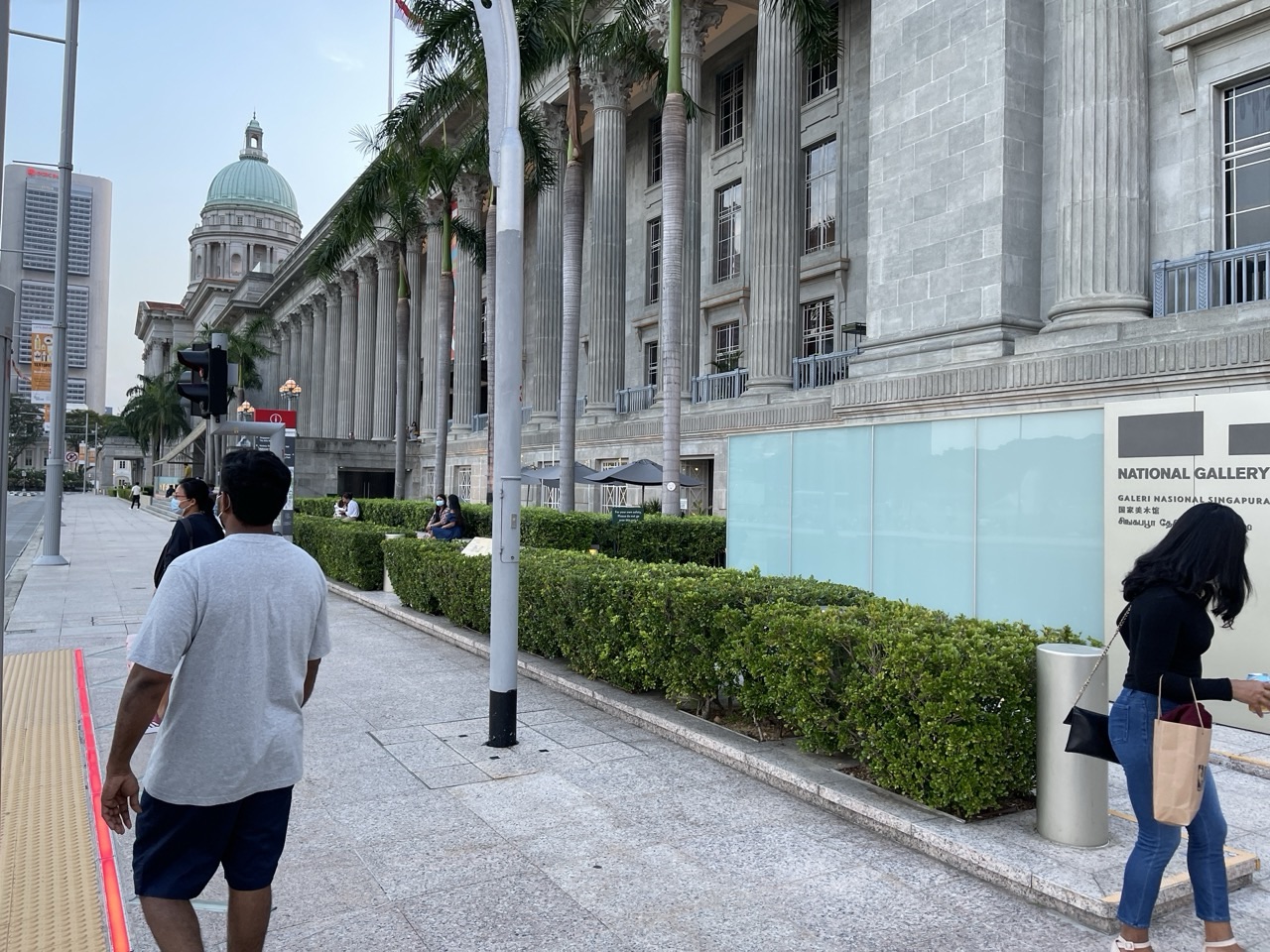
The header shows National Gallery Singapore and the Padang from the eduKateSG photo collection.