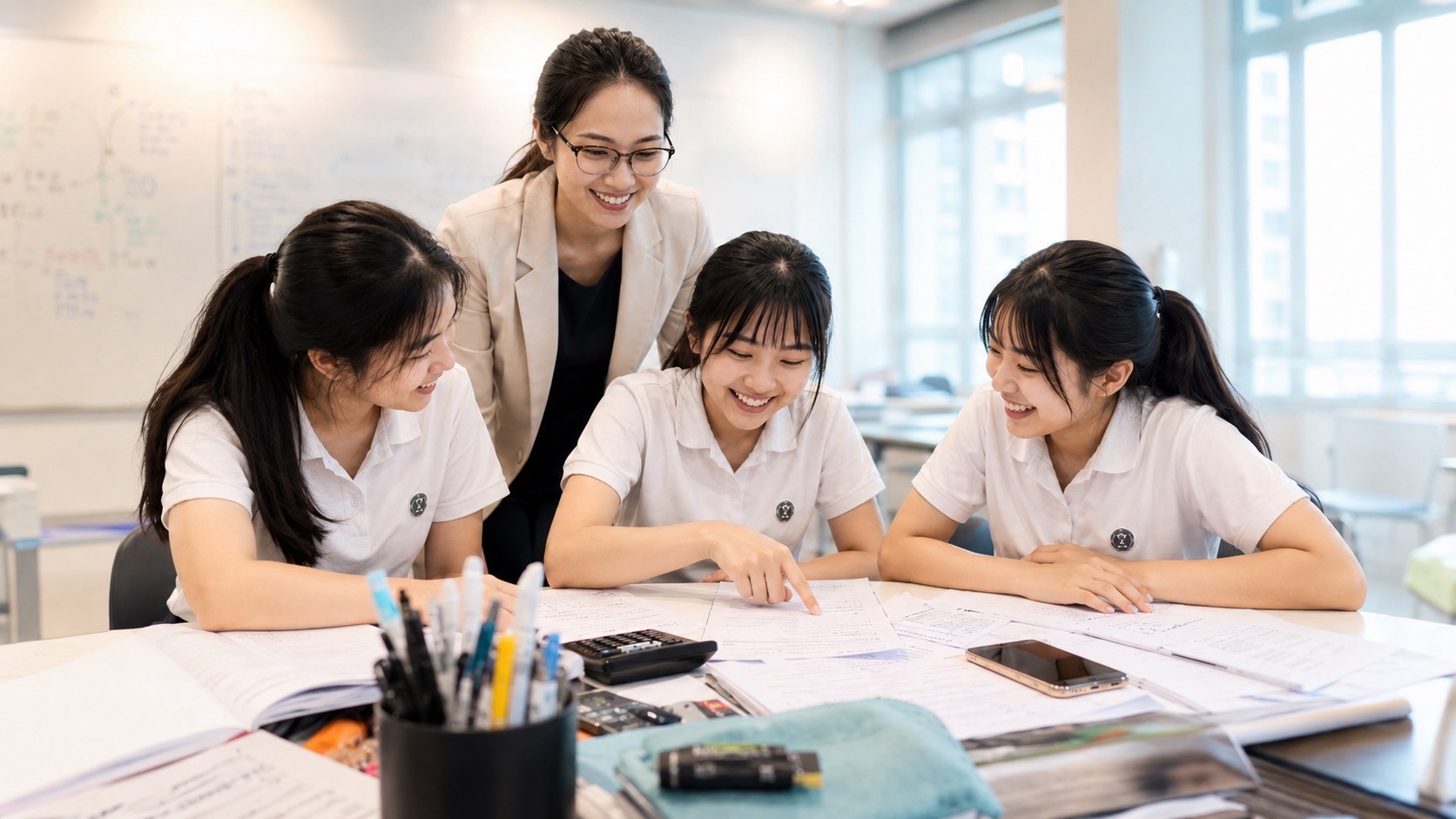
Bukit Timah Secondary 2 Math Tuition: Who Benefits Most and Why

Not every Sec 2 student needs Math tuition in the same way. Here is who benefits most from Secondary 2 Math tuition in Bukit Timah and why this year matters so much.

One-sentence answer

Secondary 2 Math tuition benefits students most when they are no longer stabilising on their own, especially if algebra is shaky, independence is weak, mistakes keep repeating, or confidence is quietly falling before the jump to Secondary 3.

Bukit Timah Secondary 2 Math Tuition: Who Benefits Most and Why

The Streaming Corridor Year Before Secondary 3 Life Begins

Secondary 2 is not just another school year.

It is the corridor year.

Secondary 1 is the reset year. A student enters secondary school after PSLE, learns a new timetable, new teachers, new classmates, new expectations and a new way of thinking. They are no longer doing Primary 6 Mathematics. They are learning how Secondary Mathematics behaves.

Secondary 2 is different.

By Secondary 2, the system starts asking a sharper question.

Where is this student heading next?

Not in a frightening way.

In a constructive way.

Secondary 2 is the year where the student’s mathematical habits, confidence, algebra control, test performance and subject readiness begin to shape the Secondary 3 journey. It is the passage between the lower-secondary foundation and the upper-secondary examination years.

That is why we call it the streaming corridor.

Not because children should be labelled.

Not because one test defines their life.

But because Secondary 2 sits inside a corridor of decisions, signals and opportunities.

The child is walking towards Secondary 3.

The doors ahead are opening.

E-Math becomes deeper.
A-Math may become possible.
Science choices become more serious.
Subject combinations begin to matter.
The national examination years begin to feel closer.
The school pace becomes less forgiving.

For parents, Secondary 2 is the year to look carefully.

Not anxiously.

Carefully.

Because when a child receives the right help in Secondary 2, the entire upper-secondary journey can become stronger, calmer and more optimistic.

The Child Who Benefits Most: The One Whose Sec 1 Reset Was Not Fully Installed

Secondary 1 is supposed to be a reset.

A good reset does not mean the child immediately becomes perfect.

It means the child has time to adjust from primary school thinking into secondary school thinking.

In Mathematics, that shift is large.

Primary school Mathematics often rewards pattern recognition, heuristics and strong arithmetic habits. Secondary Mathematics starts building a new operating system.

Algebra becomes central.
Negative numbers matter more.
Equations become a language.
Graphs begin to carry meaning.
Ratio, proportion, percentage and geometry become more abstract.
Questions become less about “which model drawing should I use?” and more about “what structure is hidden here?”

Some students manage the Sec 1 reset well.

Others look alright on the surface, but the reset is incomplete.

They can still pass.
They can still do homework.
They can still follow examples in class.

But underneath, the system is unstable.

They may not understand algebra deeply.
They may still guess steps.
They may rely too much on memory.
They may make frequent sign errors.
They may understand the teacher’s example but freeze when the question changes.

These are the students who benefit greatly from Secondary 2 Math tuition.

Why?

Because Secondary 2 gives them time to repair the operating system before Secondary 3 increases the load.

If the Sec 1 reset was incomplete, Secondary 2 is the chance to regroup.

Not to panic.

Not to scold.

Not to assume the child is weak.

Regroup.

A good Bukit Timah Secondary 2 Math tutor helps the student find the missing pieces, rebuild algebra control, correct weak habits and prepare for the next stage before the upper-secondary pace begins.

That is the first group that benefits most.

The student who is not failing badly yet, but whose foundations are not secure.

The Student Who Is Slipping Quietly

Some students do not collapse dramatically.

They slip quietly.

Their marks drop from 80 to 72.
Then 72 to 65.
Then 65 to 58.

Each result looks explainable.

Careless mistake.
Difficult paper.
Not enough time.
Forgot formula.
Did not revise that chapter.
Teacher set a tricky question.

But over time, a pattern appears.

The child is no longer in control.

This type of student benefits strongly from tuition because Secondary 2 is still early enough to change the direction.

A quiet slip is dangerous because it can be underestimated.

Parents may think, “At least still passing.”

The child may think, “I roughly understand.”

But Mathematics does not only measure whether a student can survive today.

It measures whether the student can carry knowledge forward.

A weak chapter becomes a future problem.

Weak algebra affects equations.
Weak equations affect graphs.
Weak ratio affects similarity and scale.
Weak geometry affects trigonometry later.
Weak manipulation affects A-Math entry.

Secondary 2 is a corridor because every weakness is walking somewhere.

Tuition helps when it stops the slip early.

The aim is not only to recover marks.

The aim is to stop the downward motion before it becomes the child’s identity.

A student who slips quietly may begin to believe they are “just not a Maths person.”

That belief is expensive.

Good instruction can interrupt it.

When the student sees mistakes clearly, practises properly and starts scoring again, confidence returns.

And when confidence returns, effort becomes easier.

The Student Who Wants A-Math Later

Not every Secondary 2 student will take Additional Mathematics in Secondary 3.

But the students who may want A-Math need to treat Secondary 2 seriously.

A-Math does not begin from nowhere.

It sits on top of algebra, functions, equation solving, graph sense, manipulation and mathematical stamina.

If a student enters Secondary 3 with weak algebra, A-Math becomes heavy very quickly.

The child sees a new topic, but the real problem is often older.

They struggle with quadratic functions because factorisation is weak.
They struggle with logarithms because indices are weak.
They struggle with calculus because algebraic manipulation is slow.
They struggle with trigonometry because equation solving and identities require discipline.

This is why Secondary 2 is the preparation year.

For the student aiming at A-Math, tuition is not remedial.

It is engineering.

We are building the load-bearing beams before the upper floors are added.

A strong Secondary 2 student does not need to rush into A-Math early in a messy way.

They need to master the language that A-Math will later use.

They need to become comfortable with symbols.
They need to show clean working.
They need to recognise forms.
They need to move from one representation to another.
They need to know how to check their steps.

That is why the best time to prepare for Secondary 3 A-Math is often before Secondary 3 begins.

Secondary 2 is the quiet construction year.

Build well now, and the upper-secondary years become much more manageable.

The Student Who Is Already Good But Not Yet Excellent

Some parents think tuition is only for students who are failing.

That is not true.

Secondary 2 Math tuition also helps the student who is already doing well but has not yet become precise, fast and examination-ready.

This student may score 75 or 80.

But the marks are unstable.

Some papers are excellent.
Some papers fall suddenly.
Some questions are solved beautifully.
Some are lost through carelessness.
The student knows the topic, but not always the exam craft.

This student benefits because Secondary 2 is the best time to upgrade from “good” to “reliable.”

There is a difference.

A good student can do many questions.

A reliable student can perform under pressure.

A good student understands the lesson.

A reliable student can solve when the question is unfamiliar.

A good student has ability.

A reliable student has systems.

Secondary 2 tuition helps strong students develop those systems.

How to read the question properly.
How to set up working clearly.
How to avoid common traps.
How to check signs, units and conditions.
How to handle multi-step questions.
How to know when a method is becoming too messy.
How to finish the paper with enough time to review.

For high-performing students, tuition is not about rescue.

It is about refinement.

It is about turning ability into dependable results.

And in Bukit Timah, where many students are academically ambitious, that refinement matters.

Not because every child must chase perfection.

But because a capable child should not be held back by weak exam habits.

The Student Who Works Hard But Scores Poorly

This is one of the most painful groups.

The student studies.
The parent sees the effort.
The homework is done.
The assessment books are attempted.
The child may even spend many hours revising.

But the result does not move.

This is discouraging.

For the child, it feels unfair.

For the parent, it creates confusion.

If the child is working hard, why are the marks not improving?

The answer is usually that the effort is not targeted.

Mathematics does not improve simply because time is spent.

It improves when the right errors are corrected.

A student can spend two hours repeating the same wrong habit.

A student can complete ten pages but still not understand the concept.

A student can memorise worked solutions without learning how to start a new question.

A student can revise “everything” and still miss the one skill that is actually causing the mark loss.

This is where tuition helps.

A good tutor diagnoses.

The problem may be algebra.
It may be conceptual misunderstanding.
It may be weak question interpretation.
It may be careless execution.
It may be poor time control.
It may be exam anxiety.
It may be that the student does not know how to revise Mathematics properly.

Once the cause is visible, the work becomes sharper.

The child does not need more noise.

The child needs direction.

This is one of the most important benefits of Secondary 2 Math tuition.

It converts blind effort into intelligent effort.

The Student Who Needs Confidence Before Secondary 3

Secondary 3 life is different.

The pace changes.
The stakes rise.
Subject combinations begin.
The examination horizon becomes real.
Students begin to feel that they are no longer in the “settling in” stage.

A child who enters Secondary 3 already frightened of Mathematics will struggle more than necessary.

Fear slows thinking.

A student who panics may forget methods they actually know.
They may skip questions too early.
They may misread the problem.
They may write messy working.
They may lose marks not because they know nothing, but because their confidence collapses under pressure.

Secondary 2 is the year to rebuild emotional control around Mathematics.

The child needs to experience success again.

Small wins matter.

A corrected algebra habit.
A properly solved equation.
A graph question finally understood.
A geometry proof completed without guessing.
A test result that improves.
A mistake that does not repeat.

These moments tell the child, “I can learn this.”

That sentence is powerful.

A confident student is not a student who finds everything easy.

A confident student is one who knows what to do when the work becomes hard.

That is the real preparation for Secondary 3.

The Parent Who Needs Visibility

Secondary 2 tuition does not only help students.

It helps parents see.

Many parents know something is wrong, but cannot identify what.

The child says school is okay.
The homework is done.
The test result comes back lower than expected.
The teacher’s comments may be general.
The parent tries to help, but the syllabus feels different from what they remember.

This creates parent fog.

Parent fog is stressful because parents cannot act clearly.

Should the child practise more?
Change study habits?
Aim for A-Math?
Drop ambition?
Push harder?
Slow down?
Focus on basics?
Prepare for Secondary 3 now?

Good tuition makes the situation visible.

A tutor can tell whether the child is weak in foundation, careless in execution, slow in working, unstable in concepts or ready for higher challenge.

That clarity helps parents make better decisions.

Not emotional decisions.

Informed decisions.

Secondary 2 is a corridor year, so visibility is important.

Parents do not need panic.

They need a map.

Why Secondary 2 Is the Best Time to Boost

Secondary 4 is late.

Not too late, but late.

There is still work that can be done in Secondary 4, but by then the student is under examination pressure.

Secondary 3 is important, but it is already the beginning of the upper-secondary race.

Secondary 2 is special because there is still room.

Room to repair.
Room to strengthen.
Room to stretch.
Room to build habits.
Room to prepare for subject choices.
Room to enter Secondary 3 with better control.

This is why Secondary 2 is a boost year.

A student can still change trajectory.

The child who slipped can recover.
The child who is average can become stable.
The child who is strong can become excellent.
The child who is unsure can become clearer.
The child who wants A-Math can prepare properly.

This is the optimistic view of Secondary 2.

It is not a year of doom.

It is a year of leverage.

Small improvements now can affect the next two years.

What Good Bukit Timah Secondary 2 Math Tuition Should Do

Good tuition should not simply add homework.

Students already have homework.

Good tuition should add clarity.

It should explain concepts from first principles.
It should identify weak foundations.
It should correct working habits.
It should build algebra fluency.
It should train question interpretation.
It should prepare students for school tests.
It should help students understand how Sec 2 topics connect to Sec 3 Mathematics.

Most importantly, it should help the student become more independent.

The goal is not to make the child dependent on tuition forever.

The goal is to teach the child how Mathematics works.

A properly taught student starts to see patterns.

They know when to expand.
They know when to factorise.
They know when to form an equation.
They know how to represent information.
They know how to check whether an answer makes sense.
They know how to learn from mistakes.

That is real progress.

The Streaming Corridor: Not a Wall, But a Set of Doors

Parents sometimes think of Secondary 2 as a wall.

A fixed judgement.
A stressful cut-off.
A moment where everything is decided.

It is healthier to see it as a corridor.

A corridor has doors.

Some doors need stronger grades.
Some doors need better foundations.
Some doors need confidence.
Some doors need subject readiness.
Some doors need more maturity.

Tuition helps because it gives the child more keys.

A stronger algebra key.
A clearer reasoning key.
A better exam technique key.
A calmer confidence key.
A more consistent revision key.

The more keys the child has, the more choices remain open.

That is the point.

Education should not shrink a child.

It should open the future.

Building for the SEC/O-Level Years

The upper-secondary examination years reward students who have built early.

By Secondary 3 and Secondary 4, Mathematics is no longer just about understanding today’s chapter.

It is about remembering old chapters, connecting topics, applying methods under time pressure and writing clean solutions across an entire paper.

Secondary 2 is where many of those habits should begin.

Students should learn to keep a mistake ledger.
They should learn to review corrections.
They should learn to revisit weak topics.
They should learn to show proper working.
They should learn to practise mixed questions.
They should learn to treat Mathematics as a system, not a pile of isolated chapters.

That is how examination confidence is built.

Not in the final month.

Not by panic drilling.

But by steady training.

The best exam years are not created by last-minute fear.

They are created by earlier clarity.

Who Benefits Most?

Bukit Timah Secondary 2 Math tuition benefits many students, but especially these groups.

The student whose Secondary 1 reset was incomplete.

The student who is slipping quietly.

The student who wants to prepare for Secondary 3 A-Math or stronger E-Math.

The student who is good but inconsistent.

The student who works hard but does not see results.

The student who needs confidence before upper secondary begins.

The parent who needs a clear map before making decisions for Secondary 3.

These students benefit because Secondary 2 is still early enough to change the story.

And that is the most important idea.

The story is not fixed.

A child can regroup.
A child can rebuild.
A child can improve.
A child can learn to think better.
A child can walk into Secondary 3 with more confidence than they had in Secondary 1.

The eduKate Way: Catch Up, Keep Up, Move Ahead

At eduKate, we believe good tuition should help students catch up, keep up and move ahead.

Catch up where foundations are weak.

Keep up with school so the child does not feel lost.

Move ahead when the student is ready for stronger thinking and higher performance.

For Secondary 2 Mathematics, this means teaching the subject as a connected system.

Sec 1 was the reset.
Sec 2 is the corridor.
Sec 3 is the new engine.
Sec 4 is the execution year.

When students understand this journey, they stop seeing Mathematics as a random series of tests.

They begin to see the road.

That road can lead to better grades.

But more importantly, it can lead to a stronger learner.

A child who can think.
A child who can correct mistakes.
A child who can face difficulty.
A child who can prepare for the future with calm discipline.

That is why Secondary 2 matters.

It is not merely the year before Secondary 3.

It is the year where the future starts becoming visible.

And with the right instruction, that future can be bright.

Three students giving thumbs up while studying at a table with books in front of them, with a whiteboard in the background showing subjects like English, Mathematics, and Science.

Who Benefits Most and Why: Why this question matters in Secondary 2

Many parents in Secondary 2 are unsure what to do.

Their child may not be failing badly. The results may still look passable. Homework is still being completed, at least most of the time. On the surface, it may not feel like an emergency. But something often feels off. Math takes longer. The same mistakes keep returning. Confidence is weaker. The child is not becoming more independent.

This is exactly why Secondary 2 is such an important tuition year.

It is not always the year of visible collapse. It is often the year of quiet sorting. Some students become stronger and more stable before upper secondary. Others continue moving forward, but with a weak floor underneath. That floor usually matters much more in Secondary 3 and 4.

So the real purpose of Secondary 2 Math tuition is not only to help with current homework. It is to identify who is drifting, who is merely inconsistent, and who needs real repair before the next phase becomes much heavier.

Bukit Timah Secondary 2 Math Tuition: What We Do So They Benefit

Turning the Streaming Corridor Year Into a Stronger Secondary 3 Start

Secondary 2 Mathematics is not only about learning more topics.

It is about preparing the student for what comes next.

This is why good tuition cannot simply mean more worksheets, more homework and more pressure.

Students already have enough pressure.

What they need is a system.

At Bukit Timah Tutor, our Secondary 2 Mathematics tuition is designed to help students use the corridor year properly.

Secondary 1 was the reset year.

Secondary 2 is the regroup and boost year.

Secondary 3 is where the engine changes.

Secondary 4 is where execution matters.

So the question is not only, “Can this student pass the next test?”

The better question is:

What must be built now so the student can enter Secondary 3 stronger, calmer and more prepared?

That is what we do.

We make the child’s current position visible.

We repair what is weak.

We strengthen what is useful.

We prepare what is coming.

We help students catch up, keep up and move ahead.

First, We Find the Real Problem

Many students do not know why they are struggling.

Parents often do not know either.

The test result comes back, but the result itself is not the diagnosis.

A 58 does not explain what broke.
A 72 does not explain what is unstable.
A careless mistake does not explain why carelessness keeps happening.
A blank answer does not explain whether the child lacked knowledge, confidence, time or strategy.

So the first thing we do is look beneath the mark.

We ask:

Is the student weak in Sec 1 foundations?
Is algebra slow?
Are negative numbers causing errors?
Is the student copying methods without understanding?
Are word problems the issue?
Is geometry weak?
Is the student losing marks through poor working?
Is the student able to do homework but unable to perform in tests?
Is the child frightened of difficult questions?
Is the student ready to stretch but lacking exam discipline?

This matters because different problems need different solutions.

A student with weak algebra does not need only “more practice.”

They need algebra rebuilt.

A student who understands but loses marks through carelessness needs method control.

A student who freezes in tests needs confidence and exam exposure.

A student who is already strong needs sharper challenge, not repeated easy work.

Good tuition begins with diagnosis.

Without diagnosis, tuition becomes noise.

With diagnosis, every lesson has direction.

We Repair the Sec 1 Reset

Secondary 1 is the reset year, but not every student completes the reset.

Some students move into Secondary 2 still carrying primary-school habits.

They want to memorise.
They want to imitate.
They want questions to look exactly like the examples.
They are uncomfortable when letters replace numbers.
They may not yet understand that algebra is a language.

This becomes expensive in Secondary 2.

So we repair the Sec 1 reset.

We revisit important foundations when necessary.

Integers.
Fractions.
Ratio.
Percentage.
Algebraic expressions.
Expansion.
Factorisation.
Equations.
Graphs.
Geometry basics.
Units.
Working presentation.

We do not go backwards to waste time.

We go backwards to fix the bridge.

A student cannot build Secondary 3 Mathematics on shaky Sec 1 habits.

If the child cannot manipulate algebra cleanly, upper-secondary Mathematics becomes heavy.

If the child does not know how to show working properly, exam marks leak away.

If the child cannot interpret a question, more practice only creates more frustration.

So we repair early.

Then we move forward faster.

We Build Secondary 2 Mathematics as a Connected System

Students often think each chapter is separate.

This week is algebra.
Next week is geometry.
Then graphs.
Then probability.
Then statistics.
Then another test.

But Mathematics is not a pile of disconnected topics.

It is a system.

At Bukit Timah Tutor, we teach Secondary 2 students to see the connections.

Algebra connects to equations.

Equations connect to graphs.

Graphs connect to functions later.

Ratio connects to similarity.

Similarity connects to scale, geometry and trigonometry later.

Expansion and factorisation connect to quadratic expressions.

Quadratic thinking connects to Secondary 3 E-Math and A-Math.

Data handling connects to interpretation and decision-making.

Once students see the system, they stop treating every chapter as a new enemy.

They begin to understand that Mathematics reuses ideas.

That is when learning becomes more efficient.

A strong Secondary 2 student is not one who merely survives each chapter.

A strong Secondary 2 student sees how the chapters talk to one another.

That is what prepares them for Secondary 3.

We Strengthen Algebra Until It Becomes Usable

Algebra is one of the main gates.

If algebra is weak, Secondary 2 feels unstable.

If algebra is strong, many topics become easier.

So we pay close attention to algebra.

Not just whether the child can get the answer.

But whether the child can move properly.

Can they expand without losing signs?
Can they factorise accurately?
Can they solve equations step by step?
Can they handle fractions in algebra?
Can they simplify expressions cleanly?
Can they write working in a way that examiners can follow?
Can they check whether the answer makes sense?

Many students know algebra only as steps.

We want them to understand algebra as movement.

An expression can be rearranged.
A term can be grouped.
A common factor can be extracted.
An equation can be balanced.
A graph can be connected to an algebraic relationship.

When algebra becomes usable, the child gains control.

And control is the beginning of confidence.

We Train Students to Start Questions Properly

A common Secondary 2 problem is not that the child knows nothing.

It is that the child does not know how to start.

They stare at the question.

They wait for a familiar pattern.

If the question looks different, they freeze.

This is dangerous because upper-secondary Mathematics rewards students who can decide.

So we train students to start.

We teach them to read the question carefully.

What is given?
What is asked?
What topic is involved?
What form is the information in?
Should we draw a diagram?
Should we form an equation?
Should we simplify first?
Is there a hidden relationship?
Is the question testing calculation, reasoning or application?

Starting is a skill.

Many students are never taught this explicitly.

They are shown solutions, but not taught how the first move was chosen.

At Bukit Timah Tutor, we slow that moment down.

We teach the thinking before the working.

This helps students become more independent.

Because in the examination hall, the tutor is not beside them.

The student must learn how to begin.

We Correct Mistakes Until They Stop Repeating

Mistakes are not the enemy.

Repeated mistakes are the problem.

Every student makes mistakes.

But when the same mistake returns again and again, it means the student has not understood the cause.

So we use mistakes properly.

We do not only mark wrong answers.

We study them.

Was the mistake caused by careless copying?
Was it a sign error?
Was it poor algebra?
Was it misunderstanding the question?
Was it wrong formula use?
Was it missing units?
Was it skipping steps?
Was it weak time control?
Was it panic?

Once we know the cause, we correct the habit.

This is how students improve.

Not by hiding mistakes.

By learning from them.

We want students to build a mistake ledger in their thinking.

A student should know:

“These are the types of errors I usually make.”

“These are the steps I must check.”

“This is where I usually lose marks.”

“This is how I prevent it next time.”

That awareness is powerful.

It turns mistakes into training data.

A student who understands their own mistakes becomes a stronger learner.

We Build Test Readiness Early

Many students can do homework but underperform in tests.

This is because homework and tests are different environments.

Homework gives time.
Homework may follow the chapter sequence.
Homework allows checking notes.
Homework may feel safe.

Tests are different.

There is time pressure.
Questions are mixed.
The student must recall methods.
The student must decide quickly.
The student must manage emotions.
The student must write clearly.

So we prepare students for test conditions early.

We use mixed practice.
We revisit old topics.
We train time awareness.
We teach students how to allocate effort.
We practise reading questions under pressure.
We correct presentation and working.

This matters because Secondary 2 is not only about marks now.

It is about building examination behaviour before Secondary 3 and Secondary 4.

A student who learns test discipline early has a calmer upper-secondary journey.

We Prepare Students for Secondary 3 Life

Secondary 3 is not just “next year.”

It is a change in academic load.

The subjects become heavier.
The timetable becomes more serious.
Mathematics becomes more demanding.
A-Math may enter the picture.
E-Math becomes more exam-driven.
The student needs stronger habits.

So we connect Secondary 2 lessons to Secondary 3 life.

When we teach algebra, we explain why it matters later.

When we teach graphs, we show how graph sense becomes important in upper secondary.

When we teach geometry, we link it to trigonometry and more advanced reasoning.

When we teach problem-solving, we show why method selection matters.

This gives students a bigger picture.

They are not only studying for Friday’s test.

They are building the engine for the next two years.

That changes the student’s attitude.

A child who understands why a skill matters is more likely to take it seriously.

We Help Three Types of Students Differently

Not all Secondary 2 students need the same help.

At Bukit Timah Tutor, we often see three broad groups.

The first group needs to stop falling.

These students are slipping. Their marks are dropping, confidence is weakening and Mathematics is becoming stressful. For them, we stabilise first. We rebuild basics, correct urgent weaknesses and help them recover control.

The second group needs to maintain strong performance.

These students are doing reasonably well, but they are not yet stable. They need consistency, cleaner working, better revision habits and stronger test readiness. For them, we protect the grade and reduce unnecessary mark loss.

The third group needs to move towards distinction.

These students already have ability, but they need stretch. They need harder questions, sharper thinking, faster recognition and stronger exam craft. For them, we train precision and higher-level performance.

This matters because tuition should not treat every child as the same case.

A student who is falling needs support.

A student who is stable needs strengthening.

A student who is strong needs challenge.

Good tuition meets the child where they are, then moves them forward.

We Make Parents Clearer Too

Secondary 2 can be confusing for parents.

The child is no longer in primary school.

The upper-secondary years are approaching.

Subject combinations matter.

A-Math may become a question.

The parent wants to help, but may not know whether the child is truly ready.

So part of what we do is give visibility.

We help parents understand what is happening.

Is the child weak in basics?
Is the child careless or conceptually confused?
Is the child ready for harder work?
Is the child struggling because of confidence?
Is the child’s effort being used properly?
What should be fixed first?

Parents do not need vague reassurance.

They need useful clarity.

When parents know what is happening, they can support the child better.

The home becomes calmer.

The child feels less judged.

The family can move from panic to planning.

That is one of the hidden benefits of good tuition.

We Teach Students to Think Like Builders

Mathematics is construction.

You cannot build the upper levels without the lower beams.

You cannot rush the roof if the columns are weak.

You cannot make a building taller by painting the walls.

Secondary 2 is the year where we strengthen the structure.

We teach students to think like builders.

What is the foundation?
What is the load-bearing idea?
Which step supports the next step?
Where is the crack?
What must be repaired before we continue?

This way of thinking helps students beyond Mathematics.

It teaches patience.
It teaches order.
It teaches responsibility.
It teaches the value of doing things properly.

That is why education matters.

A properly taught child does not only score better.

A properly taught child learns how to build.

They build knowledge.
They build discipline.
They build confidence.
They build a future.

We Keep the Tone Optimistic

Some students arrive worried.

Some parents arrive tired.

Some children have already decided that Mathematics is not for them.

We do not begin from blame.

We begin from possibility.

A weak result is not a life sentence.

A bad chapter is not the whole story.

A careless mistake can be corrected.

A missing foundation can be rebuilt.

A frightened student can become steady again.

Secondary 2 is a good year for this kind of recovery.

There is still time.

Time to boost.
Time to regroup.
Time to rebuild.
Time to prepare for great SEC/O-Level years.

This is the optimistic truth of Secondary 2.

The corridor is not only a place of pressure.

It is a place of movement.

With the right help, students can move into Secondary 3 stronger than they were in Secondary 1.

What Happens in Our Lessons

In our Secondary 2 Math tuition, lessons are designed around clarity, correction and progress.

We explain the topic clearly.

We connect it to what students already know.

We show how the method works.

We make students practise.

We check their working.

We correct the exact mistake.

We revisit weak foundations.

We prepare them for school assessments.

We link the topic to future Secondary 3 demands.

This is not random tuition.

It is guided training.

The student should leave each lesson with more clarity than they came in with.

They should know what was fixed.

They should know what to practise.

They should know what to watch out for.

They should feel that Mathematics is becoming more manageable.

That feeling matters.

When the child believes progress is possible, effort becomes easier.

The Real Benefit

The real benefit of Secondary 2 Math tuition is not only a better mark in the next test.

That matters, of course.

But the deeper benefit is readiness.

Readiness for Secondary 3.
Readiness for E-Math depth.
Readiness for possible A-Math.
Readiness for stronger exam years.
Readiness for more independent learning.
Readiness to handle difficulty without panic.

Secondary 2 is where many students can still change direction.

A child who is weak can stabilise.

A child who is average can strengthen.

A child who is strong can stretch.

A child who is anxious can become calmer.

A child who is careless can become more disciplined.

A child who is lost can find the road again.

That is why we do what we do.

We teach Mathematics properly so students can benefit not only now, but in the years ahead.

Bukit Timah Secondary 2 Math Tuition: Built for the Corridor Year

At Bukit Timah Tutor, we see Secondary 2 as a powerful year.

It is not a waiting room before Secondary 3.

It is the preparation corridor.

It is the year to repair the reset, build the engine, strengthen the foundations and open more doors.

Good tuition helps students catch up where they are weak, keep up with school, and move ahead when they are ready.

With clear teaching, close correction and careful preparation, Secondary 2 students can enter Secondary 3 with stronger habits, better confidence and a clearer path.

The corridor year can become a boost year.

And when a child is properly taught, the future becomes brighter.

Not every Secondary 2 child needs tuition in the same way

One mistake parents sometimes make is asking only, “Should my child have tuition?”

The stronger question is:
What kind of child benefits most, and what exactly should the tuition fix?

Some children benefit because they are clearly weak and need structured repair. Others benefit because they are not weak enough to fail, but not strong enough to remain stable later. Others do not urgently need tuition yet, but may still benefit from targeted support before Sec 3.

So the answer is not one-size-fits-all.

The real value depends on whether tuition matches the child’s actual breakdown point.

Group 1: The child who is still passing, but is not becoming stronger

This is one of the biggest groups that benefits from Secondary 2 Math tuition.

These students often look “fine enough” from a distance:

  • they still pass
  • they still attend class normally
  • they still complete homework
  • they are not in obvious crisis

But when parents look more carefully, the signs are there:

  • the same errors return often
  • algebra still feels shaky
  • corrections do not lead to lasting improvement
  • the child needs too much support
  • confidence is shrinking quietly
  • homework feels slower and heavier than it should

This group benefits a lot from tuition because they are often the easiest to misread. The child is not crashing loudly, so support gets delayed. But under the surface, the system is not strengthening enough.

Good tuition helps this child before later Math turns quiet weakness into visible struggle.

Group 2: The child with recurring algebra weakness

If a child is repeatedly unstable in algebra during Secondary 2, tuition often becomes very worthwhile.

This includes students who:

  • mishandle signs and brackets often
  • combine terms wrongly
  • can copy examples but cannot apply them independently
  • freeze when the question format changes
  • say they understand, but still repeat the same symbolic errors

Why does this group benefit so much?

Because algebra is not just one chapter. It is part of the language of later Mathematics. A child who enters Secondary 3 with weak algebra usually finds upper secondary E-Math heavier, and A-Math much harder if they take it.

So tuition here is not just about improving the next test. It is about preventing algebra weakness from becoming a long-term burden.

Group 3: The child who depends too much on help

Some Sec 2 students look functional only because they are heavily supported.

They may need:

  • parents to sit with them during homework
  • tutors to re-explain almost every topic
  • constant reassurance before each step
  • reminders at every stage of revision
  • help to restart whenever they get stuck

This group benefits from tuition if the tuition is designed properly.

The key point is this: the right tuition should reduce dependence over time, not deepen it.

A child who cannot yet hold Math steadily alone needs a more guided repair route. But if that support is good, it should gradually build:

  • stronger recall
  • better question-starting ability
  • clearer self-checking
  • more stable working habits
  • more confidence in independent attempts

This is especially important in Secondary 2 because the child should be moving toward greater independence before Sec 3, not less.

Group 4: The child whose confidence is weakening

Some children are not visibly weak on paper, but they are becoming emotionally unstable around Math.

Parents may hear things like:

  • “I always get algebra wrong”
  • “Math is getting too hard”
  • “I can only do it if someone helps me”
  • “I don’t think I’m good at this anymore”

These statements should not be ignored.

A child with falling Math confidence often begins to:

  • avoid harder questions
  • rush through work to escape
  • hide confusion
  • become defensive during correction
  • lose accuracy under pressure

This group benefits from tuition when the tuition is not just extra work, but clearer work.

Good support can rebuild confidence by:

  • making the topics less mysterious
  • reducing repeated failure
  • helping the child see real progress
  • giving one coherent pathway through the subject
  • turning mistakes into repair rather than humiliation

This matters because a child who enters Sec 3 already feeling defeated by Math is carrying more than an academic problem.

Group 5: The child who is “in the middle”

This is one of the most overlooked groups.

These students are not the strongest, but they are not obviously weak either. They often live in the broad middle:

  • passable marks
  • uneven performance
  • some chapters okay, some not
  • no dramatic failure
  • no deep confidence either
  • little clear growth in independence

This group often benefits from Secondary 2 tuition because middle-position students are the ones who are easiest to neglect until the upper secondary jump becomes painful.

A very weak student is easier to spot. A very strong student usually stabilises without much concern. The middle student is the one who often drifts.

For these students, tuition can help turn “just coping” into “actually strengthening.”

That change can matter a great deal by the time Secondary 3 begins.

Group 6: The child considering Additional Mathematics

If a child may take A-Math in Secondary 3, Secondary 2 tuition can be especially useful if the algebra base is not yet fully stable.

This does not mean every future A-Math student must have tuition. But it does mean parents should assess the symbolic foundation honestly.

A child benefits strongly from tuition before A-Math if:

  • algebra manipulation is still weak
  • sign control is unreliable
  • working is sloppy
  • unfamiliar symbolic questions cause panic
  • the child survives Math by imitation more than understanding

Why is this group important?

Because A-Math usually magnifies symbolic weakness. A child entering A-Math with unstable algebra is often carrying too much risk into a subject that already demands more abstraction and discipline.

So for this group, tuition can function as preparation, not just rescue.

Group 7: The child whose home support is no longer enough

Some parents are very involved and capable. They have supported the child through Primary school and Secondary 1. But by Secondary 2, the dynamic may be changing.

Parents may start noticing:

  • explanations at home are creating more confusion
  • every Math session turns into tension
  • the child resists learning more strongly with family than with others
  • the parent is spending too much time reteaching instead of monitoring
  • the support is working less well than before

This group benefits because tuition can shift the family’s role.

Instead of home becoming the place where all correction happens, tuition can carry more of the academic repair, while parents shift toward:

  • routine support
  • progress monitoring
  • emotional steadiness
  • accountability without constant reteaching

That often lowers stress for everyone.

Who may not urgently need tuition yet

Not every Secondary 2 child needs tuition immediately.

A child may not urgently need it yet if:

  • understanding is mostly sound
  • mistakes reduce when routine improves
  • independence is clearly growing
  • corrections are meaningful
  • algebra is mostly stable
  • homework is manageable
  • confidence is realistic and steady
  • one weak result is the exception, not the pattern

These students may still benefit from guidance, but not necessarily from immediate regular tuition. Sometimes stronger home structure, better review rhythm, and more careful correction are enough.

The important thing is to judge by pattern, not panic.

What good Secondary 2 Math tuition should actually do

For the students who do benefit, the tuition should be doing more than just increasing volume.

Good Sec 2 Math tuition should:

  • identify the exact breakdown point
  • repair leftover Sec 1 weaknesses
  • strengthen algebra and sign control
  • improve written working discipline
  • tighten the correction loop
  • reduce repeated careless patterns
  • rebuild confidence through real understanding
  • increase independence over time
  • prepare the child for Sec 3 E-Math and possible A-Math

If the tuition only adds worksheets, it may create busyness without real strengthening.

The question parents should keep asking is:
Is my child becoming clearer, steadier, and less dependent over time?

That is the real test.

Why Bukit Timah families often think about tuition at this stage

For families in Bukit Timah, the issue is often not whether education matters. The issue is when support becomes worth it.

Secondary 2 is often the point where families start seeing that Math strength is no longer just about doing homework and passing class tests. It is about whether the child is preparing properly for a much heavier stage ahead.

That is why this year often becomes a decision point:

  • repair early and strengthen the route
  • or delay and risk entering Sec 3 with hidden instability

The most useful Secondary 2 tuition is not pressure for its own sake. It is timely, targeted support that makes the next stage less fragile.

A simple parent test

A useful way to judge whether your child is in the “benefits most” group is this:

Ask whether your child is becoming more stable, not just whether your child is still passing.

Look at:

  • repeated error patterns
  • algebra confidence
  • homework independence
  • correction quality
  • speed and control
  • emotional resistance
  • readiness for Sec 3

If these are not improving, your child is likely in the group that benefits meaningfully from structured tuition.

Conclusion

Secondary 2 Math tuition benefits students most when they are not truly stabilising on their own. This includes the child who is still passing but drifting, the child with recurring algebra weakness, the child who depends too much on help, the child whose confidence is shrinking, the middle student who is quietly slipping, the student considering A-Math, and the child whose home support is no longer enough.

The key is not to ask whether tuition sounds useful in general. The key is to ask whether it solves the actual problem your child has now, before the jump to Secondary 3 makes that problem heavier.

When the fit is right, Secondary 2 tuition is not just extra study. It is early repair, preparation, and stabilisation.


Almost-Code Block

“`text id=”b9n4qe”
TITLE: Bukit Timah Secondary 2 Math Tuition: Who Benefits Most and Why

ONE-LINE DEFINITION:
Secondary 2 Math tuition benefits students most when they are no longer stabilising alone and need targeted repair before Sec 3 makes the same weakness more expensive.

MAIN GROUPS WHO BENEFIT MOST:

  1. The child still passing but not getting stronger
  • passable marks
  • repeated errors
  • weak independence
  • quiet confidence decline
  1. The child with recurring algebra weakness
  • sign errors
  • weak symbolic control
  • poor transfer to new questions
  1. The child too dependent on help
  • needs prompting at many steps
  • weak independent working
  1. The child with shrinking confidence
  • avoidance
  • negative self-talk
  • fear of harder Math
  1. The middle child who is quietly drifting
  • not failing
  • not stabilising
  • easy to overlook
  1. The child considering A-Math
  • needs stronger algebra base
  • symbolic discipline must be more secure
  1. The child whose home support is no longer enough
  • increasing conflict
  • reteaching at home is becoming ineffective

WHO MAY NOT URGENTLY NEED TUITION YET:

  • understanding mostly sound
  • routine improves performance quickly
  • algebra mostly stable
  • independence clearly growing
  • weak results are isolated, not repeated

WHAT GOOD SEC 2 TUITION SHOULD DO:

  • diagnose exact breakdown points
  • repair Sec 1 leftovers
  • strengthen algebra and sign control
  • improve written working
  • build a real correction loop
  • reduce careless patterns
  • rebuild confidence
  • increase independence
  • prepare child for Sec 3 E-Math and possibly A-Math

PARENT DECISION TEST:
Ask not only:

  • “Is my child still passing?”

Also ask:

  • “Is my child becoming more stable over time?”

MAIN RULE:
The best-fit student for Sec 2 tuition is not always the loudest struggler.
Often it is the student whose weakness is growing quietly before Sec 3.

OUTCOME:
When tuition fits the real child and the real weakness, Sec 2 becomes a repair-and-preparation year instead of a quiet drift year.
“`

Recommended Internal Links (Spine)

Start Here For Mathematics OS Articles: 

Start Here for Lattice Infrastructure Connectors

eduKateSG Learning Systems: