
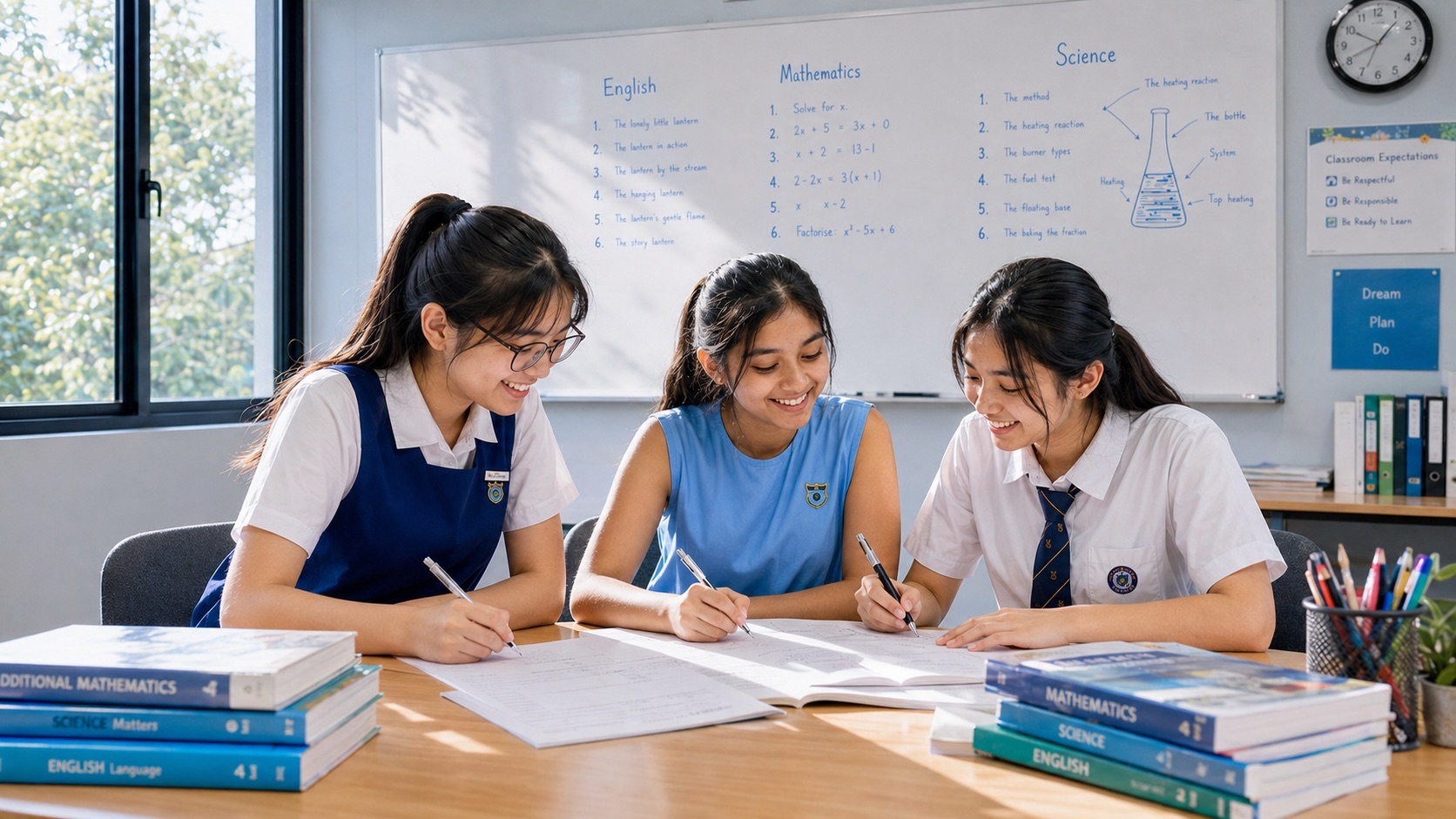
Below is an almost-code spec for Secondary 3 English Tuition (Singapore), aligned to the MOE EL Syllabus 2020 aims (listen/read/view; speak/write/represent; use standard grammar + vocabulary accurately; use English with impact) and mapped to O-Level English Language (1184) paper requirements (Editing; Situational 250–350; Continuous 350–500; Paper 2 includes vocab-in-context + ~80-word summary; Listening; Oral planned response + spoken interaction). (Ngee Ann Secondary School)
SEC3.ENGLISH.TUITION.OS (SINGAPORE) — ALMOST-CODE v0.1Scope: Secondary 3 (Upper Sec) | Track: O-Level readiness (1184) | Output: stable language under load================================================================================A) SYSTEM INTENT (WHAT THIS “TUITION” REALLY IS)Intent: Tuition := a closed-loop upgrade system that increases: - BindIntegrity (ideas connect) - CorridorStability (can produce under time + stress) - TransferReliability (works across prompts, texts, contexts)One-line Lock: "Secondary 3 English tuition works when it converts vocabulary+grammar into repeatable corridors for writing, comprehension, listening and oral—stable under load."================================================================================B) OFFICIAL CONSTRAINTS (SYLLABUS + EXAM MAP)B1) MOE Syllabus Aims (installed as operating objectives): AO-MOE-1: Listen / Read / View critically and accurately across text types AO-MOE-2: Speak / Write / Represent in Standard English for purpose/audience/context AO-MOE-3: Use Standard grammar + vocabulary accurately; understand how language makes meaning/impact AO-MOE-4: Use English with impact, effect, affectB2) O-Level 1184 Assessment Map (Tuition must pre-build these corridors): Paper1: S1 Editing (grammar error correction) S2 Situational Writing: 250–350 words (purpose/audience/context + visual stimulus) S3 Continuous Writing: 350–500 words (choose 1 of 4 topics; narrative/argument etc) Paper2: Comprehension (literal/inferential/evaluative) Vocabulary-in-context + language-for-effect Summary ≈ 80 words (exclude provided intro words) Paper3: Listening (varied tasks; informational note-taking task included) Paper4: Oral Planned Response (video prompt; up to ~2 min) Spoken Interaction (discussion on related topic)================================================================================C) VOCABULARY REQUIREMENTS (WHAT “GOOD VOCAB” MEANS IN SEC 3)VocabularyRequirement := NOT word-count.VocabularyRequirement := (PrecisionTokens + RegisterControl + CollocationControl + BindTokens)Define VocabKit.SEC3 := NodeSets: N1 AcademicVerbs (analyse, evaluate, justify, infer, qualify, synthesise…) N2 Stance/Modal tokens (may, must, likely, arguably, however, therefore…) N3 Precision nouns (policy, consequence, trade-off, incentive, reliability…) N4 Descriptive gradients (subtle→obvious; tentative→definitive; beneficial→harmful…) N5 Topic banks (Sec3 typical: tech/media, environment, health, school, community, ethics) BindTokens (mandatory): B1 cause→effect B2 contrast→counterpoint B3 concession→qualification B4 example→generalisation B5 sequence→process B6 claim→evidence→explanation OutputRule: VocabularyCounts only when it improves: - comprehension of vocab in context - clarity + shades of meaning in writing - oral fluency + precision================================================================================D) DIAGNOSTICS (WEEK 0) — FIND THE REAL FAILUREInputTests (baseline): T1 WritingSnapshot: - 1 Situational (short plan + 1 paragraph) - 1 Continuous (intro + 2 body paras) T2 ComprehensionSnapshot: - inference questions + vocab-in-context + short summary attempt T3 EditingSnapshot: - 20–30 sentence-level edits (common grammar patterns) T4 OralSnapshot: - 1 planned response (2 min) + 5 min discussion T5 ReadingSpeed+Accuracy: - timed passage: main idea / detail / toneDiagnosisTags: FP1 NODE_RICH_BIND_POOR # knows words but can’t explain FP2 CORRIDOR_OVERFIT # only works on “expected” formats FP3 SENTENCE_UNSTABLE # grammar breaks under speed FP4 SUMMARY_COLLAPSE # cannot compress without copying FP5 ORAL_FLUENCY_GAP # ideas exist; delivery collapses================================================================================E) CORE TRAINING LOOPS (THE TUITION ENGINE)Loop = Teach → Model → Drill → Stress → Feedback → Repair → Re-testE1) LOOP.WRITING (Paper 1 readiness) Corridor.W1 Situational: Plan := Audience + Purpose + Context + RequiredPoints + Tone + VisualUse Output := 250–350 words; points covered; clear organisation Corridor.W2 Continuous: Plan := Thesis/Angle + 2–3 BodyClaims + Evidence + Counter/Qualification Output := 350–500 words; cohesion; paragraph logic SensorPack.W: S-W1 TaskFulfilmentScore S-W2 CohesionScore (topic sentences + linking) S-W3 PrecisionScore (verbs + stance + collocations) S-W4 ErrorRate (grammar/punct/spell) under time RepairRules.W: IF S-W4 high THEN run EditingMicroLoop daily (10 min) IF S-W2 low THEN run BindParagraph template (claim→why→example→link) IF S-W3 low THEN install “upgrade swaps” (weak word → precise token)E2) LOOP.READING+COMPREHENSION (Paper 2 readiness) Corridor.R1 Understand: main idea → supporting details → inference → writer’s intent/tone Corridor.R2 VocabInContext: meaning from surrounding binds (contrast, example, definition, tone) Corridor.R3 Summary (~80 words): extract points → group → rephrase → compress without copying SensorPack.R: S-R1 InferenceAccuracy S-R2 VocabInContextAccuracy S-R3 SummaryCompressionRatio S-R4 OwnWordsIndex (avoid lifting) RepairRules.R: IF Summary lifts text THEN enforce ParaphraseConstraint: "No 3 consecutive words from source" IF Inference weak THEN run “EvidenceLine” drill: claim must point to a line + explain whyE3) LOOP.GRAMMAR+EDITING (Paper 1 Section A readiness) GrammarTargets.SEC3: - subject–verb agreement - tenses + consistency - pronoun reference - modifiers - sentence boundaries (run-ons/fragments) - parallelism SensorPack.G: S-G1 EditAccuracy S-G2 ErrorTypeHistogram RepairRules.G: IF ErrorType repeats 3x THEN create 5-sentence minimal pair drillE4) LOOP.LISTENING (Paper 3 readiness) Corridor.L1: identify gist → details → inference; note-taking structure SensorPack.L: S-L1 DetailAccuracy S-L2 NoteTakingCompletenessE5) LOOP.ORAL (Paper 4 readiness) Corridor.O1 Planned Response (2 minutes): Hook → Point → Reason → Example → Link (H-P-R-E-L) Corridor.O2 Spoken Interaction: answer → elaborate → qualify → question back SensorPack.O: S-O1 IdeaOrganisation S-O2 VocabularyRange (appropriate, not fancy) S-O3 Fluency+Pronunciation RepairRules.O: IF rambling THEN enforce “2-point max” rule + timed delivery================================================================================F) WEEKLY SCHEDULER (SEC 3 DEFAULT)WeeklyCycle (2 tuition sessions + daily micro): Session A (90–120m): Writing corridor + Editing repair Session B (90–120m): Comprehension + Summary + Oral drill Daily Micro (15–25m): - 10m Editing OR Sentence upgrade - 10m Reading (1 short article) + 5-sentence summary - 3 “Bind swaps”: however/therefore/although + claim/evidence link================================================================================G) Z0–Z6 BIND (SO IT SCALES AS A SYSTEM)Z0: Sentence stability (grammar + precise token)Z1: Paragraph corridors (binds: cause/contrast/qualify)Z2: Paper corridors (P1/P2/P3/P4 readiness)Z3: School load (time limits + common task patterns)Z4: National standard (assessment objectives + exam constraints)Z5: Cross-context transfer (novel prompts, new topics, new text genres)Z6: Real-world capability (explain, persuade, summarise, negotiate under load)================================================================================H) VERIFICATION (PROVE IT WORKS)Every 4 weeks run ReTestSuite: - 1 Situational + 1 Continuous (timed) - 1 Compre set + Summary (timed) - 1 Oral planned response (timed) + discussion - 1 Editing setPassCondition (Sec3 target): CorridorStability := output quality does not collapse under time + prompt shifts TransferReliability := same skills survive new topics/text types================================================================================END
SEC3.ENGLISH.TUITION — HOW IT DOES NOT WORK (NEGATIVE VOID) v0.1Scope: Singapore Secondary 3 | Target: O-Level English Language (1184) readinessAnchors: MOE EL Syllabus 2020 aims include listening/reading/viewing; speaking/writing/representing; accurate grammar+vocabulary. SEAB 1184 (Y26) scheme includes Editing; Situational 250–350; Continuous 350–500; Paper 2 includes vocab-in-context + language for effect + ~80-word summary; plus Listening & Oral.Entities:- MOE- SEAB================================================================================0) THE OBJECTIVE (WHAT “WORKING” WOULD HAVE MEANT)WorkingTuition := raises - BindIntegrity (ideas connect) - CorridorStability (output holds under time/stress) - TransferReliability (skills survive new prompts/text types)across Paper1/2/3/4 constraints.NonWorkingTuition := increases activity/time but does NOT increase the above 3.================================================================================1) CORE FAILURE: VOCAB AS INVENTORY (NOT MECHANISM)PATTERN NV1: WORDCOUNT_OPTIMISATIONBelief: "Vocabulary = how many words you can list."Behavior: - memorise synonyms - replace simple words with “fancy” words - collect word banks without usage constraintsResult: nodes↑ binds↓ corridors↓Output: - “wordy but empty” - wrong register, wrong collocations, awkward toneExam effect: - Situational writing misses audience/purpose/context despite “good vocab” - Continuous writing becomes incoherent under timeFailureTrace: inventory_nodes → weak_binds → corridor collapse → truncation under load================================================================================2) TEMPLATE OVERFIT (MODEL ESSAY = CRUTCH)PATTERN NV2: CORRIDOR_OVERFIT_TEMPLATEBelief: "If I memorise formats, I’m safe."Behavior: - copy model essays - memorise introductions/conclusions - force every prompt into same 2–3 story/argument shapesResult: works only on expected prompts; fails on novel phrasing / unusual angleExam effect: - Continuous writing: irrelevant content, forced theme, poor task fit - Oral: rehearsed monologue collapses during interaction (cannot adapt)FailureTrace: narrow corridor → prompt shift → corridor breaks → panic writing/talking================================================================================3) GRAMMAR DRILLS WITHOUT TRANSFER (EDITING ISOLATED)PATTERN NV3: GRAMMAR_ISLANDBelief: "Do enough worksheets and grammar will appear in writing."Behavior: - drill rules in isolation - do Editing questions but never re-run the same error inside real writingResult: grammar holds in slow practice but breaks under timeExam effect: - Paper 1 Editing may improve slightly, but writing still error-heavy under loadFailureTrace: rule knowledge (slow) ≠ production stability (fast) → error rebound in timed tasks================================================================================4) COMPREHENSION AS GUESSWORK (NO EVIDENCE BINDS)PATTERN NV4: ANSWER_WITHOUT_ANCHORBelief: "Compre is vibes / intuition."Behavior: - answer inference/evaluative questions without pointing to lines + explaining why - vocab-in-context treated as dictionary recall, not context bindsResult: low reliability; marks fluctuate; cannot justifyExam effect: - Paper 2: inference + language-for-effect weak; vocab-in-context inconsistentFailureTrace: no evidence-bind → weak justification corridor → marks volatility================================================================================5) SUMMARY FAIL MODE: COPYING (NO COMPRESSION CORRIDOR)PATTERN NV5: LIFTING_TEXTBelief: "Summary = shorten by deleting."Behavior: - copy phrases - keep original sentence structure - no grouping of pointsResult: low “own words” control; poor organisation; unclear meaningExam effect: - Summary (~80 words; intro words excluded) becomes penalty zoneFailureTrace: no compression corridor → lifting → loss of clarity/precision================================================================================6) NO STRESS TESTING (PRACTICE WITHOUT LOAD)PATTERN NV6: NO_LOAD_TRAININGBelief: "If I can do it untimed, I can do it in exam."Behavior: - write slowly with unlimited time - redo only “comfortable” questions - avoid speaking on camera / timed oralResult: corridors never become load-stableExam effect: - Paper 1/2 timing causes collapse - Oral planned response + interaction becomes rambling or blanking - Listening note-taking misses details under real-time constraintsFailureTrace: no load exposure → first real load = exam → corridor fracture================================================================================7) NO REPAIR LOOP (FEEDBACK WITHOUT RE-TEST)PATTERN NV7: FEEDBACK_DECAYBelief: "Teacher marks; student reads; improvement happens."Behavior: - corrections are seen once, not converted into drills - no error log; no re-test gateResult: repeated same errors for monthsExam effect: - persistent grammar slips in writing - repeated weak question types in Paper 2 - oral fillers + unclear stance remainFailureTrace: feedback (information) without repair (behavior change) → no system update================================================================================8) WRONG SEQUENCING (BUILDING LATE-STAGE ARTEFACTS FIRST)PATTERN NV8: START_WITH_POLISHBelief: "Start with fancy vocabulary, then structure later."Behavior: - decorate sentences before installing binds/corridorsResult: pretty fragments, incoherent paragraphsExam effect: - Situational writing fails task fulfilment (purpose/audience/context) - Continuous writing lacks cohesionFailureTrace: surface upgrade without corridor base → collapse under real constraints================================================================================9) PCCS GAP (PRE-CAREER BINDS NEVER INSTALLED)PATTERN NV9: PCCS_BIND_MISSINGBelief: "School alone can install reasoning language."Behavior: - home life lacks “why/because/therefore”, sequencing talk, repair scriptsResult: student’s bind tokens are underused; explanations feel unnaturalExam effect: - oral interaction weak elaboration/qualification - writing lacks reasoning connectorsFailureTrace: weak PCCS binds → weak life corridors → weak academic transfer================================================================================10) NON-WORKING TUITION: SENSOR PROFILE (HOW TO SPOT IT FAST)NonWorkingSignature := - ScoreVariance high (same student swings wildly between attempts) - TransferCollapse: new topic/text type → performance drops sharply - TruncationEvents: paragraphs become lists under time - ErrorTypeRepeats: same 3 grammar errors reappear every script - SummaryLifts: copied phrases; low own-words control - OralOverrun: cannot hold 2-minute planned response structure================================================================================11) MINIMUM REPLACEMENT (ONE SCREEN; OPTIONAL INSERT)ReplaceWith := - vocab = precision tokens + bind tokens + corridor reps (not lists) - every correction must become a drill + re-test gate - practice must include load (timed) + perturbation (novel prompts) - comprehension must include evidence binds (line→why) - summary must include compression corridor (group→rephrase→trim)================================================================================END
Start Here:
- https://edukatesg.com/top-100-vocabulary-list-for-primary-1-intermediate/
- https://edukatesg.com/top-100-vocabulary-list-for-primary-2-intermediate-psle-distinction/
- https://edukatesg.com/top-100-vocabulary-list-for-primary-3-al1-grade-advanced/
- https://edukatesg.com/2023/04/02/top-100-psle-primary-4-vocabulary-list-level-intermediate/
- https://edukatesg.com/top-100-vocabulary-list-for-primary-5-al1-grade-advanced/
- https://edukatesg.com/2023/03/31/top-100-psle-primary-6-vocabulary-list-level-intermediate/
- https://edukatesg.com/2023/03/31/top-100-psle-primary-6-vocabulary-list-level-advanced/
- https://edukatesg.com/2023/07/19/top-100-vocabulary-words-for-secondary-1-english-tutorial/
- https://edukatesg.com/top-100-vocabulary-list-secondary-2-grade-a1/
- https://edukatesg.com/2024/11/07/top-100-vocabulary-list-secondary-3-grade-a1/
- https://edukatesg.com/2023/03/30/top-100-secondary-4-vocabulary-list-with-meanings-and-examples-level-advanced/
eduKateSG Learning Systems:
- https://edukatesg.com/the-edukate-mathematics-learning-system/
- https://edukatesg.com/additional-mathematics-a-math-in-singapore-secondary-3-4-a-math-tutor/
- https://edukatesg.com/additional-mathematics-101-everything-you-need-to-know/
- https://edukatesg.com/secondary-3-additional-mathematics-sec-3-a-math-tutor-singapore/
- https://edukatesg.com/secondary-4-additional-mathematics-sec-4-a-math-tutor-singapore/
- https://edukatesg.com/learning-english-system-fence-by-edukatesg/
- https://edukatesingapore.com/edukate-vocabulary-learning-system/
Recommended Internal Links (Spine)
Start Here for Lattice Infrastructure Connectors
- https://edukatesg.com/singapore-international-os-level-0/
- https://edukatesg.com/singapore-city-os/
- https://edukatesg.com/singapore-parliament-house-os/
- https://edukatesg.com/smrt-os/
- https://edukatesg.com/singapore-port-containers-os/
- https://edukatesg.com/changi-airport-os/
- https://edukatesg.com/tan-tock-seng-hospital-os-ttsh-os/
- https://edukatesg.com/bukit-timah-os/
- https://edukatesg.com/bukit-timah-schools-os/
- https://edukatesg.com/bukit-timah-tuition-os/
- https://edukatesg.com/family-os-level-0-root-node/
- https://bukittimahtutor.com
- https://edukatesg.com/punggol-os/
- https://edukatesg.com/tuas-industry-hub-os/
- https://edukatesg.com/shenton-way-banking-finance-hub-os/
- https://edukatesg.com/singapore-museum-smu-arts-school-district-os/
- https://edukatesg.com/orchard-road-shopping-district-os/
- https://edukatesg.com/singapore-integrated-sports-hub-national-stadium-os/
- Sholpan Upgrade Training Lattice (SholpUTL): https://edukatesg.com/sholpan-upgrade-training-lattice-sholputl/
- https://edukatesg.com/human-regenerative-lattice-3d-geometry-of-civilisation/
- https://edukatesg.com/new-york-z2-institutional-lattice-civos-index-page-master-hub/
- https://edukatesg.com/civilisation-lattice/
- https://edukatesg.com/civ-os-classification/
- https://edukatesg.com/civos-classification-systems/
- https://edukatesg.com/how-civilization-works/
- https://edukatesg.com/civos-lattice-coordinates-of-students-worldwide/
- https://edukatesg.com/civos-worldwide-student-lattice-case-articles-part-1/
- https://edukatesg.com/new-york-z2-institutional-lattice-civos-index-page-master-hub/
- https://edukatesg.com/advantages-of-using-civos-start-here-stack-z0-z3-for-humans-ai/
- Education OS (How Education Works): https://edukatesg.com/education-os-how-education-works-the-regenerative-machine-behind-learning/
- Tuition OS: https://edukatesg.com/tuition-os-edukateos-civos/
- Civilisation OS kernel: https://edukatesg.com/civilisation-os/
- Root definition: What is Civilisation?
- Control mechanism: Civilisation as a Control System
- First principles index: Index: First Principles of Civilisation
- Regeneration Engine: The Full Education OS Map
- The Civilisation OS Instrument Panel (Sensors & Metrics) + Weekly Scan + Recovery Schedule (30 / 90 / 365)
- Inversion Atlas Super Index: Full Inversion CivOS Inversion
- https://edukatesg.com/government-os-general-government-lane-almost-code-canonical/
- https://edukatesg.com/healthcare-os-general-healthcare-lane-almost-code-canonical/
- https://edukatesg.com/education-os-general-education-lane-almost-code-canonical/
- https://edukatesg.com/finance-os-general-finance-banking-lane-almost-code-canonical/
- https://edukatesg.com/transport-os-general-transport-transit-lane-almost-code-canonical/
- https://edukatesg.com/food-os-general-food-supply-chain-lane-almost-code-canonical/
- https://edukatesg.com/security-os-general-security-justice-rule-of-law-lane-almost-code-canonical/
- https://edukatesg.com/housing-os-general-housing-urban-operations-lane-almost-code-canonical/
- https://edukatesg.com/community-os-general-community-third-places-social-cohesion-lane-almost-code-canonical/
- https://edukatesg.com/energy-os-general-energy-power-grid-lane-almost-code-canonical/
- https://edukatesg.com/community-os-general-community-third-places-social-cohesion-lane-almost-code-canonical/
- https://edukatesg.com/water-os-general-water-wastewater-lane-almost-code-canonical/
- https://edukatesg.com/communications-os-general-telecom-internet-information-transport-lane-almost-code-canonical/
- https://edukatesg.com/media-os-general-media-information-integrity-narrative-coordination-lane-almost-code-canonical/
- https://edukatesg.com/waste-os-general-waste-sanitation-public-cleanliness-lane-almost-code-canonical/
- https://edukatesg.com/manufacturing-os-general-manufacturing-production-systems-lane-almost-code-canonical/
- https://edukatesg.com/logistics-os-general-logistics-warehousing-supply-routing-lane-almost-code-canonical/
- https://edukatesg.com/construction-os-general-construction-built-environment-delivery-lane-almost-code-canonical/
- https://edukatesg.com/science-os-general-science-rd-knowledge-production-lane-almost-code-canonical/
- https://edukatesg.com/religion-os-general-religion-meaning-systems-moral-coordination-lane-almost-code-canonical/
- https://edukatesg.com/finance-os-general-finance-money-credit-coordination-lane-almost-code-canonical/
- https://edukatesg.com/family-os-general-family-household-regenerative-unit-almost-code-canonical/
Start here if you want the full sequence:
Vocabulary OS Series Index:
- https://edukatesg.com/vocabulary-os-series-index/
- https://edukatesg.com/what-is-vocabulary/
- https://edukatesg.com/what-is-vocabulary-vocabulary-is-the-genesis-selfie-of-consciousness/
Fence English Learning System:
- https://edukatesg.com/article-1-fence-english-engine/
- https://edukatesg.com/article-2-fence-english-engine/
- https://edukatesg.com/article-3-fence-english-engine/
- https://edukatesg.com/article-4-fence-english-engine/
- https://edukatesg.com/article-5-fence-english-engine/https://edukatesg.com/article-6-fence-english-engine/
- https://edukatesg.com/article-7-fence-english-engine/
- https://edukatesg.com/article-8-fence-english-engine/
- https://edukatesg.com/article-9-fence-english-engine/
- https://edukatesg.com/article-10-fence-english-engine/
- https://edukatesg.com/article-11-fence-english-engine/
eduKateSG Learning Systems:
- https://edukatesg.com/the-edukate-mathematics-learning-system/
- https://edukatesg.com/additional-mathematics-a-math-in-singapore-secondary-3-4-a-math-tutor/
- https://edukatesg.com/additional-mathematics-101-everything-you-need-to-know/
- https://edukatesg.com/secondary-3-additional-mathematics-sec-3-a-math-tutor-singapore/
- https://edukatesg.com/secondary-4-additional-mathematics-sec-4-a-math-tutor-singapore/
- https://edukatesg.com/learning-english-system-fence-by-edukatesg/
- https://edukatesingapore.com/edukate-vocabulary-learning-system/
Recommended Internal Links (Spine)
Start Here for Lattice Infrastructure Connectors
- https://edukatesg.com/singapore-international-os-level-0/
- https://edukatesg.com/singapore-city-os/
- https://edukatesg.com/singapore-parliament-house-os/
- https://edukatesg.com/smrt-os/
- https://edukatesg.com/singapore-port-containers-os/
- https://edukatesg.com/changi-airport-os/
- https://edukatesg.com/tan-tock-seng-hospital-os-ttsh-os/
- https://edukatesg.com/bukit-timah-os/
- https://edukatesg.com/bukit-timah-schools-os/
- https://edukatesg.com/bukit-timah-tuition-os/
- https://edukatesg.com/family-os-level-0-root-node/
- https://bukittimahtutor.com
- https://edukatesg.com/punggol-os/
- https://edukatesg.com/tuas-industry-hub-os/
- https://edukatesg.com/shenton-way-banking-finance-hub-os/
- https://edukatesg.com/singapore-museum-smu-arts-school-district-os/
- https://edukatesg.com/orchard-road-shopping-district-os/
- https://edukatesg.com/singapore-integrated-sports-hub-national-stadium-os/
- Sholpan Upgrade Training Lattice (SholpUTL): https://edukatesg.com/sholpan-upgrade-training-lattice-sholputl/
- https://edukatesg.com/human-regenerative-lattice-3d-geometry-of-civilisation/
- https://edukatesg.com/new-york-z2-institutional-lattice-civos-index-page-master-hub/
- https://edukatesg.com/civilisation-lattice/
- https://edukatesg.com/civ-os-classification/
- https://edukatesg.com/civos-classification-systems/
- https://edukatesg.com/how-civilization-works/
- https://edukatesg.com/civos-lattice-coordinates-of-students-worldwide/
- https://edukatesg.com/civos-worldwide-student-lattice-case-articles-part-1/
- https://edukatesg.com/new-york-z2-institutional-lattice-civos-index-page-master-hub/
- https://edukatesg.com/advantages-of-using-civos-start-here-stack-z0-z3-for-humans-ai/
- Education OS (How Education Works): https://edukatesg.com/education-os-how-education-works-the-regenerative-machine-behind-learning/
- Tuition OS: https://edukatesg.com/tuition-os-edukateos-civos/
- Civilisation OS kernel: https://edukatesg.com/civilisation-os/
- Root definition: What is Civilisation?
- Control mechanism: Civilisation as a Control System
- First principles index: Index: First Principles of Civilisation
- Regeneration Engine: The Full Education OS Map
- The Civilisation OS Instrument Panel (Sensors & Metrics) + Weekly Scan + Recovery Schedule (30 / 90 / 365)
- Inversion Atlas Super Index: Full Inversion CivOS Inversion
- https://edukatesg.com/government-os-general-government-lane-almost-code-canonical/
- https://edukatesg.com/healthcare-os-general-healthcare-lane-almost-code-canonical/
- https://edukatesg.com/education-os-general-education-lane-almost-code-canonical/
- https://edukatesg.com/finance-os-general-finance-banking-lane-almost-code-canonical/
- https://edukatesg.com/transport-os-general-transport-transit-lane-almost-code-canonical/
- https://edukatesg.com/food-os-general-food-supply-chain-lane-almost-code-canonical/
- https://edukatesg.com/security-os-general-security-justice-rule-of-law-lane-almost-code-canonical/
- https://edukatesg.com/housing-os-general-housing-urban-operations-lane-almost-code-canonical/
- https://edukatesg.com/community-os-general-community-third-places-social-cohesion-lane-almost-code-canonical/
- https://edukatesg.com/energy-os-general-energy-power-grid-lane-almost-code-canonical/
- https://edukatesg.com/community-os-general-community-third-places-social-cohesion-lane-almost-code-canonical/
- https://edukatesg.com/water-os-general-water-wastewater-lane-almost-code-canonical/
- https://edukatesg.com/communications-os-general-telecom-internet-information-transport-lane-almost-code-canonical/
- https://edukatesg.com/media-os-general-media-information-integrity-narrative-coordination-lane-almost-code-canonical/
- https://edukatesg.com/waste-os-general-waste-sanitation-public-cleanliness-lane-almost-code-canonical/
- https://edukatesg.com/manufacturing-os-general-manufacturing-production-systems-lane-almost-code-canonical/
- https://edukatesg.com/logistics-os-general-logistics-warehousing-supply-routing-lane-almost-code-canonical/
- https://edukatesg.com/construction-os-general-construction-built-environment-delivery-lane-almost-code-canonical/
- https://edukatesg.com/science-os-general-science-rd-knowledge-production-lane-almost-code-canonical/
- https://edukatesg.com/religion-os-general-religion-meaning-systems-moral-coordination-lane-almost-code-canonical/
- https://edukatesg.com/finance-os-general-finance-money-credit-coordination-lane-almost-code-canonical/
- https://edukatesg.com/family-os-general-family-household-regenerative-unit-almost-code-canonical/