
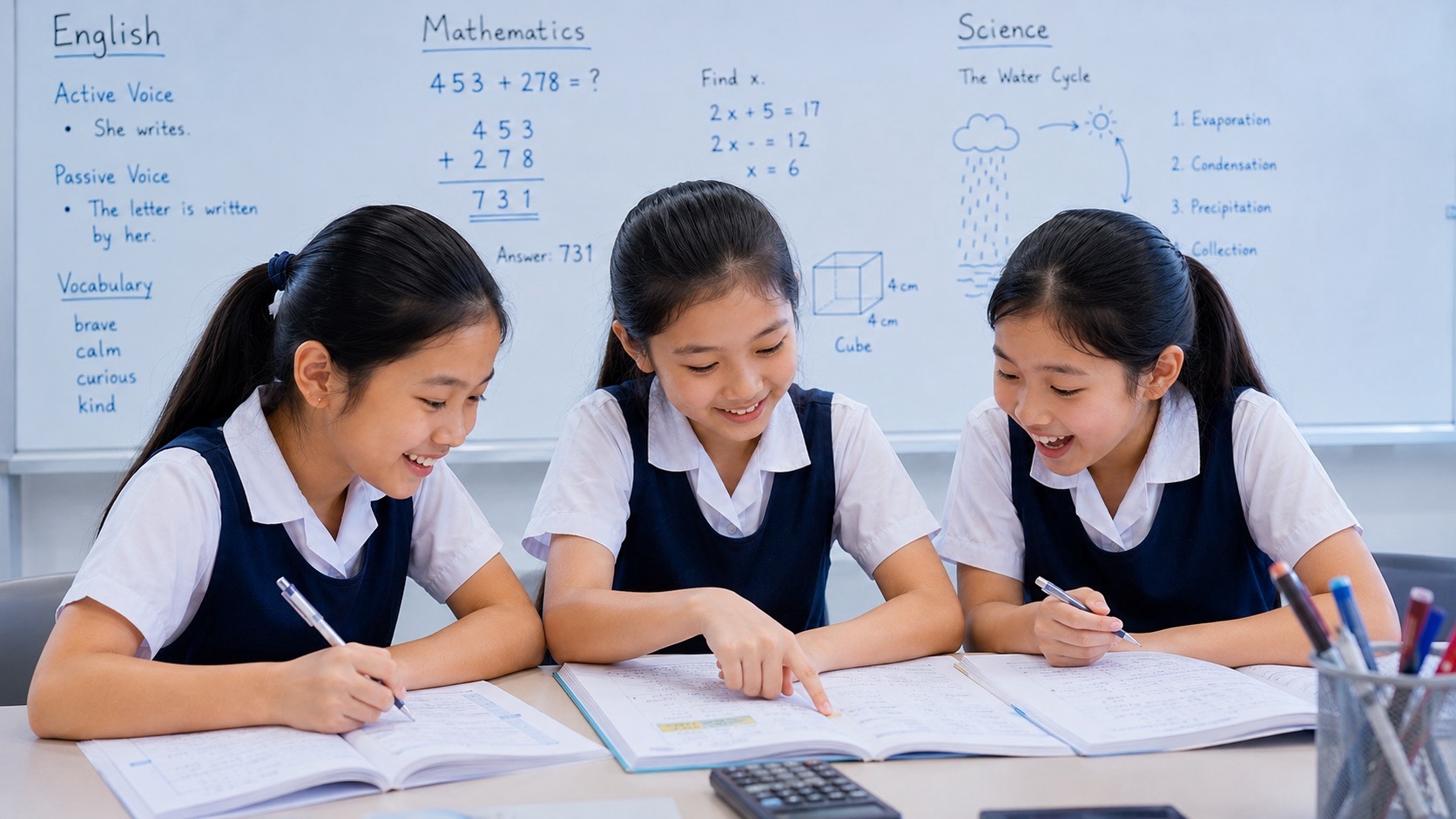
Awesome Schools in Hougang is a town-level education field guide to the current MOE Primary and Secondary school ecosystem in Hougang. It is not a ranking. The purpose is to make a complex North-East school field legible: which schools are physically here, what each institution makes distinctive, how those differences connect to English, Mathematics, Science, PSLE, Full Subject-Based Banding, SEC, CCAs, sport and the arts, and what families should investigate before deciding for themselves.
The current field used here contains 9 Primary schools and 8 Secondary schools. The Primary schools are CHIJ Our Lady of the Nativity, Holy Innocents’ Primary, Hougang Primary, Montfort Junior, Paya Lebar Methodist Girls’ School (Primary), Punggol Primary, Xinghua Primary, Xinmin Primary and Yio Chu Kang Primary. The Secondary schools are Bowen, Holy Innocents’ High, Hougang Secondary, Montfort Secondary, Paya Lebar Methodist Girls’ School (Secondary), Serangoon Secondary, Xinmin Secondary and Yuying Secondary.
This list deliberately follows current campus geography rather than school names. Punggol Primary School is in Hougang. Yio Chu Kang Primary School is in Hougang. Serangoon Secondary School is also in the Hougang field used by the current directory. A territorial knowledge graph becomes much more reliable when actual location outranks historical or institutional naming.
Hougang does not have a current Junior College or Integrated Programme school inside this town field. Anderson Serangoon Junior College is a separate institution outside the Hougang planning-area set used here. That means local families may have strong Primary and Secondary options nearby while still needing to think beyond the town for IP or JC routes.
For the larger context, connect this article to History of Singapore | Hougang, Why Singaporeans Love Hougang, Fun facts about Singapore | Hougang, Things to do in Singapore | Hougang, Education Hub, English Learning Hub, Mathematics Learning Hub, Science Learning Hub, From PSLE to SEC, Singapore Secondary School Directory and Tutors and Tuition in Hougang. The field article is the broad map; the deeper nodes own history, subjects, pathways and intervention.
Why Hougang is an unusually layered school field
Hougang’s educational landscape is older and more historically layered than many newer towns. Catholic, Methodist and government schools sit beside one another. Holy Innocents’ Primary carries a SAP bilingual route. PLMGS provides a girls’ school pathway from Primary to Secondary. Montfort provides a boys’ school pathway from Junior to Secondary. Other schools bring environmental science, communication, maker education, Design Thinking, outdoor education and community leadership into the field.
The town’s geography also teaches why school names should never control location. Punggol Primary is in Hougang. Yio Chu Kang Primary is in Hougang. Serangoon Secondary is in Hougang. These are not anomalies to ignore; they are evidence that institutions carry histories and names across changing urban maps.
Hougang’s mature neighbourhoods, Upper Serangoon corridor, park connectors and proximity to Sengkang and Serangoon create another kind of educational density. Students may live near one town label, attend school under another historical name and travel through several planning areas during CCA or tuition. The daily system matters more than the label on a map.
The schools also illustrate several versions of future-readiness. Holy Innocents’ Primary combines bilingual culture with robotics and design. Hougang Primary uses inquiry Science and outdoor education. Montfort Junior uses Maker Education. PLMGS Primary uses STEAM and aesthetics. Xinmin Primary uses urban farming. Yio Chu Kang Primary uses STEM and the arts. Secondary schools add journalism, social entrepreneurship, ICT, design and coding.
That variety matters because learners differ. One child may discover capability through speaking, another through making, another through environmental inquiry, sport, music or service. A strong town field does not force those strengths into a single hierarchy. It gives families enough evidence to decide which environment is likely to produce sustained effort and growth.
All 17 current MOE Primary and Secondary schools in Hougang
| School | Level | Distinctive learning lens |
|---|---|---|
| CHIJ Our Lady of the Nativity | Primary | Catholic girls’ education with communication, advocacy, leadership and sports resilience; LEAP develops confident and empathetic speakers who use their voice to advocate for worthy causes, while SPARK—Sports for Active and Resilient Kids—uses camps, dragon boating, inline skating, rock climbing and other sports to build resilience and leadership; OLN 360 adds values, life skills, sport and digital literacy |
| Holy Innocents’ Primary School | Primary | SAP bilingual and bicultural education with design thinking, robotics, coding and the arts; Digiminds@HIPS develops Design Thinking, robotics and coding, while Artistry@HIPS gives pupils structured music, visual-arts, ceramics, speech-and-drama and performance experiences; the SAP programme deepens Chinese language and culture |
| Hougang Primary School | Primary | inquiry-based Science paired with progressive Outdoor Education; its Science ALP works toward ‘A Scientist in Every HGPian’ through exploration, experimentation and real-world inquiry; its Outdoor Education LLP provides a six-year progression that includes environmental learning, camps, risk awareness and upper-primary kayaking |
| Montfort Junior School | Primary | Catholic boys’ education with Maker Education and sports-based character formation; Maker Education @ MJS uses hands-on STEAM, 3D printing, AR/VR and a Learn-by-Doing approach, while its sports LLP develops CHRISTE values, mental toughness, teamwork and a healthy sporting lifestyle |
| Paya Lebar Methodist Girls’ School (Primary) | Primary | Methodist girls’ education with STEAM maker learning and a strong aesthetics pathway; Joyful Change-Makers integrates STEAM, Maker Education and Design Thinking around real-world service and problem solving, while Aesthetics Expressions@PL develops art and music through six years of progressive exposure, engagement and talent development |
| Punggol Primary School | Primary | environmental innovation paired with sports and outdoor character education; GreeNovation @ PPS develops green education, interdisciplinary environmental inquiry and innovative problem solving across six years, while S.T.A.R.S uses sport and outdoor education to build self-discipline, teamwork, affection, responsibility, grit and resilience |
| Xinghua Primary School | Primary | environmental Science and the identity of the caring scientist; its Environmental Education ALP aims to develop every pupil as a green citizen, while the Science curriculum builds inquiry through hands-on learning, nature trails and advanced opportunities such as E2K for pupils with strong interest and ability |
| Xinmin Primary School | Primary | environmental stewardship through urban farming paired with a whole-school values framework; G.L.O.B.E—Green Lifestyle Observed By Everyone—uses hydroponics, aeroponics, GrowFridge systems, vertical farming and other urban-agriculture experiences, while C.L.O.V.E—Cultivating a Life of Values and Excellence—connects character, service and reflection across the six Primary years |
| Yio Chu Kang Primary School | Primary | STEM learning paired with arts, communication and progressive holistic development; STEM@YCKPS develops real-world Science, Technology, Engineering and Mathematics through inquiry and design, while CREATE@YCKPS uses the arts for character, confidence and expression; P.L.o.D.E structures progressive developmental experiences across all six years |
| Bowen Secondary School | Secondary | social entrepreneurship paired with community youth leadership; its Applied Learning Programme nurtures creativity, empathy and enterprise through Social Entrepreneurship, while the Bowen ChANgemakers programme develops community youth leadership |
| Holy Innocents’ High School | Secondary | journalism and broadcasting paired with service and community leadership; its Journalism and Broadcasting ALP develops critical thinkers and effective communicators, while the Good Samaritan Programme provides a community youth leadership and service context |
| Hougang Secondary School | Secondary | authentic communication paired with Values-in-Action and community leadership; its Applied Learning Programme promotes communication skills through authentic learning, while its Learning for Life work makes Values-in-Action a Hougean way of life |
| Montfort Secondary School | Secondary | design, coding and making paired with outdoor adventure and sports leadership; Made in Montfort—Design, Code, Make—develops emerging-technology skills, while the Learning for Life Programme develops student leadership through Outdoor Adventure and Sports |
| Paya Lebar Methodist Girls’ School (Secondary) | Secondary | autonomous Methodist girls’ education with strong arts, language, leadership and co-curricular breadth; the current MOE directory records autonomous status and a wide co-curricular field rather than reducing the school to one narrow ALP or LLP headline; its long PL heritage remains a central part of the educational environment |
| Serangoon Secondary School | Secondary | real-world ICT exploration paired with student leadership in community service; its Applied Learning Programme develops real-world explorations in ICT in a future-of-transportation context, while Project Ablaze develops student leadership in service of community |
| Xinmin Secondary School | Secondary | autonomous Secondary education with broad language, arts, outdoor and leadership opportunities; the current MOE directory records autonomous status and a broad co-curricular environment rather than one dominant distinctive-programme headline |
| Yuying Secondary School | Secondary | innovation through Design Thinking paired with service-centred community leadership; its Applied Learning Programme fosters innovation through Design Thinking in a business and entrepreneurship domain, while YUYING C.A.R.E.S—Collaborate, Act, Reflect, Empathise, Serve—develops community youth leadership |
Use the table as orientation rather than a verdict. Programme names, CCAs, subject combinations and admissions details can change. Before a live decision, return to MOE SchoolFinder, the school’s official website and the current MOE Primary 1 registration portal or Secondary posting information.
Hougang as a learning landscape: history, neighbourhoods and movement
The History of Singapore | Hougang gives Hougang a useful depth of field. Long before today’s MRT stations, malls and HDB estates, the Upper Serangoon and Hougang area had villages, roads, farms, churches, temples, schools and communities that evolved over decades. Some school names and institutional traditions preserve that earlier geography even when current planning-area boundaries have shifted.
This is why school history matters educationally. A child who understands that institutions move, merge, change language streams and redesign programmes learns something larger about Singapore itself: systems are built over time. The present is not a fixed natural arrangement; it is the result of previous decisions and continuing adaptation.
Hougang’s location also creates a highly connected school life. Students move toward Sengkang, Serangoon, Ang Mo Kio and Punggol for CCAs, enrichment, friends and later education. That mobility means families should think in travel time rather than town labels. A school that is technically in Hougang may be easier to reach from a bordering neighbourhood than another school with a more familiar name.
Park connectors, neighbourhood centres and established public spaces give students everyday places for observation, exercise, interviews, photography, data collection and civic learning. The Things to do in Singapore | Hougang page becomes educational when a family asks not only where to go, but what a child can notice, measure, explain or compare there.
Mature estates also create intergenerational learning opportunities. Students live among residents with long memories of neighbourhood change. History and citizenship become more concrete when young people hear how transport, housing and schools changed during one person’s lifetime.
That is why the field article belongs beside Why Singaporeans Love Hougang and Fun facts about Singapore | Hougang. One explains why people feel attached to Hougang; another gives accessible local knowledge; this page explains the school institutions that help reproduce capability and community across generations.
1. CHIJ Our Lady of the Nativity
CHIJ Our Lady of the Nativity contributes Catholic girls’ education with communication, advocacy, leadership and sports resilience to the Hougang school field. The school carries the CHIJ tradition into Hougang and combines faith, girls’ education, communication confidence and strong student-development structures. The important question is not whether this sounds impressive in a brochure. It is what students repeatedly do inside that identity and whether the challenge becomes deeper, more independent and more meaningful over time.
LEAP develops confident and empathetic speakers who use their voice to advocate for worthy causes, while SPARK—Sports for Active and Resilient Kids—uses camps, dragon boating, inline skating, rock climbing and other sports to build resilience and leadership; OLN 360 adds values, life skills, sport and digital literacy. A strong distinctive programme should have a developmental arc: guided exposure when learners are younger, stronger disciplinary knowledge and more independent decision-making later, then reflection that changes the next attempt. That is how a school programme becomes a learning culture rather than a sequence of events.
Communication is unusually visible in the school’s identity. Students need to listen accurately, organise ideas, adapt to audiences, explain choices and respond to feedback. In bilingual or cultural settings, they also practise shifting language and perspective without losing precision. The English Learning Hub develops the deeper national pathway. Families can ask where students use communication outside formal English lessons, because authentic audiences often reveal whether language skill can transfer.
Mathematics remains part of the common academic spine even when the school’s signature work emphasises language, arts, sport or leadership. Formal reasoning, data, measurement and structure travel into many school experiences and become increasingly abstract over time. The Mathematics Learning Hub explains how Primary relationships develop into Secondary algebra and advanced Mathematics. Applied work is strongest when students can move between the real situation, a representation and formal notation with accuracy.
Science contributes an evidence habit even when the school’s headline programme sits elsewhere. Students learn to distinguish observation from explanation, understand mechanisms, interpret data and revise conclusions when evidence changes. The Science Learning Hub develops the deeper subject progression. Hougang’s environmental, urban, outdoor, maker and technology programmes provide several local contexts in which scientific reasoning can become useful knowledge.
The co-curricular field—sports, performing arts, uniformed groups, service and leadership—adds long-horizon practice. Students train, rehearse, perform, build, serve and lead across months or years. This makes improvement visible. A child experiences that feedback only matters when it changes the next attempt, and that consistency usually matters more than occasional bursts of effort.
As a Primary school, CHIJ Our Lady of the Nativity sits inside a six-year developmental runway from foundational literacy and numeracy to upper-Primary independence and PSLE readiness. Lower Primary builds reading, number sense and school routines; middle Primary adds formal Science and more inference; upper Primary requires retrieval, method selection and checking under increasing pressure.
PSLE matters because it affects the current Secondary posting range, but a strong six-year Primary education cannot be reduced to one examination. The best preparation grows out of foundations: reading accuracy, vocabulary, number sense, Science concepts, retrieval, checking and increasing independence.
Transfer is another useful lens. Can the student take a communication habit from a presentation into Science, a checking habit from Mathematics into coding, a resilience habit from CCA into revision, or an empathy habit from service into teamwork? Transfer should not be assumed, but schools and families can make it visible through reflection.
Independence matters just as much. Over time, the learner should become better at starting familiar tasks, planning work, checking, asking specific questions and recovering after mistakes. Strong adult support is designed to fade as competence grows rather than creating permanent reliance.
Family logistics deserve equal seriousness. Test the real route in the morning and on CCA days. Consider school hours, student care where relevant, meals, homework, external lessons and sleep. Hougang is large and border-rich enough that the town label alone tells you little about the actual weekly load.
Belonging is also educational. A child should be able to imagine at least one plausible community inside CHIJ Our Lady of the Nativity: a class, CCA, team, ensemble, club, service role or programme. Belonging does not remove challenge; it often makes students more willing to persist when challenge arrives.
Keep evidence categories separate. P1 registration demand describes applicant pressure, not school quality. Historical Secondary posting ranges help build a realistic choice list, not measure culture. Awards demonstrate achievement, not every learner’s daily experience. Programme descriptions reveal intent, but current implementation still deserves direct checking.
Useful parent questions are therefore concrete: how does Catholic girls’ education with communication, advocacy, leadership and sports resilience progress by year; what are the current CCA commitments; how are academic gaps supported; how are stronger learners stretched; what are current subject choices; and how does the school deliberately develop agency? Specific answers are more useful than reputation shorthand.
Future-readiness should also be interpreted carefully. Technologies and industries will change during the student’s lifetime. Durable capacities travel: accurate reading, evidence-based reasoning, mathematical representation, clear explanation, collaboration, revision and responsibility. CHIJ Our Lady of the Nativity is worth understanding partly through how its distinctive identity creates repeated practice for those capacities.
Finally, return to live official sources. Programmes, campuses, subject offerings and policies can change. MOE SchoolFinder and the official school site should control the operational decision, while this field guide helps the family understand what to look for and how the pieces connect.
2. Holy Innocents’ Primary School
Holy Innocents’ Primary School contributes SAP bilingual and bicultural education with design thinking, robotics, coding and the arts to the Hougang school field. Its roots reach back to the Chinese Catholic school tradition of the nineteenth century, and it became a SAP primary school in 1992, making it one of Hougang’s deepest institutional and bilingual education anchors. The important question is not whether this sounds impressive in a brochure. It is what students repeatedly do inside that identity and whether the challenge becomes deeper, more independent and more meaningful over time.
Digiminds@HIPS develops Design Thinking, robotics and coding, while Artistry@HIPS gives pupils structured music, visual-arts, ceramics, speech-and-drama and performance experiences; the SAP programme deepens Chinese language and culture. A strong distinctive programme should have a developmental arc: guided exposure when learners are younger, stronger disciplinary knowledge and more independent decision-making later, then reflection that changes the next attempt. That is how a school programme becomes a learning culture rather than a sequence of events.
Communication is unusually visible in the school’s identity. Students need to listen accurately, organise ideas, adapt to audiences, explain choices and respond to feedback. In bilingual or cultural settings, they also practise shifting language and perspective without losing precision. The English Learning Hub develops the deeper national pathway. Families can ask where students use communication outside formal English lessons, because authentic audiences often reveal whether language skill can transfer.
The distinctive programme naturally creates mathematical situations involving quantity, data, pattern, variable, ratio, measurement, geometry or constraint. The educational gain comes when pupils recognise and use formal mathematical relationships rather than treating numbers as decoration. The Mathematics Learning Hub explains how Primary relationships develop into Secondary algebra and advanced Mathematics. Applied work is strongest when students can move between the real situation, a representation and formal notation with accuracy.
Science connects directly to the programme because students can observe systems, identify variables, test ideas, interpret evidence or understand mechanisms. Authentic contexts are strongest when they require accurate conceptual knowledge rather than activity for its own sake. The Science Learning Hub develops the deeper subject progression. Hougang’s environmental, urban, outdoor, maker and technology programmes provide several local contexts in which scientific reasoning can become useful knowledge.
The co-curricular field—Chinese cultural activities, robotics, arts, sport, service and leadership—adds long-horizon practice. Students train, rehearse, perform, build, serve and lead across months or years. This makes improvement visible. A child experiences that feedback only matters when it changes the next attempt, and that consistency usually matters more than occasional bursts of effort.
As a Primary school, Holy Innocents’ Primary School sits inside a six-year developmental runway from foundational literacy and numeracy to upper-Primary independence and PSLE readiness. Lower Primary builds reading, number sense and school routines; middle Primary adds formal Science and more inference; upper Primary requires retrieval, method selection and checking under increasing pressure.
PSLE matters because it affects the current Secondary posting range, but a strong six-year Primary education cannot be reduced to one examination. The best preparation grows out of foundations: reading accuracy, vocabulary, number sense, Science concepts, retrieval, checking and increasing independence.
Transfer is another useful lens. Can the student take a communication habit from a presentation into Science, a checking habit from Mathematics into coding, a resilience habit from CCA into revision, or an empathy habit from service into teamwork? Transfer should not be assumed, but schools and families can make it visible through reflection.
Independence matters just as much. Over time, the learner should become better at starting familiar tasks, planning work, checking, asking specific questions and recovering after mistakes. Strong adult support is designed to fade as competence grows rather than creating permanent reliance.
Family logistics deserve equal seriousness. Test the real route in the morning and on CCA days. Consider school hours, student care where relevant, meals, homework, external lessons and sleep. Hougang is large and border-rich enough that the town label alone tells you little about the actual weekly load.
Belonging is also educational. A child should be able to imagine at least one plausible community inside Holy Innocents’ Primary School: a class, CCA, team, ensemble, club, service role or programme. Belonging does not remove challenge; it often makes students more willing to persist when challenge arrives.
Keep evidence categories separate. P1 registration demand describes applicant pressure, not school quality. Historical Secondary posting ranges help build a realistic choice list, not measure culture. Awards demonstrate achievement, not every learner’s daily experience. Programme descriptions reveal intent, but current implementation still deserves direct checking.
Useful parent questions are therefore concrete: how does SAP bilingual and bicultural education with design thinking, robotics, coding and the arts progress by year; what are the current CCA commitments; how are academic gaps supported; how are stronger learners stretched; what are current subject choices; and how does the school deliberately develop agency? Specific answers are more useful than reputation shorthand.
Future-readiness should also be interpreted carefully. Technologies and industries will change during the student’s lifetime. Durable capacities travel: accurate reading, evidence-based reasoning, mathematical representation, clear explanation, collaboration, revision and responsibility. Holy Innocents’ Primary School is worth understanding partly through how its distinctive identity creates repeated practice for those capacities.
Finally, return to live official sources. Programmes, campuses, subject offerings and policies can change. MOE SchoolFinder and the official school site should control the operational decision, while this field guide helps the family understand what to look for and how the pieces connect.
3. Hougang Primary School
Hougang Primary School contributes inquiry-based Science paired with progressive Outdoor Education to the Hougang school field. Hougang Primary’s identity is unusually coherent: curiosity is developed through Science while character and leadership are practised through outdoor experiences. The important question is not whether this sounds impressive in a brochure. It is what students repeatedly do inside that identity and whether the challenge becomes deeper, more independent and more meaningful over time.
its Science ALP works toward ‘A Scientist in Every HGPian’ through exploration, experimentation and real-world inquiry; its Outdoor Education LLP provides a six-year progression that includes environmental learning, camps, risk awareness and upper-primary kayaking. A strong distinctive programme should have a developmental arc: guided exposure when learners are younger, stronger disciplinary knowledge and more independent decision-making later, then reflection that changes the next attempt. That is how a school programme becomes a learning culture rather than a sequence of events.
Even when the distinctive identity is technical, environmental or physical, English remains the transmission layer. Students read instructions, explain observations, justify designs, collaborate and reflect through language. A communication bottleneck can make strong thinking look weaker than it is. The English Learning Hub develops the deeper national pathway. Families can ask where students use communication outside formal English lessons, because authentic audiences often reveal whether language skill can transfer.
The distinctive programme naturally creates mathematical situations involving quantity, data, pattern, variable, ratio, measurement, geometry or constraint. The educational gain comes when pupils recognise and use formal mathematical relationships rather than treating numbers as decoration. The Mathematics Learning Hub explains how Primary relationships develop into Secondary algebra and advanced Mathematics. Applied work is strongest when students can move between the real situation, a representation and formal notation with accuracy.
Science connects directly to the programme because students can observe systems, identify variables, test ideas, interpret evidence or understand mechanisms. Authentic contexts are strongest when they require accurate conceptual knowledge rather than activity for its own sake. The Science Learning Hub develops the deeper subject progression. Hougang’s environmental, urban, outdoor, maker and technology programmes provide several local contexts in which scientific reasoning can become useful knowledge.
The co-curricular field—sports, outdoor education, science, arts, clubs and leadership—adds long-horizon practice. Students train, rehearse, perform, build, serve and lead across months or years. This makes improvement visible. A child experiences that feedback only matters when it changes the next attempt, and that consistency usually matters more than occasional bursts of effort.
As a Primary school, Hougang Primary School sits inside a six-year developmental runway from foundational literacy and numeracy to upper-Primary independence and PSLE readiness. Lower Primary builds reading, number sense and school routines; middle Primary adds formal Science and more inference; upper Primary requires retrieval, method selection and checking under increasing pressure.
PSLE matters because it affects the current Secondary posting range, but a strong six-year Primary education cannot be reduced to one examination. The best preparation grows out of foundations: reading accuracy, vocabulary, number sense, Science concepts, retrieval, checking and increasing independence.
Transfer is another useful lens. Can the student take a communication habit from a presentation into Science, a checking habit from Mathematics into coding, a resilience habit from CCA into revision, or an empathy habit from service into teamwork? Transfer should not be assumed, but schools and families can make it visible through reflection.
Independence matters just as much. Over time, the learner should become better at starting familiar tasks, planning work, checking, asking specific questions and recovering after mistakes. Strong adult support is designed to fade as competence grows rather than creating permanent reliance.
Family logistics deserve equal seriousness. Test the real route in the morning and on CCA days. Consider school hours, student care where relevant, meals, homework, external lessons and sleep. Hougang is large and border-rich enough that the town label alone tells you little about the actual weekly load.
Belonging is also educational. A child should be able to imagine at least one plausible community inside Hougang Primary School: a class, CCA, team, ensemble, club, service role or programme. Belonging does not remove challenge; it often makes students more willing to persist when challenge arrives.
Keep evidence categories separate. P1 registration demand describes applicant pressure, not school quality. Historical Secondary posting ranges help build a realistic choice list, not measure culture. Awards demonstrate achievement, not every learner’s daily experience. Programme descriptions reveal intent, but current implementation still deserves direct checking.
Useful parent questions are therefore concrete: how does inquiry-based Science paired with progressive Outdoor Education progress by year; what are the current CCA commitments; how are academic gaps supported; how are stronger learners stretched; what are current subject choices; and how does the school deliberately develop agency? Specific answers are more useful than reputation shorthand.
Future-readiness should also be interpreted carefully. Technologies and industries will change during the student’s lifetime. Durable capacities travel: accurate reading, evidence-based reasoning, mathematical representation, clear explanation, collaboration, revision and responsibility. Hougang Primary School is worth understanding partly through how its distinctive identity creates repeated practice for those capacities.
Finally, return to live official sources. Programmes, campuses, subject offerings and policies can change. MOE SchoolFinder and the official school site should control the operational decision, while this field guide helps the family understand what to look for and how the pieces connect.
4. Montfort Junior School
Montfort Junior School contributes Catholic boys’ education with Maker Education and sports-based character formation to the Hougang school field. Montfort Junior belongs to a long Catholic school tradition in Hougang and gives the town a boys’ primary pathway where making, sport and character are deliberately linked. The important question is not whether this sounds impressive in a brochure. It is what students repeatedly do inside that identity and whether the challenge becomes deeper, more independent and more meaningful over time.
Maker Education @ MJS uses hands-on STEAM, 3D printing, AR/VR and a Learn-by-Doing approach, while its sports LLP develops CHRISTE values, mental toughness, teamwork and a healthy sporting lifestyle. A strong distinctive programme should have a developmental arc: guided exposure when learners are younger, stronger disciplinary knowledge and more independent decision-making later, then reflection that changes the next attempt. That is how a school programme becomes a learning culture rather than a sequence of events.
Even when the distinctive identity is technical, environmental or physical, English remains the transmission layer. Students read instructions, explain observations, justify designs, collaborate and reflect through language. A communication bottleneck can make strong thinking look weaker than it is. The English Learning Hub develops the deeper national pathway. Families can ask where students use communication outside formal English lessons, because authentic audiences often reveal whether language skill can transfer.
The distinctive programme naturally creates mathematical situations involving quantity, data, pattern, variable, ratio, measurement, geometry or constraint. The educational gain comes when pupils recognise and use formal mathematical relationships rather than treating numbers as decoration. The Mathematics Learning Hub explains how Primary relationships develop into Secondary algebra and advanced Mathematics. Applied work is strongest when students can move between the real situation, a representation and formal notation with accuracy.
Science connects directly to the programme because students can observe systems, identify variables, test ideas, interpret evidence or understand mechanisms. Authentic contexts are strongest when they require accurate conceptual knowledge rather than activity for its own sake. The Science Learning Hub develops the deeper subject progression. Hougang’s environmental, urban, outdoor, maker and technology programmes provide several local contexts in which scientific reasoning can become useful knowledge.
The co-curricular field—sports, maker and technology activities, arts, clubs, uniformed groups and service—adds long-horizon practice. Students train, rehearse, perform, build, serve and lead across months or years. This makes improvement visible. A child experiences that feedback only matters when it changes the next attempt, and that consistency usually matters more than occasional bursts of effort.
As a Primary school, Montfort Junior School sits inside a six-year developmental runway from foundational literacy and numeracy to upper-Primary independence and PSLE readiness. Lower Primary builds reading, number sense and school routines; middle Primary adds formal Science and more inference; upper Primary requires retrieval, method selection and checking under increasing pressure.
PSLE matters because it affects the current Secondary posting range, but a strong six-year Primary education cannot be reduced to one examination. The best preparation grows out of foundations: reading accuracy, vocabulary, number sense, Science concepts, retrieval, checking and increasing independence.
Transfer is another useful lens. Can the student take a communication habit from a presentation into Science, a checking habit from Mathematics into coding, a resilience habit from CCA into revision, or an empathy habit from service into teamwork? Transfer should not be assumed, but schools and families can make it visible through reflection.
Independence matters just as much. Over time, the learner should become better at starting familiar tasks, planning work, checking, asking specific questions and recovering after mistakes. Strong adult support is designed to fade as competence grows rather than creating permanent reliance.
Family logistics deserve equal seriousness. Test the real route in the morning and on CCA days. Consider school hours, student care where relevant, meals, homework, external lessons and sleep. Hougang is large and border-rich enough that the town label alone tells you little about the actual weekly load.
Belonging is also educational. A child should be able to imagine at least one plausible community inside Montfort Junior School: a class, CCA, team, ensemble, club, service role or programme. Belonging does not remove challenge; it often makes students more willing to persist when challenge arrives.
Keep evidence categories separate. P1 registration demand describes applicant pressure, not school quality. Historical Secondary posting ranges help build a realistic choice list, not measure culture. Awards demonstrate achievement, not every learner’s daily experience. Programme descriptions reveal intent, but current implementation still deserves direct checking.
Useful parent questions are therefore concrete: how does Catholic boys’ education with Maker Education and sports-based character formation progress by year; what are the current CCA commitments; how are academic gaps supported; how are stronger learners stretched; what are current subject choices; and how does the school deliberately develop agency? Specific answers are more useful than reputation shorthand.
Future-readiness should also be interpreted carefully. Technologies and industries will change during the student’s lifetime. Durable capacities travel: accurate reading, evidence-based reasoning, mathematical representation, clear explanation, collaboration, revision and responsibility. Montfort Junior School is worth understanding partly through how its distinctive identity creates repeated practice for those capacities.
Finally, return to live official sources. Programmes, campuses, subject offerings and policies can change. MOE SchoolFinder and the official school site should control the operational decision, while this field guide helps the family understand what to look for and how the pieces connect.
5. Paya Lebar Methodist Girls’ School (Primary)
Paya Lebar Methodist Girls’ School (Primary) contributes Methodist girls’ education with STEAM maker learning and a strong aesthetics pathway to the Hougang school field. PLMGS marked its 110th anniversary in 2026, combining a long girls’ school heritage with contemporary maker, digital and arts learning. The important question is not whether this sounds impressive in a brochure. It is what students repeatedly do inside that identity and whether the challenge becomes deeper, more independent and more meaningful over time.
Joyful Change-Makers integrates STEAM, Maker Education and Design Thinking around real-world service and problem solving, while Aesthetics Expressions@PL develops art and music through six years of progressive exposure, engagement and talent development. A strong distinctive programme should have a developmental arc: guided exposure when learners are younger, stronger disciplinary knowledge and more independent decision-making later, then reflection that changes the next attempt. That is how a school programme becomes a learning culture rather than a sequence of events.
Communication is unusually visible in the school’s identity. Students need to listen accurately, organise ideas, adapt to audiences, explain choices and respond to feedback. In bilingual or cultural settings, they also practise shifting language and perspective without losing precision. The English Learning Hub develops the deeper national pathway. Families can ask where students use communication outside formal English lessons, because authentic audiences often reveal whether language skill can transfer.
The distinctive programme naturally creates mathematical situations involving quantity, data, pattern, variable, ratio, measurement, geometry or constraint. The educational gain comes when pupils recognise and use formal mathematical relationships rather than treating numbers as decoration. The Mathematics Learning Hub explains how Primary relationships develop into Secondary algebra and advanced Mathematics. Applied work is strongest when students can move between the real situation, a representation and formal notation with accuracy.
Science connects directly to the programme because students can observe systems, identify variables, test ideas, interpret evidence or understand mechanisms. Authentic contexts are strongest when they require accurate conceptual knowledge rather than activity for its own sake. The Science Learning Hub develops the deeper subject progression. Hougang’s environmental, urban, outdoor, maker and technology programmes provide several local contexts in which scientific reasoning can become useful knowledge.
The co-curricular field—rhythmic gymnastics, badminton, netball, art, choir, handbells, string ensemble, dance, Girls’ Brigade, innovation and environmental clubs—adds long-horizon practice. Students train, rehearse, perform, build, serve and lead across months or years. This makes improvement visible. A child experiences that feedback only matters when it changes the next attempt, and that consistency usually matters more than occasional bursts of effort.
As a Primary school, Paya Lebar Methodist Girls’ School (Primary) sits inside a six-year developmental runway from foundational literacy and numeracy to upper-Primary independence and PSLE readiness. Lower Primary builds reading, number sense and school routines; middle Primary adds formal Science and more inference; upper Primary requires retrieval, method selection and checking under increasing pressure.
PSLE matters because it affects the current Secondary posting range, but a strong six-year Primary education cannot be reduced to one examination. The best preparation grows out of foundations: reading accuracy, vocabulary, number sense, Science concepts, retrieval, checking and increasing independence.
Transfer is another useful lens. Can the student take a communication habit from a presentation into Science, a checking habit from Mathematics into coding, a resilience habit from CCA into revision, or an empathy habit from service into teamwork? Transfer should not be assumed, but schools and families can make it visible through reflection.
Independence matters just as much. Over time, the learner should become better at starting familiar tasks, planning work, checking, asking specific questions and recovering after mistakes. Strong adult support is designed to fade as competence grows rather than creating permanent reliance.
Family logistics deserve equal seriousness. Test the real route in the morning and on CCA days. Consider school hours, student care where relevant, meals, homework, external lessons and sleep. Hougang is large and border-rich enough that the town label alone tells you little about the actual weekly load.
Belonging is also educational. A child should be able to imagine at least one plausible community inside Paya Lebar Methodist Girls’ School (Primary): a class, CCA, team, ensemble, club, service role or programme. Belonging does not remove challenge; it often makes students more willing to persist when challenge arrives.
Keep evidence categories separate. P1 registration demand describes applicant pressure, not school quality. Historical Secondary posting ranges help build a realistic choice list, not measure culture. Awards demonstrate achievement, not every learner’s daily experience. Programme descriptions reveal intent, but current implementation still deserves direct checking.
Useful parent questions are therefore concrete: how does Methodist girls’ education with STEAM maker learning and a strong aesthetics pathway progress by year; what are the current CCA commitments; how are academic gaps supported; how are stronger learners stretched; what are current subject choices; and how does the school deliberately develop agency? Specific answers are more useful than reputation shorthand.
Future-readiness should also be interpreted carefully. Technologies and industries will change during the student’s lifetime. Durable capacities travel: accurate reading, evidence-based reasoning, mathematical representation, clear explanation, collaboration, revision and responsibility. Paya Lebar Methodist Girls’ School (Primary) is worth understanding partly through how its distinctive identity creates repeated practice for those capacities.
Finally, return to live official sources. Programmes, campuses, subject offerings and policies can change. MOE SchoolFinder and the official school site should control the operational decision, while this field guide helps the family understand what to look for and how the pieces connect.
6. Punggol Primary School
Punggol Primary School contributes environmental innovation paired with sports and outdoor character education to the Hougang school field. Despite its name, Punggol Primary School’s current campus is at Hougang Avenue 8, so it belongs in the current Hougang field. This makes it one of the clearest examples of why current location must outrank school names in a territorial series. The important question is not whether this sounds impressive in a brochure. It is what students repeatedly do inside that identity and whether the challenge becomes deeper, more independent and more meaningful over time.
GreeNovation @ PPS develops green education, interdisciplinary environmental inquiry and innovative problem solving across six years, while S.T.A.R.S uses sport and outdoor education to build self-discipline, teamwork, affection, responsibility, grit and resilience. A strong distinctive programme should have a developmental arc: guided exposure when learners are younger, stronger disciplinary knowledge and more independent decision-making later, then reflection that changes the next attempt. That is how a school programme becomes a learning culture rather than a sequence of events.
Even when the distinctive identity is technical, environmental or physical, English remains the transmission layer. Students read instructions, explain observations, justify designs, collaborate and reflect through language. A communication bottleneck can make strong thinking look weaker than it is. The English Learning Hub develops the deeper national pathway. Families can ask where students use communication outside formal English lessons, because authentic audiences often reveal whether language skill can transfer.
The distinctive programme naturally creates mathematical situations involving quantity, data, pattern, variable, ratio, measurement, geometry or constraint. The educational gain comes when pupils recognise and use formal mathematical relationships rather than treating numbers as decoration. The Mathematics Learning Hub explains how Primary relationships develop into Secondary algebra and advanced Mathematics. Applied work is strongest when students can move between the real situation, a representation and formal notation with accuracy.
Science connects directly to the programme because students can observe systems, identify variables, test ideas, interpret evidence or understand mechanisms. Authentic contexts are strongest when they require accurate conceptual knowledge rather than activity for its own sake. The Science Learning Hub develops the deeper subject progression. Hougang’s environmental, urban, outdoor, maker and technology programmes provide several local contexts in which scientific reasoning can become useful knowledge.
The co-curricular field—sports, outdoor learning, environmental work, arts, clubs and leadership—adds long-horizon practice. Students train, rehearse, perform, build, serve and lead across months or years. This makes improvement visible. A child experiences that feedback only matters when it changes the next attempt, and that consistency usually matters more than occasional bursts of effort.
As a Primary school, Punggol Primary School sits inside a six-year developmental runway from foundational literacy and numeracy to upper-Primary independence and PSLE readiness. Lower Primary builds reading, number sense and school routines; middle Primary adds formal Science and more inference; upper Primary requires retrieval, method selection and checking under increasing pressure.
PSLE matters because it affects the current Secondary posting range, but a strong six-year Primary education cannot be reduced to one examination. The best preparation grows out of foundations: reading accuracy, vocabulary, number sense, Science concepts, retrieval, checking and increasing independence.
Transfer is another useful lens. Can the student take a communication habit from a presentation into Science, a checking habit from Mathematics into coding, a resilience habit from CCA into revision, or an empathy habit from service into teamwork? Transfer should not be assumed, but schools and families can make it visible through reflection.
Independence matters just as much. Over time, the learner should become better at starting familiar tasks, planning work, checking, asking specific questions and recovering after mistakes. Strong adult support is designed to fade as competence grows rather than creating permanent reliance.
Family logistics deserve equal seriousness. Test the real route in the morning and on CCA days. Consider school hours, student care where relevant, meals, homework, external lessons and sleep. Hougang is large and border-rich enough that the town label alone tells you little about the actual weekly load.
Belonging is also educational. A child should be able to imagine at least one plausible community inside Punggol Primary School: a class, CCA, team, ensemble, club, service role or programme. Belonging does not remove challenge; it often makes students more willing to persist when challenge arrives.
Keep evidence categories separate. P1 registration demand describes applicant pressure, not school quality. Historical Secondary posting ranges help build a realistic choice list, not measure culture. Awards demonstrate achievement, not every learner’s daily experience. Programme descriptions reveal intent, but current implementation still deserves direct checking.
Useful parent questions are therefore concrete: how does environmental innovation paired with sports and outdoor character education progress by year; what are the current CCA commitments; how are academic gaps supported; how are stronger learners stretched; what are current subject choices; and how does the school deliberately develop agency? Specific answers are more useful than reputation shorthand.
Future-readiness should also be interpreted carefully. Technologies and industries will change during the student’s lifetime. Durable capacities travel: accurate reading, evidence-based reasoning, mathematical representation, clear explanation, collaboration, revision and responsibility. Punggol Primary School is worth understanding partly through how its distinctive identity creates repeated practice for those capacities.
Finally, return to live official sources. Programmes, campuses, subject offerings and policies can change. MOE SchoolFinder and the official school site should control the operational decision, while this field guide helps the family understand what to look for and how the pieces connect.
7. Xinghua Primary School
Xinghua Primary School contributes environmental Science and the identity of the caring scientist to the Hougang school field. Xinghua’s public Science vision—Every Child a Caring Scientist—captures a distinctive blend of scientific thinking and environmental responsibility within Hougang. The important question is not whether this sounds impressive in a brochure. It is what students repeatedly do inside that identity and whether the challenge becomes deeper, more independent and more meaningful over time.
its Environmental Education ALP aims to develop every pupil as a green citizen, while the Science curriculum builds inquiry through hands-on learning, nature trails and advanced opportunities such as E2K for pupils with strong interest and ability. A strong distinctive programme should have a developmental arc: guided exposure when learners are younger, stronger disciplinary knowledge and more independent decision-making later, then reflection that changes the next attempt. That is how a school programme becomes a learning culture rather than a sequence of events.
Even when the distinctive identity is technical, environmental or physical, English remains the transmission layer. Students read instructions, explain observations, justify designs, collaborate and reflect through language. A communication bottleneck can make strong thinking look weaker than it is. The English Learning Hub develops the deeper national pathway. Families can ask where students use communication outside formal English lessons, because authentic audiences often reveal whether language skill can transfer.
The distinctive programme naturally creates mathematical situations involving quantity, data, pattern, variable, ratio, measurement, geometry or constraint. The educational gain comes when pupils recognise and use formal mathematical relationships rather than treating numbers as decoration. The Mathematics Learning Hub explains how Primary relationships develop into Secondary algebra and advanced Mathematics. Applied work is strongest when students can move between the real situation, a representation and formal notation with accuracy.
Science connects directly to the programme because students can observe systems, identify variables, test ideas, interpret evidence or understand mechanisms. Authentic contexts are strongest when they require accurate conceptual knowledge rather than activity for its own sake. The Science Learning Hub develops the deeper subject progression. Hougang’s environmental, urban, outdoor, maker and technology programmes provide several local contexts in which scientific reasoning can become useful knowledge.
The co-curricular field—science and environmental activities, arts, sport, clubs and leadership—adds long-horizon practice. Students train, rehearse, perform, build, serve and lead across months or years. This makes improvement visible. A child experiences that feedback only matters when it changes the next attempt, and that consistency usually matters more than occasional bursts of effort.
As a Primary school, Xinghua Primary School sits inside a six-year developmental runway from foundational literacy and numeracy to upper-Primary independence and PSLE readiness. Lower Primary builds reading, number sense and school routines; middle Primary adds formal Science and more inference; upper Primary requires retrieval, method selection and checking under increasing pressure.
PSLE matters because it affects the current Secondary posting range, but a strong six-year Primary education cannot be reduced to one examination. The best preparation grows out of foundations: reading accuracy, vocabulary, number sense, Science concepts, retrieval, checking and increasing independence.
Transfer is another useful lens. Can the student take a communication habit from a presentation into Science, a checking habit from Mathematics into coding, a resilience habit from CCA into revision, or an empathy habit from service into teamwork? Transfer should not be assumed, but schools and families can make it visible through reflection.
Independence matters just as much. Over time, the learner should become better at starting familiar tasks, planning work, checking, asking specific questions and recovering after mistakes. Strong adult support is designed to fade as competence grows rather than creating permanent reliance.
Family logistics deserve equal seriousness. Test the real route in the morning and on CCA days. Consider school hours, student care where relevant, meals, homework, external lessons and sleep. Hougang is large and border-rich enough that the town label alone tells you little about the actual weekly load.
Belonging is also educational. A child should be able to imagine at least one plausible community inside Xinghua Primary School: a class, CCA, team, ensemble, club, service role or programme. Belonging does not remove challenge; it often makes students more willing to persist when challenge arrives.
Keep evidence categories separate. P1 registration demand describes applicant pressure, not school quality. Historical Secondary posting ranges help build a realistic choice list, not measure culture. Awards demonstrate achievement, not every learner’s daily experience. Programme descriptions reveal intent, but current implementation still deserves direct checking.
Useful parent questions are therefore concrete: how does environmental Science and the identity of the caring scientist progress by year; what are the current CCA commitments; how are academic gaps supported; how are stronger learners stretched; what are current subject choices; and how does the school deliberately develop agency? Specific answers are more useful than reputation shorthand.
Future-readiness should also be interpreted carefully. Technologies and industries will change during the student’s lifetime. Durable capacities travel: accurate reading, evidence-based reasoning, mathematical representation, clear explanation, collaboration, revision and responsibility. Xinghua Primary School is worth understanding partly through how its distinctive identity creates repeated practice for those capacities.
Finally, return to live official sources. Programmes, campuses, subject offerings and policies can change. MOE SchoolFinder and the official school site should control the operational decision, while this field guide helps the family understand what to look for and how the pieces connect.
8. Xinmin Primary School
Xinmin Primary School contributes environmental stewardship through urban farming paired with a whole-school values framework to the Hougang school field. Xinmin’s 2026 direction emphasises future-readiness anchored in values, giving its environmental ALP and CLOVE character framework a coherent whole-school role. The important question is not whether this sounds impressive in a brochure. It is what students repeatedly do inside that identity and whether the challenge becomes deeper, more independent and more meaningful over time.
G.L.O.B.E—Green Lifestyle Observed By Everyone—uses hydroponics, aeroponics, GrowFridge systems, vertical farming and other urban-agriculture experiences, while C.L.O.V.E—Cultivating a Life of Values and Excellence—connects character, service and reflection across the six Primary years. A strong distinctive programme should have a developmental arc: guided exposure when learners are younger, stronger disciplinary knowledge and more independent decision-making later, then reflection that changes the next attempt. That is how a school programme becomes a learning culture rather than a sequence of events.
Even when the distinctive identity is technical, environmental or physical, English remains the transmission layer. Students read instructions, explain observations, justify designs, collaborate and reflect through language. A communication bottleneck can make strong thinking look weaker than it is. The English Learning Hub develops the deeper national pathway. Families can ask where students use communication outside formal English lessons, because authentic audiences often reveal whether language skill can transfer.
The distinctive programme naturally creates mathematical situations involving quantity, data, pattern, variable, ratio, measurement, geometry or constraint. The educational gain comes when pupils recognise and use formal mathematical relationships rather than treating numbers as decoration. The Mathematics Learning Hub explains how Primary relationships develop into Secondary algebra and advanced Mathematics. Applied work is strongest when students can move between the real situation, a representation and formal notation with accuracy.
Science connects directly to the programme because students can observe systems, identify variables, test ideas, interpret evidence or understand mechanisms. Authentic contexts are strongest when they require accurate conceptual knowledge rather than activity for its own sake. The Science Learning Hub develops the deeper subject progression. Hougang’s environmental, urban, outdoor, maker and technology programmes provide several local contexts in which scientific reasoning can become useful knowledge.
The co-curricular field—arts, sport, environmental work, clubs, leadership and peer support—adds long-horizon practice. Students train, rehearse, perform, build, serve and lead across months or years. This makes improvement visible. A child experiences that feedback only matters when it changes the next attempt, and that consistency usually matters more than occasional bursts of effort.
As a Primary school, Xinmin Primary School sits inside a six-year developmental runway from foundational literacy and numeracy to upper-Primary independence and PSLE readiness. Lower Primary builds reading, number sense and school routines; middle Primary adds formal Science and more inference; upper Primary requires retrieval, method selection and checking under increasing pressure.
PSLE matters because it affects the current Secondary posting range, but a strong six-year Primary education cannot be reduced to one examination. The best preparation grows out of foundations: reading accuracy, vocabulary, number sense, Science concepts, retrieval, checking and increasing independence.
Transfer is another useful lens. Can the student take a communication habit from a presentation into Science, a checking habit from Mathematics into coding, a resilience habit from CCA into revision, or an empathy habit from service into teamwork? Transfer should not be assumed, but schools and families can make it visible through reflection.
Independence matters just as much. Over time, the learner should become better at starting familiar tasks, planning work, checking, asking specific questions and recovering after mistakes. Strong adult support is designed to fade as competence grows rather than creating permanent reliance.
Family logistics deserve equal seriousness. Test the real route in the morning and on CCA days. Consider school hours, student care where relevant, meals, homework, external lessons and sleep. Hougang is large and border-rich enough that the town label alone tells you little about the actual weekly load.
Belonging is also educational. A child should be able to imagine at least one plausible community inside Xinmin Primary School: a class, CCA, team, ensemble, club, service role or programme. Belonging does not remove challenge; it often makes students more willing to persist when challenge arrives.
Keep evidence categories separate. P1 registration demand describes applicant pressure, not school quality. Historical Secondary posting ranges help build a realistic choice list, not measure culture. Awards demonstrate achievement, not every learner’s daily experience. Programme descriptions reveal intent, but current implementation still deserves direct checking.
Useful parent questions are therefore concrete: how does environmental stewardship through urban farming paired with a whole-school values framework progress by year; what are the current CCA commitments; how are academic gaps supported; how are stronger learners stretched; what are current subject choices; and how does the school deliberately develop agency? Specific answers are more useful than reputation shorthand.
Future-readiness should also be interpreted carefully. Technologies and industries will change during the student’s lifetime. Durable capacities travel: accurate reading, evidence-based reasoning, mathematical representation, clear explanation, collaboration, revision and responsibility. Xinmin Primary School is worth understanding partly through how its distinctive identity creates repeated practice for those capacities.
Finally, return to live official sources. Programmes, campuses, subject offerings and policies can change. MOE SchoolFinder and the official school site should control the operational decision, while this field guide helps the family understand what to look for and how the pieces connect.
9. Yio Chu Kang Primary School
Yio Chu Kang Primary School contributes STEM learning paired with arts, communication and progressive holistic development to the Hougang school field. Although its name points to Yio Chu Kang, its current campus sits within the Hougang field, another reason the series follows actual school geography rather than names alone. The important question is not whether this sounds impressive in a brochure. It is what students repeatedly do inside that identity and whether the challenge becomes deeper, more independent and more meaningful over time.
STEM@YCKPS develops real-world Science, Technology, Engineering and Mathematics through inquiry and design, while CREATE@YCKPS uses the arts for character, confidence and expression; P.L.o.D.E structures progressive developmental experiences across all six years. A strong distinctive programme should have a developmental arc: guided exposure when learners are younger, stronger disciplinary knowledge and more independent decision-making later, then reflection that changes the next attempt. That is how a school programme becomes a learning culture rather than a sequence of events.
Communication is unusually visible in the school’s identity. Students need to listen accurately, organise ideas, adapt to audiences, explain choices and respond to feedback. In bilingual or cultural settings, they also practise shifting language and perspective without losing precision. The English Learning Hub develops the deeper national pathway. Families can ask where students use communication outside formal English lessons, because authentic audiences often reveal whether language skill can transfer.
The distinctive programme naturally creates mathematical situations involving quantity, data, pattern, variable, ratio, measurement, geometry or constraint. The educational gain comes when pupils recognise and use formal mathematical relationships rather than treating numbers as decoration. The Mathematics Learning Hub explains how Primary relationships develop into Secondary algebra and advanced Mathematics. Applied work is strongest when students can move between the real situation, a representation and formal notation with accuracy.
Science connects directly to the programme because students can observe systems, identify variables, test ideas, interpret evidence or understand mechanisms. Authentic contexts are strongest when they require accurate conceptual knowledge rather than activity for its own sake. The Science Learning Hub develops the deeper subject progression. Hougang’s environmental, urban, outdoor, maker and technology programmes provide several local contexts in which scientific reasoning can become useful knowledge.
The co-curricular field—arts, sport, clubs, STEM, leadership and outdoor learning—adds long-horizon practice. Students train, rehearse, perform, build, serve and lead across months or years. This makes improvement visible. A child experiences that feedback only matters when it changes the next attempt, and that consistency usually matters more than occasional bursts of effort.
As a Primary school, Yio Chu Kang Primary School sits inside a six-year developmental runway from foundational literacy and numeracy to upper-Primary independence and PSLE readiness. Lower Primary builds reading, number sense and school routines; middle Primary adds formal Science and more inference; upper Primary requires retrieval, method selection and checking under increasing pressure.
PSLE matters because it affects the current Secondary posting range, but a strong six-year Primary education cannot be reduced to one examination. The best preparation grows out of foundations: reading accuracy, vocabulary, number sense, Science concepts, retrieval, checking and increasing independence.
Transfer is another useful lens. Can the student take a communication habit from a presentation into Science, a checking habit from Mathematics into coding, a resilience habit from CCA into revision, or an empathy habit from service into teamwork? Transfer should not be assumed, but schools and families can make it visible through reflection.
Independence matters just as much. Over time, the learner should become better at starting familiar tasks, planning work, checking, asking specific questions and recovering after mistakes. Strong adult support is designed to fade as competence grows rather than creating permanent reliance.
Family logistics deserve equal seriousness. Test the real route in the morning and on CCA days. Consider school hours, student care where relevant, meals, homework, external lessons and sleep. Hougang is large and border-rich enough that the town label alone tells you little about the actual weekly load.
Belonging is also educational. A child should be able to imagine at least one plausible community inside Yio Chu Kang Primary School: a class, CCA, team, ensemble, club, service role or programme. Belonging does not remove challenge; it often makes students more willing to persist when challenge arrives.
Keep evidence categories separate. P1 registration demand describes applicant pressure, not school quality. Historical Secondary posting ranges help build a realistic choice list, not measure culture. Awards demonstrate achievement, not every learner’s daily experience. Programme descriptions reveal intent, but current implementation still deserves direct checking.
Useful parent questions are therefore concrete: how does STEM learning paired with arts, communication and progressive holistic development progress by year; what are the current CCA commitments; how are academic gaps supported; how are stronger learners stretched; what are current subject choices; and how does the school deliberately develop agency? Specific answers are more useful than reputation shorthand.
Future-readiness should also be interpreted carefully. Technologies and industries will change during the student’s lifetime. Durable capacities travel: accurate reading, evidence-based reasoning, mathematical representation, clear explanation, collaboration, revision and responsibility. Yio Chu Kang Primary School is worth understanding partly through how its distinctive identity creates repeated practice for those capacities.
Finally, return to live official sources. Programmes, campuses, subject offerings and policies can change. MOE SchoolFinder and the official school site should control the operational decision, while this field guide helps the family understand what to look for and how the pieces connect.
10. Bowen Secondary School
Bowen Secondary School contributes social entrepreneurship paired with community youth leadership to the Hougang school field. Bowen contributes a practical social-enterprise lens to Hougang, asking students to connect creative problem solving with human needs and community impact. The important question is not whether this sounds impressive in a brochure. It is what students repeatedly do inside that identity and whether the challenge becomes deeper, more independent and more meaningful over time.
its Applied Learning Programme nurtures creativity, empathy and enterprise through Social Entrepreneurship, while the Bowen ChANgemakers programme develops community youth leadership. A strong distinctive programme should have a developmental arc: guided exposure when learners are younger, stronger disciplinary knowledge and more independent decision-making later, then reflection that changes the next attempt. That is how a school programme becomes a learning culture rather than a sequence of events.
Even when the distinctive identity is technical, environmental or physical, English remains the transmission layer. Students read instructions, explain observations, justify designs, collaborate and reflect through language. A communication bottleneck can make strong thinking look weaker than it is. The English Learning Hub develops the deeper national pathway. Families can ask where students use communication outside formal English lessons, because authentic audiences often reveal whether language skill can transfer.
The distinctive programme naturally creates mathematical situations involving quantity, data, pattern, variable, ratio, measurement, geometry or constraint. The educational gain comes when pupils recognise and use formal mathematical relationships rather than treating numbers as decoration. The Mathematics Learning Hub explains how Primary relationships develop into Secondary algebra and advanced Mathematics. Applied work is strongest when students can move between the real situation, a representation and formal notation with accuracy.
Science contributes an evidence habit even when the school’s headline programme sits elsewhere. Students learn to distinguish observation from explanation, understand mechanisms, interpret data and revise conclusions when evidence changes. The Science Learning Hub develops the deeper subject progression. Hougang’s environmental, urban, outdoor, maker and technology programmes provide several local contexts in which scientific reasoning can become useful knowledge.
The co-curricular field—arts, basketball, football, choir, drama, dance, media, uniformed groups, netball and Taekwondo—adds long-horizon practice. Students train, rehearse, perform, build, serve and lead across months or years. This makes improvement visible. A child experiences that feedback only matters when it changes the next attempt, and that consistency usually matters more than occasional bursts of effort.
As a Secondary school, Bowen Secondary School sits inside Full Subject-Based Banding and the transition toward the SEC era. Lower Secondary should consolidate algebra, reading, scientific reasoning and organisation; upper Secondary increases subject specialisation, abstraction and examination demands.
For the 2027 graduating cohort onward, families should understand the SEAB Secondary Education Certificate. Students sit subjects at G1, G2 or G3. Examination readiness increasingly depends on independent method selection, retrieval under time and precise written reasoning rather than inherited assumptions from the old streaming language.
Transfer is another useful lens. Can the student take a communication habit from a presentation into Science, a checking habit from Mathematics into coding, a resilience habit from CCA into revision, or an empathy habit from service into teamwork? Transfer should not be assumed, but schools and families can make it visible through reflection.
Independence matters just as much. Over time, the learner should become better at starting familiar tasks, planning work, checking, asking specific questions and recovering after mistakes. Strong adult support is designed to fade as competence grows rather than creating permanent reliance.
Family logistics deserve equal seriousness. Test the real route in the morning and on CCA days. Consider school hours, student care where relevant, meals, homework, external lessons and sleep. Hougang is large and border-rich enough that the town label alone tells you little about the actual weekly load.
Belonging is also educational. A child should be able to imagine at least one plausible community inside Bowen Secondary School: a class, CCA, team, ensemble, club, service role or programme. Belonging does not remove challenge; it often makes students more willing to persist when challenge arrives.
Keep evidence categories separate. P1 registration demand describes applicant pressure, not school quality. Historical Secondary posting ranges help build a realistic choice list, not measure culture. Awards demonstrate achievement, not every learner’s daily experience. Programme descriptions reveal intent, but current implementation still deserves direct checking.
Useful parent questions are therefore concrete: how does social entrepreneurship paired with community youth leadership progress by year; what are the current CCA commitments; how are academic gaps supported; how are stronger learners stretched; what are current subject choices; and how does the school deliberately develop agency? Specific answers are more useful than reputation shorthand.
Future-readiness should also be interpreted carefully. Technologies and industries will change during the student’s lifetime. Durable capacities travel: accurate reading, evidence-based reasoning, mathematical representation, clear explanation, collaboration, revision and responsibility. Bowen Secondary School is worth understanding partly through how its distinctive identity creates repeated practice for those capacities.
Finally, return to live official sources. Programmes, campuses, subject offerings and policies can change. MOE SchoolFinder and the official school site should control the operational decision, while this field guide helps the family understand what to look for and how the pieces connect.
11. Holy Innocents’ High School
Holy Innocents’ High School contributes journalism and broadcasting paired with service and community leadership to the Hougang school field. Holy Innocents’ High carries the wider Holy Innocents’ Catholic heritage into the Secondary years while giving communication and service unusually explicit roles. The important question is not whether this sounds impressive in a brochure. It is what students repeatedly do inside that identity and whether the challenge becomes deeper, more independent and more meaningful over time.
its Journalism and Broadcasting ALP develops critical thinkers and effective communicators, while the Good Samaritan Programme provides a community youth leadership and service context. A strong distinctive programme should have a developmental arc: guided exposure when learners are younger, stronger disciplinary knowledge and more independent decision-making later, then reflection that changes the next attempt. That is how a school programme becomes a learning culture rather than a sequence of events.
Communication is unusually visible in the school’s identity. Students need to listen accurately, organise ideas, adapt to audiences, explain choices and respond to feedback. In bilingual or cultural settings, they also practise shifting language and perspective without losing precision. The English Learning Hub develops the deeper national pathway. Families can ask where students use communication outside formal English lessons, because authentic audiences often reveal whether language skill can transfer.
Mathematics remains part of the common academic spine even when the school’s signature work emphasises language, arts, sport or leadership. Formal reasoning, data, measurement and structure travel into many school experiences and become increasingly abstract over time. The Mathematics Learning Hub explains how Primary relationships develop into Secondary algebra and advanced Mathematics. Applied work is strongest when students can move between the real situation, a representation and formal notation with accuracy.
Science contributes an evidence habit even when the school’s headline programme sits elsewhere. Students learn to distinguish observation from explanation, understand mechanisms, interpret data and revise conclusions when evidence changes. The Science Learning Hub develops the deeper subject progression. Hougang’s environmental, urban, outdoor, maker and technology programmes provide several local contexts in which scientific reasoning can become useful knowledge.
The co-curricular field—journalism, digital media, arts, sport, Chinese cultural groups, service, uniformed groups and aviation-related activities—adds long-horizon practice. Students train, rehearse, perform, build, serve and lead across months or years. This makes improvement visible. A child experiences that feedback only matters when it changes the next attempt, and that consistency usually matters more than occasional bursts of effort.
As a Secondary school, Holy Innocents’ High School sits inside Full Subject-Based Banding and the transition toward the SEC era. Lower Secondary should consolidate algebra, reading, scientific reasoning and organisation; upper Secondary increases subject specialisation, abstraction and examination demands.
For the 2027 graduating cohort onward, families should understand the SEAB Secondary Education Certificate. Students sit subjects at G1, G2 or G3. Examination readiness increasingly depends on independent method selection, retrieval under time and precise written reasoning rather than inherited assumptions from the old streaming language.
Transfer is another useful lens. Can the student take a communication habit from a presentation into Science, a checking habit from Mathematics into coding, a resilience habit from CCA into revision, or an empathy habit from service into teamwork? Transfer should not be assumed, but schools and families can make it visible through reflection.
Independence matters just as much. Over time, the learner should become better at starting familiar tasks, planning work, checking, asking specific questions and recovering after mistakes. Strong adult support is designed to fade as competence grows rather than creating permanent reliance.
Family logistics deserve equal seriousness. Test the real route in the morning and on CCA days. Consider school hours, student care where relevant, meals, homework, external lessons and sleep. Hougang is large and border-rich enough that the town label alone tells you little about the actual weekly load.
Belonging is also educational. A child should be able to imagine at least one plausible community inside Holy Innocents’ High School: a class, CCA, team, ensemble, club, service role or programme. Belonging does not remove challenge; it often makes students more willing to persist when challenge arrives.
Keep evidence categories separate. P1 registration demand describes applicant pressure, not school quality. Historical Secondary posting ranges help build a realistic choice list, not measure culture. Awards demonstrate achievement, not every learner’s daily experience. Programme descriptions reveal intent, but current implementation still deserves direct checking.
Useful parent questions are therefore concrete: how does journalism and broadcasting paired with service and community leadership progress by year; what are the current CCA commitments; how are academic gaps supported; how are stronger learners stretched; what are current subject choices; and how does the school deliberately develop agency? Specific answers are more useful than reputation shorthand.
Future-readiness should also be interpreted carefully. Technologies and industries will change during the student’s lifetime. Durable capacities travel: accurate reading, evidence-based reasoning, mathematical representation, clear explanation, collaboration, revision and responsibility. Holy Innocents’ High School is worth understanding partly through how its distinctive identity creates repeated practice for those capacities.
Finally, return to live official sources. Programmes, campuses, subject offerings and policies can change. MOE SchoolFinder and the official school site should control the operational decision, while this field guide helps the family understand what to look for and how the pieces connect.
12. Hougang Secondary School
Hougang Secondary School contributes authentic communication paired with Values-in-Action and community leadership to the Hougang school field. Hougang Secondary gives the town a communication-and-service pathway that links language to authentic audiences and community contribution. The important question is not whether this sounds impressive in a brochure. It is what students repeatedly do inside that identity and whether the challenge becomes deeper, more independent and more meaningful over time.
its Applied Learning Programme promotes communication skills through authentic learning, while its Learning for Life work makes Values-in-Action a Hougean way of life. A strong distinctive programme should have a developmental arc: guided exposure when learners are younger, stronger disciplinary knowledge and more independent decision-making later, then reflection that changes the next attempt. That is how a school programme becomes a learning culture rather than a sequence of events.
Communication is unusually visible in the school’s identity. Students need to listen accurately, organise ideas, adapt to audiences, explain choices and respond to feedback. In bilingual or cultural settings, they also practise shifting language and perspective without losing precision. The English Learning Hub develops the deeper national pathway. Families can ask where students use communication outside formal English lessons, because authentic audiences often reveal whether language skill can transfer.
Mathematics remains part of the common academic spine even when the school’s signature work emphasises language, arts, sport or leadership. Formal reasoning, data, measurement and structure travel into many school experiences and become increasingly abstract over time. The Mathematics Learning Hub explains how Primary relationships develop into Secondary algebra and advanced Mathematics. Applied work is strongest when students can move between the real situation, a representation and formal notation with accuracy.
Science contributes an evidence habit even when the school’s headline programme sits elsewhere. Students learn to distinguish observation from explanation, understand mechanisms, interpret data and revise conclusions when evidence changes. The Science Learning Hub develops the deeper subject progression. Hougang’s environmental, urban, outdoor, maker and technology programmes provide several local contexts in which scientific reasoning can become useful knowledge.
The co-curricular field—music, drama, sport, media, uniformed groups, dance and leadership—adds long-horizon practice. Students train, rehearse, perform, build, serve and lead across months or years. This makes improvement visible. A child experiences that feedback only matters when it changes the next attempt, and that consistency usually matters more than occasional bursts of effort.
As a Secondary school, Hougang Secondary School sits inside Full Subject-Based Banding and the transition toward the SEC era. Lower Secondary should consolidate algebra, reading, scientific reasoning and organisation; upper Secondary increases subject specialisation, abstraction and examination demands.
For the 2027 graduating cohort onward, families should understand the SEAB Secondary Education Certificate. Students sit subjects at G1, G2 or G3. Examination readiness increasingly depends on independent method selection, retrieval under time and precise written reasoning rather than inherited assumptions from the old streaming language.
Transfer is another useful lens. Can the student take a communication habit from a presentation into Science, a checking habit from Mathematics into coding, a resilience habit from CCA into revision, or an empathy habit from service into teamwork? Transfer should not be assumed, but schools and families can make it visible through reflection.
Independence matters just as much. Over time, the learner should become better at starting familiar tasks, planning work, checking, asking specific questions and recovering after mistakes. Strong adult support is designed to fade as competence grows rather than creating permanent reliance.
Family logistics deserve equal seriousness. Test the real route in the morning and on CCA days. Consider school hours, student care where relevant, meals, homework, external lessons and sleep. Hougang is large and border-rich enough that the town label alone tells you little about the actual weekly load.
Belonging is also educational. A child should be able to imagine at least one plausible community inside Hougang Secondary School: a class, CCA, team, ensemble, club, service role or programme. Belonging does not remove challenge; it often makes students more willing to persist when challenge arrives.
Keep evidence categories separate. P1 registration demand describes applicant pressure, not school quality. Historical Secondary posting ranges help build a realistic choice list, not measure culture. Awards demonstrate achievement, not every learner’s daily experience. Programme descriptions reveal intent, but current implementation still deserves direct checking.
Useful parent questions are therefore concrete: how does authentic communication paired with Values-in-Action and community leadership progress by year; what are the current CCA commitments; how are academic gaps supported; how are stronger learners stretched; what are current subject choices; and how does the school deliberately develop agency? Specific answers are more useful than reputation shorthand.
Future-readiness should also be interpreted carefully. Technologies and industries will change during the student’s lifetime. Durable capacities travel: accurate reading, evidence-based reasoning, mathematical representation, clear explanation, collaboration, revision and responsibility. Hougang Secondary School is worth understanding partly through how its distinctive identity creates repeated practice for those capacities.
Finally, return to live official sources. Programmes, campuses, subject offerings and policies can change. MOE SchoolFinder and the official school site should control the operational decision, while this field guide helps the family understand what to look for and how the pieces connect.
13. Montfort Secondary School
Montfort Secondary School contributes design, coding and making paired with outdoor adventure and sports leadership to the Hougang school field. Montfort Secondary extends the Montfort boys’ education tradition into Secondary school and creates a clear continuum from maker learning to outdoor and leadership challenge. The important question is not whether this sounds impressive in a brochure. It is what students repeatedly do inside that identity and whether the challenge becomes deeper, more independent and more meaningful over time.
Made in Montfort—Design, Code, Make—develops emerging-technology skills, while the Learning for Life Programme develops student leadership through Outdoor Adventure and Sports. A strong distinctive programme should have a developmental arc: guided exposure when learners are younger, stronger disciplinary knowledge and more independent decision-making later, then reflection that changes the next attempt. That is how a school programme becomes a learning culture rather than a sequence of events.
Even when the distinctive identity is technical, environmental or physical, English remains the transmission layer. Students read instructions, explain observations, justify designs, collaborate and reflect through language. A communication bottleneck can make strong thinking look weaker than it is. The English Learning Hub develops the deeper national pathway. Families can ask where students use communication outside formal English lessons, because authentic audiences often reveal whether language skill can transfer.
The distinctive programme naturally creates mathematical situations involving quantity, data, pattern, variable, ratio, measurement, geometry or constraint. The educational gain comes when pupils recognise and use formal mathematical relationships rather than treating numbers as decoration. The Mathematics Learning Hub explains how Primary relationships develop into Secondary algebra and advanced Mathematics. Applied work is strongest when students can move between the real situation, a representation and formal notation with accuracy.
Science connects directly to the programme because students can observe systems, identify variables, test ideas, interpret evidence or understand mechanisms. Authentic contexts are strongest when they require accurate conceptual knowledge rather than activity for its own sake. The Science Learning Hub develops the deeper subject progression. Hougang’s environmental, urban, outdoor, maker and technology programmes provide several local contexts in which scientific reasoning can become useful knowledge.
The co-curricular field—design, computing, media, sport, canoeing, rugby, swimming, martial arts, uniformed groups and student leadership—adds long-horizon practice. Students train, rehearse, perform, build, serve and lead across months or years. This makes improvement visible. A child experiences that feedback only matters when it changes the next attempt, and that consistency usually matters more than occasional bursts of effort.
As a Secondary school, Montfort Secondary School sits inside Full Subject-Based Banding and the transition toward the SEC era. Lower Secondary should consolidate algebra, reading, scientific reasoning and organisation; upper Secondary increases subject specialisation, abstraction and examination demands.
For the 2027 graduating cohort onward, families should understand the SEAB Secondary Education Certificate. Students sit subjects at G1, G2 or G3. Examination readiness increasingly depends on independent method selection, retrieval under time and precise written reasoning rather than inherited assumptions from the old streaming language.
Transfer is another useful lens. Can the student take a communication habit from a presentation into Science, a checking habit from Mathematics into coding, a resilience habit from CCA into revision, or an empathy habit from service into teamwork? Transfer should not be assumed, but schools and families can make it visible through reflection.
Independence matters just as much. Over time, the learner should become better at starting familiar tasks, planning work, checking, asking specific questions and recovering after mistakes. Strong adult support is designed to fade as competence grows rather than creating permanent reliance.
Family logistics deserve equal seriousness. Test the real route in the morning and on CCA days. Consider school hours, student care where relevant, meals, homework, external lessons and sleep. Hougang is large and border-rich enough that the town label alone tells you little about the actual weekly load.
Belonging is also educational. A child should be able to imagine at least one plausible community inside Montfort Secondary School: a class, CCA, team, ensemble, club, service role or programme. Belonging does not remove challenge; it often makes students more willing to persist when challenge arrives.
Keep evidence categories separate. P1 registration demand describes applicant pressure, not school quality. Historical Secondary posting ranges help build a realistic choice list, not measure culture. Awards demonstrate achievement, not every learner’s daily experience. Programme descriptions reveal intent, but current implementation still deserves direct checking.
Useful parent questions are therefore concrete: how does design, coding and making paired with outdoor adventure and sports leadership progress by year; what are the current CCA commitments; how are academic gaps supported; how are stronger learners stretched; what are current subject choices; and how does the school deliberately develop agency? Specific answers are more useful than reputation shorthand.
Future-readiness should also be interpreted carefully. Technologies and industries will change during the student’s lifetime. Durable capacities travel: accurate reading, evidence-based reasoning, mathematical representation, clear explanation, collaboration, revision and responsibility. Montfort Secondary School is worth understanding partly through how its distinctive identity creates repeated practice for those capacities.
Finally, return to live official sources. Programmes, campuses, subject offerings and policies can change. MOE SchoolFinder and the official school site should control the operational decision, while this field guide helps the family understand what to look for and how the pieces connect.
14. Paya Lebar Methodist Girls’ School (Secondary)
Paya Lebar Methodist Girls’ School (Secondary) contributes autonomous Methodist girls’ education with strong arts, language, leadership and co-curricular breadth to the Hougang school field. PLMGS Secondary gives Hougang a direct continuation of the PL girls’ school tradition from Primary into Secondary education. The important question is not whether this sounds impressive in a brochure. It is what students repeatedly do inside that identity and whether the challenge becomes deeper, more independent and more meaningful over time.
the current MOE directory records autonomous status and a wide co-curricular field rather than reducing the school to one narrow ALP or LLP headline; its long PL heritage remains a central part of the educational environment. A strong distinctive programme should have a developmental arc: guided exposure when learners are younger, stronger disciplinary knowledge and more independent decision-making later, then reflection that changes the next attempt. That is how a school programme becomes a learning culture rather than a sequence of events.
Communication is unusually visible in the school’s identity. Students need to listen accurately, organise ideas, adapt to audiences, explain choices and respond to feedback. In bilingual or cultural settings, they also practise shifting language and perspective without losing precision. The English Learning Hub develops the deeper national pathway. Families can ask where students use communication outside formal English lessons, because authentic audiences often reveal whether language skill can transfer.
Mathematics remains part of the common academic spine even when the school’s signature work emphasises language, arts, sport or leadership. Formal reasoning, data, measurement and structure travel into many school experiences and become increasingly abstract over time. The Mathematics Learning Hub explains how Primary relationships develop into Secondary algebra and advanced Mathematics. Applied work is strongest when students can move between the real situation, a representation and formal notation with accuracy.
Science contributes an evidence habit even when the school’s headline programme sits elsewhere. Students learn to distinguish observation from explanation, understand mechanisms, interpret data and revise conclusions when evidence changes. The Science Learning Hub develops the deeper subject progression. Hougang’s environmental, urban, outdoor, maker and technology programmes provide several local contexts in which scientific reasoning can become useful knowledge.
The co-curricular field—English and Chinese drama, choir, band, guitar, guzheng, handbells, harp, dance, sport, uniformed groups and media—adds long-horizon practice. Students train, rehearse, perform, build, serve and lead across months or years. This makes improvement visible. A child experiences that feedback only matters when it changes the next attempt, and that consistency usually matters more than occasional bursts of effort.
As a Secondary school, Paya Lebar Methodist Girls’ School (Secondary) sits inside Full Subject-Based Banding and the transition toward the SEC era. Lower Secondary should consolidate algebra, reading, scientific reasoning and organisation; upper Secondary increases subject specialisation, abstraction and examination demands.
For the 2027 graduating cohort onward, families should understand the SEAB Secondary Education Certificate. Students sit subjects at G1, G2 or G3. Examination readiness increasingly depends on independent method selection, retrieval under time and precise written reasoning rather than inherited assumptions from the old streaming language.
Transfer is another useful lens. Can the student take a communication habit from a presentation into Science, a checking habit from Mathematics into coding, a resilience habit from CCA into revision, or an empathy habit from service into teamwork? Transfer should not be assumed, but schools and families can make it visible through reflection.
Independence matters just as much. Over time, the learner should become better at starting familiar tasks, planning work, checking, asking specific questions and recovering after mistakes. Strong adult support is designed to fade as competence grows rather than creating permanent reliance.
Family logistics deserve equal seriousness. Test the real route in the morning and on CCA days. Consider school hours, student care where relevant, meals, homework, external lessons and sleep. Hougang is large and border-rich enough that the town label alone tells you little about the actual weekly load.
Belonging is also educational. A child should be able to imagine at least one plausible community inside Paya Lebar Methodist Girls’ School (Secondary): a class, CCA, team, ensemble, club, service role or programme. Belonging does not remove challenge; it often makes students more willing to persist when challenge arrives.
Keep evidence categories separate. P1 registration demand describes applicant pressure, not school quality. Historical Secondary posting ranges help build a realistic choice list, not measure culture. Awards demonstrate achievement, not every learner’s daily experience. Programme descriptions reveal intent, but current implementation still deserves direct checking.
Useful parent questions are therefore concrete: how does autonomous Methodist girls’ education with strong arts, language, leadership and co-curricular breadth progress by year; what are the current CCA commitments; how are academic gaps supported; how are stronger learners stretched; what are current subject choices; and how does the school deliberately develop agency? Specific answers are more useful than reputation shorthand.
Future-readiness should also be interpreted carefully. Technologies and industries will change during the student’s lifetime. Durable capacities travel: accurate reading, evidence-based reasoning, mathematical representation, clear explanation, collaboration, revision and responsibility. Paya Lebar Methodist Girls’ School (Secondary) is worth understanding partly through how its distinctive identity creates repeated practice for those capacities.
Finally, return to live official sources. Programmes, campuses, subject offerings and policies can change. MOE SchoolFinder and the official school site should control the operational decision, while this field guide helps the family understand what to look for and how the pieces connect.
15. Serangoon Secondary School
Serangoon Secondary School contributes real-world ICT exploration paired with student leadership in community service to the Hougang school field. Despite the Serangoon name, the current campus at Upper Serangoon View sits within the Hougang school field used here, reinforcing the need for location-based classification. The important question is not whether this sounds impressive in a brochure. It is what students repeatedly do inside that identity and whether the challenge becomes deeper, more independent and more meaningful over time.
its Applied Learning Programme develops real-world explorations in ICT in a future-of-transportation context, while Project Ablaze develops student leadership in service of community. A strong distinctive programme should have a developmental arc: guided exposure when learners are younger, stronger disciplinary knowledge and more independent decision-making later, then reflection that changes the next attempt. That is how a school programme becomes a learning culture rather than a sequence of events.
Even when the distinctive identity is technical, environmental or physical, English remains the transmission layer. Students read instructions, explain observations, justify designs, collaborate and reflect through language. A communication bottleneck can make strong thinking look weaker than it is. The English Learning Hub develops the deeper national pathway. Families can ask where students use communication outside formal English lessons, because authentic audiences often reveal whether language skill can transfer.
The distinctive programme naturally creates mathematical situations involving quantity, data, pattern, variable, ratio, measurement, geometry or constraint. The educational gain comes when pupils recognise and use formal mathematical relationships rather than treating numbers as decoration. The Mathematics Learning Hub explains how Primary relationships develop into Secondary algebra and advanced Mathematics. Applied work is strongest when students can move between the real situation, a representation and formal notation with accuracy.
Science connects directly to the programme because students can observe systems, identify variables, test ideas, interpret evidence or understand mechanisms. Authentic contexts are strongest when they require accurate conceptual knowledge rather than activity for its own sake. The Science Learning Hub develops the deeper subject progression. Hougang’s environmental, urban, outdoor, maker and technology programmes provide several local contexts in which scientific reasoning can become useful knowledge.
The co-curricular field—computing, media, sport, drama, dance, music, Scouts, uniformed groups and leadership—adds long-horizon practice. Students train, rehearse, perform, build, serve and lead across months or years. This makes improvement visible. A child experiences that feedback only matters when it changes the next attempt, and that consistency usually matters more than occasional bursts of effort.
As a Secondary school, Serangoon Secondary School sits inside Full Subject-Based Banding and the transition toward the SEC era. Lower Secondary should consolidate algebra, reading, scientific reasoning and organisation; upper Secondary increases subject specialisation, abstraction and examination demands.
For the 2027 graduating cohort onward, families should understand the SEAB Secondary Education Certificate. Students sit subjects at G1, G2 or G3. Examination readiness increasingly depends on independent method selection, retrieval under time and precise written reasoning rather than inherited assumptions from the old streaming language.
Transfer is another useful lens. Can the student take a communication habit from a presentation into Science, a checking habit from Mathematics into coding, a resilience habit from CCA into revision, or an empathy habit from service into teamwork? Transfer should not be assumed, but schools and families can make it visible through reflection.
Independence matters just as much. Over time, the learner should become better at starting familiar tasks, planning work, checking, asking specific questions and recovering after mistakes. Strong adult support is designed to fade as competence grows rather than creating permanent reliance.
Family logistics deserve equal seriousness. Test the real route in the morning and on CCA days. Consider school hours, student care where relevant, meals, homework, external lessons and sleep. Hougang is large and border-rich enough that the town label alone tells you little about the actual weekly load.
Belonging is also educational. A child should be able to imagine at least one plausible community inside Serangoon Secondary School: a class, CCA, team, ensemble, club, service role or programme. Belonging does not remove challenge; it often makes students more willing to persist when challenge arrives.
Keep evidence categories separate. P1 registration demand describes applicant pressure, not school quality. Historical Secondary posting ranges help build a realistic choice list, not measure culture. Awards demonstrate achievement, not every learner’s daily experience. Programme descriptions reveal intent, but current implementation still deserves direct checking.
Useful parent questions are therefore concrete: how does real-world ICT exploration paired with student leadership in community service progress by year; what are the current CCA commitments; how are academic gaps supported; how are stronger learners stretched; what are current subject choices; and how does the school deliberately develop agency? Specific answers are more useful than reputation shorthand.
Future-readiness should also be interpreted carefully. Technologies and industries will change during the student’s lifetime. Durable capacities travel: accurate reading, evidence-based reasoning, mathematical representation, clear explanation, collaboration, revision and responsibility. Serangoon Secondary School is worth understanding partly through how its distinctive identity creates repeated practice for those capacities.
Finally, return to live official sources. Programmes, campuses, subject offerings and policies can change. MOE SchoolFinder and the official school site should control the operational decision, while this field guide helps the family understand what to look for and how the pieces connect.
16. Xinmin Secondary School
Xinmin Secondary School contributes autonomous Secondary education with broad language, arts, outdoor and leadership opportunities to the Hougang school field. Xinmin Secondary adds an autonomous route to Hougang and complements Xinmin Primary’s values-and-environmental identity without being simply a copy of the Primary school. The important question is not whether this sounds impressive in a brochure. It is what students repeatedly do inside that identity and whether the challenge becomes deeper, more independent and more meaningful over time.
the current MOE directory records autonomous status and a broad co-curricular environment rather than one dominant distinctive-programme headline. A strong distinctive programme should have a developmental arc: guided exposure when learners are younger, stronger disciplinary knowledge and more independent decision-making later, then reflection that changes the next attempt. That is how a school programme becomes a learning culture rather than a sequence of events.
Communication is unusually visible in the school’s identity. Students need to listen accurately, organise ideas, adapt to audiences, explain choices and respond to feedback. In bilingual or cultural settings, they also practise shifting language and perspective without losing precision. The English Learning Hub develops the deeper national pathway. Families can ask where students use communication outside formal English lessons, because authentic audiences often reveal whether language skill can transfer.
Mathematics remains part of the common academic spine even when the school’s signature work emphasises language, arts, sport or leadership. Formal reasoning, data, measurement and structure travel into many school experiences and become increasingly abstract over time. The Mathematics Learning Hub explains how Primary relationships develop into Secondary algebra and advanced Mathematics. Applied work is strongest when students can move between the real situation, a representation and formal notation with accuracy.
Science connects directly to the programme because students can observe systems, identify variables, test ideas, interpret evidence or understand mechanisms. Authentic contexts are strongest when they require accurate conceptual knowledge rather than activity for its own sake. The Science Learning Hub develops the deeper subject progression. Hougang’s environmental, urban, outdoor, maker and technology programmes provide several local contexts in which scientific reasoning can become useful knowledge.
The co-curricular field—debate, English and Chinese drama, choir, band, dance, outdoor adventure, climbing, sport, media, uniformed groups and student leadership—adds long-horizon practice. Students train, rehearse, perform, build, serve and lead across months or years. This makes improvement visible. A child experiences that feedback only matters when it changes the next attempt, and that consistency usually matters more than occasional bursts of effort.
As a Secondary school, Xinmin Secondary School sits inside Full Subject-Based Banding and the transition toward the SEC era. Lower Secondary should consolidate algebra, reading, scientific reasoning and organisation; upper Secondary increases subject specialisation, abstraction and examination demands.
For the 2027 graduating cohort onward, families should understand the SEAB Secondary Education Certificate. Students sit subjects at G1, G2 or G3. Examination readiness increasingly depends on independent method selection, retrieval under time and precise written reasoning rather than inherited assumptions from the old streaming language.
Transfer is another useful lens. Can the student take a communication habit from a presentation into Science, a checking habit from Mathematics into coding, a resilience habit from CCA into revision, or an empathy habit from service into teamwork? Transfer should not be assumed, but schools and families can make it visible through reflection.
Independence matters just as much. Over time, the learner should become better at starting familiar tasks, planning work, checking, asking specific questions and recovering after mistakes. Strong adult support is designed to fade as competence grows rather than creating permanent reliance.
Family logistics deserve equal seriousness. Test the real route in the morning and on CCA days. Consider school hours, student care where relevant, meals, homework, external lessons and sleep. Hougang is large and border-rich enough that the town label alone tells you little about the actual weekly load.
Belonging is also educational. A child should be able to imagine at least one plausible community inside Xinmin Secondary School: a class, CCA, team, ensemble, club, service role or programme. Belonging does not remove challenge; it often makes students more willing to persist when challenge arrives.
Keep evidence categories separate. P1 registration demand describes applicant pressure, not school quality. Historical Secondary posting ranges help build a realistic choice list, not measure culture. Awards demonstrate achievement, not every learner’s daily experience. Programme descriptions reveal intent, but current implementation still deserves direct checking.
Useful parent questions are therefore concrete: how does autonomous Secondary education with broad language, arts, outdoor and leadership opportunities progress by year; what are the current CCA commitments; how are academic gaps supported; how are stronger learners stretched; what are current subject choices; and how does the school deliberately develop agency? Specific answers are more useful than reputation shorthand.
Future-readiness should also be interpreted carefully. Technologies and industries will change during the student’s lifetime. Durable capacities travel: accurate reading, evidence-based reasoning, mathematical representation, clear explanation, collaboration, revision and responsibility. Xinmin Secondary School is worth understanding partly through how its distinctive identity creates repeated practice for those capacities.
Finally, return to live official sources. Programmes, campuses, subject offerings and policies can change. MOE SchoolFinder and the official school site should control the operational decision, while this field guide helps the family understand what to look for and how the pieces connect.
17. Yuying Secondary School
Yuying Secondary School contributes innovation through Design Thinking paired with service-centred community leadership to the Hougang school field. Yuying’s programme pairing makes innovation relational: students are asked not only to create but also to empathise, reflect and serve. The important question is not whether this sounds impressive in a brochure. It is what students repeatedly do inside that identity and whether the challenge becomes deeper, more independent and more meaningful over time.
its Applied Learning Programme fosters innovation through Design Thinking in a business and entrepreneurship domain, while YUYING C.A.R.E.S—Collaborate, Act, Reflect, Empathise, Serve—develops community youth leadership. A strong distinctive programme should have a developmental arc: guided exposure when learners are younger, stronger disciplinary knowledge and more independent decision-making later, then reflection that changes the next attempt. That is how a school programme becomes a learning culture rather than a sequence of events.
Even when the distinctive identity is technical, environmental or physical, English remains the transmission layer. Students read instructions, explain observations, justify designs, collaborate and reflect through language. A communication bottleneck can make strong thinking look weaker than it is. The English Learning Hub develops the deeper national pathway. Families can ask where students use communication outside formal English lessons, because authentic audiences often reveal whether language skill can transfer.
The distinctive programme naturally creates mathematical situations involving quantity, data, pattern, variable, ratio, measurement, geometry or constraint. The educational gain comes when pupils recognise and use formal mathematical relationships rather than treating numbers as decoration. The Mathematics Learning Hub explains how Primary relationships develop into Secondary algebra and advanced Mathematics. Applied work is strongest when students can move between the real situation, a representation and formal notation with accuracy.
Science contributes an evidence habit even when the school’s headline programme sits elsewhere. Students learn to distinguish observation from explanation, understand mechanisms, interpret data and revise conclusions when evidence changes. The Science Learning Hub develops the deeper subject progression. Hougang’s environmental, urban, outdoor, maker and technology programmes provide several local contexts in which scientific reasoning can become useful knowledge.
The co-curricular field—design and innovation, media, photography, music, dance, sport, environmental science, uniformed groups and leadership—adds long-horizon practice. Students train, rehearse, perform, build, serve and lead across months or years. This makes improvement visible. A child experiences that feedback only matters when it changes the next attempt, and that consistency usually matters more than occasional bursts of effort.
As a Secondary school, Yuying Secondary School sits inside Full Subject-Based Banding and the transition toward the SEC era. Lower Secondary should consolidate algebra, reading, scientific reasoning and organisation; upper Secondary increases subject specialisation, abstraction and examination demands.
For the 2027 graduating cohort onward, families should understand the SEAB Secondary Education Certificate. Students sit subjects at G1, G2 or G3. Examination readiness increasingly depends on independent method selection, retrieval under time and precise written reasoning rather than inherited assumptions from the old streaming language.
Transfer is another useful lens. Can the student take a communication habit from a presentation into Science, a checking habit from Mathematics into coding, a resilience habit from CCA into revision, or an empathy habit from service into teamwork? Transfer should not be assumed, but schools and families can make it visible through reflection.
Independence matters just as much. Over time, the learner should become better at starting familiar tasks, planning work, checking, asking specific questions and recovering after mistakes. Strong adult support is designed to fade as competence grows rather than creating permanent reliance.
Family logistics deserve equal seriousness. Test the real route in the morning and on CCA days. Consider school hours, student care where relevant, meals, homework, external lessons and sleep. Hougang is large and border-rich enough that the town label alone tells you little about the actual weekly load.
Belonging is also educational. A child should be able to imagine at least one plausible community inside Yuying Secondary School: a class, CCA, team, ensemble, club, service role or programme. Belonging does not remove challenge; it often makes students more willing to persist when challenge arrives.
Keep evidence categories separate. P1 registration demand describes applicant pressure, not school quality. Historical Secondary posting ranges help build a realistic choice list, not measure culture. Awards demonstrate achievement, not every learner’s daily experience. Programme descriptions reveal intent, but current implementation still deserves direct checking.
Useful parent questions are therefore concrete: how does innovation through Design Thinking paired with service-centred community leadership progress by year; what are the current CCA commitments; how are academic gaps supported; how are stronger learners stretched; what are current subject choices; and how does the school deliberately develop agency? Specific answers are more useful than reputation shorthand.
Future-readiness should also be interpreted carefully. Technologies and industries will change during the student’s lifetime. Durable capacities travel: accurate reading, evidence-based reasoning, mathematical representation, clear explanation, collaboration, revision and responsibility. Yuying Secondary School is worth understanding partly through how its distinctive identity creates repeated practice for those capacities.
Finally, return to live official sources. Programmes, campuses, subject offerings and policies can change. MOE SchoolFinder and the official school site should control the operational decision, while this field guide helps the family understand what to look for and how the pieces connect.
The Primary 1 to Primary 6 runway in Hougang
Primary 1 teaches the operating system of school: decoding, reading, number relationships, classroom listening, task completion, handwriting or digital routines and emotional independence. A good P1 does not need to look advanced; it needs to make foundational work increasingly reliable.
Primary 2 consolidates. Reading becomes more fluent, arithmetic more automatic and sentence control more stable. Small gaps remain relatively inexpensive to fix. Dependency is worth watching because a child who succeeds only with constant prompting may struggle when subject load expands.
Primary 3 is a genuine transition. Science becomes formal, texts become denser and Mathematics becomes more multi-step. Hidden gaps often become visible here. That evidence is useful because adults can now identify whether the real problem is comprehension, number sense, method selection, attention or independent work.
Primary 4 should strengthen transfer. The pupil must recognise when to use a known idea in a less familiar setting. Mixed practice, explanation and error analysis become increasingly important. This is also an excellent year to build independent homework and revision routines before PSLE pressure intensifies.
Primary 5 begins the serious two-year PSLE runway. The curriculum deepens and old gaps become expensive. The answer is not endless papers. Students still need concept repair, vocabulary growth, model selection and accurate Science explanation alongside increasingly realistic retrieval and timing work.
Primary 6 is synthesis and examination fitness. Students need reliable knowledge, method choice, reading accuracy, checking and familiarity with paper conditions. Strong final preparation cycles through realistic attempt, diagnosis, repair and retesting rather than undifferentiated repetition.
Hougang’s Primary schools wrap this common runway in different contexts—communication, SAP bilingualism, environmental inquiry, maker education, outdoor education, arts and sport. Those identities can deepen learning, but the foundations remain shared.
The Secondary 1 to Secondary 4 runway in Hougang
Secondary 1 changes the language of school. Mathematics becomes more symbolic, Science more formal, English texts denser and assignments more distributed across teachers. Algebra is a key diagnostic area because Primary weaknesses in fractions, negative numbers or arithmetic can immediately reappear inside symbolic work.
Secondary 2 consolidates and prepares for upper-Secondary subject decisions. Algebra should become more fluent, written reasoning more structured and Science explanations more causal. This is a strong point for targeted repair because later combinations may depend on the foundations being secure enough.
Secondary 3 introduces a different workload profile. Additional Mathematics, separate sciences, upper-Secondary humanities and specialised electives increase abstraction. Students who relied on short-term familiarity often discover that it no longer scales. Active recall, mixed practice and regular error review become essential.
Secondary 4 is synthesis. Prelims and SEC-era national examinations require accurate performance under time. Strong preparation cycles through timed attempt, diagnosis, repair and retesting. The student should increasingly know exactly why a mark was lost and which practice would reduce the chance of repeating the error.
Hougang’s Secondary schools wrap that common runway in different applied identities: social entrepreneurship, journalism, authentic communication, coding and making, ICT, Design Thinking, community service and broad autonomous-school opportunities. Motivation may differ; foundational learning habits remain portable across every route.

Three geography surprises every Hougang family should understand
First, Punggol Primary School is physically in Hougang. Families making P1 decisions should therefore work from the current address and MOE distance tools rather than the school name. This school belongs in the Hougang field today even though its name preserves a different geographic story.
Second, Yio Chu Kang Primary School is also physically within the Hougang field used here. The school’s long history and name should not override its present campus geography when building a town index.
Third, Serangoon Secondary School is in the current Hougang field at Upper Serangoon View. Again, the important rule is current location. Institutional names are historical signals; planning-area articles are geographic signals. They can coexist without one replacing the other.
This rule makes the whole Singapore series scalable. Each school has one primary territorial owner based on current location, while history and thematic pages can create secondary relationships. The result is a cleaner graph for readers and search engines.
It also protects family decisions. Distance-based P1 priority, travel time and CCA return routes depend on the actual campus. A name is never a substitute for checking the map.
English across Hougang: communication, journalism, bilingualism and authentic audiences
Hougang contains an unusually strong communication thread. CHIJ Our Lady of the Nativity develops advocacy and confident speaking. Holy Innocents’ Primary combines SAP bilingual learning with performance and digital creation. Hougang Secondary uses authentic communication. Holy Innocents’ High uses journalism and broadcasting. These are different contexts for one deeper capability: making thought clear to another person.
Language is also infrastructure. Students read Mathematics and Science questions through English, follow instructions, write reflections, negotiate projects and demonstrate reasoning through words. A language bottleneck can therefore make other academic knowledge appear weaker than it really is.
Bilingual and bicultural environments add another layer. A student is not merely learning two sets of vocabulary. They learn to shift context, cultural assumptions, audience and expression. That can deepen perspective-taking when both languages are given meaningful work.
Journalism and broadcasting make information literacy explicit. Students must distinguish fact from claim, identify relevant evidence, ask useful questions, edit for clarity and understand audience. Those capacities are increasingly important in a media environment where information is abundant but reliability varies.
Vocabulary works best as conceptual architecture. Evidence is not example; cause is not correlation; efficient is not merely fast; empathy is not agreement. A richer network of distinctions improves both reading and writing.
Oracy is trainable because it has components: pace, articulation, structure, evidence, listening, eye contact and recovery after losing a thought. Real audiences through advocacy, debate, journalism, drama and leadership give those components purpose.
The English Learning Hub owns the deeper subject progression, while Hougang’s school field demonstrates how many authentic communication contexts can exist inside one town.
Mathematics across Hougang: structure, making and design
Primary Mathematics builds number, fractions, ratio, measurement, geometry, data and problem representation before Secondary algebra compresses relationships into symbols. Students who understand structure can adapt when the surface story changes; students who remember only a procedure are more vulnerable to unfamiliar questions.
Hougang’s maker, STEM, environmental and Design Thinking programmes provide authentic mathematical contexts. Robotics uses variables and sequencing. Urban farming uses measurement and data. Design uses geometry and constraints. Social entrepreneurship uses quantity, cost and comparison.
These applications are valuable only when the underlying Mathematics remains explicit. A project can be engaging while still requiring little mathematical thought. Families should look for evidence that students must retrieve and use formal concepts rather than simply adding numbers to a presentation.
The phrase “understands but cannot score” often hides a retrieval or execution problem. A student may recognise a method after seeing it but fail to select it independently. They may perform accurately without time pressure but collapse in mixed practice. Those are trainable differences.
Additional Mathematics magnifies foundation quality. Surds, indices, logarithms, coordinate geometry and calculus are harder when basic algebra still consumes conscious attention. Repairing earlier layers can be the fastest advanced strategy.
Checking should be treated as reasoning: do units match, is the sign plausible, does substitution confirm the solution, does the graph behave as expected? Students who verify their own work become less dependent on external marking.
The Mathematics Learning Hub connects the national progression from Primary models to Secondary algebra and advanced Mathematics.
Science across Hougang: inquiry, environment and technology
Hougang Primary explicitly builds a Scientist in Every HGPian through inquiry, exploration and experimentation. Xinghua develops the caring scientist and green citizen. Xinmin uses urban farming and food resilience. Yio Chu Kang uses STEM. Holy Innocents’ Primary adds robotics and coding. These programmes make Science unusually visible across the town.
Primary Science begins by separating observation from explanation. What changed? What evidence supports the claim? Which variable matters? Students gradually learn that scientific confidence must be proportional to evidence.
Secondary Science formalises these habits through Biology, Chemistry and Physics. Models become more specialised, relationships more quantitative and practical work more demanding. The student needs both knowledge and the ability to recognise when that knowledge applies.
Technology programmes add iteration. A robot fails, code is debugged, a prototype is modified or a farm system is adjusted. Students learn that failure can produce information if the process is observed carefully.
Environmental programmes add systems thinking. Plants, food, water, energy, materials and human behaviour interact. A local sustainability problem rarely belongs to one subject, which is precisely why interdisciplinary work can become valuable when disciplinary knowledge remains strong.
Science also trains intellectual humility. Data can be noisy, experiments improved and conclusions revised. In an age of fast information, the habit of asking what evidence would change one’s mind may be one of the most transferable outcomes of school Science.
The Science Learning Hub develops the deeper subject pathway, while Hougang’s schools provide many authentic contexts for that reasoning.
CCA, sport, arts and outdoor education in Hougang
Hougang’s field is rich in sport, outdoor education, music, drama, debate, Chinese cultural groups, robotics, media, uniformed groups and service. That diversity matters because students often discover their first durable sense of competence outside an examination paper.
Sport teaches feedback at speed. Timing, coordination, fatigue and teamwork have visible consequences. Students experience why training needs progression and why recovery matters. Those are powerful analogies for academic preparation.
Outdoor education adds uncertainty. Weather, terrain, equipment and group decisions can change the plan. Students practise adaptation, risk awareness and communication under conditions that cannot be perfectly controlled.
Music and performing arts teach rehearsal. Difficult passages are isolated, repeated and reintegrated. The same deliberate-practice cycle can improve composition, algebra or scientific explanation.
Design, robotics and maker CCAs normalise debugging. A failed attempt is not simply a bad result; it is information about what needs to change. That mindset can make academic correction less threatening.
Service and leadership add responsibility. Students learn that competence affects other people. Planning, communication and follow-through matter because a group depends on them.
Families should therefore look for a CCA community where the child is likely to practise consistently and belong. Awards matter, but sustained engagement and responsibility may have the larger developmental impact.
PSLE, SEC, IP, IB and IGCSE: accurate pathways for Hougang families
PSLE remains the Primary-to-Secondary transition point. It matters because it affects posting options, but the strongest preparation remains cumulative: reading, vocabulary, number sense, Science concepts, retrieval, timing and checking.
From the 2027 graduating cohort onward, families need to understand the SEC framework. Students sit subjects at G1, G2 or G3. Current SEAB Secondary Education Certificate information should outrank older stream labels and inherited assumptions.
Hougang does not contain a current IP school in the town field used here. Students can still pursue IP elsewhere in Singapore if eligible. That is a national route decision involving admissions, learner readiness, culture and commute.
Hougang also does not contain a current JC in this field. Anderson Serangoon Junior College is outside the Hougang planning-area set used for this article. Families should therefore expect post-Secondary routes to expand beyond the town.
There is no current MOE IB school in this Hougang field. International schools are excluded, so IGCSE is not represented as a local MOE route either.
Accurate boundaries improve both search quality and family decisions. A useful article should say what exists, what does not and where the reader should look next rather than stuffing every education acronym into every town page.
How to compare Hougang schools fairly
Use the same criteria across every shortlisted school: current location, programme identity, subject opportunities, CCA, support, commute, family logistics and the learner’s own patterns of motivation and persistence. Consistency reduces reputation bias.
Do not turn P1 balloting history into a school-quality ranking. It records applicant pressure and vacancies for a specific phase and cohort. Distance and housing patterns affect demand.
Do not turn historical Secondary posting ranges into culture scores. They support realistic choice planning but do not describe teachers, friends, CCA, support or the student’s future daily experience.
Use the ordinary-Tuesday test. Imagine rain, CCA, homework, meals and sleep. A plan that only works when nothing ever runs late is fragile.
Include the child’s voice without outsourcing adult responsibilities. Children can identify interests, worries and preferences; adults should understand live rules, transport, finances and long-horizon trade-offs.
Accept uncertainty. No family can predict every teacher, friendship or future interest. The goal is a robust choice that still makes sense across several plausible futures.
Return to MOE SchoolFinder and current school information before submission. eduKateSG’s role is to organise the field and sharpen the questions, not to replace official registration or posting systems.
Where tuition fits in the Hougang education field
Tuition is most useful after the learning problem is defined. Weak vocabulary, poor reading fluency, insecure fractions, algebra, incomplete Science explanation, slow retrieval, timing or independent-study habits are different problems.
School remains the learner’s main educational community. Tuition cannot replace classmates, CCAs, laboratories, pastoral systems, school traditions or the daily experience of belonging to an institution.
Small-group support can tighten feedback because the tutor sees the learner’s method rather than only the final answer. The first wrong mental move can be identified and repaired more efficiently.
The objective should be increasing independence. If a student performs only when an adult sits beside them, the learning has not fully transferred. Good scaffolding is designed to fade.
Hougang families should also protect total weekly load. Travel, CCA, homework, tuition, meals, sleep and family time all compete for finite hours. More academic time can reduce learning if recovery disappears.
Tutors and Tuition in Hougang owns the deeper local intervention discussion so this field guide can remain focused on schools, subjects, pathways and the town’s educational system.
Family-situation routes through the Hougang field
Entering Primary 1
Start with geography and routine. Check official P1 rules, actual home-to-school distance, morning travel, student care and then programme fit. Lower Primary learning depends heavily on consistent sleep, calm routines and reliable reading or number foundations.
Primary 3 or 4
Use new academic difficulty diagnostically. Formal Science, denser comprehension and multi-step Mathematics often expose weaknesses that were hidden earlier. Ask whether the problem is concept, language, attention, method choice or independence before assuming a school mismatch.
Primary 5
Think in a two-year PSLE runway. Repair foundations while gradually increasing mixed retrieval and timed work. A strong P5 year reduces the amount of emergency repair required in P6.
Primary 6
Separate immediate PSLE preparation from Secondary school choice. Historical posting ranges, Full SBB, programmes, commute, CCA and belonging are separate pieces of evidence that need to be combined calmly.
Entering Secondary 1
Prioritise transition fitness. Algebra, denser reading, multiple teachers, homework systems and CCA all arrive together. Students may need explicit support learning how to manage a more distributed school day.
Secondary 2
Use current evidence to think about upper-Secondary subjects. Interest matters, but foundations and willingness to practise matter too. This is a strong point for repair before specialisation increases the cost of gaps.
Secondary 3
Watch the workload transition. Active recall, mixed practice, error review and a weekly plan become essential. More hours without a better system rarely solve the real problem.
Secondary 4
Shift toward examination synthesis: timed attempts, diagnosis, repair and retesting. Protect sleep and recovery because performance is physical as well as cognitive.
Frequently asked questions about schools in Hougang
How many current MOE schools are covered in this Hougang field?
Seventeen: 9 Primary schools and 8 Secondary schools, using current campus geography rather than names alone.
Which Primary schools are in this Hougang field?
CHIJ Our Lady of the Nativity, Holy Innocents’ Primary, Hougang Primary, Montfort Junior, Paya Lebar Methodist Girls’ School (Primary), Punggol Primary, Xinghua Primary, Xinmin Primary and Yio Chu Kang Primary.
Which Secondary schools are in this Hougang field?
Bowen, Holy Innocents’ High, Hougang Secondary, Montfort Secondary, Paya Lebar Methodist Girls’ School (Secondary), Serangoon Secondary, Xinmin Secondary and Yuying Secondary.
Why is Punggol Primary School in a Hougang article?
Because its current campus is at Hougang Avenue 8. A territorial guide should follow current location rather than the historical name.
Why is Yio Chu Kang Primary School in Hougang?
Because the current campus sits within the Hougang field used here. School names preserve history and identity; planning-area articles follow geography.
Why is Serangoon Secondary School in Hougang?
Its current campus at Upper Serangoon View is part of the Hougang field used by the directory, so it belongs here territorially despite the name.
Does Hougang have a current Junior College?
No current JC is counted in this Hougang field. Anderson Serangoon Junior College is outside the planning-area set used here.
Does Hougang have an IP school?
Not inside the current Hougang field. Eligible students can pursue IP elsewhere in Singapore.
Which Hougang Primary schools have strong communication programmes?
CHIJ Our Lady of the Nativity develops advocacy and speaking, while other schools such as Holy Innocents’ Primary, PLMGS Primary and Yio Chu Kang Primary also give language, performance and expression meaningful roles.
Which Primary schools foreground Science or STEM?
Hougang Primary, Montfort Junior, Holy Innocents’ Primary, Xinmin Primary, Xinghua Primary and Yio Chu Kang Primary all have especially visible Science, maker, coding, environmental or STEM work.
Which Primary schools foreground environmental learning?
Punggol Primary, Xinghua Primary and Xinmin Primary have especially explicit environmental ALPs, while Hougang Primary and Yio Chu Kang Primary also include environment and sustainability contexts.
What is distinctive about Holy Innocents’ Primary?
It is a SAP primary school with a deep Chinese-Catholic history, a bilingual and bicultural programme, Digiminds design/robotics/coding work and Artistry@HIPS in the arts.
What is distinctive about Montfort Junior?
It combines Catholic boys’ education, Maker Education and a strong sports-based character pathway built around CHRISTE values and mental toughness.
What is distinctive about PLMGS Primary?
It combines a 110-year Methodist girls’ school heritage with Joyful Change-Makers STEAM/maker learning and Aesthetics Expressions@PL.
What is distinctive about Xinmin Primary?
GLOBE develops environmental stewardship through urban farming technologies, while CLOVE develops values and character through a six-year progression.
Which Secondary school foregrounds social entrepreneurship?
Bowen Secondary School.
Which Secondary school foregrounds journalism and broadcasting?
Holy Innocents’ High School.
Which Secondary school foregrounds communication through authentic learning?
Hougang Secondary School.
Which Secondary school foregrounds design, coding and making?
Montfort Secondary School through Made in Montfort—Design, Code, Make.
Which Secondary school foregrounds ICT and future transportation?
Serangoon Secondary School through Real-world Explorations in ICT.
Which Secondary school foregrounds Design Thinking and service?
Yuying Secondary School through its innovation-focused ALP and YUYING C.A.R.E.S leadership programme.
How important is P1 distance?
It can affect priority when a phase is oversubscribed and it affects daily life every school day. Use the live MOE P1 system rather than inferring from town names.
Does P1 demand prove school quality?
No. It reflects applicant pressure and vacancies for a particular phase and cohort. Distance, housing patterns and familiarity influence demand.
Should historical Secondary posting ranges decide the school?
No. They help with realistic choice planning, but programme, subject options, CCA, support, commute and learner fit also matter.
What changes under Full Subject-Based Banding?
Students may offer subjects at G1, G2 or G3 according to current rules and readiness. Subject level should not become a label for the entire learner.
What is SEC?
The Singapore-Cambridge Secondary Education Certificate is the national certification framework for the 2027 graduating cohort onward. Use current SEAB information.
Are there current MOE IB schools in Hougang?
No current MOE IB school is included in this Hougang field.
What about IGCSE?
International schools are excluded from this series and IGCSE is not the organising route for these MOE Hougang schools.
How should families prepare for PSLE?
Build durable foundations first, then train retrieval, timing, mixed practice and checking. Examination technique works best on top of real knowledge.
Can CCA help academic learning?
CCA can develop practice, feedback, teamwork, resilience and performance under pressure. Transfer should be made explicit rather than assumed.
What does school fit mean?
Fit is the alignment among learner, programme, culture, commute, support and family routine. Good fit makes productive challenge sustainable; it does not remove challenge.
Should friends determine Secondary school choice?
Friendships can reduce transition stress but should remain one factor because social groups and interests can change.
What if my child understands lessons but cannot score?
Diagnose retrieval, reading, method selection, written explanation, timing and checking separately. Different failure modes need different interventions.
Where does tuition fit?
As targeted support that repairs a defined weakness and moves the learner toward greater independence without replacing the school experience.
How often should this guide be refreshed?
Before live registration, posting, subject-choice or examination decisions because programmes, locations and pathways can change.
Where should I read next?
Use the Hougang history, Why Singaporeans Love Hougang, Fun Facts and Things to Do pages for place; the subject hubs for learning; the Secondary Directory and PSLE-to-SEC pages for pathways; and Tutors and Tuition in Hougang for additional support.
School-by-school parent decision prompts
CHIJ Our Lady of the Nativity: three questions to carry into the decision
First, ask how Catholic girls’ education with communication, advocacy, leadership and sports resilience appears during an ordinary term. Which year levels participate, what do students actually read, build, perform, investigate, design or lead, and how does the challenge become more sophisticated with age? A strong answer describes progression rather than isolated events.
Second, connect LEAP develops confident and empathetic speakers who use their voice to advocate for worthy causes, while SPARK—Sports for Active and Resilient Kids—uses camps, dragon boating, inline skating, rock climbing and other sports to build resilience and leadership; OLN 360 adds values, life skills, sport and digital literacy back to the academic spine. Ask how English, Mathematics and Science foundations are protected while students participate in distinctive programmes. Authentic learning is strongest when students retrieve and apply real knowledge instead of merely producing attractive outputs.
Third, test the weekly reality: sports, performing arts, uniformed groups, service and leadership; transport; homework; school hours; academic support; opportunities for extension; and the learner’s likely place of belonging. Using the same three questions across schools makes comparison calmer and less vulnerable to reputation effects.
Holy Innocents’ Primary School: three questions to carry into the decision
First, ask how SAP bilingual and bicultural education with design thinking, robotics, coding and the arts appears during an ordinary term. Which year levels participate, what do students actually read, build, perform, investigate, design or lead, and how does the challenge become more sophisticated with age? A strong answer describes progression rather than isolated events.
Second, connect Digiminds@HIPS develops Design Thinking, robotics and coding, while Artistry@HIPS gives pupils structured music, visual-arts, ceramics, speech-and-drama and performance experiences; the SAP programme deepens Chinese language and culture back to the academic spine. Ask how English, Mathematics and Science foundations are protected while students participate in distinctive programmes. Authentic learning is strongest when students retrieve and apply real knowledge instead of merely producing attractive outputs.
Third, test the weekly reality: Chinese cultural activities, robotics, arts, sport, service and leadership; transport; homework; school hours; academic support; opportunities for extension; and the learner’s likely place of belonging. Using the same three questions across schools makes comparison calmer and less vulnerable to reputation effects.
Hougang Primary School: three questions to carry into the decision
First, ask how inquiry-based Science paired with progressive Outdoor Education appears during an ordinary term. Which year levels participate, what do students actually read, build, perform, investigate, design or lead, and how does the challenge become more sophisticated with age? A strong answer describes progression rather than isolated events.
Second, connect its Science ALP works toward ‘A Scientist in Every HGPian’ through exploration, experimentation and real-world inquiry; its Outdoor Education LLP provides a six-year progression that includes environmental learning, camps, risk awareness and upper-primary kayaking back to the academic spine. Ask how English, Mathematics and Science foundations are protected while students participate in distinctive programmes. Authentic learning is strongest when students retrieve and apply real knowledge instead of merely producing attractive outputs.
Third, test the weekly reality: sports, outdoor education, science, arts, clubs and leadership; transport; homework; school hours; academic support; opportunities for extension; and the learner’s likely place of belonging. Using the same three questions across schools makes comparison calmer and less vulnerable to reputation effects.
Montfort Junior School: three questions to carry into the decision
First, ask how Catholic boys’ education with Maker Education and sports-based character formation appears during an ordinary term. Which year levels participate, what do students actually read, build, perform, investigate, design or lead, and how does the challenge become more sophisticated with age? A strong answer describes progression rather than isolated events.
Second, connect Maker Education @ MJS uses hands-on STEAM, 3D printing, AR/VR and a Learn-by-Doing approach, while its sports LLP develops CHRISTE values, mental toughness, teamwork and a healthy sporting lifestyle back to the academic spine. Ask how English, Mathematics and Science foundations are protected while students participate in distinctive programmes. Authentic learning is strongest when students retrieve and apply real knowledge instead of merely producing attractive outputs.
Third, test the weekly reality: sports, maker and technology activities, arts, clubs, uniformed groups and service; transport; homework; school hours; academic support; opportunities for extension; and the learner’s likely place of belonging. Using the same three questions across schools makes comparison calmer and less vulnerable to reputation effects.
Paya Lebar Methodist Girls’ School (Primary): three questions to carry into the decision
First, ask how Methodist girls’ education with STEAM maker learning and a strong aesthetics pathway appears during an ordinary term. Which year levels participate, what do students actually read, build, perform, investigate, design or lead, and how does the challenge become more sophisticated with age? A strong answer describes progression rather than isolated events.
Second, connect Joyful Change-Makers integrates STEAM, Maker Education and Design Thinking around real-world service and problem solving, while Aesthetics Expressions@PL develops art and music through six years of progressive exposure, engagement and talent development back to the academic spine. Ask how English, Mathematics and Science foundations are protected while students participate in distinctive programmes. Authentic learning is strongest when students retrieve and apply real knowledge instead of merely producing attractive outputs.
Third, test the weekly reality: rhythmic gymnastics, badminton, netball, art, choir, handbells, string ensemble, dance, Girls’ Brigade, innovation and environmental clubs; transport; homework; school hours; academic support; opportunities for extension; and the learner’s likely place of belonging. Using the same three questions across schools makes comparison calmer and less vulnerable to reputation effects.
Punggol Primary School: three questions to carry into the decision
First, ask how environmental innovation paired with sports and outdoor character education appears during an ordinary term. Which year levels participate, what do students actually read, build, perform, investigate, design or lead, and how does the challenge become more sophisticated with age? A strong answer describes progression rather than isolated events.
Second, connect GreeNovation @ PPS develops green education, interdisciplinary environmental inquiry and innovative problem solving across six years, while S.T.A.R.S uses sport and outdoor education to build self-discipline, teamwork, affection, responsibility, grit and resilience back to the academic spine. Ask how English, Mathematics and Science foundations are protected while students participate in distinctive programmes. Authentic learning is strongest when students retrieve and apply real knowledge instead of merely producing attractive outputs.
Third, test the weekly reality: sports, outdoor learning, environmental work, arts, clubs and leadership; transport; homework; school hours; academic support; opportunities for extension; and the learner’s likely place of belonging. Using the same three questions across schools makes comparison calmer and less vulnerable to reputation effects.
Xinghua Primary School: three questions to carry into the decision
First, ask how environmental Science and the identity of the caring scientist appears during an ordinary term. Which year levels participate, what do students actually read, build, perform, investigate, design or lead, and how does the challenge become more sophisticated with age? A strong answer describes progression rather than isolated events.
Second, connect its Environmental Education ALP aims to develop every pupil as a green citizen, while the Science curriculum builds inquiry through hands-on learning, nature trails and advanced opportunities such as E2K for pupils with strong interest and ability back to the academic spine. Ask how English, Mathematics and Science foundations are protected while students participate in distinctive programmes. Authentic learning is strongest when students retrieve and apply real knowledge instead of merely producing attractive outputs.
Third, test the weekly reality: science and environmental activities, arts, sport, clubs and leadership; transport; homework; school hours; academic support; opportunities for extension; and the learner’s likely place of belonging. Using the same three questions across schools makes comparison calmer and less vulnerable to reputation effects.
Xinmin Primary School: three questions to carry into the decision
First, ask how environmental stewardship through urban farming paired with a whole-school values framework appears during an ordinary term. Which year levels participate, what do students actually read, build, perform, investigate, design or lead, and how does the challenge become more sophisticated with age? A strong answer describes progression rather than isolated events.
Second, connect G.L.O.B.E—Green Lifestyle Observed By Everyone—uses hydroponics, aeroponics, GrowFridge systems, vertical farming and other urban-agriculture experiences, while C.L.O.V.E—Cultivating a Life of Values and Excellence—connects character, service and reflection across the six Primary years back to the academic spine. Ask how English, Mathematics and Science foundations are protected while students participate in distinctive programmes. Authentic learning is strongest when students retrieve and apply real knowledge instead of merely producing attractive outputs.
Third, test the weekly reality: arts, sport, environmental work, clubs, leadership and peer support; transport; homework; school hours; academic support; opportunities for extension; and the learner’s likely place of belonging. Using the same three questions across schools makes comparison calmer and less vulnerable to reputation effects.
Yio Chu Kang Primary School: three questions to carry into the decision
First, ask how STEM learning paired with arts, communication and progressive holistic development appears during an ordinary term. Which year levels participate, what do students actually read, build, perform, investigate, design or lead, and how does the challenge become more sophisticated with age? A strong answer describes progression rather than isolated events.
Second, connect STEM@YCKPS develops real-world Science, Technology, Engineering and Mathematics through inquiry and design, while CREATE@YCKPS uses the arts for character, confidence and expression; P.L.o.D.E structures progressive developmental experiences across all six years back to the academic spine. Ask how English, Mathematics and Science foundations are protected while students participate in distinctive programmes. Authentic learning is strongest when students retrieve and apply real knowledge instead of merely producing attractive outputs.
Third, test the weekly reality: arts, sport, clubs, STEM, leadership and outdoor learning; transport; homework; school hours; academic support; opportunities for extension; and the learner’s likely place of belonging. Using the same three questions across schools makes comparison calmer and less vulnerable to reputation effects.
Bowen Secondary School: three questions to carry into the decision
First, ask how social entrepreneurship paired with community youth leadership appears during an ordinary term. Which year levels participate, what do students actually read, build, perform, investigate, design or lead, and how does the challenge become more sophisticated with age? A strong answer describes progression rather than isolated events.
Second, connect its Applied Learning Programme nurtures creativity, empathy and enterprise through Social Entrepreneurship, while the Bowen ChANgemakers programme develops community youth leadership back to the academic spine. Ask how English, Mathematics and Science foundations are protected while students participate in distinctive programmes. Authentic learning is strongest when students retrieve and apply real knowledge instead of merely producing attractive outputs.
Third, test the weekly reality: arts, basketball, football, choir, drama, dance, media, uniformed groups, netball and Taekwondo; transport; homework; school hours; academic support; opportunities for extension; and the learner’s likely place of belonging. Using the same three questions across schools makes comparison calmer and less vulnerable to reputation effects.
Holy Innocents’ High School: three questions to carry into the decision
First, ask how journalism and broadcasting paired with service and community leadership appears during an ordinary term. Which year levels participate, what do students actually read, build, perform, investigate, design or lead, and how does the challenge become more sophisticated with age? A strong answer describes progression rather than isolated events.
Second, connect its Journalism and Broadcasting ALP develops critical thinkers and effective communicators, while the Good Samaritan Programme provides a community youth leadership and service context back to the academic spine. Ask how English, Mathematics and Science foundations are protected while students participate in distinctive programmes. Authentic learning is strongest when students retrieve and apply real knowledge instead of merely producing attractive outputs.
Third, test the weekly reality: journalism, digital media, arts, sport, Chinese cultural groups, service, uniformed groups and aviation-related activities; transport; homework; school hours; academic support; opportunities for extension; and the learner’s likely place of belonging. Using the same three questions across schools makes comparison calmer and less vulnerable to reputation effects.
Hougang Secondary School: three questions to carry into the decision
First, ask how authentic communication paired with Values-in-Action and community leadership appears during an ordinary term. Which year levels participate, what do students actually read, build, perform, investigate, design or lead, and how does the challenge become more sophisticated with age? A strong answer describes progression rather than isolated events.
Second, connect its Applied Learning Programme promotes communication skills through authentic learning, while its Learning for Life work makes Values-in-Action a Hougean way of life back to the academic spine. Ask how English, Mathematics and Science foundations are protected while students participate in distinctive programmes. Authentic learning is strongest when students retrieve and apply real knowledge instead of merely producing attractive outputs.
Third, test the weekly reality: music, drama, sport, media, uniformed groups, dance and leadership; transport; homework; school hours; academic support; opportunities for extension; and the learner’s likely place of belonging. Using the same three questions across schools makes comparison calmer and less vulnerable to reputation effects.
Montfort Secondary School: three questions to carry into the decision
First, ask how design, coding and making paired with outdoor adventure and sports leadership appears during an ordinary term. Which year levels participate, what do students actually read, build, perform, investigate, design or lead, and how does the challenge become more sophisticated with age? A strong answer describes progression rather than isolated events.
Second, connect Made in Montfort—Design, Code, Make—develops emerging-technology skills, while the Learning for Life Programme develops student leadership through Outdoor Adventure and Sports back to the academic spine. Ask how English, Mathematics and Science foundations are protected while students participate in distinctive programmes. Authentic learning is strongest when students retrieve and apply real knowledge instead of merely producing attractive outputs.
Third, test the weekly reality: design, computing, media, sport, canoeing, rugby, swimming, martial arts, uniformed groups and student leadership; transport; homework; school hours; academic support; opportunities for extension; and the learner’s likely place of belonging. Using the same three questions across schools makes comparison calmer and less vulnerable to reputation effects.
Paya Lebar Methodist Girls’ School (Secondary): three questions to carry into the decision
First, ask how autonomous Methodist girls’ education with strong arts, language, leadership and co-curricular breadth appears during an ordinary term. Which year levels participate, what do students actually read, build, perform, investigate, design or lead, and how does the challenge become more sophisticated with age? A strong answer describes progression rather than isolated events.
Second, connect the current MOE directory records autonomous status and a wide co-curricular field rather than reducing the school to one narrow ALP or LLP headline; its long PL heritage remains a central part of the educational environment back to the academic spine. Ask how English, Mathematics and Science foundations are protected while students participate in distinctive programmes. Authentic learning is strongest when students retrieve and apply real knowledge instead of merely producing attractive outputs.
Third, test the weekly reality: English and Chinese drama, choir, band, guitar, guzheng, handbells, harp, dance, sport, uniformed groups and media; transport; homework; school hours; academic support; opportunities for extension; and the learner’s likely place of belonging. Using the same three questions across schools makes comparison calmer and less vulnerable to reputation effects.
Serangoon Secondary School: three questions to carry into the decision
First, ask how real-world ICT exploration paired with student leadership in community service appears during an ordinary term. Which year levels participate, what do students actually read, build, perform, investigate, design or lead, and how does the challenge become more sophisticated with age? A strong answer describes progression rather than isolated events.
Second, connect its Applied Learning Programme develops real-world explorations in ICT in a future-of-transportation context, while Project Ablaze develops student leadership in service of community back to the academic spine. Ask how English, Mathematics and Science foundations are protected while students participate in distinctive programmes. Authentic learning is strongest when students retrieve and apply real knowledge instead of merely producing attractive outputs.
Third, test the weekly reality: computing, media, sport, drama, dance, music, Scouts, uniformed groups and leadership; transport; homework; school hours; academic support; opportunities for extension; and the learner’s likely place of belonging. Using the same three questions across schools makes comparison calmer and less vulnerable to reputation effects.
Xinmin Secondary School: three questions to carry into the decision
First, ask how autonomous Secondary education with broad language, arts, outdoor and leadership opportunities appears during an ordinary term. Which year levels participate, what do students actually read, build, perform, investigate, design or lead, and how does the challenge become more sophisticated with age? A strong answer describes progression rather than isolated events.
Second, connect the current MOE directory records autonomous status and a broad co-curricular environment rather than one dominant distinctive-programme headline back to the academic spine. Ask how English, Mathematics and Science foundations are protected while students participate in distinctive programmes. Authentic learning is strongest when students retrieve and apply real knowledge instead of merely producing attractive outputs.
Third, test the weekly reality: debate, English and Chinese drama, choir, band, dance, outdoor adventure, climbing, sport, media, uniformed groups and student leadership; transport; homework; school hours; academic support; opportunities for extension; and the learner’s likely place of belonging. Using the same three questions across schools makes comparison calmer and less vulnerable to reputation effects.
Yuying Secondary School: three questions to carry into the decision
First, ask how innovation through Design Thinking paired with service-centred community leadership appears during an ordinary term. Which year levels participate, what do students actually read, build, perform, investigate, design or lead, and how does the challenge become more sophisticated with age? A strong answer describes progression rather than isolated events.
Second, connect its Applied Learning Programme fosters innovation through Design Thinking in a business and entrepreneurship domain, while YUYING C.A.R.E.S—Collaborate, Act, Reflect, Empathise, Serve—develops community youth leadership back to the academic spine. Ask how English, Mathematics and Science foundations are protected while students participate in distinctive programmes. Authentic learning is strongest when students retrieve and apply real knowledge instead of merely producing attractive outputs.
Third, test the weekly reality: design and innovation, media, photography, music, dance, sport, environmental science, uniformed groups and leadership; transport; homework; school hours; academic support; opportunities for extension; and the learner’s likely place of belonging. Using the same three questions across schools makes comparison calmer and less vulnerable to reputation effects.
Sources, freshness and the role of this field guide
The Secondary-school set and current planning-area logic are aligned with the 2026 eduKateSG Secondary School Directory, which is built from current MOE school information. Primary-school membership is based on current campus addresses and current official school pages.
Primary distinctive-programme information was checked against current 2026 official school material, including CHIJ OLN’s LEAP and SPARK, Holy Innocents’ Primary’s SAP, Digiminds and Artistry work, Hougang Primary’s Science and Outdoor Education programmes, Montfort Junior’s Maker Education, PLMGS Primary’s Joyful Change-Makers and Aesthetics Expressions, Punggol Primary’s GreeNovation and STARS, Xinmin’s GLOBE and CLOVE, and Yio Chu Kang Primary’s STEM and CREATE programmes.
National pathway information should be refreshed against MOE and SEAB. The SEAB Secondary Education Certificate is particularly important during the transition away from older certificate and stream language.
The territorial graph connects through History of Singapore | Hougang, Why Singaporeans Love Hougang, Fun facts about Singapore | Hougang, Things to do in Singapore | Hougang and Singapore Area Learning Article Index. Subject depth belongs to the English, Mathematics and Science hubs. Tuition sits in Tutors and Tuition in Hougang. This division keeps the article comprehensive without forcing every node to duplicate every other node.
The lasting purpose is to make Hougang legible: seventeen current schools, layered institutional histories, confusing name-location relationships, diverse programme identities, one national education system and many possible learner pathways. Families keep the final decision.
Continue through the Singapore education graph: Singapore Area Learning & Tuition Article Hub · History of Education in Singapore Atlas.