
Did you know that Bukit Timah residents will see an important active-mobility registration milestone in 2027, even though a new rail station may be years away? LTA plans to begin registration of existing mobility scooters from mid-2027, using roving registration stations at community touchpoints. The compulsory deadline for existing devices is later, in 2029, so residents must not confuse the start of registration with the date when unregistered scooters become unlawful.
For people walking, cycling or using mobility aids near Bukit Timah Road, Beauty World, King Albert Park, the Rail Corridor and residential estates, 2027 is also a useful time to understand which paths are pedestrian-only, which may be shared and why rules at a nature trail can differ from rules beside a road.
This guide is based on the Land Transport Authority’s 2026 rules and project statements, with NParks’ specific guidance for the Rail Corridor and protected nature areas. Information was checked on 27 October 2026. The individual 2027 dates and locations of any roving registration sessions must still come from LTA when it publishes them.
In this guide
- The essential 2027 facts in one place
- Begin with the path in front of you
- What exactly is a Pedestrian-Only Path?
- Does this mean bicycles are banned from every footpath?
- Cycling paths and shared paths: why the 25 km/h limit is not an invitation to race
- The Rail Corridor has its own 10 km/h cycling rule
- Are power-assisted bicycles and e-scooters allowed on the Rail Corridor?
- Bridges: why dismounting is part of safe riding
- Nature reserve hiking trails are not general bicycle paths
- Safe cycling near school entrances and bus stops
- Cycling on the road: a different set of safety obligations
- What changed for mobility scooters on 1 June 2026?
- Who needs a Certificate of Medical Need?
- The significant 2027 milestone: registration of existing scooters
- When does an existing mobility scooter have to be registered?
- Device dimensions and the difference between a speed limit and a speed-capable device
- Mobility scooters are not the same as electric bicycles
The essential 2027 facts in one place
- From 1 July 2025, active-mobility devices such as bicycles and non-motorised PMDs are prohibited on footpaths newly designated as Pedestrian-Only Paths alongside cycling paths.
- Ordinary footpaths that have not been designated pedestrian-only can still be shared with permitted device types, subject to the applicable speed limit and rules.
- Bicycles: the general LTA speed limit is 10 km/h on footpaths, and 25 km/h on cycling and shared paths, but slower speed is often necessary around pedestrians.
- Rail Corridor: NParks sets a 10 km/h cycling limit. Cyclists must give way to pedestrians and dismount on bridges. Motorised PMDs and power-assisted bicycles are not allowed there.
- From 1 June 2026, motorised Personal Mobility Aids (PMAs) must not travel faster than 6 km/h on public paths; additional eligibility and device requirements apply.
- From mid-2027, LTA plans roving registration stations for existing mobility scooters and equivalent devices. Actual venues and dates must be confirmed later.
- From 1 January 2029, an unregistered mobility scooter cannot legally be used on public paths.
- Cross Island Line Phase 2, including a future interchange at King Albert Park, has a 2032 target, not a 2027 opening.
These rules concern different users and different places. They should not be collapsed into one slogan such as “all wheeled devices must use cycle paths”.
Begin with the path in front of you
A pedestrian carrying groceries, a Primary-school child cycling with a parent, a delivery rider and an older person using a mobility scooter may all encounter the same neighbourhood junction. Their permitted movements can differ.
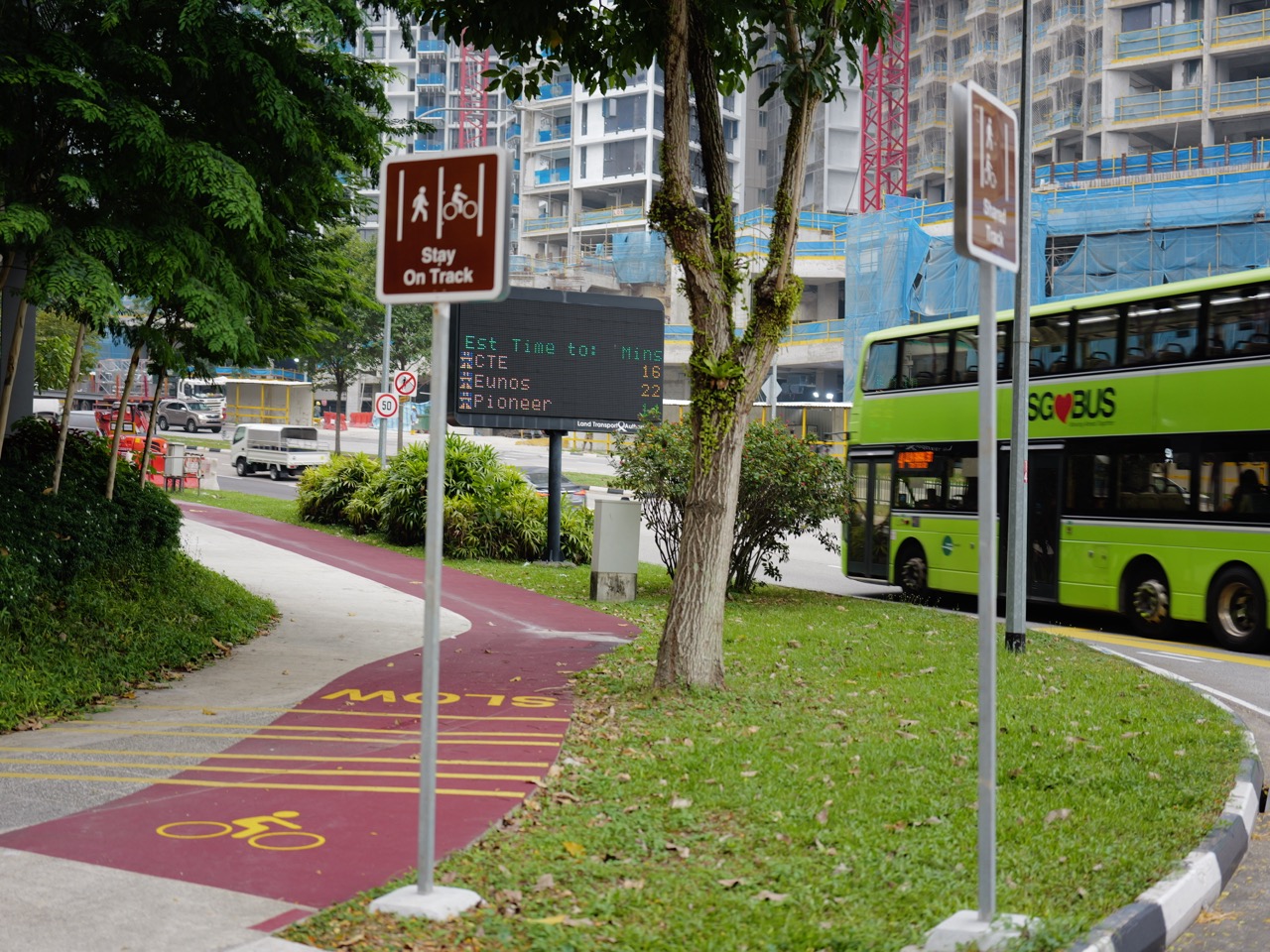
The first question is therefore what kind of path is this? It may be a footpath, a cycling path, a shared path or a specially marked pedestrian-only path. The presence of pavement alone does not answer the question.
LTA has expanded its network of marked walking and cycling infrastructure. Some paths are separated by signs and surfaces; others remain shared. Temporary construction diversions may also change how people pass through a junction.
For a 2027 journey, follow the current signs and markings on the actual route and use LTA’s active mobility rules when uncertain.
What exactly is a Pedestrian-Only Path?
LTA’s Pedestrian-Only Paths Initiative took effect from 1 July 2025. It converts footpaths adjacent to dedicated cycling paths into areas intended for pedestrians and permitted mobility-aid users.
The essential practical change is that cyclists and users of non-motorised personal mobility devices should use the adjacent cycling path rather than continue riding along the newly marked pedestrian-only section.
This policy protects people who may be less able to move quickly out of the way, including young children, seniors and pedestrians with disabilities. It also makes the function of adjacent paths clearer.
A cyclist may occasionally need to cross a pedestrian-only section to reach an estate path or avoid an obstacle, but LTA expects that crossing to be done carefully before returning to the cycling path. That is not a general licence to treat the pedestrian-only route as an alternative cycling lane.
Does this mean bicycles are banned from every footpath?
No. A designated Pedestrian-Only Path is not the same as every ordinary footpath. LTA continues to permit bicycles on many standalone footpaths that have not been converted, subject to the relevant device requirements and speed limit.
This difference matters in established Bukit Timah neighbourhoods where some streets have older footpaths and others have new cycling facilities. Riders must read the markings instead of assuming that one set of rules covers all pavements.
The ordinary footpath limit is 10 km/h for permitted devices. That is a maximum, not a target. Where people are walking closely together, much slower movement or dismounting may be the safe response.
For an overview, consult LTA’s official Rules and Code of Conduct.
Cycling paths and shared paths: why the 25 km/h limit is not an invitation to race
LTA’s general path framework provides a 25 km/h maximum speed on cycling paths and shared paths for permitted active-mobility devices. This is a legal upper limit, not a recommended cruising speed in busy conditions.
A shared path includes both pedestrians and permitted riders. Children can change direction abruptly, and a person with reduced hearing or mobility may not notice a fast-approaching bicycle. Riders should slow down well before becoming a hazard.
The meaning of a route also depends on the current markings. A red surface is not sufficient evidence on its own if temporary signs or a different layout apply.
A careful rider looks ahead, gives way to vulnerable users and keeps enough stopping distance for the actual circumstances.
The Rail Corridor has its own 10 km/h cycling rule
For Bukit Timah, this is one of the most important local distinctions. The Rail Corridor’s official visitor guidance sets a 10 km/h speed limit for cyclists along the corridor.
It also tells riders to give way to pedestrians, ring their bell before overtaking and dismount and push bicycles when crossing bridges. This applies even when a cyclist is comfortable riding much faster on a conventional cycling path elsewhere.
The Rail Corridor is a shared heritage and ecological space, not a road-racing course. It attracts walkers, families, photography enthusiasts and people visiting conserved railway features.
A rider who follows the more general 25 km/h shared-path limit without checking the Rail Corridor’s special rule could be riding too fast. Specific location rules take precedence.
Are power-assisted bicycles and e-scooters allowed on the Rail Corridor?
NParks explicitly says motorised personal mobility devices and power-assisted bicycles (PABs) are not permitted on the Rail Corridor. This rule differs from certain public cycling paths elsewhere where specific approved devices may be allowed.
A PAB, which assists pedalling with a motor, should not be confused with a manual bicycle. A motorised PMD such as an e-scooter also has its own registration, technical and location restrictions.
Residents should plan a legal alternative route rather than assume a motorised device can follow the same corridor used by ordinary cyclists. Use LTA’s live cycling infrastructure guidance to identify routes that permit the device type.
The corridor may also have temporary maintenance closures or diversions. Check the official Rail Corridor website before a long trip, especially if the route crosses into another part of Singapore.
Bridges: why dismounting is part of safe riding
A narrow bridge concentrates people into a smaller space. Even a cyclist travelling below the normal speed limit can create discomfort or danger when trying to overtake a family or a person using a walking aid.
The Rail Corridor’s instruction to dismount and push bicycles on bridges is therefore a practical safety measure, not an arbitrary interruption to a cycling route.
Dismount early enough to avoid sudden braking among other users. Walk the bicycle at a comfortable pace and allow others to pass safely. Do not treat a bridge as a place to demonstrate technical riding skill.
If a bridge or trail section is closed, follow the designated diversion. Do not enter a worksite or lift a bicycle through a restricted barrier.
Nature reserve hiking trails are not general bicycle paths
Bukit Timah Nature Reserve protects sensitive forest habitats. The visitor rules distinguish between hiking trails and designated routes for bicycles. A trail that looks rideable is not automatically open to cyclists.
NParks’ Bukit Timah Nature Reserve visitor information and official route guidance should be consulted before any ride or hike. The reserve is also an area where pets are not permitted.
For cyclists who want challenging mountain biking, use a clearly designated trail where cycling is allowed and observe its specific rules. For families who simply want to walk, choose a suitable hiking route rather than sharing a narrow trail where bicycles are prohibited.
This protects both people and the forest floor. An active-mobility guide should not encourage riding on restricted paths merely because a mapping app shows a line through greenery.
Safe cycling near school entrances and bus stops
A school route can contain crowded footpaths, turning vehicles, parked cars and children who are concentrating on something other than approaching traffic.
LTA’s Code of Conduct advises riders to slow down near bus stops and path intersections, give way to pedestrians, keep left where appropriate and gently alert people before overtaking. If an area is crowded, walking the bicycle is often a better response.
Parents should teach children to identify where riding is permitted and when it is necessary to stop. They should also explain that a bicycle bell is a courteous warning, not an instruction ordering pedestrians to move aside.
At busy crossings, dismounting may be easier than negotiating a tight space. Follow the actual traffic-control and path signage rather than assuming an unmarked corner is safe to cycle across.
Cycling on the road: a different set of safety obligations
Cycling on roads introduces vehicles, higher speeds and traffic-control rules. LTA requires cyclists to wear helmets when cycling on roads, follow traffic signals and travel with traffic rather than against it.
Cyclists and PAB riders should use the left side of the road as required, be particularly careful near turning vehicles and buses, and use white front and red rear lights in darkness in accordance with the rules.
Expressways, road tunnels and selected viaducts are prohibited to cyclists. A direct route on a navigation app can therefore be unsuitable or unlawful for a bicycle.
Families riding with inexperienced children should not choose a busy road merely because it is shorter. The route must fit the rider’s actual skill and age, with appropriate adult supervision.
What changed for mobility scooters on 1 June 2026?
The Land Transport Authority introduced tighter Personal Mobility Aid (PMA) regulations from 1 June 2026. These changes matter throughout 2027 for residents who use mobility scooters or similar devices because of genuine movement difficulties.
Among the changes, motorised PMAs must not travel faster than 6 km/h on public paths, and mobility scooter users generally require a Certificate of Medical Need unless they meet an exemption. Devices are also subject to dimension and weight criteria, with medically certified exceptions where relevant.
It is important not to describe every powered device as a PMA. Motorised PMDs, PABs and medical mobility aids have different permitted uses and regulatory requirements.
Check LTA’s dedicated PMA regulations page for the full definitions and current rules.
Who needs a Certificate of Medical Need?
LTA says users of mobility scooters and equivalent devices must generally complete the Assessment for Mobility Scooter (AMS) to receive a Certificate of Medical Need, unless an exemption applies.
Among those exempted are seniors aged 70 and above, as well as certain users who qualify through specified government assistive-technology or disability-support schemes. The actual list of exemptions contains detailed conditions; it should not be reduced to a claim that every senior or every wheelchair user follows the same process.
A resident who is uncertain should use OneMotoring’s certificate and exemption status guidance or LTA’s official instructions.
Do not tell a neighbour that they are medically ineligible simply because of their appearance. Certification and exemptions are handled through the relevant official process.
The significant 2027 milestone: registration of existing scooters
LTA’s August 2026 active mobility enforcement factsheet confirms that registration of existing mobility scooters and equivalent devices will be progressively facilitated from mid-2027.
LTA plans roving registration stations at community touchpoints, with compliance checks on devices and users. The agency states that more information about exact arrangements will be released closer to the time.
This is a genuine future programme milestone. Yet it is not evidence that a registration station has been booked at Bukit Timah Community Club, Beauty World or any particular estate on a specific 2027 date.
Residents should follow LTA directly and use official registration channels rather than hand over personal information to an unsolicited caller or unverified registration agent.
When does an existing mobility scooter have to be registered?
The mandatory registration requirement takes full effect 1 January 2029. LTA says using an unregistered mobility scooter on public paths will be an offence from that date.
This means the start of the registration process in mid-2027 should be understood as a period during which existing users can prepare and complete compliance checks before the later legal deadline.
New mobility scooters sold by retailers have already been subject to registration-related requirements since June 2026. The process differs for those who already owned a device before that transition.
For the most precise instructions, visit LTA’s PMA regulations and registration page.
Device dimensions and the difference between a speed limit and a speed-capable device
LTA’s newer PMA rules include an indicative maximum physical envelope of 120 cm length, 70 cm width and 150 cm height, together with a 300 kg laden-weight limit, subject to the specific medical provisions for oversized devices.
There is another important distinction: a travel speed limit tells users how fast they may move on a public path, whereas a device’s maximum speed capability describes how fast the machine itself can operate. The legal transition for device speed capability includes arrangements continuing towards 1 January 2029.
Residents using older equipment should not assume that travelling slowly makes every aspect of a non-compliant device legal forever. Equally, they should not be told that all existing scooters became illegal on 1 June 2026 simply because later registration is planned.
The safe approach is to consult the official LTA FAQ for the actual model, purchase date, medical need and compliance procedure.
Mobility scooters are not the same as electric bicycles
A mobility scooter is designed to assist a person with movement difficulties; a power-assisted bicycle is a bicycle with a motor providing assistance when pedalled. A motorised PMD such as an e-scooter is yet another type of device.
Different regulatory classifications explain why some devices can enter pedestrian-only paths while others cannot, and why a family should not buy a machine on the basis of an informal comparison.
For example, LTA permits appropriate PMAs on pedestrian-only paths with pedestrians, but that does not imply a PAB rider may use the same space. LTA also does not permit PMAs on ordinary roads.
Before purchasing or modifying a device, read the current type-specific rules. A marketing term such as “elderly electric bike” does not determine the machine’s legal classification.
How to support an older relative through the 2027 transition
A family helping an older relative can begin with practical information rather than alarm. Identify the actual device, whether it is already registered, whether the user is exempt from certification and whether its dimensions and speed comply with the relevant rules.
When LTA announces roving stations, check the genuine registration location, date and documents required. If accessibility or transport is difficult, ask the agency about suitable arrangements instead of relying on an unverified private service.
Do not share an older person’s identity documents, medical details or device registration information in public messaging groups. Use official portals and handle personal information carefully.
An elderly resident’s mobility and independence matter. The aim of appropriate regulation and assistance is safe use of shared public spaces, not to create unnecessary barriers through misinformation.
What about electric bicycles, batteries and home fire safety?
Devices using lithium batteries create additional safety considerations. LTA has tightened restrictions on non-compliant e-scooters, and both LTA and the Singapore Civil Defence Force provide advice on appropriate charging and equipment.
Avoid unauthorised modification, unsafe chargers and damaged or swollen batteries. Follow the maker’s instructions and approved safety guidance. Do not treat a cheap replacement battery with unclear specifications as equivalent to the original.
If a battery becomes hot, deformed or behaves abnormally, stop using the equipment and seek appropriate qualified help. Emergency response instructions take priority when there are signs of fire or imminent danger.
This matters in a neighbourhood with shared corridors, residences and public charging concerns. Fire safety is part of active mobility, not a separate optional issue.
A practical route audit for Bukit Timah families
Here is a useful 2027 family activity that does not require a formal event.
Step one: choose an everyday journey, such as home to school, a nearby clinic or the MRT. Step two: identify footpaths, cycling paths, pedestrian-only sections and crossings. Step three: assess how the route works for the actual user—walking child, cyclist, stroller or mobility-aid user.
Step four: note places where the paths narrow or multiple groups interact. Step five: check whether a safe legal alternative exists if a worksite blocks access. Step six: verify current agency rules and conditions before changing the daily routine.
The exercise is especially valuable for children learning civic responsibility. A route can be legal for one device and unsuitable for another, and good public behaviour means considering more than personal convenience.
Why the Cross Island Line is still relevant—but not a 2027 service
Bukit Timah’s longer-term transport picture includes construction of Cross Island Line Phase 2, which will connect at King Albert Park. LTA’s current completion target is 2032.
That future network is relevant to how people may eventually combine walking, cycling and rail travel. But it cannot yet provide a shorter 2027 school commute, and a station under construction is not an operating interchange.
Residents should distinguish current paths, construction diversions and future planned connections. Combining these layers into one imagined route causes confusion and can lead households to choose unsuitable transport options.
For more detail, read eduKateSG’s Bukit Timah 2027 MRT and transport-change guide.
What to do when a path becomes unsafe or obstructed
If an obstacle blocks a usable footpath, do not assume it is acceptable to ride through a pedestrian-only space at speed or enter a construction worksite to bypass it.
Stop, inspect the available safe route, follow any temporary signs and dismount when necessary. If a wheelchair or mobility scooter cannot pass a diversion, contact the responsible agency or project operator with a clear description.
Include the nearest landmark, the specific side of the road, time and nature of the barrier. A factual, detailed report is more actionable than a general complaint that a neighbourhood is unfriendly to cyclists.
If there is an immediate hazard or injury, follow the appropriate emergency procedures. Routine infrastructure feedback belongs with the responsible agency.
How to read a 2027 active-mobility announcement correctly
Official information can refer to an effective legal date, an outreach programme, a registration window, an enforcement change or the completion of physical infrastructure.
These are different. For example, mid-2027 is the stated beginning for existing mobility scooter registration, while 1 January 2029 is the full mandatory registration date. Neither should be described as a newly opened MRT station or cycling path.
Similarly, a conversion of a footpath to pedestrian-only status changes the permitted users; it does not mean that all bicycles are forbidden on every standalone footpath.
When sharing an update with neighbours, add the source and the relevant device category. Without these, even well-intentioned advice can be misleading.
A family watchlist for 2027
- Before the school year: walk the actual route and identify safe crossings, permitted cycling sections and any nearby roadworks.
- At the start of 2027: review LTA’s current active-mobility rules, especially the distinctions between bicycles, PABs, PMDs and PMAs.
- From mid-2027: if someone in the household owns an existing mobility scooter, check LTA’s announced roving registration arrangements; do not assume a local venue before it is confirmed.
- Before a Rail Corridor outing: check NParks’ current closures, follow its 10 km/h cycling limit and dismount on bridges.
- At year-end: verify any new path markings or regulatory notices and update household travel routines for 2028.
This is a recommended information routine, not a timetable of scheduled activities at specific Bukit Timah venues.
Frequently asked questions
Are bicycles banned from all Bukit Timah footpaths?
No. LTA’s pedestrian-only designation applies to certain converted paths alongside cycling paths. Many ordinary footpaths still permit bicycles under the applicable rules and 10 km/h maximum.
What speed can I cycle on the Rail Corridor?
NParks specifies a 10 km/h cycling speed limit, slower than the general 25 km/h maximum on some marked cycling and shared paths.
Must cyclists walk their bicycles on Rail Corridor bridges?
Yes. NParks tells cyclists to dismount and push bicycles when crossing bridges.
Can I ride an e-scooter or PAB along the Rail Corridor?
No. NParks says motorised PMDs and power-assisted bicycles are not allowed on the Rail Corridor.
What speed applies to motorised mobility aids on public paths in 2027?
Under LTA’s rules introduced on 1 June 2026, motorised PMAs must travel at no more than 6 km/h on public paths.
Do all mobility scooter users need medical certificates?
Generally they do, but there are stated exemptions, including seniors aged 70 and above and certain other qualifying groups. Check LTA’s detailed eligibility guidance.
Will a mobility scooter registration roadshow definitely be held at Bukit Timah Community Club in 2027?
No location has been established by the sources used here. LTA has announced roving community registration from mid-2027, with specific arrangements to be announced closer to that time.
Is 2027 the deadline after which an existing unregistered mobility scooter becomes illegal?
No. LTA’s current full mandatory registration date is 1 January 2029. Mid-2027 marks the planned start of registration for existing devices.
Are pedestrians allowed to use cycling paths?
LTA encourages pedestrians to use pedestrian-only paths where available, keeping faster cycling paths for riders. If a diversion makes that impossible, follow the safe route and on-site instructions.
Can I use a bicycle on a Bukit Timah Nature Reserve hiking trail?
Not on trails designated for hiking only. Use a permitted cycling route and obey the reserve’s protected-area rules.
Official sources and useful local guides
- LTA: Active mobility rules, pedestrian-only paths and code of conduct
- LTA: Regulations and registration for Personal Mobility Aids
- LTA: February 2026 new PMA rules and medical-certification requirements
- LTA: August 2026 enforcement update and mid-2027 scooter registration
- OneMotoring: Certificate of Medical Need and exemptions
- NParks: Rail Corridor cycling speed, bridge and device rules
- NParks: Bukit Timah Nature Reserve access and etiquette
- eduKateSG: Rail Corridor cycling and pedestrian priority
- eduKateSG: Walking and cycling infrastructure improvements
- eduKateSG: Bukit Timah 2027 neighbourhood transport and MRT
- eduKateSG: Safe school journeys and SEC transitions
The takeaway: 2027 Bukit Timah active mobility is about knowing the exact type of path and device, keeping pedestrians safe and preparing eligible existing mobility scooters for registration once LTA announces the local arrangements. The important dates are 2025 pedestrian-only rules, 2026 PMA safety changes, mid-2027 registration access and 2029 mandatory registration.