
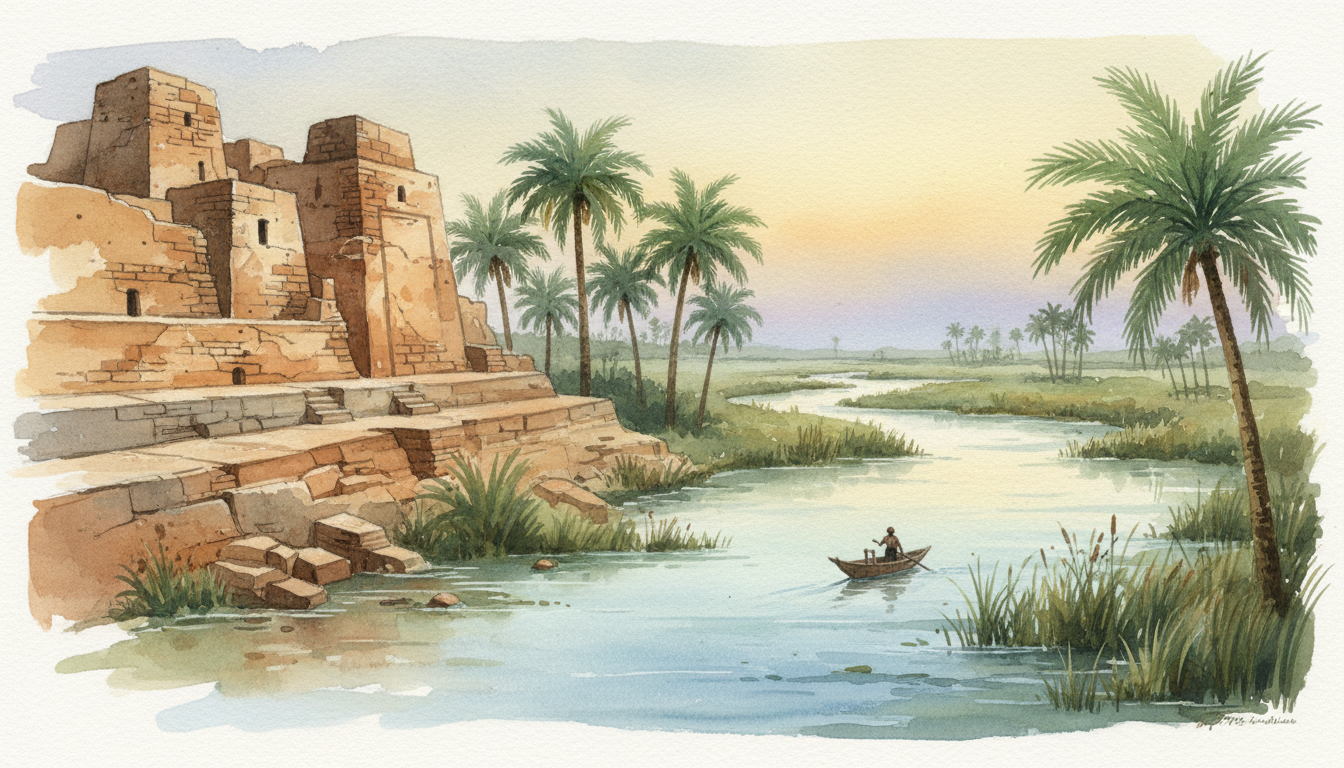
Did you know that an Egyptian model granary dating back almost four thousand years contains more people keeping accounts than carrying sacks? Six figures transport the grain, while nine work at measuring and accounting.
That small detail opens an enormous question: when a city depends on harvests grown by many different families, who makes sure that the food arrives, stays usable and reaches the people who need it?
Ancient granaries helped societies manage food over time, but a storehouse was not a magical shield against hunger. Farming, transport, measurement, records, distribution and fair decisions all had to work together. The granary was a physical building inside a much larger civilisation system.
The quick answer
How did ancient granaries work? Explore Egyptian grain stores, Mesopotamian barley records, food shortages and the hidden labour behind civilisation.
In 60 seconds
- A granary stores harvested crops; reliability also requires accounting, protection, transport and decisions about distribution.
- A Middle Kingdom Egyptian tomb model shows separate storage and administrative areas, illustrating the organisation around food.
- A stockpile can help during disruption, but it cannot by itself guarantee enough food, fair access or survival through every shortage.
What was an ancient granary?
At its simplest, a granary is a place to store grain such as barley or wheat. Storage allows some of a harvest to remain available after the fields have been cleared, instead of every household needing to consume or exchange everything immediately.
But stored grain is not the same as food security. People must first produce a harvest, move it before it spoils, keep it sufficiently dry and protected, and make sure the quantities recorded correspond to what is physically there.
In some settings, stores could support particular estates, temples, households or government obligations. We should not assume that every ancient granary was a public emergency reserve or that every resident could take grain when hungry.
Here is the useful mechanism: harvest → transport → storage → checking → allocation → consumption or planting. Each arrow represents people, knowledge and possible failure.
The Egyptian model that makes the paperwork visible
The Metropolitan Museum of Art’s model of a granary with scribes comes from the tomb of the royal steward Meketre, dating to about 1981–1975 BCE.
The model is divided into two main areas: one for storing grain and the other for accounting. It includes six carriers with sacks and nine people involved in measuring and keeping accounts, among them scribes using papyrus and wooden writing boards.
Its raised corners may have helped represent protection against animals or thieves. The model preserves an idea of how a carefully organised store might operate, and how important counting was to those who commissioned it.
We have to be precise: this is an elite funerary model, not a photograph of a particular daily delivery. It cannot prove that all ancient Egyptian stores employed exactly fifteen workers or maintained identical records.
What it does show is that grain management was understood as a combination of material work and administrative work. Somebody had to distinguish what arrived from what was promised, and what remained from what had already been distributed.
Why scribes mattered as much as sacks
Imagine that a store receives one hundred sacks and later issues thirty. A worker who only counts the remaining sacks might find sixty-eight rather than seventy. Is the difference caused by a recording error, spoilage, theft, a damaged sack or a mistaken earlier count?
Ancient administrators did not have spreadsheets, but they confronted the same need to reconcile goods and records. Written accounts made it possible to trace obligations across days and between officials.
A scribe’s task was not the same as producing grain. Yet without reliable knowledge of stock, a ruler or estate manager might make promises based on food that was no longer available.
That produces a subtle lesson: information is part of food infrastructure. Stores need walls and workers, but they also need people able to check quantities and identify discrepancies.
Accurate records do not establish fair distribution by themselves. A store can be counted perfectly while access is unequal. Administrative efficiency and social justice are different questions.
Uruk: grain in the earliest surviving economic records
In southern Mesopotamia, some of the earliest surviving written tablets relate to the management of goods. The Met’s proto-cuneiform tablet from around 3100–2900 BCE probably concerns deliveries and distributions of barley and emmer wheat.
Another tablet with numerical signs and seal impressions appears to concern barley issued by a large temple institution.
These are earlier than the Egyptian Meketre model, and they come from another culture. Their importance is not that the same organisation existed everywhere, but that grain accounting became significant enough to leave written traces.
The Met also notes an important limit: early records often lack verbs, which makes precise interpretation difficult. A tablet may reveal commodities and quantities without explaining every step or intention behind a transaction.
Did you know? A small piece of clay can tell us more about how a large institution handled grain than a monument designed to celebrate a king. Yet the clay does not tell us whether hungry households benefited.
Storage could make specialised urban life more possible
A city contains people who are not farming during every hour of the day: builders, craftspeople, religious specialists, administrators, traders and children learning skills.
Such specialisation depends on food moving between producers and consumers. A reliable store can help coordinate supply when harvests happen seasonally and consumption continues every day.
The Met’s account of Uruk describes an early urban environment of monumental buildings, craft activity and records of goods and workers’ rations. The city operated through multiple linked forms of work, not agriculture alone.
We should not claim that granaries alone invented cities. Communities had long histories of settlement, exchange and cultivation, and many factors shaped urbanisation.
A more careful statement is that dependable food storage and redistribution helped some institutions support work that could not happen without a food supply.
Han China: a different granary in a different age
A Met essay on ancient architectural models describes Han-dynasty Chinese tomb models representing granaries, wells and animal enclosures alongside other useful buildings.
These models belong to a much later historical setting than early Mesopotamia or Middle Kingdom Egypt. They remind us that communities in different regions continued to treat food-related structures as essential features of organised life.
But tomb models also communicate ideals about a prosperous estate and the afterlife. They are not direct measurements of how much food any particular village stored or how effectively officials responded to shortage.
The comparison works because it reveals a recurring problem—keeping food available beyond the moment of harvest—without claiming the governments, religions or storehouse designs were identical.
What could go wrong with a food reserve?
These risks show why a full storehouse is not equivalent to a well-fed population. Who controls the keys, quantities and decisions matters.
The correct historical question is not simply ‘Did they store grain?’ It is ‘For whom was it stored, who controlled it and what happened when demand exceeded supply?’
- Production failure: drought, flood, pests or conflict may reduce the harvest before grain ever reaches storage.
- Transport failure: damaged roads, unsafe routes or lost vessels can interrupt delivery.
- Storage failure: moisture, vermin, theft and poorly maintained buildings can reduce what remains usable.
- Accounting failure: incorrect quantities can cause bad promises or conceal losses.
- Distribution failure: food can exist in a store yet remain inaccessible to people who need it.
- Political failure: demands from rulers, armies or elites may crowd out the needs of households.
A shortage scenario: watch the system rather than the walls
Imagine a hypothetical river town with two harvests to cover the coming year. A flood damages one of the roads to its main store. A smaller delivery arrives, while officials initially use the previous season’s allocation plan.
If nobody checks what actually arrived, the shortage is hidden until orders cannot be filled. Households may then borrow food, change diets, move away or lose time searching for another supply.
Now imagine that incoming stock is verified quickly and a replacement route or adjusted distribution plan is available. The town may handle the same physical flood differently.
This is a systems-thinking example, not a reconstruction of a named ancient famine. Its causal chain is environmental disruption → delivery and stock change → administrative response → unequal household outcomes.
A food reserve is valuable only if the people responsible can recognise changes in reality and act on them.
Five questions to ask when studying ancient food storage
Granaries are more than places where ancient people put food. They are evidence of how societies tried to carry a seasonal harvest forward into the uncertain future.
Civilisation survives through many quiet routines, and one of them is simply making sure the next meal remains possible.
- Which crop or product was stored, and how was it harvested?
- Was the facility household, estate, temple, communal or governmental?
- What evidence documents the workers, accounting and physical building?
- How did people manage spoilage, losses and stock decisions?
- Who received grain, and who might have been excluded?
Frequently asked questions
What was an ancient granary used for?
It stored harvested grain for later use. Its function could be connected with households, estates, temples or public institutions depending on the society.
Did ancient granaries always prevent famine?
No. Production failures, spoilage, conflict, inaccurate records and unequal access could still lead to severe shortages.
What did Egyptian scribes do in granaries?
They helped measure, record and account for grain, as illustrated by the Middle Kingdom model from Meketre’s tomb.
What do Mesopotamian grain tablets reveal?
They provide evidence that institutions tracked commodities and quantities. Some early tablets are difficult to interpret completely because their writing lacks later grammatical features.
Were all ancient granaries the same?
No. Building design, scale, ownership and access differed between periods and regions.
What is the main lesson?
Food security requires more than walls: production, physical stock, trustworthy records, maintenance and fair decisions must work together.
Explore the Civilisation series
Read the Civilisation archive for more, or follow this connected batch:
- Civilisation | How Ancient People Measured Weights, Lengths and Time
- Civilisation | How Ancient Healers Treated Illness and Injury
- Civilisation | How Ancient Craftspeople Turned Materials into Technology
Previously in the series:
- Civilisation | How Family Life Shaped Ancient Societies
- Civilisation | How Women Worked and Influenced Ancient Civilisations
- Civilisation | How Children Learned Before Modern Schools
- Civilisation | How Art, Music and Stories Preserved Cultural Memory
Sources and further reading
The museum and research sources below support the historical cases. Each illustrates a particular time and place; they do not prove that all ancient societies followed the same model.
- The Met — Model of a Granary with Scribes
- The Met — Administrative Account of Barley and Emmer
- The Met — Proto-Cuneiform Barley Distribution Tablet
- The Met — Uruk: The First City
- The Met — Ancient Architectural Models
Remember the historian’s three checks: what survives, how we know and what the evidence does not yet tell us.